Blog Archives
‘Uncle Vanya,’ Steve Carell in a Superb Update of Timeless Chekhov

A favorite of Anton Chekhov fans is Uncle Vanya because it combines organic comedy and tragedy emerging from mundane, static situations, intricate, suppressed characters and their off-balanced, mired-down relationships. Playwright Heidi Schreck (What the Constitution Means to Me), has modernized Vanya enhancing the elements that make Chekhov’s immutable work relevant for us today. Lila Neugebauer’s direction stages Schreck’s Chekhov update with nuance and singularity to make for a stunning premiere of this classic at Lincoln Center’s Vivian Beaumont in a limited run until June 16th.
With a celebrated cast and beautifully shepherded ensemble by the director, we watch as the events unfold and move nowhere, except within the souls of each of the characters who climb mountains of elation, fury, depression and despair by the conclusion of this two act tragicomedy.
Schreck has threaded Chekhov’s genius characterizations with dialogue updates that are streamlined for clarity, yet allow for the ironies and sarcasm to penetrate. At the top of the play Steve Carell’s Vanya is hysterical as he expresses his emotional doldrums at the bottom of a whirlpool of chaos which has arrived in the form of his brother-in-law, Professor Alexander (the pompous, self-important Alfred Molina in a spot-on portrayal), and Alexander’s beautiful, self-absorbed, younger-by-decades wife Elena (Anika Noni Rose). Also present is the vibrant, ironic, self-deprecating, overworked Dr. Astrov (William Jackson Harper), a friend who visits often and owns a neighboring estate.

During the course of the first act, we are witness to the interior feelings and emotions of all the characters who in one way or another are bored, depressed, miserable and disgusted with themselves. Vanya is enraged that he has taken care of Alexander’s lifestyle, even after his sister died in deference to his mother, Maria (Jayne Houdyshell). He is particularly enraged that he believed with is mother that Alexander was a “brilliant” art critic who deserved to be feted, petted and over credited with praise when he lived in the city.
Having clunked past his prime as an old man, Alexander has been fired because no one wants to read his work. He and Elena have run out of money and are forced to stay in the family’s country estate with Vanya and Sonia, Alexander’s daughter (the poignant, heartfelt Alison PIll), away from the limelight which shines on Alexander no more. Seeing Alexander in this new belittlement, though he orders around everyone in the family, who must wait on him hand and foot, Vanya is humiliated with his own self-betrayal. He didn’t realize that Alexander was a blowhard who duped and enslaved him to labor on the farm to supporting his high life, while he pursued his “important” writing. Vanya and Sonia labor diligently to make sure the farm is able to support the family, though it has been a difficult task that recently Vanya has grown to regret. He questions why he wasted his years on a man unworthy of his time and effort, a fraud who knows little about art.

Likewise, Astrov questions his own position as a doctor, admitting to Marina (Mia Katigbak), that he feels responsible for not being able to help a young man killed in an accident. To round out the “les miserables,” Alexander is upset that he is an old man who is growing more decrepit by the minute as he endures believing his young, beautiful wife despises him. Despite his upset, Alexander expects to be waited on by his brother-in-law, mother-in-law and in short, everyone on the estate, which he has come to think is his, by virtue of his wanting it. Though the estate has been bequeathed to his daughter Sonia by Vanya’s sister, his first wife, Alexander and Elena find the quiet life in the country unbearable.
As they take up space and upturn the normal routine of the farm, Elena has been the rarefied creature who has disturbed the molecules of complacency in the lives of Vanya, Sonia and Astrov. Her beauty is shattering. Sonia hates her stepmother, and both Vanya and Astrov fall in love and lust with her. As a result, their former activities bore them; they cannot function with satisfaction, and have fallen distract with want, craving the impossible, Elena’s love. Alexander fears losing her, but realizes if he plays the victim and harps on his own weaknesses of old age, as distasteful as he is, Elena is moral enough to attend to him, though she is bored and loathes him in the process.

The situation is fraught with problems, hatreds, regrets, upsets and soul turmoil, which Schreck has stirred following Chekhov’s dynamic. Thus, Carell’s Vanya and Harper’s Astrov are humorous in their self-loathing as is the arrogant Alexander and vapid Elena who Sonia suggests can end her boredom by helping them on the farm. Of course, work is not something Elena does, which answers why she has married Alexander and both have been the parasites who have sucked the lifeblood of Vanya and Sonia, as they labor for their “betters,” who are actually inferior, ignoble and selfish.
To complicate the situation, Sonia is desperately in love with Astrov, who can only see Elena who is attracted to him. However, Elena is afraid to carry out the possibility of their affair. Instead, she destroys any notion that Sonia has of being with Astrov by ferreting out Astrov’s feelings for Sonia which tumble out as feelings for Elena and a forbidden, hypocritical kiss which Vanya sees and adds to his rage at Elena’s self-righteousness and martyred morality. When Elena tells Sonia that Astrov doesn’t love her, Sonia is heartbroken. It is Pill’s shining moment and everyone who has experienced unrequited love empathizes with her devastation.
When Alexander expresses his plans to sell the estate and take the proceeds to live in the city in a greater comfort and elegance, Carell’s Vanya excoriates Alexander and speaks truth to power. He finally clarifies his disgust for the craven and selfish Alexander, despite Maria’s belief that Alexander is a great man, not the fraud Vanya says he is.

It is a gonzo moment and Carell draws our empathy for Vanya who attempts to expiate his rage, not through understanding how he is responsible for being a dishrag to Alexander, but through manslaughter. The scene is brilliantly staged by Neugebauer and is both humorous and tragic. The denouement happens quickly afterward, as each of the characters turns to their own isolated troubles with no clear resolution of peace or reconciliation with each other.
The ensemble are terrific and the actors are able to tease out the authenticity of their characters so that each is distinct, identifiable and memorable. Naturally, Carell’s Vanya is sympathetic as is Pill’s heartsick Sonia, for they nobly uphold the ethic that work is a kind of redemption in itself, if dreams can never come true. We appreciate Harper’s Astrov in his love of growing forests and his understanding of the extent to which the forests that he plants will bring sustenance to the planet, if even to mitigate only somewhat the society’s encroaching destructiveness. Even Katigbak’s Marina and Sonia’s godfather Waffles (the excellent Jonathan Hadary), are admirable in their ironic stoicism and ability to attempt to lighten the load of the others and not complain.

Finally, as the foils Molina’s Alexander and Noni Rose’s Elena are unredeemable. It is fitting that they leave and perhaps will never return again. The chaos, misery, dislocation and confusion they leave in their wake (including the somewhat adoring fog of Houdyshell’s Maria), are swallowed up by the beautiful countryside and the passion to keep the estate functioning which Sonia and Vanya hope to achieve in peace. Vanya, for now, has thwarted Alexander, by terrorizing Alexander into obeying him in a language (threatening his life), he understands. For this we applaud Vanya.
When Alexander and Elena leave, the disruption has ended and they take their drama and chaos with them. It is as if they were never there. As Vanya and Sonia handle the estate’s paperwork, which they’ve neglected having to answer Alexander’s every need, the verities of truth, honor, nobility and sacrifice are uplifted while they work in silence, and peace is restored to the estate, though they must suffer in not achieving the desires of their lives.
Neugebauer and Schreck have collaborated to create a fine version of Chekhov’s Uncle Vanya that will remain in our hearts because of the simplicity and clarity with which this update has been rendered. Thanks go to the creative team. Mimi Lien’s set design functions expansively to suggest the various rooms of the estate, the garden and hovering forest in the background. A decorative sliding divider which separates the house from the forest and allows us to look out onto the forest and woods beyond (a projection), symbolizes the division between the natural and the artificial worlds which influence and symbolize the characters and what they value.

Vanya and the immediate family take their comforts from the earth and nature as does Astrov. Alexander and Elena have forgotten it, finding no solace in the beautiful surroundings and quiet, rural lifestyle which they find boring because they prefer chaos and the frenetic atmosphere of society. Essentially they are soul damaged and need the distractions they’ve become used to when Alexander was famous and the life of the party before he got tiresome and old and disgusting in the eyes of Elena and those who fired him..
The projection of trees that expands entirely across the stage in the first act is a superb representation of what is immutable and must be preserved as Astrov works to preserve. The forest of trees which is the backdrop of the garden, sometimes sway in the wind. The rustling leaves foreshadow the thunder storm which throws rain into the garden/onstage. The storm symbolizes the storm brewing in Uncle Vanya about Alexander, and emotionally manifests when Alexander suggests they sell the estate to fulfill his personal agenda.
During the intermission every puddle and water droplet is sopped up by the tech crew. Kudos to Lap Chi Chu & Elizabeth Harper for their lighting design and Mikhail Fiksel & Beth Lake for their sound design which bring the symbolism and reality of the storm home.
The modern costumes by Kaye Voyce are character defining. Elena’s extremely tight knit, brightly colored, clingy dresses are eye candy for her admirers as she intends them to be to attract their attention, then pretend she doesn’t want it. Of course she is the leisurely swan while Sonia is the ugly duckling in work clothing, Grandmother Maria dresses like the “hippie radical feminist” that she is, and Marina is in a schmatta as the servant who cooks and cleans. Here, it is easy for Elena to shine; there is no competition.
Vanya looks frumpy and uncaring of himself. This reflects his depression and lack of confidence, while Molina’s Alexander is dressed in the heat like a peacock with a scarf, cane and hat and cream-colored suit when we first see him. Astrov is in his doctor’s uniform, utilitarian, purposeful, then changes to more relaxed clothing. The costumes are one more example of the perfection of Neugebauer’s vision and direction of her team.
Uncle Vanya is an incredible play and this update does Chekhov justice. It is a must-see for Schreck’s script clarity, the actors seamless interactions and the creative teamwork which elevates Chekhov’s view of humanity with hope, sorrow and love in his characterizations, especially of Vanya.
Uncle Vanya runs two hours twenty-five minutes including one intermission, Lincoln Center Theater at the Vivian Beaumont. https://www.lct.org/shows/uncle-vanya/whos-who/
Hugh Jackman’s Indelible, Winning Con in ‘The Music Man,’ Just Unbeatable!’
Historically, America is the land of con artists and showmen. Do you know the difference? As a relatable example there is David Hannum who in the 1850s bought the “Cardiff Giant,” a stone statue he unwittingly believed to be real (the giant fake was made in Iowa). As did its previous owner, Hannum charged admission for viewings. When P.T. Barnum (Hugh Jackman portrayed Barnum in The Greatest Showman) couldn’t purchase the Cardiff Giant for $50,000, he made his own plaster statue, called Hannum’s statue the fake, and charged more money, advertising his as the “real” one. Hannum sued Barnum and referring to Barnum’s patrons said, “There’s a sucker born every minute,” not realizing he, too, had been duped. The suit failed when the originator of the hoax “came clean.” Interestingly, all three entrepreneurs probably kept the money “they earned” providing a thrilling show. In keeping with the great cons of America, history is silent about whether patrons got their money back.
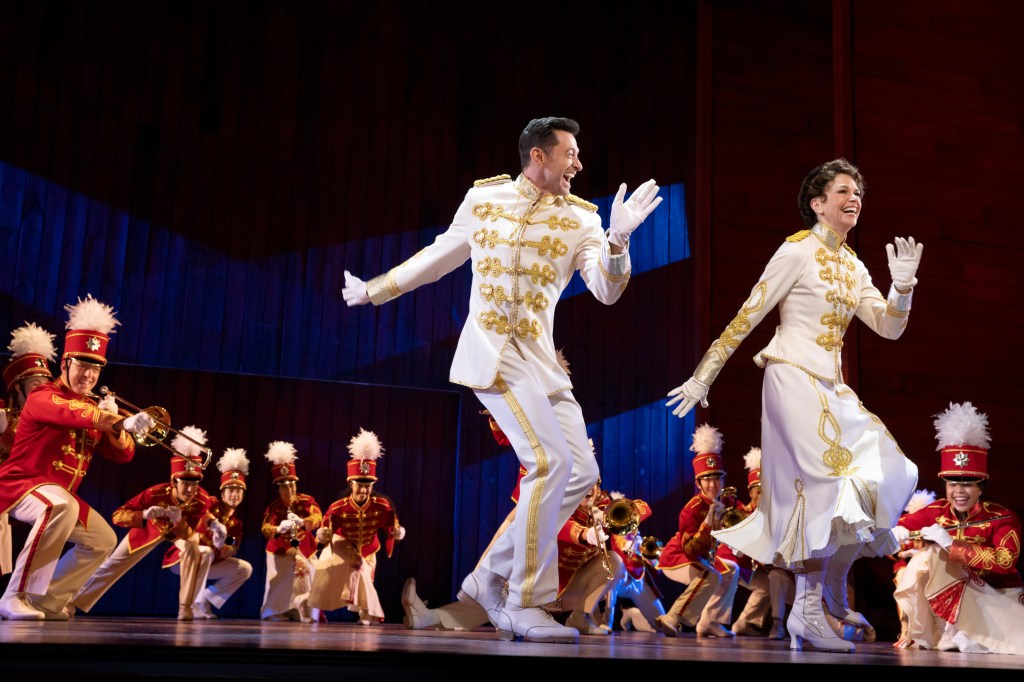
This exploration of that type of con is at the core of Meredith Willson’s The Music Man, which I’ve come to appreciate on another level with this revival at the Wintergarden Theatre, starring Hugh Jackman and Sutton Foster. Along with these romantic leads are Shuler Hensley, Jefferson Mays, Jayne Houdyshell and Marie Mullen. All are Tony Award winners. All give humorous, memorable performances in this fanciful, exuberant, profoundly conceived production (directed by Jerry Zaks and choreographed by Warren Carlyle), about small town America, its bucolic, “nothing is happening here” townsfolk, and the burgeoning love between two needy, flawed individuals, who grasp at hope in each other.
With book, music and lyrics by Meredith Willson and story by Meredith Willson and Franklin Lacey, the great con is spun by a magic-making, uber-talented, artiste extraordinaire that all fall in love with by the conclusion (including the audience). That is all except non-believer, malcontent salesman Charlie Cowell (the excellent, hyper-caustic Remy Auberjonois who was in Death of a Salesman). He’s the “villain” who seeks vengeance to expose Hill as a wicked, flim-flam man.
Hugh Jackman is spot-on in his modern interpretation of the Professor Henry Hill “brand” of “music man.” He and Zaks really get this character, so that Jackman makes it his own, as he exudes the energy-packed, brilliant, larger-than-life, loving individual that you want to stay with, wherever he takes you. After seeing his performance, I believe in pied pipers, who don’t need music to make you theirs.
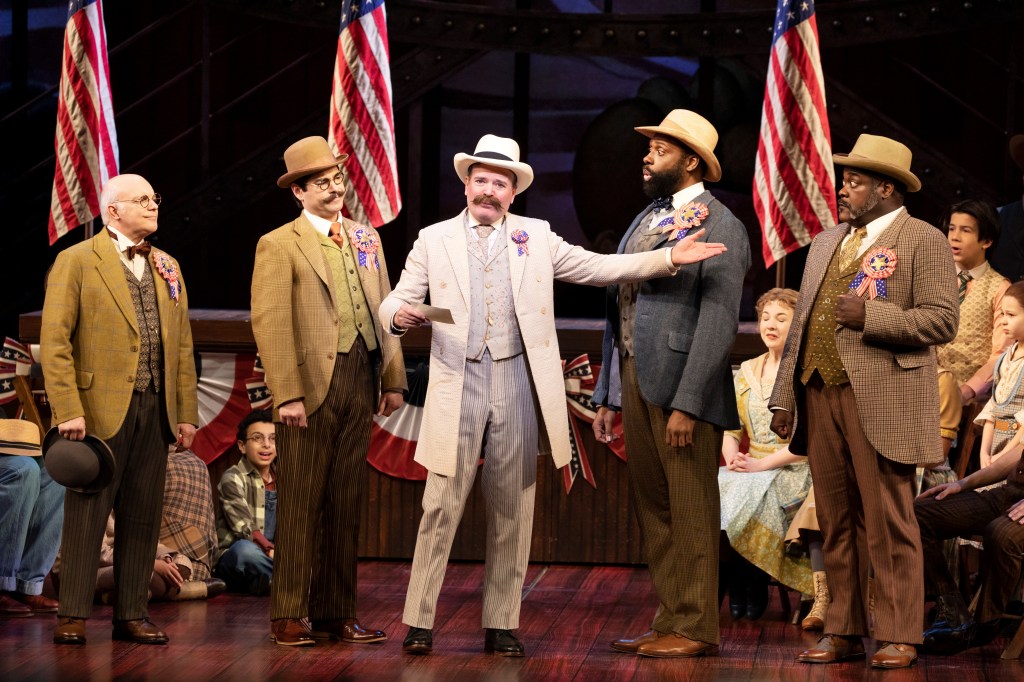
The criticism that he is not edgy is questionable. If Jackman’s Hill were sinister, few would believe his sincerity in a small town that prides itself on suspicion and being “Iowa Stubborn.” Would the women be so taken with his graceful, smooth, charmingly flirtatious manner? He is a swan among the ungainly, quacking mallards and especially his nemesis, the punchy, exasperated, malaproping Mayor Shinn (the always hysterical and exceptional Jefferson Mays), who gaslights the town with his own con. That this genius craftsman of BS has an irresistible delivery reveals Jackman enjoying expanding the graceful Professor in pure entertainment, with every precious breath and every savvy movement he expends, as he inhabits his refreshing version of Professor Harold Hill for the ages.

Hill’s seductive, adorable, spirited demeanor is dangerously addictive. The happy-go-lucky showman is all about getting others to believe in and enjoy themselves. From that elixir, there is no safe return and the crash, if there is one, is emotionally devastating. How Zaks, Jackman, the cast and creative team spin this rendering is solid and logical throughout, giving this extraordinary revival a different feel, understanding and vision, that should not be underestimated or ignored.
Throughout the dance numbers, which are beautifully conceived with wit and substance, Jackman’s lead is ebullient, light, lithe. This is especially so during his convincing, playful seduction in the number “Marian the Librarian” (Warrent Carlyle’s ballet in soft shoe tempo is just great). Jackman’s sensual, boyish suppleness contrasted with Sutton Foster’s stiff reticence in Marian counterpoint are superb together.
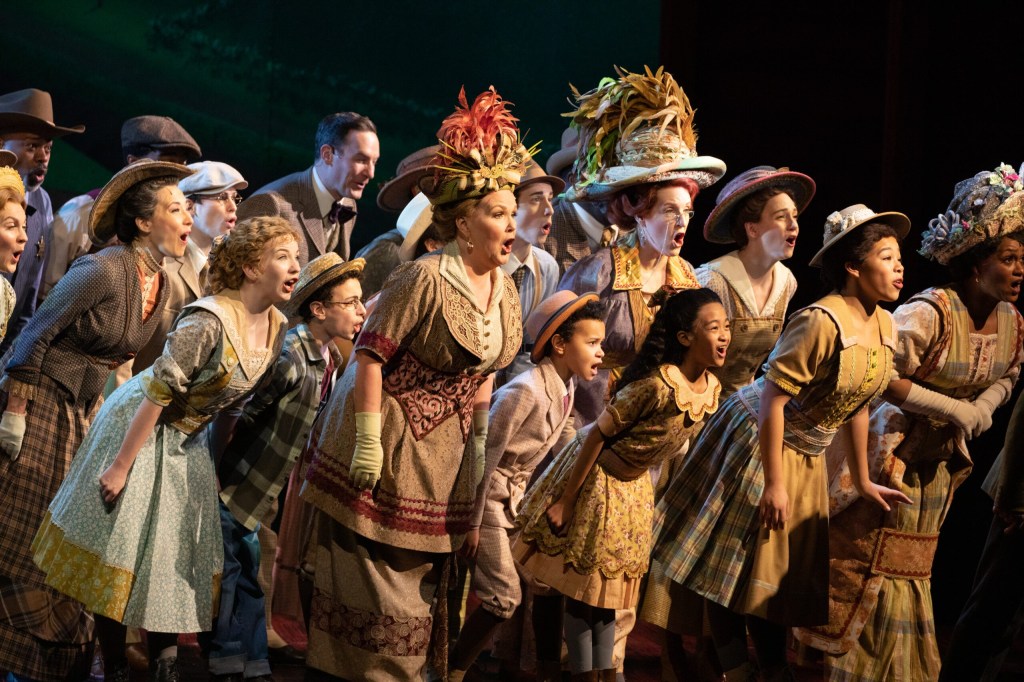
For the song identifying the Iowan’s walled stronghold against strangers (“Iowa Stubborn”), Hill’s great challenge, Zaks stages River City citizens huddled together in a circular clump with stern looks and unsmiling determination. Initially, with Hill they pride themselves on being cold steel like Marian, who is even more icy remote than they are. However, because of Charlie Cowell’s challenge, that Iowa territory is impossible for salesmen, Hill takes the bait and rises to the occasion. He plies his delightful winsomeness with enough sincerity and great good will to surreptitiously penetrate their pride.
Not only are the townsfolk splintered from their stubborn resolve because of his contagious enthusiasm, his youthfulness retains a sociability that is able to connect with young and old. Indeed, Hill offers them something that no one else who has come to their town has ever offered: happiness, hope, fantasy, the power to believe; to think something is so and it becomes so (the “Think System” re-framed from “the power of positive thinking”). Jackman’s Hill is a practiced master at human nature-buffeted by life’s heart-breaks, that create the foundation in the soul, that hungers to believe in something or someone. Of course, he is a master at this, because he, first and foremost, is starving, a clue to this Hill portrayal, upon which turns the arc of development and all the character interactions. It is also the theme of “Sadder But Wiser Girl,” that he sings in knowing “wisdom” with buddy Marcellus Washburn (the excellent Shuler Hensley).
The brilliance of this production is that Hill’s charismatic delivery of the dangerous idea is palpable, adorable and expansive. As apparently unrealistic as Hill’s disarming positivity is, it is like manna from heaven for these homely folks, who cannot resist just a taste. And Jackman’s Hill enjoys spoon feeding it to them like sugar, until they are hooked. Interestingly, he also is hooked…on their joyous response to him.
In his backdoor discussions with his comrade in arms, the affable and in love Marcellus, the winning Professor Hill has no disdain or ridicule for those he mesmerizes. He enjoys the challenge (more in the style of 110 in the Shade’s rainmaker Bill Starbuck), of instilling confidence in others and, in return, receiving what he needs, enjoyment, fun, affirmation. He is the antithesis of the bombastic, arrogant traveling salesman loudmouths like Charlie Cowell and the others in the rhythmically pounding opening train number “Rock Island.” (another superb staging by Zaks, et. al.)
Willson reveals the vital difference between them and Hill, as they ride the rails and complain about how hard their job is because of encroaching progress. What an incredible opening scene that gives the set up (costumes, staging, sets, music, sound, tone, tenor). Challenged by their comments that Iowa is an impossible territory, Hill shows himself up to the task, gets off the train, turns to the audience and presents Professor Harold Hill. Just looking at Jackman’s unabashed, open smile and shining spirit, we believe as Mrs. Paroo does, that he can do nearly anything, even if it is getting her very shy son Winthrop to speak, which he does, as Winthrop flows forth in a burst of excitement and emotion that never stops afterward in “Wells Fargo Wagon.”

His product, unlike Charley Cowell’s and the others, is intangible. Thus, taking folks’ money is done quickly, painlessly for much more is being given, including a loving manner and wish to spread joy. In this version of Hill it is his endearing vulnerability to love that Jackman makes believable in his deepening interactions with Marian, whose loving support he has, before the two of them realize it. Jackman and Foster construct this surprising discovery beautifully in the Footbridge scene (“Till There Was You,” and the melding of the relationship as they conjoin their singing of the double reprise “Goodnight My Someone” and “Seventy-Six Trombones”).
The town’s seduction is inevitable after “Ya Got Trouble” and “Seventy-Six Trombones,” an incredible dance number (and pantomimed instrumentation), that Jackman and the cast just kill. River City has “swallowed his line” (the fishing metaphor is used throughout), as does young Winthrop (Benjamin Pajak in a show stealing performance), who is thrilled when his mother, like the other townspeople, signs on for instruments, uniforms and instruction books to form the showy band Hill promises for the absolute thrill of it. That they must learn to play is subtly whisked off until “later,” the “will-o-the-wisp” magic Jackman’s Hill seamlessly performs.

Hill is gloriously, attractively spell-binding. He draws the town to him bringing togetherness and good will, that goes a long way to diffuse the backbiting of the women against Marian’s standoffishness (“Pick-a-Little, Talk-a-Little”). He helps to mend the ladies’ divisiveness, which further draws Marian to them and himself. Humorously, he unifies feuding officials in the exquisite harmony of a barbershop quartet, that they can’t seem to get enough of, once he starts them off on the right chords (“Sincere,” “Goodnight Ladies,” “Lida Rose”). One by one each potentially thorny group falls under Hill’s flirtatious, delectable, gentle power and inspirational artistic encouragement. Talk about soft power flying under the radar, he hits folks’ hearts for a bullseye every time.
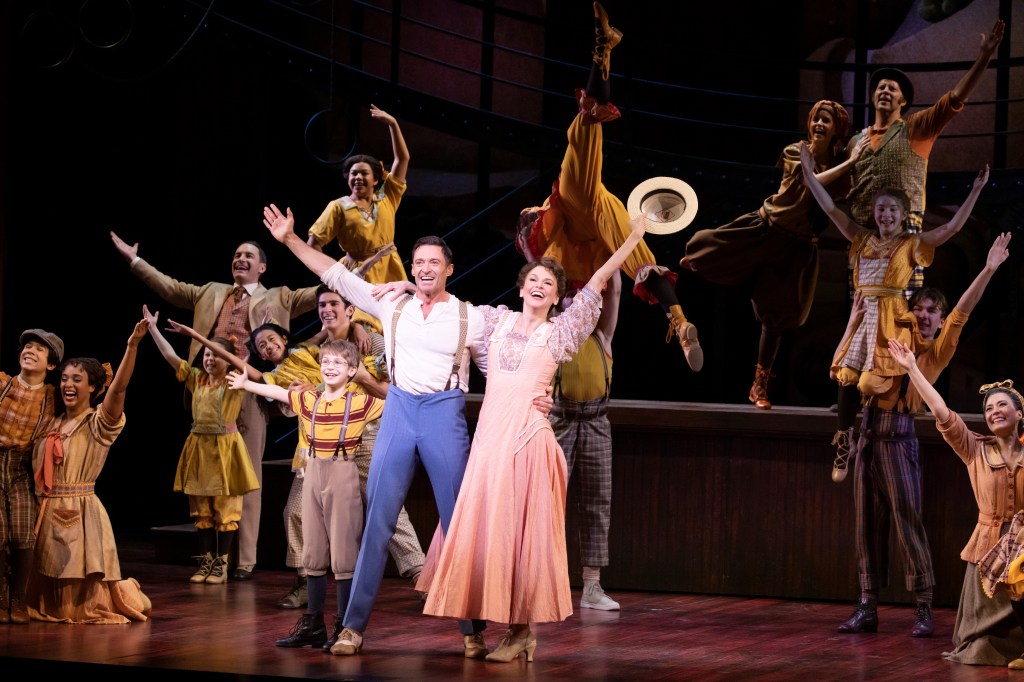
In beautifully staged moments by Zaks, we see Hill’s influence on the Mayor’s wife, Eulalie Shinn and her friends, who create dance numbers and other entertainments. Jayne Houdyshell as Shinn is marvelous and LOL in her dancing and primping poses, after Hill’s maximum attentions. The costuming for these scenes is exceptional. Throughout, the costumes are a take-off of 1912 fashion but with the variety of patterns, in some scenes earthen tones, other scenes fun hats, shoes and accoutrements, thanks to Santo Loquasto, who also did the scenic design.
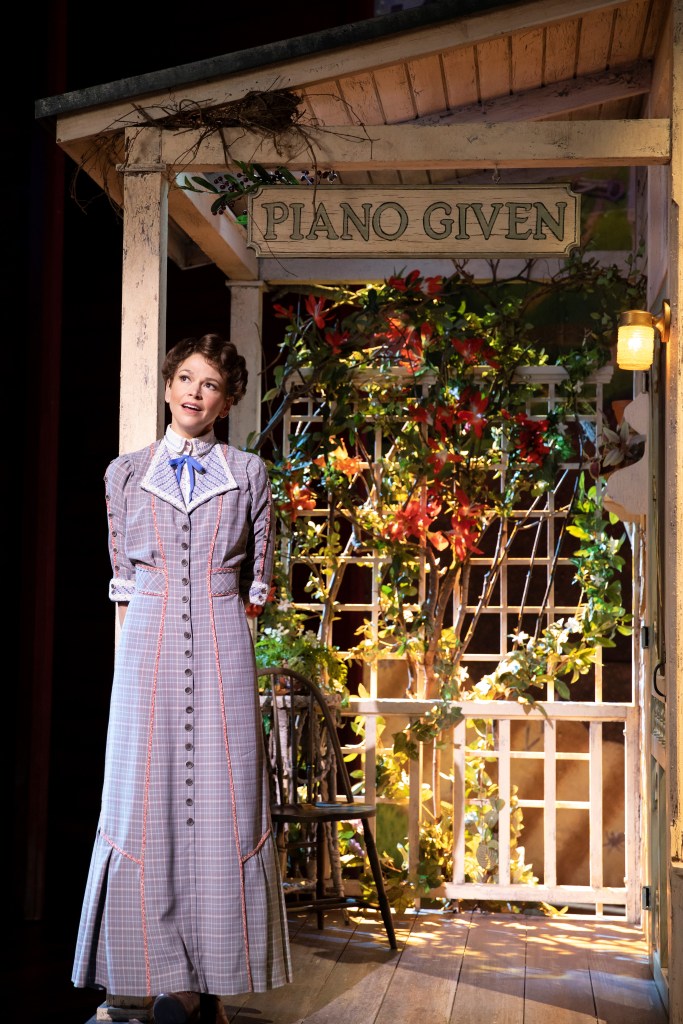
Marian’s costumes are straight-laced without frills by comparison; her hair (Luc Verschueren for Campbell Young Associates), like the other ladies is in fashion, an up-sweep like her mother’s, Mrs. Paroo (the wonderful Maureen Mullen). Attention in this detailed crafting reveals Marian’s restraint, her career and character, providing the subtext and interesting contrast to the other open-handed, more extravagantly dressed woman. Eulalie and her hens are encouraged to believe in themselves in Hill’s sincere admiration as they ooze his charm back at him and titter. In the case of Marian’s response to Hill’s starlight, she moves from grimace to smile to grin.

Importantly, the women are drawn into Hill’s net, however, it’s mutual. Jackman’s Hill is having a rollicking time becoming enamored of them. This portrayal makes complete sense. Because he is lured by their, acceptance and trust in mutual feeling, he is unable to escape when the love net closes around him. Jackman and Zaks have broadened that net to include the townspeople’s acceptance and love as well as Marian’s, her mother’s and Winthrop’s. Zaks shepherds the actors to forge that budding love and trust with specificity and feeling each time they share a scene (i.e. the fishing scene with Hill and Winthrop).
Fear has no place in Hill’s magical world. So when it attempts to enter in the form of Mayor Shinn’s grave doubts about Hill (though Shinn’s motives are financially suspect), he is misled by Marian and his officials, who by this point in time, understand Hill is bringing new life to the community. Thus, they allow themselves to be distracted away from Shinn’s mission to verify Hill’s identity. It’s apparent that with the exception of Mayor Shinn, whose agenda Hill upends by dunning his new pool table, the town’s spirited happiness is heartfelt. One wonders what their lives were like before his enchantments blinded them? Or did he give them a new way of seeing? And what was Hill’s life like traveling one step ahead of the sheriff before he hit River City, an unintentional stop on his route to anywhere U.S.A.?
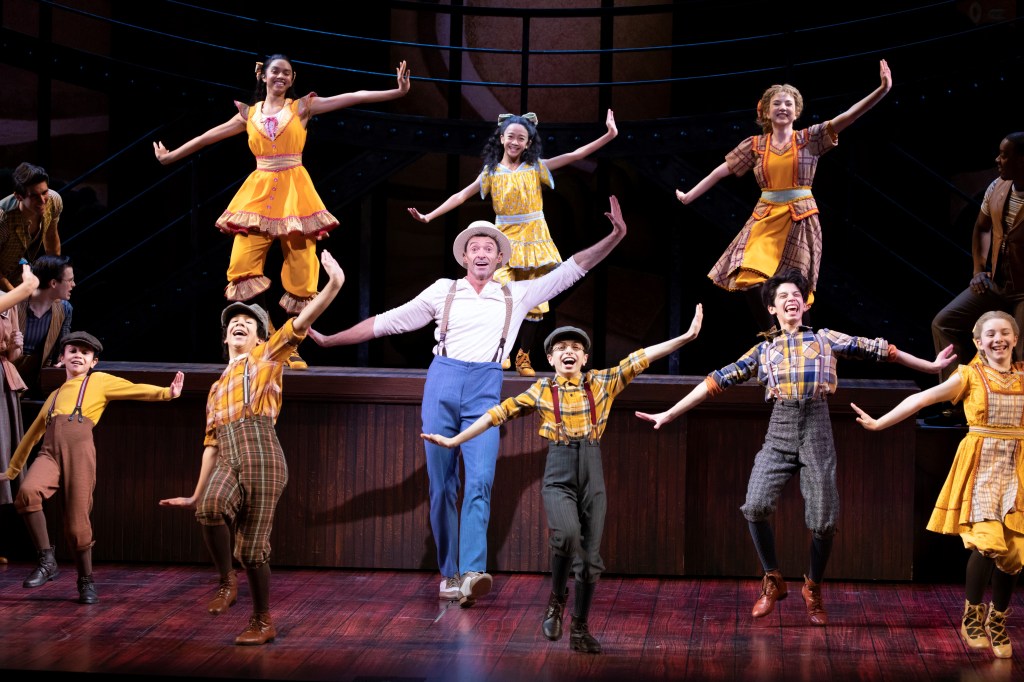
Clues are revealed in the large set backdrops of the Grant Wood style paintings (Regionalism, note the painting “American Gothic”), that are at once simplistic and complicated in their being two-dimensional, brimming with sub-text. These brilliantly reveal the time, place and characters with details of tone, tenor and color. This is especially so against the green rolling hills Grant Wood backdrop, where the tiny, animated, red, Wells Fargo Wagon races down a hill in the distance as it approaches River City. The audience gasped in awe at the ingenious contrivance. Then, they gasped even louder as the “larger-than-life” Wells Fargo Wagon materialized on stage. Pulled by a well-groomed, shiny-coated, smallish-looking “Clydesdale,” Hill beamed atop the wagon as it stopped, the cast sang “The Wells Fargo Wagon” exuberantly, and Jackman rhythmically tossed out the brown, paper wrapped “instruments.” Poignantly, Pajak’s Winthrop sings, lisp and all, completing the effect. Pure dynamite!
This is the show’s “Singing in the Rain,” moment. It is the still point in time that clarifies and represents the whole; action, event, music, symbolism, lighting and spectacle reveal the theme and its significance to the characters and audience. It is here that we understand the treasure that Hill brings, the heightened glory he coalesces in a happening that the townspeople and a now confident Winthrop, (whom we fall in love with along with Hill), will never forget. And for that reason, Marian destroys the evidence that can sink Hill. It’s a stirring, fabulous end to Act I.

By the beginning of Act II, Hill’s invested emotional interest in Marian is revealed in “Shipoopi,” the silly-grand singing and dance number with the entire cast, and colorful, striking costumes, led by Marcellus, who reveals his contentment with his wife. As friend and confidante Marcellus is also Hill’s foil. Living a fulfilled life in a small town, his life contrasts with the emptiness of Hill’s tired wanderings. This is underscored through Hill’s previous interactions with Marcellus, in their fine duet “The Sadder But Wiser Girl,” and brief discussion of his former inability to settle down which Marcellus encourages him to do in River City because he can introduce him to a lovely girl. However, Hill has already met a lovely girl, who rejects him, but as we note at the top of the musical, Hill enjoys a challenge. Jackman nails Hill’s bravado with class, nuance and balance, never over-doing it. He will have Marian and she will have him.
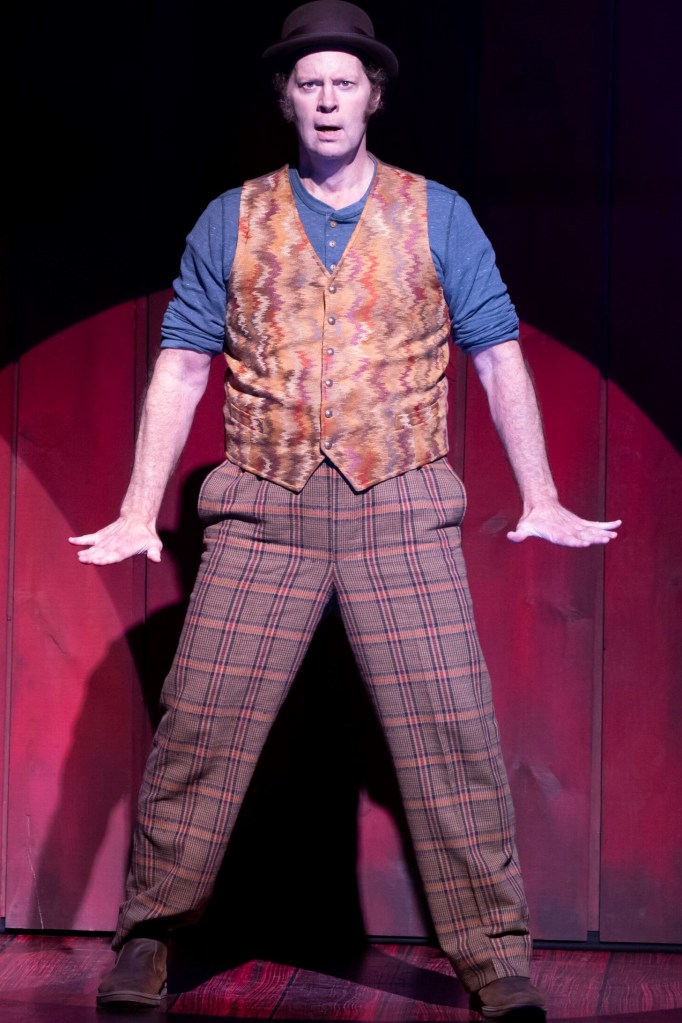
Sutton Foster’s Marian is the challenge Hill finds stimulating. She falls in love, her hard-heart melting in attenuating stages: after Mother Paroo’s pressure in “If You don’t Mind My Saying So,” her own internal pressure in “Goodnight, My Someone” and “My White Knight,” in Hill’s sweetly, gorgeous “bad-boy” pestering in, “Marian the Librarian,” and most importantly, after she sees Hill’s beloved influence on Winthrop (“Wells Fargo Wagon,” the fishing scene, “Gary Indiana”). As Marian, Foster’s change of heart toward Hill is superbly wrought by degrees; her stance and body gradually relaxing as they dance in “Shipoopi.” And the relationship Foster and Jackman forge in its progressive development toward love is believable and touching. By the time the scene with the kiss arrives, their bond is manifest; the long kiss, wistfully enjoyed by Jackman fans, brought faint and not so faint audience gasps; the longing and hunger in the characters dangerously apparent.
For love’s reality is an obstacle to his “safety” that Hill acknowledges (“Till There Was You” reprise). Charlie Cowell intends to provoke the town to scourge Hill with a “tar and feathering.” It is at this point that Marcellus’ injunction that Marian is doing the conning and Hill has to leave or be damned, resonates. But he can’t leave; he must face the music or rather, lack of it.
Foster shines as she attempts to gaslight sexual predator Auberjonois’ Cowell with flirting and a kiss. And in the realistic fight scene (one punch is always sufficient), between Cowell and Hill, the professor vindicates Marian’s reputation that Cowell besmirches. I love how Foster sexually presents herself to Cowell, breaking the third wall and eliciting the audience’s encouragement; she twits the scene for all its worth.
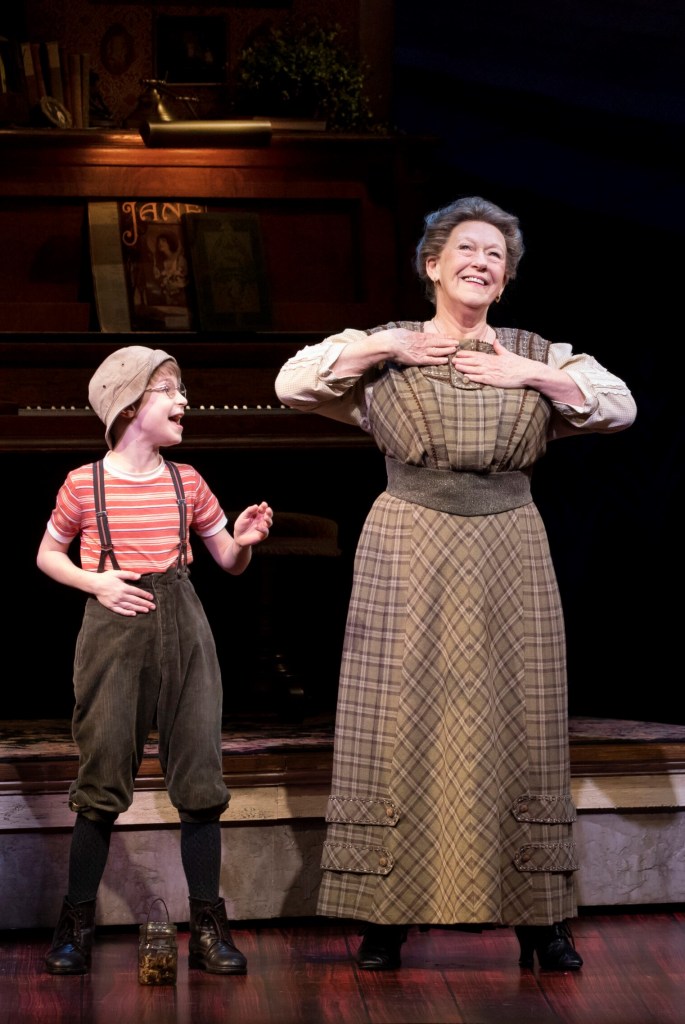
But the con is over. Humorously and ironically, Hill is a victim of Mother Paroo’s use of his “Think System.” And of course, his own need to be loved traps him. Thus, he admits the truth to an upset Winthrop, who forgives him as does Marian. Brother and sister encourage Hill to quickly escape, not realizing the music man wants to stay despite the jeopardy. The sacrifice of the three for each other is perfection. When Hill is arrested, Jackman’s emotional response in the scene is smashing, as is the drama created by Pajak, Auberjonois, Foster and the other cast members. The question remains. Will the town forgive Hill, as Marian and Winthrop have? Will they acknowledge that he has given them something more priceless than a boy’s band? Perception is everything.
In this revival the intentionally “un-dangerous,” genius, entrepreneur professor, like those entrepreneurs of the Cardiff Giant, created a daily thrill. Specifically, Hill’s music man encourages the town to launch out on a new road. It turns into their own growth and ultimate benefit in merging community, good will and love. In exchange for instruments and uniforms, he has bestowed the citizens with an ineffable gift (that Marian and Eulalie Shinn encourage the others to stand for). As Mayor Shin sees their unity and hears his son play, Hill’s “Think System” catches communal fire. The joy and warmth that Hill gave is returned; he is loved and forgiven. And Charlie Cowen leaves a sadder and unrepentant man.

In the end scene as the perception of the townsfolk moves from what is to what each parent thinks/imagines Hill’s orchestral direction to be with love, the miraculous occurs. Hill is redeemed as the band emerges in sound and sensory vision. Announcing the Finale, Winthrop/Pajak blows a vibrant, bold horn. The cast emerges in full band regalia, sings, plays and dances, with Foster and Jackman front and center, leading the charge. Dazzling fun, profoundly realized.
The Music Man is a spectacle that is incredibly rich with visual movement and vibrancy, striking hues and emotional musical grist brought together with sterling performances that are divine brush strokes. The story is a faceted jewel, the characters inhabited by these multi-talented acting greats are uniquely American. The sound/music delivery-technical and vocal is as fine as can be. I heard every word, the glorious harmonies, spun out rhythms and witty lyrics in the compelling choral numbers (“Rock Island,” “Ya Got Trouble,” Shipoopi,” “Pick-a-Little, Talk-a-Little,” “Marian the Librarian,” Seventy-Six Trombones”). What a pleasure, especially in the large musical numbers; this has not always been the case on Broadway (post-pandemic and certainly not pre-pandemic).
The Smithsonian Institution ranks The Music Man as one of the “great glories of American popular culture.” When it premiered on December 19, 1957, it was a smash hit that ran 1375 performances. It won five Tony Awards including Best Musical. The original cast album held the number one position on the
Billboard charts and stayed on the album charts for 245 weeks. The recording won the first-ever Grammy Award for Best Original Cast Album.
In this amazing revival all of the main actors are Tony Award winners. Sutton Foster is a two-time Tony Award winner. Hugh Jackman is a two-time Tony Award, Grammy Award, and Emmy Award-winning star. Director Jerry Zaks is a four-time Tony Award winner and Choreographer Warren Carlyle is a Tony Award winner. The creative team is equally sterling and award studded. It includes four-time Tony Award winner Santo Loquasto (Scenic & Costume Design), five-time Tony Award winner Brian MacDevitt (Lighting Design), Tony Award winner Scott Lehrer (Sound Design), Luc Verschueren for Campbell Young and Associates (Hair, Wigs, & Makeup Design), Tony Award winner Jonathan Tunick (Orchestrations), David Chase (Vocal and Dance Arrangements), and Patrick Vaccariello (Musical Director).
This production with this cast, director, choreographer and technical team will never happen again in your lifetime. Considering what the cast, crew and production team went through to present The Music Man opening night this February 10th, 2022, it has been a labor of love that underscores every dance step, every note played, every trill, every laugh by the actors, the musicians, everyone. It is a one-of-a-kind revival that is breathtaking. Do what you can to see it. I will go again if I can get tickets. Here is their website for arrangements. https://musicmanonbroadway.com/
‘King Lear’ Starring Glenda Jackson, a Royal Performance at the Cort Theatre

John Douglas Thompson and Glenda Jackson in ‘King Lear,’ directed by Sam Gold (Brigitte Lacombe)
William Shakespeare’s King Lear directed by Sam Gold is a must-see for its principal performances and its particular, stylized artistic design (scenic, sound, costume) which cleverly emphasizes the themes, symbolism and metaphors of the play. Above all, you should not miss Glenda Jackson who is a gobsmacking dynamo as the king who throws off the shackles of corruption and confronts his mortality to gain the wisdom of foolishness.
Jackson fits the titular role like it is made of her own flesh. This is a “once upon a lifetime” production that is astute, profound, if sometimes opaquely realized with regard to integrating Philip Glass’ music. Nevertheless, the director’s vision and design suggests overarching themes about appearance vs. reality, lies vs. truth, duplicity vs. authenticity, wisdom in madness and madness in wisdom.
Throughout, Jackson is a magnificent, who always rises to perform with sentience and power. Her Tony award winning portrayals in Edward Albee’s Three Tall Women last year were unforgettable. Likewise, her performance in King Lear follows with equal ferocity and fervor.

Pedro Pascal, Jayne Houdyshell in ‘King Lear,’ directed by Sam Gold (Brigitte Lacombe)
Shakespeare’s characterization of the foolish king is among the most searing, poignant and challenging of roles. Only someone with the breadth, knowledge, sensitivity and prodigious talent like Ms. Jackson’s should attempt it. And that is why, from a woman’s perspective, her performance of this man who is a king and a fool is almost counterintuitive. It is no ready coincidence that Jackson’s Lear exemplifies a startling emotional grist that moves the king’s ethos from corruption to madness to wisdom with breathtaking logic and moment-to-moment life.
In her every action, every breath and movement, every grimace and expression of inner torment and fury, we search out Lear’s evolving humanity as we feel his pain and empathize with him. Shakespeare’s characterization of Lear engineers the development of the play.

(L to R): Ruth Wilson, Glenda Jackson, John Douglas Thompson in ‘King Lear’ (Brigitte Lacombe)
It is Lear who creates the self-destructive vortex and whirls violently in it during the arc of his soul journey, buffeted by its abuse, yet buoyed up by a stalwart inner core of moral outrage and self-righteous fury. It is the recognition of his own corrupted judgment and the expose of his daughters’ wickedness that keeps him from drowning in complete madness. He is kept from this abyss by the Earl of Kent (the exquisite john Douglas Thompson) his Fool (Ruth Wilson in a humorous turn) the supportive Earl of Gloucester (the poignant and superb Jayne Houdyshell) and Gloucester’s son Edgar (Sean Carvajal) in a beautifully rendered performance) who becomes like the Biblical lunatic to escape the wrath of the court.

Sean Carvajal in ‘King Lear,’ directed by Sam Gold (Brigitte Lacombe)
After Lear spurns his third daughter Cordelia (Ruth Wilson) his daughter Goneril (the excellent Elizabeth Marvel) and daughter Regan (the equally fine Aisling O’Sullivan) presumptuously usurp his authority. They command that he heel to their authority, despite his generous bestowal of wealth and lands upon them. Rather than accept his retinue that follows him to his daughters’ castles, they provoke their father’s wrath to pursue their own agendas.
Maintaining his nobility and identity, Jackson’s Lear refuses to “live” under their terms. Homeless, he braves the stormy abyss of his own soul damnation reflected in the harsh elements with the help of his Fool and the Earl of Kent, disguised as a servant. Ruth Wilson’s Fool comforts Lear, chides him and peppers his rages at Goneril’s and Regan’s ignominous treatment with humorous jibes and quips which strip Lear of his courtly pretensions. Indeed, the Fool guides him toward humility and brings this lofty king into an endearment with his own “base” but noble humanity.

Pedro Pascal, Jayne Houdyshell in ‘King Lear’ (Brigitte Lacombe)
Gold’s version of Lear stylizes the trope that Cordelia and the Fool are similar by having Wilson expertly play both parts. If this is, in Lear’s mind, an unconscious projection of remorse, self-flagellation and wish fulfillment to forgive his loving Cordelia and keep her near, the doubling of roles is sensible. Certainly, Cordelia is the only daughter who loves him. Thus, it is appropriate that Cordelia-the Fool leads the foolish old man into wisdom to help perfect his soul and expurgate the corruptions he has internalized, surrounded by treacherous courtiers and family in a lifestyle that has caved in his better person.
During Lear’s journey into the dark storms of mental uncertainty deranged by a gilded, false life in the gaudy kingdom that he must leave behind (mentally) to grow, he stumbles upon his real self. Centered in truths he never experienced before in his court, Lear strives to maintain his autonomy and identity. He eventually comes to realize what is important in his life-his humanity/mortality/liability to err in judgment which he is able to forgive as he presents himself as “a foolish old man.”

(L to R): John Douglas Thompson, Russell Harvard, Michael Arden, in ‘King Lear’ (Brigitte Lacombe)
Gold’s decision (Miriam Bljether’s Senic Design) to regale the court in pretentious splendor hints at a surface gloss and artificiality/artfulness that distracts from confronting the underlying wickedness and greed in Lear’s court and kingdom. They are “dressing to impress” to cover up the incompetence, nihilism and emptiness within themselves. All that glitters is fool’s gold; it lacks value and worth in an inherently weak kingdom whose underlying principles (if there are any) do not guard against self-destruction and annihilation. Thus, in the stylization the director reveals the seeds of corruption and foreshadows the devolution of the kingdom that will follow hard and fast.
In this setting of “fool’s gold” we meet the commanding Lear and his three daughters at a celebration during which the string quartet stuffed into a corner plays the gorgeous music (original music by Philip Glass) which the courtiers and family neither acknowledge nor appreciate but treat as background noise to be ignored as they raise their voices over it. The family’s general lack of appreciation for their lavish lifestyle and their dismissal of the importance of the depth of their royal duties is reflected in their reaction to all the court accoutrements including a most civil tea service later in the play, held at an incongruent and ridiculous time and place. They are the arrogant, the privileged. Only Cordelia differs.
Thus, when Cordelia reminds the court of her loyalty to her father invested in her role as his daughter, we take this to heart. Do the others, after receiving their inheritance realize the obligations their father’s gift entails?
Elizabeth Marvel in ‘King Lear’ (Brigitte Lacombe)
Hardly. Regan and Goneril from the outset are principally concerned with “getting all they can” through false pretense. They could care less about the rights and duties invested in their father’s gift of an early inheritance. It is no small wonder that Goneril and Regan rail about Lear’s visits with his soldiers. They want the inheritance with no strings attached, wishing to be free of their father forever. Rather than pay homage and give extended hospitality to a vibrant, authoritative king, they take advantage of his public punishment of Cordelia and suggest that he is off balance. It follows that they will provoke his wrath and become his enemies, so that their unconscious desire that he dies sooner rather than later becomes a reality.
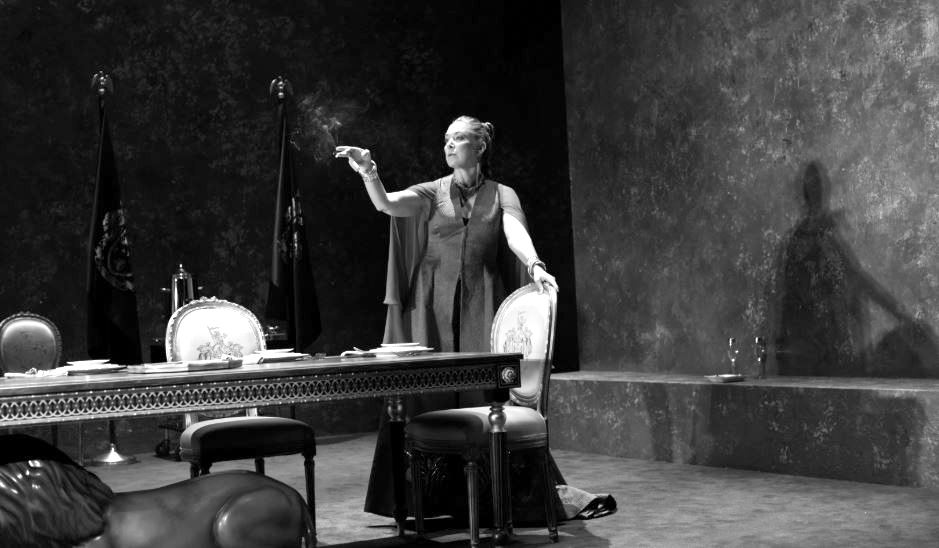
An overarching metaphor the director emphasizes throughout the play, is the irony of incongruence-in the court’s lack of probity and unseemly excessiveness. Incongruence is everywhere represented by the “out-of-place” music at the celebration and elsewhere, music which never quite melds throughout the arc of the play’s development. The “over-the-top,” ostentatious, meretricious faux “gold” walls and the formal outfits (Ann Roth-Costume Design) exchanged for less formal ones as the kingdom devolves and the characters’ wicked selves are exposed, also appear incongruous as they are presented. So do the huge ceramic dog and lion.

Russell Harvard, Aisling O’Sullivan in ‘King Lear’ (Brigitte Lacombe)
The gilt walls are present throughout the play with a similarly hued curtain that characters stand before during various scenes (a further emphasis of the themes of incongruity and fool’s gold or an idea that Shakespeare often uses that appears in The Merchant of Venice: “all that glitters is not gold”). The “fool’s gold” walls and audience curtain are the ironic, anomalous backdrop against which the characters are measured and either found wanting in that they exemplify the trope or are antithetical to it.
These artistic elements reflect the malfeasant influence his daughters and husbands have over Lear, an influence which is shaken out of him on his stormy journey coming to the end of himself.

(L to R): Jayne Houdyshell, Glenda Jackson in ‘King Lear,’ directed by Sam Gold (Brigitte Lacombe)
As the daughters and their husbands abuse the kingdom for their own nefarious ends all becomes rubble, wrecked by the familial divisions and war. The walls are the only remnants of the former “glory” of the court perhaps suggesting a universal concept. This kingdom is finished, but the spirit of duplicity (faux gold) of leaders’ pretense which they use to control their minions is present in every age. Eventually, by the conclusion the back gold wall takes on a different hue changed by shifts in lighting. Interpret this as you will, the hue doesn’t gleam, but suggests small points of light (starlight?) amidst characters comments (i.e. Kent: ‘The stars above us govern our condition”).
In the fateful universe of Shakespeare’s play, the arrogant, self-centered human beings are thwarted in the pursuit of their own wicked desires which are founded upon worthless principles (“fool’s gold”) and lies. This development is evident in the characterizations of Goneril, Edmund, Regan, the Duke of Cornwall. The other characters (Edgar, the Duke of Albany) who do not follow their lust for power rise to triumph. As object lessons, Cordelia, Kent, Gloucester, Lear are caught up in the hazard, subjects of poignant tragedy.

Glenda Jackson in ‘King Lear,’ directed by Sam Gold (Brigitte Lacombe)
And it all begins in the “golden” court, when Lear pronounces his inheritance to his inherently wicked daughters enticing them to flatter him in a misaligned quid pro quo as if to prove his greatness and their fealty to him. Goneril and Regan oblige him; Cordelia does not. In that fell act, treason and wickedness are exposed. The wrong daughters receive the bulk of the inheritance, the right daughter is disinherited. The world is in chaos, turned upside down as duplicity usurps love and order.
Lear makes a public show of Cordelia’s punishment sealing his misaligned judgment which the others see may be further abused. Indeed, Lear’s malignity is revealed in a court which embraces and exploits it. And this evil sets in motion the parallel plot with the Earl of Gloucester and his treacherous, conniving son Edmund (the wonderful, insidious Pedro Pascal) who usurps brother Edgar’s inheritance and place in his father’s affections and legal authority.

Glenda Jackson in ‘King Lear,’ directed by Sam Gold (Brigitte Lacombe)
In this secondary plot the illegitimate Edmund, who despises the goodness of his father, lies on his brother Edgar who is forced to escape with his life and go into hiding disguised as the madman beggar “poor Tom.” It is only when Lear, Kent and the Fool meet up with Edgar and take shelter in a hovel does Lear begin to understand his condition in light of poor Tom who is much worse off. In this beggar lunatic, he sees his true ethos without the vanities of the world and his court.
Lear journeys through his “madness” gaining wisdom and gradually throws off the misaligned corruptions of the “courtly mind,” represented by the “fool’s gold” set design. Lear becomes the humble, kingly fool. These scenes among Lear, the Fool, Kent and Edgar are particularly wonderful. The scenes between Carvajal’s Edgar and Houdyshell’s Earl of Gloucester when the blind Earl seeks his death are magnificently rendered by Houdyshell and Carvajal and incredibly touching and poignant.

Ruth Wilson in ‘King Lear,’ directed by Sam Gold (Brigitte Lacomb)
Thus, the deeper evils of this court once hidden in the hearts of Goneril and Regan and her husband and Edmund, feed on themselves and grow as the villains wreck everything to gain the advantage, an advantage which is never sustained with the good sense and order to keep it. The director correctly has the nihilistic Goneril, Regan, The Duke of Cornwall and Edmund contribute to demolishing all order in the kingdom symbolized by the ripped up set interiors as the court is rocked from within and without by war. Considering that they annihilate their inheritance and the goodness of Lear’s gift to them, portraying their father as their enemy, that evil which was hidden by glamour and civility explodes full bore by the play’s conclusion.
Goneril’s mocking lasciviousness expresses her unrestrained wildness “going over to the dark side.” Marvel’s development of characterization is superb. Likewise O’Sullivan’s Regan as the raging, screaming shrew (evolving from the sweeter sister at the outset) appears even more “off the beam” crazy than her father, Lear. And so does her husband the Duke of Cornwall (Russell Harvard’s signing is emotionally powerful) whose rage is at times inarticulate and can only be expressed with frantic signing and frustrated slamming.
By the end, the court reaches its true level of craven wantonness. The debased Goneril and Edmund have sordid sex on the floor reveling in the chaos and rubble. Regan and Edmund plot against Goneril in the disordered wreckage which no one bothers to clear out. Cornwall is stabbed as the actors pick their way around the debris of the once “glorious” court, followed by Regan’s poisoning by Goneril for Edmund’s love. The director again reinforces the theme that wicked amorality has no tenability nor the substance to sustain order. As those who deserve to rule, Edgar and the Duke of Albany (Dion Johnstone) prove themselves wise and just in restoring a kingdom ruined by greed, lies, usurpation, corruption and treachery.

Glenda Jackson in ‘King Lear’ (Brigitte Lacombe)
In his humbled, state after the madness of wisdom shines a truth he has learned, Lear states a key theme about his royal court: “robes and furr’d gowns hide all.” In another quote he states: “plate sin with gold, and the strong lance of justice hurtless breaks.” To “plate” sin with gold (as he had allowed) makes justice weak and breaks it.
By the end Lear gains the revelations of foolish wisdom for he has humbled himself with self-recriminations of his pride at discounting Cordelia’s goodness. We are uplifted by his reconciliation with Cordelia. We rejoice with him as she forgives him, and sorrow with him at her death which he follows with his own. In all of these emotional modulations of this iconic human being that is the recovered foolish king, Ms. Jackson just wipes out the audience.
Ms. Jackson accomplishes this because from the first scene to the last she assumes the mantle of the salty, unhoused, unbridled, tragic Lear and never strays in her focus and determination. As Ms. Jackson’s Lear comes to the end of himself, he manifests the truth that he is, as all men (and women) are great and small, a fool. In this human portrayal, we recognize we too are the kingly fools of our own universe. And we stink of our own mortal desires, mistakes, frailties. And perhaps that is in itself our royalty of revelation. It doesn’t get any better than that!
King Lear runs with one twenty minute intermission, three and one-half hours at the Cort Theatre (48th St.) You may find tickets and times at the website by CLICKING HERE.
 CAROLE DI TOSTI