Blog Archives
‘Evanston Salt Costs Climbing,’ Arbery’s Excellent Play is a Must-See
In the microcosm is the macrocosm. This is especially so in the setting Will Arbery presents in Evanston Salt Costs Climbing, the sardonic, metaphysical-realistic 95-minute play acutely directed by Danya Taymor, currently at the Signature Theatre presented by The New Group.
A key theme of Arbery’s exceptional work turns on the notion that the larger picture of what is happening resides in the details which human beings have a penchant for ignoring, though it is right before their eyes. Do we see the connections, or are we like the characters in this play, willfully unaware until a catastrophe results and it is too late to do anything about it? Arbery examines these themes in his thought-provoking, stylized work that suggests we cannot escape how we relate to our environment, no matter how much we attempt to obviate it. Indeed, Arbery points out that it is this blindness that has brought us to the brink of self-annihilation. Ironically, even standing on the brink looking down, we can’t manage to do what is needed to confront the human disaster that is unfolding before our eyes.
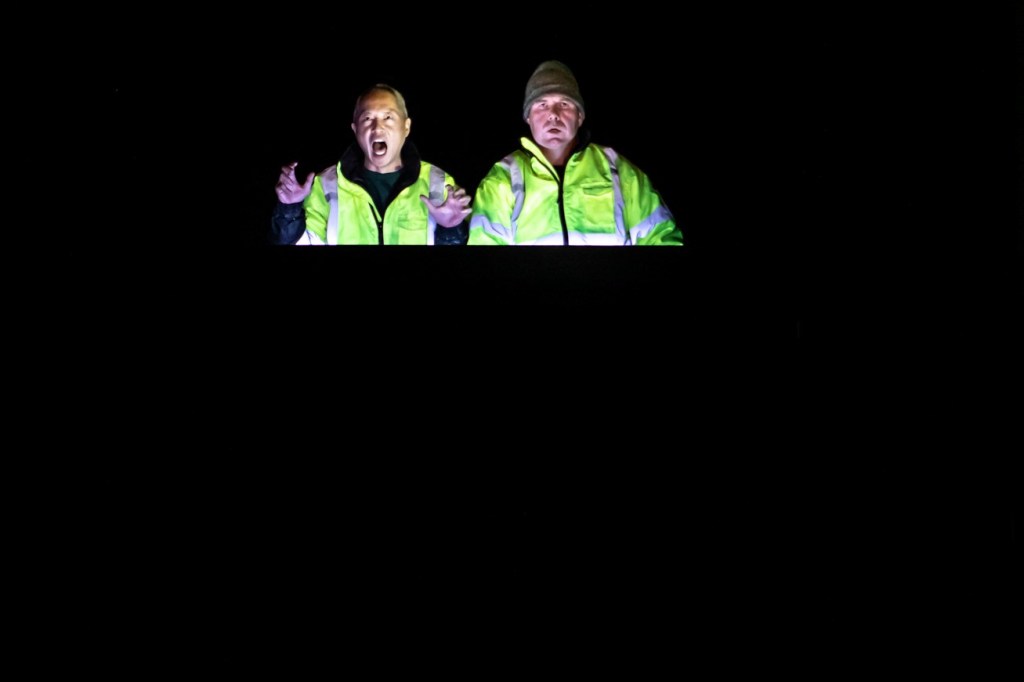
At the opening of Arbery’s play two truck driver forty-somethings, Peter (the superb Jeb Kreager), and Basil (Ken Leung is his vivacious side-kick), share their morning coffee before they take their rounds spreading salt to safe-guard the roads in and around Evanston, Illinois. We let this information slide away from us without giving it much thought. However, everything in Arbery’s play is profound and the characters’ lives and future are encompassed in the smallest detail of salt spreading. In that detail is reflected the wider invisible world that the characters sense is out there, both under the ground, pushing to break apart the sham infrastructure that cities have built for the purpose of commerce, or in the invisible world that hangs above in the ambient atmosphere pressing down on the characters to confound them and make them despondent.

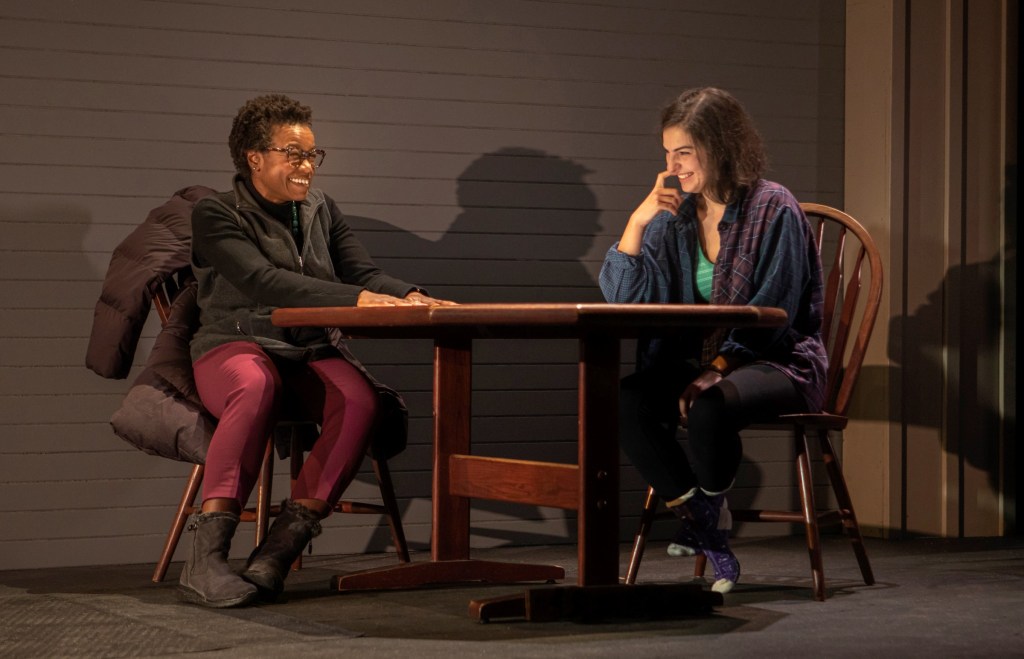
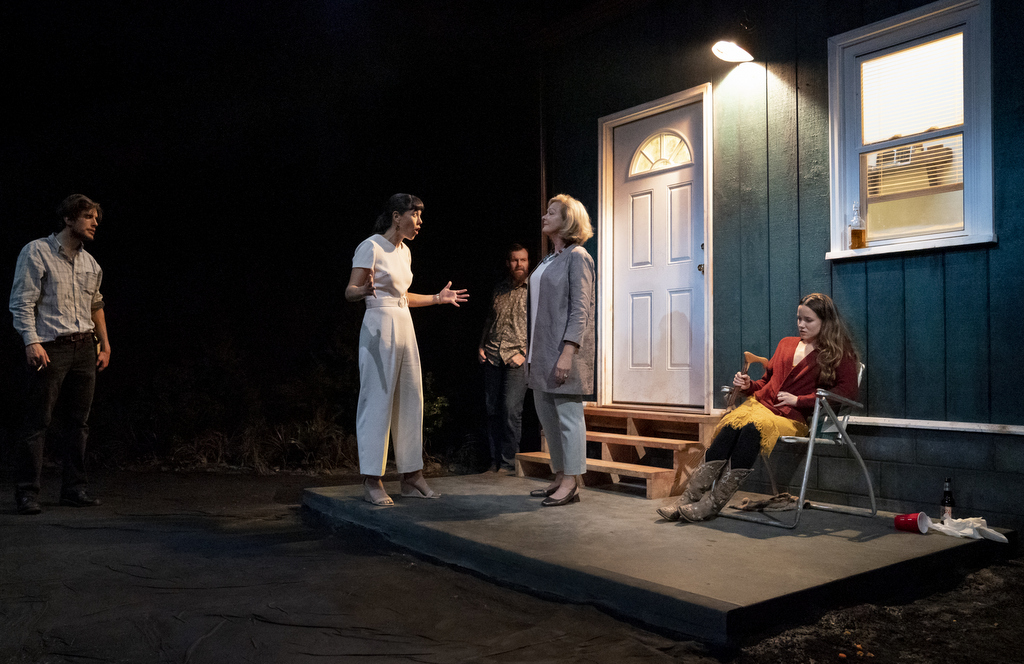
The world that Arbery’s characters inhabit is representational. The action takes place in the environs of the Evanston “salt dome,” in the truck, and in Maiworm’s home, all staged with superb and symbolic minimalism by Matt Saunders’s scenic design, Isabella Byrd’s lighting design and Mikaal Sulaimon’s sound design. Before Peter and Basil begin their shift, Maiworm, the public works administrator who is their boss (the excellent Quincy Tyler Bernstine), stops in as she does each morning. Maiworm is astute and stays on top of the forward moving trends regarding the Green Movement. She understands the “larger picture” of the changing environmental conditions which impact their jobs and of which Peter and Basil remain unaware. Maiworm attempts to enlighten them by reading an article to them, the gist of which states that the record colder temperatures are requiring record levels of salt use. These are driving up the salt costs.
If we are paying attention, we understand the cause and effect of global warming and weather weirding indicated in this small detail of salt costs. After Maiworm reads the article, Peter says an article should be written about the fun he has with Basil driving in the truck. He doesn’t catch the “devil” in the details. In other words, he never makes the leap that the costs might impact his current job, his hours or salary. He assumes all will remain static in this job he’s had for twenty years.

Basil, who writes micro-fiction, ignores the underlying significance of the article for another reason. He tells Peter no one wants to read an article about their job because it has no “pull” or interest. The connection between Arbery as a writer and Basil is understated. It is as if Arbery twits himself about the intentional boring context of “salt costs climbing,” knowing that such a subject will not keep the audience engaged. However, Arbery is having us on. That is not what the play is about. And how the playwright cleverly connects this “detail” with its hidden significance making it dynamic and indelibly related to his characters is striking and horrifically revelatory to us.
Basil asks Maiworm about the impact of the increasing salt costs. Arbery reveals why Basil asks the question in the next scenes when we see that he and Maiworm have developed a covert sexual relationship unbeknownst to Peter. Thus, unlike Peter who doesn’t see or care about the symbolism behind the details, Basil is open to Maiworm’s thoughts and most probably encourages the direction of her decisions to feather her own nest and advance in her administrative position which must take into consideration the budget which includes the price of salt. However, on another level, he too misses the significance connecting the dots to climate change and colder weather which will create havoc if the powers that be (including Maiworm), don’t properly plan for it.
In a humorous scene that follows, we understand why Peter loves driving in the truck with Basil. They act silly and ridiculous, sharing “manly” antics as “roadies,” who do their job and maintain a friendly relationship, where they can cut loose and have a free-for all (which mostly entails cursing). Also, during this time Basil and Peter discuss more personal issues. Basil relates the dream he has of his grandmother who has told him, “Don’t let the Lady in Purple come near you.” He states, in the last part of the dream, The Lady in Purple does come near his grandmother, who dies. We intuit that the Purple Lady may be Death.

Additionally, Basil discusses that he ends up fusing with the Purple Lady and reverts to a dying little boy as the Purple Lady takes him. This, he tells Peter, happens during a time when cities are freezing and burning. Basil’s description is metaphoric and prescient in its representation of global warming, which he never mentions by name as if it doesn’t exist. By degrees, Arbery reveals how the events Basil describes in the dream come to fruition in his life in a mysterious way that merges phantasmagoria with reality later in the play.
Peter expresses that he is sad and his dreams are surrounding darkness and noise. This reflects Peter’s depression and suicidal thoughts. Basil, who has discussed Peter’s wanting to kill himself and kill his wife is concerned that Peter is in bad shape. Basil tells Maiworm about Peter and she vaguely comments she’ll watch out for him.
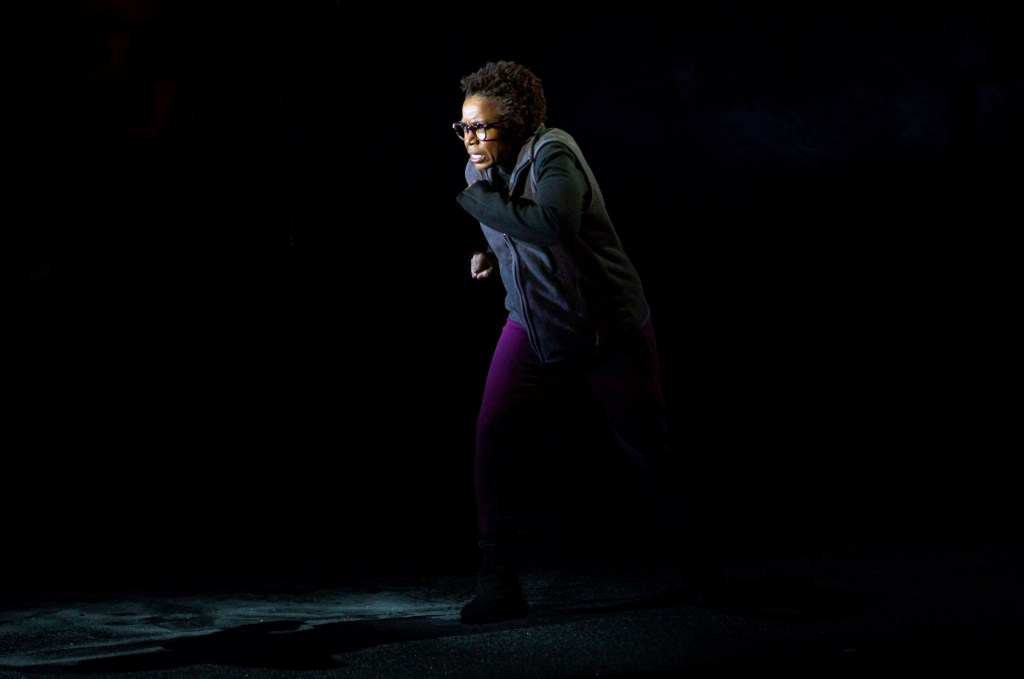
The dynamics of the interrelationships complicate as we learn more about Maiworm’s adopted daughter, Jane Jr., who suffers from depression and has suicidal thoughts like Peter. As Jane Jr. Rachel Sachnoff gives a fine, nuanced performance. of the only character who understands the impact of climate change. Maiworm’s concern for Jane Jr. includes trying to direct her interests by getting her to read Jane Jacobs’ book The Death and Life of Great American Cities. Additionally, Maiworm encourages Jane Jr. to help others by singing to them at the nursing home. To make her feel needed, Maiworm uses Jane Jr. as her confidante. After a nightmare provoked by the suicide of the journalist who wrote the article Maiworm reads to Peter and Basil, Maiworm discusses her anxiety about Evanston. Maiworm tells Jane that she saw the dead rise from under the ground as the journalist fused with them. Then she segues the discussion to heated permeable pavers, the technology to make roads heat up so they can melt ice and snow to eliminate the use of salt and reduce costs.
Like all exceptional playwrights, Arbery reveals the trenchant themes by gradually through their connections. Eventually we learn one aspect why the heated permeable pavers might be a great solution. The salt is incredibly toxic and destructive to wildlife. Salt run-off pollutes the water table creating toxic blooms releasing poisonous chemical compounds and metals that kill animals and people.
Interestingly, this is the first we hear of such a technology, but not the last. We discover much later when Arbery connects the dots that Maiworm, to advance in her position, is part of the program to bring heated permeable pavers to Evanston, unbeknownst to Peter and Basil, whose jobs will become obsolete as a result. However, the implications of this Arbery does not make “visible” until after personal devastation occurs to each of the characters over the course of the three consecutive brutal winters in Illinois when the play takes place.
Arbery boxes in the characters who increasingly become dislocated through sadness and depression, indirectly caused by ignoring the moment of what is happening around them in the environment. Arbery indicates that though they don’t see the larger picture of the apocalyptic effects of climate change, in the unseen realm of the invisible world, it impacts them day and night. Jane Jr. is aware of this. It is mostly the cause of her depression and desire to end her life. She considers her Dad lucky that he died and doesn’t have to experience the impending doom that can be felt everywhere. Maiworm and others go about their lives as if nothing is happening. They live in a denial and that doesn’t quite work because they sense the coming destruction but don’t articulate its connection to what they feel is happening. Articulation is the beginning of recognition.
The unseen doom disturbs everyone. Peter’s suicidal thoughts continue and his situation worsens after his wife dies from an accident on the icy roads that didn’t have enough salt on them (presumably because less salt was used to defray costs). Fortunately, his daughter lives and they bond over Dominoes Pizza and watching the truck come to their door, a fun event for the six-year-old. Their relationship is the bright light in the play.
Maiworm’s guilt about Peter’s wife’s death is understated, but her behavior becomes more hyper and the overarching doom she senses increases in her life with Jane Jr. Additionally, the doom is in Basil’s dreams and shows up in his micro-fiction. When he is confronted with his past and inability to deal with it in his present, he is swallowed up (the Purple Lady makes an appearance). Basil joins the other dead in the earth metaphorically and physically fulfilling his nightmares. How Taymor and her team effect this is strange and dislocating, intensifying the play’s foreboding which becomes palpable to the audience.
Maiworm who could understand the impending doom of global warning’s impact on their lives, can only manage to live in the microcosm to fulfill her desire for advancement. She is the most blind and she blindsides others. Palliative measures to correct the dire future with “heated permeable pavers,” are too little too late. Caught up in the details, she ignores the “bigger picture.”
The climax of the encroachment of the unseen (the environment rebelling), upon the characters occurs toward the end of the play where Arbery delivers his key message delivered by a supernatural incarnation of a presence from the past, Jane Jacobs. As Jacobs, Ken Leung arises in black funereal dress. Without his accent he comes across with clear, precise anger and a clarion warning. Jane Jacobs suggests what we must do as human beings to face the oblivion of our own making. See the play; there is no spoiler alert.
Taymor’s direction of the actors is spot-on as they convey the suppressed doom in the tension and growing personal alarm in their dreams and confessions. All of the creative artists majestically bring together Arbery’s and Taymor’s vision of the dire consequence of the environment rebelling as an incarnate “thing.” Saunders, Byrd, Sulaiman and Sarafina Bush’s costume design, help to manifest terror in the atmosphere of the play through the suggestions of mysterious other-worldiness peeking through reality. We “get” the palpable danger human beings have created for themselves with their willful ignorance, negligence and dereliction of duty. That danger drives Maiworm, but because she ignores the signs and can’t translate what she feels into understanding, her obsession is misdirected. Caught up with the pavers for the future, Maiworm forgets to order salt for the present winter and they must hire others to do the job of salting the roads. She is rewarded for her incompetence as her advancement continues up the administrative chain.
The director and her team use at varying intensities darkness, shadows and light to great effect. Additionally, they alternate silence and loud sounds of the truck engines, screeching tires and grating sounds made by the raising and lowering of the warehouse garage doors. They employ storm sounds as well. These help to enhance the ominous atmosphere the characters feel and creates in us a growing dread. Also, the use of lighting and sound suggest the extremes of heat and cold and the eerie, weird quality of the environment as a being which humanity has monstrously shaped by its abuse. As a result of Taymor’s direction, Saunders, Bush, Byrd and Sulaiman’s artistry the nameless stark, terrible becomes real and the playwright’s themes hit home. Their prodigious efforts combined with the actors’ authenticity create memorable live theater that should not be missed.
For tickets and times go to their website https://thenewgroup.org/production/evanston-salt-costs-climbing/
‘Heroes of the Fourth Turning’ by Will Arbery at Playwrights Horizons

Jeb Kreager, Julia McDermott, Heroes of the Fourth Turning by Will Arbery (Joan Marcus)
John Zdrojeski, Julia McDermott in Heroes of the Fourth Turning, by Will Arbery (Joan Marcus)
It’s seven years after you’ve graduated from college. What do you do if you are adrift, emotionally miserable and/or in physical pain? What if cocaine, alcohol, social media obsessions, abstinence from sex, indulgence in sex, and your Catholicism isn’t helping you find your way? Do you find something else to believe in to help you escape from the labyrinth of conundrums and foreboding demon thoughts plaguing your life?
Will Arbery’s Heroes of the Fourth Turning in a production at Playwrights Horizons ably directed by Danya Taymor discloses the inner world of the right wing religious. In his entertaining and profound examination of conservative-minded friends and alumni from a small, Catholic college who gather for a party, we get to see an interesting portrait of conservative “types,” who are akin to liberals in dishing the rhetoric. To his credit Arbery gives grist to the argument that beyond the cant are the issues that pertain to every American. Whether liberal or conservative, all have the need to belong, to care and love, and to make a way where there is no apparent way to traverse the noise and cacophony that creates the social, political divide currently in our nation.

John Zdrojeski, Zoë Winters Heroes of the Fourth Turning, by Will Arbery (Joan Marcus)
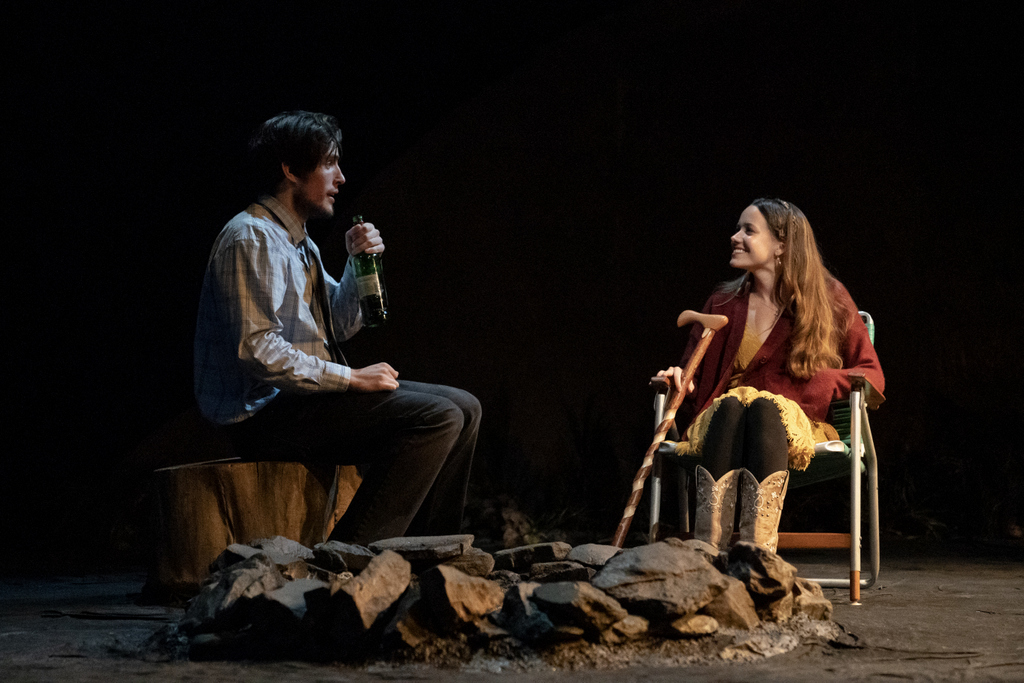
How each of the friends attempts to survive “out there” in the cruel, “evil” world fascinates. During the evening mini reunion on the occasion of celebrating Emily’s mom’s accepting the presidency of their alma mater, Emily (Julia McDermott), Kevin (John Zdrojeski), Justin (Jeb Kreager), and Teresa (Zoë Winters), explain who they’ve become or not become in the seven years since they’ve graduated. Teresa, a rebel during her college years, has become more right-wing conservative than ever, embracing Steve Bannon, Breitbart and Trump with gusto. The others have “laid low” in retreat in Wyoming and Oklahoma, holding jobs they either despise or “put up with,” until they get something better.

Zoë Winters, Jeb Kreager, Julia McDermott, Heroes of the Fourth Turning, by Will Arbery (Joan Marcus)
Zoë Winters portrays Teresa, the feisty, determined, “assured,” conspiracy-theorist supporter with annoying certainty and hyper-vitality, as she explains the next phase of American history to the others. She does this by summarizing a book which posits the Strauss-Howe Generational Theory. Emily, Teresa and Kevin fit into the millennial segment which lends its title to the play: the fourth turning/hero cycle. As she insists that her friends are the hero archetypes laid out in Generations: The History of America’s Future: 1584-2069, she suggests they must embrace their inner/outer hero and get ready for the coming “civil war.”

John Zdrojeski, Julia McDermott in Heroes of the Fourth Turning by Will Arbery (Joan Marcus)
For different reasons Emily and Kevin find Teresa’s explanation of the “Fourth Turning” conceptualization doubtful for their lives. Kevin’s self-loathing and miserable weaknesses belie heroism. He is too full of self-torture and denigration to get out of himself to help another or take a stand for a conservative polemic to fight the liberal enemy in a civil war. Emily is crippled by the pain of her disease. We discover later in the play that she has questions about the conservatism she once embraced. The civil war polemic only seems possible for Justin (Jeb Kreager), who was in the military. Though Justin is not the “Hero” archetype, but is a “Nomad,” he later in the evening expresses that he thinks the conspiracy mantra “there will be a civil war,” proclaimed for decades by alternative right websites will happen.
John Zdrojeski, Zoë Winters, Jeb Kreager, Michele Pawk, Julia Mermott in Heroes of the Fourth Turning by Will Arbery (Joan Marcus)
Arbery has targeted their conversations with credibility and accuracy and the actors are authentic in their nuanced portrayals. As Kevin, John Zdrojeski becomes more drunk, humorous and emotionally outrageous as the night progresses. His behavior shocks for a supposed Catholic, until we understand Kevin doubts his religion’s tenets, especially abstinence before marriage. To a great extent he has been crippled emotionally by doubt, double-mindedness and the abject boredom he experiences with his job in Oklahoma. Also, he admits an addiction to Social Media. Zdrojeski projects Kevin’s confusion and self-loathing victimization with pathos and humor. But we can’t quite feel sorry for him because he is responsible for his morass and appears to enjoy reveling in with his friends. Teresa suggests this is his typical behavior.
The friends wait for the arrival of Gina (Michele Pawk), Emily’s mom’s, to congratulate her on becoming president of their old alma mater, Catholic Transfiguration College of Wyoming. As they wait, they drink, get drunk and catch up with each other, reaffirming their friendships from the past. They discuss and reflect upon the decisions that brought them to Catholic Transfiguration College. We note their conservative, religious views about life, family and politics. Their confusion, sense of impending doom and lack of hope for the future are obvious emotional states. This is an irony for Catholics, whose hope should reside with the birth of Christ and the resurrection. Clearly, they are not exercising the spiritual component of their faith, alluded to in Gina’s speech and in Kevin’s quoting of Wordsworth’s poem “The World is Too Much With Us.” They’ve allowed the material and carnal to overtake the spiritual dimension and thus are depressed and filled with doubt.

(L to R): John Zdrojeski, Michele Pawk, Jeb Kreager, in Heroes of the Fourth Turning by Will Arbery (Joan Marcus)
In representing the conservative views of these individuals, the playwright culls talking points from right-wing media and blogs which Teresa references to Gina when Gina finally arrives. The fact that right-wing conservatism construes violent fighters as heroes is a conflated, limited view. Indeed, to see oneself as a hero and embrace that role is not even an act which true heroes (i.e. firemen, doctors in war zones) saving lives perceive for themselves. It is rhetoric. And Teresa, to empower herself and impress her old friends, speaks it as polemic. Her discussion is not really appropriate to inspire comfortable light conversation at a party. Indeed, her talk is done to solidify herself in the firmament of fantastical belief and remove any oblivion of her own doubts about her life. She and Justin who was in the military particularly rail against liberals, the LGBTQ community, Black Lives Matter, etc.

(L to R): Michele Pawk, John Zdrojeski, Zoë Winters, Heroes of the Fourth Turning, by Will Arbery (Joan Marcus)
Interestingly, Gina blows up Teresa’s cant when she finally arrives to receive the friends’ congratulations. However, they are not quite ready for Gina’s rhetorical response which is a convolution of conservative and liberal ideas that loop in on themselves again and again and defy political labeling. But Gina separates out the illogic of each of their positions. She disavows Justin’s need for guns on campus and decries the conspiracy of the upcoming “civil war.” She implies that Bannon and his like-minded are hacks, and she disavows Trump to the shock of Teresa. At the end of the evening, she pronounces that she is disappointed in the education they have received at their school, believing the college has failed them.

Jeb Kreager, Julia McDermott, in Heroes of the Fourth Turning by Will Arbery (Joan Marcus)
The night of celebration becomes a night of upheaval for Emily, Justin, Kevin and even the staunchly “certain” Teresa who will in the next decade most probably change her views a number of times to suit her determination that she has a handle on the great narrative of “reality.” But in truth as we watch these friends founder through the labyrinth of sublimely complex political, social and cultural convergences they discuss and refer to, it becomes obvious that they have been dislocated from their comfortable conservatism that categorically defined the world for them when they began college.

(L to R): Zoë Winters. Michele Pawk in Heroes of the Fourth Turning by Will Arbery (Joan Marcus)
The irony is that when Gina comes and joins their conversation and smacks down each of their beliefs, especially Teresa’s, we settle back watching the imbroglio that Arbery has wrought. Indeed, we wonder at Gina’s convoluted logic and justifications. That she would give Kevin a job in admissions is a dark irony of misjudgment. He appears the least directed to help others in the admissions process. Though they say their goodbyes with love, Justin and Emily remain in darkness. There is no comfort to be found. There is only the continuation of a foreboding reckoning.
The strongest dynamic of the play resides in the conflicts when Arbery has the friends go at each other after their initial easy reaffirmation of friendships. Ironically, the community they attempt to create falls apart driven by what is devouring each of them inside. It is then that personal flaws they’ve discussed manifest and the hell they face within spills out. Justin’s is humorously eerie. Emily’s comes in the form of fury at whom she deals with in her job and the resident demon of pain in her body. Teresa fears she is making a mistake getting married, and Kevin can’t come to the end of himself.
The tempest between and among the individuals and their inner conflicts reflects a currency for our times and is welcome fodder for entertainment. Arbery with the subtle direction of Taymor has succeeded in extending a hand across the divide of national uproar between left and right with his human, flawed characters. The actors in this ensemble are superb and hit powerful emotional notes with spot-on nuances between humor and profound drama.
This is a play you must see for its shining performances, its topics, the rhetoric-exceptionally fashioned by the playwright and its surprises in characterization. The conclusion is chilling as it expands to the mythic. Noted are the design team: Sarafina Bush (costumes), Isabella Byrd (lighting), Justin Ellington (sound), J. David Brimmer (fight director).
Heroes of the Fourth Turning runs with no intermission at Playwrights Horizons (416 West 42nd Street between 8th and 9th). For tickets and times go to their website by CLICKING HERE.
t
 CAROLE DI TOSTI