Blog Archives
‘Birthright’ at MCC is Exceptional
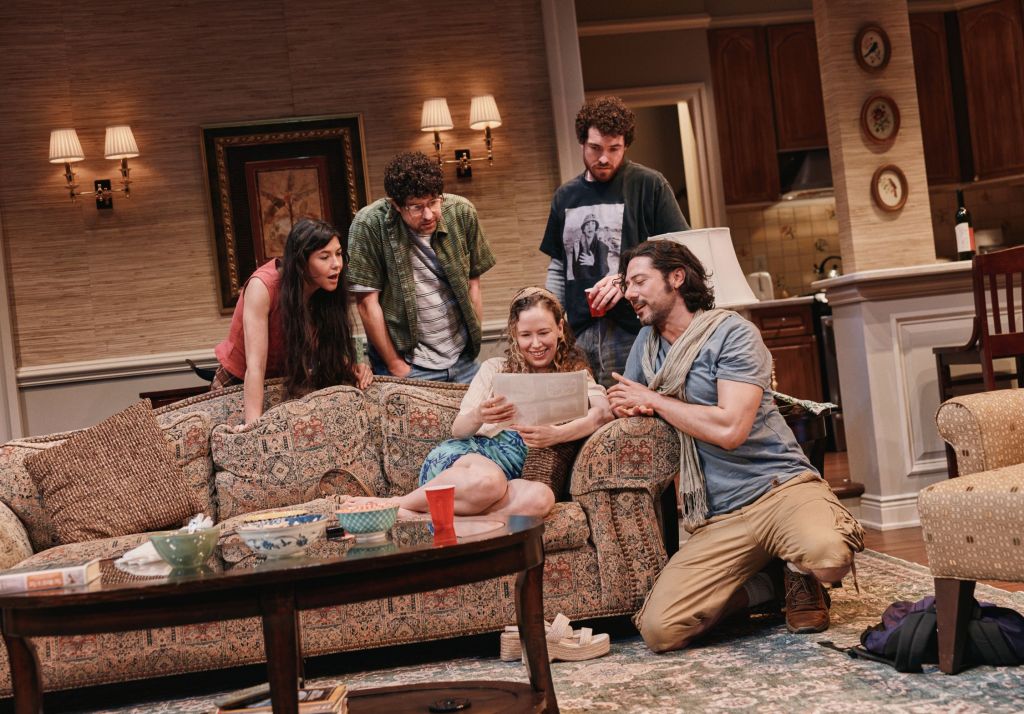
In Birthright writer Jonathan Spector tackles Jewish identity through the viewpoints of six friends as they evolve their relationship with each other after they return from a “Birthright” trip to Israel. Examining each of the characters over an extended time frame from 2006 through 2024, Spector reveals their psychic and spiritual growth as they confront the ever-changing dynamic of the political state of Israel, an increasingly violent and unsafe country.
Spector brilliantly integrates their emotional and personal backgrounds initially as twenty-somethings during the presidency of George Bush Jr. in 2006. After highlighting specific turning points he fast forwards to 2016 ten years later, during Hillary Clinton’s momentous campaign. The last segment settles on the salient points of their journey as they are still in touch with each other. The time quickly forwards through eight years to land in 2024, during the backdrop of President Joe Biden’s campaign, before he moved aside for Kamala Harris to run as the Democratic candidate.
Complex, insightful, philosophical, humorous, fascinating and profoundly human, Spector’s play strikes theatrical gold. Directed by TeddyBergman, Drama Desk nominated director, producer, actor, Birthright currently runs in an extension at MCC through August 23, 2026.
As he did with Eureka Day, the Tony Award-winning playwright presents controversies and explores various cultural opinions. His distinct characters, portrayed almost to near perfection by the ensemble, reveal perspectives that deepen and change over time. Each individual, raised in the cultural background of Judaism with its holiday traditions, foods, behaviors, language and concentration on identity, expresses their own brand of personal and political liberalism. Together, they eschew American conservatism and the Republican Party. In the last segment, we understand that they all deplore Benjamin Netanyahu’s leadership and AIPAC’s (wealthy Jewish donors) influence over congress.
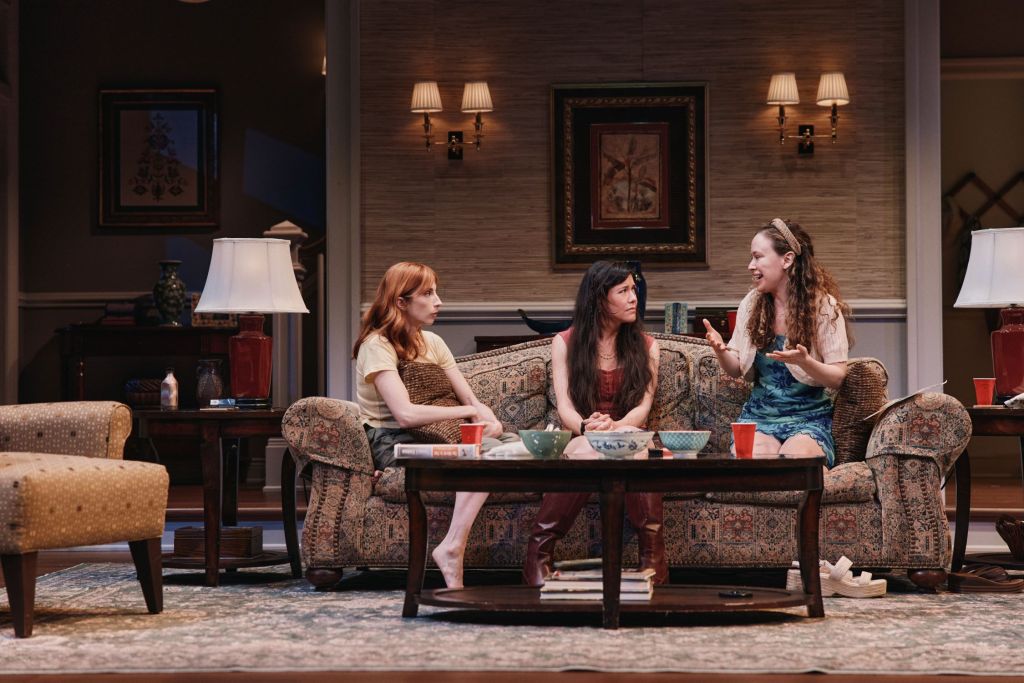
Indeed, some of the play’s humor derives from advancing political ironies cleverly using the flashbacks against our present as a medium. For example one of the characters comments that when “Hillary’s administration gets in, there will be job opportunities.” In another, an anecdote about a conservative father who voted Republican tells his son he may vote Democratic based on Kanye West’s comment that “Bush doesn’t care for Blacks,” evidenced by his dilatory response to Hurricane Katrina. The audience never loses track of the ironies of both statements and others. Indeed, years later West supports Republican Trump, then campaigns to divide Black votes from Biden to help Trump in the 2020 election. Throughout, Spector makes use of the characters’ assumptions about the future which blow up in their faces later in the play as “impossibilities” happen again and again, i.e. “one-third of the nation votes for Trump.”
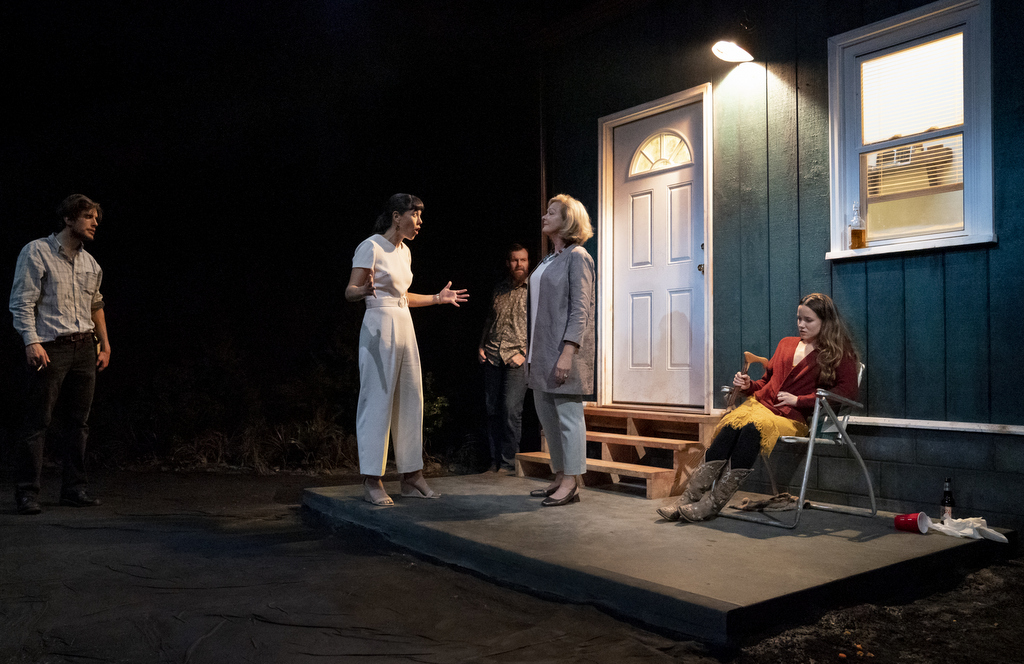
The play opens at the reunion party that Chaya (Zoe Winters) holds for friends who recently returned from their trip to Israel. Birthright Israel gives Jewish adults between 18 and 26 years old an all expenses paid educational and fun trip to experience Israel as a “journey of a lifetime.” At Chaya’s parents’ house in a suburb of Washington, D.C. (with fine period appropriate set designs by Scott Pask), we first meet the brilliant, Israel-aware, gay Izzy (Molly Bernard), Chaya’s long-time friend. Next, we meet politically-minded blogger Noah (Eli Gelb), then drug-fueled musician Emerson (Nate Mann), recently expelled from his band for drinking. Arriving last, comes the philosophical, searching, profound Lev (Hale Appleman),
Also, we discover Chaya’s ulterior motive for the gathering; to dissuade Alona (Molly Ranson) from her rash decision to immigrate to Israel (“making aliyah”). Chaya spills that Alona lost her virginity to an IDF soldier during the trip. As Chaya tries to discourage her in front of the others, Emerson reveals the soldier sexually hooked up with a number of the other young women. Though this devastates Alona, we learn later the trip probably had the greatest impact on her because of her future decision to move there.
Interestingly, we learn the friends’ various attitudes about the trip’s inauthentic, unreal nature. The friends see through the propaganda about Israel to persuade young Jewish people to leave their birth countries. With the exception of Ranson’s Alona, all agree to one degree or another their established camaraderie fostered a bond with each other greater than any loyalty to Israel. Lev, who left the tour, felt, “it was all this like crafted Styrofoam,” like “seeing The Matrix.” Lev tells Izzy (who also felt the unreal situation), if I “wanted any kind of authentic experience, I had to get away from the trip.” After Lev disappears, he visits Jordan’s Petra, and Egypt. Also, he doesn’t miss the significance of the hours long lines for Palestinians to cross borders versus the fifteen minute line white tourists and others easily wait on. If Lev had not left the tour, he wouldn’t have seen this other alarming experience of Israel which he shares with Izzy.
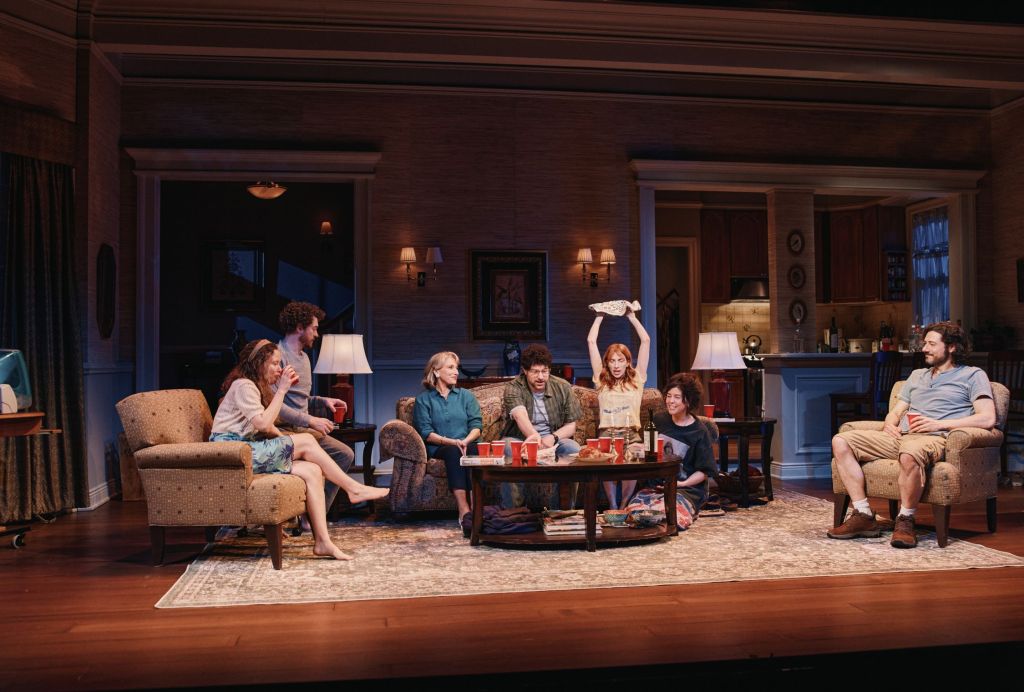
In the 2016 segment during another reunion at Chaya’s as they plan their toast for Alona’s wedding celebration the next day, we discover Alona and her husband are moving to Israel. From this meeting we understand the characters’ progress in search of something to strengthen their sense of purpose, despite personal successes or failures. For example married lawyer Izzy, at polar opposites with Alona, passionately speaks out against Israel’s apartheid. Chaya and Izzy question Alona’s Israel move in light of its moral ambiguity. As a citizen she will take part in the oppression and abuse of the Palestinians through her complicity by simply moving and living there. Will she stand for justice for Palestinians, or walk obliviously over their trail of tears?
Lev, who had spoken of his desire to become a rabbi years before drops out of school, gets married, divorced and beats himself up about not seeing his child as often as he likes. Noah quits The Washington Post and reinforces his online presence as a political influencer which eventually morphs into podcasting by 2024. Noah’s interest in Chaya which began after a brief affair on the trip continues despite Chaya’s marriage which heads toward divorce. Her work with the Obama administration ends and she takes on an organization to help Hillary get elected. Emerson seems the most lost at this point; unmarried, composing a few solo albums. But he stumbles into keeping kosher in spite of himself. All look forward to the hope of the first female president, some more avidly than others.
In the last segment, the downturn from hope and light into confusion and darkness becomes symbolized in the death of one of their number. Consequently, his loss raises the stakes of their relationships. The original bonds fostered during the trip have developed into love and an emotional concern and closeness which sustains them. Likewise, on another cultural, personal level, the devastating attack of Hamas on October7th, and the subsequent turmoil and chaos of finding the hostages amidst the daily bombing of the people of Gaza causes emotional devastation for Izzy, Chaya and Alona. And to various degrees, each friend questions the well-meaning values of the Judaism they were raised in versus Netanyahu’s bloody, never-ending punishment of Palestinian women and children.
What is the right path? Can the initial massacre justify the piles of bodies and annihilation and ethnic cleansing implicating the US government’s complicity supplying aid which includes weapons to Israel? Where did this begin? In Zionism as Izzy suggests or in the foundation of the state of Israel as a safe haven for outcast Jews in search of their birthright? And arguing whether the bloody slaughtering is or isn’t a genocide becomes a distraction while the incessant murdering continues. As Noah attempts to mitigate Izzy and Chaya’s arguments, Emerson arrives. He missed the funeral service. As it turns out he has arrived just in time for some food and community. And his surprising presence brings gasps from the audience.
As it turns out after years of wandering, in this 2024 reunion, the friends are brought together once again in a new way. And maybe just maybe Chaya and Noah will see their way clear to be with each other after all is said and done.
Birthright runs 3 hours 20 minutes through August 23, 2026 at MCC Theater; mcctheater.org.
‘Heroes of the Fourth Turning’ by Will Arbery at Playwrights Horizons

Jeb Kreager, Julia McDermott, Heroes of the Fourth Turning by Will Arbery (Joan Marcus)
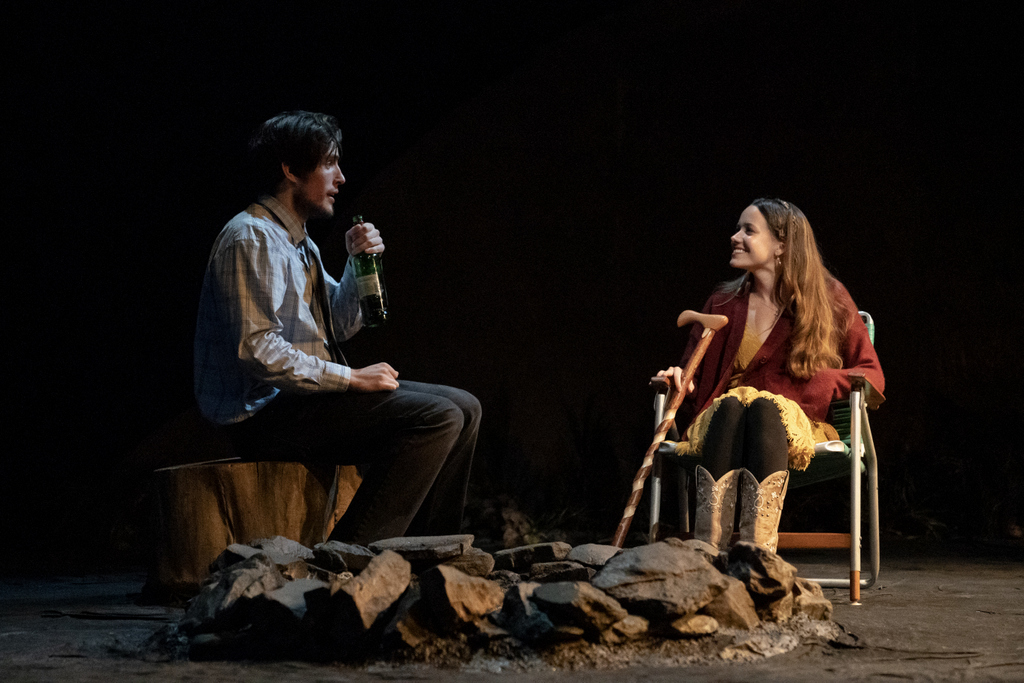
John Zdrojeski, Julia McDermott in Heroes of the Fourth Turning, by Will Arbery (Joan Marcus)
It’s seven years after you’ve graduated from college. What do you do if you are adrift, emotionally miserable and/or in physical pain? What if cocaine, alcohol, social media obsessions, abstinence from sex, indulgence in sex, and your Catholicism isn’t helping you find your way? Do you find something else to believe in to help you escape from the labyrinth of conundrums and foreboding demon thoughts plaguing your life?
Will Arbery’s Heroes of the Fourth Turning in a production at Playwrights Horizons ably directed by Danya Taymor discloses the inner world of the right wing religious. In his entertaining and profound examination of conservative-minded friends and alumni from a small, Catholic college who gather for a party, we get to see an interesting portrait of conservative “types,” who are akin to liberals in dishing the rhetoric. To his credit Arbery gives grist to the argument that beyond the cant are the issues that pertain to every American. Whether liberal or conservative, all have the need to belong, to care and love, and to make a way where there is no apparent way to traverse the noise and cacophony that creates the social, political divide currently in our nation.

John Zdrojeski, Zoë Winters Heroes of the Fourth Turning, by Will Arbery (Joan Marcus)
How each of the friends attempts to survive “out there” in the cruel, “evil” world fascinates. During the evening mini reunion on the occasion of celebrating Emily’s mom’s accepting the presidency of their alma mater, Emily (Julia McDermott), Kevin (John Zdrojeski), Justin (Jeb Kreager), and Teresa (Zoë Winters), explain who they’ve become or not become in the seven years since they’ve graduated. Teresa, a rebel during her college years, has become more right-wing conservative than ever, embracing Steve Bannon, Breitbart and Trump with gusto. The others have “laid low” in retreat in Wyoming and Oklahoma, holding jobs they either despise or “put up with,” until they get something better.

Zoë Winters, Jeb Kreager, Julia McDermott, Heroes of the Fourth Turning, by Will Arbery (Joan Marcus)
Zoë Winters portrays Teresa, the feisty, determined, “assured,” conspiracy-theorist supporter with annoying certainty and hyper-vitality, as she explains the next phase of American history to the others. She does this by summarizing a book which posits the Strauss-Howe Generational Theory. Emily, Teresa and Kevin fit into the millennial segment which lends its title to the play: the fourth turning/hero cycle. As she insists that her friends are the hero archetypes laid out in Generations: The History of America’s Future: 1584-2069, she suggests they must embrace their inner/outer hero and get ready for the coming “civil war.”

John Zdrojeski, Julia McDermott in Heroes of the Fourth Turning by Will Arbery (Joan Marcus)
For different reasons Emily and Kevin find Teresa’s explanation of the “Fourth Turning” conceptualization doubtful for their lives. Kevin’s self-loathing and miserable weaknesses belie heroism. He is too full of self-torture and denigration to get out of himself to help another or take a stand for a conservative polemic to fight the liberal enemy in a civil war. Emily is crippled by the pain of her disease. We discover later in the play that she has questions about the conservatism she once embraced. The civil war polemic only seems possible for Justin (Jeb Kreager), who was in the military. Though Justin is not the “Hero” archetype, but is a “Nomad,” he later in the evening expresses that he thinks the conspiracy mantra “there will be a civil war,” proclaimed for decades by alternative right websites will happen.
John Zdrojeski, Zoë Winters, Jeb Kreager, Michele Pawk, Julia Mermott in Heroes of the Fourth Turning by Will Arbery (Joan Marcus)
Arbery has targeted their conversations with credibility and accuracy and the actors are authentic in their nuanced portrayals. As Kevin, John Zdrojeski becomes more drunk, humorous and emotionally outrageous as the night progresses. His behavior shocks for a supposed Catholic, until we understand Kevin doubts his religion’s tenets, especially abstinence before marriage. To a great extent he has been crippled emotionally by doubt, double-mindedness and the abject boredom he experiences with his job in Oklahoma. Also, he admits an addiction to Social Media. Zdrojeski projects Kevin’s confusion and self-loathing victimization with pathos and humor. But we can’t quite feel sorry for him because he is responsible for his morass and appears to enjoy reveling in with his friends. Teresa suggests this is his typical behavior.
The friends wait for the arrival of Gina (Michele Pawk), Emily’s mom’s, to congratulate her on becoming president of their old alma mater, Catholic Transfiguration College of Wyoming. As they wait, they drink, get drunk and catch up with each other, reaffirming their friendships from the past. They discuss and reflect upon the decisions that brought them to Catholic Transfiguration College. We note their conservative, religious views about life, family and politics. Their confusion, sense of impending doom and lack of hope for the future are obvious emotional states. This is an irony for Catholics, whose hope should reside with the birth of Christ and the resurrection. Clearly, they are not exercising the spiritual component of their faith, alluded to in Gina’s speech and in Kevin’s quoting of Wordsworth’s poem “The World is Too Much With Us.” They’ve allowed the material and carnal to overtake the spiritual dimension and thus are depressed and filled with doubt.

(L to R): John Zdrojeski, Michele Pawk, Jeb Kreager, in Heroes of the Fourth Turning by Will Arbery (Joan Marcus)
In representing the conservative views of these individuals, the playwright culls talking points from right-wing media and blogs which Teresa references to Gina when Gina finally arrives. The fact that right-wing conservatism construes violent fighters as heroes is a conflated, limited view. Indeed, to see oneself as a hero and embrace that role is not even an act which true heroes (i.e. firemen, doctors in war zones) saving lives perceive for themselves. It is rhetoric. And Teresa, to empower herself and impress her old friends, speaks it as polemic. Her discussion is not really appropriate to inspire comfortable light conversation at a party. Indeed, her talk is done to solidify herself in the firmament of fantastical belief and remove any oblivion of her own doubts about her life. She and Justin who was in the military particularly rail against liberals, the LGBTQ community, Black Lives Matter, etc.

(L to R): Michele Pawk, John Zdrojeski, Zoë Winters, Heroes of the Fourth Turning, by Will Arbery (Joan Marcus)
Interestingly, Gina blows up Teresa’s cant when she finally arrives to receive the friends’ congratulations. However, they are not quite ready for Gina’s rhetorical response which is a convolution of conservative and liberal ideas that loop in on themselves again and again and defy political labeling. But Gina separates out the illogic of each of their positions. She disavows Justin’s need for guns on campus and decries the conspiracy of the upcoming “civil war.” She implies that Bannon and his like-minded are hacks, and she disavows Trump to the shock of Teresa. At the end of the evening, she pronounces that she is disappointed in the education they have received at their school, believing the college has failed them.

Jeb Kreager, Julia McDermott, in Heroes of the Fourth Turning by Will Arbery (Joan Marcus)
The night of celebration becomes a night of upheaval for Emily, Justin, Kevin and even the staunchly “certain” Teresa who will in the next decade most probably change her views a number of times to suit her determination that she has a handle on the great narrative of “reality.” But in truth as we watch these friends founder through the labyrinth of sublimely complex political, social and cultural convergences they discuss and refer to, it becomes obvious that they have been dislocated from their comfortable conservatism that categorically defined the world for them when they began college.

(L to R): Zoë Winters. Michele Pawk in Heroes of the Fourth Turning by Will Arbery (Joan Marcus)
The irony is that when Gina comes and joins their conversation and smacks down each of their beliefs, especially Teresa’s, we settle back watching the imbroglio that Arbery has wrought. Indeed, we wonder at Gina’s convoluted logic and justifications. That she would give Kevin a job in admissions is a dark irony of misjudgment. He appears the least directed to help others in the admissions process. Though they say their goodbyes with love, Justin and Emily remain in darkness. There is no comfort to be found. There is only the continuation of a foreboding reckoning.
The strongest dynamic of the play resides in the conflicts when Arbery has the friends go at each other after their initial easy reaffirmation of friendships. Ironically, the community they attempt to create falls apart driven by what is devouring each of them inside. It is then that personal flaws they’ve discussed manifest and the hell they face within spills out. Justin’s is humorously eerie. Emily’s comes in the form of fury at whom she deals with in her job and the resident demon of pain in her body. Teresa fears she is making a mistake getting married, and Kevin can’t come to the end of himself.
The tempest between and among the individuals and their inner conflicts reflects a currency for our times and is welcome fodder for entertainment. Arbery with the subtle direction of Taymor has succeeded in extending a hand across the divide of national uproar between left and right with his human, flawed characters. The actors in this ensemble are superb and hit powerful emotional notes with spot-on nuances between humor and profound drama.
This is a play you must see for its shining performances, its topics, the rhetoric-exceptionally fashioned by the playwright and its surprises in characterization. The conclusion is chilling as it expands to the mythic. Noted are the design team: Sarafina Bush (costumes), Isabella Byrd (lighting), Justin Ellington (sound), J. David Brimmer (fight director).
Heroes of the Fourth Turning runs with no intermission at Playwrights Horizons (416 West 42nd Street between 8th and 9th). For tickets and times go to their website by CLICKING HERE.
t

