Blog Archives
‘The Great Gatsby,’ Sumptuously Re-imagined, A Must-See, Unforgettable Broadway Spectacle

The Great Gatsby by F. Scott Fitzgerald is an iconic American novel set during the Jazz Age. It is about class, the privilege of old wealth and the excesses of the nouveau riche, who can never attain the status of the generational moneyed class, regardless of how hard they try. The Great Gatsby a New Musical, based on the titular novel, retains this key theme of America’s class system from the perspective of unreliable narrator Nick Carraway (Noah J. Ricketts). Carraway memorializes Jay Gatsby, the extraordinaire, whose ability to distill hope and materialize his dreams achieves its own artistic perfection. Examined from the perspective of Nick Carraway (Noah J. Ricketts), the tragic flaw in Gatsby’s process is that he attaches his hope to the imperfection of love and a woman who wasn’t worthy of his vision, faith or love.

The Great Gatsby, a New Musical made its premiere at the Broadway Theatre after its fall run at the Paper Mill Playhouse in New Jersey. With book by Kait Kerrigan in her Broadway debut, music by Jason Howland (Paradise Square), and lyrics by Nathan Tysen (Paradise Square), the musical is suprbly choreographed by Dominique Kelley and acutely directed by Marc Bruni (Beautiful: the Carole King Musical). Overall, it’s a gorgeously conceived production with exceptional ensemble work and flamboyant spectacle that sumptuously re-imagines the distinctive settings, individualistic characters and seminal events that make the novel a singular and timeless classic.

The strength of this production is that Kerrigan, Howland and Tysen are loyal to Nick’s perception of the magnificent Jay Gatsby, portrayed exquisitely by Jeremy Jordan. Jordan’s luscious, exceptional voice, Gatsbyesque persona, and passion do justice to Howland and Tysen’s lyrical and dynamic songs, “For Her,” “Past Is Catching Up to Me,” and the duet “Go.” We empathize with Jordan’s Gatsby, whose near divine love of Daisy (the lovely Eva Noblezada), never fails him, though Daisy can’t handle the irrepressible and divine nature of his efforts to transform time.
In “My Green Light,” an extraordinary duet between Noblezada and Jordan at the end of Act I, the couple consummates their love in Gatsby’s lavish bedroom with the projection of the rippling Long Island Sound at night, and the green light at the end of Daisy’s dock twinkling behind them in the background.

Bruni’s phenomenal staging, Paul Tate DePoo III’s projection and set unifies the key elements of the love relationship between Gatsby and Daisy, the artistry of Gatsby’s vision and his infinite hope (symbolized by the green light), driving it. The acting talents of Jordan and Noblezada, their lustrous singing and the setting are dazzling in this memorable, uplifting scene, where Gatsby, indeed, for a moment conquers time.

At that point we believe that Gatsby’s love is enough to hold Daisy and take her away from the craven, brutish, hypocritical Tom, who breaks his mistress Myrtle’s nose (Sara Chase), and manhandles Daisy leaving bruises on her arms during their quarrels. We believe like Nick and Jordan (the adorable Samantha Pauly), that Tom doesn’t deserve Daisy. However, by the conclusion of the musical, Nick realizes that Tom and Daisy do deserve each other. She won’t even attend Gatsby’s funeral, acting like he never existed. We agree with Nick that Gatsby is “worth the whole damn bunch put together.”

As Nick spins it, the tragedy lies in Daisy’s soulish weakness and her inability to live up to Gatsby’s love to “forget the past,” which he asks her to do in front of Tom in the superbly acted scene at the Plaza Hotel. Together the characters sing the sensational ensemble number “Made to Last.” John Zdrojeski’s Tom is particularly cruel as he arrogantly denounces Gatsby, his criminal bootlegging and his low class background. The lyrics are profound and spot-on. The dynamic music reinforces the themes which the characters forcefully embrace and symbolize. Tom sardonically sings, “It’s not about wealth, it’s blood. It’s class. The day you were born, your die had been cast.” And Gatsby insists, “Daisy, tell him you’re through.” And he tells Tom to “face reality,” affirming that Daisy never loved Tom.

During the explosive turning point in the song, Gatsby insists she renounce her marriage to Tom, and in effect her position and class to which Tom “elevated” her. When Tom sees she falters, that she honestly admits that she loved them both, and that Gatsby “wants too much,” Tom feels secure. He knows she is too weak and insecure to leave him and their daughter. Noblezada’s Daisy, Zdrojeski’s Tom and Jordan’s Gatsby strike the mixture of emotions of their characters with authenticity and power. Daisy’s heightened angst and tenuous state of mind force her to leave the suite, with Gatsby running after her. It is not a position of power from which Gatsby might redeem himself with her, though he tries.

Tom’s defamation and insults to Gatsby’s face and the reality of what Daisy would be giving up to leave him dislocates Daisy to distraction and ultimately causes the fatal accident and final tragedy of the underclasses, who make the mistake of becoming involved with the soulless, unimaginative upper class.

Noblezada portrays Daisy’s confusion with grist, making Jeremy Jordan’s desperation to stop Tom’s brainwashing and win her back even more pronounced. When Tom’s words hit their mark, it’s as if a curtain shuts down Daisy’s mind. Jordan’s Gatsby sees the impact of Tom’s cynicism as it disintegrates all the romance of what he has accomplished in order to turn back time to the fullness of Daisy’s love when Tom never existed. The scene is the brilliant high-point. What follows is the aftermath from which there is no recovering, except that Nick must lead the musical encomium to the greatness of his friend Gatsby. He alone fully grasps who the man was, so of course, he is furious that the papers slam Gatsby and further drive Daisy into oblivion and Tom into victory, as they jaunt away to Hawaii.

Kerrigan, Howland and Tysen are faithful to the key events in the novel down to no one going to Gatsby’s funeral except Nick which Bruni simply stages with black curtains, the casket and bier and red roses. Howland and Tysen fill out Wilson’s mania as he assassinates Gatsby, after Tom sets him up (“God Sees Everything”). As Gatsby sings the reprise “For Her” and Nick imagines how it happens, Wilson joins in and asks God’s forgiveness for using his hands to met out justice and take responsibility for the execution. Of course, Wilson’s ask is ridiculous as his justice is misplaced. Duped by Tom to do violence and pay for it with his own life, Wilson is a pathetic figure. Reflecting on these events, and Daisy and Tom’s nonchalance about Gatsby and the Wilsons, Carraway disdains Daisy and Tom as representative of the careless rich who destroy people and things leaving the Nick Carraways of the world to clean up the mess.

Comedic elements are found in this adaptation which sometime diffuse the impact of the story, as does attention to the secondary characters who are given greater focus. It is also problematic that Nick’s perspective doesn’t cohere throughout the musical, but leaves off in a few scenes, one between Jordan and Daisy.

Some of the comedy is refreshing as in the scene Nick and Jordan share at Nick’s cottage while Daisy and Gatsby meet for the first time in five years. Their relationship is expanded beyond the novel when Jordan and Nick’s intimacy gives way to his proposal of marriage which she is on the verge of accepting, though in Act I she is against marriage. Her characterization is more in keeping with today’s women than women of the early 20th century. Nick’s characterization is largely faithful to the novel. Noah J. Ricketts does a fine job of rendering Nick the unreliable narrator who thinks highly of himself, but doesn’t completely stand up to Tom and Daisy. Instead, he turns tail and runs back to the Midwest away from the” “evil” East, an irony. The only way he can reconcile his self-loathing about his behavior is to attempt to expiate his guilt by memorializing Gatsby.
The Jordan/Nick scenes are humorous and flirtatious. Their number “Better Hold Tight” is a diversion more for its own sake. However, we are not surprised that Nick throws over Jordan who doesn’t show up to Gatsby’s funeral either. She is one of the bad drivers, the careless rich who sicken and disgust him, for they dupes the fools who would seek the dream “boats running against the current” (“Finale: Roaring On”), to only to stumble because their dreams are behind them in the past.

Kerrigan, Howland and Tysen take even greater liberties with the secondary characters for the sake of dramatic purposes. Kerrigan, et. al. strengthen and coalesce the ideas symbolizing George Wilson (Paul Whitty), George’s wife Myrtle (Sara Chase), and Meyer Wolfsheim (Eric Anderson), by giving each of them solo numbers which define their personalities, desires and attitudes. These add to the themes, though they refocus the thrust of Nick’s story of how Gatsby is a romantic hero. The mystery surrounding Gatsby’s identity which is slowly revealed in the novel, is lost in this musical with attention going elsewhere.

As a representative of the criminal class that feeds the dreams of the lower class, breaking the law to do so, thug Wolfsheim joins the company singing “New Money,” which old wealth (Tom), regards as garish and meretricious. Anderson’s Wolfsheim (“who made Gatsby”), also sings and joins the company dancing in the excellent number “Shady.” As Wolfsheim sings, Bruni stages vignettes with each of the character couples being corrupted in their adultery or “sinful” affairs (Jordan and Nick, Gatsby and Daisy, Tom and the Wilsons). According to Wolfsheim, “I’m okay with keeping secrets. I’m okay with being naughty. I approve of indiscretions, if you know how to hide a body.”

Eric Anderson and cast of The Great Gatsby (Matthew Murphy and Evan Zimmerman)
Read the rest of this entry
‘Jonah,’ Working Through Trauma Over Time

The world premiere of Jonah by Rachel Bonds directed by Danya Taymor and presented by Roundabout at Laura Pels Theatre, Harold and Miriam Steinberg Center for Theatre, is in a limited engagement until March 10th. Billed as a “coming of age story,” Jonah follows a young girl traumatized by events after her mother joins up with a man and his sons. This becomes an untenable living arrangement from which she and her mother cannot escape, all of which we learn through her dialogue with three characters.
In a nonlinear fashion, with sketchy details, Bonds reveals Ana’s backstory by degrees, as Ana (Gabby Beans-The Skin of Our Teeth) interacts with Jonah (Hagan Oliveras), Danny Samuel H. Levine (The Inheritance), and Steven (Good Night, Oscar), throughout undefined time sequences. Using obscurity, intimation, opacity and mystery as key devices to unfold how the “slings and arrows of outrageous fortune” have impacted the main character Ana, we gradually learn how traumatic events might be worked through with fantasy and the imagination to promote redemption and healing.
Bonds opens the play with Ana at an unspecified educational setting, most probably a private high school where Ana tells Jonah she is on a scholarship. Jonah (the adorable, exceptional Oliveras), walks with her and engages her in friendly conversation. Ana, who attempts to remain aloof, eventually allows him to follow her up to her dorm room after a few interactions outside her dorm. In the next few scenes, Jonah and Ana grow closer and share intimate details about their sex lives. Both are virgins and their intimacy never really “gets off the ground” into something sexual, though what they do share is profoundly substantive, sweet and loving.

The manner in which Jonah leaves, and the fantasies Ana shares about her being in love and sexually fulfilled, indicate the possibility that Jonah is her fantasy. He is the way she wishes a partner in love might be: sweet, caring, solicitous about her comfort, flattering, overwhelmed by her beauty, and articulate to the extent that he engages her trust and faith. It is these qualities that elicit her reciprocation, until shockingly, at the “twinkling of an eye,” he falls back into the blackness of the doorway.
Bonds shifts the time in the next segments. The playwright introduces another character, Danny, who is troubled, confused, traumatized. Though Wilson Chin’s set design remains the same, unobtrusive beige (rugs, bed linens, walls, etc.,), Danny appears at her doorway, taking the place of the sweet Jonah. We learn Ana’s mother has died, after remarrying a violent alcoholic with two sons. He abuses son Danny because he stands up to him. Through Ana and Danny’s dialogue we learn that her stepfather is also brutal to Ana emotionally, but stops at the point of physicality. However, the intimation is that soon he will go after Ana, and perhaps he has already abused her with inappropriate sexual touching.
In Ana’s scenes with Danny, we note how she comforts him and helps him cope with his father’s abusive beatings, either attempting to dress his wounds or give him a head massage. Clearly, Danny is protecting her by taking the brunt of his father’s alcoholic abuse, and he goes to her in kinship for comfort. Bonds doesn’t clarify how her mother died. Nor does she explain what happened to her sisters, referenced in a photo she discussed in the previous scenes with Jonah.

The one positive element in the series of events in the Danny sequences is that Ana is excellent in school and is pursuing writing which helps distance her from the terrible home circumstances. Apparently, Danny effects their escape before the stepfather sexually abuses Ana, who avoids discussion of the specific details of their situation. However, because Danny references that he brought Ana and his brother to a safe place, we note that Ana possibly feels an obligation to comfort Danny.
In one scene when Danny visits her drunk in her new location, presumably another school setting where she is pursuing her writing, they are intimate. The experience isn’t pleasant, but she permits him to “deflower” her out of pity. Because he is “out of it,” he doesn’t realize what he is doing until after it is over and Ana withdraws from him and becomes remote. In the final Danny segment, he reads an assignment that she has written about him, though she attempts to explain it awat. He is so upset by her view of him that he cuts himself to release the pain of what he interprets to be her censure and loathing. As he goes into shock, she is forced to get help to take him to the hospital to stem the bleeding.
Once again, the scene shifts and a new young man appears at the doorway of the same beige room which by now we gather is a combination of Ana’s memory, a fabrication of an alternate reality that Ana constructs to help herself emotionally, or a dorm-like setting in the future that manifests some elements of objective reality. As Ana converses with Steven (John Zdrojeski), the dialogue lets us know the setting has changed to a writing retreat, and Steven is concerned why she is not dining with the other writers. During their conversation, Steven discloses he has read her novel and found it fascinating. As he attempts to become closer to her through his kind manner and friendly conversation, we note that he is more like Jonah from the first segments.
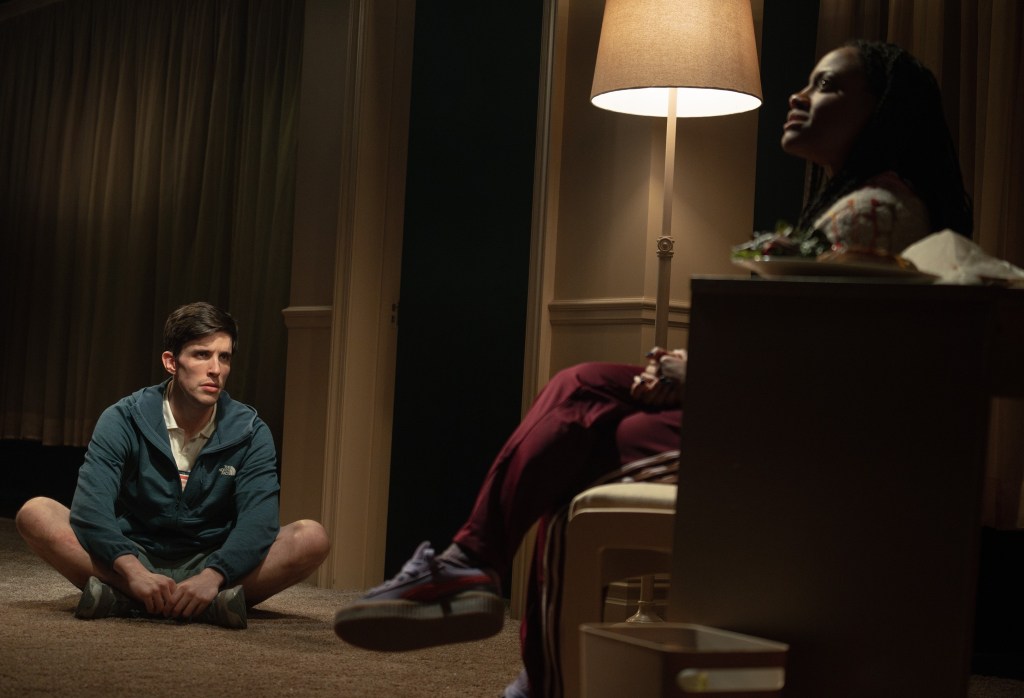
It is in this final segment with Steven that Ana discloses Danny committed suicide. The impact of this years later and the events that occurred in the past Ana relates to Steven, a lapsed Mormon because he wants to know about her family situation and her writing. During these segments with Steven, there is a scene when Jonah returns. He reaffirms their connection from the past. They discuss how they missed each other and Jonah apologizes for perhaps having done something that disconnected their relationship and closeness.
In this last meeting with Jonah, we realize that Jonah is symbolic. Perhaps, he is a configuration of her psyche that is her male counterpart. Perhaps he is a fantasy she uses to bring her to closure, so she can establish an intimacy that will help her overcome the previous traumas and unhealthful relationship with Danny.
Jonah and she briefly reunite in a healing moment and then he leaves. At the right time, Steven who has fallen asleep by her bedside, while Jonah visited, awakens.
It is after her visit with Jonah that Steven and Ana discuss the nature of intimacy and sex. Additionally, she is able to discuss God and answer Steven’s questions. As she describes her experience, we understand the impact of the past traumas. They disassociated her from her body and her faith in God. The pain was so great she went into a deep freeze and felt nothing, nor did she want to feel anything. However, the disassociation became a form of recuperation and allowed her an emotional pause. Eventually, as a result of it, she can begin to restore herself with a loving relationship, release the guilt and shame and become whole again.
During her discussions with Steven, they move to establish a closer, comfortable relationship, as Steven checks to make sure she is comfortable with him. Ana becomes reconciled to herself. She and Steven begin a more intimate chapter in their lives as Bonds concludes on an up note.

Bonds’ play is about the healing process after trauma and how individuals use elements of their own humanity to work through terrible events from their past. She merges fantasy and reality, past and present and cleverly uses the dialogue to identify emotional, psychological time so that we understand the nature of how physical violence and abuse may be worked through. Bonds’ conclusion shows Ana and Steven concerned for each other, unlike Ana’s incomplete, painful relationship with Danny, where Ana nurtured him as far as possible, but she wasn’t enough for him.
Bonds keeps us intrigued, though at times, the dialogue needed tightening. I drifted during some parts. I found the scenes with Jonah the most uplifting and credit Oliveras, who is sensational and believable as the forthright and candid Jonah. Levine has the most difficult role as Danny. His portrayal of Danny as broken, and as a taker is spot-on. Yet, despite the undercurrent of violence and overt neediness, Levine’s Danny is poignant. Additionally, he clarifies that, though Danny apologizes to Ana, we note that he is following in his father’s footsteps. He desperately needs help which Ana cannot give him or she will herself drown.
That she nearly does drown emotionally then closes off herself is a protective device against Danny, who has been so abused, he seeks suicide as a release for his inner torment. The extent to which his suicide impacts Ana and makes her feel guilty is intimated but not spelled out.
Zdrojeski’s Steven is a welcome contrast after Levine’s angst-filled Danny. His tenderheartedness recalls Jonah’s innocence and kindness. That Zdrojeski’s Steven is like Jonah in the concern expressed for Ana’s well being, as well as the admiration of her talent, creates the hopefulness that Bonds wishes for Ana’s emotional recovery. Beans’ Ana and Zdrojeski’s Steven remind us in a world of hurt, torment and violence, there are kind and loving individuals. Perhaps they are there when one doesn’t look for them or more importantly, when one is ready to work through one’s guilt, recrimination and pain.
Though Bonds ends the play affirmatively with Steven and Ana learning to be intimate with each other, she leaves many questions unanswered. What have we just envisioned? Were the scenes mere sketches in Ana’s psyche that are fantastical but not really grounded in objective reality? Or do they convey fictional accounts in Ana’s writerly imagination? Such is the nature of consciousness and the layers of personality when confronting trauma, abuse, violence so that the events tend to merge fantasy and reality in the haze of wounded memory. Taken on that level, Bonds’ work is fascinating and valuable.
The creative team effects Taymor’s unity of vision with Bonds’ themes with effective stylization,. Wilson Chin’s set design defines the place in Ana’s mind which never changes. Kaye Voyce’s costume design similarly remains the same for Ana and the characters with only two tops varying down through the years as Ana’s mind leaps in time segments. Likewise, Tommy Kurzman’s hair design (it stays the same), follows Taymor’s and Bonds’ vision that objective reality has been overcome by Ana’s interpretation and perspective in her conversations as she grapples with the past in her imagination in the present.
Likewise, the light flashes which signify a change in time sequence (Amith Chandrashaker’s lighting design), give structure to the scenes. The overall softness in the lighting when Ana is “in the room” with the young men, appropriately echoes the dimness of memory and hazy suggestion of imagination. Kate Marvin’s sound design accompanies the lighting flashes symbolically and indicates the shifts in time, reality, imagination.
The theme that over time one may heal from past emotional devastation, if one has the will to do so, is a hopeful one. Though we don’t understand all of Ana’s derivations through reality, fantasy, memory, flashback, objective reality, we do understand that she wants to release herself from the pain, and redeem herself so she can be intimate and open to love again. How Bonds effects this process is striking. The performances are terrific. And Beans sustains her energy and vitality throughout.
Jonah, Laura Pels Theatre Harold and Miriam Steinberg Center for Theatre, 111 West 46th Street between 6th and 7th for the Box Office. For their website: https://www.roundabouttheatre.org/get-tickets/2023-2024-season/jonah/
‘Good Night, Oscar’ Sean Hayes in a Marvelous Must-See

It is not that Sean Hayes looks like Oscar Levant (he is taller), or speaks like Levant (not really), or accurately displays Levant’s neurotic ticks and eye blinks (he ticks away), or imitates his posture (he slumps, cutting off 2 inches of his own height). What Hayes does nail is Levant’s pacing, deadpan delivery, comedic sentience and his self-effacing, desperate, sorrowful heart. And it is these latter Levantesque authenticities that Hayes so integrates into his being that when he shines them forth, we believe and follow Hayes wherever he takes us during the brilliant, imminently clever Good Night, Oscar, currently running at the Belasco Theatre with no intermission.

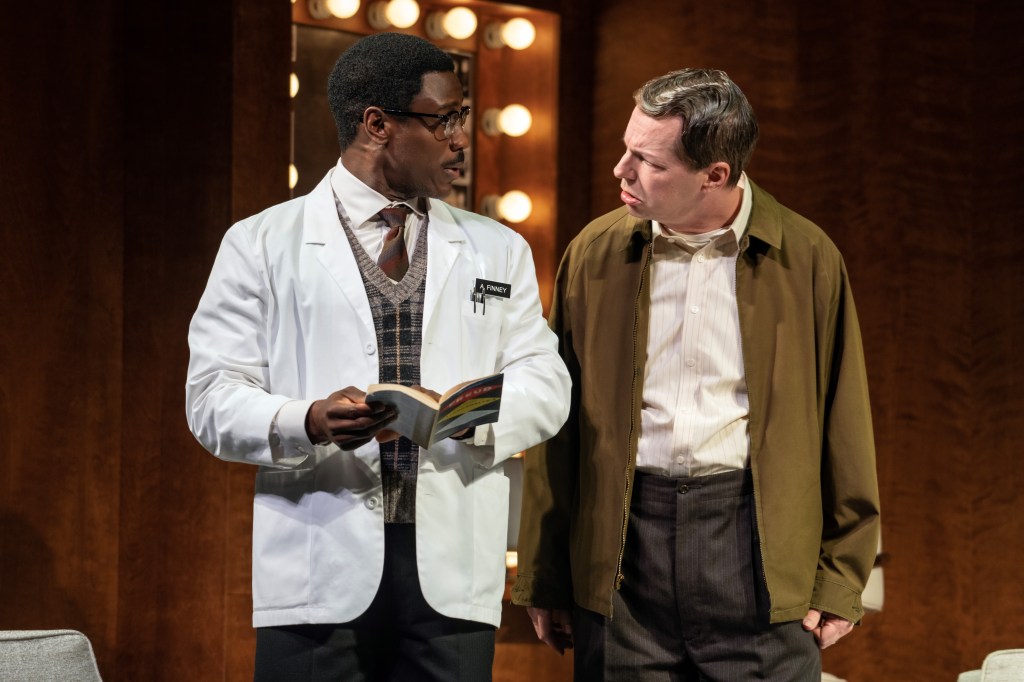
With a well-honed, drop-dead gorgeous book by Doug Wright (I Am My Own Wife), and superb production values (Rachel Hauck-scenic design), (Emilio Sosa-costume design), (Carolina Ortiz Herrera & Ben Stanton-lighting design), (Andre Pluess-sound design), and J. Jared Janas for hair & wig design, director Lisa Peterson’s vision brings us back to 1958 in NBC Studios’ inner sanctum, where the backstage drama is more incredible than what happens on live camera. Of course, by the time Hayes’ Levant appears live on The Tonight Show, we, Parr (Ben Rappaport), June Levant (Emily Bergl), Alvin Finney (Marchánt Davis) and head of NBC Bob Sarnoff (Peter Grosz), have lived two lifetimes fearing the worst. After all, this is live television with no splicing tape or editing. Whatever happens is. And that makes the tension and thrill of this production that duplicates the fear of “live,” (just like on Broadway, but with no extended rehearsals), just smashing.

Doug Wright acutely, craftily ups the ante of danger in the 80% probability that Levant will make a mess of things. Perhaps, he won’t make it to the studios, just like the time he left an audience of three thousand waiting in fancy dress to hear him play the piano, concert style, which was popular in those days. Then, he let them wait and never showed up.
Levant is noted for his version of the stellar George Gershwin’s “Rhapsody in Blue.” Parr and the TV audience expect Levant to play it, but of late, he is hesitant and may refuse and walk off the set. So Levant might be on time but blow-up his appearance, as he has done before, saying the extraordinary and surprising, if asked to comment on religion, politics or sex. Furthermore, he is plagued by the spirit of Gershwin and has reveries of the past where, at times, he makes no sense. So much can go wrong, like Murphy’s Law states: “If something can go wrong, it will.” With Levant this has become a truism with scheduled bookings and appearances.
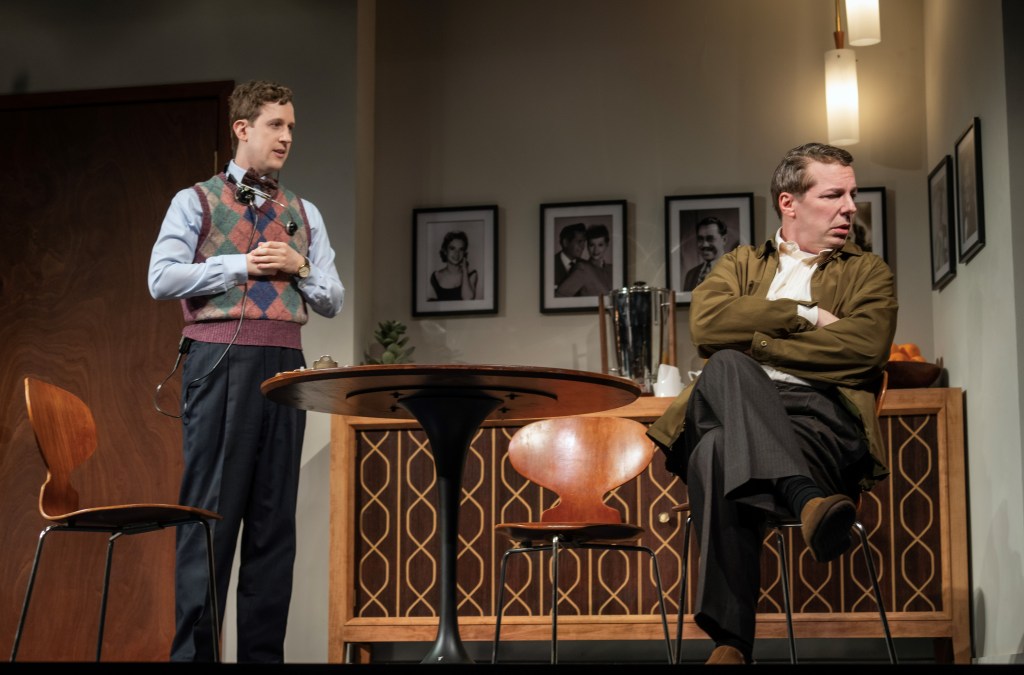
As Grosz’s apoplectic Sarnoff and Rappaport’s reasoned Parr go head to head about the high-risks they are taking because they cannot fail during “sweeps week,” we discover that recently, Levant is completely unreliable and “out there.” Sarnoff refers to him as a “freak.” On the other hand Parr has specifically chosen Levant because he needs his new Burbank show to be a success. Levant always delivers because Parr knows his close friend and can set him up for the best one-liners and witticisms in the business.
With Levant, Jack hopes to compete his way into prime time with a low budget and the talk show format he has perfected. It is a difficult task because he is on every evening, is rather high-brow, and the network underestimates him. However, Rappaport’s Parr believes Levant is a “true original,” who “treats chit chat with all the daring, all the danger of a high-wire act.” Parr knows that he will score with Levant because his unexpected brilliance lands his one liners all the time. Jack will start the engine, and Levant will speed off with the cues for a perfect show, nose diving into space and leveling off every time. He only needs to show up and get in make-up. Wright has created the set up for anticipation so that when Levant arrives, if he does, we are ready for his prime time antics, which happen behind the cameras.

That Parr doesn’t convince Sarnoff to calm down remains a problem. Sarnoff tells Parr he has booked “chica chica boom boom” Spanish musician and band leader Xavier Cugat as Levant’s replacement. He will save the day if Levant stiffs The Tonight Show, like he stiffed The Eddie Fisher Show the week before. In other words, as Levant keeps the studio waiting, the greater the likelihood that Levant’s career is down the toilet, along with the bad will that Parr has contributed making his goal to be in prime time a pipe-dream.
The issues appear to be settled when June Levant, Oscar’s wife, sweeps through the doors in her period piece, flowery outfit looking chic and composed. Parr is relieved until June tells him that she committed Oscar, and he’s in an asylum because she finally had enough. Parr becomes as apoplectic as Sarnoff and the rest of the play spins out of control, is brought back into control, then goes up into the high-wire act Parr wished for, after Levant shows up and fills everyone with expectation and sometime dread that he will blunder irreparably and destroy all they’ve planned.
To add to the tension, right before Levant goes on the air, he downs a bottle of Demerol and seems comatose. The saving grace is that Levant is a drug addict and his body is accustomed to so many drugs of his choosing, he has to take a bottle of it to stop his hand from shaking. (I reminded you of that, if you question how taking that many pills and functioning is possible. Think functioning alcoholic.)
Who is this drug addict? Who is Jack Parr? In what century are we? One of the salient take-a ways of Good Night, Oscar is its reverential nod to the Golden Age of Television, when culture, wit, superior comedy shows and superb programs (I Love Lucy, Playhouse 90, Your Show of Shows, What’s My Line, etc.), and actual bona fide news graced the air waves. Jack Parr was one of the first hosts of The Tonight Show franchise, which has lasted to this day and has been duplicated many times over in other shows on other channels.

Then, Parr made individuals famous during his five-year stint. One of his frequent guests was comedic concert pianist and Hollywood celebrity Oscar Levant. Thanks to Doug Wright’s incredible, stylized portrayal of Levant, and Sean Hayes’ remarkable ability to don the ethos of the exceptional pianist and tortured artist, we understand his emotional underpinnings. And we empathize with the psychological whirlwinds captivating Hayes’ Levant. Figuratively haunted by George Gershwin’s shadow, Levant glorifies in and also regrets riding Gershwin’s coattails to celebrity. Wright fancifully manifests this haunting by materializing Gershwin, who cajoles, persuades and torments Hayes’ Levant with remembrances of his greatness and serene notes of “Rhapsody in Blue.” Davis’ Alvin tells Parr assistant Max (Alex Wyse) that these babblings are auditory and visual hallucinations.Max should just “go with it.”
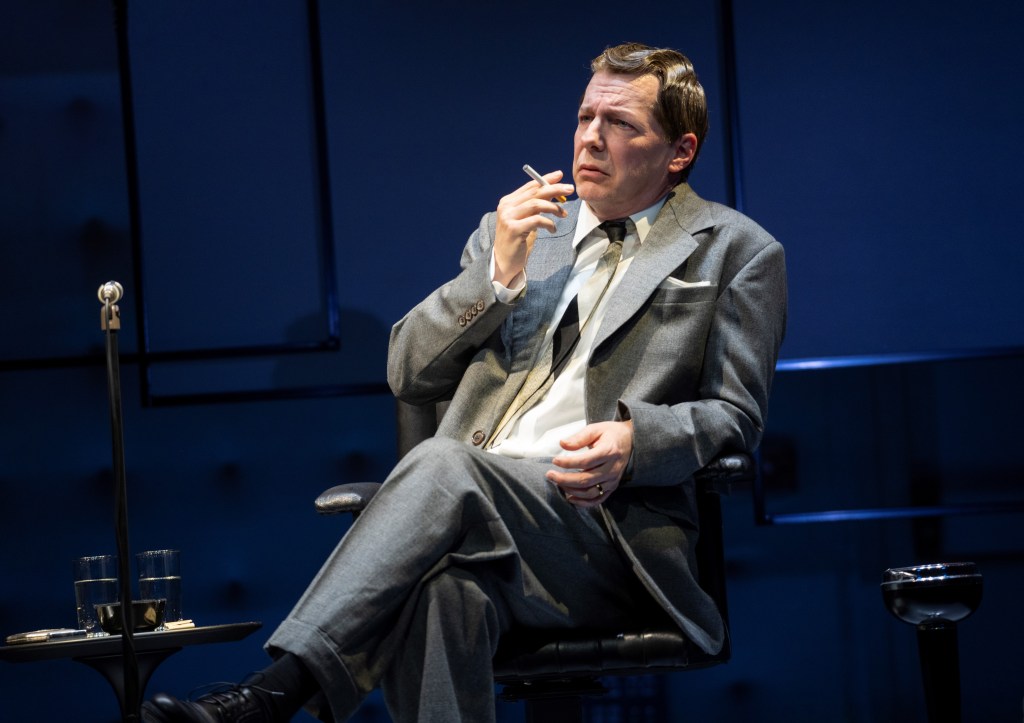
After June Levant and Parr tell Hayes’ Levant he must play, that the concert grand is waiting, Levant goes head to head with Gershwin’s ghost. Portrayed by John Zdrojeski, we note Gershwin’s arrogance and dapper, mordant, ghostly looks. However materially insubstantial he is, to Levant, the only one who sees him, he is beautiful and elegant. We understand that compared to Gershwin, Levant is a midget in looks and talent (in his own flawed estimation). Levant has undermined himself becoming Gershwin’s fawning adherent. Thus, eventually Levant obeys his hallucinations, as the Gershwin ghost compels him. Will Hayes’ Levant be able to play anything with arthritic hands and twenty-five concentrated doses of Demerol in pill form churning around in his stomach?
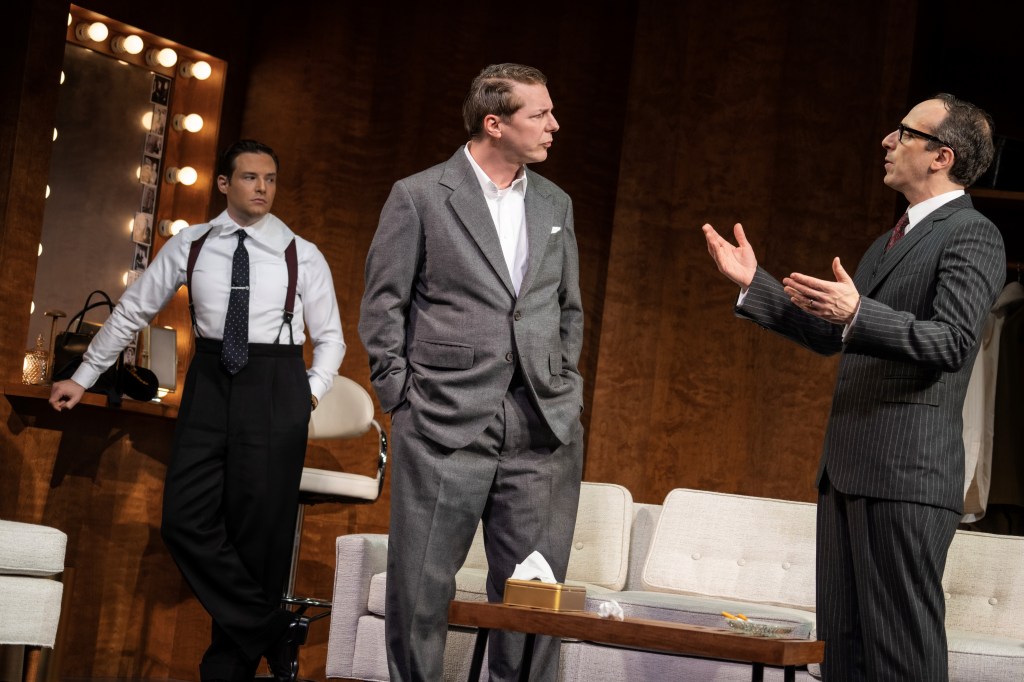
There is no spoiler alert. How Levant, his body hungering for drugs, manages to manipulate Parr assistant Max and his own nurse assistant Alvin to get what he wants is frightening, funny and ironic. Wright employs Max and Alvin as devices to reveal Levant’s backstory and acquaint the audience with his former grandiloquence, while we take in his deteriorating condition. Levant, Judy Garland and other celebrities shared the same fate with the pills and drugs that the studio doctors offered. Ironically, the tragedy of Oscar Levant and his glory and folly, which Hayes portrays with perfection, has great currency for our time.

Though Levant’s story is a throwback to that crueler, exploitive time of the studios, where the industry ground up artists in its maw and left them at the side of the road to deal with their own damage, we see the effects of big pharma today, expanding their client base beyond celebrities to the US public. Additionally, we note that corporations have become even more insidious than the Hollywood studio system as exploiters of writers and other artists. Good Night, Oscar is vital in showing how the then parallels the now.
Wright, Peterson and importantly, Hayes, elucidate how artists were encouraged to destroy themselves gradually for the sake of their “careers.” That Parr and June Levant are similar in their persuasions, pushing Oscar to “entertain,” is answered by the fact that Oscar adores being in front of an audience, even if it’s only for the four hours he has been “sprung” from the asylum. However, his self-harm becomes irrevocable as celebrity self-destruction through addictions to drugs and alcohol, unless redeemed is irrevocable in our time as well.
Wright’s play is an encomium to Levant’s genius, his humanity and his artistry, beautifully shepherded by Peterson and the creatives who convey her vision. And Sean Hayes’ performance is one for the ages.
There are gaps in this review for the sake of surprising the reader. Most assuredly, Good Night, Oscar is a must-see. You should go a few times to appreciate the wit, humor and spot-on performances, all of which are superb. Sean Hayes is especially poignant and authentic. For tickets and times go to their website https://goodnightoscar.com/
‘Heroes of the Fourth Turning’ by Will Arbery at Playwrights Horizons

Jeb Kreager, Julia McDermott, Heroes of the Fourth Turning by Will Arbery (Joan Marcus)
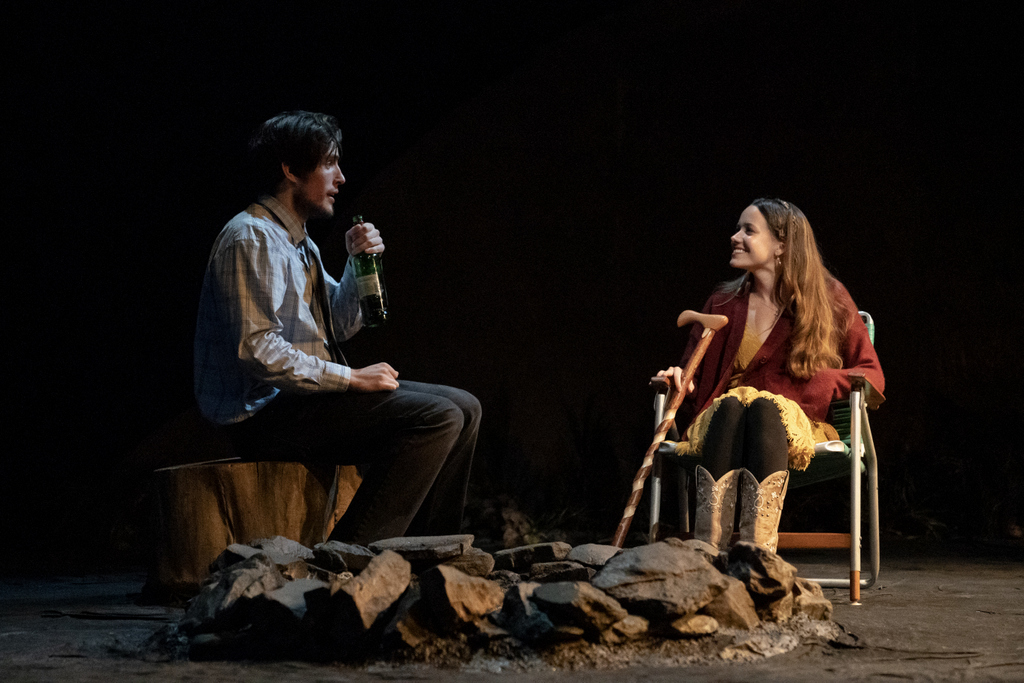
John Zdrojeski, Julia McDermott in Heroes of the Fourth Turning, by Will Arbery (Joan Marcus)
It’s seven years after you’ve graduated from college. What do you do if you are adrift, emotionally miserable and/or in physical pain? What if cocaine, alcohol, social media obsessions, abstinence from sex, indulgence in sex, and your Catholicism isn’t helping you find your way? Do you find something else to believe in to help you escape from the labyrinth of conundrums and foreboding demon thoughts plaguing your life?
Will Arbery’s Heroes of the Fourth Turning in a production at Playwrights Horizons ably directed by Danya Taymor discloses the inner world of the right wing religious. In his entertaining and profound examination of conservative-minded friends and alumni from a small, Catholic college who gather for a party, we get to see an interesting portrait of conservative “types,” who are akin to liberals in dishing the rhetoric. To his credit Arbery gives grist to the argument that beyond the cant are the issues that pertain to every American. Whether liberal or conservative, all have the need to belong, to care and love, and to make a way where there is no apparent way to traverse the noise and cacophony that creates the social, political divide currently in our nation.

John Zdrojeski, Zoë Winters Heroes of the Fourth Turning, by Will Arbery (Joan Marcus)
How each of the friends attempts to survive “out there” in the cruel, “evil” world fascinates. During the evening mini reunion on the occasion of celebrating Emily’s mom’s accepting the presidency of their alma mater, Emily (Julia McDermott), Kevin (John Zdrojeski), Justin (Jeb Kreager), and Teresa (Zoë Winters), explain who they’ve become or not become in the seven years since they’ve graduated. Teresa, a rebel during her college years, has become more right-wing conservative than ever, embracing Steve Bannon, Breitbart and Trump with gusto. The others have “laid low” in retreat in Wyoming and Oklahoma, holding jobs they either despise or “put up with,” until they get something better.

Zoë Winters, Jeb Kreager, Julia McDermott, Heroes of the Fourth Turning, by Will Arbery (Joan Marcus)
Zoë Winters portrays Teresa, the feisty, determined, “assured,” conspiracy-theorist supporter with annoying certainty and hyper-vitality, as she explains the next phase of American history to the others. She does this by summarizing a book which posits the Strauss-Howe Generational Theory. Emily, Teresa and Kevin fit into the millennial segment which lends its title to the play: the fourth turning/hero cycle. As she insists that her friends are the hero archetypes laid out in Generations: The History of America’s Future: 1584-2069, she suggests they must embrace their inner/outer hero and get ready for the coming “civil war.”

John Zdrojeski, Julia McDermott in Heroes of the Fourth Turning by Will Arbery (Joan Marcus)
For different reasons Emily and Kevin find Teresa’s explanation of the “Fourth Turning” conceptualization doubtful for their lives. Kevin’s self-loathing and miserable weaknesses belie heroism. He is too full of self-torture and denigration to get out of himself to help another or take a stand for a conservative polemic to fight the liberal enemy in a civil war. Emily is crippled by the pain of her disease. We discover later in the play that she has questions about the conservatism she once embraced. The civil war polemic only seems possible for Justin (Jeb Kreager), who was in the military. Though Justin is not the “Hero” archetype, but is a “Nomad,” he later in the evening expresses that he thinks the conspiracy mantra “there will be a civil war,” proclaimed for decades by alternative right websites will happen.
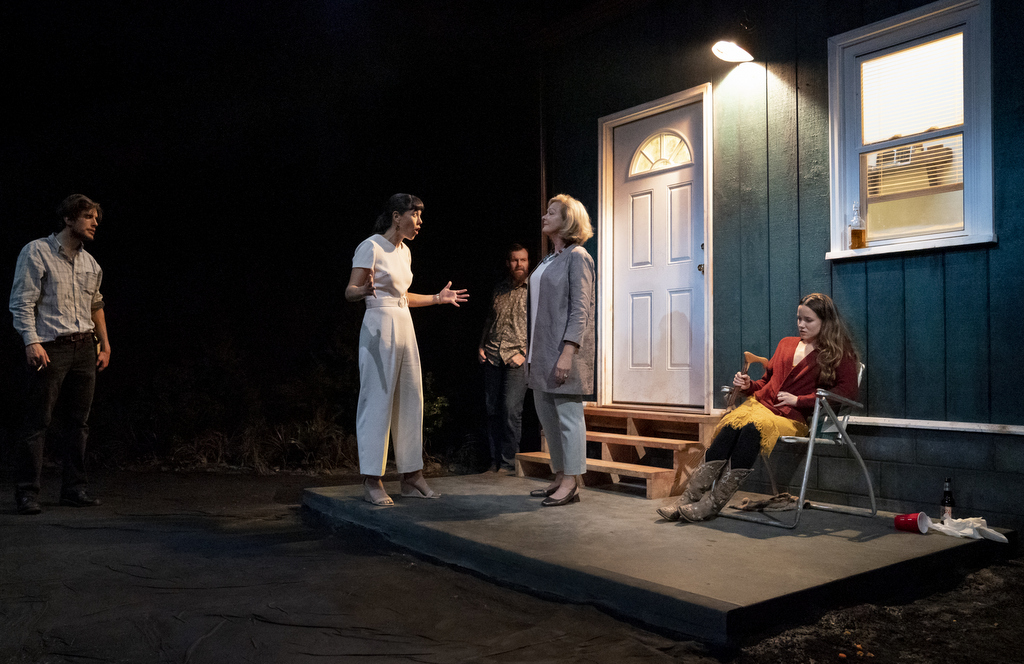
John Zdrojeski, Zoë Winters, Jeb Kreager, Michele Pawk, Julia Mermott in Heroes of the Fourth Turning by Will Arbery (Joan Marcus)
Arbery has targeted their conversations with credibility and accuracy and the actors are authentic in their nuanced portrayals. As Kevin, John Zdrojeski becomes more drunk, humorous and emotionally outrageous as the night progresses. His behavior shocks for a supposed Catholic, until we understand Kevin doubts his religion’s tenets, especially abstinence before marriage. To a great extent he has been crippled emotionally by doubt, double-mindedness and the abject boredom he experiences with his job in Oklahoma. Also, he admits an addiction to Social Media. Zdrojeski projects Kevin’s confusion and self-loathing victimization with pathos and humor. But we can’t quite feel sorry for him because he is responsible for his morass and appears to enjoy reveling in with his friends. Teresa suggests this is his typical behavior.
The friends wait for the arrival of Gina (Michele Pawk), Emily’s mom’s, to congratulate her on becoming president of their old alma mater, Catholic Transfiguration College of Wyoming. As they wait, they drink, get drunk and catch up with each other, reaffirming their friendships from the past. They discuss and reflect upon the decisions that brought them to Catholic Transfiguration College. We note their conservative, religious views about life, family and politics. Their confusion, sense of impending doom and lack of hope for the future are obvious emotional states. This is an irony for Catholics, whose hope should reside with the birth of Christ and the resurrection. Clearly, they are not exercising the spiritual component of their faith, alluded to in Gina’s speech and in Kevin’s quoting of Wordsworth’s poem “The World is Too Much With Us.” They’ve allowed the material and carnal to overtake the spiritual dimension and thus are depressed and filled with doubt.

(L to R): John Zdrojeski, Michele Pawk, Jeb Kreager, in Heroes of the Fourth Turning by Will Arbery (Joan Marcus)
In representing the conservative views of these individuals, the playwright culls talking points from right-wing media and blogs which Teresa references to Gina when Gina finally arrives. The fact that right-wing conservatism construes violent fighters as heroes is a conflated, limited view. Indeed, to see oneself as a hero and embrace that role is not even an act which true heroes (i.e. firemen, doctors in war zones) saving lives perceive for themselves. It is rhetoric. And Teresa, to empower herself and impress her old friends, speaks it as polemic. Her discussion is not really appropriate to inspire comfortable light conversation at a party. Indeed, her talk is done to solidify herself in the firmament of fantastical belief and remove any oblivion of her own doubts about her life. She and Justin who was in the military particularly rail against liberals, the LGBTQ community, Black Lives Matter, etc.

(L to R): Michele Pawk, John Zdrojeski, Zoë Winters, Heroes of the Fourth Turning, by Will Arbery (Joan Marcus)
Interestingly, Gina blows up Teresa’s cant when she finally arrives to receive the friends’ congratulations. However, they are not quite ready for Gina’s rhetorical response which is a convolution of conservative and liberal ideas that loop in on themselves again and again and defy political labeling. But Gina separates out the illogic of each of their positions. She disavows Justin’s need for guns on campus and decries the conspiracy of the upcoming “civil war.” She implies that Bannon and his like-minded are hacks, and she disavows Trump to the shock of Teresa. At the end of the evening, she pronounces that she is disappointed in the education they have received at their school, believing the college has failed them.

Jeb Kreager, Julia McDermott, in Heroes of the Fourth Turning by Will Arbery (Joan Marcus)
The night of celebration becomes a night of upheaval for Emily, Justin, Kevin and even the staunchly “certain” Teresa who will in the next decade most probably change her views a number of times to suit her determination that she has a handle on the great narrative of “reality.” But in truth as we watch these friends founder through the labyrinth of sublimely complex political, social and cultural convergences they discuss and refer to, it becomes obvious that they have been dislocated from their comfortable conservatism that categorically defined the world for them when they began college.

(L to R): Zoë Winters. Michele Pawk in Heroes of the Fourth Turning by Will Arbery (Joan Marcus)
The irony is that when Gina comes and joins their conversation and smacks down each of their beliefs, especially Teresa’s, we settle back watching the imbroglio that Arbery has wrought. Indeed, we wonder at Gina’s convoluted logic and justifications. That she would give Kevin a job in admissions is a dark irony of misjudgment. He appears the least directed to help others in the admissions process. Though they say their goodbyes with love, Justin and Emily remain in darkness. There is no comfort to be found. There is only the continuation of a foreboding reckoning.
The strongest dynamic of the play resides in the conflicts when Arbery has the friends go at each other after their initial easy reaffirmation of friendships. Ironically, the community they attempt to create falls apart driven by what is devouring each of them inside. It is then that personal flaws they’ve discussed manifest and the hell they face within spills out. Justin’s is humorously eerie. Emily’s comes in the form of fury at whom she deals with in her job and the resident demon of pain in her body. Teresa fears she is making a mistake getting married, and Kevin can’t come to the end of himself.
The tempest between and among the individuals and their inner conflicts reflects a currency for our times and is welcome fodder for entertainment. Arbery with the subtle direction of Taymor has succeeded in extending a hand across the divide of national uproar between left and right with his human, flawed characters. The actors in this ensemble are superb and hit powerful emotional notes with spot-on nuances between humor and profound drama.
This is a play you must see for its shining performances, its topics, the rhetoric-exceptionally fashioned by the playwright and its surprises in characterization. The conclusion is chilling as it expands to the mythic. Noted are the design team: Sarafina Bush (costumes), Isabella Byrd (lighting), Justin Ellington (sound), J. David Brimmer (fight director).
Heroes of the Fourth Turning runs with no intermission at Playwrights Horizons (416 West 42nd Street between 8th and 9th). For tickets and times go to their website by CLICKING HERE.
t
 CAROLE DI TOSTI