Blog Archives
‘Uncle Vanya,’ Steve Carell in a Superb Update of Timeless Chekhov

A favorite of Anton Chekhov fans is Uncle Vanya because it combines organic comedy and tragedy emerging from mundane, static situations, intricate, suppressed characters and their off-balanced, mired-down relationships. Playwright Heidi Schreck (What the Constitution Means to Me), has modernized Vanya enhancing the elements that make Chekhov’s immutable work relevant for us today. Lila Neugebauer’s direction stages Schreck’s Chekhov update with nuance and singularity to make for a stunning premiere of this classic at Lincoln Center’s Vivian Beaumont in a limited run until June 16th.
With a celebrated cast and beautifully shepherded ensemble by the director, we watch as the events unfold and move nowhere, except within the souls of each of the characters who climb mountains of elation, fury, depression and despair by the conclusion of this two act tragicomedy.
Schreck has threaded Chekhov’s genius characterizations with dialogue updates that are streamlined for clarity, yet allow for the ironies and sarcasm to penetrate. At the top of the play Steve Carell’s Vanya is hysterical as he expresses his emotional doldrums at the bottom of a whirlpool of chaos which has arrived in the form of his brother-in-law, Professor Alexander (the pompous, self-important Alfred Molina in a spot-on portrayal), and Alexander’s beautiful, self-absorbed, younger-by-decades wife Elena (Anika Noni Rose). Also present is the vibrant, ironic, self-deprecating, overworked Dr. Astrov (William Jackson Harper), a friend who visits often and owns a neighboring estate.

During the course of the first act, we are witness to the interior feelings and emotions of all the characters who in one way or another are bored, depressed, miserable and disgusted with themselves. Vanya is enraged that he has taken care of Alexander’s lifestyle, even after his sister died in deference to his mother, Maria (Jayne Houdyshell). He is particularly enraged that he believed with is mother that Alexander was a “brilliant” art critic who deserved to be feted, petted and over credited with praise when he lived in the city.
Having clunked past his prime as an old man, Alexander has been fired because no one wants to read his work. He and Elena have run out of money and are forced to stay in the family’s country estate with Vanya and Sonia, Alexander’s daughter (the poignant, heartfelt Alison PIll), away from the limelight which shines on Alexander no more. Seeing Alexander in this new belittlement, though he orders around everyone in the family, who must wait on him hand and foot, Vanya is humiliated with his own self-betrayal. He didn’t realize that Alexander was a blowhard who duped and enslaved him to labor on the farm to supporting his high life, while he pursued his “important” writing. Vanya and Sonia labor diligently to make sure the farm is able to support the family, though it has been a difficult task that recently Vanya has grown to regret. He questions why he wasted his years on a man unworthy of his time and effort, a fraud who knows little about art.

Likewise, Astrov questions his own position as a doctor, admitting to Marina (Mia Katigbak), that he feels responsible for not being able to help a young man killed in an accident. To round out the “les miserables,” Alexander is upset that he is an old man who is growing more decrepit by the minute as he endures believing his young, beautiful wife despises him. Despite his upset, Alexander expects to be waited on by his brother-in-law, mother-in-law and in short, everyone on the estate, which he has come to think is his, by virtue of his wanting it. Though the estate has been bequeathed to his daughter Sonia by Vanya’s sister, his first wife, Alexander and Elena find the quiet life in the country unbearable.
As they take up space and upturn the normal routine of the farm, Elena has been the rarefied creature who has disturbed the molecules of complacency in the lives of Vanya, Sonia and Astrov. Her beauty is shattering. Sonia hates her stepmother, and both Vanya and Astrov fall in love and lust with her. As a result, their former activities bore them; they cannot function with satisfaction, and have fallen distract with want, craving the impossible, Elena’s love. Alexander fears losing her, but realizes if he plays the victim and harps on his own weaknesses of old age, as distasteful as he is, Elena is moral enough to attend to him, though she is bored and loathes him in the process.

The situation is fraught with problems, hatreds, regrets, upsets and soul turmoil, which Schreck has stirred following Chekhov’s dynamic. Thus, Carell’s Vanya and Harper’s Astrov are humorous in their self-loathing as is the arrogant Alexander and vapid Elena who Sonia suggests can end her boredom by helping them on the farm. Of course, work is not something Elena does, which answers why she has married Alexander and both have been the parasites who have sucked the lifeblood of Vanya and Sonia, as they labor for their “betters,” who are actually inferior, ignoble and selfish.
To complicate the situation, Sonia is desperately in love with Astrov, who can only see Elena who is attracted to him. However, Elena is afraid to carry out the possibility of their affair. Instead, she destroys any notion that Sonia has of being with Astrov by ferreting out Astrov’s feelings for Sonia which tumble out as feelings for Elena and a forbidden, hypocritical kiss which Vanya sees and adds to his rage at Elena’s self-righteousness and martyred morality. When Elena tells Sonia that Astrov doesn’t love her, Sonia is heartbroken. It is Pill’s shining moment and everyone who has experienced unrequited love empathizes with her devastation.
When Alexander expresses his plans to sell the estate and take the proceeds to live in the city in a greater comfort and elegance, Carell’s Vanya excoriates Alexander and speaks truth to power. He finally clarifies his disgust for the craven and selfish Alexander, despite Maria’s belief that Alexander is a great man, not the fraud Vanya says he is.

It is a gonzo moment and Carell draws our empathy for Vanya who attempts to expiate his rage, not through understanding how he is responsible for being a dishrag to Alexander, but through manslaughter. The scene is brilliantly staged by Neugebauer and is both humorous and tragic. The denouement happens quickly afterward, as each of the characters turns to their own isolated troubles with no clear resolution of peace or reconciliation with each other.
The ensemble are terrific and the actors are able to tease out the authenticity of their characters so that each is distinct, identifiable and memorable. Naturally, Carell’s Vanya is sympathetic as is Pill’s heartsick Sonia, for they nobly uphold the ethic that work is a kind of redemption in itself, if dreams can never come true. We appreciate Harper’s Astrov in his love of growing forests and his understanding of the extent to which the forests that he plants will bring sustenance to the planet, if even to mitigate only somewhat the society’s encroaching destructiveness. Even Katigbak’s Marina and Sonia’s godfather Waffles (the excellent Jonathan Hadary), are admirable in their ironic stoicism and ability to attempt to lighten the load of the others and not complain.

Finally, as the foils Molina’s Alexander and Noni Rose’s Elena are unredeemable. It is fitting that they leave and perhaps will never return again. The chaos, misery, dislocation and confusion they leave in their wake (including the somewhat adoring fog of Houdyshell’s Maria), are swallowed up by the beautiful countryside and the passion to keep the estate functioning which Sonia and Vanya hope to achieve in peace. Vanya, for now, has thwarted Alexander, by terrorizing Alexander into obeying him in a language (threatening his life), he understands. For this we applaud Vanya.
When Alexander and Elena leave, the disruption has ended and they take their drama and chaos with them. It is as if they were never there. As Vanya and Sonia handle the estate’s paperwork, which they’ve neglected having to answer Alexander’s every need, the verities of truth, honor, nobility and sacrifice are uplifted while they work in silence, and peace is restored to the estate, though they must suffer in not achieving the desires of their lives.
Neugebauer and Schreck have collaborated to create a fine version of Chekhov’s Uncle Vanya that will remain in our hearts because of the simplicity and clarity with which this update has been rendered. Thanks go to the creative team. Mimi Lien’s set design functions expansively to suggest the various rooms of the estate, the garden and hovering forest in the background. A decorative sliding divider which separates the house from the forest and allows us to look out onto the forest and woods beyond (a projection), symbolizes the division between the natural and the artificial worlds which influence and symbolize the characters and what they value.

Vanya and the immediate family take their comforts from the earth and nature as does Astrov. Alexander and Elena have forgotten it, finding no solace in the beautiful surroundings and quiet, rural lifestyle which they find boring because they prefer chaos and the frenetic atmosphere of society. Essentially they are soul damaged and need the distractions they’ve become used to when Alexander was famous and the life of the party before he got tiresome and old and disgusting in the eyes of Elena and those who fired him..
The projection of trees that expands entirely across the stage in the first act is a superb representation of what is immutable and must be preserved as Astrov works to preserve. The forest of trees which is the backdrop of the garden, sometimes sway in the wind. The rustling leaves foreshadow the thunder storm which throws rain into the garden/onstage. The storm symbolizes the storm brewing in Uncle Vanya about Alexander, and emotionally manifests when Alexander suggests they sell the estate to fulfill his personal agenda.
During the intermission every puddle and water droplet is sopped up by the tech crew. Kudos to Lap Chi Chu & Elizabeth Harper for their lighting design and Mikhail Fiksel & Beth Lake for their sound design which bring the symbolism and reality of the storm home.
The modern costumes by Kaye Voyce are character defining. Elena’s extremely tight knit, brightly colored, clingy dresses are eye candy for her admirers as she intends them to be to attract their attention, then pretend she doesn’t want it. Of course she is the leisurely swan while Sonia is the ugly duckling in work clothing, Grandmother Maria dresses like the “hippie radical feminist” that she is, and Marina is in a schmatta as the servant who cooks and cleans. Here, it is easy for Elena to shine; there is no competition.
Vanya looks frumpy and uncaring of himself. This reflects his depression and lack of confidence, while Molina’s Alexander is dressed in the heat like a peacock with a scarf, cane and hat and cream-colored suit when we first see him. Astrov is in his doctor’s uniform, utilitarian, purposeful, then changes to more relaxed clothing. The costumes are one more example of the perfection of Neugebauer’s vision and direction of her team.
Uncle Vanya is an incredible play and this update does Chekhov justice. It is a must-see for Schreck’s script clarity, the actors seamless interactions and the creative teamwork which elevates Chekhov’s view of humanity with hope, sorrow and love in his characterizations, especially of Vanya.
Uncle Vanya runs two hours twenty-five minutes including one intermission, Lincoln Center Theater at the Vivian Beaumont. https://www.lct.org/shows/uncle-vanya/whos-who/
‘The Ally,’ Terrific Performances of a Trenchant Play at the Public
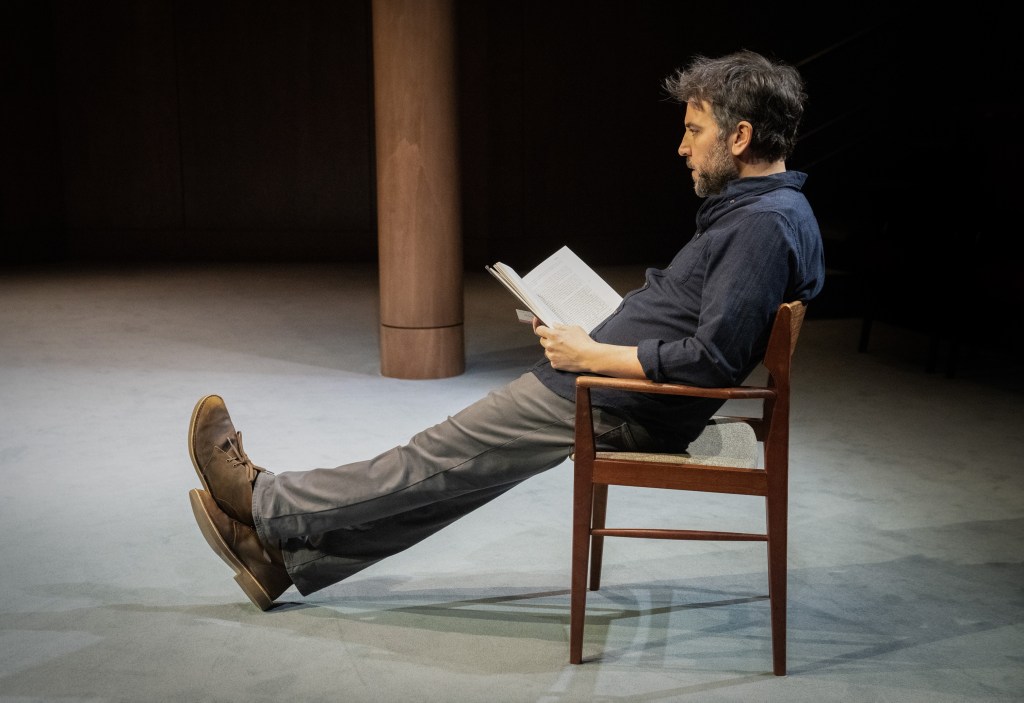
The Ally, written by Itamar Moses (The Band’s Visit), and directed by Lila Neugebauer (The Waverly Gallery), currently runs in a World Premiere at the Public Theater until March 24th. Moses’ two act play that is largely polemical raises important and controversial questions in its two hours and thirty-five minutes. It is thought-provoking, historically informative and profound, and has great currency in light of the Netanyahu government’s war against Hamas. Though the play was written before the October 7th attack, the issues couldn’t be more on-point.
The Ally is short on dramatic tension, and long on terrific performances. The exceptional actors passionately argue about Black and Brown people struggling to achieve human rights in countries (Israel, the United States, etc.), which have their foundations in oppressive, white, patriarchal colonialism. Though the prejudices and discrimination have been called out and strides have been made, often the countries obfuscate justice, and in defensive mode, redirect their institutions, practices and social constructs away from equanimity, foregoing humanity, compassion and empathy to abuse those they subjugate.
To present the arguments and make a case with little resolution, Neugebauer’s vision offers a spare stage and few props to evoke the setting in a professor’s home and office on a University campus which represents a bastion of learning, where allegedly every viewpoint may be expressed without censure, to promote enlightened civil discourse and benefit the social good of the community. Moses’ protagonist on the field of intellectual battle is liberal Jewish professor Asaf (the excellent Josh Radnor).
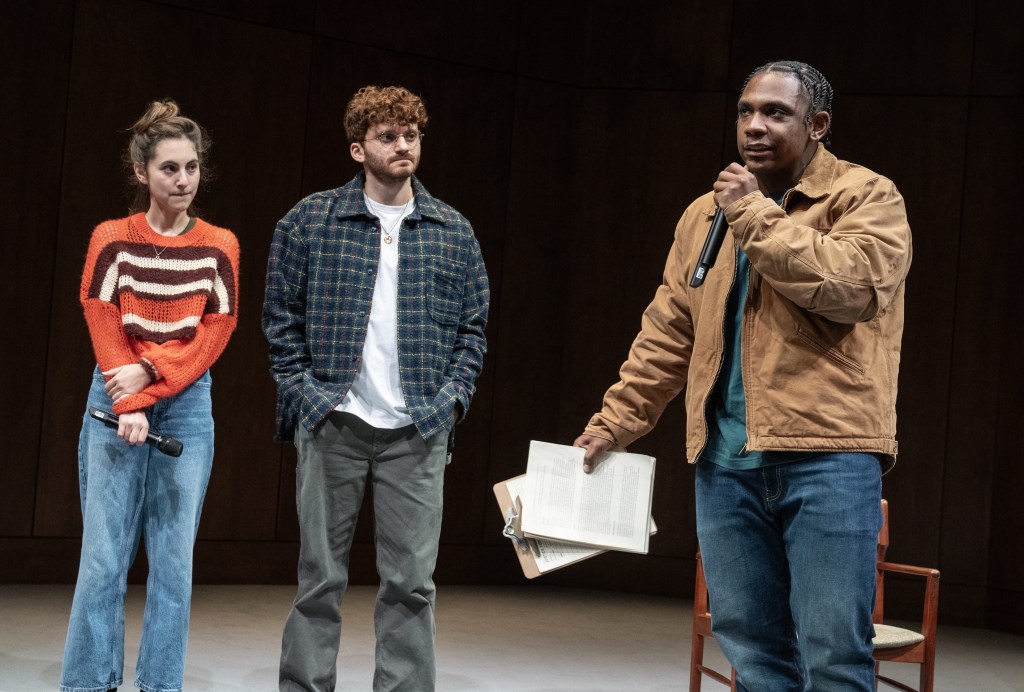
Asaf’s Korean-American wife Gwen (Joy Osmanski), has been hired to give a positive spin on land the University is developing that was formerly used for housing in a lower middle class, Black area. The land has been appropriated, though the University has assured that it will provide housing units to compensate for the dwellings that have been demolished. How the situation evolved, we discover later, is fraught with rumors about underhanded tactics the University used to create circumstances beneficial to University expansion, while dismissing the interests of the Black community.

The main conflict begins when Asaf’s former student Baron (Elijah Jones), who is Black, feels encouraged asking Asaf to sign a social justice manifesto that involves his cousin Deronte, who was killed by police unjustly for a theft Deronte didn’t commit. After agreeing to sign once he looks over the twenty-page manifesto, Asaf realizes that the documented is personally sensitive to him in what it demands.
First, it aligns the history of violence against Black Americans to the violence against oppressed Black and Brown people who have been colonized globally and suffer under inhuman conditions. Additionally, the manifesto targets a controversial subject for Asaf, an American, who doesn’t identify culturally with Israel, though he was born there. The manifesto demands that sanctions be placed on Israel for its nihilistic treatment of Palestinians, resulting in an apartheid state. In clear terms it pronounces that a “failure to do so will leave the United States complicit in the ongoing genocide of the Palestinian people.”
Though he is Jewish, essentially, Asaf is an atheist. But he thoughtfully considers what he is signing, and questions the words “apartheid” and “genocide” as extreme, unrelated positions, though he feels that Baron’s cause is just. Helping support Baron holds no contentions for him, initially. The apparent police brutality in killing Deronte is one more example of murderous racism and the blue wall of silence that fronts against such horrific injustice in a country with a long history of slavery and oppression of Black and Brown peoples.

Gwen tells Asaf’ that his signing the manifesto will undergird her position as a university administrator pushing for expansive development of university housing into the Black community. If he refuses to support Baron it will appear that he cannot align with fighting injustice and it most probably will add to the negative spin already brewing about the expansion project which the Black community is resisting.
It is after Asaf signs the manifesto that problems arise which disastrously make him the “man in the middle” among activist organizations with conflicting agendas which demand that he support and be an “ally” with their specific causes and positions. The situation embroils him deeper in conflict with his conscience and beliefs and forces him to deeply question allegiances he would forge with others on campus, impacting his reputation.
Two organizations confront him after he signs Baron’s manifesto. Jewish representative (Madeline Weinstein), and Palestinian representative (Michael Khalid Karadsheh), ask Asaf to support their bringing a controversial speaker to campus. They tell him that the speaker argues for a revisionist history of Israel’s foundational and follow-up wars. Contrary to the standard view that Israel was defending itself, the speaker posits that the wars were fought ferociously for one reason: “the likely outcome was more territory.”
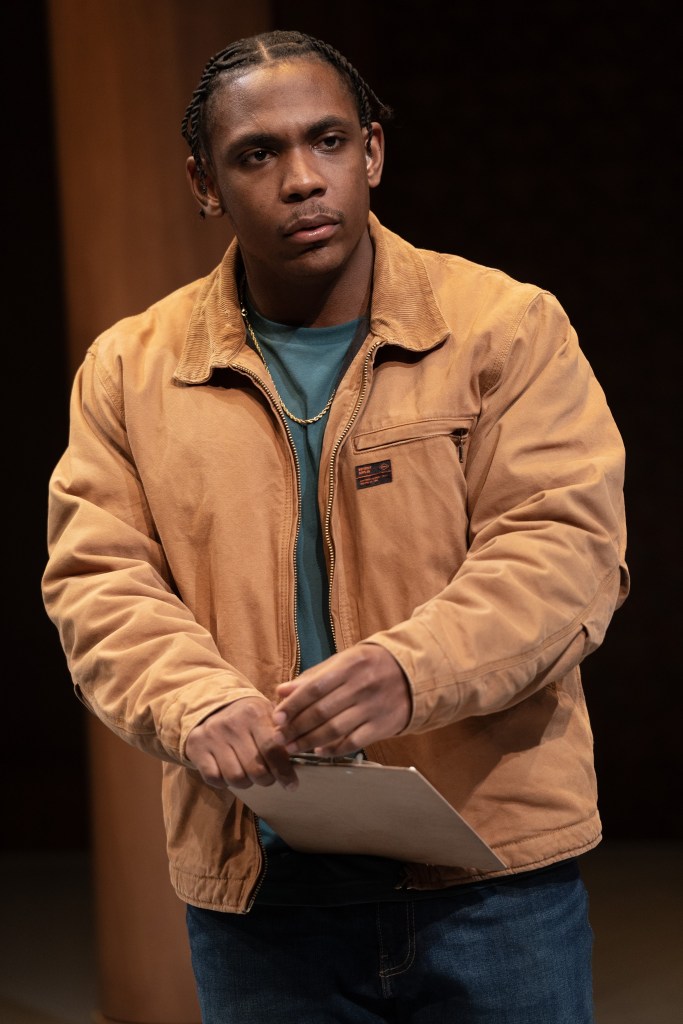
To his credit to give all opinions a place in civil discourse, Asaf discusses the nature of the support they want, but questions why they want this particular speaker. Additionally, with a follow-up which indicates that activist organizations are noting who is importuning Asaf, another oppositional individual shows up to challenge Asaf. Reuven Fisher (Ben Rosenfield), a religious Jewish graduate student attacks Asaf’s arguments and the others that we’ve previously heard. Fisher defends Israel ‘s position with the Palestinians.
Interspersed among those who have backed Asaf into a corner, Nakia Clark (Cherise Boothe), confronts him about his questioning the fact that Israel is the one expected to ameliorate its position and is always used as a “whipping boy,” when it is the only place historically where Jews can find safe on their home turf.
As we listen to their wrangling, we take into account that Nakia and Asaf have history together. Once a couple who dated, Nakia shepherded Asaf in community social justice, inspiring him to go with her on marches, and schooling him in protest as she strengthened her role as a Black community organizer. Now, years later, she challenges him once more to step up and not renege on his support of the manifesto which Nakia, herself, wrote.

Where is Asaf’s place in these arguments when the university community knows the stand he wished to take that he now equivocates about taking? Moses uses the character of Asaf as a canvas upon which to project all the viewpoints in the arguments about Israel, Palestine, Black discrimination and colonial oppression. The playwright proves knowledgeable and informative, especially in recounting the conflicts in the history of Israel starting from its inception in 1948 and its wars against the PLO and the complicated rise of Hamas which didn’t happen in a vacuum but was allowed by an extremist government to its own benefit, not necessarily to create equity and harmony with the Christians, Jews and Muslims who make Israel their home.
However, as has occurred since divisions created an untenable situation between Zionists, Palestinians, Muslims, Christians and Jews when Israel was formed in 1948 and worsened up to the present war in Gaza, there is only the horrific struggle. Moses indicates the lessons in why with his exploration of the reasons in The Ally. Thus, how can there be a positive resolution in this work? All is uncertain, with even more passionate feelings on all sides we’ve heard presented.
And of course, Asaf now has issues with each of the groups because of his lack of certainty; thus, his reputation has received a hit. Even Gwen is annoyed that his equivocation has bounced back to impact her project. Only more questions remain.

However, Moses and Neugebauer have pulled a rabbit out of a hat with this production which focuses the audience on the arguments which make them understandable and relatable, especially because the ensemble is just brilliant. Importantly, we have been shown the intricacies of intense debate which, if continued will eventually lead to the possibility of a positive resolution. Thus, we are left with the feeling that there must be an open dialogue during which responsible individuals listen to each other and again and again hash out some consensus, as impossible as that seems..
This is one to see because of its overall coherence, incredible performances and fine direction. Neugebauer stages the debate amongst the stakeholders, so we thrillingly follow every word. Could there have been edits? Perhaps. However, Moses has built solidly and any removal of the bricks in his structure will lessen the impact overall.
Kudos to the creative team who effect the director and playwright’s vision. These include Lael Jellinek (scenic design), Sarita Fellows (costume design) Reza Behjat (lighting design) Bray Poor (sound design).
The Ally runs 2 hours 35 minutes at the Public until March 24th. https://publictheater.org/productions/season/2324/the-ally/
‘Appropriate,’ Exceptionally Acted, Scorching, Complex, Revelatory

Appropriate’s theme
The truth is the truth, no matter how hard one betrays oneself into believing otherwise. Currently, segments of the American population have difficulty with the nation’s history of bigotry and murder and would mitigate it, not through reparations and reconciliation, but through dismissal and nihilism. As long as such masking occurs, the violence will continue in a legacy that can only be expiated and ended by confronting the deplorable aftereffects of racism head on. Such is the basic theme of Appropriate, Branden Jacobs-Jenkins harrowing, humorous, profound family drama about loss, self-betrayal, torment, fear and generational psychic damage, that is currently unraveling great performances at 2nd Stage’s Helen Hayes Theater. The drama with sardonic humor is in its Broadway premiere and has now been extended.
Before the curtain lifts onto the 7th generation Arkansas plantation home of the Lafayette family, the theater is plunged into the darkness of nighttime. Then, Bray Poor and Will Pickens let loose the prolonged, screeching sound of Cicadas, a sound repeated between acts and scenes. When Jacobs-Jenkins determines we’ve “had enough,” the lights dimly come up on a once stately mansion interior- living room, foyer, and stairs-leading up to the balcony landing and off to unseen bedrooms, where Toni (Sarah Paulson,Talley’s Folly), Bo (Corey Stoll, Macbeth), and Frans (Michael Esper, The Last Ship), slept during their childhood.
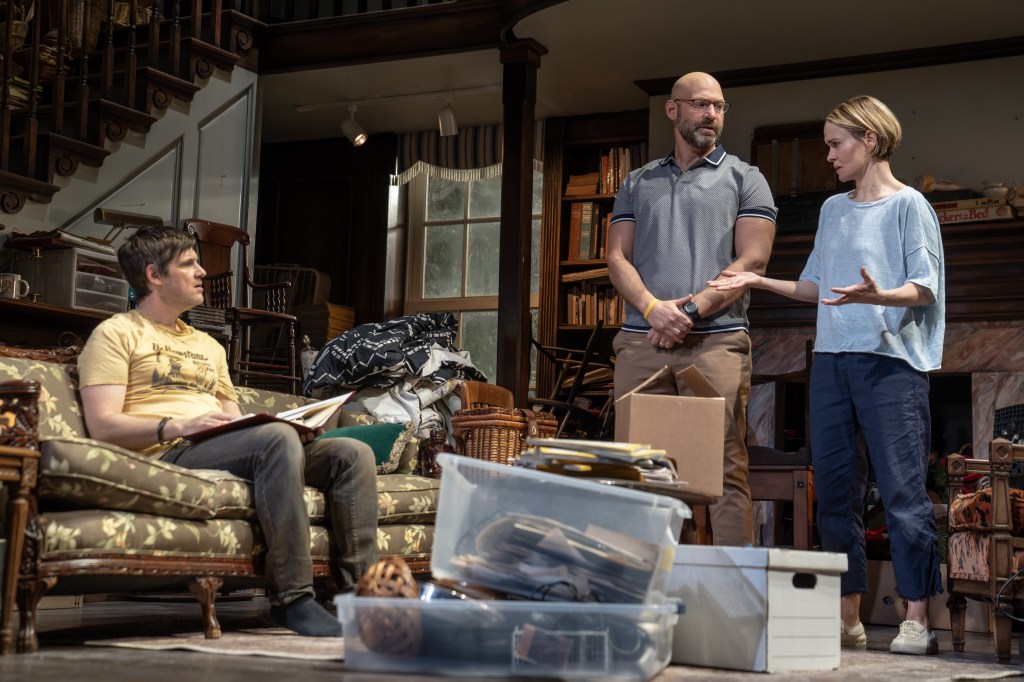
The mansion, in complete disarray, filled with hoarder’s junk-furniture, ceramics, glassware, clothing and more-still has remnants of beauty amidst its dilapidation and tawdry dressings of curtains and outdated furniture, thanks to dots’ prodigious scenic design. Symbolic of the once “glorious” South, with its penchant for ritual and gentility delivered by Black enslavement, servitude, Jim Crow peonage, bigotry and prejudice, the mansion, we come to discover, hides remnants of brutality, sadism and murder, a legacy of the Layafettes, which has not been recognized or confronted by the present generation, especially Toni.
The Backstory
In the backstory, we learn that Toni, Bo and their families are at the plantation for the auction of the estate interior, house and extensive property which includes two cemeteries, one for seven generations of Lafayette ancestors, and the other a slave cemetery isolated near the algae-ridden pond. Bo and Toni have kept in touch and were together for their father’s funeral six months prior, when they discussed raising money to pay off the loans of the estate’s indebtedness. Though they try to contact Franz, who has been AWOL for 10 years, they have been unable to tell him of their father’s death and the disposal of the estate.
It is no small irony that Franz, at the top of the play, comes in through the window with his girlfriend like a thief in the night, in the early morning hours, the day the liquidators are supposed to catalogue and price the estate’s valuables. When Paulson’s Toni makes a dramatic entrance from the 2nd floor balustrade, shining a flashlight on Franz, ranting at his presence and interrupting his reunion with her son, his nephew, Rhys (Graham Campbell), we question what is going on. From this incident of conflict, Jacobs-Jenkins unspools the mystery about the family, its members, their dead father and their ancestors. Throughout the play by agonizing and strategic degrees, the playwright reveals the Lafayette’s tragic family portrait, and explores many themes, key among them ancestral accountability for the past sins, which if not addressed or confronted, will be a curse on future generations.

As the play progresses and the siblings deal with the estate, we note that Toni, as executrix, makes unilateral decisions and controls everything to the point of “spur-of-the-moment” irrationality (though her explanations to herself are rational). This foments more chaos than is necessary in a situation fraught with turmoil, divisiveness and alienation among the siblings.
Pressures and conflicts in the Lafayette family
Pressures of the father’s illness and death, the disparate circumstances in each sibling’s family, Toni’s divorce and difficulties with her son Rhys (Graham Campbell), exacerbate the tensions of the stressful time, as the siblings attempt to create order out of chaos and obtain the most money to pay off the debts. Handling the estate and settling the inheritance would upend the most sanguine, peace-loving and close siblings. However, for the tormented Lafayettes, settling the estate is apocalyptic. The brokenness of each family member and their significant others raises the temperature of the non air-conditioned mansion to an explosive boiling point by the end of the play.
The first roiling incident begins with Franz, renamed from Frank by his California-dreaming, tendentious, sweetie, River (Elle Fanning is brilliant as the peace-keeping, pompous, shaman-loving spiritualist). The moment Paulson’s acerbic, sniping Toni sees Franz, she launches into strident questions, as he soft peddles his replies and defends himself against her accusations that he only showed up to greedily collect “his share.” When she threatens to “call the cops” on him, he ignores her and goes upstairs with River to sleep off their long trip from Oregon, where he had been hiding out for a decade.

Why she responds toward her youngest brother this way is revealed in the last act cataclysm. However, her bile-frothing attitude, while humorous and sardonic, frightens. Though she seeks hugs from her son Rhys and tells him she loves him, we question her volcanic response to Franz and fiery tirade answering Bo’s comments about shelling out money to maintain the estate through the last years of their father’s illness. Apparently, Bo paid for the aide who ministered to their father almost 24/7, and paid for all the house expenses. According to Bo, he took that “hit,” and hopes to recoup some of that loss from the proceeds of the auction and estate sale.
Questions about the kids’ discoveries
Toni dismisses him saying that it was “their father” who was ill. The implication is that he is heartless and should have opened his bank account willingly with no thought of recompense. We are curious about this “selflessness” she demands of others, while equating her time with her father and drives to Arkansas from Atlanta as more than the equivalent of the money Bo paid. Meanwhile, why wasn’t the father’s grand estate enough to pay for its upkeep? As a DC district justice (in line for becoming a Supreme Court Justice), didn’t the father have the acumen to financially manage it? Why didn’t Toni contribute monetarily, and why are there heavy loans against the property? And why did the father keep quiet about his precarious financial circumstances? Eventually, we learn the answers about this family which is so dysfunctional, it is caving in on itself by the weight of its violent legacy which they refuse to confront.
Little of what her siblings say Toni takes in giving any weight to their position or logic. She is quick to retort and uplift her own situation and attack theirs with seething anger. Whether this is a function of her age (the oldest), and her position as executrix, one concludes that it is mostly due to Jacob-Jenkins’ stylized characterizations in the service of elucidating his themes. A key theme is that karma is a bitch. Unless you break the cycle of abuse of others (slavery, murder) and acknowledge and reverse it, it comes to haunt you with its own particular brand of sickness and blight in the human heart. By the end of the play, we note how each sibling is crippled with agony, divided and isolated from each other without any possibility of reconciliation or redemption.
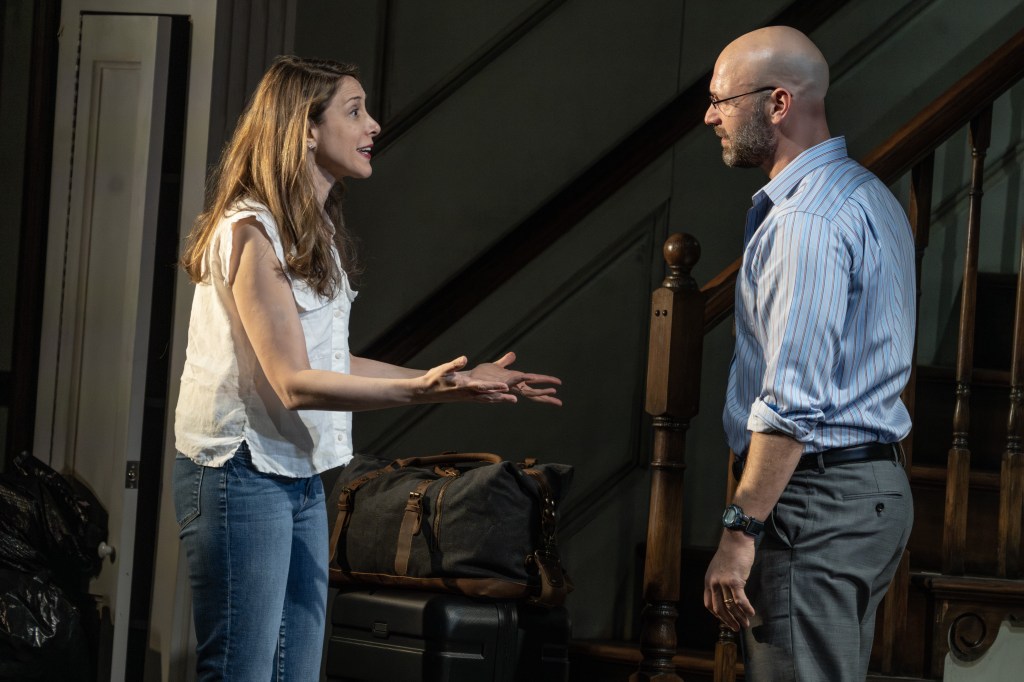
That this may be the result of what their ancestors had wrought upon the land they “appropriated,” and the slaves they abused, and the Black people they may have seen or had lynched, generational accountability is the last thing these present day Layafettes consider. However, adding other clues (i.e. River feeling the presence of spirits), it is a sub rosa theme of the play. Bo, Toni and even Franz hurt, lash out and move to disinherit themselves from each other, the estate valuables and the plantation which they leave to the elements, abandoning it.
Who would question their behavior? Who would want their legacy which involves lynchings (they find photographs of Blacks lynched), glass jars filled with noses, fingers, ears and penises of Black people carved out of the lynched bodies, and a Klan hood that was their father’s. Clearly, the race hatred permeated their childhood, but they didn’t realize it, having spent most of their lives in Washington, DC and some summers at the Arkansas plantation. Besides, around them, their father never mentioned the “N” word, though Bo remembers in college the judge refused to look at “in the eye,” or “shake the hand” of a Black dorm-mate.
The mystery revealed: spoiler alert.
The siblings and apparently, the father and mother, didn’t deal with their ancestry, but like so many others in the south, received the benefits of “free labor” and reaped the rewards of servitude and Black social oppression through the generations without considering the possibility of karmic reparations exacted on their being, emotionally, spiritually and psychically. Jacobs-Jenkins gives clues of the cruelty of their ancestors toward the Black population throughout, via the collector’s items and junk their father and his relatives hoarded.
That this sale of the estate represents the family’s apotheosis of failure and self-destruction, Jacobs-Jenkins uncovers by the conclusion. Bo has lost his cushy job. Toni has been fired from her teaching position when her son distributed her meds to classmates, for which he was kicked out of high school. She is finalizing her divorce and Rhys doesn’t want to stay with her but is going with his father because she is not a good mother.
We discover that Franz is only interested in collecting “his share,” after befriending Bo’s daughter Cassidy (Alyssa Emily Marvin), who broadcast family events to him via her Facebook pictures. Franz had been receiving checks from his father to pay for his upkeep after his jail sentence as a pederast (he got a teenager pregnant). During Toni’s harangues, we discover, though Franz is presently “clean,” Toni suffered with “worry” through his hospitalizations, rehabilitations and addictions to drugs and alcohol. Meanwhile, Franz blames his “bi-polar,” psychically-broken father who fell apart after his wife’s loss to cancer, as he attempted to raise Franz by indulging him. Franz also blames his siblings’ abandonment of him to his father’s questionably abusive care. Of course Toni counters Franz “defense” as lies.

The Lafayettes are an emotionally debilitated family on steroids
Jacobs-Jenkins clarifies that this is a emotionally debilitated family on steroids. Maybe the only member with any rationality is Bo, but only because of his wife. When discussing their father’s racism and prejudices, which Toni denies, Rachel mentions she overheard their father slur her when he referred to her on the phone with a crony, as Bo’s “Jew wife.” Toni dismisses her and the race hatred artifacts. She is “put-out” by Rachel’s alarm that the children have seen the photo album of Black lynchings and incensed that Rachel implies her father is anti-semitic and racist, she ends up provoking Rachel to provoke Toni to slur her. Toni does with ironic abandon, then claims she was joking.
Interestingly, Bo, who lives in the North has put a great distance between himself and his heritage, which is another form of dismissiveness. However, he has taken his racist attitudes with him. He attempts to recoup money from the estate by arranging to sell the photographs of the lynchings of Blacks, which apparently are valuable on a covert white nationalist market of sadistic memorabilia of the “good ole” Southern “glory days”
Bo is so numbed to his legacy, he doesn’t see the egregious amorality of making money off others’ victimization and death. This is a corrupt continuation of the “benefits” the South receives from its Jim Crow policies of racism and murder, heightened by the fact that there is a market for these “valuable collector’s items.” Though each revelation of the father’s racist hoardings is achieved through the kids’ innocent, sardonic, humorous discovery, as the adults try to cover up the shocking “in-your-face” racism, the audience’s real shock is at the macabre, psychotic nature of keeping such items. We ask, why would the father, a judge, “get off” on photos of Black lynchings and jars of Black body parts from the lynchings?
Who does the photo album belong to or the glass jars of body parts?
Toni, Bo and Franz don’t find this loathsome about their father, and try to pretend it belongs to someone else.

Jacobs-Jenkins clarifies the craven, broken psyche of Bo, Toni and Franz, who don’t see anything wrong with selling these items to recoup the estate’s losses. On the other hand, Rachel is outraged her children have been the ones to discover the photo album and jars of body parts. And at some point, she intends to discuss what they mean with her kids to work through the psychological shock of seeing such horrors. Indeed, she is the only one who seems to understand the brutality and violence such artifacts signify. It is her morality that stirs the morality of the others to try to protect the kids from further exposure. But Cassidy is interested because it is verboten, so she continues to look, seduced to the grotesque, cruel voyeurism that this American past was normal for the South..
The playwright speaks volumes through what is absent in the siblings’ conversation. They don’t deal with why the father hoarded such items and didn’t find a better place for them in the Smithsonian African-American History Museum, Arkansas African-American History Museum, or other educational institutions or museums. Why has he kept the photos in a shelf in the foyer, and the Klan hood and the body parts in his bedroom? They weren’t secreted away in a hiding place in the attic or elsewhere, but were out in the open. Obviously, there are two sides to the retired judge’s character. One part of him justifies lawless lynching via white domestic terrorist racism, while the other lives peaceably as a justice. Perhaps Franz has a better handle on his father’s “bi-polar” nature than Toni, who disbelieves all of the “incongruities” Bo, Rachel and Franz have pointed out about him.
The final coup de grâce

Jacob-Jenkins cannot resist the final coup de grâce on this tragic, racist, family legacy that is blowing up in their faces with regard to recouping money. Bo states the land cannot even be sold without dealing with the two cemeteries, so the property isn’t worth much. Secondly, Franz,, to “cleanse himself and get in good with his family,” throws himself and the photos into the pond by the slave cemetery before he knows they might be valuable. The photos are destroyed; the money up in smoke. This family can’t win for losing. Have the spirits of the dead effectively prevented any benefit to a family with its violent legacy of slavery and lynchings, as karma takes its recompense and the estate goes into receivership?
River, who has from the start been wary of the spirits on the place and has sensed “a presence” in the mansion, is used by Jacobs-Jenkins to validate this possibility that the spirits of lynched, enslaved African-Americans exact their karmic retribution. Additionally, the playwright and director’s vision reveal that such spirits may seek vengeance until the family expiates the bloodshed and torment their forebears have wreaked on the Black population on their lands. Thus far the current generation hasn’t and the siblings are a wreck.
The tragedy of blindness is on everyone in this family, who ignores the significance of those murdered, lynched, abused and oppressed. The lives of those in the slave cemetery and those in the photo album are like the lives of Blacks across the South, who were and are still being appropriated for money on the covert market of “lynching” items that white, terrorist racists find “quaint,” “cool” and “prize-worthy” for trading. It is an unacceptable criminal abomination that must not be normalized. It still is at what cost?
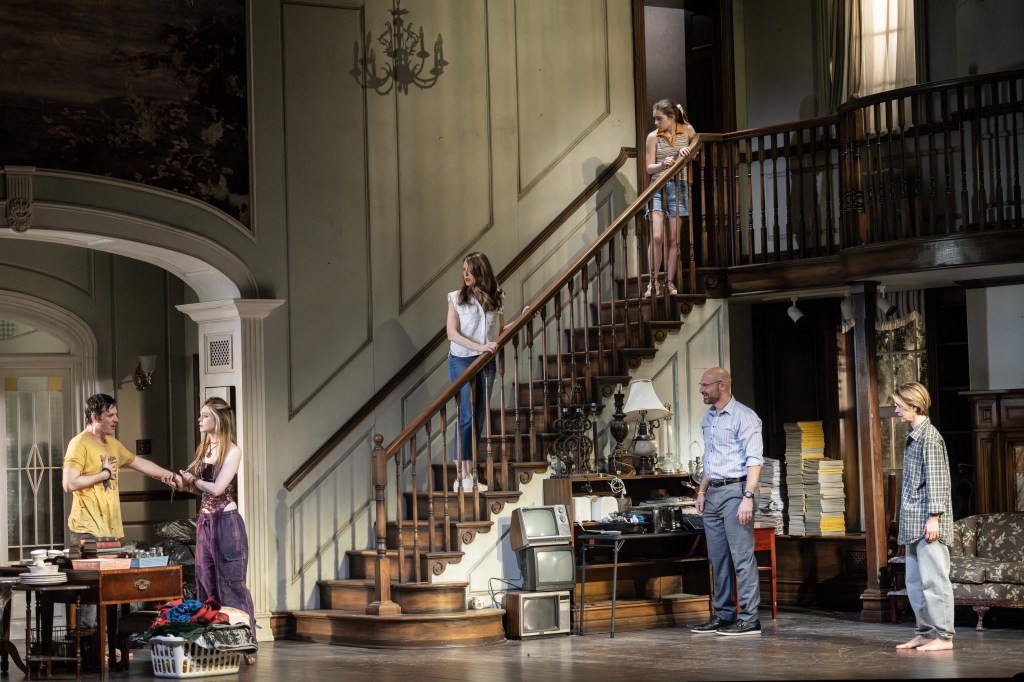
The siblings abandon the mansion and its contents which nature takes over and destroys through the decades as it collapses and a final haunting symbol emerges in the mansion center stage. It is a huge tree open to interpretation. It is representative of the lynchings in the photograph album which must be accounted for.
An amazing conclusion
The conclusion after the blighted family members have left, never to see each other again, is an amazing scenic feat. A tree rises from the mansion floor effected by the amazing scenic designers, dots. Neugebauer’s vision with dots’ execution of the house symbolically shattering as the tree rises up from the foundation of racial hatred, brings together Jacobs-Jenkins’ themes. They warn that despite assuming all is well, recompense will continue to be exacted for historic racial bloodshed and murder. As this family has a legacy of it and refuses to confront it, a bill for the bloodshed will be delivered on them and future generations, via psychosis, financial ruin, addiction etc. Karma is a bitch.
The play is exceptional in its themes and important in its significance about recognizing and not normalizing racial murder and lawlessness as the family tends to do when their father’s hidden life uplifts it. The characterizations serve the themes; the themes don’t arise from the characters. At times the dialogue is contrived to be humorous, especially as the playwright has stylized these individuals as types. Toni’s character is drawn as sardonic, insulting, shrewish and one-note.

The reason why the production gets away with the contrivances is because the director’s staging is perfection, the technical creative team is superbly coherent in conveying her vision. Most importantly, the actors are incredible, individually and as an ensemble. They flesh out and inhabit these unlikable individuals and make them watchable and horridly humorous. Paulson brings her own star quality and beauty to the role so we dismiss Toni’s obnoxiousness, until as with all of them, their faults gradually clarify and deaden them. Then, we reach the point of no return.
By the end we could care less that Toni declares herself dead to the others as they are dead to her. We watch as Bo weeps and questions why he cries. We assume that Franz will continue in his lost state with River directing him until she gets fed up. And Toni sums up what each of the siblings is thinking. She affirms this is who she is with them, implying they “make her” this way and she doesn’t like herself as a result. It is the same for Bo and Franz, who aren’t particularly happy with themselves. Neither do we empathize with any of them because they don’t acknowledge their legacy, they dismiss it or run from it. As their ancestors “threw away” Black generations, so these individuals in self-torment, “throw away” themselves…a tragedy.
This family is the problem and not the solution which is hard won. And as the themes imply, there must be recognition of the horrors of murder and reparations must be attempted. Karma is taking its toll. The sooner the crimes and injustice are recognized, the better for all who have a legacy of violence as this family does. Regardless of how disconnected they think they are from it, they are suffering and will suffer until the injustice is made right.
Kudos to the creative team not identified above. These include Dede Ayite (costume design) and Jane Cox (lighting design). This is not one to miss in its profound themes about the South, about normalizing crimes, and dismissing their historical significance and impact on us today.
Appropriate, two hours thirty minutes with one intermission at the Helen Hayes Theater, 240 W 44th St. between 7th and 8th. https://cart.2st.com/events/?view=calendar&startDate=2024-1
‘Morning Sun’ Starring Edie Falco, Blair Brown, Marin Ireland at MTC

Morning Sun by Simon Stephens directed by Lila Neugebauer, presented by Manhattan Theatre Club (New York City Center Stage 1), takes its name from the titular Edward Hopper painting. Hopper’s austere work is of a woman on her bed in bright sunlight staring out the window that faces a factory type building in the distance and rooftops below. The building is out of view from the high-floor perspective of the painted cityscape.
Edward Hopper came from the same hometown, Nyack, as the McBride family women who make reference to him with pride. The painting “Morning Sun” is symbolically appropriate, because Stephens’ protagonist (#1 or Charlotte/Charley) played with terrific focus and authenticity by Eddie Falco, is peering out the window of her life in a flashback life review. She recalls to remembrance her past, assisted by Blair Brown (#2, her mother) and Marin Ireland (#3 her daughter). The woman in the painting steeped in reflection and introspection mirrors Charley McBride.

Brown, Falco and Ireland represent three generations of the lower middle-class McBride women. We see their perspectives and lives as they discuss their relationship with Charley who is the centerpiece of the play. Brown and Ireland also portray the important friends, family and male partners who populated Charley’s life and who are central to the events that took her on her singular journey through the stages of youth, middle age and beyond.
The exposition begins after Charley cries out about safety and security for herself, like a child crying out in the dark. The others assure her she is safe, and calm her down. We understand this beginning to mean that Charley initially is in a place where she fears for her safety. Ironically, it comes to refer to her entire life as a question of unsafe uncertainty. Like every human being who confronts death every moment without accepting or understanding the conundrum of life in death, they move without fully grasping that their instinctive purpose is to stay alive until they leave this earthly plane.
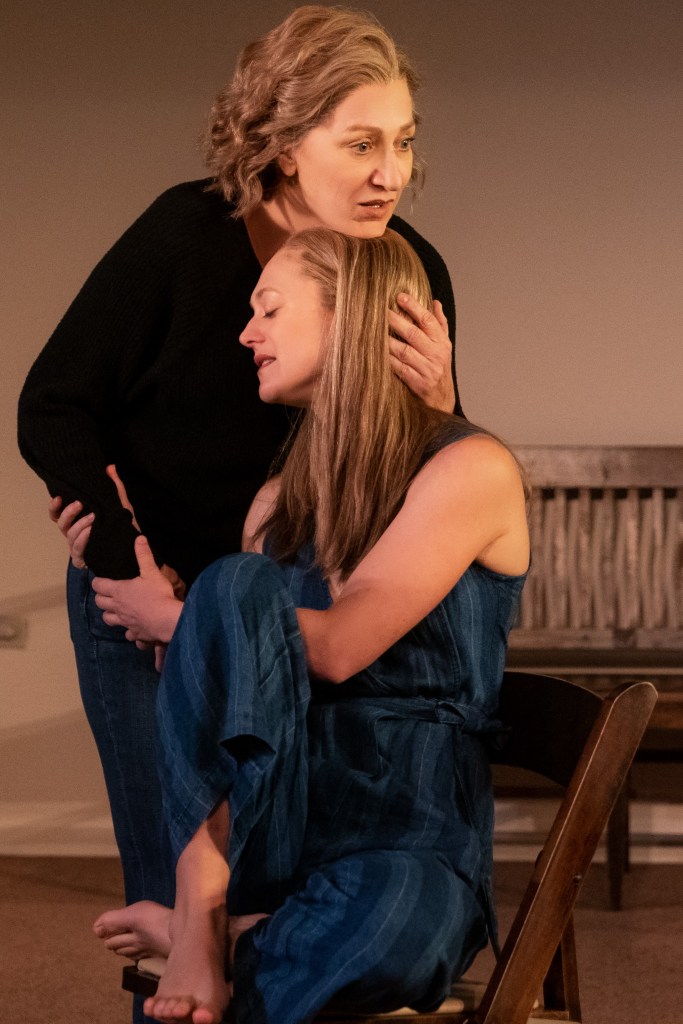
Stephens intimates that there is another consciousness, and the characters inhabit some netherworld in it. But he never clarifies the specifics and certainly not with any religious overlay. Thus, Charley’s cries have great moment. However, we don’t realize why this is so and to what she refers to in her cries until the conclusion, when Stephens reveals it.
With rapid-fire unveiling, the women stream through the beginning, middle and ending of Charley’s life assessment. Their exposition has break through dynamic moments where the women or men that #2 and #3 portray argue or disagree and resist Charley. The drama of a “life well or ill lived” is bled out of Charley’s existence which might be characterized as one of the invisible millions of “average” and “ordinary” women. These lived and died as New Yorkers making do, because they decided not to commit suicide and affirm their identity with an important emotional statement embracing death as a balm for their life’s miseries. Without much reflection or philosophical pondering, they a day-to-day existence.
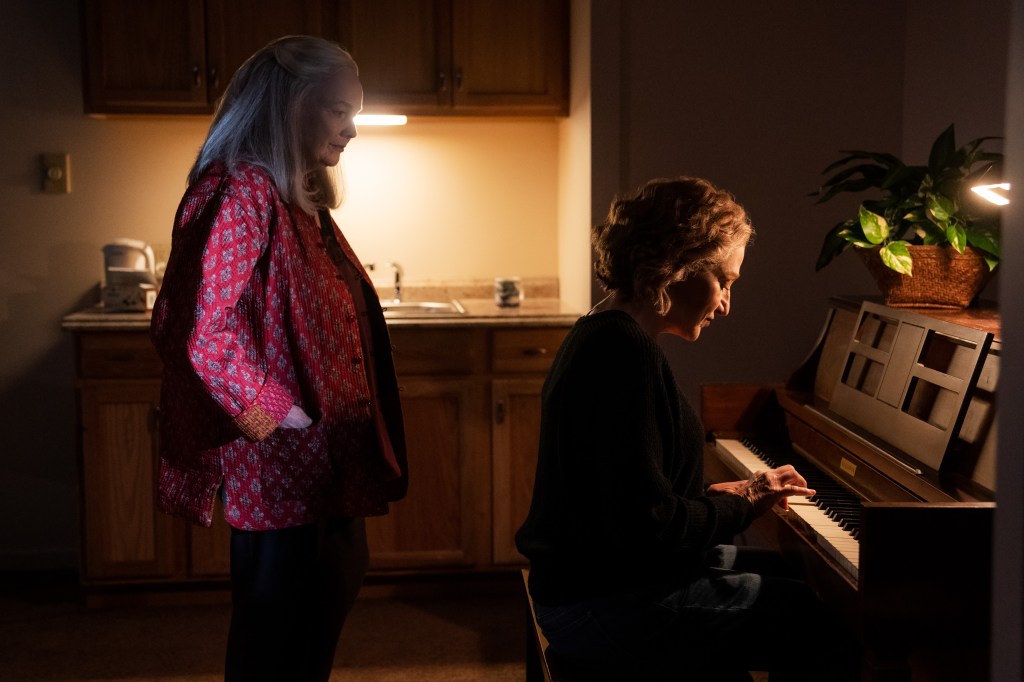
Charley’s chronicle is sandwiched between Claudette’s move to New York City and purchase of an apartment on 11th St. in Greenwich Village where she raises Charley, and years later when Charley comes back to visit and stay with Tessa after she moves to Colorado. The apartment bought on the cheap, in a questionable area grows in value and becomes the envy of all who hear of it, including the audience.
We learn that Claudette arrived in NYC to escape upstate New York and an untenable home-life. By degrees almost as an expanded laundry list, we learn of Claudette’s work, her husband, Charley’s father, Charley’s formative years, her friendship with Casey, her work as a receptionist at St. Vincent’s Hospital, her one-night stand with a pilot and her pregnancy and decision to keep Tessa as a single mother without extensive means. We also learn of Charley’s substantive partners, one abusive, the other kind.

The chronicle is also of New York City’s rise, fall and rise again, revealed as Stephens intertwines Charley’s personal events through the decades which are sometimes impacted by the culture. Ironically, Claudette wants to linger on the 60s, her generation, while Charley affirms the 70s is more important and it’s about “her life” after all. Thus, politics and the upheavals of the 1960s roll off Charley’s back without notice. We consider that Claudette’s viewpoints perhaps were shaped by that time, while Charley, the recipient of the benefits of the 60s social upheavals, remains unconcerned about them.
Throughout, as New York’s financial situation improves, there is discussion about the apartment and what to do with it. We discover that one of Charley’s partners, Brian, who Claudette can’t tolerate because he abused her daughter, persists in trying to get Charley to sell the place, even after they split up. Such discussions become points of humor, as every New Yorker at one time or another finds looking for a place to live, finding a place to live and staying once they’ve found it, one of the main preoccupations of being a New Yorker and living in the city.

Stephens’ vehicle of using #2 and #3 to supplement Charley’s perspective with the men and friends in her life offers an unsettling, unemotional scoping of a list of remembrances that speed us to the why and wherefore of Charley’s existence, however tedious it may be for the audience. The exposition in its great swaths of the non-confrontational is wearisome and uneventful. My neighbor in the audience slept through most of the play and at one point, I found myself almost joining him as I struggled to stay “woke.”
Clearly, Stephens is making a thematic point similar to one heralded by Thorton Wilder’s Emily in Act 3 of Our Town. That life, all of it, especially in its sameness and undramatic monotone is wonderful. Even if one’s life is dreary, monochromatic, dull and uneventful, it is up to us, the players, to bring purpose and meaning to it. This, Charley realizes by the end of the play. She understands the great importance of being a receptionist at St. Vincent’s after the hospital is shut down. She tells Tessa the amazing things about her that she loves.
Such realizations, Stephens suggests, arrive just on time for their full appreciation. Indeed, Charley understands by the end, that she misses what she took for granted as a privilege. Most importantly, those people, places and wants only resonate with her unique ethos and being.
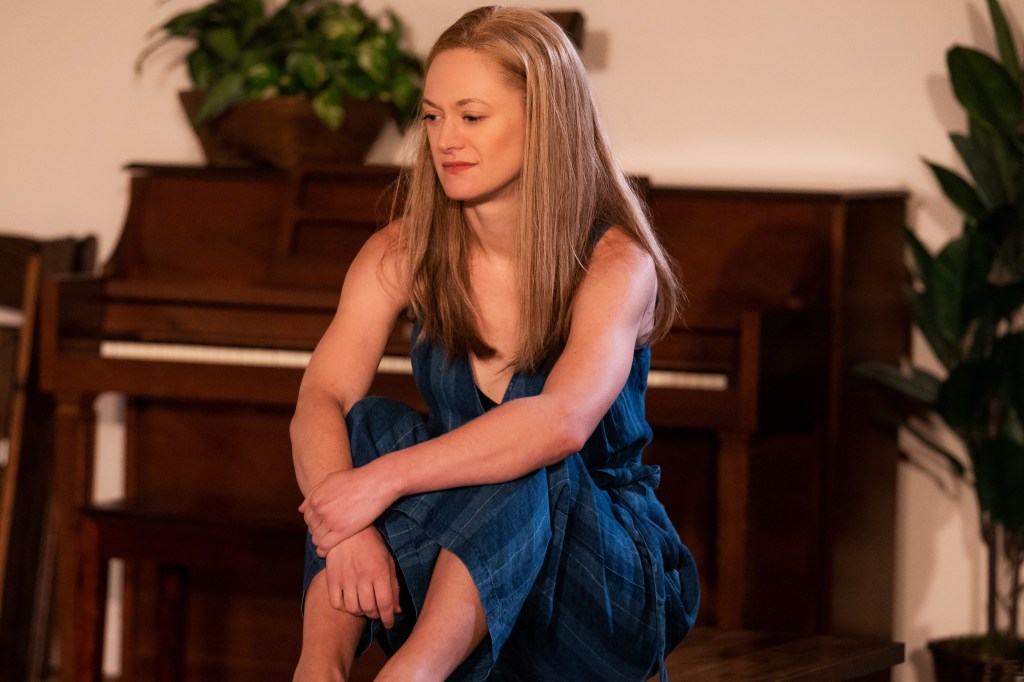
The strength of Stephen’s work which requires a yeowoman’s job of getting all of the details down is in the overall message and the last few minutes of the play which is an apotheosis for Charley and the audience. Throughout, Falco is a tour de force, in a role beautifully rendered, especially at the conclusion. Blair Brown and Marin Ireland are wonderful assistants, though Ireland needed to project and at times in her inward emotion-gathering became a faint wisp, indeed, in character, but not always articulated.
Director Lila Neugebauer properly stages Morning Sun in the ethers, not focusing on the material aspects of the production so that we listen carefully and take in the lives being shared with us. Though Charley’s journey is told in flashback narrative, we do come to trust the reliability of those who speak. This is a testament to the actors and director savoring the playwright’s work.

Kudos to the creative team: dots (scenic design) Kaye Voyce (costume design) Lap Chi Chu (lighting design) Lee Kinney and Daniel Kluger (sound design) Daniel (original music) Tom Watson (hair and wig design). For tickets and times go to https://www.manhattantheatreclub.com/shows/2021-22-season/morning-sun/
 CAROLE DI TOSTI