Blog Archives
‘Marcel on the Train’ a Celebration of Life Using the Silent Power of Mime
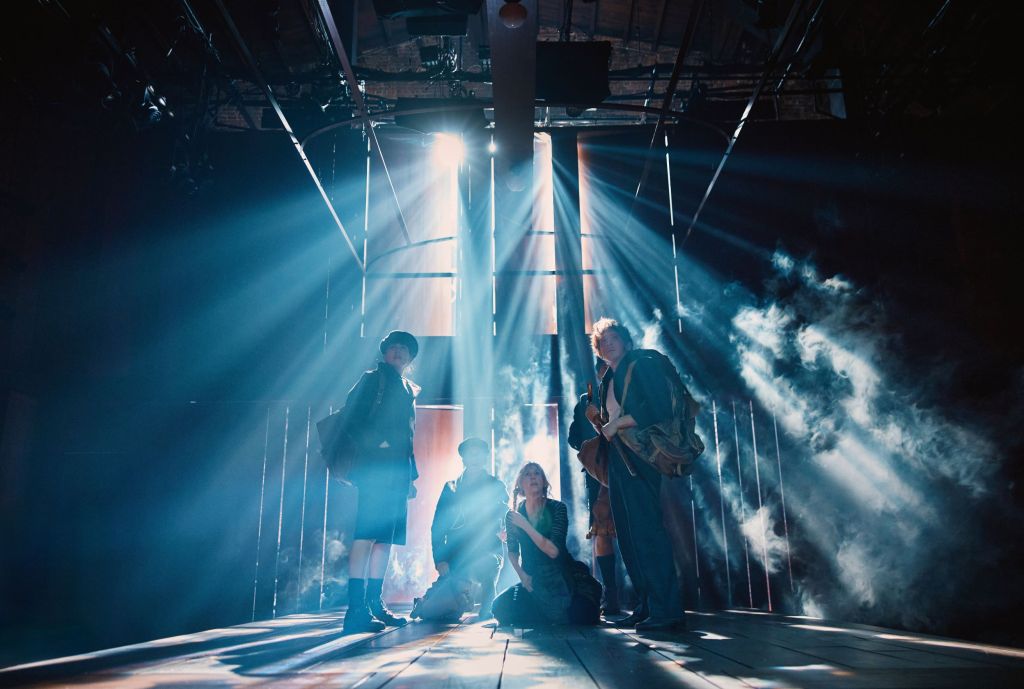
Live theater has the power to enthrall while inspiring a deep emotional impact, not only with well-honed dialogue and organic staging, but with movement and well-placed silences. With an emphasis on the latter, Marcel on the Train is mesmerizing and emotionally powerful. The drama is a tribute to celebrated icon of mime, Marcel Marceau. With a fascinating twist it captures a little known fact about Marceau’s life. As a young Frenchman he helped his brother save Jewish children with the French Resistance during the WWII Nazi occupation. This poetic, profound and suspenseful production finely directed by Marshall Pailet is inspired by Marceau’s courage and work in the Resistance. It currently runs at CSC until March 22, 2026.
Written by Marshall Pailet and Ethan Slater, who portrays Marceau, the events begin with an introduction to Marceau’s power to fluidly convey the invisible with simple movements. With these he manifests concrete objects that the audience sees with their imaginations in a silent, collective consciousness.
The opening scene happens in an abandoned train car overgrown with weeds, all invisible. Once Slater’s Marceau mimes sliding the doorway open, he views his surroundings. He sees a flower, picks it, and behold, his hand becomes the flower which opens, then dies. Another cast member enters and joins Marceau in the three sided space that is the train car. His right hand is a fluttering butterfly whose movements are accompanied by a riff of piano music, via Jill BC Du Boff’s sound design. Other performers whose hands are butterflies fill the train car with delicate beauty. Then, they vanish.
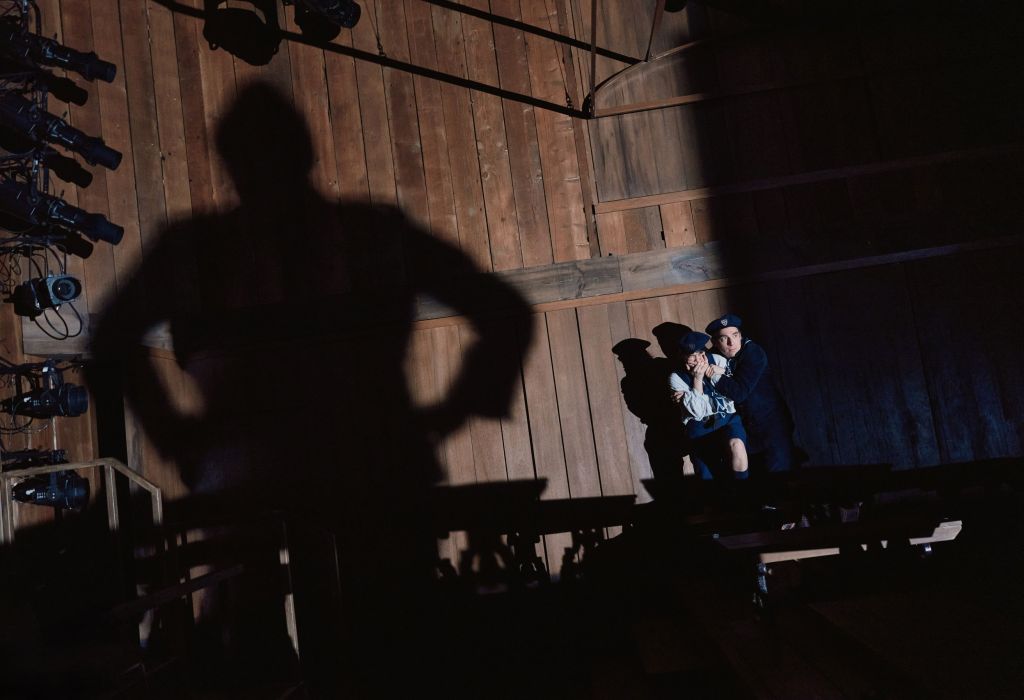
The scene transforms with the whistle and chugging sounds of the train. The performers turn into sleeping children and the difficult Berthe (Tedra Millan) screams as she awakens from a nightmare. Marceau attempts to understand her explanation and comfort her with humor in his role as chaperone of the 12-year-old boys (two girls are in disguise) under his charge. The train takes the 20-year-old Marceau and the four “boys” to a Boy Scout Camp in Switzerland to escape Nazi deportation to the concentration camps.
Pailet and Slater disclose the backstory in flashback vignettes where Marceau at various points remembers scenes from the past with his brother or father. These fill in gaps to clarify present events. In one such scene his brother Georges (Aaron Serotsky) discusses the foolproof plan (Jews never become Boy Scouts) to save children. Georges volunteers a reluctant Marceau to take them on a train through Nazi occupied France to the Swiss border. The flashbacks seamlessly return to the present stressful circumstances on the train created effectively with minimal design by Scott Davis and atmospheric lighting by Studio Luna.
As Marceau attempts to comfort the nihilistic, quarrelsome Berthe with humor, she criticizes his bad jokes and throws their dire situation in his face. Her character, though unlikable, provides the forward momentum challenging Marceau to rise above the dangerous circumstances. He persists and succeeds in rocking her off her negativity and fear with the silence of mime.
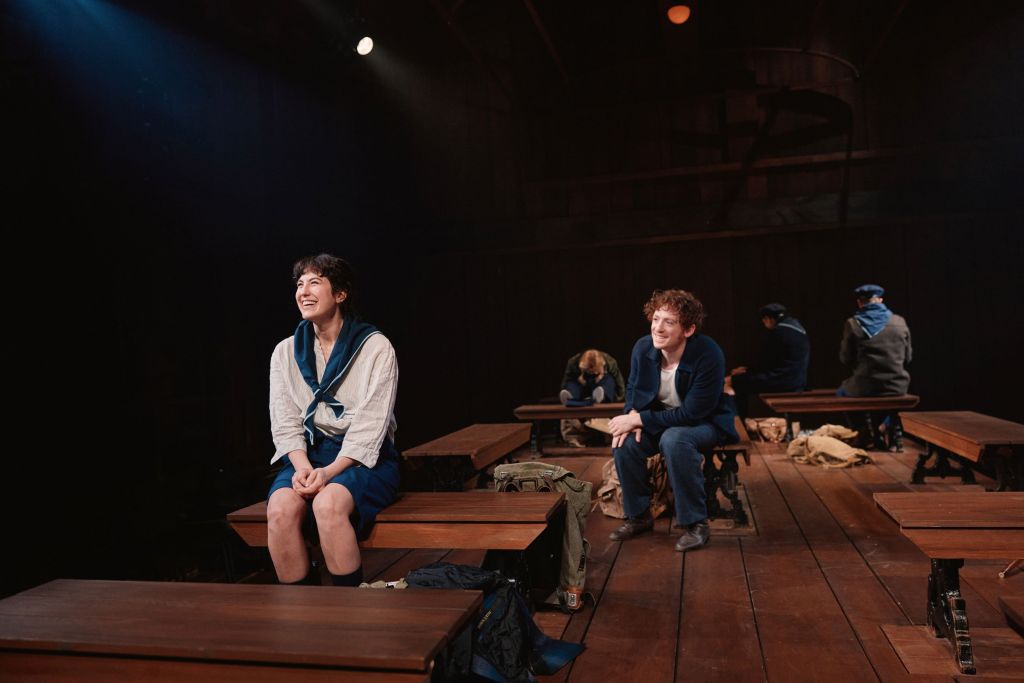
This becomes the template Marceau uses as he and the children travel toward the Alps, encountering obstacles along the way. Particularly tense scenes concern the unexpected. For example Georges doesn’t meet them at a stop where he was supposed to board the train to accompany them. Other frightening moments occur when they encounter the Nazis, especially as they come closer to their destination and the Swiss border crossing. At these moments of possibly being discovered, the stakes go through the roof. In each case, Marceau proves his mettle by using his art to distract the children and provide the hope and courage to confront extreme danger by believing in a positive outcome. Slater’s Marceau proves his talent using the power of silence and kinetic physicality. His creative imagination entrances the children. Thus, they follow his lead to keep quiet and not fight with each other and expose their true identity.
As a break in this template of Marceau’s softening the hellish situation with his artistry, Pailet and Slater interpose a scene in the future for each of the children. It is Marceau’s affirmation that they will not be captured and die in the camps. For example, Adolphe’s (Max Gordon Moore), future takes place in a POW camp in Vietnam. Marceau told him to remember something from his time on the train, Adolphe uses this remembrance to give himself hope. As a result he lightens the outlook for himself and another soldier despite the hellishness of the POW camp.
Marceau gives each of the children hope by telling them he sees their futures. Of course this inspiration deters them from believing in the present which is peopled by Nazis who intend to send any and all Jewish kinder off to the extermination camps.
The ensemble is superb. The staging and direction surprising and engaging. Slater, whose effervescent performance was perfection in the title role of “SpongeBob SquarePants: The Broadway Musical.” is of necessity the standout in a startling, endearing portrayal he helped write for himself. The scene where he picks up the snow that becomes the white make-up of Bip the Clown is searing and poignant. Slater’s few, profound gestures carry a lifetime of meaning in Marceau’s sixty-year career as a mime and actor in films who most always played himself with ironic silence.
Marcel on the Train runs 100 minutes with no intermission through March 22 at Classic Stage Company. classicstage.org.
‘The Fears,’ Meditation vs. Inner Chaos, a Review

Where do you go when psychiatric therapy, group therapy, self-medication (alcohol, food, weed, etc.), prescribed medications, and other mainstream therapies don’t help you out of severe depression from psychic trauma and PTSD? You try the Buddhist center in New York City. In The Fears written by Emma Sheanshang, directed by Dan Algrant, currently running on the Irene Diamond Stage at The Pershing Square Signature Center, we are ironically entertained and drawn in to the emotional, traumatized, yet hysterical responses of seven individuals. Each attempts to reconcile their angst and anxiety together in five Buddhist meditative sessions over the course of five weeks.
The Buddhist practice led by Maia (Maddie Corman) follows the striking of the singing bowl, meditation in silence. Then individual members “touch in” and share their miseries, joys, or angers from the previous week. Part of the irony and humor of these sessions is in becoming acquainted with the individual stakeholders Rosa (Natalie Woolams-Torres), Katie (Jess Gabor), Fiz (Mehran Khaghani), Mark (Carl Hendrick Louis), and Suzanne (Robyn Peterson). Each unique individual is introduced to new member Thea (Kerry Bishé ), who has not received an email about the rules of the sessions and is flying blind. We, along with Thea, learn the quirky rules set up to guide the meditation and group dynamic as it unravels to a turning point during each session.
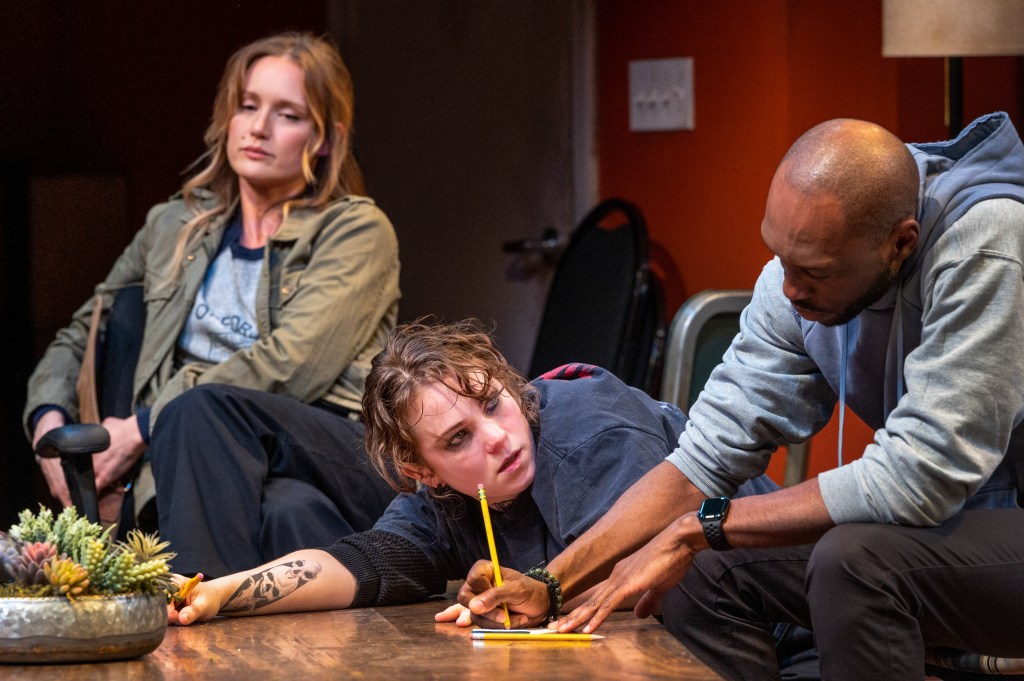
First, there are no apologies necessary for anything one does. Second, no discussion of the past is encouraged. Each of the members must stay “in the room” and in the moment to ground themselves with the here and now of their feelings. Third, no group member can ask questions of other members. Additionally, the group leader guides any member having problems with suggestions, for example to plant a tree (this never occurs), or in one instance, the inner child method–the adult version of the group member speaks to her inner child version– as the rest of the group’s inner children watch and learn.
For example, Rosa (Natalie Woolams-Torres) is subject to panic attacks and doesn’t do marital discord (conflicts between group members). Anything sets her off and raises her inner pressure. When she spirals upward in a fear, as she flails about her husband’s obliviousness to her panic attack at a christening, the controlled, calm Maia humorously brings her down by reminding her to “breathe,” and “stay in the room.” When these exhortations don’t work, she finally has Big Rosa address her inner child (Little Rosa), via a pillow who stands in for Little Rosa. Maia expertly guides her with questions, as the group members look on approvingly, while Big Rosa tells Little Rosa she’s safe, can go to another room, go for a walk, or go anywhere. Thea has gotten a eyeful as have we, except Thea doesn’t find it as humorous as the audience does.

The various members “touch in” after Rosa comes down from her attack. Katie “took a shower.” It’s apparently a big step for her because the others cheer her improvement. Fiz discusses that his sister dared to invite him to her wedding. Group members know he has issues with his parents. His father raped him as a tween, and when he told his mother, she refused to believe it and had him put in juvenile detention. His wounds are still raw, though he has been “healing.” Nevertheless, when Suzanne suggests that his sister’s invitation is a positive move, he blows up and asks if Suzanne is insane, a touchy question because all of them are off the charts from their traumas.
Also a sex abuse survivor, Suzanne attempts to defend herself. The interchange escalates humorously. Peterson’s Suzanne and Khaghani’s Fiz are invested in their emotions, and it’s crucial that the actors sustain the right balance of tone, sincerity and timing. or the scene could be deadly and fall flat. However, with apt direction and superb acting, the result is hilarity with no small thanks to Algrant, who knows how to make this hybrid dramedy pop. Additionally, the dialogue is choice with one-liners built in so that the actors (Khaghani is a comedian), cleverly measure the dead-on delivery.
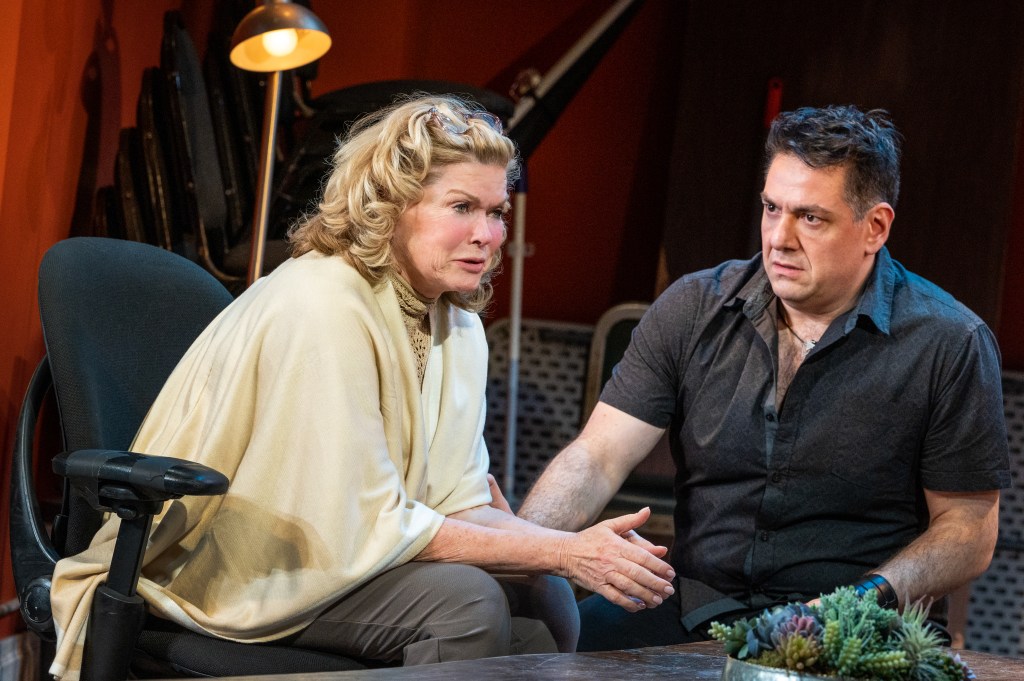
The heated exchange between Fiz and Suzanne prompts Maia to intervene and call “weather on the ones.” Gauging the “emotional atmosphere” each is feeling, the group members weigh in with “misunderstood,” “fear,” “anger,” etc., and the brewing storm subsides as they stay “in the room in real time,” and don’t nurture hurts from the past.
Sheanshang raises the emotional stakes higher when Thea tries to describe how Alexander the Great is responsible for a traumatic attack that happened to her. Initially, no one gets it and there’s confusion, until later in the play she describes the incident that terrorized her. The playwright’s clever script is both poignant and funny. She has pared down the lines yet has given enough backstory with the individuals to supply an inherent humor as they briefly describe the traumatic event which they are suppressed from discussing when the session gets underway, but not before.
The playwright thematically reminds us that humanity is boiling over with trauma and oftentimes, takes itself too seriously. However, the trauma cannot be suppressed because it is devastating; finding humor and having a gallows laugh about it is paramount. Interestingly, watching the group members surf the waves of their watery emotions, and explode despite Maia’s attempts to keep the ship on an even kee,l reveals the irony in attempting to control the chaos with “Buddhist” practice, which is a 20th century, Western appropriation of an Eastern religion, which requires an entirely different mind-set.
The religion has existed for thousands of years and its “practice,” through the Western lens and mind has been twerked. The practitioners ignore that it has been superimposed over Western, cultural psychoses and promulgated by various gurus (one of whom we later discover was a sex predator himself). Sheanshag twits the sessions and exposes the West’s arrogance and privilege in its appropriation. Her dialogue and Algrant’s direction land the play with the right tonal balance, which makes for a profound, yet comedic production. Incisively, it reveals the desperation of each of the characters, especially Maia, to find some modicum of peace, that the culture and society do not readily offer.

The actors are superb, and as they erupt with emotion, Dan Algrant has them work seamlessly in tandem with impeccable timing for maximum humor. Sheanshang has crafted the characters with such specificity, and uniqueness, we understand how they have become practiced to trust in Maia’s cues and guidance so that they follow it like herded cows. The only one who doesn’t get it is the outlier-newcomer Thea, who “didn’t get the email,” and thus, is introduced to the “rules” in real time as we are. This element keeps us engaged and provides vitality and surprise about what will happen next.
As group leader, Maia’s response to various members as she guides them, is a non-response of “Mmmmm,” which becomes loaded with meaning after we follow various characters’ issues. As the play progresses in humor and sobriety, we discover that each of the group members have experienced sexual abuse which has traumatized them, so that they rely on each other for comfort and the camaraderie of understanding. However, they aren’t allowed to discuss the specifics of the abuse because it happened in the past, and they must remain in the present. Because of the active dynamic going on in the sessions, we don’t miss learning about their past. It is enough to understand that their wounds spill into the presen,t regardless of how hard they try to “Mmmmm.”
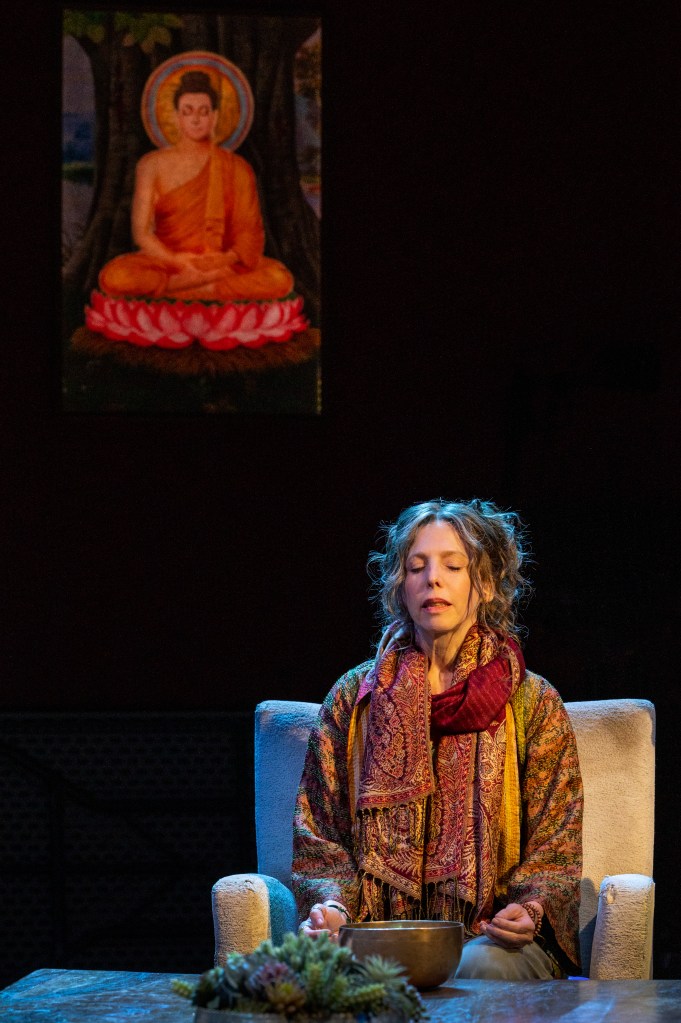
How each of the group members relates to the others remains funny and toward the end of the play becomes volatile. The techniques that Maia uses are successful only in so far that group members believe them to be. However, Thea reveals a few secrets and asks questions which throw a monkey wrench into their “smooth” sessions. And when Katie, who the others believe has joined a satanic cult, leaves after an emotional outburst, it sets the rest of the group members at each others throats. Even Maia who has the “air” of a female yogi, loses control of them and herself in a chaotic epiphany. After her outburst, she is forced to confront herself with the groups’ encouragement, as she reveal a truth she has suppressed to delude herself “nothing happened.”
The success of Sheanshang’s work is in its twists and moment-to-moment “presence” which the actors keep alive and bubbling. All of them have been beautifully shepherded into a believable ensemble of traumatics, which can be set off at any time. And, they are. The secrets revealed by Thea, Maia and Katie cause the group to go off the rails, until Maia is encouraged to hold a session which brings them and the audience back down to earth for a fitting conclusion. The necessity of restoring calm succeeds. As her depth of feeling reaches out and encourages healing, the audience members join in as well. The conclusion is poignant and the theme that every person faces their own PTSD events in their lives becomes clear. Ironically, as much as each of us would like to “get better,” and “be healed,” in an ironic comment, Thea says, “You’re on earth. There’s no cure for that.”

The quote from Samuel Beckett is the play’s principle theme. Knowing that human beings can’t escape having been shaped by horrors in their past, they are grateful for moments of shared peace which bring them outside of their emotional chaos. And in that peace they may find renewed purpose, as they acknowledge it is enough to bring power to reconcile such events with the help of others.
Kudos Jo Winiarski’s scenic design, David Robinson’s costume design (Maia’s and Goth Katie are particularly interesting), Jane Shaw’s sound design, Jeff Croiter’s lighting design, and Jimmy Goode’s wig, hair and make-up design (especially for Maia and Katie). The Fears presented by Steven Soderbergh (Academy Award winner for the film Traffic), is performed without an intermission. For tickets go to their website: https://thefearsplay.com/
 CAROLE DI TOSTI