Blog Archives
‘Marcel on the Train’ a Celebration of Life Using the Silent Power of Mime
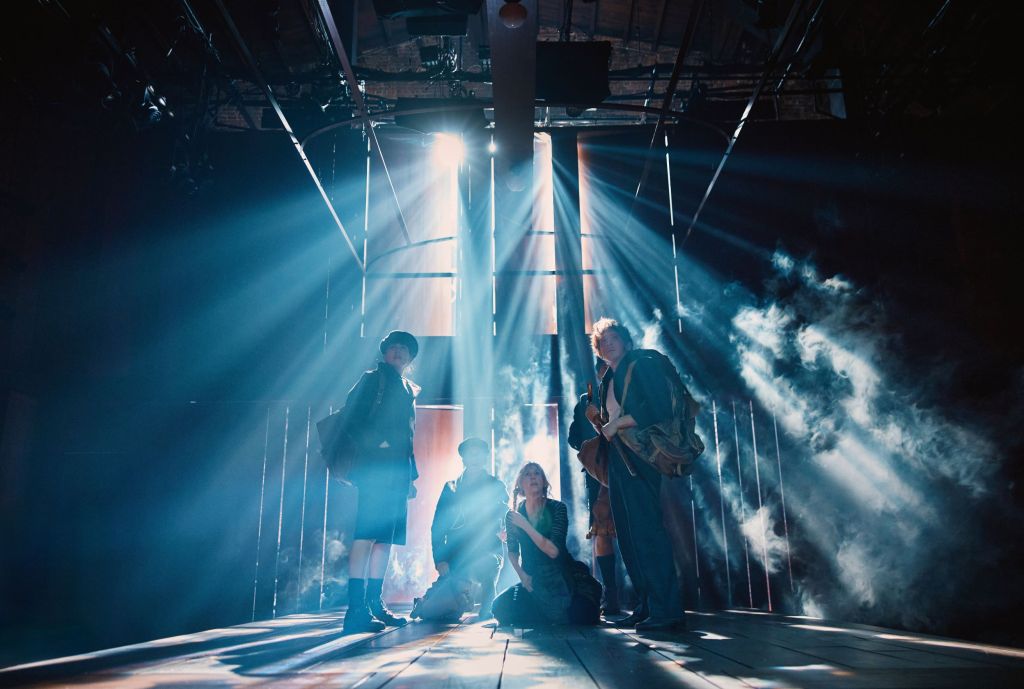
Live theater has the power to enthrall while inspiring a deep emotional impact, not only with well-honed dialogue and organic staging, but with movement and well-placed silences. With an emphasis on the latter, Marcel on the Train is mesmerizing and emotionally powerful. The drama is a tribute to celebrated icon of mime, Marcel Marceau. With a fascinating twist it captures a little known fact about Marceau’s life. As a young Frenchman he helped his brother save Jewish children with the French Resistance during the WWII Nazi occupation. This poetic, profound and suspenseful production finely directed by Marshall Pailet is inspired by Marceau’s courage and work in the Resistance. It currently runs at CSC until March 22, 2026.
Written by Marshall Pailet and Ethan Slater, who portrays Marceau, the events begin with an introduction to Marceau’s power to fluidly convey the invisible with simple movements. With these he manifests concrete objects that the audience sees with their imaginations in a silent, collective consciousness.
The opening scene happens in an abandoned train car overgrown with weeds, all invisible. Once Slater’s Marceau mimes sliding the doorway open, he views his surroundings. He sees a flower, picks it, and behold, his hand becomes the flower which opens, then dies. Another cast member enters and joins Marceau in the three sided space that is the train car. His right hand is a fluttering butterfly whose movements are accompanied by a riff of piano music, via Jill BC Du Boff’s sound design. Other performers whose hands are butterflies fill the train car with delicate beauty. Then, they vanish.
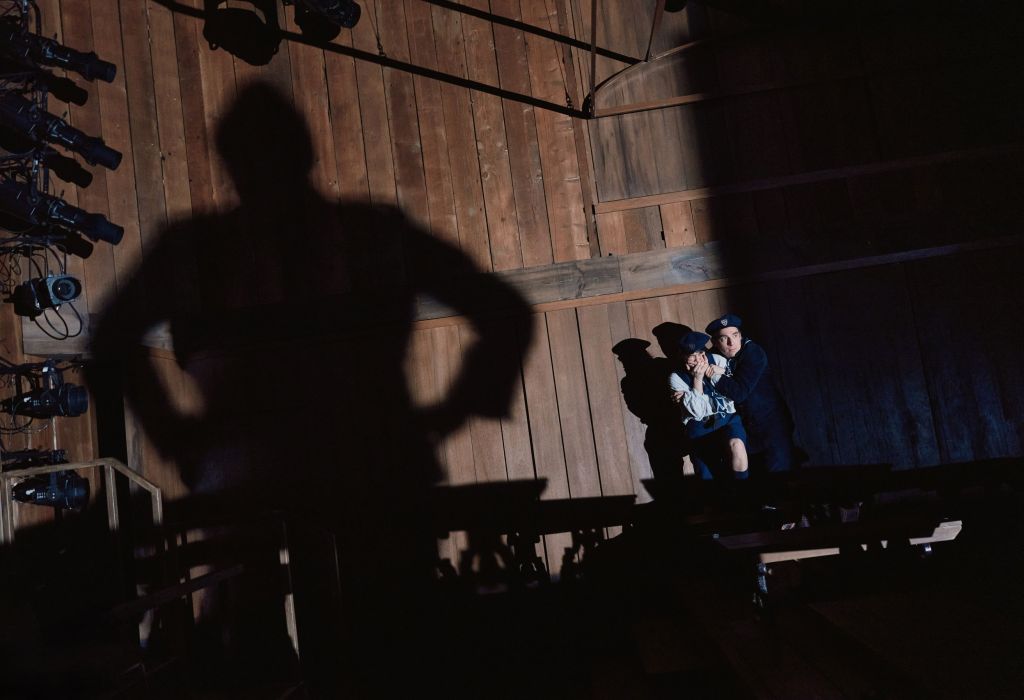
The scene transforms with the whistle and chugging sounds of the train. The performers turn into sleeping children and the difficult Berthe (Tedra Millan) screams as she awakens from a nightmare. Marceau attempts to understand her explanation and comfort her with humor in his role as chaperone of the 12-year-old boys (two girls are in disguise) under his charge. The train takes the 20-year-old Marceau and the four “boys” to a Boy Scout Camp in Switzerland to escape Nazi deportation to the concentration camps.
Pailet and Slater disclose the backstory in flashback vignettes where Marceau at various points remembers scenes from the past with his brother or father. These fill in gaps to clarify present events. In one such scene his brother Georges (Aaron Serotsky) discusses the foolproof plan (Jews never become Boy Scouts) to save children. Georges volunteers a reluctant Marceau to take them on a train through Nazi occupied France to the Swiss border. The flashbacks seamlessly return to the present stressful circumstances on the train created effectively with minimal design by Scott Davis and atmospheric lighting by Studio Luna.
As Marceau attempts to comfort the nihilistic, quarrelsome Berthe with humor, she criticizes his bad jokes and throws their dire situation in his face. Her character, though unlikable, provides the forward momentum challenging Marceau to rise above the dangerous circumstances. He persists and succeeds in rocking her off her negativity and fear with the silence of mime.
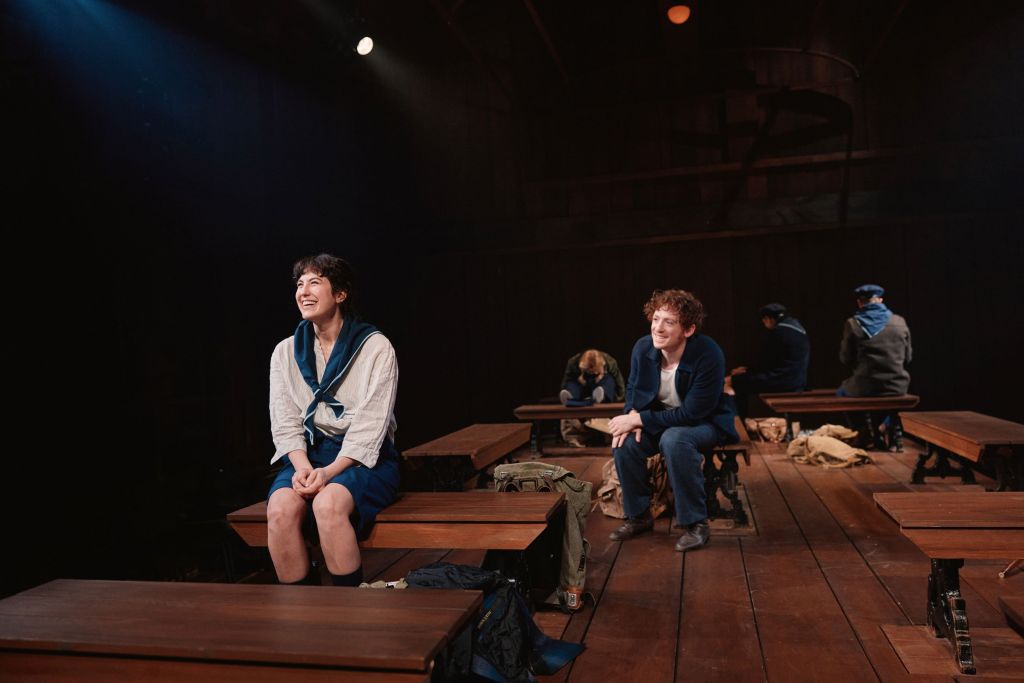
This becomes the template Marceau uses as he and the children travel toward the Alps, encountering obstacles along the way. Particularly tense scenes concern the unexpected. For example Georges doesn’t meet them at a stop where he was supposed to board the train to accompany them. Other frightening moments occur when they encounter the Nazis, especially as they come closer to their destination and the Swiss border crossing. At these moments of possibly being discovered, the stakes go through the roof. In each case, Marceau proves his mettle by using his art to distract the children and provide the hope and courage to confront extreme danger by believing in a positive outcome. Slater’s Marceau proves his talent using the power of silence and kinetic physicality. His creative imagination entrances the children. Thus, they follow his lead to keep quiet and not fight with each other and expose their true identity.
As a break in this template of Marceau’s softening the hellish situation with his artistry, Pailet and Slater interpose a scene in the future for each of the children. It is Marceau’s affirmation that they will not be captured and die in the camps. For example, Adolphe’s (Max Gordon Moore), future takes place in a POW camp in Vietnam. Marceau told him to remember something from his time on the train, Adolphe uses this remembrance to give himself hope. As a result he lightens the outlook for himself and another soldier despite the hellishness of the POW camp.
Marceau gives each of the children hope by telling them he sees their futures. Of course this inspiration deters them from believing in the present which is peopled by Nazis who intend to send any and all Jewish kinder off to the extermination camps.
The ensemble is superb. The staging and direction surprising and engaging. Slater, whose effervescent performance was perfection in the title role of “SpongeBob SquarePants: The Broadway Musical.” is of necessity the standout in a startling, endearing portrayal he helped write for himself. The scene where he picks up the snow that becomes the white make-up of Bip the Clown is searing and poignant. Slater’s few, profound gestures carry a lifetime of meaning in Marceau’s sixty-year career as a mime and actor in films who most always played himself with ironic silence.
Marcel on the Train runs 100 minutes with no intermission through March 22 at Classic Stage Company. classicstage.org.
 CAROLE DI TOSTI