Blog Archives
‘Old Friends’ the Fabulous Sondheim Revue with Bernadette Peters and Lea Salonga

Who doesn’t adore Stephen Sondheim’s mastery of the Broadway musical, mentored to him by lyricist and playwright Oscar Hammerstein II? I am loathe to admit I am late to the Sondheim party, not being familiar with all of his musicals. However, the marvelous Old Friends revue, currently running at Manhattan Theatre Club’s Samuel J. Friedman Theatre is a superb opportunity for fans old and new to celebrate Stephen Sondheim’s genius and rediscover some of his greatest songs. But don’t wait too long to get down to the Friedman. Old Friends is in a limited engagement which ends June 15th unless it receives an extension.

Who better to give tribute to Sondheim’s genius than friends who starred in Sondheim’s productions? In the current revue these include some of the cast who were most recently in the Los Angeles production of Old Friends in its North American premiere (February 13 through March 9, 2025). They reprized their roles in the Broadway transfer in March which opened on April 8th. Additionally, Peters and Salonga reprized their roles from London’s West End where Stephen Sondheim’s Old Friends played in a limited engagement at the Gielgud Theater until January 6, 2024. The history of how this production evolved is fascinating. See below snippets from the West End production to get an idea of what you’ll be seeing on Broadway.
With their voices, power and humor Bernadette Peters and Lea Salonga are perfect celebrants of the Sondheim cannon. Cameron Mackintosh wasn’t the first to come up with a revue of Sondheim’s songs. That was Hal Prince’s “Side by Side by Sondheim” in 1976. Then Cameron Mackintosh convinced Stephen Sondheim an update of his music was needed and created “Putting It Together” in 1993. “Stephen Sondheim’s Old Friends” is the third revue and the first one in over 30 years in the US after its run in London.
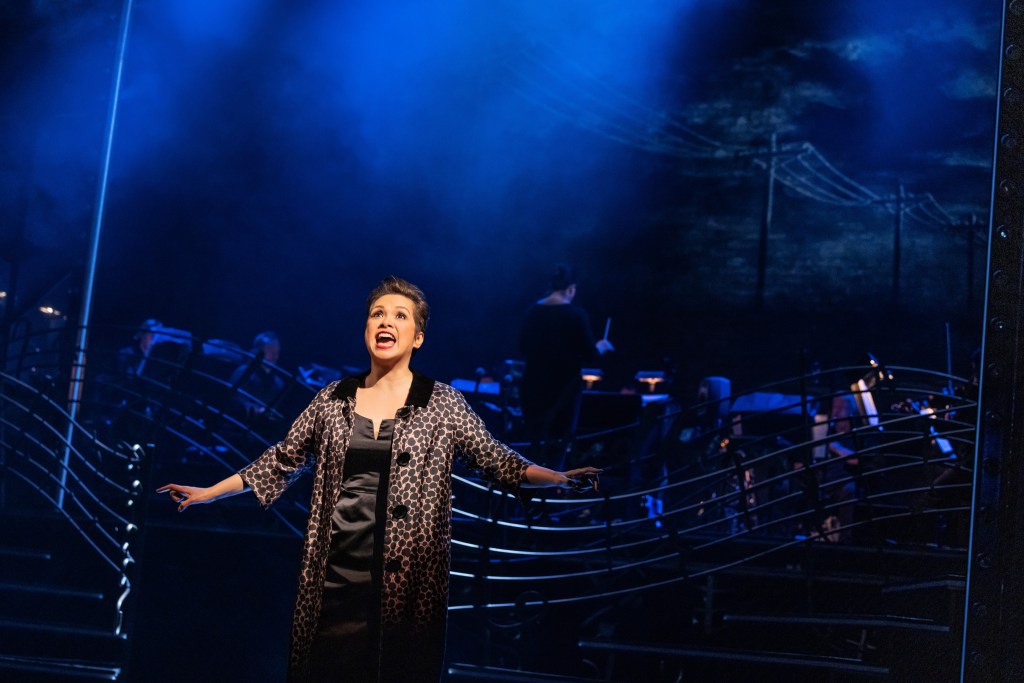
Following the typical format of revues Old Friends doesn’t stray too far, and for some, that will be a joy. However, what makes this production special is not the selection of songs (41), but who brings out new interpretations amidst a backdrop of various suggestive sets alluding to the shows, i.e. Sweeney Todd, West Side Story, Into the Woods, Sundays in the Park With George, Follies (thanks to Matt Kinley’s scenic design) and George Reeve’s projection design. Vitally, there is a segue into clips of “the man” himself and photographs which strike the heart and make one want to read everything that’s out there about Stephen Sondheim.

Jill Parker’s costume design is clever and thoughtful. For example she features Bernadette Peters in a red cape, ready to fend off Jacob Dickey’s wolf with perky ears, giving both performers the fuel to be humorous and endearing in “Hello LIttle Girl” from Into the Woods. Peters makes the most of her comedic funny bone when warranted. She is imminently watchable and mesmerizing. Though the production features Parker’s sleek and front slit gowns-a-glitter, silk jackets and tuxedos, whether show-inspired costumes or concert level TV variety show type costumes, they give off a sheen and a comfort level of old-fashioned nostalgic glamour that is soothing in these rough times heading for what many fear will be a tariff-created depression.

The production holds the emphasis on songs from “Sweeney Todd,” “Company,” “Follies” and “Into the Woods.” Actually ‘”Sweeney Todd” has the largest song selection and the most elaborate looking set design even down to the pies, oven, and barber’s chair where Sweeney slits a fellow’s throat. Stefan Musch’s wig, hair, and make-up design along with Parker’s costumes for Sweeney Todd are appropriately period grotesque making Jeremy Secomb a scary Sweeney and Lea Salonga a crazily macabre Mrs. Lovett. They do a bang up job albeit with a malevolent twist and accent on horror in “A Little Priest” that is less comical than I’ve seen performed in the latest revival in 2023, starring Josh Groban. However, considering the song is without the context, it works well by itself.

With direction and musical staging by Matthew Bourne the segues between songs run smoothly and the numbers in front of an elaborate show curtain with arches of light and lighted graduated steps when the curtain opens to see the 14-piece orchestra, provide the set for Bourne and choreographer Stephen Mear to stage the glamorous portion of the revue. With original orchestrations by Jonathan Tunick, Stephen Metcalfe’s musical arrangements soar with harmonic lyricism. Warren Letton’s lighting design and Mick Potter’s sound design are near perfect enhancing the overall technical aspect of the production.
Performing with song and dance in front of the curtain provides the time for set changes. Songs from Company, and Merrily We Roll Along are featured simply with the highlights on the performer. For example Peters and Salonga sing “Side by Side,” as the show opener with a quick segue to full stage as the curtain opens for “Comedy Tonight” by the two stars, Jason Peycooke, Gavin Lee and the Company wearing shimmering Roman-style drapes over gowns and tuxedos.
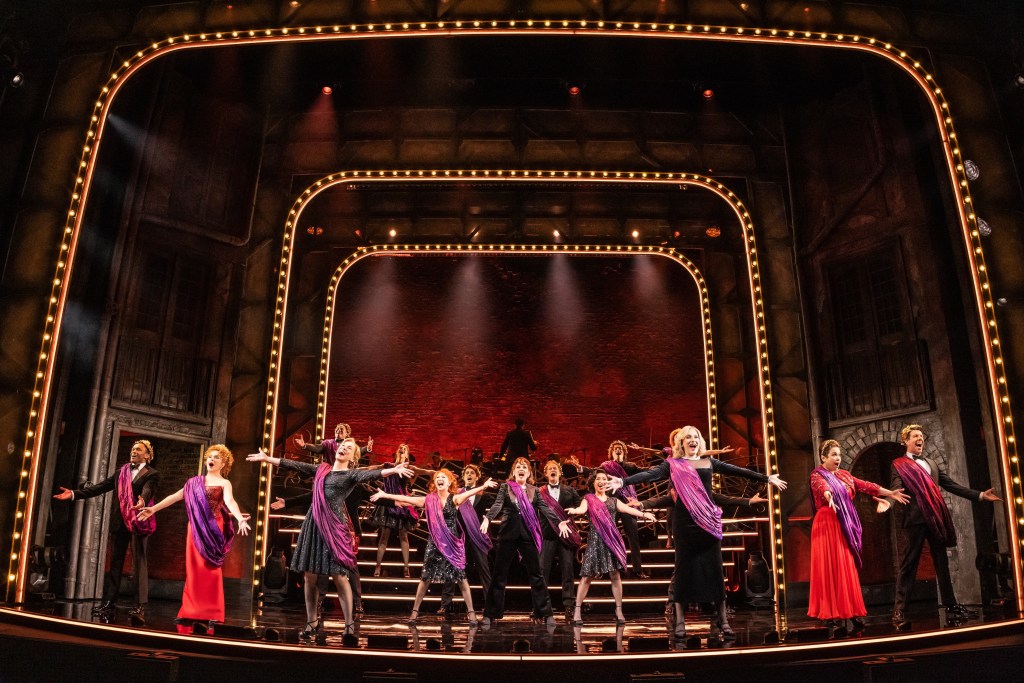
Particularly strong numbers involve the 17 cast members singing and dancing the songs “Company,” “Into the Woods,” “Comedy Tonight,” and of course “Sunday” from Sundays in the Park with George, whose scrim of the painting appears as the set piece to close Act I before the intermission. Seeing Georges Seurat’s painting is always a stunning visual effect.
Wonderful interpretations of “Send in the Clowns” by Peters,”Ladies Who Lunch,” by Beth Leavel, “I’m Still Here,” by Bonnie Langford (who does an amazing split to conclude the kick line number), and “Everything’s Coming Up Roses,” by Salonga prove the power of the music in the specific instrument and personality of the performer. “Being Alive,” then “Side by Side” as the finale are superb capstones to conclude the joyous and heartfelt evening that is a tribute to the greatness of Stephen Sondheim. Now I’m going online to order his biography by Meryle Secrest.
Old Friends runs at The Samuel J. Friedman, 2 hours and 45 minutes, including a 15-minute intermission. https://sondheimoldfriends.com/
”Merrily We Roll Along,’ Strong Performances, an Ebullient, Sleek, Shining Revival at Roundabout
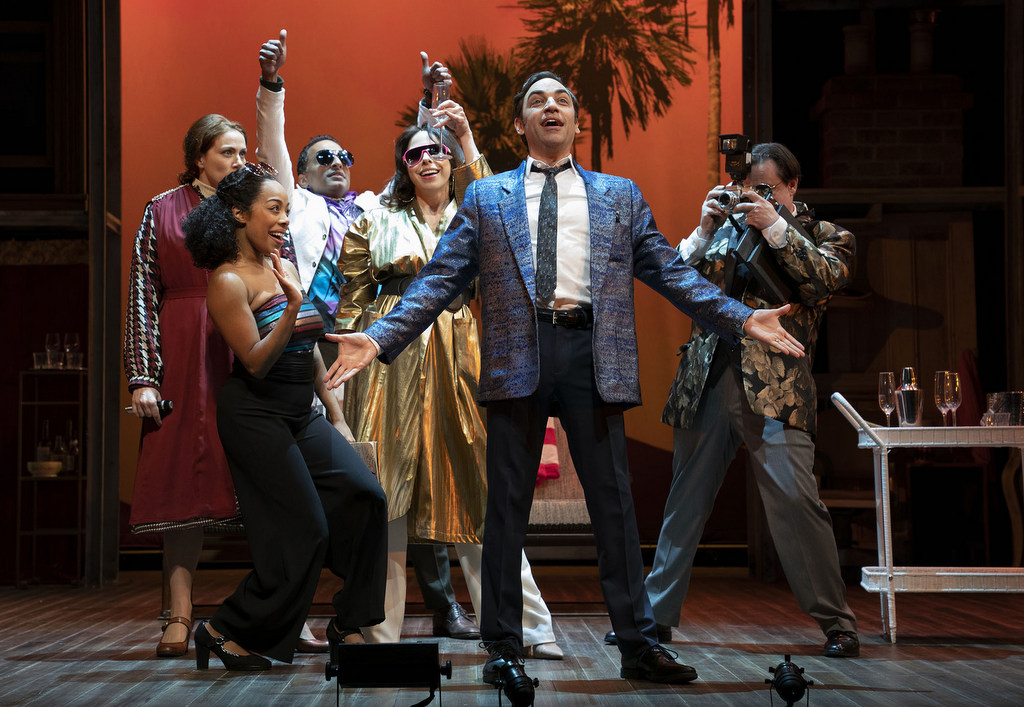
The Company of ‘Merrily We Roll Along,’ presented by Roundabout Theatre Company and Fiasco Theater. Book by George Furth, Music/
lyrics by Stephen Sondheim, directed by Noah Brody (Joan Marcus)
Dramaturgs are most probably familiar with the tribulations of the 1981 version of Merrily We Roll Along, book by George Furth, music and lyrics by Stephen Sondheim, produced by Harold Prince. The musical, based on the titular play by George S. Kaufman and Moss Hart essentially extols youthful ambitions and artistic dreams which may become subverted by practical considerations once success and financial security are achieved. The original Furth/Sondheim musical lacked measured focus but was noted by some for its wonderful score. Though the show closed after more previews than performances, it was nominated for awards and won two.
The concepts highlighted by Sondheim’s music and lyrics are timeless and made especially so in their reworked version of Merrily We Roll Along (1994) which grounds the adapted iteration presented by Roundabout and engendered by the sterling efforts of Fiasco Theater. From the superlative, exciting performances by a “gang of six” headed up by the three principals, Jessie Austrian, Manu Narayan and Ben Steinfeld and directed with precision and adroit sensitivity by Noah Brody, this thematically poignant production resoundingly works (rare praise coming from a lukewarm Sondheim fan). I found the energetic pace, incredible plot structure and imaginative set design that paid tribute to theaters of the past (and Sondheim’s work) delightful and funny. Altogether, the artistic design, staging, costumes, sound design, and the ensemble’s superlative acting and singing unfold seamlessly in the service of uniquely structured storytelling that many should appreciate.
Certainly, the sheer number of theatrical props on library bookself-style floor to ceiling walls covering three sides of the stage intrigue. The props, haphazardly arranged appear akin to a “behind-the-scenes” look into symbolic take-aways of the characters’ lives. The theatrical design and tropes provide a fascinating backdrop to the action, the arc of which spins linchpin events in a reverse chronology from 1980 to 1957. It is a period of time which encompasses seven transitions to the precipitating incident when the three protagonists (Mary-Jessie Austrian, Charley-Manu Narayan, Frank-Ben Steinfeld) first meet on a rooftop that turns out to hold a lasting symbolism for them. The flashbacks to crucial years, highlight the melds and fractures of these immensely talented individuals whose dreams, personalities and synergies help to solidify an artistic fount of creativity. It is from this fountain of creativity and their interlocking aspirations that their successes spring forth.
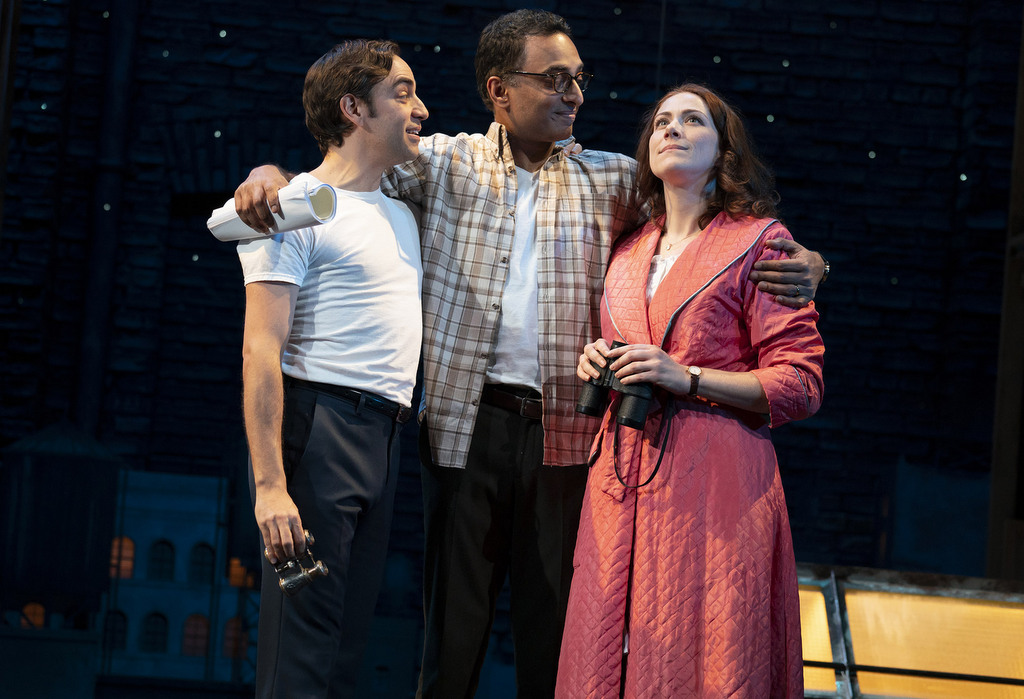
(L to R): Ben Steinfeld, Manu Narayan, Jessie Austrian in ‘Merrily We Roll Along,’ Book by George Furth, Music/lyrics by Stephen Sondheim, directed by Noah Brody, Fiasco Theater’s production at Roundabout Theatre Company (Joan Marcus)
However, without their symbiotic energies weaving and flowing together, the fountain dries up. As we follow the events backward in time, we note the progression and conclude that the waters that once revived them dissipated as did the joy, hope and vibrance of creative, encouraging friendship. It is this that Frank remembers at the outset of the play and which is the initiating incident of all the scenes that flow back into the past. We shadow Frank as he relives and remembers key times and places that led to his separation from his friends. The three when we meet them in 1980 are successful and rest on their laurels. However, their greatness which is embedded in their friendship with each other is behind them. It is this tri-parte greatness that Frank (the excellent Ben Steinfeld) seeks in the beginning of Merrily We Roll Along.
And it is this greatness that Frank understands he has lost in an epiphany at the conclusion of the extended flashback which switches back into the present. He knows when his friendship ended with Mary (Austrian is absolutely wonderful) and Charley (Narayan brings down the house with “Franklin Shepard, Inc.”), that he lost the best part of himself. Whether he makes a determined effort to rekindle his relationship with Mary and Charley to recapture what they had is uncertain and sadly, not even alluded to as the lights dim.
The play’s structure as we chronicle the journey back to their first sparks of friendship is revelatory. When we witness the older individuals and their various partners at the outset of the play, these successful people are “played out,” grossly unspectacular and unoriginal. We do not relate to them, and feel disengaged from Frank’s “matter-of-fact” attitude as he sings “Rich and Happy.” But the song belies the truth and he and others question how they arrived at their aggressive and truly unhappy, unfulfilled state. There is a “movie-like” rewind (a transition which segues into the past), and the characters get to experience what most of us don’t get to see: the pivotal events that cause them to be where they are, when they don’t wish to be there at all.
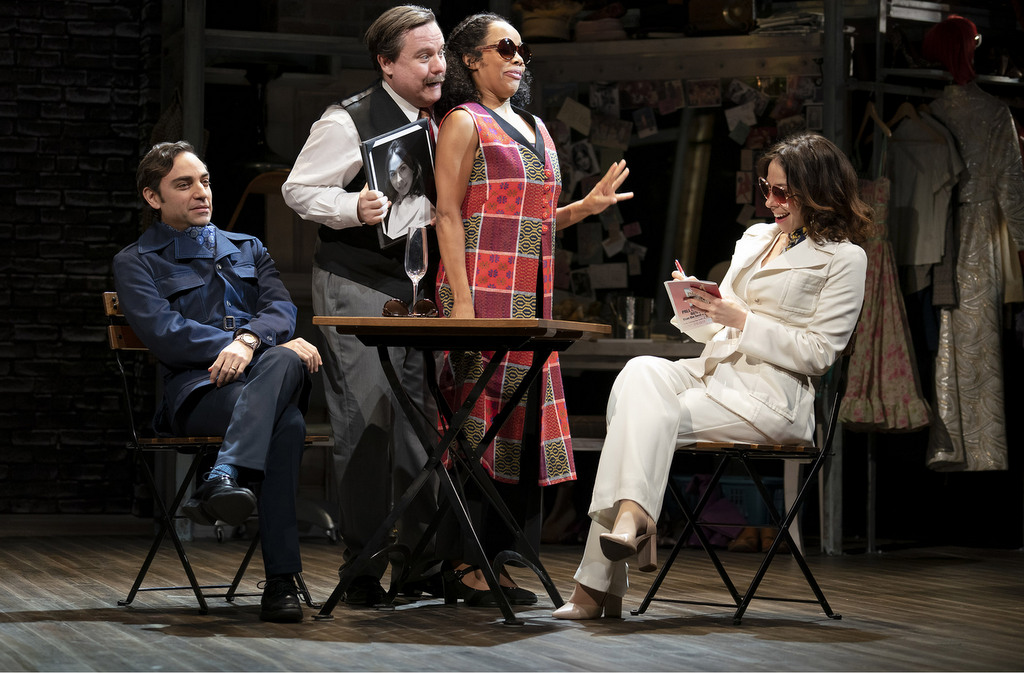
(L to R): Ben Steinfeld, Paul L. Coffey, Brittany Bradford, Emily Young in ‘Merrily We Roll Along,’ Book by George Furth, Music/lyrics Stephen Sondheim, directed by Noah Brody, Fiasco Theater’s production at the Roundabout Theatre Company (Joan Marcus)
In the brilliance of the play’s structure we chronicle Frank’s and the other’s flashback to the greatness they lost with various songs (“Like It Was,” “Franklin Shephard, Inc.”, “Old Friends,” “Growing Up,” through to “Our Time”). With the songs and transitional refrain (“Merrily We Roll Along”) taking us to their former times, the characters fill out and become personable individuals with whom we readily identify. Because of the ensemble’s acting skills and the director’s attention to detail, we joy to their humanity and feel ebullient with them, witnessing how they “made it.” However, we realize there is a caveat: success is another type of failure if one allows it to overthrow priorities and values that are based in goodness.
When we finally witness Mary’s, Frank’s and Charley’s serendipitous meet up on the rooftop when they solidify an uncanny unity, we make the connection to their twenty years later selves. Yes, years later they have “grown up.” But they have sacrificed, not their youthfulness, but their hope. They’ve lost the eternal innocence that initially ignited their artistic ambitions and happiness when they “found” each other.
It was this eternal innocence that synergistically drove them, encouraged them, sustained them through the “hard” years before they achieved success. However, after each becomes successful in their own right, they allowed their friendship to be sacrificed on the altar of celebrity. Their triumph is hollow, their latter-day efforts are uninspired. It is an incredible irony that in “the seeking” is the fun and adventure. With success comes another myriad of torments. And without your friends to hear you out and go through the miseries with you, it is especially painful. So it is for Mary, Charley and Frank.
To round out the acting “gang of six” are Brittany Bradford who portrays Beth, Meg and K.T. Her “Not a Day Goes By,” is just great in its emotional power and resonance. Paul L. Coffey and Emily Young are excellent as foils to each other portraying the producer, husband, actress, divorced and devolved. Carefully they authenticate the specifics of these individuals that confound Mary’s, Charley’s and Frank’s friendships with each other.
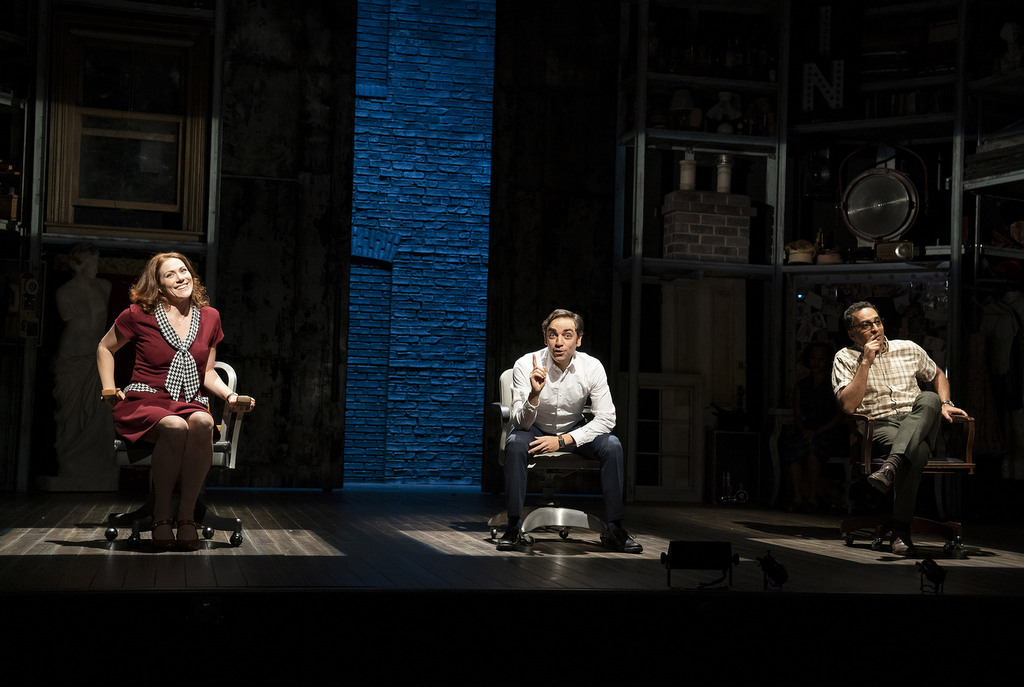
(L to R): Jessie Austrian, Ben Steinfeld, Manu Narayan in ‘Merrily We Roll Along,’ Book by George Furth, Music/lyrics by Stephen Sondheim, directed by Noah Brody, Fiasco Theater’s production at Roundabout Theatre Company (Joan Marcus)
Coffey’s upward development of Joe from failed producer to top of the world success is great (rewinding from the present to the past). Young’s upward development of neophyte actress and wife, who throws over Joe for Frank is excellent. The ebb and flow of success and failure in the marriages and relationships between Frank, Beth, Gussie, Joe characterizes the show business life. Meanwhile, Charley and Mary manage to hang on to their steady state (though Mary never marries). The contrast between the two groups is fascinating. It is clear how the demands of the producing/acting/songwriting lifestyles overthrow stability as these characters swim and tread water in an ever-changing sea of transitions.
Fiasco Theater’s re-imagining of Merrily We Roll Along is sharp, engaging, humorous, heartbreaking. The themes of friendship, regret and loss examined using flashbacks are clearly drawn through the music which is dynamic and exceptional. Sondheim touched upon the ineffability of friendship’s innocence and beauty and used that to drive the show forward into the remembrances of the past. The transitions beginning with the “Big Rewind” are excellent as the “gang of six” “rolls merrily along further into the convoluted turning points that got them to where they are decades later.
Some numbers are riotous, for example Austrian’s transformation into her thinner, unalcoholic self. Her vomiting up the booze “in the rewind” is super smart and hilarious. “Bobby and Jackie and Jack,” a song Charley, Beth, Frank and Mary perform at the Downtown Club is fun, and nostalgic for those who remember the Kennedys. The excitement of “It’s a Hit!” sung by Joe, Charley, Frank, Mary and Beth when their show is a success is exuberant and effervescent. And “Old Friends” is just spectacular. emotional and stirring. It is the kindling of the show’s fiery brightness.
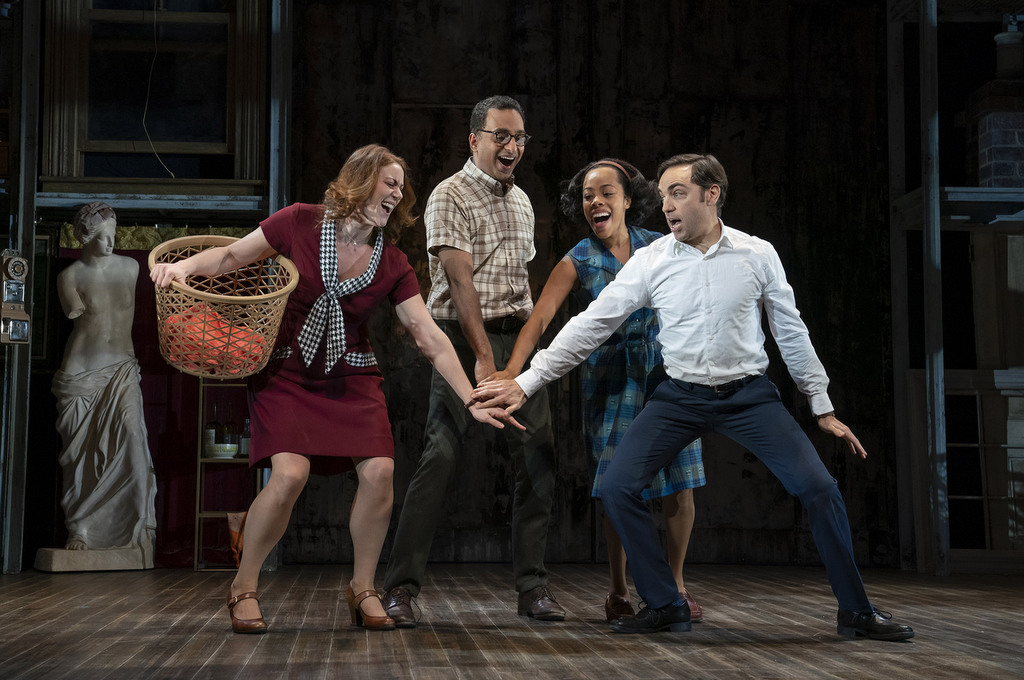
(L to R): Jessie Austrian, Manu Narayan, Brittany Bradford, Ben Steinfeld in ‘Merrily We Roll Along,’ Book by George Furth, Music/lyrics by Stephen Sondheim, Fiasco Theater’s production at the Roundabout Theatre Company (Joan Marcus)
Most importantly, the cast authentically, magnetically fulfills in their various portrayals what Sondheim and Furth wanted to express: themes about friendship gained and lost, the synergies of creativity, the wonder of manifesting the creative process, and the corruptions that undermine the best of one’s self, for example prizing financial gain above all else.
The production is complex and rich. It should be seen, especially if you saw another version of Merrily We Roll Along. Fiasco Theater’s smashing adaptation is not to be missed. And if you didn’t see an earlier version, be happily enthralled while enjoying the depth of this production which is a clever, profoundly poignant “every-person” memoir of gaining and losing oneself. Finally, the work is a paean to friendship which in this show starts in the forever and ends up with protagonist Frank and the others staring into the abyss of regret. Is there a warning here in the “Age of Trumpism?”
Special Kudos to all creatives and The Band: Conductor/Piano-Emily Whitaker and these musicians: Giuseppe Fusco, Ansy Francois, Jeremy Miloszewicz, Jami Dauber, Hidayat Honari, Matt Aronoff, Janna Graham. Music Coordinator: Meg Zervoulis; Music Preparation: Conor Keelan.
Merrily We Roll Along runs without an intermission at the Laura Pels Theatre, Harold and Miriam Steinberg Center for Theatre (111 West 46th Street) until 7 April. You can purchase tickets at (212) 392-6308 or at their website by clicking HERE.
 CAROLE DI TOSTI