Blog Archives

Jonathan Groff is Phenomenal in ‘Just in Time’

Oftentimes, singers have the gift of reconstituting songs and making them iconic, then become celebrated for doing it. One example is Bobby Darin (1936-1973), who took the droll, sluggish “Mack the Knife” from Kurt Weill’s Three Penny Opera, and with a jazzy, upbeat swing, gave it a reverential life of its own. A singer, songwriter, and actor, Darin ambitiously sang all music styles from swing to folk, from rock and roll to country music. He played three instruments, won two Grammy awards and a Golden Globe in a fifteen year period before he left this earth, only to win more awards posthumously. For his efforts, he was inducted into the Rock and Roll Hall of Fame (1990) and the Songwriters Hall of Fame (1999).
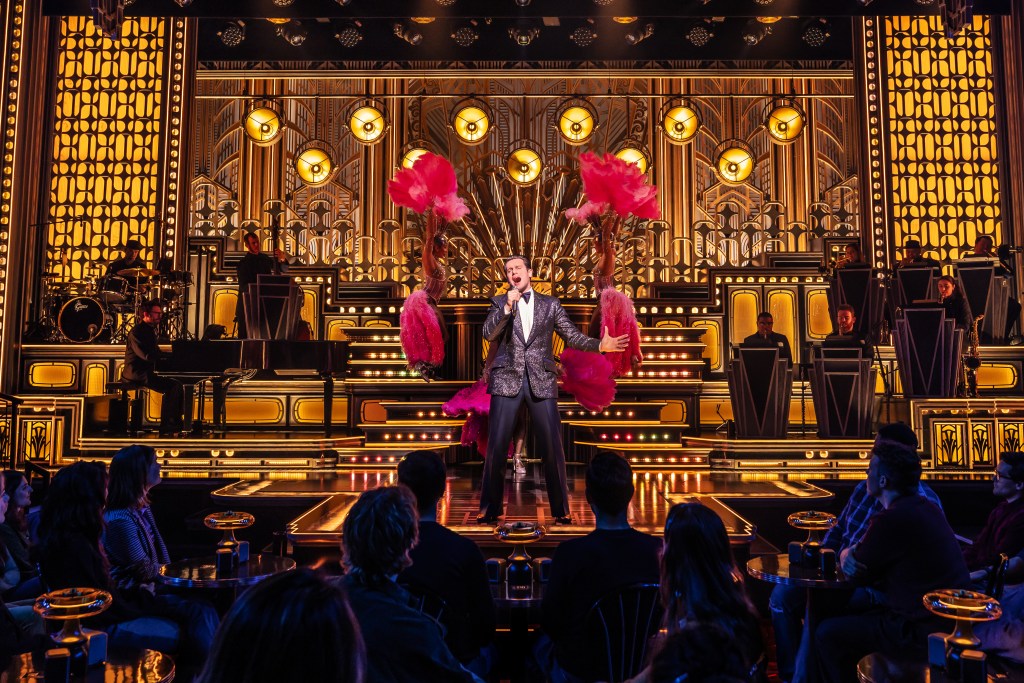
The chronicle of his life manifested a candle burning at both ends to accomplish whatever he could in his short lifespan. Just in Time starring Jonathan Groff as Bobby Darin shines a spotlight on what made Darin a consummate performer, as he reinvented his career by adjusting to the times. Key to this production is Groff’s winning, adorable persona and uplifting and empathetic approach to portraying Darin’s mystique.
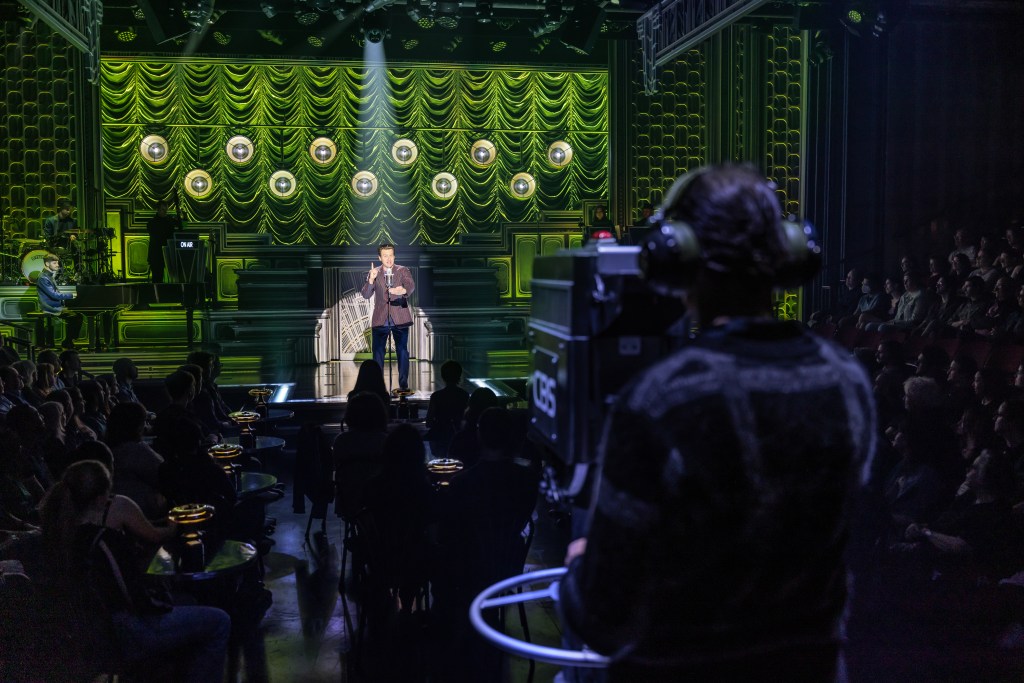
With an 11-piece band accompanying him and fine orchestrations by Andrew Resnick, this is an incredible show right out of the gate, though the book by Warren Light and Isaac Oliver based on an original concept by Ted Chapin cannot cover all of the salient information about Darin’s life for purists. However, it indeed is enough and a must-see. The exceptional Just in Time, developed and directed by Alex Timbers currently runs until November 30th at Circle in the Square.
To represent Darin’s ethos the production places the star in his favored venue, the nightclub. With set design by Derek McLane, Justin Townsend’s lighting design and Peter Hylenski sound design, Circle in the Square Theatre is transformed into both an exclusive nightclub and swank, intimate cabaret. There, Groff singularly portrays Darin’s trajectory in what has perhaps wrongly been limited as a “jukebox bio musical.”

The stunning sets around which Groff and the cast perform and enact more intimate scenes, open another aspect of the Darin persona. The immersive nightclub with two sections also converts to other settings with the use of a scrim and props. The floor area holds a cabaret-style seating arena where Groff and the others act amidst the patrons seated at tables. The multi-tiered stage of steps includes a dancing area banked on either side by the band, led by Andrew Resnick. Resnick plays piano, and supervises the music he has arranged which is vibrant, updated, resonant and heady.
Groff performs in both areas, but the showpiece numbers are on the higher levels where Darin’s Sirens dance, sing and perform with him in finely tuned, tightly choreographed numbers by Shannon Lewis. Darin’s glittering, alluring assistants include Valeria Yamin, Christine Cornish and Julia Grondin. Interestingly, theirs is an economy of movement as they surround Groff/Darin and join him with verve and style within the multi-levels of the set.

This design is exceptional and reflects the tenor of restraint, an ironic, perhaps meaningful limitation. Darin had severe health issues throughout his life and the knowledge that death was near, a terrible psychological/emotional/physical limitation, nevertheless spurred him on with a driving urgency. Darin pushed himself and everyone around him. He was about, “having a lot of living to do” because of his rheumatic heart. Despite his “mother’s” (the wonderful Michele Pawk), adjurations that the doctor told him nonsense that he would die in his teenage years, Darin took the doctor’s warnings “to heart.” He daily lived with death, and using the warning like a stoic’s “memento mori,” inspired himself to “live to the fullest.”

If anything, that is a theme of Just in Time. It is a riff on the idea that our time is limited and we must make the most of it with the gifts we have, as Bobby Darin did.
Just in Time originated as The Bobby Darin Story, a series of five concerts in 2018 at the 92nd Street Y, starring Groff as Darin. Since then its book and Timbers’ development and direction manifested a production with flowing, urgent forward momentum. Groff/Darin freezes the action with a “snap of his fingers” to add briskly paced narrative humor. These asides and direct addresses to the audience unfold Darin’s life story between upbeat club numbers dated for the time, but redirected for our time via Resnick’s arrangements. The entire production is set up as a series of night-club acts, and a stage performance to familiarize non fans with the man and his career.

However, before we discover Darin’s ambition and death-spur that propelled him, Groff is introduced as himself and assumes the relaxed, dressed to the nines (Catherine Zuber’s costume design), carefree, Groff-styled night-club persona. Groff twits the audience, making them his confidante, grounding it for his future direct addresses that will follow as a device that cycles through Darin’s life events briskly. These cover his childhood, the start of his career writing songs for Connie Frances, their relationship and break-up, his hits, the record company bosses, his revolutionary stylization of “Mack the Knife” and beyond to his relationship and marriage to Sandra Dee, its end, and his reinvention after he goes bankrupt.
As Groff zips and zags through the retrospective of Darin’s too brief life, we follow the whirlwind. Occasionally, we glimpse through the pull back of the curtain into his failing health, as Groff’s Darin initializes the stresses of his broken marriage and the revelation of a family secret that devastated him and most probably impacted his health.

In the opening set up of crooning songs “This Could be the Start of Something Big,” “Just in Time,” and lead in to the story of Darin’s life with the vamp of “Beyond the Sea,” Groff’s interpretations are sensational. Then, the audience is off and running with Groff’s self effacing line, “Whether you’re a fan of Bobby Darin, or one of the twelve people who watched “Mindhunter” – it doesn’t matter how I got you. All that matters is that you’re here and, tonight, you’re mine.”

And no joke, that’s the truth. We go with Groff down Darin’s memory lane, meeting his sweetheart that was not to be, Connie Francis (the sensational Gracie Lawrence), his “sister” always concerned for his health (Emily Bergl), his loving, show business influential “mother” (Michelle Pawk), and wife Sandra Dee (Erika Henningsen), among others who fill in various roles (Joe Barbara, Lance Roberts, Caesar Samayoa). As swiftly and smoothly as the first act spools, the second act covers his relationship with Sandra Dee, giving it short shrift, along with Darin’s political endeavor helping Bobby Kennedy’s presidential campaign. Darin was present at the Ambassador Hotel and suffered another devastation at Kennedy’s death.

The show concludes with Groff/Darin, back in the nightclub where he fits best after a few years of resettlement. As the final capstone song, the production ends with “Once in a Lifetime/That’s All” as Groff powerfully, forcefully pulls out all the stops and his closest family and friends give remarks upon learning of Darin’s death after open heart surgery. Groff concludes with poignant remarks, “Every breath we take is a gift we get to open. It isn’t enough. And yet, it is so much.” Groff back in his own skin, makeup off, in his own robust soul, passionately ends the gobsmacking evening with, “Thanks for spending this time with us. Goodnight. I love you.” And the audience gives love back with a resounding standing ovation.
Just in Time is a fabulous seduction, memorializing the life and times of Bobby Darin through Jonathan Groff’s being and perspective. To say he channels Darin limits the depth of the production. The separation between the men is always present and that is what makes this production rise above a “jukebox bio musical.” None of the songs are jukebox, but reformulated. None of the patter and narrative are crassly biographical, but more at symbolic and synoptic, like a review with song twists to elucidate the events and key turning points throughout Darin’s life. Time and effort have been taken to thoughtfully render the production’s success to a new crowd of Darin fans.
Just in Time runs 2 hours 25 minutes with one intermission at Circle in the Square. https://justintimebroadway.com/
‘Heroes of the Fourth Turning’ by Will Arbery at Playwrights Horizons

Jeb Kreager, Julia McDermott, Heroes of the Fourth Turning by Will Arbery (Joan Marcus)
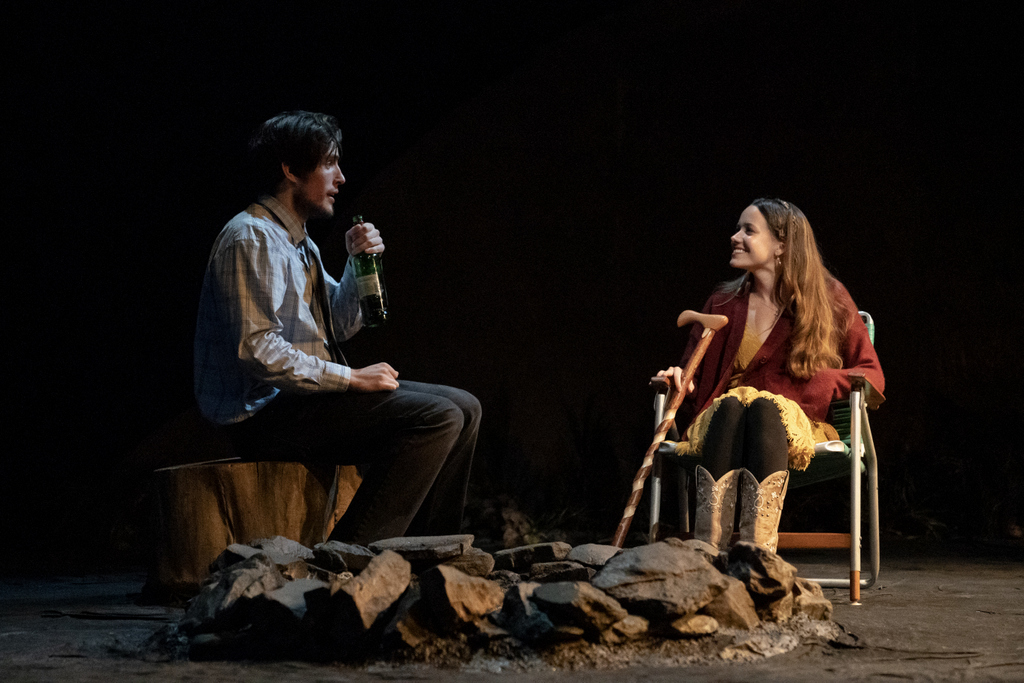
John Zdrojeski, Julia McDermott in Heroes of the Fourth Turning, by Will Arbery (Joan Marcus)
It’s seven years after you’ve graduated from college. What do you do if you are adrift, emotionally miserable and/or in physical pain? What if cocaine, alcohol, social media obsessions, abstinence from sex, indulgence in sex, and your Catholicism isn’t helping you find your way? Do you find something else to believe in to help you escape from the labyrinth of conundrums and foreboding demon thoughts plaguing your life?
Will Arbery’s Heroes of the Fourth Turning in a production at Playwrights Horizons ably directed by Danya Taymor discloses the inner world of the right wing religious. In his entertaining and profound examination of conservative-minded friends and alumni from a small, Catholic college who gather for a party, we get to see an interesting portrait of conservative “types,” who are akin to liberals in dishing the rhetoric. To his credit Arbery gives grist to the argument that beyond the cant are the issues that pertain to every American. Whether liberal or conservative, all have the need to belong, to care and love, and to make a way where there is no apparent way to traverse the noise and cacophony that creates the social, political divide currently in our nation.

John Zdrojeski, Zoë Winters Heroes of the Fourth Turning, by Will Arbery (Joan Marcus)
How each of the friends attempts to survive “out there” in the cruel, “evil” world fascinates. During the evening mini reunion on the occasion of celebrating Emily’s mom’s accepting the presidency of their alma mater, Emily (Julia McDermott), Kevin (John Zdrojeski), Justin (Jeb Kreager), and Teresa (Zoë Winters), explain who they’ve become or not become in the seven years since they’ve graduated. Teresa, a rebel during her college years, has become more right-wing conservative than ever, embracing Steve Bannon, Breitbart and Trump with gusto. The others have “laid low” in retreat in Wyoming and Oklahoma, holding jobs they either despise or “put up with,” until they get something better.

Zoë Winters, Jeb Kreager, Julia McDermott, Heroes of the Fourth Turning, by Will Arbery (Joan Marcus)
Zoë Winters portrays Teresa, the feisty, determined, “assured,” conspiracy-theorist supporter with annoying certainty and hyper-vitality, as she explains the next phase of American history to the others. She does this by summarizing a book which posits the Strauss-Howe Generational Theory. Emily, Teresa and Kevin fit into the millennial segment which lends its title to the play: the fourth turning/hero cycle. As she insists that her friends are the hero archetypes laid out in Generations: The History of America’s Future: 1584-2069, she suggests they must embrace their inner/outer hero and get ready for the coming “civil war.”

John Zdrojeski, Julia McDermott in Heroes of the Fourth Turning by Will Arbery (Joan Marcus)
For different reasons Emily and Kevin find Teresa’s explanation of the “Fourth Turning” conceptualization doubtful for their lives. Kevin’s self-loathing and miserable weaknesses belie heroism. He is too full of self-torture and denigration to get out of himself to help another or take a stand for a conservative polemic to fight the liberal enemy in a civil war. Emily is crippled by the pain of her disease. We discover later in the play that she has questions about the conservatism she once embraced. The civil war polemic only seems possible for Justin (Jeb Kreager), who was in the military. Though Justin is not the “Hero” archetype, but is a “Nomad,” he later in the evening expresses that he thinks the conspiracy mantra “there will be a civil war,” proclaimed for decades by alternative right websites will happen.
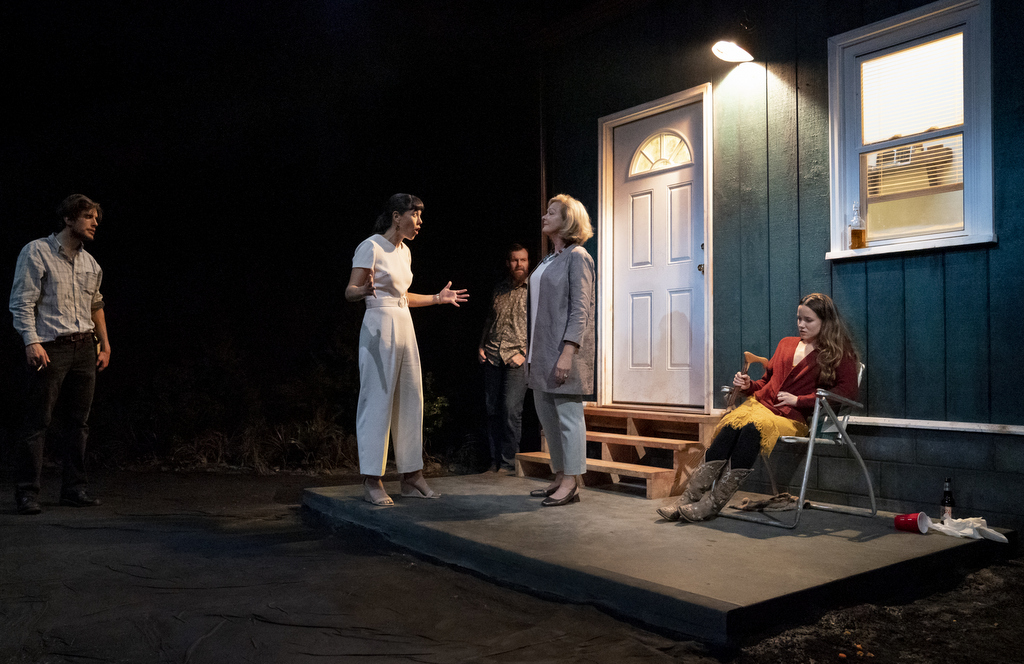
John Zdrojeski, Zoë Winters, Jeb Kreager, Michele Pawk, Julia Mermott in Heroes of the Fourth Turning by Will Arbery (Joan Marcus)
Arbery has targeted their conversations with credibility and accuracy and the actors are authentic in their nuanced portrayals. As Kevin, John Zdrojeski becomes more drunk, humorous and emotionally outrageous as the night progresses. His behavior shocks for a supposed Catholic, until we understand Kevin doubts his religion’s tenets, especially abstinence before marriage. To a great extent he has been crippled emotionally by doubt, double-mindedness and the abject boredom he experiences with his job in Oklahoma. Also, he admits an addiction to Social Media. Zdrojeski projects Kevin’s confusion and self-loathing victimization with pathos and humor. But we can’t quite feel sorry for him because he is responsible for his morass and appears to enjoy reveling in with his friends. Teresa suggests this is his typical behavior.
The friends wait for the arrival of Gina (Michele Pawk), Emily’s mom’s, to congratulate her on becoming president of their old alma mater, Catholic Transfiguration College of Wyoming. As they wait, they drink, get drunk and catch up with each other, reaffirming their friendships from the past. They discuss and reflect upon the decisions that brought them to Catholic Transfiguration College. We note their conservative, religious views about life, family and politics. Their confusion, sense of impending doom and lack of hope for the future are obvious emotional states. This is an irony for Catholics, whose hope should reside with the birth of Christ and the resurrection. Clearly, they are not exercising the spiritual component of their faith, alluded to in Gina’s speech and in Kevin’s quoting of Wordsworth’s poem “The World is Too Much With Us.” They’ve allowed the material and carnal to overtake the spiritual dimension and thus are depressed and filled with doubt.

(L to R): John Zdrojeski, Michele Pawk, Jeb Kreager, in Heroes of the Fourth Turning by Will Arbery (Joan Marcus)
In representing the conservative views of these individuals, the playwright culls talking points from right-wing media and blogs which Teresa references to Gina when Gina finally arrives. The fact that right-wing conservatism construes violent fighters as heroes is a conflated, limited view. Indeed, to see oneself as a hero and embrace that role is not even an act which true heroes (i.e. firemen, doctors in war zones) saving lives perceive for themselves. It is rhetoric. And Teresa, to empower herself and impress her old friends, speaks it as polemic. Her discussion is not really appropriate to inspire comfortable light conversation at a party. Indeed, her talk is done to solidify herself in the firmament of fantastical belief and remove any oblivion of her own doubts about her life. She and Justin who was in the military particularly rail against liberals, the LGBTQ community, Black Lives Matter, etc.

(L to R): Michele Pawk, John Zdrojeski, Zoë Winters, Heroes of the Fourth Turning, by Will Arbery (Joan Marcus)
Interestingly, Gina blows up Teresa’s cant when she finally arrives to receive the friends’ congratulations. However, they are not quite ready for Gina’s rhetorical response which is a convolution of conservative and liberal ideas that loop in on themselves again and again and defy political labeling. But Gina separates out the illogic of each of their positions. She disavows Justin’s need for guns on campus and decries the conspiracy of the upcoming “civil war.” She implies that Bannon and his like-minded are hacks, and she disavows Trump to the shock of Teresa. At the end of the evening, she pronounces that she is disappointed in the education they have received at their school, believing the college has failed them.

Jeb Kreager, Julia McDermott, in Heroes of the Fourth Turning by Will Arbery (Joan Marcus)
The night of celebration becomes a night of upheaval for Emily, Justin, Kevin and even the staunchly “certain” Teresa who will in the next decade most probably change her views a number of times to suit her determination that she has a handle on the great narrative of “reality.” But in truth as we watch these friends founder through the labyrinth of sublimely complex political, social and cultural convergences they discuss and refer to, it becomes obvious that they have been dislocated from their comfortable conservatism that categorically defined the world for them when they began college.

(L to R): Zoë Winters. Michele Pawk in Heroes of the Fourth Turning by Will Arbery (Joan Marcus)
The irony is that when Gina comes and joins their conversation and smacks down each of their beliefs, especially Teresa’s, we settle back watching the imbroglio that Arbery has wrought. Indeed, we wonder at Gina’s convoluted logic and justifications. That she would give Kevin a job in admissions is a dark irony of misjudgment. He appears the least directed to help others in the admissions process. Though they say their goodbyes with love, Justin and Emily remain in darkness. There is no comfort to be found. There is only the continuation of a foreboding reckoning.
The strongest dynamic of the play resides in the conflicts when Arbery has the friends go at each other after their initial easy reaffirmation of friendships. Ironically, the community they attempt to create falls apart driven by what is devouring each of them inside. It is then that personal flaws they’ve discussed manifest and the hell they face within spills out. Justin’s is humorously eerie. Emily’s comes in the form of fury at whom she deals with in her job and the resident demon of pain in her body. Teresa fears she is making a mistake getting married, and Kevin can’t come to the end of himself.
The tempest between and among the individuals and their inner conflicts reflects a currency for our times and is welcome fodder for entertainment. Arbery with the subtle direction of Taymor has succeeded in extending a hand across the divide of national uproar between left and right with his human, flawed characters. The actors in this ensemble are superb and hit powerful emotional notes with spot-on nuances between humor and profound drama.
This is a play you must see for its shining performances, its topics, the rhetoric-exceptionally fashioned by the playwright and its surprises in characterization. The conclusion is chilling as it expands to the mythic. Noted are the design team: Sarafina Bush (costumes), Isabella Byrd (lighting), Justin Ellington (sound), J. David Brimmer (fight director).
Heroes of the Fourth Turning runs with no intermission at Playwrights Horizons (416 West 42nd Street between 8th and 9th). For tickets and times go to their website by CLICKING HERE.
t
 CAROLE DI TOSTI