Blog Archives
‘My Joy is Heavy’ the Bengsons Sing Their Joy Through Sorrow
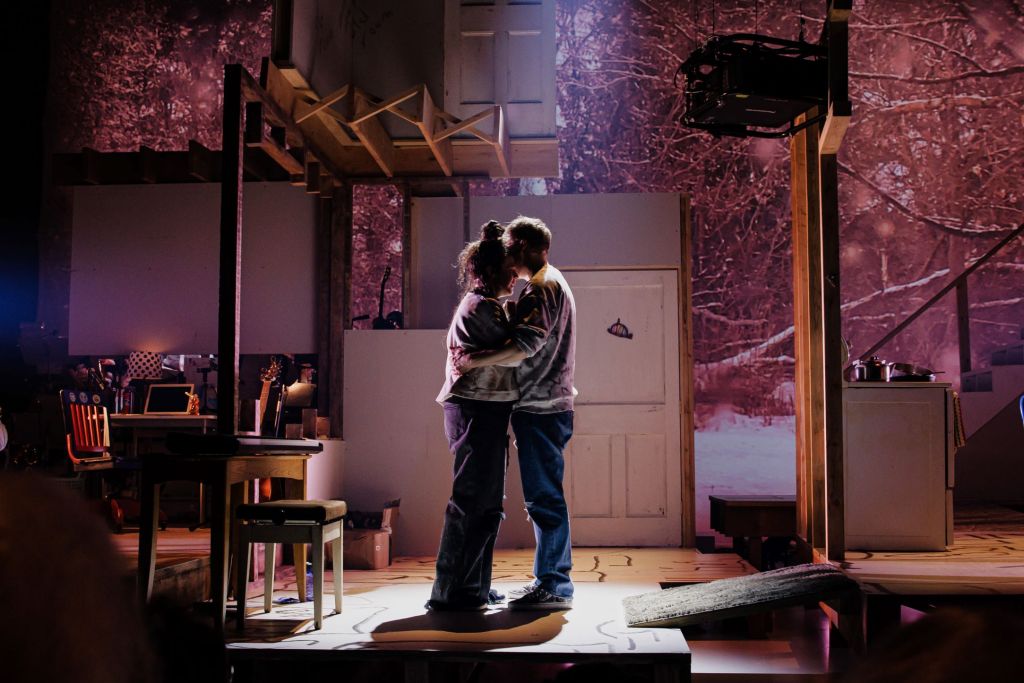
Like “A Tear and a Smile,” Kahlil Gibran’s well-known poem, the Bengson’s musical memoir My Joy is Heavy displays the couple’s affirmation of life in contrasts. Great joy can arise while experiencing great loss.The Obie-winning husband and wife team responsible for notable offerings like NYTW’s Hundred Days, presents an intimate, visceral series of experiences expressed organically in hauntingly beautiful music. Grounded in the audience’s remembrance of COVID lock-down, its isolation and traumas, we learn of the fiery trials the Bengsons went through separately and together during that time.
This powerful, soulful, cycle of songs and narration superbly directed by Tony Award winner Rachel Chavkin (Hadestown), transports the audience every moment the couple takes the stage. Abigail and Shaun invite audience members into their world, a gritty chronicle of emotions, spooling out from an extraordinary mix of folk-rock, punk and gospel that rearranges one’s psyche from start to finish. Because of audience enthusiasm, My Joy is Heavy has been extended through April 12, 2026 at New York Theatre Workshop.
What makes this production intimate and heartfelt includes the couple’s attention to the audience. To make sure they hear and see every lyric, turns of phrase, imagery and poetry, the production employs closed captions that appear above the stage. I found these to be less distracting than captions in other productions that oftentimes appear stage left or stage right. Additionally, the musical duo cuts to the chase identifying their wish to share a compelling revelation at the center of their musical memoir. “We’re here to tell you about this one moment, this one moment that happened right there on that bed.”
When Abigail says this, she motions to the bed in Lee Jellinek’s set design of Abigail’s mom’s house in Vermont. The couple and their toddler son stayed there during the alienating months of COVID, the time period of the production. It was then they had an epiphany, like a shamanic vision, which drives them artistically. Hoping that the expressiveness and power of their story helps restore harmony and wholeness, they try to connect with the audience so they might experience a cathartic, emotional release.
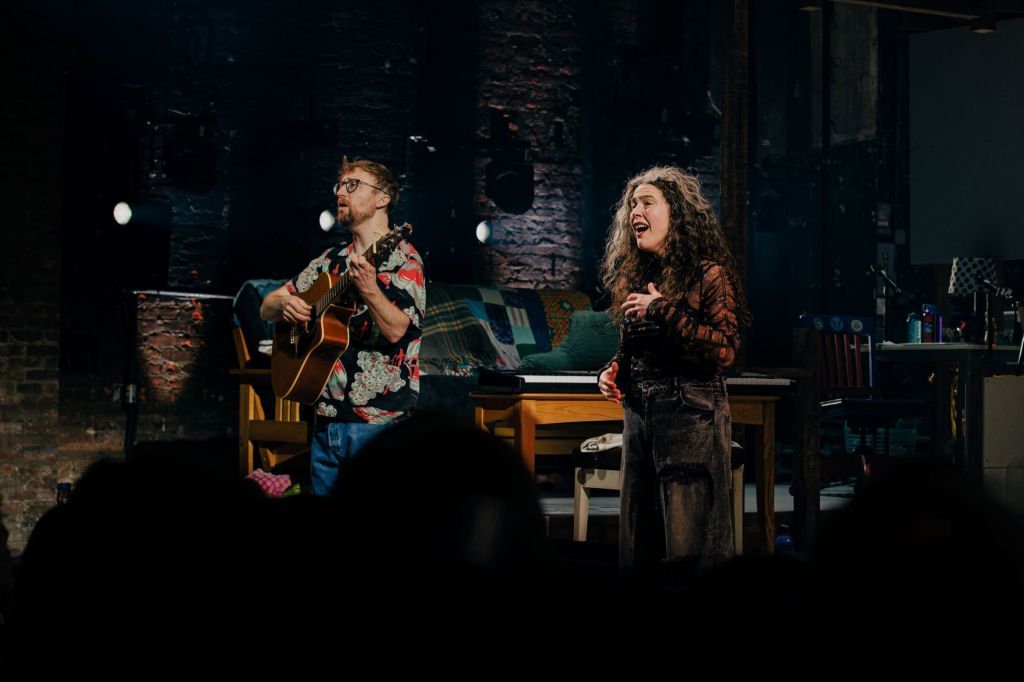
When Abigail and Shaun begin to discuss their COVID isolation, they call upon the audience to remember with them and reflect upon those lost to the pandemic. Abigail memorializes these individuals with a symbolic gesture involving two audience members. Then the duo plunges into their musical narrative with choreography by Steph Paul and music supervision by Obie Award winner Or Matias (Grey House). Shaun’s great versatility playing piano, guitar, accordion, etc., and the expert six member band directed by Matt Deitchman, accompany Abigail and Shaun throughout.
With them the couple rides waves of humor, uplift and sadness as they course through songs, not slowing down until they sing the last refrain of “My Joy is Heavy” to the audience’s rhythmic hand clapping.
As a part of the narrative we see snippets of Gramma Kathy, Abigail’s mother, and their toddler Louie in home video footage taken with their phones. Chauvkin uses these and other videos projected on the back wall of the set to convey and enhance mood and tone, and transition to other scenes with different emotional content. Also, Chavkin integrates these projections into the narrative to relay quieter moments of homely family life in “the calm before the storm.”
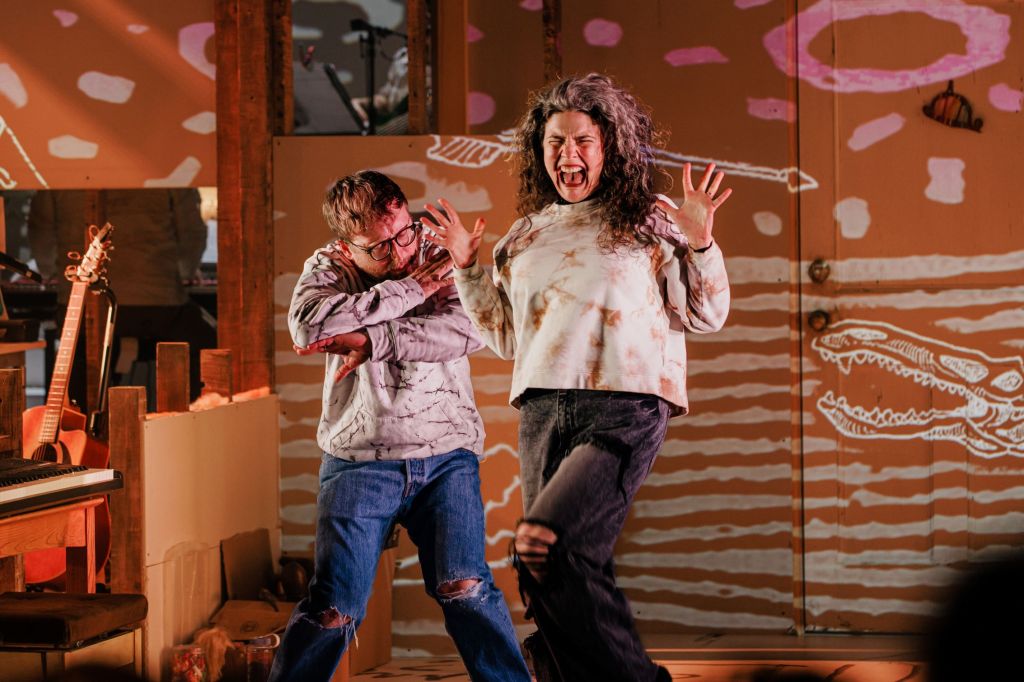
As a complement to the home videos, David Bengali’s video design, which accompanies the metaphoric song “Underground,” and serves as background for other musical pieces, effectively captures the Bengson’s interior emotions. For “Underground” the wild and evocative projections aptly serve the lyrics. For example, to reflect how Abigail and Shaun went into feelings of isolation and fear they sing, “I’ve been underground in a deep, dark cave, doing my best to stay live.” Alan C. Edwards’ lighting makes the projections pop. For her part Abigail experiences excruciating headaches that she labels PTSD. Clearly, the pandemic causes intense stress when, despite everyone’s assumptions, it goes on for months because of skyrocketing numbers of the dead and dying as COVID spreads.
With the drama of the pandemic in the background, Abigail and Shaun try for another baby. However, the risk reward ratio of a prior miscarriage plummets them into cascading fear. They elicit help from doctors and when the medication and fertility testing don’t seem to help, they watch holistic programs and go through Zoom sessions. Many of the profound songs as well as the humor deal with the Bengsons struggle with their having another baby. Standouts include “River” and “Don’t Hope.”
The first song is a striking, poignant remembrance of their baby who never makes it into life, a song of love and mourning. This devastating experience five years prior informs their roller-coaster emotions in the present when Abigail discovers the blue line of her new pregnancy. Though “over the moon,” Shaun and Abigail can’t allow themselves the luxury of celebrating, because “what if?”
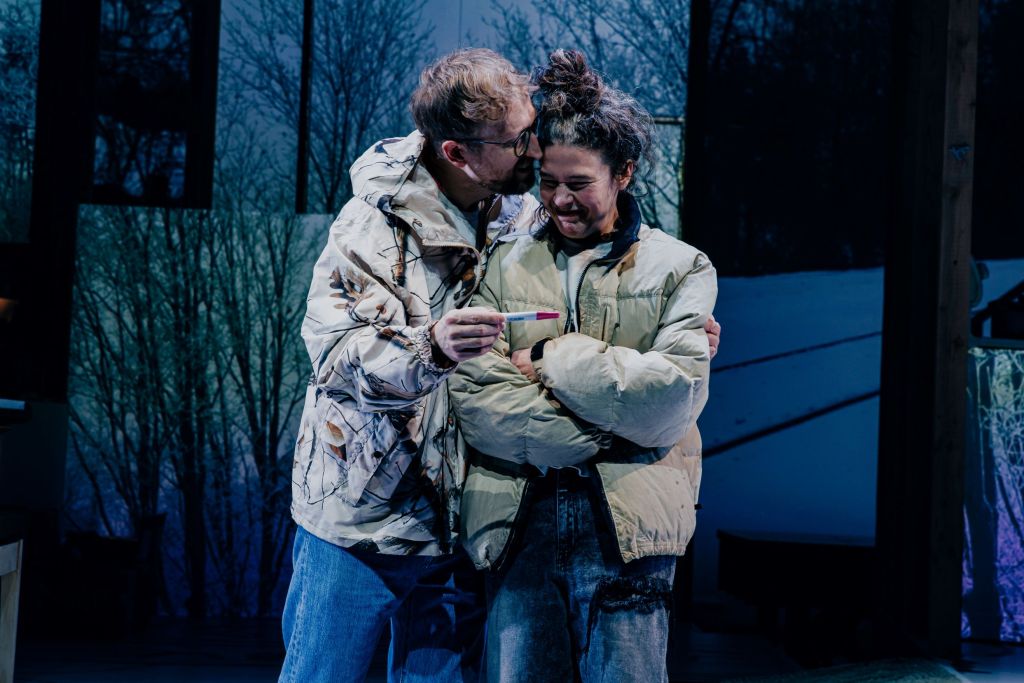
“Don’t Hope” hits home with its simple humanity and perfect melody aligning with the repeated refrain, “DON’T DO IT, DON’T
HOPE, DON’T DO IT, DON’T GET HAPPY. Who cannot empathize with the sentiment that feeling too exuberant will jinx what one wants desperately? After this amazing song Shaun describes his riotous experience with little Louie on the Santa Sleigh and the humor breaks through the fear and makes way for the song, “Veil.” Both agree, they’re doing everything they can do. And this leads to their understanding that they can’t live avoiding their natural feelings. Together they decide, in the next song, “I’d Like to be Happy.” They choose to let go of repression.
By degrees we follow their emotional journey from the cave and pain to an expiation of the sorrow of the miscarriage and recognition that happiness shouldn’t be suppressed. And in between a few other remembrances and songs, the couple arrives at the epiphany Abigail refers to at the top of the musical. Thus, engaged audience members travel with them through flashbacks to experience palpably how joy and sorrow can occupy the same place in one’s heart, at the same time. The Bengsons bring the audience to this breathtaking and ebullient conclusion in the rousing gospel “My Joy Is Heavy,” as all stand in appreciation.
My Joy Is Heavy runs 1 hour 10 minutes through April 12, 2026 at New York Theatre Workshop. https://www.nytw.org/show/my-joy-is-heavy/
.
u
.
NYTW’S ‘Sanctuary City’ at the Lucille Lortel Theatre

One of the most fascinating elements of the superb Martyna Majok’s Sanctuary City, directed by Rebecca Frecknall, is the symbolic stylization conveyed by the script. Majok’s script is a powerhouse. It is rhythmic, poetic and a rap of eternal, brief moments of brilliance in time. Majok’s layered work elucidates how relationships begin, not with long conversational pieces, but with connecting, truncated slips of thought. She suggests that relationships evolve through the power of memory and imagination, the interactions between “B” (the adorable and heartfelt Jasal Chase-Owens), and the emotionally wired “G” (the wonderful Sharlene Cruz,). These prove to be fatal, fairy wisps in the first part of the production.
Frecknall’s staging on a bare, raised platform, sans props and any theatrical spectacle, requires that the audience focus on Majok’s words which, abstracted, are short, repetitive bursts. For emphasis and effect, Frecknall follows the brief, seven word or less sentences with brilliant strobe light flashes, denoting flashbacks and changes of scene, situation and time. The intriguing lighting and set design are by Tom Scutt and Isabella Byrd with Mikaal Sulaiman’s sound design.

The effect, revealing the stress and anxiety of the characters, recalls the dislocation and alienation that characters experience in plays like Beckett’s Waiting for Godot. Such stylized dialogue brings to mind the mission of Theatre of the Absurdists, who highlighted the incapacity of language to convey emotion and heart. When human beings experience trauma, internal isolation and nihilism to a devastating extent, verbalization seems impossible.
Thus, as teenagers “B” and “G” move and re-position themselves onstage. As the portray these characters Chase-Owens and Cruz, offer fragments of memory recalling the past with intensity. Engaged, we follow intently, discovering that they are illegal aliens. “B’s” mom is fed up and intends to return to a country that her son was too young to know. “G’s” mom is oppressed and abused by the partner she lives with who also wallops “G” for good measure when she gets in the way. “G” and “B,” who are archetypes of dreamers everywhere, have parents who are single women. Hampered by fear of reprisal and intimidated by threats of deportation, the mothers are unable to make comfortable lives for their children. They struggle to do their best, but instead “B” and “G” are brought into a cold, indecent, alien world of devastation without citizenship.

We watch in the dim light and lightning-like flashes how Cruz’s “G” often climbs up the fire escape seeking “sanctuary” and help from Chase-Owens “B.” The abuse, arguments and chaos at her apartment create phenomenal stress; she must leave. “B” welcomes her and eventually she sleeps in his bed and they have sex to make a connection so they feel less alone. Both confide in each other, encourage each other at school and “dream” of better times which eventually do happen for “G.” The superb actors create a relationship dynamic that is believable and vital. Interested and invested in their prodigiously skilled portrayals, we stay with them throughout the play.
The setting is New Jersey in 2006, in a country which ill uses its immigrants because political parties have exploited the issue of citizenship as a way to consolidate power. For “B” who fears getting caught and being deported, the emotional terrors are like a war of attrition that force him and his mother to live an impoverished pressure-cooker existence. They wait daily for the explosion to occur, of their being caught and deported.

We discover through the light flashes and their circular movements on the platform, that “B” and “G” trace the chronology of their relationship in staccato bursts of memory. These lead to an apotheosis at the play’s conclusion. We empathize with “B’s” concern for his mother, who suffers abuse and bullying from her employer. She obeys his every word, and overlooks his skimping her pay. His disrespect is better than returning to the homeland, until she reaches a point of no return and decides it is enough.
Thus, Majok reminds us continually by examining the plight of “G’s” and “B’s” situation, that immigrant women are often sexually abused and beaten because they have no leverage. As in the case of “G’s” mother, orders of protection are useless because the partner can call INS (currently ICE), and have them deported, if they don’t comply sexually. Indeed, once the partner exhausts the mother, the implication is that he will come for “G.” At times “G” shows up at “B’s” bleeding and bruised by his wanton brutality.
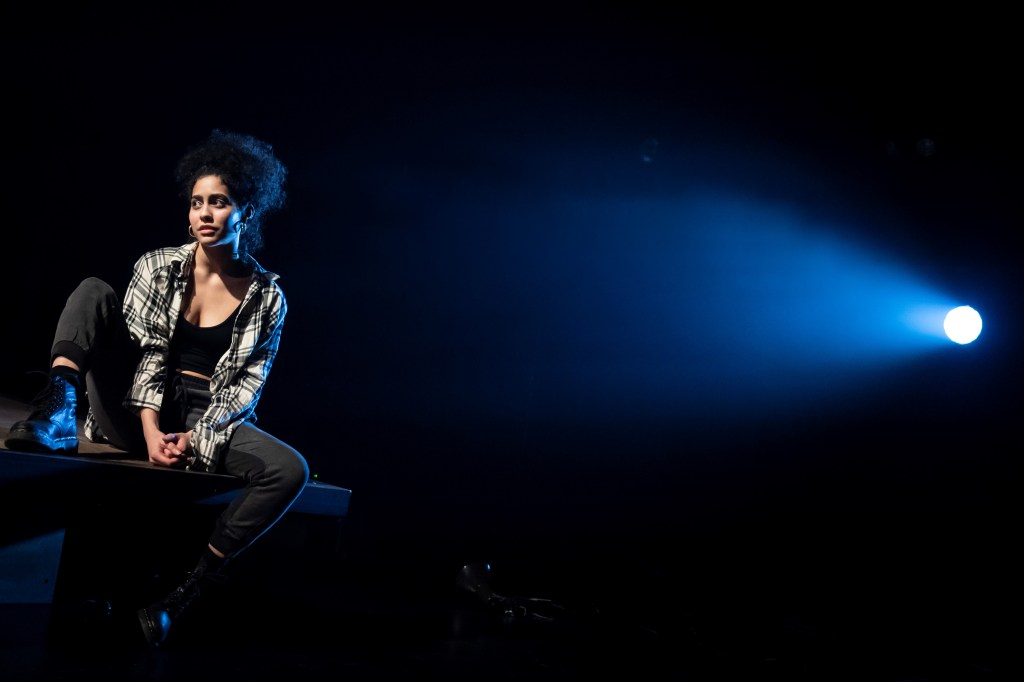
However, hope does come. And in the same stylized format of language, “G” tells “B” that her mother got her papers and miraculously, “G” is a citizen. That moment of G’s” joy causes “B’s” searing pain. While “G” no longer fears discovery and looks forward to their moving away from her mom’s monstrous partner, we note “B’s” sadness and envy. He is stuck. His mother is going back to the “homeland” and his confidante and ersatz lover has “made it” to a more superior position in the immigrant pecking order, while he must wallow in her wake, facing the shadows of fear and oppression alone.
It is at this juncture that a turning point occurs. The guilt “G” feels about her position in comparison to “B’s” situation wears on her. She forms the idea that as he has given her sanctuary, perhaps she can do the same for him. Her method is to select the way to citizenship immigrants have employed for decades. After all, she has feelings for him and is willing to risk her life offering to marry him, though, if discovered, she possibly would lose her own citizenship, be fined and jailed after he is deported.
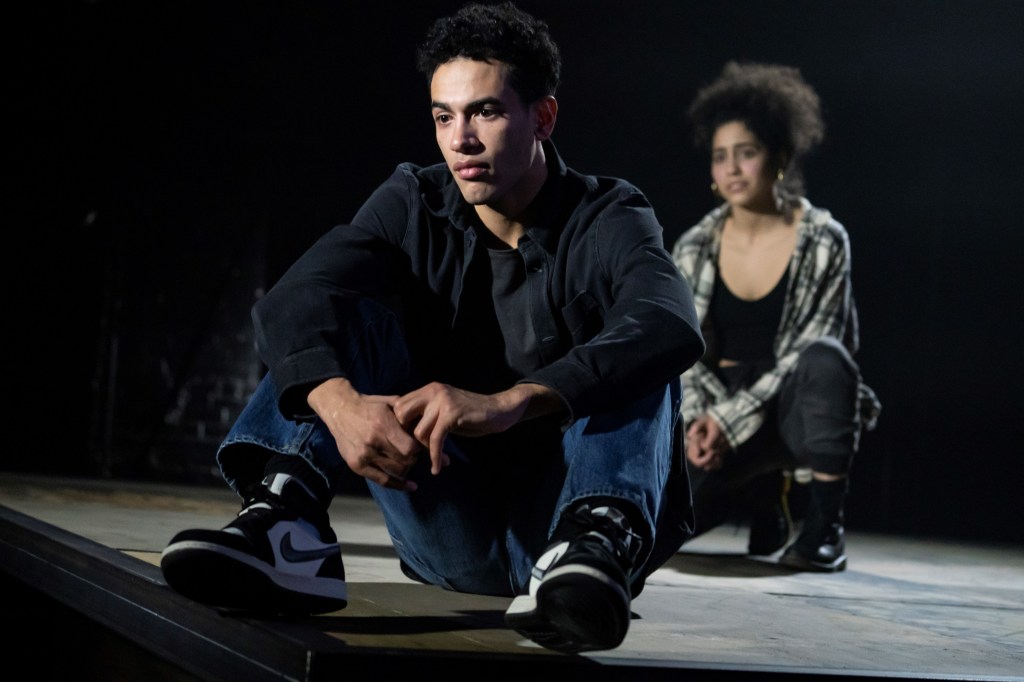
Majok’s script sags when the plans evolve for “G” to help “B.” Perhaps due to the continued flashes of light and whirl-y-gig staging, the sameness becomes tedious. However, there is the wonderful and welcome respite of their dancing and going to the prom with additional colorful lighting. The diversion from the stasis of the repetitive stagnant (the symbolism is apparent…no need to bludgeon the audience), might have come sooner.
And then comes the transformation of a three-year hiatus which Frecknall announces with sound effects and darkness both of which are symbolically ominous. Subsequently, Henry (the excellent Austin Smith) comes onto the threshold of “B’s” life to provide safety and emotional sustenance as “G” once had, until she returns, and the three clash. In this second sequence of events, all is light with no obfuscation. “B” and “G” no longer maneuver around each other. Their dynamic is straightforward. Now, it is “G” who must sink or swim in her emotional guilt while “B” makes a decision about citizenship and sacrificing love.
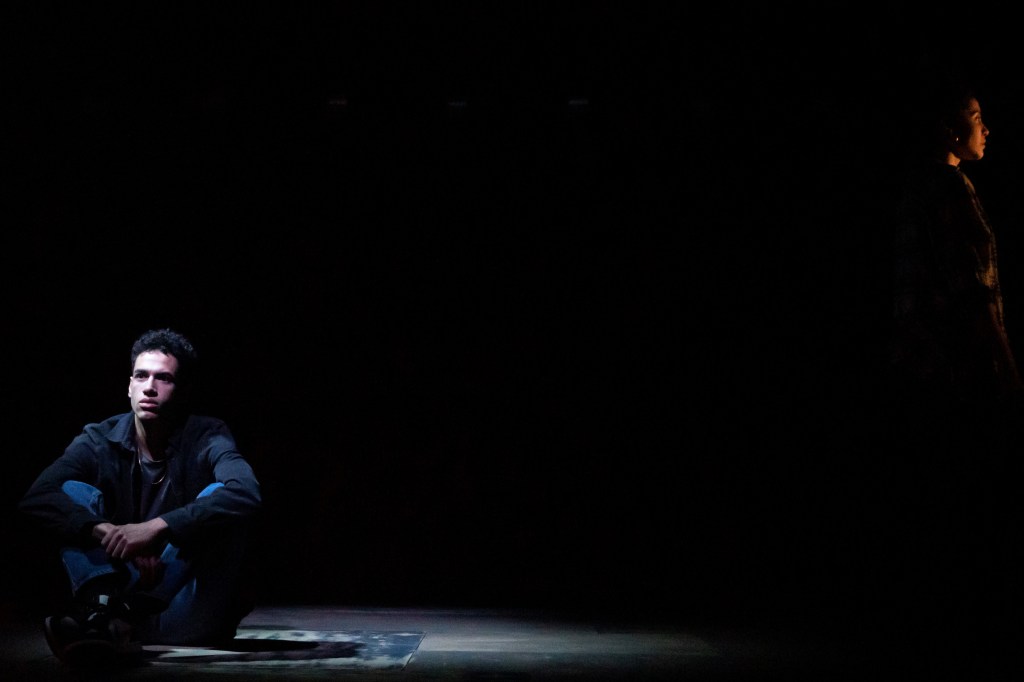
What happened to “G” and “B’s” compact, their relationship, their closeness? Majok presents the stark themes. Immigrants and illegal aliens are compelled by political forces to behave in ways counter to their altruistic good will and sense of decency. Of course, this doesn’t just pertain to those trying for citizenship. It doubly applies to citizens who have become mentally and emotionally inert and are inured to the sensitivities of others because they are weighted down by materialism and consumerism. In other words, they having forgotten “where they came from.” Ironically, the country then, no longer becomes a sanctuary, but a prison that has sucked their life force dry.
These themes are only a few of those that Majok covers in this play of antitheses: of connection and isolation, of compromise and extremism, of fear and hope, of dislocation and community, of alienation and unity.
Through various administrations, we’ve closed our borders following the need of politicians to use immigration and immigrants as playthings to boogeymen citizens and grow their political power base. Sanctuary City shines a unique light on the PTSD that arises for those who want a better life and are willing to risk their substance to dream big and/or help others who are lost in limbo between citizenship and deportation; those who wait for the light of deliverance. Majok’s writing is poetic and austere with the rhythms of immigrants’ and aliens’ voices and silences.
Kudos to the technical team that melded the elements lighting, sound, stage design, etc., to reflect the themes and sync them with the beautiful movement, and symbolism staged and directed by Frecknall. Her acute talents exceptional and show insight, precision and intuition.. If you can get down to Lucille Lortel Theatre to see Sanctuary City before it closes this weekend. you will be happy you did. For tickets and times go to their website. https://www.nytw.org/show/sanctuary-city/
 CAROLE DI TOSTI