Category Archives: New York Theatre Workshop
Jean-Michel Basquiat Celebrated, ‘In Honor of Jean-Michel Basquiat’
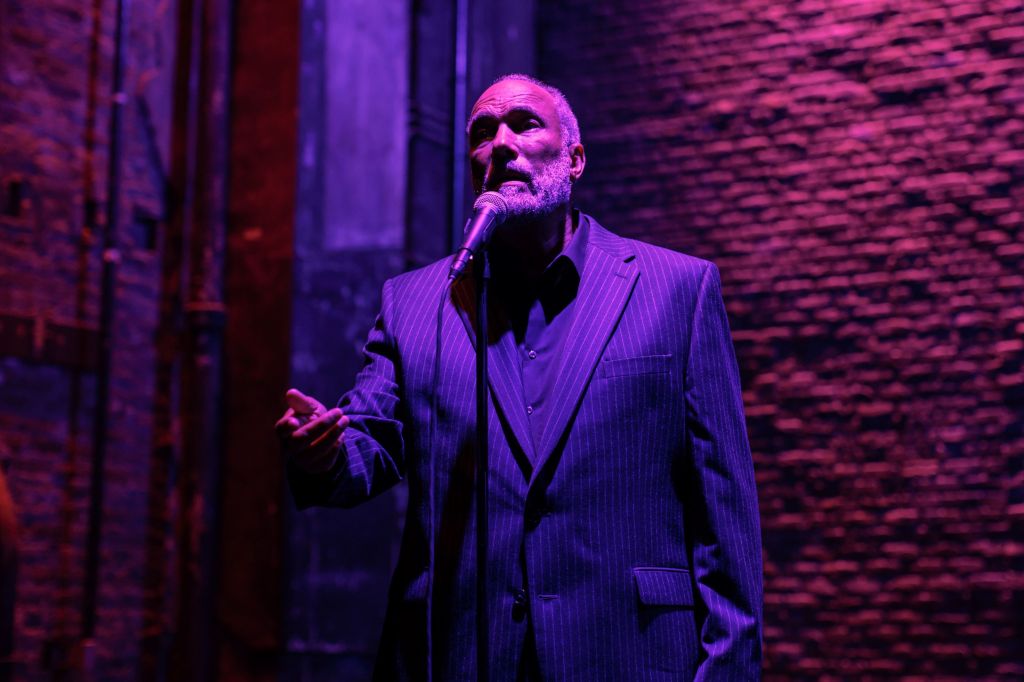
Who better to memorialize the artistic genius Jean-Michel Basquiat than a friend and a fellow creative Black performer who hung around with him in Venice, California? In his mesmerizing one man show at New York Theatre Workshop, Roger Guenveur-Smith cobbles together a thematically, ordered, series of stylized vignettes and images of his encounters, impressions and insights against the quixotic philosophical street wisdom of Basquiat. Importantly, Guenveur-Smith quietly illuminates Basquiat as a maverick and icon in the pantheon of Black artists/musicians running up against the annihilating, pathological, racist dynamic of white American culture. This is a necessary reckoning if we consider the current sociopolitical climate and thus, a must-see show.
The Obie Award-winning actor, playwright and director’s solo presentation follows his acclaimed sold-out run during Under the Radar Festival earlier in the year. As a testament to Guenveur-Smith’s profound, personal work about Basquiat and his legacy, the production has once more connected with audiences whose enthusiasm prompted its extension until October 10, 2026.
Accompanied with superb live sound design by Marc Anthony Thompson, and Ario Sanders’ atmospheric, symbolic lighting design, the 1 hour show zips by leaving one wishing for more. Standing barefoot in a natty suit, on a bare stage against the backstage wall a doorway reveals an intriguingly beautiful, mysterious space behind the performer.
At the mic Guenveur-Smith infuses his poetic delivery with an accompanying choreography of subtle movements. At times his subject possesses him and Basquiat’s presence feels palpable. The audience becomes fully immersed in the colors of sound and words melding in nuanced rhymes and rhythms. The immersion is a subtle plunge.
Gradually, the solo performer draws in the audience after he expresses the wisdom and encouragement his father gave him when he launched his own career as an actor. The father humorously reminds his son of the “challenges” (understatement) of Black identity. “You think you’re so goddamn clever/ You know if Van Gogh was Negro/He would have cut off more than his ear.” Also, his dad infers the commercial world’s exploitation. “Hell that boy didn’t live long enough/To see his shit really sell.” In an auction vignette Guenveur-Smith ironically conducts the auction for Basquiat’s “Untitled” which sold for $110.5 million dollars.
And, the father chides son Roger, “You go ahead, be an actor/But you’ll never act yourself out of this coffin called the US of A.” Finally, with love he uplifts him. “Be the best actor you can possibly be/And before it’s all over son, why don’t you act something out for your friend Jean-Michel and for me.”
Unlike Van Gogh, Basquiat did see his success translate into wads of money which he preferred as cash. Unfortunately, it sped him more quickly to his death which Guenveur-Smith narrowly pinpoints then moves on to more lyricism. The money afforded Basquiat greater access to heroin and an overdose at an age Basquiat uncannily predicted on canvas when he was twenty-one-years old.
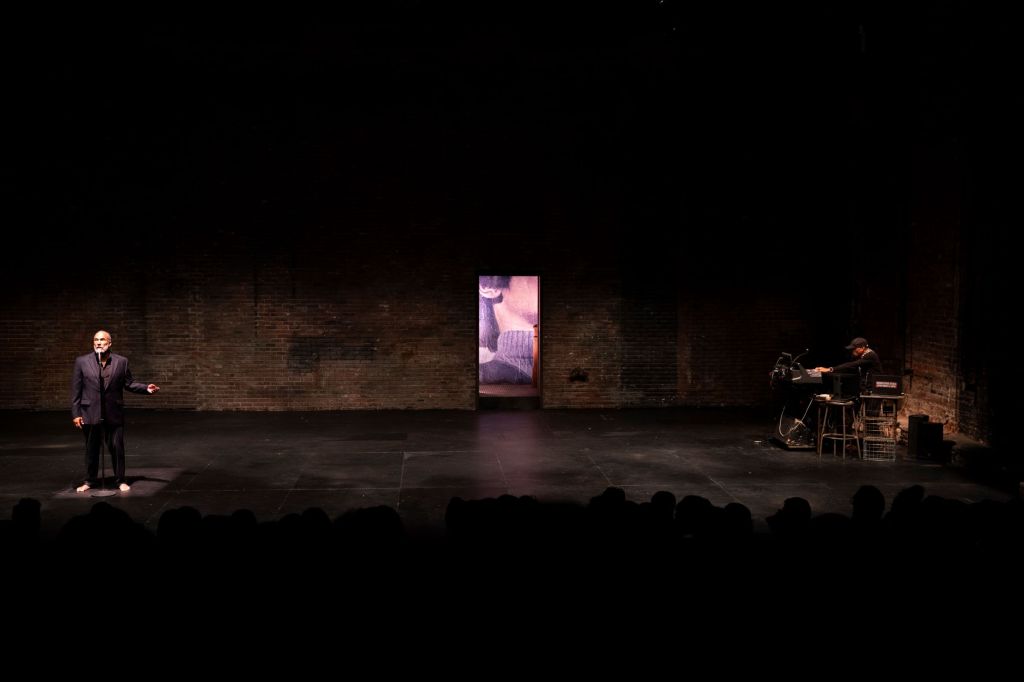
Guenveur Smith’s lyrical account is a vibrant vision of the man whose candle lit up the skies then was extinguished by his own hands in 1988 when Basquiat was twenty-seven. Initially, the two met at an L.A. dance hall in 1982. Guenveur Smith, rapping under the name “Hollywatts” (Hollywood and Watts), hooked up with Basquiat at his career’s first blossoming.
Rather than examine the artist’s place in Neo-expressionism or define him as an appendage of Andy Warhol, Guenveur-Smith uniquely personalizes his friend with compelling metaphoric images that stick in one’s mind. For example when he and Baquiat met, he thought he was just “a cool kid with an electronic hairdo.” He didn’t know Basquiat was “incognegro numero uno writing acrylic poems and philosophy on concrete walls and canvas and refrigerator doors.” Together they see Martin Scorsese’s King of Comedy walking in late to the balcony moving in front of the projectionist. “His dreads are projected in silhouette onto the screen, obscuring Robert DeNiro and Jerry Lewis/The crowd is very confused then very amused/The King of Comedy crowned.”
Additionally, Guenveur-Smith punches up events and people in ironic synchronicity with Basquiat’s life. In 1960, the only survivor of a plane crash, a young “white boy burned black,” having fallen from the plane remarks that the city “looked like a magic fairyland.” Then he dies in the same Brooklyn hospital where three days after Basquiat is born. Hit by a car, Basquiat, a child, loses his spleen the same year Andy Warhol, shot by radical feminist Valarie Solanas, loses his. Basquiat’s father comes to Brooklyn in 1955, the same year Emmett Till was savagely murdered, the same year the Brooklyn Dodgers won the World Series on the backs of Jackie Robinson, Don Newcombe and Roy Campanella.
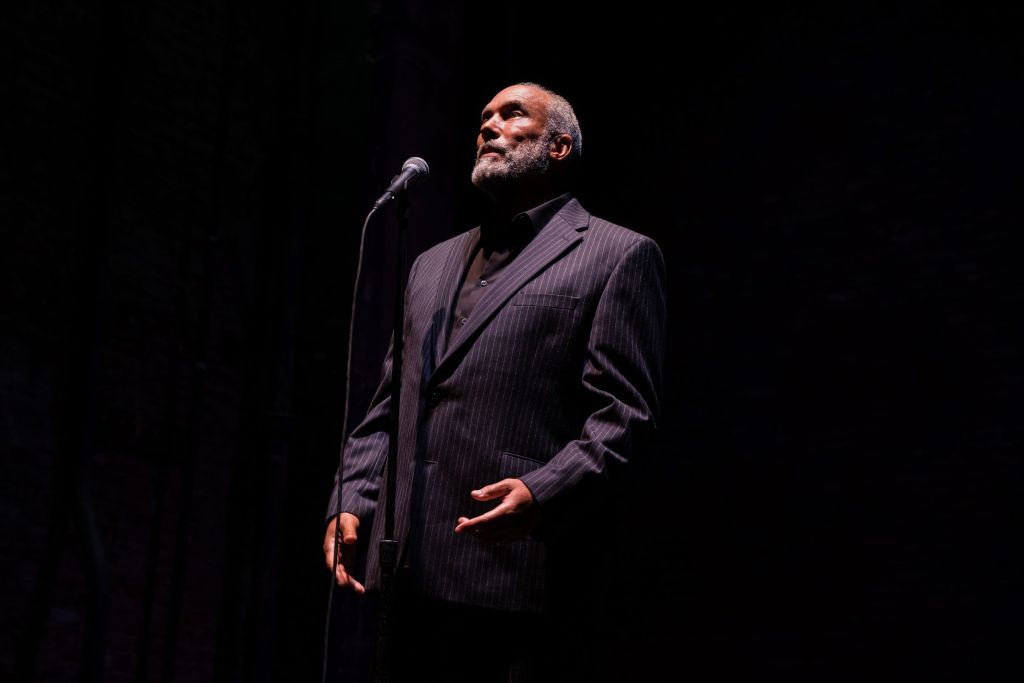
The synced parallels continue throughout as touchstones centering Basquiat in time and out of time in this memorial. A history of Black musicians, singers, some of whom they listened to as Hollywatts rapped and Basquiat threw down on whatever medium he liked are referenced. These honorable mentions include everyone from Charlie Parker, Charles Mingus, Lady Day, Louis Armstrong, Nat King Cole, John Coltrane and many more. Guenveur-Smith makes sure to indicate that the best of them took a stint in mental institutions or rehab centers. It’s part of the landscape of white American culture’s deadliness Guenveu-Smith’s father referred to earlier.
As Guenveur-Smith threads together stories of Black artists and activists, he intersects them with Basquiat. Basquiat’s father said he “Never needed a mic to politicize or a machete, but still he was a soldier.” This is especially so in Basquiat’s work Defacement (The Death of Michael Stewart). Guenveur-Smith starkly describes the murder of Michael Stewart by MTA police with searing detail. It’s a lynching that brought no accountability to the officers. Recognizing that Stewart, the graffiti artist and model, could “have been him,” Basquiat gives homage to Michael Stewart in his acrylic marker on wood painting. After Guenveur-Smith’s jarring description, he revisits memories that inspired his own character “Smiley” in Spike Lee’s film Do the Right Thing.
Guenveur-Smith concludes his en memoriam as it should in a celebration of Basquiat’s legacy forever tied with a nation that looks to his astonishing work sometimes with apprehension but mostly with pure joy.
In Honor of Jean-Michel Basquiat runs one hour with no intermission at New York Theatre Workshop. https://www.nytw.org/show/basquiat/?gad_source=1&gad_campaignid=24057584595
‘My Joy is Heavy’ the Bengsons Sing Their Joy Through Sorrow
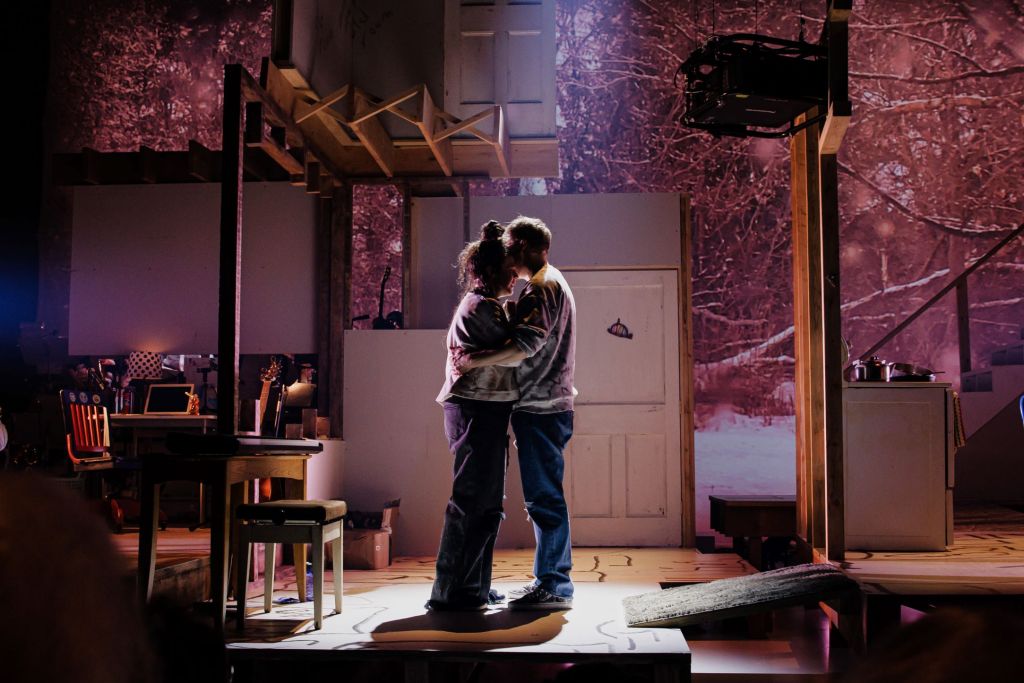
Like “A Tear and a Smile,” Kahlil Gibran’s well-known poem, the Bengson’s musical memoir My Joy is Heavy displays the couple’s affirmation of life in contrasts. Great joy can arise while experiencing great loss.The Obie-winning husband and wife team responsible for notable offerings like NYTW’s Hundred Days, presents an intimate, visceral series of experiences expressed organically in hauntingly beautiful music. Grounded in the audience’s remembrance of COVID lock-down, its isolation and traumas, we learn of the fiery trials the Bengsons went through separately and together during that time.
This powerful, soulful, cycle of songs and narration superbly directed by Tony Award winner Rachel Chavkin (Hadestown), transports the audience every moment the couple takes the stage. Abigail and Shaun invite audience members into their world, a gritty chronicle of emotions, spooling out from an extraordinary mix of folk-rock, punk and gospel that rearranges one’s psyche from start to finish. Because of audience enthusiasm, My Joy is Heavy has been extended through April 12, 2026 at New York Theatre Workshop.
What makes this production intimate and heartfelt includes the couple’s attention to the audience. To make sure they hear and see every lyric, turns of phrase, imagery and poetry, the production employs closed captions that appear above the stage. I found these to be less distracting than captions in other productions that oftentimes appear stage left or stage right. Additionally, the musical duo cuts to the chase identifying their wish to share a compelling revelation at the center of their musical memoir. “We’re here to tell you about this one moment, this one moment that happened right there on that bed.”
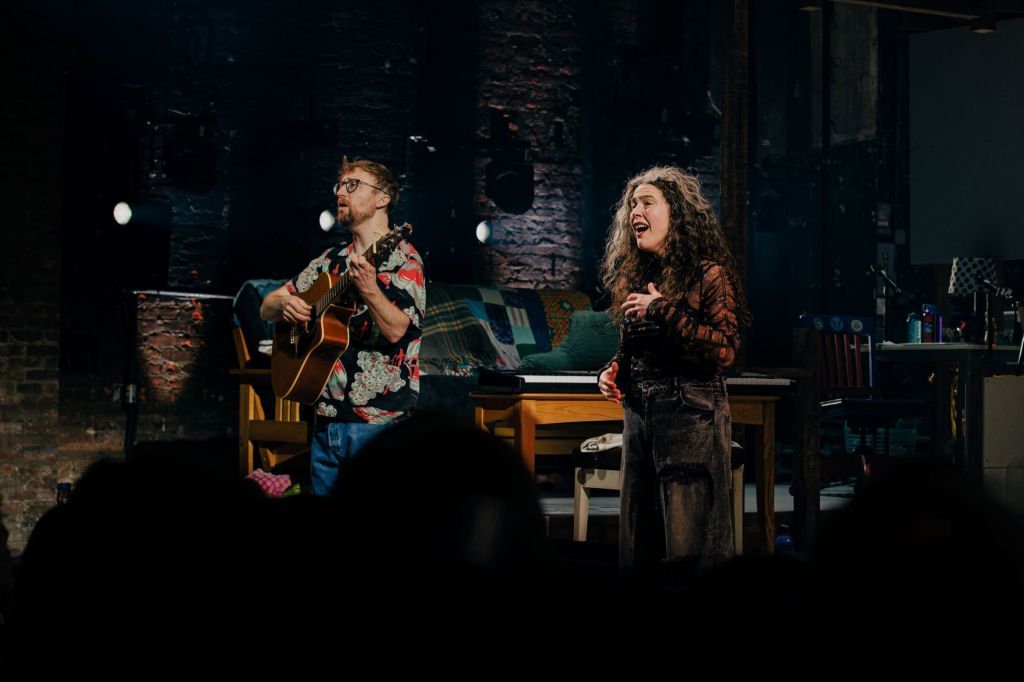
When Abigail says this, she motions to the bed in Lee Jellinek’s set design of Abigail’s mom’s house in Vermont. The couple and their toddler son stayed there during the alienating months of COVID, the time period of the production. It was then they had an epiphany, like a shamanic vision, which drives them artistically. Hoping that the expressiveness and power of their story helps restore harmony and wholeness, they try to connect with the audience so they might experience a cathartic, emotional release.
When Abigail and Shaun begin to discuss their COVID isolation, they call upon the audience to remember with them and reflect upon those lost to the pandemic. Abigail memorializes these individuals with a symbolic gesture involving two audience members. Then the duo plunges into their musical narrative with choreography by Steph Paul and music supervision by Obie Award winner Or Matias (Grey House). Shaun’s great versatility playing piano, guitar, accordion, etc., and the expert six member band directed by Matt Deitchman, accompany Abigail and Shaun throughout.
With them the couple rides waves of humor, uplift and sadness as they course through songs, not slowing down until they sing the last refrain of “My Joy is Heavy” to the audience’s rhythmic hand clapping.
As a part of the narrative we see snippets of Gramma Kathy, Abigail’s mother, and their toddler Louie in home video footage taken with their phones. Chauvkin uses these and other videos projected on the back wall of the set to convey and enhance mood and tone, and transition to other scenes with different emotional content. Also, Chavkin integrates these projections into the narrative to relay quieter moments of homely family life in “the calm before the storm.”
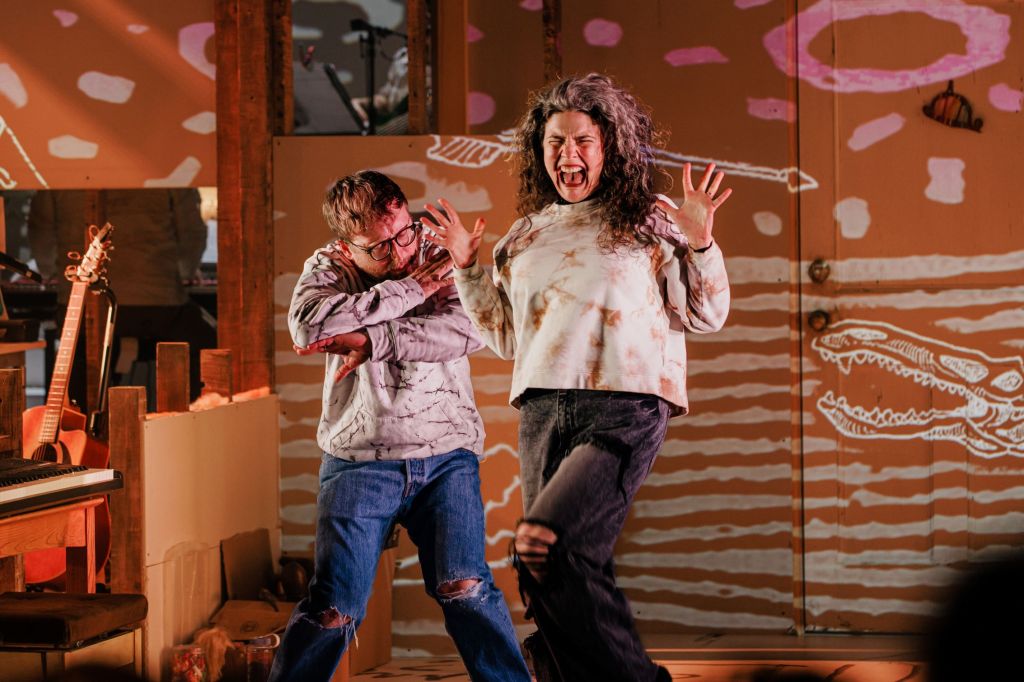
As a complement to the home videos, David Bengali’s video design, which accompanies the metaphoric song “Underground,” and serves as background for other musical pieces, effectively captures the Bengson’s interior emotions. For “Underground” the wild and evocative projections aptly serve the lyrics. For example, to reflect how Abigail and Shaun went into feelings of isolation and fear they sing, “I’ve been underground in a deep, dark cave, doing my best to stay live.” Alan C. Edwards’ lighting makes the projections pop. For her part Abigail experiences excruciating headaches that she labels PTSD. Clearly, the pandemic causes intense stress when, despite everyone’s assumptions, it goes on for months because of skyrocketing numbers of the dead and dying as COVID spreads.
With the drama of the pandemic in the background, Abigail and Shaun try for another baby. However, the risk reward ratio of a prior miscarriage plummets them into cascading fear. They elicit help from doctors and when the medication and fertility testing don’t seem to help, they watch holistic programs and go through Zoom sessions. Many of the profound songs as well as the humor deal with the Bengsons struggle with their having another baby. Standouts include “River” and “Don’t Hope.”
The first song is a striking, poignant remembrance of their baby who never makes it into life, a song of love and mourning. This devastating experience five years prior informs their roller-coaster emotions in the present when Abigail discovers the blue line of her new pregnancy. Though “over the moon,” Shaun and Abigail can’t allow themselves the luxury of celebrating, because “what if?”
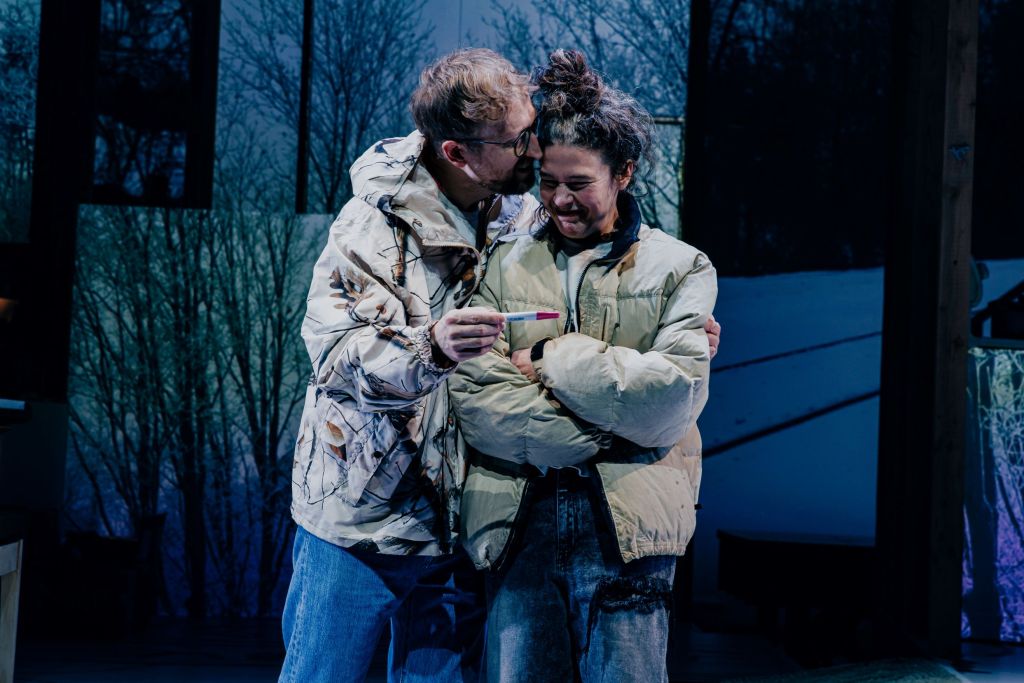
“Don’t Hope” hits home with its simple humanity and perfect melody aligning with the repeated refrain, “DON’T DO IT, DON’T
HOPE, DON’T DO IT, DON’T GET HAPPY. Who cannot empathize with the sentiment that feeling too exuberant will jinx what one wants desperately? After this amazing song Shaun describes his riotous experience with little Louie on the Santa Sleigh and the humor breaks through the fear and makes way for the song, “Veil.” Both agree, they’re doing everything they can do. And this leads to their understanding that they can’t live avoiding their natural feelings. Together they decide, in the next song, “I’d Like to be Happy.” They choose to let go of repression.
By degrees we follow their emotional journey from the cave and pain to an expiation of the sorrow of the miscarriage and recognition that happiness shouldn’t be suppressed. And in between a few other remembrances and songs, the couple arrives at the epiphany Abigail refers to at the top of the musical. Thus, engaged audience members travel with them through flashbacks to experience palpably how joy and sorrow can occupy the same place in one’s heart, at the same time. The Bengsons bring the audience to this breathtaking and ebullient conclusion in the rousing gospel “My Joy Is Heavy,” as all stand in appreciation.
My Joy Is Heavy runs 1 hour 10 minutes through April 12, 2026 at New York Theatre Workshop. https://www.nytw.org/show/my-joy-is-heavy/
.
u
.
‘Saturday Church’: The Vibrant, Hot Musical Extends Until October 24th
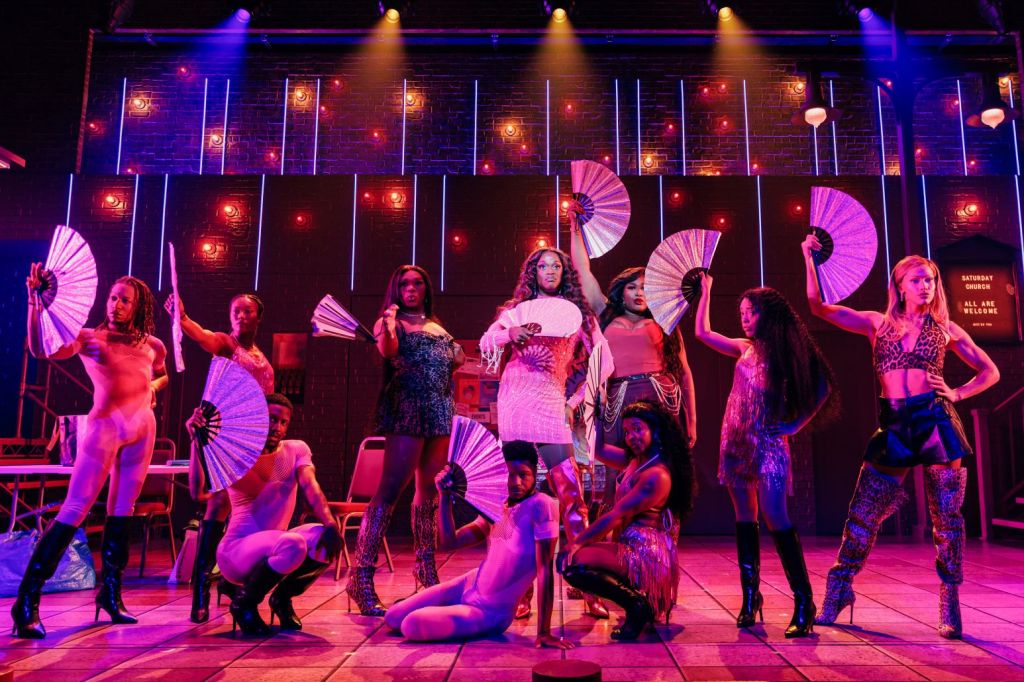
With music and songs by Grammy-nominated pop star Sia and additional music by Grammy-winning DJ and producer, Honey Dijon, Saturday Church soars in its ambitions to be Broadway bound. The excitement and joy are bountiful. The music and songs, a combination of house, pop, gospel spun into electrifying arrangements by Jason Michael Webb and Luke Solomon, also responsible for music supervision, orchestrations and arrangements, become the glory of this musical. Finally, the emotional poignance and heartfelt questions about acceptance, identity and self-love run to every human being, regardless of their orientation and select gender identity (65-68 descriptors that one might choose from).
Currently running at New York Theatre Workshop Saturday Church extends once more until October 24th. If you like rocking with Sia’s music, like Darrell Grand and Moultrie’s choreography and Qween Jean’s vibrant, glittering costumes, you’ll have a blast. The spectacle is ballroom fabulous. As J. Harrison Ghee’s Black Jesus master of ceremonies says at the conclusion, “It’s a Queen thing.”
However, some of the narrative revisits old ground and is tired. Additionally, the music doesn’t spring organically from the characters’ emotions. Sometimes it feels imposed upon their stories. Perhaps a few songs might have been trimmed. The musical, as enjoyable as it is, runs long.
Because of the acute direction by Whitney White (Jaja’s African Hair Braiding), the actors’ performances are captivating and on target. Easily, one becomes caught up in the pageantry, choreography and humor which help to mitigate the predictable story-line and irregularly integrated songs in the narrative.
Conceived for the stage and based on the Spring Pictures movie written and directed by Damon Cardasis, with book and additional lyrics by Damon Cardasis and James Ijames, Saturday Church focuses on Ulysses’ journey toward self-love. Ulysses (the golden Bryson Battle), lost his father recently. This forces his mother to work overtime. Unfortunately, her work schedule as a nurse doesn’t allow Amara (Kristolyn Lloyd) to see her son regularly.
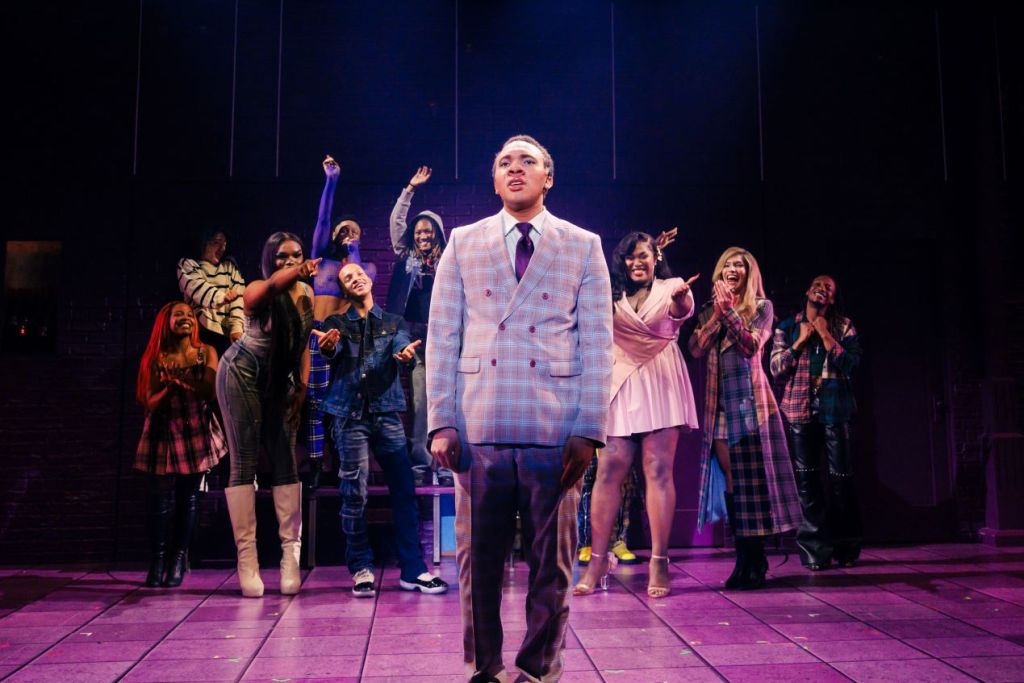
Though the prickly Aunt Rose (the exceptional Joaquina Kalukango), stands in the gap as a parental figure, the grieving teenager can’t confide in her. Even though he lives in New York City, one of the most nonjudgmental cities on the planet, with its myriad types of people from different races, creeds and gender identities, Ulysses’ feels isolated and unconnected.
His problem arises from Aunt Rose and Pastor Lewis (J. Harrison Ghee). Ghee also does double duty as the master of ceremonies, the fantastic Black Jesus. Though Ulysses loves expressing himself in song with his exceptional vocal instrument, Aunt Rose and Pastor Lewis prevent him from joining the choir until he “calms down.” In effect, they negate his person hood.
Negotiating their criticisms, Ulysses tries to develop his faith at St. Matthew’s Church. However, Pastor Lewis and Aunt Rose steal his peace. As pillars of the church both dislike his flamboyance. They find his effeminacy and what it suggests offensive. At this juncture with no guidance, Ulysses doesn’t understand, nor can he admit that he is gay. Besides, why would he? For the pastor, his aunt and mother, the tenets of their religion prohibit L.G.B.T.Q Christianity, leaving him out in the cold.
During a subway ride home, Ulysses meets Raymond (the excellent Jackson Kanawha Perry). Raymond invites Ulysses to Saturday Church and discusses how the sanctuary runs an L.G.B.T.Q. program. With trepidation Ulysses says, “I’m not like that.” Raymond’s humorous reply brings audience laughter, “Oh, you still figuring things out.” Encouraging Ulysses, Raymond suggests that whatever his persuasion is, Saturday Church is a place where different gender identities find acceptance.
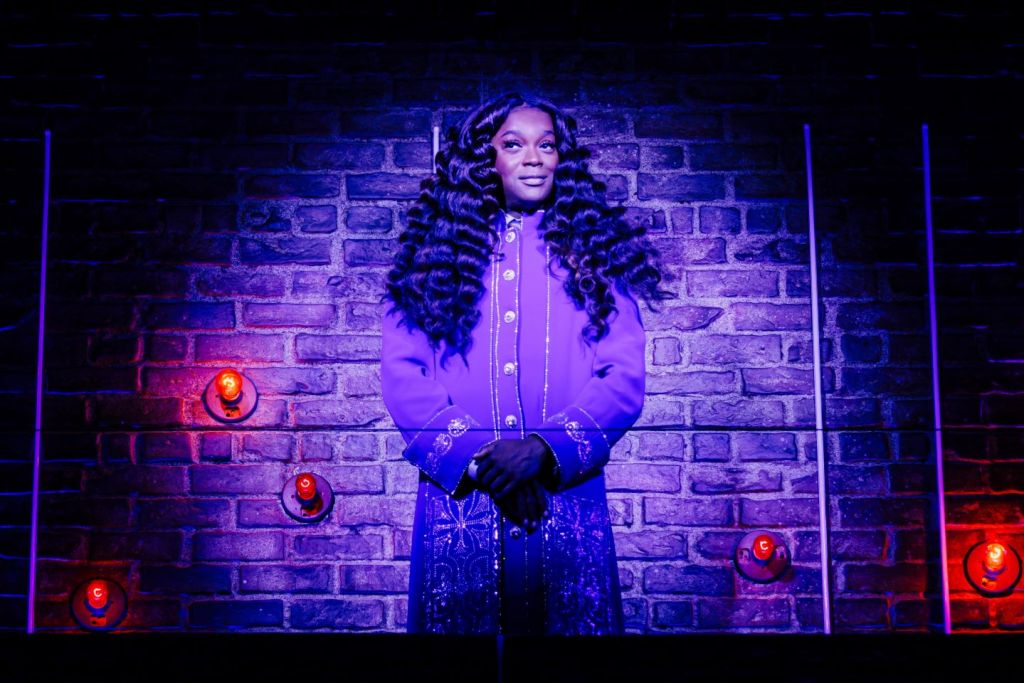
Inspired by the real-life St. Luke in the Fields Church in Manhattan’s West Village, Saturday Church provides a safe environment where Christianity flourishes for all. When Ulysses visits to scout out Raymond, with whom he feels an attachment, the motherly program leader Ebony (B Noel Thomas), and her riotous and talented assistants Dijon (Caleb Quezon) and Heaven (Anania), adopt Ulysses into their family. In a side plot Ebony’s loss of a partner, overwork with running activities for the church with little help, and life stresses bring her to a crisis point which dissolves conveniently by the conclusion.
The book writers attempt to draw parallels between Ulysses’ family and Ebony which remain undeveloped. As a wonderful character unto herself, the subplot might not be necessary.
As Ulysses enjoys his new found persona and develops his relationship with Raymond, his conflicts increase with his mother and aunt. From Raymond he learns the trauma of turning tricks to survive after family rejection. Also, Ulysses personally experiences physical and sexual assault. Finally, he understands that for some, suicide provides a viable choice to end the misery and torment of a queer lifestyle without the safety net of Saturday Church.
But all’s well that ends well. J. Harrison Ghee’s uplifting and humorous Black Jesus redirects Ulysses and effects a miraculous bringing together of the alienated to a more inclusive family of Christ. And as in a cotillion or debutante ball, Ulysses makes his debut. He appears in Qween Jean’s extraordinary white gown for a shining ballroom scene, partnering with Raymond dressed in a white tux. As the two churches come together, and each of the principal’s struts their stuff in beautiful array, Ghee’s Jesus shows love’s answer.
In these treacherous times the message and themes of Saturday Church affirm more than ever the necessity of unity over division, and flexibility in understanding the other person’s viewpoint. With its humor, great good will, musical freedom and prodigious creative talent, Saturday Church presents the message of Christ’s love and truth against a pulsating backdrop of frolic with a point.
Saturday Church runs with one fifteen minute intermission at New York Theatre Workshop until October 24th. https://www.nytw.org/show/saturday-church/?gad_source=1&gad_campaignid=22911892225

