Blog Archives
‘A Bright New Boise’ by Samuel D. Hunter, Sardonic, Devastating and Profound, a Review

In A Bright New Boise, Samuel D. Hunter’s sardonic, dark play about events that take take place in a Hobby Lobby break room, the award-winning playwright (A Bright New Boise, The Whale) acquaints us with characters that may be more alien to our cultural beliefs and economic well being than individuals we might converse with in another country. Acutely directed by Oliver Butler and currently running in its Off Broadway Premiere at the Signature Theatre until March 12th, Hunter and Butler reveal a sometimes funny but mostly tragic, portrait, and a cross-section of another America reflected in the 90 minute play’s characterizations, plot and themes.
Hunter opens the play with protagonist Will (the superb Peter Mark Kendall) who, facing the audience, stands at the side of the road, eyes closed, concentrating. Then, he says one word as if to call into existence, time and place, “something.” Four times he says, “Now.” By the play’s conclusion, we understand his cryptic pronouncement which produces only a vast emptiness and “never works.”

In the second scene we meet the feisty, hyper-organized, store manager Pauline, portrayed by the excellent and humorously volatile Eva Kaminsky. Pauline interviews Will for a sales position in the break room at Hobby Lobby, Boise which in 2010 (the setting) is owned by an Evangelical CEO who runs the company as a Christian organization. During the interview Pauline makes Hobby Lobby’s conservatism clear when she reminds Will, “no unions,” explaining that a Hobby Lobby in Kansas was shut down when employees tried to unionize. The economy is struggling, there is little opportunity for those without a college education and the big box stores like Hobby Lobby are the expansive grand employers of the moment. Thus, the minimum wage that Will readily accepts (under $8.00 an hour) is the best for his circumstances and is an offer he dare not refuse for a reason more important than financial. This, we learn with the introduction of another character in the break room, taciturn teenager Alex (Ignacio Diaz-Silverio).
Will’s apparent emotional dislocation is made clear in Kendall’s superb performance. From his evasive and contradictory responses to Pauline’s questions, we understand he needs money and appears to be in unusual life circumstances because he is unable to give her a reference or emergency contact. However, he is hired so that Pauline can continue to run her “tight ship.” He begins to socially settle in by striking up a conversation about music with Alex who is taking his break and wishes not to be disturbed.

Hunter immediately establishes Will’s additional intentions and enjoins the main conceit of the play, “abandonment” and “loss,” setting in motion the conflicts with a shocking surprise. Spoiler Alert: Will announces he is Alex’s father and he proclaims that Alex was named after him so his real name is also Will. Fortunately, Pauline returns and interrupts Will’s announcement. Simultaneously, the TV whose satellite glitches vie between graphic surgeries and monotonous conversations between two Hobby Lobby male employees, snaps back to the Hobby Lobby’s conversational monotony about how to sell products. And a disturbed Alex walks out as Pauline tries to make a joke most Americans would understand, if they have been culturally plugged in for the last two decades.
However, Will doesn’t get the joke or the celebrity associated with it, and even if he did, Kendall’s Will appears overwhelmed about introducing himself to his son. He could care less about Pauline’s attempt to make him feel comfortable and appears lost in his thoughts about how he will negotiate and respond to the brutal questions from Alex that are sure to come.

Will’s deadened reaction is another clue that ties in to Hunter’s characterization of a hapless, unsound father, whose adopted son he has desperately sought out by getting a job at a Hobby Lobby, instead of using another means to contact him that is less traumatizing. From this first turning point of many, the revelations between and among characters spin out as surprises continue in a grotesque emotional and psychological maze that Alex, Leroy, Alex’s brother (Angus O’Brien) and employee Anna (Anna Baryshnikov) inhabit in the coldly remote, depersonalized break room of the Boise, Idaho Hobby Lobby. The sterile, severely lit space is perfectly ironic as a symbolic setting where they attempt to go to relieve the stress of their job, but end up frantically confronting a hellish swamp filled with regrets from their past. The result exacerbates the demeaned alienation of each of the characters who have lost their way and whose religion is unable to help and in fact makes things worse.
By degrees we learn the backstory of Alex and Will. Instead of clarifying toward comfort in a way to salve emotional hurts, by degrees Alex with stress and strain in his questions puts together the puzzle why Will has come to establish a relationship with him. Eventually, after Will reveals the truth of where he lives, the joy his church gave him and the events which transpired there, Alex appears to forgive him and defend him to his brother Leroy who fears Will has another motive for wanting to see Alex. In a secondary plot to enhance the characterizations, Anna and Will stumble upon each other in a darkened break room after hours, which seems even more sinister (the TV is still on vying between blood and guts and boring Hobby Lobby guys).

Anna sneaks her way in beyond closing hours by hiding in various sections of the huge store unnoticed. We learn she does this to avoid her father and brother’s criticism of her always reading and we get the sense that she is a misfit without a medium to feel comfortable in until she has a few conversations with Will whom she likes. Will is homeless; we eventually learn why and what happened to him. Furthermore, he is afraid to sleep in his car.

Their conversation gives occasion for Will to read parts of his Evangelical “End Times” blog to her, which he intends to make into a novel. Anna is taken up with the notion she has met a writer whose work she likes and she encourages him. It is then we understand the extent of his beliefs and his hope of being taken up in the Rapture (often used as a fund raising tactic by Evangelical Mega Churches) away from the wicked hell that has been perpetrated in the culture and on the earth by sinners who must be saved or perish in damnation. We also understand that he feels he has a purpose in converting people before it’s too late. He tells Alex he has to believe in God because the alternative is terrible. He would have to look at himself as an utter failure as a father, whose triumph is working in Hobby Lobby, while he lives in his car. Will tells Alex, “There are greater things in life. There have to be.”
Will gradually works his way into Alex’s world by asking to hear the song Alex wrote with his friend. He praises some of Alex’s poetry. However, Leroy is incensed about Will after he reads articles about Will’s former church and especially after Alex appears to favor Will over his adoptive family and tells Leroy he is changing his life plans. Leroy lashes out in revenge against Will after Pauline affirmed that it doesn’t matter what people’s personal beliefs are, as long as they are on time and do their jobs. However, Leroy involves Hobby Lobby in his revenge, making it impossible for Will to work there. Leroy and Will’s conflict has broken Pauline’s rule to maintain order as the status quo. After working for four years to make the store profitable and organized, she will not allow their conflict to drag it into the chaos that Will has brought with his presence. (Eva Kaminsky’s affirmation speech about Pauline’s taking the store to profitability earlier in the play is corporately magisterial and humorous.) Thus, Will, the last to be hired will be the first to be fired, aside from the fact that Alex and Leroy’s talents make them indispensable.
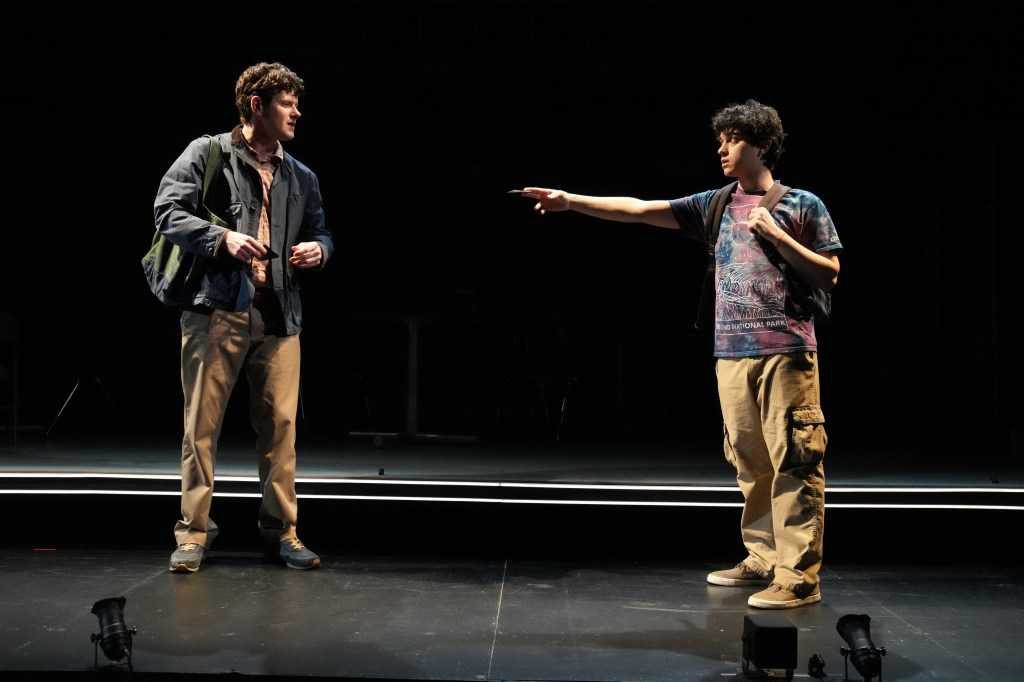
How events further evolve are both surprising and expected. However, when Leroy confronts Will about Alex, the result is uncertain and unpredictable. Hunter’s writing is freshly wrought and organic. The characters are well-crafted and their motley and unique differences meld well with each other for maximum tension, which abides throughout. By the conclusion Hunter ties Will’s injunction to God, “Now,” and explores another reason why Will seeks out Alex for comfort in a relationship that is not destined to grow closer or even continue unless Will makes a decision to change.
The play is wonderful on many levels. Hunter allows us to get under Will’s skin and into his soul which is both horrifying and sadly authentically truthful if one has been around certain Evangelical sects for more than a few days. Importantly, though we might not be able to put ourselves in Will’s shoes, Kendall portrays Will with empathy and pathos thanks to Butler’s incisive direction. Thus, we can understand his emotional guilt and torment and his desire to be a better person, the point of his religious journey, which becomes sidelined. The relationships Hunter establishes are woven with heightened drama. Alex feels a misfit and is emotionally traumatized by Will moving on a roller coaster of emotions through to the play’s conclusion. That Will doesn’t consider another way to get in touch with Alex speaks to his inner turmoil and disregard for Alex’s feelings and response. However, Will’s need to see Alex is urgent and has to do with the “Now” that is the final puzzle piece that unfolds in the flashback at the very end.

The terrific and terrifying set design by Wilson Chin and jarring fluorescent lighting and vibrant neon lighting in the road scenes by Jen Schriever are evocative and symbolic. That the appliances (i.e. microwave, VCR, etc.) barely function and little attention is given to popping up the color to make a unique, interesting or warm environment speaks volumes about Hobby Lobby, the employees and Pauline who is the epitome of the loyal, harried worker bee manager. The break room set, props and lighting reference the respect that the corporate officials have for their employees in a nullifying environment that is neither challenging, purposeful or life affirming. Hunter conveys the sense of Big Brother when Eva explains to Will as a blind, deaf and dumb team player that it’s a “pretty great company” that knows how to run a business, because everything is “hooked up to the corporate office.” Then, she cheerfully states, “We can’t even turn the air conditioning on without calling Oklahoma.”
The Hobby Lobby envisioned by the director and playwright and what fuels it, also reflects the nature of the commercial culture that creates consumer robots whose function least of all is a purposefully human one. That Will, Alex and Leroy refer to a job there as something loathsome by which to define oneself is further irony because the store is incredibly profitable, if money is its Christian measure of success as the prosperity gospel likes to portray. That Will has accepted religious rhetoric as his mantle and believes the world needs to be destroyed becomes particularly sardonic considering Hobby Lobby’s function and value system as a Christian organization with tenets about love, forgiveness and acceptance.

Another of the themes of the play is manifest in the characterization of these conservative Christians who are devout, yet are incapable of applying the tenets of the religion to their lives to achieve peace and fulfillment. Along with the themes of abandonment, isolation, and purposelessness that nullifies comes the important irony that Hunter relates at a time (2010) before the religious political movement grew into what it is today in 2023 in the culture wars, book bannings and civil rights curtailments. The hypocrisy, spiritual unhappiness and emptiness tied to a culture that is broken and breaks those who live in it to seek other ways to escape (through the belief of the Rapture) Hunter’s ironic play underscores. The play was humorously prescient then, more frightening now. A Bright New Boise is an ironic expose of the worst of Christian sects’ hold on the minds of those like Will and others.
Kudos to the creative team not mentioned before which include April M. Hickman (costume design) Christopher Darbassie (sound design) Stefania Bulbarella (projection and video design). This is one to see especially for the ensemble work, the fine performances and direction that teased out the actors’ efforts to be spot-on authentic. The creatives did a smashing job to fulfill the director’s vision of A Bright New Boise. For tickets go to their website.
https://www.signaturetheatre.org/shows-and-events/Productions/2022-2023/A-Bright-New-Boise.aspx
‘What the Constitution Means to Me,’ Heidi Schreck in a Vibrant and Revelatory Evening on Broadway

Heidi Schreck (writer, performer) ‘What the Constitution Means to Me,’ directed by Oliver Butler (Joan Marcus)
Heidi Schreck workshopped What the Constitution Means to Me over a number of years. Her efforts and overwhelming audience responses have taken the production from Off Broadway to Broadway’s The Helen Hayes Theater. Presented by The Clubbed Thumb, True Love Productions and New York Theatre Workshop, What the Constitution Means to Me, written/performed by Schreck, directed by Oliver Butler, offers a striking look at a document we should be familiar with since it governs and compels our every waking moment.
What audience members will discover during the presentation is that the devil is in the details, the interpretation of laws in the amendments and laws decided by the Supreme Court: the crucial ones related to Schreck’s personal life, she reviews.
As Schreck affirms, Supreme Court interpretations shift despite public opinion, depending upon the power brokers who control the narrative…a trend in the decades since Regan. We have seen the court move the values of this country from the decency and humanity of the 1960s liberalism to restrictive Federalist society conservatism led by Antonin Scalia and Clarence Thomas, and to what today may only be described as retrograde rightist extremism. Just a few days ago, the court made a decision in Bucklew v. Precythe that a torturous death was OK during capital punishment, setting a horrific precedent.
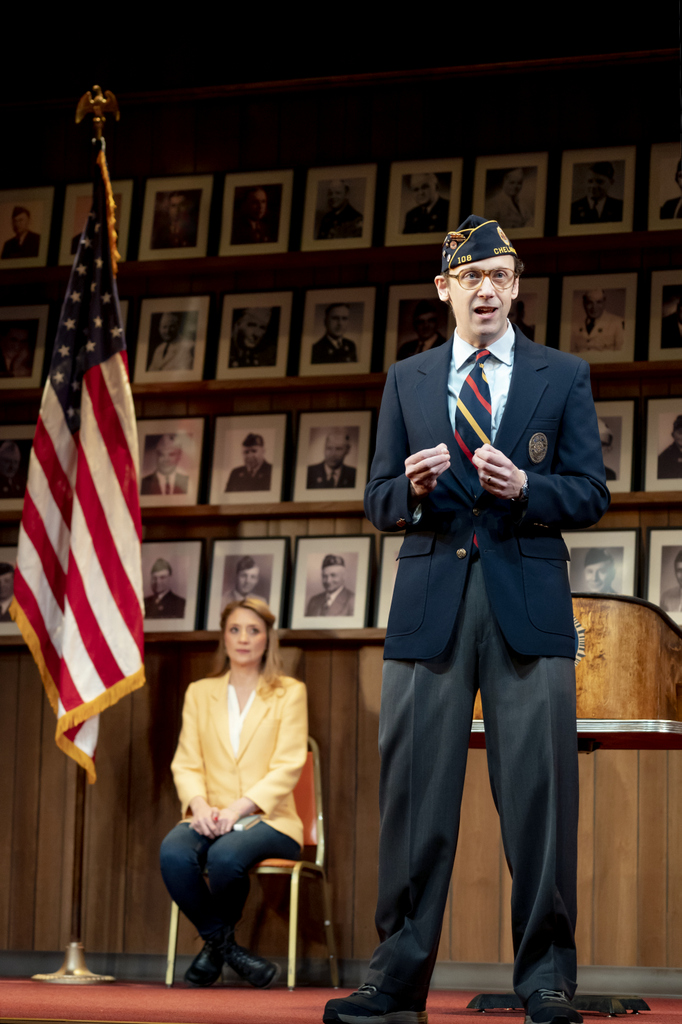
Mike Iveson, Heidi Schreck in ‘What the Constitution Means to Me,’ directed by Oliver Butler (Joan Marcus)
Schreck offers a riveting opportunity to revisit vital segments of the document which has established our rights as citizens at a time when these very rights are under threat by an administration which demonstrates little respect for it or the rule of law. Nor does the current administration or president abide by the oath of office which is to uphold the constitution whose amendments he has no qualms about challenging in the courts or in the press.
Clearly, because of the chaos and divisiveness in our culture (which Schreck references a number of times with great humor) seeing this production is a civic and moral imperative which should be made mandatory for high school students. Not only are Schreck and the other cast members Rosdely Ciprian (a 15-year-old) and Mike Iveson humorous and exuberant, the material is highly entertaining and extremely informative. It is a fabulous and exciting way to learn about our constitution. Indeed, the president, vice-president and cabinet should see the production.
Schreck introduces us to many facets of our diamond document by organizing the development of the production in an intriguing way. She refers to the time when her mother, a debate coach, encouraged her to compete in speech contests at American Legion Halls across the nation on the topic of “how the constitution related to her personal life.” Reconstructing her speeches which she gave as a teenager to collect money for college, Schreck turns back time to her fifteen-year-old self. She converts the audience to white, older, male legionnaires and fires away with the help of legionnaire Mike Iveson who times segments of her speech and times her discussions of a selected amendment.
All of these she relates to her own life and thus the lives of women impacted by the constitution for over two centuries. Indeed, women, Native Americans, free blacks, slaves weren’t even recognized as citizens from its creation by white property owners. Schreck follows the arc of development in the progress of women as non citizens under the constitution to the non-passage of the ERA (Equal Rights Amendment) today.

Rosdely Ciprian in ‘What the Constitution Means to Me,’ directed by Oliver Butler (Joan Marcus)
She touches upon the injustices toward all except the white, male, property owners, and the later revisions in the amendments, particularly the 14th amendment. She revisits the Dred Scott Decision and its reversal in the Emancipation Proclamation and the reasons why Lincoln had writers solidify the 13th amendment with the 14th amendment. She references the Chinese Exclusion Act and how it related to the 14th amendment’s clauses on immigration (shades of our present). And all of this she accomplishes with humor and good will.
During Schreck’s discussions she emphasizes seminal information related to women’s rights, the Equal Rights Amendment, what amendments engendered Roe v. Wade, the ironic and humorous stories related to the legalization of birth control and staggering statistics which reveal that men’s violence against women is alive and brutalizing the “fairer sex.” For example three women are murdered each day by a male partner in this country. One in three women are sexually assaulted during their lifetimes and one in four are raped during their lifetimes.
It doesn’t mentor sterling male behavior that the president has been accused of raping minors (see Jeffrey Epstein). One whistlebloewer who was going to go public about her experiences with Epstein and Trump withdrew because she was threatened with death. Nor does it help that Supreme Court Justice Kavanaugh faced tremendous controversy at his nomination hearing from women who accused him of sexual abuse and even rape. Oh well, “Boys will be boys.” (sardonic irony) He was given a pass.
Schreck also discusses the details of Castle Rock v. Gonzales…again in the service of paralleling what happened in her family, to her mother and grandmother. In Castle Rock v. Gonzales, the Supreme Court ruled that the 14th amendment no longer protects women against a violent male partner if the police feel they don’t want to intervene between a wife and husband who has sworn he will kill her and her children.

Heidi Schreck, ‘What the Constitution Means to Me,’ directed by Oliver Butler (Joan Marcus)
Later in the production Schreck discusses how her grandmother who survived an abusive, pederastic second husband via “Covert Resistance,” finally had the courage to run after him when he kidnapped Schreck’s mom and her other siblings to kill them. But it was Schreck’s mom who called the police on him. This was before Castle Rock v. Gonzales. Today, would the police respond as they did then?
One number Schreck states I had not heard before. More American women have been killed by a violent partner in the last century than men who have died in wars including 9/11. She makes it a point to affirm “killed by a male partner,” not just “killed.” That today, the law/government does not protect women against a partner’s violence, staggers one’s being.

(L to R): Rosdely Ciprian, Mike Iveson, Heidi Schreck, ‘What the Constitution Means to Me’ (Joan Marcus)
All of this information is presented in the service of personalizing the importance of the constitution to Schreck’s life and thus, to our lives. It is mind-blowing! Always fascinating she discusses how her maternal ancestors bowed down under the oppressions of the rule of law which didn’t cotton to women’s rights and as a result, women at the time sustained violence and abuse. For example her great great grandmother who was a bride purchased from “Matrimonial Times,” for $75.00, at 37-years-old died in a mental institution. On the death certificate, the cause was “melancholia.” Schreck infers she most probably ended up shattered by a relationship with her abusive logger husband.
In the last segment of the show Schreck and Rosdely Ciprian go head-to-head in a debate about whether we should abolish our “negative rights constitution” (it prevents the government from encroaching on our liberties) and perhaps establish a “positive rights constitution” (one that guarantees human rights to all for healthcare, equal economic opportunity, etc. like the constitutions of Germany and South Africa). How they debate (guided by Mike Iveson who times them) is just plain fun. Iveson encourages loud audience participation and cheering. And Rosdely Ciprian is an absolute spitfire.
What the Constitution Means to Me is a peppery, unique and delightful evening out. It is also slap-in-your-face get “woke” time in what Schreck reveals to us about who we are and where we’ve come from. The dense material is lightly driven by Schreck so that you remember the salient points. And all of this is presented with great good will in the hope that we become civic-minded. We must not allow the current crop of old, white, male, rich prototypes like those who created the document to perpetrate another act of violence against women. Men and women must prevent them from turning us out among the denizens of the deep without protection into a retrograde past. As women go, so go their men and families; men will suffer even more than women.
With the latest turn of the Supreme Court to rightest extremism, this is not just fantasy. But to consolidate power, it is in the best interests of the Federalist Society (that Antonin Scalia championed) and the extremist right to push the Supreme Court to such ultra right positions on cases and denude the majority of citizens of their human rights.
Sadly, to overturn Roe v. Wade and other laws that have empowered women will be active tyranny against lower class women. Schreck points out that wealthy women, (politicians’ mistresses, celebrities, etc.) always got abortions and always will regardless of legality. Money places them above the law. However, to cruelly nullify women’s souls and minds from making decisions about their own bodies is an evangelical act against God. Only He has power over all people’s minds and souls. That white men would usurp that power is tantamount to exercising a power which is the opposite of His love and mercy.
Kudos to all the creatives like Rachel Hauck (Scenic Design), Michael Krass (Costume Design) Jen Schriever (Lighting Design) Sinan Refik Zafar (Sound Design) who helped to make this a wonderful, must-see production that is an imperative for old and young alike. What the Constitution Means to Me runs without an intermission in an extension until 24 August. It is at The Helen Hayes Theater (44th Street, between 7th and 8th). For tickets go to the website by clicking HERE.
‘Thom Pain (Based on Nothing),’ Starring Michael C. Hall, an Existential Crisis With Humor

Michael C. Hall in ‘Thom Pain (Based on Nothing),’ by Will Eno, directed by Oliver Butler (Joan Marcus)
Playwright Will Eno’s one-man show Thom Pain (based on nothing) flies any way you like it. Surely, this depends upon that day’s audience’s intellect and responses. Indeed, one focus of the production entails the shared consciousness between Thom Pain and his listeners. Layered, multi-dimensional, this ethereal communication blossoms in the world created between the audience and Michael C. Hall as Thom. Reflecting upon this daunting effort comes a startling idea. This consciousness creation captivates beyond knowing every performance is different because it is live.
The portrayal of Thom Pain in the hands of Hall shepherded by Oliver Butler makes this production live theater on steroids. Hall’s very present performance magnifies each moment. The impact is powerful. Indeed, Hall’s Pain with subtle humor plows into the sardonic and tragic-comic furrows of our own humanity. He does this through contradictory impulses. On the one hand, as Thom he attempts to suppress his feelings and “manage them.” On the other hand he feels compelled to express/expurgate what makes him and all of us human: feelings of hurt. We understand the tense conflict between the compulsion to reveal and the desire to suppress. Daily, we accomplish this with friends, acquaintances, and ourselves, whether we admit it or not.
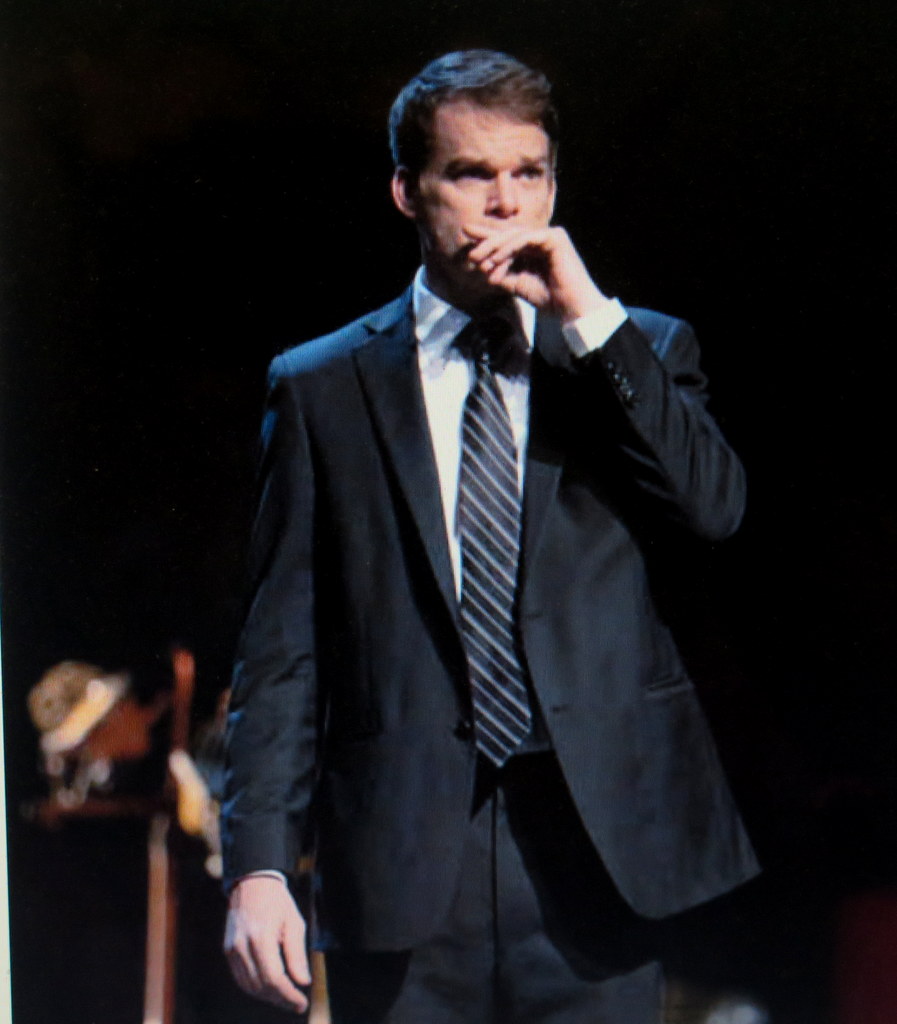
Michael C. Hall in ‘Thom Pain (Based on Nothing),’ by Will Eno, directed by Oliver Butler (Joan Marcus)
By extension these apparent contradictions in Thom create the tautness we feel when he pauses or pointedly addresses us by the royal “you.” Hence, we identify with his inner conflict to express and repress. Also, the tension helps to create immediacy. For Thom tells us whatever he wishes with urgent authenticity. And his suppressed pain guides his childhood revelations. Is he conscious of his suppressed pain? Certainly, it evidences in his demeanor, hesitations, attempts at humor, and need to talk to us.
Directed with a stark relevance and clever re-imagining, Oliver Butler spins out Eno’s irreverent, perplexing, Beckett-like piece. Thom’s ramblings move into places that settle on topics with uncertain happenstance, like the flight and landing of a wary sparrow. And then Eno, Hall, and Butler spiral the piece in a completely different direction. This is a superlative plot twist, as if a sparrow startled itself unexpectedly, then rapidly skedaddled.
Notably, Thom often redirects back to us. He puts us “on the line” for examination and a silent or vocal refrain as he confesses his observations about his life. At one point during this audience-participatory moment, an individual did respond orally when Hall’s Thom asked for a volunteer. The individual commented about a time he volunteered to go on stage during a Spalding Gray production. Hall responded as one would imagine Thom Pain as Hall would respond (not the other way around). The audience chortled and guffawed.

Michael C. Hall in ‘Thom Pain (Based on Nothing),’ by Will Eno, directed by Oliver Butler (Joan Marcus)
That exact moment with that particular audience and that gentleman remains the quintessential element of theater. It was classic, alive, and immediate. And it will never be duplicated, not even if all the same individuals returned to try to repeat it. Great theater should be about the unrecapturable, spontaneous life evoked by actors. That life spiritually refreshes. It’s priceless and breathtaking.
Likewise, Hall’s performance enlivens, refreshes, rejuvenates throughout. Ironically, the content, the playwright states, is based on “nothing.” So process rather than content activates the audience. But, sans the content conveyed by the consciousness between Hall and his audience, no “life” would be possible. Hall’s Thom and Eno’s words and Butler’s direction find their perfect union in receptive ready minds.
Such production artistry occurs when the key players open themselves to the universe. Whatever Hall’s Thom appears to seek from us at each moment carries us all to the next string of moments in the show. This immediacy, made possible through Hall’s many superlative talents, strikes humor and wariness into the audience’s hearts.
For his part when Hall ventures into the audience and/or asks for a volunteer, we turn on high alert. Hall’s relaxed graceful performance as Thom, never moves to result. He breathes with the rhythms of Eno’s Everyman clown stuck in a consciousness of others. Subsequently, his attempt at movement continually displaces him back to his key hurtful childhood incident. And it sends him to other highpoints in his life from which he attempts to make particular sense. Ironically, these efforts turn into a weird null. But he, Thom, Michael C. Hall so captivates, we stay with him curious about where he goes.
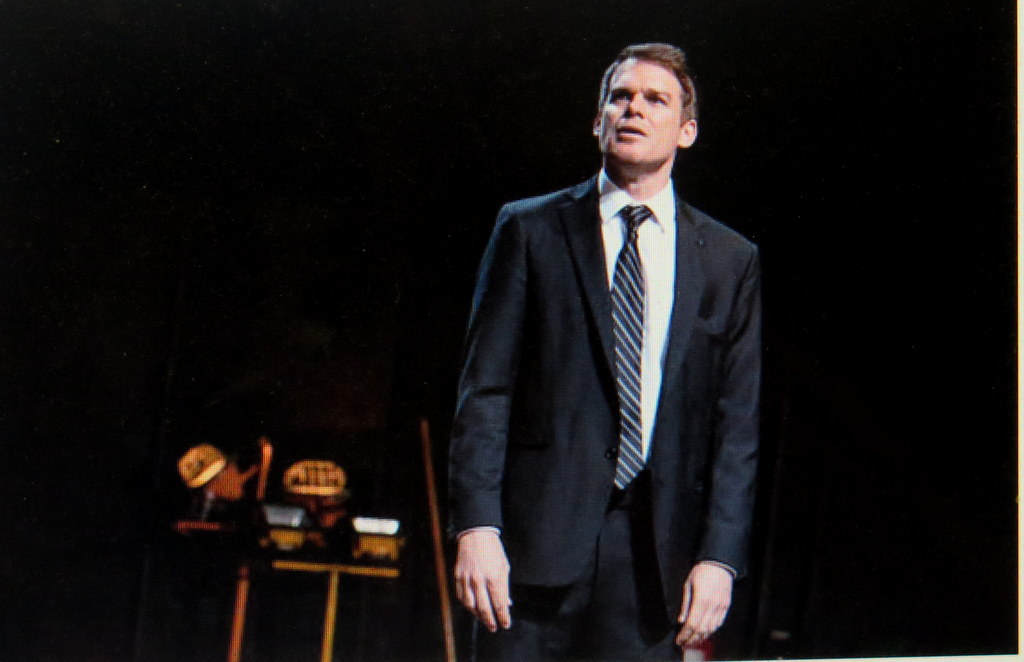
Michael C. Hall in ‘Thom Pain (Based on Nothing),’ by Will Eno, directed by Oliver Butler (Joan Marcus)
The ironic parenthetical in the title “based on nothing,” implies that Thom Pain’s musings before the audience lead no where and come from “not much,” in his perspective. Not so! The very profound themes of existence, consciousness, life purpose, memory caught up among the ordinary, off-handed remarks lead us to questioning joy. With the incredible acting instrument that Hall employs, we become enthralled from beginning when darkness engulfs the entire theater, to ending, when Hall asks the audience the ultimate question. And I of course in my mind as other audience members did made a choice. We answered or ruminated without answering or sat shocked or took on a myriad of audience mental responses to his question.
By the outburst of applause afterward, Eno, Hall and Butler hit their target. Strangely, I felt not only uplifted but cleansed of the last year and one half of angst-ridden and confounding “breaking news” stresses. What a pleasure to communicate mentally, silently with Hall as Thom Pain.
Any day, give me the existential crisis of attempting to make sense of the uncertainty of consciousness, of shifting memory, felt emotional loss, pain and the clown struggle of existence. At least my mind wasn’t being assaulted with the president’s narcissistic pronouncements in a time, place and space which daily confounds him and menaces a majority of the citizenry. After seeing Thom Pain, I am reminded to laugh. If our body politic is at a critical mass of mess, so? My answer to the last question of the play suffices with my laughter!
Hall’s performance will be up for nominations as will Butler’s direction, most probably. The actor’s sincerity and the moment to moment life he breathes through Eno’s words washes over one like a beautiful, clear river. Just wow!
Thom Pain (Based on Nothing) slides through your viewing appreciation without an intermission at The Pershing Square Signature Center in NYC. The production has been extended through 9 December.
Theater Review (NYC): ‘What The Constitution Means to Me’ Starring Heidi Schreck

(L to R): Rosdely Ciprain, Heidi Schreck-playwright, Thursday Williams, Mike Iveson, ‘What The Constitution Means to Me,’ NYTW, (Joan Marcus)
Depending upon how you view the months since the 2016 election, playwright, actress Heidi Schreck’s timely What the Constitution Means to Me casts a long shadow and provides trenchant perspectives. Of course one may view it simply as a pleasurable, informative romp through a document most remain clueless about. Or perhaps one may identify that her humorous, vibrant writing more profoundly remains a siren call to “get woke!”
Indeed, the production staged and set in an American Legion Hall, directed by Oliver Butler, stars award winning actress and writer Heidi Schreck. And it took years in the making. With assistance by fellow actor Mike Iveson and debater Rosdely Ciprain, the result sparkles. Schreck’s crisp, sharp, ironic writing encapsulates American themes and pivotal, historical moments that changed our laws. Abundantly, these perplex. For they concern the constitution’s long-range evolution toward greatness. But Schreck also includes how the people have stretched the document over the chasm of far reaching human miseries. At any time it may break, and our society plummet into the abyss. Her work and its cattle-prod intent remain a fascinating, thought-provoking must-see.
Indeed, humorous and enthusiastic throughout, Schreck’s “light-hearted” approach belies the seriousness of the subject in today’s light/dark atmospheres. For she presents profound and disquieting principles and facts about our lives that we cannot dismiss. And she accomplishes what the news media at times does not. She presents with succinct, factual details and logical arguments that clarify. Importantly, she makes one think beyond memes and spurious arguments, troll epithets, and misinterpretations!

Rosdely Ciprain, Heidi Schreck, Mike Iveson, Clubbed Thumb in partnership with True Love Productions, ‘What The Constitution Means to Me,’ (Joan Marcus)
This alone remains worth the price of the ticket. In fact her production should be opened to area schools. Sitting just 10 minutes into the first half of the performance solidifies why. With a facile, funny, and vitally spontaneously delivery, Schreck becomes our vibrant teacher and historian. Notably, she proves the past abides in the present through her debates about the amendments. These concern those (9th, 4th), not typically familiar. Nevertheless, she proves why we should know them as crucial to our rights and well being.
During the production, Schreck reveals her personal veneration of our country’s democratic principles particularly outlined in the laws written after the Civil War. The quotes from distinguished justices and presidents alike illuminate. Assuredly, most amendments guarantee equity for every citizen and the rights of due process for all. And she notes the pitfalls where such principles and laws wobbled and continue to shake. Subtly, she infers that we must continually apprise ourselves of our constitution’s ever flexible nature.

Heidi Schreck, actress, playwright, ‘What The Constitution Means to Me,’ directed by Oliver Butler, NYTW (Joan Marcus)
Evolution and devolution include the same letters save one. In other words we are a letter away from the collapse of the bedrock laws of equity. If pernicious, power-usurping partisans undo just applications for the great majority to benefit the proportionately few wealthy, contentment, and prosperity wanes for most citizens. Exemplified, though not mentioned in Schreck’s work would be Citizens United which favors corporate donors giving multi-millions to politicians’ PACS thereby owning them.
Additionally, her discussion relating the constitution’s impact on women in her own family acknowledges strides. But it also portends fissures and potential earthquakes setting “women’s rights” back decades. This discussion Schreck attends to in the second segment of her production
Winningly, in the first half Schreck recalls her teenage years and how she employed her reading, writing and research skills to earn needed college scholarship money. As a teenager she competed in debates for various prizes from the American Legion. Indeed, these competitions challenged her thinking and debate skills. Of course her presentation centered around “what the constitution meant to her” at that age. Thus, she uses this presentation format which she delivers to white military legionnaires (we, her audience, become them), at the American Legion Hall in the state of Washington. And returning to her teenage self, she argues the constitution’s relevance to her, evoking these debates. In the fast forward to now, we compare notes and assess our progress in the current times.
This clever vehicle allows Schreck and Mike Iveson (as a Legionnaire and himself), to set up her detailed and fascinating account of women in her family and how the constitution might have and then did impact them. As she discusses the lies promulgated to bring women to settle Washington state (one woman for every nine men), she enumerates the suicides and death rates of wives at the hands of their husbands. For example, her great, great-grandmother, a mail-order bride, ended up in an asylum and died of melancholia in her thirties. Schreck ruminates about the possible back story of what happened to her. Dismissively, we may think, “times have changed.”
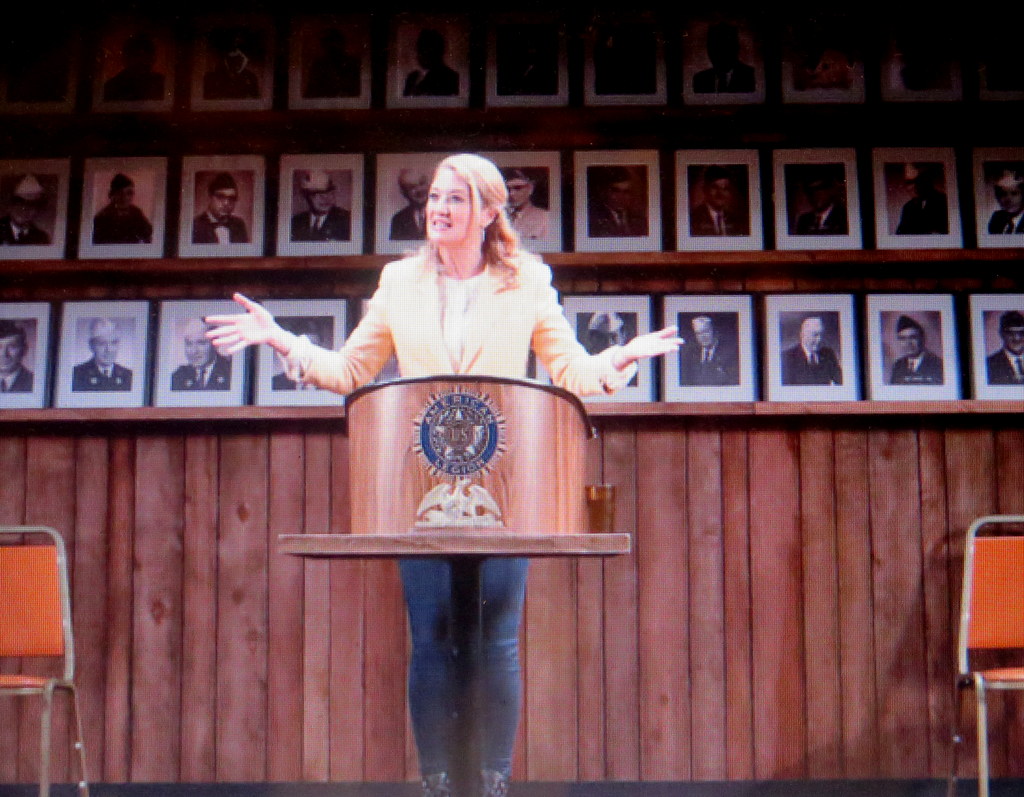
Heidi Schreck, actress, playwright, ‘What The Constitution Means to Me,’ directed by Oliver Butler, NYTW (Joan Marcus)
Then, she reveals today’s statistics. One in three women will be abused by male partners. One in four women are raped by men. And half of women killed die at the hands of their partners. However, women, no longer chattel (property), may seek justice. At one point in our history husbands could kill their wives with impunity. Yet, with lawsuits against Roger Ailes, Bill O’Reilly, Harvey Weinstein, and others, the #MeToo movement is a vital necessity. But will it negatively impact the constitution with the recent justice appointment?
In the third segment Schreck goes head-to-head with a student debater about whether we should keep or abolish the current constitution and create a new one. The evening I saw the production, Rosdely Ciprain revealed her feisty, funny debating chops and bested Schreck. However, Schreck’s spot-on argument about creating a positive rights constitution like those found in many European countries rang with sound truth.
What are negative vs. positive rights? Our negative rights constitution insures what the government cannot do to its citizens. On the other hand a positive rights constitution indicates what the government must provide: safety, security, healthcare, a living wage. After WWII FDR intended to institute a Second Bill of Rights which would have shifted the direction of our rights to positive ones. Of course, this became anathema to conservative corporates. And they held sway over our government and still do today.
Ours is a negative rights constitution. Hence, the government does not guarantee affordable healthcare, a decent living wage, human rights over corporate rights, mandates limiting excessive CEO pay, a proportionate equitable tax structure, etc. And it may rescind a “woman’s right to choose” what she might do with her own body.” Certainly, our congress has yet to pass an Equal Rights Amendment.

Preamble to the Constitution, Heidi Schreck, ‘What The Constitution Means to Me,’ NYTW, directed by Oliver Butler, (photo courtesy of the site)
Throughout, this superb production keeps one enthralled and laughing. But Schreck’s points run far and wide as she encourages our active participation in civics to understand our current historical reckoning. Thematically, she infers much. I divine from her work that like watchful sentinels, we must support the ACLU and other advocacy groups. And with them we must hold accountable our politicians to prevent thinning the constitutional threads so that they never break. Indeed, we must prevent the political think tanks and lobbyists who control our legislators from overriding through the courts the will of the majority of U.S. taxpayers/citizens. In the current tide of the Supreme Court Justice Kavanaugh times, this “must” appears more problematic than ever.
However, Schreck evokes a hopeful image her mother, a feminist, suggested to uplift her. First, picture a woman walking along a beach with a dog which darts back and forth, in the tide and waves. The dog races forward then races behind her and backtracks from whence it came. Then it moves forward, then backward. However, the woman walks forward, forward, steadily, slowly, undeterred, forward. This metaphor encourages us to hope. Not only to hope for women, but to hope for men, and LBGT communities who support equitable, positive rights for all born in this nation. And along with hope must come the energy to debate and persuade with reason and logic how undergirding the vulnerable and weak strengthens the strong.
The production currently at New York Theatre Workshop (83 E 4th Street) until 28 October, runs with no intermission. With scenic design by Rachel Hauck, costume design by Michael Krass, lighting design by Jen Schriever, and sound design by Sinan Zafar, this humorous masterwork should be extended. Hopefully, it will attend at another venue at some point in the near future. For tickets and times go to nytw.org.
 CAROLE DI TOSTI