Blog Archives
‘Endgame’ by Samuel Beckett at Irish Repertory Theatre is Amazing
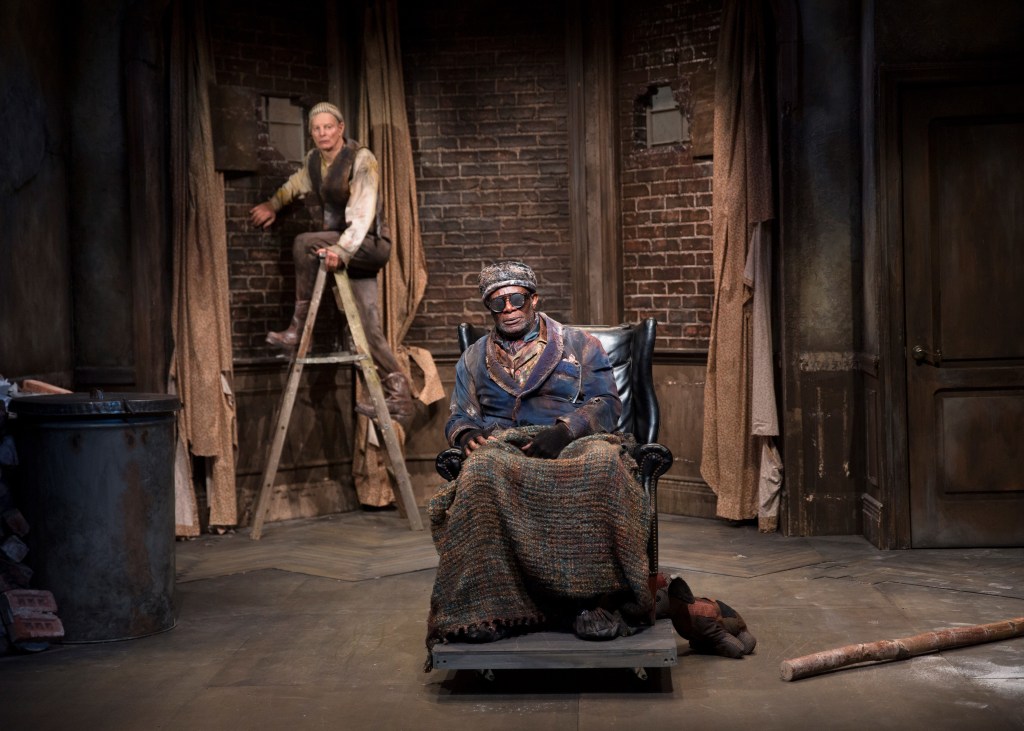
Nobel prize winner Samuel Beckett suffered years of rejection until his wife managed to sell his work which gradually put him on the map. Now we question how this rejection was possible because his work is timeless and exemplifies his genius. His particular greatness lies in his creation of spare, staccato, memorable dialogue, enigmatic characters and static situations as metaphors of human existence and its banal, opaque meaninglessness. How could anyone miss Beckett’s exceptionalism? In Endgame Beckett believed he was at his best. Gloriously, the Irish Repertory Theatre is presenting this work and the production directed by Ciarán O’Reilly reflects the accuracy of Beckett’s opinion.
Starring the irrepressible Bill Irwin as Clov and stolid John Douglas Thompson as Hamm, the production is perfection in its minimalism and ironies. It appropriately allows the audience to focus on the principal characters and their dire circumstances as they confront the end of the world, the end of their relationships with each other, their personal closure, and the abject null of lives lived in their last days, without joy, empathy or compassion. Interestingly, the play’s conclusion appears to happen in real time. When the final words are proclaimed, Hamm’s story is told and the lights go out to audience applause. All that has been said and has needed to be expressed is said and done. And there is the precise end of it, as the audience is left to wonder and take nothing for granted about their own existential happenstance and what they have just witnessed in this shared humanity that plays out in a tragicomic unspooling.
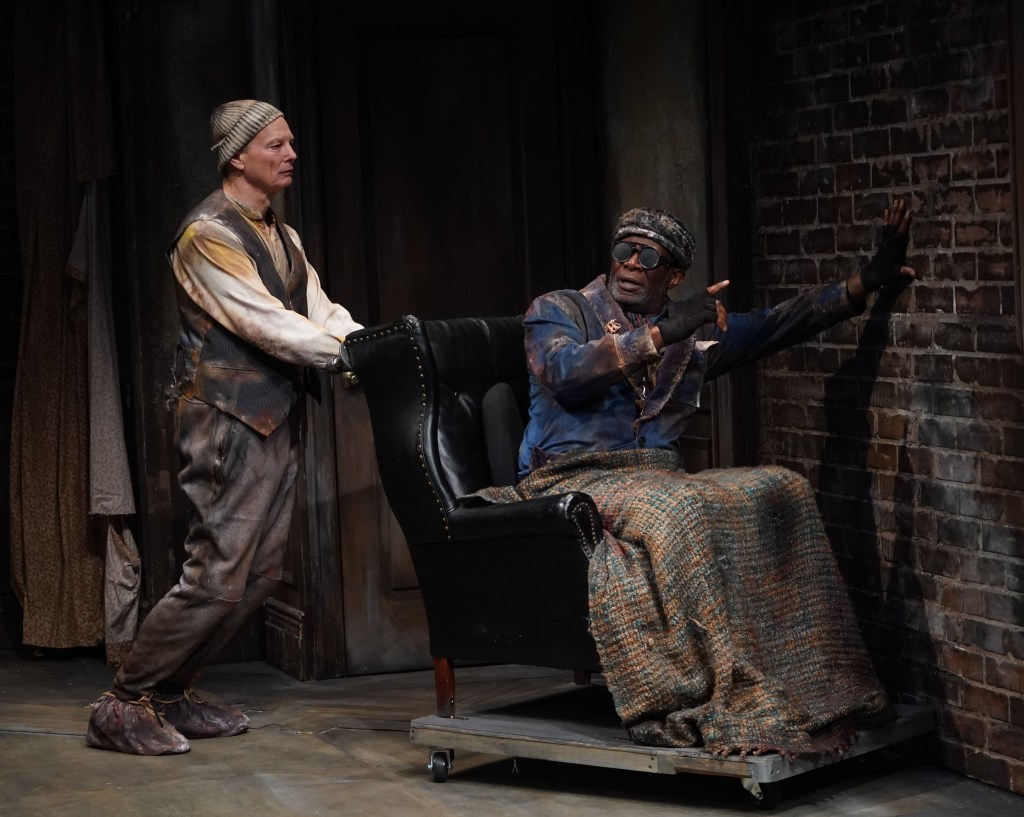
Apart from their physical conditions of wrack and ruin, the characters are essentially ciphers. Hamm is blind and wheelchair bound, dependent on Clov, his handicapped, scattered servant, who begrudgingly comes to his every “whistle” and obeys Hamm’s commands. Clearly, their symbiotic relationship is one based on mutual abuse and co-dependence, as there is no love lost between them, though they’ve known each other since Clov was a child. Throughout the play, Clov limps with a barely controllable gait and awkward mobility to Hamm’s imperious orders. Toward the end of their repetitious tedium together, Clov even remarks he doesn’t understand why he continues to obey the cantankerous, unloving, pain-filled, acerbic older man.
In addition to Clov and Hamm are Hamm’s elderly parents who abide in the same large, spare room. They, also have lost their mobility and live without their legs in garbage cans filled at the bottom, first with sawdust, then more recently with sand. There are lids on the garbage cans, and the parents pop up for a conversation, until Hamm is tired of them and tells Clov to shut them up and close them out. Ironically, in the brief time we come to know father Nagg (Joe Grifasi) and mother Nell (Patrice Johnson Chevannes), we appreciate their relationship and the affection between them. Beckett reveals their togetherness as they recall the good times they had with each other, even making light of the accident when they both lost their legs. They put up with their son’s abusive, cruel nature and forbear under his insults (he refers to Nagg as a “fornicator”). As a result we perceive them as empathetic characters, while Hamm appears all the more obnoxious and querulous.

These four hapless individuals are perhaps the last human beings in the world. Hamm refers to the external environment outside the ramshackle building where they reside to be filled with death. The assumption is that the apocalypse has happened and there’s nothing left but a wasteland. The only objects that appear to make sense are inside their meager abode. These include Hamm’s piercing whistle, a few biscuits (in the play they look like dog biscuits) and Clov’s paraphernalia which include a spyglass and a ladder, an alarm clock and a few other items. There is also Hamm’s pet dog which is a stuffed animal, which may or may not give him comfort amidst his whining about “it’s” being enough, asking for his pain killer and his attempts to finish the story that he’s trying to tell, which symbolizes his and Clov’s lives.
The laughable irony is that the end of days are inhabited by these infirm individuals led by a powerless, despotic miscreant who presides over the others like a king, though he is powerless, halt, lame and blind (the Biblical reference is intimated). Instead of his physical helplessness guiding him into humility, the opposite is apparent. He is full of himself in his miserable state, which he appears to masochistically enjoy. (“Can there be misery loftier than mine? No doubt.”)
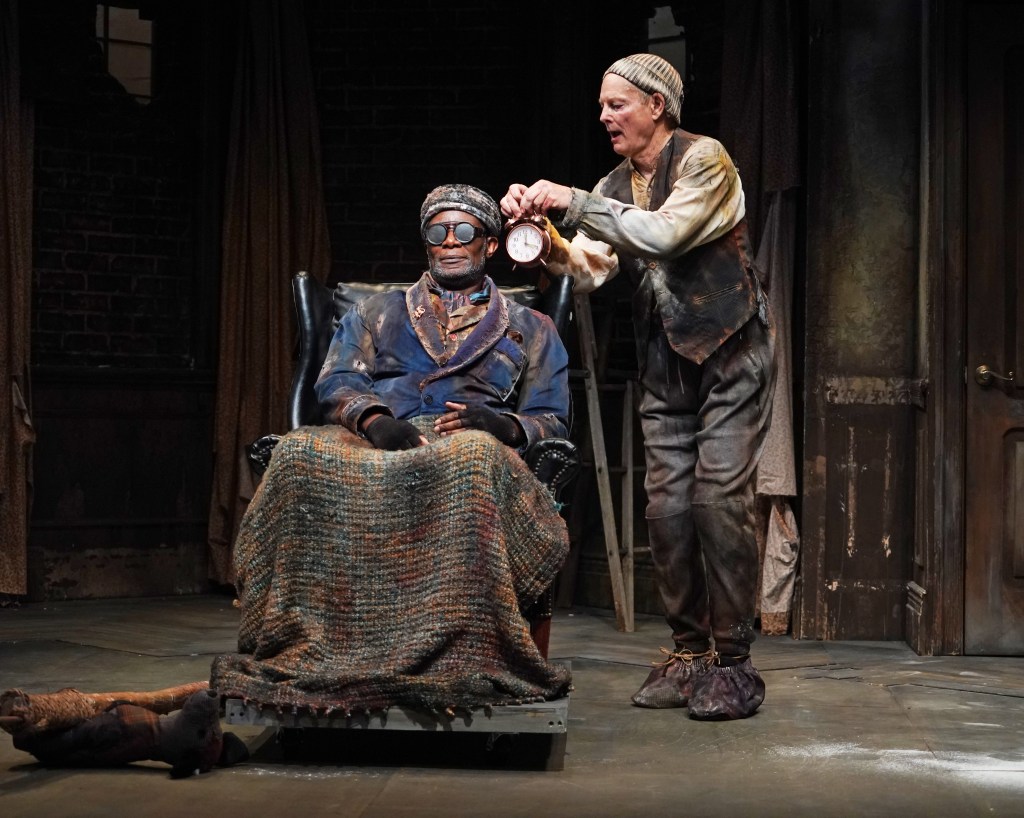
Hamm and Clov are contrapuntal. They are unique personalities and they contradict each other but come to the same conclusions. Their state of existence must end and it has gone on long enough without meaning. As they speak to each other in short bursts of, oppositional banter, the overall effect is humorous, like a bad joke or punchline. However, their thrust and parry about “nothing” has philosophical power in their sporadic digressions about life, time and existence. Their interactions often end with a surprising, pithy statement from either of them and the overall effect is also like a poetic riff. For example Hamm says, “It’s a day like any other.” Clov counters, “As long as it lasts. All life long the same inanities.” In their counterpoint, there is the great observational moment about the redundant, vapid routines of living.
Considering that apart from a few moments when Clov looks out the window, and Hamm directs him to “drive” his wheelchair around in a circle, Clov kills a flea by throwing powder down his pants and Hamm uses a staff-like implement to try to move himself which he can’t, little happens. From beginning to ending they know the situation is absurd because their end is inevitable and irrevocable. And because they are helpless against time and existence itself, they can do nothing except what they do and say which is both funny and tragic.

Bill Irwin’s Clov is a mastery of awkward physicality precisely effected. He is imminently watchable and uncharacteristic in his movements which are surprising and antic. In his stasis, John Douglas Thompson is his frustrated counterpart. Their banter is humorous and paced with authenticity bringing on the chortles and laughter because their characters are so passive and truthful about their condition. No one is raging against the storm which has already happened. They are waiting the interminable wait for “the end.”
O’Reilly’s direction and staging align with Beckett’s intent and we find ourselves mesmerized and waiting for the shoe to drop,, which only does in the little details and actions. One example of this occurs when Clov sets up the ladder and climbs it, anchoring his leg so he might safely look out the window on the “grey.” Another example occurs when Clov gets rid of the flea with the white powder which he roughly sprinkles down his baggy pants. A third action occurs when Clov brings out an alarm clock and hangs it on the wall. Each of these “events” and others (Hamm’s petting his stuffed dog, Hamm’s attempting to move himself with the gaff) create a kind of suspense that ends in nothingness. This is one of the themes of Endgame; ultimately, our actions result in little that impacts or changes existence. However, they do help to pass the time and “entertain” us until “the end,” which is uncertain.

Charlie Corcoran’s scenic design, Orla Long’s costume design, Michael Gottlieb’s lighting design, M. Florian Staab’s original music and sound design convey the austere setting of a ramshackle room in a house beset by a post-apocalyptic, end times scenario. That the title references a game of chess where there are no winners and one of the players (Clov) threatens to leave numerous times but remains at “the end” is to Beckett’s purpose that all inevitably wanders into empty inaction which has little substance or meaning. Thus, we are left seeing characters confronting what they cannot, as we witness our own inability to reckon that there is an “end” to all of “this.” And as Nell states, nothing is funnier than unhappiness. So as we watch the characters struggle with their fateful endings, we laugh because life is nonsensical. And we are sad for the tragedy that reflects our own humanity.
This is an amazing production with flawless performances that you don’t want to miss. For tickets and times go to their website https://irishrep.org/show/2022-2023-season/endgame-2/
‘runboyrun’ and ‘In Old Age’ Two Magnificent Works by Mfoniso Udofia

Chiké Johnson, Patrice Johnson Chevannes in runboyrun and In Old Age, written by Mfoniso Udofia, directed by Loretta Greco, Awoye Timpo (Joan Marcus)
What is the impact of experiencing a genocidal civil war when one’s ancestry, bloodline and religion are used as targeted excuses for extermination? If one survives, is it possible to overcome the wartime horrors one experienced? Or is the sufferer doomed to circularly repeat the emotional ravages of past events that erupt from the unconscious and imprison the captive forever in misery? How is such a cycle broken to begin a process of healing?
In runboyrun, Mfoniso Udofia, first-generation Nigerian-Amerian playwright, through poetic flashback and mysterious revelation, with parallel action fusing the past with the present, explores these questions. Majestically, in her examination of principal characters Disciple Ufot (the superb Chiké Johnson), and his long-suffering wife Abasiama Ufot (the equally superb Patrice Johnson Chevannes), we witness how Disciple overcomes decades of suffering with the help of Abasiama during a night which is a turning point toward hope and redemption.
Chiké Johnson, Patrice Johnson Chevannes, Karl Green, Adrianna K. Mitchell in runboyrun and In Old Age, written by Mfoniso Udofia, directed by Loretta Greco, Awoye Timpo (Joan Marcus)
A bit of backstory is warranted. In 2017 New York Theatre Workshop presented two of Mfoniso Udofia’s plays in repertory (Sojourners, Her Portmanteau). runboyrun and In Old Age are two of Mfonsio Udofia’s offerings which are plays in The Ufot Cycle, a series of nine plays in total which chronicles four generations of a family of stalwart women and men of Nigerian descent. Though the plays currently presented at NYTW are conjoined to elucidate similar themes, they do not run in sequence. Nevertheless, both plays spotlight Mfonsio Udofia as a unique female voice of the African diaspora in the United States. Both represent the particularity of her exceptional work from a maverick’s perspective.
The first play directed by Loretta Greco begins with a flashback of a sister and brother. The setting is January, 1968 Biafra, the southern part of Nigeria that attempted to gain independence from Nigeria during the three year Biafran Civil War. During a lull in the shelling by the government in a hideout in the bush, the sister comforts her brother with a metaphorical story about the foundation of humanity and life. Then she encourages him to run as a game. However, it is the one activity that will save their lives as they escape the Nigerian soldiers at every turn, until they reach a safe place in a compound with their mother and brother.
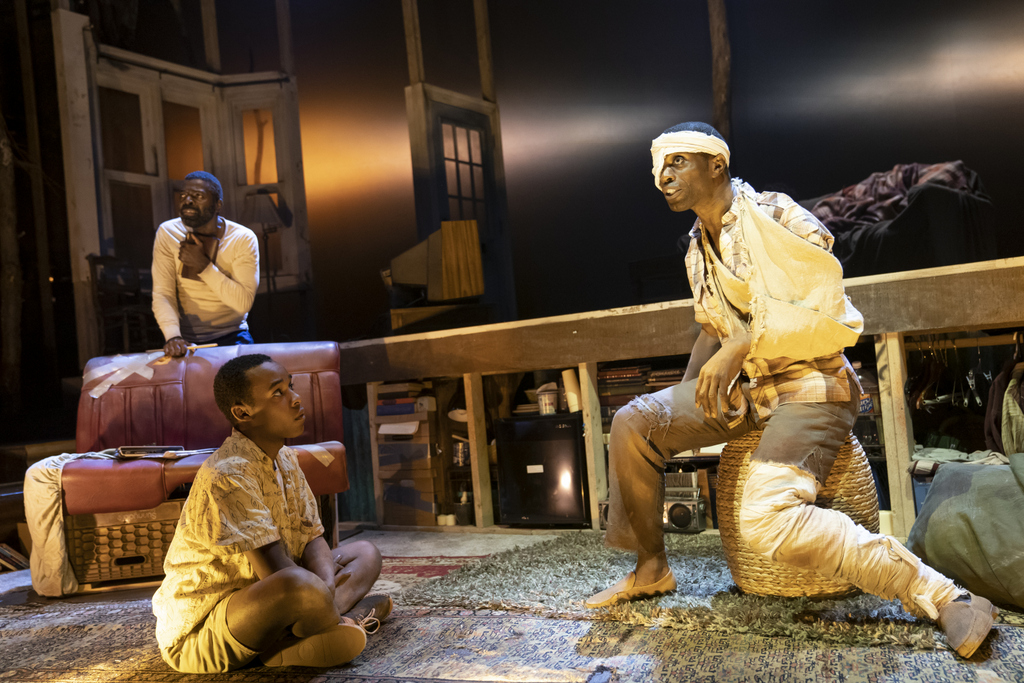
Chiké Johnson, Patrice Johnson Chevannes, Karl Green, Adrianna K. Mitchell in runboyrun and In Old Age, written by Mfoniso Udofia, directed by Loretta Greco, Awoye Timpo (Joan Marcus)
This setting alternates to the present January, 2012, where we are introduced to the Ufots, transplanted Nigerians who immigrated to the United States, became citizens and eventually settled in the ramshackle interior of their colonial house in Massachusetts. However, from the moment Johnson’s Disciple enters their cold, dank home and with bellicosity relates to Chevannes’ Abasiama, we understand that their estrangement is acute. For her part Abasiama, who lies on the couch in the center of the living room wrapped up in layers of clothing with blankets and sheets thrown over her head, disengages from his behaviors, attempting to stay away from his weird, oppressive antics.
Disciple attempts to control her every move, berates and blames her for the bad spirits in the house. However, it becomes obvious that it is he who suffers derangement. He is fixated on the perception that everything outside him and especially his wife are the source of his bad luck and the wickedness that plagues him and threatens to upend his life and his writing. In what we learn has become a ritualistic practice, Disciple uses a thin stick to circumscribe areas as safe to prevent evil spirits from disarranging and unsettling his peace. Abasiama, used to this behavior, plays Christian music; Christianity was a part of their Igbo ancestry. However, after Disciple’s exorcism, when he attempts to begin work on a new book, the past erupts. Once more the playwright creates flashbacks which establish and explain Disciple’s instability and borderline insanity.

The full cast of runboyrun, written by Mfoniso Udofia, directed by Loretta Greco (Joan Marcus)
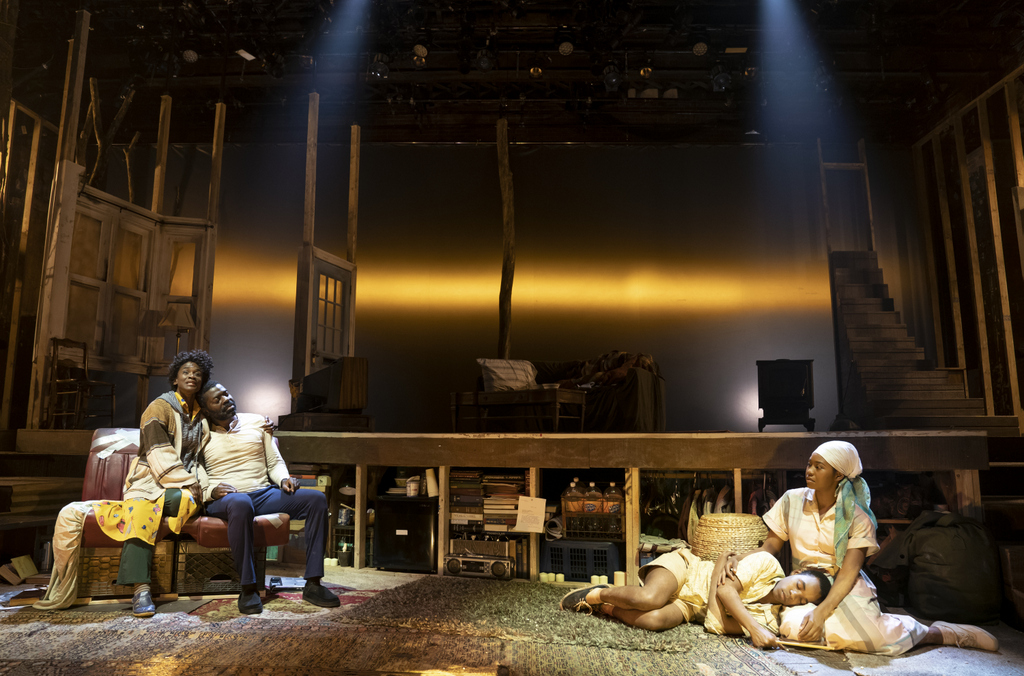
Udofia’s structure interlacing the past with the present is particularly strengthened by Andrew Boyce’s scenic design which threads the action, symbols and themes. The house is divided in a cross section symbolizing the division in Disciple’s and Abasiama’s relationship and marriage so we see how both conduct their lives in separate parts of the house: Abasiama upstairs, Disciple in the basement. They do not communicate, nor are they intimate with each other’s thoughts and feelings, sharing little if anything of their histories, a tragedy which has led to the disintegration of their marriage. Their lives are separately lived; they buy food separately, use different refrigerators. Disciple cooks for himself and they take their meals separately because he believes she may poison him.
The separation extends even to the different churches they attend and Disciple’s cruel treatment of Abasiama, which she sustains because to take a stand against it would rain down more abuse. Disciple begrudges Abasiama warmth for the upper floors which have insufficient heat to brace up against the cold Worcester, Massachusetts winter. This behavior of keeping the upper floors cold reflects Disciple’s abusiveness and penuriousness, not only with finances but with emotional intimacy and love.

Chiké Johnson, Patrice Johnson Chevannes in ‘runboyrun’ and ‘In Old Age,’ written by Mfoniso Udofia, directed by Loretta Greco, Awoye Timpo (Joan Marcus)
The division/cross section symbolizes a number of elements which define the characters so acutely portrayed by Johnson and Chevannes with maximum authenticity. It represents the compartmentalization of Abasiama’s and Disciple’s minds, especially Disciple’s as it relates to his unconscious memories which he’s suppressed, and on this night erupt with great ferocity. For Abasiama, she compartmentalizes her rage and anger against Disciple; to express the emotions will result in violence so she must be stoic. The events that play out from the past take place in the “basement” area. Events move upstairs when Abasiama extends grace to Disciple and he relives the flashback that has shaken his soul and increasingly knocked on his heart to be released as he has aged. If he does not, surely he will damage and destroy everything he has, most importantly his relationship with Abasiama.
It is in the “basement” of his being on this particular night that Disciple confronts the spirits that have haunted him for decades. By the play’s conclusion he revisits the blood soaked memories of his childhood during the horrors of the Biafran War. The spirits rise and their energy drives him to the brink of irrationality, which he takes out on Abasiama, who finally proclaims “enough,” and tells him she wants a divorce. In shock he returns downstairs and she hears him raving against the energies that roil him (his unconscious terror and guilt).

Adrianna Mitchell, Karl Green, ‘runboyrun,’ written by Mfoniso Udofia (Joan Marcus)
Mfoniso Udofia expertly weaves in concurrent flashbacks which reveal seminal events that shattered Disciple’s consciousness and emotionally freeze him in time. We learn why he is psychotic in recreated scenes of his family: sister (Adrianna Mitchell), mother (Zenzi Williams), Benjamin (Adesola Osakalumi). Karl Green portrays Disciple as a boy. And on Abasiama’s encouragement and love, he finally reaches the core event to expurgate it and grieve, thus beginning the healing process.
Chiké Johnson is acutely, sensitively invested in his portrayal of Disciple. Patrice Johnson Chevannes as Abasiama is expert and uplifting at the conclusion of runboyrun. And in the segue to the next play, we see her transformation into a withered, dried up old woman living with the rage and fury bestowed upon her by Disciple who has died by the opening of In Old Age.

Ron Canada, Patrice Johnson Chevannes in In Old Age, directed by Awoye Timpo, written by Mfoniso Udofia (Joan Marcus)
It is Abasiama’s fury that has carried over from her time with Disciple that Mfoniso Udofia examines in the play In Old Age. The stoicism we see in runboyrun blossoms into rage against herself for “putting up with” Disciple and not leaving him. Whether such anger manifests when we age, so that we have no tolerance for ourselves and are grumpy and angry with others is an interesting question that Mfoniso Udofia posits. Yet, it is in Abasiama’s interactions with Azell Abernathy the workman (Ron Canada), that the emotional abuse she never discussed or confronted Disciple about is now coming to call. And likewise, the tragic alcoholic-fueled abuse that centered around Abernathy’s marriage, that Abasiama intuits harmed his marriage, becomes a focal point of their interactions.
Abernathy and Abasiama clash and their expressed annoyances with each other are sometimes humorous. However, because they are both Christians, they attempt to bear up with one another. Indeed, Abernathy is much more determined to do so than initially Abasiama seems to want to. How Mfoniso Udofia brings these two together to establish the beginnings of a loving relationship is a lesson in grace and the spiritual need for forgiveness and emotional healing.
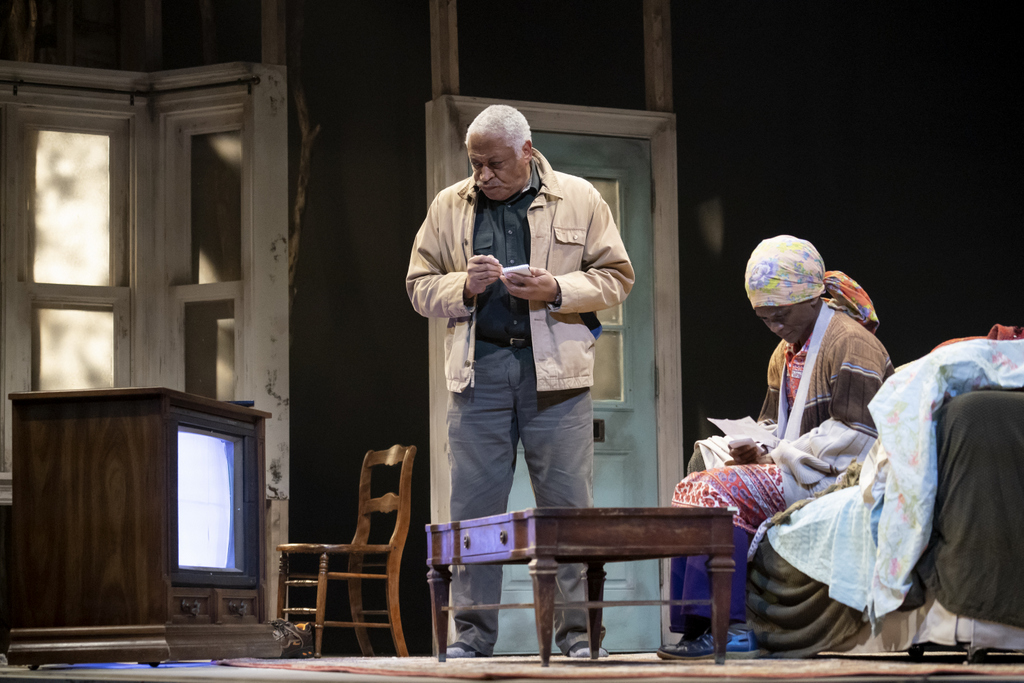
Ron Canada, Patrice Johnson Chevannes, ‘In Old Age,’ written by Mfoniso Udofia, directed by Awoye Timpo (Joan Marcus)
The plot development of In Old Age is simple. Azell Abernathy must persuade Abasiama to allow him to repair her house, the same house that she lived in with Disciple. However, the house is in more than need of repair. Abasiama hears what she believes is Disciple ranging and banging around in the basement. Just like in runboyrun when Disciple projected his terror and hurt onto Abasiama, now Abasiama projects her rage and anger onto the house and in magical realism fashion, it manifests in banging and noise.
One of the problems is that Abasiama subverted her own healing and empowerment to help Disciple redeem himself. Now she regrets her sacrifice and unselfishness. As a result, when Abasiama is forced to deal with Azell Abernathy (Ron Canada in a highly nuanced, sensitive, clarion performance), whom her daughters have paid to repair the house, the rage has so swelled inside of her she drips bile. Toward Abernathy, she is provocative and she riles him to the point where he nearly becomes abusive. However, he has learned. He leaves, goes outside and prays for her.

Ron Canada, Patrice Johnson Chevannes, In Old Age, written by Mfoniso Udofia, directed by Awoye Timpo (Joan Marcus)
His prayers work with power and change comes with revelation. Abasiama realizes she can no longer carry around past hurts and regrets. To expurgate them, she cleans out the “basement” (symbolic of her own soul and psyche), of all of the artifacts that Disciple kept there. As she throws them out, she frees herself realizing she is responsible for her own happiness and cannot blame her misery on Disciple. Cleansed from a night of dealing with her own regrets about her life, Abasiama is ready to face a new day. In a great, symbolic gesture, Abernathy washes her feet as Christ did with his disciples, showing he forgives her and forgives himself. It is an act of sublime strength. She receives his good will, Christian love and faith. She removes her shackles represented by her headdress and shows Abernathy her true self. She is beautiful. In their old age they have found love after confessing their faults to each other to be healed.
In Old Age is a hopeful, redemptive encomium to our ability to grow and regenerate our souls if we face ourselves. Directed by Awoye Timpo, In Old Age is just lovely and the complex performances by Canada and Chevannes are sterling, poignant and uplifting. Kudos to Andrew Boyce (scenic design), Karen Perry (costume design), Oona Curley (lighting design).
These are productions you do not want to miss for the profound beauty of Mfoniso Udofia’s work and the great ensemble acting. The tension in runboyrun is truly striking. runboyrun and In Old Age are at NYTW on 4th Street between 2nd and the Bowery. The production runs with one intermission. For tickets and times CLICK HERE.
‘Mies Julie’ an Adaptation of August Strindberg’s ‘Miss Julie’ by Yaël Farber at CSC

(L to R): Elise Kibler, Patrice- Johnson Chevannes, James Udon in CSC, ‘Mies Julie,’ by Yaël Farber, adapted from the play ‘Miss Julie’ by August Strindberg, directed by Shariffa Ali (Joan Marcus).
The Classic Shakespeare Company is presenting two 19th century plays by August Strindberg in Repertory. The Dance of Death (see my review by “clicking here” in a new version by the award winning Conor McPherson) and Mies Julie in an adaptation by the award winning South African director and playwright Yaël Farber.
Farber has given Strindberg’s Miss Julie a renovation in texture, location, structure and dynamic by intensifying the conflict and shortening the arc of the play’s development. Inherent in this production directed by Shariffa Ali is the force and power to further elucidate the themes about classism, chauvinism, oppression, economic injustice, racism, white supremacy and cyclical revenge with the backdrop of a new setting, South Africa, 2012. Additionally. she has changed the characterization of Christine from Jean’s fiancee to John’s mother, and worldly servant Jean to Xhosa farm worker John, intriguingly characterizing him as one who grew up with Mies Julie on the farm that Julie’s father owns.
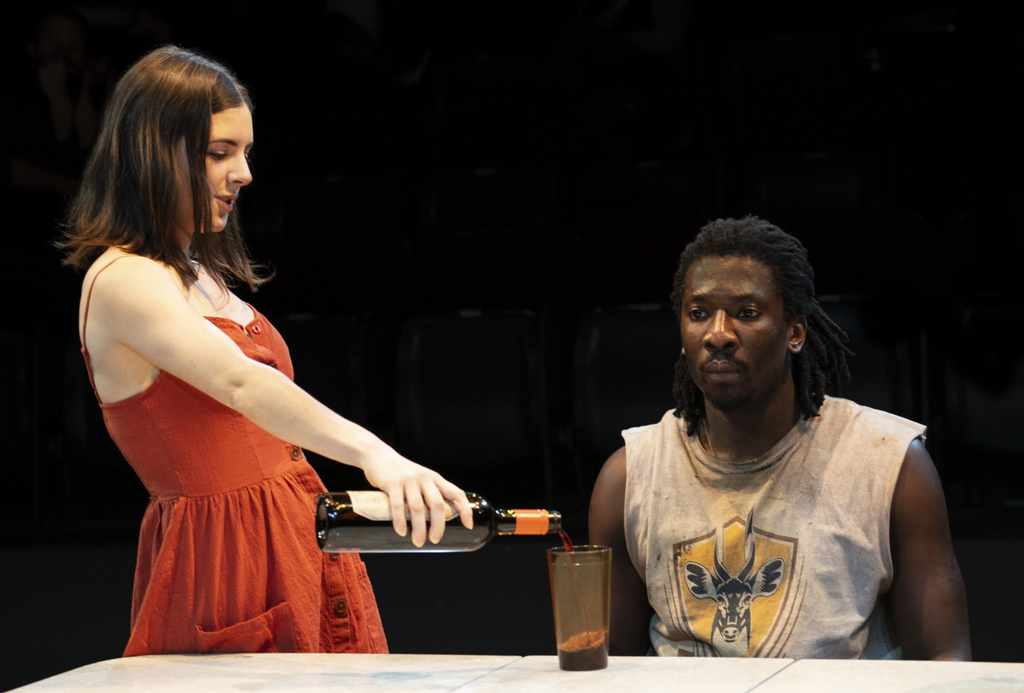
(L to R): (L to R): Elise Kibler, Patrice- Johnson Chevannes, James Udon in CSC, ‘Mies Julie,’ by Yaël Farber, adapted from the play ‘Miss Julie’ by August Strindberg, directed by Shariffa Ali (Joan Marcus).
Christine has raised Mies Julie alongside her own son when Julie’s mother abandoned her daughter suffering from severe depression. The mother, alienated and isolated from the strangeness of the colonial women with whom she never could feel comfortable, the difficulty of the farming life and her own inner regrets caved in her soul. Without any sense of purpose or the obligation of duty to take care of her own child, she shoots herself and little Julie finds the disastrous ruin of the woman. Mies Julie thinks she is responsible for her mother’s death, but is nurtured by Christine’s love to eventually recover.
Nevertheless, Mies Julie bears the scars of the trauma. And during the course of the play we intuit that her rebellious behavior and impulsiveness suppresses an inner pain as she careens through her life. If not for Christiane’s love and an emotional attachment to Christine’s son John, who protects her and secretly, hopelessly loves her, Mies Julie might follow in her mother’s footsteps. The character of Mies Julie is most similar to Strindberg’s Miss Julie in ethos, however, the fascinating twists of transformation of setting reshape all of her actions and give them additional resonance and thematic richness.
Farber’s adaptation opens in a farmhouse kitchen in Eastern Cape, Karoo, South Africa on Freedom Day, 27 of April 2012, almost 20 years after all South Africans were give the right to vote in 1994. The day is a vital symbol integral to the complex themes of this adaptation. For the blacks of South Africa, the price of freedom was purchased by blood and suffering. The black culture’s redemption and return to the land of their ancestors will also be paid for by blood and suffering in a twisted karmic resolution in Farber’s Mies Julie.
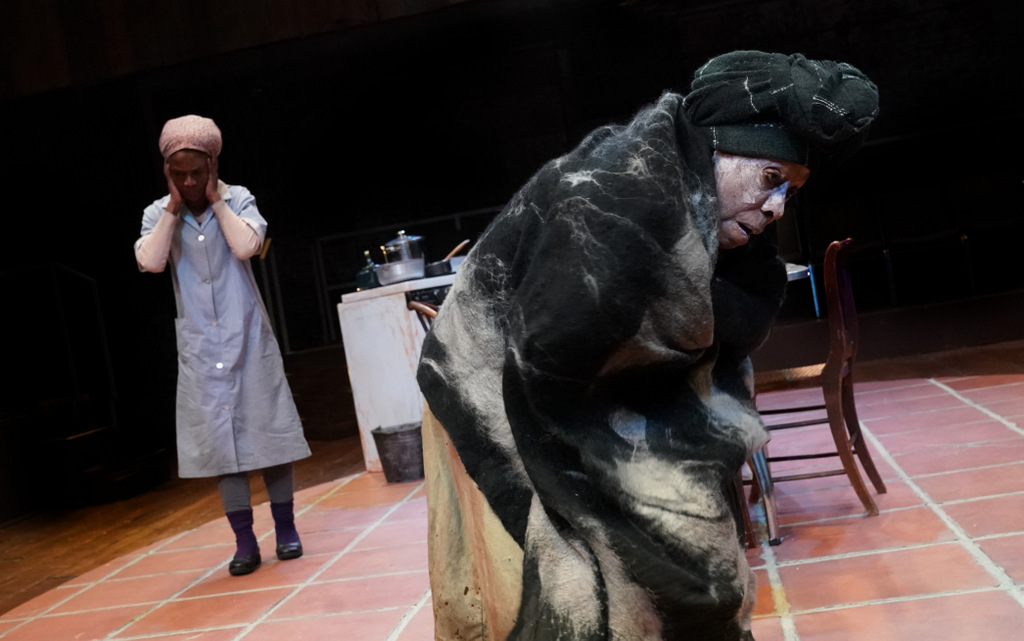
(L toR): Patrice- Johnson Chevannes, Vinie Burrows, CSC, ‘Mies Julie,’ by Yaël Farber, adapted from the play ‘Miss Julie’ by August Strindberg, directed by Shariffa Ali (Joan Marcus).
Indeed, ancestors in the form of a ghostly grandmother seek revenge as she haunts the house which was built upon ancestral graves. Although this is not effected in the set design, Christine refers to the great tree which was cut down to make way for the house, but whose roots retained life and now break through the tiles of the floor of the kitchen and continue to grow in defiance of the white, man-made structure. The symbolism of the tree as representational of the Xhosa family which belongs on the land and whose culture can never be erased is a focal point. Unfortunately, without evidence of the tree breaking through the floor (due to the repertory’s need for minimalism) an important theme of Farber’s work is diminished, opaquely realized through Christine’s dialogue which becomes too easily lost in the hum of action.
Farber presents the underlying conflict when the workers on the farm and some squatters who have returned to the land that their ancestors lived on before the colonials came, have been celebrating and dancing on Freedom Day. Mies Julie dances with the workers a bold and inappropriate act. Because her father is away, she rebelliously revels in these liberties which lower her stature and respect in the workers’ eyes. When John attempts to admonish her, we see the emotional tensions between them and realize that the relationship they have developed in many ways runs past master/servant and portends elements of love or sado-masochism or both.
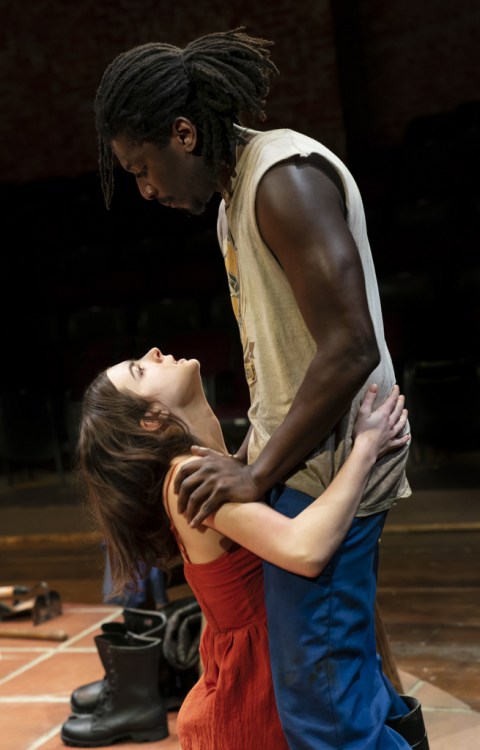
(L to R): Elise Kibler, James Udon in CSC, ‘Mies Julie,’ by Yaël Farber. adapted from the play ‘Miss Julie’ by August Strindberg, directed by Shariffa Ali (Joan Marcus).
During the course of the production we discover that the South African’s hope is to one day take back the land from the colonials like Julie’s father. They consider this an act of restitution for the terrible bloodshed and misery caused in the years of usurpation which brought about cultural devastation. The economic struggles continue in the present day for the workers like John and Christine must still submit to servitude to survive. Decades of economic injustice and inequality have delayed their accumulation of enough capital to purchase the land that their ancestors lived on centuries ago.
Though John has educated himself and wants the freedom to be able to prosper beyond his “class and race,” he is not the urbane, world traveler of the Jean of Strindberg’s work. And though he has had women, he has loved Mies Julie from childhood. It is this night that erupts in a culmination of many subterranean wants and desires for both Mies Julie and for John. And of course it is this night of freedom that lifts up Mies Julie’s “Afrikaaner race” out from under the degradation and debasement of oppressing the Xhosa.
John and Julie are representative of their race and class. On one level Mies Julie becomes the sacrifice to expiate the “sins” of her forefathers when she chooses to become equal and unite in a physical consummation of love with John. Likewise for John, it is a night where he asserts his privilege to repossess the land (symbolized by Mies Julie’s body) and achieve a lifelong dream to be restored to his true sense of self-worth, identity and power.
The beauty and tragedy of portraying their relationship as Farber does in layer upon layer of intricate psychological and social texture is that we understand before the characters do that perhaps decades need to pass before the destructive social MATRIX in which both live and have their being disintegrates. John comes to this realization sooner than Mies Julie, who is impaled on the immediacy and unreality of wanting an idyllic life with John away from the farm. She intends to run away with him and use her father’s money that she’s stolen from the safe. John cannot trust Mies Julie enough to leave his mother and the stultifying but familiar identity that has oppressed him his entire life. The two are trapped and their end appears to be an inevitability. The time is surely “out of joint.” And only a few options remain for them to take before Julie’s father returns the next day and stasis consumes their lives once more.
In this adaption, Farber presents some of Strindberg’s themes front and center and then embellishes and expands them. Farber suggests the following. In order for the injustices between and among economic classes to ever be resolved, the classes themselves must be dissolved. For all human beings, the trials overcoming the miseries of childhood and the nullifying stricture of social mores, are uneasily won. For outsiders who are economically challenged, the trials are even greater. Only gradually through the passing of the generations will there ever be economic and social parity between and among disparate races and ethnic groups.

(L to R): Elise Kibler, Patrice- Johnson Chevannes, James Udon in CSC, ‘Mies Julie,’ by Yaël Farber. adapted from the play ‘Miss Julie’ by August Strindberg, directed by Shariffa Ali (Joan Marcus).
Christine knows this. She treasures her job and is willing to abide in her faith believing that for her son’s generation it will be better, but for her generation, it is finished. John wants change immediately and by fathering Mies Julie’s child he will overthrow the status quo, though he risks her father’s wrath. They must leave, for if a baby comes, her father will kill them both.
The harder he and Julie attempt to extricate themselves from the binding circumstances, the more they become mired in fear. It is a truism that they must leave or die. They cannot forge new identities in the same place where old hatreds and resentments float like ghosts above the blood-soaked land. Mies Julie wisely commands that they run away from her father and the farm’s oppression and migrate to a new identity and new existence in the city. But John is stuck. Christine adjures that she will never leave the farm. John must choose. Either he abandons his mother and goes with Mies Julie to freedom, or he remains with Christine in servitude. If there is a baby, all three will die.
Farber’s adaptation presented by the CSC and directed by Shariffa Ali enthralls with strong, emotional performances by James Udon as John, Elise Kibler as Mies Julie and Patrice Johnson-Chavannes as Christine. And when the ghost of the grandmother walks the kitchen, Vinnie Burrows is uncanny and foreboding. Because of her presence, we understand that a fearful retribution is coming, but it remains unclear until the play’s conclusion.

(L to R): James Udon, Elise Kibler, Patrice- Johnson Chevannes, in CSC, ‘Mies Julie,’ by Yaël Farber, adapted from the play ‘Miss Julie’ by August Strindberg, directed by Shariffa Ali (Joan Marcus).
The production runs like a bullet train on a collusion course toward destruction especially in the scenes where Kibler and Udon spar, seek to dominate and control, then relent, succumbing to their tenuous love for each other. Kibler is effective in her smoldering, wild longing. Udon is sensitive and caring as the “fool” for love, then angry and rebellious in believing he is Mies Julie’s plaything. These emotions provide a field for incredible contrasts. On the one hand Julie and John collide with their fear of abandonment and betrayal. Then they fly to each other then fly to reinforce a love perches on the edge of desperation. These tensions and the heightened interplay between Kibler’s Mies Julie and Udon’s John is wrought with ferocious zeal.
A note of warning. Some of the dialect and the accents are muffled and strained. I found that swaths of dialogue were garbled because of an overemphasis to “get the accents right.” I am not referring to the words of Afrikaans or Indigenous words in Xhosa, but the heavily accented English. The accents are vital for they introduce the setting. However, the use remained problematic. When the emotion was presented organically, the dialogue followed and the actors were easily understood.
Finally, the set design was spare and adequate as it should be in this repertory Strindberg cycle. However, the incredible symbolism of the tree should be included as an important thematic thread of the play. The music, the effects, make-up and costumes are apt. When the ghostly presence enters and leaves, all these design elements effect the supernatural wonderfully.
Mies Julie and The Dance of Death alternate in repertory at CSC (13th Street between 3rd and 4th) until 10 March. Mies Julie is a spare 75 minutes with no intermission. You can pick up tickets at their website.
 CAROLE DI TOSTI