Blog Archives
‘The Weir’ Review: Drinks and Spirits in a remote Irish Pub
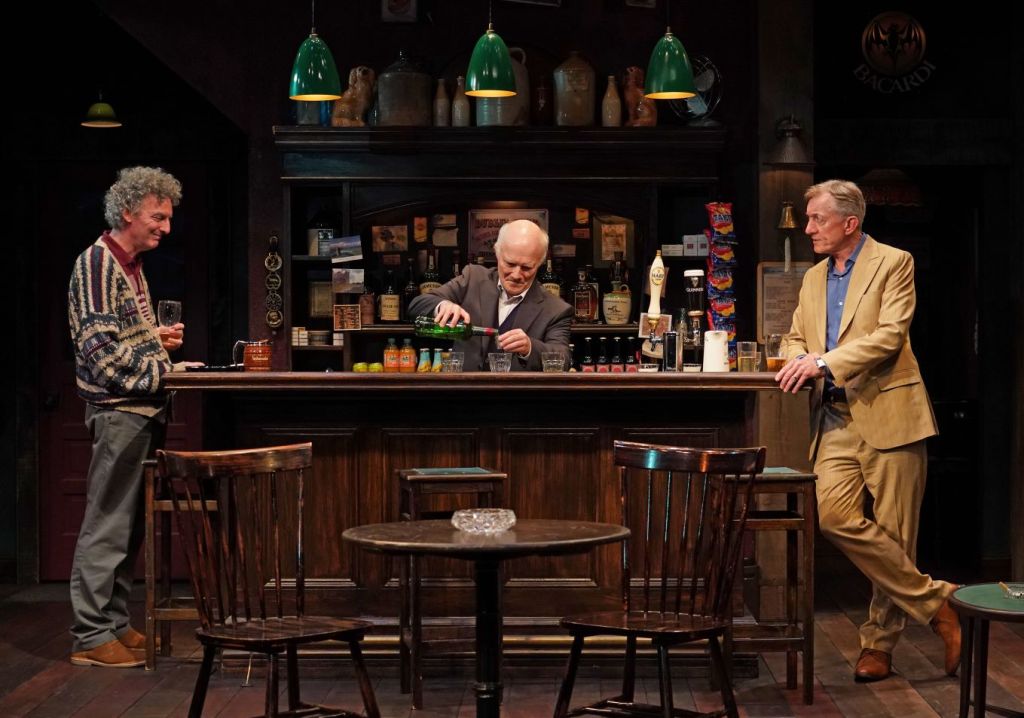
Conor McPherson’s The Weir currently in its fourth revival at Irish Repertory Theatre has evolved its significance for our time. It captures the bygone Irish pub culture and isolated countryside, disappeared by hand-held devices, a global economy and social media. Set in an area of Ireland northwest Leitrim or Sligo, five characters exchange ghostly stories as they drink and chase down their desire for community and camaraderie. Directed with precision and fine pacing by Ciarán O’Reilly, The Weir completes the Irish Rep’s summer season closing August 31st.
Charlie Corcoran’s scenic design of the pub with wooden bar, snacks, bottles, a Guinness tap and heating grate is comfortable for anyone to have a few pints and enjoy themselves at a table or nearby bench. With Michael Gottlieb’s warm, inviting lighting that enhances the actors’ storytelling, all the design elements including the music (Drew Levy-sound design), heighten O’Reilly’s vision of an outpost protective of its denizens and a center of good will. It’s perfect for the audience to immerse itself in the intimacy of conversation held in non-threatening surroundings.
On a dark, windy evening the humorous Jack drops in for drinks as a part of his routine after work at the garage that he owns. A local and familiar patron he helps himself to a bottle since he can’t draw a pint of Guinness because the bar’s tap is not working. Brendan (Johnny Hopkins) owner of the pub, house and farm behind it informs him of this sad fact. But no matter. There are plenty of bottles to be had as Jim (John Keating) joins Jack and Brendan for “a small one.” The entertainment for the evening is the entrance of businessman Finbar (Sean Gormley), who will introduce his client Valerie to the “local color,” since she recently purchased Maura Nealon’s old house.
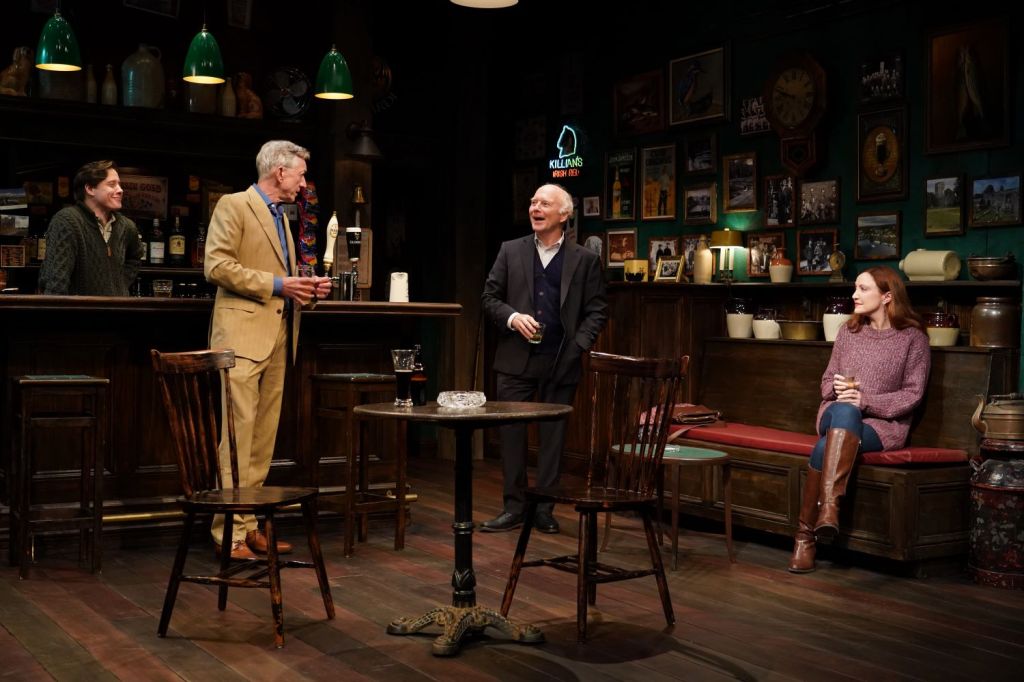
Initially, Jack, Jim and Brendan gossip about the married Finbar’s intentions as he shows up the three bachelors by escorting the young woman to the pub. Jim, caretaker of his mom, and Jack are past their prime in their late 50-60s. Brendan, taken up with his ownership of the pub and farm, is like his friends, lonely and unmarried. None of them are even dating. Thus, the prospect of a young woman coming up from Dublin to their area is worthy of consideration and discussion.
McPherson presents the groundwork, then turns our expectations around and redirects them, after Finbar and Valerie arrive and settle in for drinks. When the conversation turns to folklore, fairy forts and spirits of the area, Valerie’s interest encourages the men to share stories that have spooky underpinnings. Jack begins his monologue about unseen presences knocking on windows and doors, and scaring the residents until the priest blesses the very house that Valerie purchased.
Caught up in his own storytelling which brings a hush over the listeners (and audience), Jack doesn’t realize the import of his story about the Nealon house that Valerie owns. Thankfully, the priest sent the spirits packing. Except there was one last burst of activity when the weir (dam) was being built. Strangely, there were reports of many dead birds on the ground. Then the knocking returned but eventually stopped. Perhaps the fairies showed their displeasure that the weir interfered with their usual bathing place.
Not to be outdone, Finbar shares his ghost story which has the same effect of stirring the emotions of the listeners. Then, it is Jim who tells a shocking, interpretative spiritual sighting. Ironically, Jim’s monologue has a sinister tinge, as he relays what happened when a man appeared and expressed a wish, but couldn’t really have been present because he was dead.
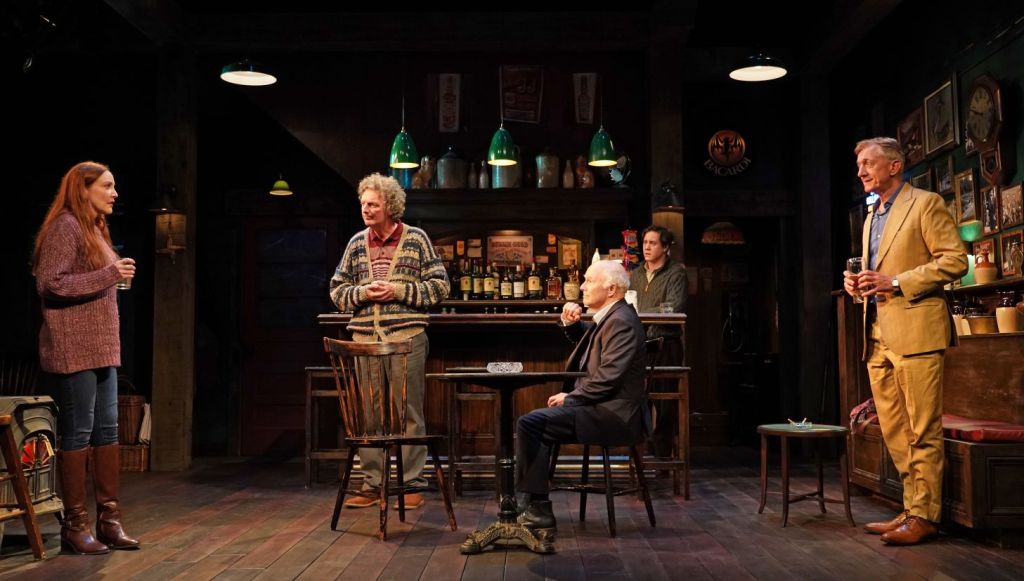
As drinks are purchased after each storyteller’s turn, the belief in the haunting spirits rises, then wanes as doubts take over. After Jim tells his story about the untoward ghost, Valerie goes to the bathroom in Brendan’s house. During her absence Finbar chides all of them. He regrets their stories, especially Jim’s which could have upset Valerie. With Jack’s humorous calling out of Finbar as a hypocrite, they all apologize to each other and drink some more. By this point, the joy of their conversation and good-natured bantering immerses the audience in their community and bond with each other. I could have listened to them talk the rest of the night, thanks to the relaxing, spot-on authenticity of the actors.
Then, once more McPherson shifts the atmosphere and the supernatural becomes more entrenched when Valerie relates her story of an otherworldly presence. Unlike the men’s tales, what she shares is heartfelt, personal, and profound. The others express their sorrow at what happened to her. Importantly, each of the men’s attitudes toward Valerie changes to one of human feeling and concern. Confiding in them to release her grief, they respond with empathy and understanding. Thus, with this human connection, the objectification of the strange young woman accompanied by Finbar at the top of the play vanishes. A new level of feeling has been experienced for the benefit of all present.
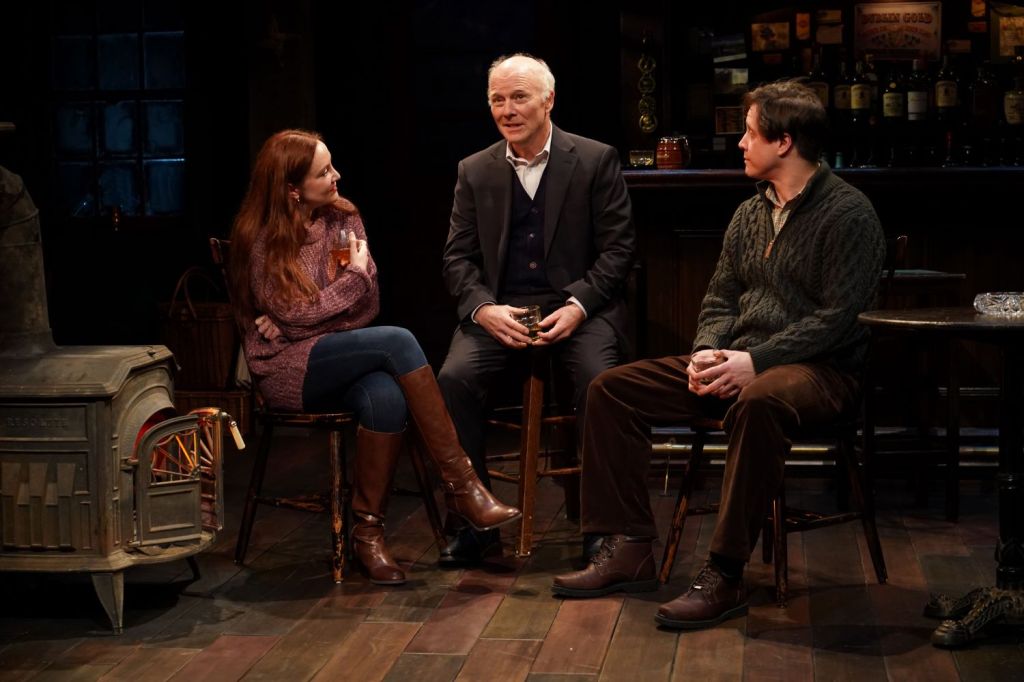
After Finbar leaves with Jim, McPherson presents a surprising coup de grâce. Quietly, Jack shares his poignant, personal story of heartbreak, his own haunting by the living. In an intimate emotional release and expression of regret and vulnerability, Jack tells how he loved a woman he would have married, but he let her slip away for no particularly good reason. Mentoring the younger Brendan not to remain alone like he did, Jack says, “There’s not one morning I don’t wake up with her name in the room.”
McPherson’s theme is a giant one. Back in the day when the world was slower, folks sat and talked to each other in community and conviviality. With such an occasion for closeness, they dispelled feelings of isolation and hurt. As they connected, they helped redeem each other, confessing their problems, or swapping mysteries with no certain answers.
As the world modernized, the ebb and flow of the culture changed and became stopped up, controlled by outside forces. Blocked by fewer opportunities to connect, people retreated into themselves. The opportunities to share dried up, redirected by distractions, much as a dam might redirect the ebb and flow of a river and destroy a place where magical fairies once bathed.
McPherson’s terrific, symbolic play in the hands of O’Reilly, the ensemble and creative team is a nod to the “old ways.” It reminds us of the value of gathering around campfires, fireplaces or heating stoves to tell stories. As companions warm themselves, they unfreeze their souls, learn of each other, and break through the deep silences of human suffering to heal.
The Weir runs 1 hour 40 minutes with no intermission at Irish Repertory Theatre (132 West 22nd St). https://irishrep.org/tickets/
‘Aristocrats,’ Irish Repertory Theatre, Review
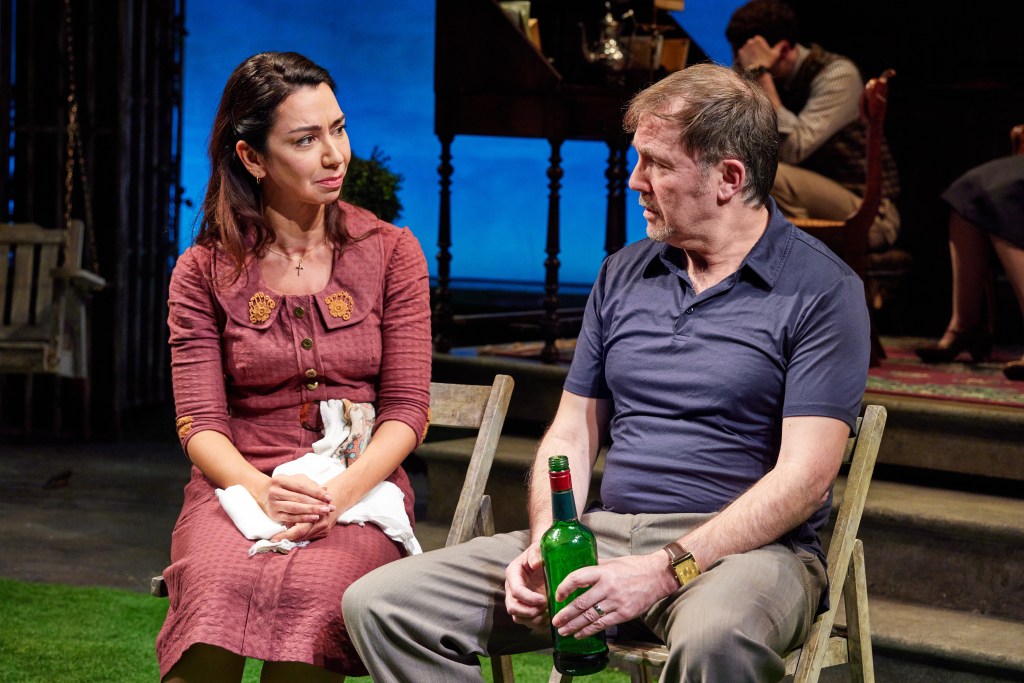
Dysfunction and decay are principle themes in Brian Friel’s Chekovian Aristocrats, a two-act drama about a once upper middle class family in precipitous decline in the fictional village of Ballybeg, County Donegal, Ireland. Currently at the Irish Repertory Theatre as the second offering in the Friel Project, the intricate and fine production is directed by Charlotte Moore and stars a top-notch cast who deliver Friel’s themes with a punch.
Two members of the O’Donnell family, headed up by the autocratic and dictatorial father, former District Justice O’Donnell (Colin Lane),, who remains offstage until a strategic moment brings him on, have arrived at the once majestic Ballybeg Hall. They are there to celebrate the wedding of Claire (Meg Hennessy), the youngest of the four children, who still lives with her sister Judith (Danielle Ryan), the caretaker of the estate. Well into the play, Ryan’s Judith reveals the drudgery of her responsibilities caring for her sickly father and her depressive sister Meg, as well as managing the estate and the chores of the Big House.
At the top of the play, we meet the grown children who live abroad and arrive from London and Germany. These include Alice (Sarah Street), her husband Eamon (Tim Ruddy), and the O’Donnell brother Casimir (Tom Holcomb). As Friel acquaints us with his characters, we discover Eamon, who once lived in the village, claims he knows more about Balleybeg Hall from his grandmother, who was a maid servant to the O’Donnells. Also present is Willie Diver (Shane McNaughton), who is attentive to Judith as he helps her around the estate and farms and/or rents out the lands to the locals. Initially, we watch as Willie organizes a monitor through which Justice O’Donnell can speak and ask for Judith to attend to him.

By degrees, through the character device of the researcher, Tom Huffnung (Roger Dominic Casey), and especially the ironic comments of Eamon, Friel discloses who these “aristocrats” of Ireland are. First, they were the upper class with land, who once dominated because the English protestant faction empowered them to do their bidding. The irony is that over the years, they have devolved and have imploded themselves. The sub rosa implication is that the seduction of the English, to give these Catholic Irish power, has led to their own emotional and material self-destruction.
The father, the last of the dying breed of “gentlemen,” like his forebears, took on the cruel, patriarchal attitude of the English. Raising his family in fear and oppression, and indirectly causing his wife’s suicide, he has deteriorated after strokes. We learn this by degrees, as Friel catches us unaware, except for the title of the play, by revealing the characters to be on equal class footing at the play’s outset. We learn the irony of the great “fallen.” The past distinction between the “superior” O’Donnell’s of the Hall, and the rest of the village peasantry, who referred to them as “quality,” (Eamon’s grandmother’s definition), has faded and is only kept alive in the imagination of a few.
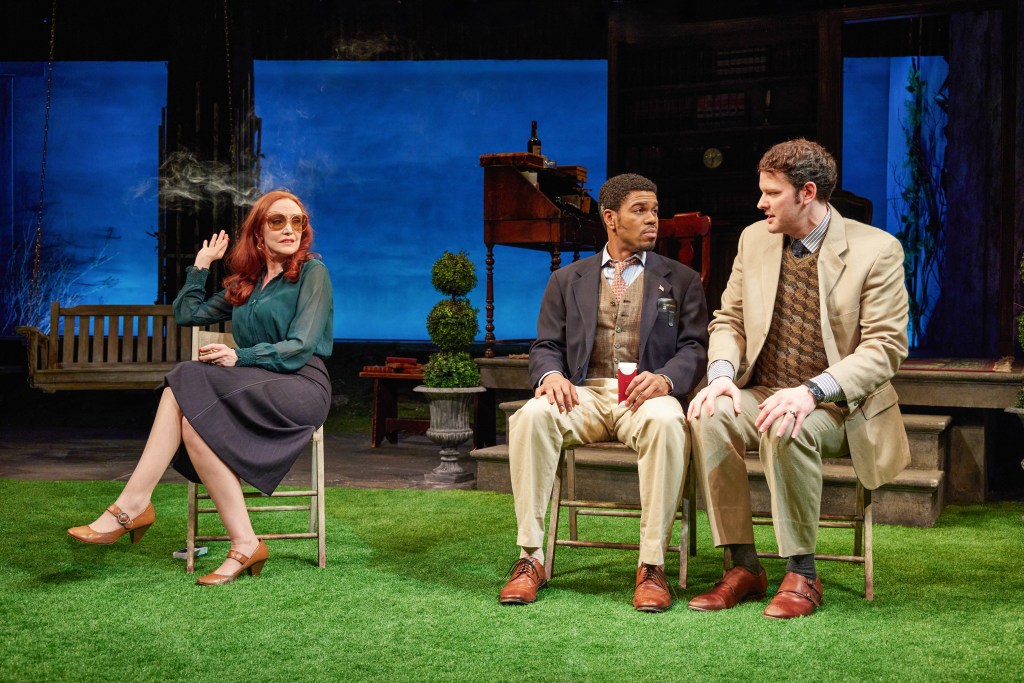
Throughout, Claire’s music can be heard in the background as Alice and Casimir converse with Huffnung, whose research topic is about the impact of the Catholic Emancipation laws on the “ascendant Roman Catholic ruling class and on the native peasant tradition.” In other words Huffnung has come to Ballybeg Hall to research the aristocratic O’Donnells and discover the political, economic and social impact they have had on the villagers.
Interestingly, Eamon sums it up to Huffnung when he ironically answers the question as an insider who knows the Hall and what it is like being married to Alice, one of the former “ruling class.” Alice and her sister Judith were repeatedly sent away from home for their schooling. Alice marries Eamon who, caught up in the Civil Rights action against the English Protestants, loses his job in Ireland and eventually works for the English government in London. Alone most of the day, Alice has become an unhappy, isolated alcoholic. Eamon, whose irony wavers between obvious bitterness and humor tells Huffnung that the O’Donnells have had little or no impact on the local or “native peasants,” of which he numbers himself as one of the classless villagers.

Indeed, noting the shabbiness of the Hall and the problems of the family members, we see the pretension of superiority has long gone. All of them face emotional challenges and need rehabilitation from their oppressive upbringing under their father, Justice O’Donnell who seems to have be a tyrant and unloving bully. We note this from his rants over the monitor and Casimir’s response to his father’s imperious voice.
Judith contributed to causing her father’s first stroke having a baby out of wedlock with a reporter, after joining the Civil Rights fight of the Catholics against the British Protestants. Forbidden to raise her child at home, which would bring shame to the family, she was forced to give him up for adoption; he is in an orphanage. Over the monitor in a senile rant we hear the bed ridden O’Donnell, refer to her as a traitor. Thus, we imagine the daily abuse she faces having to care for her father’s most basic needs, while he excoriates her.
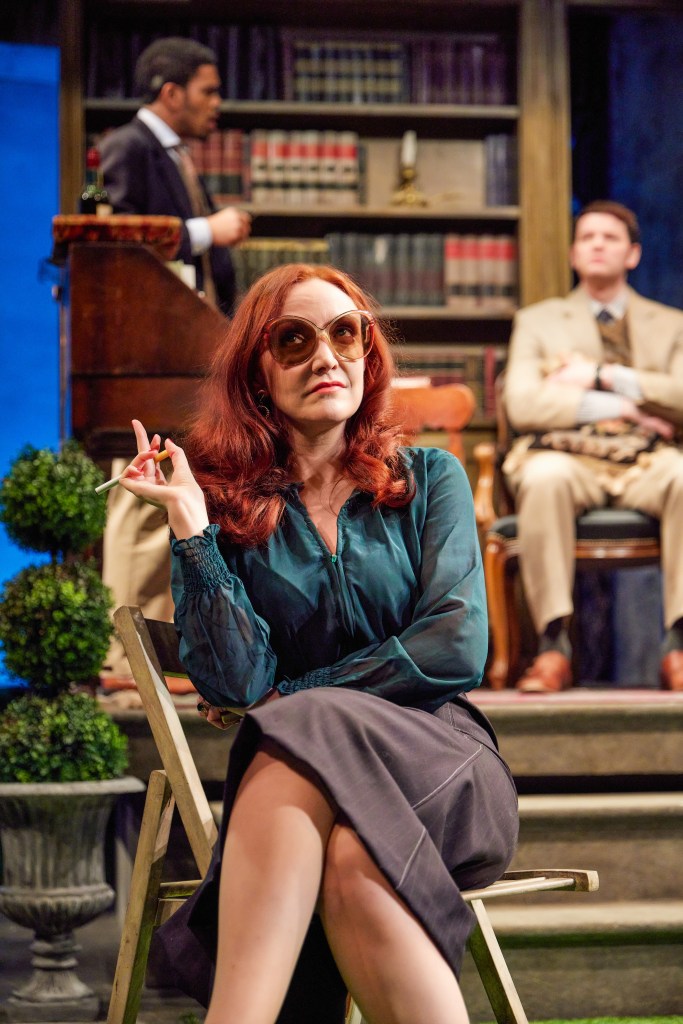
Meg is a depressive on medication who helps around the house, plays classical piano, and plans for her marriage to a man twice her age in the village, a further step down in class status. Desperate to leave, she selects escape with this much older man who has four children. She enjoys teaching piano to them.
Casimir is an individual broken by his father’s tyranny and cruelty. Holcomb’s portrayal of the quirky, strange Casimir is excellent, throughout, but particularly shines when he reveals to Eamon, how Justice O’Donnell’s attitude shattered him. The Justice’s cruel judgments about his only son, are revealed by Casimir toward the conclusion of the play. Ironically, Casimir politely attempts to uplift the family history to Casey’s clear-eyed Huffnung who, tipped off by Eamon, fact checks the details and realizes that Casimir exaggerates with a flourish. Additionally, most of what Casimir shares about his own life is suspect as well, and used to appear “normal,” though he may be gay.
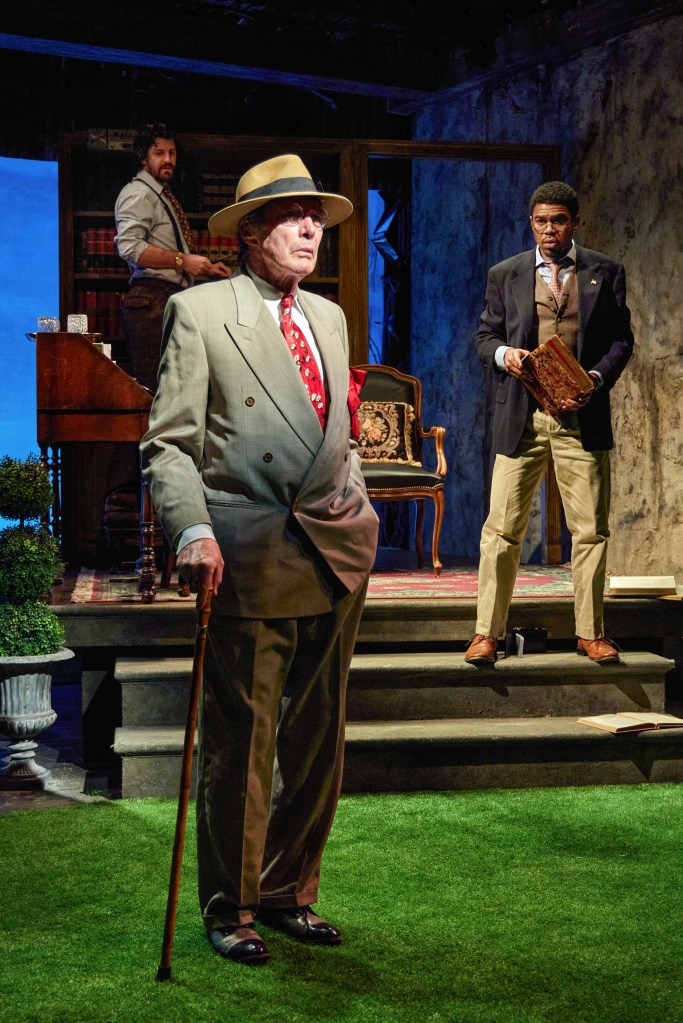
Thus, as Friel unravels the truth about the family, largely through Eamon, we come to realize the term “aristocratic” is a misnomer when applied to them. The noblesse oblige, if it once existed, has declined to mere show. As Casimir attempts to enthrall Huffnung with the celebrated guests who visited the Hall (i.e. Chesterton, Yeats, Hopkins), his claims by the conclusion are empty. In turn Huffnung’s research seems ironic in chronicling the decline of an aristocracy that has self-destructed because it remained isolated and assumed a privileged air, rather than become integrated with the warmth and care of the local Irish Catholics.
The brilliance of Friel’s work and the beautiful direction by Charlotte Moore and work of the ensemble shines in how the gradual expose of this family is accomplished. As the ironies clarify the situation, Friel’s themes indicate how the oppressor class inculcated those who would stoop to their bidding to maintain a destructive power structure which eventually led to their own demise. Of course, Eamon, who is bitter about this, also finds the “aristocracy” enchanting. He wants them to maintain the Great House and not let it go to the “lower class” thugs who will destroy it further, though it is in disrepair and too costly to keep up.

The class subversion is subtle and hidden. What appears to be “emancipation” perhaps isn’t, but is further ruination. How Moore and the creatives reveal this key point is vitally effected.
Thanks to Charlie Corcoran’s scenic design, we note the three levels of the Big House’s interior and exterior where most of the action takes place. David Toser’s costume design is period appropriate. Ryan Rumery & M. Florian Staab’s sound design is adequate. The original music is superb along with Michael Gottlieb’s lighting design. Accordingly, Justice O’Donnell’s entrance is impactful.
This second offering of the Friel Project is a must see. Aristocrats is two acts with one fifteen minute intermission. For tickets go to the Box Office of the Irish Repertory Theatre on 22nd Street between 6th and 7th. Or go online https://irishrep.org/show/2023-2024-season/aristocrats-2/
‘Dublin Carol’ by Conor McPherson, Directed by Ciarán O’Reilly at Irish Repertory Theatre
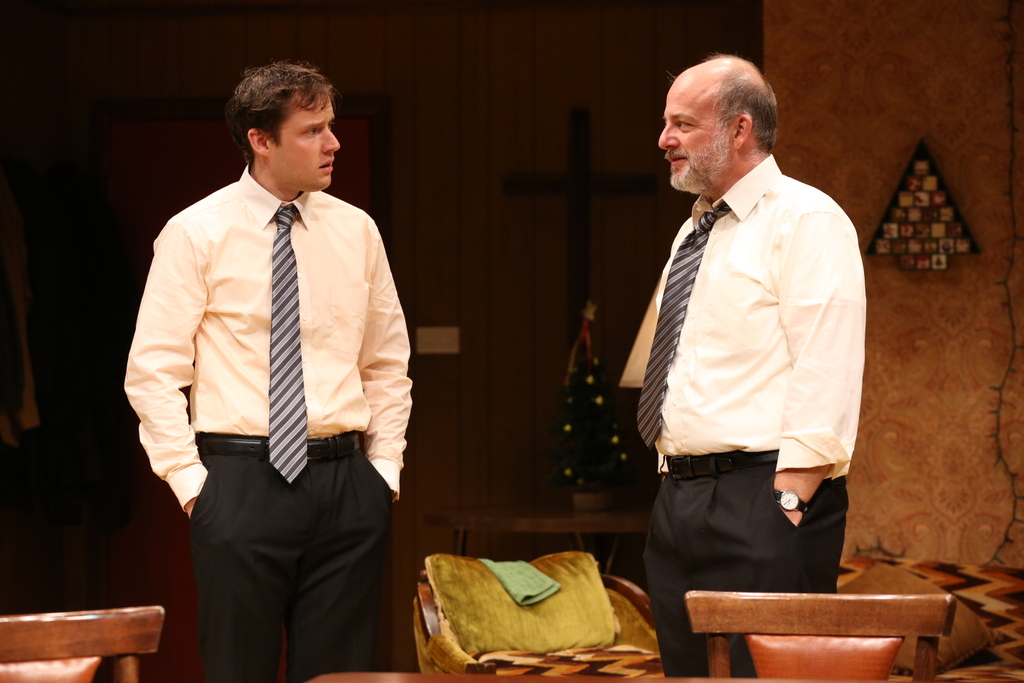
(L to R): Cillian Hegarty, Jeffrey Bean, ‘Dublin Carol’ by Conor McPherson, directed by Ciarán O’Reilly, Irish Repertory Theatre (Carol Rosegg)
Dublin Carol by Conor McPherson directed with just the right tone and irony by Ciarán O’Reilly is a seminal play about the spirit of Christmas that is bestowed upon the principal character John, superbly portrayed by Jeffrey Bean. McPherson chooses this self-hating alcoholic protagonist to reflect humanity’s hope of redemption from broken promises, regrets and soul sins lathered with guilt and remorse.
McPherson’s John, like many, reveals an overarching longing for change from the boredom of self-loathing, loneliness and recriminations. During the course of the play we see how the playwright elucidates that such change never happens quickly, but does come with subtle, gradual almost unnoticeable shifts when least expected. In John’s instance it is the visit from his daughter Mary (Sarah Street) whom he hasn’t seen in ten years that fans the flames that have been ignited by his boss the mortician Noel who saved him from one stage of himself. When she comes to tell him about the condition of his wife, her mother whom he abandoned long ago, the conversation prompts his movement to admit his miserable state when he left the family. He was in hell.

Sarah Street in ‘Dublin Carol’ by Conor McPherson, directed by Ciarán O’Reilly, Irish Repertory Theatre (Carol Rosegg)
Above all McPherson’s work is about love and forgiveness. Such love is given by John’s daughter. And it is an irony that John is so over-bloated with guilt and remorse that he cannot forgive himself and thinks himself completely unworthy of it. But it is her expression of love and respect (she admits she also hates him) that helps him make a final determination. The decision moves him toward a kind and thoughtful resolution with his family which by the end of the play portends a new door will open in John’s life that may lift him up from his self-hatred into self-forgiveness.
Though the setting is Dublin Christmastime, in the office of a funeral parlor where life and death sit side by side, the title references a widow Carol who lived in Dublin that John mentions he had a long-time affair with. The title also alludes to a Carol as a song heralding the good news of the celebration of Christ’s birth. Of course, Christ’s birth symbolizes that redemption, reformation, forgiveness and love are possible for the great and small and even someone as “rotten” as John perceives himself to be.
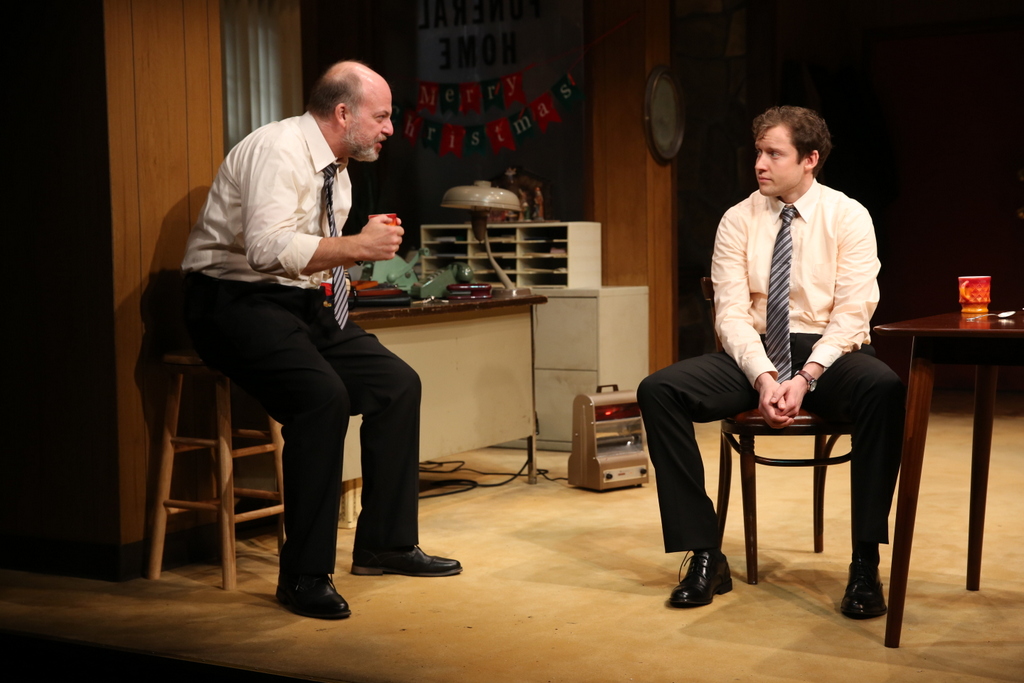
(L to R): Jeffrey Bean, Cillian Hegarty in ‘Dublin Carol’ by Conor McPherson, directed by Ciarán O’Reilly, Irish Repertory Theatre (Carol Rosegg)
The characterizations are drawn clearly and we become engaged in the simple interactions between Mark (Cillian Hegarty) and John in the first segment, John and his daughter Mary in the second and John and Mark in the third. The arc of development grows out of these interactions and the nature of the conversations which become more revelatory and intimate bring about a change in John’s character.
As Mark and John sit down for tea and a respite from their labors assisting Mark’s sick Uncle Noel (a mortician) with the external arrangements of a young person’s funeral while Noel is in the hospital, we first learn about John and a bit about the twenty-year-old Mark. John shares his self-perceptions and generally blames his lack of discipline and care for his family because of alcohol. He enjoys drinking. But when Mark’s Uncle Noel gave him a job to help in the office with the funerals, John’s life improved and he lifted himself up from the bad state he was in when Noel met him.
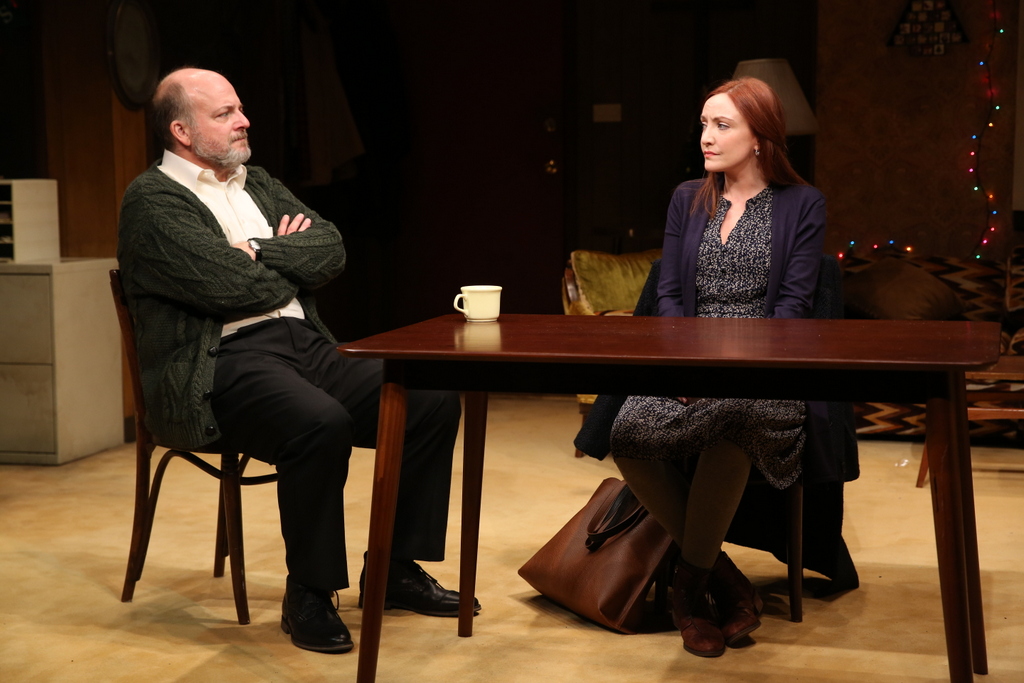
Jeffrey Bean, Sarah Street in ‘Dublin Carol’ by Conor McPherson, directed by Ciarán O’Reilly, Irish Repertory Theatre (Carol Rosegg)
John’s character grows on us because he holds little back and digs down into the depths of his self-loathing in each segment, taking off on a racetrack in his confession and heart-to-heart with daughter Mary to whom he apologizes for his miserable treatment and abandonment of the family. It is clear that there was no physical harm. Indeed, his own father beat his mother and John does not follow in his footsteps. Nevertheless, he lands on the fact that he didn’t stop his father and was a coward and felt self-hatred for selfishly, brutally not intervening because he feared getting beaten along with his mother.
However, even after John apologizes profusely for his behavior to Mary, he knows it isn’t enough. Clearly, he despises himself and wishes he could erase the memory of who he is along with his former identity and behaviors with his family. The self-disgust moves him to say he wishes he had never been born. Of course the more he admits fault, and makes such profound declarations, the more we identify with him and find his authenticity human, real and poignant. Jeffrey Bean is truly adroit in the role. He strikes all the notes clearly. He manifests John’s self-disgust with the nuance that John longs to be a different person, but is afraid he will let himself down by letting his family down once more.

Sarah Street, Jeffrey Bean in ‘Dublin Carol’ by Conor McPherson, directed by Ciarán O’Reilly, Irish Repertory Theatre (Carol Rosegg
For their part Mary and Mark become John’s sounding boards, yet he clearly engages them and asks about their lives. When he discovers the news that Mary brings and the subsequent request that goes with it, the situation becomes a way that he can make up for his behavior in the past. He and Mary confess each other’s faults to one another, an important step toward forgiveness. But can John trust himself to do the right thing and stick to his decision? The irony is this: if he fulfills the request he will have to confront his past with the one he most abused and hurt, his wife from whom he never obtained a divorce. His guilt is overwhelming!
As his daughter leaves with the understanding that John will go with her to visit her mother who is dying, she importunes him not to drink any more and to be ready at a later time when she will drive him to the hospital. Of course, flashing lights go on. It is as if the request to not drink triggers John with perverse reverse psychology. The segment closes leaving John contemplating what to do. To drink? To make it up to his wife, daughter and son? Or just to escape somewhere out of their reach?
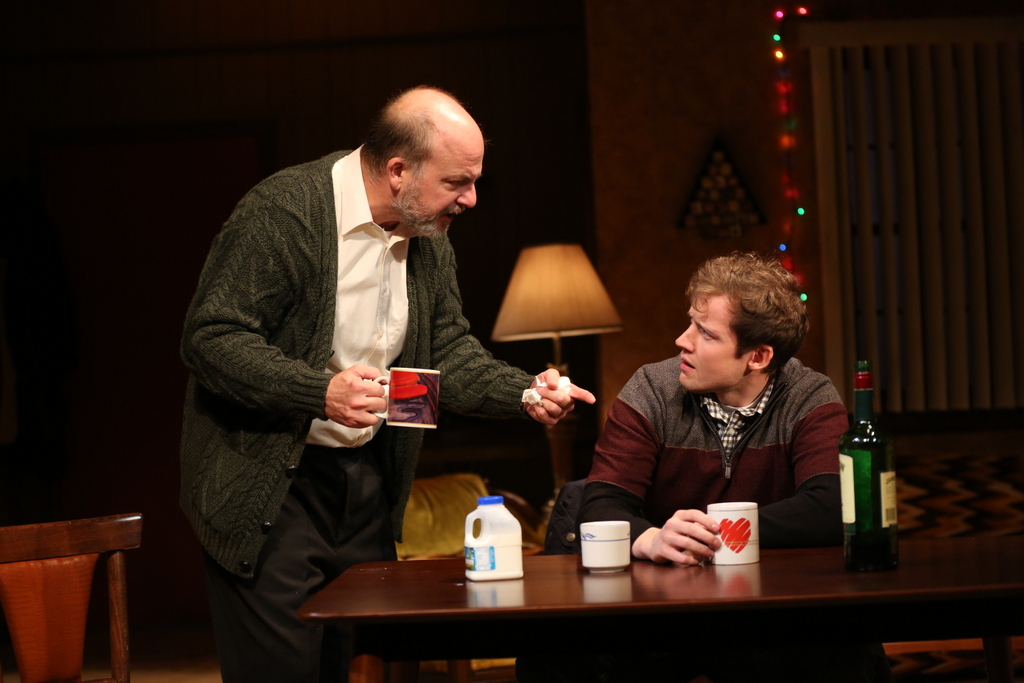
(L to R): Jeffrey Bean, Cillian Hegarty in ‘Dublin Carol’ by Conor McPherson, directed by Ciarán O’Reilly, Irish Repertory Theatre (Carol Rosegg)
At the top of the third segment we discover John caves to self-loathing and guilt. He has been celebrating “Christmas.” Mark interrupts him only to discover John was too overwhelmed with drink to pick up his money at the bank. During the course of their interchange, John lays down a rant which is pure McPherson replete with irony and sardonic humor as he relates how his affair with Carol and her unconditional love drove him to the end of himself and the dregs of barrels of alcohol. At this point it is apparent, especially when he begins to put away the Christmas decorations that he has no intention of making it up to his family or going with his daughter. He is back to square one and will be on another bender and into the abyss without Noel to save him a second time.
McPherson’s characterizations and themes are spot-on. Throughout, this work is filled with dark humor which resonates in truthfulness. And in the hands of Jeffrey Bean guided by O’Reilly, the ironies spill out with fervor, especially in the last section of the play when John attempts to counsel Mark not to feel guilty about ending it with his girlfriend. John’s groveling diatribe about the stages of his drunks is also humorous. But the confession and John’s setting a terrible example for Mark does both characters good. Hearing the pain and misery of the stages of drunkenness would give anyone pause about drinking to oblivion.

Jeffrey Bean in ‘Dublin Carol,’ by Conor McPherson, directed by Ciarán O’Reilly, Irish Repertory Theatre (Carol Rosegg)
The ensemble work is tight and O’Reilly keeps the production resonating with the wisdom and revelations that McPherson suggests in his themes. Kudos to the creative team who bring it all together: Charlie Corcoran (scenic design) Leon Dobkowski (costume design) Michael Gottlieb (lighting design) M. Florian Staab (sound design) Ryan Rumery (original music).
See Dublin Carol for the uplifting performances in this subtle and different McPherson work. It is running at Irish Repertory Theatre (22nd St between 6th and 7th) with no intermission. For tickets and times go to their website: CLICK HERE.
 CAROLE DI TOSTI