Blog Archives
Elevator Repair Service’s ‘Ulysses’ by James Joyce, a Review
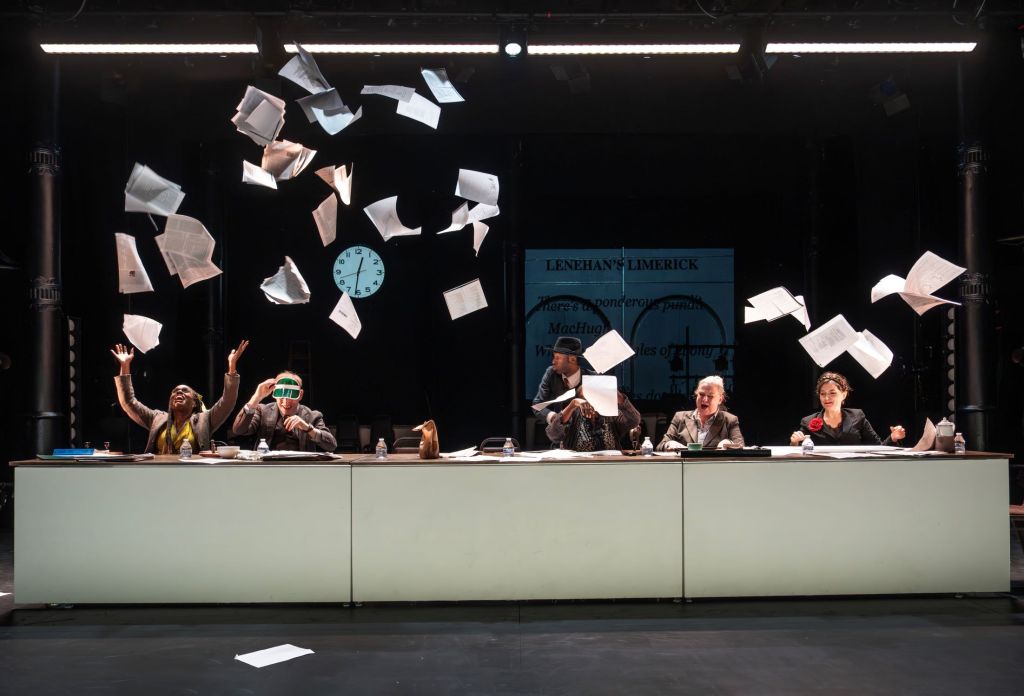
Elevator Repair Service became renowned when they presented Gatz, a verbatim six hour production of F. Scott Fitzgerald’s The Great Gatsby at the Public, as part of the Under the Radar Festival in 2006. Since their remarkable Gatz outing, they have followed up with other memorable presentations. It would appear they have outdone themselves with their prodigious effort in their New York City premiere of James Joyce’s opaque, complicated novel Ulysses. The near three-hour production directed by John Collins with co-direction and dramaturgy by Scott Shepherd, currently runs at The Public Theater until March 1, 2026.
At the top of the play Scott Shepherd introduces the play with smiling affability and grace. He directly addresses the audience, reminding them that “not much happens in Ulysses, apart from everything you can possibly imagine,” and that it happens in the span of a day beginning precisely at 8 a.m,, Thursday June 16, 1904 in Dublin, Ireland. Before Shepherd dons the character Buck Mulligan who appears at the beginning of the novel, he discusses that in the “spirit of confusion and controversy” (labels by critics), Joyce’s day in the life of three characters will be read with cuts in the text. Elevator Repair Service elected to remove Joyce’s text to redeem the time. The cuts are indicated by the cast “fast forwarding” over the narrative.
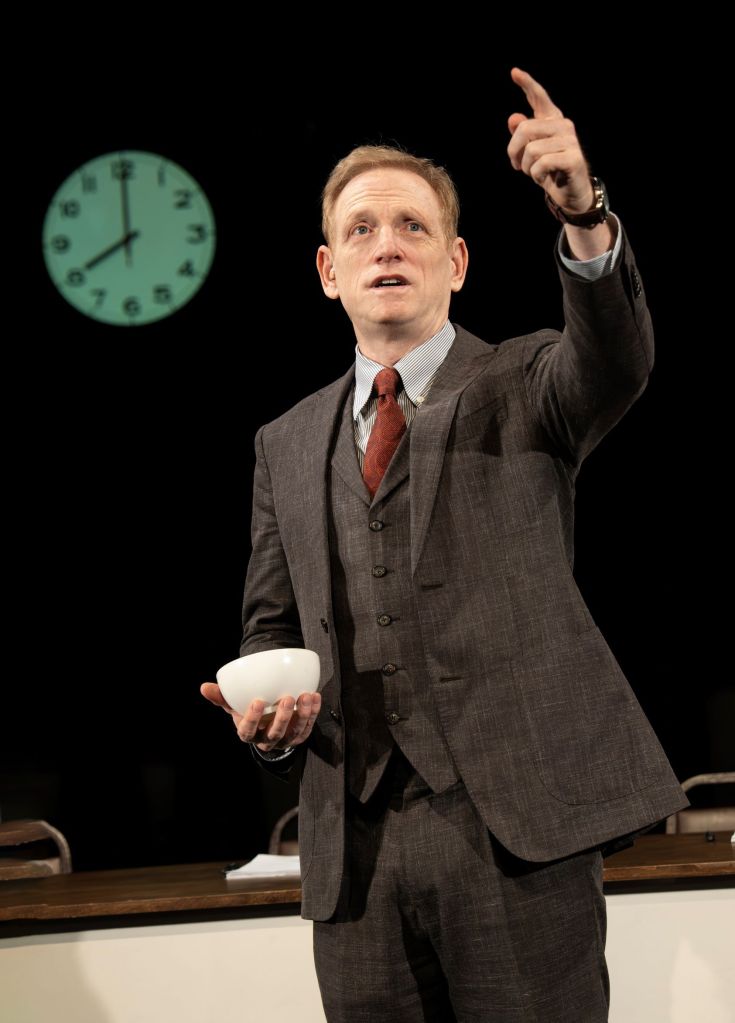
Collins and the creative team cleverly effect this “fast forwarding” with gyrating, shaking movement and action. Ben Williams’ design replicates the sound of a tape spinning forward. To anyone who may be following along with their own copy of the novel, the “fast forward” segments are humorous and telling. However, the cuts pare away some of the details and depths of character Joyce thought vital to include in his parallel of Dublin figures with the most important characters of the Odyssey: home returning hero Odysseus, long-suffering wife, Penelope, and warrior son, Telemachus.
After Shepherd’s introduction, Ulysses moves from a sedentary reading with multiple actors into a fully staged and costumed production as it progresses through the day’s events principally following Stephen Dedalus (Chisopher-Rashee Sevenson), who represents Telemachus, Leopold Bloom (Vin Knight), as Odysseus, and Molly Bloom (Maggie Hoffman) as Penelope.
The events illuminate these characters, and the cast superbly theatricalizes the novel’s humor, whimsy and farce. Some scenes more successfully realize Joyce’s playfulness and wit better than others. For example when Bloom decides to go to another pub after seeing the sloppy, gluttonous patrons of the first bar, the cast revels in portraying the slovenly, grotesque Dubliners. slobbering over their food. Additionally, the scene where Bloom faces his deepest anxieties shows Knight’s Bloom giving birth to “eight male yellow and white children.” Director Collins hysterically stages Bloom’s “labor” with Knight in the birthing position, legs apart, as Shepherd “catches” eight baby dolls he then throws to the attending cast members.
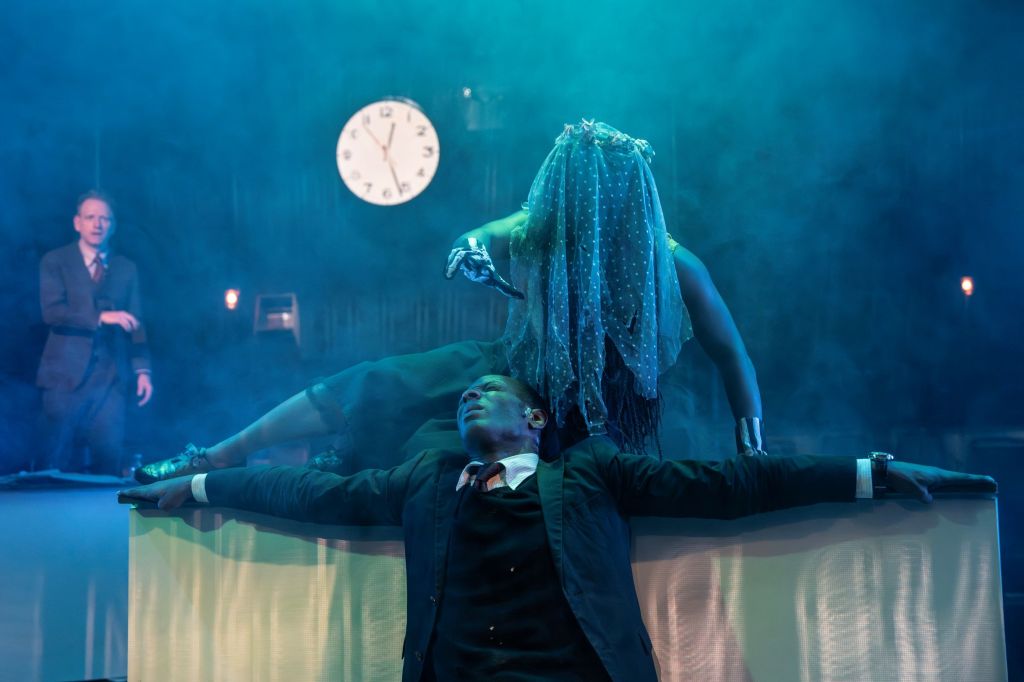
As costumes and props are added to the staging, we understand Leopold Bloom’s persecution as an outsider and a Jew. Also, wee note Stephen Dedalus as the writer/poet outsider who eventually joins Bloom, a father figure, who Bloom takes home for a time until Dedalus leaves to wander the night alone. Chistopher-Rashee Stevenson portrays the young Dedalus, a teacher whose unworthy friends lead him to drink and misdirection. Dedalus grieves his recently deceased mother and toward the end of the play has a nightmare visitation by her frightening, judgmental ghost.
For those familiar with the novel, the cast becomes outsized in rendering the various Dubliners that Knight’s Bloom and Stevenson’s Dedalus encounter. The dramatization is ultimately entertaining. We identify with Bloom as an Everyman, an anti-hero, who tries to get through the day in peace, while dismissing the knowledge that his wife Molly cuckolds him. Though he hasn’t been intimate with her since their baby Rudy died, he is unsettled that she conducts an affair with Blazes Boylan in their marriage bed at home. Somehow, Bloom has discovered that Molly who is a singer will be meeting with Boylan at 4 p.m. that afternoon. On his journey through the day he avoids confronting Boylan as they carry on with their activities around Dublin.
The ironic anti-parallel to the Odyssey, on the one hand, is that Molly Bloom is far from a Penelope who physically remained loyal to Odysseus, where Molly has an affair. On the other hand, late at night as Bloom sleeps with his feet awkwardly next to her face, we understand that Molly still loves Bloom and is emotionally and intellectually loyal. In her stream of consciousness monologue, seductively delivered by Maggie Hoffman, Molly arouses herself with memories of her relationship with Bloom when they were first together. It was then that she transferred a seed-cake from her mouth to his, sensually expressing her love.
Collins’s staging of the scene is humorous and profound. It defines why Molly has been present in Bloom’s consciousness throughout his strange journey traversing the streets of Dublin until he eventually finds his way home to her bed later that evening.
For those unfamiliar with Joyce’s novel, they will find the events and people a muddled hodgepodge that clarifies then becomes opaque, like a light switch turning on and off. Characters swap places with each other as seven actors take on numerous parts in a sometimes confusing array. Only Bloom, Dedalus and Molly stand out, true to Joyce’s vision for Ulysses for they embody Joyce’s themes about life. Thus, Bloom and Dedalus move through the day with flashes of brilliance, revelation, connection, irony and dread. Their reactions interest us. And Molly Bloom in her ending monologue puts a capstone on the vitality and beauty of a women’s perspective, as she experiences the sensuality and power of love for Bloom through reminiscence.
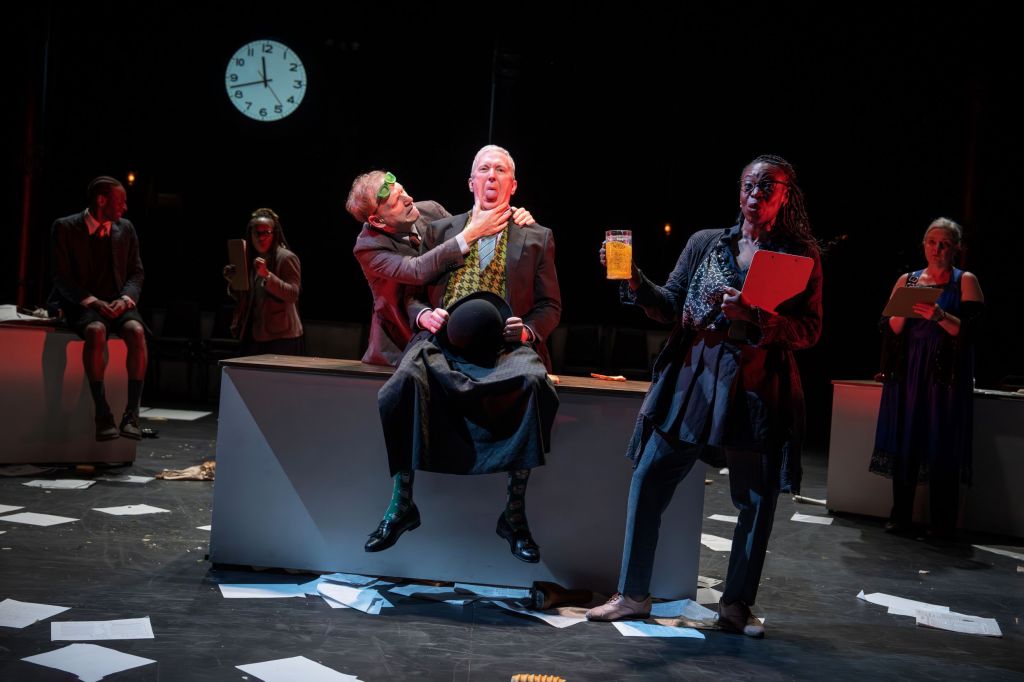
The costume design by Enver Chakartash reflects the time period with a fanciful modernist flourish that gives humor and depth to the personalities of the characters. For example Blazes Boylan (Scott Shepard) who has the affair with Molly wears a straw hat, outrageous wig and light suit that aligns with his jaunty gait. The scenic design by DOTS is minimalist and functional as is Marika Kent’s lighting design and Mathew Deinhart’s projection design. Most outstanding is Ben Williams’ acute, specific sound design which brings the scenes to life and follows the text adding fun and delight.
By the conclusion the audience is spent following the challenge of recognizing Joyce’s Dublin and the three unusual intellectuals and artists who he chooses to explore. Elevator Repair Service has elucidated the novel beyond what one might endeavor to understand reading it on one’s own. Importantly, they’ve made Ulysses an experience to marvel at and question.
Ulysses runs 2 hours 45 minutes with one intermission at the Public Theater through March 1, 2026. https://publictheater.org/productions/season/2526/ulysses
‘Much Ado About Nothing,’ Directed by Kenny Leon, Powerful Messages for an America in Crisis
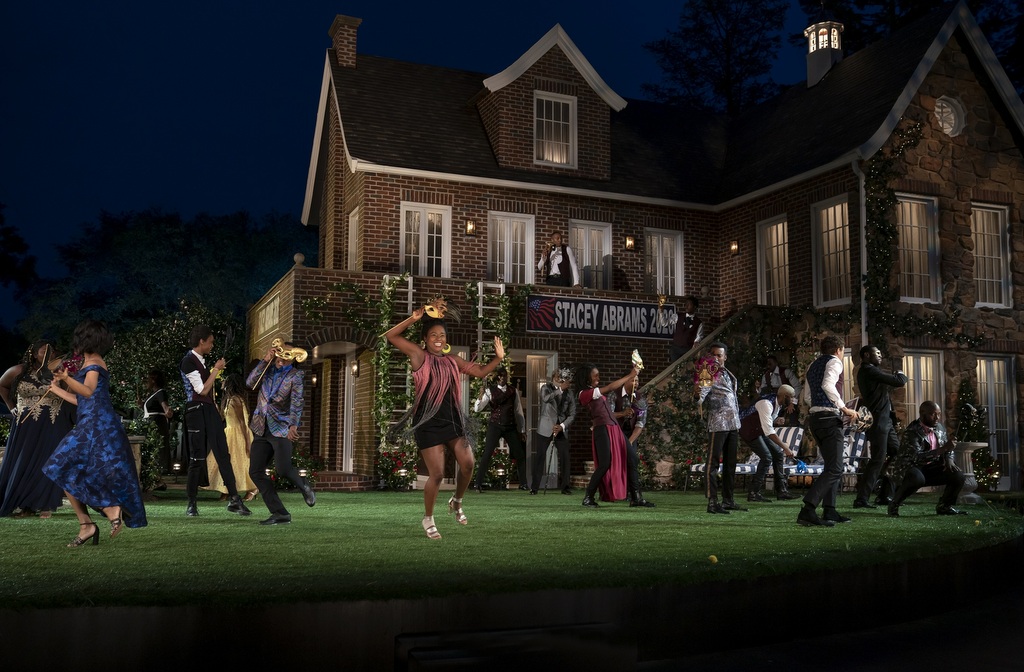
The ensemble in William Shakespeare’s Much Ado About Nothing, directed by Kenny Leon, Shakespeare in the Park, Public Theater (Joan Marcus)
From Emilio Sosa’s vibrant costumes to Beowulf Boritt’s impeccable set design (a landscape of roses, luscious, ripe-for-the-plucking peaches on the Georgia peach tree, the luxuriant front lawn, the Georgian-styled, two-story mansion-representative of an orderly, harmonious, idyllic world), this update of Much Ado About Nothing resonates as an abiding Shakespearean classic. Director Kenny Leon’s vision for the comedy with threads of tragedy evokes a one-of-a-kind production with currency and moment. This is especially so as we challenge the noxious onslaught of Trumpism’s war on democratic principles, our constitution and the rule of law.
Directed with a studied reverence for eternal verities, Leon, with the help of his talented ensemble, carves out valuable takeaways. They focus on key elements that gem-like, reflect beauty and truth in Shakespeare’s characterizations, conflicts and themes. By the conclusion of the profound, spectacular evening of delight, of sorrow, and of laughter, we are uplifted. As we walk out into a shadowy Central Park, our minds and hearts have been inspired to shutter fear and cloak our souls against siren calls that would lure us from reason into irrational insentience and hatred.

Grantham Coleman (foreground) Hubert Point-Du Jour, ensemble, William Shakespeare’s Much Ado About Nothing, directed by Kenny Leon, Shakespeare in the Park, Public Theater (Joan Marcus)
Kenny Leon has chosen for his setting a wealthy black neighborhood of Atlanta, Georgia, whose Lord of the realm, Leonato (Chuck Cooper’s prodigious, comedic and stentorian acting talents are on full display), shows his political persuasion with prominent signs on the front and side of his house that read, “Stacey Abrams 2020.” The impressive “Georgian-style” mansion which could be out of East Egg, the upper class setting of The Great Gatsby by F. Scott Fitzgerald, is ironic with the addition of its advocating support for Abrams.
With this particular set piece, we note Leon’s comment on black progress toward a sustained economic prosperity amidst a backdrop of oppression, if one considers the chicanery that happened during Abrams’ run for the 2018 gubernatorial election. It also is reminiscent of the house of the racist, misogynistic villain of Gatsby, the arrogant, presumptuous Tom Buchannan and other such elites (i.e. wealthy conservatives), who give no thought to destroying “people and things” of the underclasses with their policies. Yet Lord Leonato and his friends and relatives are not turned away from justice and empathy for others. This, the director highlights through this Shakespearean update, whose characters seek justice and truth and encourage each other to abide in kindness, love and forgiveness.

(L to R): Margaret Odette, Tiffany Denise Hobbs, OLivia Washington, Danielle Brooks William Shakespeare’s Much Ado About Nothing, directed by Kenny Leon, Shakespeare in the Park, Public Theater (Joan Marcus)
Leon approaches his vision of justice through love by weaving in songs and music. At the outset Leon incorporates such music with a refrain sung by Beatrice (the inimitable Danielle Brooks):
“Mother, mother, there’s too many of you crying, brother, brother, brother, there’s far too many of you dying. You know we’ve got to find a way to bring some lovin’ here today.”
As Beatrice finishes the refrain by asking “What’s happening?” her ensemble of friends which include Hero (Margaret Odette), Margaret (Olivia Washington), and Ursula (Tiffany Denise Hobbs), sing the patriotic ballad “America the Beautiful” as a prayer and inspiration for the country to follow its ideals of “brotherhood from sea to shining sea.” This is not a war-like unction, it a solicitation for peace and goodness. Clearly, the women importune God to “shed His grace” on America. One infers their feeling as an imperative for political and social change hoped for, in a true democracy which can guarantee economic equality and justice.
The arrangement of “America the Beautiful” is lyrical and soulfully harmonious. As the women sing this anointed version they transform the text from hackneyed cliche, long abandoned by politicos and wealthy Federalist Society adherents, and uplift it with profound meaning. They encourage us toward authentically pursuing justice, brotherhood and unity in love and grace, elements which are sorely tried during the central focus of Much Ado About Nothing, during Hero’s unjust slander and infamy until she receives vindication.

(L to R): Chuck Cooper, Erik Laray Harvey in Much Ado About Nothing, by William Shakespeare, directed by Kenny Leon, Shakespeare in the Park, The Delacorte Theater, Public Theater (Joan Marcus)
After the women finish singing, the men march in from the wars. Instead of arms, they carry protest signs decrying hate, uplifting love, proclaiming the right of democracy. Instead of a warlike manner they are calm. The theme of justice and the imperative for political and social brotherhood prayed for in the previous song is reaffirmed as we understand what the “soldiers” are fighting for. In Leon’s genius it is a spiritual warfare, a battle for the soul of American democracy. Leonato appreciates their endeavors and invites them to stay with him for one month to be refreshed and gain strength before they go back out for another skirmish against the forces of darkness.
The music and songs composed by Jason Michael Webb strategically unfold throughout the development of the primary love story between Leonato’s daughter, Hero (the superb Margaret Odette) and family friend Claudio (the excellent Jeremie Harris). And they follow to the conclusion with the funeral and redemption of Hero and her final marriage and dual wedding celebrations with the parallel love story between Beatrice and Benedick. The songs not only illustrate and solidify the themes of love, forgiveness, and the seasons of life, “a time for joy, a time for sorrow,” they unify the friends and family with hope and happiness through dancing and merriment. The melding of the music organically in the various scenes throughout the production is evocative, seamless and just grand.

(L to R): Margaret Odette, Jeremie Harris, Billy Eugene Jones, Chuck Cooper in William Shakespeare’s ‘Much Ado About Nothing,’ directed by Kenny Leon, Shakespeare in the Park (Joan Marcus)
After the men arrive from their protest, the director cleverly switches gears and the tone moves to one of playful humor and exuberance. With expert comic timing, Brooks’ Beatrice wags about Benedick in a war of sage wits and words. Coleman’s Benedick quips back to her with equal ferocity that belies both potentially have romantic feelings but must circle each other like well-matched competitors enjoying their “war” games as sport. They offer up the perfect foils to a plot their friends later devise using rumor to get Beatrice and Benedick to fall in love with each other in a twisted mix up that is hysterical in its revelations of human pride and ego.
The relationship between Beatrice (the marvelous Danielle Brooks) and Benedick (Grantham Coleman is her equally marvelous suitor and sparring partner) is portrayed with brilliance. The couple serves their delicious comedic fare with great good will and extraordinary fun. Their portrayals provide ballast and drive much of the forward action in the delightful plot events. Danielle Brooks gives a wondrously funny, soulfully witty portrayal. As Benedick, Grantham Coleman is Brooks’ partner in spontaneity, LOL humor, inventiveness and shimmering acuity.
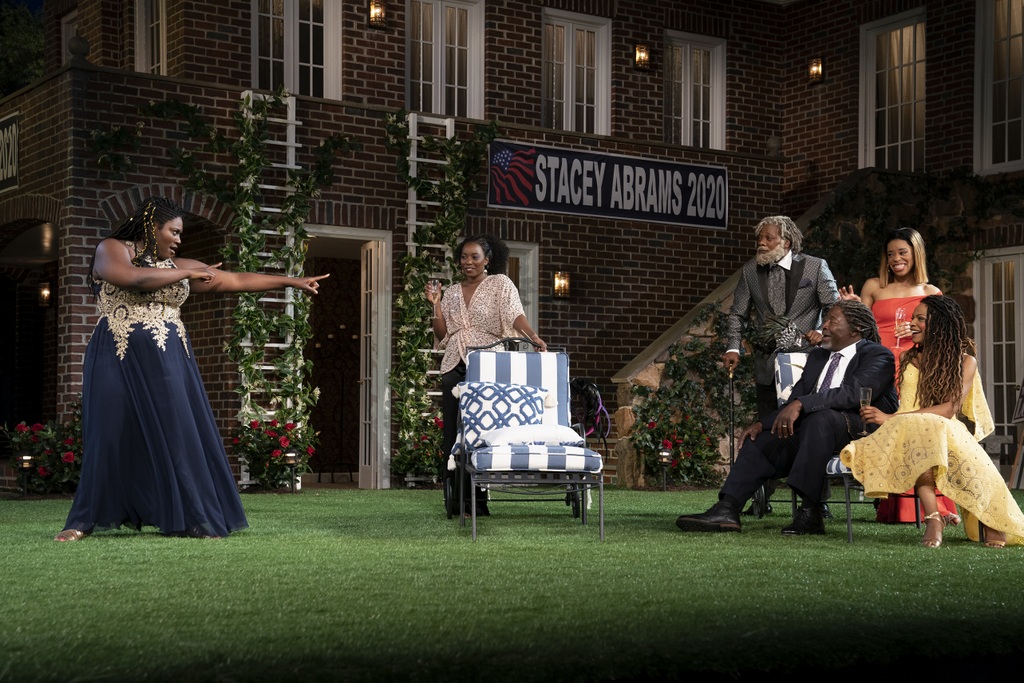
(L to R): Danielle Brooks, Olivia Washington, Erik Laray Harvey, Chuck Cooper, Tiffany Denise Hobbs, Margaret Odette, William Shakespeare’s ‘Much Ado About Nothing,’ directed by Kenny Leon, Shakespeare in the Park, Public Theater (Joan Marcus)
Various interludes in Act I are also a time for male banter about the ladies Hero and Beatrice and the love match with Hero that friend of the family Don Pedro (Billy Eugene Jones) effects for his friend Claudio (Jeremie Harris). The scene between Benedick, Claudio and Don Pedro is superbly wrought with Benedick’s insistence he will remain a bachelor. The audience knows he “doth protest too much” for himself and for Claudio. The pacing of their taunts and jests is expertly rendered. The three actors draw out every bit of humor in Shakespeare’s characterizations.
Into this beauteous garden of delight, exuberance and order creeps the snake Don John (Hubert Point-Du Jour), brother of Don Pedro, and his confidante and friend Conrade (Khiry Walker). Though they support the fight for democracy, Don John is engaged in sub rosa familial warfare. We move from the macrocosm to the microcosm of the human heart which can be a place of extreme wickedness as it is with Don John who quarreled with his brother Don Pedro, his elder and does not forgive him. Don Pedro extended forgiveness and grace to Don John, which Don John feels forced to accept though he is not happy about it. Indeed, he is filled with rancor and seeks revenge, to abuse his brother and anyone near him, if the opportunity presents itself which it does.

(L to R): Danielle Brooks, Grantham Coleman in William Shakespeare’s ‘Much Ado About Nothing,’ directed by Kenny Leon, Shakespeare in the Park (Joan Marcus)
The conversation between Conrade and Don John is intriguing for what Shakespeare’s characterizations reveal about the human condition, forgiveness and remorse. Indeed, Don John is reprobate. Whether out of jealousy or the thought that he has done no wrong, he feels bullied to accept his brother’s public forgiveness. The theme “grace bestowed is not grace received unless there is true remorse,” is an important message highlighted by this production through the character of evil Don John who eschews grace. Indeed, extending grace and forgiveness to such individuals is a waste of time. No wonder Don John would rather “be a canker in a hedge than a rose in his grace.”
Trusting Conrade, Don John admits he is a plain-dealing villain. When he learns of Claudio’s marriage, he plots revenge on Don Pedro by attacking his best friend and smearing Hero’s integrity and fidelity to Claudio. The jealous Claudio is skeptical, but later “proof” during a duplicitous arrangement with an unwitting Margaret, Claudio becomes convinced that Hero is an unfaithful, unchaste philistine.
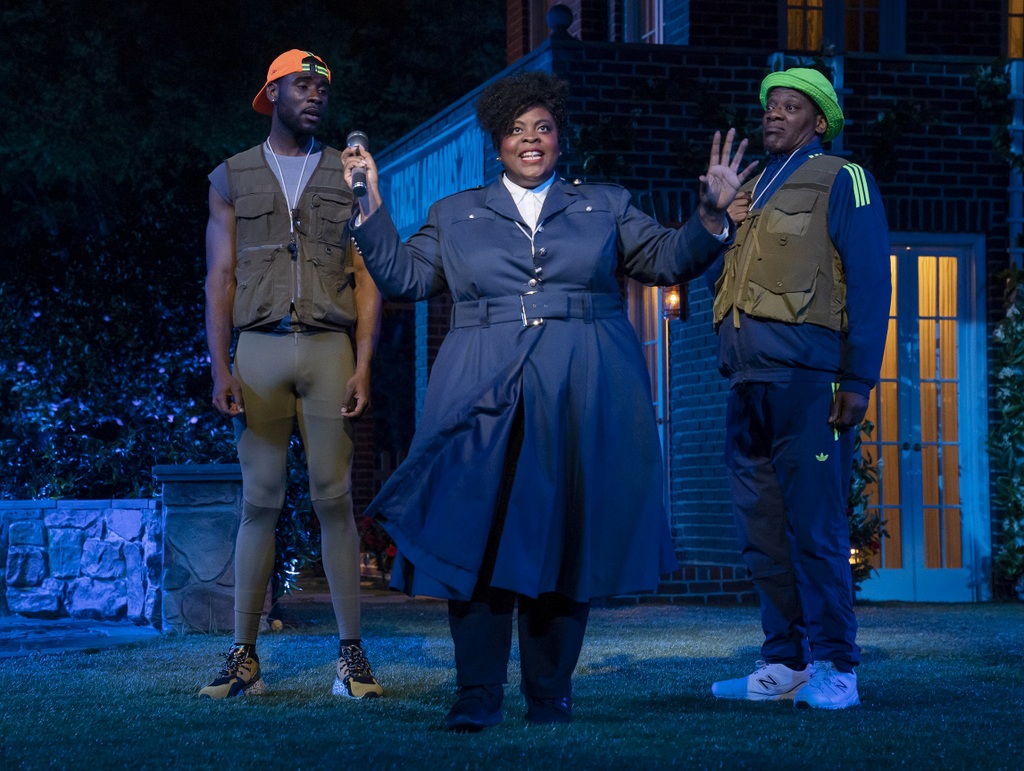
Lateefah Holder (center) and ensemble in William Shakespeare’s ‘Much Ado About Nothing,’ directed by Kenny Leon, Shakespeare in the Park (Joan Marcus)
Claudio’s jealous behavior and immaturity believing Don John turns goodness into another wickedness as evil begets evil. As they stand at the alter Claudio excoriates Hero as an unfit whore to the entire wedding party. Hero, injured unjustly by Don John’s wicked lie and Claudio’s extreme cruelty, collapses. In a classic historical repetition, once again misogyny raises its ugly head and condemns the innocent Hero destroying her once good name. Benedick, the uncanny Friar and Leonato stand with Hero. This key turning point in the production is wrought with great clarity by the actors so that the injustice is believable and it is shocking as injustice always is.
Thankfully, The Friar’s (a fine Tyrone Mitchell Henderson) suggestion to return Hero to grace and redemption in Claudio’s eyes by proclaiming her death to bring her again to a new life is effected with power. Finally, we appreciate a cleric who bestows love not condemnation or a rush to judgment! The emotional tenor of the scene is in perfect balance. Odette and Harris are heartfelt as is Cooper’s Leonato. The scene works in shifting the comedy to tragedy and of uplifting lies believed in as facts with wickedness overcoming love and light. Once again we are reminded that Shakespeare’s greatness is in his timelessness; that if allowed the opportunity for vengeance and evil, humanity will corruptly, wickedly use lies cast as facts to dupe and deceive the gullible, in this case Claudio.

(L to R): Grantham Coleman, Jeremie Harris, Margaret Odette, Danielle Brooks (center) ensemble, in William Shakespeare’s ‘Much Ado About Nothing,’ directed by Kenny Leon, Shakespeare in the Park (Joan Marcus)
I absolutely adore how the truth comes to light, through the lower classes represented by Dogberry (a hysterical Lateefah Holder) and her assistants who are witnesses to Don John’s accomplices to nefariousness. I also appreciate that all the villains in the work admit their wrongdoing; it is a marvel which doesn’t always occur the higher the ladder of power and ambition one ascends. But this is a comedy with tragic elements, thus, evil is turned to the light and Beatrice and Benedick the principle conveyors of humor are lightening strokes of genius which soothe us to patience until justice arrives right on time.
I also was thrilled to see that the remorseful, apologetic Claudio willingly accepts Hero’s recompense (Leon has Hero dog him in the face) as she unleashes her rage at his unjust treatment. These scenes of redemption and reconciliation ring with authenticity: Cooper, Odette and Harris shine.
The celebrations, masked dance, marriage between Hero and Claudio, Hero’s funeral and the final marriages are staged with exceptional interest and flow; they reveal that each in the ensemble is a key player in the action. The choreography by Camille A. Brown and the fight direction by Thomas Schall are standouts. Kudos also goes to those in the creative team not previously mentioned. Peter Kaczorowski’s gorgeous lighting design conveys romance and subtly of focus during the side scenes; Jessica Paz’s sound design is right on (I heard every word) and Mia Neal for the beautiful wigs, hair and makeup design receives my praise.
Leon’s Much Ado About Nothing is one for the ages. It leaves us with the men doing warfare for the soul of democracy leaving Leonato’s ordered world of right vs. wrong where the right prevails. Once again soldiers fight the good fight and go out to resist and stand against the world of “alternate facts” where chaos, anarchy, and the overthrown rule of law abide (at this point) with impunity. Leon counsels hope and humor; progress does happen, if slowly.
This production’s greatness is in how the director and cast extract immutable themes. These serve as a beacon to guide us through times that “try our souls,” and they encourage us to persist despite the dark impulses of money-driven power dynamics and fascist hegemony that would keep us enthralled.
I saw Much Ado About Nothing in a near downpour then fitful stop and start to continual light rain during which no one in the audience left. Despite this the actors were anointed, phenomenal! I would love to see this work again. I do hope it is recorded somewhere. It’s just wow. The show runs until June 23rd. You may luck out with tickets at their lottery. Go to their website by CLICKING HERE.
 CAROLE DI TOSTI