Blog Archives
Nathan Lane, Laurie Metcalf Bring Out Truths for Our Time in an Ageless ‘Death of a Salesman’ (9 Tony nominations)
Considered Arthur Miller’s masterpiece of the average guy as a tragic figure, Death of a Salesman has been a hard sell for me as Miller’s greatest play. However, Joe Mantello’s searing direction that teases out incredible performances from Nathan Lane (Willy Loman), Laurie Metcalf (Linda Loman), Chrisopher Abbott (Biff) and Ben Ahlers (Happy), made me a convert. Presented on the cavernous stage of the Winter Garden Theatre in its sixth Broadway revival, the Loman family’s psychological travails between reality and hopeful dreams unfold their flawed humanity with pathos until August 9, 2026.
This magnificent revival in Mantello’s expansive vision conveys the characters as middle class archetypes of American citizens that are manufactured, used up and spit out by a devouring corporate culture, obsessed by success, money and status as definitions of power and greatness (“the American Dream”). Industrialization, production and “progress” are the means used to propagandize and process worker-citizens away from an appreciation of their soul worth and self identification as valuable to themselves and their families.
To underscore this overarching theme of the Lomans snared by this cultural processing with the use of the American Dream to drain their hopes, keep them ensnared and perpetuate the elusive lies of easy prosperity inferred by Willy’s Uncle Ben-Jonathan Cake (you walk into a jungle and bring out diamonds), Mantello uses a stylized set design superbly realized by Chloe Lamford. Additionally, the sound design by Mikaal Sulaiman, haunting music by Pulitzer Prize-winning composer Caroline Shaw, and lighting design by Jack Knowles beautifully carry Mantello’s dark, foreboding insights which the superb ensemble enlivens in a production whose like won’t be seen again.
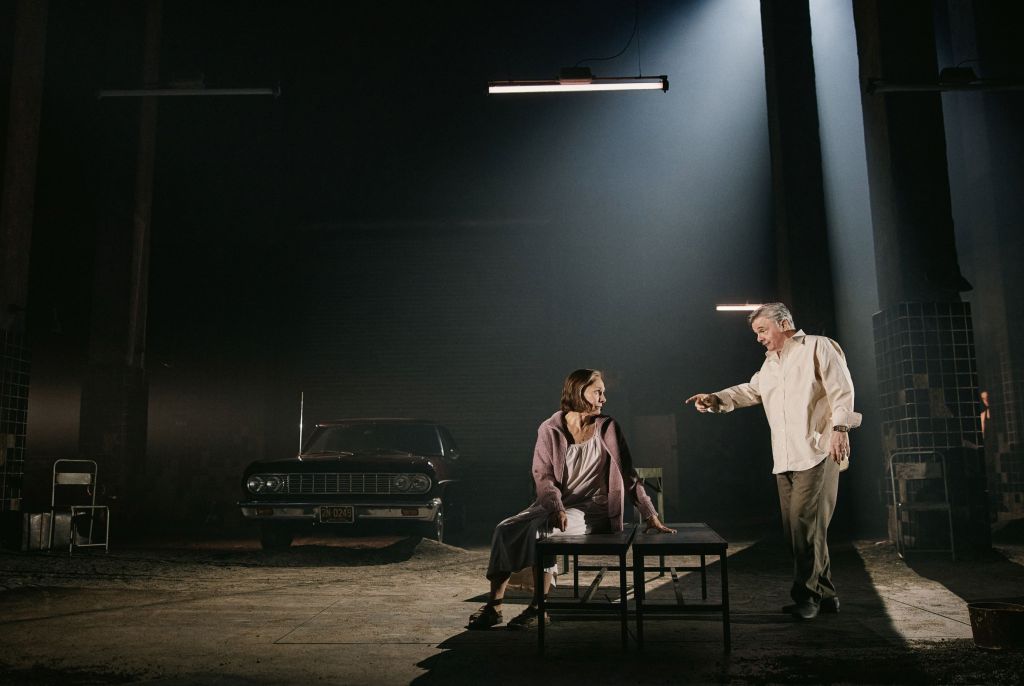
This production of Miller’s Salesman is perfectly synchronized to reflect citizens in our country, currently under siege from the very forces which isolate the Lomans from helping each other. Set adrift in misery, loneliness, distraction and despair, they have little recourse or salvation except delusions, hallucinations and denial. Even a form of success is never enough as suggested by Ahlers’ Happy, who references a prosperous boss who builds an estate but “doesn’t have the peace of mind to live in it.”
The symbol of what made America great, the car (automobile production and its attendant feeder industries, oil, gas, rubber, etc.), becomes that which Willy chooses as his place to die. Mantello features Willy’s car as ever-present and onstage throughout. The car is where Willy spent most of his life alone, traveling through New England with his dreams, and longing of returning home to see his sons, chiefly Biff who he lives his successes through until Biff has a breakdown. At the play’s beginning it also becomes his place of terror, of failure, of disorientation where he can no longer survive for any length of time on a road trip. Finally, he converts it to his way out of a tormenting hellish life he can’t bear, that promises more hope for his family in his death.
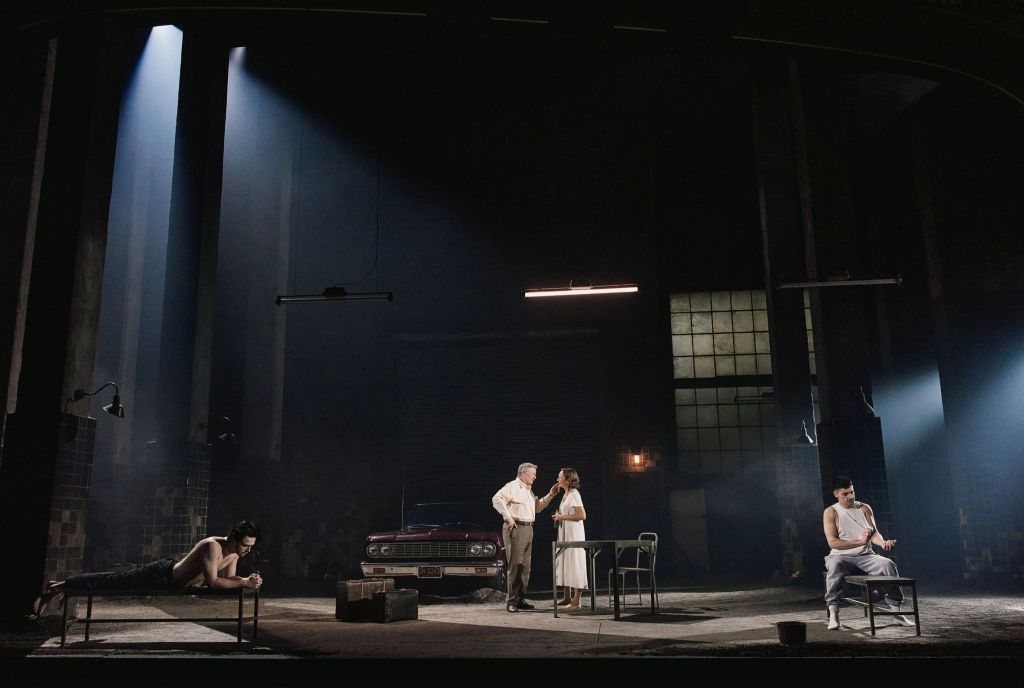
The play opens as Lane’s Willy, exhausted and broken down, returns from his aborted sales trip and drives the car onstage into the humongous, grey space that is the Loman’s stylized home. Unlike previous revivals, this place is nothing like an American home the bank would hold in a mortgage. It is similar to an empty factory or warehouse with rectangular, peeling tiled columns and no vibrant colors. It is dimly lit with a grid of dirty window panes on the backstage wall that barely let light in.
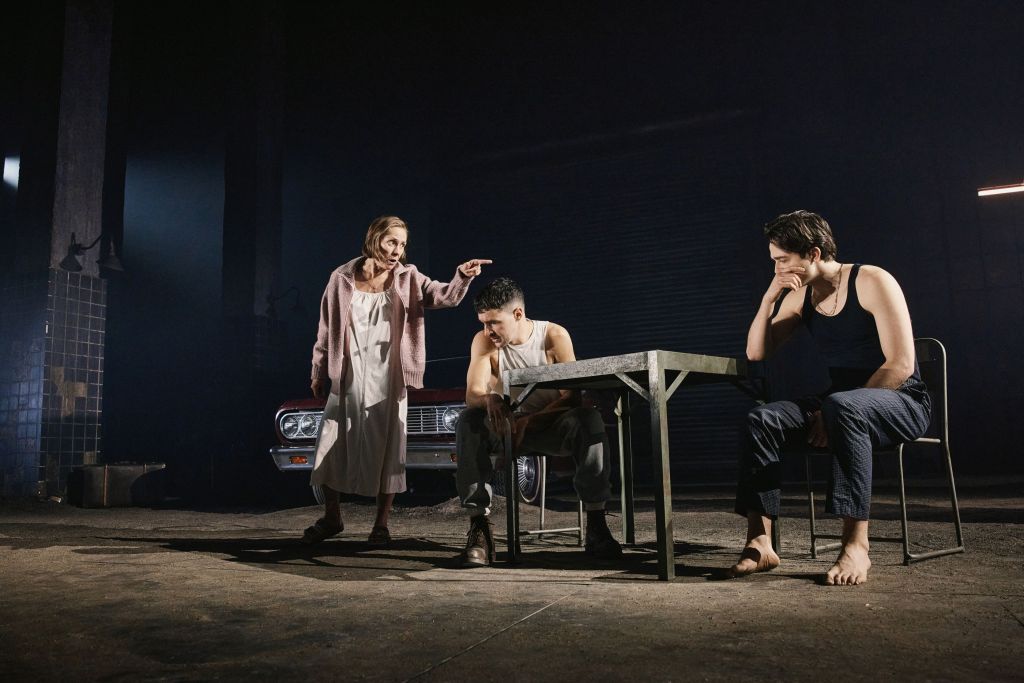
The space is symbolic and interpretive. Far stage left is the basement with Willy’s possible instrument of suicide, the gas water heater, and downstage left is the bit of soil where Lane’s Willy hopefully plants seeds he will never see grow. The characters remain onstage, moving around uncomfortable, factory-type, metal “furniture” to define areas they set up mostly away from each other. They sometimes become inconsequential dim shadows when they don’t speak and other family members do.
Spot lit when there are interactions is Mantello’s approach. But for their interactions darkness and isolation surround them. As spots come up on the initial scene between Willy and Linda when she asks why he came back home, Biff and Happy each lie on a bench on opposite sides of the stage in their ersatz beds and bedrooms, as their parents talk “downstairs.” The spots illuminate the life and interaction of Linda and Willy to a break point, then the darkness encroaches. The symbolism is affecting and effective, revealing the disjointedness of this family, their fears, their isolation, their solitary struggles, their inability to communicate with efficacy to bring about their listener’s understanding toward change.
Willy’s dire emotional and psychic state which impacts the family is also symbolized with the set when the characters move as if in timeless space, like Uncle Ben-Jonahan Cake-who floats onstage and off, as his words float in and out of Willy’s mind. Initially, he uses Ben to inspire him, but also his words and values are a truncheon that Willy uses to bludgeon himself for his failed life. There are also the recriminating memories of guilt that devastate him and push him toward self-annihilation provoked by grown up Bernard (Michael Benjamin Washington) who asks what happened in Boston, the turning point after which Biff and Willy are separated from each other by a gulf of lies and pretenses to protect Linda and damn each other, .
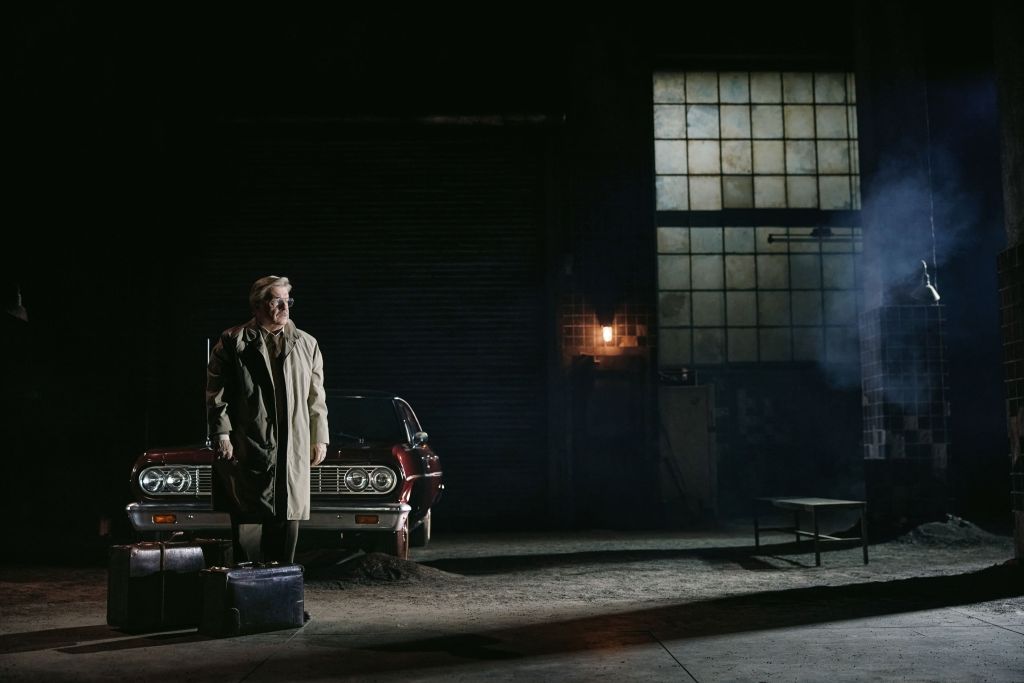
Importantly, Mantello/Lamford and the creative team have created an environment of bleakness and gloom removing any sense of warmth or comfort that a homely kitchen set or living room would suggest. Indeed, Willy and his family move in this towering oppressive, dark space that crushes them but for their connection to each other, which is their real and lasting hope, if they could see it and give each other more kind words and love instead of recriminations. However, even when they argue, insult, indict or chide each other as the glorious Metcalf does in a moment-to-breathtaking-moment take down of Biff, then Happy, her scorching speeches, one about how they left Willy alone babbling in the restaurant, are better than the silent, darkness above, behind and around them.
Mantello/Lamford also use the car to travel through time into the past. For example, one of Willy’s comforting reminiscences is when Young Biff (Joaquin Consuelos) and Young Happy (Jake Termine) follow Willy’s instructions to simonize, shine and buff the car. It is the family’s prize possession that helps provide Willy’s means of support and allows them to go to Ebbets Field on a celebratory day. It represents Willy’s pride in Biff’s scholarship success, as he stands on the roof of the car, the lighting in a golden bronze to family cheers on game day. Happy, happy recollection when Willy is their fine father, Biff has the world at his feet, and Linda looks on her brood “pleased as punch,” a successful mother and wife. Even their giving neighbor Charley (the fine K. Ttodd Freeman) comes out to tease them on this greatest of days for Biff and Willy.
Lane convinces us that Willy is who he claims he is, until he isn’t. Out of the remembrances into the gloom of grey reality he tells his sons, “the woods are burning,” and Linda tells the incredulous Happy and anger-suppressing Biff their dad is dying. With a raw fierceness and edgy emotional plea, Metcalf’s Linda tells Biff and Happy that they can’t just come to visit her, because she loves Willy. “He’s the dearest man in the world to me.” Metcalf’s Linda means it and because of her strength of character and force of will, we take a second look at Willy and see him through her eyes with poignance, and weep for this desolate family.
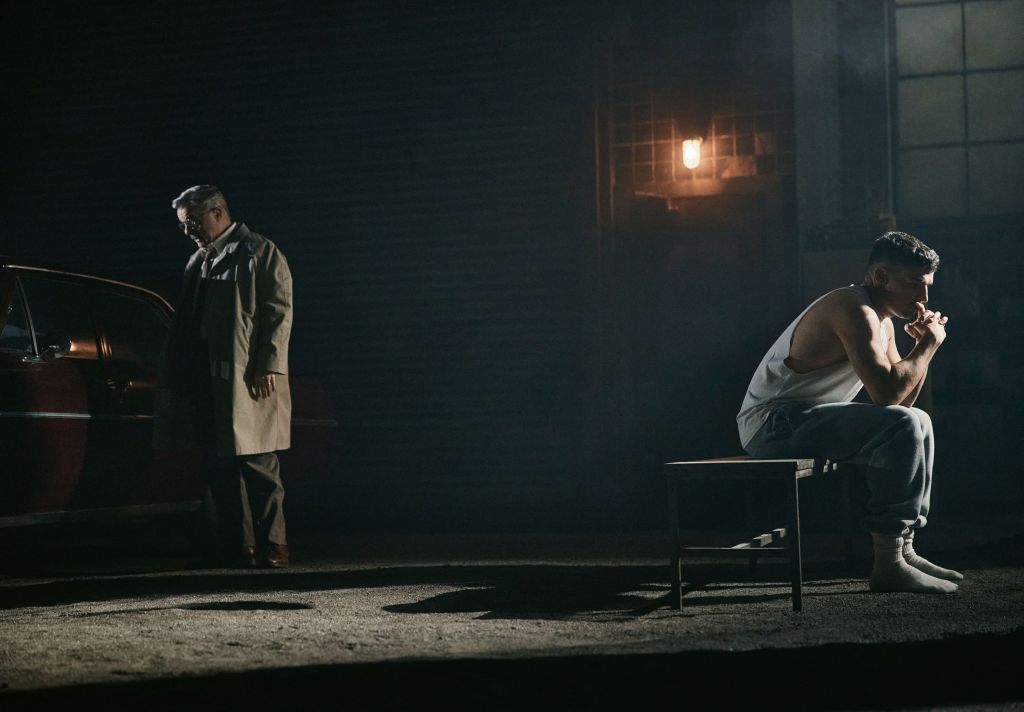
As the play progresses, Miller via Mantello reveals, the reminiscences are in fact hallucinations that Willy uses to torment himself when Biff visits. Willy’s hallucination in the restaurant after his sons desert him is guilt-laden. He relives Biff catching him with a woman and calling him a liar. Willy knows he let his son down, but he can’t admit it and will never forgive himself for it, turning psychically sick. After that incident in Boston Biff and Willy can’t have a heart to heart. Even toward the conclusion when Biff tells his father he will never be the man Willy wants him to be, Willy can’t hear him and misunderstands.
It’s a superb theatrical moment between Lane and Abbott, who passionately steps into the heartfelt, truthful Biff, releases his anger and turns to his father. Willy, still lost, conflating past and present, incapable of recognizing Biff’s truth proclaims,”He cried to me.” In the final most dangerous of Willy’s hallucinations, Cake’s Ben agrees with Willy that Biff will be magnificent with twenty-thousand to back him. Lane’s portrayal of Willy humanizes him and makes him identifiable.
As the second brother given short shrift by the family, Ahlers Happy repeats himself to get attention and uplift Linda. His, “I’m gonna get married, mom,” is as plaintive a cry as any grown manchild’s cry is, yearning for recognition and love but feeling he is incapable of receiving it. Ahlers’ Happy is endearing and charming in a standout portrayal, I haven’t seen before. Still carrying the American Dream to “make it” after seeing what happened to his brother and father, we note his denial like Linda’s, as the inevitable comes and brings her a terrible freedom.
Death of a Salesman runs 2 hours, 50 minutes with one intermission at the Winter Garden Theater through August 9, 2026. salesmanbroadway.com.
‘Titus Andronicus’ Patrick Page is Mesmerizing, Heartbreaking, Over-the-top
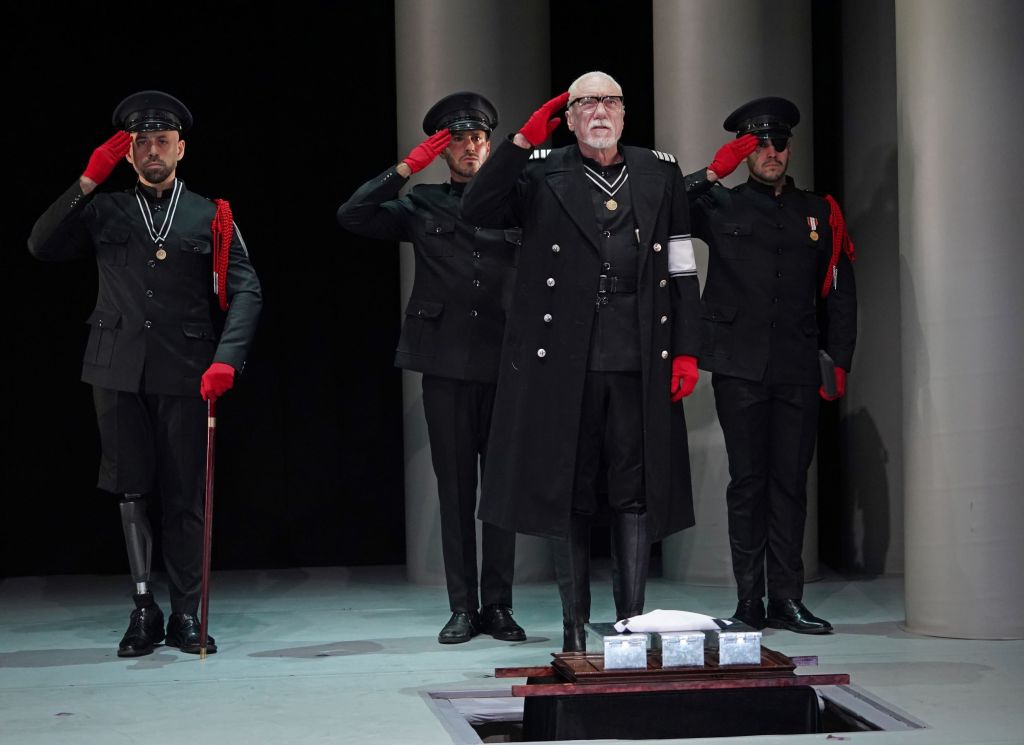
William Shakespeare’s Titus Andronicus comes with a warning label about the bloodshed and violence in this profound, incredibly acted Off-Broadway production at Pershing Square Signature Center. As I was watching the visceral, gut-wrenching performances of Patrick Page’s Titus Andronicus and Olivia Reis’ portrayal as Lavinia, Andronicus’ treacherously abused daughter, I thought of the brutal, unjustifiable bombing of women and children in Gaza, Israel. However, the difference of watching reports via screens from the safety of one’s sofa versus watching fictional live-action bloodshed onstage seems moot. One requires imagination to understand what is happening that media doesn’t show: the eviscerated bodies, the scattered arms and legs of blown up children. That horror compared to immersing oneself in stage acting with the well timed bursting of fake blood capsules during a fight or murder scene? Violence and murder are inhumane. Blood and gore in fictional drama loudly points to the heinous, triggering realities of war going on today.
Thus, the themes of William Shakespeare’s goriest tragedy are impactful. But one must understand that the result of Titus Andronicus‘ gore is tragic. Murder, treason, blood-lust, vengeance all turn the warriors’ swords against their own entrails. This is especially so when the ones maimed and brutalized are offspring the enemies leverage to emotionally annihilate their parents. There’s nothing like watching one’s future inheritance and legacy wiped out and being unable to find peace afterward. That is the ultimate tragedy in the magnificent Titus Andronicus produced by Red Bull Theater at the Alice Griffin Jewel Box Theatre. Titus Andronicus has been extended through May 3, 2026.
At the top of the play victorious, intrepid Roman general Titus Andronicus returns from the wars in triumph, but having paid a stiff price. During the battles he sacrificed three of his sons for Rome. However, he did succeed in bringing Rome the spoils of his win. Titus presents these captives to Rome: Tamora (Francesca Faridany) the Queen of Goths, her ambitious warrior/lover Aaron the Moor (McKinley Beelcher III), and her three sons played by Jesse Aaronson, Blair Baker, Adam Langdon. Their captivity in chains gives more light to shine Rome’s mighty, justified conquests.
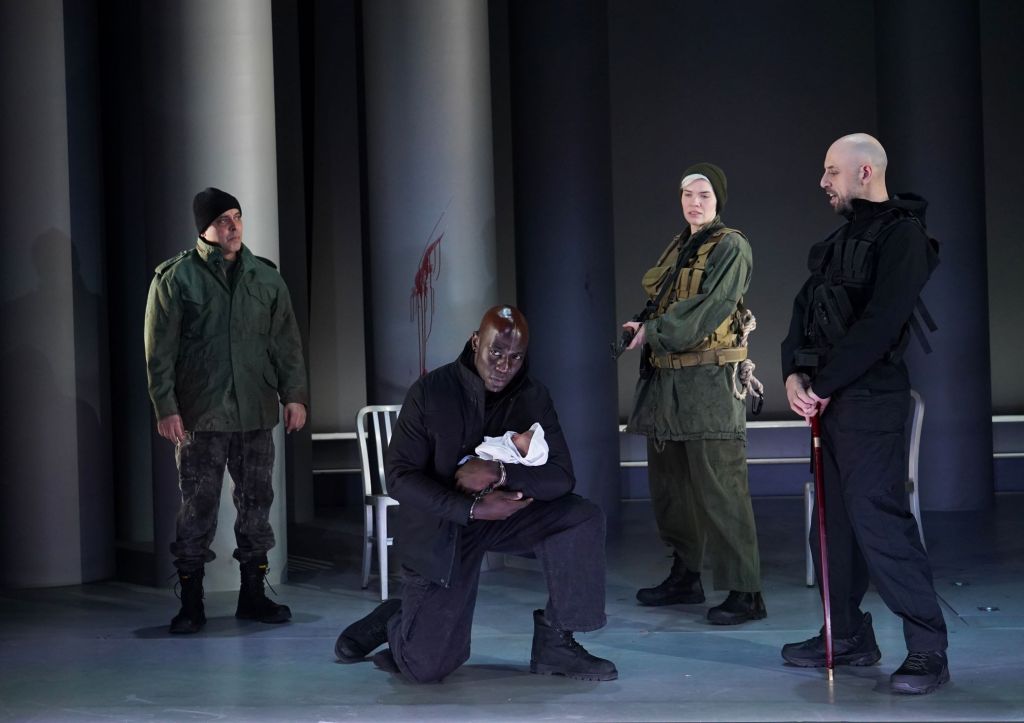
During the Andronici family reunion which includes Titus, Titus’ Tribune sister Marcia (Enid Graham), his daughter Lavinia and his three living sons, played by Anthony Michal Martinez, Zack Lopez Roa and Anthony Michael Lopez, they perform burial rites. Additionally, a ritual of recompense is made of Goth blood for Andronici blood. Lucius (Anthony Michal Lopez) states, “Give us the proudest prisoner of the foe, that we may hew his limbs and sacrifice his flesh to these our fallen brothers.” It is an act to appease the deceased son’s spirits who were killed in the war with the Queen of the Goths, and to stop any “prodigies” from being visited upon the Andronici.
If bloodletting is ever fair, the balance is that three were lost and the blood of one is the equivalent of three. This is a ritual always performed on the battlefield and to Tamora’s pleadings, Titus asks her to pardon him. His sons perform the ritual killing of Alarbus without rage, but as a tradition. One could argue this duty is more than fair, a viewpoint Titus holds, but Tamora does not.
In truth, Titus should have killed all those he captured, instead of just Tamora’s oldest, her firstborn son. Dismissive of Roman tradition, the Goth Queen sees this act as a gruesome provocation-killing her son in front of her. She is a Goth; she doesn’t “get” Roman traditions or values. She dispenses with the mercy Titus bestows on her, the Moor, and her sons by letting them live and roam free to do damage to Titus and his family. Titus’ mercy is a brutality from Tamora’s perspective. And Titus doesn’t remind her of the fact that she and the others live by his grace. In tragic blindness she refuses to acknowledge or see his act as just and a Roman tradition (I read the script’s stage directions about killing her son as ritual.). And Titus is completely blind to her ferocity and the possibility that she will get vengeance on him and his entire family when the opportunity arises. She has chosen not the way of life bestowed by Titus’s grace, but of vengeance, bloodshed and death. Tragically, blindly Titus lets down his guard and opens the door to Tamora’s hell with fate’s help.
In their blindness lies their downfall.
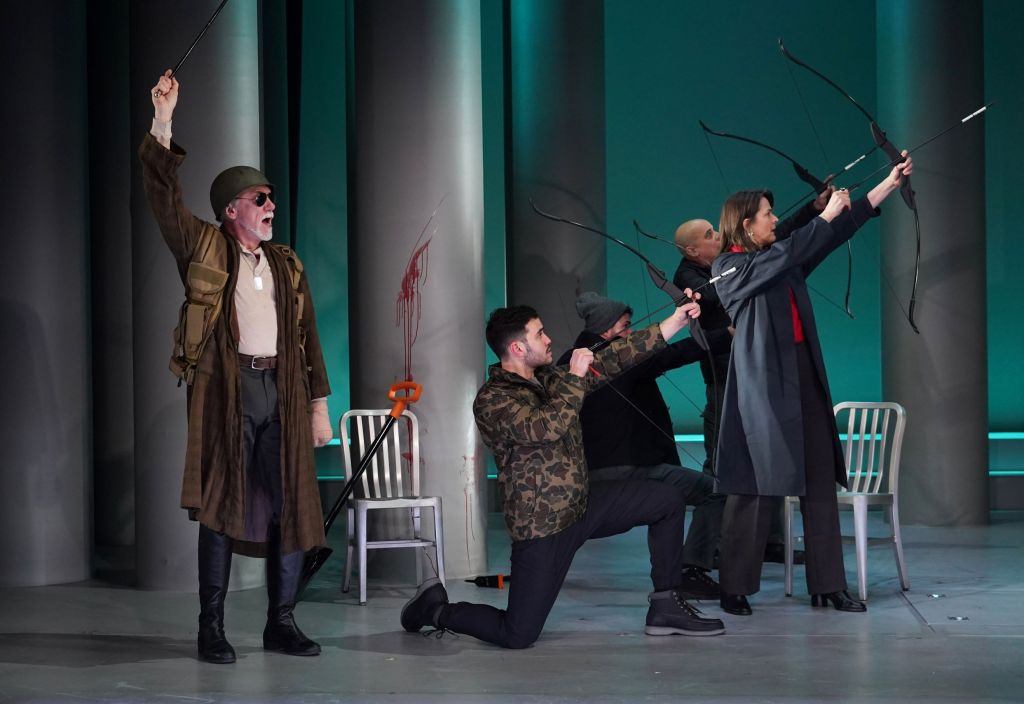
Most probably if Tamora had won, Titus and his sons would have been killed. We note in her future actions and those of Aaron, her lover, what she would have done. Humiliated, a captive in chains, a loser, she chooses to feel provoked by her eldest son’s sacrifice, not acknowledging the lives his blood saves. As they take her and the captives off, she rants, beats her breast and waits for a time of revenge saying, “I’ll find a day to massacre them all.”
Unfortunately, that day comes sooner than later. It is hastened by Titus’ choice not to be the Emperor of Rome, though the people want him, and though Lavinia’s betrothed Bassianus (Howard W. Overshown), Saturninus younger brother, supports him with his troops and followers. Why? Romans are not idiots. Saturninus, the late emperor’s eldest son is unlikable, silly, pompous and incompetent. They want Titus, but Saurninus, the child, protests, not caring about Rome, but caring about himself. In fact Titus would make the better leader proven by his track record of service, leadership competence and popularity. (The parallels with the US are staggering)
Titus makes his ultimate mistake not taking the emperor-ship, stating he is too old and that he wants to enjoy peace after forty years of wars. Titus persuades the people to accept Saturninus as the head of Rome. Under his rule, all hell breaks loose and chaos and violence are unleashed by this terrible decision. Mathew Amendt portrays Saturninus as an infantile, asinine, petulant fool easily duped by one who ends up with a ruling partner as unfit as he, but worse-the bloodthirsty Tamora. Not able to have Lavinia, though Titus suggests it to her, then relents when she says she is betrothed to Bassianus, Saturninus elevates the bloodthirsty Tamora to the throne as his queen. There, she is all about peace and unity. Titus doesn’t see her coming. Nor does he see coming her instrument of vengeance, the gleeful, sneaky Aaron who suggests rape, mutilation and torture for Lavinia to Tamora’s slothful sons. He also suggests a means of impunity so she will never confess the crimes nor bring about her own healing.
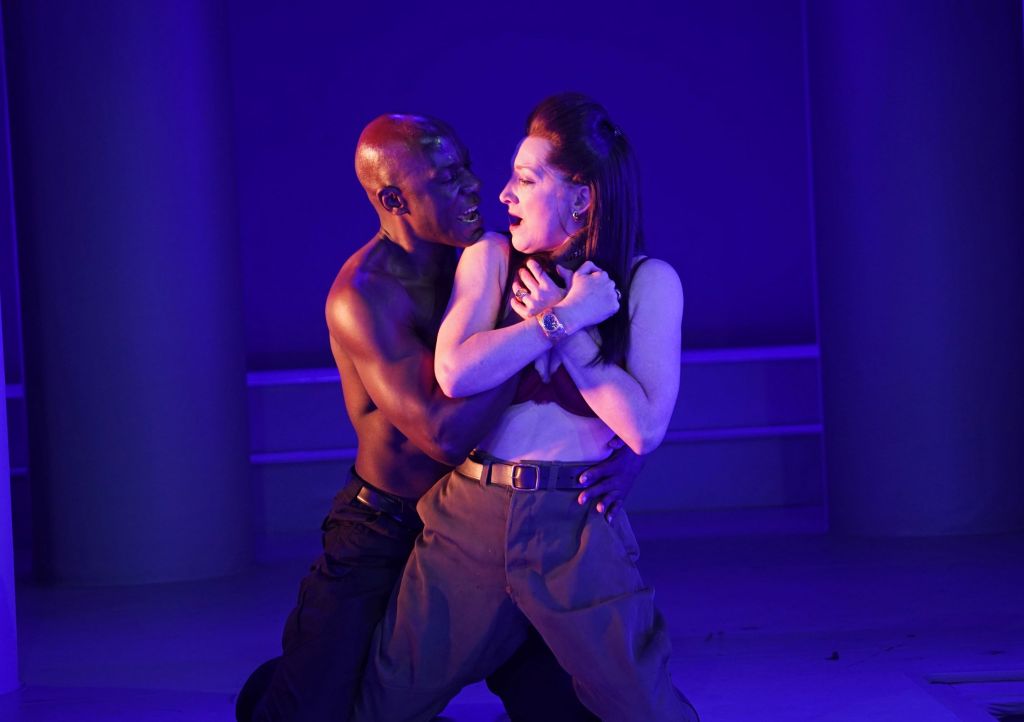
Jesse Berger’s staging works, though the tone of the tragedy shifts off its axis in Act II from sorrowful horror to an outrageous, sometimes weirdly comedic tone. In the last scene of Act I Page’s Titus experiences the full effects of Tamora’s trickery and the loss of two of his sons. When Page’s Andronicus beholds what the spirit of vengeance and hate have done to Lavinia, he is broken. With breathtaking, magnificent, touching grief, he cannot absorb what an anonymous “they” have done to his daughter. Reis’ pitiable cries at the heinous treatment during her violent struggle with the heartless Aaronson’s Chiron and Langdon’s Demetrius (both excellent) are symbolically representative. She is the archetype of women’s soul murder and it is clear why men use rape and mutilation as the defining weapon of war. In the scene Reis conveys what every woman in that position feels. Beyond words.
Page and Reis are incredible together. Page’s Titus slides into madness with laughter and screaming, the extreme emotions of a father unable to protect his daughter or help her. As the destroyed Lavinia, Reis’ cries in echoing response to stage father Page are shattering. One cannot help but weep for empathy at their loss of identity, beauty and valor.
Of course Act II is almost anticlimactic as we wait for the coming revenge on one who chooses vengeance and death rather than life and peace when she vows to “massacre them all.” In that, too, Tamora fails for Lucius lives to become emperor welcomed by both Romans and Goths alike with Tribune Marcia serving his mission of peace, ending the cycle of revenge. Belcher III is superb. As Aaron he speaks passionately to save the son birthed by Tamora who in humiliation gives up the Black child to be killed to hide her shame. The speech softens Aaron’s Iago-like wickedness as the engineer of Tamora’s revenge. His humanity extends to his innocent son, whom he forgives, as he wallows in despair and condemnation.
When Page’s Titus sits his guests down to dinner dressed in a chef’s hat and outfit grinning from ear to ear, he holds Tamora’s sons flesh pie. The laughter from the audience is a confusion of emotions: gladness that he is holding Tamora accountable with a just revenge; empathy that anyone would be driven to this. In fact laughter at serving up Tamora’s sons in a meat pie is all that is left of his sanity.
By this juncture Titus has released all his grief and sorrow. Life has become absurd. What’s left when nothing’s left? Page who worked on the script and did a masterful job sluicing it to crystal clarity reveals the descent of a noble individual who was better at fighting wars, than living in peace. His act of killing Lavinia is an act of mercy. If she could do it herself, she would. But the sons have chopped off her hands so she can’t reveal her abusers. Titus knows her yearning for death like he knows his own soul. He lovingly kills her ending her torment, which she will never get over in life, stripped of her identity and empowerment of words and actions, which end any opportunity for her to heal.
Titus Andronicus runs a swift 2 hours through May 3, 2026 at the Pershing Square Signature Center.
redbulltheater.com.
Elevator Repair Service’s ‘Ulysses’ by James Joyce, a Review
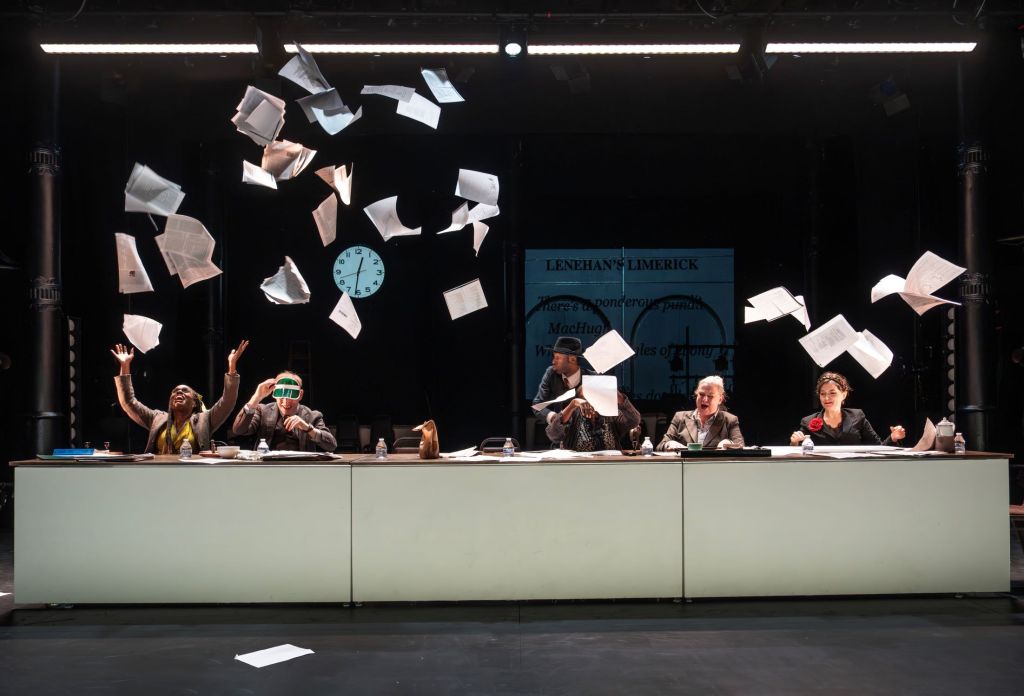
Elevator Repair Service became renowned when they presented Gatz, a verbatim six hour production of F. Scott Fitzgerald’s The Great Gatsby at the Public, as part of the Under the Radar Festival in 2006. Since their remarkable Gatz outing, they have followed up with other memorable presentations. It would appear they have outdone themselves with their prodigious effort in their New York City premiere of James Joyce’s opaque, complicated novel Ulysses. The near three-hour production directed by John Collins with co-direction and dramaturgy by Scott Shepherd, currently runs at The Public Theater until March 1, 2026.
At the top of the play Scott Shepherd introduces the play with smiling affability and grace. He directly addresses the audience, reminding them that “not much happens in Ulysses, apart from everything you can possibly imagine,” and that it happens in the span of a day beginning precisely at 8 a.m,, Thursday June 16, 1904 in Dublin, Ireland. Before Shepherd dons the character Buck Mulligan who appears at the beginning of the novel, he discusses that in the “spirit of confusion and controversy” (labels by critics), Joyce’s day in the life of three characters will be read with cuts in the text. Elevator Repair Service elected to remove Joyce’s text to redeem the time. The cuts are indicated by the cast “fast forwarding” over the narrative.
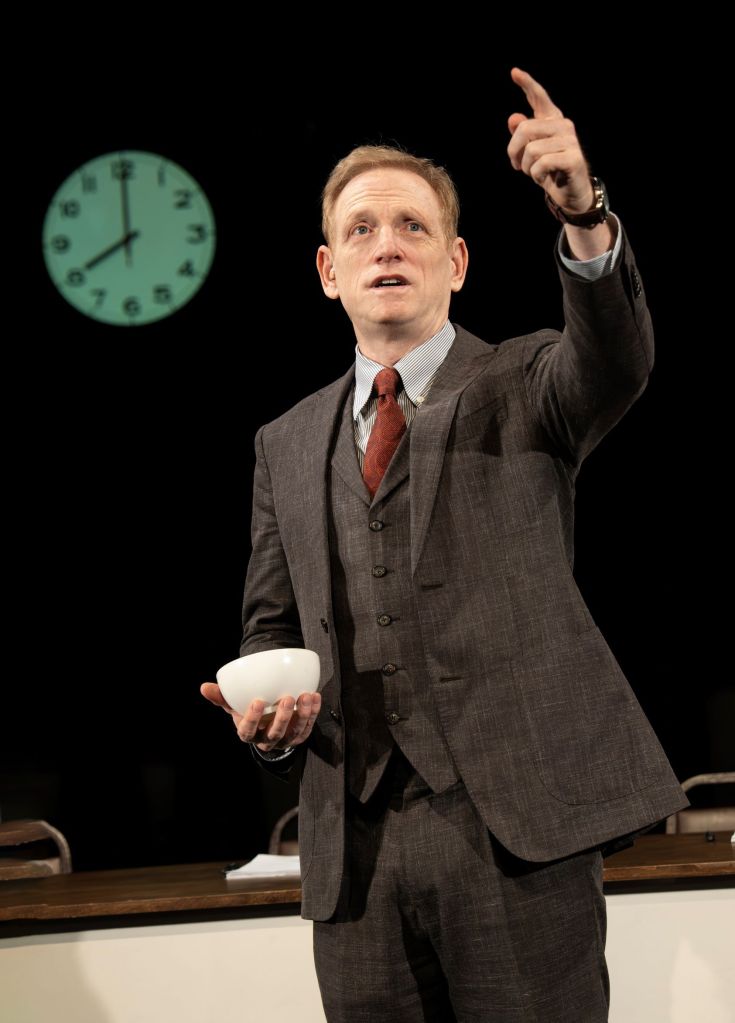
Collins and the creative team cleverly effect this “fast forwarding” with gyrating, shaking movement and action. Ben Williams’ design replicates the sound of a tape spinning forward. To anyone who may be following along with their own copy of the novel, the “fast forward” segments are humorous and telling. However, the cuts pare away some of the details and depths of character Joyce thought vital to include in his parallel of Dublin figures with the most important characters of the Odyssey: home returning hero Odysseus, long-suffering wife, Penelope, and warrior son, Telemachus.
After Shepherd’s introduction, Ulysses moves from a sedentary reading with multiple actors into a fully staged and costumed production as it progresses through the day’s events principally following Stephen Dedalus (Chisopher-Rashee Sevenson), who represents Telemachus, Leopold Bloom (Vin Knight), as Odysseus, and Molly Bloom (Maggie Hoffman) as Penelope.
The events illuminate these characters, and the cast superbly theatricalizes the novel’s humor, whimsy and farce. Some scenes more successfully realize Joyce’s playfulness and wit better than others. For example when Bloom decides to go to another pub after seeing the sloppy, gluttonous patrons of the first bar, the cast revels in portraying the slovenly, grotesque Dubliners. slobbering over their food. Additionally, the scene where Bloom faces his deepest anxieties shows Knight’s Bloom giving birth to “eight male yellow and white children.” Director Collins hysterically stages Bloom’s “labor” with Knight in the birthing position, legs apart, as Shepherd “catches” eight baby dolls he then throws to the attending cast members.
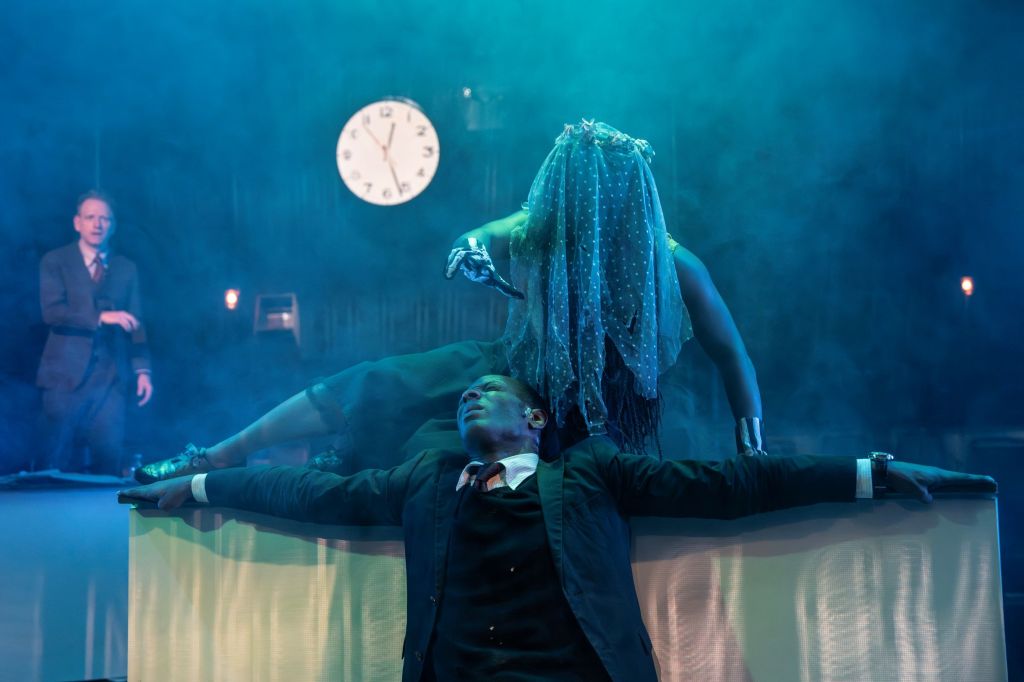
As costumes and props are added to the staging, we understand Leopold Bloom’s persecution as an outsider and a Jew. Also, wee note Stephen Dedalus as the writer/poet outsider who eventually joins Bloom, a father figure, who Bloom takes home for a time until Dedalus leaves to wander the night alone. Chistopher-Rashee Stevenson portrays the young Dedalus, a teacher whose unworthy friends lead him to drink and misdirection. Dedalus grieves his recently deceased mother and toward the end of the play has a nightmare visitation by her frightening, judgmental ghost.
For those familiar with the novel, the cast becomes outsized in rendering the various Dubliners that Knight’s Bloom and Stevenson’s Dedalus encounter. The dramatization is ultimately entertaining. We identify with Bloom as an Everyman, an anti-hero, who tries to get through the day in peace, while dismissing the knowledge that his wife Molly cuckolds him. Though he hasn’t been intimate with her since their baby Rudy died, he is unsettled that she conducts an affair with Blazes Boylan in their marriage bed at home. Somehow, Bloom has discovered that Molly who is a singer will be meeting with Boylan at 4 p.m. that afternoon. On his journey through the day he avoids confronting Boylan as they carry on with their activities around Dublin.
The ironic anti-parallel to the Odyssey, on the one hand, is that Molly Bloom is far from a Penelope who physically remained loyal to Odysseus, where Molly has an affair. On the other hand, late at night as Bloom sleeps with his feet awkwardly next to her face, we understand that Molly still loves Bloom and is emotionally and intellectually loyal. In her stream of consciousness monologue, seductively delivered by Maggie Hoffman, Molly arouses herself with memories of her relationship with Bloom when they were first together. It was then that she transferred a seed-cake from her mouth to his, sensually expressing her love.
Collins’s staging of the scene is humorous and profound. It defines why Molly has been present in Bloom’s consciousness throughout his strange journey traversing the streets of Dublin until he eventually finds his way home to her bed later that evening.
For those unfamiliar with Joyce’s novel, they will find the events and people a muddled hodgepodge that clarifies then becomes opaque, like a light switch turning on and off. Characters swap places with each other as seven actors take on numerous parts in a sometimes confusing array. Only Bloom, Dedalus and Molly stand out, true to Joyce’s vision for Ulysses for they embody Joyce’s themes about life. Thus, Bloom and Dedalus move through the day with flashes of brilliance, revelation, connection, irony and dread. Their reactions interest us. And Molly Bloom in her ending monologue puts a capstone on the vitality and beauty of a women’s perspective, as she experiences the sensuality and power of love for Bloom through reminiscence.
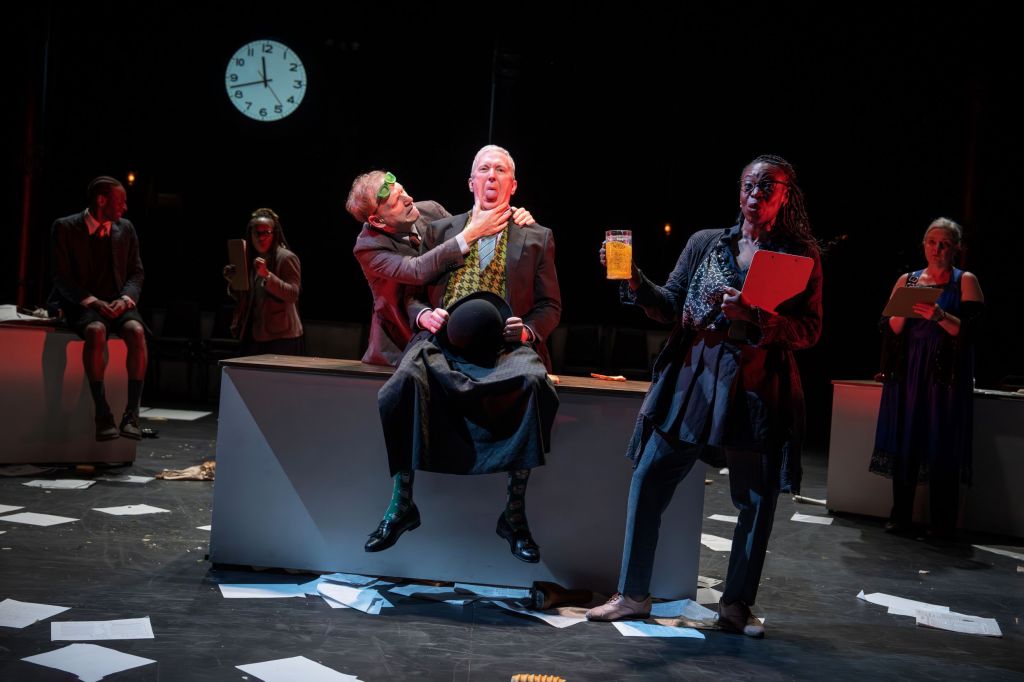
The costume design by Enver Chakartash reflects the time period with a fanciful modernist flourish that gives humor and depth to the personalities of the characters. For example Blazes Boylan (Scott Shepard) who has the affair with Molly wears a straw hat, outrageous wig and light suit that aligns with his jaunty gait. The scenic design by DOTS is minimalist and functional as is Marika Kent’s lighting design and Mathew Deinhart’s projection design. Most outstanding is Ben Williams’ acute, specific sound design which brings the scenes to life and follows the text adding fun and delight.
By the conclusion the audience is spent following the challenge of recognizing Joyce’s Dublin and the three unusual intellectuals and artists who he chooses to explore. Elevator Repair Service has elucidated the novel beyond what one might endeavor to understand reading it on one’s own. Importantly, they’ve made Ulysses an experience to marvel at and question.
Ulysses runs 2 hours 45 minutes with one intermission at the Public Theater through March 1, 2026. https://publictheater.org/productions/season/2526/ulysses

