Blog Archives
‘My Joy is Heavy’ the Bengsons Sing Their Joy Through Sorrow
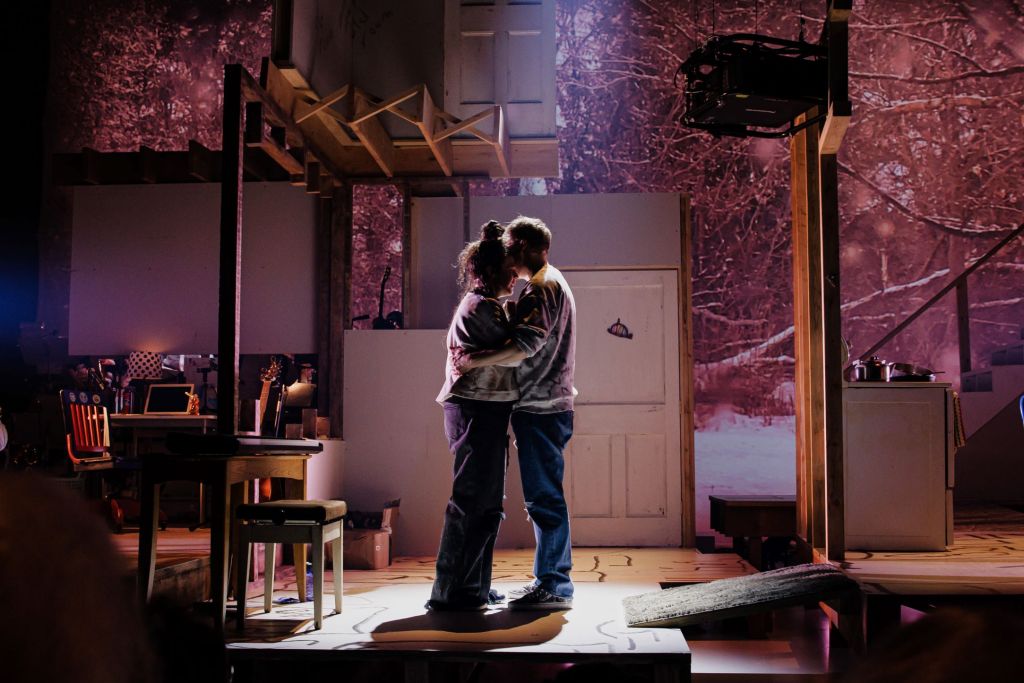
Like “A Tear and a Smile,” Kahlil Gibran’s well-known poem, the Bengson’s musical memoir My Joy is Heavy displays the couple’s affirmation of life in contrasts. Great joy can arise while experiencing great loss.The Obie-winning husband and wife team responsible for notable offerings like NYTW’s Hundred Days, presents an intimate, visceral series of experiences expressed organically in hauntingly beautiful music. Grounded in the audience’s remembrance of COVID lock-down, its isolation and traumas, we learn of the fiery trials the Bengsons went through separately and together during that time.
This powerful, soulful, cycle of songs and narration superbly directed by Tony Award winner Rachel Chavkin (Hadestown), transports the audience every moment the couple takes the stage. Abigail and Shaun invite audience members into their world, a gritty chronicle of emotions, spooling out from an extraordinary mix of folk-rock, punk and gospel that rearranges one’s psyche from start to finish. Because of audience enthusiasm, My Joy is Heavy has been extended through April 12, 2026 at New York Theatre Workshop.
What makes this production intimate and heartfelt includes the couple’s attention to the audience. To make sure they hear and see every lyric, turns of phrase, imagery and poetry, the production employs closed captions that appear above the stage. I found these to be less distracting than captions in other productions that oftentimes appear stage left or stage right. Additionally, the musical duo cuts to the chase identifying their wish to share a compelling revelation at the center of their musical memoir. “We’re here to tell you about this one moment, this one moment that happened right there on that bed.”
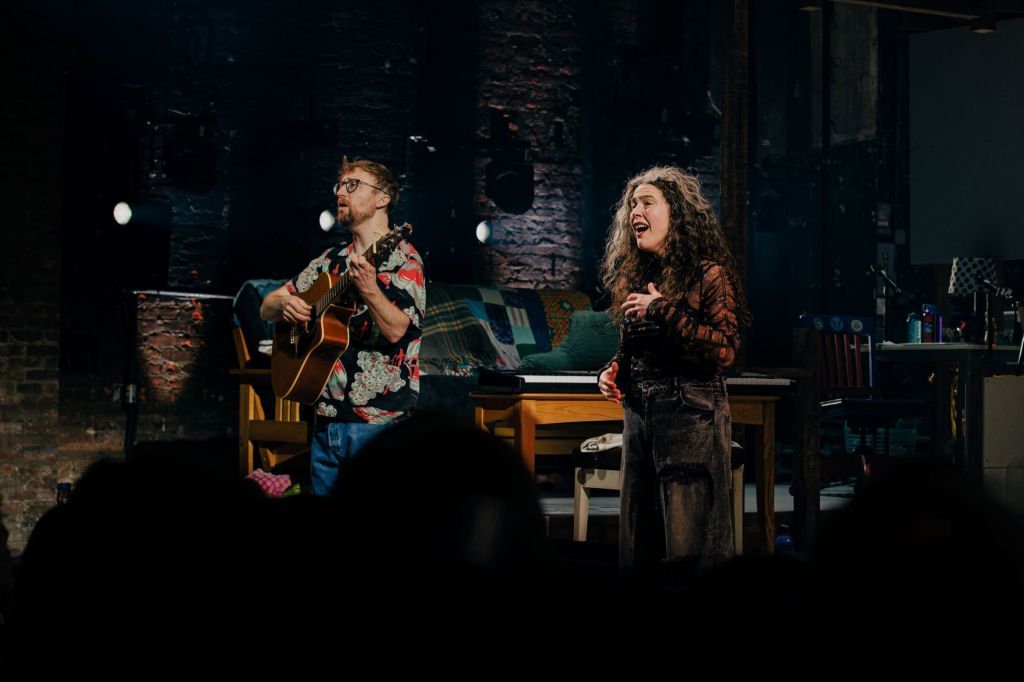
When Abigail says this, she motions to the bed in Lee Jellinek’s set design of Abigail’s mom’s house in Vermont. The couple and their toddler son stayed there during the alienating months of COVID, the time period of the production. It was then they had an epiphany, like a shamanic vision, which drives them artistically. Hoping that the expressiveness and power of their story helps restore harmony and wholeness, they try to connect with the audience so they might experience a cathartic, emotional release.
When Abigail and Shaun begin to discuss their COVID isolation, they call upon the audience to remember with them and reflect upon those lost to the pandemic. Abigail memorializes these individuals with a symbolic gesture involving two audience members. Then the duo plunges into their musical narrative with choreography by Steph Paul and music supervision by Obie Award winner Or Matias (Grey House). Shaun’s great versatility playing piano, guitar, accordion, etc., and the expert six member band directed by Matt Deitchman, accompany Abigail and Shaun throughout.
With them the couple rides waves of humor, uplift and sadness as they course through songs, not slowing down until they sing the last refrain of “My Joy is Heavy” to the audience’s rhythmic hand clapping.
As a part of the narrative we see snippets of Gramma Kathy, Abigail’s mother, and their toddler Louie in home video footage taken with their phones. Chauvkin uses these and other videos projected on the back wall of the set to convey and enhance mood and tone, and transition to other scenes with different emotional content. Also, Chavkin integrates these projections into the narrative to relay quieter moments of homely family life in “the calm before the storm.”
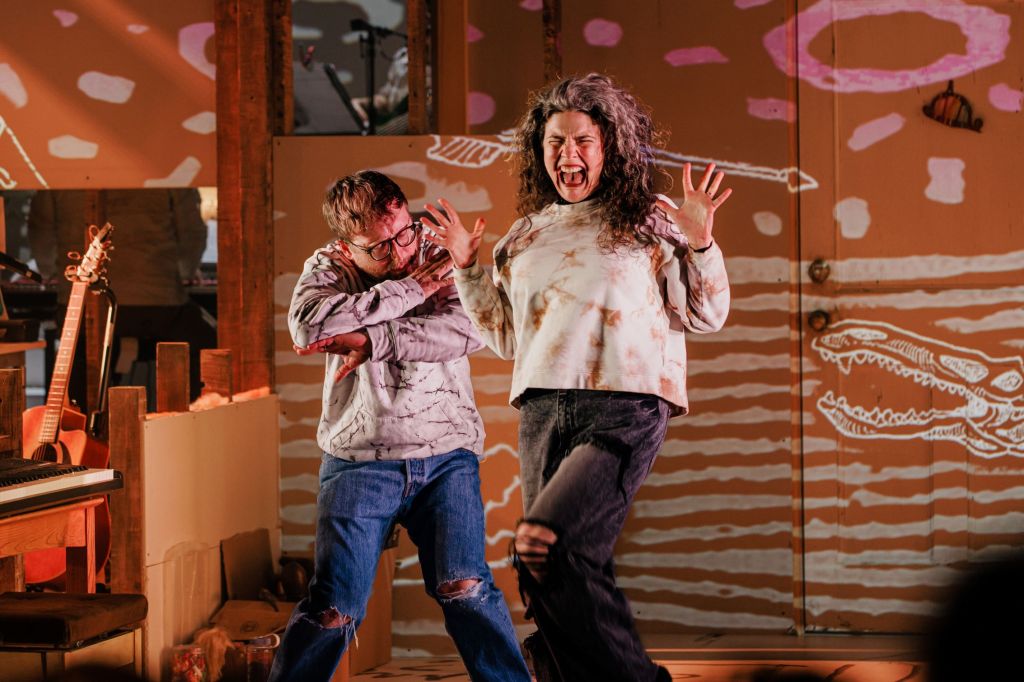
As a complement to the home videos, David Bengali’s video design, which accompanies the metaphoric song “Underground,” and serves as background for other musical pieces, effectively captures the Bengson’s interior emotions. For “Underground” the wild and evocative projections aptly serve the lyrics. For example, to reflect how Abigail and Shaun went into feelings of isolation and fear they sing, “I’ve been underground in a deep, dark cave, doing my best to stay live.” Alan C. Edwards’ lighting makes the projections pop. For her part Abigail experiences excruciating headaches that she labels PTSD. Clearly, the pandemic causes intense stress when, despite everyone’s assumptions, it goes on for months because of skyrocketing numbers of the dead and dying as COVID spreads.
With the drama of the pandemic in the background, Abigail and Shaun try for another baby. However, the risk reward ratio of a prior miscarriage plummets them into cascading fear. They elicit help from doctors and when the medication and fertility testing don’t seem to help, they watch holistic programs and go through Zoom sessions. Many of the profound songs as well as the humor deal with the Bengsons struggle with their having another baby. Standouts include “River” and “Don’t Hope.”
The first song is a striking, poignant remembrance of their baby who never makes it into life, a song of love and mourning. This devastating experience five years prior informs their roller-coaster emotions in the present when Abigail discovers the blue line of her new pregnancy. Though “over the moon,” Shaun and Abigail can’t allow themselves the luxury of celebrating, because “what if?”
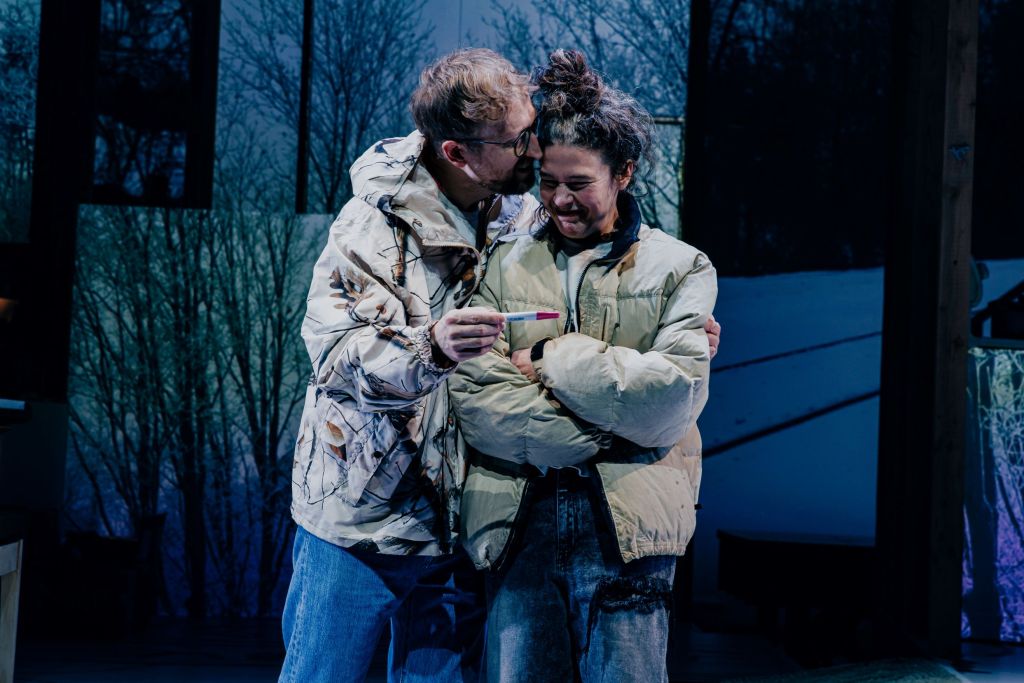
“Don’t Hope” hits home with its simple humanity and perfect melody aligning with the repeated refrain, “DON’T DO IT, DON’T
HOPE, DON’T DO IT, DON’T GET HAPPY. Who cannot empathize with the sentiment that feeling too exuberant will jinx what one wants desperately? After this amazing song Shaun describes his riotous experience with little Louie on the Santa Sleigh and the humor breaks through the fear and makes way for the song, “Veil.” Both agree, they’re doing everything they can do. And this leads to their understanding that they can’t live avoiding their natural feelings. Together they decide, in the next song, “I’d Like to be Happy.” They choose to let go of repression.
By degrees we follow their emotional journey from the cave and pain to an expiation of the sorrow of the miscarriage and recognition that happiness shouldn’t be suppressed. And in between a few other remembrances and songs, the couple arrives at the epiphany Abigail refers to at the top of the musical. Thus, engaged audience members travel with them through flashbacks to experience palpably how joy and sorrow can occupy the same place in one’s heart, at the same time. The Bengsons bring the audience to this breathtaking and ebullient conclusion in the rousing gospel “My Joy Is Heavy,” as all stand in appreciation.
My Joy Is Heavy runs 1 hour 10 minutes through April 12, 2026 at New York Theatre Workshop. https://www.nytw.org/show/my-joy-is-heavy/
.
u
.
‘How to Defend Yourself’ at New York Theatre Workshop
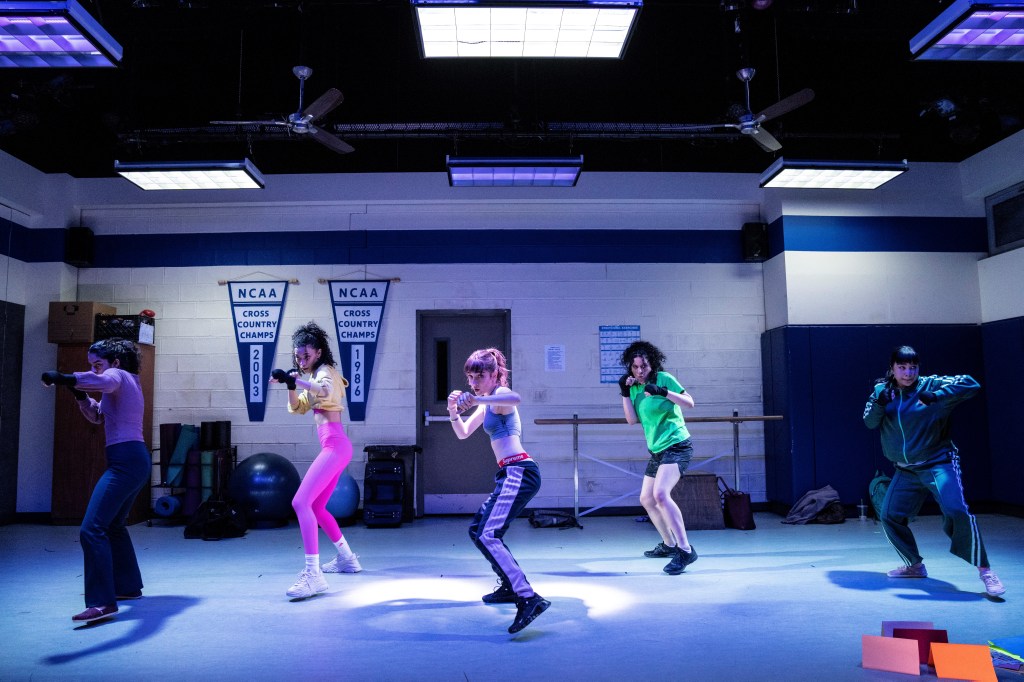
In this decade of sexual extremes on a continuum from paranoia, political correctness, libertine licentiousness, the billion dollar pornography industry and casual permissiveness, one in four women is violated, sexually assaulted or physically/emotionally abused. As a strategic defense #metoo has been appropriately employed culturally, but it also has been wrongfully magnified as a double-edged sword of vengeance. In Liliana Padilla’s play How to Defend Yourself, currently at New York Theatre Workshop, following a successful 2020 run at Chicago’s Victory Gardens Theatre, Padilla confronts important issues about personal safety both emotional and physical. Incisively co-directed by the exceptional Rachel Chavkin, Liliana Padilla and Steph Paul, the hybrid comedy drama explores consent and the litigated definitions of rape and harassment, which shift based upon geographical location, accuser and victim.
With the setting as a torpid and tumultuous college campus, when individuals are beginning to define their goals, dreams and intentions, sexuality and choices remain fluid. A decision to be with someone can lead to devastation, especially around stimulants, alcohol and drugs at a testosterone-fueled frat party, where young women are pressured to compromise themselves. At the top of the play we are introduced to women in a self-defense class started by college junior Brandi (Talia Ryder). The confident, black belt, with social media videos of herself disarming a bully with a gun, is a self-appointed, self-defense instructor. Brandi decides to teach students the ways to protect themselves, after sorority sister Susannah is raped and hospitalized. The assault happened at a frat party.

Much of the enjoyment of Padilla’s play is becoming acquainted with the buoyant women and two young men in the class. They reveal their humorous attitudes as they attempt to navigate a culture whose roiling currents are being defined from moment to moment, often dislocating both men and women. All genders of that age group may be easily overcome by intimate circumstances, which they assume they have control over but don’t.
Brandi, whose self-assurance, determination to do good and organized, talented, physical skills, not only looks dancer-fit, but is also lovely. Admired and accepted by her peers, she is a member of a hot sorority and has the cache to hold self-defense sessions. These attract a few neophytes who are there to learn self-defense. Some are there for other reasons.
Brandi runs her sessions circumspectly with precision. She expects her peers to evolve toward her confidence level, so they understand that “anything can be used as a weapon,” and primarily, “their own bodies are weapons.” Kara (Sarah Marie Rodriguez), joins her BFF for moral support and fun, but she lacks Brandi’s skill set. Kara assists Brandi with chatter and chalkboard drawings in the college gym space (finely designed by You-Shin Chen), where Brandi holds classes.
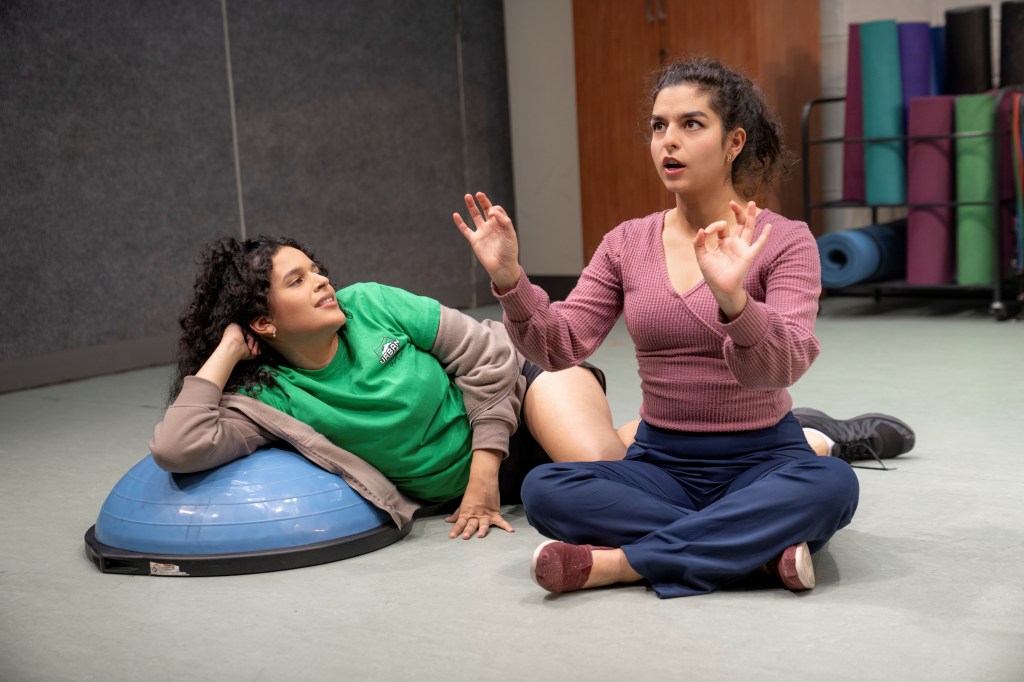
Two students, who drift in anxious to get started, arrive before Brandi. We learn that freshman Diana is obsessed about defending herself against guns. Her BFF Mojdeh follows fast in her orbit. Humorous and sociable Diana ((Gabriela Ortega at the top of her game), and Mojdeh (Ariana Mahallati), are primarily there to get closer to Brandi, who is a Zeta Chi, the sorority they would like to rush. It escapes them that the group think atmosphere of sororities and fraternities are precisely the communities that can be toxic and abusive. However, Mojdeh craves being identified as “cool.” She seeks the hot, popular individuals to ride their coattails and achieve acceptance. For her, this is the fastest way to self-love. On the other hand, Diana appears to be self-content, and is humorous in how she fetishizes guns to the point where by the the end of the play, she indulges her passion.
The last young woman to join Brandi’s sessions is Nikki (Amaya Braganza). Her entrance provokes laughter because she appears super shy, hesitant and awkward. Throughout, she is mysterious and reticent, until the conversation opens up, and she admits she gave a “blow job” to a guy in a gasoline station. When Brandi and Kara attempt to kindly excuse her humiliating, crass behavior as a mistake, she states that she was fine with it, and it was her idea. Whether she is lying or fronting is difficult to surmise. Hiding behind “it’s OK,” is oftentimes the default response because it is too messy to get into, who is responsible, who is to blame and what forced sex means.

Kara indirectly insults Nikki by stating that she also has made such “mistakes.” Nikki is nonplussed, revealing the differences in attitudes between the two young women. Clearly, the circumstances around sexual behavior are extremely complex and not easily understood. Subsequently, Padilla’s characters veer off topic into personal discussions about what forms of touching make them uncomfortable, and what physical boundaries work.
The play reveals that the idea of self-defense encompasses more than just a physical way of being. Young men and women are at sea with regard to “growing up” with a sexual identity that is forced upon them by the culture and their friends. Oftentimes, as Jayson Lee’s Eggo suggests, they are clueless about what is the right or wrong way to conduct themselves, have relationships and fall in love. Sexuality isn’t necessarily the main ingredient that holds people together.
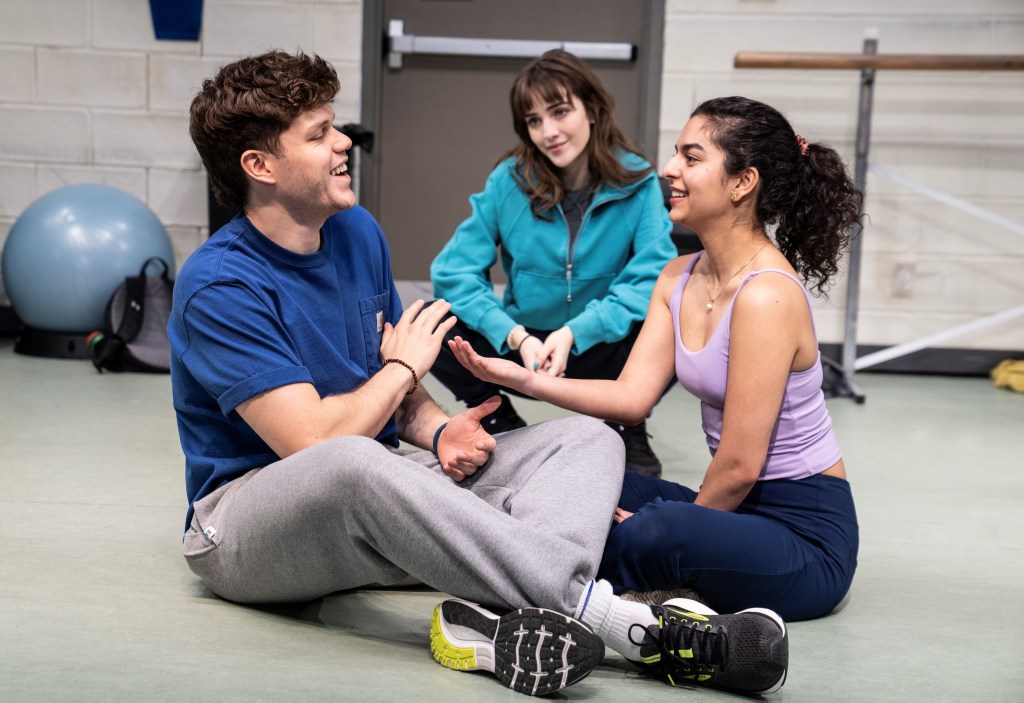
To add substance to the mix, Padilla includes the male perspective, having Brandi invite two fraternity brothers, Andy (Sebastian Delascasas) and Eggo (Jayson Lee). They are “down” with #metoo and are supportive of Susannah during her recuperation and rehabilitation from the stress of her assault. To add to the complexity, their fraternity brother has been criminally charged which has put the entire fraternity on “high alert.” To distinguish themselves from the “sexual abuser types” roaming their campus, Andy and Eggo hysterically ply their sanctimonious “we support women” front, the moment they enter the room and introduce themselves. Years in prison hovers over the head of their fraternity brother, and they are “running scared” that any of their behaviors might be interpreted as predatory. Their loud, moralistic approach toward women is “over-the-top,” and we expect they will marching in the next women’s protest to encourage female empowerment.

Padilla’s themes are not lost on us. Sexualized images and behaviors, part of the landscape of American culture in the entertainment industry and fashion industry, were shattered by #metoo. The nascent revolution that sprang up after the Harvey Weinstein debacle shuttered a billion dollar company and gave pseudo power to women for a time, only in the parts of the country which are not Republican and are “woke.” In other areas, the men act as they please, and the women go along with it, especially if they are proving they are not “socialist lefties.”
In the play, the characters are diverse: three persons of color, a Mexican-American, an Iranian-American and two whites. They are stuck with having to deal with “woke” culture, especially after the campus assault. Importantly, there is a discussion in the middle of the play about what consent means. Additionally, the question about having to always check with a partner about boundaries is raised. Kara blows up the discussion with her suggestion that there is nothing wrong with wanting S and M sex. To avoid the confusing topic, which adds another complex component about individual sexual behavior, Brandi calls her out for being inappropriate.
Clearly, Kara has issues with alcohol and wanting to be hurt. This hints at her subterranean troubles that are never revealed. We note such problems, when she doesn’t join in the physical sessions because she got “wasted” the previous evening. On the other hand, she isn’t embarrassed about sharing her enjoyment of rough sex. Apparently, she also enjoys the shock value of telling others about herself, though it is counterproductive to her BFF’s purpose in holding the class. From this turning point onward, the situations in the self-defense class run off the rails.
The most interesting segments of the production are the self-defense moves that Brandi teaches (well choreographed by Steph Paul, movement director), and the physical fight routines they accomplish together (at the guidance of Rocio Mendez). Late in the play there is a fight that breaks out between Diana and Kara that is well staged. The fight exemplifies that ego, charm and pride are competitive forces that stir up internal problems within the young women. These spill out in violence. Between Diana and Kara, there exists an intuitive impulse to dislike each other. That disgust eventually dissipates after Diana smashes the provocative Kara in the face, ironically proving that Kara does seek physical abuse.
The staging for the defense practice scenes works seamlessly and is powerful and exciting to watch. The movements are pitched to music, which pumps up the characters and reveals they are gaining confidence about themselves. Additionally, when Brandi suggests they pair off to practice techniques, for example, how to break an attacker’s wrist grip, the results are simultaneously wrought and the overlapping dialogue and action make for fascinating comparisons.
There are surprising turns throughout. Diana and Mojdeh discover things about each other that set their relationship on a different path so that they can’t be close anymore. Kara and Brandi have a disagreement about Susannah, and Andy reveals a secret to Eggo that he has been harboring since the attack on Susannah. This upsets them and dislocates their sense of well being even more. When Andy asks what he should do, Eggo is at a loss. We understand there are no easy answers with regard to human sexuality and situations worsen as a result of “not knowing what to do.” Finally, after a number of sessions where Brandi’s “students” have progressed, and she feels she has made inroads into helping them feel safer, Nikki upends her assumptions and disturbs everyone with an event that she describes.
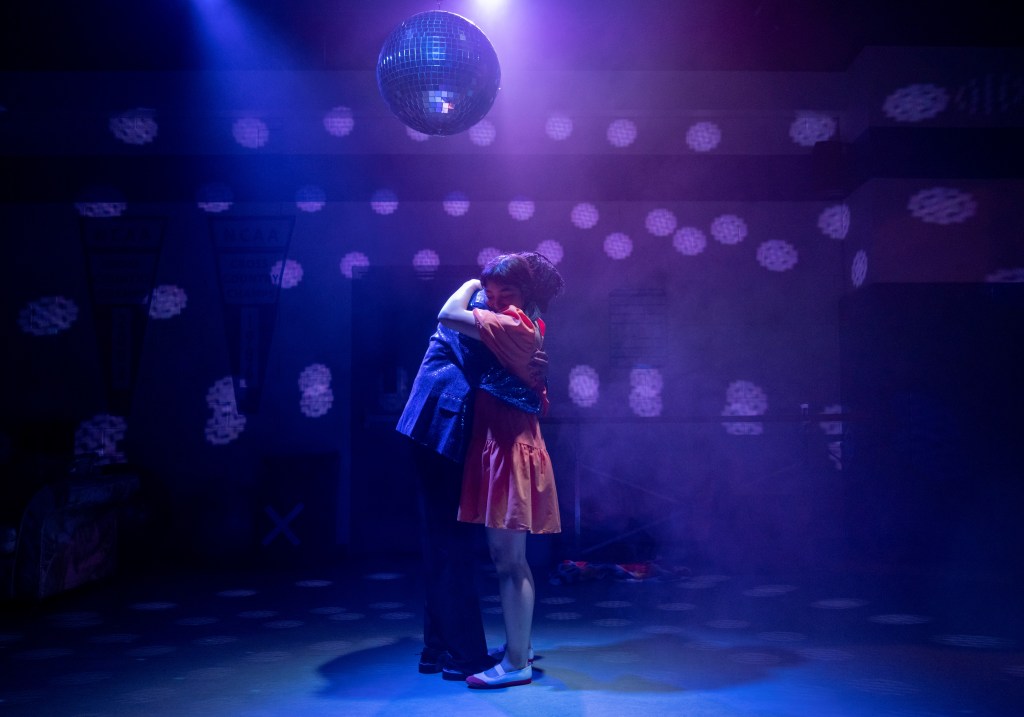
The thematic conclusion moves through flashbacks in the characters’ stages of adolescence. The directors show the individuals at three parties during their teen years, which move backward in time to a birthday party when they were in elementary school. The parties reveal the wildness from the drinking and sexual exploration when they were in high school. In the last party they end up in the sweet innocence of their elementary school days. The contrast of how they seek sexual experience that emerged from a time of innocence is stark and mind blowing.
For the rapid set changes You-Shin Chen, Stacey Derosier lighting designer, Izumi Inaba costume design and Mikhail Fiksel’s sound design create a frenetic party atmosphere. And the lovely tableau at the end reveals that the progression of their identities has sprung from love, security, family and well being. One might think that these create an assured line of defense to thwart any attack that might ever happen.
However, Padillia posits that security is never guaranteed. Though we may use our bodies as weapons, or learn self-defense, random and not so random acts of violence happen in a culture that uplifts violence. Diana feels forced to arm herself with a licensed gun as an answer to that violence. Tragically, the subtext of her statement about guns plays out daily in our society, revealing the play’s devastating currency. Its themes about our physical and psychic vulnerability in an arbitrary and violent world resonate with power.
Co-directors Rachel Chavkin, Liliana Padilla & Steph Paul are responsible for the strengths of the production, especially its staging and thematic depth. Their vision about the questions the play raises leaves us with even more questions and no clear answers. The actors are uniformly excellent and the physicality and staging of the various defense sessions make one want to get up and join the cast to try out all the moves.
How to Defend Yourself is a humorous, weighty production, whose trenchant themes give us pause, thanks to the vision and talent of its creatives. For tickets and times go to their website https://www.nytw.org/show/how-to-defend-yourself/tickets/
 CAROLE DI TOSTI