Blog Archives
‘Grey House,’ a Subtle Send-up of Horror Films, That Delivers With Humor and Surprise, Starring the Fabulous Laurie Metcalf
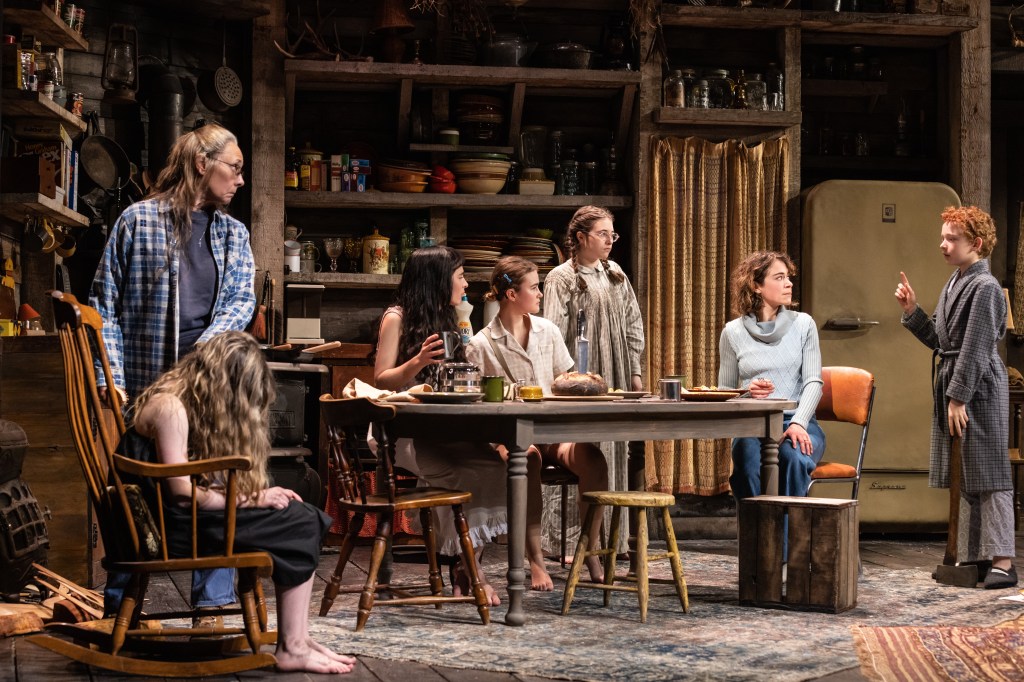
Top shelf performances and eerie effects in lighting, sound, and on-point set design carry Levi Holloway’s horror-thriller Grey House through to its unreasoned, macabre and opaque ending, leaving the audience disturbed and unsettled in an unusual, visceral entertainment. The production, currently running at the Lyceum Theatre until September 3rd, is insightfully directed by Joe Mantello for maximum preternatural weirdness and warped grotesqueness that is also a send-up of the genre.
With sardonic humor and glimpses of the supernatural which evanesce in the twinkling of an eye, the playwright Levi Holloway shrouds the action along a path of darkness, confusion and sometime shock, until the widening road dead ends in a climax and (spoiler-alert) Max’s partner Henry vanishes, replaced by a new guest as Raleigh (Laurie Metcalf), bags packed, leaves.
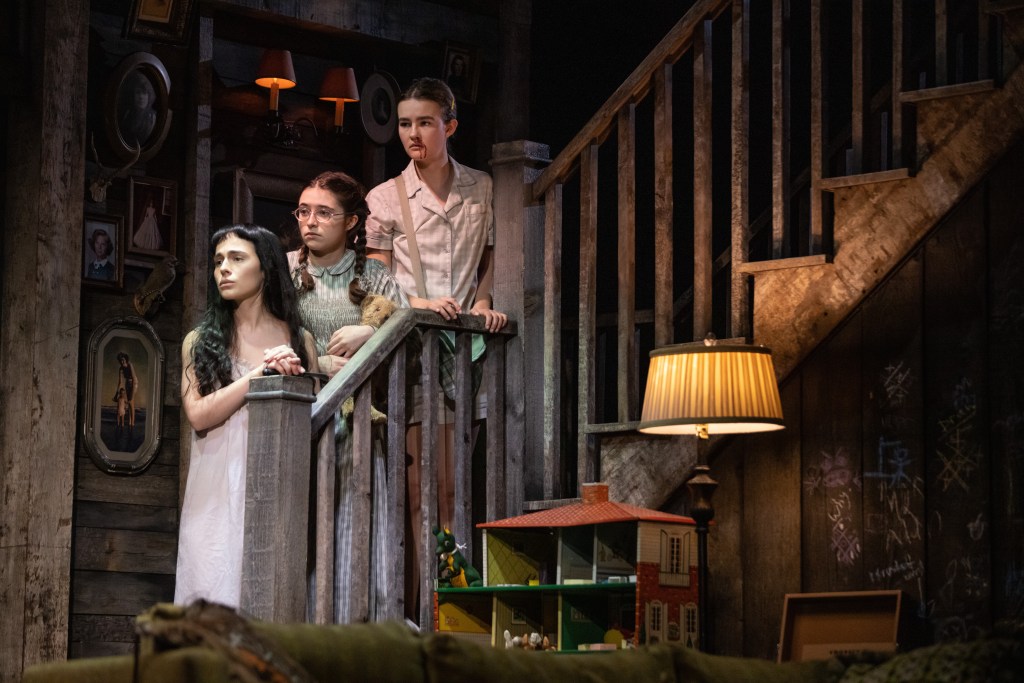
Spoiler alert! Stop reading if you want to be surprised by the play. Read the rest if you are looking for clues to guide you down the dark road of Grey House.
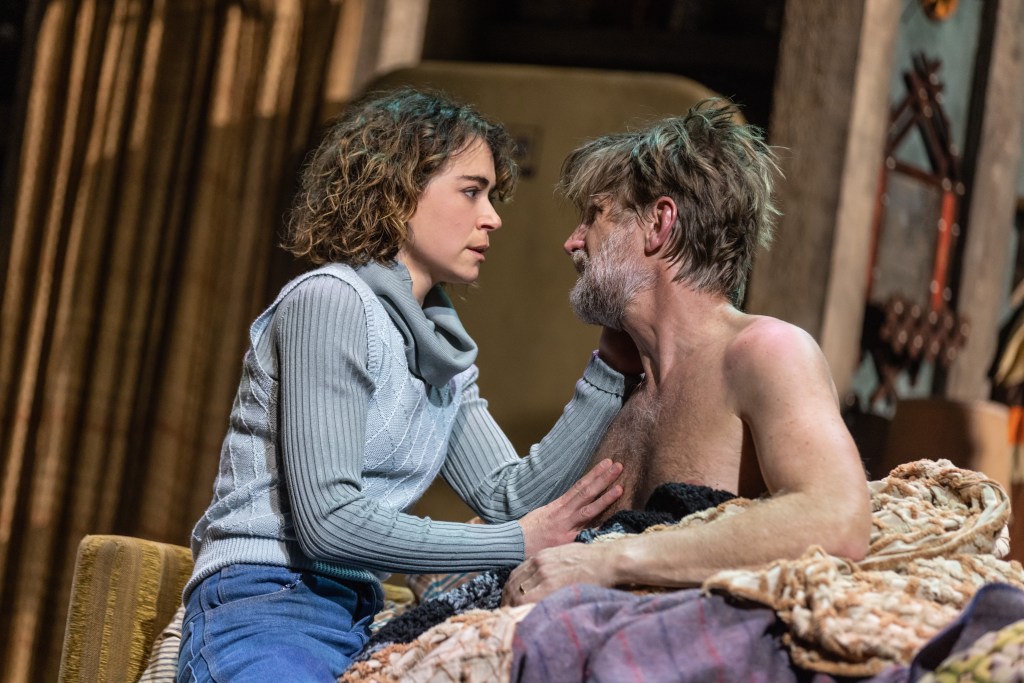
Where and how Henry de-materializes doesn’t matter. We have witnessed his sadistic torture by a child tormentor and watched astounded at his masochistic enjoyment of pain. When he contributes his substance to create a palliative “alcoholic” drink that anesthetizes, most probably for a future unrepentant male, our fog of understanding clears a bit. Henry receives well-deserved punishment for his unspeakable past acts, that, until he entered Grey House, have gone unanswered. Is the function of this house and these female inhabitants to deliver justice? If so, married couple Max (Tatiana Maslany) and Henry (Paul Sparks) who seek help at Grey House after a car accident are “innocents” walking into a trap.
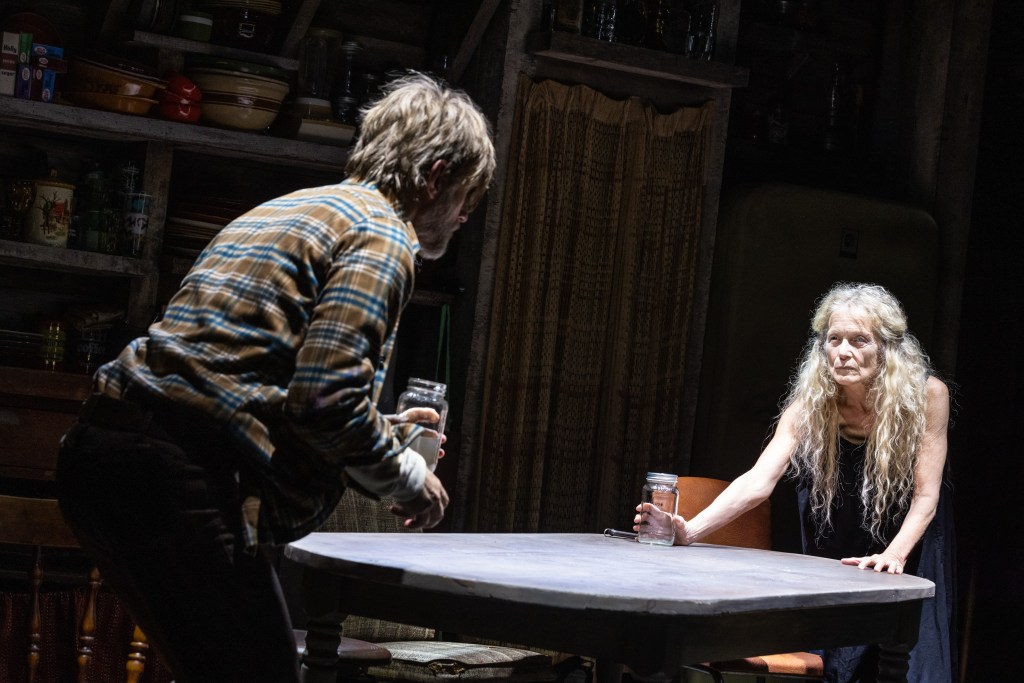
The creaking, groaning, hellish, two-story, ramshackle abode in the mountains, referred to as “Grey House,” initially appears to Max and Henry as a welcome, cozy shelter from the blizzard and their injuries. However, we know better and not just because of the advertising campaign for the show.
Previously, we have been introduced to the strange, uncanny children of the mountain cabin and their mother/caretaker Raleigh (the sensational Laurie Metcalf). Two of the “sisters” initially raise the spirits in a representative song of the region, singing a cappella. They produce an effect which is haunting and spooky. At turning points throughout the production, a total of four songs are sung: two authored by Mountain Man and the others by Bobby Gentry and Sylvan Esso. Each song is more compelling and meaningful in relation to the action, thanks to Or Matias (music supervisor and a cappella arranger).
Henry’s ironic comment that he’s seen this movie before and they “won’t make it,” lands with humor, horror and truth. We know something he doesn’t. He and Max must stay away from the two unnatural malevolents, a Wednesday Addams meme, Marlow, and her frightful companion in wickedness, the vicious, hell-bound Squirrel. In the initial moments of dialogue and action, they are daunting.
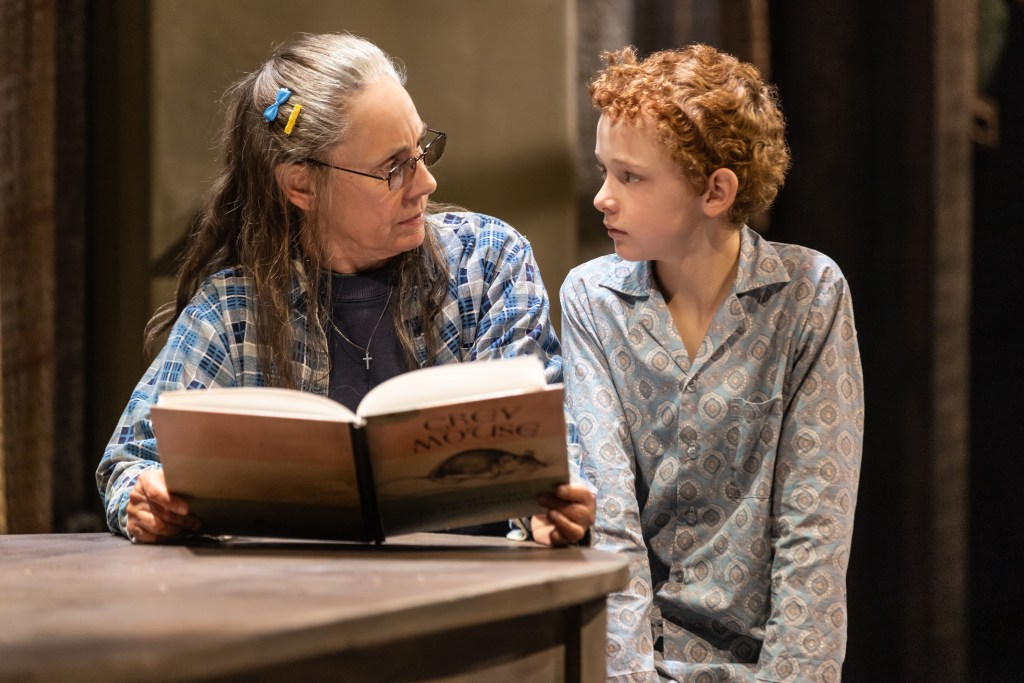
Throughout the action, both could double cast as witches in their sarcasm, sinister intentions and sub rosa text delivered in a straight-forward manner, as they allow the “words to convey the meanings.” The import of their statements are clues to what is really going on, however, the substance is easily missed because the audience is Holloway’s prey and is misdirected as she steers them down the road, and blinds them with her dark shadows of uncertainty.
Nothing is directly expressed. Of course, Henry and Max have the bulk of their interactions with these vixens, who rule the roost and who, Raleigh, their ersatz mom, calls “willful creatures,” an understatement.

As the Wednesday Adams meme who is a self-satisfied, self-admitted, proud “bitch” in the MAGA vein of “owning the libs,” Sophia Anne Caruso is terrific at suggesting the horror underneath the action. She enjoys making her guests, especially Max, feel creeped out.
Squirrel, whose damaging persona is represented by her name and her having chewed the phone chord so no calls come in or go out, is the youngest. Portrayed with insinuation and sadism in a nuanced performance of softness and brutality, Colby Kipnes is superb. She is the youthful doppleganger of The Ancient (Cyndi Coyne) and is the instrument of revenge holding “everyman” predator Hank to account in a twisted time reversal. For unspeakable acts he committed decades before, the young Squirrel and the others collaborate in effecting physical retribution which the anesthetized Henry willingly accepts as his due.

“Grey House” exists beyond time and place, the repository of the wounded in life who exist when we meet them as otherworldly beings or some other undetermined construct of humanity, which the playwright ironically leaves in the realm of uncertainty. When we meet this particular brood, Raleigh suggests others will come and go, as she in fact leaves at the conclusion with a packed suitcase, letting Max who may be a younger version of herself replace her as the caretaker.
The bottles of “moonshine” the ersatz family of women, including A1656 (the fine Alyssa Emily Marvin), and hearing-impaired Bernie (Millicent Simmonds passionately completes the witches’ coven) extract from male predators is kept refrigerated for the next visitor destined to arrive at Grey House. Like Henry he will be punished to sustain its prosperity and existence as a “living thing.”

Laurie Metcalf’s Raleigh is continually surprising in a spot-on, gorgeous performance as the hapless “mom,” who she portrays with power, insight and presence. Of all of the actors, Metcalf is the most surreal yet authentic and empathetic, as we feel for what she goes through at Grey House, though we don’t succinctly understand what we see happening before our eyes. When she is on stage, she is imminently watchable. Her lead, as subtle as it is, guides Caruso’s Marlow and Kipnes’ Squirrel to their understated ferocity which spills out in their insightment to get Henry to masochistically “fall on his own sword,” as they act out their vengeance.
Sparks’ Henry is so likable and loving in his relationship with Maslany’s Max who is the perfect wife, that we are shocked that both are not who they appear to be, Henry less so than Max. Maslany shows a sense of humor with the girls, then turns, flexing her emotional range when she expresses the appropriate terror knowing their luck has changed and she confronts evil. Sparks’ demeanor during the ordeals he is put through is nuanced. His confession is forthright and shocking in its understated delivery.
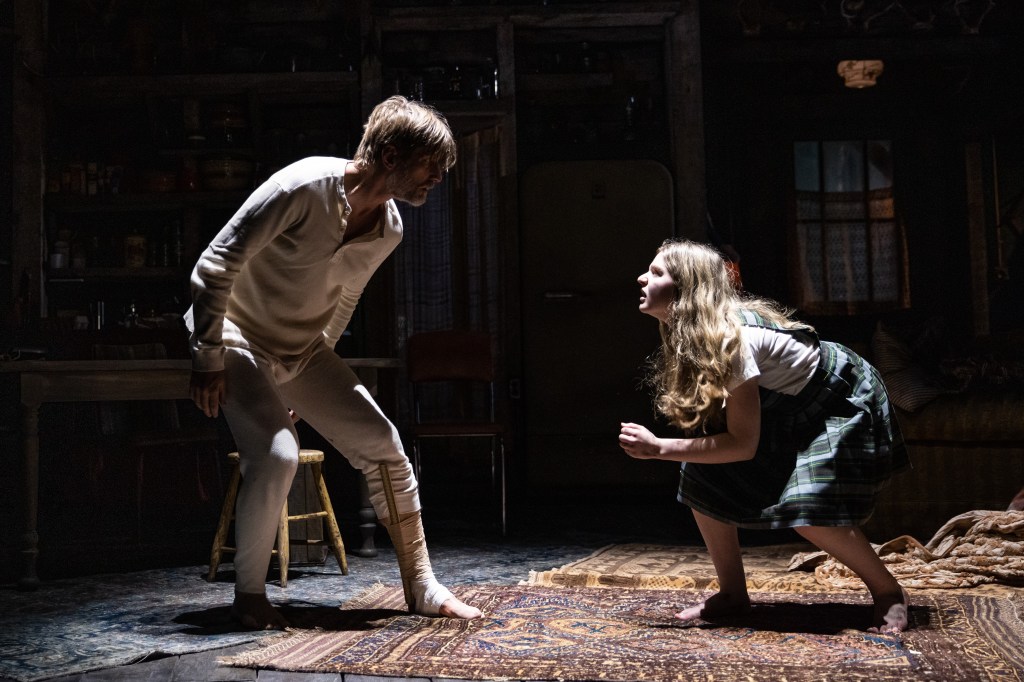
The silent characters, The Boy (Eamon Patrick O’Connell), and The Ancient (Cyndi Coyne), are vital in their gestures and presence. They add to the dynamic of “the family,” and Coyne’s Ancient is the wounded mirror image of Colby Kipnes’ Squirrel as a youth.
The production is amazing in its confabulation of mystery and opaque unreality delivered by the creative team. These include Scott Pask’s wonderful set design, Rudy Mance’s subtle costume design, Natasha Katz’s stark, atmospheric lighting design, Tom Gibbons’ house humanizing sound design, Katie Gell & Robert Pickens’ wig and hair design, Christina Grant’s makeup design. All of the actors are invested, as is Mantello in relating the otherworldly and arcane side by side with the profane, teasing out humanity in its wild derivations.
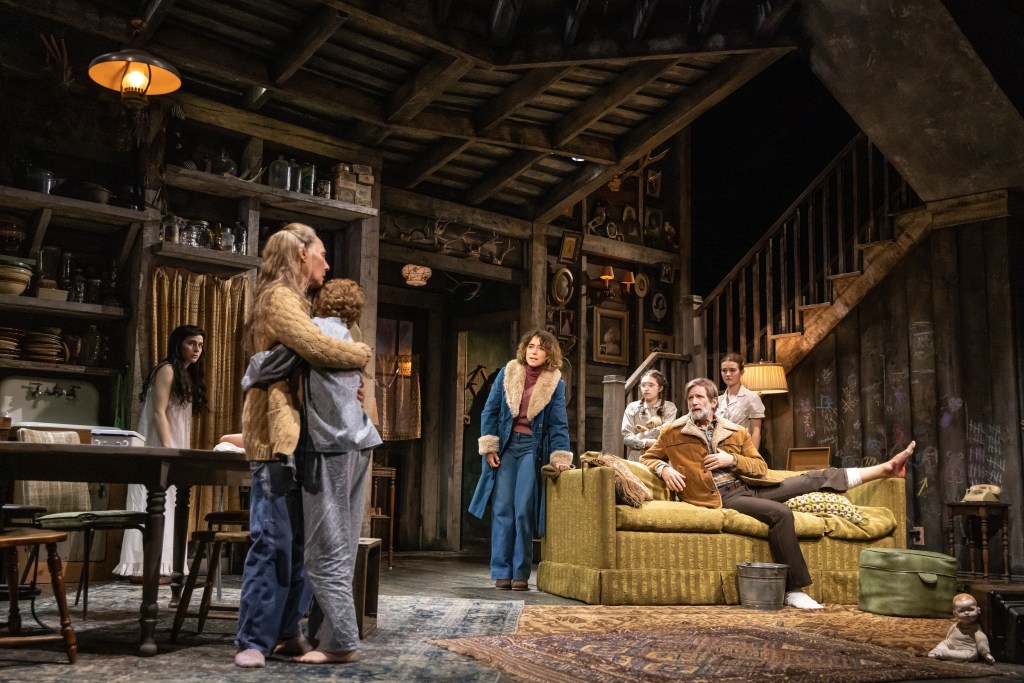
In life we see “through a glass darkly.” We receive glimpses beyond what we assume to be “reality” but know there is more that is present. What our senses apprehend, continually deceives us, though we like to believe “we know” and we are in control.
Holloway reminds us of the contradictions, the ironies, the shades of life that have no clear explanation. Indeed, the hints she drops about how the “family” of “willful creatures” operates in this spooky place are never solidified. All is intimation. The “moonshine” as Raleigh refers to it, “sold during the summer,” Marlow names “The Nectar of Dead Men,” which seems a more accurate handle by the conclusion. The duality of symbols existing on a spiritual, preternatural level are contrasted with the profane, material realm, for example when Max makes eggs (they are real-made offstage), for the “hungry, always hungry” sisters-daughters-creatures.
Thus, all is not what it seems. Holloway drives this theme home using the horror-thriller genre conveyance as a grand joke to prod us toward fear and laughter. She sends up that genre and twits us about our nightmares displayed in horror films, mirroring those found in our unconscious in dreams.

The development of the story and its characters, who are timeless archetypes reflected in literature (the good, the evil, the furies who gain vengeance), drive this work beyond genre. Thus, in an attempt to nail down Grey House and dismiss it, one may lose the deeper levels of Holloway’s symbols and complex, convoluted themes. One fascinating example is the red tapestry woven of the sinews of the historical predators, who have come to visit the cabin and whose “Nectar of Dead Men” is distilled for future use. The labels on the jars in the refrigerator tell the tale. The men’s remains we learn are in the walls, the grounds or in the basement which Squirrel frequents.
In Grey House Holloway’s vision expressed by Mantello and his creative team and enacted by the wonderful ensemble is a tonal hybrid of humor, a teasing send up of horror-thrillers, yet terrifying in its deeper representation of the patriarchy which doesn’t come off looking well in its tapestry of innards and crimes committed with impunity finally answered with rough justice, by “willful creatures.” The play is highly conceptual and may bear seeing twice because you will definitely miss connecting elements. Or just enjoy the ride and the fabulous acting and theatricality which will not disappoint.
For tickets and times go to their website https://greyhousebroadway.com/
‘Network’ on Broadway, Starring Bryan Cranston
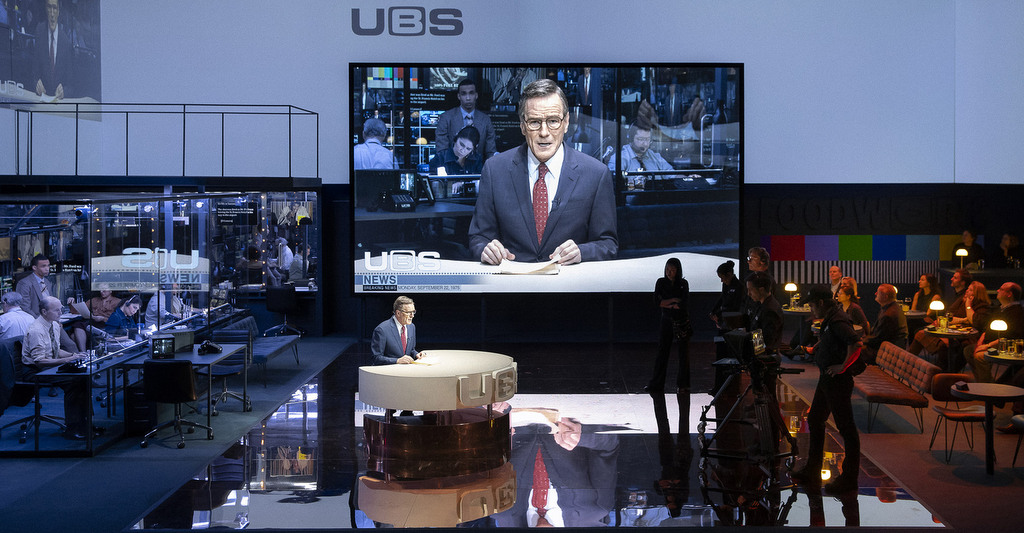
Bryan Cranston and cast in ‘Network,’ adapted by Lee Hall based on the Paddy Chayefsky film, directed by Ivo Van Hove (Jan Versweyveld)
Paddy Chayefsky’s gobsmacking 1976 film satire Network (directed by Sidney Lumet), provides a searing example of the noxious morphing of Broadcast News toward lurid entertainment. Also, its timeless themes about the ubiquity of corruption even in the banal news delivery business cauterize with laser-like precision. In transferring this amazing work to Broadway, only a devilishly adroit director could improve upon an already ingenious rendering of the nullification of the free press by corporate greed. It takes genius to tackle the already fantastic. Unsurprisingly, Ivo Van Hove has applied his brilliance to bring Network to Broadway after its London run last year.
The innovative Van Hove and the inestimably formidable Bryan Cranston as Howard Beale, the uncanny, knight-errant, news anchor of fictional UBS make Network a mind-blaster. Cranston’s performance leaves one speechless. With humanity and ferocity, Cranston believably renders Beale’s epiphany about his own life. As a result he elicits our compassion and captivates us into astonishment. We watch open-mouthed as he steps into Beale’s cavernous soul-depth. And we feel the emotional pull of Cranston’s Everyman and journey with him to the Beale abyss. Cranston achieves an immediacy and truth that coheres with our own empathetic understanding. We’ve been there! Truly, even if we remain complacent with every privilege in the world, we feel “mad as hell and refuse to take it anymore!”
Exhilarated with wonder after seeing the production, I recall the profound themes Van Hove’s exalted direction and Lee Hall’s succinctly adapted script present. Indeed, these resound for us today in the fake news Trumposphere. Increasingly, the news spills out “shock and awe” entertainment. For the sake of profits, facts, information and sourced material shift to the back burner. Judgment and reason become sacrificed to the audience lust for titillation. The difficulties of divining the differences between truth, reality, lies, obfuscations increase. Content appears subject to media company editors who must carefully negotiate around the mission of profit and not upset advertisers. The confounded viewer eventually stops seeking to be informed as a civil obligation. Notably, viewers have been overwhelmed by the cacophony of lies from the media nexus which depends on advertising dollars.
Sadly, as Network illustrates, if truth and a truth deliverer do somehow break through the confusion of white noise and find a following as Howard Beale seemingly does, he and his opinions, “the truth” are commoditized. Finally, when the truth is hijacked for its profitability, the service of one whose opinions authoritatively voice society’s zeitgeist will be undermined. Truth can never be commoditized, regardless of how much its seekers long to hear it. The once noble concepts of a free press and information sharing to keep the public informed and knowledgeable disintegrate in CEOs bank accounts.
Van Hove and Hall have reconfigured the already brilliant Paddy Chayefsky script to another level of currency with a few modifications. Though the time period and characters appear similar, in the case of Max Schumacher (the fine Tony Goldwyn), and Diana Christensen (Tatiana Maslany distills all we dislike about the rapacious female executive), their self-destruction appears to be more trenchant.
The ironies of Network’s plot development are still precious. The fired Howard Beale whose ratings slump cannot be overcome states on the air that he intends to kill himself on next week’s program. His unauthorized announcement creates a furor and a ratings spike. Indeed, competitor news media make Howard Beale front page headlines. From this point on Beale’s inner unraveling moves to center stage. Beale becomes the stuff of media legend. As the journey of his personal enlightenment grows with power and truth, he and it are commoditized. Enabled by his friend Max Schumacher (Tony Goldwyn), and ambitious up-and-comer Diana Christensen (Tatiana Maslany), who usurps Max Schumacher’s job with seductive abandon, Beale ends up becoming the superlative ratings darling of UBS.

Tony Goldwyn, Tatiana Maslany in ‘Network,’ directed by Ivo Van Hove, adaptation by Lee Hall based on the Paddy Chayefsky film (Jan Versweyveld)
Essentially the dynamic twists of Hall’s adaptation follow Chayefsky’s sardonic overload brought to an absurdist conclusion. Beale’s breakdown drives him to the edge of sanity and a fool’s genius. Notably, as Cranston negotiates Beale’s travels from the hackneyed to sublime revelation, he leaves us spellbound. His “mad as hell” rant arises from Cranston’s core of understanding the human condition. As he explodes with humanity and inner beauty, we align ourselves with his emotion. We marvel at what he has made us feel.
Despite Max’s plea for decency to take Howard off the air and stop exploiting his breakdown, Diana Christensen promotes Beale as the angry “prophet” of the airwaves. As spokesperson for millions of individuals, Beale enamors his fans with unscripted “truths.” On “The Howard Beale Show,” converted into something akin to a game show with us as the live audience, Beale’s ravings resound with passion.
Meanwhile, confounded by his own immorality and dissipation, Max leaves his wife Louise. I love what Alyssa Bresnahan does with Louise’s aria. Going against his own best interests, Max has an affair with the obscenely ambitious Christensen. As their relationship begins to crumble, the climax of the cacophony of chaos peaks. Cannily, Beale crosses a line that must never be crossed. He mucks with the corporate restructuring of debt. And Arthur Jensen, the CEO of CCA, the parent company, gets mightily pissed. Nick Wyman’s subtle, grinning malevolence as Jensen is just great.
Largely due to Bryan Cranston’s fantastic performance as Howard Beale, Network echos in our remembrance. As Howard Beale communicates truth to his television audience, Cranston brings our consciousness into the greater understanding of who we are as human beings. In Beale’s realization of who he can be, he reminds us of our value and our spirit and soul worth. When Cranston’s Beale expresses the anger which is more than anger and rage that is more than rage, it is as if he grasps our being, and we tie in with him forming a collective consciousness.
Indeed, Beale takes us to a level of human sanctity that was unimaginable at the top of the production. When at one point Cranston’s Beale joins the audience and sits next to two individuals for a confidential moment (he’s incredible in delivering the irrevocable ineffability of live theater), Van Hove turns the cameras on us. We see ourselves projected on television. It is impossible to ignore the truths of what we experience in the shadow of Beale’s soul light. Irrevocably, we awake and feel intensely because Cranston trusts Beale’s heart and conjoins himself and us with it.
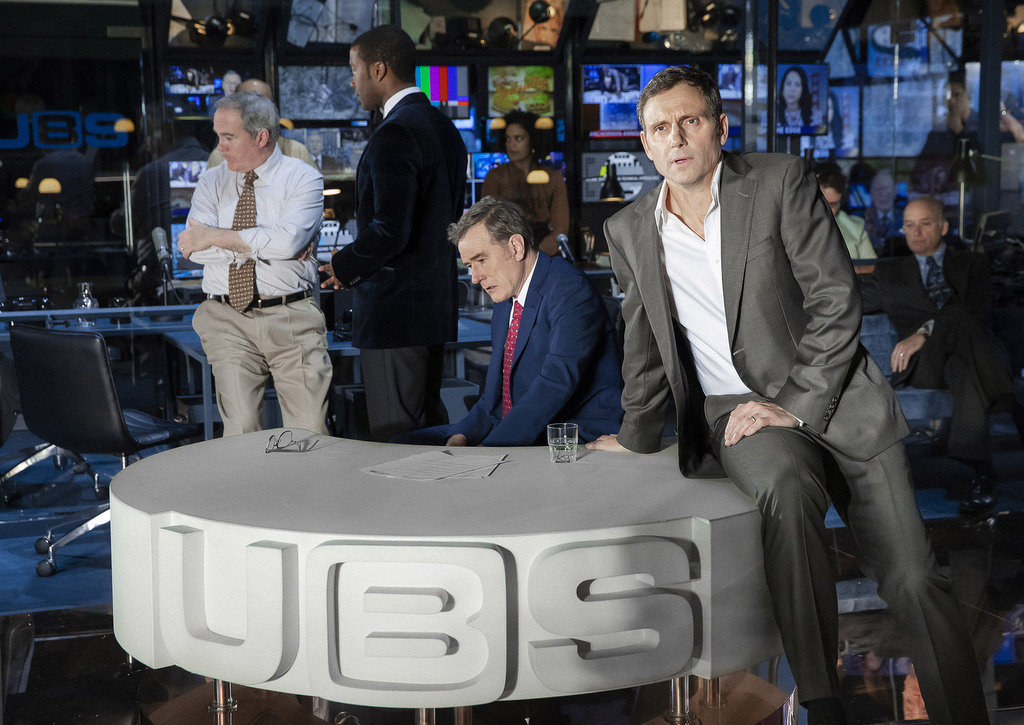
(L to R): Bryan Cranston, Tony Goldwyn and the cast of ‘Network,’ directed by Ivo Van Hove, adaptation by Lee Hall based on the Paddy Chayefsky film (Jan Versweyveld)
For his part Van Hove has rendered the dynamism, artificiality and hyperbolic humming chaos of the TV production newsroom with seamless facility. We watch the recreated TV Studio live! Thus, we see the news projected on the big screen as camera operators live-capture Cranston’s Beale. And we note his various pilot fish (make-up, hair and clothing assistants, etc.), fussing over him. The immediacy of their actions powers up to build suspense about watching the “TV show.” Of course it is a show within a show. And we all become players!
Interestingly, the authenticity and the boardroom scenes reinforce the theme that “profit-motives propel television content” (we think of social media), to addict and brainwash. Media folks need us to appreciate sensationalism over rationality. And their obsession with the bottom line strips and devours the decency of all who work for the CCA company. Most importantly, we note the downward trend away from kindness, generosity and concern for others in Christensen, Frank Hackett (Joshua Boone), Harry Hunter (Julian Elijah Martinez) and others. In fact all who create such entertainment news reflect a craven amorality.
Additionally, Van Hove’s striking re-imagining of a TV studio and news room as a live play by play brings the action into our laps. We serve a dual function. With sardonic humor, Van Hove makes us a live and interactive, participatory audience as we applaud to “Applause” signs. Yet simultaneously, we watch the action on smaller screens featuring various channels which morph to the large screen for Beale’s news program. We participate, yet we distance ourselves as the voyeurs of TV’s “non-participatory experience.”
Interestingly, this meld of the two roles we play as audience members during “The Howard Beale Show” creates dissonance. For ultimately, we “get” that as the media audience (especially social media), we choose/control the content which is as good as our viewing tastes.
This production and all who create its fever, furor and fabulousness from actors to scene and technical designers impart a momentum that runs like an electric wave which ignites all it touches. The encounter provokes. It is as if by watching the downfall of Howard Beale, UBS, CCA and everything that was once moral and decent in the news business, we watch our own participation/contribution to it.
Chayefsky’s and Hall’s Network is the harbinger of the current social media devolution. “The news” has been atomized to fit every opinion or position based on skewed information and ear tickling “facts.” And it is these statements “of fact” that force us to a site like Snopes for fact-checking. Ironically, the site speaks more credibly of its being relied upon by non-readers and non-researchers than for its accuracy.

Bryan Cranston and the cast of ‘Network,’ directed by Ivo Van Hove, adaptation by Lee Hall based on the Paddy Chayefsky film (Jan Versweyveld)
The greatness of this production is in its expression as an immersive consciousness-raising satire/comedy/drama. For it compels us to interact with cognition and emotion in a weird connect/disconnect. On one level, Network, especially in its addendum video clips (no spoiler alert-you’ll just have to see it), becomes an intriguing call to action. We can be better if we demand better and do not settle for less. On the other hand, Van Hove shepherds Cranston, the excellent ensemble and the artistic designers to provide an incredible one-of-a-kind entertainment that makes us think long after we’ve left the Belasco Theatre.
Special kudos to Jan Versweyveld (Scenic & Lighting Design), Tal Yarden (Video Design), An D’Huys (Costume Design), Eric Sleichim (Sound & Music).
Don’t miss this one. You will regret not seeing Bryan Cranston and this fiery re-imagining of Network at the Belasco Theatre. The production runs with no intermission at the Belasco Theatre (111 44th Street), through 17 March. You can pick up tickets at their website.
 CAROLE DI TOSTI