Blog Archives
Nathan Lane, Laurie Metcalf Bring Out Truths for Our Time in an Ageless ‘Death of a Salesman’ (9 Tony nominations)
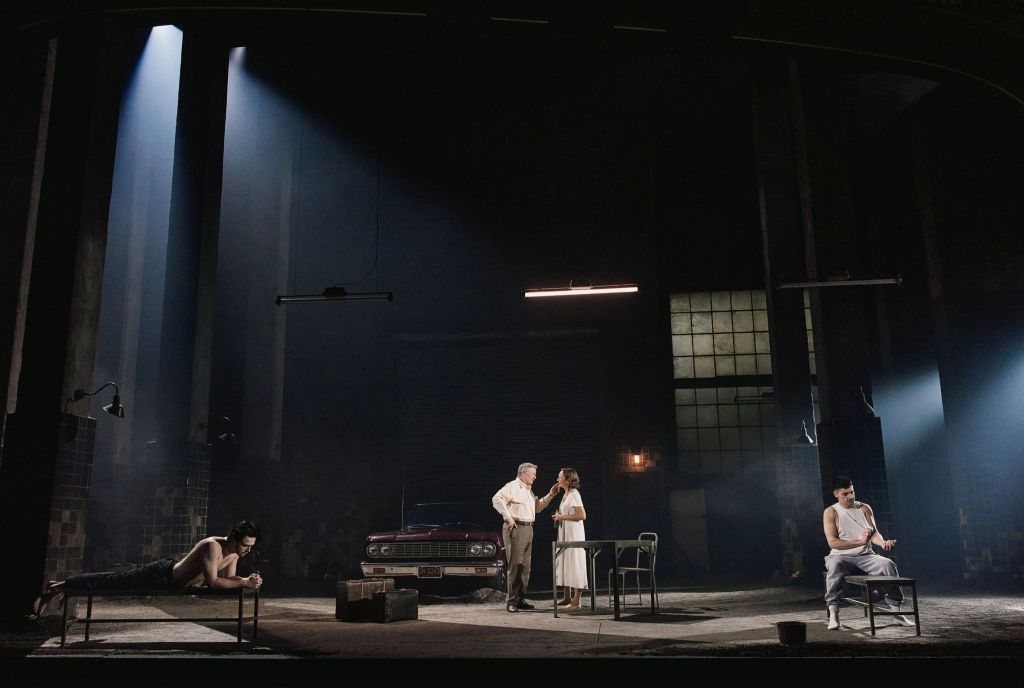
Considered Arthur Miller’s masterpiece of the average guy as a tragic figure, Death of a Salesman has been a hard sell for me as Miller’s greatest play. However, Joe Mantello’s searing direction that teases out incredible performances from Nathan Lane (Willy Loman), Laurie Metcalf (Linda Loman), Chrisopher Abbott (Biff) and Ben Ahlers (Happy), made me a convert. Presented on the cavernous stage of the Winter Garden Theatre in its sixth Broadway revival, the Loman family’s psychological travails between reality and hopeful dreams unfold their flawed humanity with pathos until August 9, 2026.
This magnificent revival in Mantello’s expansive vision conveys the characters as middle class archetypes of American citizens that are manufactured, used up and spit out by a devouring corporate culture, obsessed by success, money and status as definitions of power and greatness (“the American Dream”). Industrialization, production and “progress” are the means used to propagandize and process worker-citizens away from an appreciation of their soul worth and self identification as valuable to themselves and their families.
To underscore this overarching theme of the Lomans snared by this cultural processing with the use of the American Dream to drain their hopes, keep them ensnared and perpetuate the elusive lies of easy prosperity inferred by Willy’s Uncle Ben-Jonathan Cake (you walk into a jungle and bring out diamonds), Mantello uses a stylized set design superbly realized by Chloe Lamford. Additionally, the sound design by Mikaal Sulaiman, haunting music by Pulitzer Prize-winning composer Caroline Shaw, and lighting design by Jack Knowles beautifully carry Mantello’s dark, foreboding insights which the superb ensemble enlivens in a production whose like won’t be seen again.
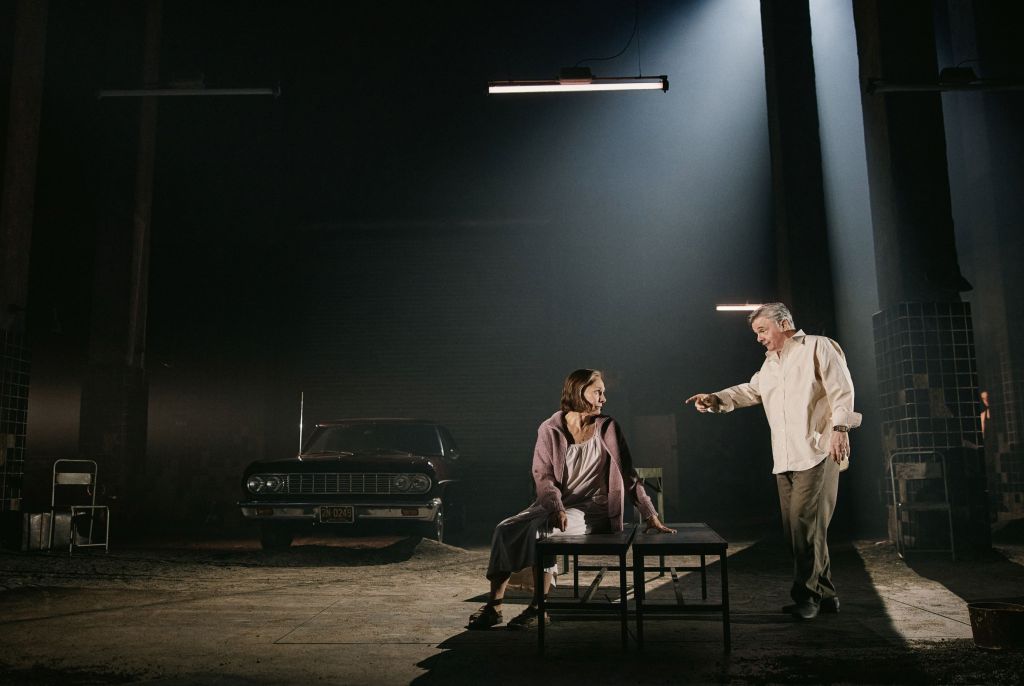
This production of Miller’s Salesman is perfectly synchronized to reflect citizens in our country, currently under siege from the very forces which isolate the Lomans from helping each other. Set adrift in misery, loneliness, distraction and despair, they have little recourse or salvation except delusions, hallucinations and denial. Even a form of success is never enough as suggested by Ahlers’ Happy, who references a prosperous boss who builds an estate but “doesn’t have the peace of mind to live in it.”
The symbol of what made America great, the car (automobile production and its attendant feeder industries, oil, gas, rubber, etc.), becomes that which Willy chooses as his place to die. Mantello features Willy’s car as ever-present and onstage throughout. The car is where Willy spent most of his life alone, traveling through New England with his dreams, and longing of returning home to see his sons, chiefly Biff who he lives his successes through until Biff has a breakdown. At the play’s beginning it also becomes his place of terror, of failure, of disorientation where he can no longer survive for any length of time on a road trip. Finally, he converts it to his way out of a tormenting hellish life he can’t bear, that promises more hope for his family in his death.
The play opens as Lane’s Willy, exhausted and broken down, returns from his aborted sales trip and drives the car onstage into the humongous, grey space that is the Loman’s stylized home. Unlike previous revivals, this place is nothing like an American home the bank would hold in a mortgage. It is similar to an empty factory or warehouse with rectangular, peeling tiled columns and no vibrant colors. It is dimly lit with a grid of dirty window panes on the backstage wall that barely let light in.
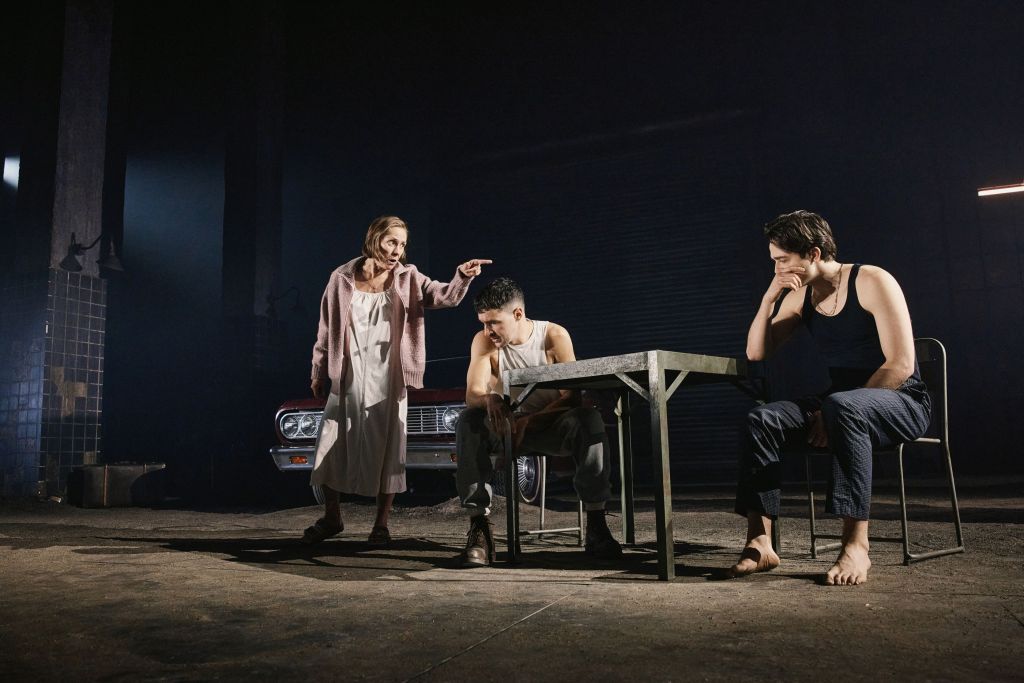
The space is symbolic and interpretive. Far stage left is the basement with Willy’s possible instrument of suicide, the gas water heater, and downstage left is the bit of soil where Lane’s Willy hopefully plants seeds he will never see grow. The characters remain onstage, moving around uncomfortable, factory-type, metal “furniture” to define areas they set up mostly away from each other. They sometimes become inconsequential dim shadows when they don’t speak and other family members do.
Spot lit when there are interactions is Mantello’s approach. But for their interactions darkness and isolation surround them. As spots come up on the initial scene between Willy and Linda when she asks why he came back home, Biff and Happy each lie on a bench on opposite sides of the stage in their ersatz beds and bedrooms, as their parents talk “downstairs.” The spots illuminate the life and interaction of Linda and Willy to a break point, then the darkness encroaches. The symbolism is affecting and effective, revealing the disjointedness of this family, their fears, their isolation, their solitary struggles, their inability to communicate with efficacy to bring about their listener’s understanding toward change.
Willy’s dire emotional and psychic state which impacts the family is also symbolized with the set when the characters move as if in timeless space, like Uncle Ben-Jonahan Cake-who floats onstage and off, as his words float in and out of Willy’s mind. Initially, he uses Ben to inspire him, but also his words and values are a truncheon that Willy uses to bludgeon himself for his failed life. There are also the recriminating memories of guilt that devastate him and push him toward self-annihilation provoked by grown up Bernard (Michael Benjamin Washington) who asks what happened in Boston, the turning point after which Biff and Willy are separated from each other by a gulf of lies and pretenses to protect Linda and damn each other, .
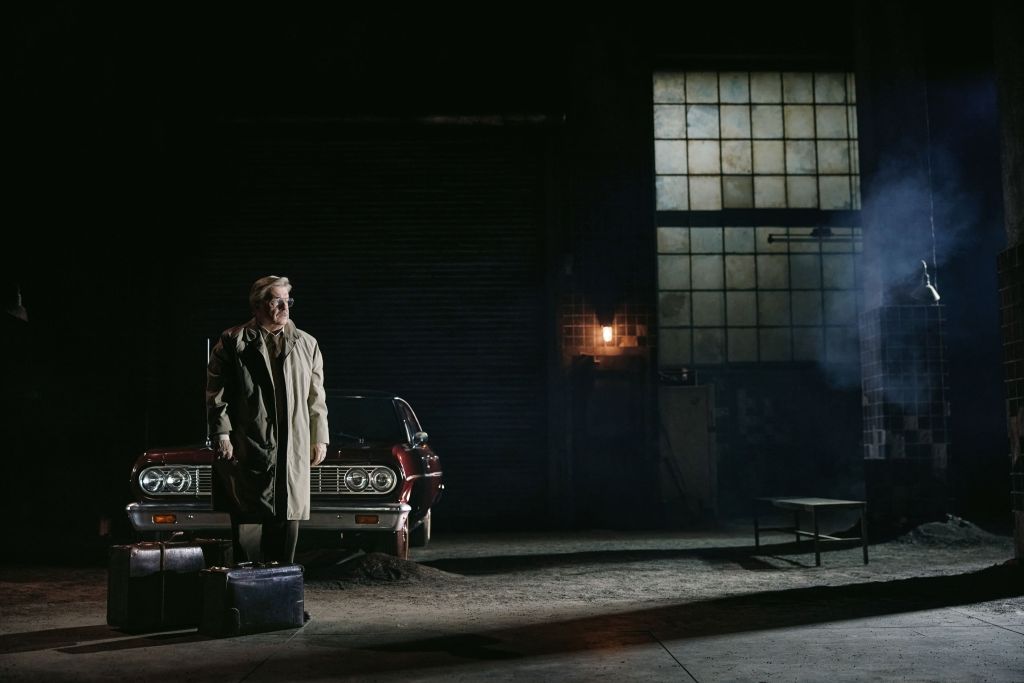
Importantly, Mantello/Lamford and the creative team have created an environment of bleakness and gloom removing any sense of warmth or comfort that a homely kitchen set or living room would suggest. Indeed, Willy and his family move in this towering oppressive, dark space that crushes them but for their connection to each other, which is their real and lasting hope, if they could see it and give each other more kind words and love instead of recriminations. However, even when they argue, insult, indict or chide each other as the glorious Metcalf does in a moment-to-breathtaking-moment take down of Biff, then Happy, her scorching speeches, one about how they left Willy alone babbling in the restaurant, are better than the silent, darkness above, behind and around them.
Mantello/Lamford also use the car to travel through time into the past. For example, one of Willy’s comforting reminiscences is when Young Biff (Joaquin Consuelos) and Young Happy (Jake Termine) follow Willy’s instructions to simonize, shine and buff the car. It is the family’s prize possession that helps provide Willy’s means of support and allows them to go to Ebbets Field on a celebratory day. It represents Willy’s pride in Biff’s scholarship success, as he stands on the roof of the car, the lighting in a golden bronze to family cheers on game day. Happy, happy recollection when Willy is their fine father, Biff has the world at his feet, and Linda looks on her brood “pleased as punch,” a successful mother and wife. Even their giving neighbor Charley (the fine K. Ttodd Freeman) comes out to tease them on this greatest of days for Biff and Willy.
Lane convinces us that Willy is who he claims he is, until he isn’t. Out of the remembrances into the gloom of grey reality he tells his sons, “the woods are burning,” and Linda tells the incredulous Happy and anger-suppressing Biff their dad is dying. With a raw fierceness and edgy emotional plea, Metcalf’s Linda tells Biff and Happy that they can’t just come to visit her, because she loves Willy. “He’s the dearest man in the world to me.” Metcalf’s Linda means it and because of her strength of character and force of will, we take a second look at Willy and see him through her eyes with poignance, and weep for this desolate family.
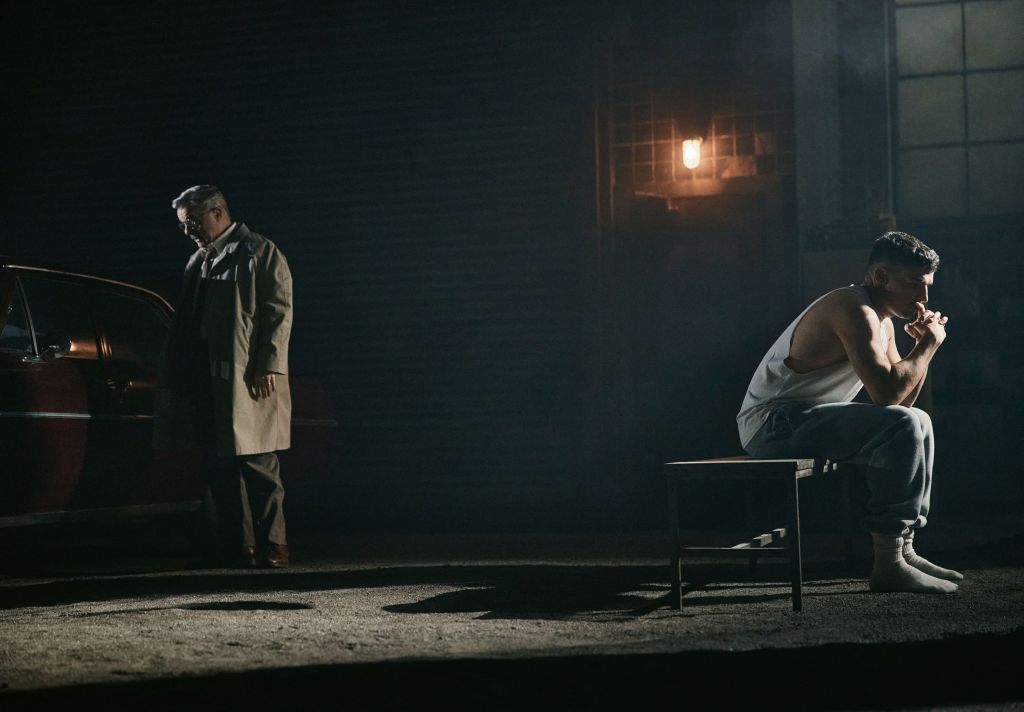
As the play progresses, Miller via Mantello reveals, the reminiscences are in fact hallucinations that Willy uses to torment himself when Biff visits. Willy’s hallucination in the restaurant after his sons desert him is guilt-laden. He relives Biff catching him with a woman and calling him a liar. Willy knows he let his son down, but he can’t admit it and will never forgive himself for it, turning psychically sick. After that incident in Boston Biff and Willy can’t have a heart to heart. Even toward the conclusion when Biff tells his father he will never be the man Willy wants him to be, Willy can’t hear him and misunderstands.
It’s a superb theatrical moment between Lane and Abbott, who passionately steps into the heartfelt, truthful Biff, releases his anger and turns to his father. Willy, still lost, conflating past and present, incapable of recognizing Biff’s truth proclaims,”He cried to me.” In the final most dangerous of Willy’s hallucinations, Cake’s Ben agrees with Willy that Biff will be magnificent with twenty-thousand to back him. Lane’s portrayal of Willy humanizes him and makes him identifiable.
As the second brother given short shrift by the family, Ahlers Happy repeats himself to get attention and uplift Linda. His, “I’m gonna get married, mom,” is as plaintive a cry as any grown manchild’s cry is, yearning for recognition and love but feeling he is incapable of receiving it. Ahlers’ Happy is endearing and charming in a standout portrayal, I haven’t seen before. Still carrying the American Dream to “make it” after seeing what happened to his brother and father, we note his denial like Linda’s, as the inevitable comes and brings her a terrible freedom.
Death of a Salesman runs 2 hours, 50 minutes with one intermission at the Winter Garden Theater through August 9, 2026. salesmanbroadway.com.
Laurie Metcalf is Amazing in ‘Little Bear Ridge Road’
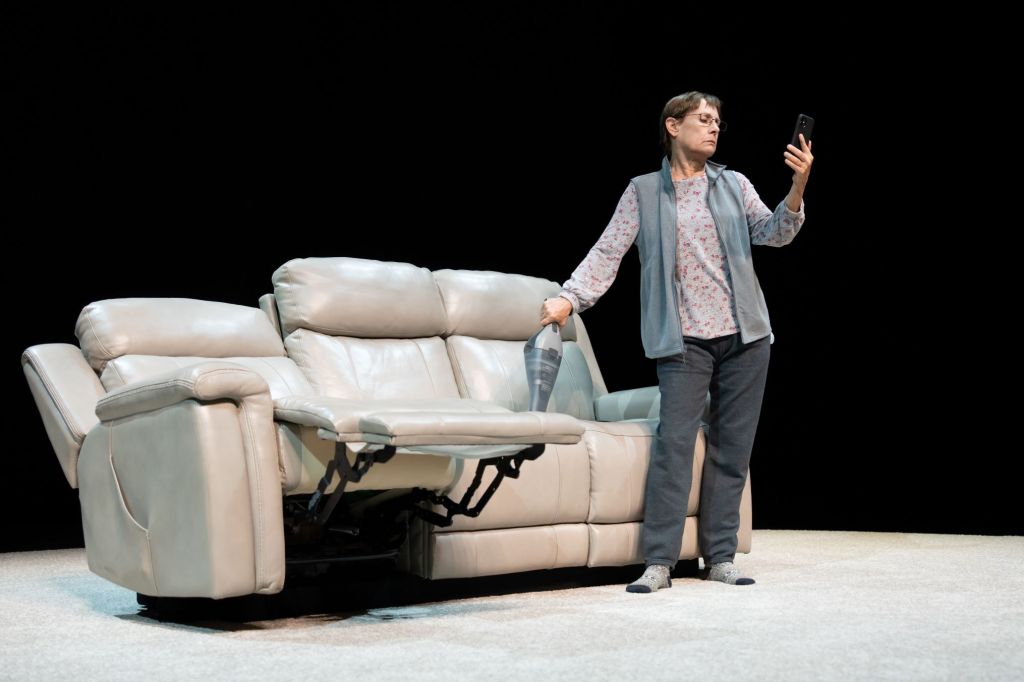
On 12 acres of property in Idaho on the top of the ridge, the sky is so intense it makes Ethan (Micah Stock) panicky because he feels that his life is insignificant against the vastness of the galaxy glittering before him. Sarah (Laurie Metcalf), Ethan’s aunt who owns the property and appreciates the nighttime view tells him she “thought once about buying a telescope, but you know. Then I’d own a telescope.” The audience laughter responding to Metcalf’s pointed, identifying statement that reveals her edgy, funny character peppers Samuel D. Hunter’s powerful, sardonic Little Bear Ridge Road currently at the Booth Theatre.
Metcalf is terrific as Sarah who delivers comments like darts hitting the bullseye and evoking laughter because her words are heavy with authenticity. Her statements convey meaning and pointedly eschew the gentility of polite conversation. Micah, Sarah’s nephew, is withdrawn, remote and masked, not only because the play begins during the COVID-19 pandemic, but because he wears his soul damage on the exterior with a covering of silence that withholds speech. Interestingly, these two estranged family members, one a nurse who doesn’t even nurture her own wounds, and the other, a self-damaged young man of thirty, who can’t really get out of his own way, eventually get along,
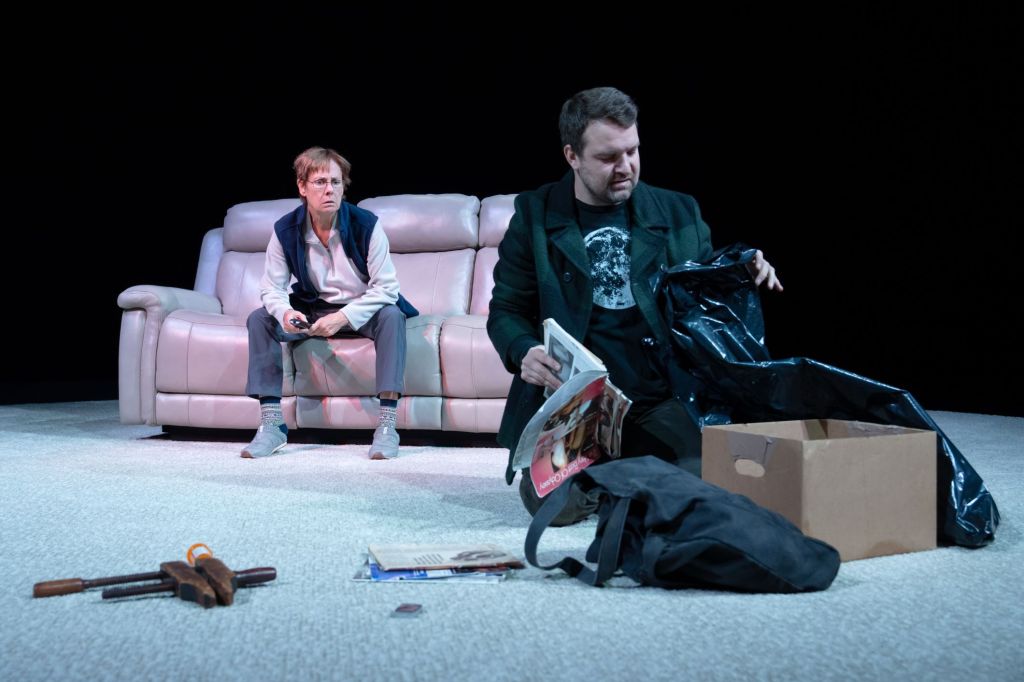
With this Broadway debut Hunter (The Whale, A Bright New Boise) weaves a poignant, humorous, fascinating dynamic. Metcalf and Stock inhabit these individuals with humanity and a fullness of life that is breathtaking.
Directed crisply with excellent pace and verve by Joe Mantello, Hunter’s comedic drama that premiered at Steppenwolf Theater Company, confronts human isolation and failed familial relationships. Hunter presents individuals who confuse self-supporting independence with misguided self-reliance. With spare, concise dialogue the playwright explores how Metcalf’s Sarah and Stock’s Ethan rekindle their sensitivity and open up while nursing their fractured, self-victimized souls, to help each other without acknowledging it as help.
Finally, Hunter’s dialogue has flourishes of well-placed poetic grace and rhythm. Within its meta-themes about human beings struggles with themselves, it’s also about knowing when to let go to encourage another’s growth.
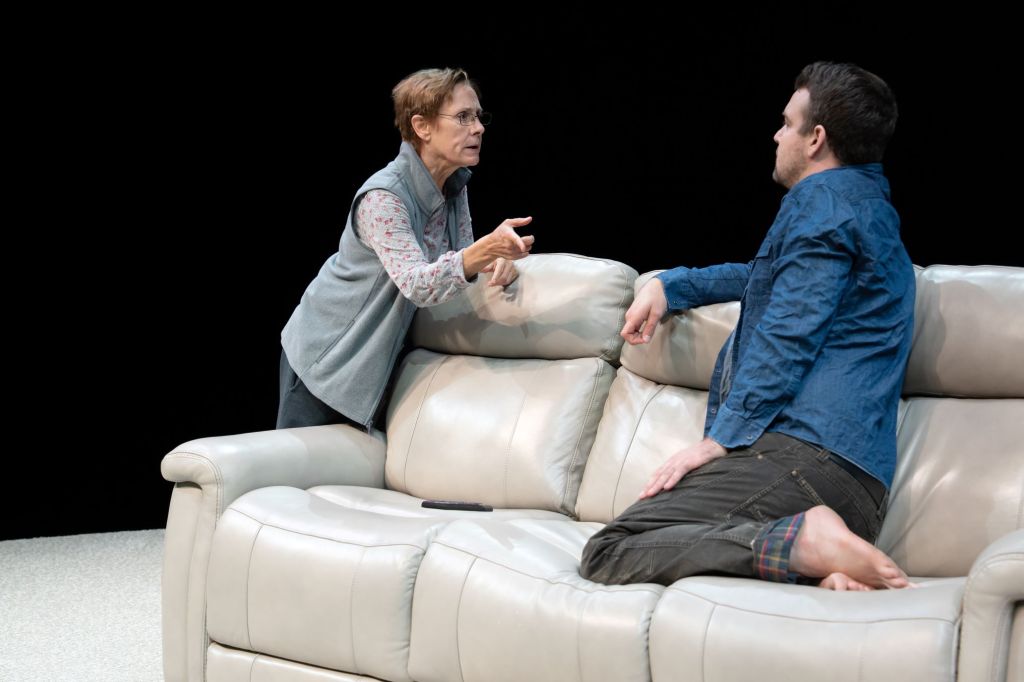
Aunt Sarah and nephew Ethan have an ersatz reunion, when Ethan’s father, Sarah’s brother, dies and leaves the nearby house and estate to Ethan to dispose of. Estranged from his father and from her for a number of years, Ethan, who is gay, lived in Seattle with a partner, who emotionally abused him and self-medicated with a cocaine habit. Eventually, they split. Graduating from university with an M.F.A. in writing, Ethan has drifted, stunned by his devastating childhood where he was raised by an addict father, since Ethan’s mother abandoned the family when he was little. How does Ethan learn not to duplicate his problematic relationship with his father, with love relationships with other older men?
For her part Sarah remained in Idaho near where she was born and worked as a nurse during and after her husband left her. Fortunately or unfortunately, they had no children. This means that she and Ethan are the only Fernsbys left on the planet, dooming their family line to extinction, which according to Ethan seems pathetic. Selling her home in Moscow, Sarah tells Ethan she moved to a more remote area because “It suits me better. Not being around—people.”
With her prickly, self-reliance and proud stance refusing help, Sarah has taken care of her house and property, worked, organized documents and paperwork for Leon (Ethan’s dad, her brother). She generously gave Leon money to help him with his bills. When Ethan affirms that was a bad idea because his addict father used it for his meth habit, Sarah states she doesn’t know what he used it for. After all, Leon told her that he never did meth in front of Ethan. The truth lies elsewhere.
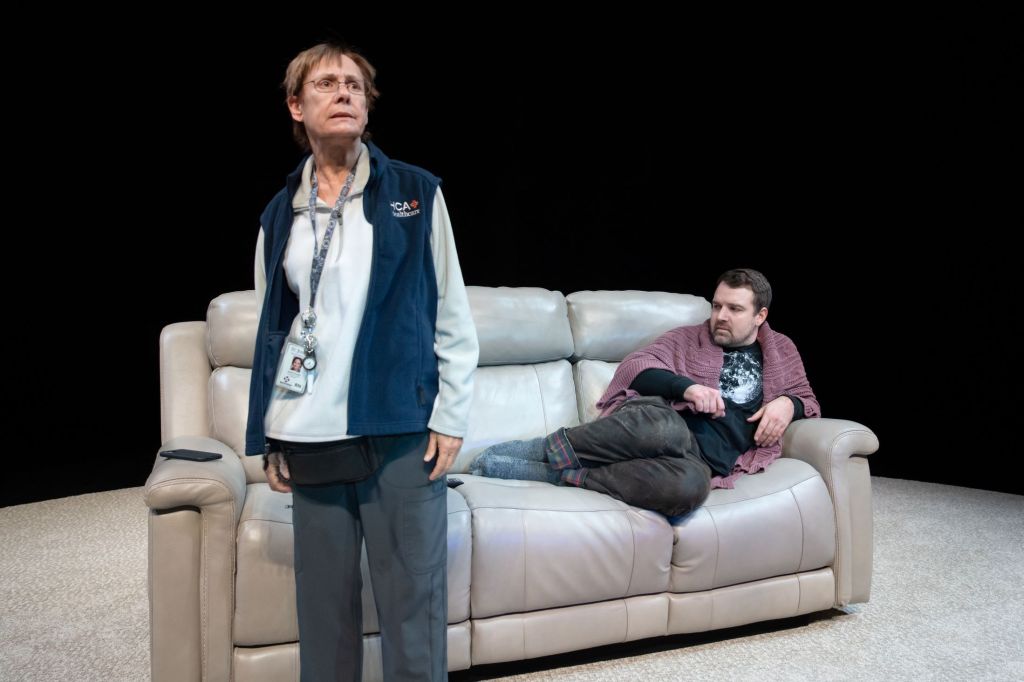
As the pandemic passes and circumstances improve, the relationship between aunt and nephew also improves. They communicate more intimately. They watch a TV series and comment about the characters. The dialogue is funny and Sarah and Ethan become family. Assumptions and mistaken views are dismissed and overturned. Realistic expectations fill in the gaps. A surprise occurs when Ethan meets and forms an attachment with James (the excellent John Drea).
Hunter uses James as a catalyst, who provokes a turning point to continue the forward momentum of the play. James comes from a more privileged, loving background and is studying at a nearby university to be a star-gazer for real, an astrophysicist. With eloquence James explains the magnificence of Orion’s Belt to Ethan, as it relates to our sun. Sarah welcomes him and encourages his relationship with Ethan, until once more circumstances gyrate in another direction, all perfectly unfolding with the emotion of the characters.
Mantello arranges the interlocking dynamic among Sarah, Ethan and then James, center stage on a “couch in a void.” From there the characters converse, sit, enter and leave stage right (to an invisible kitchen), stage left (to bedrooms). The recliner couch on a turntable platform in different positions establishes the passage of time between 2020 and 2022. Scott Pask’s set and the lighting by Heather Gilbert are symbolic and interpretive. Our focus becomes the characters and the actors’ exceptional portrayals as they struggle to find a home with each other and themselves, until the threads of grace in their alignment come to a necessary end.
After all, the Fernsbys have to have a legacy, if not in offspring, then in words. And the respite and connections they find together talking and watching TV on a “couch in void” becomes the place where Ethan’s legacy in writing is born, and the Fernbys legacy prevails.
Little Bear Ridge Road runs 1 hour 35 minutes with no intermission at the Booth Theater through February 15th littlebearridgeroad.com.
‘Grey House,’ a Subtle Send-up of Horror Films, That Delivers With Humor and Surprise, Starring the Fabulous Laurie Metcalf
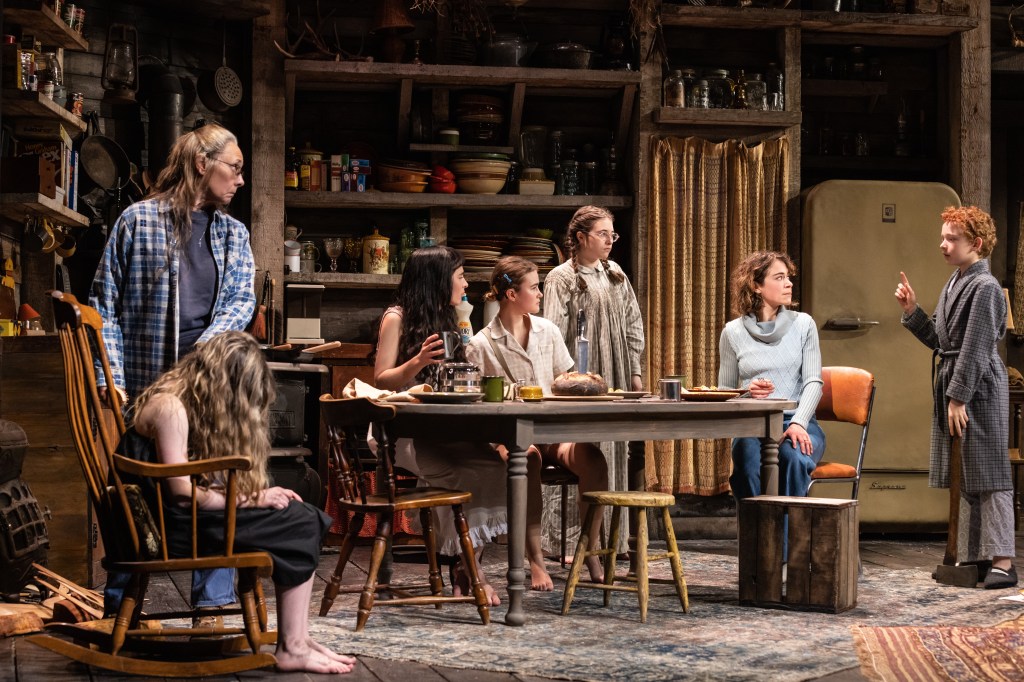
Top shelf performances and eerie effects in lighting, sound, and on-point set design carry Levi Holloway’s horror-thriller Grey House through to its unreasoned, macabre and opaque ending, leaving the audience disturbed and unsettled in an unusual, visceral entertainment. The production, currently running at the Lyceum Theatre until September 3rd, is insightfully directed by Joe Mantello for maximum preternatural weirdness and warped grotesqueness that is also a send-up of the genre.
With sardonic humor and glimpses of the supernatural which evanesce in the twinkling of an eye, the playwright Levi Holloway shrouds the action along a path of darkness, confusion and sometime shock, until the widening road dead ends in a climax and (spoiler-alert) Max’s partner Henry vanishes, replaced by a new guest as Raleigh (Laurie Metcalf), bags packed, leaves.
Spoiler alert! Stop reading if you want to be surprised by the play. Read the rest if you are looking for clues to guide you down the dark road of Grey House.
Where and how Henry de-materializes doesn’t matter. We have witnessed his sadistic torture by a child tormentor and watched astounded at his masochistic enjoyment of pain. When he contributes his substance to create a palliative “alcoholic” drink that anesthetizes, most probably for a future unrepentant male, our fog of understanding clears a bit. Henry receives well-deserved punishment for his unspeakable past acts, that, until he entered Grey House, have gone unanswered. Is the function of this house and these female inhabitants to deliver justice? If so, married couple Max (Tatiana Maslany) and Henry (Paul Sparks) who seek help at Grey House after a car accident are “innocents” walking into a trap.
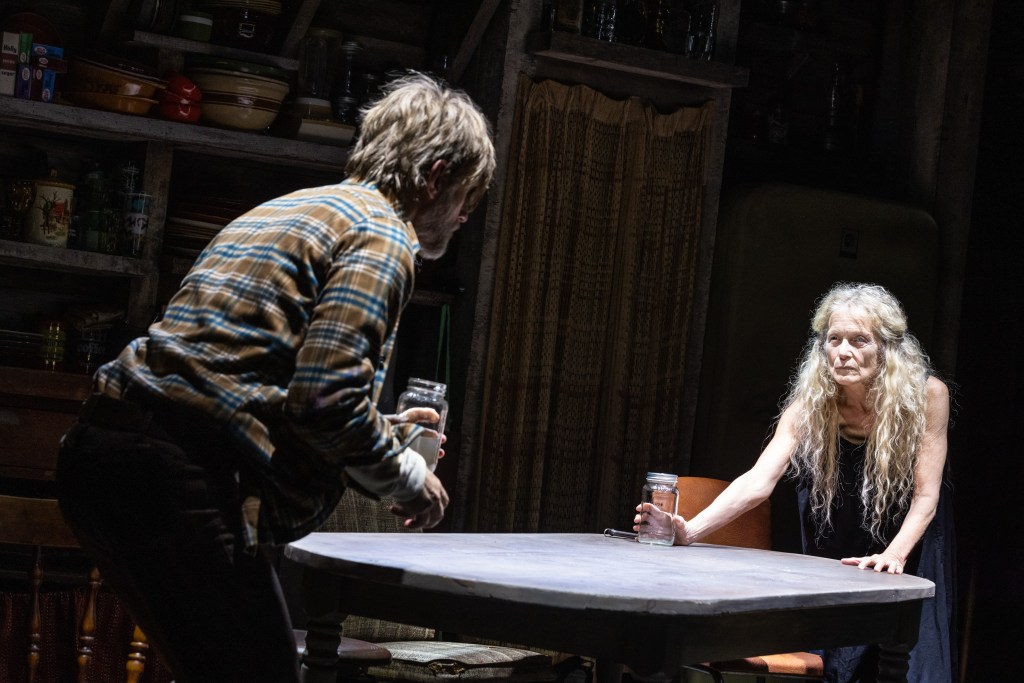
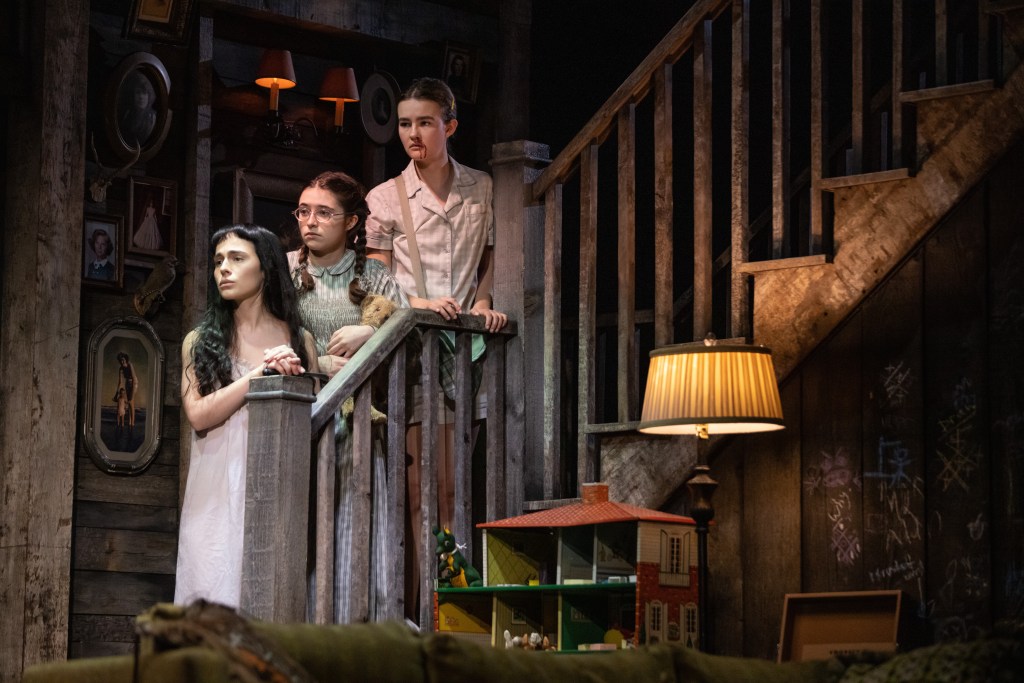
The creaking, groaning, hellish, two-story, ramshackle abode in the mountains, referred to as “Grey House,” initially appears to Max and Henry as a welcome, cozy shelter from the blizzard and their injuries. However, we know better and not just because of the advertising campaign for the show.
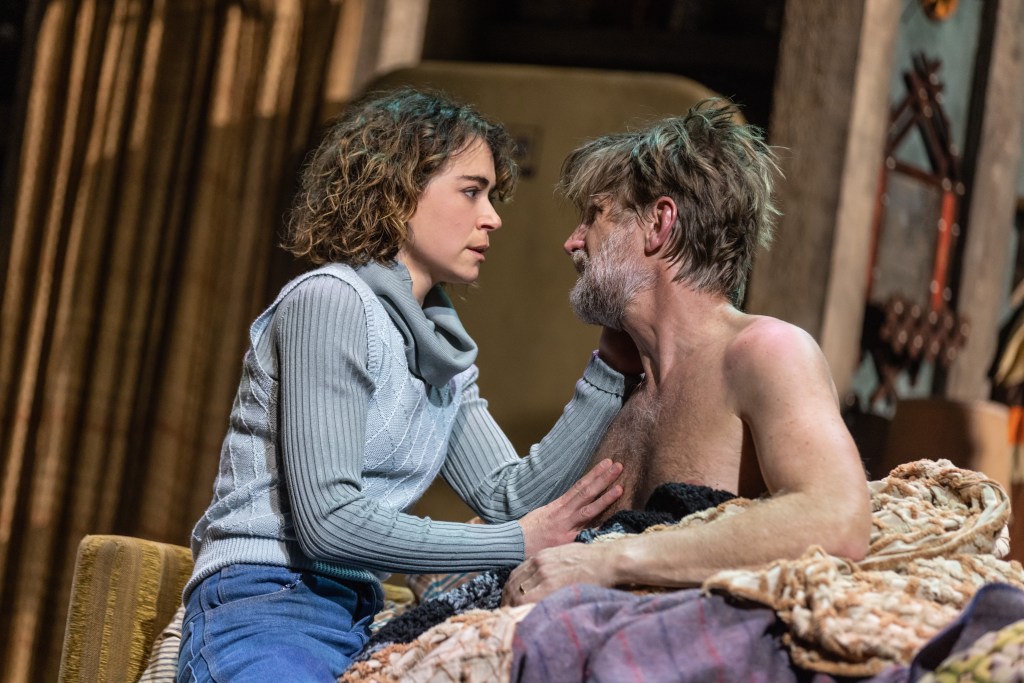
Previously, we have been introduced to the strange, uncanny children of the mountain cabin and their mother/caretaker Raleigh (the sensational Laurie Metcalf). Two of the “sisters” initially raise the spirits in a representative song of the region, singing a cappella. They produce an effect which is haunting and spooky. At turning points throughout the production, a total of four songs are sung: two authored by Mountain Man and the others by Bobby Gentry and Sylvan Esso. Each song is more compelling and meaningful in relation to the action, thanks to Or Matias (music supervisor and a cappella arranger).
Henry’s ironic comment that he’s seen this movie before and they “won’t make it,” lands with humor, horror and truth. We know something he doesn’t. He and Max must stay away from the two unnatural malevolents, a Wednesday Addams meme, Marlow, and her frightful companion in wickedness, the vicious, hell-bound Squirrel. In the initial moments of dialogue and action, they are daunting.
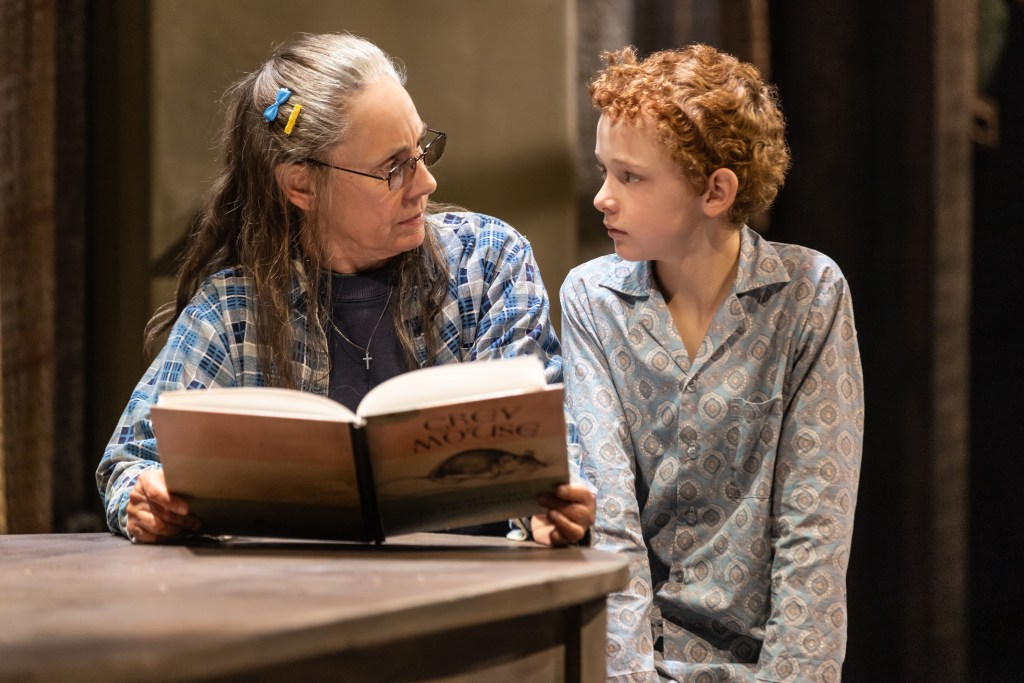
Throughout the action, both could double cast as witches in their sarcasm, sinister intentions and sub rosa text delivered in a straight-forward manner, as they allow the “words to convey the meanings.” The import of their statements are clues to what is really going on, however, the substance is easily missed because the audience is Holloway’s prey and is misdirected as she steers them down the road, and blinds them with her dark shadows of uncertainty.
Nothing is directly expressed. Of course, Henry and Max have the bulk of their interactions with these vixens, who rule the roost and who, Raleigh, their ersatz mom, calls “willful creatures,” an understatement.

As the Wednesday Adams meme who is a self-satisfied, self-admitted, proud “bitch” in the MAGA vein of “owning the libs,” Sophia Anne Caruso is terrific at suggesting the horror underneath the action. She enjoys making her guests, especially Max, feel creeped out.
Squirrel, whose damaging persona is represented by her name and her having chewed the phone chord so no calls come in or go out, is the youngest. Portrayed with insinuation and sadism in a nuanced performance of softness and brutality, Colby Kipnes is superb. She is the youthful doppleganger of The Ancient (Cyndi Coyne) and is the instrument of revenge holding “everyman” predator Hank to account in a twisted time reversal. For unspeakable acts he committed decades before, the young Squirrel and the others collaborate in effecting physical retribution which the anesthetized Henry willingly accepts as his due.

“Grey House” exists beyond time and place, the repository of the wounded in life who exist when we meet them as otherworldly beings or some other undetermined construct of humanity, which the playwright ironically leaves in the realm of uncertainty. When we meet this particular brood, Raleigh suggests others will come and go, as she in fact leaves at the conclusion with a packed suitcase, letting Max who may be a younger version of herself replace her as the caretaker.
The bottles of “moonshine” the ersatz family of women, including A1656 (the fine Alyssa Emily Marvin), and hearing-impaired Bernie (Millicent Simmonds passionately completes the witches’ coven) extract from male predators is kept refrigerated for the next visitor destined to arrive at Grey House. Like Henry he will be punished to sustain its prosperity and existence as a “living thing.”

Laurie Metcalf’s Raleigh is continually surprising in a spot-on, gorgeous performance as the hapless “mom,” who she portrays with power, insight and presence. Of all of the actors, Metcalf is the most surreal yet authentic and empathetic, as we feel for what she goes through at Grey House, though we don’t succinctly understand what we see happening before our eyes. When she is on stage, she is imminently watchable. Her lead, as subtle as it is, guides Caruso’s Marlow and Kipnes’ Squirrel to their understated ferocity which spills out in their insightment to get Henry to masochistically “fall on his own sword,” as they act out their vengeance.
Sparks’ Henry is so likable and loving in his relationship with Maslany’s Max who is the perfect wife, that we are shocked that both are not who they appear to be, Henry less so than Max. Maslany shows a sense of humor with the girls, then turns, flexing her emotional range when she expresses the appropriate terror knowing their luck has changed and she confronts evil. Sparks’ demeanor during the ordeals he is put through is nuanced. His confession is forthright and shocking in its understated delivery.
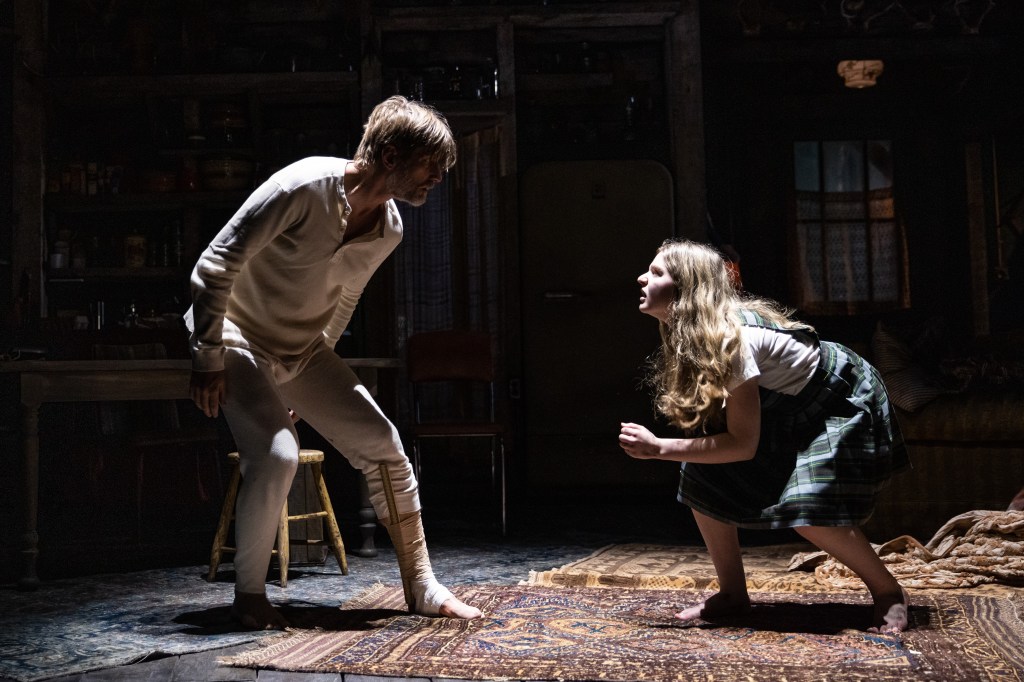
The silent characters, The Boy (Eamon Patrick O’Connell), and The Ancient (Cyndi Coyne), are vital in their gestures and presence. They add to the dynamic of “the family,” and Coyne’s Ancient is the wounded mirror image of Colby Kipnes’ Squirrel as a youth.
The production is amazing in its confabulation of mystery and opaque unreality delivered by the creative team. These include Scott Pask’s wonderful set design, Rudy Mance’s subtle costume design, Natasha Katz’s stark, atmospheric lighting design, Tom Gibbons’ house humanizing sound design, Katie Gell & Robert Pickens’ wig and hair design, Christina Grant’s makeup design. All of the actors are invested, as is Mantello in relating the otherworldly and arcane side by side with the profane, teasing out humanity in its wild derivations.
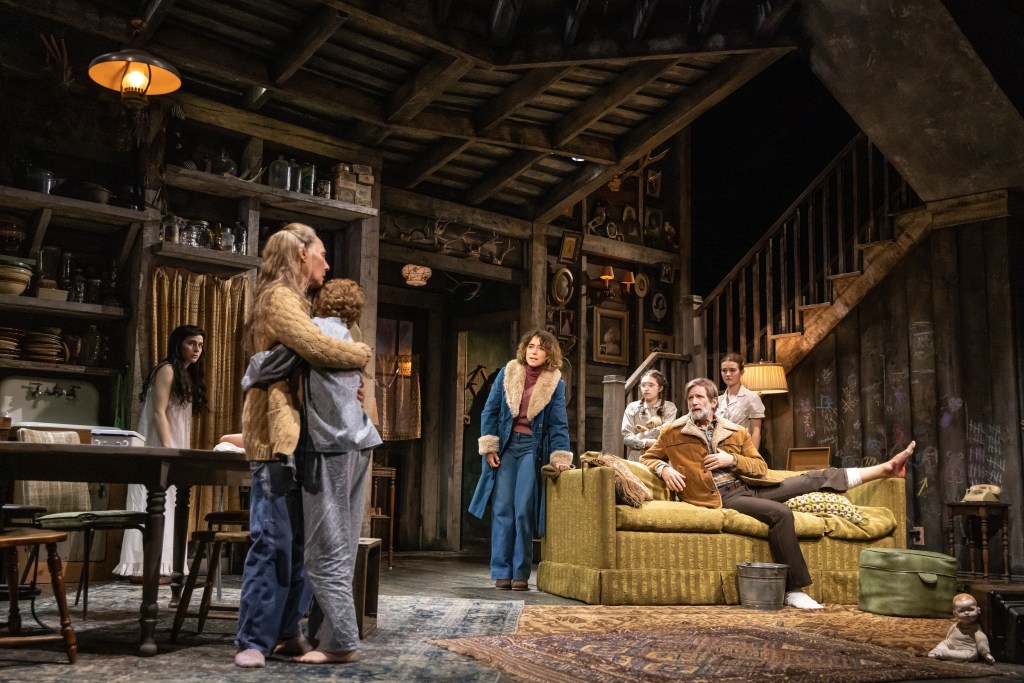
In life we see “through a glass darkly.” We receive glimpses beyond what we assume to be “reality” but know there is more that is present. What our senses apprehend, continually deceives us, though we like to believe “we know” and we are in control.
Holloway reminds us of the contradictions, the ironies, the shades of life that have no clear explanation. Indeed, the hints she drops about how the “family” of “willful creatures” operates in this spooky place are never solidified. All is intimation. The “moonshine” as Raleigh refers to it, “sold during the summer,” Marlow names “The Nectar of Dead Men,” which seems a more accurate handle by the conclusion. The duality of symbols existing on a spiritual, preternatural level are contrasted with the profane, material realm, for example when Max makes eggs (they are real-made offstage), for the “hungry, always hungry” sisters-daughters-creatures.
Thus, all is not what it seems. Holloway drives this theme home using the horror-thriller genre conveyance as a grand joke to prod us toward fear and laughter. She sends up that genre and twits us about our nightmares displayed in horror films, mirroring those found in our unconscious in dreams.

The development of the story and its characters, who are timeless archetypes reflected in literature (the good, the evil, the furies who gain vengeance), drive this work beyond genre. Thus, in an attempt to nail down Grey House and dismiss it, one may lose the deeper levels of Holloway’s symbols and complex, convoluted themes. One fascinating example is the red tapestry woven of the sinews of the historical predators, who have come to visit the cabin and whose “Nectar of Dead Men” is distilled for future use. The labels on the jars in the refrigerator tell the tale. The men’s remains we learn are in the walls, the grounds or in the basement which Squirrel frequents.
In Grey House Holloway’s vision expressed by Mantello and his creative team and enacted by the wonderful ensemble is a tonal hybrid of humor, a teasing send up of horror-thrillers, yet terrifying in its deeper representation of the patriarchy which doesn’t come off looking well in its tapestry of innards and crimes committed with impunity finally answered with rough justice, by “willful creatures.” The play is highly conceptual and may bear seeing twice because you will definitely miss connecting elements. Or just enjoy the ride and the fabulous acting and theatricality which will not disappoint.
For tickets and times go to their website https://greyhousebroadway.com/
‘Hillary and Clinton’ Starring Laurie Metcalf and John Lithgow
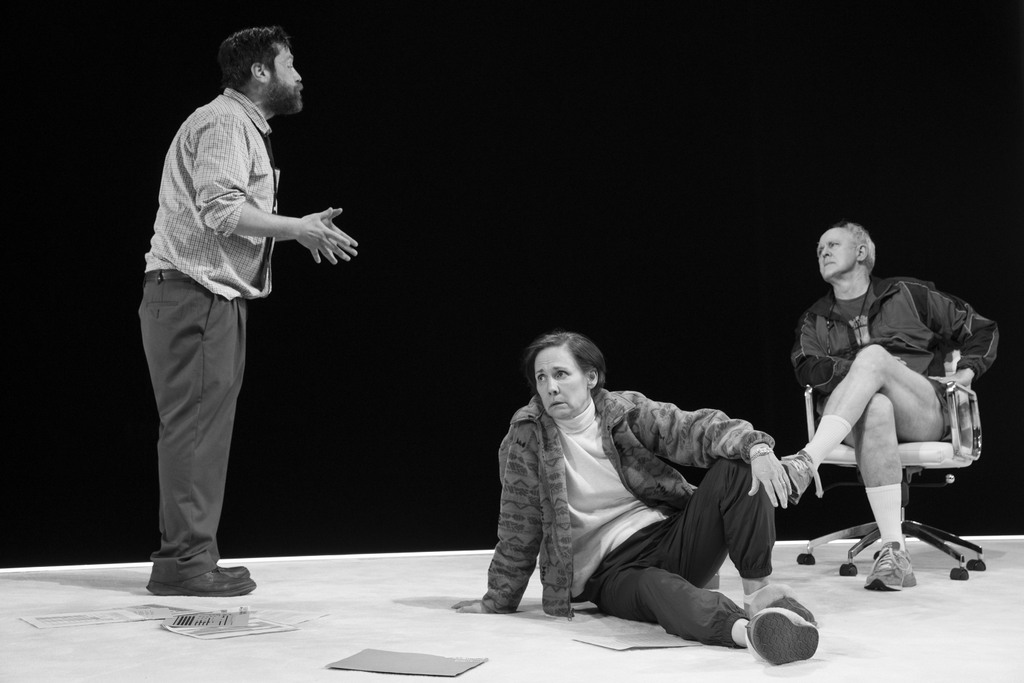
(L to R): Zak Orth, Laurie Metcalf, John Lithgow in ‘Hillary and Clinton,’ directed by Joe Mantello, written by Luas Hnath (Julieta Cervantes)
Hillary and Clinton by Lucas Hnath, directed by the acute, clever Joe Mantello, currently at the Golden Theatre, begins with hypotheticals. Women live their lives in hypotheticals. What Ifs! And this is how the playwright has his character Hillary, who neither looks like nor effects the ethos of Hillary Clinton (played by Laurie Metcalf in a stunning, invested portrayal) opens her discussion in a relaxed “down-to-earth,” “behind the veil” confession to the audience. She posits a “What if?” supposition that there are “infinite possibilities” in our universe.
Hnath wrote the play when Barack Obama was in the full swing of his presidency. Considering what occurred during the 2016 election, Hnath’s play is doubly prescient and its underlying themes resonate more loudly than ever. In 2019 despite #Metoo, perhaps because of it, as much as we’d like to, we cannot pretend that women and men have equality in our culture, especially in light of a Trump presidency which is a throwback to women’s oppression in various forms that echos throughout American History.
For many women, “What if” doesn’t really get a chance to soar to a triumphant conclusion because there are an infinite number of “not possibles” preventing it. The sheer will that is required for women to overstep the “not possibles” is shattering. This is even so in an alternate universe of cultural equanimity, where it is a given that women succeed in obtaining leadership positions because men always lay down their egos and encourage them to do so.
Hnath subtly spins themes about paternalism and gender folkways in his subtle yet not so subtle fictional/nonfictional work. He does this aptly by hypothesizing about one of the most brilliant, competent and ambitious of women in the “free” world living today. Like no other in the political arena, Hillary Clinton embodies the possibilities of power and the smash downs to achieve it. Why is this, Hnath asks sub rosa? He answers this by factualizing his perception of Hillary Clinton’s relationship with Bill Clinton in the service of reminding us about women leadership and competence, about male ego and dominance, about the underlying primal realities of paternalism and male oppression and womens’ attempts to overcome.
At the play’s opening, an always on point Laurie Metcalf as Hillary, posits the probability that on another planet earth somewhere in our universe of “infinite possibilities” there is a Hillary running for the Democratic Party nomination during the 2008 primaries. Hillary, in competition with a man named Barack is losing. With Mark Penn (Zak Orth portrays the shambled-looking, frustrated and stressed campaign manager) Hillary attempts to determine the truth about why she is losing and how she will be able to recoup further losses if she can get more funds to refill her dwindling coffers.
After Mark offers explanations of her loss from his perspective, he indicates that perhaps it is not as bad as she suspects. The Obama campaign actually is daunted by her and has offered an opening for her to be his running mate when he is nominated if she drops out of the next two races and slowly fades away. Hillary interprets this to mean the Obama campaign is circling in for the “kill,” and expresses outrage that she might take such a deal. Despite Mark’s protestations she interprets it to mean she is going down for the count. Mark warns her not to call Bill for help and she promises not to.
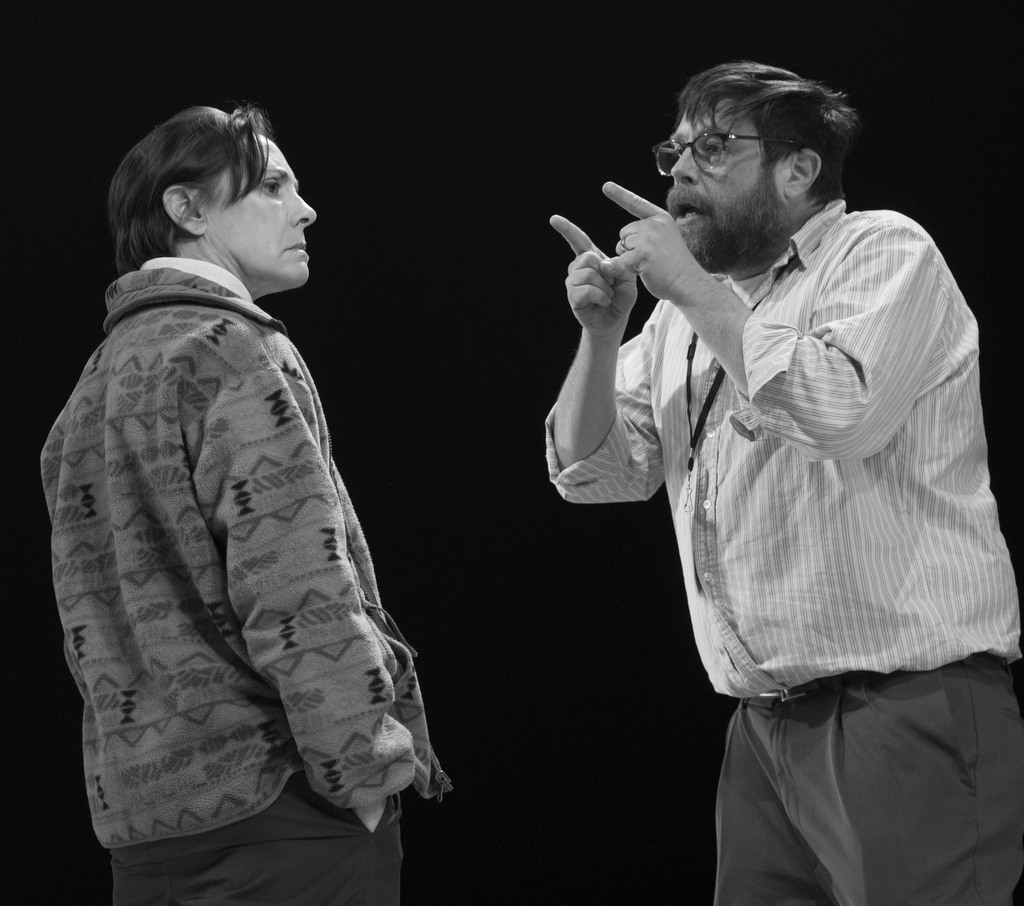
Laurie Metcalf, Zak Orth in ‘Hillary and Clinton,’ directed by Joe Mantello, written by Lucas Hnath (Julieta Cervantes)
Twelve hours later, Bill (the wonderful Lithgow) who previously had been kicked off the campaign, shows up in New Hampshire to the starkly minimalistic hotel room (which indicates a lack of funds). When he swears they stayed there before, we consider perhaps this is a backhanded reference to his own campaign in the primaries which he successfully won. In small measure he is forcing her to “eat crow” that she needs him. Then he chides her and expresses his ire at having been thrown off the campaign by Mark.
Their clashes are revelatory. In these discussions they cover a myriad of intriguing subjects: her fear of losing, their lives together, his boredom, her personality, her lack of fire and warmth, that he exhausts her, references to his infidelity and strategies for the upcoming primaries to initiate wins. Some of the subjects are unfamiliar. Others we anticipate because we’ve heard talking heads discuss the Hillary “personality” problem.
Lithgow’s and Metcalf’s focused listening and responding to each other are particularly excellent during Hnath’s dynamic interchanges, well shepherded by Mantello. Importantly, in exploring the fictional/nonfictional complications of a marriage between two brilliant, competitive and ambitious individuals, Hnath reveals the conundrum. They need to be together, but also must be apart in their own identity and autonomy. In their wish to be themselves, they are also the couple in a shared unity and friendship which will end in uncertainty for Hillary and loss for Bill if they separate. The public trust has glued them together as one. Their bond is intangible and ineffable and Hnath particularly suggests this with great sensitivity.
Hnath grounds their arguments, thrusts and parries with homely marriage tropes which we identify and empathize with. They are intensely human, real, warm, vibrant, competitive, loving (their costumes suggest the “all masks off” feel). Underlying all of it are dollops of frustration, wrath, annoyance and fear thrown in for good measure.
Threaded throughout we understand that these two have a profound relationship based on many similarities and attractions based on differences. They have a mutual care and concern that is their greatest grace and their underlying curse. Indeed, Hillary, in anger wishes she could break away from the stench of Bill that follows her. But when he suggests to succeed she must get a divorce, she avers. It is a fascinating moment; for as she states, she knows that many would support this and believe this is the right action for her to take. However, she cannot; she states she will be with him forever. For that he is beyond grateful.
Into this mix is thrust the knowledge of a phone call between Hillary and Obama, during which Hillary accepted Obama’s offer to be his running mate. Upon this everything turns.
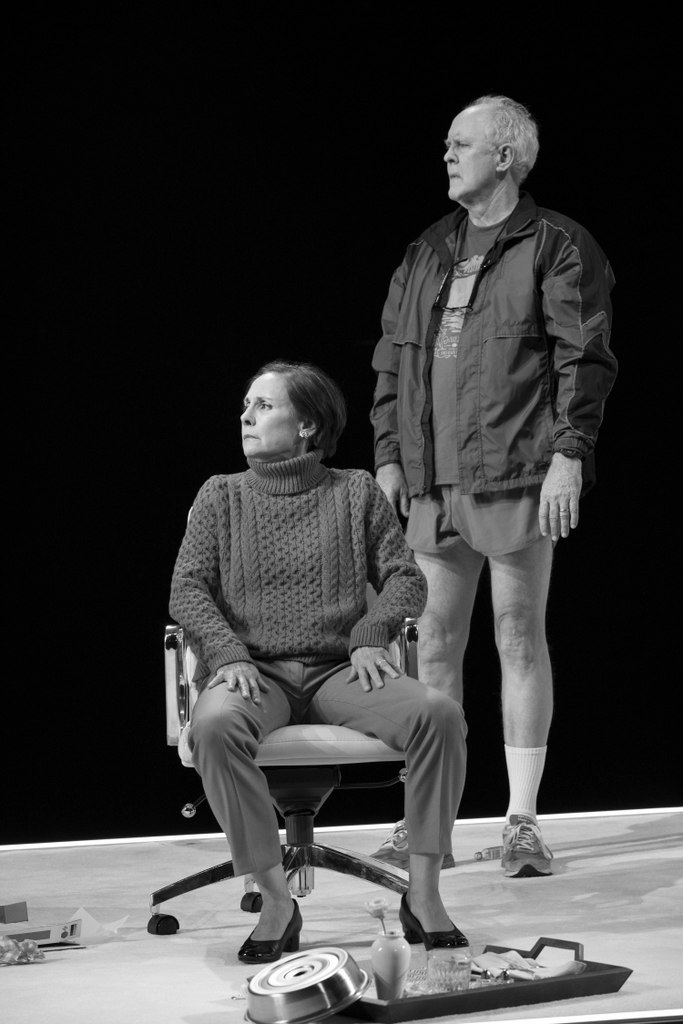
Laurie Metcalf, John Lithgow in ‘Hillary and Clinton,’ directed by Joe Mantello, written by Lucas Hnath (Julieta Cervantes)
When Bill steps into the campaign and gives her what she initially requested, he also oversteps his bounds causing rifts between Mark and Hillary. This causes a surprising series of events, one of which includes Barack coming to their hotel room to talk. Barack is portrayed by Peter Francis James in an interesting turn and resemblance to Obama in demeanor and stance. Barack confronts Hillary about the offer to be his running mate and the change in the fortunes of a race, after Bill becomes involved. He also reveals a tidbit of information that landed in his lap, information which will haunt the Clintons in the future.
There is no spoiler alert. You will have to see how Hnath arranges the chips to fall in this climax and how all of what we’ve seen before of their ties that bind, play out.
The play which expands on the premise of “infinite possibilities,” ends on it. From Hillary’s initial flipping of the coin that turns up a 50/50 heads/tails pattern of probabilities, we follow a series of events that decry any possibility of the coin toss dealing Hillary a winning hand. Hnath has brought us closer to explaining why she is not a winner this time, nor a winner in 2016, nor ever unless the earth tilts differently on its axis to produce another earth where Hillary somewhere “over the rainbow” on another earth is president.
Hnath allows us to fill in the unanswerable uncertainties and questions which he leaves open and encourages us to hope for in his poetic “on another earth Hillary is president.” For me this is heartbreaking especially now with the Mueller Investigation revealing a massive Russian warfare campaign to interfere with the election to put Trump in as the president, the results of which we are being deprived of in its full form. Indeed, Hillary lost the 2016 election on planet earth. She did this, perhaps for the reasons suggested intriguingly in the play.
However, Hnath’s powerful work and framing it with the backdrop of probabilities reveals more in what it doesn’t discuss because it was written before we understood what forces were ranging against the United States. Probabilities set up in coin tosses are random. What happened in Hillary Clinton’s 2016 loss (which is never alluded to in the play) is far from a probability. As more of the facts come out (despite the struggle to obfuscate and obstruct the report by the administration) her loss appears to be an inevitability…an inevitability which various illegal forces would go to extreme lengths to bring about.
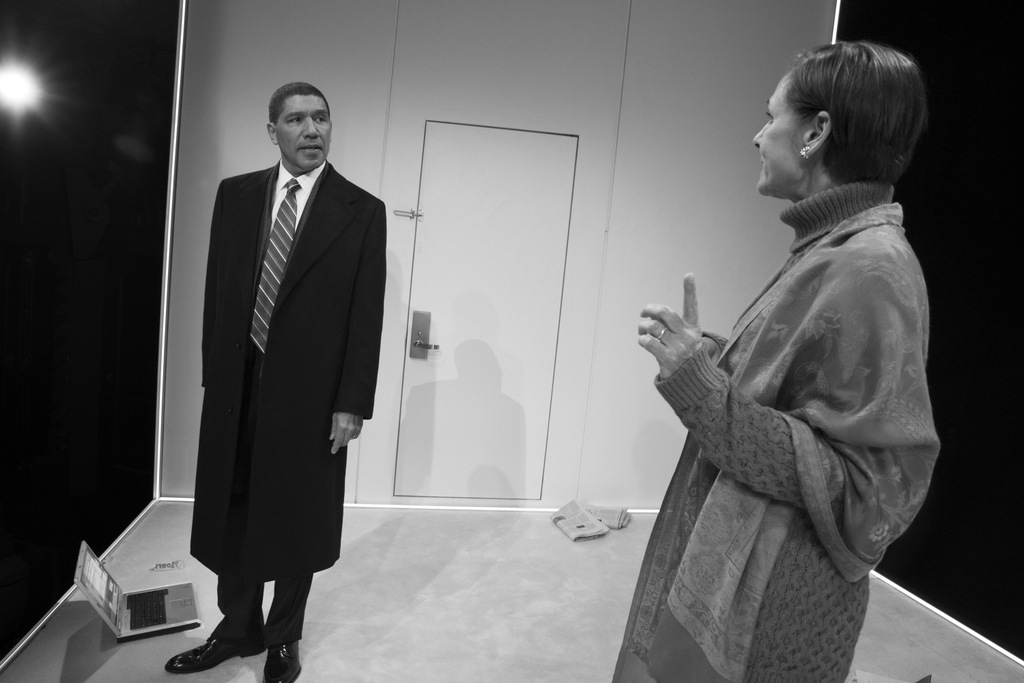
peter Francis James, Laurie Metcalf, ‘Hillary and Clinton,’ directed by Joe Mantello, written by Lucas Hnath (Julieta Cervantes)
That this production is being presented now at the height of the issues with the release of the Mueller Report Investigation and the DOJ? Well! This is fascinating and curious. And it leads me to this theme: there is more to what appears to be so, what pundits say is so and what “the facts” are depending upon who “owns” them. In Hillary and Clinton, Hnath presents the “What If” and allows us to consider what the character Hillary says about running again at some point. She would like to; she must understand how to get there to win.
This forces us to ponder what happened in 2016 and then the character Hillary brings us back to the coin toss which makes her president on another earth. We go with Metcalf’s Hillary for one second, then are dropped into the pit of reality. She isn’t president. And why not? Because of Bill? Because of her personality? Because of the Clinton Foundation? Because of paternalism? Because she is a woman? Sure!
But!
To my mind, Hillary Clinton’s loss was less about her personality and her relationship and Bill’s “stench” and more about what forces didn’t want her in and why not. All the ultra-conservative social media groups, Russian Intelligence institutions, Russian hackers, Republican Think Tank strategists, elite globalists and like-minded billionaire Americans were poised to prevent her win with systems “ON.” It was a monumental effort that is mind blowing. And very costly.
That’s why Hnath’s character Hillary tossing a coin at the beginning and conclusion of the play is brilliant in theme and profound message. It is frightening, heartbreaking and an eye-opener, however you frame the “What if.” There will never be a “What if” for Hillary. There is no alternate universe, earth or whatever. We must deal with what is and get to work about it.
Laurie Metcalf is gobsmacking; she’s nominated for a Tony, Drama Desk and Drama League for “Best Actress in a Play.” Lithgow is superb. Able assists, Zak Orth and Peter Francis James make this a play you must see. Hillary and Clinton will make you think; it will open your eyes. And as it did for me, it may break your heart.
Hillary and Clinton runs at the Golden Theatre (252 West 45th St.) until 21 July. It has no intermission. You can purchase tickets by going to the website and CLICKING HERE.
Tribeca Film Festival Review 2018: ‘Every Act of Life,’ Looking Into the Brilliant Terrence McNally

(L to R): Director Jeff Kaufman, Terrence McNally, ‘Every Act of Life,’2018 Tribeca FF World Premiere Special Screening and Q & A, Moderator Frank Rich, unpictured (Carole Di Tosti),
Terrence McNally is a theatrical force of nature, though with his incredible humility in an age of self-promotion, he would be the last to admit it. With a career spanning six decades and major, ground-breaking successes on Broadway and Off, in film and television, and multiple theater awards every decade, the man is a dynamo, beloved by actors whose careers he has vaulted, actors whom he collaborates with in a symbiotic relationship again and again. At 80, he is still working, attending productions (I saw him in the audience of the musical production of the most Tony nominated musical SpongeBob SquarePants this summer.) and launching off into new projects, even as I write this.
The World Premiere Every Act of Life directed and written by Jeff Kaufman was given a special screening at Tribeca Film Festival 2018, with luminaries, actors and McNally himself attending for the Q and A afterward. In this formidable documentary about a formidable American playwright, Kaufman presents McNally’s career and personal life. From start to finish Every Act of Life is an intriguing and well-thought-out chronicle cobbled together with interviews, archived photos, video clips, well-researched facts, details, memorabilia and well-placed commentary by actors, directors, producers and McNally himself. The documentary is especially revealing in its presentation of how one individual’s love and passion for the theater, opera, music and art has impacted our culture and brought us together in a forward momentum of shared communication and understanding.

Tyne Daly (‘Mothers and Sons’ and ‘Master Class’), Nathan Lane (‘Love! Valor! Compassion!’ ‘The Lisbon Traviata,’ ‘ It’s Only a Play’)2018 Tribeca FF World Premiere and Special Screening and Q & A (Carole Di Tosti)
Beginning with his early plays and traveling right up to his most recent work, Kaufman lays out the seminal moments and turning points that have slowly fostered the personality and character of this mild-mannered and charmingly authentic persona that McNally is today. Early influences on his life McNally credits to his English teacher in Corpus Christi who encouraged him to write and attend schools outside of the area. But his love of musicals and Broadway, were initially inspired by his parents, transplanted New Yorkers, who brought him all the way from Texas to New York to see a few smash musicals with towering figures like Gertrude Lawrence in The King and I and Ethel Merman in Annie Get Your Gun.

Terrence McNally, ‘Every Act of Life,’ 2018 Tribeca FF World Premiere Special Screening and Q & A (Carole Di Tosti)
The excitement and enchantment of live theater musicals were imprinted on his memory. And this love abides with him to this day as he continues to collaborate on musicals writing the book for numerous hits like The Kiss of the Spider Woman (1992), Ragtime (1996), The Full Monty (2000), The Visit (2001), Catch Me If You Can (2011), Anastasia (2017). He has also sharpened his wits and taken up collaborating on opera, for example in 2015, the production of Great Scott (music by Jake Heggie), premiered at Winspear Opera House in Dallas, Texas. He is a veritable tornado when it comes to writing new plays and collaborating with composers on musicals and operas.

Chita Rivera appeared in McNally’s ‘The Rink,’ (1984) ‘The Kiss of the Spider Woman,’ (1992, 93, 94) ‘The Visit,’ (2004). Tribeca FF 2018, World Premiere Screening and Q & A, ‘Every Act of Life.’Chita Rivera appears in Kaufman’s film about McNally. Here Chita Rivera appears at a 2018 LPTW event (Carole Di Tosti)
Following his English teacher’s advice, McNally attended Columbia University and was further shepherded by professors like Lionel Trilling for literature and Andrew Chiappe who steered him in the basics by having McNally and others read every work by Shakespeare in the order of their composition. After Columbia, McNally through a serendipitous introduction via The Actor’s Studio, cruised with John Steinbeck and family around the world as he tutored Steinbeck’s two young sons. This was another incredible experience which was to shape McNally’s writing career and broaden his horizons as well as establish his relationship with Steinbeck who inspired his writing. From these adventures he later fashioned the first act of And Things That Go Bump in the Night. Additionally, Steinbeck asked him to write a libretto for a musical adaptation of his novel East of Eden. One doesn’t know what one can do until a great American novelist like John Steinbeck asks you to do it.

F. Murray Abraham, ‘Every Act of Life,’ 2018 Tribeca FF World Premiere and Special Screening and Q & A (Carole Di Tosti)
Back in New York City, McNally used his connections at the Actor’s Studio to begin to workshop his nascent one-act plays. And it was in New York that he met the brilliant playwright Edward Albee who was just coming into his own. After a four-year tempestuous relationship during which Albee wrote The American Dream and Who’s Afraid of Virginia Woolf, they parted ways and McNally’s career began to take off gradually in theater, television and in film as he wrote screenplays for versions of his works first performed on Broadway and Off Broadway.

(L to R): Terrence McNally, Edward Albee, ‘Every Act of Life,’ 2018 Tribeca FF World Premiere Screening and Q & A (Carole Di Tosti)
Various tidbits appear in Kaufman’s documentary that fascinate. Some of the impressions are telling. He became addicted to alcohol and at a time when no one could admit to being gay, McNally confronted the oppressions of the culture and created some of the most insightful, poignant and endearing works related to the LGBT community and relatives confronting the AIDS epidemic. These include the TV miniseries Andre’s Mother for which he won an Emmy and later his Mothers and Sons starring Tyne Daly based upon the miniseries. Additionally, Lips Together, Teeth Apart, as well as an inside look at gay relationships for which he won his second Tony Award, Love! Valor! Compassion! also feature topics about confronting gender prejudice.

Joe Mantello, ‘Every Act of Life,’ 2018 Tribeca FF World Premiere Screening and Q & A (Carole Di Tosti)
Always concerned about the deep side of the human condition and striving above it, McNally first landed on the map when he was recognized for his portrayal of female-male relationships among the working classes (Frankie and Johnnie in the Claire de Lune) which was adapted into a screenplay starring Al Pacino and Michelle Pfeiffer. McNally’s versatility and humanity encompasses play topics that run the continuum. What is most important to him is human connections and the realization that we are together in this “thing” referred to as life. The beauty of our ability to connect, express love, overcome personal issues and adversity, with an assist from art and theater makes all the difference in discovering our purpose and fulfillment.
McNally’s dogged fight for LGBTQ rights at a time when it was most unfashionable and nearly anathema is an incredible achievement, considering the forces and money behind the attempt to liquify LGBTQ rights in the noxious march toward inhumanity and darkness led by the political conservative right-wing. Kaufman highlights the struggle. He also reveals how McNally overcame his addiction to alcohol and on that subject includes an amazing anecdote. Angela Lansbury’s love and honesty prompted her to speak directly to McNally to the effect that he must stop destroying himself. Indeed, she feared this most talented playwright, librettist and screenwriter would die an early death. Her influence and other factors eventually sent him down the road to wellness, where others were not as willfully fortunate.
What I appreciate in the film is McNally’s candor in discussing his “flops.” Of course, one might say that there are no flops in a playwright’s repertoire, only stepping stones which help them achieve their hard won success.

2018 Tribeca FF World Premiere Screening and Q & A, ‘Every Act of Life,’ (L to R): Jeff Kaufman, Terrence McNally, Tyne Daly, Nathan Lane, Joe Mantello, F. Murray Abraham (Carole Di Tosti)
Kaufman highlights McNally’s award-winning work (the musicals- The Kiss of the Spider Woman-1992 and Ragtime-1997 and his plays, Love! Valor! Compassion!-1994, Master Class-1995 and Dedication or The Stuff of Dreams-2005). The most incredible feature of this segment of the documentary is the commentary by living legends and McNally friends and collaborators, Chita Rivera, Nathan Lane, John Glover, Tyne Daly, John Kander, F. Murray Abraham, Joe Mantello, Angela Lansbury, Christine Baranski, Audra McDonald and many more. Indeed, the film is a who’s who of McNally’s posse, as well as a chronicle of his prodigious work ethic and love of theater, opera, ballet and music. His talents and breadth of knowledge about the Arts are absolutely staggering. And Kaufman gives us a historical perspective that is continually fresh and exciting.

Terrence McNally, ‘Every Act of Life,’ 2018 Tribeca FF World Premiere Screening and Q & A, (photo courtesy of the film)
I loved this film. I am familiar with McNally’s work having seen a number of his musicals and comedies on Broadway and Off. I split my sides enjoying them. However, Kaufman digs deep into the revelation of the anointed genius of this most wonderful of playwrights who connects the heavens to humanity with his words, impressions and inspirations, and joins us together in what can be compared to a holy act of communion in the theater. The film is a must see, and you will especially enjoy hearing how McNally and friends worked together to create some of the finest, most enduring works of American theater which in the future will surely be identified as classics.

‘Every Act of Life,’ Q and A, Tribeca FF 2018 with (L to R) Jeff Kaufman, Terrence McNally, Tyne Daly, Nathan Lane, Joe Mantello, F. Murray Abraham, moderated by Frank Rich who is not pictured (Carole Di Tosti)
Epilogue
After the World Premiere Screening there was a Q and A moderated by Frank Rich, who was a longtime critic of theater at The New York Times. McNally made an incredible admission during the Q and A. Even though he has a prodigious body of work trailing in his wake, he never really considered himself a playwright or a successful one at that, until a few years ago. I was gobsmacked. Such is the talent and evolving genius of this artist.
That Frank Rich was moderating individuals he has sometimes dunned in his previous job as New York Times Theater critic was a bit of an irony. He long held sway as THE Times CRITIC until 2011. Often he was acerbic and unwieldy in his self-aggrandizement and pretensions to be THE VOICE of theater, backed by the “heft” of The Times. After I accomplished some gentle research for this review, I discovered a note in Wikipedia on Kiss of the Spider Woman (musical) that bears sounding since the main subject of this film is American Theater and Terrence McNally as one of the fountains where we might go for a revitalizing drink..
It seems that in 1990 Kiss of the Spider Woman was being workshopped at “New Musicals” at the Performing Arts Center SUNY at Purchase. New Musicals‘ goal was to create, develop and provide a working home for sixteen new musicals over four years. When New York critics heard that the play was being workshopped in its initial production, they wanted to see it. Unfortunately, they couldn’t be persuaded not to review it despite the fact that producers, etc., were testing the waters to see what needed ironing out. Frank Rich and other critics filed “mostly negative reviews” of this initial workshopping of Kiss of the Spider Woman. Sadly, New Musicals, whose mission was honorable and vital for American theater and especially New York Theater, blew out and folded after the fiasco with Kiss. Don’t get me started on the state of American Theater and why it is that way.
Thankfully, two years later a producer developed Kiss of the Spider Woman. It went on in Toronto and The West End where it won An Evening Standard. It finally came back to the US where it received 7 Tony Awards and 3 Drama Desks and ran 904 performances, despite Rich’s reviews. Ultimately, the American public became the arbiter of the production.
American Theater has lost ground for many reasons and indeed, the gatekeepers, critics and money people have, for all intents and purposes, shot it to hell and drained its lifeblood. With the rise of Social Media, for good or ill, digital platforms and word of mouth continue to lift up productions so that their lasting value might be revealed to give them staying power. But it is enough? Rich went on to feather his own nest. Kiss of the Spider Woman found its audience. New Musicals is no more. And so it goes. In light of these events Every Act of Life is an important documentary about the history of American theater, and a master creator who has thrived in spite of changing times.

