Monthly Archives: August 2019
‘Bat Out of Hell the Musical’ by Jim Steinman, Thunders Off Broadway

Andrew Polec in ‘Bat out of Hell the Musical,’ book, music & lyrics by Jim Steinman directed by Jay Scheib (Little Fang photo)
Jim Steinman’s Bat out of Hell the Musical is first and foremost a clangorous, booming Hard Rock/Pop Concert on a small stage with operatic, bespectacled overtones. In other words, the production is an amazing hybrid not easily categorized. Replete with strobes, underground caves and fiery doomsday projections, intimate video hand-held captures which codify emotional moments and the blaring fantasmagoria of myriad-colored flashing lights with haze and fog, the musical numbers are loud and shattering and the unusual choreography evokes the strangeness of the futuristic setting. These are characters not of our time, but with emotional resonances we can feel and glory with.

(L to R): William Branner, Andrew Polec and Tyrick Wiletz Jones ‘Bat out of Hell the Musical’ with music, book, lyrics by Jim Steinman (Little Fang Photo)
Based on bestselling Meat Loaf albums, Steinman wrote the book, music and lyrics. He has been working on this magnum opus for years and has managed to garner awards during his production tours which began in 2017 up to and after the London West End Tour which beamed its startrails to Off Broadway at the New York City Center where it ends on 8 September. Five days ago, Meatloaf showed up on stage to celebrate this vibrant, blasting out of the park musical production directed by Jay Scheib. With the cast he celebrated songs he made famous from the 1970s through his Grammy Award win in 1994 and beyond.

Andrew Polec, Christina Bennington in ‘Bat out of Hell the Musical,’ book, music & lyrics by Jim Steinman, directed by Jay Scheib (Little Fang Photo)
Bat out of Hell’s sketchy story coheres to its slim plot points. These gyrate the action into a “world’s end” scenario that casts as enemies the haves like the Falcos, well placed elites with a pedigree living high above in the neo-gothish “Falco Towers” (slamming Trump Towers) and the have nots (The Lost Boys/Girls). The latter clan are Oliver Twist urchin-orphans, who live a hard scrabble existence in abandoned subway tunnels underground, making wild music, partying and ferreting out their existence with above ground raids. Their keyword is freedom and the innocence and wildness of reveling in being what the mainstream culture refers them to as “lost.” Indeed, it is the other way around. With their power and money, Sloane and Falco have become lost to what they once were and what they once enjoyed. The theme, sometimes you need to launch off and take a break from your own imprisoning fears and corrupted values (which Falco and Sloane eventually do) you can restore the passion and vitality of youth which is spiritual and never “lost.”
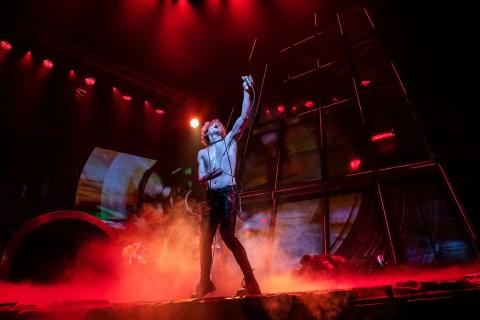
Andrew Polec in ‘Bat out of Hell the Musical (Little Fang Photo)
As perpetual teens (it’s a Peter Panish spin as their metabolic physical processes never age past 18-years-old), Strat and his band also attempt to stay one step ahead of cudgelings by autocratic Falco’s security forces who intend to eradicate them like the “vermin” they are. However, this street gang is poetic; their “vermin-state” is romantic as Strat proves to Raven (the sylph-like, melodically voiced Christina Bennington). Ignoring her parents’ dictum to stay away from the miscreants, she is lured by the sonorous, powerful Strat (Andrew Polec is mesmerizingly fabulous; you cannot take your eyes off him), attracted to his energy, resourcefulness and ever abundant enthusiasm. Like a super-hyped engine, he charges Raven’s curiosity, daring and love. Eventually, her boredom with privilege and oppression by her father lead her Juliet-like (there is even a balcony scene) to Strat’s emotional, heart-throbbing Romeo.

Christina Bennington in ‘Bat out of Hell the Musical’ (Little Fang Photo)
The character developments are primarily revealed through the dynamism of Steinman’s songs and the superb acting, dance-movements and singing talents of Andrew Polec (Strat) Bradley Dean (Falco) and Lena Hall (Sloane). Interestingly, unlike the others whose movements and actions remain purposeful, especially when delivering an intense, revved up song, Raven’s movements during the time she is influenced by her parents are like those of a jelly-fish with no backbone. Only after she leaves home for one night with Strat, does she gain strength and resolve and her movements become more directed.
During the course of the two act musical, we witness how wife Sloane (Lena Hall’s voice is unparalleled) resists Falco’s love and motivates him to change with her anger and remembrances of their love from the past (the fabulous “Paradise by the Dashboard Light”). Bradley Dean, like Andrew Polec, delivers his songs with incredible verve and realism (“What Part of My Body Hurts the Most,” “Who Needs the Young,” etc.) He is mesmerizing. The Dean and Hall duets are highpoints; balance, strength, power encapsulate their emotional potency in a unified whole. Wow!

Lena Hall, Bradley Dean in ‘Bat out of Hell the Musical,’ directed by Jay Scheib, book music & lyrics by Jim Steinman (Little Fang Photo)
Thankfully, all turns on love restored between Falco and Sloane. However, the poignance that Strat will never move past 18-years-old while Raven reaches her late forties is a reality not easily traversed. The ideal that love is the answer, if not the reality is one of the finest moments for the entire ensemble with solos by the protagonists in “I’d Do anything for Love (But I won’t Do That).” And somehow we let pass the hard distinctions of youthfulness and old age that Raven hits Strat with; this trope is easily forgotten and passed over by the rousing, gobsmacking finale.
Outstanding cast members who belt out their souls are the couple Jagwire (Tyrick Wiltez Jones) and Zahara (Danielle Steers). Like Sloane and Falco, this would-be couple remains apart until the end. And their performance together is nothing short of stunning as it melds with the other couples’ renditions into the iconic “I’d Do Anything for Love (But I won’t Do That).” Additionally, Avionce Hoyles’ (Tink, a Tinkerbell allusion to Peter Pan) and Andrew Polec’s number which both sing while Tink is dying is heartfelt and gut-wrenching. Polec and Hoyles are one’s to watch for their inherent star power.
Kudos go to the following creatives: Ryan Cantwell (musical director) Howard Joines (music coordinator) Edward Pierce Studio (design supervision) Steve Sidwell (orchestrator) Jon Bausor (set and costume designer) Meentje Nielsen (original costume designer) Finn Ross (video designer) Patrick Woodroffe (lighting designer) Gareth Owen (sound designer) Xena Gusthart (choreography adaptor) Michael Reed (musial supervisor and additional arrangements).
Presented at New York City Center, Bat out of Hell the Musical is at the end of its run, closing on 8 September unless it is extended which it should be. It is that phenomenal. It runs in two acts. You can purchase tickets online if you CLICK HERE.
‘Rinse Repeat,’ an Intense, Riveting Exposé of Illness Perpetuated by a Family in Crisis
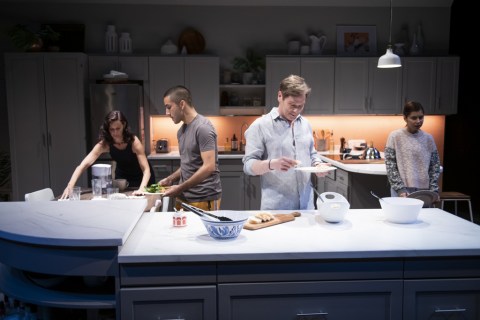
(L to R) Florencia Lozano, Jake Ryan Lozano, Michael Hayden, Domenia Feraud, in ‘Rinse, Repeat,’ written by Domenica Feraud, directed by Kate Hopkins, The Linney at The Pershing Square Signature Center (Jenny Andersen)
Domenia Feraud’s brilliantly constructed, intimate and fascinating Rinse Repeat, is about one woman’s attempt to grapple with a disease pervasive in our culture, but which few discuss and many keep hidden. Feraud’s play at Pershing Square’s Signature Center (The Linney) receives a cogent, eye-opening, much needed rendering in this astounding production expertly directed by by Kate Hopkins and exceptionally acted by an “in the moment,” acute, dynamic ensemble..
From the outset when Rachel (Domenica Feraud’s portrayal is specific, highly tuned and real) enters the home she has left for a season to return to her family, we are gripped by her tentative steps, her unsettled, hesitant manner. Surely, her unease comes out of something which has happened there; her expectation hovers in the air like a darkened cloud, and we pick up her imbalance which leaves us in a hushed suspense.

(L to R):, Domenica Feraud, Florencia Lozano, ‘Rinse, Repeat,’ directed by Kate Hopkins, written by Domineca Feraud (Jenny Andersen)
All this is put to rest, however, when beautiful mother Joan (the superb Florencia Lozano) and warm, loving father Peter (the heartfelt and engaging Michael Hayden) greet her enthusiastically and smother her in smiles and encouraging, welcoming comments about “how wonderful she looks” and how happy they are to see her and have her back. Yet, clues are dropped. Her mom asks if she may hug her: importuning if her daughter is ready to receive her affection? Curious! And her laconic, 18-year-old brother, the haphazardly funny Brody, whose response to his sister is frank and unapologetic, gives her a less than gracious hug that is cold and brief. This unsettles the atmosphere once more. We question: is that just Brody’s character or does it reflect “what happened” before Rachel left?
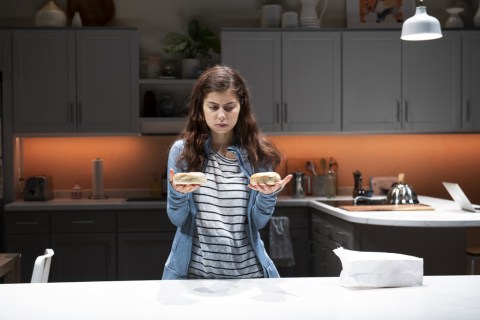
Domenica Feraud in ‘Rinse, Repeat,’ written by Domenica Feraud, directed by Kate Hopkins (Jenny Andersen)
Jake Ryan Lozano’s portrayal as Brody garners laughs with his callow, humorous, teen-male demeanor, obsessed with his girlfriend and sports. (The portrayal blossoms in their quiet sister/brother time together later in the play when Lozano’s Brody allows his love and sensitivity to unfold with poignance.) Initially, Brody seems uninterested in her presence, but tips us off that her return is something he may fear when he implies he doesn’t want to introduce her to his girlfriend to scare her off and that her physical appearance the last time he saw her “was scary.”
As we watch these interactions, we synthesize the clues and the picture sharpens. Rachel has been in intense therapy that involved she be away from family. Before she left, she was in a wheelchair, too weak to walk. But now she appears physically fit. Therapy has saved her life. Back in the environment that bred her illness, can she maintain the health she has achieved or will she suffer a set back into her addiction?
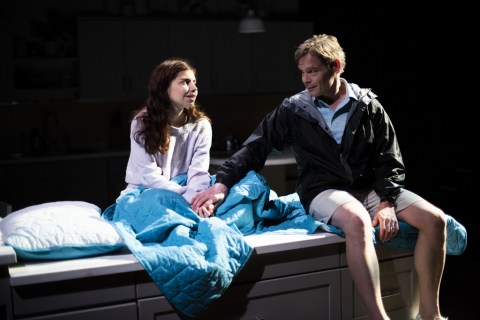
Domenica Feraud, Michael Hayden in ‘Rinse, Repeat,’ written by Domenica Feraud, directed by Kate Hopkins (Jenny Andersen)
The playwright gradually unfolds the mystery of what happened before that on the surface upended the loving, “normal” family. The family was never “normal;” nor was it unconditionally loving. Peter and Joan are rife with issues and problems in their relationship and in themselves; blindness, fear and anger have prevented them from confronting themselves honestly and this has spilled onto their relationships with their children.
Feraud has drawn the matrix of illness interrelating it with Rachel, Joan and Peter primarily. Ironically, the complications of Rachel’s addiction are the manifestation of profound issues with each of the family members. Like a festering boil which comes to a head then is burst so the infection is released, Rachel’s addiction has been burst to impact the family on a manifest level. However, for the infection to be eliminated, it must be excised at the root and that means Joan and Peter and even Brody must be excised in therapy with Rachel if she is to live with them in health. They are her addiction as well as being psychically ill themselves. However, only Rachel understands this.

(L to R): Florencia Lozano, Domenica Feraud in ‘Rinse, Repeat,’ written by Domenica Feraud, directed by Kate Hopkins (Jenny Andersen)
For those who have suffered in similitude with Rachel’s illness, they will identify with her behaviors and immediately “get it.” And indeed, the “tell-tale” signs of how her sickness morphs her back toward unhealthy patterns explodes again and again during the weekend with Peter, Joan and Brody. During her discussion with Brody in a quiet time of night, we appreciate the serenity and honesty between the siblings, an honesty that is lacking in her relationship with her mother and father. Placed back into the family structure that is in effect a sham, Rachel and Brody huddle in their own corner of their lives. Peter’s and Joan’s marriage is crumbling with dishonesty. Brody and Rachel sense it and suffer, and will be happy to leave the festering wounds that work deep underground in the soils of their family’s lives and interrelationships.

Jake Ryan Lozano in ‘Rinse, Repeat,’ written by Domenica Feraud, directed by Kate Hopkins (Jenny Andersen)
The details of Rachel’s eating disorder are superbly portrayed. We note her family’s concern about Rachel’s eating as they sit down to a meal together all on their best behavior, playing the dutiful family members the first night. The turning point comes when Rachel speaks to her mother that evening and looks for a snack. Her mother pressures her about her career and the snack. The dutiful daughter, Rachel agrees with her mother and foregoes the snack, which she is not supposed to do according to the protocol of health set up for her by her therapists. The tiny detail and the seemingly benign interaction between mother and daughter spills controlling maternal poison that psychically infuses Rachel’s emotions and careens her back into her old self-damaging behaviors.
The next day, all unravels and the underpinnings of the problems that contributed to Rachel’s illness emerge. Back in an environment where she is the sacrifice and the target around which everyone places the blame, no one else appears to accept responsibility for their contributions in the matrix of self-destruction twining into Rachel’s addiction. Indeed, unless the others, especially Joan, who herself is eating disordered, reflect on their own psychic maladies and seek help to correct, Rachel is doomed to fail once more if she stays at home.
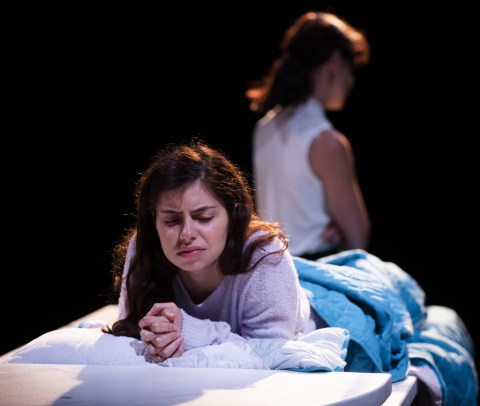
(foreground): Domineca Feraud, (background) Florencia Lozano in ‘Rinse, Repeat,’ directed by Kate Hopkins, written by Domenica Feraud (Jenny Andersen)
This is the anatomy of an illness that Feraud incisively chronicles with emotional power and intense, accurate specificity. As each event builds on the ones that have gone before we understand the magnitude and the complexity of why people die from Rachel’s anorexia, and chronic eating disorders. Feraud unravels the tapestry with an incredible precision of detailed acts that show how Rachel slides back into a routine of bulimia, binging/purging, excessive weighing and body dysmorphia, which Joan, unconsciously, neglectfully perpetrates with the controlling pressure on Rachel to do as she suggests regarding a legal career and eating less than she should.
On the other hand, though Peter, having gone to therapy at Renley with Rachel, appears to be sympathetic and concerned, he too drops the ball regarding monitoring her care. Both parents leave her alone to fend for herself, a violation of the protocol which therapists established to make sure she will not relapse. For those “unfamiliar” with eating disorders, Feraud ‘s characterization of the struggling Rachel is one for the ages. And as Rachel weighs the bagels and takes the smallest one, stuffs down the delicious French toast then spits it out, the looming psychology of why one must watch one’s weight and not “get fat,” reveals the self-fulfilling monster that is devouring the anorexic like Rachel from inside out.

Portia in ‘Rinse, Repeat,’ written by Domenica Feraud, directed by Kate Hopkins (Jenny Andersen)
Sadly, as Feraud points out in her “Note from the playwright,” Rachel is not alone. Thirty million people suffer from an eating disorder; truth be told, the numbers are most probably much larger considering the cultural obsession of the fashion, advertising, plastic surgery and billion dollar weight loss industries which ply their guilt on women to be thin and look sleek, young and beautiful at every age.
The play is filled with the signs of nefarious eating oddities that plague not only women of all ages but men as well. Perhaps the scene that most resonates, is one enacted incredibly by Florencia Lozano’s Joan. Having been too busy to eat, Joan, who deprives herself of food to maintain her lovely body comes home ravaged with uncontrollable hunger. We watch stunned as standing by the counter, too impatient to set a place for herself at the table while she cooks a meal (Peter does the cooking; she avoids it) she crams her face with anything low calorie to stave off her “insane” cravings. The hunger she expresses is a theme and metaphor, not only of her inability to be the beautiful person she intends to be, but of her starvation of self-love borne out by her obsessive need to “be the best, prettiest, slimmest, smartest, sharpest,” all the while believing inside that she is a miserable, loathsome worm.
This and the other scenes related to eating are so authentic their reality shocks us. Indeed, the truths in this production create vital theater exacted with brilliance by the director and actors. This is a production that must be seen for its themes of how parents “lovingly” encourage their children into self-loathing translating their own self-loathing onto them, to the cultural starvation through appearance fascism that commands that all conform to one physical appearance type and self-righteously condemn anyone who does not measure up. These themes and others and the characterizations and interrelationships Feraud has painstakingly drawn to perfection.

Florencia Lozano, Michael Hayden in ‘Rinse, Repeat,’ written by Domenica Feraud (Jenny Andersen)
Another of the beauties of her well-crafted writing is that the themes evolve with revelation upon revelation. stacked upon each other. Then, at the end Rachel reaches a crescendo of rage that she releases in truths about her mother and father with such wisdom, it is breathtaking. All makes perfect sense; the family masks are off and Rachel returns to therapy leaving her parents standing naked in their own psychic self-loathing.
Kudos to Brittany Vasta whose functional, evocative scenic design conveys the household of perfection where imperfect individuals strive, lose, hurt and avoid each other with lies. Likewise, Nicole Slaven’s costume design, Oona Curley’s Lighting design and Ien Denio’s sound design/original compositions help to create such a memorable, indelible portrait of a family in crisis and one who is on the road to health, in spite of it.
Rinse, Repeat (precisely symbolic title for the chronic circularity of illness) has been extended until 24 of August and should be extended again, it is that superb. The play runs with no intermission at Pershing Square Signature Center. For tickets and times go to their website by CLICKING HERE.
‘the way she spoke,’ Audible’s Searing Production About Misogyny and Genocide in Juárez, Mexico
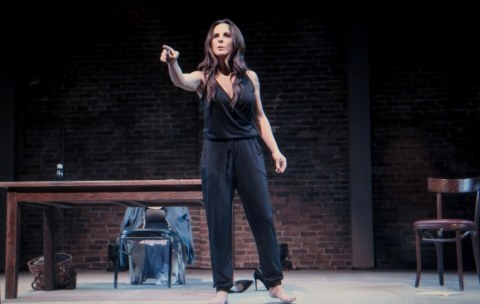
Kate del Castillo in ‘the way she spoke’ presented by Audible, written by Isaac Gomez, directed by Jo Bonney at Minetta Lane Theatre (Joan Marcus)
The first few minutes of the way she spoke by Isaac Gomez directed by Jo Bonney are easy and humorous with light but discriminatory undertones. An actor comes in for a reading. She references that directors give her demeaning parts to read, for example, whores or prostitutes typified by characters named Cha Cha.
The turning point in this lightheartedness erupts with a stark description. Sporadic laughter morphs to horror as the actor moves into the pages of a script where there is the first mention of the graphic mutilation of women’s bodies identifying the brutal murder of eight Mexican women in Juárez, Mexico.

Kate del Castillo in ‘the way she spoke’ presented by Audible, written by Isaac Gomez, directed by Jo Bonney (Joan Marcus)
In one fell blow, Telemundo star Kate del Castillo in her electric solo performance strikes at the heart of the patriarchy and bloodletting against thousands of women in the way she spoke. These acts are the side effects of gang violence, power dominance and poverty. In this horrific unofficial civil war, women’s carcasses send messages. They cry out threats and triumphs. They are the most often poignant and innocent casualties, many unrecovered as their persons, after whatever torment and abuse they experienced while alive, are buried in loam in vacant fields that are vast burial grounds.
Gomez’s dramatic rendering, is staged by Bonney with appropriate projections against the stage’s brick wall, while del Castillo in measured crescendos and fades of emotion and woodenness, responds to the shock of what she’s reading so she eventually experiences the high sorrow of this hell. At emotional midpoints she stands and redirects to another part of the stage to enact a role, sometimes of a dastardly, cold killer. The music and the projections follow her and slip into silence with the resonance of her storytelling. The drama increases its intensity; she configures the eye-witness accounts so that they jump off the page, spin with her energy into our imaginations.

Kate del Castillo in ‘the way she spoke’ presented by Audible, written by Isaac Gomez, directed by Jo Bonney (Joan Marcus)
As del Castillo relates events, describes images, philosophizes and makes us feel a paralysis of horror about the terrible femicide in ,Juárez at a time when the drug cartels were most fierce, we understand. Regardless that the violence has been mitigated since then and murders have decreased a bit, the same happens elsewhere in the world. This is a theme that del Castillo/Gomez reiterate. This reality floats like a dagger before us; what can we do? Is awareness enough? The playwright has unloaded his revelations in this work. He is finished, for in the effort to gain and reveal evidence of our blood lusting nature, he has accepted a measure of responsibility. But where do we go from here? And how do we become involved in a fight of advocacy to ensure that such targeted bellicosity against women doesn’t happen again?
There is always the response to “do nothing and move on with our lives.” It is a survival response, to ignore, duck and cover, return to our pleasant lives and try to forget we ever heard such descriptions of a female holocaust impacting all ages. But we cannot. Gomez, del Castillo and Bonney grip us with the power of these women’s voices from beyond the grave. They make us care for the “invisible” women whom they transcribe into reality during the strongest segments of this production. The concrete images of hate, fear and gore unsettle our minds: they are the final evidence that the mutilation and murder of women, the givers of life, have at their core a blasphemy against all of humankind like no other. After our numbness, the outrage comes against the patriarchy that would not sanction this, against the misogyny that is ancient, inbred and unique to our species!

Kate del Castillo in ‘the way she spoke’ presented by Audible, written by Isaac Gomez, directed by Jo Bonney (Joan Marcus)
The material gleaned by the playwright from a series of interviews with various members of the Mexican community speaks for itself in the voices of the witnesses. And Gomez has cobbled it together thematically allowing the interviewees words conveyed with heartfelt grist by del Castillo to float like blood in water whose increasing droplets will not co-mingle or mix but retain their shape. And then suddenly, all is a dark red that stains our remembrance.
Kudos to the creative artists who assisted to make this a haunting presentation. They are Riccardo Hernandez (scenic design), Emilio Sosa (costume design), Lap Chi Chu (lighting design), Elisheba Ittoop (sound design), and Aaron Rhyne (projection design).
This production which Audible has recorded will be released as an audio play after its closing. Without visuals the words of the witnesses will explode in the hearer’s ears. They are both an encomium and a chronicle reconciling the dead to the light of a greater truth we are being forced to acknowledge in the hope of changing if even one life in the future.
In its final week the way she spoke is presented by Audible Theater at Minetta Lane Theatre (18 Minetta Lane between 6th Ave and McDougal St. in the West Village) until 18 August. For tickets and times go to their website by CLICKING HERE.
‘Coriolanus’ by William Shakespeare, Pride Without Humility Breeds Self-Destruction
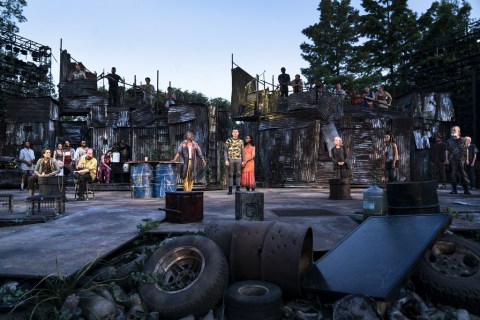
‘Coriolanus,’ by William Shakespeare, directed by Daniel Sullivan with Justin P. Armstrong (Ensemble), Teagle F. Bougere (Menenius Agrippa), Kate Burton (Volumnia), Jonathan Cake (Caius Martius Coriolanus), Louis Cancelmi (Tullus Aufidius), Katharine Chin (Ensemble), Gregory Connors (Ensemble), Darryl Gene Daughtry, Jr. (Ensemble), Biko Eisen-Martin (Ensemble), Bree Elrod (Ensemble), Nayib Felix (Ensemble), Josiah Gaffney (Ensemble), Chris Ghaffari (Titus Lartius), Enid Graham (Junius Brutus), Christopher Ryan Grant (Ensemble), Emeka Guindo (Young Martius), Jonathan Hadary (Sicinius Velutus), Suzannah Herschkowitz (Ensemble), Gemma Josephine (Ensemble), Thomas Kopache (First Senator), Tyler La Marr (Ensemble), L’Oreál Lampley (Ensemble), Jack LeGoff (Ensemble), Alejandra Mangini (Ensemble), Louis Reyes McWilliams (Ensemble), Max Gordon Moore (First Citizen), Tom Nelis (Cominius), Nneka Okafor (Virgilia), Donovan Price (Ensemble), Sebastian Roy (Ensemble), Ali Skamangas (Ensemble), Jason Paul Tate (Ensemble), and Amelia Workman (Valeria), (Joan Marcus
Coriolanus, Shakespeare’s apotheosis about a war monger who fires up for battle and yawns with boredom when he must live peaceably in the community brings to mind a ravaged soldier whose PTSD has so overcome him that he prefers living on the edge of death to energize himself to life. If he must choose between bloodshed, battle and calm, give Coriolanus carnage that he delivers, the gorier the better.
What does one do with such a Roman in a time of scarce resources on a planet ravaged by the doomsday scenario of global warming? Make him a politician to organize and straighten out issues in a time of great unrest in the most dire of conditions? Indeed, then watch him self destruct. For politicians must schmooze, flatter, promise, swallow crow, apologize and act with humanity and forbearance. Coriolanus is fit for battle, not for compromise, leader of his own personal autocracy which cannot be countermanded. Politics requires equanimity or the appearance of it. Of this he is incapable.
Shakespeare’s protagonist has a bit of the hero of The Hurt Locker (Kathryn Bigelow’s 2008 award winning film) without Jeremy Renner’s heartfelt agony and recognition of the mammoth loss of his former self before he signed up for war. Indeed, Coriolanus as portrayed by Jonathan Cake has much of the robotic machine killer with whom one has a devil of a time empathizing, especially as he rants and raves against those not born to a privileged background, from no fault of their own. Cake’s Coriolanus lacks interest, love or concern for others, except his wife (Nneka Okafor) son (Emeka Guindo) and mother (the wonderful Kate Burton). For his patrician friends he shows equal measure and latitude, for example Menenius Agrippa (Teagle F. Bougere) Cominius (Tom Nelis) and Titus Lartius (Chris Ghaffari) who advise him and fight with him. For his marvelously bellicose foes like Tullus Aufidius (Louis Canelmi) he bestows his complete veneration and worship.

(L to R): Christopher Ryan Grant, Louis Cancelmi in ‘Coriolanus,’ directed by Daniel Sullivan, Delacorte Theater (Joan Marcus)
As for the hurting, starving crowds clamoring for grain while the patricians’ storehouses flow with plenty? Let them eat each other in a zombie apocalypse. Coriolanus will none of it. Indeed, at the outset of the production, director Daniel Sullivan has placed a locked up barrel holding water downstage which the plebeians attempt to break into. But only Coriolanus holds the key to the lock and only he has access as he gives water to his son and denies his thirsty underlings. Charity stops first and last with self and family in a time of crisis such as that which confronts this deteriorating Rome, evocatively represented with a Mad Max scenic design by Beowulf Boritt of scattershot, burned out piles of garbage, remnants of the past, rather like Bob Ewell’s (To Kill a Mockingbird) scrummy playland hovel next to a massive town dump.
Because the rabble are deprived, there is civil unrest against the elites which if not quelled will threaten the security of the state, making it vulnerable to Rome’s enemies. However, Coriolanus answers the plebeians’ complaints with epithet and insult (they are curs and scabs) and argues that if he had the opportunity, he would slaughter them and create a mountain with their carcasses.

(L to R): Jonathan Cake, Biko Eisen-Martin, and Teagle F. Bougere in the Free Shakespeare in the Park production of Coriolanus, directed by Daniel Sullivan (Joan Marcus)
Some explanation is given for his wrath against the fickle, unreliable lower classes. His is an elitist patrician nature roiled by his aggressive, assertive mother. When he was a child she encouraged him to abusive dominance exemplified when he attacked the most beautiful and delicate of nature’s creatures by chomping off the wings of butterflies. Being so schooled against softness and generosity, he has no tolerance for the lazy, cowardly plebeians whose unmeritorious behaviors deserve no handouts. He states this to their faces in the opening scenes and we divine that his rancor is most grievous when he rails that he has provided the security of Rome while these poor and unfit do nothing to help him, but quailing in fear, flee even the thought of battle.
The situation is certainly egregious with the Volsces who come to attack. To get the corn they need to stem Rome’s hunger and murmurings, Coriolanus like a Titan hero single-handedly in “Incredible Hulk” fashion goes against these foes and delivers the goods without the help of the commons who slow him down. He emerges victorious from Beowulf Boritt’s ramshackle tin gates set, bloody and triumphant, but arrogant to the point of caricature!
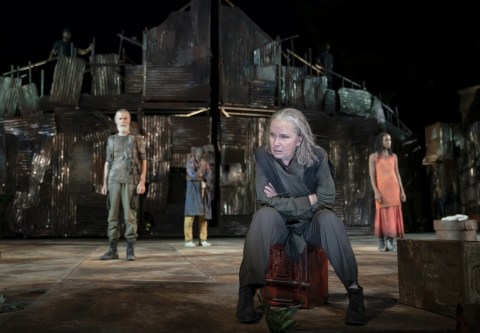
(L to R): Kate Burton (downstage) Tom Nelis, Teagle F. Bougere, and Nneka Okafor in the Free Shakespeare in the Park production of ‘Coriolanus,’ directed by Daniel Sullivan (Joan Marcus)
Was ever there such a raging hero hewn from the trials of confronting daily doom as the populace struggles against diminishing resources in Sullivan’s fascinating, ominously foreboding vision? Never. And Shakespeare forges from his hyperbolic character the tragic flaw that caves in Coriolanus’ life, legacy and career: his overweening pride, and his fearsomeness in not being shy to express his superiority to those lowlife “deplorables” who hate him.
Coriolanus certainly is reminiscent of other leaders we know whose arrogance and inability to apologize runs before them. However, Coriolanus is intrepid, mighty and uber skilled in battle. In this he is admirable. The current arrogant and boastful who lead are 100% image and 0% substance, bullying, cowardly and shallow like those whom they represent. That both Coriolanus and the resident of the White House are unfit for politics is their only similarity. Coriolanus’ pride is based in fact and follows an important logic that is downright Puritan in a time of destitution. If one doesn’t contribute to the good of the society, then one is not worthy of the grain that others have supplied. Freeloaders are not welcome!

(L to R): Emeka Guindo, Jonathan Cake, Nneka Okafor in Free Shakespeare in the Park,’Coriolanus,’ directed by Daniel Sullivan (Joan Marcus)
Shakespeare’s tragedy revolves around his protagonist being lured into the political sphere which he hates for he is not social. He is too “in your face” real to grovel in flowery phrases, alluring promises and imaginative disingenuousness to please the masses. He is direct, frank and authentic and cannot apologize or “fake it” to front those he despises.
However, he suppresses his best judgment and accepts a position which is offered to him. The conspiracy against him blows up when the Tribunes who despise him Sicinius (the excellent Jonathan Hadary) and Junius Brutus (the equal of the pair Enid Graham) incite the plebeians to revoke the offer of the position. This is upon condition that Coriolanus does not “bow” to the voice of the people. This untenable situation requires Coriolanus to be humble and compromising; this is an impossibility which results in his banishment by the Tribunes. Coriolanus counters with the statement that he banishes Rome from his presence and stature. With solemnity, he suggests that there is a place for him, away from Rome.
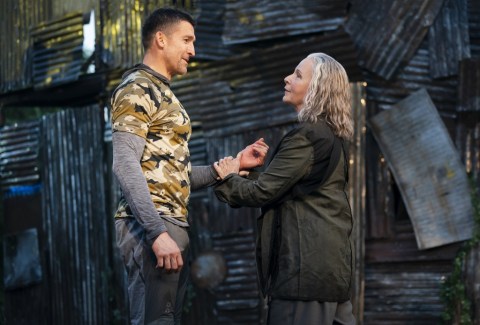
(L to R): Jonathan Cake, Kate Burton in ‘Coriolanus,’ directed by Daniel Sullivan (Joan Marcus)
But there is not. Though he joins Rome’s former enemy Tullus Aufidius of the Volsces intending to avenge his disgrace and dishonor of banishment by destroying Rome, it is a rush to judgment. The momentous decision means that he will destroy his mother, wife, son and friends who have not joined the Volsces. In the most insightful and powerful scene in the production (thanks to Kate Burton and Jonathan Cake’s whining “but mother” which reveals his enslavement to her dominance) Voluminia persuades him to betray Aufidius and fight for Rome not Volsces. It is Coriolanus’ act of sacrificial, stoic death. Aufidius will certainly kill him for his betrayal. That Voluminia has raised her son to war so that he can ultimately die to save her is unnatural and wicked for a mother. Doesn’t Voluminia and his family have other options? But their relationship as Cake and Burton portray it is fraught with issues of power dominance and abuse as the brute Coriolanus is reduced to a mewling weakling by his mother. He accedes to her wishes.
The production’s emphasis works at times and at other times is spotty. The rag-tag Costume Design by Kaye Voyce, Scenic Design by Beowulf Boritt, the Lighting Design by Japhy Weideman (strongest at the conclusion) the Soudd Design by Jessica Paz, the Composer Dan Moses Schreier’s music all convey Sullivan’s vision and themes soundly to resonate for us today. What happens to the haves and have nots when the law of diminishing returns lets loose annihilation because of the willful negligence and stupifying greed of previous generations’ corporate elites? Sullivan’s answering backdrop for the play is acute and frightening.
On the other hand, the empathy that we could feel for the plight of Coriolanus struggling against his own character wobbles perhaps because his character portrayal is one-note, at times cartoonish and lacking in depth. In the scenes with Burton’s Voluminia the depth of Cake’s Coriolanus shines, however. Shakespeare’s characterization reveals a character caught by his own ego between a rock and a hard place. He is betrayed by the Tribunes (his mother’s rant in their faces is largely ineffective) who capitalize on his arrogant weak character, lure him then back him into a humble pie corner from which he implodes.
And when he decides to punish Rome by depriving the society of the one way he has greatly benefited it by delivering death to its door? Once again he is thwarted, this time by his mother. And yet, there is no solace, nor sorrow nor identification at the conclusion that one might feel with Cake’s portrayal of a man who has undone himself. This is a weakness of the production which in all else especially Sullivan’s vision of the future is pointed.
Coriolanus is enjoying its last presentation today, 11 August. Performances have been sold out. However, there may be seats released if you are lucky and able to get to the Delacorte Theater well before curtain time at 8:00 pm.
 CAROLE DI TOSTI