Blog Archives
‘Girl, Interrupted,’ This Play With Music is Stunning and Memorable
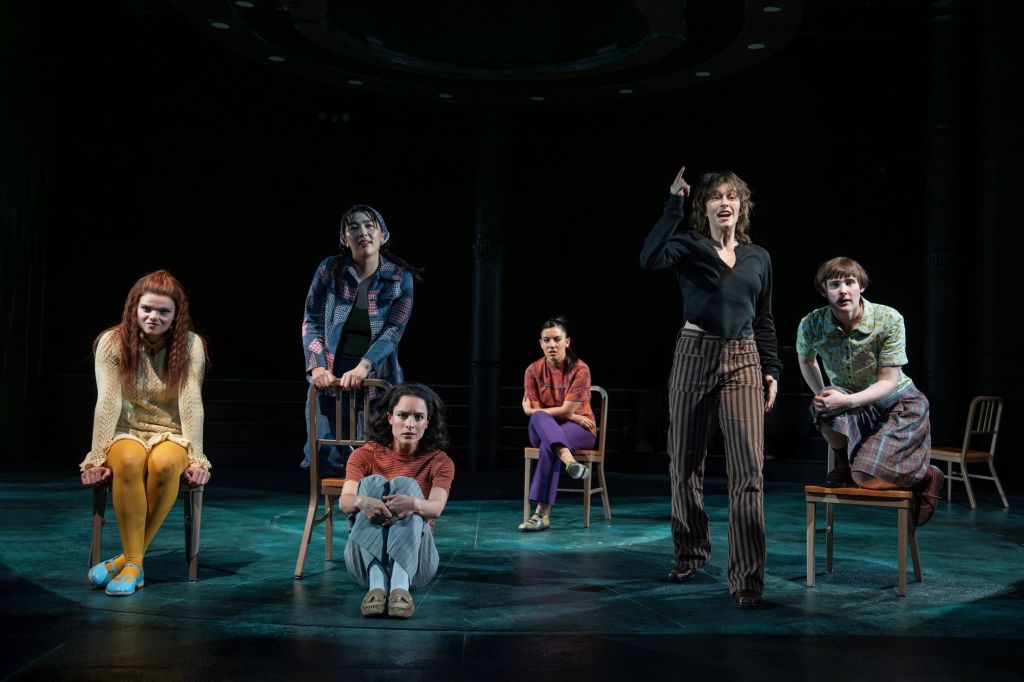
Matyna Majok’s adaptation of Girl, Interrupted, based on Susanna Kaysen’s titular memoir resonates with lyrical, haunting music by Aimee Mann. The production has been extended yet again until July 12, 2026 and is currently at the Public’s Martinson Hall. The play’s somber music of ballads and gentle, low key blues songs strikes with its cadences and simple, clear lyrics. Both heighten personal identification with the characters. The music informs the acting and is the linchpin that makes the production riveting.
Susanna (Juliana Canfield of Sterophonic) narrates her journey through McLean as she bumps up against women her age and ultimately crashes into acknowledging she was depressed and tried to kill herself. Initially opaque about the reason why she lands in the psychiatric hospital, she finds comfort in her fellow patients and the cultured and gentle roommate Grace (Mia Pak), who sings-shares that the upscale institution was a temporary home for Robert Lowell, James Taylor, Sylvia Plath and Ray Charles until they got back on their feet.
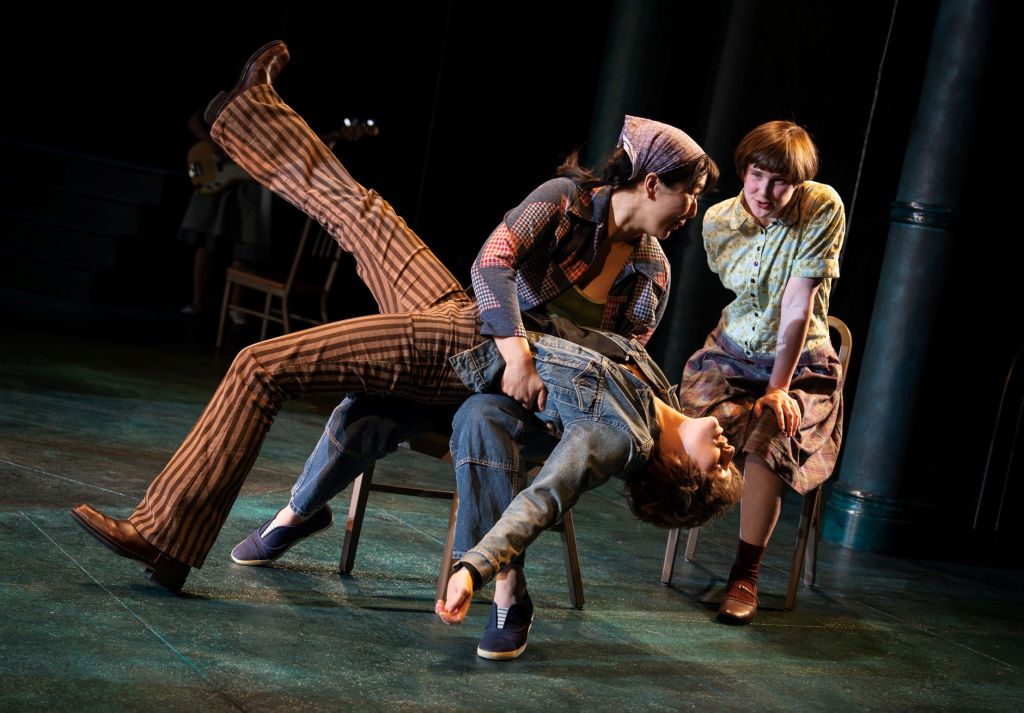
As she sings Grace infers that their experiences at McLean might find their way into a book because Susanna mentioned she is a writer. Ironically, it would seem that artists, writers and musicians not “right” with the world have passed through McLean and something changed in their lives, though Susanna quips that Sylvia Plath should have gotten a refund. Plath committed suicide; the “place didn’t work for her.”
Over the span of two hours in dots minimal set design, which includes a wired circular cage raised in a spiraling pattern above the stage that threatens where they may go if “warranted,” we discover why five patients and Susanna have checked themselves into McLean or were committed. We learn that all don’t fit into the society and have defaulted to various means of self-abuse, perhaps punishing themselves for not adjusting to what others want them to be.
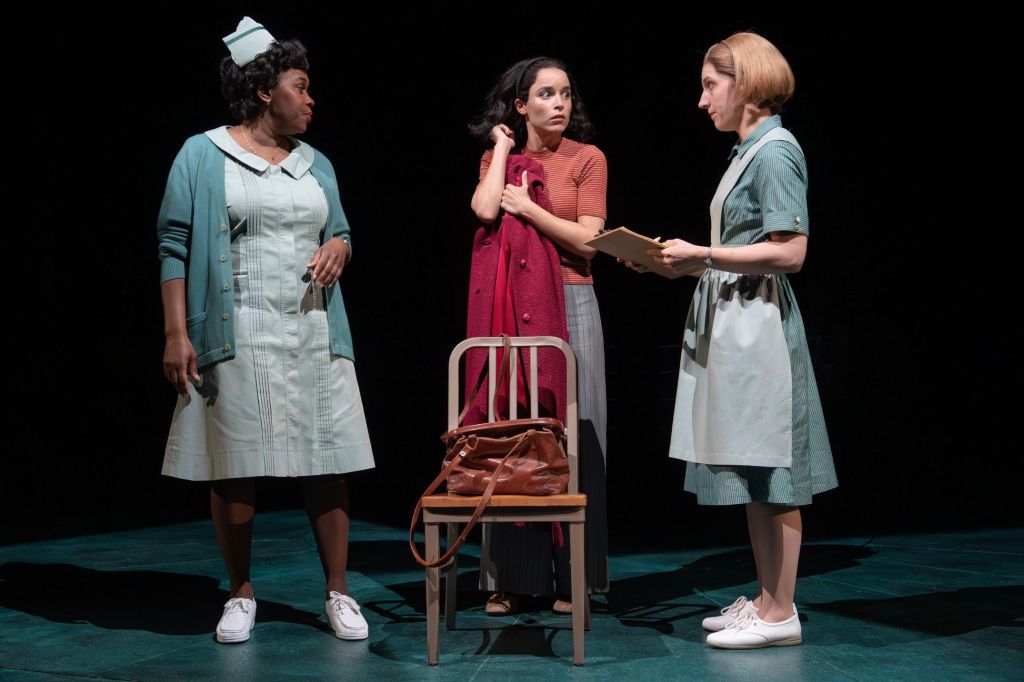
Directed by Jo Bonney the staging is strong and stylized in a set with few props that relies on Heather Gilbert’s excellent lighting design. The ensemble’s lovely voices reinforce the themes of Majok’s adaptation in the poignant timber of Mann’s soulful notes.
Lisa (singer./song writer King Princess in a sexy, fluid, dynamic portrayal) challenges the others and provides an electric spark of rebellion against an outer world of madness that all the girls appreciate, especially when she escapes to freedom only to be dragged back inside. Like Lisa, each of the girls makes their own attempts at freedom which in the translation of their actions against themselves reveals the extent they feel imprisoned by pain, isolation and self-rejection. We learn Polly (Sally Shaw brought down the house when she sang) poured gasoline over herself to “burn out” the shame and “get rid of” the person she believes herself to be. Tori (Gabi Campo) is dumped in McLean by her parents who insult her and blame her for their problems then take her to “Mexico” where she “shoots speed” because she can’t get what she needs from her parents or presumably anyone.
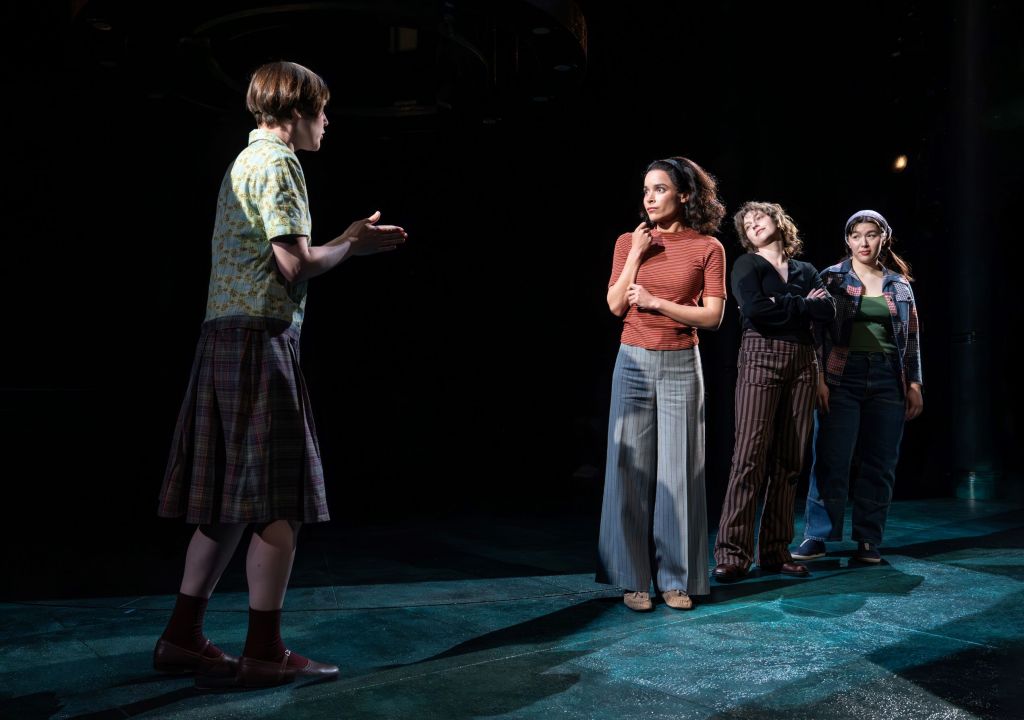
Daisy (Katherine Reiss), who goes to McLean as a “seasonal event,” is perhaps the most tragic of all having an incestuous relationship with her father. Her food obsession manifests the relationship in a disturbing way and there is nothing that can be done to help her. Likewise, Grace falls apart and it is frightening for the other girls to see her disturbed state when they visit her. Though Tori is forced to leave, she knows she will resort to her drug addiction. Polly is bound up and imprisoned by the sheaths of her scar tissue. Only Lisa and Susanna remain sentient as the others they are close to “drop like flies.”
Susanna is stuck in McLean and accepts being there for almost two years getting therapies and speaking with Dr. Wick (Emily Skinner) without a “plan” for her life, knowledge of what is “wrong with her,” or why she feels the way she does. However, she learns something about many asylums and mental institutions. Susanna discovers it is easy to get into McLean, but it is nearly impossible to get out, even if one signs oneself in or agrees with someone signing her in as she did with a doctor after a fifteen minute interview.
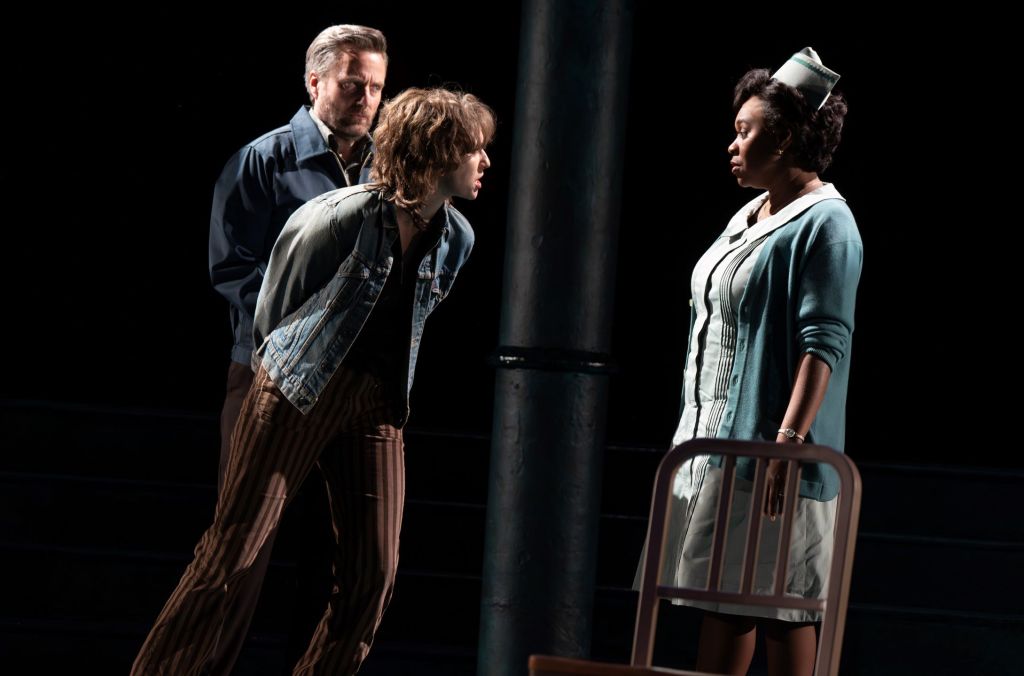
After almost two years, something happens and she finds a way out, not because she has confronted herself and heals, but because her way out, “marriage,” is acceptable to the doctors and patriarchal institution. It is obvious her decision is strongly motivated by “fitting in.” In other words, the culture and society only accept women who obey, women who don’t rebel or resist, women who fit into the roles men have proscribed for them. She can be released into the hands of her husband, regardless of the fact that this may be a terrible decision.
Majok’s conclusion has a spiral circularity that satisfies as Susanna finally realizes what she needed to know about herself years later during a visit at the Frick Museum looking at Vermeers with her bored husband. The event is symbolic and ties in the play’s development neatly. Susanna has an epiphany looking at a Vermeer painting, really looking at it, without allowing another’s perspective to cloud her own.
Canfield does a fine job throughout, assisted by an excellent ensemble. Her interpretation of “I See You,” at the conclusion where Susanna is finally visible to herself without the filters of the world’s view is especially resonant and current.
Girl, Interrupted runs 110 minutes with no intermission at the Public Theater’s Martinson Hall. https://publictheater.org/productions/season/2526/girl-interrupted/
‘the way she spoke,’ Audible’s Searing Production About Misogyny and Genocide in Juárez, Mexico
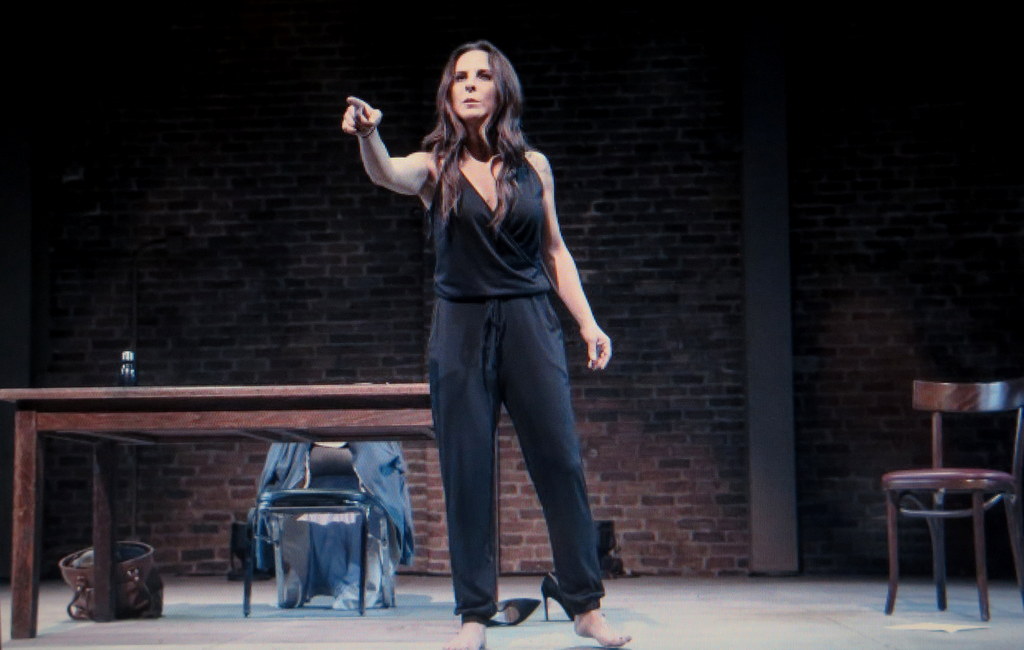
Kate del Castillo in ‘the way she spoke’ presented by Audible, written by Isaac Gomez, directed by Jo Bonney at Minetta Lane Theatre (Joan Marcus)
The first few minutes of the way she spoke by Isaac Gomez directed by Jo Bonney are easy and humorous with light but discriminatory undertones. An actor comes in for a reading. She references that directors give her demeaning parts to read, for example, whores or prostitutes typified by characters named Cha Cha.
The turning point in this lightheartedness erupts with a stark description. Sporadic laughter morphs to horror as the actor moves into the pages of a script where there is the first mention of the graphic mutilation of women’s bodies identifying the brutal murder of eight Mexican women in Juárez, Mexico.
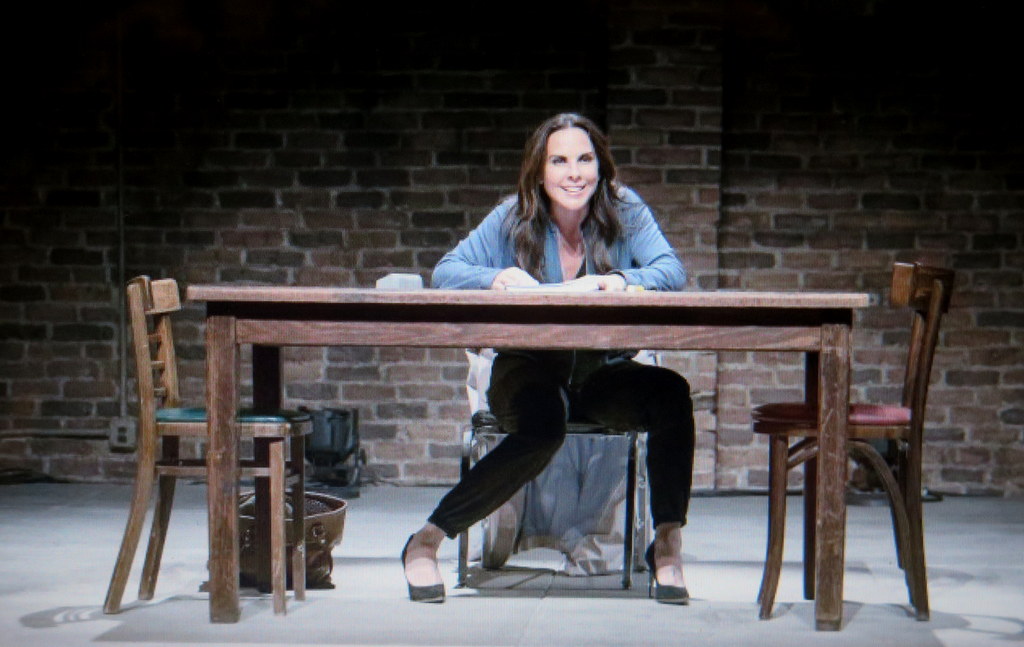
Kate del Castillo in ‘the way she spoke’ presented by Audible, written by Isaac Gomez, directed by Jo Bonney (Joan Marcus)
In one fell blow, Telemundo star Kate del Castillo in her electric solo performance strikes at the heart of the patriarchy and bloodletting against thousands of women in the way she spoke. These acts are the side effects of gang violence, power dominance and poverty. In this horrific unofficial civil war, women’s carcasses send messages. They cry out threats and triumphs. They are the most often poignant and innocent casualties, many unrecovered as their persons, after whatever torment and abuse they experienced while alive, are buried in loam in vacant fields that are vast burial grounds.
Gomez’s dramatic rendering, is staged by Bonney with appropriate projections against the stage’s brick wall, while del Castillo in measured crescendos and fades of emotion and woodenness, responds to the shock of what she’s reading so she eventually experiences the high sorrow of this hell. At emotional midpoints she stands and redirects to another part of the stage to enact a role, sometimes of a dastardly, cold killer. The music and the projections follow her and slip into silence with the resonance of her storytelling. The drama increases its intensity; she configures the eye-witness accounts so that they jump off the page, spin with her energy into our imaginations.
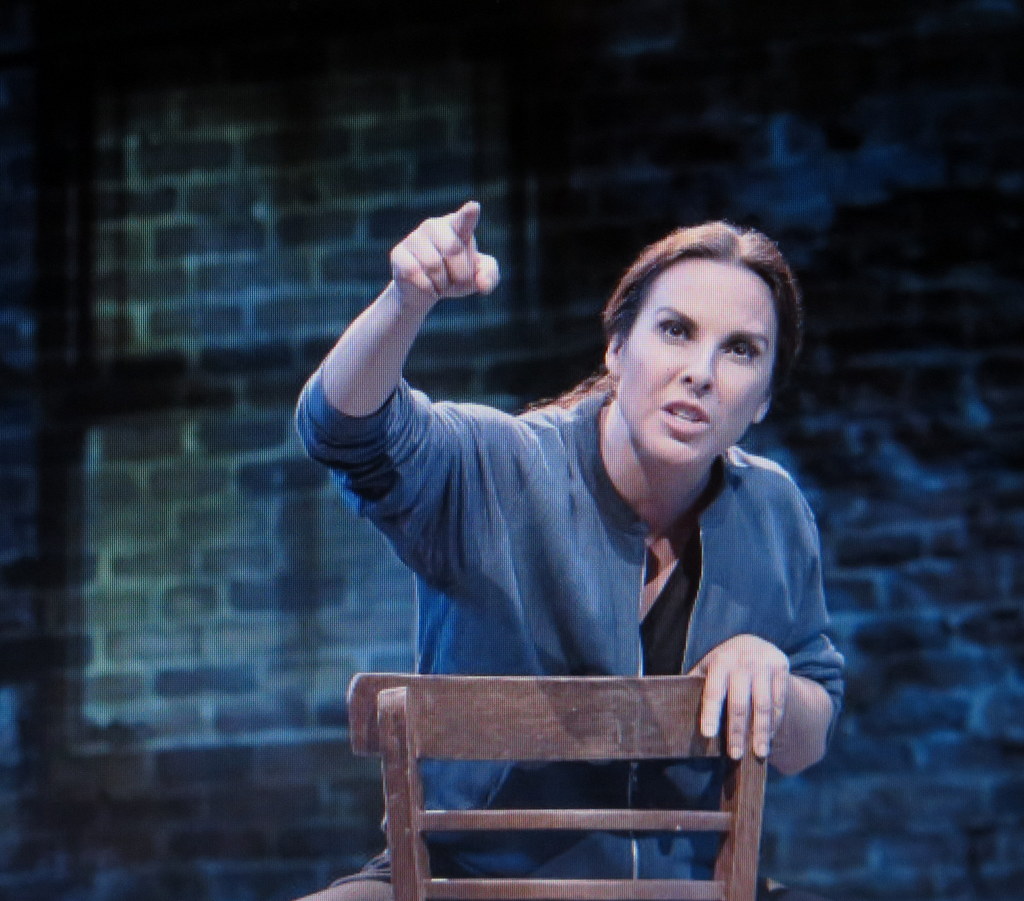
Kate del Castillo in ‘the way she spoke’ presented by Audible, written by Isaac Gomez, directed by Jo Bonney (Joan Marcus)
As del Castillo relates events, describes images, philosophizes and makes us feel a paralysis of horror about the terrible femicide in ,Juárez at a time when the drug cartels were most fierce, we understand. Regardless that the violence has been mitigated since then and murders have decreased a bit, the same happens elsewhere in the world. This is a theme that del Castillo/Gomez reiterate. This reality floats like a dagger before us; what can we do? Is awareness enough? The playwright has unloaded his revelations in this work. He is finished, for in the effort to gain and reveal evidence of our blood lusting nature, he has accepted a measure of responsibility. But where do we go from here? And how do we become involved in a fight of advocacy to ensure that such targeted bellicosity against women doesn’t happen again?
There is always the response to “do nothing and move on with our lives.” It is a survival response, to ignore, duck and cover, return to our pleasant lives and try to forget we ever heard such descriptions of a female holocaust impacting all ages. But we cannot. Gomez, del Castillo and Bonney grip us with the power of these women’s voices from beyond the grave. They make us care for the “invisible” women whom they transcribe into reality during the strongest segments of this production. The concrete images of hate, fear and gore unsettle our minds: they are the final evidence that the mutilation and murder of women, the givers of life, have at their core a blasphemy against all of humankind like no other. After our numbness, the outrage comes against the patriarchy that would not sanction this, against the misogyny that is ancient, inbred and unique to our species!
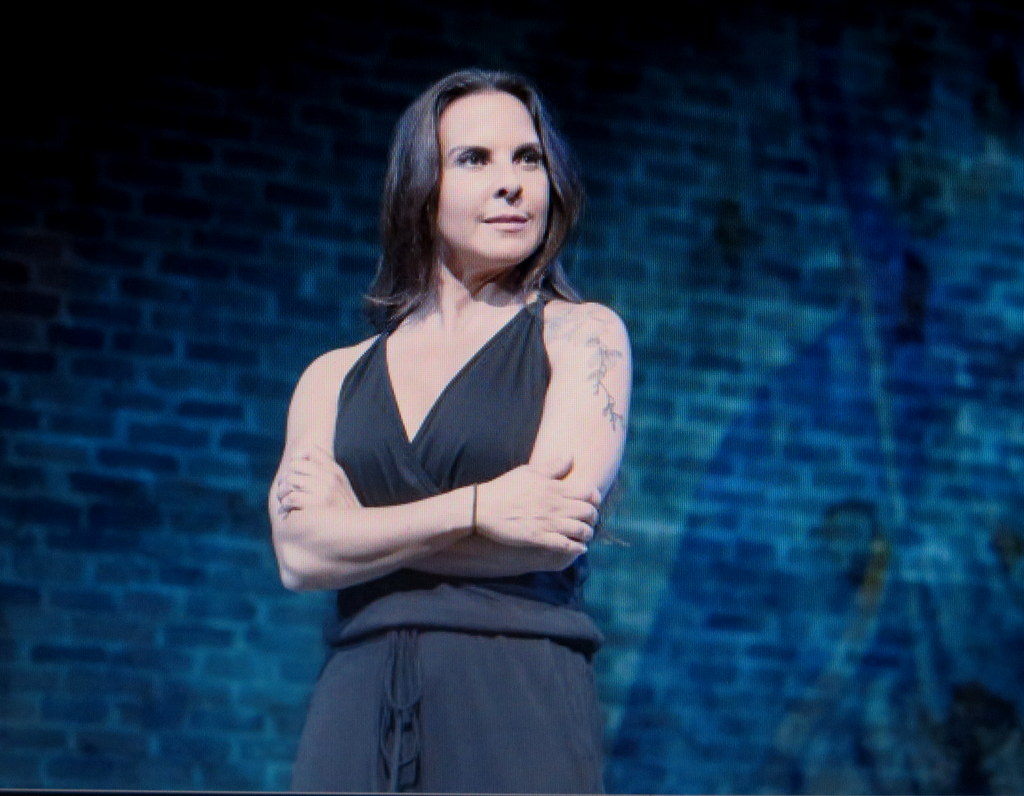
Kate del Castillo in ‘the way she spoke’ presented by Audible, written by Isaac Gomez, directed by Jo Bonney (Joan Marcus)
The material gleaned by the playwright from a series of interviews with various members of the Mexican community speaks for itself in the voices of the witnesses. And Gomez has cobbled it together thematically allowing the interviewees words conveyed with heartfelt grist by del Castillo to float like blood in water whose increasing droplets will not co-mingle or mix but retain their shape. And then suddenly, all is a dark red that stains our remembrance.
Kudos to the creative artists who assisted to make this a haunting presentation. They are Riccardo Hernandez (scenic design), Emilio Sosa (costume design), Lap Chi Chu (lighting design), Elisheba Ittoop (sound design), and Aaron Rhyne (projection design).
This production which Audible has recorded will be released as an audio play after its closing. Without visuals the words of the witnesses will explode in the hearer’s ears. They are both an encomium and a chronicle reconciling the dead to the light of a greater truth we are being forced to acknowledge in the hope of changing if even one life in the future.
In its final week the way she spoke is presented by Audible Theater at Minetta Lane Theatre (18 Minetta Lane between 6th Ave and McDougal St. in the West Village) until 18 August. For tickets and times go to their website by CLICKING HERE.
 CAROLE DI TOSTI