Monthly Archives: October 2023
Susan Stroman Interview by Broadway Playwright Sharon Washington

On Friday, November 17th The League of Professional Theatre Women is sponsoring a free event at the Bruno Walter Auditorium at the New York Public Library for the Performing Arts at Lincoln Center (111 Amsterdam Avenue at 65th Street, New York). The public is invited to this special interview of Tony Award winning Director/Choreographer Susan Stroman about her brilliant career by Broadway Playwright Sharon Washington, at 6 p.m.
The event, which is open to the public, is part of the League of Professional Theatre Women’s (LPTW) Oral History Project in partnership with the Library and is a highlight of LPTW’s 41st season.

Susan Stroman, Director/Choreographer is a five-time Tony Award winning director and choreographer known for the Broadway musicals Crazy for You, Contact, The Scottsboro Boys, and The Producers. She is the winner of a record-making 12 Tony Awards including Best Direction and Best Choreography. Her work has been honored with Olivier, Drama Desk, Outer Critics Circle, Lucille Lortel, and a record six Astaire Awards.

For Broadway, she most recently directed and choreographed the new Kander & Ebb musical New York, New York and directed the new play POTUS: Or, Behind Every Great Dumbass Are Seven Women Trying to Keep Him Alive. This season in London’s West End, she directed and choreographed the revival of Crazy for You at the Gillian Lynne Theatre. Other Broadway credits include: Show Boat, Prince of Broadway, Bullets Over Broadway, Big Fish, Oklahoma!, Young Frankenstein, Thou Shalt Not, The Music Man, Big, The Frogs, and Steel Pier.
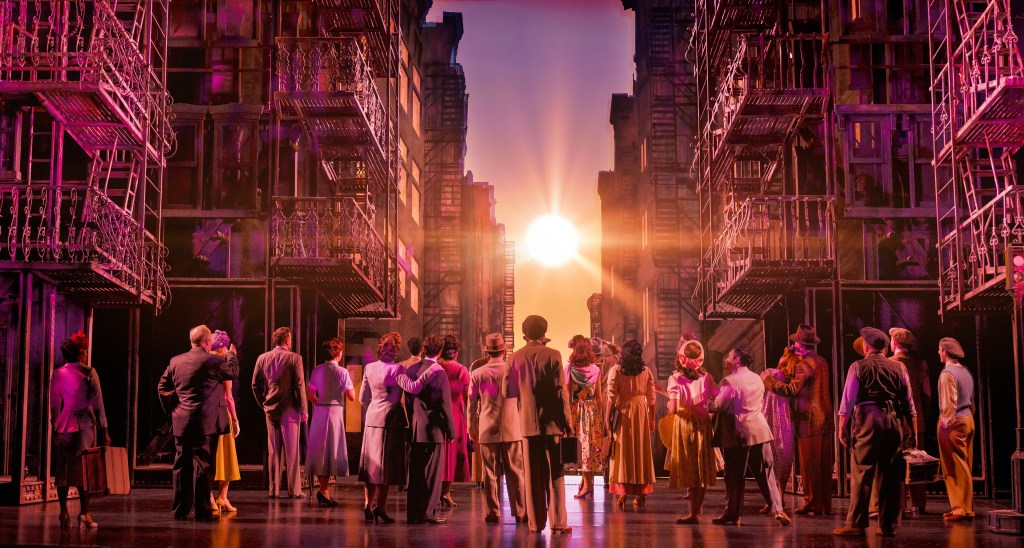
Off-Broadway she directed and choreographed Little Dancer, The Beast in the Jungle, Dot, Flora the Red Menace, And the World Goes ‘Round, Happiness, The Last Two People on Earth: An Apocalyptic Vaudeville, as well as The Merry Widow for The Metropolitan Opera. She has created ballets for New York City Ballet, Pacific Northwest Ballet, and Martha Graham. She received the American Choreography Award for her work in Columbia Pictures feature film Center Stage. She is the recipient of the George Abbott Award for Lifetime Achievement in the American Theater and an inductee of the Theater Hall of Fame in New York City. www.SusanStroman.com
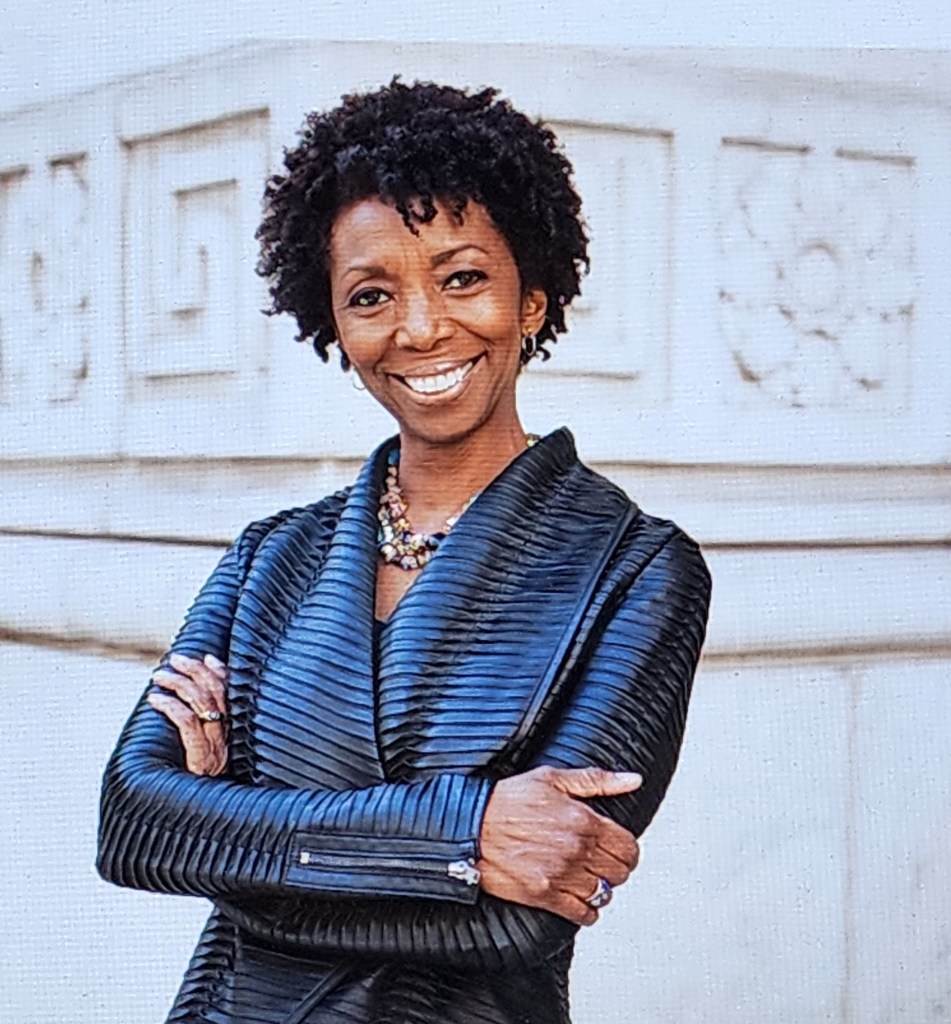
Sharon Washington, Playwright/Actor was nominated for a 2023 Tony Award for Best Book of a Musical as co-writer of New York New York. She made her debut as playwright with her solo play Feeding The Dragon which played Off-Broadway at Primary Stages and was nominated for Outer Critics, Lortel and Audelco Awards. She was the Primary Stages 2017-18 Tow Foundation Playwright-in-Residence. The play was recorded as an Audible Original and selected as an Audible Essentials Top 100 pick.
As an actor, last summer Sharon was seen as Queen Margaret in the Public Theater/Shakespeare in the Park production of Richard III, broadcast on PBS Great Performances. Recent film and television appearances include Power Book III: Raising Kanan, Bull;the short film Birdwatching co-starring Amanda Seyfried, and the Academy-Award winning Joker. You may also recognize her voice as the narrator of several documentary series for Animal Planet, Discovery and NOVA.
On Broadway Sharon appeared in The Scottsboro Boys musical. Off-Broadway credits include Dot (Vineyard Theater); Wild with Happy (Public Theater/NYSF – Lucille Lortel nomination and Audelco Award among many others; and numerous regional theaters around the country.
Sharon holds an MFA from the Yale School of Drama and a BA from Dartmouth College.
To attend this event, please RSVP at this link: https://www.nypl.org/events/programs/2023/11/17/league-professional-theatre-women-susan-stroman
‘The Refuge Plays,’ Nicole Ari Parker and Daniel J. Watts are Smashing

Nathan Alan Davis’ The Refuge Plays, directed by Patricia McGregor, chronicles a family’s survival with a play whose structure employs an interesting twist. The production, a world premiere, begins in the present and flashes backward in generational segments to 70 years prior, spanning four generations. Though the three plays or segments may stand alone, the characters repeat in each and the thread of the main character’s resilience is the principle linchpin around which the events revolve.
In its world premiere presented by the Roundabout Theatre Company in association with New York Theatre Workshop, The Refuge Plays unspools its epic saga during three hours and twenty minutes, and two intermissions. It runs until November 12th at the Laura Pels Theatre.
In Davis’ epic of family bonds happening away from any social construct after World War II, we note how the reigning matriarch and great, grandmother Early wields subtle power and presence despite her advanced years. The superb Nicole Ari Parker is a standout in the role as she evokes the elderly, middle aged and teenage Early.
Contrasted with her great grandson Ha, Ha (JJ Wynder), who expects others to do for him, Early takes it upon herself to chop wood for the stove which also provides heat, despite her granddaughter Joy’s protests that her seventeen-year old son Ha Ha should be doing the chopping, which he says he doesn’t know how to do.

From that action alone the clue is given that Early’s age belies her life force and vibrancy. Living in this cabin in the woods off the grid, which she and husband Crazy Eddie (the superb Daniel J. Watts), built with their own hands decades before, she makes the best of her roughly-hewn life, which she shares with family. Remaining isolated from culture, technological developments and progress, they have managed to find a measure of comfort and peace that society doesn’t offer. The inference is that is perhaps that is why they are still alive. Though not living in the lap of luxury, they want for nothing. What carries them onward are the the authentic community and relationships they forge with each other.
Davis symbolizes Early as the seminal earth mother who sustains her family’s survival, which we understand watching the characters in the present and their movement into the past. From the outset, we note the elderly Early is determined, feisty, funny and authentic no nonsense with family members.
Though she doesn’t get along with her son’s wife Gail (Jessica Frances Dukes), she allows her to stay with them for the sake of their daughter Joy, who once left then came back. Making cryptic comments at times, Early puts up with Gail, though it is obvious she approves of her granddaughter for what they share. Both mourn Walking Man (Jon Michael Hill), who we hear died in a freak accident when a cow crushed him with its weight as he slaughtered it.
In the first segment, “Protect the Beautiful Place,” Davis sets the tone and presents the four generations of family members living in a two room cabin, cramped together, not seeming to mind the lack of personal and private space. This cabin that they call home is a refuge from all that would destroy and divide them, we realize, by the play’s conclusion.
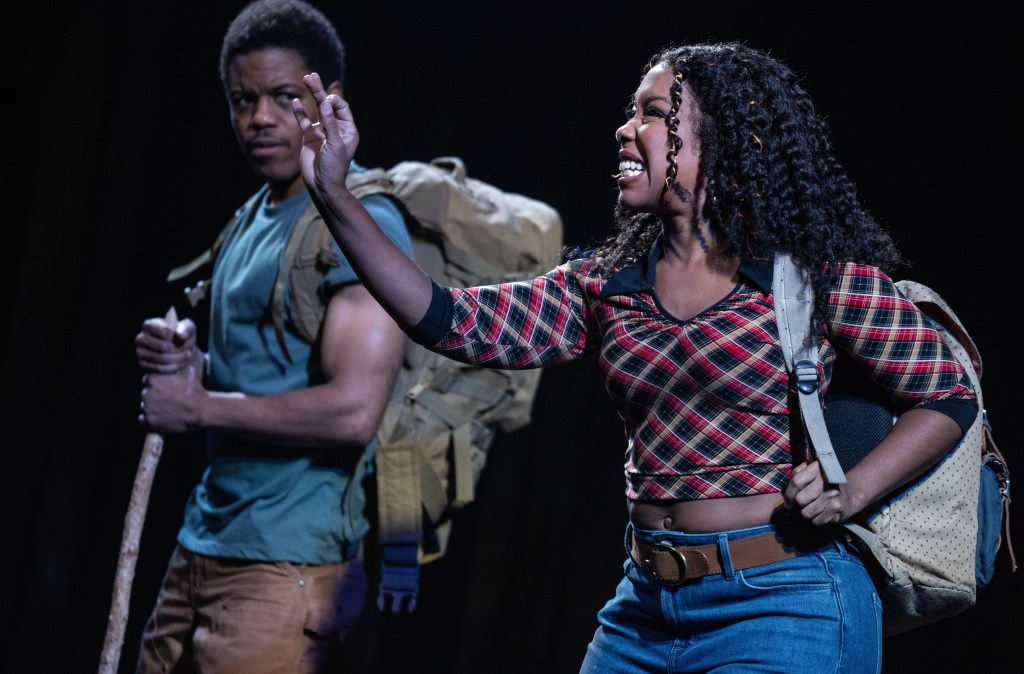
Arnulfo Maldonado’s set design reveals the rawness of their life that indicates economically that they are lower middle class. Only Gail has her own bedroom. Early, Joy and Ha ha sleep together in the living room in a chair, a sofa and the floor. In the same room they cook and eat with spare utilitarian minimalism. The outhouse is around the corner and in the distant past, a younger Early took the water in pails up from the river.
In “Protect the Beautiful Place,” the supernatural eerily wends its way into the family’s routine as they wake up and get ready for their day. The spirit of Gail’s husband Walking Man is a welcome visitor. He moves between the veil of life and the afterlife, and all know of his presence and communicate with him. Recently, he has appeared and announced to Early that Gail will pass on and join him. The family, even Ha ha, accepts this notion, though Gail resists it. During the course of the family interactions, we learn that the women hope that Ha Ha finds a woman to love and have children with to continue the family’s bloodline, though he is only seventeen. We also learn clues about the family history that Davis clarifies in subsequent segments.
When Walking Man visits Gail in a dream, he helps her to make up her mind about joining him. The eventual result occurs through an interesting sequence of events. Thus, we see that the family, encouraged by Early, has created its own myths and folklore which is as natural to them as breathing. Importantly, that one generation has exceeded another is striking and a testament to Early’s resilience and survival instincts. By the conclusion of The Refuge Plays, we understand how Early’s youthful struggles strengthened her, gave her courage and fostered the thriving of this family whose dominance will be taken up by the innocent, clever, book-smart Ha Ha with his new found girlfriend.
The second part, “Walking Man” features Early’s son after he leaves home, wanders to Alaska and other parts of the world, then returns home to his mother and father. Maldonado’s sets include the outdoor space in front of the cabin which is indicated by a front door. During the course of Walking Man’s return home, he talks to his father’s brother, uncle Dax (the humorous Lance Coadie Williams), and two spirits who are his grandparents Clydette (Lizan Mitchell) and Reginald (Jerome Preston Bates). Through them he discovers the truth of his legacy and why he has no birth certificate, why his mother raised him to be self-sufficient and why he is compelled to wander the earth, which he doesn’t understand.

After he learns this truth, Walking Man doesn’t have the heart to confront his mother with the specific details, though he confronts Crazy Eddie who he has accepted as his father. Angry, Walking Man intends to take revenge on the world and kill anyone he finds who exhibits the wickedness of his blood father. Early, stalwart, trusting in God, doesn’t insist with her son, but makes a suggestion and leaves him to his own decisions.
The segment ends with a new influence in Walking Man’s life, his future wife Gail, who the spirits have brought to him. We know this because of the lighter which Gail has been given by Clydette and Reginald and which she uses to light Walking Man’s pipe. The lighter, exhibited by Gail in the first segment which Ha Ha’s girlfriend Symphony (Mallori Taylor Johnson), picks up and uses, reveals the spiritual and ancestral influences that surround this family and guide it to peace and security.
The third segment, “Early’s House” flashes back to Early as a teenager living in the forest with her baby, Walking Man. Through her conversations with Watts’ Crazy Eddie who seeks her out and brings her food, we discover how she has survived through the winter after bearing her child alone. The relationship they develop over the course of the segment is powerfully drawn by Davis and acted with smashing resolve by Parker and Watts. As Crazy Eddie draws her out of herself so she trusts him, similar to how a feral animal is wooed by a well-meaning animal lover, Early reveals herself.
The place by the river she has chosen to be her sanctuary to receive respite and peace. Because she has been forbidden to return home, she determined to turn her back on society and her parents and make it in the woods. Nature has embraced her and with faith in God and the supernatural, she has received sustenance and wisdom to survive with Walking Man.
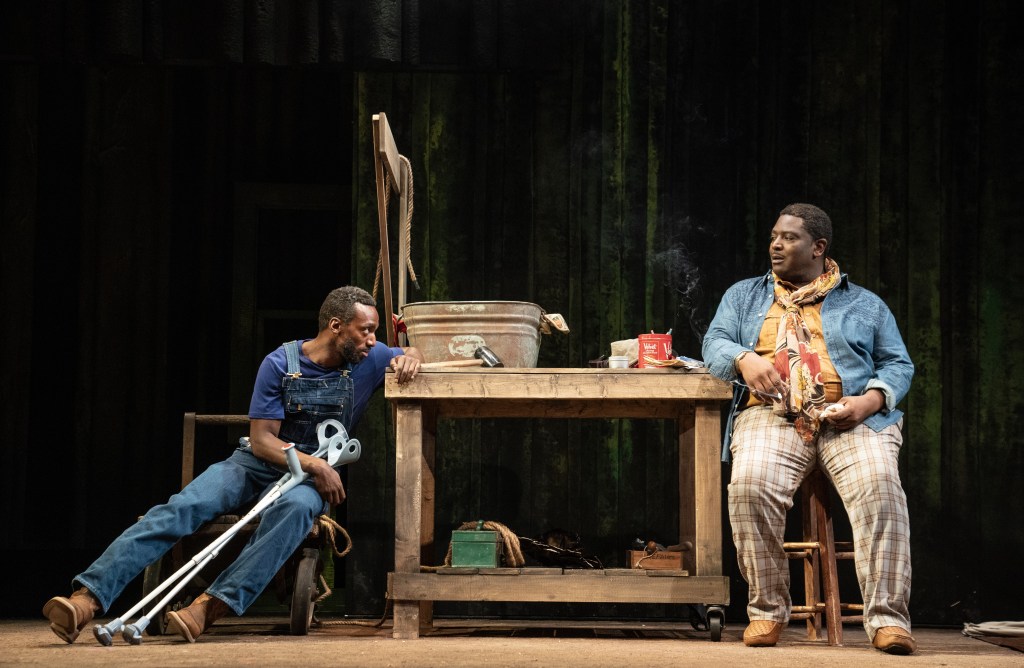
Parker’s amazing portrayal of the young Early reveals the depths of a woman who will fight against all odds to live and care for her child whom she loves. Ironically, there is more peace in nature than there could be found back in her home and former lifestyle which she has renounced to keep Walking Man with her.
The gentle Crazy Eddie is the only one who seeks her out and attempts to help her. Because he, too, has been wounded like Early, hobbled by extensive war injuries, she pities, accepts and trusts him. Both need one another and gradually they receive each other’s help and care. And it is in this place by the river that Eddie and Early sanctify their union and build a rudimentary cabin where they will live and raise Walking Man, whom Eddie unofficially adopts as his son.
“Early’s House” is poignantly written and acted with spot on authenticity. Davis brings together all of the character threads and elements so that we realize how Early compelled herself to forge a family which burgeons and will be sustained past the seventy years that we witness this saga. Excellently directed with fine performances all around, The Refuge Plays is fascinating especially in its structure and poetic, striking dialogue.
A fault at the outset was in the sound design which was corrected in the latter segment. Props go to Emilio Sosa’s costume design, Stacey Derosier’s lighting design, Earon Nealey’s superb hair and wig design and J. Jared Janas make-up design.
For tickets to the unique production, The Refuge Plays, go to their website https://www.roundabouttheatre.org/get-tickets/2023-2024-season/the-refuge-plays/performances
‘Gutenberg! The Musical!’ Featherbrained, Loopy, Josh Gad and Andrew Rannells Shine!
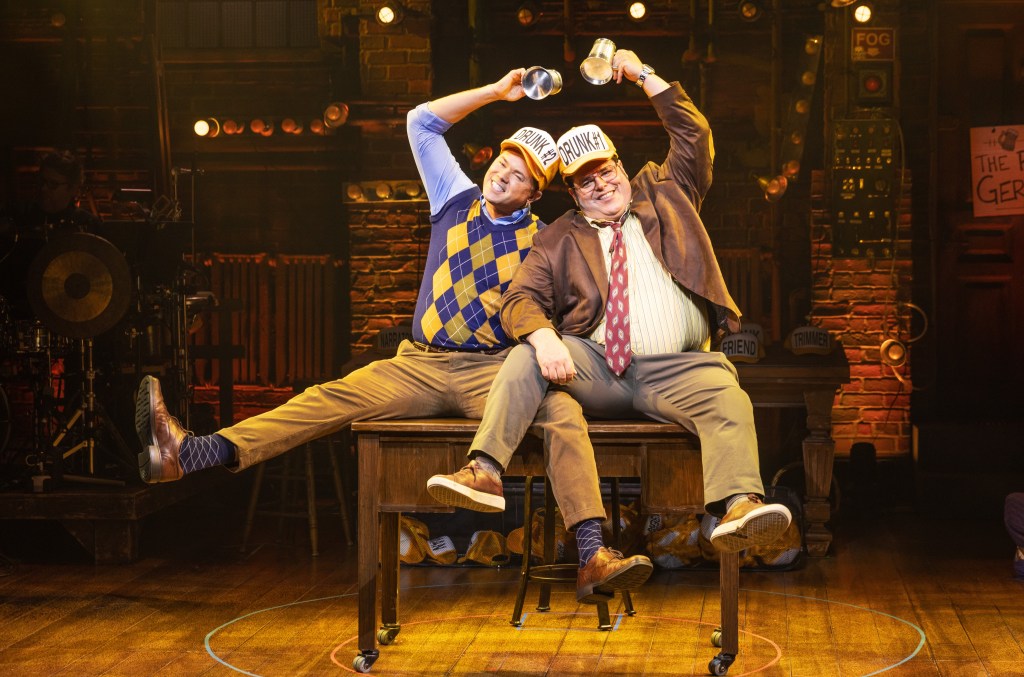
If you are looking for laughs and ridiculous fun, Gutenberg! The Musical! is the show for you. Thanks to the superbly wacky performances in this farce where Josh Gad and Andrew Rannells make a twosome of bat-sh*t silliness, Gutenberg! is a standout. Currently running at the James Earl Jones Theatre with one intermission in a two hour time slot, the zaniness is a treat to take you out of yourself. And who doesn’t need to “forget your troubles and get happy” in these times that try all of our souls?
The premise is well known: amateurs strike out for Broadway, draw in by the allurement of the “great white way.” In this iteration, two guys from New Jersey decide to toss the dice and bankroll a musical they’ve written to pitch it at a backer’s audition they set up at the James Earl Jones Theatre for a one night rental. Because they have to scrounge up the money by using the last dime of their inheritances, they can only afford a bare bones cast. Both play a total of twenty parts. They never change costumes except for hats in bold, black print which state their roles. For accompaniment they’ve hired a three-piece, local band that plays weddings, bar mitzvahs, retirement parties, etc.
Their thought is if they are good enough (ah, there’s the rub), they will get funding from producers to mount their musical on Broadway. Thus, Gutenberg! is theater “vérité,” happening with immediacy. Sitting in the audience, we are told, are various producers who’ve received invites. Thus, the audience bears witness to whether or not these Jersey guys have what it takes to sizzle and shine or fizzle and die on the vine of their dreams.

Scott Brown and Anthony King (book, music and lyrics), launch the show into the stratosphere of inanity. Not only are Bud (Josh Gad) and Doug (Andrew Rannells) below average talents, they have little expertise about what makes a musical or any show for that matter. Furthermore, their lyrics, rhymes and meaning rival the simplicity of Dr. Seuss.
But all is not lost. Interestingly, Dr. Seuss is extremely popular because it capitalizes on being silly. Additionally, the wild duo are winning and lovable. What Bud and Doug lack in talent and expertise, they make up for with enthusiasm, joie de vivre and hilarious, charming schtick.
As a side note, Gad and Rannells, who haven’t been together since Book of Morman, are terrific in curtailing their exceptional talent just enough to be a tad off, making their portrayals as Bud and Doug even funnier. Of course, this adds to the inside joke about who they really are and what they are capable of. Indeed, the audience was tuned to the inside jokes.

Gad and Rannells have fun playing it to the hilt with tongue in cheek direct addresses to the audience and a shattering of the fourth wall, as they move along the plot about a dry subject, the life and times of Johannes Gutenberg, inventor of the printing press. As it turns out Gutenberg is a topic about which little is written and much can be embellished and fictionalized. That is why Bud and Doug have found it to be a glorious subject for a “fantastic” musical.
Ironically, referring to their content as historical fiction, they share little factual information about the man and the time. In falling back on fabrication, which currently is trending in political news and the radical conservative, nihilistic, QAnon wing of the “Republican” Party, Bud and Doug’s fantastic tale is hugely satiric. It indirectly points the finger at the last seven years of Trumpism, when the playing field of misinformation became normalized through the efforts of conservative media. Lies of omission, conspiracy theories and sheer made-up junk swanned as legitimate and newsworthy.

Take for example reports on Italian space lasers causing the 2020 election to be stolen from former president Donald Trump. (Look up recently convicted Trump lawyer Sidney Powell, if my reference to Italian space lasers eludes you.) Such theories are inane fabrications such as those found in this musical.
On the other hand for all its guffaws, belly laughs and puerility, Gutenberg! is as serious as a heart attack. If you peek underneath the abundant blanket of hysteria, it actually makes grave points.
That Scott Brown and Anthony King convert the momentous occasion of the birth of Gutenberg’s printing press, a turning point in history, into a farce that nuances themes about the perils of illiteracy, is profound as well as riotous. In truth illiteracy and “not reading books” is disastrous, when considering the culture wars of the South and their twisted turn into banning books. Making indirect inferences to the QAnon pride of ignorance against the elitism of the educated, Gutenberg! twits us with its ridicule about our present time.

This is especially so with the musical’s humorous, historical reminder of how ignorance leaves an open door for the power hungry. In its Act II arc of development, after the printing press has been invented, the villainous, devilish monk completes his scheme to target Gutenberg and destroy his press. Representing the power of the church which historically exploited the ignorant and illiterate, we understand the benefits of keeping the uneducated, non-reading masses brainwashed, oppressed and afraid.
In portraying the monk with a nefarious purpose, Gad is riotously funny. He pings all the notes of the stereotypical wicked, leaving the audience LOL. Of course, his crafty portrayal stings, if one moves beyond the laughter to the quiet message underneath. Despotism only works well with the uneducated, non-reading, non-thinking masses who are often too distracted to distinguish the truth from fiction and lies.
Throughout the winding action which involves anti-semites, Gutenberg’s fictional German town of Schlimmer, a wine press becoming a printing press, a pretty, violent white cat named Satan, a maid named Helvetica, pencils that kill, Brechtian breaks and commentary about the musical, and so much more, Gad and Rannells create their comedic, whirlwind sketches at Alex Timber’s breakneck pace. Seamlessly stirring the narrative segues, then plunging back into the action as they don the various hats of the characters they portray to trigger spot-on caricatures with their voices and gestures, they send up the “politically warped” stereotypes and spin this delightful musical farce with lightening speed.
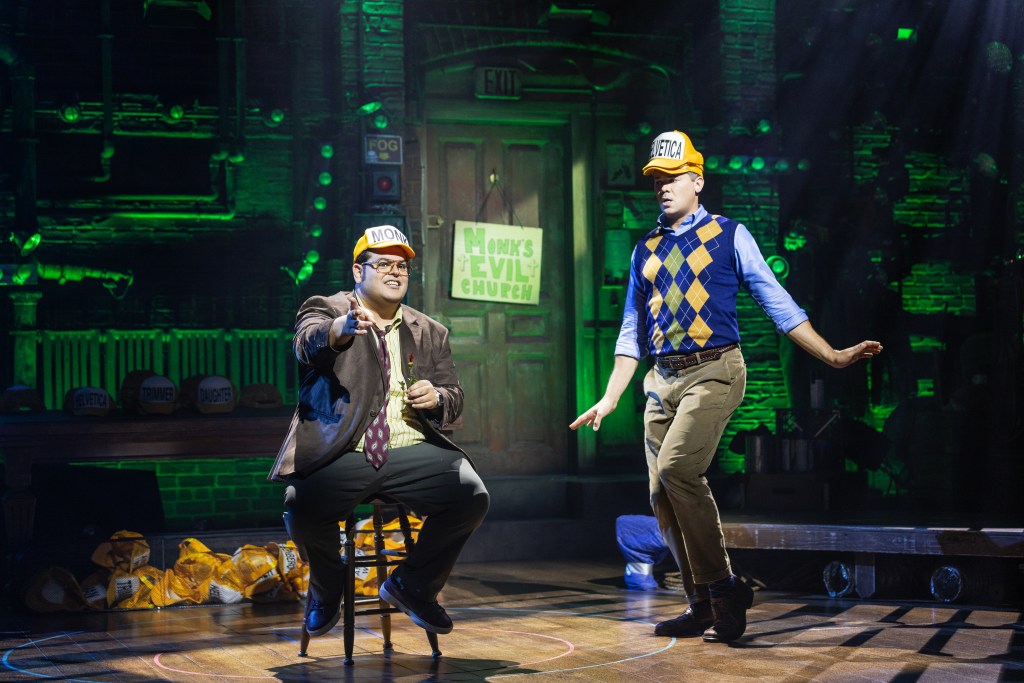
We have been led into the “secret world” of a backer’s audition for a production that is a loser and a winner. Maybe with a little revision, a tweak here and there, a consolidated cast, a reworking of the more incredible elements, a producer will envision its commercial vitality? Maybe not. You have to see it to find out if the producers line up to sign on or hold their noses and back out quietly.
Importantly, during the process, Gad’s Bud and Rannells’ Doug steer the audience from joke to quip to zany song with an aplomb that is exhaustive and exhausting. Assisted by Scott Pask’s scenic design of the stripped down stage, Emily Rebholz’s costume design which is appropriate for Doug and Bud’s dorkish affability, Jeff Croiter’s lighting design and Tommy Kurzman’s hair design, the actors fulfill Timber’s tone and vision for this seemingly facile, but humorously febrile, profound musical. M.L. Dogg and Cody Spencer’s sound design is spot on; I could hear every word.
Kudos goes to the orchestra which includes Marco Paguia (conductor/keyboard 1), Amanda Morton (associate conductor/keyboard 2) and Mike Dobson (percussion). Additional arrangements are made by Scott Brown and Anthony King. T.O. Sterrett is responsible for music supervision, arrangements and orchestrations.
This is one to see for the fun of it. It is also a sardonic criticism of our time, which, thankfully, doesn’t slam one over the head with pretentious probity. For tickets go to the Box Office at 138 West 48th Street or visit their website online https://gutenbergbway.com/ It closes January 28th.
‘Jaja’s African Hair Braiding,’ Hysterical, Fun, Profound
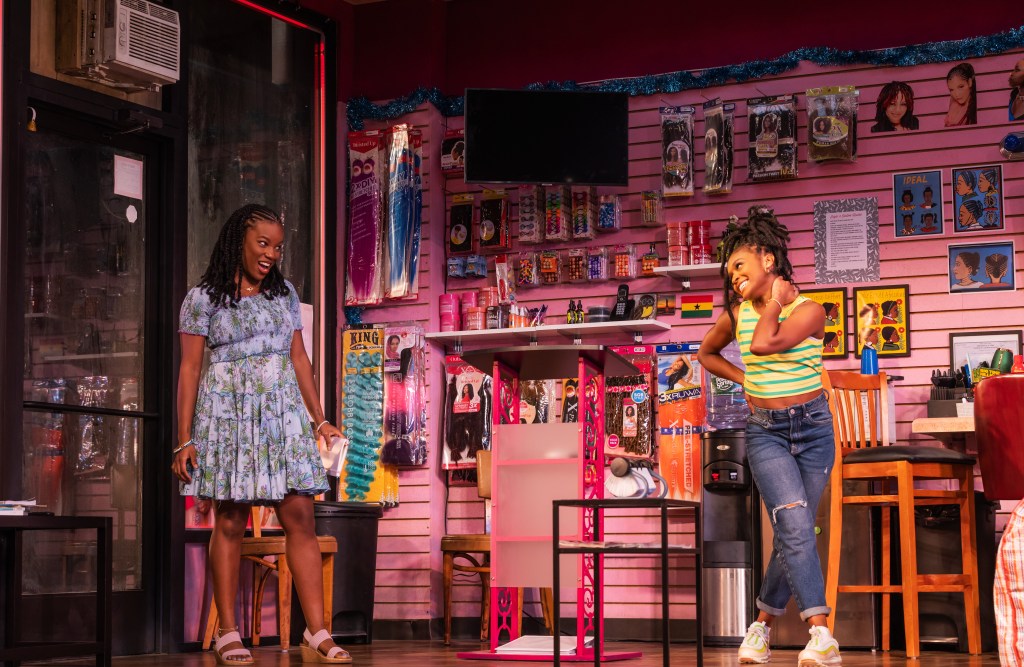
Jaja’s African Hair Braiding by Jocelyn Bioh in its world premiere at the Manhattan Theatre Club (Samuel J. Friedman Theatre), is a rollicking comedy with an underlying twist that, by the conclusion, turns as serious as a heart attack. Bioah’s characters are humorous, quick studies that deliver the laughs effortlessly because of Bioah’s crisp, dialogue and organic, raw themes about relationships, community, female resilience and the symbolism of hair braiding which brings it all together.
The setting is in Harlem, at Jaja’s Hair Salon where African hair braiding and the latest styles are offered. For those white gals and guys who envy the look of long lovely extensions but are too afraid to don them, it is understandable. You have to have a beautiful face to sustain the amazing, freeing look of long braided tresses that you can fling with a gentle or wild toss, evoking any kind of emotion you wish.
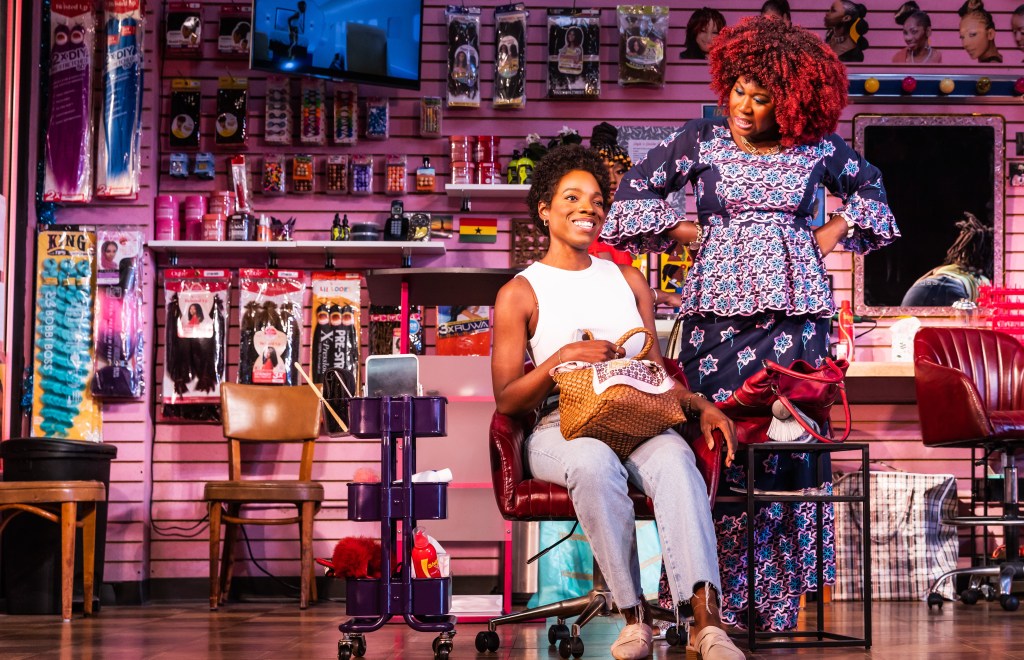
During the course of the play, we watch fascinated at the seamless ease with which the actors work their magic, transforming otherwise unremarkable women into jaunty, confident and powerful owners of their own dynamic presentation. While we are distracted by the interplay of jokes and mild insults and gossip, the fabulous shamans weave and work it.
In one instance, Miriam (the fine Brittany Adebumola) takes the entire day to metamorphose her client Jennifer (the exceptional Rachel Christopher). Jennifer comes into the shop appearing staid, conservative and reserved with short cropped hair that does nothing for her. But once in Miriam’s chair, something happens beyond a simple hairdo change.
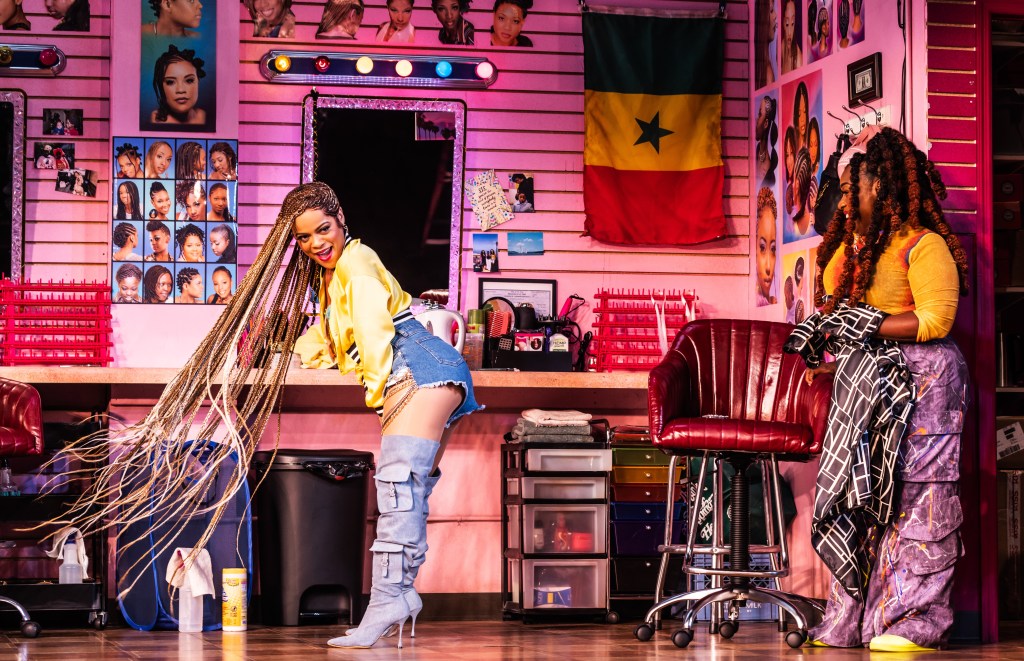
After MIriam is finished discussing her life back in Sierra Leone, which includes the story of her impotent, lazy husband, her surprise pregnancy and birth of her daughter by a gorgeous and potential future husband, and her divorce from the “good-for-nothing”, paternalistic former one, Jennifer is no longer. Miriam has effected the miraculous during her talk. Jennifer has become her unique self with her lovely new look. As she tosses her head back, we note Jennifer’s posture difference, as she steps into the power of how good she looks. Additionally, because of Miriam’s artistry, Jennifer is the proud receptor of a new understanding and encouragement. She has witnessed Miriam’s courage to be open about her life. If Miriam can be courageous, so can she.
Jennifer leaves more confident than before having taken part in the community of caring women who watch each other’s backs and hair, which by now has taken on additional symbolic meaning. Incredibly, Miriam works on Jennifer’s braids the entire play. However, what Jennifer has gained will go with her forever. The dynamic created between the storyteller, Miriam, and the listener, Jennifer, is superb and engages the audience to listen and glean every word they share with each other.
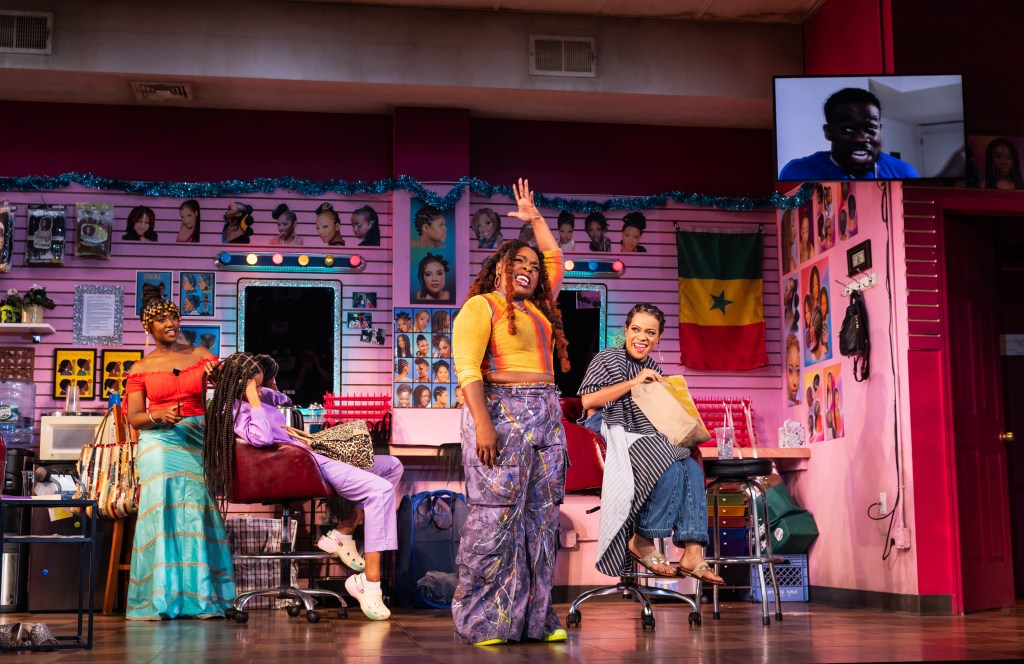
On one level, a good part of the fun and surprise of the production rests with Bioh’s gossipy, earthy, forthright characters, who don’t hold back about various trials they are going through involving men, who exploit them. Nor do they remain reticent if they think one of their braiding colleagues has been surreptitiously stealing their clients, as Bea accuses Ndidi of doing in a hysterical rant
Another aspect of the humor deals with the various clients who come in. Kalyne Coleman and Lakisha May each play three roles as six different clients. They are nearly unrecognizable for their differences in appearances. They change voices, gestures, clothing, mien, carriage and more. For each of these different individuals, they come in with one look and attitude and leave more confident, happier and lovelier than before.
Portraying three vendors and James, Michael Oloyede is hysterically current. Onye Eme-Akwari and Morgan Scott are the actors in the funny Nollywood Film Clip that Ndidi imitates.
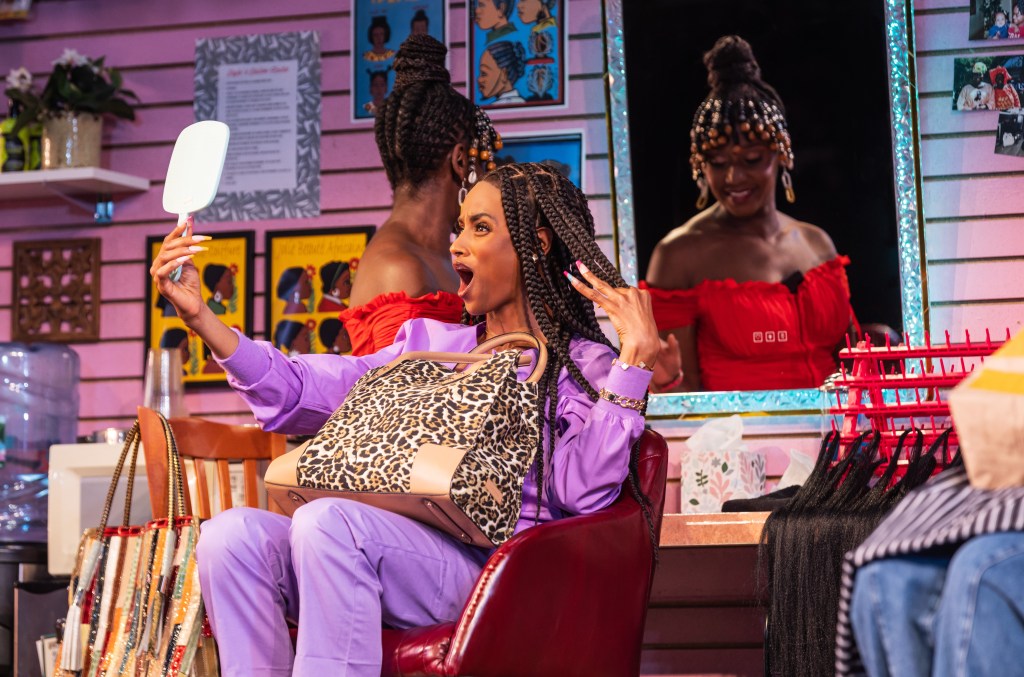
For women, hair is key. Bad hair days are not just a bad joke, they are a catastrophe. Bioh capitalizes on this embedded social, cultural more. Presenting its glories, she reveals the symbolism of “extensions,” and “new appearances” as they relate to uplifting the spirit and soul of women who are required to look gorgeous.
Above all, Bioh elevates the artists whose gifted hands enliven, regenerate, encourage and empower their clients. Along with Miriam (Brittany Adebumola), these include Ndidi (Maechi Aharanwa), Aminata (Nana Mensah) and Bea (Zenzi Williams). Sitting in their chairs, under their protection, trusting their skills at beautification, we recognize the splendid results, not only physically in some instances but emotionally and psychically.
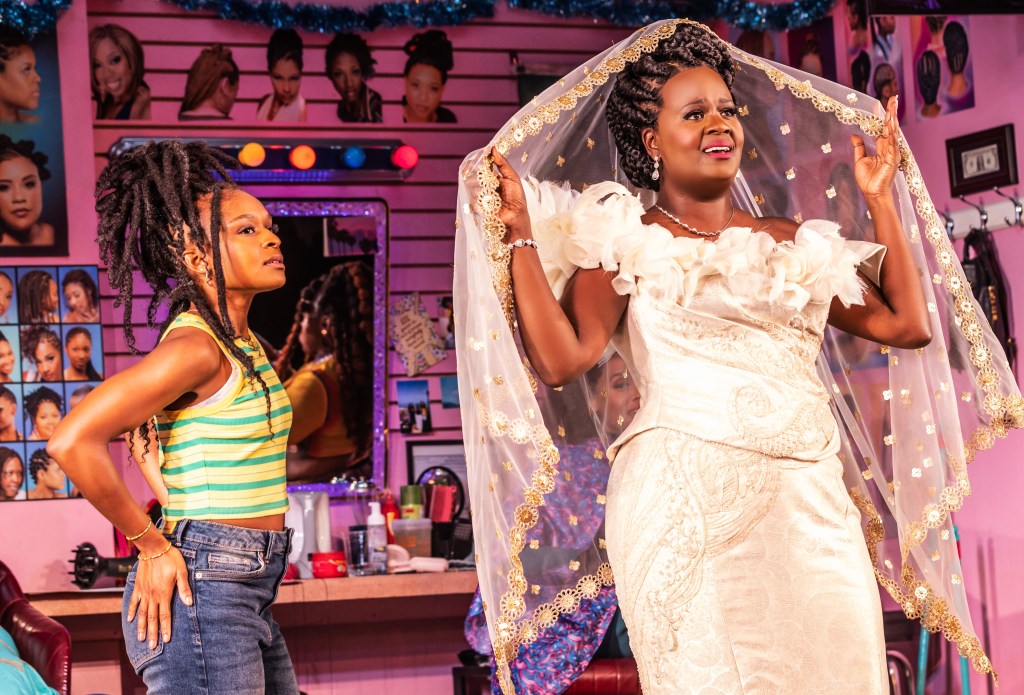
The only one who isn’t an African braiding artist is Marie (Dominique Thorne). She is helping out her mother Jaja (Somi Kakoma), who owns the salon and who is getting married that day, so she can get her green card for herself and Marie. Jaja who appears briefly in wedding garb to share her excitement and happiness with the women who are her friends, then goes to the civil judge to be married. However, Marie can’t be happy for her mother. Likewise, neither can old friend Bea, who has told the others the man Jaja is marrying is not to be trusted.
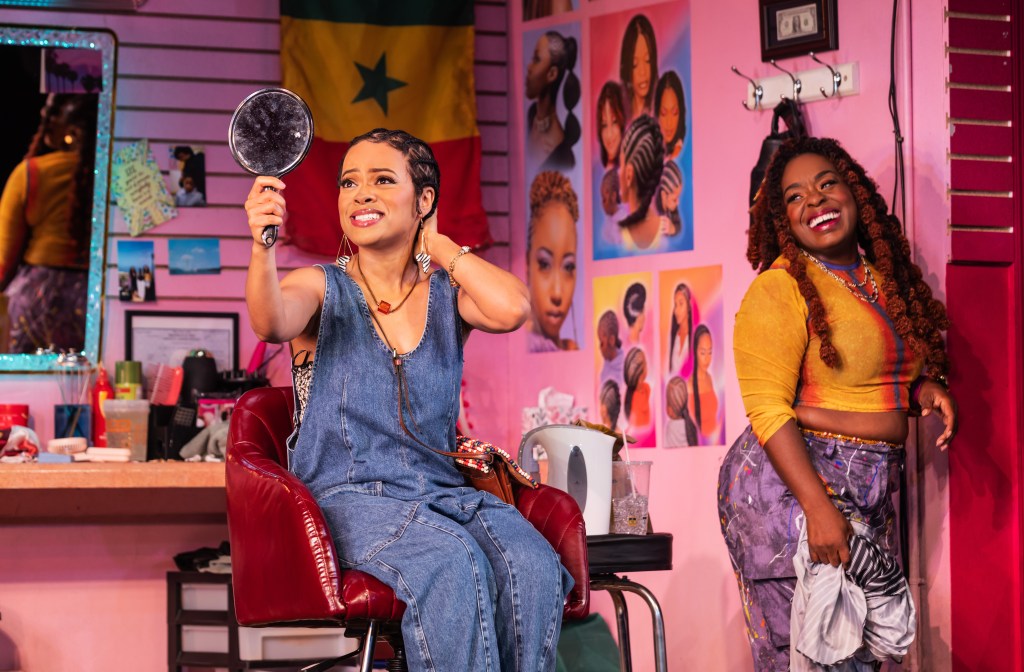
Nevertheless, the point is clear. Within the shop there are artists who are working their way toward citizenship. And Miriam is saving money to bring her daughter to the US. Though Bioh doesn’t belabor the immigration issues, but instead, lets us fall in love with her warm, wonderful characters, it is a huge problem for the brilliant Marie, who has been rejected from attending some of the best colleges. Her immigration status is in limbo as a “Dreamer.”
And like other immigrants, she is living her life on hold in a waiting game that is nullifying as well as demeaning because, as Jaja points out repeatedly to her, she can be a doctor or anything she wants. Her daughter, Marie, is brilliant, ambitious and hard working. Taking over the African hair braiding salon is not good enough. She can do exploits. But without a green card, she can do nothing.
Directed by Whitney White whose vision for the play manifests the sensitivity of a fine tuned violin, the play soars and gives us pause by the conclusion. The technical, artistic elements cohere with the overall themes that show the hair salon is a place of refuge for women to commiserate, dig deep and express their outrage and jealousies, then be forgiven and accepted, after a time. It is a happy, busy, brightly hued and sunny environment to grow and seek comfort in.
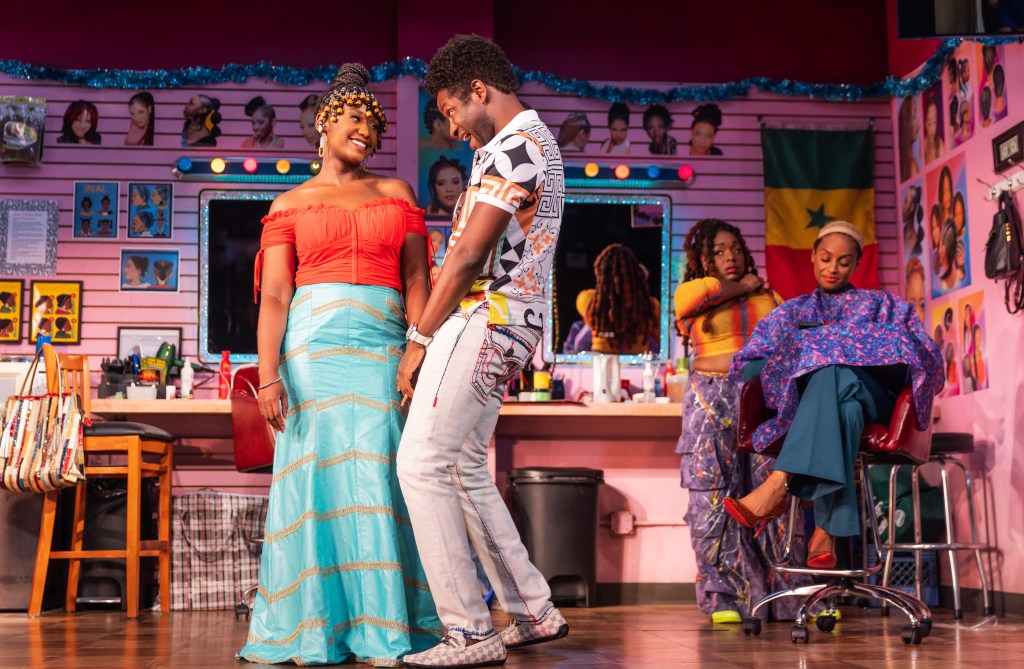
David Zinn’s colorful, specific scenic design helps to place this production on the map of the memorable, original and real. This salon is where one enjoys being, even though some of the characters snipe and roll their eyes at each other. Likewise, Dede Ayite’s costume design beautifully manifests the characters and represents their inner workings and outer “brandings.” From her costumes, one picks up cues as to the possibilities of what’s coming next, which isn’t easy as the production’s arc of development is full of surprises.
Importantly, Nikiya Mathis’ hair & wig design is the star of the production. How the braiding is done cleverly with wigs so that it appears that the process takes hours (it does) is perfect. Of course the styles are fabulous.
Kudos to the rest of the creative team which includes Jiyoun Chang (lighting design), Justin Ellington (original music & sound design), Stefania Bulbarella (video design), Dawn-Elin Fraser (dialect & vocal coach).
This is one to see for its acting, direction, themes and its profound conclusion which is unapologetic and searingly current. Bioah has hit Jaja’s African Hair Braiding out of the park. She has given Whitney White, the actors and the creatives a blank slate where they can enjoy manifesting their talents in bringing this wonderful show to life. It is 90 minutes with no intermission and the pacing is perfect. The actors don’t race through the dialogue but allow it to unfold naturally and with precision, humor and grace.
For tickets go to the Box Office on 47th Street between 7th and 8th Avenues or their website https://www.manhattantheatreclub.com/shows/2023-24-season/jajas-african-hair-braiding/?utm_source=google&utm_medium=cpc&gclid=CjwKCAjwvfmoBhAwEiwAG2tqzDaZkpYxm9EVbEs9yQ0hCPDF5gTyx9a8iy4yFCkwZxfd3skrmdD8oxoCAfgQAvD_BwE
‘Purlie Victorious,’ a Riotous Look in the Backward Mirror of 1960s Southern Racism

White power structures die hard. However, they do fall apart when the younger generation helps to topple them.
This is particularly true in Purlie Victorious, a Non-Confederate Romp Through the Cotton Patch, currently in revival on Broadway at The Music Box. It is the next generation that overwhelms the cement-like apparatus of noxious, white paternalism in Ossie Davis’ trenchantly funny play. Thus, we cheer on the pluck, humor, audacity and cleverness of the young reverend Purlie Victorious Judson, exquisitely inhabited by the unparalleled Leslie Odom, Jr. of Hamilton fame. Odom, Jr. leads the cast with his kinetic and superb performance.
The premise for the play that initiates the action is steeped in hope and youthfulness-the righting of a an ancestral wrong symbolically-the despotic terrorism of slavery’s oppressive violence. With mythic actions and intentions Purlie returns home to the Georgia plantation where he was raised, to claim his inheritance and take back the honor which racist owner Ol’ Cap’n Cotchipee siphoned off from his family through peonage (servitude indebtedness).
How Purlie does this involves a fantastic and hysterical scheme, eliciting the help of the adorable Lutiebelle Gussie Mae Jenkins (the riotous Kara Young). Purlie, who met Lutiebelle in his travels, intends to pass her off as his Cousin Bee, who will charm Ol’ Cap’n (the perfect foil, Jay O. Sanders), into giving her the $500 cash that was bequeathed to their aunt by her wealthy lady boss. After succeeding in the scheme to dupe Ol’ Cap’n, Lutiebelle will give Purlie the cash. With cash in hand, Purlie will purchase and restore the Old Bethel Church, so he can preach uplifting freedom to the sharecroppers, who are enslaved by peonage to Ol’ Cap’n.

As Purlie relates his scheme to family, Missy Judson (the fine Heather Alicia Simms), and Gitlow Judson (the riotous Billy Eugene Jones), they avow it won’t work. At first, Gitlow refuses to take any part because he is one of Ol’ Cap’n’s favorite “darkies.” Gitlow has risen to success through his amazing cotton picking labors. Ol’ Cap’n bestows upon him the anointed status of chief oppressor of the “colored folk” working for Ol’Cap’n. He keeps them nose to the grindstone at their backbreaking work.
However, when Purlie introduces his relatives to Lutiebelle, and unleashes his persuasive and inspiring preaching talents on his kin, they give the scheme a whirl. What unfolds is a joyous, sardonic expose of all the techniques that Black people used when dealing with the egregious, horrific, white supremacists of the South, represented by Ol’ Cap’n, The Sheriff (Bill Timoney), and The Deputy (Noah Pyzik).
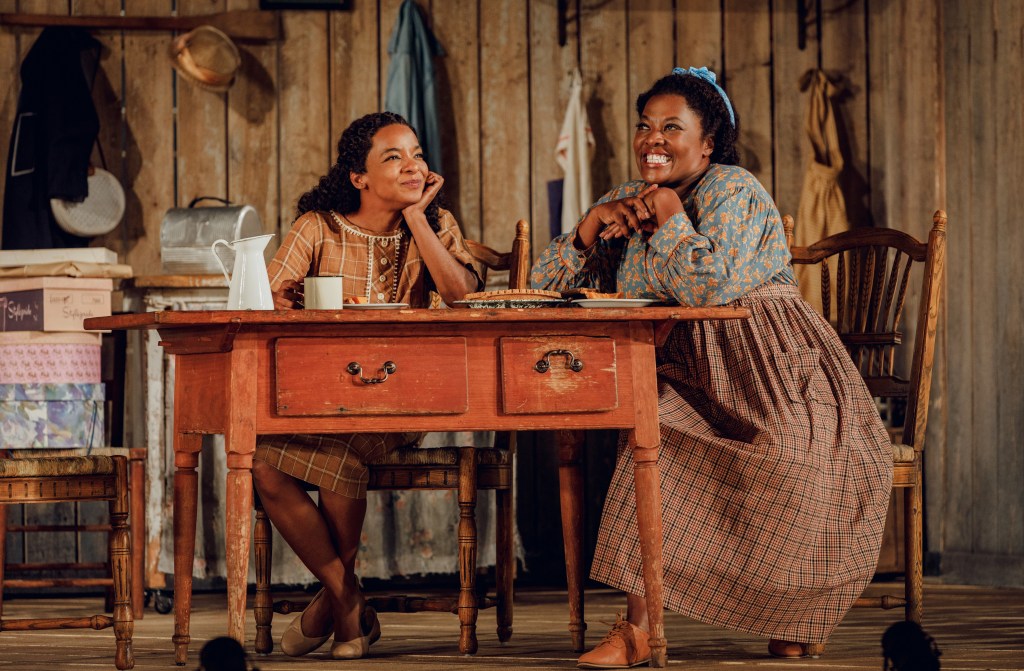
The irony, double entendres and reverse psychology Purlie and family use when confronting Ol’ Cap’n are sharp, comedic, and of moment. Though Ol’ Cap’n owns the place and exploits the sharecroppers using indebtedness, on the other hand, we note that Gitlow is able to manipulate Ol’ Cap’n with his “bowing and scrapping” which, as we are in on the joke, is brilliantly humorous.
It is in these moments of dramatic irony when Ossie Davis’ arc of development reveals how the characters work on a sub rosa level, that the play is most striking and fabulous. The enjoyment comes in being a part of knowing that Purlie and the others are able to “get over,” while Ol’ Cap’n is unable to see he is “being had.” Additionally, with the assistance of Ol’ Cap’n’s clever, forward-thinking son, Charlie (the wonderful Noah Robbins), Ol’Cap’n is completely flummoxed, having missed all the undercurrents which indicate he is being duped.

The actors, beautifully shepherded by director Kenny Leon, effect this incredible comedy, which also has at its heart a deadly, serious message.
Black activist, writer, actor, director Ossie Davis wrote Purlie Victorious, which premiered on Broadway in 1961 at a time when Martin Luther King, Jr. had strengthened the Civil Rights Movement and celebrities were taking a stand with Black activists. In fact, Martin Lurther King, Jr. saw the production and was pictured with the cast, Ossie Davis and Ruby Dee, his wife, who portrayed Lutiebelle.

Particularly in the final speech that Purlie delivers, we can identify with the important themes of a unified human family being together on an equal plane. It is a message that is particularly poignant today, considering the political divisiveness of the white nationalists, a throwback to the Southern racists of the 1960s, like Ol’ Cap’n, who Jay O. Sanders makes as human as possible to allow his racial terrorism to leak through with humor. Because of Sanders’ balanced portrayal, Ol’ Cap’n is an individual who has become his own hysterically funny caricature and stereotype, precisely because he is so obtuse in his self-satisfied mien as their “great white father.”
In the play Davis’ themes about the cruelties of peonage resonate today in the corporate structures which have kept wages low while giving CEOs 500 times what their average workers make. Indeed, the play resonates with the idea of servitude and keeping the labor force however indebted (with student loans, loans, mortgages, credit card debts), so that individuals must work long hours to keep one step ahead of financial ruin. We note the parallels between then and now. The inequities then are in many ways reflective of current economic disparities between the classes, allowing for very little upward mobility from one generation to the next.

It is this that Purlie attacks and preaches against throughout the play. It is this inequity and enslavement indebtedness that Purlie intends to educate Black people about, so that they become free and whole. It is for this reason Purlie wants to purchase and renovate Bethel Church, where he will preach his message of freedom. As we listen, we also realize that the message resonates with everyone, regardless of race, except, of course, the white oppressors, who stand to lose their power, lifestyle and privilege.
This material loss, which would be their spiritual gain, is unthinkable to them. Davis’ indirect message is that this is the oppressors’ greatest sin. They don’t see that by internalizing the defrauding and inhumane values of white supremacy, they are the truly hellish, loathsome monsters, the “other,” they seek to destroy. The destruction only happens to them, while the strengthening happens to those they oppress.
Kenny Leon’s direction expertly guides his actors, moving them with perfectly timed pacing and comedic rhythm. The play develops from broad farce and hi jinks and moves to an ever-expanding roller coaster ride of frenetic humor and excitement. We note Purlie’s desperation and frustration with Ol’ Cap’n’s arrogance and presumptions about Black inferiority, which Purlie will not scrape to. Of course, Idella Landy (the wonderful Vanessa Bell Calloway), who has been a mother to Charlie, with love, influences him to override his father’s brutal attitude toward their family. Indeed, Charlie adopts the Judsons as the family he chooses to be with, rather than his arrogant, ignorant, abusive father.

Leon manages to seamlessly work the staging and find the right balance so the irony and true comedy never becomes bogged down in the seriousness of the message. Because of the lightheartedness and good will, we are better able to see what is at stake, and why Charlie comes to the rescue of his Black family, against his own father, who is an inhumane obstructionist past his prime.
The set design by Derek McLane allows the action to remain fluid and shape shifts so that we move from the Judson family home, to Idella Landy’s kitchen, to the Bethel Church at the conclusion. With Emilio Sosa’s costume design, Adam Honore’s lighting design, Peter Fitzgerald’s sound design and J. Jared Janas hair, wig and makeup design, the creatives have manifested Leon’s vision for the play. Additional praise goes to Guy Davis’ original music, and Thomas Schall’s fight direction.

This revival of Purlie Victorious is a wonderful comedic entertainment that also has great MAGA meaning for us today. For tickets to this must-see production that runs without an intermission, go to their Box Office on 239 West 45th Street or their website https://purlievictorious.com/tickets/
 CAROLE DI TOSTI