‘Babe,’ Theater Review: Marisa Tomei, Rocking Through to the Next Phase
Babe
Can people change? Or do they just flip their perspectives and deceive themselves to believe they’re “evolving?” In the New Group presentation of Babe, written by Jessica Goldberg, directed by Scott Elliott, Abigail (Marisa Tomei), is Gus’ (Arliss Howard), invaluable collaborator in the music industry. The comedy/drama focuses on a number of current issues using Abby and Gus’ relationship as a focal point to explore the landscape of shifting political correctness, power dynamics, generational conflicts, delayed self-actualization, and more. With original music by the trio BETTY, Babe runs approximately 85 minutes with no intermission at the Signature Center until December 22nd.
Treading lightly on Gus’ rocky ground, Abby has been instrumental in maintaining their successful, collegial relationship for thirty-two years, though at a steep, personal price. She hasn’t acknowledged the sacrifice to herself or been inspired to make a change until the confident, twenty-nine year old, Katherine, interviews with Gus, while Abby monitors their conversation and tries to give him clues when to end his political incorrectness. Katherine’s poise and forward attitude develops during the play as the catalyst which ignites a fire that turns into a conflagration between Gus, Abby and Katherine by the conclusion.

Tomei’s astute Abby is sensitive and insightful
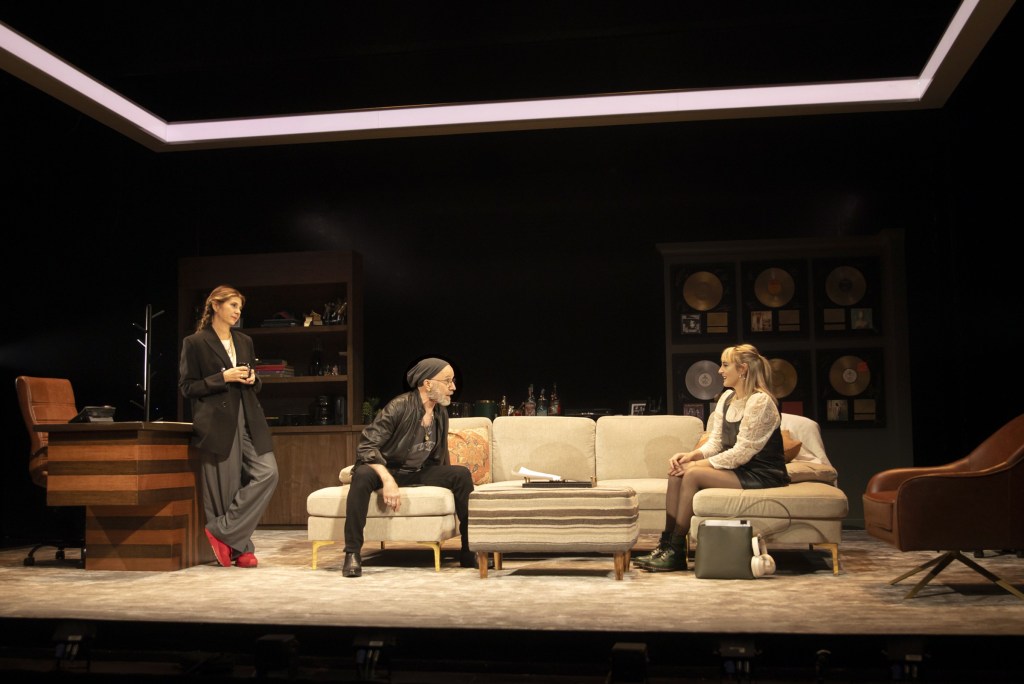
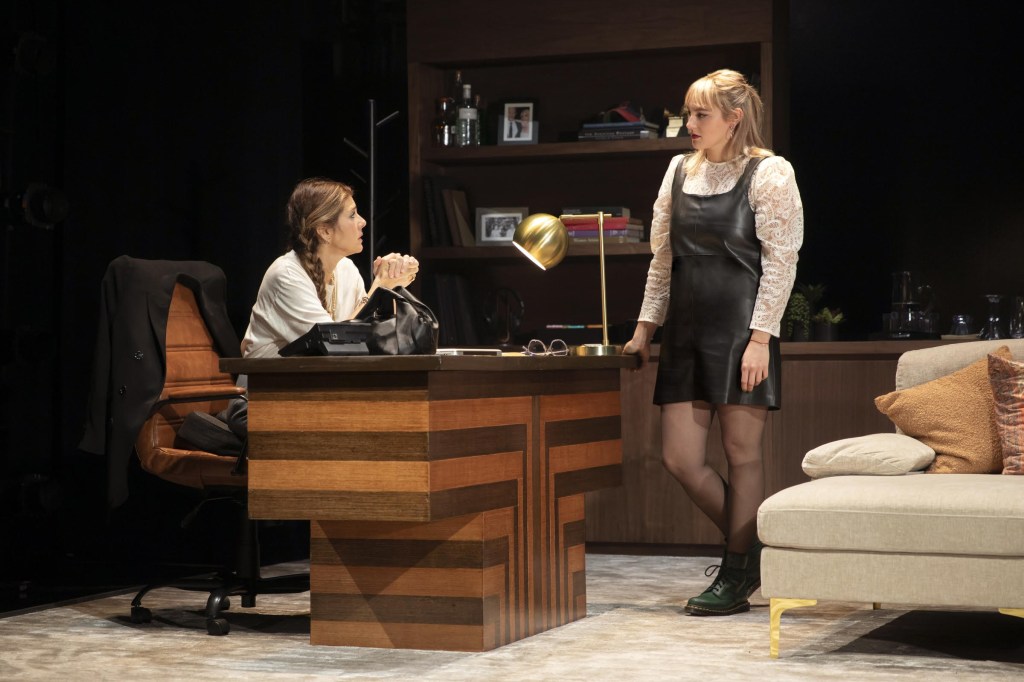
Tomei’s astute Abby provides the sensitivity and insight into the zeitgeist that electrifies fans and brings in the gold records, a number of which hang on the walls of Gus’s chic office (sleek, versatile set design by Derek McLane). The producing legend now in his 60s, but fronting his hip, “with-it” ethos in his tight, black pants, chains, stylized beret, and black leather jacket (Jeff Mahshie, costume design), is at “the top of his game,”and on a down-hill slide, indicated by the sensitivity-training Abby references he has had to withstand. We learn it has been ordered by patriarchal, music company head Bob, who also needs to correct himself, but is powerful enough not to. The hope is with Abby’s continual guidance, and the training, Gus’ boorish, self-absorbed, toxic maleness and unrestrained egotism, encouraged at the company by the other men in the past, will refine. Not a chance, as old dogs refuse to learn new tricks.
As groundbreaking, protective and vital as Abby has been to Gus, the two A & R reps, who have discovered and fashioned some of the most successful solo artists in the business, are not equal in stature, success or monetary rewards. Abby’s discovery of Kat Wonder epitomizes these disparities between her boss Gus, and her, as his second. The only woman in the company for years, Abby suffered through the vulgar and abusive patriarchy, a fact she admits late in the play. To her credit, she managed to gain Gus and the others’ respect and esteem. They keep her around because, as Gus suggests, they think she is like them. We learn by degrees that this is because she is silent and as apparently sedate as her bland, grey pants, white top and black jacket. She is unobtrusive and remains professional, the perfect “Girl Friday,” who allows them to “let it all hang out,” without judging their behavior or making them feel like pigs.
Abby is shut out of receiving credit for her sterling efforts
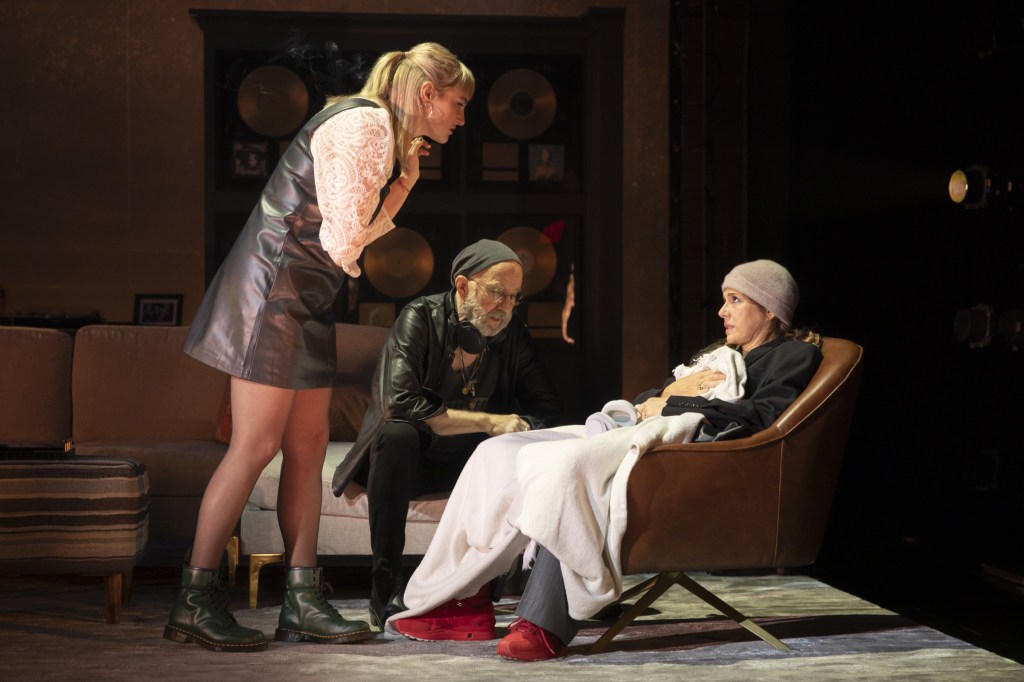
For her pains to participate, Abby didn’t receive credit on any of the Kat Wonder albums, an “invisible” co-producer. Nor did she share in the spoils as Gus did with global residences and a townhouse he forces the staff to meet in at his convenience, instead of the conference room.
However, ignoring Gus as “all that,” Katherine conflicts with his philosophy, his pronouncements, his ideas. If opposites attract, these two are an exception. Gus sees Katherine’s cultural approaches as pretentious and immaterial (vegan he is not). Katherine is gently oppositional as she pitches herself, her education and background. Interestingly, Katherine sees Abby as a hero to admire. In the initial meet-up, Katherine recognizes Abby from a photo Abby appears in with phenom of the time, “Kat Wonder” at CBGB.Admiring Abby and fawning over her after the interview, Katherine tells Abby that she has been her inspiration to get into the business and wanted to be her.
As obnoxious as Katherine’s forward presumptuousness is, her confidence and appearance remind Abby of Kat Wonder, whose wild grace and energy haunts her throughout the play. Kat appears in her imagination in flashbacks at varying, crucial turning points, with Gracie McGraw doubling for Kat Wonder. These memories of their time together direct Abby toward self-realization and an eventual confrontation with Gus about his unjust treatment of her. This is obviously a painful realization which Abby eventually allows, despite acknowledging Gus’ platonic love, and respect. His concern for her is apparent when he sits with her during a very uncomfortable chemo treatment for her breast cancer.
Katherine visits Abby in an unusual get-together
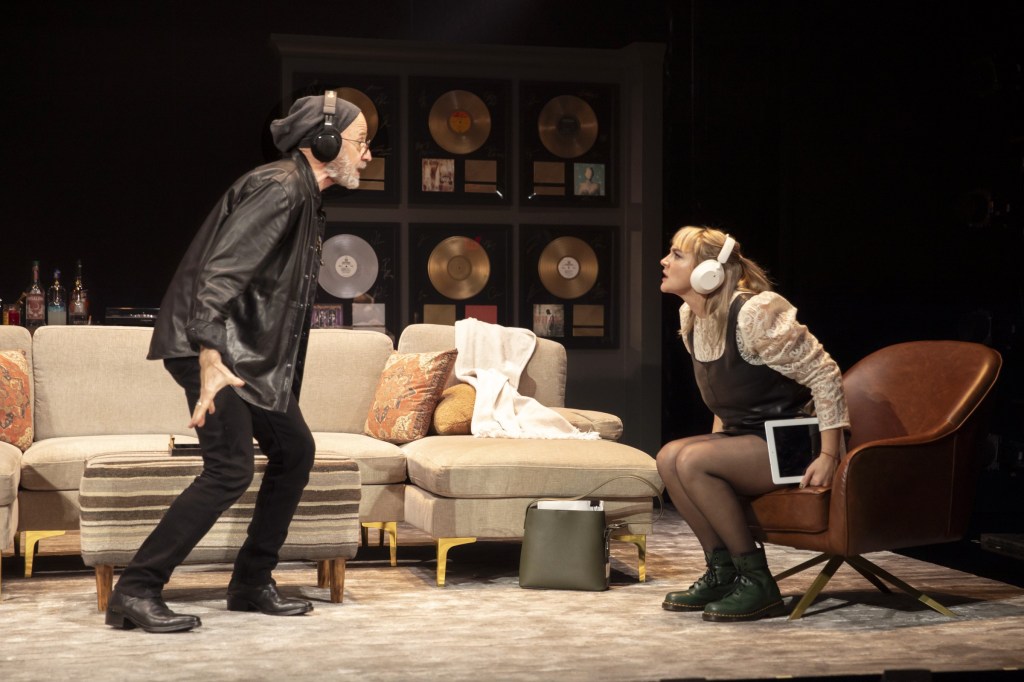
After Katherine again attempts to rise in the company in another interaction with Gus, she visits Abby at her apartment (McLane’s set design again shines in the transition from Gus’ office to Abby’s apartment and back). They listen to music and Katherine asks Abby probing questions. Then they rock out to music and she dances with Abby, at which point Katherine pushes herself on Abby. Abby is forced to rebuff her because any relationship between them is inappropriate. Nevertheless, this trigger, Goldberg implies, impacts Abby. Abby’s remembrance of her relationship with Kat brings her into a deepening realization of herself because of her experiences, including feeling responsible for Kat Wonder’s death, and being shut out of the glory of notoriety as producer who discovered grunge-rocker Kat.
Abby’s realizations about what she has allowed emotionally, which may have contributed to her physical illness and stress, coupled with a twist that Katherine generates, bring about a surprising conclusion. However, Abby’s response to the final events is the most crucial and important. Maybe it is possible in one’s middle age to forge a new path and become one’s own self-proclaimed star.
The ensemble melds with authenticity and flair
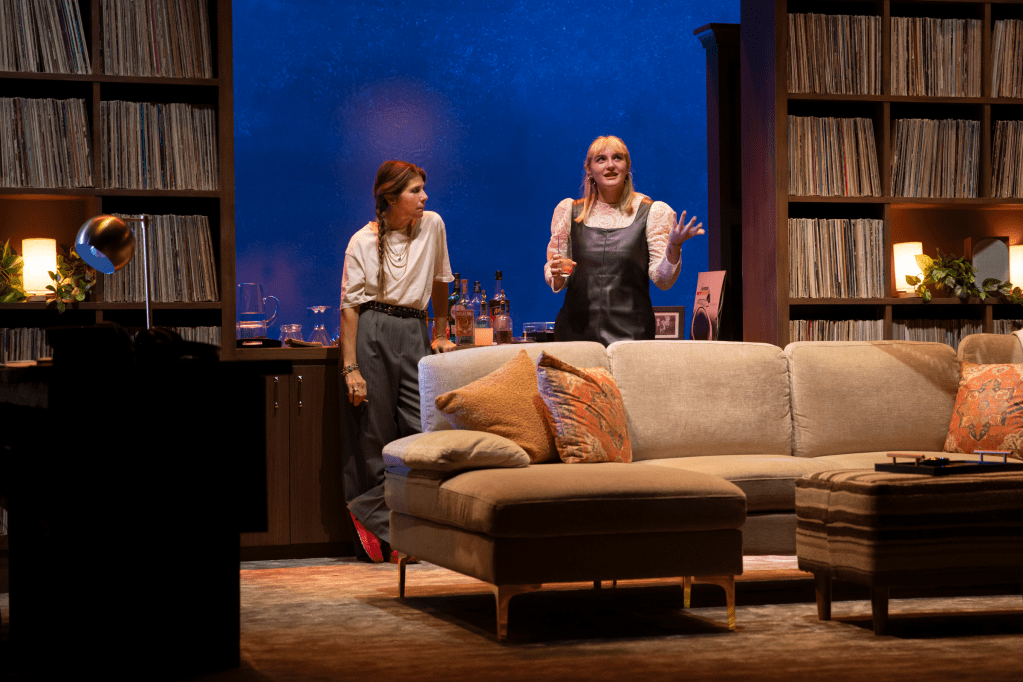
The actors convey their characters with spot-on authenticity, aptly shepherded by Elliot’s direction. Arliss Howard manages to break through Gus’ character with a winning charm and matter-of-factness, which throws dust in the audience’s eyes, even after Katherine corrects his back-handed compliment of her as a “smart girl.” Marisa Tomei as Abby is imminently watchable and versatile as she moves from quiet restraint, to the throes of physical and emotional suffering. The development and culmination of her rage and satisfying expression of it in rocking-out with Kat Wonder is powerful especially at the conclusion. As always Tomei gives it the fullness of her talent, rounding out the Abby’s humanity despite Goldberg’s thin characterization.
Gracie McGraw’s portrayal of Kat Wonder, the 1990s grunge rocker who embodied “centuries of female rage,” before she self-destructed is too brief, perhaps. Much is suggested in Kat’s and Abby’s relationship, but remains opaque. However, we do get to see McGraw’s Kat cut loose. And the memory is so alive and vibrant, it encourages Tomei’s Abby to be her own rock-star, wailing out her repressed rage by the conclusion of Babe. And the women in the audience wail with her, especially now, after the election.
Babe covers many interesting points. To what extent has music been egregiously shaped by the current technologies? What damage has been done as the music and entertainment industry, hypocritically shaped by cultural politics, only creates artificial boundaries on the surface that don’t penetrate the noxious back room parties and behaviors which have given rise to worse abuses? Another issue defines the difficulties of compromise and corruption which spans every institution, every industry. To be a part, one has to be complicit, and then be satisfied with less of a reward because others hold the power and money and make up the rules. Babe scratches the surface and leaves food for thought. The performances are noteworthy and should be seen.
Kudos to the creatives not mentioned before which include Cha See (lighting design), Jessica Paz (sound design), Matthew Armentrout (hair and wig design), and not enough of BETTY’S original music.
Babe runs 85 minutes with no intermission at the Signature Center.

Posted on December 13, 2024, in Off Broadway and tagged Arliss Howard, Babe, Gracie McGraw, Jessica Goldberg, Marisa Tomei, Marisa TTomei, Off Broadway, reviews, Scott Elliott. Bookmark the permalink. 2 Comments.
 CAROLE DI TOSTI
Very insightful and spot on!!
LikeLike
Well, hello!!! Thx. XO
LikeLike