Author Archives: caroleditosti
‘Toni Stone,’ A Baseball Great Takes Center Stage at the Roundabout

April Matthis in Roundabout Theatre Company’s ‘Toni Stone,’ directed by Pam MacKinnon, written by Lydia R. Diamond (Joan Marcus)
Imagine being so excellent at baseball you have to join a boys’ team because no one on the girls’ team can hold a candle to you! Toni Stone was the first African American female to distinguish herself and play pro ball ball in the Negro Leagues. No other woman of any race topped her skill, pluck or stamina in 1953, not that any women even conceived that they should try. Based on the biography Curveball, The Remarkable Story of Toni Stone by Martha Ackmann, Roundabout’s humorous, intriguing and illuminating production about baseball, race, gender, inspiration and ambition, Toni Stone, written by Lydia R. Diamond, is currently at the Laura Pels Theatre until the 11th of August.
Starring Obie Award Winner April Matthis, who transforms herself into the feisty, wise-cracking, straight-talking, female baseball maverick in the two act production that runs with one intermission, we learn Toni’s inside perspective about what it was like to break into the prestigious negro leagues. She was the only woman to do exploits with her male teammates playing the game she adored and gave the best years of her life to in the late 1940s to 1954. Hired to play second base with The Clowns in 1953, Toni Stone took over the position that Hank Aaron had played the previous year and rocked it in 50 outings, slamming a hit off the legendary pitcher Satchel Paige. Matthis as Stone is incredible, moment-to-moment, real.

(L to R): Harvy Blanks, Jonathan Burke, Daniel J. Bryant, Ezra Knight, Toney Goins, Eric Berryman, Phillip James Brannon, April Matthis, Kenn E. Head in ‘Toni Stone,’ Roundabout Theatre Company, written by Lydia R. Diamond, based on the book ‘Curveball, The Remarkable Story of Toni Stone,’ by Martha Ackmann directed by, Pam MacKinnon (Joan Marcus)
The structure of Toni Stone is picaresque and dramatic. It spans the years from the 1920s to the 1950s in various locations around the country. With superb, athleticism by the actors, the movements are precision, characteristically baseball as the actors represent the players on Toni’s exhibition team The Clowns (like the Harlem Globetrotters in the basketball world today). The Choreography by Camille A. Brown in Act I is taut as we watch the players practice their fielding, throwing, catching, swinging as professional ball players with the fierce pride and confidence to match any professional today. They and Brown’s choreography are impressive. Director Pam MacKinnon’s staging segues from bit to bit with fast paced spin in the first act, and less precision in the second act which becomes more ponderous.
The Lighting (Allen Lee Hughes) and Set Design (Riccardo Hernandez) echoe where Tony strived to spend the best years of her life, on the ball field, with lights blaring down (at the right moment) and with bleachers for the full effect and accoutrements, i.e. uniforms (Dede Ayite) caps, gloves, bats minus the ball which is held in mime invisibly as the players “throw” and “catch.” The minimalism is effective in lifting the subject of what has been described as the only true American sport. The lack of extraneous spectacle draws our attention to the dialogue between and among the players and other characters. Without the razzle dazzle, we focus on Toni Stone’s narration during which she confides to us about salient details of her life and events which reveal the themes of the production: steadfastly overcoming the odds, ambition as everything, female success in a man’s world, and effort and hard work pays off if one keeps focused.
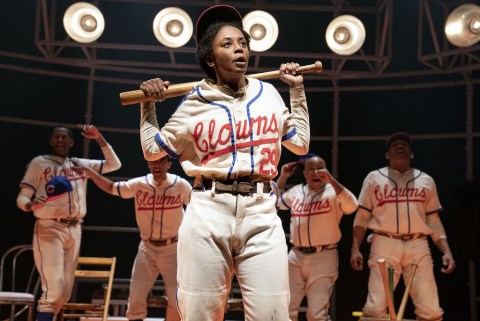
(L to R): Eric Berryman, Jonathan Burke, April Matthis, Daniel J. Bryant, Ezra Knight, ‘Toni Stone,’ written by Lydia R. Diamond, directed by Pam MacKinnon, based on the book ‘Curveball, The Remarkable Story of Toni Stone,’ by Martha Ackmann (Joan Marcus)
April Matthis has the accent, the drawl, the humor to evoke Toni’s persona and let us in on the secrets of her baseball obsession and efforts to be the best. She’s not as good as Jackie Robinson whom the players reference moving from the Negro Leagues in a leap over the line of segregation to Major League baseball as the first African American to integrate the Majors. Nevertheless, Toni was a one-of-a-kind celebrity and superb ball player. It is that particularity that playwright Diamond characterizes and Pat MacKinnon highlights through her direction so that it explodes on stage and holds our interest.
The top of the play begins with her teammates on the Indianapolis Clowns who introduce her and then she introduces them with humorous quips and prods. As the men move like poetry as they practice behind her, Toni gives an overview of the game with a rhythm all her own in description and enumeration of details. Her full on discussion of the ball, likening it to that which is a part of her hand and which she balances by its weight, shape and feel is typically mind-bending. It indicates how one can be engrossed by that which one loves to go very deep! Indeed, she remarks that as the girls in high school were obsessed about boys, she could only see, hear and think about baseball. A fiend she spends her waking moments on the baseball fields of St. Paul where her tom boyishness and fervor were accepted by the guys who “let” her play with them.

(L to R): Jonathan Burke, Harvy Blanks, Toney Goins, Kenn E. Head, April Matthis, Eric Berryman, Daniel J. Bryant, Phillip James Brannon, Ezra Knight, ‘Toni Stone,’ written by Lydia R. Diamond, directed by Pam MacKinnon, Roundabout Theatre Company (Joan Marcus)
However, when she did break into pro baseball, the players gave her “what for.” Some of the intriguing elements of the production occur when Toni hones in on confronting difficulties. She prides herself on “taking it” i.e. the male-on-female abuse. She kept a stoic outlook and sustained the bruising and battering she got when the players treated her like a guy, but more so. In one segment, her friend, prostitute Millie (an exceptional Kenn E. Head) is with her as she applies cream on a bruise she receives from a player out to “get her.” In that brief moment is the tip of the iceberg of what she went through as the singular woman among the burly, smelly, macho men. Yet, she felt that she was one of them but through the years many of them treated her as “the other.” Indeed, she wasn’t allowed in the locker room and had to change in spaces they had to find for her as they traveled on the road.
Playing on the Negro Leagues, the players encountered the usual “hospitality” of the Jim Crow South; they were banned from white hotels, motels and bathrooms and subjected to racist, discriminatory abuse. In one town the only hotel they were accepted in was one that catered to sex workers. This is the place where she meets Millie, replete with flowery robes courtesy of Dede Ayite’s Costume Design, albeit Head wears them over his Clowns’ uniform. The interactions between Kenn E. Head’s Millie (his feminine gestures are humorous, but real) and Matthis’ Toni are poignant and revelatory. Head particularly has superb timing with his looks, his one-liners.

(L to R): ,Toney Goins, April Matthis, Kenn E. Head, in ‘Toni Stone,’written by Lydia R. Diamond, directed by Pam MacKinnon, based on the book ‘Curveball, The Remarkable Story of Toni Stone’ by Martha Ackmann, Roundabout Theatre Company (Joan Marcus)
There are sensitive illustrious moments drawn between the two, for example when Millie gives her tips on how to do her hair. And as Toni questions Millie for her wisdom regarding men, we note that her attitude is unrelenting and strong. We never see her break down even with Millie; she can’t afford that luxury. And very simply, it is not the “Toni Stone” style.
In another segment the playwright examines Toni’s relationships, in particular Alberga (portrayed by the superb, likable Harvy Blanks) who she allows to buy her drinks in a bar. How these scenes are simplistically staged using two players to hold a board is part of the fun. It is obvious that Alberga intends to sweet-talk her and ply her with alcohol which doesn’t understand until Millie explains it to her. Eventually, Toni abruptly calls him down on it and distracts him by talking “baseball.” Taken aback by her honesty and unpretentious, unfeminine, unflirty demeanor, they continue to “hang out” whenever she is in town.
Toni decides to marry him; it is the right time. When he and she are tired of smelling the man-sweat wreak of her own exertions on her clothes, coupled with sweaty, noxious odors of her male baseball counterparts, it is one more element that helps her decide to leave baseball. The last straw occurs after she is traded to the Kansas City Monarchs and benched most of the time sitting next to teammates whose dislike for her is obvious. Toni Stone leaves for a civilian life with her husband and never returns to baseball again.
Perhaps the most searing effect of this production is in how the playwright weaves in the details of the history of our nation’s racism during the accounts of her life on the field and in pro baseball. These thread everpresently throughout. In one instance Toni editorializes about the discrimination and it is here where the director and choreographer work their magic, starkly in a memorable finality to Act I. Toni stares out at the audience and comments about the “spectacle” of exhibition games where they were to make the audience laugh. The players “dance” behind her as grinning “clowns,” though one imagines that each and every one of the players is “crying inside.”
The depth and beauty of the sport she loves is compromised by the stereotypical, racial attitudes. The indictment is clear as Matthis’Toni stares out at the audience. We are a throwback to the historical audience who wanted the “negroes” to entertain them. It is then, the playwright infers little has changed regarding discriminatory racial stereotypes and bigoted acts. The tragedy of this is the stereotype obviates the profound depth of what African Americans/blacks were/are but are locked out from “becoming.” It is a vital moment in the play and the perfect end of the first act. The second act does not end as strongly.
Kudos to the creative team not already mentioned: Broken Chord (Original Music & Sound Design) Cookie Jordan (Hair & Wig Designer) Thomas Schall (Fight Director).
Toni Stone runs with one intermission at the Laura Pels Theatre, the Harold and Miriam STeinberg Center for Theatre on 46th Street between 6th and 7 Avenue until the 11th of August. For tickets and times go to the Roundabout Website by CLICKING HERE.
‘The Secret Life of Bees,’ a Heartfelt Musical Adaptation of Sue Monk Kidd’s Titular Novel

(L to R): )Elizabeth Teeter and Manoel Felciano in ‘The Secret Life of Bees,’ bOok by Lynn Nottage, Music by Duncan Sheik, Lyrics by Susan Birkenhead, based on Sue Monk Kidd’s novel, directed by Sam Gold (Ahron R. Foster)
The World Premiere of The Secret Life of Bees (Book by Lynn Nottage, Music by Duncan Sheik, Lyrics by Susan Birkenhead) spins Sue Monk Kidd’s best-selling novel into “A River of Melting Sun,” a metaphor for love, sweetness and redemption that is established in the opening lyrical musical number. Sung by the ensemble who elicit the audience to join them on a mythic and personal a journey they might wish to take, the song reinforces primary themes. These ripple throughout the story of Rosaleen (a sensational Saycon Sengbloh) and the troubled heart-broken Lily (Elizabeth Teeter’s lyrical voice is perfect for the role) both of whom must reconcile the wounds from their motherless childhood that threaten to destroy them.
The production directed by Sam Gold (Fun Home) is uniquely metaphysical. The director has chosen to keep the staging and set design (Mimi Lien) illustratively spiritual, functionally minimalistic and suggestive. The characters. pull out the props from the back wall use them to reflect and evoke events as they conduct the action organically. The book melds together the music and lyrics with characterizations. Sheik’s music with Birkenhead’s lyrics are sensitively drawn and vibrantly anointed in a mix of styles (gospel, blues, ballads, rock and pop pieces). This musical inspires and thrills.

The company of ‘The Secret Life of Bees,’ Book by Lynn Nottage, Music by Duncan Sheik, Lyrics by Susan Birkenhead, based on Sue Monk Kidd’s novel, directed by Sam Gold (Ahron R. Foster)
Ultimately, the healing power of many of the melodies, infused by the gorgeously, heady voices of the inimitable LaChanze (August Boatwright) Saycon Sengbloh (Rosaleen) Elizabeth Teeter (Lily) Eisa Davis (June) and Anastacia McCleskey (June) become the golden threads that provoke us to understanding that we too can share in “The Secret Life of Bees” and be purveyors of the honey of joy, moving down our own byways of life impacting others positively within our own sphere of influence.
The symbolism in the “A River of Melting Sun” has a myriad of layers as evocative as the messages in this adaptation enhanced with the emotionalism of Sheik’s score and veteran Birkenhead’s stirring lyrics. On one level the melting sun represents the golden honey that expert beekeeper August Boatwright (LaChanze) draws from hundreds of bee hives which is processed into the pure, amber sweetness from which she and her sisters, the broken-hearted May, and the hypercritical, austere June make their living in the county around Tiburon, South Carolina.

(L to R): LaChanze, Elizabeth Teeter in ‘The Secret Life of Bees,’ Book by Lynn Nottage, Music by Duncan Sheik, Lyrics by Susan Birkenhead, based on Sue Monk Kidd’s novel, directed by Sam Gold (Ahron R. Foster)
The melting sun also alludes to the mysterious power of sunlight that impacts the bees before and after they gather the pollen from the flowers whose plants, require the radiant rays’ energy to blossom and lure their pollinators to complete the vital rhythmic cycle of propagation that has persisted for thousands of years.
As the bees follow the rhythms of nature, so do the characters. The bee puppets shimmering in the expert lighting against the dark backdrop are effective, especially accompanied with the lyrical, flowing “bee theme.” In this musical as in the novel, both bees and humans are symbolic counterparts. Both focus on and require support from (their bee queen, the Black Madonna, Mother Mary). The honey, the bees produce for themselves and their queen; the honey represents the strength and love as well as the product central to August’s business. Importantly, the honey is the “sunlight” theme of the underlying love, unity, equanimity and community that sustains life. Without these elements, human beings will wither and die from displacement, isolation, disunity and emotional malnutrition. The same applies for the bee colonies.
Rosaleen and Lily are amazed and learn from the community of healing love from which the praying, spiritual Daughters of Mary find sustenance in, despite an oppressive, bigoted, hateful culture. Without their unity and faith there would be a return to misery, torment and depression, the likes of which May experiences and must continually be lifted away from. The metaphor of melting sun also alludes to the heat/warmth/enlightenment/encouragement/hope/faith extended by August and the Daughters of Mary to the broader community. This symbolic “melting sun” is received by Rosaleen and Lily after the runaways allow faith to transform their souls and heal their brokenness through love and peace.

(L to R): LaChanze, Anastacia McCleskey and the company of ‘Secret Life of Bees,’ Book by Lynn Nottage, Music by Duncan Sheik, Lyrics by Susan Birkenhead, based on Sue Monk Kidd’s novel, directed by Sam Gold (Ahron R. Foster)
Nottage’s book serves to frame the arc of development, elucidate the characterizations and manifest the themes. Cleverly, she employs a delicate, slim, suggestive rendering. She quickly establishes the setting as 1964, South Carolina. For those unfamiliar with the history, we learn through radio announcements salient news details; these news events are tied to the action. Those familiar with the Civil Rights Movement, will recall the year was a time of roiling fury for Southern white supremacists who opposed the passage of President Johnson’s Voting Rights Act and retaliated with bombings and killings to spread fear and stop blacks from registering to vote.
This social and cultural backdrop magnifies the conflicts for Lily, the confused white teenager who sings “The Girl Who Killed Her Mother” and Rosaleen who works for Lily’s father T-Ray and who intends to vote (“Sign My Name.”) challenging racist bullies who have maintained their oppressive, genocidal power structure since Plessy v. Ferguson in a Jim Crow South. During the musical, we learn that Rosaleen and Lily have been abandoned by their mothers and suffer from emotional and spiritual traumas that destroy their confidence and wholeness so they cannot progress.

Saycon Sengbloh in ‘The Secret Life of Bees,’ Book by Lynn Nottage, Music by Duncan Sheik, Lyrics by Susan Birkenhead, based on Sue Monk Kidd’s novel, directed by Sam Gold (Ahron R. Foster)
Escalating conflicts force Lily and Rosaleen to take the risk of running away together. Tired of her father’s physical and emotional abuse, and in her quest for the truth about her mother who has died, Lily solicits Rosaleen’s companionship and they leave Sylvan without T-Ray’s permission. Manoel Felciano as T-Ray aptly delivers the brutish, hurtful father convincingly.
They follow the only clue Lily has about her mother’s past, a paper honey label stamped with a Black Madonna with the printed location of Tiburon, South Carolina. Though tired and worn, they believe and hope in their future (“Better Than This”). For feisty Rosaleen who spit on a red-neck’s shoe when he prevented her from registering to vote after she brings down the house with “Sign My Name,” escape may lead to power. For Lily escape means the freedom to seek her mother’s identity away from the gnawing terrors of a childhood event that is too traumatic to remember. Her lack of memory is why T-Ray opaquely tortures her about it without being entirely truthful.

(L to R): LaChanze, Elizabeth Teeter in ‘The Secret Life of Bees,’ Book by Lynn Nottage, Music by Duncan Sheik, Lyrics by Susan Birkenhead, based on Sue Monk Kidd’s novel, directed by Sam Gold (Ahron R. Foster)
Rosaleen’s and Lily’s travels lead them to the mysterious, striking, holy scene, a ritualized church service of dance and song that is a powerful prayer to Mother Mary (a Black Madonna carved in driftwood). The Black Madonna is a contact point of faith, enlightenment and love. The anointed song “Tek A Hol A My Soul” is rhythmic and profound. It thrums with the pulsation of sweeping currents that uplift and energize the Daughters of Mary (ensemble and the sisters) and Neil (a heartfelt, humorous, sensitive portrayal by Nathaniel Stampley). Neil is a like-minded “brother”who prays and sings with them; he is also the principal of the school where June teaches. The song is a soul shaker, just fabulous in providing the dramatic focus from which the action centralizes.
When the singers (August, June, May, Neil, Queenie, Sugar Girl, Violet, Neil) see Rosaleen and Lily are enthralled, August (she represents the Queen Mother, the educated entrepreneur whose encouragement and wisdom undergirds the community of educated black women) invites them to work for room and board. The ensemble sings “The Secret Life of Bees,” the thematic mantra which represents the unity of all things through love, hope and decency, and all that is life affirming and purposeful, if one has the eyes to see and the ears to hear the secrets/mysteries to obtain the honey goodness.
Rosaleen and Lily gratefully accept the invitation and in exchange for lodging, they assist with the housework and beekeeping. As they gradually become a part of the family, they confront their troubles and embrace peace and self-love through August’s nurturing. This becomes problematic for Lily because of June’s skepticism about taking in a white girl who obviously will bring trouble into their sanctuary. Lily must overcome June’s negative attitude with the help/love of August and her own soul searching and prayers to Mother Mary. She grows in empathy toward the broken-hearted May (the golden voiced Anastacia Mcleskey) who also has gone through a terrorizing, event. In the lovely “Frogs and Fireflies” and they encourage one another

(L to R): Anastacia McCleskey, Elizabeth Teeter in ‘The Secret Life of Bees,’ Book by Lynn Nottage, Music by Duncan Sheik, Lyrics by Susan Birkenhead, based on Sue Monk Kidd’s novel, directed by Sam Gold (Ahron R. Foster)
Rosaleen’s and Lily’s arrival at the farm is a major turning point in which the interactions between and among May, June and August entertain and teach us about the women’s industry, resourcefulness and determination to strive in a culture that would otherwise annihilate their souls and identities. LaChance’s August (accent on the second syllable means sage) is spot-on brilliant. She delivers a nuanced performance that drips with wisdom, steadfastness, inner mystical knowledge and power through inner peace. Her portrayal is transcendent. She sets the tone for the metaphysical underpinnings, revelations and healings which might not be gleaned if one is “scientifically,” empirically-minded. Her singing is absolutely grand.
Saycon Sengbloh is a whirlwind, likable, effusive and joyful as Rosaleen, a true overcomer. Her chiding Lily’s selfishness into true friendship in “All about You,” is superbly, forcefully delivered. Her other solo “Who Knew?” as she receives grace and heals her sorrows is another highpoint of the production in its development of her character that makes crystalline sense.
Her white counterpart in “becoming,” Lily, is her equal in redemption after Zachary (the adorable Brett Gray and Lily’s potential love interest) has been found alive. When he and Lily are pulled over and officers brutalize Zachary and arrest him for nothing, he nearly loses his life, but for the help of a white client of August, who wields power in the county. The currency of this scene is painful to watch considering how many times such unjust violence spilled from the past into today and it is ongoing. Many times the outcome is not as it is in the play; the victim is tortured, abused and murdered with impunity. The Daughters of Mary understand what is at stake and do all they can to free the innocent Zachary.
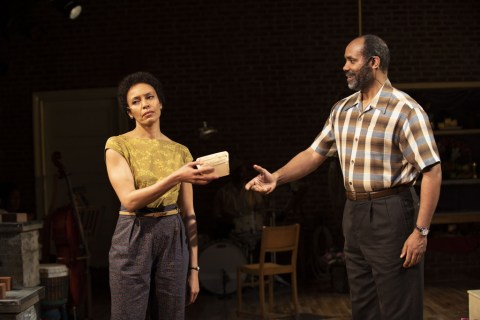
Eisa Davis, Nathaniel Stampley ‘The Secret Life of Bees,’ Book by Lynn Nottage, Music by Duncan Sheik, Lyrics by Susan Birkenhead, based on Sue Monk Kidd’s novel, directed by Sam Gold (Ahron R. Foster)
That Lily importunes Mother Mary and has a conversion experience praying for Zachary is an indication of her growth away from selfishness toward healing and self-love. In this powerful scene, she activates the substance of her own faith as it joins with the Daughters of Mary who also pray for Zachary’s return. However, any hope she may have to be with Zachary will never be realized as long as the atmosphere of hatred and injustice is an entrenched, “legal” social more.
Brett Gray’s Zachary “rocks it” with Lily in two musical numbers which show their bonds: “Fifty-Five Fairlane,” and “What Do You Love?” Their exuberance in the first and their sweetness in the second provide a side story of budding love which avoids the syrupy and remains authentic. The second love story, between Neil (Nathaniel Stampley) and June (Eisa Davis) is LOL hysterical as Neil persists in wooing June and she rejects him a whopping number of times out of fear of being hurt again as she was before. “Marry Me” is just fabulous. The men in the play empathize with Neil and chortled around me at the humor and were tense at June’s answers. This is no spoiler alert; you will have to see the musical to find out if June and Neil join forces. And you will have to see it to discover what happens when T-Ray shows up to confront Lily about her mother’s death to take her back home.
The Secret Life of Bees is an ethereal, spiritual adaptation with little spectacle of the type that “dazzles” and then is easily forgotten. It is an evocative and suggestive view of a time that is near timeless as it reflects the same horrific events that are happening today (voter suppression, police brutality, racial abuse, women’s oppression). But the adaptation carefully elicits the substance of faith and its power evidenced in a mystical group of educated, “sisters” and a “brother” who have found a way to negotiate the hellish genocidal racists and best them beyond “religiosity” and a form of godliness that has no power. Nottage’s selection of events in the style she’s chosen is right on as is Sheik’s music and Birkenhead’s lyrics, aptly shepherded by Sam Gold.
Kudos to the company, and to the creative artists Chris Walker (choreography) Dede Ayite (costumes) Jane Cox (lights) Dan Moses Schreier (sound) AchesonWalsh Studios (puppets) Jason Hart (music director) Antoine Silverman (music contractor) Duncan Sheik & John Clancy (orchestrations) Jason Hart (vocal arrangements) Cookie Jordan (hair, makeup & special effects) UnkleDave’s Fight House (fight director).
This must see musical production runs with one intermission at Atlantic Theater Company’s Linda Gross Theater (West 20th Street) until 21 July. It should be extended or another venue found. For tickets and times CLICK HERE.
‘Little Women,’ Kate Hamill’s Riveting Update of Louisa May Alcott’s Feminist Classic

(L to R): Paola Sanchez Abreu, Ellen Harvey, John Lenartz, Kate Hamill, Kristolyn Lloyd, Nate Mann in Primary Stages production of Kate Hamill’s adaption of Louisa May Alcott’s ‘Little Women’ (James Leynse)
Oh the tragedy of being a brilliant woman out of her time and place who must, with probity, slip into “becoming” without making too many waves! Kate Hamill’s profound update of Louisa May Alcott’s Little Women is presented by Primary Stages at The Cherry Lane Theatre as a two act comedy/drama that reveals how the March sisters adapt or transform the gender roles that the culture dictates for them. The play focuses on Alcott’s view of women during the Civil War when hardship was plentiful and economic pressures were acutely felt by families such as the financially strapped Marches.
Hamill’s update speaks with currency for our time revitalizing the novel with forward-thinking elements as it highlights the 4 sisters and draws comparisons between and among them. Interestingly, Hamill develops their personalities revisiting Alcott’s plot structure and character foundation. But her characterizations gain breadth when she teases out themes and traits relevant to woman today.
The play parallels the salient turn of events in the novel and examines the “little women” as they age into their own perceptions of “womanhood” with regard to the role limitations afforded to women when the only careers available to them were as governesses, caretakers, wives and mothers. Women could not vote, were considered mental inferiors to men who could have them committed to an asylum if they “got out of line.” As wives they were men’s property, chattel to do with them as they pleased, command them as they would under the law. Fortunate are the Marches whose father is an abolitionist and a pastor who is loving toward his wife and children and does not batter them.

(L to R): Ellen Harvey, Kate Hamill, Kristolyn Lloyd, in Primary Stages production of Kate Hamill’s adaptation of Louisa May Alcott’s ‘Little Women’ (James Leynse)
In Hamill’s reconfiguration there is an understanding of each of the sisters with an eye on the present. The play’s development concerns how Meg, Jo, Beth, Amy adopt the roles that they will choose and perhaps inhabit for life. In this Hamill has extracted key concepts and fleshed them out to examine the underlying threads of what Alcott inferred but could not write about extensively in order to negotiate the accepted folkways and mores of her culture at the time.
The playwright highlights Beth (a heartfelt performance by Paola Sanchez Abreu) as the spiritual one whose physical weakness and confrontation with the death of the Hummel baby impact her understanding of life’s mutability. As Jo (Kristolyn Lloyd) dubs her “the conscience.” Beth is the one who speaks truth to power quietly, solidly, steadfastly. Bravely, she alone visits Mr. Laurence (John Lenartz) and softens his heart toward allowing Laurie (Nate Mann) to become a part of their family. Wisely, she soothes Laurie’s wounds when Joe spurns his marriage offer. Insistently, she encourages Jo to write from her heart’s core, not from fantastic plots that glorify the male gender and make women into weak creatures. She reconciles the family during quarrels, especially the final explosive argument between the two most antithetical women in the family, Jo and Amy (Carmen Zilles).
In her adaptation Hamill enhances Beth’s wisdom and beauty and highlights the strength of her soul. This is a wonderful teasing out of the characteristics of who she is, the first to be herself and eschew female “type” changing for no one, not even Jo who changes for her. That all the family accept Beth, even Amy, clearly emphasizes her dominion.
The costume design by Valerie Therese Bart superbly reflects each of the characters as Hamill has drawn them. Jo is forever in pants; in polite company, she wears a skirt over her pants. Beth doesn’t wear the outfits the others wear. She is more soul and spirit and thus, she wears invalid gowns of her physical weakness throughout the play. Of all the sisters Beth is perhaps the most actualized. She has “become” before our eyes and thus, is the strong woman which we might take for granted as weak or inconsequential.
Following Hamill’s characterization and apt direction by Sarna Lapine, Abreu’s Beth is subtle strength and quiet wisdom. Yet, she is vibrant and determined when she needs to be in Act II, forcefully chiding Jo (the vibrant, exquisite Kristolyn Lloyd) to shake off self-pity and stir herself to her life’s work as a mature writer with a unique, personal style. She is the sister that is “the rock,” not Jo who is a performer, writer, actor, but mush within, less “together” than the Jo of the novel. This is especially so when her novel is rejected and Beth gives her the resolve and courage to persist and write about what she knows best, the wonderful memories of her family.
The characterization of Meg enacted with with precision and humor by Kate Hamill who portrays Meg, provides the view of womanhood as poised perfection, feminine and graceful. She is the “perfect lady.” Indeed, Meg’s putting on airs at the dance and reminding a bored Jo by coughing to alert her to correct her unlady-like behavior is one of the hysterical highpoints of the production. But her poise at the dance is shattered when she takes off her glasses and becomes dislocated, having to be led around by Brooks (Michael Crane) Laurie’s tutor whom she eventually marries.

(L to R): Nate Mann, Kate Hamill, Kristolyn Lloyd, Primary Stages production of Kate Hamill’s adaptation of Louisa May Alcott’s ‘Little Women’ (James Leynse)
The irony of having to be led around by a man because of her myopia is symbolic of what ails women who too easily swallow the culture’s gender roles. Meg has proudly fit herself into the wifely mold until she collapses hammered by the reality of the role’s oppression in a superbly portrayed scene by Hamill, Crane and Lloyd. Meg leaves Brooks and returns home, confiding to Jo her desperation because she is overcome by the impossible reality of domestic life, motherhood and male expectations that the household be run in perfect order every day.
Hamill’s “freak-out” as Meg is both humorous and dramatic. Her fine performance of the scene first with Jo and then with Brooks who is contrite and apologetic, strikes like lightening. Meg goes back to him after she has asserted what she will and won’t put up with and we sense he is a reasonable man; thus, the development of a relationship that is the hope of a partnership of give and take forms. Michael Crane is excellent as Brooks and authentic in his portrayal of the retiring, erudite tutor who, too, falls prey to the gender roles of the time to not fully recognize that he needs to “man up” and help out Meg.
For her part Jo has witnessed in Meg’s and Brook’s quarreling, what she will never put herself through. Her identity, encouraged by Beth, Marmie (the wonderful Mary Bacon) and Meg’s trials with Brooks convince her she must forge her own sense of self and career path that is equivalent to those men which men achieve. Meg’s troubles assure her that her decision not to flirt with, capture a man’s heart then be oppressed and saddled with drudgery the rest of her life as his handmaid will never be her portion.

(L to R): Kristolyn Lloyd, Paola Sanchez Abreu, Primary Stages production of Kate Hamill’s adaptation of ‘Little Women’ (James Leynse)
Kristolyn Lloyd’s Jo is a dominant force, a powerhouse who is driven to express herself. With her soul, will and determination throughout the play again and again, Lloyd succinctly portrays how it is Jo’s nature to eschew being the passive, demure, “lady” who must portray an illusion to catch a man, then spend the rest of her life with him overthrowing that lie. Unlike Amy and Meg, she and Beth reject the repressive folkways which dictate how women must act, how they must look, what they must wear and do, as they take their final “resting place” at the bottom of society, absent power and authority, never to be heard from again. That is a death Jo and Beth will never die!
Initially, when Laurie (the vibrant Nate Mann makes the character charming, endearing, sensitive and adorable) joins the family and takes part as a swashbuckler in Jo’s plays, he accepts Jo’s strong identity though she continually throws off “being” the passive feminine. Laurie finds her enthralling and exciting company and adjusts his growing friendship by being real and loving. He notes that Joe sees herself like him and he appears to understand that she covets male power, authority and the freedom to take women’s freedom from them. This is why she revels acting the preeminent roles in her plays with Meg as the “damsel in distress” that she fights Laurie for.

Nate Mann, Kristolyn Lloyd, Primary Stages production of Kate Hamill’s adaptation of Louisa May Alcott’s ‘Little Women’ (James Leynse)
The “play” scenes are humorous and cogently, precisely directed by Sarna Lapine and well-acted by Mann, Hamill, Abreu, Lloyd and Carmen Zilles as Amy who largely is their audience. These scenes establish each of the characters and reveal the undercurrents of why Jo must take on the dominant parts. We understand it is an attempt to work through what she finds completely obnoxious in the gender role of the passive, submissive, weak and helpless little lady that men find so alluring for they can come to their rescue and be the macho man. The artificiality and unreality of these roles annoys Jo, though Mann’s Laurie, inculcated to them since boyhood attempts to get Jo to play the damsel when Meg gets married. Her refusal is telling in another superb scene by Mann and Lloyd which foreshadows their maturation and Laurie’s love for her which Jo will never return as a lover. (Mann’s heartfelt upset when Lloyd’s Jo rejects him is beautifully rendered.)
The reversals are hysterical, as is Jo’s need to change the fake male-female dynamic. The humor in the overacting of Hamill’s Meg and Lloyd’s Jo to heighten the fake gender displacement is priceless and profound. That the enactment of the plays serves to reveal that Jo defines herself as equal to a man. Indeed, she intends to have the same notoriety and authority by making herself “someone recognized.” Though the culture would deny her, she will find a way, something Marmie, Meg (she is agreeable to join in the acting) and Beth encourage her to do with their acceptance and support. These scenes are powerful and filled with moment!

Kate Hamill, Michael Crane in the Primary Stages production of Kate Hamill’s adaptation of ‘Little Women’ (James Leynse)
The only one who does not accept Jo’s definition of herself and her way of being is Amy. Carmen Zilles convincingly portrays Amy as a spoiled, insistent, victim of Jo. Their disagreements not only move beyond rivalry, they represent opposing forces of womanhood. Amy has no ambition beyond marriage; and in a few funny bits aptly staged by Lapine, we see how she sets her designs on Laurie as she tries to get him to kiss her by standing under the mistletoe. At the conclusion of the play Amy insults Jo’s entire being and encourages her to give up her ambitions. We side with Jo’s anger against Amy; the burning of Jo’s book is tantamount to a blasphemy.
Amy brings to mind conservative women who marry well and stand by their man without a clue, staunchly upholding him regardless of the incorrectness of his position. She is Jo’s foil and their fights are inevitable so convinced are they of their definitions of themselves as women: Amy traditional, Jo a maverick forward thinker who wishes equality with men.

(L to R): Kate Hamill, Carmen Zilles, Ellen Harvey, Paola Sanchez Abreu, Kristolyn Lloyd in Primary Stages, ‘Little Women,’ Kate Hamill’s adaptation of Louisa May Alcott’s novel (James Leynse)
Jo’s behavior at Aunt March’s (Mary Bacon is superb as the crotchety old woman) causes Amy to be taken to Europe instead of Jo. Amy’s vengeful burning of Jo’s only copy of her novel is the perfect raison d’etre for Jo to launch out on a new endeavor and succeed. Zilles and Lloyd shine in these dynamic scenes of argument and insult. Amy and Jo’s sustained oppositions spur each other on in the paths they’ve chosen with irony and humor. Without Jo, Amy would not be who she is; likewise for Jo. Their’s is a perfect match brought into focus in this fine rendering of Hamill’s Little Women whose elucidations of the themes and characterizations are revelatory and uniquely realized. Just marvelous.
Hamill’s adaptation of Little Women and Lloyd’s portrayal of Jo, Abreu’s Beth, Hamill’s Meg and Zilles’ Amy enlighten us to the power of entrenched gender roles whose folkways and stereotypes we wrestle with our entire lives. The ironies and themes of how each sister deals with these mores is incredible and found in no other adaptation of the novel that I have seen. Gobsmacking! Whether viewing for the depth of understanding or the pure fun and enjoyment and in Act II pathos of the family March, Little Women is a wondrous must see.
Special kudos to Mikiko Suzuki MacAdams for the functional and minimalistic set design. Much praise goes to Valerie Therese Bart’s superbly thought-out costumes and Paul Whitaker’s lighting design whose candles in Act II are heartfelt and atmospheric. Additional kudos to Leon Rothenberg for sound design, Dave Bova for wig and hair design, Michael G. Chin’s fight direction. Deborah Abramson’s original music between scenes is exceptional, atmospheric, lyrical. Without it the action would not have achieved such a seamless flow. The exuberance of Act I and the mellow seriousness of Act II would have been diminished in tone and tenor.
Little Women runs with one intermission at Cherry Lane Theatre (Commerce St.) until 29th June. Get your tickets before it is too late by CLICKING HERE.
‘The Mountains Look Different,’ by Micheál mac Liammóir, The Mint Theater Company
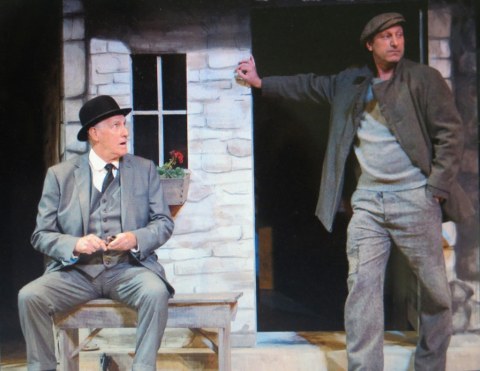
(L to R): Paul O’Brien and Con Horgan,’The Mountains Look Different, by Micheál mac Liammóir, directed by Aidan Redmond(Todd Cerveris)
The Mountains Look Different, written by Micheál mac Liammóir, presented by the Mint Theater Company is a profound tour de force whose plot arcs swiftly toward climactic catastrophe. Directed by Aidan Redmond, the play takes place in the beauteous, desolate, wilds of Connemara, Republic of Ireland on St. John’s Eve. On this portentous night, the townsfolk gather to celebrate by lighting bonfires, dancing, singing, drinking and praying for good luck, prosperity and a fruitful life for the coming year. As the events unfold, it becomes apparent that mac Liammóir’s selection of the setting is deeply, thematically ironic.
Into the bucolic, rustic, traditionally Catholic, isolated, agrarian village, where time is entrenched in ancient folkways, and modernization hasn’t yet approached (there is no electricity, running water, modern accoutrements or trending social conventions) Tom Grealish (Jesse Pennington) brings his new bride Bairbre (Brenda Meaney) from London, to introduce her to his father, Martin Grealish and the neighbors. Returning from the fast-paced, cruelly indifferent, big city, the couple seeks the rest and solitude of the farm. They hope that father Martin (Con Horgan) will welcome them for more than a short stay. Indeed, the newlyweds intend to live and make a home with Martin, contributing their efforts to add to the farm’s prosperity.
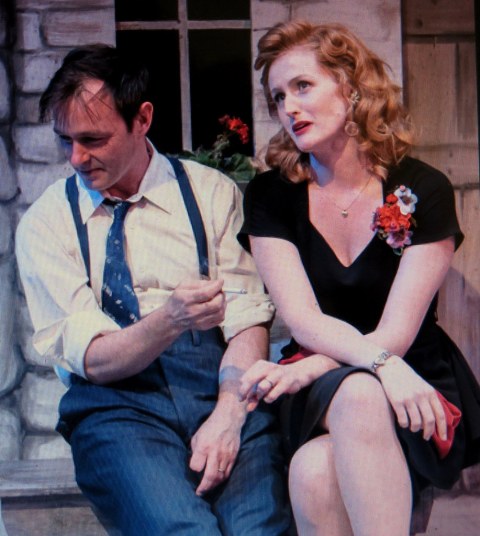
Jesse Pennington and Brenda Meaney, ‘The Mountains Look Different,’ by Micheál mac Liammóir, directed by Aidan Redmond, Mint Theater Company (Todd Cerveris)
Prior to the couple’s entrance, Matthew Conroy, Bairbre’s uncle (Paul O’Brien’s fine performance is not submerged by a top-heavy accent) visits Martin, introduces himself and attempts to lay the foundation for a happy union between the families. He spreads good will and extends generosity toward Martin Grealish. A miller, Uncle Conroy promises that Bairbre will inherit his estate after he’s gone as he has no children or other heirs. To reveal his love and concern for Bairbre, Conroy brings her a wedding present which he asks Martin to give to her and encourages Martin to be “good” to her.
Martin is abrupt, surly and inhospitable. To Conroy he bitterly grouses about the “lack of dowry” upon the marriage. However, when Conroy discusses the promised gift of some money, presently, and the future inheritance landing on Bairbre and Tom, Martin transforms from darkness to light.
With this striking movement in Martin’s characterization, playwright mac Liammóir foreshadows the true nature of the father as a dark, hypocritical and selfish individual. From his gruff, irascible demeanor and grasping manner, we infer that the elder Grealish has little grace, empathy or affability to bestow upon in-laws. When Tom refers to his father’s churlish nature and abusive upbringing during his reunion conversation with Martin in which he boasts that he has achieved status as a solid, married man, Martin derides him. It is as if he hates his own son and finds him a disgusting failure, not that the father has much to commend him as a human being. In prizing money and wealth above love, humanity and forgiveness (this is apparent as the plot unfolds), we understand the “type” of Christianity Martin professes is the type that destroys.

Con Horgan, Brenda Meaney, ‘The Mountains Look Different,’ by Micheál mac Liammóir, directed by Aidan Redmond, Mint Theater Company (Todd Cerveris)
Alone on the farm with only the manservant Bartley to help, it is clear that the aging, declining and reclusive, Martin has most probably driven off his other seven children (to the religious life and America). Perhaps he has driven his wife to an earlier death which ironically might be a more pleasant experience than living with Martin. There are no pictures of her; there is only a prominent picture of Jesus and those involved in the Easter rising of 1916. Indeed, Martin could use the assistance of his son and his bride, and like the story of the Prodigal Son in the scripture, he should be thrilled upon Tom’s return. He should put any grievances and negative attitudes he has about Tom behind him and celebrate this change for the better, especially in that the scripture extols a man who gets himself a wife.
The tragic irony is that Martin is not that loving father in the Bible, joyful at his son’s return. He is villainous, arrogant, unloving. Ultimately, he brings about his own devastation in an attempt to gain revenge and obviate his self-hatred of an act he committed nine years before for which he cannot forgive himself. Thus, his Christianity fails him; though in outward form he is staunchly religious and condemning of others. Brilliantly, mac Liammóir has threaded the themes within the characterizations of Martin, Bairbre and Tom. And he has set the events in motion organically with their behaviors that are rooted in emotional, psychological, sociological logic which the principal actors (Pennington, Meaney, Horgan) portray with power.
Tom’s wife Bairbre is the most well-rounded characterization in the play and the most empathetically and tragically drawn. Her destiny is set in “stone” (a feature of the setting symbolically) by the folkways of the time and the hypocritical mores of the social structure. These are manifest in Martin’s attitude toward her and the marriage along with her Uncle’s, Bartley’s (Daniel Marconi) and widowed, ever-praying neighbor Máire’s (Cynthia Mace) attitudes. For example to Martin, she’s as good as a dowry and she is guilty before proven innocent. Martin suspects she’s damaged goods to be with his son. Martin doesn’t even consider giving her the benefit of the doubt or encourage finer behavior; he condemns. Bartley takes liberties in insulting her in front of Tom and Uncle Conroy. Uncle Conroy questions her paleness and asks why she would not stay in London, but would move to the “god-forsaken” place on the farm which portends the grave (a reference made a few times in the play).

Con Horgan and Jesse Pennington, ‘The Mountains Look Different,’ by Micheál mac Liammóir, directed by Aidan Redmond (Todd Cerveris)
The hardship of women is a prevalent folkway in this culture and is emphasized throughout the production. It is revealed later in the play when Máire points out Bairbre looks “weak” and she suggests that the hard life of married women and childbirth may kill her as it killed her daughter, especially that she’s come from a cushier lifestyle. Máire faced the hardship of raising her grandson the deaf Batty Wallace-an excellent Liam Forde.
The other characters (Bridin, Bartley, Uncle Conroy) believe that in comparison to the wonderful life she’s led in London (they can’t fathom why she’s left) she is going to undergo a startling and unnerving “period of adjustment” if she and Tom are able to make their home with the taciturn, negative Martin. Bairbre affirms that the farm is just the right place for her with Tom’s love and Tom at her side to sustain her. Clearly, Bairbre faces an uphill battle in this isolated, lugubrious place, facing off against sour Martin.
As the playwright unfolds Martin’s character (he is the perfect foil and serves as the catalyst and driving force in the conflict with Bairbre) we note that he represents the misogyny, traditionalism and oppressive, abusive behavior that men applied to women whom they considered their underlings and chattel. If women were unmarried and orphaned as Bairbre was until three days prior to their arrival, their opportunities were limited. This was especially so if they lacked an education in a trade or otherwise. Education was very rare for women without money or class status. Oftentimes, women were destined to be servants of the wealthy or handmaids of husbands who were preeminent. Good jobs were difficult to come by, but apparently in London Bairbre has had a decent job to make a living for herself until she meets Tom. Uncle Conroy reads this in her letter to him as Martin listens with disdain.

(L to R): Jesse Pennington, Brenda Meaney, Cynthia Mace, Liam Forde, Daniel Marconi, McKenna Quigley Harrington, ‘The Mountains Look Different,’ by Micheál mac Liammóir, directed by Aidan Redmond (Todd Cerveris)
Tom, the antithesis of his father is sweet, pliant, kind-hearted, innocent, loving. It is no wonder that Bairbre leaps at the chance to be with him, for he exemplifies a man who is a companionable partner and a “helpmeet,” not a dictator or autocrat that land owner Martin obviously is. To Uncle Conroy, Martin proclaims Tom a “stammering slob,” who threw off two arranged marriages (with substantial dowries most probably). Uncle Conroy counters that in these current times, arranged marriages are avoided by the young. He assures Martin that he should give the newlyweds a chance. However, as the characterization shows out, Martin’s mind is inflexible, like a stone mountain.
When Uncle Conroy leaves, goodness and light also leave, along with hope of “the mountains looking different,” a theme of the play. When Bairbre left for London as a sixteen-year-old to escape the mountain’s shadow of desolation in an unpromising life of poverty, she sought her fortune with the promise of youth. When she returns a happy, married women, “the mountains appear different,” because she has changed into a respectable woman with a man by her side. The marriage vows define her and she is subject to no other definition. No man can slime her reputation or hold sway over her newly established “ethos” which has been granted to her by the priest she confessed to. She is a new person and with Tom’s love she will continue to be this new person.
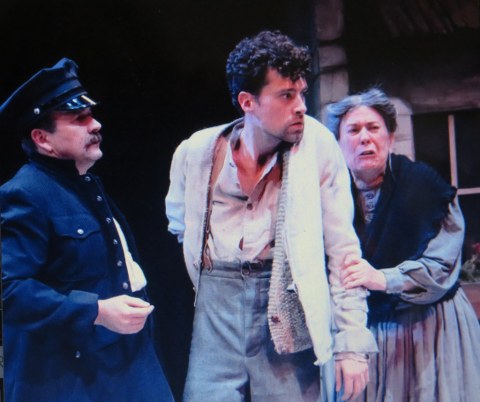
(L to R): Ciaran Byrne, Liam Forde, Cynthia Mace, ‘The Mountains Look Different,’ by Micheál mac Liammóir, directed by Aidan Redmond, Mint Theater Company (Todd Cerveris)
However, Martin’s false Christianity will not allow her to be this new, respectable woman. He will not allow her to remain at the farm because he “knows” her from nine years before, as in the Biblical phrase of “knowing.” Stepping into the dark recesses of evil and sin which his shallow, form-filled Christianity cannot expurgate, Martin offers Bairbre a devil’s bargain. She may remain with Tom on the farm, but must stay on his terms and pay his asking price. Bairbre’s decision is fated; she explains that “the mountains don’t look different” after all. Ironically, she chooses the only way out to maintain the dignity that is blossoming in her soul. Her act of self-defense is a supremely sardonic, “un-Christian” one that during the original premiere of the play brought controversy and outrage. In that expression of outrage and its plot and themes, the play is wildly current. Indeed, though one would hope the “mountains look different” in our lives, a trope meaning cultural and personal progress comes with every generation, in parts of the U.S. as in this play’s culture and folkways, nothing has changed.
This is a marvelous work by mac Liammóir. The Mint Theater Company’s production has brought it to life as it deserves, with emotional and riveting performances by the ensemble and appropriate shepherding by the director. A caveat is that sometimes the accents slide over the words and comprehension becomes diminished. This is a pity because the play is powerful. Every word is critical, especially to emphasize the themes of redemption, entrenched evil conveyed by hypocritical mores, the love of money as the root of all evil, self-hatred and unforgiveness causing destruction. The playwright’s seminal characterizations must “take no prisoners,” and will further shine as the actors embody the roles with clarity that resonates for us today.
Kudos goes to the creative team: Vicki R. Davis (sets) Andrea Varga (costumes) Christian Deangelis (lights) M. Florian Staab (sound) Heather Martin Bixler (music director) Chris Fields (props).
The Mountains Look Different runs with one intermission at Theatre Row on 42nd Street between Ninth and Tenth until 14 July. For tickets and times go to their website by CLICKING HERE.
‘Much Ado About Nothing,’ Directed by Kenny Leon, Powerful Messages for an America in Crisis

The ensemble in William Shakespeare’s Much Ado About Nothing, directed by Kenny Leon, Shakespeare in the Park, Public Theater (Joan Marcus)
From Emilio Sosa’s vibrant costumes to Beowulf Boritt’s impeccable set design (a landscape of roses, luscious, ripe-for-the-plucking peaches on the Georgia peach tree, the luxuriant front lawn, the Georgian-styled, two-story mansion-representative of an orderly, harmonious, idyllic world), this update of Much Ado About Nothing resonates as an abiding Shakespearean classic. Director Kenny Leon’s vision for the comedy with threads of tragedy evokes a one-of-a-kind production with currency and moment. This is especially so as we challenge the noxious onslaught of Trumpism’s war on democratic principles, our constitution and the rule of law.
Directed with a studied reverence for eternal verities, Leon, with the help of his talented ensemble, carves out valuable takeaways. They focus on key elements that gem-like, reflect beauty and truth in Shakespeare’s characterizations, conflicts and themes. By the conclusion of the profound, spectacular evening of delight, of sorrow, and of laughter, we are uplifted. As we walk out into a shadowy Central Park, our minds and hearts have been inspired to shutter fear and cloak our souls against siren calls that would lure us from reason into irrational insentience and hatred.
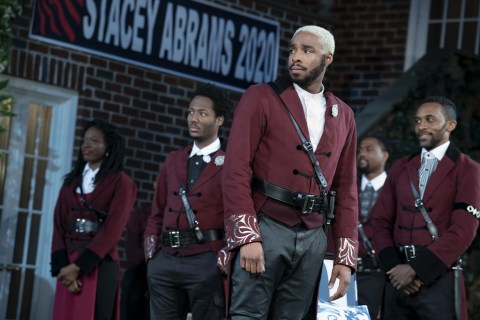
Grantham Coleman (foreground) Hubert Point-Du Jour, ensemble, William Shakespeare’s Much Ado About Nothing, directed by Kenny Leon, Shakespeare in the Park, Public Theater (Joan Marcus)
Kenny Leon has chosen for his setting a wealthy black neighborhood of Atlanta, Georgia, whose Lord of the realm, Leonato (Chuck Cooper’s prodigious, comedic and stentorian acting talents are on full display), shows his political persuasion with prominent signs on the front and side of his house that read, “Stacey Abrams 2020.” The impressive “Georgian-style” mansion which could be out of East Egg, the upper class setting of The Great Gatsby by F. Scott Fitzgerald, is ironic with the addition of its advocating support for Abrams.
With this particular set piece, we note Leon’s comment on black progress toward a sustained economic prosperity amidst a backdrop of oppression, if one considers the chicanery that happened during Abrams’ run for the 2018 gubernatorial election. It also is reminiscent of the house of the racist, misogynistic villain of Gatsby, the arrogant, presumptuous Tom Buchannan and other such elites (i.e. wealthy conservatives), who give no thought to destroying “people and things” of the underclasses with their policies. Yet Lord Leonato and his friends and relatives are not turned away from justice and empathy for others. This, the director highlights through this Shakespearean update, whose characters seek justice and truth and encourage each other to abide in kindness, love and forgiveness.

(L to R): Margaret Odette, Tiffany Denise Hobbs, OLivia Washington, Danielle Brooks William Shakespeare’s Much Ado About Nothing, directed by Kenny Leon, Shakespeare in the Park, Public Theater (Joan Marcus)
Leon approaches his vision of justice through love by weaving in songs and music. At the outset Leon incorporates such music with a refrain sung by Beatrice (the inimitable Danielle Brooks):
“Mother, mother, there’s too many of you crying, brother, brother, brother, there’s far too many of you dying. You know we’ve got to find a way to bring some lovin’ here today.”
As Beatrice finishes the refrain by asking “What’s happening?” her ensemble of friends which include Hero (Margaret Odette), Margaret (Olivia Washington), and Ursula (Tiffany Denise Hobbs), sing the patriotic ballad “America the Beautiful” as a prayer and inspiration for the country to follow its ideals of “brotherhood from sea to shining sea.” This is not a war-like unction, it a solicitation for peace and goodness. Clearly, the women importune God to “shed His grace” on America. One infers their feeling as an imperative for political and social change hoped for, in a true democracy which can guarantee economic equality and justice.
The arrangement of “America the Beautiful” is lyrical and soulfully harmonious. As the women sing this anointed version they transform the text from hackneyed cliche, long abandoned by politicos and wealthy Federalist Society adherents, and uplift it with profound meaning. They encourage us toward authentically pursuing justice, brotherhood and unity in love and grace, elements which are sorely tried during the central focus of Much Ado About Nothing, during Hero’s unjust slander and infamy until she receives vindication.

(L to R): Chuck Cooper, Erik Laray Harvey in Much Ado About Nothing, by William Shakespeare, directed by Kenny Leon, Shakespeare in the Park, The Delacorte Theater, Public Theater (Joan Marcus)
After the women finish singing, the men march in from the wars. Instead of arms, they carry protest signs decrying hate, uplifting love, proclaiming the right of democracy. Instead of a warlike manner they are calm. The theme of justice and the imperative for political and social brotherhood prayed for in the previous song is reaffirmed as we understand what the “soldiers” are fighting for. In Leon’s genius it is a spiritual warfare, a battle for the soul of American democracy. Leonato appreciates their endeavors and invites them to stay with him for one month to be refreshed and gain strength before they go back out for another skirmish against the forces of darkness.
The music and songs composed by Jason Michael Webb strategically unfold throughout the development of the primary love story between Leonato’s daughter, Hero (the superb Margaret Odette) and family friend Claudio (the excellent Jeremie Harris). And they follow to the conclusion with the funeral and redemption of Hero and her final marriage and dual wedding celebrations with the parallel love story between Beatrice and Benedick. The songs not only illustrate and solidify the themes of love, forgiveness, and the seasons of life, “a time for joy, a time for sorrow,” they unify the friends and family with hope and happiness through dancing and merriment. The melding of the music organically in the various scenes throughout the production is evocative, seamless and just grand.

(L to R): Margaret Odette, Jeremie Harris, Billy Eugene Jones, Chuck Cooper in William Shakespeare’s ‘Much Ado About Nothing,’ directed by Kenny Leon, Shakespeare in the Park (Joan Marcus)
After the men arrive from their protest, the director cleverly switches gears and the tone moves to one of playful humor and exuberance. With expert comic timing, Brooks’ Beatrice wags about Benedick in a war of sage wits and words. Coleman’s Benedick quips back to her with equal ferocity that belies both potentially have romantic feelings but must circle each other like well-matched competitors enjoying their “war” games as sport. They offer up the perfect foils to a plot their friends later devise using rumor to get Beatrice and Benedick to fall in love with each other in a twisted mix up that is hysterical in its revelations of human pride and ego.
The relationship between Beatrice (the marvelous Danielle Brooks) and Benedick (Grantham Coleman is her equally marvelous suitor and sparring partner) is portrayed with brilliance. The couple serves their delicious comedic fare with great good will and extraordinary fun. Their portrayals provide ballast and drive much of the forward action in the delightful plot events. Danielle Brooks gives a wondrously funny, soulfully witty portrayal. As Benedick, Grantham Coleman is Brooks’ partner in spontaneity, LOL humor, inventiveness and shimmering acuity.

(L to R): Danielle Brooks, Olivia Washington, Erik Laray Harvey, Chuck Cooper, Tiffany Denise Hobbs, Margaret Odette, William Shakespeare’s ‘Much Ado About Nothing,’ directed by Kenny Leon, Shakespeare in the Park, Public Theater (Joan Marcus)
Various interludes in Act I are also a time for male banter about the ladies Hero and Beatrice and the love match with Hero that friend of the family Don Pedro (Billy Eugene Jones) effects for his friend Claudio (Jeremie Harris). The scene between Benedick, Claudio and Don Pedro is superbly wrought with Benedick’s insistence he will remain a bachelor. The audience knows he “doth protest too much” for himself and for Claudio. The pacing of their taunts and jests is expertly rendered. The three actors draw out every bit of humor in Shakespeare’s characterizations.
Into this beauteous garden of delight, exuberance and order creeps the snake Don John (Hubert Point-Du Jour), brother of Don Pedro, and his confidante and friend Conrade (Khiry Walker). Though they support the fight for democracy, Don John is engaged in sub rosa familial warfare. We move from the macrocosm to the microcosm of the human heart which can be a place of extreme wickedness as it is with Don John who quarreled with his brother Don Pedro, his elder and does not forgive him. Don Pedro extended forgiveness and grace to Don John, which Don John feels forced to accept though he is not happy about it. Indeed, he is filled with rancor and seeks revenge, to abuse his brother and anyone near him, if the opportunity presents itself which it does.
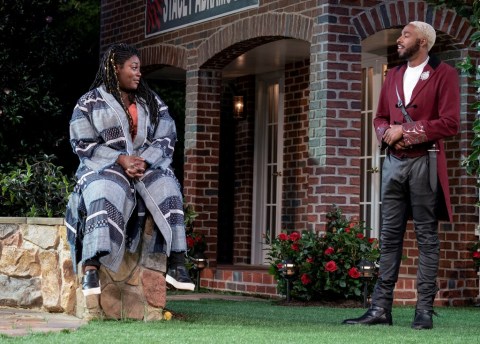
(L to R): Danielle Brooks, Grantham Coleman in William Shakespeare’s ‘Much Ado About Nothing,’ directed by Kenny Leon, Shakespeare in the Park (Joan Marcus)
The conversation between Conrade and Don John is intriguing for what Shakespeare’s characterizations reveal about the human condition, forgiveness and remorse. Indeed, Don John is reprobate. Whether out of jealousy or the thought that he has done no wrong, he feels bullied to accept his brother’s public forgiveness. The theme “grace bestowed is not grace received unless there is true remorse,” is an important message highlighted by this production through the character of evil Don John who eschews grace. Indeed, extending grace and forgiveness to such individuals is a waste of time. No wonder Don John would rather “be a canker in a hedge than a rose in his grace.”
Trusting Conrade, Don John admits he is a plain-dealing villain. When he learns of Claudio’s marriage, he plots revenge on Don Pedro by attacking his best friend and smearing Hero’s integrity and fidelity to Claudio. The jealous Claudio is skeptical, but later “proof” during a duplicitous arrangement with an unwitting Margaret, Claudio becomes convinced that Hero is an unfaithful, unchaste philistine.

Lateefah Holder (center) and ensemble in William Shakespeare’s ‘Much Ado About Nothing,’ directed by Kenny Leon, Shakespeare in the Park (Joan Marcus)
Claudio’s jealous behavior and immaturity believing Don John turns goodness into another wickedness as evil begets evil. As they stand at the alter Claudio excoriates Hero as an unfit whore to the entire wedding party. Hero, injured unjustly by Don John’s wicked lie and Claudio’s extreme cruelty, collapses. In a classic historical repetition, once again misogyny raises its ugly head and condemns the innocent Hero destroying her once good name. Benedick, the uncanny Friar and Leonato stand with Hero. This key turning point in the production is wrought with great clarity by the actors so that the injustice is believable and it is shocking as injustice always is.
Thankfully, The Friar’s (a fine Tyrone Mitchell Henderson) suggestion to return Hero to grace and redemption in Claudio’s eyes by proclaiming her death to bring her again to a new life is effected with power. Finally, we appreciate a cleric who bestows love not condemnation or a rush to judgment! The emotional tenor of the scene is in perfect balance. Odette and Harris are heartfelt as is Cooper’s Leonato. The scene works in shifting the comedy to tragedy and of uplifting lies believed in as facts with wickedness overcoming love and light. Once again we are reminded that Shakespeare’s greatness is in his timelessness; that if allowed the opportunity for vengeance and evil, humanity will corruptly, wickedly use lies cast as facts to dupe and deceive the gullible, in this case Claudio.

(L to R): Grantham Coleman, Jeremie Harris, Margaret Odette, Danielle Brooks (center) ensemble, in William Shakespeare’s ‘Much Ado About Nothing,’ directed by Kenny Leon, Shakespeare in the Park (Joan Marcus)
I absolutely adore how the truth comes to light, through the lower classes represented by Dogberry (a hysterical Lateefah Holder) and her assistants who are witnesses to Don John’s accomplices to nefariousness. I also appreciate that all the villains in the work admit their wrongdoing; it is a marvel which doesn’t always occur the higher the ladder of power and ambition one ascends. But this is a comedy with tragic elements, thus, evil is turned to the light and Beatrice and Benedick the principle conveyors of humor are lightening strokes of genius which soothe us to patience until justice arrives right on time.
I also was thrilled to see that the remorseful, apologetic Claudio willingly accepts Hero’s recompense (Leon has Hero dog him in the face) as she unleashes her rage at his unjust treatment. These scenes of redemption and reconciliation ring with authenticity: Cooper, Odette and Harris shine.
The celebrations, masked dance, marriage between Hero and Claudio, Hero’s funeral and the final marriages are staged with exceptional interest and flow; they reveal that each in the ensemble is a key player in the action. The choreography by Camille A. Brown and the fight direction by Thomas Schall are standouts. Kudos also goes to those in the creative team not previously mentioned. Peter Kaczorowski’s gorgeous lighting design conveys romance and subtly of focus during the side scenes; Jessica Paz’s sound design is right on (I heard every word) and Mia Neal for the beautiful wigs, hair and makeup design receives my praise.
Leon’s Much Ado About Nothing is one for the ages. It leaves us with the men doing warfare for the soul of democracy leaving Leonato’s ordered world of right vs. wrong where the right prevails. Once again soldiers fight the good fight and go out to resist and stand against the world of “alternate facts” where chaos, anarchy, and the overthrown rule of law abide (at this point) with impunity. Leon counsels hope and humor; progress does happen, if slowly.
This production’s greatness is in how the director and cast extract immutable themes. These serve as a beacon to guide us through times that “try our souls,” and they encourage us to persist despite the dark impulses of money-driven power dynamics and fascist hegemony that would keep us enthralled.
I saw Much Ado About Nothing in a near downpour then fitful stop and start to continual light rain during which no one in the audience left. Despite this the actors were anointed, phenomenal! I would love to see this work again. I do hope it is recorded somewhere. It’s just wow. The show runs until June 23rd. You may luck out with tickets at their lottery. Go to their website by CLICKING HERE.
‘Julie Madly Deeply’ Brits Off Broadway U.S. Premiere at 59E59 Theaters
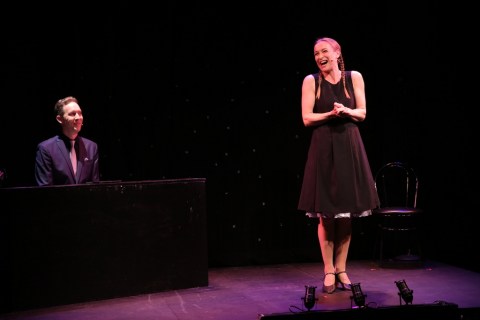
L-R: Michael Roulston, Sarah-Louise Young in ‘Julie Madly Deeply’ at Brits Off Broadway at 59E59 Theaters (Carol Rosegg)
If you adore Dame Julie Andrews, you must see the Brits Off Broadway offering in its US Premiere fresh from its sold out runs in the West End and Toronto. Julie Madly Deeply celebrates the iconic performer who is still going strong at 83-years-old. Julie Clare Productions and New Diorama Theatre present this delightful musical cabaret in honor of the Dame. Written and performed by Sarah-Louise Young, directed by and with contributions from Russell Lucas and musical direction by Michael Roulston, who also appears and sings in the production, Julie Madly Deeply reminds us why Julie Andrews is not only a fabulous performer. It also reveals Julie Andrews as a survivor who is the last person to take her life and her career for granted.
Sarah-Louise Young has been a loving fan of Julie Andrews for most of her life. She humorously exposes this with a letter to Andrews she wrote as a child, asking her to be her mum and marry her Dad. After reading the letter, Young affirms that she never lost faith in Andrews emphasizing that this was more than the press could muster.
Young chronicles Andrews’ life in a vibrant, picaresque fashion, emphasizing the salient events in her career. To do this she begins with Andrews’ 2010 London return after her failed throat surgeries, billed as “The Gift of Music-An Evening With Julie Andrews.” The press dunned Andrews, but Young’s encomium to Andrews in this production indicates they were harsh and should have been forgiving considering what Andrews continues to accomplish. (Indeed she has a FB page and posts anecdotes from various Broadway productions, i.e. check out the one about Robert Goulet, Lancelot in Camelot.)

L-R: Michael Roulston, Sarah-Louise Young ‘Julie Madly Deeply,’ at Brits Off Broadway at 59E59 Theaters (Carol Rosegg)
For Andrews, the evening was a tenuous comeback which required great bravery because it was believed that her singing career was finished. Indeed, husband Blake Edwards stated that she would never sing again after the botched throat surgeries. However, Andrews marshaled on and worked on therapies for her throat.
Would Andrews sing as she had before with her four octave range serenading a huge orchestra? No. However, she “talked sang” and Young who had kept the faith was thrilled to have seen her “live.” From this experience Young seques to interactive by asking audience members if they had seen Andrews live. Hands raised and responses were shared; this is an intriguing segment because it is extemporaneous and requires Young to be lightening quick and she shines with witty repartee. After this segment Young with a combination of brief narration and songs from the decade in Andrew’s career she is highlighting, accompanied by Michael Roulston, sings Andrews with a lovely, lyrical style.
Throughout, Young keeps the events and Andrews’ stories moving with comedy bits and snippet impersonations of celebrities, i.e. Liza Minnelli who took over for Julie Andrews in Victor Victoria when she was on vacation, and Audrey Hepburn who comments about being chosen as Eliza Doolittle in the film version of My Fair Lady.

L-R: Michael Roulston, Sarah-Louise Young in ‘Julie Madly Deeply’ at Brits Off Broadway at 59E59 Theaters (Carol Rosegg)
Young’s talents with comedy, singing and movement, keep the production engaging and lively as she lovingly riffs on her favorite icon. She introduces each career milestone in Andrews’ life circling through The Boyfriend, My Fair Lady, Cinderella (television) and Camelot. Interestingly, when Walt Disney offered Andrews the part of Mary Poppins, a film which would take her away from live stage performance, she took it and won an Academy Award.
As Young pinpoints the various films and roles, singing some of the songs completely and others with a few bars, she finalizes Act I with a mention of Andrews’ divorce with Tony Walton. He worked on Mary Poppins with her doing costumes and set design. Then Young closes with a song from Mary Poppins and an interactive with the audience breaking for intermission with a send-off that after the “interval” she will be in the alps.

L-R: Michael Roulston, Sarah-Louise Young in
‘Julie Madly Deeply,’ at Brits Off Broadway at 59E59 Theaters (Carol Rosegg)
Act II is vintage Julie Andrews in the film The Sound of Music (1965). Again, Young sings snippets of favored songs and at one point, cleverly invites a sing-along. The audience was eager to oblige! Young’s patter includes quips about Andrews’ co-star Christopher Plummer. The film remains one of the highest grossing films of all times. And Young mentions that there are Julie Andrews sing-a-longs, some with the showing of the film. Indeed, the film is mythic and ironically, it resonates more and more as the uber right wing white supremacists don Nazi outfits and uplift fascism.
Memorable is Young’s segment about Andrews’ love of her second husband Blake Edwards and their work together after their marriage. Young highlights Andrews’ grappling with the limitations of her sunny, sweet image that her fans adored. When she attempted to do serious films i.e. Torn Curtain, The Americanization of Emily and others, her box office smash records evaporated. Her fans couldn’t accept her cross-over to other work and she went through a bumpy period, settling for work in Blake Edwards 10 and as Young humorously points out in S.O.B. a satire in which Andrews twits the idea she is more than a sugary, sweet flower by showing her breasts (tits).
Young sings partials from Victor Victoria (1982) and discusses its adaptation as a successful Broadway production which Julie Andrews performed in 1995 until she had to quit the show in 1997 after vocal problems and a botched surgery.
Throughout, Julie Madly Deeply remains ebullient and informative thanks to Young’s clever working of the material and interspersing the humorous bits with songs and anecdotes which Andrews’ fans will enjoy.
Julie Madly Deeply has one intermission and runs at 59e59 Theaters as a part of their Brits Off Broadway series until 30 June. For tickets and times go to the website by CLICKING HERE.
‘Handbagged’ by Moira Buffini, Brits Off Broadway at 59e59 Theaters
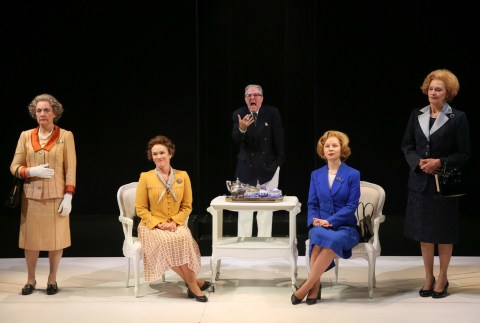
(L to R): Anita Carey, Beth Hylton, John Lescault, Susan Lynskey, Kate Fahy in ‘Handbagged,’ by Moira Buffini, Brits Off Broadway, at 59e59 Theaters (Carol Rosegg)
Round House Theatre production’s Handbagged is an extraordinary evening of history, humor, philosophy, politics, economics, parody and satire. Offering a view of the Thatcher years in the U.K. (1979-1990) until Prime Minister Margaret Thatcher stepped down from the leadership of her party, playwright Moira Buffini encapsulates the past. With acute themes, Buffini parallels two disparate views which still hold sway today in the U.K. and in the U.S. These are posited and embodied by Queen Elizabeth II and Margaret Thatcher. The production is a comedy as the two women go head to head. And it is a poignant reminder of where the world has “progressed” since then.
The evening is rollicking fun. In almost every scene Queen Elizabeth II bests (handbags) Margaret Thatcher with her wit, her grace, her level headedness, her humanity and her decency. And Margaret Thatcher can only be her dour, unsympathetic, unyielding, cruel self, whose watchword “No,” seems to permeate even the rigidness of her tailored suits.
Directed by Indhu Rubasingham, Handbagged is based upon the original production with the same director at the Kiln Theater. As part of the Brits Off Broadway season at 59e59 Theaters, from start to finish, the production engages and delights with its humor and with the fine performances delivered by the ensemble and especially by the “older” versions of the Queen (Anita Carey) and Thatcher (Kate Fahy) whose similitude with their true counterparts appears to be “right-on.”

(L to R): Anita Carey, Beth Hylton, Susan Lynskey, Kate Fahey in ‘Handbagged,’ by Moira Buffini, directed by Indhu Rubasingham, Brits Off Broadway at 59e59 Theaters (Carol Rosegg)
To chronicle the Thatcher years and Queen Elizabeth’s sub rosa influence during that time, the playwright’s characterizations move in tandem with two actors each, playing the Queen and Margaret Thatcher (young and old). Beth Hylton portrays the young Queen, “Liz,” with posh accent and sweet demeanor. Anita Carey is the older Queen, “Q,” whose quiet stature, edgy wit and motherly probity of today’s Queen Elizabeth reveals an astute wisdom and gently forceful authority.
Both “Queens” deliver quips, undercurrents and subtle chastening to the inflexible, conservative, hard-right, iron lady with smashing, crashing wit and sometimes LOL humor. They do it with such aplomb and timing we appreciate the through-line that Queen Elizabeth II understood who Margaret Thatcher was and held her own with her throughout. In a changing of the Empire to a Commonwealth of Nations, she proved a beacon, though she had no official power or authority. In her shadow, Thatcher held her head high but had to admit defeat when she stepped down in a painful process of changing leadership.

(L to R): Kate Fahy, Beth Hylton, Susan Lynskey in ‘Handbagged’ (Carol Rosegg)
Susan Lynskey delineates the younger Thatcher, “Mags” with smiling, chilling certitude, hot and solid in her determination to change the U.K. for “the better,” according to her perspective and that of her conservative “neoliberal” party that eschewed “socialism” like the plague. Working in tandem with her is the old Thatcher “T” portrayed by Kate Fahy who in a forceful, deliberate, sternly exacting manner reveals why the handle “the iron lady” was used as a noxious epithet and descriptor of praise by detractors and supporters of the ferrous Margaret Thatcher.
Filling in the characterizations of Thatcher’s husband Denis, Prince Philip, President Ronald Regan, Nancy Regan, the Queen’s Footman, and political leaders (Enoch Powell, Michael Heseltine, Arthur Scargill, etc.) are the versatile and very humorous Cody Leroy Wilson and John Lescault. The playwright’s device to break the fourth wall by having Actor 1 and Actor 2 argue about the roles they are playing is humorous. At one juncture “T” demands that Actor 2 not abandon his role of her husband Denis and he argues, “I’m playing several roles…some are thin caricatures but times are hard and it’s a job.”
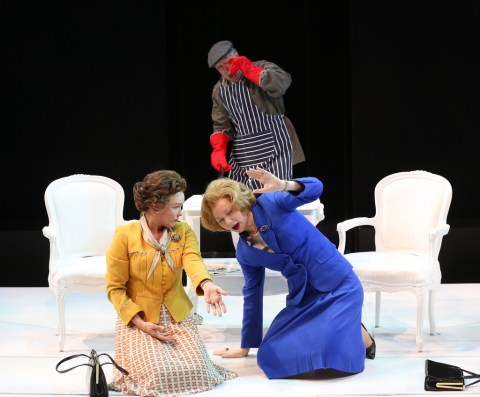
(L to R): Beth Hylton, John Lescault, Susan Lynskey in ‘Handbagged,’ by Moira Buffini, 59e59 Theaters (Carol Rosegg)
This “breaking the fourth wall” device elevates the play into the realm of Theatre of the Absurd where the actors comment on the play and their roles. As they break from their roles and portray themselves as actors, we understand that this is still a part of the play; they are portraying the characters as the actors in the play. At one point or another, all of the characters step out of their roles and comment that this play is of their own making or that they don’t want to play the roles they do or are “switching” roles. This break in the play’s chronology of the Thatcher years melds the action, is enlivening and provides the twists that maintain energy throughout.
With regard to The Queen and Thatcher, this “breaking the wall” convention reminds us that the characters, though representative of real individuals, are fictionalized with some basis in truth. Buffini also uses this device to insert humor and to present information of the time period and of individuals that the audience may not know or remember. Actor 1 for example takes the liberties with the script to describe that in the “midst of all that Diana wedding stuff, the whole country was boiling with rage.” Thus, we understand the historical period seamlessly and find the information fascinating.

(L to R): Beth Hylton, Susan Lynskey in ‘Handbagged’ (Carol Rosegg)
Overall, Buffini’s infusion of what the dialogue was between the two women constantly intrigues. Importantly, we understand their different roles. Thatcher, propagating her polices under the guise of freedom and democracy (she proclaims this as the elderly “T”) sustains an iron-fisted “control” of the U.K. The difficult times for the country are chronicled: the 1981 IRA bombings and killings, the miner’s strikes, the War in the Falkland Islands, the closing down of the Empire gradually into a Commonwealth of Nations (which the Queen comments on happily), Princess Diana’s wedding to Prince Charles, Reganism, the rise of Rupert Murdock and his amoral, untoward scandal sheets and more.
During various events, ingeniously with subtle conflict between the characters and little exposition, we are reminded of the backstory with just enough information to be able to understand how the two women’s viewpoints and actions diverged. Thatcher obviates the cruelty of her own behavior; Queen Elizabeth II attempts to modify Thatcher’s understanding of her policies and practices, applying a humanity not readily found in Thatcher’s comportment.
Thus, we are appalled when Thatcher destroys the trade unions and boastfully touts her win of the miner’s strike which lasts a year and causes tremendous hardship. With quiet reserve, Queen Elizabeth II asks both “T” and “Mags” if she has ever been down in a coal mine which Queen Elizabeth II has. We walk away from that encounter with the stark view of both women. With eyes open, we note Thatcher’s recalcitrance and blindness to the populace’s suffering, a condition which she blames on them.
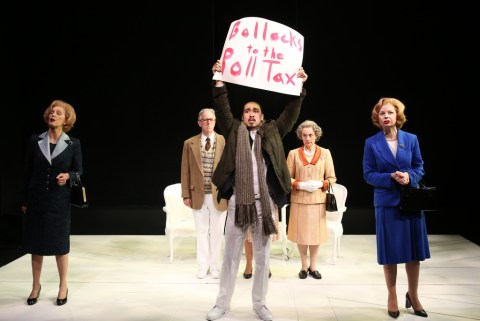
(L to R): Kate Fahy, John Lesault, Cody Leroy Wilson, Anita Carey, Susan Lynskey, ‘Handbagged, Brits Off Broadway (Carol Rosegg)
In each of her actions, closing coal mines, privatizing public companies, de-regulating financial institutions, refusing sanctions on South African apartheid, Thatcher effects misery and the citizens’ anger and protests. Though “T” and “Liz” do not counsel, they level broadsides at these actions. Indeed, in the Queen’s Christmas message of hope, Thatcher is publicly humiliated as the Queen’s message of Christian love is broadcast.
One of the most humorous segments in the revisiting of the Queen’s and Thatcher’s “relationship” during these years, the playwright examines their bonding with U.S. President Ronald Regan (an effusive, enthusiastic John Lescault) with Cody Leroy Wilson as Nancy Regan. The Regan scenes are hysterical and the relationships of the Regans’ visits with Queen Elizabeth at Windsor and as Thatcher and Regan meet and visit is excellent. That Thatcher and Regan agree in policies and practices (“trickle down economics”) is a pointed reminder of how many of the same policies embraced then took hold in the U.S. and U.K. and should “die a death.” They have not because the wealthy benefit from the destruction of the middle class and policies that feather their own nest (i.e. the destruction of the trade unions, tax breaks, de-regulation).
One of the greatest strengths of Handbagged, in addition to its providing a wonderful evening of entertainment in imagining the relationship between Queen Elizabeth II and Margaret Thatcher, is in its themes which both women embody. Much of that time period has currency for us today in laying bare the noxiousness and inhumanity of policies of conservatism represented by Thatcherism. These parallel with Trumpism in the U.S. today and faux, fascist populism of the uber right groups which are attempting to take over in the European Union. As the Thatcher government had its rallying cry of “no socialism,” there is the same rallying cry today by Trumpists.

(L to R): Kate Fahy, Susan Lynskey in ‘Handbagged,’ Brits Off Broadway (Carol Rosegg)
Then and now, these are twisted remnants of the politics of fear to bring about an advancement of corporate greed and hegemony. The elite powerful are those who seek to control, one of the mantras of Thatcher’s commentary that the playwright reinforces. The irony is that the Queen, the richest woman in the U.K., stands against these policies and pushes for equity, remembering the horrors of WW II when the country fought a common enemy. The economic policies that were catastrophic and led to the fall of Thatcherism are present in the Trump administration today. They foment economic inequality, and the economic divide between the haves and have nots. Indeed, when Thatcher left the government, there was jubilation and crowds in the streets celebrated the hope that things would get better. An irony, indeed and one wonders if the same will occur with Trump.
Handbagged is a must-see for its performances, its clever send up of two iconic individuals, its ironies and the historical infusions of vital information with dollops of humor slipped in-between. It is vital in how it reflects and reminds us of the economic and political dynamic that exists today globally. Kudos to the team of creatives and the production team that made this excellent production soar.
Handbagged runs with one 15-minute intermission until 30th of June at 59e59 Theaters on 59th Street between Madison and Park Avenues. For tickets go to their website by CLICKING HERE.
‘Long Lost’ by Donald Margulies directed by Daniel Sullivan

(L to R): Lee Tergesen, Kelly AuCoin, Alex Wolff, Annie Parisse in ‘Long Lost,’ by Donald Margulies, directed by Daniel Sullivan, Manhattan Theatre Club New York City Center Stage I (Joan Marcus)
Are we our brother’s/sister’s keepers? There is a scripture that says a person who doesn’t take care of family is worse than an infidel. But do these tenets always apply? And how do we take care of family? Just supply their external needs? Or should we also connect with them on a truthful, soulful level which will nourish and heal frailties?
Pultizer-Prize-winning playwright Donald Margulies in his new play Long Lost examines filial relationships, family dynamics and the assumptions and values that despoil love and forgiveness within families. Directed by Daniel Sullivan in a tight framework of fine performances by the actors, the twists in the arc of development reveal the inner trauma and turmoil in some families that often are never resolved. The only hope might be in the next generation where there is the possibility of redemption and love.

(L to R): Lee Tergesen, Kelly AuCoin in ‘Long Lost,’ directed by Daniel Sullivan written by Donald Margulies (Joan Marcus)
David (the ambivalent, deceptive, hypocritical and coolly raging Kelly AuCoin) lives a life of success as a Wall Street consultant who royally supports his socially conscious wife Molly (Annie Parisee gives a mesmerizing performance) who is a philanthropist. Their son Jeremy (Alex Wolff gives a thoughtful, sensitive portrayal) who is going to Brown, enjoys his promising life and is close to his parents whom he is visiting for Christmas recess.
Into this idyllic family situation intrudes the estranged, ne’er-do-well, older brother Billy (the wonderful Lee Tergesen). At the play’s opening, he sits symbolically in the dark waiting for his brother David in his Wall Street office. He is waiting to “say hello,” to reconnect, to redeem himself and more. When David turns on the lights, the last person he expects to see is Billy. AuCoin’s David reacts with shock, annoyance, suspicion, aloofness. These layers of darkness pull back as we note the conversation between the two brothers. There are recriminations; David wants Billy gone; there is no love lost between them, and if there is any empathy it is non-existent.
David unloads on Billy. Apparently, from his self-righteous, exalted position of having helped Billy attempt to overcome and get through his addictions and the destruction they’ve wrought, he has lost patience, and intends to stop any further enabling of his brother. Indeed, at this point, we respect David’s probity, his former magnanimity with Billy and his measured and enviable success.

(L to R): Kelly AuCoin, Alex Wolff, Annie Parisse in ‘Long Lost,’ directed by Daniel Sullivan, written by Donald Margulies (Joan Marcus)
Not that any time would be a good time for Billy to land on David’s doorstep to be invited into a warm family situation, this is the most inopportune of times, David suggests. It is the night of Molly’s fundraiser, which Billy cannot be invited to as it’s a black tie affair. And Billy eschews the proffered money that Billy usually gets, for example, the last time David heard from him two years ago when he “hit him up” and wired funds. But nothing works to put Billy off and then Billy unloads on David. He is dying and is coming to David and the family for help and support. David has the money, most probably, to rent a studio for Billy, but he will not. Instead, he invites him home.
From the outset we note the differences between the two brothers and wonder if one is a changeling because he is the antithesis of success, happiness and inner tranquility, so unlike David. Apparently, Billy’s addictions unraveled his soul and made him dependent upon David for money, who at one point banished him. Billy’s behaviors landed him in jail; the reason is tragic, but most probably caused because of his addiction which made him irresponsibly negligent and insensate. Indeed, despite his personable, charming open nature, it is obvious that he is a “bad seed.” And if he is allowed to stay with David and the family, what upheavals will he create? David is clearly wary of Billy for good cause. However he takes him in because of guilt. Billy has nowhere to go and he has cancer. What would David want someone to do for him if he were in Billy’s shoes?

(L to R): Lee Tergesen, Alex Wolff in ‘Long Lost,’ directed by Daniel Sullivan, written by Donald Margulies (Joan Marcus)
In the subsequent scenes, Billy meets his nephew Jeremy and the scene between them is beautifully rendered. Indeed, all the scenes between uncle and nephew are heartfelt, and the pathos and sensitivity of the actors bring out the humanity and soulfulness in the character portraits. Through Jeremy’s eyes we understand another side of Billy; the fun loving, humorous, affable individual who is attractive, adorable and not “a bum.” Through Jeremy’s perspective, his parents should not be hard on his uncle, and certainly should let him stay to celebrate Christmas. The last time he remembers being with his uncle, he was nine. Jeremy doesn’t judge Billy as his parents do; he does not have the information or the experience with him that they have.
However, Billy being Billy provokes both Molly and David who chafe at his presence. When Billy lands a zinger truth on David that cuts his soul (this actually is hypocritical as we later find out and ego on David’s part) David kicks out Billy before Jeremy can say “goodbye.” Jeremy, the moral/familial conscience of the family, counters, “What kind of people are you?”
The irony is that Molly’s charity “Safe Harbor” to help women trapped in violent relationships, appears to indicate she has a soft heart with regard to supporting people. However, this softness stops where Billy is concerned. Easy to help strangers, but family? Hit the road Jack! Billy has apparently affronted Molly in the past and she will not forgive him. She refuses to have him stay with them for the holidays and looks up places to help him find the support he needs with his condition. Of course, Billy doesn’t help by consuming all the beer in their fridge and smoking weed and giving some to Jeremy who warns him Molly doesn’t want any smoke in the house. Humorously, it is the first thing she notices when she walks in with David after the fundraiser.
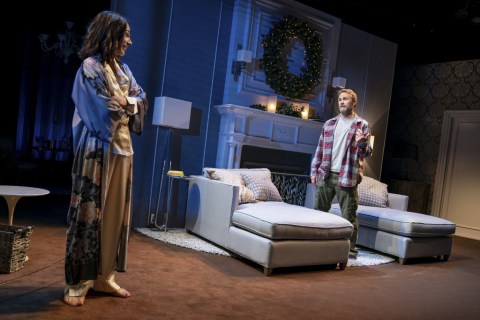
(L to R): Annie Parisse, Lee Tergesen in ‘Long Lost,’ (Joan Marcus)
Margulies unwraps the comedy and the drama gradually with key details that allude to the swirling undercurrents in these individuals that move beyond sibling rivalry to deep wounds. Molly, David and Jeremy as a family are a brick structure, solid and sturdy to withstand hurricanes. But we discover, the bricks are painted cardboard; the house is built for show and is rotting within. Neither Molly nor David are honest or forthright about their own personal issues; they withhold their true nature from Jeremy and each other. They are living a sham existence gilded over by superficial, meretricious accoutrements and values that do not feed their souls nor sustain their relationships with each other. Jeremy ends up being the casualty of this existence that never really was. The only individual who is real to him, his Uncle Billy, remains the most down-to-earth individual who has confronted his own demons and is in effect coming to grips with his self-destructive past in full view of Jeremy. This is real and and heartfelt, especially when Billy nurtures Jeremy and encourages him to remember that he is “a good kid.”
Billy’s presence serves as a catalyst; he is a provocateur who blows up the family pretense with a few, choice, truthful revelations. These revelations force the issue and expose the core of David’s and Molly’s lies and their living a life of quiet desperation with each other, a fact which Molly refuses to see. Billy’s authenticity and his acknowledgment that he is impaired, flawed, a “mess” is disarming and we find him to be likable. However, this is a two-edged sword because being charming also makes him cunning and manipulative as an operator without filters. When David initially tells him that he can’t stay because he and Molly are going through a “rough patch,” Billy relates this to Molly and Molly confronts David who assures her they are “fine.” But Billy’s keen observation of his brother at the outset of the play gleans the truth and his authenticity draws out the truth from others.
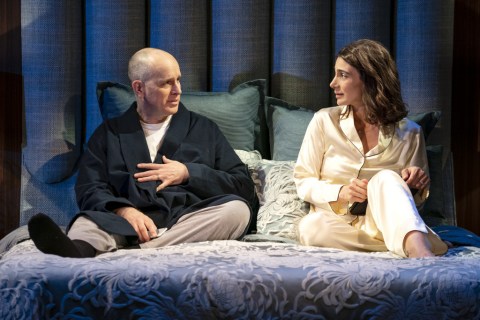
Kelly AuCoin, Annie Parisse in ‘Long Lost,’ (Joan Marcus)
Threading undercurrents weave throughout, expertly wrought by Margulies so that by the end the raw nature of the characters crystallizes before us. Indeed, the title we assumed defined Billy. But it relates to Molly and David, who also have been “long lost.” The only authentic individual who has found the core of his own frail and weak being is Billy. And he is not ashamed to admit it. Ironically, Molly and David are just beginning their journeys of dealing with who and what they are and what they have pretended to be in a marriage that has been lifeless for a “long” time.
Margulies brings the characters into a few revelatory highpoints. The most significant one occurs between Billy and David. We learn of the sibling rivalry, the abuse, the parental neglect and the recriminations each brother feels. The scene is a powerful one and AuCoin and Tergesen bring to bear their extensive talents to draw us into a dynamic that many will empathize with. The tragedy is that as in many families, forgiveness is not an option. There is too much anger, fear, ego, and extreme hurt. There are not enough centuries to work through all of it, not that David would want to.

Annie Parrise, Kelly AuCoin in ‘Long Lost,’ directed by Daniel Sullivan, written by Donald Margulies (Joan Marcus)
That Billy is dying is an answer for Billy, a strange redemption in which all of his life comes back on itself. By the conclusion he is fatalistic and grateful, even able to joke a bit about who he is and what he has done. However, David doesn’t have the same good fortune. He will have to deal with himself and his own inner resentments, pride, frailties and sadnesses especially after Billy is gone. Whether he has the strength or courage to do so, as Billy seems to have been able to do, remains to be seen. Perhaps it is easier after all to be a mess and to rather make a mess of one’s life and recognize it. That is a life lived with few expectations. On the other hand, David and Molly have so many ambitions and expectations, to not measure up to any of them is an agonizing and soul hardening devastation.
Margulies ends on an uncertain note, but brings a partial resolution during Jeremy’s visit with his uncle before he goes away to school. During their conversation, we see the impact of Billy’s visit on the family which externally appears to be disastrous, but in terms of clearing the air of lies and duplicity, in effect, was a blessing. However, Margulies expert characterization reveals that most probably David or Molly would not attest that Billy’s visit yielded a positive outcome. As often happens, he will be blamed for causing difficulty when, in effect, they should look to themselves to rectify their own inner mess.
Long Lost works on many levels. The actors’ spot-on portrayals reveal these poignant, flawed individuals whose lives are scattershot regardless of how “perfect” they may appear socially and economically. Parisse and AuCoin adroitly strip the gradual layers revealing that false perfection cannot sustain or nurture their characters’ relationship with each other. Tergesen uses the truthful comments to deliver Billy’s honesty bullet-like; his is the most empathetic character and the most chilling. The underpinnings are thrillingly made manifest through the excellently paced, shepherded production with Sullivan’s thoughtful, specific direction.
Kudos to John Lee Beatty for his gorgeous and appropriate revolving set design. Toni-Leslie James’ costumes are equal to the social/economic classes they embody. Kenneth Posner’s lighting design and Daniel Kluger’s original music and sound design round out the production with equal fervor.
Long Lost presented by Manhattan Theatre Club New York City Center Stage I runs with no intermission at New York City Center (131 W 55th St. between 6th and 7th) until 30th June. For tickets and times CLICK HERE.
‘Frankie & Johnny in the Clair de Lune,’ Audra McDonald and Michael Shannon Keep it Profound!

‘Frankie and Johnny in the Claire de Lune’ written by Terrence McNally and directed by Arin Arbus starring Audra McDonald and Michael Shannon, at the Broadhurst Theatre New York (Deen van Meer)
Audra McDonald and Michael Shannon directed by Arin Arbus spike Terrence McNally’s 1980s New York City “romance for the ages” Frankie & Johnny in the Clair de Lune with organic authenticity and powerhouse performances. Both actors cleverly negotiate the difficulties of comedy by not playing for humor. Their characters are driven by overt and subterranean desires, and in that they are humorous. In not pushing for laughs, a grave danger in a play (the laughs change every night based upon a thousand audience variables) the actors come up with the most unexpected and surprising riffs. Considering that these moments are emotionally based, this shows their consummate technique and absolutely glorious listening/effecting. They are among the most talented and superlative of actors in portrayals that are precisely shepherded with adroit skill by Arbus to release their profound and moving sensibilities.
On a superficial level, we assume we know the play which was also made into a film starring Al Pacino and Michelle Pfeiffer (1991); it’s been revived in New York City, most recently with Edie Falco and Stanley Tucci in 2002.
In this current time of sexting and posting fleshly photos on Social media “private” and then being hacked into and displayed, the play is downright quaint, even with the nudity. And yet these actors and the director transcend the quaintness, elevate the current thematic mores/trends/folkways, of romance and find the beauty of individuality which is what Terrence McNally strives for in Frankie & Johnny in the Claire De Lune.
What is it about this night, this couple? Distinction despite their “apparent” inconsequentiality in the era of Trumpism! With each other, their particularly shines. McNally brings this into intriguing relief, smartly realized by Arbus, Shannon and McDonald. Their humanity and what makes them who they are inherently is unique and poignant, as they confront the human condition of loneliness, doubt, self-torment and pain in relationships that have decayed like rotten fruit.
The play raises fascinating themes. One is that we underestimate our exceptionalism or convert it into a fear of the unknown in ourselves and a fear of our possibilities. In New York City (the setting of the play is NYC, 1980s) where over 8 million people live and work, the impulse is to maintain a familiar invisibility negotiating the sheer mass of people. Apart from this, many live their lives attempting to be like others in their social groups, even in their “intimate relationships” to the point where they don’t acknowledge soul differences nor respect them.

‘Frankie and Johnny in the Claire de Lune’ written by Terrence McNally and directed by Arin Arbus starring Audra McDonald and Michael Shannon, at the Broadhurst Theatre New York (Deen van Meer)
McNally explores this exceptionalism in two seemingly ordinary lower middle class individuals (a waitress, a short-order cook) that no one would find interesting, especially when folks are striving to become rich in an age of “greed is good.” McNally spins the vitality of these two by examining their depth, prompted by Johnny’s compulsion to realize the opportunity before him with Frankie; this active movement on his part creates the dynamic of their growing involvement with each other and shifting perception about themselves.
After intense love making, Johnny stops himself from disengaging from Frankie. Instead, he does not ignore her and dismiss what has just happened, which Frankie would prefer. He goes deep. In attempting to communicate with her to make sense of who they can be together, he finally explains his “vision” to a radio host convincing him to play the most beautiful music to get Frankie to connect with him. Johnny tells him (in Frankie’s hearing) that he stopped himself from the “usual rosary,” i.e. thinking of “the million reasons” why he should not love Frankie, why they wouldn’t work out.
The irony is that Johnny pursues what is on another level. They’re physical manifestation of love was “perfect.” And that is an indication of possibilities, of recognizing what is profound within each of their souls. Johnny senses her uniqueness. And for that reason he will not follow the path he followed many times before – forgetfulness, dismissal, staying superficial. With the courage of his convictions, he persists in attempting to persuade her to do the same: to go deep.
Johnny’s action which creates the arc of development has little to do with a repeat performance of “sex” and all to do with seeing each other on a soul/spiritual level. From Johnnie’s perspective, if they can achieve that, their relationship will be able to build and grow. It’s what Johnny means about “connection,” that ethereal thing that can happen during making love, but not always. He and Frankie have experienced it and for some reason Frankie fears or is defensive about a continued intimacy with conversation. In attempting to have Frankie “connect” with him again, Johnny intuits that they need to hear the music of transcendence to take them out of the mundane. That he hopes will ease the way back for her to engage on that other level once more. Indeed, it is that level on which the finest, most truthful relationships are based.
To miss the depth of what is happening between the characters is not doing justice to McNally’s play or the performances and direction. This is the focus that remains alive and present in this wonderful revival. Johnny believes in that profound level of connection. Frankie fears, eschews and resists it. McDonald and Shannon make us care why these two behave in their “compulsions.” They make us care whether they can become the couple for “all time,” “Frankie and Johnny.”
What I particularly appreciate is how McNally has reverse troped the characters of Frankie and Johnny in the backdrop of a culture which is uber jaded regarding “love” and “romance.” Arbus, Shannon and McDonald have mined the gold in McNally’s ironic twists and tweaks.
Here, the man wants intimacy, love and bonding. The woman just wants sex, a slam, bam, thanks, see ya. Frankie is beyond skeptical and doubtful about Johnny. She closes him out, doesn’t hear what he is saying, doesn’t “connect,” until after she slaps him.
Because of Frankie/Audra McDonald’s revelatory inner authenticity-her resistance to Johnny/Shannon’s importuning her to “go deep,” warning alarms go off. If one has studied or read the M.O. of abused women, they should “get” McDonald’s Frankie’s impulsive, defensive reactions and nervousness. She has been abused in a way that has damaged her psychically so that all bets for true intimacy are off. She can’t allow herself to take that risk again, regardless of the physical “something” between them. That can be dismissed as sex, nothing more which is precisely what Frankie seeks to do, but Johnny will not let her get away with it.

‘Frankie and Johnny in the Claire de Lune’ written by Terrence McNally and directed by Arin Arbus starring Audra McDonald and Michael Shannon, at the Broadhurst Theatre New York (Deen van Meer)
McNally’s characterization of Frankie resonates even more strongly today. Current sexual predation numbers despite all the #MeToo publicity and positive directions have not decreased. Physical/sexual abuse transcends economic and social class backgrounds. Wives of billionaires are abused as are women of partners of lower socioeconomic classes. Often women who have been abused cannot be intimate. They will have sex and may seek it out as a form of control. But the abuse must be worked through before intimacy becomes welcome.
Abuse from a former partner we discover is making Frankie resist Johnny which she reveals in Act II. Some have suggested the play can be done in one act. The intensity of the characterizations has eluded these critics; Frankie’s violence and then revelation about why she reacts as she does must come full bore in the modulations after the radio host plays a transcendent song that will “connect” them. And by the conclusion as we follow the journey of how they both work through their psychic damage, we see they are together and perhaps “perfectly” as Johnny suggests in Act I.
The development is crucial and needs the breadth that McNally gives it. At the end of Act I when Frankie appears to be persuaded by Johnny to become intimate in the way he wishes, she “controls” and pushes him to have sex which we discover at the beginning of Act II “fails.” Johnny’s “failure” is humorously rendered by the actors. However, this “failure” also reveals that “the connection” between them still isn’t trusted by Frankie. That doesn’t stop Johnny from persisting, and they both become adorable and familiar to each other in their gradual revelation of the truth of themselves.
McDonald’s portrayal of McNally’s Frankie is right-on: her fear of intimacy, her insistence to control sex, to control him is paramount. Her abusive reaction to him is also spot-on. Her breakthrough effected by both actors beautifully as Shannon stops the abuse and kisses the hand that slapped him is an important turning point. We know something happened to her in the past; Johnny senses it and is lovingly helping her work through it. His attempt to connect with her is scintillating. It is an irony that she converts the beauty of this moment back to sex and “wanting him.” In showing her “desire”, she is actually pushing him away. No wonder Johnny’s “manhood” fails him. He wants more than a little friction! Shannon is just terrific in effecting this with sensitivity and great feeling.
In Act II Johnny has another hurdle after she reveals she has been abused. He must convince her to move beyond the need to control using sex, and recognize that between them there is the opportunity for something transcendent and profound. In their uniqueness, such riches are available to them because of who they are together. This is rare, it isn’t possible for others and how fortunate/destined they are that they have “found” each other.
This sensitivity from a guy who seeks to make a connection on another level and eventually understands how to do this with a beautiful song to “get there,” is mind-blowing. One might say cynically, “Men are just not like this!” “The playwright is gay and writing his own fantasy male.” Or these characters are simply beyond the pale and this is a modern “fairy-tale!” Well, that is missing McNally’s searing point which Arbus and the actors have elicited in this production. This is possible. But what one must risk is failure, or being ego-less. Risking the pain of failure is frightening, especially if one has gone down that road before.

‘Frankie and Johnny in the Claire de Lune’ written by Terrence McNally and directed by Arin Arbus starring Audra McDonald and Michael Shannon, at the Broadhurst Theatre New York (Deen van Meer)
Arbus, Shannon and McDonald apply their brilliant talents seamlessly. The actors convince us Frankie and Johnny are possible because of the actors’ stunning and detailed inner logic which simmers with backstory. If it is possible for them, it might be available for other “Frankie and Johnny’s” in a universe of lonelyhearts. Their relationship is a beacon and a warning not to be like married couples who married out of fear and never “connected,” or who were matched up by others because they were “perfect” for one another, only they weren’t.
Perhaps one of the strongest themes of this production is found by looking at how Frankie and Johnny evolve together “magically” to achieve a level that many couples don’t achieve. The play begs the question, why are Frankie and Johnny so stellar and original? Why can’t their evolution be the norm, not the exception?
The reasons are multitudinous. But one of the reasons is that our culture and society warps men and women with platitudes and tropes and gender annihilation in some quarters. “Men don’t cry.” “Don’t be gay, be a manly man.” “Women are best being quiet and looking pretty.” Women who are feminists are feminazis. Women must look only a few ways to be feminine and beautiful.
The fact that the nullifying stereotypes behind such commentary still exist today is appalling; and now there is a Trumpist backlash that embraces such thought. On social media and beyond, there is an actual collective of Incels. On the opposite side of the spectrum, sexual predation and abuse are as old as time, and paternalism and misogyny. It is tragic that there is a necessity for a #MeToo movement because of the misogyny and paternalism inherent in our folkways and mores.
Frankie and Johnny in the Claire de Lune flies in the face of all this noise. It reminds us of the humanity of individuals, not of the stereotypes of genders. This production encourages us to look into the souls of individuals and make those priceless connections which rebel against that which would attempt to defile the bounty of our humanity by slopping it on the trash heap of stereotypes and labels. Bravo, to McNally’s original vision and Arbus,’ Shannon’s and McDonald’s adherence to it, allowing the themes of the play to soar along with the incredible portrayals of these wonderful characters.
Kudos to all the artistic creatives: Riccardo Hernandez (Scenic Design) Emily Rebholz (Costume Design) Natasha Katz (Lighting Design) Nevin Steinberg (Sound Design) J. Jared Janas (Hair, Wig & Makeup Design) Claire Warden (Intimacy & Fight Director).
Frankie and Johnny in the Claire de Lune runs with one intermission at the Broadhurst Theatre (44th Street between 7th and 8th) in a limited engagement until 25th August. For tickets and times go to their website by CLICKING HERE.
‘Brazilian Modern: The Living Art of Roberto Burle Marx,’ The New York Botanical Garden

‘Brazilian Modern” The Living Art of Roberto Burle Marx,’ NYBG Installation (June 8-September 29) (Carole Di Tosti)
The New York Botanical Garden is perhaps the most exotic and forward-thinking, theatrical living museum of plants and one of the most magnificent green spaces in all of New York City rivaled only by Central Park. In presenting their largest botanical exhibition ever from June 8 -September 29, 2019, the New York Botanical Garden has achieved a seamless meld with a globally renowned, award-winning Brazilian modernist artist, Roberto Burle Marx (1909-1994).

‘Brazilian Modern” The Living Art of Roberto Burle Marx,’ NYBG Installation (June 8-September 29) (Carole Di Tosti)
For this wonderful exhibit, members get to go free on Friday, Member’s Day. See links below to the symposium on Friday.
The influential Brazilian modernist, landscape architect, plant explorer and cultural giant, is deserving of a celebration of his prodigious design work which features examples of the lush gardens he created throughout Brazil and the world. His unique and innovative modernist perspective gave birth to thousands of landscapes and private gardens, including the famous curving mosaic walkways at Copacabana Beach in Rio.The exhibition exemplifies every aspect of his artistry with a curated gallery of his eye-poppying paintings, drawings and textiles.

‘Brazilian Modern” The Living Art of Roberto Burle Marx,’ Untitled, 1970 by Roberto Burle Marx, Acrylic on canvas, NYBG Installation, LuEsther Mertz Art Gallery (June 8-September 29) (Carole Di Tosti)
The amazing Burle Marx was a maverick in highlighting the importance of environmental preservation and particularly exotic plant species some found only in Amazonia a good part of which is in Brazil. In the NYBG horticultural tribute to Marx, the exhibition team pulled in experts like Raymond Jungles (FASLA) his protégé who personally knew Marx and worked with him, and those like Edward J. Sullivan, Ph.D., the Helen Gould Shepard Professor of Art History and Deputy Director, Institute of Fine Arts, New York University, who has studied Marx extensively and who continues to write about him.

Edward J. Sullivan, Ph.D., the Helen Gould Shepard Professor of Art History and Deputy Director, Institute of Fine Arts, New York University, ‘Brazilian Modern” The Living Art of Roberto Burle Marx,’ NYBG Installation (June 8-September 29) (Carole Di Tosti)

‘Brazilian Modern” The Living Art of Roberto Burle Marx,’ NYBG Installation (June 8-September 29) Raymond Jungles (white hat) foreground/ bottom of the photo with his design behind him (Carole Di Tosti)
Jungles used his expertise and personal experience working with Marx to design the exotic tropical feel and immense grandeur of the installations revealed in three stages of the exhibition. The first is the Modernist Garden with striking, patterned paths that lead through extensive curvilinear planting beds to an open plaza with a reflecting pool backdropped by a wall. This wall design is inspired by a Burle Marx installation in the Banco Safra headquarters in São Paulo. The entire vibrant black, white and grey walkway and colorful, sweeping plantings are framed by spectacular palm trees that tower to their natural heights, many contributed by Jungles’ own personal collection.

Explorer’s Garden ‘Brazilian Modern” The Living Art of Roberto Burle Marx,’ NYBG Installation (June 8-September 29) (Carole Di Tosti)
The Explorer’s Garden in the conservatory showcase (not the Palms of the World Gallery whose dome is being refurbished) features the tropical rain forest plants among Burle Marx’s favorites as a bone fide “plant nerde.” These include those he adored, particular exotics which he constantly used in his installations to inform Brazilians about the natural world’s smackdown of diversity in their home country. With this he was constantly building up Brazilian’s sense of home pride.

Water Garden, ‘Brazilian Modern” The Living Art of Roberto Burle Marx,’ NYBG Installation (June 8-September 29) (Carole Di Tosti)

Water Garden, Staghorn Ferns-a Burle Marx favorite, ‘Brazilian Modern” The Living Art of Roberto Burle Marx,’ NYBG Installation (June 8-September 29) (Carole Di Tosti)

Bromeliads-a Burle Marx favorite, Water Garden, ‘Brazilian Modern” The Living Art of Roberto Burle Marx,’ NYBG Installation (June 8-September 29) (Carole Di Tosti)
The Water Garden evinces Burle Marx’s use of plants from a wide variety of tropical regions in his Brazilian designs and throughout the world. The reflecting pool is the natural habitat of temperate water lilies which are blooming in the variety of pastel colors. And it will include the more exotic water lilies that only basque in warm waters of Florida and the equatorial regions; these are of darker purple hues, etc.

‘Brazilian Modern” The Living Art of Roberto Burle Marx,’ NYBG Installation (June 8-September 29) (Carole Di Tosti)

Making tiles to display, a la Roberto Burle Marx, ‘Brazilian Modern” The Living Art of Roberto Burle Marx,’ NYBG Installation (June 8-September 29) (Carole Di Tosti)
Burle Marx’s Art and Garden Lifestyle Philosophy are extensively covered through film, and exhibits of his paintings, drawings, textiles and more all inspired by Brazilian culture. You will find this extensive exhibit in the Art Gallery and on the fourth floor of the LuEsther T. Mertz Library. This section of the exhibit reflects his work from the final 30 years of his career from 1964 to his death in 1994) and shows not only his evolution as a person but also as a titan who beautifully integrated all the finest of the cultural and wholistic elements of an individual rooted in every aspect of his country’s well being. In this section you will see the apotheosis of Burle Marx, the print maker, ecologist, naturalist, artist and musician as well as innovator whose modernist landscape architecture whose designs of parks and gardens lifted Brazil’s reputation and culture as an important contributor on the international scene.

‘Brazilian Modern” The Living Art of Roberto Burle Marx,’ NYBG Installation (June 8-September 29) (Carole Di Tosti)
Engaging public programming showcases the sights and sounds of Brazil and its lively contributions to music and dance evoking Rio de Janeiro, the “Cidade Maravilhosa” (“Wonderful City”) that Roberto Burle Marx called home and inspired his life and work. Expect to experience the dances, music, foods of Brazil at the NYBG for the length of the exhibition which runs from June 8 through September 29, 2019.

Untitled (1968) by Roberto Burle Marx, Acrylic and industrial dye on fabric,’Brazilian Modern” The Living Art of Roberto Burle Marx,’ NYBG Installation (June 8-September 29) (Carole Di Tosti)
Details about the exhibition’s diverse and engaging schedule of public programming for all ages is available here:
https://www.nybg.org/content/uploads/2019/06/NYBG_Brazilian_Modern_02_Programming.pdf
Information about the Brazilian Modern Interactive Mobile Guide, supported by Bloomberg Philanthropies, is available here:
https://www.nybg.org/content/uploads/2019/06/NYBG_Brazilian_Modern_03_InteractiveMobileGuide.pdf
.
New York Botanical Garden, 2900 Southern Blvd, Bronx, NY 10458 United States
- ,
- or

