Author Archives: caroleditosti
Roses are Blushing at the New York Botanical Garden, Soon to Peak

Peggy Rockfeller Rose Garden, NYBG (Carole Di Tosti)
Among its great treasures at the New York Botanical Garden, is The Peggy Rockefeller Rose Garden. The rose garden has around 700 different roses and over 4000 plants.

Peggy Rockfeller Rose Garden, NYBG, Rose Weekend (Carole Di Tosti)
Some of them are historical and others are hybrids that have been created and named and as in the case of the white rose called “The Divine Miss M” (named for Bette Middler) or “Purple Rain,” named in celebration of rock singer-songwriter, actor, record producer, Prince, his titular film and record album. Indeed, all of the roses planted have a fascinating story about its genesis or its development.

Peggy Rockfeller Rose Garden, NYBG, Rose Weekend (Carole Di Tosti)
When I visited for Rose Weekend, which was this Saturday and Sunday, I lucked out. Stephen Scanniello who is the curator of the Peggy Rockefeller Rose Garden and world renowned author and expert on roses was present checking the roses for black spot (a fungal disease rampant in hot, humid weather that causes defoliation) and other issues. He graciously filled in for a guide who had to leave and he shared some of his vast knowledge about roses and specifically the ones at The Peggy Rockefeller Rose Garden. He took us on a tour of a few of the unique plants that are found in the garden which you must look for when you come to visit.
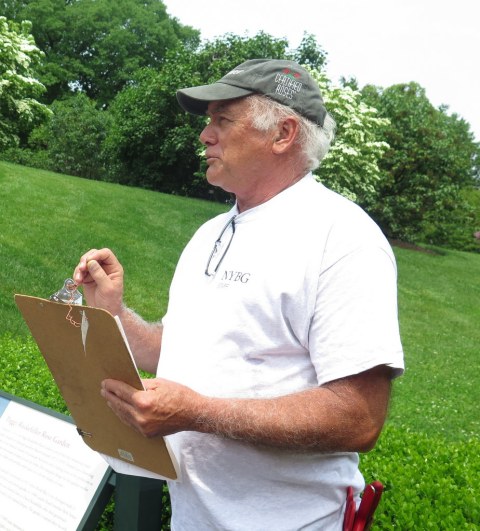
Stephen Scanniello, Rose Curator, Peggy Rockefeller Rose Garden, NYBG (Carole Di Tosti)
For those unfamiliar with the superlative Peggy Rockefeller Rose Garden, Stephen did mention a bit of its history which I will briefly summarize in this article and which you can find more information about HERE.
Before the rose garden settled at this present site, there were three other iterations. Two rose gardens were by the conservatory. One was there in 1907 and the other garden was opened in 1972 in front of the Conservatory and opposite the Perennial Gardens. Both didn’t last and the rose garden location that initially was selected in 1916 was returned to by 1986, 70 years later. Why this particular spot for the roses?

Peggy Rockefeller Rose Garden, NYBG (Carole Di Tosti)
That was the location that renowned landscape designer Beatrix Farrand chose when founder of the NYBG Nathaniel Lord Britton asked her to design a new, larger, world class, rose garden. Farrand had built up her reputation by studying privately with Sprague Sargent, director of Harvard’s Arnold Arboretum. To get design ideas she visited the great gardens of Europe. At the time Nathaniel Lord Britton spoke to her about a rose garden for the NYBG, Farrand had already designed the White House Garden in Washington, D.C. and many others.

Peggy Rockefeller Rose Garden, NYBG, Rose Weekend (Carole Di Tosti)
Farrand chose the site where the garden stands today, a low lying “valley” near the barns of the old Lorillard estate where people believe that a rose garden pre-existed on the site, though there are no records to verify this. In 1918, Farrand’s rose garden opened. Her original design was influenced by the well known rose garden Roseraie du Val-de-Marne (or Roseraie de L’Haÿ) in L’Haÿ les Roses, France. The offset triangular-shaped formal garden she intended to establish included iron fencing framing the garden and enclosing the roses within, as well as a central gazebo.

Peggy Rockefeller Rose Garden, Rose Weekend, NYBG (Carole Di Tosti)
However, the iron fencing and gazebo could not be included because of a lack of money. Nevertheless, John R. Brinley and John S. Holbrook designed the classic stone stairway leading from the top of the hill to the rose garden. In the later decades additional renovations were made until 1960 when to consolidate the formal gardens in one area, it was decided that the rose garden should be moved near the conservatory. By 1972 this third rose garden iteration was designed and planted in front of the conservatory. The other rose garden across from the Lorillard barns was abandoned.

Peggy Rockefeller Rose Garden, NYBG, Rose Weekend (Carole Di Tosti)
Never say never again! Beatrix Ferrand’s garden design arose like a phoenix from the ashes of the old rose garden when in 1985, NYBG Board member Beth Straus saw the original Farrand design plans. Inspired, Straus convinced David Rockefeller to donate one million dollars to complete Farrand’s vision with the gazebo and the fencing and restore the rose garden to the location she selected for it. In 1988, after an irrigation system was put in, the Peggy Rockefeller Rose Garden opened to the public in honor of David’s wife, Peggy, a horticulturist and conservationist.

Peggy Rockefeller Rose Garden, Easy on the Eyes-disease resistant roses, NYBG, Rose Weekend (Carole Di Tosti)
Stephen Scanniello mentioned some important facts about the Peggy Rockefeller Rose Garden and its collection. First, the location is a difficult one because it’s in a depression with higher elevations all around. As a result, there isn’t the greatest air circulation which roses require. Also, there is the moisture and humidity and heat that can cause fungal diseases. Since the NYBG is decreasing its chemical spraying, they are pumping up the condition and quality of the soil so that the rose bushes will be healthier and won’t be susceptible to insects and diseases. They are also putting in plants that are disease resistant and require no spraying because they are not liable to be taken down by black spot and other problems. Nevertheless, Stephen monitors each of the plants carefully and if plants have too many demerits against them, for example, foliage issues, beginnings of fungal issues, then the plant has to be pulled and another one put in.

The Divine Miss M., Peggy Rockefeller Rose Garden, NYBG, Rose Weekend (Carole Di Tosti)
Some highlights Stephen pointed out concerns the types of roses grown in the garden. Many are hybrid tea roses that have a lovely scent and have been created for the pleasure of the celebrities after which they are named. Stephen Scanniello showed us the beauty of The Divine Miss M, the “decadent bloom” that is named for the fabulous American singer, songwriter, actress, comedian and film producer who is still going strong at 73-years-old, Bette Midler.

The Divine Miss M., NYBG, Peggy Rockefeller Rose Garden, Rose Weekend (Carole Di Tosti)
It is a creamy white large-flower hybrid tea rose which has a scent of myrrh and lime. The new rose, “The Divine Miss M” has been described as whipped cream with overtones of antique white with a slight golden hue.” The rose celebrates not only Bette Midler’s life’s work and advocacy, but is in honor of the 40th anniversary of her 1979 breakout film, The Rose.

“Julie Andrews,” Peggy Rockefeller Rose Garden, NYBG, Rose Weekend (Carole Di Tosti)
A few years ago, there was the celebration of the “Julie Andrews” a large flower hybrid tea rose that is a deep pink.

Violet’s Pride, Peggy Rockefeller Rose Garden, NYBG, Rose Weekend (Carole Di Tosti)
Along with the Julie Andrews, Stephen Scanniello pointed out that the “Julie Andrews” rose is planted near the rose named “Violet’s Pride,” a rose named for the character Violet Crawley played by Maggie Smith in the show Downtown Abbey. Two dames are planted near one another in the Peggy Rockefeller Rose Garden; reportedly Julie Andrews thought that was delightful.

Stephen Scanniello, Rose Curator of NYBG, holding the green rose, NYBG, Peggy Rockefeller Rose Garden (Carole Di Tosti)
Another fascinating story Stephen Scanniello told us is about the rose you will find by the entrance, facing the gazebo, on your left. It is the green rose. Yes a green rose. Through a mutation of a regular looking pink rose called “Old Blush,” (a derivative of a species called Rosa chinensis) which originated in China and was brought to Europe and the U.S. in the 1790s, a green rose was formed in the 1900s. People propagated it by grafting or cutting off pieces of stems and re-planting them to produce new plants. The green rose was formed when it never went through the normal genetic switches causing the male and female reproductive parts in the right order in the parent plant. The green rose’s development gets “stuck” at the sepal-making step and it is the sepals that form the “petals” of the green rose.

Green rose bush, NYBG, Peggy Rockefeller Rose Garden, Rose Weekend (Carole Di Tosti)
The mythology surrounding the green rose is that Quakers-abolitionists during the beginnings of the movement and after the Fugitive Slave Act was passed and into the period up to the Emancipation Proclamation, Quakers planted the green rose in their front yards as a signal that they were a part of the Underground Railroad network and were a “safe house” that would offer protection and the way to continue on to Canada for runaway slaves. This is a difficult fact to verify. However, in Baltimore there was a Quaker family that claimed that this story was true.

Green Rose, NYBG, Peggy Rockefeller Rose Garden (Carole Di Tosti)
Stephen Scanniello told us that the roses are late this year because of the damp and colder spring weather. At this point the roses are at 65% until they peak so you still have perhaps a week or so depending on the weather. However, even if the roses are not at their peak, you should visit to see the celebrity roses. Another tip we heard about is the rose scents come out toward the evening, and the roses with the greatest scents are on the fencing at the back of the garden where the climbing roses are on trellises.

Peggy Rockefeller Rose Garden, gazebo, NYBG, Rose Weekend (Carole Di Tosti)
At the opening of the Peggy Rockefeller Rose Garden in 1988, Carl Totemeier, NYBG Vice President of Horticulture related the mission statement that has made the most sense for the rose garden when he said, “This [garden] will never be finished. We will always be striving to develop a collection with the best of old and new roses that are both attractive and well adapted to the site.” To see the best that the Peggy Rockefeller Rose Garden has to offer this season, go when the roses are at or near their peak and then follow the roses throughout the summer until they stop blooming and are cut back in late September. But even the remnant of the rose garden’s structure and setting in October is amazing. The NYBG lists the time for the roses from April – October.
To see the events happening at the NYBG and the Peggy Rockefeller Rose Garden daily as well as to follow the rose tracker, CLICK HERE.
‘Octet,’ by Dave Malloy, Rehabbing With Vibrant Song Circles
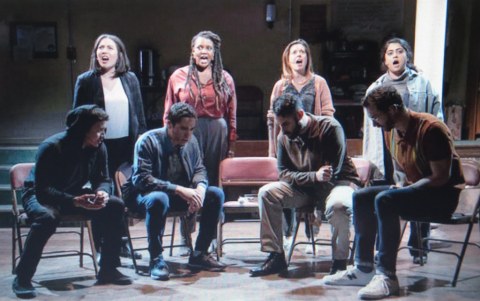
The cast of ‘Octet,’ by Dave Malloy, directed by Annie Tippe, presented by the Signature Theatre (Joan Marcus)
Addicted to your phone, via Instagram? Text? Candy Crush? Reddit? 4Chan? World of Warcraft? In Octet by Dave Malloy, directed by Annie Tippe, eight individuals who drop in to no-show Saul’s rehab in a homely church basement, find another hosting the weekly session. Thankfully, group leader Paula (the singer, songwriter Starr Busby), is nurturing and responsive to their cavernous, disabling confessions. There, in a harmonious, ever fluid, richly sonorous, song circle, they discuss their digital urges and expurgate them via the occult, each governed by a Tarot card designed for them and them alone. And sometimes the chorus joins in inspired by a soul hymn, encouraging the beauty of sharing in a non-judgmental like-mindedness.
What are they sharing? That which is maligned, misunderstood and apotheosized, the intimate, digital, hand-held which opens up their personal world like a hallucinogen and entraps them with their own emotional frailties. By the end of their epiphany-yielding, tonal and atonal harmonies (sung a cappella and sometimes performed with pitch pipes, batons and other make-shift percussion items), they are lifted spiritually out of this world and “out of themselves.” They’ve achieved a healing peace in the community of others and the audience responds with a standing ovation for they, too, have been enlivened and awakened, having stayed off their phones for almost two hours.
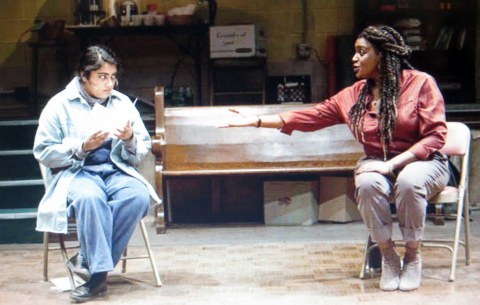
(L to R): Kuchoo Verma, Starr Busby in ‘Octet,’ directed by Annie Tippe, by Dave Malloy (Joan Marcus)
Dave Malloy, the progenitor of this innovative, exceptional and robust musical has created a masterwork with little theatrical spectacle, certainly nowhere near the breadth of Natasha Pierre & the Great Comet of 1812, his signature work. In Octet, for which Malloy has deftly created the music, lyrics, book and vocal arrangements, he takes a complex and intricate subject of great currency and couches it within a simplistic, minimalistic structure so that the powerful message of community and our need for live interaction resonates. With the seating in the “round,” and featuring a one-walled back set which reveals community bulletins, community ads, a coffee pot, announcements, etc., we get the sense we are in a basement which by the end, infuses the sanctity of each of us which must not be underestimated. Above all Octet is like a soul injection to promote our awareness of each other’s value and worth more than an $1000 phone.
Into the choir circle of healing comes various debilitated, physically whole, but spiritually wounded internet adherents. When all are gathered, they begin the refreshment and comfort of unity so that they eventually will be released to express their hearts in solo song. The “Hymn: The Forest” reflects The Moon Tarot card which represents “Intuition.” Indeed, each of the individuals are misaligned spiritually and need to be “made upright” especially with firing up and being guided by their own wisdom and not the addictive distractions of the world.

The cast of ‘Octet,’ by Dave Malloy, directed by Annie Tippe, presented by the Signature Theatre (Joan Marcus)
In the first solo, we learn that Jessica in “Refresh” has put herself out there on “YouTube” and has gotten a huge response for it by those who comment. Though controversy gets clicks and likes and dislikes, it is also obsessive and must be followed by more “rants,” which Margo Seibert’s Jessica is addicted to creating for the comments. Henry (Alex Gibson) sings about his addiction to video games, and Paula (Starr Busby) sings about her distraction from her marriage and her losing her interest or attentiveness to making it work.
Distraction, dislocation from the most important relationships in one’s life is one theme of this production. Of course, viewing a screen is easy. Relationships take time, effort, pain and suffering along with the joy and good times. To stay dynamically involved with friends and spouses, one often must work through the underlying reasons and foundations for why one chooses the particular individuals one does to populate one’s life. It’s much easier to click on one’s phone and be taken away from problems by video games and escape introspection with “rants” which Jessica, Henry and Paula seek to do.
In the representative songs of what being “plugged in” digitally means to these individuals, we understand that in the “Hymn: Monster” which everyone sings, they project their inner “devil” outward and ascribe that the internet is their addiction. “Being connected online” has become the monster that has destroyed and eaten up their lives. Of course the irony is that the monster was always there within, waiting to manifest. But the way to get rid of it which will have to be a continual process, first is the realization that they have a “devil” within, and second that it is a devourer.
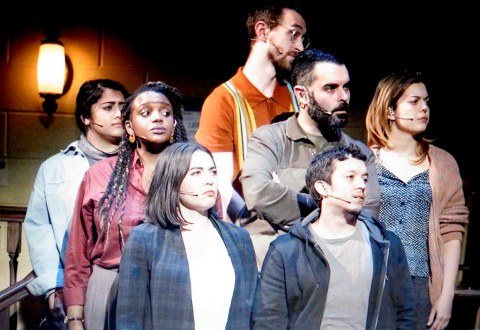
The cast of ‘Octet,’ by Dave Malloy, directed by Annie Tippe, presented by the Signature Theatre (Joan Marcus)
Karly (Kim Blanck) and Ed (the deep-voiced Adam Bashian) sing “Solo” about love and hunger for love. Ed is an Incel, a nonconformist. He riffs about Stacys and Chads (which is funny/drop dead serious Incelspeak) and they both sing about internet porn and online sexual addiction and the narcissism of having a ton of males (Karly) on her apps. In “Actually,” sung by Toby (Justin Gregory Lopez) whose Tarot card is The Magician, we note how far one must go to achieve one’s destiny, arriving at their potential. Toby has been waylaid in any pursuit of fulfillment.
In Marvin’s “Little God,” there is an intersection of spirituality and science which I found engaging in the tensions posited. J.D. Mollison is humorous in his visualizing that God is an 11-year-old dressed or looking like a Mermaid. In this song Malloy throws in ideas from Alan Watts’ The Book, and moves with gyrations into Richard Dawkins’ The God Delusion, and Douglas Adams’ The Hitchhiker’s Guide to the Galaxy” and concepts from wherever. This he does throughout this intriguing, rich musical referencing games, podcasts, film, theater and books which he lists in the show’s Playbill insert.

Kuchoo Verma, ‘Octet,’ by Dave Malloy, directed by Annie Tippe, presented by the Signature Theatre (Joan Marcus)
However, as a cleanse from the confusion of the myriad voices that try to persuade, convince and entrap us online, Paula conducts a wonderful ceremonial tea (“Tower Tea Ceremony”). It is then all sit, savor, become present, become located within themselves and prosper in their souls with the help of a drug that takes them deep within, but only for a few minutes. The ceremony yields humorous and beautiful moments. As a justification that there is something good about the online delusion that has swept their souls from beyond their easy grasp of themselves, it takes a song circle and tea ceremony to bring them back to a healing.
It is after the tea ceremony that Velma (Kucho Verma) courageously sings of her angst. It is she who brings an interesting justification of the global reach of the internet. In all the world, online,she has found someone to love who loves her back and makes her feel accepted and not such an ugly freak. The song “Beautiful,” governed by the Tarot card of The Fool, magnetizes all the concepts that have gone before and represents “new beginnings” and faith. This, Velma encourages and with moderation, as with everything, we understand that the “monster” can be conquered.

The cast of ‘Octet,’ by Dave Malloy, directed by Annie Tippe, presented by the Signature Theatre (Joan Marcus)
The evening comes to a close with “Hymn: The Field,” which the ensemble sings. Aligned through restoration and staying off their phones for almost two hours, the “chamber choir” has melded into an illustrious community. They have displayed their sterling singing gifts with measured ease, enthusiasm and a lovely grace which the audience finds absolutely delicious.
Octet’s superb director is Annie Tippe. Or Matias brings the majesty of Dave Malloy’s music to life through his adroit music supervision and music direction. Octet has been extended a number of times and is scheduled to close on 30 June. However, it may extend again. It runs 1 hour 40 minutes with no intermission at The Pershing Square Signature Center (42nd St. between 9th and 10th). For tickets and times go to their website by CLICKING HERE.
‘Happy Talk,’ by Jesse Eisenberg, Starring Susan Sarandon, Marin Ireland

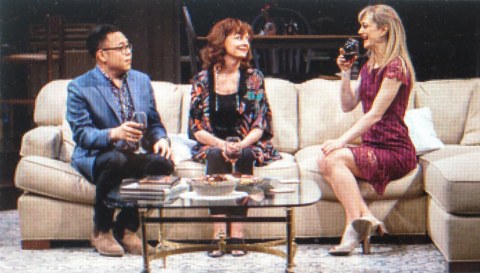
(L to R): Daniel Oreskes, Susan Sarandon, Nico Santos in ‘Happy Talk,’ directed by Scott Elliott, written by Jesse Eisenbert (Monique Carboni)
In Happy Talk by Jesse Eisenberg, adroitly directed by Scott Elliott, stealthy desperation that unravels into a high stakes gambit between employer Lorraine (Susan Sarandon) a Jewish community theater actress/housewife, and home health caretaker, Ljuba (Marin Ireland) climaxes by the end of the play. From the outset Eisenberg infers frenetic undercurrents in the dynamic between the two women. Lubja is the “happy,” compliant, illegal Serbian help and Lorraine negotiates the care of two individuals while she attempts a fantastic pretense that all is “well,” for the sake of the household. Both are fronting.
From their interactions at the top of the play, we divine a synergistic relationship between Ljuba and Lorraine. Ljuba is meticulous with Lorraine’s mom in her caretaking duties. Not in the country legally, Ljuba confides that she hopes to become a citizen via a green card marriage so that she might bring her daughter to the United States for a better life. Lorraine, whom we realize later in the play, is one step away from a nervous breakdown, has an upbeat attitude with Ljuba whom she treats as a friend. Importantly, she attempts to cheer up dour husband Bill, whose agonizing, degenerative MS is a depressive death sentence. Lorraine’s bedridden, incontinent mother is slowly dragging herself into the afterlife with Ljuba’s attentive care, feeding, changing and monitoring her. But in Lorraine’s daily existence, her mother is an afterthought, amidst her preparations for her role as “Bloody Mary” in the Jewish Community Center’s South Pacific.
(L to R): Nico Santos, Susan Sarandon, Marin Ireland in ‘Happy Talk,’ by Jesse Eisenberg, directed by Scott Elliott (Monique Carboni)
Eisenberg’s arc of development between and among the characters is pegged to the gradual revelation of the deeper “ethos” of these two women and how they balance the precariousness of their daily emotional struggles to manage their inner tension and stress. They do this with “happy talk.” Though other songs from South Pacific are played with ironic intent during the dramatic interludes (“Bali H’ai,” “Twin Soliloquies,” Some Enchanted Evening,” and “I’m Gonna Wash That Man Right Outa My Hair”) Eisenberg references the titular song sung by Bloody Mary. Initially, the analogy that Lorraine should be cast as Bloody Mary seems weird. But as the play unfolds, we understand the parallels of characterization flavored with trenchant sardonic humor. Both characters manifest underlying themes of manipulation, exploitation and desperation.
As the events unfold we realize that both Lorraine and Ljuba act to encourage themselves away from reality. One is easily recognizable because she wears “drama” on her sleeve and rambles on about the intentions and nuances of her role as Bloody Mary with her “co-star” Ronny (the fine Nico Santos). Ljuba is a joyful cipher who is unmasked by Jenny (Tedra Millan) Lorraine’s wrath-filled daughter whose condemnation of Lorraine is delivered in a rapid-fire series of punches. Jenny encourages Ljuba to be her real self, a painful prospect considering her circumstances.

(L to): Marin Ireland, Susan Sarandon in ‘Happy Talk,’ by Jesse Eisenberg, directed by Scott Elliott (Monique Carboni)
The intrigue in this production is in its authenticity of Sarandon’s and Ireland’s, staged “happiness.” They mask their interactions with each other while they choke down their true feelings. Ljuba fears deportation. Lorraine fears losing everything to her husband’s sickness and death.
But as Eisenberg displays the characters in the first half, with the exception of taciturn Bill (the excellent Daniel Oreskes) there is no hint of debacle, desolation or tension. Lorraine and Ljuba are cheerful, “open,” convivial and warm and seem to genuinely care for each other. Lorraine’s “over-the-top” narcissism about her acting chops and Ljuba’s sweet generosity and friendliness incite humor. In their interplay Lorraine’s self-aggrandizement about acting appears shallow and we laugh at her presumptive “greatness.” Of course the irony that Susan Sarandon, who has a mile-long list of credits, praises her talent is rich. And Ireland playing hand maiden as an actress of lesser years and experience is equally ironic.
The plot thickens when Lorraine matches up Ljuba to Ronny as her green card husband and they create a backstory together complete with photographs, dates and events. There are twists and turns; the tension increases. We witness the severity of Bill’s illness and pain. Also, we note that Lorraine refuses to confront her mother’s illness and impending mortality. She avoids even looking in on her and only does so after daughter Jenny berates her about it.
Jenny’s sneaky arrival through the back garden sliding doors gyrates the play in another direction and twerks the cheerful atmosphere and humor. Tedra Millan drips bile as she notes the pretense between her mother and Ljuba. Her appalling relationship with Lorraine whom she hasn’t seen in six months becomes apparent, and we are swept into her authenticity, amazed at her reaction to Lorraine.
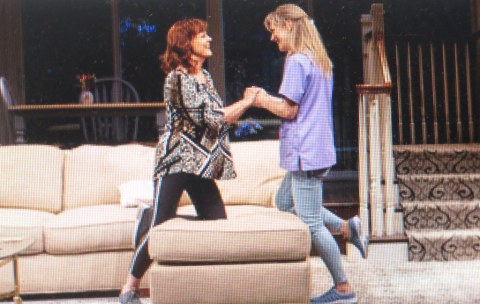
(L to R): Susan Sarandon, Marin Ireland in ‘Happy Talk’ by Jesse Eisenberg, directed by Scott Elliott (Monique Carboni)
As Millan’s Jenny unloads a condemnatory rant in a fusillade of excoriations, with a self-justified tone of recrimination, she announces her permanent move to Costa Rica. Her brief visit to her grandmother and expression of love to Bill are almost ancillary. Her shooting target is Lorraine.
As divaish as Lorraine has been, Jenny assumes center stage; she a drama queen like her mother but with the intention to destroy. She shreds her mother until Lorraine has had enough and kicks her out, but not before Ljuba upbraids her. Nevertheless, Jenny has poisoned the well, and we look at the principals with a different perspective. Perhaps Jenny has clear-eyed vision in her suggestion that Ljuba is too compliant, too congenial in putting up with her mother. Perhaps Lorraine has another agenda in assisting Ljuba to obtain a green card marriage with Ronny.
In this highpoint of the play, the actors’ transformations are nuanced and real. Sarandon’s inner torment and guilt resonate with us and we shift toward her with empathy when she breaks down then recoups to carry on suppressing her pain so she will be able to go on. It’s an important moment during which Sarandon’s Lorraine becomes humanized.
Our estimation of Ljuba steps up when she defends Lorraine against what can only be a described as tragic hatred revealing traumatic hurt that Jenny has experienced growing up with Lorraine as her mother. Since we only hear Jenny’s side and see a humbled, guilty Lorraine who acts like a wounded animal, we cannot divine the truth. But we are on notice and watchful for additional signs of clarification.

(L to R): Susan Sarandon, Marin Ireland, Tedra Millan in ‘Happy Talk,’ by Jesse Eisenberg, directed by Scott Elliott (Monique Carboni)
Ireland and Sarandon play off each other like a chef and a sous chef that reverse the power dynamic now and again. The irony and sardonic humor laden with various tropes of middle class lifestyles gilding the darker aspects a “comfortable” life are jerked back at the end of the play. It is then we see the desperation and understand how economic hardship is the perennial wolf at the door. No amount of well meaning goodness can be sustained when the situation becomes a matter of life and death. Fear, panic and selfishness take over. And to survive, one must go along with what fate has dished up however terrible. When the masks are dropped, all becomes rotten and real and the “happy talk,” ends.
Happy Talk is a must see for the performances and the clever writing which changes on a dime to the unexpected and concludes with searing force into tragic collapse. The characterizations are grounded in the currency of the times and remind us that manipulations and secret agendas seek their own level of opportunity. The victims often have little recourse in the hands of unlikely predators whom one never sees coming.
Kudos to Derek McLane (Scenic Design) Clint Ramos (Costume Design) Jeff Croiter (Lighting Design, Rob Milburn and Michael Bodeen (Sound Design) Leah J. Loukas (Hair, Wig, Makeup Design).
Happy Talk presented by The New Group is at the Pershing Square Signature Center (42nd Street between 9th and 10th) until 16 June. For tickets and times at their website CLICK HERE.
‘Curse of the Starving Class’ by Sam Shepard at the Signature Theatre

Gilles Geary, Maggie Siff in Sam Shepard’s ‘Curse of the Starving Class,’ directed by Terry Kinney, The Pershing Square Signature Center (Joan Marcus)
Sam Shepard’s Curse of the Starving Class which appeared at the Public Theatre and won an Obie for Best New American Play during the 1976-1977 season, has been revived a number of times and is currently part of the Signature Theatre’s legacy program. Shepard often chronicled his family history weaving themes in and out of his “Family Tragedies.” These include dramas that are dynamic, intimate, intense dark plays: the titular play reviewed here, Buried Child (1979) True West (1980) Fool for Love (1983) and A Lie of the Mind (1985).
These dramas with often searing poetic elements and unusual twists, feature violent, dysfunctional familial relationships which are borderline insane but human. The emphasis on the destructive nerve endings of the human condition makes them sardonic and devastatingly humorous. The characters are representative of us, every-women, every-man despite their demographics. In the inner soul of the individuals, there is the same fear, want, loneliness and partition from their families that make them real, heartfelt and tragic. Their human “ilk,” is horrific yet understandable. Shepard’s characterization logic and Director Terry Kinney’s guidance of the actors to achieve these manifestation in this production are just superb.
In this first of the family series, Curse of the Starving Class, we note how a family rooted in farming and the land in rural California attempts to wrangle with their own emotional and psychological demons that have provided a wayward leading inheritance that they must either overcome or succumb to. Though each has the ambition to improve themselves, like Chekhovian characters who are out of place and time, they harbor their dreams while creating elaborate networks of self-destruction that divert their will and thwart their ability to manifest their goals into realities.

Maggie Siff in ‘Curse of the Starving Class,’ directed by Terry Kinney, written by Sam Shepard (Joan Marcus)
By the time Shepard’s characters amass the will and strength to better themselves, they select the wrong path. All ends in failure. Indeed, their own blood family members sabotage any possibility of their improvement. Worsening the situation the saboteurs explode with resentment-filled, passive aggressive rages that harm and incite the downward-spiraling over and over again.
The drama opens with a catastrophic explosion. The outer structure of the house splits apart. It is a symbolic rendering of an ancient and ancestral lesion that is ever-present in the bloodline of the family and can never be healed because there is no attempt to seek an intervention. This explosion reflects the curse of the family that they choose not to expurgate or exorcise because they don’t know how, nor do they have the tools to stop its cyclical repetition. The breaking apart of the house portends the threatening doom for each of the family members.
The lesion/curse is within each of them and spreads the horrific, hurtful, damage outward and among them. This trip wire provokes the other family members’ sadism and from day to night, torment and abuse infects like a poison (Weston, the father discusses this in a central aria) and destroys everything in its path.
In the family. which has managed to share the same space because they are not there together for one whole hour, there are a mother and father and two teenage children. The younger one is the intelligent Emma. The electric Lizzy Declement gives a performance that develops Emma from hope and contentment to resentment, rage, rebellion and spiritual devolvement. The older sibling is the dutiful Wesley who intends to maintain the farm and keep it a going concern despite the worsening conditions Weston’s addictions create. Wesley and Emma have hopes and dreams, though they do not necessarily include the family.
Emma’s efforts creating a school project indicate that she has ambition and the determination to “be somebody” in her life, if she can ever get away from the nullifying family and farm. After her mother and brother destroy her school project, she runs away on a horse that her mom says is crazy. She returns covered in mud and humiliated desperation. The horse (as emblematic crazy as her family) threw her off and dragged her “through the mud.”

(L to R): Gilles Geary, Andrew Rothenberg, Lizzy Declement in ‘Curse of the Starving Class by Sam Shepard, directed by Terry Kenney at the Signature Theatre (Joan Marcus)
This symbolic action forebodes how the family will treat her for attempting to rise above. After this, she makes negative, impulsive choices which will only exacerbate further damage. She and the other family members are practiced at this circularity, directing their decisions and actions from rage, depression and panic, rather than hope and peace.
Wesley (the dynamic and authentic Gilles Geary) who at the outset of the play and through the second act is trying to repair the door his father bashed in during a drunken, “out-of-control” binging rage-on, cares about the farm, the animals and the security of the family. His assiduous attempt to rebuild the door represents his desire to keep out animal or human interlopers and marauders who would steal from them or usurp the inheritance of the land which father Weston’s alcoholism threatens to encourage.
Weston (the superb David Warshofsky) an alcoholic, cannot lift the farm into thriving, organized prosperity. His relationship with his wife is abusive. Weston emphasizes he is a killer in his descriptions to his son about his role as a bombing pilot during the war. Most probably he is suffering from PTSD, though at the time Shepard wrote the play, this condition of returning combat VETS was never acknowledged. However, his entire destructive, hell-raising, yelling fits indicate he is most likely suffering from it. The culture didn’t help him after the war, and it, along with his negative learned behaviors contribute to the root of his self-hatred, despair and inability to get out from under his depressive, alcoholic malaise and lethargy.
Like the other members of her family the mother Ella (Maggie Siff portrays the mother with nuanced reality) negotiates the tense, hyper-aggressive atmosphere that each of them creates. She augments it by living in the fantasy of selling the property and running away. As her business person who would handle her affairs, she chooses a shyster who intends to defraud her.

(L to R): David Warshofsky, Maggie Siff, Gilles Geary, Esau Pritchett in ‘Curse of the Starving Class,’ directed by Terry Kinney, written by Sam Shepard (Joan Marcus)
The key factors that would make her motherly, accountability, a tidy home with food in the refrigerator, nurturing concern about each of the family members are absent. The refrigerator is empty and as she and the others discuss whether they are a part of the “starving class,” we understand that the empty refrigerator is symbolic. The culture at large deprives them of honor and respect and is the antithesis of soul nurturing. Thus, with their own inner weaknesses, it is nearly impossible for them to care for and nurture each other. Like her daughter who intends to escape, Ella plans to sell the house and take the kids to Europe, as fantastical as this dream is.
As Ella attempts to make arrangements behind Weston’s back, Weston, too, in a drunken fit thinks he makes a deal to sell the property and get a lot of money for it, but he is being defrauded. Wesley understands that the predators that want to buy their property will wreck the land, develop it and ruin its beauty while giving them a pittance, if that. The developers represent the meretricious empty mores influenced by the take over of corporate consumerism. And this consumeristic “curse” has displaced the country’s citizens from searching for the more profound values of life and has alienated them from their purpose and place in the universe, replacing it with being the slaves/pawns of wanton corporate America.
Thus, the land that once might have nurtured Weston and the family for a few generations, has been subject to Weston’s inner plague from the war which he attempts to ameliorate with alcohol, but can’t. And he receives no help from the greedy economic predators who see a mark and intend to take advantage of him.
The culture has failed him on many counts that he hasn’t the “where-with-all” to protect himself from the buzzards-the lawyers and real estate developers and thugs (Andrew Rothenberg, Esau Pritchett) who have entangled Weston with loans that they will extort and bully back from him. Any money that Weston gets from the sale of the property once his debts are paid off and the developers or other predators are done with him, will result in a negative balance.

(L to R): David Warshofsky, Gilles Geary in ‘Curse of the Starving Class,’ by Sam Shepard, directed by Terry Kinney (Joan Marcus)
Thematically, this production soars for its reality, authenticity and raw power. The Scenic Design by Julian Crouch is truly amazing in its functional and thematic purpose. The refrigerator is filthy; one wonders that the food kept in it is sanitary when it is eventually stocked. This adds to our horrified amazement when the starving Wesley ravages all the food in it after he kills the lamb with the intention of eating it. Indeed, his starvation as a member of the “starving class” represents the emotional hunger all of the family experience that manifests as ravenous physical hunger.
Though he and the others complain about not having food in the refrigerator, this “starvation” is not literal, it is soul starvation, spiritual starvation, cultural starvation. The society at large is responsible for this as Weston states and as Ella infers in her desire to go to Europe to escape; indeed, Europe is a place that is culturally rich and can provide unique stimulation.
Sadly, their daily lives have little spiritual or psychic sustenance and when Wesley and Emma attempt to satisfy their inner longings with hope, the other family members come around and either take it away (as Weston/Ella do in attempting to sell the farm) or piss on it (literally, in the case of Emma’s project which Wesley ruins with his urine).
Shephard shows that his characters are so deprived and so used to being deprived and “starving” they starve themselves and each other of love, familial companionship, warmth, compliments, joy, humor, the list is long and comprehensive. As a representative family in this country after WWII, they manifest the status quo. And this is so regardless of economic class, though Shepard uses them, a lower middle class family, to illustrate his themes which actually transcend class when they are viewed from a more profound level.

Maggie Siff in ‘Curse of the Starving Class,’ directed by Terry Kinney, written by Sam Shepard (Joan Marcus)
The acting of the principals is spot-on, moment-to-moment. All of them hit the bulls-eye as they evoke our empathy, pathos, fear, disapproval, shock and horror. The climax is particularly upsetting, but it is also understandable. All are responsible and have contributed to each other’s demise. As they pursue their own desperate goals and desires to escape from their inner masochistic, nihilistic impulses, they collapse in on themselves. Because they are not nurtured to do so, they never reach out to help or to receive help from those who might take them out of their misery.
Terry Kinney guides this production meticulously and has found the right artistic designers to collaborate with to portray Shepard’s tragic almost nihilistic vision from which there is no escape. The costume design by Sarah J. Holden, the lighting design by Natasha Katz, the sound design and original music by Rob Milburn and Michael Bodeed (just wow) and William Berloni’s lamb round out this production and do justice to Shepard’s legacy as a playwright uncovering the underbelly of this nation’s ills in this family microcosm.
Curse of the Starving Class runs with one intermission at the Pershing Square Signature Center on 42nd Street between 9th and 10th. It has been extended until 2nd June. For tickets and times CLICK HERE.
‘Feral,’ Brits Off Broadway at 59E59 Theaters

‘Feral’ devised by Tortoise in a Nutshell and directed by Ross MacKay, produced by Tortoise in a Nutshell / An Original Co-Production with Cumbernauld Theatre for Brits Off Broadway at 59E59 Theaters (Amy Downes)
Tortoise in a Nutshell, an Edinburgh-based visual theater company has finally been able to coordinate with 59E59 Theaters for its 2019 Brits Off Broadway season. The company, which first premiered Feral at the 2012 Edinburgh Fringe Festival, is a multi-award-winning group which combines film, and digital theatricals. These include watching the technicians as performers create a show with pre-set miniature pieces which they then animate to tell a story.
The company which travels far and wide and has presented its works not only in the UK, but also in Denmark, Austria and Mexico enjoys creating productions that are unique, innovative and impossible to categorize. Feral in its U.S. Premiere is one such production that combines a use of miniature puppetry, small digital video cameras, live camera action projected on a screen. The productions include background lighting of the set pieces and sound effects as well as a mixed musical score that enhances the story-telling.

‘Feral’ devised by Tortoise in a Nutshell and directed by Ross MacKay, produced by Tortoise in a Nutshell / An Original Co-Production with Cumbernauld Theatre for Brits Off Broadway at 59E59 Theaters (Amy Downes)
Feral, which Tortoise in a Nutshell is presenting in an original co-production with Cumbernauld Theatre, focuses on a family. Sister Dawn, brother Joe and their mum live in a town by the sea. They are symbolic and representative as is their town whose “town fathers” decide to allow developers to come in and open a “Supercade.”
What happens as a result of this development becomes disastrous. The picturesque landscape eventually is marred by the types of people who come to the “Supercade.” The quaint shops and daily life of the town’s citizens are wrecked and increasingly law enforcement must be called in to stop muggings, thefts, violent crimes, sexual assaults and general vandalism that occurs. Additionally, it is suggested that the developers used chicanery to bribe the officials or worm their way into the area. This corruption has been overlooked and the Supercade occludes everything. Though we don’t know whom, someone has probably become very rich at the expense of the citizens undermining the tenor and gracefulness of a once peaceful place.

‘Feral’ devised by Tortoise in a Nutshell and directed by Ross MacKay, produced by Tortoise in a Nutshell / An Original Co-Production with Cumbernauld Theatre for Brits Off Broadway at 59E59 Theaters (Amy Downes)
The townspeople attempt to protest what is going on to little effect. And the once lovely beginnings have tragic endings as the wildness in human nature takes over spurred on by the Supercade. However, the production doesn’t end on a completely nihilistic note. There is always hope.
The ingenuity of Feral is not in the “what” but in the “how.” Process is everything with this theater company. The miniatures used are tiny by comparison to average sized puppets. This enhances our interest in them. The model town is all of a piece, the same type of delicate architecture and color and made from the same materials. The beauty of this work is in how the collaborators put the setting together and effect the characters operation in it.

‘Feral’ devised by Tortoise in a Nutshell and directed by Ross MacKay, produced by Tortoise in a Nutshell / An Original Co-Production with Cumbernauld Theatre for Brits Off Broadway at 59E59 Theaters (Amy Downes)
It takes a while for the town and its individuals to be introduced by the cast (Alex Bird, Jim Harbourne, Aaran Howie, Matthew Leonard and Ross Mackay) who build the setting with the houses and shops and then place the inhabitants in their appropriate settings or work the music and background sound effects. This set-up is an important part of the presentation because we see the Hair Shop, the Bakery, the Lighting Shop, the Church, etc., the typical patrons and even some of the animals as familiar, homely residents. We readily identify.
As the cast completes the initial set it up, we do appreciate how adorable the miniatures appear and the camera work that focuses on them in close-up so that we are present on the same level with the characters. Thus, we become a part of what can only be described as a sweet, functioning, bucolic, little piece of heaven where the inhabitants are contented and enjoy their placement there in the universe.

‘Feral’ devised by Tortoise in a Nutshell and directed by Ross MacKay, produced by Tortoise in a Nutshell / An Original Co-Production with Cumbernauld Theatre for Brits Off Broadway at 59E59 Theaters (Amy Downes)
However, we only see the externals. The presentation never proceeds into anything deeper within the individuals. It is a parable with a larger symbolic focus, that of the microcosm reflecting the macrocosm. In miniature, the cast, creative team and production team have engendered what happens when a town’s equilibrium is upset by development that has, at its basis, corruption and malfeasance. And when the goals do not align with human beings’ needs, desires and well being, catastrophe occurs.
In Feral the wild impulse is diverted in the goal to make money without consideration for how the “development” whether it be digital-technological (the iPhone, Facebook, Amazon) or a material “play-land,” “Gentleman’s Club” or casino will impact the community at large. Thus, we understand that the inhabitants are acted upon by unforeseen forces that in the guise of “developmental prosperity” actually foment destruction as a by-product. The wild impulses the entertainment is designed to exploit for money overwhelm. Once the Supercade opens, entropy lopes in and takes over.
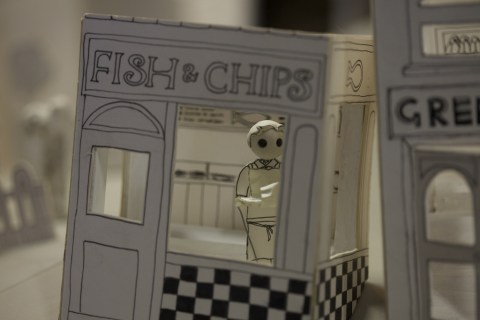
‘Feral’ devised by Tortoise in a Nutshell and directed by Ross MacKay, produced by Tortoise in a Nutshell / An Original Co-Production with Cumbernauld Theatre for Brits Off Broadway at 59E59 Theaters (Amy Downes)
Feral is obviously a labor of love by the creative team: Amelia Bird (Scenic Design) Simon Wilkinson (Lighting Design) and Jim Harbourne (Original Music and Sound Design) and theri director Ross Mackay. Their innovative, human-friendly designs immediately convey the audience into the creators’ world of imagination. To its credit, the designers work to make the audience an integral part of the ongoing events as the camera angles move our vision from a distant perspective closer and closer into Dawn’s and Joe’s house to see their kitty cat and close to see the interiors of the various shops. The camera moves our vision into the beauty parlor, around the park and pier and into an adorableness that includes our watching a cute squirrel fed daily by the pastor of the town church.
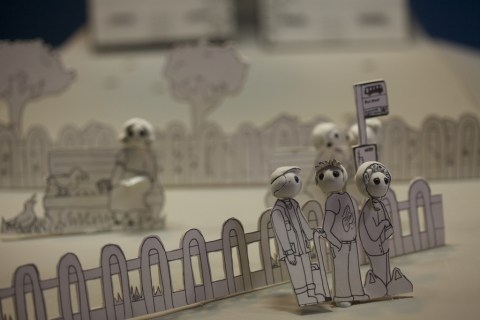
‘Feral’ devised by Tortoise in a Nutshell and directed by Ross MacKay, produced by Tortoise in a Nutshell / An Original Co-Production with Cumbernauld Theatre for Brits Off Broadway at 59E59 Theaters (Amy Downes)
Thus, as we identify with this mini corner of the universe, we are engaged and become concerned when the “Supercade” is built despite protest. Most probably money changes hands surreptitiously for the entertainment palace to be built. It is then the themes shift to the macrocosm as we consider what has transpired in the last 10 years almost exponentially along waterfronts and elsewhere.

‘Feral’ devised by Tortoise in a Nutshell and directed by Ross MacKay, produced by Tortoise in a Nutshell / An Original Co-Production with Cumbernauld Theatre for Brits Off Broadway at 59E59 Theaters (Amy Downes)
Such displacing, nefarious development is happening in too many cities and towns across the globe. Those who have the most to lose are overcome by those who have the money and power to do what they want and not be held accountable for the damages. Indeed, though it is not clear in this production, most developers live in their own bucolic paradise surrounded by three-acres, with security teams, gates and high walls to keep out the “riff-raff” whom they prey upon to fund their selfishness, the “riff-raff” being these townspeople who just want to live life with some modicum of happiness..
Feral is imaginative, particular and profound if not disconcerting. The creators’ process is complicated but it delivers a simple metaphor of our times in identifiable human terms. Bravo to both the creative team listed above and the production team Andrew Gannon (Technical Diretor) and AEA Stage Manager (Alyssa K. Howard).
Tortoise in a Nutshell’s Feral runs for 50 minutes with no intermission at 59E59 Theaters until 9 June. For tickets and times go to their website by CLICKING HERE.
‘Fiddler on the Roof,’ in Yiddish, a Powerhouse of a Production

Steven Skybell, ‘Fiddler on the Roof’ in Yiddish, Joel Grey (Matthew Murphy)
When Fiddler on the Roof premiered on Broadway in 1964 (winning 9 Tony awards) it took the theater world by storm and the larger world with gradual stealth augumenting to an avalanche of global premieres and subsequent revivals. With the original cast starring the wildly zany Zero Mostel as Tevye the milkman, the wryly funny Bea Arthur (the future Golden Girl) as Yente, and Austin Pendleton as Motl Kamzoyl, the Tailor, the production was set in humorous stone and held a warm place in countless hearts. It ran with various casts for nearly eight years, went on tour and was made into an Oscar winning film.
Since then Fiddler (Book by Joseph Stein, Music by Jerry Bock, Lyrics by Sheldon Harnick) has been in revival mostly every year either in the U.S. or somewhere in the world in high schools, colleges or regional theater. The most recent revival landed on Broadway (2016) in a stellar production starring Danny Burstein with an emphasis on the poignant issues enveloping growing populations of displaced refugees and immigrants.

(L to R): Raquel Nobile, Rosie Jo Neddy, Rachel Zatcoff, Stephanie Lynne Mason, Samantha Hahn, ‘Fiddler on the Roo’ in Yiddish, directed by Joel Grey (Matthew Murphy)
Accordingly, the revivals reflect the times and the current social attitudes. Into this day that echoes anti-semitic chants, “Jews will not replace us” by white supremacist marchers in Charlottesville, Virginia and recent attacks against US synagogues, comes a revival of Fiddler on the Roof in Yiddish that is monolithic. The Yiddish National Theatre Folksbein’s production in Yiddish has supertitles in English and Russian. In its authenticity of language and grounding in the ethnicity inherent in Sholem Aleihem’s source material on which it’s based, the production which effuses the choreography of Jerome Robbins with Staś Kmieć’s additions, is one for the ages in its transcendent humanity and spiritual resonance.
What is it about this Fiddler that is unlike all others? Directed by the superb, insightful Tony/Oscar award winner Joel Grey, the production is a moral imperative! It is for our time and all time in its simplicity, grace and spare, unadorned beauty and emotionally taut, intimate, soul crushing power.

Steven Skybell, ‘Fiddler on the Roof’ in Yiddish, directed by Joel Grey (Matthew Murphy)
Grey’s vision personalizes and authenticates the complexity of faith as it moves Tevye (an unparalleled Steven Skybell) through the challenges of negotiating the daily uncertainties of life in a rapidly changing world, while retaining the core values of his religious beliefs that have been codified for thousands of years (exemplified in the gorgeous number “Shabes Brokhe” (Sabbath Prayer).
Tevye’s, is the iconic hero’s journey of life’s rhythms, of the wheel and woe and back again. By distilling the musical to its most searingly gut-wrenching, basic elements, Grey has elevated Tevye and his family to a timeless universality. With levity and poignancy Grey stirs us to empathize with the characters’ plight, as we experience the “happiness and tears” reflected throughout and especially in the song “Tog-any, Tog-oys” (“Sunrise/Sunset”). The number, rendered with sonorous beauty by Tevye, Golde (the golden, lyrical soprano Jennifer Babiak) and the company just before the Russian officials effect a mini-pogrom is a harbinger of things to come.
Tevye and his family and village speak in Yiddish though at the time in a place like “Anatevke” (Anatevka) they also most probably spoke German and Russian as well. An interesting derivation turns up in the song Tevye sings to his God, “Ven ikh bin a Rotshild”) the translation of which is “If I Were a Rothchild.” The irony of Tevye’s dreaming to be like the uber wealthy Rothchild banking family who were also Jewish is hysterical. Would he sacrifice his faith for money? Would he have to? Indeed! Skybell’s rendition of this funny, poor man’s lament to God is priceless.

Jackie Hoffman as Yente in ‘Fiddler on the Roof’ in Yiddish, directed by Joel Grey (Matthew Murphy)
The question becomes: is the Yiddish a distraction making it more difficult to engage with the characters? The irony is we pay attention because the language is unfamiliar and we must not take anything for granted. As we begin to pick up words read from the supertitles on panels to the right/left of the stage, we connect with another time and place, which materially is unlike our own, while discovering that the characters symbolically represented are like ourselves.
The supertitles in English and Russian from the Yiddish Translation by Shraga Friedman (first performed in Israel in the 1960s) reinforce our understanding along with the actors’ gestures (Skybell is particularly superb) expressions and crystal clear intentions. The ensemble is letter perfect in its portrayals. Additionally, Yiddish is one of the most onomatopoetic of languages; its very sounds convey the meanings which we counterintuitively glean. During the song and dance numbers, the plosive consonants and guttural, rolled rrrrrs express a vibrancy and excitement which adds to their energy and joy.
Of course, it helps that the actors are wholly present and “in-the-moment.” The audience can’t help but be engaged and enthralled as we employ more of our senses, so as not to miss a word or thought for fear of losing out.
Importantly, Joel Grey has brilliantly shepherded this production and has acutely grounded it in the power of fundamental principles of equanimity. We are precisely aware that the production’s underscored intrinsic values encourage all people to overcome and move through the dark times. These are the basic truths which we cling to as we live our lives in Anatevke, Russia 1905 or NYC 2019. In this essentially clear-eyed, genuine, heartfelt production, faith and love emerge like pillars of fire; they guide Tevye and his daughters, and drive the arc of the play’s development.
During the course of the play Tevye learns ancient faith and modern love are not mutually exclusive; they are one. Steven Skybell’s Tevye (Skybell’s is an inspired, precise, brilliant portrayal of the witty journeyman) exercises faith daily in his discussions and personal relationship with God. Love, Tevye discovers by witnessing how it blossoms in his daughters’ lives and marriages. In a touching moment that lingers with sweetness Skybell’s Tevye and wife Golde (Jennifer Babiak) sing about what love is in their personal relationship. “Libst Mikh, Sertse?” (Do You Love Me). They discover that they have been bonded in love which has provided the security and contentment which helps them weather a hardscrabble existence, partners to the last.
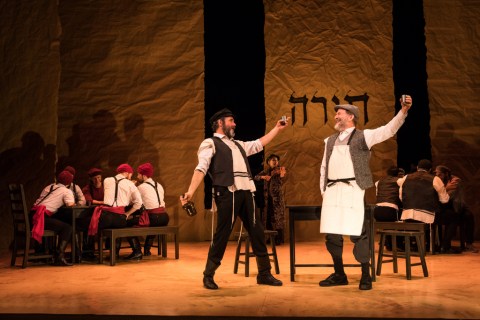
Steven Skybell, Bruce Sabath in ‘Fiddler on the Roof’ in Yiddish, (Matthew Murphy)
Both faith and love embody the instrumental forces which drive the uneducated milkman and his family toward hope despite uncertainty. By the conclusion of the production, we understand that only with faith and love can they confront the anti-semitism of the Russian Orthodox community which fearfully has expelled them. Only with faith and love can they move on stoically without bitterness, believing that it will be better in their new home in America because they have each other. And Tevye, by keeping his fervent relationship with God, will continue to keep his balance as “a fiddler on the roof” despite the precarious times they will face in the new world with possibly more persecution and discrimination.
Wisely, Grey strips all unnecessary elements that Fiddler on the Roof might represent as a “Broadway show,” and solidifies the themes and alternating tenor and moods of laughter and sadness with a minimalist set, whose backdrop of parchment and cloth panels retains the most important word in the play and the only word which is not in Yiddish.
It is in Hebrew, painted in black Hebrew letters across the central banner. And it symbolizes what in effect Tevye looks for when he talks to an invisible God whom he must believe hears him and through received wisdom, answers Tevye. It is the Hebrew word signifying The Torah, God’s truth, God’s guidance to navigate a world which is in constant upheaval and is often hostile. It is particularly during intimate and animated discussions with God that Skybell’s Tevye depends upon his faith to provide the enlightenment he needs to make the right decisions for himself and his family. Every one of these discussions Tevye has, we believe that he believes God listens. These conversations imply the depth and irrevocability of Tevye’s faith and are a crucial part of the profoundness of this production.

Bruce Sabath, Kirk Geritano, Lauren Jeanne Thomas, Michael Einav, Mikhl Yashinsky, Adam B. Shapiro, Bobby Underwood, DRew Seigla, Steven Skybell, Fiddler on the Roof in Yiddish, Joel Grey (Matthew Murphy)
But faith is a private matter between a man and/or woman and his/her God. So Tevye to explain himself in communal terms that relate to the society in which he lives, employs the simile to explain how he withstands his hard scrabble life. He does it precariously like “a fiddler on the roof” while conveying a bit of his own musical identity. And he’s able to stand living on the edge because of “one Torah, one God, one word…tradition.” As the ensemble joins in the song”Traditsye” we are introduced to Tevye’s ethnic cultural folkways that have existed in Anatevka for generations. We presume these “traditions” are reflected in The Torah.
Interestingly, during the course of the play, we, Tevye and the community learn that the folkways of Anatevka are not necessarily God’s ways of the Torah. In fact, they can be abused and lead to misery, as even Yente implies with her unhappy marriage and as we discover with the other unhappy marriages in the village, i.e. Leyzer-Volf’s marriage to Frume Sore who was a bitter woman. In fact, we and Tevye learn there can be happiness in marriage if there is love. And that is what God is all about.
As Motl (the fine Ben Liebert) suggests with wisdom given to him by Tsaytl (Rachel Zatcoff), “even a tailor deserves a little happiness.” Tevye after an enlightened discussion with God, and his daughter and Motl, throws off a stubborn adherence to Anatevka’s folkways, and follows a greater wisdom and acceptance because he loves his daughter and wants her to be happy in her marriage to a man she loves.

Steven Skybell, Company, ‘Fiddler on the Roof’ in Yiddish, directed by Joel Grey (Matthew Murphy)
Reinforcing that love is God’s way, Motl’s faith is strengthened. Having the courage to stand up to Tevye and step out in faith for Tsaytl’s hand is miraculous, like the Biblical miracles (manna in the wilderness, etc.). He sings the vibrant “Nisimlekh-Veniflo’ oys” (Miracle of Miracles), the greatest miracle being that God has made the way for him to marry Tsaytl, serving as a beacon of light for the rest of the town.
To assuage and convince Golde of the rightness of this decision, Tevye has “Der Kholem” (The Dream). With the skills of this adroit company, in one of the marvelous highpoints of the production. Frume Sore is a larger than life spirit, a fiend (on stilts) with oversized body looming in a shrouded, wild costume, witchy hands, wild hair and exaggerated, ghostly make-up. She is wonderful and the company echoes her screams and questions with humorous frightfulness. As Tevye recounts the dream and the ensemble enacts it, Frume Sore portends a curse on Tsaytl if she marries Leyzer-Volf. It is so horrifying, Golde wants her daughter to avoid any curse; and receive the blessing her sweet spirit ancestor bestowed on the marriage. In this incredible scene, the traditional folkway of the matchmaker making a match is vitiated and love becomes the preeminent value.
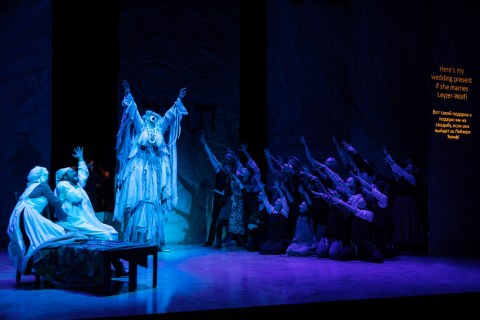
(L to R): Steven Skybell, Jennifer Babiak, Jodi Snyder, Frume Sore and Company, Fiddler on the Roof in Yiddish, Joel Grey (Matthew Murphy)
This production clearly makes a distinction between faith of the Torah and folkways of Anatevka. Grey beautifully effects this through lighting, Skybell’s forceful discussions with his God, the sets (the backdrop panels) and the staging. Tevye’s faith and relationship with the God of The Torah who gives enlightened wisdom is not the same as the ancestral cultural folkways of Anatevka which have sprung up and been integrated from the surrounding society for economic purposes.
The learned Pertshik (the wonderful Drew Seigla) infers that love supersedes the matchmaker Yente (the wry, saleswoman of unappealing spouses-Jackie Hoffman). The Rabbi indirectly affirms this at the wedding at Tevye’s insistence by wisely not ruling on it. Nevertheless, the underlying message is that matchmakers are not in the Torah; God puts love in the hearts of people for each other. Tevye later confirms for Pertshik’s future marriage with Hodl, the old ways don’t apply as he evokes the metaphor of Adam and Even whose matchmaker was God. Another tradition that has little to do with the Torah is mixed dancing. Petshik dances with his beloved Hodl declaring it is not a “sin” which the Rabbi confirms. It is not in the Torah (the guide). And the men and women dance inspired by Tevye and Golde to initiate the dance which begins and incredible dance celebration at Tsaytl’s and Motl’s wedding.
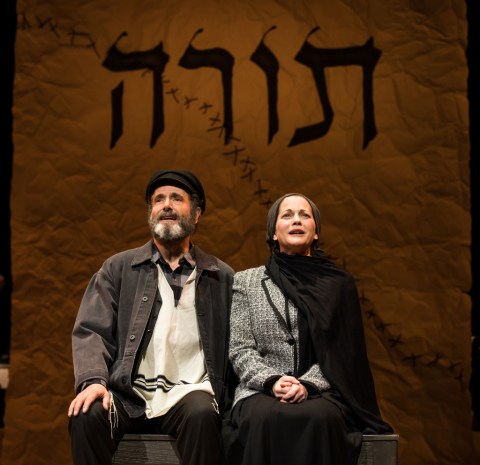
Steven Skybell, Jennifer Babiak, ‘Fiddler on the Roof’ in Yiddish, directed by Joel Grey (Matthew Murphy)
Grey’s genius in selecting the painted Hebrew word “The Torah” as the focal point of the setting is so logical it’s breathtaking. The symbolism is magnificent. Not only is Tevye guided by his faith in God during trying times when the traditions they have followed for centuries are being overthrown by modernism. We, likewise, are being instructed in Tevye’s trials of faith. We, too, receive the wisdom he gains after he wrangles with God over vital decisions concerning his daughters’ marriages.
Indeed, this overarching theme of The Torah, God’s guidance, is present throughout as the panel never moves, never is taken down. That is why when the Russian constable comes in and his officers wreck the celebration and one of them tears the panel with the word Torah, it is horrifically chilling. To not be able to actively practice their faith threatens their ethos; they will be evicted. But why stay in a place tears out the very fabric of who they are? Though in the next act the panel has been sewed where it has been ripped, “the handwriting is on the panel.” The warning the constable has been giving to Tevye is coming to pass. And not even Khavele’s (Rosie Jo Neddy) relationship with Russian Orthodox Fyedke (Cameron Johnson’s dancing is spectacular) can save Tevye and the community from eviction.

Steven Skybell in ‘Fiddler on the Roof’ in Yiddish (Matthew Murphy)
This blow to his relationship with God, Tevye cannot brook. That his daughter would be with one of that faith is a death. This is not a custom, this goes much deeper and is a great trial. However, Goldie and his daughters will work on him, as is obvious when they say goodbye. Meanwhile, the dance sequence as Tevye mourns the loss of Khavele in the song “Khavele” (Khavele) is beyond poignant.
Every decision Grey has made informs the profound themes in this work and emphasizes what is vital for life to thrive despite loss. This is exemplified in the simple, uniform, dark tables and chairs which structure the scenes in Tevye’s home, the wedding hall, Motl Kamzoyl’s shop, the Russian/Jewish mixed cafe where Tevye meets Leyzer-Volf and they sing the marvelous “Lekhayim” (To Life, Lekhayim) and the Russians join in with vigorous, athletic dancing that is so joyful and celebratory, that for a tiny moment we actually think that the Russians and the Jews can have peace. Also the accoutrements-props, like candles, a washbasin, drinking glasses, the milk pales and cart-without a horse, etc., are used to round out the action when needed.
The message is clear. The material objects of life are movable and transient. The Torah, God’s guidance is forever for those who seek it and believe they receive His answers, as the vibrantly alive, humorous, enthusiastic “man for all seasons,” Steven Skybell’s Tevye believes he does.
Another superb element of this production is the use of the lovely fiddler portrayed by Lauren Jeanne Thomas whose portrayal is not to be underestimated, but is beautifully soulful and evocative. When Tevye is having a crisis and must go to his God for a talk, the nimble, sylph-like graceful Der Fidler (Lauren Jeanne Thomas as the fiddler) leans in slyly, sweetly and dances around Tevye as her playing soars with the poignance of the melody of “Traditsye,” as the music swells with the custom which is falling away. These moments are absolutely heartbreaking for Tevye must call upon his faith to guide him through the uncertainty, confusion and darkness. And of course as they leave Anatevke singing their song about a place they’ve identified with and can do no longer, Tevye motions for the Der Fidler to go with them. The customs of the Russian village they leave behind. But The Torah, God’s guidance is with them forever.
The production is a spiritual revelation that is extraordinary and miraculous. Special kudos to the orchestra, conducted by Zalmen Mlotek and Associate Conductor Andrew Wheeler. Just wow.
Fiddler on the Roof in Yiddish runs with one intermission at Stage 42 (42nd St. between 9th and 10th) until 5 January. For tickets and times go to the website by CLICKING HERE.
‘The Plough and the Stars’ by Sean O’Casey, the Sean O’Casey season at the Irish Repertory Theatre
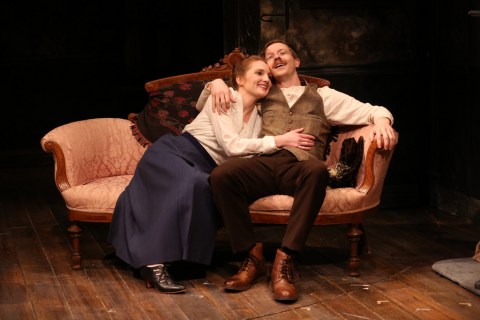
Clare O’Malley, Adam Petherbridge, Irish Repertory Theatre’s ‘The Plough and the Stars’ (Carol Rosegg)
When it premiered at The Abbey Theatre in 1926, The Plough and the Stars initially opened to acclaim. However, word got out that O’Casey had written a play critical of Irish nationalism and religion, and the acclaim turned to disapprobation. O’Casey elected to focus on the hapless Dubliners, many women and children, who had been swept up in the bloodshed of the Easter Rising of 1916. During the five days of fierce fighting between the British and the Irish Citizen Army and Irish Republican Brotherhood, the British who had brought in heavy artillery, machine guns and bombshells with over nine times the troop strength of the Irish converted central Dublin and the tenements where citizens lived into a war zone. Because of the hundreds of citizen fatalities and thousands injured, the Irish rebels surrendered to save the city. The British took revenge with arrests and summary executions of the organizers, sealing the ill-will of Ireland and guaranteeing the irrevocability of Irish Independence.

Maryann Plunkett, Clare O’Malley, Irish Repertory Theatre, ‘The Plough and the Stars,’ by Sean O’Casey, directed by Charlotte Moore (Carol Rosegg)
In this last production of the Dublin Trilogy, the Irish Repertory Theatre, which has presented an amazing season of Sean O’Casey’s works, ends with its most masterful and emotional production to date. Directed by Charlotte Moore, O’Casey’s The Plough and the Stars remains a sterling and representative human drama that soars into the heavens with the timeless message that there are no victors when members of the human family take up arms and kill each other. Assuredly, it is the innocent trying to make it to the next day, who become the casualties of violent conflicts. Those who die achieve a final peace; the living have to deal with the horrible memories and consequences of the aftermath of war.
The actors expertly shepherded by Moore effect O’Casey’s themes with emotional grist and power. As an ensemble their work together is exquisite, paced, focused, present. Because of their attention to moment-to-moment living onstage, the impact that rises from scene to scene and especially in the last scenes when the conflict and suspense are greatest are breathtakingly real and tragic.

James Russell, Irish Repertory Theatre’s ‘The Plough and the Stars,’ directed by Charlotte Moore, written by Sean O’Casey (Carol Rosegg)
The play follows the homely interactions of tenement dwellers in the latter part of 1915 and during the Easter Rebellion of 1916. These scenes of the every day lives of the tenement dwellers draw our empathy. In their discussions we become apprised that there are marches and meetings of various Irish groups who are gathering to amass political sentiment in support of the hoped for Irish rebellion and move toward independence. The meetings which have gained fervent advocates eventually come to a head and the play’s action shifts to events in Dublin during Easter Week 1916. It is then that O’Casey most acutely and poignantly reveals how these horrific events impact the lives of the Dubliners who live and hide in the tenements as they are shelled, shot at and warred against by the British Tommies who attempt to quash the rebellion.
In the first part of the production we note how O’Casey illustrates the divisions among the Irish citizens living in one lower middle class Dublin tenement. These characterizations develop and remain the focal point of the play. Some of the Dubliners have antithetical political affiliations like protestant, pro-British Bessie Burgess (the wonderful Maryann Plunkett who gives a heartfelt, frenzied, emotional portrayal throughout). Bessie’s son fought and died with the British as a Dublin Fusilier during early battles of The Great War. Her expressed rage and fury at the supporters of Irish Independence is understandable, though the other tenants think she is loathsome. Indeed, by the play’s end O’Casey’s twist of characterization proves her a formidable human being; and Maryann Plunkett brings this out in spades.

(L to R): Michael Mellamphy, Sarah Street, Harry Smith, Robert Langdon Lloyd, Irish Repertory Theatre’s ‘The Plough and the Stars,’ by Sean O’Casey, directed by Charlotte Moore (Carol Rosegg)
Others, like fiesty Peter Flynn (the humorous Robert Langdon Lloyd), the life-worn Mrs. Gogan (the fine Una Clancy) and Fluther Good (Michael Mellamphy is spot-on in his rousing portrayal of the carpenter who represents the typical working man) empathize with the Irish cause of independence as Catholics. Meanwhile, The Young Covey (the excellent James Russell) is the critical, anti-religious, acerbic intellectual who strafes the cause of independence with his caustic remarks. He is frustrated that the socialist cause he advocates has been redirected from the Worker’s of the World uniting to overthrow the capitalistic system.
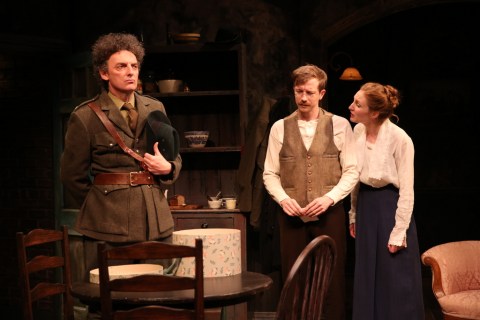
(L to R): John Keating, Adam Petherbridge, Clare O’Malley, Irish Repertory Theatre’s ‘The Plough and the Stars,’ by Sean O’Casey (Carol Rosegg)
Much of the humor in the first part of the play centers around O’Casey’s identification of the cross section of individuals who are disparate from one another in beliefs, religion and intellectual ethos. Yet they live in Dublin tenements and make up the culture and society of the city as they remain economically oppressed and without a voice in the government. We laugh as they carp and criticize each other to the extent that one wonders how the country will unite against the British at any level. Into this convulsed and funny hodgepodge of characters come the newly weds, the sweet, romantic Nora (Clare O’Malley gives a fervent, emotional and powerful performance throughout) and husband Jack (the sensitive and forceful Adam Petherbridge) who eventually, despite Nora’s surreptitious attempts to prevent this, is proudly made Commandant in the Irish Citizen Army.

(L to R): Meg Hennessy, Clare O’Malley, Irish Repertory Theatre’s ‘The Plough and the Stars,’ by Sean O’Casey (Carol Rosegg)
Jack, infuriated that Nora withheld information of his promotion out of fear for his death, argues with her vehemently. Indeed, her self-interest and duplicity push him right into the arms of his mates. The scene where she admits she lied is dynamic and powerful. O’Casey’s characterizations are authentic and the actors (O’Malley and Petherbridge) are so letter perfect that we imagine such scenes playing out in households throughout Dublin and in a universal sense that this occurs in every war fought regardless of politics or nation. The timeless quality of war as a sacrifice of innocents is everpresent and beautifully rendered thematically in this scene.
As Young Covey, Fluther and Flynn meet and have drinks in a Public House after listening to speakers and continuing to listen to them from inside the pub, we meet additional Dublin denizens who will be impacted by the coming rebellion. These are the “lady of the night” Rosie Redmond (Sarah Street) and the Bartender who also plays Sargent Tinley (Harry Smith). In this interlude at the pub, the tension outside is rising and we note the success of the march and the rousing political speeches meant to mobilize the crowds.

Adam Petherbridge, Clare O’Malley, Irish Repertory Theatre’s ‘The Plough and the Stars,’ by Sean O’Casey (Carol Rosegg)
When Jack and his mates come into the pub and conclude the scene with their nationalistic cries, they wave the flag (The Plough and the Stars, and the Tricolor Flag of Irish Independence). As these volunteers uphold their allegiance to a free Ireland, they put their family, wives and homes second. Nora is abandoned and forgotten as Ireland becomes Jack’s family.
In the next scenes that take place during the Easter week, April 1916, the irony of Jack’s heady, ebullient nationalistic sentiment is pitted against the frightful horrors that these volunteers and tenement dwellers face in the violence during the five days they confront heavy artillery and machine guns. The booming sounds are heard in the distance. Nora who looks for Jack to bring him home (an ignominious, selfish and cowardly action from Jack’s perspective) proclaims that she sees the fear in the Irish soldiers’ eyes while the soldiers she meets tell her she is shaming Jack.

(L to R): Una Clancy, Maryann Plunkett, Irish Repertory Theatre’s ‘The Plough and the Stars,’ by Sean O’Casey (Carol Rosegg)
In this fabulously directed scene that is tense, frightful, poignant and rage-filled, Nora struggles physically with Jack to keep him with her. And Bessie screams epithets and insults at Jack, Captain Brennan (John Keating) and the wounded dying Lieutenant Langon (Ed Malone). At the height of the drama, Jack berates Nora for attempting to keep him from fighting the cause, then he and the others leave to look for a doctor. Bessie who has a turn of empathy for Nora brings her safely inside, then runs for a doctor to help Mrs. Gogan’s dying daughter Mollser (Meg Hennessy). Kudos to the superb ensemble and the principals whose urgency and focus create the incredible tension in the scene. The audience is enthralled throughout.
As marvelous as Act III is, O’Casey’s climax in Act IV is without parallel and Moore and the actors are beyond exceptional in bringing the conclusion to its final glowing draw-down. O’Casey hammers his themes. These, he has seeded earlier in the play. In the final act they foment with the growing chaos which sweeps up various individuals unwittingly caught in the rebellion, i.e. The Woman from Rathmines (Terry Donnelly). Everyone who can be represented is. O’Casey reveals the tragedy and futility of innocents dying as they are mistaken for “the enemy.” In this last act of this most incredibly paced and dramatically written of his plays, we understand the genius of his message to humanity, which has been ignored and will continue to be ignored long into the next century.
There is no spoiler alert. You will just have to see how the conclusion unfolds ironically in this must-see production which is truly magnificent and fiercely trenchant and timely. I cannot praise this production with high enough encomiums for the director and cast except to say it will be a damn shame if you miss it.
Charlie Cororan (Scenic Design) Linda Fisher and David Toser (Costume Design) Michael Gottlieb (Lighting Design) Ryan Rumery and M. Florian Staab (Sound Design) and Ryan Rumery (Original Music) and others on the artistic team do a superb job in bringing about the authenticity of this production.
The Plough and the Stars (with one intermission) and the entire Dublin Trilogy can be seen until 22nd June at the Irish Repertory Theatre (132 West 22nd). For tickets and times go to the website by CLICKING HERE.
‘King Lear’ Starring Glenda Jackson, a Royal Performance at the Cort Theatre

John Douglas Thompson and Glenda Jackson in ‘King Lear,’ directed by Sam Gold (Brigitte Lacombe)
William Shakespeare’s King Lear directed by Sam Gold is a must-see for its principal performances and its particular, stylized artistic design (scenic, sound, costume) which cleverly emphasizes the themes, symbolism and metaphors of the play. Above all, you should not miss Glenda Jackson who is a gobsmacking dynamo as the king who throws off the shackles of corruption and confronts his mortality to gain the wisdom of foolishness.
Jackson fits the titular role like it is made of her own flesh. This is a “once upon a lifetime” production that is astute, profound, if sometimes opaquely realized with regard to integrating Philip Glass’ music. Nevertheless, the director’s vision and design suggests overarching themes about appearance vs. reality, lies vs. truth, duplicity vs. authenticity, wisdom in madness and madness in wisdom.
Throughout, Jackson is a magnificent, who always rises to perform with sentience and power. Her Tony award winning portrayals in Edward Albee’s Three Tall Women last year were unforgettable. Likewise, her performance in King Lear follows with equal ferocity and fervor.

Pedro Pascal, Jayne Houdyshell in ‘King Lear,’ directed by Sam Gold (Brigitte Lacombe)
Shakespeare’s characterization of the foolish king is among the most searing, poignant and challenging of roles. Only someone with the breadth, knowledge, sensitivity and prodigious talent like Ms. Jackson’s should attempt it. And that is why, from a woman’s perspective, her performance of this man who is a king and a fool is almost counterintuitive. It is no ready coincidence that Jackson’s Lear exemplifies a startling emotional grist that moves the king’s ethos from corruption to madness to wisdom with breathtaking logic and moment-to-moment life.
In her every action, every breath and movement, every grimace and expression of inner torment and fury, we search out Lear’s evolving humanity as we feel his pain and empathize with him. Shakespeare’s characterization of Lear engineers the development of the play.
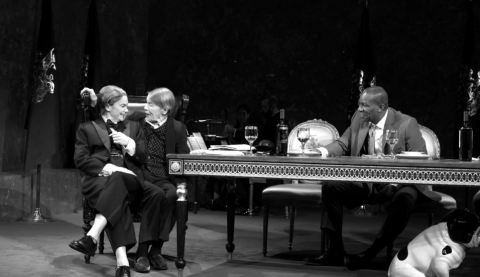
(L to R): Ruth Wilson, Glenda Jackson, John Douglas Thompson in ‘King Lear’ (Brigitte Lacombe)
It is Lear who creates the self-destructive vortex and whirls violently in it during the arc of his soul journey, buffeted by its abuse, yet buoyed up by a stalwart inner core of moral outrage and self-righteous fury. It is the recognition of his own corrupted judgment and the expose of his daughters’ wickedness that keeps him from drowning in complete madness. He is kept from this abyss by the Earl of Kent (the exquisite john Douglas Thompson) his Fool (Ruth Wilson in a humorous turn) the supportive Earl of Gloucester (the poignant and superb Jayne Houdyshell) and Gloucester’s son Edgar (Sean Carvajal) in a beautifully rendered performance) who becomes like the Biblical lunatic to escape the wrath of the court.

Sean Carvajal in ‘King Lear,’ directed by Sam Gold (Brigitte Lacombe)
After Lear spurns his third daughter Cordelia (Ruth Wilson) his daughter Goneril (the excellent Elizabeth Marvel) and daughter Regan (the equally fine Aisling O’Sullivan) presumptuously usurp his authority. They command that he heel to their authority, despite his generous bestowal of wealth and lands upon them. Rather than accept his retinue that follows him to his daughters’ castles, they provoke their father’s wrath to pursue their own agendas.
Maintaining his nobility and identity, Jackson’s Lear refuses to “live” under their terms. Homeless, he braves the stormy abyss of his own soul damnation reflected in the harsh elements with the help of his Fool and the Earl of Kent, disguised as a servant. Ruth Wilson’s Fool comforts Lear, chides him and peppers his rages at Goneril’s and Regan’s ignominous treatment with humorous jibes and quips which strip Lear of his courtly pretensions. Indeed, the Fool guides him toward humility and brings this lofty king into an endearment with his own “base” but noble humanity.

Pedro Pascal, Jayne Houdyshell in ‘King Lear’ (Brigitte Lacombe)
Gold’s version of Lear stylizes the trope that Cordelia and the Fool are similar by having Wilson expertly play both parts. If this is, in Lear’s mind, an unconscious projection of remorse, self-flagellation and wish fulfillment to forgive his loving Cordelia and keep her near, the doubling of roles is sensible. Certainly, Cordelia is the only daughter who loves him. Thus, it is appropriate that Cordelia-the Fool leads the foolish old man into wisdom to help perfect his soul and expurgate the corruptions he has internalized, surrounded by treacherous courtiers and family in a lifestyle that has caved in his better person.
During Lear’s journey into the dark storms of mental uncertainty deranged by a gilded, false life in the gaudy kingdom that he must leave behind (mentally) to grow, he stumbles upon his real self. Centered in truths he never experienced before in his court, Lear strives to maintain his autonomy and identity. He eventually comes to realize what is important in his life-his humanity/mortality/liability to err in judgment which he is able to forgive as he presents himself as “a foolish old man.”

(L to R): John Douglas Thompson, Russell Harvard, Michael Arden, in ‘King Lear’ (Brigitte Lacombe)
Gold’s decision (Miriam Bljether’s Senic Design) to regale the court in pretentious splendor hints at a surface gloss and artificiality/artfulness that distracts from confronting the underlying wickedness and greed in Lear’s court and kingdom. They are “dressing to impress” to cover up the incompetence, nihilism and emptiness within themselves. All that glitters is fool’s gold; it lacks value and worth in an inherently weak kingdom whose underlying principles (if there are any) do not guard against self-destruction and annihilation. Thus, in the stylization the director reveals the seeds of corruption and foreshadows the devolution of the kingdom that will follow hard and fast.
In this setting of “fool’s gold” we meet the commanding Lear and his three daughters at a celebration during which the string quartet stuffed into a corner plays the gorgeous music (original music by Philip Glass) which the courtiers and family neither acknowledge nor appreciate but treat as background noise to be ignored as they raise their voices over it. The family’s general lack of appreciation for their lavish lifestyle and their dismissal of the importance of the depth of their royal duties is reflected in their reaction to all the court accoutrements including a most civil tea service later in the play, held at an incongruent and ridiculous time and place. They are the arrogant, the privileged. Only Cordelia differs.
Thus, when Cordelia reminds the court of her loyalty to her father invested in her role as his daughter, we take this to heart. Do the others, after receiving their inheritance realize the obligations their father’s gift entails?

Elizabeth Marvel in ‘King Lear’ (Brigitte Lacombe)
Hardly. Regan and Goneril from the outset are principally concerned with “getting all they can” through false pretense. They could care less about the rights and duties invested in their father’s gift of an early inheritance. It is no small wonder that Goneril and Regan rail about Lear’s visits with his soldiers. They want the inheritance with no strings attached, wishing to be free of their father forever. Rather than pay homage and give extended hospitality to a vibrant, authoritative king, they take advantage of his public punishment of Cordelia and suggest that he is off balance. It follows that they will provoke his wrath and become his enemies, so that their unconscious desire that he dies sooner rather than later becomes a reality.
An overarching metaphor the director emphasizes throughout the play, is the irony of incongruence-in the court’s lack of probity and unseemly excessiveness. Incongruence is everywhere represented by the “out-of-place” music at the celebration and elsewhere, music which never quite melds throughout the arc of the play’s development. The “over-the-top,” ostentatious, meretricious faux “gold” walls and the formal outfits (Ann Roth-Costume Design) exchanged for less formal ones as the kingdom devolves and the characters’ wicked selves are exposed, also appear incongruous as they are presented. So do the huge ceramic dog and lion.

Russell Harvard, Aisling O’Sullivan in ‘King Lear’ (Brigitte Lacombe)
The gilt walls are present throughout the play with a similarly hued curtain that characters stand before during various scenes (a further emphasis of the themes of incongruity and fool’s gold or an idea that Shakespeare often uses that appears in The Merchant of Venice: “all that glitters is not gold”). The “fool’s gold” walls and audience curtain are the ironic, anomalous backdrop against which the characters are measured and either found wanting in that they exemplify the trope or are antithetical to it.
These artistic elements reflect the malfeasant influence his daughters and husbands have over Lear, an influence which is shaken out of him on his stormy journey coming to the end of himself.

(L to R): Jayne Houdyshell, Glenda Jackson in ‘King Lear,’ directed by Sam Gold (Brigitte Lacombe)
As the daughters and their husbands abuse the kingdom for their own nefarious ends all becomes rubble, wrecked by the familial divisions and war. The walls are the only remnants of the former “glory” of the court perhaps suggesting a universal concept. This kingdom is finished, but the spirit of duplicity (faux gold) of leaders’ pretense which they use to control their minions is present in every age. Eventually, by the conclusion the back gold wall takes on a different hue changed by shifts in lighting. Interpret this as you will, the hue doesn’t gleam, but suggests small points of light (starlight?) amidst characters comments (i.e. Kent: ‘The stars above us govern our condition”).
In the fateful universe of Shakespeare’s play, the arrogant, self-centered human beings are thwarted in the pursuit of their own wicked desires which are founded upon worthless principles (“fool’s gold”) and lies. This development is evident in the characterizations of Goneril, Edmund, Regan, the Duke of Cornwall. The other characters (Edgar, the Duke of Albany) who do not follow their lust for power rise to triumph. As object lessons, Cordelia, Kent, Gloucester, Lear are caught up in the hazard, subjects of poignant tragedy.

Glenda Jackson in ‘King Lear,’ directed by Sam Gold (Brigitte Lacombe)
And it all begins in the “golden” court, when Lear pronounces his inheritance to his inherently wicked daughters enticing them to flatter him in a misaligned quid pro quo as if to prove his greatness and their fealty to him. Goneril and Regan oblige him; Cordelia does not. In that fell act, treason and wickedness are exposed. The wrong daughters receive the bulk of the inheritance, the right daughter is disinherited. The world is in chaos, turned upside down as duplicity usurps love and order.
Lear makes a public show of Cordelia’s punishment sealing his misaligned judgment which the others see may be further abused. Indeed, Lear’s malignity is revealed in a court which embraces and exploits it. And this evil sets in motion the parallel plot with the Earl of Gloucester and his treacherous, conniving son Edmund (the wonderful, insidious Pedro Pascal) who usurps brother Edgar’s inheritance and place in his father’s affections and legal authority.

Glenda Jackson in ‘King Lear,’ directed by Sam Gold (Brigitte Lacombe)
In this secondary plot the illegitimate Edmund, who despises the goodness of his father, lies on his brother Edgar who is forced to escape with his life and go into hiding disguised as the madman beggar “poor Tom.” It is only when Lear, Kent and the Fool meet up with Edgar and take shelter in a hovel does Lear begin to understand his condition in light of poor Tom who is much worse off. In this beggar lunatic, he sees his true ethos without the vanities of the world and his court.
Lear journeys through his “madness” gaining wisdom and gradually throws off the misaligned corruptions of the “courtly mind,” represented by the “fool’s gold” set design. Lear becomes the humble, kingly fool. These scenes among Lear, the Fool, Kent and Edgar are particularly wonderful. The scenes between Carvajal’s Edgar and Houdyshell’s Earl of Gloucester when the blind Earl seeks his death are magnificently rendered by Houdyshell and Carvajal and incredibly touching and poignant.

Ruth Wilson in ‘King Lear,’ directed by Sam Gold (Brigitte Lacomb)
Thus, the deeper evils of this court once hidden in the hearts of Goneril and Regan and her husband and Edmund, feed on themselves and grow as the villains wreck everything to gain the advantage, an advantage which is never sustained with the good sense and order to keep it. The director correctly has the nihilistic Goneril, Regan, The Duke of Cornwall and Edmund contribute to demolishing all order in the kingdom symbolized by the ripped up set interiors as the court is rocked from within and without by war. Considering that they annihilate their inheritance and the goodness of Lear’s gift to them, portraying their father as their enemy, that evil which was hidden by glamour and civility explodes full bore by the play’s conclusion.
Goneril’s mocking lasciviousness expresses her unrestrained wildness “going over to the dark side.” Marvel’s development of characterization is superb. Likewise O’Sullivan’s Regan as the raging, screaming shrew (evolving from the sweeter sister at the outset) appears even more “off the beam” crazy than her father, Lear. And so does her husband the Duke of Cornwall (Russell Harvard’s signing is emotionally powerful) whose rage is at times inarticulate and can only be expressed with frantic signing and frustrated slamming.
By the end, the court reaches its true level of craven wantonness. The debased Goneril and Edmund have sordid sex on the floor reveling in the chaos and rubble. Regan and Edmund plot against Goneril in the disordered wreckage which no one bothers to clear out. Cornwall is stabbed as the actors pick their way around the debris of the once “glorious” court, followed by Regan’s poisoning by Goneril for Edmund’s love. The director again reinforces the theme that wicked amorality has no tenability nor the substance to sustain order. As those who deserve to rule, Edgar and the Duke of Albany (Dion Johnstone) prove themselves wise and just in restoring a kingdom ruined by greed, lies, usurpation, corruption and treachery.

Glenda Jackson in ‘King Lear’ (Brigitte Lacombe)
In his humbled, state after the madness of wisdom shines a truth he has learned, Lear states a key theme about his royal court: “robes and furr’d gowns hide all.” In another quote he states: “plate sin with gold, and the strong lance of justice hurtless breaks.” To “plate” sin with gold (as he had allowed) makes justice weak and breaks it.
By the end Lear gains the revelations of foolish wisdom for he has humbled himself with self-recriminations of his pride at discounting Cordelia’s goodness. We are uplifted by his reconciliation with Cordelia. We rejoice with him as she forgives him, and sorrow with him at her death which he follows with his own. In all of these emotional modulations of this iconic human being that is the recovered foolish king, Ms. Jackson just wipes out the audience.
Ms. Jackson accomplishes this because from the first scene to the last she assumes the mantle of the salty, unhoused, unbridled, tragic Lear and never strays in her focus and determination. As Ms. Jackson’s Lear comes to the end of himself, he manifests the truth that he is, as all men (and women) are great and small, a fool. In this human portrayal, we recognize we too are the kingly fools of our own universe. And we stink of our own mortal desires, mistakes, frailties. And perhaps that is in itself our royalty of revelation. It doesn’t get any better than that!
King Lear runs with one twenty minute intermission, three and one-half hours at the Cort Theatre (48th St.) You may find tickets and times at the website by CLICKING HERE.
Tribeca Film Festival World Premiere Review: ‘It Takes a Lunatic,’ The Life and Times of Wynn Handman

Wynn Handman, ‘It Takes a Lunatic,’ directed by Billy Lyons, (photo courtesy of Billy Lyons and the film via FB page of ‘It Takes a Lunatic’)
Anyone who has been involved in the New York City theater world knows who the prodigiously awarded Wynn Handman is. He is a lunatic indeed, with a purpose and a passion. Wynn Handman’s love is for theatrical performance, teasing out character to achieve the pinnacle of believability that allows the actor to live “onstage.”

(L to R): Billy Lyons, Wynn Handman, Jeremy Gerard (moderator) Michael Douglas, Tribeca FF Q & A after screening of ‘It Takes a Lunatic,’ directed by Billy Lyons (Carole Di Tosti)
For decades Wynn Handman has been coaching actors to get in touch with the best part of themselves and release their God given talents. His appreciation for innovative theater is as legion as his humanity. It is expressed in the countless friendships he’s had over the years with writers, playwrights, musicians, directors and artists. Billy Lyons’ wonderful documentary is an incredible testament to a great man who continues to have an impact on all in his sphere of influence.

Michael Douglas in the Tribeca FF Q & A after the World Premiere screening of ‘It Takes a Lunatic,’ directed by Billy Lyons (Carole Di Tosti)
In its World Premiere at Tribeca Film Festival, It Takes a Lunatic, director Billy Lyons (actor, director, teacher, producer and assistant to Wynn Handman) displays the man behind the mask and reveals there is no mask or gloss to Wynn Handman. Wynn is who he is, an authentic, witty, “tell-it-like-is” acting teacher, and he is this with everyone, large and small, famous or infamous, actor or layperson. Why change now? Wynn is 97-years-young and is still teaching acting. He has nothing to lose by being himself, which he always has been, “a wild and crazy guy!”

(L to R): Billy Lyons, Wynn Handman, Tribeca FF World Premiere, Q & A after the screening of ‘It Takes a Lunatic,’ directed by Billy Lyons (Carole Di Tosti)
Lyons’ poignant tribute to this brilliant genius and loving artist is a lesson in learning to be real, to get to the core of oneself unapologetically, to take risks, to embrace the unique, and defy the status quo. And above all through this retrospective on Wynn, we learn that in the theatrical world, one should go where angels fear to tread to manifest the rewards of creative inspiration. Wynn has approached his life this way and has achieved what only a fearless magician would dare to even think about. He initiated The American Place Theatre and with it directed and hosted unknown and established playwrights and known writers who adapted their work into plays. Wynn allowed innovation to flourish and opened opportunities to black (Ed Bullins, Michael Bradford, Ron Milner) and Chinese (Frank Chin) and female (Emily Mann, María Irene Fornés) playwrights and actors at a time when opportunities for them were slender and doors opened infrequently.
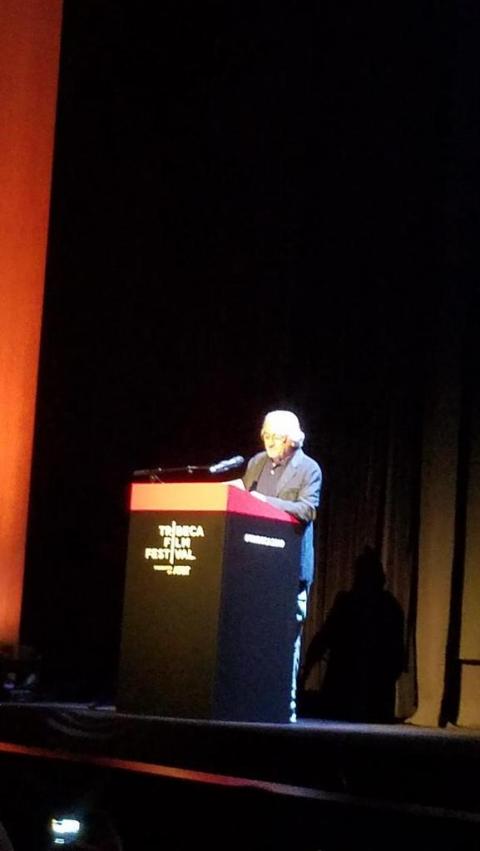
Robert De Niro introducing the World Premiere screening of ‘It Takes a Lunatic,’ directed by Billy Lyons (Carole Di Tosti)
Lyons reveals how Wynn effected this, through his own life experiences during and after the war when New York was opening up like a flower and anything seemed possible. Wynn learned from some of the best; he ended up studying with and assisting Sandy Meiser at The Neighborhood Playhouse. There he made his chops and had the grist to launch out on his own creating his own acting classes and sessions which he has continued doing for decades.
Lyons captures this dynamo through film and video interviews and archived family photos that span his early life and cover all parts in between through his marriage, later family life and continuous career, from 1949 up until the present. Lyons captures his enthusiasm, his great good will, humor, generosity and his flexibility to understand the importance of helping to hone the talents of actors, directors and writers. Video and film clips include interviews or discussions with/about a veritable “Who’s Who” of actors, directors and playwrights who studied or worked with Wynn. A few interviewed in the film or seen in photos or film clips are Richard Gere, Joel Grey, John Leguizamo, Bill Irwin, Raul Julia, Sam Waterston, Frank Langella, Sam Shepherd, Eric Bogosian, Michael Douglas, Dustin Hoffman, Mira Sorvino, Susan Lucci, Woody King Jr, Faye Dunaway and many more.
Lyons includes historical clips from his acting and coaching classes as individuals discuss Wynn Handman’s approach toward his actors which was unlike many of the other acting teachers in the city who were austere and frightening. Every actor interviewed from Michael Douglas to Richard Gere tells anecdotes and experiences they had with Wynn, many humorous, all of them praiseworthy. He is the ideal acting teaching who dispels fear, encourages, comforts with his wise, calm demeanor. He knows just when to tell a joke or make one laugh. His suggestions and perceptions are superlative. From the introductory applause in the theater as Robert De Niro introduced Billy Lyons and the film, one could tell that Wynn’s hundreds of fans-many of them working actors and directors were present to support him. They gave him and Billy Lyons a standing ovation before and after the film.

Wynn Handman, American Place Theatre Associate Director Julia Miles, ‘It Takes a Lunatic,’ directed by Billy Lyons (photo courtesy of American Place Theatre, Martha Holmes, on ‘It Takes a Lunatic,’ FB page and Billy Lyons)
The list of celebrities who studied with Wynn is impressive. Many of them have gone on to be award winners. Lyons includes fabulous black and white performance clips from some of the fascinating productions staged at The American Place Theatre and has various actors discuss their impact. Lyons delves into Wynn Handman’s close friendship with Sam Shepherd who he, in effect, put on the map by producing 8 of his plays at The American Place Theatre.

(L to R): Dominic J. DeJoseph, Wynn Handman (seated) Billy Lyons, ‘It Takes a Lunatic,’ directed by Billy Lyons (photo courtesy Billy Lyons and ‘It Takes a Lunatic’ FB page)
Wynn Handman conducted many series at The American Place Theatre. There was a Humorist’s series (i.e. Cavin Trillin, James Thurber, Jules Feiffer and others) A Woman’s Project Series, a Literature Series (various authors adapted their longer works into plays). Wynn encouraged the production of controversial, ground-breaking and thematically striking works.
In 1969 Wynn produced George Tabori’s The Cannibals a holocaust play which received a cool reception because the audience didn’t understand the piece as black comedy. Tabori’s play went on to be produced at the Schiller Theatre in Berlin where it received an incredible reception and outpouring of support because the Germans needed to deal with elements of the Holocaust and the play afforded them the opportunity. Tabori, a Hungarian Jew who swore he would never return to Berlin ended up moving there and becoming a vital force in German Theater. From the reception of this work, Tabori ended up writing additional plays and working in TV as opportunities opened up to him. Tabori became globally renowned and won various awards. Without Wynn Handman’s support for Tabori to present his plays, one wonders would this inspired story have ended the way it did? Lyons coverage of this segment in the history of NYC theater is monumental.

(L to R): Billy Lyons, Wynn Handman, Jeremy Gerard (moderator) Michael Douglas, Tribeca FF World Premiere, Q & A after screening of ‘It Takes a Lunatic,’ directed by Billy Lyons (Carole Di Tosti)
Additionally, in 1970, Wynn staged Tabori’s Pinkville starring Michael Douglas in a dynamic and highly praised performance. The play was an indictment of the US war in Vietnam. Pinkville was controversial and exceptional. It is another example of Wynn Handman’s courage in treading where theatrical producers feared to go. But in the film Handman emphasizes that The American Place Theatre was a non-profit theater, funded through subscriptions. So those who donated, paid their subscriptions because they wanted to see controversial, ground-breaking Off Broadway theater. The American Place Theatre was artistic theater in the best sense of the word and as one of the producers, Handman was free from worrying about the bottom line and commercialism that plagues NYC theater today.
The moderator of the Q & A that occurred after the screening was Jeremy Gerard who wrote the biography on Wynn Handman entitled Wynn, Place, Show. It is worth the read to review Wynn’s historical place in American theater and specifically his influence in shepherding so many sterling actors who are still working today.
The documentary superbly chronicles one man’s indelible impact on NYC theater and in particular revelatory drama. Lyons has created a gem of a film. It is a must-see for anyone pursuing a theater or entertainment career, and for those interested in how theater’s cultural impact can change lives. Look for It Takes a Lunatic online and check out their FB page.
Tribeca Film Festival Review and Article on ‘American Factory’

‘American Factory,’ documentary by Steven Bognar, Julia Reichert,Tribeca FF New York premiere, Sundance FF World Primere (Sundance FF)
American Factory by Steven Bognar and Julia Reichert screened in its New York premiere at Tribeca Film Festival. The documentary is an alarming view of the foreign factory which may presage the downhill slide for American workers as the trend of foreign investment continues. Factories in China and Russia operate differently. And when such investment comes to the U.S., standards of accountability are not what Americans are used to. Foreign ownership dictates process and operation.
The film presents the anatomy of a GM plant closing December 2008 and its rise from the ashes in the form of a refurbished plant bought by Chinese investors. The idea to invest in the U.S. was to establish profitability. For Americans the hope was that the jobs created would bring greenery back to a state which was choking from the massive rust storms its closed industries had caused.
The devastation in industry as a result of the mortgage debacle and Second Great Depression under the Bush Administration was legion throughout the U.S. and globally. Thus, when news of the GM plant’s restoration by Chairman Cao came, there was cause for jubilation. After the dust of the launch settled, expectations shifted and the hard realities revealed themselves.
The filmmakers lay no blame and avoid a political stance. Any reference to politics is my own perspective. The filmmakers present all sides and attempt to be as objective as possible. Because of that attitude they had total access to the factory floor. Using the techniques of cinema verite and acute editing, we see interviews of workers expressing feelings and opinions. In light of the history of the American factory and unions which the film touches upon, what is now happening with foreign investment coming here and opening factories is not the boon politicians would make it out to be. Based upon what the filmmakers discovered and relate through their interviews and portraits of workers at home and on the factory floor, “the handwriting is on the wall.”
A Bit of History
When the Dayton, Ohio GM plant closed in 2008 filmmakers recorded what was a tragedy for blue collar workers. Dayton, the home of the Wright Brothers, had a prodigious history of industry and innovation. At one point it boasted the most patents per capita than any other city in the US. It was the second largest automotive manufacturing city after Detroit at a prosperous time before the Regan administration. Before the Regan years the wealthy were taxed proportionately with the other classes. The corporate tax rate was triple what it is now. The unions protected/advocated for workers and petitioned the government (OSHA) to safeguard their health and well being when there were violations. CEO salaries were not as exponentially wacked in comparison to their workers’ salaries. Workers faced low inflation: by comparison to today, there was little national debt. A single parent wage-earner was able to support a family of four and put kids through college in middle America and the South. Additionally, the medical industrial complex was not profit based.
None of this was socialism! The wealthy were taxed their proportionate fair share. It was good, old-fashioned American citizens paying to support one another’s prosperity, from the wealthy to the poor based on the graduated income tax. The extremes between rich and poor were not galactic. Banks were regulated repositories of citizen funds; they could not invest.
Ronald Regan and a conservative Republican administration exponentially increased corporate socialism otherwise known as corporate welfare. Everything changed in the nation’s economy and social/economic progress among the classes to benefit the wealthiest and slight the poor and middle class (upper middle, middle, lower middle). Republicans increasingly targeted programs for every-day Americans and pushed for more tax breaks for the wealthy. Unions were broken up. Globalism was used as the excuse, but in effect, the 60/40% power balance upended between unions and corporate higher ups to 80/20. Corporates took advantage. Greed blossomed, inequities grew. Corporations closed factories in the U.S. and went overseas, not happy to make a profit, but happier to make a mega profit to pay a hefty CEO salary and benefits to someone more interested in the bottom line than making product. Banking structure continued to change. Banks consolidated, made investments, funded derivatives, subprime mortgages and became “too big to fail.
Surreptitiously, Regan and others that followed had the laws changed to effect this, all to benefit corporates and the wealthy. There was continued downsizing, outsourcing, lower corporate tax rates, higher middle class tax rates, and lower taxes for the wealthy. Factories went overseas and Americans and farmers went bankrupt as the American Dream evaporated. With the mortgage debacle in 2008, it was the apotheosis of the death of the American Dream. Plant closures bankrupted and retrograded the lives of thousands of blue-collar workers in a chain reaction effect on other businesses.

‘American Factory,’ by Steven Bognar and Julia Reichert, Sundance World Primere, Tribeca FF New York Premiere (Ian Cook, courtesy of Sundance Institute)
THE FILM
After filmmakers covered the GM plant closing, they did an update of the area. Founder, chairman and CEO of Fuyao Glass Industry Group in a symbolic gesture acquired the old GM factory to establish an American headquarters of multinational Fuyao Glass. For the promise of hiring American workers and having it launched by American officials, he received enormous tax credits from the Ohio Tax Credit Authority. These breaks have increased under the Trump Tax Reform Act, which gives millions of dollars in tax welfare to corporations and billionaires, while making the other, poorer economic classes pay for it in a now swelling $23 trillion dollar deficit, something once considered anathema by conservative Republican tea partyists, now embraced and lauded by Mitch McConnell Republicans.
Documentarians filmed the plant launch and operations of Fuyao Glass which, to Chairman Cao’s consternation, was not immediately profitable as it would have been in China. It was losing money on top of the $500 million invested to open the plant.
Interestingly, Steven Bognar and Julia Reichert examine a cross-section of Chinese and American workers and managers to gauge the cultural differences, language barriers and work approaches. They interview Chairman Cao (a communist party leader hooked in high up to the party through his family). The Chinese workers, used to long hours and little pay are happy. American workers are upset.
The differences between the two cultures are staggering and problematic when the pressure of financial losses increases. Chinese workers, used to 10-14 hour days, find the 8 hour day unrealistic for profitability. US safety regulations established by OSHA are not understood and often ignored imperiling workers. For example Wong He, lead Furnace Engineer in OEM Tempering at Fuyao Glass America in an area where temperatures exceed 1200 F, a 20-plus-year employee of Fuyo, has burn marks all over his arms gotten in China. China’s safety regulations are not like ours. American workers file grievances, something that Chairman Cao doesn’t understand.
The Chinese and American workers try to become friends; there are humorous clips of Americans bringing Chinese workers for barbecue and for entertainment, showing them how to use guns for target practice. The Chinese workers who are away from their families and room together in tiny apartments are shocked that some Americans have to work two jobs (FGA pays $14.00 per hr.) to make ends meet. Clearly, American standards of living are not what Chinese hear about. Filmmakers interviews who lost homes, went bankrupt and live in one room in a relative’s house with few belongings. Thus, FGA seemed a dream come true. There are caveats.
In the past the former jobs at GM paid $28.00 an hour and the inflation rates and cost of living were lower. With their lower salary and higher costs, inflation and the shrinking purchasing power of the dollar, the FGA workers cannot afford to pay for their own education to retool or pay for their children’s college. Some are happy to have a job. But it is longer hours (they are not paid for training) with unsafe working conditions. The Chinese workers are younger and are used to long work hours under stressful conditions. Chinese workers come from a militaristic/communistic approach to company loyalty. They obey all commands without question, even if it means sacrificing their safety. Americans if have been used to a long tradition since unionization of asking “why?” Chairman Cao and the Chinese officials see this approach as disloyalty. They should just obey orders.
As the financial pressures increase, the Chinese attempt to show American company officials how FGA should be operated; they even pay for their visit to China to understand how plants are run. The hand of the Communist Party is all over the company in China; there are songs, banquets and entertainment to praise Fuyo Glass and the Chairman for his goodness. The sessions appear like brainwashing PR advertisements which inculcate the workers to be loyal, obedient employees for the good of the company/communist party. The visit to mainland China is an eye-opener.

‘American Factory’ and cast, Tribeca FF NY Premiere, Sundance FF World Premiere (courtesy of Sundance FF)
Though American managers who visited China attempt to rein in their American workers when they return home, the historical, socio-cultural and economic disparities get in the way. Everything explodes when American workers at FGA attempt to unionize with the help of the U.A.W. Chairman Cao will not brook this assault on his company. He hires American lawyers and lobbyists to thwart unionization and mount an attack campaign against the union so workers will vote it down. The firm he hires, the Labor Relations Institute is paid over one-million for its assistance to provide everything that Chairman Cao and Chinese managers (Chairman Cao brings over new managers to tackle what the American managers can’t) need for the union vote to fail.
Filmmakers catch all of these interactions on camera and edit cogently so we understand the events with voice over explanations by workers. Surveillance of union representatives at FGA is taken. The right of the worker to voice complaint is discouraged; union reps who work at the plant are the equivalent of traitors. The vote fails; FGA has no union. There are promises made to lift the employee wages. Eventually, with no profitability, American management is fired; union reps are fired and anyone who gives “what for” or doesn’t work at the level required of their Chinese counterparts is put on notice. Retribution for asserting the right to speak out will occur, thus workers fear filing grievances with OSHA. At the end of the film’s shooting in December of 2017, a Fuyao employee was accidentally crushed to death. Additionally, to avoid conflicts in the future, the plant is being increasingly automated. Regardless, workers will be out of jobs, even if they prove loyalty.
AFTERMATH
Is there any way of knowing what injuries are occurring or what violations are happening in a corporation in the US, a foreign run company, which follows Chinese policies and practices? Only whistleblowers could reveal this; but they need their jobs and would be fired if the the identity of the whistleblower was revealed. The law of profitability is supreme, under a system of loyalty to the Chairman and the company which expects its workers to meet its own standards, not American standards.
Since the film the number of OSHA complaints against the company is down-exactly why is not known. The company has been profitable in 2018; but one of the stipulations for tax incentives of $15 million is that the company fulfill its promise to hire 800 employees, generate an annual payroll of $32.5 million and stay at their current facility for at least 18 years. Filmmakers also discovered that in March of 2018 a Fuyao employee was accidentally killed while working. Fifteen years ago in plants across the nation, to avoid citations, OSHA standards were being followed and the press would have publicly shamed the company.
Chairman Cao is spending $16 million to build a new processing center in South Carolina. It’s a new day. Foreign investment is here. It’s been a long time coming. Those in the “know” needed to prime the nation for such a situation with sub prime loans, so workers could go bankrupt, corporations could make more money overseas, the unions could be broken and those pesky regulations could be obviated. All of this happened and happens so that corporations pay little for a desperate, broken-down, poor, workforce, and foreign companies find the US an attractive place to invest, helped by politicians looking to make a little spare change for their states and themselves. But as automation takes over jobs, much of the need to oversee human production will be moot.
How do we handle the coming foreign factories that are populating our American landscape, offering jobs at what cost to Americans?
The situation has exponentially worsened under Trump. Workers are expendable and invisible; the rule of law and regulations are a thing of the past. No one is watching except Chairman Cao, and other foreign corporate chairmen and Trump. They are watching their bottom line at the expense of workers and the American people. But don’t believe what I’ve written here. See the film for yourself. Corporate socialism has everything to do with what is happening to the “American” Factory. Equitable economic, democratic practices and tax structure had everything to do with why the U.S. was thriving up until Regan. Only the .001% are increasing their wealth exponentially. The reset of the nation is treading water or drowning in rust. Automation will exacerbate these problems.
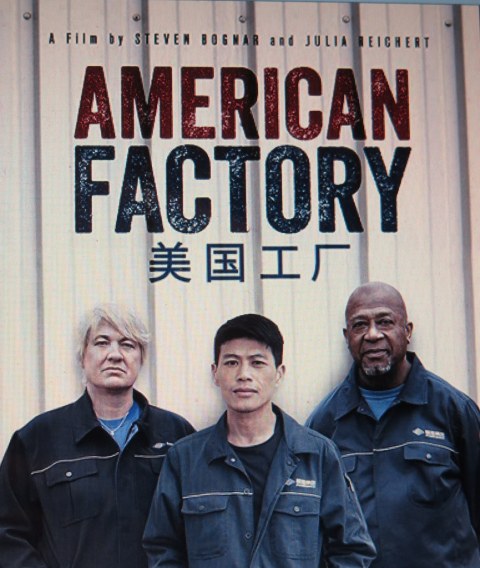
‘American Factory,’ by Steven Bognar and Julia Reichert, Tribeca FF New York Premiere, Sundance FF World Premiere (courtesy of Sundance FF)
The film is truly a siren call to citizens in the South and in the Rust Belt who are debilitated and hurting economically, despite promises by Trump. Fox News reports which ADVERTISE for the next election, a “booming economy” (yes for billionaires and Wall Street) are great sources of brainwashing to convince Americans that the shrinking purchasing power of the dollar is not happening and their existing paycheck to paycheck is a good thing. Just don’t get sick. The film posits what is happening and I’ve suggested this is no coincidence if you look at the larger picture. The economy is global. Corporations are not bound by nation-states,’ laws. They are free; their CEOS make incredible salaries; workers can’t afford a night out on the town if they have children. And under Citizen’s United, corporations are people; they can donate any amount they like to their preferred political candidates to perpetuate corporate welfare.
An example of foreign investment that is happening as I write this concerns Russian oligarch Oleg Deripaska who is bringing money and jobs to Mitch McConnell’s state of Kentucky after Trump lifted heavy sanctions applied by Obama. against Russia for the Crimean invasion. Oleg Deripaska,Putin’s close friend, is building an aluminium factory in Kentucky. Deripaska has a history of looting, money laundering, corruption, silencing whistleblowers (one woman who shot her mouth off that Deripaska knew about Russian meddling with the U.S. election has been jailed in Russia). Deripaska/Putin have covered up corruption that is the basis of his oligarchic empire which he is making global with the help of Trump and McConnell.
If Deripaska is given carte blanche treatment to “stimulate jobs,” for McConnell’s Kentucky, his company will not ipso facto be subject to former American factory standards, especially if Trump and Mitch McConnell (who has turned a blind eye to Russian meddling in the 2016 election, the Mueller Report’s findings of potential conspiracy and definite obstruction of justice) are in power. If the company pollutes and run roughshod over American workers? Only an aware public and vigilant government can stop any abuse by a company that is processing one of the most toxic substances on this planet, a poison connected to Alzheimer’s and other debilities.
Under Trump, the skies are the limit with foreign investment and foreign companies coming to the US to “create jobs.” There are no regulations worth keeping to improve the profitability of corporations. US tax payers will be subsidizing these corporations and individual states will be subsidizing tax breaks; certainly Mitch McConnell and the Kentucky state tax commission will be offering Oleg Deripaska tax breaks as a condition of hiring American workers. One wonders what else McConnell and others from Kentucky will be offering to “bring jobs” to one of the poorest states in the Union?
If we learn anything from American Factory, we will note that unless guarantees are made with workers, foreign investment will not improve American citizens’ plight and the economy in states that are hurting. Coupled with workers’ inability to easily retool and get an education (they cannot afford it because of bank strangleholds on student loans and interest rates) their options are so limited they are forced to work in such foreign industries for lower pay and questionable safety conditions. The vicious cycle will continue and the divide between rich and poor, the coastal cities and the red States will exponentially worsen. We must ask who does this foreign investment help?
This is a film worth seeing and thinking about. The point is to keep on learning. Ignorance is not a luxury we can afford.

