Author Archives: caroleditosti
‘The Traveling Lady’ by Horton Foote, directed by Austin Pendleton

(L to R): Larry Bull, Lynn Cohen, George Morfogen in ‘Traveling Lady’ directed by Austin Pendleton at the Cherry Lane Theatre (Carole Rosegg)
The Traveling Lady by American treasure Horton Foote (Pultizer Prize and two-time Academy Award winner), is about the foibles of human nature, relationships, loss and the hope of love and new beginnings as a natural order of living. The production directed by Austin Pendleton with his usual insight, attentiveness to acting specificity and feel for “when to hold ‘em and when to fold ‘em,” is currently being presented by La Femme Theatre Productions at The Cherry Lane Theatre. It boasts a very fine cast.
The Traveling Lady is an ensemble piece that requires on-point performances for the portrayals to cohere and present logically. Foote accomplishes his work steadfastly, brilliantly: every line builds on the other in his characterizations. And though his work appears simplistic, it is layered and profound with minimal belaboring. If one carefully attends to the themes and character notes, one understands that the outcome for his small-town personalities is inevitable. The beauty of Foote’s work and this production is that it is far from predictable. This is why much of Foote’s work, if executed with precision, as Pendleton does with the assistance of the fine ensemble and artistic creative team, is greatly satisfying in its representation of homely Americana.

(L to R): Lynn Cohen, Karen Ziemba, Angelina Fiordellisi in ‘Traveling Lady,’ directed by Austin Pendleton, Cherry Lane Theatre (Carol Rosegg)
Foote’s plot arc for The Traveling Lady is developed with enough inherent tension so that one actually breathes a sigh of relief at the conclusion, as the characters move naturally toward their resolutions. As with many of his plays (i.e. Orphan’s Home Cycle), Foote lays out the rural dynamic of his setting as 1950, the small Texas town of Harrison.
In Harrison as in any rural town, daily life is routine and slow. The action moves with major town events: births, weddings, funerals. And Foote uses an earth shattering event, the death of Miss Kate, Henry Thomas’ mother, to be the catalyst for the movement of life, death and renewal for Foote’s protagonists.
It is Miss Kate’s funeral which brings Henry Thomas back to Harrison. It is Henry’s return to his hometown which brings his wife Georgette Thomas (Jean Lichty) and their daughter Margaret Rose (Korinne Tetlow) to Harrison to be with him. Henry and Georgette are thrust into the matrix of characters who make neighborly visits to share the gossip at Clara Breedlove’s home. It is in revealing Henry’s and Georgette’s impulses and humanity that Foote’s themes of sorrow, regret, hope and forgiveness are relayed.
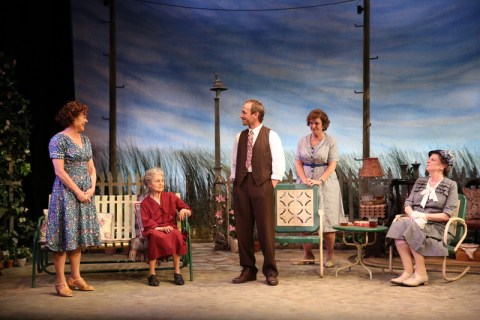
(L to R): Karen Ziemba, Lynn Cohen, PJ Sosko, Angelina Fiordellisi, Jill Tanner in ‘The Traveling Lady’ at The Cherry Lane Theatre (Carol Rosegg)
The neighborly matrix of townsfolk born and bred in Harrison include the elderly, “mentally slipping” Mrs. Mavis (a fabulous Lynn Cohen), Sitter Mavis (Karem Ziemba is her patient, loving daughter), Judge Robedaux (George Morfogen in too brief an appearance), Mrs. Tillman (the humorous Jill Tanner as the stalwart, religious, do-gooder), Henry Thomas (PJ Sosko is perfect as the heart-rending, regretful and angry Henry) and Clara Breedlove (Angelina Fiordellisi is excellent as the kind, wise, earth-mother) whose home {ironically not far from the cemetery} and heart provide a respite and place of sustenance.
Two protagonists, one who was not raised in Harrison, and the other who was and plans to leave it are Georgette Thomas and Slim Murray. Harrison is a way station for Georgette Thomas who comes seeking husband Henry after he is released from the penitentiary for stabbing and nearly killing a man.
Larry Bull finely shapes his Slim with subdued inner beauty and humility. He breathes charisma, attractiveness and light in Slim’s soul as a quiet hero whose values and principles are decent and kind. I could feel every woman in the audience including myself ache for more such individuals like Slim (who is reminiscent of Steinbeck’s Slim in Of Mice and Men). Slim, who has been a deputy, prefers working in the cotton industry and plans to head South to pursue what he knows best.

(L to R): Jean Lichty, Korinne Tetlow, Angelina Fiordellisi in ‘The Traveling Lady,’ at The Cherry Lane Theatre (Carol Rosegg)
As Henry’s loving, long-suffering, sweet, loyal wife Georgette, Jean Lighty is well cast, as is Korinne Tetlow who is exceptionally poised and captivating as her little daughter, Margaret Rose. Georgette and Margaret Rose are wanderers looking for rest and succor. Georgette hopes that her reunion with husband Henry will be successful and they will finally be able to live as a family. From the other characters, we discover that she has been loyal to Henry and would be most probably until “death do them part.” However, his actions are not worthy of her love and his inner weaknesses create the guilt that keeps him racing down the path of self-destruction. Despite this, Georgette may be willing to forgive him and continue if not for the welfare of Margaret Rose. These attributes of patience and loyalty form the core of who Georgette is. She reflects the time she lives in; she echoes the folkways of the Texas communities whose women “stand by their men.”
Foote has laid his groundwork for us to immediately empathize with mother and daughter. We learn they are not accepted because people where they attempt to live discover Henry’s background. Georgette’s father represents such attitudes. After Henry goes to the penitentiary, her father throws her out of the house. He refuses to accept his daughter’s marriage to Henry and ignores her when she sends him a picture of Margaret Rose.
Georgette has hidden Henry’s situation from Margaret Rose. For her daughter’s sake, instead of confronting realities about Henry, in her mind she has built up tremendous hope for a family reunion. She believes that Henry can only improve. Though both are ready for a renewal, it is not to come in the shape and form Georgette imagines.

(L to R): Lynn Cohen, Jean Lichty, Larry Bull, Karen Ziemba in ‘The Traveling Lady’ at The Cherry Lane Theatre (Carol Rosegg)
When mother and daughter arrive at Clara Breedlove’s home, eventually Henry, as all the townsfolk most likely do, finds his way there. Clara Breedlove’s home is a fitting symbol; it is not only a hub for the townsfolk and in this case the travelers, it is also a place for the truth to be revealed and accepted without judgment or recrimination. The “Breedlove” last name is appropriately clever.
In her loyalty and principled soul, Georgette is the counterpart of Slim who lost his wife and was/still is devastated by the circumstances surrounding their relationship which he finally reveals to his sister Clara in a poignant scene. Foote has created sterling human beings in Slim and Georgette and indeed they are archetypes for what may be the best potential for contentment in relationships.
We are gratified that somehow throughout all the pain and suffering Georgette and Slim have endured. They are stolid individuals, unbowed by life’s hardships. Perhaps they will end up together to find some measure of happiness in the next chapter of their lives. With Foote, it is always a hopeful “perhaps.” Certainly, if Georgette remains with Henry, who is an alcoholic, disaster will follow for her and Margaret Rose.
The resolution of conflicts in Slim’s, Georgette’s and Henry’s lives occurs at Clara Breedlove’s. Foote has staged the beginning of life transformation there in Clara’s homely place, perhaps the most appropriate of places for there to be the possibility of life affirmations.
This production is a gem. You will appreciate the strong performances by the ensemble and incisive direction by Austin Pendleton. The cast, the director and the creative team Harry Feiner (Scenic & Lighting Design), Theresa Squire (Costume Design), Ryan Rumery (Sound Design & Original Music) whose striking production values enhance throughout, effect a very fine presentation of Horton Foote’s The Traveling Lady.
For performances and ticket information, go to www.cherrylanetheatre.org; or call OvationTix at 866-811-4111; or stop by the box office at The Cherry Lane Theatre on 38 Commerce Street. The production has no intermission and runs until 16 July.
‘Invincible,’ Theater Review, 59E59 Theaters

Alastair Whatley and Emily Bowker in ‘Invincible’ at 59E59 Theaters, as part of the Brits Off Broadway 2017 season (Manuel Harlan)
Invincible currently at 59E59 Theaters is a tour de force written by Torben Betts, directed by Stephen Darcy with original direction by Christopher Harper. Presented by The Original Theatre Company and Ghost Light Theatre Productions, it is one of 59E59 Theaters Brits Off Broadway offerings this season.
Playwright Betts selects a mundane situation of neighbors being introduced to the neighborhood and spins it gyrating with turns that by the end of Act II career the audience into a ditch of shocking displacement and surprise. However, life cannot be all fun and games and ridicule, especially when there is a severe economic downturn and one is forced to downsize and relocate away from a tony London lifestyle as Emily and Oliver have to do. Indeed, we cannot anticipate what lurks around the corner of ourselves and especially behind the closed doors of our neighbors with whom we may have little in common.
The class divide of education and economics, conservative and liberal/radical Marxist views form the casual backdrop of a disastrous few meetings between two neighboring families in a North England suburb. We are first introduced to the educated Marxist Emily (Emily Bowker is superb as a high-strung feminist who peels away the layers to reveal a seething emotional depth) and liberal-minded, posh, near-pro cricket player Oliver (Alastair Whatley gives an exceptional performance as the initially weak-willed, accommodating partner) as they argue about not getting married.
Emily abhors bourgeois, middle-class mores that stultify relationships. She will not even consider pleasing Oliver’s sickly mother before she dies. Their assumptions that solidify the basis of their rant are largely humorous. However, Betts injects enough clues for us to eventually realize that Emily’s fears are more than Marxist chic and she is attempting to deal with inner guilt and pressure. The seemingly good-natured, innocent-looking Oliver, who has pedaled along beside her for four years keeping his mother in anticipation of their marriage has grown weary of making excuses. We find their exchange ironic in the extreme; usually the woman wants the big marriage and party. This is not who Emily is and once more, though his mother would be happy to see them married before she dies in a few months, she will not get her dying wish because of Emily’s strident inflexibility.

Elizabeth Boag, Alastair Whatley in ‘Invincible’ part of the Brits Off Broadway at 59E59 Theaters (Manuel Harlan)
On the contrary, their neighborly couple the sexy, uneducated Dawn (Elizabeth Boag in a stunning portrayal of developing emotional cave-ins) and boorish, football-lover and postman Alan (Graeme Brookes is the believable, noxious lout whose kindness and love sustain and comfort) appear as if they rushed to embrace the cultural folkways of marriage, children, a family lifestyle so they could follow their parents unthinkingly into the grave. The couples could not be more disparate, and as Alan proclaims his love for his favorite football team and beer, we understand that Dawn and Alan are apparently shallow flag waving conservatives who mindlessly uphold blue-collar assumptions and chase them down with “bring their own” beer, when Oliver and Emily tell them they eschew alcohol and have none to offer.
Betts, the director and actors unfold the fireworks gradually. They also drop lightning bolts upon us when we least expect it. The arc of the play develops keeping the tensions fluid and random. We are not privy to the usual rants of liberal vs. conservative. The couples attempt to be neighborly by avoiding dangerous subjects. And the playwright stays away from conservative cant, though in the first part of the play, Emily’s Marxist diatribe to back off Oliver’s marriage plans for his mom’s happiness is funny.
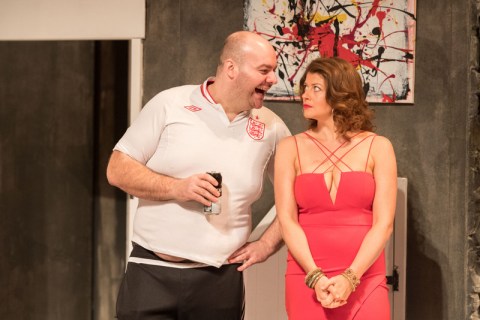
Graeme Brookes, Elizabeth Boag in ‘Invincible’ at 59E59 Theaters (Manuel Harlan)
When the couples face off against each other with awkward friendliness during a pleasant evening, the divisions between their differences of education and lifestyles creep forward. Underneath are boiling emotions in both families when the characters drive toward each other to reveal their passions. For Alan, it is his cat Vince (Invincible) whom Emily and Dawn dislike, Emily principally because the cat is a killer and no creature is safe in Vince’s dominion which is everywhere. Talkative Alan also discusses his paintings which are hysterically child-like and so amateurish, we wonder why he bothers not to take the painting lessons he sorely needs. However, he believes the paintings of Vince are special.
We know the first dive into the ditch cannot be prevented when Alan persists in his demands that the talented Emily (her paintings have been priced at around one thousand pounds), provide her true opinion of his work which he proudly shows as we cringe, albeit with laughter. After coaxing her, Emily gives her critique which is hysterical. The loutish, jabbering Alan quiets himself into a sulk and his ire reveals an annoyance that runs deeper as he attempts to defend the great sensitivity behind his awful work.
It is a mistake that Oliver attempts to defend Alan. Emily explodes about the importance of truth and their waste of an evening of banal conversation instead of discussing the “Western powers behaving like psychopaths, forever sending misguided, ignorant soldiers to murder innocent civilians in illegal wars!”
Alan and Dawn’s son is doing just that and the remainder of the evening drills out the undercurrents which have divided the couples all along. Alan defends their son’s heroism to protect their freedoms so Emily can “paint her pictures and have all her clever opinions.” In effect he is lambasting her for being chic, unthinking and hypocritical. Dawn tells her she needs to “have a quiet little think about that.” As Dawn and Alan storm out, Emily, Oliver and the audience are left to the silence of their own souls.

(L to R): Emily Bowker, Graeme Brookes, Elizabeth Boag, Alastair Whatley in ‘Invincible’ at 59E59 Theaters (Manuel Harlan)
Betts has initialized the themes by the end of Act I which he completes in Act II. Because of their night with Alan and Dawn and Dawn’s parting remarks, Emily and Oliver confront their griefs. It is then we discover why Emily and Oliver have sworn off liquor, why Emily has immersed herself in radical politics and why Oliver puts up with her mood swings, stresses and odd demands. It is then we understand that Dawn is unhappy with who she is and how she measures up. One night with Emily and Oliver has transformed Alan’s and her awareness of self and goals.
The exchange has been revolutionary; the characters’ personalities change by the play’s conclusion. There has been a convergence. Which couple benefits the most is debatable. Betts reveals that Oliver and Emily have the makings of the wealthy, sleazy and corrupt conservatives they used to decry. Alan and Dawn have been devastated into perhaps turning from the warmongering they once embraced and sent their son off to partake of. And as the latter two confront a devastation, we can identify with the love, forgiveness and care that Alan, whom we once deemed loutish, gives Dawn. Heroism comes in many shapes and forms, sometimes initially unappealing ones.
Betts has manipulated us cleverly to look at our own humanity and the humanity of those with class perspectives and behaviors precisely counter to our own. Themes of flexibility, empathy and tolerance are in the forefront of this production which reveals the fickleness of human nature when circumstances change. Stephen Darcy’s excellent direction and the tremendously effecting performances by the actors in this strong ensemble piece, reveal Invincible to be a complex, thought-provoking production which examines the best and worst of our prejudices and attitudes and the strength of human character required to be truly invincible in the face of loss.
You can see Invincible which has one intermission and is running at 59E59 Theaters (59 East 59th Street) until 2 July. You can pick up tickets if you click HERE.
Save
‘Woody Sez: The Life & Music of Woody Guthrie,’ Theater Review

David M. Lutken in ‘Woody Sez: The Life & Music of Woody Guthrie,’ at the Irish Repertory Theatre (Carol Rosegg)
Woody Sez: The Life & Music of Woody Guthrie, devised by David M. Lutken with Nick Corley, Darcie Deaville, Helen Jean Russell and Andy Teirstein is an entertaining and poignant evening of music and story-telling. The production directed by Nick Corley with music direction by David M. Lutken, orchestrations and vocal arrangements by David M. Lutken, Darcie Deaville, Helen Jean Russell and Andy Teirstein, presents the life and work of the monumental musician and singer-songwriter Woody Guthrie, whose work resonates for all Americans especially so when citizens feel they are powerless in the face of injustice.
With his ballads, political, traditional folk and country-blues songs and stories, Woody Guthrie chronicled the lives of Americans in the first half of the 20th century. He traveled across the country living with the little people with whom he identified and became a call sign. He recognized that the “salt of the earth” were the backbone of the nation squeezed by the banking industry and Wall Street. He sang of their economic tribulations and deprivation, their struggles through the Great Depression and the Dust Bowl era which led to the California migration and the abuses of migrant farm workers by farm conglomerates such as they were at that juncture in our history.

(L to R): David M. Lutken, Helen Jean Russell, Megan Loomis in ‘Woody Sez: The Life & Music of Woody Guthrie,’ Irish Repertory Theatre (Carol Rosegg)
Above all, he uplifted and encouraged that, “This land is your land, this land is my land…” With these words many were able to gather their forces, unionize and create movements to strengthen and consolidate their efforts in the struggle for economic equity.
Guthrie was the “Dust Bowl Troubadour” and advocate, whose songs excoriated the wealthy and their puppet politicians of both parties as the root of the farmers and little peoples’ hardships and evils. Though he flirted with communism and socialism and even wrote the column “Woody Sez” for the Communist paper People’s World (which appropriately is the title of this production) his music was his primary vehicle to uplift and exhort. He never joined any party and preferred to roam freely, always an observer and chronicler more than a participant who supported any one political cause. His cause was that of all of humanity. This production of Woody Sez highlights the finest and most endearing turning points in his life, always revealing the complexity of his nature in its most humorous, glorious and flawed states.
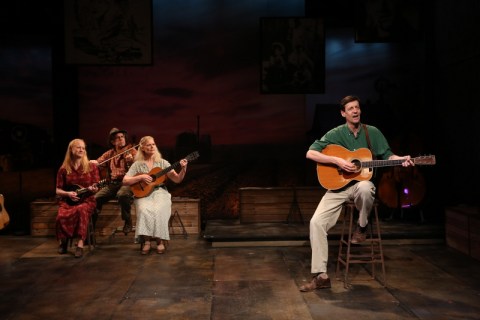
(L to R): Megan Loomis, Andy Teirstein, Helen Jean Russell, David M. Lutken in ‘Woody Sez: The Life & Music of Woody Guthrie’ at the Irish Repertory Theatre (Carol Rosegg)
Act I starts with the Company’s singing “This Train is Bound for Glory.” It is an appropriate memorial of the journey of Guthrie’s glory that the actors/singers/musicians (stirring performances by Megan Loomis, David M. Lutken, Helen Jean Russell, Andy Teirstein) lead us through to understand the beauty and humanity of Guthrie. In a relaxed, down-to-earth performance style, Lutken assumes the persona of Guthrie first by introducing himself as one who venerates Guthrie. He becomes Woody through episodic narration as he relates the key points of Guthrie’s life and the songs that reveal major themes and issues Guthrie experiences.
The production structure is essentially a flashback of his life. It is framed by Guthrie’s time in New York City in 1940 with Guthrie’s stint on a radio show at Rockefeller Center which a friend helped secure for him. The first scene includes the ensemble. They portray various roles throughout the production: Megan Loomis, Andy Teirstein, Helen Jean Russell. Guthrie (Lutken) sings one of his political songs on the radio which ridicules the wealthy. We are introduced to Guthrie’s freedom-loving personality. He is incapable of compromising his values, his dreams, his autonomy to tow the conservative line and accept censorship of his politics and criticism of Wall Street bankers and old J.D., the scion of Rockefeller Center. When Guthrie is fired, we are transported to the past to envision how Guthrie became that revolutionary individual.

Helen Jean Russell, David M. Lutken in ‘Woody Sez,’ Irish Repertory Theatre (Carol Rosegg)
Guthrie/Lutken discusses that he was born in Okemah, Oklahoma. We are introduced to his mother and siblings in song, the ensemble filling in the roles. We learn of the family’s troubles and the tragedies they faced with his mother’s evolving illness. The narration is simple yet heart-breaking and is also chilling. The ensemble and Lutken backdrop the prose with the dynamic of themed songs that are powerful and touching.
Guthrie’s journey continues through their impoverishment and his resilience attempting to “sing for money” during the boom town years when oil was discovered in Okemah. But their family situation worsens with death and more tragedy and eventually Guthrie strikes out on his own as a teenager discovering who he is and what he is made of. He travels to Texas to see his relatives and Dad. He sings in a makeshift band with his uncle and makes some money and even gets married.

(L to R): Megan Loomis, Helen Jean Russell, Andy Teirstein in ‘Woody Sez’ at the Irish Repertory Theatre (Carol Rosegg)
But the April Dust Storm of 1935 overwhelms, and all is lost in a country that has been consumed by dust and sand. Everyone’s bank accounts are fallow as the bankers come for the land to pay off the farmers’ debts. Once again Guthrie travels, hopping a freight to California where he sees thousands of Americans traveling across the country. Their hopes and dreams of survival must be found at the precipice of the country’s Pacific Ocean border in California, the new Eden. After that, there is nowhere else to go.
By the end of Act I, Guthrie’s young eyes have been opened, and his political discernment solidified. Life and success are about money which the working man can never obtain without credit and which gamblers seem to be luxuriating in despite their craven, wanton existence of selfishness. It is an ever-recurring theme throughout the production, threaded through various songs.

Helen Jean Russell in ‘Woody Sez,’ Irish Repertory Theatre (Carol Rosegg)
In Act II Guthrie has gained notoriety as a voice of the people. By this point he has accepted his identity that this is where he belongs as their advocate and more importantly, a mirror to validate their experiences as human beings who must never lose their power in hope. This time of American farmer migrants is represented in such songs as “I Ain’t Got No Home” “The Ballad of Tom Joad” (sung throughout the production), “Vigilante Man,” and “Union Maid” the last two based on true stories which reveal the oppression of the working class against the businessmen owners and the violent abuse they sustain when they attempt to assert their rights as human beings to obtain a living wage through organizing unions.
It is in this act that Guthrie’s legacy takes flight. He sings with Pete Seeger’s group The Almanacs and uses his voice and guitar to fight Hitler during WWII with a sign on his guitar, “This machine fights fascists.” The emphasis is on fighting fascism at home and abroad to support peace with songs which ring loudly and clearly against American and foreign war lords who would sacrifice their countrymen to make money. He records various songs and though he copywrites his music, he encourages others to sing his songs, even without paying him. This has led to controversial copywrite wars up to the last decade and represents a rapacity that Guthrie would abhor. As the production winds down to the conclusion, we discover how Guthrie’s music and recordings triumph despite his being rendered silent by the same illness that engulfed his mother. The production reminds us of this iconic man and helps us appreciate the wealth of historic moments captured for all time by his songs.

David M. Lutken, Megan Loomis in ‘Woody Sez: The Life & Music of Woody Guthrie,’ Irish Repertory Theatre (Carol Rosegg)
With a minimalistic set and adaptive, flexible staging, the ensemble brings together their sterling musical skills on every string instrument that rings out Guthrie’s country, folk, blues from violin to banjo, from guitar to harmonica and more. The performers’ voices soar with the haunting melodies and joyful rhythms of 20th century Americana that have been taken up by everyone from Bob Dylan to Billy Bragg.
The production reveals why tributes are continually held to honor Woody Guthrie’s music and life. His work is imminently universal and timeless. He is a beacon for future generations as long as economic injustice blankets any area of the planet. Indeed, as this production of Woody Sez thematically indicates, “the chickens have surely come home to roost.” A researcher in 2016 discovered in the archives of the Woody Guthrie Center in Oklahoma that Guthrie criticized Fred Trump, father of President Donald Trump, revealing his disgust with the father as a landlord. In song lyrics, Guthrie accuses Fred Trump of stirring up racial hate “in the bloodpot of human hearts.”
Guthrie’s words will continue to reverberate in our hearts and minds. The injunctions in his songs are a welcome anodyne to get us through the next day or over a rough patch to eventually take the stand necessary in our own lives and for our culture and nation.
This fine production of Woody Sez: The Life & Music of Woody Guthrie (one intermission) runs at the Irish Repertory Theatre (132 West 22nd) until 23 July. You may purchase tickets HERE.
‘Paula Vogel in Conversation With Linda Winer’
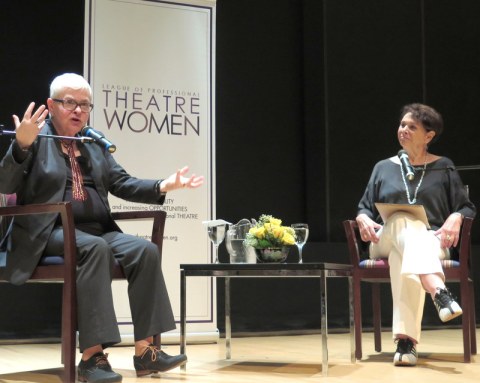
(L to R): Pulitzer Prize-winning playwright Paula Vogel, Linda Winer in NYPL for the Performing Arts at Lincoln Center, League of Professional Theatre Women collaboration, ‘Paula Vogel in Conversation With Linda Winer at Bruno Walter Auditorium (photo Carole Di Tosti
The League of Professional Theatre Women’s Pat Addiss and Sophia Romma again have successfully collaborated with Betty Corwin, who produces the New York Public Library’s Oral History Interviews, to present an enlightening, joyous evening with one of Broadway’s hottest playwrights, Paula Vogel. In conversation with Linda Winer, long-standing theater critic of Newsday, the Pulitzer Prize-winning playwright discussed her life, her work and the journey of her play Indecent from conceptualization through development, regional theater production and Off Broadway right up to its current run at Broadway’s Cort Theatre. The immutably themed Indecent has been nominated for a Tony Award in the category of Best Play. It is not only a must-see, it is a must-see two or three times over for its metaphors, themes and sheer genius.
Paula Vogel, a renowned professor of playwriting (Brown-two decades, currently Eugene O’Neill Professor of Playwriting (adjunct) at Yale School of Drama, Playwright-in-residence at Yale Rep) generously shares her time and dynamism with global communities. She conducts playwriting “boot camps,” and playwriting intensives with various organizations, theater companies and writers around the world. What is smashing is that Vogel not only is a charming, vibrant raconteur, she is an ebullient, electricity-filled advocate of the artist within all of us.

Pullitzer Prize-winning playwright Paula Vogel, a presentation by The NYPL for the Performing Arts at Lincoln Center and League of Professional Theatre Women, ‘Paula Vogel in Conversation With Linda Winer, Bruno Walter Auditorium (photo Carole Di Tosti)
In her philosophy and approach toward theater, we are all story tellers, we are all playwright,s and we must cultivate the citizen artist within to insure that the theater arts are accessible and relevant to all cultures and populations, not just the “haves.” What she discussed about the current state of theater arts past and present was profound and prescient in response to why it took her so long to get to Broadway. Vogel reminded the audience that in the 1980s there were about 50 innovative, theme-rich plays on Broadway exemplified by The Elephant Man and M Butterfly. Such plays dealt with difficult issues that brought audiences together in a profound communal experience. Currently in 2017 there are a handful of productions that effect this. Commercialism has enveloped Broadway.
Hence, Vogel expressed a motivating joy that perhaps we should all entertain. We should roll up our sleeves to fight the good fight against philistine commercialism and consumerism and Byzantine gender and racial bias. Such dampening restrictions and discriminations parade behind the notion that film and theater are essentially liberal mediums. Vogel introduced the thought that they are the opposite. To her way of thinking there is a profligate conservatism akin to that of corporate America that hampers theater innovation and prevents provocative theater production to readily make it to Broadway.
However, she did affirm that the next generation of playwrights, whether older or younger, are seeing an explosion of work featured Off Broadway and Off Off Broadway which is where a lot of the innovation and experimentation has found a home. That aspect of the theater is thriving and in the upcoming years we can expect an elegance of defining work that will have an illuminating impact on Broadway.
A believer of reverse capitalism, that supply increases demand, Vogel’s ideas and effervescence are contagious. She “spreads the word” and brings the community of theater wherever she visits, from Austin, Texas to Sewanee, Shanghai Theatre Academy in China, from Minneapolis to the neighborhood near the Vineyard Theatre in New York City. And together she and her audience of all ages across the communities (from 15-90), of seasoned writers and playwrights and neophytes alike, experiment, grow and enjoy writing and reading plays during her intensives.
Her current playwriting boot camps (they used to take a week to do) to make live theater a communal experiment much like its original creative form as a social, cathartic experience resonate today. They make complete sense especially at a time when artistic shallowness manifested in some entertainment forms has achieved a noxious superfluidity that really needs to die a death (my thoughts).

(L to R): Paula Vogel, Linda Winer, ‘Paula Vogel in Conversation With Linda Winer, in a collaboration by The New York Public Library for the Performing Arts at Lincoln Center and the League of Professional Theatre Women (photo Carole Di Tosti)
Some of the highlights of Paula Vogel’s discussion with Linda Winer, who was a wonderful interviewer, revolved around how she conducts her “bootcamps,” culminating in bakeoffs to spur on a fountain of creativity. In response to how her Pulitzer Prize-winning play Learning How to Drive was produced Off Broadway but never made the transfer to Broadway, she repeated an incisive comment from the past, “How often do the girls get to play with the big expensive toys?”
Now that Vogel’s Indecent and colleague Lynn Nottage’s play Sweat also transferred to Broadway from the Public Theater, Vogel laughingly acknowledged that for both of them, the expensive toys are “a lot of fun.” Vogel stated that when one acclimates to the house size, whether the play is in a 60 seat theater or a 200 seat theater, the effort and the intensity of the work process is the same. Vogel joked, “The only difference is I’m not sleeping on a sofa bed.” Indeed, with Indecent, Vogel has graduated to a mattress and a bed, “more expensive toys.”
Vogel discussed the evolution of Indecent which was fascinating. In her twenties she had read The God of Vengeance, by Sholem Asch, the play upon which Indecent revolves. She was mesmerized by the transcendent love scene between the pious Jewish father’s daughter and one of the prostitutes who works for him in the brothel below their apartment. When the world renowned Yiddish play was translated into English and brought to Broadway in 1923, the cast, director and producer were arrested for obscenity, even though some of the love scenes were cut. The play received a greater following and lasted 133 performances, but there was a trial after the play closed. The Court of Appeals overturned the convictions of the director and producer in 1925.
Twenty years after Vogel read Asch’s play, she learned that Rebecca Taichman was attempting to direct the obscenity trial for her thesis. Vogel learned of her work and pronounced her a genius. Vogel was inspired when she received a call from Taichman to collaborate on a play about the events surrounding the trial of Asch’s play. During their conversation Vogel had a lightening-like vision seeing a scene from the play which she stated “always happens” (it happened with Learning How to Drive) when she knows she can write a particular play. Having read up on Yiddish Theater, she told Taichman, “I think this is a play way beyond an obscenity trial.” Taichman was thrilled at her enthusiasm. Vogel admitted that this was around nine years and 40 drafts ago.

(L to R): Pat Addiss, Paula Vogel, ‘Paula Vogel in Conversation With Linda Winer presented by NYPL for the Performing Arts at Lincoln Center and League of Professional Theatre Women (photo Carole Di Tosti)
They workshopped at Sundance Theatre Lab (2013) and after many drafts and other workshops they put it on at Yale Repertory for the first time with the music, choreography and staging. Vogel joked the “flop sweat” was prodigious. Taichman’s and Vogel’s shirts were sticking to their backs. Since then it has moved on and was performed at La Jolla Playhouse in Fall 2015 and in May 2016 was produced at the Vineyard Theatre in New York City.
There is such enthusiasm for the production since Yale (2015) that the ensemble, the musicians, the stage manager and the assistants have remained together. As Vogel says, “We’ve all moved together as one.” This never happens with a production that transfers to Broadway. If it does, it is extremely rare. Vogel laughingly joked they have become a family. When two children were born during the evolution of Indecent, Vogel commented she has become like a godmother to both.
What a memorable evening! Vogel is about fun, about community about connections, about living and creating whatever comes next. That spontaneity and flexibility is like jumping off into the darkness, knowing you will land on soft ground at sunrise. The moment you think about the jump, you stop yourself. Vogel is not about stopping. She’s there already and beckoning us to join her. Why not?
A Day of ‘Hamilton,’ The Hamilton Education Program in New York City
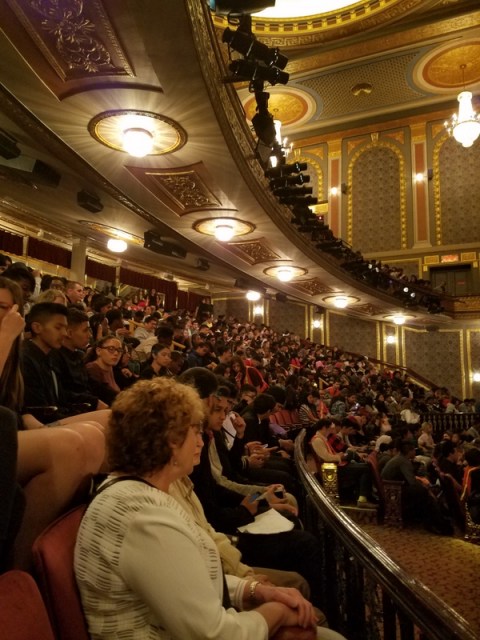
Hamilton Education Program, 24, May, 2017, Richard Rogers Theater, ‘Hamilton’ (photo Carole Di Tosti)
If you have yet to see Hamilton, an American Musical on Broadway and have been avoiding it because of the “hype” or the ticket prices, rethink the “hype” about the “hype.” I cannot recommend the production enough. I have not reviewed it because I cannot put into words its greatness and ineffability. I have seen it seven times, including the time I and a friend saw it being workshopped at Vassar a few years before it arrived on 2015 at the Public Theater. The summer performance workshop at Vassar College, before Lin Manuel Miranda wrote “The Room Where It Happened,” (in Aaron Burr’s bedroom at the Eliza Jumel Mansion), was fantastic. I introduced myself to Ron Chernow who was there, and told him to get ready. He was going to be selling a lot of books. He wrote Hamilton upon which much of Miranda’s production is based.
Is Hamilton deserving of its “hype” (2016 Pultizer Prize for Drama, 11 Tony Awards, 8 Drama Desk Awards, 2016 Grammy Award)? Should Lin Manuel Miranda have won the MacArthur ‘Genius’ Grant? Is it portentous that President Donald Trump tweeted that he heard it was a “highly overrated show?” Suffice to say, the jokes about prices are humorous, the hyperbole is clever. If it is keeping you away, you are missing a superb production that cannot be compared to anything on Broadway before or since its inception. Hamilton is about the best and worst of what makes our country an amazing experiment of which we are all a part, whether citizens or not, whether legal immigrants or not.
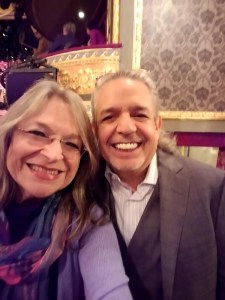
the journalist with Luis A. Manuel Miranda, Jr., Hamilton Education Program, 24 May, 2017, Richard Rogers Theater, ‘Hamilton’ (photo Carole Di Tosti)
To offer the opportunity of seeing Hamilton for New York City teenagers, many of whom may have never been to a Broadway performance because Broadway is so egregiously pricey, there has been an ongoing initiative to offer a Hamilton experience for city teenagers. Hamilton has formed a partnership with The Rockefeller Foundation, The Gilder Lehrman Institute of American History and the NYC Department of Education to bring various schools and their teachers to a matinee of Hamilton. Before seeing the performance, students from high schools around the city present their creative work (songs, vignettes, poems), related to the time of Alexander Hamilton in America’s history. After their presentations, they enjoy a Q and A with cast members who they see after lunch performing in Hamilton.
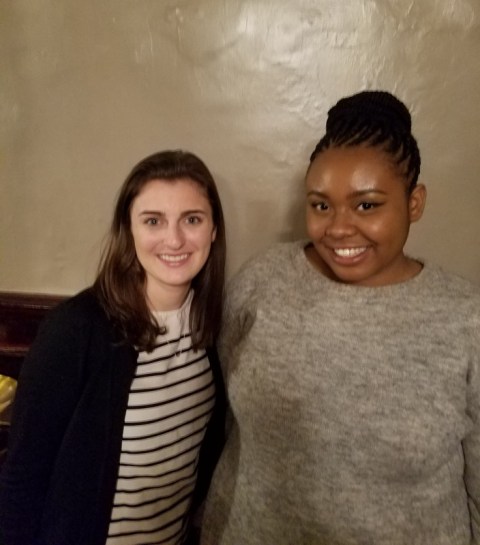
(L to R): Teacher Nicole Schindel, Madison Banks, Bronx Collegiate Academy, Hamilton Education Program, Richard Rogers Theater, ‘Hamilton’ (Carole Di Tosti)
I attended on Wednesday, 24 May and was pleasantly surprised by the efforts of the students, some of whom had never performed before a live audience before of around 1300 students. Nineteen schools with teachers and students attended. Students from 14 schools presented their projects. I had the opportunity to briefly speak with five students who performed.
Madison Banks from Bronx Collegiate Academy wrote the “Hamilton Song” and performed it with with power, showing she was comfortable before the live audience. She belongs to a global traveling choir and performs anywhere there are open mics in NYC. She’s performed poetry and also sang at venues in Greenwich Village, the Apollo Theater, the Harlem School of the Arts and the Nuyorican Cafe. Madison is interested in evolving and pursuing her creative talents and would love to be an entrepreneur exercising her acting, singing, writing skills. When I asked her about colleges, she mentioned Spelman College in Atlanta, Georgia, and Temple University in Philadelphia, Pennsylvania. Her teacher Nicole Schindel shepherded her through the application process and attended with her enjoying Hamilton Day.

(L to R): Tyler Johnson, Hawa Sall, Benita Campos, Hamilton Education Program, ‘Hamilton,’ Richard Rogers Theater (photo Carole Di Tosti)
Three young ladies I spoke to from University Neighborhood High School performed a feminist poem about the Schuyler sisters: “Schuyler Sisters’ Poem.” When I spoke to Tyler Johnson, Hawa Sall and Benita Campos, they assured me that they wanted to draw attention to the importance of women during the American Revolution and the fact that they are rendered invisible, though they made their husband’s exploits possible and greatly contributed to their successes. The “Schuyler Sisters’ Poem” raised loud vocal appreciation and applause from both young men and young women in the audience when they repeated the line, “There is more to us than what we do in bed.” Tyler, Hawa and Benita are in the Baruch College program preparing to excel in law and medicine after they graduate high school. Like other students in the audience, they are completing their junior year. I heard Columbia University and Fordham University as two of their choices for colleges they would like to attend. The young ladies were accompanied by their teacher Kelly Haff who helped them with the project.
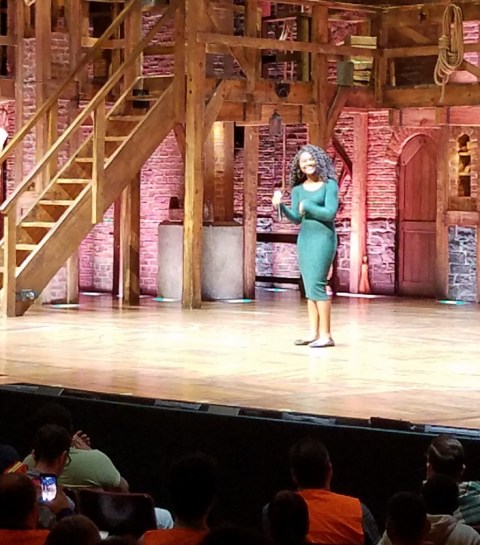
Treniece Johnson, Hamilton Education Program, 24 May, 2017,’Hamilton,’ Richard Rogers Theater, (Carole Di Tosti)
From Martin Van Buren High School, Treniece Johnson wrote and performed the “Freedom Fight Song.” Though I was told she was nervous, her performance went smoothly and students joined in speaking/singing the refrain about fighting for freedom. Her song confronted a crucial problem which we still face today as our democracy comes increasingly under pressure from foreign adversaries threatening our election processes. Additionally, we must maintain our free speech, free press rights, the lifeblood of freedom as they are coming under increasing attacks by those who would muzzle unfavorable opinions and mischaracterize facts as fake.
Treniece Johnson’s song reminded us that one must continue to fight for freedom. Though the constitution guarantees freedoms, there are those who would curtail citizens’ rights in order to consolidate and increase their own power base. It takes our active participation in the struggle to prevent usurpers from wielding extraordinary power that constitutionally they do not have. We must “fight for freedom” in the courts, in the press and in our protests to redress overweening governmental grievances.
After the thirty students performed, the MC and host Donald Webber, Jr. (he portrays Philip Schyler, James Reynolds and the Doctor), conducted the Q and A during which members of the cast answered questions. The following cast members were present: J. Quinton Johnson (portrays Hercules Mulligan/James Madison), Sasha Hollinger (ensemble), Gregory Treco (standby for Aaron Burr, George Washington and Lafayette/Jefferson), and Lauren Boyd (ensemble). Some excellent advice from cast members included the exhortation, “Be prepared in everything you do in order to be ready to receive what is available.”
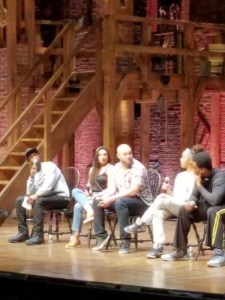
‘Hamilton’ cast: Donald Webber MC), Lauren Boyd, Gregory Treco, Sasha Hollinger, J. Quinton Johnson, Hamilton Education Program, cast Q & A, 24 May, 2017, ‘Hamilton’ Richard Rogers Theater (photo Carole Di Tosti)
By that point students were ready to receive the performance of Hamilton after lunch. And I was thrilled to introduce myself to Luis A. Miranda, Jr., Lin Manuel Miranda’s dad who is an icon in his own right. He graciously paused a moment in his busy day for a selfie with me. For the 40,000 students and teachers who are having the incredible opportunity of seeing Hamilton on Broadway, a special thanks and appreciation must go to Hamilton, the Gilder Lehrman Institute of American History, The Rockefeller Foundation and the NYC Department of Education. For all of us there on 24 May, 2017 it was an experience of a lifetime.
As a postscript, if you never get to see Hamilton on Broadway, Lin Manuel Miranda is working to put Hamilton on film. Like Treniece Johnson’s “Freedom Fight Song” the film will be a reaffirmation of the ideals of our nation, ideals which we are constantly striving to realize, though, at times there are setbacks. If we are not there yet, the voices of American citizens will continue to “Rise Up” to be heard loudly and clearly that, “…these truths are self-evident; that all men and women are created equal. That they are endowed by their Creator with certain unalienable Rights, that among these are life, liberty and the pursuit of happiness.” (The Declaration of Independence.)
“If it be now, ‘tis not to come; if it be not to come, it will be now; if it be not now, yet it will come—the readiness is all.” (Hamlet, Act V, Scene 2)
Tribeca Film Festival Interview: Trish Adlesic and Geeta Gandbhir, Part II
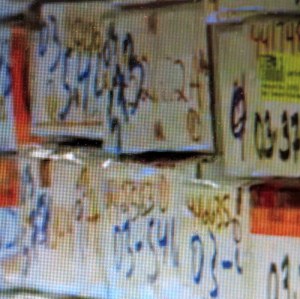
Each box represents an untested rape kit. ‘I Am Evidence,’ directed by Trish Adlesic and Geeta Gandbhir. (photo from the film)
After viewing the World Premiere screening of the documentary I Am Evidence at Tribeca Film Festival, a few days later, I sat down with directors Trish Adlesic and Geeta Gandbhir to discuss the making of the film. For Part I of my interview, CLICK HERE. For my review of the film CLICK HERE.
Could you talk about how this is a pivotal moment and talk about where you think the direction with the testing will go. People will see the film and be impacted. One cannot help but be impacted. So the film is a step in the right direction.
Geeta: This is something we mentioned before. This is such a critical moment with the election that happened. It is a dark time in some ways for women, for people of color. The film encapsulates so many issues that right now everyone needs to be motivated and on the forefront, fighting the battle for citizen’s rights. I am referring to sexism, systemic institutional racism, public safety and basic moral issues. And right now, unfortunately, we have a president in charge who doesn’t necessarily support the different communities that really are trying to be heard in this film. So it feels very timely. I can’t think of a better time.

(L to R) Geeta Gandbhir, Trish Adlesic, directors ‘I Am Evidence, World Premiere at Tribeca Film Festival (photo Carole Di Tosti, taken at HBO)
Trish: Yes. It’s interesting. As I sit here now, I don’t think anyone over 40 can’t say they haven’t have had some sort of violence afflicted on them whether it’s related to gender, discrimination in the workplace, sexual harassment, domestic abuse, sexual assault…but I must say that sitting here in 2017, I’m really fatigued for having to keep the fight going. We haven’t really made the progress we deserve with all the women who have gone before us from Betty Friedan to Gloria Steinem, to all our leaders. It’s so disheartening that we are still in the fight at this time. When are we going to move forward and have an Equal Rights Amendment? Also, people would say to me during the making of this, “Oh, you’re worrying too much. Hillary’s going to become president. She’ll have your back; she’ll have your back. You don’t have to worry about this”
But the real problem with this is the deeply rooted cultural biases that are planted by people who are in control of this issue. We have to have required training in police academies across the country. The decision must be taken out of their hands, for example, so that they don’t get to determine the fate of a kit. Every kit must be tested and there must be proper funding in place to do something with the findings because it’s just not enough to test a kit. It has to be taken to the next level. And laws need to be created to test and protect the evidence in each kit. Those laws must be adhered to. If this occurs, I think we can make significant progress.

(L to R): Erick Murria, Trish Adlesic at the Q & A after the TFF World Premiere screening of ‘I Am Evidence’ (Photo Carole Di Tosti)
We need education as well. That’s where the film comes in. But it’s a difficult film in a lot of ways. First of all, it’s a film about women. That’s already a strike against you. Then you have a film about sexual assault. There’s a lot of shame and darkness around this issue. We wanted to make the film very survivor-centric so people could feel the experiences. And make it relatable to everyone. So this is the tool that hopefully will do that and get everyone in the room.
Do we need to get men on board, a lot of men on board?
Trish: Interesting. As a gut reaction, I asked a reporter that in Cleveland, Rachel Dissell, in a follow-up interview. She got very angry by that. She said, “I don’t understand why we need to actually get them on board. They should already be on board.”
Geeta: I think that the key thing is we cannot come from an apologist’s standpoint. That is really the key thing. This is an issue…that is said in the movie. If you have evidence of a crime and you do nothing with it, that in and of itself is a crime.
Trish: That’s a Polly Poskin (Illinois Coalition Against Sexual Violence), quote. She wrote a beautiful quote about this very thing. She said, “When you don’t utilize the evidence given to you, that in itself is a crime because it’s re-victimizing others. You’re letting a perpetrator run free.
Geeta: And I think in these times, if we have this information, this is obvious neglect. If you don’t stand on the side of women in this…

(L to R): Geeta Gandbhir, Mariska Hargitay, Sheila Nivens, Trish Adlesic, Nancy Abraham, Tribeca Film Festival World Premiere screening, ‘I Am Evidence’ (photo Carole Di Tosti)
It’s criminal negligence. The UN has come out and stated that rape is equivalent to genocide. (CLICK ON ARTICLE)
Geeta: It’s used in war as a weapon of war, and is a war crime.
Trish: It has been a psychological weapon used against people in war.
Geeta: It’s been used as a weapon of war. And as a follow-up to that, Helena as one of the survivors says, “The system should be better than a criminal.” We need everyone on our side of course in this fight. But we cannot be concerned about specifically having to target men.
Trish: I think that any human being should be able to relate to this. I understand the intention of the question because it’s commonly asked…
I don’t believe that by the way. If we look at Kym Worthy’s example, she shows us how we must act. She led the fight in Detroit. She took a leadership role that others, including men, followed because they were ashamed.
Trish: I think that it has to go down to…this may sound trite, but, “When you see something, say something.” When we talk about needing to have informed consent, it’s clear. Sexual assault is sexual assault. It is not an invitation to have sex with someone. So we have a lack of education. And this environment of alcohol use can promote rape, and boys and men and women alike need to understand the boundaries around alcohol use.

Sealing a rape kit filled with DNA evidence, ‘I Am Evidence’ (photo from the film)
Geeta: You’re absolutely right. Trish makes a very good point. I think this is what Mariska talked about in one of our Q and As. Young people are not educated about what the definition of consent means. They are not educated about sexual assault. We need to educate young men and boys as we need to educate young girls and women. That’s at the root of it, but as far as we’re concerned we think that anybody should be able to see this film.
Trish: It’s certainly not to say, it’s their fault if they’re not aware. But it’s helpful to know to be careful around alcohol use because alcohol can lead to situations that are compromised.
Geeta: There’s also sexism. I have two boys. I feel that it is our job as parents, as schools, as communities, in the church, wherever we go, to also focus on raising feminist boys. Part of the feminist training for boys is for them to understand sexual boundaries and the definition of assault and things like that because men and boys are also victimized.
Absolutely. I forgot the exact numbers…
Trish: 1 in 6 men and 1 in 4 women…
1 in 4 women and 1 in 6 men are raped on college campuses
Trish: I have a close family member who is a male and was assaulted as a teenager and it really tormented him. It was rough. I don’t think for any one of us that we are far from this issue.
I was amazed at a lot of the information I learned from the film. Was there any information that was just staggering to you?
Trish: Tell me what you learned as a viewer…I’m curious.
The number of rape kits that were allowed to molder on shelves. The fact that there are states and whole police departments that are not looking at them. The fact that they discount them. I found that to be egregious. The fact that New York is doing OK, now, and they have a law that all rape kits must be tested. But New York is only 1 of 8 states. Shouldn’t every state in the union have a law?
Trish: There are different types of legislation being put forth around this issue. There is progress happening. But they’re not the law that we’re looking for which is the requirement for all kits, current and backlogged to be tested and to be followed up on. There are varying forms of those laws being legislated. The movement is happening. I think a number of states now are looking at legislation to improve the conditions.
So that is important. But I remember our travels…we’ve gone to many states. We couldn’t put everything in the film. If we had more time we would have. But I remember being in Kentucky, going to jurisdiction after jurisdiction counting. There are varying degrees. In Kentucky, once they know they are backlogged, they do an audit. The state auditor goes to the police departments and counts. Or they’ll give them a survey. And I remember being in one precinct in Covington, Kentucky, I believe it was. The auditor was asking, “So when you go into your data base and you look up a rape kit, how do you find the right number for your rape kit in your data base? Do you type in rape, sexual assault?” The woman said, “Other.”

(L to R): Sheila Nivens, Ericka Murria, Geeta Gandbhir, Mariska Hargitay, TFF World Premiere Red Carpet for ‘I Am Evidence’ (Photo Carole Di Tosti)
Geeta: There wasn’t even a category for it.
Trish: So that to me was so stunning. She said we have a category for a bicycle, for a stolen bicycle. And I thought that gives you an indication of the organization around this.
Geeta: I have to say that everything was shocking to me. I would lie awake at night thinking about this issues. And I’m sure Trish felt the same. When you say was there one thing? There was one thing after another after another. I was in shock.
Trish: One thing I wanted to share with you is something that one of the survivors told us when they were investigating and the police came to her house. One of the officers pulled her aside and said to her. “Do you know why this happened to you?” She said, “Because the guy was a jerk?” And he said, “No. It’s because you don’t have a father.” Just to give you an indication of what that feels like.
Geeta: She was a teenager. It’s an indication of the police training.
I just have to say I was shocked when you featured the courtroom scene and the poor woman who was the rape victim was on the stand. The defense was implying that she was responsible for her rape, and she responded, “Well, a gun was being pointed at my head.”
Trish: It’s always like that. It’s standard procedure for Defense Attorneys for rape. They do that for every case. I sat in on many cases from East to West in this country. And every single case is conducted in exactly the same way by the defense. And sometimes it’s quite colorful and humiliating. What there intention is, is to trip the victim up and to scare the victim, to stifle the victim so that they won’t come across as reliable, as a reliable, credible witness.
Geeta: Ericka spoke to that in the Q and A. She said that she was put on trial, too. She felt that basically, she had to pull out her underwear in front of the entire place. She felt that she was as much on trial as her perpetrator.
Any plans for International Woman’s Day for showing this film?
Trish: You say where to be and I’ll be there. We’re ready. We’re working toward our broadcast date with HBO. In the meantime we’re going to do many other film festivals. Social engagement campaigns. East and West, high and low, theatrical campaigns. We’ll do everything we can, and we’ll be there.
You might get in touch with Girl Be Heard! (CLICK HERE for website) It’s a theatrical organization. At one of their productions I first heard about untested rape kits; I had no idea. They are a youth organization in NYC. Lin Manuel Miranda fund-raised for them. They are a wonderful organization.
Geeta: Also, there is the website if anyone is interested in keeping up with this.
Trish: CLICK THE LINK https://www.iamevidencethemovie.com/
To see how your state is dealing with the backlog CLICK HERE.
Thanks, Geeta, Trish.
‘I Am Evidence’s’ Trish Adlesic and Geeta Gandbhir, Interview Part I

(L to R): Geeta Gandbhir, Trish Adlesic, directors of ‘I Am Evidence.’ Interview at HBO Offices after Tribeca Film Festival World Premiere screening and Q & A. (Photo Carole Di Tosti)
Tribeca Film Festival held the World Premiere and screening of I Am Evidence, a compelling documentary which follows the story of four survivors of rape as they attempt to gain justice over a period of many years. During the process that they contact and work with law enforcement, they and filmmakers highlight the fate of what at one point amounted to 400,000 untested rape kits filled with evidence that various police departments left forgotten on storage unit shelves because rape is a low priority, high complexity crime. Behind each of the 400,000 + kits is the DNA of a woman who was sexually assaulted and who waits for her perpetrator’s DNA to be cross-matched with known criminals, serial rapists, murderers, through the federal database, CODIS.
Rape victims often hear nothing from the police departments for years leading to miscarriages of justice and an unfettered crime spree. Research has shown many rapists are serial rapists and some serial rapists murder. In one example in the film a serial rapist raped 10 women until he was picked up. The egregious negligence of various police departments across the nation, who allow criminals to run free, is one of the many issues directors Trish Adlesic and Geeta Gandbhir examine and explore during their journey shadowing the four women survivors.
Filmmakers show there is hope as the backlog of rape kits is slowly being addressed. More states are passing laws to enforce the testing of the kits. The film focuses on the backlog issues, the causes and solutions and the heroes in the fight, like Kym Worthy, Detroit prosecutor, whose untiring work to have Detroit’s 11,000 kits + tested is resulting in prosecutions that get rapists off the streets. The shining moments of the film reveal the survivors who are overcomers: they remain unapologetic about the miscarriages of justice that have occurred and have become advocates to change the laws so that every rape kit is tested, matched up in the criminal data base nationwide and followed up. They inspire hope as they encourage other women to come forward and join the fight to end this systemic institutional injustice of backlogged rape kits..
I met with directors Trish Adlesic and Geeta Gandbhir at the HBO offices a few days after the film screened.
I loved the film. Could speak to what the title refers to and what the film is about?
Trish: Well, the title came very organically through the process of understanding the journey for women who have been through this violence of sexual assault. In pursuing subjects for the film, I wanted to find someone who had not had their rape kit tested yet in Detroit because Detroit had a backlog of over 11,000 untested rape kits. I thought that it would be incredible to find someone who was still looking for their kit and still looking for justice. There was an organization called The Sasha Center which is geared toward the needs of African American women because the church is predominately African American. The Sasha Center (it provides sexual assault services for holistic healing and awareness) had someone they were working with who was still looking for her rape kit. She agreed to speak with me. When she walked into the room, she had this phenomenally beautiful pink hair and this beautiful skin. Then I look down and see, “I Am Evidence” on her T-shirt. I immediately got chills. I thought, I’m about to have a profound experience.
Ericka?
Geeta: Yes. And what is interesting is that Ericka is deeply involved in her church. That statement is used in her church and it is sort of a traditional saying, “I Am Evidence,” a statement about being a witness. So she took it and basically we reprised it in the sense of talking about her rape kit. It’s a powerful statement. And she makes statements about this in the film. She says that she is evidence that a rape kit is not just a rape kit. It’s not just DNA, there’s a person behind it. It’s also evidence of being able to overcome the struggle that goes along with the violence she experienced as her personal experience. So this background about Ericka was a big part of the decision for I Am Evidence to be the title.

(L to R): Mariska Hargitay, Sheila Nivens, Trish Adlesic, Tribeca Film Festival World Premiere Red Carpet, ‘I Am Evidence’ (photo Carole Di Tosti)
Trish: Yeah. It’s incredible because it’s a double entendre. The body is a living, breathing crime scene. We are evidence. But the poetry around her is that we are the evidence that we can heal and grow and we can get beyond this, because this kind of violence is so debilitating for people. I found it so inspirational that she had the ability to say those words. I mean anyone can relate to the fact that we are evidence of the lives we live and how we handle trauma and challenges in our lives. I thought that would be something everyone could relate to.
Did she help to evolve the film’s uplifting tone. Could you talk about the extent to which she may have influenced that?
Geeta: I think she did. But there’s an arc, is there not Trish? I think with the subjects that we follow, the women that we follow have an arc and that over a period of time, this was her organic journey. Obviously, her journey was ultimately uplifting. She’s a powerful person.
Trish: Yes, she is very spiritual and that’s the case. She did have challenges. Her kit was found. It was tested and there were really hard days for her to undergo in that process. Ultimately, she came to a place of acceptance characterized by the word that she uses for it in the film: “unapologetic.” In other words we don’t have to apologize for the things that have happened to us. It’s OK to feel that pain and to want to have some satisfaction out of being hurt and you really have justice. And the arc is the unapologetic moment and the moment of acceptance that while I may not get a victory in court, I was heard. That’s what matters most to all of the victims of this kind of violence: the fact that they actually are given the opportunity for justice.

(L to R): Geeta Gandbhir, Helena (film subject) TFF World Premiere screening and Q & A, ‘I Am Evidence’ (Photo Carole Di Tosti)
You helped in that arc. You helped to inspire her journey. Could you talk a little bit about that and how long the process was as she really was at the forefront of your expose.
Trish: It was about two and one-half years from the moment I interviewed her. I began to contact the prosecutor to find out if there could be some way in which they could try to locate her kit. She simultaneously had met with Ms. Worthy at a fund raising event for the backlog through an organization called the 490 Group. It’s a group of African American women in Detroit who are raising funds to test the kits. Both efforts converged and her kit was located. I think that certainly her participation in the film brought this opportunity. Eventually, her kit would have been found because they are continuing to test all the kits, but it wouldn’t have happened necessarily in the timeline that it did.
Geeta: I have to say that the film had a profound experience on the women because of Trish. Trish is the producer and co-director, and Trish had a profound impact on the women because she was there from the inception. I came onto the film a little bit later, but Trish was there from the beginning. I think that the idea, the thought that someone is working with you, that someone wants to hear your voice, gives you a sense of empowerment. That’s not to decry the fact that these women in their own right are very powerful. But I think that when someone holds out their hand to support you, it makes a big difference.
In our presence at the World Premiere after the film screening in the Q and A, Ericka sang to a packed audience in the theater, which takes courage. And she announced that she’s running for office.
Trish: Yes. City Council. How about that? (she laughs). She’s smart, she’s very smart.
Geeta: She’s an incredible force, I mean with or without us and the film.
So there was a convergence of events which reveals a kind of synchronicity. This leads me to ask this question. Did this project choose you or did you choose it? How did the film evolve?
Trish: That’s a great question and it’s a question we’re always asked. I want to give the backstory so it’s clear. I had worked on the television show Law and Order: SVU for 14 years with Mariska Hargitay, and we became friends through that work together. I began to produce documentaries because I was potentially going to be affected by the issue of fracking in my community in upstate New York. That led me to do these films that had a profound effect on my life (Gasland and Gasland II). I saw the power of the medium and I thought, well, I’m not getting any younger. How do I want to spend my time? I feel like for me this opportunity has been a dream come true to do this work. It’s honestly gratifying.
Mariska saw that journey for me and I knew that backlog was at the forefront of her focus for her foundation (The Joyful Heart Foundation) and we kept saying let’s do a project together. Let’s do something. And it led to doing this film. You know it’s her first documentary. I was excited to do everything I could to give it its best shot and bring it into the light and to bring in all the best people I knew in the documentary world to help complement the work we were doing. So that’s how the film came about.
I brought Geeta on the project. I knew Geeta from working with her before. I trust her work and knew that Geeta would understand and care greatly as I do, and so she was someone that I really wanted to bring in on the film.

(L to R): Ericka Murria, Trish Adlesic, Helena, Geeta Gandbhir, Helena, Mariska Hargitay, Kim Worthy in a Q & A, after the TFF World Premiere screening ‘I Am Evidence’ (photo Carole Di Tosti)
Geeta: It was such an honor for me when Trish and I worked together. Obviously, I really respect her and what she’s done. We were talking about doing this film for a long period of time.
Trish: I was serenading her (Trish laughs).
Geeta: I wasn’t able to. I had other things. Then finally there came the time. So it was Trish who brought me on. Also, I had worked with HBO for a long time; I started with them when the levees broke in New Orleans. That was when I became hooked on Social Justice issues similar to Trish, and I realized that these documentaries gave my life meaning. With this work you feel like you’re making some kind of impact, some kind of a difference.
Then, finally, it felt like the time was right. I think Trish and the project and Sheila Nivens (President of HBO documentaries) had something to do with it. Once they all say, it’s time…
Trish: She’s the Goddess (referring to Sheila Nivens).
Geeta: …you come on board. Honestly, it’s been incredibly rewarding and meaningful.
You knew through Mariska that there was a problem.
Trish: I did. We had done an episode at SVU about an untested rape kit. One of the women who actually is in our film, Helena, had an episode written for her. It’s called Behave. That’s when I first learned about the rape kit backlog. I saw what she he had been through with law enforcement being re-victimized by not being heard.
I think for a lot of the women whom I’ve spoken with, that very re-victimization almost felt worse for them than the assault itself. These were the very people who had been set up to be there for them. Yet, these very people in fact were blaming them and not believing them. Rape survivors felt so violated by that. First, it’s incredible that they have the ability to come forward with such a traumatic experience. It is so hard to tell your story. Then for them to go through the re-victimization with the police?
So I learned about the untested rape kits that way and learned more and more when Detroit broke in 2009. And I saw the heroism of Kym Worthy and thought, this has got to be a documentary. It’s amazing to be in this moment at this
Look for Part II of the interview with Trish Adlesic and Geeta Gandbhir.
For my review of the film CLICK HERE.
For the link to the website I AM EVIDENCE, CLICK HERE.
To see how your state is dealing with the backlog of untested rape kits, CLICK HERE.

‘I Am Evidence,’ World Premiere at Tribeca Film Festival, Review
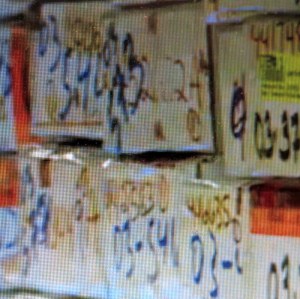
Untested rape kits moldering on shelves. ‘I Am Evidence,’ Tribeca Film Festival World Premiere (photo from the film)
I Am Evidence is one of the most important documentary films to come out of Tribeca Film Festival. It is a groundbreaking criminal and social justice documentary about women, rape, and the folkways that allow this crime to fly under the radar. The film centers around rape survivors and the process of rape crime evidence collection, sealed in a rape kit which then is sent off to be tested. Central to I Am Evidence is the egregious miscarriage of justice that happens in a predominance of states in the U.S. Rape kits, loaded with critical evidence, languish sometimes for years in police storage untested, forgotten, trashed. Is this institutional misogyny, the banality of evil or something else?
With meticulous, clearly organized information, the filmmakers answer these questions and examine how and why this unconscionable backlog of known untested kits (once numbered 400,000 nationwide) happened. The number was probably even greater if one considers those thrown away, negligently stored, lost, displaced. Rape victims are loathe to file a police report; most probably the number of rapes is greater. The backlog exacerbates our culture of sexual violence (every 98 seconds an American is sexually assaulted).
Through salient interviews of rape survivors (i.e. Ericka, Helena, Amberly), journalists, investigators, law enforcement, researchers, and other experts (Mariska Hargitay identifies the substantive issues at the outset as she interviews Wayne County prosecutor Kym Worthy), directors Trish Adlesic and Geeta Gandbhir cogently examine why the testing of rape kits needs to be a nationwide law enforcement priority. The filmmakers’ approach is winning; the documentary is a heartfelt and human drama told through the uplifting testimony of rape survivors like Ericka Murria. Murria shares her triumph over psychological and physical trauma as she seeks justice and takes a stand to advocate for others. As Ericka, Helena Amberly and others share the arc of their journeys from chaos and depression into the light, filmmakers outline the breadth of the problem about untested rape kits.
Adlesic and Gandbhir establish that every untested rape kit represents a victim. The kit contains material DNA evidence. Once the evidence is tested in a lab, the results can be placed in a data-base (CODIS) which matches rapes, crimes and murders nationwide with the DNA evidence from perpetrators. If the evidence is never tested, the kits left to molder on a shelf in a storage unit, that crime and the potential match-up with criminals (especially serial rapists/murderers), and other crimes they’ve perpetrated will remain unsolved.

Mariska Hargitay at the Tribeca Film Festival World Premiere screening of ‘I Am Evidence,’ (Carole Di Tosti)
Through the testimony of investigative teams and prosecutors, the filmmakers reveal the endemic nature of the problem. Each ignored kit means that a rape is not going to be investigated, even though a victim has emotionally steeled himself/herself to go through the shame of filing a report that takes 4-6 hours for evidence collection and placement in the kit. The message inadvertently sent to rapists and serial rapists/murderers is that they are permitted to to rape and/or kill again.
The message sent to victims is that their rape doesn’t matter and they don’t matter. Ultimately, the victim, traumatized by the sexual assault and battery, is further abused by the negligence of their un-investigated crime. Humiliation is compounded by the silence of injustice. An additional noxious side effect of untested rape kits is that word gets around that no one called about the rape investigation. Other victims are less likely to file a report. Rapists are emboldened. A significant point the filmmakers underscore from the research on rapists is that many rapists are serial rapists. They continue to rape until they are stopped. And some of those serial rapists also murder. Sadly, there is no way to gauge how many women are raped and how many serial rapists/potential murderers have committed multiple crimes.
When one considers that an untested rape kit that sits for years (the filmmakers reveal this occurred in places like Detroit, Los Angeles, see END THE BACKLOG), might empty even one cold case file, one begins to understand the staggering negligence that is multiplied as untested rape kits mount up in the thousands. (see your state’s numbers on END THE BACKLOG). In a lurid example of the impact of just one untested rape kit (sitting over a decade), filmmakers show how serial rapist Charles Courtney (a truck driver who committed crimes in various states along his driving route), was free to rape again and again. (click here for Helena’s story)
(L to R): Mariska Hargitay, Sheila Nivens, Trish Adlesic, Tribeca Film Festival World Premiere Red Carpet, ‘I Am Evidence’ (photo Carole Di Tosti)
If kits had been tested, law enforcement could have checked the databases, identified Courtney’s multiple rapes and gotten him off the streets, never to rape, threaten her family, and traumatize Amberly, one of his victims who filmmakers interview. From that rape, Amberly suffered PTSD that sent her life spiraling downward into addiction, a devastation which she is turning around. Indeed, one of the investigators who helped get Charles Courtney off the streets stated that if all the kits nationwide were tested, she would bet that his DNA would match up with a few unsolved murders.
I Am Evidence incisively, humanly directed by Trish Adlesic and Geeta Gandbhir, is an extremely valuable work of social justice. The filmmakers make a precise, clear, and thorough examination of how this holocaust of abuse has been allowed to continue fueled by our culture’s mores, folkways and prejudices leveraged by institutional racism, negligent law enforcement, misogyny. The clips that reveal this are devastating. Though the documentary is a painful and frustrating look into the egregious criminal negligence committed by various police departments with an incredible number of backlogged rape kits (over 100,000 nationwide), I Am Evidence is also an unforgettable journey of hope, healing, redemption, and activism.
Sealing a rape kit filled with DNA evidence, ‘I Am Evidence’ (photo from the film)
I cannot praise this film enough for its solid story-telling, its unabashed strength in unspooling the themes that inspire one to advocacy. From the outset, with empathy and poignancy, filmmakers elicit the soulfulness of the survivors who have gone through the hell of rape and reporting, and have attempted to deal with the psychological and emotional trauma of what they experienced only to then confront the truth that they may never receive justice. The documentarians also highlight the heroes-the investigators and prosecutors who have gone through the stressful frustration of dealing with the monumental backlog of untested rape kits.
Along the journey we watch specific examples of effectively functioning teams who are getting things done, pitted against interviews with former law enforcement officials who make dismissive comments about lack of funding and the terrible difficulty of prosecuting rape cases. Rather than admit the tragedy behind each and every untested rape kit, there remains a dilatory lack of accountability to problem solve or acknowledge that rape correlates with murder and other crimes.
What is particularly uplifting is that filmmakers show successes: they follow a team’s painstaking work to tackle the backlog that eventually results in successful prosecutions. They focus on undaunted heroes like Wayne County Prosecutor Kym Worthy (Detroit, Michigan had 11,000+ untested rape kits that had been placed in an abandoned, wrecked building, home to nesting birds and other creatures). When Worthy takes Mariska Hargitay to the site of the abandoned building to view where the kits had been left, we are shocked knowing that each kit is a person. When Worthy discovered this (2009), despite the insurmountable problems including lack of funding, she went into action, got kits tested, and criminals off the streets (some serial rapists had raped 10-15 times).
Survivors, law enforcement icons, The Joyful Heart Foundation, and End The Backlog are in the forefront of overturning the systemic criminal negligence perpetrated by the dilatory law enforcement agencies and their sub rosa misogynistic, racist behavior which deems rape a low priority crime, especially in ethnic communities. Some states are reforming their laws. Others are not. Why not? Is it because some law enforcement and prosecutorial departments don’t want to “waste” time, effort and finances on rape kits while there are other “more important crimes” to investigate? Indeed! By not testing rape kits, they are promoting more felonies instead of stopping them.
I Am Evidence is the filmmakers’ incredible work of hope and progress. Yet, it reveals we are not out of the labyrinth of unawareness and egregious systemic negligence. This must-see film is a clarion call for the public to demand all rape kits be tested as a matter of safety and security. Our criminal justice system must be accountable, especially now as the political winds shift.
This is a film everyone should see. For screenings check HBO and the film website.
‘The Lucky One’ by A. A. Milne, The Mint Theater Company, Review

(L to R): Michael Frederic, Wynn Harmon, Robert David Grant, Mia Hutchinson-Shaw, Andrew Fallaize, Cynthia Harris in ‘The Lucky One,’ directed by Jesse Marchese, (photo Richard Termine)
Playwright and celebrated writer A.A. Milne (of Winnie the Pooh renown), pursues the concept of what exactly it means to have fortune favor you when those “blessings” become a club that family members use at will for their manipulative pleasure. How is praise used? To taunt others and shower fulsome blandishments more for the one praising or in sincerity to encourage and support? In the Mint Theater Company’s fine presentation of The Lucky One, we have the opportunity to see into the soul of the one whose blinding achievements dazzle and spur on familial fawning, but only after disastrous sibling rivalry explodes in vengeance and wrecks havoc on an entire family.
Amidst a beautifully appointed stage set and lovely period costumes characteristic of The Mint Theater Company productions, we are introduced to the Farringdon household, a family that appears to be successful and at peace with themselves and each other. Much of this pretense circles around the youngest son, Gerald Farringdon (Robert David Grant), upon whose sterling coattails family and friends are happy to ride. In the play’s initial sequences, with the assistance of Henry Wentworth (Michael Frederic), Thomas Todd (Andrew Fallaize), Letty Herbert (Mia Hutchinson-Shaw) and parents Sir James Farringdon (Wynn Harmon) and Lady Farringdon (Deanne Lorette) who all turn in competent performances, we are given a tremendous build up to the family star, Gerald. He is betrothed to Pamela Carey (the lovely, feeling Paton Ashbrook) whom we are led to believe is more than his equal in perfection and grace.

Robert David Grant, Paton Ashbrook in ‘The Lucky One,’ directed by Jesse Marchese (photo Richard Termine)
The first act painstakingly outlines the dynamic between the siblings, the older Bob Farringdon (Ari Brand is heart-broken, jealous and constricted as the love-deprived brother), who works in the city and Gerald (Robert David Grant in an intriguing and constrained portrayal) who works for the foreign office. The play gradually reveals the layers of personality of each, and dark, swirling currents between siblings as changing events transform their interactions. Their perceptions of each other are further impacted by family pressure, influence and malevolence which both begin to confront by the play’s end.

(L to R): Robert David Grant, Ari Brand in ‘The Lucky One,’ directed by Jesse Marchese (photo Richard Termine)
Initially, portrayed by friends and family with a heavy emphasis on outer external behaviors and accomplishments, we divine that there is nothing Gerald can’t accomplish; he is the charming, shining success who will probably be Ambassador to the U.S. before thirty-five. Of course Pamela dazzles and sparkles. The universe pivots around them as they cultivate solid favor with the ease and regularity of sunshine (albeit above England’s cloud cover). The irony in Milne’s cleverly depicted family matrix is that Gerald’s perfection irks. We are grateful when the great-aunt, Miss Farringdon (a terrific performance by Cynthia Harris), is edgy with Gerald, and does not quite embrace the family’s views of his exalted state. This he bares with good will as seems to be his characteristic response to everyone.
Miss Farringdon’s twitting of Gerald, and her down-to-earth nature for an “uppity” Brit is not only appealing, it is a welcome relief. It is a reality we have been looking for. We have had enough of the parents’ and friends’ fawning over Gerald. How dare he be flying so high above us lowly plebeians? He doesn’t even look the part! He should be more stunning, more fantastic, more wonderful. What is going on?
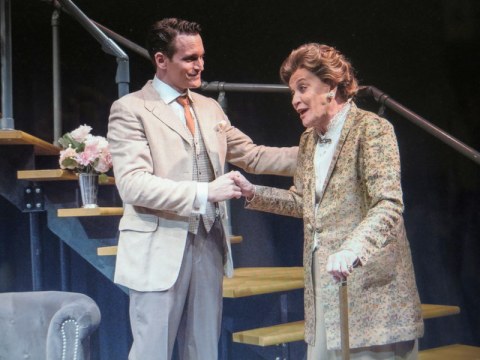
Robert David Grant, Cynthia Harris in ‘The Lucky One, directed by Jesse Marchese (photo Richard Termine)
This is a clever turn by the director Jesse Marchese and his apt casting and shepherding of the actors to reveal the layers beneath Milne’s characterizations and the ironies as we battle with our own presumptions about greatness, image, likeability, and family perspectives. Indeed, if not for the family reaction to Gerald and his contrast with Bob who is the invisible one, Gerald would fly a normal pitch. It is the contrast that sets Gerald on a heavenly course, a wicked injustice for Bob with whom we have a predisposition to empathize, and to whom we look forward to meeting when he finally arrives. The irony we do not consider is that Gerald’s elevation is not easy for him either, and perhaps it is even more wearing, for he must be the perfect one. Who better than he knows this is not the case.
The darkly brooding personality in the family, cultivated and referred to by the unsettling adjective “poor,” as in “poor Bob,” is apparently filled with dour rain as Bob is introduced to us. He has just cause; Pamela was “his” before she fell under the spell of Gerald’s charm and scintillating shimmer. No wonder he twitches in their presence and appears forlorn and unsettled. He is like an open wound.
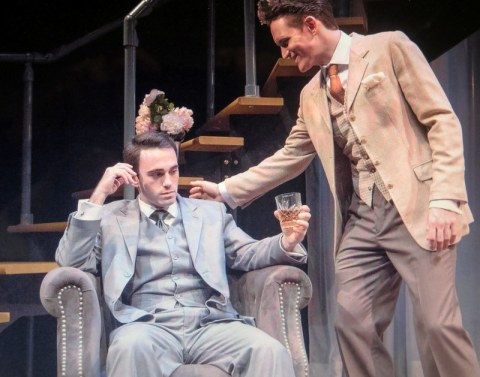
(L to R): Ari Brand, Robert David Grant in ‘The Lucky One,’ directed by Jesse Marchese (photo Richard Termine)
Because of everyone’s presumptions about Gerald, and his lack of feeling in taking Pamela from Bob, we are appalled that the family has been so unloving and insupportably cruel. It is apparent they have thrown over Bob, who hasn’t quite turned out as they expected, for the grand Gerald, the younger, brilliant, lucky one who has exceeded all of their expectations. Will someone teach this family how to be nice to one another and not play favorites? We cringe for Bob who is indeed, “poor.”
We are even more distressed when Bob asks for Gerald’s help and Gerald isn’t immediately forthcoming. By that point we applaud Bob’s powerful, though obviously manipulative, deceitful and perhaps even malicious wooing back of Pamela whom he importunes to be his friend. She promises to support him through the dire circumstances he has “unwittingly” gotten himself into and for which he childishly blames his upbringing, his parents’ favoring his brother over him and his ill placement in an environment which he also blames for causing his weakness of character. Not once does he accept responsibility for his own choices or acknowledge that he is accountable for his own life. Indeed, in the flux and flow, Gerald appears to be sympathetic to Bob, though Bob doesn’t acknowledge it, nor does he show his brother any affection when Gerald extends it.
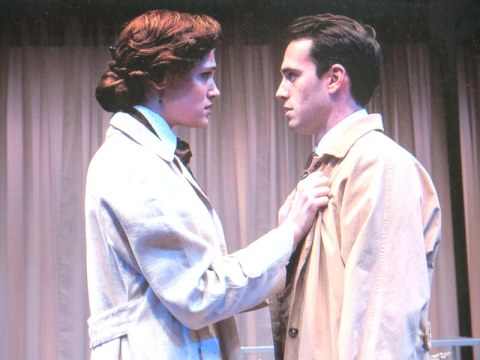
Paton Ashbrook, Ari Brand in ‘The Lucky One,’ directed by Jesse Marchese (photo Richard Termine)
A.A. Milne’s characters are drawn with insightful subtly. We swallow Bob’s whining excuses and agree with his dishonorable manipulation of Pamela toward his cause that she is his only friend. We realize as the events unfold in the second act how neither brother has been accurately portrayed or understood by their family whose superficiality is noxious and lacks vision.
When the brothers confront one another in the last moments of the play, our eyes are opened. We are abashed that we allowed ourselves to be blinded by the light to miss the profound aspect of how Gerald has been navigating his parents’ expectations with challenges at every turn, and how Bob has perhaps, like much of the world today used excuse, manipulation and guilt to pursue his own duplicitous desires, not really understanding his own weaknesses because he justifies them at every turn.
Milne’s work and the Mint Theater Company production follow many vital themes which thread through all of our lives: selfishness in family relationships, sibling rivalry, self-blindness, willful ignorance of the complexity of human nature, weakness of character, manipulation, deceit and more. The play resonates deeply in its characterizations and propels us to look into our own souls, but that requires some thought and introspection.
Upon first consideration, I didn’t realize the first act is carefully constructed to set up the revelations in the second act. I thought it slow, but the fault was my lack of focus on the ironic mystery being presented. Indeed, I was too quickly drawn into the surface reality by A. A. Milne’s superb writing of characters, like the family members, who presume and judge. By the play’s conclusion, the questions Milne raises about our misapprehension of personality and perception of others and especially those close to us come into crashing focus. Milne leaves us with few answers.
Kudos to the Mint Theater Company for taking on this richly complicated work and executing a presentation of which Milne couldn’t help but be proud. The production runs with one intermission until 2 July at The Beckett Theatre on Theatre Row, 410 West 42nd Street. You can find tickets if you CLICK HERE.
‘Wasted! The Story of Food Waste’ Starring Anthony Bourdain, Mario Batali at Tribeca Film Festival

(L to R): Anthony Bourdain, Danny Bowien, Dan Barber, Massimo Bottura, Peter Madonia, Tribeca Film Festival World Premiere Q & A, ‘Wasted! The Story of Food Waste’ (Carole Di Tosti)
Anthony Bourdain (star of Parts Unknown), is his edgy, humorous self in Wasted! The Story of Food Waste. The film, which screened in its world premiere at Tribeca Film Festival, Bourdain produced with Zero Point Zero Productions’ partners Lydia Tenaglia, Christopher Collins, Joe Caterini and co-director Nari Kye (Anna Chai also directed). However, Bourdain whose narration threads through the key issues about food waste globally and in the U.S. is more acerbic and ripping than ever I imagined he could be. But he, Dan Barber (Stone Barnes, Blue Hill), Mario Batali, Eric Ripert (Le Bernardin), Danny Bowien (Mission Chinese), Massimo Bottura (Osteria Francescana), Tristan Stewart (Toast Ale) and others who are in the forefront of trying to figure out how to rescue food and use it to create delicious meals, must tell it like it is. The situation is bleak.
Food waste is perhaps the most dire problem we face as Americans that we can do something about right now. Consider a few of these facts that directors bring out through interviews and celebrity chef comments in the initial segments of their amazing documentary.

TFF Red Carpet for ‘Wasted! The Story of Food Waste,’ (L to R): Peter Madonia, Nari Kye, Danny Bowien, Anna Chai (photo Carole Di Tosti)
Roughly one third of the food produced in the world for “people consumption” (approximately 1.3 billion tonnes yearly), gets lost or wasted. Food losses and waste amounts to around US$ 680 billion in industrialized countries and US$310 billion in developing countries. Ninety percent of the food produced ends up in landfills. According to Anthony Bourdain, all along the processing of food for consumption, there is waste at every junction from the farm, and the harvest, to the distribution, to the grocery story or green market, to the preparation, to the dinner table, to the leftovers.
And where does this food predominately end up? In landfills. In garbage dumps. If we could only redistribute the unused food to those who need it. Even if just one-fourth of the food currently lost or wasted globally could be rescued, there would be enough to feed 870 million hungry people in the world. But globally, people are not just hungry. It is a tragedy that globally, thousands of individuals face chronic starvation and die from disease and malnutrition. In the U.S. one in six individuals is food insecure, (in Europe it is 1 in 20). These are not just lazy, “good-for-nothings” as politocos would have us believe so we can dismiss them and de-fund programs which they label entitlements. The families are working in low paying jobs (an employment situation which has never been recovered since the second Great Depression), and many of them are white. In the film, Mario Batali looks dead into the camera (in the US we are the worst perpetrator), and he brings the problem right into our homes. He says, “This waste is criminal!”

TFF Red Carpet ‘Wasted! The Story of Food Waste,’ Eric Ripert (owner of Le Bernardin) rescues food for City Harvest (Carole Di Tosti)
Anna Chai and Nari Kye’s efforts are subtly brilliant because of how they have structured their film and carried us along a journey of discovery to recognize the staggering numbers and the criminality of food waste that resonates profoundly for our own lives. First they identify the unimaginable and make it visible. They outline the causes (taking us to farms, showing the process of food distribution, etc.), then bring us to the end of the line-the food devastation in landfills.
This is where the concept of food waste goes exponentially unconscionable and Batali is not kidding when he points out the egregiousness of waste as not only “stealing” food from the hungry, but also wantonly, negligently stealing all of the resources our planet offers for us to make it to the next generation. We won’t get there if the situation continues into the next decades if we continue to be as brazenly stupid as we have been culturally.

(L to R): Anthony Bourdain, Danny Bowien in a Q & A after the TFF World Premiere screening of ‘Wasted! The Story of Food Waste,’ (Carole Di Tosti)
Filmmakers and experts reveal how food in landfills exacerbates global warming-climate change. As the food decomposes methane gasses are released. Methane, heavier than CO2 is a worse pollutant of clean air. It erodes oxygen supplies, acidifies the oceans, chokes off marine life, harms ecosystems that sustain plants, animals and us. You didn’t note any discussion about the higher degree temperatures increasing glacial melt did you? We won’t acknowledge that is happening for fear of offending those government leaders who think global warming is a matter of belief.
You thought you had handled the problem of plastic by shopping with your cloth bags? Well, what about the food you are throwing away? Filmmakers point out that one head of lettuce in a landfill takes twenty-five years to break down. You have to throw away some lettuce because your guests won’t eat wilted leaves? Throw it in your composting bin or bring it to your green market for them to compost. If you multiply your leaves and that head of lettuce you threw in the garbage last week with thousands upon thousands of heads that got wilted and that grocery stores daily en masse throw away because housewives like their lettuce crisp and fresh-looking (even though it has no taste and the wilted leaves at the green market have much more nutrition and taste because they were picket in the morning), then you begin to see the extent of the problem of why food waste is so endemic.

TFF Red Carpet ‘Wasted! The Story of Food Waste,’ Massimo Bottura who created Refettorio Ambrosiano in Milan as “Food for the Soul” (photo Carole Di Tosti)
Filmmakers show that unsustainable farming practices expend and do not replenish resources (air, water, rich soil). Think of the water wasted to irrigate veggies that end up in your waste-can and end up in a landfill. The amount of money that can be saved with careful planning and husbanding water, crop yields, etc., not only can be realized by farmers and businesses and grocery stores and distribution centers, but it also filters but can also filter down to families if thoughtful planning is accomplished and if consumers don’t mind selecting some bruised fruit at a lower price (often more delicious), than the perfect apples and oranges with no taste.
Food and resource waste directly correlating to global warming and climate change, whether deaf, dumb and blind politicians acknowledge this or not, insidiously correlates to shifting population migrations as refugees challenged by drought, famine and war in a subtle and complicated connection with dwindling resources (food, clean water) seek areas to live that are not under such duress. When Bourdain implies that everything about food is tied to everything else, the message not only “hits home,” filmmakers have brought you to a place where you need to see interventions and programs and innovations that are eliminating and reducing our criminality of food waste.

Anthony Bourdain of ‘Parts Unknown’ hosted the TFF Q & A after the screening of the film he produced with others, ‘Wasted! the Story of Food Waste’ (Carole Di Tosti)
The interviews and visits with celebrity chefs are legendary. They follow Tristam Stewart to England as he shows how he recovers 900,000 tons of bread wasted a year by making artisinal beer). They travel to Modena, Italy and then Milan to see Massimo Battura who created Food For the Soul and the divine concept of the artistry of the Refettorios. With beauty and elegance he has found a way to touch the hearts of the “invisible needy” that rivals dining at The Four Seasons and uplifts their souls. At the outset they visit Dan Barber who takes us through his guided veggie discoveries and tastes as he educates us to the egregiousness of food waste with produce (fruits and vegetables, roots and tubers have the highest wastage rates of any food). And they shadow Danny Bowien’s travels to Japan where chefs surprise him with delicious dishes that use unbelievable cuts from the animal that he never tried including the uterus and vows to take home to his restaurant.
These entertaining, enlightening and uplifting segments of the film, which are woven into the dialogue about food waste, dissolve the “doom and gloom” of the underlying problems by showing there is much we can do. Indeed, entrepreneurs and innovators, spurred by funds from the Rockefeller Foundation (which is supplying grants through YieldWise) are working to ameliorate the situation and move the paradigm to Zero Food Waste in the next decades, regardless of the lack of political will that recently has been demonstrated. The uplifting examples of how other countries and individuals are curtailing food waste are inspiring. They encourage us to toward activism on a personal and local level: at the very least composting, wiser food shopping and more.
This is a must-see film for its clarity, for its inspiration, for its no-holds-barred revelations, for its love and good will, for its energy. Its unforgettable incisiveness magnifies the importance of our individual and national global food waste imprint. Its generosity and positive outlook spur us to become leaders in our own lives and communities so that we can have a global impact. The situation is bleak, but it is not without hope. We can positively shape our future and the future of the generations that come after us. It is only a matter of starting today.
Check the website for updates.
Check this page for more information on global food waste.
 CAROLE DI TOSTI