Category Archives: Broadway
‘Summer, 1976’ Laura Linney and Jessica Hecht are Terrific

Summer, 1976 at the Manhattan Theatre Club’s Samuel J. Friedman Theatre is predominately two solo performances with a few dynamic interchanges, the principal one occurring at the conclusion. The static, expository “play,” directed by Daniel Sullivan, occurs in the minds and reflections of Diane (Laura Linney) and Alice (Jessica Hecht). Through their discourse, we learn how they established a close friendship over a summer which gradually fades into memories when Diane moves away a few years later. If not for the brilliant, authentic performances by Linney and Hecht, and the enlightened direction by Sullivan, one might think that “the dramatic event” that supposedly initiates the conflict never occurs. Nor does the conflict occur manifestly. However, the performances and direction overcome the lack of theatricality, and make Summer, 1976 interesting enough thematically to put this on one’s radar to see.
One of the key themes that playwright David Auburn (Proof) explores in Summer, 1976, is how the right connections, though brief in the span of a lifetime, may vitally change one’s development and help individuals evolve in a direction they might never have taken without such influence. Diane and Alice become friends who, for no particular reason, share their memories revealing this thematic point in this stylized storytelling that alternates back and forth from Diane and Alice as each reflects and remembers. Through their perspectives as reliable/unreliable narrators, they discuss themselves and each other, sometimes offering conflicting details, leaving us to decide for ourselves who is the more accurate storyteller, if it even matters. During the course of their reveries, we note there are more similarities than differences between them, if we carefully tease out the deeper levels in their personalities.
Superficially, Diane has an immaculate house and is a foodie, with some quirky lapses in her perfection. Interestingly, she is unconventional in one regard. She carelessly becomes pregnant having a fling with a man who wasn’t “all that,” and who she dismisses from her life so she can raise her daughter alone. She doesn’t give much thought that Gretchen might need a father, but is confident within herself not to be desperate for a man at her side. which would cause more stress and complication. Besides, Diane has enough inherited money to raise her without worries and continue with a quasi-serious art career which Alice encourages.

Alice points out that Diane’s work reminds her of Paul Klee’s. Diane confesses that she used to be influenced by Klee, but has moved on. Diane never finishes her art pieces, a revelation which Diane eventually confides to us and discusses with Alice. For her part Alice doesn’t think Diane’s art is very good, precisely because they are unfinished. We learn this through Alice’s commentary after Diane makes various disclosures.
Alice contrasts with Diane. Her housekeeping is messy. None of the furniture matches and she isn’t a foodie or an excellent chef as Diane is. Also, Alice is a laid back housewife who helps husband Doug, He doesn’t make much money as a college professor and their lifestyle reveals it. In those days women could still live (not comfortably) on one salary. Doug and Alice manage, though Diane notes that they don’t have style, class or much dynamism. Ironically, staying at home doesn’t encourage Alice to be a superior housewife or foodie. What she does all day is take care of her daughter and Doug, read and clean up the house as best as possible, when it moves her .
These superficial differences would stand in the way of their becoming best friends, if their daughters were not thrown together at the beginning of the summer. Because their daughters adore one another and beg Diane and Alice for play dates, the mothers reluctantly get together to please Gretchen and Holly. It is during these hot days of summer, Diane and Alice move beyond the surface to reveal deeper elements about themselves and their circumstances to forge a beneficial relationship.
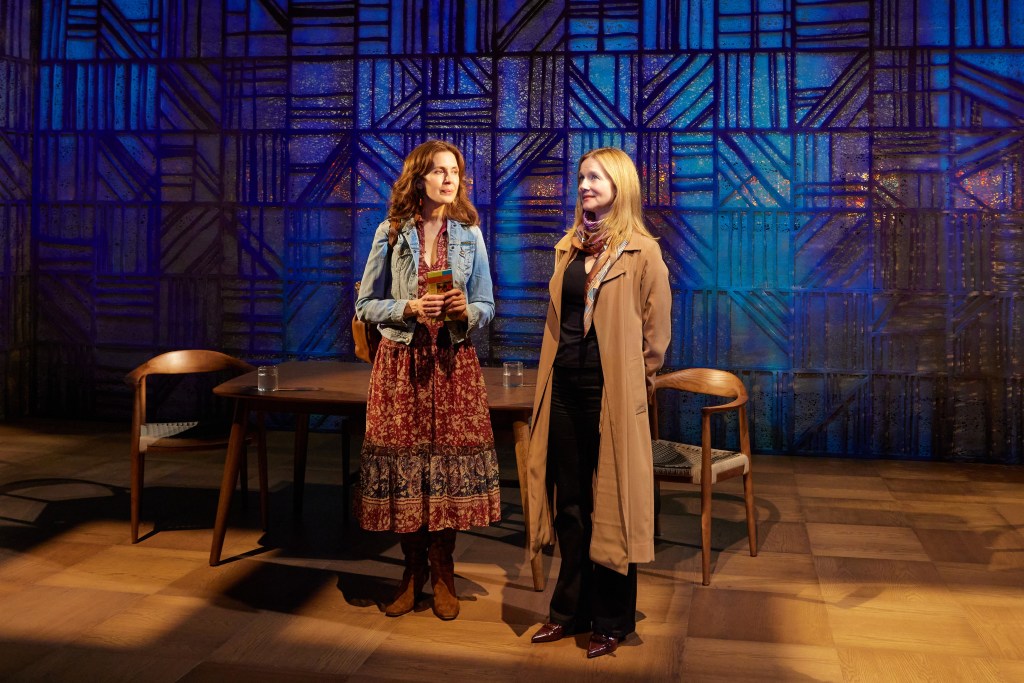
Auburn uses narration and the women’s solo reveries to reveal their lives. However, it is the nuanced performances and portrayals by Linney and Hecht that elevate this play and make us interested in these two women, who live unadventurous outer lives. The actors land on the humor of their confessions and judgmental criticism (only given to the audience) about each other. It is only when the women take day trips, the first to an antique store where Diane buys Alice a Bauhaus desk, that their relationship takes off. Afterward, we note that there is a soulful simpatico that they seem to have with each other that transcends their differences.
That soulfulness is brought to the fore during two crucial events that Linney’s Diane and Hecht’s Alice reflect upon. During one summer day Diane has a wicked migraine. Alice lovingly nurtures her and gives her time generously, as Diane attempts to overcome the waves of pain. In supervising the situation while Diane writhes in pain, Alice even allows Gretchen to watch the TV channels Diane doesn’t permit normally. However, this situation warrants it because, as Diane suggests, she can’t deal with her daughter and a migraine at the same time. In Diane’s perspective, Alice’s comfort and care saves her life and the migraine goes away the next day. However, a thread has been woven between the two women that never dissolves, despite their not keeping up the relationship in later years.
Diane helps Alice when she has an argument with Doug that blows up into a full on discussion about divorce. Alice takes Holly and seeks solace from Diane, who readily gives it and comforts her. Diane always thought Doug boring and she encourages Alice to consider other possibilities. Even when Alice resolves to herself emotionally that she and Doug can work out their marriage, Diane offers her place to stay to regroup. This is an offer that later could have become a living arrangement, however, Alice is faithful to Doug and never takes her up on it.

Another theme that comes up when Alice stays the night with Diane is happiness. Diane asks Alice if she is happy, but Alice is more concerned with “keeping up appearances” and trying to make the marriage work after Doug tells Alice he “can’t do this any more.” The idea that people can’t make people happy and rarely does anyone find sustained happiness is something Alice considers as a result of her conversation with Diane that evening. Certainly, it influences Alice in her relationship with Doug, and they eventually divorce in 1978, after Diane moves away.
During the summer and their weekly dinners in the fall, they gradually see each other less and less during 1977 because Alice is engrossed with saving her marriage. However, Diane’s wisdom helps Alice.
At one point Diane lightly suggests they should just travel together and have adventures. Alice’s traditionalism and conventionalism won’t permit it. It is as if Diane intuits Alice and Doug’s marriage will end, but Alice is not ready to admit it. For Holly’s sake she must go through the arduous process of salvage that is fruitless anyway. The possibilities of their close friendship remaining and becoming something more becomes swallowed up in Alice’s conservatism and her fear about leaving Doug. Her inner conflict prevents her from considering other possibilities and freeing herself. Ironically, by the time Alice and Doug divorce and she is free, Diane has left.
Almost a decade later, both women are in New York City. When Alice sees the banner featuring Diane’s works on exhibit, she goes inside the gallery and they meet and discuss how their circumstances have changed. Alice is a middle school English teacher. Diane has become a professional artist who finally finishes her work. When they say their farewells and Alice expresses that she misses Diane and gives her a hug, Diane’s response is “matter-of-fact,” and distant. She reveals to the audience that Gretchen has moved back in with her, has a drug dependency and perhaps made a suicide attempt. She reveals none of this to Alice which is unclear why. When considering if she misses Alice, she reminisces that they were close only for that summer and that is why they drifted apart completely when Diana left and Alice divorced in 1978. Diana even suggests that perhaps it is the memories that she misses.
The final meeting and hand off are fascinating because we note that Diane dismisses Alice, yet gives herself away when she says that Alice is the only one she sends her “art cards” to annually for a decade then stops. Alice loves them and assumes she sends them to everyone, but never replies back. That Diane only sent them to her is momentous. The relationship was important to her for her artistic development. Furthermore, considering Diane and Alice have no partnerships, though Alice admits there were men, but nothing spectacular, we are left wondering that perhaps in a time when the culture wasn’t as oppressive for female-female relationships, they might have had a deep and abiding love. By the play’s end, we understand that their candle of friendship may have nearly blown out, nevertheless they have contributed to each other’s lives and careers beyond measure. Perhaps, it may be rekindled again if one of them takes the step forward.
Summer, 1976 occurs in the undercurrents, the aside comments to the audience, and the subtext. There are the nuanced perspectives and the unspoken spoken. Nothing is manifest. Sullivan’s superb direction and the stellar Linney and Hecht fascinate, in this character study of two women who subtly influence each other to evolve and grow. One day when they are ready, they may possibly reaffirm their connection in the future after their New York meeting. The rest is uncertain as is true to life.
The scenic design (John Lee Beatty) is a minimalist latticed backdrop through which Japhy Weideman’s lighting design flips on the turn of events in their storytelling with beautiful hues. Linda Cho’s costume design is aptly pegged to the characters and Auburn’s characterization. Kudos to Jill BC Du Boff’s sound design, Hana S. Kim’s projection design and Greg Pliska’s original music which elucidates Sullivan’s stylized vision.
Summer, 1976 runs with no intermission, but Linney and Hecht with prodigious authenticity keep the audience rapt and the time becomes transcendent. For tickets and times go to their website https://www.manhattantheatreclub.com/shows/2022-23-season/summer-1976/
‘Prima Facie,’ Jodie Comer’s Tour de Force is a Must-See

One receives a stunning, thematic walk-away from Suzie Miller’s Prima Facie, directed by Justin Martin, currently at the Golden Theatre for a limited engagement. Prima Facie (the Latin legal term means on the face of it), stars the inimitable Jodie Comer in a well-heeled, solo performance. She won the U.K.’s Olivier Award for her portrayal of the assertive, successful, high-powered barrister, Tessa Ensler, who adores the rules of the law with an almost religious fervor. How Comer, the director and Miller effect Tessa’s roller-coaster ride toward hell, engaging the audience so you can hear a pin drop, reveals their prodigious talents. In Prima Facie, they’ve created a thematically complex production of theatricality and moment.
Though there are gaps in the play, Cormer’s performance bestrides them and raises numbing, thematic, rhetorical questions. Initially, the answers escape us, as we become involved in Tessa’s journey toward personal revelation. The strength of the play is in the slow arc of character development, which Cormer senses in her bones and conveys with power and flexibility, as she draws us in to Tessa’s plight. Her vocal and emotional breadth are superb and wide-ranging. Comer’s near-flawless expose, starkly pinpoints Tessa’s confession and admission of repeated self-betrayal and unwise decision-making. How Tessa is prompted to self-destruction by the patriarchal culture’s influence, confounds us. However, the audience cycles through the nullifying events she experiences and gradually becomes enlightened to her devastation.
From the top of the play, through to Miller’s characterization and Cormer’s sometimes breezy, dualistic, self-satisfied and impassioned recounting of her success as a defense barrister, we note she plays to win against the tricks of the police and the tactics of the prosecution. Her metaphoric descriptions are humorous. She is a winner at the law, always up for social justice, jumping into challenging cases against the prosecution. We learn many of the cases are for sexual assault, which she defends her clients against to “get the criminals off,” as her mother suggests. Blindly, with her own rational justifications, Tessa has greedily internalized the patriarchy’s folkways and legal mores. She believes herself immune as a barrister in a justice system, which she thrillingly and ferociously advocates. It is a game to her. She humorously pegs herself as a thoroughbred in a race, during which she expertly uses her strategies to anger, lure and upend the prosecution’s witnesses, who can’t “see her coming.”
Believing herself to be in control, she succeeds in becoming a star defense barrister, who wins her cases for her male clients. That she is a dupe, and a puppet female that the legal system has cultivated to perpetuate its entrenched hierarchy and male-informed justice, she only awakens to when she herself falls prey to assault. Too late, she becomes like the female victims she shreds, victimizes and makes look guilty on the witness stand to benefit her male clients. As Cormer and Miller subtly reveal, Tessa has been riven asunder by her desires to best the upper class barristers she competes against. To do this, she must take on their most obnoxious of attributes and suppress her true identity as the attractive, vulnerable, learned, emotional woman, who desires love and a relationship with a guy.
Thus, like most women in the patriarchal culture, she must negotiate two selves and protect both from each other. Importantly, she must not allow the predominance of one over the other in a blood sacrifice to “rise to the top,” or be the handmaiden of a partner, supporting him financially, if he is a slacker. Worse, she must not couple up with another barrister as ferocious as herself in a competitive, combative relationship. Nor must she throw down her career to wrap herself in the “lesser roles” of housewife, mother, wife, while her partner enjoys the power and amenities (sexual peccadilloes) his career may offer. However, as Cormer and Miller portray Tessa, the “feminine” side is not tended to, so it erupts when a guy lures her away from her career identity.
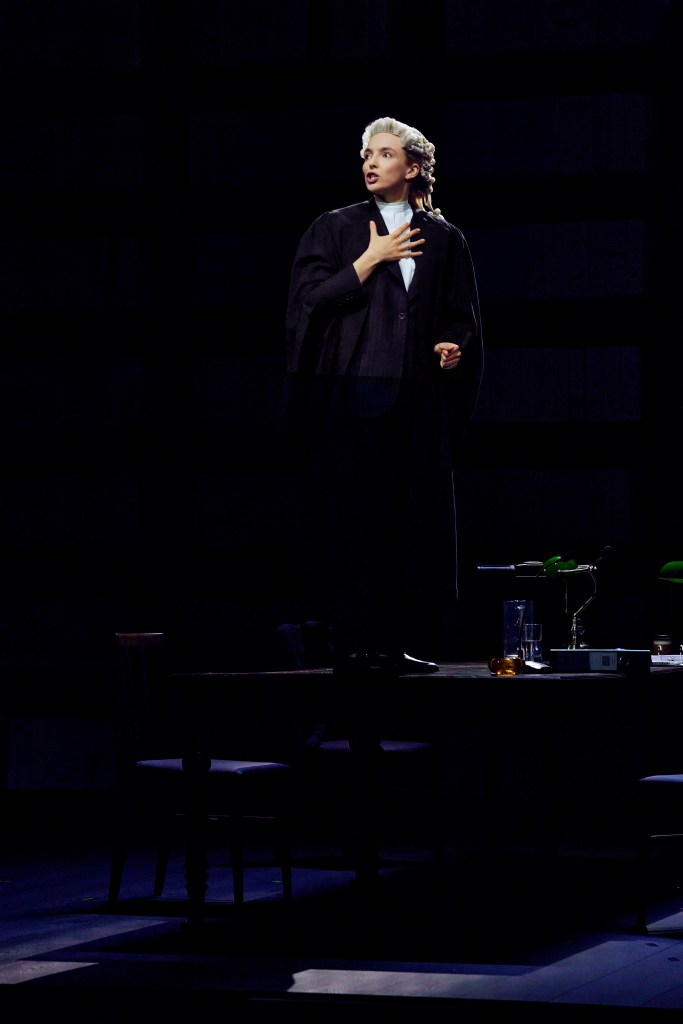
Interestingly, to convey the mystery of this inner conflict, which Tessa ignores, Miller sanitizes Tessa’s descriptions and removes gender references, when discussing her cases as “the barrister.” She doesn’t use names. Instead, she employs legal terms. Objectification and impersonalization are paramount. Cormier’s Tessa internalizes the abusive male folkways and embraces them because she is in a position of power. She doesn’t realize that she is a dehumanized robot, exploited by the patriarchy precisely because she is a woman defending men (a supreme irony). Just like the guys she competes with, she is all about the legal game and winning the race. We understand that the police predominately are males, and she bests them and her male barrister colleagues. One she excels against is Julian, who ruefully comments on her repeated success.
Occasionally, a clue is given. Her upper class friend, who started law school with her, drops out and becomes an actress. Tessa is the one in three, who makes it because of her persistence, brilliance and aggressiveness against all comers. Indeed, the very attributes that are rewarded in the legal profession are more masculine than feminine. That she has chosen to defend males against females in a crass exploitation of her skills is pointed out by a female colleague, who questions her.
Though her colleague intends to bring Tessa to enlightenment, Tessa describes how she conveniently ignores the question which hits us over the head with its answer. Apparently, Tessa doesn’t mind that her position is being undermined by defending men in cases against women. Nose to the grindstone, she aggressively succeeds, and all should get out of her way. The undaunted barrister personality proves she is the best and “fits right in.” However, there is the suppressed side of her personality, where she can’t compete with “all comers,” and she will never fit in. She can’t compete with males in their gender antics. She can’t behave like men sexually because the standards are different for men and women. Such traditions and double standards die hard.

There’s the rub. Women are still oppressed by the ancient folkways that manifest in sub rosa male and female attitudes. These egregiously include the notions that men are not “whores,” they’re just good ole boys, having fun. After all, boys will be boys. On the other hand, women are referred to as “sluttish” according to double standards. Thus, a woman’s response to sexual assault can be easily confounded by the legal questioning in a system that “doesn’t get how females respond and freeze,” when they are sexually assaulted. The legal interrogation system that allows for only one word answers is oriented toward the masculine. If there is fuzzy thinking and confusion on the stand, it means intentional obfuscation and guilt. The legal system’s foundation is historically entrenched in preeminent male beliefs, behaviors and attitudes, integral to its structure of obtaining justice for the accused. This is especially so when the charge is a gender crime against women.
The event that turns Tessa’s world upside down and opens her understanding is her non-consensual rape by a colleague with whom she previously was intimate. The legal parameters of justice indicate that non-consensual sex is the red line beyond which no partner can go, because it involves force and pushing oneself on the autonomy of another. Tessa ends up in a situation with barrister Julian making one bad decision after another that she knows will make her appear guilty. In effect, she is making herself the victim, but can’t stop herself. In applying the law to her own behavior, she realizes her mistakes, however, she decides to press charges against Julian. Despite knowing she should wait for a female officer, who will understand from a female perspective, she relates what happened to a male officer in charge. She knows what to do, but does the opposite, time again during this experience with Julian to seek justice.
We follow Tessa’s story from one sequence of events after another, during Tessa’s two year waiting period to eventually get into the courtroom and testify on her own behalf. As she faces Julian and the defense barrister colleague realizing what’s coming, she is shocked. The entire courtroom of officials is filled with men. She is the only woman. And it is there that the tactics she strategically, confidently, aggressively used against females to defend her male clients, now are employed against her. She becomes her own victim. By her own barrister standards, she realizes she is guilty. However, she is not on trial, Julian is.
In her final self-betrayal, the internalized patriarchy of justice must release Julian as an innocent. There is one guilty person, the woman, who somehow is lying and magically fabricating that a non-consensual rape occurred. Because of her fuzzy and at times confused, frozen responses, she raises doubt that a rape occurred. Thus, victimizing herself, she turns the barrister Tessa against her female identity, and is guilty. The prosecution loses the case to Julian, who she victimized with her accusation.

In an interesting turn, Tessa is able to express her feelings. She addresses the court absent the jury and finds her voice. Cormer rises to the occasion during the courtroom scenes she effects. She is especially powerful in her indictment of a patriarchal legal system established for the betterment of males, particularly those who have money and are in the upper class.
In her concluding salvo to the audience, tears streaming down her face, Comer’s Tessa adjures wistfully that “something must change.” Though we agree, after her revelations, the self-absorbed, anti-climactic assertion rings hollow. Indeed! She must change. She must stop internalizing “the perfection” of male folkways, which historically have destroyed women. She must resign from her position of defending men in sexual assault cases. She must negotiate the balance in her personality. She must not allow “the barrister” to predominate and harm the feminine Tessa, mistakenly applying male double standards to her personal life. She must not forget her gender places upon her an unforgiving female ideal of perfection and purity, she must adhere to. Ironically, there is no move to understand that she must transform herself to bring about the change that she seeks. This irony needed to be emphasized in the staging, which at times is lacking in pointing up the dualism in her character.
However, Cormer’s plaintive cry reveals her regret, which is a self-betrayal and utter confusion at finding herself where she is in her life. She has backed herself into a corner. If she leaves the profession after losing the case, the patriarchy will have won. If she stays and continues to defend men, as she has done before to “put the terrible events behind her,” the patriarchy will have won. If she moves to the prosecution side, she will no longer be “the star” at the top of the ladder. She is left broken and crying at her self-entrapment in the stunning irony as the stage lights dim. The effect is numbing. What did we just see? Her generalized cry for change lacks impact and force. However, her tearful regrets are the first step in a long process of self-correction, which may lead to social reform.
Miller’s thematic “call to arms” is clear. Every woman in the audience must change internally. They must uproot every internalized desire of the patriarchy which defines them and denies them. They must define themselves. They must not believe the lie they can compete with men as Tessa attempted to compete and allowed herself to be duped and exploited. Sadly, in the attempt to compete women internalize folkways that necessitate their own co-optation that leads to self-harm.
Miller’s point about the judicial system concerning rape and sexual abuse is thought-provoking. Only with protests might the legal system be reformed to accommodate the female perspective about rape to use a different form of questioning that drives to the truth. But the underlying folkways that have been seething for millennia and are global in scope must be dealt with. If not, men will continue to conquer, divide and co-opt to undermine women. They are incredibly practiced at it. This is especially so with regard to institutional misogyny that is subverted/invisible because it is inherent in the structures men have created to maintain privilege and power.
Kudos to Miriam Buether (set & costume designer), Natasha Chivers (lighting designer), Ben & Max Ringham (sound designers), Rebecca Lucy Taylor (composer), Willie Williams (video). Prima Facie is not to be underestimated and labeled as a “feminist” treatise that is against men, so those who wish to ignore what Miller’s themes are conveying can easily dismiss them. The production is complex in a time when #metoo often has been misunderstood, politically abused and misapplied. The insert with the program is a reminder of the catastrophic consequences of rape as a crime of gender annihilation. One statistic stands out. Approximately 70 women commit suicide every day in the US, following an act of sexual violence.
The point is not that sexual violence is sexual. It is that gender/sex is used to annihilate psychically, and render the “other” silent. Prima Facie investigates this on a more profound level than one expects. For that reason, it is a must see. And Jodie Comer is just terrific. For tickets and times to this play with no intermission, go to their website https://primafacieplay.com/
‘Peter Pan Goes Wrong’ With Neil Patrick Harris is LMAO Genius

The Mischief production of Peter Pan Goes Wrong, directed by Adam Meggido, is a a whopper of a farce with some of the finest schtick that can be conceived of in the minds of men and beasts. Threading non-stop chortles and belly laughs, the production runs at the Ethel Barrymore Theatre through the 9th of July. This is one to see if you enjoy slapstick, farce, irony, Monty Pythonesque humor which is sardonic, and dead-pan, and simply gorgeous in the hands of the British. Also, the farce is an absolute send up of Murphy’s Law, “If anything can go wrong it will.” The Mischief productions have made “a thing” of this law in theater, assuring us how amazing and wonderful it is, when professional casts and creative teams collaborate to present a show without a glitch, hitch or switch. In Peter Pan Goes Wrong, nothing goes right, and for that we are utterly grateful for such an evening of joy.

Delighting a world-wide audience (forty countries) the hilarious Mischief Peter Pan uses as its source material, the iconic play Peter Pan by J.M. Barrie. This clever farce of foolishness and mayhem is written by Henry Lewis, Jonathan Sayer and Henry Shields. The writers also take on key roles of the members of the Cornley Youth Theatre, the amateur theatrical company whose faux pas production has made it to the Ethel Barrymore. In effect, the Mischief production is a play within a play and the cast portrays two roles, the Cornley members and the Peter Pan characters they portray.

Thus, we experience the amateurs’ attempt to elevate their status to professional theater-makers with their Peter Pan which becomes Peter Pan Gone Wrong. This ingenious conceit keeps the jokes and pratfalls coming. Indeed, for future versions and tours of Peter Pan Goes Wrong, one can see how such a premise promises an ever evolving fountain of hilarity.

As Cornley members, Lewis’ Robert, Sayer’s Dennis and Shields’ Chris take on the roles of Nana the Dog, John Darling and George Darling. They are counted among the pirates (Starkey, Captain Hook, Mr. Smee), and Cornley Youth Theatre’s competing creatives. These actors are the backbone of the production and are simply superb as they interact with each other and the audience. Shield’s Captain Hook, who the Cornely cast members encourage the audience to “boo,” goes “whole hog.” He attempts to shut up the booing and commands the audience loudly and humorously to, “Shut up.” For a moment, I worried that the audience would be too “over-the-top” and get out of hand. However, Shields was incredible, conducting the audience like a maestro, evoking their boos, then ending them. His technique, practiced comfort and obvious enjoyment at playing interactively with the audience in great good fun was tremendous.

The same may be said of he entire cast’s versatility and expertise in slipping between the roles of the Cornley Theatre members and Barrie’s Peter Pan characters with energetic zaniness. The ensemble works in concert seamlessly to make each moment a wondrous laugh riot. These include Matthew Cavendish who portrays Cornely’s Max, the show’s money man, child Michael Darling, and the athletic crocodile. Nancy Zamit, Cornely’s Annie plays Mrs. Darling, Lisa the maid, Curly and Tinkerbell. The fairy outfit is perfection thanks to Robert Surace’s costume design. Zamit switches roles and costumes from Mrs. Darling to Lisa the maid with deadpan insouciance, as she cues the audience in to the ironic jokes with a glance.

Rounding out the fine ensemble are Charlie Russell who plays Cornely’s Sandra, who is Wendy Darling. In the Cornely Theatre world backstory she is having an affair with Greg Tannahill’s Jonathan. As the “high flyer” Peter Pan, he has grown “close” to Wendy and in front of the audience, they shamelessly steal kisses and hugs. Ellie Morris’ ungainly Lucy Grove is Robert’s daughter, who portrays Tootles in the Neverland segment. At the beginning, she runs around with father Robert and Cornely’s Assistant Stage Manager, Gill (Bianca Horn), as they try to correct the lighting issue.

However, most notable for his hysterical performance is Neil Patrick Harris, who portrays Cornely’s Francis, the Narrator of the amateur production, and Cecco, an older pirate who has been with Captain Hook (Shields) on his many adventures. Harris astounds with his presence, making each moment of stage time real with organic humor. He’s athletic, authentic and hysterical, presenting impeccable timing. His amateurishness is believable given the professionalism and talent it takes to pull it off. He’s just smashing and throughout conveys he enjoys the sheer fun of this farce.
Given the production’s foibles and blunders, we note that it would have been easier to put on an unadorned, straight Peter Pan. Indeed it is ferociously hard to make precision technical errors that could harm if their “going wrong goes wrong.” One can’t help but appreciate the ensemble and technical crews’ incredible pacing and dead-on timing of the fiascos that populate the comedy and keep audience rolling in the aisles. For example, early on when Mrs. Darling opens a door, after that exact moment a light falls from the electrics. A few seconds off dead reckoning, Mrs. Darling alias Annie (Nancy Zamit) would be flattened. Part of the enjoyment of the production is the surprise that none of the endangered actors injure themselves. However, there is no bloodshed in the service of the incredible displays of scenic design “gone wrong.”

The fun begins when audience members are handed the Playbill. Smack in the center of the glossy program, where one would expect to see theater advertisements, one finds Cornley Youth Theatre’s black and white program of their Peter Pan. Written by Robert Graves (Henry Lewis) the four-page program is filled with tidbits and stories of the Youth Theatre’s events and various and sundry. The program’s ironic, humorous tone massages the audience to expect what the Cornley Youth Theatre isn’t capable of. For example the “flying operator” responsible for Peter Pan’s “flying” is “not known.” In other words, Peter Pan will “fly” on a wing and a prayer, with no tech crew to guide him gracefully across the stage and to Neverland. Greg Tannahill, who plays Cornley member Jonathan, who portrays Peter Pan, is the most ungraceful, wonky, upside-down Peter Pan ever to hit Broadway and/or Off Broadway. Tannahill is brilliant and frightening in his flight plans.
Additionally, the program notes that directors Chris Bean (Henry Shields) and Robert Grove (Henry Lewis) are fighting for preeminence. Their competitiveness spills over into the Cornley production of Peter Pan, where they take jabs at one another as they portray Barrie’s characters. Robert Grove (Lewis) who pegs himself as the “Head” of Cornley Youth Theatre, has written most of the program which includes an “In Memoriam” to Nadia, their ten-foot Nile crocodile that passed away. How she passed is LOL ironic. The Cornley program lists upcoming production descriptions and events which include Wind in the Willows, Wind in the Widows, Wind in the Pillows, and a “Peter Pan Backstage Tour,” which has been given a safety assessment rating, “Hazardous to All,” and which strongly advises tourists not to participate.

From start to finish, Cornely Youth Theatre’s amateurs, not only don’t get it right, they do so in the most galacticaly nutty and unexpectedly surprising ways as they give Barrie’s script a try. Lewis’ Robert Grove appears onstage as the audience is being seated. There is a problem with the electrical current and outlets. So Grove and Horn’s Gill arrange for a long, orange extension chord to be floated over the heads of audience members to plug it into an outlet at the back of the Barrymore. These hi jinks occur and the play hasn’t even begun yet? Correct. And when the Cornely players finally manage to get the lighting situation straightened out and the set revolves to its proper Darling household (the revolving platform with three sets is exceptional in a later stunt) Peter Pan Goes Wrong takes off, and bumpily flies down and up and around, and lands with unforgettably riotous brilliance.
The creative team were called out for their bows and rightly so, for without their expertise, there is no Peter Pan Goes Wrong hysteria. Kudos goes to Simon Scullion (scenic design), Roberto Surace (costume design), Matthew Haskins (lighting design), Ella Wahlstrom (sound design) Richard Baker & Rob Falconer (original music), Tommy Kurzman (wig & make up design), Hudson Theatrical Associates (technical supervision.
Enough praise for this superior farce that will split your sides with its sensational humor and gags. For tickets to this premiere, go to their box office on 243 West 47th St. or go to their website at https://pangoeswrongbway.com/. You’ll be thrilled that you did.
‘Fat Ham’ is Smokin’ Sumptuous in its Broadway Transfer

What I enjoy most about seeing Fat Ham in its transfer from The Public Theatre (my review of the Public Theater production) to Broadway’s American Airlines Theatre, are the sardonic tropes which send up William Shakespeare’s Hamlet, a Jacobean revenge tragedy, where privileged white royals end up slaughtering each other for power with a particular lack of grace, wisdom and spirituality. Fat Ham’s Pulitzer Prize-winning playwright, James Ijames, writes with a joyous, “diabolical” and a steel-sharpened keyboard, with which he extracts the choicest cuts of the Bard’s meatiest speeches, to reveal the enlightened soul of the would-be avenger of his father’s killer, Juicy (the sublime Marcel Spears). Directed by Saheem Ali Fat Ham’s transfer is a delectable winner.
Juicy is the “fat ham,” shortened for Hamlet. The title references Juicy’s necessary acting “chops” in his pursuit of the truth. The title also refers to the succulent pork roast plumping his middle. Ham is also one of the items being served at the barbecue wedding celebration “honoring” mom Tedra (Nikki Crawford) and Juicy’s Uncle Rev (Billy Eugene Jones). Ironically, the meaty feast is a postmortem contribution by the late, great, pit master, Juicy’s father, who owned and managed the family butcher shop and restaurant, which now is owned by Uncle Rev (Claudius-like), who has “supplanted his brother’s place in Tedra’s bed and affections.
Juicy, like the other characters, elements and themes, represents the antithesis of dramatic particulars in Shakespeare’s complex tragedy. Ijames has a blast flipping Hamlet on its head, layering additional profound complexity to a similar plot, as he highlights Black experience in a racist North Carolina. But the beauty of this production is it riotous humor spread “thicc” everywhere you turn, so one can carefully divine the irony, puns, quips and punchy lines that send up the tragedy it twits.

For example white, colonial, Danish heir to a royal dynasty urged to seek revenge by his impeccable, kind and kingly Dad’s ghost? Nope! However, Juicy is a son, disinherited by his murdering uncle and saddled by the wicked, violent ghost of his father to wreck revenge. The method? The ghostly, white-sequined, flashily suited Pap (Billy Eugene Jones plays both brothers), demands that Juicy slaughter Rev, gutting him like they do with the hogs they butcher. After he is slit open, then Pap wants Juicy, who knows butchering, to slice Rev up into roasts, chops, hams and grind his testicles into a powder. Then, Juicy must invite over friends and family to feast on him. Pap’s description is revoltingly humorous, and Juicy questions every word, and rightfully accuses Pap of being unloving, cruel and demeaning to him and his mom.
Antithesis reigns in this brilliant LOL comedy. From Juicy’s race and gender to Pap’s obnoxious, ignoble character, to mom Tedra’s wild, sexy, lap-dancing antics, to porn-loving, hyperbolic cousin Tio, to Larry and Opal’s gay reveal, and relative Rabby’s evangelical praise Jesus, preach-it hypocrisy, Gertrude, Horatio, Laertes, Ophelia and Polonius are partly recognizable. More’s the fun realizing the ironic, deadpan reversals of character to their counterparts.

Tio’s characterization is especially noteworthy. In Hamlet Horatio is the balanced, unemotional, wise, educated courtier, worthy and emblematic of all the traits one would look for in a trusted scholar and friend. Instead, a reserved, watchful Juicy provides the acute, wise commentary to Tio and those his age, while Tio is plainly off the wall and not sure of his identity, as he seek avenues of expression that are unbalanced and addictive. He is seeing a therapist who does give him good advice about how trauma travels through the history of families, as Tio identifies that Juicy’s family has trauma packed into the male genes from slavery onward.
In these roles the actors shine effortlessly. An incredible ensemble, they work seamlessly with not one particulate of comedic pacing or rhythmic, emotional bit out of place. Along with the smooth Marcel Spears, the marvelous players include the crazy wild patriarch and sneaky, underhanded brother Billy Eugene Jones, uber fit, riotous Nikki Crawford as Tedra, the humorously “out-of-hand” Chris Herbie Holland as Tio, the funny, bored, seemingly dim-witted Adrianna Mitchell as Opal, the turn-on-a-dime hysterical Calvin Leon Smith (love his dance) as Larry, and the wonderfully buoyant, hallelujah-loving Benja Kay Thomas as Rabby, Larry’s and Opal’s mom.

Leading this cast, Spear’s Juicy appears content in himself and settled in his identity as a sensitive gay man, in the face of ridicule about his online college education at Phoenix, and his gay sensibility. He eschews his father and uncle for branding themselves with power exemplified by their criminal behavior. He knows the difference between inner strength, fear and inferiority. With equanimity, he receives the information that Tedra prompted by Rev used up his college money for a refurbished bathroom. His non-violent response when Rev and Larry hit him, deemed “soft” by Pap and Rev, is wisdom. Juicy’s inner spirit and soul are cast in the threads of nobility, historically woven by great Black Civil Rights leaders Martin Luther King Jr. and Congressman John Lewis. There is brilliant understatement in the characterizations, if one has the eyes to see Ijames resonant themes.
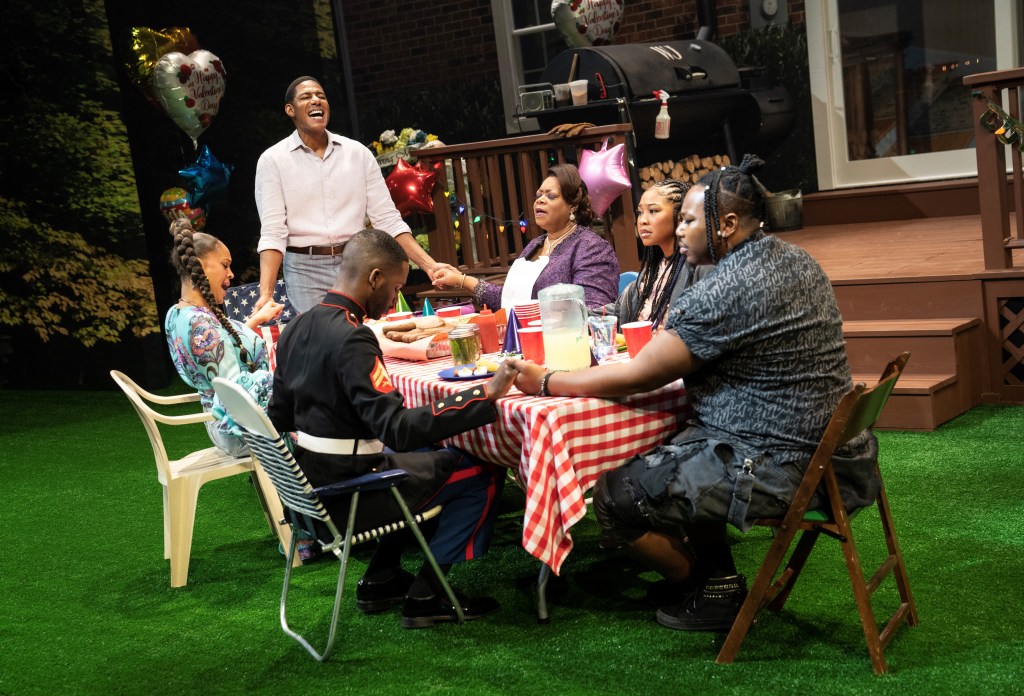
The beauty of Fat Ham‘s comedic rendering is its lack of preachiness and political rhetoric. With contemplation, sensibility and humor, Juicy, unlike Hamlet, has found his voice and is comfortable in his skin. Thus, he is able to counsel Opal not to be pushed around to fit other’s labels, so she can be herself. Peaceful, calm, he calculates that the blood-thirsty act of revenge is a reprehensible manifestation of generational exploitation and institutional racism. Murder is a curse begun in slavery and perpetrated in Black impoverishment, whose answer has been drug crimes, thefts, Black on Black killings and profitable incarceration by white racist oppressors. The “buck” stops with Juicy’s delicious ham (actor, truth seeker, truth teller).

He is the only one who understands how his family has been incredibly victimized, while Pap and Rev with a modicum of financial security don’t realize how murdering one another is the internalization of racism and weakness born out of a violent past. Juicy affirms after his wonderful delivery of Hamlet’s speech about “catching the conscience of ‘the king'” and noting Rev’s reaction, that revenge is not the suit he wishes to wear. Why should he carry on the family tradition of blood-letting as a generational birthright so he can live down to Pap and Rev’s image of a macho power player? He will set himself free of such chains, and with inner security and knowledge, reject Pap and Rev’s labels and destructive, racially ensnared behaviors.
Nevertheless, as the hysterical events at the barbecue unfold, Juicy turns the “beat” around. In his multiple asides to the “listeners out there in the dark,” Spears creates great humor by winking, gesturing, flipping his hand in coded messages to the audience. This is questioned by the other characters i.e. Tedra who wants to know what he has said about her to us.

The barbecue whose lush set design of a North Carolina one-story middle class home surrounded by trees, sky, a modest deck and backyard, realistically sports set designer Maruti Evans’ astro turf lawn and smoker, where Rev grills the meat. As the large table is laid out and family gathers to eat the biscuits, corn, potato salad and grilled pork, the party takes off into hilarity. Rev delivers a hypocritical prayer with Rabby’s loud, Holy Spirit anointed yells. After they eat, the family and friends tramp around with wild karaoke and charades, during which Juicy catches Rev’s guilty response. However, unlike the tragic end of Hamlet, this is a marvelous comedy and there is no more Black on Black crime. Juicy has ended the family curse of bondage to institution racism’s impact on his family. And Rev does perish. You’ll just have to see Fat Ham to find out how, and to also enjoy the celebratory finish that Calvin Leon Smith’s Larry provides with pizzazz and glam.

Dominique Fawn Hill’s costume design is funny and ironic. Bradley King’s lighting design during the karaoke sequence is atmospheric and mood-filled. Mikaal Sulaiman’s sound design, and Earon Chew Healey’s hair and wig design reflect Saheem Ali’s vision for this superior Broadway transfer which improves upon itself and deepens the Public’s original presentation.
Importantly, the daylight ghost sequence and the illusion designs by Skylar Fox indicate that side by side, the supernatural/spiritual reside with the realities that the characters acknowledge. There is no need to deliver spookiness on a dimly lit stage. The characterization that Ijames draws of Pap’s inner anger, fear and outrage which is karmic (he has killed and he is killed) is frightening enough in all of its humanity. Likewise, how Rev is dispatched by karma is not spooky, it is real and horrifying. This is especially so in a time after COVID when there’s enough fear in unexplained, sudden deaths to last another 100 years. Lastly, the institutional generational historical racism which ghosts in the culture and traditions of this family and binds them to uncontrollable actions they’ve been brainwashed to accept holds enough horror for a lifetime. Juicy’s snapping those chains with his love, peace and irony is a welcome experience for our time.

The production is not to be missed for its superb ensemble, exceptional technical creatives and design teams, and the masterful direction of Saheem Ali, who create his vision to elucidate Ijames’ vital themes. For tickets at the American Airlines Theatre, go to the box office at 42nd street or online at their website: https://www.fathambroadway.com/book-tickets/ But do so now because the show has a limited run and ends in June.
‘Shucked’! “Shucks Ma’am, It’s a Helluva Show!”

If you love corn and even if you hate it, you will laugh at the jokes about or related to the sunny fruit (official classification), in Shucked, the funny, bright, clever, homespun musical fable/farce about love, corn and deeper things. Shucked is a throwback to delightful Broadway productions that are easily relatable and pack a thematic lunch that is palatable and digestible. The cast twits itself throughout and clues the audience in to the one-liners, puns and spicy double entendres, as they judiciously pause for the raucous audience laughter to subside, then deliver the next quip with a twinkle and no wrinkle.
Shucked has something for everyone with innuendos aplenty. Directed by the seasoned Jack O’Brien (Tony Award® winner for Hairspray), who shepherds his cast toward drop-dead pacing and finely honed delivery to produce maximum laughs, the production currently runs at the Nederlander Theatre around two hours and fifteen minutes, including intermission.

With the book by Tony Award® winner Robert Horn (also Drama Desk, Outer Critics Circle, NY Drama Critics’ Circle awards for Tootsie), and music and lyrics by the Grammy® Award-winning songwriting team of Brandy Clark and Shane McAnally, the show is finding its way to hit status, having received its jet-pack from these talented creatives. Featuring an exceptional cast, whose vocals hit the mark every time, Shucked is a musical that leaves one with a smile on one’s face, and songs thrumming through one’s mind. It’s a delectable corn dog that takes you from “farm to fable.”
Introduced by bubbly, enthusiastic Storytellers # 1 and # 2 (Ashley D. Kelley, Grey Henson), who note many funny, lovely facts about and uses of corn (“Corn”), we learn about Cobb County, the place that time forgot because folks had all they needed and walled themselves off from the outside world, using the “high as an elephant’s eye” corn plants. There, Maizy (Caroline Innerbichler) and Beau (Andrew Durand) are standing at the altar ready to receive their wedding vows when the cataclysm happens. Patches of corn plants decorating various sections of the stage begin to die. How Scott Pask (scenic design) manages this and the corn’s restoration is neatly effective.
Believing that Cobb County’s xenophobia is destructive and their worst enemy in face of this corn dying disaster that threatens their way of life, heroine Maizy identifies the county’s chief problem (“Walls”). It has a fixed and irrational paranoia about strangers, and thus, they avoid the outside world. Maizy decides that she must leave the isolation of their existence and find answers to the corn die off. Not only does this upset her cousin Lulu (Alex Newell), and the riotous Peanut (Kevin Cahoon’s deadpan delivery and twanging accent are sincerely hysterical), her fiance Beau (Durand’s macho know-it-all is humorously harmless), puts his annoyed foot down. He tries to exert his will over her when she expresses her desire to leave. However, she has a point when she tells him Cobb County is too limited to provide any answers. Despite Beau’s directives, Maizy leaves, affirming they will be married after she finds the solution to their corn apocalypse.

On her journey from Cobb County, Maizy ends up in Tampa, which the Storytellers conclude is a “humid wonderland of welcoming Tamponians and one douchebag” (“Travelin’ Song”). The number is a clever, humorous build up to the large, bright, neon letters that spell out the city’s name. It is only topped by the city slicker, scam artist Gordy (John Behlmann), a scheming, horse gambling, poseur podiatrist who “removes corns.” Naive Maizy seeks out this scientist and professed expert on corns, not realizing where his “expertise” lies. To make matters worse for Maizy, Gordy is a failed gambler and con (“Bad”). Nevertheless,, the sweet, simple Maizy shows him the rot-ridden ear of corn from home and he promises he might be able to do something.
Sensing an easy way to get out of his $200,000 gambling debt from leg-breaking gangsters, Gordy shows interest in Maizy, after he takes her broken bracelet to jewelers to have it fixed. In a brief, stylized, mini-aside by the all-purpose storytellers, who double this time as disreputable jewelers showing their “range,” (Kelly’s Storyteller #1 quips this), they move the story ahead. They assure Gordy they will buy the unique, valuable stones which can easily be found, “it gathers in clusters like single women in their thirties.” After a seductive dinner and drinks, Gordy produces a perfect ear of corn for Maizy that he tells her he has “fixed.” Of course, she invites him back to Cobb County “to fix” all the corn. Behlmann’s Gordy persists in his romantic seduction to get into Maizy’s rocks underneath the house where she lives.
Thrilled at her own bravery and ability to rectify Cobb County’s corn apocalypse, Innerbichler’s Maizy effectively shows her vocal chops in “Woman of the World.” After the proud, self-satisfied Maizy toots her own horn for bringing back stranger Gordy to meet and save the town, at Beau’s farm Peanut voices his opinion about Beau and Maizy’s love. He quips, “Ever since Maizy came back with this Corn Doctor, you’ve been pissier than a public pool.” In her meet up with Beau to share her “new-found wisdom,” Maizy affirms her sophisticated personality change. In her “pissing-contest” competitiveness with Beau, she lets information slip that devastates Durand’s Beau. He kicks her off his land, then belts out “Somebody Will,” a number that guys can identify with, if they have ever broken up with a long-term partner.
In another women centered number, Lulu (the superb Alex Newell),, belts out a syncopated country tune, “Independently Owned” promoting her whiskey business. As she advertises her autonomy from a man, she warns Gordy to “watch out,” despite her business spiraling downward on an absence of corn supply. Regardless of what happens, Lulu knows who butters her corn. The exchanges among Maizy, Gordy and Lulu, like most of the dialogue in Shucked, are crafted for Henny Youngman/Mae West styled one-liners, with ironic punchlines shot out like rhythmically paced cannon fire. How the actors convey their characters without “pushing it” is authentic and a testament to their comedic brilliance, O’Brien’s direction and Horn’s fine book.
In a winding up toward the end of Act I, Gordy’s situation has a monkey wrench thrown into it. Due to poor cellular connections on two phones, he gets the wrong information which spurs him on in desperation. Over-hearing Gordy’s phone conversations (misinformation), Peanut, Beau and Lulu assess that Gordy is up to no good (“Holy Shit”). How they settle at that conclusion speaks more to their upset that Maizy bravely left and came back with a solution, than hearing the truth. Maizy is forced to defend Gordy’s presence in Cobb County and affirms her faith in him. Alone, she admits she is torn between her feelings for Beau and the possibility of love with Gordy (“Maybe Love”).

Shocked into accepting her belief in him, Gordy persuades the townspeople of his ideas about “fixing” the corn (“Corn”). As the song concludes Act I, Maizy accepts Gordy’s proposal of marriage, and we are left for one intermission to guess whether Gordy’s plan to resurrect the corn has efficacy or his inner shyster is getting over to hightail it outta Cobb with some valuable gem stones.
Horn’s book is tightly spun with the songs which slip in messages of love, acceptance, risk taking, hospitality and compromise, with large portions of savory humor in the lyrics. Jason Howland, who is responsible for music supervision, music direction, orchestrations and arrangements, keeps the score country vibrant, so it sounds like a mix of other music genres in its country beats and rhythms. Japhy Weideman lights the barn for appropriate atmosphere, and John Shivers’ sound design is on target. This is tricky in a show like Shucked, which is dependent on a balance of sound throughout the theater for maximum contagious laughter at the quips, puns and double entendres. Mia Neal’s wig design has a modern flavor with a “Hee-Haw” touch to meld with Tilly Grimes patchwork, homespun costume design of plaids, paisleys and “patches,” that appear to be cut out of various “past-their-prime” clothing items.
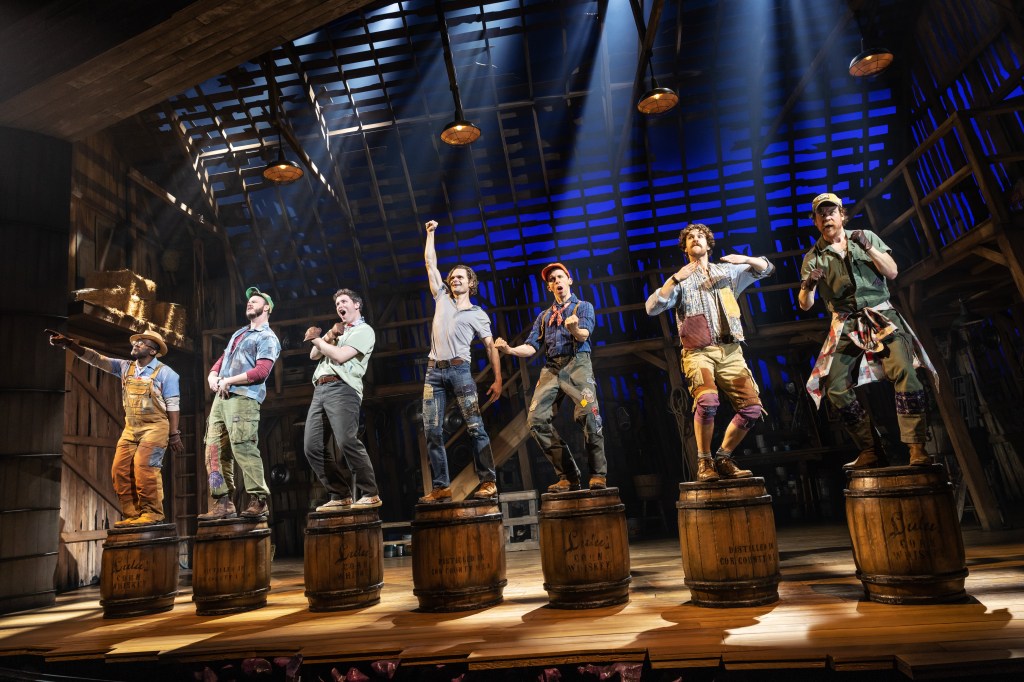
Scott Pask’s barn staging has every item and tool one would imagine on a working farm. The intricate, wooden barn structure remains stationary while Lulu’s whiskey still and paraphernalia are brought out when appropriate for some songs in Act II (the hysterical, ironic “We Love Jesus”). And the playing area is large enough to roll out whiskey barrels for the fantastic “Best Man Wins,” as Beau, Peanut, Storyteller #2 and the ensemble jump on the barrels and stand Beau on a long board and move him around. This is an ingenious and visually exciting dance number configured by choreographer Sarah O’Gleby.
There is no spoiler alert. You’ll just have to see Shucked to laugh until your sides ache and pay attention to what happens to bring the corn back from the edge of doom to bless Cobb County with joy, love and a bit of growth toward letting down their walls to accept strangers (“Maybe Love” reprise). Gee! The corn may be a metaphor for something.
This is one you will enjoy in the moment. And afterward, you may try to remember the songs and the wonderful quips, puns and one-liners that had you chortling in the corn row aisles of the audience. For the deeper meanings and references to our time, perhaps you should see it twice. They are cleverly woven into the themes amd strike fire for their currency.
Shucked runs with an end date in September at the Nederlander Theatre (208 West 41st St.). For tickets go to their website: https://shuckedmusical.com/
‘Sweeney Todd,’ His Vengeful Spirit Ranges in Thomas Kail and Alex Lacamoire’s Magnificent Revival

With a nod to the original 1979 Hal Prince directed Sweeney Todd: The Demon Barber of Fleet Street, Broadway (1989, 2005), and off Broadway revivals (2017), Thomas Kail (director) and Alex Lacamoire (music supervision) achieve breathtaking majesty in this 2023 revival. Emphasizing immutable themes and character archetypes inhabited by the brilliant, sonorous Josh Groban and comically conniving, mischievous Annaleigh Ashford, Sweeney Todd’s thrilling, operatic music spins out a Jacobean revenge tragedy for our time. With music and lyrics by Stephen Sondheim and book by Hugh Wheeler, from an adaptation by Christopher Bond, audiences at the Lunt-Fontanne Theatre are having a rollicking time, gauging from their cheers and whoops, as the cast takes their bows.
The artistic team’s well-thought out choices restore the musical (more like an opera), to its epic, grand stature. The suspenseful Sweeney story is arrayed through ingeniously integrated spectacle, delivered by Nevin Steinberg’s sound design, Mimi Lien’s scenic design, Emilio Sosa’s costume design, Natasha Katz’s lighting design and Steven Hoggett’s choreography. All cohere, enhancing Kail’s acute vision of Sweeney’s obsessive need to pursue vengeance, with an assist by an avid, affectionate partner, Mrs. Lovett, who manipulates him into her embrace, using keen practicality and amoral, surreptitious duplicity.

Stephen Sondheim’s exceptional music, delivered by the twenty-six piece orchestra’s soaring sounds, is superlatively arranged by Jonathan Tunick. And under the musical supervision of Alex Lacamoire, the immensely variable score evokes the piercing macabre, the lyrical romance and the chaos of despair. Indeed, every phrase, every note resonates tonal moods of light and dark, that swirl like fateful winds directing the emotions of the lead characters. All of this creative gorgeousness unfolds in the service of displaying humanity in its full-bodied fallibility, as it plunges from grace, victimized by circumstance and the Satanic designs of others. And, as the culprits free-fall, wallowing in a surfeit of pride and sardonic delight by killing the wicked with impunity, we are drawn into lurid expectation, aroused to anticipate which corrupt victims will be sliced by Sweeney’s razor, next.
Originally taken from popular Victorian fiction known as penny dreadfuls, the name Sweeney Todd was first noted in ‘The String of Pearls.” The plot elements evolved to other genres, but the horror tale of the murderous barber slitting his victim’s throats, while Mrs. Lovett’s pies hid the ground-up fleshly bodies, was enhanced by Christopher Bond’s addition of obsessional revenge. These elements inspired Sondheim and Wheeler because of their mythic and dramatic possibilities.
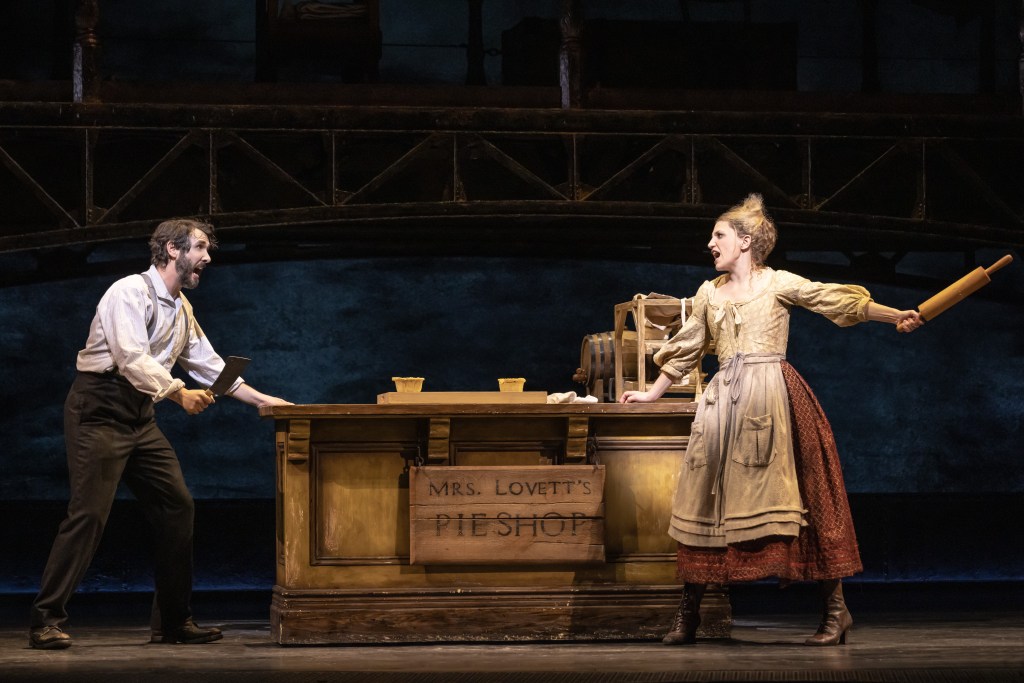
The musical begins, as the ensemble of 19th century Londoners sets the scene (“The Ballad of Sweeney Todd”). They are the Greek chorus, who sing the ballad at key moments throughout the musical, making judgments about Sweeney Todd and his relationship to the world he lives in. As they sing, Sweeney emerges from the grave looking gruff and moody to animate the Sweeney legend and receive grand applause, as the audience acknowledges Groban’s exceptional vocal gifts and acting skills. Indeed, his well conceived, profound portrayal of the demon barber is worthy of every second of applause he receives.
Thus, unfolds the story of injustice, corruption, oppression, obsession, vengeance, mayhem and murder. The latter, Sweeney justifies in the Act I song “Epiphany,” with his “novel” definition of two kinds of “men,” who comprise the entire human race which deserves to die. These are the upper class wicked, who oppress the poor, and the miserable lower class, for whom death is a relief. When he sings this, Sweeney has gone over to “the dark side,” choosing to expiate his rage and hatred on his fellow human beings, including himself, a key theme of the tragedy. However, at least Sweeney recognizes what he is, where the hypocrites he murders (especially Judge Turpin and the Beadle), pretend perfection.
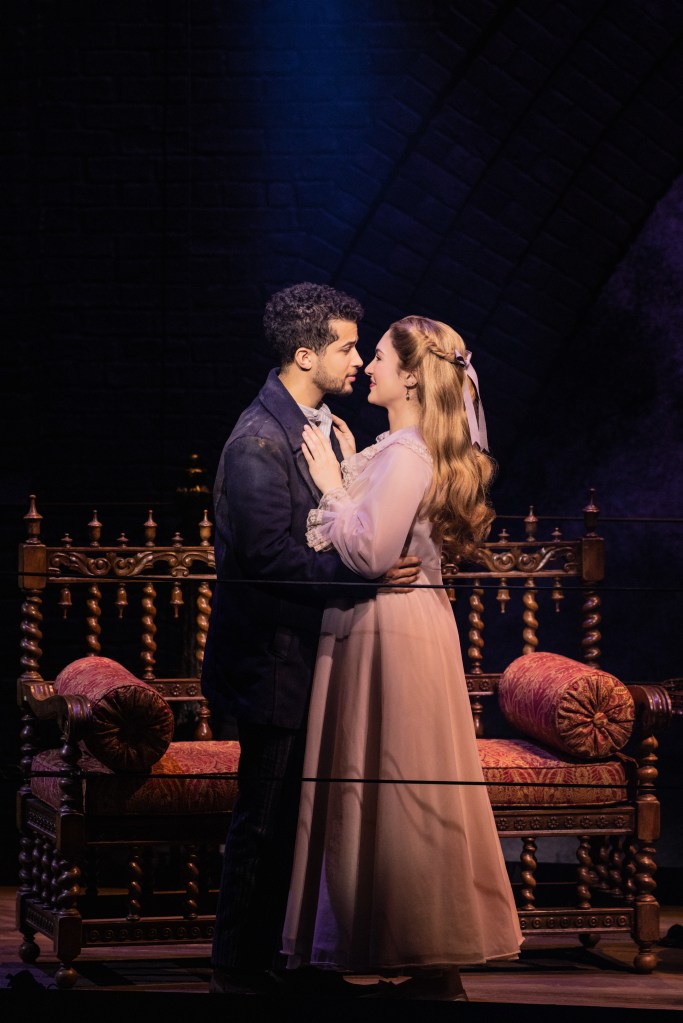
After the epilogue, the scene moves to flashback and shifts to the past, enacted by the spirits of those brought to life to evoke the tragic tale of the barber, his wife, the duplicitous paramour, a corrupt judge, his assistant and the barber’s grown-up daughter and her lover. With the exception of Johanna (Maria Bilbao) and Anthony (Jordan Fisher), all are victims of their own weakness as they succumb to a fateful destiny. Their macabre acts and the ensemble’s ballad refrain, which threads throughout, compel us to listen and learn.
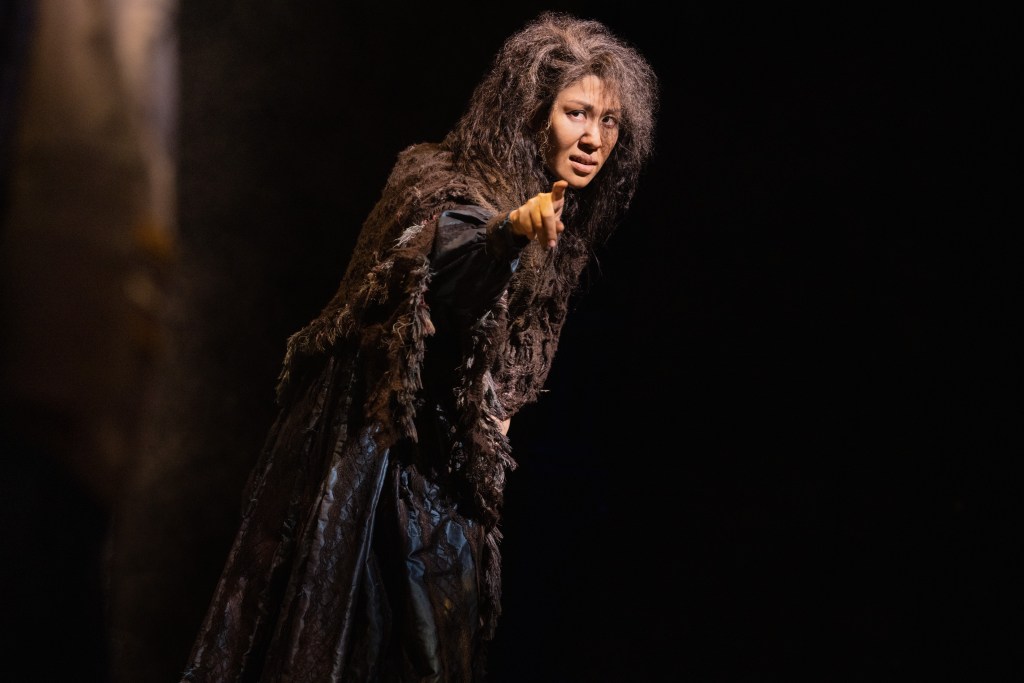
Convicted of a trumped up crime by the sinister, lascivious, Judge Turpin (the fearful and excellent Jamie Jackson), the barber is shipped off in chains to Botany Bay, Australia, to intentionally separate him from his beautiful wife Lucy, and young child, Johanna. Over a decade later we meet Sweeney, who disembarks from a ship in London with Anthony (the golden voiced Jordan Fisher), a sailor who rescued him, and to whom he sings of Turpin’s injustice (“The Barber and His Wife”). Returning to his old apartment, which is owned by the impoverished Mrs. Lovett (Annaleigh Ashford), who has a pie shop no one frequents because her pies are just crust (“The Worst Pies in London”), Sweeney learns from her that Lucy was raped by Turpin and Beadle Bamford (the fine John Rapson).
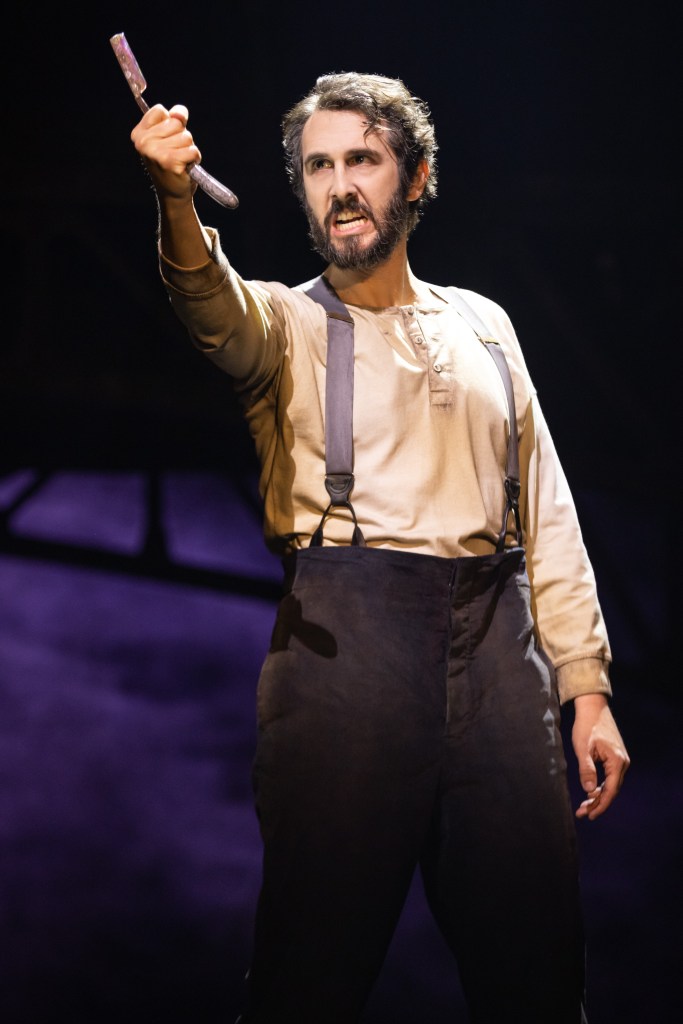
As Lovett sings (“Poor Thing”), we discover that Lucy became so demoralized and degraded, she swallowed poison. Taking pity on Johanna, Turpin adopts her as his ward and raises her under his possessive, watchful eye. Under his oppression she is like a sightless bird in a cage, who is blinded so it sings beautifully. In the following scenes we understand the bird metaphor, as it relates to Johanna imprisoned in a lovely mansion, unknowing of her past and the wicked Judge’s corrupt actions and scurrilous intentions.
Grogan’s Sweeney becomes manic with rage learning of Lucy’s plight. Consumed with painful thoughts of her sexual abuse at the hands of the powerful, “moral” judge, who cravenly destroyed their family, and who now has his Johanna, he vows revenge with the help of his razors (“My Friends”), which Mrs. Lovett kept for him. Mrs. Lovett, who always fancied Sweeney, seizes the opportunity to encourage him in his revenge, suggesting he open a barber shop above her pie-making establishment. As he works, he can wait for the opportunity to kill Turpin (“Wait”). It is there that the formerly innocent Sweeney enacts his first homicide of blackmailer Pirelli (the comical and insidious Nicholas Christopher), who threatens to expose Sweeney’s true identity and turn him over to Beadle Bamford, a death sentence.
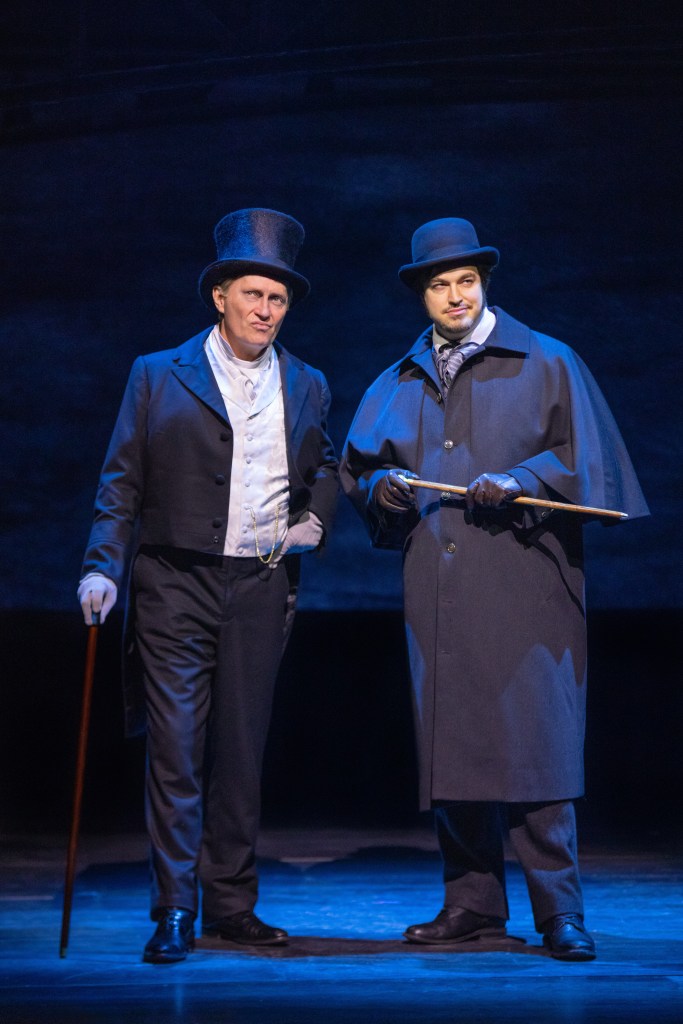
This is the first blood-letting, the ensemble assures us in “His Hands Were Quick,” a reprise of “The Ballad of Sweeney Todd.” But it’s not the last. The fates are spinning. Mrs. Lovett distracts Pirelli’s assistant Tobias (the wonderful Gaten Matarazzo), who eventually grows close to her and believes her lies that his boss “went away.” Ironically, he becomes the instrument of karmic discovery, which brings down the killing machinery of the Todd/Lovett enterprise.
Ashford’s seduction and insinuation into Sweeney’s life, and Groban’s Sweeney, at first reluctant, then gradually swayed by her cajoling advances, are a couple made in hell, as they align in comedic malevolence. Their performances are humorously symbiotic and perfectly realized with such spontaneity and verve, we are subtly sucked into their foul deeds and initially cheer them on. Jamie Jackson’s Turpin is so goose-bump abhorrent, arrogant and hypocritical, when Sweeney finally kills him, the audience cheers.

However, it takes the appropriate time for Sweeney to avenge Turpin’s horrors. These “drive him up the wall” and push him to accept the god of vengeance and unforgiveness as his master. After Sweeney is interrupted from killing Turpin and despairs that he’s lost his chance, he appoints himself an executioner of “mankind” (two types of men), in “Epiphany.” It’s a show-stopping number and Groban is in his full, lush glory. In a profoundly clever Sondheim transition, ever the opportunist, Ashford’s Lovett soothes Sweeney’s explosive mania. She conceives of an ingenious way to dispatch the bodies of those “who deserve to die,” by baking their flesh into savory meat pies (“A Little Priest”). Forever, she elicits his gratitude and affection, which she gladly receives because she is so smitten with him and wants to supplant memories of Lucy with her love and murderous complicity. She becomes his invaluable asset for vengeance with impunity.
Sweeney’s transformation from doom and gloom to joy and laughter occurs when he “gets” how Mrs. Lovett will help rid him of the evidence of his murders. Groban’s Sweeney is absolutely mesmerizing in this scene. As the realization of her lovely idea takes over his whole being, his interior darkness shifts to light, as if a burden has been lifted. Happily, he binds himself to her in a euphoric irony of evil. Ashford’s mastery of his soul lures him and couples him to her, as they fly toward doom, too taken with their genius to be bothered by the possible consequences of their wicked amorality. Thus, together they answer the world’s corruption, emphasizing the theme of how human beings eat one another, taking the devouring from metaphor to realty.
The portrayals and performance of this clever song marries these actors in their brilliant talents and shared generosity. It is one of the most memorable moments in a production that is filled with many memorable moments. Importantly, as we are relieved to see them laugh, and laugh with them as they delightfully plot against those high born and low, who deserve to die, fate spins the tragedy of consequences and accountability in Act II.

Meanwhile, in a second feeder plot, whose action develops in conjunction with the scenes between Sweeney and Mrs. Lovett, Fisher’s Anthony comes upon the grown-up Johanna (Maria Bilbao). Bilbao aptly sings about birds that are caged (“Green Finch and Linnet Bird”). Listening to her (Bilbao’s flighty performance and lyrical singing are stunning), Fisher’s Anthony inquires her identity from a Beggar Woman (the incredible Ruthie Ann Miles), who is always near Mrs. Lovett’s or the Judge’s mansion. Anthony falls in love at first sight (“Ah, Miss,” “Johanna”). Emboldened by the Beggar Woman’s admonition that he should stay away, he pursues Johanna who is receptive to running away with him to escape marriage with Judge Turpin, her future intended. When Turpin discovers her plot with Anthony, he locks her in an asylum, waiting for her to relent.
How these characters reach the end of themselves in freedom or bondage unravels in a darkening Act II. Only then, do we realize, like Sweeney, how “kindness” and “friendship” can be exploited to deceive those weakened with unstable and desperate passions. As the emotionally seductive Mrs. Lovett, whom we and Sweeney come to delight in, then are horrified by, Annaleigh Ashford’s portrayal is sumptuous and grand. Her antithetical character is Ruthie Ann Miles’ Beggar Women, with whom Mrs. Lovett secretly is in competition. Throughout, the Beggar Woman is the key upon which events turn. Also, she is the wise Cassandra that no one listens to because they look at her outer appearance (“City on Fire”), and think her mad. This important theme is one more irony the fates spin out in this fabulous revival.
With spot-on performances by the entire cast of those who “eat” and are “eaten,” of the righteous innocent who escape, and of the hapless, beautiful, trafficked Lucy-types, who are in the “wrong place at the wrong time,” and are abused by men and women alike, all the characters “get what they deserve.” The warning is that memento mori. The same will happen to us, though it may not be at the hands of the Sweeney Todd’s of the world. If vengeance is sought, let karma deliver it. Pursuing it is its own destruction.
This Sweeney Todd affirms stylized truths that remind us of the precarious balance between justice and vengeance, love and obsession, helpfulness and selfishness. In its monumental arc where duplicity, self-deceit, betrayal and cruelty play out in the characters’ lives, the messages are profound. The characters in their impulses and desires are terrifying, not in the horror genre sense, but in their reflections of human emotions, revealing what people are capable of. Kail and the actors have teased out incomparable, believable portrayals. We have only to read the news to see their conjunction with our time, indeed, all time.
This devastatingly human Sweeney Todd, whose only hope is an escape through love, is a classic. It is a fitting revival of a masterwork that must be experienced live to feel its grandeur. For tickets go to their website or visit the Lunt-Fontanne Theatre at 205 West 46th St. https://sweeneytoddbroadway.com/
‘A Doll’s House,’ Jessica Chastain’s Nora is Brilliantly Unbound
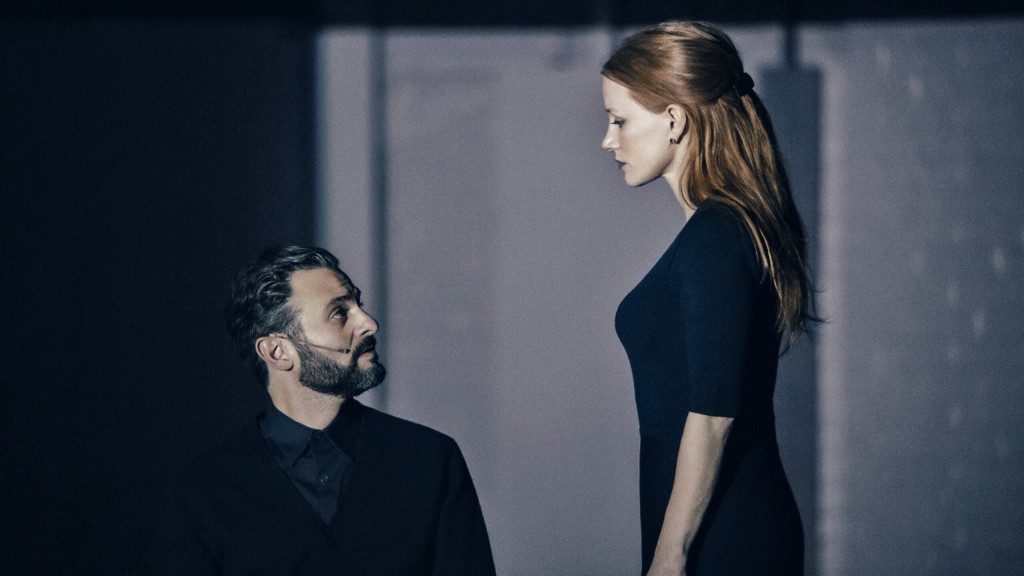
As a masterpiece of modern theater Henrik Ibsen’s A Doll’s House presciently foreshadowed the diminution of a women’s role as homemaker. Ibsen shattered the notion of a woman being a husband’s pet, an obedient robot/doll with no autonomy or identity of her own, who cheerfully accepts the delimitation of traditional folkways. A maverick play at the time, A Doll’s House was considered controversial. Ibsen was forced to rewrite the ending for German audiences so it was acceptable.
What would those audiences have said about Amy Herzog and Jamie Lloyd’s stark, minimalist, conceptually powerful, metaphoric version currently at the Hudson Theatre? It is a version which relies on no distracting accoutrements of theatrical spectacle, i.e. period costumes and plush drapery. Nothing physically tangible assists with the unlacing of “the bodice” of Nora’s interior. With “little more” than cerebral irony, and emotional grist, Nora displays her soul in a genius enactment by the inimitable Jessica Chastain, in the production of A Doll’s House, which runs a spare one hour and forty-five minutes with no intermission.
The plot development, characters and themes are Ibsen’s. Nora, a pampered, babied housewife, to save her husband’s life, unwittingly commits fraud by borrowing money from loan shark Krogstad (Okieriete Onaodowan who in the first scene needed to project his voice so as not to appear a weak character which Krogstad is not). Complications arise when Torvald (an exceptional Arian Moayed), receives a bank promotion. With the additional money, Nora plans to quickly pay back Krogstad. But the loan shark threatens to expose Nora’s secret, unless she can save his job at the bank, where her husband has just become his boss.
Tensions increase when Torvald fires Krogstad and hires Nora’s friend Kristine (Jesmille Darbouze). Nora must confront the situation with Torvald before Krogstad exposes her and destroys Torvald’s reputation and their marriage.
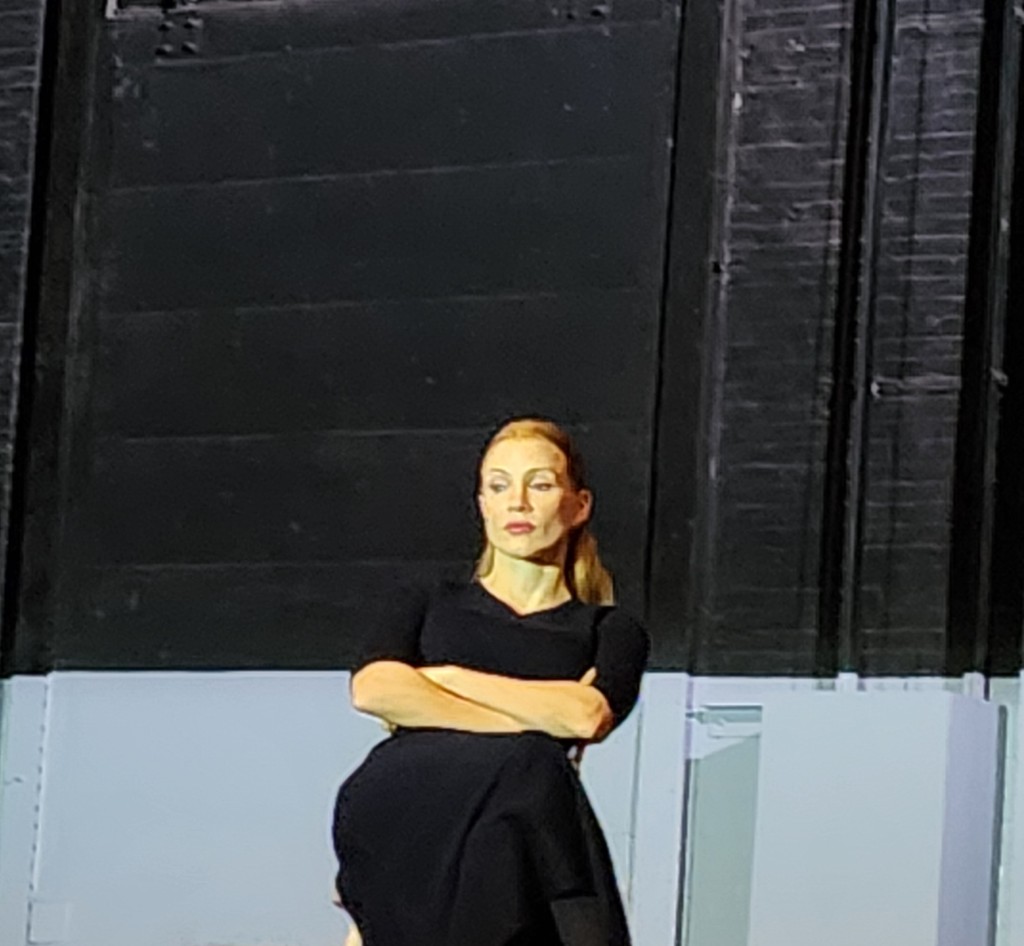
Lloyd and Herzog are a fine meld. Herzog strips extraneous words and phrases, though not the substance of the pared-down dialogue. Her version is striking with a natural, informal, un-stilted speech for concentrated listening. There’s even a “fuck you” which Nora proclaims cheerfully to be bold, though not in Torvald’s hearing. The meat is Ibsen; the forks and knives to devour it are sleek and without ornamentation to distract. The themes and characterizations are bone chillingly articulate, which Herzog and Lloyd excavate with every word and phrase in this acute, breathtaking, ethereal, new version of A Doll’s House.
Lloyd eliminates the comforting, elaborate staging where actors might have moved to and fro amongst luxurious furniture and eye-catching, gloriously-hued dramatic sets that show Torvald’s preferred, lifestyle, which Nora scrimps from her own “allowance” to maintain. Instead, the ensemble’s movements are restrained. They step quietly around Soutra Gilmour’s set. Gilmour has distilled Lloyd’s vision to the back stage wall, top-half painted black, with attendant muted white painted on the bottom half of the wall. The flooring is grey. Predominant are the revolving platform and institutional-looking bland chairs which actors bring in and place on the sometime circling platform, or on its outer edges which don’t revolve.
Chastain appears twenty minutes before the production begins, seated in a chair revolving on the platform (I should have counted the repetitions, but I didn’t.). Sitting, she fascinates. Initially, to me, she was invisible; I was distracted, while she quietly walked on bringing her chair. She was a part of the onstage background, muted, unremarkable. That is perhaps one of the many concepts Lloyd and Herzog suggest with this enlightened version that is memorable because it is metaphysical and conceptual, giving rise to themes about soul interiors and women’s invisibility in the patriarchal culture.
One theme this set design suggests is that we travel in our own orbits, going in circles in our own perspectives, unseen and never truly known as psychically present, spiritual beings. And as Ibsen suggests, it takes an inner cataclysm such as Nora experiences to break from traditional mores and behavioral repetitions into a different consciousness and new way of being. This breakthrough, Nora attempts at the conclusion.
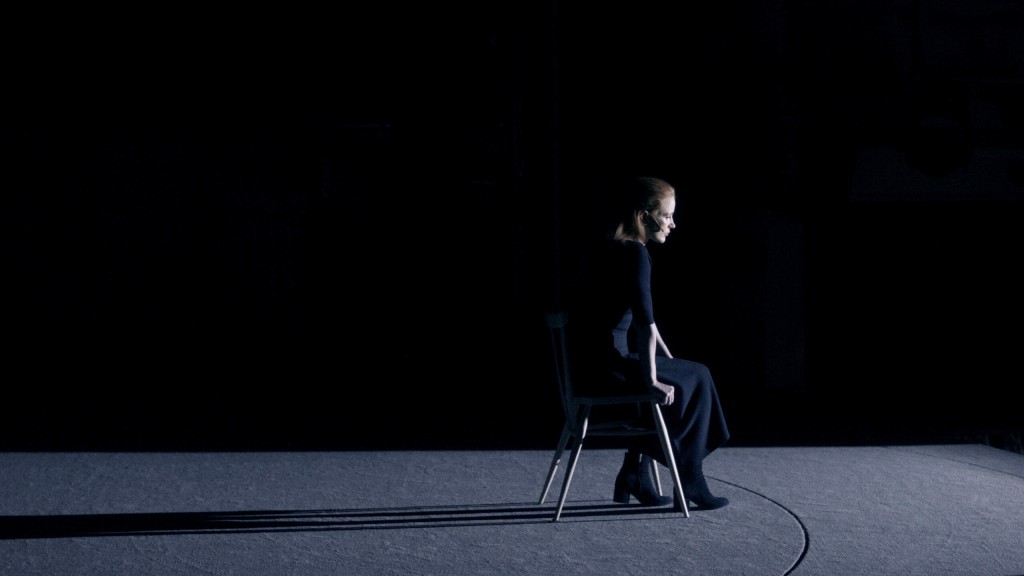
Amy Herzog’s modernized language version of A Doll’s House is one for the ages in focusing Ibsen’s power of developing characterizations. It presents an opportunity for Lloyd’s preferred, stylized, avant-garde staging, similar to what he used in Betrayal (2019) and Cyrano (2022). It requires the audience to listen acutely to every word of the dialogue and scrutinize the actors splendid, nuanced emotions which flicker across their faces. This is especially so of Chastain’s Nora, who is chained and bound symbolically throughout, minimally using gestures or any physicality, as she sits in a chair facing the audience. Predominately. she employs her voice and face to convey the interior-organ manifestation of Nora’s tortured, miserable psyche. For example when the wedding ring is returned, Nora and Torvald do not move; there is no ring. They look at one another, however, the unspoken meaning resonates loudly.
Even the tarantella Nora dances at the costume party, Chastain wrenches from herself sitting in the chair in a frantic nearly psychotic frenzy of shaking and kicking. The earthquake physicality that splits Chastain’s Nora apart is the only broad, physical movement, other than walking out of her stifling, meaningless existence, that Chastain and Lloyd effect with novel irony at the conclusion. The chair-dance is an explosive, rage-filled fit of exasperation, principally done for the purpose of distracting Torvald. Desperate to prevent his discovery of corrupt loan shark Krogstad’s blackmail plot, Nora’s diversion succeeds for a time. However, her fear and inner bleeding wounds only augment, until her behavior is exposed and Torvald unleashes his fury, vowing she must not infect the children with her poisonous corruption. Interestingly, the children ethereally “appear” as voices in voice- over recordings. Nora speaks to them, looking out in the direction of the audience. Hypocritically, Torvald demands she stay away from the children, though she must remain with the family to keep up appearances as his jeweled asset and prize doll.
With Lloyd’s symbolic staging, Chastain’s Nora proves that body, soul and mind are inseparably engulfed in the trauma of a paternalistic culture, represented by males who “love her the most” (her father and husband), and psychically straight-jacket and gaslight her to adopt their thoughts, behaviors and attitudes as right and true. To do this she nullifies her existence as a “human being.” In this production, Herzog, Lloyd, Chastain and the ensemble display this truth. It is undeniably representative of women in 1879, the projected number on the back wall of the stage that appears in the beginning of the production.
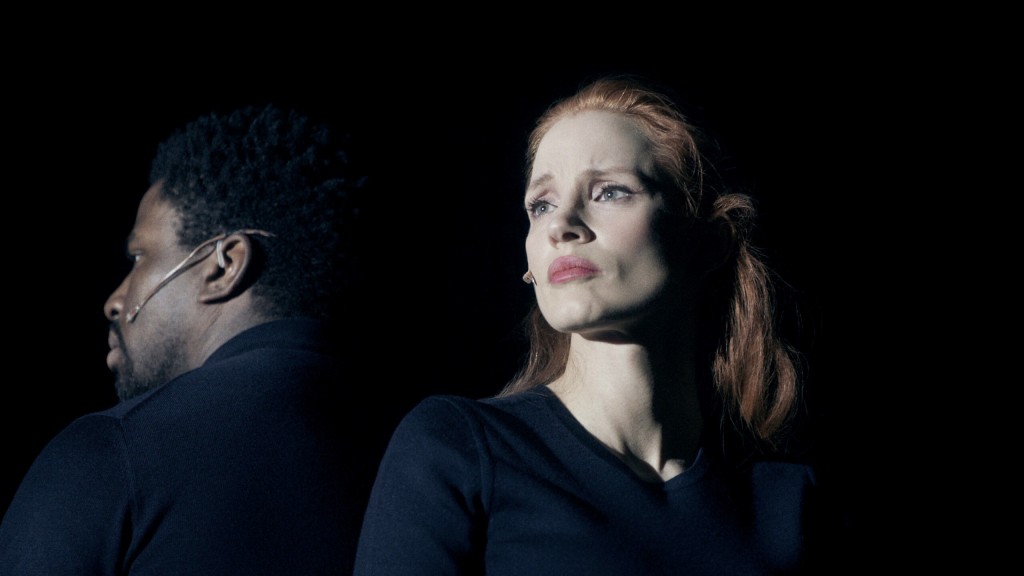
And when the number disappears, we understand that Soutra Gilmour’s black, white, grey set design, and Gilmour and Enver Chakartash’s costume design (modern dress black), function to speed us through 140 + representative years to display the dominant patriarchal attitudes today. These folkways still straight-jacket, demean and traumatize. If one thinks this is fatuous “woke” hyperbole that is finished, one has only to read the one in four statistics of women who are bound in violent relationships with male partners who beat or abuse them, yet cannot leave for fear of being alone or without the means to support themselves or their children. The LGBTQ community is not excepted from this. Humanity has a penchant for violence. If it is not externalized, the violence is psychic and emotional, where not a hand is raised toward a partner, yet the words and silences traumatize. It is the latter psychic trauma that Ibsen/Lloyd explore.
Whether in Ibsen’s historically, visually laden production of A Doll’s House, or in Lloyd’s naked, bleak and blasted version, it is a despotic spirit that demands obeisance, excluding other ways of being to exalt itself by oppressing and choking the life force from “the other,” whether gender-conforming or LGBTQ. That Chastain has the chops to convince us that we are witnessing every stressed fiber of her nerve endings annihilated, as she inhabits one of the most well-crafted characters in drama, is astounding and not to be underestimated, as some have done, implying her Nora “cries too much.”
Suffice to say, those are not female critics, of which there are far too few. However, her performance is emotionally handicapped accessible for those without a hearing ear, who may need to see Jamie Lloyd’s phenomenally sensitive direction a few times to “get it.” And happily many men do get it. They stood, cheered and whooped during the curtain calls when I looked around to see who was standing at Wednesday’s March 14th matinee. More importantly, women also cheered and whooped.
Clearly, husbands/partners, who might be like Torvald, need to see this production, if they suspect they are like him. Chastain’s Nora is an educational experience in how a particular woman suffers to the breaking point in order to be the prototype ideal wife and mother for a man’s “love” and acceptance. When Nora finally realizes she has the tools to free herself from the false and illusory prison of her own making, she throws off a life and role she believed made her happy to search for definitions of her own happiness.
Moayed’s Torvald, who portrays the solipsistic, presumptuous, self-aggrandizing, martinet with likable charm (how he does this is incredible), exposes her to herself. He smashes her fantasies that he is a white knight, who will do the “beautiful thing,” by sacrificing himself for her, as she has done for him.
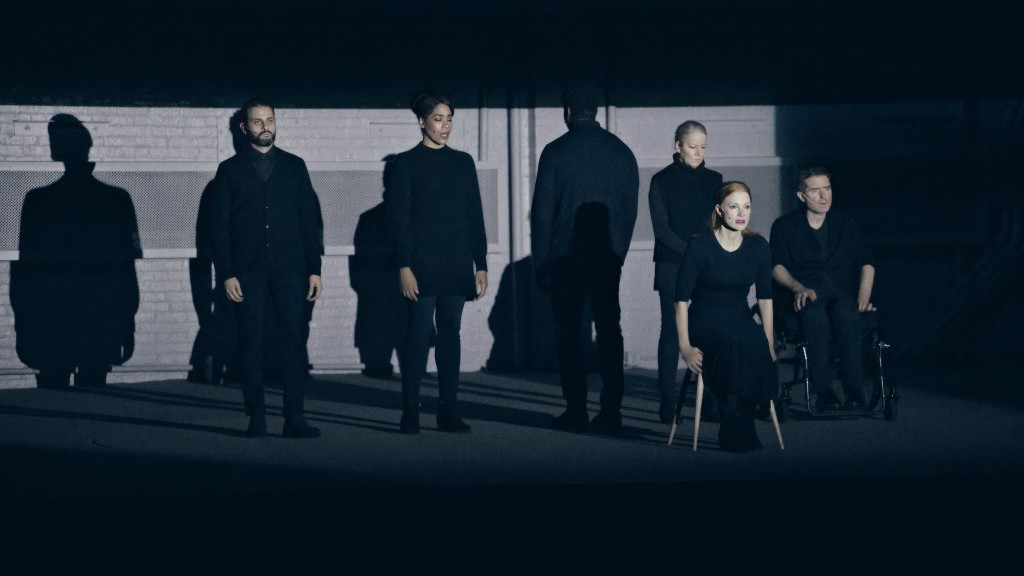
Unfortunately, the only one who would sacrifice himself for her is on his way out of life. Chastain’s scenes with Michael Patrick Thornton’s Dr. Rank, who is the couple’s terminally ill close friend, are touching, warm and human, unlike her scenes with Torvald. They should be together, but she won’t push their light flirtations beyond, loyal to her fantasy of Torvald, until she isn’t.
Interactions between Nora and Torvald are increasingly transparent as they devolve into Torvald’s eventual explosion and hatred directed at Nora after discovering the truth. The scenes between Krogstad and Kristine pointedly contrast and move in the opposite direction. Kristine’s persuasive love of Onaodowan’s Krogstad makes him swallow his “pride” and give up his extortion plan. Truth is at the core of their love. Onaodowan and Darbouze are particularly strong and authentic in their scene together which reveals Kristine and Krogstad’s love has remained over the years. On the other hand Torvald and Nora’s toxic relationship functions in falsehoods. Lies are at its core, and what is presumed to be love is convenience and objectification. Torvald demands Nora be his dream doll and she obeys, though it demoralizes her soul.
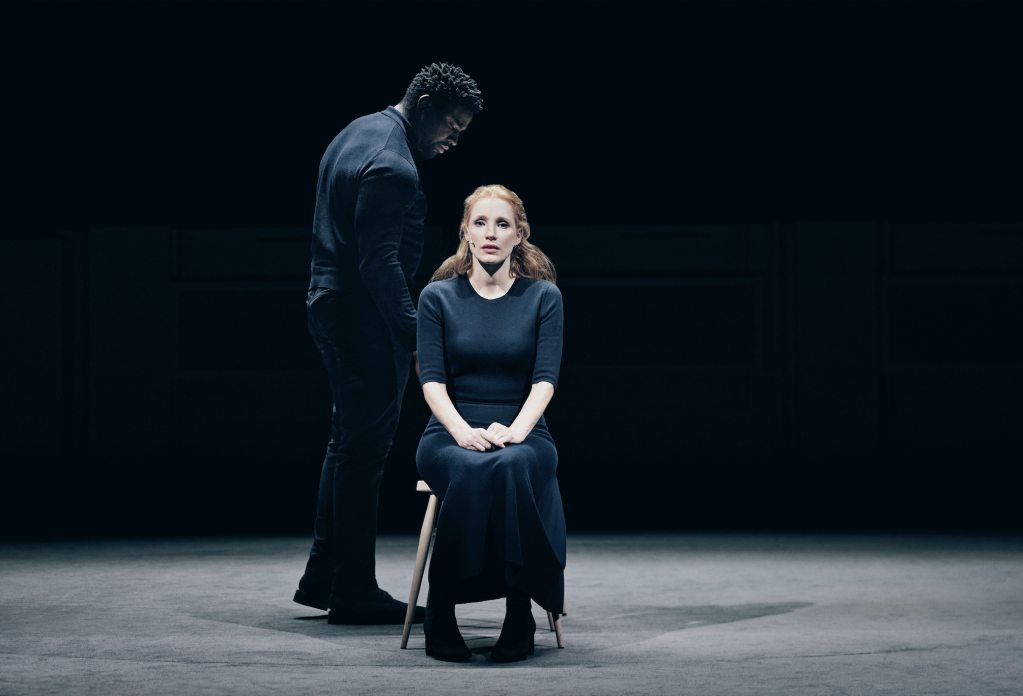
Kristine’s troubled life has brought her to an understanding of herself in an honesty which Krogstad appreciates, for he wants to give up his corrupt way of life. That Lloyd has selected two Black actors to portray these characters reveals an underlying authenticity and exaltation for their love. Krogstad, who is in the shadows when we first meet him, as he sits behind Nora and blackmails her (unfortunately I had to read the script to understand these lines), appears the villain. He is made more villainous by the society’s ill treatment of him, but his love for Kristine redeems him. Torvald’s inability to love Nora damns them both.
Ironically, when her friend’s love is rekindled, Nora’s love ends, as she realizes Torvald’s true nature and relationship to her. Though he apologizes for “going off” in a diatribe superbly delivered by Moayed, Torvald’s narcissism which can’t abide anything hurting the Torvald “brand,” is egregious. His presumption is a delusion, for she saved his life; he wouldn’t exist but for her.
Herzog’s spare dialogue reveals how loathsome Torvald is in the last scene, when Nora tells him she believed him to be her white knight who would take the blame for her mistake. She insists she would have killed herself to stop his sacrifice for her. It is laughable when he says he would do anything for her, but he “won’t do that.” With conviction speaking for the entire tribe, Moayed states, “No man sacrifices his dignity for the person he loves.” Nora counters, “Hundreds of thousands of women have done that.” When Torvald begs her to stay for the children, he is the weak, despicable coward. His concern is pretentious show to make her feel guilty for leaving. Nora can’t be pressured. She knows Torvald will dump the inconsequential children’s care on their Nanny Anne-Marie (Tasha Lawrence).
Nora allows Torvald’s toxic masculinity to forge the chains which she uses to bind herself in the confines of a paternalistic culture that promotes attitudes about “the little wife.” Meanwhile, his little “bird” lacks a being and ethos apart from him. The only freedom, identity and empowerment Chastain’s Nora will ever receive is one she fashions for herself. This, she ironically and joyously enforces at the play’s conclusion.
How are such incredible performances by Chastain, Moayed and the others so beautifully shepherded? Lloyd economizes to the essence of thought in the lines reworked by Herzog. The evocative minimalism heightens the play’s timelessness and draws into crystal clarity the subtle, “loving” oppressive fantasies men and women (or whatever gender relationships), rely on to sustain power dynamics in their coupling. Without underlying truth and honesty to bolster the relationship and weather horrific storms, the illusions become insupportable and the personalities and relationships shatter.
Kudos to all in the creative team I may not have noted previously, including Jon Clark (lighting design), Ben & Max Ringham (sound design), the ominous, haunting music by Ryuichi Sakamoto & Alva Noto, and dance choreography by Jennifer Rias. For tickets to this maverick production, go to their website https://adollshousebroadway.com/
‘Pictures From Home,’ Strong, Humorous, Heartfelt Performances Bring Depth and Nuance to Must-See Theater

How does one negotiate one’s upbringing as an adult, when one’s parents still keep them under their charge and supervision as a comforting mainstay of their relationship? How does one one respond, if the parents in their relationships with adult children default to roles of superior authority figure vs. inferior minor? The superb Pictures From Home raises and answers these questions.
Pictures From Home in its premiere at Studio 54, currently runs until April 30. Written by Sharr White (The Other Place), and directed by Bartlett Sher (To Kill a Mockingbird) it sports a tremendous all-star cast who inhabit the characters to the cellular level. The play, which encapsulates photographer Larry Sultan’s decades-long project, exploring his relationship with his parents through pictures, is a knockout. Based on Sultan’s titular photographic memoir (1992), White’s work unfolds as an intimate portrait of a family that challenges the audience to think about how we reconcile issues with our own parents that we know may never be resolved.
White’s depiction of Larry (portrayed with great sensitivity and aplomb by the marvelously versatile Danny Burstein) and his parents, as a memory play is largely thematic. The son, Burstein’s Larry perseveres in his project initially to learn about his life and relationship with his parents through the post-war pictures taken before and after they moved to Southern California. Of course his initial intentions change with the passing years he gets to know his parents from a different viewpoint.

In his quest to understand levels beyond surface identities, Larry chronicles the culture against the backdrop of family photos, videos. discussions and interviews during weekend visits (twice a month) from 1982-1992. Importantly, Burstein’s Larry discovers that the process of “information gathering” itself is wondrous, life-affirming and loving. He learns to live with the uncertainty that the truth about his and his family’s past and present is always shifting. Eventually, he realizes that this is an acceptable revelation that occurs despite his creating frustrations and annoyances for his parents and himself. Complications arise, as he explores other perspectives about them through what he hopes will become a “more objective” lens.
However, throughout the humorous and at times rancorous give and take sessions among son Larry, Dad Irving and Mom Jean (the inimitable Nathan Lane and Zoë Wanamaker) there is the inevitable acknowledgement that this is “their” family. For good or ill they have navigated the emotional and psychological shark infested waters and stuck by each other protected by an abiding, scratchy, blanket of love. Who is anyone to judge them? There’s a quote about glass houses and throwing stones somewhere in this production which White, the actors and director take out and shake up with chiding humor to “not point the finger too readily or heartily.” Judgment doesn’t apply, regarding this intimate enlivened portrait; in fact, it is disingenuous.

Indeed, we cannot look back in hindsight and determine accurately, Sharr White suggests as one of the themes of this clever production which sneaks up on you, if you allow it the grace to do so. At it strongest moments the presentation of the family dynamic, becomes like watching our own family dysfunctioning in real time. Larry’s motivations and intentions as he seeks out Irving’s and Jean’s approbation, insights and perspectives, and weathers his father’s criticism during the unfolding of the project, are right out of our own home movies. Not only are the interactions hysterical and funny, they are heartbreaking and identifiable, and at times searing.
If one is fortunate to have family, it is what all adult children (if they are honest) cannot really grasp in the fullness of its significance and meaning to their lives. We can’t even securely attribute our successes or failures to them because there is the ineffable mysterious that cannot be pinned down. And if one does attempt to acutely define what is undefinable and cover it with blame or calculation, it will be incomplete, misaligned and skewed by one’s own biases. Family relationships in all their warts, impurities and embarrassments are beautiful because they are attempts to get it right, Sharr White teases out of Larry Sultan’s photo memoir. The heartbreak of Larry, Irving and Jean is that with every imperfect interaction, they don’t quite hit the mark. That is the pain and that is the glory. At least they tried.
And just as Burstein’s Larry concludes by the end of the play (and project) and we concur as an audience watching the intimacies of what the photos reveal, family relationships, individual and combined, are infinitely complex. In that complexity, if grace is attempted, there is mirth in the clown car of family gatherings. You have to laugh. If you don’t find the humor, you weep, and of course in the humor, there has been much weeping and pain to allow it to rise to the levity of wit and wisdom.

As Larry explores and unravels each home movie or picture, discussing it with Jean and Irving, he chooses to accept and love as his parents have and still love, despite the sorrows and pains. Underneath there are happinesses. And this is a treasure worth more than the profits that Larry gains when he publishes his photo memoir which receives wide acclaim and Irving’s praise and the relief that his son’s visits have accomplished “something worthwhile.” The time spent with his parents and their generosity in allowing him to needle and prod them could never be fashioned any other way. The bond they form holds no regrets because in due season, as Wanamaker’s Jean underscores in the poignant scene with Burstein’s Larry, she can’t live forever, though in his child-like heart he wishes she could.
Of course we “get” her question to him, “Why would I want to?” That one of the reasons why Larry might be doing this project, to redeem the time with his parents, turns out to be his finest reason for its accomplishment. Wanamaker and Burstein render every nuance and feeling out of their scene together which is lovely and outright smashing.
Thomas Wolf proclaimed in You Can’t Go Home Again, that you can’t return to the past, for time’s momentum dissolves what was into inaccurate memory. Likewise, there is something greatly tragic in viewing photographs to jar one’s memories and find meaning which can never be fully realized. For the faded photographs often capture a brand, a statement to cover over truths with impressions. However, as a photographer whose life is made full attempting to capture timeless compositions, Burstein’s Larry eschews Wolf’s adjuration and tries to discover meaning and substance from the impressions. And he doesn’t quite succeed to his liking, yet it is magnificent that he tries.

Time and again he visits Jean and Irving, flying from his professorship, wife and children to his old homestead in Southern California (neatly effected by Michael Yeargan’s set design). As he interviews his parents and reviews again and again various photos from his childhood to capture the cultural zeitgeist and look for new interpretations of his life and parents beyond his memories from a child’s perspective, he concludes points, then argues with his father who disagrees with him. Ingeniously, he examines and reflects upon their poses, facial expressions, gestures, activities, captured in the still point, directing his parents toward a new interpretation. It is a humorous fact that the photos Larry selects for his book are precisely the ones that his parents and particularly his father dislike because they are not posed to perfection or portray a flattering image.
In the dialogue centering on the photos,White has given the actors the grist to take off into the amazing territory of nuance to bring out sub rosa emotions, defense mechanisms and disclosures from each family member. That Jean is not as forthcoming as her husband, but is nurturing and supportive of her son speaks volumes. She is wary and deeply loves and understands her husband’s weaknesses and defensiveness, though she gets fed up with him at times. He counts on her understanding and is the one to affirm his love for her toward the conclusion.
Through each of their interactions that represent the many visits from Larry, White creates vignettes that are thematic. In one when Lane’s Irving hysterically hobbles about with an injury we never learn how he received, the scene moves to an unexpected and poignant end-stop about aging. Lane’s Irving effects the emotional arc of the scene with incredible moment and a cry from the heart that is tremendously moving.

In another interaction Jean’s growing dementia is subtly revealed in her panic about where she put various items. From the beginning of the play to the conclusion, Wanamaker subtly reveals Jean’s worsening condition. If one is not focusing, one might miss this incredible aspect of her performance. Wannamaker reveals Jean’s memory decline, nervous fidgeting and sometime irascibility, which Lane’s Irving discounts in the latter scenes that represent the end of the decade. We understand why Irving prefers not to note this as we look at the photo projections of them dressed to the nine’s decades earlier. Though we laugh, we get the undertones when Irving asks why Larry can’t use this photo where Jean is just stunning and Irving is certainly her inferior in the looks department.
The photos and videos blown up and projected on the set’s back wall become the backdrop upon which the actors acutely portray these individuals so that we become acquainted with them as archetypes with whom we identify. Thanks to 59 Productions these are integral to the themes in the vignettes. And they make all the more vital and poignant the last lines of the play when we discover that Jean dies after they move to Palm Springs (something which Larry disapproved of more for himself than for his parents). And as Burstein’s Larry proclaims his father’s illness and his death, his last lines fade and a visual of the photographer Larry Sultan is projected. Larry and Irving died in the same year, 2009. One cannot help but be stirred looking at his beautiful picture as a crystallization of his ancestry and his honest tribute to his parents in text and photos and this play’s messages of love, family, “seizing the day” and “memento mori.”
Kudos to Jennifer Moeller (costume design) Jennifer Tipton (lighting design) Scott Lehrer and Peter John Still (sound design) and Tommy Kurzman (wig/hair and makeup design) and of course 59 Productions projection design for bringing to life with the actors’ prodigious efforts the director’s stunning vision..
Pictures From Home is a must-see for the performances, the themes, the direction, the complexity and nuance of the play itself. For tickets go to their website, https://picturesfromhomebroadway.com/
‘A Beautiful Noise’ Review: The Neil Diamond Musical is a Triumph

How does one take the measure of a man toward the end of his life? Does one examine his relationships with others or does one examine the relationship he has with himself? In The Neil Diamond Musical, A Beautiful Noise, directed by Michael Mayer, currently at the Broadhurst Theatre, book writer Anthony McCarten (The Collaboration, Two Popes) approaches the question using the conceit of a therapeutic doctor/patient relationship.
To McCarten’s credit this complex bio-musical is unlike typical jukebox theater in its positioning of two protagonists: the older Neil of the present with the younger Neil in the past. Driven by this patient/therapist conceit, the musical incorporates Diamond’s songs with flashbacks centered around Diamond’s inspiration for their writing with the added heft of a hero quest. As Diamond unfolds himself to his doctor, certain topics can’t be discussed. He is keeping a part of himself in the shadows. Only through this complex journey into the past will his true identity emerge and be reconciled with his torments. Importantly, we learn through the melding of storytelling and songs why Neil Diamond was inducted in the Songwriters Hall of Fame (1984) and The Rock and Roll Hall of Fame (2011). We also learn the sacrifice that it took for him to be who he is.
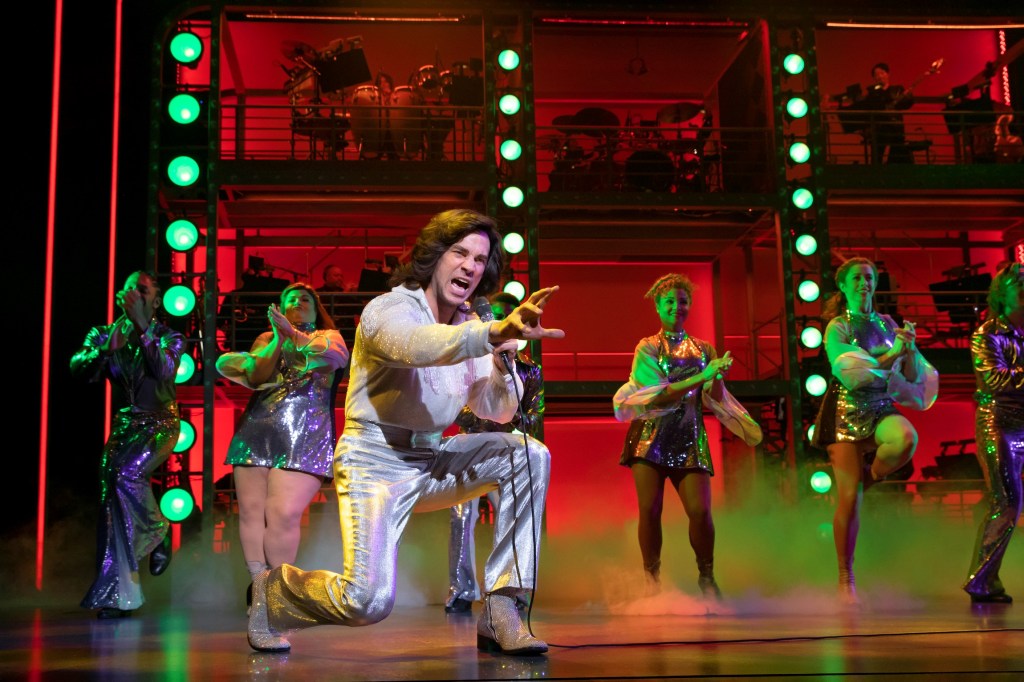
The doctor/patient motif that provides a thrilling excavation into Diamond’s life and career is cleverly crafted. For weeks a psychologist (Linda Powell) has sessions with a reluctant present-day, older Neil Diamond (the superb Mark Jacoby) who goes to her so that he might examine his inability to interact with his third wife Katie and his children. They have told him that “he’s hard to live with.” Is he? Diamond doesn’t know and on some level, he doesn’t care and prefers to brood (perhaps about his Parkinson’s diagnosis). After a number of sessions (three brief scenes) during which Diamond the elder says little, the psychologist produces his songbook, The Complete Lyrics of Neil Diamond. She does this in the hope of engaging him to discuss songs which he has said reflect his life. In this way maybe a door will be opened into Diamond’s psyche to clear up the issues he is having with his family relationships and most importantly, in his relationship with himself.
Jacoby’s Diamond begins to engage with the psychologist as she reads from the book’s cover that he has 40 of the Top Forty Hits and 129 million of his albums have been sold. When she suggests that they discuss what some of the songs mean to him, he rejects her idea and humorously is piqued that she only is familiar with one of his songs out of his 39 albums. However, when she mentions that title, it strikes a sensitive nerve and he doesn’t want to discuss what it means to him. Unable to leave this “therapy” to please his wife, we understand that he chafes at being controlled, but out of love for Katie and the kids, puts up with the doctor and therapy sessions which have, thus far, proven fruitless.
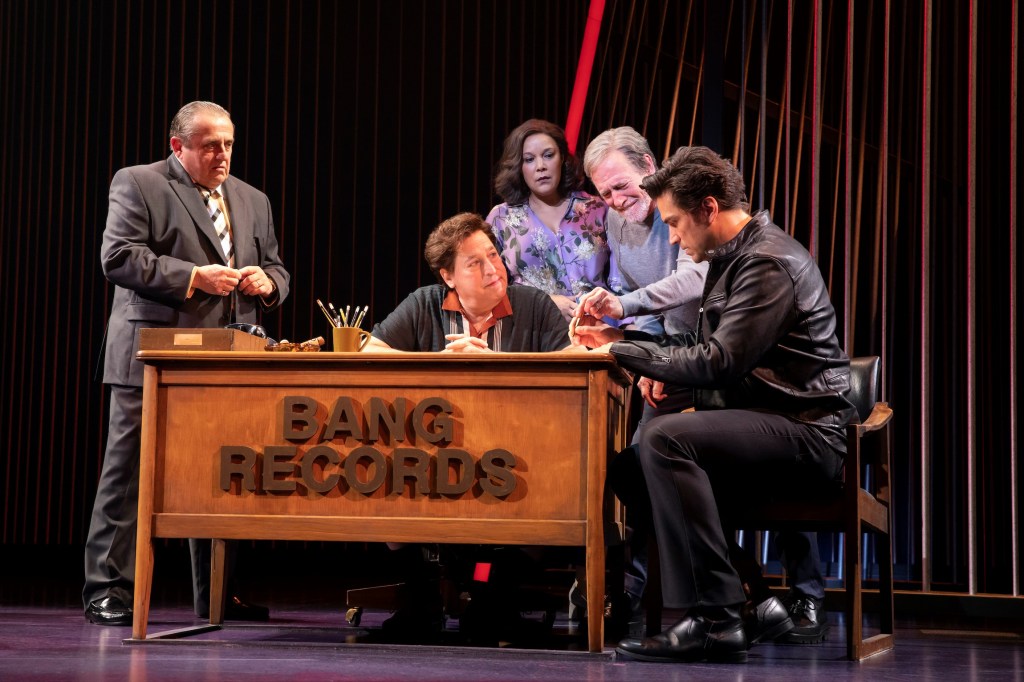
When the doctor gives him the songbook and suggests that he pick out a song and talk about it, as he rifles through the pages, he notes his proud accomplishments. We hear the “Opening Montage” of a few of his hits. It is as if a genie has been released from his memory as he peruses the book, then shuts it, perhaps because the memories of what was are too painfully overwhelming. But ambivalently, he opens the book again commenting, “what a beautiful noise.” As he remembers, a back up group sings “Beautiful Noise,” and the young Neil Diamond (Will Swenson in an exhilarating performance) appears and sings with them to a backdrop full of glorious light and sound. The song includes an overlapping combination of riffs from some of his classic hits, signature songs which Swenson’s Diamond sings with lustrous power and energy.
The singers who symbolize Diamond’s concept of “The Beautiful Noise” with this song and throughout various numbers are Paige Faure, Kalonjee Gallimore, Alex Hairston, Jess LeProtto, Tatiana Lofton, AAron James McKenzie, Mary Page Nance, Max Sangerman, MiMi Scardulla and Deandre Sevon. They sing backup and dance the journey of Neil’s life and career as the songs explore and reveal his flaws in his relationships, most importantly the one he has with himself. The “Noise” who accompany him are as diverse as the street people who Diamond writes for. It is they and their ancestors who have “Come to America” to seek the American Dream that Neil Diamond himself represents. The play is a revelation of this which we learn at the conclusion of the production, when Jacoby’s Neil discusses the loneliness and fears of his childhood. Only then is he able to reconcile his identities past and present.

After the opening musical reverie, the older Neil then returns to reality in the doctor’s office. These positive remembrances have made Jacoby’s Neil comfortable enough to answer the doctor’s questions about writing his first song in Flatbush, Brooklyn for his high school girlfriend Jaye (Jessie Fisher) who he marries. During this exchange he refers to his escape into music and how he was obsessed with writing and performing songs to “get out of Flabtush.” Ironically, we learn throughout the musical that Flatbush is the place he seems to be forever escaping, before and after he becomes famous. His reasons for running are revealed by the older Neil at the conclusion. McCarten has fashioned the reason as his quest to acknowledge his true worth which will help him achieve peace with himself, Katie and the children
McCarten’s book sets up the paradigm and structure of older Neil digging deeper into his past. As he flashes back and forth in time with younger Neil, who manifests the songs inspired by his life, The Neil Diamond Musical, A Beautiful Noise takes off. Act I showcases Diamond’s rise to fame in the 1960s. Act II follows with his touring and concert glories as his career achieves stunning heights in producing 39 albums, while his personal life after two divorces and an empty bank account are in the abyss. We are delighted to travel back and forth from present to past to present as Jacoby’s Neil frames the journey to Powell’s therapist through flashbacks, as the vibrant, Swenson’s Neil enacts the “dream” and makes it reality.

Guided by the doctor’s questions, Jacoby’s Neil relates his experiences beginning at Aldon Music where he meets Ellie Greenwich (Bri Sudia) in a humorous few scenes, getting his feet wet under her guidance. In one scene he pitches a slower version of “I’m a Believer.” She hears its possibility and voila she sells it to The Monkeys for a hit. Neil’s career is growing as he receives his first gold record. He is a success writing for the Monkeys, but it’s not enough. The older Neil illustrates the part of Neil that is never satisfied. The song is “silly,” he says. However, the doctor points out the depth in the song’s lyrics, a depth which indicates no part of Neil was ever occluded by commercialism. His own poetic voice always showed through in his songs.
Jacoby’s Neil softens with Powell’s therapist. He shares how he moved from writing songs for others to performing them. In a flashback, we note that Ellie believes he is “that good,” when he sings how “Kentucky Woman” should be performed during a “Demo Medley.” Because he needs to develop his performance skills, Sudia’s Ellie has him gain experience at the Bitter End in New York City. After singing a set (“Solitary Man,” Cracklin’ Rose”) Paul Colby (Michael McCormick) gives him $9.00 and asks the shy Neil to return. It is here that young Neil opens up to attractive fellow singer Marcia (Robyn Hurder). He tells her that he enjoys performing live for this, his first time. The uplifting experience strengthens and changes him. It allows him to express a vibrant, alive part of himself he has not acknowledged or thought himself capable of.
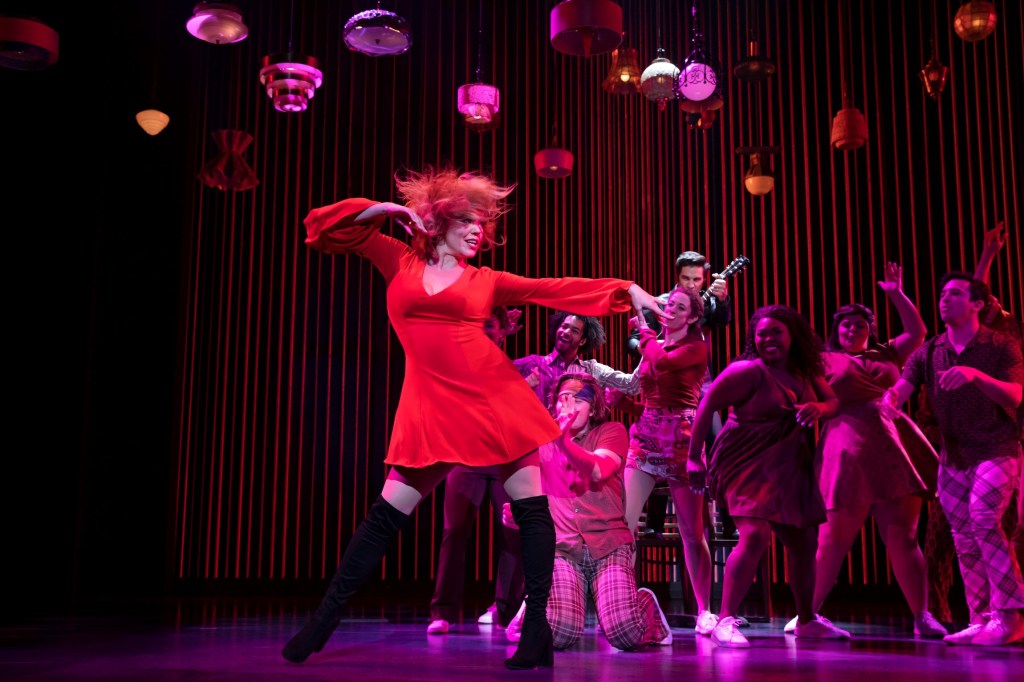
We understand how this turning point shapes Diamond into the dynamic performer he eventually becomes with Marcia’s encouragement. Hurder’s Marcia suggests he write more upbeat songs that everyone can identify with. In this flashback segment, she and Neil sing “Song Sung Blue” which intimates how their growing romantic relationship is forged by his need to establish himself in a fruitful career and release his poetic and musical talents to become a success.
McCarten then shifts the flashback to the present in the doctor’s office. Jacoby’s Neil doesn’t want to discuss how his involvement with Marcia while Jaye is pregnant with their second child upends his marriage. Neil fights with the doctor not to remember what is painful that is revealed in songs he wrote at that time. These include songs about being torn between his wife and his mistress. Clearly, he is overwhelmed with guilt having grown close to Marcia who assists him with his career. It is a sore point and he isn’t ready to do the emotional work looking at why he took a self-destructive turn by reviewing how this angst came out in his songs.
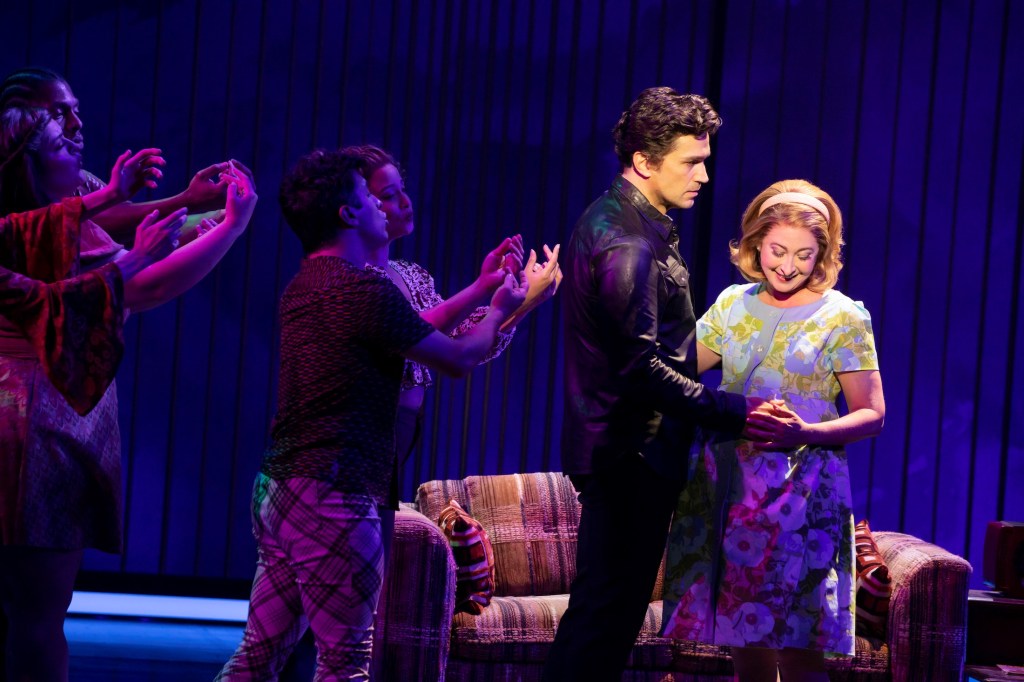
So when the doctor settles upon a classic hit created around that time, (which Robyn Hurder dances to in a bright red sexy costume when “Cherry Cherry” is performed) the older Neil jumps at the chance to talk about the creation of his song for “the mob.” These flashback scenes become the humorous high point of Act I. We are intrigued as the older Neil characterizes working with Bang Records as “the biggest mistake of my life.”
Ellie introduces Neil to Bert Berns (Tom Allan Robbins) who runs Bang Records, while Mob Boss Tommy O’Rourke (Michael McCormick) funds the company. In a flashback Swenson’s Neil makes a deal with them to produce hits, if they then produce more artistic songs like “Shilo,” which may not be hits. Though O’Rourke agrees, McCormick’s O’Rourke humorously indicates he has no intention of keeping his promise. In a scene where time stops, the older Neil tries to prevent younger Neil signing on with Bang Records by trying to take the pen away. Older Neil fails and younger Neil signs and is controlled by them. He must produce three hits or end up in peril of his or his family’s lives.

In revealing how younger Neil is torn between Jaye and Marcia, the musical number with the Noise “Cherry Cherry” rocks it as the number physicalizes Neil’s quandary first with Jaye and then moving toward Marcia until he is with her. As Fisher’s Jaye sings “Love on the Rocks,” with Swenson’s Neil begging her to stay, she asks if he loves Marcia. At this point the question is moot.
Neil’s exciting foray into success as he fulfills his contract to mob controlled Bang Records reaches its dramatic high point played out in a dingy Memphis motel, where he retreats to write and get away from the gun happy O’Rourke. Jacoby’s Neil reveals how he was under tremendous pressure to create or suffer the dire consequences. O’Rourke has the Bitter End bombed to send Neil “a message.” Older Neil shares how in Memphis after days of rain, the symbolic sun comes out. He credits the inspiration to “God” coming into the motel room, sealing his children’s future and his own. In thirty minutes the metaphoric dark clouds clear (dark clouds are used as a symbol throughout) and Neil writes one of his signature songs. Act I ends with the rousing “Sweet Caroline.” During their song performance the audience went wild the night I was there. The audience, and Swenson and the Noise “reach out, touching me, touching you.” Theirs is an electric connection that younger Neil is not able to muster with his wife Jaye and their children.

Act II begins with the persona Neil Diamond, who is now famous. Director Mayer has Swenson’s Diamond rise on a platform surrounded by lights and glory with a “Hollywood Squares” type layered set with the band in various “squares.” Clearly, Neil is becoming the award winning legend, singing “Brother Love.” Subsequently, through the older Neil’s retelling, we note that Swenson’s Diamond, with dazzling, sparkling sequins runs from concert to concert, fulfilling the destiny that he dreamed of in Flatbush, Brooklyn, the place that controls his psyche, the place he still runs from. This is especially so even though his concerts sell out with greater fandom than the Rock & Roll King Elvis. In the next decades with Marcia in twenty-five years of marriage, he has it all, friends with the Redfords, a Malibu home and money raining down. Where his first marriage to Jayne dissipated with “love on the rocks,” his marriage to Marcia quietly implodes during phone calls, separate lives and acknowledged disinterest. This is manifest with Hurder’s Marcia and Swenson’s Neil with “You Don’t Send Me Flowers,” in a lovely rendition.
At their divorce, Diamond gives Marcia everything and continues to work. Jacoby’s Neil tells us a few years pass and he meets third time lucky Katie and establishes a family. But the diagnosis has brought him to a place of reckoning at the therapist’s office. And we are back in the present when Powell’s therapist asks the question about Neil’s feelings of being alone, an emotion which permeates many of his songs. During this segment Mark Jacoby’s quiet resolve and recalcitrance breaks open in expansive revelation.
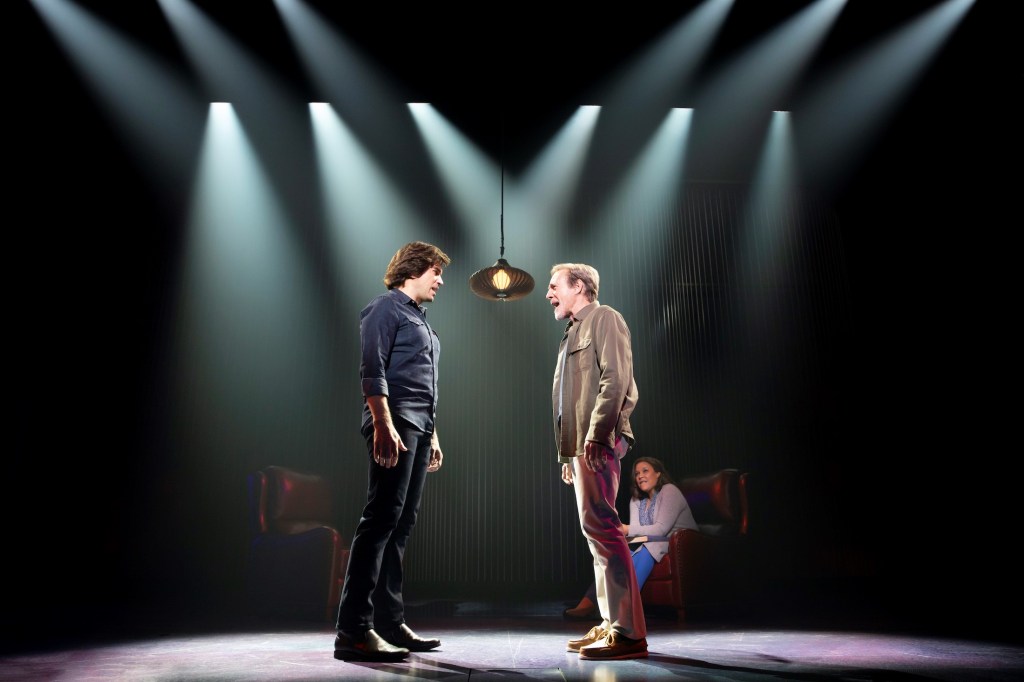
For the first time we hear him sing filled with the depth of years of repression to claim his self-affirmation in “I Am I Said.” Jacoby hits it out of the ball park and brings the entire journey into completion as Swenson’s Neil joins him and the two identities are conjoined. It is an astounding, brilliant piece of writing coupling the elements and characters bringing them into sharp focus. The power of the moment hinges on Jacoby’s portrayal of Neil which is heartfelt, touching and human. The conclusion memorably coalesces the dream coming to its full humanity in Neil Diamond. Merging his identity as a performer and as a cultural prophet he gains a new understanding of his emotions from the past viewing them with the comfort in the present reality of who he is and what he has accomplished.
Directed by Michael Mayer with Steven Hoggett’s choreography and Sonny Paladino’s music supervision and arrangements and the near-perfect performances, this astounding and prodigious effort is bar none. Above all it is a tribute to Neil Diamond the performer and Neil Diamond, the man, like all of us, broken by his own inner fears and isolation which is an integral part of his creative spirit and artistic genius. The breadth of the songs included in the show which reveal that Diamond mastered pop, rock, country and blues indicates why in addition to his awards is also an honoree at the Kennedy Center Honors and a recipient of the Grammy Lifetime Achievement Award (2018).

Importantly, The Neil Diamond Musical, A Beautiful Noise probes themes that reveal how driving ambition and talent shadow an artist’s personal life. In chasing the dream it is sometimes difficult to fully enjoy one’s success. In his resolution at the conclusion, Jacoby’s Neil understands the importance of this and expresses gratefulness at all the directions, all the roads his life has gone down.
There are a few critical junctures that don’t quite work and sometimes the staging and sound were problematic for those not seated direct center. But these details are overshadowed by the ingenuity of the book, the resonance and gorgeousness of Diamond’s music, the energetic, believable performances and the organic, modern and retro dances. Jacoby’s Neil who is listening and participating as he watches Neil’s own reflections manifest before him, never flags in his portrayal in a difficult, complex role. Neither does Swenson who’s evocation of Diamond is an intimation of his attitude and spirit and not an imitation. Hurder, Powell, Fisher and Sudia are excellent and Sudia is flexible doing double time as younger Neil’s mom. Robbins and McCormick fulfill their portrayals with humor and kudos to them for taking on additional roles.
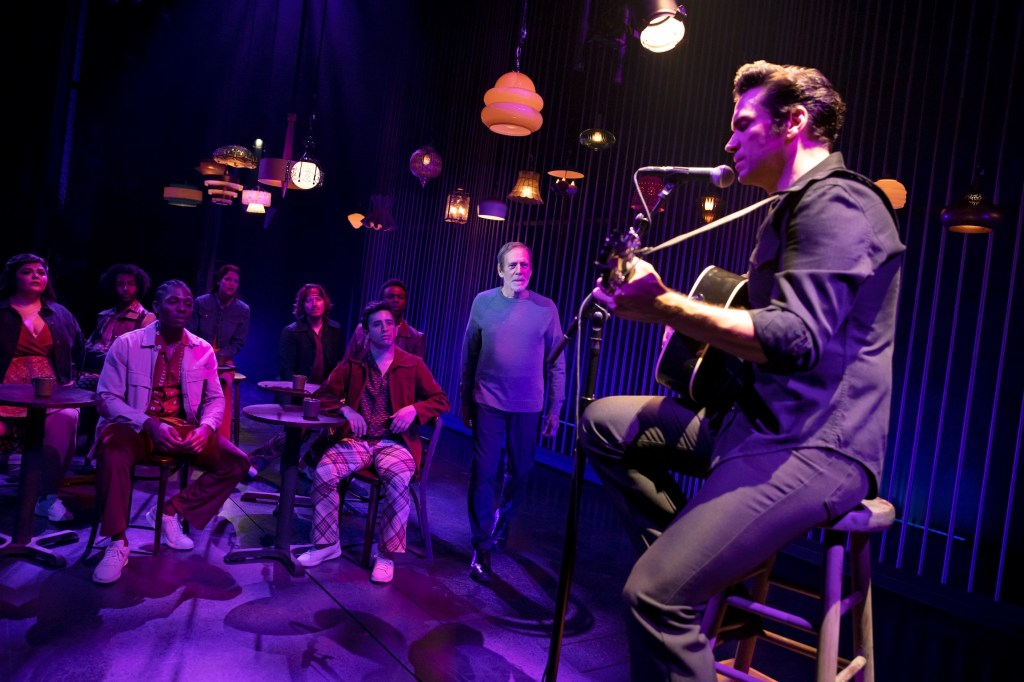
David Rockwell’s scenic design, Emilio Sosa’s costume design, Kevin Adams’ fine lighting design and Jessica Paz’s sound design work to deliver an amazing production. Noted are Luc Verschueren’s hair, wig & makeup design and Annmarie Milazzo’s vocal design. Bob Gaudio, Sonny Paladino & Brian Usifer delivered the superb orchestrations and Brian Usifer is responsible for incidental music and dance music arrangements.
If Neil Diamond’s music doesn’t rock for you, see it for the performances and spectacle. If you adore Neil Diamond, what are you waiting for? Go to their website for tickets and times https://abeautifulnoisethemusical.com/
.
t
‘The Collaboration,’ Paul Bettany and Jeremy Pope are Brilliant as Andy Warhol and Jean-Michel Basquiat

Whether you are an art aficionado, fan or critic, The Collaboration, by Anthony McCarten about Andy Warhol and Jean-Michel Basquiat’s joint effort to produce paintings together is an astonishing, dynamic production. Starring Paul Bettany (an Inspector Calls-West End) and Jeremy Pope (Choir Boy) and directed by Kwame Kwei-Armah, the two-act play currently runs at the Samuel J. Friedman Theatre, extended until 5 February. This production which hails from the Young Vic Theatre is not to be missed.
Warhol’s and Basquiat’s alliance was an unusual meld for both artists, who were at different points in their careers and who, according to McCarten in the first act, were a thesis/antithesis in their personal lives, perspectives and personalities. Because Warhol and Basquiat are icons who helped transform the art world as unique and indelible fixtures in their own right, The Collaboration is of seminal importance. Not only does the work identify aspects of the artists’ individual and collective graces, it also inspires further exploration into the lives of these individuals and their synergistic and productive relationship.

Bettany and Pope’s prodigious acting skills and Kwame Kwei-Armah’s superb direction in helping them tease out memorable details of emotion, gesture and nuance allow the actors to live and breathe their characters onstage. Bettany and Pope are a pleasure to watch in their authenticity as their portrayals by the second act lift toward the heavens into the phenomenal. They inhabit Warhol and Basquiat with vulnerability and humanity. So comfortably do they don the artists’ ethos, one forgets the play is a stylization and evocation of two mythic figures who attained immortality in spite of themselves.
Indeed, the production takes us on a fantastic journey with intermittent elements of realism that all the more enhance the beauty and tragedy of these men, whose lives were cut short. Though Andy Warhol lived to be 58 years-old, Jean-Michel died of an overdose of heroin at twenty-seven. At the conclusion McCarten suggests that their individual and collective work and their ability to inspire and whimsically play off one another are an irrevocable, immutable and timeless gift to all of us.
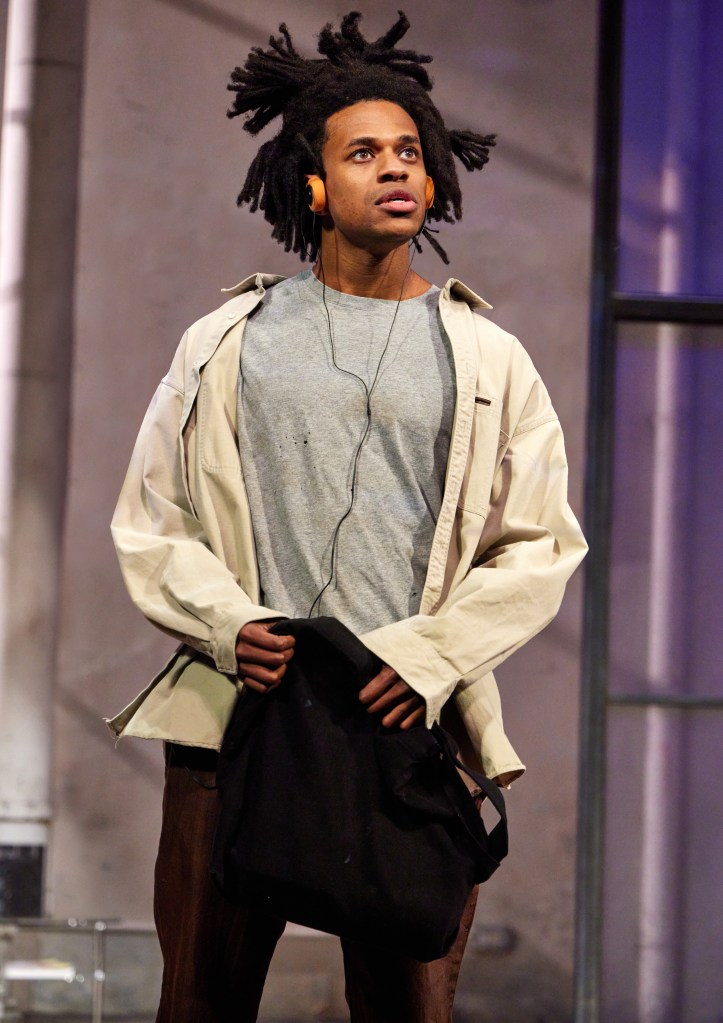
The award-winning playwright (known for films The Theory of Everything {2014) Two Popes {2020} and the book writer of A Beautiful Noise) grapples with revealing their combined efforts in the short period of time they worked together. Indeed, the cultural mystique and reputation that precedes these men sometimes gets in the way. The more one knows about Warhol and Basquiat, the more frustrated one may become with McCarten’s presentation of their relationship, whose closeness is developed in filmed events of Bettany and Pope doing activities together, projected on the backstage wall and side walls during the intermission between Act I and Act II. Thus, if one leaves to get a drink or take a trip to the bathroom, the vital aspects of how Warhol and Basquiat’s relationship develops and how the men bond over time will be missed.
McCarten first introduces us to Warhol who visits the gallery of Bruno Bischofberger (Erik Jensen’s accent at times trips over itself). There, Andy inspects Basquiat’s paintings as Bruno attempts to sell him on his idea of a collaboration. Though Bruno makes it seem that Basquiat is “dying” to work with Warhol, we discover this isn’t the case. Bruno is massaging Andy’s ego. In his exchange with Bruno, Andy views 24 of Basquiat’s paintings which unfortunately we never see. Bettany looks out into the audience to “view” Basquiat’s work, as we imagine what Andy sees and watch his expressions of shock, excitement, amazement and jealousy, all in Warhol’s inimitable stylistic phrasing and being. Bettany captures the characteristic Warhol exclamations “gee,” “oh,” and retains enough of the soft spoken and demur air that we’ve seen in films of Andy Warhol that bring us toward acceptance of his portrayal, which deepens as the play embodies their philosophical tension working together.

Bruno is the catalyst for their collaboration. And it is Bruno who comes up with the concept of how to market the exhibition of their works with a poster of both in boxing shorts with Jean-Michel’s chest exposed and Andy’s chest covered in a black T-shirt, as they hold up their boxing gloves ready for their match up of paintings on Mercer Street in New York City.
To persuade a reluctant Andy, Bruno uses flattery and guilt. He chides the avid filmmaker that he hasn’t picked up a brush in years. When Andy shrugs off Bruno’s flattery with self-deprecation that his reputation “is in tatters,” and “no one loves him any more,” Bruno wisely counters Andy’s defense and makes him think. Bruno suggests that it is Andy who doesn’t return the love given to him, an idea that intrigues Andy because it divulges arcane, inner knowledge about his soul which may be accurate. Bruno has hooked Andy toward working with Jean-Michel. But he is completely drawn in when Andy realizes that this is a golden opportunity to employ his skills as a filmmaker and interviewer. He will film their collaboration and record it for posterity.

After Andy leaves Bruno’s gallery, Basquiat keeps his appointment with Bruno and we see how the art dealer works his persuasion to lure Jean-Michel to accept Andy as an artist-partner. Like Andy, Jean-Michel is not convinced. In fact, he is nonplussed at the idea of painting with a world renowned artist and is suspicious and recalcitrant, suggesting that Andy is mechanistic and repetitive and his prints lack soul. With the same push-pull, parry and thrust that he experienced with Andy, Bruno cajoles and uses reverse psychology on Jean-Michel. He is not willing to take “no” for an answer, though Jean-Michel accuses him of exploitation when Bruno suggests the project is monumental and will have “art lovers lined up from the gallery door to JFK.”

Bruno stirs Jean-Michel on collaborating with Andy, using flattery and the unction that Andy really wants to work with Jean-Michael, though we have just witnessed that this is not true. Jean-Michel states he has nothing to say to Andy because they don’t “speak the same languages,” and he is not here to “bring Andy back from the dead.” Bruno, a master of human nature who pings Jean-Michel’s underlying vanity and competitiveness, finally reels him in with the discovery that Andy thinks Jean-Michel is “a threat to his entire understanding of art.”
The humor in both artist’s exchanges with the art dealer is organic, and the presentation of Bettany’s Warhol and Pope’s Basquiat are strikingly similar in their susceptibility to compliments, their egotism, their underlying insecurity with arrogance (Basquiat) and self-disdain (Warhol). As we watch the apparent tensions unfold, it is clear that Warhol and Basquiat may be sparring partners, but theirs is a match that is too coherent and intuitive not to work. Of course the idea that this will bring in tons of cash and, as Basquiat suggests, the bankers will be happy, emphasizes the themes of art’s pure expression versus art exploitation, and art as a business versus the pleasure and necessity to create art which drives both Andy and Basquiat. Meanwhile, as the inveterate money-minded dealer, Bruno encourages this promotional collaboration to harness their ambition and turn it into profits.

During Andy’s and Jean-Michel’s individual exchanges with Bruno dueling for advantage, themes and details in the artists’ lives surface. Andy’s mention of Valerie Solonas’ assassination attempt in 1968 that nearly took his life and caused him to look over his shoulder, expecting to be killed again is poignant and humanizing. The humanizing details continue throughout both acts and help to inform our understanding of the similarities between Warhol and Basquiat in their childhood experiences, for both were influenced by their mothers toward art, drawing and painting.
After the prologue with Bruno, the first act predominately takes place in Andy’s studio as the artists become familiar with each other, discuss their viewpoints, the idea of branding, what Andy’s art attempts and what Jean-Michel attempts with his art. Finally, they agree about what to paint and Andy sneaks in his filming as Jean-Michel paints and answers Andy’s questions. By the second act which takes place in Jean-Michel’s loft/studio/apartment, both artists have become close revealed in the film projections during intermission. At a crucial point in the second act and at Jean-Michel’s suggestion, they challenge each other good naturedly to take off their shirts and expose their wounds.

It is a profound, humbling, bonding act. The icons are human and terribly vulnerable. We see Jean-Michel’s extensive surgical scar where he was injured, run over by a car. He had to recuperate for a long time, a trial which his mother got him through when he was 7-years-old by encouraging him to look at Grey’s Anatomy and draw what he saw to inspire his healing process. And we see Andy’s corset which he must wear to hold his organs in place and above it the long, disfiguring scars criss-crossing his torso, where the surgeons had worked feverishly to save his life from Valerie’s bullet which she shot into him at point blank range.
The second act evolves into an explosion of love and rancor between the two artists. When former girlfriend Maya (Krysta Rodriguez) comes to Jean-Michel’s place to settle up a financial arrangement with Jean-Michael, Andy tells her about their mutual friend Michael Stewart who is in a coma, beaten unrecognizable by cops because he was painting graffiti. Maya returns with the news of Michael’s death and pleads with Basquiat to go to the lawyer’s office with her to give testimony proving the cops murdered Michael. Basquiat refuses. Instead, he gives her the Polaroids of Michael’s mutilated face and body.
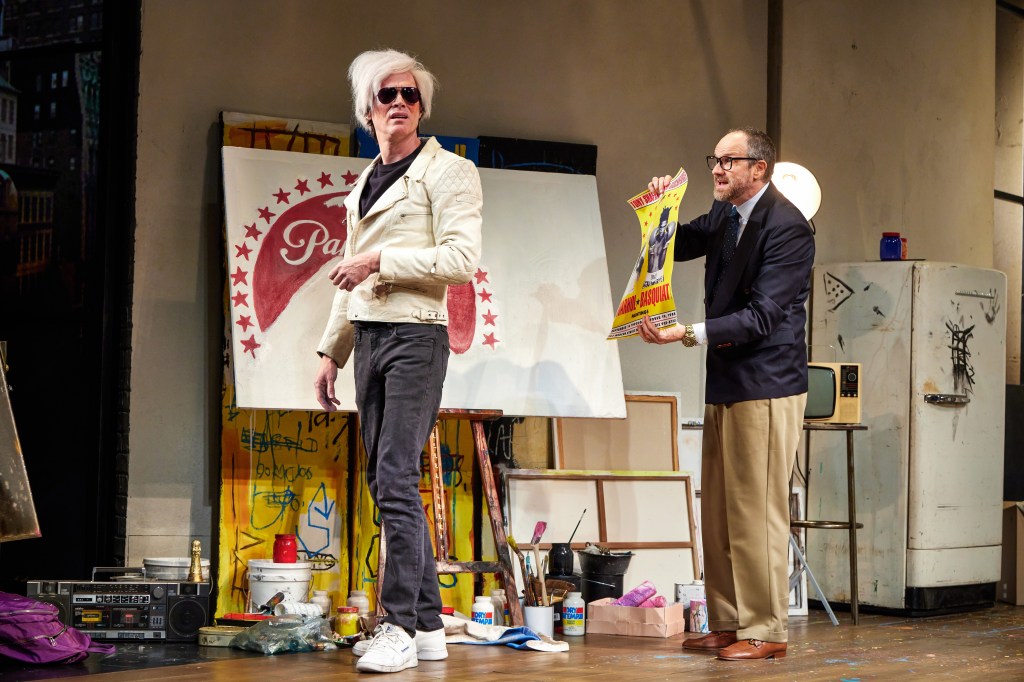
Jeremy Pope’s Basquiat transforms into raw nerve endings of emotion in a heart wrenching explanation why he can’t go to the lawyer’s office. The jitters, the nerves, the frenetic energy that need to be displaced because of Jean-Michel’s painful identification with Michael as a fellow sufferer who has just passed is Jeremy Pope’s tour de force throughout the rest of the act.
Basquiat reminds Maya and Andy of the heartless reality of Black racism and oppression evidenced in police brutality against Michael. The spirit of hate and bigotry murdered Michael and that same spirit is ranging to murder him, as he, too, painted graffiti at one point early in his career. Pope conveys Basquiat’s tortured grief at the loss of his beautiful friend. He is torn between wanting to help the Stewart family and preserve his own life and destiny. When Basquiat accuses Andy of indirectly killing Michael, who he was trying to heal with his painting, not understanding, Andy is shocked at Basquiat’s recriminations.

McCarten reveals what painting means to Basquiat and how he perceives art’s power in this tremendous scene that hearkens back to Basquiat’s childhood when he encouraged his own healing by drawing “healthy” organs from illustrations in Grey’s Anatomy. Painting is his way of controlling, resurrecting life, defining power constructs and capturing racism symbolically to effect its change. When Basquiat tries to evoke healing for Michael spiritually, Andy’s commercial, material filming destroys the spiritual power to heal his friend who dies. Thus, for Basquiat painting is totemic and primal, sacred and holy while Andy, tortured by Basquiat’s questions reveals that art to him is an escape from self-loathing into an austere identity which only momentarily eradicates the deformed ugliness he is.
Ironically, at the core of their art, MarCarten suggests they symbolize and do different things. Andy films/records history to understand the creative process and see humanity, while never accepting his own. Basquiat employs the creative process to heal himself and others. One process is not better than the other, nor are they mutually exclusive. As their “collaboration” proves, both are integral to each other. Combined, they establish the inherent beauty and singularity of both.

This incredible scene extends into a dance between Andy and Jean-Michel who pushes Andy to validate and reveal himself as he pretends to film him, though Basquiat has destroyed all of Andy’s films of their collaboration. Once again Bettany’s Warhol and Pope’s Basquiat challenge each other in a rivalry that can never be equal because Andy is not Black. Though he suffers discrimination because he is gay, their bond has limitations. Andy leaves then comes back apologetically though Basquiat has been cruel to him. And it is in the last minutes of the play that there is a touching reconciliation. The inevitability of their lasting artistic achievement is brought to the fore.
To effect the characters, the director’s vision and the creative team’s execution of it works well. Warhol’s and Basquiat’s wigs thanks to Karicean “Karen” Dick & Carol Robinson and Anna Fleischle’s costuming are on-point. Fleischle’s minimalist scenic design of white walls serves to intimate Bischofberger’s gallery, Warhol’s Studio on Broadway and Union Square, and Basquiat’s loft apartment/studio on Great Jones Street. Props and paintings and works and furniture are added and taken away accordingly. Basquiat’s digs in the second act require the greatest set-up, as he lives in cluttered disarray, unlike Andy’s studio which is neat, clean and “almost sterile.”

The second act reveals magnificent writing and magnificent acting. Throughout the concept of modern arts’ evanescence, that “everyone thinks they can do it,” and discussions of art critics attempting to nail down their work then toss it aside, are fascinating and richly profound. That both men were exploited and learned to then exploit themselves to become their own business models has currency for us today. Of course they became masters at self-exploitation. Considering that Basquiat’s brilliant light shined momentarily to leave a massive body of work and Warhol’s frenetic energy blasted an even more massive collection, their painting together was genius.
Because Warhol and Basquiat have been branded with their own mythology and entrepreneurship, understanding who they were, understanding their relationship remains elusive. Such comprehension cannot be gleaned in one play, nor should one expect to. However, McCarten creates a masterwork that Bettany and Pope use as a jumping off point to portray the divine and weak in both characters. They are stunning, beautiful, transcendent. Thus, to describe The Collaboration as a “biodrama,” as some critics have done, is wholly inadequate. Rather the play is McCarten’s vision enhanced by Kwame Kwei-Armah’s sensitive and profound acknowledgement of two artistic geniuses who collided in the tension of trying to do the impossible. And as a result of this collision, they formed something new. They integrated their own styles of art in these partnership paintings that embodied resonating themes at the core of their own lives.
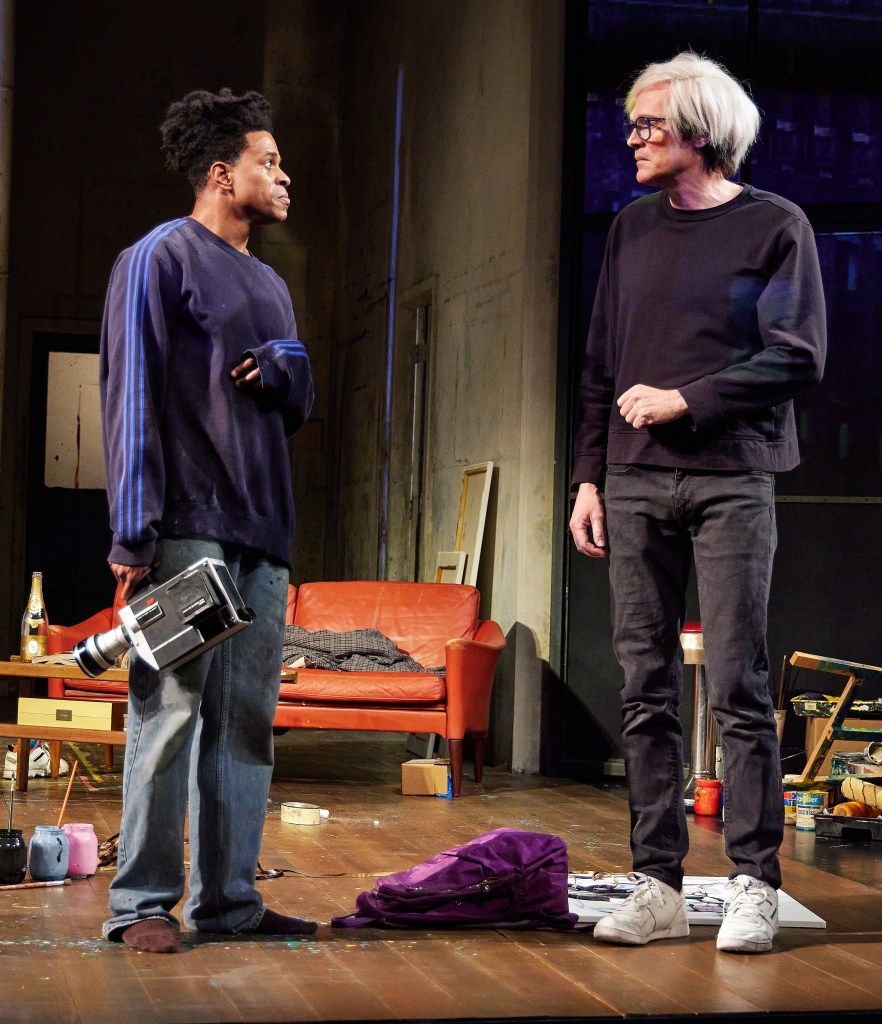
As the final sardonic irony at the play’s conclusion, while Bettany’s Warhol and Pope’s Jean-Michel paint into immortality, we hear the voice of an auctioneer, representative of the art world now on steroids, directional from what it was like when they were alive in the 1980s. Their work together is valued in the multi-millions, the irrevocable exploitation of both.
Kudos to Ben Stanton’s lighting design, Emma Laxton’s sound design, Duncan McLean’s projection design and Ayanna Witter-Johnson’s original music. For tickets and times go to their website https://www.manhattantheatreclub.com/shows/2022-23-season/the-collaboration/
 CAROLE DI TOSTI