Blog Archives
Jean-Michel Basquiat Celebrated, ‘In Honor of Jean-Michel Basquiat’
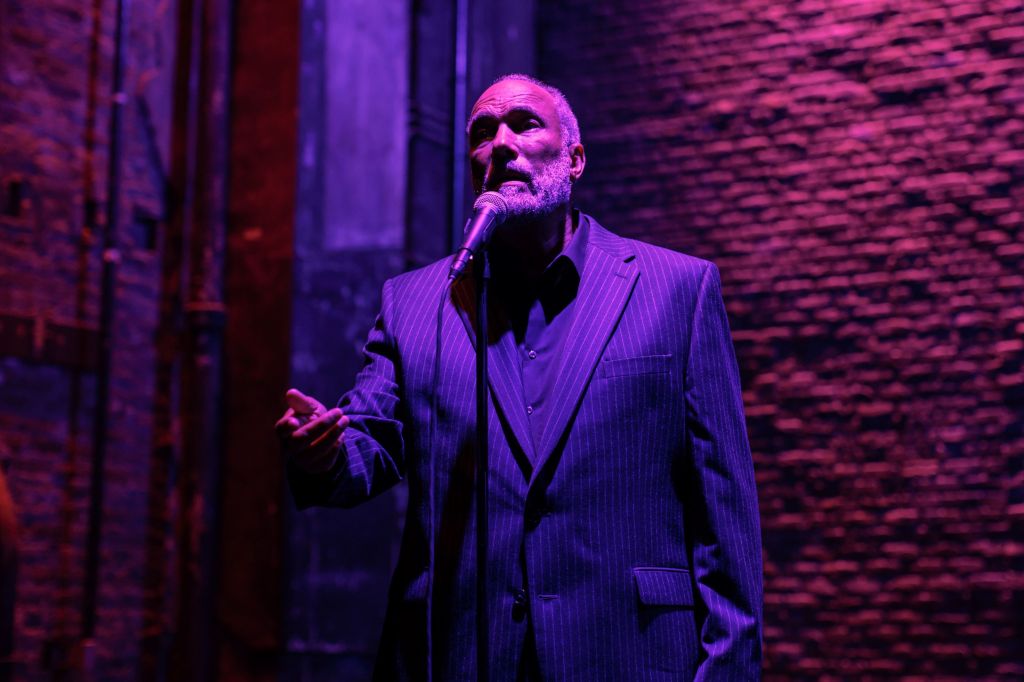
Who better to memorialize the artistic genius Jean-Michel Basquiat than a friend and a fellow creative Black performer who hung around with him in Venice, California? In his mesmerizing one man show at New York Theatre Workshop, Roger Guenveur-Smith cobbles together a thematically, ordered, series of stylized vignettes and images of his encounters, impressions and insights against the quixotic philosophical street wisdom of Basquiat. Importantly, Guenveur-Smith quietly illuminates Basquiat as a maverick and icon in the pantheon of Black artists/musicians running up against the annihilating, pathological, racist dynamic of white American culture. This is a necessary reckoning if we consider the current sociopolitical climate and thus, a must-see show.
The Obie Award-winning actor, playwright and director’s solo presentation follows his acclaimed sold-out run during Under the Radar Festival earlier in the year. As a testament to Guenveur-Smith’s profound, personal work about Basquiat and his legacy, the production has once more connected with audiences whose enthusiasm prompted its extension until October 10, 2026.
Accompanied with superb live sound design by Marc Anthony Thompson, and Ario Sanders’ atmospheric, symbolic lighting design, the 1 hour show zips by leaving one wishing for more. Standing barefoot in a natty suit, on a bare stage against the backstage wall a doorway reveals an intriguingly beautiful, mysterious space behind the performer.
At the mic Guenveur-Smith infuses his poetic delivery with an accompanying choreography of subtle movements. At times his subject possesses him and Basquiat’s presence feels palpable. The audience becomes fully immersed in the colors of sound and words melding in nuanced rhymes and rhythms. The immersion is a subtle plunge.
Gradually, the solo performer draws in the audience after he expresses the wisdom and encouragement his father gave him when he launched his own career as an actor. The father humorously reminds his son of the “challenges” (understatement) of Black identity. “You think you’re so goddamn clever/ You know if Van Gogh was Negro/He would have cut off more than his ear.” Also, his dad infers the commercial world’s exploitation. “Hell that boy didn’t live long enough/To see his shit really sell.” In an auction vignette Guenveur-Smith ironically conducts the auction for Basquiat’s “Untitled” which sold for $110.5 million dollars.
And, the father chides son Roger, “You go ahead, be an actor/But you’ll never act yourself out of this coffin called the US of A.” Finally, with love he uplifts him. “Be the best actor you can possibly be/And before it’s all over son, why don’t you act something out for your friend Jean-Michel and for me.”
Unlike Van Gogh, Basquiat did see his success translate into wads of money which he preferred as cash. Unfortunately, it sped him more quickly to his death which Guenveur-Smith narrowly pinpoints then moves on to more lyricism. The money afforded Basquiat greater access to heroin and an overdose at an age Basquiat uncannily predicted on canvas when he was twenty-one-years old.
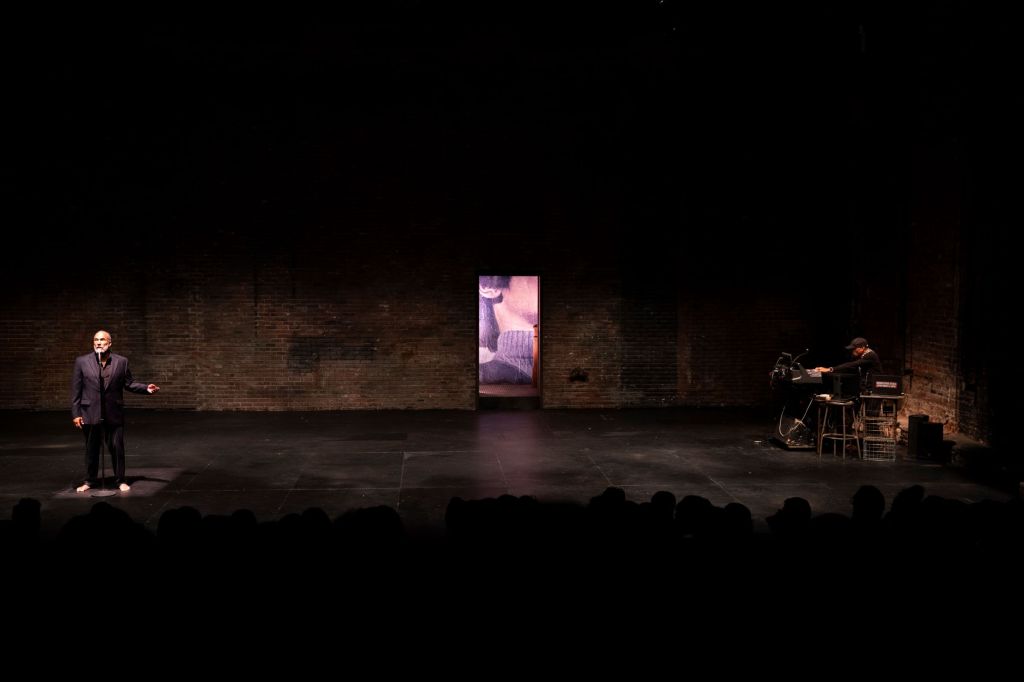
Guenveur Smith’s lyrical account is a vibrant vision of the man whose candle lit up the skies then was extinguished by his own hands in 1988 when Basquiat was twenty-seven. Initially, the two met at an L.A. dance hall in 1982. Guenveur Smith, rapping under the name “Hollywatts” (Hollywood and Watts), hooked up with Basquiat at his career’s first blossoming.
Rather than examine the artist’s place in Neo-expressionism or define him as an appendage of Andy Warhol, Guenveur-Smith uniquely personalizes his friend with compelling metaphoric images that stick in one’s mind. For example when he and Baquiat met, he thought he was just “a cool kid with an electronic hairdo.” He didn’t know Basquiat was “incognegro numero uno writing acrylic poems and philosophy on concrete walls and canvas and refrigerator doors.” Together they see Martin Scorsese’s King of Comedy walking in late to the balcony moving in front of the projectionist. “His dreads are projected in silhouette onto the screen, obscuring Robert DeNiro and Jerry Lewis/The crowd is very confused then very amused/The King of Comedy crowned.”
Additionally, Guenveur-Smith punches up events and people in ironic synchronicity with Basquiat’s life. In 1960, the only survivor of a plane crash, a young “white boy burned black,” having fallen from the plane remarks that the city “looked like a magic fairyland.” Then he dies in the same Brooklyn hospital where three days after Basquiat is born. Hit by a car, Basquiat, a child, loses his spleen the same year Andy Warhol, shot by radical feminist Valarie Solanas, loses his. Basquiat’s father comes to Brooklyn in 1955, the same year Emmett Till was savagely murdered, the same year the Brooklyn Dodgers won the World Series on the backs of Jackie Robinson, Don Newcombe and Roy Campanella.
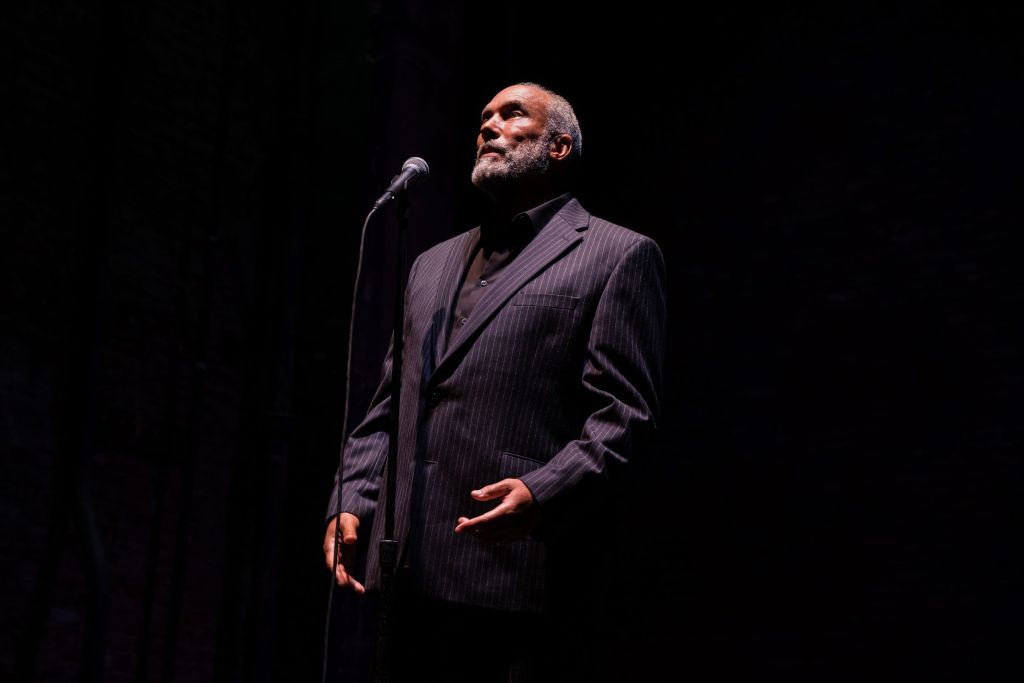
The synced parallels continue throughout as touchstones centering Basquiat in time and out of time in this memorial. A history of Black musicians, singers, some of whom they listened to as Hollywatts rapped and Basquiat threw down on whatever medium he liked are referenced. These honorable mentions include everyone from Charlie Parker, Charles Mingus, Lady Day, Louis Armstrong, Nat King Cole, John Coltrane and many more. Guenveur-Smith makes sure to indicate that the best of them took a stint in mental institutions or rehab centers. It’s part of the landscape of white American culture’s deadliness Guenveu-Smith’s father referred to earlier.
As Guenveur-Smith threads together stories of Black artists and activists, he intersects them with Basquiat. Basquiat’s father said he “Never needed a mic to politicize or a machete, but still he was a soldier.” This is especially so in Basquiat’s work Defacement (The Death of Michael Stewart). Guenveur-Smith starkly describes the murder of Michael Stewart by MTA police with searing detail. It’s a lynching that brought no accountability to the officers. Recognizing that Stewart, the graffiti artist and model, could “have been him,” Basquiat gives homage to Michael Stewart in his acrylic marker on wood painting. After Guenveur-Smith’s jarring description, he revisits memories that inspired his own character “Smiley” in Spike Lee’s film Do the Right Thing.
Guenveur-Smith concludes his en memoriam as it should in a celebration of Basquiat’s legacy forever tied with a nation that looks to his astonishing work sometimes with apprehension but mostly with pure joy.
In Honor of Jean-Michel Basquiat runs one hour with no intermission at New York Theatre Workshop. https://www.nytw.org/show/basquiat/?gad_source=1&gad_campaignid=24057584595
‘The Collaboration,’ Paul Bettany and Jeremy Pope are Brilliant as Andy Warhol and Jean-Michel Basquiat

Whether you are an art aficionado, fan or critic, The Collaboration, by Anthony McCarten about Andy Warhol and Jean-Michel Basquiat’s joint effort to produce paintings together is an astonishing, dynamic production. Starring Paul Bettany (an Inspector Calls-West End) and Jeremy Pope (Choir Boy) and directed by Kwame Kwei-Armah, the two-act play currently runs at the Samuel J. Friedman Theatre, extended until 5 February. This production which hails from the Young Vic Theatre is not to be missed.
Warhol’s and Basquiat’s alliance was an unusual meld for both artists, who were at different points in their careers and who, according to McCarten in the first act, were a thesis/antithesis in their personal lives, perspectives and personalities. Because Warhol and Basquiat are icons who helped transform the art world as unique and indelible fixtures in their own right, The Collaboration is of seminal importance. Not only does the work identify aspects of the artists’ individual and collective graces, it also inspires further exploration into the lives of these individuals and their synergistic and productive relationship.

Bettany and Pope’s prodigious acting skills and Kwame Kwei-Armah’s superb direction in helping them tease out memorable details of emotion, gesture and nuance allow the actors to live and breathe their characters onstage. Bettany and Pope are a pleasure to watch in their authenticity as their portrayals by the second act lift toward the heavens into the phenomenal. They inhabit Warhol and Basquiat with vulnerability and humanity. So comfortably do they don the artists’ ethos, one forgets the play is a stylization and evocation of two mythic figures who attained immortality in spite of themselves.
Indeed, the production takes us on a fantastic journey with intermittent elements of realism that all the more enhance the beauty and tragedy of these men, whose lives were cut short. Though Andy Warhol lived to be 58 years-old, Jean-Michel died of an overdose of heroin at twenty-seven. At the conclusion McCarten suggests that their individual and collective work and their ability to inspire and whimsically play off one another are an irrevocable, immutable and timeless gift to all of us.
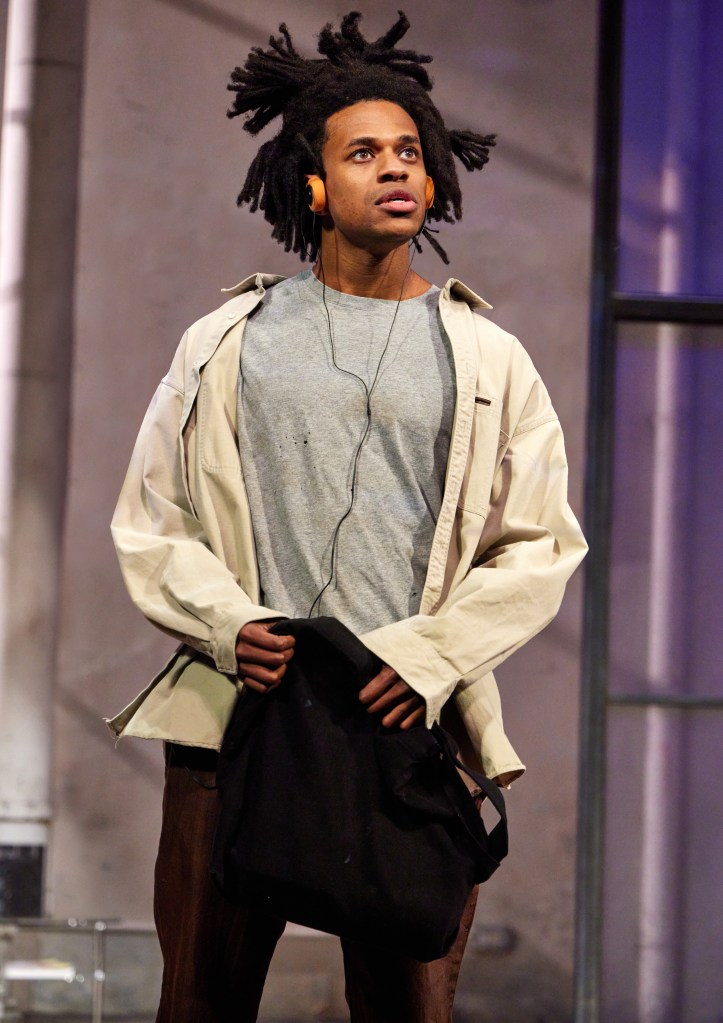
The award-winning playwright (known for films The Theory of Everything {2014) Two Popes {2020} and the book writer of A Beautiful Noise) grapples with revealing their combined efforts in the short period of time they worked together. Indeed, the cultural mystique and reputation that precedes these men sometimes gets in the way. The more one knows about Warhol and Basquiat, the more frustrated one may become with McCarten’s presentation of their relationship, whose closeness is developed in filmed events of Bettany and Pope doing activities together, projected on the backstage wall and side walls during the intermission between Act I and Act II. Thus, if one leaves to get a drink or take a trip to the bathroom, the vital aspects of how Warhol and Basquiat’s relationship develops and how the men bond over time will be missed.
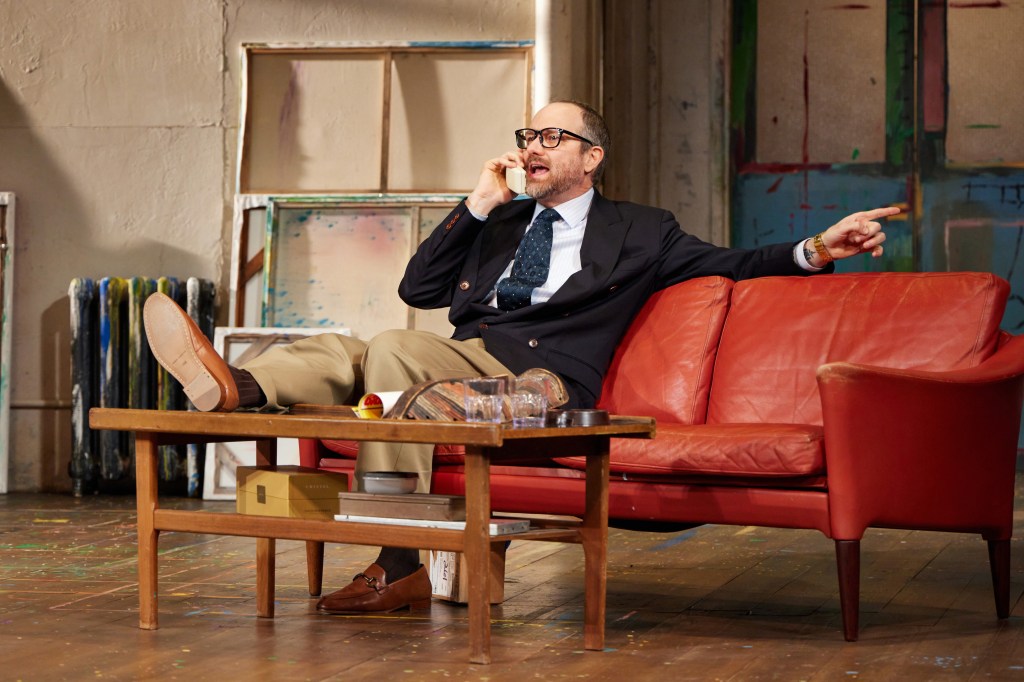
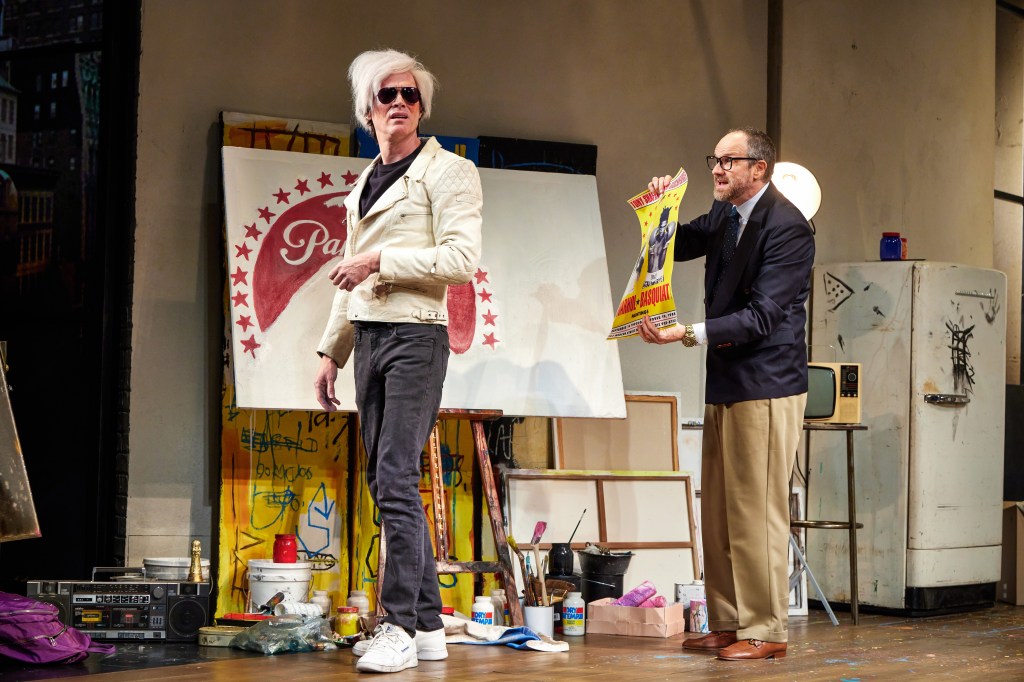
McCarten first introduces us to Warhol who visits the gallery of Bruno Bischofberger (Erik Jensen’s accent at times trips over itself). There, Andy inspects Basquiat’s paintings as Bruno attempts to sell him on his idea of a collaboration. Though Bruno makes it seem that Basquiat is “dying” to work with Warhol, we discover this isn’t the case. Bruno is massaging Andy’s ego. In his exchange with Bruno, Andy views 24 of Basquiat’s paintings which unfortunately we never see. Bettany looks out into the audience to “view” Basquiat’s work, as we imagine what Andy sees and watch his expressions of shock, excitement, amazement and jealousy, all in Warhol’s inimitable stylistic phrasing and being. Bettany captures the characteristic Warhol exclamations “gee,” “oh,” and retains enough of the soft spoken and demur air that we’ve seen in films of Andy Warhol that bring us toward acceptance of his portrayal, which deepens as the play embodies their philosophical tension working together.

Bruno is the catalyst for their collaboration. And it is Bruno who comes up with the concept of how to market the exhibition of their works with a poster of both in boxing shorts with Jean-Michel’s chest exposed and Andy’s chest covered in a black T-shirt, as they hold up their boxing gloves ready for their match up of paintings on Mercer Street in New York City.
To persuade a reluctant Andy, Bruno uses flattery and guilt. He chides the avid filmmaker that he hasn’t picked up a brush in years. When Andy shrugs off Bruno’s flattery with self-deprecation that his reputation “is in tatters,” and “no one loves him any more,” Bruno wisely counters Andy’s defense and makes him think. Bruno suggests that it is Andy who doesn’t return the love given to him, an idea that intrigues Andy because it divulges arcane, inner knowledge about his soul which may be accurate. Bruno has hooked Andy toward working with Jean-Michel. But he is completely drawn in when Andy realizes that this is a golden opportunity to employ his skills as a filmmaker and interviewer. He will film their collaboration and record it for posterity.

After Andy leaves Bruno’s gallery, Basquiat keeps his appointment with Bruno and we see how the art dealer works his persuasion to lure Jean-Michel to accept Andy as an artist-partner. Like Andy, Jean-Michel is not convinced. In fact, he is nonplussed at the idea of painting with a world renowned artist and is suspicious and recalcitrant, suggesting that Andy is mechanistic and repetitive and his prints lack soul. With the same push-pull, parry and thrust that he experienced with Andy, Bruno cajoles and uses reverse psychology on Jean-Michel. He is not willing to take “no” for an answer, though Jean-Michel accuses him of exploitation when Bruno suggests the project is monumental and will have “art lovers lined up from the gallery door to JFK.”

Bruno stirs Jean-Michel on collaborating with Andy, using flattery and the unction that Andy really wants to work with Jean-Michael, though we have just witnessed that this is not true. Jean-Michel states he has nothing to say to Andy because they don’t “speak the same languages,” and he is not here to “bring Andy back from the dead.” Bruno, a master of human nature who pings Jean-Michel’s underlying vanity and competitiveness, finally reels him in with the discovery that Andy thinks Jean-Michel is “a threat to his entire understanding of art.”
The humor in both artist’s exchanges with the art dealer is organic, and the presentation of Bettany’s Warhol and Pope’s Basquiat are strikingly similar in their susceptibility to compliments, their egotism, their underlying insecurity with arrogance (Basquiat) and self-disdain (Warhol). As we watch the apparent tensions unfold, it is clear that Warhol and Basquiat may be sparring partners, but theirs is a match that is too coherent and intuitive not to work. Of course the idea that this will bring in tons of cash and, as Basquiat suggests, the bankers will be happy, emphasizes the themes of art’s pure expression versus art exploitation, and art as a business versus the pleasure and necessity to create art which drives both Andy and Basquiat. Meanwhile, as the inveterate money-minded dealer, Bruno encourages this promotional collaboration to harness their ambition and turn it into profits.

During Andy’s and Jean-Michel’s individual exchanges with Bruno dueling for advantage, themes and details in the artists’ lives surface. Andy’s mention of Valerie Solonas’ assassination attempt in 1968 that nearly took his life and caused him to look over his shoulder, expecting to be killed again is poignant and humanizing. The humanizing details continue throughout both acts and help to inform our understanding of the similarities between Warhol and Basquiat in their childhood experiences, for both were influenced by their mothers toward art, drawing and painting.
After the prologue with Bruno, the first act predominately takes place in Andy’s studio as the artists become familiar with each other, discuss their viewpoints, the idea of branding, what Andy’s art attempts and what Jean-Michel attempts with his art. Finally, they agree about what to paint and Andy sneaks in his filming as Jean-Michel paints and answers Andy’s questions. By the second act which takes place in Jean-Michel’s loft/studio/apartment, both artists have become close revealed in the film projections during intermission. At a crucial point in the second act and at Jean-Michel’s suggestion, they challenge each other good naturedly to take off their shirts and expose their wounds.
It is a profound, humbling, bonding act. The icons are human and terribly vulnerable. We see Jean-Michel’s extensive surgical scar where he was injured, run over by a car. He had to recuperate for a long time, a trial which his mother got him through when he was 7-years-old by encouraging him to look at Grey’s Anatomy and draw what he saw to inspire his healing process. And we see Andy’s corset which he must wear to hold his organs in place and above it the long, disfiguring scars criss-crossing his torso, where the surgeons had worked feverishly to save his life from Valerie’s bullet which she shot into him at point blank range.
The second act evolves into an explosion of love and rancor between the two artists. When former girlfriend Maya (Krysta Rodriguez) comes to Jean-Michel’s place to settle up a financial arrangement with Jean-Michael, Andy tells her about their mutual friend Michael Stewart who is in a coma, beaten unrecognizable by cops because he was painting graffiti. Maya returns with the news of Michael’s death and pleads with Basquiat to go to the lawyer’s office with her to give testimony proving the cops murdered Michael. Basquiat refuses. Instead, he gives her the Polaroids of Michael’s mutilated face and body.
Jeremy Pope’s Basquiat transforms into raw nerve endings of emotion in a heart wrenching explanation why he can’t go to the lawyer’s office. The jitters, the nerves, the frenetic energy that need to be displaced because of Jean-Michel’s painful identification with Michael as a fellow sufferer who has just passed is Jeremy Pope’s tour de force throughout the rest of the act.
Basquiat reminds Maya and Andy of the heartless reality of Black racism and oppression evidenced in police brutality against Michael. The spirit of hate and bigotry murdered Michael and that same spirit is ranging to murder him, as he, too, painted graffiti at one point early in his career. Pope conveys Basquiat’s tortured grief at the loss of his beautiful friend. He is torn between wanting to help the Stewart family and preserve his own life and destiny. When Basquiat accuses Andy of indirectly killing Michael, who he was trying to heal with his painting, not understanding, Andy is shocked at Basquiat’s recriminations.

McCarten reveals what painting means to Basquiat and how he perceives art’s power in this tremendous scene that hearkens back to Basquiat’s childhood when he encouraged his own healing by drawing “healthy” organs from illustrations in Grey’s Anatomy. Painting is his way of controlling, resurrecting life, defining power constructs and capturing racism symbolically to effect its change. When Basquiat tries to evoke healing for Michael spiritually, Andy’s commercial, material filming destroys the spiritual power to heal his friend who dies. Thus, for Basquiat painting is totemic and primal, sacred and holy while Andy, tortured by Basquiat’s questions reveals that art to him is an escape from self-loathing into an austere identity which only momentarily eradicates the deformed ugliness he is.
Ironically, at the core of their art, MarCarten suggests they symbolize and do different things. Andy films/records history to understand the creative process and see humanity, while never accepting his own. Basquiat employs the creative process to heal himself and others. One process is not better than the other, nor are they mutually exclusive. As their “collaboration” proves, both are integral to each other. Combined, they establish the inherent beauty and singularity of both.

This incredible scene extends into a dance between Andy and Jean-Michel who pushes Andy to validate and reveal himself as he pretends to film him, though Basquiat has destroyed all of Andy’s films of their collaboration. Once again Bettany’s Warhol and Pope’s Basquiat challenge each other in a rivalry that can never be equal because Andy is not Black. Though he suffers discrimination because he is gay, their bond has limitations. Andy leaves then comes back apologetically though Basquiat has been cruel to him. And it is in the last minutes of the play that there is a touching reconciliation. The inevitability of their lasting artistic achievement is brought to the fore.
To effect the characters, the director’s vision and the creative team’s execution of it works well. Warhol’s and Basquiat’s wigs thanks to Karicean “Karen” Dick & Carol Robinson and Anna Fleischle’s costuming are on-point. Fleischle’s minimalist scenic design of white walls serves to intimate Bischofberger’s gallery, Warhol’s Studio on Broadway and Union Square, and Basquiat’s loft apartment/studio on Great Jones Street. Props and paintings and works and furniture are added and taken away accordingly. Basquiat’s digs in the second act require the greatest set-up, as he lives in cluttered disarray, unlike Andy’s studio which is neat, clean and “almost sterile.”

The second act reveals magnificent writing and magnificent acting. Throughout the concept of modern arts’ evanescence, that “everyone thinks they can do it,” and discussions of art critics attempting to nail down their work then toss it aside, are fascinating and richly profound. That both men were exploited and learned to then exploit themselves to become their own business models has currency for us today. Of course they became masters at self-exploitation. Considering that Basquiat’s brilliant light shined momentarily to leave a massive body of work and Warhol’s frenetic energy blasted an even more massive collection, their painting together was genius.
Because Warhol and Basquiat have been branded with their own mythology and entrepreneurship, understanding who they were, understanding their relationship remains elusive. Such comprehension cannot be gleaned in one play, nor should one expect to. However, McCarten creates a masterwork that Bettany and Pope use as a jumping off point to portray the divine and weak in both characters. They are stunning, beautiful, transcendent. Thus, to describe The Collaboration as a “biodrama,” as some critics have done, is wholly inadequate. Rather the play is McCarten’s vision enhanced by Kwame Kwei-Armah’s sensitive and profound acknowledgement of two artistic geniuses who collided in the tension of trying to do the impossible. And as a result of this collision, they formed something new. They integrated their own styles of art in these partnership paintings that embodied resonating themes at the core of their own lives.
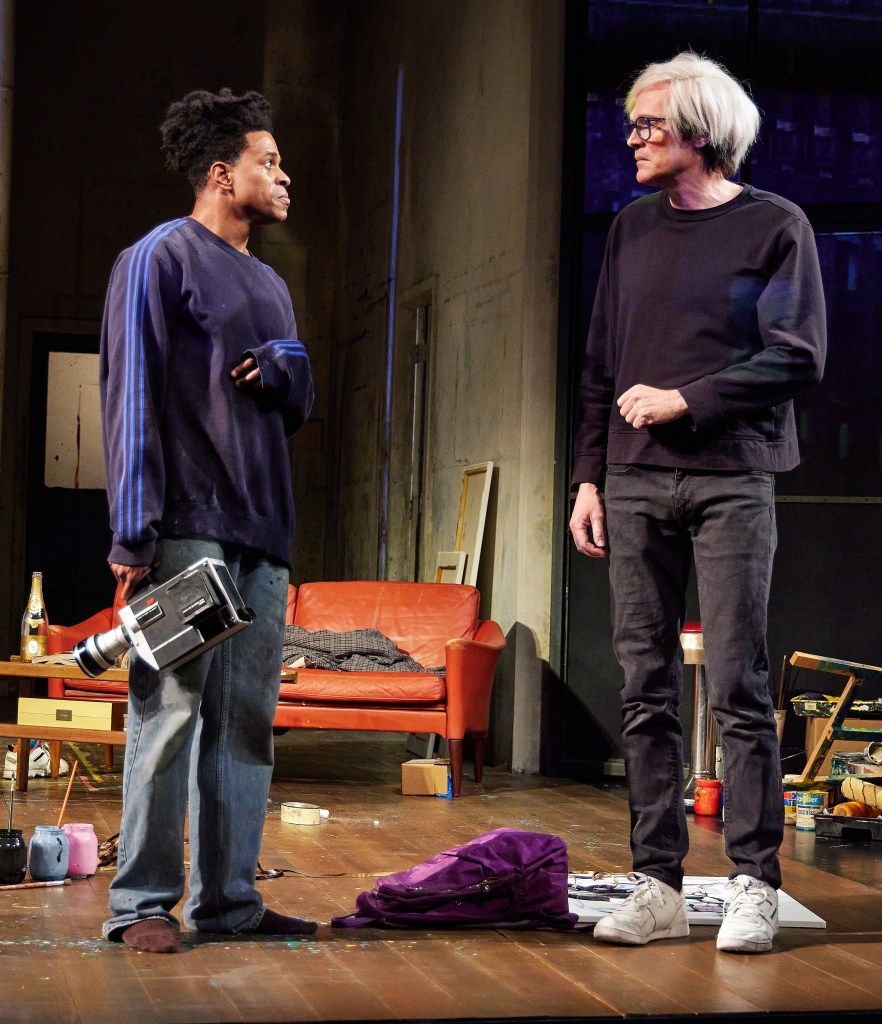
As the final sardonic irony at the play’s conclusion, while Bettany’s Warhol and Pope’s Jean-Michel paint into immortality, we hear the voice of an auctioneer, representative of the art world now on steroids, directional from what it was like when they were alive in the 1980s. Their work together is valued in the multi-millions, the irrevocable exploitation of both.
Kudos to Ben Stanton’s lighting design, Emma Laxton’s sound design, Duncan McLean’s projection design and Ayanna Witter-Johnson’s original music. For tickets and times go to their website https://www.manhattantheatreclub.com/shows/2022-23-season/the-collaboration/

