Blog Archives
Jon Bernthal, Ebon Moss-Bachrach in ‘Dog Day Afternoon’ Humorous, Riveting
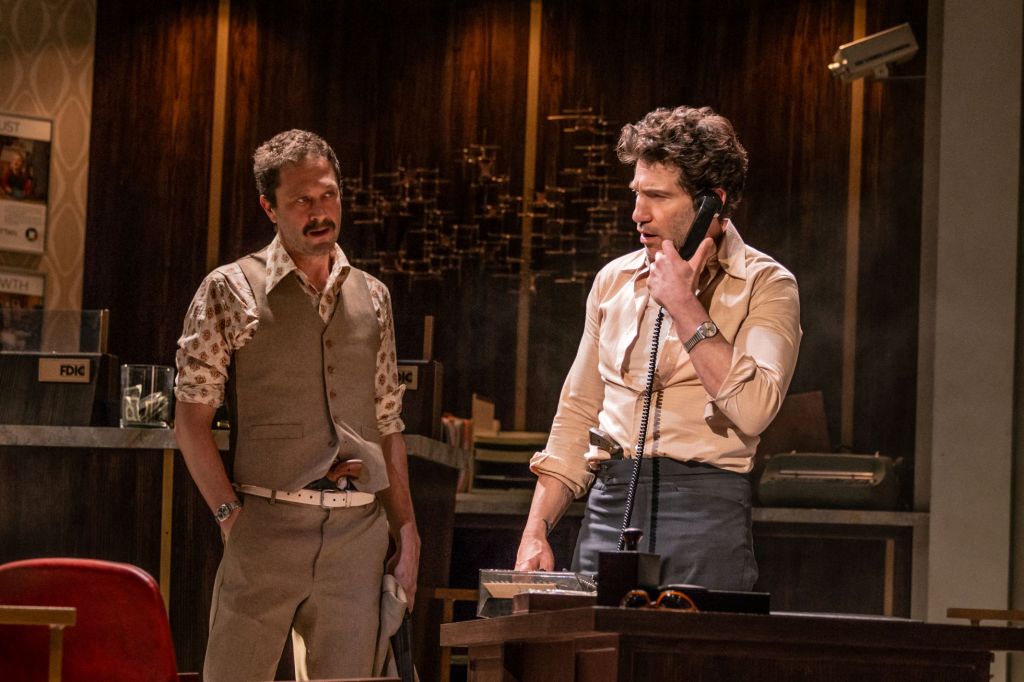
Murphy’s Law (what can go wrong, will go wrong) upends the plan of 3 bank robbers reduced by one who is high on drugs, forgets a shot gun and leaves in a panic literally sh&tting his pants, while apologizing for being unable to do any of what Sonny (Jon Bernthal) asked him. Also, he didn’t bring the getaway car, but took the subway instead. If this isn’t the makings of a gonzo, botched, bank heist, it just may be the makings of a riotous play. However, don’t compare it to the film it is based on.
Sonny can’t believe that the evacuating Ray Ray (Christopher Sears) dumped their well-made plans into the toilet. Indeed, what other situations will be turned over in the Broadway premiere of Dog Day Afternoon at the August Wilson Theater running through July 12, 2026? Directed by Rupert Goold (Ink), Stephen Adly Guirgis (Pulitzer-prize winning Between Riverside and Crazy) wrote the script. He based it on the article “The Boys in The Bank” written by P.F. Kluge and Thomas Moore, published by Life Magazine, and the titular Warner Bros. film directed by the impeccable Sidney Lumet. The production softens the film’s tension and danger and adds humor that provokes raucous laughter.
I’ve resisted the temptation to compare the urgency and depth of the iconic 1975 film with this production that leans heavily on irony and humor to convey a wild situation in a 1972 New York City, itself under siege. More enlightened critics have drawn contrasts and found the play seriously wanting. Judging from the audience’s response the night I saw the production, Adly Guirgis and Goold succeeded in creating a vehicle for friends Bernthal and Moss-Bachrach (TV series The Bear) who elucidate Sonny and Sal with their exceptional talents. They emphasize the “haywire” in a bank heist inspired by real events.
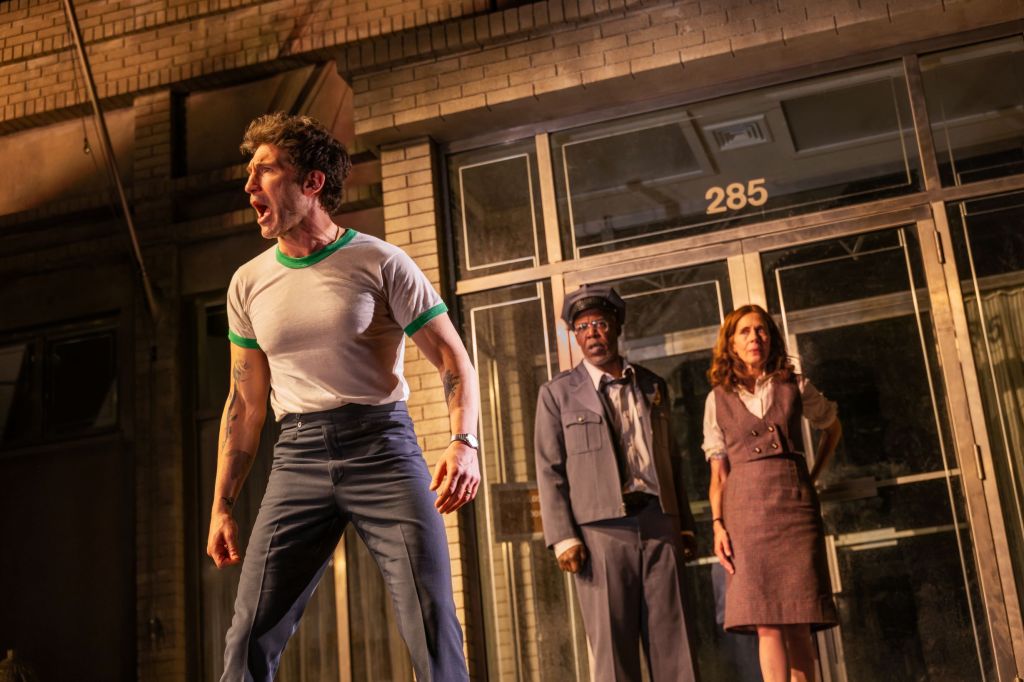
Gould and Adly Guirgis have kept the setting of Brooklyn, 1972 with a few updates in ideas and language (oligarchs substituted for the rich). However, the tone of the play is vastly different from the film which critiqued the social issues looming throughout the decade and became a landmark for cultural reform by creating sympathy for its LGBTQ characters. In this production Sonny’s wife is played convincingly with humor and pathos by Eseban Andres Cruz to reveal Sonny’s explosive relationship and foreshadow the inevitable conclusion.
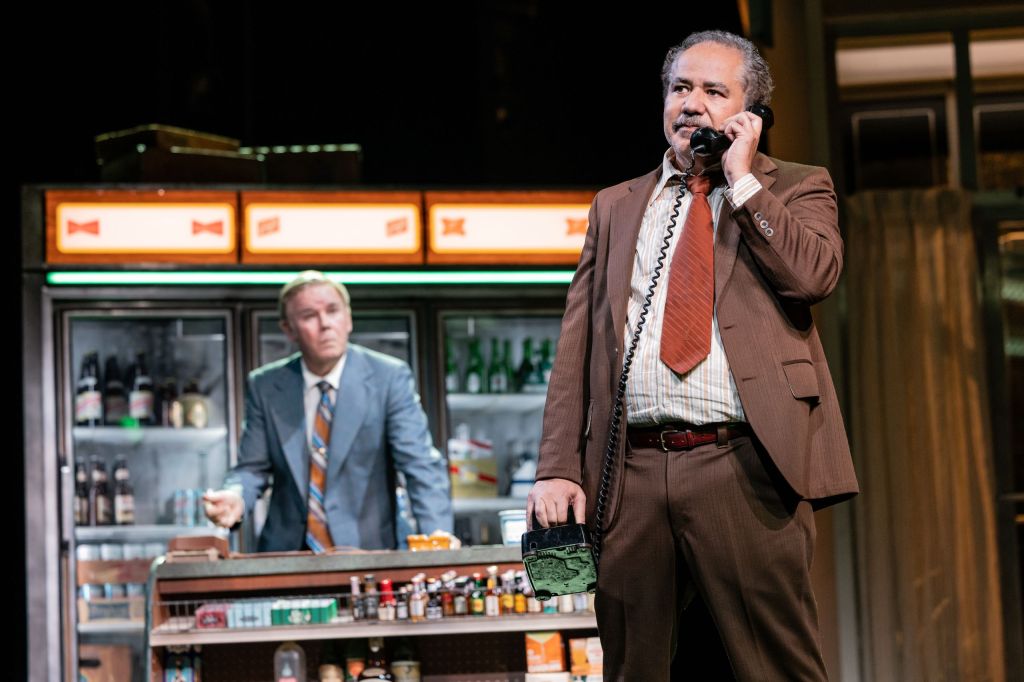
In light of the state of the world’s particular horrors, the play’s memorializtion of that time in a deteriorating New York City becomes eerily soothing. The tone that borders on farce feels safe. We can look at a less problematic time where decency abides. It’s in the character of Detective Fucco (John Ortiz), and Colleen (Jessica Hecht) and security guard Mr. Eddy. And it’s reflected in Sonny. Ironically, the sinister, cynical, cold cruelty of the FBI’s Sheldon (Spencer Garr), reflects today’s cynical law enforcement. Overall, the production succeeds with its sometimes riotous approach, sterling performances by Bernthal, Ebon Moss-Bachrach, Hecht, Ortiz, fine ensemble work, and period set, lighting, great music selections and sound design (David Korins, Isabella Byrd, Cody Spencer).
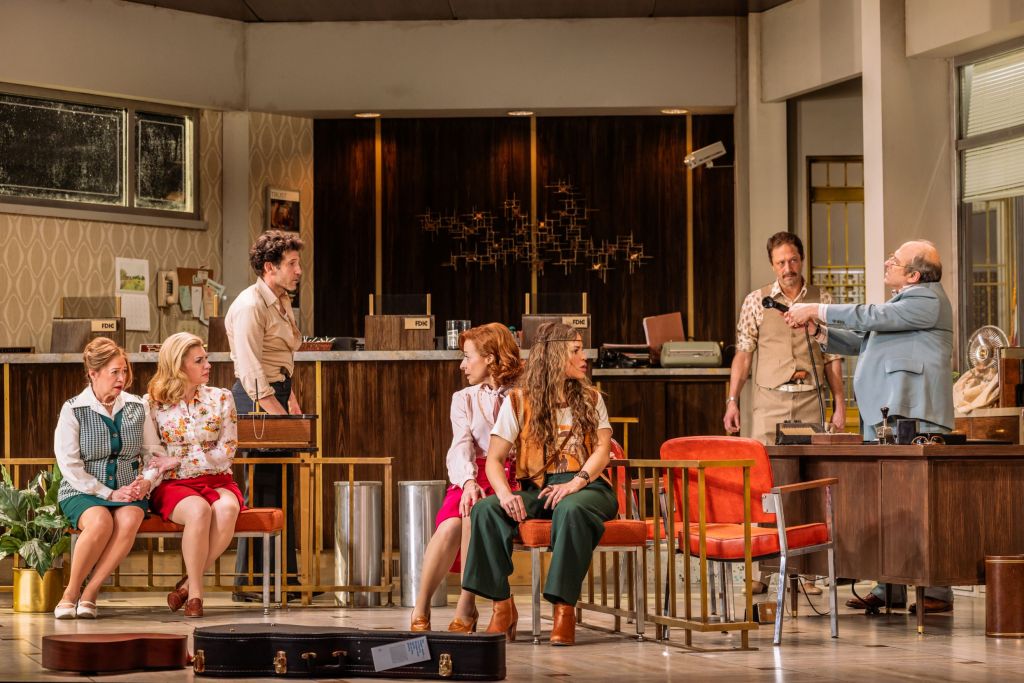
The set design features a revolving stage which effects the exterior 1972 bank facade on the streets of Gravesend, Booklyn. The stage swivels to the bank’s interior of teller’s stations, seating area adjacent to the office manager’s desk and a view into the vault upstage.This set design effectively engages the audience when Sonny steps outside to address the crowd in the play’s most theatrically satisfying moment. Outside the bank Bernthal’s Sonny dynamically, humorously chides the cops. He invites the crowd (audience members) to participate, rousing their enthusiasm. Various passages of Adly Gurirgis’ seminal writing resonate for us today as Sonny’s works the crowd who identify with his truth.
Cops in the audience aisles point their guns at Sonny while he says, “All this show of force — all this shit — it ain’t for me! They don’t need a whole army of blue bozos to put two in the back of my head — bag me, tag me — this is for you people! Make no mistake. They wanna scare you!” As we cheer him on, Hecht’s Colleen encourages him with the word “Attica!” which he shouts arms raised in remembrance of the prisoners and hostages who unjustly were shot by law enforcement in the 1971 riots.
The one-off jokes arise from the situations that Gould pulls off with fine pacing. Bernathal explores Sonny’s vitality, electric energy and sociability as the mastermind manipulator who thinks on his feet, corrects what goes wrong as it happens, all the while capitalizing on helpers like flirtatious older Colleen who becomes a friend. She is LOL when she decides it’s more fun to stay behind, though Sonny offers her the chance of being the first released hostage. Ironically, the other tellers joke amongst themselves that the one least liked should go first. This is the most adventure they’ve had in their lives. Clearly, they believe Sonny when he repeatedly assures them no one will die, a statement that runs counter to what Sal and Sonny privately agreed to.
Because of the light-handed approach, there is a reduction of the overall tension and danger which essentially has been left to the character of Sal (Ebon Moss Bachrach) to convey. Additionally, Sonny and Sal are pitted against the dark, insulting Sheldon and Feds as the enemy, a current theme today. Moss Bachrach thoughtfully portrays emotionally broken Sal as the former convict with PTSD from his prison experiences. His attendant nihilism has left him with two bad choices: worse crimes (Sonny’s hair-brained robbery) or suicide vengeance, taking others with him. Even though Mr. Eddy was accidentally shot when Ray Ray dropped the gun, having guns in an armed bank robbery in which a security guard was shot, means more prison time that Sal tells Sonny he won’t do.
As circumstances progress, the more the charismatic Sonny shines socially even creating a weird Stockholm Syndrome effect with Colleen (Jessica Hecht), the more Sal loses the bond he thought he formed with Sonny. Abruptly, Sal ends Sonny’s love fest. With an edgy brutality he stomps out the congenial atmosphere and stomps on the donuts that John Ortiz’s Detective Fucco gets them. It’s an important moment when the fun stops and the audience are reminded of what he is capable, though Sonny might not be as desperate.
When Lorna (Wilemina Olivia-Garcia) tries to calm him with a Boston creme doughnut, we are frightened when he says, “I’m not your friend. He’s not your friend. And this — this ain’t no fuckin’ picnic, got it?” We realize Sal has chosen and will probably stir that choice unless the congenial Sonny with his positivity and charisma convinces him to calm down. Sal’s speech to Sony about his speaking “words” in a manipulation resonates with power. He’d like to believe Sonny about a helicopter escape, but he can’t because he knows all too well Sonny is a con artist and his words don’t ring true.
Dog Day Afternoon runs 2 hours 15 minutes through July 12 at the August Wilson Theater, Manhattan; dogdayafternoon.com.
‘Between Riverside and Crazy,’ in its Stunning Broadway Premiere
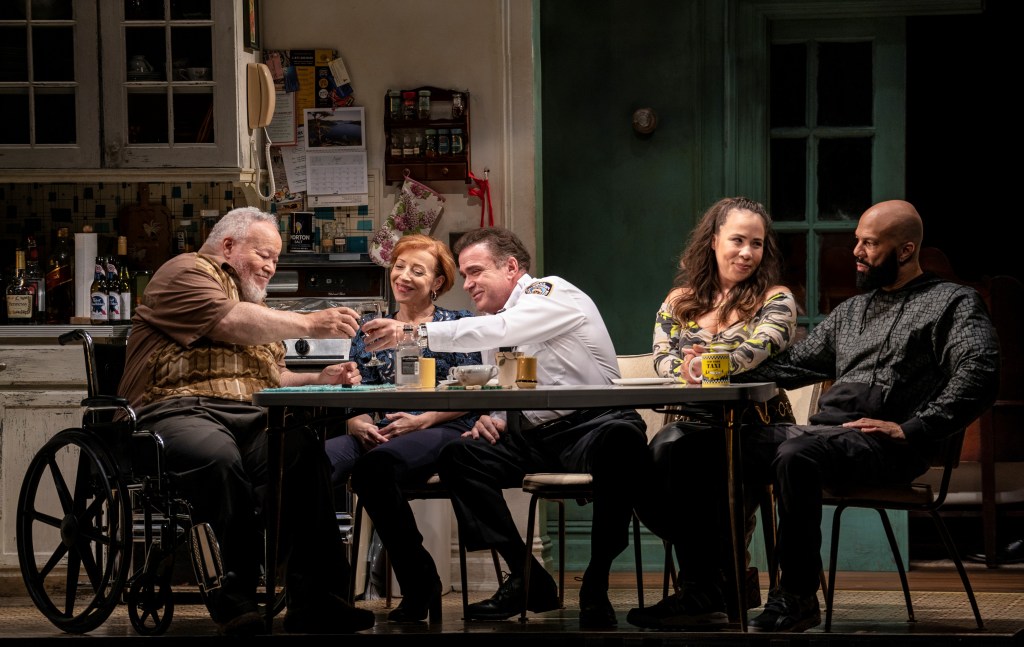
When it premiered Off Broadway at the Atlantic and then moved to 2nd Stage in 2014, Stephen Adly Guirgis’ Between Riverside and Crazy, directed by Austin Pendleton, won a passel of New York City Theater awards in 2015 (New York Drama Critics Circle Award for Best Play, Lucille Lortel Award for Outstanding Play, Outer Critics Circle Award for Outstanding New Off Broadway Play). Also, it won the 2015 Pulitzer Prize for Drama.
Starring mostly the same cast as in its 2014 outing, the 2022-2023 production appears to be topping itself with solid, incisive direction by Pendleton and sharp ensemble performances led by the mind blowing Stephen McKinley Henderson, who inhabits Pops as sure as he lives and breathes the character’s feisty attitude, edgy humor and earthy sangfroid. Henderson’s performance is a tour de force, a character portrayal of a manipulator able to dodge and parry with the “best” of them to outsmart all comers and “get over” even when he has lost the war and is trying to win his last battle, though the likelihood isn’t in his favor.

Guirgis plies old ground in Between Riverside and Crazy. He examines Black lives that are moving on in the struggle to rise up in New York City, as they attempt to negotiate middle class economics, while the discriminatory city institutions fight them at every turn. In this environment every day is a hustle and the institutions who have hustled Blacks for generations are obvious. However, how does one fight City Hall and still remain in tact? Pops is an old salt and has managed to learn the ropes as a NYC cop. The problem is he lost his wife, his son has just been released from jail and he likes to have a drink or two or three. Can he suppress his wayward impulses, sustain himself and support his son getting back on his feet to prevent Junior’s recidivism?
The play opens with Pops having his breakfast (pie and whiskey-spiked coffee) with Oswaldo (Victor Almanzar in a riveting performance). Oswaldo is a friend of his son Junior’s who clearly is needy and has psychological issues which Guirgis reveals later in the play. Pops’ banter with Oswaldo indicates the situation and relationship between the men. Oswaldo positions Pops as his “Dad,” because he allows him to stay and help him get on his feet without paying rent, though Oswaldo affirms that he wants to and will when he is more flush in his finances. Who Oswaldo is and how he became friends with Junior clarifies as the play progresses. Indeed, they most probably share more than a few crimes.
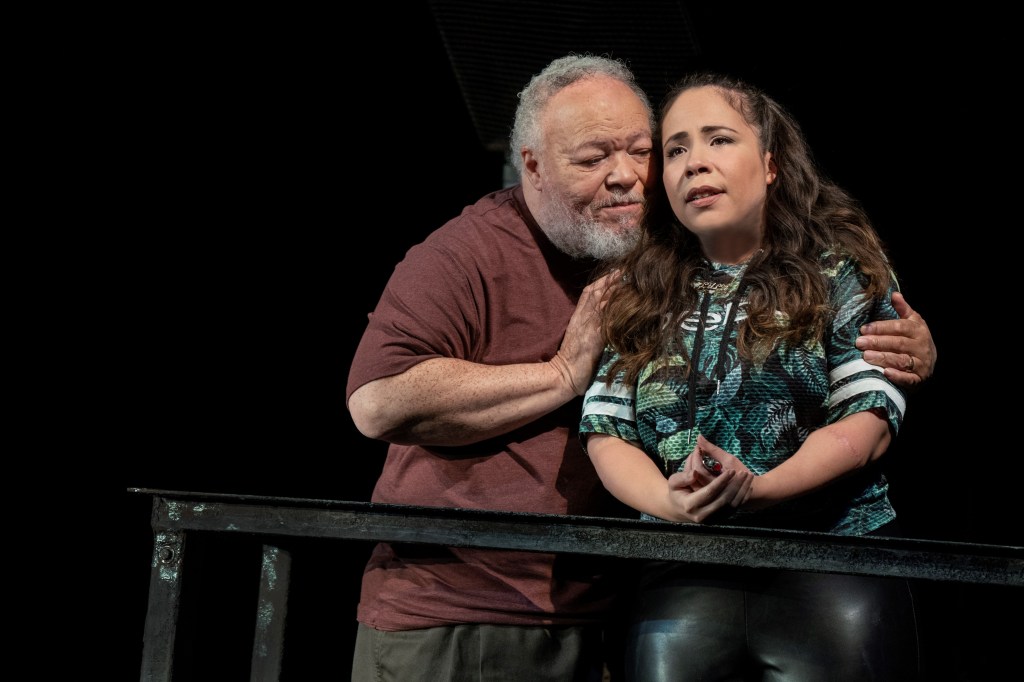
As a former New York City cop who has been retired after being shot by another cop in a questionable racial incident that Pops has been litigating against the NYPD for eight years, Pops is aware of who Oswaldo is. Interestingly, ironically, he is helping out his son’s friend as a fatherly figure. Of course that isn’t as easy as it appears at the top of the play.
Pops lives in a spacious, valuable, rent-controlled apartment on Riverside Drive in a gentrified area. The apartment whose former structural beauty and interior cared for by Pops’ deceased wife is apparent and fading (scenic design by Walt Spangler). Pops is in your face with Junior’s friends and girlfriend Lulu (the fine Rosa Colon) who he chides for exposing her ample buttocks and breasts and comments about her lack of intelligence to Oswaldo, behind her back as an afterthought. Guirgis has given Pops the bulk of the humorous dialogue and makes sure the other characters that circle him are beholden to him, and give him the proper obeisance, so he might gently insult and dominate them.

Clearly, Pops is witty with tons of street smarts, and we are drawn in by his outgoing nature and backhanded charm. However, Guirgis leaves numerous clues that Pops is into a power dynamic and must have the last word and must have the upper hand in the relationships he has with others. As we watch him “front” and “get over,” we ask to what extent this is part of his hustle and interior nature that he developed as a way to survive? To his credit Guirgis leaves enough ambiguity in his characterizations to suggest the deeper psychology along with the cultural aspects of discrimination without belaboring the themes. We are invited to watch these characters unfold with glimpses into their lives in a light-handed approach that is heavy with meaning, if one wishes to acknowledge it.
Thus, on the one hand Pops’ demeanor is entertaining and hysterical. On the other hand, it is so because Pops is driven to keep others “at bay” and “in their place.” This is the situation that abides until the conclusion, though Guirgis throws twists and divergences in the plot, redirects our attention and makes Pops appear to be the weak one who can’t get out from under his own foibles and issues. Guirgis constructs episodic humorous moments that are surprising and lead to an equally surprising resolution which is totally in character with Pops, whose every nuance, gesture and line delivery are mined brilliantly by Henderson, guided by Pendleton’s deft direction.

Thus, it would appear that Pops has created an environment where secrets are kept and Lulu, Junior and Oswaldo are allowed to take advantage of Pops’ largesse. This is especially true of Junior, who possibly is using his Dad’s apartment to store items that fell off a truck, something Pops turns a blind eye to. As Junior, Common is making his stage debut and he manages to negotiate the complex character’s love/hate relationship with Pops as they spar and “get along” as best they are able because both are dangerously similar in pride, ego and charm. This is so even though they are on the opposite sides of the law and Junior has recently been released from prison.
The principal conflict in Guirgis’ character study occurs after the playwright spins out the expositional dynamics. Pops’ former partner Detective O’Connor (Elizabeth Canavan) and her fiance Lieutenant Caro (J. Anthony Crane in the Tuesday night performance I saw) have a scrumptious dinner that Pops cooks for them. After a lovely repast, Caro delivers a proposition to Pops. Only then do we understand the precarious situation Pops has put himself in. The dire circumstances have been encouraged by Pops’ own negligence and lack of due diligence. He has not kept up with his rent. He has not taken the offer the NYPD has put forth to pay for his pain and suffering (his sexual function has been debilitated) in the litigation. Additionally, Pops faces an eviction spurred on by the building’s tenant complaints, some of which seem sound, but also reveal discrimination.

How has Pops managed to back himself into this corner, though he doesn’t appear to belong in his wife’s wheelchair which he enjoys sitting in and can just as easily get out of? Importantly, Gurgis suggests sub rosa explanations for Pops deteriorated emotional state and his reliance on drinking. Nothing is clear at the outset, but after the visit by O’Connor and Caro, the extent to which Pops has allowed his potential enemies to leverage his present circumstances against him emerges. Will Pops be able to finesse the situation? By the end of Act One when Pops is injured and burglarized, we are convinced that Pops’ weaknesses have overcome him and he is doomed to go the way of his wife.
Guirgis’ Act II heads off in a zany direction which further validates the playwrights’ admiration for the prodigious character he has created in Pops, foibles and all. There is no spoiler alert, here. You’ll just have to see this superb production. A good part of the enjoyment of this premiere is watching Henderson hit every note of Pops’ subtle genius in redirecting those around him to eventually achieve what he wishes. He even bests Church Lady (the funny Maria-Christina Oliveras). Her machinations to “get over” on him which results in a reversal of fortune that is redemptive for both Pops and her are LOL smashing.

The ensemble is top notch and Pendleton’s direction leaves little on the table and is equally stunning. Kudos to the creative team with Alexis Forte’s costume design, Keith Parham’s lighting design, Ryan Rumery’s original music & sound design which are excellent. Gigi Buffington as vocal coach does a great job in assisting the actors in the parlance of the culture of Pops and his satellites so that they are seamlessly authentic and spot-on in their portrayals.
I did have a minor issue with Walt Spangler’s beautiful scenic design. Pops’ apartment revolves on a turntable which limits staging options. Granted that Pops is central to every scene. However, at times the actors’ conversations are directed toward Pops with their backs to the audience. These requires they project or “cheat” in their stance to be seen which at times they did not. This is an instance when the scenic design as lovely as it is didn’t enhance the overall production, but hampered it, a minor point.
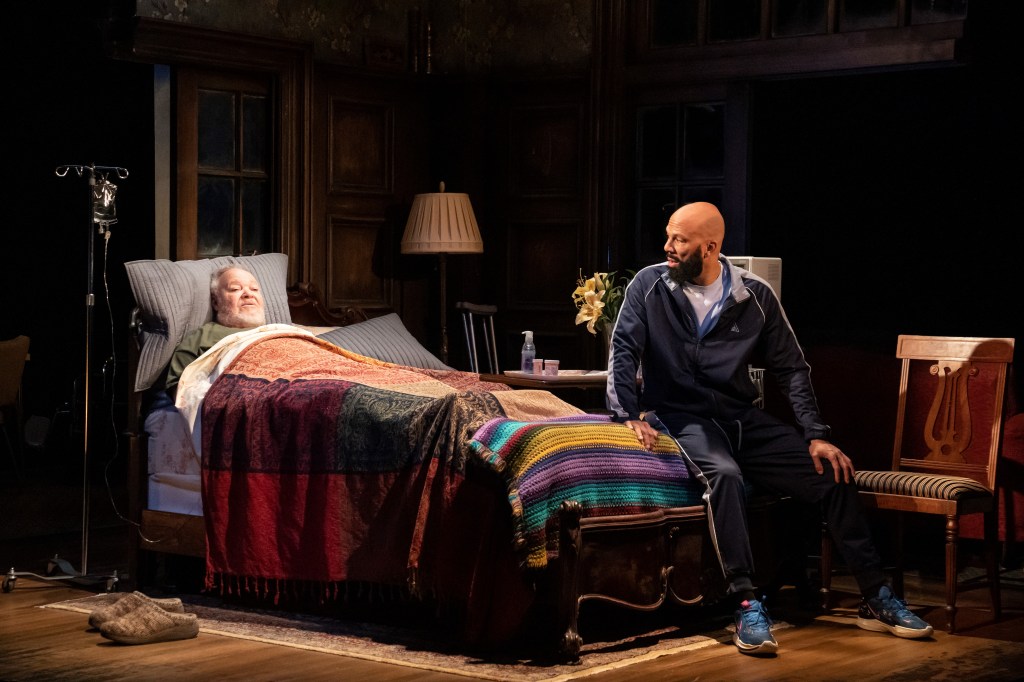
Between Riverside and Crazy is a must-see for its performances, ensemble work and fine shepherding by Austin Pendleton. It is in a limited engagement until February 12th unless it is extended. For tickets and times go to their website: https://2st.com/shows/between-riverside-and-crazy#calendar

