Category Archives: Broadway
‘The Minutes,’ Too Close For Comfort, a WOW!

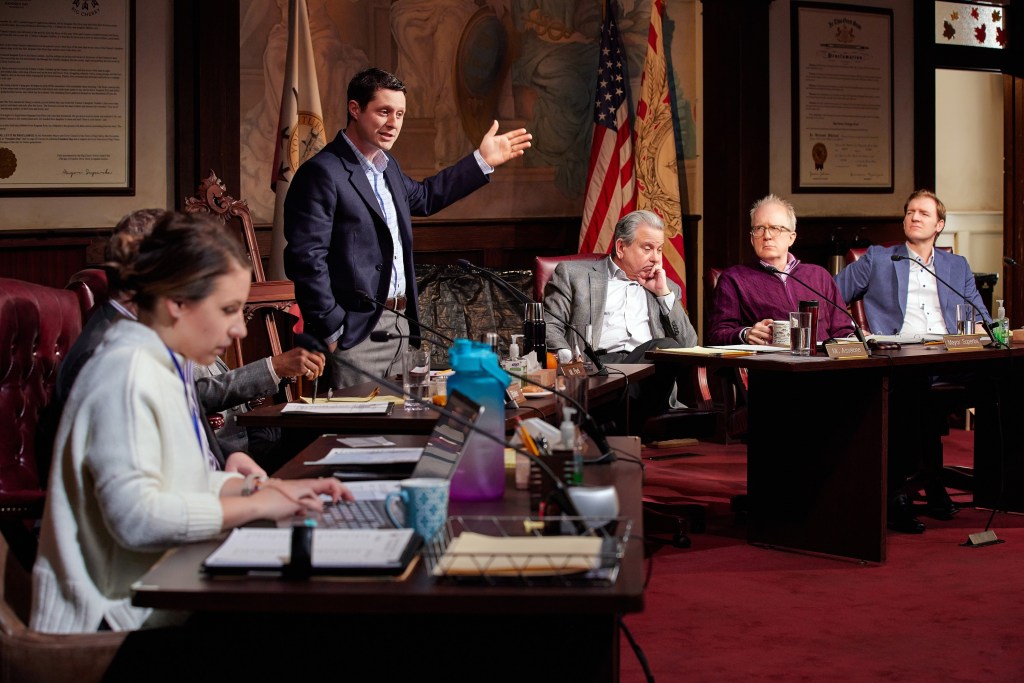
The beauty of Tracy Letts’ The Minutes, directed by Anna D. Shapiro is that there is no hearty mention of political parties in Steppenwolf’s “very American” production whose patriotic music blares as the audience takes their seats at Studio 54. The music (Andre Pluess), and the City Council’s meeting room set design (David Zinn), remind us that it is in the small towns and cities of our democratic government that the American Dream comes to fruition, as it moves toward the hope that in our country, all men and women are created equal and are guaranteed their inalienable rights stated in the Declaration of Independence as under-girded by the constitution.
During The Minutes, the veil is lifted so we may watch democracy in action, vaguely referenced by Big Cherry’s Mayor Superba (Tracey Letts). What occurs on this momentous rainy night, when the city council gathers in a quorum to conduct its business, is a bludgeoning reminder of our blind hypocrisy regarding our pretensions to democratic self- government. When uncontrollable atavistic compulsions in our natures arise and dominate the best of us, is it even possible to govern with equanimity, Lett’s and the creative team ask?
This question appears to be at the heart of Letts’ rich and profound exploration of an Everyman/Everywoman city council, one of whose members we discover toward the last twenty minutes of the play is a whistleblower. What happens to him reveals the power of what America can and should mean vs. what America is revealed to be, in its local governments which often usurp our nation’s lofty principles and subvert them into governance by raw, destructive emotions born out of traditions of fear and hatred.
The point is made that the elected officials that govern Big Cherry, the central focus of this fascinating production, are neither Republican or Democratic. Nor at first do we anticipate that this council is anything but a representative democratic institution that functions as a proper governmental council should, with an emphasis on doing what is “the best” for the constituents who elected these men and women. In addition to Mayor Superba the board members include a bi-racial, gender appropriate, non-ageist group who look to be inclusive and bring inclusive issues to the fore as presented during the meeting.
The officials include Ms. Innes (Blair Brown), Mr. Breeding (Cliff Chamberlain), Mr. Blake (K. Todd Freeman), Mr. Hanratty (Danny McCarthy), Ms. Johnson (Jessie Mueller), Ms. Matz (Sally Murphy), Mr. (Austin Pendleton), Mr. Peel (Noah Reid) and Mr. Assalone (Jeff Still). Note Letts’ clues of character with the particular, irony weighted selection of names. The names push the envelope of belief to convey the play’s sardonic tone at the beginning.
Vitally, the tone and humor increasingly morph toward revelation of the mystery of the previous week’s minutes that end in the shocking banality of evil at the play’s conclusion. As the production devolves into atavistic horror, we understand the city council’s cultural appropriation of the Sioux’s tribal dance. Incredibly open to interpretation, it symbolizes how they approach their concept of city council government. They attempt to empower themselves as warriors of their mission which they take to a radical extreme, defying the national, constitutional mandate while wickedly, hypocritically posing to uplift it.
The play drives to the heart of the dangerous atavism in this nation on both political divides without stating “Democrats” or “Republicans;” the party is not the point. Human nature is the point. Whether its book bannings, “don’t say gay,” Southern botch job of COVID as politicians and QAnon representatives scream “my body my choice,” then turn around and reverse “my body my choice” women’s rights with abortion bans, or the smear job screamed out by rabid #metoo pretense, pushing the ouster of former Governor Cuomo, equanimity and rationalism aren’t to be found.
Letts’ drives this home…revealing how the mundane often cloaks the dark, emotional abyss underneath. If only Satan sported horns, chains of diabolism and wore a name tag hailing his identity. Too often the sweetest people are the most malevolent, especially if they are working for your best interests in government. Ah, “something wicked this way comes and it’s the human heart.” BEWARE!
Without going into the specific plot points because there is no spoiler alert, at the top of the play, Letts introduces us to the EVERYMEN AND EVERYWOMEN city council members who are “average” individuals of a cross range of the “middle class.” At the outset, as they arrive, they move into their friendship groups, to elicit support from each other for their proposals that they intend to present at this evening’s meeting.
Throughout the play Mr. Peel questions what happened at the previous week’s meeting which he missed because his mother passed away. Mayor Superba and Mr. Hanratty casually dismiss Mr. Peel’s questions at the outset. However, Mr. Blake suggests that he will be rebuffed roundly and warns him that Mr. Assalone will lead the others against him so he won’t get anywhere with finding out what occurred.
Lett’s cleverly sets up the conflict focusing on what happened, why no one wants to discuss the previous meeting and what happened to Mr. Carp (Ian Barford in a profound dramatic performance) who is absent and apparently is no longer on the council. With a weird dismissal of Mr. Peel’s questions which under the law must be answered, we and Mr. Peel are set to wondering whether this is a cover-up and who and why the previous meeting cannot be easily discussed. We also wonder, along with Mr. Peel, what happened to Mr. Carp and why the duly elected official is no longer on the council. Was it Mr. Carp’s choice, Mayor Superba’s choice or the council’s choice that he left?

This relatively new council member Mr. Peel, who we discover a bit later had become friendly with Mr. Carp and supported his cause is no wiser about the circumstances as the meeting comes to order with the typical prayer and pledge of allegiance as all governmental meetings follow with sleepy, traditional protocol. Thus, we forget Mr. Peel’s questions and concern and with the demonstrated banality of what we’re familiar with, settle into regularity until Mr. Oldfield presents his case for an important consideration, an empty parking space.
Oldfield portrayed by the esteemed and wonderfully LOL, on-point Austin Pendleton conveys much of the humor in Lett’s The Minutes. In whatever he does Pendleton is a standout of authenticity and moment. Once Mr. Oldfield and his subtle request about the parking space is dismissed, the business at hand is presented.
Mr. Hanratty and Mr. Blake have their pet projects which eventually are objected to and voted down. Interestingly, the figure on the fountain that Hanratty wants to renovate gives rise to how the figure represents the foundation of the city. The members who are in the know provide the dramatic re-enactment of the mythic Battle of Mackie Creek that the figure’s heroism is dedicated to in the fountain. Only Mr. Peel is not familiar with the history of Big Cherry because it is his wife’s birthplace, not his. Thus, he does not take part and watches as Big Cherry’s history rises up from its past in a re-enactment.
All take part, even Mr. Oldfield, who provides the horse hoofs’ sounds. Their “theatrics” are humorous and the actors, as their council counterparts really ham it up appropriately to audience applause. Thus, we are reminded of such mythic re-enactments that traditionally dot the nation as harmless fun. However, the Civil War re-enactments are perhaps more than that for those who take part yearly (before COVID). Letts and the creative team call into question their significance and symbolism. To what end do those go to the trouble to show up and fight with accurate replicas of guns, cannons, outfits, and some even living on the fields for a week or more to “remember.” Curious.

Letts opens one’s eyes to conceptual meaning made physical. With regard to the Civil War, the devastation and destruction…one questions why re-enact it yearly? How can bloodshed (the greatest number of casualties in a war before COVID) and violence be fun? (Interestingly, COVID will have killed twice as many in the same time period. Thus far, there are a recorded number of US deaths at over one million twenty thousand on Worldometer in a two-year period.) However, the re-enactment is relished by the council members because it manifests glory in their history. It binds them in community and makes their lives as council members meaningful. Of course, the further symbolism and importance of this act blossoms by the conclusion.
Mr. Peel, with knowledge of what the previous meeting was about but with an inability to attend it and give support to Mr. Carp who was making a presentation, wants to discover the resolution of Mr. Carp’s petition. It is revealed in the minutes of the meeting which Mayor Superba has refused to release. However, a way is made. Eventually, in a flashback, we get to see why Mr. Peel wants to know what happened. And we also discover why Mr. Carp is no longer on the city council. The question remains with this revelation and the solving of the mystery of the minutes Mr. Peel has sought, will he stay on the council which his deceased mother never wanted him to be on in the first place?
Criticism has been made of Letts’ leaps in plot, sometimes illogical notions, etc. I would put it to those critics. This is not a play about linear logic, refined judgments and profound political moment. It is about us. and what we have to fear in ourselves. In that the play should make you weep. It won’t. It is not only about this nation, it is about human nature. In that it is timeless. Like most theater that attempts to get some of who we are down, it is irreparably flawed. Thus, it should be left as is.
Kudos to all the actors for their strong performances in this ensemble piece as well as the director who aptly shepherded them so you could hear a pin drop from the audience the last “minutes” of the play. Kudos to Ana Kuzmanic (costume design) Brian MacDevitt (lighting design), Ty Defoe (choreographer), Tom Watson (hair & wig design) and see above for the other designers mentioned.
You need to see this a couple of times to let it sift your soul, or not if you hate that kind of thing. For tickets and times go to their website: https://www.studio54theatre.com/events/the-minutes-25/#.YnLPLNPMJPY
‘The Skin of Our Teeth,’ a Zany Exploration of the Fate of Humanity at Lincoln Center

Thorton Wilder’s Pulitizer Prize winning The Skin of Our Teeth currently in revival at Lincoln Center’s Viviane Beaumont, presents the fate of the human race in three segments when the human family represented by the Antrobuses (Greek for man or human), faces extinction. The first debacle is the ice age; the second is the great deluge; the third is a seven years war. The play leaves off in uncertainty for surely humanity will continue to face threats of extermination and will continue to shake these off, repair itself and scientifically progress to greater heights and lower depths in its struggle to survive as a species. Though Wilder leaves this conclusion uncertain through the character of Sabina (the vibrant and versatile Gabby Beans), the very fact that the characters make it as far as they do is a witness to human resilience and tenacity.
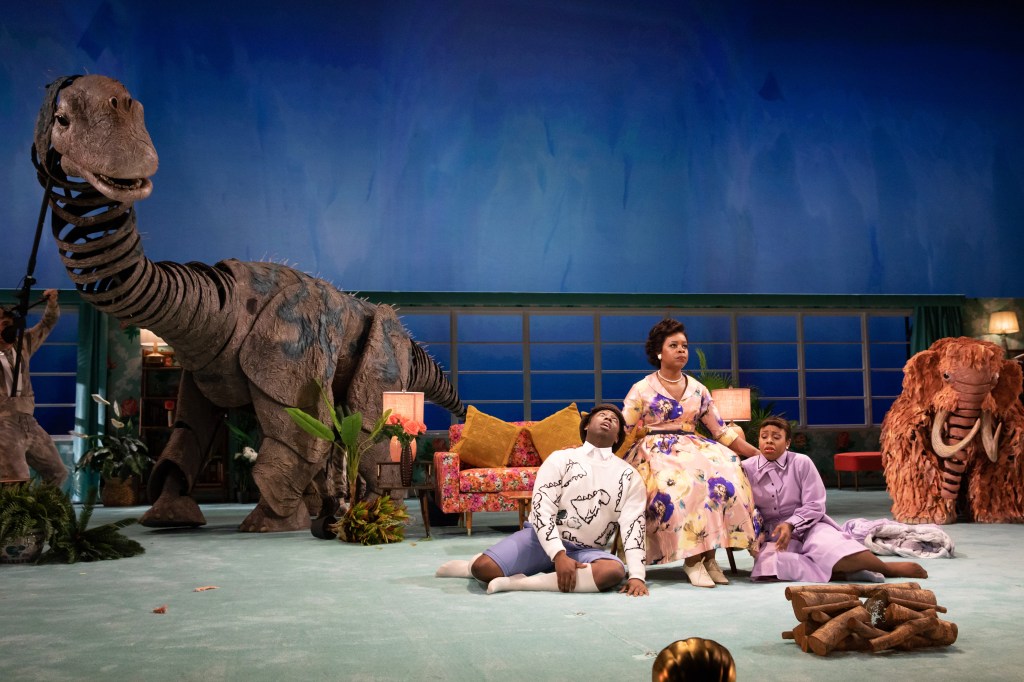
The production, one of spectacle and moment, whimsy and humor is acutely directed by Lileana Blain-Cruz for maximum effect. It succeeds in various instances, to be poignant and profound as the Antrobus family (James Vincent Meredith-Dad, Roslyn Ruff-Mom, Julian Robertson-Henry, Paige Gilbert-Gladys) and their maid Sabina (Gabby Beans), the narrator who breaks the fourth wall to address the audience, claw their way through history to survive. These “every men” and “every women” archetypes experience representative cataclysms, all the while confronting the questions about the human race and their place in history until the end of time.
Though Wilder references Bible figures like Cain, suggests Adam, Eve and Lilith (Lily Sabina), and the disasters that have foundations in tribal religious mythology (the great flood myth is recorded in most indigenous cultures), other cataclysms are scientifically and historically referenced (the ice age, dinosaur extinction, seven year’s war between England and France). Wilder is intentionally out of chronological order, suggestive, melding various historical/cultural documents of literature and religion with scientific discovery. Throughout, the vital thread is humanity’s survival.
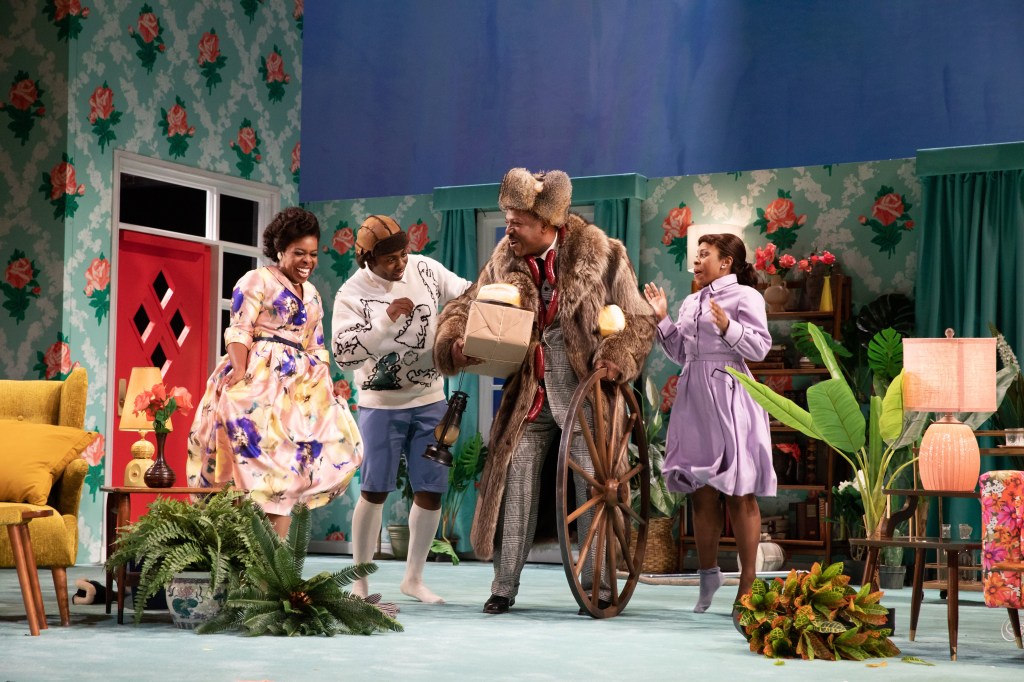
The questions the characters raise which float throughout each act are philosophical and moral. For example is the human race worth saving from the struggles, trials and horrors which will continue to threaten both people and their environment? Should humanity just throw in the towel, lay down and refuse to repair itself or evolve technologically, artistically, scientifically? Given the rapacity and murderous ruthlessness of son Henry (aka the Biblical Cain, the spirit of murder in humanity), will the human race just exterminate itself with weapons of its own making? Or as humanity’s mother, Ruff’s Mrs. Antrobus suggests, will the family unit sustain the human species, enabling it to succeed in each progressive and evolving era?
Given the latest foray into extinction by Vladimir Putin as he attempts to obliterate Ukraine into the dust bin of history, bully democratic countries to heel to his genocide, and bribe apologist lackeys in the extreme global radical right, including the QAnon members of the Republican Party, Wilder’s overriding questions are current. This is especially so in the last segment when Ruff’s Mrs. Antrobus and daughter Paige Gilbert’s Gladys emerge from the basement where they’ve been sheltering for a seven years war to reunite with Sabina (Gabby Beans). All welcome the new peace. However, they consider how they will rebuild as they view the burned wreckage of their bombed out home.
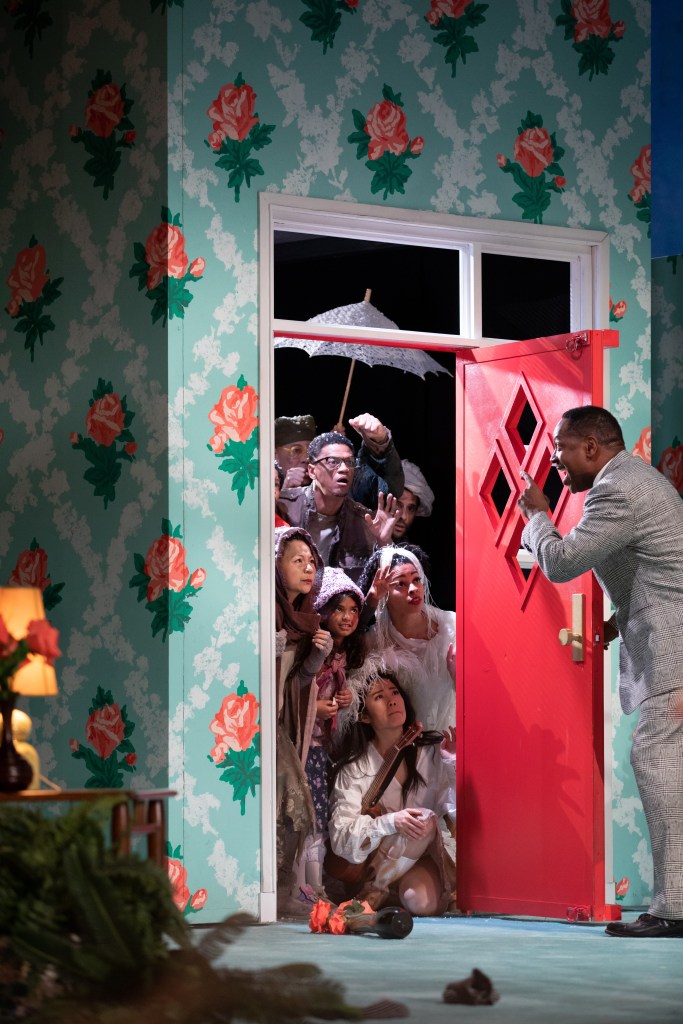
As the curtain of the last act rises on the devastation, one can’t help think of Ukrainian towns (the Russian soldiers have since left), and Mariupol, where Ukrainian families and soldiers shelter in basements and in a steel factory, as they suffer Putin’s inhumane starvation, while bombs blast above, uselessly pulverizing dust. The irony is so beyond the pale; Putin bombs dust in helpless fury while every minute the heroism, bravery and resilience of Ukraine’s “Antrobus” spirit thrusts into the heavens, memorializing that Ukraine will never capitulate to the likes of Putin. It is a humiliation for Russia. They for allowed such a serial killer to usurp power, genocide women and children and bomb dust because the Ukrainians embody the slogan, “live free or die,”refusing to bow to one man rule and an abdication of their human rights.
Electing to die honorable Roman deaths, rather than submit to Putin’s vengeful, psychotic temper tantrums, they shame those officials who pretend to uphold democracy but, like Putin, vitiate human rights with lies. Uncannily, what’s happening in Mariupol dovetails with Wilder’s prescient theme, that the human race will never capitulate to fires, floods, and its own murderous instincts.
Though Sabina grouses that she’s sick and tired of being sick and tired as she begins the first lines at the top of the play again, the wheel of irrevocable change and life goes around once more with new things for humanity to learn in a new way that is never a repetition of the past. However, Sabina doesn’t see that human history is a spiral and not a circle. She is blind to the human experiment, which Wilder suggests we must understand beyond her limited vision.

Indeed, no human being desires going into survival mode. But cataclysm squeezes out benefit from humanity’s collective soul during great trials. Wilder suggests it is worth the price. Through these actors’ sterling portrayals, we understand that human tenacity and hope propel the human race to make it to the next day. And as the species collectively moves through the days, weeks and years, it evolves a finer wisdom, strength and efficacy. Wilder suggests, this is confirmed again and again and again with each debacle, each disaster, each cataclysm, each deranged maniac that would make war on his brothers and himself.
Some scenes in this enlightened production are particularly adorable. The representative sentient beings of the ice age, the dinosaur and mammoth are the most lovable pets thanks to the brilliant puppeteers (Jeremy Gallardo, Beau Thom, Alphonso Walker Jr., Sarin Monae West).
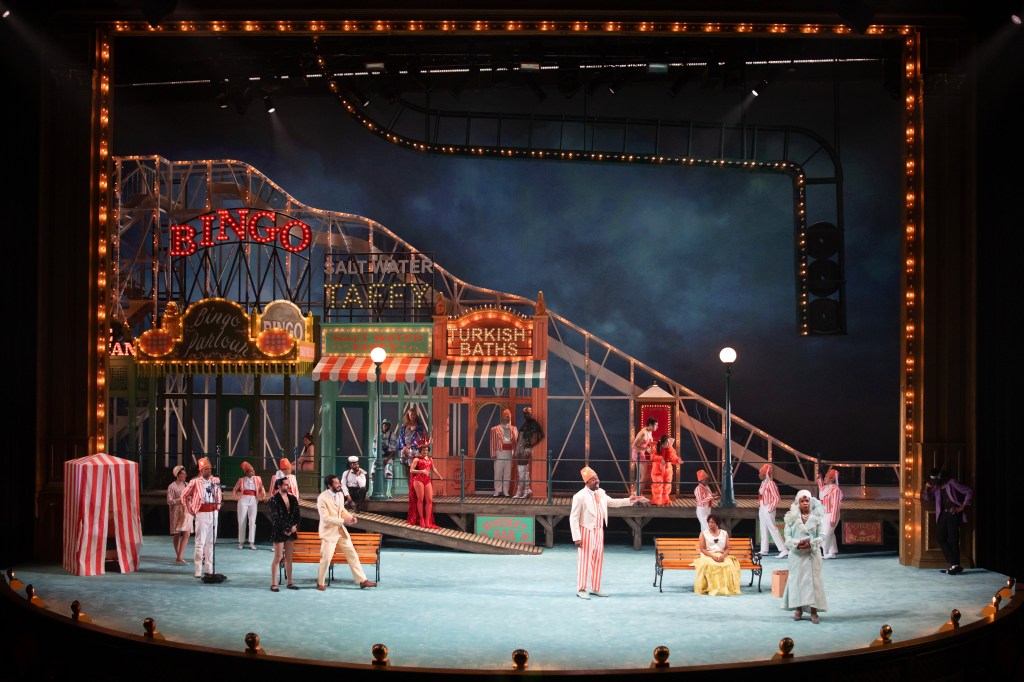
Unfortunately, Antrobus (the solid James Vincent Meredith), tells the dinosaur and mammoth to leave the warmth of their Jersey home so he has room to take in refugees like prophet Moses, the ancient Greek poet Homer and the three Muses: Melete, “Practice,” Mneme, “Memory” and Aoide, “Song,” who would otherwise freeze to death. The dinosaur’s and mammoth’s expulsion is heartbreaking; the ice age destroys their kind. However, Wilder ties their extinction to necessity. Humanity gave up some unique, particular species and from that arose incalculable value. In this instance the preservation includes the foundation of human laws of civilization, timeless poetry and the spirits who inspire art to soothe the collective human soul and generate its hope and creativity.
The sounds of the ice shelf moving, the projection of the towers of ice and the smashing of the home are particularly compelling thanks to the technical team, as the Antrobus family and their maid and sometime object of Mr. Antrobus’ affections escape, “by the skin of their teeth.”
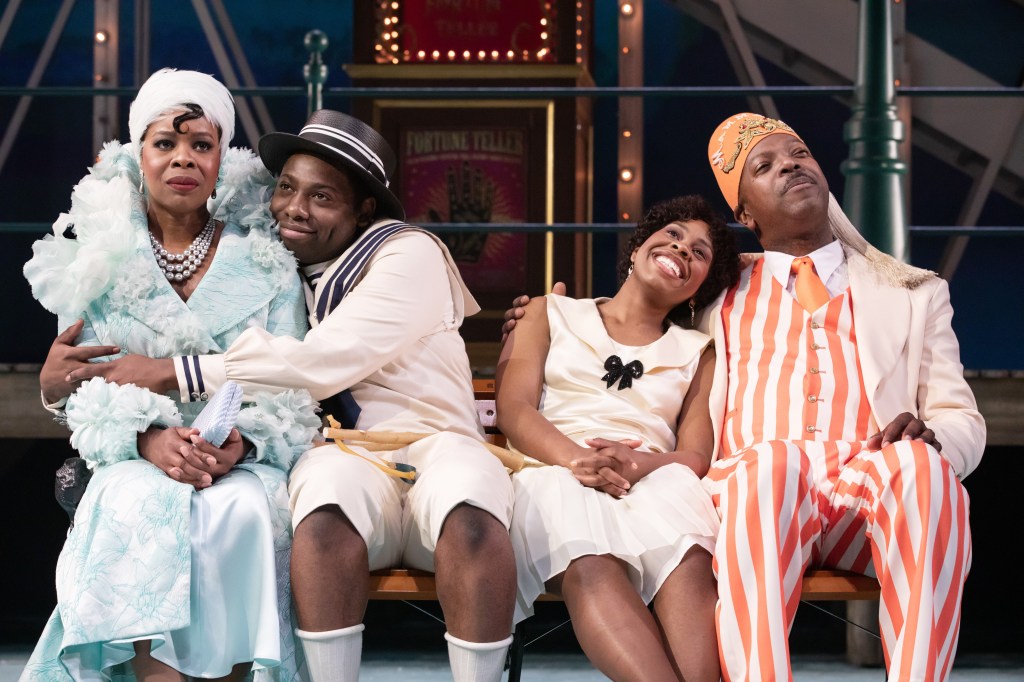
Wilder’s zany, human account has the same setting of bucolic New Jersey throughout. In Act II it’s still New Jersey, but it’s the wild equivalent of sin city in Atlantic City and the boardwalk that has a carnival atmosphere with a lovely gypsy fortune teller (Priscilla Lopez) who warns Antrobus that she can tell him his future, but his past is lost and incomprehensible. It is an interesting notion because one then thinks of the adjuration, “those who forget the past are doomed to repeat it.” However, this doesn’t quite follow for the Antrobus family who are forward moving in progress.
Lopez’s Fortune Teller predicts the great deluge. Terrifying warning sounds rendered by a huge mechanism register the wind velocity and impending storm ferocity. The sounding of the alarm of the impending deluge is scarily effected. Warnings are ignored by the tourists and those who enjoy the fun, dancing, drugging and alluring lights of the Atlantic City boardwalk. As doom approaches, they party. Of course the Antrobus family flees to a boat after pursuing their natures (slippery Robertson’s Henry has killed someone else). Gabby Beans’ Sabina follows them, a veritable member of the family in her seductions of Antrobus, manifested in Act II, hinted at in Act I.

A powerful scene in Act III occurs after the war is over and the Antrobuses convene at what’s left of their Jersey home. Henry confronts his father, for he is the enemy and Antrobus senior threatens to kill him. Of all the characters, the murderous Henry is the most useless. The daughter is the golden child as was the child they no longer speak of, the beautiful, gifted Abel who Henry resentfully killed. But in Act III, after Henry expresses his feelings of isolation, loneliness and desolation being insulted and demeaned by his father, there is a breakthrough and resolution which is heartening. The scene, beautifully rendered by Julian Robertson, who is in his element as the enraged and hurt son and James Vincent Meredith as the commanding then empathetic father, suggests that hope and love are possible through communication.
Director Lileana-Blain Cruz shepherds her fine, spot-on cast with aplomb to performances that never appear off focus or muted for Wilder’s unique characterizations.
The fun of this production also is in the set design, aptly configured by Adam Rigg, effervescent and vibrant in the first two acts, symbolic and moving in Act III. The colorful costumes by Montana Levi reveal the time periods. Act I presents suburban housewife and family and children with happy-go-lucky flowery dresses, with the appropriate fur coat and stylized costumes for Homer, Moses and the others. Act II presents the 1920s flapper style and for the men the orange pin stripes typically emotive for officials of the Convention for Mammals. The lovely Fortune Teller outfit is glamorous, as she is like a Hollywood celebrity and Sabina is the seductress in shimmering red. In Act III the outfits are back to the housewife/mother and maid look similar to the costumes in Act I. Levi’s stylized flair takes in the themes of the act and threads the overall survival mode of the play with precision and care.
With Blanco, Yi Zhao’s accompanying lighting, Palmer Hefferan’s terrific sound design and the integrated, vital projections by Hannah Wasileski, the artistic technical team provides the canvas which sets off the events and the performances, making them more striking. Even more fun are the expert puppeteers who made me fall in love with the animals and shed a tear at their demise. I am calling out these individuals again, BRAVO to Jeremy Gallardo, Beau Thom, Alphonso Walker Jr., Sarin Monae West.
I’ve said enough. Go see it. For tickets and times go to their website: https://www.lct.org/shows/skin-our-teeth/
‘Potus,’ A High Octaine Farce With Riotous Performances by Rachel Dratch, Vanessa Williams, Lilli Cooper, Lea DeLaria, Suzy Nakamura, Julie White, Julianne Hough

POTUS: or, Behind Every Great Dumbass are Seven Women Trying to Keep Him Alive is a laugh riot, pants wetter that begins from the moment the lights dim in the audience. Writer Selina Fillinger turns every political meme on its silly and dangerous head as award winning director Susan Stroman shepherds her superb cast for maximum rollicking humor that doesn’t quit. Of course, there is a point to this brilliantly “mad” production, currently running at the Sam S. Shubert Theatre. The theme? WWWD?

In other words, “What Would Women Do,” if they ran the country? Well, it turns out in the play, they do! However, because they are not the president, they don’t receive credit for making the big man look good, while taking the flak from what he has managed to botch or not do at all. White men of both political parties pay billions of dollars to make sure that women aren’t presidents. BILLIONS. It makes one think, does it not? What are white men on that they are willing to spend BILLIONS to prevent women taking the highest office in the land? Has there been a time in US History when both political parties had women candidates running against each other for the presidency? POTUS suggests it’s about time.
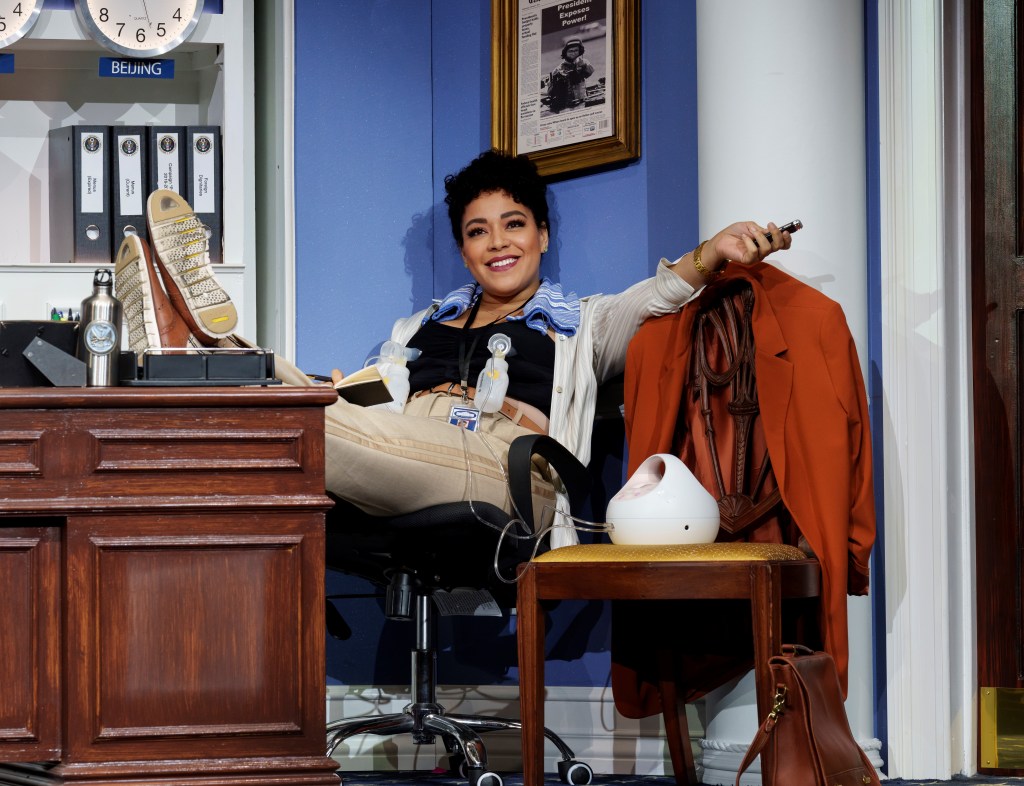
The theme gradually expands and is framed as a question by various female characters in this profoundly funny black comedy. As the events whip by in Fillinger’s ebullient and raucous two act play, they reveal that without his women as his right and left arms, this particularly lame president, who could double for a former president whose last name begins with “T,” would be up sh*t’s creek without a paddle, plunging over a sewage waterfall to his sludgy demise. Do they enable him? It’s one way to look at it. Another is they will never have any chance at all to be in the man’s world without doing what they do. Without a penis, their vaginas bar them for as long as men decide. That is the fleshy point!
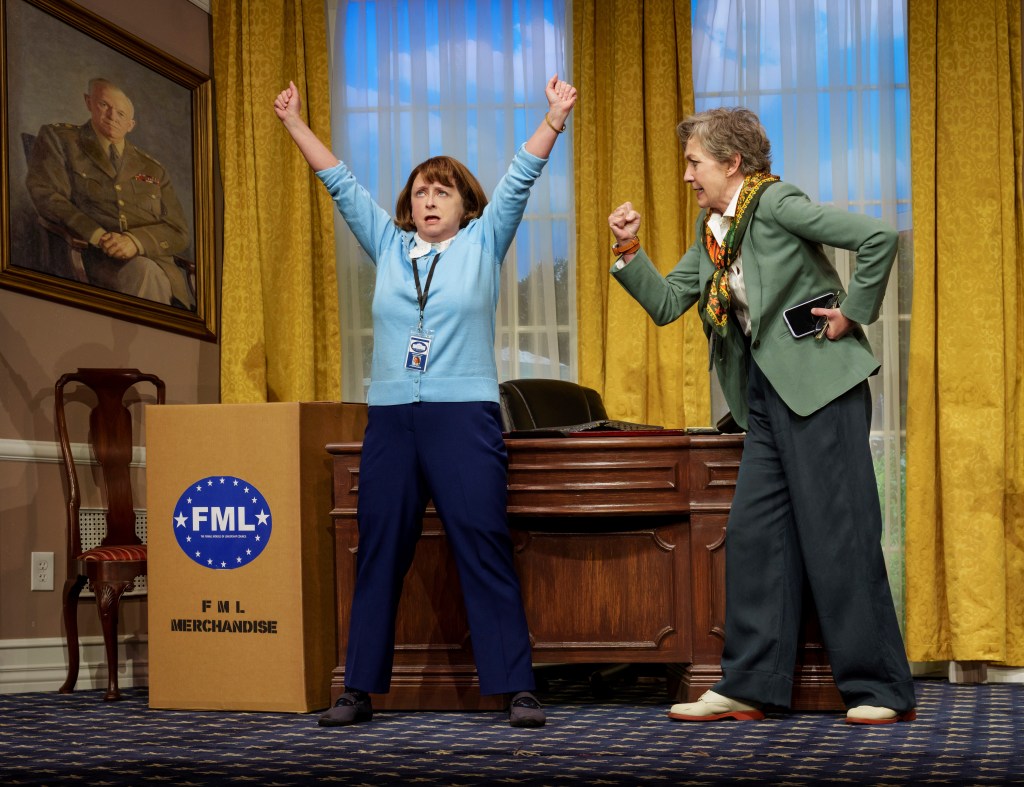
The farce which sends up various former presidents we’ve had (to be fair Republican presidents, because Republicans are never fair), moves at the speed of light for pacing, quips, one-liners and thrust and parries that make absolute sense. So does the gyrating plot which moves from mountain top to mountain top until you are so elevated, you can’t breathe for the belly laughs.
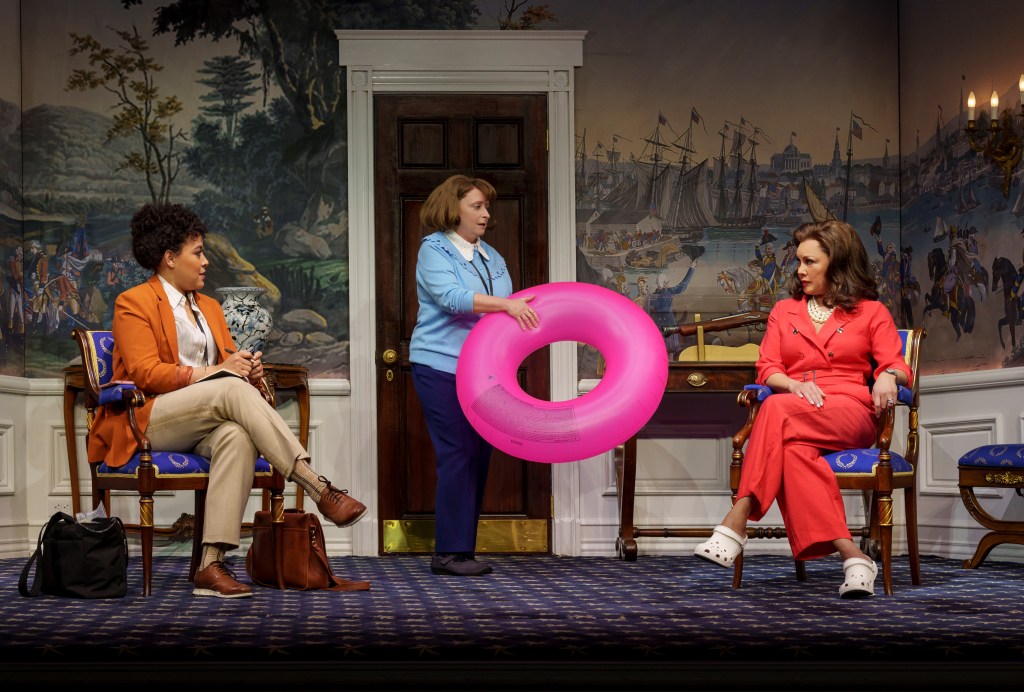
With a cast of seven (all award winners), and an intricate set (Beowulf Boritt), of well appointed rooms spinning on a turn table that reflects areas in the White House, we happily spend time with the females, including a pilot fish reporter. Most of them are highly efficient, talented geniuses who make POTUS pop and generally keep him and the country together. This is a feat considering that “the servant of the people” is a ninny incompetent who is a firestarter, and the women must be at the ready to contain his blazes like advanced technically able forest rangers.
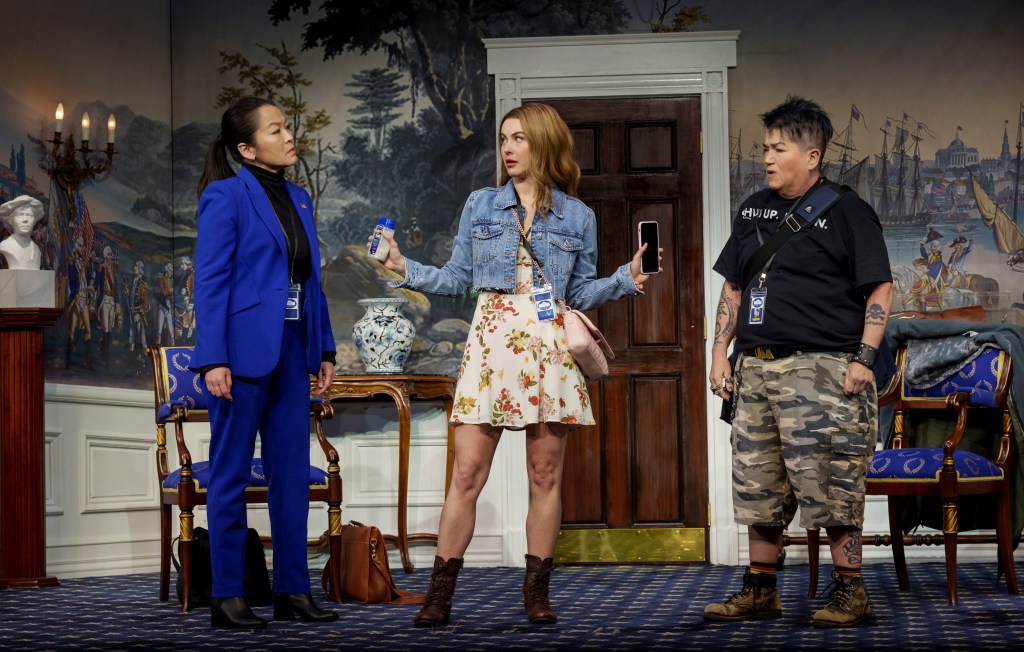
The frolic represents a day in the life of the women of POTUS and a few hangers on like his wife, sister and a “has-been” reporter “in” with the press secretary. These marvelous women include his chief of staff Harriet (Julie White), press secretary Jean, (Suzy Nakamura), secretary Stephanie (Rachel Dratch), his dalliance Dusty (Julianne Hough), his sister Bernadette (Lea DeLaria), slick journalist Chris (Lilli Cooper) and his wife Margaret (Vanessa Williams). All of them are beyond capable and the actresses are a prodigious, laugh a second team.
With frenzy these “wonder women” “keep the balls in the air” for the presidential apotheosis and get him through his day of discussions, briefings, handshakes with physically challenged vets, and a meeting with foreign dignitaries about nuclear non-proliferation treaties. After these events, POTUS is just in time for the FLM (Female Models of Leadership), dinner as icing on his evening cake. Through all these, we witness the machinations these fabulous women spin behind the scenes, but never see the president in action.
In fact, not one male is present on the Schubert stage. How quaint! Considering the few females proportionate to males in the theater world (even female critics), this is quite a lovely step in the right direction.
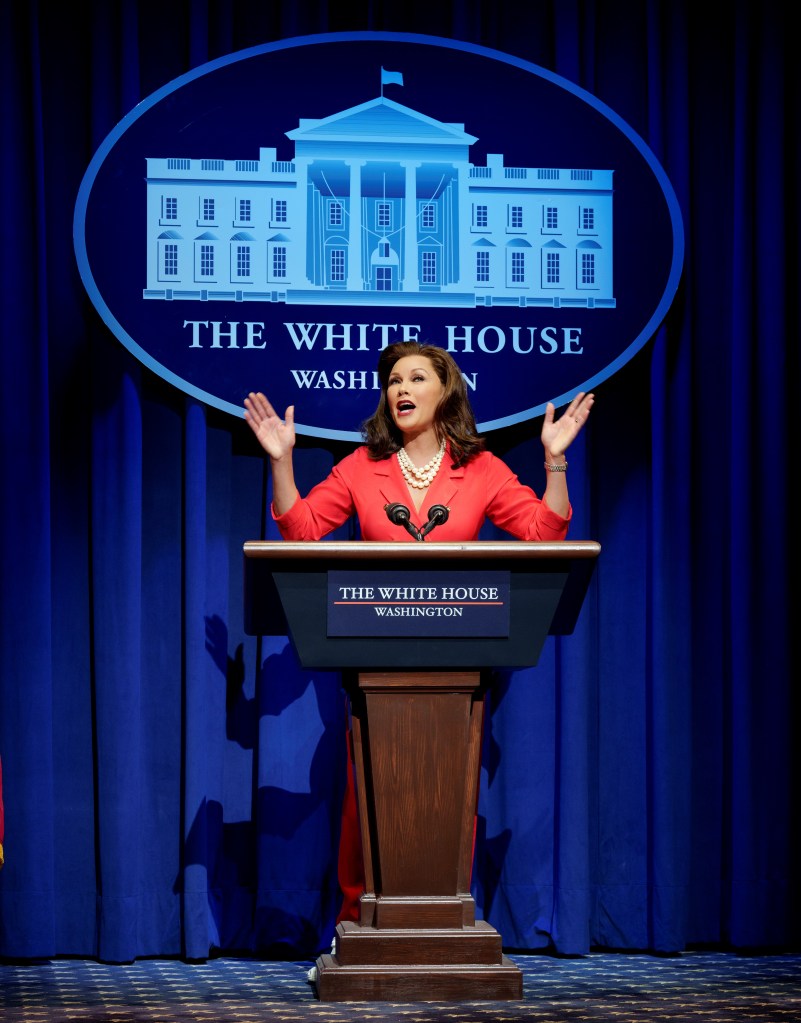
After an explosive fight in which his wife tells him “to stop acting like his father, grow a pair and get his anal cyst removed without anesthesia,” which we hear about, POTUS publicly states the First Lady is absent from a gathering because she is having a “cunty morning.” “Cunt” is the first word that is spoken by Julie White’s Harriet at the top of the play, as she relates to press secretary Jean POTUS’ public cruelty. It is at the heart of the play’s themes and a remark that sets the media world on fire. Indeed, in POTUS’ world, women don’t count except as utilitarian sex objects; if they are salient, they are “cunts.”
Though we laugh as the correction machine starts to turn and hell breaks loose in the kingdom, the point hits home. Subsequently, one “cunty” event happens after another on this average day at the White House with an invisible POTUS and the women front and center who must suck it up and smile, making the badies go away.
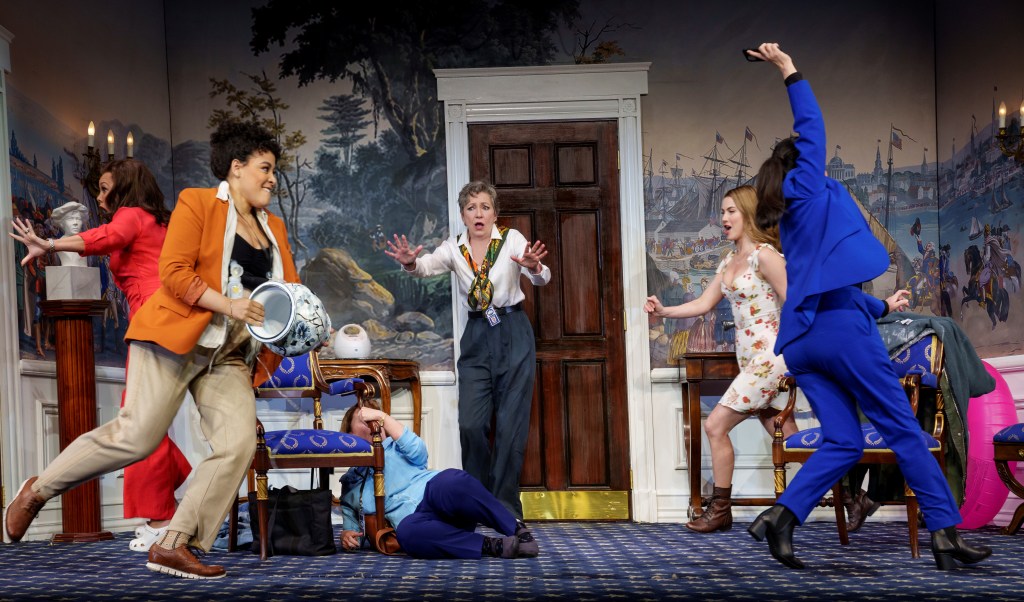
We get to meet Ratchel Dratch’s insecure press secretary Stephanie who is learning physical power confidence and taking her own space, employing full body postures to block Margaret, the First Lady, from going in to give her husband “what for.” Margaret’s edgy, dark insults fly at Stephanie intentionally “behind her back,” while Stephanie is in the room suffering Margaret’s fury and accomplishing her job impeccably. Of course, Margaret believes her role as wife takes precedence over her role as First Lady. However, Harriet and Stephanie prove that is true only up to a point. They prevent the first couple seeing each other (not that they ever do), and block her like linebackers with words and actions.
Potus’ packed schedule doesn’t warrant a discussion with the always fuming Margaret, and he obviously has told Harriet to keep her at bay. However, the First Lady has gravitas and can help smooth the situation which is crassly getting out of hand, inflamed by the media. Allowed to fester like a pustule, his public insult in front of diplomats causes a growing international kerfuffle. Interestingly, “I’m sorry” is not in his vocabulary.
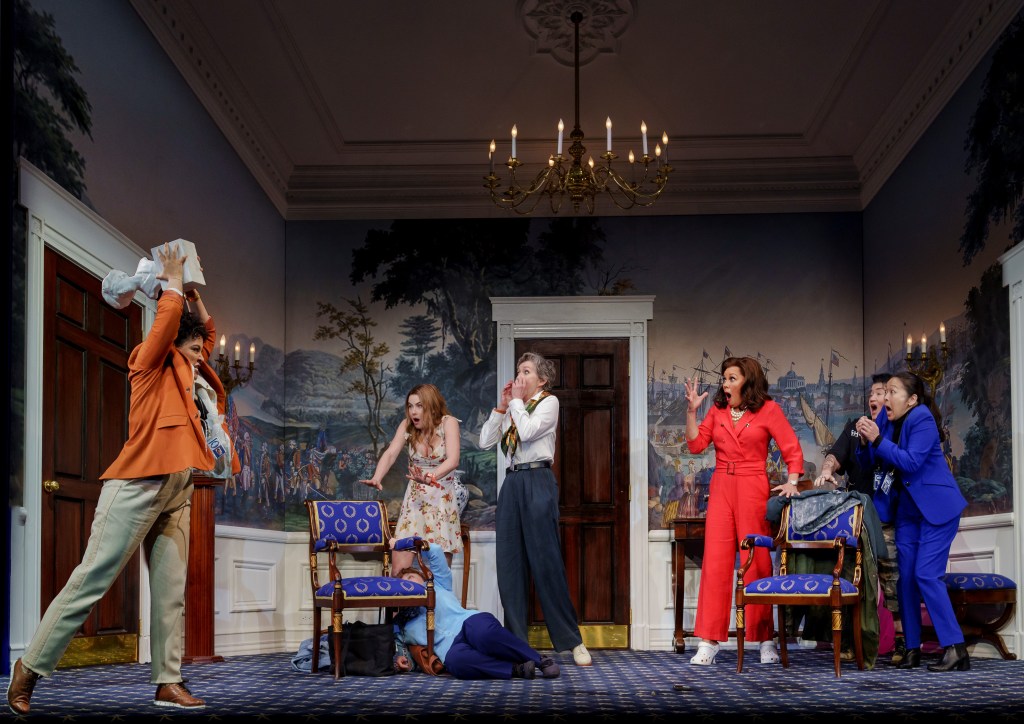
The snoopy reporter Chris (Lilli Cooper), who makes herself comfortable in press secretary Jean’s office, milks the situation for all its worth. It’s a meme; she has twins; a milking machine attached to her breasts gathers breast milk in plastic bags, while she collects the latest juicy gossip about how Margaret handles the president’s “cunty” remark. Interestingly, the comment explodes the offensive meter with countries like Bahrain, who think that the scurrilous reference inferring the First Lady’s female genetalia is nasty and disturbing.
Nevertheless, in the world of power plays and reelections, offense at this remark is a legitimate way to leverage its relationship with POTUS’ administration. Of course Bahrain’s allies and allies of allies all pile on. None of this we see; we only view the frenetic and LOL behavior of the President’s female clean up squad, who must ironically blow by the gender insult to them, as if it is “nothing.”

The situation only worsens when Stephanie stumbles upon the very attractive Dusty (Julianne Hough), armed with a security badge, as she floats around the White House looking for the president to discuss their shared secret which makes her vomit. Dratch’s Stephanie freaks. She believes Dusty is her replacement. Throughout Dratch as Stephanie ups the laughs with her spot-on, completely organic reactions to Dusty and the increasingly wild situations. With acumen, press secretary Jean discovers Dusty is a POTUS dalliance that Harriet has scheduled to speak to the president under Harriet’s advisement. Dusty, a wealthy farmer’s daughter, wants a deal with POTUS about seed planting, leveraging something she carries, and making public statements.
The breaking point thrills when POTUS’ sister Bernadette (Lea DeLaria delivers some of the best lines), arrives at the White House to have her brother pardon her convictions for drug crimes. Of course, this will be over Margaret’s dead body, Harriet’s attempts to compromise, and Jean’s attempt to suppress her passion for their former love. The chaos converges and Stroman with the rocket launch of Fillinger’s present, zany, crazy-hysterical script sends us to the heavens and then the depths, when, at the end of Act I, it looks like POTUS is quite dead and requires a body double. Is the former president anywhere to be found?
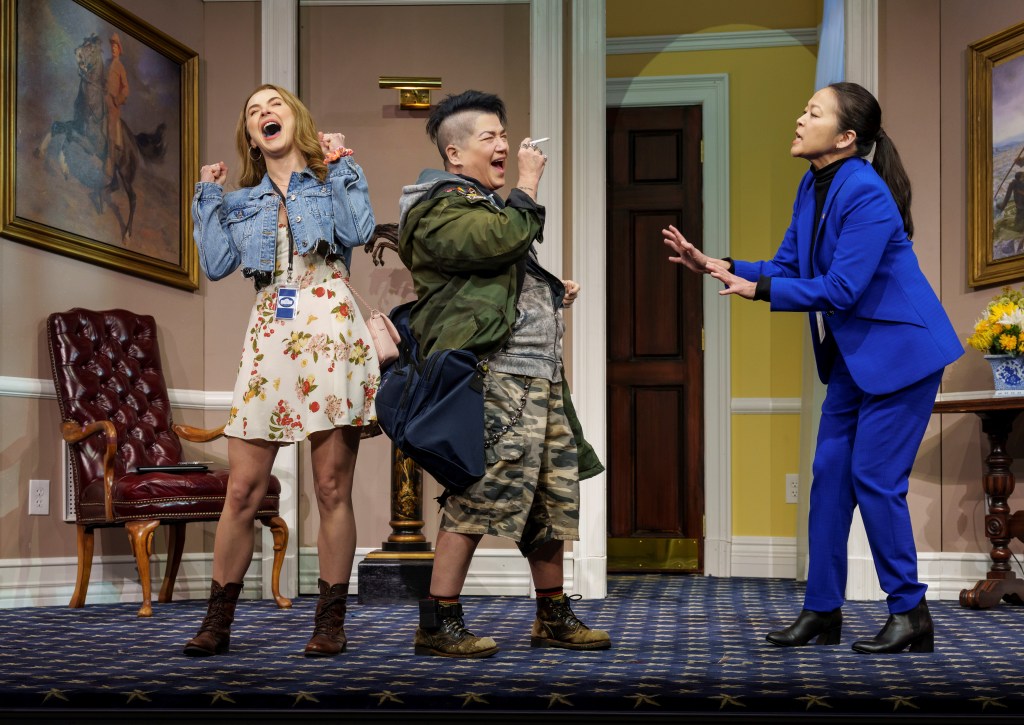
There is no spoiler alert. So much of the wonder of Stroman, the fabulous comedians, the salient crackling script is in each “scene” which must be seen and not read about here. I can’t recommend POTUS enough. This is especially so if you need to laugh feverishly, hysterically, manically, in the face of the ongoing viral plague, freak weather events, Trump Capitol insurrection permissiveness by a Republican (?) DOJ, 2 trillion in Republican tax breaks for billionaires and Putin’s war genociding women and children in Ukraine which Republican apologists like Rand Paul appear to support (???).

Humor and laughter in the midst of darkness helps us get to the next day. The heroic President of Ukraine Volodomyr Zelenskyy reminds the “free world” what courage it takes to be independent of one-man rulers like despot/genocidist Putin who channels Stalin’s extermination of Ukrainians in the Holodomor of 1932-33. That Zelenskyy is a brilliant artist, comedian, producer (Studio Kvartal-95), who rose to become a figurative and literal “Servant of the People,” reveals the importance of laughter and comedy as a foundation to confront trauma and tragedy.
Thus, for non-billionaires and the little people with little, Stroman, these wonderful actors and genius writing by Fillinger are worth their weight in gold. Final kudos go to Sonoyo Nishikawa (lighting design), Jessica Paz (sound design), Linda Cho (costume design), all of which help to make this wondrously absurdist delight the still point in time that you must see, especially if you are a straight white guy who is “macho” enough to handle it. All others in the family of human beings will appreciate it.
POTUS is the “MAX,” especially now in this political season where everything is at the hazard. For tickets and times go to their website: https://potusbway.com/
Martin McDonagh’s ‘Hangmen,’ Theater Review
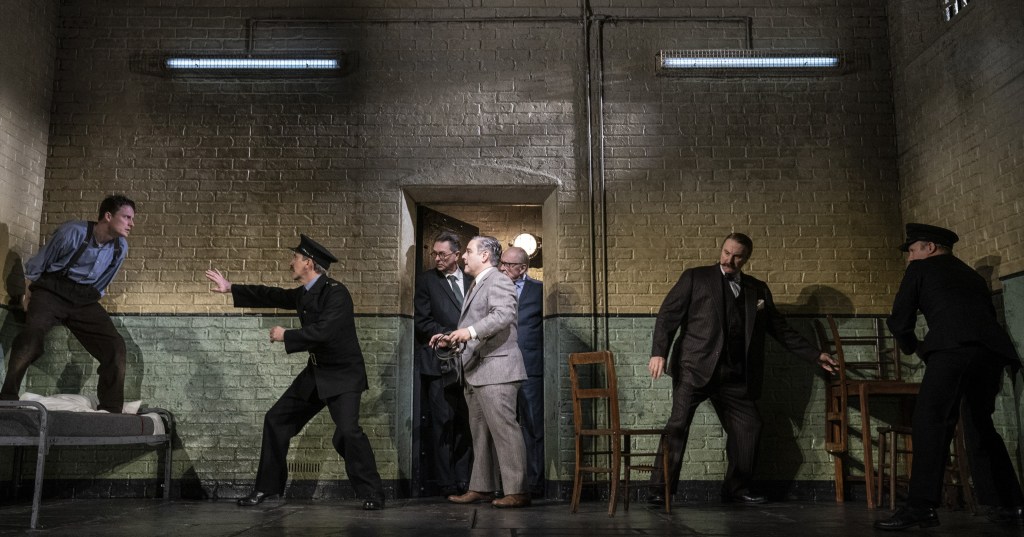
The year 1965 signifies a momentous occasion. By 204 votes to 104, The Murder Act has abolished hanging and the death penalty for those convicted of murder in Great Britain. For human rights advocates and those agreeing that capital punishment isn’t a deterrent, thus, civilized countries shouldn’t practice tribal law, there is rejoicing. For hangmen across the UK, there is less enthusiasm. Martin McDonagh’s sardonic, brutal, unapologetic and macabre humor works brilliantly in his dark comedy Hangmen about some hangmen which centers around the end of hanging in the UK. Hangmen which won McDonagh the 2016 Laurence Olivier Award for Best New Play, begins with an official hanging and ends two years later after the death penalty has been abolished.
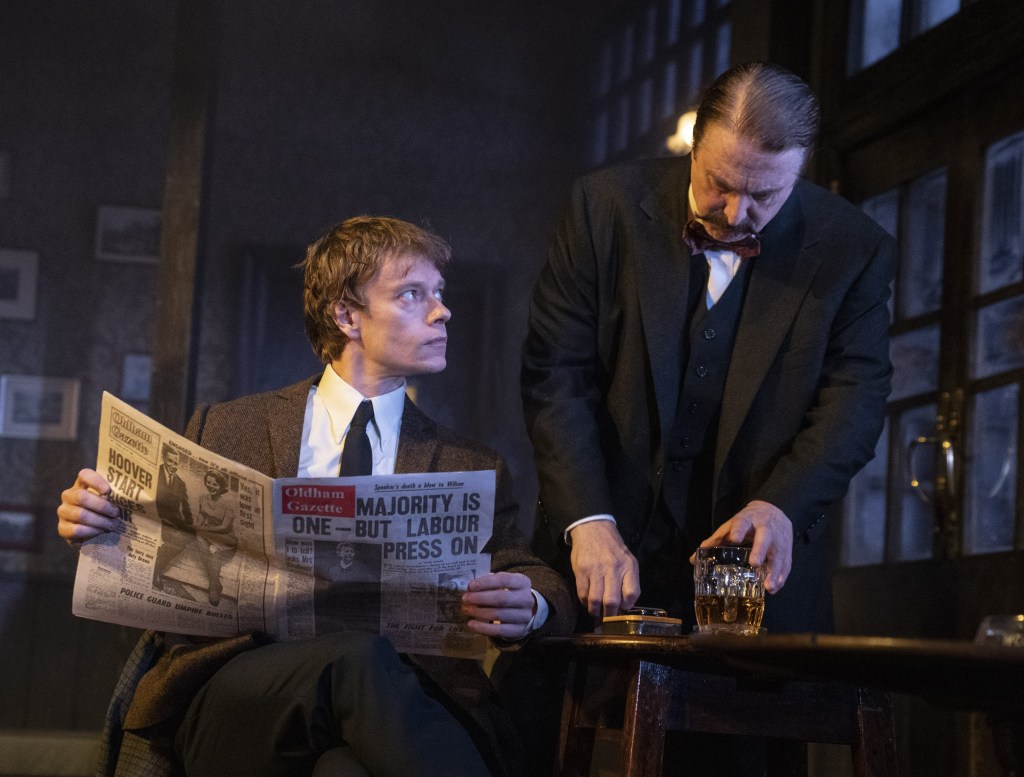
Currently on Broadway at the Golden Theatre, in Hangmen McDonagh centrifuges the wicked human impulses of irrationality, arrogance, machismo and the mechanical banality of evil, then sends these elements into the stratosphere of random circumstance. Add to that mischance, misadventure and mishap, an ironic and inevitably surprising McDonagh-style conclusion is seamlessly effected in this engaging, comedic work. One finds the events mysterious, grisly and lurid until one allows the belly laughs to erupt and the smiles to pop up on one’s face at the systematic take down of males, their grotesque appreciation of insult humor, barbarism and their dung-heap grossness which females are sometimes a party to.
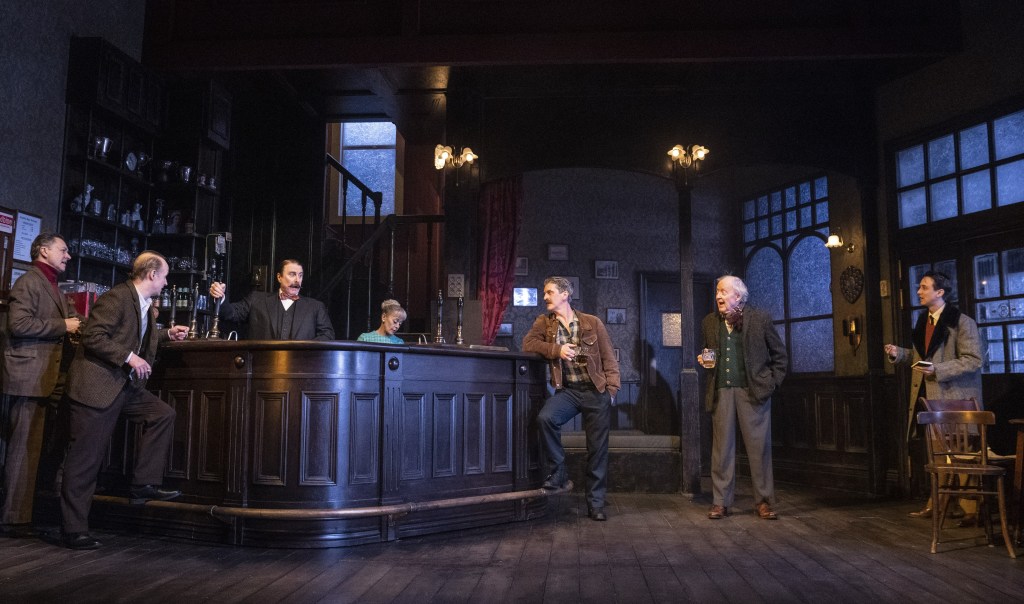
How McDonagh maintains the balancing act of the humorous with the gruesome, effectively weaving the tonal grace to bring on laughter through organic characterizations, always astounds. He accomplished this in the uproarious A Behanding in Spokane (2010) on Broadway (starring Christopher Walken and Sam Rockwell), and in his other works, with the selection of exceptional actors who understand not to “force the laughs” but just to slide into inhabiting the beings that are incredibly loathsome under other circumstances. In the McDonagh settings and arc of developments, what unfolds is the revelation of humanity in all its inglorious ungraciousness. McDonagh’s humans suffer and joke about it, not attempting to evolve or better their soul wretchedness. They just wallow and lay about. In that there is the humor.
This especially applies for the characters and situations in Hangmen, whose chief irony is that the national acceptance of brutality in destroying human life as a punishment for destroying human life (a mild form of genocide), has ended. But the state of human nature which is tribal and hideously, wickedly murderous continues. It’s the same old, same old. And perhaps with capital punishment abolished, it is indeed worse.
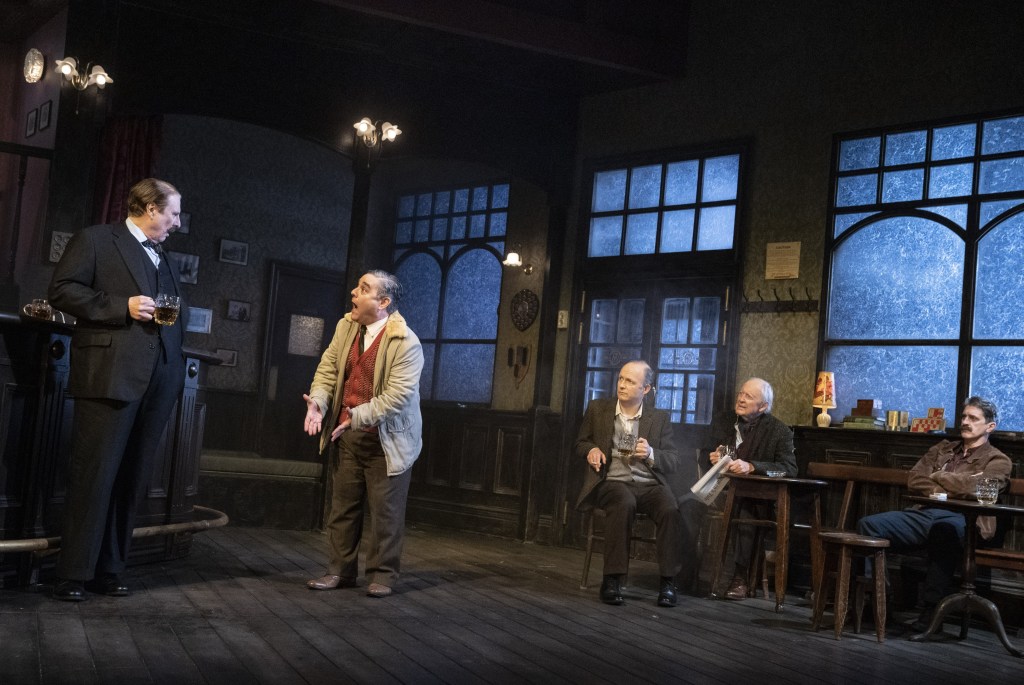
McDonagh investigates various themes about “the company of men,” the willful deceit of human nature and its impish cruelty and brutality, and other themes in the Hangmen, whose focus lands on Harry, the hangman (the wonderful David Threlfall). Harry owns a pub in the north of England and entertains as the king of his space the usual locals who come in for more than a pint. These wayward alcoholics, which he obliges and indulges, include Bill (Richard Hollis), Charlie (Ryan Pope), and the near deaf Arthur (the hysterical John Horton). Occasionally, Inspector Fry (Jeremy Crutchley), drops in, adds his wisdom to the comments of the tipsy crowd, who fall into a natural banter as the alcohol buzz takes over their minds.
On the sterling occasion (for potential murderers in the UK), of the passage of The Murder Act, reporter Clegg (Owen Campbell), comes to the pub to interview Harry about his past glories as a hangman, which initially Harry refuses, then agrees to out of earshot of his clientele. Others who drop in and exacerbate the events which gyrate out of control in Act II are Syd (Ryan Pope), Harry’s former colleague that Harry fired for exclaiming about a male corpse’s lifted genetalia and other inappropriate mistakes. Additionally, there is Harry’s wife Alice (Tracie Bennett), and his teenage daughter Shirley (Gaby French).
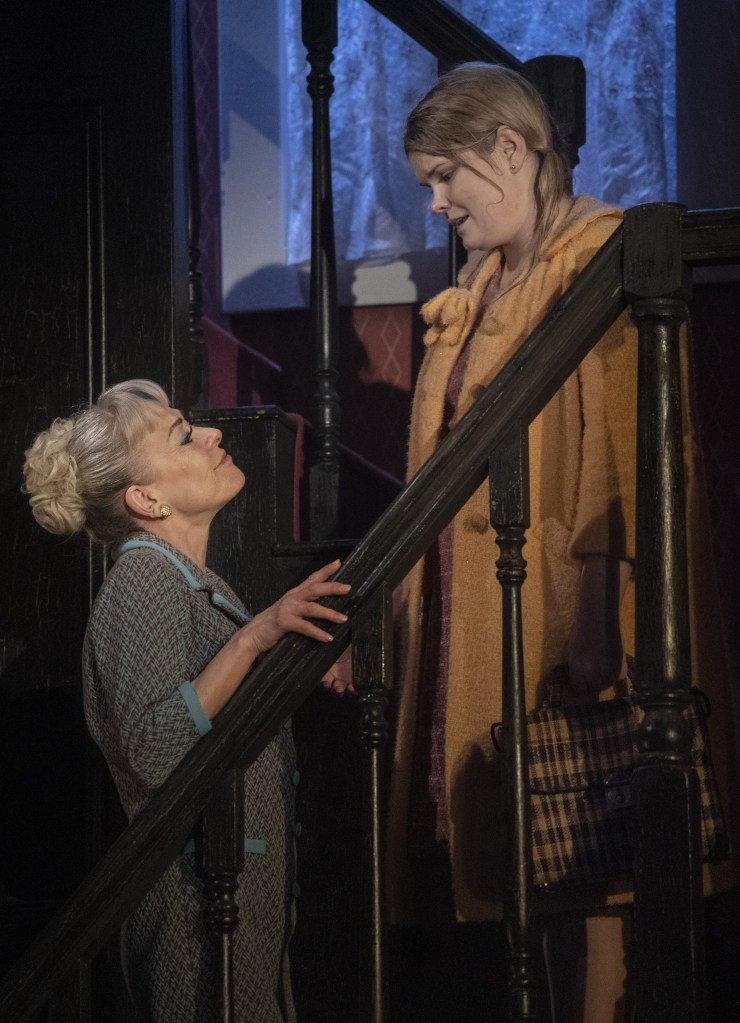
Alice who helps in the pub puts up with Harry and the others and encourages her husband, who she is proud of in a mindless kind of thoughtlessness. But it is obvious that Shirley, who receives the brunt of her parents negative comments because of the age gap and her mopey disposition, is chaffing at the bit to have some adventures. If only someone would give her the opportunity.
The opportunity arises when a rather mysterious, menacing bloke from the south comes into the pub, has a few pints then inquires about lodging. Mooney (Alfie Allen), is the catalyst who propels the action along with Syd, whose deviousness and impulse for revenge sets in motion the sequence of events from which there is no turning. The events are inexorable, especially since Harry’s rival and fellow hangmen Albert (Peter Bradbury when I saw the production), shows up in a coincidental irony and adds to the final debacle.
There is no spoiler alert because so much of the fun of this play is in the twisting plot, incorrect assumptions that McDonagh whimsically leads you to make, and overall uncertainty about which characters are truly malevolent and which ones are actually fronting evil but are almost nice and kind. Beneath this foray into the darkness of human nature, the elements are profound and frightening as the scripture does say that wickedness lurks in the human heart. Naturally, in the culture’s global lexicon, the heart is tender and sweet. Not for McDonagh in the Hangmen, in this entertaining look at machismo, revenge, female complicity, arrogance, pride, lawlessness and fronting.
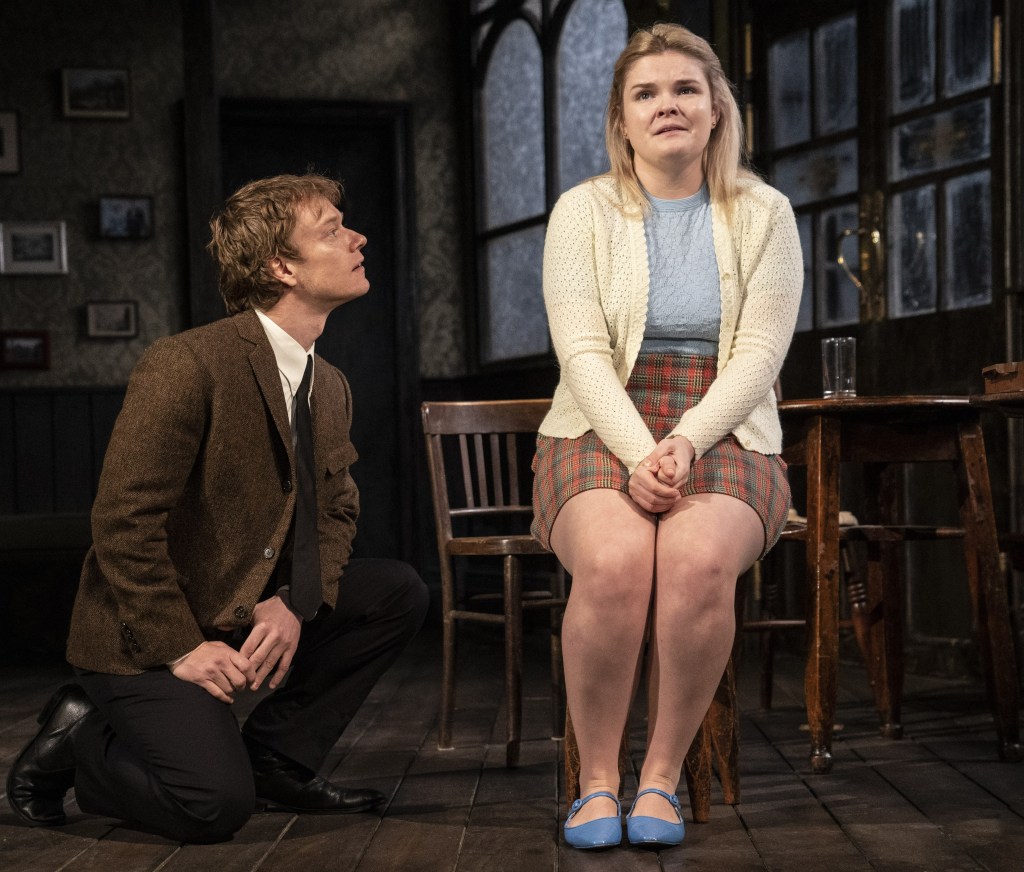
If you enjoy McDonagh and are wanting a laugh or two or many, this is one to see for its wit, cleverness and sardonic finger-pointing at who you really are in your soul. Threlfall’s portrayal of the fascinating character Harry and the solid cast performances shine a light on McDonagh’s themes about human nature. Ironically, in this current time, these themes seem to resonate roundly with Vladimir Putin’s current expose of the misery of his own soul and a want of humor and laughter. Thankfully, McDonagh reminds us of ourselves with brilliant humor which might makes us want to be different for an occasional minute or two.
Directed by Matthew Dunster, who collaborated with Anna Fleischle (scenic and costume designer), about the intriguing two level sets that are quite elaborate with spectacle yet functionality (a cafe, a prison, a darkly paneled, expansive pub), the play succeeds on many levels (sorry, I couldn’t resist). Perhaps there’s a bit of symbolism to think about as you get to watch the pub set rise from hell (as it was referred to in Elizabethan times-the space under the proscenium), as the prison and place where poor Hennessy-whether guilty or innocent was hanged- slowly moves to the second level atop the pub. Thus, the pub becomes the set on the main stage and the prison cell and cafe are above it.
Finally, kudos goes to Joshua Carr’s lighting design and Ian Dickinson for Autograph in sound design.
For tickets and times go to their website: https://hangmenbroadway.com/
‘MJ’ is One of the Greatest Broadway Productions Ever

For much of Michael Jackson’s life, there was controversy. Extraordinary genius is not often reverenced by those who attempt to control it, exploit it or covet it as theirs. Sometimes it is least understood by the person who possesses such talent, until it is too late, and there are only a few years left to try to get it all down.
One-of-a-kind greatness is as ineffable and mighty as what we imagine divinity is. But divinity streams in a multitude of directions. In spirit and light it is incapable of being contained. A bit of that was Michael Jackson’s talent, genius, divinity that he emblazoned on our planet for too brief a time. It is a bit of that Michael Jackson which Myles Frost so lovingly portrays with precision, excellence and prodigious beauty in MJ, with the book by the sterling Lynn Nottage that currently runs on Broadway at the Neil Simon Theatre. This production is an unforgettable, blinding amazement, full of wonder.
Unlike other shows that have been dubbed jukebox musicals, MJ cannot be categorized as such and defies pat, convenient labels. First, though Michael Jackson’s music is featured throughout, the music threads who he is albeit “through a glass darkly,” if we can ever know another individual. The production soars because, as Myles’ MJ tells MTV documentarian Rachel (Whitney Bashor), if we “listen” to his music, it “answers questions” we might have. Thus, if we really intend to know who Michael Jackson is, we must examine his music. MJ does this by presenting riffs of his treasured, award-winning songs in two acts, though not in completeness because the breadth of his work would require days to display in full.
Wisely, Nottage focuses on a period in Michael’s life which manifests a turning point right before he travels globally on his Dangerous tour. It is 1992 in a L.A. rehearsal studio. Through flashback and flashing forward, framed by the present in the studio, Nottage provides richness and depth, crystallizing vital themes and conflicts MJ confronted externally and internally. These include: 1) the media’s rapacious hunger to exploit scandal and create MJ’s twisted identity that it hypocritically blamed him for; 2)his struggles with his father in going solo and breaking from his family to obtain his own autonomy as a person and artist; 3)his struggles to evolve his music beyond his industry producers and labels represented by his father Joseph (Antoine L. Smith), Berry Gordy (Ramone Nelson), and Quincy Jones (Apollo Levine).

Additionally, Nottage examines his work ethic and quest to be perfect, a recurrent theme in MJ. For example after rehearsing various numbers for the Dangerous tour to the breaking point, MJ asks, “But is it perfect?” It is a refrain he’s internalized from his childhood when his father pushed the Jackson 5 to the brink and didn’t allow them to “be children.” Finally, MJ is representational as a black every man striving against the color bar everywhere. Thus, we see his father, his family and his life struggles against institutional racism in the music industry and culture.
Complexly encapsulated throughout, Nottage reveals his personal struggles to manifest love, and overthrow the cruel abuse he received as a child, teen and adult (in the media and entertainment industry). He must do this to spread the love in his music and not transfer the culture’s hatred which is so easy to internalize. This is most probably the most difficult ask of himself that Michael pushes himself toward. This is the thing which is impossible, not the incredible nature of his tours or finding the money his financial manager Dave (Joey Sorge), requires, using his Neverland Ranch as collateral to fund the Dangerous tour. Importantly, Nottage notes his personal struggle to understand and forgive himself reflected in the incredible performance of “Man in the Mirror.” However, does he achieve self-love finally, the bane of all human existence? Ah, well…
Interwoven to spotlight these themes and conflicts is Michael Jackson’s fabulous music featured with the dancers in later songs during the rehearsal period for the Dangerous tour and in memory vignettes. Also, we enjoy featured songs in MJ’s discussion of his work with Rachel which includes numbers from his albums Off the Wall and Thriller.
From his childhood Little Michael’s ( the superbly talented Walter Russell and Christian Wilson alternate) incredible voice shines with his brothers portrayed by performers who also take on different roles. In the segments when Myles’ MJ in the present reflects about correlating events in his childhood, we note his father’s gruff, abusive prodding as a taskmaster (portrayed by Antoine L. Smith the night I saw the production). And we appreciate his loving mother’s comfort as a counterbalance who MJ relies on. Katherine Jackson’s incredible voice is poignant and lovely as she sings with Little Michael, i.e. “I’ll Be There.” When MJ comes back from his thoughts about the past, answering questions from the documentarian at times and other times just letting memories emerge, Myles as the adult MJ sings with Little Michael and they encapsulate the convergence of the past with the present. Perhaps this is a healing, self-revelatory moment.
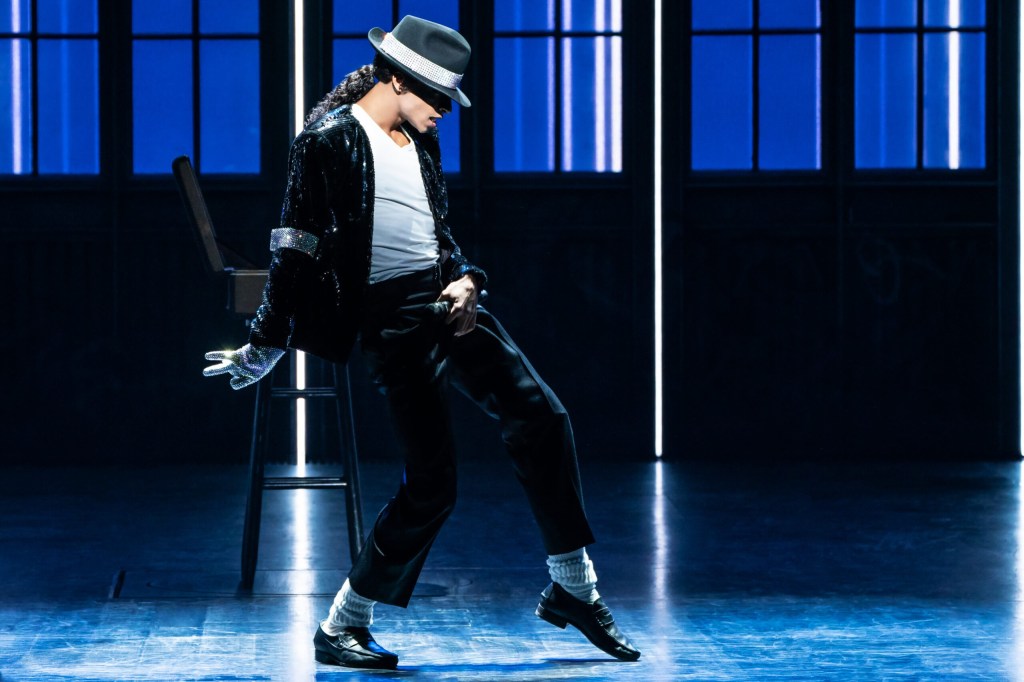
Likewise, the same occurs with teenage Michael, portrayed by Tavon Olds-Sample as Nottage explores the height of the Jackson’s fame with their appearance on Soul Train performing “Dancing Machine.” Especially when MJ steps back into the past, songs in the vignettes explore his emotions at the time. Then MJ comes back to the present into the rehearsal studio where the dancers are singing the same number. The past turmoil is concurrent with the turmoil he goes through in the present with his managers and directors telling him what he wants isn’t possible. It is a refrain he received his entire life and must overcome continually. The transitions from flashback to forward present are beautifully effective as rendered in songs.
Wisely, the structure and organization of MJ is complexly framed by the present and is driven by a confluence of emotional and personal issues which erupt throughout the production. These issues, Nottage intimates were the ones to spiral out of control later in Jackson’s life. The issues explored in flashbacks reveal that MJ is a fluid memory piece and musical. It is as if Jackson, given over to his own talent and unconscious, becomes haunted by the past which intrudes upon the present to generate the direction of his art and personal life. It is that past from which “he runs” (a superficial assessment by the media). Regardless, it is that chaos and emotional angst from the past which infuses and creates the greatness of his being and work, Nottage suggests throughout. It is even reflected in the words of Barry Gordy who claims that Little Michael sings with the pain of an adult’s experience.
Though I wasn’t a Michael Jackson fan, after seeing MJ, I have become one, learning of some the facets of his talent and genius which he attempted to perfect and which anyone who looks deeper into his life with understanding recognizes what he accomplished as one of the most significant global cultural icons of the twentieth century. Importantly, MJ is a celebration of Michael Jackson’s goodness, graciousness, gentleness and love, revealed in his spectacular ability to compose, sing, dance, produce and innovate new music styles and initiate forward trends in all these listed, including fashion.
MJ is also a memorial to Michael Jackson’s work given that through great pain comes art which is timeless. Though some would quibble that “his” type of music isn’t art, Nottage’s book and this production rises above that inanity in its affirmation that what Michael Jackson accomplished must be reviewed seriously apart from scurrilous tabloid journalism or even an attempt at documentary. Though he was Known as the “King of Pop,” the Broadway production reveals that “handle” was a superficial, limiting meme.

He was a phenomenon that we will not see again, a sensitive maverick “music man” who morphed into mythic beings and as easily shapeshifted out of them into new personas. As he evolved, he swiftly left history and the media in the dust, something which the media appears to refuse to understand. One has only to view his vast body of awards and global recognition, his millions of record sales the dollar amounts, the presidential awards, global awards, the breaking of 39 Guinness World records to begin to “get this.” Indeed, he is the most awarded individual music artist in history.
MJ the Musical begins in an L.A. rehearsal studio in 1992 as dancers and the soft-spoken Michael (the shining Myles Frost) suggests ways to improve “Beat It,” the number the dancers work on. Sequestered in a corner, a two-person MTV documentary film crew records until the overexcited camera man, Alejandro (Gabriel Ruiz), loses his cool in the presence of this living myth and MJ “yells” about the how and why of cameras in the studio. Rachel (Whitney Bashor) steps in and saves the day assuring Rob (Antoine L. Smith) and Michael they are “unobtrusively” there to record MJ’s process of putting together his Dangerous World Tour. Frost’s Jackson quietly explains that the tour to promote his album Dangerous will travel four continents excluding the U.S. and Canada in the hope of raising $100 million for his newly established charity Heal the World Foundation to help children and the environment.
Immediately, the strains and pressures of conflict between the media’s mission to raise dirt, versus the sensitive artist and the private individual who yearn to be understood are manifest. Behind MJ’s back Rachel affirms to Alejandro that she wants to delve into his personal struggles, blowing by his art. It is the reason why they insinuated themselves into the rehearsal studios with the guise of filming his tour preparations. Once again, MJ is trusting and allows her to stay to publicize the tour.
Intriguingly, Nottage points out that the documentarian attempts cinema veritae. However, by the end of MJ we see this is a blind. Rachel gets “what she wants.” She has overheard a conversation by MJ’s close associates Rob (Antoine L. Smith) and Nick (Ramone Nelson) about his taking too many painkillers because of the accident filming a Pepsi commercial. Instead of concentrating on his music, though she says she will be fair, we understand “fair” means not necessarily giving MJ the benefit of the doubt. It is “The Price of Fame” that he learns from his father and without which he couldn’t perform. Regardless, it is a cul de sac in which “You Can’t Win,” sung by Berry Gordy (Ramone Nelson) and teenage Michael (Tavon Olds-Sample).

By the conclusion of MJ, we discover that “facts,” too can be twisted into untruths, and what is called for and never pursued by the media is understanding and empathy. Thus, as a theme media exploitation manifests three minutes into MJ, revealing what dogged him and grew to an insanity by the end of his life. The media’s rapacious commercialism to get “the exclusive” scandal to tear down the myth it grudgingly helped to create is integral to MJ. The constant struggle with the media later strengthened him to transcend every barrier institutional racism put up to thwart him in exploitative cruelty that Jackson later excoriated and exposed, using his songs as a weapon to beat back injustice, planet devastation, global child trafficking and more.
In a perfect meld of music and dance numbers, Nottage’s book is the skeleton upon which the creative team of Jason Michael Webb (music direction, orchestrations, arrangements), David Holcenberg (music supervision, orchestrations, arrangements), and Christopher Wheeldon (director, choreographer) sculpt the greatness of Michael Jackson’s artistry in his humanity. Songs represented are from all of his albums; in alphabetical order they include (ABC, Bad, Beat it, Billie Jean, Black or White, Don’t Stop Til You Get Enough, Keep the Faith, Rock With You, Smooth Criminal, The Way You Make Me Feel, Wanna Be Startin’ Something) to name only a few. With Thriller (look at how his father in costume moves off stage into the nightmare world which emerges from his imagination) how the song is incorporated with his living, awake nightmares in his own life at this point in time is just fantastic.

The set design (Derek McLane) exemplifies MJ’s inner and outer conflicts magnificently, in vibrant colors for the dynamic award winning numbers. They even get the opening propulsion up from the trap under the stage for a huge WOW! It signifies MJ successfully got his crew to do this for his Dangerous tour. See the production MJ for this rush of excitement, and explosive fun surprise. Or look it up on YouTube if you are not coming to NYC.
For the “smaller” intimate moments in the Jackson family home, the design is simpler, but functional and appropriate to the time. The retro look continued for the Soul Train vignette is heartwarming as the introductory music opens, reminding us of our youth and the time in the nation where black entertainers like Michael rarely crossed over. They had to appear on Soul Train for publicity. The lighting (Natasha Katz), complementing the set design for the maximum striking “fantastical,” especially with the “Thriller” number that just kills it are all other-worldly, as Paul Tazewell’s costumes provide the fearful/graveyard monster touch. The costumes of course are so varied, but all are MJ. Importantly, Gareth Owen’s sound design is spot on so the lyrics are clear, the music strongly wonderful.
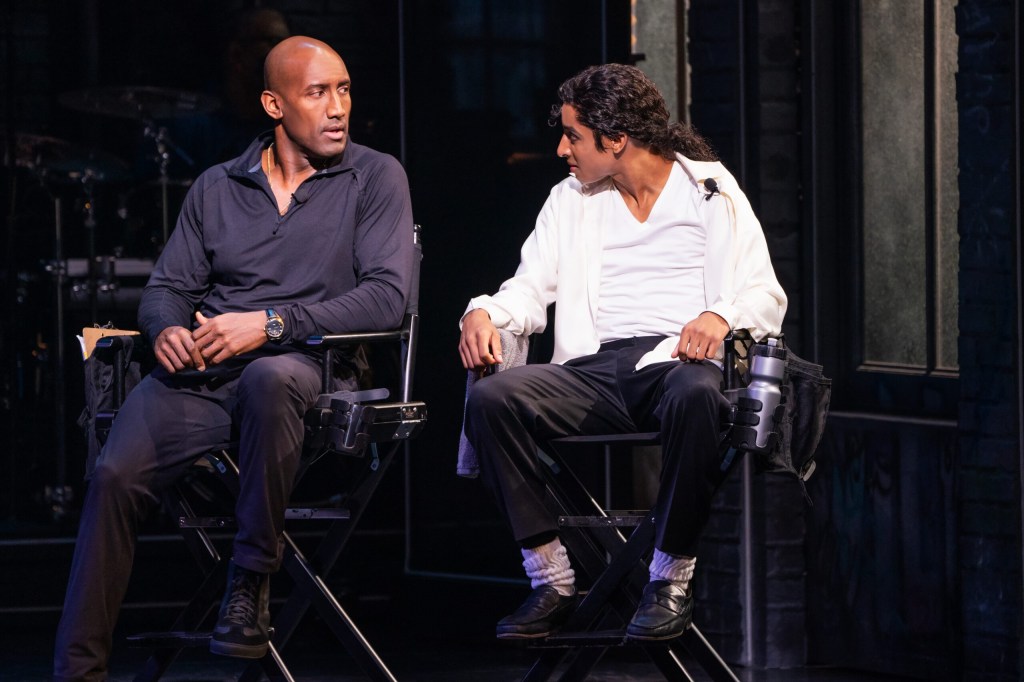
Peter Negrini’s production design, Charles LaPointe’s wig and hair design, Joe Dulude II’s make-up design all thrust the actors and especially Myles Frost into glory and provide the unity of spectacle this production so fabulously renders. Enough cannot be said about Myles Frost’s portrayal that is emotionally devastating because he is Michael Jackson’s beating heart and so gratefully appreciated for his amazing talents and will to become MJ for each of the nights of the week. Shepherded by Christopher Wheeldon’s masterful direction and thrilling, hot choreography, they are MJ‘s lifeblood along with the cast who entertain us to their last nerve. All are nonpareil.
We see that in the songs in his later life, MJ attempts to overthrow the forces that exemplify the worst manifestations of greed, pernicious exploitation, hypocrisy, falsehood and hatred in the culture and in his personal life. What he went through first with the media which built him up to destroy him, we have witnessed these past years in the propaganda used to destroy in the service of furthering others’ hidden agendas, regardless of the facts in this heightened time of political power plays.
As the last individual walks away from the Neil Simon Theatre, after seeing MJ, they should leave with the knowledge that what Michael Jackson represented to fans, foes, colleagues and those nearest and dearest to him is incalculable. Whether one scorned, predatorized, idolized, exploited, manipulated, in short any action word you might use to exemplify how people related to him, Michael Jackson impacted all of us through his music, his humanity and his tragedy. Lynn Nottage, the actors and the creative team have done a sensational and dazzling job of assisting Myles Frost in bringing the legend to life.
Finally, whatsoever things are true, whatsoever things are honest, whatsoever things are just, whatsoever things are pure, whatsoever things are lovely, whatsoever things are of good report; if there be any virtue, and if there be any praise, think on these things. With regard to Michael Jackson and the production’s greatness, this scripture seems appropriate to leave you with.
For tickets and times go to the MJ website: https://mjthemusical.com/
Mary Louise Parker, David Morse Renegotiate Their Roles in the always amazing ‘How I Learned to Drive’
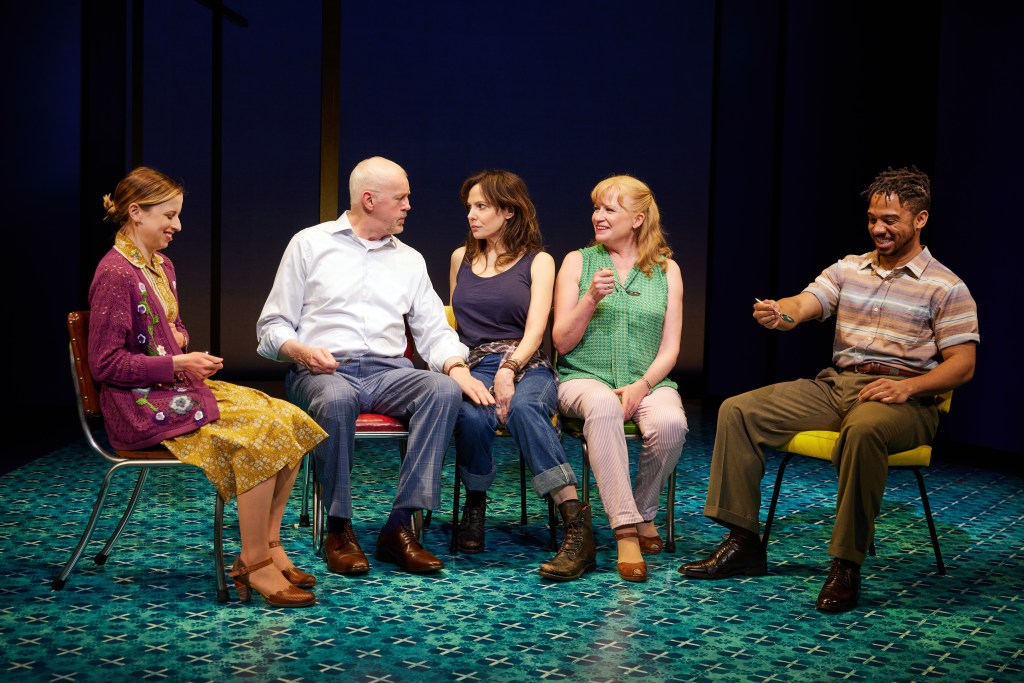
Paula Vogel’s Pulitizer Prize winning How I Learned to Drive in revival at the Samuel Friedman Theater is a stunning reminder of how far we’ve come as a society and how much we’ve remained in the status quo when it comes to our social, psychological, sexual and emotional health, regarding straight male-female relationships. Pedophilia and incest by proxy are as common as history and not surprising in and of themselves. On the other hand how particular male and female victims lure each other into illicit sexual self-devastation is unique and horrifically fascinating.
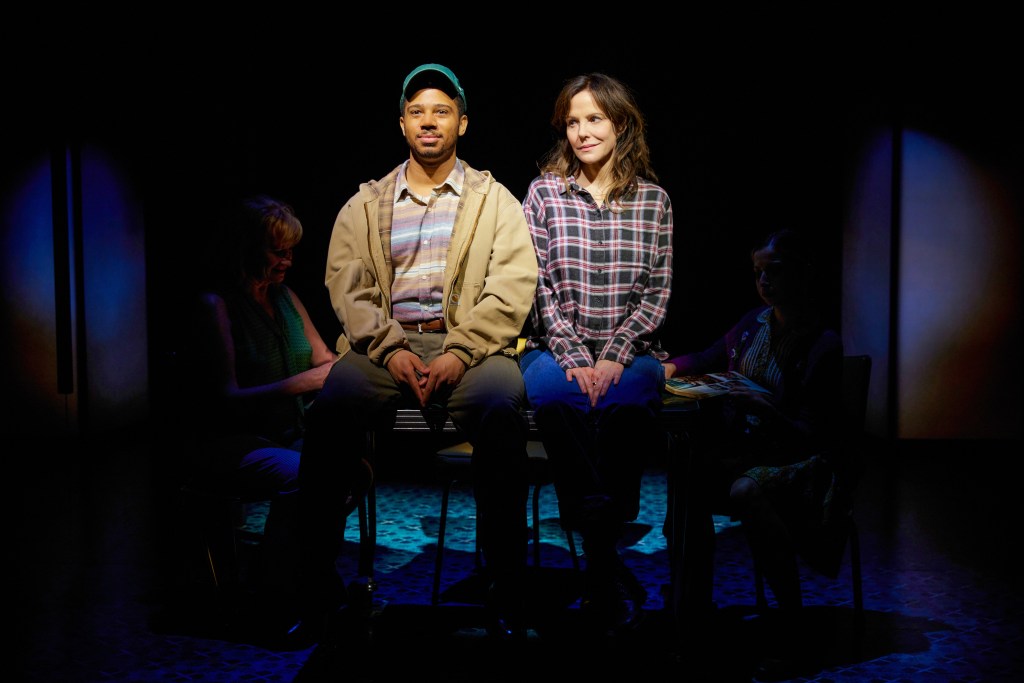
This is especially so as leads Mary-Louise Parker, David Morse, and director Mark Brokaw put their incredible imprint on Vogel’s trenchant and timeless play. Interestingly, Parker and Morse are reprising their roles from the original off-Broadway production, with original director Mark Brokaw shepherding the Manhattan Theatre Club presentation. Parker (Li’l Bit) and Morse (Uncle Peck) are mesmerizing as they portray characters who manipulate, circle and symbolically search each other out for affection, love and connection. The relationship the actors beautifully, authentically establish between the characters is heartbreaking and doomed because it cannot come out from under the umbrella of the culture’s changing social mores, Peck’s psychological illness from the war, and Li’l Bit’s familial, sexual psychoses.
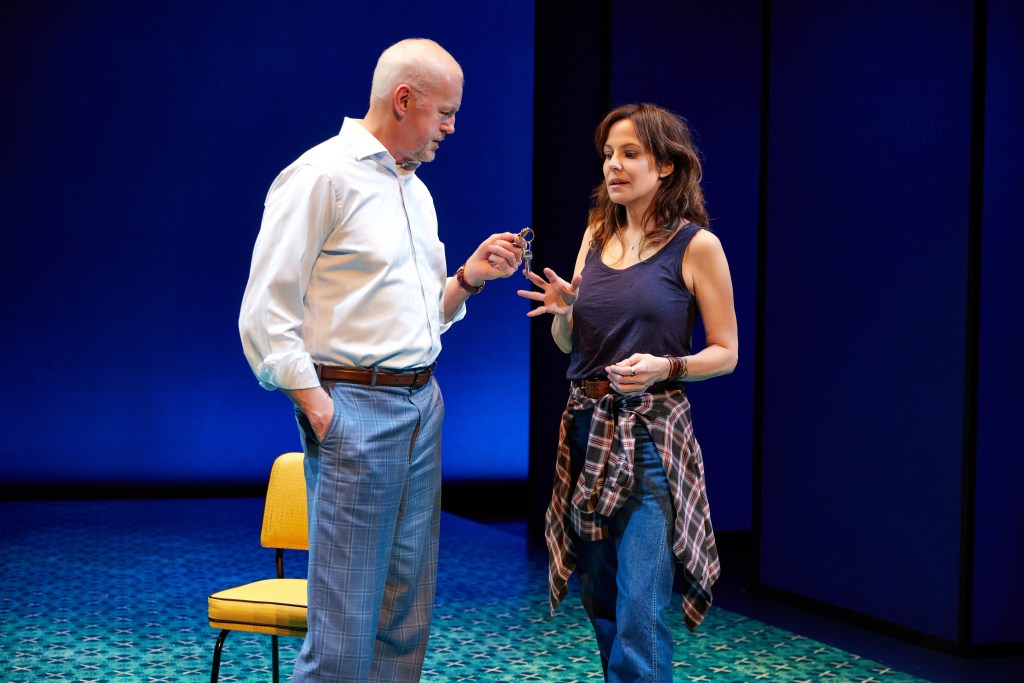
How I Learned to Drive reveals what happens to two individuals (a teen girl and an adult male), who engage in the dance of psycho-sexual destruction while negotiating feelings of desire, love, attraction, fear and guilt under society’s and family’s repressive sexual folkways and double standards. What makes the play so intriguing is not only Vogel’s dynamic and empathetic characterizations, it is her unspooling of the story of the key sexual-emotional relationship between Li’l Bit and Peck.
Li’l Bit and Peck’s relationship is not easily defined or described as sexually abusive, though in a court of law, that is what it is, if an excellent prosecutor makes that case in a blue state. However, in a red state, it might be viewed differently. Consider 13 states in the US allow marriage under 18, and Tennessee has recent records of marriages of girls at 10 years-old with parental or judicial agreement.

Sexual abuse, if the players are amenable and influencing each other for reasons they themselves don’t understand, is a slippery slope depending upon the state’s political and social folkways, the familial mores and the perspectives of the players themselves. Ironically and eventually, a turning point comes IF the abuse is recognized and the relationship ends whether exposed to the light of public scrutiny or not as in the case of Lil’Bit and Peck.
In Vogel’s play, how and why Lil’Bit ends her forbidden relationship with Uncle Peck is astounding, if one looks to Vogel’s profound clues of Lil’Bit’s emotions which are an admixture of confusion, regret, love, affection, annoyance, fear and disgust of going legal/public and against family, for example, her Aunt, whom she has “stolen” Peck from. Indeed, Lil’Bit is willing to forget what happened and stop their secret “drives” after she goes away to college. But when she is disturbed by Peck’s obsessive letters, and drinking to excess, she flunks out. She is haunted by the events (sexual grooming in 2022 parlance), that began when she was eleven, so she ends “them.” The last time she sees him is in a hotel room, though at 18-years-old she is of age and old enough for intercourse under the law. However, she must be willing.

Her ambivalence is reflected when she lies down with him on a bed, obviously feels something but gets up. Yes, she agrees to do that after she has two glasses of champagne. But when he asks her to marry him and go public with their affection with each other, it’s over. The irony is magnificent. When they were secret, she let it happen and told no one and continued her drives with him until college. The public exposure of a public marriage is loathsome for her as she would have to confront what has transpired between them for seven years.
As Vogel relates the process through Lil’Bit’s sometimes chaotic flashback/flashforward, unchronological remembrances, we understand the anatomy of Peck’s behavior and hers. The finality of this revelation occurs when she divulges the precipitating abusive event on Lil’Bit’s first driving lesson in Peck’s car. Driving becomes the sardonic, humorous metaphor by which Peck reels her in, linking her desires to his (part of the affectionate aspect of grooming). Her mother (the funny and wonderful Johanna Day), despite negative premonitions, allows her eleven-year-old to go with her uncle, though she “doesn’t like the way” he “looks” at her.

The dialogue is brilliant. Li’l Bit chides her mother for thinking all men are “evil,” for losing her husband and having no father to look out for her, something Uncle Peck can do, she claims. Li’l Bit uses guilt to manipulate her mother to let her go with him. Her mother states, “I will feel terrible if something happens” but is soothed by Li’l Bit who says she can “handle Uncle Peck.” The mother, instead of being firm, says, “…if anything happens, I hold you responsible.”
Thus, Li’l Bit is in the driver’s seat from then on, responsible for what happens in her relationship with Peck, given that warning by her mother. This, in itself is incredible but the family has contributed to this result in their own personal relationships with each other as Vogel reveals through flashbacks of scenes which have psycho-sexual components between Peck and Lil’Bit and Lil’Bit and family members. However, this is a play of Lil’Bit’s remembrance. We accept her as a reliable narrator, knowing that things may have been far different than what she tells us. As she is coming to grips with what happened to her as a child, we must admit, it could have been worse, or better, any of the representations less or more severe. Indeed, she is narrating this story of her teen years as a 35 or 40-year-old who is plagued by the tragedies of the past which include what happens to her Uncle which she may feel responsible for.

During the flashbacks which are prompted by themes of unhealthy sexual experiences (including male schoolmates’ obsession with her large breasts), Lil’Bit reveals prurient details about her family’s approach toward their own sexuality and hers. It is not only skewed, it is psychologically damaged. For example, Lil’Bit explains they are nicknamed crudely and humorously for their genitalia. Her grandfather represented by Male Greek Chorus (the superb Chris Myers), continually references her large breasts salaciously, one time to the point where she is so embarrassed she threatens to leave home. Of course, she is comforted by Uncle Peck who understands her and never insults or mocks her. However, in retrospect, he does this because it’s a part of their “close” driving relationship.
In another example her mother chides her grandmother for not telling her about the facts of life because she was most probably gently forced into sex, got pregnant, had a shotgun wedding and ended up in an unhappy, unsuitable marriage. From the women’s kitchen table of women-only sexual discussions, we learn that grandmother married very young and grandfather had to have sex for lunch and after dinner, almost daily. And with all that sex, grandma never had an orgasm.
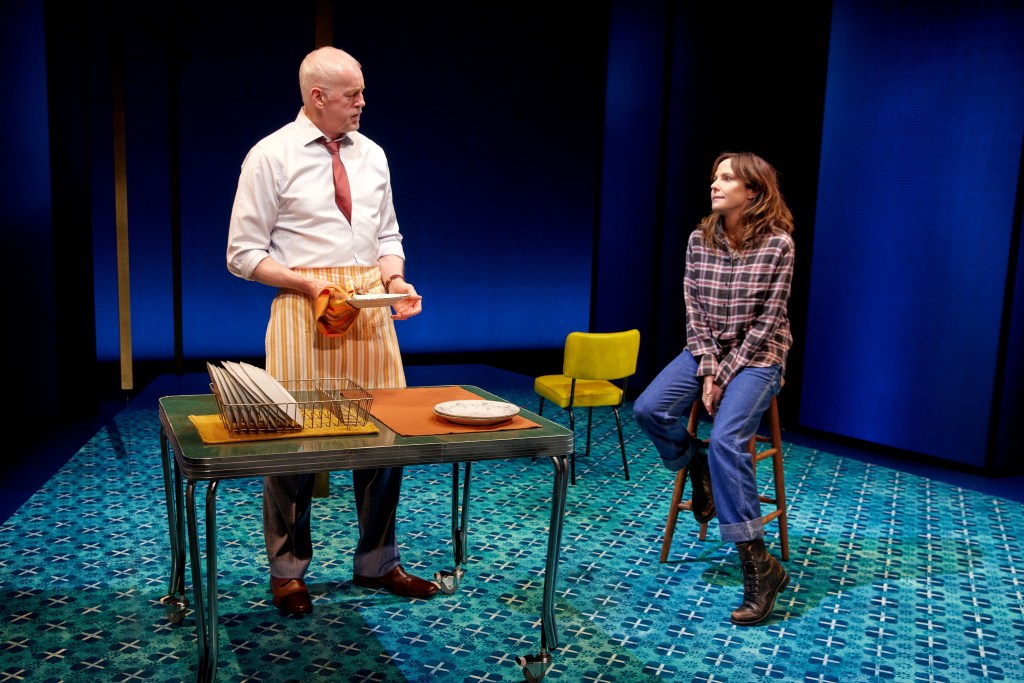
When Lil’Bit asks does “it” hurt (note the reference isn’t to love or intimacy or even the more clinical intercourse), the grandmother portrayed by the Teenage Greek Chorus (Alyssa May Gold who looks to be around a teenager), humorously tells her, “It hurts. You bleed like a stuck pig,” and “You think you’re going to die, especially if you do ‘it’ before marriage.” The superb Alyssa May Gold is so humorously adamant, she frightens Lil’Bit so that even her mother’s comments about not being hurt if a man loves you are diminished. Indeed, reflecting on her mother’s unwanted pregnancy and her grandparents’ cruelty forcing her mother to marry a “good-for-nothing-man,” the discussions are so painful Li’l Bit can’t bear to remember their comments “after all these years.”
Thus, romance, love and affection and sweet intimacy are absent from most discussions about men who are neither sensitive, caring, loving or accommodating to her mother (an alcoholic with tips on drinks and how to avoid being raped on dates), and grandmother who never had an orgasm with her beast-like husband. Only her Aunt seems satisfied with Uncle Peck, who is a good, sensitive man, who is troubled and needs her, and who reveals that she sees through Li’l Bit’s slick manipulation of him. She knows when Li’l Bit leaves for college, her husband will return to her and things will be as before. An irony.

Vogel takes liberties in the arc of the flashbacks with intruding speeches by family. As all memories emerge surprisingly when they are disturbing ones, Li’l Bit’s are jumbled. The exception is of those memories which organically spring from the times Peck and Li’l Bit drive in his car as he teaches her various important points and helps her get her driver’s license on her first try. After, they celebrate and he takes her to a lovely restaurant and she gets drunk.
Again and again, Vogel reveals Peck doesn’t want to take advantage of her because he will not do anything she doesn’t want him to do, he proclaims. Thus, his attentions are normalized. And Lil’Bit shows affection yet, at times apprehension, ambivalence and acceptance. On their drives, Peck has become her quasi father figure, a confidant and supportive friend. Thus, she accepts his physical liberties with her (unstrapping her bra, etc).
Because the scenes are in a disordered cacophony, each must be threaded back to the initial event of Peck’s molestation which happens at the end of the play. SPOILER ALERT. STOP READING IF YOU DON’T WANT TO KNOW WHAT HAPPENS.

The mystery is revealed why Li’l Bit continues her driving lessons until she goes to college, and even then ambivalently meets him in the hotel room where he proposes. When she is eleven (Gold stands off to the side reminding us of her age as Parker and Morse enact what happens), she touches Peck’s face as she sits on his lap. While driving, Peck touches Li’l Bit who cannot reach the breaks, but only holds her hands on the wheel so she doesn’t kill them both. Though she accepts what he does initially, then tells him to stop, he ignores her. Then she states, “This isn’t happening,” making the incident vanish, though it happens. And she tells us, “That was the last day I lived in my body.”
It is a shocking moment and is a revelation at the play’s near conclusion. Prior to that Morse is so exceptional we take Peck at his word, that he won’t do what she doesn’t want him to. In the last scene, we see he lies. Likewise, we realize the impact of his horrific behavior on Li’l Bit. When she is twenty-seven as an almost aside, in the middle of the play, she cavalierly tells us she had sex with an underaged high school student, then reflects upon her experiences with Peck. She realizes for Peck, as for herself, it is the allure of power, of being the mentor and teacher to someone younger, using sex to hook them like a fish.

By this point, we have learned that Uncle Peck became alcoholic, lost everything and died of a fall seven years after she never saw him again. At this juncture in her life, perhaps she is reconciling and working through all of those traumatic experiences growing up. And then Lil’Bit tells us of her love of driving as she gets into a car and Peck’s spirit gets into the back seat and races down the road with her as the others stand outside and watch. Indeed, taking Peck with her, the damage is everpresent. Though she will never die in a car, she has learned to destroy others with the driving techniques of allurement, denial and “gentle affection” Peck showed her.
The actors do admirable justice toward rendering Vogel’s work to be magnificent, complex and memorable. With her profound examination via Li’l Bit’s remembrances, we see Parker’s and Morse’s astonishing balancing act inhabiting these characters and making them completely believable and identifiable. The audience tension is palpable with expectation as we become the voyeurs of a slow seduction: we wonder if the cat who mesmerizes the bird will really pounce or the bird merely enthralls the cat, knowing its wings enables it to an even quicker escape, leaving the cat in devastation of its own faculties.
Rachel Hauck’s minimalist set is suggestive of memory without a conundrum of details, just the bare essentials to fill in the locations with the time stated by the chorus (Johanna Day, Alyssa May Gold, Chris Myers). The depth and sage layering of Vogel’s production envisioned by Brokaw disintegrates the superficiality and sensationalism of pundits on the left in #metoo and on the right with #QAnon pedophile conspirators. It echos the tragedy of the human condition and the revisiting of the sins upon each generation who dares to breathe life into the next set of progeny.
Kudos to the creative team Dede Ayite (costume design), Mark McCullough (lighting design), David van Tieghem (original music and sound design), Lucy MacKinnon (video design), Stephen Oremus (music direction & vocal arrangements). This is another must-see with this cast and director who have lived the play since before COVID. You will not see their likes again. For tickets and times go to https://www.manhattantheatreclub.com/shows/2021-22-season/how-i-learned-to-drive/
Debra Messing in ‘Birthday Candles’ brings a tasty treat to Broadway
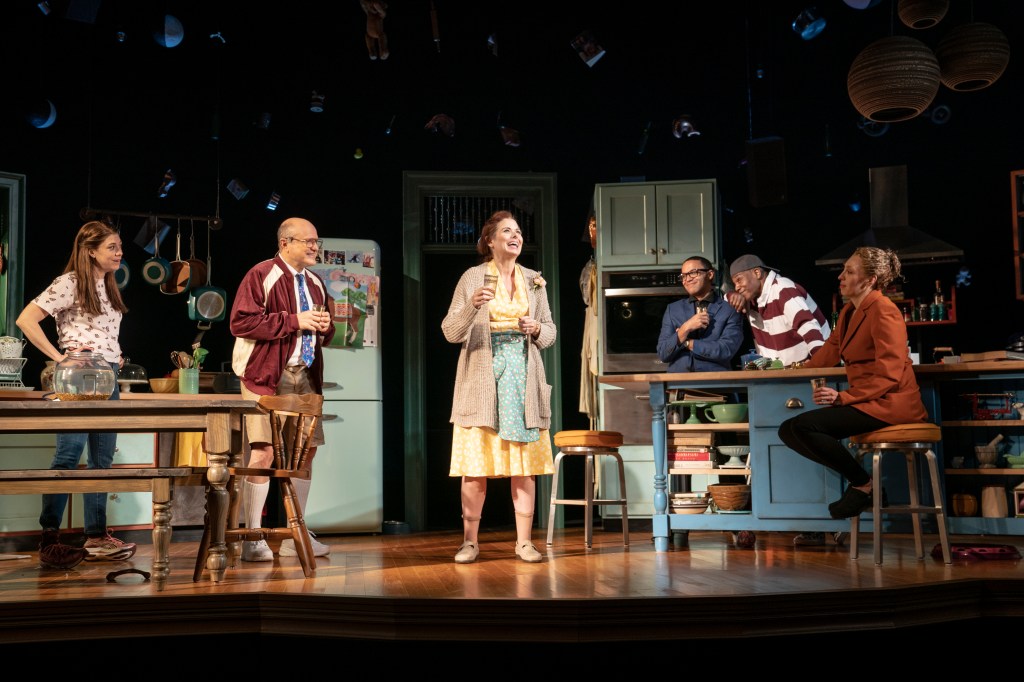
Birthday Candles by Noah Haidle, directed by Vivenne Benesch allows Debra Messing to shine as the aging Ernestine who moves from 17 to 107. As she traditionally bakes her birthday cake, over the years, first taught by her mom Alice (Susannah Flood), she gradually understands that she can only realize her dreams by being herself. And all along, getting married, raising a family, getting a divorce and finding the love of hr life, she has achieved her goal, taking her rightful place in the universe.
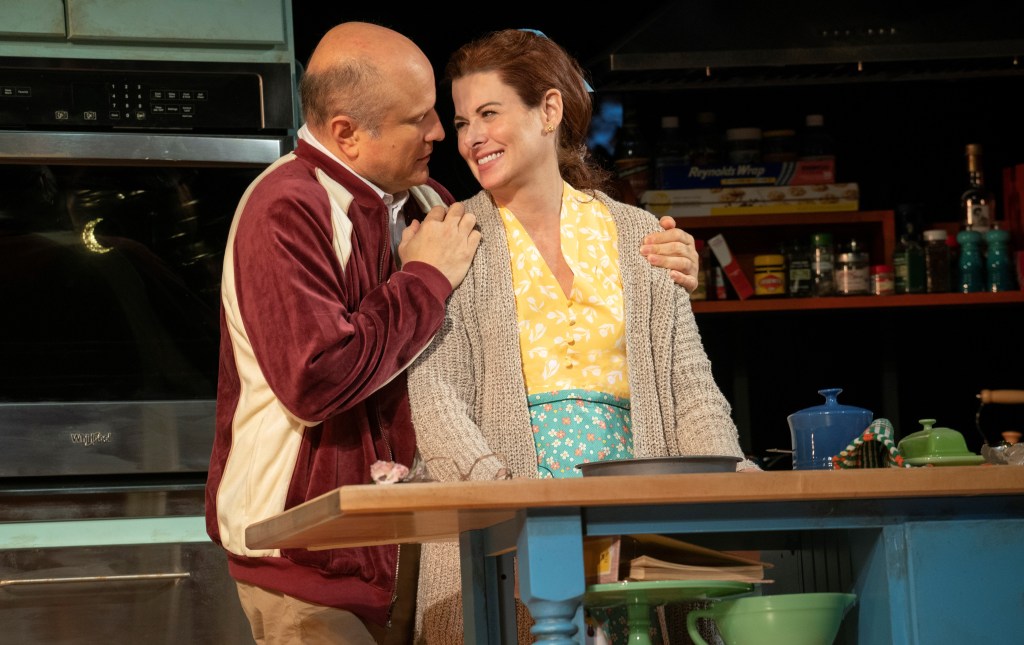
Haidle’s Birthday Candles, at the Roundabout’s American Airlines Theatre, is poetic and complex with multiple themes. The most salient one focuses on Ernestine’s spiritual journey as the “every woman” sustaining emotional pain, trauma, loss, moving from weal to woe and finally reconciling a belated love with great joy in her 80s. As she moves quickly through time, she “looks through a glass darkly” without understanding, until she finally accepts the love and divinity in herself in her relationships with her family and partners. By her 107th year, she misses everyone and wishes them back as she has each time she gives the one passing (mother, daughter, son, grandchildren, etc.) up to the cosmos. Finally, her family spiritually appears and it would seem waits “in the wings” for her to accompany them on the next leg of her journey with them.
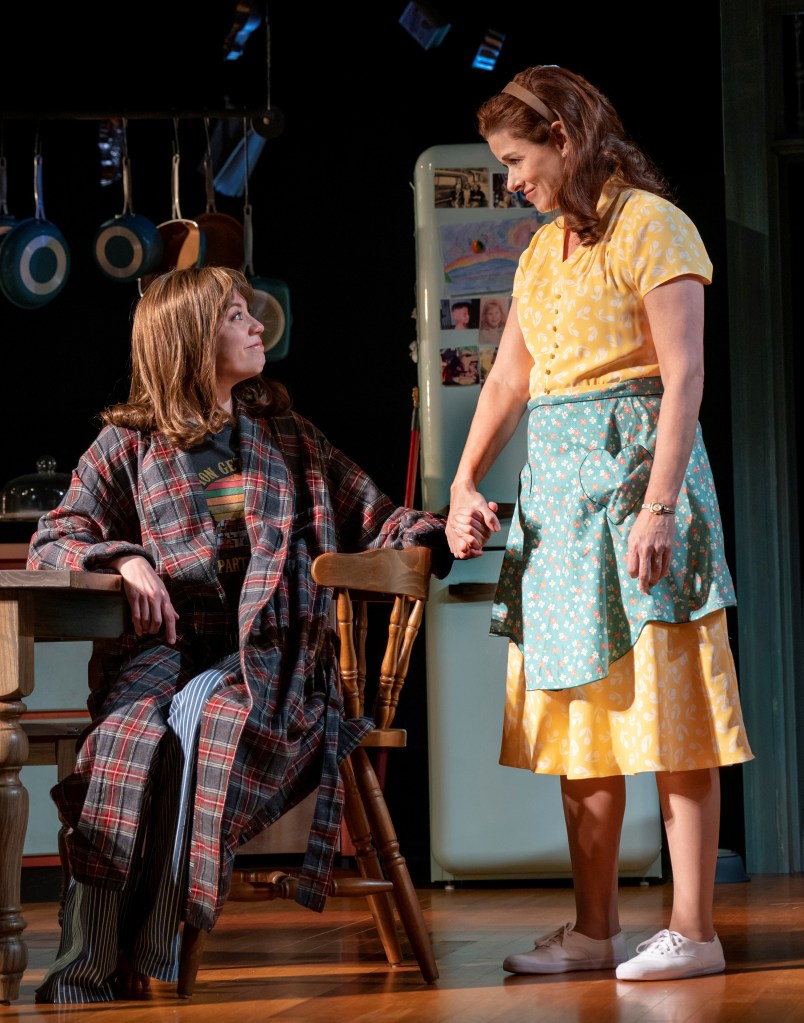
Haidle’s conceit about time and life’s passage in the “twinkling of an eye” (in the play 90 years in 90 minutes with some decades speeded up and others truncated) is most wonderful holistically as the characters live in the moments which they can’t fully appreciate. In this play the adage “life is short” is on steroids. Indeed, living one’s life while observing it alters it (a very rough comprehension of the Uncertainty Principle).
Thus, dramatically the play magnifies each character, present in their most vital of moments with Ernestine to heighten her life’s purpose in being herself, a mosaic of moments which come together at the conclusion. It is then that the audience and Ernestine reflect upon her life’s work and the revelation of Ernestine’s beauty is clarified. Of course, at that juncture when her work is finished, she moves to another realm in the starlit space/time continuum.
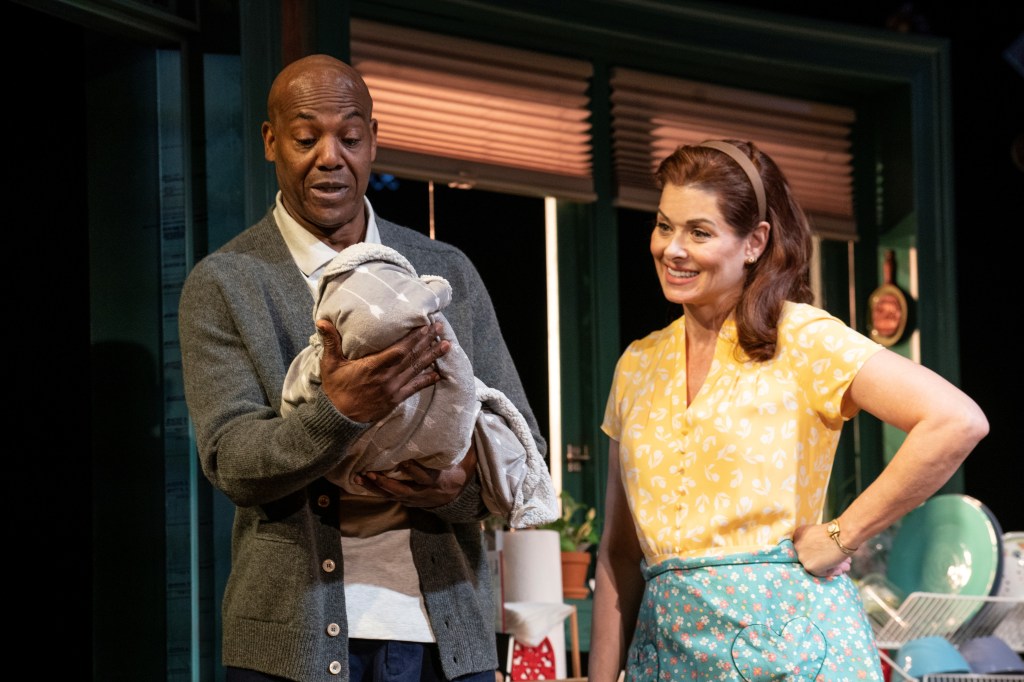
With the exception of Messing’s Ernestine, the actors portray multiple generationaly linked roles from mother Alice (Susannah Flood), to great grand daughter Ernie (Susannah Flood) with husband Matt (John Earl Jelks), son Billy (Christopher Livingston), daughter (Susannah Flood), grandchildren and forever sweetheart Kenneth (impeccably played by Enrico Colantoni). All these escort Ernestine through the years.
The dialogue and sounding of a bell for the passage of time clues us in to each generation as they come to celebrate Ernestine’s birthday while she bakes her plain butter cake over the 90 minutes of the play. Though birthday candles are never placed on top of the cake, nor is it iced, the title is enough. Indeed, Messing as Ernestine is both the icing and the candles, her soul and spirit, which are invisibly lit for eternity.
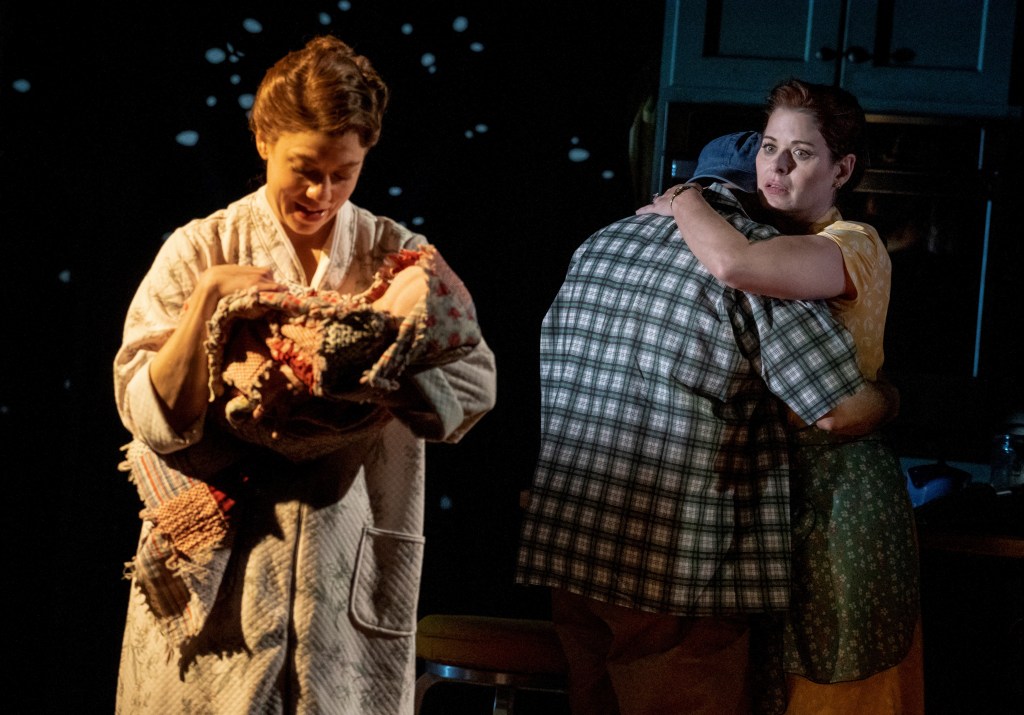
Importantly, every word of the dialogue is paramount and must be heard to appreciate Haidle’s depth of meaning, the poetry, the wisdom, the beauty and the sweet golden threads that bind from one generation to the next. In the performance that I saw (Wednesday evening), sometimes the dialogue was muffled and the words, not projected, slung together like a nondescript house salad without dressing. This was tragic because Haidle’s play is brilliant and achingly timeless and heartfelt. The humor is multi-layered and ripe. The conflicts which (if the actors don’t enunciate precisely) appear rather sparse. However, upon review, they are exceedingly well drawn and acute in each twinkle of time over the fast procession of years that transpose and spool Ernestine’s life.
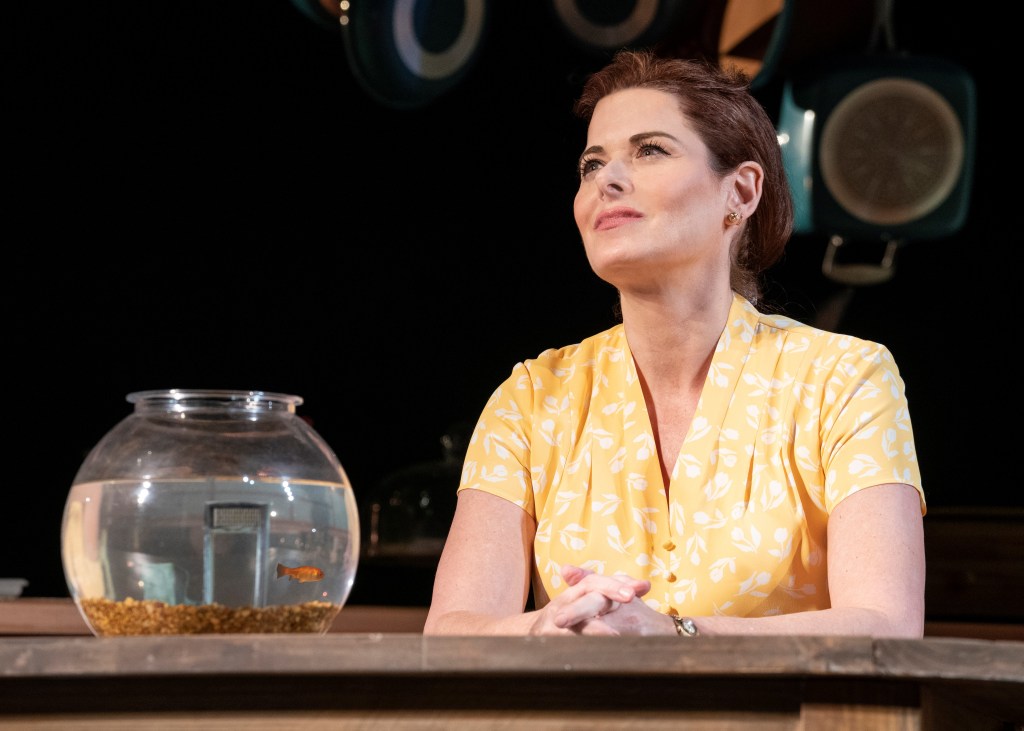
Messing who is an accomplished TV (“Will & Grace”), film (The Mothman Prophecies) and stage actress (Outside Mullingar) is in her glory onstage throughout with “no rest,” (a meme in the play), a veritable tour de force. She is strongest and most poignant in the section of the play when Ernestine reaches a ripe seventy. She has negotiated life on her own terms, has become an entrepreneur, traveled to far flung places and is only taking care of herself. It is then when her granddaughter Alex (Crystal Finn) introduces the next surprising chapter in her spiritual evolution and she learns about reconciliations and renewals, and the fruition of faith and love.
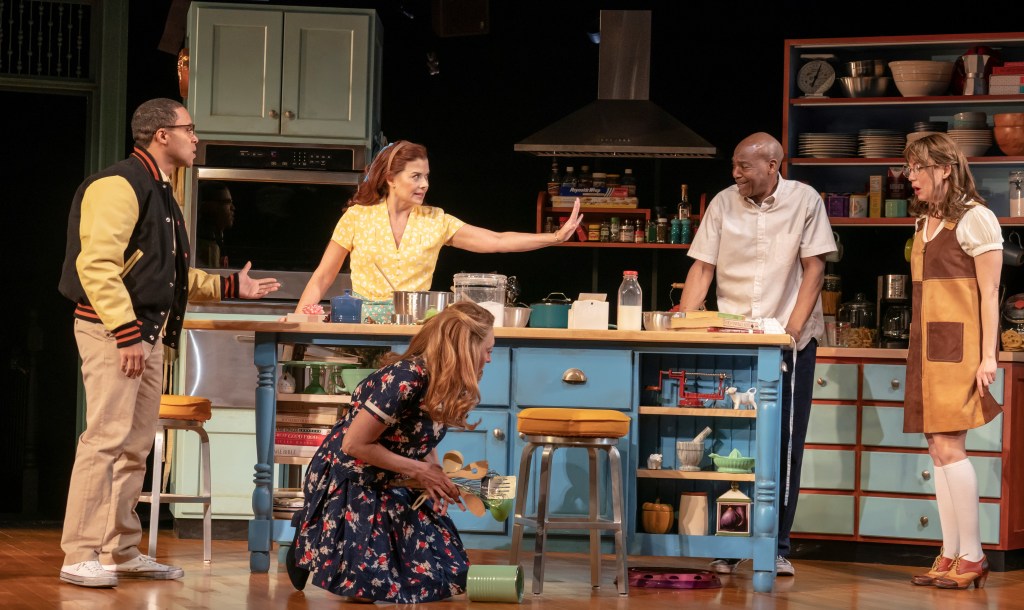
Enrico Colantoni and Messing create the emotional grist for this section of the play which brings a sigh of relief to audience members and shouts from her children. They are truly stunning together and force us to look at those elements that Haidle insists upon in Birthday Candles, the spiritual, the ineffable, the timeless, the eternal. Their relationship which has been growing unseen for Ernestine, always felt to Kenneth, is breathtakingly conceived by the playwright, authentically manifested by Messing and Colantoni. It is the high-point, and Haidle has cleverly made us wait for it, so when it comes we are happily stunned and gratified.
Kudos to the cast when they projected (Colantoni and Messing had no problem) and the creatives: Christine Jones (set design), Toni-Leslie James (costume design), Jen Schriever (lighting design), John Gromada (sound design), Kate Hopgood (original music).
Birthday Candles is on limited engagement. See if before May 29th when it closes. For tickets and times go to their website: https://www.roundabouttheatre.org/get-tickets/2021-2022-season/birthday-candles/performances
‘Take Me Out,’ the Revival Strikes Deep With Bravura Performances by an All-Star Cast
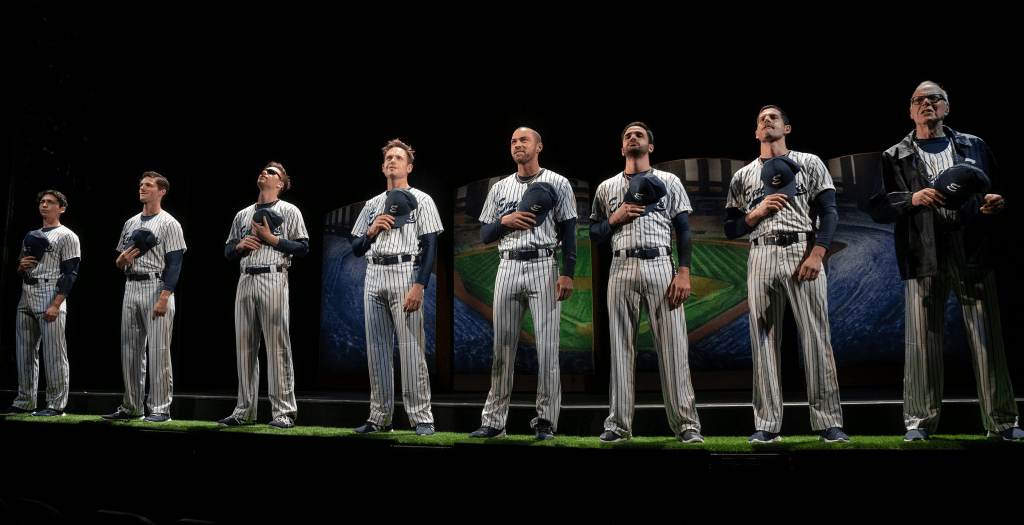
Once again, twenty years later, Take Me Out, the revival for the love of baseball running at 2nd Stage, strikes a pacing home run with bravura performances by Jesse Tyler Ferguson (Mason Marzac), Jesse Williams (Darren Lemming), and Brandon J. Dirden (Davey Battle). Richard Greenberg’s dialogue in the minds, mouths and hearts of the cast never seems more acute, dazzling and dangerous in this “piping time” of Red State/Blue State, as he pumps up the themes of machismo, homophobia, religious bias, gender bias, racism, identity conflicts with color blindness, celebrity privilege, corporate hypocrisy and much more. The second act really takes off, soaring into flight after a perhaps too long-winded first act, whose speeches may have been slimmed a bit to make them even more trenchant and viable.
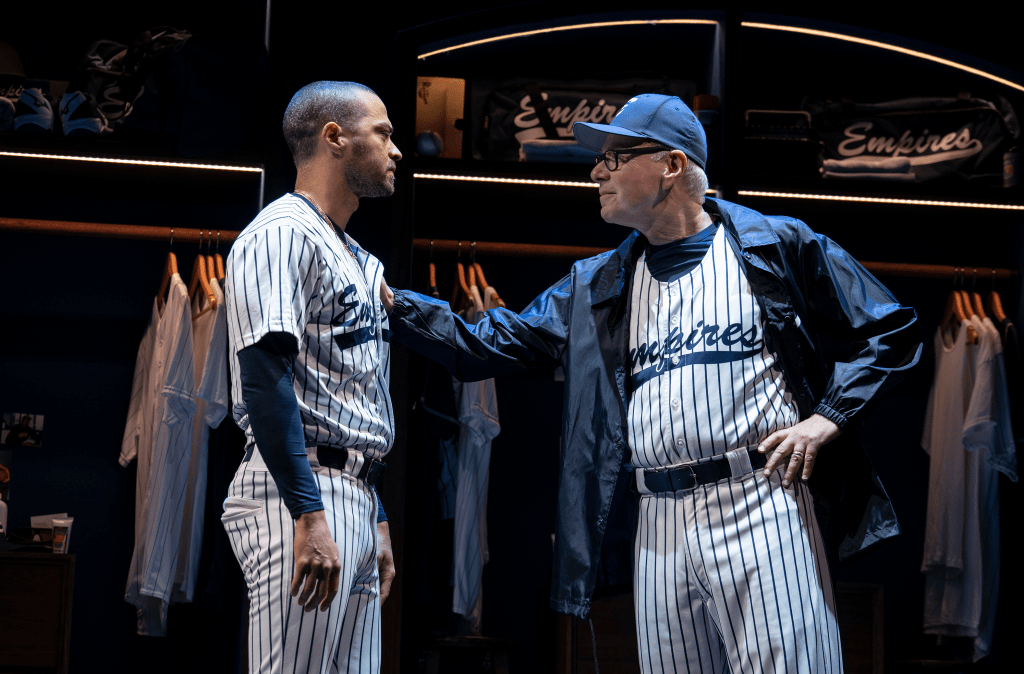
There is no theme that Greenberg doesn’t touch upon which is current and heartbreaking, except #metoo. That is refreshing because one’s personal rights vs. accountability to the public good are paramount to all spirits inhabiting various bodies whether male, female, transgender, or other. The importance of human rights, human decency and love are crucial in this play because the incapacity of all the characters to embody these qualities remains one of the focal points.

Finally, one does hope that the success of the production will remind all lovers of baseball (the most American of games), that it is the only sport where an active major league player has not come out as gay. As a matter of personal choice and risk, of course, such a decision would be momentous as it becomes for the star of the Empires (think Yankees), Darren Lemming, superbly played by Jesse Williams.

Scott Ellis’ direction is spare and thematically charged. Importantly, “sound” (thanks to Bray Poor, responsible for sound design), heightens the excitement. The emphasis is on the crack of the ball on the bat and the cheering fans. The lighting (Kenneth Posner), is spare. Florescent thin blue lines, representing team colors, square off the space to suggest the players’ emotional confinement. The staging elements rightly place front and center the social dynamic, arc of development and relationships between and among the players.
Initially, team camaraderie is thrown into disarray by Darren Lemming, who drips gold from his pores and walks upright in perfection but admits to being gay. His proclamation sends ripples of “shock and awe” through his envious teammates, who worship Lemming’s “divinity,” his steely cool demeanor and very, very fat salary,

We find his teammates response to be humorous. In order not to appear femme they restrict all their male “locker-room” behaviors because they don’t want to “entice” Darren into thinking they are his sexual “kin.” Only Kippy, his self-appointed buddy and narrator who tells part of the story (the fine Patrick J. Adams), chides him for not alerting anyone before his press announcement. Afterward, Kippy humorously teases his friend that the team lionizes who he is and would love to “be him” or “be with him,” on the down low, except that he is now very public. And that would make them very public. So they must keep their distance. Darren is annoyed at this new leprosy which he never experienced or thought he would experience because he is who he is, the team’s greatest.

Meanwhile, Darren’s announcement has forced all to confront where they stand with their own sexuality and sensitive male identity, which Kippy suggests reveals latent gay repression, and Darren suggests is the opposite. From the initial conflict, the Empires go through a roller-coaster of events and emotions that Darren didn’t foresee when he blithely walked between the raindrops and dropped the bomb on his team and Major League Baseball, assuming that because he could handle it, they should handle it.
When it comes to his devoutly traditional Christian friend Davey Battle (the always excellent Brandon J. Dirden), Darren has a blind spot. Instead of quietly discussing his sexual orientation with Davey, a misunderstanding ensues when Davey encourages him to be himself and be unafraid.
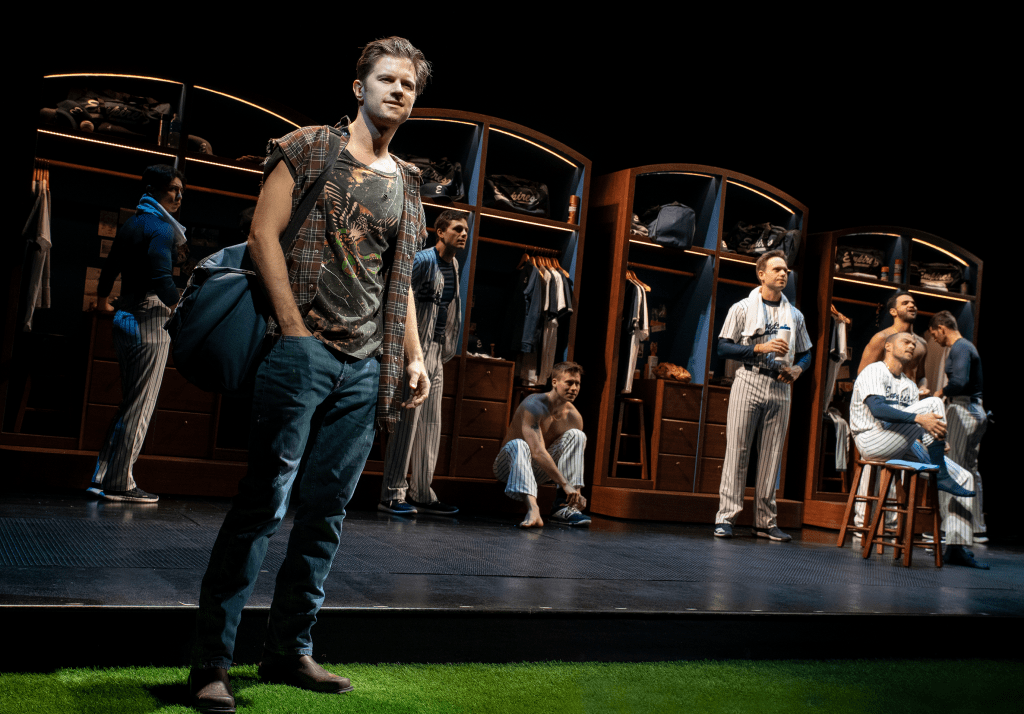
Where certain Christians are concerned, being gay is another feature of Christ’s love. Darren assumes that especially with his devout Christian friend, Christ’s love means acceptance. Greenberg holds back the mystery of Davey’s and Darren’s conversation about his being gay, revealing its importance at the end of Act II, when the stakes are at an explosive level. When we discover the identity of the individual who overhears their conversation is a witness to “the event,” we are surprised at the superb twist. Immediately, we understand the conversation happened. There is no way the “overhearing witness” would be lying. It is this conversation that becomes the linchpin of uncertainty, a tripwire to set off questions with no easy answers. There is no spoiler alert. You’ll just have to see this wonderful production to find out the importance of the witness to the conversation.
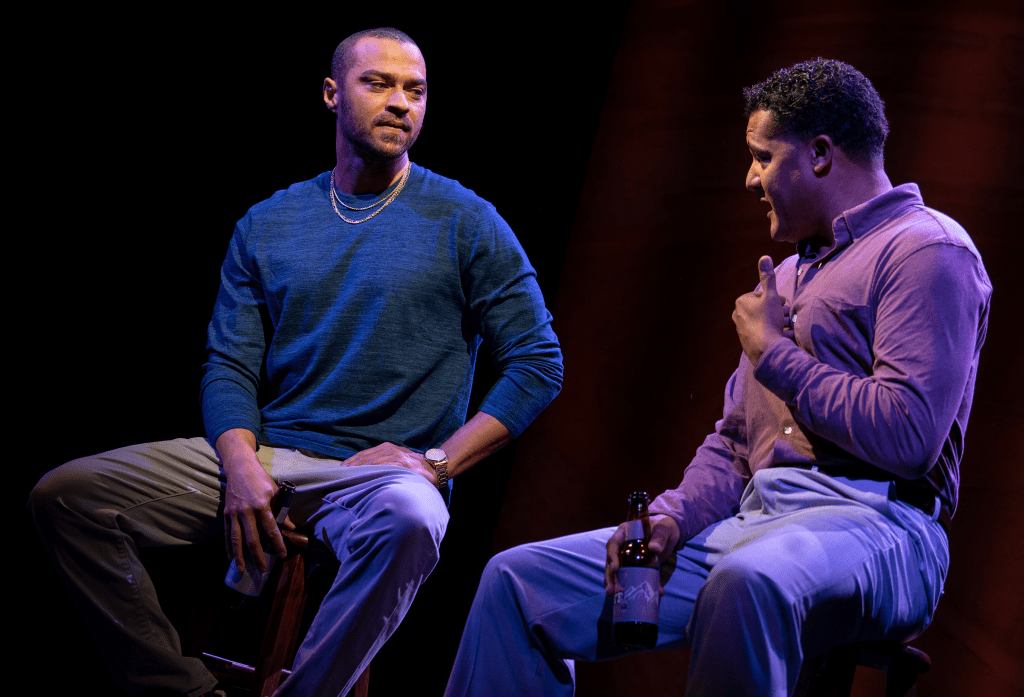
Greenberg covers all his bases with runners in this take down and resurrection of America’s “favorite past-time.” There is personal locker room talk where nude teammates “let it all hang out,” as they shower and face-off against each other, responding to Darren’s announcement and humanizing him because of it. Greenberg’s wit and shimmering edginess work best, revealing his spry characterizations in the banter between Kippy and Darren, and in the growing friendship between Darren and his new financial advisor Mason Marzac, the superbly heartfelt and riotous Jesse Tyler Ferguson. As the consummate outsider who becomes a fan, the character of Mason has the most interesting perspective on baseball, the gay community and the events that happen in real time that result in an unresolved tragedy.
Marzac, meets with cool, collected Darren after the celebrity star outs himself. Ferguson’s Marzac is humorously over the moon about Darren’s courage, his performance and the game. Darren states coming out was not “brave,” unless one thinks something bad will happen, because “God is in baseball,” and Darren is in baseball. And “nothing bad happens to Darren.” This Icarus is flying high. He takes advantage, surreptitiously, smoothly crowing about his stature which outshines his teammates and especially the awe-struck dweeby, unathletic, unbuff Mason.

Of course, the conversation carries tremendous irony in hindsight, because like Icarus who gets burned and crashes to the earth, so does Darren. How Greenberg fashions this is surprising and ingenious. Interestingly, not only does Darren take the team with him emotionally and psychically, they are rewarded despite their corrupt Machiavellian machinations to achieve a win. The irony is heavenly. It is Greenberg’s device, savvy and sardonic, which speaks to theme. Sometimes when you win, it’s not a win if your heart breaks and there are no friends or teammates you can share it with because of emotional separation and alienation. So for the team and especially Kippy and Darren, the win becomes a grave loss that no one can ever appreciate, except baseball idolator, Mason.
But I get ahead of myself praising Greenberg’s irony.
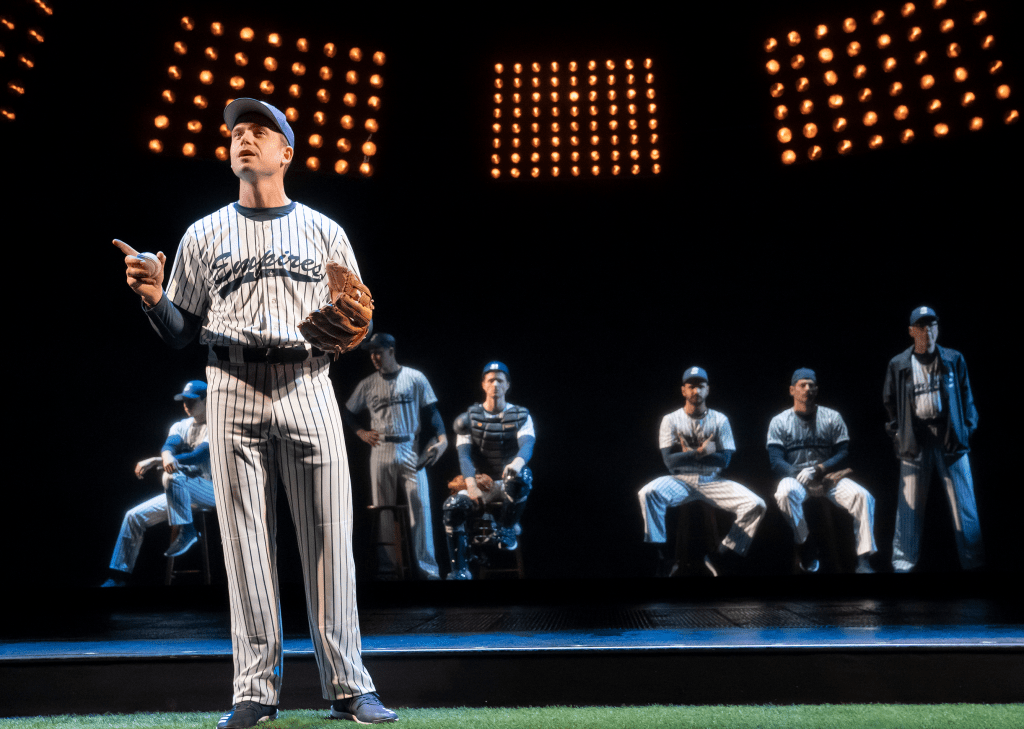
As they discuss Darren’s financial picture, Darren clues Ferguson’s Mason in to the finer points of baseball appreciation, for example to keep “watching” the number coincidences. There’s “a lot of that,” Darren implies as Mason rattles off wondrously, “…the guy who hit sixty-one home runs, to tie the guy who hits sixty-one home runs, in nineteen sixty-one, on his father’s sixty-first birthday.” Mason is ignited by speaking to the amazing and surprisingly gay Darren.
Ferguson shines in his Mason portrayal, as he excitedly waxes over the Americanisms of the game, as pure egalitarian democracy. He emphasizes that everyone has a chance when they get up to bat. But then he states that baseball is more mature than democracy. This comment coupled with the arc of development is an incredible irony considering the team takes in a crackerjack pitcher, Shane Mungitt, who is one of the more florid Red Necks to ever appear on stage. Michael Oberholtzer’s Shane is breathtaking, a stellar, in-the-moment portrayal of a bigot you can actually feel sorry for.
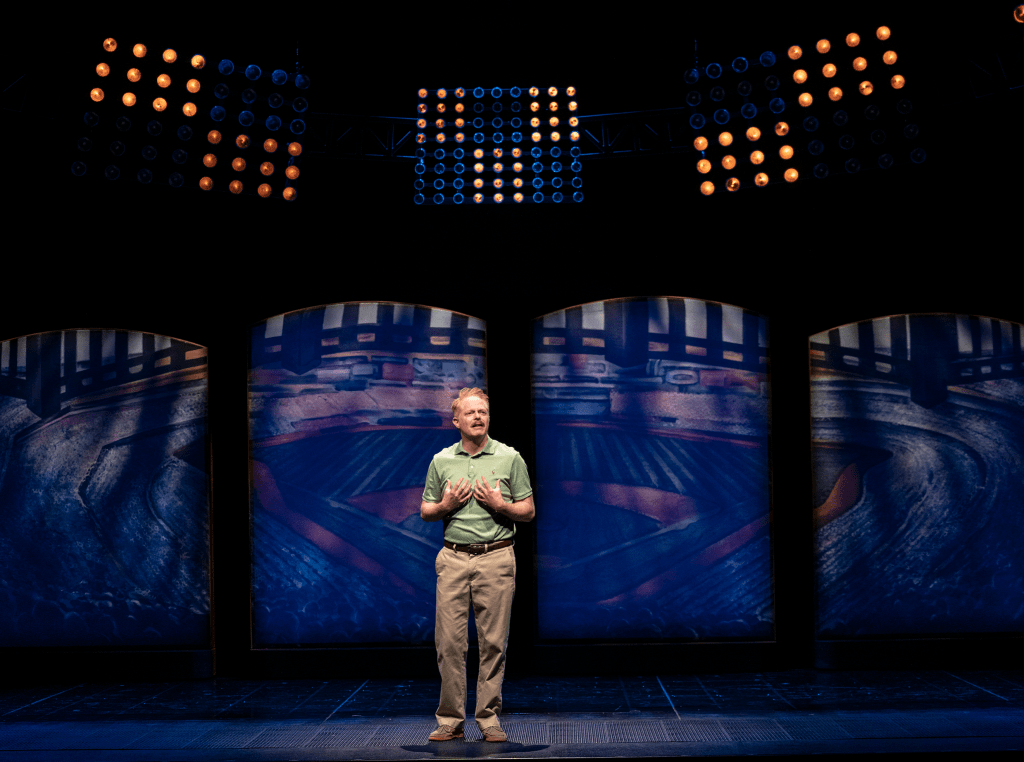
Ferguson’s superbly rendered soliloquy about baseball opens a window into Mason’s kind, perceptive and loving nature. He effusively and humorously describes the requisite home run as a unique moment: the game stops and there is a five minute celebration of cheering time for the fans and the hitter, who rounds the bases like a king, though the ball has long spiraled out of the stadium into the universe. From watching the completely unnecessary round of the bases, Mason says, “I like to believe that something about being human is good. And what’s best about ourselves is manifested about our desire to show respect for one another. For what we can be.”
This is the crux of the play because after this eloquent and high-minded speech, everything falls apart. The winning streak of the Empires, the team relationships, the friendships between Davey and Darren, and between Darren and Kippy implode. And sadly, the once silent, “mind my own business” Shane unravels into a hellish state, careening into the other players with a vengeance that he may not be responsible for, given his upbringing. Thus, not even a winning season saves them from the inner reckoning they have brought upon themselves. If this is America’s favorite past time, it would be better to go back to reading.
Greenberg gives his play’s coda to Mason, who has “evolved” into a baseball aficionado. As such he is brimful of hope, yet ironically perceptive. A tragedy has occurred. However, for him the greater tragedy is that he has to wait a whole half year for the season to begin again. Baseball is that tiny thing that takes one out of the misery of life and makes it worth living, even with its tragedies. In Take Me Out, that is true for the fans. For the players, what occurs is an entirely different and terrible consequence.
Kudos to Scott Ellis’ direction and his shepherding of cast and the creative team. These include Linda Cho (costume design), David Rockwell (scenic design), and others already mentioned. Scott Ellis and the cast have delivered a profoundly humorous and vital, resonant work about a game played throughout our country, revealing that no one, regardless of how we prize sports figures, is worthy of the greatness of the game itself.
For tickets and times go to the website: https://2st.com/shows/take-me-out?gclid=Cj0KCQjwjN-SBhCkARIsACsrBz798inP5l5pUV7hZGFHOj0rWRI1spG27oalp8HyLfnArPnBlPauavsaAkcwEALw_wcB
The ‘Plaza Suite’ Snark is Disingenuous #metoo

In his snarky review of Neil Simon’s Plaza Suite, the New York Times’ critic’s “clever,” oh so “entertaining” disposal of the John Benjamin Hickey production into the garbage bin of hideous fustiness seems misguided. To the critic’s dunning I shout, “Au contraire!” The production starring Matthew Broderick and Sarah Jessica Parker offers a unique, glimmering reflection of the past. It is a past that we need to be reminded of. If one peers into that reflection, and considers the interactions of the characters, one sees how intelligent females bested their male counterparts with surreptitious abandon, superior wit, and brilliant irony. If one’s view is dim and dark, like the NYT critic, one sees little.
From my humble female perspective, one also considers via this production, that between then and now, with all of the hell raising and insistence on progress, and change between straight men’s and women’s relationships, nothing much has changed. Don’t believe me? Have you read any good Evangelical books lately? Have you lived in the South for any period of time, recently? All right, maybe that doesn’t make sense to you.

Well, I will remind you about that pesky statistic (one in four women are violently abused by their partners), that has yet to budge off its number. Abusing females is alive and well, and that’s despite #metoo which is a meme that only applies to the celebrated, rich and famous, including well-paid male theater critics. In plebian circles if a woman attempts to speak up, a hand often goes upside her head. And what happens after that is anyone’s guess.
That Simon exults in the superiority and cleverness of each of the female characters in the play is lost on the critic which is understandable as he is not a female. He is a male looking in and once again judging the female characters and finding them and the production fusty, dusty and musty. Unfortunately, he shallowly superimposes his #metoo version of the female perspective on the characters, thus making the push to be politically correct all the more hypocritical and disingenuous. And frankly some of it is nonsensical, though there appears to be “logic” in what he is doing because the piece is well edited. Is his editor a male too?
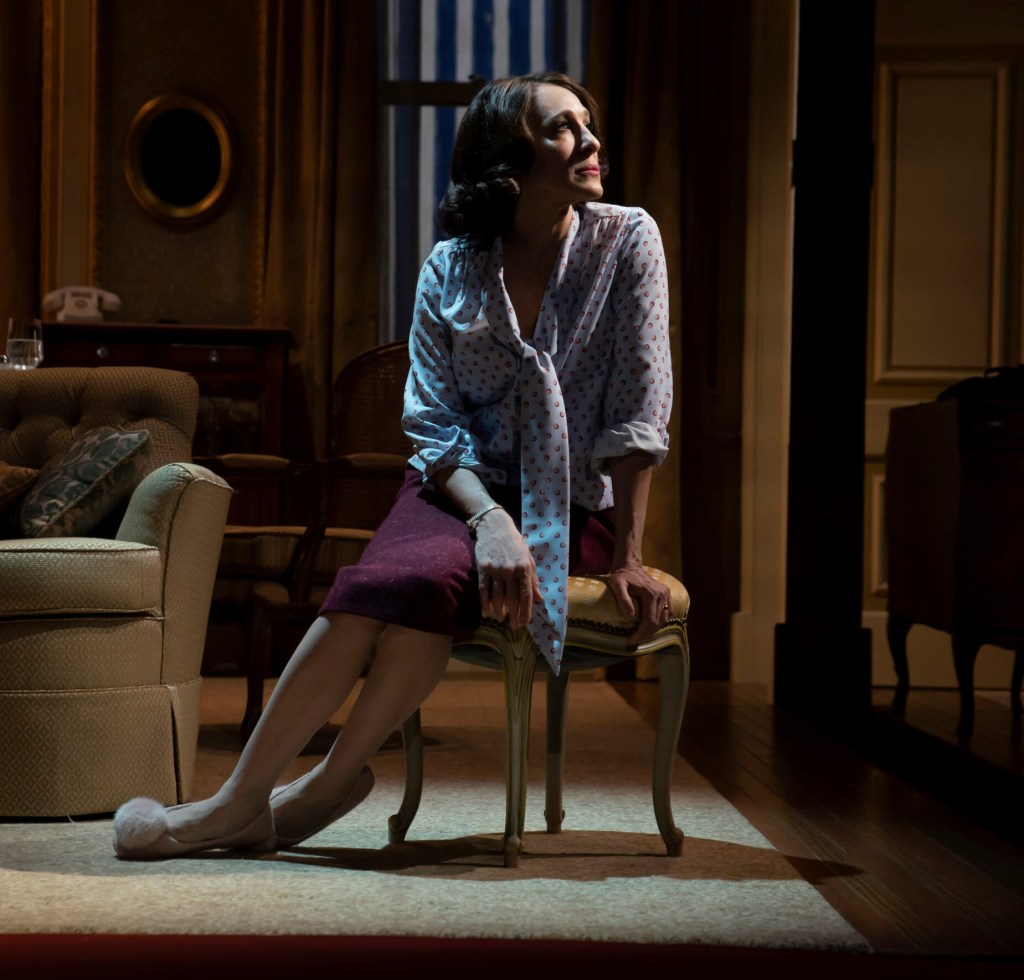
Ah, forget what I just stated. Be overwhelmed by the “smart attitude” of the New York Times critic who displays his own “genius,” sense of privilege and arrogance via his male writerly superiority, which is nowhere near the genius of say, Gore Vidal (a favorite of mine). So caught up in admiring his style in the mirror, he misses the themes and the currency of Hickey’s vision. He also misses the fact that relationships between men and women have gone nowhere because human misunderstanding and fear and inability to confront death and lies by keeping them at bay through self- manipulation is an everpresent fact encompassing the relationships, in Plaza Suite.
But none of that was picked up by the critic to whom the 1960s was such a thing of the past, it doesn’t exist in his imagination; nor does he appear to want to be reminded of it, if it did exist.

Instead, what is of great importance to him, it would seem, is bowing to politically correct memes. Tragically, that is a blindness and acute hypocrisy. Currently, I boycott the New York Times. I am tired of the same pap from this particular NYT critic whose dullness would be raw meat for Noel Coward, if he were alive. I stumbled upon the review clued in by a studio professor, and well-produced playwright who mentioned the tenor of the review because he knows such pablum makes me livid.
The privilege he displays is a long-held tradition at the New York Times. Females, largely absent in theater as critics, directors, etc., commented upon by Director Rachel Chauvin in her acceptance speech for Hadestown is an example of how #mettoo doesn’t work in the theater world. Perhaps the reason is that female critics and reviewers are not #metoo politically correct enough. Perhaps females don’t remind us enough that various productions are not “politically correct.” Shall I discuss LGBTQ?

Truly. Perhaps for future productions directors and producers should wipe out the canon of plays written before 2017 and #metoo, etc., as worthless. What could possibly be learned from them?
Indeed, if critics are to genuinely benefit audiences who see plays, then they must perceive, think and above all go deep. First, understand what the director’s vision is. Is the director presenting that which on first assumption perhaps the critic didn’t get? Does it pass the audience test?
The night I saw the production, Plaza Suite did pass the audience test. They enjoyed it. Thus, I agree to disagree with the NYT and the Wall Street Journal critics. The below review, which also appeared in Sandi Durell’s Theater Pizzaz explains why.
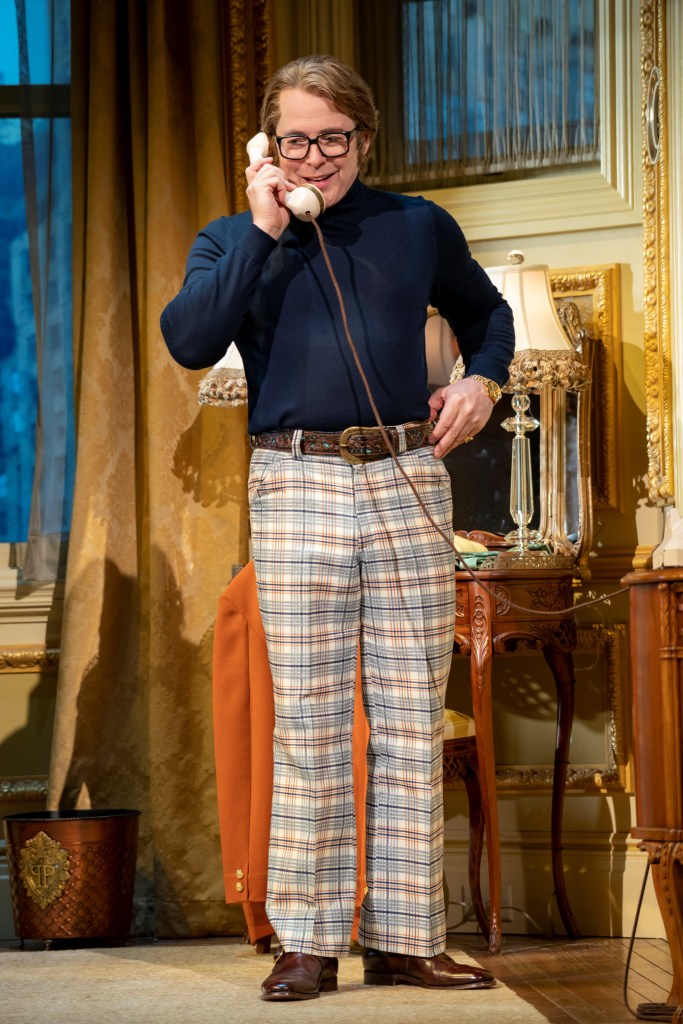
My Review of Plaza Suite: A Female Perspective
Judging by the applause as the curtain lifts and John Lee Beatty’s luxurious, shimmering set for Plaza Suite unveils, director John Benjamin Hickey’s glorious throwback to the gilded Broadway of “yesteryear,” intimates a night of enjoyment. Coupled with its second harbinger of success, enthusiastic cheers at the entrances of the husband-and-wife team Sarah Jessica Parker and Matthew Broderick, the Neil Simon revival emblazons itself a smash even before Karen (Parker) and Sam (Broderick) have their first disagreement.

Not one moment falters in the pacing or mounting crescendo of hilarity in this superbly configured production about a suite of rooms (a conceit knock-off of Noel Coward’s Suite in Three Keys). There, visitors from Mamaroneck, Hollywood and Forest Hills play out their dreams and face their foibles in room 719 at the historic Plaza Hotel. That the place is still standing is a source of Simon witticisms.
Apparently, rumors of its being bought over by rapacious developers to be torn down making way for state-of-the-art buildings even existed at Simon’s writing. The theme of the ugly new replacing the beautiful old and historic as a pounding mantra of New York City is everpresent and a sometime theme in the triptych of playlets about couples.
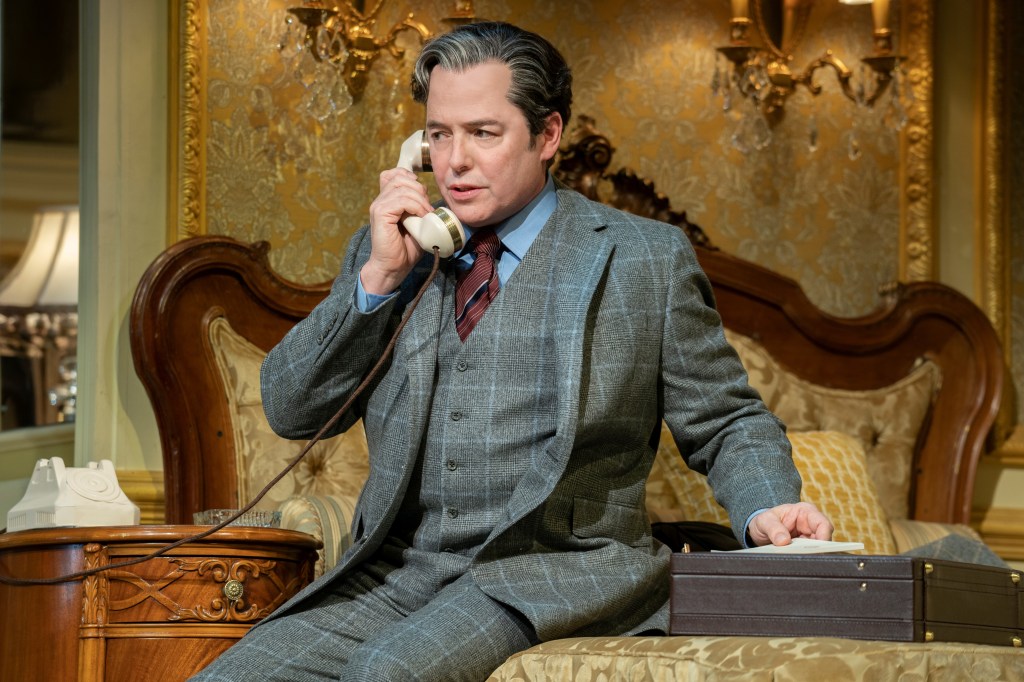
Hickey shepherds Parker’s and Broderick’s performances, delivered with “effortless” aplomb, gyrating from one comedic flourish to another to the amazing farcical finale. Authentically and specifically (gestures, mannerisms, presence, posture), they hone the characterizations of three disparate couples, breathing into them the humanity we’ve all come to love and loathe. We didn’t want the fun to end, and it was apparent that neither did they.
The few times they broke each other up or comfortably ad libbed, they let the audience in on the endearing fact that they were having a blast. That mutuality between audience and performers was doubly so because they’ve been waiting to perform for two years of COVID hell. Happy to be back in front of a live audience, their enthusiasm was communicated by the ineffable electricity that happens in live performance and changes nightly because of the audience’s diverse sensibilities. The performers vibrated. The audience vibrated back. The circle completed and rolled around for the next laugh which topped the next.
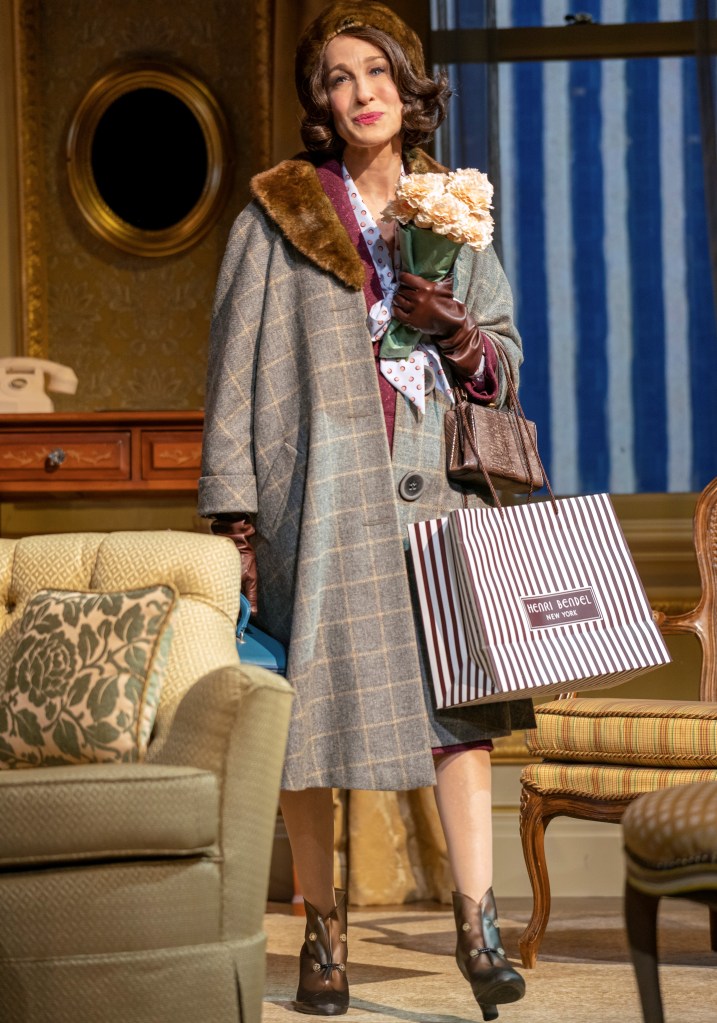
Ingeniously entertaining, incredibly performed, Plaza Suite at the Hudson Theatre which runs for a limited engagement is a spectacular winner. Here’s why you should see it.
Though Neil Simon’s concept that he lifted from Coward has been reshaped and used by playwrights and screenwriters since the 1960s when Simon wrote Plaza Suite, the production gives it a unique uplift because of its specificity and attention to detail. Importantly, viewed through a historical lens, the relationships, character intentions and conflicts ring with comical verities. Wisely, Hickey allows the characters inhabited by these sterling performers to chronicle the values and folkways of the sixties which were a turning point in our society and culture. The understanding that arises from Simon’s exploration suggests why we are where we are today.
Finally, using humor the play deeply touches on seminal and timeless human topics: fear of aging, seduction, loneliness, marriage unsustainability, the generation gap and more.
In the first playlet, Karen’s Mamoneck housewife chafes in a relationship which she unconsciously senses has soured. She books Suite 719 to celebrate her anniversary with Sam and ironically initiates the reverse.

Listening carefully and watching Parker’s Karen, noting her plain outfit and hairstyle and comparing it to Broderick’s Sam, the laconic, dapper, sharp, appearance obsessed businessman, we should anticipate what will happen. We don’t because Simon’s keen, witty dialogue of thrust and parry between Sam and Karen keeps us laughing and because the performances are so spot-on, in the moment, we, like the characters, don’t know what’s happening next. However, of course, Broderick and Parker do. Yet, they are so alive onstage, that the characters’ reactions remain a surprise and the revelations are unanticipated.
Karen’s ironic subtext brilliantly digging at Sam to confess he’s having an affair is wonderful dialogue expertly delivered. A few of Parker’s lines bring down the house with her sharply paced delivery. One is her crackerjack response to Sam’s “What are we going to do.” Without a blink Parker’s “You’re taken care of. I’m the one who needs an activity,” receives audience whoops and hollers. An age-old event of cheating and adultery is born anew.
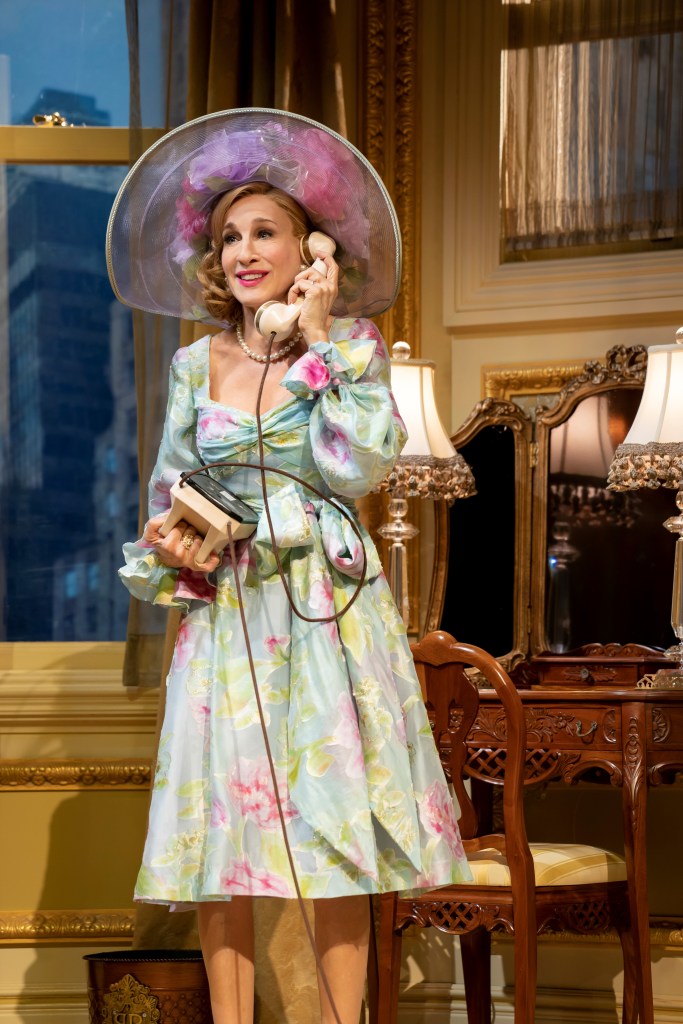
Simon’s snapping-turtle dialogue in the face of today’s hackneyed insult humor is wickedly scintillating. In the Hollywood seduction playlet, High School sweethearts become reacquainted. Broderick’s smarmy Hollywood producer Jesse Kiplinger decked out in his Mod finest is a classless nerd who confesses his unhappiness with the Hollywood slime set and his three *&$% ex-wives who take not only his money but his guts and soul. Muriel in Parker’s equivalent of her fashionable self in the ‘60s, is enthralled by Jesse’s Hollywood persona, but is in keeping with the innocent, demure women Jesse remembers. The hilarity builds into what becomes a reverse seduction scene by a steaming married woman when they “get down to brass tacks.”
All stops are pulled in “A Visitor from Forest Hills.” The costumes (Jane Greenwood), the hair and wig design (Tom Watson), contribute to building the maximum LMAO riot. The inherent action and zany organic characterizations by Broderick and Parker augment to hysteria when Mimsey refuses to attend her own wedding and ensconces herself in the bathroom.

Norma and Roy implore Mimsey attempting to psychologically manipulate her and each other to get her to come out. Parker and Broderick effectively create the image of their daughter crying, possibly suicidal, as she remains unseen, silent and incorrigible behind the sturdy, unbreakable bathroom door. Desperate to stem a disastrous day, Broderick’s “out of his mind with frustration” Roy even goes out on the ledge and braves a pigeon attack and thunderstorm to wrangle in his wayward child. Broderick’s mien and gestures bring on belly laughs.
What they do to move heaven and earth to get Mimsey to come out is priceless comedy that is easier than it looks. The frustration and fury the actors convey with the proper balance to appear realistic yet crazy and smack-me funny is what makes this over-the-top segment fabulous.
Kudos to the artistic team which includes Brian MacDevitt (lighting design) and Scott Lehrer (sound design). For tickets go to https://plazasuitebroadway.com/
Hugh Jackman’s Indelible, Winning Con in ‘The Music Man,’ Just Unbeatable!’
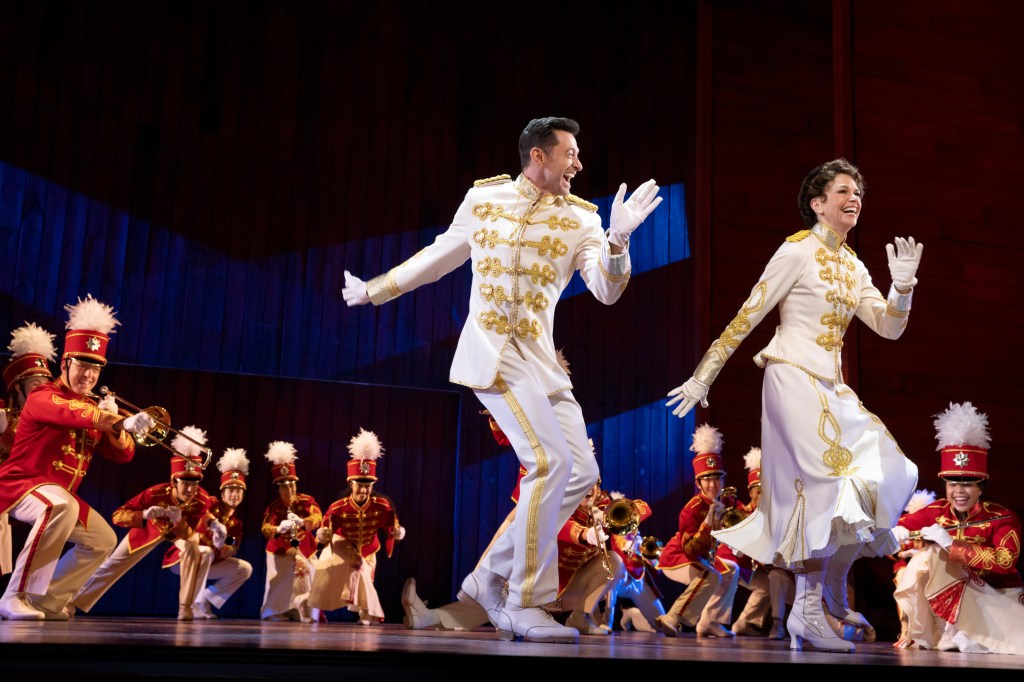
Historically, America is the land of con artists and showmen. Do you know the difference? As a relatable example there is David Hannum who in the 1850s bought the “Cardiff Giant,” a stone statue he unwittingly believed to be real (the giant fake was made in Iowa). As did its previous owner, Hannum charged admission for viewings. When P.T. Barnum (Hugh Jackman portrayed Barnum in The Greatest Showman) couldn’t purchase the Cardiff Giant for $50,000, he made his own plaster statue, called Hannum’s statue the fake, and charged more money, advertising his as the “real” one. Hannum sued Barnum and referring to Barnum’s patrons said, “There’s a sucker born every minute,” not realizing he, too, had been duped. The suit failed when the originator of the hoax “came clean.” Interestingly, all three entrepreneurs probably kept the money “they earned” providing a thrilling show. In keeping with the great cons of America, history is silent about whether patrons got their money back.
This exploration of that type of con is at the core of Meredith Willson’s The Music Man, which I’ve come to appreciate on another level with this revival at the Wintergarden Theatre, starring Hugh Jackman and Sutton Foster. Along with these romantic leads are Shuler Hensley, Jefferson Mays, Jayne Houdyshell and Marie Mullen. All are Tony Award winners. All give humorous, memorable performances in this fanciful, exuberant, profoundly conceived production (directed by Jerry Zaks and choreographed by Warren Carlyle), about small town America, its bucolic, “nothing is happening here” townsfolk, and the burgeoning love between two needy, flawed individuals, who grasp at hope in each other.
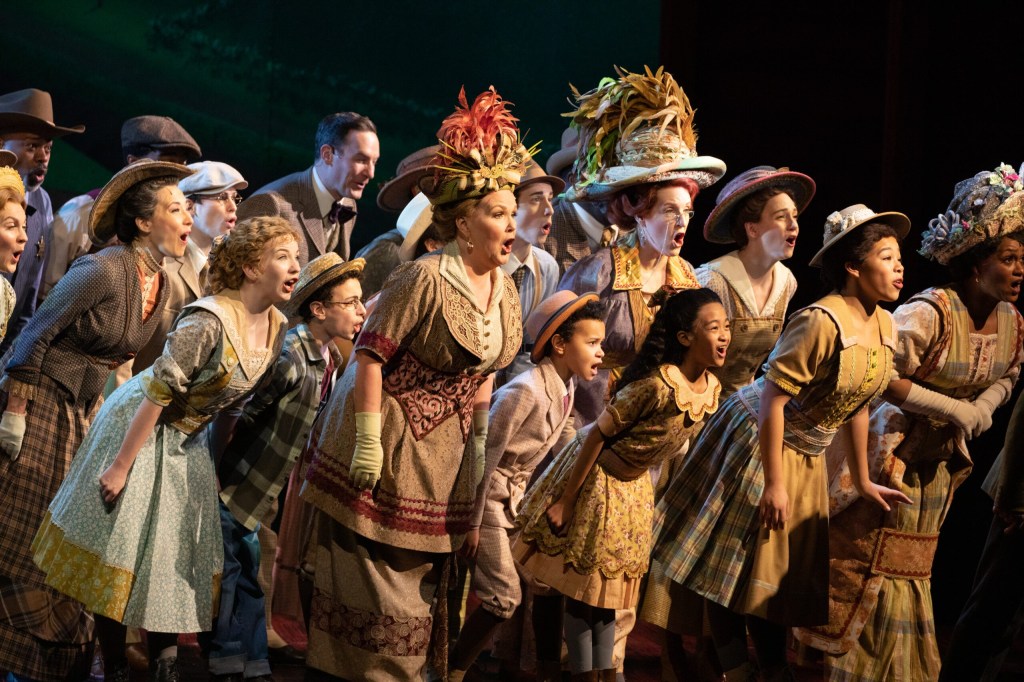
With book, music and lyrics by Meredith Willson and story by Meredith Willson and Franklin Lacey, the great con is spun by a magic-making, uber-talented, artiste extraordinaire that all fall in love with by the conclusion (including the audience). That is all except non-believer, malcontent salesman Charlie Cowell (the excellent, hyper-caustic Remy Auberjonois who was in Death of a Salesman). He’s the “villain” who seeks vengeance to expose Hill as a wicked, flim-flam man.
Hugh Jackman is spot-on in his modern interpretation of the Professor Henry Hill “brand” of “music man.” He and Zaks really get this character, so that Jackman makes it his own, as he exudes the energy-packed, brilliant, larger-than-life, loving individual that you want to stay with, wherever he takes you. After seeing his performance, I believe in pied pipers, who don’t need music to make you theirs.
The criticism that he is not edgy is questionable. If Jackman’s Hill were sinister, few would believe his sincerity in a small town that prides itself on suspicion and being “Iowa Stubborn.” Would the women be so taken with his graceful, smooth, charmingly flirtatious manner? He is a swan among the ungainly, quacking mallards and especially his nemesis, the punchy, exasperated, malaproping Mayor Shinn (the always hysterical and exceptional Jefferson Mays), who gaslights the town with his own con. That this genius craftsman of BS has an irresistible delivery reveals Jackman enjoying expanding the graceful Professor in pure entertainment, with every precious breath and every savvy movement he expends, as he inhabits his refreshing version of Professor Harold Hill for the ages.

Hill’s seductive, adorable, spirited demeanor is dangerously addictive. The happy-go-lucky showman is all about getting others to believe in and enjoy themselves. From that elixir, there is no safe return and the crash, if there is one, is emotionally devastating. How Zaks, Jackman, the cast and creative team spin this rendering is solid and logical throughout, giving this extraordinary revival a different feel, understanding and vision, that should not be underestimated or ignored.
Throughout the dance numbers, which are beautifully conceived with wit and substance, Jackman’s lead is ebullient, light, lithe. This is especially so during his convincing, playful seduction in the number “Marian the Librarian” (Warrent Carlyle’s ballet in soft shoe tempo is just great). Jackman’s sensual, boyish suppleness contrasted with Sutton Foster’s stiff reticence in Marian counterpoint are superb together.
For the song identifying the Iowan’s walled stronghold against strangers (“Iowa Stubborn”), Hill’s great challenge, Zaks stages River City citizens huddled together in a circular clump with stern looks and unsmiling determination. Initially, with Hill they pride themselves on being cold steel like Marian, who is even more icy remote than they are. However, because of Charlie Cowell’s challenge, that Iowa territory is impossible for salesmen, Hill takes the bait and rises to the occasion. He plies his delightful winsomeness with enough sincerity and great good will to surreptitiously penetrate their pride.
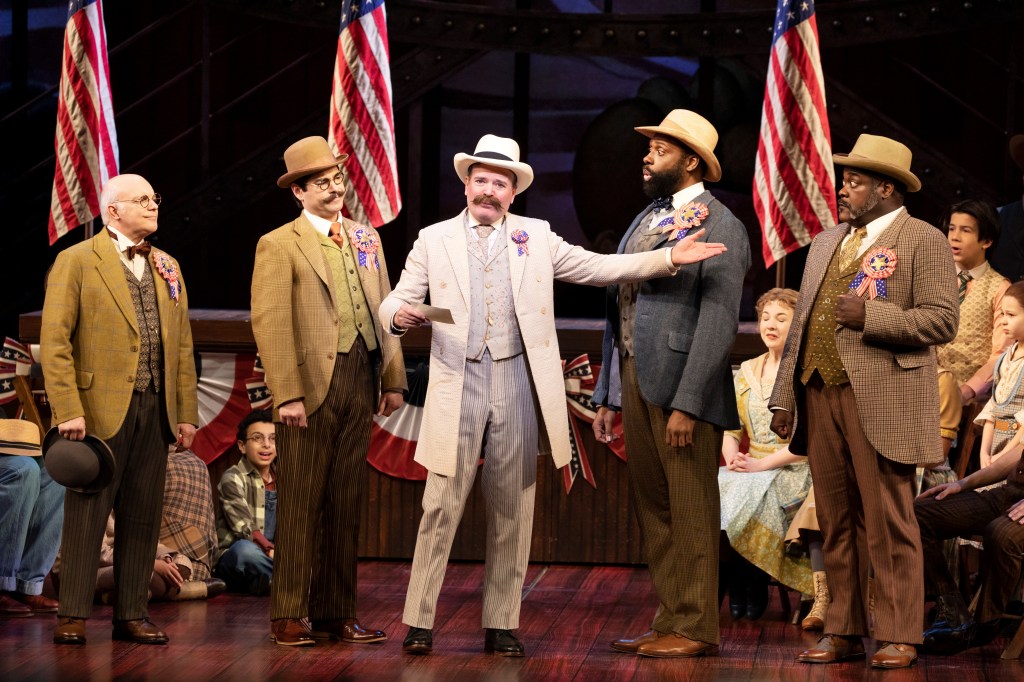
Not only are the townsfolk splintered from their stubborn resolve because of his contagious enthusiasm, his youthfulness retains a sociability that is able to connect with young and old. Indeed, Hill offers them something that no one else who has come to their town has ever offered: happiness, hope, fantasy, the power to believe; to think something is so and it becomes so (the “Think System” re-framed from “the power of positive thinking”). Jackman’s Hill is a practiced master at human nature-buffeted by life’s heart-breaks, that create the foundation in the soul, that hungers to believe in something or someone. Of course, he is a master at this, because he, first and foremost, is starving, a clue to this Hill portrayal, upon which turns the arc of development and all the character interactions. It is also the theme of “Sadder But Wiser Girl,” that he sings in knowing “wisdom” with buddy Marcellus Washburn (the excellent Shuler Hensley).
The brilliance of this production is that Hill’s charismatic delivery of the dangerous idea is palpable, adorable and expansive. As apparently unrealistic as Hill’s disarming positivity is, it is like manna from heaven for these homely folks, who cannot resist just a taste. And Jackman’s Hill enjoys spoon feeding it to them like sugar, until they are hooked. Interestingly, he also is hooked…on their joyous response to him.
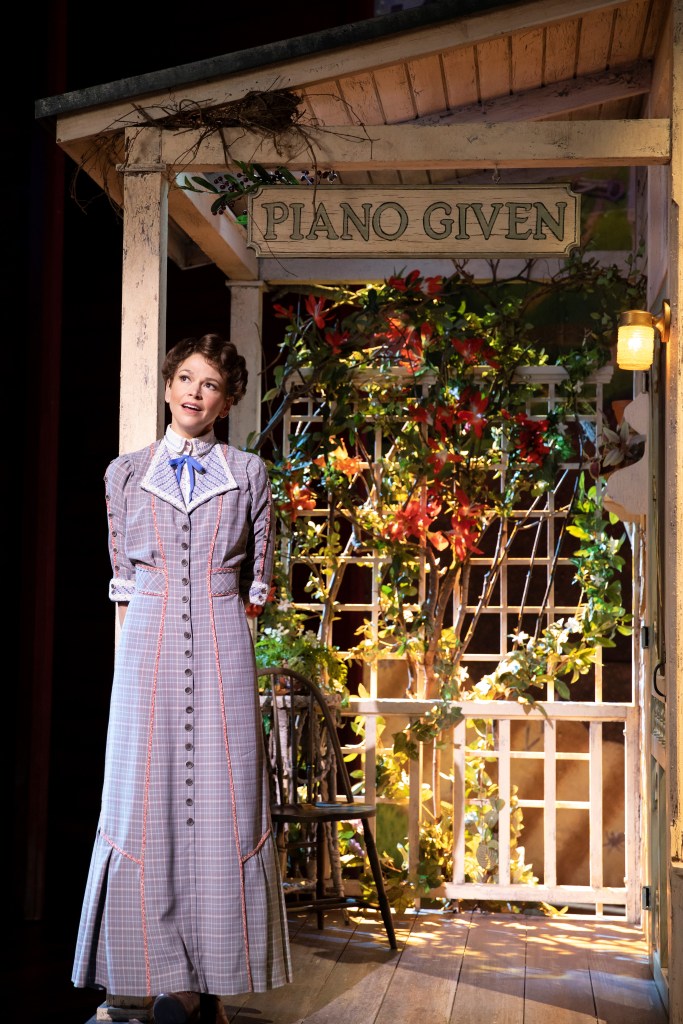
In his backdoor discussions with his comrade in arms, the affable and in love Marcellus, the winning Professor Hill has no disdain or ridicule for those he mesmerizes. He enjoys the challenge (more in the style of 110 in the Shade’s rainmaker Bill Starbuck), of instilling confidence in others and, in return, receiving what he needs, enjoyment, fun, affirmation. He is the antithesis of the bombastic, arrogant traveling salesman loudmouths like Charlie Cowell and the others in the rhythmically pounding opening train number “Rock Island.” (another superb staging by Zaks, et. al.)
Willson reveals the vital difference between them and Hill, as they ride the rails and complain about how hard their job is because of encroaching progress. What an incredible opening scene that gives the set up (costumes, staging, sets, music, sound, tone, tenor). Challenged by their comments that Iowa is an impossible territory, Hill shows himself up to the task, gets off the train, turns to the audience and presents Professor Harold Hill. Just looking at Jackman’s unabashed, open smile and shining spirit, we believe as Mrs. Paroo does, that he can do nearly anything, even if it is getting her very shy son Winthrop to speak, which he does, as Winthrop flows forth in a burst of excitement and emotion that never stops afterward in “Wells Fargo Wagon.”

His product, unlike Charley Cowell’s and the others, is intangible. Thus, taking folks’ money is done quickly, painlessly for much more is being given, including a loving manner and wish to spread joy. In this version of Hill it is his endearing vulnerability to love that Jackman makes believable in his deepening interactions with Marian, whose loving support he has, before the two of them realize it. Jackman and Foster construct this surprising discovery beautifully in the Footbridge scene (“Till There Was You,” and the melding of the relationship as they conjoin their singing of the double reprise “Goodnight My Someone” and “Seventy-Six Trombones”).
The town’s seduction is inevitable after “Ya Got Trouble” and “Seventy-Six Trombones,” an incredible dance number (and pantomimed instrumentation), that Jackman and the cast just kill. River City has “swallowed his line” (the fishing metaphor is used throughout), as does young Winthrop (Benjamin Pajak in a show stealing performance), who is thrilled when his mother, like the other townspeople, signs on for instruments, uniforms and instruction books to form the showy band Hill promises for the absolute thrill of it. That they must learn to play is subtly whisked off until “later,” the “will-o-the-wisp” magic Jackman’s Hill seamlessly performs.

Hill is gloriously, attractively spell-binding. He draws the town to him bringing togetherness and good will, that goes a long way to diffuse the backbiting of the women against Marian’s standoffishness (“Pick-a-Little, Talk-a-Little”). He helps to mend the ladies’ divisiveness, which further draws Marian to them and himself. Humorously, he unifies feuding officials in the exquisite harmony of a barbershop quartet, that they can’t seem to get enough of, once he starts them off on the right chords (“Sincere,” “Goodnight Ladies,” “Lida Rose”). One by one each potentially thorny group falls under Hill’s flirtatious, delectable, gentle power and inspirational artistic encouragement. Talk about soft power flying under the radar, he hits folks’ hearts for a bullseye every time.
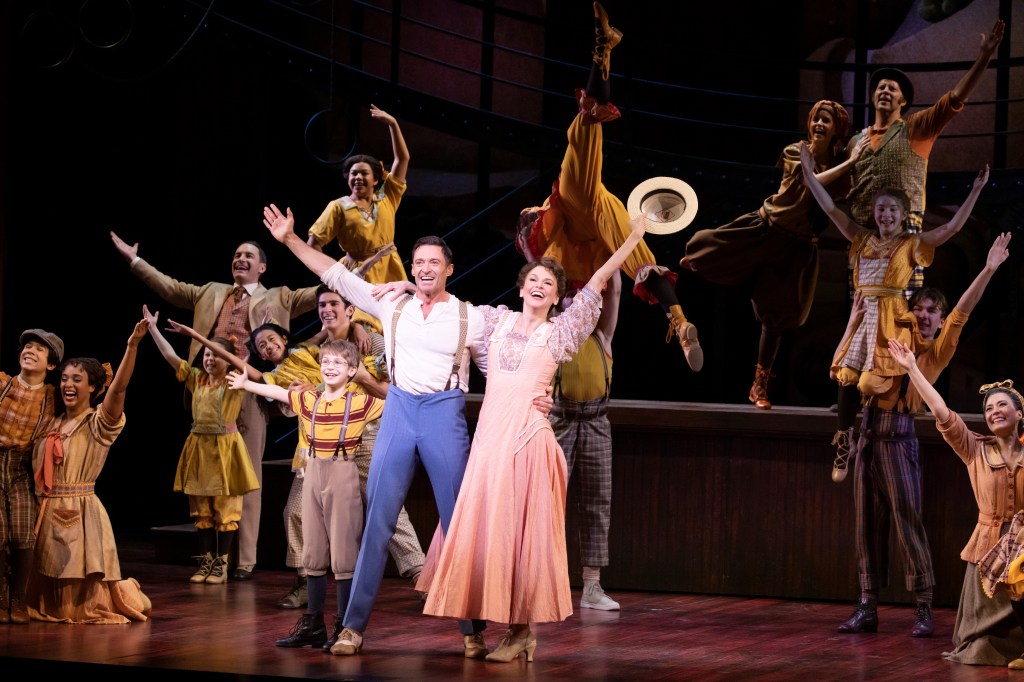
In beautifully staged moments by Zaks, we see Hill’s influence on the Mayor’s wife, Eulalie Shinn and her friends, who create dance numbers and other entertainments. Jayne Houdyshell as Shinn is marvelous and LOL in her dancing and primping poses, after Hill’s maximum attentions. The costuming for these scenes is exceptional. Throughout, the costumes are a take-off of 1912 fashion but with the variety of patterns, in some scenes earthen tones, other scenes fun hats, shoes and accoutrements, thanks to Santo Loquasto, who also did the scenic design.
Marian’s costumes are straight-laced without frills by comparison; her hair (Luc Verschueren for Campbell Young Associates), like the other ladies is in fashion, an up-sweep like her mother’s, Mrs. Paroo (the wonderful Maureen Mullen). Attention in this detailed crafting reveals Marian’s restraint, her career and character, providing the subtext and interesting contrast to the other open-handed, more extravagantly dressed woman. Eulalie and her hens are encouraged to believe in themselves in Hill’s sincere admiration as they ooze his charm back at him and titter. In the case of Marian’s response to Hill’s starlight, she moves from grimace to smile to grin.

Importantly, the women are drawn into Hill’s net, however, it’s mutual. Jackman’s Hill is having a rollicking time becoming enamored of them. This portrayal makes complete sense. Because he is lured by their, acceptance and trust in mutual feeling, he is unable to escape when the love net closes around him. Jackman and Zaks have broadened that net to include the townspeople’s acceptance and love as well as Marian’s, her mother’s and Winthrop’s. Zaks shepherds the actors to forge that budding love and trust with specificity and feeling each time they share a scene (i.e. the fishing scene with Hill and Winthrop).
Fear has no place in Hill’s magical world. So when it attempts to enter in the form of Mayor Shinn’s grave doubts about Hill (though Shinn’s motives are financially suspect), he is misled by Marian and his officials, who by this point in time, understand Hill is bringing new life to the community. Thus, they allow themselves to be distracted away from Shinn’s mission to verify Hill’s identity. It’s apparent that with the exception of Mayor Shinn, whose agenda Hill upends by dunning his new pool table, the town’s spirited happiness is heartfelt. One wonders what their lives were like before his enchantments blinded them? Or did he give them a new way of seeing? And what was Hill’s life like traveling one step ahead of the sheriff before he hit River City, an unintentional stop on his route to anywhere U.S.A.?
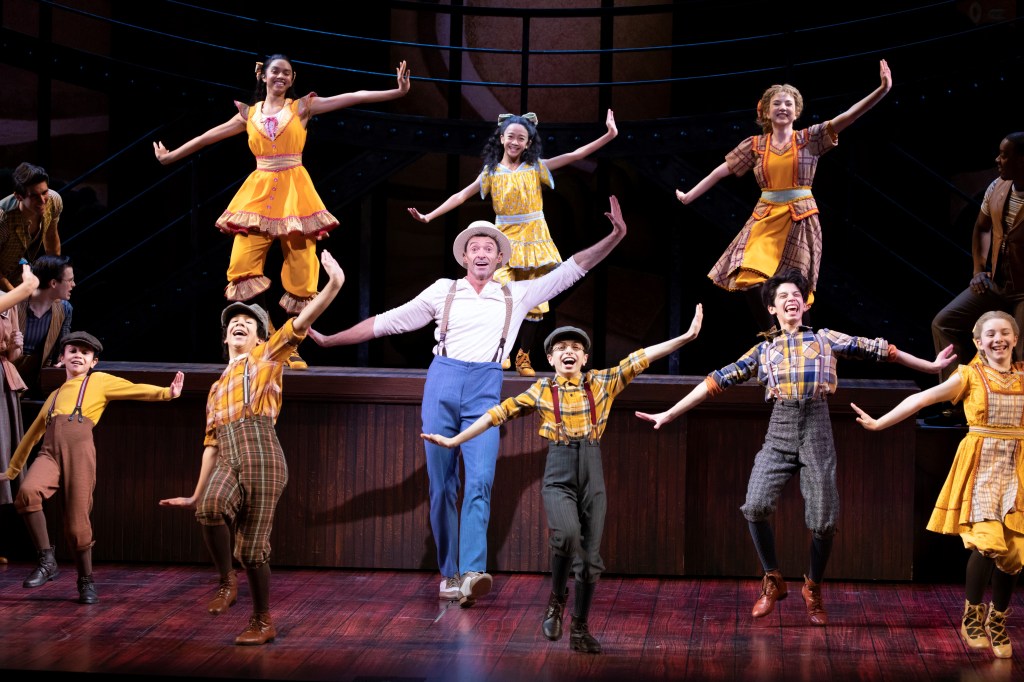
Clues are revealed in the large set backdrops of the Grant Wood style paintings (Regionalism, note the painting “American Gothic”), that are at once simplistic and complicated in their being two-dimensional, brimming with sub-text. These brilliantly reveal the time, place and characters with details of tone, tenor and color. This is especially so against the green rolling hills Grant Wood backdrop, where the tiny, animated, red, Wells Fargo Wagon races down a hill in the distance as it approaches River City. The audience gasped in awe at the ingenious contrivance. Then, they gasped even louder as the “larger-than-life” Wells Fargo Wagon materialized on stage. Pulled by a well-groomed, shiny-coated, smallish-looking “Clydesdale,” Hill beamed atop the wagon as it stopped, the cast sang “The Wells Fargo Wagon” exuberantly, and Jackman rhythmically tossed out the brown, paper wrapped “instruments.” Poignantly, Pajak’s Winthrop sings, lisp and all, completing the effect. Pure dynamite!
This is the show’s “Singing in the Rain,” moment. It is the still point in time that clarifies and represents the whole; action, event, music, symbolism, lighting and spectacle reveal the theme and its significance to the characters and audience. It is here that we understand the treasure that Hill brings, the heightened glory he coalesces in a happening that the townspeople and a now confident Winthrop, (whom we fall in love with along with Hill), will never forget. And for that reason, Marian destroys the evidence that can sink Hill. It’s a stirring, fabulous end to Act I.

By the beginning of Act II, Hill’s invested emotional interest in Marian is revealed in “Shipoopi,” the silly-grand singing and dance number with the entire cast, and colorful, striking costumes, led by Marcellus, who reveals his contentment with his wife. As friend and confidante Marcellus is also Hill’s foil. Living a fulfilled life in a small town, his life contrasts with the emptiness of Hill’s tired wanderings. This is underscored through Hill’s previous interactions with Marcellus, in their fine duet “The Sadder But Wiser Girl,” and brief discussion of his former inability to settle down which Marcellus encourages him to do in River City because he can introduce him to a lovely girl. However, Hill has already met a lovely girl, who rejects him, but as we note at the top of the musical, Hill enjoys a challenge. Jackman nails Hill’s bravado with class, nuance and balance, never over-doing it. He will have Marian and she will have him.

Sutton Foster’s Marian is the challenge Hill finds stimulating. She falls in love, her hard-heart melting in attenuating stages: after Mother Paroo’s pressure in “If You don’t Mind My Saying So,” her own internal pressure in “Goodnight, My Someone” and “My White Knight,” in Hill’s sweetly, gorgeous “bad-boy” pestering in, “Marian the Librarian,” and most importantly, after she sees Hill’s beloved influence on Winthrop (“Wells Fargo Wagon,” the fishing scene, “Gary Indiana”). As Marian, Foster’s change of heart toward Hill is superbly wrought by degrees; her stance and body gradually relaxing as they dance in “Shipoopi.” And the relationship Foster and Jackman forge in its progressive development toward love is believable and touching. By the time the scene with the kiss arrives, their bond is manifest; the long kiss, wistfully enjoyed by Jackman fans, brought faint and not so faint audience gasps; the longing and hunger in the characters dangerously apparent.
For love’s reality is an obstacle to his “safety” that Hill acknowledges (“Till There Was You” reprise). Charlie Cowell intends to provoke the town to scourge Hill with a “tar and feathering.” It is at this point that Marcellus’ injunction that Marian is doing the conning and Hill has to leave or be damned, resonates. But he can’t leave; he must face the music or rather, lack of it.
Foster shines as she attempts to gaslight sexual predator Auberjonois’ Cowell with flirting and a kiss. And in the realistic fight scene (one punch is always sufficient), between Cowell and Hill, the professor vindicates Marian’s reputation that Cowell besmirches. I love how Foster sexually presents herself to Cowell, breaking the third wall and eliciting the audience’s encouragement; she twits the scene for all its worth.
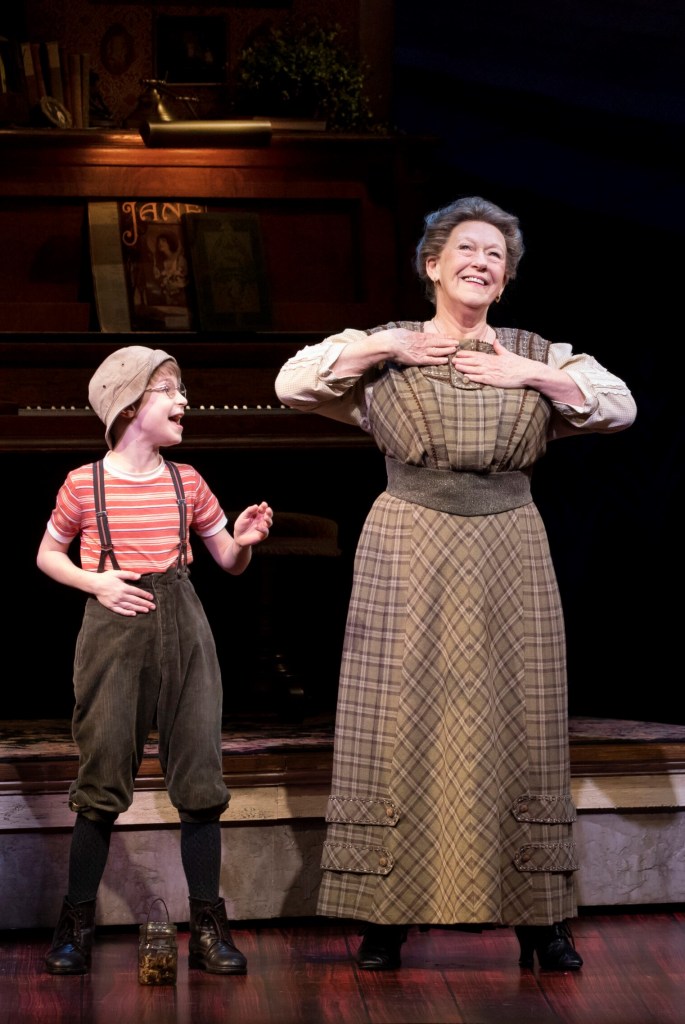
But the con is over. Humorously and ironically, Hill is a victim of Mother Paroo’s use of his “Think System.” And of course, his own need to be loved traps him. Thus, he admits the truth to an upset Winthrop, who forgives him as does Marian. Brother and sister encourage Hill to quickly escape, not realizing the music man wants to stay despite the jeopardy. The sacrifice of the three for each other is perfection. When Hill is arrested, Jackman’s emotional response in the scene is smashing, as is the drama created by Pajak, Auberjonois, Foster and the other cast members. The question remains. Will the town forgive Hill, as Marian and Winthrop have? Will they acknowledge that he has given them something more priceless than a boy’s band? Perception is everything.
In this revival the intentionally “un-dangerous,” genius, entrepreneur professor, like those entrepreneurs of the Cardiff Giant, created a daily thrill. Specifically, Hill’s music man encourages the town to launch out on a new road. It turns into their own growth and ultimate benefit in merging community, good will and love. In exchange for instruments and uniforms, he has bestowed the citizens with an ineffable gift (that Marian and Eulalie Shinn encourage the others to stand for). As Mayor Shin sees their unity and hears his son play, Hill’s “Think System” catches communal fire. The joy and warmth that Hill gave is returned; he is loved and forgiven. And Charlie Cowen leaves a sadder and unrepentant man.

In the end scene as the perception of the townsfolk moves from what is to what each parent thinks/imagines Hill’s orchestral direction to be with love, the miraculous occurs. Hill is redeemed as the band emerges in sound and sensory vision. Announcing the Finale, Winthrop/Pajak blows a vibrant, bold horn. The cast emerges in full band regalia, sings, plays and dances, with Foster and Jackman front and center, leading the charge. Dazzling fun, profoundly realized.
The Music Man is a spectacle that is incredibly rich with visual movement and vibrancy, striking hues and emotional musical grist brought together with sterling performances that are divine brush strokes. The story is a faceted jewel, the characters inhabited by these multi-talented acting greats are uniquely American. The sound/music delivery-technical and vocal is as fine as can be. I heard every word, the glorious harmonies, spun out rhythms and witty lyrics in the compelling choral numbers (“Rock Island,” “Ya Got Trouble,” Shipoopi,” “Pick-a-Little, Talk-a-Little,” “Marian the Librarian,” Seventy-Six Trombones”). What a pleasure, especially in the large musical numbers; this has not always been the case on Broadway (post-pandemic and certainly not pre-pandemic).
The Smithsonian Institution ranks The Music Man as one of the “great glories of American popular culture.” When it premiered on December 19, 1957, it was a smash hit that ran 1375 performances. It won five Tony Awards including Best Musical. The original cast album held the number one position on the
Billboard charts and stayed on the album charts for 245 weeks. The recording won the first-ever Grammy Award for Best Original Cast Album.
In this amazing revival all of the main actors are Tony Award winners. Sutton Foster is a two-time Tony Award winner. Hugh Jackman is a two-time Tony Award, Grammy Award, and Emmy Award-winning star. Director Jerry Zaks is a four-time Tony Award winner and Choreographer Warren Carlyle is a Tony Award winner. The creative team is equally sterling and award studded. It includes four-time Tony Award winner Santo Loquasto (Scenic & Costume Design), five-time Tony Award winner Brian MacDevitt (Lighting Design), Tony Award winner Scott Lehrer (Sound Design), Luc Verschueren for Campbell Young and Associates (Hair, Wigs, & Makeup Design), Tony Award winner Jonathan Tunick (Orchestrations), David Chase (Vocal and Dance Arrangements), and Patrick Vaccariello (Musical Director).
This production with this cast, director, choreographer and technical team will never happen again in your lifetime. Considering what the cast, crew and production team went through to present The Music Man opening night this February 10th, 2022, it has been a labor of love that underscores every dance step, every note played, every trill, every laugh by the actors, the musicians, everyone. It is a one-of-a-kind revival that is breathtaking. Do what you can to see it. I will go again if I can get tickets. Here is their website for arrangements. https://musicmanonbroadway.com/
 CAROLE DI TOSTI