Category Archives: cd
Bobby Cannavale, James Corden, Neil Patrick Harris Are LOL in ‘Art’
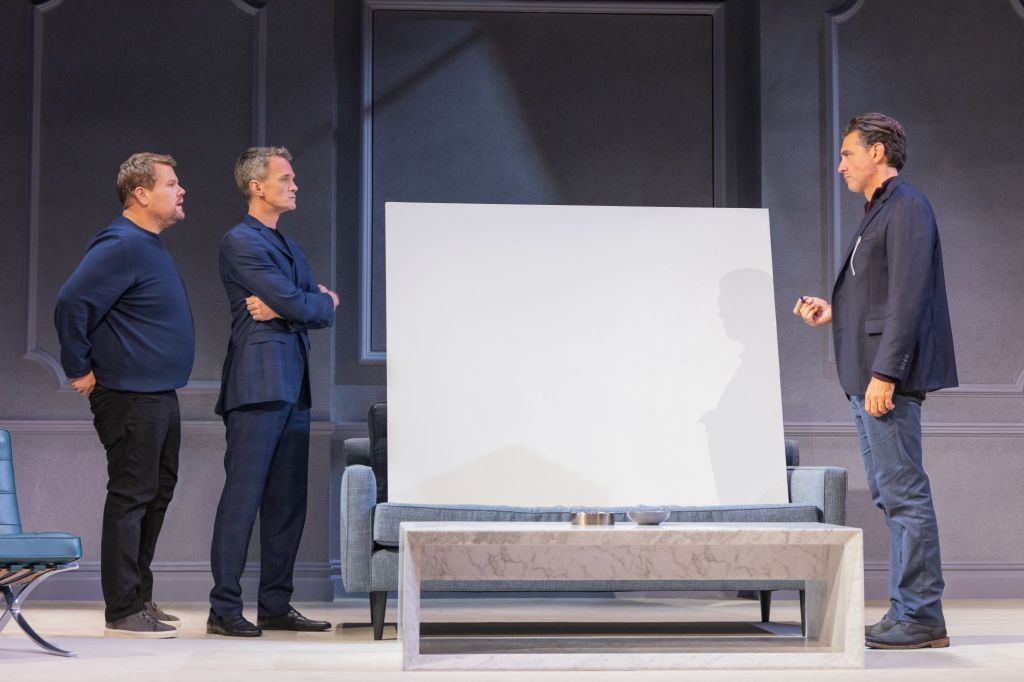
Superb acting and humorous, dynamic interplay bring the first revival of Yasmina Reza’s Tony-award winning play Art into renewed focus. The play, translated from the French by Christopher Hampton, is about male friendship, male dominance and affirming self-worth. Directed by Scott Ellis, the comedy with profound philosophical questions about how we ascribe value and importance to items considered “art” as a way of bestowing meaning on our own lives resonates more than ever. Art runs until December 21st at the Music Box Theatre with no intermission.
When Marc (Bobby Cannavale) visits his friend Serge (Neil Patrick Harris) and discovers Serge recently spent $300,000 dollars on a white, modernist painting without discussing it with him, Marc can’t believe it. Though the painting by a known artist in the art world can be resold for more money, Marc labels the work “shit,” not holding back to placate his friend’s ego. The opening salvo has begun and the painting becomes the catalyst for three friends of twenty-five years to reevaluate their identity, meaning and bond with each other.
As a means to reveal each character’s inner thoughts, Reza has them address the audience. Initially Marc introduces the situation about Serge’s painting. After Marc insults Serge’s taste and probity, Serge quietly listens, makes the audience, his confidante and expresses to them what he can’t tell Marc. In fact Serge categorizes Marc’s opinion saying, “He’s one of those new-style intellectuals, who are not only enemies of modernism, but seem to take some sort of incomprehensible pride in running it down.” As Serge attempts to pin down Marc reinforcing Marc’s lack of expertise or knowledge about modern art, he questions what standards Marc uses to ascribe his valuable painting as “this shit.”
At that juncture Reza emphasizes her theme about the arbitrary conditions around assigning value to objects, people, anything. Without consensus related to standards, only experts can judge the worth of art and artifacts. Obviously, Marc doesn’t accept modernist experts or this painter’s work. He asserts his opinion through the force of his personality and friendship with Serge. However, his insult throws their friendship into unknown territory and capsizes the equilibrium they once enjoyed. The power between them clearly shifts. The white canvass has gotten in the way.
During the first thrust and parry between Marc and Serge in their humorous battle of egos, the men resolve little. In fact we learn through their discussions with their mutual friend Yvan (James Corden), they think that each has lost their sense of humor. The purchase of the painting clearly means something monumental in their relationship. But what? And how does Yvan fit into this testing of their friendship?

Marc’s annoyance that Serge purch,ased the painting without his input, becomes obsessive and he seeks out Yvan for validation. First he warns the audience about Yvan’s tolerant, milquetoast nature, a sign to Marc that Yvan doesn’t care about much of anything if he won’t take a position on it. During his visit with Yvan, Marc vents about Serge’s pretensions to be a collector. Though he knows he can’t really manipulate Yvan about Serge because Yvan remains in the middle of every argument, he still tries to influence Yvan against the painting.
Marc believes if Yvan tolerates Serge’s purchase of “shit” for $300,000, then he doesn’t care about Serge. Tying himself in knots, Marc considers what kind of friend wouldn’t concern himself with his friend getting scammed $300,000 for a shit panting? If Yvan isn’t a good friend to Serge, at least Marc shows he cares by telling Serge the painting is “shit.” Without stating it, Marc implies that Serge has been duped to buy a white canvass with invisible color in it he doesn’t see based on BS, modernist clap trap.
In the next humorous scene between Yvan and Serge, knowing what to expect, Yvan sets up Serge, who excitedly shows him the painting. True to Marc’s description of him, Yvan stays on the fence about Serge’s purchase not to offend him. However, when Yvan reports back to Marc about the visit, he disputes Marc’s impression that Serge lost his sense of humor. In that we note that Yvan has no problem upsetting Marc when he says that he and Serge laughed about the painting. However, when Marc tries to get Yvan to criticize Serge’s purchase, Yvan tells him he didn’t “love the painting, but he didn’t hate it either.”
In presenting this absurd situation Reza explores the weaknesses in each of the men, and their ridiculous behavior which centers around whose perception is superior or valid. Additionally, she reveals the balance inherent in friendships which depend upon routine expectations and regularity. In this instance Serge has done the unexpected, which surprises and destabilizes Marc, who then becomes upset that Yvan doesn’t see the import behind Serge’s extreme behavior.
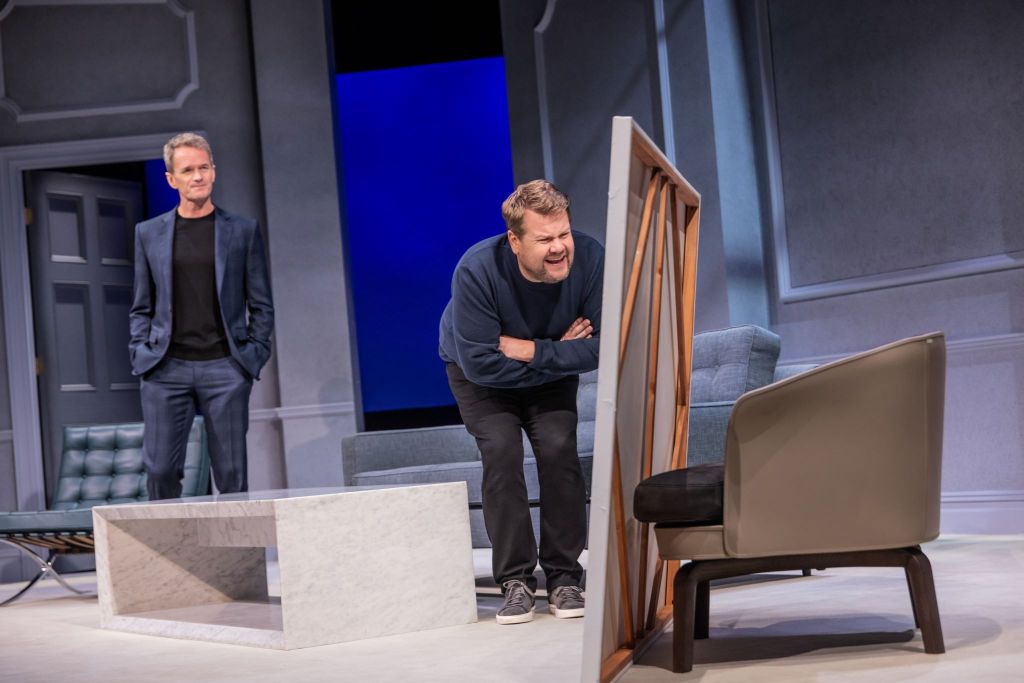
Teasing the audience by incremental degrees prompting LOL audience reactions, Reza brings each of the men to a boiling point and catharsis. Will their friendship survive their extreme reactions (even Yvan’s noncommittal reaction is extreme) and differences of opinion? Will Serge allow Marc to deface what he believes to be “shit” for the sake of their friendship? In what way are these middle-aged men asserting their “place” in the universe with each other, knowing that that place will soon evanesce when Death knocks on their doors?
The humorous dialogue shines with wit and irony. Even more exceptional are the actors who energetically stomp around in the skins of these flawed characters that do remind us of ourselves during times when passion overtakes rationality. Each of the actors holds their own and superbly counteracts the others, or the play would seem lopsided and not land. It mostly does with Ellis’ finely paced direction, ironic tone, and grey walled set design (David Rockwell), that uniformly portrays the similarity among each of the characters’ apartments (with the exception of a different painting in each one).
Reza’s characters become foils for each other when Marc, Serge and Yvan attempt to assert their dominance. Ironically, Yvan establishes his power in victimhood.
Arriving late for their dinner plans, Corden’s Yvan bursts upon the scene expressing his character in full, harried bloom. His frenzied monologue explodes like a pressure cooker and when he finishes, he stops the show. The evening I saw the production, the audience applauded and cheered for almost a minute after watching Corden, his Yvan in histrionics about his two fighting step-mothers, fiance, and father who hold him hostage about parental names on his and his fiance’s wedding invitations. Corden delivers Yvan’s lament at a fever pitch with lightening pacing. Just mind-blowing.
The versatile Neil Patrick Harris portrays Serge’s dermatologist as a reserved, erudite, true friend who “knows when to hold ’em and knows when to fold ’em.” Cannavale portrays Marc’s assertive personality and insidiously sardonic barrel laugh with authenticity. Underneath the macho mask slinks inferiority and neediness. Together this threesome reveals men at the worst of their game, their personal power waning, as they dodge verbal blows and make preemptive strikes that hide a multitude of issues the playwright implies. They are especially unwinning at successful relationships with women.
Reza’s play appears more current than one might imagine. As culture mavens and influencers revel in promoting and buying brands as a sign of cache, the pretensions of superiority owning, for example, a Birkin bag, bring questions about what an item’s true worth is and what that “worth” means in the eye of the beholder. Commercialism is about creating envy and lust and the illusion of value. To what extent do we all fall for being duped? Does Marc truly care that his friend may have fallen for more hype than value? Conclusively, Yvan has his own problems to contend with. How can he move beyond, “I don’t like it, I don’t hate it.”
As for its own value, Art is worthwhile theater to see the performances of these celebrated actors who have fine tuned their portrayals to a perfect pitch. Art runs 1 hour 35 minutes with no intermission through Dec. 21 at the Music Box Theater. artonbroadway.com.
Paris Daze (day 5) With Co-author of ‘The Haunted Guide to New Orleans’

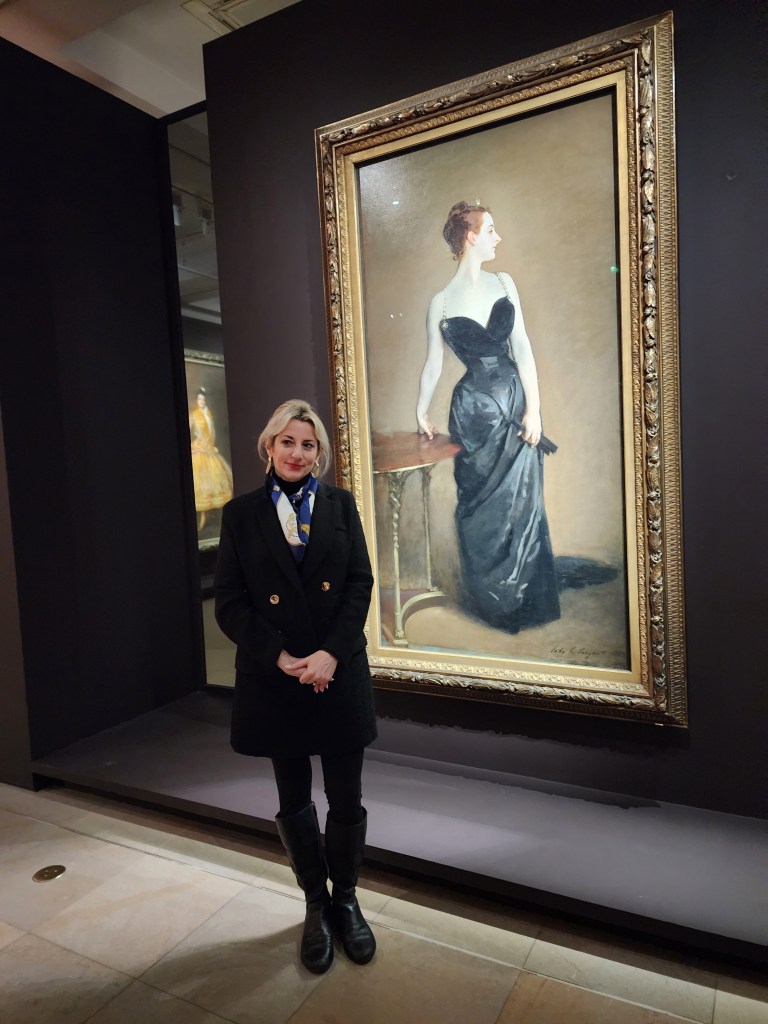
Thursday was an eventful day. First, we were off to the Musée d’Orsay to see the John Singer Sargent exhibit which was presented in partnership with the New York Metropolitan Museum of Art. According to the d’Orsay, the exhibit John Singer Sargent Éblouir Paris was “organized in partnership with the Metropolitan Museum of Art in New York for the centennial of the artist’s death.” Both exhibits take a look at Sargent’s early career. The MET ran its Sargent and Paris exhibit April 27th through August 3rd, after which arrangements were made to send over the paintings to the Musée d’Orsay. In its exhibition material, the d’Orsay states that some of the Sargent paintings are being seen for the first time in France.
Since Rory and Rosary are working on their book about John Singer Sargent and Madame X, Rory was keen to continue her research into the painter and his subject, Parisian socialite, Madame Pierre Gautreau (the Louisiana-born Virginie Amélie Avegno; 1859–1915) who was married to a wealthy Parisian banker. Unable to get to the MET exhibit, Rory who had seen the painting of Madame X before, was happy to do more extensive research in the City of Light, which was held the culture and society that produced the scandalous reaction when Sargent’s painting was presented.
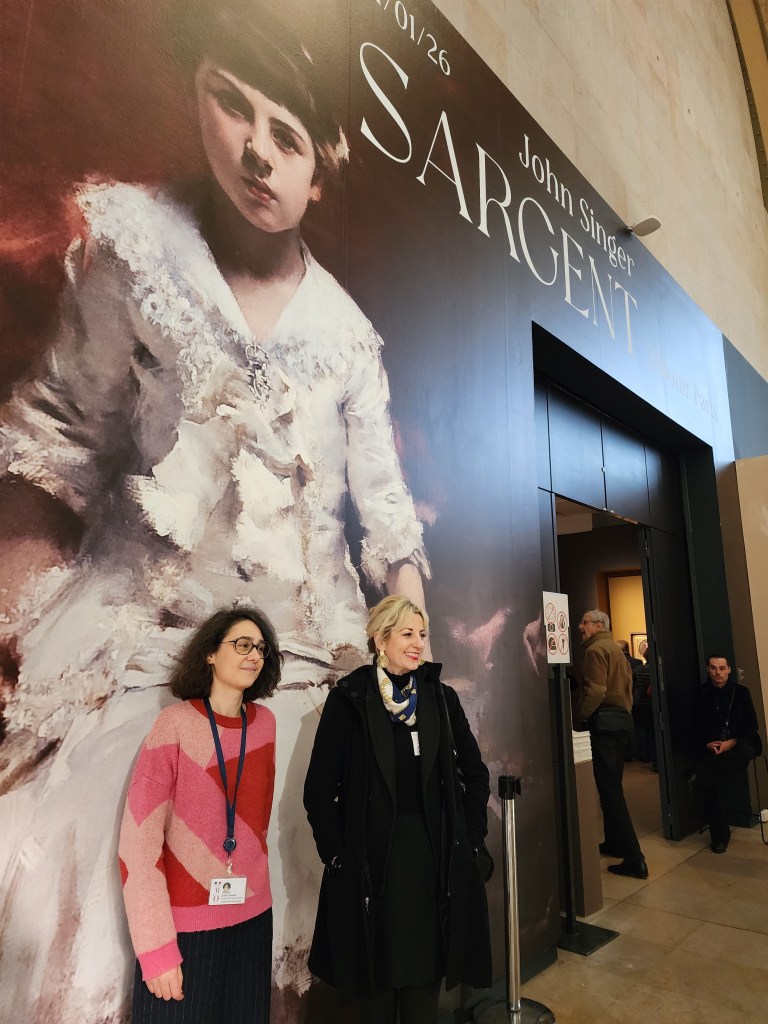
Rory contacted Lucie Lachenal-Taballet, who is a research engineer at the biblioteque interuniversitaire de la Sorbonne. Her expertise is in art criticism and the press in the 19th century. Ms. Lachhenal-Taballet graciously arranged for all of us to enter one hour early and see the Sargent exhibit before the crowds arrived.
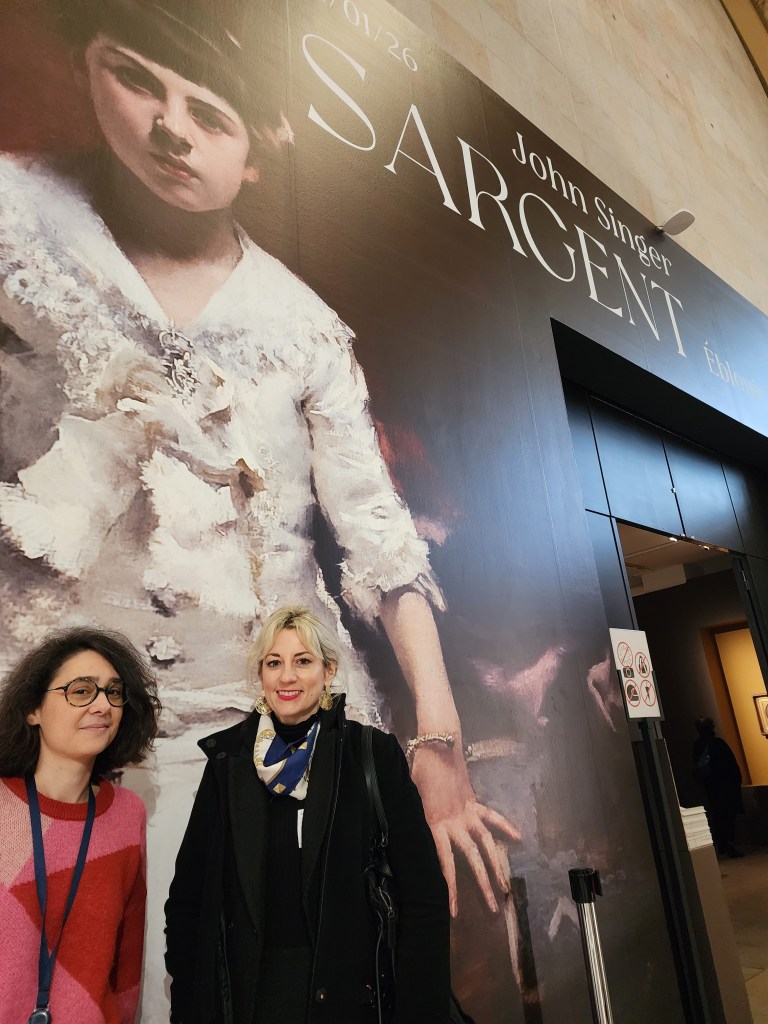
We each took our time viewing the paintings. I had seen the Sargent exhibit at the MET and noted the differences.
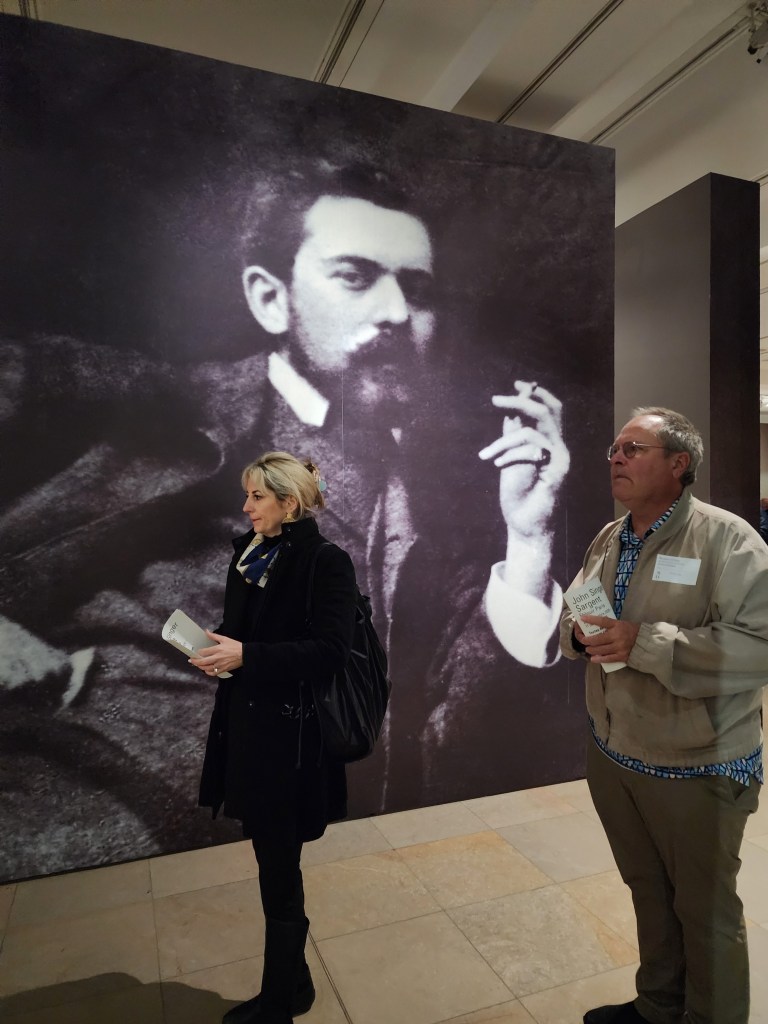
The d’Orsay perspective decidedly enhanced Sargent’s French influences with a selection of paintings under the tutelage of Carolus-Duran, one of his teachers in Paris. Some of these were absent from the MET exhibit. However, the MET included five paintings by other painters, Sargent contemporaries, teachers and influencers. An example is of Comtesse Potocka (Princesse Emmanuela Pignatelli di Cerchiara) painted by Léon Bonnat (1880). According to the MET description in the Sargent and Paris exhibition materials, “Bonnat was a significant and sought-after portraitist in the 1870s and 1880s, and one of Sargent’s teachers at the Ecole des Beaux-Arts.”
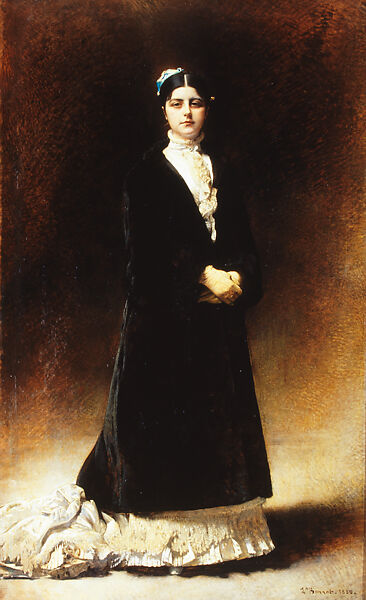
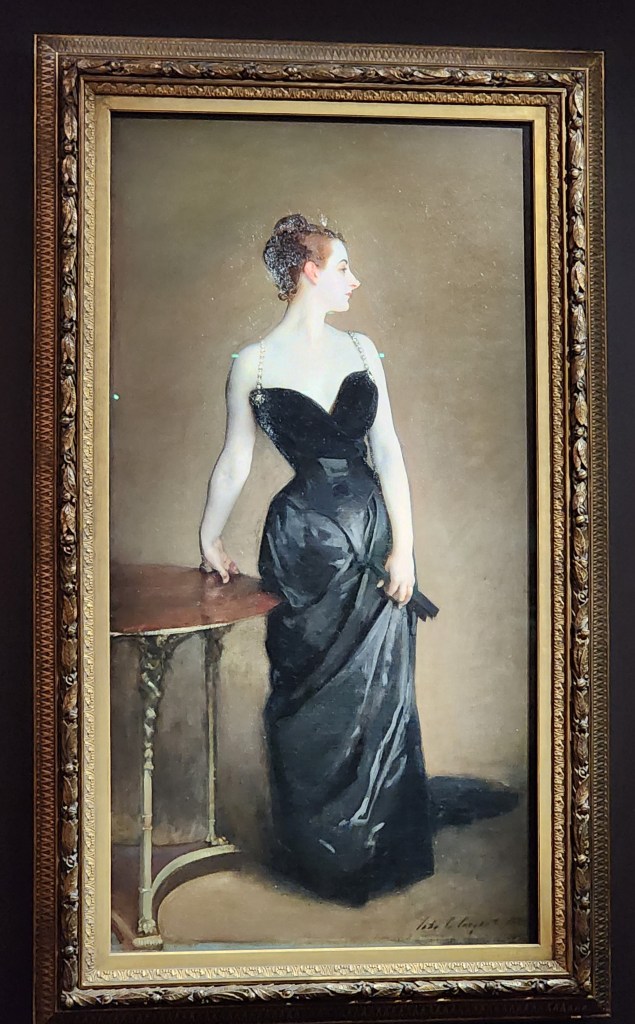
The MET used these paintings, like the one of Comtesse Potocka (Princesse Emmanuela Pignatelli di Cerchiara) to compare them with Sargent’s Madame X. In three of the paintings at the MET exhibit, the women subjects are examples of renown Parisienne socialites of the time. Similarly, two additional paintings are entitled “The Parisienne.” The painters are Leon Bonnat, Carolus-Duran, Edouard Manet, James McNeill Whistler and Charles-Alexandre Giron. All stunningly capture the historical, cultural period in Paris, revealing fashionable wealthy women of Parisian high society.
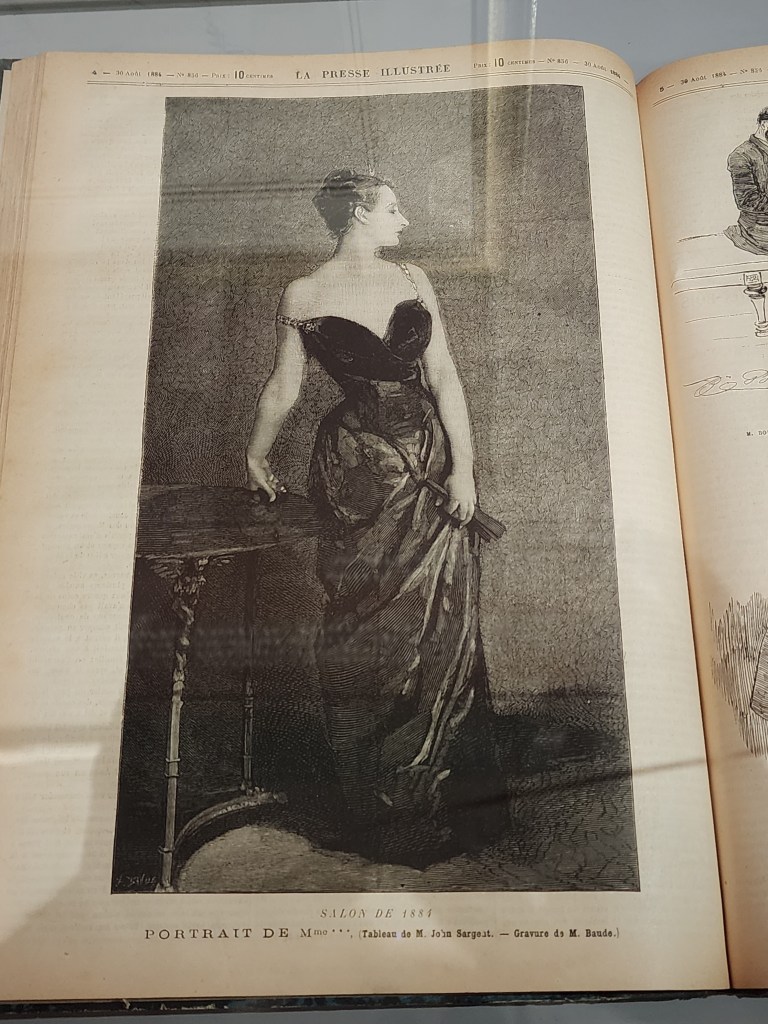
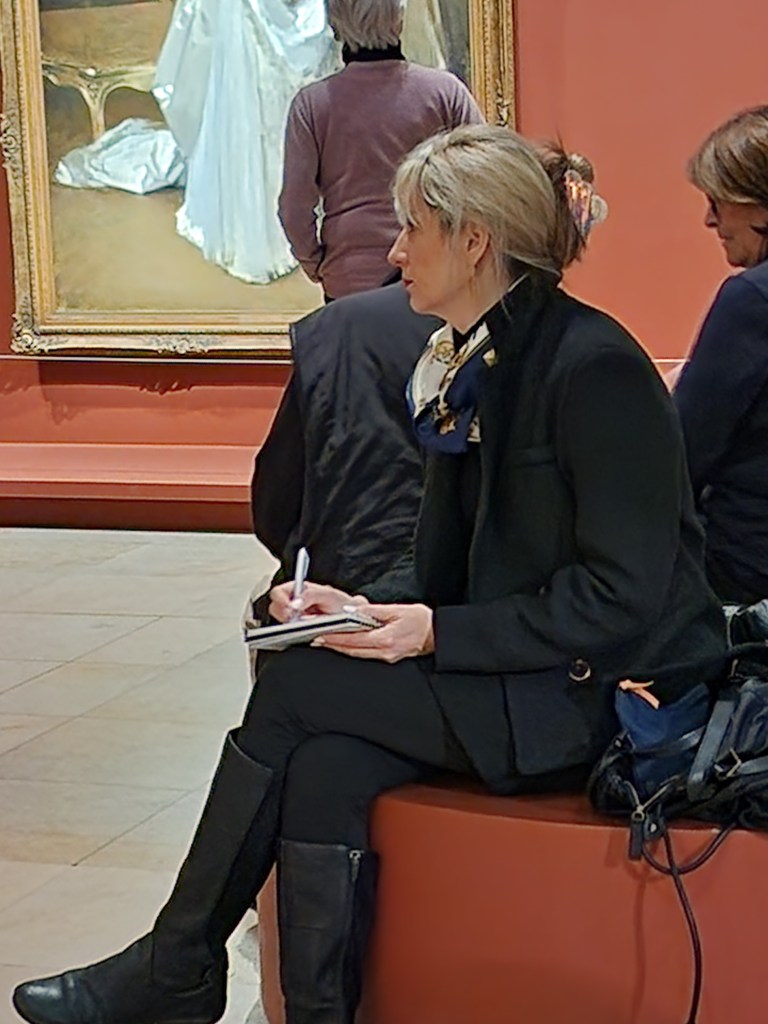
Interestingly, the d’Orsay’s exhibit didn’t include works from other painters to use as a comparison. So Rory spent time reflecting and taking notes on Sargent’s painting and various sketch studies he used in preparation for Madame X. She asked Bill and me about our impressions. When we finished with the exhibit, we headed off to other sections of the d’Orsay while Rory remained behind to study.
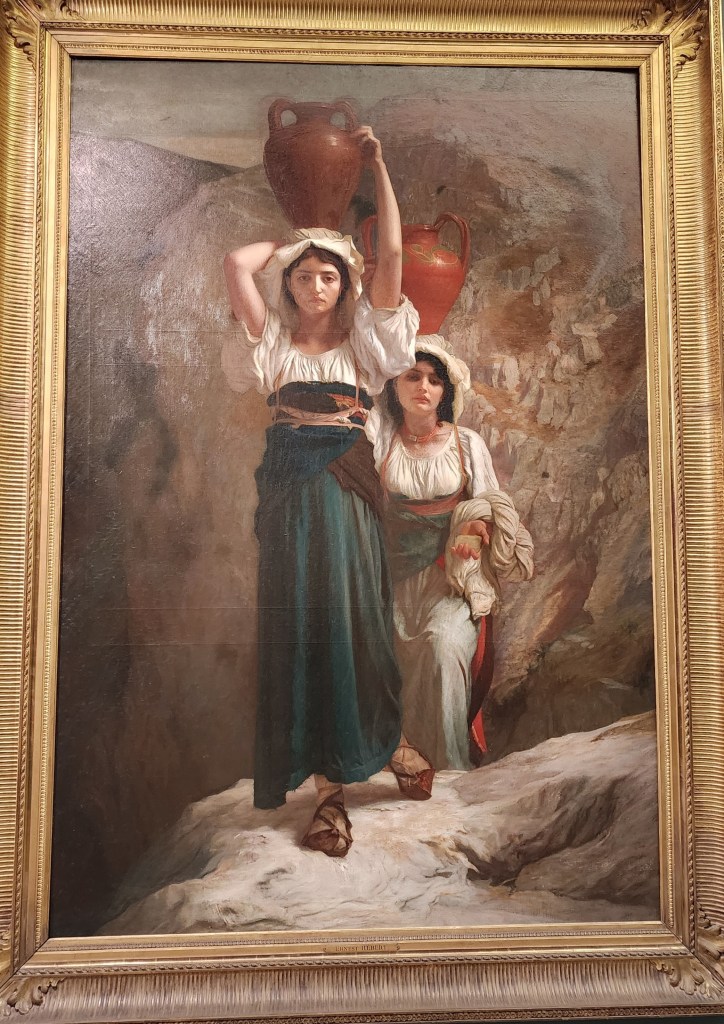
I looked at the Ernest Hébert paintings. (He is known for La Mal’aria in the d’Orsay collection). The exhibit included a few of his paintings of the peasants of Latium, strikingly beautiful works painted during his thirty year period in Italy.
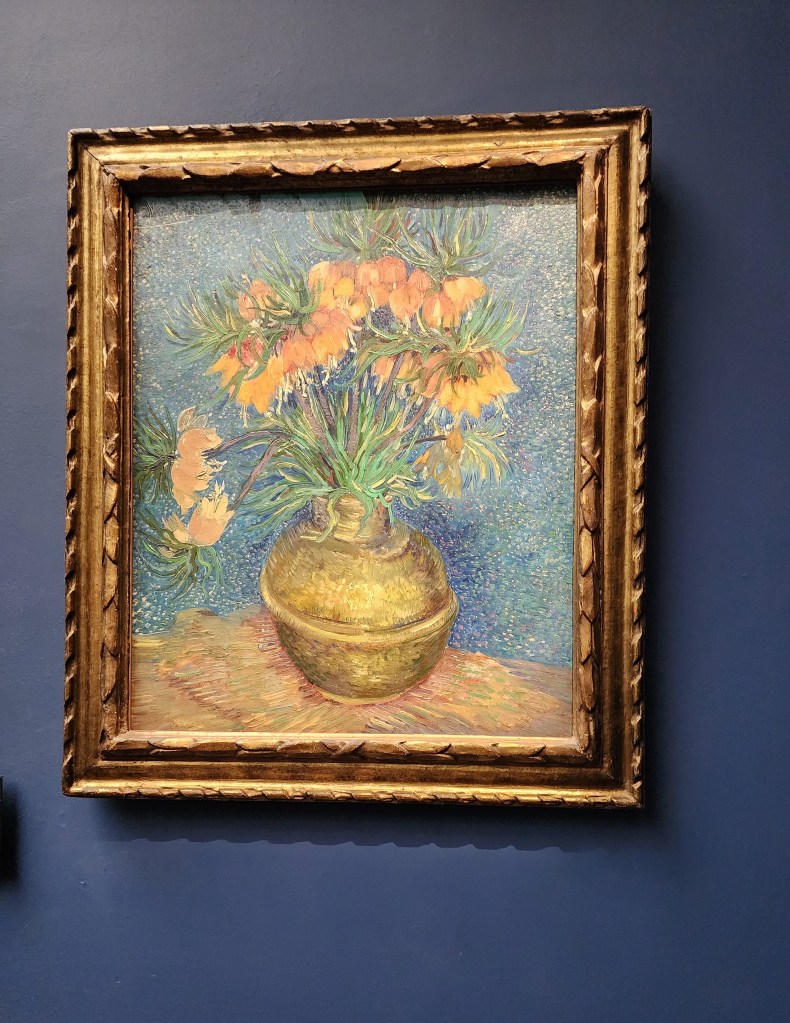
Also, I visited the Impressionists and looked at the van Goghs on display. I’ve written a play which references a lost van Gogh. My play, yet to be produced/published, was well received by workshop mentors, classmates, a partner I collaborated with and various friends I trust to read my work and be honest without feeling they need to flatter me.
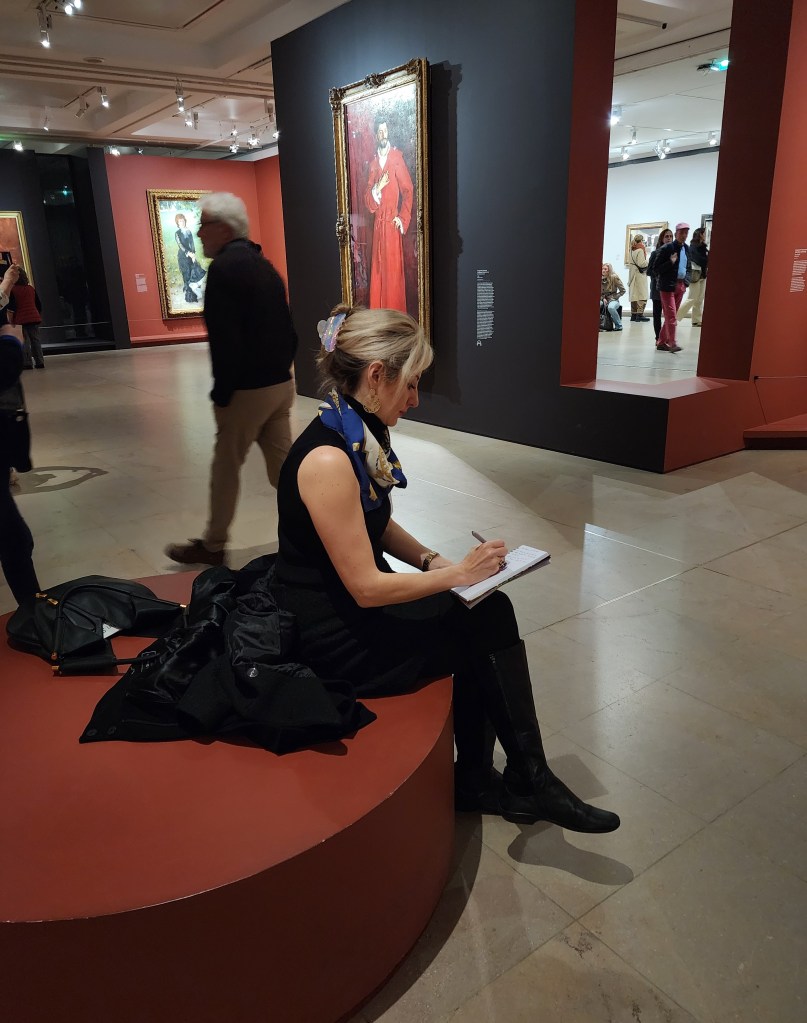
Rory continued with her research and notes, then readied herself for her appointment to interview Lucie about the exhibit, Sargent and other salient details that would be included in the book about the relationship between Sargent and Madam X. Apparently, after the painting’s presentation and the eruption of scandal, the close relationship between Madam X and Sargent fell apart. After her interview, Rory continued the rest of the day perusing the archives for any information she might find that would solidify and refine her impressions and hard information about Sargent and Madame Pierre Gautreau.

After viewing the Impressionists collection (I’ve seen the exhibit at the d’Orsay a number of times), I walked back along the Seine River to a favorite avenue in the fifth arrondissement, Boulevard Saint-Michel.


Walking up past the Sorbonne, and past the Pantheon, I arrived at the little park and environs where the TV series Emily in Paris had set-ups for various external shots.
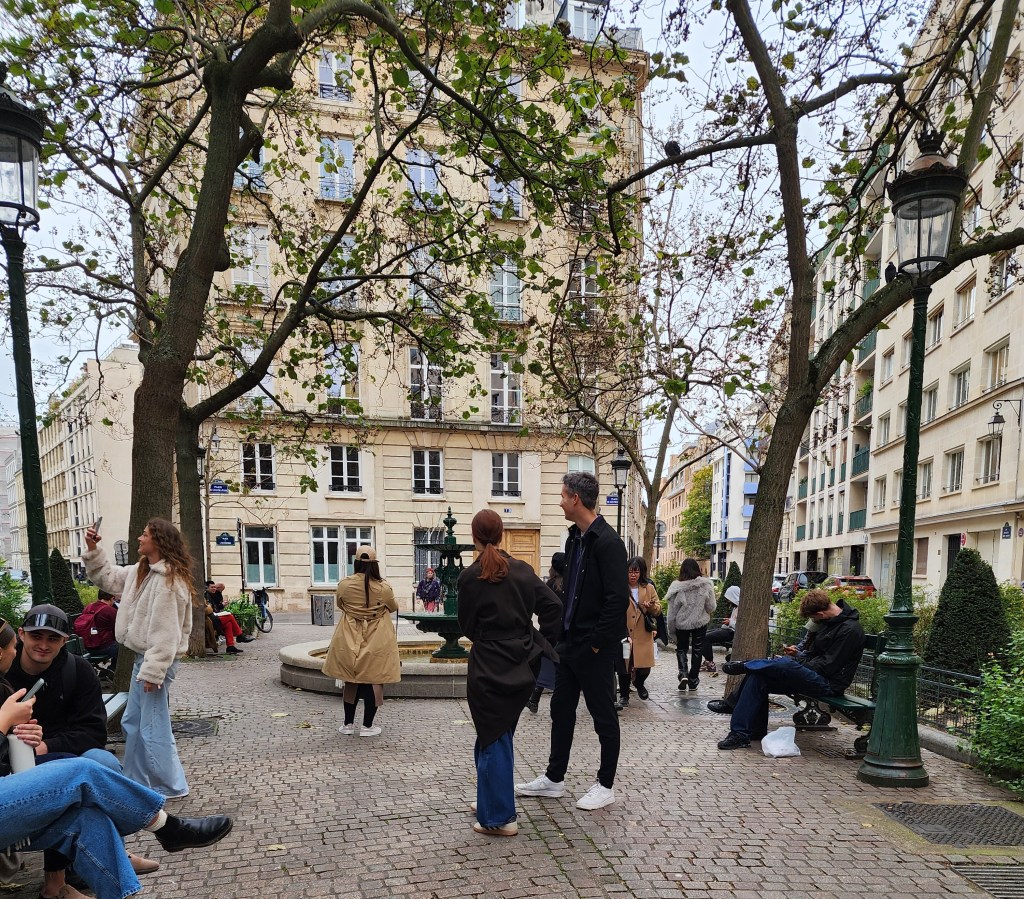
It’s around the corner of the Irish Cultural Centre and now, has become a tourist attraction. Years ago, when I walked through theis park with its lovely water fountain, it used to be empty.

After the team reconvened back at the Irish Cultural Centre, we took a cab to Foyer International d’Accueil de Paris (FIAP), where Rory was presenting the photography exhibit ‘Piercing the Veil.’
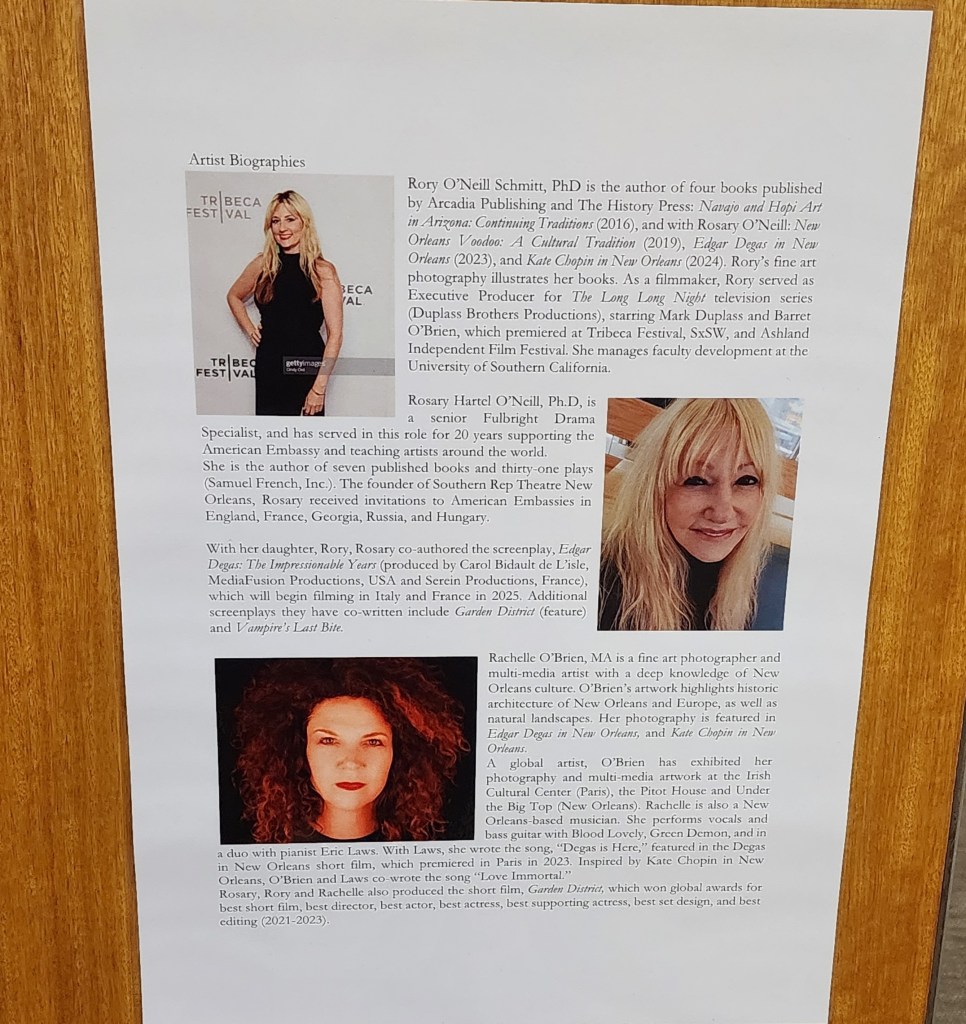
These were the photographs Rory, Amelie and the team had put up earlier in the week. Rory and sister Rachelle took the photographs of the various haunted buildings and New Orleans environs for The Haunted Guide to New Orleans. FIAP residents got to look at the photos since Monday. Now it was time for the formal opening of the exhibit.
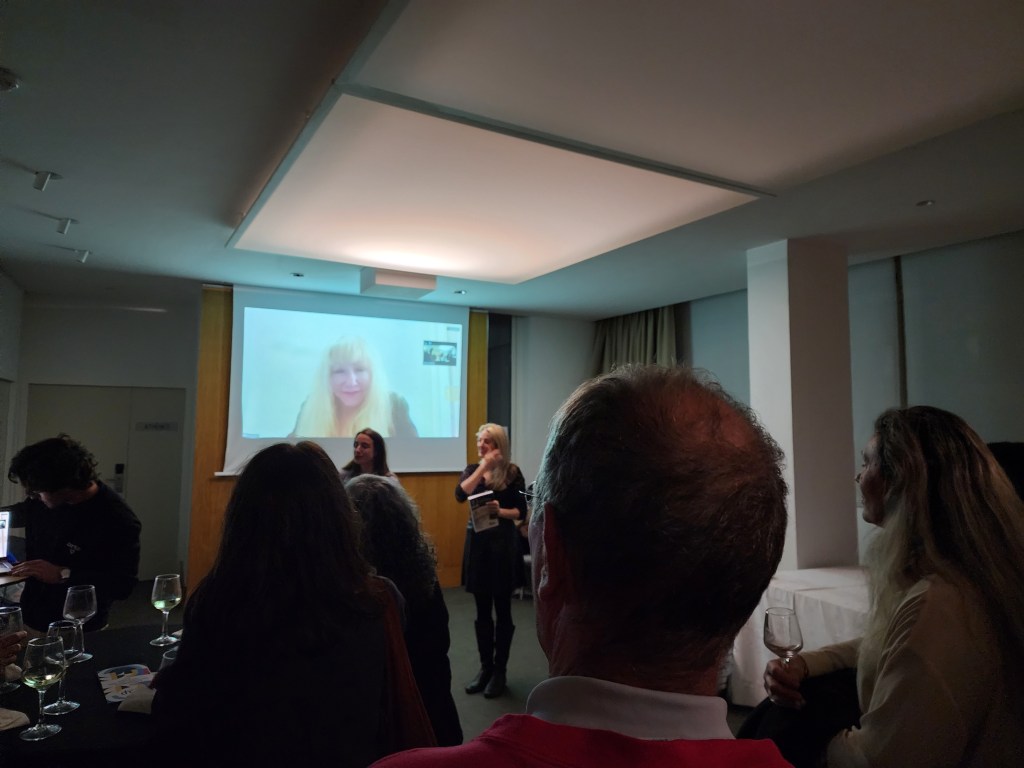
Amelie introduced Rory and the exhibit and then Rory continued in French, discussing the book and the photographs of New Orleans of buildings where ghosts have been sighted.
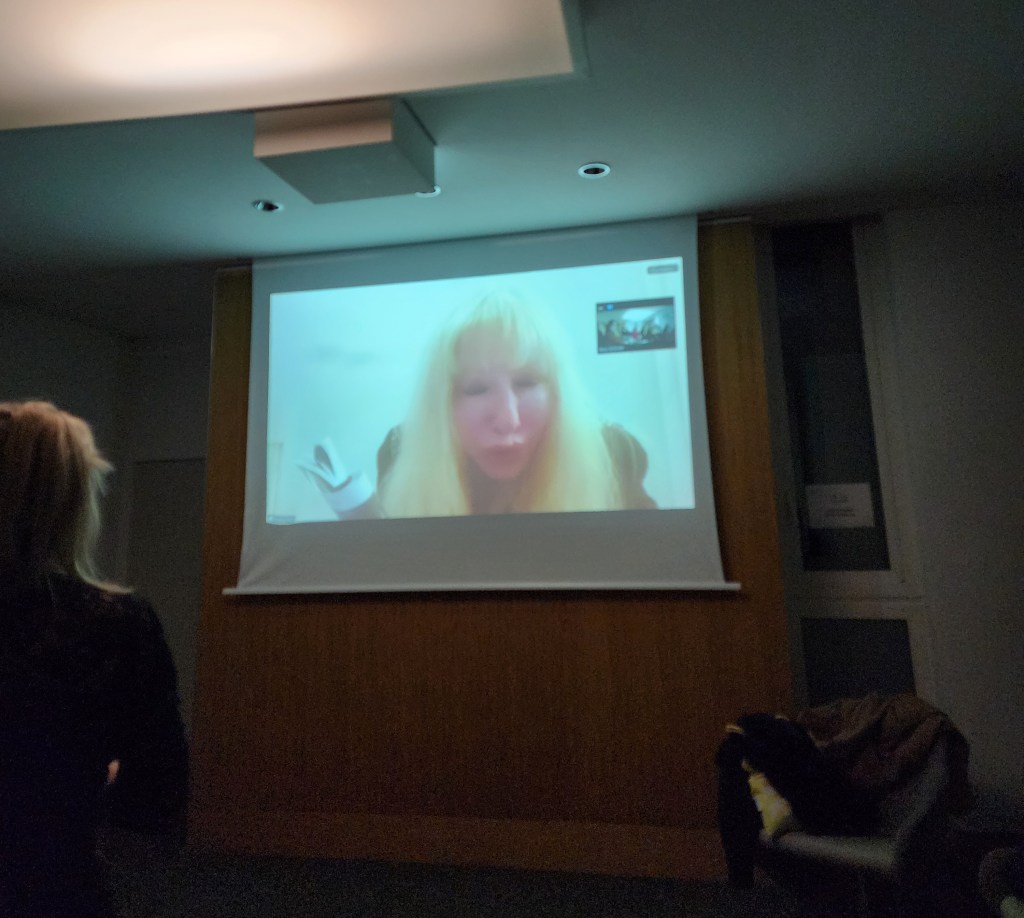
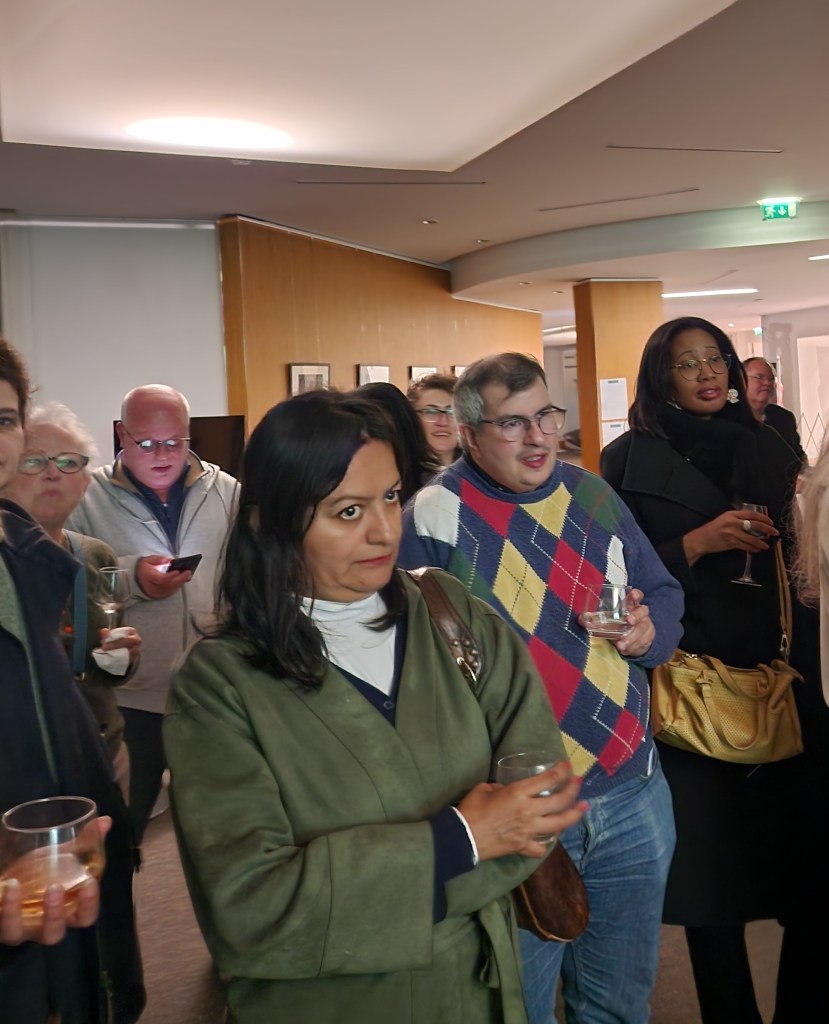
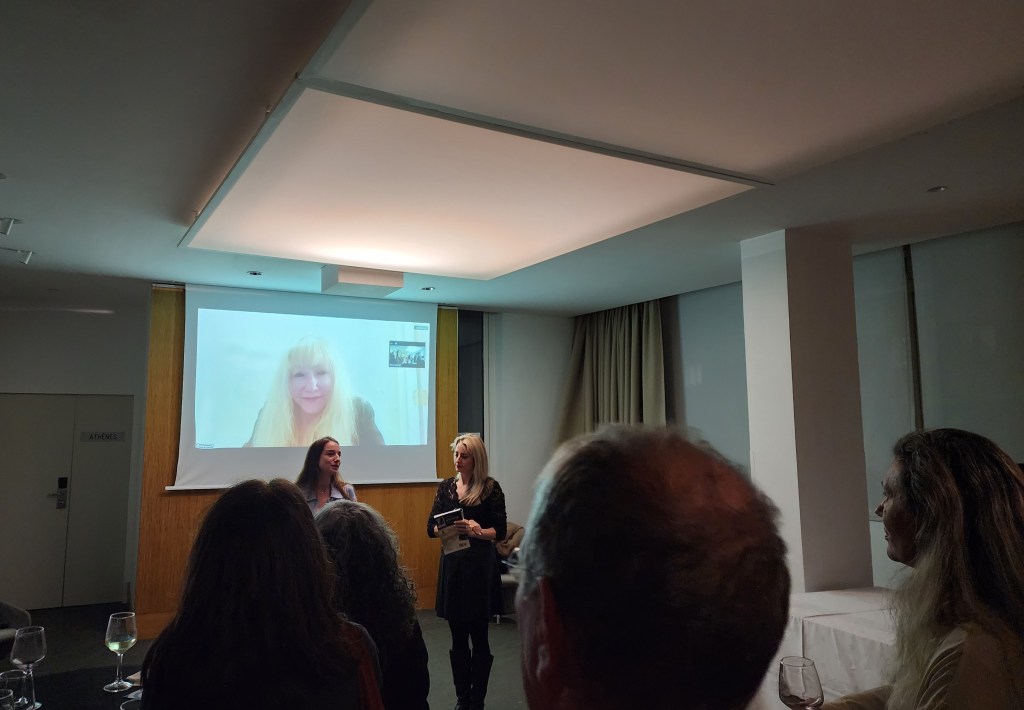
Before Rosary read from the introduction of The Haunted Guide to New Orleans, she shared some words of wisdom and humor in French gathering laughter from the crowd. Rosary, a former actress a long while ago, and a playwright in addition to her histories she’s worked on alone and with Rory is dramatic and theatrical. She can read the most boring, dull technical paper on how to set up barometric instruments for home use and make it interesting. Her reading of the book’s intro was superb.
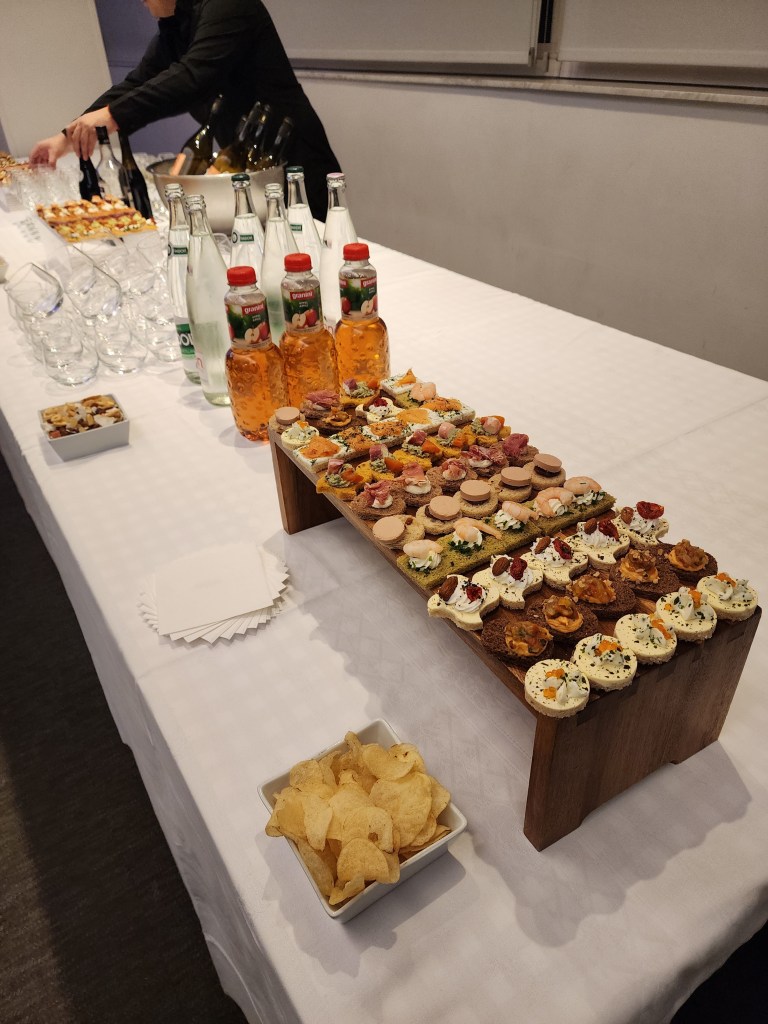
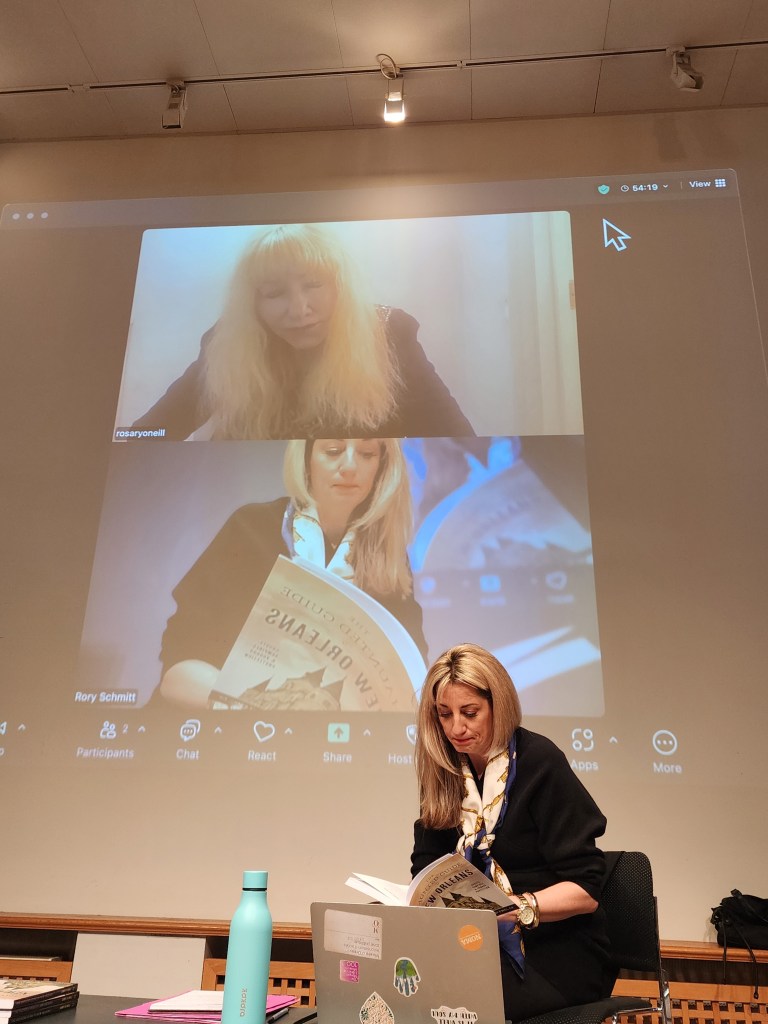
Before, during and after the presentation, there were light bites and wine to accompany the nibbles, which added to the atmosphere of conviviality. Some of Rosary’s former friends stopped by and she spoke with them via Zoom.


A long time friend who was a liaison between France and New Orleans’ cultural affairs spoke to Rory about getting their books translated into French. Other friends were present and showed up to support Rory and Rosary’s new book release.
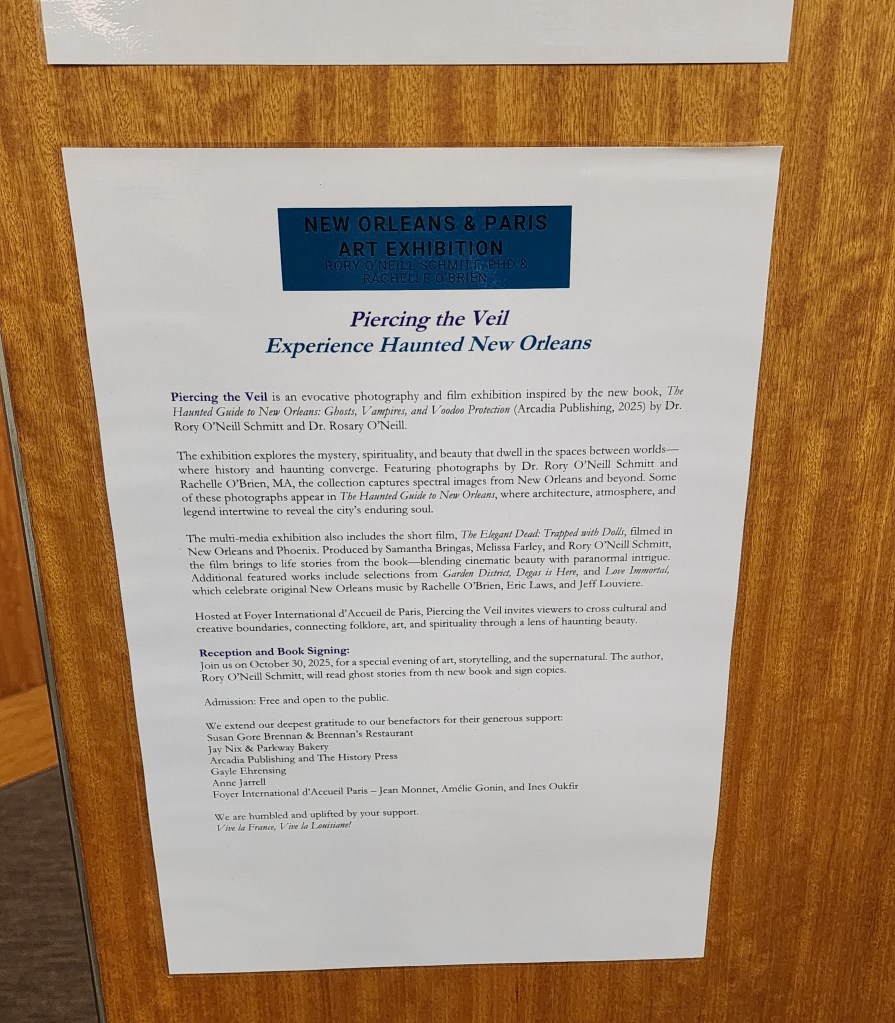
After Rosary’s dramatic reading there was a multi-media presentation of a short, spooky film, The Elegant Dead: Trapped With Dolls. Filmed in New Orleans and Phoenix, the film materializes the stories in the book and makes them palpable. Produced by Samantha Bringas, Melissa Farley and Rory O’Neill Schmitt, the film’s atmospheric haunting sends chills up and down one’s spine. The audience was rapt. until the end, then stayed for more conversation.
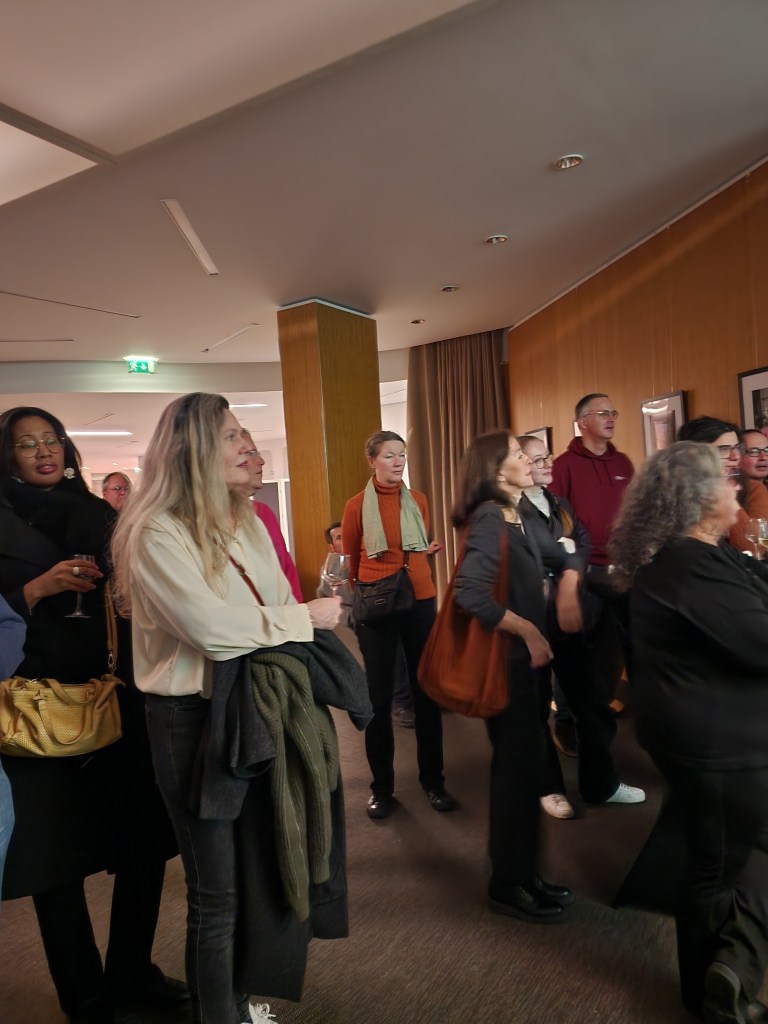
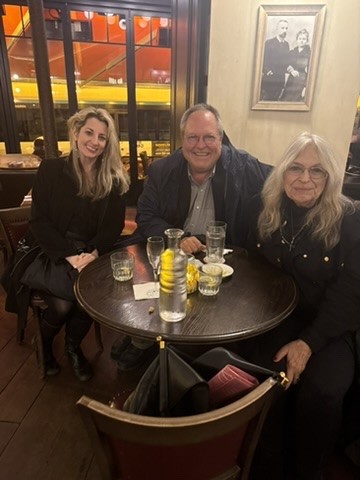
Ours was a long, fulfilling day that ended with a late dinner at a nearby restaurant that seems to always be open for everything lovely, including French onion soup, Le Comptoir du Panthéon.
Rosary and Rory Talk: ‘The Haunted Guide to New Orleans’ at the ICC, Paris Daze 3 & 4
The Irish Cultural Centre in Paris is formerly to a large collegiate community of Irish priests, seminarians and lay scholars whose origins stretch back to 1578. In its historical foundations, the website indicates that “for most of the 19th and 20th centuries the college resumed its role as seminary to Irish and Polish students.” It was converted into a hospital to accommodate three hundred French soldiers, surviving the Franco-Prussian War, and the two World Wars. Additionally, the ICC served the United States army in 1945 as a shelter for displaced persons claiming American citizenship. The Polish seminary in Paris established itself in the Collège des Irlandais in 1945. It stayed until 1997.
It has been the home of residents from Ireland and elsewhere. Some residents take classes at the Sorbonne. Others who apply may receive a residency to study, do research and write. Rory and Rosary have had a number of residencies at the Irish Cultural Centre located conveniently in the 5th arrondissement of Paris near the Sorbonne.
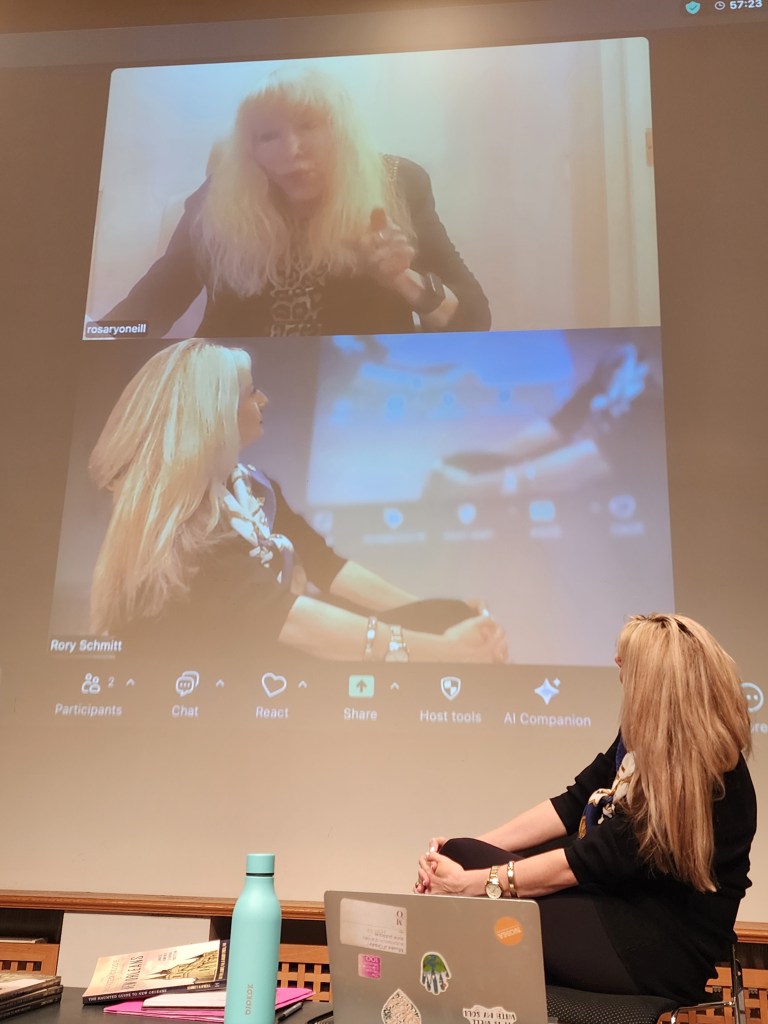
Continuing with my shadowing of Rory, Tuesday and Wednesday were busy days. Connecting via Zoom back in New Orleans, Rosary woke up in the early morning hours of darkness to convene with guests and Rory who hosted the talk about their work live from Paris. Mother and daughter are a joyful tag team. They discussed salient points about how they accomplish their research together. Oftentimes, they alternate chapters. For example after they discuss what topics they want to explore, they decide who can best illuminate the topic based on prior knowledge and interest.
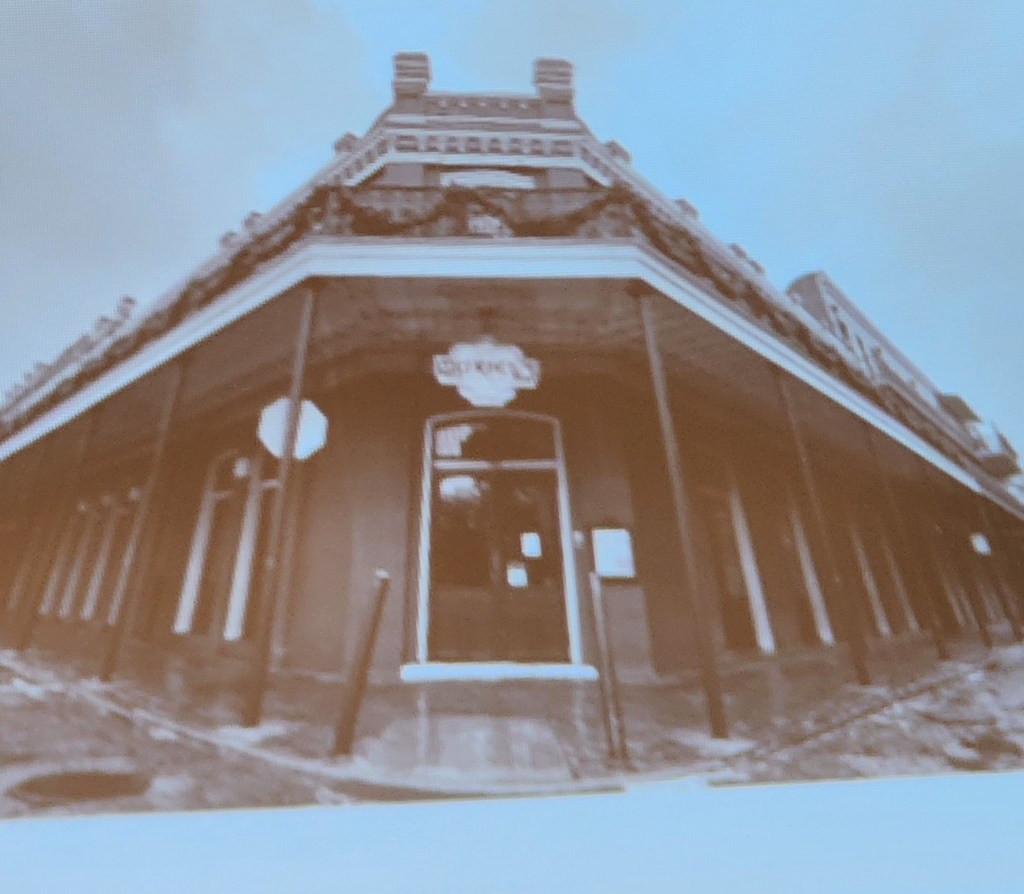
Humorously, Rosary commented that she is frightened of the paranormal and would prefer not to experience any ghostly sightings. For her part Rory is thrilled about the paranormal and very much an aficionado of ghosts and all things paranormal and supernatural. She hopes to work on another book about ghosts. She thoroughly believes in being unafraid to experience the alternate realms of consciousness after individuals pass into the places beyond the veil.
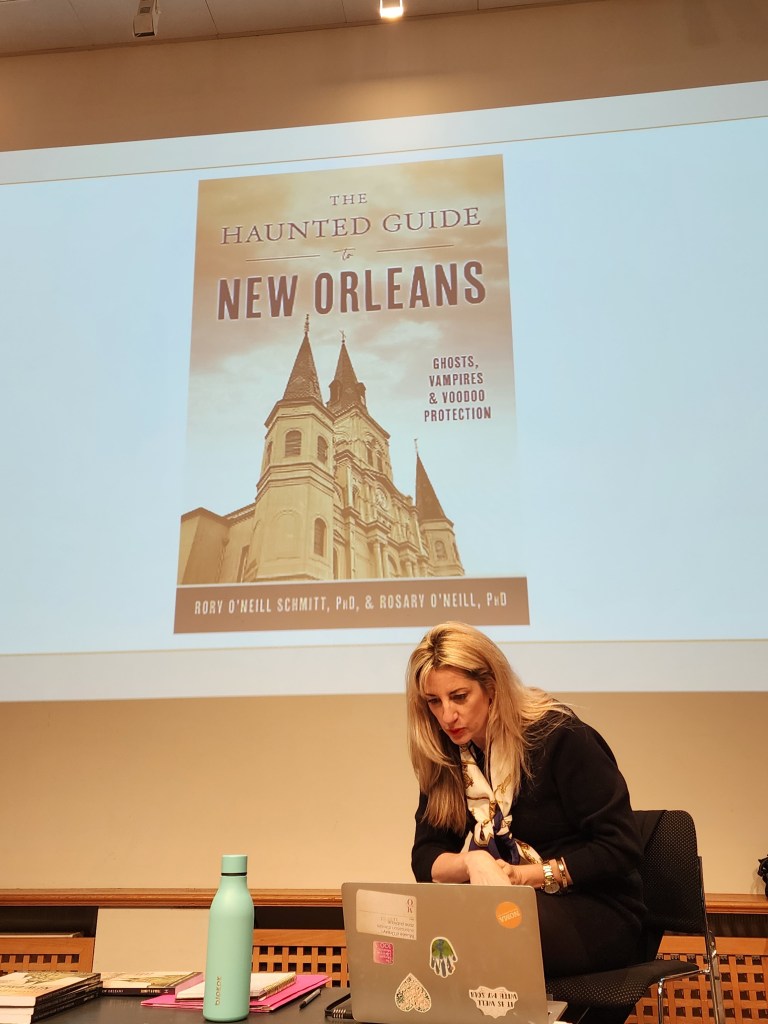
Not only did their talk reference ghostly presences in around New Orleans, some hilarious, some truly scary, they also discussed past and future projects. These, alluded to in the previous article, are coming into full bloom. One, a TV series about Edgar Degas is being worked on as mentioned. Another, the fascinating relationship between John Singer Sargent and Madame X continues to fuel Rosary and Rory’s interest as they look for the clues which lead to new insights never explored by biographers and authors before. That project is in its review stages having already been written. However, Rory has been working hard in Paris to make sure there is nothing to add to their comprehensive work.
Nevertheless, she went to two exhibits to gain more information that may lead to additional clues to spark the research questions that drive the project forward and enhance the conclusions. I’ll start with the exhibit we saw on Thursday, then backtrack to the exhibit we saw on Wednesday.

On Thursday we went to the Musée d’Orsay to see the exhibit of John Singer Sargent’s years in Paris. Of course, a main feature is his masterpiece “Madame X” which, as mentioned in the previous article, he presented to the Salon with great controversy.
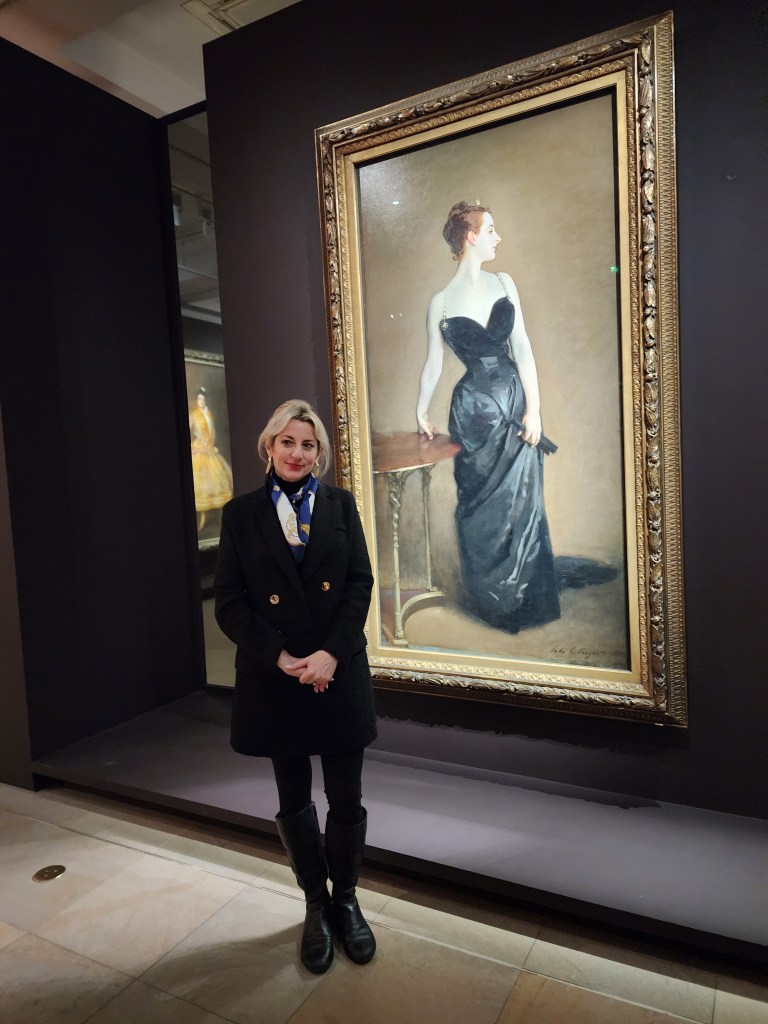
Rory and Rosary researched Sargent and Madame X’s relationship extensively and nothing more might be added to what they’ve written. But I do admire Rory’s tenacity to go the extra distance to make sure she and her mom have left no stone unturned when presenting the backstory of these two individuals who made history together.
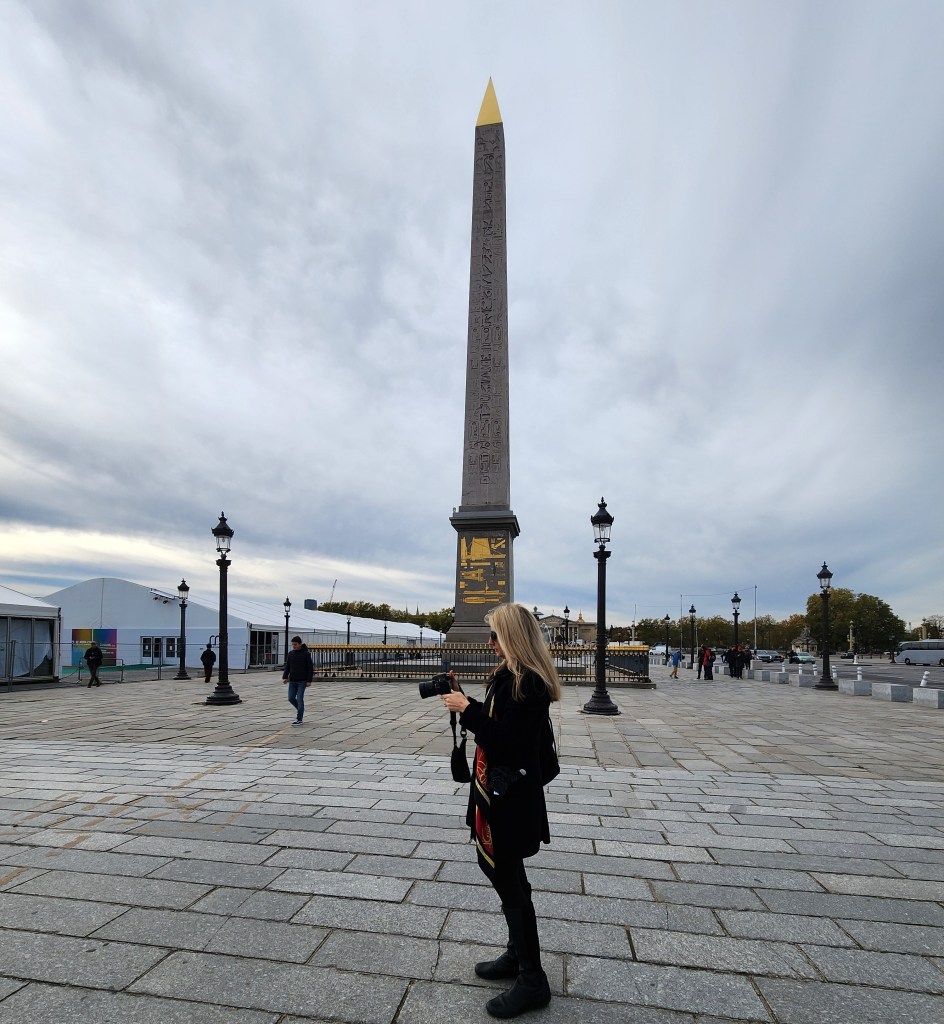
On Wednesday, Rory and I went to La place de la Concorde to investigate The Hôtel de Pontalba which has a fascinating history that relates to one of the subjects she is researching, the Baroness Pontalba. Indeed , Rory wanted to see the site where the New Orleans-born Baroness Micaela Almonester de Pontalba lived from 1855 until her death in 1874.
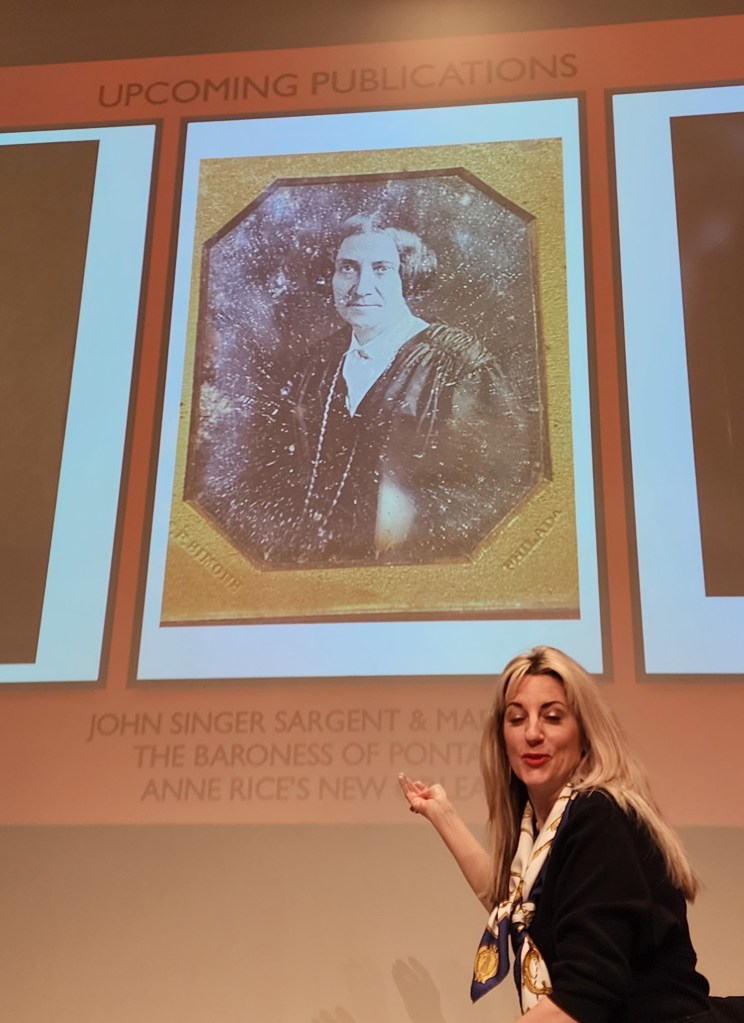
However, the property and environs have had a convoluted history, redevelopment and refurbishment as one would imagine since her heirs sold the property two years after her death. Supposedly, only the original gatehouse and portals were left intact, but following much of the H-shaped ground floor plan. It has been the official residence of the United States ambassador to France since 1971.
When we stopped by, the security was very heavy and we weren’t even allowed to take a picture. However, are the gatehouse and portals still present on the property? And how might this inform the story about the Baroness that Rory and Rosary would like to share? More research is needed.
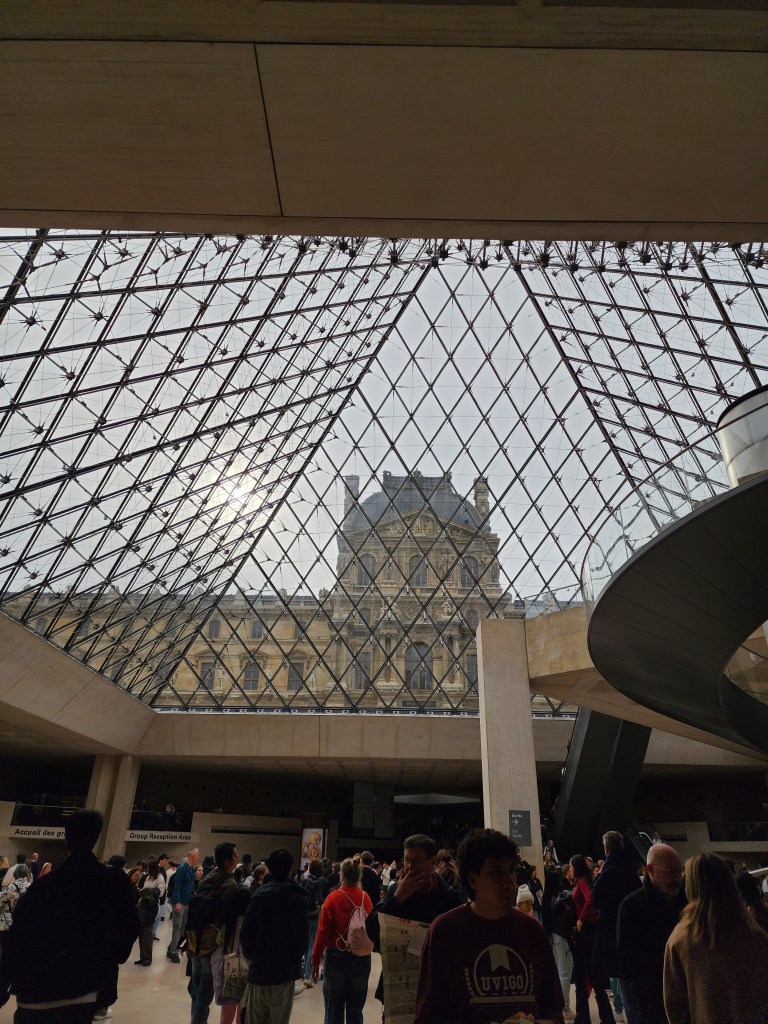
Then we went to the Louvre exhibit to enjoy the paintings of Jacques-Louis David, a French painter whose work spans the years of 1748 through 1825. The exhibit marks the bicentennial of his death in exile in Brussels in 1825. The Musée du Louvre proclaimed on its website that the exhibit “offered a new perspective on a figure and body of work of extraordinary richness and diversity.”
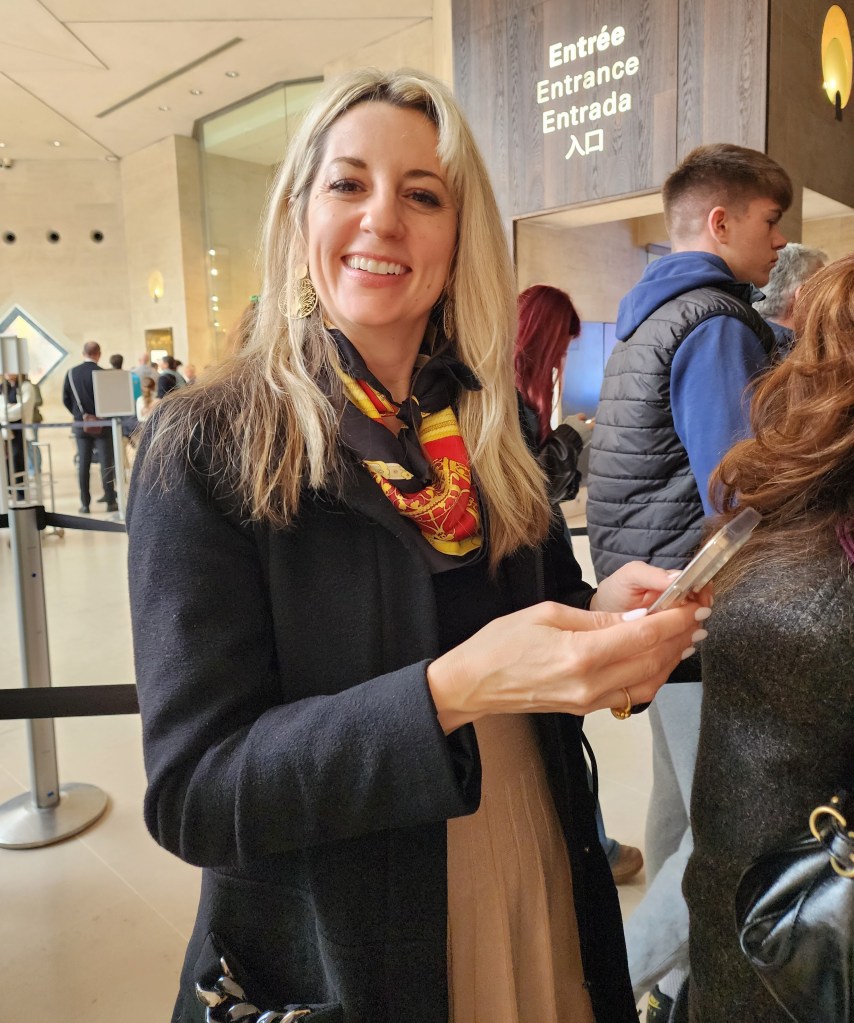
While I waited with Rory on the line to get into the Louvre to see the Jacques-Louis David exhibit, she explained why she wanted to see his work. Once again, she was checking for clues and looking for inspiration. Apparently, Jacques-Louis David was the teacher of his student Claude-Marie Dubufe. Dubufe painted the portraits of Micaela Pontalba (The Baroness) and Marie de Ternant (Amelie Gautreau/ Madame X’s grandmother). Micaela Pontalba and Madame X’s grandmother were contemporaries.
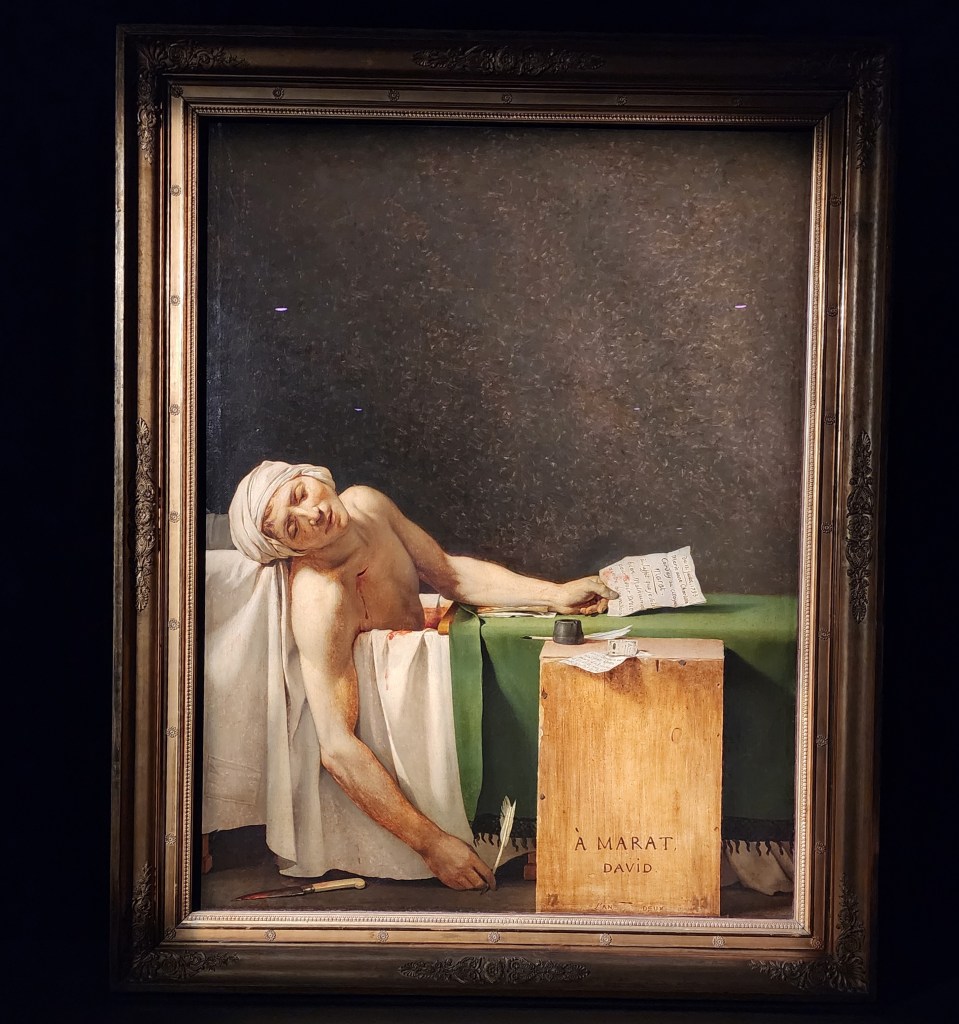
Certainly seeing Jacques-Louis David’s magnificent works was worth the wait. The exhibit at the Louvre looks to be one of the more popular ones. Thankfully, Rory’s scholarship and research mission allowed us an early entrance to the John Singer Sargent exhibit. Both exhibits were among the highlights of our time in Paris.
‘Punch’ Makes its Vital Impact on Broadway
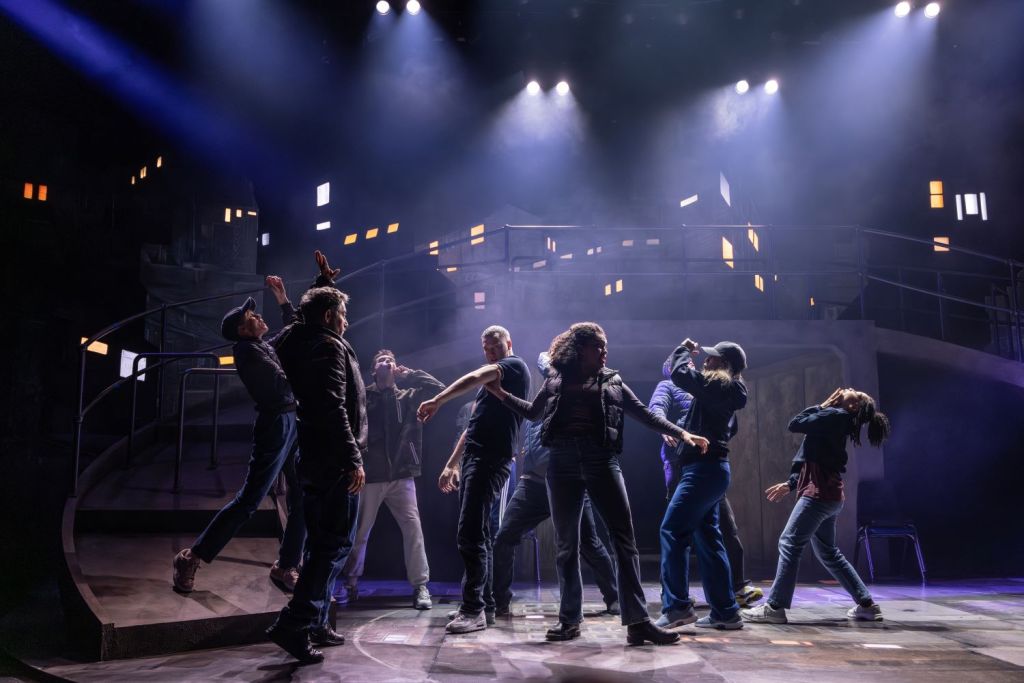
In 2025 when US citizens witness violence by those who profess patriotism, conservatism and religious fervor, one must look past the cognitive dissonance for clarity and understanding. Though the setting of Punch is Nottingham, England between 2011-2025, it is representative. The initial events might have happened in the US or any other country where punches are thrown as a right of passage for strapping young men. For these reasons Punch at Manhattan Theatre Club arrives at a crucial time.
Importantly, the heartfelt drama explores trending social concepts and themes that impact our cultural well being. The play presses hot button issues with vitality and energy. It examines the ethos of violence as the evidence of weakness. It explores how accountability for wrongdoing must be a part of rehabilitation or the likelihood of rehabilitation decreases. Finally, through the arc of the protagonist’s transformation, the play reveals that restorative justice can promote self-forgiveness and healing.
Based on Jacob Dunne’s book Right from Wrong, playwright James Graham with crystal clarity squares off against the confusion associated with brawling as thrilling, fun and justifiable. The play identifies the societal constructs that in the last decade have been infused with political nuance to exploit division and violence. Such constructs lift up physical assault as an emblem of masculinity. Likewise, they demean and dismiss kindness, compassion and empathy as true measures of strength and power.
Through Graham’s well-articulated characterizations of Jacob (the sensational Will Harrison), whose one punch kills James, and James’ mom Joan (the equally sensational Victoria Clark), we learn that redemption, forgiveness and hope are not empty words bandied about after violent acts that kill. Made alive by spiritual goodness, the process of redemption and forgiveness can manifest positive results. And with hope and persistence, nihilistic behavior can be turned around.

The two act structure of Punch stylized by minimal sets and props put to suggestive use seems front-loaded with exposition in the first act. In the prologue Graham carefully creates the circumstances moving from the present to Jacob’s past during the fateful night that changed his life. In the present Jacob barely is able to articulate what happened to a facilitator and “circle group” in an initial therapy session. To them he describes the night of Raf’s birthday celebration and the reasons how and why the confrontation with a stranger upends his life.
Principally through his precise descriptions, the choreographed action via Leanne Pinder’s movement direction, and director Adam Penford’s staging of Jacob and his mates, we understand how and why the killing happened. After they celebrate with drugs and pub crawls, his friends scatter in various directions planning to meet up later. Jacob runs into a girl, Claire (Camila Canó-Flaviá) and has a brief flirtation. Then, Raf phones him for some “action” going down at Yates’ Bar in Market Square. For Jacob, “You always step in, your mate, my mates, your people.”
Sadly, Jacob allows himself to be Raf’s and his friends’ tool. Jacob describes that he arrives at Market Square where they wait for him but they take no responsibility for their own provocation. Helping his “mates” Jacob slams a man with his fist during what he assumes to be a brawl. With one blow, he knocks down the guy he doesn’t know whose name he discovers later is James. It is a punch that lasts forever, symbolized effectively in a freeze frame tableau and directed lighting.
In the first act the events move to James’ parents David (Sam Robards) and Joan (Victoria Clark), who deal with James’s condition and eventual diagnosis that he can’t just sleep off being drunk in the ER. Through a series of acute, brief questions, Joan queries David why James needs hospitalization. We divine he received a severe concussion. Subsequently, a diagnosis comes. A brain bleed requires James to have surgery. However, he never regains consciousness. After a decision to pull him off life support, his parents review how and why their giving, gentle, twenty-eight year old son died.
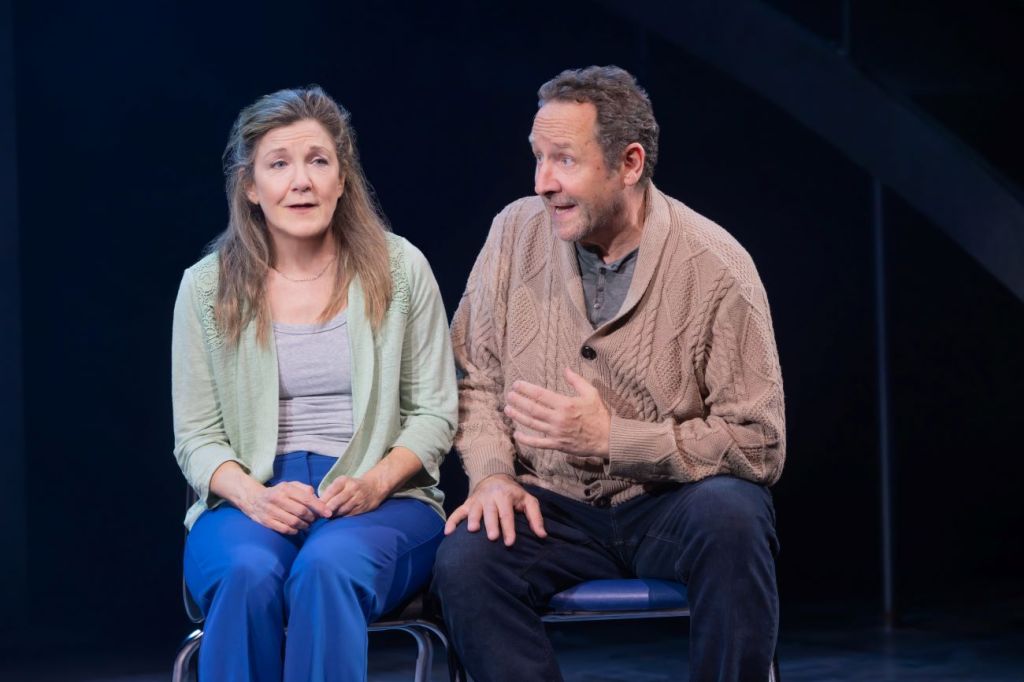
In his circle group, Jacob discusses his childhood, parents divorce, change of living arrangements and choice of friends in school. Jacob makes the point that his early decisions to choose one group of friends over another directly influenced his life negatively. Additionally, trouble in his school work because of autism adds to his alienation from school, his feelings of inferiority and need to fit in with “his mates.” For them engaging in violence bonds them together in a show of masculinity and power.
These scenes and Jacob’s discussing his jail time and encouragement by convicts to seek revenge on Raf for tipping off the police alternate with scenes between David and Joan. The couple discuss wonderful memories of James, the trial, appeals for a tougher sentence for their son’s killer and the underestimation of the “one punch” that frequently causes death. In another turning point, Joan discusses the uselessness of the situation where she feels no relief. In seeking relief, she ends up in a program called “restorative justice.” During the program she communicates with Jacob who is encouraged by his social worker (Camila Canó-Flaviá) and parole officer (Lucy Taylor).
Segments of the first act might have been streamlined and tightened as the repetition of scenes with Jacob and his mates become tiresome. The second act moves more quickly. It profoundly deals with Jacob’s self-realizations and transformation prompted by communication with David and Joan. The three, who agree to participate in the British restorative justice system communicate through letters. At this point Jacob is out on parole after 14 months. David and Joan question him about the circumstances of the fateful night. In the last scenes, they meet face to face and Jacob asks for forgiveness.
Harrison and Clark with the assistance of a fine ensemble (who take on many roles) breathe life into the characters and make them identifiable. The power of the play lies in the performances. Harrison’s move deeper into the emotions of Jacob as he seeks relief, redemption and forgiveness astounds. Clark’s Joan makes one admire James’ mother’s spiritual strength. She recognizes that she cannot live with hate and resentment toward her son’s killer. By seeking to understand and have hope for Jacob’s future, she gives birth to the possibility that Jacob can make something of himself. That satisfies her so that her own son’s sacrifice gains meaning in Jacob’s redemption.
The adaptation from narrative to drama requires theatricality. At times, the dialogue doesn’t deliver and must be activated. In the shuffling into action some scenes are awkward and need tweaking. Some might have been removed altogether. Overall Punch rides the zeitgeist of the moment. Its performances elevate its timeless themes and strike us with their vitality and power.
Punch runs approximately 2 hours and 30 minutes with one intermission at the Samuel J. Friedman Theatre until November 2nd. https://www.manhattantheatreclub.com/shows/2025-26-season/punch/
‘Staff Meal,’ Avant Garde, Experimental, a Review

In the notes from playwright Abe Koogler about Staff Meal, directed by Morgan Green, currently at Playwrights Horizons, Koogler hopes that the audience, “will emerge from it the way you might emerge from a transportive meal in an unusual restaurant in a part of town you’ve never been to before. The avant garde work, shrouded with a uncertainty is most interesting when there appears to be a linear forward movement among characters during vignettes of scenes which take place in Gary Robinson’s restaurant, that once was packed, but by the end closes down.
At the top of the play Ben (Greg Keller) and Mina (Susannah Flood), sit near each other in a coffee shop working on their laptops. Eventually, their proximity prompts them to become familiar with each other so after a number of days, saying “Hi,” and other chatty comments, they leave and seek better coffee and/or food elsewhere. The search leads them to Gary Robinson’s restaurant.
The rapport and pacing between Keller and Flood is enjoyable and funny by these talented actors. However, it ends when they get bogged down ordering from a waiter who takes an inordinately long period of time to take their order and bring back an excellent wine. In the interim, they take humorous and sobering flights of fancy about their personal lives which include some of the most imaginative dialogue in the play. However, when the waiter has not brought their food, then the scene shifts with the mood, and the focus becomes their waiter and his experience at the restaurant.

As a flashback of “The Waiter” segment begins, Ben and Mina leave “hanging in the air,” the thread of dialogue along with Ben’s story about his dog, whom his parents mistreated during the time he lived with his family in Spain. Hampton Fluker is the waiter who enters the spotlight. He discusses his time at the restaurant joined by other members of the wait staff (Jess Barbagallo, Carmen M. Herlihy), and chef Christina (Erin Markey), who serves them their delicious “staff meal” before they begin the evening’s service. Fluker’s waiter declines the meal at this point because it is his first day and he is afraid he will throw up out of nervousness.
What is striking about this vignette is that Christina doesn’t come up with ordinary food for the staff, but serves them extraordinary dishes following the philosophy of Gary Robinson, who emphasizes the importance of being of service to others. As one of the servers affirms, “Our power, our glory increases only so much as we give it away, constantly, only so much as we serve.” This is akin to a Biblical verse which implies, if one would be a great leader, one must be great at serving others. This philosophy is the antithesis of that practiced by politicians who serve themselves first, last and always, a virus that has particularly attacked the former Republican Party known as the Trump MAGAS.

However, like fragments of wisdom and truth which filter in and out of our consciousness, this conversation among the staff as they eat Christina’s delicious food and reference two of Gary Robinson’s books, dissolves into the air, though it is a profound concept that is incredibly current. However, one of the reasons why this wisdom and the astute servers’ conversation comes to a screeching halt is that an audience member interrupts with an important question, akin to “What the hell?”
By this point in time, the fourth wall has been broken twice; first by a vagrant (Erin Markey), who attempted to steal Mina’s laptop, though Mina elicited the help of an audience member to watch it for her when she went to the bathroom, because Ben wasn’t there that day. Luckily, Mina interrupts The Vagrant’s theft and sends her away without the laptop as Mina chides the negligent audience member, who was obedient to the playwright and didn’t tell The Vagrant, “Stop thief!”

The second breaking of the fourth wall is by a disruptive “audience member” (the fine Stephanie Berry), who is “annoyed” and questions the direction of the play defining it as meaningless, unrelated to her life, not current-when the world is burning down, and a waste of the gift of the audience’s time. Joining the other actor/servers onstage, she then discusses what she considers meaningful, her life, and the direction it has taken recently.
Of course, this is humorous and gives way to the notion that audience members’ opinions don’t always jive with theater professionals, though they can make or break them via word of mouth recommendations. Then the playwright forestalls audience opinions about his avant garde, surrealistic, weird work, using Berry as a a mouthpiece when the playwright has her say, “Do you ever get this feeling with young writers, or early writers, writers who are developing….do you ever wonder: when will they develop?” Berry’s audience member excoriates the quality of the play, Staff Meal, addressing the characters and absent playwright before sharing what is relatable to her in her life.

On consideration this surreal vignette works because of Berry’s authentic, spot-on performance which is confessional and makes us empathize with her even more so than with the other vignettes. But then she leaves and Koogler picks up where he left off back to the servers discussing the dwindling clientele and whether or not Robinson is going to close the restaurant down.
Then time and space shift once more. At this point, the servers and the couple have disappeared and the vignette with The Vagrant (Erin Markey) occurs. She explains that she takes on three roles, one of which is the chef, but the segment of The Vagrant involves her living in a hole and trying to acquire laptops so that she can get a job. Ah ha! We have the explanation of The Vagrant attempting to steal Mina’s laptop early on in the play. Eventually, she goes for a job interview and is hired and tells us she lived an extraordinary ordinary life and concludes with her affirmation that the rest of the play is about “how it ended.”

Berry’s audience member returns, warning us that she has been found out to be an artifice, and her role in the play is over, but she notices the weather outside is shifting and becoming ominous. The time has shifted once more and events move toward an unsettling conclusion. However, we do find out what happened to Ben’s dog, after they leave the restaurant without their food or wine. The waiter receives a delectable “staff meal,” Ben and Mina are separated walking home, and The Waiter is left questioning if Christina is still in the restaurant.
At this juncture it’s time to reconsider the audience member/playwright twitting himself about what he’s written. However, the play is more naturalistic in its chaotic, unthreaded, seeming randomness with bits of profound meaning stuffed here and there, like life, perhaps. In that we realize that we make meaning from our own lives, as random and strange as events can sometimes be, which have no rhyme or reason. Indeed, a fictional play with a neat beginning, middle and ending is easy to follow, but is perhaps easily dismissed as fiction. Staff Meal, as surreal as it is, is darkly memorable.

To assist with the sets which dissolve away to a bare stage, Jian Jung’s minimalist scenic design creates a cafe, a kitchen, a restaurant dining room and the dark ominous streets. Additional kudos go to Kaye Voyce’s simple (costume design), though I thought the elaborate costume for The Vagrant was interestingly layered with various “stuff.” Masha Tsimring (lighting design), kept segments toward the end foreboding, and Tei Blow (sound design) and Steve Cuiffo (illusion design), executed Morgan Green’s vision for Staff Meal.
Staff Meal will keep you guessing and wondering and perhaps as annoyed as Stephanie Berry’s Audience Member, trying to find the portal to understanding what’s beyond this unusual restaurant that serves its staff better than its customers. It runs with no intermission at Playwrights Horizons, Peter Jay Sharp Theater, 416 West 42nd Street. https://www.playwrightshorizons.org/shows/plays/staff-meal/
‘Stereophonic,’ Adjmi’s Hit Transfers to Broadway

When Stereophonic opened at Playwright’s Horizons in the fall of 2023, the hybrid comedy/drama/musical was extended a number of times for a multitude of reasons. The acting was superb. The subject matter intrigued. Who is not enthralled by a smooth rock band on the cusp of greatness with a chonky financial contract, “getting their s%$t together,” as a small privileged audience watches them record their artistry in two sound studios? Under pressure, the two couple’s relationships straining, the husband-wife partners display pustules bursting with emotionalism, and the audience sees the interior of these relationships. What’s not to love?
This is live theater at its best. The audience lives moment to moment with the musicians (we have forgotten they are actors), riding to the mountain tops and canyons as we joy to their pain of creation, producing what may be a #1 album that soars to the top of the charts. In its transfer and Broadway premiere at the Golden Theatre, the cast, music, verité style, and arc of development are the same as is the three-hour length as in the original production at Primary Stages. Bravo. It is still a must-see.

Why would playwright David Adjmi (The Evildoers, Stunning), Will Butler, who wrote the terrific original music and lyrics, and superb director Daniel Aukin muck with success? The solid, winning substance of Stereophonic is about the five-member rock band and studio engineers working at an accelerated pace to record an album at two California sound studios in the mid-1970s. We get the “low-down” perspective of what it takes to be great.
Above all Stereophonic Broadway remains a stylistic masterpiece of theater verité with a view into two separate worlds, music creation and technical engineering, without which musicianship would not exist. The meld of the two in a great album reveals the dynamic genius of technicians and musicians, though the musicians are the public face who receive all the glory.

Two points to make about the production, which is integrated and fantastic from my perspective, with one suggestion. First, Stereophonic may not be understood by a “Broadway” type audience, who might not have the patience to work through the incredible detail of “moment to moment” dialogue and complications so organically constructed, intimate and authentic, that the realistic action brings one into oneself, rather than encouraging escapism in a flight of song and dance numbers characteristic of “the Broadway show.” In its brilliance, Stereophonic may not be fully appreciated for what it is. Stereophonic is a “one-of-a-kind” original that provides an electrifying evening of music creation as one would imagine happened in iconic recording studios like Muscle Shoals Sound Studio in Alabama or Abbey Road in London, perhaps, without the histrionics.
Secondly, in its staging at the Golden Theatre, a larger venue, the sound design has to be properly figured out by the designers, and the actors. They are not in a smaller venue. The actors must project, especially when their backs are turned from the audience. The sound design must be at equal level in every portion of the theater to eliminate dead spots. In the transitioning this must continue to be fine tuned.
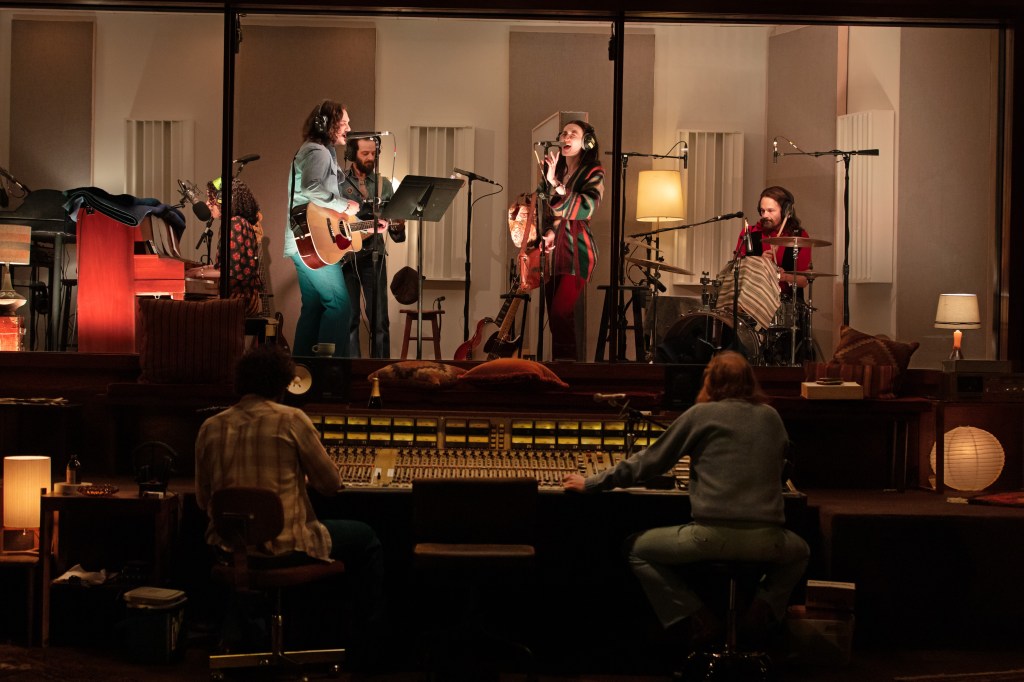
For rock fans and those fascinated by the ethereal nature of how bands collaborate, the Broadway production mesmerizes because we clearly understand the division between the musicians’ mystical artistry, which is always front and center, and the unseen, faceless, backstage engineering by Grover (Eli Gelb), and Charlie (Andrew R. Butler), who are finally revealed in process. It is the engineers’ artful techniques which enhance the overall effect and impact of each recorded song. This division of the two different realms of making music is beautifully manifested in David Zinn’s wood paneled scenic design, and Jiyoun Chang’s lighting design, which Aukin carried over to Broadway, along with Enver Chakartash’s period costume design. Robert Pickens & Katie Gell’s hair and wig design are new in this production.
As at Primary Stages, the Golden Theatre’s stage is divided into two sections. The upper level reveals the sound studio protected by glass, where we see and hear the musicians perform in a theater verité style, as they stop to revise tempos, add pauses, evolve riffs, etc. Downstage is the massive control panel where the engineers sit mostly with their backs to the audience and work to serve, manipulate, and stoke the musicians’ extraordinary talent and heightened emotional states, all the while discussing “their truth” with each other. With Aukin’s superior staging, we can track both worlds, feeling we are in their midst, interactively participating in music creation and understanding how the worlds precariously interact.
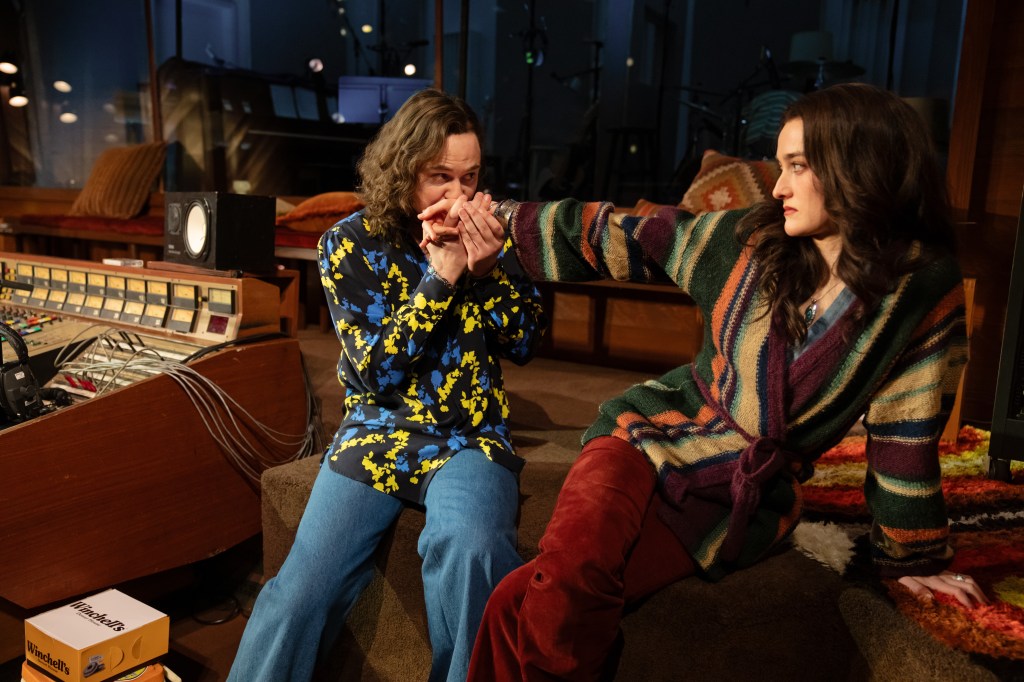
Though band members treat Grover and especially the shy Charlie as invisibles they don’t speak to, without their efforts the band’s unique identity and glorious sound wouldn’t exist. Therefore, in the production’s arc of development, Adjmi gradually uncovers the engineers’ centrality to the creative process and the band’s success. It is especially funny and poignant to witness how the engineers moderate the emotional infantilism of the “high-strung” musicians to get the recordings in top shape.
Throughout, drugs and alcohol become a panacea to quell the rough edges of sleep deprivation and stimulate a frenzied work environment. The cocaine, supplied by overworked engineers, keeps the band working at a frenetic pace. Ironically, drug use intensifies the arguments but floods the band’s creative juices.

Aukin’s vision of Adjmi’s themes of art, music, sacrifice and suffering, heighten the importance of sound engineers. They must have skill and expertise in the control room, as well as the personalities to cope with and manipulate artistic personas like druggy Reg (the hysterical and funny Will Brill), and diva Diana (Sarah Pidgeon).
For example Grover and Charlie must be temperate as Diana strains to get the notes, emotionally loses it, and must be encouraged by her partner lead musician and producer Peter (Tom Pecinka), to try again and again to “get it right.” Additionally, the engineers must be purposed to withstand the emotional word bludgeons from their “boss,” Peter, who launches off into a demeaning tirade against Grover and fires him. It is an idiotic move because Grover is the backbone of the album and Peter knows it. That is why he later makes Grover co-producer and apologizes.
The songs of Will Butler, (Oscar-nominated and former member of the Grammy-winning indie rock band Arcade Fire), remain as striking as ever. Indeed, one would wish that this band does produce an album, finishing the partial songs (we only hear a few in their entirety), that we hear them rehearse. The songs resonate with the themes of emotional yearning and the deceptions of fame, money and commercialism, the masquerade that they must avoid. If they embrace the commercialism, they will lose their way as artists, attempting to achieve perfection, a goal of the hard driving Peter.

Butler’s songs importantly reveal the raw emotions of anger and hurt, stirred by betrayal and loss that couples Reg (Will Brill) and Holly (Juliana Canfield), and Peter and Diana, experience in their relationships. Working frenetically together in close quarters to exceed the results of their previous album require sacrifice to be great. Peter constantly pushes them toward this. But by the conclusion as their work is finished, all have suffered for it. Simon (Chris Stack), who has been away from his wife and children for six months faces the threat of divorce and losing his family.
However, only Diana has been signed on to be a solo artist. Is the pain, suffering and sacrifice worth it for the others? Juliana Canfield’s Holly, a close friend and ally of Diana, congratulates her on this success. But we are left wondering if they will remain close or if the band will remain together to collaborate again?
A tour de force, Stereophonic runs over three hours with one intermission. Thanks to Adjmi, director Daniel Aukin, the sensational cast, whose acting chops and vocal talents are non-pareil, and the technical design team, the compelling forward momentum of the band’s creative dynamic resonates with powerful immediacy.
Special kudos goes to Music Director Justin Craig and Will Butler and Justin Craig’s orchestrations.
Stereophonic runs through July 7 at the Golden Theatre (252 West 45th Street, between Broadway and Eighth Avenue). www.stereophonicplay.com
Athena Film Festival 2024: ‘Fancy Dance’ Panel
Decolonizing the Film Industry: Indigenous Women’s Voices

Athena Film Festival opened last weekend. The premiere women’s film festival in New York City celebrated its 14th year. In previous years, the amazing festival has had ground-breaking, maverick films and speakers like Gloria Steinem, Dolores Huerta, Eve Ensler and many more. Held at Barnard College, the labs, workshops and screening of cutting edge films proved to be exciting and revelatory in showing the direction of trends in women’s stories. Filmmakers, friends and supporters conducted talk backs and conversations, and experienced events that explored what it means to be a woman today among diverse groups.

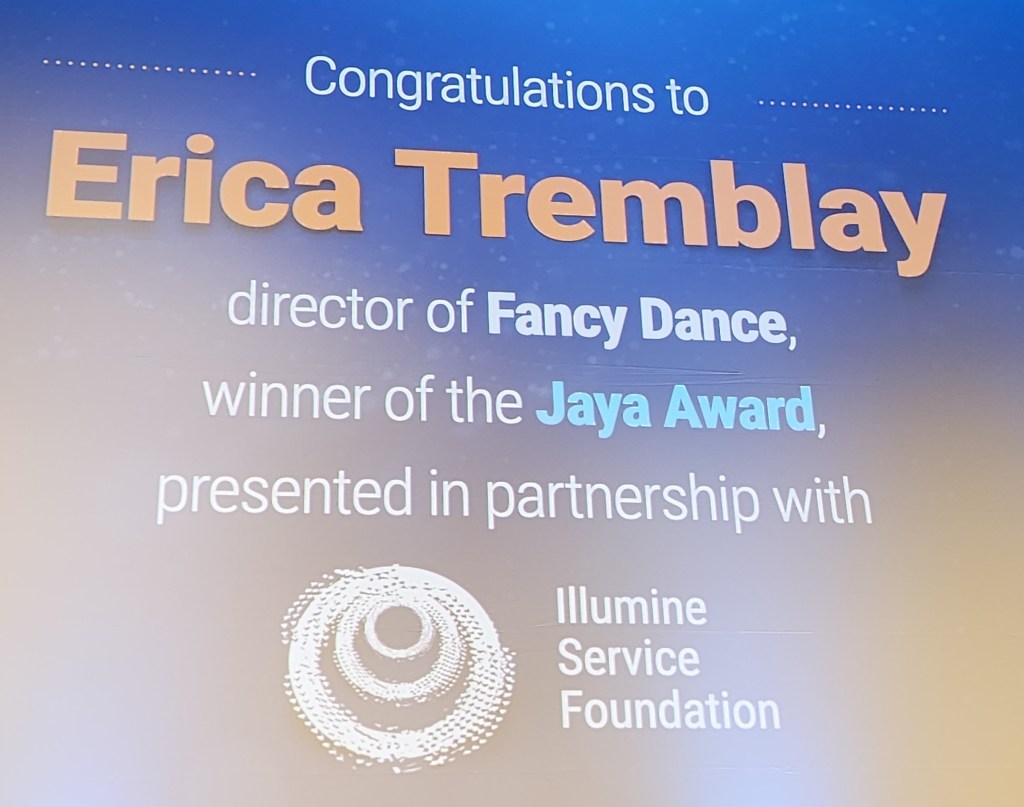
Fancy Dance was a film I enjoyed seeing. There was a Talk Back afterward with the director and creatives who worked on and supported the award winning film, released in 2023 and screened in festivals around the country. Directed by Erica Tremblay and written by Erica Tremblay and Miciana Alise, Fancy Dance stars Lily Gladstone who has been nominated for an Oscar and received multiple awards from critics’ associations, film festivals and a SAG and Golden Golden award for her amazing performance in Martin Scorsese’s masterwork, Killers of the Flower Moon.
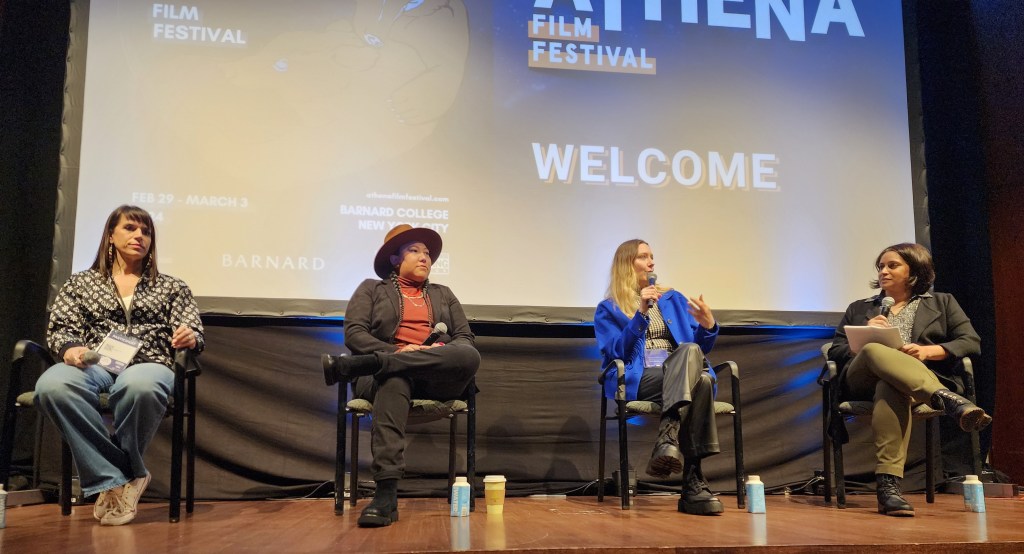
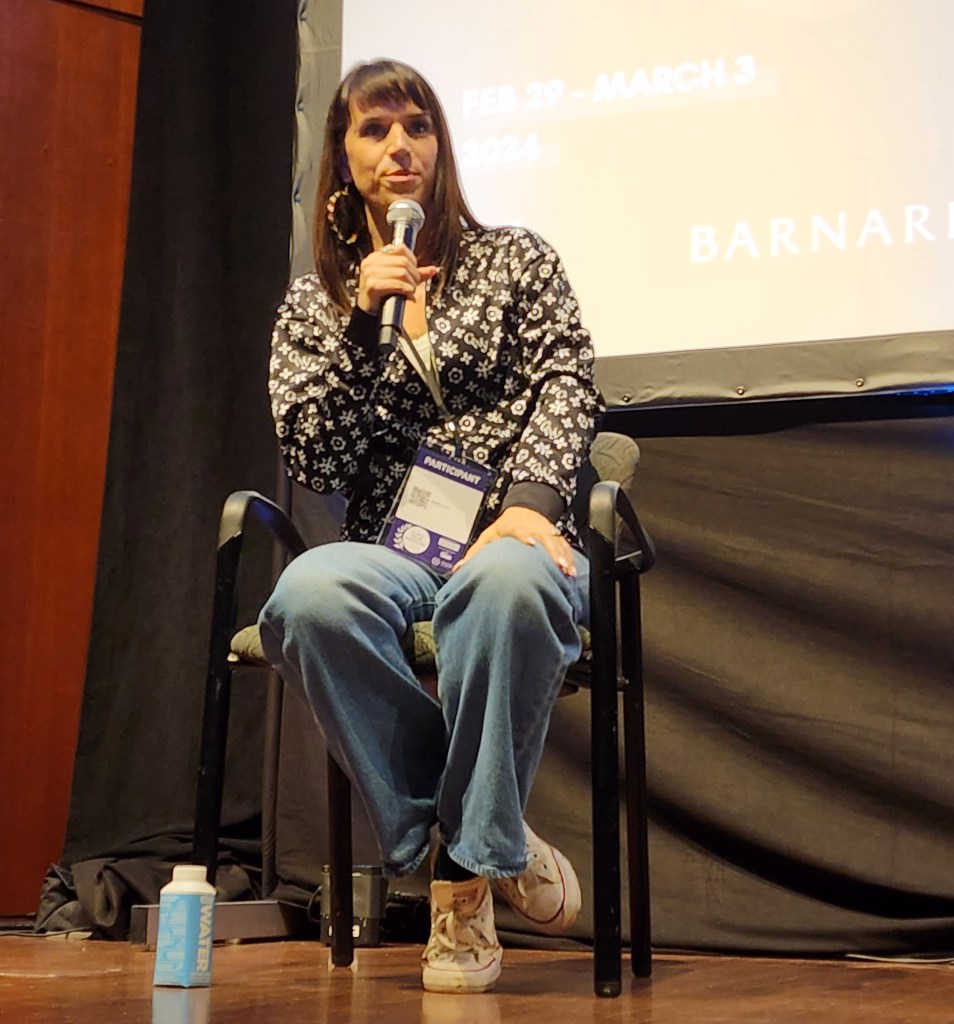
The panel after the screening of Fancy Dance.
Like Lily Gladstone and Erica Tremblay, many of the creatives who worked on the film were Indigenous woman and men. The story and themes revolve around Lily Gladstone’s character, Jax, a queer indigenous woman, who must confront her sister’s disappearance, while she lives and takes care of Roki (Isabel Delroy-Olson). Together Jax and Roki struggle to hustle money and at the top of the film we note that Jax with Roki as her accomplice steals a vehicle and drives it to a chop shop for a nominal amount of money. Tremblay, eschews political correctness in her portraiture of Jax and Roki who is not above stealing from a convenience store furtively picking and choosing items she likes while Jax picks up some supplies.
The film combines many elements and is a combination mystery, thriller, road trip and ultimately family drama as Jax deals with having to give up care of Roki to her white father and stepmother. The situation becomes problematic when her grandparents refuse to take Roki to the state powwow where Jax has obfuscated that her mom will be because she is a great dancer.
During the panel discussion which encompassed how the film was made, Tremblay discussed writing the characterizations specifically to go against the stereotyped “Indians” who vie between stoic, noble savages who are guardians of the lands vs. thieves, deceivers and killers who will stab white people in the face. Tremblay intentionally characterized Jax having a record. She steals and hustles money from those she can dupe, as does Roki. And the theme of trafficking indigenous women like her sister, who sell themselves to oil riggers or other temporary workers and then are abused sexually-which most probably happened to Jax’s sister, is highlighted in the film.

Tremblay discussed how indigenous creatives work together and supported each other’s films. When Gladstone worked with her, it was before Killers of the Flower Moon and her performance took off. Then after Tremblay couldn’t get distribution, she and her team slowly applied to film festivals (Outfest LA 2023, Sundance 2023, Hamptons International Festival 2023, etc.) where they won awards for Gladstone’s performance and Tremblay’s overall artistry, Best Narrative feature. By that point Gladstone received rave notices for her performance in Killers of the Flower Moon, and Tremblay persisted. Finally after about a year of struggling, trial and error leaping over distributors who couldn’t see a way to funding the film, Tremblay was thrilled that Apple+TV picked it up.
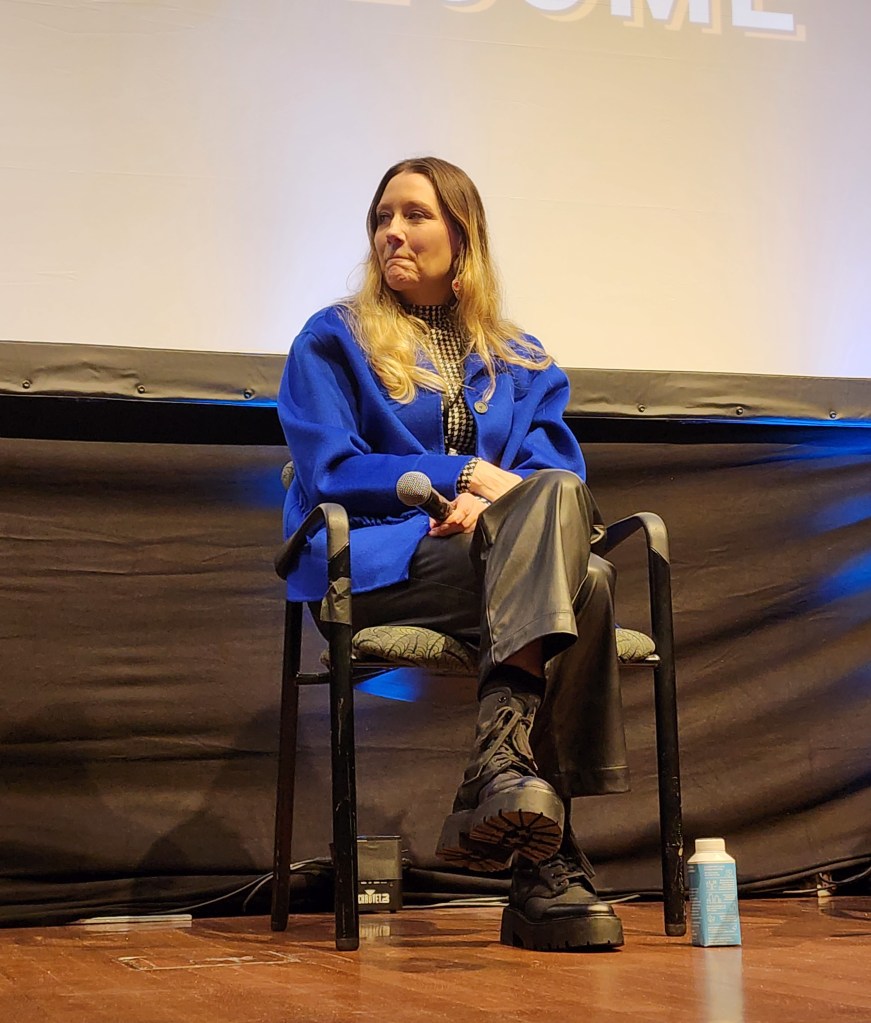
Tremblay said that Apple+TV was ideal because she wanted the film to have a wide viewership and Apple+TV’s streaming platform was exceptional. Rather than to have it appear in theaters for a week (that could be accomplished by submitting it to film festivals) and would be there and gone before most people saw it, a streaming service would offer it indefinitely.

Panel members affirmed that the indigenous film community networked and stayed upbeat and supported each other, especially during the dark times when they needed to raise money for payroll and then were at a loss about anyone picking up distribution. Tremblay and the others were hopeful about films about indigenous women in the future. Tremblay was working on seeing more humor in indigenous film, to break the stereotype of the remote, cold, unemotional “Indian” which she didn’t quite escape with her Jax character.
See Fancy Dance distributed on Apple+TV. Read my review on Blogcritics https://blogcritics.org/athena-film-festival-review-fancy-dance/
Susan Stroman Interview by Broadway Playwright Sharon Washington

On Friday, November 17th The League of Professional Theatre Women is sponsoring a free event at the Bruno Walter Auditorium at the New York Public Library for the Performing Arts at Lincoln Center (111 Amsterdam Avenue at 65th Street, New York). The public is invited to this special interview of Tony Award winning Director/Choreographer Susan Stroman about her brilliant career by Broadway Playwright Sharon Washington, at 6 p.m.
The event, which is open to the public, is part of the League of Professional Theatre Women’s (LPTW) Oral History Project in partnership with the Library and is a highlight of LPTW’s 41st season.

Susan Stroman, Director/Choreographer is a five-time Tony Award winning director and choreographer known for the Broadway musicals Crazy for You, Contact, The Scottsboro Boys, and The Producers. She is the winner of a record-making 12 Tony Awards including Best Direction and Best Choreography. Her work has been honored with Olivier, Drama Desk, Outer Critics Circle, Lucille Lortel, and a record six Astaire Awards.

For Broadway, she most recently directed and choreographed the new Kander & Ebb musical New York, New York and directed the new play POTUS: Or, Behind Every Great Dumbass Are Seven Women Trying to Keep Him Alive. This season in London’s West End, she directed and choreographed the revival of Crazy for You at the Gillian Lynne Theatre. Other Broadway credits include: Show Boat, Prince of Broadway, Bullets Over Broadway, Big Fish, Oklahoma!, Young Frankenstein, Thou Shalt Not, The Music Man, Big, The Frogs, and Steel Pier.

Off-Broadway she directed and choreographed Little Dancer, The Beast in the Jungle, Dot, Flora the Red Menace, And the World Goes ‘Round, Happiness, The Last Two People on Earth: An Apocalyptic Vaudeville, as well as The Merry Widow for The Metropolitan Opera. She has created ballets for New York City Ballet, Pacific Northwest Ballet, and Martha Graham. She received the American Choreography Award for her work in Columbia Pictures feature film Center Stage. She is the recipient of the George Abbott Award for Lifetime Achievement in the American Theater and an inductee of the Theater Hall of Fame in New York City. www.SusanStroman.com

Sharon Washington, Playwright/Actor was nominated for a 2023 Tony Award for Best Book of a Musical as co-writer of New York New York. She made her debut as playwright with her solo play Feeding The Dragon which played Off-Broadway at Primary Stages and was nominated for Outer Critics, Lortel and Audelco Awards. She was the Primary Stages 2017-18 Tow Foundation Playwright-in-Residence. The play was recorded as an Audible Original and selected as an Audible Essentials Top 100 pick.
As an actor, last summer Sharon was seen as Queen Margaret in the Public Theater/Shakespeare in the Park production of Richard III, broadcast on PBS Great Performances. Recent film and television appearances include Power Book III: Raising Kanan, Bull;the short film Birdwatching co-starring Amanda Seyfried, and the Academy-Award winning Joker. You may also recognize her voice as the narrator of several documentary series for Animal Planet, Discovery and NOVA.
On Broadway Sharon appeared in The Scottsboro Boys musical. Off-Broadway credits include Dot (Vineyard Theater); Wild with Happy (Public Theater/NYSF – Lucille Lortel nomination and Audelco Award among many others; and numerous regional theaters around the country.
Sharon holds an MFA from the Yale School of Drama and a BA from Dartmouth College.
To attend this event, please RSVP at this link: https://www.nypl.org/events/programs/2023/11/17/league-professional-theatre-women-susan-stroman
‘Jaja’s African Hair Braiding,’ Hysterical, Fun, Profound

Jaja’s African Hair Braiding by Jocelyn Bioh in its world premiere at the Manhattan Theatre Club (Samuel J. Friedman Theatre), is a rollicking comedy with an underlying twist that, by the conclusion, turns as serious as a heart attack. Bioah’s characters are humorous, quick studies that deliver the laughs effortlessly because of Bioah’s crisp, dialogue and organic, raw themes about relationships, community, female resilience and the symbolism of hair braiding which brings it all together.
The setting is in Harlem, at Jaja’s Hair Salon where African hair braiding and the latest styles are offered. For those white gals and guys who envy the look of long lovely extensions but are too afraid to don them, it is understandable. You have to have a beautiful face to sustain the amazing, freeing look of long braided tresses that you can fling with a gentle or wild toss, evoking any kind of emotion you wish.

During the course of the play, we watch fascinated at the seamless ease with which the actors work their magic, transforming otherwise unremarkable women into jaunty, confident and powerful owners of their own dynamic presentation. While we are distracted by the interplay of jokes and mild insults and gossip, the fabulous shamans weave and work it.
In one instance, Miriam (the fine Brittany Adebumola) takes the entire day to metamorphose her client Jennifer (the exceptional Rachel Christopher). Jennifer comes into the shop appearing staid, conservative and reserved with short cropped hair that does nothing for her. But once in Miriam’s chair, something happens beyond a simple hairdo change.
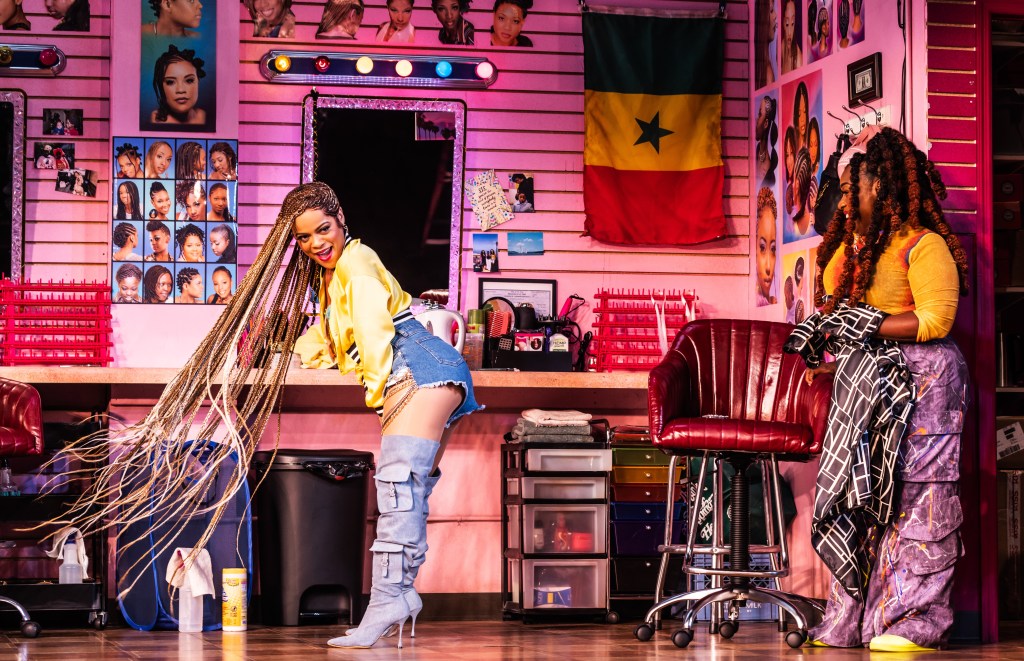
After MIriam is finished discussing her life back in Sierra Leone, which includes the story of her impotent, lazy husband, her surprise pregnancy and birth of her daughter by a gorgeous and potential future husband, and her divorce from the “good-for-nothing”, paternalistic former one, Jennifer is no longer. Miriam has effected the miraculous during her talk. Jennifer has become her unique self with her lovely new look. As she tosses her head back, we note Jennifer’s posture difference, as she steps into the power of how good she looks. Additionally, because of Miriam’s artistry, Jennifer is the proud receptor of a new understanding and encouragement. She has witnessed Miriam’s courage to be open about her life. If Miriam can be courageous, so can she.
Jennifer leaves more confident than before having taken part in the community of caring women who watch each other’s backs and hair, which by now has taken on additional symbolic meaning. Incredibly, Miriam works on Jennifer’s braids the entire play. However, what Jennifer has gained will go with her forever. The dynamic created between the storyteller, Miriam, and the listener, Jennifer, is superb and engages the audience to listen and glean every word they share with each other.

On one level, a good part of the fun and surprise of the production rests with Bioh’s gossipy, earthy, forthright characters, who don’t hold back about various trials they are going through involving men, who exploit them. Nor do they remain reticent if they think one of their braiding colleagues has been surreptitiously stealing their clients, as Bea accuses Ndidi of doing in a hysterical rant
Another aspect of the humor deals with the various clients who come in. Kalyne Coleman and Lakisha May each play three roles as six different clients. They are nearly unrecognizable for their differences in appearances. They change voices, gestures, clothing, mien, carriage and more. For each of these different individuals, they come in with one look and attitude and leave more confident, happier and lovelier than before.
Portraying three vendors and James, Michael Oloyede is hysterically current. Onye Eme-Akwari and Morgan Scott are the actors in the funny Nollywood Film Clip that Ndidi imitates.

For women, hair is key. Bad hair days are not just a bad joke, they are a catastrophe. Bioh capitalizes on this embedded social, cultural more. Presenting its glories, she reveals the symbolism of “extensions,” and “new appearances” as they relate to uplifting the spirit and soul of women who are required to look gorgeous.
Above all, Bioh elevates the artists whose gifted hands enliven, regenerate, encourage and empower their clients. Along with Miriam (Brittany Adebumola), these include Ndidi (Maechi Aharanwa), Aminata (Nana Mensah) and Bea (Zenzi Williams). Sitting in their chairs, under their protection, trusting their skills at beautification, we recognize the splendid results, not only physically in some instances but emotionally and psychically.
The only one who isn’t an African braiding artist is Marie (Dominique Thorne). She is helping out her mother Jaja (Somi Kakoma), who owns the salon and who is getting married that day, so she can get her green card for herself and Marie. Jaja who appears briefly in wedding garb to share her excitement and happiness with the women who are her friends, then goes to the civil judge to be married. However, Marie can’t be happy for her mother. Likewise, neither can old friend Bea, who has told the others the man Jaja is marrying is not to be trusted.

Nevertheless, the point is clear. Within the shop there are artists who are working their way toward citizenship. And Miriam is saving money to bring her daughter to the US. Though Bioh doesn’t belabor the immigration issues, but instead, lets us fall in love with her warm, wonderful characters, it is a huge problem for the brilliant Marie, who has been rejected from attending some of the best colleges. Her immigration status is in limbo as a “Dreamer.”
And like other immigrants, she is living her life on hold in a waiting game that is nullifying as well as demeaning because, as Jaja points out repeatedly to her, she can be a doctor or anything she wants. Her daughter, Marie, is brilliant, ambitious and hard working. Taking over the African hair braiding salon is not good enough. She can do exploits. But without a green card, she can do nothing.
Directed by Whitney White whose vision for the play manifests the sensitivity of a fine tuned violin, the play soars and gives us pause by the conclusion. The technical, artistic elements cohere with the overall themes that show the hair salon is a place of refuge for women to commiserate, dig deep and express their outrage and jealousies, then be forgiven and accepted, after a time. It is a happy, busy, brightly hued and sunny environment to grow and seek comfort in.

David Zinn’s colorful, specific scenic design helps to place this production on the map of the memorable, original and real. This salon is where one enjoys being, even though some of the characters snipe and roll their eyes at each other. Likewise, Dede Ayite’s costume design beautifully manifests the characters and represents their inner workings and outer “brandings.” From her costumes, one picks up cues as to the possibilities of what’s coming next, which isn’t easy as the production’s arc of development is full of surprises.
Importantly, Nikiya Mathis’ hair & wig design is the star of the production. How the braiding is done cleverly with wigs so that it appears that the process takes hours (it does) is perfect. Of course the styles are fabulous.

Kudos to the rest of the creative team which includes Jiyoun Chang (lighting design), Justin Ellington (original music & sound design), Stefania Bulbarella (video design), Dawn-Elin Fraser (dialect & vocal coach).
This is one to see for its acting, direction, themes and its profound conclusion which is unapologetic and searingly current. Bioah has hit Jaja’s African Hair Braiding out of the park. She has given Whitney White, the actors and the creatives a blank slate where they can enjoy manifesting their talents in bringing this wonderful show to life. It is 90 minutes with no intermission and the pacing is perfect. The actors don’t race through the dialogue but allow it to unfold naturally and with precision, humor and grace.
For tickets go to the Box Office on 47th Street between 7th and 8th Avenues or their website https://www.manhattantheatreclub.com/shows/2023-24-season/jajas-african-hair-braiding/?utm_source=google&utm_medium=cpc&gclid=CjwKCAjwvfmoBhAwEiwAG2tqzDaZkpYxm9EVbEs9yQ0hCPDF5gTyx9a8iy4yFCkwZxfd3skrmdD8oxoCAfgQAvD_BwE
‘The Saviour,’ a Tour de Force at the Irish Repertory Theatre
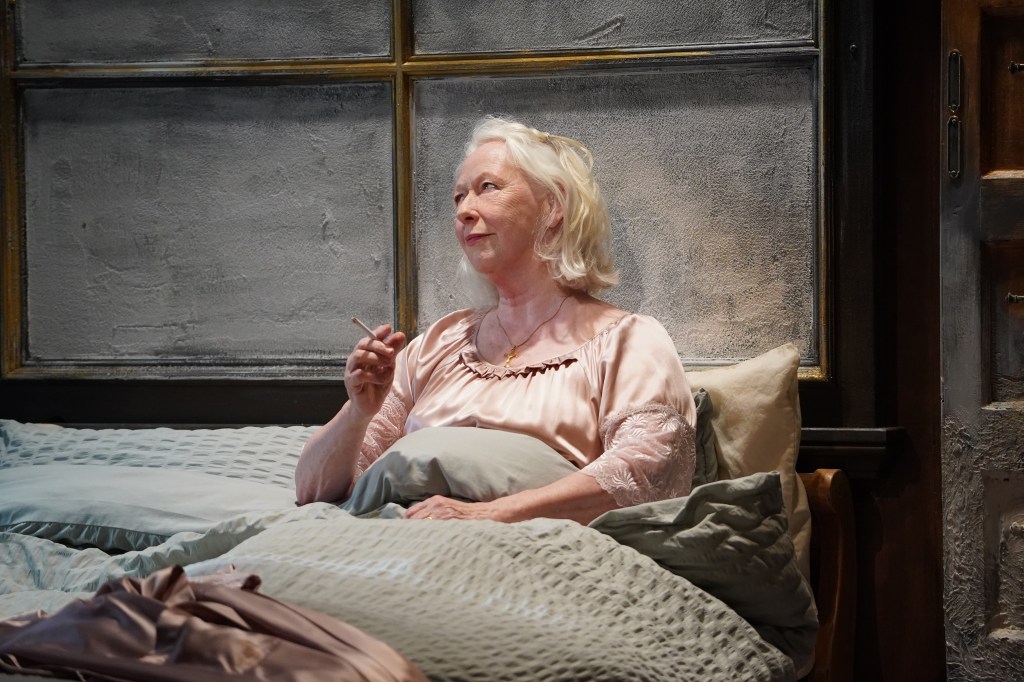
The Saviour, a powerful, ironic character expose, written by Deirdre Kinahan and directed by Louise Lowe, presents the wonderful Marie Mullen in a performance which strikes at the heart of Catholicism, paternalistic culture and hypocrisy. The World Premiere by Landmark Production is being performed on the Francis J. Greenburger Mainstage at the Irish Repertory Theatre until August 13.
Kinahan begins her 70 minute play as Marie Mullen’s Máire resides in bed enjoying a “fag” (cigarette) and laughing to herself at what has just transpired with Martin. She expresses her enthusiasm and joy to her great confidante Jesus, whom she addresses for half of the play.
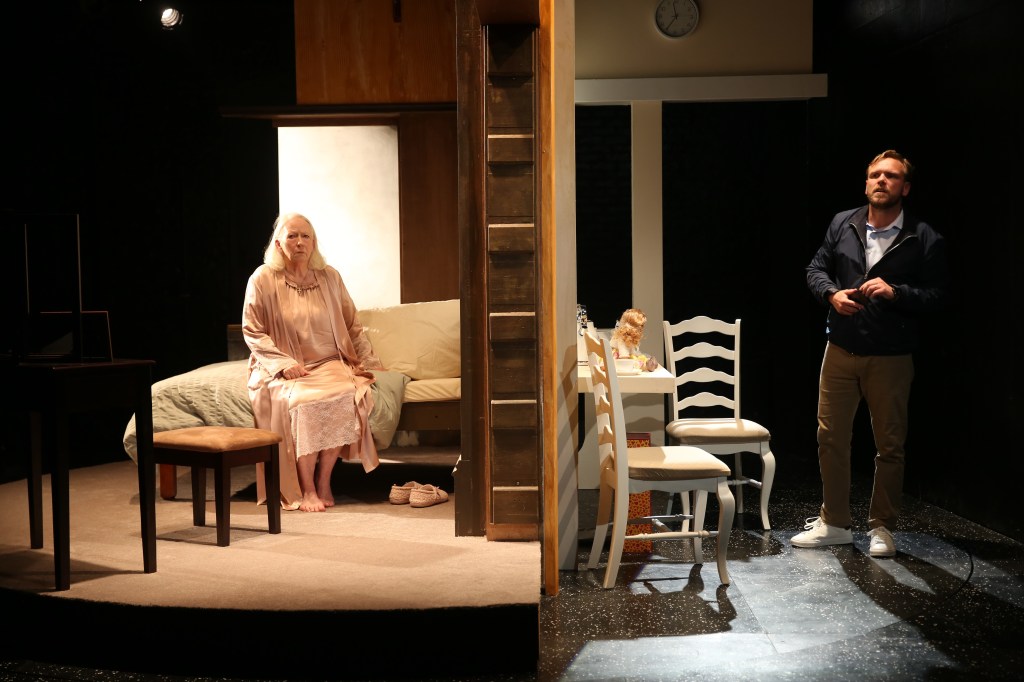
The audience is shocked into laughter at the unexpected subject matter of her descriptions. Máire (thanks to Joan O’Clery’ costume design), is the opposite of a woman that others might describe as a “dolled-up floozy,” generous with her affections and body. The protagonist is a senior citizen. Her environs and bedroom are neither opulent nor well-appointed thanks to Ciarán Bagnall’s scenic and lighting design. The sets on a revolving platform of bedroom and kitchen are a clue to her financial situation.
In other words, Máire is not the type to be taken advantage of for her money or what she has which looks to be the stylized bare minimum of possessions. Thus, she must be taken at her word, or she is completely fantasizing the circumstance with Martin, who, like Jesus, remains invisible. She is an unreliable narrator, so we are left guessing about the truth of the present circumstance she describes.
Louise Lowe’s acute direction shepherds’ Mullen’s fabulous performance as Máire to lead the audience in wonder, enthralled in the grip of hearing about Máire’s relationship with Martin as she discusses it with Jesus.
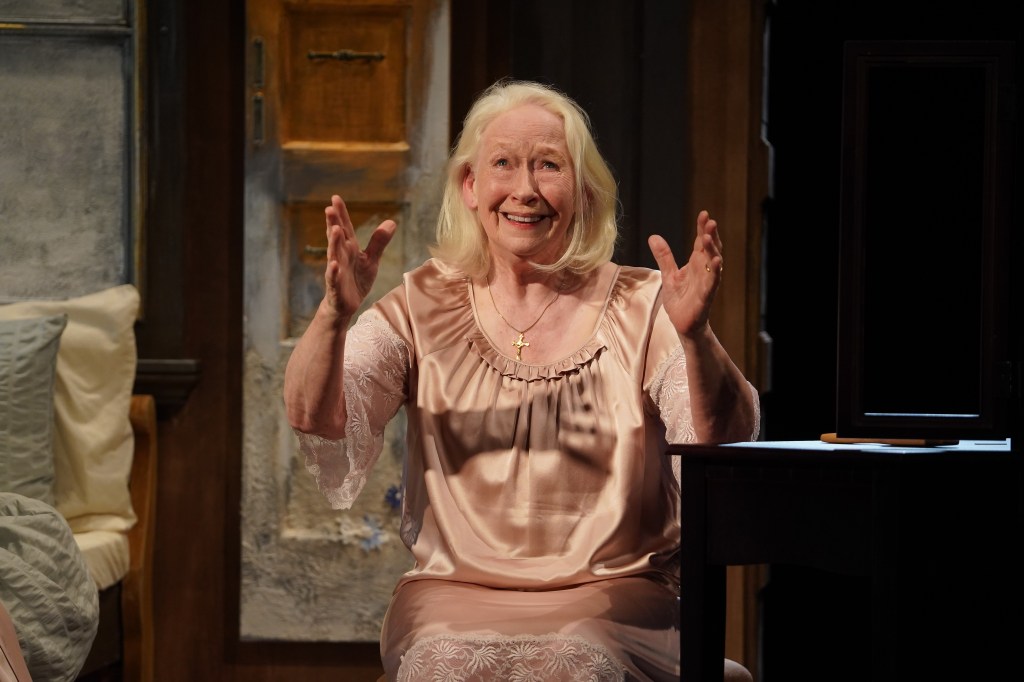
As Máire waits for Martin to come upstairs with her coffee, she glories that it is her birthday and she celebrated a wonderful evening with Martin who shopped and cooked for her and appreciates her more than her husband who died years before. Indeed, Martin even appreciates her more than her children, who are now grown and have children of their own. She reviews the circumstances of her life with Jesus in light of her relationship with Martin. She believes that her relationship with “the saviour” is somehow in concert with her Godly interactions with Martin, because he prays, believes in God, goes to church and wouldn’t be with her if Jesus didn’t accept him.
Kinahan’s characterization of Máire, effected through Mullen’s interpretation, is completely believable, especially when she speaks to Jesus as if He is her “all in all.”
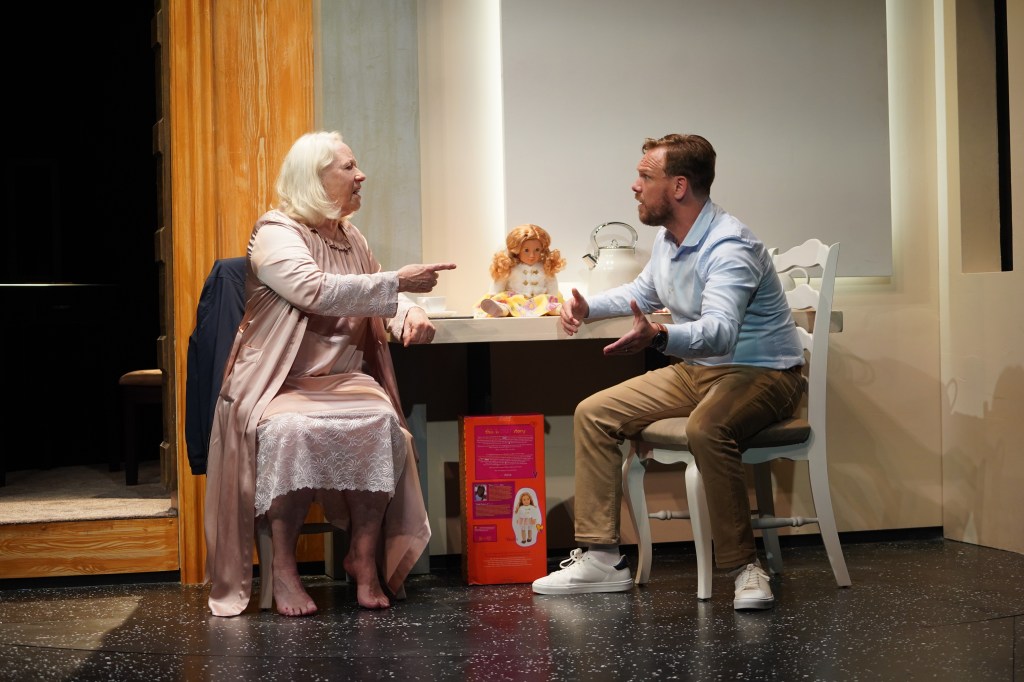
As the monologue continues, we question the reality of what Máire shares with Jesus with regard to Martin who is shadowy and mysterious. Is it true or isn’t it? However, we do accept her discussion with Jesus about her devastating upbringing. This includes the death of her mother, and her father’s abandonment. He left her with the nuns where she is abused and made to work in the oppressive, hot “laundry.”
The reference is perhaps to the Magdalene Laundries in Ireland, run by the nuns and Roman Catholic orders to give shelter to “fallen women” from poor backgrounds. To punish them with proper penance and hide their shame, parents sent them to these asylums which were secretive and oppressive. Exploiting the girls’ labor, they offered little emotional respite from condemnation. Sadly, the babies born out of wedlock were taken away from their birth mothers and adopted out by the nuns for donations.
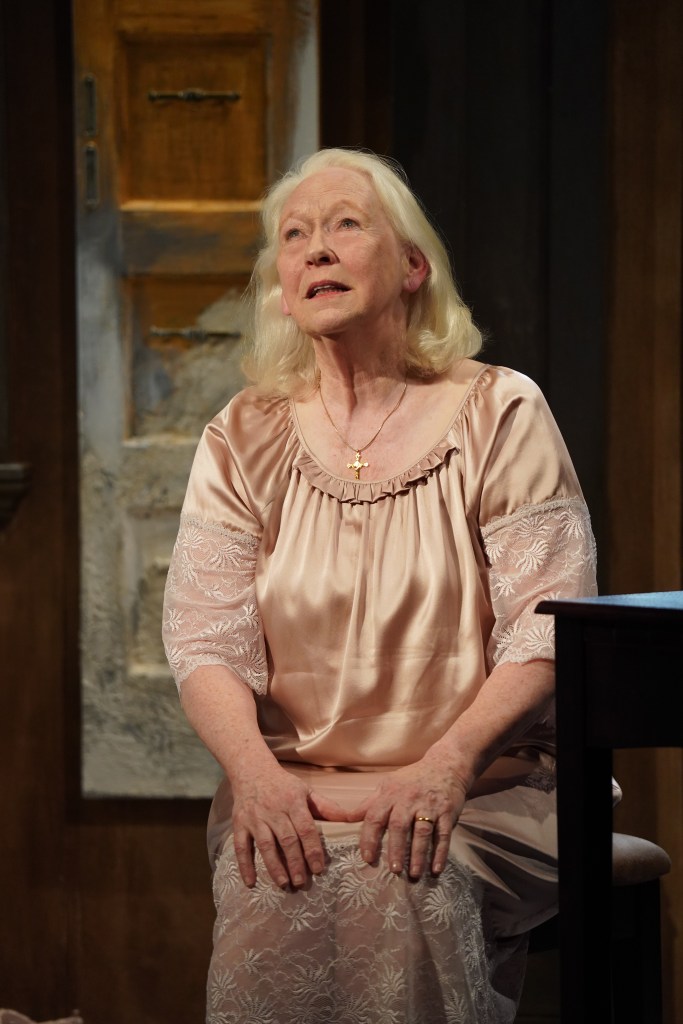
As in the case of Máire, orphaned girls were placed there so they could be properly raised by the goodly nuns. However, as Máire indicates, her situation was equally terrible, not because she “sinned,” but because poverty relegated her to a life of misery of hellish toil and fear with the nuns at a young age.
It is during this discussion of the laundry, whose atmosphere and terror is effected by Aoife Kavanagh’s crushing sound design (as Máire recalls her past), that she reveals her only salvation was her faith in Jesus. She refers to “her loving Jesus” as not the “nuns’, Jesus.” Her Jesus helps her survive the nuns’ cruelty, condemnation and judgment until she manages to free herself with a job. And it is then she meets her husband with whom she has a loving relationship and family.
Marie Mullen’s is absolutely terrific in animating Máire and establishing Jesus as a “living” being with whom she shares the most intimate of secrets. Mullen’s authenticity is spot-on. We accept how Jesus affirms Máire’s life to receive this new beginning in her relationship with Martin. Though there doesn’t appear to be a conflict, the dramatic dynamic unfolds in earnest when son Mel (the superb Jamie O’Neill) appears. He brings her a present (a doll which has symbolic significance), to celebrate her birthday.
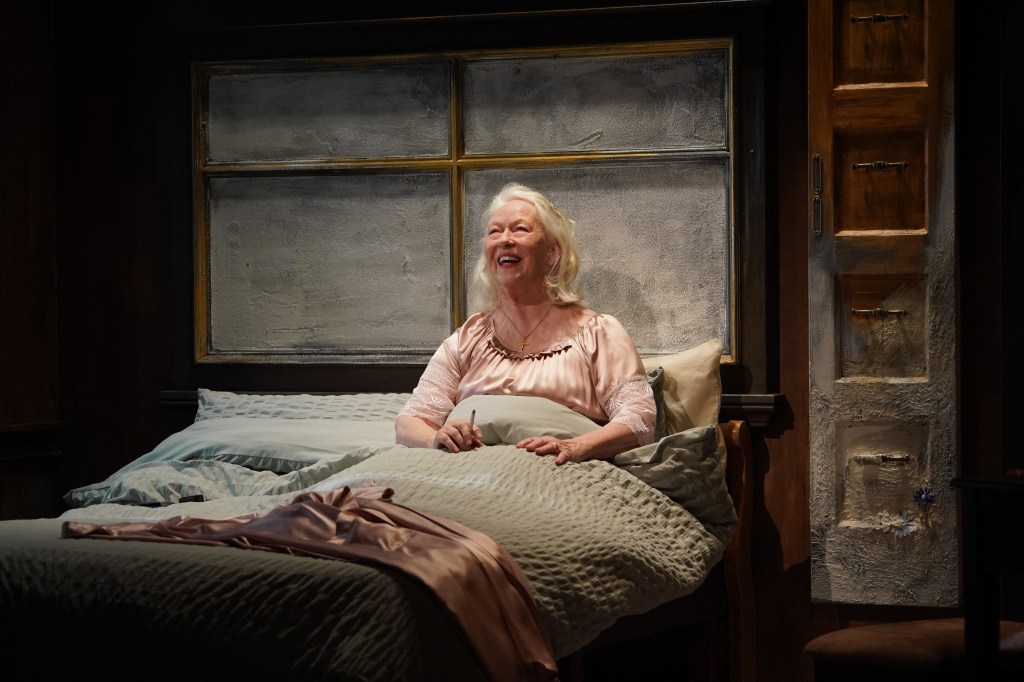
Her relationship with Mel seems loving enough, until Máire’s behavior references Martin’s visit. It is then that they make statements which explode with revelation and meaning in a myriad of emotions including anger, torment and hate. Both mother and son hurt one another. Their comments are severe. No apologies can be made to salve the wounds. We question where is forgiveness? Where is Jesus? Where is love? All appears to be confusion, fear and obfuscation.
Kinahan’s dialogue cleverly builds as Mel and Máire turn to the undercurrents of the past. Clearly, we understand the impact the church has had upon them. After Mel leaves, Máire must grapple with what the truths may be and either confront and accept them, or reject them finding justifications. Ironically, this leaves the audience in uncertainty with more questions which are never answered.
Kinahan’s suspenseful events beautifully build toward the high point at the conclusion. The mesmerizing play is directed and acted to perfection. Thematically, the characters’ acceptance of lies as truth and their ability to be duped by “isms,” philosophies and trends is incredibly current. Mel uses the truth to bludgeon his mother which appears vengeful. On the other hand, Máire selects which truths to believe and which to reject, hypocritically.
Both son and mother are flawed. Both need redemption and love from each other. Both have been caught in a web of religion, either rejecting/rebelling against it, or embracing it but not in the fullness of its meaning. As a result, caught up in their own agendas, they cannot communicate to use the very tenets of faith that are supposed to heal, bring peace and redeem. This is a terrible, magnificent irony where Jesus is called upon, but never arrives to heal and mend the differences. Additional work must be done for that to occur.
Unfortunately, this is a story visited again and again in religious households. It is thematically universal. Kinahan, Lowe, the actors and creatives have expressively highlighted the conundrums of faith, hypocrisy, forgiveness, spiritual truth and condemnation in this amazing and unforgettable production. It is a must-see.
For tickets and times go to their website https://irishrep.org/show/2022-2023-season/the-saviour/
 CAROLE DI TOSTI