Blog Archives
‘Birthright’ at MCC is Exceptional
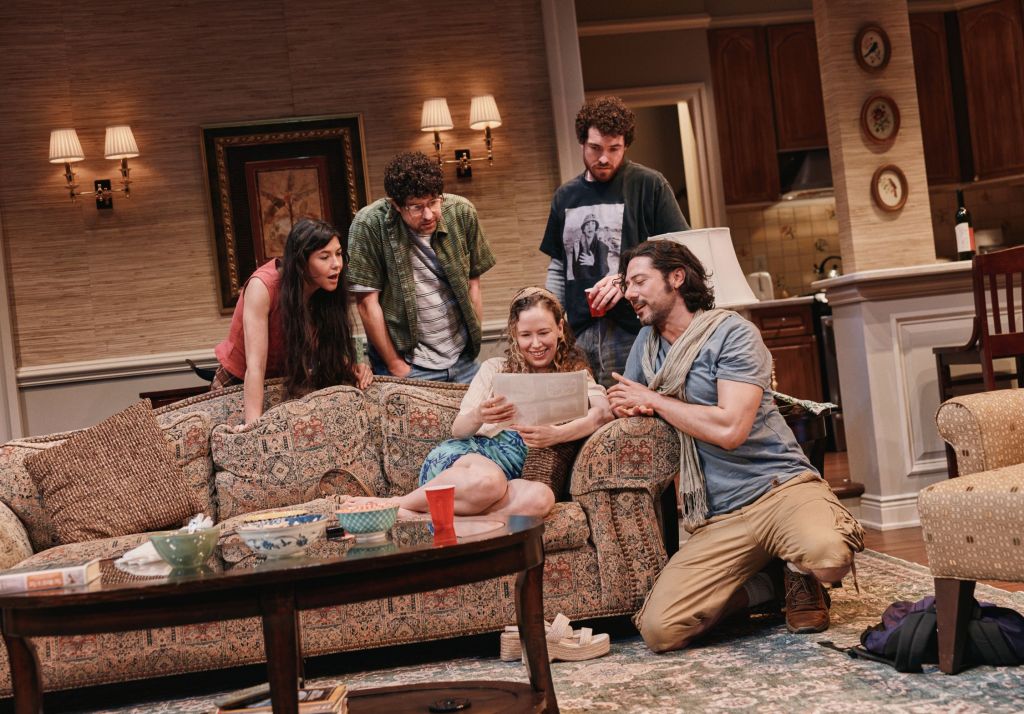
In Birthright writer Jonathan Spector tackles Jewish identity through the viewpoints of six friends as they evolve their relationship with each other after they return from a “Birthright” trip to Israel. Examining each of the characters over an extended time frame from 2006 through 2024, Spector reveals their psychic and spiritual growth as they confront the ever-changing dynamic of the political state of Israel, an increasingly violent and unsafe country.
Spector brilliantly integrates their emotional and personal backgrounds initially as twenty-somethings during the presidency of George Bush Jr. in 2006. After highlighting specific turning points he fast forwards to 2016 ten years later, during Hillary Clinton’s momentous campaign. The last segment settles on the salient points of their journey as they are still in touch with each other. The time quickly forwards through eight years to land in 2024, during the backdrop of President Joe Biden’s campaign, before he moved aside for Kamala Harris to run as the Democratic candidate.
Complex, insightful, philosophical, humorous, fascinating and profoundly human, Spector’s play strikes theatrical gold. Directed by TeddyBergman, Drama Desk nominated director, producer, actor, Birthright currently runs in an extension at MCC through August 23, 2026.
As he did with Eureka Day, the Tony Award-winning playwright presents controversies and explores various cultural opinions. His distinct characters, portrayed almost to near perfection by the ensemble, reveal perspectives that deepen and change over time. Each individual, raised in the cultural background of Judaism with its holiday traditions, foods, behaviors, language and concentration on identity, expresses their own brand of personal and political liberalism. Together, they eschew American conservatism and the Republican Party. In the last segment, we understand that they all deplore Benjamin Netanyahu’s leadership and AIPAC’s (wealthy Jewish donors) influence over congress.
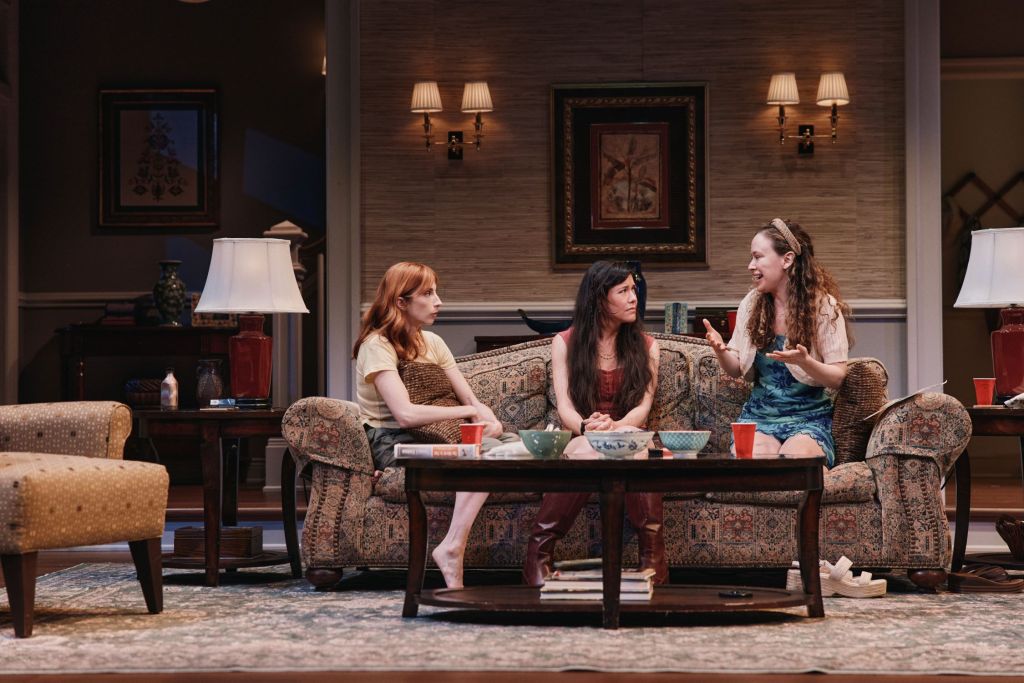
Indeed, some of the play’s humor derives from advancing political ironies cleverly using the flashbacks against our present as a medium. For example one of the characters comments that when “Hillary’s administration gets in, there will be job opportunities.” In another, an anecdote about a conservative father who voted Republican tells his son he may vote Democratic based on Kanye West’s comment that “Bush doesn’t care for Blacks,” evidenced by his dilatory response to Hurricane Katrina. The audience never loses track of the ironies of both statements and others. Indeed, years later West supports Republican Trump, then campaigns to divide Black votes from Biden to help Trump in the 2020 election. Throughout, Spector makes use of the characters’ assumptions about the future which blow up in their faces later in the play as “impossibilities” happen again and again, i.e. “one-third of the nation votes for Trump.”
The play opens at the reunion party that Chaya (Zoe Winters) holds for friends who recently returned from their trip to Israel. Birthright Israel gives Jewish adults between 18 and 26 years old an all expenses paid educational and fun trip to experience Israel as a “journey of a lifetime.” At Chaya’s parents’ house in a suburb of Washington, D.C. (with fine period appropriate set designs by Scott Pask), we first meet the brilliant, Israel-aware, gay Izzy (Molly Bernard), Chaya’s long-time friend. Next, we meet politically-minded blogger Noah (Eli Gelb), then drug-fueled musician Emerson (Nate Mann), recently expelled from his band for drinking. Arriving last, comes the philosophical, searching, profound Lev (Hale Appleman),
Also, we discover Chaya’s ulterior motive for the gathering; to dissuade Alona (Molly Ranson) from her rash decision to immigrate to Israel (“making aliyah”). Chaya spills that Alona lost her virginity to an IDF soldier during the trip. As Chaya tries to discourage her in front of the others, Emerson reveals the soldier sexually hooked up with a number of the other young women. Though this devastates Alona, we learn later the trip probably had the greatest impact on her because of her future decision to move there.
Interestingly, we learn the friends’ various attitudes about the trip’s inauthentic, unreal nature. The friends see through the propaganda about Israel to persuade young Jewish people to leave their birth countries. With the exception of Ranson’s Alona, all agree to one degree or another their established camaraderie fostered a bond with each other greater than any loyalty to Israel. Lev, who left the tour, felt, “it was all this like crafted Styrofoam,” like “seeing The Matrix.” Lev tells Izzy (who also felt the unreal situation), if I “wanted any kind of authentic experience, I had to get away from the trip.” After Lev disappears, he visits Jordan’s Petra, and Egypt. Also, he doesn’t miss the significance of the hours long lines for Palestinians to cross borders versus the fifteen minute line white tourists and others easily wait on. If Lev had not left the tour, he wouldn’t have seen this other alarming experience of Israel which he shares with Izzy.
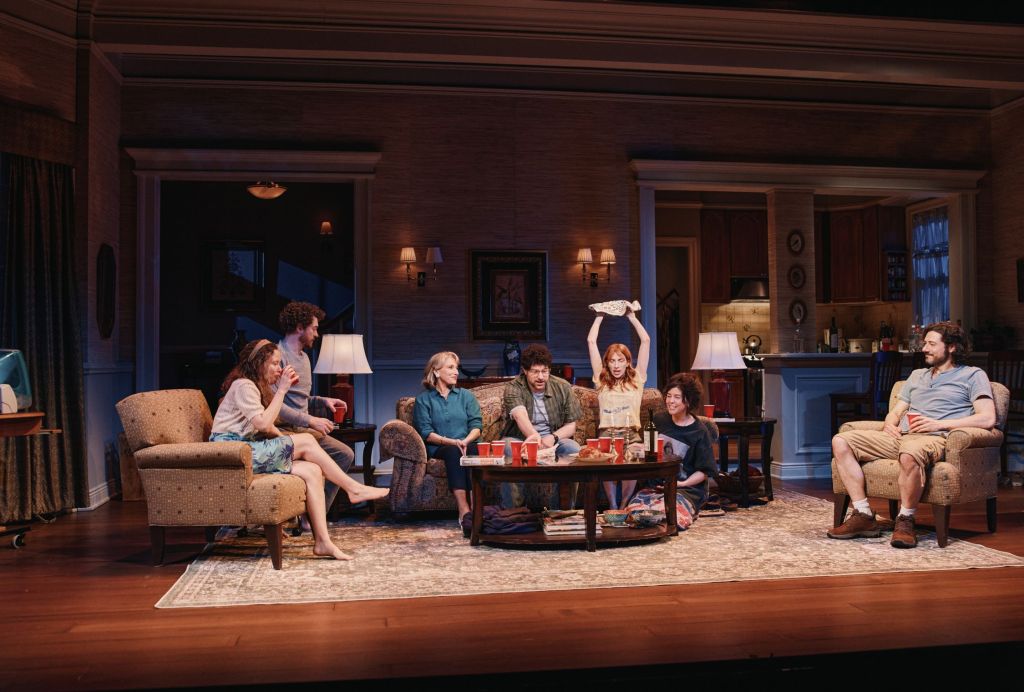
In the 2016 segment during another reunion at Chaya’s as they plan their toast for Alona’s wedding celebration the next day, we discover Alona and her husband are moving to Israel. From this meeting we understand the characters’ progress in search of something to strengthen their sense of purpose, despite personal successes or failures. For example married lawyer Izzy, at polar opposites with Alona, passionately speaks out against Israel’s apartheid. Chaya and Izzy question Alona’s Israel move in light of its moral ambiguity. As a citizen she will take part in the oppression and abuse of the Palestinians through her complicity by simply moving and living there. Will she stand for justice for Palestinians, or walk obliviously over their trail of tears?
Lev, who had spoken of his desire to become a rabbi years before drops out of school, gets married, divorced and beats himself up about not seeing his child as often as he likes. Noah quits The Washington Post and reinforces his online presence as a political influencer which eventually morphs into podcasting by 2024. Noah’s interest in Chaya which began after a brief affair on the trip continues despite Chaya’s marriage which heads toward divorce. Her work with the Obama administration ends and she takes on an organization to help Hillary get elected. Emerson seems the most lost at this point; unmarried, composing a few solo albums. But he stumbles into keeping kosher in spite of himself. All look forward to the hope of the first female president, some more avidly than others.
In the last segment, the downturn from hope and light into confusion and darkness becomes symbolized in the death of one of their number. Consequently, his loss raises the stakes of their relationships. The original bonds fostered during the trip have developed into love and an emotional concern and closeness which sustains them. Likewise, on another cultural, personal level, the devastating attack of Hamas on October7th, and the subsequent turmoil and chaos of finding the hostages amidst the daily bombing of the people of Gaza causes emotional devastation for Izzy, Chaya and Alona. And to various degrees, each friend questions the well-meaning values of the Judaism they were raised in versus Netanyahu’s bloody, never-ending punishment of Palestinian women and children.
What is the right path? Can the initial massacre justify the piles of bodies and annihilation and ethnic cleansing implicating the US government’s complicity supplying aid which includes weapons to Israel? Where did this begin? In Zionism as Izzy suggests or in the foundation of the state of Israel as a safe haven for outcast Jews in search of their birthright? And arguing whether the bloody slaughtering is or isn’t a genocide becomes a distraction while the incessant murdering continues. As Noah attempts to mitigate Izzy and Chaya’s arguments, Emerson arrives. He missed the funeral service. As it turns out he has arrived just in time for some food and community. And his surprising presence brings gasps from the audience.
As it turns out after years of wandering, in this 2024 reunion, the friends are brought together once again in a new way. And maybe just maybe Chaya and Noah will see their way clear to be with each other after all is said and done.
Birthright runs 3 hours 20 minutes through August 23, 2026 at MCC Theater; mcctheater.org.
‘Stereophonic,’ Adjmi’s Hit Transfers to Broadway

When Stereophonic opened at Playwright’s Horizons in the fall of 2023, the hybrid comedy/drama/musical was extended a number of times for a multitude of reasons. The acting was superb. The subject matter intrigued. Who is not enthralled by a smooth rock band on the cusp of greatness with a chonky financial contract, “getting their s%$t together,” as a small privileged audience watches them record their artistry in two sound studios? Under pressure, the two couple’s relationships straining, the husband-wife partners display pustules bursting with emotionalism, and the audience sees the interior of these relationships. What’s not to love?
This is live theater at its best. The audience lives moment to moment with the musicians (we have forgotten they are actors), riding to the mountain tops and canyons as we joy to their pain of creation, producing what may be a #1 album that soars to the top of the charts. In its transfer and Broadway premiere at the Golden Theatre, the cast, music, verité style, and arc of development are the same as is the three-hour length as in the original production at Primary Stages. Bravo. It is still a must-see.
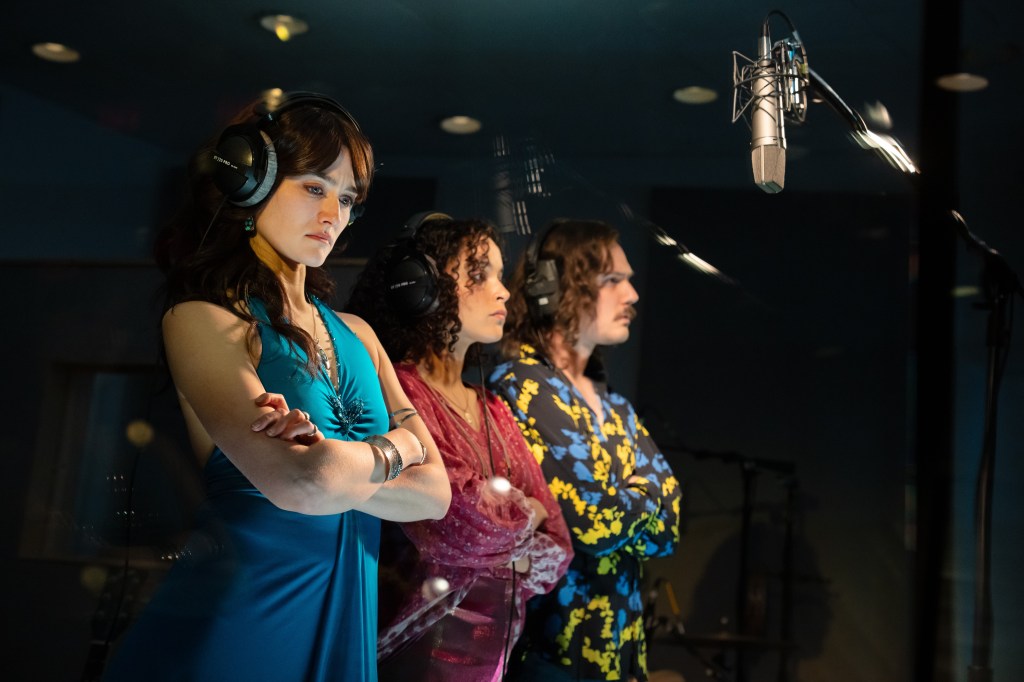
Why would playwright David Adjmi (The Evildoers, Stunning), Will Butler, who wrote the terrific original music and lyrics, and superb director Daniel Aukin muck with success? The solid, winning substance of Stereophonic is about the five-member rock band and studio engineers working at an accelerated pace to record an album at two California sound studios in the mid-1970s. We get the “low-down” perspective of what it takes to be great.
Above all Stereophonic Broadway remains a stylistic masterpiece of theater verité with a view into two separate worlds, music creation and technical engineering, without which musicianship would not exist. The meld of the two in a great album reveals the dynamic genius of technicians and musicians, though the musicians are the public face who receive all the glory.

Two points to make about the production, which is integrated and fantastic from my perspective, with one suggestion. First, Stereophonic may not be understood by a “Broadway” type audience, who might not have the patience to work through the incredible detail of “moment to moment” dialogue and complications so organically constructed, intimate and authentic, that the realistic action brings one into oneself, rather than encouraging escapism in a flight of song and dance numbers characteristic of “the Broadway show.” In its brilliance, Stereophonic may not be fully appreciated for what it is. Stereophonic is a “one-of-a-kind” original that provides an electrifying evening of music creation as one would imagine happened in iconic recording studios like Muscle Shoals Sound Studio in Alabama or Abbey Road in London, perhaps, without the histrionics.
Secondly, in its staging at the Golden Theatre, a larger venue, the sound design has to be properly figured out by the designers, and the actors. They are not in a smaller venue. The actors must project, especially when their backs are turned from the audience. The sound design must be at equal level in every portion of the theater to eliminate dead spots. In the transitioning this must continue to be fine tuned.
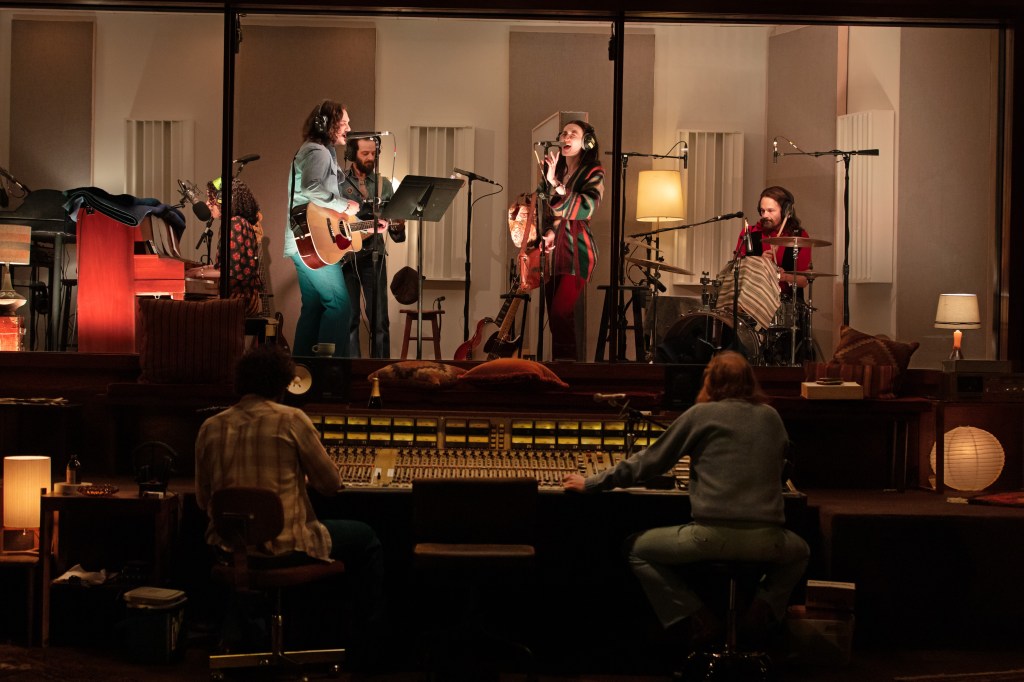
For rock fans and those fascinated by the ethereal nature of how bands collaborate, the Broadway production mesmerizes because we clearly understand the division between the musicians’ mystical artistry, which is always front and center, and the unseen, faceless, backstage engineering by Grover (Eli Gelb), and Charlie (Andrew R. Butler), who are finally revealed in process. It is the engineers’ artful techniques which enhance the overall effect and impact of each recorded song. This division of the two different realms of making music is beautifully manifested in David Zinn’s wood paneled scenic design, and Jiyoun Chang’s lighting design, which Aukin carried over to Broadway, along with Enver Chakartash’s period costume design. Robert Pickens & Katie Gell’s hair and wig design are new in this production.
As at Primary Stages, the Golden Theatre’s stage is divided into two sections. The upper level reveals the sound studio protected by glass, where we see and hear the musicians perform in a theater verité style, as they stop to revise tempos, add pauses, evolve riffs, etc. Downstage is the massive control panel where the engineers sit mostly with their backs to the audience and work to serve, manipulate, and stoke the musicians’ extraordinary talent and heightened emotional states, all the while discussing “their truth” with each other. With Aukin’s superior staging, we can track both worlds, feeling we are in their midst, interactively participating in music creation and understanding how the worlds precariously interact.
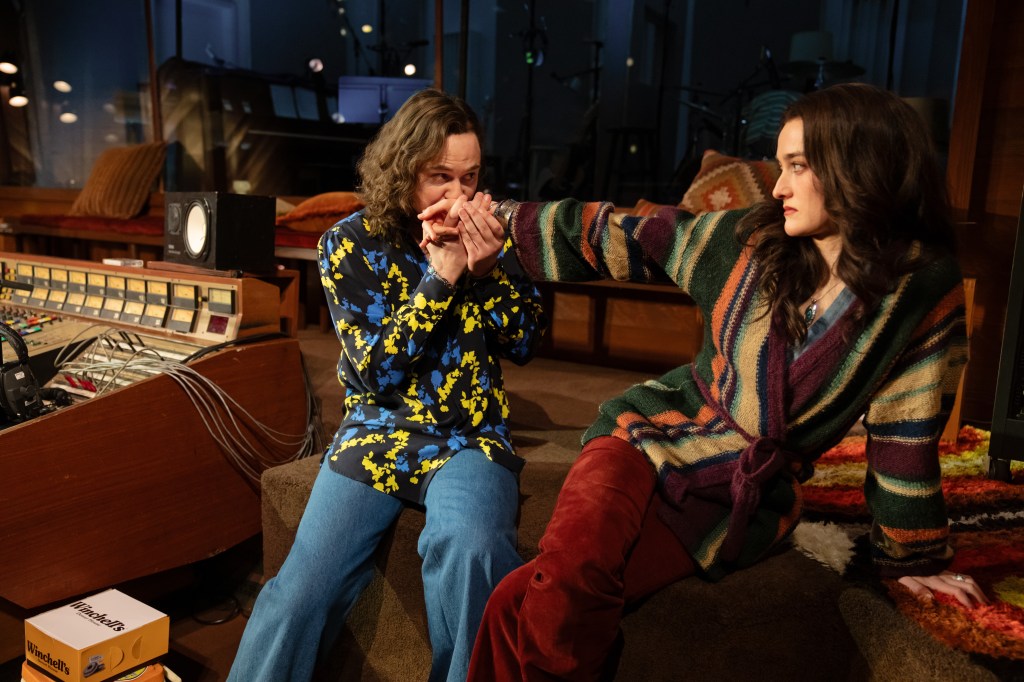
Though band members treat Grover and especially the shy Charlie as invisibles they don’t speak to, without their efforts the band’s unique identity and glorious sound wouldn’t exist. Therefore, in the production’s arc of development, Adjmi gradually uncovers the engineers’ centrality to the creative process and the band’s success. It is especially funny and poignant to witness how the engineers moderate the emotional infantilism of the “high-strung” musicians to get the recordings in top shape.
Throughout, drugs and alcohol become a panacea to quell the rough edges of sleep deprivation and stimulate a frenzied work environment. The cocaine, supplied by overworked engineers, keeps the band working at a frenetic pace. Ironically, drug use intensifies the arguments but floods the band’s creative juices.
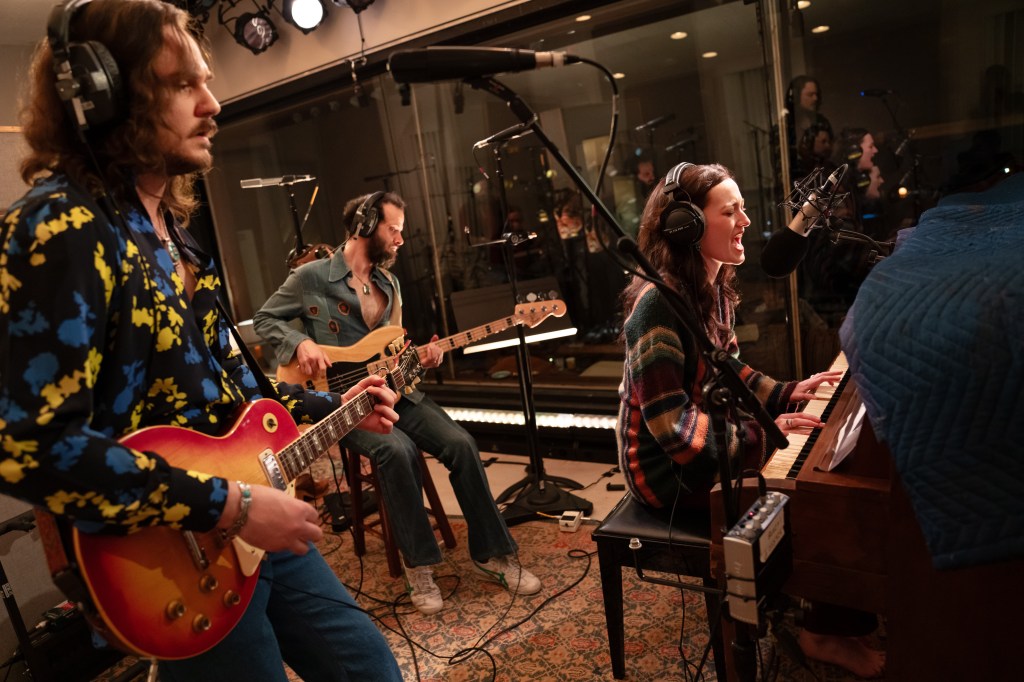
Aukin’s vision of Adjmi’s themes of art, music, sacrifice and suffering, heighten the importance of sound engineers. They must have skill and expertise in the control room, as well as the personalities to cope with and manipulate artistic personas like druggy Reg (the hysterical and funny Will Brill), and diva Diana (Sarah Pidgeon).
For example Grover and Charlie must be temperate as Diana strains to get the notes, emotionally loses it, and must be encouraged by her partner lead musician and producer Peter (Tom Pecinka), to try again and again to “get it right.” Additionally, the engineers must be purposed to withstand the emotional word bludgeons from their “boss,” Peter, who launches off into a demeaning tirade against Grover and fires him. It is an idiotic move because Grover is the backbone of the album and Peter knows it. That is why he later makes Grover co-producer and apologizes.
The songs of Will Butler, (Oscar-nominated and former member of the Grammy-winning indie rock band Arcade Fire), remain as striking as ever. Indeed, one would wish that this band does produce an album, finishing the partial songs (we only hear a few in their entirety), that we hear them rehearse. The songs resonate with the themes of emotional yearning and the deceptions of fame, money and commercialism, the masquerade that they must avoid. If they embrace the commercialism, they will lose their way as artists, attempting to achieve perfection, a goal of the hard driving Peter.
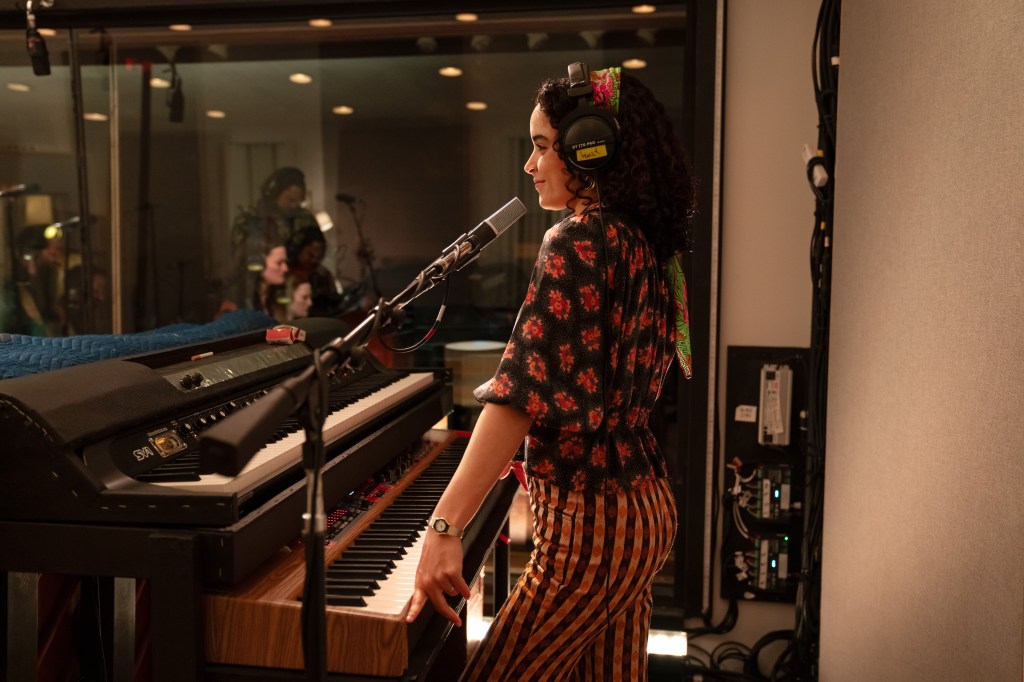
Butler’s songs importantly reveal the raw emotions of anger and hurt, stirred by betrayal and loss that couples Reg (Will Brill) and Holly (Juliana Canfield), and Peter and Diana, experience in their relationships. Working frenetically together in close quarters to exceed the results of their previous album require sacrifice to be great. Peter constantly pushes them toward this. But by the conclusion as their work is finished, all have suffered for it. Simon (Chris Stack), who has been away from his wife and children for six months faces the threat of divorce and losing his family.
However, only Diana has been signed on to be a solo artist. Is the pain, suffering and sacrifice worth it for the others? Juliana Canfield’s Holly, a close friend and ally of Diana, congratulates her on this success. But we are left wondering if they will remain close or if the band will remain together to collaborate again?
A tour de force, Stereophonic runs over three hours with one intermission. Thanks to Adjmi, director Daniel Aukin, the sensational cast, whose acting chops and vocal talents are non-pareil, and the technical design team, the compelling forward momentum of the band’s creative dynamic resonates with powerful immediacy.
Special kudos goes to Music Director Justin Craig and Will Butler and Justin Craig’s orchestrations.
Stereophonic runs through July 7 at the Golden Theatre (252 West 45th Street, between Broadway and Eighth Avenue). www.stereophonicplay.com

