Category Archives: cd
New York Botanical Garden’s ‘Chihuly’ Exhibition Illuminates Brilliant Light and Color
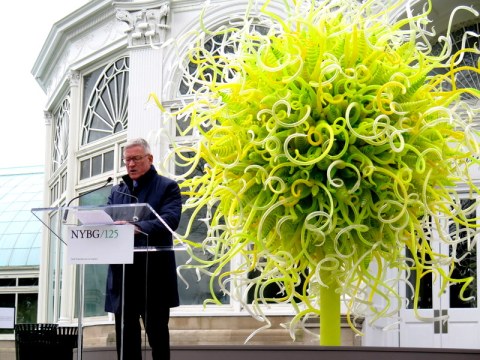
Gregory Long, Chief Executive Officer and The William C. Steere Sr. President of NYBG, introducing Chihuly (2017) at NYBG press opening (Carole Di Tosti)
Dale Chihuly, world-renown glass artist non pareil, has avidly embraced the concept of evolving his artistry. In his thirst to investigate ancient techniques from the masters of glass blowing in Venice, a skill which has been traced to Roman times, Dale Chihuly in 1968 applied for and received a Fulbright to study at the Venini glass factory. From that time on a new avant garde movement in hand-blown glass sculpting as a fine art was born. Since then Dale Chihuly’s revolution in this fine art has burgeoned with amazing stylistic innovations of an exuberance and color radiance that are internationally venerated as the signature genius of Dale Chihuly, who is a consummate believer in the possibilities of glass.

Dale Chihuly in front of his newly inspired installation at ‘NYBG Chihuly (2017) based on his 1975 Artpark Installation in collaboration with Seaver Leslie (Carole Di Tosti)
Throughout the spring and summer until October 29th, Chihuly’s spectacular masterworks are appearing in a completely new iteration at the New York Botanical Garden’s Chihuly Exhibit. Considering that it took over ten years for Chihuly to return to NYBG, where his amazing installations in 2006 were first introduced to New York City, this is no small feat. The current exhibit was years in the planning, as Dale Chihuly, his team and the NYGB team considered and imagined a show which would honor the last exhibit and enhance his current artistic revolutions. This is never easy where Dale Chihuly’s work is concerned because it is nearly impossible to keep up with his energy and enthusiasm.
In 2006 his exquisitely delicate Blue Herons situated amidst the reeds and plant life at the Enid A. Haupt Conservatory Courtyard’s Tropical Pool absolutely astonished. They are deemed a work of art in their own right. Should they or should they not be included almost eleven years later? They have been and if you saw them in 2006, look for them in a stunning new display.

NYBG Palms of the World Gallery, Chihuly’s Persian Pond and Fiori (2017), Chihuly (photo Carole Di Tosti)
Yes, it has been a long time coming, but NYBG Chihuly is so worth it. This artist has returned in an exhibition that is even more majestic than his first.
The current exhibit is indeed a once-in-a-lifetime experience for tourists and New Yorkers alike, especially if they have never seen Chihuly’s masterpieces in any showcases around the world or visited the Chihuly Studio in the state of Washington. That his artistic genius now boldly graces the New York Botanical Garden’s living landscape and settled in unique arrangements is an opportunity that will never happen again.

Red Reeds on Logs (2017) NYBG Chihuly (photo Carole Di Tosti)
Chihuly architectural installations have been configured around the world wherever glass can be staged and organically connected by him: botanical gardens, in, over and around water, in forests, canals, in museums, in deserts, in the most ancient of cities, (Jeruselum and Venice), indeed anywhere his intuition and joy brings them. His exotic sculptures have propelled light beams to visitors’ eyes, have touched their souls and have uplifted their hearts. When you see his work you must acknowledge whether to a lesser or larger extent, that here is a wondrous beauty in a substance whose infinite possibilities you probably have never considered. Over the ten year period Dale Chihuly has traveled the world with exhibits, won awards, and plumbed the depths of his unconscious where true artistic creation lies, he has continued to evolve and revolutionize.
To give you an idea, his work is included in more than 200 museum collections worldwide. He has been the recipient of many awards, including twelve honorary doctorates and two fellowships from the National Endowment for the Arts. Just viewing all that his exhaustive career has spanned, glimpses of which you will see in this exhibition, you can’t help but be amazed. That is one of the most vital features of NYBG Chihuly. Through its organizational details lovingly presented, you are able to understand the arc of Dale Chihuly’s journey of evolution since his early days as an initiate in Venice, to a mature artist who is currently refining his artistry using other mediums, a number of which appear in the more than 20 installations that took three weeks to ship in and set up at the Garden.
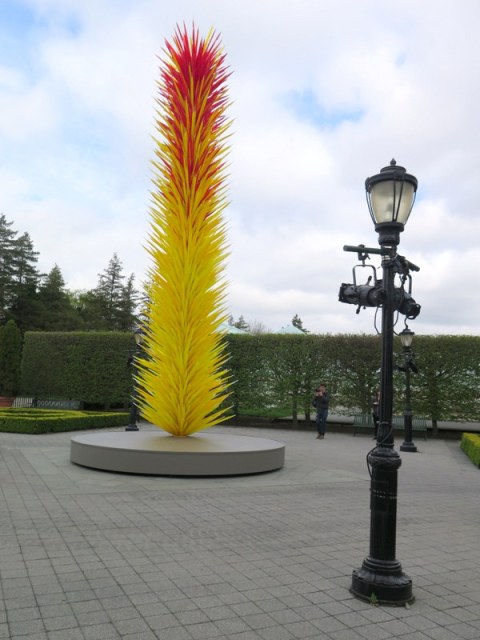
Chihuly’s Scarlet and Yellow Icicle Tower (2017) NYBG Chihuly, (photo Carole Di Tosti)
As has been mentioned, the NYBG was in discussion with the team at The Chihuly Studio years before, until they were ready to set dates and finalize the schedule. This was after they selected legendary works and designated themes with an expansion of a Chihuly exhibit which would mirror the expansion that has been occurring at the NYBG. Of course, newly innovated pieces would be included which may be found in the Native Plant Garden and the conservatory Courtyard’s Tropical Pool.
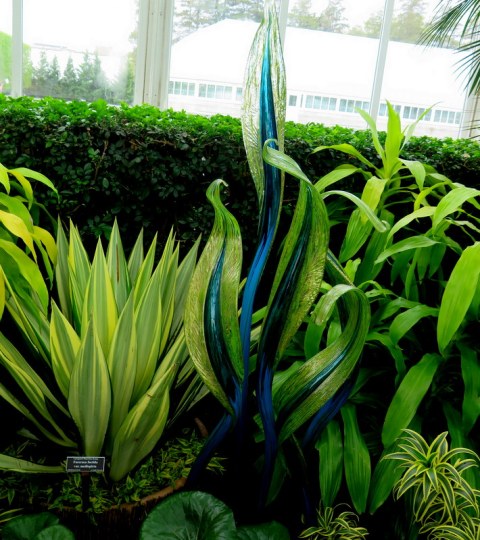
The interplay of plants and glass and glass as plants, Dale Chihuly, NYBG, Chihuly (2017) (photo Carole Di Tosti)
The result is stunning. The ebullient, striking beauty of Chihuly’s glass innovations evoke unique harmonies with plants and flowers in the Garden’s smaller venues and against the verdant, rolling landscape of stark, shadowy pines, water garden rushes and grasses, and eye-catching floral springtime and summer borders. Specifically arranged to offer surprises and gobsmacking moments as one saunters along Garden way or on ancillary paths, the glass creations are in one-of-a-kind displays. With thoughtful precision, the selections of his works were chosen to evoke an indefinable aura and exceptionalism for the beholder. Combined, the artistic panorama in glass provides a unity and pageantry that will never be seen again after the 29th of October.

Dale Chihuly’s art, NYBG Chihuly (2017) (photo Carole Di Tosti)

Dale Chihuly’s striking plant forms and vibrant colors, NYBG Chihuly (2017) (photo Carole Di Tosti)
This singular exhibition of his work, which is a retrospective that includes earlier creations together with new artistic achievements unfolds throughout the New York Botanical Garden as a celebration of Dale Chihuly’s life, career and timeless conceptualizations. Indeed, if Dr. Carl Gustav Jung (author of books on art and the unconscious), were alive to view some of Chihuly’s achievements over the last four and one-half decades since he co-founded the international Pilchuck Glass School in Washington State (1971), he would have embraced Chihuly’s unconscious impulses to allow intuition and in-the-moment serendipity to unleash the power of breath, heat and fire’s natural elements in the creation of never before imagined or visualized hand-blown glass artistry.
If you listen to Dale Chihuly’s discussion of how he and his team worked on his tour in Ireland, Finland and Mexico to eventually showcase in Italy, you note how Chihuly allows the realm of intuition and the spontaneous to dance in his imagination; then you will understand what inspires his artistic creativity which is a fusion of playful whimsy and joyful intuition. This is the fuel that energizes this artist. We are fortunate to be witnessing these works at NYBG which symbolize Dale Chihuly’s ethos…which has come into a full expression in our time.
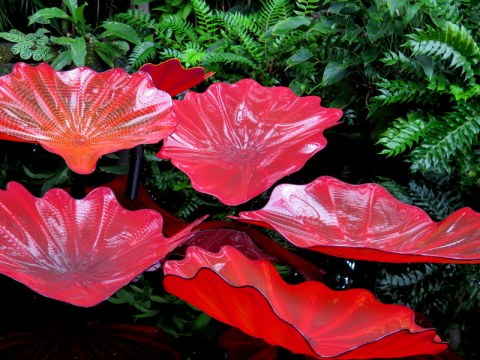
Detail, NYBG Palms of the World Gallery, Chihuly’s Persian Pond and Fiori, NYBG Chihuly (2017) (photo Carole Di Tosti)
The exhibition includes more than twenty Chihuly installations. Various glass constructions were selected to be showcased in the Enid A. Haupt Conservatory’s living theater displays in the Palms of the World Gallery and in the hallway vista which leads up to the seasonal display rotunda of the Conservatory where you may see the splendid White Tower With Fiori.

Dale Chihuly’s White Tower With Fiori (2017) NYBG Chihuly (photo Carole Di Tosti)

Detail, Dale Chihuly’s White Tower With Fiori (2017) NYBG Chihuly (photo Carole Di Tosti)

Detail, Dale Chihuly’s White Tower With Fiori (2017) NYBG Chihuly (photo Carole Di Tosti)
This installation has an interesting origination. Because some of the fabulous hues in White Tower With Fiori (and others in the adjoining vista that are pale purple), can only be created with rare elements that the U.S. bans, the phenomenal work was made in 1997 in the Czech Republic. The rare mineral combined with silica turned the glass to a lustrous, glassine, pale pink. This color, Chihuly chose for the delicate flowers that surround the tower. Only when the piece was finished could it be shipped back to the U.S.

Graceful organic forms meld with plants, Dale Chihuly’s art, NYBG Chihuly (2017) (photo Carole Di Tosti)
If you move through the various sections of the conservatory, you will come upon surprises that will visually startle. Tucked among the lush, dark plantings are lovely, slender, tapering swan’s-neck-shaped pieces that arise from a pool of water in which their white reflections shimmer. In the conservatory vista of the Aquatic Plants and Vines Gallery, you will note the lily pond and arising from the water-splaying fountain as if growing there, are the eye-popping, crashing colors of his Macchia Forest, 2017, in an exceptional and new arrangement. In these installations Dale Chihuly’s artistry of glass and water reflect and enhance one another in a visual fluidity that draws the eye and soul because they transcend into archetypes.

Dale Chihuly’s Macchia Forrest (2017) NYBG Chihuly (photo Carole Di Tosti)
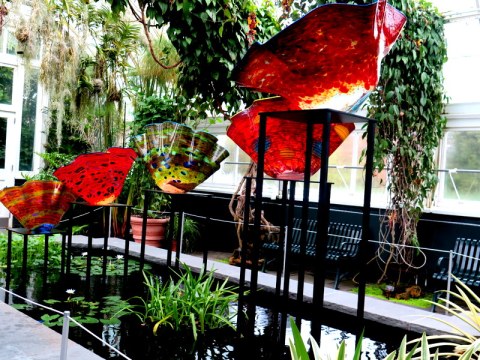
Another view of Dale Chihuly’s Macchia Forest (2017) NYBG Chihuly (photo Carole Di Tosti)
Water features heavily in this exhibition as it does in all Dale Chihuly’s exhibitions. In videos discussing how he likes to work and how he worked in his fabulous exhibition Chihuly Over Venice, he and his team suspended large glass chandeliers (hand-blown in glassworks in Finland, Ireland and Mexico), in Venetian buildings and over the canals in a presentation that is unparalleled in historical meaning and splendor for the sheer audacity of it. Chihuly has said that he is “always drawn to water.” He has decried that water is “extremely important to his work and being,” perhaps because “water is extraordinarily creative.”
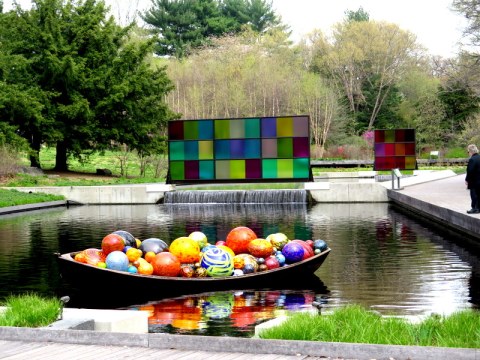
Inspired by 1975 Artpark Installation (Chihuly collaborated with Seaver Leslie), Chihuly’s Koda Studies #1 & #2, (2017), NYBG Chihuly (photo Carole Di Tosti)
Thus, it is appropriate that the many installations found in this Chihuly Experience at the Garden feature water. His pieces are featured in the pools or fountains in the Enid A. Haupt Conservatory. Outside, the welcoming sculpture as you enter the Conservatory Gate is Red Reeds on Logs, 2017. The high-powered-red reeds are pumped up by the reflecting pool upon which they are situated and ping off the glinting surface of the water below.
New artworks inspired by Chihuly’s summer 1975 Artpark installation (when he collaborated with Seaver Leslie), are Koda Study #1 and #2 (in the Native Plant Garden), and Koda Study #3 in the Conservatory Courtyard. The first two follow Dale’s intuitive impulse toward water. The works are made of polycarbonate sheets, another medium he originated for his art, and they create intriguing effects as light bounces through them during the day, to twilight.
Chihuly’s vibrant constructions are also exhibited at the LuEsther T. Mertz Library. There, you may see his sculpture, Blue Polyvitro Crystals, situated in the Lillian Goldman Fountain of Life that looks like huge chunks of blue ice that will never melt. This work in polyvitro demonstrates Chihuly’s love of experimenting in various mediums. He has applied his talents to innovate in paint, sculpture, polyvitro, glass and neon (check out the new installation Neon 206).
His gorgeous Seaforms (a favorite of mine), are in a glass case inside the library. His Fire Orange Baskets (an innovative design which he gleaned looking at Northwest Native American baskets), are on another display floor of the library. And if you have a bit of time, return periodically during a different season to view how the light impacts his works outdoors as they are transformed by the sun as the earth transits its orbit. And spend some time in the library (on a rainy day).

Dale Chihuly’s Seaforms (2017) NYBG Chihuly (photo Carole Di Tosti)
There, you will note the transformation of Dale Chihuly’s career, shown with a revelation of his early works, a glass series and other drawings and paintings on paper. These highlight another facet of Chihuly’s expression of talent but also demonstrate a practical use. They were a way that Dale Chihuly could convey what he wanted his team to help him execute in his innovative designs. Words and/or gestures are rather limited for the crafting in glass, when an illustration (granted that the artist has illustrative skill as Dale Chihuly has), is a stellar tool of assistance to execute one’s conceptualizations.
The Chihuly Exhibition at the NYBG in this configuration will never be seen again. CLICK HERE for programming and the dates for Chihuly Nights.
‘NISE: The Heart of Madness’ directed by Roberto Berliner

Poster courtesy of the film, ‘NISE: The Heart of Madness’
NISE: The Heart of Madness directed by Roberto Berliner is a fascinating account of maverick, Brazilian psychiatrist Nise da Silveira (a poignant and stirring portrayal by Glória Pires) who created a ground-breaking therapy for mental patients which assisted them toward self-healing in their lives. In a number of instances her patients were able to be returned to their own communities, despite a prognosis that they were hopelessly beyond “sanity” and would live in institutions for the rest of their lives.
In this exceptional and heartfelt chronicle (screenplay by multiple writers including Berliner), the director outlines the arc and miraculous impact of Nise da Silveira’s efforts. He highlights her experiences beginning with her return to work as a psychiatrist after an eight year period. Berliner takes up the journey of how da Silveira, with patience, intuition and love encourages the transformation of her patients over time.
Berliner recreates the horrific setting of the National Psychiatric Center in Rio De Janiero that houses chronic schizophrenics who are treated as low life forms, imprisoned and are clothed in rags when we are first introduced to them. They are out of control and violent; their madness has completely overtaken any ability for them to communicate easily. We are convinced that they are hopeless and beyond the reach of the medical profession.

Painting by Emigdio de Barros one of Nise da Silveira’s patients.
The male, conservative doctors (the ensemble is outstanding) outnumber Nise da Silveira. They embrace “modern” treatments (electroshock, lobotomies, insulin treatments, imprisonment,) which appall her. We understand that the doctors have a ready population of guinea pigs (these patients) upon which to experiment and exercise their preconceptions and stereotyping. The parallel of the violence which the medical profession enacts upon patients which are supposed to be served, but which are used to serve doctors is a theme which threads throughout the film.
Though we don’t realize it at first and fall into the trap of believing these brutal treatments may have efficacy, because of da Silveria’s response and courage in the face of the doctors’ oppression, we come to realize that these men have a proclivity to select the aggressive, immediate, lazy-man’s way of solving problems. As the film progresses and Berliner shows the slow, painstaking, intuitive approach of da Silveira with trial and error and observation, we realize that the mainstream doctors have selected wrong-headed treatments that are counterproductive and that yield harmful, fatal results on a population that cannot speak up for itself. The patients have no advocates and have been dumped in asylums by family members who have signed away their autonomy and free will to the state.
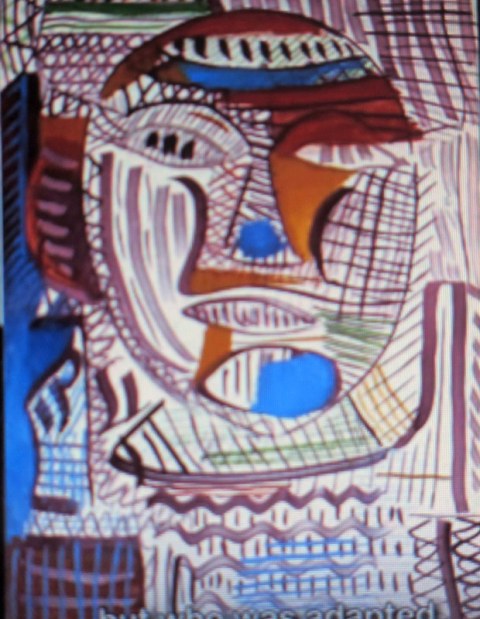
Painting by Raphael Domingues, one of Nise da Silveira’s patients.
Berliner creates a frightening, heartfelt and uplifting historical pastiche of how da Silveira single-handing opposes these renowned men of the psychiatric profession in Brazil and world-wide by countering their use of these barbaric medical treatments which she labels as violent. These colleagues ridicule her and punish her with a demotion by placing her in charge of Occupational Therapy for the patients. They relegate her to a section of the hospital which is a filthy, run-down garbage heap, perhaps with the intention of forcing her resignation. She has been consigned to a no prestige placement, apart from their company and away from any potential of career advancement. However, she remains curious and positive though she will be spending her days with an ill-equipped staff, a group of violent schizophrenics and a situation which seems beyond improvement. This is a David and Goliath story with a twist.
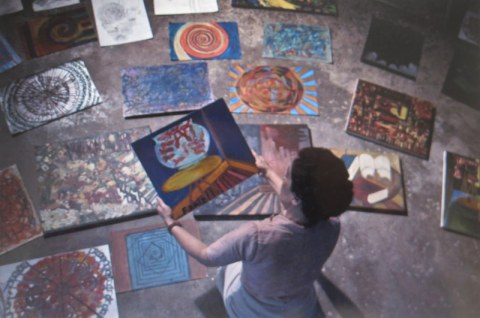
Gloria Peres in ‘NISE: The Heart of Madness’ (photo courtesy of the film)
Clearly, the conservative doctors have underestimated her will, intuition, brilliance and empathy for the individuals under her care. With the assistance of the nurses and aides, she transforms the garbage dump into a clean and workable unit that her patients and staff appear to acknowledge and recognize. Through observation, love, humanity and the Golden Rule, da Silveira proves her own methods (she stumbles upon activities that elicit the individuals’ inner world through art-painting, sculpture, wood-working, etc.) have more efficacy than those of her conservative, brutality oriented, male peers.
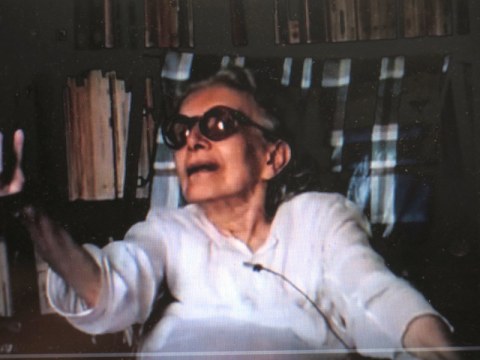
Nise da Silveira. Photo courtesy of the film.
As she learns from her patients’ art which is astounding in its expressiveness of their inner world because they are allowed the freedom to be who they are in their artistic endeavors, their unconscious allows them to self-heal. Nise da Silveira encourages them to become a community with each other as they take interest in their own person-hood and thrive. Nise da Silveira studies the symbols in their work and researches the concepts of Dr. Carl Gustav Jung and the collective unconscious. She contacts Jung and receives his affirmation and she eventually pioneers the acceptance of Jungian Psychology in Brazil. However, her colleagues do not recognize Nise da Silveira’s efforts. They threaten her job security and even have performed a violent act which sets the patients backward.
Undaunted, she holds an exhibit of the amazing art work on the hospital premises and invites the renowned Brazilian art critic Mário Pedrosa (Charles Fricks) to attend. He is thrilled to view the artistry of these “mad” individuals and recognizes they see beyond into another world of consciousness which they are able to express freely so they can bring others in touch with who they are.
Berliner shows that this is an important crossroads in da Silveira’s amazing career as a psychiatrist who continued to research, write and foster “mad” ones’ artistic achievements, as well as successfully employ the therapy of animals to encourage self-healing.
The artistic achievement by these individuals and many other “mad” ones, has been acknowledged to be some of the finest, most valuable of modern art produced in Brazil. These works have been registered (127,000 thus far) and are recognized around the world for what they represent. They are in the Images of the Unconscious Museum (da Silveira donated the works so they would be protected). There have been 150 exhibitions in Brazil and abroad.
The many themes of this film concerning the obtuseness of the medical profession to employ quick and dirty and wrong treatments and medications resonates profoundly for us today. So does the patients use as guinea pigs to serve science and not the other way around, with the exception of the Holistic approach (observation, patience, humanity) which is what da Silveira practiced. The last part of Berliner’s poignant and triumphant film is absolutely breathtaking. You will have to see this wonderful film for yourself. I will not spoil it for you.
For more information about Nise da Silveira CLICK HERE.
Photographs of the paintings taken from this site. Poster courtesy of the film.
New York Botanical Garden ‘Orchid Show: Thailand’ a Feast for the Senses and the Soul

Vandas, Bromeliads, NYBG’s ‘Orchid Show: Thailand’ (photo Carole Di Tosti)
Every year I attend the NYBG Orchid Show (now in its 15th year) I am pleasantly surprised to note that the exhibits are increasingly more intricate and more lovely. This year Orchid Show: Thailand is absolutely smashing. It runs until 9 April. The team of professionals, staff, volunteers and others whose creativity, prodigious effort and great good will in executing the drama of a beautiful, living production of one of the most exquisite and exotic of plant species, has outdone itself.

Dendrobrium, NYBG ‘Orchid Show: Thailand’ (photo Carole Di Tosti)
Karen Daubmann (AVP of Exhibitions and Public Engagement at NYBG) originated the theme Thailand which she had been considering for a number of years. She is thrilled with Christian Primeau’s (Designer of Orchid Show: Thailand) and March Hachadourian’s (Director of the Nolen Greenhouses who curates the show) culminating work to create this striking exhibit. Christian and Marc collaborated to select the orchids and then came up with the unique and inspired interpretations and symbolic representations that are NYBG’s Orchid Show: Thailand.
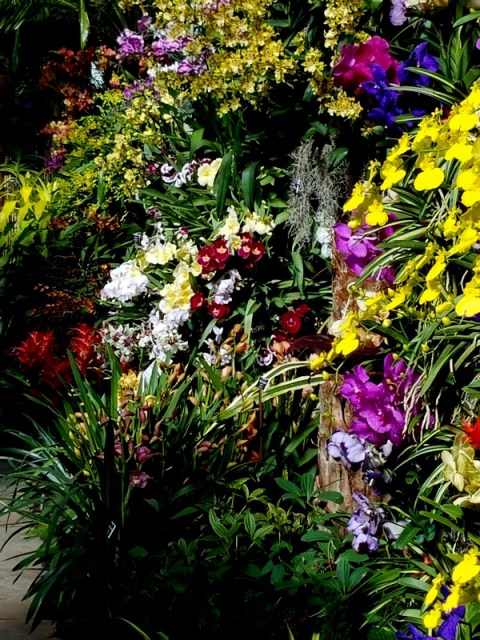
A riot of orchid varieties on the walkway at NYBG ‘The Orchid Show: Thailand’ (photo Carole Di Tosti)
It has been a while since the staff and experts conceptualized a geographical theme for the NYBG orchid show. Thailand was an excellent fit. For uber orchid experts, Thailand is synonymous with orchids. Thailand has been in the forefront of orchid horticulture in the cultivation and hybridization of orchids and in the expansion and promotion of orchid farming for more than a century. It is the biggest exporter of tropical orchids globally and if you ask an expert, he or she will tell you that whether native or hybrid, orchids are mostly associated with Thailand.

Dendrobium, NYBG’s ‘The Orchid Show: Thailand’ (photo Carole Di Tosti)
The Thai people lionize orchids because they flourish in the companionable climate. They add explosions of vibrant, joyful color amidst the lush, green tropical foliage and they contribute handily to the GNP. Thai horticulturalists have been able to propagate a great variety of hybrids which have become ready plantings in Thai gardens adding tranquility and loveliness to promote well being. Their admiration of exotic tropical plants, the orchids’ wide variety of sizes, shapes and hues have prompted Thais to grow them on trees that line public streets.
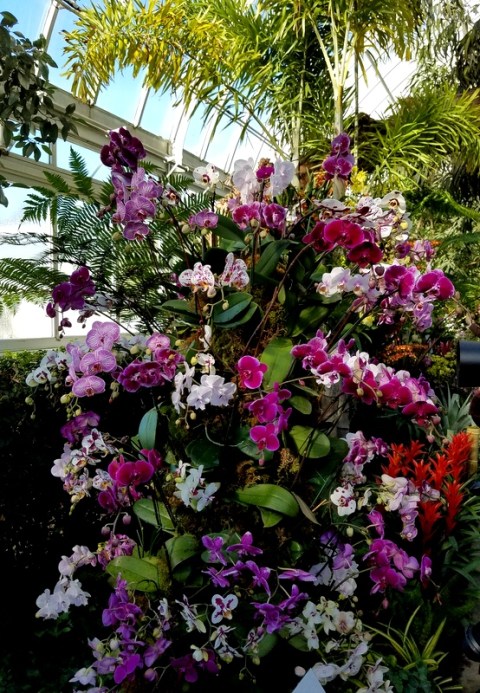
Phaeleanopsis (moth orchids) at the 15th Annual NYBG’s ‘Orchid Show: Thailand’ (photo Carole Di Tosti
Another reason why the country “fell” into orchid breeding and pursued it with diligence is because Thailand is the birth place and residence of 12oo known native species. Of course, there may be some native species yet to be discovered in Thailand; one can be sure botanists and orchid horticulturalists are on the hunt for them.

Phaelaenopsis, Bromeliads, Palms, Oncidium on the walkway NYBG ‘Orchid Show: Thailand’ (photo Carole Di Tosti)
To realize Karen’s theme the NYBG team researched the integration of orchids in Thai culture. They explored how to incorporate particular elements of Thai social and religious structure into the exhibit. They made sure to honor symbols and traditions that the Thai people venerate, adhering to them assiduously throughout the show; that was Christian’s particular passion. Combining these features and designing them into the backdrop of the veritable kaleidoscope of the orchids themselves, has made this show a number one pick to revisit time and again to renew one’s spirit and be soothed by the phantasmagoria of beauty that bathes the senses as you saunter through the Enid A. Haupt Conservatory.

Elephant topiaries carrying orchids in the Palms of the World Gallery and reflecting pool, NYBG’s ‘Orchid Show: Thailand’ (photo Carole Di Tosti)
After seeing the show once or twice, you get it! Upon entering the Palms of the World Gallery at the Enid A. Haupt Conservatory, one’s perspective and emotions immediately shift. You are in a subtropical, lush, other worldly habitat where the plants are happily riotous. Centered in the reflecting pool which echoes the vibrant pageantry above and below in mirror images, the elaborately hued hybrids, the Phalaenopsis (moth orchids), Dendrobriums (hard cane, soft cane), pansy orchids, Oncidiums (dancing lady orchids) Paphiopedilum (lady slippers) and Vandas luxuriate. Water reflections in the Palm Gallery’s pool reverberate the striking color palate of orchid hybrids which Christian and Marc selected to exemplify the Thai people’s preferences for amazing rainbows of color.
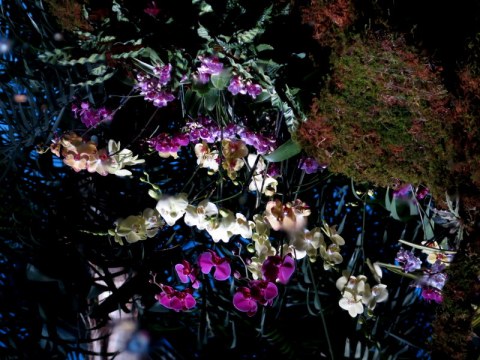
Upside down reflection of Phaelaenopsis, Palms of the World Gallery, NYBG’s ‘Orchid Show: Thailand’ (photo Carole Di Tosti)
Also in the Palm Gallery are noted the Thai cultural elements that thread throughout the other galleries that comprise The Orchid Show: Thailand: water, elephants and noted varieties of orchids specially featured as Thai favorites (Vandas, Dendrobiums, Paphiopedilum). The reflecting pool is reminiscent of the Thai’s evocation of tranquility and serenity in their gardens which often sport small pools, ponds, waterfalls. The elephant topiaries carrying orchids indicate their veneration of the Thai elephant, chang thai. It is their national symbol. Thai elephants have been used for centuries as a means of transport and a laboring force. Chang thai’s picture is in on the emblems of many of Thailand’s provinces.
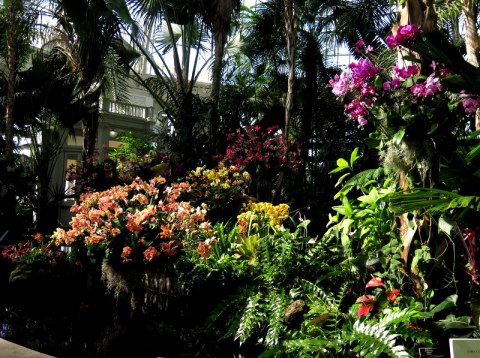
Palms of the World Gallery, NYBG ‘Orchid Show: Thailand’ (photo Carole Di Tosti
As you move around the Palms of the World Gallery and saunter into the walkway of the conservatory toward the piece de resistance, the 360 degree centerpiece heart of the exhibit, you will see elements of the Thai culture represented in the design features of the exhibit and in symbols throughout. To become aware of them, it will take close scrutiny. These design elements include bamboo sectionals and dividers-pieces of bamboo filled with moss. There are amazing dendrobium plantings in water jars, small topiaries which are a tribute to mai dat, the ancient Thai craftsmanship of clipping trees/shrubs into fanciful shapes. There are hanging Thai sky lanterns and hand carved teak spirit houses.
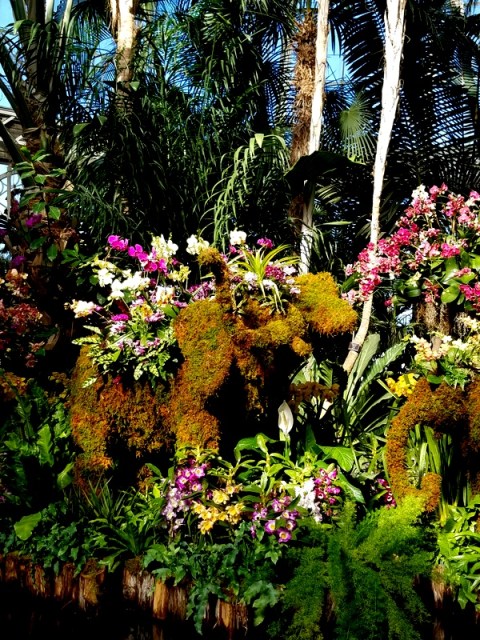
Elephant topiary (detail) carrying Phaelaenopsis orchids, Palms of the World Gallery, NYBG ‘Orchid Show: Thailand’ (photo Carole Di Tosti)
If you have time you will note placards with information about lucky numbers and the sky lanterns. Numbers are very important symbols for Thais. They believe in lucky numbers: numbers divisible by three, odd numbers, the lucky number 3 and the penultimate lucky number 9. But the number 13 is bad news. You will never find it in Thailand which is similar to our rejection of the thirteenth floor in hotels across the nation.
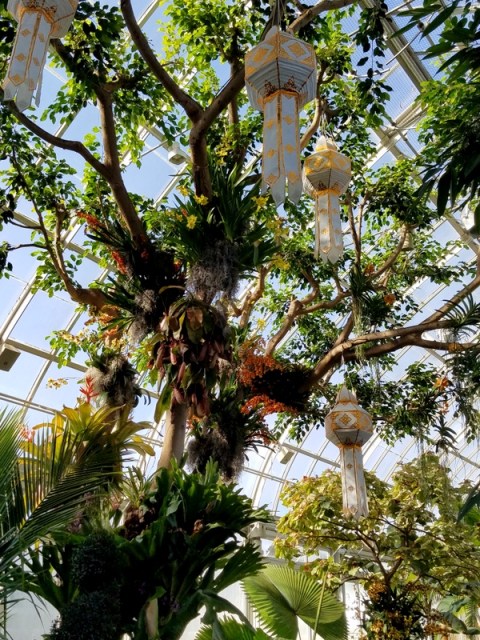
Sky Lanterns, (khom loi) Oncidium, Pitcher Plants NYBG’s ‘Orchid Show: Thailand’ (photo Carole Di Tosti)
At the beginning of the walkway after you leave the Palms of the World Gallery, look up. You will see the sky lanterns (khom loi). If you count their number it will total nine. Thais use khom loi during festivals and important occasions. These offer a soft, glowing, halo effect in the evenings; you’ve seen the sky lantern festival photos where folks light the lanterns, and like tiny hot air balloons, they rise over water. These lanterns will be lit during Orchid Evenings to create an enchanting effect. There are different sky lanterns farther on in the 360 degree centerpiece gallery which also number nine and which will be lit for Orchid Evenings. There is no preventing the good luck which is manifest everywhere in this orchid show.
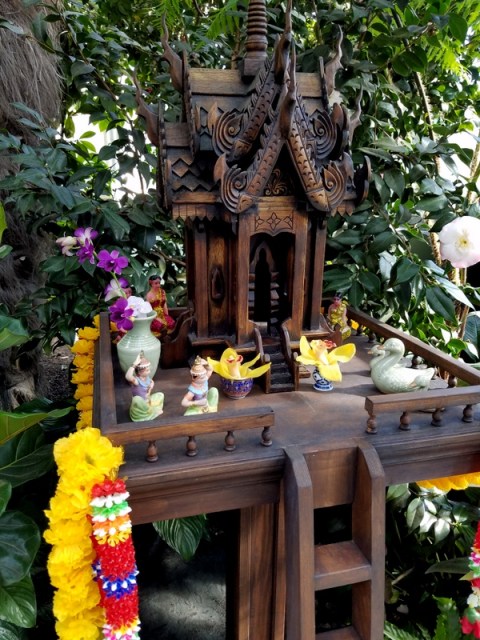
Thai Spirit Houses of hand carved teak by Thai artist, Pirot Gitikoon with offerings at NYBG ‘Orchid Show: Thailand’ (photo Carole Di Tosti
Integral to that insurance of good luck in Orchid Show: Thailand are the teak spirit houses hand carved by Thai artist Pirot Gitikoon, near the grand centerpiece. Spirit houses are traditional in Thailand and represent a merging of religions: Buddhism, Hinduism, Chinese ancestor worship and ancient Thai spirit worship or phra phum which is widespread.

Hand carved teak Thai Spirit Houses with offerings, NYBG, ‘Orchid Show: Thailand’ (photo Carole Di Tosti)
Spirit houses appear in places of business and homes. It is believed spirits live in these houses made for them to guard against disaster: floods, typhoons, storms, catastrophe, etc. The spirit houses at the NYBG are hand carved with dragon elements: dragons symbolize wisdom, power and protection. Offerings of food, fruit, candies, cans of Fanta soda, exotic ceramic dancers, ceramic elephants are on a platform in front of the spirit house. They are there to lure the spirits to feel at home. These offerings include everything a spirit would need to live in the house, be entertained, eat, have transportation and protect the environs.
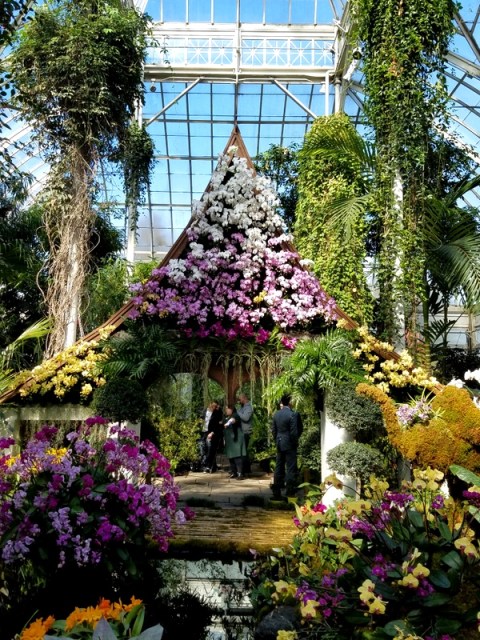
Thai sala with elephant topiary and a riot of orchids, NYBG ‘Orchid Show: Thailand’ (photo Carole Di Tosti)
At this point in your journey, you have come upon the 360 grand centerpiece. It is a sala inspired by a structure created by Thai architect Mom Tri. Salas are pavilions which are incorporated into temple complexes and public places. They are used for relaxation, rest for weary travelers, meeting places, etc.
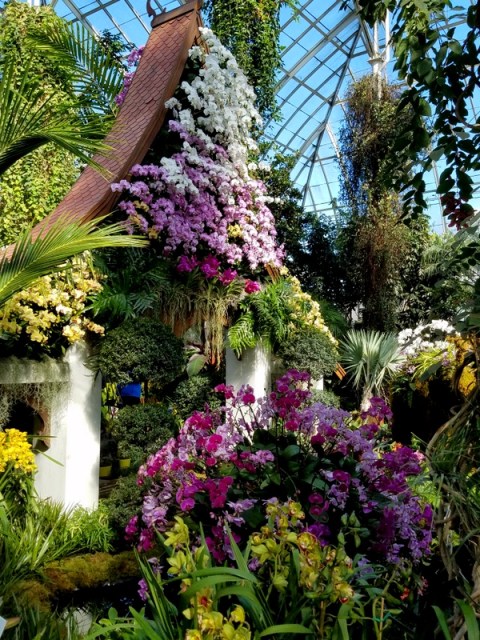
Thai sala, NYBG ‘Orchid Show: Thailand’ (photo Carole Di Tosti
The NYBG sala and circular staging environs are adorned with all of the orchid varieties we’ve seen throughout the show arranged into a spectacular finale. The water element is present in a reflecting pool, the elephant topiaries carry white Phalaenopsis and fabulously hued Dendrobium. Paphiopedilum cling to moss on rocks in the pool. Mammoth Bromeliads frame the pool with ferns, palms and other foliage. Mega plantings of fabulous Phalaenopsis frame either side of the sala, while in the back spanish moss drips and pansy orchids greet those who peek behind the structure. Exceptional living theater.
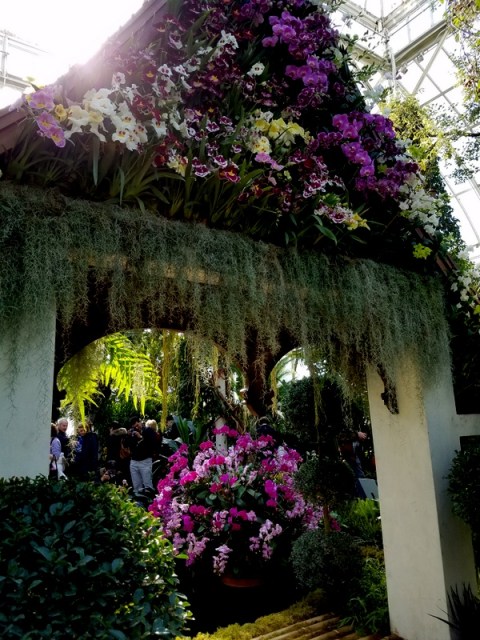
Thai sala, NYBG ‘Orchid Show: Thailand’ (photo Carole Di Tosti)


Above are two pictures of the Thai sala from a different perspective, one a close-up
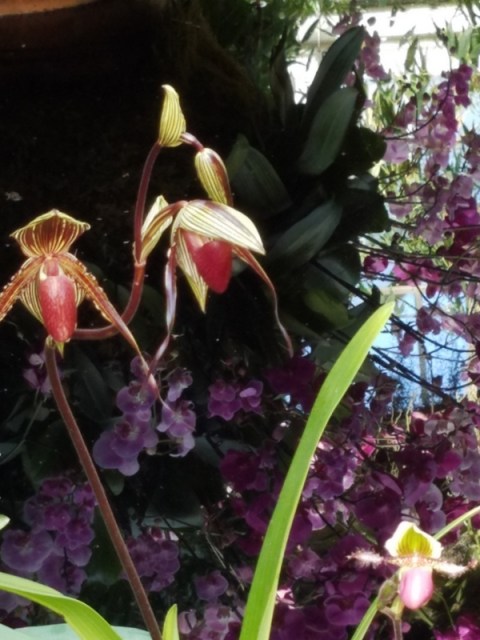
Paphiopedilum and watery reflections of Phalaenopsis at the Thai sala, NYBG ‘Orchid Show: Thailand’ (photo Carole Di Tosti)
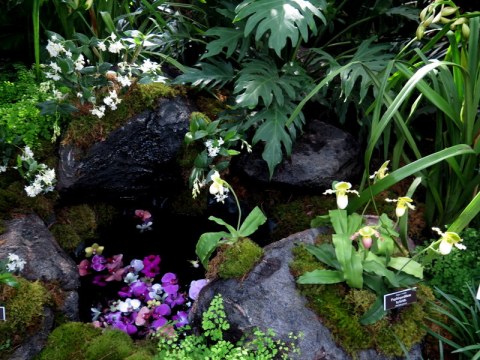
Serenity pool with Phalaenopsis petals and Paphiopedilum (lady slippers) near the sala, NYBG ‘Orchid Show: Thailand’ (photo Carole Di Tosti)
I took hundreds of photos capturing some of the thousands of orchids and found it difficult to wrap my mind around the prodigious effort it takes to choose the orchid show theme, plan the design, effect appropriate research, decide upon the plants, strike the previous show (Christmas train show) grade and prepare the ground, select the plants, arrange the design settings, then plant each orchid for this extravaganza which Christian mentioned took around nine (lucky number) months to plan and put together. The more I visit, the more I begin to understand what such a horticultural production, which March Hachadourian likens to a theatrical spectacle, entails. Can you imagine the behind-the-scenes drama to create this panoramic phenomenal display?
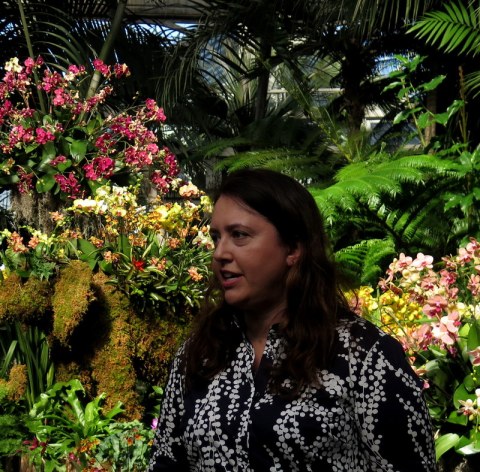
Karen Daubmann, AVP of Exhibitions and Public Engagement, NYBG, ‘Orchid Show: Thailand’ speaking to press at the Palms of the World Gallery (photo Carole Di Tosti)

Marc Hachadourian (Director of the Nolen Greenhouses, curates the exhibit’s orchid selection) NYBG, ‘Orchid Show: Thailand’ (photo Carole Di Tosti)

Christian Primeau by the Thai sala, Designer of the ‘Orchid Show: Thailand’ (photo Carole Di Tosti)
The Orchid Show: Thailand must not be missed. One should especially come back for orchid evenings. Christian mentioned that the night before the show opened to the press, he was in the conservatory surveying the final results. The lanterns were lit, it was peaceful, tranquil and absolutely “magical,” a term he said he doesn’t use lightly. I believe it.


The photo above is the duality of reflections in a pool where up is down and the Phalaenopsis mirrors itself as the light and color bounces off the water.
I am definitely going back in the evening when the Garden is at its most ethereal and “magical.” An Orchid Evening is coming up this Saturday, 4 March. Orchid Evenings are Saturdays: March 4, 11, 18, 25; April 1 and 8. Fridays: March 31 (LGBT night) and 7 April.

Dendrobium, NYBG ‘Orchid Show: Thailand’ (photo Carole Di Tosti)
The Thailand theme will be expressed everywhere in the Garden to enhance the exhibition.In addition to Orchid Evenings, there will be Film Screenings (Ross Hall) Dance Performances by the Somapa Thai Dance Company (Ross Hall or seasonally in Conservatory Plaza) Orchid Show Tours, Orchid Care Demonstrations and Orchid Expert Q & As. In the NYBG Garden Shop there is themed merchandise and a sea of orchids to purchase with an expert on hand to guide you. Phalaenopsis is easiest to grow with recurrent blooms.
The Orchid Show: Thailand runs until 9 April. For additional events and programming, CLICK HERE.
‘The Awakening of Kate Chopin’ by Rosary O’Neill, A Salon Reading
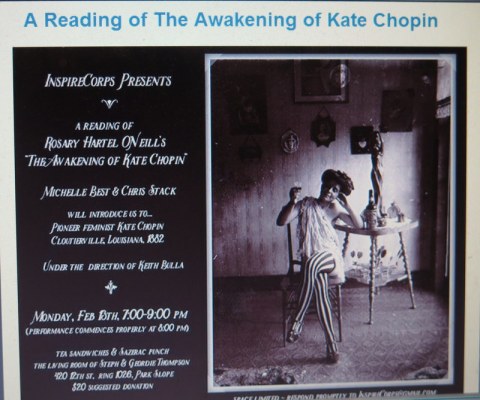
Poster of InspireCorps’ presentation of the reading of ‘The Awakening of Kate Chopin’ by Rosary O’Neill. (courtesy of the playwright)
Recently (February 13), I attended the salon of Stephanie and Ghordie Thompson, 420 12th Street, Park Slope, New York where a staged reading of Rosary O’Neill’s play The Awakening of Kate Chopin staring Michelle Best and Chris Stack was presented. Directed by Keith Bulla, this post Civil War romantic drama takes place in 1882 at The Chopin plantation 100 miles from New Orleans in an impoverished and destitute one street town in rural Louisiana.
Michelle Best played Kate Chopin, the defiant Irish beauty with a captivating frankness of expression and a brilliance of action. In the play, Kate Chopin (future author of The Awakening) must decide between her dying husband and her lover, Albert the wealthy planter next door (Chris Stack). She chooses her lover. He leaves her. In agony she goes forth to become the great writer she was meant to be.
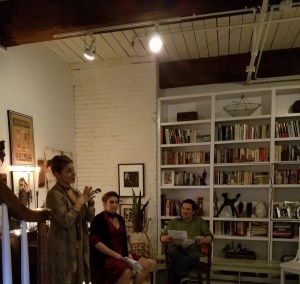
(L to R): Stephanie Thompson introducing the actors Michelle Best and Chris Stack in a reading from ‘The Awakening of Kate Chopin’ by Rosary O’Neill (photo Carole Di Tosti)
This tour de force of obsession and liberation is rooted in the real life of the famous first great American novelist Kate Chopin. Chopin was considered a fine writer until she violated the mores of her time with her second novel, The Awakening (1899). She dared to portray her protagonist Edna Pontellier as a woman who evolves into a free thinking, free acting woman. Edna seeks out autonomy and uplifts her own individuality, regardless of the Southern culture’s finding this to be intolerable. These were near heretical notions for women in 1899 when the book was published, even in the North.
Because Chopin portrayed Edna Pontellier truthfully, revealing her sexuality, her rich, inner life of freedom and her complex relationships with her husband and other men with whom Chopin, following literary conventions, insinuates she had passionate affairs, the press vilified her. For Chopin’s forward-thinking depiction of Edna and the other women in the novel, which was years ahead of its time, her work was excoriated as “morbid,” “vulgar,” “disagreeable.” Depressed about its reception, though it received a few positive reviews, Chopin returned to her short story writing, and never wrote another novel again. Four years later she suffered from a brain hemorrhage at the St. Louis World’s Fair and died two days later.
O’Neill’s play is based on elements of Kate Chopin’s life some of which may be discovered in a biography Kate Chopin by Emily Toth (1990). The Awakening of Kate Chopin details interesting concepts about Chopin’s life which dovetail with her characterization of Edna Pontellier and add an accessible elucidation to an understanding of the writer

Michelle Best as Kate and Chris Stack as Albert are positioned tellingly, one anticipatory, the other relaxed and in control. A reading of ‘The Awakening of Kate Chopin,’ presented by InspireCorps (photo Carole Di Tosti)
The play uncovers events which happened in Chopin’s life prior to establishing her writing career in St. Louis, Missouri where she eventually moved. O’Neill cleverly indicates that Chopin used autobiographical elements of her own life (all writers do) as literary fodder to create her magnificent portrayals of women in The Awakening, a novel venerated and read widely in schools, colleges and universities today.
O’Neill’s Kate and the other women in the The Awakening of Kate Chopin are equally revolutionary for their time, and O’Neill’s work echoes the life of the real Kate Chopin. O’Neill’s Kate wants to hold on to her marriage and her six small children. On the other hand there is the allure of reaching beyond the traditional roles forced upon women. Kate’s inner life encourages her to perhaps seek something which she could call her own.

The tension continues in a reading of ‘The Awakening of Kate Chopin’ by Rosary O’Neill with Michelle Best as Kate and Chris Stack as Albert, her lover (photo Carole Di Tosti)
As inexorable circumstances close in on her marriage and situation, Kate is inspired to launch herself as a novelist. However, her relationship with her husband is strained and she becomes walled in when their cotton business goes bankrupt and a wealthy next-door neighbor presents more complex problems.
Ultimately, O’Neill’s Kate is is torn between establishing her own independence by writing and maintaining her love for her children, against negotiating a failed business, a philandering husband and a seductive, sexy planter. Though the sequence of events has been tweaked with regard to the real Kate Chopin’s life, there is a passionate affair (scandalous for the time).

Michelle Best, Chris Stack ‘The Awakening of Kate Chopin’ (courtesy Rosary O’Neill)
The conflicts and elements in O’Neill’s evocation of Kate Chopin’s life in The Awakening of Kate Chopin are all too real. Many women in 2017 will empathize with O’Neill’s characterization of her protagonist, for she is an iconic woman confronting issues that married and unmarried women face in their life journeys. The Awakening of Kate Chopin, which leaves off right before the real Kate Chopin moves to St. Louis and becomes known to the world, is an epic drama of the first American woman novelist who is still highly controversial today.
I was intrigued to be at the salon to hear the reading of segments of the play for the first time with these well cast, fine actors. Michelle Best was subtle and evolving as the conflicted Kate. Chris Stack portrayed the sexy Albert with predatory insolence and sensuality. The soon-to-be-divorced Albert helps save Kate’s family business from Oscar’s (her husband) poor decisions while igniting her desire for a sexual relationship.

Director Keith Bulla conferring with Rosary O’Neill, the playwright of ‘The Awakening of Kate Chopin’ (photo Carole Di Tosti)
Keith Bulla is a director who has extensive experience working with playwrights on the development of new work. He predominately does this at the Actors Studio but may be encouraged elsewhere if it is the right property. Bulla’s interest and insight spearheaded the reading. His gentle skill with the actors elicited from the depth of O’Neill’s writing a growing understanding by Best and Stack of how to best access these complex, fascinating characters.
The salon was sponsored by Stephanie and Geordie Thompson who are co-founders of InspireCorps, a non-profit arts education organization dedicated to supporting the arts.

(L to R): (L to R): Carole Di Tosti (journalist) Linda Langton (literary agent) Rosary O’Neill (playright, ‘The Awakening of Kate Chopin’) at InspireCorps’ salon reading of ‘The Awakening of Kate Chopin’ (photo Carole Di Tosti)
Based upon the audience’s response in the “talk back” which generated discussion about Kate Chopin as a writer ahead of her time, yet obviously living these events in her time before she moved to St. Louis where her writing took off, I would say this is an auspicious “first” which portends great things to come for The Awakening of Kate Chopin.
Slow Wine 2017, an Incredible Tasting

Eataly is a superior setting for wine tastings like Slow Wine 2017 (photo Carole Di Tosti)
Every year Slow Wine which is a welcome offshoot of Slow Food features wine producers on tour from the West to East Coast, from San Francisco, California, Seattle, Washington, Austin, Texas, ending in New York City. All of the wines featured at the tastings are either certified organic or biodynamic with an emphasis on clean, quality, affordable wines that are cultivated without chemical fertilizers, pesticides, herbicides and are nurtured with attention to the phases of the moon and farming and wine making techniques that are both ancient and modern. This year’s Slow Wine tasting was in a perfect setting: Eataly downtown on Liberty Street in New York City.

Lucas Lanci took us on a tour.
Slow Wine which produces a a guide for food as well, identifies producers taking into consideration the life of the cultivators, their vineyards and their wine production. There is a breakdown of excellence according to three categories: the snail, the bottle and the coin.
The Snail identifies a cellar that has distinguished itself through its “interpretation of sensorial, territorial, environmental and personal values” in accord with the Slow Food philosophy (clean, of quality).
The Bottle is given to cellars that show “a consistently excellent quality throughout the range of wines presented.
The Coin indicates good value for the quality of the wine.

Slow Wine 2017: Federico, of Caparsa, shows where the winery is in Tuscany; the winery and villa are rustic and beautiful for a relaxing holiday (photo Carole Di Tosti)
For the three categories of wines, there are the epitome of the “Slow Wines.” These wines uniquely manifest fine sensory elements and reflect the personality of their terroir, their history and their environment. The”Great Wines” are singular in their exquisite sensory qualities. The “Everyday Wines” are those that are drinkable with food or alone and demonstrate a measurable price which bestows good value.

Caparsa wines from Tuscany, 2017 Slow Wine Tasting at Eataly (photo Carole Di Tosti)
At the 2017 tasting there were too many wonderful wines and so little time to get to them all without passing out. However, this year a few tours were offered by the Università degli Studi di Scienze Gastronomiche (University of Gastronomic Sciences). For two tours, I and a small group of educators and press followed Lucas Lanci as he introduced us to sterling producers.
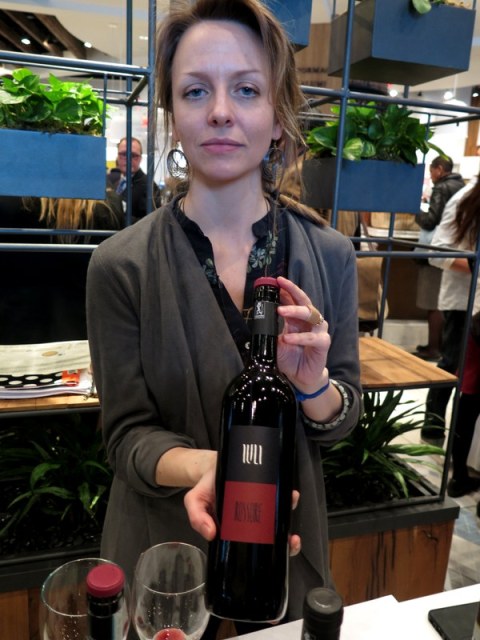
Representative of Iuli holding a bottle of Rossore 2013, with a “Slow Wine” designation at 2017 Slow Wine Tasting at Eataly (photo Carole Di Tosti)
On the first tour, the producers had distributors/importers. On the second, the producers were looking for distribution and importers to collaborate with. We tasted some interesting wines, some extremely memorable, others not to my palate. But then I favor red wines and the whites have to pop with a memorable palate and nose.
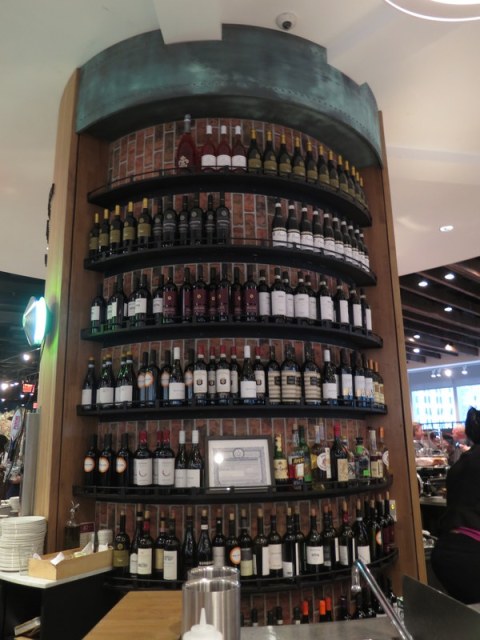
Eataly wine centerpiece, 2017 Slow Wine Tasting (photo Carole Di Tosti)
Carparsa is one of those small but memorable producers. Located in Tuscany, they produce 25,000 bottles a year on 30 acres. They are certified organic and have achieved a Snail signification and are identified as a “Slow Wine,” indicating that the nose, palate and color reflect the personality of their terroir, their history and their environment.Their importer is Artisan Wines, Inc.
There were three wines for tasting, all of them made from 100% sangiovese grapes, all of them Chianti Classico. The Caparsino Riserva 2012 was the superior wine receiving the “Slow Wine” designation because it fulfills the classic wine of the Mountains of Chianti expressing the terroir of the region with its rich fruit, mellowness and distinguishing spices and herbs. The Chianti Classico Doccio a Matteo Riserva 2012 is ready now, but it will be more full bodied in 2018. Like all the Chianti Classicos it is an intense purple color. The tannins are strong and crisp and the long finish indicates spiciness on the palate. The Doccio a Matteo Riserva 2007 carries the same expression of the other wines, all of which are best with pasta dishes and appetizers like salumi and strong cheeses.

Cantine del Notaio at 2017 Slow Wine, L’Atto 2014 (photo Carole Di Tosti)
Carparsa Azienda Agricola also boasts a bed and breakfast where one may stay for a “farm holiday” in the beautiful rolling hills of Tuscany’s vineyards in the Chianti region. There you may relax, tour the winery and learn about the 600-year-old cellars and the wine making which is a family concern headed up by Paolo Cianferoni. You may also take a trip to Siena which is in Tuscany and worth the visit.
One wine that I thought was exceptional was from a smaller producer. Iuli from Cerrina Monferrato in the Piedmont region has a production of 40,000 bottles. Thirty-four acres are under production and the cultivation is certified organic. This producer had a wonderful purple red wine constructed from Barbera grapes that I really enjoyed. Rossore 2013 gave a palate of full bodied fruit, little hint of tannins and chocolate and tobacco savors. It is designated with a Snail and identified for excellence as a “Slow Wine.” Check out this wine at Indie Wineries or Natural Wine Company in Colorado.
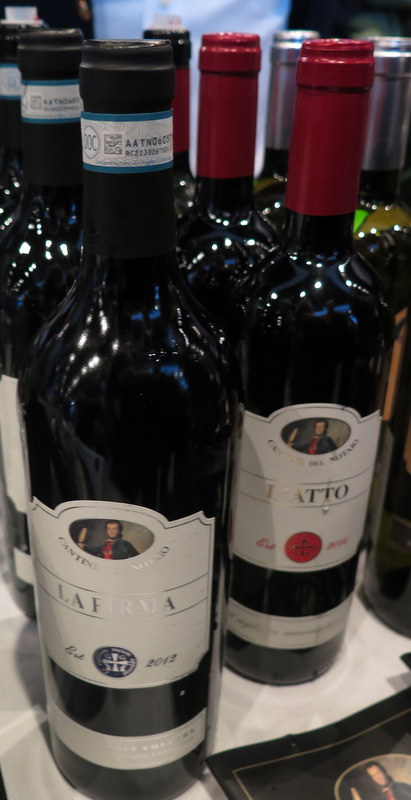
Cantine del Notaio, Aglianico del Vulture La Firma 2012 and L’Atto 2014 at 2017 Slow Wine, Eataly (photo Carole Di Tosti)
Cantine del Notaio in Basilicata, Italy is a larger producer (360,000 bottles) on 74 acres. It has a Snail designation and its vineyards and wine making are certified organic and biodynamic. We were told that Gerardo Giuratabocchetti is practically obsessive about the Aglianico del Vulture.. The vineyards have been passed down through his family for generations. Of the three wines for tasting. I enjoyed the Aglianico del Vulture La Firma 2012, designated “Slow Wine,” and L’Atto 2014. Both are deep reds with firm structure, berry fruit and luscious mouth feel with a satisfying finish, great with pastas, cheeses, salumi and meats. There is a cantina for tastings and tours of the winery as tourists and guests tell of great stories about the area and the wine making. The importer is Vinifera Imports.
2017 Slow Wine always is an enjoyable tasting. It is a pleasure to know that the producers are concerned about the environment, about clean food and wine not poisoning the individuals who buy and enjoy their products.
FOR MORE ABOUT WINE PRODUCERS AT THE 2017 SLOW WINE TASTING AT EATALY DOWNTOWN, SEE THIS ARTICLE ON BLOGCRITICS CLICK HERE.
Christian Wisdom: Donald Trump and Republicans

NYC Women’s March January 21, 2017
Wisdom is represented in all cultures and in all religions which uphold love and practice peace. I have particularly tailored this list of quotes for Christian Republican men and women and the Christian President. I have knowingly excluded the wisdom of other religions and global cultures which practice peace and love because these individuals profess to be Christians.

In this list, intentionally, there are no women quoted. Nevertheless, forgive me that I am a woman who is reminding Christian Donald Trump and Christian Republicans that in this nation, regardless of race, gender, religion and economic status, equality of opportunity and equity of treatment in work and at home is a “Christian value.” As Christians your religion predisposes you to uphold Christian tenets. (see the first quote below) No one wants to be relegated as a criminal inferior regardless of one’s innocence. If you, adherents of Christ, wish to live in His peace that passes understanding, you will demonstrate and be known as His followers by the fruit of the Spirit: love, joy, peace, forbearance, kindness, goodness, faithfulness, gentleness and self-control.”

However, if you truly are not Christians, than admit it and the country will at least understand your honesty when you follow through on your intentions to abrogate Women’s Rights and stop funding programs (pre-natal, post-natal, nursery care, pre-kindergarden, women’s healthcare, children’s healthcare) to help women and their babies. They will understand when you truncate Social Security, Medicare, Medicaid and other social programs, siphoning off funds and redirecting them to spend $12-15 billion on a wall which will most probably result in a trade war with Mexico and tremendous cost overruns of misspent taxpayer dollars. By the time your wall is finished TAX AND SPEND Republicans will probably have drained around $100 billion counting cost overruns, wall maintenance and border security.
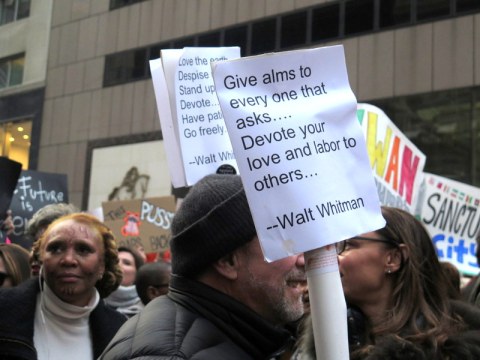
NYC Women’s March, January 21, 2017
Here are wise words and sayings to give erudite Christian counsel to the current Christian President who may gain peace from them. They are meant to succor. The little people already know and abide by much of this wisdom reflected in all cultures and religions (with the exception of those that oppress women egregiously-which Christianity does not if the Word is rightly divided and not gaslighted/twisted by the institutionalization of paternalistic religionistas).
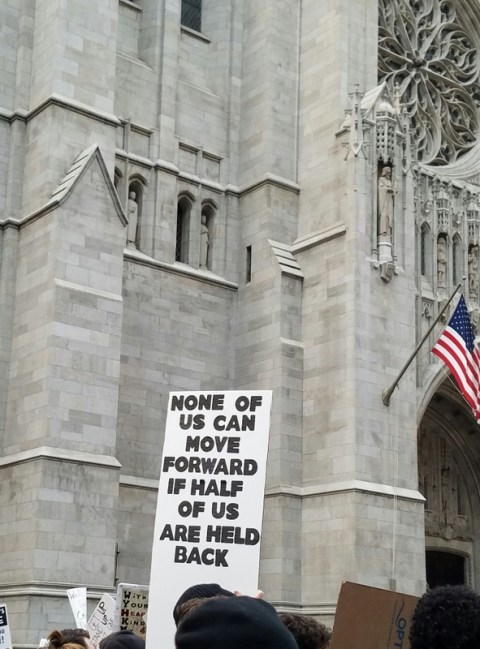
NYC Women’s March: the sign is backdropped against St. Patrick’s Cathedral
“Do unto others as you would that others should do unto you.” (Bible) (Golden Rule)
“The first step to greatness is to be honest.” (Samuel Johnson)
For those Republican Christians, who would say they are Christians but are not forgiving and loving…a word to the wise. The truthfulness which Jesus demands from his followers is the self-abnegation which does not hide sin. Nothing is then hidden, everything is brought to the light of day. In this question of truthfulness, what matters first and last is that a man’s whole being should be exposed, his whole evil laid bare in the sight of God. But sinful men do not like this sort of truthfulness. from this site.

NYC Women’s March: This sign is backdropped against St. Patrick’s Cathedral
“Doing an injury puts you below your enemy; revenging one makes you but even with them; forgiving it sets you above them.” (Benjamin Franklin)
“A good name is rather to be chosen than great riches.” (The Bible)
“Thou shalt not bear false witness (tell a lie).” (Bible)
“God governs in the affairs of men (and women).” (Benjamin Franklin made this statement when he requested the members of the constitutional convention to pause for prayer for God’s guidance.)

“Love your neighbor as yourself.” (Bible)
“They that are slow to anger are better than the mighty.” (Bible)
“Pride goeth before destruction, and a haughty spirit before a fall.” (Bible)
“Of all the dispositions and habits which lead to a political prosperity, religion and morality are indispensable supports.” (George Washington)
“Labor to keep alive in your breast the little spark of celestial fire-conscience.” (George Washington)
“Love one another.” (Bible)
“Thou shalt not steal.” (Bible)
“That this nation, under God, shall have a new birth of freedom, and that government of the people, by the people, for the people, shall not perish from the earth.” (Abraham Lincoln Gettysburg Address 11/19/1863)
“It is easier for a camel to go through the eye of a needle than a rich person to enter the Kingdom of God.” Jesus Christ of Nazareth
©all photos by Carole Di Tosti, 21 January, 2017, NYC Women’s March
NYC Women’s March: Of the People, By the People, for the People, 21 January



The global Women’s March was three days ago. My soul is still soaring from the momentous and historic occasion. In NYC upwards of 400,000-600,000 (the numbers are inconclusive-police said around 400,000 and Mayor DeBlasio put the numbers higher) women and men of all ages and all races, children, LGBT folks, people from all educational and economic backgrounds and lifestyles marched throughout the day. The main route was from Dag Hammarskjold Plaza down 42nd Street, up 5th Avenue and marchers stopped on 53th Street a few blocks from Trump Tower.


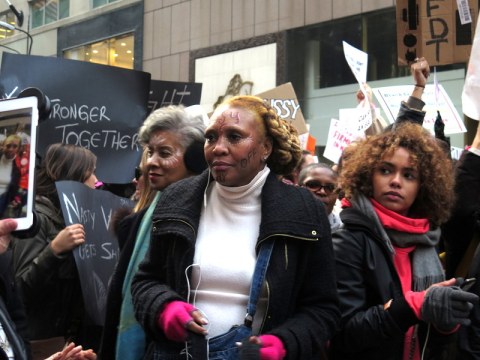
However, because there was a glut of individuals who converged at Dag Hammershold, crowds spilled out into side streets and sidewalks. The police were accommodating, my friends who were there early told me. Other friends I ran into, who had not planned to join in were swept up in the crowd. They marched on sidewalks alongside the marchers in the street; some marched on Madison Avenue going uptown, others on Park Avenue holding signs boldly over their heads. Whether a part of the registered marchers or the sidewalk marchers, waiting to get to an entry point where they would be allowed in, all were in unity, of one mind and spirit, even if they didn’t march the entire route.
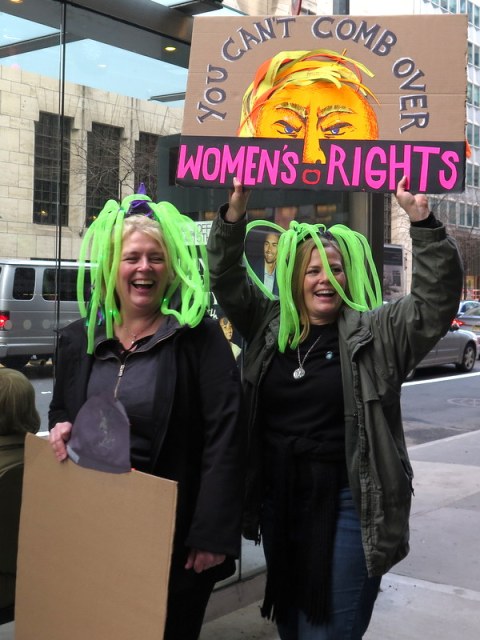
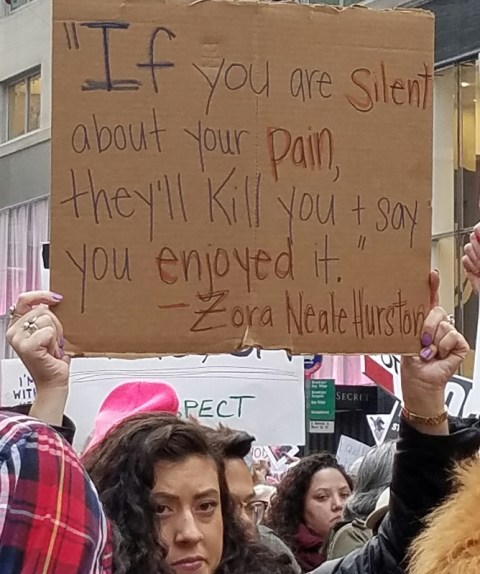 I I had previously marched in Washington against the Viet Nam War (remember the scene in Forrest Gump at the mall?). Throughout the years, I have joined in at various protests (Kent State, gay rights, strikes on SUNY Albany campus, various peace and civil rights marches in Albany, Occupy Wall Street 2011, Black Lives Matter). None of those actions compares to this Women’s March January 21 in breadth, scope and intent. Those marches advocated for a specific action: to uplift the 99%, to end the War in Viet Nam, to demand justice for the abusive law enforcement tactics that killed 4 Kent State students, to assert that Black Lives matter in the face of a history of abuse and unjust killings.

None of those marches were unified on a national and global scale to stand together in concert against everything that one individual and members of a billionaire economic class and their pilot fish have come to represent for people of good will everywhere. This march and these marchers stood and still stand against institutional repression of human rights (including the right to a sustainable environment without threat of upheaval to countries and societies because of climate change). The marchers stood in opposition to the unapologetic behavior of the president and his staff during the campaign and their demonstrated actions of bigotry in not loudly refuting white supremacy, racism, misogyny, gender discrimination, anti-semitism and cronyism.
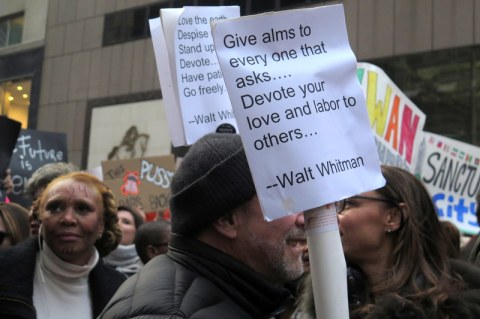

In Washington D.C., NYC, Los Angeles, Chicago, Austin, Philadelphia, Boston, Miami, in cities in every U.S. state, in 60 countries, in seven continents, even in the Antarctic Peninsula, there were sister marches. Each shed an incredible spirit of unity and community. January 21, 2017 marks a global day of unity and peace (there was no violence anywhere). We who participated are a part of a citizenry without national borders, a united spiritual consciousness of individuals who believe that liberty, justice and equality of opportunity should be for all, not just the tiny minority who can pay for preeminent civil rights.



In the U.S. untold amounts of money buy freedoms, the crucial freedom to be above the law and to slyly dictate sub rosa what the law should be according to corporate or personal agendas. Swaths of money buy a presidency, pay to keep one out of prison by purchasing the best attorneys, buy global mobility, buy luxury housing, trophy wives, beauty, youth, clean water, quality food, superb preventative alternative medicine with holistic MDs, private hospital rooms with catered meals.

The more the billions, the greater the power and influence, the greater the likelihood of unethical, unchecked behavior. Money is the right of privilege. Money has a higher sanctity than life. Without it, in the U.S. especially, (the national quality of life-the US is not on this list) the individual is in a relative state of economic bondage: forced into or trapped in economic marriage relationships, miserable at low paying, stressful jobs…where one longs for days of “freedom.” or retirement. Unlike European countries (Netherlands, Denmark, etc.) in the U.S. the ratio of salary between CEOs, company owners and their employees, is egregiously unequal.
Equity of opportunity is one reason people marched. In the U.S. the gender wage gap still exists, though there is argument about how to measure it taking numerous variables into consideration. Black women and men, and Hispanic women and men make less money then their white counterparts.

People marched to uphold women’s rights to control their souls/decision-making over themselves and their bodies, a natural right men have and vociferously uphold against anyone mucking with their “masculinity.”


 Men and women marched to uphold that women must not be demeaned, belittled, abused, objectified because of gender. (statistics of violence against women globally are here as a referent) Yet they are and the president has an appalling track record on video revealing his paternalism and objectification of women’s appearance, not a good model for young female children.



And people marched to stand against a president who they feel is an illegitimate bounder, who demeaned and unjustly vilified and criminalized opponent Hillary Clinton using shadowy assets delivered by contingents of law enforcement to pressure FBI Comey to tar and feather her days before the election. Others marched for they believe the president’s men occluded results in swing states with cooperating election boards, all funded by Kremlin dollars through Paul Manafort who was fired from the Trump campaign in August 2016, but remained in the shadows advising Trump to go to swing states before the vote.



Kellyanne Conway questioned the purpose of the march. President Trump suggested the marchers should have voted. Conway is paid well to speak the administration propaganda. In response to the president’s retort, people did vote. Hillary won the popular vote. Hillary won the majority in a democratic popular vote, something which to this day (commentary by Press Secretary Spicer) the president denies and affirms that “millions voted illegally,” in keeping with his believed assertions that he won in a landslide, both the popular vote and the electoral college. Research and evidence reveal these are mistaken beliefs which have become fraudulent “alternative facts” at the least. Others state they are outright lies and propaganda to soothe a wounded ego and keep up the brand name of “Trump, the winner.”After all, the man has yet to divest himself or his progeny of his businesses and put them in a blind trust befitting a President of the United States under the Constitution, which he swore an oath to uphold on Inauguration Day.



This character, this personality, this attitude by the president is another reason why marchers left their homes, their activities, their leisure to protest. They felt it imperative to take a stand against the overt trickery, the lies, the deceit, the fraud and the “gaslighting” twisted distortions of truth which characterize the president’s behaviors before and during the campaign and even up to this day. Every human being has the capability to learn humility; the people marched in the hope that there would be a change of attitude. In empathy and pity, the people around the world marched in concert as a remembrance of the the finest principles of American values, human rights, equitable treatment and justice. This was not about patriotism, it was about humanity, goodness, kindness, generosity of spirit, good will and standing in someone else’s shoes.
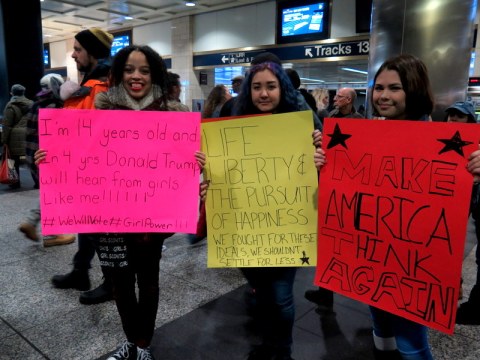 Of the many symbolic themes which the marches (672 marches in 60 countries around the world), hold, there is the empowerment of the individual within a social community, standing for the good of oneself and each other. This consciousness of united individuals globally now exists like never before in manifested form. Individuals took a stand visibly. They stood for the goodness of equity, for common decency, for equal justice and human rights for all. They marched to oppose war and violence. They marched in the belief that technology has already provided answers to create sustainable energy and sufficient resources for all who live on the planet. It is only a matter of the will of governments and the energy of sane leaders and organizers to work to that end. Where is that will demonstrated in this administration which rebukes climate change as a fantasy and would put America First, in a nationalism reminiscent of a dark period of the 20th century?

Human decency and the golden rule trump politics, greed and the tiny niggardly minority who holds the wealth of the nations at their pleasure while others live in needless misery, bowed and wasted by lack of adequate medical treatment, in the impoverishment of unclean food and water, in jails discriminatorily stocked by a broken justice system. Those who believe and act the golden rule are the majority. Though some did not march this time, they will march the next time, unless there is a behavioral reversal, a gradual humility and sense that someone is different because he has acquiesced to the voice of the people. If the situation worsens and the lies and intimidation and bullying continue, they will march again, and again, and again in peace and unity until the governments which cannot exist in themselves respond to their will and the human mandate for equity.

NYBG Orchidelirium: The Victorians’ Obessession for Orchids and Profits

Phalaenopsis at NYBG Orchidelirium Photo by Carole Di Tosti
Phalaenopsis orchids, the most ubiquitous of flowers, hardly garner a second glance when we stroll by the myriad colored hybrids that adorn restaurants, homes, offices, and flower sections of grocery stores.

Opsistylis Mem. Mary Nattrass NYBG Orchidelirium Photo by Carole Di Tosti
However, in 19th century Victorian England, if you had orchids in your parlour, you were most probably a member of the upper class. Orchids were a costly rarity, and for much of the 19th century, these plant gems remained in the domain of aristocrats, whose adoration of spectacular orchid originals epitomized the genteel display of power, status, and luxury.

Phalaenopsis I-Hsin Sun Beauty at NYBG Orchidelirium Photo by Carole Di Tosti
In celebration of those passionate Victorians whose obsessions spawned perilous journeys and whose collectors’ cultivations helped to transform the field of plant research, propagation, and conservation, this year’s theme of the NYBG Orchid Show, is “Orchidelirium.” Representative of all that is exceptional and dynamic about this monumental flowering plant family Orchidaceae (over 30,000 naturally occurring species from tiny to large, with over 150,000 man-made hybrids), NYBG “Orchidelirium” in its intense visual design and intriguing tour layout circumscribes the trending mania that burst onto the scene in Victorian England. The exhibition highlights the finest and most innovative creative impulses of the time and recalls some of the most nefarious of human activity before profiteering, exploitation, and habitat destruction became the anathema they are today.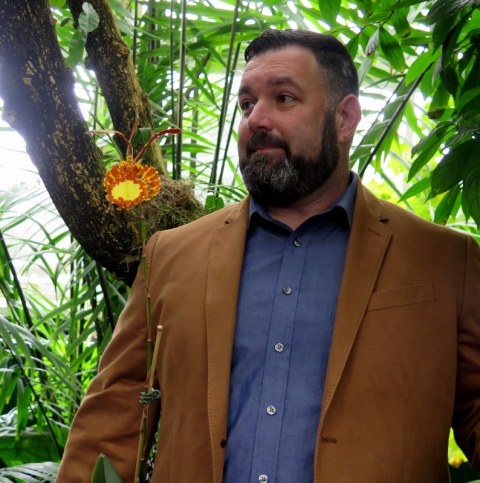
Marc Hachadourian (NYBG orchid curator) holding the beloved Psychopsis papilio that whetted the Duke of Devonshire’s obsession for more rare beauties. Photo: Carole Di Tosti
The euphoria began when the Duke of Devonshire fixated upon a dazzling, most singular orchid, Psychopsis papilio. Enchanted, he lusted for more “living jewels” and commissioned explorers to travel the continents and bring back obscure treasures. They did. His addiction grew. Word spread. London’s upper class’ fanaticism was set ablaze, and the orchid craze catapulted into hyper-drive.
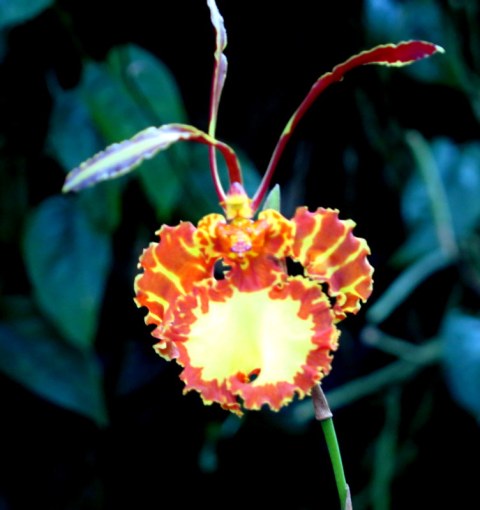
Close up of the Psychopsis papilio that started orchid mania and determined the British Duke of Devonshire to amass the largest private orchid collection in the world at his Chatsworth House estate in Derbyshire which you can visit today. Photo Carole Di Tosti
The Duke’s head gardener Joseph Paxton revolutionized greenhouse design and orchid cultivation for the Duke whose expanding collection (eventually his greenhouses were over an acre under glass), inspired his wealthy friends to also display their unrivaled orchid prizes. Soon hundreds of adventurers were commissioned to travel on the high seas and bring back all the obscure, unparalleled beauties they could find. In 10 years the Duke possessed the largest private orchid collection in the world centered at his Chatsworth House estate. The grandiloquent gardens, greenhouses, and impressive buildings in Derbyshire, which recall the wealth and splendiferous grounds of Mr. Darcy’s estate in Pride and Prejudice, are worth the visit if you are traveling to the UK.
 Fragrant Dancing Ladies Orchid, Oncidium, Rosy Sunset ‘F’ NYBG Orchidelirium. The oncidium orchids carry a lovely fragrance of roses or chocolate. Photo: Carole Di Tosti
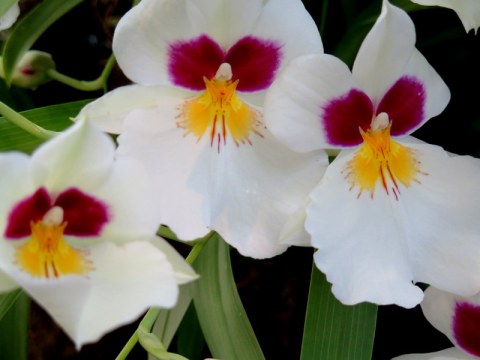
Miltoniopsis Herralexandre (pansy orchid) NYBG Orchidelirium Photo:Carole Di Tosti
Our love of orchids has been tempered with an ethical imperative about conservation and preservation of habitats that was absent back in the time of the exploitative, predatory Victorians. Throughout, this prodigious show highlights the extent of the Victorians’ often piratical obsession, not only through its exquisite, floral pageantry but by showcasing the historical artifacts, books, pictures, narratives that adorn the pathways where the lusciously fragrant Oncidium Rosy Sunset ‘F’ orchids dance (they smell like chocolate), and the Miltoniopsis Herralexandre (pansy orchids) charm with their smiling faces that bloom with scintillating color. The narrative discloses “movers and shakers like Benedikt Roezl, the “Prince of Orchid Hunters,” who was the most famous and successful orchid collector of the era.
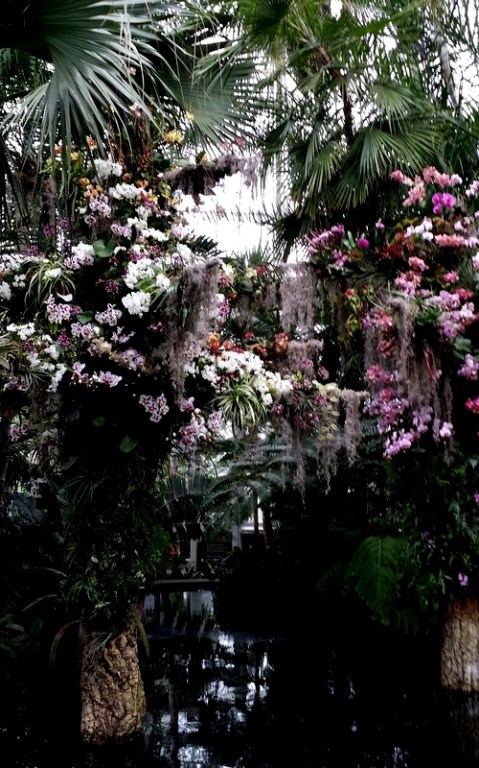
Featured display introducing Orchidelirium in the Palms of the World Gallery and Reflecting Pool. Photo by Carole Di Tosti
The exhibition is breathtaking in its conceptualization, scope, design, and presentation. It is partly conceived as an expeditionary journey that snakes through the greenhouse galleries and suggests the diversified habitats that recall the various continents spanning rain forests, mountains, and deserts (orchids live in all continents with the exception of Antarctica), where orchids luxuriate. One first enters the conservatory’s Palms of the World Gallery Reflecting Pool and is struck by the explosion of whites, fuscias, variegated roses, pinks, and maroons of reigning Phalaenopsis which cascade dripping Spanish moss from elevated dispositions in the trees. The featured display symbolizes how far orchid cultivation has come from hunters poaching species in the wild to the massive hybridization and cultivation of Orchidaceae it is today.
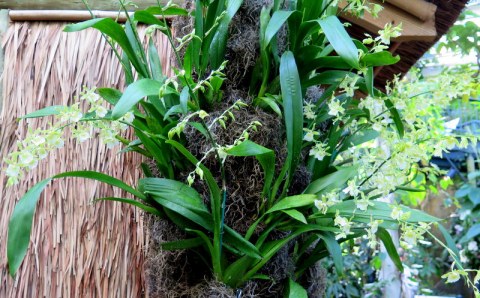
Oncidium Irish Mist ‘Big Hot Sun’ Photo by Carole Di Tosti
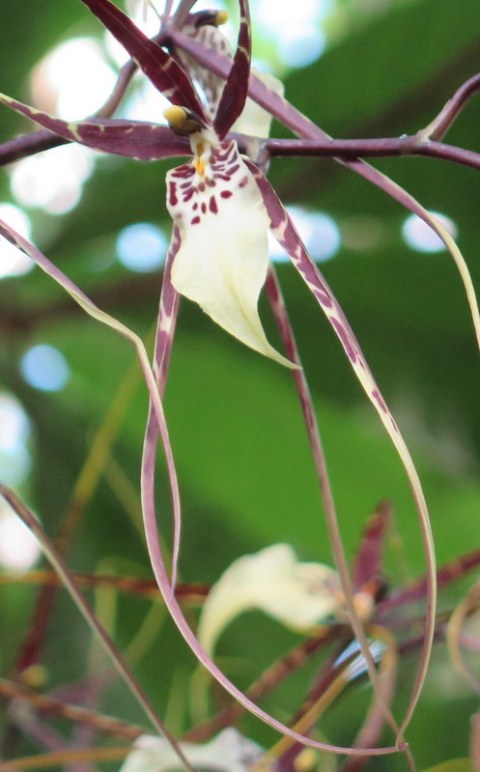
Bratonia Kaui’s Choice-note the long petals. NYBG Orchidelirium Photo by Carole Di Tosti
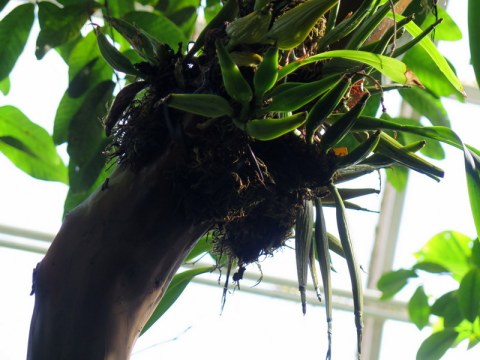
Vanilla orchid not in bloom, pods visible. Photo by Carole Di Tosti
Around each turn is the unusual, like the vanilla orchid whose pods are not beans and which is the only orchid of natural economic value from which we derive all our vanilla flavoring. According to Marc Hachadourian who walked with us along the orchid trail, the vanilla seed pod of the orchid is what is taken, dried and cured and as a result of that curing process or fermentation, that’s where natural vanilla comes from. So the Madagascar and Tahitian vanilla which is the real vanilla extract, comes from the seed pod of an orchid. Marc referred to the black flecs in Vanilla Haagen dazs ice cream which are from the vanilla orchid seed pod. “You see, you’ve been eating orchids your entire life and didn’t know it.”
As we move along the trail, Marc informs us of the tremendous diversity of orchids which are highly adaptable to all terrains and climates and are the reason why researchers use them in their plant studies. Along the pathway through the galleries that mimic the various terrains where orchids grow, you will encounter the desert orchid Eulophia Petersii.
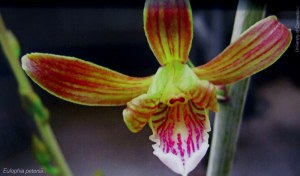
Photo of desert orchid in bloom in the NYBG desert gallery. Photo of photo by Carole Di Tosti
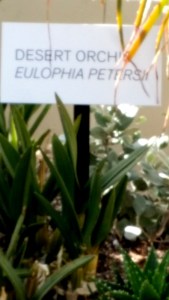 The Desert Orchid Eulophia Pettrsii has adapted to the terrain in that has stems like the swollen stems of a cactus and it has a defense; the edges of the leaves which are like a saw, may cut you. Orchids adapt to every location in the world but Antarctica.
There is also a display case filled with orchid miniatures and valuable, rare orchids from the NYBG’s permanent collection. Within the case is a yellow orchid from Southeast Asia that has the fragrance of horse manure, a scent irresistible to its fly pollinators. As he walked with us Marc Hachadourian discussed that he even had equestrians test it and verify the scent. According to Marc, “It’s one of the things that orchids are known for, the really bizarre pollination biology sort of verging on science and science fiction.
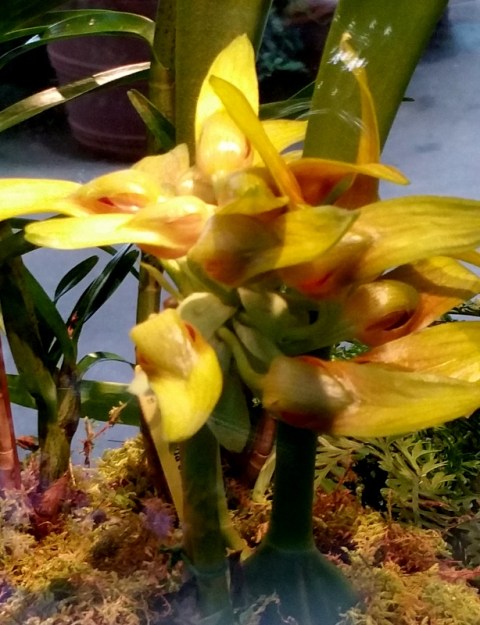
The Bulbophyllum orchid smells like horse manure fragrant to its fly pollinators. This may be found in the permanent orchid collection ,NYBG Orchidelirium. Photo by Carole Di Tosti
The winding trails of the rainforest gallery recall the thick jungles of an earlier time when thousands of undiscovered orchid species proliferated with abandon. Their abundance was staggering. It exists no longer, having fallen prey to wasteful plunderers. Stop to read the story synopses of collectors and nurserymen and see how the orchid hunters lived while under threat of tropical diseases (malaria, yellow fever, blackwater fever), big jungle cats, and other predatory animals. Historically recorded are some of the most dastardly examples of plant exploitation, cupidity, and habitat destruction, encouraged by the likes of self-proclaimed “Orchid King” Henry Frederick Conrad Sander.

On the orchid trail with Marc Hachadourian who points out the typical shelter of an orchid hunter at NYBG Orchidelirium. Photo by Carole Di Tosti
Sander sent out twenty explorers at a time to South and Central America, India, Burma, etc., all in the name of possessing, monopolizing, propagating, and monetizing the most inimitable specimens. The collector amassed a fortune, grew between 1 and 2 million orchid plants in his nurseries, and was named Royal Orchid Grower to Queen Victoria. The NYBG bought orchids from Sander. One of them, a Vandopsis gigantea purchased in 1904 and on display, is almost as old as the NYBG which is celebrating its 125th Anniversary this year. The Vandopsis gigantea is in its 112th year.
Behind the scenes of the splendid faerie blooms imperiously showcased in sedate upper class English parlours and Joseph Paxton designed conservatories (his greenhouse innovations influenced the Enid A. Haupt Conservatory design), lurked venality, bellicosity and coldblooded aggression. The orchid wilds were foreboding territories of mayhem and murder. Avaricious collectors like Sander and his competitors (Dr. John Lowe, Beechers, Veitch & Sons), hired ruthless, cutthroats to seek and discover peerless finds that would yield a veritable king’s ransom ($100,000 and more in today’s currency for a single orchid). If they could destroy their rivals’ orchid specimens, urinate on them, burn down forest habitats, cut down trees (4000 were cut during an expedition), throw competitors “off the scent” of a particularly stupendous find by slyly redirecting them, and generally assure their orchid bosses’ exclusivity in nature’s masterpieces, they succeeded. That was the “game of orchids.”
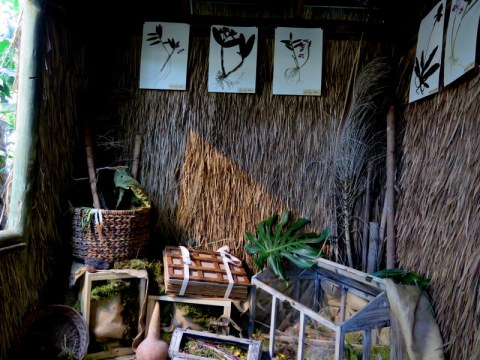
The interior of the hut with the implements the orchid hunter used including the Wardian Case found on the orchid trail NYBG Orchidelirium. Photo by Carole Di Tosti
Along the garden tour is placed an orchid hunter’s grass hut. Inside, along with examples of his tools and implements, is his Wardian Case (an early terrarium), where he would create a kind of micro-climate for his orchids’ preservation on the long journey home. Wardian Cases were also used to display orchids. A few in this exhibition display delicate orchid miniatures.

Photo of a sketch/photo of Benedikt Roezl, “Prince of Orchid Hunters,” an intrepid gardener, horticulturalist and orchid collector who discovered 800 different species of orchids. NYBG Orchidelirium Photo by Carole Di Tosti
The life of the orchid explorer was arduous and death-defying at every turn. One can review chronicles of those who drowned in the Orinoco (William Arnold), were attacked or mauled by jaguars and tigers, were felled by dysentery (Gustav Wallis), or yellow fever (Frantisek Klaboch), or robbed 17 times at gun or knifepoint (Benedikt Roezl). There were many who simply didn’t return. (David Burke, a Veitch hunter was murdered as many probably were). Indeed, though these brazen, plunderers might fiercely fight with spear, gun or knife, they were duty bound to come back alive with their “booty.” If they killed a rival or indigenous peoples to preserve their stash? Well…
Susan Orlean’s John Larouche of The Orchid Thief and the posse of Seminoles who were arrested in 1994 for poaching the ghost orchid from Fakahatchee Strand State Preserve are pussy cats in comparison to the wanton, fortune hunting Victorians. They were not constrained by any laws except the laws of the jungle, where only the fittest survived to plunder the precious rarities that had never been discovered before.
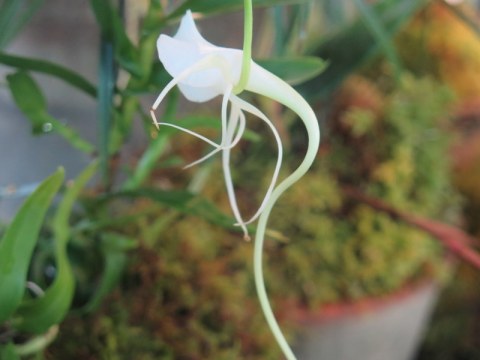
Rare orchid in the glass display case as part of the permanent collection. NYBG Orchidelirium Photo by Carole Di Tosti
Is it any wonder that Charles Darwin, Victorian contemporary and “fantastic observational botanist” (quote from Marc Hachadourian NYBG orchid curator), who was all too familiar with the rapacious frenzy of orchid collectors and the lurid stories of explorers’ dire misfortunes in jungles, high plains, mountains, and plateaus, that the notion of predatory survival in nature spoke to his heart and perhaps added weight to his evolutionary theories?There is a nod to Darwin as an aficionado of orchids with a marvelous explanation and illustrations of an ingenious discovery Darwin intuited about the Darwin Star Orchid and its pollinator that you can see on your way through the galleries.

Paphiopedilum (lady slippers) and Nepenthes (pitcher plants) in a gallery before the final exhibition centerpiece. NYBG Orchidelirium Photo: Carole Di Tosti
In the gallery just before reaching the finale you will find an interesting display of the unusual that Christian Primeau (see previous articles on this site) designer of Orchidelirium really enjoy: Paphiopedilum and Nepenthes which also can be found in the centerpiece where they are quietly tucked in and create uniqueness and an innovative touch to the usual gorgeous and brilliant displays.
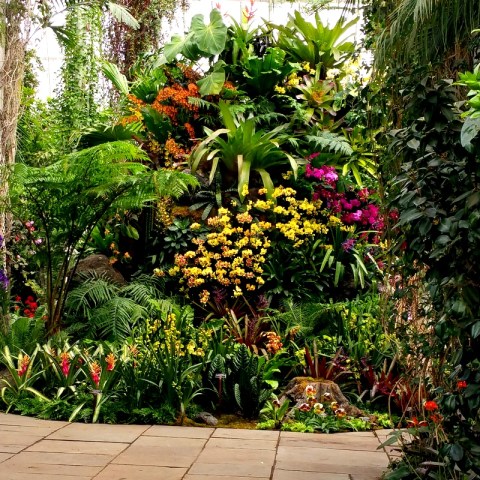
A view of the orchid mountain from the previous gallery. NYBG Orchidelirium Photo by Carole Di Tosti
On the final expeditionary leg one reaches the centerpiece of the exhibition, and the apotheosis of Victorian orchid frenzy, a 360 degree supernal, floral prominence rising over 8 feet tall in glittering, vivid technicolor. This otherwordly mountain is awash with orchids of varying species, Phalaenopsis, Oncidopsis, Oncostele, Oncidium, Vandas, Paphiopedilum (lady slippers). The hundreds of orchids vibrate a multitude of colors-fuscias, yellows, variegated pinks, roses, tricolors, whites, pale yellows, maroons, and more.

Another view of the orchid mountain with waterfall at the far side NYBG Orchidelirium Photo: Carole Di Tosti
They are a massive profusion, with smaller, quiet vignettes of orchids here and there on rocks clinging as orchids do. This splendid proliferation evokes what orchid hunters may have seen at the dawn of their exploration before the craze was underway and many had been ripped from their centuries old habitats. Jewels, they drape the mountain and create its texture rising up to the summit, sported by staghorn ferns and weird hanging Nepenthes (pitcher plants). Paphiopedilum, sit on rocks at the bottom of the two waterfalls planted with striking orange blooming bromeliads and Tacca chantrieri (black bat flowers) luxuriating in the water shallows.
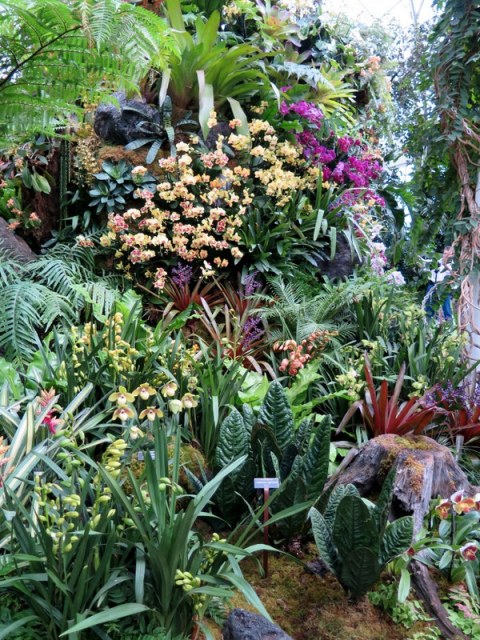
Another view of the mountain NYBG Orchidelirium Photo: Carole Di Tosti
Christian Primeau, the designer of the exhibition, was inspired into the mountain creation by an engraving of James Bateman’s (Victorian horticulturist and collector), naturalistic display in a conservatory at his country mansion, Knypersley Hall. The illustration appears in a two volume tome commissioned by James Bateman, The Orchidaceae of Mexico and Guatemala, (1843).
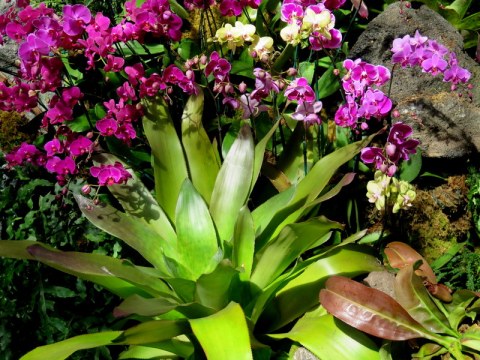
A studied vignette of the mountain with Bromeliads and Phalaenopsis NYBG Orchidelirium. Photo by Carole Di Tosti
This mountain created with volcanic rock, steel cubes, and chicken wire with a secret door to water the plants from the inside is “an homage” (Primeau’s words), to those who have gone before…to the avid collectors who endured the wrath of indigenous peoples, poisonous serpents, insects the size of birds, predatory animals, and murderous rivals in their exploits to scour unknown terrain, even lava-spewing volcanoes (Roezl did this), for the most exquisite and valuable of Orchidaceae. Despite the negatives, we have the Victorians to thank for their remarkable finds and innovations in cultivation and propagation.

Illustration of a potting bench with a variety of orchids one might find in an orchid collector’s greenhouse. NYBG Orchidelirium Photo: Carole Di Tosti
Victorian Orchidelirium gave birth to the billion dollar orchid industry that abides today. It even gave rise to the New York Botanical Garden’s ornate Victorian Enid A. Haupt Conservatory and its missions of research, preservation and protection of orchid species and hundreds of other plants that are becoming extinct because of illegal poaching, habitat destruction and climate change. With every delicate bloom, every fern, every pitcher plant, “Orchidelirium” is a bedazzling, live horticultural spectacular, a sterling exhibition to celebrate the NYBG’s 125 Anniversary.
The NYBG Orchid Show 2016 concludes April 17th. Check the Garden website for details about Orchid Evenings on Saturdays (March 12, 19, 26, April 2, 9, 16), as well as Friday (April 15), and Thursday (March 24, LGBT night). On select evenings visitors can also upgrade to V.I.P. status and enjoy an Orchid Lounge.
A shorter version of this article appeared on Blogcritics.
How I Saved Hundreds of Dollars On Editing
Great article.

 Everyone loves saving money, but sometimes I don’t want to go the extra effort to do so. This time, however, I did take the extra steps and I saved hundreds of dollars. I was thrilled!
If you’re following my posts on Facebook (facebook https://www.facebook.com/JAOwenby/) you know my upcoming novel was sent to my editor January 15th. I sent her 75 pages of my manuscript in order for her to present a scope of work and price. This is what she wrote back:
“I’ve spent some time with chapters of Tears in the Sun, and overall your development and plot are strong. You’re a good writer, and the story is intriguing. You only need light developmental editing.”

I was so excited I didn’t sleep that night! The next day I finally got over myself and looked back at what I did that saved me money, and I laughed. The one thing…
View original post 348 more words
Mark Twain in Damascus
Interesting post by Barb Drummond.

Some more from Charles Glass, in his ‘Tribes with Flags’. I knew Train travelled to Britain, but I had no idea he had done the Grand Tour to the Middle East as well:
This is Twain on Damascus in 1867:
“She measures time not by days and months and years, but by the empires she has seen rise and prosper and crumble into ruin. she is a type of immortality. She saw the foundations of Baalbek and Thebes and Ephesus laid; she saw these villages grow into mighty cities and amaze the world with their grandeur – and she has lived to see them desolate, deserted, and given over to the owls and the bats. She saw the Israelitish empire exalted, and she saw it annihilated. She saw Greece rise and flourish two thousand years and die. In her old age she saw Rome built; she saw it overshadow the…
View original post 435 more words
 CAROLE DI TOSTI