

Category Archives: Film Festival Screenings

‘Wasted! The Story of Food Waste’ Starring Anthony Bourdain, Mario Batali at Tribeca Film Festival

Anthony Bourdain, Danny Bowien, Dan Barber, Massimo Bottura, Peter Madonia

(L to R): Anthony Bourdain, Danny Bowien, Dan Barber, Massimo Bottura, Peter Madonia, Tribeca Film Festival World Premiere Q & A, ‘Wasted! The Story of Food Waste’ (Carole Di Tosti)

Anthony Bourdain (star of Parts Unknown), is his edgy, humorous self in Wasted! The Story of Food Waste. The film,  which screened in its world premiere at Tribeca Film Festival, Bourdain produced with Zero Point Zero Productions’ partners Lydia Tenaglia, Christopher Collins, Joe Caterini and co-director Nari Kye (Anna Chai also directed). However, Bourdain whose narration threads through the key issues about food waste globally and in the U.S. is more acerbic and ripping than ever I imagined he could be. But he, Dan Barber (Stone Barnes, Blue Hill), Mario Batali, Eric Ripert (Le Bernardin), Danny Bowien (Mission Chinese), Massimo Bottura (Osteria Francescana), Tristan Stewart (Toast Ale) and others who are in the forefront of trying to figure out how to rescue food and use it to create delicious meals, must tell it like it is. The situation is bleak.

Food waste is perhaps the most dire problem we face as Americans that we can do something about right now. Consider a few of these facts that directors bring out through interviews and celebrity chef comments in the initial segments of their amazing documentary.

Tribeca Film Festival Red Carpet, Wasted! The Story of Food Waste, Peter Madonia, Nari Kye, Danny Bowien, Anna Chai

TFF Red Carpet for ‘Wasted! The Story of Food Waste,’ (L to R): Peter Madonia, Nari Kye, Danny Bowien, Anna Chai (photo Carole Di Tosti)

Roughly one third of the food produced in the world for “people consumption” (approximately 1.3 billion tonnes yearly), gets lost or wasted. Food losses and waste amounts to around US$ 680 billion in industrialized countries and US$310 billion in developing countries. Ninety percent of the food produced ends up in landfills. According to Anthony Bourdain, all along the processing of food for consumption, there is waste at every junction from the farm, and the harvest, to the distribution, to the grocery story or green market, to the preparation, to the dinner table, to the leftovers.

And where does this food predominately end up? In landfills. In garbage dumps. If we could only redistribute the unused food to those who need it. Even if just one-fourth of the food currently lost or wasted globally could be rescued, there would be enough to feed 870 million hungry people in the world. But globally, people are not just hungry. It is a tragedy that globally, thousands of individuals face chronic starvation and die from disease and malnutrition. In the U.S. one in six individuals is food insecure, (in Europe it is 1 in 20). These are not just lazy, “good-for-nothings” as politocos would have us believe so we can dismiss them and de-fund programs which they label entitlements. The families are working in low paying jobs (an employment situation which has never been recovered since the second Great Depression), and many of them are white. In the film, Mario Batali looks dead into the camera (in the US we are the worst perpetrator), and he brings the problem right into our homes. He says, “This waste is criminal!”

Tribeca Film Festival Red Carpet, Wasted! The Story of Food Waste, Eric Ripert, Le Bernardin, food rescue, City Harvest

TFF Red Carpet ‘Wasted! The Story of Food Waste,’ Eric Ripert (owner of Le Bernardin) rescues food for City Harvest (Carole Di Tosti)

Anna Chai and Nari Kye’s efforts are subtly brilliant because of how they have structured their film and carried us along a journey of discovery to recognize the staggering numbers and the criminality of food waste that resonates profoundly for our own lives. First they identify the unimaginable and make it visible. They outline the causes (taking us to farms, showing the process of food distribution, etc.), then bring us to the end of the line-the food devastation in landfills.

This is where the concept of food waste goes exponentially unconscionable and Batali is not kidding when he points out the egregiousness of waste as not only “stealing” food from the hungry, but also wantonly, negligently stealing all of the resources our planet offers for us to make it to the next generation. We won’t get there if the situation continues into the next decades if we continue to be as brazenly stupid as we have been culturally.

Anthony Bourdain, Danny Bowien, Wasted! The Story of Food Waste, Tribeca Film Festival World Premiere

(L to R): Anthony Bourdain, Danny Bowien in a Q & A after the TFF World Premiere screening of ‘Wasted! The Story of Food Waste,’ (Carole Di Tosti)

Filmmakers and experts reveal how food in landfills exacerbates global warming-climate change. As the food decomposes methane gasses are released. Methane, heavier than CO2 is a worse pollutant of clean air. It erodes oxygen supplies, acidifies the oceans, chokes off marine life, harms ecosystems that sustain plants, animals and us. You didn’t note any discussion about the higher degree temperatures increasing glacial melt did you? We won’t acknowledge that is happening for fear of offending those government leaders who think global warming is a matter of belief.

You thought you had handled the problem of plastic by shopping with your cloth bags? Well, what about the food you are throwing away? Filmmakers point out that one head of lettuce in a landfill takes twenty-five years to break down. You have to throw away some lettuce because your guests won’t eat wilted leaves? Throw it in your composting bin or bring it to your green market for them to compost. If you multiply your leaves and that head of lettuce you threw in the garbage last week with thousands upon thousands of heads that got wilted and that grocery stores daily en masse throw away because housewives like their lettuce crisp and fresh-looking (even though it has no taste and the wilted leaves at the green market have much more nutrition and taste because they were picket in the morning), then you begin to see the extent of the problem of why food waste is so endemic.

Massimo Bottura, Wasted! The Story of Food Waste, Tribeca Film Festival Red Carpet, Refettorio Ambrosiano, Milan, Food for the Soul

TFF Red Carpet ‘Wasted! The Story of Food Waste,’ Massimo Bottura who created Refettorio Ambrosiano in Milan as “Food for the Soul” (photo Carole Di Tosti)


Filmmakers show that unsustainable farming practices expend and do not replenish resources (air, water, rich soil). Think of the water wasted to irrigate veggies that end up in your waste-can and end up in a landfill. The amount of money that can be saved with careful planning and husbanding water, crop yields, etc., not only can be realized by farmers and businesses and grocery stores and distribution centers, but it also filters but can also filter down to families if thoughtful planning is accomplished and if consumers don’t mind selecting some bruised fruit at a lower price (often more delicious), than the perfect apples and oranges with no taste.

Food and resource waste directly correlating to global warming and climate change, whether deaf, dumb and blind politicians acknowledge this or not, insidiously correlates to shifting population migrations as refugees challenged by drought, famine and war in a subtle and complicated connection with dwindling resources (food, clean water) seek areas to live that are not under such duress. When Bourdain implies that everything about food is tied to everything else, the message not only “hits home,” filmmakers have brought you to a place where you need to see interventions and programs and innovations that are eliminating and reducing our criminality of food waste.

Anthony Bourdain, Tribeca Film Festival World Premiere Q & A, Wasted! The Story of Food Waste

Anthony Bourdain of ‘Parts Unknown’ hosted the TFF Q & A after the screening of the film he produced with others, ‘Wasted! the Story of Food Waste’ (Carole Di Tosti)

The interviews and visits with celebrity chefs are legendary. They follow Tristam Stewart to England as he shows how he  recovers 900,000 tons of bread wasted a year by making artisinal beer). They travel to Modena, Italy and then Milan to see Massimo Battura who created Food For the Soul and the divine concept of the artistry of the Refettorios.  With beauty and elegance he has found a way to touch the hearts of the “invisible needy” that rivals dining at The Four Seasons and uplifts their souls. At the outset they visit Dan Barber who takes us through his guided veggie discoveries and tastes as he educates us to the egregiousness of food waste with produce (fruits and vegetables, roots and tubers have the highest wastage rates of any food). And they shadow Danny Bowien’s travels to Japan where chefs surprise him with delicious dishes that use unbelievable cuts from the animal that he never tried including the uterus and vows to take home to his restaurant.

These entertaining, enlightening and uplifting segments of the film, which are woven into the dialogue about food waste, dissolve the “doom and gloom” of the underlying problems by showing there is much we can do. Indeed, entrepreneurs and innovators,  spurred by funds from the Rockefeller Foundation (which is supplying grants through YieldWise) are working to ameliorate the situation and move the paradigm to Zero Food Waste in the next decades, regardless of the lack of political will that recently has been demonstrated. The uplifting examples of how other countries and individuals are curtailing food waste are inspiring. They encourage us to toward activism on a personal and local level:  at the very least composting, wiser food shopping and more.

This is a must-see film for its clarity, for its inspiration, for its no-holds-barred revelations, for its love and good will, for its energy. Its unforgettable incisiveness magnifies the importance of our individual and national global food waste imprint. Its generosity and positive outlook spur us to become leaders in our own lives and communities so that we can have a global impact. The situation is bleak, but it is not without hope. We can positively shape our future and the future of the generations that come after us. It is only a matter of starting today.

Check the website for updates.

Check this page for more information on global food waste.

Fisher Stevens, ‘Before the Flood’: Video of the Q and A at Hamptons International Film Festival 2016

img_5019

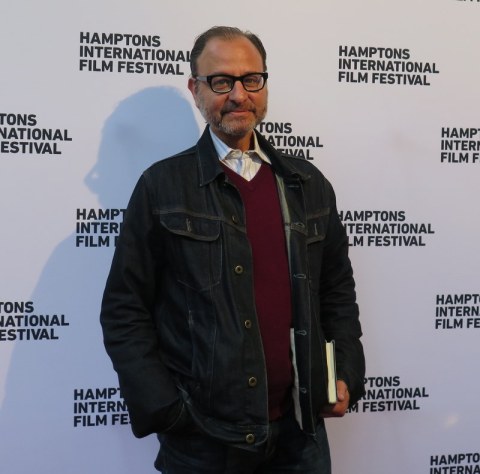
Fisher Stevens at the HIFF 2016 speaking to me about his documentary ‘Before The Flood’ (photo Carole Di Tosti) See the video clip on Theater Pizzazz by clicking HERE.

Fisher Stevens’ Before the Flood is a prodigious effort by the filmmaker who is also an actor, writer and producer. The film, starring Leonardo DiCaprio (he also co-produced the film), which screened at the Hamptons International Film Festival 2016, comprehensively details the subject of climate change through cogent interviews by scientists, activists, researchers, world leaders and more. Stevens’ perspective could have been a browbeating doom and gloom treatise on global warming. Instead, after seeing the film, one leaves the theater feeling the urgency that there are ways one can individually make a difference in the fate of the planet.

Stevens’s documentary is compelling and memorable as he traces how climate change impacts every being on this planet, every microscopic creature and every seed, every spore, every molecule of life that has managed to evolve and survive through the eons up to this point in time.  He shows how experts in climatology and related, supporting fields have been monitoring the planet for years and have produced the facts, details, information, data, maps, visuals, photographs that predict signs of impending global catastrophe. In an overwhelming consensus, they have explained what is ongoing and current: rising seas, melting glaciers, disappearance of the Greenland ice sheet. They have almost uniformly predicted the subsequent inundation of coastline cities, mass population migrations, starvation and decimation of a planet caused by greenhouse gas overload which created chain reactions that many believe are irrevocable.

img_5022

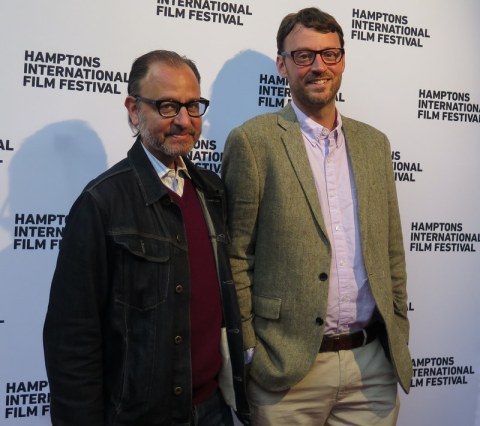
(L to R) Fisher Stevens and Artistic Director of HIFF David Nugent before the screening of Stevens/ superb documentary ‘Before The Flood’ (photo Carole Di Tosti)

Stevens also reveals the antithetical arguments to climate change and why they exist. Despite scientific consensus, climate change deniers managed, with Fox news propaganda prestidigitation, for expedience and profit, to turn black into white, to twist up into down and to morph fact into fiction. The result has been a quicker burn, a delayed global response which even after the Paris Climate Summit 2015 is not effectively doing enough to stem the glacial melt, dissipate the acidification of the oceans, ameliorate the dying of coral reefs, end unsustainable practices employed by energy corporations and create an effective reduction of carbon emissions to cool the planet.The scenario scientists, researchers and experts paint has far reaching dire consequences that impact every global culture and every land or oceanic ecosystem with supporting marine and wildlife. This result may be likened to the ushering in of the four horseman of the apocalypse: pestilence, war, famine, death.

But this must-see documentary is uplifting despite the revelatory evidence of overarching power demonstrated by a handful of genocidal nihilists (climate change deniers), who are egregiously and willfully deaf, dumb and blind to the earth’s reality show. How Stevens’ journey (which follows the investigation and work of Leonardo DiCaprio as United Nations Messenger of Peace on climate change), arrives at the realm of hope that suggests a possible rainbow in our future, is miraculous, invaluable filmography.

The film must be seen for its poetic script, its breathtaking cinematography and concurrent dark and soaring music, its cogent analysis and exhaustive documentation through experts’ interviews, visuals, maps, data and much more. Fisher’s documentary is an accessible and definitive work on climate change. It will inspire all those who see it to become involved on a personal and community level to overturn the climate change denier’s lies and take action before it is too late. The film Before the Flood is being aired on National Geographic and is screening at City Cinemas Village East and elsewhere. Check about dates online.

Here, Fisher Stevens speaks to the moderator at the Hamptons International Film Festival 2016 after the screening of this seminal film.

Save

Hamptons International Film Festival 2016 and NYFF 2016 Review: ‘Manchester by The Sea’

Kenneth Lonergan, Manchester by The Sea, HIFF 2016, NYFF 2016

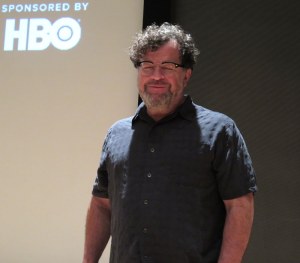
Kenneth Lonergan at the NYFF 2016. He was unable to appear at the HIFF 2016 for Manchester by The Sea, his best film to date. Photo by Carole Di Tosti

Manchester by The Sea is a pageantry of human emotions that Kenneth Lonergan prodigiously marches with relentless precision across the screen, encapsulated by the astonishing performances of Casey Affleck, Michelle Williams, Lucas Hedges, and a superb supporting cast. The plot development is a complicated paradox which exists on two levels. One is the emotional, interior level where protagonist Lee Chandler (Casey Affleck is breathtaking and magnificently drafted as the tragic everyman), reflects about a past he wishes to escape. The other is on the level of linear time in the present where Lee confronts his brother Joe Chandler’s (Kyle Chandler) death and the multiplicity of mundane details that must be carried out. Joe’s passing forces Lee to return to Manchester by The Sea, settle his brother’s affairs, and possibly assume the guardianship of his brother’s son, Patrick.

Lee’s former hometown is a place of great beauty, but Lonergan reveals by the film’s conclusion, that Manchester by the Sea may be a scenic paradise only if one has peace and joy within. For the protagonist it is the razor’s edge slicing his already bleeding soul. Of all the locations on earth, it is the last place he would wish to be to thrive emotionally in wholeness.

Manchester by The Sea, Michelle Williams, NYFF 2016, HIFF 2016

Michelle Williams in ‘Manchester by The Sea’ at the NYFF 2016 and HIFF 2016. Photo from the film

Cinematically constructed with a canny, unaffected minimalism, Lonergan alternates between the vividness of exterior scenic beauty of the coastal New England setting, and the nullifying, hackneyed interiors of families in homes which are supposed to be comfortable, but which are less than warm or real. The film’s tones are elusive and ever changing with haunting echoes spiked with humor, levity, somberness, and poignancy. Striking glimmers of scenes flare into one’s consciousness long after one has left the theater. It would be an understatement to say that this film is remarkable. It pulses with the vibrance of what makes us cling to our lives in hope, long after we, like Lee Chandler, may have been emotionally blasted by circumstances to merely exist in a roiling inferno of quiet subterranean rage and immobilizing despair.

At the heart of this film there is mystery and lustrous revelation. Lee Chandler’s suppressed identity and what he has experienced is gradually made alive to us so that we may empathize with him and wish for his redemption and healing. Lonergan has created a powerful human drama with broad and masterful strokes of storytelling. He unspools the underlying dramatic events with flashback. The flashbacks are the raw, vibrant dynamics which are Lee’s place-induced memory reflections as he robotically goes about the task of returning to Manchester to deal with his brother’s remains, hold the funeral, settle the financial estate, and monitor his teenage nephew whose enthusiasm for activities and girlfriends is a blind for the pain of losing his father and having his life upended by his uncle’s impending guardianship.

During the activities in the present, Lonergan alludes to Lee’s past through the townspeople’s off-handed comments; his identity remains a cypher. The mystery of Chandler’s going through the motions of existing in the present while living in a hyper-drive of emotional memories from the past, we later discover, is tied up with a horrible accident. For Lee and his former wife, Randi (Michelle Williams is simply, completely stunning), it is a cataclysmic, life-altering devastation. The writer gradually uncloaks the keystone revelation in a swift cut of shockingly unexpected visual images that explode on the screen and in our minds, then reverberate like the aftereffects of an earthquake.

Kyle Chandler, Casey Affleck, Manchaster by The Sea, Kenneth Lonergan, NYFF 2016, HIFF 2016

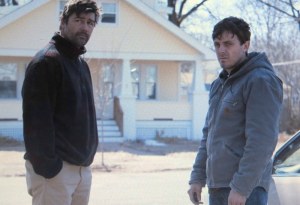
(L to R): Kyle Chandler and Casey Affleck in ‘Manchester by The Sea.’ Photo from the film

It is a revelation that occurs well into the film, and it coalesces all our understanding about who Lee Chandler is and what he is going through. From then on, our empathy with his plight includes the hope that he will be able to forgive himself, end the self-flagellation and eventually reconcile his emotions to walk the road of healing. For the present it is perhaps just enough that Chandler can breathe and experience the physical manifestations of living until deliverance arrives, if it ever does, an uncertainty that concludes the film.

We know nothing of this as the movie opens. We only discern the flattened affect of Chandler’s mechanical non-existence as the superintendent of a building in Quincy, Massachusetts. It is an existence from which he is interrupted when he must return to his former hometown, a place of exterior beauty and, for Lee, emotional terror, to deal with his brother’s death. Once there he must confront family, his nephew, and former friends under the continual oppression that reminds him that Manchester by the Sea, represents a wasteland. There, he has lost everything meaningful he has ever known.

Lonergan takes us painstakingly through the details of Chandler driving to Manchester reflecting (one of a number of flashbacks), upon the day he first heard of his brother Joe’s (Kyle Chandler is memorable in the supporting role), physical diagnosis that eventually leads to his sudden demise. The flashbacks create mesmerizing storytelling; they reveal family history, Lee’s relationships with Joe and his nephew Patrick (a humorous, heartfelt performance by Lucas Hedges). They also highlight the fragmented relationship between Joe and wife Elise (Gretchen Mol). If one studies the flashbacks as Lonergan integrates them with the arc of the plot development in the present, we understand that the whole is defined by the sum of its parts. Brick by brick Lonergan constructs the foundation of Lee’s condition and life path showing they have been arranged by these telling and vital moments revealed in the memories upon which hang his emotional threnody.
Casey Affleck, Lucas Hedges, Manchester by The Sea, Kenneth Lonergan

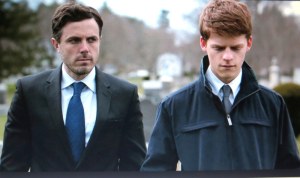
(L to R): Casey Affleck and Lucas Hedges in ‘Manchester by The Sea.’ Photo courtesy of the film.

With functionality the filmmaker also uses Lee’s reflections and memories to provide the solid plot points upon which are built the conflicts and the issues Lee must confront in the present as he is forced to deal with the horror of his past. We discover why his brother wanted him to take on the guardianship of Patrick. Underlying all of this is the linchpin issue: the conflict between Patrick and Lee which must be resolved. Will Lee force Patrick to live in Quincy where Lee’s job is, a safe haven for Lee far away from the hell of Manchester by the Sea? Or will Lee sacrifice himself for Patrick’s happiness so Patrick can be with friends, girlfriends, and activities he loves, fulfilling his life in Manchester by the Sea? One’s fulfillment is the other’s sorrow. For Lee, in Manchester floats the ashes of his former happinesses that are gone forever.

Patrick asks his uncle, why go back to a one room apartment and a job that he could do anywhere? It is an irony. And Lonergan answers Patrick’s question through an extended flashback, Lee’s memory of the horrific accident. Lonergan paints Lee’s remembrance in sharp visual images that emotionally stun, accompanied by an amazing selection of music (the music is brilliantly chosen throughout). Through this pointed flashback the mystery of Lee’s being and changed identity is brought into the unfortunate light.

The meat of the film is how Lonergan carefully patterns the relationship between Patrick and Lee starting with a joyful memory Lee has (in flashback), before tragedy strikes both brothers when Patrick was a youngster. It is a happy moment during a fishing outing and Lee kids Patrick about choosing him over his father. The irony is tremendously layered in the jump from the past to the present where it becomes twisted and sardonic; Lee must tell Patrick about his father’s death.  Of course, if he could choose, Patrick would rather his uncle have been the one to die, not his father. And Lonergan clarifies as the film progresses, Lee would gladly have chosen to be the one who would die rather than Joe. But fate twists reality into the antithesis of their desires.

Lee gradually adjusts to his nephew whom he hasn’t seen in a long while.  In Lee’s case, he appears to be emotionally non-present (we learn later it is  because his feelings are acutely raw; he must attempt to freeze them or erupt in a white heat electrical storm of rage). Patrick in youthful oblivion to his uncle’s state and even his own, blows him off temporarily for his two girlfriends, his hockey, his band, and his future prospects. But the strain and pull of youth and age, of humor, and the light and dark between them encompass the high points of the film which are immensely entertaining and an effective counterpoint to the sorrow and stirring scenes of heartbreak.

The emotional variety and seeming random reality of the actors’ performances captivate. It is impossible not to identify with the protagonist, despite how much one wants to extricate oneself from Lee’s engorgement on self-flagellation and broken heartedness. The scene between Randi and Lee toward the conclusion is Shakespearean and is incredibly human and real. Michelle Williams and Casey Affleck are not rendering performances, they are rendering a kaleidoscope of raw, emotional power. They are devastating.

Kenneth Lonergan, Manchester by The Sea, HIFF 2016, NYFF 2016

The irrepressible Kenneth Lonergan posed for me at the NYFF 2016 after a Q and A about ‘Manchester by The Sea’. Photo Carole Di Tosti

Lonergan presents the case, that some hardships might be too much for any individual to bear. Lee Chandler finds a way, even if it it brings him into a state of oblivion. Catastrophe has sifted his soul and he has found himself wanting. It and his response to the accident place him in a limbo akin to an eternal process of dying without the imagined peace of finality. Lonergan’s film is a case study in the tragedy and triumph of the human spirit, even if it is to just get to the next second in linear time while enduring a parade of painful images erupting from one’s unconscious.

Lonergan’s acutely crafted storytelling emerges from his discrete human characterizations. His dialogue throbs life like a palpitating heart. His visual craft seamlessly modulates his characters’ feelings and interplay. Like life’s dynamism, the effect is so intricate and whispering, that one can miss the broader picture of beauty in suffering and redemption in nanoseconds of humor and felt connection with others. All this is to say that the film is absolutely fantastic. It is a must see for the levity and pathos and the incredible cast Lonergan has marshaled to relay what is most tragic, humorous and uplifting in our lives.

This review first appeared on Blogcritics.


Save

New York Film Festival Review: ‘Ingrid Bergman in Her Own Words’

Ingrid Bergman, New York Film Festival, Ingrid Bergman in Her Own Words

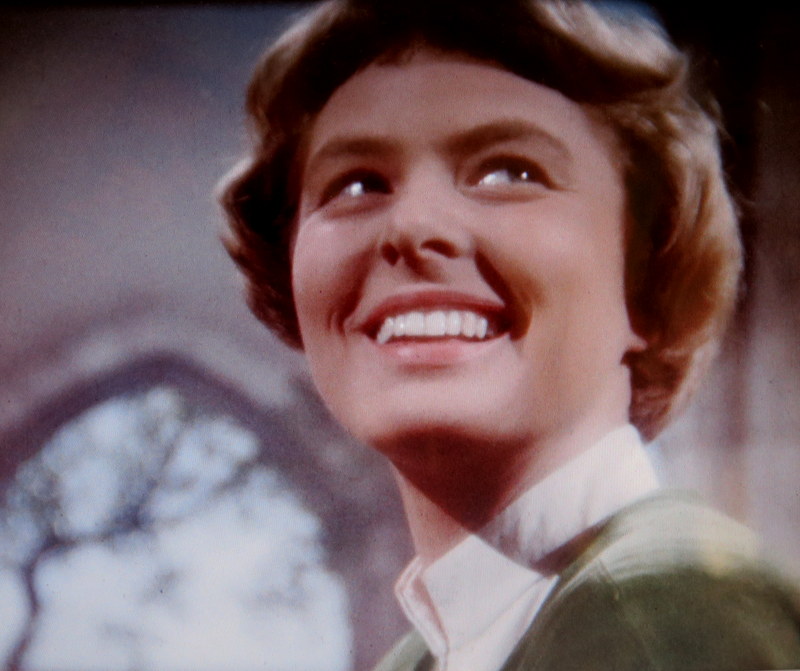
Ingrid Bergman in ‘Ingrid Bergman in Her Own Words.’ Photo courtesy of the film.

Celebrations of Ingrid Bergman’s 100th birthday (August 29, 1915) have been taking place all year, as fans and film professionals honor the iconic Swedish actress, winner of 3 Academy Awards, 4 Golden Globes, 1 Tony and 2 Emmys. But perhaps the greatest celebration of Bergman’s amazing career and life is the documentary Ingrid Bergman in Her Own Words, directed and written by Stig Björkman and Dominika Daubenbüchel. Björkman offers a fresh and intriguing perspective of Bergman: the person and the actress.

The documentary is a fascinating account of Bergman’s life, cobbled together using Bergman’s own 8 and 16 mm family film clips, Bergman interviews, pointed snippets from Bergman’s childhood diary entries, letters to best friends (the voice-over narration read by Alicia Vikander), and vibrant commentary by her four children Pia Lindstrom, Isabella, Ingrid and Roberto Rossellini. Bergman was a pack rat who saved, letters, photographs, and other personal memorabilia.

Her diary and letters are a treasure trove of her evolving thoughts, impressions and personal growth over the years. Her letters, and the interviews about her relationships with her husbands, her agent, her close friend Ruth Selznick (wife of David O. Selznick), and her own self-described identity as a bird of passage, who flew to new ground where she forged another milestone in her life marked “change” as the only permanence she would cling to.

The amazing and juicy tidbits Bergman wrote in letters and diaries, and the film clips that she, herself, took, chronicle her life and the times in which she lived. The material makes for a thrilling historical glimpses into the aura of film studios (Hollywoodland’s golden times), the hypocritical social folkways of the times (the culture’s response to her affair and marriage to director Roberto Rossellini), her film directors (Hitchcock), her travels through European cities a few years before WWII, and much more. The director includes Bergman’s pre-WWII footage of marching Nazi Youthregiments, and Storm Troopers doing maneuvers. Prewar anti-semitic slices of life in Berlin–prescient warnings–Bergman captured in footage and photograph: a glimpse of the horrors to yet to come.
Ingrid Bergman, Ingrid Bergman in Her Own Words, New York Film Festival

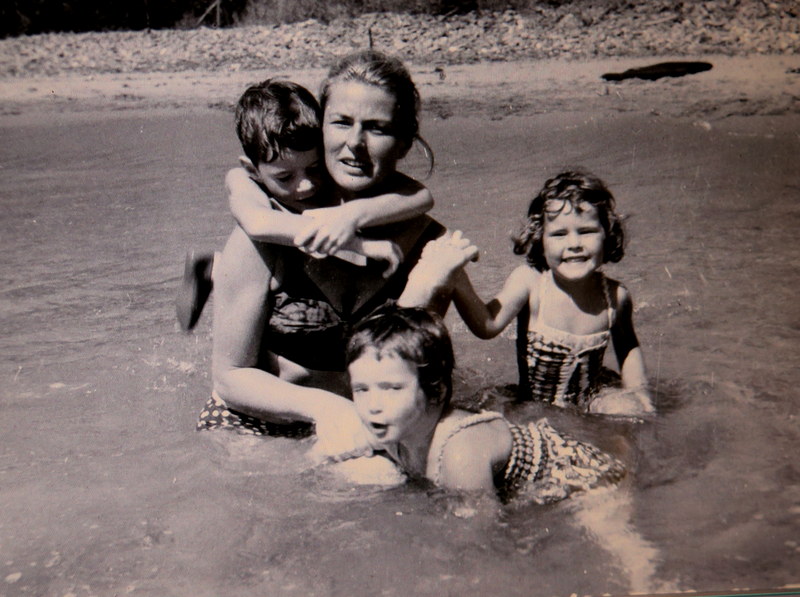
Ingrid Bergman and her children. ‘Ingrid Bergman in Her Own Words.’ Photo courtesy of the film.

In every country she lived (Sweden, the U.S., Italy, France and England),  Bergman carried her most prized possessions with her. These mementos represented her very being. To leave them behind or destroy them would have meant obliterating a part of herself and her past. Considering that she had to pack them up each time she moved on, whether to a new city or new partner, this was no small feat. It is clear that the artifacts symbolized her heart’s love and held profound meaning for her. The public is fortunate that they are archived at Weslyan University, and many are revealed in this documentary.

Putting the pieces together from these slivers of history, the director traces her life voyage as Bergman attempts to put down roots for herself and her family. Her personal films reveal the human woman and her interconnected, loving, down-to-earth persona as friend, wife, mother, and general ambassador of good will. The clips also exhibit that when the roots deepened, she changed her garden landscape and pulled them up to transplant herself. The director includes her perspective that whenever she became stifled or felt she was not progressing within, she had to release herself to the universe and embrace another adventure, another world that she would create at will.

Ingrid Bergman, Ingrid Bergman in Her Own Words, New York Film Festival, 100 Year Celebration of Ingrid Bergman's Life

Ingrid Bergman in ‘Ingrid Bergman in Her Own Words.’ Photo courtesy of the film.

Using Bergman’s own metaphor, “bird of passage,” she became inspired to move on, not wanting to remain settled or stationary. The documentary material reveals how much Bergman enjoyed her freedom. Thus, although her children often rued her departure because she was so much fun to be around, she never took them with her. She understood the instability, insecurity and upheaval caused by her need for continual movement, and likewise comprehended that her children required a solid foundation. They needed to finish their schooling and be embraced by the comfort of familiar surroundings. During her travels and transformations, the children were raised by her former husbands and their wives or family members. In leaving her families and moving on, there was sorrow, and whenever she could she would see them and bring them to visit in the next city where she remained for a time.

This candid and very open view offered by her adoring adult children, and her archived material reveal what was paramount in Bergman’s life. As a young girl, she wanted to be a great actress; she made this dream real and in the pursuit of this goal she remade herself in her personal and professional life. She was a maverick, an autonomous and independent woman ahead of her time.

Stig Björkman discloses that the colorful, charming and beautiful creative spirit was as flexible and strong as a reed in the storm. Hence, she took on the creative challenge to be brilliant at her craft: that was the force that flooded her veins and propelled her to flight and transformation. It propelled her into Swedish films and then to Hollywood. It propelled her away from her first husband into the arms of director Roberto Rossellini and into a hiatus of filmmaking, scandal and media vilification. It propelled her away from Rossellini back to a declining and morphing studio system that embraced her and forgave. It propelled her onto the stage and to TV. It propelled her into the arms of her third husband, a stage producer.

Ingrid Bergman shooting family films in 'Ingrid Bergman in Her Own Words.' Photo courtesy of Mantaray AB.

Ingrid Bergman shooting family films in ‘Ingrid Bergman in Her Own Words.’ Photo courtesy of Mantaray Film AB.

Throughout her life existed the compulsion to be a great actress. Next to Katherine Hepburn, Bergman is the most awarded actress in the film industry, and one of the most celebrated. Acting, she realized, stirred her to the finest joys in her life. In establishing her career, she lay her own self-evolved identity apart from anyone else. In the craft, there could be boundless creativity. In the process, there were no tethers to rein her in. Because of acting, Ingrid Bergman was her own woman. Because of her prodigious talents she possessed her own soul.

The director wisely reveals the maverick Bergman through her own 8 and 16 mm films, with only passing reference to her movie persona. By the end of the documentary, we understand that Bergman was an iconic woman for all time, in her ambition, her recreations of her own identity and especially for her courage in breaking through the restrictions of cultural hypocrisy and double standards.

The documentary is an homage to the film industry and the personal life of one of its enduring actresses. The editing is a bit uneven and a few sections could have been tightened, even though a fine musical selection adds to the film’s poignancy when relating her early years. Nevertheless, the director avidly selects and shapes Bergman’s mementos in a presentation that clarifies a salient theme. It is a reminder to us that, like Bergman, we must do exploits. It is a call to be one’s own person, regardless of social hypocrisy or the social pressures to conform to an image that is not our own.

If Ingrid Bergman had lived longer, surely she would have supported women’s power constructs in the entertainment and media industry. Included in one of her last TV interviews, she comments on ageism and the illogic of it. Sadly, the industry has not budged from her time to ours; roles for “older” women (in their 30s, as Maggie Gylenhall implied recently) are in short supply. Bergman spoke out and though her comments may have been only noted by a few men, she encourages that women must raise their voices continually. By using Bergman’s “own words,” the director cleverly emphasizes the power of voice. It is her power of voice and her example that challenge us from beyond the grave. In this Stig Björkman has done a masterful job.

This review first appeared on Blogcritics @ http://blogcritics.org/new-york-film-festival-review-ingrid-bergman-in-her-own-words/