


Category Archives: Film Reviews

‘Wasted! The Story of Food Waste’ Starring Anthony Bourdain, Mario Batali at Tribeca Film Festival

Anthony Bourdain, Danny Bowien, Dan Barber, Massimo Bottura, Peter Madonia

(L to R): Anthony Bourdain, Danny Bowien, Dan Barber, Massimo Bottura, Peter Madonia, Tribeca Film Festival World Premiere Q & A, ‘Wasted! The Story of Food Waste’ (Carole Di Tosti)

Anthony Bourdain (star of Parts Unknown), is his edgy, humorous self in Wasted! The Story of Food Waste. The film,  which screened in its world premiere at Tribeca Film Festival, Bourdain produced with Zero Point Zero Productions’ partners Lydia Tenaglia, Christopher Collins, Joe Caterini and co-director Nari Kye (Anna Chai also directed). However, Bourdain whose narration threads through the key issues about food waste globally and in the U.S. is more acerbic and ripping than ever I imagined he could be. But he, Dan Barber (Stone Barnes, Blue Hill), Mario Batali, Eric Ripert (Le Bernardin), Danny Bowien (Mission Chinese), Massimo Bottura (Osteria Francescana), Tristan Stewart (Toast Ale) and others who are in the forefront of trying to figure out how to rescue food and use it to create delicious meals, must tell it like it is. The situation is bleak.

Food waste is perhaps the most dire problem we face as Americans that we can do something about right now. Consider a few of these facts that directors bring out through interviews and celebrity chef comments in the initial segments of their amazing documentary.

Tribeca Film Festival Red Carpet, Wasted! The Story of Food Waste, Peter Madonia, Nari Kye, Danny Bowien, Anna Chai

TFF Red Carpet for ‘Wasted! The Story of Food Waste,’ (L to R): Peter Madonia, Nari Kye, Danny Bowien, Anna Chai (photo Carole Di Tosti)

Roughly one third of the food produced in the world for “people consumption” (approximately 1.3 billion tonnes yearly), gets lost or wasted. Food losses and waste amounts to around US$ 680 billion in industrialized countries and US$310 billion in developing countries. Ninety percent of the food produced ends up in landfills. According to Anthony Bourdain, all along the processing of food for consumption, there is waste at every junction from the farm, and the harvest, to the distribution, to the grocery story or green market, to the preparation, to the dinner table, to the leftovers.

And where does this food predominately end up? In landfills. In garbage dumps. If we could only redistribute the unused food to those who need it. Even if just one-fourth of the food currently lost or wasted globally could be rescued, there would be enough to feed 870 million hungry people in the world. But globally, people are not just hungry. It is a tragedy that globally, thousands of individuals face chronic starvation and die from disease and malnutrition. In the U.S. one in six individuals is food insecure, (in Europe it is 1 in 20). These are not just lazy, “good-for-nothings” as politocos would have us believe so we can dismiss them and de-fund programs which they label entitlements. The families are working in low paying jobs (an employment situation which has never been recovered since the second Great Depression), and many of them are white. In the film, Mario Batali looks dead into the camera (in the US we are the worst perpetrator), and he brings the problem right into our homes. He says, “This waste is criminal!”

Tribeca Film Festival Red Carpet, Wasted! The Story of Food Waste, Eric Ripert, Le Bernardin, food rescue, City Harvest

TFF Red Carpet ‘Wasted! The Story of Food Waste,’ Eric Ripert (owner of Le Bernardin) rescues food for City Harvest (Carole Di Tosti)

Anna Chai and Nari Kye’s efforts are subtly brilliant because of how they have structured their film and carried us along a journey of discovery to recognize the staggering numbers and the criminality of food waste that resonates profoundly for our own lives. First they identify the unimaginable and make it visible. They outline the causes (taking us to farms, showing the process of food distribution, etc.), then bring us to the end of the line-the food devastation in landfills.

This is where the concept of food waste goes exponentially unconscionable and Batali is not kidding when he points out the egregiousness of waste as not only “stealing” food from the hungry, but also wantonly, negligently stealing all of the resources our planet offers for us to make it to the next generation. We won’t get there if the situation continues into the next decades if we continue to be as brazenly stupid as we have been culturally.

Anthony Bourdain, Danny Bowien, Wasted! The Story of Food Waste, Tribeca Film Festival World Premiere

(L to R): Anthony Bourdain, Danny Bowien in a Q & A after the TFF World Premiere screening of ‘Wasted! The Story of Food Waste,’ (Carole Di Tosti)

Filmmakers and experts reveal how food in landfills exacerbates global warming-climate change. As the food decomposes methane gasses are released. Methane, heavier than CO2 is a worse pollutant of clean air. It erodes oxygen supplies, acidifies the oceans, chokes off marine life, harms ecosystems that sustain plants, animals and us. You didn’t note any discussion about the higher degree temperatures increasing glacial melt did you? We won’t acknowledge that is happening for fear of offending those government leaders who think global warming is a matter of belief.

You thought you had handled the problem of plastic by shopping with your cloth bags? Well, what about the food you are throwing away? Filmmakers point out that one head of lettuce in a landfill takes twenty-five years to break down. You have to throw away some lettuce because your guests won’t eat wilted leaves? Throw it in your composting bin or bring it to your green market for them to compost. If you multiply your leaves and that head of lettuce you threw in the garbage last week with thousands upon thousands of heads that got wilted and that grocery stores daily en masse throw away because housewives like their lettuce crisp and fresh-looking (even though it has no taste and the wilted leaves at the green market have much more nutrition and taste because they were picket in the morning), then you begin to see the extent of the problem of why food waste is so endemic.

Massimo Bottura, Wasted! The Story of Food Waste, Tribeca Film Festival Red Carpet, Refettorio Ambrosiano, Milan, Food for the Soul

TFF Red Carpet ‘Wasted! The Story of Food Waste,’ Massimo Bottura who created Refettorio Ambrosiano in Milan as “Food for the Soul” (photo Carole Di Tosti)


Filmmakers show that unsustainable farming practices expend and do not replenish resources (air, water, rich soil). Think of the water wasted to irrigate veggies that end up in your waste-can and end up in a landfill. The amount of money that can be saved with careful planning and husbanding water, crop yields, etc., not only can be realized by farmers and businesses and grocery stores and distribution centers, but it also filters but can also filter down to families if thoughtful planning is accomplished and if consumers don’t mind selecting some bruised fruit at a lower price (often more delicious), than the perfect apples and oranges with no taste.

Food and resource waste directly correlating to global warming and climate change, whether deaf, dumb and blind politicians acknowledge this or not, insidiously correlates to shifting population migrations as refugees challenged by drought, famine and war in a subtle and complicated connection with dwindling resources (food, clean water) seek areas to live that are not under such duress. When Bourdain implies that everything about food is tied to everything else, the message not only “hits home,” filmmakers have brought you to a place where you need to see interventions and programs and innovations that are eliminating and reducing our criminality of food waste.

Anthony Bourdain, Tribeca Film Festival World Premiere Q & A, Wasted! The Story of Food Waste

Anthony Bourdain of ‘Parts Unknown’ hosted the TFF Q & A after the screening of the film he produced with others, ‘Wasted! the Story of Food Waste’ (Carole Di Tosti)

The interviews and visits with celebrity chefs are legendary. They follow Tristam Stewart to England as he shows how he  recovers 900,000 tons of bread wasted a year by making artisinal beer). They travel to Modena, Italy and then Milan to see Massimo Battura who created Food For the Soul and the divine concept of the artistry of the Refettorios.  With beauty and elegance he has found a way to touch the hearts of the “invisible needy” that rivals dining at The Four Seasons and uplifts their souls. At the outset they visit Dan Barber who takes us through his guided veggie discoveries and tastes as he educates us to the egregiousness of food waste with produce (fruits and vegetables, roots and tubers have the highest wastage rates of any food). And they shadow Danny Bowien’s travels to Japan where chefs surprise him with delicious dishes that use unbelievable cuts from the animal that he never tried including the uterus and vows to take home to his restaurant.

These entertaining, enlightening and uplifting segments of the film, which are woven into the dialogue about food waste, dissolve the “doom and gloom” of the underlying problems by showing there is much we can do. Indeed, entrepreneurs and innovators,  spurred by funds from the Rockefeller Foundation (which is supplying grants through YieldWise) are working to ameliorate the situation and move the paradigm to Zero Food Waste in the next decades, regardless of the lack of political will that recently has been demonstrated. The uplifting examples of how other countries and individuals are curtailing food waste are inspiring. They encourage us to toward activism on a personal and local level:  at the very least composting, wiser food shopping and more.

This is a must-see film for its clarity, for its inspiration, for its no-holds-barred revelations, for its love and good will, for its energy. Its unforgettable incisiveness magnifies the importance of our individual and national global food waste imprint. Its generosity and positive outlook spur us to become leaders in our own lives and communities so that we can have a global impact. The situation is bleak, but it is not without hope. We can positively shape our future and the future of the generations that come after us. It is only a matter of starting today.

Check the website for updates.

Check this page for more information on global food waste.

‘NISE: The Heart of Madness’ directed by Roberto Berliner

Gloria Pires, NISE: The Heart of Madness, Roberto Berliner

Poster courtesy of the film, ‘NISE: The Heart of Madness’

NISE: The Heart of Madness directed by Roberto Berliner is a fascinating account of maverick, Brazilian psychiatrist Nise da Silveira (a poignant and stirring portrayal by Glória Pires) who created a ground-breaking therapy for mental patients which assisted them toward self-healing in their lives. In a number of instances her patients were able to be returned to their own communities, despite a prognosis that they were hopelessly beyond “sanity” and would live in institutions for the rest of their lives.

In this exceptional and heartfelt chronicle (screenplay by multiple writers including Berliner), the director outlines the arc and miraculous impact of Nise da Silveira’s efforts. He highlights her experiences beginning with her return to work as a psychiatrist after an eight year period. Berliner takes up the journey of how da Silveira, with patience, intuition and love encourages the transformation of her patients over time.

Berliner recreates the horrific setting of the National Psychiatric Center in Rio De Janiero that houses chronic schizophrenics who are treated as low life forms, imprisoned and are clothed in rags when we are first introduced to them. They are out of control and violent; their madness has completely overtaken any ability for them to communicate easily. We are convinced that they are hopeless and beyond the reach of the medical profession.

Nise da Silveria, 'Nise: The Heart of Madness, director Roberto Berliner

Painting by Emigdio de Barros one of Nise da Silveira’s patients.

The male, conservative doctors (the ensemble is outstanding) outnumber Nise da Silveira. They  embrace “modern” treatments (electroshock, lobotomies, insulin treatments, imprisonment,) which appall her. We understand that the doctors have a ready population of guinea pigs (these patients) upon which to experiment and exercise their preconceptions and stereotyping. The parallel of the violence which the medical profession enacts upon patients which are supposed to be served, but which are used to serve doctors is a theme which threads throughout the film.

Though we don’t realize it at first and fall into the trap of believing these brutal treatments may have efficacy, because of da Silveria’s response and courage in the face of the doctors’ oppression, we come to realize that these men have a proclivity to select the aggressive, immediate, lazy-man’s way of solving problems. As the film progresses and Berliner shows the slow, painstaking, intuitive approach of da Silveira with trial and error and observation, we realize that the mainstream doctors have selected wrong-headed treatments that are counterproductive and that yield harmful, fatal results on a population that cannot speak up for itself. The patients have no advocates and have been dumped in asylums by family members who have signed away their autonomy and free will to the state.

NISE: The Heart of Madness, Raphael Domingues, Roberto Berliner, Nise da Silveira

Painting by Raphael Domingues, one of Nise da Silveira’s patients.

Berliner creates a frightening, heartfelt and uplifting historical pastiche of how da Silveira single-handing opposes these renowned men of the psychiatric profession in Brazil and world-wide by countering their use of these barbaric medical treatments which she labels as violent. These colleagues ridicule her and punish her with a demotion by placing her in charge of Occupational Therapy for the patients. They relegate her to a section of the hospital which is a filthy, run-down garbage heap, perhaps with the intention of forcing her resignation. She has been consigned to a no prestige placement, apart from their company and away from any potential of career advancement. However, she remains curious and positive though she will be spending her days with an ill-equipped staff, a group of violent schizophrenics and a situation which seems beyond improvement. This is a David and Goliath story with a twist.

Gloria Peres, NISE: The Heart of Madness, Roberto Berliner, Dr. Carl Gustav Jung, Jungian Psychology, Brazil

Gloria Peres in ‘NISE: The Heart of Madness’ (photo courtesy of the film)

Clearly, the conservative doctors have underestimated her will, intuition, brilliance and empathy for the individuals under her care. With the assistance of the nurses and aides, she transforms the garbage dump into a clean and workable unit that her patients and staff appear to acknowledge and recognize. Through observation, love, humanity and the Golden Rule, da Silveira proves her own methods (she stumbles upon activities that elicit the individuals’ inner world through art-painting, sculpture, wood-working, etc.)  have more efficacy than those of her conservative, brutality oriented, male peers.

Nise da Silveira, Roberto Berliner, NISE: Heart of Madness, Brazil, schizophrenia, art therapy, animal therapy

Nise da Silveira. Photo courtesy of the film.

As she learns from her patients’ art which is astounding in its expressiveness of their inner world because they are allowed the freedom to be who they are in their artistic endeavors, their unconscious allows them to self-heal. Nise da Silveira encourages them to become a community with each other as they take interest in their own person-hood and thrive.  Nise da Silveira studies the symbols in their work and researches the concepts of Dr. Carl Gustav Jung and the collective unconscious. She contacts Jung and receives his affirmation and she eventually pioneers the acceptance of Jungian Psychology in Brazil. However, her colleagues do not recognize Nise da Silveira’s efforts. They threaten her job security and even have performed a violent act which sets the patients backward.

Undaunted, she holds an exhibit of the amazing art work on the hospital premises and invites the renowned Brazilian art critic Mário Pedrosa (Charles Fricks) to attend. He is thrilled to view the artistry of these “mad” individuals and recognizes they see beyond into another world of consciousness which they are able to express freely so they can bring others in touch with who they are.

Berliner shows that this is an important crossroads in da Silveira’s amazing career as a psychiatrist who continued to research, write and foster “mad” ones’ artistic achievements, as well as successfully employ the therapy of animals to encourage self-healing.

The artistic achievement by these individuals and many other “mad” ones, has been acknowledged to be some of the finest, most valuable of modern art produced in Brazil. These works have been registered (127,000 thus far) and are recognized around the world for what they represent. They are in the Images of the Unconscious Museum (da Silveira donated the works so they would be protected). There have been 150 exhibitions in Brazil and abroad.

The many themes of this film concerning the obtuseness of the medical profession to employ quick and dirty and wrong treatments and medications resonates profoundly for us today. So does the patients use as guinea pigs to serve science and not the other way around, with the exception of the Holistic approach (observation, patience, humanity) which is what da Silveira practiced. The last part of Berliner’s poignant and triumphant film is absolutely breathtaking. You will have to see this wonderful film for yourself. I will not spoil it for you.

For more information about Nise da Silveira CLICK HERE.

Photographs of the paintings taken from this site. Poster courtesy of the film.

Hamptons International Film Festival 2016 and NYFF 2016 Review: ‘Manchester by The Sea’

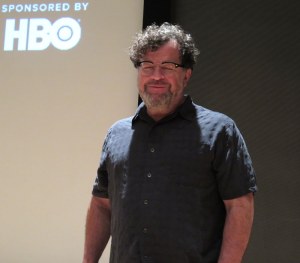
Kenneth Lonergan, Manchester by The Sea, HIFF 2016, NYFF 2016

Kenneth Lonergan at the NYFF 2016. He was unable to appear at the HIFF 2016 for Manchester by The Sea, his best film to date. Photo by Carole Di Tosti

Manchester by The Sea is a pageantry of human emotions that Kenneth Lonergan prodigiously marches with relentless precision across the screen, encapsulated by the astonishing performances of Casey Affleck, Michelle Williams, Lucas Hedges, and a superb supporting cast. The plot development is a complicated paradox which exists on two levels. One is the emotional, interior level where protagonist Lee Chandler (Casey Affleck is breathtaking and magnificently drafted as the tragic everyman), reflects about a past he wishes to escape. The other is on the level of linear time in the present where Lee confronts his brother Joe Chandler’s (Kyle Chandler) death and the multiplicity of mundane details that must be carried out. Joe’s passing forces Lee to return to Manchester by The Sea, settle his brother’s affairs, and possibly assume the guardianship of his brother’s son, Patrick.

Lee’s former hometown is a place of great beauty, but Lonergan reveals by the film’s conclusion, that Manchester by the Sea may be a scenic paradise only if one has peace and joy within. For the protagonist it is the razor’s edge slicing his already bleeding soul. Of all the locations on earth, it is the last place he would wish to be to thrive emotionally in wholeness.

Manchester by The Sea, Michelle Williams, NYFF 2016, HIFF 2016

Michelle Williams in ‘Manchester by The Sea’ at the NYFF 2016 and HIFF 2016. Photo from the film

Cinematically constructed with a canny, unaffected minimalism, Lonergan alternates between the vividness of exterior scenic beauty of the coastal New England setting, and the nullifying, hackneyed interiors of families in homes which are supposed to be comfortable, but which are less than warm or real. The film’s tones are elusive and ever changing with haunting echoes spiked with humor, levity, somberness, and poignancy. Striking glimmers of scenes flare into one’s consciousness long after one has left the theater. It would be an understatement to say that this film is remarkable. It pulses with the vibrance of what makes us cling to our lives in hope, long after we, like Lee Chandler, may have been emotionally blasted by circumstances to merely exist in a roiling inferno of quiet subterranean rage and immobilizing despair.

At the heart of this film there is mystery and lustrous revelation. Lee Chandler’s suppressed identity and what he has experienced is gradually made alive to us so that we may empathize with him and wish for his redemption and healing. Lonergan has created a powerful human drama with broad and masterful strokes of storytelling. He unspools the underlying dramatic events with flashback. The flashbacks are the raw, vibrant dynamics which are Lee’s place-induced memory reflections as he robotically goes about the task of returning to Manchester to deal with his brother’s remains, hold the funeral, settle the financial estate, and monitor his teenage nephew whose enthusiasm for activities and girlfriends is a blind for the pain of losing his father and having his life upended by his uncle’s impending guardianship.

During the activities in the present, Lonergan alludes to Lee’s past through the townspeople’s off-handed comments; his identity remains a cypher. The mystery of Chandler’s going through the motions of existing in the present while living in a hyper-drive of emotional memories from the past, we later discover, is tied up with a horrible accident. For Lee and his former wife, Randi (Michelle Williams is simply, completely stunning), it is a cataclysmic, life-altering devastation. The writer gradually uncloaks the keystone revelation in a swift cut of shockingly unexpected visual images that explode on the screen and in our minds, then reverberate like the aftereffects of an earthquake.

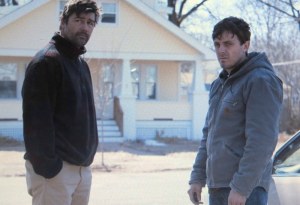
Kyle Chandler, Casey Affleck, Manchaster by The Sea, Kenneth Lonergan, NYFF 2016, HIFF 2016

(L to R): Kyle Chandler and Casey Affleck in ‘Manchester by The Sea.’ Photo from the film

It is a revelation that occurs well into the film, and it coalesces all our understanding about who Lee Chandler is and what he is going through. From then on, our empathy with his plight includes the hope that he will be able to forgive himself, end the self-flagellation and eventually reconcile his emotions to walk the road of healing. For the present it is perhaps just enough that Chandler can breathe and experience the physical manifestations of living until deliverance arrives, if it ever does, an uncertainty that concludes the film.

We know nothing of this as the movie opens. We only discern the flattened affect of Chandler’s mechanical non-existence as the superintendent of a building in Quincy, Massachusetts. It is an existence from which he is interrupted when he must return to his former hometown, a place of exterior beauty and, for Lee, emotional terror, to deal with his brother’s death. Once there he must confront family, his nephew, and former friends under the continual oppression that reminds him that Manchester by the Sea, represents a wasteland. There, he has lost everything meaningful he has ever known.

Lonergan takes us painstakingly through the details of Chandler driving to Manchester reflecting (one of a number of flashbacks), upon the day he first heard of his brother Joe’s (Kyle Chandler is memorable in the supporting role), physical diagnosis that eventually leads to his sudden demise. The flashbacks create mesmerizing storytelling; they reveal family history, Lee’s relationships with Joe and his nephew Patrick (a humorous, heartfelt performance by Lucas Hedges). They also highlight the fragmented relationship between Joe and wife Elise (Gretchen Mol). If one studies the flashbacks as Lonergan integrates them with the arc of the plot development in the present, we understand that the whole is defined by the sum of its parts. Brick by brick Lonergan constructs the foundation of Lee’s condition and life path showing they have been arranged by these telling and vital moments revealed in the memories upon which hang his emotional threnody.
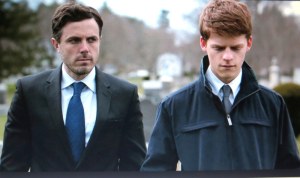
Casey Affleck, Lucas Hedges, Manchester by The Sea, Kenneth Lonergan

(L to R): Casey Affleck and Lucas Hedges in ‘Manchester by The Sea.’ Photo courtesy of the film.

With functionality the filmmaker also uses Lee’s reflections and memories to provide the solid plot points upon which are built the conflicts and the issues Lee must confront in the present as he is forced to deal with the horror of his past. We discover why his brother wanted him to take on the guardianship of Patrick. Underlying all of this is the linchpin issue: the conflict between Patrick and Lee which must be resolved. Will Lee force Patrick to live in Quincy where Lee’s job is, a safe haven for Lee far away from the hell of Manchester by the Sea? Or will Lee sacrifice himself for Patrick’s happiness so Patrick can be with friends, girlfriends, and activities he loves, fulfilling his life in Manchester by the Sea? One’s fulfillment is the other’s sorrow. For Lee, in Manchester floats the ashes of his former happinesses that are gone forever.

Patrick asks his uncle, why go back to a one room apartment and a job that he could do anywhere? It is an irony. And Lonergan answers Patrick’s question through an extended flashback, Lee’s memory of the horrific accident. Lonergan paints Lee’s remembrance in sharp visual images that emotionally stun, accompanied by an amazing selection of music (the music is brilliantly chosen throughout). Through this pointed flashback the mystery of Lee’s being and changed identity is brought into the unfortunate light.

The meat of the film is how Lonergan carefully patterns the relationship between Patrick and Lee starting with a joyful memory Lee has (in flashback), before tragedy strikes both brothers when Patrick was a youngster. It is a happy moment during a fishing outing and Lee kids Patrick about choosing him over his father. The irony is tremendously layered in the jump from the past to the present where it becomes twisted and sardonic; Lee must tell Patrick about his father’s death.  Of course, if he could choose, Patrick would rather his uncle have been the one to die, not his father. And Lonergan clarifies as the film progresses, Lee would gladly have chosen to be the one who would die rather than Joe. But fate twists reality into the antithesis of their desires.

Lee gradually adjusts to his nephew whom he hasn’t seen in a long while.  In Lee’s case, he appears to be emotionally non-present (we learn later it is  because his feelings are acutely raw; he must attempt to freeze them or erupt in a white heat electrical storm of rage). Patrick in youthful oblivion to his uncle’s state and even his own, blows him off temporarily for his two girlfriends, his hockey, his band, and his future prospects. But the strain and pull of youth and age, of humor, and the light and dark between them encompass the high points of the film which are immensely entertaining and an effective counterpoint to the sorrow and stirring scenes of heartbreak.

The emotional variety and seeming random reality of the actors’ performances captivate. It is impossible not to identify with the protagonist, despite how much one wants to extricate oneself from Lee’s engorgement on self-flagellation and broken heartedness. The scene between Randi and Lee toward the conclusion is Shakespearean and is incredibly human and real. Michelle Williams and Casey Affleck are not rendering performances, they are rendering a kaleidoscope of raw, emotional power. They are devastating.

Kenneth Lonergan, Manchester by The Sea, HIFF 2016, NYFF 2016

The irrepressible Kenneth Lonergan posed for me at the NYFF 2016 after a Q and A about ‘Manchester by The Sea’. Photo Carole Di Tosti

Lonergan presents the case, that some hardships might be too much for any individual to bear. Lee Chandler finds a way, even if it it brings him into a state of oblivion. Catastrophe has sifted his soul and he has found himself wanting. It and his response to the accident place him in a limbo akin to an eternal process of dying without the imagined peace of finality. Lonergan’s film is a case study in the tragedy and triumph of the human spirit, even if it is to just get to the next second in linear time while enduring a parade of painful images erupting from one’s unconscious.

Lonergan’s acutely crafted storytelling emerges from his discrete human characterizations. His dialogue throbs life like a palpitating heart. His visual craft seamlessly modulates his characters’ feelings and interplay. Like life’s dynamism, the effect is so intricate and whispering, that one can miss the broader picture of beauty in suffering and redemption in nanoseconds of humor and felt connection with others. All this is to say that the film is absolutely fantastic. It is a must see for the levity and pathos and the incredible cast Lonergan has marshaled to relay what is most tragic, humorous and uplifting in our lives.

This review first appeared on Blogcritics.


Save

New York Film Festival Review: ‘Ingrid Bergman in Her Own Words’

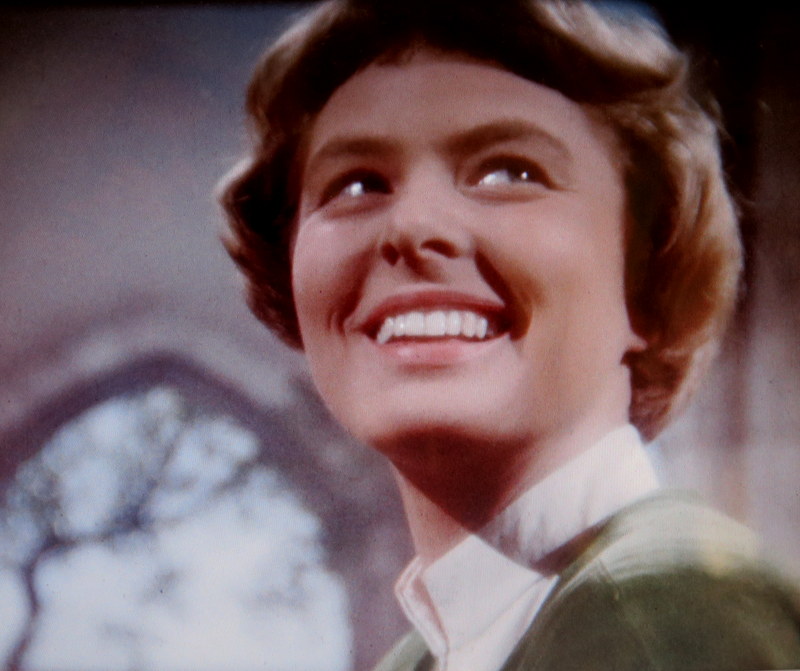
Ingrid Bergman, New York Film Festival, Ingrid Bergman in Her Own Words

Ingrid Bergman in ‘Ingrid Bergman in Her Own Words.’ Photo courtesy of the film.

Celebrations of Ingrid Bergman’s 100th birthday (August 29, 1915) have been taking place all year, as fans and film professionals honor the iconic Swedish actress, winner of 3 Academy Awards, 4 Golden Globes, 1 Tony and 2 Emmys. But perhaps the greatest celebration of Bergman’s amazing career and life is the documentary Ingrid Bergman in Her Own Words, directed and written by Stig Björkman and Dominika Daubenbüchel. Björkman offers a fresh and intriguing perspective of Bergman: the person and the actress.

The documentary is a fascinating account of Bergman’s life, cobbled together using Bergman’s own 8 and 16 mm family film clips, Bergman interviews, pointed snippets from Bergman’s childhood diary entries, letters to best friends (the voice-over narration read by Alicia Vikander), and vibrant commentary by her four children Pia Lindstrom, Isabella, Ingrid and Roberto Rossellini. Bergman was a pack rat who saved, letters, photographs, and other personal memorabilia.

Her diary and letters are a treasure trove of her evolving thoughts, impressions and personal growth over the years. Her letters, and the interviews about her relationships with her husbands, her agent, her close friend Ruth Selznick (wife of David O. Selznick), and her own self-described identity as a bird of passage, who flew to new ground where she forged another milestone in her life marked “change” as the only permanence she would cling to.

The amazing and juicy tidbits Bergman wrote in letters and diaries, and the film clips that she, herself, took, chronicle her life and the times in which she lived. The material makes for a thrilling historical glimpses into the aura of film studios (Hollywoodland’s golden times), the hypocritical social folkways of the times (the culture’s response to her affair and marriage to director Roberto Rossellini), her film directors (Hitchcock), her travels through European cities a few years before WWII, and much more. The director includes Bergman’s pre-WWII footage of marching Nazi Youthregiments, and Storm Troopers doing maneuvers. Prewar anti-semitic slices of life in Berlin–prescient warnings–Bergman captured in footage and photograph: a glimpse of the horrors to yet to come.

Ingrid Bergman, Ingrid Bergman in Her Own Words, New York Film Festival

Ingrid Bergman and her children. ‘Ingrid Bergman in Her Own Words.’ Photo courtesy of the film.

In every country she lived (Sweden, the U.S., Italy, France and England),  Bergman carried her most prized possessions with her. These mementos represented her very being. To leave them behind or destroy them would have meant obliterating a part of herself and her past. Considering that she had to pack them up each time she moved on, whether to a new city or new partner, this was no small feat. It is clear that the artifacts symbolized her heart’s love and held profound meaning for her. The public is fortunate that they are archived at Weslyan University, and many are revealed in this documentary.

Putting the pieces together from these slivers of history, the director traces her life voyage as Bergman attempts to put down roots for herself and her family. Her personal films reveal the human woman and her interconnected, loving, down-to-earth persona as friend, wife, mother, and general ambassador of good will. The clips also exhibit that when the roots deepened, she changed her garden landscape and pulled them up to transplant herself. The director includes her perspective that whenever she became stifled or felt she was not progressing within, she had to release herself to the universe and embrace another adventure, another world that she would create at will.

Ingrid Bergman, Ingrid Bergman in Her Own Words, New York Film Festival, 100 Year Celebration of Ingrid Bergman's Life

Ingrid Bergman in ‘Ingrid Bergman in Her Own Words.’ Photo courtesy of the film.

Using Bergman’s own metaphor, “bird of passage,” she became inspired to move on, not wanting to remain settled or stationary. The documentary material reveals how much Bergman enjoyed her freedom. Thus, although her children often rued her departure because she was so much fun to be around, she never took them with her. She understood the instability, insecurity and upheaval caused by her need for continual movement, and likewise comprehended that her children required a solid foundation. They needed to finish their schooling and be embraced by the comfort of familiar surroundings. During her travels and transformations, the children were raised by her former husbands and their wives or family members. In leaving her families and moving on, there was sorrow, and whenever she could she would see them and bring them to visit in the next city where she remained for a time.

This candid and very open view offered by her adoring adult children, and her archived material reveal what was paramount in Bergman’s life. As a young girl, she wanted to be a great actress; she made this dream real and in the pursuit of this goal she remade herself in her personal and professional life. She was a maverick, an autonomous and independent woman ahead of her time.

Stig Björkman discloses that the colorful, charming and beautiful creative spirit was as flexible and strong as a reed in the storm. Hence, she took on the creative challenge to be brilliant at her craft: that was the force that flooded her veins and propelled her to flight and transformation. It propelled her into Swedish films and then to Hollywood. It propelled her away from her first husband into the arms of director Roberto Rossellini and into a hiatus of filmmaking, scandal and media vilification. It propelled her away from Rossellini back to a declining and morphing studio system that embraced her and forgave. It propelled her onto the stage and to TV. It propelled her into the arms of her third husband, a stage producer.

Ingrid Bergman shooting family films in 'Ingrid Bergman in Her Own Words.' Photo courtesy of Mantaray AB.

Ingrid Bergman shooting family films in ‘Ingrid Bergman in Her Own Words.’ Photo courtesy of Mantaray Film AB.

Throughout her life existed the compulsion to be a great actress. Next to Katherine Hepburn, Bergman is the most awarded actress in the film industry, and one of the most celebrated. Acting, she realized, stirred her to the finest joys in her life. In establishing her career, she lay her own self-evolved identity apart from anyone else. In the craft, there could be boundless creativity. In the process, there were no tethers to rein her in. Because of acting, Ingrid Bergman was her own woman. Because of her prodigious talents she possessed her own soul.

The director wisely reveals the maverick Bergman through her own 8 and 16 mm films, with only passing reference to her movie persona. By the end of the documentary, we understand that Bergman was an iconic woman for all time, in her ambition, her recreations of her own identity and especially for her courage in breaking through the restrictions of cultural hypocrisy and double standards.

The documentary is an homage to the film industry and the personal life of one of its enduring actresses. The editing is a bit uneven and a few sections could have been tightened, even though a fine musical selection adds to the film’s poignancy when relating her early years. Nevertheless, the director avidly selects and shapes Bergman’s mementos in a presentation that clarifies a salient theme. It is a reminder to us that, like Bergman, we must do exploits. It is a call to be one’s own person, regardless of social hypocrisy or the social pressures to conform to an image that is not our own.

If Ingrid Bergman had lived longer, surely she would have supported women’s power constructs in the entertainment and media industry. Included in one of her last TV interviews, she comments on ageism and the illogic of it. Sadly, the industry has not budged from her time to ours; roles for “older” women (in their 30s, as Maggie Gylenhall implied recently) are in short supply. Bergman spoke out and though her comments may have been only noted by a few men, she encourages that women must raise their voices continually. By using Bergman’s “own words,” the director cleverly emphasizes the power of voice. It is her power of voice and her example that challenge us from beyond the grave. In this Stig Björkman has done a masterful job.

This review first appeared on Blogcritics @ http://blogcritics.org/new-york-film-festival-review-ingrid-bergman-in-her-own-words/

Kurt Cobain Suicide Controversy. ‘Soaked In Bleach,’ A Film by Benjamin Statler

Kurt Cobain, 'Soaked in Bleach, suicide controversy, Nirvana

Kurt Cobain, ‘Soaked in Bleach.’ Photo courtesy of the film.

 Soaked in Bleach (a lyric in “Come as You Are” from the album Nevermind), is the metaphoric, suggestive title of Benjamin Statler’s film which infers what really happened in the Kurt Cobain death investigation. The documentary begins with the acknowledgement that for Generation X, Kurt Cobain was the equivalent of what John Lennon was for the baby boomers. Both ended up dead before their time with Cobain at 27, the same age as Jim Morrison at his death. Cobain was the “go-to” Alternative-Rock icon, establishing grunge music with a permanent place in the stars and Cobain’s Nirvana the #1 spot on the Billboard 200 in 1992 with the album Nevermind. His tragic death two years later on April 8th, 1994 was pronounced a suicide by the Seattle Police Department.

The question of whether it was or wasn’t a suicide is the subject of Soaked in Bleach. The filmmakers with pinpoint logic, methodical and meticulous details and facts underscore that the gunshot wound to Cobain’s head, the position of the rifle and Courtney Love’s (his wife), insistence that Cobain was suicidal, prematurely closed down any further death investigation of the quiet, press-shy man whose music reached out to the down trodden of society and whose language spoke to the “average Joe in the streets.”

Courtney Love, 'Soaked in Bleach, Kurt Cobain, Nirvana, suicide controversy

Courtney Love, Kurt Cobain’s wife. ‘Soaked in Bleach.’ Photo from the film.

Statler uses film clips of testimony by retired law enforcement experts in forensics, investigation and homicide, who point out that a death ruled a suicide conveniently precludes the need for any further investigation of the evidence. After such a ruling, investigation becomes nearly impossible. This is doubly so for Cobain whose body has been cremated; interestingly, the building where his body was found, soon afterward was ordered torn down. The notion  of suicide was first presented by Courtney Love when she hired private investigator Tom Grant to locate Kurt Cobain. This was five days before the corpse was located. That notion of suicide was fueled by the media along with other misinformation which the filmmakers expose as lies. Indeed, the rapacious media reveled in the story of another celebrity rocker nihilist who “burned bright and burned out.” Thus, filmmakers disclose that the idea of Cobain’s death as a suicide was entrenched. It helped to obliterate the need for any credible death investigation into what really might have happened. According to experts the Seattle Police Department prompted by Love in a highly unusual and uncharacteristic move for law enforcement death investigations ruled his death a suicide in one day, the day the body was found. Then they closed the file on Cobain.

Kurt Cobain, 'Soaked in Bleach, suicide controversy

From the official file on Kurt Cobain. ‘Soaked in Bleach.’ Photo courtesy of the film.

If suicide is convenient for the police and the possible murderer or murderers, then inconvenient is the aftermath of Cobain’s suicide as it has influenced others. Fans of the rocker have celebrated him in death by more greatly embracing his music and memory in life. Then there are the others. These are the copy cat suicides.  Reports of teens have sprung up over the years. It is a global phenomenon. As parents have had to bury their children who killed themselves leaving notes that referenced Cobain’s death or Nirvana’s song lyrics, they’ve had to go through the tragedy of asking themselves how they could have prevented their deaths. To date there have been 68 related copy cat suicides, each one of them a profound, individual family tragedy. To consider that Cobain might have been the victim not of his own hands but of someone else’s would make their deaths a completely macabre and twisted irony too horrible to contemplate.

Soaked in Bleach reveals this and more as filmmakers travel the stark, mind bending road uncovering truths that conclude Cobain’s death was improperly investigated and incorrectly determined. The implications that his was a probable homicide run far and wide to decrying the investigative skills of the Seattle Police Department and implicating those in charge at the time. If the investigation of Cobain’s death is reopened as suggested by journalist Max Wallace and officials like retired Seattle Chief of Police, Norm Stamper, Vernon J. Geberth, former Homicide Commander of NYPD, the Bronx, and Dr. Cyril H. Wecht (Forensic Pathologist and Former President of the American Academy of Forensic Science), and if Cobain’s death is ruled a homicide, the problem will be locating enough evidence to identify a killer or killers. Motive will play a huge factor in that determination. Filmmakers, through the testimony of experts, suggest possibilities.

Kurt Cobain, 'Soaked in Bleach,' Nirvana, greenhouse

The greenhouse where Cobain’s body was found. It has since been destroyed. ‘Soaked in Bleach.’ Photo from the film.

This documentary first and last is tantamount to a crime thriller. Though Cobain’s suicide ruling by police was a quick and dirty convenience, Statler and co-writers Donnie Eichar and Richard Middleton make the compelling case that it wasn’t. They present this argument  throughout with clips of Cobain’s friends who give testimony about his positive mental state, tape recordings, experts’ commentary, and recreations of the players who peopled the last days of Cobain’s life before the body was discovered.

These evidentiary revelations and facts are contrasted with media misrepresentations and video clip commentary by Seattle Police investigators who journalist Max Wallace, Norm Stamper, Vernon J. Geberth and others infer made a “rush to judgment.” The lynchpin in the filmmakers’ presentation is private investigator Tom Grant whose law enforcement background and reputation are sterling. Grant, who was hired by Courtney Love to locate Kurt Cobain 5 days before his body was found, discusses his experiences dealing with Love during this time. It is his revelations that are the most startling, it is his commentary that is the most logical and convincing.

As Statler focuses on Grant, he includes audio clips of Grant’s tape recordings of conversations with Courtney Love and others during the time he worked for her. Suspicious of Courtney Love’s contradictory stories, Grant taped her and taped all of those he spoke to including her attorney and Cobain’s friends. With these tapes and Grant’s narrative, filmmakers narrow to a still point his logical conclusions and the rationale which teases out the threads of truth from media falsehoods. It is these which they sew into a manifest tapestry that Cobain’s death was anything but a suicide.

Tom Grant, Kurt Cobain, 'Soaked in Bleach.

Tom Grant’s tape recordings. ‘Soaked in Bleach.’ Photo from the film.

The documentary is beautifully organized and layered into clear, easy to understand segments. Statler’s adept direction makes excellent use of his recreations to reveal the chronology of the days Grant worked with Love. Continually interspersed throughout are clips of the experts who pull apart the Seattle Police Department’s uber brief death investigation to reveal their mismanagement of the case, their blunders as well as how and why this probably occurred. Pieces of evidence and reports are reviewed. There is one that is particularly astounding. It was identified that the amount of heroin in Cobain’s body would have put him in a coma or near coma state; he would not have been sentient enough to use a shotgun to kill himself.

Soaked in Bleach is a film to see if you enjoy investigative crime documentaries. Even if one is not a fan of Kurt Cobain and Nirvana, the film is powerful in what it suggests and well made in its presentations and argument. It is clear that the filmmakers have taken the time to carefully reconstruct the possibilities of what didn’t happen in the death of Kurt Cobain. They do this in the interest of discovering what actually did happen to a man whose life had miles to go.

This review first appeared on Blogcritics.


Michael Urie (Ugly Betty, Buyer and Cellar) in ‘WTC View,’ His Breakout Film Debut: A Review

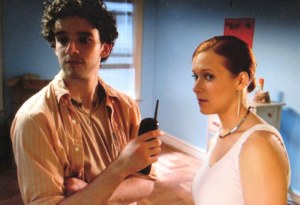
Michael and Elizabeth Kapplow in 'WTC View,' directed by Brian Sloan about the aftermath of 911 and its impact on New Yorkers. Photo from the film.

Michael and Elizabeth Kapplow in ‘WTC View,’ directed by Brian Sloan about the aftermath of 911 and its impact on New Yorkers. Photo from the film.

A long time ago in a world far away there lived a thirty-something named Eric who, on a Sunday evening, placed an online ad for a roommate to share his two-bedroom Soho apartment in Manhattan. The following day, the world shifted off its axis and Eric never would be the same again. Nor would his former roommate, nor his former lover Will, nor any New Yorker, for that matter. From September 11, 2001, onward, there would be no turning back for any of us. In the days following, though Eric received calls on his answering machine from young men who wanted to come down immediately and see his apartment, they would have to wait.

Unlike a number of films about September 11, 2001, chronicling the tragedy, sorrow and heroism of that day’s events, WTC View written, directed and produced by Brian Sloan and starring Michael Urie (Ugly Betty, Buyer and Cellar, What’s Your Emergency-director ), is about the days that follow September 11, revealing an exclusive portrait of how one individual tries to get through his personal difficulties while living in a devastated and traumatized Manhattan as the full impact of the towers’ collapse echoed and still echoes to this day. In the film’s opening, Brian Sloan cleverly slides shots with a voice over of news about the event in a crawl with the date of days passing until Eric (Michael Urie in an exceptionally acted and beautifully nuanced portrayal), is allowed back into the area; he was staying with a friend in Brooklyn.

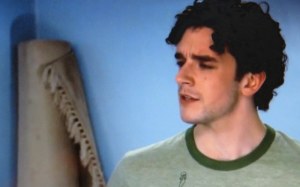
Michael Linstroth in 'WTC View' directed by Brian Sloan. A film about the aftermath of 911 in the lives of New Yorkers. Photo from the film.

Michael Linstroth in ‘WTC View’ directed by Brian Sloan. A film about the aftermath of 911 in the lives of New Yorkers. Photo from the film.

The still shots, voice over, and crawl which Sloan uses as a bridge for time passing and transition to the various segments of the film is an effective summation of what has occurred without emphasizing any horrific external images of the death planes, the conflagration and smoke, the buildings collapsing, or dramatic rescue and cleanup. Sloan is more concerned about how the emotional stress and trauma continues to play out in the minds and imaginations of those who either witnessed it live, saw the event on TV, or lost family or friends in the collapse. He represents this by predominately focusing his camera on Eric’s and the other characters’ faces and facial expressions.

In an astutely understated way, by spotlighting the reactions of individuals within the interior rooms of Eric’s apartment, symbolizing the interior emotional landscape of their being, Sloan reveals the power of such an incident on everyone. Through his camera direction we understand that we cannot help but anchor the event and aftermath as defining moments in our lives, whether we are consciously aware of it or not. It is a reckoning for us and especially for New Yorkers, but Sloan’s intention brings about a shared experience of expiation and healing. It is a one-of-a-kind film about the aftermath of September 11, 2001, on an intimate level. The result is powerful, poignant, and empathetic.

The arc of the film follows Eric from the moment that he arrives in his apartment to interview the first prospective roommate nine days later on September 20th. The film concludes on October 1, 2001, after he rents the entire apartment. He comes to this decision during the film as we watch him emotionally disintegrate as he experiences the jarring revelations of personal trauma over the stress of 9/11, exacerbated by living in the apartment and interviewing prospective roommates who invariably discuss the event. At the conclusion of Eric’s interior trials, Sloan shows him finally stepping outside the building; he is ready to face a grieving Manhattan and his own inner pain and loss. The decision to give up the apartment indicates he recognizes his emotional crisis (the stress of 9/11 is a part of it), and realizes he must begin to deal with his problems in a constructive way. Sloan has written a complex work that was initially based on his stage play of the same title. The film is an intricacy of captured moments of humor, drama, intimacy, intensity, sadness, and hope, made alive with a rendering that he beautifully instills with cinematic elements that enhance the tropes of the play.

Michael Urie as Eric in 'WTC View,' directed by Brian Sloan. This film was his breakout film debut. Photo courtesy of the film.

Michael Urie as Eric in ‘WTC View,’ directed by Brian Sloan. This film was his breakout film debut. Photo courtesy of the film.

The situation is iconic for every urban dweller; apartment hunting, roommate hunting, so we are interested and engaged in Eric’s search for the “right person” to share his “space.” Initially, we do not understand the full and symbolic import of what this means, for Sloan during the course of the film gradually reveals the mysteries of what has happened to Eric emotionally. By the end we finally understand the impact and importance of his roommate search and what “sharing the space” fully means.

Along the journey of the “search” we note that Eric and those who visit him are incredibly impacted by “the WTC view” outside his Soho apartment window. The window is in the bedroom where the roommate will be resting each night. It is the “dreams that may come” that give the various characters pause from immediately agreeing to rent, though they politely refrain from saying that it might be “the view” of the horror of the WTC site that is giving them pause. Sloan adroitly whispers this and doesn’t make a huge point of it; it is intimated by Eric who states that beforehand getting a roommate happened quickly and easily, since living space was impossible to find in Manhattan (it’s much harder and more expensive a decade later). The reality with all of its meaning is just under the surface of Eric’s consciousness. He knows that the sight outside his window is a truly gruesome and devastating view, but he is in denial. He has suppressed this reality and others which are gradually revealed to us by the conclusion of the film.

Though the characters never say they will not rent because of what they see out of window, all do discuss the events of 9/11 and their experiences; one was in the building and miraculously escaped. Each story, each character is representative of how individuals have confronted the events or avoided thinking about them. The subtlety of how the subject is avoided and then eventually brought by the potential roommates is threaded throughout the interviews and astutely written with authenticity as are Sloan’s characterizations who are quintessential, real and recognizable New Yorkers: the friend, the landlord, the bond trader, the manager, the political assistant, the student, etc. Their interactions with Eric are vibrant and engaging. Nevertheless, they invariably end up in the abyss of the burning debris and smoke of the fires which are acutely visible outside of Eric’s apartment window, but which the director brilliantly never shows. Sloan leaves this up to our imagination as we watch the reaction of the characters as they look at (what we imagine is) the smoking rubble of human dreams pluming upward. We are caught in their reactions which are ours, and somehow together there is revelation and shared understanding and empathy that uplifts.

The window overlooking a sight too horrific for all of us to see. From 'WTC View,' directed by Brian Sloan. Photo courtesy of the film.

The window overlooking a sight too horrific for all of us to see. From ‘WTC View,’ directed by Brian Sloan. Photo courtesy of the film.

The film is a much needed rendering of that day and all the days that happened after 9/11. Sloan, with the masterful Urie at the helm and the fine ensemble of actors (Elizabeth Kapplow as Josie (Eric’s friend) and Nick Potenzieri as the bond trader are excellent), has found a way to bring us together to expiate that time for all time and remind us that we must be there for each other despite the current return to “normalcy” and “apparent” New Yorker insouciance. In the film’s humanity and emotional intimacy, we can remember, connect with our own feelings and be recharged to clarity as Eric is. For those who have little knowledge of how people felt in the immediacy of the aftermath because they witnessed from afar, the film is a poignant, powerful, and sometimes humorous record of that time in the personal emotions of New Yorkers. Certainly, it is an important “view,” even if you didn’t have an apartment in Soho.

The WTC View will be available for the first time in its original HD format and is on sale on iTunes for purchase and rental. It originally premiered in NYC at the New Festival in 2005 and was broadcast after screening on the festival circuit. The national broadcast premiere was on MTV’s Logo Channel and aired on the 5th anniversary of 9/11 in 2006. It was also released on DVD by TLA Video.

The 10th Anniversary Edition of WTC View in its first-time HD Format is available on iTunes.

Click here for the HD version of WTC View on iTunes.

This review first appeared on Blogcritics.

‘Still Alice,’ Starring Golden Globe Winner Julianne Moore, US Premiere 22nd HIFF

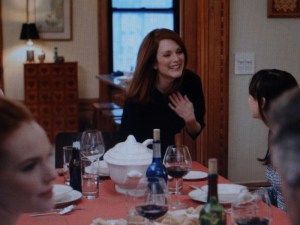
Kristen Stewart and Julianne Moore in 'Still Alice.' Photo courtesy of the film.

Kristen Stewart and Julianne Moore in ‘Still Alice.’ Photo courtesy of the film.

Still Alice received its U.S. Premiere as the “Closing Night Film” at the 22nd Hamptons International Film Festival on October 13, 2014. Since then the film, starring Julianne Moore in an incredible performance and directed by Wash Westmoreland and Richard Glatzer, has gone on to win 16 awards, for Moore’s complex, challenging and heartfelt work. In the film’s first award for the New Year Moore won the Golden Globe 2015 for Best Performance of an Actress, Drama this past Sunday. The indie film will receive a wider release on January 16.

January is a noted award month and Moore after winning the Golden Globe will most likely during the January and February ceremonies take home a few more awards for which she has been nominated. The more prestigious nominations include the BAFTA 2015 Best Actress award, the SAG award for Outstanding Performance by a Female Actor in a Leading Role, the Independent Spirit Award for Best Female Lead, the London Critics Circle Film Awards 2015 for Actress of the Year, and the Broadcast Film Critics Association Award for Best Actress. There are other nominations with ceremonies in the subsequent months, including the Oscars, but the Academy Award nominations have not been announced yet. The Las Vegas odds are listed and the likelihood of Moore being nominated for an Oscar is high.

Alec Baldwin and Julianne Moore in 'Still Alice.' Photo courtesy of the film.

Alec Baldwin and Julianne Moore in ‘Still Alice.’ Photo courtesy of the film.

The accolades are well deserved because Julianne Moore is the centerpiece of Still Alice. Her performance is perfection as Alice Howland, a beautiful, accomplished and happily married linguistics professor who apparently “has it all,” until she notices that during speeches and at conferences, words seem to slip by her and remain just out of reach, hanging in the air somewhere. For a linguistics professor this is a chilling irony and when Alice notices that more of her ability to stringing words and phrases together fades to oblivion the alarms sound.

One turning point occurs on a typical workout. At the beginning of her run she is complacent and thoughtful and energetic, but in a split second, the familiar place and knowledge of what she is doing there vanishes. She stops, panicked; the setting is unfamiliar though she has been jogging on this path weekly for years. She recognizes nothing.

It is at this point that the reality of what is happening to Alice lands with full force in her soul. Moore registers this still point and our hearts break for her. How this superb actress conveys the terror and sense of being lost in a once known place and time is completely truthful and in the moment. We are with her, gripped by fright as we see Alice’s  realization that this “vanishing” of one moment of known reality into the unfamiliar and unknown is a momentous symbol of what is happening to her. It is as if a dark cloak is being drawn over her once brilliant mind to extinguish all of its pulsating light.

(L to R) Julianne Moore and Kate Bosworth in 'Still Alice.' Photo courtesy of the film.

(L to R) Julianne Moore and Kate Bosworth in ‘Still Alice.’ Photo courtesy of the film.


When Alice tells her husband Dr. John Howland (a believable and loving Alec Baldwin) that she has Alzheimer’s, we are as incredulous as he is, because she is in the prime of her life and has “miles to go before she sleeps.” Except she doesn’t. She is one of a growing number of Americans swept up in Early Onset Alzheimer’s, a disease entity which steals one’s memory and identity. It happens in a relatively short period of time, there is no known cure and it happens cruelly, forcefully and without mercy. How the family responds to the situation, the film reveals, can make all the difference in the world.

Basing their film on the novel of the same title by Lisa Genova, writers/directors Westmoreland and Glatzer made the decision to sharpen the focus on Alice so as to peel back how she confronts her condition head on with the help and support of her family. Westmoreland’s and Glatzer’s amazing viewpoint is uplifting, real and human. They have managed to keep this serious, depressing situation eminently watchable because Alice’s interactions with her family are loving and caring. Alice’s intelligence and honesty in accepting the situation even as she struggles against it with every ounce of her being is revelatory because she has not “gone away,” as the assumption often is about Alzheimer’s patients. Though Alice loses her formal speech patterns, she relates on other levels and is constantly reaching out to family to remain with them in the existential present. Yes, the past is increasingly blurred and the future cannot be conceived, but the present is the vitality that is still Alice.

Julianne Moore in 'Still Alice.' Photo courtesy of the film.

Julianne Moore in ‘Still Alice.’ Photo courtesy of the film.

The fine ensemble cast playing immediate family including husband (Alec Baldwin) and daughters Anna (Kate Bosworth), Lydia (Kristen Stewart), and son Tom (Hunter Parrish) provide a look into the responses family members take as Alice’s decline gradually increases and then appears to speed up. We understand that family’s reactions are choices they make. They could have responded differently, but it is how they deal with the situation that makes Alice’s condition all the more poignant. As a primary theme, Westmoreland and Glatzer have emphasized that the interlocking support of family helping each other is vital to sustain the relationship with a loved one with Alzheimer’s for as long as possible. Together Moore and the directors teach us that the individual with Alzheimer’s is always who they are, despite their experiencing a daily creeping mortality; their personhood and life force courageously attempts to assert itself despite all odds.

This film is an incredible accomplishment by Moore, the directors and the cast. Considering the growing awareness of this noxious disease (Seth Rogen recently appeared before Congress discussing his wife’s mother who has Alzheimer’s) and the increasing numbers of individuals forecast to come down with Alzheimer’s in the decades ahead, the film reveals a blueprint of expectation. It is a reminder to all of us that who we are and how we live out our lives or help family who may contract Alzheimer’s doesn’t have to be tragic. It can be hopeful and uplifting.

This post first appeared on Blogcritics.

‘Goodbye to All That,’ Starring Award Winning Paul Schneider (Tribeca Film Festival)

Award winning (Tribeca Film Festival, Best actor in a narrative feature), has the lead ball drop on him in this scene with

Paul Schneider as Otto won an award at Tribeca Film Festival for Best actor in a narrative feature. In this scene Otto has the lead ball dropped on him by his wife and her psychologist. (Malanie Lynskey and Ceila Weston)

Playwright and screenwriter of Junebug, the award winning Angus MacLachlan, has done it again! He has penned a funny, poignant, commonsensical and incredibly human film which will resonate with a wide swath of individuals if it is discoverable to them. And Goodbye to All That, also directed by MacLachlan should be imminently discoverable. After all, the age group that this clever, saavy movie should appeal to ranges from thirty-somethings to sixty-somethings, and includes men and women. If you enjoy Indie films that cut through the hype, shmoozy glitter, and intentional, self-conscious realism, Goodbye to All That is for you, especially if you like to laugh.

Though the film has a regional feel, its subject touches upon issues that city-folks can relate to, namely separation, divorce and reentering the hot dating scene using Social Media after years of a settled, somnambulant marriage. MacLachlan is a canny director. He knows how best to achieve humor with his comedic timing and knowledge of how to vary silence, a look and a glance, with pacing and rhythm. The result has brought about an award winning performance by the likeable, human and very funny Paul Schneider who plays the everyman protagonist, Otto Wall. Paul Schneider who won a Best Actor in a Narrative Feature award at Tribeca Film Festival is incomparably Otto.

Paul Schneider in 'Goodbye to All That,' directed by Angus MacLachlan. Photo from the film.

Paul Schneider in ‘Goodbye to All That,’ directed by Angus MacLachlan. Photo from the film.

With clear precision, from the outset, MacLachlan intimates that Otto’s and Annie’s (a fine performance by Melanie Lynskey), relationship is terminally ill. The humor is that Otto is the only one who is back at the alter thinking everything is going really well. The arc of the film is Otto’s dawning realization that he has to grow up and confront who he is and what he wants in a relationship with a woman and especially in his relationship with his daughter after he separates from his wife. As he juggles his priorities, he begins to understand where he has come from. But will he be able to resume an existence without the woman who was so comfortable in his life’s landscape that he forgot she was there?

This is a tall order for Otto, as it might be for many men who have grown into a dullard’s reality of walking through time with someone they don’t know, understand or are interested in, even if it is their wife. However, Otto is fortunate to receive help. It comes in the form of a number of beautiful, autonomous, independent-minded and intelligent women. It’s an interesting arrangement; he is interested in them sexually and they are interested in him sexually. This is the age of Social Media and women are approachable at the click of a button on Facebook and the same applies for men as both genders surf online dating sites and profiles to see if there might be compatibility.

Paul Schneider and Ashley Hewitt in 'Goodbye to All That.' Photo from the film.

Paul Schneider and Audrey P. Scott in ‘Goodbye to All That.’ Photo from the film.

For Otto this is a kind of mecca. What was once a deadening existence just moving through the ethers now becomes a life that is thrilling and alive. After the first “date” he is invigorated and “rarein to go.” The painful jolt of being dumped (no spoiler alert…I will not ruin it for you as to the specifics),  has revived him from near brain death. And that electric current is spurring him on to recognize that culturally “things have changed” after being out of the social loop for 15 married years. And it’s a change for the better.

Otto works through gauging his priorities and begins to develop into a responsible, caring male. Some of this evolves because of the unique responses and reciprocation of feelings from the women he engages with- Mildred (Ashley Hinshaw), Stephanie (Heather Graham), and Debbie Spangler (Anna Camp). Their meet-ups and dates are hilarious, surprising and real. Otto also is guided by his daughter (11-year-old Edie), whom he attempts to please and who is not afraid to “get real” and censure him when/if he goes too far with his women friends. Massaged by all of this female wisdom and the added preciousness of reestablishing a connection with an old girlfriend (Heather Lawless), he knew and cared for in high school (the classmates find each other via Facebook and hold a reunion), Otto finally gets to make a conscious decision about what he wants and who he is. He has landed on solid ground. He recognizes that he enjoys his life for he is no longer sailing away on the wings of oblivion in an existence that will be over before it really begins.

Goodbye to All That, an apt title, is meaningful without appearing to be “profound.” Yet it is real, touching, powerful and extremely funny. How MacLachlan achieves all this in a concentrated work whose scenes are precisely edited so they are just enough, and the dialogue sufficient without any extraneous bits to reveal the characters’ wants and needs is an extraordinary achievement for a first time director. It would be a shame if the film didn’t get the recognition it deserves for the writing and directing and the women’s acting ensemble in support of Schneider’s performance. All sync seamlessly.

This review first appeared on Blogcritics.


The Homesman’ Starring Hillary Swank in a Dynamic Performance

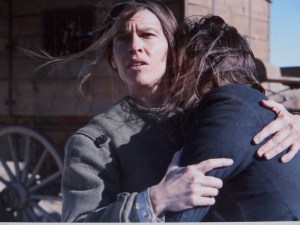
Tommy Lee Jones and Hillary Swank in 'The Homesman.' Photo taken from the film website.

Tommy Lee Jones and Hillary Swank in ‘The Homesman.’ Photo taken from the film website.

The film adaptation of the award winning novel The Homesman by Glendon Swarthout, directed by Tommy Lee Jones presents a a bleak, ironic and desolate view of the Nebraska Territory in the 1830s in an atypical Western that strikes against genre in a refreshing way. In his fourth foray into directing, Jones has created a surprising, unusual and always fascinating film narrative about the nature of survival and the inner fortitude it takes to hold on to one’s center amidst trying circumstances and inner conflicts. The Homesman made its East Coast premiere at the 22nd Hamptons International Film Festival and was the festival’s Sunday centerpiece film.

At the fulcrum of this quirky, complex film is Jones’ stark portrait of a pious, single, 31-year-old, Mary Bee Cuddy (in a role thoughtfully and exceptionally acted by Hillary Swank). Cuddy is the forerunner of the “modern woman,” and the amazing characterization touches upon the stresses women confront when they dare to transcend the typical feminine projection of the simpering, helpless, dependent little girl in their interactions with men. Thanks to Swank’s portrayal and Jones’ direction and adaption, Mary Bee Cuddy’s depiction is a thrilling one to watch as this singular women develops along an arc throughout the film even to the conclusion. Though Cuddy is not present at the end, the audience is forced to consider her impact, her strength and what she stands for in the nature of who she is and why she makes the choices she does.

Hillary Swank in 'The Homesman.' Photo taken from the film website.

Hillary Swank in ‘The Homesman.’ Photo taken from the film website.

We are introduced to Mary Bee as a homesteader in the Nebraska Territory replete with all of the hazards of the times before the Civil War with slavery and the Indian troubles active; the land is undeveloped, harsh and unyielding.  Jones’ cinematic choices are spot on in revealing the stark beauty and cold harshness of the landscape, a coldness inherent and  malevolent, one which the characters must confront and overcome as much as they must till the soil and tease out a productive harvest to sustain themselves. As Jones emphasizes, such terrain and hard scrabble life punishes everyone; some are able to survive better than others if they have resilience, inner strength and dogged determination. For women it is especially a brutal and unforgiving existence which chews them up and spits them out into a wilderness beyond the worth of living. Without love, compassion and tenderness such an existence in such a territory can alienate, drive one mad or murderous.

Mary Bee works diligently and steadfastly to farm her land which she and her community (headed up by her pastor played by John Lithgow), have obtained sacrificing the pleasures of living in the developed East to possibly increase their prosperity. Mary Bee keeps some livestock and is sustained emotionally by the religious community to which she belongs.  She is an archetypal woman of clever resourcefulness and power, but in developing these qualities to mastery because she had to, she has sacrificed abilities in the softer graces, having thrown off womanly deceitfulness to “get a man.” We understand this early on in the film when Mary Bee invites a potential suitor (though he is beneath her in his talents, unattractiveness and loutish manner), for a delicious dinner. She proposes they marry as a viable economic arrangement toward continual prosperity. It is a sound and well thought out proposition, though an unromantic one as there is no talk of love. It should be alluring to any man considering that he would have access to all of her resources, including her excellent homemaking skills. As direct as she is with him, the “intended” is direct with her, but to the point of insult.  The audience sees he is holding out for romance, illusion and sex; he will never marry her because he says, “she’s as plain as a pail and she’s bossy.”

Hillary Swank as Mary Bee Cuddy in 'The Homesman.' Photo taken from the film trailer.

Hillary Swank as Mary Bee Cuddy in ‘The Homesman.’ Photo taken from the film trailer.

The humor of his response is priceless. Swank is hardly plain, so we realize her “plainness” is not the problem, her independence, dominance and resourcefulness is. So is her inability to strike up an illusion of femininity that could seduce him. She is his obvious superior and without guile. In marriage her intelligence would dominate his dullness and there would be no “apparent” softness, flattery or deceit to mitigate it. Rather than be “oppressed” by her brilliance, something his ego could not tolerate, he is going to remain “happily” in his present state until a “real woman” comes along who fits the type. Mary Bee takes it all in, but we understand as the film progresses that rather than accept the wisdom of being alone and prospering on her own without having to shore up the excess baggage of a lout who would be a tremendous liability, the rejection gnaws at her. Most probably his offensive insult to her feminity contributes to spurring her to take on an unsound project whose odds of success are haphazard.

When her pastor discusses with his congregation that three wives have gone insane from horrific traumas during their time in the territory, he asks for volunteers to bring the women back East where they will be taken care of by others. No man will step up for the trip; the husbands won’t help their wives taking them out of the bleak environment and the hardness of their lives which has driven them into the abyss. It is as if the husbands could care less about restoring them to sanity and a happier condition; they just want them removed, for they have become more trouble than the chattel they are worth. In flashback scenes we are led to understand what drove each of the women to derangement. Mary Bee is in direct contrast to these three who were looking for a better life with a man, but whose disappointment and horror of their circumstances (in some instances exacerbated by the men), destroyed their minds.

Whether it is a matter that Mary Bee is destined to involve herself in because of her inner coldness and loneliness in this harsh land, the rejection by her marriage candidate, or whether she is the only one capable of doing such an act of charity, bravery and mental strength, Mary agrees to take on the project alone. Even though many feel she is “as good as a man” in her skills and talents, Jones has set up an interesting parallel between the men and women of that time, threading themes that are very present for us today. The overriding questions about her actions foment interest and create suspense keeping us alert to the next bend in the river of action.

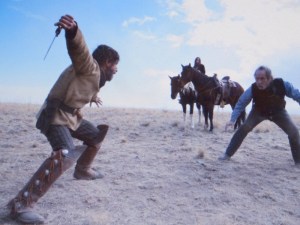
'The Homesman,' starring Hillary Swank and directed by Tommy Lee Jones. Photo taken from the film trailer.

‘The Homesman,’ starring Hillary Swank and directed by Tommy Lee Jones. Photo taken from the film trailer.

Mary Bee begins her journey with the women (Grace Gummer, Mirando Otto, Sonja Richter), who are “apparently” so demented they must be locked in the covered wagon, one tied up because she is violent. Now we understand that this five week journey in the wilderness against potential attacks by Indians, the winter, male marauders and violating trouble makers is an undertaking that is life threatening for all of them. In a bit of a contrived plot device, Mary Bee runs into George Biggs (Jones is a natural for this part and slides into its nuances and modulations with his easy acting craft and intelligence), who is at the point of death, sitting on his skittish horse under a tree, hands tied behind his back with a noose around his neck ready to hang if the horse coughs. Wisely, Mary Bee realizes this man is a rapscallion thief or near-do-well, and she bargains with him;  in exchange for his life, he must accompany her to Iowa; she neglects telling him the particulars. Desperate, he agrees, but later, when Biggs finds out about the insane women and tries to back out, Mary Bee sweetens the pot with a promise of money once they’ve delivered their charges.

These two are polar opposites, and it is only because of the money that the “street smart,” conniving and blunt Biggs stays with this domineering but logically clever and admirable Mary Bee who gets under his skin. For her part Mary Bee is not thrilled with Biggs, but like much of her life, she tolerates him, makes do and with her intelligence gets around his personality to the point where they are able to successfully progress along the journey with the demented, who at times attempt to kill each other, at times attempt to escape. There are obstacles along the route and Mary Bee appears to be holding her own; Biggs, encouraged by the nature of this do-gooding act and Cuddy’s acceptance appears to be getting kinder.

Hillary Swank and Tommy Lee Jones in 'The Homesman,' directed by Tommy Lee Jones. Photo taken from the film trailer.

Hillary Swank and Tommy Lee Jones in ‘The Homesman,’ directed by Tommy Lee Jones. Photo taken from the film trailer.

At length, the two form a weird relationship and the audience prepares itself for the possibility that perhaps Mary Bee has found a gent she can encourage who might fill her lonely nights, even though he is rough around the edges, though not without humor. It is around this time that Jones throws several boulders into what we anticipated was a fairly still pond; the biggest boulder flips around Mary Bee’s well being and fortitude and sends her plunging into a downward spiral from which she must save herself. She manages to recoup, but the ordeal has rattled her and we understand that the spirit of derangement on the women has perhaps engulfed her as well. It is at this point that Mary Bee proposes to Biggs in the same way that she proposed to the other cowboy at the film’s beginning. This scene comes out of nowhere; on the other hand, there is enough depth in both characterizations for us to understand the how and why of the events that follow.

This is no spoiler alert. You will have to see the film to discover his response and afterwards, hers. The result is poignant, alarming and unforgettable. The women eventually do end up in Iowa, however, there has been tribulation, sacrifice, callous inhospitality by an outrageous, wealthy developer (James Spader is particularly loathsome), rage, violence and a completely unpredictable conclusion that is unexpected like much of the twists and shocks of the film.

Jones has collided the past with our present in The Homesman which appears to be a Western because of all the accountrements, the plot, the sets, the costumes, but whose characterizations, themes and concepts are very modern. Jones reveals that what it takes to survive and thrive are completely different. The survivors make it through by any means possible but there is an inner loss that remains elusive as each successive battle to keep death at bay weathers and hardens the soul. For those who appear to thrive and prosper because of their particular gifts and talents, one never knows their inner weather, storms or conflicts and where these will drive them. Certainly, The Homesman will leave you haunted in its pathos and the irony that come what may, life does go on with or without our approval.

This review first appeared on Blogcritics.


23rd New York Jewish Film Festival, ‘The Jewish Cardinal.’ NY Premiere

Laurent Lucas as Aaron Jean-Marie Lustiger in The Jewish Cardinal, directed by Ilan Duran Cohen at the 23rd New York Jewish Film Festival

Laurent Lucas as Aaron Jean-Marie Lustiger in The Jewish Cardinal, directed by Ilan Duran Cohen at the 23rd New York Jewish Film Festival

The New York Premiere of The Jewish Cardinal (Le Metis de Dieu) screened three times at the 23rd New York Jewish Film Festival. As word of mouth spread, the second and third screenings were sold out and the wait list line on the last screening day was very long. Praise for the film and the director’s live Q & A sessions escalated the audience turn out. At the third screening, the film received hearty applause which demonstrated that it was one of the festival’s fan favorites.

Directed by Ilan Duran Cohen, who also co-wrote the screenplay with Chantal Derudder, the film is a fascinating account of Archbishop of Paris, Jean-Marie Lustiger (1981-2005). Lustiger was born Aaron Lustiger to Ashkenazi Jewish parents living in France. Lustiger at 13 converted to Catholicism over his father’s protests and attempts to rescind his baptism. He rose in the hierarchy of the Catholic Church to become one of its most outspoken and prominent Cardinals, helping Pope John Paul II tackle vital issues of the day politically and globally. The film focuses on the period from Lustiger’s appointment as the Bishop of Orleans until he receives his appointment as Cardinal, The Archbishop of Paris, a position he held until he retired in 2005.

The filmmaker is careful with the memory of Jean-Marie Lustiger, attempting to round what is know of him, a man whose fascinating and surprising journey in life can only benefit our cultural understanding. A testament of Cohen’s brilliant care is evidenced by the enthusiasm with which the film was received at this festival, a combined effort by the Jewish Museum and The Film Society of Lincoln Center. The hope is that Cohen’s message, which is the same as Lustiger’s, will be shouted far and wide.

The Jewish Cardinal, directed by Ilan Duran Cohen.

The Jewish Cardinal, directed by Ilan Duran Cohen.

In his introduction to the screening, Cohen simply stated that the film is “about reconciliation.” Indeed, in Lustiger (wonderfully rendered by Laurent Lucas), there is the reconciliation of the two faiths, Judaism and Christianity, and there is revealed the hoped for reconciliation between himself and his father, who were in conflict. Charles Lustiger was devastated by Lustiger’s choice to convert. Nevertheless, Charles was very proud of his son’s independence, his integrity and his perseverance in attempting to show love and forgiveness without compromising his birthright as a Jew. Lustiger makes it clear to everyone that he has converted to Catholicism, but he will never renounce his Judaism. He is a Jew and he is a Catholic. It is his choice and the film intimates why it makes sense for him. During the film we learn that Lustiger is practicing and strengthening his Hebrew and attempting to understand Christianity’s growth and development out of Judaism with Christ as the lynchpin joining both faiths. The film is brilliant in revealing Lustiger’s struggle for reconciliation despite opposition and denunciations from Jews and Catholics. Cohen shows us Lustiger’s humanity and reveals the instances when either his temper or his cowardice overcame him and he nearly faltered in his drive toward uplifting Judaism and Christianity with love, understanding and integrity.

Larent Lucas as Jean-Marie Lustiger in The Jewish Cardinal

Laurent Lucas as Jean-Marie Lustiger in The Jewish Cardinal

Rather than reveal Lustiger’s life chronology, Cohen elects to begin when he was vicar of Sainte-Jeanne-de-Chantal (1969-1979) in the wealthy 16th arrondissement of Paris with his parochial vicar Andre Vingt-Rois who later succeeded him as Archbishop of Paris when Lustiger retired. He is beloved of his parishioners who affectionately refer to him as “the bulldozer” because of his temper and at times his determined views. We learn later that these are a few of the reasons Pope John Paul II entrusted him with the position of Bishop Orleans. In addition his views are similar to the Pope’s and run counter to some of the French clergy with whom Cardinal Paolo Bertoli (he recommended Lustiger to the Pope) is on bad terms.

After 15 months and much consideration Jean-Paul II notifies Lustiger he will be the Bishop of Orleans. It is a magnificent gesture because Orleans is where Aaron Jean-Marie was baptized into the Christian faith. This act appears to be ordained by God, however, there is an overriding problem and the filmmaker reveals it immediately. Will Charles Lustiger (Henri Guybet) be present at his son’s appointment as Bishop of Orleans? The conflict is clearly revealed when Lustiger visits his father. There are old wounds between the two and there is a bitterness that the father holds for his son. There are emotional hurts Lustiger feels in his father’s non acceptance; he also feels the guilt of letting his father down. However, Cohen makes clear the obvious great love between them and the sacrifice that each is making to attempt to get along when estrangement would have been much easier for both, though it would have left father and son with regrets and sorrow. Lustiger’s female cousin Fanny (Audrey Dana) is a mitigating force and at times acts as the go-between behind the scenes to soften both men to be more supportive and understanding of each other.

Laurant Lucas as Jean-Marie Lustiger in The Jewish Cardinal

Laurent Lucas as Jean-Marie Lustiger in The Jewish Cardinal

Screenwriters have made excellent choices in keeping Jean-Marie’s past, his decision to convert, his mother’s move back to Paris during WWII to keep the business running, and his time in unoccupied France until 1945 in the shadows.

There are only a few flashbacks which coincide with emotional hurt or an eruption of feelings not yet dealt with in the present or a clarification of the time period. Instead, the dialogue between the father and son elucidates more of what happened in the past: Giselle Lustiger being deported to Auschwitz where she was killed; the father staying in safety with the children in unoccupied France. These moments are used sparely to reveal Jean-Marie’s relationship with his father. And gaps are left about Jean-Marie’s conversion; a spiritual experience is alluded to which is thought provoking. More important is Jean-Marie’s attempt to reconcile himself with his father before he dies and Jean-Marie’s developing relationship with the Pope which is fascinating.

L to R: Aurole Rondieg and Laurant Lucas in The Jewish Cardinal

L to R: Aurélien Recoing and Laurent Lucas in The Jewish Cardinal

Naturally, during his initial conversation with the Pope (a dynamic and believable Aurélien Recoing) he asks whether he was appointed because he was Jewish; he repeats he has made it known that he will not renounce his Judaism though he has chosen to convert to Catholicism. That Jean-Marie is a strong man of courage is made clear and Cohen’s and Derudder’s characterizations of Lustiger and the Pope set up the problems that are to come later in the film. Both must work together to solve the conflicts or there will be disastrous results between global Catholicism and Judaism. However, during this initial visit, we come to understand the brilliant Pope’s vision for France. With Lustiger who eventually will be moved up to the position of Archbishop of Paris, the Pope hopes to restore Catholic France and bring unity amongst believers. It is an uncanny appointment which has later repercussions and which eventually is crucial to facilitating the eventual fall of communism. The fall of communism is the most vital of goals in the Pope’s intentions for Poland and for religious believers globally.

Without Jean-Marie Lustiger’s presence as a reconciler upholding Judaism and Catholicism in the position of Archbishop of Paris, other events may have occurred which would have exacerbated animosity between Jews and Polish Catholics delaying the fall of communism and creating a cultural/religious backlash when cooperation was most needed. How Cohen reveals this is nothing short of revelatory. For those who follow Judaism or Christianity or both, they will most likely agree with Jean-Marie Lustiger that it was God’s will that he was appointed Bishop of Orleans and then Archbishop of Paris. Cohen’s true-to-life storytelling is uplifting. He reminds us of the possibilities for goodness if there is respect, love and forgiveness between and among cultures and those of faith.

This review first appeared on Blogcritics.