Category Archives: New York Botanical Garden
NYBG ‘Orchid Show, Mr. Flower Fantastic’s Concrete Jungle’ Part One
Mr. Flower Fantastic’s Concrete Jungle
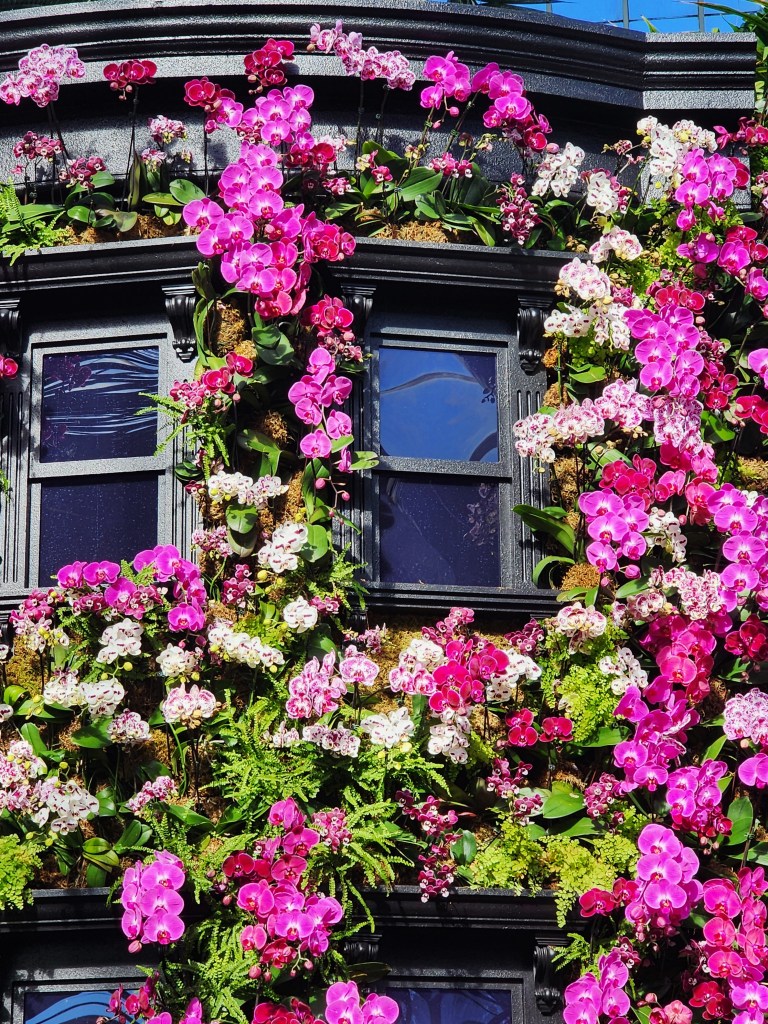
A Love Letter to New York in Stunning Orchids until April 26, 2026
The metaphor for New York City as a “concrete jungle” has been used in the past, sometimes with negative connotations that implied ugly buildings, few green spaces, tall skyscrapers stealing light and air, and danger lurking around every corner.
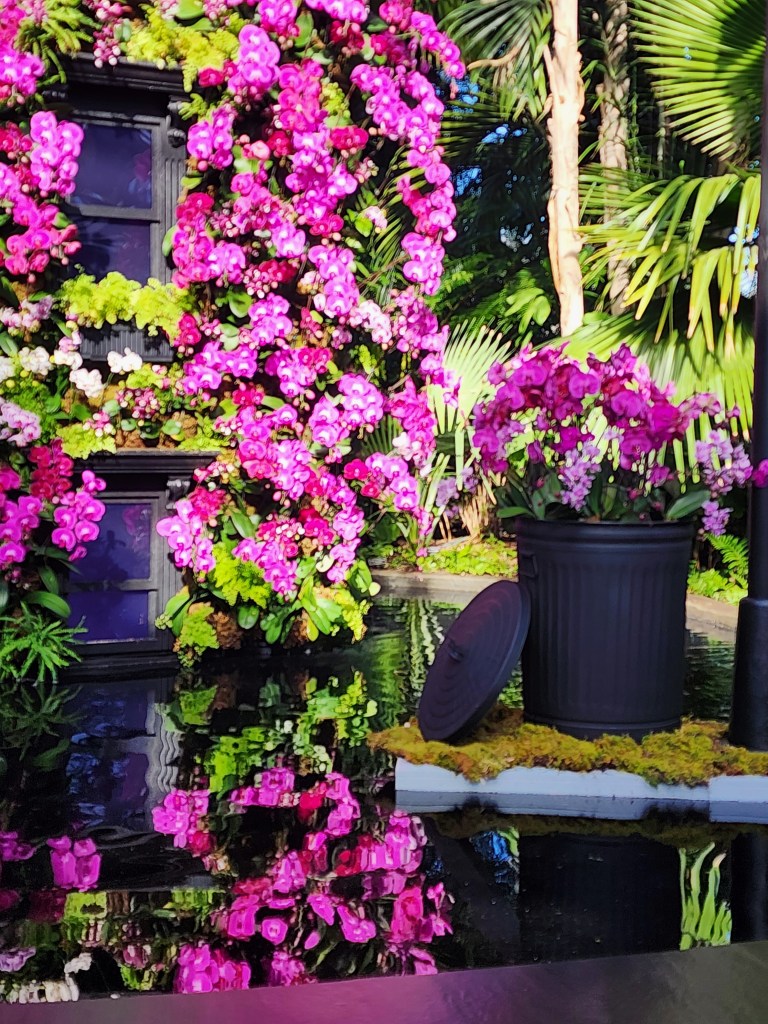
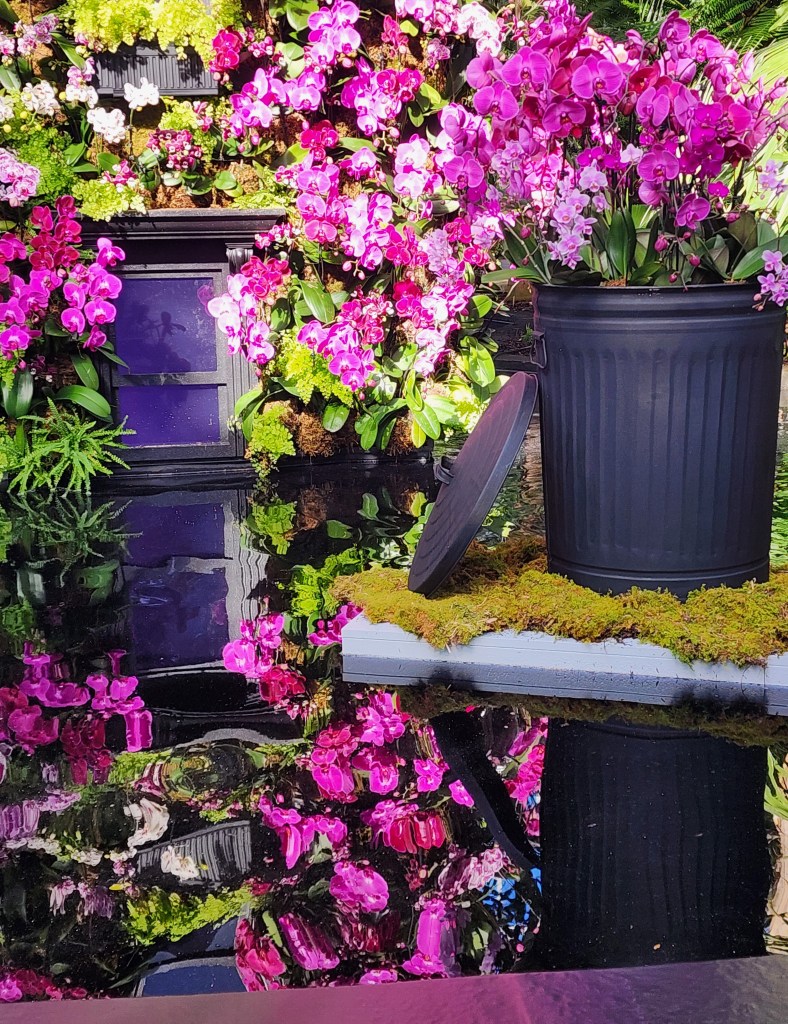
But that conception of the city has long gone with the disappearance of the rotary phone. Alicia Keys’ Empire State of Mind “Concrete Jungle” blew it up forever (https://www.youtube.com/watch?v=FPggPjkoCjE) as did her autobiographical Broadway show Hell’s Kitchen.
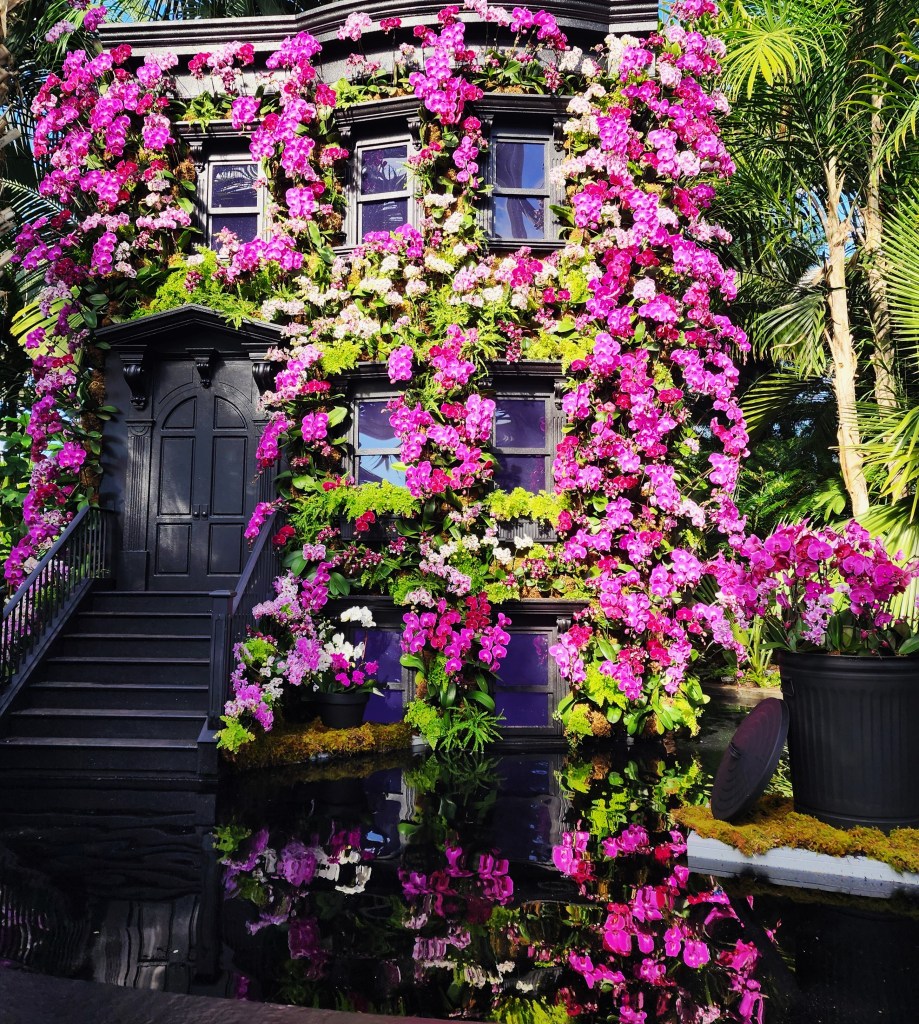
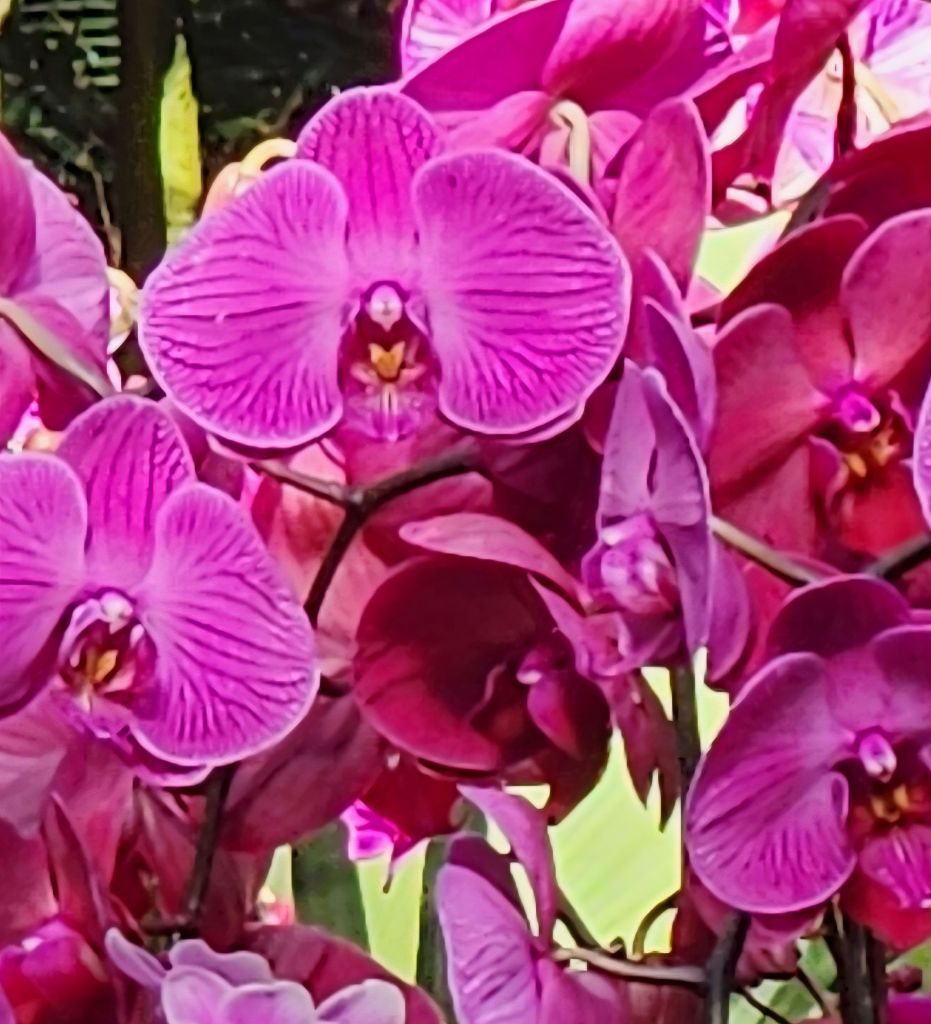
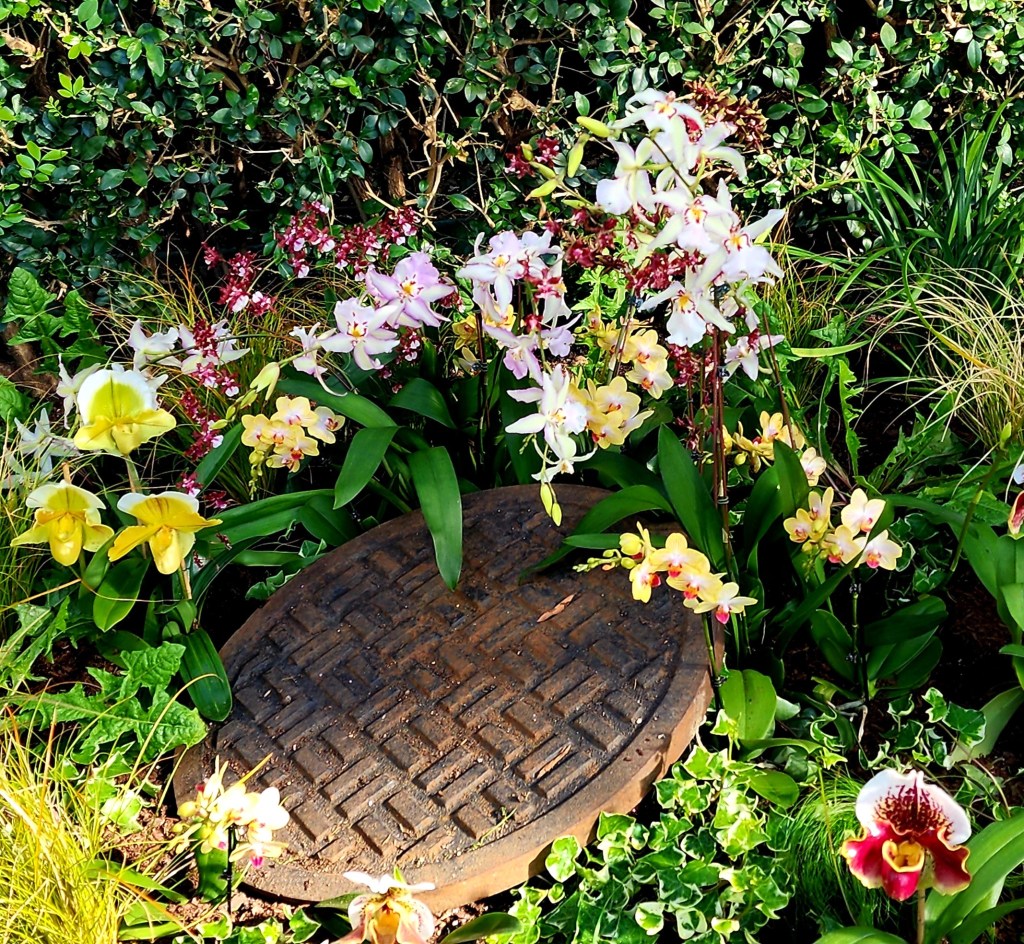
Embodying Key’s song’s beauty and excitement, world-renown, in-demand, floral artist, Mr. Flower Fantastic, presents his view of the city in floral pageantry at NYBG. The show is his love letter to New York with captivating cityscapes punctuated with gorgeous, vibrant, many-hued orchids amidst design sculptures and supporting botanical arrangements that highlight familiar objects and places. The ebullient, fun displays present aspects of city life that all city dwellers take for granted and tourists may completely overlook.
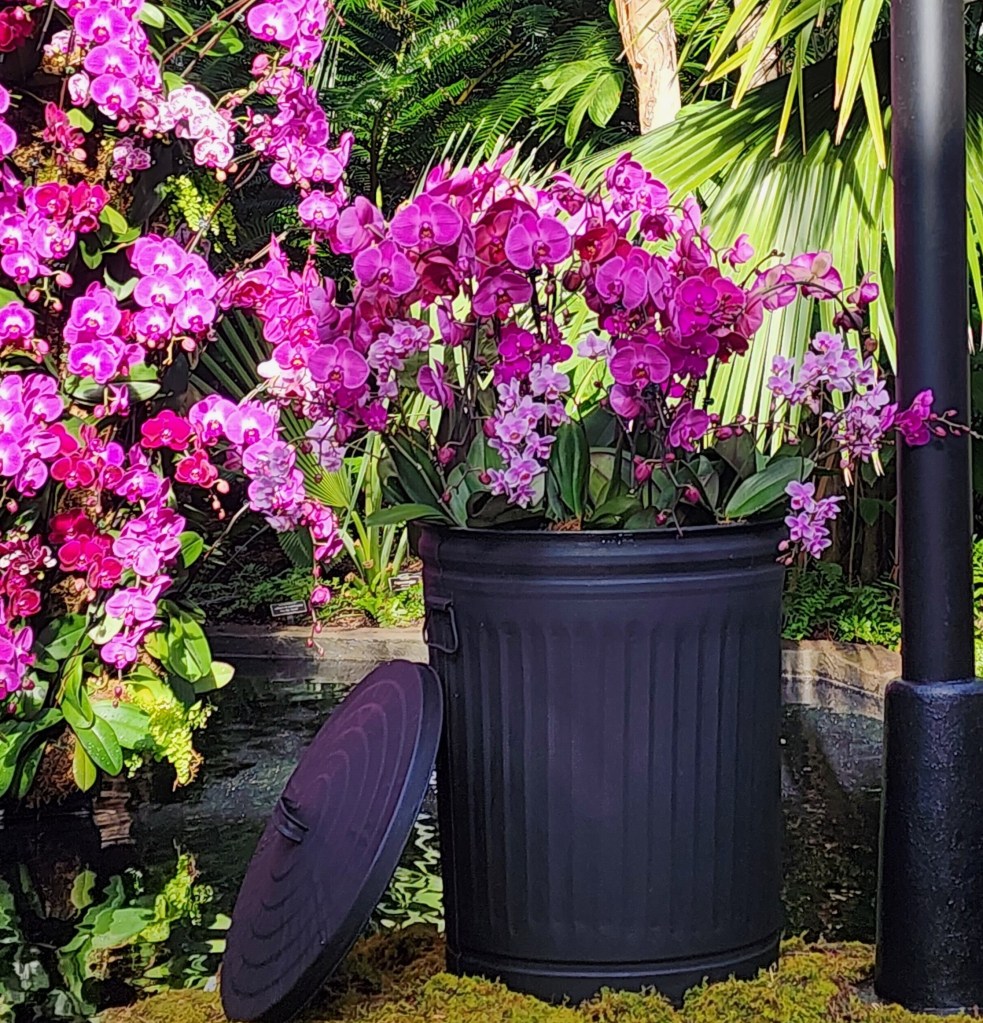
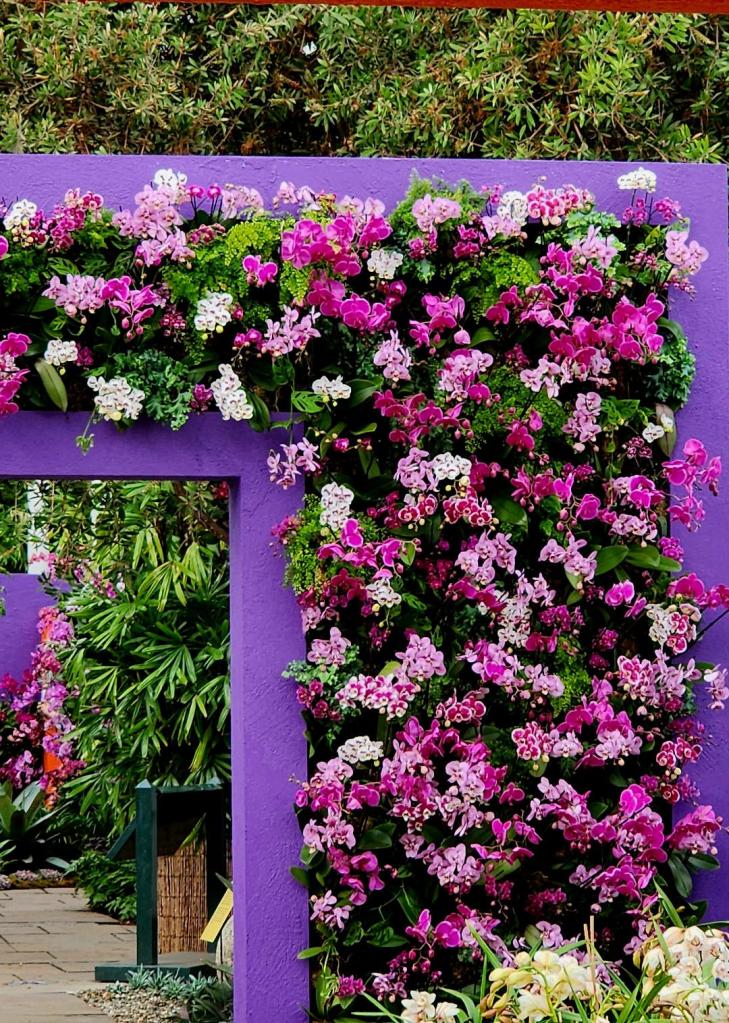
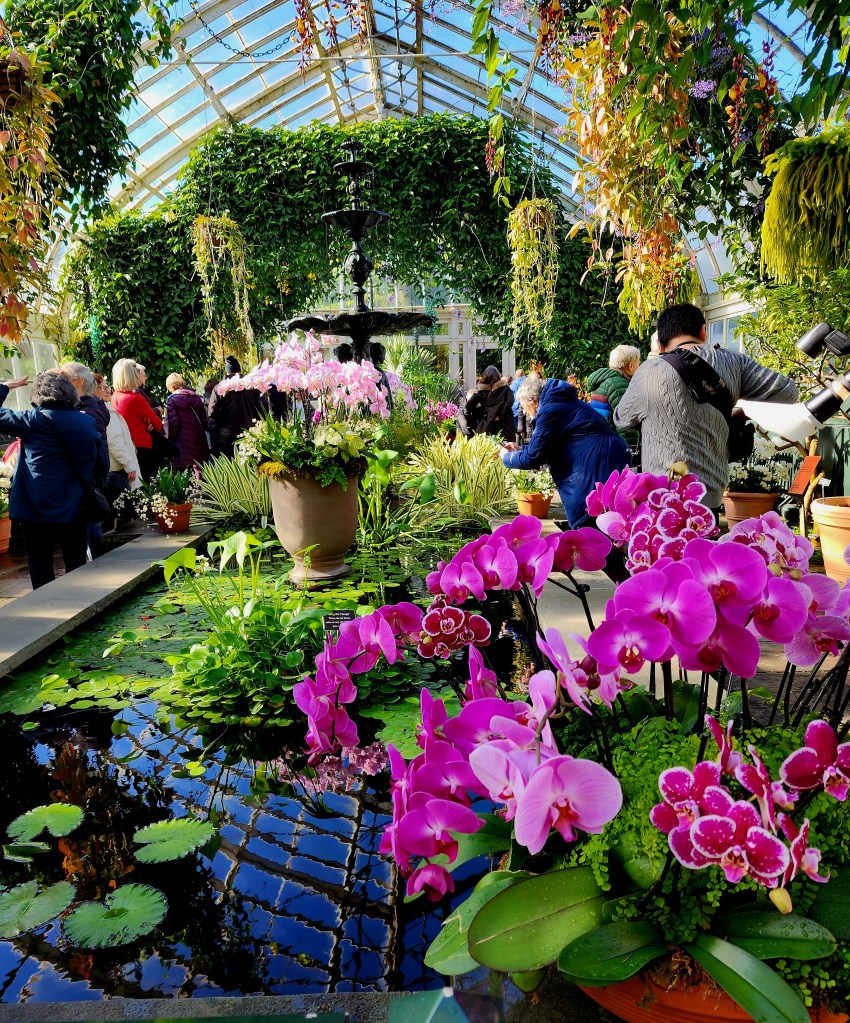
In the Palms of the World Gallery, Mr. Flower Fantastic designs moth orchids flowing over and around the iconic townhouse found throughout each of the boroughs of the city.
Who is the show’s creator?
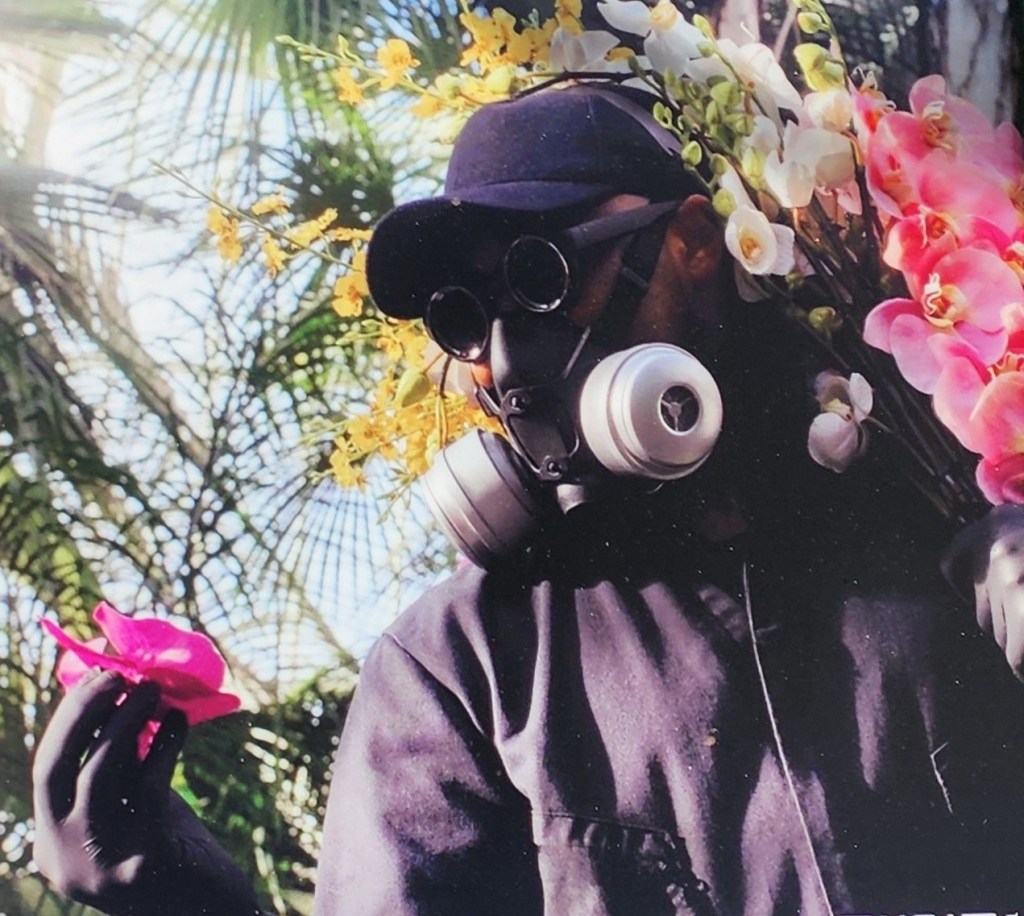
Mr. Flower Fantastic or MFF is one of the most in-demand floral artists in the world, known for transforming flowers into bold, sculptural pieces. Oftentimes, these meld art, fashion, and pop culture. As art comes in a variety of forms, Mr. Flower Fantastic has selected flowers as his medium. This selection carries an irony. Mr. Flower Fantastic is allergic to flowers. In response to this consequence, he embraces his allergies and turns this weakness into his brand strength.
Though his “fantastic” choice of his name and brand is outsized and attention grabbing, yet he is anonymous. You won’t be able to imprint him with facial recognition software because he wears a mask (respirator) and gloves reconciling his allergies with his passion for flowers instilled in him when he was a child. The respirator and gloves embody his style and charisma and allow him to focus on the floral medium as his message with anonymity. The unknown known is his identity.
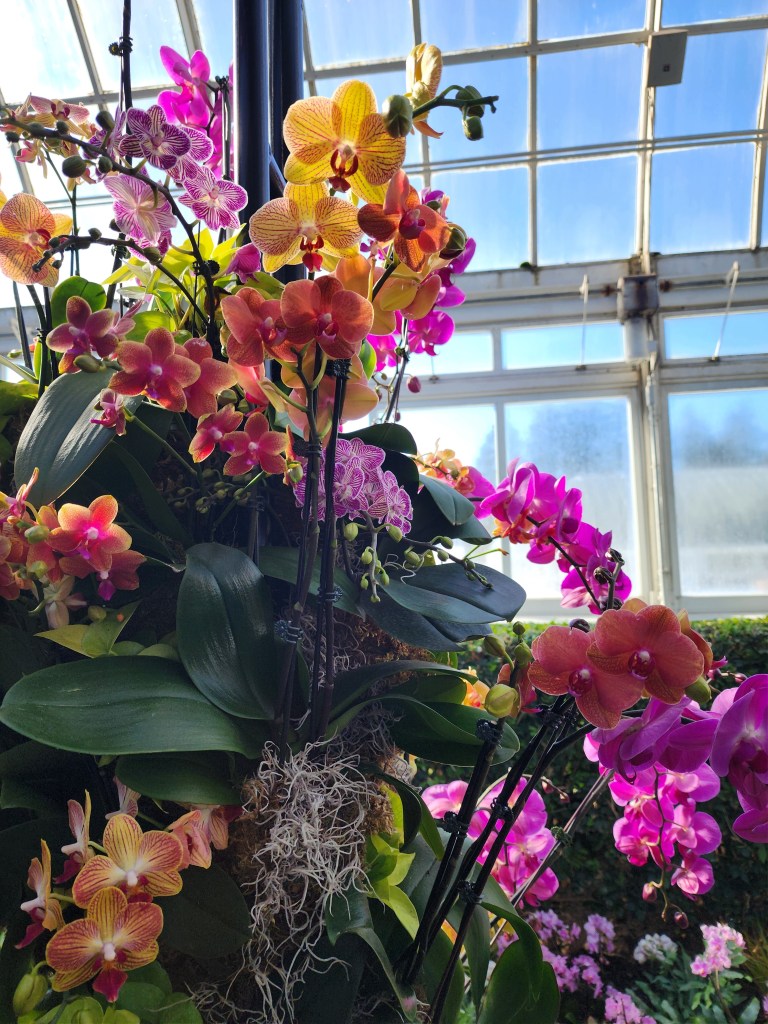
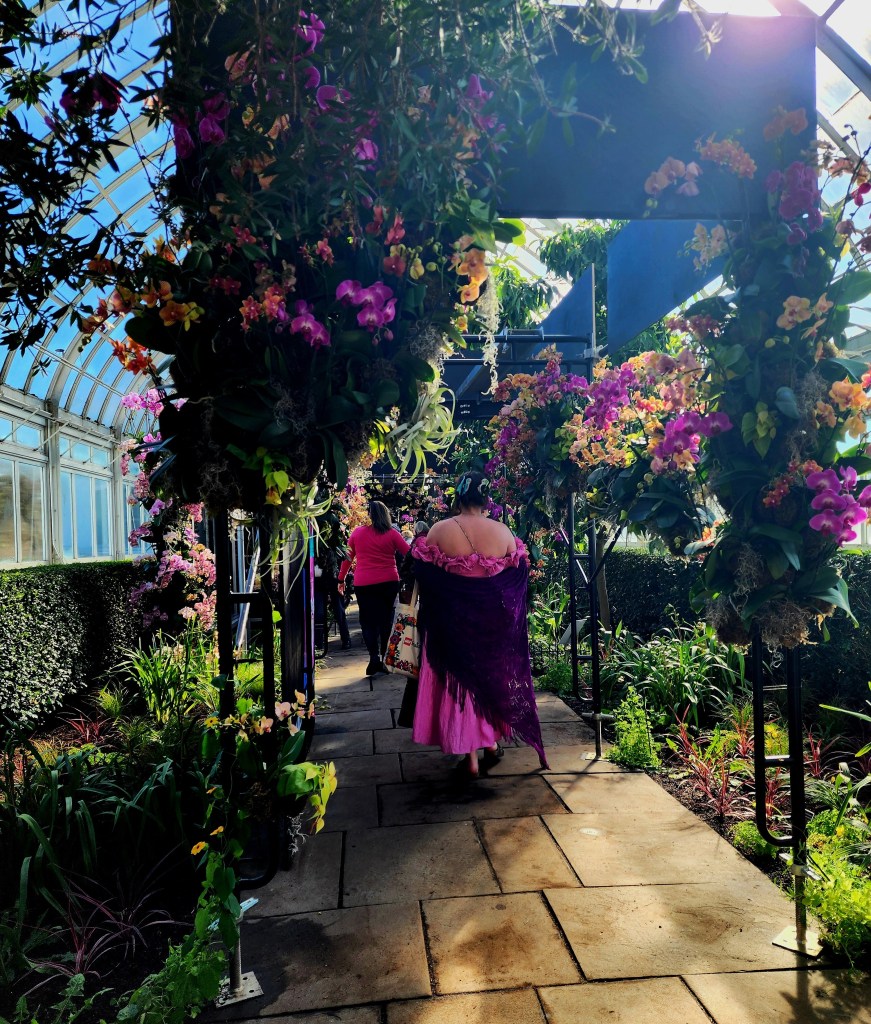
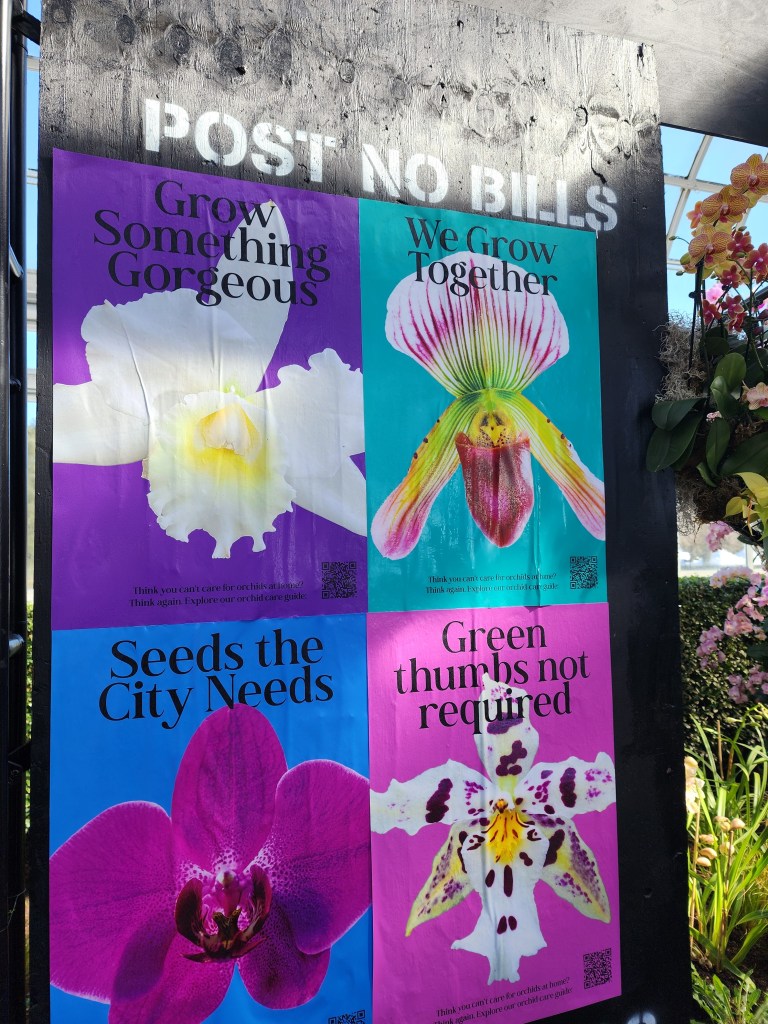
The creator and NYBG staff selected a variety of showy blooms to cheer us through one of the colder winters in memory. His reiminaging is a lovely meld of “concrete” and green jungle to uplift us and make us smile for its cleverness and whimsy.
Stay tuned for PART II of my CONTINUED COVERAGE of the fantastic NYBG The Orchid Show Mr Flower Fantastic’s Concrete Jungle. In the meantime, check out the programming being offered connected to the show including dates for Orchid Evenings on the NYBG website. https://www.nybg.org/event/the-orchid-show-mr-flower-fantastics-concrete-jungle/
Also, if you would like to check out MFF’s website to look at previous shows and/or items for sale, check this website: https://www.mffstudio.com/
Schedule your plans for a number of visits to the The Orchid Show, Mr. Flower Fantastic’s Concrete Jungle. There is a lot to see that couldn’t be covered in just one post, thanks to the ingenuity of NYBG staff and MFF. The show ends April 26, 2026.
NYBG Holiday Train Show® Joyfully Presents a Magical Winter Wonderland
The 34th NYBG Holiday Train Show® runs until Jan 11, 2026
The 34th NYBG Holiday Train Show® opened November 15, 2025 to fanfare, excitement and large crowds with families and delighted children eagerly moving through the galleries of the Enid A. Haupt Conservatory. The exquisite botanical train theater shines its way into the New Year and closes on Sunday, January 11, 2026.

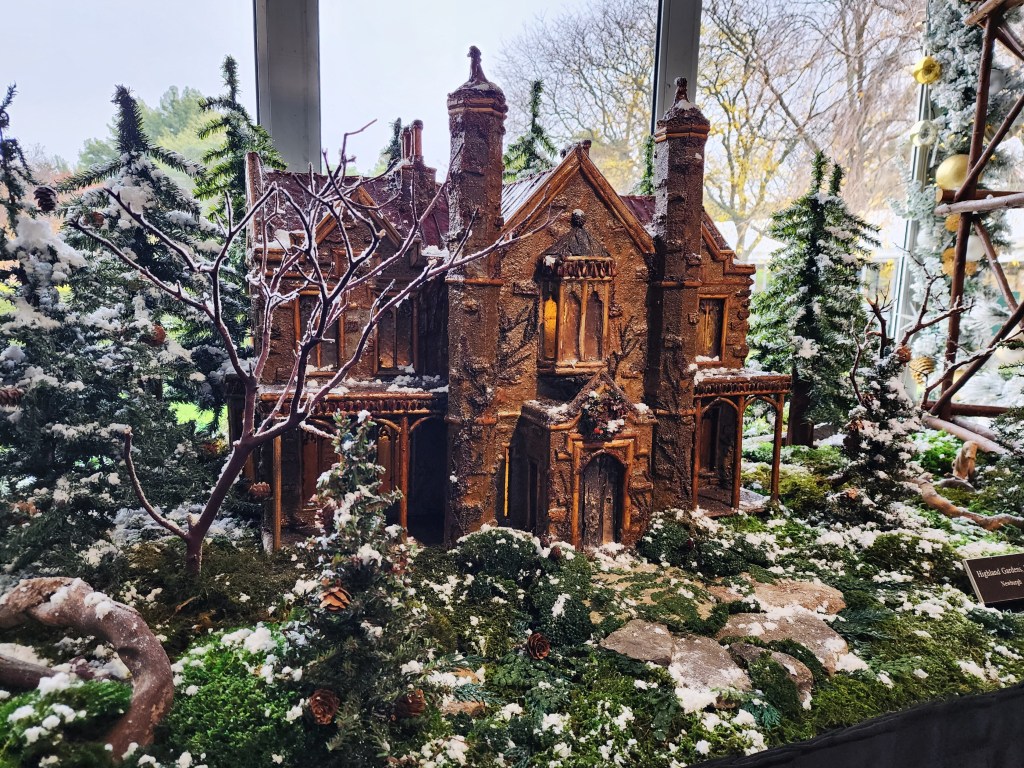

The enchanting train displays reflect beloved seasonal traditions. The show offers something for everyone—with two ways to experience it: day or night. In the daytime, families are welcome. More than 30 G-scale model locomotives and trolleys whizz and hurtle through a showcase of nearly 200 twinkling replicas of renowned New York architecture. During select evenings Holiday Train Nights invites visitors to see lighted, celebratory show one through a different lens. Sparkling nighttime at the Enid A. Haupt Conservatory is extraordinary.
So The Holiday Train Show® ties the past with the present and history with modernity in the exhibits which center around thematic locations. Look for exhibits featuring landmarks in the Bronx, Brooklyn’s Coney Island, Queens and Staten Island. Look for the New York City bridges that connect the boroughs with Manhattan. Look for replicas featuring famous landmarks in the lower Hudson River Valley, as well as downtown Manhattan.
In the Central Park displays there is the new addition, the Delacorte Theatre. The Delacorte was recently refurbished to expand its offerings of the Public Theater’s Free Shakespeare in the Park. Applied Imagination celebrated the completion of the Theater with this replica.
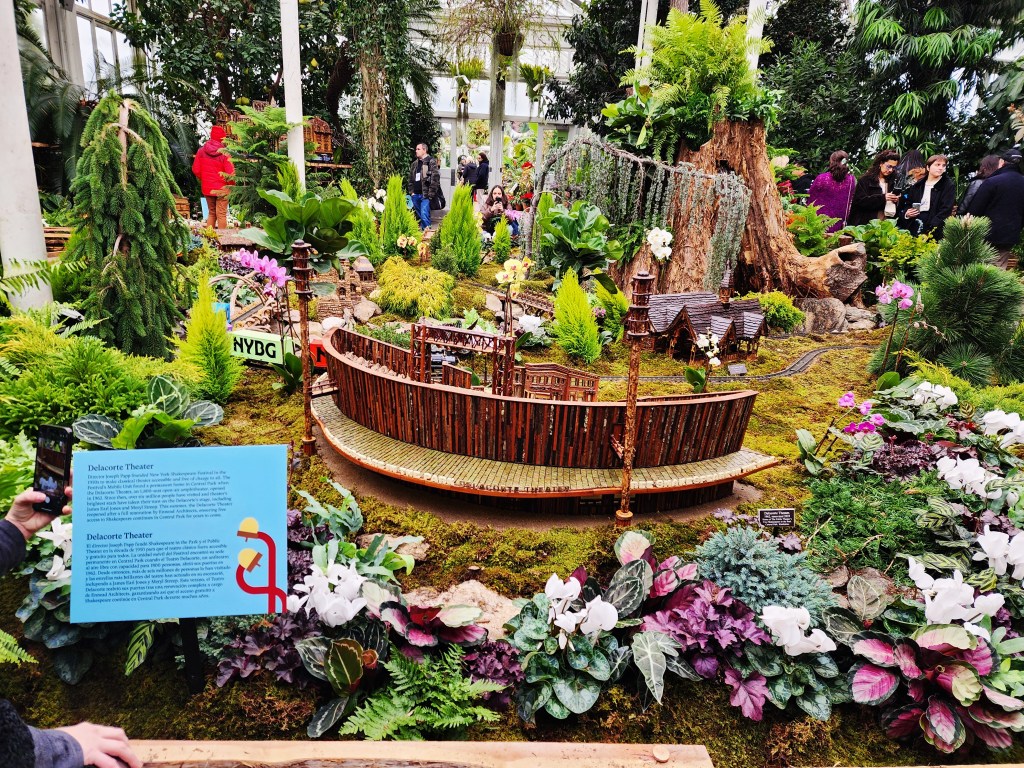

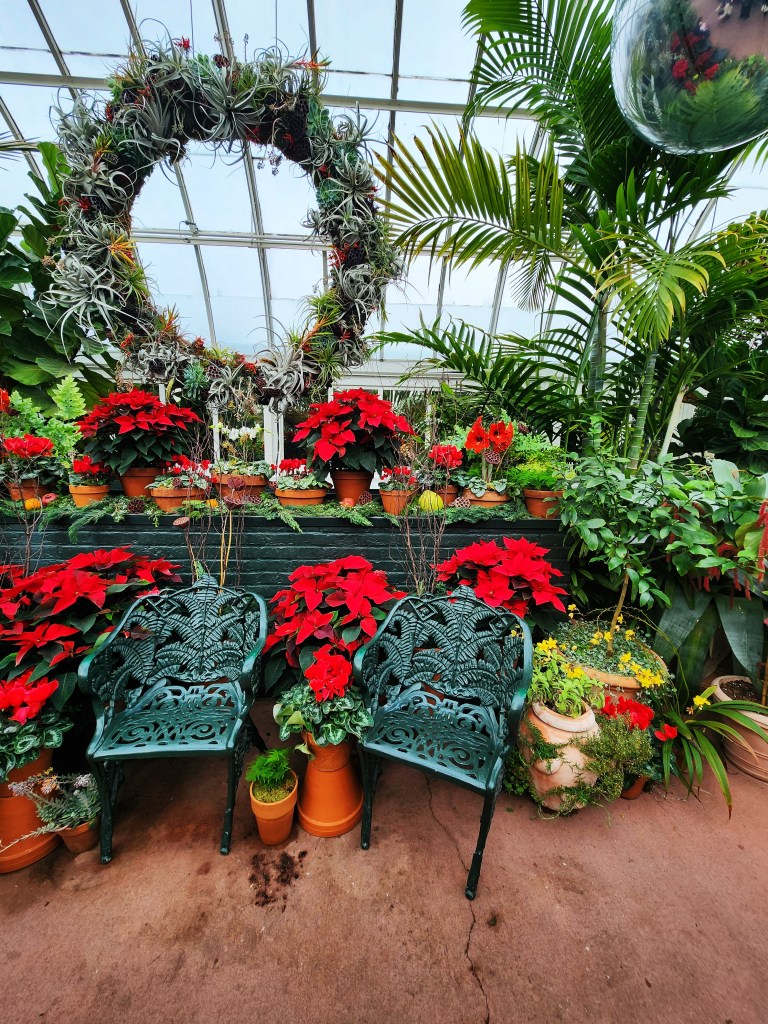
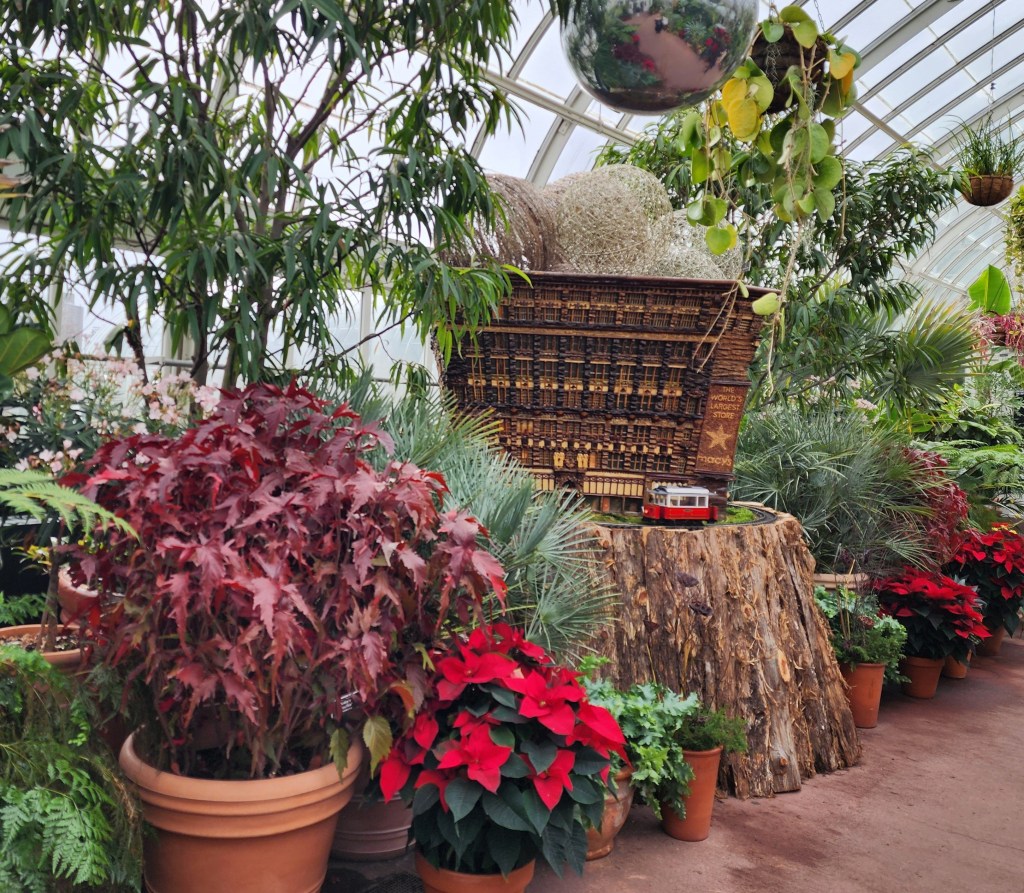

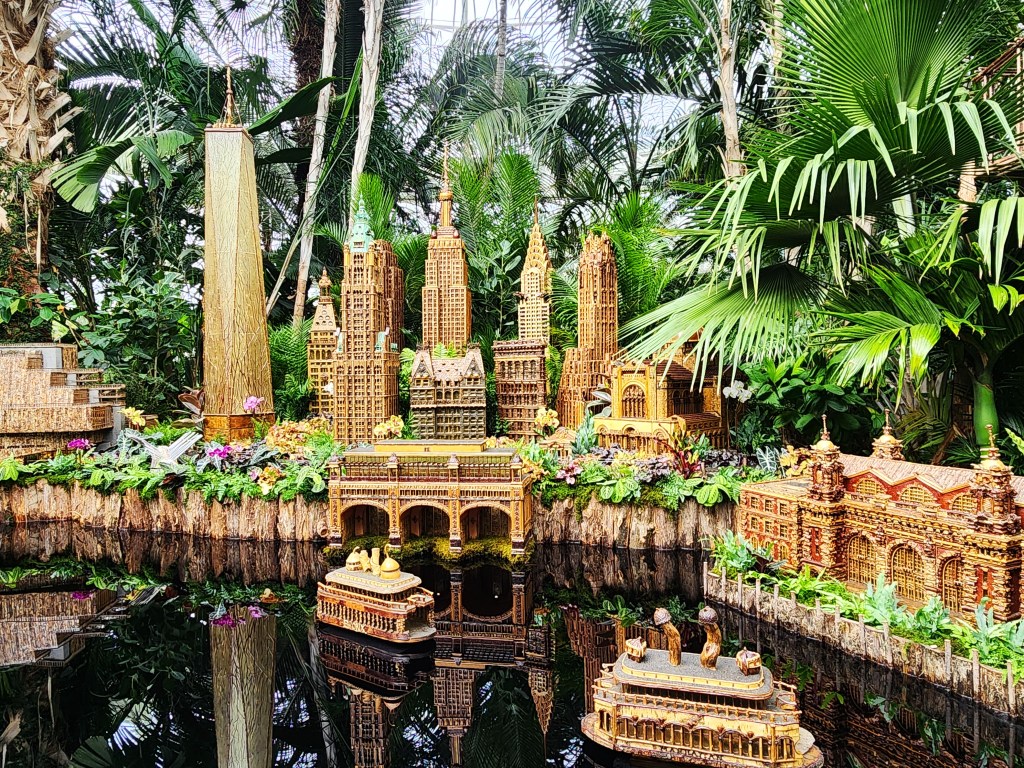
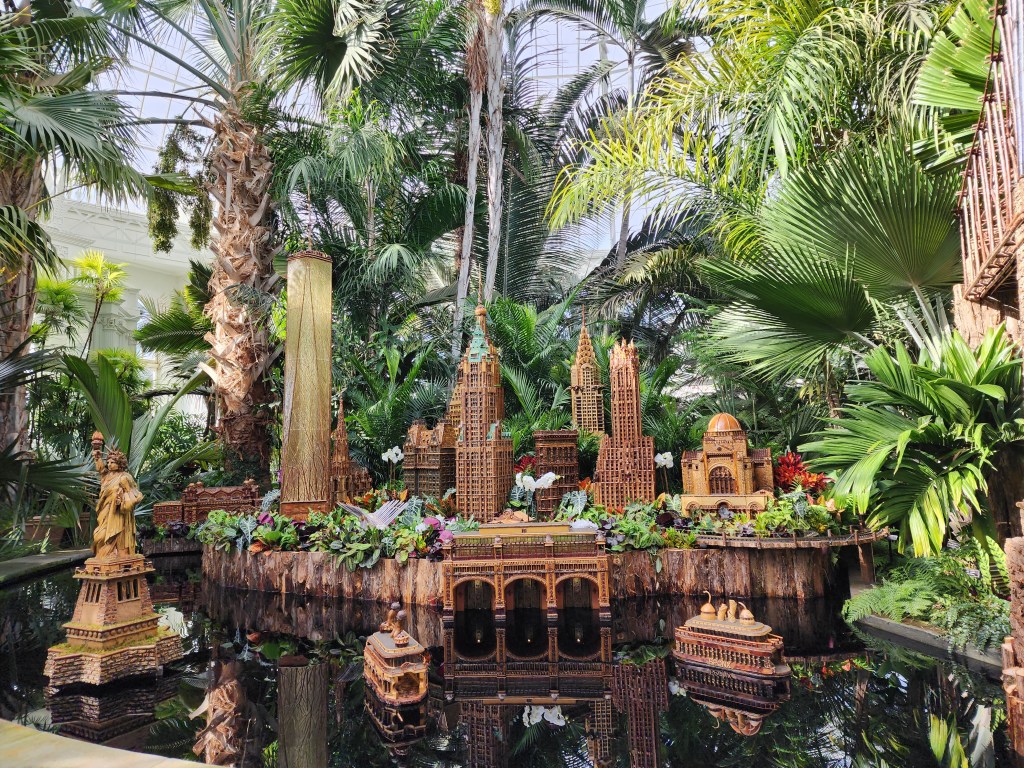
In the Palms of the World Gallery, check carefully and you will see the Oculus, One World Trade Center, the Statue of Liberty, St. Bartholomew’s Church, the Woolworth Building and another new addition, the Whitney Museum in the display featuring historic structures old and new.
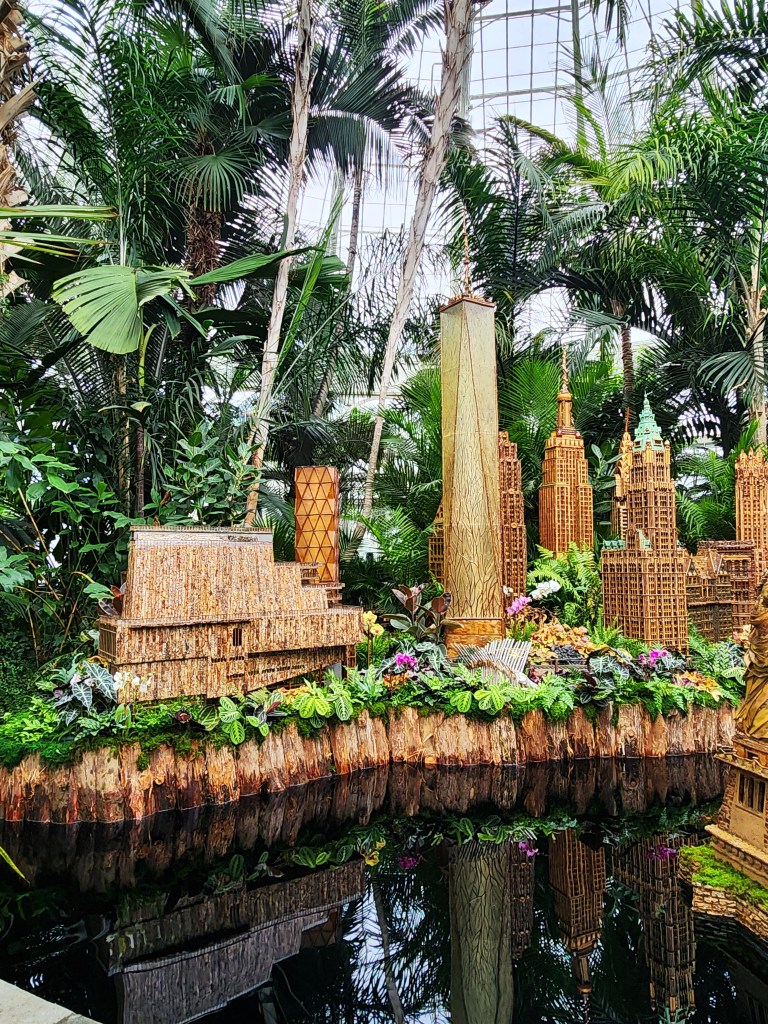
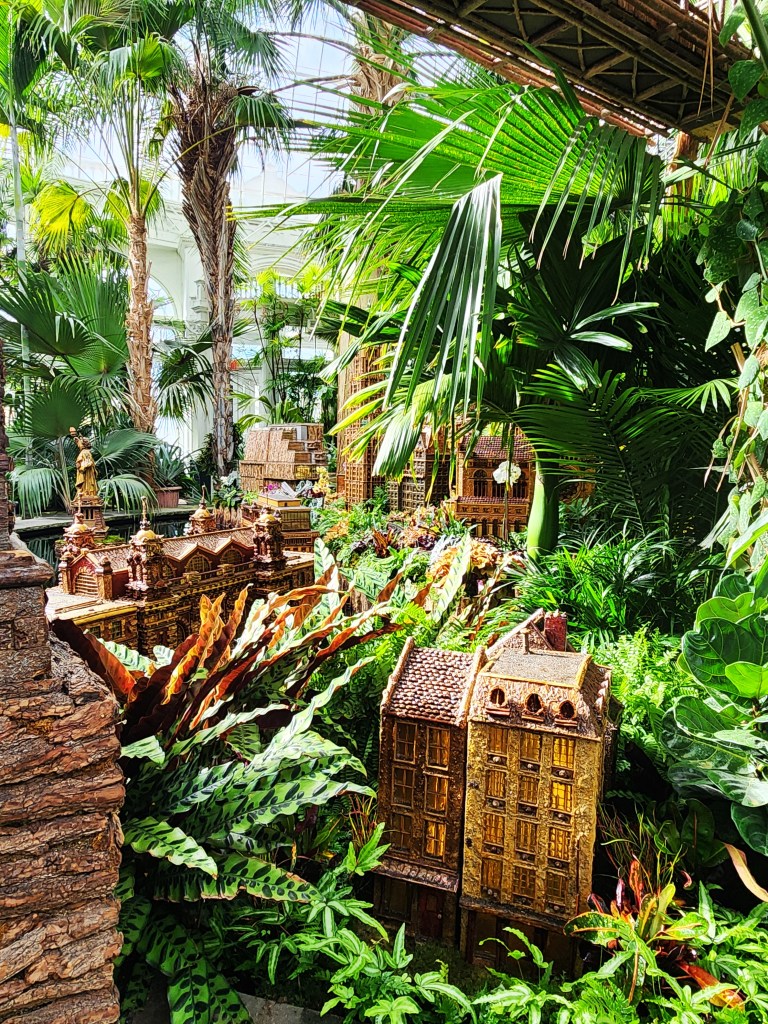

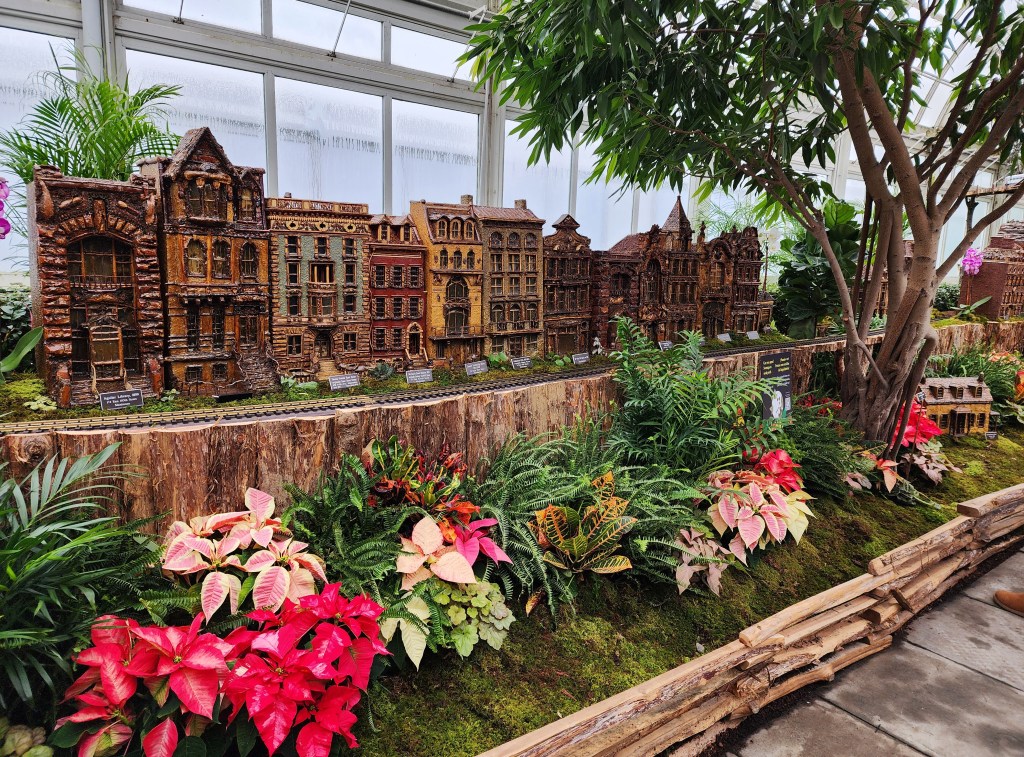
To see the real magic which defies your imagination, get up close to view the construction of the artistically crafted masterpieces. Each one has been configured to scale painstakingly and ingeniously assembled from plant parts. The roof of a building might be shelf fungi.

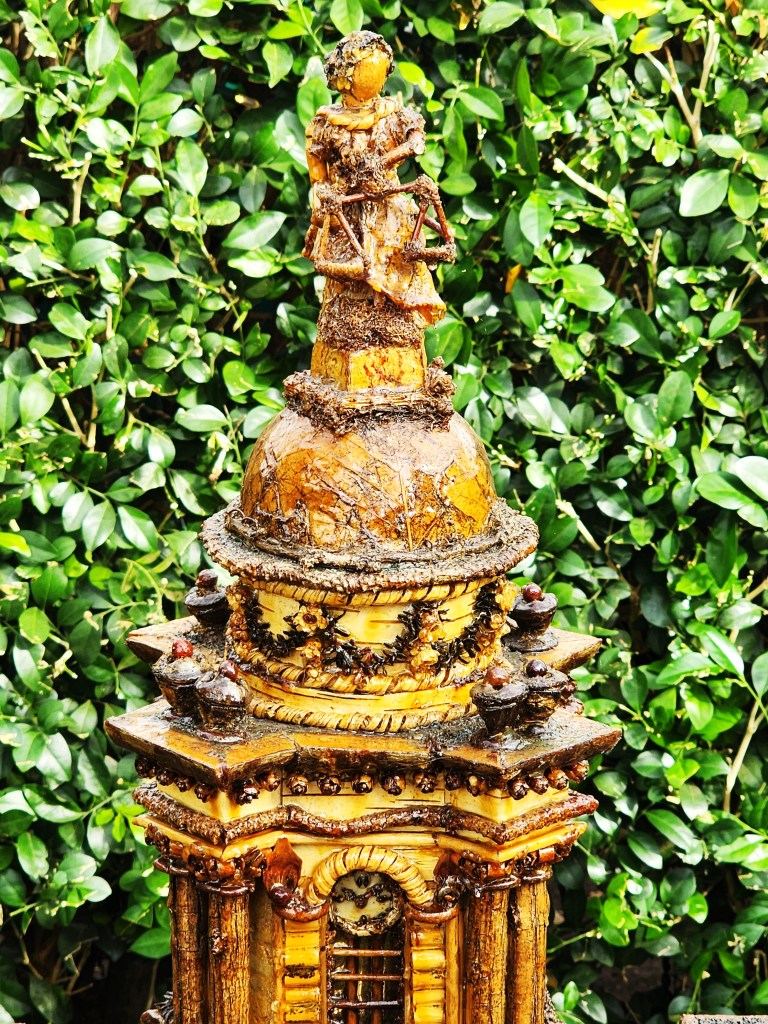

There are leaves, palm fronds, pinecones, cinnamon sticks, seed pods, acorns, twigs used for fine details as larger pieces are shaped into cornices, columns and stone blocks. It’s mind-blowing when you discover that a pistachio shell was used to meticulously detail an angelic statue.


All of the incredible building designs of the miniatures created by Applied Imagination, highlight the immense importance of plants in our world. Indeed, nature’s flora inspires some of the finest, most uplifting of architectural designs that comfort and support humanity. Plants are vital not only to our physical well being (the rain forests are the lungs of the planet), they are vital to our psychic and emotional well being.
In this outside exhibit, trains chug along with their heavy loads (i.e. acorns, seed pods) around mountains and fanciful, gigantic toadstools and fungi adding an outdoor wonderland to the indoor wonderland of magic. Notice the whimsical train car, and the mushroms out of Alice in Wonderland. And look for the woodland creatures tucked away in a mountain or peering down at you from a train trestle.


Whether young or old the NYBG Holiday Train Show® continues to spark wonder in generations of visitors. It’s one of the City’s best way to celebrate the season with all your loved ones.
For the evenings you can enjoy seasonal beverages as you stroll through the twinkling lights of the exhibition,. And don’t forget to stop in at the NYBG Shop to pick up that gift for that hard to buy friend or family member. Not only does the NYBG Shop have lovely and unique gifts, if you are a member, show your card for the discount.
As you enjoy the Garden at night dance to the holiday classics and sing along with performers as they croon the Christmas pop favorites. You can also enjoy sweet and savory bites for purchase, or stop at the “Bar Car” which features a 21+ bar at the Hudson Garden Grill Patio.

Holiday Train Nights offer their unique experiences from 7 to 10 p.m. on November 22, 28, and 29, 2025; December 6, 12, 13, 19, 20, 21, 26, 27, 28, and 29, 2025; and January 2, 3, and 10, 2026; 7 to 10 p.m. Holiday Train Nights are ticketed through NYBG’s presenting partner Fever. Tickets start at $39 for Non-Members purchasing for groups of four or more, with 20% off for NYBG Members, and free entry for children under the age of 2. For more information, visit https://www.nybg.org/holiday-train-nights/.
.
‘Van Gogh’s Flowers’ at New York Botanical Garden is Magnificent


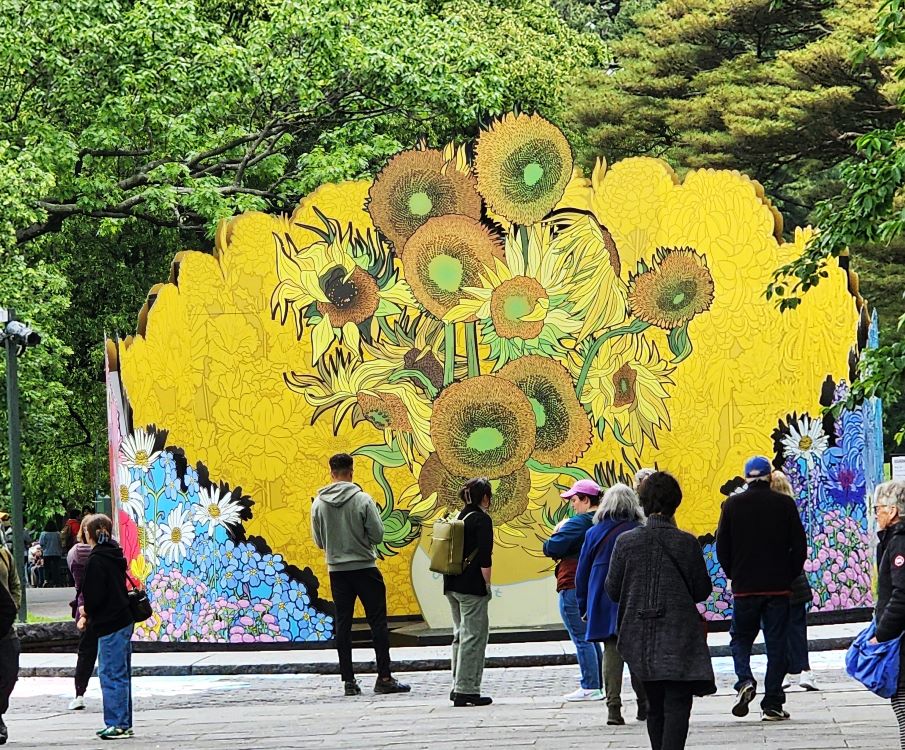
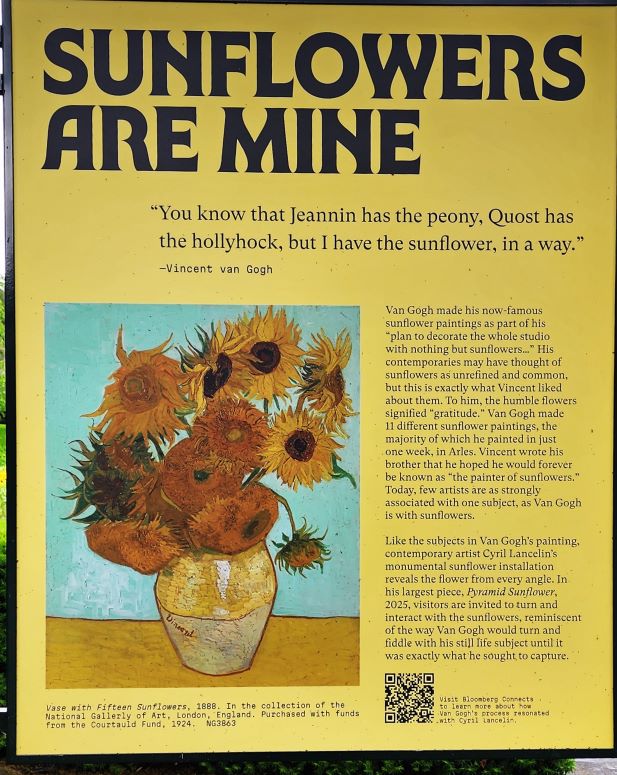
Van Gogh’s Flowers (May 24 through October 26, 2025)
Vincent van Gogh needs no introduction to art lovers. Happily, for them and even for those not acquainted with the iconic painter, the New York Botanical Garden’s spring exhibit Van Gogh’s Flowers is stunning. The memorable exhibit celebrates the work of the Dutch painter who decided to become an artist at 27-years-old.


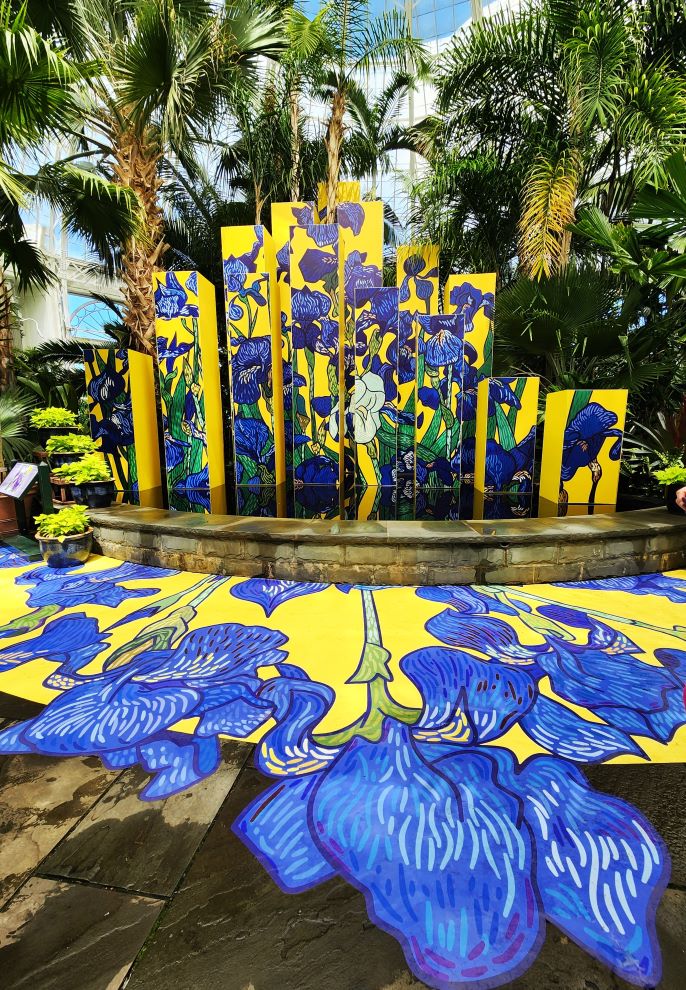
His was a decision that changed his life and the art world forever, according to the Vincent Van Gogh Museum in its discussion of Van Gogh’s life and journey toward the elusive greatness he never was able to realize while he was alive. Van Gogh’s Flowers runs from May 24 through October 26, 2025. The exhibit is not to be missed, principally because it highlights the way Van Gogh captured still lifes of flowers through his unique expression of color, light and form.

Reading through the stories of Van Gogh listed with various paintings on the Van Gogh Museum’s website, one is able to discover interesting facts about the junction of Van Gogh’s life and work. On the subject of flowers, the museum contains some of his floral still lifes. It’s fun to compare them with the specific paintings that inspired artists Amie J. Jacobsen, Graphic Rewilding’s Catherine Borowski and Lee Baker, and immersive artist, Cyril Lancelin.


All three contemporary artists contribute to the NYBG exhibit Van Gogh’s Flowers using their own mediums of expression.
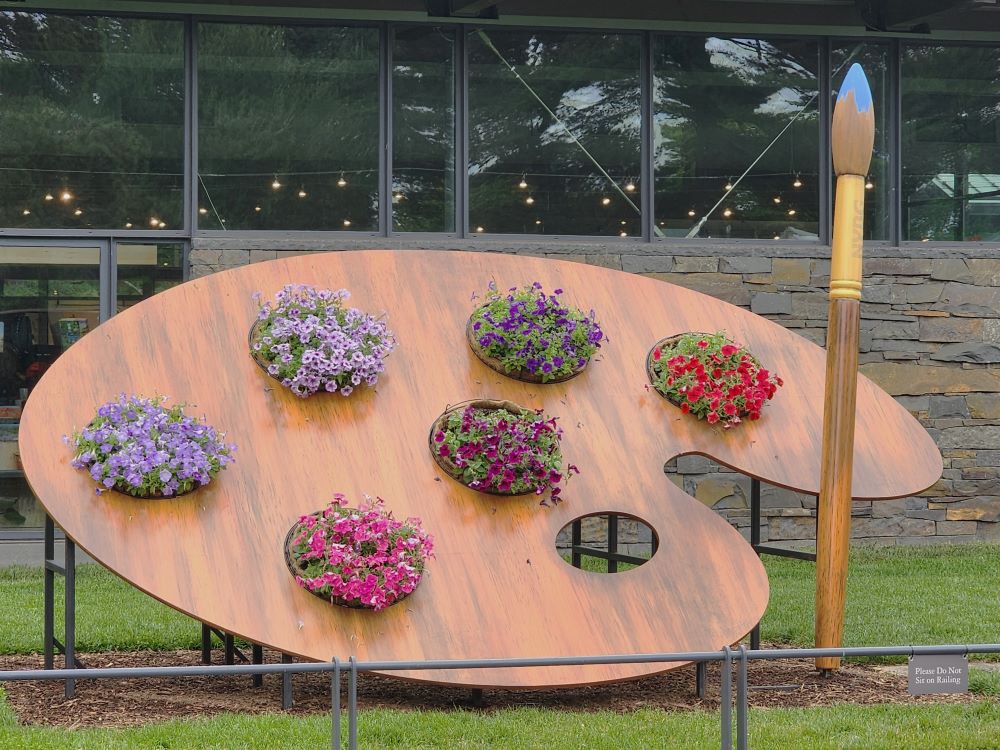
Visiting NYBG Van Gogh’s Flowers, one will want to read all of the signage with the quotes Van Gogh spoke during his lifetime to learn more about the mythic painter. The signage also pinpoints the designs of the featured artists found in the Enid A Haupt Conservatory walkways, in the indoor and outdoor reflecting pools and in the great plaza lawn. Van Gogh’s influence on them and on artists globally is a study in genius and the immutable verities that touch humanity and ground it in the pleasure of beauty and nature to move our souls out of ourselves into another way of being and consciousness.

Apparently, along his journey, Van Gogh painted flowers as a commercial venture, as he heard that such paintings were popular and lucrative. In Paris Van Gogh painted over 35 still life paintings of flowers, hoping that they would sell.
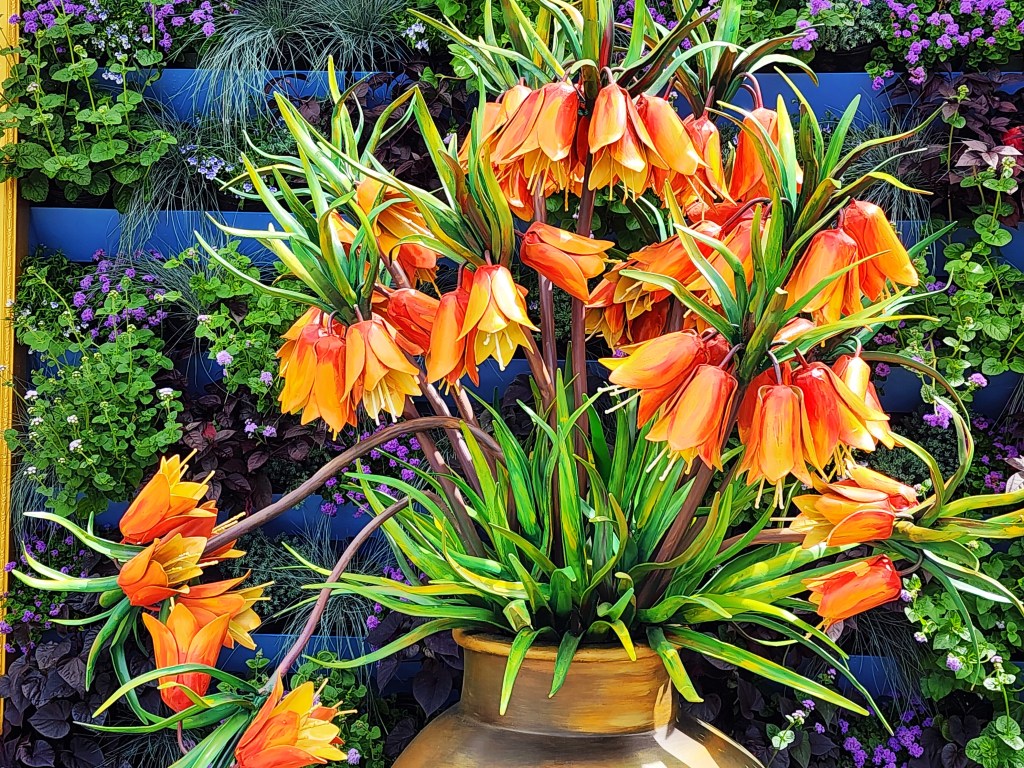

However, he had little luck selling them even though paintings of flowers were trending. His brother Theo wrote to their mother telling her that to help him, acquaintances would bring flowers for Van Gogh to paint every week.

After he ventured to the South of France, Van Gogh, whose intellect and mentality were always fragile, had a breakdown. It took him about a year to recover in a sanatorium at Saint-Rémy-de-Provence where he painted scenes he saw from his room. Interestingly, he didn’t paint the bars on the windows, perhaps signifying that in his creative spirit he was free as he was in his paintings as his mode of expression. Before and after recovering from his extended illness Van Gogh painted sunflowers (in Arles nearby), which to him symbolized gratitude. He used the color yellow extensively delighting in it. These and other details are found on the signage of the NYBG exhibit.
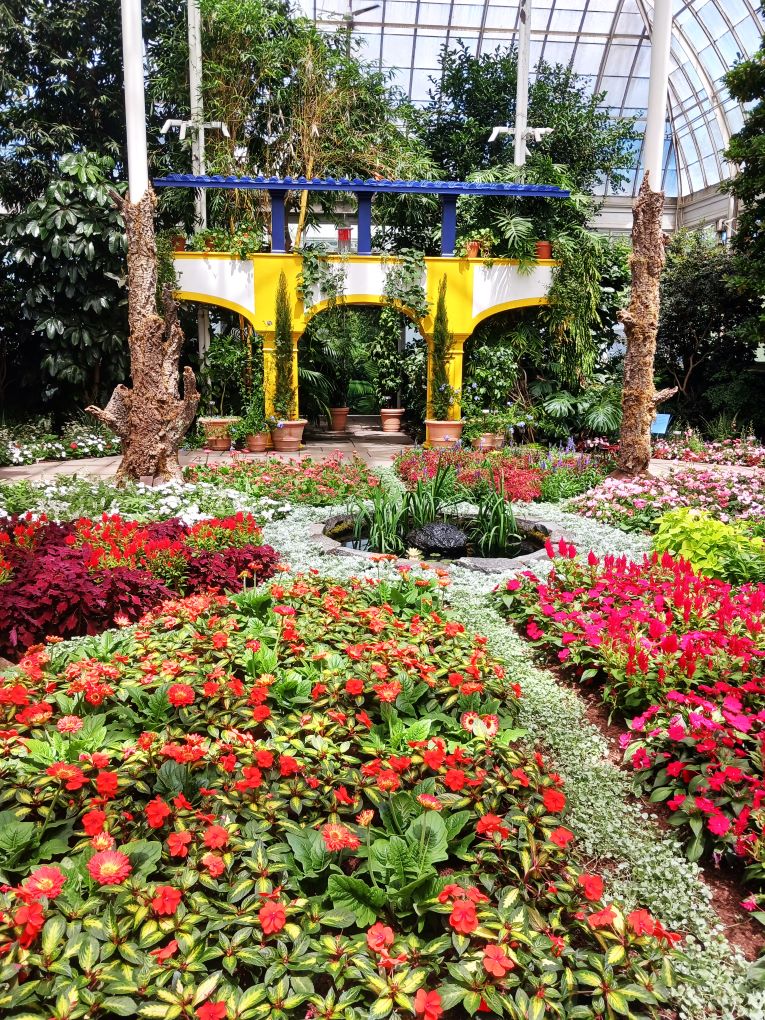
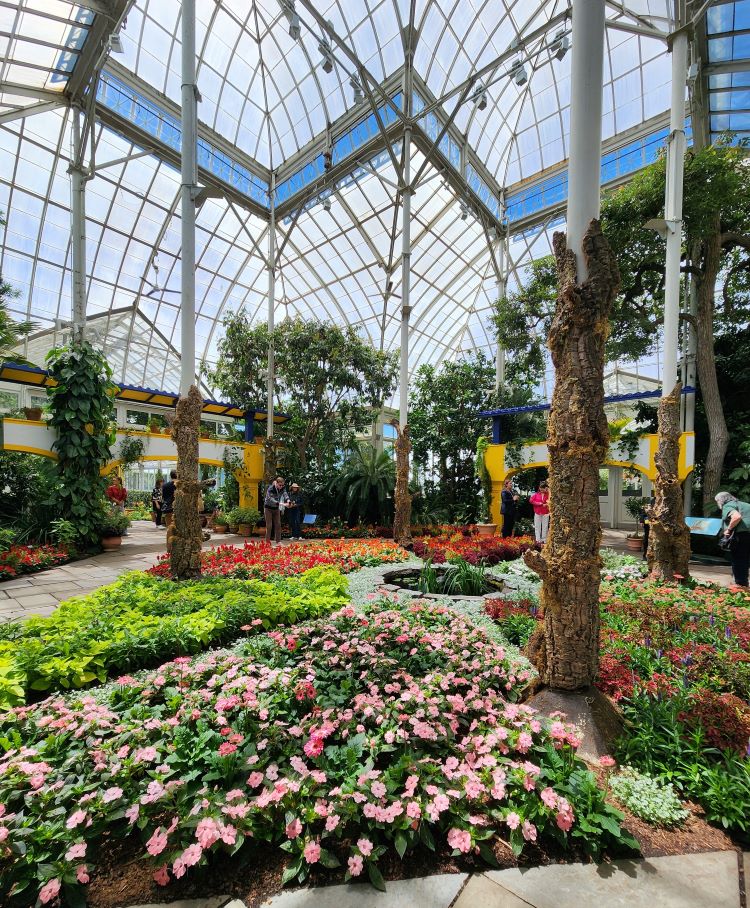
The NYBG exhibit features a placard of Van Gogh’s painting of the courtyard of the hospital at Saint-Rémy-de-Provence where Van Gogh found rest and recuperated as best he could. The showcase rotunda of the Enid A. Haupt conservatory features a reflection of Van Gogh’s courtyard painting with a similar structure suggested and the amazing plantings which are in a circular arrangement segmented florally like the spokes of a wheel. Just breathtaking.
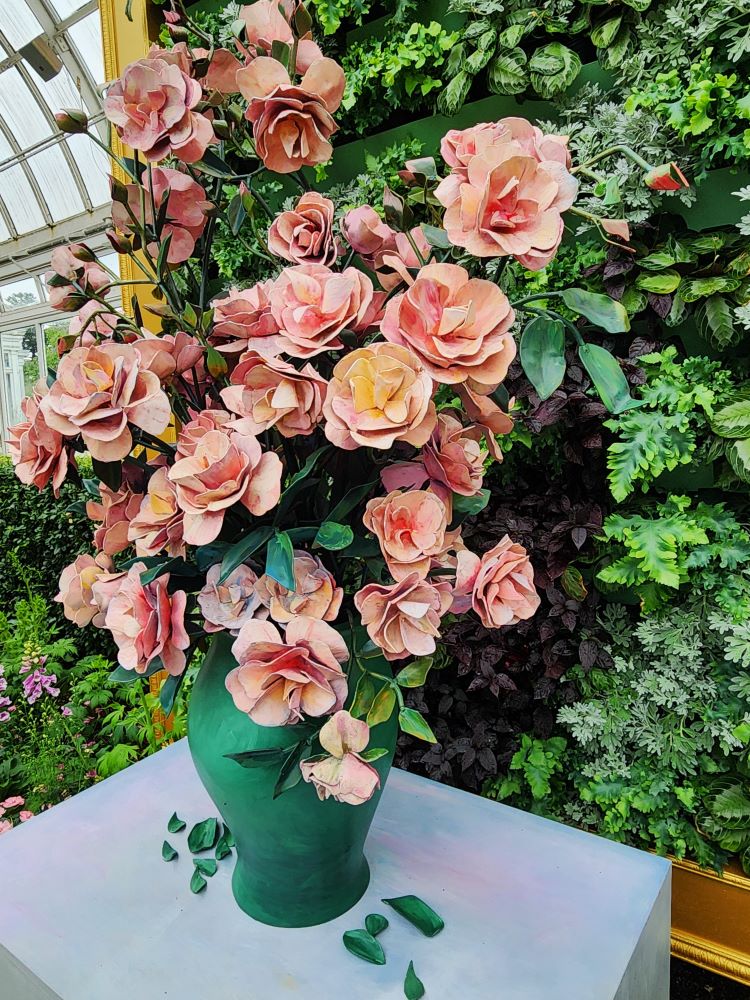
At the Garden, the paintings that inspired the artists Amie J. Jacobsen, Catherine Borowski and Lee Baker, and Cyril Lancelin are brought to life situated in gorgeous botanical displays along with the contemporary artists’ work.

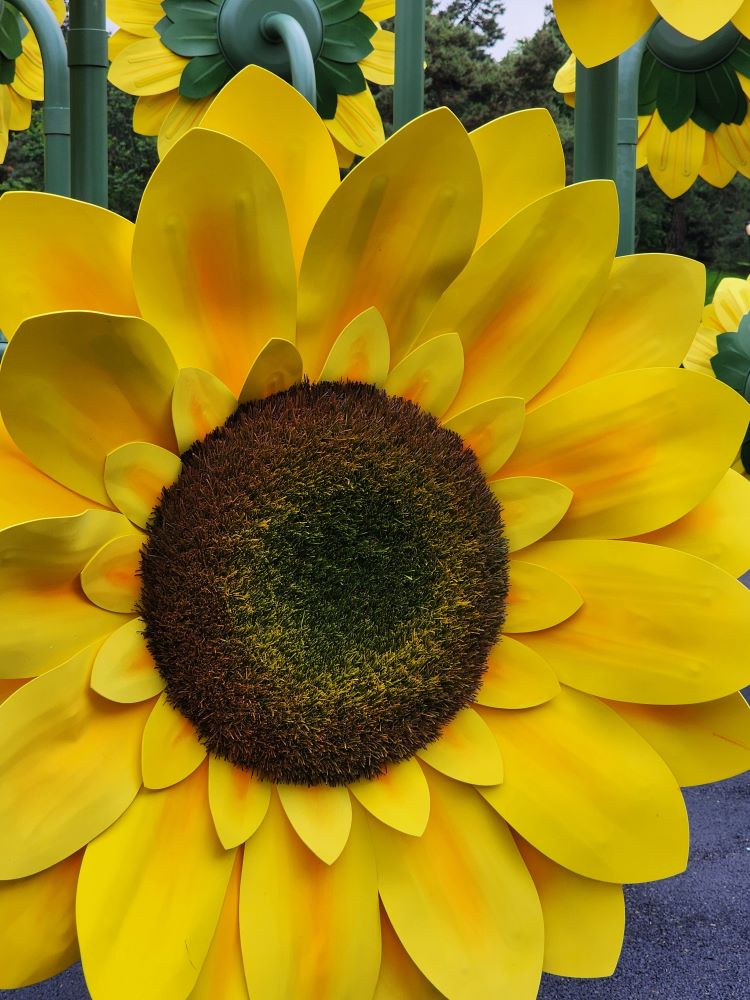
Thanks to Cyril Lancelin, visitors can walk along a pathway that meanders through plantings of real and sculptured sunflowers (by Lancelin), a symbolic reflection of what Van Gogh found healing and restorative. For him sunflowers meant “gratitude.”

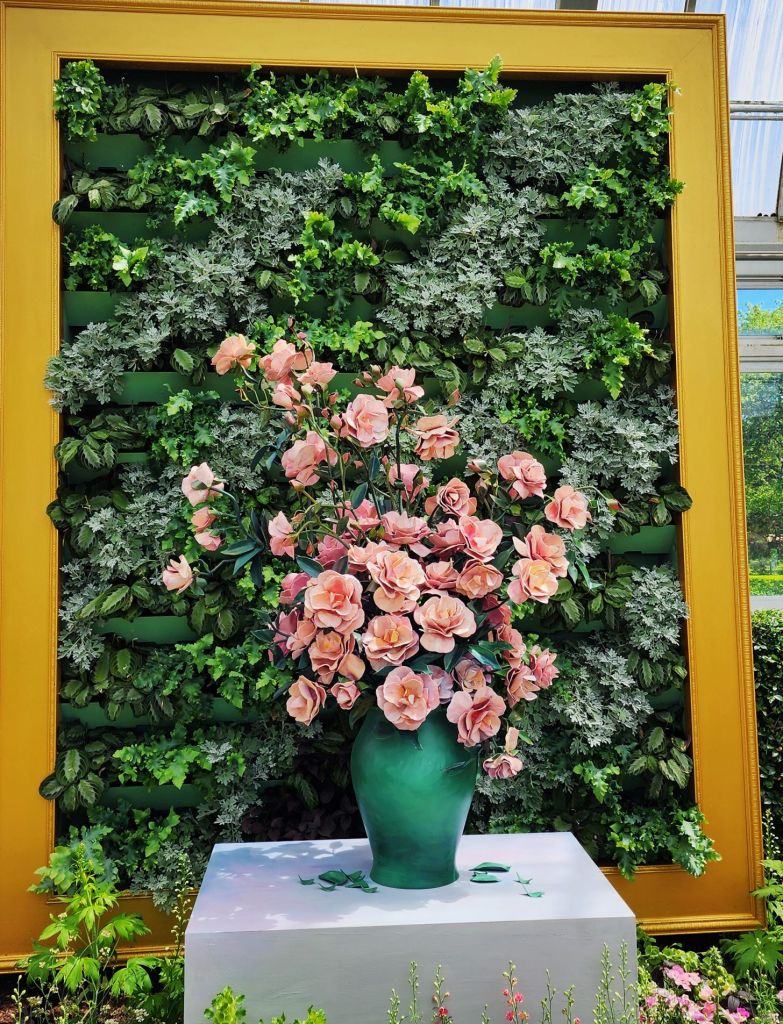
Vincent left the mental hospital in May 1890, he headed north to Auvers-sur-Oise. He met several artists there and continued painting fields, always using his beloved yellow. Then, one day in agitation, the story goes, he shot himself in a wheat field and died of his wounds some days later.

Van Gogh’s incredible legacy was a large body of art works: over 850 paintings and almost 1,300 works on paper. Visitors to NYBG’s Van Gogh’s Flowers will come to a new appreciation of how the natural world inspired Van Gogh. Most museums boast at least two or three of Van Gogh’s paintings which at auction command millions of dollars. In 1987 one version of Sunflowers sold for $37. 85 million. Today, those in the art world suggest the sunflower series of paintings would be in the hundreds of millions.
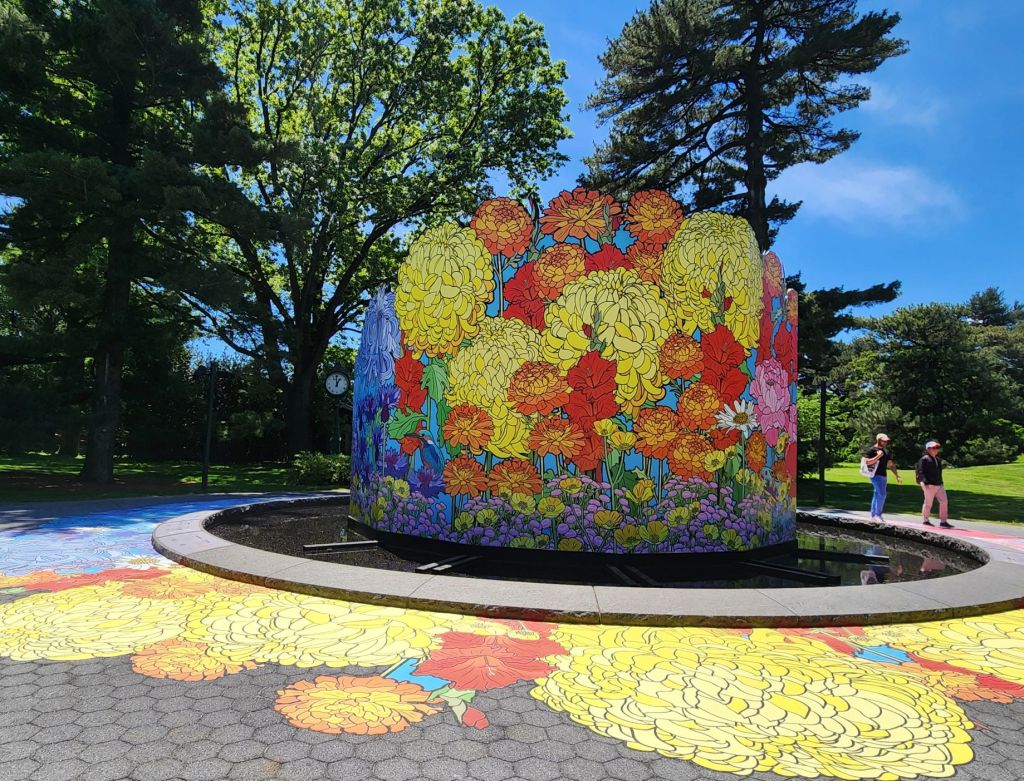

This amazing NYBG exhibit is a complete celebration of Van Gogh reflected in all of its programming. Complementary daytime programming on select dates during Van Gogh’s Flowers will offer engaging, interactive experiences, such as “Plein Air Drop-In and Paint,” engaging NYBG visitors’ creativity.
On select dates, Starry Nights will offer exhibition viewing in the glow of evening, with music and performers, drinks and food available for purchase. Conditions-permitting, after-dark Van Gogh-themed drone shows will take place on May 30, 31st and June 6th. These shows are New York City’s first at a cultural institution—bringing Starry Night to life before your eyes.
Finally, visitors can immerse themselves in the LEGO Botanical Garden pop-up. They can enjoy the hands-on make-and-take experience including a mini-Van Gogh sunflower creation.
For more information about this wonderful show and programming during the exhibit, go to the website, https://www.nybg.org/event/van-goghs-flowers/?gad_source=1&gad_campaignid=22428050313
‘The Orchid Show: Mexican Modernism’ at New York Botanical Garden
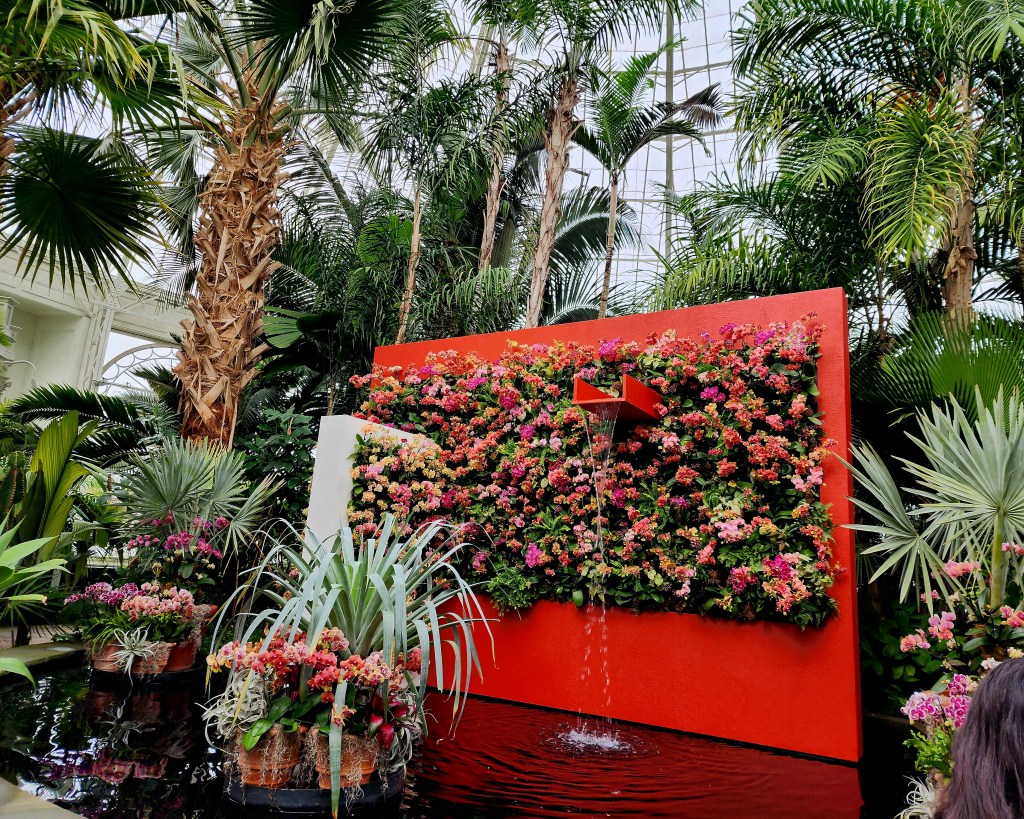
ORCHID SHOW: MEXICAN MODERNISM-FEBRUARY 15TH THROUGH APRIL 27TH

The New York Botanical Garden Orchid Show: Mexican Modernism has exploded onto the New York City scene in eye-popping color.

The NYBG exhibit is so welcome at this time of year. Many New Yorkers and Garden members having been waiting with high anticipation for the annual orchid show to brighten up this period of winter’s doldrums.
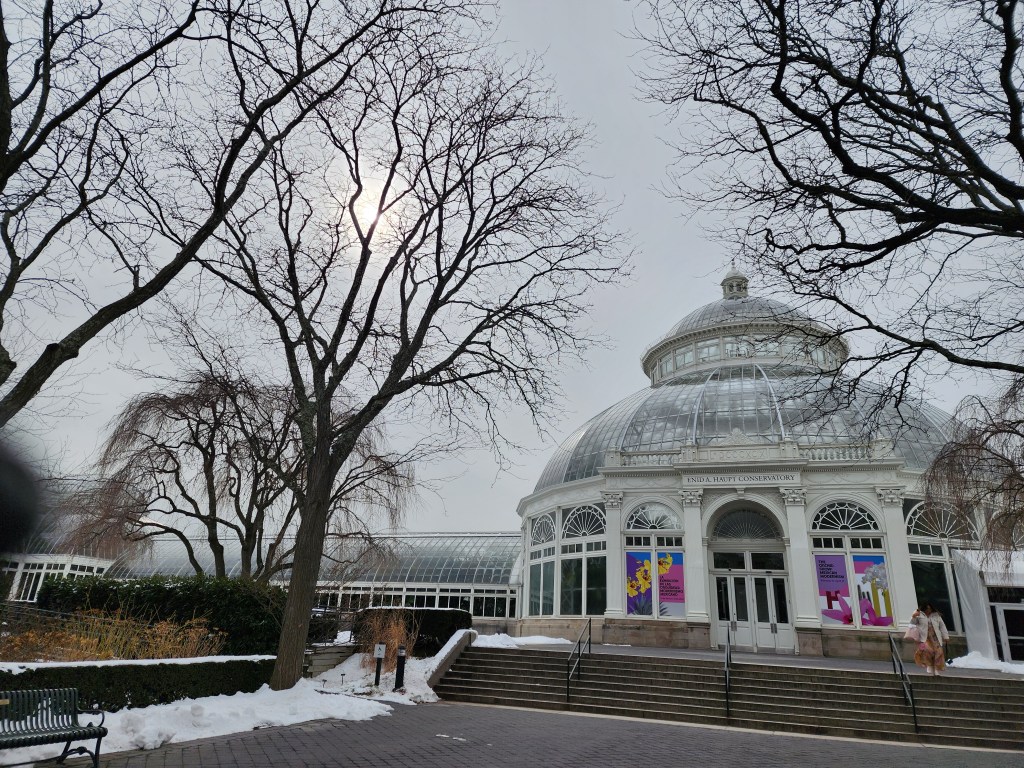
The show is superlative. In displays of orchids, one showier than the next, the exhibition, inspired by the vibrant, multi-hued designs of Mexican architect Luis Barragán (1902-1988), leaves one with a treasured emotional uplift.

It is just great knowing one may now walk through the galleries of the Enid A. Haupt Conservatory’s beauties taking in the breathtaking orchids in fabulous displays while the winter cold and potential snowfalls remain outside.


There’s no place better to be than in the comforting warmth of orchid pageantry, as one saunters through the conservatory’s splendid galleries.
This is NYBG 22nd Orchid Show
Moving through the various galleries beginning with the Palms of the World gallery, visitors will note the myriad orchid species from the family Orchidaceae. According to Marc Hachadourian, Director of Glasshouse Horticulture & Senior Curator of Orchids at NYBG, orchids grow in every continent on the planet except Antarctica.
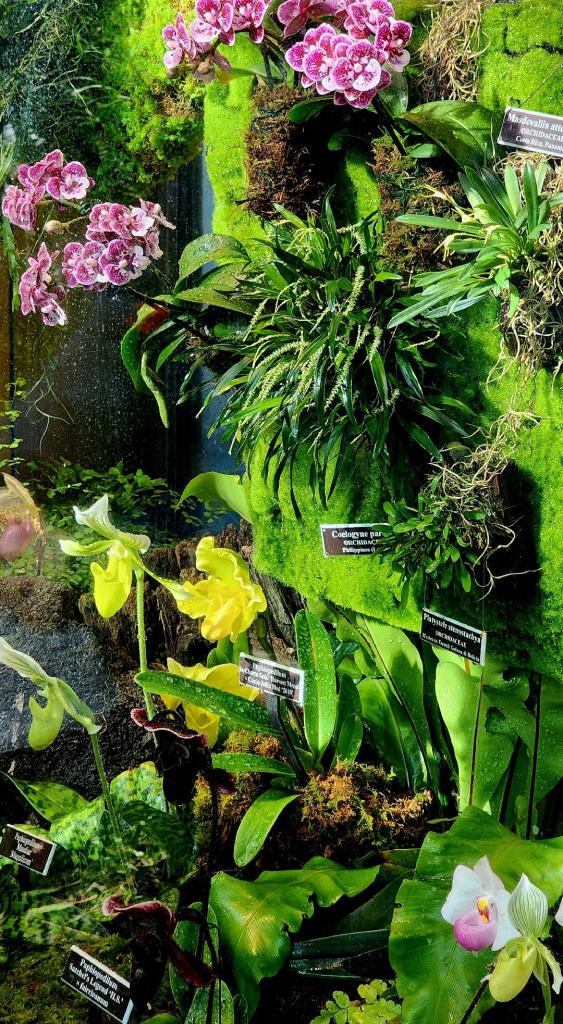
The orchid exhibit features rare orchids in the glass case just before you go into the rain forest gallery. Importantly, in color and variety, NYBG staff arranged thousands of orchids. Many from Mexico are featured on the Luis Barragán inspired yellow lattice fence designs that are perfect for growing the particular displays.
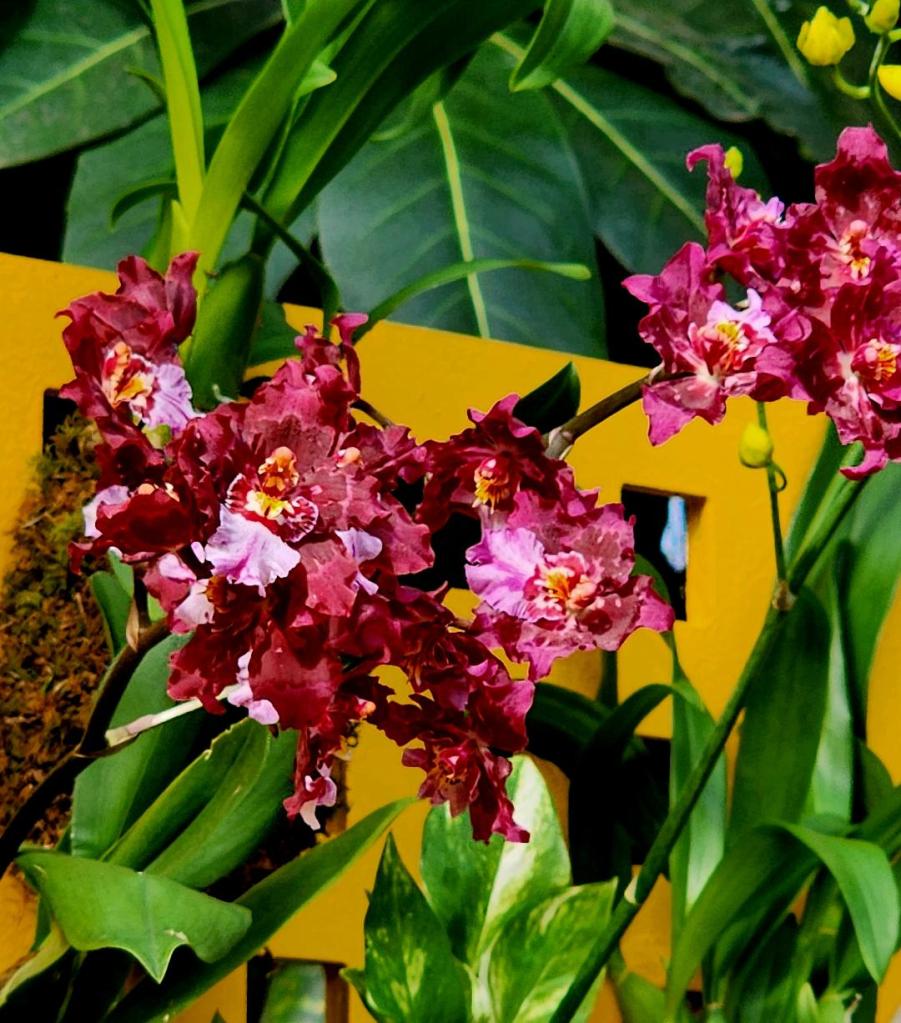
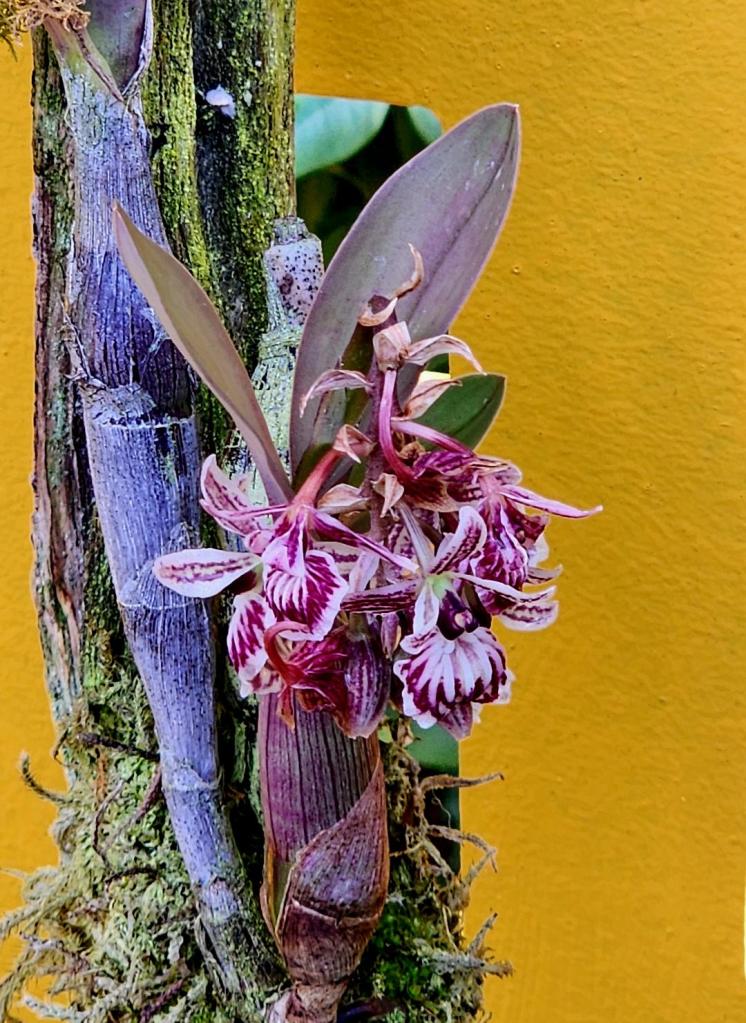
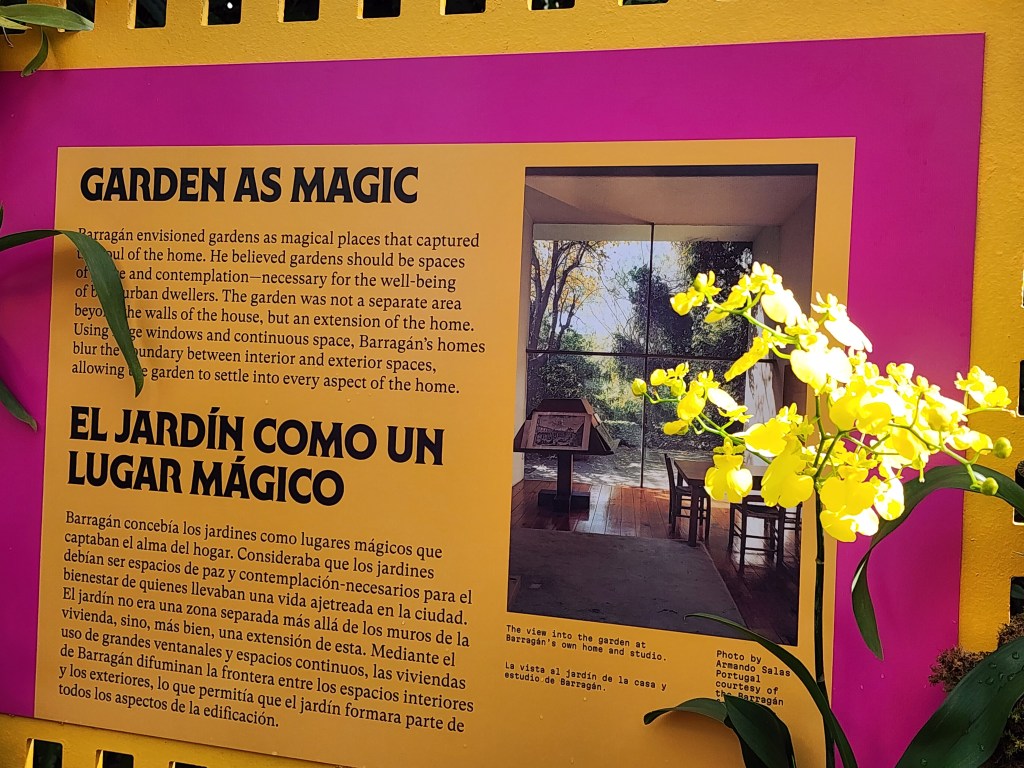
The exhibit is so utterly beautiful because it brings Luis Barragán’s renown, minimalist, architectural style to NYBG. According to those who elected to have Barragán as this year’s featured artist of the orchid show, Barragán was highly influential in defining Mexican modernist architecture. He adapted international trends using what was at hand in Mexico, suffusing Mexican culture and style with international ideas. His achitecture employed organic textures, vibrant cultural hues and native Mexican plants like cactus, agave and other succulents.
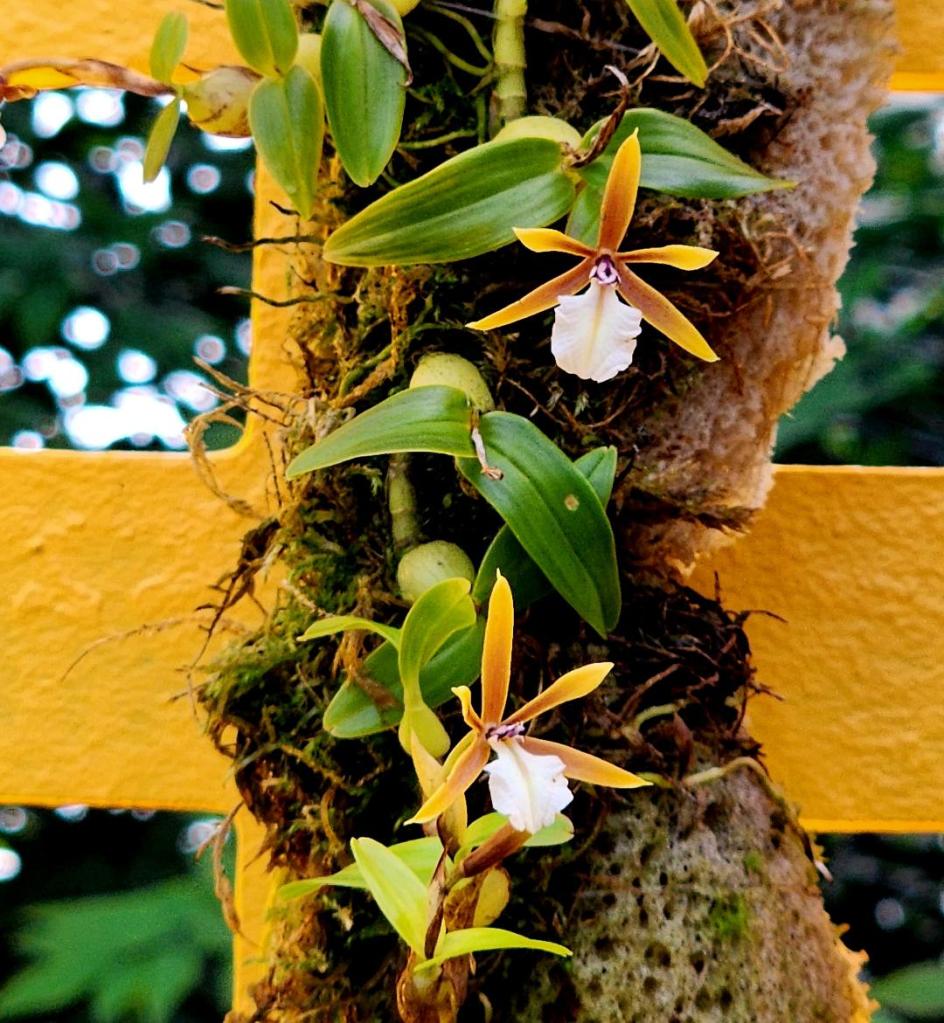
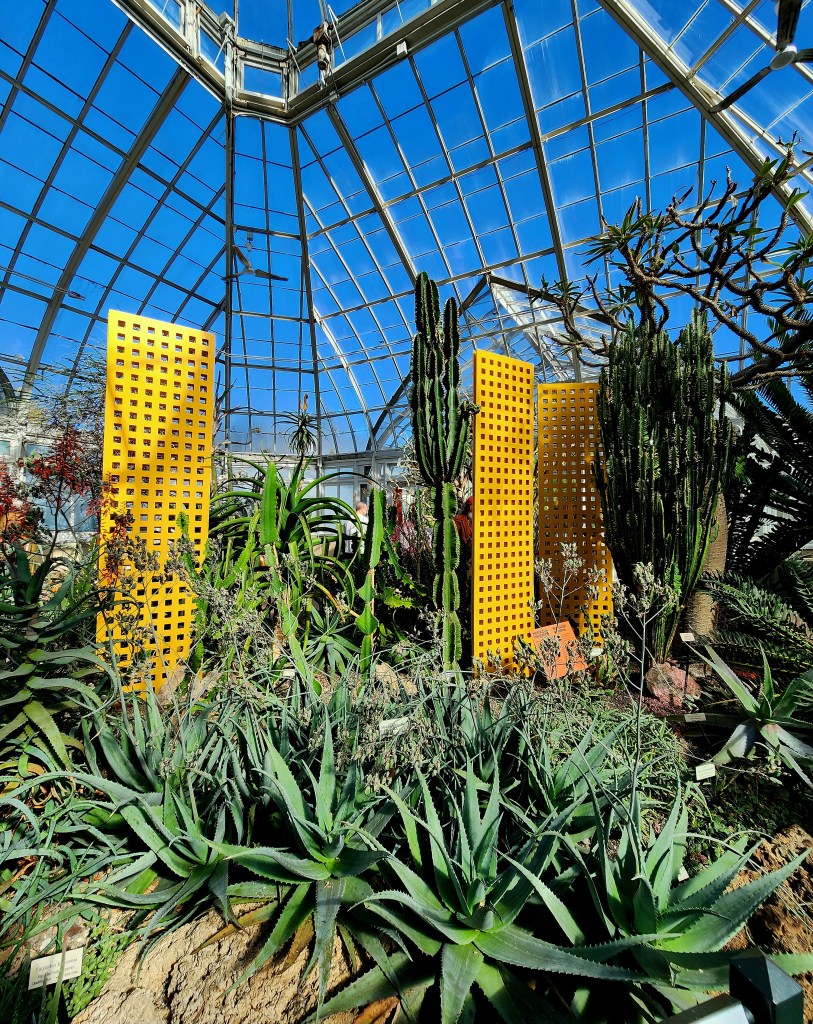
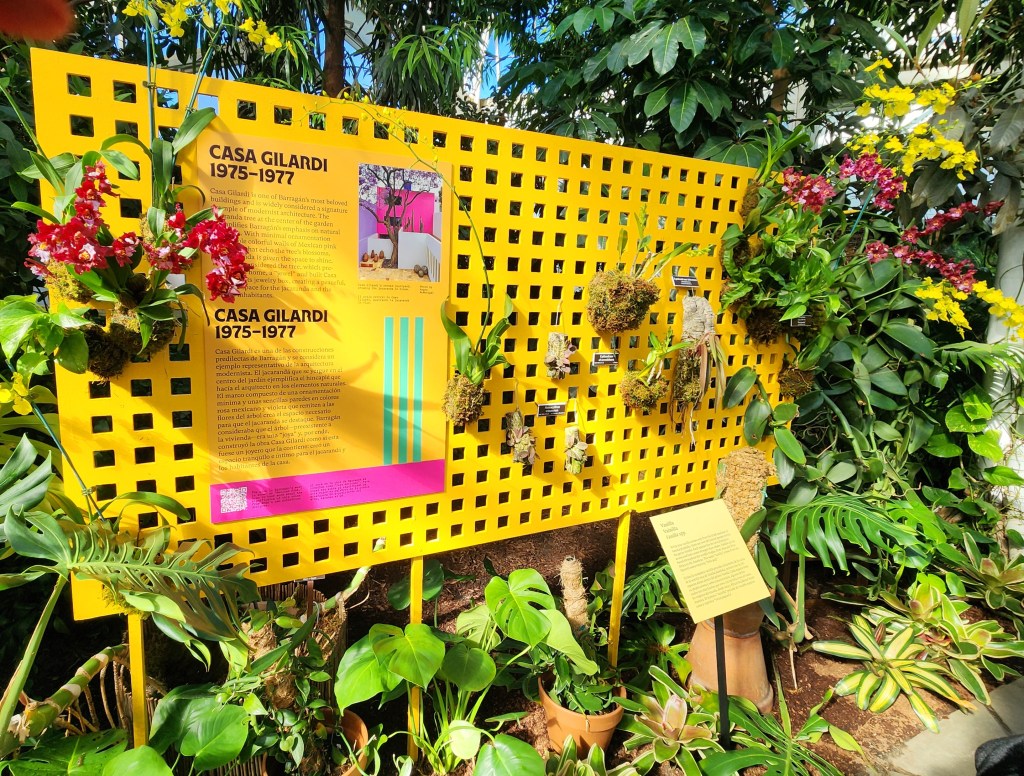
Look for the accompanying signage to understand how Luis Barragán’s designs meld with the unique orchids chosen for the yellow lattice fences (Carole Di Tosti)
In the rotunda, magic and contrast
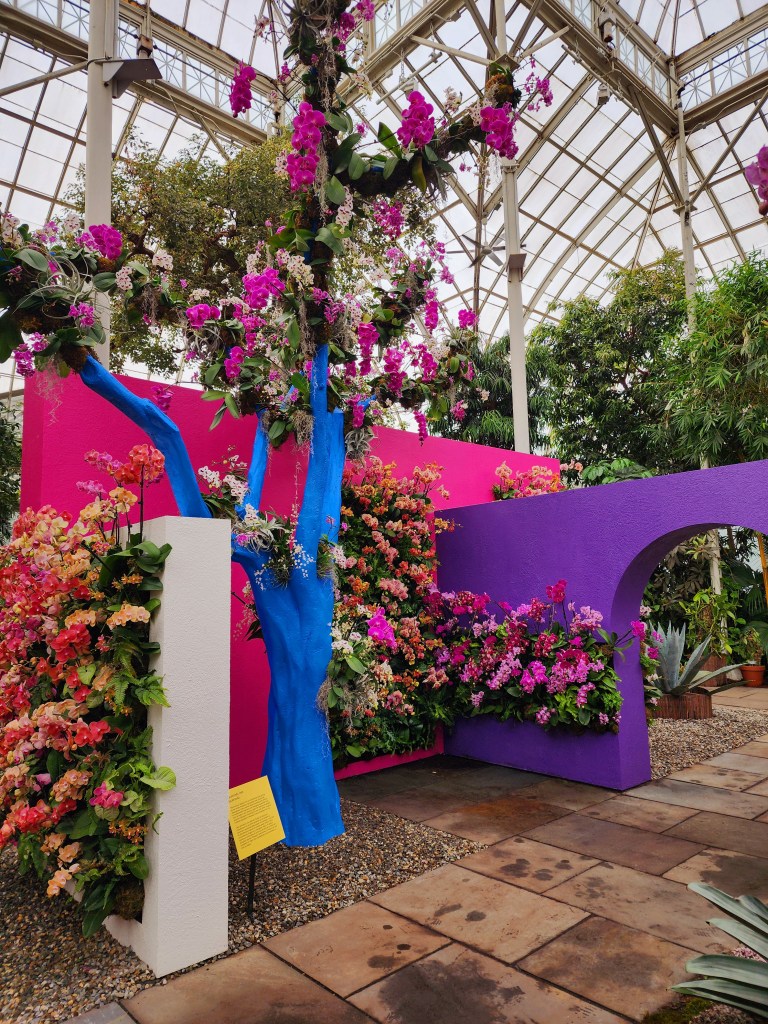
Barragán was able to master balancing contrasting elements: splashes of color pop against neutrals. Geometric shapes cast dramatic shadows across starkly hued vibrant walls. Clean lines emerge and strike against the circular shapes of lava rocks and prickly desert plants.

Check out the succulents which provide a curious and striking contrast to the exotic, luxuriant orchids attached to various walled structures, and lattice fences. The effect of the plantings encourages otherworldly, mesmerizing visuals.
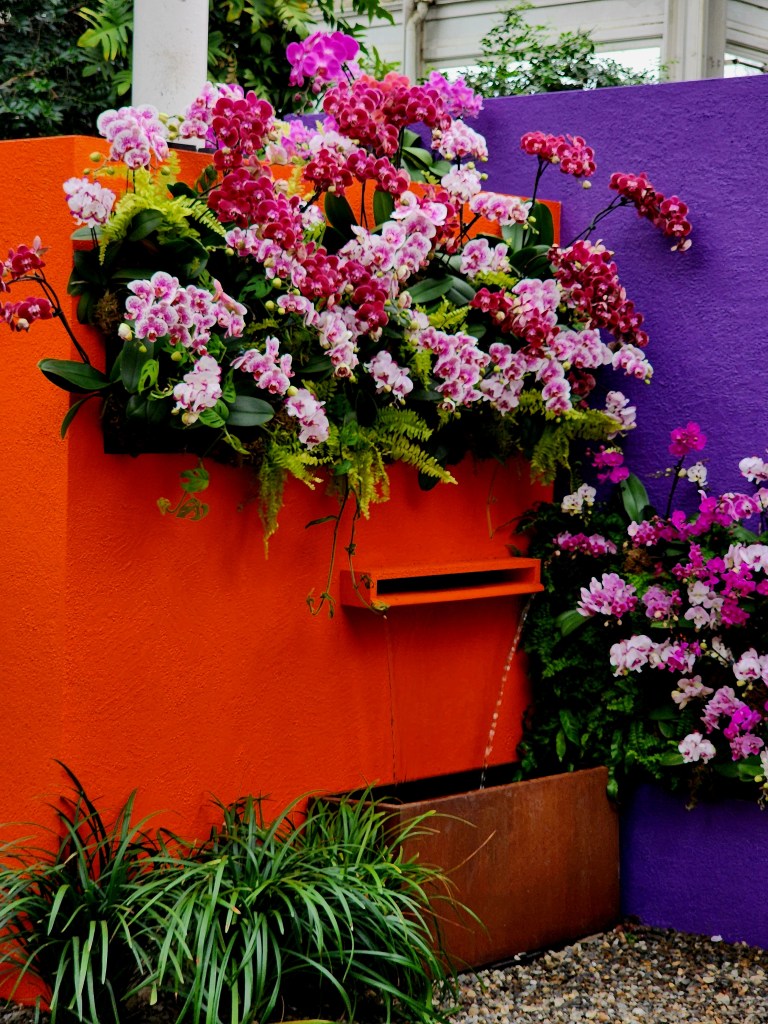
It is vital to remember that Mexico has a wide range of ecosystems that contain 10-12 percent of the world’s botanical species and their accompanying animal species. Mexico is one of the largest biodiversity hotspots on Earth. Additionally, it includes more than 1,300 orchid species, about 40 percent of which are endemic. In other words, they are not found anywhere else on the planet.

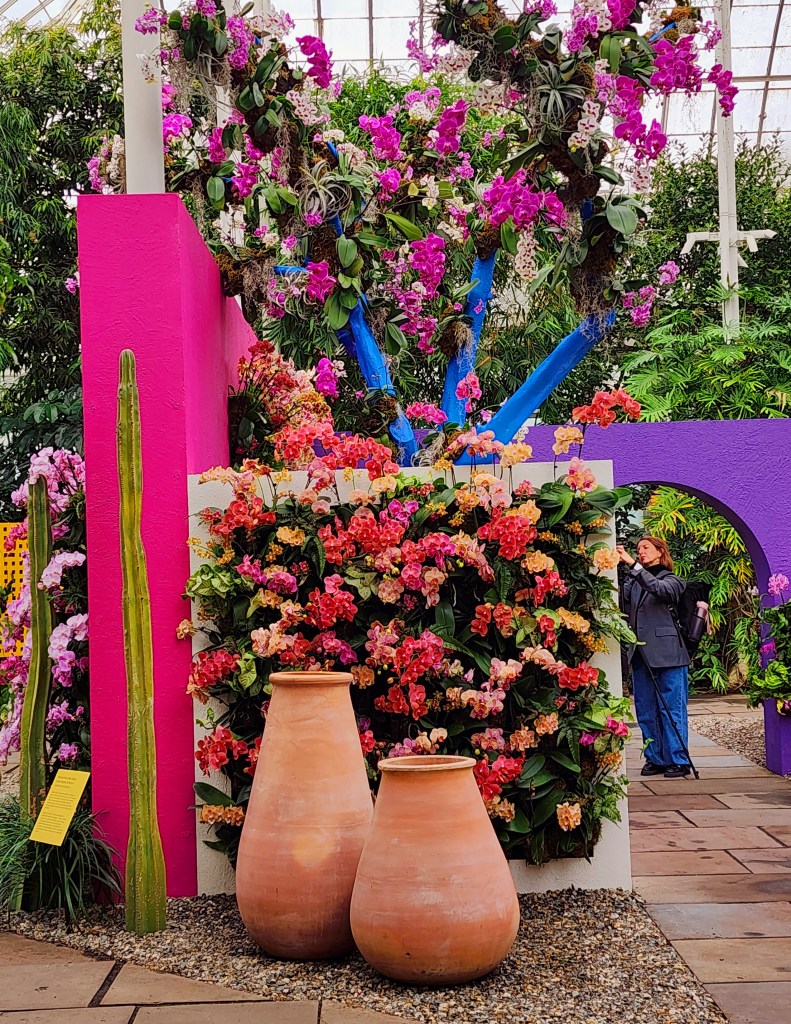

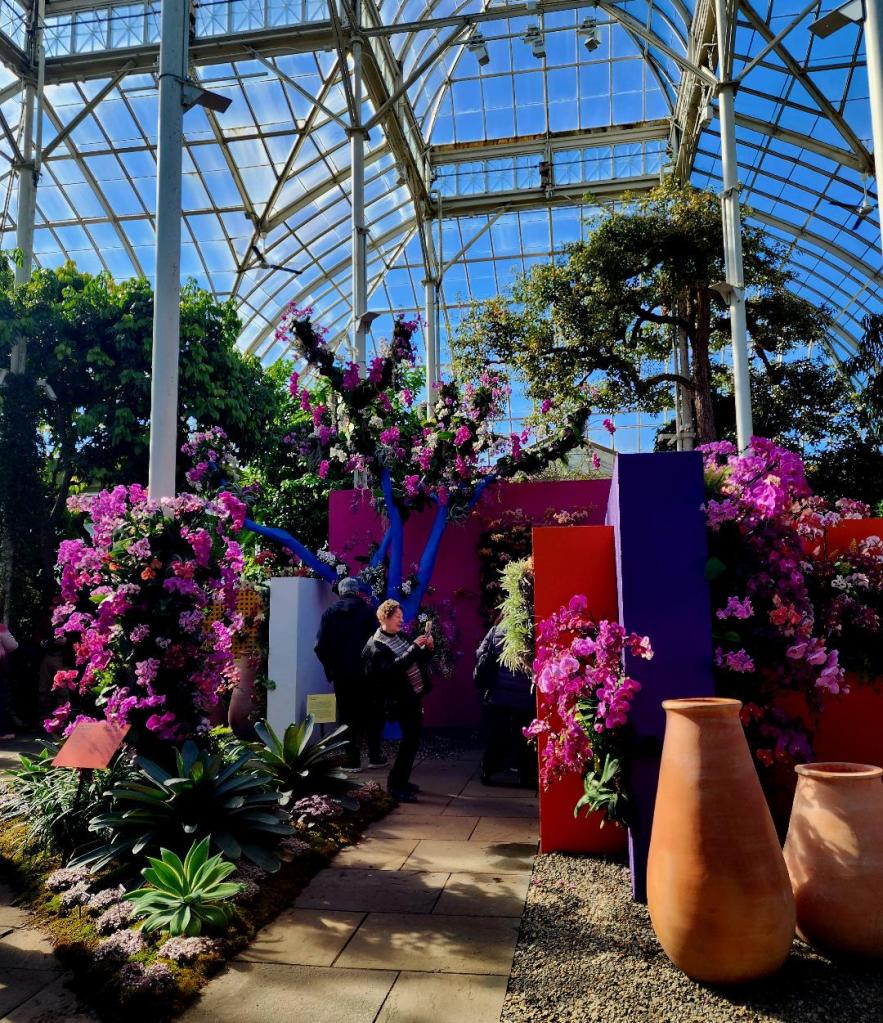
Walking through the galleries, note these native plants from Mexico and the surrounding plantings that feature the stunning orchids that are companion pieces to the walls and the fantasy blue tree in the rotunda. It is a multi-faceted display which is non pareil. Also, check out the water features which are reminiscent of the cooling fountains throughout Mexico City and smaller cities in Barragán’s beloved homeland.
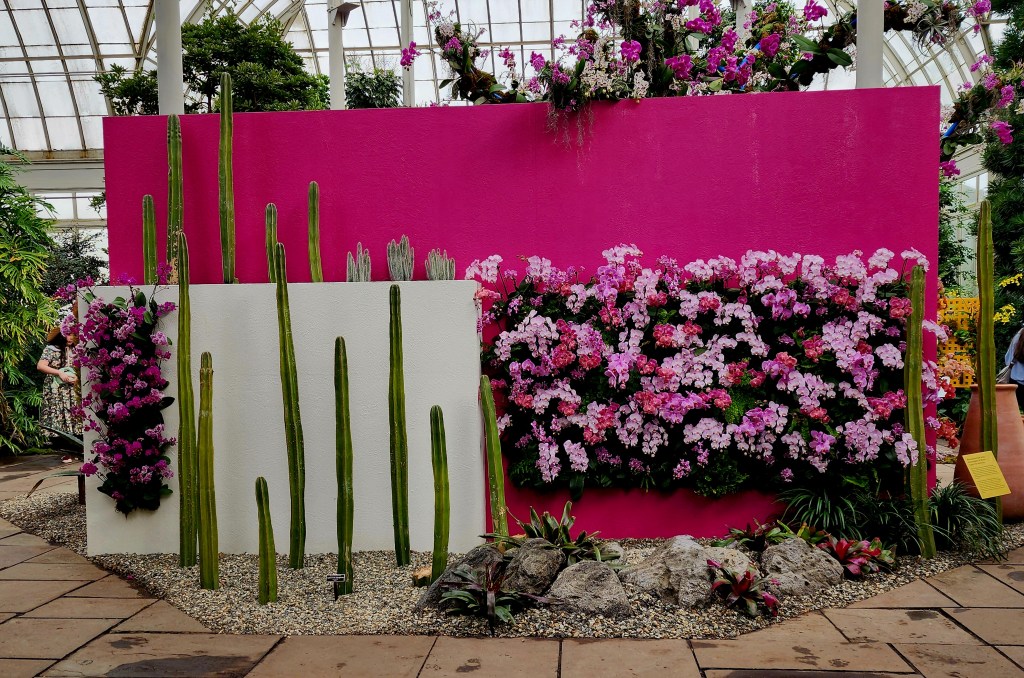

Numerous designs include a predominance of Moth orchids (phalaenopsis) in the large Barragán inspired structures. These are present especially in the Palms of the World Gallery, the rotunda and the walkway gallery, whose distance perspective is absolutely stunning.
The walkway gallery with stunning perspectives




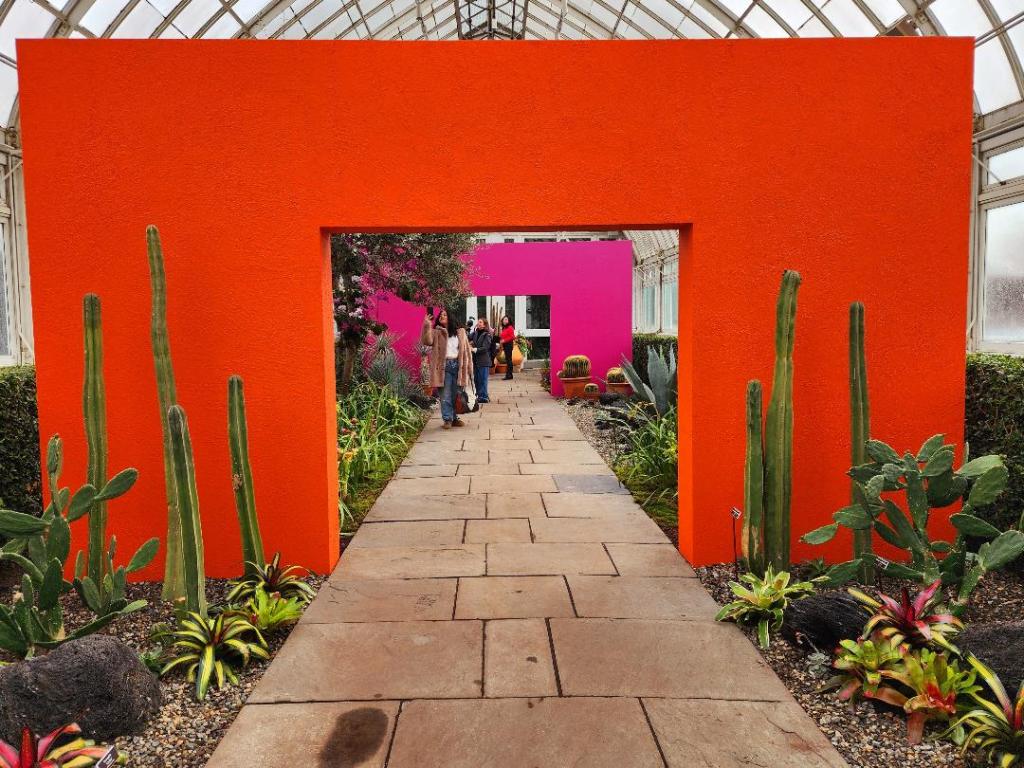

On your visit, make sure to stand with your back to the exit door of the Palms of the World Gallery and look toward the rotunda. As you look through the vistas of the diminishing rectangular walls of orchids, the combined effect will take your breath away.

One reason why you will see phalaenopsis in the large, spectacular displays is because they are hardier and last longer, looking vital and robust. Phalaenopsis maintain their blooms with proper care for more than a few weeks until they get dreary and droopy. NYBG staff continually replace orchids that have moved past their prime. Indeed, when I visited during the press preview, Marc Hachadourin was speaking with staff to insure that orchids and their plantings looked fresh and vibrant. He suggested that staff check places here and there which needed some attention.
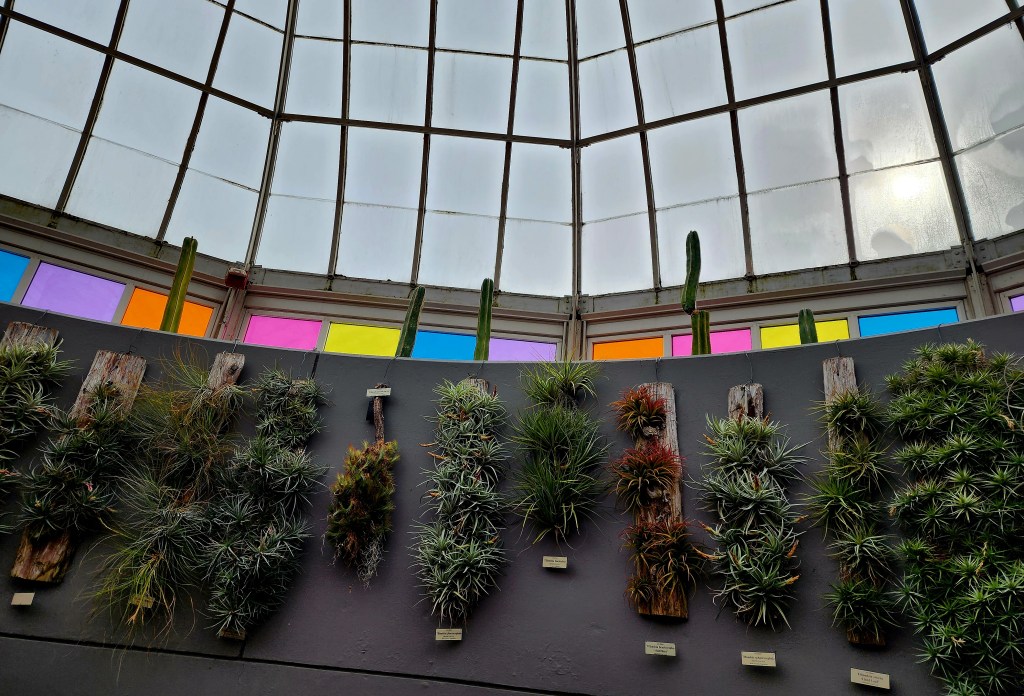
The 22nd orchid show, as previous shows have done, showcases diverse ecosystems where orchids make their home. Even in the desert gallery with the cacti and succulents featured in this show because of their relationship to Mexican environs, you will see that NYBG has an orchid that lives in the dry terrain of the desert. However, that orchid may not be blooming for you to see during this time in the season.


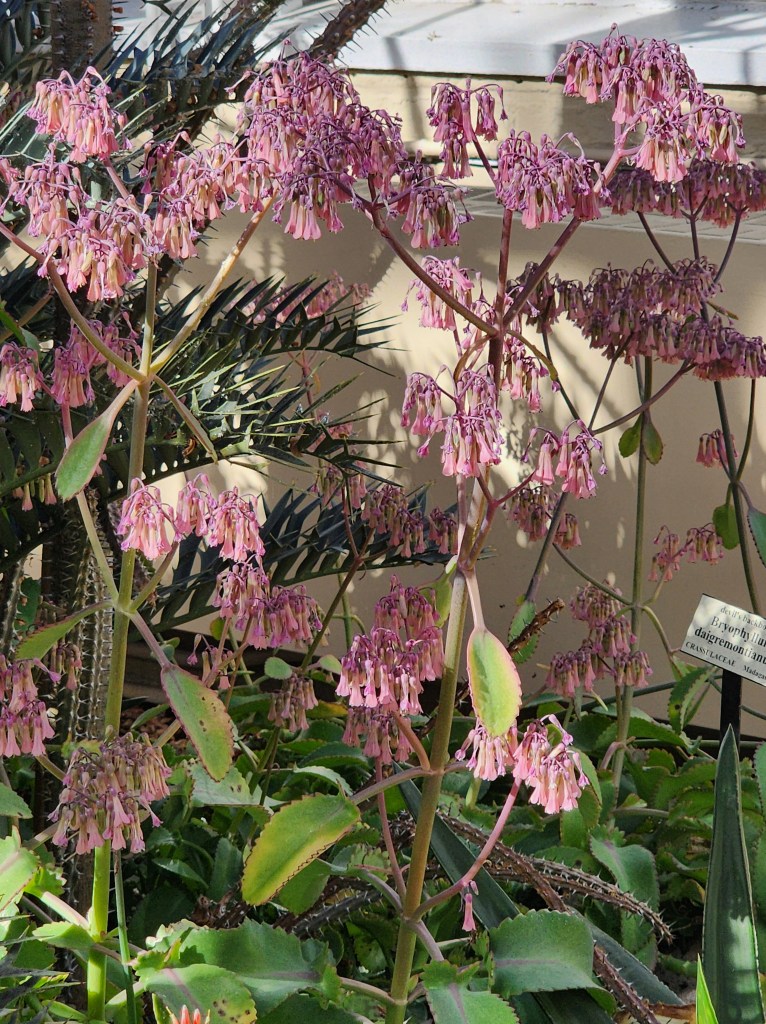
In one of the galleries where there were benches, I noted that visitors on Members Day crowded to sit and take in the glorious sights. They so enjoyed the serene and peaceful setting of the dazzling orchids, hanging vines, fountain splashing water and tropical beauty that created a magical world. They were loathe to leave and move on to the other galleries. As happens with the annual orchid show, members made sure to take their time to appreciate the exotic, ethereal orchid wonders.
ORCHID NIGHTS
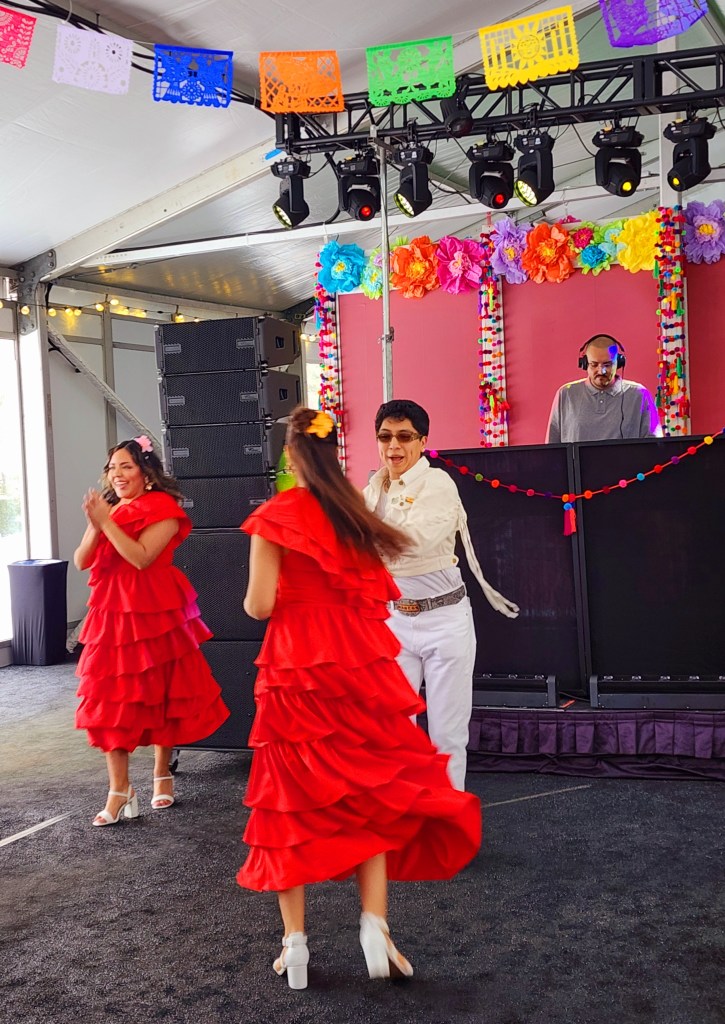
This magic can be experienced all throughout the exhibition various days and night and in different venues in a marvelous celebration of Mexico’s extensive botanical history. For example, on select evenings, Orchid Nights bring the happy beats of cumbia music, with cumbia sonidea dance parties led by a DJ and professional dancers.
Come to experience the party atmosphere of traditional tracks and modern influences that create an immersive dance experience. DJ hellotones, “El Hijo de PueblaYork,”is Bronx-born and at the forefront of a cultural renaissance that uplifts the Mexican diaspora in New York City.
Uplifted is the cumbia genre. Mark Saldana, a.k.a. Coolmarx, born and raised in Queens and based in Brooklyn, embraces variations of cumbia in his community-based dance lessons. These include cumbia colombiana, ecuatoriana, peruana, and mexicana.
Orchid Nights feature music and dancing, cash bars and food (lite bites) for purchase for adults 21 and over. Experience the energy and exuberance carried from the exhibit to the appreciation of all things Mexican. Select evenings are February 22; March 8, 25, 22 and 29; April 5, 12, 18, 19, 25, 26.
Photography Exhibit by Mexican-American Visual Artist Martirene Alcantara.
Check out the LuEsther T. Mertz Library to see how the artist captures the essence of Luis Barragán’s vibrantly colorful and geometrical works.
For additional programming go to https://www.nybg.org/event/the-orchid-show-mexican-modernism/
The Marvelous New York Botanical Garden ‘Holiday Train Show®’
All Aboard!
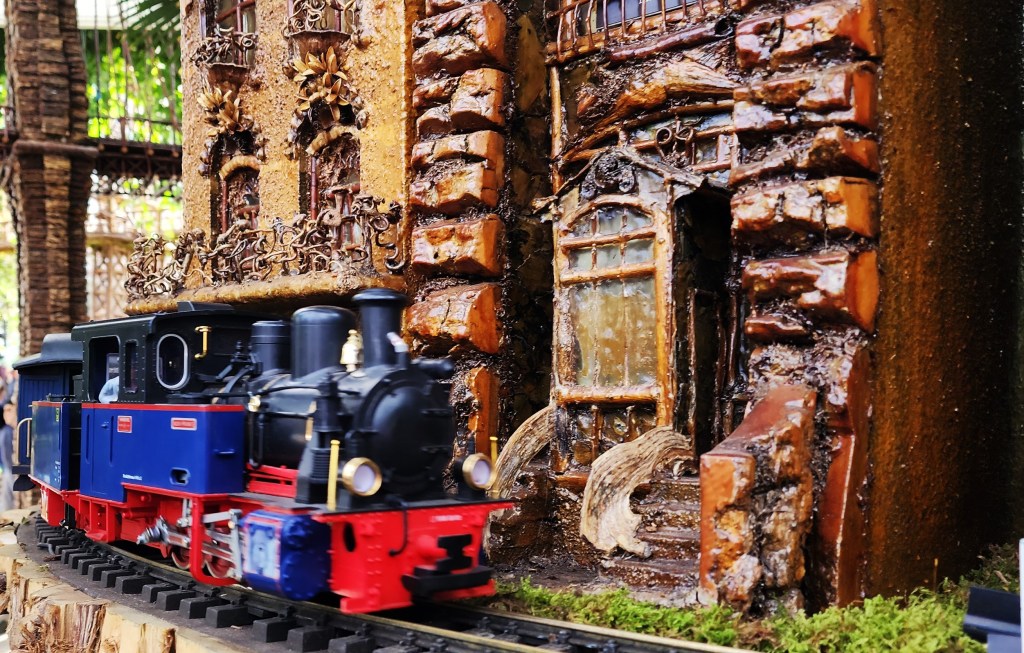


Now in it’s 33rd year, the magical NYBG Holiday Train Show® has arrived. This most thrilling and fun experience for families and friends runs from Saturday, November 16, 2024 through Monday, January 20, 2025.
Enid A. Haupt Conservatory exhibits
NYC favorite the Holiday Train Show® boasts G-scaele model trains zipping, racing and rollicking through galleries of the Enid Haupt Conservatory amidst gorgeous, rainbow hued plantings set to complement New York landmarks in miniature from NYC’s five boroughs to historic places in the beautiful Hudson Valley.


These replicas (i.e. Poe Cottage, the Park Avenue Armory, LuEsther T. Mertz Library, Cooper Union) are wonders in themselves because Applied Imagination’s creative team constructs them entirely of plant parts.
Practically every train type is represented from1880s American steam engines to modern freight and passenger trains with diesel engines, to trolleys and whimsical cars.


Woodland outdoor display
The woodland outdoor display created last year is an enchantment for all.


Trains chug around whimsical mountain structures on the ground and high above on trestles so that high visitors may walk under the bridges. The landscape is filled with forest animals and creatures, winter-interest plants and marvelous fungi.
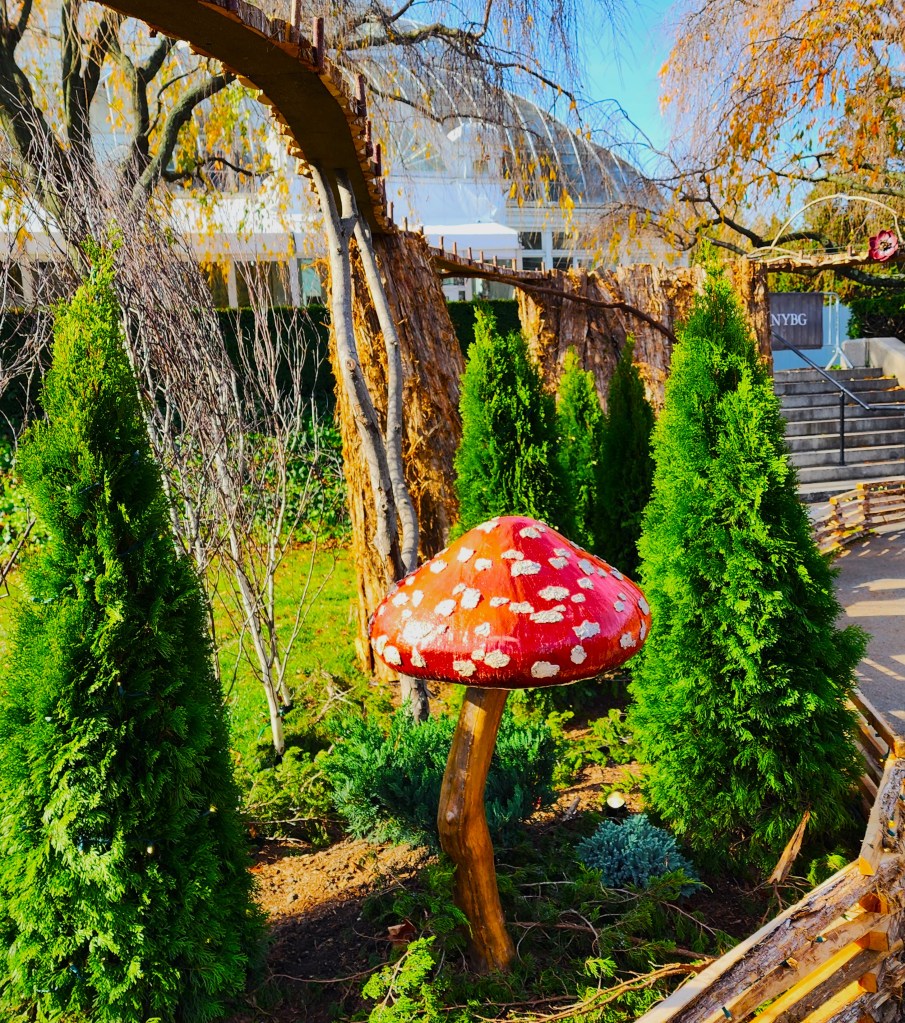
All these and more enchantments unfold on the conservatory Lawn begging to be seen, like the owl perched above looking down on laughing children and smiling adults.


Events
NYBG and Tea Around Town
This year NYBG has partnered with Tea Around Town, a sightseeing tour bus that serves afternoon tea and brings the excitement and delight of the season from Manhattan to NYBG. First, join Tea Around Town’s festive journey to NYBG’s Holiday Train Show®. On the bus you will enjoy special teas, delicious treats and merriment served by elves aboard a beautifully decorated bus that celebrates the season. Disembarking from the bus, you will walk through the Holiday Train Show exhibits appreciating the craftsmanship and skill of Applied Imagination’s ingenious team and the clever botanical designs of the NYBG staff.

The Tea Around Town bus will run Tuesdays in November and December, and Thursdays and Sundays from November 19th through January 20th. The bus departs from Central Park South at 11 a.m. and leaves NYBG at 3 p.m. to return to Manhattan. Also, in November and December, Tuesdays and Thursdays, 1-2:30 p.m., Santa and an elf will be on-site in NYBG’s Leon Levy Visitor Center for photo opportunities with visitors.
Holiday Train Nights
Everyone enjoys another favorite event of the NYBG Holiday Train Show® at Holiday Train Nights. There is nothing more mysterious and beautiful as the glowing colored lights in the evenings where another atmosphere takes over the Garden landscape and inside the Enid A. Haupt Conservatory. Viewing the replicas twinkling with lighting from within and without. Enjoy listening or bopping along with holiday classics and Christmas pop favorites sung by performers in the Locomotive Lounge of the Visitor Center. Enjoy sweet and savory bites, spiked cider cocktails and mocktails, and hands-on gingerbread decorating your own for purchase.

Holiday Train Nights take place on 16 select evenings. Ten of them are for adults only from 7 to 10 p.m. Six of the evenings are for all ages from 6 to 9 p.m. Holiday Train Nights are ticketed through NYBG’s presenting partner Fever.

For adults
During adult Holiday Train Nights adults age 21 and older will be able to view the Train Show under an entirely different evening aura. There is also festive food and curated cocktails available for purchase. The dates are as follows: Saturday, Novembr 21; Friday, November 29; Saturday, November 30; Saturday, December 7; Friday, December 13; Saturday, December 14; Saturday, Decembr 28; Saturday, January 4; Saturday, January 11; and Saturday, January 18.
For families
All ages can enjoy Holiday Train Nights with hands-on activities on the following dates: Friday, December 20; Saturday, December 21′ Sunday, December 22; Monday, December 23; Thursday, December 26; and Friday, December 27.
More coverage will appear on this blog about NYBG Holiday Train Show. For additional information visit https://www.nybg.org/
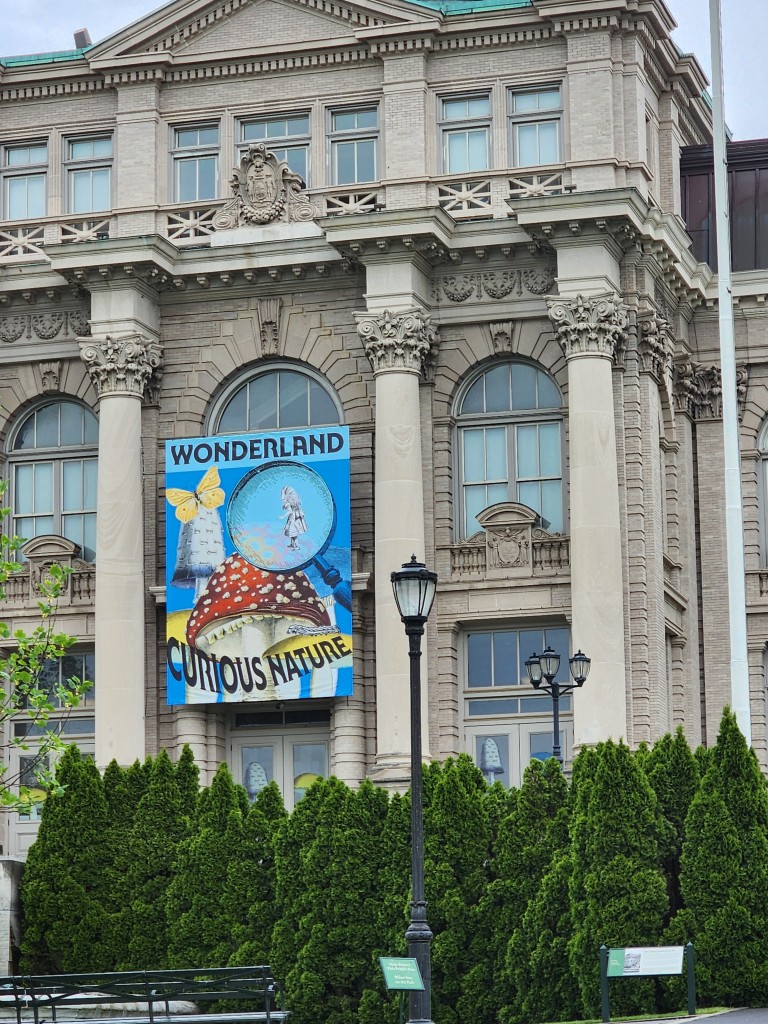
‘Wonderland: Curious Nature’ at New York Botanical Garden
Victorian “Age of Wonder,” Alice’s Adventures in Wonderland, a Fascinating Exhibit
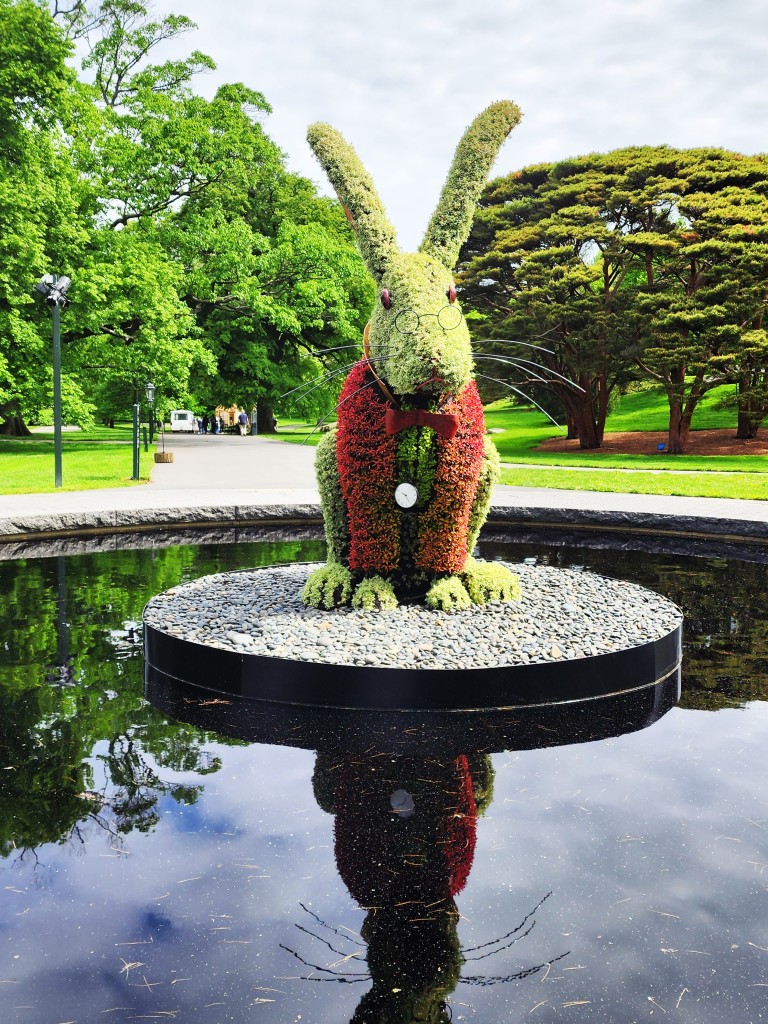


NYBG opened its latest exhibit this weekend. Inspired by the classic Alice’s Adventures in Wonderland and the sequel, Through the Looking-Glass, And What Alice Found There, by Lewis Carroll, the all-new garden-wide exhibition is whimsical and full of fun and surprising features.

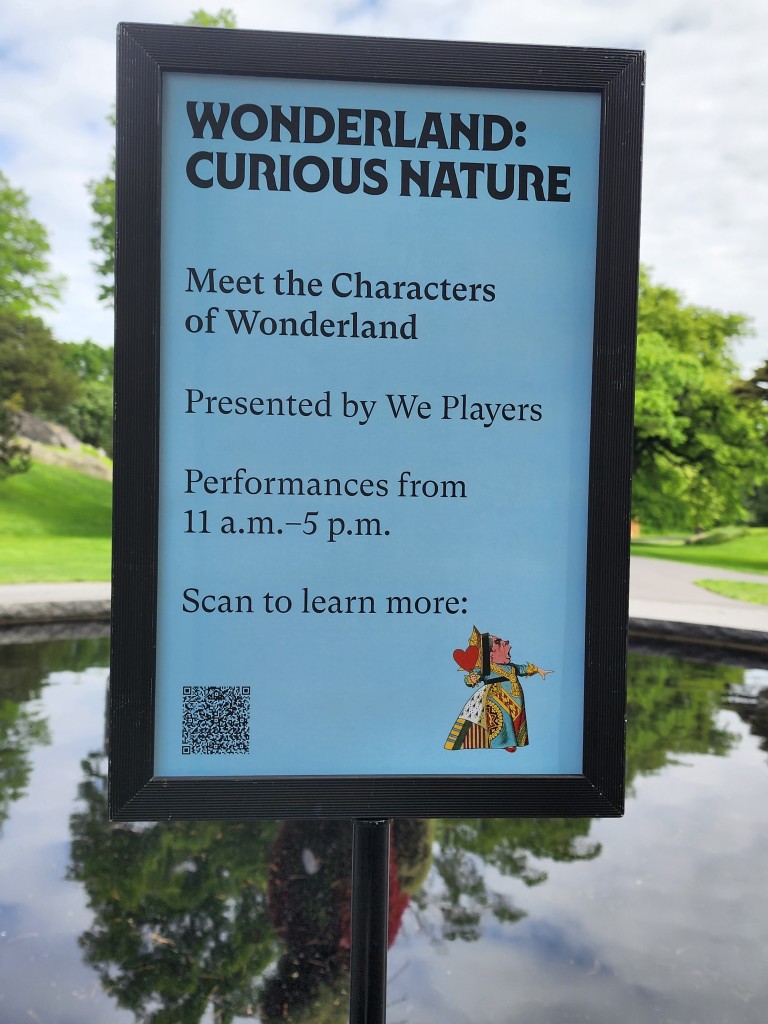
Today, Sunday is the Opening Weekend Garden Party Celebration from 11 a.m. to 5 p.m. on Daffodil Hill. You can dine as a special guest at the Queen’s Tea. And you can encounter The Mad Hatter, Alice, the Red Queen, and other Wonderland characters popping up on the walkways throughout the Garden.
OPENING WEEKEND GARDEN PARTY CELEBRATION TODAY, SUNDAY, MAY 19
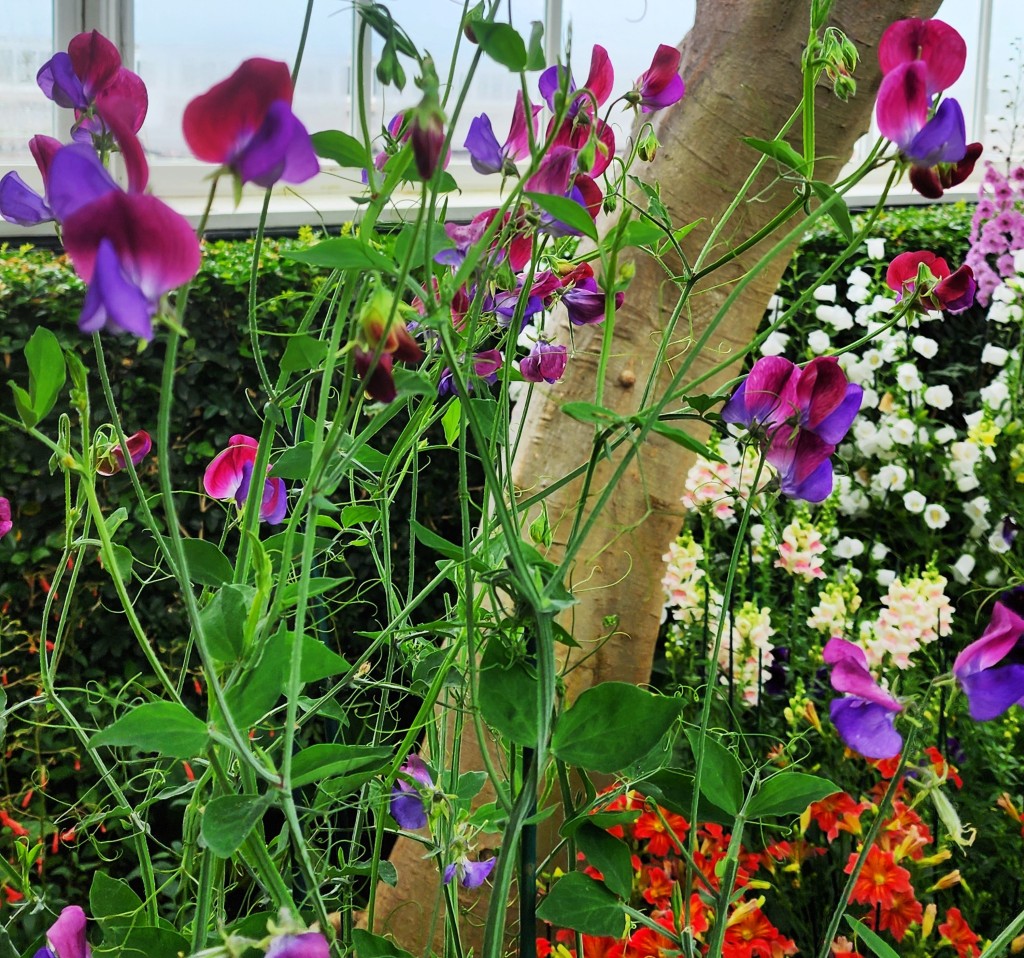
Today, May 19, Sunday, there are lawn games like croquette, and other craft activities. Or if you prefer to meditate and reflect as you relieve the stresses of a hard work week, just enjoy a self-guided tour following the digital signs as you appreciate the Garden in its glorious pageantry in the spring. Everywhere you look there is a plant wonderland and themes from Carroll’s works and the Victorian era’s new age of exploration and wonder.
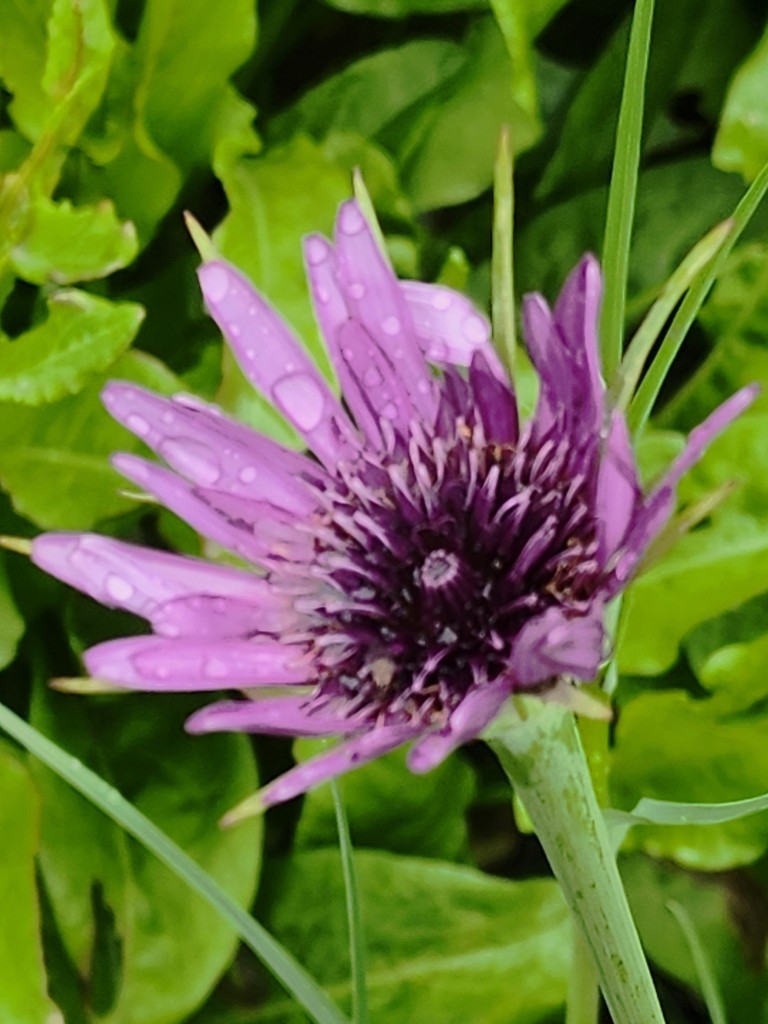


And as you are swept up in the Garden’s heavenly beauty you just may see a Cheshire Cat grinning out at you, for real. Certainly, if you let go, that Cheshire is there smiling at your happiness that you’ve treated yourself and your family to the Garden’s fantastical retreat.
Follow the Signs
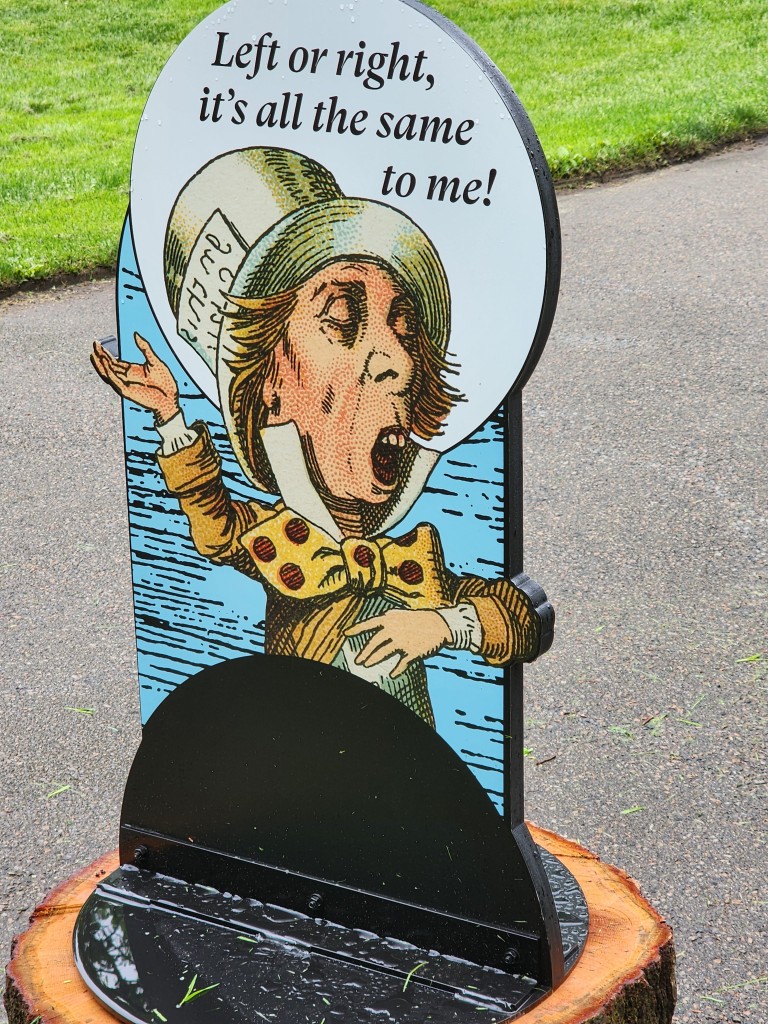


Plants Inspired by Oxford Botanical Gardens, Where Lewis Carroll Walked

The Wonderland Exhibit continues at LuEsther T. Mertz Library. Visit the galleries to see the contemporary global artists, i.e. Abelardo Morell, Beverly Semmes, Agus Putu Suyadnya and others inspired by Carroll’s books. There are artworks reflect the global appreciation of the wacky characters and settings found in Alice’s Adventures. And in the rotunda of the Library look at the exhibit of dried mind-altering plants, their descriptions, and the songs and books they inspired which reference Carroll’s work. Some of these plants like opium and various mushrooms promoted altered states. The plants influenced Carroll’s idea about perception that he incorporated in Alice’s Adventures in Wonderland and Through the Looking-Glass, And What Alice Found There.
Wonderland: Curious Nature runs until October 27, 2024

The events run from this weekend through October 27th across three seasons, spring, summer and fall. There are programs for the entire family and even the characters from the fantastical books by Lewis Carroll show up to entertain and frolic down the Garden’s pathways always ready for a photo or chat with the more serious patrons wanting to find out more about the characters they portray.


Wondrous people and plants.
Look out for unusual characters and unusual plants that enjoy a marriage with insects like the fern below.

Wonderland: Curious Nature is not only fun, it is ingenious. From the spectacular flower show in the main galleries of the Enid A. Haupt Conservatory to the scheduled tea parties and brunches in the Stone Mill near the Peggy Rockefeller Rose Garden and different menu offerings at the Hudson Garden Grill, there is something for everyone. I will update the exhibit coverage in weeks to come.
For specific programming, go to the New York Botanical Garden site: https://www.nybg.org/event/wonderland-curious-nature/wonderland-curious-nature-programs/wonderland-curious-nature-opening-weekend/
The Orchid Show: ‘Florals in Fashion’ at The New York Botanical Garden


The Orchid Show: Florals in Fashion runs from February 17 through April 21, 2024

Orchid Extravaganza
The orchid extravaganza at NYBG is always a unique and winning experience whether one goes in the day or in the evening hours for Orchid Nights. This yar, the 21st edition of NYBG’s iconic annual orchid exhibition features stunning fashion-inspired floral designs from three celebrated artists.
Meet the Floral Designers
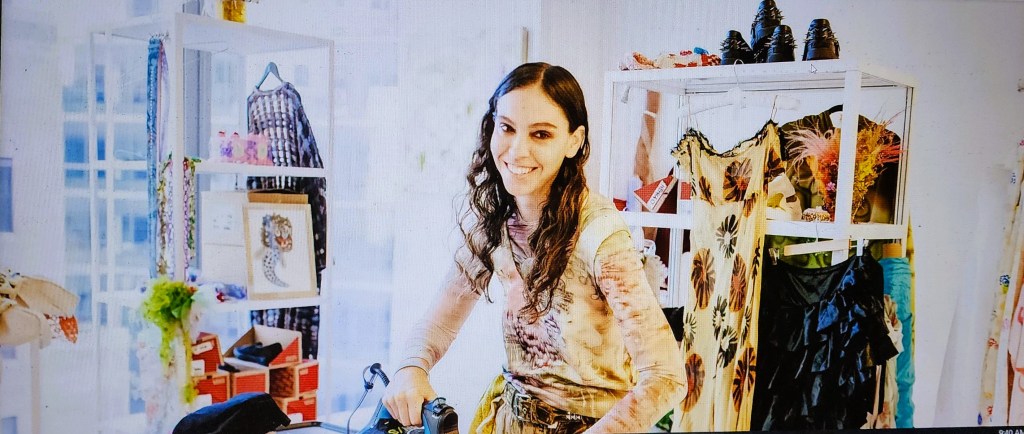


Floral Fashions by Collina Strada, Dauphinette and FLWR PSTL
The designers are Collina Strada by Hillary Taymour, Dauphinette by Olivia Cheng, and FLWR PSTL a.k.a. Kristen Alpaugh. The exhibit features the cleverness of the designers who integrate a gorgeous variety of orchids into their fashion creations in a dazzling and particular way. You will want to return again and again to marvel at the intriguing fashion designs composed of orchids and companion botanicals displayed poetically and artistically on mannequins.
Journeying Through NYBG Florals in Fashion
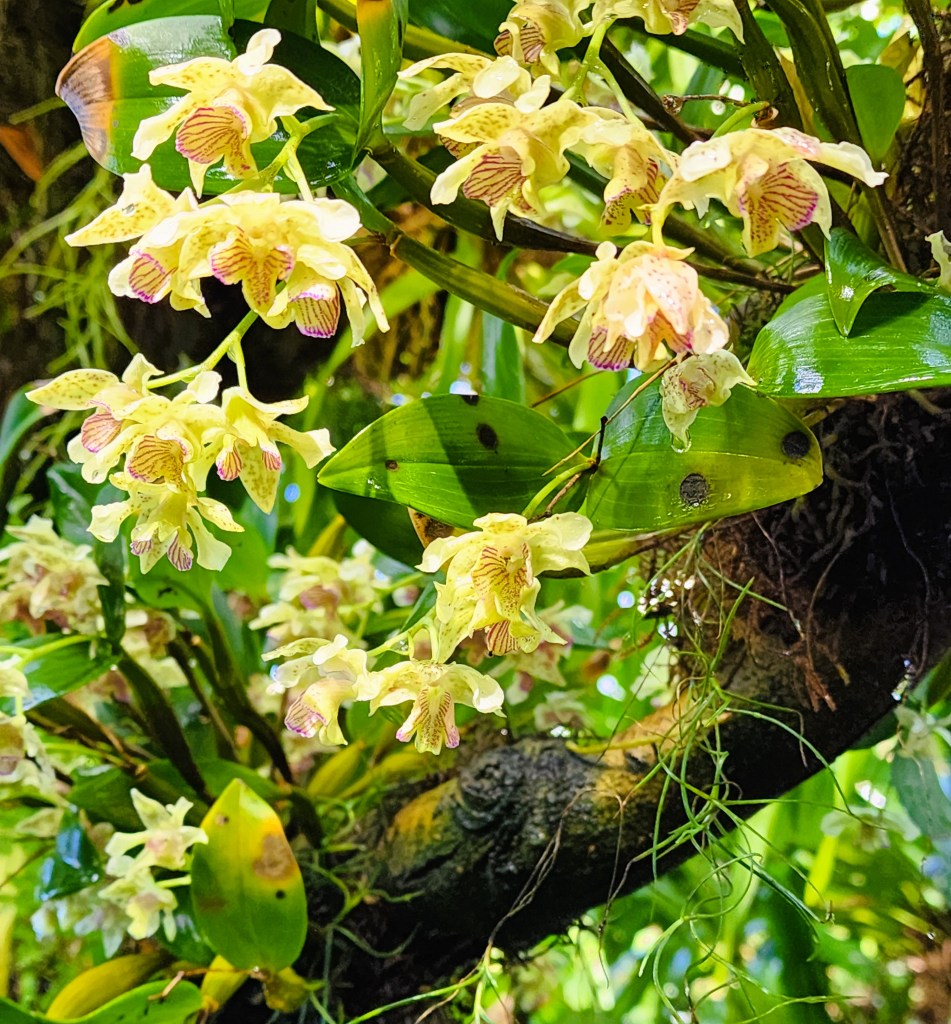


Orchids Always Inspired Fashions
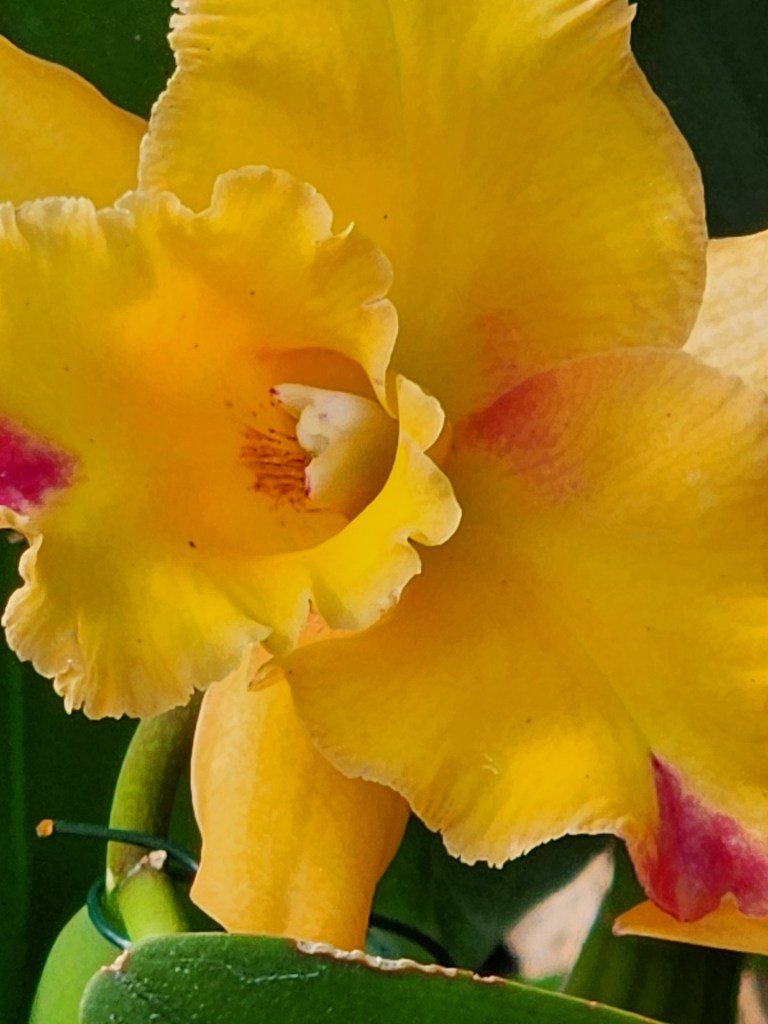
For decades orchids, the most highly evolved, largest and most diverse families of flowering plants on the planet, have inspired fashions from Halston to Rodarte. For the 21st annual orchid exhibit, the NYBG horticulturists selected a showy panoply of specimens both popular and rare from the Garden’s collections. Interspersed among the orchids beautiful arrays are striking botanical specimens whose eye-popping collection accentuates the variety of hues, textures, sizes and differences in the wide-ranging orchid family. Some of these include epiphytic cacti, carnivorous nepenthes, air plants, beauteous bromiliads, maidenhead ferns and many more.
Olivia Cheng


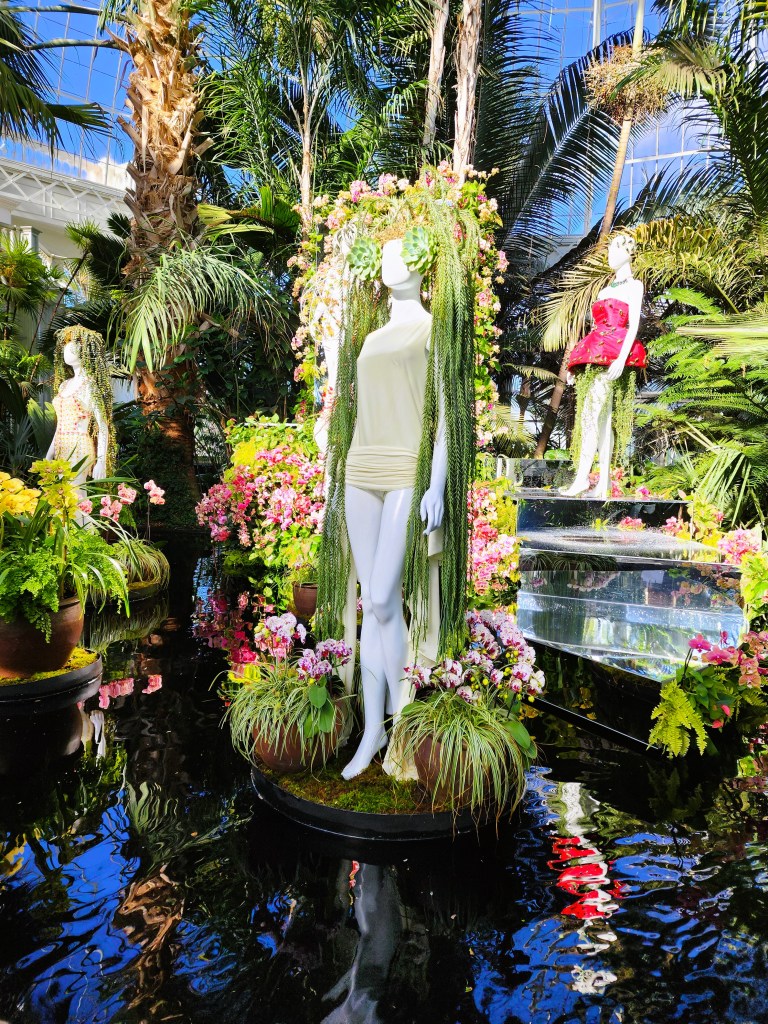
In the Palms of the World Gallery Olivia Cheng of Dauphinette (https://www.instagram.com/p/CljdMacgnRH/) presents her amazing designs centered among the orchid displays which serve as the backdrop to frame Cheng’s creations amongst mirrors and a grand staircase. Headdresses of Tillandsia air plants suspended with an orb create a floating effect. Sustainable plant-based outfits are finely made of vibrant living material, i.e. elegant blue-green tresses of Huperzia, pastel rosettes of Echeveria, and delicate Spanish moss.
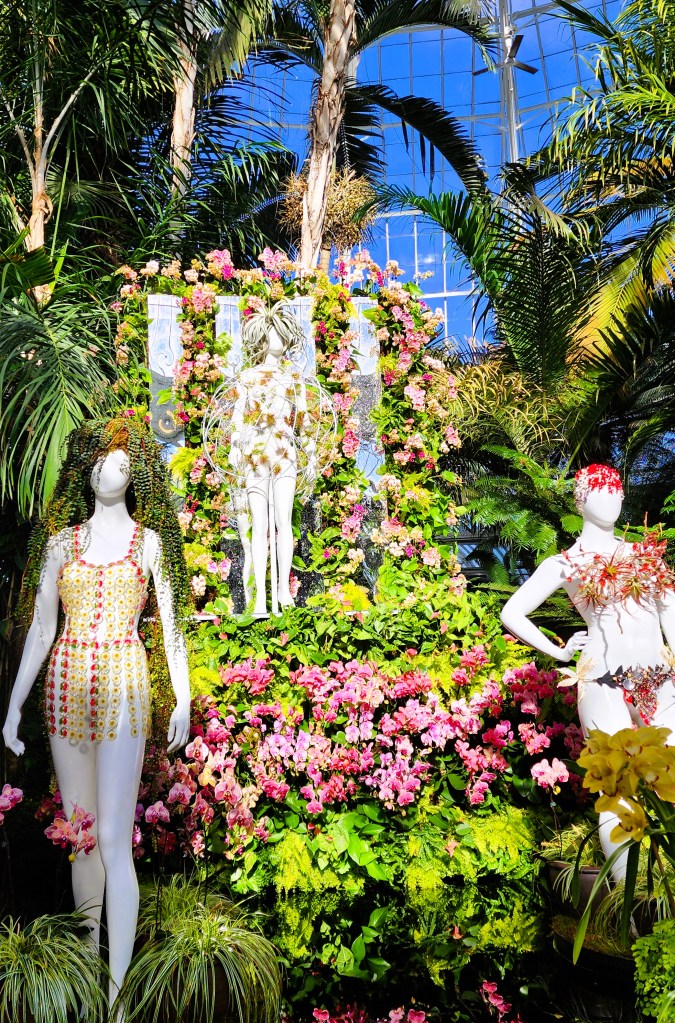

“A soft yet spikey palette of grasses, air plants and greens are the perfect foil to the orchids in Olivia Cheng’s edgy, ethereal designs. Cheng founded her fashion brand, Dauphinette, by transforming upcycled materials. The brand has since expanded with botanicals-including real resin-cast flowers and hand-drawn prints-enduring at the heart of Dauphinette’s designs.” (NYBG)


Cheng says of orchids, “Orchids have this very pristine and fantastical quality to them. And fashion is all about reinterpretations of what makes a person sexy or beautiful. That’s what makes orchids within fashion so symbiotic”

A Journey of Orchids Through Enid A. Haupt Galleries
From the Palms of the World Gallery and Cheng’s exhibit one proceeds along the orchid journey through the Conservatory’s Lowland and Upland Rain Forest Galleries. Along the way, look up to see hanging orchids seeking higher real estate up from the forest floor where there is more accessible light and moist air which they adore. Look down and you will note the Cymbidiums which flourish in soil as do the Lady Slipper Orchids.
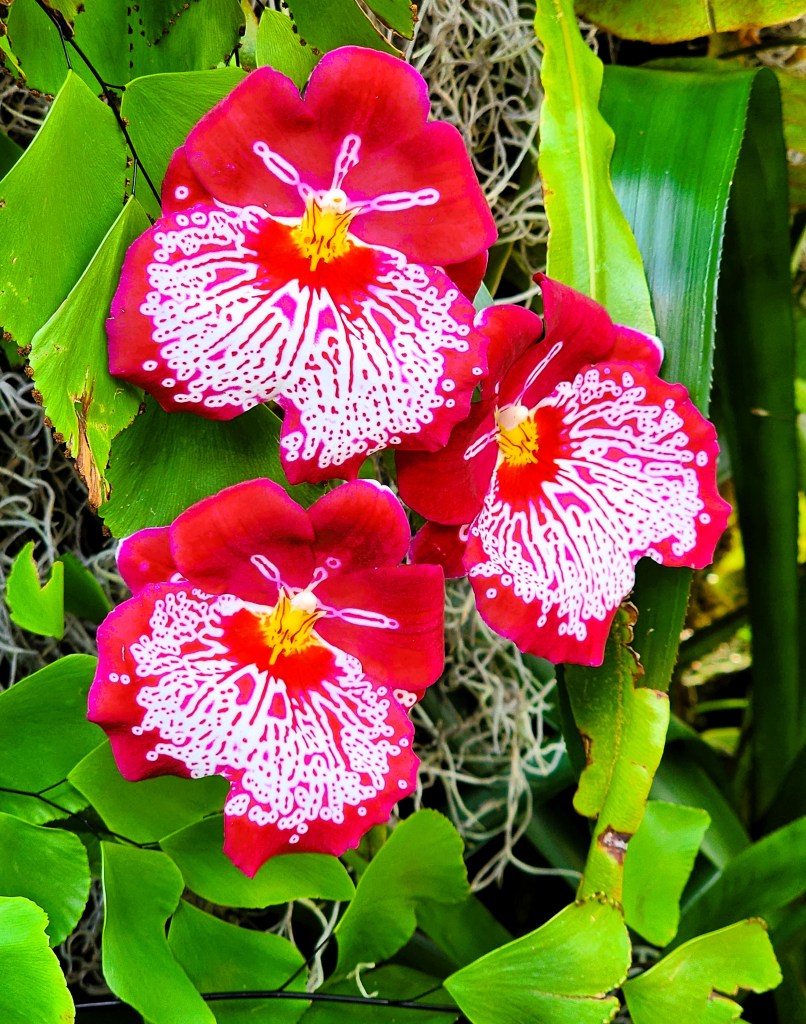


Following the orchid journey you will notice the great diversity of orchid hybrids in magnificent colors which will take you through the tunnel of lights, your own runway, if you will, through the desert gallery.
Seasonal Exhibition Galleries, FLWR PSTL
Kristen Alpaugh https://www.instagram.com/flwrpstl/?hl=en shared the names of the figures she has decked out. They are dramatically expressive of a variety of emotions. Central in the rotunda is Regina. Regina towers up and beckons with warmth in a 360 degree panoramic cape of Phalaenopsis in various shades of pink, purple and fuscia companioned by mini ferns. Up high are air plants, Spanish moss and miniature orchids encircling Regina’s face with Alpaugh’s signature “Iritherium” (iridescent painted Anthurium plants).

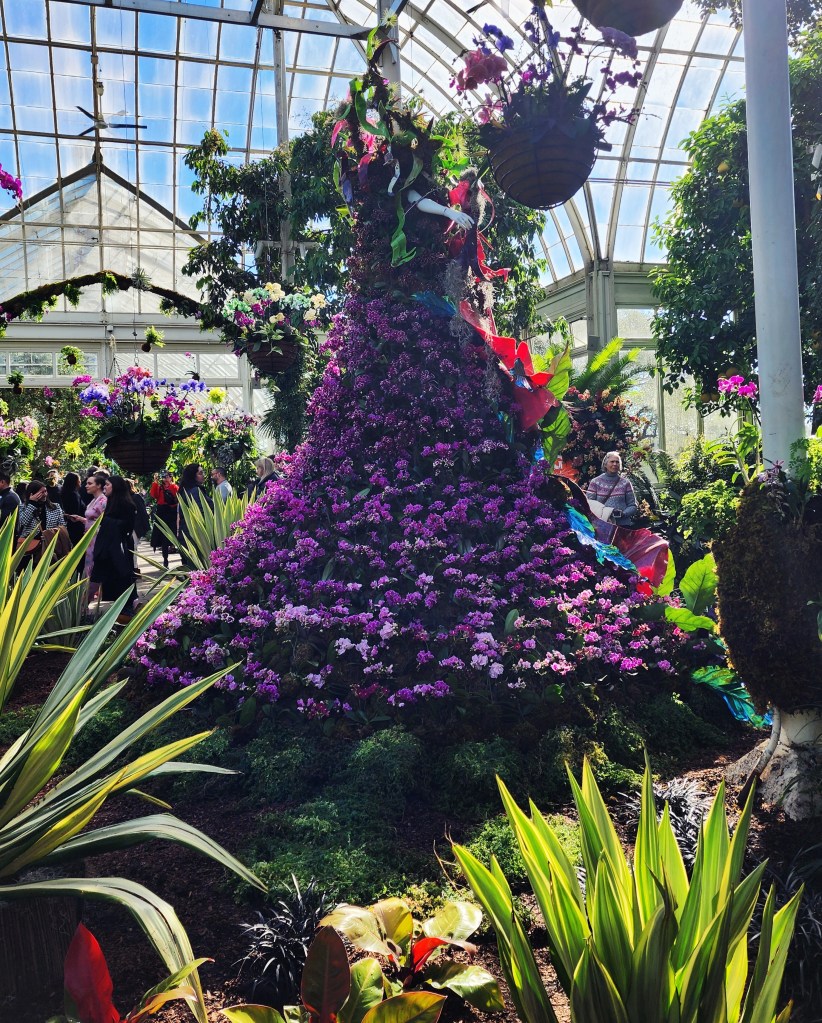

Surrounding Regina four other mannequens represent elements of joy and beauty in modern expression. Victoria’s water lily hoop skirt fountain framed with white Phalaenopsis and amber hues, matching a head piece features a delicate, feminine, balletic form.
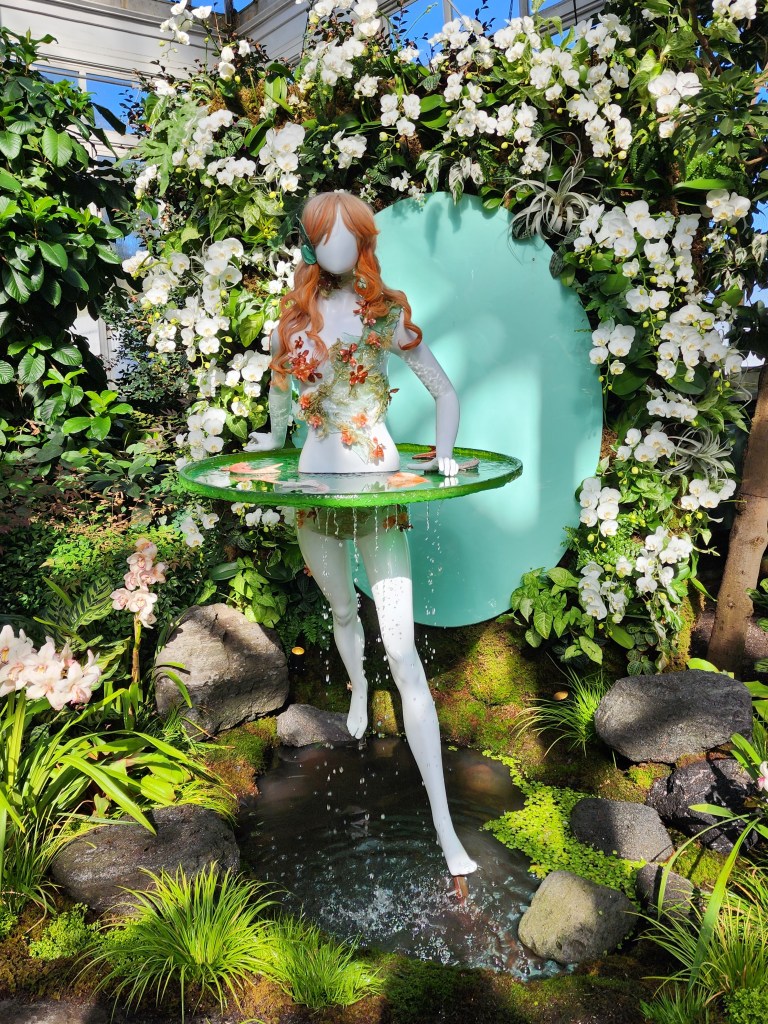
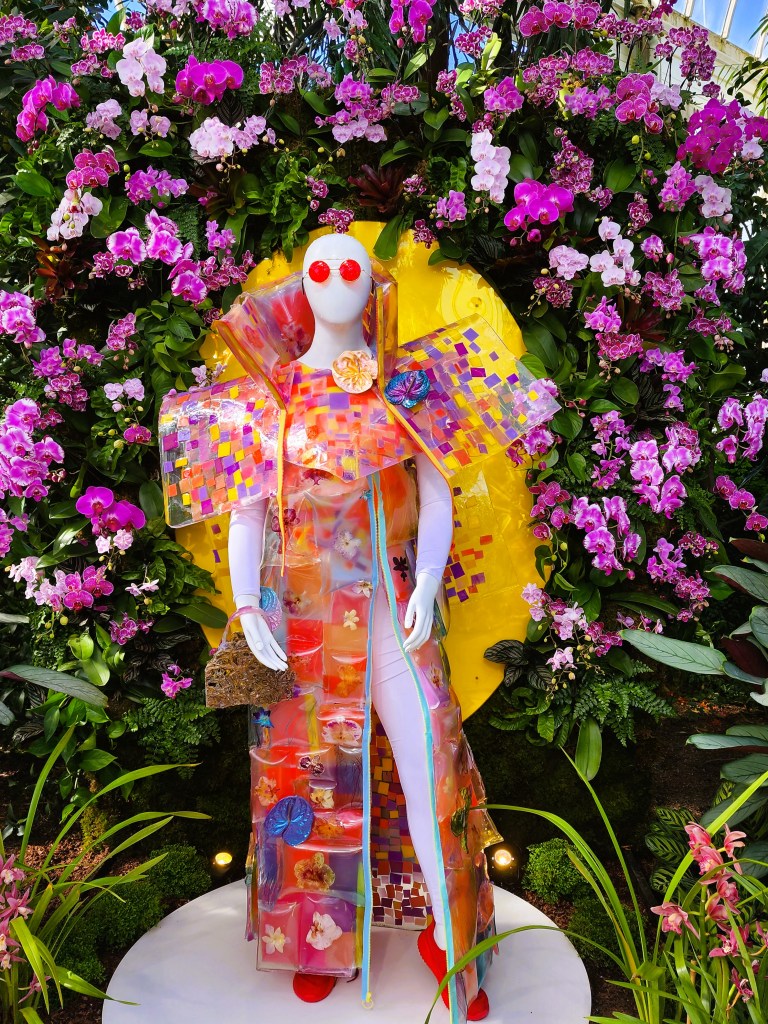

The others figures like Vespa with thigh-high floral boots and orchid headphones sport fun and rock the scene. FLWR PSTL’S vision is dramatized with “Iritherium”-iridescent painted Anthurium plants that she uses for floral displays and fantastical creations, one worn by Katy Perry in her music video Never Worn White. See the video by Katy Perry –Never Worn White below or go to YouTube to see the amazing dress FLWR PSTL created for her.
Kristen Alpaugh Works from an Emotional Foundation
When I briefly spoke to her Kristen Alpaugh said that she works from an emotional foundation to express her creations. Incorporating one essential orchids in her fun vignettes she mentioned, “Phalaenopsis orchid is a very warm and welcoming flower. It’s got this big face and these buttery petals, and it has a slightly shimmery finish, and it’s just like out there. It’s offering you a big hug.” Her experimental work merges natural beauty, high fashion and fine art. Interviews and features profile Kristen Alpaugh in The New York Times, The Lost Angeles Times, Architetural Digest and Vogue.
Collina Strada
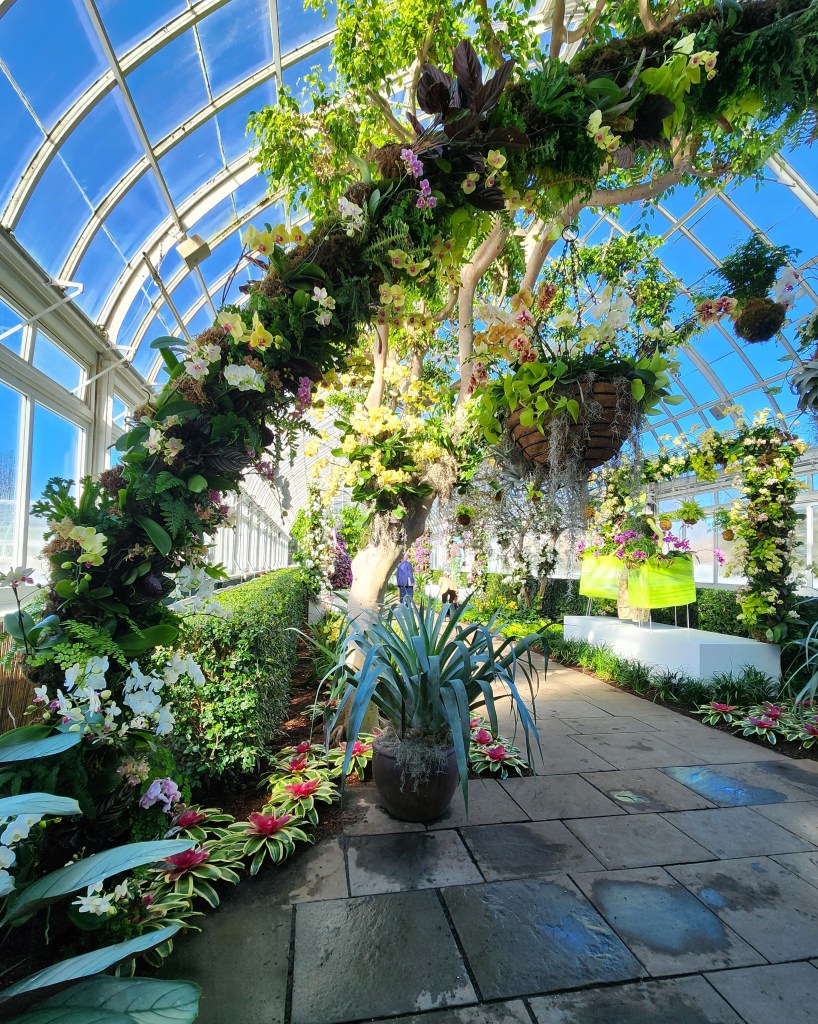
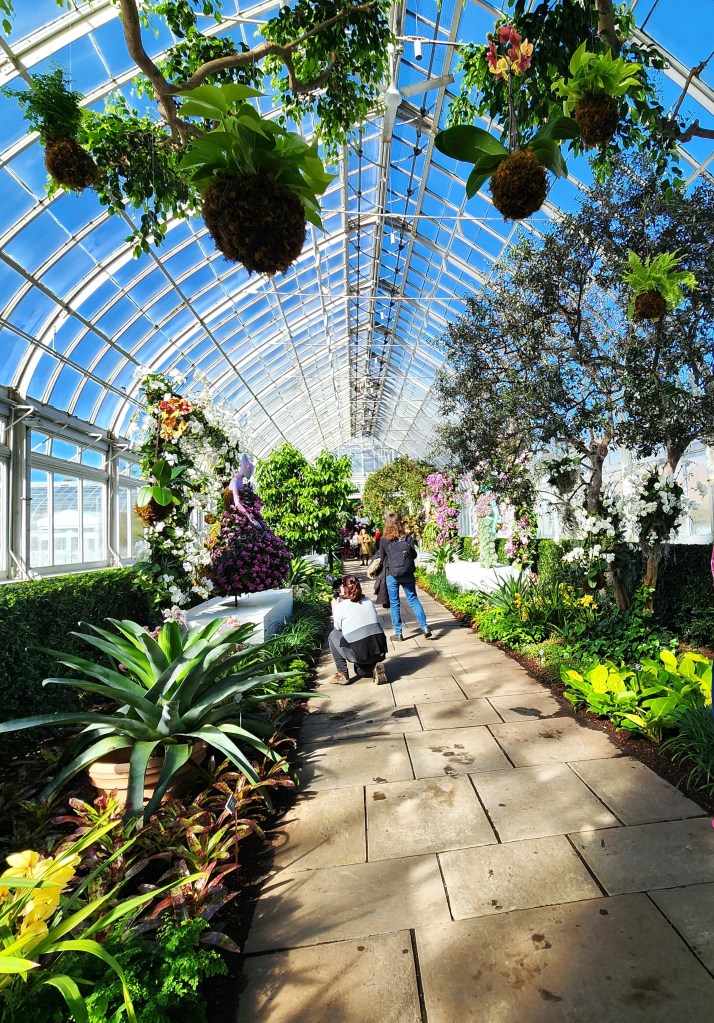
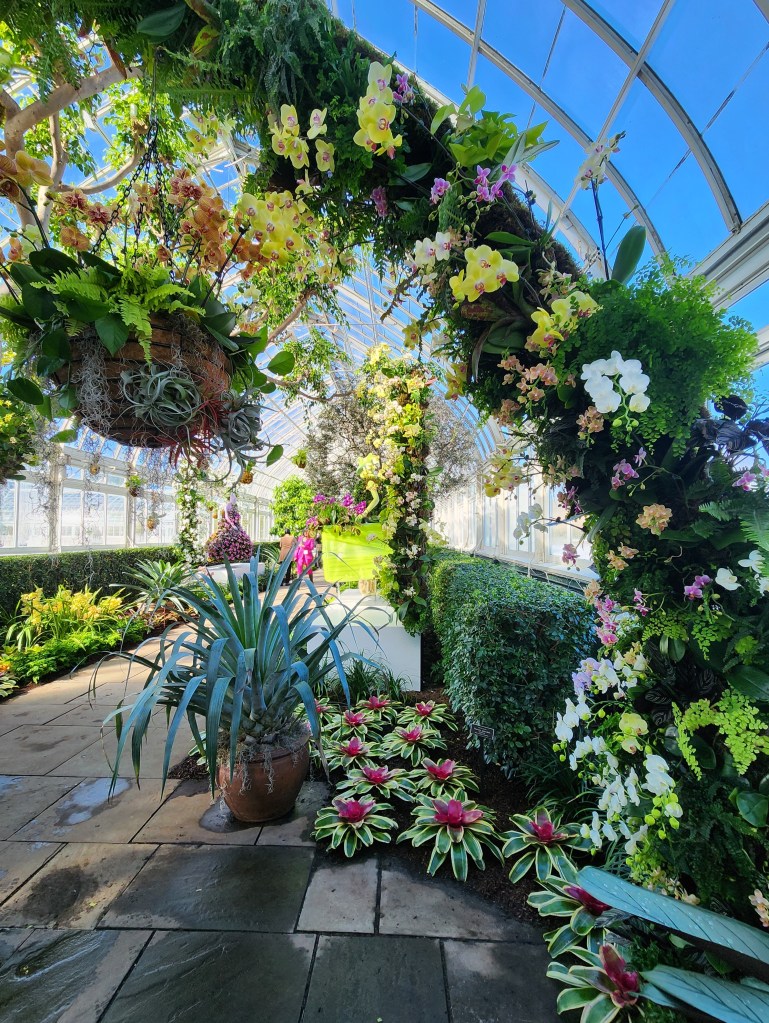
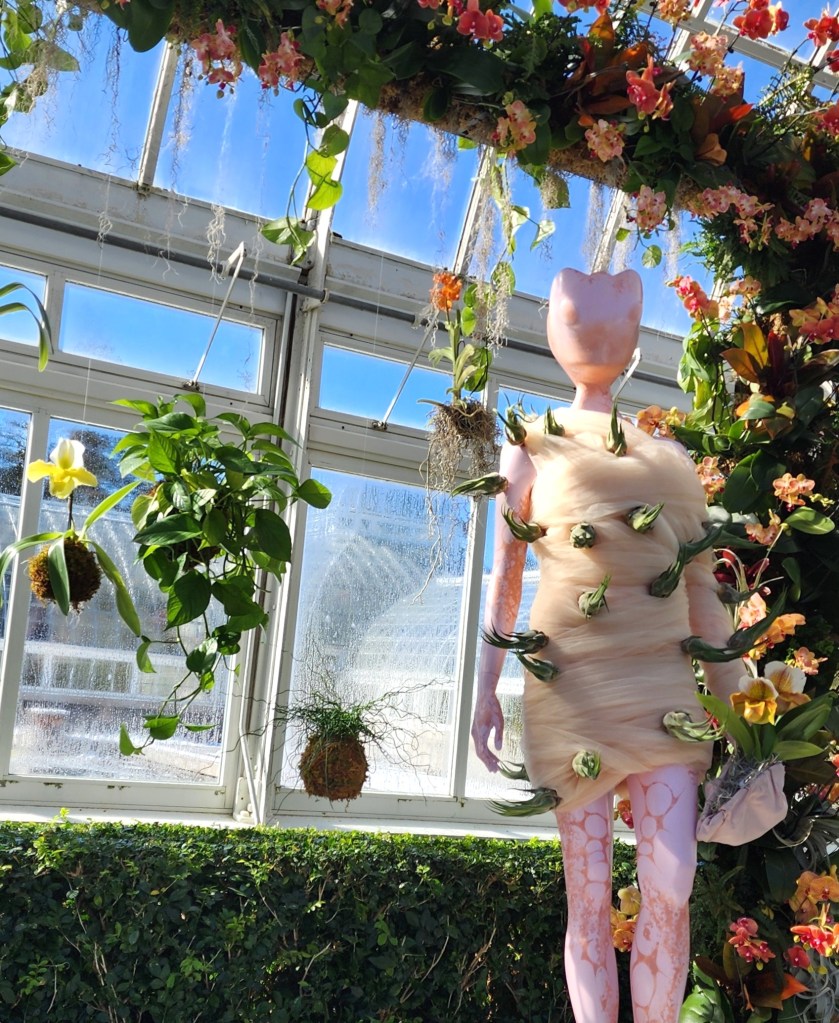
Moving into coordinated orchid displays to the right and left of the final gallery walkway, Collina Strada’s “Freeze-Frame” runway vignettes emerge. Hillary Taymour uses her platform not only for fashion but for social issues and awareness. Her main concern is staying true to her craft, and staying on course to becoming a fully sustainable and radically transparent brand.
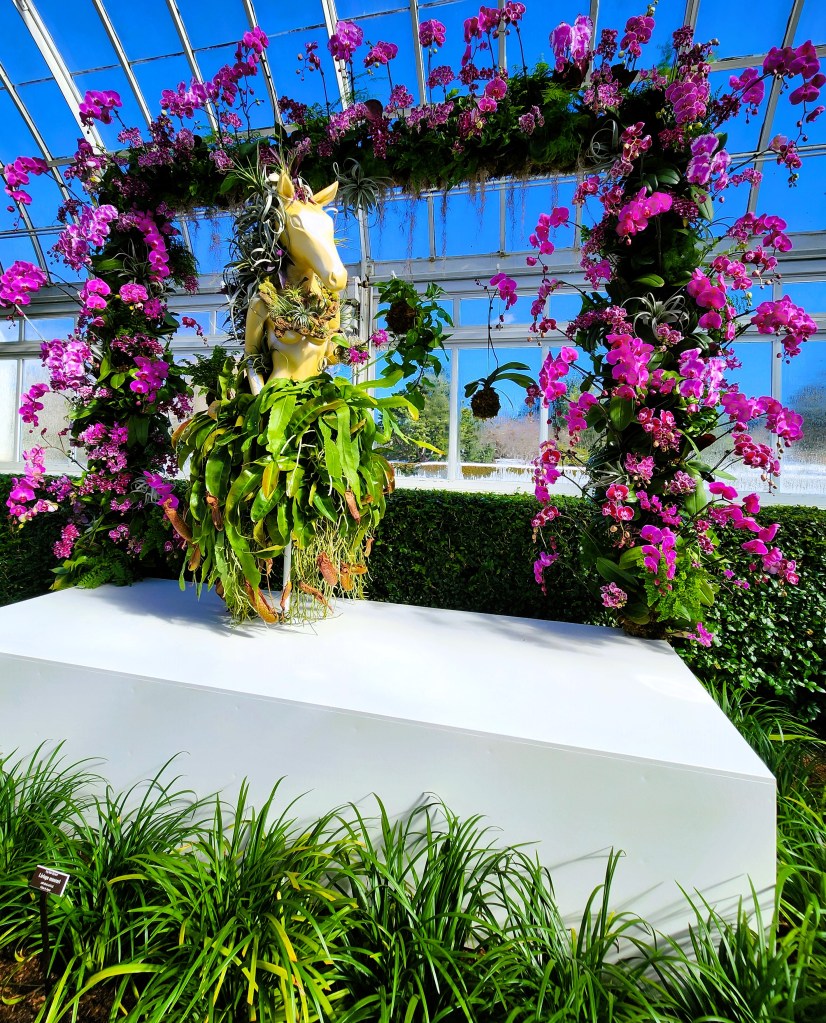
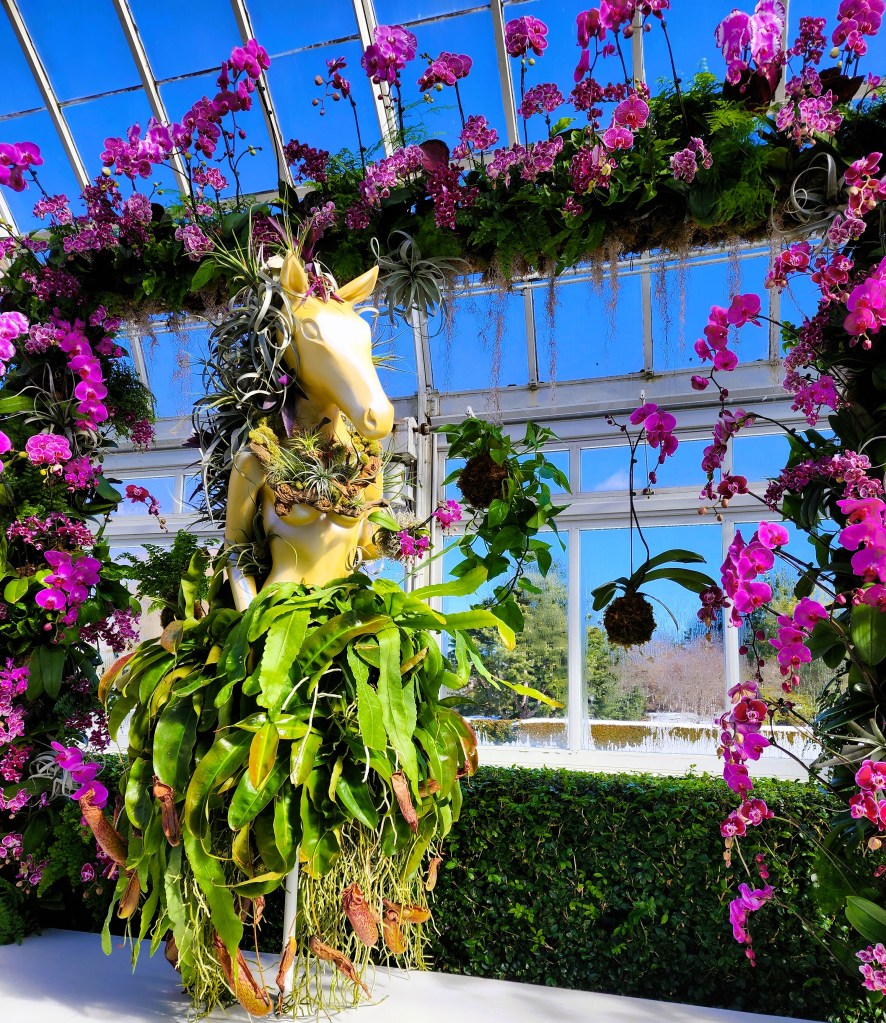
As such she employs upcycled materials such as “rose sylk,” made from salvaged rose plants. Taymour was the first to use artificial intelligence to generate looks for her New York Fashion Week and Spring/Summer 2024 collection. Her creations are accessorized by geometric plantings.
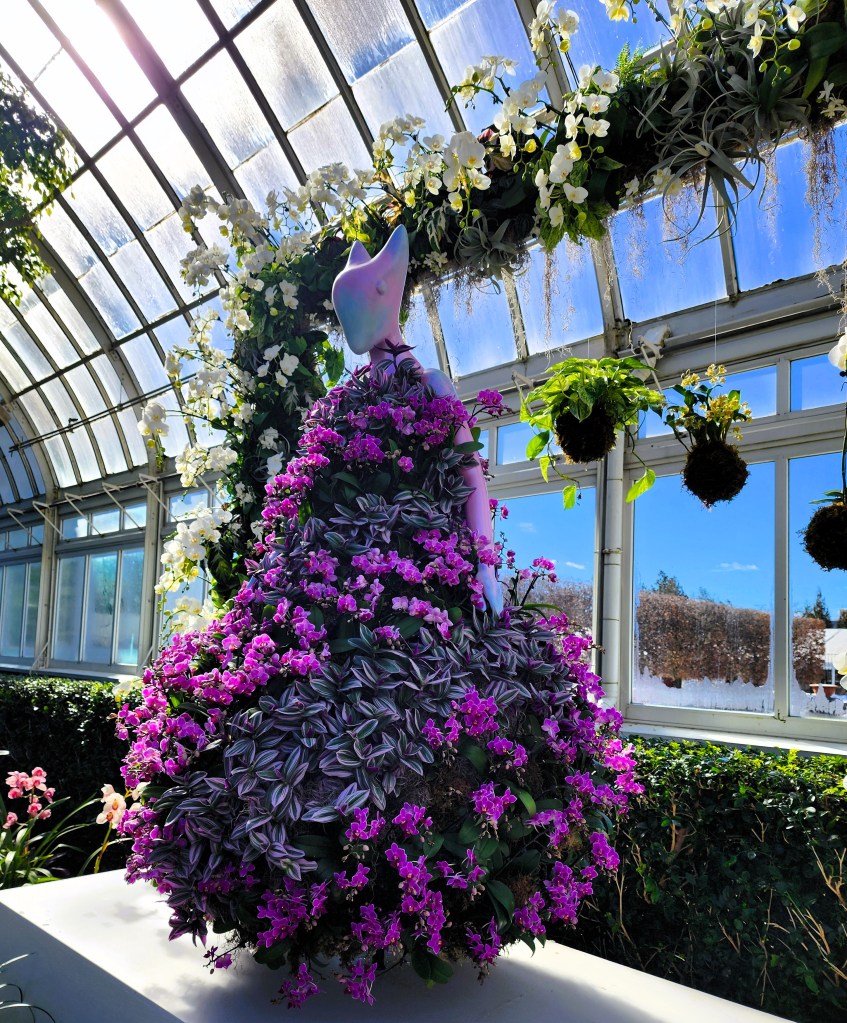
Orchid-decorated Kokedama-spheres of moss in which an ornamental plant grows-hang overhead. The mythic figures including a horse, frog, cat, are draped with Vanda orchids, many-hued miniature Phalaenopsis, variegated succulents and other botanicals.

Collina Strada manifests items that are created using sustainable methods and responsibly sourced materials to establish colorful designs for everyone. According to creator Hillary Taymour, “Nature is the mother of all inspirations.”

You can see a beautiful sunset in the middle of nowhere…and you’re never going to be able to mimic that beauty. Nature is the end goal of art.”

Orchid Nights
A main event during the Florals in Fashion Orchid Show, NYBG is hosting music, live performances and a selection of cocktails and lite bites for purchase at seasonal bars for adults 21 and over. Performances by the Iconic International House of Miyake Mugler, led by choreographer NY Father Icon Arturo Miyake-Mugler (Arturo Lyons), winners of Season 2 of HBO Max’s Legndary, wisk patrons to a ballroom culture scene with fashion and movement. Strike a floral pose entertaining your date in chic couture during one or more of the 7 Orchid Nights: Saturday, March 30; Friday, April 5; Saturday, April 6; Friday, April 12; Saturday, April 13; Friday, April 19; and Saturday, April 20, 2024, from 7 to 10 p.m. For additional programming at NYBG Florals in Fashion go to their website. https://www.nybg.org/
For additional events
New York Botanical Garden GLOW and the 32nd Holiday Train Show®
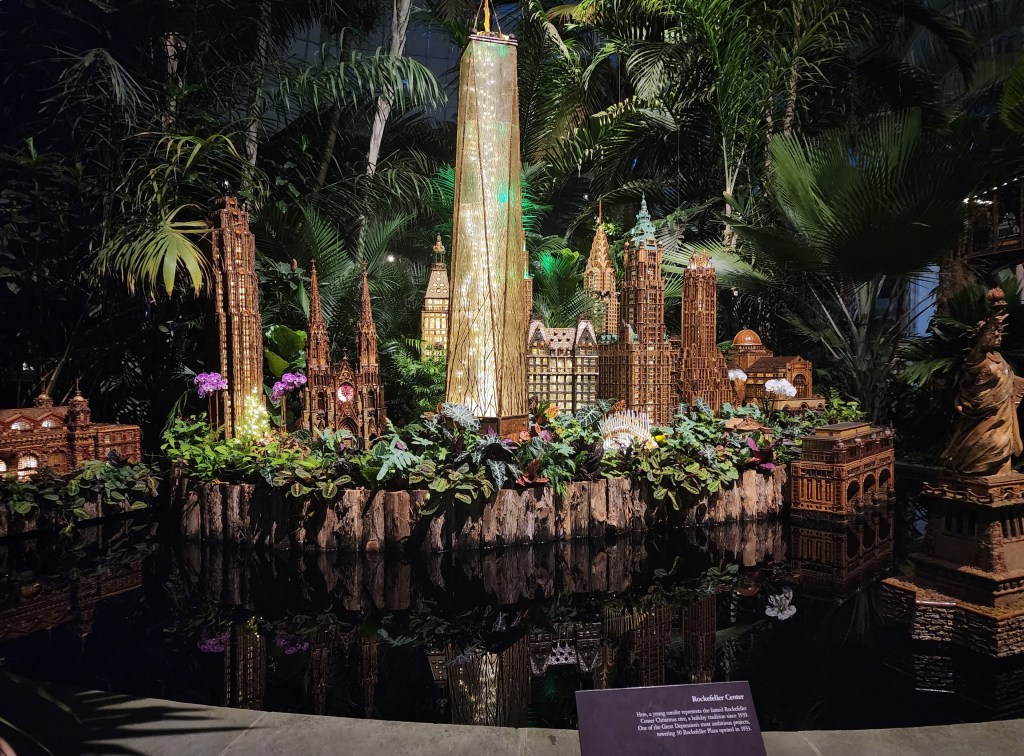

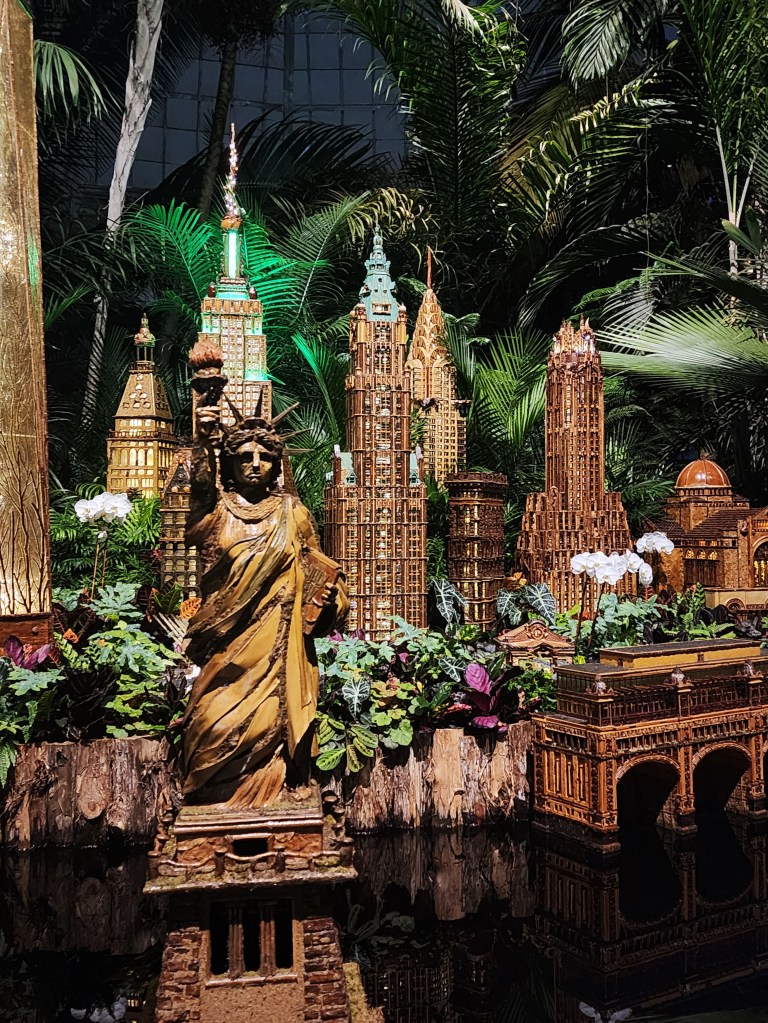
The NYBG Holiday Train Show®returns for its 32nd year. It is a magnificent stirring of the past in recalling the first train shows that were in the outdoor landscape in 1993, created by Applied Imagination’s founder Paul Busse. For more information about Applied Imagination’s collaborations with the NYBG and the artistry and process of Applied Imagination’s botanical spectaculars, click here.
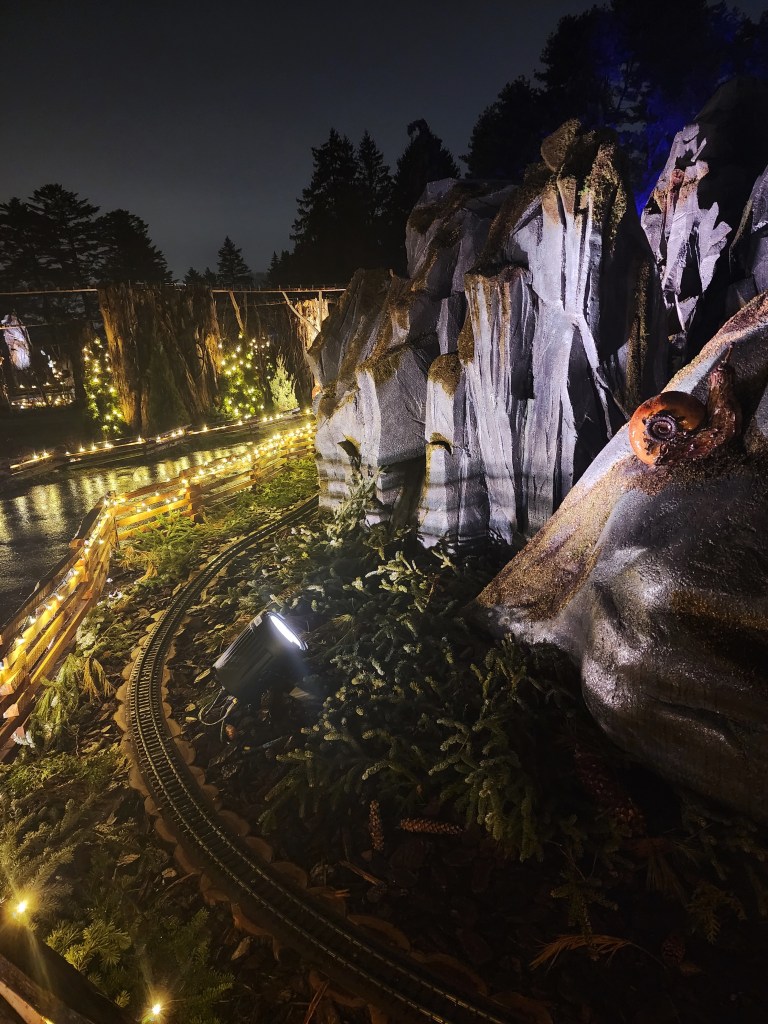
This year’s Train Show is fabulous and bigger than ever with more model trains and an “all-new outdoor display,” that is a magical woodland of fantastic fungi and creatures. Various slow and fast moving trains zip along merrily on raised trestles and around mountain landscapes on the Haupt Conservatory Lawn..
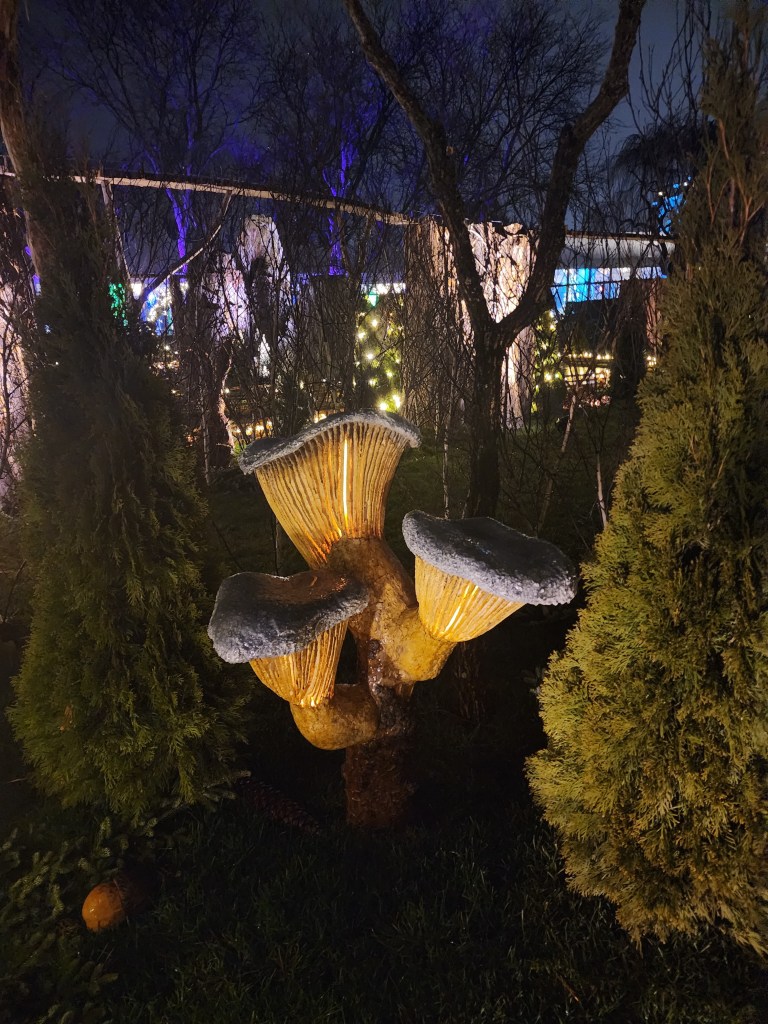
The NYBG Holiday Train Show®runs until Monday, January 15, 2024. For my article on my daytime visit to the Holiday Train Show® click here.
Importantly, On 2 REMAINING SELECT NIGHTS, SATURDAY, JANUARY 6 AND JANUARY 13, Holiday Train Show Visitors of all ages can enjoy NYBG GLOW, the OUTDOOR COLOR AND LIGHT EXPERIENCE, currently in its fourth year. It is just spectacular.
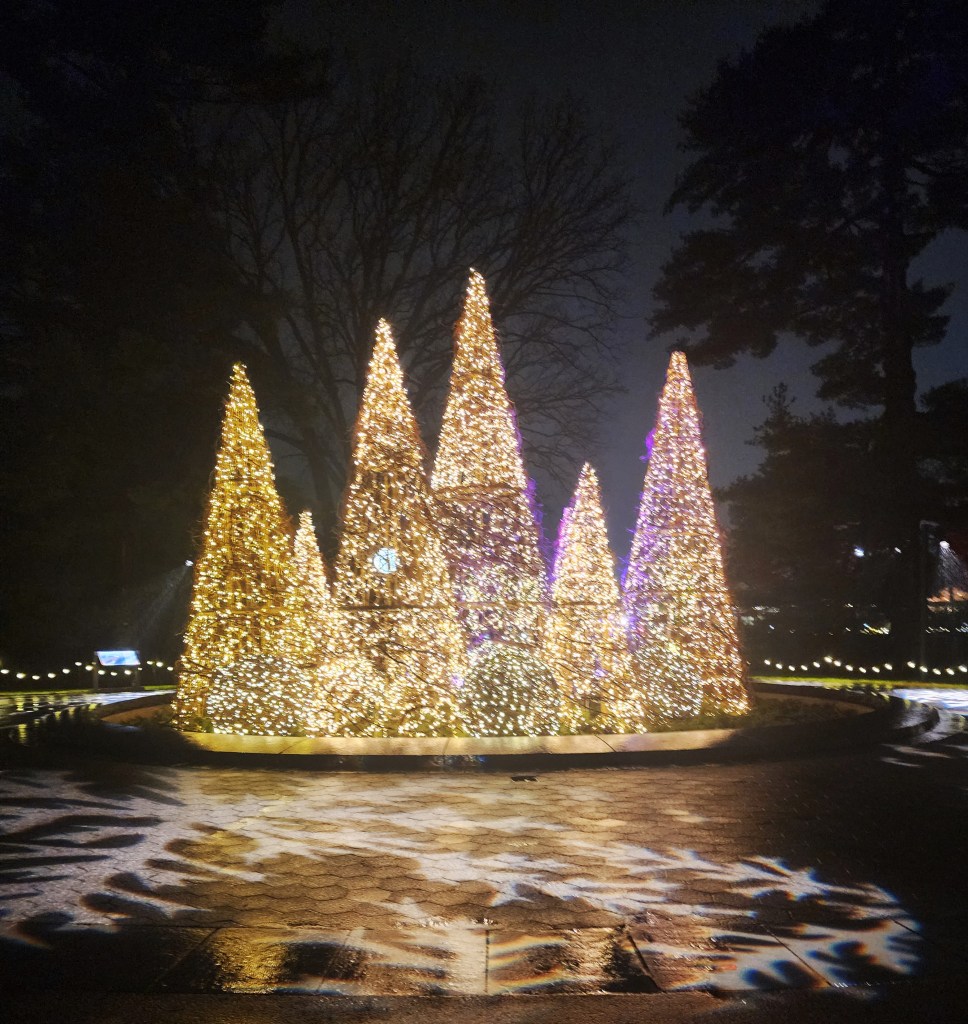
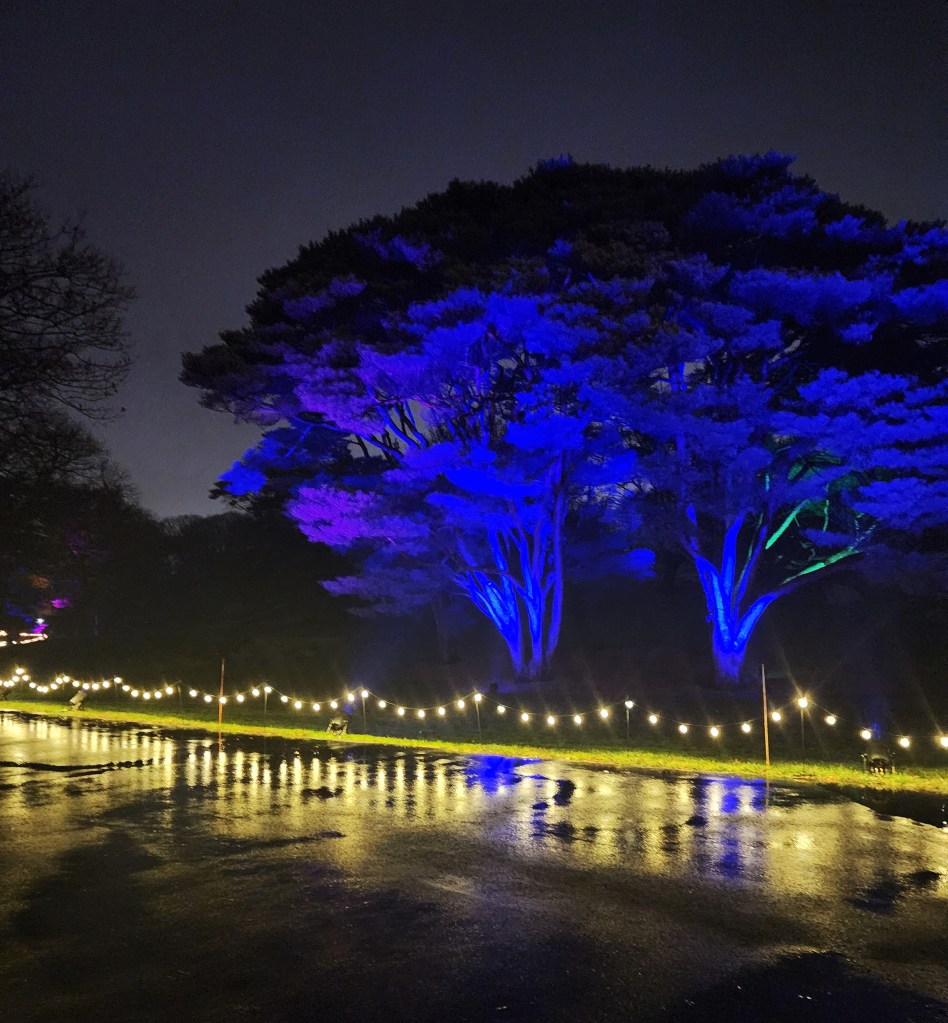
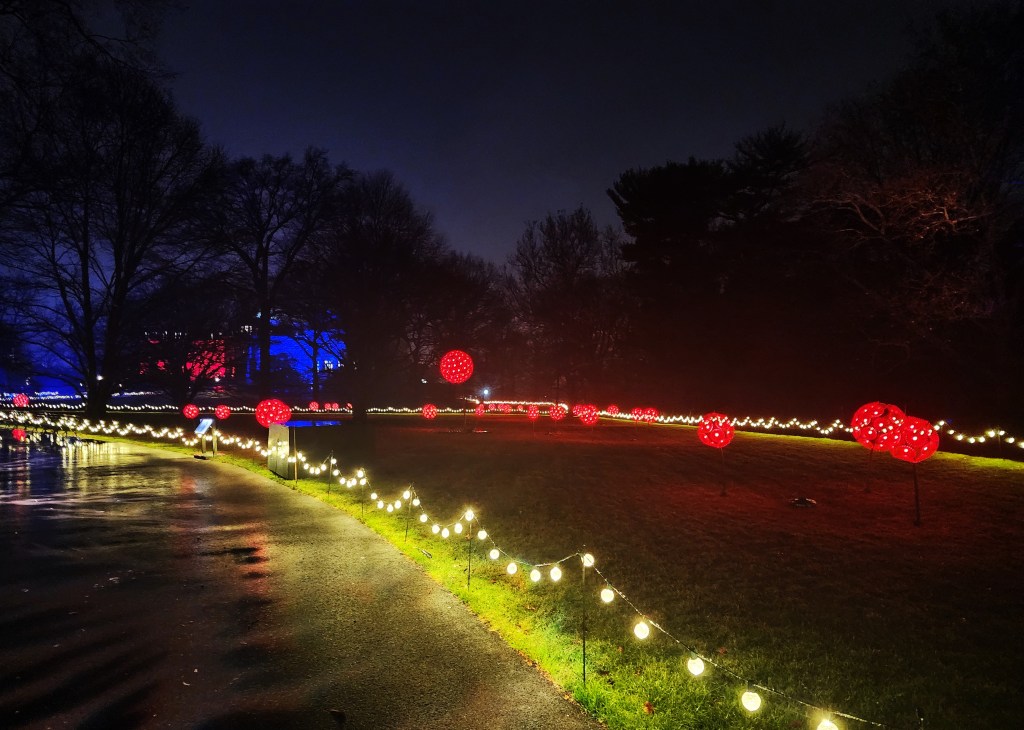
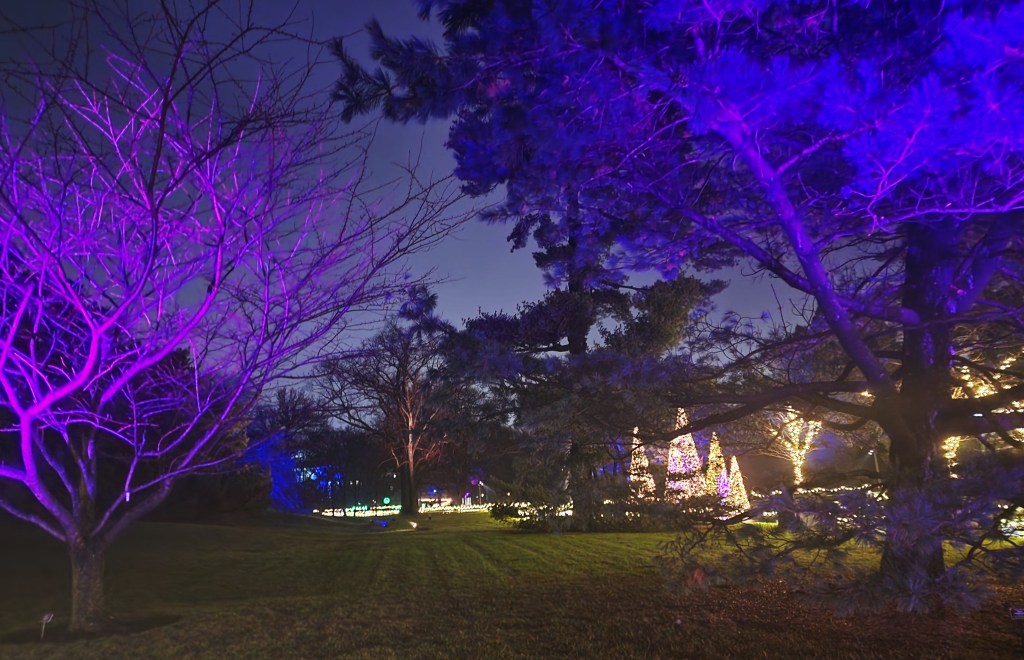
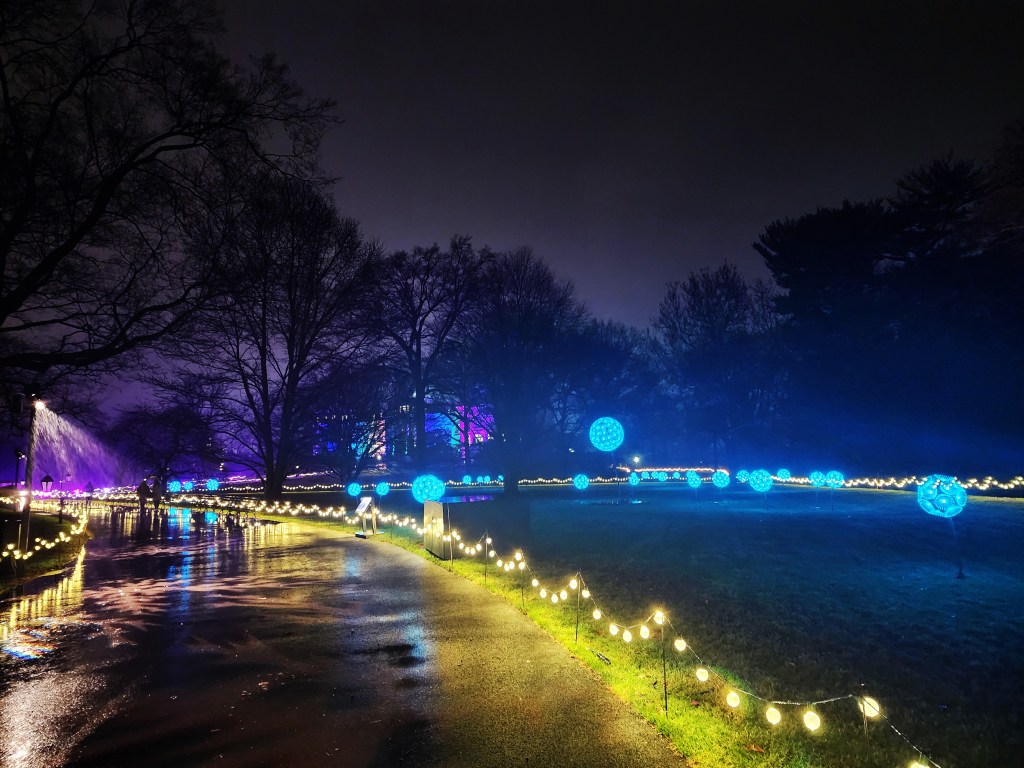
NYBG GLOW will take place from 5 to 10 p.m. on the following dates: Saturday, January 6; and Saturday, January 13, 2024.
Fan-favorite Bar Car Nights, for adults age 21 and over feature adults-only nighttime viewing of the Holiday Train Show and NYBG GLOW. These include light bites and curated beverages available for purchase. Visitors can sip their drinks and feast their eyes on the lighted, imperial beauty of the replicas (i.e. the old Penn Station, Grand Central Station, the Enid A. Haupt Conservatory) that speak of a time past whose like we shall never see again. There is one more Bar Car Night, Friday, January 5, 2024. Tickets are on sale now at nybg.org.
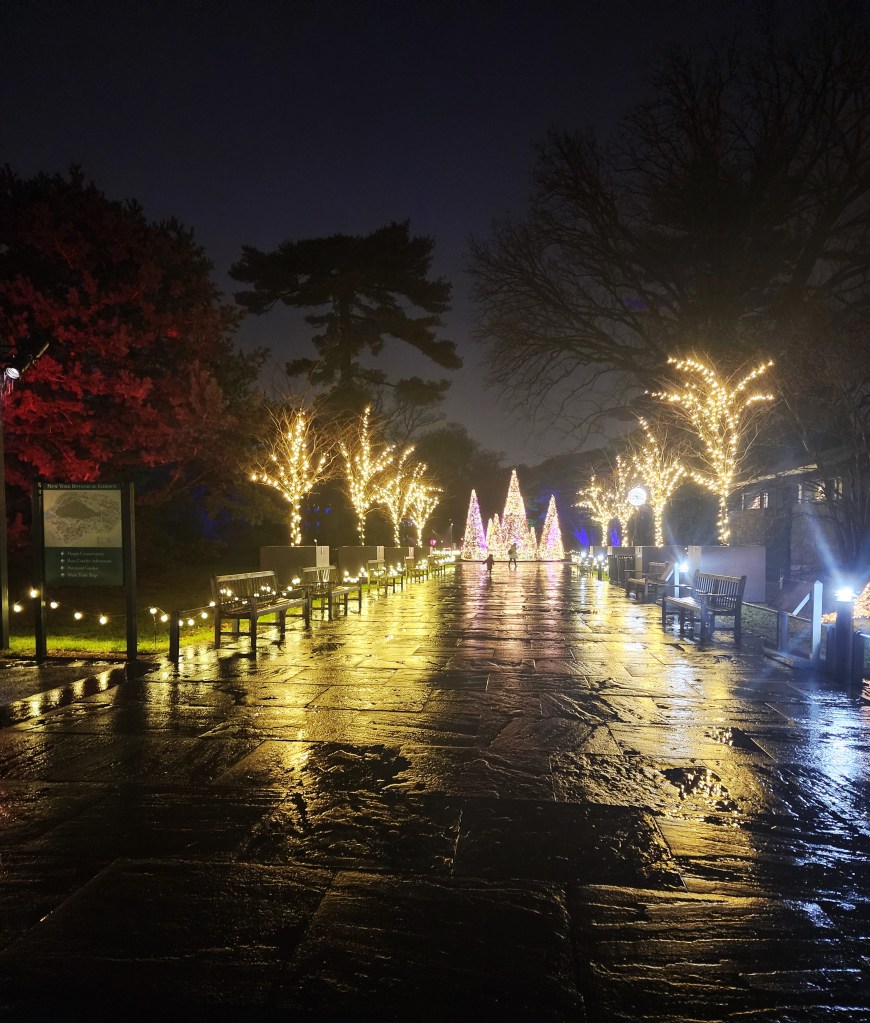
The night I visited, it was warm and misty. The grounds literally glistened with the very light rain and fog. The lights vibrated and as friends and I walked the landscape, the magic of the Garden made the title GLOW resonate with meaning.
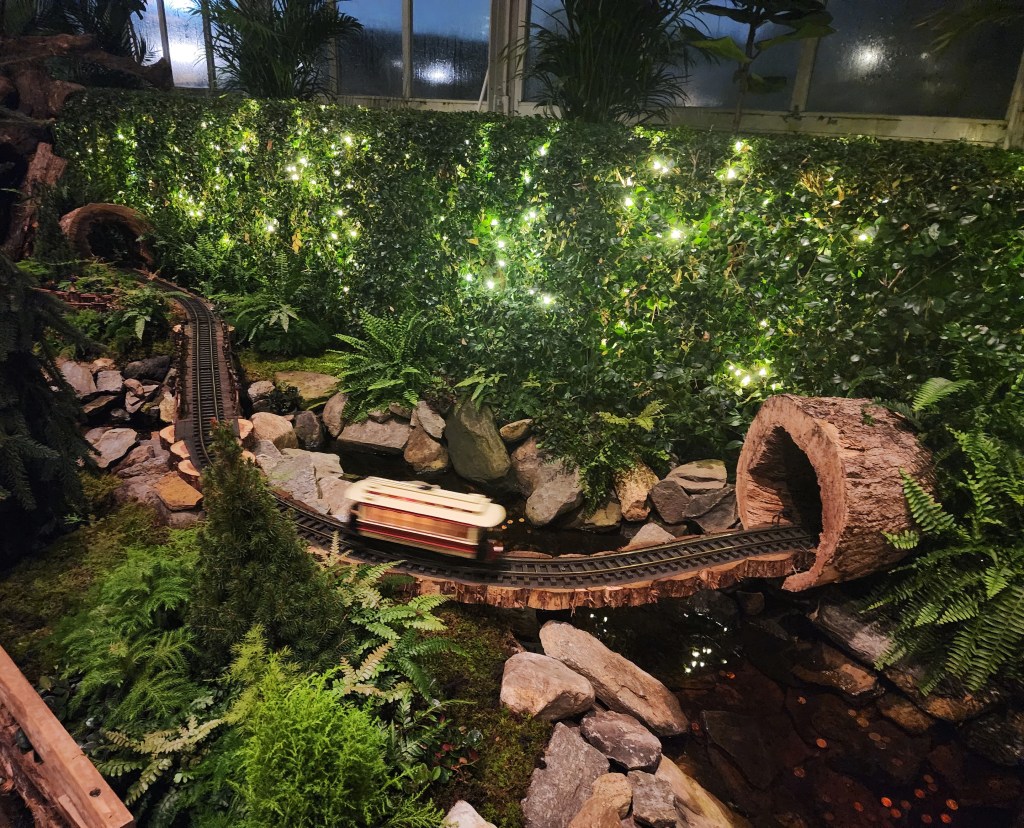
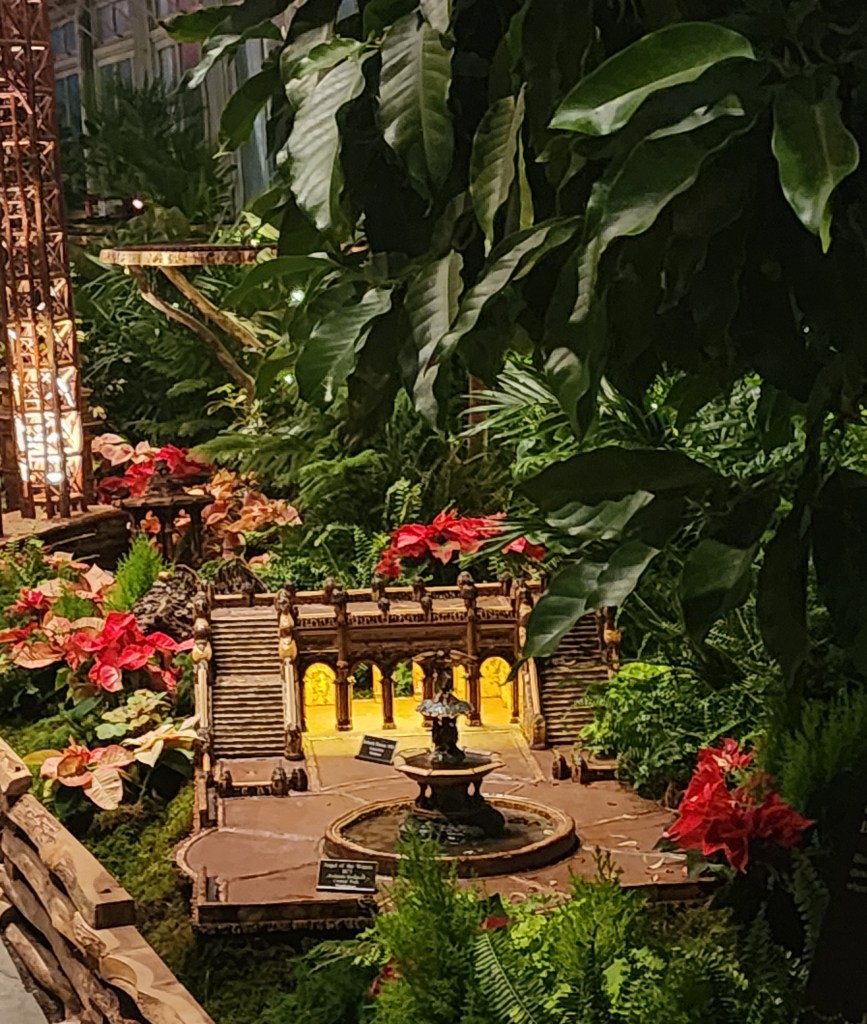
Indoors, the Holiday Train Show twinkles with magic. Evenings are more mysterious in the Garden. The foliage seems more lush as the deep shadows suggest hidden secrets. The imagination runs wild as one moves along the walkways, to see an elf peer out from under a palm frond, then vanish in a nano second. Sounds of the train whistles and horns and clackings along the tracks accompany a variety of engines and cars, from passenger trains, to freights, to diesels to locomotives, trolley cars and whimsical fantastics (a bee car) buzzing along.
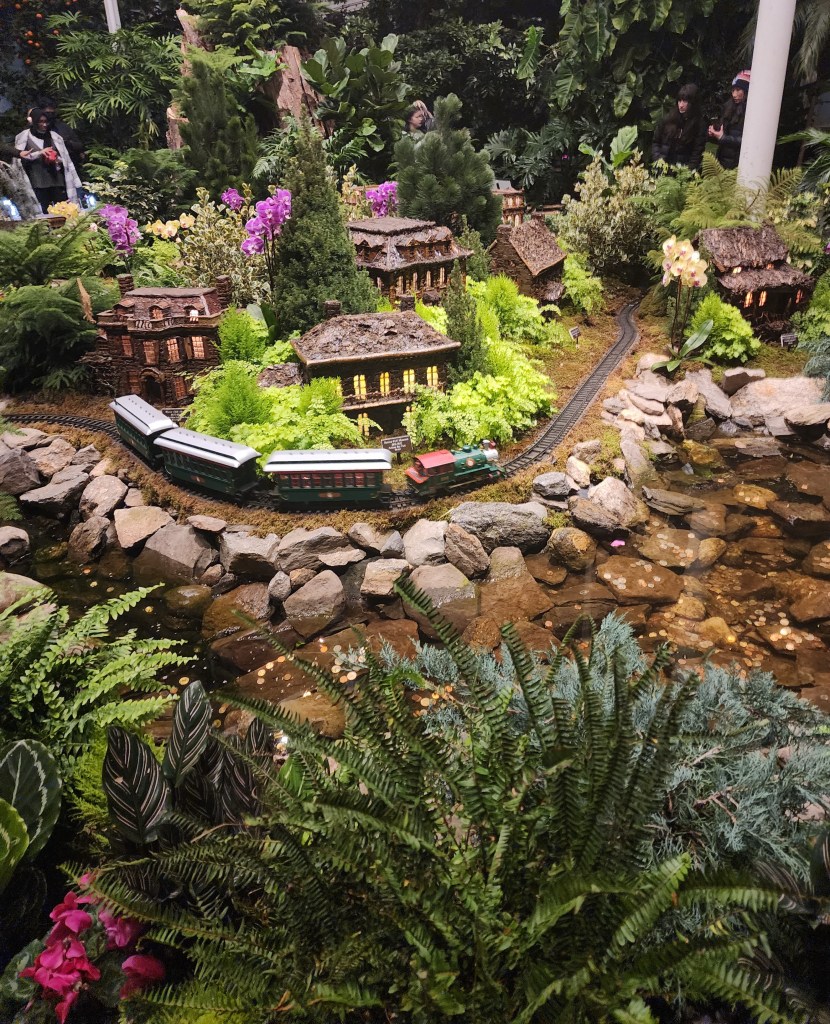
I enjoy catching glimpses of the trains jetting underneath the greenery and chugging past the beautifully crafted replicas of landmarks and iconic buildings from each of New York City’s five boroughs, as well as surrounding counties, i.e., Orange, Westchester and Columbia to name a few.
Thanks to artisans at Applied Imagination, currently run by Laura Busse Dolan, daughter of Paul Busse, who founded the show, the amazing, miniature landmarks are created from a myriad of plant parts, for example, artichoke leaves, seed parts, pistachio shells, walnuts, acorns, pine cones, tree bark, twigs, numerous leaves from plants, ranging from hedges to trees, a variety of gourds, pomegranates, etc.
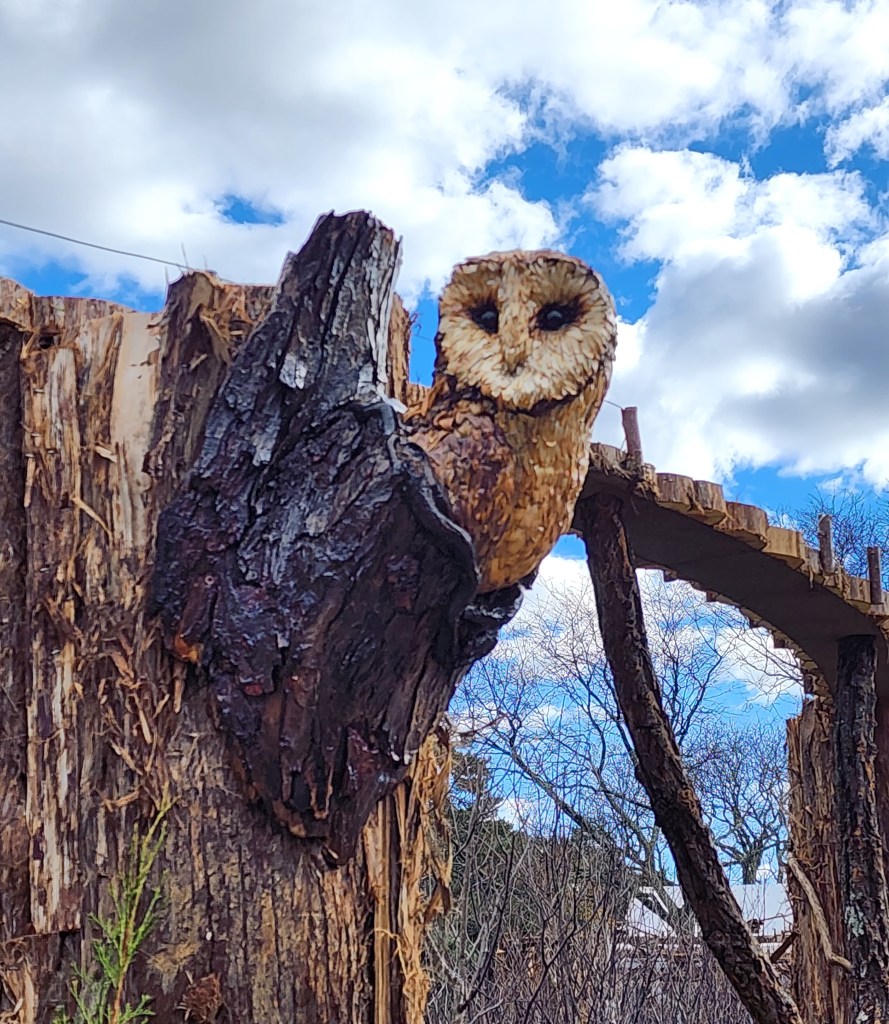
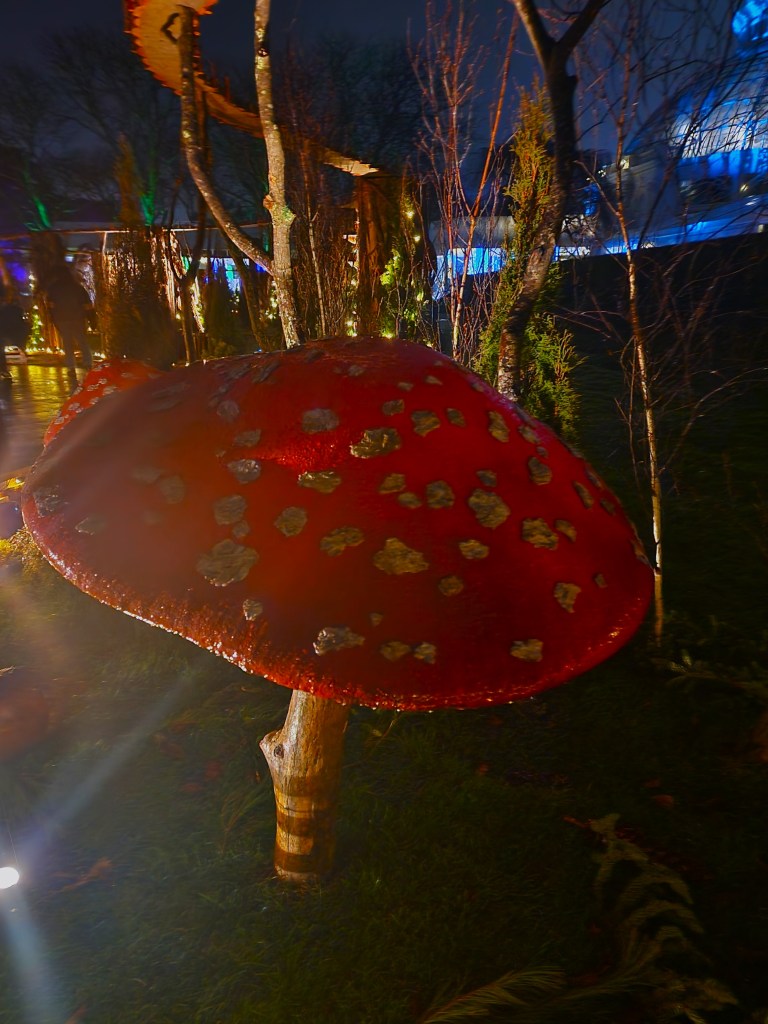
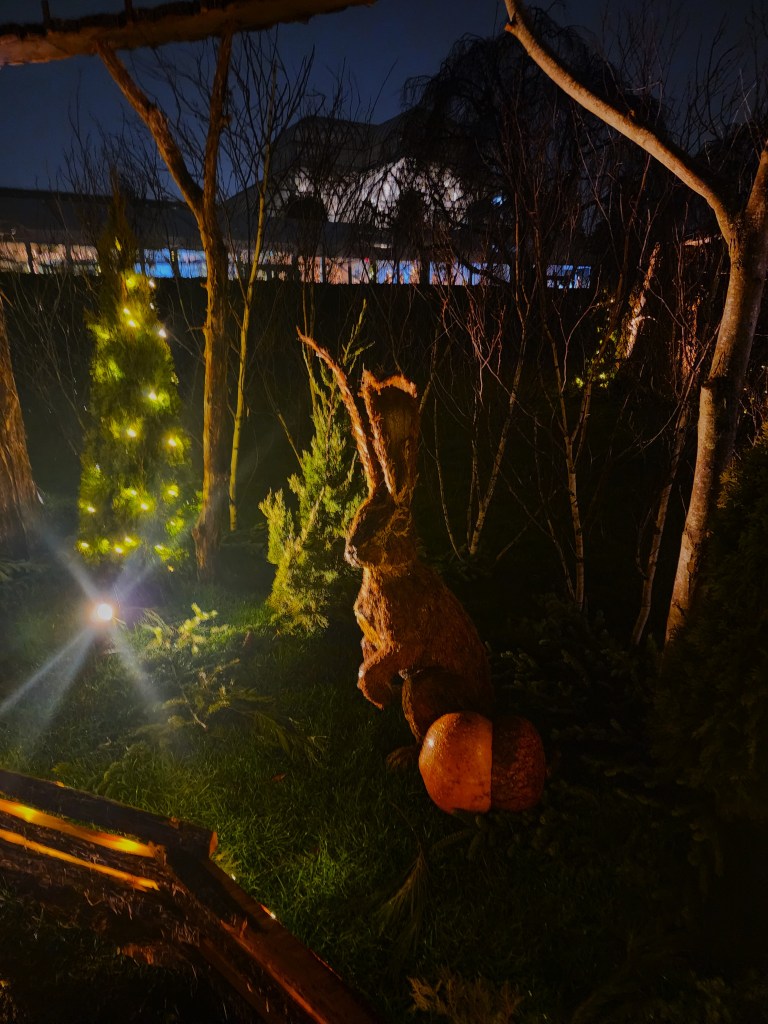
In the outdoor landscape, the toadstools and fungi that appear to be ceramic and plucked out of a Disney animation are actually carved wood finely shaped, shaved and smoothed, then painted cheerfully to shine a glossy surface. The detail of the fungi is mind-boggling and realistic. One can spend an hour taking in the near atomized work of the craftspeople whose creations are at the quality level of art. Look for animals, snails, the owl (made of artichokes) and other woodland creatures.
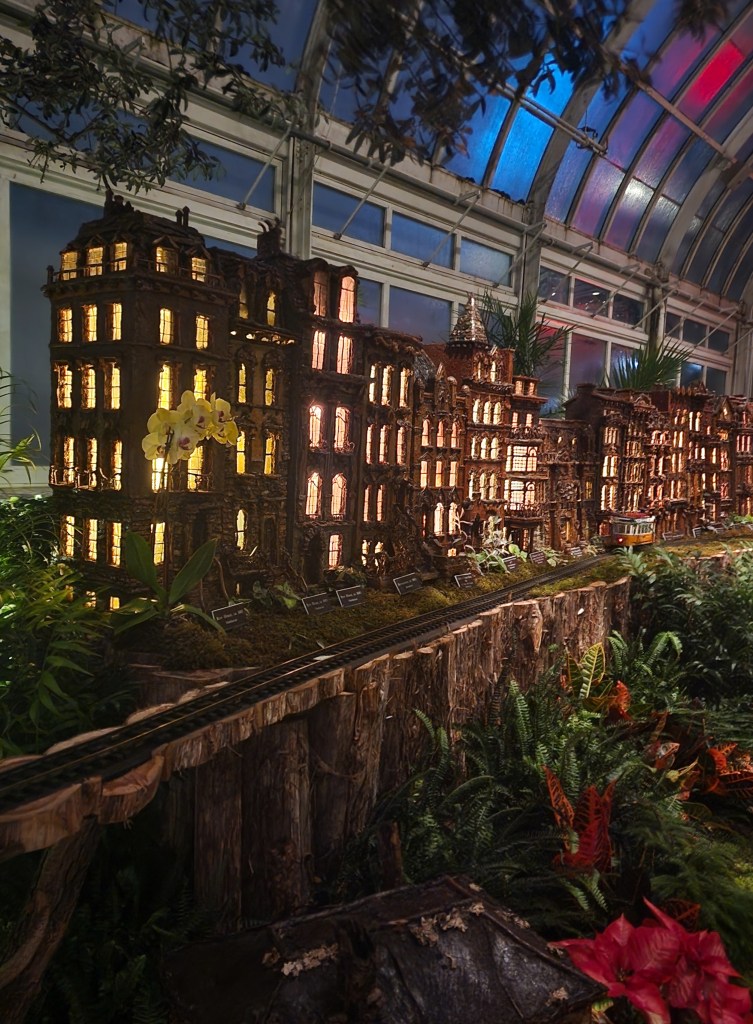
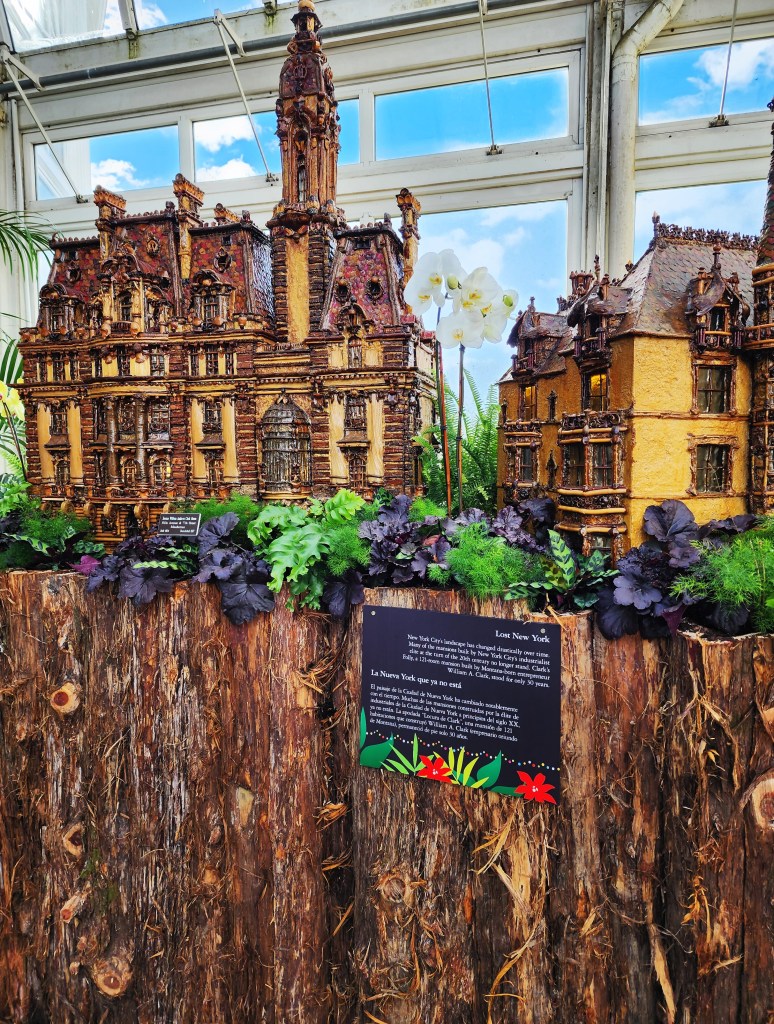
Indoors, some of the replicas I always look for include Clarke’s folly, a majestic Gilded Age mansion that was too costly to maintain and was torn down within a decade of its being finished.
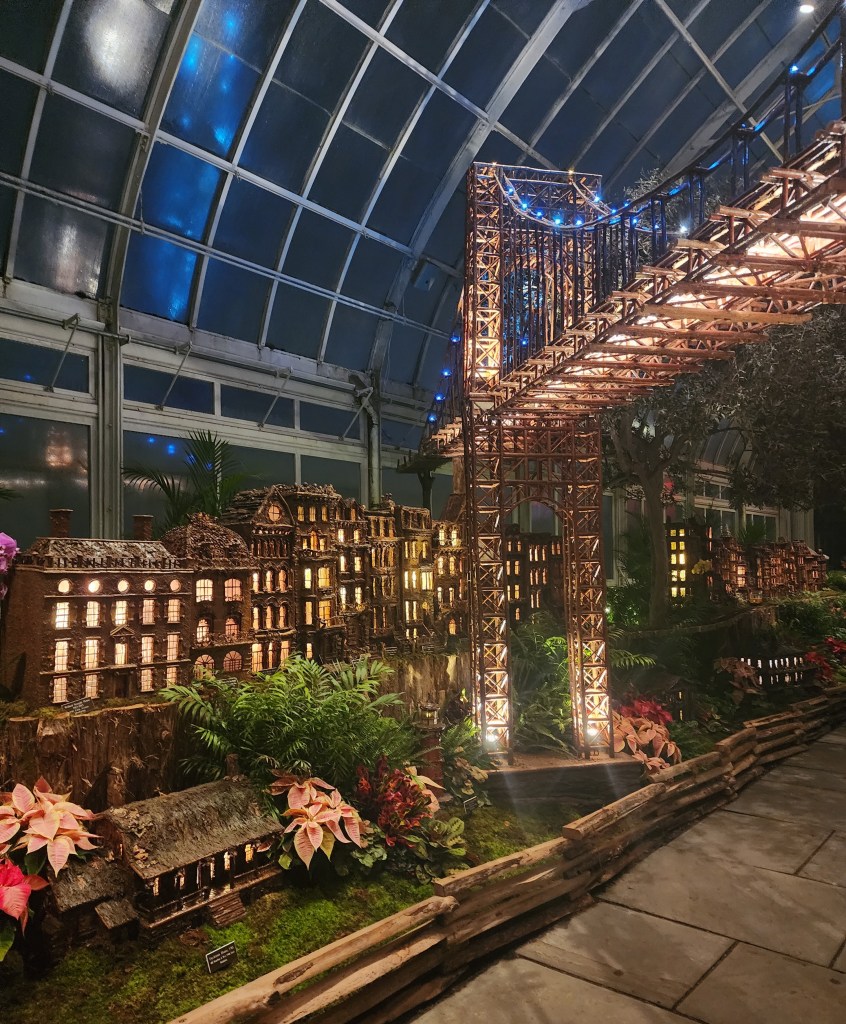
The phenomenal row houses of New York City shine their lights in all their glory. I imagine living in one of the brownstone replicas that could easily fit into Edith Wharton’s New York City so cleverly portrayed in Age of Innocence. And another favorite is Poe Cottage. Every time I see it in the Train Show, I vow I must visit it. It is near the Garden in the Bronx.
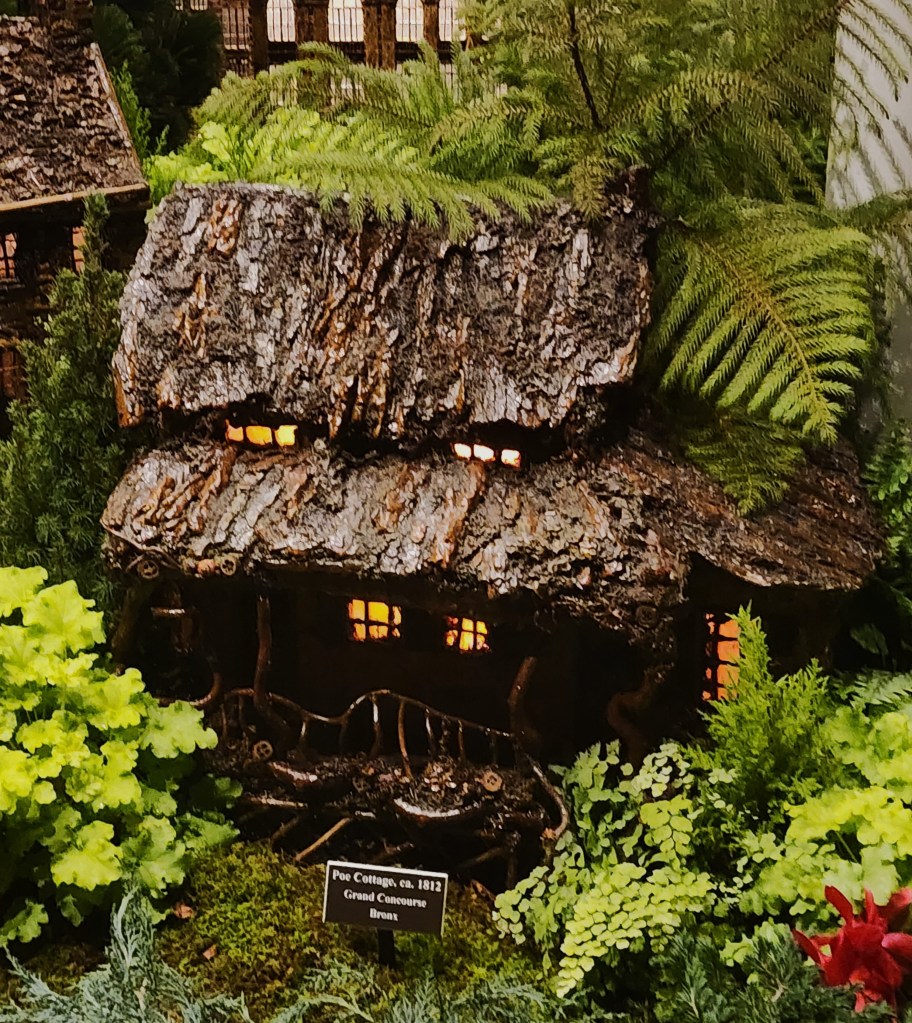
The exhibit includes signage that explores the plants used to create the miniatures. It bears reading how the various parts are used to create structures like finials, roofs, portals, arches, bricks, mortar that visually look just like their counterparts. To an artisan at Applied Imagination, a pistachio shell might be the perfect part to complete a statue. In fact look for the pistachio shells on the angelic figures of the Kykuit replica (on the Rockefeller Estate) housed between the 360 degree display of Coney Island and Grand Central Station, and the doorway to the Enid A. Haupt Conservatory interior.
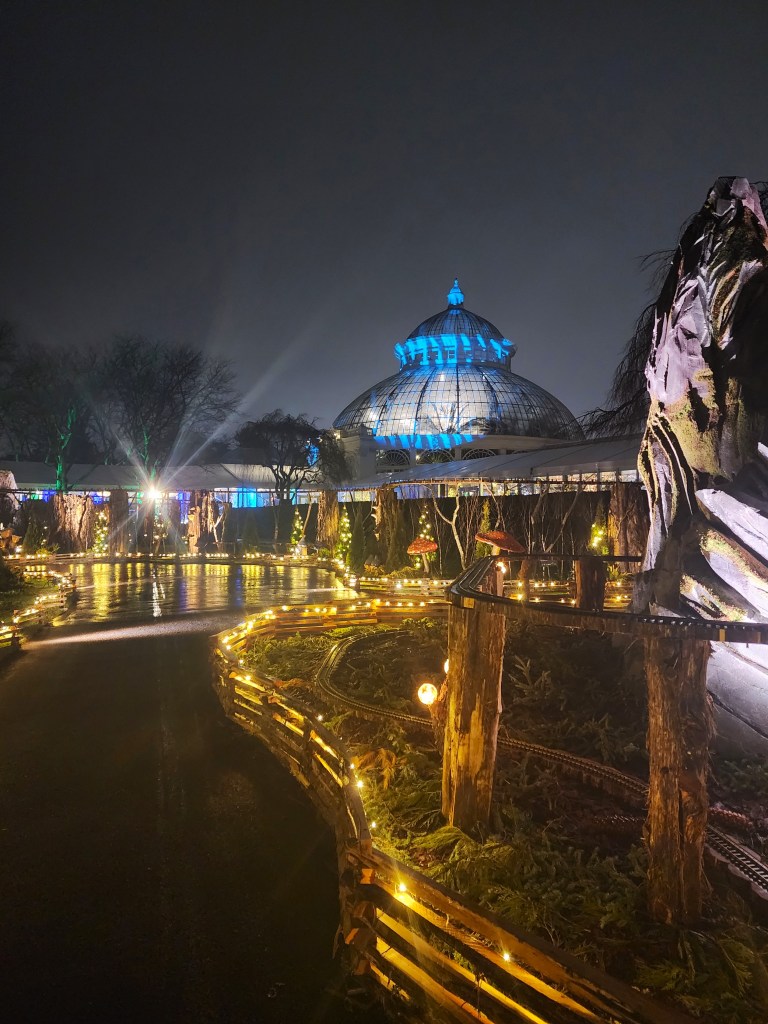
You won’t want to miss this years botanical theater of GLOW and the Holiday Train Show.® The exhibit’s wonder will cheer you up and resettle you into the joy of new beginnings in a new year.
For tickets to the Train Show and GLOW, click on the link.
‘New York Botanical Garden Holiday Train Show’


The NYBG Holiday Train Show has begun. And what a magnificent, vibrant show it is.

Now in its 32nd year the show reflects its beginnings.
In 1992, landscape architect and model train enthusiast Paul Busse of Applied Imagination came to the Garden’s Enid A. Haupt Conservatory to express his unique vision for a special exhibition during the winter holidays.

He created The Holiday Garden Railway Exhibit. The following year the “Railway Exhibit” blossomed outdoors in the Garden landscape featuring bridges and a viaduct situated near the LuEsther T. Mertz Library.


This year’s 2023 Holiday Train Show returns to Busse’s outdoor landscape design. However, it is more expansive with a clever theme for it’s outdoor exhibit. The addition is an all-new enchanted woodland train display, replete with forest animals, winter-interest plants and fantastical fungi set on the Haupt Conservatory Lawn.

Don’t underestimate the outdoor display or move too quickly to appreciate that all the elements are plant/botanically based.

The large mushrooms that look like they are out of a Disney cartoon, that kids will appreciate, are recreations, not of ceramics, but they are made of wood, intricately shaped and detailed.
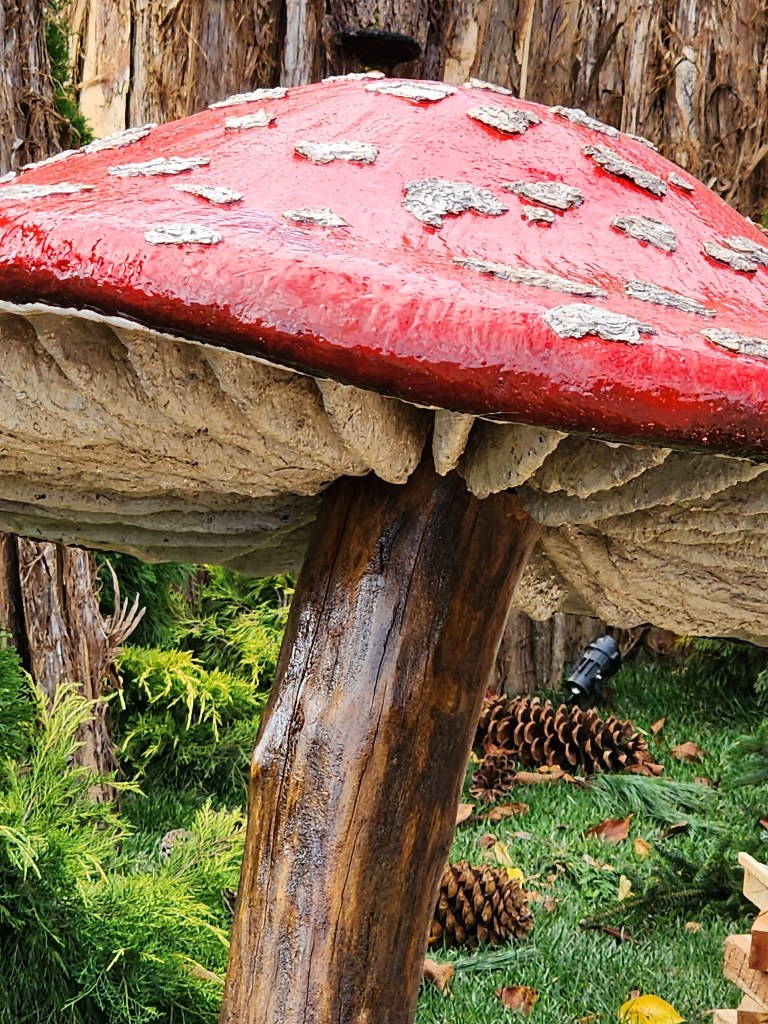
Applied Imagination’s creativity and attention to detail is bar none.

The imagination of the craftspeople at Applied Imagination to recreate their counterparts in nature is astounding. It inspires us in so many directions, conservation, environmental use and protection and appreciation of nature’s wonders. All of these values conjoin with the Garden’s efforts toward the natural world and conservation of plants especially exotic species globally.

Likewise, the woodland animals are botanical creations. For example, the owl which you might miss if you don’t look overhead (it had to be pointed out to me) is predominately made of artichokes.
The lovely flowers that adorn the top arches are made of gourds. And the shelf mushrooms attached to the bridges and fences are themselves.

Look at the vines, coated in plant based resins to give them the glossy finishing touches that look like they are metal or iron. The butterfly creation that looks like it might be featured in any high-end store for home decorations is totally plant based.
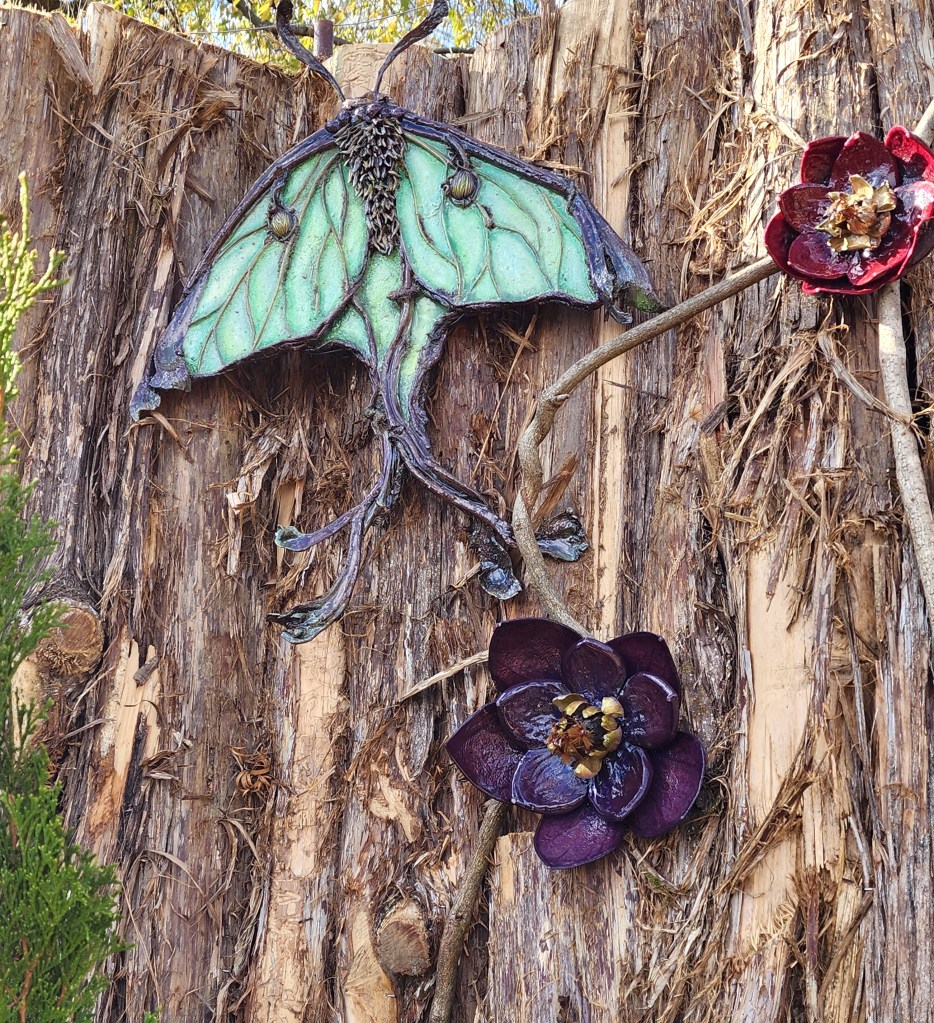
That glossy look on the wings is achieved by the same resin that is used on the windows of the miniature of the Enid A. Haupt Conservatory inside, in the rotunda with other structures of the Garden like the LuEsther T. Mertz Library.

The Conservatory miniature is a gloriously detailed structure that took over 1000 people hours to put together. Of course, the visible structure is made of reeds. Interestingly, the cupola rests on “a ring of large pine cone scales.” For the piece de resistance at the very top, artists used seedpods: one mahogany and one lotus. If you didn’t know what these seed pods looked like in their natural habitat, you wouldn’t be able to distinguish their botanical ancestry from plastic. However, the last thing that Applied Imagination would ever employ in its presentations is plastic. Busse and the entire staff support the environment and the wonders of how nature is reflected in design structures.

The outdoor expansion combines with the the New York City and upstate New York miniatures that sprawl indoors throughout the conservatory’s galleries that have been enjoyed in previous years. However, the Garden staff and staff at Applied Imagination make sure that the displays are differently arranged.
Walking through as I have done each year, I try to remember which sections of the city appear in the Palms of the World Gallery or the Centerpiece Rotunda, and I am often at a loss. The show is botanical theater and as such changes from moment to moment, from year to year. Each year, it seems more spectacular than the next. And neither still photographs nor videos do justice to reveal the wonder of exuberant plant life whether in the daytime or the magical and mysterious nighttime of the conservatory.
Like live theater which is akin to an interactive spiritual experience, the NYBG’s botanical theater feels different through the run of the show. To keep the exhibit shining, plants are swapped out. Others are added and the effect is continually one of shifting, lush tropical splendor. This year’s exhibit is a pantheon of color. Wherever you turn there are dazzling orchids, poinsettias, cyclamen and variegated plants, begonias, ferns and the permanent plantings some of which are flowering trees. It is too beautiful to miss.
PROGRAMMING
On 17 Select Nights, Holiday Train Show Visitors of all ages can enjoy NYBG GLOW, the OUTDOOR LIGHT EXPERIENCE. It is returning for its fourth year. NYBG GLOW will take place from 5 to 10 p.m. on the following dates: friday, December 8; Saturday, December 9; Friday, December 15; Saturday, December 16; Sunday, December 17, Friday, December 22, Saturday, December 23; Tuesday December 26; Wednesday, December 27; Thursday, December 28; Friday, December 29; Saturday, December 30, 2023; Saturday, January 6; and Saturday, January 13, 2024.
FAN-FAVORITE BAR CAR NIGHTS, FOR ADULTS AGE 21 AND OVER, WILL ALSO MAKE A COMEBACK THIS SEASON ON THREE SELECT DATES. These are Thursdays, December 7 and December 14, 2023, and Friday, January 5,202 4. Bar Car Nights feature adults-only nighttime viewing of the Holiday Train Show and NYBG GLOW, with light bites and curated beverages available for purchase as visitors journey through the exhibition with friends and loved ones.
For more information, go to the NYBG website. https://www.nybg.org/event/holiday-train-show/
New York Botanical Garden Debut Exhibition ‘…things come to thrive…in the shedding…in the molting,’ Artist Ebony G. Patterson
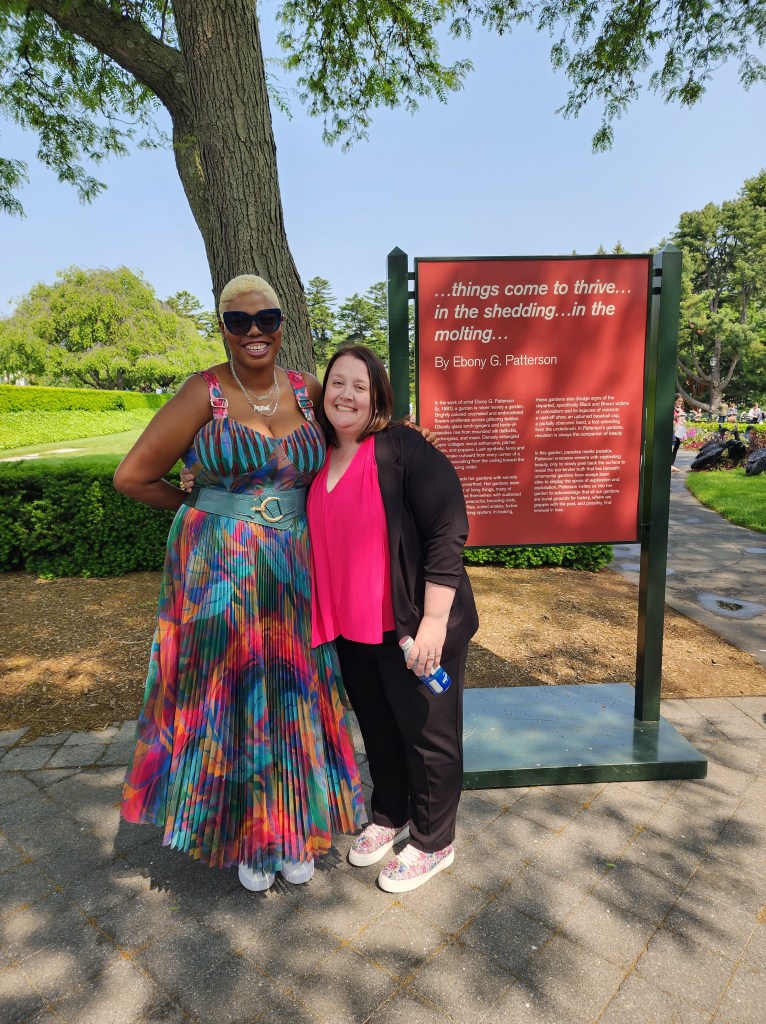
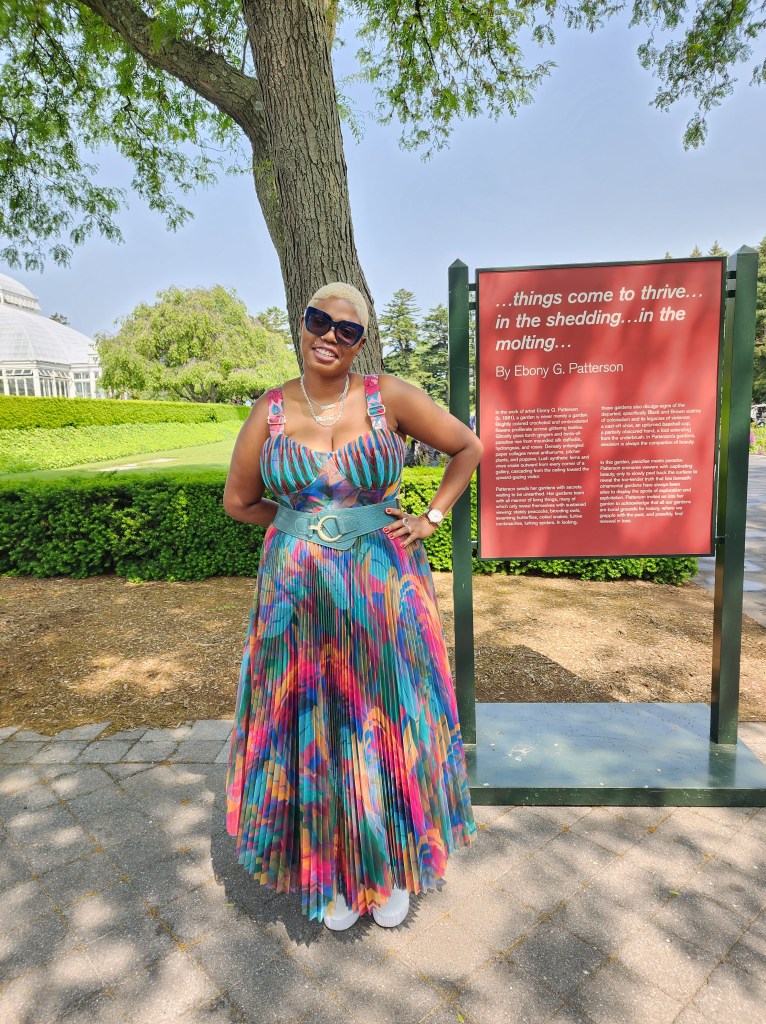
New York Botanical Garden and visual artist Ebony G. Patterson have been collaborating for a year or more about Patterson’s new site-specific work which is a maverick first for the Garden. Entitled …things come to thrive…in the shedding…in the molting… Patterson focuses her unique vision in an exhibition of tensions, using living and preserved plant collections as its material and inspiration. In her examination of gardens as a metaphoric site of birth and the journey to the molting, shedding and death to be reborn again, her expression has found new meaning and is, as all artists hope, an important trigger to enhance revelation and the appreciation of our place in history on this planet in our expression and love of gardens.

Her approach specifically relates to how the visible/invisible (sub rosa), desirable/undesirable are manifested in how past and present inhabitants attempt to exert control over the natural world via the design and selection of plants for gardens.
Patterson’s site-specific exhibition of sculptural and horticultural installations represents a few firsts. She is the first visual artist to embed with the New York Botanical Garden for an immersive residency. Working directly with the Garden’s grounds and collections she created an original conceptual arrangement that includes sculptures, installations and interventions with living plants to bring a message of impact that is highlighted in the Palms of the World Gallery, the staging rotunda and the walkway gallery between those two showcase galleries in the Enid A. Haupt Conservatory. Her visual artistry is also displayed outside the Conservatory in the lawn landscape as well in the Mertz Library Building on the 6th floor. The exhibition is on view Saturday, May 27 through Sunday, September 17, 2023.
The concept that life is cyclical and mirrors that “eternal” process is present throughout Patterson’s exceptional presentation. Living beauty doesn’t last. However, the regenerative process is what remains. Ultimately, it is that regenerative process that is beautiful and sacred. In order for the beauty of the butterfly to emerge, the ugly caterpillar must first go through its necessary transformative steps, some of them painful, after which it eventually emerges with its wings for its first flight. Likewise, wildlife, living plants and human beings go through processes of “molting,” “shedding” and “decay” in order to revive, regenerate, heal and eventually die, to then transition in another consciousness. Even what appears to be “the end,” is not a full finality, but can be cause for celebration of new life or supplying elements that create and sustain life.


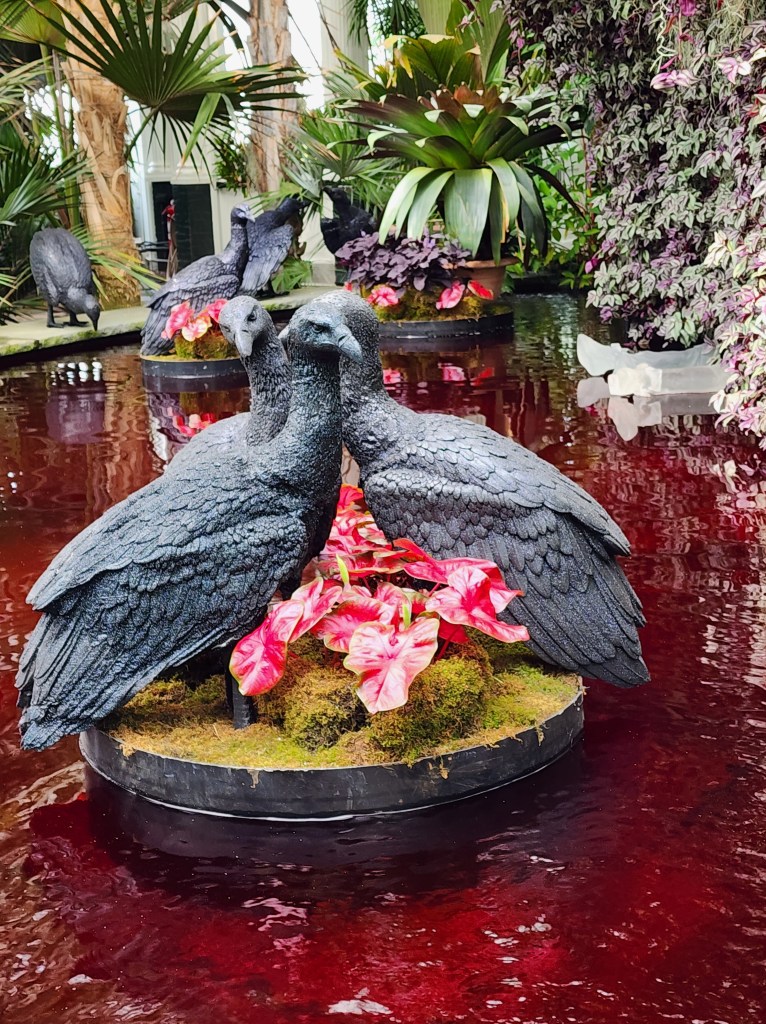
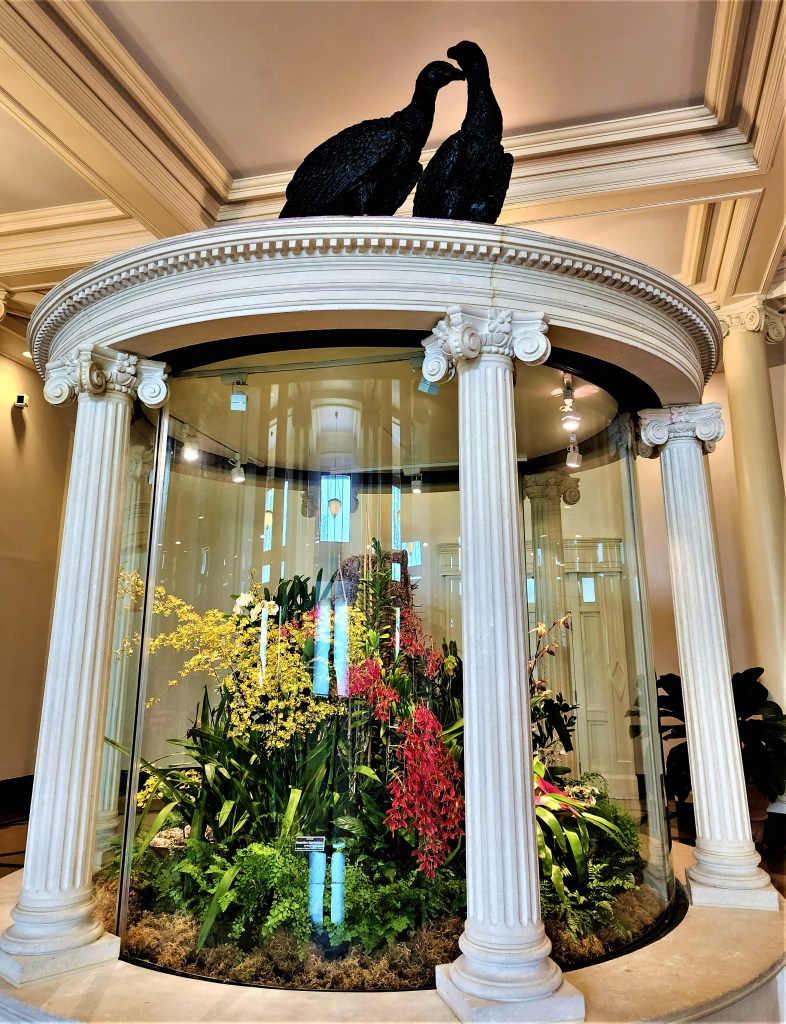
Patterson positions the loveliness of a selection of plants against sculptures which remind us that when they decay, there is the clean up crew that comes along to make way for the regeneration and rebirth. Thus, sculptures of black vultures (400 in all in four different positions) populate the landscape. A usual symbol of death and dying, certainly macabre, Patterson’s use of them, especially in the Palms of the World Gallery, the walkway and the showcase rotunda is a stark metaphor. If they are the ugliness and fearful example of nature and ultimately the planet’s world garden which is not “perfection,” they are a necessary element of purification because decay if left untended creates disease. The clean-up crew of vultures, insects, etc., takes care of the bodies that are decaying, picking their bones clean. Thus, they receive nourishment and the earth’s soil, etc., receives the nourishment from what the vulture’s don’t consume, i.e. bones leach out their phosphorous and other elements after weathering.


In Patterson’s attempt to realize new symbolism of the processes of life, death and regeneration with the backdrop of gardens, she also includes the impact this has had on her Jamaican roots which historically go back to slavery and colonialism with the Triangular Trade-sugar, molasses, rum, slaves. Historically, only the wealthy were able to create gardens. The poor and working class didn’t own swaths of land; rather they were the workers and the slaves on the land and in the gardens, until slavery was abolished and its remnants finally extirpated. Colonialism was white privilege from Europe, brought to the United States. The ending of colonialism and its representation in the ordered gardens of wealth took place during the twentieth century. Remnants of colonialism have been decaying ever since, as individuals acknowledge its horrific and miserable past (the invisible) while having created some of the most lasting and historic structures and dualistic civilization (the visible).


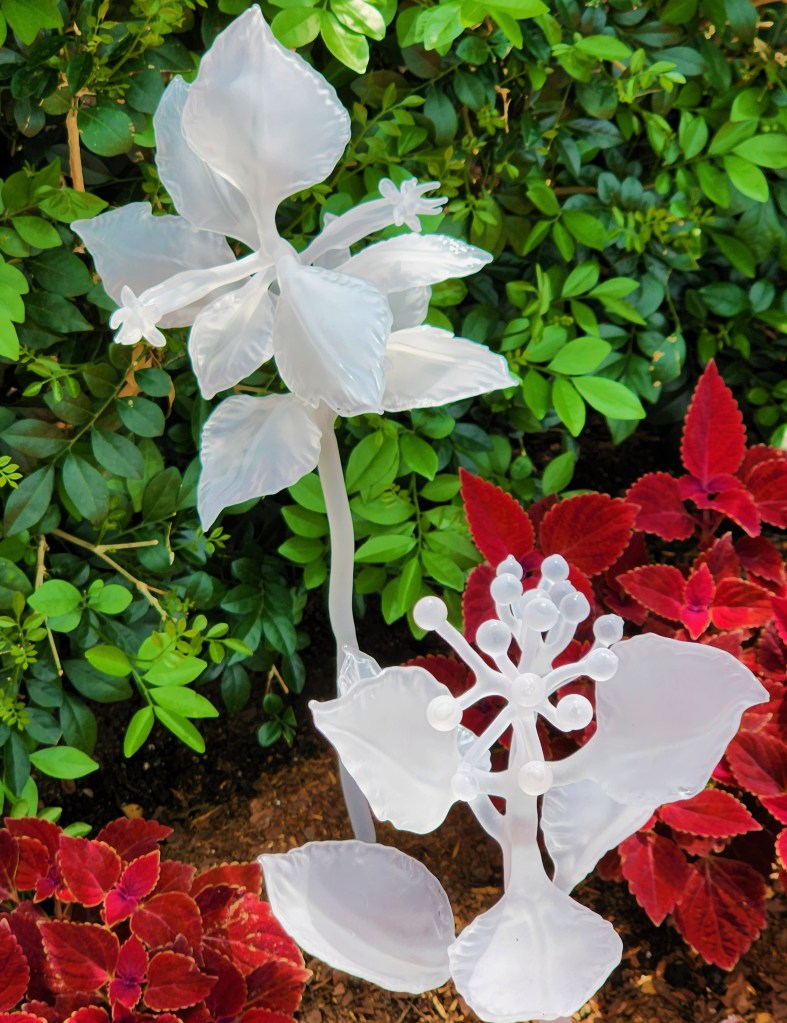
These notions are represented in the showcase rotunda where the white, glass, male feet are protruding upside down in pots of floral plantings. What lies underneath is the entire body that is being consumed by the insects and bacteria in the soil. On the surface are what the body pushes up, the flowering multiple-hued beauty of the plantings in circular pots. Thus, symbolized is the shedding of white colonialism and the power structures that once “lived” and “flourished,” but now are in a state of decay. On another level community gardens are taking over and the wealthy in the UK (which prospered from slavery and ruled in the 1700s) can no longer afford to maintain the gardens without a “free” worker force. Instead, many of the colonizers and wealthy estates have been donated to trusts and museums and paid workers are creating gardens. This is a form of regeneration.

According to Patterson, “The opportunity to work directly within the New York Botanical Garden, using its collections and landscape as inspiration, provided the opportunity to bring many elements of my practice together.” She continued, “I’ve long worked with the idea of gardens, but this direct intervention allowed us to begin to literally peel back the landscape to look, not only at the plans on the surface, but also explore what lies beneath, and the generative life cycles that sustain the entire ecosystem.”

She particularly focused on the “Plants and animals that clean, regenerate, and consume as an act of care. These are necessary for the survival of the entire ecosystem. This reality of the garden is often not highlighted and celebrated, an experience that is paralleled in many areas of society and a tension at the heart of my practice overall.”

Jennifer Bernstein, CEO and The William C. Steere Sr. President of The New York Botanical Garden, stated the following about the installations. “Ebony G. Patterson’s exhibition at the Garden marks an exciting moment for us as an institution, as we were able to provide a platform for one of the most compelling artists of our time to explore the complex symbolism of gardens and the fractured human relationship with nature. She added, “Patterson’s work will entice, disarm, and provoke visitors, and we look forward to the dialogue and conversations that will unfold.”
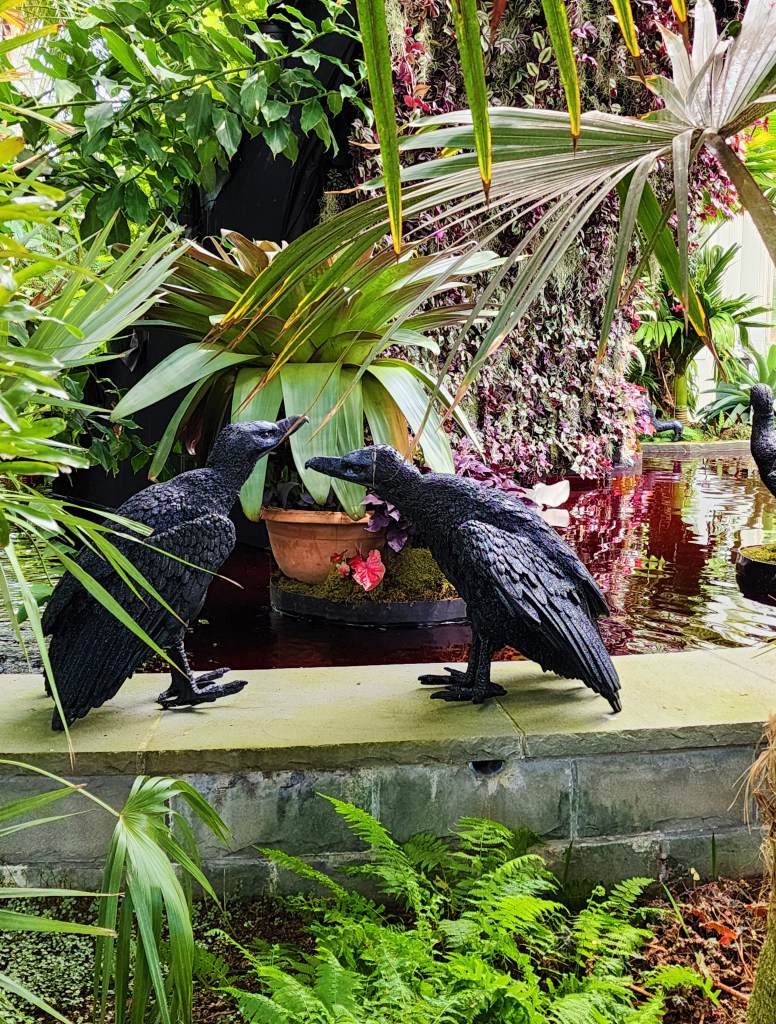
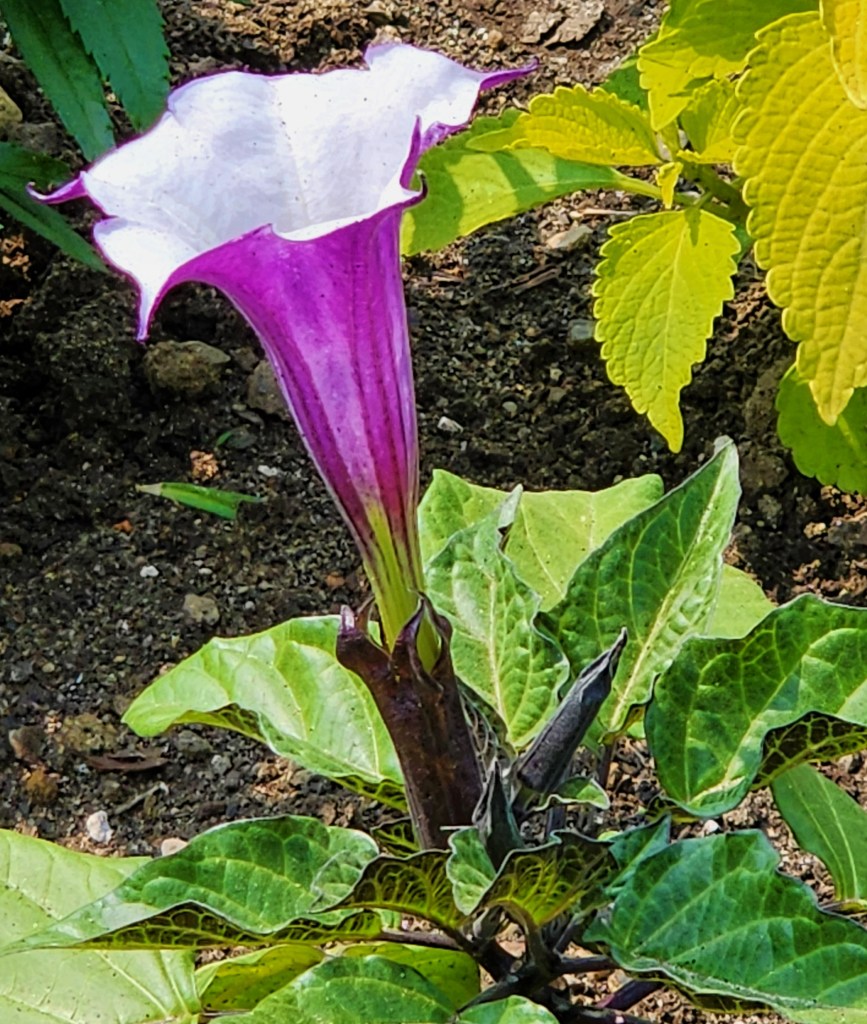
After perusing the hundreds of glittering vultures featured among blood-red, woumd-like ruptures (symbolic of the bloodshed of the enslaved) that interrupt an expanse of light purple foxgloves, lime-green zinnias, coleus and other blooms, you will enter the rotunda showcase gallery. Look up. You will see a cast-glass-and-hydrostone white peacock which focuses the installation from the rotunda to the Palms of the World Gallery. Symbolically, Patterson conceived of the peacock looking backward on its trailing tail, imaginatively unfolding an immersive garden of plants with variegated foliage. These include caladium, hypoestes, red begonias and impatiens.

Everpresent are the vultures cleansing and purifying the decay. In memorium to extinct species, there are ghostly cast-glass plants which Patterson researched in NYBG’s William and Lynda Steere Herbarium. These plants are plant placeholders, made one-of-a-kind. The species they symbolize are plants which were once alive, and now are unable to regenerate. All living things are sacred and if codified, will never truly be extinct, but will be photographed or illustrated as a reminder of the impermanence and sanctity of living structures.

Continuing the imaginary unfolding tail of the peacock, we enter the Palms of the World Gallery where there is a foliage wall reflecting in the pool. One sees various plantings including ipomeas, silver-inch plants and love-lies-bleeding. Again there is the symbolism of blood and lives sacrificed for wealth as a subtext and hidden meaning of gardens. Underneath the surface of the loveliness-there is brutality and ugliness. Indeed, nature in its feeding and living can be predatory, as well as gorgeous, a major theme of Patterson’s installation.
The secrets of decay are the subtext, always a contrast to the lush colorful and luxurious face of greenery and rainbow colors. But these plants, too, will wither and their bodies will be used as nutrients for bacteria to enrich the soil which can then burgeon with new growth when there time has arrived. Interestingly, Patterson has included the male glass figure, legs protruding out from the wall into the symbolic “blood pool.” This white glass sculpture halved by the plant wall is perhaps metaphoric of nature’s resilience against human control of gardens. It also may symbolize colonialism’s demise as the regrowth and power of nature always maintains control because of the process of birth, living, dying, decay and regeneration.



In the Mertz Library Building on the 6th floor one may see Patterson’s latest works on paper. Look closely, you will see those helpmates of plants, pollinators, and cleaners of decay, flies and spiders and cockroaches. The patterned entanglements are dense and complex. If you look closely snakes, plants, insects, human figures, butterflies can be teased out of the paper mesh which represents a vast and massive ecosystem curiously interdependent and synergistic. Her works trigger one’s thoughts and suggest subtext and hidden, symbolic meanings and associations. Patterson nudges one to look deeper at organization in nature which is more vastly unknown as discoveries currently happen. With humility researchers have discovered the vast communication system of trees, not only in their root systems, but in the ambient atmosphere. Patterson suggests the inter-connectedness of all things and the circular process which cycles.


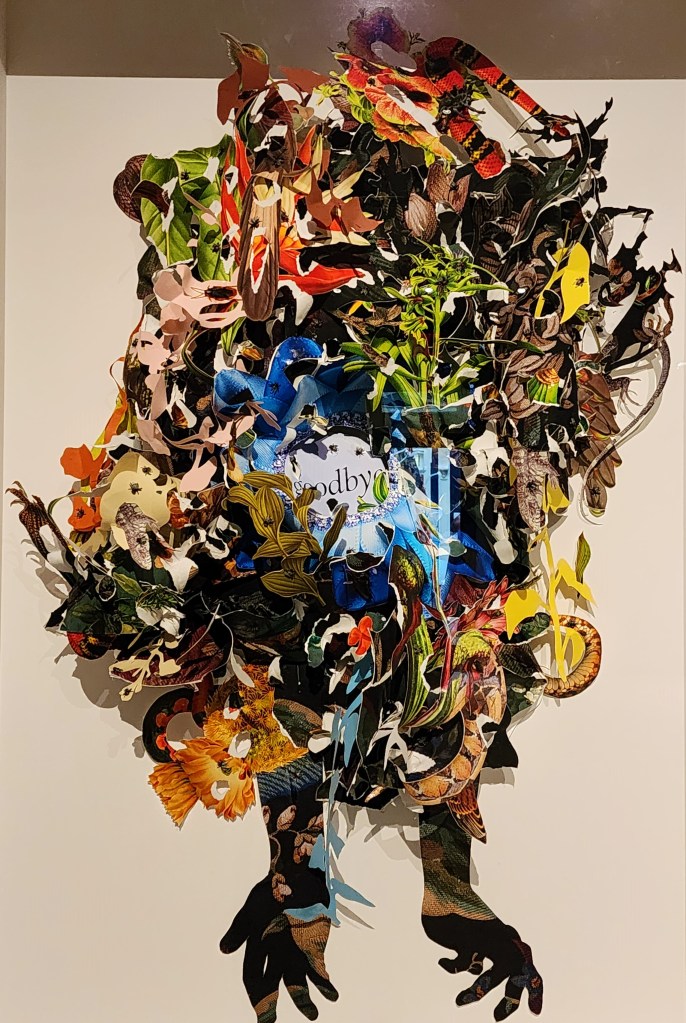
The mixed media paper collages from the 2022 series studies for a vocabulary of loss combine highly-textured, torn, and reconstituted botanical illustrations and photographs of lilies, bird-of-paradise, carnivorous pitcher plants, mushrooms, stylized vines, scorpions and highly patterned human arms. These series of works are suggestive of funerary wreaths. There is renewal in loss and beauty in the process which is continuously revolving.
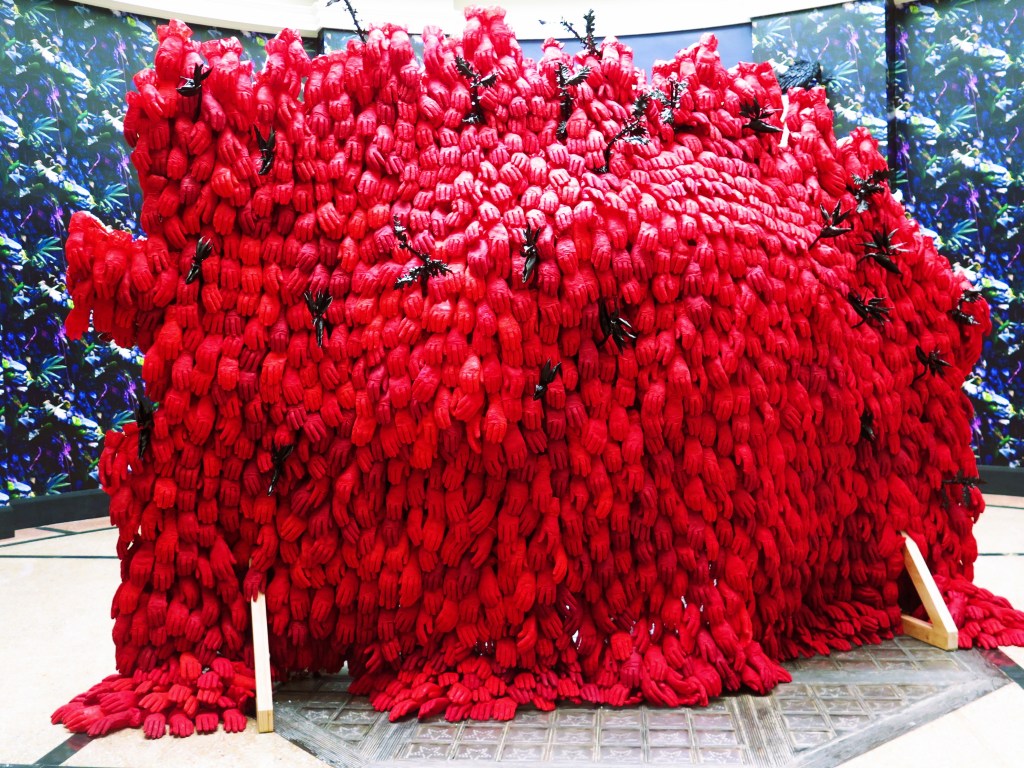
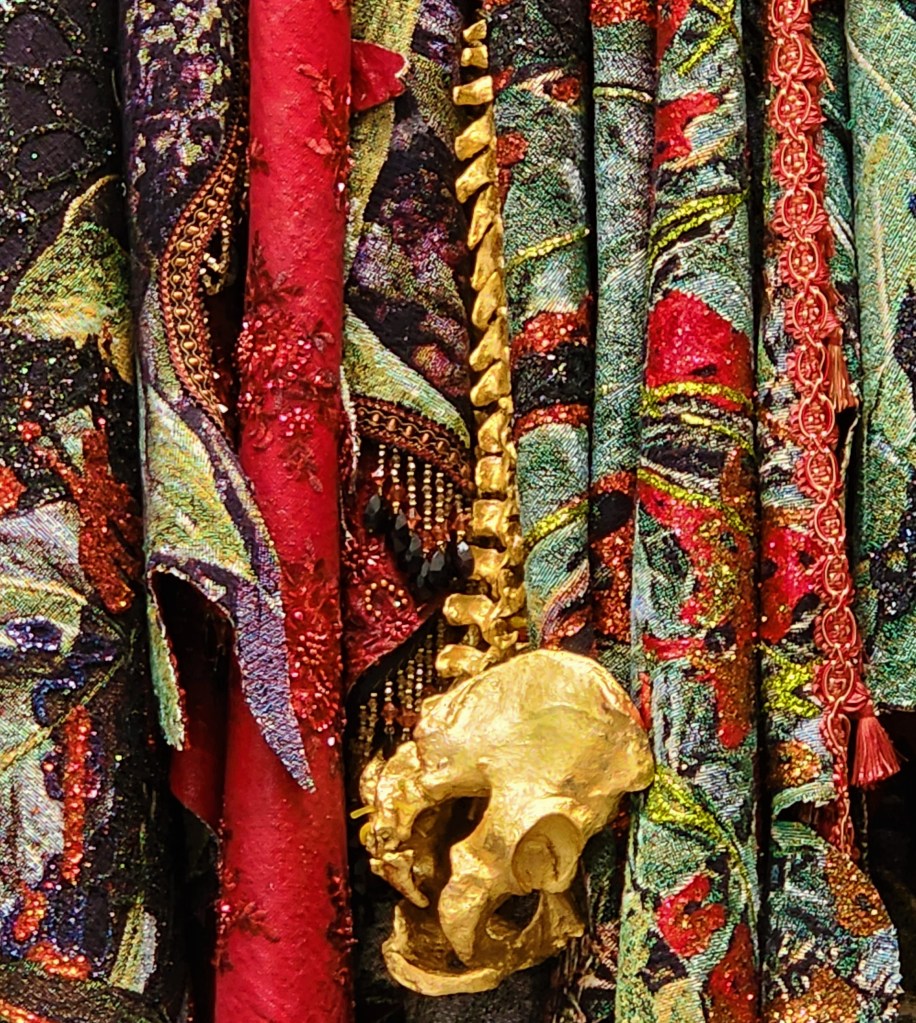
Additionally, there is Patterson’s fascinating installation “Fester.” The rotunda space has wallpaper of repeating patterns to suggest a nighttime garden and a central installation. On one side is a wall, the other side is surprising.Viewed in the round, the reverse side of the wall represents the freshly wounded earth with a cascade of over 1,000 red lace gloves, their root-like fingers revealing cast-glass thistles and cast-metal monstera leaves. Perhaps represented in the mass of blood red hands-a sacrifice of slavery and labor, there are black hands reaching out. And on the other side are the textiles, tapestries of rapturous hues hanging from the wall, partially concealing gold-leafed skeletal forms. The associations are rife. From picking cotton to making textiles, the labor is intensive. When it was free, colonizers and slave-holders made a ton of money, perhaps so much money, their spines turned to gold. Patterson’s work is so rich and imaginative, it stimulates a riot of symbolic concepts.
I also was intrigued to find Patterson’s work loaded with irony. I found myself laughing at the sharp contrasts and striking symbols. Her unique vision is refreshing and macabre and joyful and humorous and reflective of the cycles of living species.

Who is Ebony G. Patterson? The artist received her BFA in painting from Edna Manley College of Visual and Performing Arts in Kingston, Jamaica (2004), and an MFA in printmaking and drawing from the Sam Fox School of Design and Visual Arts at Washington University in St. Louis (2006). She has taught at the University of Virginia and Edna Manley College School of Visual and Performing Arts and has served as Associate Professor in Painting and Mixed Media at the University of Kentucky. Her work is in the collections of institutions including 21c Museum and Foundation, Louisville, Kentucky; Lost Angeles County Museum of Art, Los Angeles, California: Nasher Museum, Duke University, Durham, North Carolina to name a few. She is also exhibited in the Whitney Museum of American Art. Co-Artistic Director, along with curator Miranda Lash, Prospect.6 New Orleans,will open in Fall 2024.
For programming and tickets to this thought provoking exhibition, go to the NYBG website
 CAROLE DI TOSTI