Category Archives: NYC Theater Reviews
Plays
Mary Louise Parker, David Morse Renegotiate Their Roles in the always amazing ‘How I Learned to Drive’
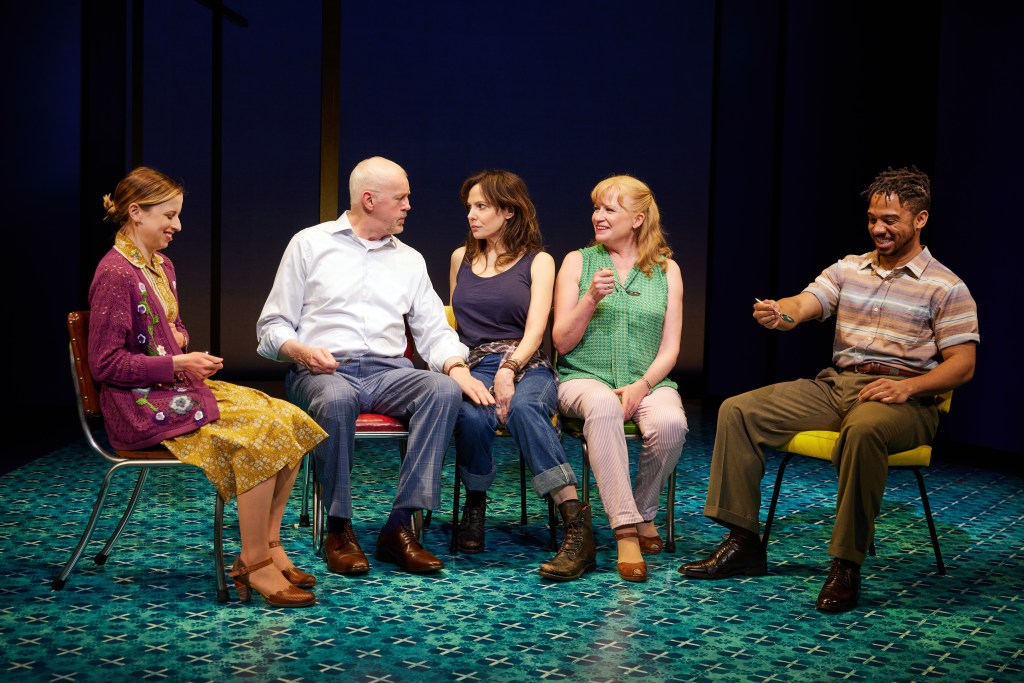
Paula Vogel’s Pulitizer Prize winning How I Learned to Drive in revival at the Samuel Friedman Theater is a stunning reminder of how far we’ve come as a society and how much we’ve remained in the status quo when it comes to our social, psychological, sexual and emotional health, regarding straight male-female relationships. Pedophilia and incest by proxy are as common as history and not surprising in and of themselves. On the other hand how particular male and female victims lure each other into illicit sexual self-devastation is unique and horrifically fascinating.

This is especially so as leads Mary-Louise Parker, David Morse, and director Mark Brokaw put their incredible imprint on Vogel’s trenchant and timeless play. Interestingly, Parker and Morse are reprising their roles from the original off-Broadway production, with original director Mark Brokaw shepherding the Manhattan Theatre Club presentation. Parker (Li’l Bit) and Morse (Uncle Peck) are mesmerizing as they portray characters who manipulate, circle and symbolically search each other out for affection, love and connection. The relationship the actors beautifully, authentically establish between the characters is heartbreaking and doomed because it cannot come out from under the umbrella of the culture’s changing social mores, Peck’s psychological illness from the war, and Li’l Bit’s familial, sexual psychoses.
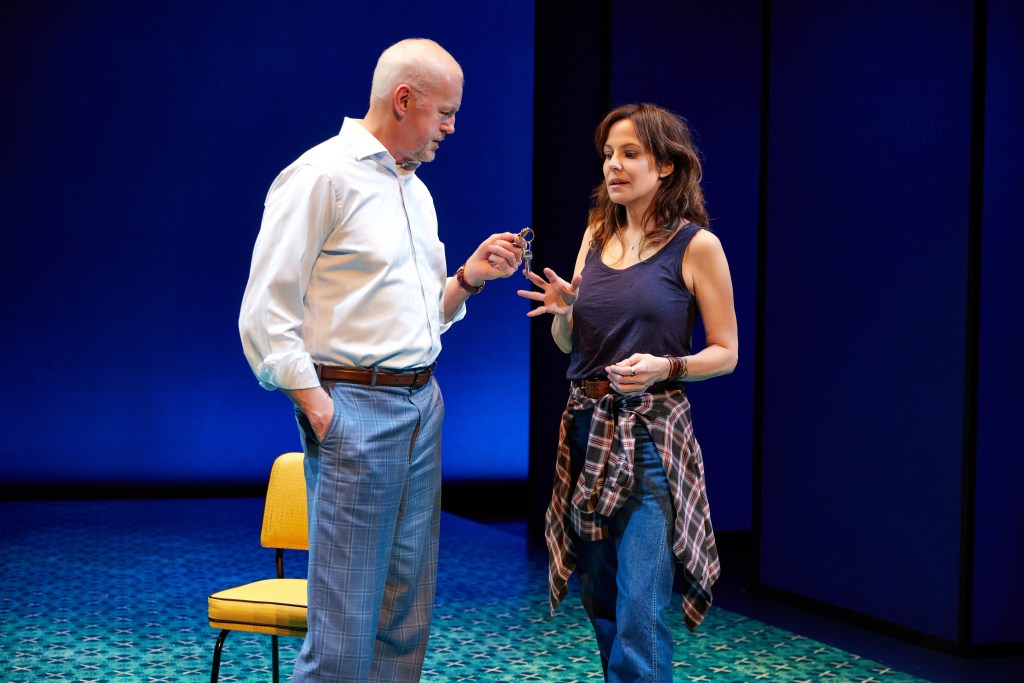
How I Learned to Drive reveals what happens to two individuals (a teen girl and an adult male), who engage in the dance of psycho-sexual destruction while negotiating feelings of desire, love, attraction, fear and guilt under society’s and family’s repressive sexual folkways and double standards. What makes the play so intriguing is not only Vogel’s dynamic and empathetic characterizations, it is her unspooling of the story of the key sexual-emotional relationship between Li’l Bit and Peck.
Li’l Bit and Peck’s relationship is not easily defined or described as sexually abusive, though in a court of law, that is what it is, if an excellent prosecutor makes that case in a blue state. However, in a red state, it might be viewed differently. Consider 13 states in the US allow marriage under 18, and Tennessee has recent records of marriages of girls at 10 years-old with parental or judicial agreement.

Sexual abuse, if the players are amenable and influencing each other for reasons they themselves don’t understand, is a slippery slope depending upon the state’s political and social folkways, the familial mores and the perspectives of the players themselves. Ironically and eventually, a turning point comes IF the abuse is recognized and the relationship ends whether exposed to the light of public scrutiny or not as in the case of Lil’Bit and Peck.
In Vogel’s play, how and why Lil’Bit ends her forbidden relationship with Uncle Peck is astounding, if one looks to Vogel’s profound clues of Lil’Bit’s emotions which are an admixture of confusion, regret, love, affection, annoyance, fear and disgust of going legal/public and against family, for example, her Aunt, whom she has “stolen” Peck from. Indeed, Lil’Bit is willing to forget what happened and stop their secret “drives” after she goes away to college. But when she is disturbed by Peck’s obsessive letters, and drinking to excess, she flunks out. She is haunted by the events (sexual grooming in 2022 parlance), that began when she was eleven, so she ends “them.” The last time she sees him is in a hotel room, though at 18-years-old she is of age and old enough for intercourse under the law. However, she must be willing.

Her ambivalence is reflected when she lies down with him on a bed, obviously feels something but gets up. Yes, she agrees to do that after she has two glasses of champagne. But when he asks her to marry him and go public with their affection with each other, it’s over. The irony is magnificent. When they were secret, she let it happen and told no one and continued her drives with him until college. The public exposure of a public marriage is loathsome for her as she would have to confront what has transpired between them for seven years.
As Vogel relates the process through Lil’Bit’s sometimes chaotic flashback/flashforward, unchronological remembrances, we understand the anatomy of Peck’s behavior and hers. The finality of this revelation occurs when she divulges the precipitating abusive event on Lil’Bit’s first driving lesson in Peck’s car. Driving becomes the sardonic, humorous metaphor by which Peck reels her in, linking her desires to his (part of the affectionate aspect of grooming). Her mother (the funny and wonderful Johanna Day), despite negative premonitions, allows her eleven-year-old to go with her uncle, though she “doesn’t like the way” he “looks” at her.

The dialogue is brilliant. Li’l Bit chides her mother for thinking all men are “evil,” for losing her husband and having no father to look out for her, something Uncle Peck can do, she claims. Li’l Bit uses guilt to manipulate her mother to let her go with him. Her mother states, “I will feel terrible if something happens” but is soothed by Li’l Bit who says she can “handle Uncle Peck.” The mother, instead of being firm, says, “…if anything happens, I hold you responsible.”
Thus, Li’l Bit is in the driver’s seat from then on, responsible for what happens in her relationship with Peck, given that warning by her mother. This, in itself is incredible but the family has contributed to this result in their own personal relationships with each other as Vogel reveals through flashbacks of scenes which have psycho-sexual components between Peck and Lil’Bit and Lil’Bit and family members. However, this is a play of Lil’Bit’s remembrance. We accept her as a reliable narrator, knowing that things may have been far different than what she tells us. As she is coming to grips with what happened to her as a child, we must admit, it could have been worse, or better, any of the representations less or more severe. Indeed, she is narrating this story of her teen years as a 35 or 40-year-old who is plagued by the tragedies of the past which include what happens to her Uncle which she may feel responsible for.

During the flashbacks which are prompted by themes of unhealthy sexual experiences (including male schoolmates’ obsession with her large breasts), Lil’Bit reveals prurient details about her family’s approach toward their own sexuality and hers. It is not only skewed, it is psychologically damaged. For example, Lil’Bit explains they are nicknamed crudely and humorously for their genitalia. Her grandfather represented by Male Greek Chorus (the superb Chris Myers), continually references her large breasts salaciously, one time to the point where she is so embarrassed she threatens to leave home. Of course, she is comforted by Uncle Peck who understands her and never insults or mocks her. However, in retrospect, he does this because it’s a part of their “close” driving relationship.
In another example her mother chides her grandmother for not telling her about the facts of life because she was most probably gently forced into sex, got pregnant, had a shotgun wedding and ended up in an unhappy, unsuitable marriage. From the women’s kitchen table of women-only sexual discussions, we learn that grandmother married very young and grandfather had to have sex for lunch and after dinner, almost daily. And with all that sex, grandma never had an orgasm.
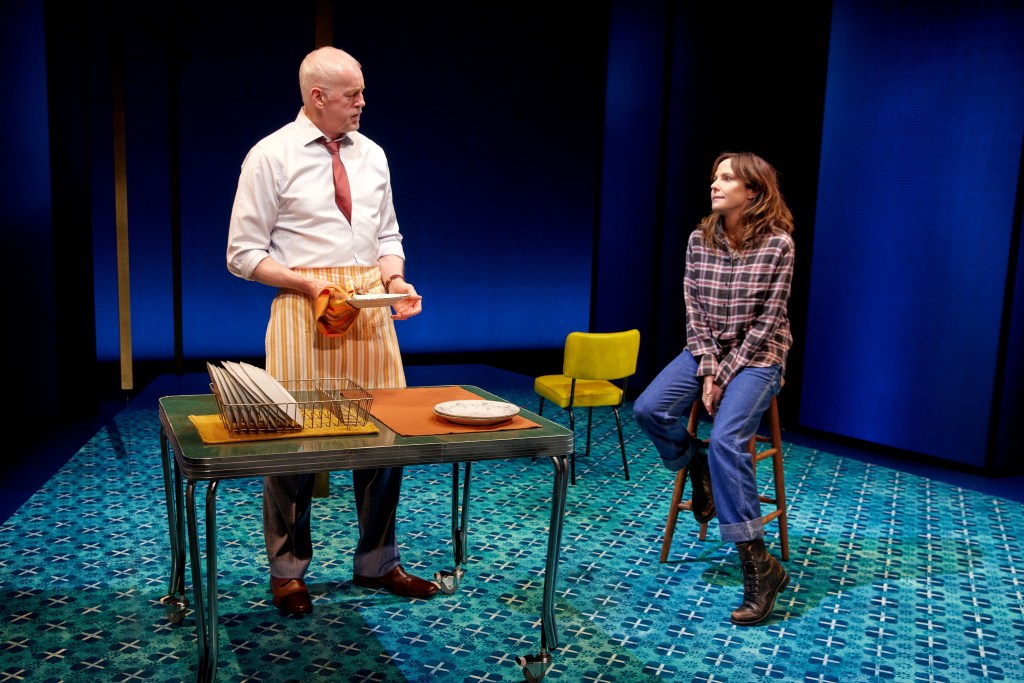
When Lil’Bit asks does “it” hurt (note the reference isn’t to love or intimacy or even the more clinical intercourse), the grandmother portrayed by the Teenage Greek Chorus (Alyssa May Gold who looks to be around a teenager), humorously tells her, “It hurts. You bleed like a stuck pig,” and “You think you’re going to die, especially if you do ‘it’ before marriage.” The superb Alyssa May Gold is so humorously adamant, she frightens Lil’Bit so that even her mother’s comments about not being hurt if a man loves you are diminished. Indeed, reflecting on her mother’s unwanted pregnancy and her grandparents’ cruelty forcing her mother to marry a “good-for-nothing-man,” the discussions are so painful Li’l Bit can’t bear to remember their comments “after all these years.”
Thus, romance, love and affection and sweet intimacy are absent from most discussions about men who are neither sensitive, caring, loving or accommodating to her mother (an alcoholic with tips on drinks and how to avoid being raped on dates), and grandmother who never had an orgasm with her beast-like husband. Only her Aunt seems satisfied with Uncle Peck, who is a good, sensitive man, who is troubled and needs her, and who reveals that she sees through Li’l Bit’s slick manipulation of him. She knows when Li’l Bit leaves for college, her husband will return to her and things will be as before. An irony.

Vogel takes liberties in the arc of the flashbacks with intruding speeches by family. As all memories emerge surprisingly when they are disturbing ones, Li’l Bit’s are jumbled. The exception is of those memories which organically spring from the times Peck and Li’l Bit drive in his car as he teaches her various important points and helps her get her driver’s license on her first try. After, they celebrate and he takes her to a lovely restaurant and she gets drunk.
Again and again, Vogel reveals Peck doesn’t want to take advantage of her because he will not do anything she doesn’t want him to do, he proclaims. Thus, his attentions are normalized. And Lil’Bit shows affection yet, at times apprehension, ambivalence and acceptance. On their drives, Peck has become her quasi father figure, a confidant and supportive friend. Thus, she accepts his physical liberties with her (unstrapping her bra, etc).
Because the scenes are in a disordered cacophony, each must be threaded back to the initial event of Peck’s molestation which happens at the end of the play. SPOILER ALERT. STOP READING IF YOU DON’T WANT TO KNOW WHAT HAPPENS.

The mystery is revealed why Li’l Bit continues her driving lessons until she goes to college, and even then ambivalently meets him in the hotel room where he proposes. When she is eleven (Gold stands off to the side reminding us of her age as Parker and Morse enact what happens), she touches Peck’s face as she sits on his lap. While driving, Peck touches Li’l Bit who cannot reach the breaks, but only holds her hands on the wheel so she doesn’t kill them both. Though she accepts what he does initially, then tells him to stop, he ignores her. Then she states, “This isn’t happening,” making the incident vanish, though it happens. And she tells us, “That was the last day I lived in my body.”
It is a shocking moment and is a revelation at the play’s near conclusion. Prior to that Morse is so exceptional we take Peck at his word, that he won’t do what she doesn’t want him to. In the last scene, we see he lies. Likewise, we realize the impact of his horrific behavior on Li’l Bit. When she is twenty-seven as an almost aside, in the middle of the play, she cavalierly tells us she had sex with an underaged high school student, then reflects upon her experiences with Peck. She realizes for Peck, as for herself, it is the allure of power, of being the mentor and teacher to someone younger, using sex to hook them like a fish.

By this point, we have learned that Uncle Peck became alcoholic, lost everything and died of a fall seven years after she never saw him again. At this juncture in her life, perhaps she is reconciling and working through all of those traumatic experiences growing up. And then Lil’Bit tells us of her love of driving as she gets into a car and Peck’s spirit gets into the back seat and races down the road with her as the others stand outside and watch. Indeed, taking Peck with her, the damage is everpresent. Though she will never die in a car, she has learned to destroy others with the driving techniques of allurement, denial and “gentle affection” Peck showed her.
The actors do admirable justice toward rendering Vogel’s work to be magnificent, complex and memorable. With her profound examination via Li’l Bit’s remembrances, we see Parker’s and Morse’s astonishing balancing act inhabiting these characters and making them completely believable and identifiable. The audience tension is palpable with expectation as we become the voyeurs of a slow seduction: we wonder if the cat who mesmerizes the bird will really pounce or the bird merely enthralls the cat, knowing its wings enables it to an even quicker escape, leaving the cat in devastation of its own faculties.
Rachel Hauck’s minimalist set is suggestive of memory without a conundrum of details, just the bare essentials to fill in the locations with the time stated by the chorus (Johanna Day, Alyssa May Gold, Chris Myers). The depth and sage layering of Vogel’s production envisioned by Brokaw disintegrates the superficiality and sensationalism of pundits on the left in #metoo and on the right with #QAnon pedophile conspirators. It echos the tragedy of the human condition and the revisiting of the sins upon each generation who dares to breathe life into the next set of progeny.
Kudos to the creative team Dede Ayite (costume design), Mark McCullough (lighting design), David van Tieghem (original music and sound design), Lucy MacKinnon (video design), Stephen Oremus (music direction & vocal arrangements). This is another must-see with this cast and director who have lived the play since before COVID. You will not see their likes again. For tickets and times go to https://www.manhattantheatreclub.com/shows/2021-22-season/how-i-learned-to-drive/
Debra Messing in ‘Birthday Candles’ brings a tasty treat to Broadway
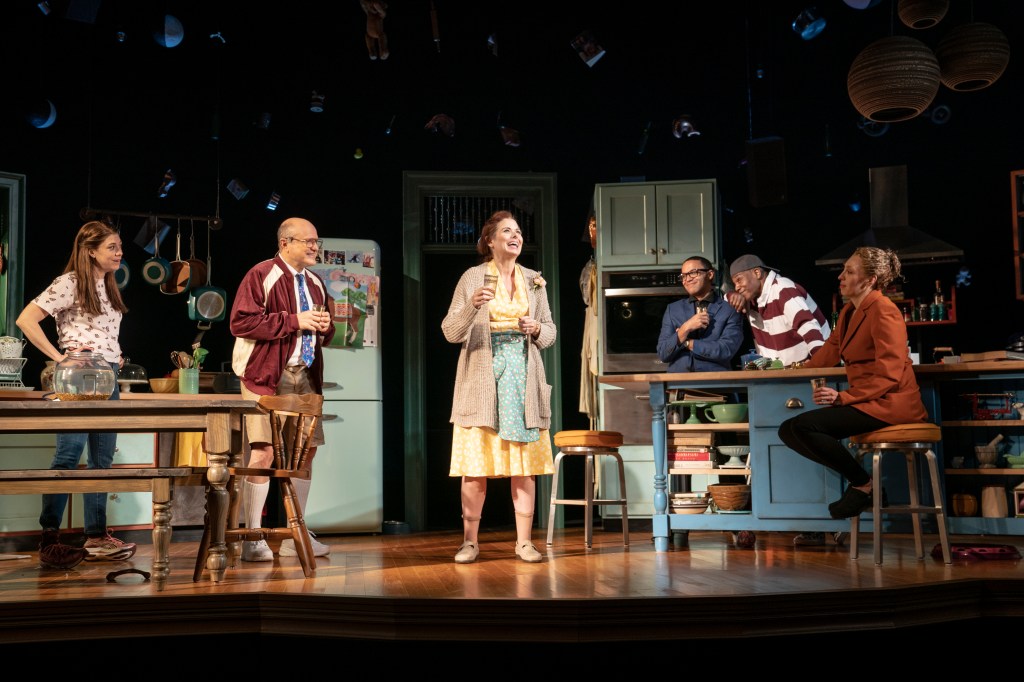
Birthday Candles by Noah Haidle, directed by Vivenne Benesch allows Debra Messing to shine as the aging Ernestine who moves from 17 to 107. As she traditionally bakes her birthday cake, over the years, first taught by her mom Alice (Susannah Flood), she gradually understands that she can only realize her dreams by being herself. And all along, getting married, raising a family, getting a divorce and finding the love of hr life, she has achieved her goal, taking her rightful place in the universe.
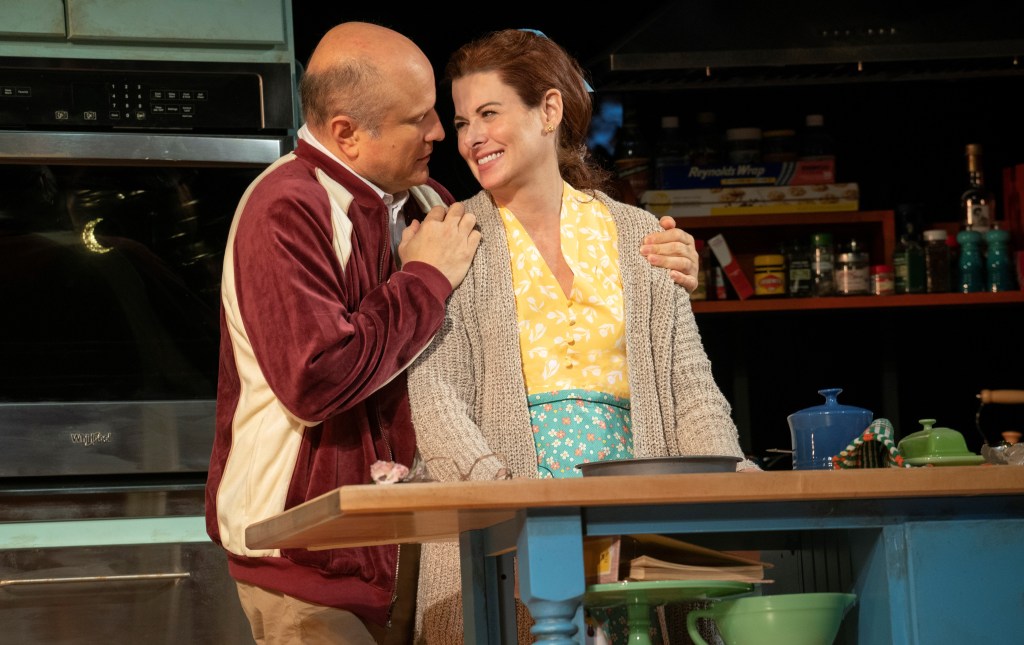
Haidle’s Birthday Candles, at the Roundabout’s American Airlines Theatre, is poetic and complex with multiple themes. The most salient one focuses on Ernestine’s spiritual journey as the “every woman” sustaining emotional pain, trauma, loss, moving from weal to woe and finally reconciling a belated love with great joy in her 80s. As she moves quickly through time, she “looks through a glass darkly” without understanding, until she finally accepts the love and divinity in herself in her relationships with her family and partners. By her 107th year, she misses everyone and wishes them back as she has each time she gives the one passing (mother, daughter, son, grandchildren, etc.) up to the cosmos. Finally, her family spiritually appears and it would seem waits “in the wings” for her to accompany them on the next leg of her journey with them.
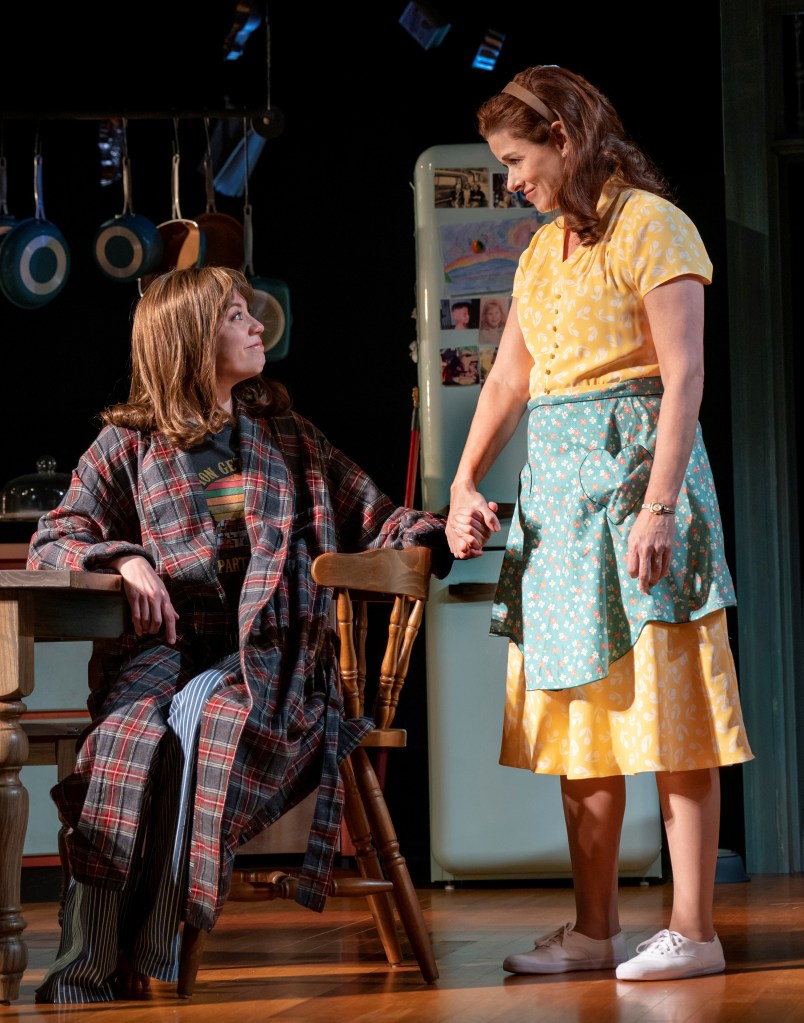
Haidle’s conceit about time and life’s passage in the “twinkling of an eye” (in the play 90 years in 90 minutes with some decades speeded up and others truncated) is most wonderful holistically as the characters live in the moments which they can’t fully appreciate. In this play the adage “life is short” is on steroids. Indeed, living one’s life while observing it alters it (a very rough comprehension of the Uncertainty Principle).
Thus, dramatically the play magnifies each character, present in their most vital of moments with Ernestine to heighten her life’s purpose in being herself, a mosaic of moments which come together at the conclusion. It is then that the audience and Ernestine reflect upon her life’s work and the revelation of Ernestine’s beauty is clarified. Of course, at that juncture when her work is finished, she moves to another realm in the starlit space/time continuum.
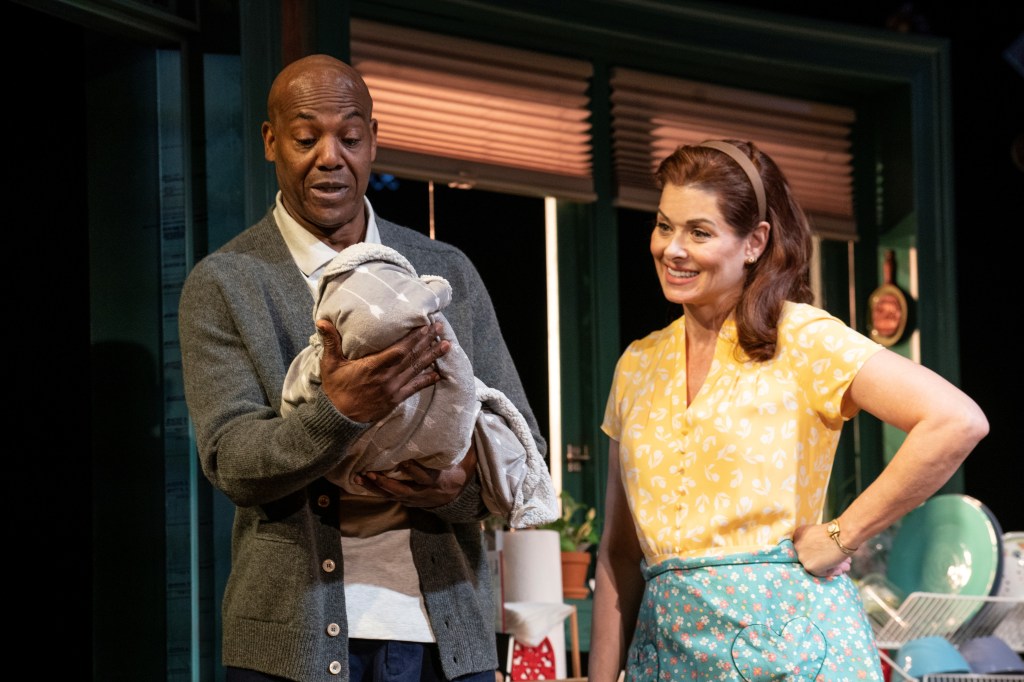
With the exception of Messing’s Ernestine, the actors portray multiple generationaly linked roles from mother Alice (Susannah Flood), to great grand daughter Ernie (Susannah Flood) with husband Matt (John Earl Jelks), son Billy (Christopher Livingston), daughter (Susannah Flood), grandchildren and forever sweetheart Kenneth (impeccably played by Enrico Colantoni). All these escort Ernestine through the years.
The dialogue and sounding of a bell for the passage of time clues us in to each generation as they come to celebrate Ernestine’s birthday while she bakes her plain butter cake over the 90 minutes of the play. Though birthday candles are never placed on top of the cake, nor is it iced, the title is enough. Indeed, Messing as Ernestine is both the icing and the candles, her soul and spirit, which are invisibly lit for eternity.
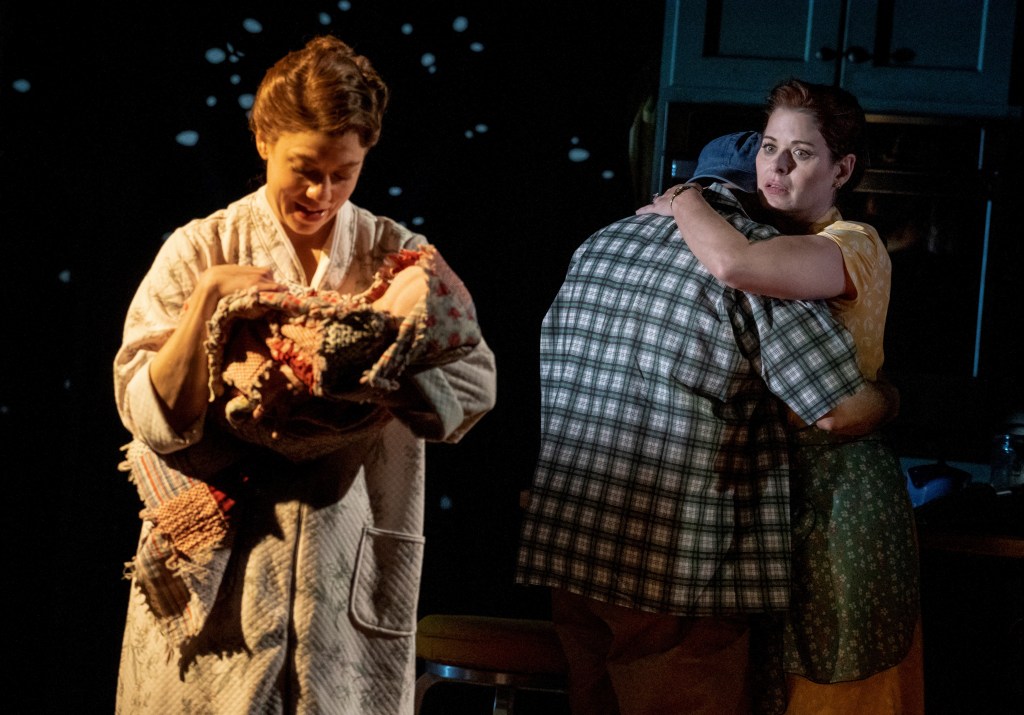
Importantly, every word of the dialogue is paramount and must be heard to appreciate Haidle’s depth of meaning, the poetry, the wisdom, the beauty and the sweet golden threads that bind from one generation to the next. In the performance that I saw (Wednesday evening), sometimes the dialogue was muffled and the words, not projected, slung together like a nondescript house salad without dressing. This was tragic because Haidle’s play is brilliant and achingly timeless and heartfelt. The humor is multi-layered and ripe. The conflicts which (if the actors don’t enunciate precisely) appear rather sparse. However, upon review, they are exceedingly well drawn and acute in each twinkle of time over the fast procession of years that transpose and spool Ernestine’s life.
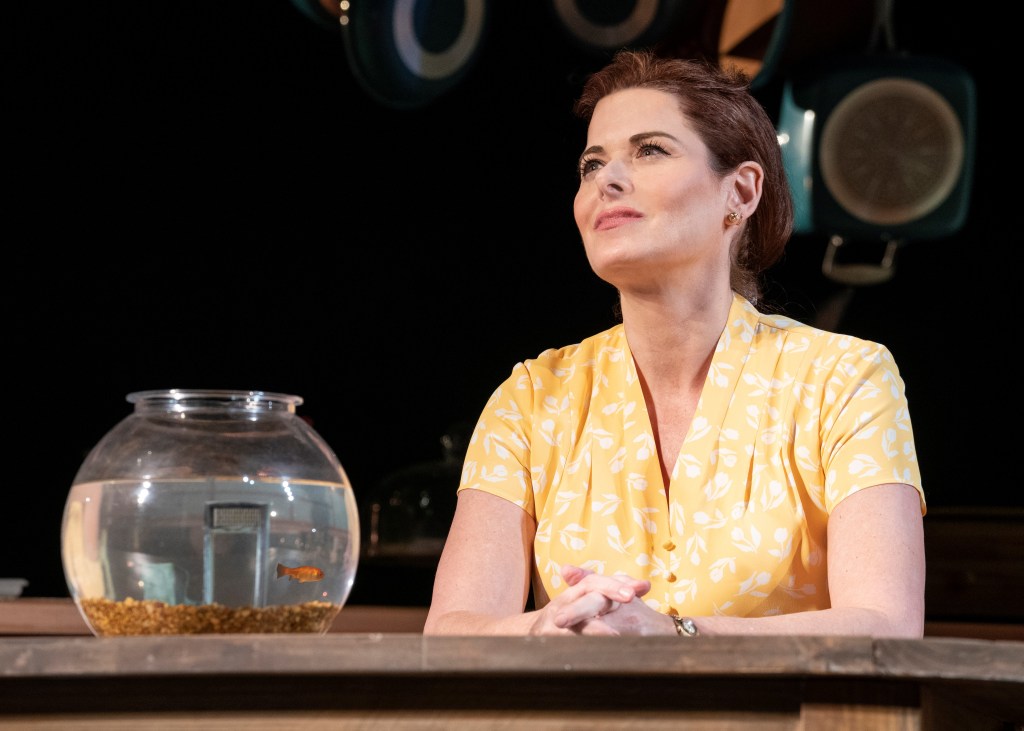
Messing who is an accomplished TV (“Will & Grace”), film (The Mothman Prophecies) and stage actress (Outside Mullingar) is in her glory onstage throughout with “no rest,” (a meme in the play), a veritable tour de force. She is strongest and most poignant in the section of the play when Ernestine reaches a ripe seventy. She has negotiated life on her own terms, has become an entrepreneur, traveled to far flung places and is only taking care of herself. It is then when her granddaughter Alex (Crystal Finn) introduces the next surprising chapter in her spiritual evolution and she learns about reconciliations and renewals, and the fruition of faith and love.
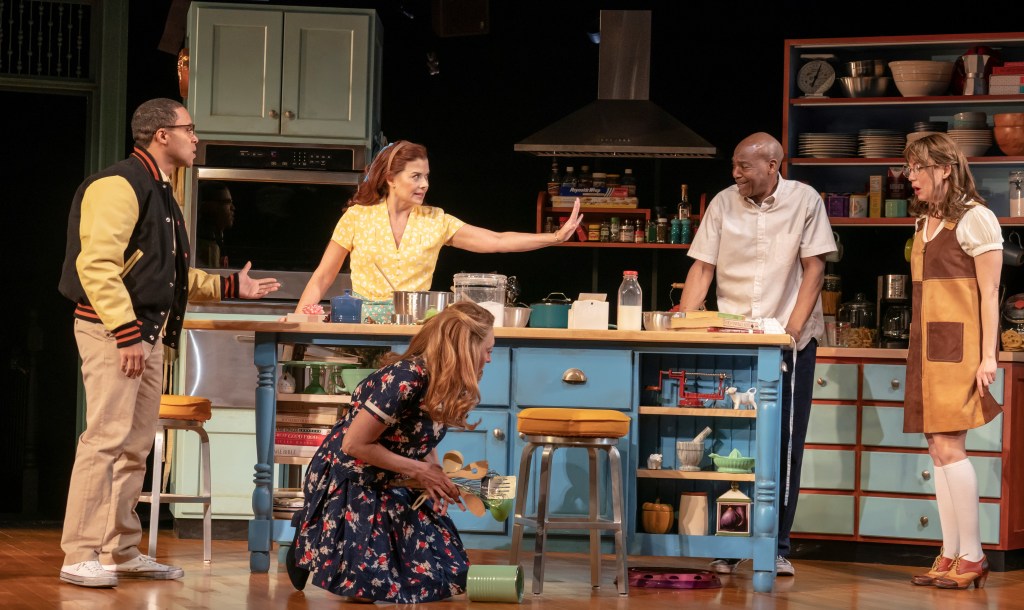
Enrico Colantoni and Messing create the emotional grist for this section of the play which brings a sigh of relief to audience members and shouts from her children. They are truly stunning together and force us to look at those elements that Haidle insists upon in Birthday Candles, the spiritual, the ineffable, the timeless, the eternal. Their relationship which has been growing unseen for Ernestine, always felt to Kenneth, is breathtakingly conceived by the playwright, authentically manifested by Messing and Colantoni. It is the high-point, and Haidle has cleverly made us wait for it, so when it comes we are happily stunned and gratified.
Kudos to the cast when they projected (Colantoni and Messing had no problem) and the creatives: Christine Jones (set design), Toni-Leslie James (costume design), Jen Schriever (lighting design), John Gromada (sound design), Kate Hopgood (original music).
Birthday Candles is on limited engagement. See if before May 29th when it closes. For tickets and times go to their website: https://www.roundabouttheatre.org/get-tickets/2021-2022-season/birthday-candles/performances
‘Take Me Out,’ the Revival Strikes Deep With Bravura Performances by an All-Star Cast

Once again, twenty years later, Take Me Out, the revival for the love of baseball running at 2nd Stage, strikes a pacing home run with bravura performances by Jesse Tyler Ferguson (Mason Marzac), Jesse Williams (Darren Lemming), and Brandon J. Dirden (Davey Battle). Richard Greenberg’s dialogue in the minds, mouths and hearts of the cast never seems more acute, dazzling and dangerous in this “piping time” of Red State/Blue State, as he pumps up the themes of machismo, homophobia, religious bias, gender bias, racism, identity conflicts with color blindness, celebrity privilege, corporate hypocrisy and much more. The second act really takes off, soaring into flight after a perhaps too long-winded first act, whose speeches may have been slimmed a bit to make them even more trenchant and viable.
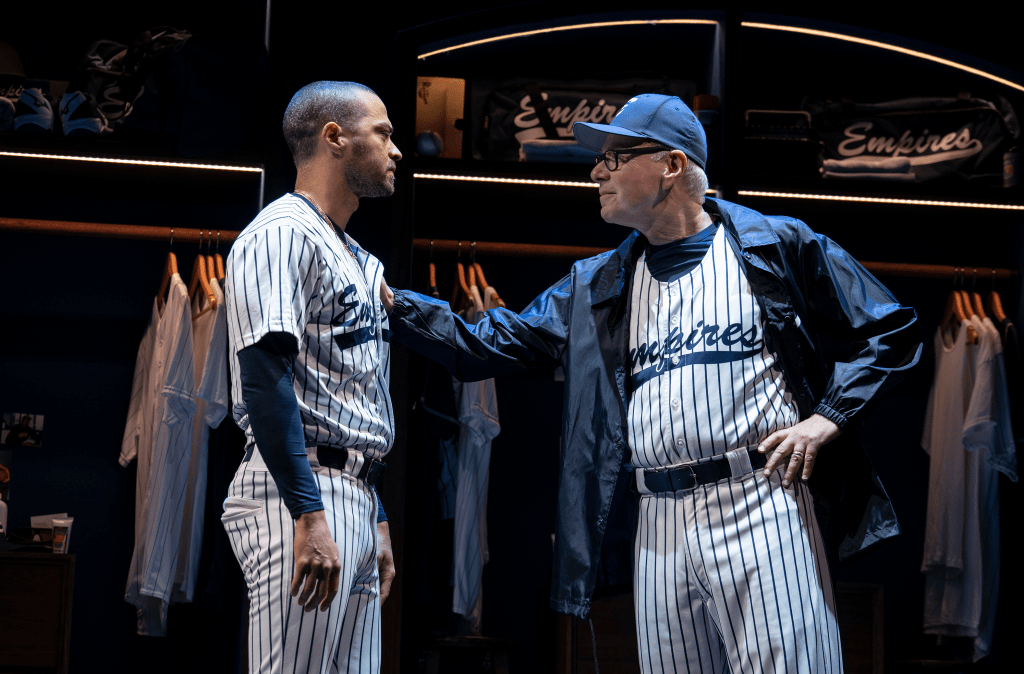
There is no theme that Greenberg doesn’t touch upon which is current and heartbreaking, except #metoo. That is refreshing because one’s personal rights vs. accountability to the public good are paramount to all spirits inhabiting various bodies whether male, female, transgender, or other. The importance of human rights, human decency and love are crucial in this play because the incapacity of all the characters to embody these qualities remains one of the focal points.

Finally, one does hope that the success of the production will remind all lovers of baseball (the most American of games), that it is the only sport where an active major league player has not come out as gay. As a matter of personal choice and risk, of course, such a decision would be momentous as it becomes for the star of the Empires (think Yankees), Darren Lemming, superbly played by Jesse Williams.

Scott Ellis’ direction is spare and thematically charged. Importantly, “sound” (thanks to Bray Poor, responsible for sound design), heightens the excitement. The emphasis is on the crack of the ball on the bat and the cheering fans. The lighting (Kenneth Posner), is spare. Florescent thin blue lines, representing team colors, square off the space to suggest the players’ emotional confinement. The staging elements rightly place front and center the social dynamic, arc of development and relationships between and among the players.
Initially, team camaraderie is thrown into disarray by Darren Lemming, who drips gold from his pores and walks upright in perfection but admits to being gay. His proclamation sends ripples of “shock and awe” through his envious teammates, who worship Lemming’s “divinity,” his steely cool demeanor and very, very fat salary,

We find his teammates response to be humorous. In order not to appear femme they restrict all their male “locker-room” behaviors because they don’t want to “entice” Darren into thinking they are his sexual “kin.” Only Kippy, his self-appointed buddy and narrator who tells part of the story (the fine Patrick J. Adams), chides him for not alerting anyone before his press announcement. Afterward, Kippy humorously teases his friend that the team lionizes who he is and would love to “be him” or “be with him,” on the down low, except that he is now very public. And that would make them very public. So they must keep their distance. Darren is annoyed at this new leprosy which he never experienced or thought he would experience because he is who he is, the team’s greatest.

Meanwhile, Darren’s announcement has forced all to confront where they stand with their own sexuality and sensitive male identity, which Kippy suggests reveals latent gay repression, and Darren suggests is the opposite. From the initial conflict, the Empires go through a roller-coaster of events and emotions that Darren didn’t foresee when he blithely walked between the raindrops and dropped the bomb on his team and Major League Baseball, assuming that because he could handle it, they should handle it.
When it comes to his devoutly traditional Christian friend Davey Battle (the always excellent Brandon J. Dirden), Darren has a blind spot. Instead of quietly discussing his sexual orientation with Davey, a misunderstanding ensues when Davey encourages him to be himself and be unafraid.

Where certain Christians are concerned, being gay is another feature of Christ’s love. Darren assumes that especially with his devout Christian friend, Christ’s love means acceptance. Greenberg holds back the mystery of Davey’s and Darren’s conversation about his being gay, revealing its importance at the end of Act II, when the stakes are at an explosive level. When we discover the identity of the individual who overhears their conversation is a witness to “the event,” we are surprised at the superb twist. Immediately, we understand the conversation happened. There is no way the “overhearing witness” would be lying. It is this conversation that becomes the linchpin of uncertainty, a tripwire to set off questions with no easy answers. There is no spoiler alert. You’ll just have to see this wonderful production to find out the importance of the witness to the conversation.
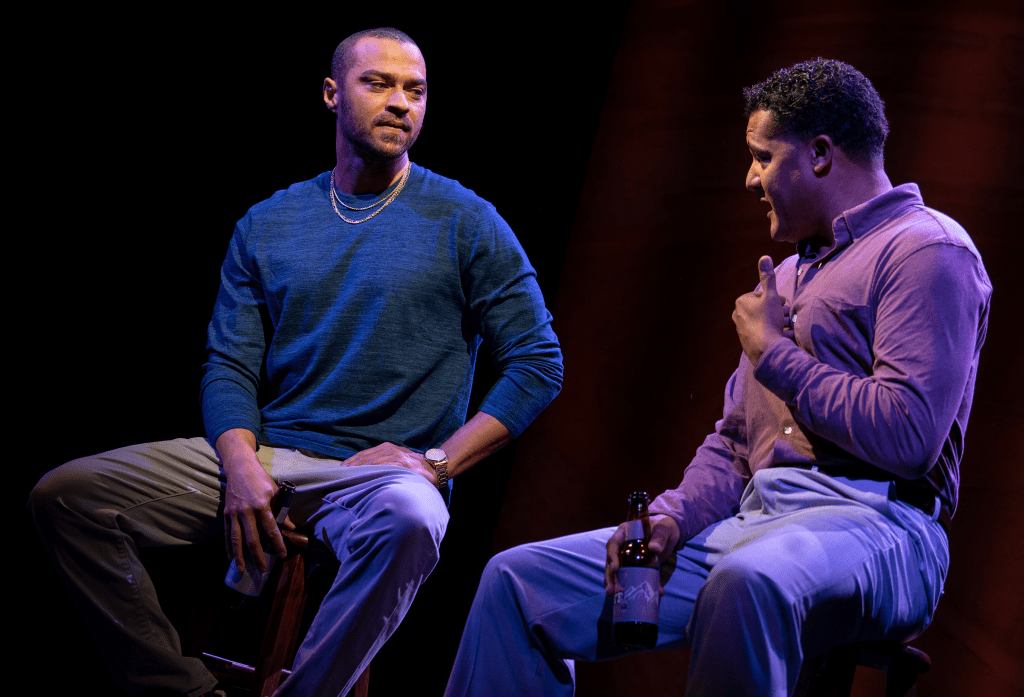
Greenberg covers all his bases with runners in this take down and resurrection of America’s “favorite past-time.” There is personal locker room talk where nude teammates “let it all hang out,” as they shower and face-off against each other, responding to Darren’s announcement and humanizing him because of it. Greenberg’s wit and shimmering edginess work best, revealing his spry characterizations in the banter between Kippy and Darren, and in the growing friendship between Darren and his new financial advisor Mason Marzac, the superbly heartfelt and riotous Jesse Tyler Ferguson. As the consummate outsider who becomes a fan, the character of Mason has the most interesting perspective on baseball, the gay community and the events that happen in real time that result in an unresolved tragedy.
Marzac, meets with cool, collected Darren after the celebrity star outs himself. Ferguson’s Marzac is humorously over the moon about Darren’s courage, his performance and the game. Darren states coming out was not “brave,” unless one thinks something bad will happen, because “God is in baseball,” and Darren is in baseball. And “nothing bad happens to Darren.” This Icarus is flying high. He takes advantage, surreptitiously, smoothly crowing about his stature which outshines his teammates and especially the awe-struck dweeby, unathletic, unbuff Mason.

Of course, the conversation carries tremendous irony in hindsight, because like Icarus who gets burned and crashes to the earth, so does Darren. How Greenberg fashions this is surprising and ingenious. Interestingly, not only does Darren take the team with him emotionally and psychically, they are rewarded despite their corrupt Machiavellian machinations to achieve a win. The irony is heavenly. It is Greenberg’s device, savvy and sardonic, which speaks to theme. Sometimes when you win, it’s not a win if your heart breaks and there are no friends or teammates you can share it with because of emotional separation and alienation. So for the team and especially Kippy and Darren, the win becomes a grave loss that no one can ever appreciate, except baseball idolator, Mason.
But I get ahead of myself praising Greenberg’s irony.

As they discuss Darren’s financial picture, Darren clues Ferguson’s Mason in to the finer points of baseball appreciation, for example to keep “watching” the number coincidences. There’s “a lot of that,” Darren implies as Mason rattles off wondrously, “…the guy who hit sixty-one home runs, to tie the guy who hits sixty-one home runs, in nineteen sixty-one, on his father’s sixty-first birthday.” Mason is ignited by speaking to the amazing and surprisingly gay Darren.
Ferguson shines in his Mason portrayal, as he excitedly waxes over the Americanisms of the game, as pure egalitarian democracy. He emphasizes that everyone has a chance when they get up to bat. But then he states that baseball is more mature than democracy. This comment coupled with the arc of development is an incredible irony considering the team takes in a crackerjack pitcher, Shane Mungitt, who is one of the more florid Red Necks to ever appear on stage. Michael Oberholtzer’s Shane is breathtaking, a stellar, in-the-moment portrayal of a bigot you can actually feel sorry for.

Ferguson’s superbly rendered soliloquy about baseball opens a window into Mason’s kind, perceptive and loving nature. He effusively and humorously describes the requisite home run as a unique moment: the game stops and there is a five minute celebration of cheering time for the fans and the hitter, who rounds the bases like a king, though the ball has long spiraled out of the stadium into the universe. From watching the completely unnecessary round of the bases, Mason says, “I like to believe that something about being human is good. And what’s best about ourselves is manifested about our desire to show respect for one another. For what we can be.”
This is the crux of the play because after this eloquent and high-minded speech, everything falls apart. The winning streak of the Empires, the team relationships, the friendships between Davey and Darren, and between Darren and Kippy implode. And sadly, the once silent, “mind my own business” Shane unravels into a hellish state, careening into the other players with a vengeance that he may not be responsible for, given his upbringing. Thus, not even a winning season saves them from the inner reckoning they have brought upon themselves. If this is America’s favorite past time, it would be better to go back to reading.
Greenberg gives his play’s coda to Mason, who has “evolved” into a baseball aficionado. As such he is brimful of hope, yet ironically perceptive. A tragedy has occurred. However, for him the greater tragedy is that he has to wait a whole half year for the season to begin again. Baseball is that tiny thing that takes one out of the misery of life and makes it worth living, even with its tragedies. In Take Me Out, that is true for the fans. For the players, what occurs is an entirely different and terrible consequence.
Kudos to Scott Ellis’ direction and his shepherding of cast and the creative team. These include Linda Cho (costume design), David Rockwell (scenic design), and others already mentioned. Scott Ellis and the cast have delivered a profoundly humorous and vital, resonant work about a game played throughout our country, revealing that no one, regardless of how we prize sports figures, is worthy of the greatness of the game itself.
For tickets and times go to the website: https://2st.com/shows/take-me-out?gclid=Cj0KCQjwjN-SBhCkARIsACsrBz798inP5l5pUV7hZGFHOj0rWRI1spG27oalp8HyLfnArPnBlPauavsaAkcwEALw_wcB
‘Coal Country’ is Amazing

When money and wealth become more important than the lives of others, that is the time to write a play with powerful, sonorous music. Oh, not to uplift the CEOs who collect the millions like Don Blankenship of Massey owned Performance Coal Company. No. The play should uplift and memorialize the ones who die because of that CEO’s greed, selfishness and refusal to accept accountability for what many have called murder. Above all the play must repudiate the wealthCy’s Puritan assertions that money and power make right. They don’t. Not now, not ever.
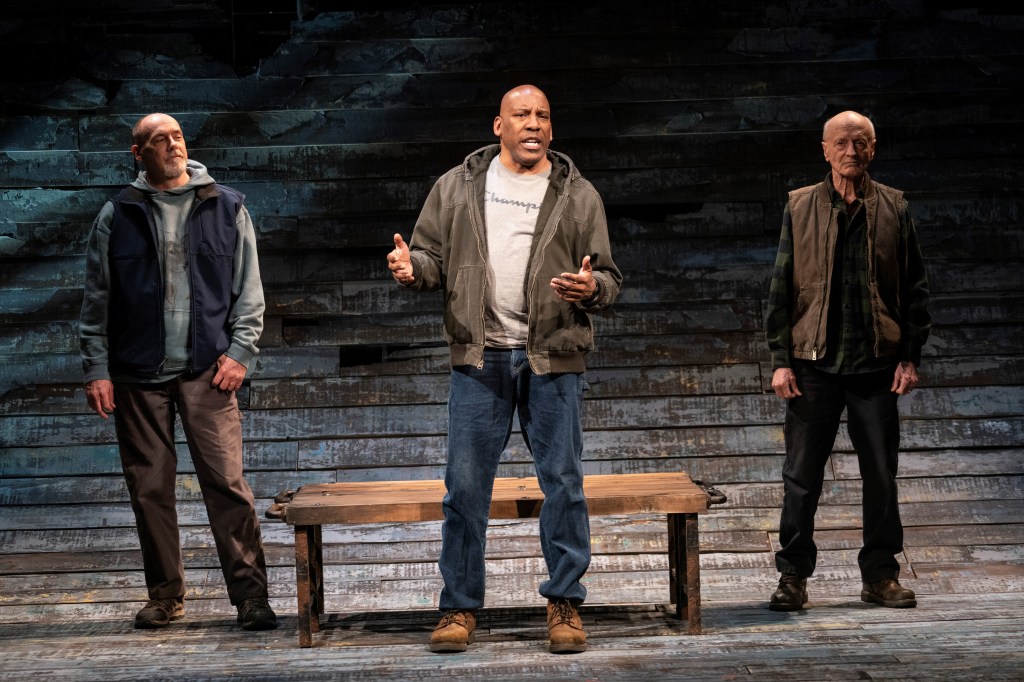
Coal Country is a docu-drama with incredibly relevant themes for us today. The riveting, masterful work written by Jessica Blank and Erik Jensen with original music by Steve Earle in a fabulous encore presentation by Audible and the Public Theater seems more impactful each time it is presented. We can never get enough of this exceptionally performed, shining work which runs at the Cherry Lane Theatre until 17 of April.
Though the worst of human nature asserts its primacy, poignant, moving stories like those in Coal Country are timeless in revealing that love despite tragedy culturally work us toward enlightenment. The voices of those who have been wrongfully snuffed out can resonate with meaning. This is especially so when fine artists like Blank, Jensen, Earle and superb performers effect those voices to channel the great moral imperative. What is good, what is true, what is valuable is never lost. It lives on.
The themes which the playwrights and songwriter ring out in Coal Country focus on the devastating catastrophe known as the Upper Big Branch Mine disaster of 2010, which cost 29 West Virginians their lives. Through family eye-witness accounts cobbled together in a tapestry of poetic beauty, vitality and grace, we learn the facts about the huge machine that operated over- capacity 24/7 on the long wall, sheering off the finest, most valuable coal so Blakenship could get his contract percentage of the mine’s earnings of $650,000 a day.

We learn through the accounts of union miners like Tommy (Michael Laurence), Gary (Thomas Kopache), and “Goose” (Joe Jung), how and why government inspectors never found the broken systems that allowed low oxygen levels to increase the build-up of methane gases and thick coal dust that caused the massive explosion. As the experienced miners relate how the broken sprinklers ineffectively doused the sparks created in machine operations that ignited the coal dust and methane behind the long wall, the final picture of egregious negligence and rapacious lust for money clarifies in the blood of innocents merged with the blood of family bonds.

Tommy, Laurence and Gary discuss how the power of the union to protect and respect the miners’ rights in the past has been subverted by the CEO and company, and government de-regulation. The owners who bought the mine hired a large percentage of non-union men, who didn’t dare “speak up,” to government inspectors and the FBI about extremely unsafe conditions in the mine. They feared reprisals. The question of payoffs arises and dead ends. We learn how those miners who did “say something” were warned and ignored. Miners were rendered voiceless against the inevitability of their deaths, because Blankenship was on a mission. No one was going to stop him.

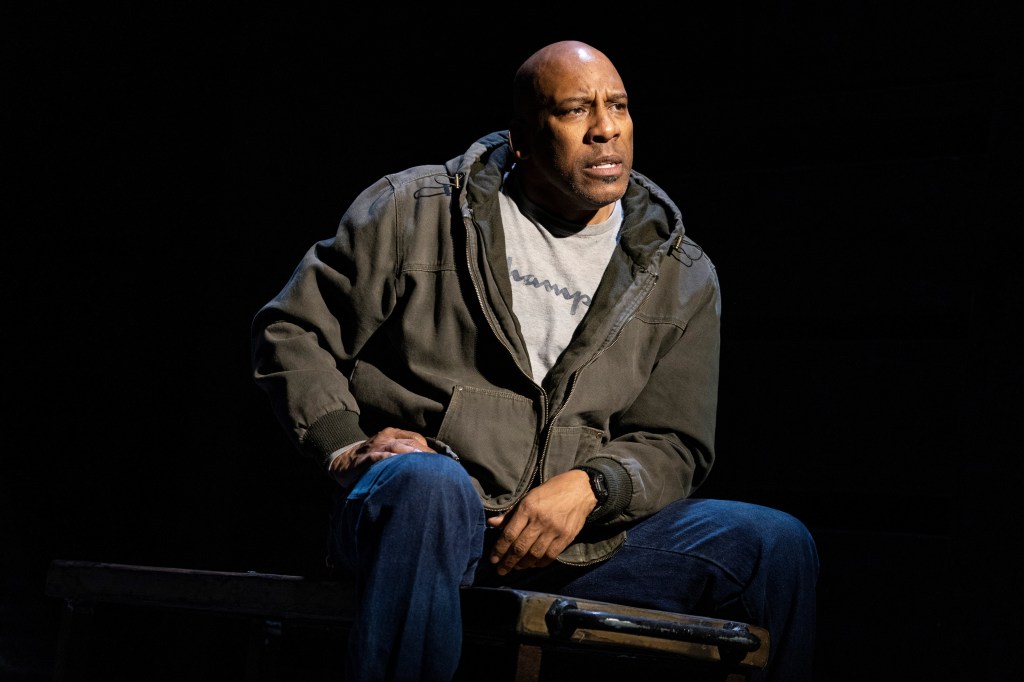
As families identify bodies on blankets on the gravel, some collapse. Roosevelt (Ezra Knight) who identifies his father, who appears to be “asleep,” remains calm until his mother comes. They weep together. As others express outrage, the families of four missing men wait to hear whether or not their loved ones cheated death. Finally, the wait is over. None make it out. Tommy, who loses his son, his nephew and his father, waits to spill the news, overcome with pain.

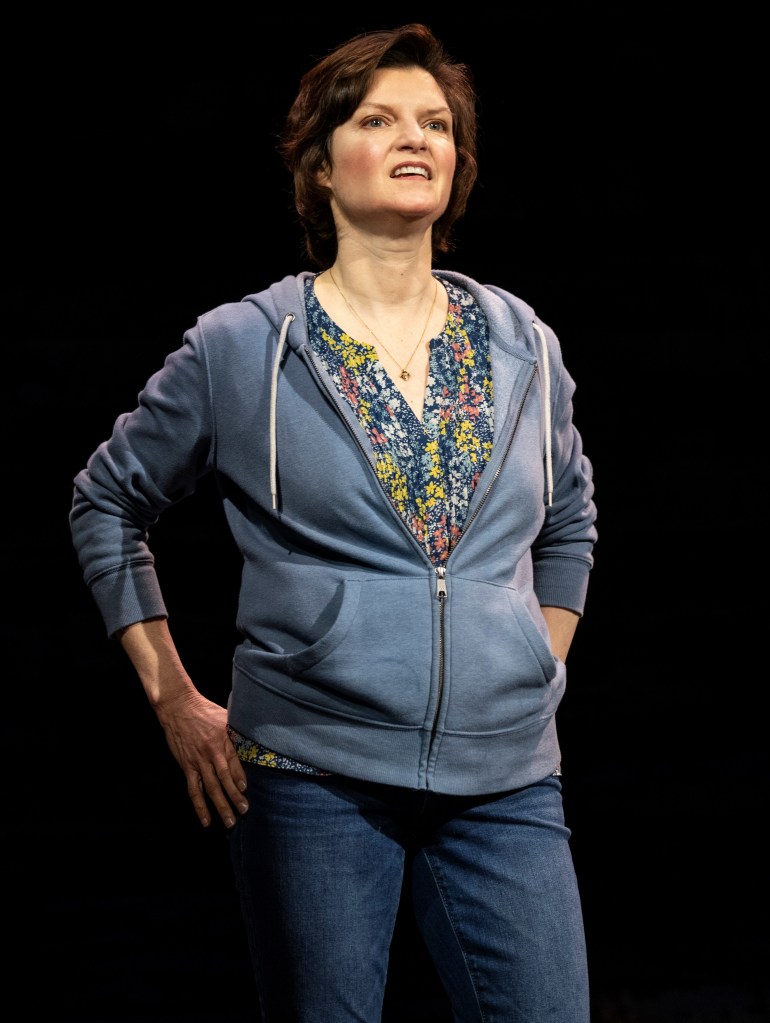
Judy (Deidre Madigan), a doctor who lost her brother in the catastrophe rides a roller coaster of emotional expectation. First, she believes her brother died. Then she believes he found refuge. Then, all is finality. She describes that she feels she is an outsider because of her socioeconomic status. But emotion and love transcend economics; she is one of them. Her brother is dead and though the medical examiner tells her not to, she insists on seeing his remains. It is ironic that even her medical background does not prepare her for what the mine did to him. It is beyond calculation. In pieces, her brother is without human form.

One by one seven family members tell their story of a simple, satisfying life before the catastrophe in a community that mined for generations. Indeed, the mountain supported and nurtured them until it was bought over by Massey Energy and a new CEO came to town. We learn of the loving relationships between Mindi (Amelia Campbell) and Goose, and Patti (Mary Bacon) and Big Greg who dies leaving Little Greg traumatized by the loss of his dad and Patti when he is taken away from her. And interspersed with their stories, Steve Earle’s country ballads lyrical and poignant drive home the resonance of their love and remembrances of their dear ones. They live in his songs and echo in the actors’ mesmerizing performances.

Blank and Jensen (the husband-wife team who created The Exonerated), choose to present this dynamic piece as a flashback after Earle (playing guitar), opens with two songs that set the themes: “John Henry,” and Heaven Ain’t Goin’ Nowhere.” Cleverly, the action begins in the courtroom at the end of Don Blakenship’s trial as Judge Berger (Kym Gomes), states they cannot read their “Victim Impact Statements.” What family could never speak in court, they relate to the court of public opinion (the audience who sees this play).

The flashback comes full circle back to the court, so the audience hears Blankenship only gets one year in jail and a fine of $250,000. Arrogantly, Blankenship uses that money to run Ads and create pamphlets in which he characterizes himself as the victim of government as a “political prisoner.” Nevertheless, in final, moving encomiums, each family member details how they remember their loved ones who live on in their hearts and in this production which has called. out to music the names of all who died in the UBB mine explosion.
With minimalist but trenchant symbolic Scenic Design (Richard Hoover), effective Lighting Design (David Lander), Sound Design (Darron L West) and Costume Design (Jessica Jahn), Coal Country is an amazing revival. It is profound and memorable in scope and power. Don’t miss it this time around. For tickets and times go to their website: https://www.cherrylanetheatre.org/coal-country
The ‘Plaza Suite’ Snark is Disingenuous #metoo

In his snarky review of Neil Simon’s Plaza Suite, the New York Times’ critic’s “clever,” oh so “entertaining” disposal of the John Benjamin Hickey production into the garbage bin of hideous fustiness seems misguided. To the critic’s dunning I shout, “Au contraire!” The production starring Matthew Broderick and Sarah Jessica Parker offers a unique, glimmering reflection of the past. It is a past that we need to be reminded of. If one peers into that reflection, and considers the interactions of the characters, one sees how intelligent females bested their male counterparts with surreptitious abandon, superior wit, and brilliant irony. If one’s view is dim and dark, like the NYT critic, one sees little.
From my humble female perspective, one also considers via this production, that between then and now, with all of the hell raising and insistence on progress, and change between straight men’s and women’s relationships, nothing much has changed. Don’t believe me? Have you read any good Evangelical books lately? Have you lived in the South for any period of time, recently? All right, maybe that doesn’t make sense to you.

Well, I will remind you about that pesky statistic (one in four women are violently abused by their partners), that has yet to budge off its number. Abusing females is alive and well, and that’s despite #metoo which is a meme that only applies to the celebrated, rich and famous, including well-paid male theater critics. In plebian circles if a woman attempts to speak up, a hand often goes upside her head. And what happens after that is anyone’s guess.
That Simon exults in the superiority and cleverness of each of the female characters in the play is lost on the critic which is understandable as he is not a female. He is a male looking in and once again judging the female characters and finding them and the production fusty, dusty and musty. Unfortunately, he shallowly superimposes his #metoo version of the female perspective on the characters, thus making the push to be politically correct all the more hypocritical and disingenuous. And frankly some of it is nonsensical, though there appears to be “logic” in what he is doing because the piece is well edited. Is his editor a male too?

Ah, forget what I just stated. Be overwhelmed by the “smart attitude” of the New York Times critic who displays his own “genius,” sense of privilege and arrogance via his male writerly superiority, which is nowhere near the genius of say, Gore Vidal (a favorite of mine). So caught up in admiring his style in the mirror, he misses the themes and the currency of Hickey’s vision. He also misses the fact that relationships between men and women have gone nowhere because human misunderstanding and fear and inability to confront death and lies by keeping them at bay through self- manipulation is an everpresent fact encompassing the relationships, in Plaza Suite.
But none of that was picked up by the critic to whom the 1960s was such a thing of the past, it doesn’t exist in his imagination; nor does he appear to want to be reminded of it, if it did exist.

Instead, what is of great importance to him, it would seem, is bowing to politically correct memes. Tragically, that is a blindness and acute hypocrisy. Currently, I boycott the New York Times. I am tired of the same pap from this particular NYT critic whose dullness would be raw meat for Noel Coward, if he were alive. I stumbled upon the review clued in by a studio professor, and well-produced playwright who mentioned the tenor of the review because he knows such pablum makes me livid.
The privilege he displays is a long-held tradition at the New York Times. Females, largely absent in theater as critics, directors, etc., commented upon by Director Rachel Chauvin in her acceptance speech for Hadestown is an example of how #mettoo doesn’t work in the theater world. Perhaps the reason is that female critics and reviewers are not #metoo politically correct enough. Perhaps females don’t remind us enough that various productions are not “politically correct.” Shall I discuss LGBTQ?

Truly. Perhaps for future productions directors and producers should wipe out the canon of plays written before 2017 and #metoo, etc., as worthless. What could possibly be learned from them?
Indeed, if critics are to genuinely benefit audiences who see plays, then they must perceive, think and above all go deep. First, understand what the director’s vision is. Is the director presenting that which on first assumption perhaps the critic didn’t get? Does it pass the audience test?
The night I saw the production, Plaza Suite did pass the audience test. They enjoyed it. Thus, I agree to disagree with the NYT and the Wall Street Journal critics. The below review, which also appeared in Sandi Durell’s Theater Pizzaz explains why.
My Review of Plaza Suite: A Female Perspective
Judging by the applause as the curtain lifts and John Lee Beatty’s luxurious, shimmering set for Plaza Suite unveils, director John Benjamin Hickey’s glorious throwback to the gilded Broadway of “yesteryear,” intimates a night of enjoyment. Coupled with its second harbinger of success, enthusiastic cheers at the entrances of the husband-and-wife team Sarah Jessica Parker and Matthew Broderick, the Neil Simon revival emblazons itself a smash even before Karen (Parker) and Sam (Broderick) have their first disagreement.

Not one moment falters in the pacing or mounting crescendo of hilarity in this superbly configured production about a suite of rooms (a conceit knock-off of Noel Coward’s Suite in Three Keys). There, visitors from Mamaroneck, Hollywood and Forest Hills play out their dreams and face their foibles in room 719 at the historic Plaza Hotel. That the place is still standing is a source of Simon witticisms.
Apparently, rumors of its being bought over by rapacious developers to be torn down making way for state-of-the-art buildings even existed at Simon’s writing. The theme of the ugly new replacing the beautiful old and historic as a pounding mantra of New York City is everpresent and a sometime theme in the triptych of playlets about couples.
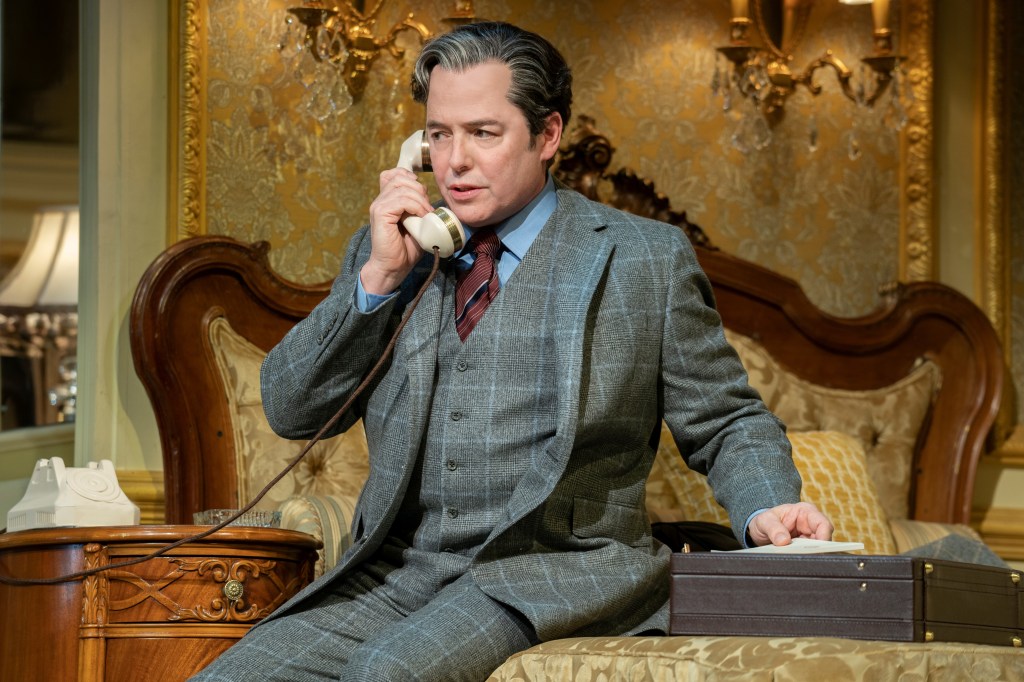
Hickey shepherds Parker’s and Broderick’s performances, delivered with “effortless” aplomb, gyrating from one comedic flourish to another to the amazing farcical finale. Authentically and specifically (gestures, mannerisms, presence, posture), they hone the characterizations of three disparate couples, breathing into them the humanity we’ve all come to love and loathe. We didn’t want the fun to end, and it was apparent that neither did they.
The few times they broke each other up or comfortably ad libbed, they let the audience in on the endearing fact that they were having a blast. That mutuality between audience and performers was doubly so because they’ve been waiting to perform for two years of COVID hell. Happy to be back in front of a live audience, their enthusiasm was communicated by the ineffable electricity that happens in live performance and changes nightly because of the audience’s diverse sensibilities. The performers vibrated. The audience vibrated back. The circle completed and rolled around for the next laugh which topped the next.
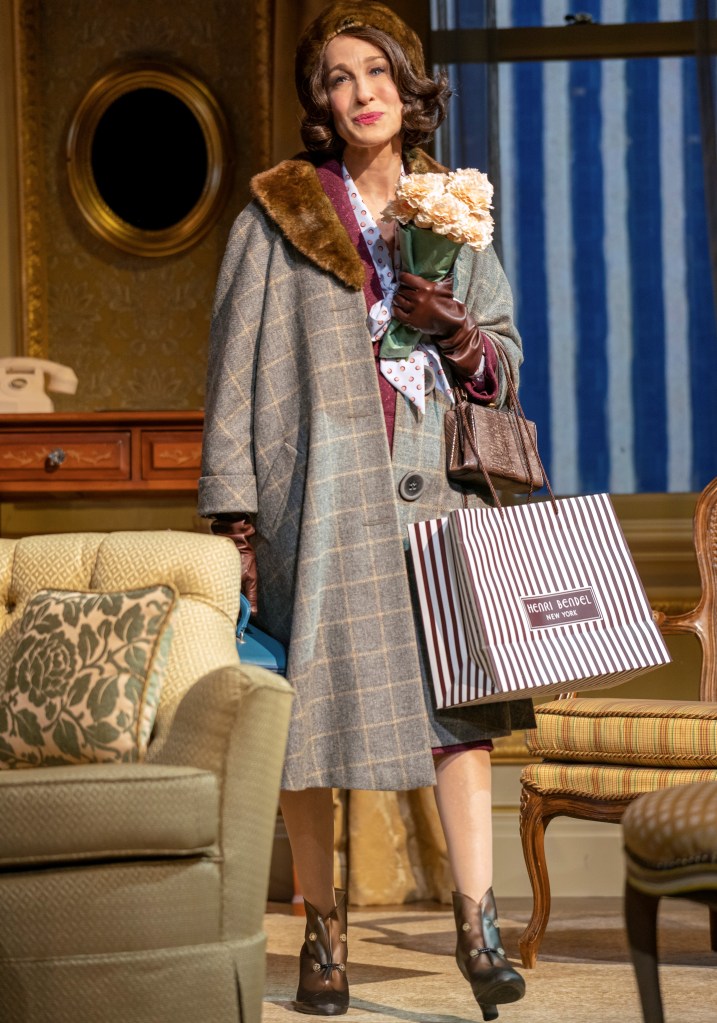
Ingeniously entertaining, incredibly performed, Plaza Suite at the Hudson Theatre which runs for a limited engagement is a spectacular winner. Here’s why you should see it.
Though Neil Simon’s concept that he lifted from Coward has been reshaped and used by playwrights and screenwriters since the 1960s when Simon wrote Plaza Suite, the production gives it a unique uplift because of its specificity and attention to detail. Importantly, viewed through a historical lens, the relationships, character intentions and conflicts ring with comical verities. Wisely, Hickey allows the characters inhabited by these sterling performers to chronicle the values and folkways of the sixties which were a turning point in our society and culture. The understanding that arises from Simon’s exploration suggests why we are where we are today.
Finally, using humor the play deeply touches on seminal and timeless human topics: fear of aging, seduction, loneliness, marriage unsustainability, the generation gap and more.
In the first playlet, Karen’s Mamoneck housewife chafes in a relationship which she unconsciously senses has soured. She books Suite 719 to celebrate her anniversary with Sam and ironically initiates the reverse.

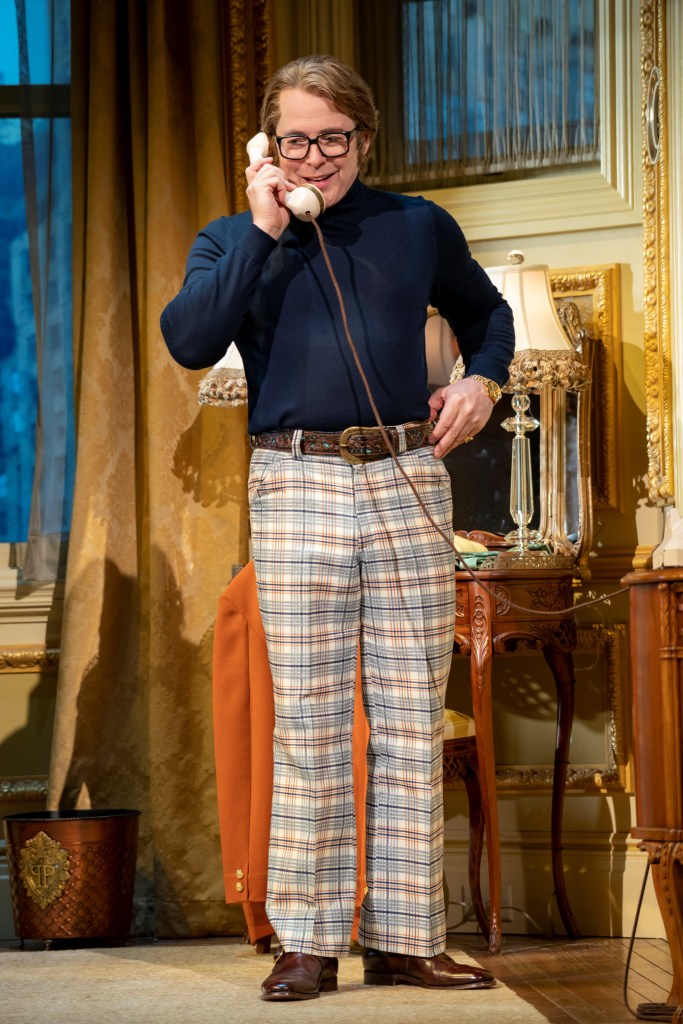
Listening carefully and watching Parker’s Karen, noting her plain outfit and hairstyle and comparing it to Broderick’s Sam, the laconic, dapper, sharp, appearance obsessed businessman, we should anticipate what will happen. We don’t because Simon’s keen, witty dialogue of thrust and parry between Sam and Karen keeps us laughing and because the performances are so spot-on, in the moment, we, like the characters, don’t know what’s happening next. However, of course, Broderick and Parker do. Yet, they are so alive onstage, that the characters’ reactions remain a surprise and the revelations are unanticipated.
Karen’s ironic subtext brilliantly digging at Sam to confess he’s having an affair is wonderful dialogue expertly delivered. A few of Parker’s lines bring down the house with her sharply paced delivery. One is her crackerjack response to Sam’s “What are we going to do.” Without a blink Parker’s “You’re taken care of. I’m the one who needs an activity,” receives audience whoops and hollers. An age-old event of cheating and adultery is born anew.
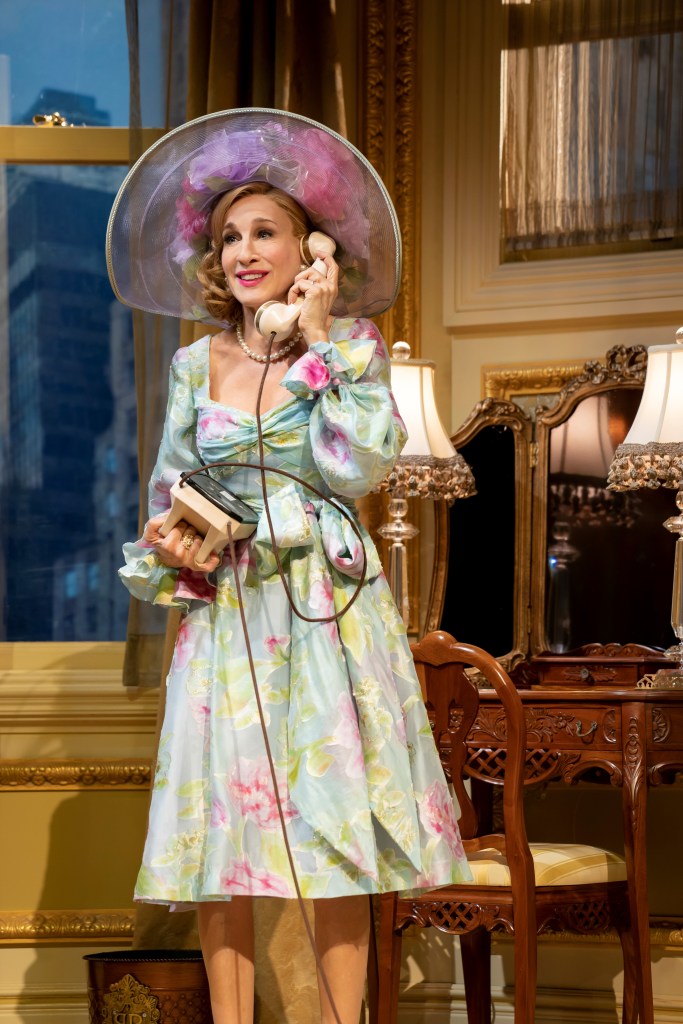
Simon’s snapping-turtle dialogue in the face of today’s hackneyed insult humor is wickedly scintillating. In the Hollywood seduction playlet, High School sweethearts become reacquainted. Broderick’s smarmy Hollywood producer Jesse Kiplinger decked out in his Mod finest is a classless nerd who confesses his unhappiness with the Hollywood slime set and his three *&$% ex-wives who take not only his money but his guts and soul. Muriel in Parker’s equivalent of her fashionable self in the ‘60s, is enthralled by Jesse’s Hollywood persona, but is in keeping with the innocent, demure women Jesse remembers. The hilarity builds into what becomes a reverse seduction scene by a steaming married woman when they “get down to brass tacks.”
All stops are pulled in “A Visitor from Forest Hills.” The costumes (Jane Greenwood), the hair and wig design (Tom Watson), contribute to building the maximum LMAO riot. The inherent action and zany organic characterizations by Broderick and Parker augment to hysteria when Mimsey refuses to attend her own wedding and ensconces herself in the bathroom.

Norma and Roy implore Mimsey attempting to psychologically manipulate her and each other to get her to come out. Parker and Broderick effectively create the image of their daughter crying, possibly suicidal, as she remains unseen, silent and incorrigible behind the sturdy, unbreakable bathroom door. Desperate to stem a disastrous day, Broderick’s “out of his mind with frustration” Roy even goes out on the ledge and braves a pigeon attack and thunderstorm to wrangle in his wayward child. Broderick’s mien and gestures bring on belly laughs.
What they do to move heaven and earth to get Mimsey to come out is priceless comedy that is easier than it looks. The frustration and fury the actors convey with the proper balance to appear realistic yet crazy and smack-me funny is what makes this over-the-top segment fabulous.
Kudos to the artistic team which includes Brian MacDevitt (lighting design) and Scott Lehrer (sound design). For tickets go to https://plazasuitebroadway.com/
‘English’ a Seminal Play by Sanaz Toossi

Born into our parents’ culture and country, we learn how to communicate with them easily and take our language for granted without thinking about it. Delving deeper, language defines us, defines our thoughts, our ways. Our name in our native language has meaning from its history. It describes who we are and how we perceive ourselves. Many change their names as a result, knowing the change means a different self. Considering the import of the language we speak and our identification with it, how does learning a new language impact the way we understand ourselves? How might learning another language affect our being?

English, the insightful and powerful work by Sanaz Toossi, presents these questions and answers them poignantly through the voices of five individuals from Iran, who grapple with learning English. Starring an all-Iranian cast, the play enjoyed an extended run at The Atlantic Theater Company and most probably will be a favorite to be staged globally. Directed by Knud Adams, the play remains an original that unfortunately, couldn’t have had a longer run.
The setting is Karaj, Iran in 2008 before and during a confluence of events taking place between Iran, the United States and other English speaking countries. At the time immigration is fairly easy and Iranians on the move want to study abroad, do business and travel for extended stays to English-speaking countries to which their families emigrated.

Marjan (Marjan Neshat portrays the instructor), teaches for the TOEFL, the Test of English as a Foreign Language. The standardized, timed test measures the English language ability of non-native speakers, who wish to study in English-speaking universities. The test is accepted by more than 11,000 universities and other institutions in over 190 countries. The selective test guarantees that the students have an excellent working knowledge of the language to insure their success, not only in their classes, but also in navigating the culture and society.
As Neshat’s Marjan teaches, she realizes as we do that in every class there is a dynamic. Personalities emerge. Though she attempts to be objective, she finds herself aligning with students who demonstrate like-minded abilities and cognition. As her students reveal themselves in their response to her and the language, we find their observations humorous, their interactions fascinating. And the conflict arises when the struggling and often embarrassed students relate her to the onerous time they have with learning a completely different mode and thought process of communication. Neshat is authentic in her portrayal as Marjan, revealing the inner emotional struggle she has especially with Elham (the feisty, assertive Tala Ashe).
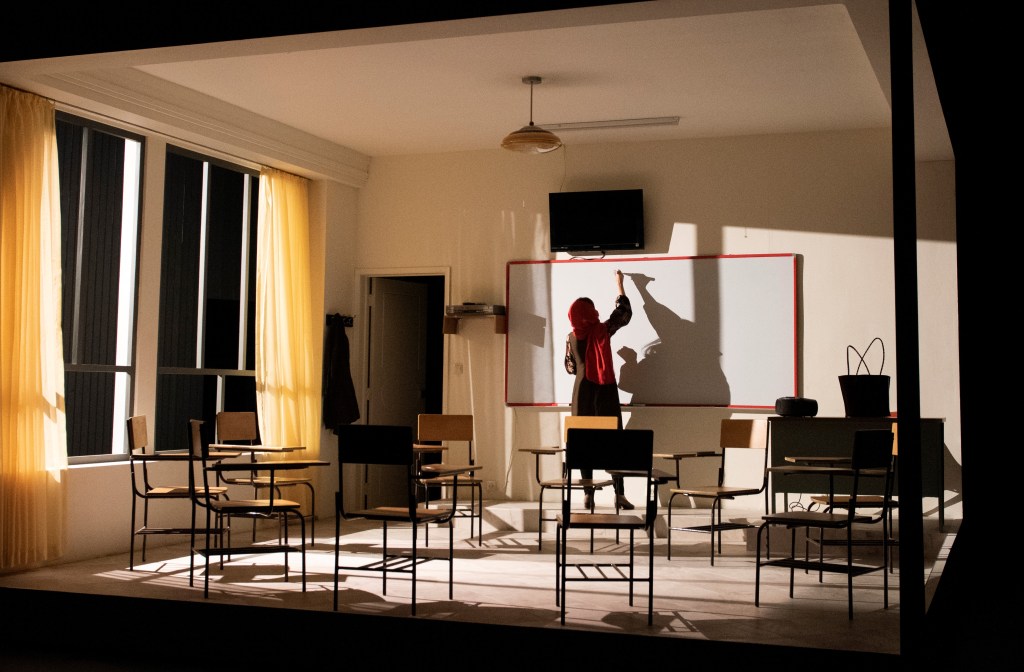
Humor evolves organically from the students’ perceptions, struggles and slippage into their native tongue Farsi in the first weeks of the class. An excellent teacher, Marjan attempts to gradually curb their fear and angst holding their feet to the fire by speaking only English and giving them a demerit if they fall back into Farsi. Her skills are effective. We watch these individuals speak halting English. When they rip off sentences quickly (in English), that designates they speak Farsi.
At the outset Neshat’s Marjan reveals equanimity despite the competitive confrontations of Elham (the excellent Tala Ashe), the shy, halting behavior of Goli (the sweet Ava Lalezarzadeh), and the lackluster, removed Roya (the heartfelt Pooya Mohseni). Eventually, it becomes apparent that Omid (the attractive, confident Hadi Tabbal), the only male in the class, whose English is nearly unaccented and spot-on, is the one that Marjan connects with cognitively and perhaps, as Elham suggests, on a more personal level. Neshat and Tabbal effect an intriguing bond that flows with undercurrents between their characters.

We enjoy Marjan’s activities with the class which reinforce recognition of English nouns through games that emphasize speed. She keeps in mind the TOEFL is a timed test. However, eventually, the language begins to wear down the teacher and the students after Neshat’s Marjan encourages them to undertake the most difficult part of learning a language; they must only speak in English.
Thus, they must converse in sentences, and in effect begin to approach thinking as a native English speaker. All of them chafe at this and break into Farsi which Neshat’s Marjan “censures” by noting it on the chalkboard. The only one who doesn’t find this difficult is Tabbal’s Omid.

As Marjan attempts to have each of the students integrate themselves more personally with English, the conflicts explode. We discover Mohseni’s Roya only wants to learn because her son wants his mother to speak to her Canadian granddaughter in her native tongue which is not Farsi. This devastates Roya, who in a show and tell explains the two languages as she hears their differences. When she discusses her son’s email in Farsi and a voice mail he leaves in English, she uplifts the beauty of Farsi. She emphasizes the softness of her son’s intent in Farsi. Then she notes in his English voice mail, his speech. The sounds he makes are harsh, removed, cold. She asks the class, “Who is mom? I am Maman.” There, in one word the history of Persia is eradicated. The audience was completely silent during Mohseni’s plaintive discussion of loss; her son and granddaughter disappearing her culture before her eyes. This powerful moment is beautifully rendered by Mohseni and insightfully directed by Knud Adams.
The distinction Toossi suggests is profound and thought-provoking. Roya’s relationship to her son has been separated by the nature of the language, and we see her heart is broken because of it. As he lives in Canada over the years, the separation will become impossible. The geographical difference matters little. It is his adoption of this new way of being in English. Even if she stays with him in Canada, she will be forced to learn this harsh, cold speech and ways of thinking to attempt to form a relationship with her granddaughter. But a culture, a way of being, a way of life and history has been disintegrated in the next generation. Mohseni’s Roya defines this as a death. As a result of her incredible performance, we believe and buy into Roya’s grief. Her granddaughter will never know the softness and poetic beauty of Farsi, the language of poets, of Omar Khayyam.

When Marjan has all of her students speak their English names, Roya rebels. It is her last stand. She never returns to class. We anticipate that the cost is too great for her to be reborn into a culture that reshapes her identity with an ugly name and being. As Roya leaves the class, Marjan’s response is invisible, absent. When a student asks what happened to Roya, Marjan dismisses the question. We are left to think that Roya failed to even desire to evolve, and Marjan failed Roya. Marjan, normally empathetic, moves on to “save” the others. However, Neshat’s Marjan too swiftly dismisses Roya. The undercurrent of her own feelings screams out with her silent dismissal, as harsh as the sounds of English to Roya’s intellect.
Toossi makes an important choice for our understanding of the complicated Marjan who puzzles us. Why didn’t she use Roya’s difficulty as a teachable moment? Why didn’t she encourage the others or explore for a few minutes a path to enhance their connection with her? We don’t know if she deeply empathizes and understands Roya’s rebellion or if she is annoyed she failed her. The question Toosi raises about Marjan’s character, she never answers because it is a developing characterization steeped in a confluence of emotions and feelings. Clearly Neshat’s Marjan is thrown by this event. Her becoming an English teacher has impacted her. There is gain, and there is loss and there is the price she pays for the trade-off.

Pooya Mohseni’s portrait of Roya is eloquently delivered, touching and emotionally driven. In every line we feel Roya’s pain in having to deal with this untenable situation. Mohseni knocks it out of the ballpark. Through her character most of all, we understand what it means to be a native speaker. We empathize with the loss of dignity, honor and person-hood Roya feels being forced into speaking English by Neshat’s Marjan. We get how Marjan’s restrictions not to communicate and make herself understood in the beauty of Farsi is anathema. Of course, she feels English is like putting on a cloak of stupidity, ugliness, ungainliness. If her granddaughter never learns Farsi (something Omid suggests her son should have his daughter do), she will never know who her grandmother really is. Roya’s loss, historical, cultural, personal is beyond calculation.
Toossi’s strongest moments present themes of loss of the old identity, yet the incomplete adoption in fluid grace with a new one. For each of the characters, we empathize that it is like being birthed again, torn from one’s natural lush habitat and plopped down in a desert left to die of thirst every moment, as they yearn to feel the cool balm of speaking in one’s mother tongue. English shines when the pronounced conflicts increase.

For example, Elham’s ambitious nature and brilliance force her to try to be the best in the class to achieve a high grade on the TOEFL in her pursuit to be a doctor. Ashe nails Elham’s frustration in achieving a high score on the MCAT and fearing a low score on the TOEFL. The TOEFL is a mountainous hurdle, so she hates English and by extension is oppressed by Neshat’s Marjan. Nevertheless, her competitive nature compels Elham to provoke Marjan in the stress and strain of being challenged. Speaking Farsi, yearning to be close, she manipulatively accuses Marjan of disliking her.
Ashe’s exceptional portrayal is revealed in her character’s suppressed anger. Thus, Elham proclaims to Ava Lalezarzadeh’s Goli that Marjan “loves” Omid. The sweet, shy Goli avers. But Elham insisits that because Marjan invites Omid to watch English films with her there is a “bond.” Indeed, in their moments together Tabbal’s attractive Omid is suggestive and in his scenes with Neshat’s Marjan there is a connection. However, it is not as Ashe suggests; it is based in understanding English fluidly. Indeed, Marjan invites Elham and Goli, but they don’t want to spend the time with Marjan and Omid watching films like Room With a View. These conflicts are vital to the play’s forward movement. Perhaps they might have been established earlier.
Toossi’s uses her characterizations to organically develop her themes. These strengthen our engagement and pull at our empathetic heart strings. Thus, when Omid’s mystery is revealed or when Elham comes back to discuss how she performed on the TOEFL, we identify. Most of all Toossi has accomplished a milestone by indicating the importance for native speakers to stand in the shoes of immigrants who are even attempting to learn English. To learn a different language is a courageous, heroic feat, as Toossi suggests. It is a willingness to expand to another identity, another thought process. Ultimately, the nature of the language, its formation and structure changes the individual emotionally, mentally, indeed psychologically. This must not be underestimated. All of the actors’ portrayals vitally heighten Toossi’s themes and bring us closer to the importance of empathy. Ashe’s development of her character Elham is exceptional and we thrill for Elham as she shocks us with her success which was in her all along.

Toossi also reveals why there are those who don’t wish to learn English, even though they’ve lived in an English speaking country for years. These individuals remain in their own communities, never learn the language and never venture out to immerse themselves in new experiences. The risk of embarrassment is too great. They will not live in humiliation as their new persona, feel like an idiot and be quiet and uncommunicative, not understanding the too rapid speech bursts around them.
Finally, Toossi implies that by leaving behind the old self and adopting a new one, the individual wipes out the favored history of their beloved country, identity, relationships, being. Of course, if there is no direct imperative for business or education, they will not even try. Additionally, in the United States, their accent will be so thick it will be tantamount to a “war crime,” especially in the rural South and West as Ashe’s Elham ironically and humorously suggests.

This is one of the great lines in Toossi’s superb play. Understandably, non-native speakers do not wish to brave the looks of disgust, horror and puzzlement on the faces of native English speakers when they try to ask, “When will the waiting room open?” (Ws without an accent are particularly hard for non-native English speakers). Toossi covers a great deal of ground in her touching play which ends on a high note. We finally hear the actors speak in Farsi.
The production has ended. A few points about when I saw it the last day of its extended run.
Some of the actors couldn’t be heard, even by those sitting in the second row. Friends sitting there told me they barely heard certain thin-voiced actors. Also, sitting up close they became annoyed because the chairs blocked their view at times and they had to lean to the left or right. I was in row F and I thought it was just me when I missed some of the dialogue. I wasn’t the only one.

Problematic was the set construction, a lovely box set classroom which kept in the sound and echoed it. A wonderful idea for the set shouldn’t obstruct the audience’s enjoyment of the production with occluded sight lines and muffled sound. The idea of the classroom, revolving on a turntable platform is symbolic. But unless the audience hears each line of the actors and sees all areas of the stage without obstruction, the symbolism is impaired. This is too wonderful a work for it not to be technically spot-on.
Look for the marvelous Toossi’s work. She is a treasure and English is a vibrant, important and current play that begs to be performed again.
‘A Touch of the Poet’ The Irish Rep’s Brilliant Revival Exceeds Its Wonderful Online Performance. Eugene O’Neill’s ‘Poet’ is Amazing Glorious Theater!

From the moment Cornelius “Con” Melody (Robert Cuccioli) appears, shaking as he holds onto the stair railing of the beautifully wrought set by Charlie Corcoran, we are riveted. Indeed, we stay mesmerized throughout to the explosive conclusion of the Irish Repertory Theatre’s A Touch of the Poet by Eugene O’Neill. Compelled by Cuccioli’s smashing performance of Con, we are invested in this blowhard’s presentiments, pretenses and self-betrayal, as he unconsciously wars against his Irish heritage. Con is an iconic representative of the human condition in conflict between soul delusion and soul truth.

What will Con’s self-hatred render and will he take down wife Nora and daughter Sara (the inimitable pairing of Kate Forbes and Belle Aykroyd), in his great, internal classicist struggle? Will Con finally acknowledge and accept the beauty and enjoyment of being an Irishman with freedom and hope? Or will he continue to move toward insanity, encased in the sarcophagus image of a proper English gentleman? This is the identity he bravely fashioned as Major Cornelius Melody to destroy any smatch of Irish in himself. O’Neill’s answers in this truly great production of Poet are unequivocal, yet intriguing.
The conflict manifests in the repercussions of the drinking Con takes on with relish. So as Cuccioli’s Con attempts to gain his composure and stiffly make it over to a table in the dining room of the shabby inn he owns, the morning after a night of carousing, we recognize that this is the wreck of a man physically, emotionally, psychically. His shaking frame soothed by drink, which wife Nora (Kate Forbes), brings to him in servile slavishness, is the only companion he wants, for in its necessity as the weapon of destruction, it hastens Con’s demise. The beloved drink stirs up his bluster and former stature of greatness that he has lost forever as a failed Englishman and even bigger failure as comfortable landed gentry in 1828 Yankee country near Boston.

Director Ciarán O’Reilly and the cast heighten our full attention toward Con’s conflict with the romantic ideal of himself and the present reality that will eventually drive him to a mental asylum or a hellish reconciliation with truth. All of the character interactions drive toward this apotheosis. The actors are tuned beautifully in their portrayals to magnify the vitality of this revelation.

Nora (Forbes is authentic and likeable), is the handmaiden to Con’s process of dissolution. In order to fulfill her own glorified self-reflection and identity in loving this once admirable gentleman, she coddles him. Riding on the coattails of her exalted image of Con, she maintains beauty in her self-love. She loves him in his past glory, for after all, he chose to be with her. So Nora must abide in his every word and deed to maintain her loyal happiness, taking whatever few, kind crumbs he leaves for her under the table of their marriage. As a result, she would never chide or browbeat Con to quit the poison that is killing him.

The good whiskey he proudly provides for himself and friends like Jamie Cregan (the excellent Andy Murray), to help maintain the proper stature of a gentleman, steadies his mind. The whiskey also makes him feel in control of his schizoid personas. He clearly is not in control and never will be, unless he undergoes an exorcism. The audience perversely finds O’Neill’s duality of characterizations in Con and the others amusing if not surprising.
Cuccoli’s Con at vital moments rejects the painfully failed present by peering into his mirrored reflection to quote Lord Byron in one or the other of two mirrors positioned strategically on the mantel piece and a wall. There, fueled by the alcohol, he re-imagines the glorious military man of the Dragoons as he stokes his pride. Yet, with each digression into the past, he torments his inner soul for reveling in his failed delusion.

Likewise, each insult he lashes against Nora, who guilty agrees with him for being a low Irish woman, both lifts him and harms him. It is the image of the Major ridiculing Nora because of the stink of onions in her hair one moment, and in self-recrimination, apologizing moments after for his abusiveness. In his behavior is his attempt to recall and capture his once courageous, successful British martial identity, while rejecting the Irish humanity and decency in the deep composition of his inner self.

Always that true self comes through as he recognizes his cruelty. He behaves similarly with Sara, bellicose in one breath, apologetic in the next, fearful of her accusatory glance. In this production Con’s struggle, Nora’s love throughout and Sara’s resistance and war with herself and her father is incredibly realized and prodigiously memorable. O’Reilly and the cast have such an understanding of the characters and the arc of their development, it electrified the audience the night I saw it. We didn’t know whether to laugh (the humor originated organically as the character struggles intensified), or cry for the tragedy of it. So we did both.

Con’s self-recrimination and self-hatred is apparent to Nora whose love is miraculously bestowed. His self-loathing is inconsequential to Sara, who torments him with an Irish brogue, lacerating him about his heritage and hers, which the “Major” despises, yet is his salvation, for it grounds him in decency. Sara and Nora are the bane of his existence and likewise they are his redemption. If only he could embrace his heritage which the “scum” friends who populate his bar would appreciate. If only he could destroy the ghost of the man he once was, Major Cornelius Melody, who had a valiant and philandering past, serving under the eventually exalted Duke of Wellington.
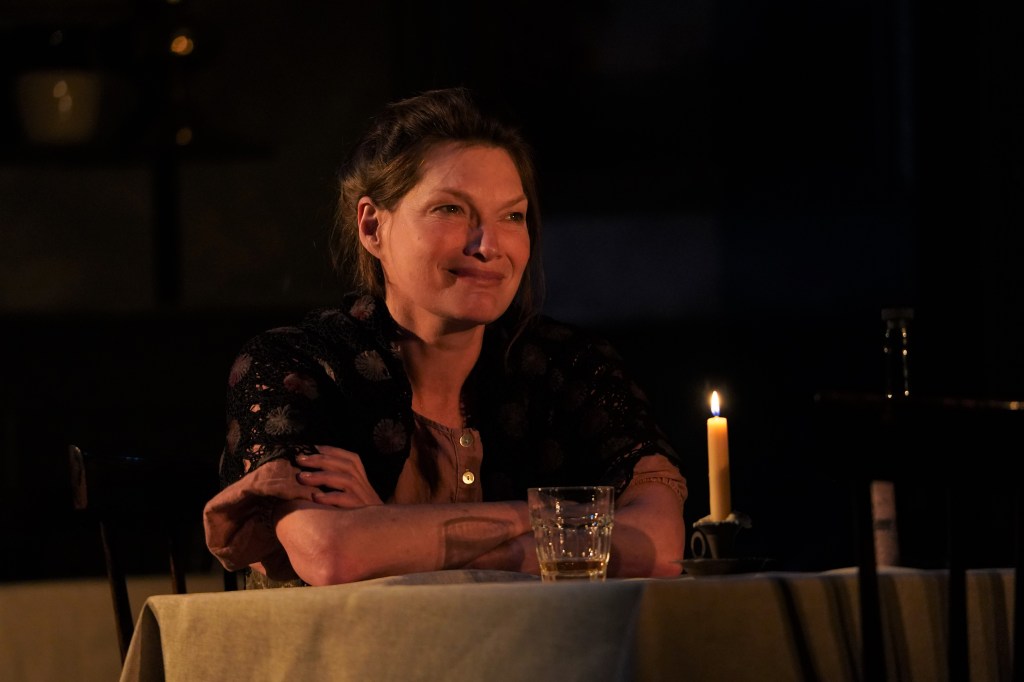
Through the discussions of Jamie Cregan with Mick Maloy (James Russell), we learn that the “Major identity” caused Con to be thrown out of the British military and forced him to avoid disgrace by settling in America with Nora and Sara. We see it causes his decline into alcoholism, destroys his resolve and purpose in life, and dissipates him mentally. It is the image of pretension that caused the bad judgment to be swindled by the Yankee liar who sold him the unproductive Inn. Sadly, that image is the force encouraging the insulting, emotional monster that abuses his wife and daughter. And it is a negative example for Sara who treats him as a blowhard, tyrant fool to vengefully ridicule and excoriate about his class chauvinism, preening airs and economic excesses (he keeps a mare to look grand while riding). It is the Major’s persona which brings them to the brink of poverty.
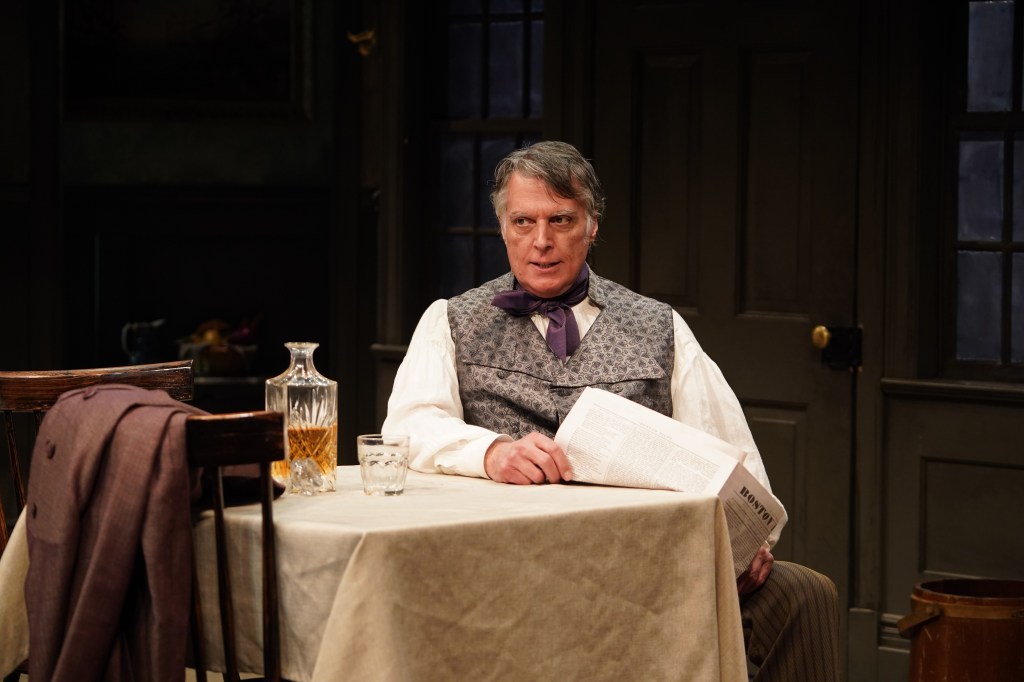
The turning point that pushes Con over the edge comes in the form of a woman he believes he can steal a kiss from, Deborah Hartford, the same woman whose intentions are against Sara and her son Simon Hartford falling in love. Without considering who this visiting woman might be, Con assumes the Major’s pretenses and we see first hand how Con “operates” with the ladies. His romanticism awkwardly emerges, left over from his philandering days with women who fell like dominoes under his charms. He is forward with Hartford who visits to survey the disaster her son Simon has befallen, under the spell of Sara’s charms, behavior not unlike Con’s. The scene is both comical and foreboding. From this point on, the events move with increasing risk to the climactic, fireworks of the ending.

As Deborah Hartford, Mary McCann pulls out all the stops in a performance which is grandly comical and real, with moment to moment specificity and detail. When Con attempts to thrust his kiss upon her, there were gasps from the audience because she is a prim Yankee woman of the upper classes who would find Con’s behavior low class and demeaning. That he “misses” the signs of who she is further proves his bad judgment. Sara is appalled and Nora, not jealous, makes excuses for him satisfying herself. The scene is beautifully handled by the actors with pauses and pacing to maximum effect.
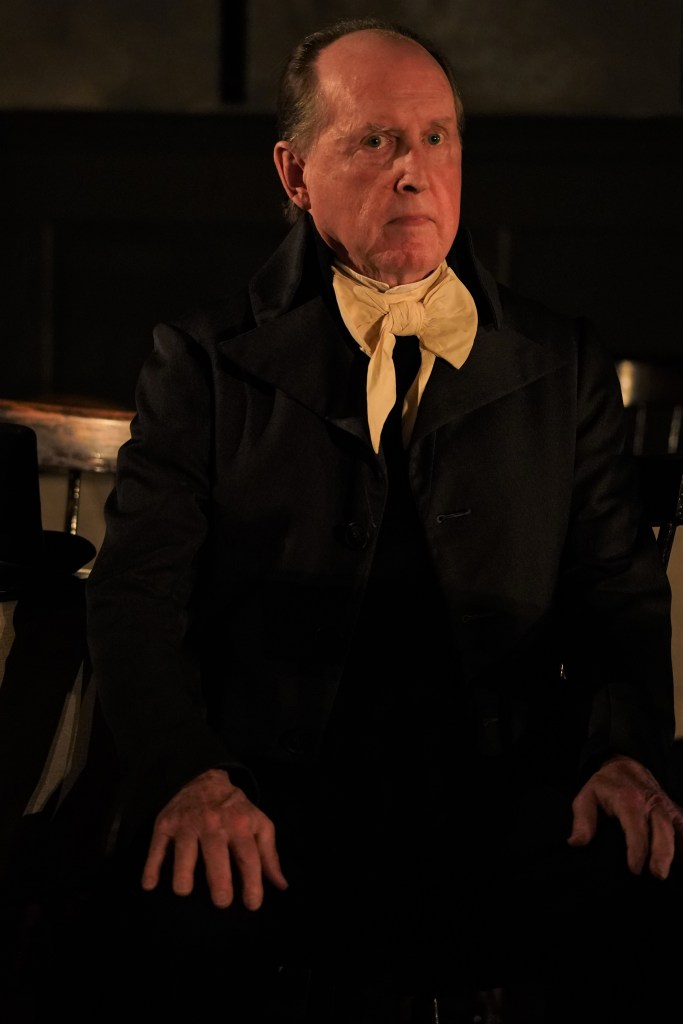
McCann’s interaction with Aykroyd’s Sara is especially ironic. Deborah Hartford’s speech about the Hartford family male ideals of freedom and lazy liberty that forced the Hartford women to embrace their husbands’ notions by taking up the slave trade is hysterical. As she mildly ridicules Simon’s dreams to be a poet and write a book about freedom from oppressive, nullifying social values, she warns Sara against him. It is humorous that Sara doesn’t understand what she implies. Obviously, Deborah Hartford suspects Sara is a gold digger so she is laying tracks to run her own train over any match Sara and her son would attempt to make. After discovering the economically challenged, demeaned Melody family, Hartford informs her husband who sends in his man to settle with the Melodys.
Together McCann and Aykroyd provide the dynamic that sets up the disastrous events to follow. Clearly, Sara is more determined than ever to marry Simon and as the night progresses, she seals their love relationship with Nora’s blessing, until Nora understands that her daughter walks in her own footsteps in the same direction that she went with Con. Unlike Nora, however, Sara is not ashamed of her actions.

O’Neill’s superb play explores Con’s past and its arc to the present, revealing a dissipated character at the end of his rope. Wallowing in the Major’s ghostly image, Con vows to answer Mr. Hartford’s insult of sending Nicholas Gadsby (John C. Vennema looks and acts every inch the part), to buy off Sara’s love for Simon and prevent their marriage. After having his friends throw out the loudly protesting Gadsby, Con and Jamie Cregan go to the Hartfords to uphold the Major’s honor in a duel. Nora waits and fears for him and in a touching scene when Sara and Nora share their intimacies of love, Nora explains that her love brings her self-love and self-affirmation. Sara agrees with her mother over what she has found with Simon. The actors are marvelous in this intimate, revelatory scene.
The last fifteen minutes of the production represent acting highpoints by Cuccioli, Forbes, Aykroyd and Murray. When Con returns alive but beaten and vanquished, we acknowledge the Major’s identity smashed, as Con sardonically laughs at himself, a finality. With the Major’s death comes the hope of a renewal. Finally, Con shows an appreciation of his Irish heritage as he kisses Nora, a redemptive, affirming action.

O’Neill satisfies in this marvelous production. The playwright’s ironic twists and Con’s ultimate affirmation of the foundations of his soul is as uplifting as it is cathartic and beautiful. Nora’s love for Con has finally blossomed with the expiation of the Irishman. It is Sara who must adjust to this new reality to redefine her relationship with her father and reevaluate her expectation of their lives together. The road she has chosen, like her mother’s, is hard and treacherous with only her estimation of love to propel her onward.
From Con’s entrance to the conclusion of Irish Repertory Theatre’s shining revival of Eugene O’Neill’s A Touch of the Poet, presented online during the pandemic and now live in its mesmerizing glory, we commit to these characters’ fall and rise. Ciarán O’Reilly has shepherded the sterling actors to inhabit the characters’ passion with breathtaking moment, made all the more compelling live with audience response and feeling. The production was superbly wrought on film in October of 2020. See my review https://caroleditosti.com/2020/10/30/a-touch-of-the-poet-the-irish-repertory-theatres-superb-revival-of-eugene-oneills-revelation-of-class-in-america/
Now, in its peak form, it is award worthy. Clearly, this O’Neill version is incomparable, and O’Reilly and the actors have exceeded expectations of this play which has been described as not one of O’Neill’s best. However, the production turns that description on its head. If you enjoy O’Neill and especially if you aren’t a fan of this most American and profound of playwrights, you must see the Irish Rep presentation. It is not only accessible, vibrant and engaging, it deftly explores the playwright’s acute themes and conflicts. Indeed, in Poet we see that 1)classism creates personal trauma; 2)disassociation from one’s true identity fosters the incapacity to maintain economic well being. And in one of the themes O’Neill revisits in his all of his works, we recognize the inner soul struggles that manifest in self-recrimination which must be confronted and resolved.
Kudos to the creative team for their superb efforts: Charlie Corcoran (scenic design), Alejo Vietti & Gail Baldoni (costume design), Michael Gottlieb (lighting design), M. Florian Staab (sound design), Ryan Rumery (original music), Brandy Hoang Collier (properties), Robert-Charles Vallance (hair & wig design).
For tickets and times to the Irish Repertory Company’s A Touch of the Poet, go to their website: https://irishrep.org/show/2021-2022-season/a-touch-of-the-poet-3/
‘The Daughter-in-Law,’ by D.H. Lawrence is Superb! Theater Review

D.H. Lawrence is rarely known for his plays. However, British critics have noted that he was a master playwright, and if discovered as such earlier in his life, he would have been appreciated for his dramas, however maverick and forward-thinking. One such incredibly rich play is being presented by the always excellent Mint Theater Company, who enjoys bringing to life rare jewels in drama that have often been overlooked. The Daughter-in-Law is one of these gems.

Directed by Martin Platt The Daughter in Law presents an amazing portrait of an independent woman, Minnie (Amy Blackman), a former governess married to a collier (coal miner), Luther Gascoyne (Tom Coiner). The couple live in a mining town near his mother’s (Mrs.Gascoyne-Sandra Shipley) home where his brother Joe (Ciaran Bowling), also a collier, works with him in East Midlands England.

The setting is autobiographical and akin to where D.H. Lawrence’s father worked and where he and his siblings lived with their mother (reminiscent of Minnie), who had cultural aspirations for Lawrence, and who inspired him in his studies. Lawrence’s play evolves into conflicts among the characters. These are rich in thematic evolution that comes to some resolution by the end of the play after the colliers riot against scab workers during a strike. Interestingly, the themes involve gender roles, class, economic inequity and familial love. Also, Freudian tropes between mothers and sons, an issue that Lawrence often investigated, receives a hearing in this realistic and beautifully acted production that Platt has tautly directed, so it remains provocatively, emotionally, tense throughout.
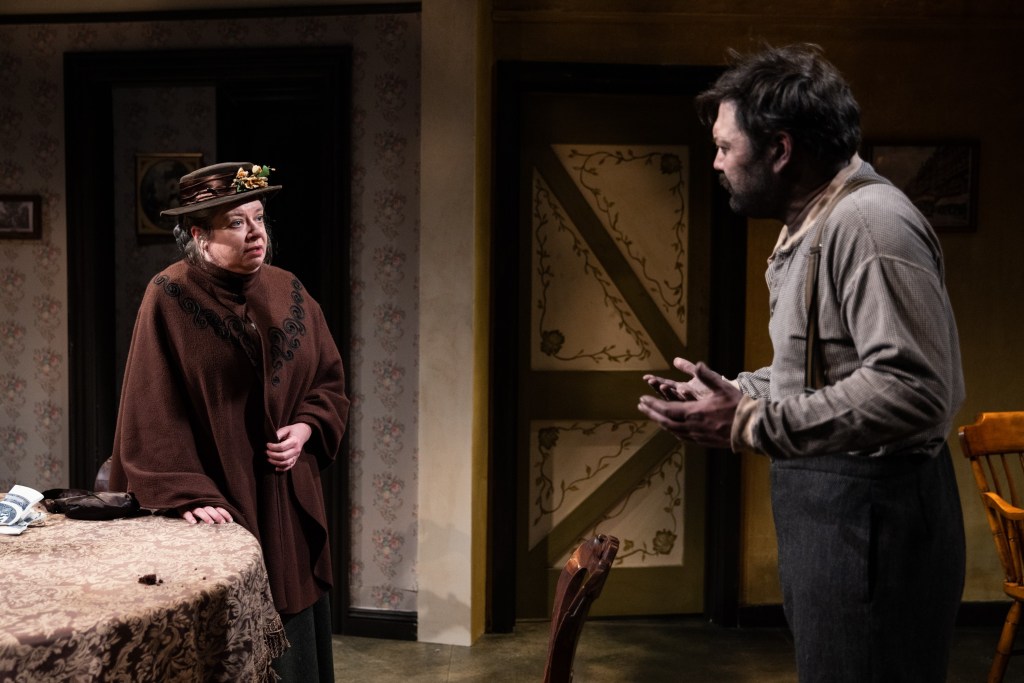
To a fault, the actors have been schooled in the Midlands accent which provides realism and creates the audiences’ attentive stir to understand all that the characters communicate. At times, this takes getting used to. However, the actors portray the characters’ emotional feeling sincerely and authentically, so that one understands, even though one may not be able to translate word for word what the characters say.

Nevertheless, when Joe (the vibrant Ciaran Bowling), enters sporting an arm in a sling and his mom (the dynamic and authentic Sandra Shipley), fusses over him with his dinner and probes what happened with receiving a disability check, we understand their close relationship, and we also understand that mother and son mutually care for each other, living under the same roof, watching out for each other, while other family have gone on to make their own lives.

The hard conditions of the mines remind us of the corporate structure which Lawrence reveals has changed little over one hundred years later. The owners receive all the benefits, and the workers are given low wages and are subcontracted out to keep them hungry and off-balance, so they are unsure of where they stand in the company’s graces. Joe and his brother, like their father before them, were at the mercy of the owners; and their father died as a result of an accident we find out later in the play. This undercurrent of workers vs. owners is the driving undercurrent and reveals that the misery of need and want is what impacts the families who live and depend on coal mining for their survival.
During lively dinner conversation, Joe tells his mother that his attempt to receive a check for his broken arm has been rejected. His manager tells his version of “the acceptable truth” of what happened to Joe, so that it is Joe’s fault that he was injured, because he was “fooling around.” It was not that he was injured on the job because of some dereliction of another worker or the mine. Lawrence strikes at the inequality of the haves and have nots and the managers who make sure to protect their employers. Thus, we feel for Joe and his mother, who are not destitute, but who struggle economically. If any stress comes to either of them, they are a few steps away from the equivalent of the poorhouse. Such is their economic and class level.

Into the background of this economic insecurity and potential working class impoverishment comes Mrs. Purdy (the convincing and excellent Polly McKie), a neighbor who brings disturbing news. Her daughter, who she describes as rather a simple girl, is pregnant. And after avoiding the direct truth until Mrs. Gascoyne drags it out of her, Mrs. Purdy lays the blame at the feet of Luther, who married Minnie seven weeks before. Mrs. Gascoyne pushes Mrs. Purdy cleverly off on Luther and Minnie, especially Minnie since she has brought some money into the marriage and can afford to pay Mrs. Purdy and her daughter off for their silence and for Bertha’s upkeep with the baby. This suggestion is made after Joe and Mrs. Purdy verify that Luther was seeing Bertha Purdy, something that Mrs. Gascoyne didn’t realize because Luther kept it under the radar and wasn’t serious with her.
Assurances are made to Mrs. Purdy that she must see Luther and Minnie at their house, since Minnie has received an inheritance that Mrs. Gascoyne insists should be used to pay off Mrs. Purdy. This malevolent and resentful suggestion is disputed by Joe whose empathy for his brother and Minnie is greater than his mother’s. As Mrs. Gascoyne discusses Luther’s marriage to Minnie in demeaning terms, it is obvious that she resents the “high and mighty” Minnie ending up with her son. She tells Mrs. Purdy that it’s because he is the only one she could get.
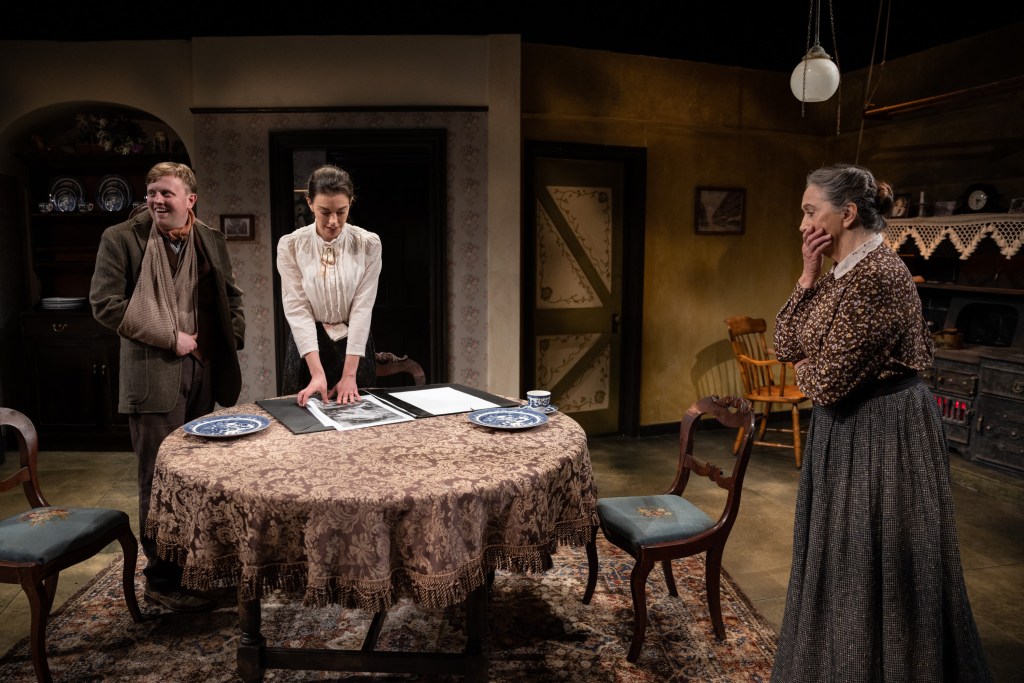
At this point not meeting Minnie, we wonder who this snotty woman is and side with Mrs. Gascoyne because we have gotten to know this nurturing, motherly type who obviously cares about her children. Based on Lawrence’s brilliant dialogue characterizing Minnie through the eyes of Mrs. Gascoyne, we believe that this snobby woman who thinks she’s “better” than the colliers and their families is pretentious. Also, we believe that she is so desperate, she doesn’t love Luther, but she just wants not to be an old maid.
Interestingly, Lawrence allows this portrait of Minnie to remain, until we see her relationship with the two brothers unfold. Gradually, her characterization is revealed and her strength, power, indomitable wisdom and love for Luther becomes apparent but with twists and turns, ups and downs by the the end of the play. But first, she must stand up and upend her mother-in-law’s presumptive discriminatory attitude against her, and then wait for the right moment to forgive her so that the two of them become closer.

Platt’s direction in keeping us wondering how Minnie will react when she discovers Luther has a child on the way is subtle and yet eventful, as Lawrence provides surprises and unusual events which keep us enthralled. Mrs. Purdy tells Luther about the child, but Joe manages to drive Minnie out of the house so that she leaves before Mrs. Purdy confronts her with the “truth.”
In an ironic twist it is Luther, who returns much later drunk, guilty and ready to be rejected. He picks a terrible fight with Minnie, then in humiliation covered over with bravado, he reveals that he has gotten Bertha with child. Interestingly, Minnie remains calm and collected, non judgmental and rational, presenting the idea that the child may not be Luther’s, but another man’s. Nevertheless, Luther becomes churlish and obnoxious, which prompts her to call him out for his meanness, especially when he suggests that Bertha was nicer to him than Minnie.
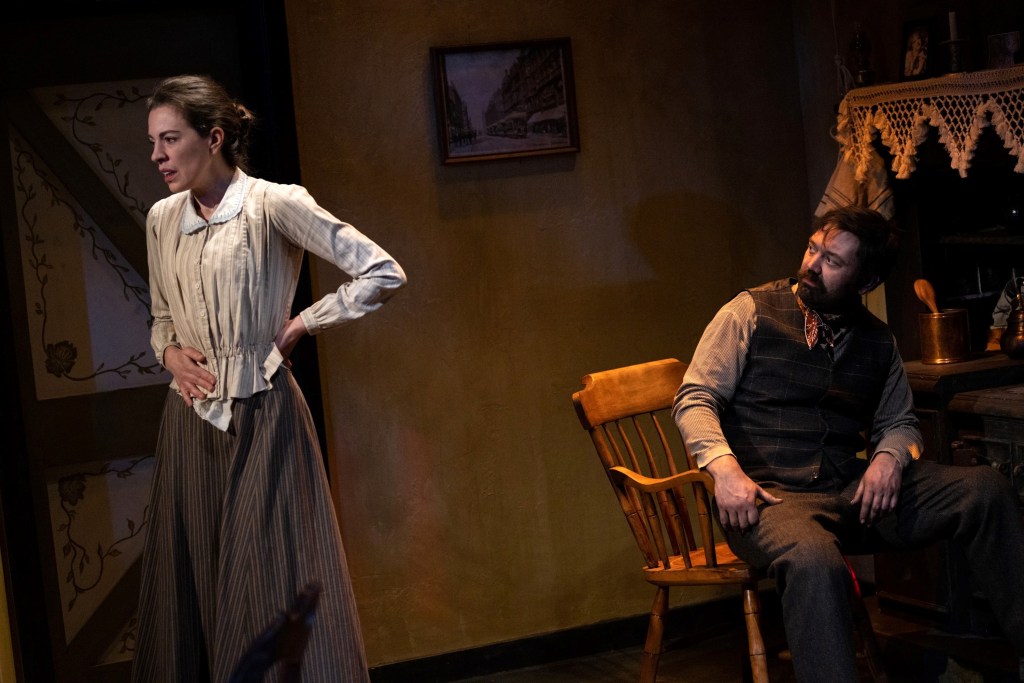
The actors do an exceptional job in raising the stakes and increasing the argument and tension between Minnie and Luther, so that we don’t know whether or not they will break up, Minnie will leave, whether Luther will have to return to his mother or both of them will end up bloodied and bruised as they come to blows. In Lawrence’s characterizations of Minnie and Luther, their relationship becomes explosive and we aren’t sure whether it’s because of class differences, economic differences (she came from a bit more money than he and he may resent it) gender role assumptions (Minnie has worked for herself and made her own money) or something else. Interestingly, we don’t consider that they may love one another, feel hurt and pain that they might lose each other, or are emotionally trying to settle out their own feelings.
The actors are just exceptional in revealing this marvelous nuance and the director has shepherded them so that we are off balance in attempting to figure out how they really feel about each other. One of the high points of the play comes when Minnie confronts her mother-in-law and indicates that she has not allowed either of her sons to become men. Minnie points out that she has babied them so that they remain shells and are forced to rely on her emotionally and psychically which has destroyed them and made them weak. Interestingly, Joe agrees with Minnie. And he indicates this situation emotionally has debilitated him and at times has left him suicidal. Ciaran Bowling, Sandra Shipley and Amy Blackman are wonderful in this confrontation scene.

Amy Blackman as Minnie gives an amazing and powerful performance. She is stalwart and strong as she stands up to Sandra Shipley’s mother-in-law who manages to be infuriating and yet very human and poignant as a woman who is needy and relies on the ties amongst her and her sons. Tom Coiner as Luther is frightening and brutal as well as weak and sheep-like when he finally admits his love and dependence on Minnie.
Lawrence concludes the play surprisingly by revealing what has been at stake all along. It is a complicated and intricate conundrum that he presents and then the revelation clearly indicates that there was no mystery. This is how a couple is settling into themselves and separating from every other family member to cling to each other as they define themselves in the most important relationship of their lives.

This wonderful production should be seen for many reasons, principally because D.H. Lawrence has written a great play with nuanced characters in striking relationships that are unfamiliar to us that the Mint Theater Company has presented in this superb revival. The intricate details of setting, the props, the coal stove that is the hearth, the set design, down to the food and plates that show Minnie’s aspirations to being middle class, manifest a reality that makes us identify with these individuals. Kudos to the tremendous effort on the part of Bill Clarke (sets), Holly Poe Durbin (costumes), Joshua Larrinaga-Yocom (props), Jeff Nellis (lights), Original Music & Sound (Lindsay Jones).
The Daughter-in-Law comes in at two and one-half hours and is at New York City Center, Stage II. For tickets and times go to their website: https://www.nycitycenter.org/pdps/2021-2022/the-daughter-in-law/
‘Prayer for the French Republic,’ Haunting, Current, Universal

Shifting in flashback between (2016-2017) and (1944-1946) set in two different Parisian apartments, Prayer for the French Republic (currently at Manhattan Theatre Club) by Joshua Harmon (Bad Jews), directed by David Cromer (The Band’s Visit), focuses on a Jewish family’s concerns about identity, safety and security in a country that they’ve called home for five generations. The backdrop of their apprehensions then and now is an uncertain world where humanity’s fears and needs turn increasingly predatorial. Capitalizing on such fears, political actors mine the unbalanced, raw emotions of deranged citizens, to create scapegoats which help grow their power and popularity. Whether left or right politically, oftentimes the scapegoats are religiously or ethnically engineered.
Such was the case in France during Hitler’s fascist occupation and the Vichy government’s cooperation with the roundup of French Jews that were murdered or sent off to concentration camps. Such is the case in France in recent years where attacks against Jewish citizens have multiplied, stirred up by opportunistic, right-wing, fascistic politicos ravenous for power.
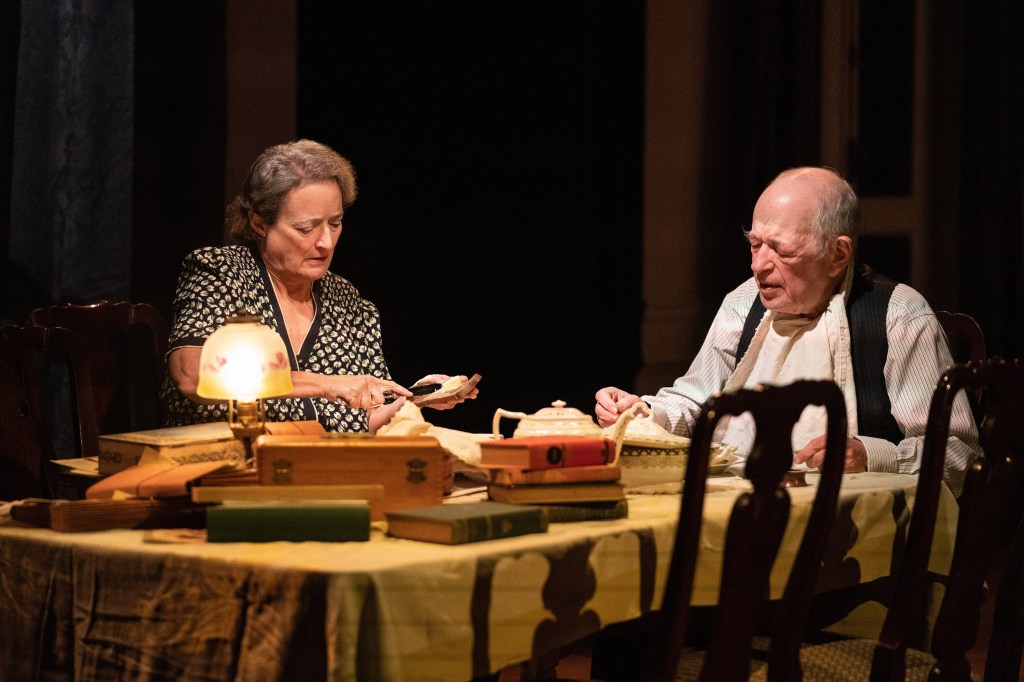
As an overseer, Patrick Salomon (Richard Topol), connects the ancestral ghosts from the past, his great grand parents, Irma and Adolph Salomon, grandfather Lucien and his father Pierre, still living, as a bridge from the past to the present. In the present are Patrick, his sister Marcelle Salomon Benhamon, husband Charles and their adult children, Daniel and Elodie. The play is Patrick’s meditation on five generations of family. Patrick redefines what being a Jew in France means, as he narrates the saga of their Parisian Jewish identity and magnifies it in light of the age-old conundrum Jews historically confront throughout the ages. To survive do they assimilate, or do they risk the danger of standing apart as they embrace their religious beliefs?
As the play progresses, these questions expand and complicate against the current global crises (climate, socio-political, economic). What do Jews do in response to severe persecution? Do they embrace their identity, suffer and die valiantly resisting? In the name of living do they become invisible, marry out of their religion to avoid the turmoil, danger and abuse that comes with the trajectory of uncertain social unrest that Jews inevitably find themselves in the midst of? Do they emigrate to “certain” safety?
Interestingly, before the last generation of the Salomon family makes any final decisions, they confront their father Pierre and present him with their conundrum. Would he go with them, for example, to a safer place with other Jews in Israel? Who better than their father, a survivor of the atrocities of Auschwitz, can ,advise them about their future? Indeed, he made his decision years ago, married a Christian woman and didn’t keep up Jewish tradition, intentionally. He remained safely in Paris raising Marcelle and Patrick without keeping ancient Jewish traditions. And until Marcelle married an Algerian Jewish emigre, they didn’t keep them either.

Patrick (the superb Richard, Topol whose easy, relaxed persona is confidently relatable and empathetic), introduces the Salomon family to the audience and discusses their business operating a store where they attempt to sell beautiful pianos that are no longer viable in modern society. Patrick brings us into 2016 to view his closest relatives, sister Marcelle (Betsy Aidem), brother-in-law, Charles (Jeff Seymour), their bi-polar daughter Elodie (Francis Benhamou), and son Daniel (Yair Ben-Dor). The cross-section of their lives begins as Marcelle (Betsy Aidem in a fine, layered performance), becomes acquainted with her guest, Molly (the clear-eyed, authentic Molly Ranson), a non-practicing Jewish, distant cousin from NYC.
Their humorous exchange ends when Daniel comes in bleeding and an uproar begins in the household. He has been attacked in a hate crime where the young men who assaulted him yell out epithets because he has obviously distinguished his religious identity with a kippah. The arguments ensue and we discover that neither Marcelle nor Charles make an obvious show of their Judaism and that Daniel is the only Orthodox one in the family. Molly watches the scene unfold and learns as we do about family dynamics.
Daniel recently became Orthodox. He doesn’t even want to go to the police to identify his beating as a hate crime. Though Marcelle insists, Daniel makes excuses that he didn’t see his attackers and the police won’t do anything about it. All land on the fact that it will only exacerbate matters in the society and spread more fear. The discussion is closed when Daniel insists Marcelle light Shabbat candles.
The scene deftly shits to the past, as we note that ancestry (the ghosts of time past), runs concurrently and influences the Salomons in the present. The spirits of their forebears come to life, and we watch the characters in their small Parisian apartment in 1944, having a conversation about their children and other family who escaped France rather than stay, which other family did. As Irma (Nancy Robinette), and Adolphe (Kenneth Tigar), wait safely in their apartment, away from the horrific persecution of Jews throughout the Third Reich occupied countries, of which France is one, they pray that Lucien and Young Pierre are safe in the mountains. This is what Adolphe encourages Irma to believe. As they pray that Lucien and Pierre will come home to their apartment in Paris, hope sustains them.
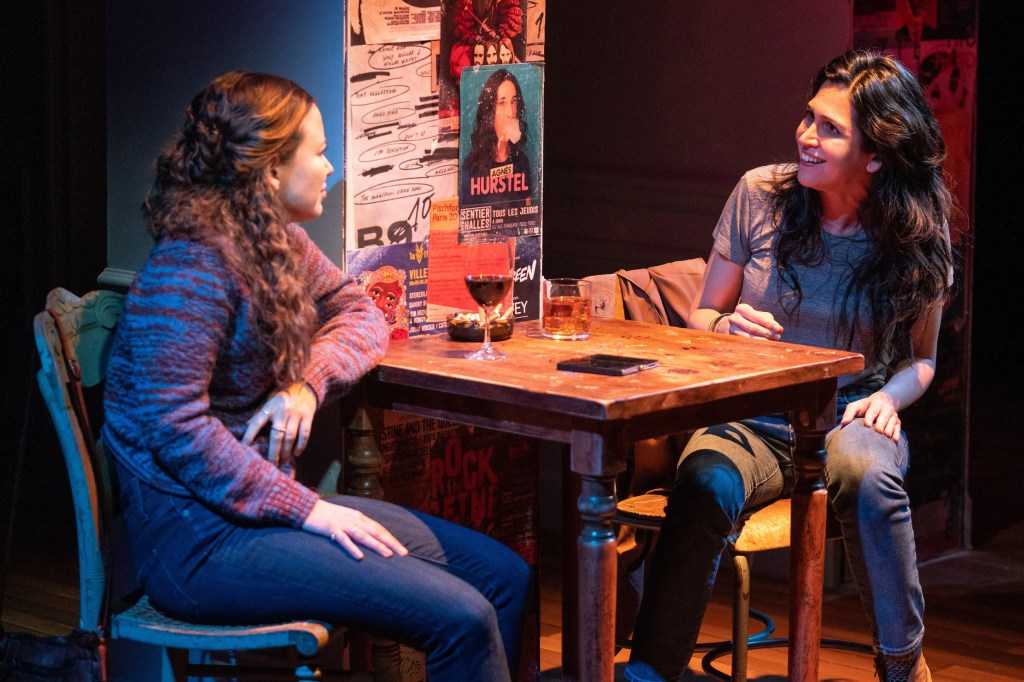
Patrick connects present and past during these moments. He ruminates about what his great grandparents, grandparents and father went through, touching upon the conversations they may have had and the rationing they went through. Furthermore, he reveals the family’s penchant for argument and debate before decisions are made. Adolphe humorously suggests that at the reunion when family is together, after ten minutes of peace there will be arguing and fighting and crying. We marvel that Irma and Adolphe can sit there and imagine what it will be like after liberation. We discover later that most of the family who didn’t escape to Cuba or elsewhere died. Adolphe’s fantasy is a manifestation of hope to uplift Irma. Their safety in Paris affords them this luxury of hope; meanwhile, Jews died in the millions.
How are they alive? Patrick relates that the superintendent of the building didn’t give Adolphe and Irma up to the Gestapo during a roundup. Thus, both escaped in that rarest of occasions; they were protected by other French people. However, at this point, they don’t know the fate of their son Lucien (Ari Brand) and their grandson Pierre (Peyton Lusk) who may have fallen into the hands of the Nazis and ended up gassed in a concentration camp. But Adolphe and Irma live in faith securely, waiting their return.
In the segue back to the present Molly and Daniel form an attachment. Daniel explains why he has become Orthodox when the family never was. He discusses the attacks at the newspaper Charlie Hebdo and the killing of four Jews at the Kosher Supermarket in Paris as proof that the hate crimes against Jews are increasing. On a hopeful note, he tells Molly that the peace marches against the violent attacks were massive, and Prime Minister Manuel Valls stood with the Jews against Benjamin Netanyahu, who told them to leave France and come to Israel. Valls encouraged belief in the French Republic stating, “If 100,000 Jews left, there would be no more France; the Republic of France would be a failure. Daniel points out that Jews left, but only a tiny fraction; the rest stayed. He affirms that always it is a matter of choice. Jews stay in France because they love their nation and have faith in the French people.

It is this concept of choice that carries through the rest of the play in the decision whether to escape persecution and hate crimes or stay and fight with courage and resistance. But slowly, this family because of the past losses, attenuates their faith in the French Republic.
First, it is Charles who rebels against staying in France after we hear the prayer for the French Republic spoken in a voice over in French and English when Charles and Daniel go to the synagogue. The Jews loyally support the French Republic, though some, like Charles, feel it is a waste of time. As father and son walk home, Charles notices the stares of disdain and anger at Daniel’s assertion of his religion. Charles insists, “I can’t take it any more.”
Once again the family is up in arms presenting arguments. Marcelle refuses to leave, decrying the beauty of their life in France. Fed up Charles wants to go to Israel. He remembers the persecution he experienced in Algeria where everyone got along when he was a child, but later socio-political forces disrupted the social fabric. Indeed, he has no allegiance to France. He doesn’t have the history, as Patrick puts it, that Jews have been in France for over 1000 years and have made a way for themselves there.
The discussion and wrangling back and forth between Aidem’s Marcelle and Jeff Seymour’s Charles is powerful and strident. We are riveted by the danger in Charles’ tone, of hidden subtext that is palpable and his fervor to believe there is safety in Israel, though that isn’t necessarily a rational conclusion because of the terrorism there as well.

The argument carries over when Molly and Elodie go to a Dive Bar. Francis Benhamou’s Elodie rant against Molly Ranson’s Molly is humorous and as powerfully strident as Charles’ argument with Marcelle. Elodie gives forth, illustrating Molly’s hypocrisy when she argues against Israel’s Palestinian settlements. Elodie’s point drives deeper to human nature. There are the power-hungry and the occupiers; how does one resist not becoming power-hungry as a matter of security? Molly’s criticism belies historic U.S. colonization and oppression of everyone but white males. Elodie indicates that finger pointing is useless.
Eventually, both manage to reach common ground on a personal, familial level. Humanity takes precedence in their discussion when Elodie explains that Daniel became Orthodox because of a girl. Revelation of his vulnerability opens the door to Molly’s and Daniel’s relationship. It also opens the door to Marcelle’s fury because she believes that Molly has taken advantage of her son’s vulnerability.
Nothing is resolved even after Charles and Daniel return from a trip to Israel to look at living arrangements and social culture. Charles gives in; he affirms wherever Marcelle is, he will stay with her. Daniel proclaims that he didn’t want to go to Israel, but just accompanied his distraught father to help him. The playwright indicates the confusion and the stress that accompanies the hassle of confronting danger in one’s daily life, as this family feels they are under siege since Daniel paraded his Jewishness. But it is understandable because the family has a history of loss and death at the hands of French fascism. Furthermore, fascists like Marine Le Pen (Deputy of the French National Assembly), and her right-wing conservative political group don’t readily disavow fascism.
As the scene shifts to the past, Lucien and Young Pierre return from the camps bringing the horrific information that family was lost. Lucien is overcome in the telling of it. Ari Brand’s performance is appropriately drained, inwardly devastated but holding it together as best he can. It is Young Pierre who eventually expresses how his father’s hope saved him. Peyton Lusk gives an incredible portrayal of the PTSD of a young person returning from an unspeakable experience. But as Lusk explains how he survived, once again comes the affirmation that hope is how people survived the persecution, attacks and killing, as community and family helped family. For Lucien always told Young Pierre that they would make it.
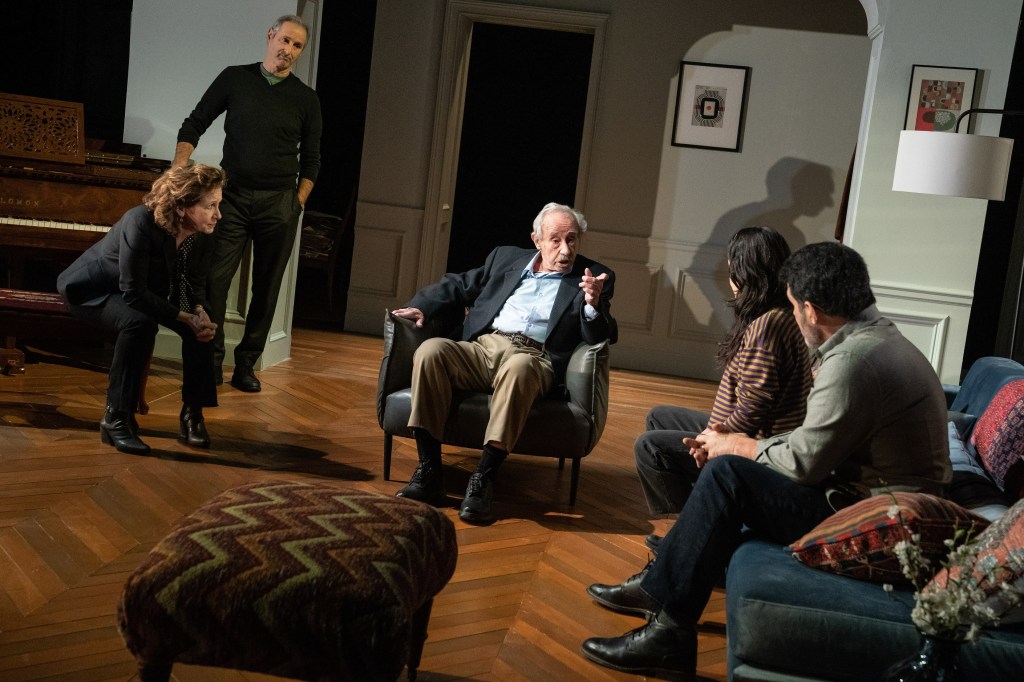
But it is in the final act when the dam bursts with a traumatic episode for Marcelle, who by degrees has given up on her beloved Paris. It occurs at the symbolic Passover Seder, a remembrance of when God wrought miracles to help the Israelites escape slavery in Egypt. At the celebration, when they arrive at the “opening of the door to let the angel in,” Marcelle becomes hysterical like Charles did weeks before. She, too, has a “can’t take it any more” moment and refuses to open the door, terrorized that a Marine Le Pen engineered terrorist will enter and kill them.
The scene is shocking. Betsy Aidem’s performance is riveting as are the other actors. Harmon establishes centuries old horror of death at the hands of haters. Though the idea seems ridiculous, recently a woman was burned alive in her apartment in Paris.
That Harmon has conjoined Marcelle’s terror with the symbolic traditional night commemorating their escape from persecution and oppression is an apotheosis. In an irony of twisted emotion, Marcelle gives in to the terrorists who want Jews gone from “their” country, the most grievous insult of all. It is an incredible message because Marcelle’s fear destroys her ability to believe in God’s protection, a basic fact of her religion. She believes in God’s protection only if she flees, like the Jews of ancient history. The hatred of others intellectually and representationally in various select acts of violence has overwhelmed Marcelle’s ability to feel secure in her own religion, her own apartment, her own country, her own identity. She must leave.
Of course it is a sardonic fact that her family’s escape will be to one of the most dangerous countries on the planet. Patrick raises the issue about the security question in Israel. Indeed, physical security must have as its precursor intellectual and philosophical security in the Golden Rule of “do unto others,” democratic values, an ideal that France attempts to follow and does with exceptions, better than other countries. Certainly, in Israel’s West Bank, the Golden Rule does not abide for Palestinians who are treated as “the other” and are oppressed and have no rights under Netanyahu’s ultra right wing, increasingly anti-democratic government.
Harmon’s play is filled with thesis/antithesis arguments, and this is a family that generationally loves a worthy argument with well supported logic and details. Patrick takes the position that the Republic of France will stand by its ideals and that there is nowhere safe globally, moment to moment; not Israel, not the United States, not Europe, the Middle East, Asia, etc. Human hearts are not safe.
To counter his sister he correctly asserts that the fascistic government of Marine Le Pen will be voted down and the Republic will persist. Harmon’s point is well taken. There are those across the globe who value equanimity in greater numbers than those whose megalomania and craven hate seeks the death of others for power. However, his commentary falls on deaf hears; Marcelle has made up her mind to go to Israel where their Jewish identity may be expressed freely with little fear of reprisal by crazies. For her France has nullified her existence as a Jew.

Whether she will feel safe in Israel relies on hope and sacrifice. In Israel they have to start all over again. They will have sacrificed their careers, friends, culture, language, everything for the hope of a safety and security that is never guaranteed. If they are on a bus that terrorists decide to blow up in Tel Aviv, there is no way to stop that. But Marcelle is convinced, turning 180 degrees from her position at the play’s beginning. Fear possesses her soul and she makes decisions based on it.
In the final segment of the play the argument takes further flight with elderly father Pierre (Pierre Epstein is eloquent in this last speech to the family). If they leave, it is their choice, but he will not go with them. Having the freedom to choose and not be compelled is vital to his identity. Ironically, by giving into their fear, they have compelled and oppressed themselves. Pierre who has seen the worst of the camps and survived, knows the difference of experiencing the worst. His children and grandchildren have not and they don’t want to. That is why Marcelle compels them to leave, though such an event happening again is a probability off the charts. But no one dares speak that to her, not even her own brother.
The performances are sterling and sensitive, at times funny, and always compelling. The canny direction by Cromer to “get it all down” and thrill the audience with ideas and concepts is just great. I particularly enjoyed the Set Design by Takeshi Kata that designated the differences between present and past efficiently and seamlessly. The Lighting Design by Amith Chandrashaker provided the ephemeral, soft, wistful tone of the past and stark contrast with bright light that magnifies the present. Kudos to the other creatives, Sound Design by Lee Kinney & Daniel Kluger, Original Music by Daniel Kluger.
Prayer for the French Republic is revelatory and insightful in questioning our arrogance to believe we, who are transient beings on this planet, have an identity and home, knowing mortality comes to all of us physically. He also twits our assumptions about safety and security, the difference between life’s enjoyments and living an existence permeated by psychological fear. Above all he designates in a Republic, there is the right to choose one’s destiny, free from personal harm because, if applied, the rule of law secures it. But if it is not exercised, then what? Harmon asks the questions through lives, relationships and situations that embody them in seeing the Salomon family live in the past and present. If one delves deeply enough and contemplates like Topol’s Patrick does, one sees the answers can only be individual and personal. No one can answer for someone else.
This is a wonderful play dramatically rendered. It should be seen, especially if you enjoy thought-provoking plays that move swiftly on emotional power. For tickets and times go to their website https://www.manhattantheatreclub.com/shows/2021-22-season/prayer-for-the-french-republic/
Prayer for the French Republic has transferred to Broadway and will run until February 18th at the Samuel J. Friedman Theatre. Look for my review of the Broadway production on Blogcritics.org.
Hugh Jackman’s Indelible, Winning Con in ‘The Music Man,’ Just Unbeatable!’

Historically, America is the land of con artists and showmen. Do you know the difference? As a relatable example there is David Hannum who in the 1850s bought the “Cardiff Giant,” a stone statue he unwittingly believed to be real (the giant fake was made in Iowa). As did its previous owner, Hannum charged admission for viewings. When P.T. Barnum (Hugh Jackman portrayed Barnum in The Greatest Showman) couldn’t purchase the Cardiff Giant for $50,000, he made his own plaster statue, called Hannum’s statue the fake, and charged more money, advertising his as the “real” one. Hannum sued Barnum and referring to Barnum’s patrons said, “There’s a sucker born every minute,” not realizing he, too, had been duped. The suit failed when the originator of the hoax “came clean.” Interestingly, all three entrepreneurs probably kept the money “they earned” providing a thrilling show. In keeping with the great cons of America, history is silent about whether patrons got their money back.
This exploration of that type of con is at the core of Meredith Willson’s The Music Man, which I’ve come to appreciate on another level with this revival at the Wintergarden Theatre, starring Hugh Jackman and Sutton Foster. Along with these romantic leads are Shuler Hensley, Jefferson Mays, Jayne Houdyshell and Marie Mullen. All are Tony Award winners. All give humorous, memorable performances in this fanciful, exuberant, profoundly conceived production (directed by Jerry Zaks and choreographed by Warren Carlyle), about small town America, its bucolic, “nothing is happening here” townsfolk, and the burgeoning love between two needy, flawed individuals, who grasp at hope in each other.

With book, music and lyrics by Meredith Willson and story by Meredith Willson and Franklin Lacey, the great con is spun by a magic-making, uber-talented, artiste extraordinaire that all fall in love with by the conclusion (including the audience). That is all except non-believer, malcontent salesman Charlie Cowell (the excellent, hyper-caustic Remy Auberjonois who was in Death of a Salesman). He’s the “villain” who seeks vengeance to expose Hill as a wicked, flim-flam man.
Hugh Jackman is spot-on in his modern interpretation of the Professor Henry Hill “brand” of “music man.” He and Zaks really get this character, so that Jackman makes it his own, as he exudes the energy-packed, brilliant, larger-than-life, loving individual that you want to stay with, wherever he takes you. After seeing his performance, I believe in pied pipers, who don’t need music to make you theirs.
The criticism that he is not edgy is questionable. If Jackman’s Hill were sinister, few would believe his sincerity in a small town that prides itself on suspicion and being “Iowa Stubborn.” Would the women be so taken with his graceful, smooth, charmingly flirtatious manner? He is a swan among the ungainly, quacking mallards and especially his nemesis, the punchy, exasperated, malaproping Mayor Shinn (the always hysterical and exceptional Jefferson Mays), who gaslights the town with his own con. That this genius craftsman of BS has an irresistible delivery reveals Jackman enjoying expanding the graceful Professor in pure entertainment, with every precious breath and every savvy movement he expends, as he inhabits his refreshing version of Professor Harold Hill for the ages.

Hill’s seductive, adorable, spirited demeanor is dangerously addictive. The happy-go-lucky showman is all about getting others to believe in and enjoy themselves. From that elixir, there is no safe return and the crash, if there is one, is emotionally devastating. How Zaks, Jackman, the cast and creative team spin this rendering is solid and logical throughout, giving this extraordinary revival a different feel, understanding and vision, that should not be underestimated or ignored.
Throughout the dance numbers, which are beautifully conceived with wit and substance, Jackman’s lead is ebullient, light, lithe. This is especially so during his convincing, playful seduction in the number “Marian the Librarian” (Warrent Carlyle’s ballet in soft shoe tempo is just great). Jackman’s sensual, boyish suppleness contrasted with Sutton Foster’s stiff reticence in Marian counterpoint are superb together.
For the song identifying the Iowan’s walled stronghold against strangers (“Iowa Stubborn”), Hill’s great challenge, Zaks stages River City citizens huddled together in a circular clump with stern looks and unsmiling determination. Initially, with Hill they pride themselves on being cold steel like Marian, who is even more icy remote than they are. However, because of Charlie Cowell’s challenge, that Iowa territory is impossible for salesmen, Hill takes the bait and rises to the occasion. He plies his delightful winsomeness with enough sincerity and great good will to surreptitiously penetrate their pride.
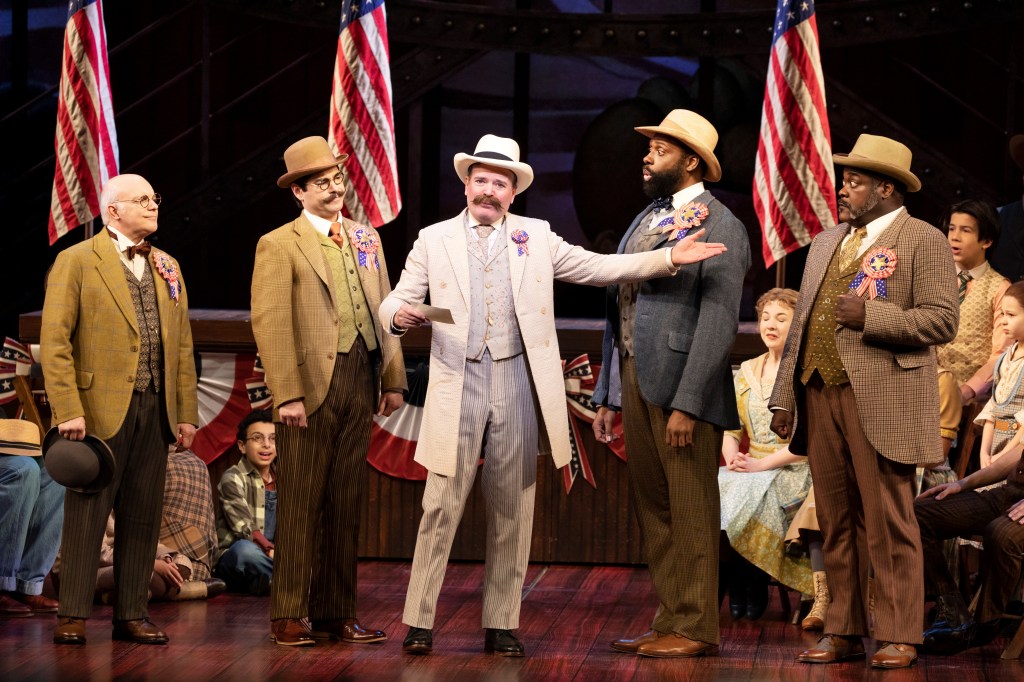
Not only are the townsfolk splintered from their stubborn resolve because of his contagious enthusiasm, his youthfulness retains a sociability that is able to connect with young and old. Indeed, Hill offers them something that no one else who has come to their town has ever offered: happiness, hope, fantasy, the power to believe; to think something is so and it becomes so (the “Think System” re-framed from “the power of positive thinking”). Jackman’s Hill is a practiced master at human nature-buffeted by life’s heart-breaks, that create the foundation in the soul, that hungers to believe in something or someone. Of course, he is a master at this, because he, first and foremost, is starving, a clue to this Hill portrayal, upon which turns the arc of development and all the character interactions. It is also the theme of “Sadder But Wiser Girl,” that he sings in knowing “wisdom” with buddy Marcellus Washburn (the excellent Shuler Hensley).
The brilliance of this production is that Hill’s charismatic delivery of the dangerous idea is palpable, adorable and expansive. As apparently unrealistic as Hill’s disarming positivity is, it is like manna from heaven for these homely folks, who cannot resist just a taste. And Jackman’s Hill enjoys spoon feeding it to them like sugar, until they are hooked. Interestingly, he also is hooked…on their joyous response to him.
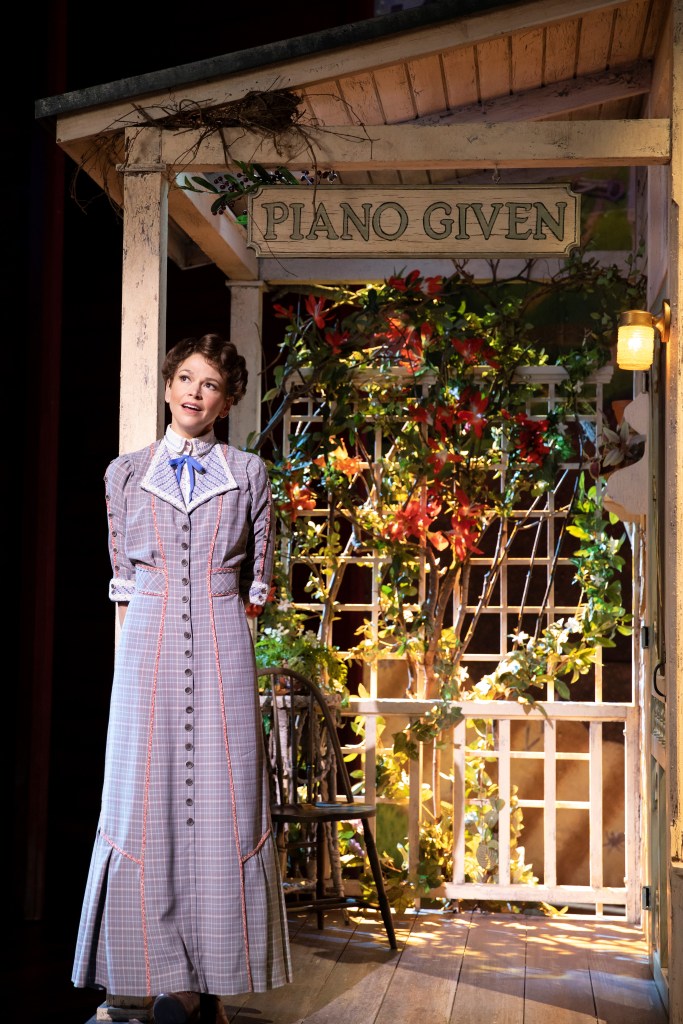
In his backdoor discussions with his comrade in arms, the affable and in love Marcellus, the winning Professor Hill has no disdain or ridicule for those he mesmerizes. He enjoys the challenge (more in the style of 110 in the Shade’s rainmaker Bill Starbuck), of instilling confidence in others and, in return, receiving what he needs, enjoyment, fun, affirmation. He is the antithesis of the bombastic, arrogant traveling salesman loudmouths like Charlie Cowell and the others in the rhythmically pounding opening train number “Rock Island.” (another superb staging by Zaks, et. al.)
Willson reveals the vital difference between them and Hill, as they ride the rails and complain about how hard their job is because of encroaching progress. What an incredible opening scene that gives the set up (costumes, staging, sets, music, sound, tone, tenor). Challenged by their comments that Iowa is an impossible territory, Hill shows himself up to the task, gets off the train, turns to the audience and presents Professor Harold Hill. Just looking at Jackman’s unabashed, open smile and shining spirit, we believe as Mrs. Paroo does, that he can do nearly anything, even if it is getting her very shy son Winthrop to speak, which he does, as Winthrop flows forth in a burst of excitement and emotion that never stops afterward in “Wells Fargo Wagon.”

His product, unlike Charley Cowell’s and the others, is intangible. Thus, taking folks’ money is done quickly, painlessly for much more is being given, including a loving manner and wish to spread joy. In this version of Hill it is his endearing vulnerability to love that Jackman makes believable in his deepening interactions with Marian, whose loving support he has, before the two of them realize it. Jackman and Foster construct this surprising discovery beautifully in the Footbridge scene (“Till There Was You,” and the melding of the relationship as they conjoin their singing of the double reprise “Goodnight My Someone” and “Seventy-Six Trombones”).
The town’s seduction is inevitable after “Ya Got Trouble” and “Seventy-Six Trombones,” an incredible dance number (and pantomimed instrumentation), that Jackman and the cast just kill. River City has “swallowed his line” (the fishing metaphor is used throughout), as does young Winthrop (Benjamin Pajak in a show stealing performance), who is thrilled when his mother, like the other townspeople, signs on for instruments, uniforms and instruction books to form the showy band Hill promises for the absolute thrill of it. That they must learn to play is subtly whisked off until “later,” the “will-o-the-wisp” magic Jackman’s Hill seamlessly performs.

Hill is gloriously, attractively spell-binding. He draws the town to him bringing togetherness and good will, that goes a long way to diffuse the backbiting of the women against Marian’s standoffishness (“Pick-a-Little, Talk-a-Little”). He helps to mend the ladies’ divisiveness, which further draws Marian to them and himself. Humorously, he unifies feuding officials in the exquisite harmony of a barbershop quartet, that they can’t seem to get enough of, once he starts them off on the right chords (“Sincere,” “Goodnight Ladies,” “Lida Rose”). One by one each potentially thorny group falls under Hill’s flirtatious, delectable, gentle power and inspirational artistic encouragement. Talk about soft power flying under the radar, he hits folks’ hearts for a bullseye every time.
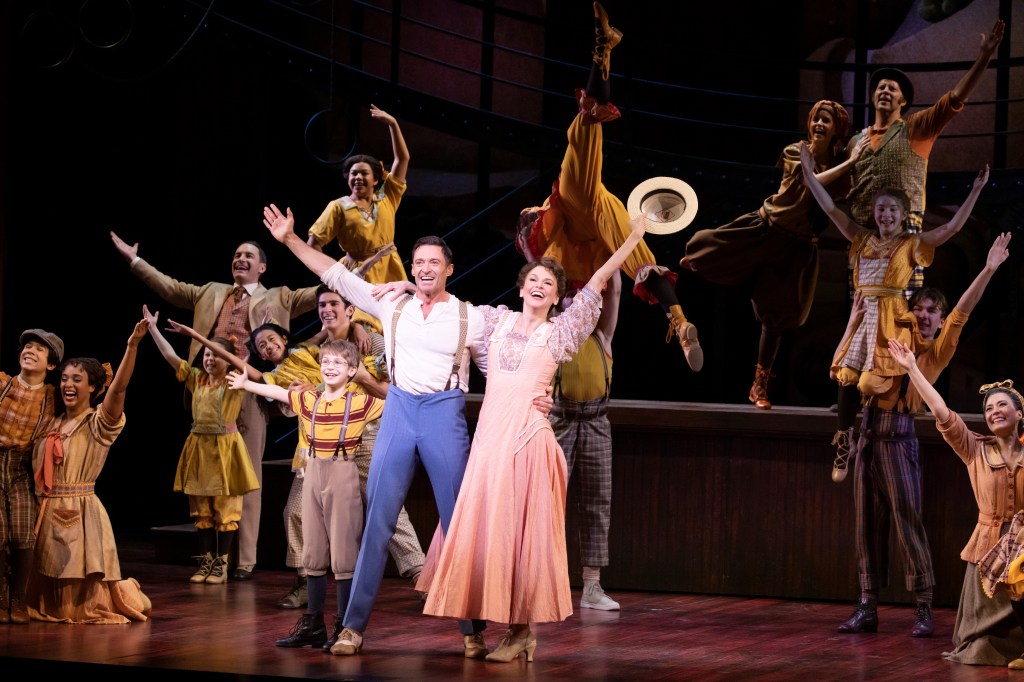
In beautifully staged moments by Zaks, we see Hill’s influence on the Mayor’s wife, Eulalie Shinn and her friends, who create dance numbers and other entertainments. Jayne Houdyshell as Shinn is marvelous and LOL in her dancing and primping poses, after Hill’s maximum attentions. The costuming for these scenes is exceptional. Throughout, the costumes are a take-off of 1912 fashion but with the variety of patterns, in some scenes earthen tones, other scenes fun hats, shoes and accoutrements, thanks to Santo Loquasto, who also did the scenic design.
Marian’s costumes are straight-laced without frills by comparison; her hair (Luc Verschueren for Campbell Young Associates), like the other ladies is in fashion, an up-sweep like her mother’s, Mrs. Paroo (the wonderful Maureen Mullen). Attention in this detailed crafting reveals Marian’s restraint, her career and character, providing the subtext and interesting contrast to the other open-handed, more extravagantly dressed woman. Eulalie and her hens are encouraged to believe in themselves in Hill’s sincere admiration as they ooze his charm back at him and titter. In the case of Marian’s response to Hill’s starlight, she moves from grimace to smile to grin.

Importantly, the women are drawn into Hill’s net, however, it’s mutual. Jackman’s Hill is having a rollicking time becoming enamored of them. This portrayal makes complete sense. Because he is lured by their, acceptance and trust in mutual feeling, he is unable to escape when the love net closes around him. Jackman and Zaks have broadened that net to include the townspeople’s acceptance and love as well as Marian’s, her mother’s and Winthrop’s. Zaks shepherds the actors to forge that budding love and trust with specificity and feeling each time they share a scene (i.e. the fishing scene with Hill and Winthrop).
Fear has no place in Hill’s magical world. So when it attempts to enter in the form of Mayor Shinn’s grave doubts about Hill (though Shinn’s motives are financially suspect), he is misled by Marian and his officials, who by this point in time, understand Hill is bringing new life to the community. Thus, they allow themselves to be distracted away from Shinn’s mission to verify Hill’s identity. It’s apparent that with the exception of Mayor Shinn, whose agenda Hill upends by dunning his new pool table, the town’s spirited happiness is heartfelt. One wonders what their lives were like before his enchantments blinded them? Or did he give them a new way of seeing? And what was Hill’s life like traveling one step ahead of the sheriff before he hit River City, an unintentional stop on his route to anywhere U.S.A.?
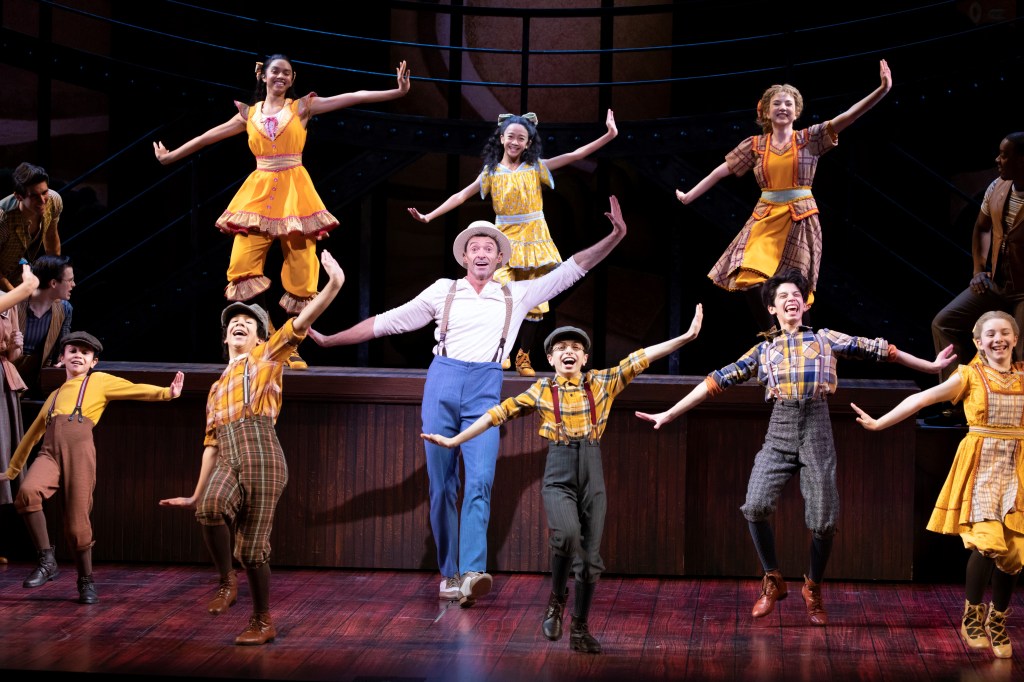
Clues are revealed in the large set backdrops of the Grant Wood style paintings (Regionalism, note the painting “American Gothic”), that are at once simplistic and complicated in their being two-dimensional, brimming with sub-text. These brilliantly reveal the time, place and characters with details of tone, tenor and color. This is especially so against the green rolling hills Grant Wood backdrop, where the tiny, animated, red, Wells Fargo Wagon races down a hill in the distance as it approaches River City. The audience gasped in awe at the ingenious contrivance. Then, they gasped even louder as the “larger-than-life” Wells Fargo Wagon materialized on stage. Pulled by a well-groomed, shiny-coated, smallish-looking “Clydesdale,” Hill beamed atop the wagon as it stopped, the cast sang “The Wells Fargo Wagon” exuberantly, and Jackman rhythmically tossed out the brown, paper wrapped “instruments.” Poignantly, Pajak’s Winthrop sings, lisp and all, completing the effect. Pure dynamite!
This is the show’s “Singing in the Rain,” moment. It is the still point in time that clarifies and represents the whole; action, event, music, symbolism, lighting and spectacle reveal the theme and its significance to the characters and audience. It is here that we understand the treasure that Hill brings, the heightened glory he coalesces in a happening that the townspeople and a now confident Winthrop, (whom we fall in love with along with Hill), will never forget. And for that reason, Marian destroys the evidence that can sink Hill. It’s a stirring, fabulous end to Act I.

By the beginning of Act II, Hill’s invested emotional interest in Marian is revealed in “Shipoopi,” the silly-grand singing and dance number with the entire cast, and colorful, striking costumes, led by Marcellus, who reveals his contentment with his wife. As friend and confidante Marcellus is also Hill’s foil. Living a fulfilled life in a small town, his life contrasts with the emptiness of Hill’s tired wanderings. This is underscored through Hill’s previous interactions with Marcellus, in their fine duet “The Sadder But Wiser Girl,” and brief discussion of his former inability to settle down which Marcellus encourages him to do in River City because he can introduce him to a lovely girl. However, Hill has already met a lovely girl, who rejects him, but as we note at the top of the musical, Hill enjoys a challenge. Jackman nails Hill’s bravado with class, nuance and balance, never over-doing it. He will have Marian and she will have him.

Sutton Foster’s Marian is the challenge Hill finds stimulating. She falls in love, her hard-heart melting in attenuating stages: after Mother Paroo’s pressure in “If You don’t Mind My Saying So,” her own internal pressure in “Goodnight, My Someone” and “My White Knight,” in Hill’s sweetly, gorgeous “bad-boy” pestering in, “Marian the Librarian,” and most importantly, after she sees Hill’s beloved influence on Winthrop (“Wells Fargo Wagon,” the fishing scene, “Gary Indiana”). As Marian, Foster’s change of heart toward Hill is superbly wrought by degrees; her stance and body gradually relaxing as they dance in “Shipoopi.” And the relationship Foster and Jackman forge in its progressive development toward love is believable and touching. By the time the scene with the kiss arrives, their bond is manifest; the long kiss, wistfully enjoyed by Jackman fans, brought faint and not so faint audience gasps; the longing and hunger in the characters dangerously apparent.
For love’s reality is an obstacle to his “safety” that Hill acknowledges (“Till There Was You” reprise). Charlie Cowell intends to provoke the town to scourge Hill with a “tar and feathering.” It is at this point that Marcellus’ injunction that Marian is doing the conning and Hill has to leave or be damned, resonates. But he can’t leave; he must face the music or rather, lack of it.
Foster shines as she attempts to gaslight sexual predator Auberjonois’ Cowell with flirting and a kiss. And in the realistic fight scene (one punch is always sufficient), between Cowell and Hill, the professor vindicates Marian’s reputation that Cowell besmirches. I love how Foster sexually presents herself to Cowell, breaking the third wall and eliciting the audience’s encouragement; she twits the scene for all its worth.
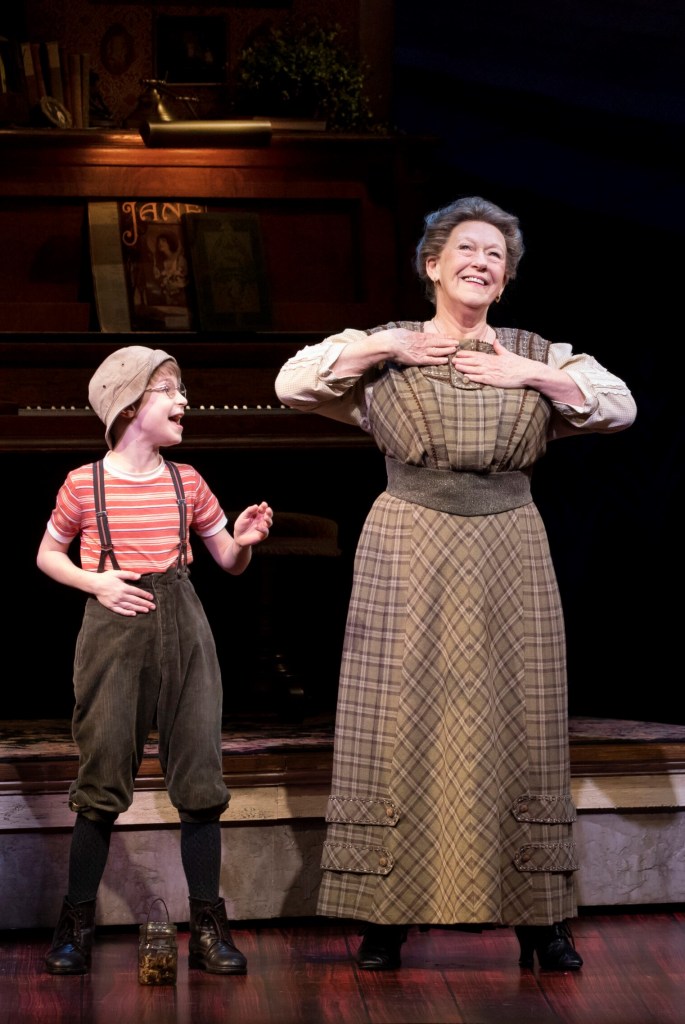
But the con is over. Humorously and ironically, Hill is a victim of Mother Paroo’s use of his “Think System.” And of course, his own need to be loved traps him. Thus, he admits the truth to an upset Winthrop, who forgives him as does Marian. Brother and sister encourage Hill to quickly escape, not realizing the music man wants to stay despite the jeopardy. The sacrifice of the three for each other is perfection. When Hill is arrested, Jackman’s emotional response in the scene is smashing, as is the drama created by Pajak, Auberjonois, Foster and the other cast members. The question remains. Will the town forgive Hill, as Marian and Winthrop have? Will they acknowledge that he has given them something more priceless than a boy’s band? Perception is everything.
In this revival the intentionally “un-dangerous,” genius, entrepreneur professor, like those entrepreneurs of the Cardiff Giant, created a daily thrill. Specifically, Hill’s music man encourages the town to launch out on a new road. It turns into their own growth and ultimate benefit in merging community, good will and love. In exchange for instruments and uniforms, he has bestowed the citizens with an ineffable gift (that Marian and Eulalie Shinn encourage the others to stand for). As Mayor Shin sees their unity and hears his son play, Hill’s “Think System” catches communal fire. The joy and warmth that Hill gave is returned; he is loved and forgiven. And Charlie Cowen leaves a sadder and unrepentant man.

In the end scene as the perception of the townsfolk moves from what is to what each parent thinks/imagines Hill’s orchestral direction to be with love, the miraculous occurs. Hill is redeemed as the band emerges in sound and sensory vision. Announcing the Finale, Winthrop/Pajak blows a vibrant, bold horn. The cast emerges in full band regalia, sings, plays and dances, with Foster and Jackman front and center, leading the charge. Dazzling fun, profoundly realized.
The Music Man is a spectacle that is incredibly rich with visual movement and vibrancy, striking hues and emotional musical grist brought together with sterling performances that are divine brush strokes. The story is a faceted jewel, the characters inhabited by these multi-talented acting greats are uniquely American. The sound/music delivery-technical and vocal is as fine as can be. I heard every word, the glorious harmonies, spun out rhythms and witty lyrics in the compelling choral numbers (“Rock Island,” “Ya Got Trouble,” Shipoopi,” “Pick-a-Little, Talk-a-Little,” “Marian the Librarian,” Seventy-Six Trombones”). What a pleasure, especially in the large musical numbers; this has not always been the case on Broadway (post-pandemic and certainly not pre-pandemic).
The Smithsonian Institution ranks The Music Man as one of the “great glories of American popular culture.” When it premiered on December 19, 1957, it was a smash hit that ran 1375 performances. It won five Tony Awards including Best Musical. The original cast album held the number one position on the
Billboard charts and stayed on the album charts for 245 weeks. The recording won the first-ever Grammy Award for Best Original Cast Album.
In this amazing revival all of the main actors are Tony Award winners. Sutton Foster is a two-time Tony Award winner. Hugh Jackman is a two-time Tony Award, Grammy Award, and Emmy Award-winning star. Director Jerry Zaks is a four-time Tony Award winner and Choreographer Warren Carlyle is a Tony Award winner. The creative team is equally sterling and award studded. It includes four-time Tony Award winner Santo Loquasto (Scenic & Costume Design), five-time Tony Award winner Brian MacDevitt (Lighting Design), Tony Award winner Scott Lehrer (Sound Design), Luc Verschueren for Campbell Young and Associates (Hair, Wigs, & Makeup Design), Tony Award winner Jonathan Tunick (Orchestrations), David Chase (Vocal and Dance Arrangements), and Patrick Vaccariello (Musical Director).
This production with this cast, director, choreographer and technical team will never happen again in your lifetime. Considering what the cast, crew and production team went through to present The Music Man opening night this February 10th, 2022, it has been a labor of love that underscores every dance step, every note played, every trill, every laugh by the actors, the musicians, everyone. It is a one-of-a-kind revival that is breathtaking. Do what you can to see it. I will go again if I can get tickets. Here is their website for arrangements. https://musicmanonbroadway.com/
 CAROLE DI TOSTI