Category Archives: NYC Theater Reviews
Broadway,
‘Fat Ham’ at The Public Theater, LOL Genius
Pulitzer Prize winning Fat Ham a hybrid genre “tragedy,” “comedy” take-off on William Shakespeare’s Hamlet ingeniously tweaks the concept of the revenge play while upending with quips and double entendres every stereotypic trope and meme of the majestic language of the Bard. James Ijames’ facile and seamless adaptation of the familiar and unfamiliar in one of Shakespeare’s most performed plays reveals his exceptional wit, and gobsmacking sensitivity that is at once a send up of age-old themes, yet a profound exploration of current issues in black culture. Now in its extended NYC premiere at The Public Theater, Fat Ham is a co-production with the National Black Theatre.

Directing with pace and timing to incorporate joy, wackiness, and profound, spellbinding, cutting hurts of father/son, nephew/uncle animus, Saheem Ali knows the inside of Ijames’ book and incorporates the selected cultural music with an appropriate meld in the backyard celebration of Rev and Tedra’s wedding celebration. Immediately, we fall in love with plump Juicy portrayed by Marcel Spears whose every cell is tuned up to inhabit the perspicacious, loving, forbearing and wise, gay, college-age kid who is made dizzy in having to confront the cultural confusion of what it is to be black and gay in the American South, something both his deceased father Pap and Uncle Rev (played exceptionally by the edgy Billy Eugene Jones) find repulsive.
As Juicy and his friend and cousin Tio (the marvelously irreverent Chris Herbie Holland) set up for the party, we discover the backstory as Ijames primes the fountain of humor with one liners, quips and jokes between Juicy who’s decorating and Tio who’s watching porn on his phone. Tio doesn’t skip a beat lusting after Juicy’s hot MILF mama Tedra (the exquisite and outrageous Nikki Crawford) when she comes into the backyard.
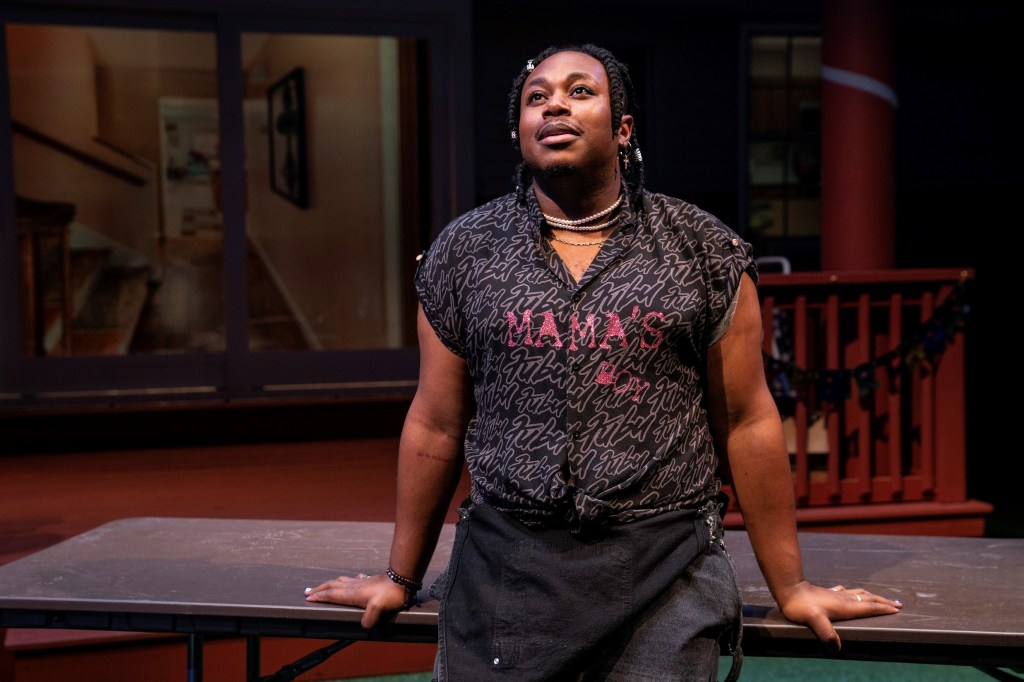
Crawford’s Tendra makes her showy, striking, drop-dead, dancer body entrance to ask Juicy for his opinion about which sexy outfit to wear. Clearly, she gets off looking young and attention grabbing and Juicy, her baby, flatters her with what she needs. Obviously, they are close and adore one another; hence the subtle and not-so-subtle Oedipal references to mother/son relationship which Ali further references with Juicy’s change up into a black T-shirt with pink sequined lettered “Mama’s Boy” on the front.
Around this time as Juicy and Tio set up balloons in the backyard of Tedra’s house (superbly detailed with a smoker grill, screen doors to view inside rooms of the house, Astroturf, expansive, wooden deck, etc. designed by Maruti Evans), something weird happens. A red and white checkered tablecloth flies from one end of the yard to the other. Initially, it appears that someone threw the tablecloth, except it is not a projectile, it streams and flutters, zipping speedily and covering enough ground to spook Tio, who recognizes it as a ghost.

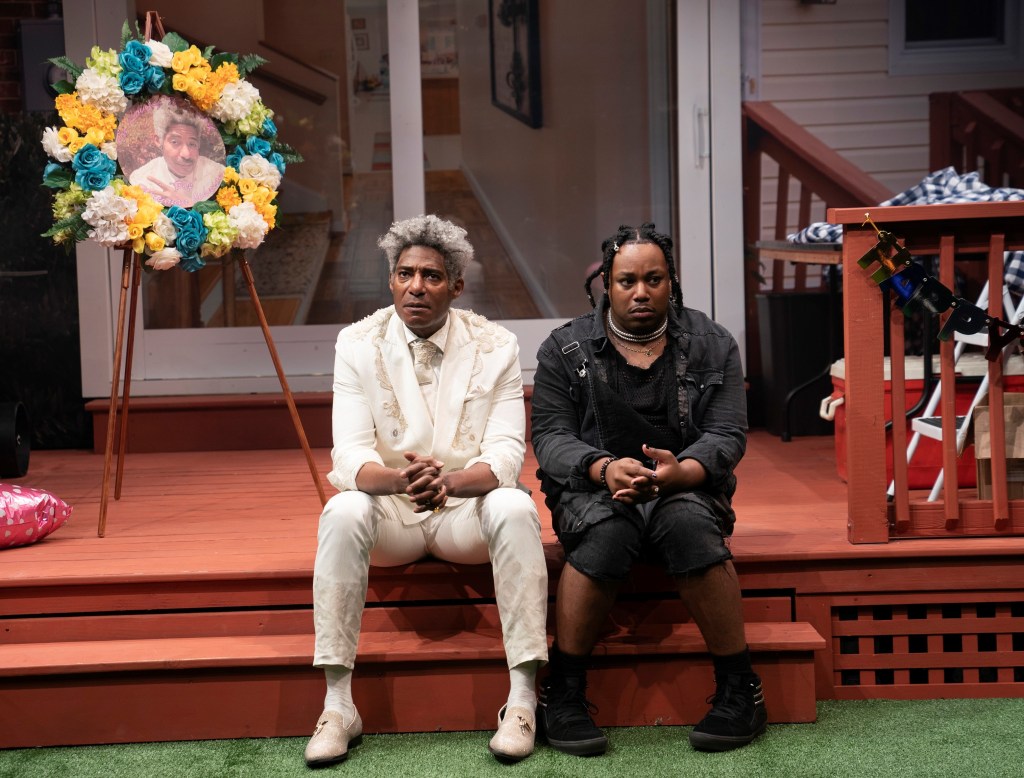
Subsequently, under a brown and white table cloth, Juicy’s father Pap speaks out unghostlike, as he throws off the tablecloth humorously and makes his dynamic entrance in a sequined white suit, sporting striking white hair (thanks to Dominique Fawn Hill’s sensational costume design and Earon Chew Healey’s hair and wig design). As ghostly presences go, his is hilarious. Occasionally, the steam from his betwixt and between state of limbo wisps up from his collar, proving his ghostly being is supernatural and otherworldly. The ghostly effects by Skylar Fox’s illusion design are coolly delivered, and sufficient enough to make us believe that Pap is not from the land of the living.
Having a hard time negotiating Pap’s return and his supernatural condition, Juicy quips about his being deceased and surprising as ghosts go, but Pap isn’t having any jokes. He’s furious. He upbraids his son for being “soft,” referencing his disapproval with Juicy’s gay lifestyle in a typical macho Dad infusion of homophobia. Then, Juicy indicts Pap for not liking him or ever being the loving, mature guide a father should be. Indeed, Ijames’ characterizations credit Juicy for shunning his father’s lifestyle and sticking to one that is more wholesome and life affirming, though culturally, not acceptable.

However, as Pap relates why he has returned, the reveal of Pap’s characterization turns on a dime that he is proud of his machismo. We learn that he is an ancestral criminal whose family provoked a crime spree over generations. His ancestors have passed down this legacy of their criminality all the way back to the days of slavery. And having been abused and abusing, in the course of running his barbecue restaurant, Pap murdered and ended up in prison where he, too, was murdered.

Interestingly, the parallel is drawn. If one doesn’t choose criminality to establish one’s identity and manhood as a black man, what choice does one have? Clearly, Pap’s disgust with Juicy’s choice also goes to what he wants Juicy to do for him. Get revenge on his “sainted” brother who had him killed in prison, then move into his bed and life. The only way for Pap to gain revenge is murder. Pap doesn’t see his way clear to changing up the tradition of criminality with his son which would be a greater form of revenge on the culture of racism by not following the stereotypes the racist culture promulgates. But for the cruel and infamous Pap, the sweetest pay back would never be through redemption or ending the cycle of self-destruction prompted by racism. Pap wants an eye for an eye and to reestablish his respect and manhood through his son.

Unfortunately, for Pap, Juicy isn’t a criminal. His hopes and dreams and his identity journeys in a different direction. Thus, Pap’s need for his revenge may be aborted. Juicy must decide what he wants for himself. And part of the first conflict is whether or not Juicy will go through with Pap’s plans or resist them. After all, Pap may not be who he presents himself to be. He may be a devil tempting Juicy to repeat the same old nullifying actions his ancestors have enacted, living lives of misery and gaining an early death. In a fun recapturing of part of the speech Hamlet (Juicy) delivers to Horatio (Tio), Juicy suggests he will test the ghost to divine the truth.
Though it is never mentioned or suggested, in Fat Ham racism is the elephant in the room. Because of it, Pap’s attitudes about Juicy being gay and not being manly close out other choices for his son in Pap’s estimation. The choice for a black man is to be a macho criminal. And only a macho criminal can get a proper revenge and most importantly respect. That Juicy is bucking the stereotype of black men as criminals doesn’t appeal to Pap. That racism has closed off options for Pap so that he would never consider going to college like Juicy is understated. However, as the play progresses, Juicy has choices and will not be held down by Pap’s definitions of manhood, identity and success. Yet, hating his uncle and missing Pap, even though he was mean and cruel, he has to get justice for Pap’s murder. How he does that is the linchpin of this wonderful production.

The beauty of Fat Ham is like Juicy says, sometimes tragedies don’t have to end like tragedies where everyone dies. Ijames jumps back to Shakespearean prose in crucial aspects of the play, including soliloquies about catching the conscience of Rev with a game of charades during the entertainment portion of the down-home celebration. Also, Juicy breaks the fourth wall and confides in the audience. He effectively gestures, rolls his eyes and with superb pacing and timing flicks his fingers in response to silly comments by one or the other of the characters.
Like the other actors, Juicy’s pauses are weighted for a laugh which he and they always get. The innate timing is a function of brilliant performance technique as well as practice and precise shepherding by the director. The laughs come because the actors are authentic and spot-on. I could have stayed and watched another one half hour. I felt engaged and was having such fun with the machinations and carryings on of the characters.

In breaking the fourth wall with direct-address commentary, Marcel Spears is masterful. At the point where he ruminates about how he will trip up Rev and watch for his reactions, at the beginning of the soliloquy, Spears looked at the audience confidentially and said “The Supreme Court is ghetto.” This was Friday evening after a day’s news of the Supreme Court’s decision against Roe. Spears received two full minutes of applause. He waited, then seamlessly segued into his plan to catch Rev. Wonderful at creating a relationship with the audience, by the conclusion we could have gone up and hugged him.
Charismatic, alive his performance was cleverly unassuming. His interactions with his fellow actors’ characters were completely natural and endearing. Considering that he had the most stage time, the pressure was on him to carry the show. There were a few breaks here and there when the spotlight was on others. For example, Chris Herbie Holland’s stoned rhapsody on why you should live to enjoy your life and stop being negative as an out of his mind riff is wonderful. Marvelous, too, is Larry’s transformation from soldier to what he’s wanted to do perhaps his entire life. His friendship with the free-wheeling Juicy allows him to reveal what he is capable of. Calvin Leon Smith knocks his concluding performance out of the park. It makes sense the production ends with him.
Joining the celebration mid way and present for Juicy’s confrontation with his murderer uncle are friends Rabby (Benja Kay Thomas in a wonderful send-up of the religious, strict, black Mama), her daughter Opal (Adrianna Mitchell’s bored, obedient-disobedient Lesbian), and son Larry (Calvin Leon Smith). Their interactions pair up perfectly with Juicy as they discuss their personal lives and break free from parental strictures and manifest their chosen identity. Their interactions provide grist and humor as they unravel their specific characterizations. What is incredibly upbeat about Fat Ham is the roller coaster ride into humor and fun with just enough Shakespeare to make it interesting and memorable.
The second half of the play with the entertainment portion, i.e. Tendra’s searing hot grinding Kareoke, Juicy’s soulful wailing that Rev characteristically puts down and the charades they play that lead to the reveal, all work beautifully and keep the vibrance climbing to the plays explosive climax. How the actors chow down on their barbecue and integrate the song portions into their partying is realized perfectly thanks to their prodigious talent and Ali keeping it as real as possible. Even the corn looked delicious. Importantly, Juicy confronts Rev ‘s murder of his father. What happens after that certainly is karma stepping up to the plate and hitting back.

The themes about truth and honesty being necessary to fight cultural folkways that destroy are the strongest. The performances are riotous, loving and spot-on. The ensemble work is some of the best I’ve seen this year. I can’t recommend Fat Ham enough as one of the finest productions of the season. It has moved from other venues and may go to Broadway. However , if the venue is a smaller house, that might be the best. This play’s greatness is its intimacy that Juicy achieves with the audience as his confidante. It may be lost in a too large venue.
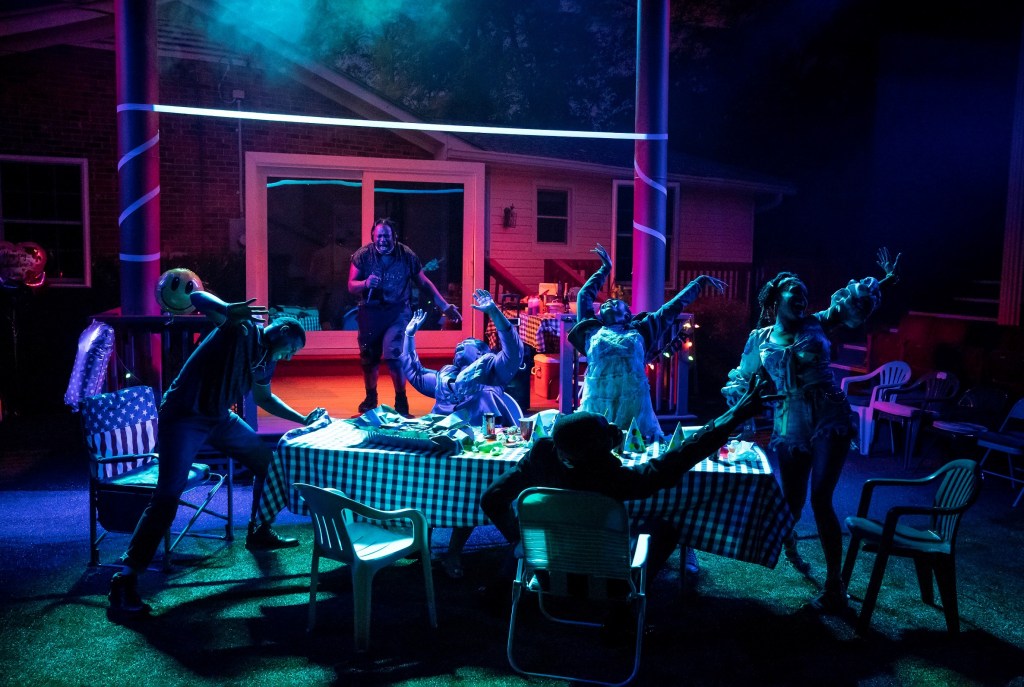
Kudos to the creative team. Not mentioned are Stacey Derosier purposeful lighting (the surreal blue was excellent for enhancing the Ali’s wild staging and character poses. The sound by Mikaal Sulaiman was uniform in each of the songs sung and the supernatural musical elements were eerie. Lisa Kopitsky’s fight direction was realistic. Marcel Spears fall was dramatic and there were gasps from the audience believing Juicy was hurt. Finally, Darrell Grand Moultrie’s choreography was exuberant and for the concluding number hysterical.
Fat Ham is extended to 17th of July. For tickets and times for this must-see production, go to their website. https://publictheater.org/productions/season/2122/fat-ham/ I just loved it!
‘The Bedwetter’ a Hysterical and Meaningful Sarah Silverman Romp

Sarah Silverman is a legendary comic and she may have been born with a funny bone. But how did she morph into the talented comedian who has a musical production about her early life, playing eight times a week at the Atlantic Theater Company? We discover the inspirations that planted the seeds of comedic success in the very humorous, irreverent pop music show The Bedwetter. Based on Silverman’s memoir The Bedwetter: Stories of Courage, Redemption, and Pee, the theater adaptation highlights the most important year of Sarah Silverman’s life, a year that intimated the possible future success Silverman would offer in her unique comic grist.

With book by Joshua Harmon and Sarah Silverman, lyrics by Adam Schlesinger and Sarah Silverman, music by Adam Schlesinger, choreographed by Byron Easley with creative consultation by David Yazbek, The Bedwetter is a hoot. Also, it is ironically woven with themes about divorce, mental illness, childhood angst and dysfunctional families. The two act musical briskly unfolds via the comical and exuberant perspective of precocious, potty-mouth Sarah played by the uber talented and sharply focused Zoe Glick.

Glick is a wunderkind. Her pacing, nasal singing voice and edgy delivery reveal she is a natural. She portrays Sarah as a loving, exhausting, “in-your-face, quick-witted love bug who goes through a series of disastrous events at the worst time in her life. The momentous problems occur at the formative age of ten-years-old when she has to go through her parent’s divorce, her mother’s increasing depression, her father’s philandering with most of the moms in town, and a move which forces her to attend a different middle school where she has no friends.

Though she manages to face these cataclysms with the help of her alcoholic Nana played by the inimitable Bebe Neuwirth in a wonderful turn, there is one issue which is insurmountable. She is a bedwetter. The secret remains among family and perhaps former friends, however, it cramps her style with making new acquaintances. Not only is she embarrassed because she is “too old” to wet the bed, her terrible debility infantalizes her. Thus, she feels inferior and demeaned by a condition she can’t control. The opening number (which also closes the show in a beautifully made sandwich) “Betterwetter” encapsulates all of her issues. Glick sings it with zing, verve and joy.
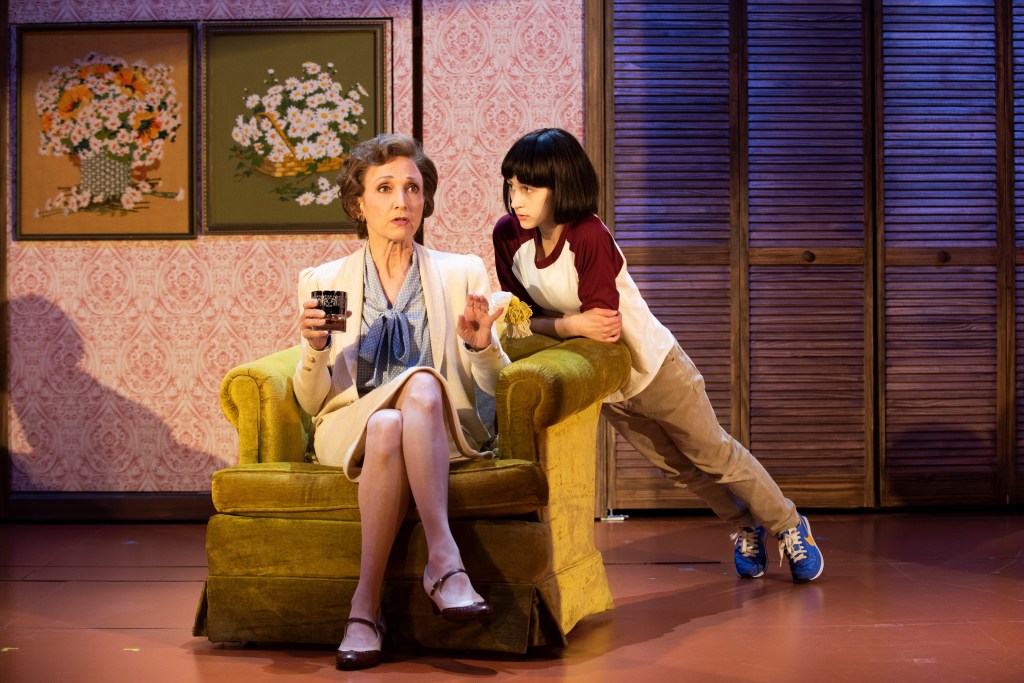
Interestingly, wetting the bed at her age, we note, must be related to her parents’ divorce, the move and inner stress. And then we discover that it is genetic. Her father Donald (the humorous Darren Goldstein who rocks many women’s boats) also wet the bed. However, as he enjoys reminding her, he did grow out of it. Sarah wonders when that wonderful occasion will happen in her life to end the emotionally painful stigma.

As we follow Sarah who introduces us to her family, we meet her sister Laura (Emily Zimmerman) who disowns her in school and puts up with her at home, decrying she doesn’t know who she is and how she is a part of the family. Interestingly, in Act II, Laura’s approach changes after Sarah’s life takes nullifying downturn. And when Nana has to be hospitalized, the Laura softens her attitude toward Sarah. Then the sisters unite and become close again. As Laura, Emily Zimmerman works the transformation from annoyances to hypocrisies to fear and concern for Sarah in a fine and authentic acting and singing performance.
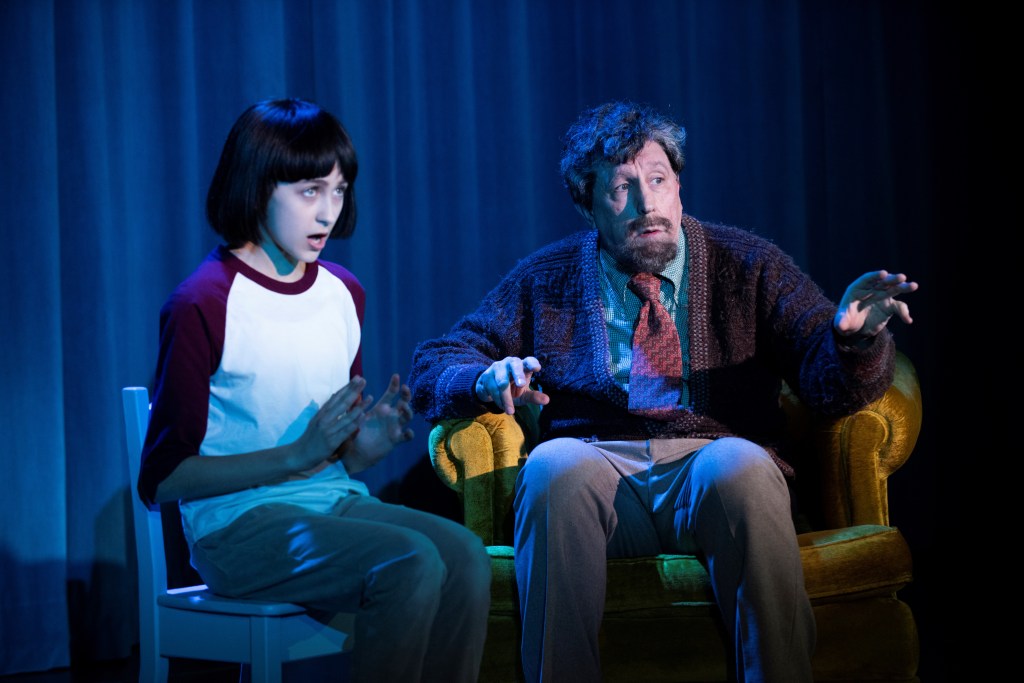
Sarah’s mother Beth Ann, normally portrayed by Caissie Levy covered by Lauren Marcus the night I saw the production is only capable of staying in bed and watching television. We learn why this situation abides in the second act when a fight erupts between Beth Ann and Nana and the truth spills out. It is then we understand Beth Ann’s depression and feel empathy for her. However, Nana ends up becoming sick over the remembrance of what happened. Indeed, her hospital stay reveals self-punishment and feelings of guilt for she feels responsible for events that cause Beth Anns’ depression.

Considering the circumstances of her caved-in life, Beth Ann does the best she can. She is aware of Donald’s philandering, one cause for the divorce. However, he is a good father. He provides enough money to take care of the family and eventually pay for Sarah’s treatments to stop her bedwetting. Also, he is there for his two daughters. Likewise, though Beth Ann’s debilitating depression hinders her for “normal” activities, she stands by her children and when Sarah needs her most, she is present for her.
Initially, Sarah, encouraged by Nana (Bebe Neuwirth comes prepared with an authentic accent and bright, cheerful demeanor) who tells her she can do anything, coasts into school. We are impressed as Sarah’s humor and agreeability eventually lures the girls in her classes to be her friends, rendered in an adorable song with Charlotte Elizabeth Curtis (Ally) Charlotte MacLeod (Abby) and Margot Weintraub (Amy).
Mrs. Dembo their teacher (the very funny Ellyn Marie Marsh) tries to inspire them to hone their talent like Mrs. New Hampshire did (the lovely voiced, effervescent and funny Ashley Blanchet) for their school is presenting a talent show. Sarah and her friends begin to practice songs for the show, inspired by the golden tones of Mrs. New Hampshire. When they practice together, they are crackerjack astounding with their harmonies and seriousness in “getting the number right.” They should form a girl band.
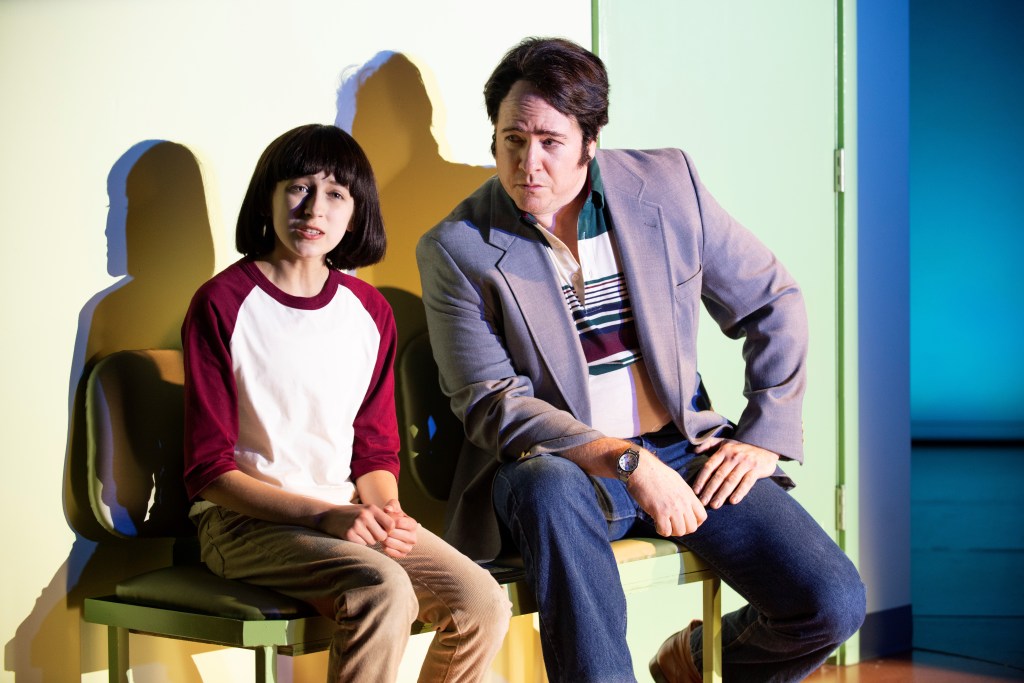
After Sarah invites her new friends to her Dad’s house, they are impressed. Darren Goldstein’s philanderer number as Donald brought the house down when I saw the show. The men loved his machismo, which he manages in the ethos of a hapless idiot far from a hot, “know-it-all” arrogant lothario. His balance in achieving a hysterical, irreverent unpolitically correct and refreshing tone is well shepherded by director Anne Kauffman.
The ease that Donald presents with Sarah and her friends opens a door of hospitality so that Sarah is invited to a sleep over. She almost doesn’t go because she will wet the bed and the girls use the occasion to add to her horrific embarrassment. But her mother unthinkingly tells her she’ll be OK. Meanwhile, Donald tries to find cures for Sarah which result in a very funny bit between the hypnotist portrayed by Rick Crom who is brilliant and whose voice is excellent for the role. Unfortunately, the hypnosis doesn’t work and the hypnotist sings a counterpoint duet with Sarah underscoring that he’s a fraud as she sings that the hypnosis doesn’t work.
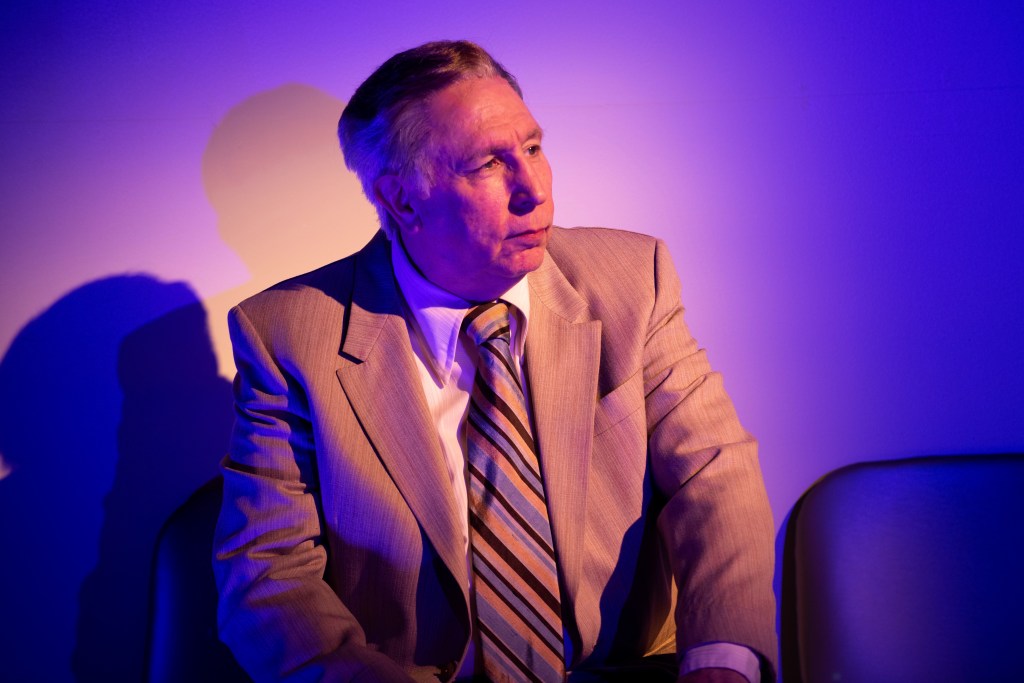
When Sarah goes to the sleepover, she has an accident. What happens after this event reaches into catastrophe. However, Silverman’s horrors come with great humor and irony. The number that takes place in the psychiatrists office is farcical in a great way, for the doctor (Crom) sings the praises of the latest cure for depression, the diagnosis he gives Sarah. As the doctor Crom leads the large dancing yellow Xanaxes that come alive to sing along with him about their wonderous effects. Crom attests to their ebullience as he flutters and skips high as a kite on Xanax. The number is one of the best in the show, as well as the most sardonic. Just great!
As the good doctor and singing dancing Xanaxes move off stage, Sarah desperate to do anything to stop her debility pops her pills for “depression.” We shudder understanding that Sarah is too young to take such powerful drugs, but it is a fact that Big Pharma likes to get folks hooked as young as possible. Instead of stemming her depression, anxiety and sorrow, Sarah joins her mom in bed where together the sing of their troubles and their hopes.
Ironically, the depression that Xanax is supposed to cure throws her into a full-blown depression so she must take more to attempt some relief. Once again, the cure is worse than the condition. The resolution does arrive to reveal the need for redemption for the family and salvation for Sarah who is still wetting the bed.
The deus ex machina (a seemingly unsolvable problem in a story is suddenly and abruptly resolved by an unexpected and unlikely occurrence) arrives when Miss New Hampshire appears in a dream. She tells Sarah about her secret which brings the child confidence in knowing that this lovely, talented woman had the same problem. Maybe there is hope for her after all. By the conclusion of this wacky and warm musical, Sarah takes the stage in the talent show and cracks open her wild and authentic comedy number (which we’ve been watching). The show ends with the rousing song “The Bedwetter” sung by the cast, and our delectable farce sandwich concludes.

The production is excellent, though it is “dirty” and “uncouth” and unpolitically correct and indecent for younger girls (that’s for the NEWSPEAK thought police on “the left” and “the right,” reference to 1984 by George Orwell). Anne Kauffman has rehearsed the cast to a fine rhythmic pace, rapid fire delivery of quips and jokes and acute pauses for timing which add to the overall hilarity and upbeat performances.
Nevertheless, when the show turns to the dark side, all of the issues break wide open and we can empathize with what this family has gone through to make it to the next day. Of course the struggles and strains provide the foundation for Silverman’s comedy and engender her growing up beyond her years, sustained by cracking jokes to forestall the misery. Indeed, misery and humiliation provide the meat upon which Thalia, the muse of comedy feeds. Silverman and Thalia are besties in this production. And Silverman’s and Harmon’s and Schlesinger’s book and lyrics inspired by the immortal acquaint us, the actors and director with her finer points of merriment.
The cast works seamlessly as an ensemble. Their voices are powerfully resonant and spot-on. Each of the leads remains precisely authentic in their own songs, whose lyrics are humorous, sometimes wildly hysterical, but always pealing out the human condition.
Kudos to the set design which was functional, variable and effectively minimalistic (Laura Jellinek). Costumes by Kaye Voyce showed up the Ad dancers and Miss New Hampshire well. Japhy Weideman’s lighting, Kai Harada’s sound, Lucy Mackinnon’s projections, Kate Wilson’s dialects made the production’s themes cohere. The music team is exceptional. These include: Dean Sharenow (music supervisor & coordinator) Henry Aronson (music director) and David Chase (orchestrations).
This is one to see for its exuberance, fun, laughter and poignant moments, too rendered by the fine performances of the ensemble and sensitive, balanced direction, keeping the humor in the pathos. For tickets and times to The Bedwetter that runs about two hours go to their website: https://atlantictheater.org/production/the-bedwetter/
‘Golden Shield’ at MTC, Review of a Must-See Production

Golden Shield by Anchuli Felicia King, directed by May Adrales currently at Manhattan Theatre Club is a thematically rich and profound work that looks into corporate greed, political activism, digital censorship as a means of control, the ethic of understanding a different language through translation without considering cultural variance, and relationship reconciliation redux. Through the lens of a jury trial against corrupt actors who refuse to consider the consequences of their actions when digital efficiency and progress is at stake, King examines ethical responsibility and the fallout when accountability is measured in litigation awards.
The principal theme begins when audience members hear the instructions to keep masks on and turn off cell phones in another language. Mandarin. They think they know what is being discussed because it is the protocol of all theatrical experience in New York City to be reminded before the play begins to be the dutiful audience. However, in reality, unless they have a working knowledge of Mandarin, they don’t know what is being said. The speaker might be cursing out the audience; thus, the setting and context determine the level of trust the audience has for the speaker.
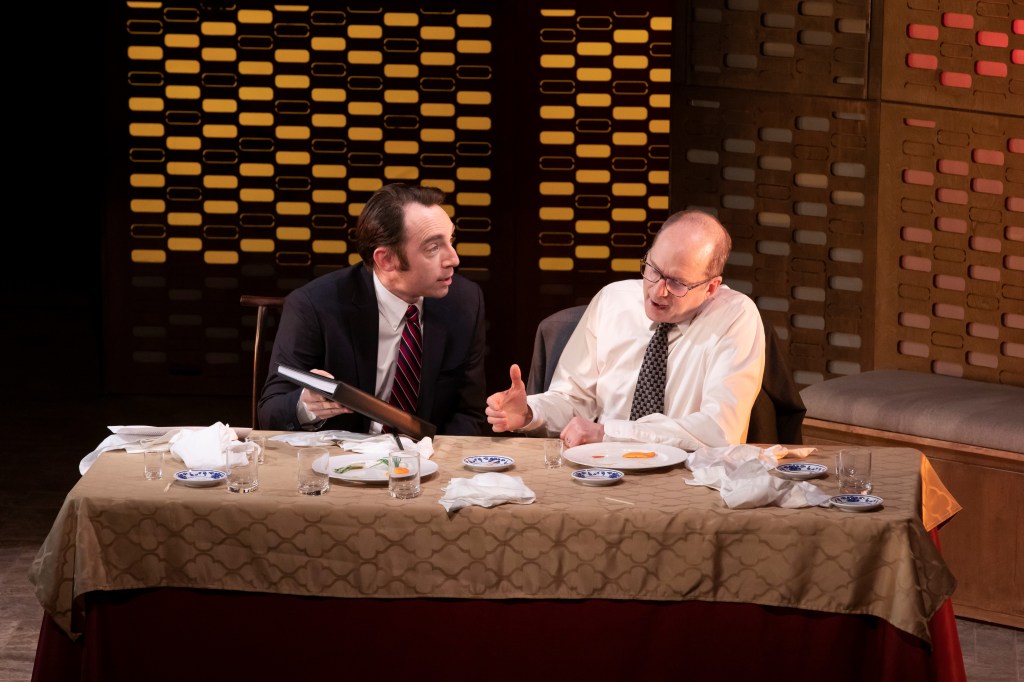
This is the linchpin of Golden Shield, illustrated by Fang Du, the clever and affable Translator who takes our hand during the more opaque sections of the two act drama and guides us with his knowledge of Mandarin and unaccented English. We can only assume that he understands both languages to provide a correct translation of what is happening when the conversation is only in Mandarin. Thus, we trust him. But should we? This is a slippery slope. Indeed, trust between and among human beings, even if they are friends and family, as King proves, is flawed.
It is a fluid theme. By the end of the play, The Translator learns an important lesson. There is no correct translation for what happens during the play between older sister Julie Chen (the excellent Cindy Cheung) and younger sister Eva (the superb Ruibo Qian) who Julie abandoned to live with their tyrannical mother in China when she was a child. Nor is there a correct translation for what happens to Li Dao (Michael C. Liu in a heartfelt powerful portrayal) when Eva gives a one sentence translation that mistakenly encourages Li Dao to take a course of action that impacts him and the case that Julie is trying for her law firm.
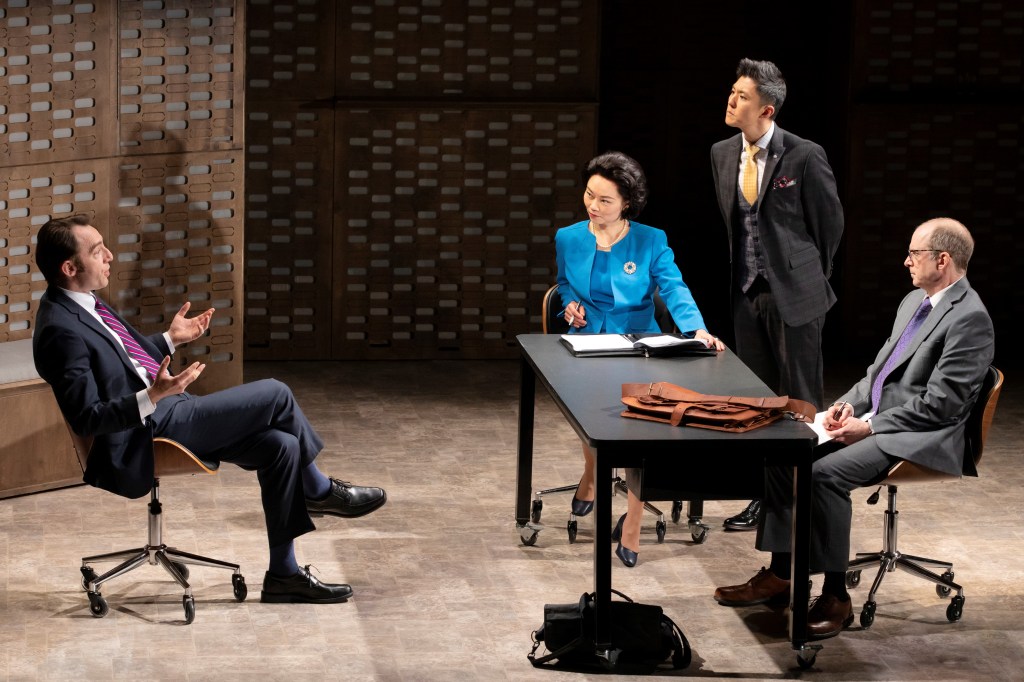
Indeed, The Translator and the Chens realize that translation is a matter of interpretation of cultural values, the proper selection of metaphors and figurative language, subtle inflections and nuances in a contextual medium that must be included to convey what an individual is saying. Finally, there is no translation for why Chen acts as she does at the play’s end, nor is there a translation for the villain ONYS Systems in how they relate to the Chinese government.
Language between native speakers is not easily conveyed if there are geographical and cultural differences within a nation. Words hold loaded meanings and what one thinks one communicates may hold offense or have an entirely different understanding for the listener. How much more is the confusion of communication if a language that conveys meaning in a circular fashion through characters and pictorial thoughts is translated to a listener and speaker of English which is essentially linear and word based, and whose time is chronological? Mandarin, Cantonese, Korean, Japanese are effectively without chronology, and retain a circularity and pictorial, visual thought process seamlessly navigated and understood by those who speak, read and write it.

Interestingly, Fang Du’s Translator warns us about the chronological expansiveness of English compared to the circularity of Mandarin and suggests there is no word for word translation. However, by the end of the play as he lives through and guides us through the events, even he is caught up short. The revelation for him is profound because he has been in the “God” seat. But he becomes enlightened like the Chens and the audience that what results is because of incomplete translation and incorrect “interpretation” and felt understanding. Mistaken understanding roils through every interaction in King’s play; it is fascinating.
This is perhaps the most profound of the themes in King’s work which takes place between 2006-2016 and shifts scenes from Washington, D.C. to Beijing, to Yingcheng, to Dallas, to Palo Alto to Melbourne. Though flashback is used and The Translator keeps us mapped out in the setting and scenes, Act 1 is top heavy. The playwright wants to say so much that she dilutes the force by trying to jam pack it all i>. Truly, the play could be streamlined and the dialogue shaved at the least to arrive at the question what are the most salient, striking themes. How can they be made to bring the audience toward vibrance.

When I saw Golden Shield, members of the audience appeared to be most affected by the relationship which implodes between the Chens. Nevertheless, King’s passion for the topics and themes is noteworthy. How do you streamline even a few words when you are in love with what your characters are saying to you. I get it, but it bears looking at for future productions to make Act I a dynamo and powerhouse leading through Act II in its explosion/implosion and powerful trial scene testimony then the conclusion.
The frame of King’s work fans out into part courtroom drama, part lawyer discussion, part insider talk at the fictional American tech company ONYS Systems. They get the contract to create a process to help them spy on any activity that opposition and adversaries use to smash the firewall of digital censorship that pertains throughout China. ONYS Systems’ pompous Elon Musk-type executive Marshall McLaren (the sardonic and superb Max Gordon Moore) creates an effective firewall by decentralizing it into multiple checkpoints, making it much easier for Chinese monitors to gauge spying and identify hackers who defy China’s digital control.

Thus, ONYS Systems in an extraordinary pro-communist political move is used as a tool of the Communist Chinese government to expose potential American spies in a counter-American action to protect itself. It also is used as the chief deterrent to stop hacking their firewall by identifying the hackers and punishing them severely.
During the course of the play, we understand the culpability of ONYS Systems through Moore’s McLaren. His nonchalance and self-satisfied genius, that he and he alone came up with this plan of decentralization for his company which increased their profitability exponentially as China pays them a huge price is loathsome. Interestingly, Moore makes the character ironic with the help of Adrales fine direction. Thus, the full understanding becomes “lost in translation.” And the full impact of how China has created a puppet in McLaren/ONYS Systems as a compromat or whatever the Mandarin word is for those without ethics or integrity who turn against their own nation, humanity and the “little people” for extraordinary wealth is muted. But hey, what the hell; it’s just business. (Some of this plays out from real life; check out Cisco and Yahoo litigation.)
Meanwhile, McLaren and ONYS Systems have ignored the impact of this “Golden Shield.” Their bottom line is paramount. Enter Chinese-American attorney Julie Chen who leads a class-action lawsuit by eight dissidents against ONYS Systems, chief among them the severely injured Professor Li Dao. Chen has found an obscure law used against pirates a few centuries ago that gives federal courts the jurisdiction to hear litigation filed by non-U.S. citizens for torts committed in violation of international law. She convinces her partner in the firm (Daniel Jenkins who doubles in his ONYS Systems’ role ) that they must take the case of the dissidents. She is passionate, convinced that McClaren and ONYS Systems are culpable for injuring the dissidents via their digital assistance to the oppressive and brutal Communists. Indeed, during various flashbacks we learn of Professor Dao’s five year imprisonment and torture because he showed students how to circumvent the Communist governments’ new “Great Wall of China,” The Golden Shield.
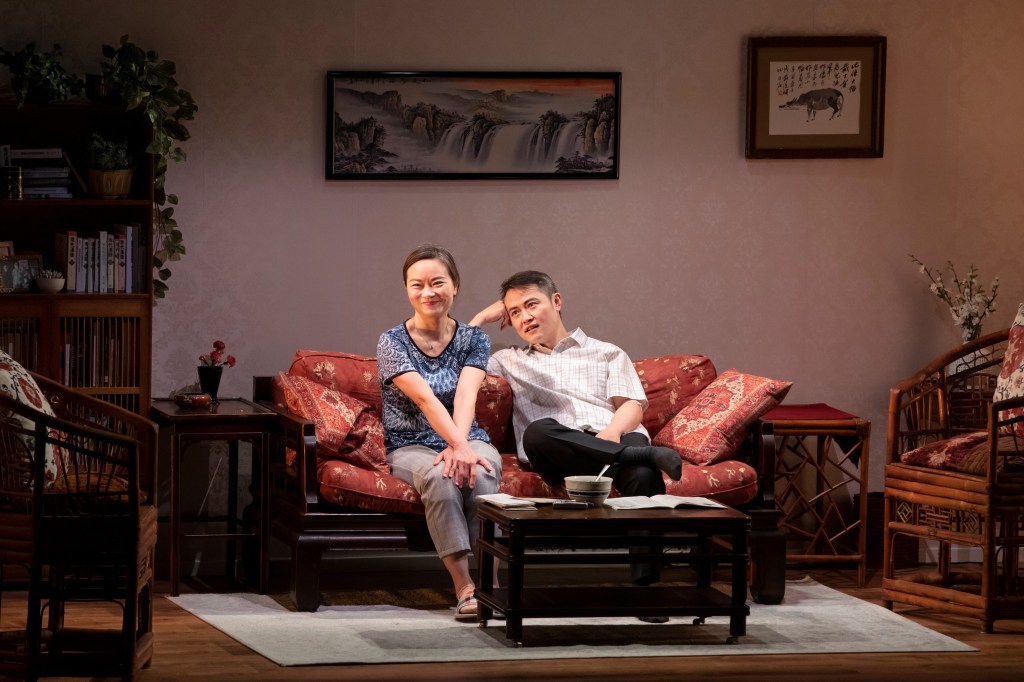
Enter the side plot and conflict between the siblings which also is lost in translation, misunderstanding and flawed communication because of emotional trauma, cultural differences and denial. Julie hires her sister Eva to visit China with her and speak to Professor Liu who can only testify and reveal so much of the brutality visited upon him under the Communists because he has been traumatized. The most vital scenes of the play occur with Li Dao and his wife Hang Mei (the fine Kristen Hung). Liu represents Li Dao with such empathy throughout that his portrayal ironically, though we don’t understand his speech, conveys superb understanding of his feelings and his expressions. Thus, the theme of translation being an incomplete and flawed means of communication hits the hardest with their performances because the words don’t matter. The emotions, tone, timbre wrought with great feeling immediately convey truth.
In Act II the courtroom scene where Professor Dao testifies is sensationally done with all the actors firing on all syllables. However, Chen as a result of her own trauma with her mother and leaving her sister in China has a confluence of emotions which end up forcing her to take a path which is devastating. For her part Eva, who we find out has been a sex worker and has compromised her sister’s relationship with her law firm partner, ends up bereft and lost. By the conclusion all the characters reveal that the events have traumatized them in one way or another. It doesn’t become a matter of winning or losing the lawsuit, it becomes whether or not one respects oneself for one’s choices.

Only Eva in her relationship with her Aussie lover (Gillian Saker who also does double duty as lawyer for ONYS Systems) seems to be seeking some sort of resolution with herself, especially after she throws over her sister Julie. But all of the characters are flawed, not very appealing, ethically challenged with the exception of the Professor Dao who has paid a terrible price for challenging China’s autocracy and repression. And indeed, by the play’s conclusion the future appears even more bleak as McLaren provides himself an off-ramp from changing his ways reflecting on the Dark Web, Block Chain and other tech “innovations” which provide myriad ways toward profitability by any means necessary.
I particularly enjoyed dots’ scenic design which coupled with Jeanette Oi-Suk Yew’s lighting design was used to smashing effect during the scenes relating to the Professor’s prison term and punishment. The set of Li Dao’s and Huang Mei’s living raised on a platform and framed by the lattacework partitions/screens on either side intimated the cultural setting, though the living room appeared Western. Its functionality was pointed and well thought out. Kudos to the rest of the creative team for applying King’s themes and Adrales’ vision. These include Sara Ryung Clement (costume design) Charles Coes and Nathan A. Roberts (original music & sound design) Tom Watson (hair & wig design).
The show closes on Sunday 12 June. I have highly recommended to to friends. It is a must-see and will be performed again. Look for it regionally. For tickets go to their website: https://www.manhattantheatreclub.com/shows/2021-22-season/golden-shield/
‘Mr. Saturday Night,’ Billy Crystal, David Paymer, Dazzle With Comedic Genius and Heart
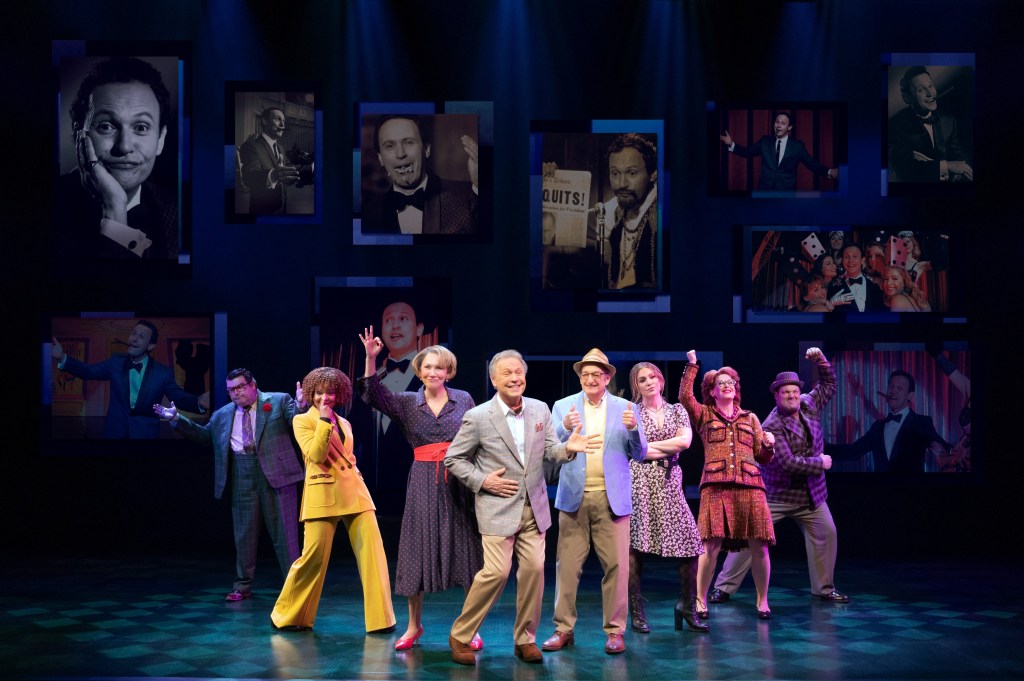
Billy Crystal’s reshaped Mr. Saturday Night at the Nederlander Theatre, directed with acute sensitivity by John Rando is based on Crystal’s 1991 Oscar nominated titular film. This production “hurts!” (in today’s parlance “kills:). Crystal embodies “Mr. Saturday Night” from head to toe. In the two act musical Buddy Young, Jr. (Crystal) luckily faces the opportunity of a second chance in his waning comedian years. With this do over, he gets to reexamine how he sabotaged his career with the hope of regenerating it. Most importantly, he faces the opportunity to revitalize his estranged relationship with his brother Stan (David Paymer reprises his Oscar nominated film role) and his non existent relationship with daughter Susan (the golden voiced and superb Shoshana Bean).
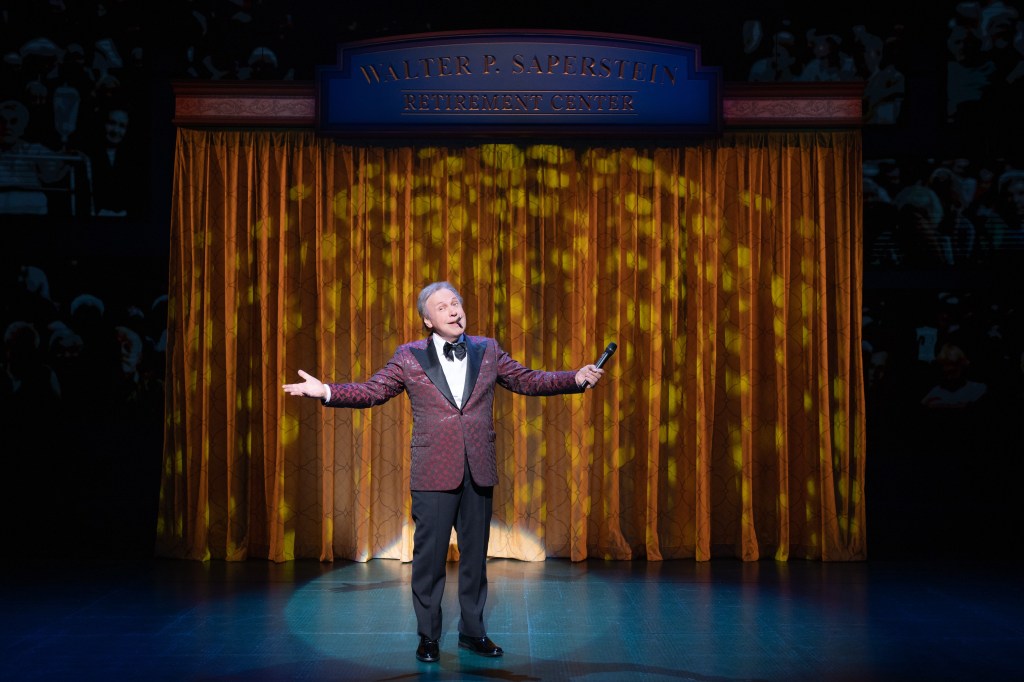
We all love second chances because we need so many of them. Buddy is no exception as the writers fashion his character to bump up against chance after chance. Indeed, in flashbacks from present to past to present, we note that as Buddy’s ego explodes with his successes, he eventually blows every chance that comes his way. When it is announced that he has died on TV (a symbolic reaffirmation of hope for a resurrection) Buddy plunges into the opportunity with the help of agent Annie Wells (Chasten Harmon covered by Tatiana Weschsler the night I saw the musical). The dramatic problem arises. Perhaps Buddy has gained the wisdom to retrieve the lost golden ring of success and once more establish himself. But what if he hasn’t?
This caveat is the crux of the conflict and arc of development. Can Buddy get out of his own way long enough to be the best human being he can be, absolving himself of past regrets with humility and aplomb? You’ll just have to see this reconfigured Mr. Saturday Night to find out
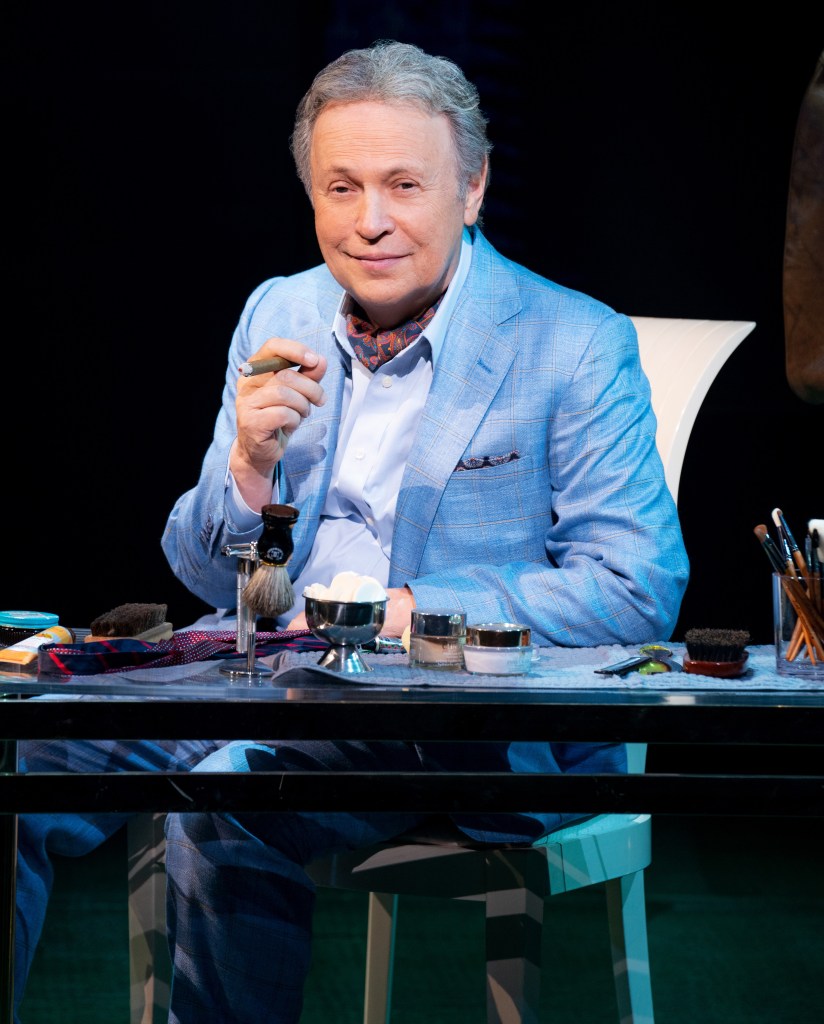
Crystal, himself is receiving a new thrust of fame in this upward moving transition in his career as a Broadway star going for his second Tony Award. He won a special Tony for 700 Sundays) doing what he enjoys, performing in front of a live audience every night. The production, despite a few twitches, is an absolute joy to see, and Crystal is the ebullient muse of hilarity, pattering jokes with lightening speed and seamless grace.
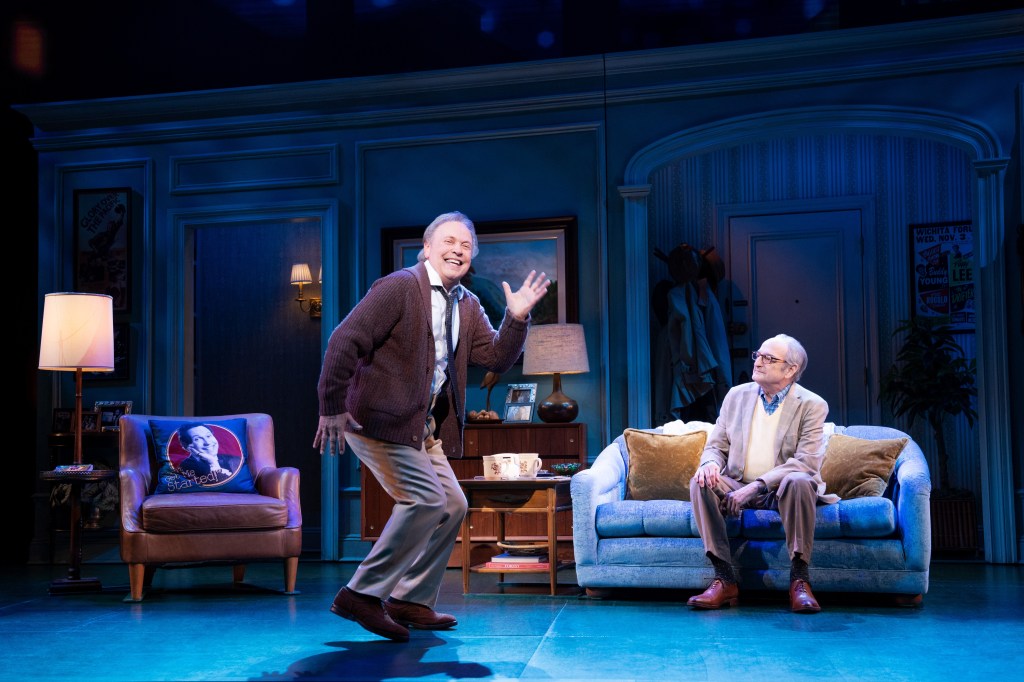
Reprising his role with Paymer, Crystal is the former Borscht Belt comedian, who once had a successful TV show until he didn’t. Paymer is his long suffering brother/manager/agent who was generous with his own salary during their heyday, but barely has enough to treat his girlfriend to a pricey dinner. Randy Graff does a fine job as wife Elaine, encouraging Bean’s Susan to “give her father a break.” “Putting up with her father is something Susan finally shutters with maturity and firmness, prompting Buddy to reassess, reevaluate and recalibrate or lose her love. The scene between Bean and Crystal against the warm background of the projections of the NYC brownstones and the doorway to Susan’s apartment and new relationship with her Dad is beautifully done.
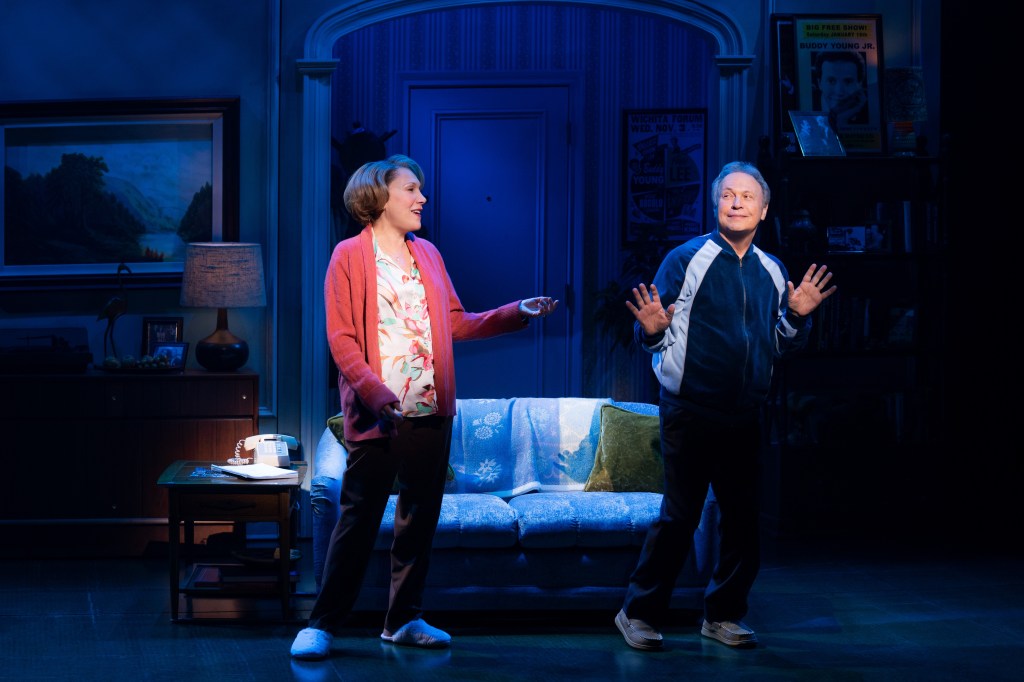
The production combines an endearing and poignant update with LOL vibrance. It soars with Crystal’s outstanding performance where he sings and dances, as one would expect seventy-something Buddy Young, Jr. to crow out a tune and jubilantly hop and skip some mildly energetic dance steps, sans flips, strenuous tap or break dancing. Indeed, Paymer and Crystal deliver their enjoyment “I Still Got It,” and companionship together and also dig deep when their characters hit the abyss: Paymer in the exceptional “Broken,” and Crystal in the profound “Any Man But Me.” Surprising, endearing, adorable, belly-laughing, fun, thoughtful and appealing, the principals are a team and appear to have fun making the audience laugh in a time when we desperately need to apolitically chortle and “fall out” in a life-affirming way.
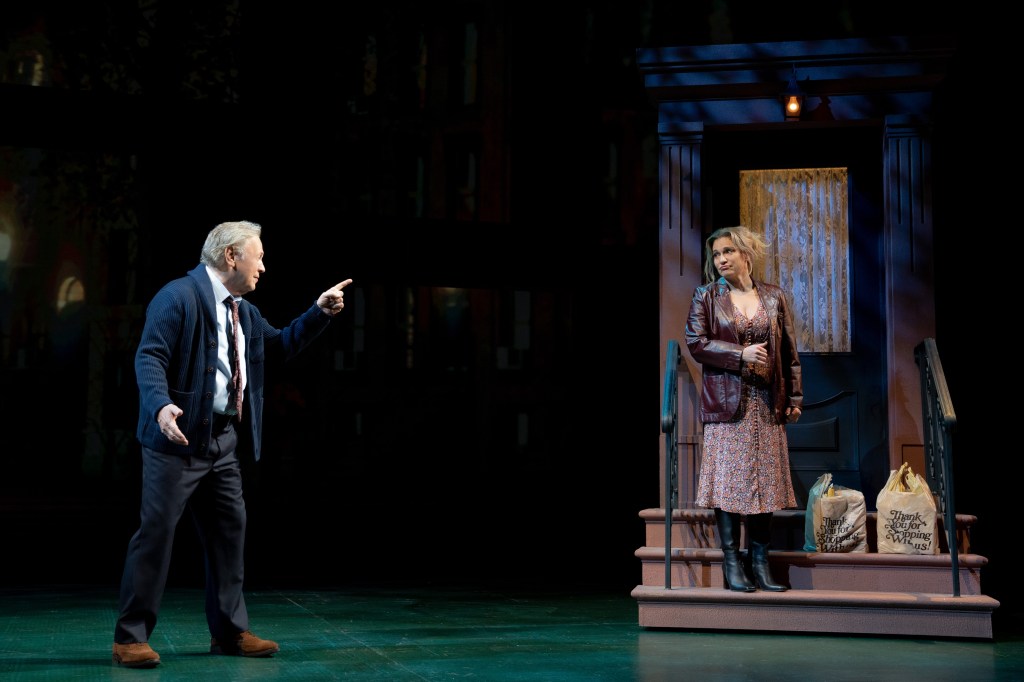
With Book by Billy Crystal, Lowell Ganz and Babaloo Mandel, Music by Jason Robert Brown and Lyrics by Amanda Green, the production has been nominated for five 2022 Tonys, including Best Musical, Book, Score (Brown and Green), Leading Actor in a Musical (Crystal), and Featured Actress in a Musical (Bean). What is marvelously stranger than fiction is that the film, if one reads the “critics” was not “the bomb,” it did not “kill” and it did not, in Buddy’s words “hurt them.” It flopped. Crystal and his creative team are to be credited for courage and gumption to try again, this time as a Broadway musical, one of the most difficult of creations and during an ongoing pandemic that no one likes to acknowledge.
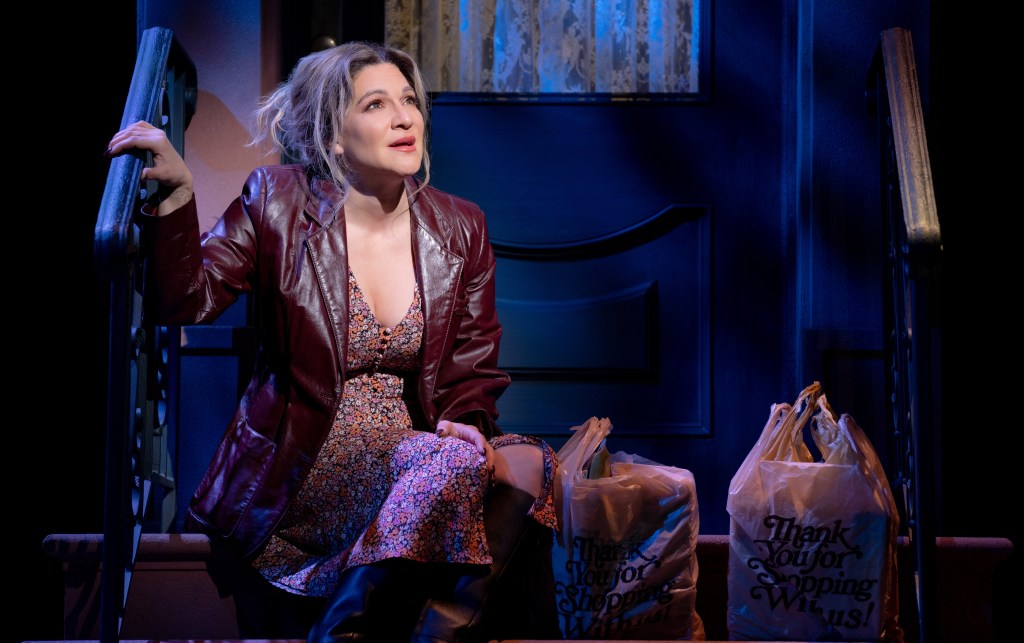
However, this is Mr. Saturday Night’s persevering second chance. With the added lift of the music and dance, and overall nostalgic silliness of 50s TV bits, where actors dress in hot dog costumes, cigarette boxes, etc., (Jordan Gelber, Brian Gonzales, Mylinda Hull) Mr. Saturday Night offers a retrospective on a history younger audiences don’t know. Also, it is an encomium to comedians who were huge greats in their time, some of whose stars still shine in films on Turner Classic Movies and black and white TV reruns.
The musical also highlights the importance of the Borscht Belt circuit in the Catskills, where comedians and entertainers could credibly try out their material and look for opportunities like Buddy did when he “covered” for Milton Berle at Farber’s. As the musical flashes back to Buddy, Stan and Elaine as twenty-somethings, we discover it is at Farber’s that he lands the gig that launches his successful career and Stan’s as agent and manager. The flashback also reveals how he met Elaine (Graff manages to be a convincing younger version of Elaine) whom he unwittingly “stole” from Stan in a a sour note between the brothers. Thus, the characterization and arc of development eventually reveal head on undercurrents of the strife between Crystal’s Buddy and Paymer’s Stan as a loop of pain which the actors convincingly inhabit and play battling each other.
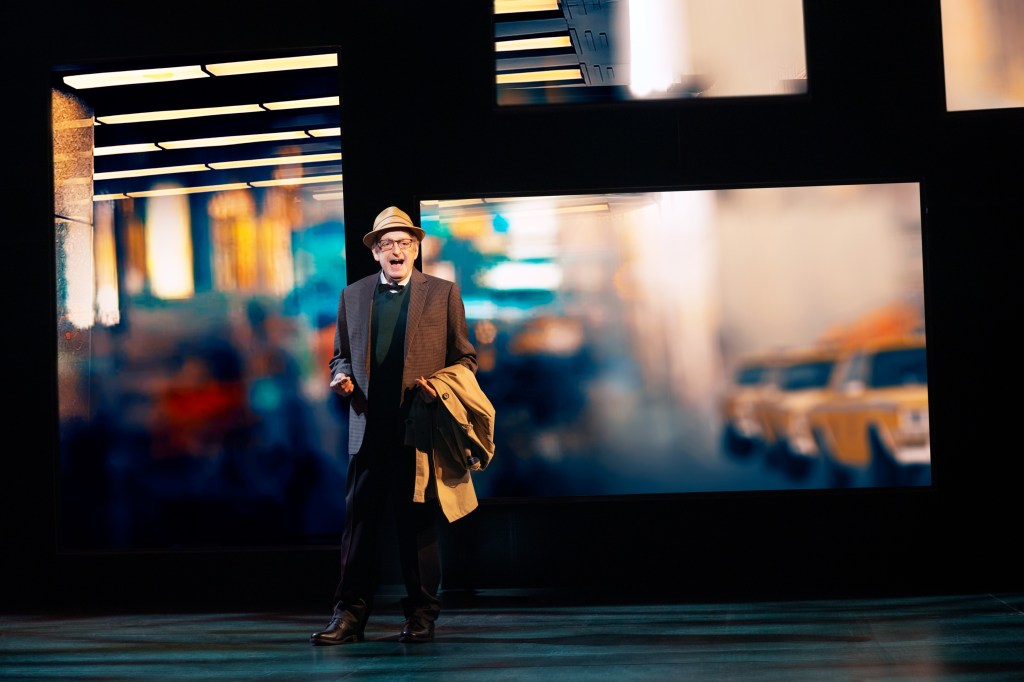
All these events with his brother, long suffering wife and broken-hearted but defiant daughter reveal the depth of the characters. They also illuminate reasons for Buddy’s self-torment, ambition and feelings of inferiority all of which are the fountain of his comedy which is part insult comedy, part ironic defense, and the type of ridicule which makes angels laugh. But when it’s directed at the individual in question, it hurts for real as dismissive one upmanship. Buddy has a tough time differentiating Shakespeare’s, “All the world’s a stage,” and is continually making his entrance and never pausing long enough to realize he needs to exit.
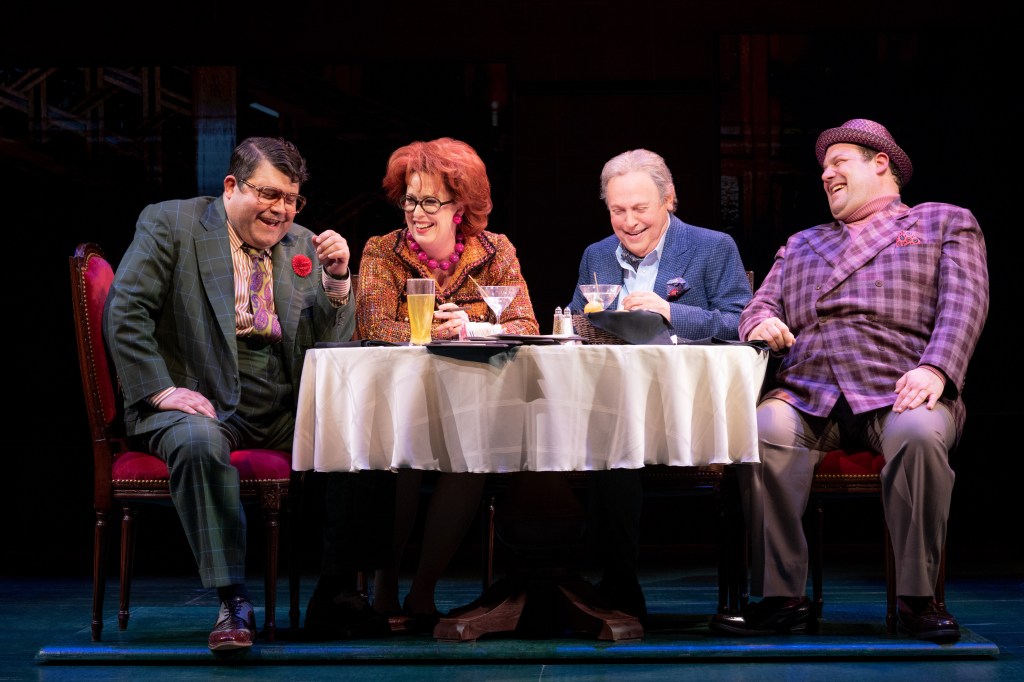
In an important scene with agent neophyte Annie (the fine Wechsler), Crystal’s Buddy gets to praise his comedy mentors. We note on the walls of the Friar’s Club and in projections a wide expanse of brilliant funny men and a few women of high humor. Buddy’s rant implies Annie should know the greats and this inspires her to do her research, then work like the devil to help Buddy get something which turns out to finally land as a part in a film. The role is funny and incredibly poignant and it requires Buddy audition, which he does. But after all the angst rehearsing and auditioning and blowing a chance at closeness with his daughter, his “big opportunity” is destroyed when the role is given to Walter Matthau. Bummer. Crystal handles this earth shattering moment with an ethos that’s believable Buddy. What he’s lost isn’t recoverable, for the loss isn’t just this part, its his mountainous history of regrets.
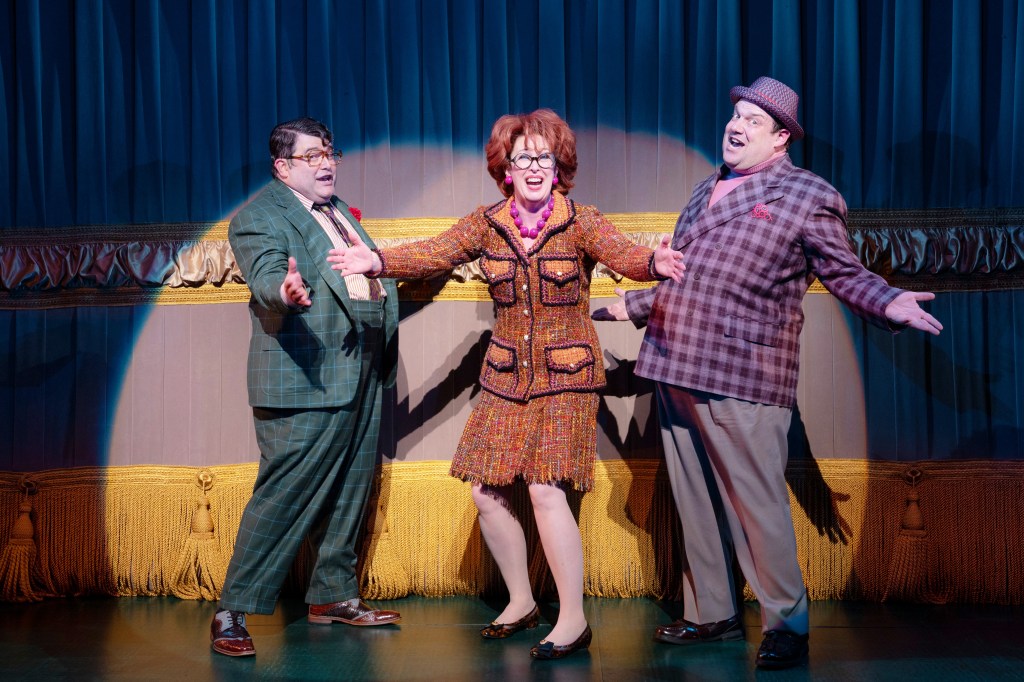
Unlike the film which referenced the comedian’s waning years from a younger man’s perspective (Crystal was in his forties, ironically “old” at that time), this Mr. Saturday Night shines in the age appropriate sequences. Interestingly, it is their younger portrayals by Paymer and Crystal as the twenty-somethings, that seem a stretch with wigs (Charles G. Lapointe) and make-up that don’t quite cohere.
However, when the flashback to Farber’s arrives, we’ve been prepped with jokes by the opening number “We’re Live” (Jordan Gelber, Brian Gonzales, Mylinda Hull). Then Buddy does his act at a retirement home (“A Little Joy”), which is a laugh riot. And by then, we’ve become acquainted with the premise, the announcement of Buddy’s death on TV, and his “new lease on his career” as agent Susan-Tatiana Wechsler sings “There’s a Chance, ” and excited Buddy and Stan sing and move to “I still Got It.” So, what’s a bad hair day for the two men returning to their younger days measured against the overall success of the well paced Act I that moves even more briskly through Act II and the conclusion after which Crystal takes a few audience questions? Well…(said with an upward lilt of a Jewish accent).
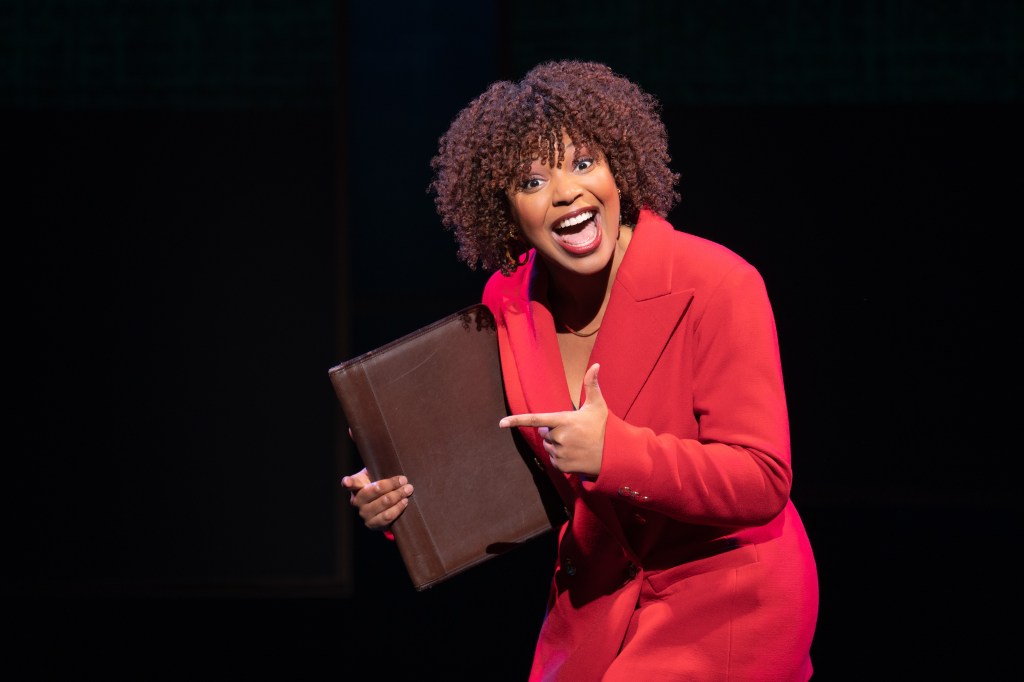
The themes of aging and regrets not answered, second, third and fourth chances, familial reconciliation, and redemption even for the incorrigible, spin in and out with a bow and a wink, superbly subtle. The sets of Buddy and Elaine’s home, Faber’s, the paneled Friar’s Club and the old time TV Studio designed by Scott Pask are spot-on, as is the costume design by Paul Tazewell & Sky Switser enhanced by Kenneth Posner’s lighting design and Kai Harada’s superb sound design. The Video & Projection Design is smashing, reminiscent of divided screens from the period, creating various effects pegged to the emotion of the scene.
The choreography by Ellenore Scott is just enough for this type of show and the actors are at ease and comfortable with their steps and movement. As silly as Elaine’s wishful thinking about leaving for “Tahiti” is, Graff pulls it off looking debonair and adorable. Thanks to Jason Robert Brown’s Arrangements and Orchestrations, David O’s Music Direction and Kristy Norter’s Music Coordination, the tone and tenor of the music fits with the book by Crystal, Ganz and Mandel, with Green’s lyrics. The time, effort and love shows, as all is held together by John Rando’s direction. Wow!
Get your tickets to this must-see show. You are not going to see this production with this cast again. For tickets and times go to their website: https://mrsaturdaynightonbroadway.com/
‘Funny Girl’ the Broadway Revival Starring Beanie Feldstein, Ramin Karimloo, Jane Lynch, Jared Grimes

Funny Girl has been successfully presented in the UK’s West End in revival (2016, book by Harvey Fierstein), in Paris, and in regional theater. However, producers have been loathe to consider a full-on Broadway revival until now. This is so for numerous reasons, not the least of which Barbra Streisand, who originated the role as a relatively unknown 21-year-old in 1964, inevitably draws acute comparison with anyone daring to try the part on for size.
Streisand was Fanny Brice in a confluence of personality, genius talent, comedic flair and pure drive. Though she didn’t win the Tony for Best Lead Actress in a Musical (1964 when Funny Girl opened), she won the best actress Oscar for the 1968 film adaptation. It was a satisfying recognition after her tremendous work in making Fanny Brice and Funny Girl legendary. Her connections to the role, and association with the show’s signature songs became inviolate. So it is a good thing that Funny Girl is in play in this revival; perhaps more revivals will come in the near future.
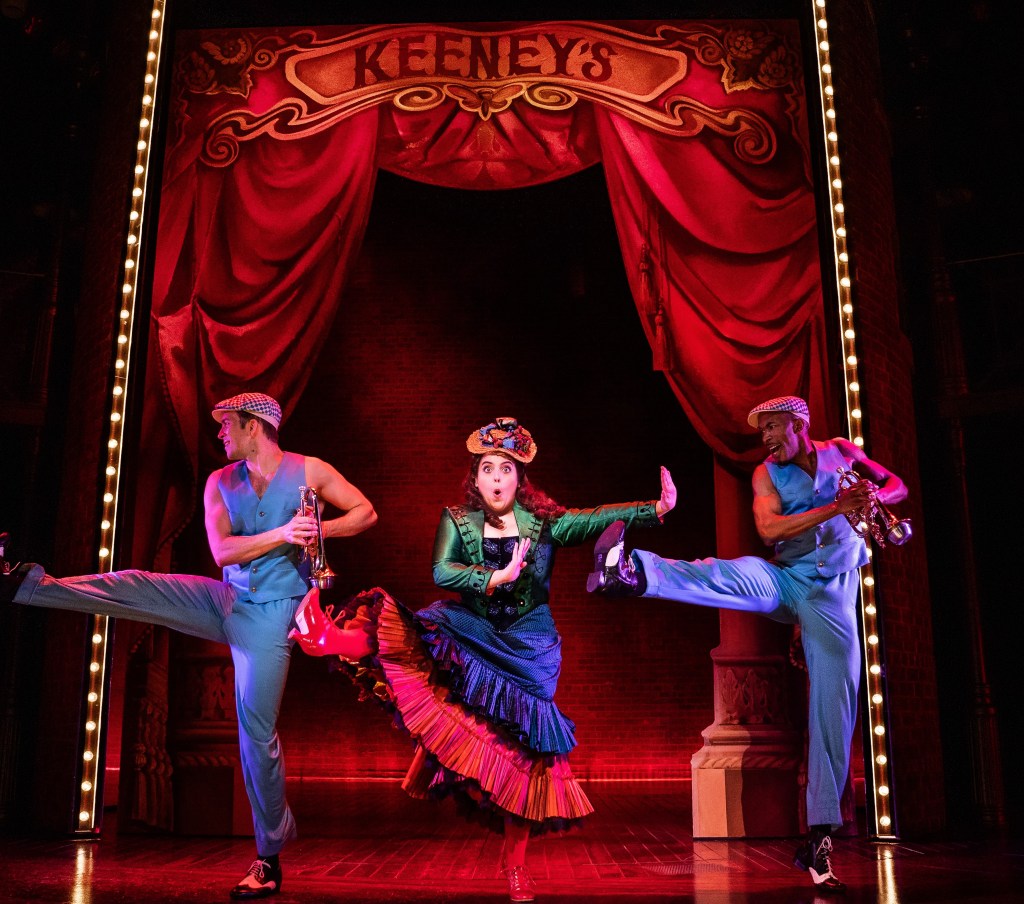
That said it takes a courageous sensibility to attempt to transmogrify the role of the Fanny Brice Ziegfield Follies star away from Streisand’s iconic work, in this first Broadway revival. Kudos go to Beanie Feldstein who stars with Ramin Karimloo, Jared Grimes and Jane Lynch in the Jule Styne (music), Bob Merrill (lyrics), Isobel Lennart (book), Harvey Fierstein (revised book), Funny Girl revival directed by Michael Mayer. Currently, the production runs at the August Wilson Theatre.
Beanie Feldstein has the appropriate determination to portray “the greatest star.” Nevertheless, during specific moments, she appears to be overwhelmed by the complex and profounder transitions the role requires as Fierstein’s book travels in flashback from the opening scene where Fanny gets ready to go onstage. The flashback of her memories follow how she moved from childhood to teen rising star to successful Follies celebrity who becomes an icon in her time. Uncloaked is her first anointing from gambler Nick Arnstein who compliments her on her talent. And as her star rises she becomes worthy of their budding relationship and blossoms, as his star dims and his wealth diminishes. By that time they’ve married.
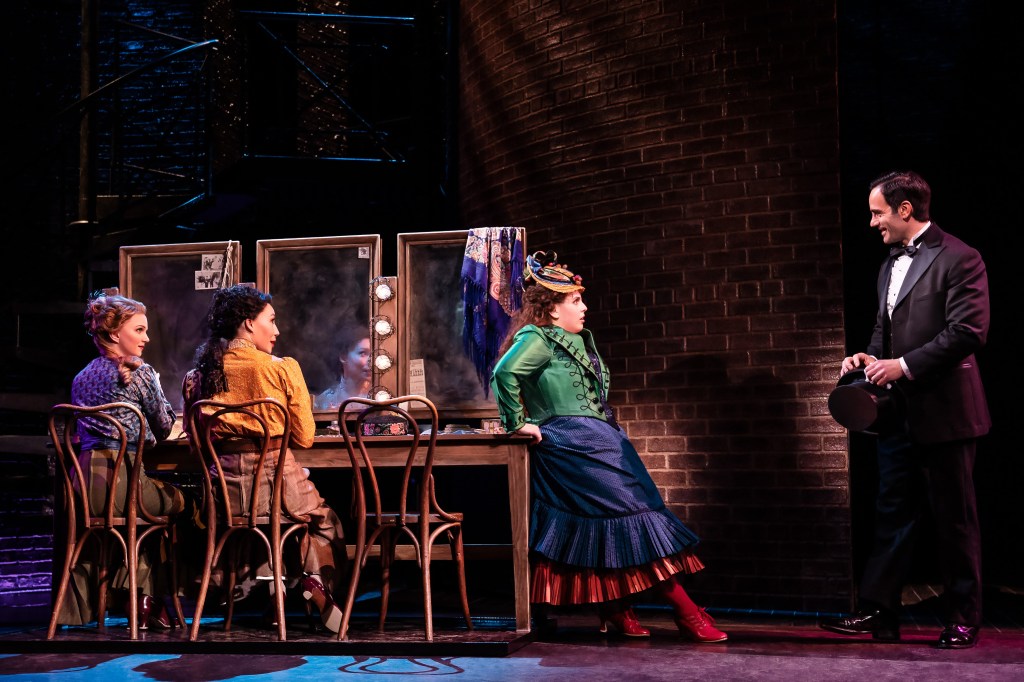
Feldstein is not new to challenges. She debuted on Broadway as Minnie Fay in Hello Dolly (2017). And she has been appreciated and noted for the humorous Booksmart and Lady Bird, and in her role as Monica Lewinsky in Impeachment: American Crime Story.
In the role of Fanny Brice she is uneven at best, at worst out of her kin, vocal acumen, acting talent, comfort/confidence zone. When she teams up with others (“I’m the Greatest Star” (“Reprise), “His Love Makes Me Beautiful,” “You Are Woman, I Am Man,” “Sadie, Sadie,” “Rat-Tat-Tat-Tat”), she shines with capability and confidence. When she carries the song on her own (“Who Are You Now?” “I’m the Greatest Star,” “People,” “The Music That Makes Me Dance”), she skates on thin ice.
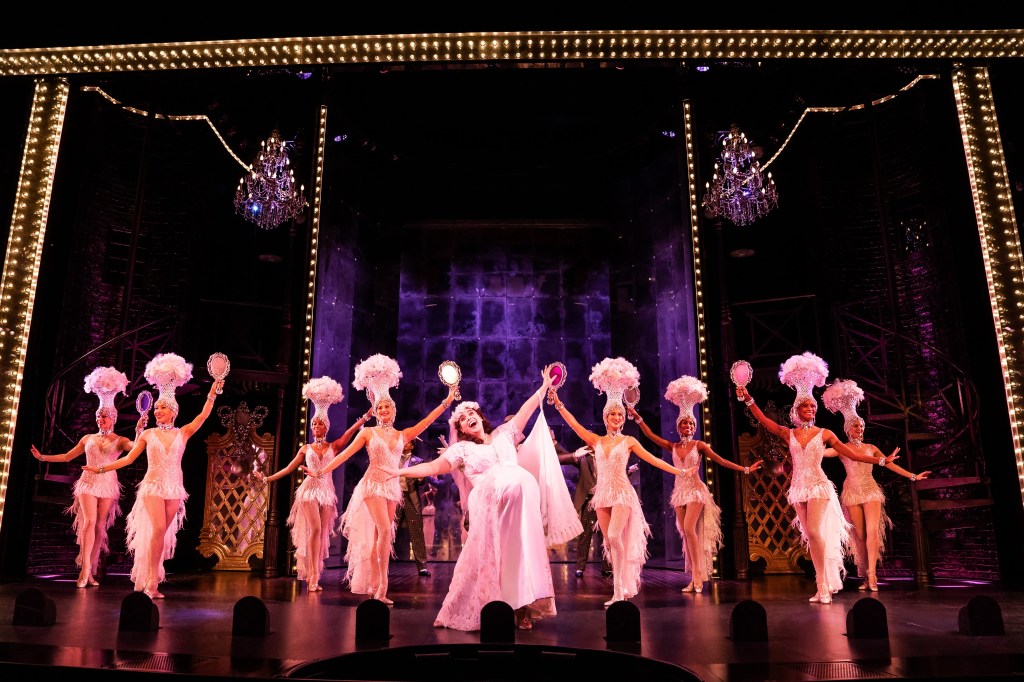
Not fervent with authenticity and the intensity that the role requires with songs like “People” which Fanny sings to convince herself to let go and love Nick Arnstein, who her mother has suggested is a criminal, she isn’t quite believable. However, with the ensemble, Jared Grimes’ wonderful Eddie Ryan and Ramin Karimloo’s suave, alluring Nick Arnstein, Feldstein relaxes and has more fun. Also, with the exuberant Jane Lynch (not necessarily believable as a pushy, Jewish mother), she overcomes herself and more comfortably inhabits the role.
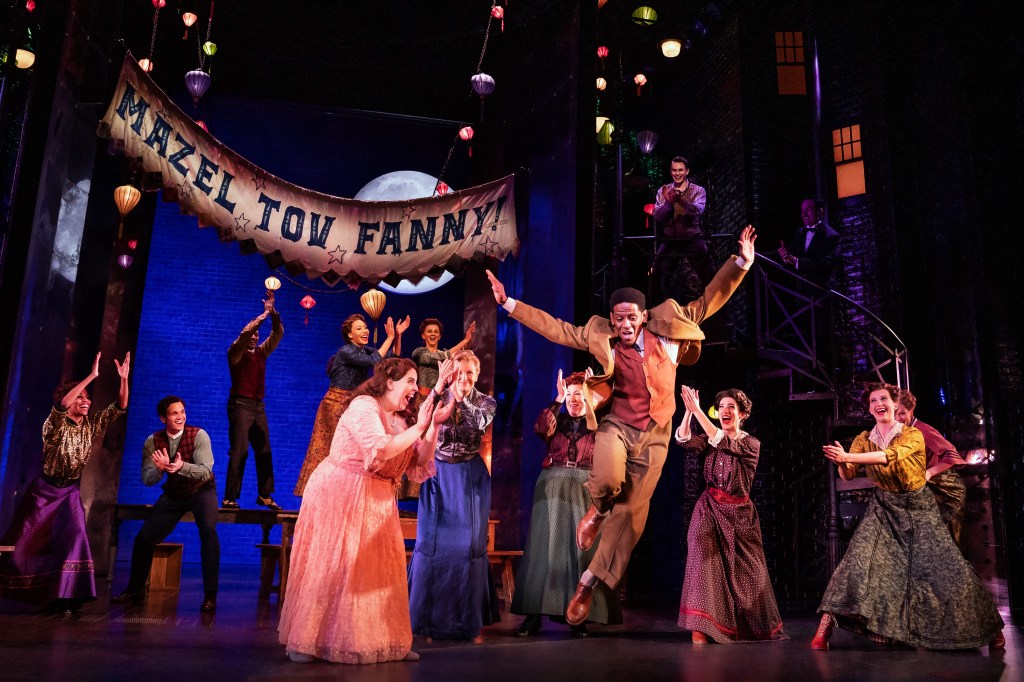
Sometimes Feldstein’s sweet singing went a tad flat momentarily in the first act and became a distraction to the events undergirded in the song. In her attempt to make Fanny Brice her own, certain schtick works if it glimmers, strikes, then vanishes. When it becomes repetitive, the humor loses its “funny.” As such, the youthful Fanny, the bumbling Fanny and the fake pregnant Fanny are clever. She is appropriately, broadly a ham (“His Love Makes Me Beautiful”). As Feldstein takes off on the visual, risque joke, the audience adores it and their adoration sets Fanny off into Fanny Brice stardom, all Beanie believable.
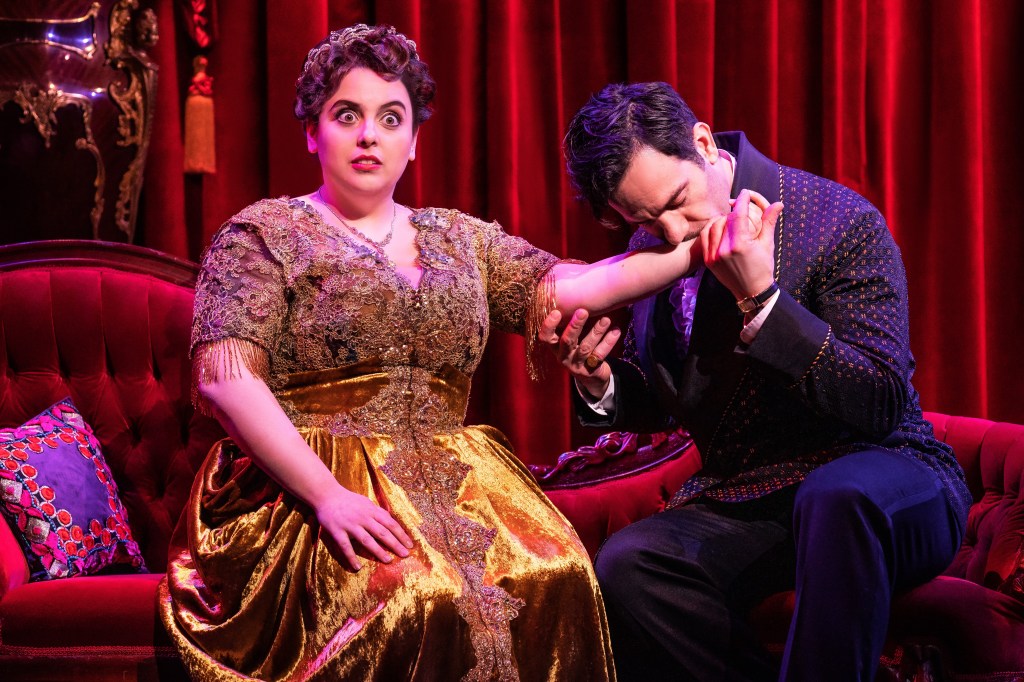
The flashback of the cute, adorable, wide-eyed innocent Fanny, the gutsy star-driven dreamer with heart (“I’m The Greatest Star”), works for a season. When she meets Nick and is with him for a while,, she doesn’t quite transition to charming, sensual, intriguing funny, the lure which entices Nick. Thus, their relationship never moves beyond the girlish Fanny who transforms into the Fanny who is a star that is beyond Nick in success, talent and charm. At some point the “Star is Born” meme should come alive when she exceeds Nick in grace and beauty as a Follies “Great.” Feldstein never quite pulls that off. Nor does she manifest the pain Fanny experiences when Ramin’s Nick and she part ways which leads into the overcomer Fanny who transcends, heartbroken but triumphant.
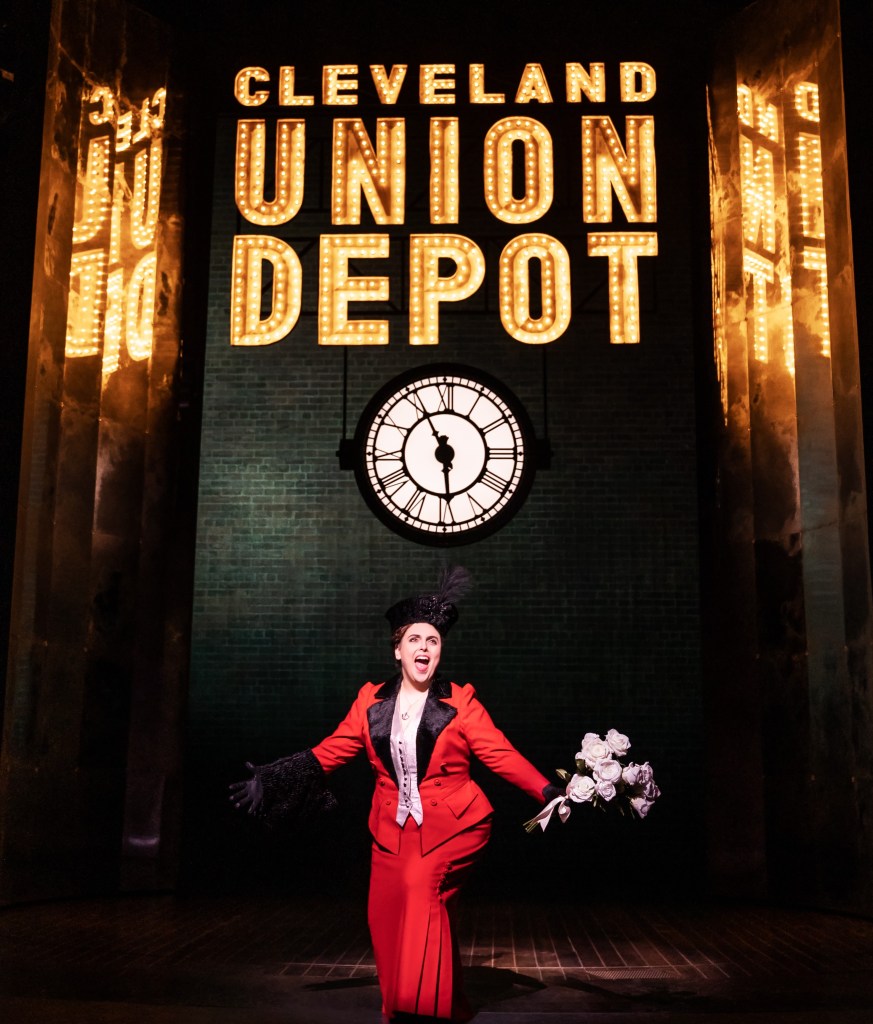
Karimloo’s Nick is gorgeous, fit, debonair and experienced. This superficial ethos lures Fanny like bread does to fresh water fish. In their scenes and songs (“I Want To Be Seen With You,” “You Are Woman, I Am Man,” “Who Are You Now,” and You’re a Funny Girl” that Nick sings alone), both actor’s make sense of these scenes because Karimloo plays the seducer, the lover, the partner who acts upon her as the receiver. Feldstein doesn’t have to do much but “fall” into his arms and be under his spell. And that is easy to do. The women in the audience are standing in her shoes enamored of Karimloo’s aura and sterling voice.
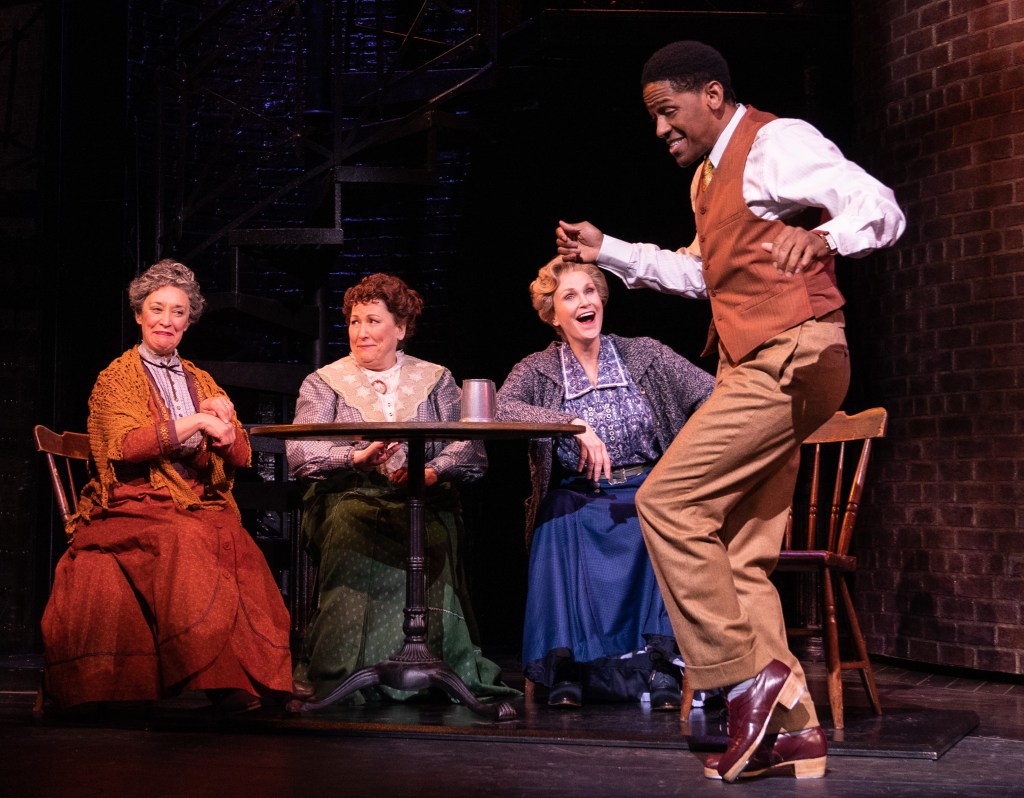
However, the complications of their marriage, seem static and should be predictable but are not emotional as Feldstein’s Fanny doesn’t register that her relationship is dissipating with Nick after she becomes a “Sadie.” Despite all the lovely set appointments by David Zinn’s scenic design for their Long Island home, the irony is manifest. It is not a home because it lacks warmth as Nick’s concern about money takes over.
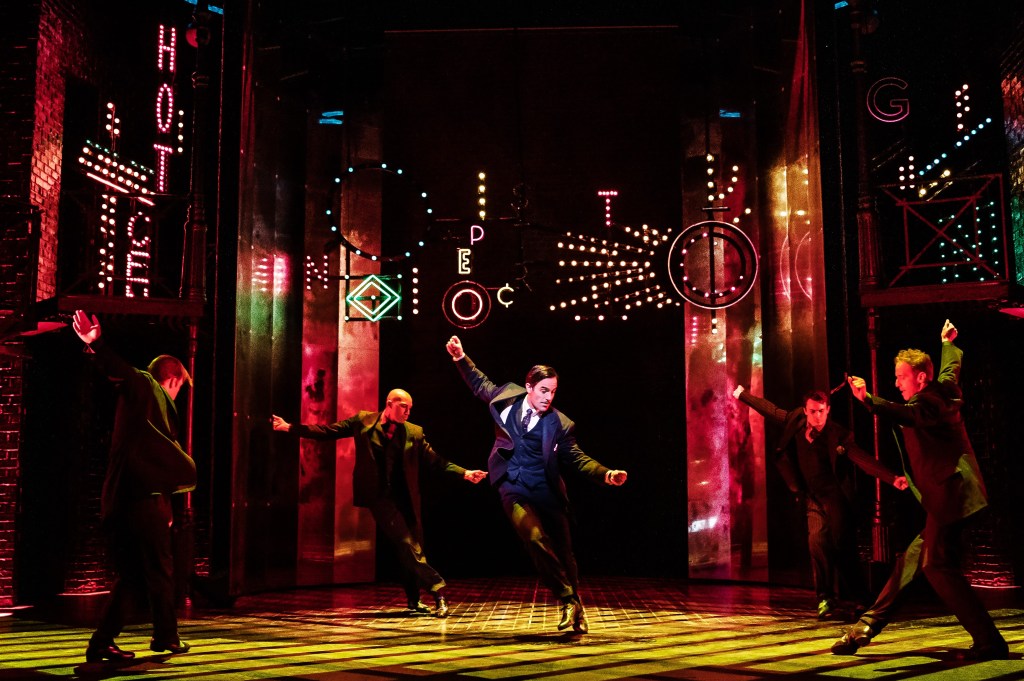
Eventually, even Karimloo (who beautifully sings throughout and does a bang-up job in “Temporary Arrangement”), when Nick sings about his going off by himself to make money…has difficulty with latter scenes between himself and Feldstein. When Feldstein’s Fanny attempts to save their marriage by outtricking a trickster, his response to Fanny’s gambit is interesting, if not lackluster. Nick’s reckless gambling has placed him out of Fanny’s status and wealth. Feeling emasculated when his project goes bankrupt, he is driven back to his criminal ways to recoup, which he never can because he lands himself in jail. The urgency between them in the parting scenes right before his prison sentence and after fall flat. We don’t care all that much about her heartbreak because Feldstein’s Fanny doesn’t seem to either by the “Finale.”
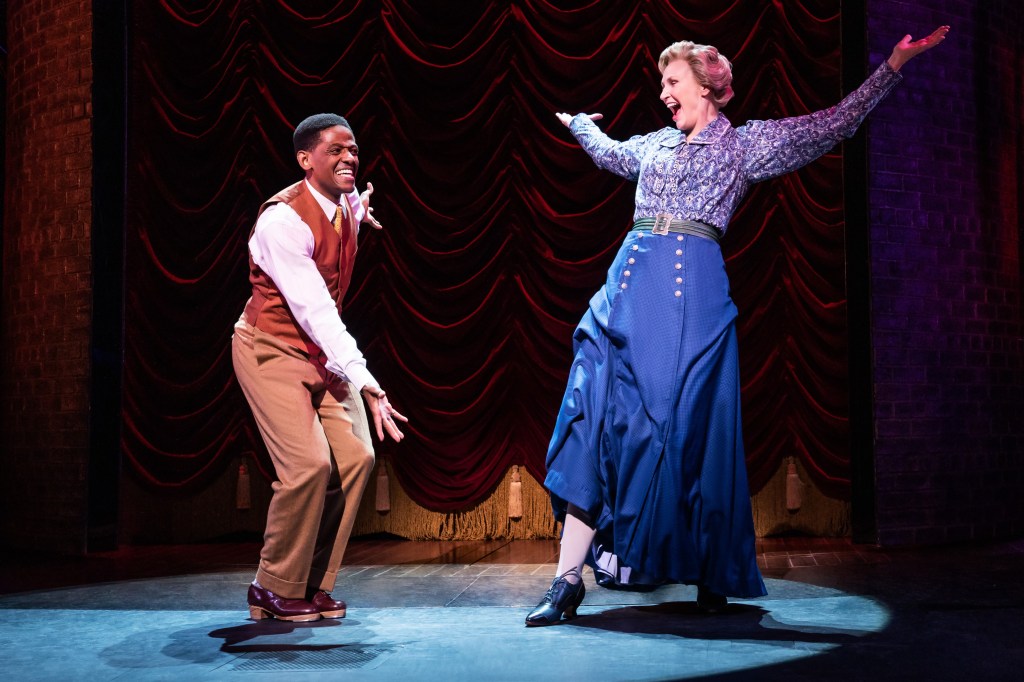
The book has been revised by Harvey Fierstein to streamline Act II which is a fine change-up. Fierstein transfers “Who Taught Her Everything She Knows?” sung by Mrs. Brice (Jayne Lynch) and Eddie Ryan (Jared Grimes) to the second act. Both are super conveyors of good will and have a blast together during the number. Indeed, Lynch’s and Grimes’ numbers are noteworthy as they possess the stage with grace, aplomb and enjoyment that the audience appreciates.
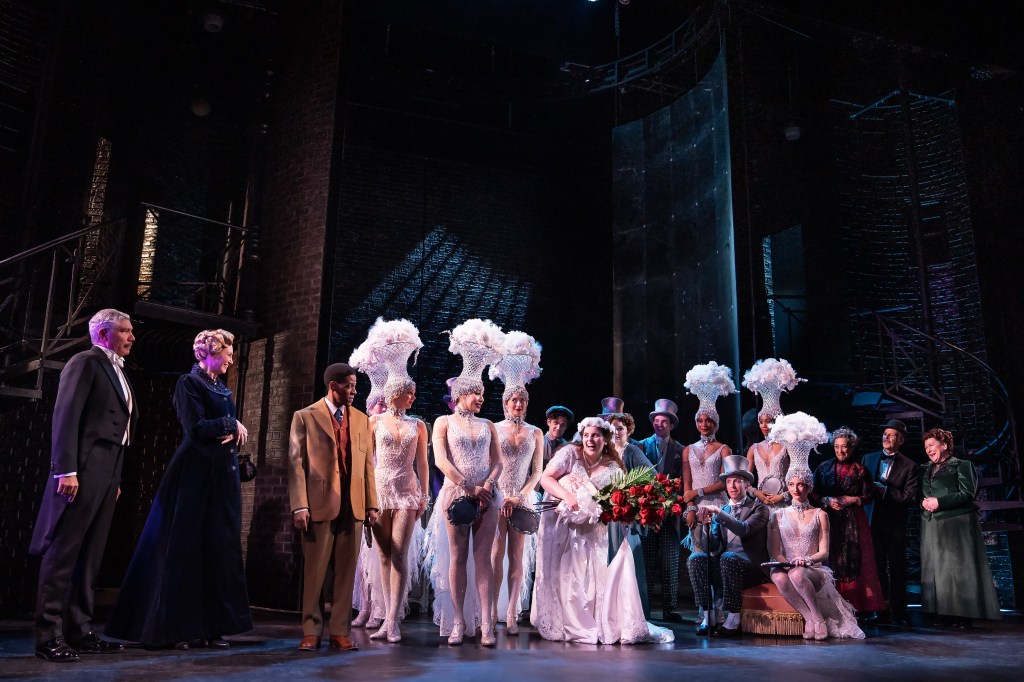
Jared Grimes’ tap is non pareil and brings down the house. Grimes is helped by tap choreographer, Ayodele Casel, who also succeeds in creating a number in which Feldstein shines with the ensemble (“Rat-Tat-Tat-Tat”). Overall the choreography by Ellenore Scott is strongest and most fun in the Ziegfeld numbers supported by the extraordinary costumes by Susan Hilferty with her expansively winged butterflies, shimmering chorus (“Rat-Tat-Tat-Tat”), bridal outfit in “His Love Makes Me Beautiful,” and in Fanny Brice’s outfits nearing the end of the production, reflecting the progressing years after the flashback ends. All are enhanced by the lighting design by Kevin Adams and Brian Ronan’s sound design.
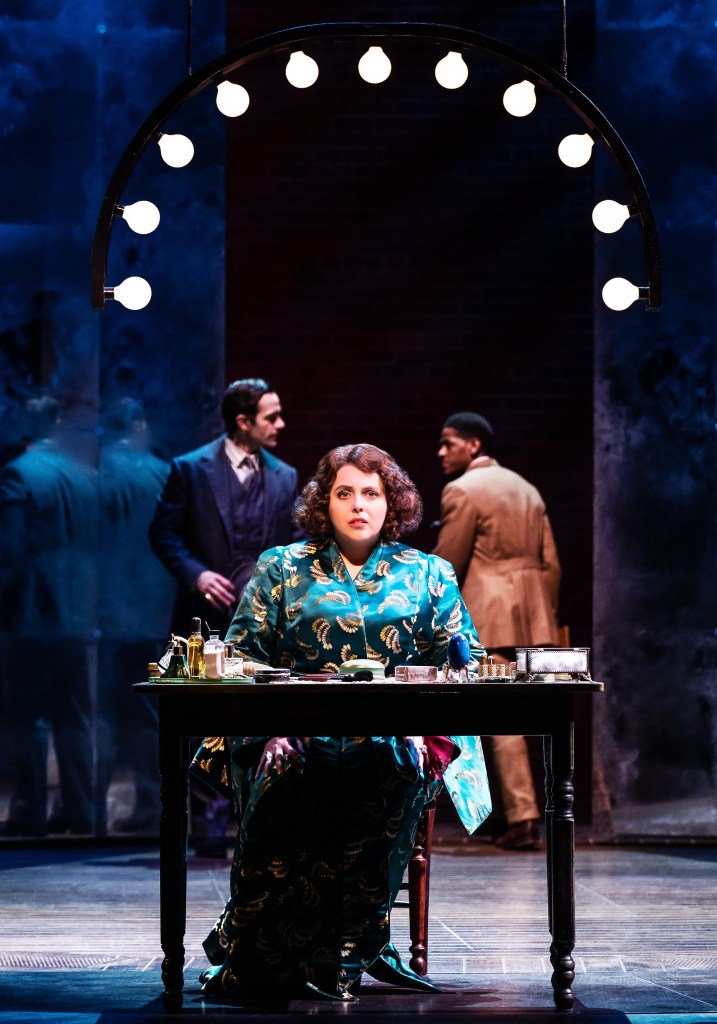
If you have not seen the West End revival of Funny Girl in the UK or at a regional theater, this production bears seeing for a number of reasons. Fierstein’s revised book is excellent and gives a lot of play to the characterization of Nick Arnstein. The entire company and the leads’ team work shines. The music is wonderful and the historic figure of Fanny Brice, a woman who made her career at a time when women had power in theater is something to be reminded of. Brice went on to more success in the entertainment industry in later years. Her life is one to remember.
Final mention must be made about the superb musical team. They include Michael Rafter’s music supervision and direction, Chris Walker’s orchestrations, Alan Williams’ dance, vocal and incidental music arrangements, Carmel Dean’s and David Dabbon’s additional arrangements, and Seymour Red Press’s and Kimberlee Wertz’s music coordination.
The show runs with one intermission. For tickets and times go to their website: https://funnygirlonbroadway.com/
‘Belfast Girls,’ a Powerful, Shining Work at the Irish Repertory Theatre
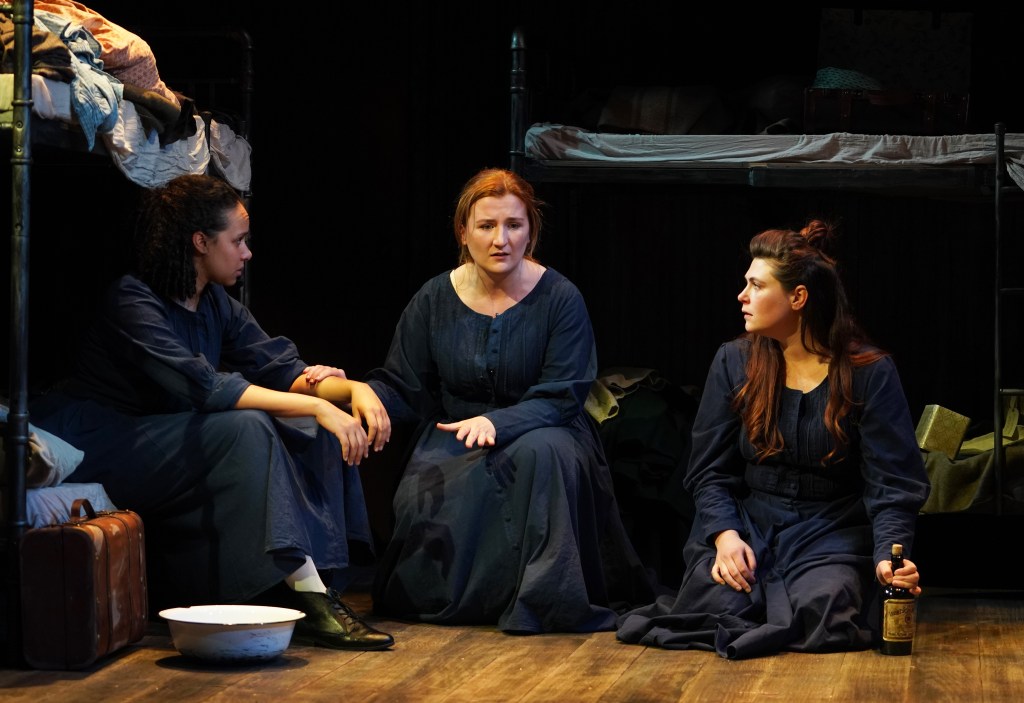
The phenomenal Belfast Girls in its New York Premiere at Irish Repertory Theatre takes place in 1850 during Ireland’s “An Gorta Mor” (The Great Starvation) on the ship the Inchinnan. Five women who have struggled through the Great Famine are chosen to leave Ireland. The trip will take them to the colony of Australia to embark on a better life. With dreams and hopes, the women undergo a three month voyage and mentally prepare themselves for the desires of their heart. What they discover on their journey is a personal and historical truth that they must confront the moment they disembark.
With Nicola Murphy’s incisive direction, the effective and keenly crafted, functional design of women’s quarters below deck (Chika Shimizu) creates a sense of the confined space they endure. The superb cast transports the audience into the minds and hearts of the Belfast Girls, the most raucous, riotous and infamous of the women accepted into the Orphan Emigration Scheme. The Scheme established by Earl Henry Grey in the 1840s sent 4000 orphaned women from Ireland to Australia to relieve Ireland’s overcrowded workhouses and poorhouses from the ravages of the Great Famine.

Under the largesse of Grey’s Scheme we watch as five women from disparate Irish backgrounds bunk together on the Inchinnan and travel for three months down the coast of Africa and around Cape Horn to become “rich” farmers’ wives, servants and workers in Australia.
Jaki McCarrick’s exceptional play profoundly delves into the lives of these five women. All relate the horrors, and organized terrorism of British landlord evictions and burning of homes they’ve seen or experienced. Later in Act II as the truth is gradually revealed to be more terrible, it is mentioned that merchants made money from shipments of grain for export instead of feeding those starving when the crop failed in what has been identified as the Irish genocide. Each of the women at the outset are grateful to be fleeing “An Gorta Mor” raging in Belfast. However, a few regret leaving what has been their home for more than two decades. They are anxious to face the unknown.
The play opens as the women settle into their bunks and unpack their meager belongings. We watch as they change their street clothes to the blue uniform “orphan” dresses the matron and officials have given them to wear on their journey. Immediately, from their behavior and accents we understand these women are from different backgrounds, ages and environs.

Judith Noone (Caroline Strange), a Jamaican mixed-race woman drips worldly experience. She exposes the fact that Ellen Clarke (Labhaoise Magee) and Hannah Gibney (the golden voiced Mary Mallen) are public women/prostitutes, despite their pretensions that they have lived otherwise. Importantly, with a sense of autonomy as sex workers, these three have staved off death and starvation where others, bound up by religion with no way out, died and were buried in mass graves. Of all of the five “orphans,” Caroline Strange’s Judith, is the most grounded, authentic and realistic. Blunt and directed, she is a natural leader who chides and commands the rest of the women, reminding them of their purpose to rise up from the lower classes to respectability and success, so they might forge a new identity with this incredible opportunity.
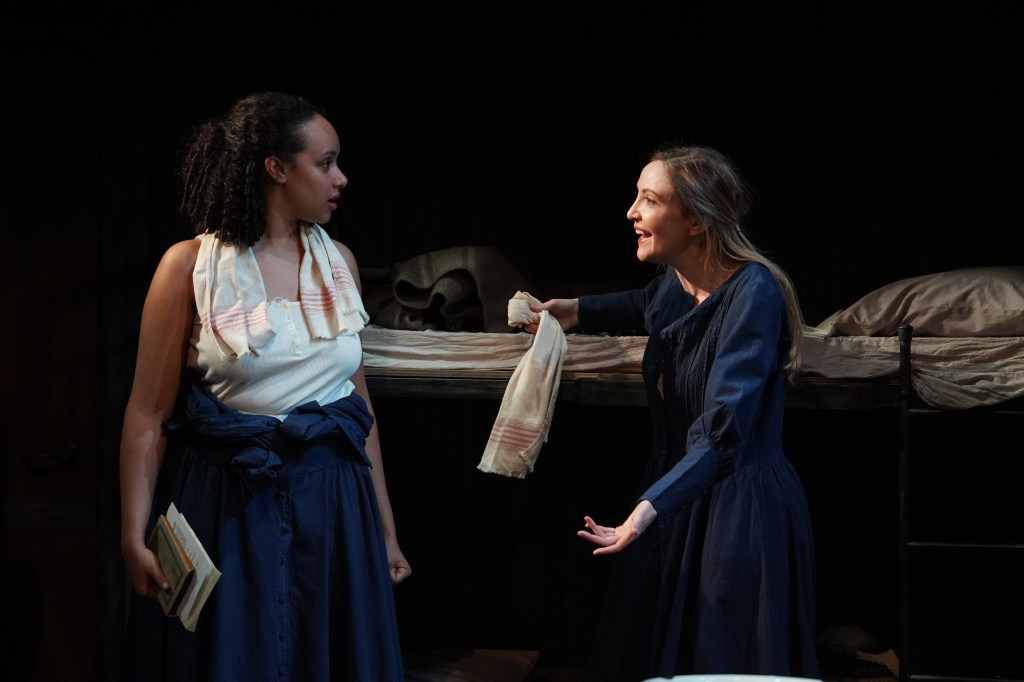
Gradually, as we watch their interactions and the dynamic of the group as they squabble, insult and demean each other with words and sometimes with blows, McCarrick reveals that each woman, save Judith, is unable to confront the dark hell of guilt and self-loathing within. It is obvious that they’ve had to compromise their autonomy, integrity, goodness and self-respect living a life of extreme self-loathing as men’s footstools. Clarke and Gibney are familiar with each other as they throw epithets and verbally attack each other’s vulnerability. Judith is no less insulting in reminding them that they must control themselves and not be physically easy with the deckhands and men on the ship because an unwanted pregnancy will destroy their chances to meet accessible men and marry. Clearly, Clarke, Gibney and Judith have shared understanding and experiences that have been traumatic and soul-crushing.
On the other hand Sarah Jane Wylie (Sarah Street, and the day I saw the production, Owen Laheen) is quiet and mild-mannered. She stays to herself, sews a bonnet and doesn’t interact or insult the others, initially. She shares that her brother has been in Australia for almost two years and has encouraged her with stories of success and the promise of a land of prosperity and goodness.

Into their midst comes another girl whom they must make room for in their small living space before they sail. Molly Durcan (Aida Leventaki) is from Sligo. The others attempt to make her as comfortable as possible, though she is not in a bunk bed. They give her a piece of bread which she devours immediately; her frail and extremely thin body indicate the troubles she’s experienced. As they rearrange their living quarters, the ship is leaving port and a few go up to say goodbye to Ireland for the last time.
Judith forthrightly declaims she will never miss Belfast and plans to bury all of the memories in her new life and identity in Australia. She suggests the other women do the same. Hannah Gibney forgets her misery and is sentimental, putting “a false tint” on her life in Belfast. Judith confronts Hannah with the truth. She tells the others that her father sold her into prostitution for alcohol and must forget the terrors of a culture which provokes such behaviors. This revelation strips away Hannah’s pretense and denial. Judith encourages her and the others to redirect and focus on her new goals and new life in Australia. During the three month voyage, they must mentally prepare themselves with plans and goals for their future.
Mallen’s and Strange’s performance of this scene make this into an important moment. Not only do we understand their mixed emotions, though the life they leave behind is full of misery. Nevertheless, it is the only life they have known. Now, they face uncertainty. They haven’t read any travelogs to understand what they will be up against because there are none. And indeed, Hannah can’t read. When the ship leaves port, there is no turning back.
McCarrick identifies the dangers of the emigrant experience which still pertains today (exploitation, uncertainty, loss of identity). She highlights two important conditions for these women. They have been prostitutes plying their trade and skills as the only skills they know. Secondly, they are third class citizens. Though Hannah speaks of the Englishman that she will marry, rejecting her own nationality, this fantasy is an extreme that the other women point out to her.
We realize these women are naive; they are not prepared for what is going to happen to them, floating on a “wing and a prayer.” That it will be anything but a bed of roses is inferred by the irony of Hannah’s hopes, the vacancy of the other women’s responses and the hidden clues in McCarrick’s writing.

What is clear is that each of them has already “jumped off the cliff into the unknown.” Hoping for something better is the tremendous risk they take, born out of courage to seek freedom from the enslavement of poverty, paternalism and oppression by the British in Ireland. However, will they be able to continue with the courage of their convictions in Australia?
When Molly sees a rat by her sleeping space in the middle of the night, other arrangements are made. Judith softens her persona and allows her to join her in her bunk away from the rat. Thus, begins a relationship between the two women which the others may or may not be aware of that blossoms into love and affection. The intimate scene between them is beautifully, tastefully directed by Murphy and the fight and intimacy director Leana Gardella.
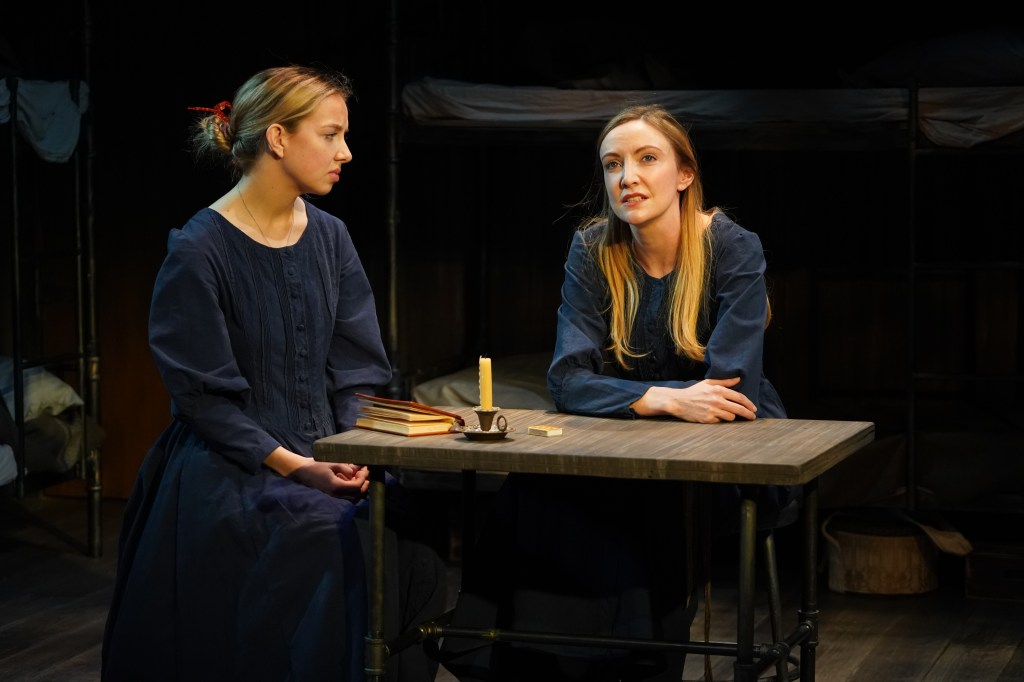
However, there is the danger that the Catholic judgments of the other women will censure and condemn the lovers. As it turns out Judith becomes Molly’s protector and Molly gives Judith her books, one of which includes the writings of Marx and Engels. Reading these, Judith begins to understand what Molly mentioned to them when she first arrived.
Women deserve their own rights and autonomy. In fact as Molly discusses her bold yearning to become an actress and play Puck, she also reveals that in other areas of Europe and the United States, women are gathering in groups and organizing for the right to vote. And women are speaking out against male chauvinism, paternalism, colonial oppression and exclusion which keeps women powerless. Judith’s knowledge grows and we understand that she and Molly have formed a close bond. At the least, the others begin a period of enlightened freedom they were never aware of before they boarded the Inchinnan.
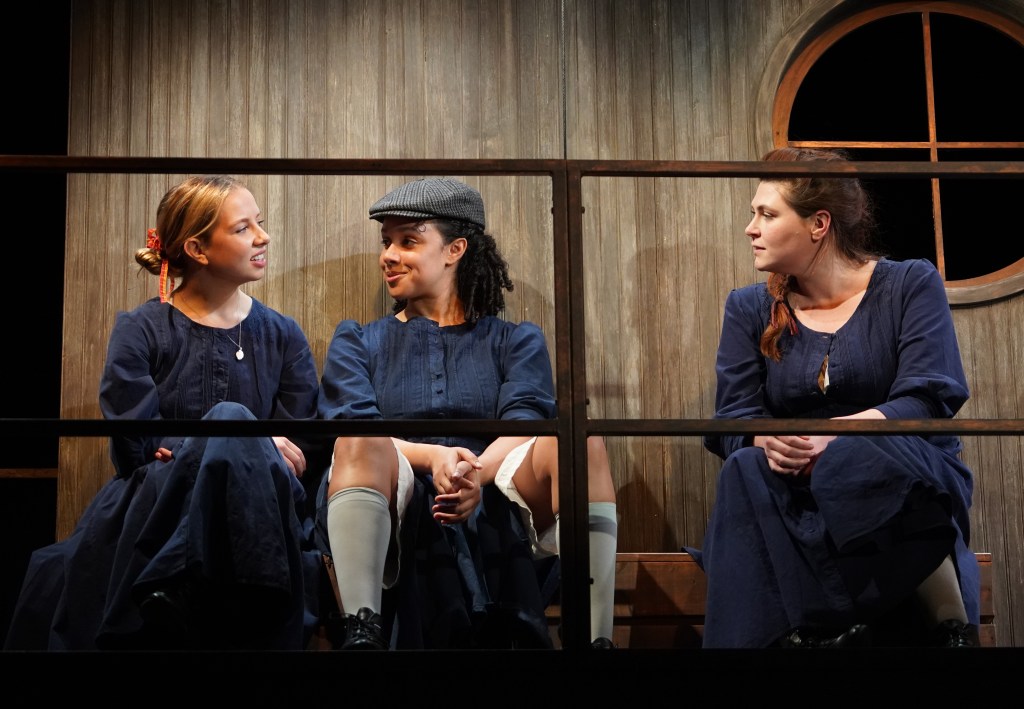
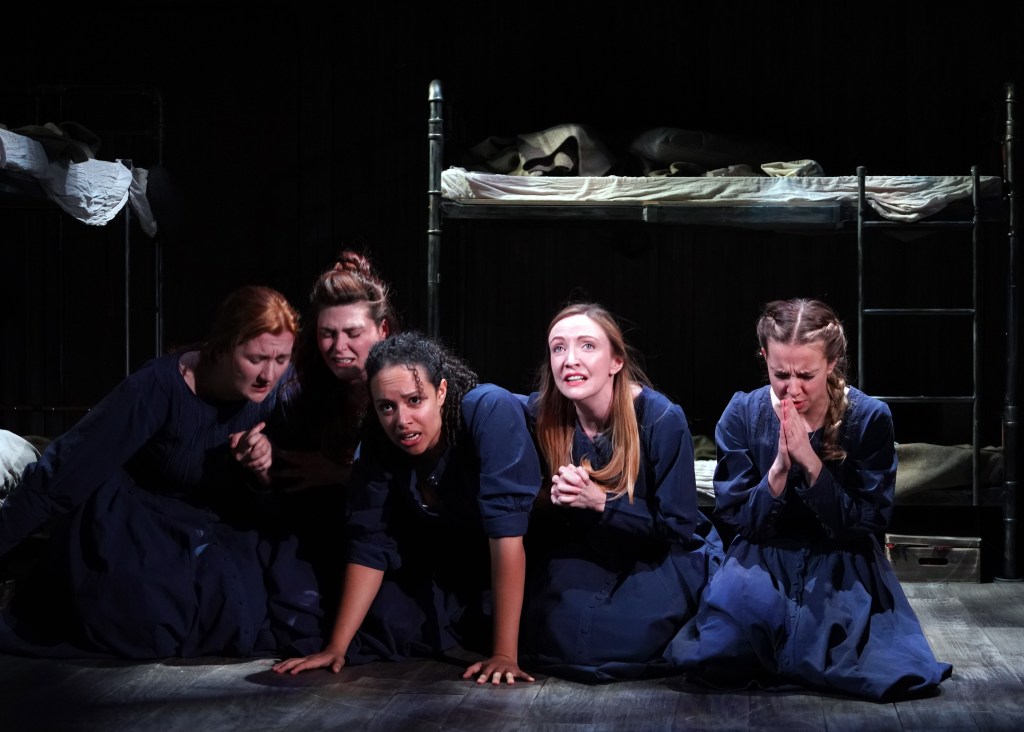
However, in Act II all of what has been a hopeful blessing on the voyage as the women begin to grow their new, free identities, is upended during a roaring storm at sea. The storm’s effects are stylistically staged and shepherded by Murphy with the help of the movement director Erin O’Leary. As the women pray together for support during the frightening hurricane that threatens to swamp the ship and kill them, another storm breaks out among them. Tensions and tempers rage. An unimaginable lie is exposed. The revelation destroys and exposes all of their lies. Judith who has become her own person and lies for no one, attempts to ameliorate the emotional explosions of the women against each other to no avail.
This is no spoiler alert. Act II brings a magnificent resolution to the mysterious threads that have been left undone in Act I. The violence that occurs is shocking and believable. The sound and lighting designers (Caroline Eng, Michael O’Conner) do a wonderful job of striking our imaginations with the storm’s effects. They help to create the terror in the scene and the resulting aftermath.
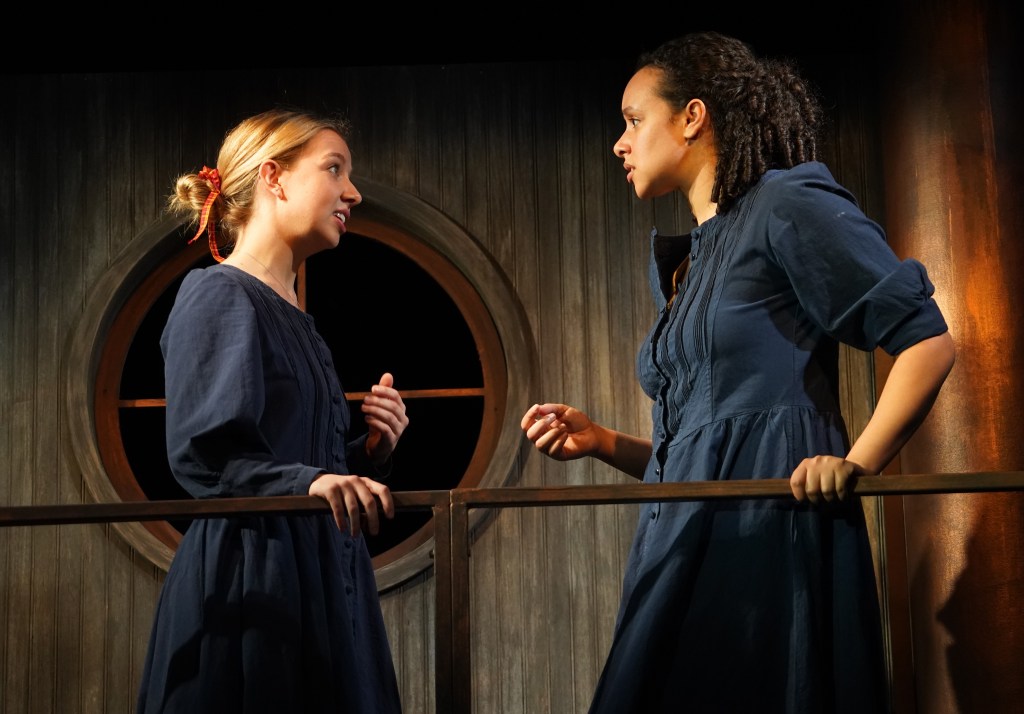
By the conclusion Judith puts the mysterious pieces together of why Earl Henry Grey has created the Emigration Orphan Scheme with the clerics. The final blow of reality is made manifest which Judith and perhaps Sarah and Ellen understand, but Hannah is too broken to receive. Nevertheless, Judith affirms she will never give up on her hopes and new found self-empowerment on the Inchinnan. She is resolute and will continue to take care of Molly Durcan and nurture her with her love. Confronting her own lies and devastation, Sarah becomes more accepting and forgiving. However, it is Ellen who leaves us with the most vital of thoughts. “Who knows what dreams were born on the Inchinnan. If it’s not us who will have those freedoms you talked of…then maybe our daughters will…”
Belfast Girls is rich with history and incisive with characterizations that keep us engaged in this real drama of passion, anger at injustice and powerlessness and hope. The characters are portrayed with spot-on authenticity, by the wonderful ensemble. Kudos to Gregory Grene the music consultant who drew on the songs “Sliabb Gallion Brae,” “A Lark in the Clear Air,” “Mo Ghile Mear” and “Rare Willie,” all traditional Irish folksongs. Kudos to all the creative team and to China Lee, responsible for costume design and Rachael Geier for hair & wig design.
This is one to see, especially if you have Irish ancestors. If you don’t, but have ancestors who emigrated on ships that crossed the oceans to bring their progeny a better life in a more prosperous setting, the experience depicted in this production is directive and should draw you to learn more. For tickets and times to see Belfast Girls at the Irish Repertory Theatre go to their website: https://irishrep.org/
Daniel Craig and Ruth Negga in ‘Macbeth’ a Stark, Thematic Whirlwind to Chill and Confound

Intentional contradictions abound in the production of William Shakespeare’s Macbeth currently enjoying a packed house in its limited run at the Longacre Theatre. Directed by Sam Gold, starring the inimitable Daniel Craig as the titular witch-doomed protagonist and superlative Ruth Negga as his feral, treachery-inspiring wife, the presentation is bold, daring, dramatic, enthralling, surprising, weird, completely irregular and defiant of critical examination.
Yet, the critics have had a field day, a bit reminiscent of Peter O’Toole’s production of Macbeth (1980), that critics ridiculed immodestly. However, the audience found O’Toole and the cast mesmerizing, and packed the Old Vic each night. Gold’s Macbeth is packing the Longacre Theatre despite venom-tongued, snarky criticism.

Macbeth theatrical productions have sprung up as star vehicles for Patrick Stewart, Alan Cummings, James McAvoy and Ethan Hawke to name a few. With each revival, each iteration of Macbeth, there have been intriguing conceptualizations. And this is as it should be, whether in modern dress, in an insane asylum or as this current production, on a stage stripped of showy spectacle, except for some of the Macbeth’s costumes, especially Lady Macbeth’s by Suttirat Larlarb. Gold’s bare stage, the back wall painted black, and Christine Jones’ minimalist set design (save the backdrop against which Macduff and Macbeth fight in the last scene), resemble a rehearsal space. There, the players strut and fret on the Longacre stage, for two hours and twenty minutes. Their discourse is audience directed interaction with resonant, beautifully delivered soliloquies by Macbeth, Lady Macbeth and others, i.e. Ross. Indeed, as Ross, Phillip James Brannon steals the scene where he describes the wanton blood-letting of Macduff’s family by Macbeth.
From the moment witches Maria Dizzia, Phillip James Brannon and Bobbi Mackenzie appear at their kitchen worktable and stovetop making preparations and cooking up their stew (which has a distinctive odor of root vegetables), in this pre-scene before the play, nothing is as what it seems (a key theme). The audience chats. The lights are on. Ushers seat audience members. Many ignore the casually dressed characters whose costumes have less distinction than the audience apparel. It is apparent that Gold is upending our expectations about Macbeth’s movers and shakers, the witches. These are homely, benign-looking creatures of no consequence, “cooking up a storm or two.”
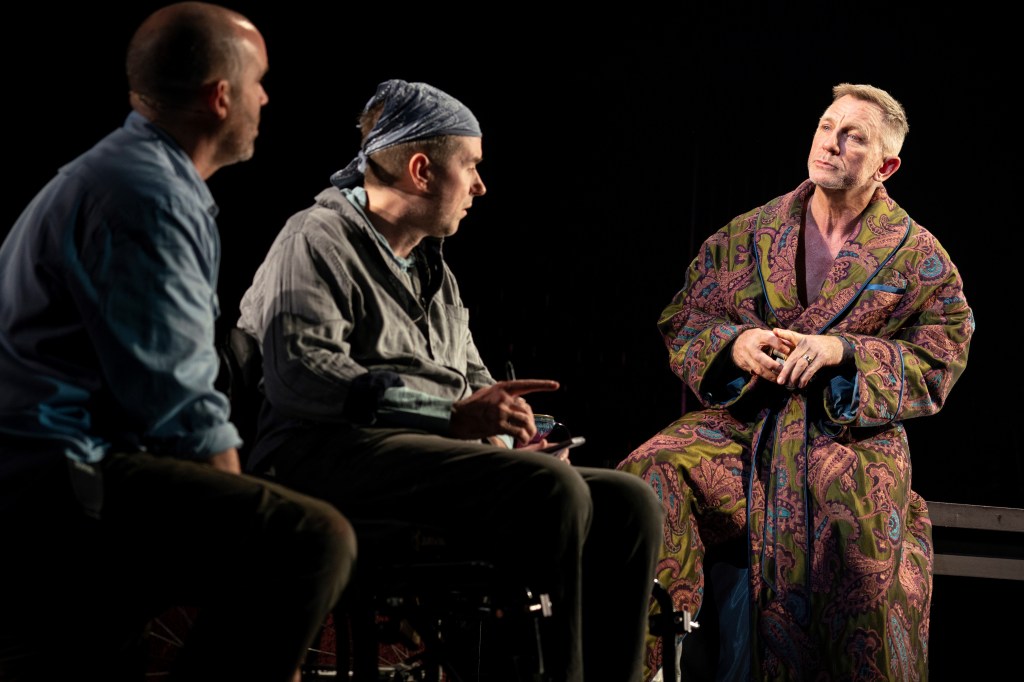
Along with the theme that everything is in reverse (fair is foul, foul is fair), and appearances are not to be trusted, the fog machine (carried by various players) symbolizes misdirection and gaslighting. The fog and mist serves a twofold purpose: to create scenes of foreboding and an atmosphere of doom because reality and truth are indecipherable to the players. Unpredictability is another theme this production brings in from beginning to end. Nothing is assured, no action of the characters is staid; only the lines spoken in various accents are dependably Shakespeare’s (though truncated) in this interpretation which doesn’t quite follow the play’s usual format and dialogue with precision.
Gold shepherds his actors to take liberties, break the fourth wall, at times appear to ad lib, use anachronisms and coy props, like a can of beer for a gallows laugh and employ the acutely strange. For example he has Paul Lazar in a switch off from his role of trusting King Duncan take off his bloody “fat” vest and strip down to his shorts to “become” the porter who receives Macduff (Grantham Coleman) and Lennox Michael Patrick Thornton. All is at the hazard and then it is not. There is comedy in the tragic and a hysterical mania flows throughout. If this is confounding, it is purposeful. The kingdom in chaos and confusion reigns everywhere. Without clarity and leadership Scotland falls prey to a treacherous usurper who transforms the realm to one of darkness, uncertainty, moral weakness, corruption and lies all of whose troubling turbulence will not be easily stemmed. The witches have generated all of these elements.

The witches cook; we ascertain their “agreement.” As they plot, we recognize that the events are being determined, unseen and unknown way before the witches manifest themselves on the heath. By the time they appear to Macbeth and Banquo (Amber Gray), they’ve completed the brew which the witches make Banquo and Macbeth drink, alluring their souls and psyches forever to their fates, ineluctable, irrevocable.
In dramatic irony with emphasis, Gold allows us to see the witches’ power and control. This is something that King James I would have believed, something that Shakespeare wrote for him. I never understood the extent of their power before, thinking they trick Macbeth with the power of suggestion. In Gold’s vision, the witches’ plot has been a while in the making, in another realm and beyond the awareness of all the characters. Thus, we are reminded that before majestic events occur, there are forces at work that may never be understood or gleaned. However, that doesn’t mean that because they are unknown, they don’t greatly influence the events. Gold emphasizes this notion with his pre-play action of the witches.

Additionally, before they state the over arching theme of this production “fair is foul and foul is fair, hover through the fog and filthy air,” at the beginning of the play, out comes Michael Patrick Thornton in antic humor. He discusses the superstition about stating the name of Macbeth onstage, violating the dictum it must not be mentioned and should only be referred to as “The Scottish Play.” After getting audience laughs, Thornton gives an interesting discourse on, James I, King of England and Scotland, his obsession with witches and witch burnings, and Shakespeare’s writing three of his finest tragedies during The Bubonic Plague, where he and others in Europe had to “shelter in.” Macbeth was written during the Plague.
This and more Thornton relates effectively with humor, pacing and irony, addressing the audience as himself, though he later portrays Lennox, a murderer and the messenger of doom for Macbeth. The transition from Thornton in the present to the increasingly serious past events and spell-casting witches is masterfully seamless as we are taken to the hanging and death of a traitor who has admitted and repented his treason against the king, something Macbeth will never do.
The timeless currency of the play abides. Gold (as some critics suggested he should) doesn’t specifically reference the events going on globally (2022) via scenic design or props. He doesn’t need to; the parallels are manifest. The play’s greatness is in its revelation of the best and worst of human nature revealed in the dialogue, events and fine performances by Craig, Negga and the other leads.
Negga’s Lady Macbeth reveals her wicked heart’s desire in her soliloquies. These prepare us for the extent to which she must manipulate her husband by any means necessary, including insulting his manhood and demeaning his fears of failure and pangs of conscience. Not understanding that he is terrorized about the significance of his terrible deeds, she upbraids him for fleeing Duncan’s bedchamber carrying the bloody daggers with him which evidence his guilt. It is as if he begs to be caught and punished for what he’s done; the scene between Negga and Craig is effective and authentic.

By this point the couple has become divided by intent and the consequence of their actions; Macbeth feels the dire results coming, Lady Macbeth does not let it impact her. The shift is clear and Gold never brings them together again with affection. In this first part Lady Macbeth swamps Macbeth’s nobility. She stirs up his acknowledged desire for the throne, despite his rational judgment that no good result will come of killing Duncan, his kinsman and his guest.
As Macbeth, Craig’s, doubt, confusion and fear before killing Duncan and his shock and horror afterward are straightforward and powerful. Likewise, Negga’s Lady Macbeth is steely as she mentally fashions his will and bends it to hers. Pointedly, after both are crowned, Craig’s Macbeth and Negga’s Lady Macbeth accurately reveal the dissolution of their self-respect and love for each other. Craig’s Macbeth becomes obsessed by the negative results his inner guilt has forewarned. After his crowning the witches’ prophecies “fog” his judgment provoking his jealousy that Banquo’s heirs will be on the throne and his will not. Lady Macbeth’s distraction grows after she chides Macbeth at the banquet, the last time they will be purposefully together. She is not apprehending Banquo’s ghost that plagues Macbeth’s mind because of the witches’ prophecy of Banquo’s heirs. At the end of Act I, the witches’ plot is in full force. It submerges any decency left in this once august couple, who now grow emotionally isolated from each other, locked in their own soulful torture chambers.
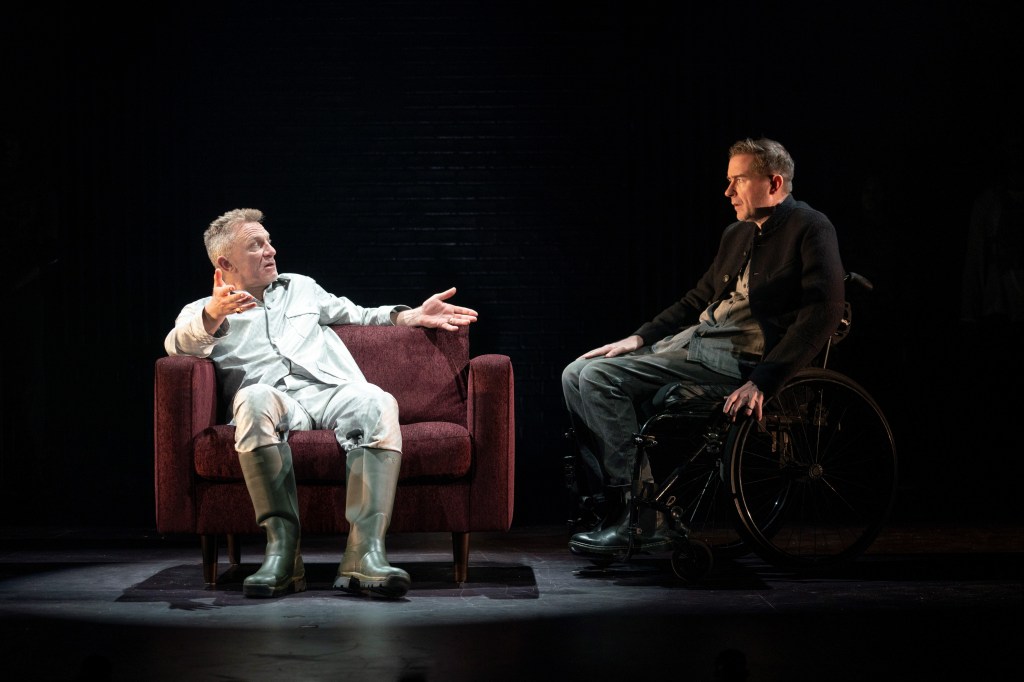
Gold’s direction of Macbeth and Lady Macbeth at this juncture in their relationship (showing no affection only rancor), indicates that the regicide, whether they want to admit it or not, has been the defining movement of their lives. Everything afterward is a counting down to their deaths. Craig’s performance reveals scene by scene, soliloquy by soliloquy the evanescence of courage with wanton carelessness and cheek (one example is when he gets the beer and drinks it). After he witnesses Banquo’s ghost he admits he is “stepped in blood so far, should I wade no more, returning would be tedious go’er.” Thus, “blood will have blood;” he allows his unrestrained lust for power to expand its corruption and visits the witches for affirmation, which he is duped to believe they give him. But what seems fair, is really foul.
Interestingly, following Shakespeare, Gold and his creative team suggest that the seeds of evil are planted by spiritual forces way before Macbeth’s self-treachery and vengeful violent nature become visible. The corruption and wickedness blossom imperceptibly, then accrue with coverups and lies (symbolized by fog and mist). The more the despotic tyrant doesn’t achieve his goal, the more he furiously lusts to accomplish it with the “help” of the witches who give him an illusory prophecy that he is immortal. This sustains him unstopped by his countrymen, until Macduff (Grantham Coleman) kills him. Indeed, tyrants like Macbeth are never satisfied. When Banquo’s son Fleance (Emeka Guindo) escapes Macbeth’s killing, thwarted, Macbeth shifts his path. Murderous revenge becomes his goal.

Craig manifests Macbeth’s transitions, superbly moving from guilt in refusing to go back to the King’s chamber to smear the chamberlains with Duncan’s blood, to raging at the audacity of Banquo’s ghost coming out from and around the banquet table, returning again and again in a scene that is chillingly effective. And when he attempts to secure his kingdom and learns that Malcolm and Macduff left for England to conspire against him, he has no compunctions about wiping out innocent Macduff’s family in revenge (another powerful scene). He has lost it; logically his blood-lust and terrorism only will inflame his enemies even more and give them license to turn his own subjects against him.
Indeed, blood will have blood, the recurring theme. Negga’s nightmare isolation is acutely staged and rendered as Lady Macbeth envisions blood stains that can never be cleansed from her hand…soul. In this version, Gold and the actors helped me better understand Shakespeare’s behind the scenes look into the human mind, soul and heart of a serial murderer and political tyrant and his unwitting, power-hungry ambitious wife. With brilliance Gold and the actors relay the process of how the wicked couple are snared by conscience then incited by megalomania to never repent. They select the path of emotional self-violation and we get to watch them unravel.

After the bloody combat between Macduff (Grantham Coleman) and Daniel Craig’s Macbeth renders Macduff victorious, Macduff defers to Malcolm (Asia Kate Dillon) as the King of Scotland. In conclusion she takes the power her father rightly bestowed upon her in the play’s beginning.
SPOILER ALERT. Gold truncates Malcolm’s dialogue so she doesn’t invite Macduff and the other thanes to Scone for her crowning. Interestingly, the play continues as an epilogue of irony. The actors put off their roles, fling themselves on the floor, take a well deserved break, and pass around bowls of “gruel” to each other that the witches prepared (offstage). The cast eats their portions silently as the audience watches, (it looks unappetizing). As they eat Bobbi Mackenzie (a witch and Macduff’s slaughtered child) soothingly, lyrically sings Gaeynn Lea’s originally composed song for Macbeth, “Perfect.” The last lines are:
“Tragedy’s viewed through its own lens; but just out of frame sits an old friend, watching our choices play out in the end, returning each other to where we began. Wish I had known it wasn’t meant to be, wasn’t meant to be perfect.”

This may be interpreted in many ways; an ironic apology for what we’ve witnessed as Macbeth’s failure that turned out badly. Indeed, as an “every person” such horrific behaviors can’t “be” perfect, ever. On the other hand it is humanity’s evolutionary process to continue and since we all are mortal, attempting to live forever, as Banquo and Macbeth attempted, the song/play speaks to human foibles. The message emphasizes imperfection, life’s disjointedness and entropy. Every murderous, cataclysmic, bloody, debacle where a despotic nature’s worst impulses for power, regency, a new Russian empire are allowed to be acted out, it is not meant to be…perfect and will not be. Thus, the despot needs to give it up sooner rather than later and save lives in the process. In another interpretation the actors wind down in their community with each other as they seal their commitment to take up their parts and “die another day.”
Shakespeare affirms the sanctity of life and the balance of evil and good in the thoughts of the noble, courageous yet monstrous Macbeth and his Lady as they bring about their own retribution and justice. Their own being effects their demise: Lady Macbeth commits suicide; Macbeth by giving himself over to the process of evil after his regicide. In reality, we can never know the inner thoughts of a Vladimir Putin or Stalin or Hitler. We can only guess at their fears, paranoias and heart’s desires. In Macbeth we have the luxury of understanding the tragedy of their rise and fall.
This is a unique production thanks to Gold, the cast, the superbly effective lighting design by Jane Cox, sound design by Mikaal Sulaiman, special effects by Jeremy Chernick and projection design by Jeanette Ol-suck Yew. Also, the original music by Gaelynn Lea is amazing. For atmospheric effects I particularly enjoyed the crashing revelations (i.e. lighting, sound, etc.) when the ambiguity of the witches’ prophecies clarify (i.e. how Birnam wood comes to Dunsinane). Additionally, kudos to Sam Pinkleton’s movement. Coupled with lighting, sound and special effects the chilling atmosphere of opaqueness and obscurity with the fog machines (which signified the theme of cover ups, lies, obfuscation of “truth”) was strengthened. David S. Leong’s direction of the violence was effected believably in service to the theme of blood will have blood.
This Macbeth will not be duplicated in your lifetime with this community of individuals. It is an incredible experience. For tickets and times go to the website: https://macbethbroadway.com/
‘American Buffalo,’ Explodes in its Third Broadway Revival With Phenomenals Fishburne, Rockwell and Criss
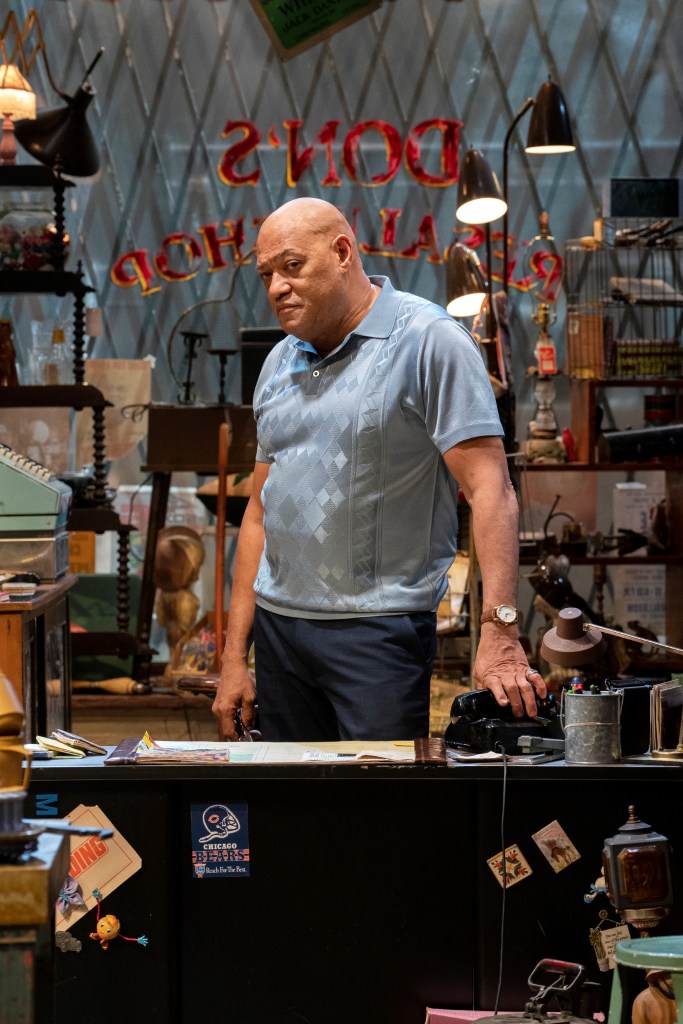
David Mamet’s American Buffalo, first presented on Broadway in 1977 with Robert Duvall as Teach followed with three Broadway revivals. The 1983 revival starred Al Pacino as Teach, the 2008 revival starred John Leguizamo. Eluding the Tony award each time, but garnering multiple Tony and Drama Desk nominations, the 1977 production did win a New York Drama Critic’s Circle Award for Best American Play.
Perhaps Neil Pepe’s direction of this third revival of the American classic, currently at Circle in the Square will bring home a few Tonys. It is a sterling production of Mamet’s revelatory, insightful play about the American Dream gone haywire for a couple of wannabe criminals whose concept of friendship and getting over test each other’s mettle.
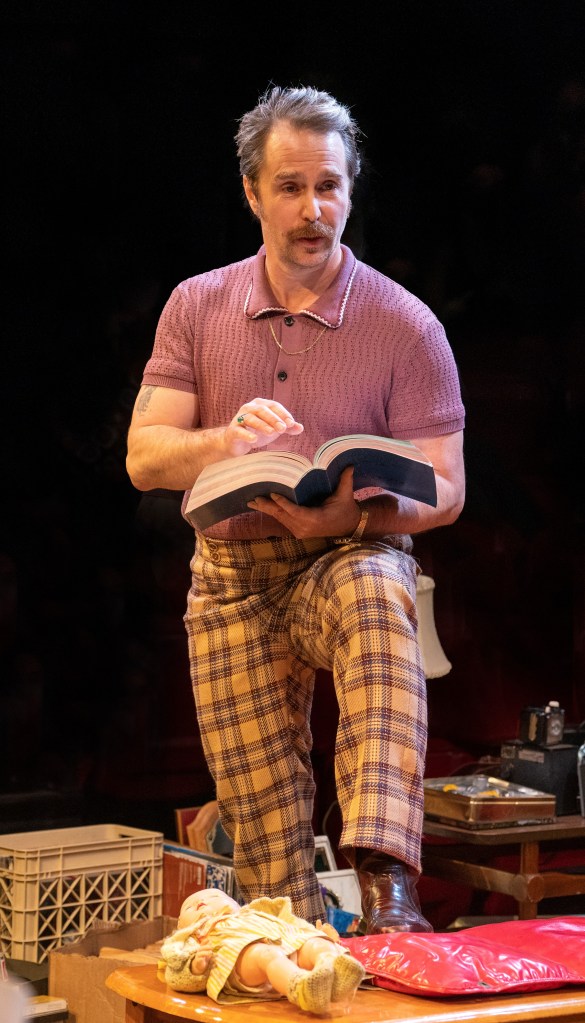
The cast is more than worthy to line up with Mamet’s dynamic, vital characterizations. The actors are seamlessly authentic in the roles of Donny (Laurence Fishburne), Teach (Sam Rockwell) and Bobby (Darren Criss). I didn’t want the play to end, enjoying their amazing energy and finding their portrayals to be humorous, poignant, frightening, intensely human and a whole lot more. Their depth, their interaction, their careful interpretation of each word and action that appeared flawlessly real is so precisely constructed in their performances, it is incredibly invigorating and a justification for live theater-why it is and why it always will be.
Mamet’s early writing is strong and singularly powerful as evidenced in American Buffalo. The play involves a string of events that happen over the course of a day in Don’s Resale Shop which is a hazard of incredible junk for the ages, fantastically arrayed by Scott Pask’s talents as scenic designer. The play opens at the height of drama (we think), when Donny upbraids Bobby about the right protocol to take regarding “doing a thing” as a preliminary action in a future plan they will endeavor. Then the developmental action sparks upward and never takes a breath in the crisp, well-paced Pepe production.

Immediately, we note Fishburne’s paternal and fatherly approach to Darren Criss’ innocent, boyish, “not too swift” acolyte into how to be sharp in business and not let “friendship” get in the way. Donny’s mantra relates throughout American Buffalo. As we watch his interaction with Bobby, we can’t help but see the organic humor in their characters which are contradictory and perhaps disparate from us in intention, discourse, values, initially, but are our brothers in humanity, whether we admit it or not.

At the outset it is impossible not to align ourselves empathetically with these acting icons, each of them award winners with a long history of prodigious talent over decades of experience in film, TV and stage. They are a pleasure to watch as they inhabit these characters, that are a few class steps above Maxim Gorky’s Lower Depths‘ denizens. LIke Gorky’s underclass, these “higher in stature” nevertheless live in their dreams as they deal with the very real and shabby circumstances of their lives. Thus, junk doyen Donny is the wise businessman who, by the play’s end belies all of the instructions he relates to Bobby at the beginning. And Bobby who intently listens to show Donny how much he is willing to learn to remain in his favor, learns little because he has let Donny down at the outset when he is “yessing” him with wide-eyed reception.

As a counterweight to the teacher-pupil, father-son relationship and manipulation between Donny and Bobby, the manic, feverish Teach throws around his knowledge, experience, street smarts and volatile “friendship.” He is their foil, their activator, their stimulator, their inveterate “loser” with a talent for braggadocio and despondency, and clipped epithets about the other denizens in their acquaintance. He is an apparent backstabber and one to watch as someone who sees themselves as dangerous, but botches his self-awareness and presumption to greatness at every turn.
Rockwell knows every inch of Teach and performs him with gusto and relish. He is integral to this team of exceptional actors that Pepe directs to high flashpoints of authenticity and spot on immediacy. This is collaboration at its best. From the layout of their characters’ plans in Act I to the consequences of the plan’s execution in Act II, the still point of behavior is the crux of what Mamet’s Buffalo presents with crushing ruthlessness.
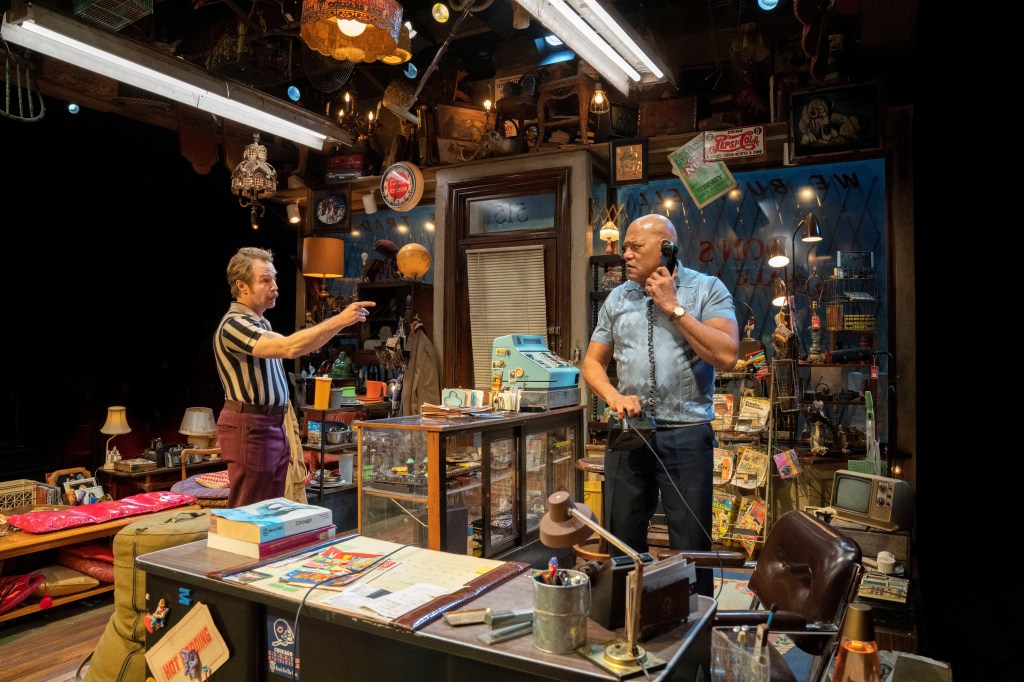
Examples abound throughout, but are particularly manifest in Act II. It is there that Rockwell’s Teach releases the anger within the character to reveal his self-destruction, self-loathing and disappointments. Rockwell’s Teach lashes out, only to be topped by Fishburne’s essentially kind and fatherly Donny, who erupts like a volcano at Teach in a shocking display of force. The drama in the second act is so alive, so expertly staged by J. David Brimmer as Fight Director, if Teach had moved an inch more slowly than he did, he would have been badly injured by the essentially good-natured but seriously, no-joke Donny. The altercation is a work of art, incredibly precise in its build up of the characters’ emotions, then release.
Likewise, Teach’s explosion against Bobby is devastating in another way. Brutal and exacting, Teach exploits Bobby as his victim. Using him as a backboard to release his fury and self-loathing, he redirects Donny to believe Bobby and another individual have double-crossed Donny and Teach in their plot to steal, undercutting Teach’s and Donny’s deal. Bobby’s attempt is feeble as he tries to verbally defend himself against Teach’s relentless onslaught, borne out by Teach’s years of inner frustration which have encompassed failure after failure. Teach won’t hear Bobby. Enraged at himself and his own assumed victimization, as he spews venom on the double-crossing Bobby and his “accomplice” to incite Donny, his violence crashes in a high, then a low.

Once again, the frenemies are tragic counterparts in a social class that is hurting. Teach’s rage is otherworldly. Bobby’s sorrowful reception of it without fighting back is heart-breaking. Criss is just smashing. I wanted to run up with alcohol and bandages to help stem the external wounds, knowing Bobby’s soul harm is irreparable. Through both brutalizations by Fishburne’s Donny and Rockwell’s Teach, the audience was silent in tension and anticipation. And then the mood breaks and here comes humor and apologies and I won’t spoil the rest.
The togetherness and human bonds displayed are as rare as the American Buffalo head rare coin Donny believes he had and lost. The coin lures the three who are governed by dreams of wealth, like iron pyrite. The resultant failure of their plans, emotional devastation and self-harm is never dealt with. Only Donny’s soothing of the situation is a partial rectification. Interestingly, whatever the type of friendship Teach, Donny and Bobby have will be strengthened by the thrill of the gambit, the crooked deal, the need to “get over” to salve lives that exist without purpose, overarching destiny or moment, except to move toward death, with “a little help from their friends.”

This portrait of Americana is particularly heady and current. Though the play is apolitical, it does speak to class, the macho bravado of making plans and screwing up, the lure of illegality as cool, and the consolation provided by the older wiser individual who the younger men are fortunate to befriend, though he is a subtle manipulator and user, as they all are in the game of “getting over.”
In American Buffalo Mamet suggests this game is as American as the American Buffalo, as American as apple pie, as American as the right to bear arms. Indeed, it is in the soil and the soul of our culture and we cannot escape it, though we may not embrace the ethic and ethos of the “art of the steal,” especially when law enforcement comes knocking. Nevertheless, the play suggests a fountain from which to drink and either be poisoned by the perspective, refreshed, nourished, but never bored. For that reason and especially these acting greats, this production should not be missed.
Kudos to Tyler Micoleau’s lighting design, Dede Ayite’s costume design and all the technical creatives whose efforts are integral to Neil Pepe’s vision for this third revival. For tickets and times go to their website: https://americanbuffalonyc.com/
‘The Vagrant Trilogy,’ an Amazing Work by Mona Mansour
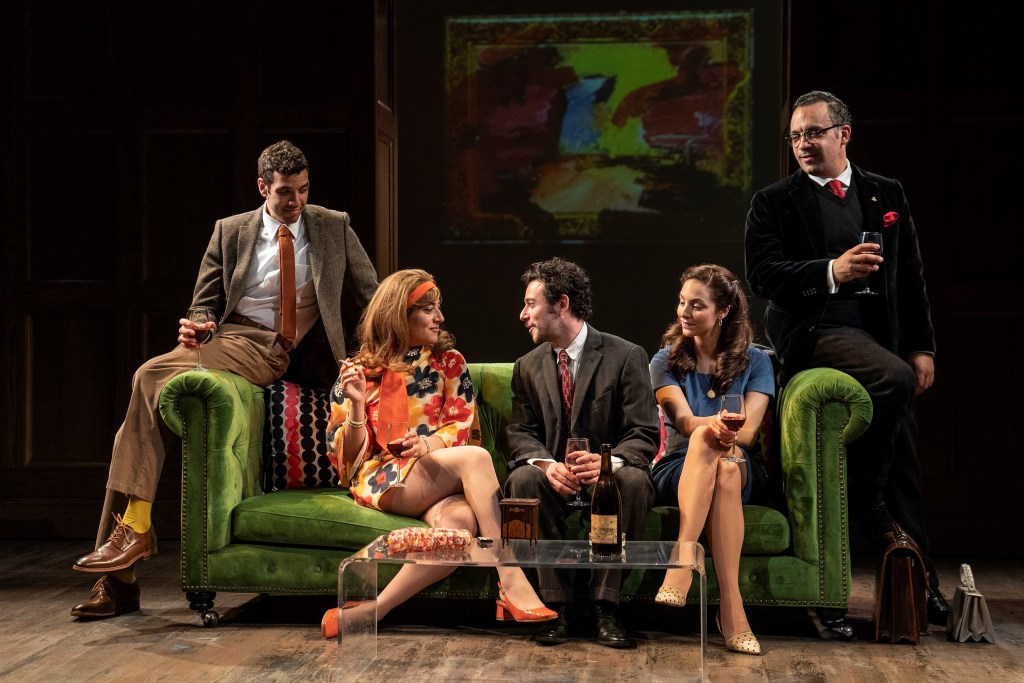
The power of The Vagrant Trilogy, Mona Mansour’s incredible work, currently at the Public Theater until 15 of May, lies in the questions it raises. These concern the very real circumstances presented, especially in Act III. Mona Mansour’s connected one-act plays (that took the Public one decade to effect), ask us to empathize with the plight of the Palestinian characters Abir (Caitlin Nasema Cassidy) and Adham (Bassam Abdelfattah). We watch as their world shatters and they have to decide whether to remain in London or go back home to live in a refugee camp in Lebanon.
Before the play begins, the actors introduce the structure and events, explaining that Act I is the set up to explore a decision whose consequences offer two alternate realities. The two different outcomes that occur in Act II and Act III reveal a life of free choice versus a life where one’s every movement is controlled, monitored and limited, as the characters live in squalid conditions, and their upward mobility curtailed unless they escape.
Mansour asks us to consider the extreme consequences of a single decision to change one’s status from culturally displaced immigrant, who gives up everything to live in relative comfort, to that of a refugee who retains cultural identity and family but gives up his comfort and future. The director (Mark Wing-Davey), and the playwright with prodigious effort intend that we empathize with such decisions that the globally displaced are forced to make. These will only increase as wars and extreme events, like climate change created drought and famine destabilize nation states. These will uproot humanity, who will be forced to migrate to places of relative safety, if they can find such places.
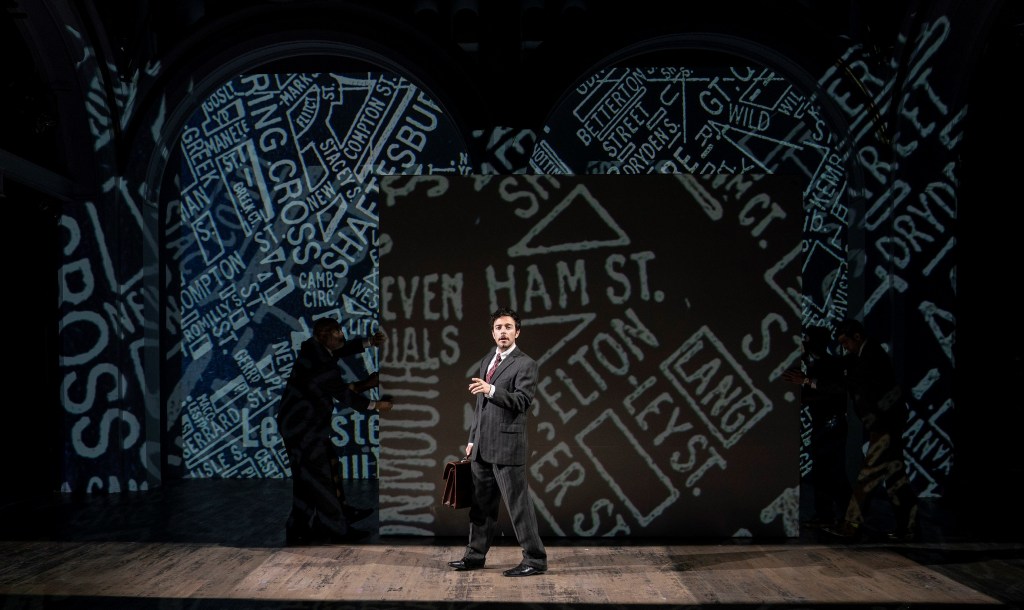
Invariably, as we identify with Abir and Adham and walk in their shoes, we ask which sacrifice would we make if we were in their position to choose between Scylla and Charybdis? (Greek mythological monsters Odysseus faced on his journey home) Which monstrous choice would help us retain the most valuable part of ourselves? Or does the act of choosing wipe-out identity, regardless of outcome, as the decision-makers consign themselves to a life of regretful “what ifs,” every time they confront the dire obstacles which are bound to occur?
The refugee camp that Adham refers to throughout the play, is the camp where he and his mother escaped from while his father and brother remained behind. The camp was formed after the first Arab-Israeli conflict in 1948 around the time that Israel was declared an independent state and Palestinians rejected partition and a two-state solution. As a result of the war, displaced Palestinian refugees were shuffled over to Burj El Barajneh, a camp in Lebanon that opened up in 1949. Once there, they were told that they would go home and be resettled, eventually.
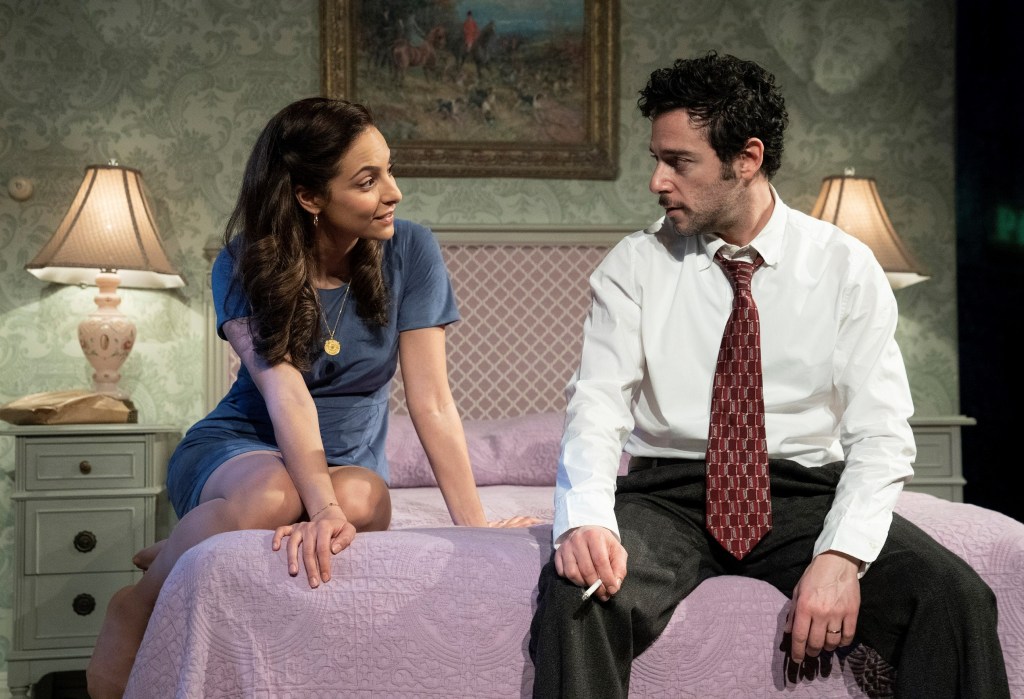
One of many refugee camps in Jordan, Lebanon, and Syria, the UN has stipulated that they have a right to return. The dictum is ridiculous; there is nothing to return to, nor can they receive documentation to readily return to the area they were forced to flee as casualties of war. Meanwhile, those in the camps wait for a resolution, generations have grown up and moved on. Indeed Adham’s father dies in the camp without ever returning to the homeland he lost. Sadly, the refugees are unable to work or obtain citizenship in the country that hosts them. There’s is a never-ending limbo from which few escape.
Time has passed since the camp was formed and Adham escaped with his mom. It is 1967 in Act I when Adham and Abir meet in their small village in Jordan (former Palestine), after Adham graduates from college. It is right before he goes off to a prestigious speaking event in London where he has been selected out of many talented candidates. Swept up in their attraction for one another, Adham takes Abir home to meet his forceful, prescient, ambitious mother (Nadine Malouf), who disapproves of Abir as a wife.

Not heeding his mother’s warning, he proposes, they elope, and travel to London where Adham garners success at the lecture and is accepted by the faculty (Osh Ashruf, Rudy Roushdi), who he schmoozes with at a party. Fortunately, the exuberant, friendly, faculty wife Diana, (Nadine Malouf’s versatility is smashing in all the roles she portrays), provides the social bridge to make Ahmad comfortable. However, Abir feels uncomfortable, a fish out of water which Adham admits to. But he feels grounded in his subject of literature in academia and he speaks English, which Abir does not.
During the evening of his success at the party, the 1967 Arab Israeli six-day war breaks out. The faculty suggests they stay in London. They will get the couple visas and work out an internship or something available and doable. Abir is distraught about leaving her family and accuses Adham of heartlessly leaving his mother who sacrificed everything for him. The argument intensifies and by the end of it, their emotional fury explodes. The fact is brought out that if they leave, they may never be allowed to return to London as Palestinians, who are now in a state of flux with Israel, the Arab world and the US. They must make their momentous decision and never look back
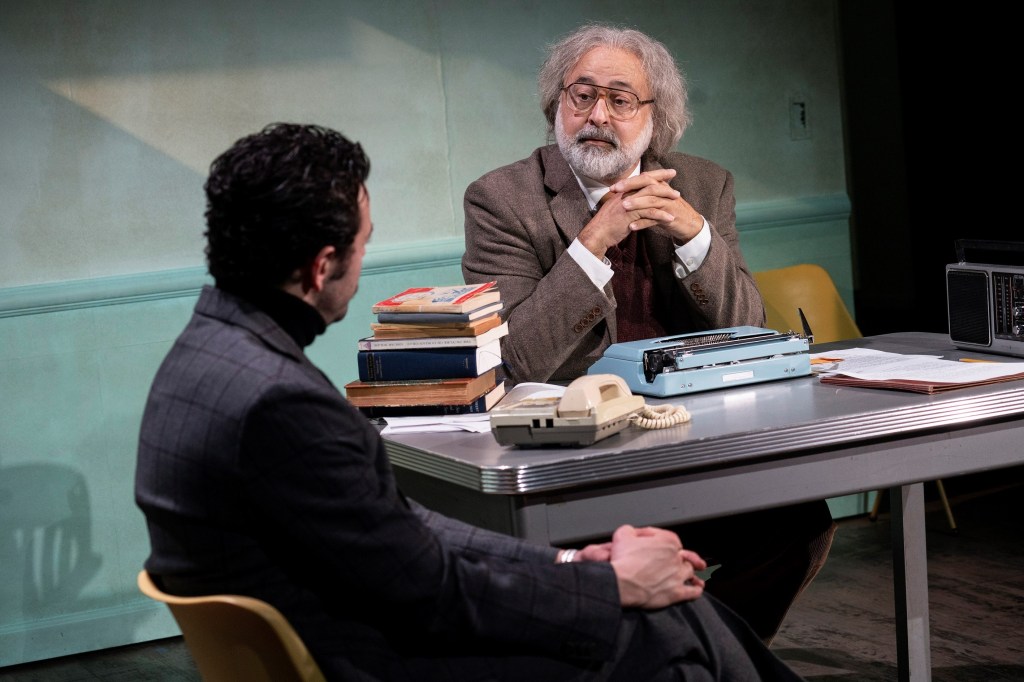
In Act II Adham’s life unfolds as a professor applying for full tenure. He is still friends with Abir whom he has divorced because of their irreconcialble differences, mainly that Abir blames Adham for staying, a convenient excuse because after the divorce she could return. However, we learn that Abir has it both ways; she accepts little responsibility for her decision to stay and blames Adham for it.
As this section unfolds, we understand Abir’s complaining to another professor friend about him, the same rants; he abandoned his brother and mother and is selfish. She is at the home of Ahmad whom she sees frequently. For his part, Adham’s teaching career is problematic and in limbo without a full professorship. He is neither here nor there culturally; he is like the vagrant he refers to in a Wordsworth poem he has studied and teaches.

Though he has made friends at the university, he finds increasing difficulty with students and faculty as a Palestinian. Act II resolves as he visits the Lake District, the setting of poet Wordsworth’s wanderings which remind him of what he has gained and lost. It is a respite that works in tandem with his discovery that his brother has died in the refugee camp, a casualty of the further escalation of the “eye-for-eye,” “tooth-for-tooth” machinations that occur in the Middle East. Thus, though he is in comfort, he is alone to pursue his career and writings and in a kind of a limbo, without family.
The set design of Act I and II is evocative, with music from the period, projections, and more, thanks to the following creatives: Allen Moyer (scenic design), Dina El-Aziz (costume design), Reza Behjat (lighting design), Tye Hunt Fitzgerald, Sinan Refik Zafar (co-sound design), Greg Emetaz (video design). However, Act III takes place in the refugee camp in the alternate reality that Adham and Abir would have faced, if they returned home.

The Act III set design, sound, lighting are wonderful as they reveal the difficulties and conditions in the camp (power outages, etc.). The two rooms where they live are more tent than shack. There, Adham, Abir, their children Jamila (Nandine Malouf is just incredible as the teen daughter) and Jul (the fine Rudy Roushdi) eat, argue, sleep and manage to survive. The cramped, impoverished, though decorative quarters (rugs and scarves adorn the walls), also hold space for Abir’s brother Ghassan (Ramsey Faragallah) and Adham’s brother Hamzi, (Osh Ashruf in a vibrant enthusiastic portrayal).
It is in Act III where we experience the full impact of their decision to go back “home” which is nowhere, a refugee camp where they wait and wait for a resolution of the Middle East conflict. It never comes. It is heart-rending, and the actors are magnificent in their portrayals which bring Mansour’s themes to their striking and tragic end-stop. What are we doing globally about this? Why? The misery is incalculable. And Ukrainian refugees in Europe and Syrian refugees, etc. and those from South America must be helped. But how? But when? Can the refugee crises ever be stopped?
This incredible production must be seen. The three hours speed by, but it is not for the faint of heart. While I sat riveted, the couple next to me walked out after Act I, while I couldn’t budge from my seat. For tickets and times, go to the website: https://publictheater.org/productions/season/2122/the-vagrant-trilogy/
‘A Strange Loop,’ is a Laugh Riot With 11 Tony Nominations

A Strange Loop, awarded the 2020 Pulitzer Prize for drama transferred to Broadway this year after an Off Broadway premiere at Playwrights Horizons. The musical steps into the psyche and being of fat, Black, queer Usher and unapologetically opens the door into his life, dreams and realities as messy and screwed-up and admirable and heroic and amorphous and yearning as they are.

With book, music and lyrics by Michael R. Jackson, directed by Stephen Brackett and choreographed by Raja Feather Kelly, The Strange Loop is currently running at the Lyceum. The production is as particular as a feedback loop stuck on itself, rounding turns with robotic precision, speeding up and slowing down to begin where there is no beginning, and end, well, never. In a very weird and wonderful way, as we view the machinations of how a fat, Black queer deals with being a loathsome/cool fat Black queer, whether one is straight, white, 18-40 BMI female, age 20 and up, or 35- 75-year-old straight, white male 23-40 BMI, or slender Asian or Latina straight or gay male or female, 30-70 somethings, or any identifying LGBTQ individual of any age, shape and size, this satire about identity, sex, race, gender and inner self vs. outer self makes one belly laugh.
Maybe it’s the uber embarrassing put downs Usher sustains with hurt aplomb, reviewing “live” encounters in his imagination (i.e. with the wonderful Jason Veasey on the subway), which plays abusively cruel tricks on him and makes our souls beg for some surcease from the screaming self-torment in his raucous mind, which endears Usher to us. Though there is little to identify with physically, (there were very few fat, Black, queer men in the audience), if one strips away his exterior and listens to him, one identifies with Usher’s sufferings and the “rapid recyclying” thoughts that plague all of us in our incessant and irrevocable “glass is empty” humanity.

In this production, Usher stands before us naked without ego. Unlike us, he admits to humorous self-flagellation. Humorously, he actualizes it so we see his zany mania in all its immediacy, through the songs, gyrations, expansive gestures and verbal somersaults of his inner thoughts portrayed by six talented actors. These include: Thought 1 (L Morgan Lee), Thought 2 (James Jackson, Jr.), Thought 3 (John-Michael LYles), Thought 4 (John-Andrew Morrison), Thought 5 (Jason Veasey), Thought 6 (Antwayn Hopper). All are dressed to “kill him” with unkindness in various color coordinated costumes (designed by Montana Levi Blanco), switched up in the many scene changes. All of these crazies are humorous, exuberantly antic, wild, sassy, picky, aggressive, politically correct, negative, negative, negative.
What they are not is encouraging, uplifting, complimentary. Positive thoughts are not funny. Jackson is about funny insult comedy in A Strange Loop, which also, sometimes is not so funny. This is especially so when the self-humiliating protagonist Usher has the courage and raw desire to “let it all hang out,” including weathering insults about the size of his genitalia to garner LMAO laughs, as he trolls for sex partners on his phone apps (acted out by his thoughts, costumed for the occasion). It is also not funny when he attempts to sexually connect in a graphic, “sensual,” anal, sex scene (with Antwayn Hopper), evocatively staged with blue lighting (designed by Jen Schriever). The end result settles unromantically, poignantly, where he is left in an emotional void and alienating disconnect. We don’t laugh. We silently “take it in.”

The irony we are seduced by is that Usher is a creative who we watch in his creative process, writing a musical about a fat, Black queer-who writes a musical about a fat, Black queer…(continue the loop). Thus, it is an imperative that he embrace his inner wacko with relish, but is his own “straight man” in not cracking a smile as he undergoes his self-delivered smackdowns via his “Thoughts.” That insanity of six shouting manics is the foundation of his art and the subject humor of his misery with which he entertains. Thus, he must not psychoanalyze it away, meditate it away, zen it away or pill pop it away. His extremities of pain take precedence, so his comedic funny man stand-up, song-up can flourish. “Strange” is art, the weirder the better. And as we laugh at this clown, we salve our own inner hell.
In his Broadway debut, the superbly versatile Jaquel Spivey as Usher, whose funny bone is as large as his spirit, draws us in after the few minutes of chaos and boredom he experiences at his job as an usher at The Lion King, chiming the ridiculous miniature glockenspiel-ish bell to alert the audience to their proper protocol. But its Usher’s six soul derivations and tangling loopy thoughts, jangling against each other, ripping into him, bringing up his present condition of being nowhere in his career path as he attempts to write a “Big, Fat, Black, Queer Musical,” that will land him on Broadway. The irony here is absolutely mind-catching because the title of his musical is The Big Loop and here he is on Broadway.

Thus, not only is Jaquel Spivey’s Usher ushering us into a novel kind of weirdo that is all about the interior soul, it is also a joke on us, as Jackson wipes out every BS convention leveled by producers about why certain plays “won’t work” on Broadway or Off.
Well, this one does, with its themes and its representative musical score which is repetitive and driving, characteristic of a loop which Spivey’s Usher coherently describes and explains as he exposes his “bizarre” in real time. In all the commotion of his being, Usher, perhaps Jackson’s alter ego, is laughing the longest and hardest at audience members who are farthest away from the “EWWW fat, Black, gay” loser protagonist.

Spivey’s adorable portrayal is winning and likable because in presenting Usher’s extremely dire misery wryly and sardonically (with his imperfect, voice singing Jackson’s effervescent word crammed songs), we find ourselves tangled interactively in his loops. If we are as honest as Usher, we’ve been there, done that with our own six thought conveyors (maybe more), driving us nuts. And “dollars to donuts” the 20-something guys laughing like roaring lions behind me felt much of Usher’s pain and were thrilled to be able to laugh at him and themselves.
What Jackson gives us with his genius are the fantastic perspectives with which to view this character as he exposes his insults, slights, sword jabs in loopy repetitive three/four crescendoing note melodies that Usher internalized from the cultural, familial influences around him. In various scenes his thought posse, well dressed in appropriate attire shreds and pickles him as he rides the subway, checks out gay apps on his phone to get a boyfriend, visits his mom and dad who insist he write a religious Tyler Perry play, and confronts their censure about his gayness which they find unacceptable.

When the set changes into a Tyler Perry facsimile in a switch up from the neon boxes his thoughts move in and out of through most of the play, the moment happens at just the right time. Spivey’s Usher steps into Perryland, taking on various characters in Perry-type costumes and wigs to please his religious mother who he portrays in the Perry send up, as he sings her affirmation that “AIDS is God’s punishment for being gay,” rousing the audience to “clap along.”
Indeed, the loop has gone around once too many times into debasing self-destruction. Thus, eventually, Thought 4 (John-Andrew Morrison) who plays Usher’s mother in the play within a play, observing Usher’s religious Perry play, breaks the fourth wall and asks him something like, “isn’t this enough? When are you going to let these people go home?” (not the exact quote, but near the meaning)
However, it’s not done; the loop continues. There’s more laughter and amazement to come because Usher is a frenzy of pain and giddiness, with fragmented memories of his father, fearful that Usher might be attracted to him, and his mother telling him she loves him.
Usher can’t process it, but he can reveal it. And somehow that is enough. Perhaps at some point he will “get” that it’s OK, and all of this labyrinth need not be straightened out. Nor should he attempt to emerge from it to achieve “wholeness.” After all, this is his unique contribution and purpose to entertain. If we can laugh about “it” and “him,” then so can he, even though his thoughts may not quite be in the mood to laugh at themselves. But he is his own archetype, an “every person,” so he can bear with that, too.
Kudos to Arnulfo Maldonado’s flexible, seamless multi-faceted scenic design which brings fresh perspective to each, swift scene change, as supple as Usher’s thoughts. Praise must also be given to Drew Levy’s sound design, Cookie Jordan (Hair, Wig, and Makeup Design), Michael R. Jackson (vocal arrangements), Tomoko Akaboshi (music coordinator), Chelsea Pace (intimacy director).
You should see this well-deserved awarded play that has garnered 11 Tony nominations. This is especially so if you need to laugh at yourself. Who doesn’t? For tickets and times go to their website: https://strangeloopmusical.com/

