Category Archives: NYC Theater Reviews
Broadway,
Sholem Aleichem and Saul Reichlin, It’s a Perfect Match in ‘Roots…Shmoots!’

A character from Sholem Aleichem’s stories adapted by Saul Reichlin. Photo taken from Saul Reichlin’s website.
Ever since Saul Reichlin who currently makes his home in England began touring his one man shows based on his adaptation of Sholem Aleichem’s stories, Saul recognized he had found a global niche. Audiences love to laugh at human foibles. They appreciate peasant ironies. Both are abundantly represented in Sholem Aleichem’s works. Saul realized that the simple and rich story telling by characters universally identifiable resonated with audiences whether they were Jewish or not, whether his shows were in the UK, Spain, South Africa or in the US.
Saul Reichlin has enjoyed bringing Sholem Aleichem’s characters to life in 35 cities and in 8 countries, initially with Sholem Aleichem…Now You’re Talking. In the last few years he has energized the Jewish storyteller’s works into a new adaptation, Roots…Shmoots! It would appear that Sholem Aleichem and Saul Reichlin go together like bagels, cream cheese and lox. It is just like the matchmaker (a beloved character in Sholem Aleichems’s stories), Yenta (Fiddler On the Roof), says, referring to a couple she wants to bring together, “It’s a perfect match!”
I was fortunate to see Saul Reichlin’s facility with portraying a myriad of Aleichem’s characters in his funny and poignant one man show Roots… Shmoots! which played at the Corneilia Street Cafe in September of 2014. The downstairs theater was packed and the audience received Reichlin’s portrayals with guffaws of laughter and hearty applause. Reichlin’s one man show most probably would have continued past its slated run if Saul didn’t have an engagement in Chicago. As it was, the Cornelia Street Cafe squeezed in a date for an additional performance since the demand warranted it; Roots… Shmoots! which was supposed to run only one night ran a second night to an enthusiastic crowd.

Saul Reichlin as himself. Photo from his website.
The testament of why Reichlin’s productions which have won awards are popular is clear. Audiences need to laugh at a time when entertainment has become ridiculously pricey. Oftentimes, funny, heartfelt shows are hard to recognize amongst a smattering of trending questionable productions whose humor lacks originality and duplicates sitcoms and situational comedy “funniness”which is tiresome and predictable. Sholem Aleichem’s humor is refreshing with subterranean twists erupting with wisdom, irony and wit. It is stimulating and its vibrance engages the audience. Saul’s adaptation as the narrator who spins off the representative characters to tell their stories and interact with the narrator/observer, never fails to amuse. This is largely due to Saul’s relaxed and comfortable manner fluidly switching from one character to the next playing all the roles.
One person shows are tricky. Nevertheless, Saul has mastered the form because of his extensive acting experience. There is one more element that makes for his rousing success. He has perhaps channeled and bonded with the author known as the Jewish Mark Twain. He presents the very real characters authentically so that we are able to visualize them and recognize elements the characters demonstrate as ones inherent in ourselves. The setting may be tiny rural towns in the Ukraine, but the situations and the human factor are parallel to our time. That Reichlin recognized the beauty and coherence of the past as current in Aleichem’s characters and work so that he is able to make them be felt and touched in our hearts is a gift of love from Reichlin translated from Aleichem to us.
You can keep up with Saul Reichlin’s work at his link: Saul Reichlin.
If you’d like to read more about this man who has fostered the knack of connecting us with the depth of human wisdom and folly manifested through Sholem Aleichem’s characters, see this link on Blogcritics. Saul is currently working on setting a performance schedule for The Good and The True, a production about the uplifting true life story of Milos Dobry and Hana Pravda, two Holocaust survivors. Saul performed the role of Milos Dobry this summer at the DR2 Theatre.

From the production ‘The Good and The True’ at the DR2 Theatre this summer. Saul Reichlin as Milos Dobry. Photo taken from the production program.
For my review of The Good and The True, click this link.
‘This Will All Be Yours’ Book by Laura Pedersen, Music and Lyrics by Charles Bloom
In 1970 factory farms, big pharma, corporate land devastation and the deleterious effects of pesticides, herbicides and chemicals in our food and water supply were subterranean issues not publicized in the mainstream media. Small family farms dotted the landscape and the obsession with making profits in the face of human harm was only whispered about behind closed doors. By the 1980s-1990s there had been a paradigm shift. A bucolic, stress-free way of life , nutritious and delicious produce, nightly home cooked meals, mom and dad closely supervising their children, and a pastoral landscape had transmuted into a pressure cooker existence of traffic jams, subdivisions, less vacation time, processed convenience foods, parents working two jobs, and suburban over development in the wake of urban blight.

L to R: Josh Powell as Adam Price, Trevor St. John-Glibert as Jackson Webb in ;This Will All Be Yours’ by Laura Pedersen, Music and Lyrics by Charles Bloom at TBG Theatre. Photo by John Quilty.
This Will All Be Yours is a vibrant musical production directed by Ludovica Villar-Hauser that highlights the beginning of this transitional time. It turns a brilliant, focused spotlight on the Price family farm in 1979 western New York, representative of many such family farms during a time of upheaval which is still happening today in different parts of the country. Through an excellent musical score by Charles Bloom and pithy, rich book by Laura Pedersen, we share the family’s personal triumphs and let-downs, as the two sons and the daughter are caught up in the swirling currents of social change which force the entire family to make hard choices. Should they transition into progress or risk falling into the doldrums of debt and a destruction of all that they and three generations of ancestors have worked hard to build up? Should they keep the farm?

L to R: Daniel Rowan, Trevor St. John-Gilbert, Josh Powell, Amy Griffin, Jenny Rose Baker, Matt Farcher in ‘This Will All Be Yours,’ directed by Ludovica Villar-Hauser. Photo by John Quilty.
Much of the story exemplifies themes that have become mainstay issues in our current society and indicate deeper problems with our cultural folkways. By implication these problems run deep even to encompassing the way we have accepted a lifestyle manipulated by corporations, industrial farming practices and the fast food and processed food industries.
Never brow beating us, Pedersen touches upon these ideas cleverly in whispers of truth that float like gossamer in the conversations of the family as they complete their various chores. For example, mom, Paula Price (a wonderful Amy Griffin), enjoys bragging about her recipe using the orchard’s delectable, fresh peaches, and subsequently there are follow up comments about the bland, no taste peaches in grocery stores that have been picked green to ripen in a truck. Of course, this lust for fruit and vegetables out of season, over the years has escalated to a negative chain of events from increasing our carbon footprint in food production, transportation costs and pollution, to all the woes concentrated around agri-business and its lobbyists fighting against GMO labeling, use of pesticides and herbicides, etc. In the consumer desire for variety has come a lack of quality, nutrition and taste with the attendant environmental impact. Though all of this is unspoken by the characters because they cannot know the future, we do; we are living it and we understand how that folkway has perpetuated a negative result. Pedersen is subtle, but if one has eyes to see, the message is clear in what we are “planting” for our children.

The cast, composer, director and playwright of “The Will All Be Yours,’ with the stage crew and orchestra. Photo by John Quilty.
Another example of threading themes occurs when father Adam (a dynamic Josh Powell) discusses how watermelons and peaches have to be made to please consumers. Watermelons must have few or no seeds-no one likes the seeds, and peaches must have “no fuzz.” With these concepts Pedersen gently infers that in food production, the natural world has been modified to our liking. Ultimately, agri-business and industrial food production have accommodated suburbanites and mallsters, but at what expense to our own health, and to the health of the environment?
Though farmers dealt with these questions decades ago, recently we have begun to see the error of our ways. In a line that runs deep, Adam Price asks, “What comes of a nation that doesn’t want peach fuzz?” Pedersen has beautifully revealed that all elements of a society are networked together starting with the land and how food is produced. Inherent is a love of the land and its spiritual value which those who have worked on it for generations truly comprehend and venerate. When the land, its creatures and natural crops are mowed down, tweaked, disdained and not properly respected, then what indeed are we creating for ourselves and our posterity?

Amy Griffin with (back ground right), Josh Powell, Jenny Rose Baker, Matt Farcher. Background left: Trevor St. John-Gilbert. Photo by John Quilty.
The production design, staging and the acting reflect a craft and ingenuity that is enhanced by the music and dialogue with energetic vitality. Through the director’s clever use of an economy of space, the actors brilliantly create the lives of their characters with fitting props that are incorporated into the musical numbers. The talented actors (Jenny Rose Baker, Matt Farcher, Daniel Rowan, Trevor St. John-Gilbert, Josh Powell and Amy Griffin), and their singing are spot on, exceptional. Theirs is a liveliness and enthusiasm not often found in musical productions where sometimes the direction pales, the actors tend to “park and bark,” and where there doesn’t appear to be much inner life or conflict. It is thanks to Ludovica Villar-Hauser’s thoughtful and attentive direction, the actors’ portrayals, and Pedersen’s succinct book that the storyline never becomes bogged down in the maudlin.
This is a production which should find additional venues because of its salient themes and overriding message about our accountability to ourselves and others in our culture, in what we allow, often mindlessly and with a lack of vision. The beauty of this production is that Pedersen’s message always remains hopeful and does not hit the audience over the head with cant and/or the rhetoric that we should “eat organic” and “buy local.” She achieves this with simplicity by telling the story of the Price family and how they are forced into an untenable position with their beloved farm because of a combination of factors, some ill some good. We are left with questions: Should this be? Doesn’t this impact all of us in the long term?
The title says it all: “This Will All be Yours.” The message gives us pause for indeed, what are we leaving for our grandchildren if we continue our current actions and policies? Hopefully, we are creating innovative ways to keep the best of what our forebears gave us, jettisoning all that is unfruitful; most importantly, recognizing the difference.
This Will All be Yours runs until August 7th.
This review first appeared on Blogcritics at this link.
The Long Shrift by Robert Boswell, directed by James Franco

L to R: Ally Sheedy, Brian Lally in ‘The Long Shrift’ by Robert Boswell, Directed by James Franco. Photo by Joan Marcus.
The Long Shrift written by Robert Boswell, directed by James Franco is currently at the Rattlestick Playwrights Theater. The production stars a powerful ensemble cast headed up by the always fascinating Ally Sheedy. The play which remains on a steady keel toward the surprising and revelatory deals with thorny issues which currently plague the culture of youth and its guardians. Recent articles in the New York Times have pinpointed one of the problems that Boswell broils us with in his interesting work: the topic of rape and holding the right individuals accountable, despite educational politics, unequal economic justice and parental and social pressures. More specifically, Boswell directs our attention to controversial sub issues raising the questions that need to be in the forefront of male-female relationships, regardless of whether the couples are married, partners, friends, or are simply “dating.” At the foundation of Boswell’s work, which investigates whether a rape has been committed is the concept of penance, forgiveness and the healing power of truth.

L to R: Brian Lally and Ally Sheedy in ‘The Long Shrift’ directed by James Franco. Photo by Joan Marcus.
When the play unfolds, Sarah (Ally Sheedy), and husband Henry of 23 years (a well meaning and level headed Brian Lally), are unpacking boxes having just moved into a “hovel,” Sarah’s description of an unadorned, lower middle class home which we gather from Sarah’s diatribe is a complete step down from their former residence. During the exposition we discover why Sarah is disgruntled and depressed, though Henry with good humor and good will tries to lift her from her doldrums. The couple have had to sell their lovely house to pay the lawyer’s fees to defend their son against a rape charge. Richard, (an excellent Scott Haze), a senior in high school, was convicted and Sarah and Henry have had to sell their home to pay their lawyer’s fees. They have since purchased another place and followed their son to the area of Huntsville, Texas where he is serving 9 years.
During the discussion about their son, we discover that Richard was a “fish out of water” in a tony, private high school amongst students of privilege, one of which was the young woman who accused him of raping her. Boswell sets the tone of mystery through the characterization of Sarah who profoundly questions her son’s innocence despite Henry’s loyal and simplistic love and the assurance that Richard has been falsely accused. Henry is amazed that Sarah doubts Richard and continually affirms that the victim is no “victim” for it was Beth (Ahna O’Reilly), who lured and teased Richard into consensual sex which she later denied because she enjoyed betraying their son in a perverse display of arrogant superiority. Henry believes Beth accused his son because she could; she is backed by the power and justice rendered by oodles of money and an attorney whose “air tight” case the jury swallowed because of the inherent differences between economic class and social culture: Beth was the prom Queen and Richard was a geek nobody.

Scott Haze and Ahna O’Reilly in ‘The Long Shrift’ by Robert Boswell. Photo by Joan Marcus.
Because Sarah intuits that Richard is hiding something from her, she cannot forgive him until he comes clean and reveals what happened between him and his accuser. Sarah manifests this stasis in her relationship with her son by refusing to visit Richard in prison. It is not an easy decision, but she is as stalwart about not seeing him as Henry is as supportive about visiting. The audience is engaged in the ready proclivity to accept Henry’s stance because of the truism that money talks and lots of money roars, and the audience questions Sarah’s decision not to visit her son. As Boswell draws Sarah’s character, it is clear that the mother has become hardened, for deep within, she is unable to stem her bleeding emotional wounds at having lost her innocent, beautiful son to the extent that she can’t bear to see him in prison.
What is superb about Boswell’s play, Franco’s direction and Sheedy’s performance is that elements of Sarah’s characterization play into the audience’s assumptions about the mother’s inability to withstand the pressures of circumstance to believe in Richard’s innocence. But as the play progresses, the characterization subtly deepens in a harkening back to the title. Sarah’s is the very tough love, where her husband’s is the sweet and understanding love. Indeed, Sarah is holding vigil for Richard’s truthful moment. It is only then he will be able to begin to heal and forge a new life. So the mystery Boswell unfolds with subtext after subtext is not only whether Richard is innocent or guilty of the rape, but whether Sarah was correct in intuiting that he was not telling her the truth. And of course, the playwright keeps us wondering what is the truth that should be revealed? Is it so complicated? Turns out it is.

Scott Haze and Allie Gallerani in ‘The Long Shift’ by Robert Boswell. Photo by Joan Marcus.
After this opening, Boswell breaks the play’s structure and fast forwards to years later during which time Sarah has died (she does appear in a brief scene with Henry in his dream state), and Richie has been released after 5 years because his accuser recanted her testimony. Gradually, the mysteries are elucidated and eventually solved for lo and behold, the accuser, Beth, shows up at Richard’s door when he stays with his Dad to go to his high school reunion, a quasi-hero vindicated from the crime. What ensues when accuser meets accused is a grinding trauma of point and counterpoint, vilification and sorrow. Boswell shocks the play with a series of electric blasts which move in heightened power throughout: they begin with Richie, and continue with an indignant Henry who angrily confronts his son’s accuser and move in a crescendo to the climax. Adding to the storm, Boswell tricks in plot complications with Macy (Allie Gallerani), student class president and reunion coordinator who accompanies Beth to Richard’s. Macy presents a tempting offer that Richard give a speech to his former classmates explaining his innocence in the presence of his humbled accuser. Boswell’s characterization of Macy is an ironic symbol of the culture’s worst ideals. She exemplifies the warped mores which have contributed to Richard’s and Beth’s watery destruction in a corrupt social vortex that engulfed their dreams and lives.
During the remainder of the production we are left stunned again and again until the final moments of truth come. They are exacted at a heavy price of painful admission by Richard and Beth who finally face each other’s reality.

L to R: Allie Gallerani, Ahna O’Reilly, Brian Lally and Scott Haze in ‘The Long Shrift.’ Photo by Joan Marcus.
With dark humor, pathos and poignancy, and through gradual enlightenment, Boswell’s characters find their way out of the morass of anger, fear, regret and weakness surrounding the pivotal event which changed all of their lives. The ensemble has worked with absorbing, focused effort to bring this production toward powerful and truthful realism under the sterling and watchful shepherding of James Franco. Sheedy portrays Sarah with an ease of moment to moment precision that is a joy to experience. There is just enough restraint and humanity, pain and petulance undergirded with the appropriate amount of tension for us to doubt and believe her testimony about her son. We sense she is determined to keep the vigil to the bitter end despite what may happen, in a standoff to see the truth out. When Haze and and O’Reilly come together in confrontation after confrontation, we are drawn toward them and repulsed. We wonder at their honesty. We remain engaged. Brian Lally sustains the moderated support and kindness necessary to reveal Henry’s love for his son. Allie Gallerani is sufficiently presumptuous, crass and obnoxious. Yet, she suffuses vulnerability when Richard turns the tables around and lures her with notes of sexual temptation.
This world premiere leaves us with much to consider. Do men and women understand the boundaries of consensual sex at the same level. Should they? Must we continue to tolerate the inequity of the justice system which allows power and money to influence, buy or nullify convictions? When lives are destroyed by deceptions, can the truth bring renewal? Each of these and many more themes are threaded through this fine production of The Long Shrift, which is running until August 23rd.
This review appeared in Blogcritics at this link.
‘Dark Water’ by David Stallings A Play of Impact and Power About the BP Oil Spill

- L to R: Dianna Martin and Chester Poon in Dark Water by David Stallings at The Theater at the 14th Street Y. Photo by Louise Flory.
The BP oil spill in the Gulf of Mexico was a tragedy that we are still reeling from. The riverfront and Louisiana wetlands were forever changed. The area’s ecosystem has been seriously compromised and devalued; the fishing and shellfish industries are crippled. However, out of the public spotlight, it’s business as usual spurred on by “the corexit” which dispersed the oil to the sea floor and like magic, “all was out of sight, out of mind.” Only those who are part of the clean up process, the scientists, the researchers, those working with the EPA, those who live on or near the water and those in university settings who are familiar with the lasting damage of oil spills and the toxic impact of corexit understand the disastrous consequences that, like dominoes, are still toppling throughout the region. Those folks understand but their voices have not been heard above the din of other distractions. They understand, and the halt, maimed, blind animals (chemical mutations) and marine life understand. Daily, they have to experience the toxic “corexit correction,” and the complete alteration of their shelters, food supply and way of survival.

L to R: Emily Hartford and Stephen Conrad Moore in Dark Water by David Stallings at The Theater at the 14th Street Y. Photo by Louise Flory
Dark Water by David Stallings, directed by Heather Cohn enjoying its premiere at The Theater at the 14th Street Y, takes us back to the initial spill and reexamines the event from the perspective of the animals and marine life. Through them we acknowledge their reactions, their attempt to comprehend the incomprehensible, and their hopeful struggle to survive despite the creeping “dark water” which moves toward them in a massive, viscous wave of suffocating, burning death.
Mother turtle Barnacle (a determined Dianna Martin) faces a conundrum. She is with her son Weed, but she has left her babies, Weed’s sisters, on an island in the gulf to keep them safe from the spewing dark water. She has told her children she will come back for them to take them to a better place, but the dark water is consuming everything in its path and she is afraid she will be too late. Barnacle drops off Weed (Chester Poon) on another island that appears to be far from the danger, leaving him with Foam (Erica Lauren McLaughlin). Foam, who has been enslaved by Clam (Susan G. Bob) learns freedom as a result of a loving relationship with Weed. Weed convinces Foam to go with him to find and help Barnacle.

L to R: Kathleen O’Neill, Dianna Martin, Chester Poon in Dark Water by David Stallings at the Theater at the 14th Street Y. Photo by Louise Flory.
Before and during Barnacle’s and Weed’s travels, Barnacle has to protect her son while confronting predatory, conniving and dangerous enemies whose habitat is being threatened by the dark water. These birds of prey have grown cruelly rapacious and wanton. Gullet (the foreboding and noxious Brian Silliman) and Blue Heron (an excellent Kathleen O’Neill) connive with arrogance, tyranny and presumption. Barnacle remains strong. She endures and outsmarts these and others who plan to either eat her or Weed. Though some animals and marine life have been driven to desperation out of fear of the rapidly moving dark water destroying their food supply, there are others who remain noble and kind. There is the sweet dolphin, Daedalus (a beloved Antonio Minino), and the prophetic Sea Urchin (Emily Hartford) who gives wise counsel to Barnacle. The highpoints in the conflict create suspense. Will Daedalus who must swim through the entangling, engulfing thickness with Barnacle on his back be able to get to the island in time? Will Barnacle find Weed and will they rescue her daughters before they are all suffocated by the slimy, black ooze?

L to R: Chester Poon and Erica Lauren McLaughlin in Dark Water by David Stallings at The Theater at the 14th Street Y. Photo by Louise Flory.
In Dark Water, Stalling’s message and themes are neither preachy nor easily dismissed. His anthropomorphic characters are like us. We are able to identify in his metaphor riot the best and the worst of human traits: maternal and filial love and sacrifice, rapacity, fear, desperation. On the other hand Stallings has found a unique way to differentiate his marine life characters from humans; they speak in verse. These other life forms express their desires, intents, hopes and fears in exacting rhymes. At times the verse is more rhythmic and poetic, at times not and there are no rhymes. His selection rises to necessity depending upon the unfolding action and events. His dialogue versification is interspersed with a few songs, a short dance and a choreographed fight sequence.

Emily Hartford in Dark Wter by David Stallings at The Theater at the 14th Street Y. Photo by Louise Flory.
These clever devices are packed with meaning and enhance the themes of this parable which is simple, direct and powerful. Stallings infers that though there are similarities between marine life and man, essentially, these other beings which we deem “dumb brutes” who are as “disposable” as flotsam and jetsom, are to be appreciated as beautiful and poetic creatures integral to the loveliness of the natural realm. By having them speak in verse, Stallings’ impulse is to magnify their preciousness and sanctity. For do we not ultimately depend on them for our sustenance? Throughout the play Stallings’ threads the question, “Do we have any idea of what we are really doing when we risk allowing such a disaster?”

Brian Silliman in Dark Water by David Stallings at The Theater at the 14th Street Y. Photo by Louise Flory.
Stallings’ choices are stylistically daring and unusually effecting. By the end we realize we are watching in these characters’ struggles for survival something akin to a Greek tragedy and all the more so because they are innocent creatures and have had no hand in what we have done. However, unlike some Greek tragedy, there is no Deus ex Machina (a god coming to the rescue of the protagonist). How can there be when the human “gods” are the executioners? And what they are executing is their own eventual destruction by first harming the creatures that maintain the ecosystems of the planet.
The fundamental theme expressed by Stallings’ title and how the dark water impacts the marine life evokes the symbolism of a darkness that is all encompassing. By extension we understand that this is an amorphous evil represented by man’s primordial lust for profit at the expense of life itself. Stallings ultimately suggests that If we continue to allow such a tangibly felt wickedness to overtake our rationality and common sense, then surely we do not have to fear an apocalypse. It has already happened in the overtaking of the human heart. Unless it is ameliorated, we are dooming ourselves and the fabric of our own culture and environment for future generations.
Dark Water will be at The Theater at the 14th Street Y until March 29th.
Ensemble: Brian Silliman, Dianna Martin, Chester Poon, Antonio Minino, Susan G. Bob, Erica Lauren McLaughlin, Kathleen O’Neill, Lily Drexler, Stephen Conrad Moore, Emily Hartford
This review first appeared on Blogcritics.
The Pig or Vaclav Havel’s Hunt for a Pig in NYC, Adaptation by Edward Einhorn, Directed by Henry Akona

Some of the freeing graffiti digital projections.
For my review, of this entertaining, absurdist and wonderful avant garde production, look for it on Blogcritics or on All Along the NYC Skyline. It is in town until March 29 at the 3LD Art + Technology Center. The pre-show is 20 minutes, the show is 1 hour and the post-show is 25 minutes. This is a 3LD Art + Technology Center and Untitled Theater Company #61 production. And it is smashing.

The Cabaret Metropole at the post-show of The Pig or Vaclav Havel’s Hunt for a Pig at 3LD Art + Technology Center.

Cabaret Metropole in full swing at 3LD Art + Technology Center. It’s a jubilee, The Pig or Vaclav Havel’s Hunt for a Pig, a joyful and revolutionary production cum celebration.

The Pig or Vaclav Havel’s Hunt for a Pig by Vaclav Havel and Vladmir Moravek, adapted by Edward Einhorn, direction and musical arrangements by Henry Akona, at 3LD Art + Technology Center.
‘The Pig or Vaclav Havel’s Hunt for a Pig’ by Vaclav Havel and Vladimir Moravek in NYC
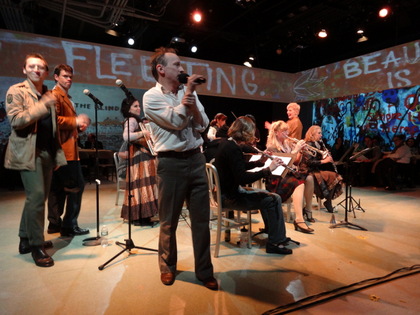
Robert Honeywell with the Cabaret Metropole
3LD Art and Technology Center and Untitled Theater Company #61’s production of The Pig or Václav Havel’s Hunt for a Pig by Václav Havel and Vladimír Morávek is nothing short of a work of wry genius. Edward Einhorn who adapted the play into English was instrumental in re-imagining this work for an American audience.
Wonderfully directed by Henry Akona, the production incorporates multi-media, in heightened artistic expression. The innovative and interesting forms elevate and enrich the themes culminating in an empathetic celebration of freedom. To achieve this heightened aspect, all the arts are represented: the dance, live instrumental music, stylistic cabaret songs, tweaked rock songs (i.e. “I’m Waiting for the Man” by the Velvet Underground) light opera, graffiti art video projections, closed-circuit TV, and ironic, comedic structure with a deep underlying message. The musicians/dancers/actors/artists/technicians ingeniously employ their talents in these forms to create a unique and transformative experience for the audience. United psychically, the audience and players collaborate in the jubilee. It is as if they are participating in a necessary cultural revolution, creating their own inner moments of reform for our time in our country. The production massages all the senses, even the sense of taste and smell; there is pig in a delicious langos of pulled pork, (and a vegetarian langos for those empathizing with the pig), as well as beer and sweets for the finale…touché.

L to R: Robert Honeywell, Phoebe Silva, Michael Whitney, Terrence Stone, Emily Shankman, Christopher Yustin, Jennifer Harder, Jenny Lee Mitchell, Sandy York and Katherine Boynton in The Pig or Václav Havel’s Hunt for a Pig at 3LD Art +Technology Center. Photo by Arthur Cornelius.
In a simplistic form the plot of this musical, dance, “dinner theatre” production is that Vaclav Havel searches for the right sized fresh, live pig sourced from the local farmers so that he can invite his friends for a roast and of course, conduct at artistic salon which emblazons and uplifts the cause of independence. The problem is that Havel cannot settle with a farmer on securing the right pig. The moment he thinls he has purchased it, either the price goes up or the pig is the wrong size or another factor squelches the deal. Running simultaneously with this plot line is the one for the operetta The Bartered Bride. The bride’s marriage is uncertain because all of the details cannot be worked out. Cohering events and plots is a journalist (Katherine Boynton) who interviews the bride-to-be (Moira Stone) and her groom-to-be (Terence Stone) and Havel (Robert Honeywell) about the process of the events and action. The symbolism of seeking something that becomes unattainable is present and the journalistic news reports with scrolls on the bottom of the closed circuit TV screens are sardonically in keeping with the absurd events and mishaps and convolutions of action which, of course, are accompanied by singers, musicians and dancers. For this is a jubilee, after all, and a superlative hint at the revolution which isn’t supposed to be happening, which of course is. Indeed, the very hunt for the pig and the ill conceived matrimonials are revolutionary.

L to R: L to R: Robert Honeywell,
Katherine Boynton and Mateo Moreno in The Pig or Vaclav Havel’s Hunt for a Pig at 3LD Art and Technology Center. Photo by Arthur Cornelius.
Edward Einhorn is well acquainted with Václav Havel’s works. In his collaboration with the Untitled Theater Company #61, The Havel Collection, a five-volume set of new translations of Havel’s plays, has been published. Their intimate knowledge of Havel’s work was demonstrated during their 2006 Havel festival in NYC. As a result it was not surprising when in 2010 upon request of Václav Havel, Einhorn was flown to The Czech Republic to see the premiere of The Pig or Václav Havel‘s Hunt for a Pig that was the centerpiece of a June theater festival in Brno. What Einhorn experienced while watching the production at the Brno festival gave birth to Akons’ and Einhorn’s conceptualization which four years later is appearing at 3LD in this soul-lifting, interactive, multi-media English version.
This production has been effected like Havel effected The Velvet Revolution swirling into the independence manifested by The Czech Republic. Initially, Havel wrote a humorous dialogue about how he tried to get a pig for a roast to celebrate a feast with his friends. (Is the pig metaphoric?) The sketchy 1987 dialogue appeared in an “underground” magazine; during Communism it was surreptitious photocopies of photocopies. In 2010 Vladimír Morávek rediscovered the dialogue, staged it and the idea grew and developed a life of its own in an all encompassing production.

L to R: Katherine Boynton, Moira Stone, Terrance Stone in The Pig or Václav Havel’s Hunt for a Pig at 3LD Art and Technology Center. Photo by Arthur Cornelius.
Morávek added more characters who were then seamlessly interwoven into sections of a Czech operetta, The Bartered Bride. The operetta is a nationalistic work from the 1860s written in the Czech language; it was a groundbreaking move toward independence in defiance of the Austro-Hungarian empire’s rule over them, for the Czech language was never the language spoken. The comedic action of Havel trying to buy a pig for his roast and the plot of the folk opera of a bride who may or may not get married and be at her wedding were beautifully fused together in the Havel/Morávek production. Czech past and present were affirmed with dry humor and celebration reaffirming that the independent spirit of the Czech people can never be contained.
What Einhorn witnessed in the 2010 Czech premiere of The Pig or Václav Havel’s Hunt for a Pig was an amazing tribute to Czech history and the uplifting of the Czech spirit over oppression. From the Austro-Hungarian Empire, through fascism, through communism, through The Velvet Revolution (the Czech overthrow of the old regime after the Berlin Wall fell), and the eventual emergence after Havel gained the presidency to the forming of The Czech Republic, freedom was ever present. In seeking a path to define their own way out from control, the Czech people had already defined themselves. It was only a matter of going.

L to R: Robert Honeywell (sitting) and John Gallop in The Pig or Václav Havel’s Hunt for a Pig at the 3LD Art and Technology Center. Photo by Arthur Cornelium.
Though communism brutally suppressed any outward show of freedom in 1968, the spirit was roiling underneath in the cultural currents. In a slap dash seemingly random style, Havel, an artist, and others moved on a path from which there was no turning back. Havel recognized that despite domination by others, independence was the only inner path the culture knew to truthfully follow toward the light. From their seeking of it in the 1860s to their gaining it after the Berlin Wall fell, their generational energy is transparent. Anyone looking closely at their culture and ethos would know the eventuality of this demonstration of the Czech spirit coming to pass. Independence and freedom could not and would not be stopped. What is interesting to comprehend in its greatness is that it was fomented via the arts. The 3LD Art & Technology Center and the Untitled Theater Company #61 production of Václav Havel’s Hunt for The Pig underscores how the arts are paramount in fomenting independence and freedom.
By adapting the play using all the forms of artistic expression in this production, Henry Akona, Edward Einhorn and the incredibly talented production team and ensemble are not only shouting out Václav Havel’s legacy, they are reminding us of our own. They are encouraging the expression of our inner drive toward independence and self-definition through the arts, innovation and interactive media. They are hearkening us to establish and maintain a cultural and political unity between and among enlightened artists, innovators, techies, writers, dancers, musicians, singers, cabaret stylists, indeed anyone who manifests his or her expression of independence and freedom through any medium, modality or tool. As this expression grows widespread, its currents flow globally. Other global artists are inspired and renewed by the uplifting spirit winds. Reform and transformation are rebirthed again and again, and there is a renaissance of interaction which reinforces the very deepest part of the human spirit to overthrow the most trenchant, nullifying and damaging impulses of materialism soaked oppression.

The Pig or Václav Havel’s Hunt for a Pig at 3LD Art and Technology Center. Photo by Carole Di Tosti
Václav Havel and the Czech Republic’s inspiring revolution led predominately by artists against the Philistines, is an example for all time. By revisiting it again and again, in such works as Václav Havel’s Hunt for a Pig, we are encouraged not to despair of the oppressive political vicissitudes of our time. In the play by Havel and Morávek and in this production Einhorn and Akona counsel us not to accept the lies and gross injustices of a ruling political oligarchy which prizes money and profits over people’s welfare. Our history has shown that like the Czechs, Americans have been driven to achieve freedom, equity and justice. Einhorn and Akona’s production strengthens us to continue the fight against similar types of power domination that the Czechs faced and overcame. As the struggle toward overthrowing lies and hatred transformed and rebirthed us, in the past, we, with innovators and artists must continue this work in unity so additional change is achieved in an ongoing process. Ultimately, the work is in freeing each human heart through vehicles of the arts. This is a work that is never finished.

This wonderful digital projection of artwork states (in the middle of John Lennon’s forehead) “the revolution will never be televised.”
Along the way there is the jubilee and a constant reminder of the distance traveled; there is the pig roast to which we call our friends in a celebration of the past that has morphed into and melded with the present. The feast encompasses historic and ongoing revolutionary action. It represents a lifting up after tearing down the walls of hypocrisy. Each transformation brings on the next wave of action, and that wave inspires and energizes us to continue ferreting out the lies. For where there are lies, there can be no good thing for anyone, least of all those who control with lies. As Havel believed, “truth and love must prevail over lies and hatred.” Only truth and love benefit the cross-cultural whole.
This is a smashing must see jubilee for the joy, the revolution, the transformation, the brilliance. It is running at the 3LD Art + Technology Center until March 29th.
The review first appeared on Blogcritics.
‘The Tribute Artist’ at 59E59 Theaters

L to R: Cynthia Harris and Charles Busch in The Tribute Artist by Charles Bush, Directed by Carl Andress, presented by Primary Stages at 59E59 Theaters. Photo by James Leynse.
Buying and selling Manhattan real estate! It’s all about being in the right place at the right time with the right clients. If the opportunity to sign a deal on a most fabulous place in Greenwich Village just dropped in your lap, you’d probably leap at it. What if it involved a smidgeon of shadiness and a soupcon of fraud?
The Tribute Artist by Charles Busch presents a hilarious scenario of three rather desperate, down on their luck characters, one attractive and potentially nefarious thief, and a $12 million dollar townhouse whose owner has recently died. From soup to nuts, this two act play is a cleverly written comedy that is beautifully acted by the ensemble cast and tightly directed by Carl Andress. Charles Busch, a Drama Desk Award winner for “Career Achievement as Playwright and Performer,” once again delights with his impeccable timing and comic genius in a play that skirts the edges of farce. The Tribute Artist’s trending humor, themes, and ironies are incisive and just shy of brilliant.
The play opens to the sumptuous living room of a Greenwich Village townhouse where we meet grand dame Adriana (the lively and funny Cynthia Harris), the homeowner. We appreciate Adriana’s sulfuric wit which she states, “is not nastiness, but my European sense of irony.” This “upper crust” lady is a former clothing designer and she is entertaining her down-to-earth and frenetic real estate broker, Rita (the excellent Julie Halston), who may or may not broker the townhouse sale. Jimmy (Charles Busch), a recently fired Las Vegas drag queen, who prefers to be called a “celebrity tribute artist,” is staying with Adriana for a while. When we are introduced to Rita and Jimmy, both are modeling Adriana’s designer clothing, and Jimmy is modeling one of her wigs. Rita and Jimmy have been long time friends. They enjoy Adriana’s hospitality as she fills in details from her past which, unbeknownst to them, are portentous to their future. When they all fall asleep from rather too much drink, the scene shifts to morning and the comedy and plot complications jolt into the most interesting of wonderful possibilities.

L to R: Keira Keeley, Charles Busch, Julie Halston, Mary Bacon, Jonathan Walker in The Tribute Artist, directed by Carl Andress for Primary Stages at 59E59 Theaters. Photo by James Leynse.
During the night, Adriana has passed; she did say she was dying, but Jimmy and Rita didn’t believe her. No one will inherit this lovely house and it will end up in the hands of the government since there are no inheritors and no will. The path appears to be clear that Adriana wants the house sold and is exerting her will that this should be exacted by those who are present. They are a perfect combination: a real estate broker and a female impersonator who just happens to have in his repertoire all the greats from Marilyn Monroe to Betty Davis. Impersonating “Adriana” will be easy. Jimmy and Rita talk themselves into the devilish plan (a hilarious segue), plotting that Jimmy will become Adriana for the time it takes Rita to sell the house. In the clear, they will split their “winnings” fifty/fifty. They even have the perfect resolution for how to deal with Adriana’s remains. Through their euphoria, they both agree that they may have forgotten something, only they aren’t sure what.
What they’ve forgotten shows up in the next scenes, creates havoc, and additional conundrums. The plot complications humorously involve the real heirs who will take the townhouse away from Rita and Jimmy. The inheritors are Adriana’s late husband’s loathsome relatives, niece Christina (a perfectly overwrought Mary Bacon) and grandniece Rachel Oliver (a fine Keira Keeley). An additional complication involves one of Adriana’s former lovers, the sexy Rodney (Jonathan Walker in a hysterical performance). Somehow Rita and Jimmy deal with these “interlopers” and Jimmy’s impersonation of Adriana goes swimmingly for a time until Rodney throws the switch that could overturn their peaceful coexistence. Once again the elements of farce are stepped up with the added suspense that Rodney may be up to something worse than the “silly little fraud” that Rita and Jimmy had hoped to commit.

Charles Busch in The Tribute Artist by Charles Busch, directed by Carl Andress for Primary Stages at 59E59 Theaters. Photo by James Leynse.
While spinning these humorous events, the playwright carefully weaves in issues of class, gender, identity, and social injustice. He does this with wit and subtle undercurrents of poignancy in keeping with the comedic pacing. Added to the glee, Jimmy unleashes his repertoire of old-time celebrity actresses with snippets of dialogue from their most famous scenes. Rosalyn Russel, Katherine Hepburn, Betty Davis, and others show up and aptly spout “wisdom” to heighten the madness. In his impersonations Busch is at the apex of his powers. His “Running Wild” is superb. If you don’t know which actress performed the song from which iconic film, then you’ll have to get yourself to 59E59 Theaters where the production is being performed. Rita will clue you in to the impersonations just in case you were born after 1990.
The playwright ties up all the complications and reveals the inner workings of each character reinforcing one of the main themes: one never knows how things will turn out in the end. In Busch’s iteration the phrasing is more poetic. The production will be running until March 16th. It is being presented by Primary Stages at 59E59 Theaters.
This review first appeared on Blogcritics.
Live in NYC: ‘Riding the Midnight Express With Billy Hayes’
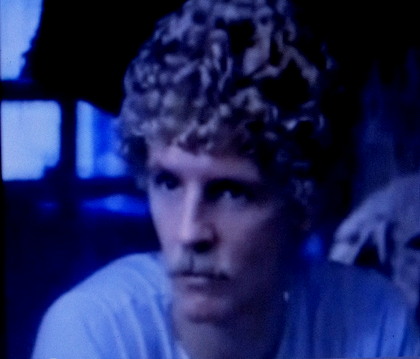
Billy Hayes (1970s) in his 20s. Billy Hayes is currently at the St. Luke’s Theatre in ‘Riding the Midnight Express With Billy Hayes’, written and performed by Billy Hayes, directed by John Gould Rubin.
Riding the Midnight Express With Billy Hayes, written and performed by Billy Hayes and currently at St. Luke’s Theatre, is a profound and illuminating theatrical experience that will leave you uplifted and inspired.
Directed by John Gould Rubin, the production is a reexamination of Hayes’s experiences in Turkey in the 1970s, when he was smuggling hashish, caught, and given a life sentence in a Turkish prison. Some of the gruesome aspects of the story were chronicled in the film Midnight Express.
Many were not. This Off Broadway production sheds a bright light on events the film left out, some harrowing and some magnificent. Though the film was based loosely on Hayes’s book Midnight Express, whole swaths of experience were eliminated and fabrications added. This show is Hayes’ revelation about the full truth of his past and how it influenced his journey into the present.
Since Hayes’s solo performance relates to the film, it is necessary to review why the impact of this one-man show is so vital by comparison. When it was released in 1978, Midnight Express received worldwide acclaim and garnered 16 awards including two for Best Writing (screenplay based on material from another medium) and Best Music (original score). It even received a Golden Globe for Best Picture in the category of Drama. If they didn’t read the book, people believed Oliver Stone’s screenplay. It portrayed Hayes’s rollicking jaunt to Turkey, his arrest, his unjust trial, and his ghoulish nightmare after being sentenced to a life in the abomination of desolation: the Turkish prison. The audience was kept in suspense and horror watching the character’s devolution in prison and his nullifying flirtation with insanity. When Hayes unbelievably escapes, easily walking out into freedom without being seen by anyone, the audience feels tremendous relief that the hell is over and Hayes is free.

Billy Hayes in NYC after he escaped from Turkey.
In Hayes’s live performance we discover that this “walk-out” did not happen, and what did was far more frightening. Indeed, his real escape to freedom took much longer and was a desperate, gripping survival story. As Hayes relates it, we cannot help but be astounded by each miraculous event that, domino-style, brought him closer to freedom. The “walk-out” as presented by the filmmakers was sheer Hollywood gloss and actually a diminution of Hayes’s character, resourcefulness and inner strength.
What particularly makes his one-man show so engrossing and compelling is Hayes‘s natural spontaneity. With his fine acting talents (he is a writer, actor and director), he aptly conveys the full import of and real events relating to his capture, arrest, trial, prison time and incredible escape. What is equally edifying is the discussion of his life afterward and his personal growth as an individual, a social advocate and a culturally dynamic American.

Billy Hayes being interviewed about his current activities as they evolved from his past.
As we watch Hayes deliver his unexpurgated account, we are able to receive it in the entirety of its depth and detail. Unencumbered by any restraints, Hayes finally has free reign. Through his vibrant descriptions and vivid language we understand his thoughts, his unique perspectives; we come to know the mind of Billy Hayes. His performance is one of unbounded clarity. Hayes expresses the soul of an age that is current and ongoing. To say the message is life-giving is an understatement.
As we receive the truth of his presence, the deep issues and themes of freedom, love, enlightenment and growth become more real and heartfelt than what the film ever could convey. Indeed, Hayes understands the essence of his life’s journey. We recognize its vitality and note that it has far-reaching implications for our culture and society today. With great courage Hayes bares his soul and our souls follow, opened to his immeasurable riches of spirit. The film was a mere shadow of what he effects and gives us in this performance over 35 years later.

Billy Hayes and his wife Wendy after the performance, speaking with audience members and signing autographs.
Whether it was intentioned or not, the film was a cautionary tale that delivered lessons about the Muslim world and more specifically, Turkey. First, that Turkey was a brutal country and its prisons cesspits; one should not travel there as a lark to flout the laws. Second, that Turkish justice was no justice.
Considering U.S. politics in the 1970s, the film was a boon for American culture, and Billy Hayes was a hero. The film encouraged a feeling of patriotism (at a time when the culture needed this). Against Turkey and other Muslim countries, it spawned a host of travel warnings for Americans abroad. In its associative portrayal of hashish and marijuana, it was a negative advertisement. Though marijuana and hashish, its concentrated form, were plant-based drugs, un-patentable and used medicinally and recreationally across many cultures for millennia, Nixon’s “war on drugs” (related to Hayes’ prison sentence) sealed their doom. In the Q&A after his performance, Hayes’s commentary about the film’s impact (related to marijuana’s illegality, and many other issues) was fascinating.
Why filmmakers re-characterized Hayes’s experiences in prison, the Turkish court, and especially his escape is up for conjecture. In any case, the reality of what actually occurred as Hayes relates in his solo performance inspires hope, courage and peace. If that message was not politically or culturally efficacious for the time, so be it. But now a new generation of individuals will be exposed to the story. Its truth and its reckoning have finally come. This is a performance not to be missed.
Riding the Midnight Express With Billy Hayes is being presented by Barbara Ligeti with Jeffrey Altshuler and Edmund Gaynes. Co-producers are Jonathan Chang, Jann Cobler, Exodus Broadway and Joseph Trent Siff. The production is running through March 23 at St. Luke’s Theatre on 308 West 46th Street.
This review first appeared on Blogcritics.
‘My Mother Has Four Noses’ by the Amazing Singer/Songwriter Jonatha Brooke

Jonatha Brooke in My Mother Has Four Noses written and performed by Jonatha Brooke, currently at The Duke on 42nd Street. Photo by Pierre Baudet.
Acclaimed singer/songwriter Jonatha Brooke emotionally climbed the mountains of the moon and plummeted to the depths of the abyss after she brought her mother to an apartment in NYC so she could care for her the last two years of her mom’s life. Her mom, published poet Darren Stone, had Alzheimer’s.
As Stone’s identity withered toward invisibility, a multiplicity of beings, characteristic of Alzheimer’s patients, emerged as she physically and mentally recreated herself with each new day. The disease took eminent domain of her mind and body parcel by parcel.
Jonatha and her mom accepted the challenge. They enacted their “greatest show on earth.” It was an all-encompassing adventure filled with drama and comedy, the mundane villains of aging (painful arthritis) and their comedic sidekicks (constipation from pain killers). Their surreal vision and dramatic courage helped pass the time as they worked through obstacles. And somehow together, they “got it all down.” Theirs was performance art which provided the raw material for a show which Jonatha Brooke would perform a year after her mom died.
By the time Stone left this plane, Brooke was ready. Mother and daughter had experienced the sublime end game in all of its beauty and beastliness. Brooke would learn to extirpate the horror of their most intimate and personal moments and keep the humor, longing, love and ethereality. By linking snippets of remembered conversation, exact quotes, and bits of her mom’s poems in a heady mix of narration and song, Brooke symbolizes the finest rhythms of those last two years. These snatches of life, brought to the stage in the one-woman musical My Mother Has Four Noses, are a precious human revelation.
One cannot witness this production, directed by Jeremy B. Cohen, and remain untouched. Brooke’s work helps us recognize and appreciate the poetic rhythms in our own lives and the lives of those dearest to us. She has dug deep into her own empathy to distill the highlights of their mother-daughter love relationship. The potion she creates is readily drinkable and the unique, bittersweet taste lingers. We are better for her gently shaking our consciousness, reminding us that our bodies are mortal. We, too, will one day have to answer the hard questions about who we are and whether we are happy about what we have made ourselves into. We, too, will enact our finality alone or in a drama with others. In her remarkable endeavor, Brooke’s artistry is heartfelt and powerful and there is much you will take away to contemplate.

Darren Stone had four prosthetic noses, one for each season. My Mother Has Four Noses by Jonatha Brooke at The Duke on 42nd Street.
In Brooke’s seminal song “Are You Getting This Down,” the opening number, she reflects how she and her mom came to deal with fleshly mortality through spiritual and electric currents of love, joy and endurance. Brooke settles on shaping the bulk of the production around a motif that streams through both of their lives: her mother’s religious beliefs as a Christian Scientist. In the earlier years it was the bane of their relationship, a major point of disagreement. Jonatha never believed, while her mother remained a staunch follower of the religion which eschews medical interventions.
That refusal is the boulder which shatters Darren Stone again and again and sends her careening to Brooke for help in the crisis created by failing to seek out doctors. Brooke uses the crisis and Christian Science as an overarching metaphor in the production: the salvation which brings no salvation. For example, her mother resorted to the science of prayer in the community of Christian Scientists as she struggled against cancer. When the cancer ate away most of her face, she decided she wanted to survive and elicited Jonatha’s help. The intensive surgeries resulted in multiple reconstructions and prosthetics. Her mom’s life was saved, but her nose was sacrificed during the battle. Hence the title of the production. Indeed, Darren Stone had four noses, as both she and her daughter joked, one for each season.

Acclaimed singer/songwriter Jonatha Brooke in the musical My Mother Has Four Noes at The Duke on 42nd Street. Photo by Pierre Baudet.
During the course of the musical we learn of Darren Stone’s artistic bent as a writer, poet and clown: she used the clown makeup to hide the unsightly cancer. In the mother’s incredible portrait, we see the vibrant picture of the daughter. By the end of the production Darren Stone and Jonatha Brooke merge into one. It is not a coincidence that Jonatha takes a poem her mother wrote in 1950 and adds stanzas that she fashions into “Mom’s Song,” the last song of the performance. The song’s completion is a symbol of resolution. Theirs is a love that requires no atonement for unresolved regrets, but finishes with a “tear and a smile” flourish. It is how Jonatha Brooke is able to nightly perform herself and her mother with joy and poignance and humor.
How does one deal before, during and after taking care of someone who as they daily die before you is a confluence of contradiction: loving and recalcitrant, lucid and foggy, cooperative and fearfully resistant, funny and tragic, a “character,” who enters a daily new normal, someone who wants to die to avoid the pain, yet hold on and live with every ounce of fading strength? How indeed? If we receive the artistry of what Jonatha Brooke offers with her instrumental and vocal expertise and power of storytelling, we have the answer in a near-divine and indomitable love that flows between the lovers out into the audiences’ hearts.
My Mother Has Four Noses is produced by Patrick Rains. Musical Director, Guitar: Ben Butler. Cello: Anja Wood. Orchestrations by Jonatha Brooke and Ben Butler. The production will run at The Duke on 42nd Street until May 4.
This review first appeared on Blogcritics.
‘Sotto Voce,’ Nilo Cruz’s Transformative Spin on the Tragedy of the MS St. Louis

Franca Sofia Barchiesi in the world premiere of Sotto Voce by Nilo Cruz at Theater for the New City until March 9th. Photo by Jonathan Slaff.
When one speaks “sotto voce,” one speaks in a softer, lower tone for emphasis or perhaps to give the impression of an involuntary utterance of truth which may shock or antagonize. Pulitzer Prize-winning playwright Nilo Cruz (Anna in the Tropics, 2003), is revealing great truths through undercurrents and whisperings of poignant and impossible love in the world premiere of Sotto Voce. The play, which he also directed, is being performed at Theater for the New City until March 9.
As the play opens, we hear a foghorn and see two separate scenes that are going on simultaneously, one from the past and one in the present. The scene from the past involves memory and imagination. The scene in the present is of uncompromising reality. In the present we see Bemadette, a the renowned German-born writer, composing her work center stage at her desk in her apartment in New York City. A voiceover narration of Bemadette’s rich and beautiful prose describing the scene she has written makes the prose alive. We see a sister and her brother, the Strausses, walking happily on their way toward the ship they will soon board on their way out of Germany to Cuba. Along with 937 other Jewish refugees they are seeking asylum from Hitler’s Germany. The year is 1939, The ship is the ill-fated SS St. Louis.

L to R: Franca Sofia Barchiesi and Arielle Jacobs in Sotto Voce by Nilo Cruz. Photo by Jonathan Slaff.
The tragedy of the St. Louis is one of the more egregious examples of politics, human profiteering and discrimination involving democratic countries to come out of the pre-WWII years. After the ship made it to the alleged place of asylum, the refugees never were allowed into Cuba. They sought help from Canada and the U.S. but were denied immigration status and turned away. After voyages to the Florida coast and back to Cuba, they were running out of supplies. The ship was forced to return to Europe. Belgium, France, England and Holland agreed to take in the refugees. Of them, 254 died when the European countries were occupied by the Nazis (England excepted). Of these 254, many were sent to the camps. The St. Louis incident is integral to Sotto Voce. How Cruz uses it to evoke wonderful themes about memory, lost love, regret, reconciliation and rebirth is poetic and illuminating.

Andhy Mendez in Sotto Voce by Nilo Cruz, directed by Nilo Cruz. Photo by Jonathan Slaff.
As Cruz develops the play, he intertwines memory, imagination and current reality to tell the story of Bemadette. Her lover was Strauss, who with his sister, were refugees on the St. Louis. Bemadette cannot deal with past regrets about her lover who died in the camps. Her stability and her enjoyment of the present have been warped by pain. When we meet Bemadette (an astounding and emotionally taut performance by Franca Sofia Barchiesi), we recognize she is a dried husk. Guilt has sucked out the choicest portions of her lifeblood. In her attempt to reconcile the past, she writes, but it is poor recompense and she is haunted by nightmares and ghosts.
Then a life-changing event occurs. It helps her expiate the sadness and desolation that has kept her pinned to the past in repeated agonizing remembrances. The catalyst comes in a beautiful form, a Cuban college student, Saquiel (an intense and provocative Andhy Mendez) who has read her writings and who shares a bond with her. His grandfather’s sister was on the St. Louis and was killed in the Holocaust. In seeking out Bemadette, he is looking for his past and wanting to understand the sources of the beauty of her writings and her own history that she would prefer to nullify but cannot.

L to R: Andhy Mendez and Franca Sofia Barchiesi in Sotto Voce by Nilo Cruz at Theater for the New City. Photo by Jonathan Slaff.
An ethereal and platonic relationship via phone and email develops between Bemadette and Saquiel, fueled by an intermediary, Bemadette’s maid Lucila (an excellent Arielle Jacobs). The student and the writer help one another, even though they do not physically see each other but instead imagine they are together. It is through their loving, healthful relationship and their probing discussions that we discover the mysteries of Bemadette’s horrific regrets and misery about her Jewish lover. It is through Saquiel’s perseverance, love and appreciation of Bemadette’s artistry and history that she is able to reconcile her memories with the present realities. By the play’s conclusion Saquiel and Bemadette are transported to a new understanding of themselves and what they are willing to sacrifice to gain peace and hope.
In Sotto Voce Nilo Cruz has created a sumptuous work of art, integrating poetic forms within the structure of the plot to fuel the dialogue and characterizations. He does this with beauty and grace that convey a wistfulness and longing for health and wholeness which both characters are on their way to achieving by the play’s end. Most importantly, Cruz reminds us of the power of human relationships to heal. It is a power that transcends the limitations of time and space and age differences. If it is allowed to develop and grow, one may receive the energy to create new dreams to replace those lost to time and regret.
Sotto Voce was performed in a limited run at Theater for the New City.
This review first appeared on Blogcritics.

