Anika Noni Rose in ‘The Balusters’ a Funny, Brilliant Take-down of the Upwardly Mobile
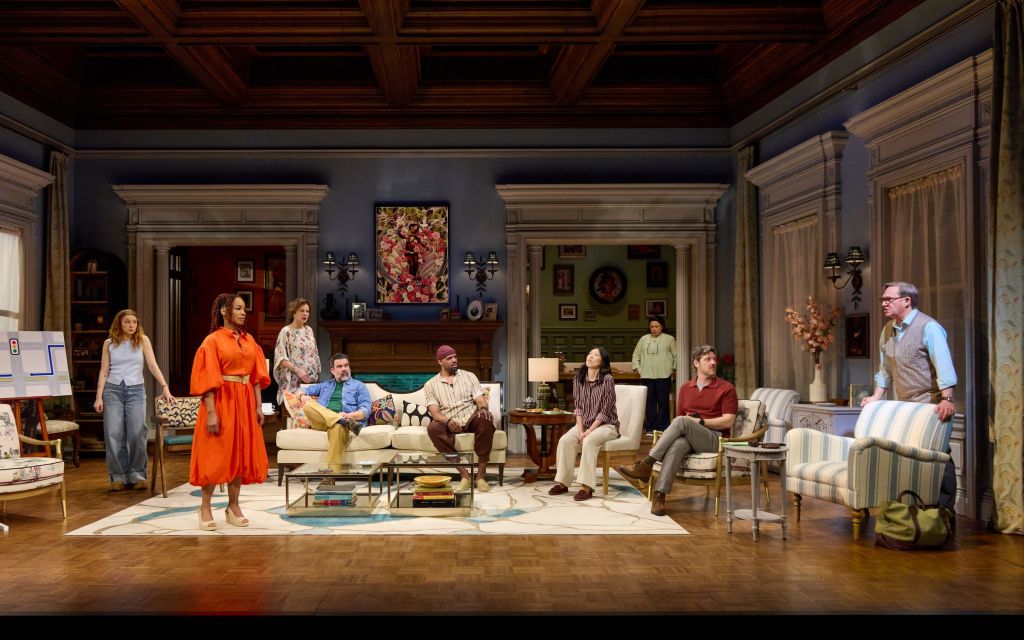
If every accusation is a projection and people’s duplicity comes out under pressure, David Lindsay-Abaire constructs characters that wear “their truth” on their unwashed sleeves, as they unite together to protect their exclusive, land marked section of town which is a protected island that abuts the housing projects nearby. The LOL world premiere comedy The Balusters, directed expertly by Kenny Leon sports a title that refers to an upright vertical, molded form which provides foundational support in architectural features. This comedy with several points about our history and culture and the hypocrisy that keeps it bolstered runs at the Manhattan Theatre Club through May 24, 2026.
Initially, the topic of balusters is brought up by President Elliot Emerson (the superb Richard Thomas), during the Vernon Point Neighborhood Association Board meeting when he shares that a neighbor is using inferior balusters not up to the grade to maintain the historic look of their land-marked community.
Microcosms of political manipulation are everywhere USA. They are perhaps nowhere more evident than in school boards and neighborhood associations. And they are as plain as day in The Balusters for our delight, as Lindsay-Abaire sets us up to laugh at ourselves. The setting is in Vernon Point, a community whose land-marked homes on the esplanade are gorgeous Queen Annes and other Victorians. The historic styles landscaped with trees, lawns and acreages that are pricey, must abide by the architectural features, materials and design of the period of their first construction. Additionally, like many communities in the US which support institutional racism via redlining and zoning laws, Vernon Point most probably has a zoning acreage limit whose pricier real estate keeps out the “riff raff.”
In other words, purchasing a home in this enclave upholds housing discrimination, one of the most egregious forms of discrimination, regardless of the handful of diverse individuals who may live there. To live there especially if one is DEI is particularly, problematically hypocritical. But doesn’t everyone want to achieve the American Dream, especially if it vaults one into upper class heights? The dream is as flawed as the 9 individuals of the neighborhood association who live there to keep it in place. How can anyone move ahead contentedly, if most have been left behind?
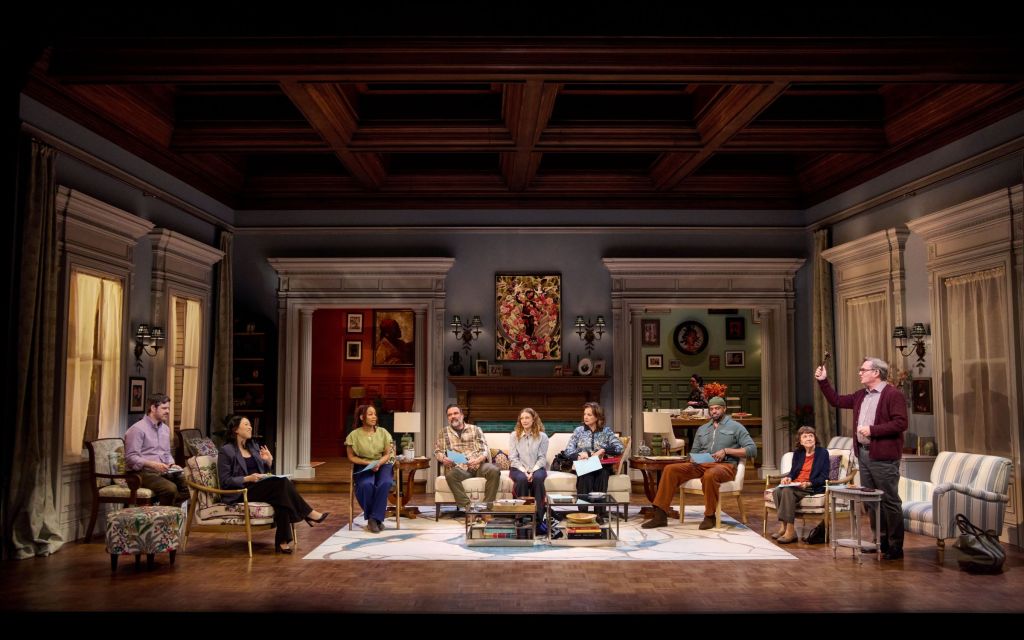
Issues are nuanced at the top of he play as the Venon Point Neighborhood Association Board meeting gets underway, gaveled in by Thomas’ Elliot, the patriarch and gatekeeper of community sanctity. A master of portraying the “hail fellow well met” poseur, Thomas’ folksy, warm, congenial, open-hearted mien belies the negatives we discover about him later in the play. Elliot is assiduous about the esplanade homes’ historic preservation. As the group settles in he discusses his ire at the previous owner of Kyra Marshall’s house which is where the VPNAB meeting is held. Kyra (the wonderful Anika Noni Rose) volunteers to host the meeting, she tells Luz her housekeeper, to establish herself and fit in. As Elliot goes on about Dr. Klein, the previous owner who put ugly aluminum siding on the exterior two months before the homes were land-marked forty-years prior, we realize he is obviously glad that Kyra had it pulled down, restoring the house’s former glory.
Like the community she wishes to fit into, Noni Rose’s Kyra, favors the old styles like Elliot Emerson. Her assiduous attention to living well is evident in her gorgeously appointed, color-coordinated living room and adjoining foyer and dining room, whose table is perennially set with fine china and stemware as most upper middle class owners often do. Derek McLane’s scenic design speaks volumes and symbolizes the director’s thematic vision for The Balusters, as does Emilio Sosa’s costume design which dresses Kyra in attire that is tasteful, appropriate and colorful, and the others in relaxed casual wear. Interestingly, the lighting during scene changes gyrates to mesmerize the audience to focus on the painting of a Black woman surrounded by flowers that turns garish under the striking lighting (Allen Lee Hughes). And Dan Moses Schreier original music and playlist loudly proclaims the themes as a stark warning. Are we listening; are we seeing the nuances?
The restored shingles may have been the sub rosa reason why real estate broker Elliot sold Kyra (a forty-something Black woman with a family), the house which she can easily afford. However Melissa (Jenna Yi), an Asian friend of Kyra’s lives there, and Kyra mentions that along with safety and beauty, the diversity of the community is why she chose Vernon Point. The VPNAB represents a picture-perfect model of diversity that is laughable with most genders and most races represented. In effect this community has achieved a type of admirable perfection on the surface, but as Margaret Colin’s edgy, raw mouthed and sardonic Ruth Ackerman suggests, it is far from perfect. And during the course of the play through various meetings, we find out how imperfect Vernon Point and its inhabitants of houses, as land-marked as the Victorians, don’t want to budge from their positions to change things.
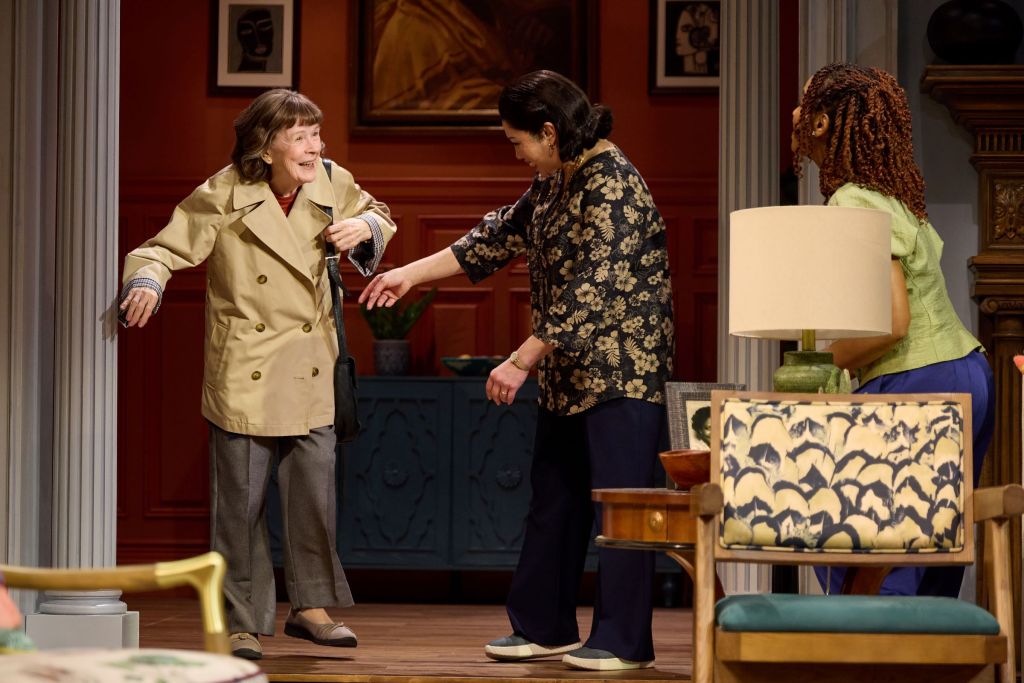
Newbe Kyra isn’t like the others in some aspects. But in other aspects she is just like them and even becomes their “queen.”
The familiar friends, neighbors, and board members push each other’s buttons as they tussle over items which arise concerning safety vs. maintaining the integrity of the historic preservation which of course keeps housing prices higher. Kyra raises a key safety issue about putting up a stop sign because cars speed past a corner and crash into each other at least once a week. This becomes the conflict that moves the play forward creating tension between Elliot and Kyra which gathers momentum as members take sides, research is done and facts are presented to support Kyra’s imperative. Yet, Thomas’ Elliot is eloquent in his arguments against putting up signs which will ruin the picturesque and beautiful esplanade which is becoming a “one-of-a-kind” setting as modernization and commercialization reconfigure the culture of the country, and not in a good way.
The disparity of who the members present themselves to be, and who they are, clarifies by the conclusion with great humor. Nuanced funny insults are swapped as a means of leveraging arguments. Clearly, some egos are obvious like Isaac Rosario (Ricardo Chavira), who protects his construction workers but only to jawbone that they don’t steal packages or do shoddy work, while he pays them less than what they are worth. Mark Esper’s Alan Kirby feels put upon and interrupted by LGBTQ Willow (Kayli Carter). Willow’s PETA stance and ethos rankle both him and Colin’s Ackerman who intentionally flaunts her rabbit coat to Willow to provoke a comment. Brooks Duncan (Carl Clemons-Hopkins) drums the race card in a subtle way while bestowing nuanced racial animus toward a Muslim business owner. Lindsay-Abaire turns this on its head and has someone reveal what is really going on related to Duncan’s male partner. The result is riotous.
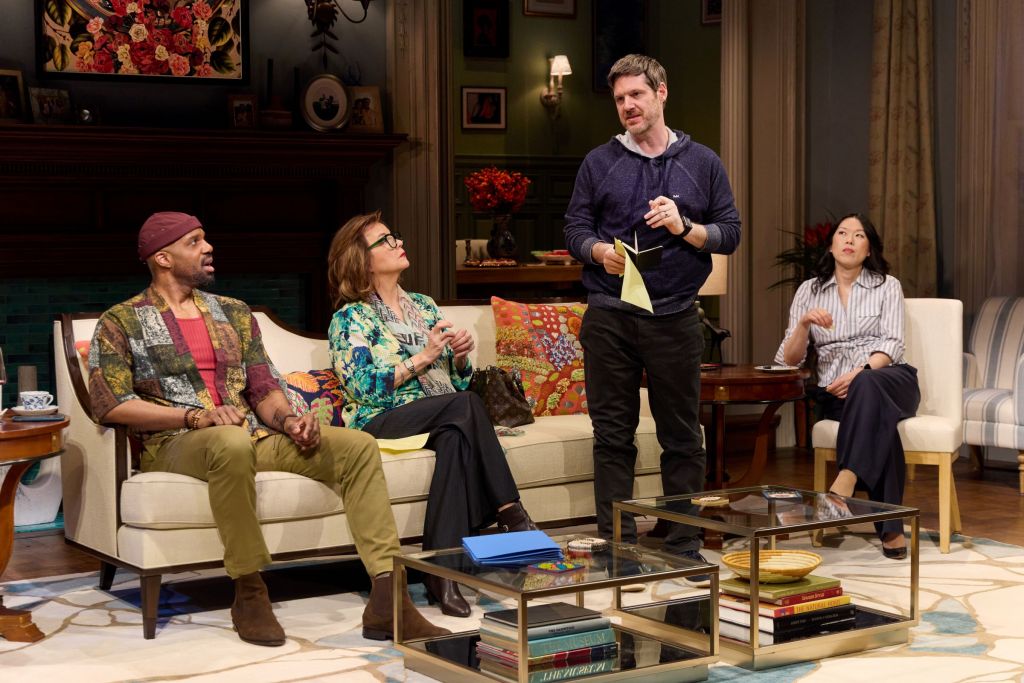
When one in the group is injured in a “crash” as Kyra predicted, the stakes go through the roof and we are shocked at the results which occur at an explosive meeting. Once more events turn the characters upside down in their reveals, especially the clever Elliot and the subtle Kyra caught, like the others, in their own hypocrisies and conflicts of interest.
The one-offs and jokes are plentiful. And Marylouise Burke, as always is a shining light with superb timing and adorableness. When she speaks for decency later in the play, the theme rings loudly and clearly through her, as it does through Maria-Christina Oliveras’ Luz whose spilling the beans on Elliot is only topped by her quiet, underplayed comment about Kyra.
At the conclusion we realize that the playwright also selected the title as a symbol to call out foundational institutions, thought patterns and stereotypes which support a way of life that is entrenched in inequality. This is so, despite each of the characters’ assumptions that adhering to political correctness ends stereotypes and indecent behavior that attacks individuals for elements they have no control over (ethnicity, race, gender, age). Whether used or ridiculed, PC is a blind that deflects from dealing with institutional inequities. Cleverly, Lindsay-Abaire takes swipes at everything, especially cultural hypocrisy and human fallibility at not recognizing it. He reveals that decency can’t be shamed or forced upon others, and the use of political correctness as a weapon and ready bludgeon to defend oneself, also is used to deflect and cover a multitude of secret agendas to gain power and influence unjustly and inequitably. Regardless of political party, regardless of using it to act like an example of correctness, it is meaningless because the true intent behind its facade is real, dangerous and corrupt.
The Balusters runs 1 hour 50 minutes with no intermission at the Friedman Theater through May 24. manhattantheatreclub.com.

Posted on April 24, 2026, in Broadway and tagged Anika Noni Rose, Carl Clemons-Hopkins, David Lindsay-Abaire, Jeena Yi, Kayli Carter, Margaret Coli, Marylouise Burke, Michal Esper, Ricardo Chavira, Richard Thomas. Bookmark the permalink. Leave a comment.
 CAROLE DI TOSTI
Leave a comment
Comments 0