Category Archives: NYC Theater Reviews
Broadway,

Grace on Broadway with Paul Rudd, Ed Asner, Michael Shannon
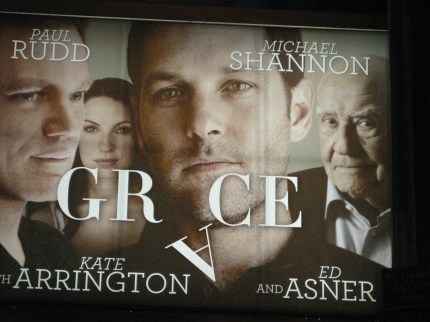 If you are an atheist, an agnostic, you despise so-called religious Republicans who are actually hypocrites, are intellectually gifted or are a native New Yorker, run to see Craig Wright’s play Grace, now at the Cort Theater. If you deem yourself a true follower of Christ spiritually (anti the political religious right) the play will resonate with you to a point and then, perhaps, as it did for me, it might skew off into a spiritual Neverland, making you wonder if the twisted logic was the playwright’s intent or his attempt to enliven the theatrical experience and create an uber-drama. Either way, the play, for me, became hyperbolic contrivance which made the ending/beginning/ending diminish the suspense and realism and crimped the development and emotional power of the characters and their relationships.
Steve (Paul Rudd) is a Christian who with Sara, his Christian wife (Kate Arrington) have moved to Florida where Steve is waiting to manifest the financial arrangements for a deal he has made with an investor. As the play unfolds, we see the relationship between loving husband and wife that appears to be perfect grows a few developing wrinkles as Steve waits for the financing to come through and Sara is left alone to her own devices which include becoming friendly with car accident disfigured, next door condo neighbor, Sam. Thrown into the mix for good pleasure is the friendly German exterminator guy, an unrecognizable (the audience didn’t applaud him when he entered as they did Rudd because he WAS THE CHARACTER and not Ed Asner) absolutely flawless Ed Asner as naturalized American citizen, Karl.
Steve’s success with his marriage and his relationship with Sara unravels as his business plans explode his dreams. He confronts a financial meltdown, litigation and loss of his wife. At the worst possible moment, Sara tells Steve she is leaving him for Sam because she and Sam love each other. During the build up to the crisis, there are critical lightening flashes and the actors freeze momentarily. These are pivotal moments where events could have gone differently, the playwright suggests, yet they did not because of…whatever: grace? lack of grace? the characters’ choices? Does it matter? These breaks “da da” add to the play’s pretension and reveal a muddled and unclear flirtation with theme that never blossoms into a true relationship What we should see and don’t is that the permutations of choices for the characters are innumerable, but the plot feels so fixed and artificial that the lightening flashes/turning points are woefully weak. They actually detract from the play’s import.
This is partly due to the playwright’s choice to begin the play at the end which diffuses curiosity and engagement and the suspense that the actors with their superb talents manage to create. The play’s construction as it stands is faulty because the playwright begins at a conventional high point and turns it on its head, making it a low point with Steve’s shooting himself at the outset. Why does the playwright begin with the ending? This is not Pinter’s Betrayal, a seamlessly constructed play which used the same contrivance of chronological event reversal with great subtly and integration of theme. Grace‘s chronological event reversal, then move to flashback and forward movement of events doesn’t really work with the thematic structure given the content. The obfuscation for the sake of clarity boggles. Is this or isn’t this the playwright’s comprehension of grace/lack of grace unfolding from missed opportunities and poor decisions?
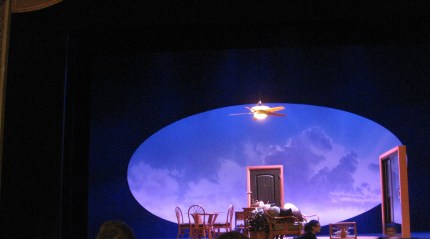
What continues after Steve’s opening suicide is a sort of cinematic reversal backwards. Rudd as Steve takes backward steps. The plot reverses the thread to Rudd/Steve shooting Sara which happened a minute before his own suicide. Then Rudd/Steve and Sara (Kate Arrington) literally step backward and next we see Steve shoot Sam which happened a minute before he shot Sara. Again, there are lightening flashes and character freezes and the stage darkens and the setting moves to a month or so prior. Now we are in a present moving flashback construct designed to show us what events occurred to lead to these three deaths. From then on, the action is forward and linear and we see how Steve and the others spun out of control in a series of pathetic events where they act upon each other to create their own dance of death. Even the hapless, atheistic Karl falls prey to Rudd’s graceless shooting spree at the moment when Karl is perhaps open to receiving grace, ready to believe after experiencing what is tantamount to a miraculous redemptive action, that, if not God, “there may be something” that caused the action. So Karl, too, ends up melodramatically dead. However, the flashback thread leaves off at the juncture where Steve/Rudd is pointing the gun. We know what follows. We have already seen it in the play’s opening. Despite our longing for a deus ex machina or Godly intervention to stay Steve’s mania for vengeance and an end to his faithless hopelessness, no one here receives grace. They die. (We don’t know if neighbors reported the shots, called 911 and in the intervening half hour three were saved. We do know that Rudd/Steve, who pointed the gun to his head is certainly dead.)
When thinking about grace and attempting to understand such a complicated concept, I am reminded of the brilliant film Nights of Cabiria. The character of Cabiria at the film’s end has experienced terrible treatment at the hands of fate or God. The man who was to marry her has robbed her and was going to kill her, though he does not, though she begs for death. Instead he leaves her alone with her utter shame and hopelessness. Destitute, alone as a former prostitute, she has nothing to fall back on, no family, education, nothing. She considers suicide, but something within her retreats: the mystery occurs. She receives the grace not to end her life, though she has every reason to do so. As she walks to who knows where in a dark wood, she comes across young people who are dancing, singing and celebrating a birthday. Through her tears, she receives whatever it is, grace (?) to smile and join them at their invitation. She is, her life is and we know she has received the grace to make it to the next day and the next and the next. Wow! No religious overtones, no religious sentiment, but you get it and you understand the human condition perfectly.
Frankly, I found if very hard to understand the playwright’s portrayal of Steve’s faith and Christianity connected with the lack of grace bestowed at the play’s beginning/end. I certainly cannot argue that his shootings and suicide have taken them all to a better world. That is not manifest in the play. The characterization of Steve is a conundrum of illogic. The irrationality a facile, thin and overused point of character taken from the mold of three decades of violent acts from Steven King’s villains. This is a mash, a combination of pedantic stereotyping of what liberals think the religious right are capable of and what their Christianity is all about.
Unfortunately, that’s too superficial, too pat and the stereotype too obvious and contrived. The dire warning fits into a precast mold. The characters’ “Christianity” is a glaring fault of the play upon which everything hinges. It didn’t have to be. Why include it? The playwright has given the logic for Steve, the everyman, to commit suicide: wife leaving him, business dreams destroyed, money robbed, defrauded by his own naive actions which were prompted by “faith,” facing litigation and the possibility of jail. He faces complete ruination. It’s enough to suicide the mildest of men. What the playwright has thrown into the mix is that fundamental Christians think “this isn’t supposed to happen to a person of faith.” Yet when it does and grace doesn’t come through, nor God, nor love, nor anything redemptive, he-Steve can’t handle it and exacts his revenge. His “faith” all along was a crutch, insincere or his killer nature buried by his “faith” surfaces. Enter the wacko religious mother in Carrie; enter the murderous religious villains whose “Christianity” has set them off to kill. It’s an atheist’s wet dream that not only is there no God, but the no God really sucks at being a no God. Well, somehow, this is all too obviously constructed for effect and it smells of the paint of too much puppet master and not with the apparent seamlessness of brilliant writing.
Because the characterization of Steve is so flawed, all the more magnificent praise goes to Paul Rudd, who with his SHEER GENIUS of talent and skill makes this wooden stereotype real, likable and amiable. Paul Rudd, courageously took on a part with so many holes, yet fills them up with back story and rationale to convey the character’s vitality. He makes what is nearly impossible, possible; he makes believable the character’s preaching and living his faith. Rudd portrays Steve’s belief his relationship with Sara lovingly yet with an undercurrent of fear. With great realism he portrays Steve’s belief in God and his hope. And Rudd “keeps the faith” until events spiral beyond his control, and we get to see Rudd’s brilliance as he spools down the character’s faith, sanity and hope. Of course, he is helped by the acting marvels of the rest of the cast, Asner, Shannon and Arrington who are all terrific. They make the play. If not for them and the director, Dexter Bullard, HELP ME JESUS!!!
Again, whether it is the fault of the plot which forces Rudd to leap to a tailspin downward, or how the character of Sara is drawn to skew precipitously downward in concerted contrivance, or the scene leading up to the shooting…these especially just didn’t make sense to me given the context of Christian faith (which is so paper thin here…that only Rudd’s in the moment breathing onstage makes it alive). And it is not enough to say that violence doesn’t make sense because it does. The playwright has stacked the deck to make sure that as everyman, Steve, has good cause to kill himself and his wife and everyone in his surroundings, regardless of whether he is angry at God or he just snapped. Except he is a Christian, and a serious one at that. He spouts off heavy spiritual montages in his urgency to convert or at least jangle the sensibilities of Karl and Sam toward faith. This incongruence between these speeches and his final actions echoes badly. It rings false. And that is an uber problem that the playwright never resolves in Steve’s characterization.
At the crux of the problem to me appears to be the playwright’s understanding of God, Christianity and the nature of the conversion that has happened to Steve and Sara. It is twisted and opaque to the point that the characters wander in the plot. The convolution is not in what they believe, but in that they were drawn incompletely to fit mechanisms in a contrivance. Da, da. Drum roll, “These are the wacked Christians.” It is OK to show wacked Christians. But for a writer to be pretentious, obvious and illogical about it is doing one’s craft a disservice. I certainly did not think that their faith as portrayed was at fault or insincere. In fact it was because of their sincerity of faith that I found the ending events written for “tragic” effect. It was a rush to create the spectacle of violence that led me to think that not only did the playwright not dig concepts of faith, spiritual conversion, the whole nine yards, he rendered it to fit his own notions. Unfortunately, the play suffers hugely, the characterizations are wobbly and illogical: Steve is a pathetic stereotype and his formerly timid wife, suddenly and within a month’s time, turns into a freewheeling, directed, courageous woman who renounces her vows and leaves Steve for Sam free of guilt, fear or self-reproach. This is rather a huge stretch, “Saaay what?”
Well, anyway, many in the audience should enjoy the characterizations because they easily fit into stereotypes. The obfuscation of faith, conversion and spiritual Christianity is so skewed and unclear, it will continue to promote the average audience member’s lack of understanding of Christianity/spiritual conversion, faith, agape love, etc. (See my opening sentence.) It is a boon for anyone who has a hatchet on for the Christian religion, is an agnostic or has had a few terrible run ins with hypocritical religionists and political religionists who are staunchly religious for purely monetary reasons.
Thank God for great direction. Thank God for brilliant performances by genius actors. That is GRACE, indeed! I so appreciated the efforts of Rudd, Asner, Shannon and Arrington who is lovely. She made real how she fell for Sam, even though I didn’t understand how she had the courage to leave Steve in a month’s time. Arrington, a magician, made me overlook that tremendous flaw in the play. The other actors’ logic and humanism made me over look the stumbling script. I knew Rudd, Asner and Shannon were absolutely great actors. I just didn’t know how great until I saw how they could take a play and characters that are ill conceived and create gems of life. Bravo to the cast and the director. You are truly masters of the craft! There is no praise great enough for the cast’s work and the director’s in how they transformed a lackluster, convulsed script into memorable theater. I will remember the phenomenal acting and direction. The play? Jesus H. Christ. It is forgettable. Do I sound confused? 😉
CQ/CX
 Imagine your writing career is about to take off. You’ve interned at the New York Times and by some straight miracle that you have helped to manipulate, you land a job there. You are ecstatic. But also imagine that you have a few character flaws you ignore. You lack focus; you are ambitious without the required determination and discipline to accomplish your goals; you are incapable of dealing with high pressured stress; you seek out “coping mechanisms” which encourage addictive, annihilating behaviors in the name of “dealing.” Perhaps this could describe any one of us during a period in our lives when we were in transition and were unable to self-correct. In CQ/CX* (which completed its run at the Atlantic Theater Company) it describes the personality of Jay Bennett, an intern who lands the prestigious job at The New York Times, then proceeds to blow up his life and career because of sloppy carelessness fueled by an indulgent penchant for alcohol, cocaine and self-destruction.
From the point we meet the character Jay Bennett as an intern, to the play’s conclusion after he has impaled himself and his two editors on the sword of fraud and plagiarism (cardinal sins of reportage) we painfully absorb the truth that an individual’s decline often carries with it many pivotal declensions that can either lead toward opportunity, or initiate doom. In Bennett’s case it is the latter: we watch silent and stunned as the miserable twine of the knave’s life unravels, becomes a scrawny tendril then breaks with the weight of error, plummeting the self-vicitimizer into the abyss of no return. And we come away understanding how someone, who is potentially addicted to failure can lure others into a web of deceit, despite their own better judgment.
Gabe McKinley’s writing is vital. Having served as a journalist for the New York Times, he witnessed the plagiarism incident of Jayson Blair, the disgraced journalist the play loosely is based on. By the time McKinley left the paper, accomplished a year’s research and wrote the play, he had sifted the events and dramatic energy of the individuals, creating characters, some composites, and others loosely based upon the major players (Blair). Then he created the arc of events that led up to the plagiarism and its impact. The result is a newsroom landscape peppered with complexity, humor and pathos. Integral to McKinley’s backdrop is his concentration on the Times as a renown institution facing this doomsday scenario: crumbling old media empire hobbles light years behind the new media reformation. McKinley reveals the extent to which these circumstances may have impacted how Bennett/Blair tweaked and exploited the editors’ and owner’s desire-concern to be trending and competitive.
Though we know the inevitable, we are engaged as events and characterizations unfold. Partly due to the excellent direction by David Leveaux and the ensemble acting, which remained moderated between tension and argument, McKinley reveals that in this institution, as in all institutions that have preceded themselves, there are those wise Cassandras who see potential disaster. And they are ignored as the “forward thinking” view preempts. So though we ironically have been warned the train wreck will occur, we draw close, interested in understanding the how and the why. Though we might not have worked in similar circumstances, we do know such problem scenarios and there is always the question, “Where did the players/me/my family go wrong?” McKinley provides answers, but they are not paramount. One must dig beyond the superficial and obvious reasons why this young reporter with problems was able to manipulate experienced editors who, themselves, didn’t check the facts (relates to the title) but took an expedient route.
The play’s message is prophetic: its warnings for readers and writers alike, emphatic (if one has the ears to hear and the eyes to see). There is a danger of trusting institutions which ride on the coattails of their former reputations. Independent internet news, social networking and the changing virtual paradigm have shifted news reporting away from the ethos of group think characteristic of large, venerated, news organizations. In a number of instances bloggers, writers, free lance journalists and professional experts in their fields have trumped such organizations with in-depth online pieces that have gone viral, eliciting a new meaning to the words, “breaking news.” This medium of independent online reporting has taken a pick axe to traditional media. In the past information might never have been revealed because of loyalties, cronyism and paternalistic decisions. Decisions not to report information were justified by such capstone logic that not reporting was for “the good of the country,” when in fact not reporting was blatant cover-up and protection of systems and individuals. In the past news institutions were hand maidens of politicians, governments and corporations, and few suspected this was the case. Only those on the inside had the power to know. Only they were well networked to keep the known, unknown.
The play shows the extent to which traditional media still clings to the “old way of doing things,” a dinosaur incapable of seeing its inevitable extinction. Couple this with the dumbing down of broadcast news to sound bytes as entertainment, overall, old institutional investigative reporting has become less and less substantive. The mastheads of ethical news tradition have been supplanted with the meaningless but urgent need to “get the story out,” to keep current and competitive with like organizations. And this is the ready made environment for someone like a Jay Bennett/Blair who can enter in and tell lie upon lie and weave deceit upon deceit while experienced editors, if they picked it up, didn’t put their foot down. In such circumstances how can INSTITUTIONAL INVESTIGATIVE JOURNALISM IN A FREE AND OPEN SOCIETY function, survive and grow stronger?
After rethinking McKinley’s work, it was evident to me that the playwight poses another underlying question for us in this virtual age of Youtube and social media and virtual exposure of lies. Do editors working for institutional new organizations prize reporters’ expertise and willingness to ask the difficult questions and give them the time to commit to the true investigations? Do editors encourage reporters after interviews to really “CQ/CX:” look for contradictions, half-truths and omissions and double check other sources against the first source? A lie is a lie and its exposure as a lie is substantive investigative reporting. To what extent are old media editors and owners encouraging their reporters to expose lies by those in power? Online sites are replete with information which contradicts and trumps institutional media news organizations that do expose lies by those in power. Shouldn’t traditional media do the same?
The plays suggests that The New York Times is an institution which may not be digging deeper, going farther, investigating, investigating, investigating. Lies have passed through (and still do, i.e. Dolores Kearns Goodwin, et. al) and because of this inconsistency, is it any wonder that a Blair/Bennett and others may audaciously crank out the falsehoods and get away it HOW MANY TIMES if no one calls them on it??? Certainly, some of the trusting New York Times readership do not know and rarely suspect this could occur. For some, the prestigious masthead is enough and because this paper said it, it must be so. The Times, according to the play, has encouraged such readership pretensions and coasted on its venerability. But this is not good enough. It needs an overhaul and thorough CQ/CX!
For when one considers the seriousness of lies and their acceptance, what is the fallout of such deterioration of fact checking for investigative journalism on the world stage? Where was investigative journalism on the WMD (weaspons of mass destruction) that were supposed to be one of the causes for going to war in Iraq? Political figures have sold themselves as experts and that has been enough validity for traditional reportage, when in fact, the individuals were sharing opinions not facts, spinning spin and there was no fact checking from “investigative” reporters/editors who didn’t ask the difficult questions. Reporters supported by editors took quotes and wrote stories without really dealing with the substance BEHIND the quotes to note the gaps, the contradictions, the half-truths, the omissions. And indeed, the play brings us to this last overriding question: to what extent were these large news organizations, representative old media, ever true exponents of a free press that was reliable, trustworthy and accurate AND NOT THE HAND MAIDEN OF POLITICAL AND CORPORATE INTEREST? Indeed how long has there been an unreliability with regard to CQ/CX; perhaps the Bennett/Blair incident is just the inevitable implosion of systemic corruption which has been happening for decades, a kind of “Decline and fall of the Roman Empire” cum old media?
This is the undercurrent of McKinley’s work and some may miss it if they are looking at the obvious. But then they are in good company. They are just like Jay Bennett’s editors who ended up having to resign because they didn’t dig deeper; they accepted what was expedient and they trusted the rightness of their own judgment in a wallow of group think instead of doing their own CQ/CX.
Though the play’s run is finished in New York, we certainly haven’t seen the last of its performance elsewhere. The subject is a timely one and as more episodes of fact checking problems arise, the play will surely carry legs in other areas of the country. Indeed, they may even be looking into its eventually going uptown New York closer to Broadway in the future.
McKinley: They’re both shorthand used during fact-checking at the Times. Editors would use CQ — an abbreviation for the Latin term Cadit Quaestio, meaning “question falls” — if a statement was correct. CX is shorthand for corrections, if something was false.
Galileo

We all are enamored of the astronomer/physicist who defied the Catholic church for a season, and though it was heresy taught that the earth was not the center of the solar system/universe, but that our sun was. F. Murray Abraham famed Academy Award winner for Amadeus and acclaimed Shylock in last year’s Classic Stage Company’s Merchant of Venice must have been enamored of Galileo as well because he plays the man with empathy and brilliance.
It is interesting that the director Brian Kulick and the company have chosen the Charles Laughton, Bertol Brecht collaborative translation of Brecht’s play Galileo. The director states that it was chosen in part because in 1947 when the play was premiered in Hollywood and had a brief later run on Broadway, this translation was meaningful in light of the nuclear age ushered in upon the world stage after Fat Man and Little Boy were dropped on Hiroshima and Nagasaki. The inevitable interplay on science’s impact on the culture was something that Brecht wrote as a concern of Galileo, how men would use the truth of science. It is a theme that artists and writers like Ray Bradbury and other science fiction writers and filmmakers have taken up again and again, even in works like Alien and Kubrick’s 2001 A Space Odyssey.
But Brecht’s version playing at the Classic Stage Company which has none of Brecht’s later additions about Galileo and the church resonates for us in its themes about the inflexibility of changing with the nature of truth, and the nature of truth itself being shaped by culture, history and expediency. Galileo’s life is picked up at the point when he is living with his daughter and is tutoring wealthy sons of land owners. Brecht clearly makes the point that one of Galileo’s foibles was his flesh, his enjoying life and eating and wine. And of course, this is the hook later in the play providing the rationale why Galileo was not the martyr that many “heretics” were at the time when he ran afoul of the Inquisition in teaching his truths and proofs about the motion of the spheres, teachings which some of the cardinals, themselves, acknowledged as accurate.
No, Galileo was not a martyr. He caved. And F. Murray Abraham imbues this fleshly hero with an empathy we can all understand. Would we not do the same as he? Who of us would perish for some scribblings that may or may not be used to enhance mankind at some future date. No. Galileo will recant and not burn. He enjoys his wine. His flesh is weak and if the truth burns instead of him? Then, at least he will be able to get to his next meal and glass of wine, enjoying its taste.
But the price he pays brings a skein of bitterness, rejection of his students (interesting that they do not offer to burn with him for receiving the blasphemous teachings) the daily remembrance of his cowardice for his papers have been confiscated, and he must cope with the permanent guest in his house who guards him from writing anything down. So our genius is imprisoned in his home and his mind, unable to further any of his discoveries.
I do not advocate spoilers. So you won’t read what happens here. Get a copy of the play. Brecht is a brilliant playwright, though this might not be his most superlative play. (Mother Courage and Her Children is better.) Don’t count on seeing this version. If you have connections, perhaps you will be able to get a ticket, though it will be difficult unless you know the director or F. Murray Abraham. The performance is completely sold out.
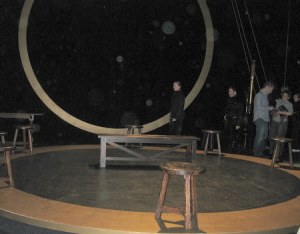
I would have loved to go again, but I’ll just have to remember, rereading this review, how splendid the supporting cast was and how human and alive F. Murray Abraham’s performance was. The circular stage, a sphere, naturally and the globes of the solar system hanging from the ceiling were an effective backdrop to the action of man at the center of the universe. It was only until Galileo’s discourses were noted far and wide that man was no longer front and center and the Age of Enlightenment propelled the sun to the center and knowledge, science and a different kind of truth began spinning outward farther and farther into space and time.
I couldn’t recommend this production enough. I do think that at some point other versions of Brecht’s Galileo will be picked up by other prodigious actors, who like a challenge and enjoy the thought that they can step into the cloak and mien of one of the most illustrious, brilliant and flawed of scientists, making us actually happy that he did not, like so many others fall into the loathsome clutches of the nefarious Inquisition.
By the way, it is interesting to note that Galileo in all his science believes in God and is God’s man. Only the truly brilliant, the ineffably brilliant are able to reconcile science and God, bringing them together in complement, not stretching them from one end of the universe to the other (That is a joke; the universe has no end…and maybe no beginning, since no one was around to observe the Big Bang. It’s a theory.)
To that effect and because I was inspired by the play and F. Murray Abraham’s performance, I did write a sonnet to celebrate.

