Category Archives: Off Broadway
‘Thom Pain (Based on Nothing),’ Starring Michael C. Hall, an Existential Crisis With Humor

Michael C. Hall in ‘Thom Pain (Based on Nothing),’ by Will Eno, directed by Oliver Butler (Joan Marcus)
Playwright Will Eno’s one-man show Thom Pain (based on nothing) flies any way you like it. Surely, this depends upon that day’s audience’s intellect and responses. Indeed, one focus of the production entails the shared consciousness between Thom Pain and his listeners. Layered, multi-dimensional, this ethereal communication blossoms in the world created between the audience and Michael C. Hall as Thom. Reflecting upon this daunting effort comes a startling idea. This consciousness creation captivates beyond knowing every performance is different because it is live.
The portrayal of Thom Pain in the hands of Hall shepherded by Oliver Butler makes this production live theater on steroids. Hall’s very present performance magnifies each moment. The impact is powerful. Indeed, Hall’s Pain with subtle humor plows into the sardonic and tragic-comic furrows of our own humanity. He does this through contradictory impulses. On the one hand, as Thom he attempts to suppress his feelings and “manage them.” On the other hand he feels compelled to express/expurgate what makes him and all of us human: feelings of hurt. We understand the tense conflict between the compulsion to reveal and the desire to suppress. Daily, we accomplish this with friends, acquaintances, and ourselves, whether we admit it or not.

Michael C. Hall in ‘Thom Pain (Based on Nothing),’ by Will Eno, directed by Oliver Butler (Joan Marcus)
By extension these apparent contradictions in Thom create the tautness we feel when he pauses or pointedly addresses us by the royal “you.” Hence, we identify with his inner conflict to express and repress. Also, the tension helps to create immediacy. For Thom tells us whatever he wishes with urgent authenticity. And his suppressed pain guides his childhood revelations. Is he conscious of his suppressed pain? Certainly, it evidences in his demeanor, hesitations, attempts at humor, and need to talk to us.
Directed with a stark relevance and clever re-imagining, Oliver Butler spins out Eno’s irreverent, perplexing, Beckett-like piece. Thom’s ramblings move into places that settle on topics with uncertain happenstance, like the flight and landing of a wary sparrow. And then Eno, Hall, and Butler spiral the piece in a completely different direction. This is a superlative plot twist, as if a sparrow startled itself unexpectedly, then rapidly skedaddled.
Notably, Thom often redirects back to us. He puts us “on the line” for examination and a silent or vocal refrain as he confesses his observations about his life. At one point during this audience-participatory moment, an individual did respond orally when Hall’s Thom asked for a volunteer. The individual commented about a time he volunteered to go on stage during a Spalding Gray production. Hall responded as one would imagine Thom Pain as Hall would respond (not the other way around). The audience chortled and guffawed.
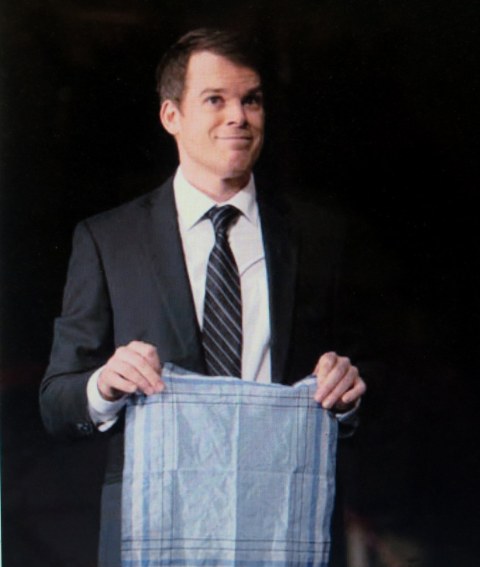
Michael C. Hall in ‘Thom Pain (Based on Nothing),’ by Will Eno, directed by Oliver Butler (Joan Marcus)
That exact moment with that particular audience and that gentleman remains the quintessential element of theater. It was classic, alive, and immediate. And it will never be duplicated, not even if all the same individuals returned to try to repeat it. Great theater should be about the unrecapturable, spontaneous life evoked by actors. That life spiritually refreshes. It’s priceless and breathtaking.
Likewise, Hall’s performance enlivens, refreshes, rejuvenates throughout. Ironically, the content, the playwright states, is based on “nothing.” So process rather than content activates the audience. But, sans the content conveyed by the consciousness between Hall and his audience, no “life” would be possible. Hall’s Thom and Eno’s words and Butler’s direction find their perfect union in receptive ready minds.
Such production artistry occurs when the key players open themselves to the universe. Whatever Hall’s Thom appears to seek from us at each moment carries us all to the next string of moments in the show. This immediacy, made possible through Hall’s many superlative talents, strikes humor and wariness into the audience’s hearts.
For his part when Hall ventures into the audience and/or asks for a volunteer, we turn on high alert. Hall’s relaxed graceful performance as Thom, never moves to result. He breathes with the rhythms of Eno’s Everyman clown stuck in a consciousness of others. Subsequently, his attempt at movement continually displaces him back to his key hurtful childhood incident. And it sends him to other highpoints in his life from which he attempts to make particular sense. Ironically, these efforts turn into a weird null. But he, Thom, Michael C. Hall so captivates, we stay with him curious about where he goes.
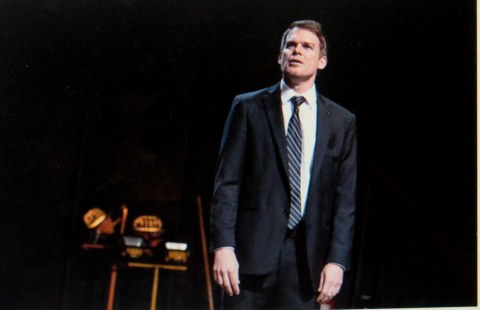
Michael C. Hall in ‘Thom Pain (Based on Nothing),’ by Will Eno, directed by Oliver Butler (Joan Marcus)
The ironic parenthetical in the title “based on nothing,” implies that Thom Pain’s musings before the audience lead no where and come from “not much,” in his perspective. Not so! The very profound themes of existence, consciousness, life purpose, memory caught up among the ordinary, off-handed remarks lead us to questioning joy. With the incredible acting instrument that Hall employs, we become enthralled from beginning when darkness engulfs the entire theater, to ending, when Hall asks the audience the ultimate question. And I of course in my mind as other audience members did made a choice. We answered or ruminated without answering or sat shocked or took on a myriad of audience mental responses to his question.
By the outburst of applause afterward, Eno, Hall and Butler hit their target. Strangely, I felt not only uplifted but cleansed of the last year and one half of angst-ridden and confounding “breaking news” stresses. What a pleasure to communicate mentally, silently with Hall as Thom Pain.
Any day, give me the existential crisis of attempting to make sense of the uncertainty of consciousness, of shifting memory, felt emotional loss, pain and the clown struggle of existence. At least my mind wasn’t being assaulted with the president’s narcissistic pronouncements in a time, place and space which daily confounds him and menaces a majority of the citizenry. After seeing Thom Pain, I am reminded to laugh. If our body politic is at a critical mass of mess, so? My answer to the last question of the play suffices with my laughter!
Hall’s performance will be up for nominations as will Butler’s direction, most probably. The actor’s sincerity and the moment to moment life he breathes through Eno’s words washes over one like a beautiful, clear river. Just wow!
Thom Pain (Based on Nothing) slides through your viewing appreciation without an intermission at The Pershing Square Signature Center in NYC. The production has been extended through 9 December.
‘American Son,’ on Broadway, Starring Kelly Washington, Steven Pasquale

Steven Pasquale, Kerry Washington, ‘American Son,’ directed by Kenny Leon, written by Christopher Demos-Brown (Peter Cunningham)
American Son written by Christopher Demos-Brown is a much needed polemic about what happens to young black males in our nation. If you can help it, don’t be a young, black male. Or if you are, try to stay off the streets between the ages of 13-35. Then, your chances of being shot or incarcerated should be greatly reduced.
To what extent does law enforcement abuse figure in to the above? The percentages speak for themselves. Indeed, this is especially so if one considers that law enforcement regulations and gun laws vary from state to state. However, do not take my word or this production’s thematic pronouncements at face value. Read the crime blotters in cities and suburbs. Sadly, the facts/statistics mount up. And this “in-your-face,” “no-holds-barred” drama powerfully directed by Kenny Leon, presents a typical case so we cannot blink or turn away. Nor can we pretend American Son lays out a mostly fictional reality. If only that were true.
The title generalizes to all our American sons. It does this in the hope that we empathize and understand especially if we are white. Eventually, our nation may become color blind, and there will be no need for the paranoia of white supremacy, Neo-Nazis, and the KKK. Then we will have achieved a miracle of decency and humanity. Surely, then law enforcement will not be partisan to favor white males over women and darker hued men and women of all races in the apprehension of suspects. Perhaps then we will be able to uplift the United States as a country which stands for equal opportunity and justice for everyone. Until then, our presentments express nobility, but our actions express venality and injustice.
Having taught in a multi-cultural district for decades, I’ve known of tensions between law enforcement and various cultures. I can think of one incident when a male student as talented and erudite as Jamal (Kendra’s son in American Son), discussed his experience of police brutality. I saw the remnants of the beating on his handsome face and was sick for the trauma he went through. Thankfully, since then he has prospered in his life and has his own family.
That was over twenty years ago. Overall, the situation has worsened. The rhetoric has escalated, and groups which work to ameliorate the tensions between law enforcement and various cultures have faltered. Often conservative, right-wing, partisan think tanks hold up memes of such groups as fodder for their smear campaigns. They promote antipathy to accelerate their political agendas against gun control and in support of oligarchic nationalism. Also, they seek to divide the populace and incite incidents throwing law enforcement in the middle of the fray.
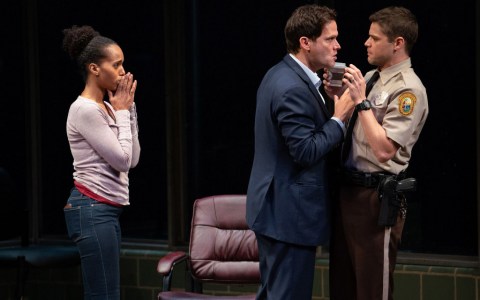
(L to R): Kerry Washington, Steven Pasquale, Jeremy Jordan, ‘American Son,’ written by Christopher Demos-Brown, directed by Kenny Leon (Peter Cunningham)
And what of law enforcement representatives of multi-cultural groups? Indeed, circumstances squeeze them to an “either-or” choice between a rock and a hard place. Few issues have a thesis-antithesis result or solution but remain extremely complex. Thus, the lack of will and incomplete measures to solve problems remain beyond the grasp of well meaning individuals.
All of these issues and many more Demos-Brown presents in this soul-crushing drama that reminds us we live in a nation whose values allegedly proclaim equality for all. But whose recent government practices establish equality for the rich, privileged and predominately white conservatives. Living in the South, even if the city is Miami, the setting of American Son, if a son is not a white, young male, but a black male, then black mothers’ anxiety living in that culture increases. Sadly, their fears for their son when encountering police often is warranted.
African American parents understand that their son’s age and skin-color provide a tragic liability for harm. Darkly hued skin colors arrest faster than white skin colors. Driving while black used to be a twisted joke. You know, when a black male drives through a white neighborhood, he is there to commit a crime. The situation has been exacerbated and the joke has morphed. Now, if one is riding while black, walking while black, smiling while black, hanging out while black, existing while black, one becomes a police suspect.
The question remains. To what extent have members of law enforcement across the nation lost their moral compass about civil rights? And how has the “use of force” taken on sinister tones toward people of color in the aftermath of protests concerning Michael Brown, Travyon Martin, Sandra Bland, and many others?
As Kendra (Kerry Washington is magnificent throughout), Jamal’s mom suggests, if you’re not black you will not understand the fear of a mother for a child who is missing. And she vehemently asserts this truth to Jeremy Jordan’s Officer Paul Larkin who tries to ameliorate her vocal volume and push back as to his whereabouts. Larkin, the white police officer manning the midnight shift in the law enforcement building where Kendra waits for news of Jamal, appears to be a fine person.
Ironically, we and he think she’s abrasive and “over-the-top.” Of course we do not understand as black parents might understand. However, by the end of the play, our perception changes. Only then do we reflect upon Kendra’s intuition. And we realize that indeed, her frantic, frenzied, fearful ranting and insistent “aggression” against the officers and husband, Scott (Steven Pasquale), speak to a deeper purpose.

Kerry Washington, Steven Pasquale, ‘American Son,’ (Peter Cunningham)
Kendra, as mother tiger stands up to Larkin’s very fine person presentation. Unrelenting, she finally pushes him to give her snippets of information until Scott (also in law enforcement but not a cop), her estranged husband arrives. Interestingly, with Kendra out of the room for a moment, the characters reveal additional information about themselves and the situation. When the two white men speak together, the dynamic shifts.
Demos-Brown to his credit includes this scene to advance the plot development and relay themes. Easily we note how between the interactions between Larkin, white Scott and black Kendra reveal stereotyping, presumptions and damaging social folkways that perpetuate social ills. Such folkways promote male-female stereotypes and black-white stereotypes. And the fears and close-mindedness generated by them become obstacles to authentic, heart-felt dialogue among all of the stakeholders.
As Scott, Kendra’s soon to be X husband, Steven Pasquale’s powerful performance remains level with Washington’s. Tragically, he partially “gets” how his son’s not coming home implies danger. However, as a white male, we note he wears the cloak of privilege. Sadly, as hard as he has tried to place the cloak upon Jamal’s shoulders, his son’s skin color isn’t light enough.
Nevertheless, when Scott repeatedly asserts Jamal will be fine, we and Kendra believe him. Indeed, how comforted we are as he makes assurances. But Kendra’s son and Scott’s son though the same, hail from different backgrounds. On the streets, Jamal’s DNA is Kendra’s. On the sports field, in school, and at the prestigious college he will be attending, Jamal’s privileged DNA belongs to Scott’s background. Kendra calls Scott on such issues. Scott remains in a cloud about it not quite accepting the import of her message. How can he? His background and very DNA establish his cultural supremacy regardless of his heart. Blessed and damned by his identity, he loves Jamal and this love becomes its own liability. The play’s conclusion clarifies the complex truth of being a child of this bi-racial couple.
With precision Demos-Brown reveals the mammoth difficulties in color-blind marriages. This becomes a very vital theme of this amazing and thoughtful play. For however “color-blind,” loving and empathetic he remains, Scott thinks and carries the white male perspective which he has projected on his son’s lifestyle and accomplishments. Of course, Kendra speaks from a black female perspective with great wisdom. However this fact remains. They must work overtime to conjoin their views, attitudes and the chasms of identity or the contentions and blind spots will continue as they raise Jamal.
This paramount theme strikes with fury throughout the production especially after Scott appears and he and Kendra argue about their perspectives and relationship to their son. Scott blames her not Jamal as the reason he walks out on the family. Bravely, Kendra shines her authentic and “no-nonsense,” self. Thus, when she indicts him and the others for their various individual callousness, her retorts sting. And when she indicts Lieutenant John Stokes (the excellent Eugene Lee), as an “Uncle Tom” who should know better, but only soft-pedals a cover-up, we cringe. Yet we do recognize that circumstances have forced the Lieutenant to wear that mantle, regardless of his inner feelings.
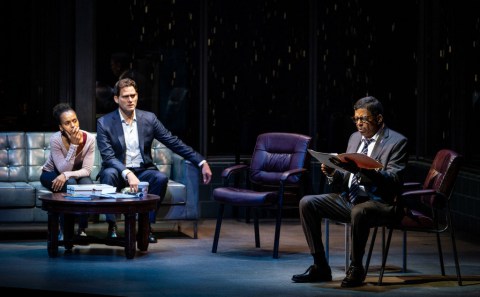
(L to R): Kerry Washington, Steven Pasquale, Eugene Lee, ‘American Son,’ written by Christopher Demos-Brown, directed by Kenny Leon (Peter Cunningham)
Though she does apologize to obtain the Lieutenant’s help with Jamal, her words have struck home. To what extent do blacks rise to the level of gatekeepers, merely put there to keep “their own folks in line?” Meanwhile, do they ever achieve the top positions and call the shots? Or must they remain lackeys to cover up the mess their colleagues may create? To what extent do they compromise themselves and add to the racial stereotyping? This is another theme that Demos-Brown includes in this multi-messaged, profoundly insightful play about race, gender, mores surrounding each, social stereotypes, the inadequacy of law enforcement training and much more.
All the while, Jamal never shows up or answers his phone heightening the tension for the parents. When Scott has a physical altercation with Lieutenant Stokes, we wonder the extent to which prejudice has pushed him over the edge. And likewise for Lieutenant Stokes to arrest Scott, how far does his own prejudice take him? The white-black conflict between Stokes and Scott fascinates. So does the conflict between Kendra and Scott as they argue about how they raised Jamal. Then comes the information that pushes everyone toward a new development and possible resolution.
Kerry Washington, Steven Pasquale, Eugene Lee, and Jeremy Jordan hit the bulls-eye with their portrayals. Each creates intensity. This combines to transfer the tension up the line to explode at the conclusion. Leon’s taut and clear-eyed direction channels their energy in a tumultuous build. All play for the stakes which crescendo up and into a mountain of emotions with which we simultaneously engage in, recoil, sorrow over.
Inevitably, I intuited what happened to Jamal before the conclusion because of my own background and extensive reading. Demos-Brown and the cast work assiduously to get us to do the impossible: identify with Kendra’s plight as a black mother in an environment of predators and passive-aggressives. Empathizing with her, one knows what can and might happen. Thus, for me, the ending came less as a shock. However, emotion doesn’t figure in so much as rationality at the play’s conclusion. When is enough enough? The nightmare of racism, genderism, oppression, injustice, inequity of power must decrease adhering to constitutional law not increase. The play is an incredible cry from the heart of love, and it reverberates with a terrible, engrossing, and tragic echo of our time.
American Son must been seen for the stellar, relentless, crackling performances, the tension, the adroit direction, the symbolism of the set (including the rain storm), and the lucid and well constructed play by Demos Brown.
American Son features scenic design by Derek McLane, costume design by Dede Ayite, lighting design by Peter Kaczorowski, and sound design by Peter Fitzgerald.
It runs with no intermission at the Booth Theatre (222 West 45th street) until 27th of January. For tickets go to the website.
Mike Birbiglia’s ‘The New One’ at The Cort Theatre
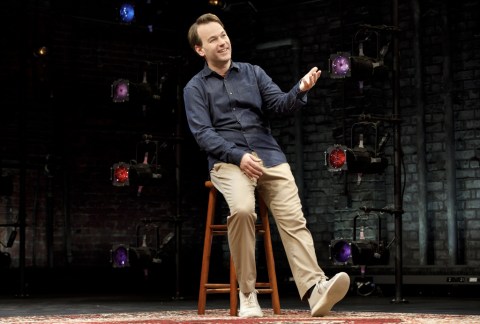
Mike Birbiglia in ‘The New One,’ directed by Seth Barrish (Joan Marcus)
Looking around the audience waiting for Mike Birbiglia’s The New One to begin, I recognize his huge following. We need laughter more than ever and Birbiglia suits up with his homely, hysterical riffs with grace and aplomb.
The prolific monologist appears to be everywhere at once. The award-winner (Kurt Vonnegut Humor Award 2017, Stand-up Comedian awards 2016, 2009, 2003) revels in standup and theatrical solo shows. His winning productions have included My Girlfriend’s Boyfriend (Lucille Lortel, 2011) and Mike Birbiglia: Thank God for Jokes (2016). Not only does he tour his solo shows nationally and internationally, he finds the time to write, direct, and act. For example, his film Don’t Think Twice (2016) debuted at festivals and received award nominations.
He’s also released eight comedy albums and four comedy specials. And did I mention he acts in television (Orange is the New Black) and film?

Mike Birbiglia in ‘The New One,’ directed by Seth Barrish (Joan Marcus)
The New One began Off Broadway at the Cherry Lane and extended before landing at the Cort Theatre on Broadway. With zany but well-modulated humor, Birbiglia’s jokes crash into us nonstop. Directed by Seth Barrish, his marvelous genius delivers a well-written, beautifully acted, perfectly paced performance.
Birbiglia endears us to him the moment he walks his relaxed self onstage. This every-guy American just wants to have fun and enjoy himself. And he makes us believe that he gets off entertaining us and explaining the most startling, shocking, and frightening developments in his life. The connection he establishes with the audience is well honed, measured, soft-spoken, admirable. When we sigh about the doctor discovering his cancer or his description of painful procedures, he comments, “I know.” The give-and-take stimulated by his responses to our guffaws, chortles, groans, and awwwws bonds us in a weird, crazy identification that we all (males, females, transgenders, old, young) participate in. God! I hope Birbiglia takes decades to fade away. We need his humor to grow old to. He gets us, and we get him. It’s love, and love should be forever, or ’til death do us part!

Mike Birbiglia in ‘The New One,’ directed by Seth Barrish at the Cort Theatre (Joan Marcus)
This consummate comedian gives us his intimate and singular takes on singledom, husband-dom, fatherdom. With the last comes the title of his show. He establishes eventually and finally that he is the father of “The New One.” Of course, this also refers to his changing identity.
Beginning with a symbol that expands to cover elements of his life in his 20s, 30s, and the current year, he zeroes in on his first couch. What Birbiglia does with a simple piece of furniture sent us into gales of laughter. The amazing thing about his aphorisms is that they not only make sense, but we note them and forget they make sense in our own lives. But this is where Birbiglia takes things that one considers insignificant and reveals their mammoth importance for us. Thus, when he codifies his numerous reasons why he loves his couch and generalizes why its better than his bed, we admit: Christ! He’s right!
I just adored how Birbiglia makes the couch one of the centerpieces of his story. From there he lifts off into other subjects, like the wooing of his wife. We enjoy his lovely, humorous observations about their relationship. Happily they can live and love forever after. We believe this for them more than for any other couple on the planet. The two of them have reached a soul union. Birbiglia’s buildup sings with humor.
What follows is the inevitable. Shouldn’t couples who adore one another have a child together? Who better than they to bring their love to their “own” boy or girl. What? In their decision-making about not having a child vs. having a child, Birbiglia shows his nimble-mindedness. The hysterical back-and-forth reflects the beauty and angst and abject uncertainty of a new human being coming onto the planet. This crescendos into one of the high points of the evening. What an ending for a beginning. We identify; half the audience has been there, done that. The guy sitting next to me was awwing throughout these riffs.

Mike Birbiglia in ‘The True One,’ directed by Seth Barrish (Joan Marcus)
Birbiglia tells us how his wife believed a baby would be great for him. Only a Birbiglia could set up this story of how he never, ever, ever wanted kids. Just by looking at his brother’s misery, he knows kids are not for him. Ironically, as he covers the hysterical threads insuring he cannot have children for a myriad of reasons, we know with one mind as an audience Birbiglia nails it. We laugh passionately in agreement! Yes!
Anyone in their right mind, whatever gender or sexual orientation, would never have children and duplicate themselves. Having kids is nuts, wacko, especially now given the state of the planet. And I will add, because Birbiglia does not specify, especially with the current political crisis.
And when the event happens, in true Birbiglia form, what he has foreshadowed comes to pass. Then reversals and twists occur. As with any set of parents raising a newborn, comes the roller-coaster ride that runs off the rails. You’ll just have to see the show to discover whether he and his wife land on their feet or spiral out into the darkness without a prayer.
Birbiglia masters relating his feelings with candor and authenticity. We become his intimates and he can tell us whatever he devises. We so want to listen! And best of all he makes a circularity of the randomness of his life, which actually appears fairly ordered, after all. In any case, I laughed and teared up and the gentleman next to me awwwed up until the standing ovation. What a fabulous, LOL, fun evening. No one wanted to leave. We could have stayed for another hour. But the poor guy had to go home to his baby daughter and wife. We’d kept him long enough.
Do not miss The New One, Mike Birbiglia’s shimmering laugh riot. Cheer yourself for the holidays and especially after Thanksgiving when you need the most laughs. The New One runs at Broadway’s Cort Theatre until 20 January. Visit the website for tickets.
‘The Other Josh Cohen,’ David Rossmer & Steve Rosen, Off Broadway Review

Kate Wetherhead (as Neil Diamond) and company of ‘The Other Josh Cohen,’ directed by Hunter Foster (Cailtin McNaney)
Actually, there are more than a few Josh Cohens in The Other Josh Cohen. We discover this at the midpoint of the humorous, witty, superlatively clever production currently making its home at the Westside Theatre. With a versatile cast portraying many roles and Hunter Foster consummately directing, the show smashes audience funny bones with brio, and thankfully, what a pleasurable way to go!
Indeed, you will leave the theater grinning at the wacky plot which rings all too true. Rossmer and Rosen’s artful, humorous book, score and pop/rock songs push out irony after irony. Plot twist after twist haphazardly propel Josh forward in an unpredictable, crazy cue line of falling dominoes, and all the dominoes fall on him. The pleasing, satisfying result trails an unexpected romp following a single Jewish guy’s baleful time leading up to his dreaded Valentine’s Day blues and beyond. If we have been there, we enjoy laughing at the perspective of his plight. If we have been too desperate lining up partners and dates to avoid being there, all the more humorous.
Fearlessly, enthusiastically directed by Hunter Foster the show sparkles with good will and cheerfulness, a perfect treat for the holidays and even for every day. The show reminds us not to despair because of our own sorry humanity. Surely, no one, not even the privileged and the physically gorgeous can escape depression and unhappiness. However, as Josh Cohen proves, one will overcome such feelings by turning to the lighter side of life. Keep laughing! When you can laugh at yourself, eventually fate turns and circumstances improve. And if one builds on the former treasure-filled losses, fulfillment comes.

(L to R): Steve Rosen, David Rossmer, ‘The Other Josh Cohen,’ directed by Hunter Foster (Caitlin McNaney)
How Josh Cohen gets to this more heavenly state begins in a fateful, hysterical journey after a robber breaks in and steals the stuff in his apartment. Everything in Josh’s life worth having and enjoying gets stolen. Josh (Steve Rosen), and his alter ego narrator (David Rossmer), who always can be counted on to tell the truth, flashback to this singular time when Murphy’s Law abides in Josh Cohen’s life, and everything that can go wrong does go wrong in the worst possible way.
To top it off the crux of Josh Cohen’s angst explodes nearly throwing him into a godless state. When he desperately searches for a date for Valentine’s Day, he ends up with dust and ashes. However, Josh’s alter ego and Josh shepherd us through this trolley wreck with songs, and also they cling to hope with the only things the robber left: the Neil Diamond CD #III, a musical cat calendar and the empty case of a porn video (The title of the video is hysterical).
What more does one need when fortune’s ill wind smacks with crippling blows? Once again the musical’s theme arises out of every classic novel, play, short story, film. When you are down and out and have “nothing left to lose,” freedom reigns! And this freedom of being open to whatever the universe offers drops another delicious and unexpected event in Josh Cohen’s life. The other Josh Cohen!
Though Josh’s tragedies don’t quite rise to the level of Shakespearean comedies, we can identify. For all have feared sloshing in the mire of the “A” and “L” words (aloneness, loneliness). Somehow these feelings come full throttle in youth and we feel them with all the terror and hurt of abandonment, and we are there with Josh, pulling for him lifting up Josh’s smile-through-the-clouds pain.

(L to R): Hannah, Elless, Steve Rosen, Elizabeth Nestlerode, Kate Wetherhead in ‘The Other Josh Cohen,’ directed by Hunter Foster (Caitlin McNaney)
Certainly, lonely, single, young guys will enjoy Josh’s various griefs, annoyances, emptinesses, lows and highs. So will lonely, single, old guys. Josh indicates he feels the heart-breaking gnaw of being without a partner most acutely on Valentine’s Day. Yet, through our identification we have no problem laughing at him when every date possibility blows up in his face. Truly, Josh becomes his own worst enemy. Is he intentionally so lame he wants to flame out? Does he want to feel sorry for himself having gotten used to spending lonely hours binge eating candy and ice cream in the aftermath of his Valentine’s Day emotional massacre?
Turns out, no! Josh’s circumstances switch when he receives a wonderful letter. And since no spoiler alert follows, you must see this truly happy-go-lucky production to find out how wrong becomes right in Josh’s life. Sometimes tragedy can be comedy in disguise, and that might actually lead to love!
I particularly enjoyed the versatility and tremendous talent displayed by the actors. Indeed, they sing, play a host of instruments, cavort and express the joy that makes this musical fly. Kudos to Kate Wetherhead, Louis Tucci, Hannah Elless, Luke Darnell and Elizabeth Nestlerode. Though all the songs sparked vitality, I particularly enjoyed “Neil Life,” “Samuel Cohen’s Family Tree,” “Hang On,” and “Change a Thing.”
I love Neil Diamond. I am happy to see that filmmakers and playwrights feature the spiritual grace and hopefulness of his songs in their work. Just great.
Foster manages to stage this musical with an economy that boggles the imagination, and he makes these characters transcend time, place and space with shimmering brilliance. Surely, without the anointed collaboration of Steve Rosen (Book Music, Lyrics, real Josh Cohen) and David Rossmer (Book, Music, Lyrics, Orchestrations, Narrator Josh Cohen), this musical would not soar. Finally, nods go to Dan Lipton (Music Supervisor/Orhestrations), Larry Lelli (Music Coordinator), Carolyn Mraz (Scenic Design), Nicole V. Moody (Costume Design), Jeff Croiter (Lighting Design), Bart Fasbender (Sound Design), J. Jared Janas (Wig & Hair Design).
The Other Josh Cohen runs with no intermission at the Westside Theatre (407 West 43rd) until 24 February. You can purchase tickets at their website.
The Resistible Rise of Arturo Ui, Starring Raul Esparza
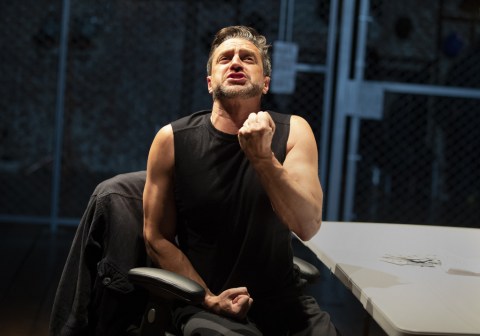
Raúl Esparza in ‘The Resistible Rise of Arturo Ui,’ by Bertolt Brecht, directed by John Doyle for CSC (Joan Marcus)
Bertolt Brecht’s The Resistible Rise of Arturo Ui, directed by John Doyle and currently at Classic Stage, presents the quintessential diagram of how authoritarianism may evolve and devour all in its path. Brecht’s ironic verse shows that the road most despots take escalates demagoguery through fear, intimidation, public acceptance of blatant criminality, and government acquiescence via malfeasance.
Using George Tabori’s translation, Doyle explores with startling clarity how the political tactics of scapegoating, smear campaigns, and bullying terror can anesthetize the public into submission. Doyle’s clear-eyed rendering and Raúl Esparza’s performance mesmerize and appall with Brechtian truths. Huge plaudits go to Esparza’s authentic, brilliantly charged Chicago gangster, Arturo Ui. Everyone who sees this triumph by Doyle and cast will be galvanized. Whether to insure that every citizen’s vote counts or to speak out and redress civil rights abuses, this work encourages the audience to actively participate and strengthen their democracy against invidious government rule by thuggery.
Seminally, Doyle’s production reveals that the core of social and cultural depravity lies in the will of the people. The director conveys this through expert shepherding of the actors. And thematically he threads it throughout the sets, staging, and costumes. As the production underscores, the people hold the power. And they must “resist.” Their participation in upholding the moral and social good remains paramount.

(L to R): Christopher Gurr, Raúl Esparza in ‘The Resistible Rise of Arturo Ui,’ by Bertolt Brecht, directed by John Doyle for CSC (Joan Marcus)
Surely, Arturo Ui’s (a satirical caricature of Hitler) rise could have been prevented. The production signals the obvious turning points where the people faltered and allowed malfeasance to spread its rot, even in such a benign business as the cauliflower trade. When individuals in power cave to amorality, they promote a climate where calumny promoted by the media, political malfeasance, and chicanery infect the society and gain a foothold. With the avid assistance of sycophants, toadies, and other compromised, morally vacant human beings, a Hitler, an Arturo Ui, a Vladimir Putin, a Donald Trump gains power. Otherwise, the culture and its supporting tentacles (media, charitable institutions, businesses, non-profits, etc.), would take a stand. Grounded in principles of honor, they would repudiate political, dictatorial criminality with civil rights measures.

Elizabeth A. Davis, ‘The Resistible Rise of Arturo Ui’ by Bertolt Brecht, directed by John Doyle for CSC (Joan Marcus)
Brecht’s play and Doyle’s iteration of it reveal what happens if oppressors ascend to the top of the political pyramid, compromising the “incorruptible” (in the play Dogsborough represents German Chancellor Hindenberg) and gaining control. Unless people are willing to fight hard and sometimes die to push back against such treason to the nation-state, removal of the despot becomes impossible. In Doyle’s precisely executed Resistible Rise of Arturo Ui we see the interplay among corporations, criminals, and political parties. Often, they meld into one. When each collapses from inner decay, ethics dissolves for the body politic. Right becomes wrong, up becomes down, left becomes right. Then the autocrat, whether it be an Ui, a Hitler, or a Trump defines what “ethical,” “legal” and “legitimate” mean.
Ever the self-dealer, Ui pounces when news leaks that the honorable Dogsborough (the excellent Christopher Gurr) can be compromised. Because Dogsborough allows himself to be tricked, he disintegrates everything moral and noble within. When he vouches for the Cauliflower Trust in a loan deal gone sour, Ui capitalizes. And he makes “the deal” into a stepping stone to seize power.
Ui’s scandalous story of lies and smears about Dogsborough caves in a once viable business network. Through a reign of terror and murder, which the courts overlook and a corrupted law enforcement upholds, Ui takes over the Trust. Eventually, the town of Cicero succumbs to his regime as he moves to seize all in his path. Parallel to Ui’s rants, Brecht/Doyle describes how Hitler invades Austria. Both legitimize their actions as a common good. How can folks take these despots at their word? Indeed, how?

(L to R): Raúl Esparza in ‘The Resistible Rise of Arturo Ui,’ by Bertolt Brecht, directed by John Doyle for CSC (Joan Marcus)
From the costumes to the sets Doyle emphasizes the play’s themes. Brecht aligns each juncture of Ui’s takeover with the historic rise of Hitler. First, Hitler attacks German democratic institutions. Opportunistically, he co-opts German Chancellor Hindenburg the year before the old man died. Hindenburg allowed Hitler to seize the government after political infighting insured that Hitler’s Nazi attack dog Ernest Roehm would be ousted/killed. By the end of the play, Hitler annexes Austria with Austrians’ help. In Brecht’s parallel, Cicero’s terrified citizens (like Austria’s) overwhelmingly align with Ui. Gangsterdom emboldened by the whitewash of citizen support casts the usurpation as legitimate.
Arturo Ui’s rise to power from Chicago mobster to elected political “hero” parallels Hitler’s takeover of Germany without the full majority of the German people’s support. Interestingly, we recollect that Trump lost the popular vote. Sadly, almost one-third of the nation neglected to participate in the voting process. Indeed, Trump’s was a minority win. So was Hitler’s! So is Ui’s. Nevertheless, it is this win which opens the floodgates for world domination as the despots ignite mayhem, murder, terror, and genocide.
Kudos to Doyle and the ensemble whose staging clarifies a difficult verse play full of ironic Shakespearean allusions. Doyle’s set encompasses a large wire fence reminiscent of a prison setting, or a detention camp. Interestingly, this fence provides the wire “curtain” or barrier walling in from out, the playing area. Actors also use the area behind the fence for announcements and as a visible holding pen before their entrances. From behind this fence-like curtain, they narrate the prelude of Brecht’s play. A gate in the middle allows ingress and egress. And the central action/paradigm occurs in the inner sanctum (playing area), adjacent to it.

(L to R): Omozé Idehenre, Christopher Gurr, ‘The Resistible Rise of Arturo Ui,’ Bertolt Brecht, CSC (Joan Marcus)
Sadly, the more powerful the recognition of the analogies that Doyle sets up to our own period of challenged civil liberties in the U.S., the more horrifically ludicrous Arturo Ui and his willing henchmen appear. Indeed, Ui’s and his goons’ caged-in, bound-up souls turn maniacal by Ui’s concluding speech.
The actors perform their roles with precision. Esparza’s weak-minded, Trumpian, whining criminal with mannerisms like Hitler’s brings humor and reality to a role often played as a caricature. His Ui is inimically real and dimensional. His superbly rendered arias justify corruption as legal, enthrall, and hypnotize. His speech about faith and loyalty magnificently, humorously, and hypocritically shows the demagogue’s urges to devour the minds and souls of his followers. Ui imagines himself the savior of the people, calling for them to believe him for he is trustworthy.
Where have we heard this before? Doyle underscores this point when at the conclusion we hear chants of “Lock her up,” and see Ui wearing a long red tie. The parallel sickens because it hits so close to home. And then come the last lines to the effect that, yes, the world powers overthrew Hitler, but this brings no assurances. For the “bitch that bore him is in heat again.” As we consider all the dictators and warlords around the globe who glory in terror, murder, and oppression, Brecht’s truths solidify. Did the populace uphold and understand the vital purpose of the social contract to a healthy government? Do we?
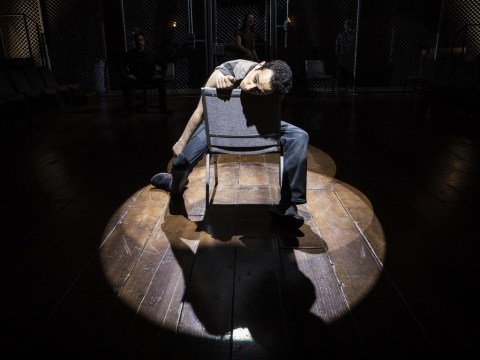
George Abud in ‘The Resistible Rise of Arturo Ui,’ by Bertolt Brecht, directed by John Doyle for CSC (Joan Marcus)
In a moral, self-sustaining world of plenty, those in power would rebuff Ui in the fictional Cicero. But in an economic depression when resources become scarce, ethics collapse with individuals’ desperation. Economic deprivations create despots who promise to return the society to safety, “greatness,” and prosperity. With the effects of climate change daily narrowing the resources (viable land, food, water) humans rely on to live and prosper, the rise of the thug dictator class threatens more than ever.
This production and the play remain a guiding watchtower for our times, for all times. By revealing what has happened, they guide us as to what citizens must not do. Notably, they must not resort to resignation and disengagement. They must speak out, demand redress, and vilify corruption, even to the point of sacrifice and death. Laissez-faire approaches perpetrate oppression for all, for despots expect no reaction to their appalling behavior. But legitimized bullying cannot abide when citizens resist it. Save for the social contract between citizens and government officials, which strengthens the bonds between our rights and responsibilities and enforcement of government accountability, we are lost.
The Resistible Rise of Arturo Ui directed and designed by John Doyle runs at CSC until 22 December. The cast includes George Abud, Eddie Cooper, Elizabeth A. Davis, Thom Sesma, Omozé Idehenre, Mahira Kakkar, and Christopher Gurr. Kudos go to Ann Hould-Ward (Costume Design), Jane Cox and Tess James (Lighting Design), and Matt Stine (Sound Design). For tickets visit CSC’s website.
Glenn Close Shines in an Authentically Realized Production of ‘Mother of The Maid’

(L to R): Glenn Close, Grace Van Patten in ‘Mother of The Maid,’ directed by Matthew Penn, written by Jane Anderson (Joan Marcus)
Joan of Arc lived for about 19 years on this earth. However brief her life, Joan enthralled artists. In every century, they have made her the subject of works of literature, painting, sculpture, film, plays, even operas. She was a darling of the Catholic Church, which canonized her in 1920. And the French declared her one of the country’s nine secondary patron saints. If we view her inimitable character, dramatic adventures, visions, and brutal death, Joan of Arc remains “larger than life.” Indeed, her mysterious divinity inspires us. But it is her humanity that infuses Jane Anderson’s Mother of the Maid directed by Matthew Penn, currently at the Public Theater.
What does a mother (the ineffable Glenn Close) do with a forthright, determined, headstrong daughter? (Grace Van Patten’s Joan is solid throughout.) She pushes back. Until one retreats or the other relents and acquiesces, sturm und drang will characterize their relationship. Anderson sustains the pressure and strain between Isabelle and Joan throughout this intense drama spinning the human relationship between mother and daughter that created an icon and established Isabelle d’Arc as a woman of power in her own right.
Joan’s reckoning with destiny, touches off a veritable cataclysm of agony for Isabelle. Only after death does their conflict pivot and become rerouted in another direction. When Isabelle recovers from her daughter’s and her husband Jacques’ death, she gains her own identity, burnished by the flames of Joan’s immolation. It is then that she charges into history and writes her own exalted epilogue. With persistence and the strength that she demonstrated throughout her life, Isabelle memorializes her great love for her amazing Joannie and acquires justice at the hands of the Catholic Church.
Anderson reveals the mother/daughter conflict at the outset of the play. And Matthew Penn shepherds Glenn Close as Isabelle and Grace Van Patten as the maid of Orleans with directorial precision and energy. Anderson’s logic, economy, and adroitly crafted portrayals, elucidate the women’s disparate natures. Close and Van Patten are perfectly suited for their emotional jousting matches. As Isabelle attempts to interpret Joan’s behavior, we understand the dynamic between the divinely called Joan, and the earthly-minded Isabelle. Indeed, Anderson capitalizes upon our knowledge of Joan of Arc’s canonization by the Catholic Church. At the very least we find humorous, Isabelle’s doubts about Joan’s “wild” determination to “lead an army and drive the English out of France.”
The playwright ingeniously lays bare how Joan must persuade her parents to support her on the divine mission. Following the scripture’s admonition to “honor thy father and mother,” Joan allows them to beat her. She does not run away, nor resist their recriminations, but she affirms her identity as a servant of God. Joan assures them she will remain steadfast unto death, even if they kill her to forestall her crazy plans. Ironically, her parents give her a worse time accepting her divine unction than the “captain up at the castle,” who will escort her to the Dauphin (heir apparent). Because she becomes persuaded that Joan lives in God’s will, Isabelle finally acknowledges the beatings have no impact. Indeed, she may suffer God’s wrath if she tries to prevent Joan from living in her obedience to God’s plans.
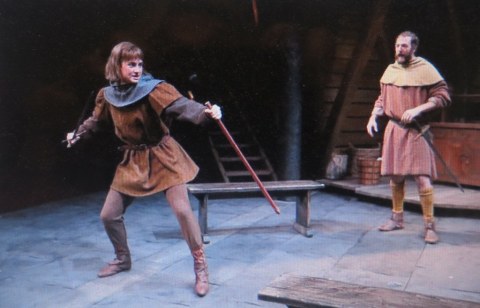
Grace Van Patten, Andrew Hovelson in ‘Mother of The Maid,’ directed by Matthew Penn, written by Jane Anderson (Joan Marcus)
This turning point defines the family’s enlightenment and support of Joan’s Godly purpose. Furthermore, Isabelle makes it clear to Joan that she recognizes and admires her piety and determination as an outgrowth of Isabelle’s fervent relationship to God. When Isabelle and Jacques give their permission, with humility, they acknowledge she is in God’s grace.
Anderson’s characterization and Penn’s measured direction of Close’s and Van Patten’s moment-to-moment acting keep us on the edge of our seats. Together they make the reality of her parents’ s acceptance of Joan’s mission miraculous. Anderson’s detailed revelations of her conflict with her parents actually heighten Joan of Arc’s humanity. And it is this that encourages us to understand that the potential for courage and strength is rooted in every human being. However, Joan’s affirmation and belief that her mission is divinely guided separates the rest of us from her. How her divinity is tested against her humanity, then, Anderson sets up in the second half of the play.
Joan’s greatness spins off at this juncture of having to deal with mom and dad. After she leaves her home and confronts the passion of God’s plans for France, her earthly persona gradually dissolves. Through various interactions with her mom both progress along an emotional and spiritual journey. We and Isabelle watch in awe how Joan becomes the Maid of Orleans. Yet, Jacques and Isabelle fear and doubt Joan’s every step. Reluctantly, after her successful battles against the British, they join her to celebrate the Dauphin’s coronation as Charles VII, King of France. Afterward, the situation worsens as the King’s enemies threaten. Jacques’ and Isabelle’s fears escalate, unabated by circumstances, faith or the King’s recognition of Joan’s favor with God.
We discover in the first segment that the actions her parents take to stop her, ironically strengthen Joan’s will. Eventually, her persistence and faith and their final spiritual illumination bring them to agreement, but only momentarily. We see the importance of Joan’s family to her character, and how their doubts and misgivings buffet her. Her father distrusts the soldiers, her cause, the church, the King, the English. And Joan must counter his arguments with reason and faith. Likewise, she and her mother develop as they abrade each other’s wits and souls. From these scourges, Joan’s mind and spirit become tempered to confront her enemy accusers. Brilliant, strengthened, resolved by faith, her answers to their entrapping questions during her trial astound them. As a result in historical archives, her trial and her death sentence appear unjustly ludicrous and political in the face of her innocence and agile mental acumen.

Dermot Crowley, Glenn Close in ‘Mother of The Maid,’ written by Jane Anderson, directed by Matthew Penn (Joan Marcus)
To the very end, Joan chooses to carve out her own path with passionate enthusiasm. Though sometimes misery caves in her energy, she always remains in defiance of her mother’s doubts This courage to overcome her parents’ fears helps her overcome her own. As Anderson draws her, we glean how parental forces, primarily Isabelle’s, shape this illiterate teenage girl’s extraordinary character.
Surmounting each plateau of the suspenseful emotional/spiritual journey, Isabelle shifts between the joy of seeing her daughter’s success and the pain of fearing her injury and torture by the British. When Joan is captured Isabelle embarks on her own path to greatness and individuality. Walking for miles over the rough country through the darkness, the difficult terrain and the fear of encounters with enemy soldiers, Isabelle finally arrives at Joan’s prison. And she insists with the guards that she be allowed to minister to her daughter. Though happy to receive her mother, Joan is unhappy to hear her protestations and argues with her, once more. For the last time Joan calls off her mother’s adjurations to recant and save herself from the fires.
This will be the last time the earthly Isabelle strives against the divinely inspired Joan who chooses death over hypocrisy. For her there is no turning. Close and Van Patten engage us in the arguments so that we empathize with both and even cheer on Close’s Isabelle in our hearts. However, we know the outcome and cheer on Joan for remaining courageous in the face of the coming brutality. Ultimately, this tension between immerses them in the feelings of love, sorrow, fear.
The rendering of the prickly mother-and-daughter relationship is the crux of the production. Anderson’s characterizations inspire us to see underneath the icon that the Catholic Church has deified. Yet, in the playwright’s reveal of these simple yet profound human souls, we learn of another miracle: that of human love ranged against the ineffable love and belief in God which cannot be quantified nor understood. Joan’s conscience is her own. Her mother can empathize and attempt to understand, but Joan must walk this walk of faith alone. And if Joan is to succeed, her mother, her father, her brother may sharpen her determination, but must ultimately get out of her way and let her go into the flames.
What parent cannot identify with the heartbreak of saying goodbye to their child and hello to the unrecognizable adult burgeoning before them? It is a bitter reckoning, more so when the parents must relent and let their beloved child whom they put their hopes in, fulfill these hopes in death. That Isabelle did not argue her daughter’s insanity before the authorities speaks to Anderson’s adroit characterization. For at this point, Close’s Isabelle though desperate, turns to God for His help, knowing it may be to no avail. It is apparent to us that she doubts and believes Joan will die. We intuit that Isabelle senses that Joan, fatally Christ-like, will be martyred for France. Whether divinely willed or not, Isabelle is out of it. This is between God and Joan. And France.

(L to R): Glenn Close, Grace Van Patten, ‘Mother of The Maid,’ written by Jane Anderson, directed by Matthew Penn (Joan Marcus)
The scenes ground the miraculous past, present, and future trenchantly in logic. Eagerly, we throw ourselves into this soul journey with Isabelle. And we hope against hope that God and St. Catherine will see Joanie through, knowing the opposite will occur. Anderson’s delicious infusion of Joan’s divinity with reality and the elevation of Isabelle and Jacques from their mundane existence is inspired! Shepherded by the sterling direction of Matthew Penn, Close and Van Patten enthrall us as they fiercely breathe life into a legend we find hard to fathom. Yet because of Anderson’s craft and superb rationale, we are closer to that legend because we see Joan from Isabelle’s perspective. She is her daughter, regardless of how divine.
Isabelle evolves as a mother mentored by Joan’s calling. Indeed, at the court ,and visiting Joan in prison, she becomes her handmaiden. While Close inhabits this “mother for all time,” Van Patten wears Joan’s anointing and humanity credibly. Through their profound, enlightened and thought-provoking portrayals, we understand the complexity of their relationship and the powerful impact of their love for one another. Isabelle demonstrates great faith, courage, and humility in navigating the pretensions of the royal court. And we become immersed in her torment as she assists Joan through the sham trial and pronouncement of the fearful death sentence. The second act is particularly chilling and suspenseful, driven by Isabelle’s urgency.

(L to R): Kate Jennings Grant, Olivia Gilliatt, Glenn Close in ‘Mother of The Maid’ The Public Theater (Joan Marcus)
Close’s quicksilver acting leaves one experiencing a torrent of emotions. She portrays the affirmative, down-to-earth, fiercely maternal Isabelle as if by second nature. With methodical calculation and matter-of-fact counter-arguments, Van Patten’s Joan extinguishes mom’s reality to justify what becomes unknowable except by faith. Her parents come to know that the tragedy of Joan’s calling is not of her choosing. Thus, they distrust and doubt her for it, not able to understand her dense faith. How the ensemble and the director establish this arc of realization, doubt, torment, sorrow, and exaltation is breathtaking.
As Close works through Isabelle’s evolution toward believing in her daughter, we experience Joan’s affirmation of all she believes in her successes at the court. These are snatched away when she falls from grace into the malevolent hands of political enemies. Both Van Patten and Close are acutely present throughout. With nuanced emotions, each of Isabelle’s intentions sharpens with clarity as the women strike like flint against one another.
By the conclusion, it is because of Close’s investment in truth that we experience Isabelle’s painful resolution, affirmation, and final ascendance into autonomy and empowerment. With Joan’s death, Isabelle comes into her own. The flames that destroyed her daughter’s body kindle a renewed and even greater courage and love in Isabell. It is a love which allows her to rage against the very God who gloriously martyred her daughter with an ignominious and unjust end. Thus, with passion Isabelle will shake the very heavens until Joan achieves through an eternal justice, a public vindication and glorification.
Mother of the Maid should not be missed. It must be seen for Glenn Close’s electrifying performance and for Grace Van Patten’s humanly realized Joan. As for the adroit staging and direction and the superb ensemble (Dermot Crowley, Andrew Hovelson, Kate Jennings Grant, Daniel Pearce, Olivia Gilliatt), all contribute to make this a must-see.
The set design (John Lee Beatty), costume design (Jane Greenwood), lighting design (Lap Chi Chu), sound design & original music (Alexander Sovronsky), and sound design (Joanna Lynne Staub) aptly enhance the development of the action with stylized grace.
Mother of the Maid runs until 23 December. For tickets visit the Public Theater website.
‘The Resistible Rise of JR Brinkley,’ Written/Directed by Edward Einhorn, FringeNYC Review

The Untitled Theater Company No. 61 presents Julia Hoffmann, Trav SD in ‘The Resistible Rise of JR Brinkley,’ written/directed by Edward Einhorn (photo from the production)
The FringeNYC Festival shuttered with its last production performances on 28 October: The Resistible Rise of JR Brinkley, Edward Einhorn’s take-off on a Bertol Brecht classic served as the festivals’ apt exclamation point. Brecht’s Resistible Rise of Umberto Ui (that Einhorn’s work parallels), satirizes Hitler’s alarming rise to power. Like Brecht Einhorn employs sardonic humor to reveal human avarice and fandom at its worst.
Divergently, Einhorn’s stylistic parody of Brecht’s work uses period music (1900-1920s), with lyrics he wrote to chronicle another incredible “rise.” Notably, the two-act hybrid musical, comedy, satire, absurdist bio-drama characterizes the American Dream, Horatio Alger “rags-to -riches” prototype. However, the prototype is turned on its head in the shape and form of one real-life JR Brinkley. JR’s misplaced ambitions destined him to millionaire stardom and fraudulent bankruptcy. Incalculably, this gentleman (who was far from one), lived and died in the American outback of the Mid-West during a period of few government regulations. Traveling the country to find a “home,” JR settled in Kansas where he thrived as a medical doctor (with no credible license or medical schooling).
Einhorn spins out Brinkley’s unbelievable adventures with a structure similar to Brecht’s. Indeed, his narrator (the fine John Blaylock), with guitar in hand, opens the play advising what events will follow. As he introduces each of the characters and advances a chronological narrative, mini-scenes unfold. In them Einhorn illustrates the key events which relate how Brinkley navigates the highbrow and lowbrow society in Kansas. Additionally, Einhorn calculates with absurdist stylistic treatment how and why Brinkley achieved success, amassed an adoring and gullible audience of followers, then debased himself in infamy.
With madcap music (on guitar, violin, clarinet, banjo, pennywhistle), the actors act, sing, and perform their characters’ foibles and fabulousnesses. The excellent Trav SD dishes up the loquacious, extroverted, con man Brinkley. His great good will fronts for an unprecedented amorality, corruption and greed. Taken alone, Brinkley’s avariciousness would have raised the suspicions of the most naive. However, through the narrator, Einhorn, with wit and whimsy reveals Brinkley’s illustrious masking qualities and manipulations.
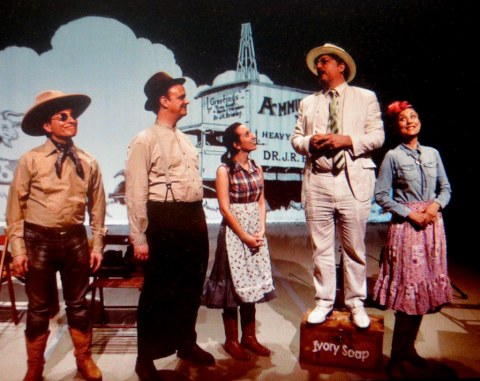
(L to R): John Blaylock, Craig Anderson, Julia Hoffmann, Trav SD, Jenny Lee Mitchell in ‘The Resistible Rise of JR Brinkley,’ written/directed by Edward Einhorn (photo from the production)
First, as a self-proclaimed entrepreneur with an organized eye for expansion, Brinkley excels. In fact his creative promotional abilities guide him to envision every opportunity to defraud others with impunity. He develops the idea to treat erectile dysfunction and “sterility” with surgical implantations of goat glands. When the procedure works for one man (most probably through the placebo effect), he capitalizes on this unrelated “success.” With a keen sales savvy for the depression era, Brinkley like a circus barker, twists male egos against themselves. Indeed, he advertises his goat gland surgical cure to tremendous male response. Additionally, he develops a handy mail order product catalogue for a myriad of cures also using goat glands and other concoctions. All the procedures and healing tinctures prove ineffective! However, despite tragedies and deaths along the way, Brinkley becomes the doctor sensation of Kansas with his clinic and hospital.
In between songs performed by John Blaylock and the ensemble like “It’s a Lie,” “Ain’t Nobody’s Business,” and “Brinkley, You’re the Man for Us,” Trav SD’s Brinkley hoodwinks and shills his way to the top. Cleverly, he purchases a radio station. For his programming he hires the first “country and western” type performers to soothe and entertain. In between he hawks the “success” of his “guaranteed” home remedies.
Through his propagandistic Trump-style radio infomercials, sales skyrocket. Creatively maintaining control, Brinkley produces, directs, script-writes and performs his own radio programs. Eliciting loyalty, Brinkley and his cast of actors and musicians entertain and convince with “down-home” folksy, “bless your sweet little Christian heart” cheer. And to assist he brings in his sugary wife Minnie (the equally outrageous Jenny Lee Mitchell). His crew includes the singing Blind Cowbody (John Blaylock). And when necessary, Brinkley hires many other performers (played by Craig Anderson, Julia Hoffmann). Indeed, one of them reputedly was Gene Autry who started his career with Brinkley’s radio shows.

Jenny Lee Mitchell, Trav SD in
‘The Resistible Rise of JR Brinkley,’ written/directed by Edward Einhorn (photo from the production)
Einhorn’s comparison to today’s rise of Trump is right on. He reveals that Brinkley, et. al., like most sociopaths, politicians, and con men, knows how to manipulate his audience. Thus, he creates his fandom and star power by tailoring his programs and products to what the folks want to see and hear, regardless of their efficacy. Ironically, the fact that supporters purchase garbage that in many instances makes them sick, poisons them or kills them, matters little. If Brinkley says it, it must be true.
Yes, Brinkley’s huckster’s soul is rotted-out with corruption. Indeed, where the fictional Horatio Alger was aspiring and noble in his pursuit of the American dream, the real-life Brinkley was of the criminal, amoral class. Einhorn’s plot development shows that Brinkley’s followers swallow Brinkley’s charlatanism whole. At the same time we gaze in horror recognizing that history repeats itself. For Brinkley could be Donald Trump’s twin, minus a few disparate, demented and desperate details.
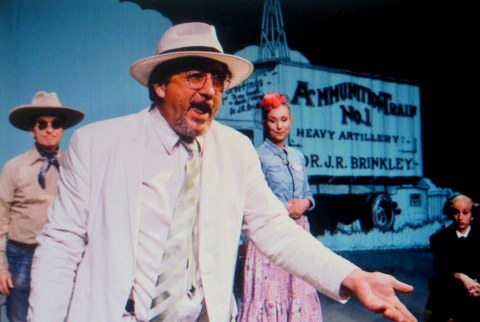
Trav SD, Jenny Lee Mitchell in ‘The Resistible Rise of JR Brinkley,’ written/directed Edward Einhorn (photo courtesy of the production)
With stylistic brio Einhorn does what he enjoys doing most. He employs absurdist, comedic mayhem to examine outrageous social and cultural behavior. We appreciate the themes (greed inspires criminality). Another theme suggests: “harming others is OK if you never get caught.” Additionally, lying suits up the fraudulent con man beautifully. For by the time the media exposes the lie, the huckster rips out 100 more. You can’t catch a liar who never admits he lies or apologizes for being “wrong.” All of these themes Einhorn crystallizes through the lens of sardonic humor, hyperbole and wit.
As Brinkley’s audacity of mendacity, trickery, and chicanery ripens to its pinnacle, so do his liabilities. Not only does he attract the attention of Morris Fishbine (Julia Hoffmann) of the American Medical Association, but the relatives of many of those who have been killed, injured, and damaged sue Brinkley for monetary awards. Eventually, Fishbein and the press expose his criminality and officials go after Brinkley. As a result, he loses his practice and his radio station.
To gain recourse and change the law in his favor, he runs for Governor of Kansas. Ironically, the current politician allowed Brinkley to practice as a fraud because he enriched politicians’ pockets and helped make the communities thrive. If not for the self-dealing of his political opponents who disqualified ballots, Brinkley would have succeeded. Though he knows how to tickle the ears of his fans to support him, his demise threatens on the horizon. Thus, he picks up his stakes and plants them in a sleepy little town in Texas. And the mansion he built there, remains on the historic register even today.
The thought-provoking The Resistible Rise of Jr Brinkley presented by Untitled Theater Company NO. 61, remains doubly potent considering that JR Brinkley’s story is a true one. Albeit, viewing human behavior in all its “glory” reminds us of our own susceptibility to liars and con artists. Certainly, JR Brinkley would not have been initially successful if males weren’t drawn in by the lure of virility. If men and women saw through him, Brinkley, like Hitler, like Trump, would have been a loser nobody. Why ordinary folks didn’t #resist them boggles the imagination, and remains a clarion call for all time.
Considering those who follow Donald Trump as if to the death, Brinkley’s fraud and political bid resonates. We need more not less regulation to protect us from those who use the US taxpayer to self-deal. And we need heavy punishments for top officials, indeed presidents, who would destroy the public good to profit themselves. Indeed, Brinkley’s rush to avoid regulation parallels the Trump presidency’s push to end regulations governing finance, environmental protection, student loan debt and much more.
Look for Einhorn’s The Resistible Rise of JR Brinkley at another venue, perhaps some time in the future in NYC. It deserves a second go-round. You will heartily enjoy it!
FringeNYC Theater Review: ‘Onaje’ by Robert Bowie, Jr
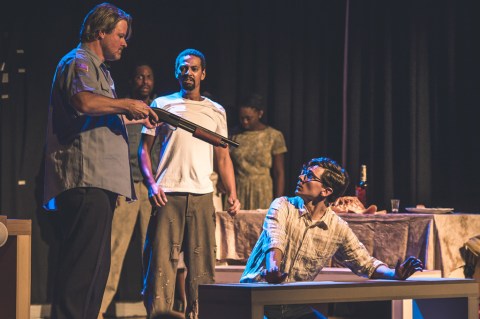
L to R): Tim Rush, Jay Ward, Curtis M. Jackson, Tinuke Adetunji, John Dewey in ‘Onaje,’ written by Robert Bowie, Jr., directed by Pat Golden, FringeNYC (ZeCastle Photography)
FringeNYC has been up and running again after a year’s hiatus. It has come roaring back with experimental theater offerings and thought-provoking presentations. One intriguing production out of the 85 or so offered ended its predominately sold-out run on Sunday, 21 October. Among the other productions, it’s a standout and bears revisiting. Onaje, written by Robert Bowie, Jr. and searingly directed by Pat Golden sported a large cast with sterling performances. Overall, the play’s themes resound with currency in this time of social and political divisiveness and hyper rhetoric not witnessed since the early 20th century.
The play takes place in the 1980s. However, the flashbacks that infuse and haunt the mind of the protagonist William/Onaje take place earlier. Onaje/William (portrayed with mesmerizing power and spot-on immediacy by Curtis M. Jackson), suffers a miserable fate. Indeed, a traumatic event that happened during the 1967 Maryland riots affects him emotionally and chains him to a bondage of self-recrimination. Sadly, racism and bigotry force him to leave his loving family (the fine Jay Ward, Mary E. Hodges, Tinuke Adetunji).
Dislocated from his former life as a result of this event, fear drives William to seek refuge and healing on the open road. Subsequently, he attempts to evolve beyond the tragic events of the past by creating another persona, Onaje. It is Onaje that Bowie, Jr. introduces us to at the play’s opening. And as the play unfolds, we learn about the devastating events that might have driven a less enlightened person than William/Onaje to suicide or murder.
Through his interactions with fellow travelers, the couple Richard and Belle, the revelation of Onaje’s humanity unfolds. Richard (Adam Couperthwaite in a dynamic and edgy performance), and Belle (the feisty, humorous, down-to-earth Sheila Joon Ostadazim), are happy Onaje accompanies them on their road trip.
Apparently, Onaje has traveled the highways of the United States since he left his family on the Eastern shore of Maryland fifteen years ago. Unbeknownst to Onaje, fate has thrown him in with this couple, and he will accompany them to return him full circle to the place of the traumatic experience. Ironically, Richard and he come from the same area. Because Richard intends to settle his accounts with his father and seek affirmation, he must return home. But Richard’s father, Middleman Sr. (Bristol Pomeroy), witnessed what happened to Onaje fifteen years before. Though he doesn’t know it yet, nor do we, a reckoning comes for Richard, his father, and Onaje. But unlike most reckonings, this one distills hope, peace, and unity.
From his conversations with Belle, we learn the extent to which Onaje has evolved. Thus, the wisdom and strength he developed on his travels transformed him into the admirable Onaje. As Onaje he has purified himself on his life journey. However, the old William and the events that devastated him still lurk within. Eventually, he must confront what occurred to expiate his guilt and self-torment and completely heal.

Sheila Joon Ostadazim, Curtis M. Jackson in ‘Onaje,’ FringeNYC, written by Robert Bowie, Jr, directed by Pat Golden (ZeCastle Photography)
Though Belle intuits Onaje, she remains clueless about his, at times, gorgeous poetic language and philosophical ramblings. Nevertheless, she understands his goodness and truth. Indeed, he presents himself as a spiritual man of the universe. He perceives himself to be a caretaker of the earth and its people. And his life on the open road allows him to be free of the culture’s machine existence. Not only does Onaje manifest goodness to this couple. But his profound and poetic insights inspire Belle to seek truth in her relationship with Richard.
Eventually, Richard reveals his criminal, “uncool” past to Belle, and she reveals her “lowly” beginnings. Indeed, Onaje’s openness and authenticity encourage them. As Richard confronts his father and seeks forgiveness, we realize the positive impact Onaje has had. Certainly, a theme the character represents remains; only by living in truth can one be free. As a veritable tour de force, Onaje changes the lives of all those he encounters. Except one.
In the play Bowie Jr. revisits the tragic history of Cambridge, Maryland and William’s participation in it. Should this scene have appeared later in this work? Indeed, the structure of the play needs shoring up for this scene is the most striking. And all scenes in the play lead to and revolve around this one.
In 1967, the Civil Rights Movement gained in strength and solidarity throughout the country including Maryland. There, marchers and protestors supported H.Rap Brown’s dynamic speech in Cambridge, Maryland. When Brown identified injustices and demanded equal treatment for African-Americans on the Eastern Shore, klansmen whipped up whites’ fearful animosity and hate-filled sentiments. As a result infuriated white mobs, some, law enforcement in hoods, torched black neighborhoods. Tragically, homes burned to the ground. Indeed, most feared that snipers would shoot anyone who attempted to put out the raging infernos.
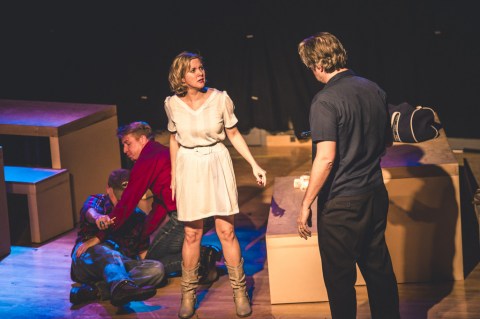
(L to R): Bristol Pomeroy, Adam Couperthwaite, Sheila Joon Ostadazim, Tim Rush in ‘Onaje,’ FringeNYC (Ze Castle Photography)
During the chaos, William/Onaje becomes swept up as a casualty of these catastrophic events. And Andrew, a young civil rights worker invited home by William’s Dad becomes another casualty along with the entire black family. Andrew (portrayed with good-natured aplomb and humanity by John Dewey), is at the wrong place at the wrong time with William’s family.
When racist cop Henderson seeks out William at his home, he questions Andrew’s presence there. The “do-gooding” arrogance of a white man in the home of a black family! Thus, Andrew’s magnanimity and color blindness provoke Henderson’s already stoked hatred. Tim Rush convinces as the malevolent, corrupt Henderson. Punishing both William (he had an earlier incident with Henderson), and Andrew, we witness the terror of sadism and brutality William must visit on Andrew. Thanks to Golden’s acute, precise direction, the scene is gobsmacking dynamite.
The incident remains the pivotal point of the production. And the lighting, staging and shepherding of the actors’ performances creates terror. Thus, the revelation of who, how and why Onaje is, clarifies. What remains must be healing between him and the man who might have stopped it but didn’t: Middleman, Sr. For he was present at the event. Henderson, the foil for wickedness, is past hope, overtaken by his own inhumanity.
The second half of the play appears anticlimactic. The playwright brings us to the closing epiphany through a meandering route. Nevertheless, when Richard brings Belle and Onaje to the Middleman home, and Henderson confronts Richard, the tension recalls us to the incident fifteen years earlier. Our fears coalesce around this character. Perhaps once again Henderson will explode with violence and hatred.

(L to R): Bristol Pomeroy, Curtis M. Jackson in ‘Onaje,’ written by Robert Bowie, Jr., directed by Pat Golden (ZeCastle Photography)
Most of these individuals seek to change and evolve. Why does this impulse elude Henderson? However, Middleman, Sr. has remorse for his former actions. He apologizes to Onaje and the hope of peace and understanding abides between them. This message, that we must be decent and human with each other in these times brings us a much needed uplift. Nevertheless, the reality of the Hendersons of the world enlists this concept. Out of horrific evil, good can come and people can change. But for some, this is an impossibility…perhaps until they stare at their own death.
I enjoyed the production, especially its excellent cast and the terrific performances by all, especially Curtis M. Jackson. Though the play needs fine tuning, the conceptualizations and themes are exquisite. The director well handled the challenges and the restrictions of the festival concerning sets, etc. In another venue with fine tuning of the dialogue, etc, this smashing production deserves another go around.
Kudos to actors: Jay Ward, Mary E. Hodges, Tinuke Adetunji, and kudos to Joye Liao (lighting design), Bevin McNally (costume design and wardrobe), Dedalus Wainwright (scenic design). Onaje was produced by Sue Conover Marinello.
‘The Ferryman’ on Broadway, Jez Butterworth’s Striking Tragedy About The Silent Unspoken

‘The Ferryman,’ ensemble, by Jez Butterworth, directed by Sam Mendes (Joan Marcus)
How does one disentangle oneself from a clandestine tribe that has no legitimacy? A tribe who bonds over shared bloodshed, brutality, and murder to achieve a political purpose? Jez Butterworth’s masterpiece The Ferryman, superbly directed by Sam Mendes, has transferred to the Bernard B. Jacobs Theatre in New York from its run in London. This smashing production confronts important themes about politics and violence for our times, for all times.
The Ferryman opens up a series of conundrums. First, is it possible to turn away from violence without completely working through one’s past bloody deeds? Or is an inherently violent nature prone to murderous acts when an occasion for vengeance presents itself? Second, when a loved one has gone missing, can family members truly reconcile the absence? When there is no closure to grieve because of the “ambiguous loss,” what is the impact on family relationships? Finally, is the missing one physically absent but still present? Or is their absence a haunting force, a myth that overwhelms, even if some family members never knew them?
Butterworth confronts these issues in his epic family tragedy akin to the works of classical Greek playwrights Sophocles and Euripides. Those ancients selected war as the backdrop to develop their dramas. And so does Butterworth. He sets this three-act play in Northern Ireland during what is referred to as the Troubles.

‘The Ferryman’ by Jez Butterworth, directed by Sam Mendes (Joan Marcus)
Through his characterizations and the references of irascible elderly Aunt Pat and sweet oldster Aunt Maggie Far Away, we learn of the Irish-British conflict. (Dearbhla Molloy as Aunt Pat and Fionnula Flanagan as Aunt Maggie Far Away are “bring-down-the-house” phenomenal as their family’s and culture’s historian and prophet respectively.) The bloody shadow of civil strife darkened the relationship between British Protestants and Irish Catholics for centuries. But by the 20th century, the Irish Catholics were taking a stand. From the Easter Rising (1916) and the partition of Northern Ireland to the Battle of Bogside (1969), the Irish fought back. With the inception of the IRA (1970), and Bloody Sunday when hundreds of young men and women joined it, British and Irish blood continued to soak the land.
As the intensity of the strife grew and bombs exploded in Belfast, killing nine in 1972, the IRA went on record. Suspected informers began to disappear. The British continued to round up and intern members of the IRA. As the prisoners held actions, the Thatcher government refused to change their status to that of political prisoners. When in 1981 the imprisoned Bobby Sands and others went on a hunger strike and died, global censure helped to turn the tide. From August to October of that year, during the action of The Ferryman, the hunger strikes ended. Not only was Bobby Sands elected to Westminster, a platform opened for the rise of Sinn Fein, the IRA’s political wing.
Fionnula Flanagan, Mark Lambert in ‘The Ferryman’ by Jez Butterworth, directed by Sam Mendes (Joan Marcus)
From the outset Butterworth reveals the Troubles broiling beneath the land, which ironically revolts at the strife and bloodshed by spewing up one of its “disappeared.” In the prologue a priest and sinister IRA men discuss a body popping up from its clandestine burial ground in a bog. Butterworth gradually reveals the import of this pivotal moment. After the body’s public discovery, Father Horrigan (Charles Dale), the IRA’s Muldoon (Stuart Graham), and the entire 14-member Carney family will never be the same.
Though the body, blackened from the peat, looks appalling, its preservation secures the man’s identity as Seamus Carney. The husband of Caitlin Carney (Laura Donnelly) and brother of Quinn Carney (Paddy Considine), had gone missing 10 years before. Mysterious reported sightings in Liverpool and elsewhere suggested Seamus had abandoned wife and family.
For the Irish Catholic Carneys living on a farm in County Armagh, Northern Ireland, all has remained in a suspended state. This is especially so for Caitlin, Quinn, Mary (Quinn’s wife), and Oisin (Seamus’ son). On closer inspection, the meaning of Seamus’ loss has afflicted all of the family interactions. Not only has their dynamic been upended, but Quinn’s, Mary’s, Caitlin’s guilt, regrets, and self-recriminations simmer in the ground of their souls. Closure eludes them. It’s as if the spirit of absence inhabits family members, who come and go like wraiths. In fact a malaise of absence abides between Mary and Quinn, Oisin and Caitlin, and Aunt Maggie Far Away and the family. Indeed, this raucous family talks, but their conversation rarely achieves intimacy or depth.

(L to R): Laura Donnelly, Genevieve O’Reilly, Paddy Considine in ‘The Ferryman’ by Jez Butterworth, directed by Sam Mendes (Joan Marcus)
After the prologue, an immense bustle of activity explodes in the 14-member household. As the children rouse and come down for breakfast, happy chaos filters in with the sunlight. Tom Kettle (Justin Edwards), a Brit saved by the family as an orphan, brings his good will. Along with apples, a live bunny, and strength for the harvest, Kettle’s slow-witted presence provides assurance of a good harvest. Still, Aunt Pat carps about his being a Brit. And she warns that the family has forgotten what is important. Eventually Mary comes downstairs in her nightgown, like a ghost, then goes back upstairs. And somewhere in this foolishness, the sterling portrayals by the ensemble win our hearts. So does the live goose that Tom Kettle rescues for the dinner.
Beautifully staged with the clutter of fun and bounty of children’s drawings, the production convincing shows us a convivial, lively family. Mendes’ staging of the entrances of the numerous Carney children (including a gorgeous baby), three elders, three parents, and cousins strikes with wonder. The enthusiasm of life and togetherness bubbles with cheer.
Their joy manifests the day’s specialness. For today, the Carneys and their Corcoran cousins will harvest the fruits of their labors. Surely, they will move out to the combines with thoughts of celebration: with the killing of the goose, feasting, drinking and dancing. But before they leave, as they have breakfast, in the midst of the ebullient confusion come the prophet and historian. The truth resounds with the moral imperative that comes with the women’s presence.
Certainly, Uncle Patrick’s (Mark Lampert) jokes about Aunt Pat’s having turned from a sweet girl to a bitter witch entertain us. But the playwright has effected a greater purpose for her character. From Pat we learn of the ongoing socio-political conflict in Northern Ireland. And yes, Aunt Maggie’s dementia breaks our hearts. But her character carries a message. All of a sudden, as she is wont to do, she comes out of her fog and sings. She “arrives!” Next, she interacts with Uncle Pat about the harvest. Then she “disappears” in a twinkling. Her absence devastates. Her arrivals vibrate with contagious electricity. She is a will-o-the-wisp sprinkling laughter until she closes up in deadly silence.

Paddy Considine, Genevieve O’Reilly in ‘The Ferryman’ by Jez Butterworth, directed by Sam Mendes (Joan Marcus)
As Maggie disappears, the children’s lively banter once more takes over. But we understand that both women serve as omens, as does Uncle Pat. Toward the end of the play, Uncle Pat delivers the final truth about the ferryman of Greek mythology, to capstone the meaning of Seamus’ loss. And Aunt Maggie sees into the spirit realm and cries out our future for all of us.
Indeed, the three elders reveal the family’s irrevocable foundations in sorrow and struggle. Through them, Butterworth most poignantly and powerfully unfolds the symbolism, beauty, and tragedy of what has been culturally and socially “disappeared.” The spiritual ethos of the Irish culture’s identity, voice, beneficence would be buried under British rule of Northern Ireland. And that rule ensures vengeful violence and murder.
Ironically, the youngest children seem dislocated from their background until Aunt Maggie reveals Aunt Pat’s miseries about the Easter Rising. The teenagers know more about the Troubles. Brooding Oisin (Rob Malone) acknowledges the struggle at the worst possible moment. When he confuses his loyalties, he reaps a horrific fate.
The climactic reckoning comes to Quinn Carney when his brother’s body emerges in a public disgrace of the IRA. Will Quinn choose to be silent to protect the IRA as he has done since his brother disappeared? Or will he take press interviews and blow the whistle on his brother’s murder? Muldoon fears the latter.
Once a member of the IRA, now a farmer, Quinn has submerged for a decade his awareness of how British rule impacts his daily life. Not until Seamus’ body with a bullet hole in the back of his head arises from the earth to confront him and Caitlin, do they move from their stasis. Ironically, Quinn regenerates the cycle of bloodshed and revenge he attempted to leave before Seamus went missing. Indeed, in a malevolent twist Muldoon provokes him to it.

Paddy Considine in ‘The Ferryman,’ directed by Sam Mendes, written by Jez Butterworth (Joan Marcus)
Quinn (an incisive and fierce portrayal by Considine) had left off this cycle to embrace his family and his farm. As patriarch he carried on the family tradition and created a large brood with Mary, which would wall him off from the political necessities of gaining freedom. They lived with Seamus’ loss, somehow waiting in peace to learn his fate. But in Butterworth’s stark, heavily messaged tragedy, the harvest brings more than the barley. And it brings more than his brother’s body, which evidences the IRA’s handiwork on alleged traitors. For the harvest returns the bloody nature and being that Quinn Carney manifested years before. If blood will let blood, surely the deeds of the fathers come knocking on the doors of the sons and the nephews. This is a bitter harvest indeed, sown in blood with little fruit to enjoy.
The play evokes a timelessness with profoundly spiraling themes and symbolism. Mendes has shepherded the actors to terrific performances and created a potent, masterful production that must not be missed. Paddy Considine, Laura Donnelly, Justin Edwards, Fionnula Flanagan, and Dearbhla Molloy are standouts. Michael Quinton McArthur delivers some of the funniest lines of the play with perfect timing. The ensemble also includes Dean Ashton, Fra Fee, Tom Glynn-Carney, Stuart Graham, Carla Langley, Matilda Lawler, Conor MacNeill, Willow McCarthy, Brooklyn Shuck, Glenn Speers, and Niall Wright.
Kudos go to Rob Howell (Scenic & Costume Designer), Peter Mumford (Lighting Designer), Nick Powell (Sound Designer & Original Music), and the rest of the creative team.
The Ferryman runs 3 hours and 15 minutes. (There is a 15-minute intermission following Act I and a three-minute pause following Act II.) The production closes on 17 February 2019. You will not forgive yourself if you miss it.
Theater Review (NYC Off-Broadway): ‘Apologia’ by Alexi Kaye Campbell, Starring Stockard Channing, Hugh Dancy

(L to r): Hugh Dancy, Talene Monahon, Stockard Channing, ‘Apologia,’ Alexi Kaye Campbell (Joan Marcus)
Apologia by Alexi Kaye Campbell poses the question: At what point must women decide between their families and their careers? Why do they have to? Should family members judge them for making their own individual choices? Must they always sacrifice their own identities to the happiness of husbands, sons? Would men in the same position subvert their own happiness allowing their wives to self-actualize without them?
Apologia, starring Stockard Channing as American art historian and human rights activist Kristin Miller in a riveting performance that spellbinds with truth and power, answers some of these questions. Playing both of Kristin’s sons, Peter and Simon, Hugh Dancy provides a tremendously potent assist as the initial backboard for Kristin’s edgy, ironic sarcasm. And then he doesn’t, in a turn which startles and leaves one breathless. Along with Talene Monahon’s deeply nuanced and empathetic Trudi, the twists of the evening and Trudi’s last comment lead Kristin on a long-awaited journey toward an acknowledged and necessary expiation.
Directed ably by Daniel Aukin, the Roundabout production is presented in special arrangement with Trafalgar Entertainment group, DB Productions, and The Dodgers. The themes scale up to the mountains women continually climb. However, each woman’s specific experience, though easily generalized, brings out unique circumstances. Such is true for Kristin Miller and her family.
Forty years ago, when Kristin Miller had her sons, feminists’ efforts to shatter the glass ceilings were faltering. Over the decades women found that “having it all” exhausted them, because they didn’t actually “have it all.” The differences loomed, as they still do, between men’s and women’s efforts to create success. And what of those women who forge ahead only to confront the ire and snide glances of men, family, and other women? Like Kristin, realizing they have to go it alone, these mavericks harden their souls because they must.
Thus, only the sound of their own ironic understanding resonates within. And gradually their rough edges blossom forming steely, stolid personalities. Such tough, determined women become renowned for their achievements. This life path sustains Kristin over the decades, supported by friends, through socio-political events and sometimes family gatherings. And then –
On the evening the action begins, her family and a friend visit for dinner and her birthday, bearing gifts. It’s the spring of 2009 in the UK, and the world wide economy is attempting to recover from the mortgage debacle which her son Peter, a congenial banker, may have helped preside over.
During the birthday celebration, we discover an intriguing antithesis. When Kristin’s marriage failed, her husband left. But he didn’t leave her for another woman. Instead, he left her bereft, took the children without a discussion, and divorced her. She could see her songs only on holidays. Irony of ironies, he left despite their shared values and mutual respect. With all of that, he still couldn’t tolerate her gaining her own voice.

Stockard Channing in ‘Apologia’ directed by Daniel Aukin, written by Alexi Kaye Campbell (Joan Marcus)
In speaking truth to power, sparking her own personal revolution through discovering the maverick Renaissance painter Giotto’s revolution, Kristin soared. And while she moved progressively upward, her husband felt abandoned. In turn, he abandoned her without notice. She stood strong against the winds, but we learn that this abandonment and betrayal changed all of their lives forever.
In an illuminating performance, Channing portrays Kristin Miller as one of the culture’s more steadfast moral compasses. We appreciate her acute sensitivity and wit when she calls her party guests on the carpet with reasonable arguments. For example, she elevates Simon’s girlfriend Claire (the wonderful Megalyn Echikunwoke) for her acting talents, shown as she plays an innovative Nora in Ibsen’s A Doll’s House. On the other hand she calls her down when Claire refers to her soap opera acting job as “artistic.” And she ironically roots out from Claire that she paid over 2,000 pounds for a designer dress because she “deserved it.” Friend Hugh (the humorous, well paced John Tillinger) finds such an amount for a dress nearly obscene. So does Kristin, a communist and activist who attends protests with great hope and fervor.

(L to R): Megalyn Echikunwoke, John Tillinger, Talene Monahon, Hugh Dancy, Stockard Channing, ‘Apologia, by Alexi Kaye Campbell, directed by Daniel Aukin (Joan Marcus)
As the play progresses we acknowledge Kristin’s outer invulnerability and searing, humorous acerbity. The guests circle around her with care. Only her longtime friend Hugh understands. And he praises her and defends her as they discuss their fun past filled with war protests and marches. However, once in a while, Talene Monahon’s Trudi pings a chip in Kristin’s protective shell. As simplistic and washed out as Kristin would make Trudi out to be, we realize this is a blind. Indeed, the information Trudi has gleaned from Peter’s discussion of his mother has stirred Trudi with insight. And the wisdom she gained Trudi drives like an arrow through Kristin’s hardness into the depths of her softening heart.
In this ominous time when Kristin first meets Trudi, a transformation occurs. Trudi brings an intriguing present which has great symbolic significance, initially unknown to all. Kristin looks up its description and identifies its purpose and meaning. Assuredly, Trudi has chosen this gift with intuition, as it fits who Kristin represents. However, the revelation occurs after Simon’s momentous visit and departure. Dancy’s portrayal of Peter’s brother Simon rings with a poetic, stark emptiness that breaks Kristin’s heart though she doesn’t readily show it. Channing’s subtle portrayal implies her inner brokenness with Simon. The actors mesmerize us in this scene.
As the lighting design indicates, Simon’s being remains in the shadows. Though his mother tenderly attempts to bind his wounds from a fall, she succeeds only with the physical flesh. Instantly, we realize this ministration of wrapping Simon’s wounds symbolizes a greater action on her part.
Kristin cannot bind the emotional lacerations he experienced when the family split up. Not completely understanding what happened between his parents, Simon doesn’t know why she never came for his brother and him. But he takes a small step in realizing that his current feelings reflect reactions from the past about her. This realization comes because Kristin doesn’t refer to her two sons as part of her “life and times” in her memoir that has just been published. Indeed, both Peter and Simon must acknowledge Kristin’s identity as separate from theirs, yet a part of them. Finally, they must stop blaming her and take responsibility for their own baleful choices.
Will Simon ever understand that Kristin, in pursuing her own identity and self-validation, benefited him? Crickets for now; maybe not in the future. Though Simon leaves with a stain on his heart, perhaps the door has opened a crack to let in more light. He decides to finalize his relationship with Claire. Indeed, this evening of understanding may portend a new beginning in Kristin’s and Simon’s relationship.

Hugh Dancy in ‘Apologia’ (Joan Marcus)
Though Kristin’s evening celebration went through its own thunder and lightning storm, the light of day shines on each of the guests. Peter apologizes. And Kristin apologizes to him. Her hard, humorous, sardonic protections appear to soften. Suppressed emotions pour out and the air clears. However, whether this result will move the sons in a finer direction of empathy toward their mother, Campbell leaves open.
Thankfully, hope appears on the horizon in the profound shape of Peter’s Christian fiancée, Trudi, who may really be what Christians are supposed to be, loving and understanding. Incredibly, Campbell cleverly sneaks this in without fanfare.
Campbell’s work shepherded by the director and actors subtly draws us into this family evening that flows with deep undercurrents. The actors are splendid together and the lighting and music segues us into the soulful levels of the characters’ hearts. I particularly love the play’s concept of “apologia,” the noun meaning vindication, justification, explanation. For both of the sons and Kristin, there is an apologia. Of course none needs it more than Kristin. But it is Trudi who triggers Kristin’s finally laying down her defense, justification, explanation to others. For she must set her own forgiveness in motion for herself. At the end Channing’s cry is one of beauty, sorrow, grace, and at bottom, the courage to let go. Wonderful.
Kudos to Dane Laffrey (set design), Anita Yavich (costume design), Bradley King (lighting design), Ryan Rumery (original music and sound design). The premiere of APOLOGIA is at the Laura Pels Theatre in the Harold and Miriam Steinberg Center for Theatre (111 West 46 Street). It runs through 16 December. Visit the website for tickets.
 CAROLE DI TOSTI