Category Archives: Off Broadway
‘The Burning Cauldron of Fiery Fire,’ Anne Washburn’s Challenging, Original Play

Known for its maverick, innovative productions, the Vineyard Theatre seems the perfect venue for Anne Washburn’s world premiere, The Burning Cauldron of Firey Fire. Poetic, mysterious and engaging, Washburn places characters together who represent individuals in a Northern California commune. When we meet these individuals, they have carved out their own living space in their own definition of “off the grid.” Comprised of adults and children, their intention is to escape the indecent cultural brutality of a corrupt American society, where solid values have been drained of meaning.
Coming in at 2 hours, 5 minutes with one 15 minute intermission, the actors are spot-on and the puppetry engages. However, the play sometimes confuses with director Steve Cosson’s opaque dramatization of Washburn’s use of metaphor, poetry and song. More clearly presented in the script’s stage directions, the production doesn’t always theatricalize Washburn’s intent. Certainly, the themes would resonate, if the director had made more nuanced, specific choices.
The plot about characters who confront death in their commune in Northern California unfolds with the stylized, minimal set design by Andrew Boyce, heavily dependent on props to convey a barn, a kitchen and more. The intriguing lighting design by Amith Chandrashaker suggests the beauty of the surrounding hills and mountains of the north country where the commune makes its home.
The ensemble of eight adult actors takes on the roles of 10 adults and 8 children. Because the structure is free-flowing with no specific clarification of setting (time), it takes a while to distinguish between the adults and children, who interchange roles as some children play the parts of adults. The scenes which focus on the children (for example at the pigpen) more easily indicate the age difference.
The conflict begins after the members of the commune burn a fellow member’s body on a funeral pyre to honor him. Through their discussion, we divine that Peter, who joined their commune nine months before, has committed suicide, but hasn’t left a note. Rather than to contact the police and involve the “state,” they justify to themselves that Peter wouldn’t have wanted outside involvement. Certainly, they don’t want the police investigating their commune, relationships and living arrangements which Washburn reveals as part of the mysterious circumstances of this unbounded, “bondage-free,” spiritual community.
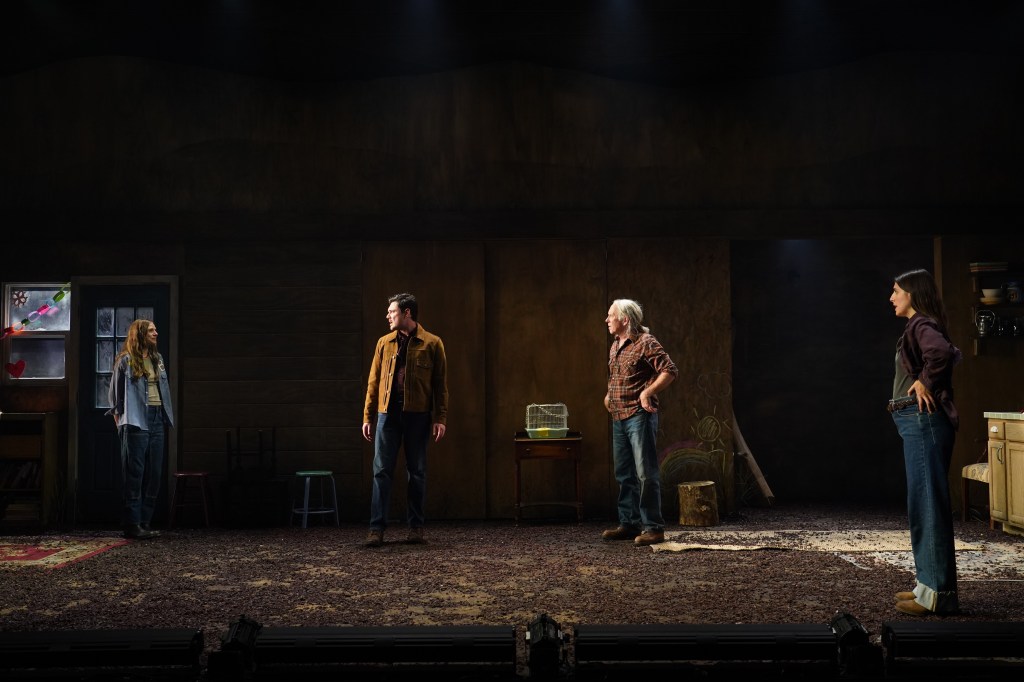
Nevertheless, Peter’s death has created questions which they must confront as tensions about his death mount. Should they reburn his body which requires the heat of a crematorium to reduce it to ashes? After the memorial fire, they decide to bury him in an unmarked grave, which must be at a depth so that animals cannot dig up his carcass. Additionally, if they keep any of Peter’s belongings, which ones and why? If someone contacts them, for example Peter’s mother, what story do they tell her in a unity of agreement? Finally, how do they deal with the children who are upset at Peter’s disappearance?
We question why they feel compelled to lie about Peter’s disappearance, rather than tell the truth to the authorities or Peter’s mom, even if they can receive her calls on an old rotary phone. Thomas, infuriated after he speaks to Peter’s mom who does call, tells her Peter left with no forwarding address. After he hangs up, Thomas (Bruce McKenzie) self-righteously goes on a rant that he will tear down the phone lines.
When Mari (Marianne Rendon) suggests they need the phone for emergency services, he counters. “Can anyone give me a compelling argument for a situation in which this object is likely to protect us from death because let me remind you that if that is its responsibility we have a recent example of it failing at just that.”
Indeed, the tension between commune members Thomas, Mari, Simon (Jeff Biehl), Gracie (Cricket Brown) and Diana (Donnetta Lavinia Grays) becomes acute with the threat of outside interference destabilizing their peaceful, bucolic arrangements. Washburn, through various discussions, brings a slow burn of anxiety that displaces the unity of the members as they work to hide the truth. What begins at the top of the play as they burn the body in a memorial ceremony that allows Thomas and the group to take philosophical flights of fancy, augments their stress as they avoid looking at hard circumstances.
Fantasy and reality clash also In the well-wrought scene where the actors portray the children moving the piglet they believe is Peter when it reacts to Peter’s belongings, specifically, a poem it chews on. Convinced Peter has been reincarnated and is with them, they take the piglet staunching their upset at Peter’s death by reclaiming and renaming the piglet as the rescued Peter. Rather than to have explained what happened, the commune members allow the children to believe another convenient lie.
This particularly well-wrought, centrally staged scene of the children in the pigsty works to explicate the behavior of the commune members. They don’t confront Peter’s death and don’t allow the children to either. The actors captivate as they become the children who relate to the invisible mom Lula and her piglets with excitement, concern and hope. It is one of the highpoints of the production because in its dramatization, we understand the faults of the commune. Also, we understand by extension a key theme of the play. Rather than confronting the worst parts of their own inhumanity, people close themselves off, escape and make up their own fictional worlds.
Washburn reveals the contradictions of this commune who parse out their ideals and justify their actions “living away from society.” Yet they cannot commit to this approach completely because of the extremism required to disconnect from civilization. As it is, they have a car, they do mail runs and sometimes shop at grocery stores. At best their living arrangement is as they agree to define it and as Washburn implies, half-formed and by degrees runs along a continuum of pretension and posturing.
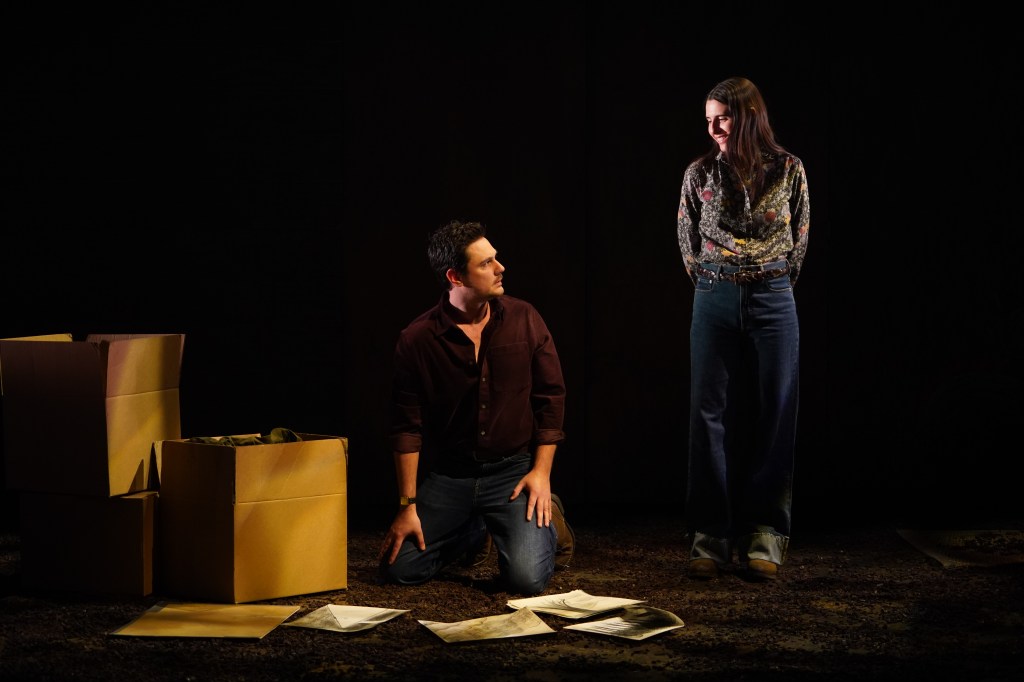
The issues about Peter’s death come to a climax when Will (Tom Pecinka), Peter’s brother, shows up to investigate what happened to Peter. Washburn ratchets up the suspense, fantastical elements and ironies. Through Will we discover that Peter was an estranged, trust-fund baby who will inherit a lot of money from his grandmother who is now dying. Ironically, we note that Mari who claims she had an affair with Peter and dumped him (the reason why he “left”), is willing to have sex with Will. They close out a scene with a passionate kiss. Certainly, Will has been derailed from suspecting this group of anything sinister.
Also, Will is thrown off their lies when he watches a fairy-tale-like playlet, supposedly created by Peter and the children that is designed to lull the watcher with fanciful entertainment.
In the fairy tale a cruel king (the comical and spot-on Donnetta Lavinia Grays), prevents his princess daughter (Cricket Brown) from marrying her true love (Bartley Booz), also named Peter. The bad king thwarts Peter from winning challenges to gain the princess’ love. Included in the scenarios are puppets by Monkey Boys Productions, special effects (Steve Cuiffo consulting), the burning cauldron of fiery flames with playful fire fishes proving the flames can’t be all that bad, and a beautiful, malevolent, dangerous-looking dragon who threatens.
Once again creatives (Boyce, Chandrashaker and Emily Rebholz’s costumes) and the actors make the scene work. The clever, make-shift, DIY cauldron, puppets and dragon allow us to suspend our judgment and willingly believe because of the comical aspect and inherent messages underneath the fairy-tale plot. Especially in the last scene when Peter (the poignant Tom Pecinka), cries out in pain then makes his final decision, we feel the impact of the terrible, the beautiful, the mighty. Thomas used these words to characterize Peter’s death and their memorial funeral pyre to him at the play’s outset. At the conclusion the play comes full circle.
Washburn leaves the audience feeling the uncertainties of what they witnessed with a group of individuals eager to make their own meaning, regardless of whether it reflects reality or the truth. The questions abound, and confusion never quite settles into clarity. We must divine the meaning of what we’ve witnessed.
The Burning Cauldron of Fiery Fire runs 2 hours 5 minutes with one 15-minute intermission at Vineyard Theatre until December 7 in its first extension. https://vineyardtheatre.org/showsevents/
‘The Other Americans,’ John Leguizamo’s Brilliant Play Targeting the American Dream Extends Multiple Times
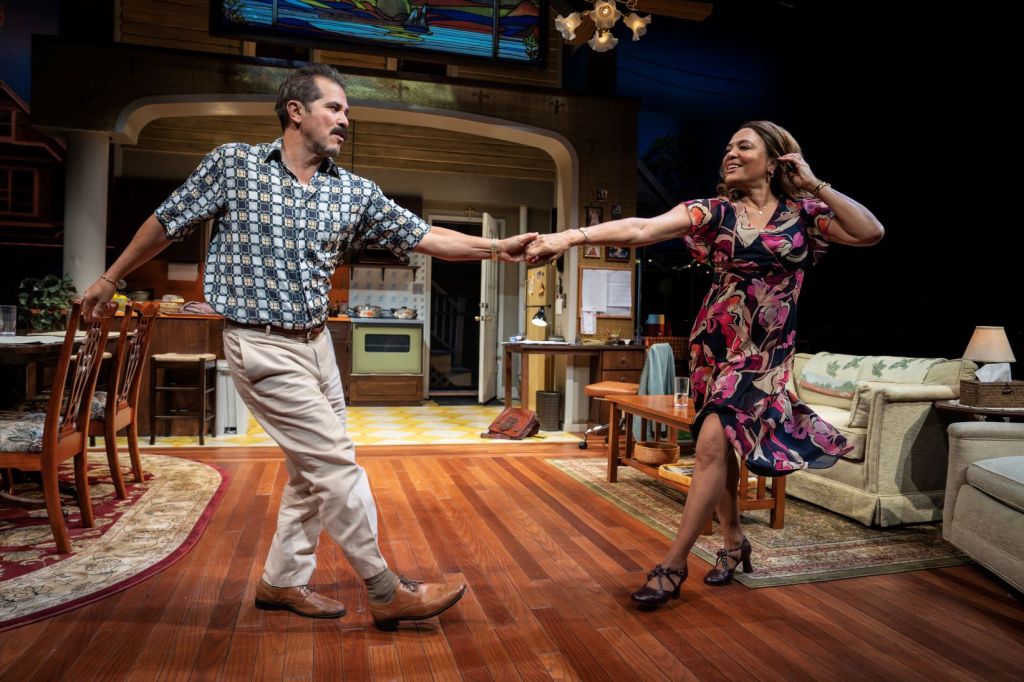
After a long career in every entertainment venue from films, to TV, to theater, Broadway, Off Broadway, etc., the prodigious work by the exceptional John Leguizamo speaks for itself. Now, Leguizamo tackles the longer theatrical form in writing The Other Americans, extended again until October 24th at the Public Theater.
Superbly directed by Ruben Santiago-Hudson, the theatrical elements of set design, lighting, costumes speak to the 1990s setting and cultural nuances. The following creatives developed a smart, stylish representation of the Castro household (Arnulfo Maldonado-set design, Kara Harmon-costumes, Justin Ellington-sound, Lorna Ventura-choreography).
Perhaps Leguizamo’s play could be tweaked to tighten the dialogue. All the more to have it shine with blinding, unforgettable truths sounding the alarm for immigrants in this nation. If tightened a bit, the complex, profound play would land perfectly as the unmistakable tragedy it inherently is. However, in its current iteration, Leguizamo gets the job done. The powerful play with comedic elements resonates to our inner core as a nation of immigrants and especially for Latinos.
Clearly, Leguizamo’s characterizations and themes add to the canon of classics that excoriate and expose the corrupted myth of the American Dream as a lie fitted to destroy anyone who believes it. That immigrants make the sacrifices they do to embrace it, is the ultimate tragedy.
Nelson Castro (played exquisitely by John Leguizamo), born in Jackson Heights from Columbian ancestry, embraces the American Dream. His wife Patti (the amazing Luna Laren Velez), from her Puerto Rican heritage, not so much. Patti’s values lead to loving her family and friends with devotion. Daughter, Toni (Rebecca Jimenez), who will marry the solid but nerdy Eddie (Bradley James Tejeda), looks to fit in as a white woman. The younger Nick (Trey Santiago-Hudson) was like his dad and took advantage of others, fiercely competitive. However, an incident changed him forever.
As the play unfolds, Leguizamo deals with the central question. To what extent have the warped values of the predominant culture negatively impacted this Latino family? From his first speech on we note that these twisted values have lured Nelson. The ethos-scam to get ahead-guides Nelson like a veritable North Star. He uses “getting over” as the key reason to provide for his family. This excuse rots everything under his power.
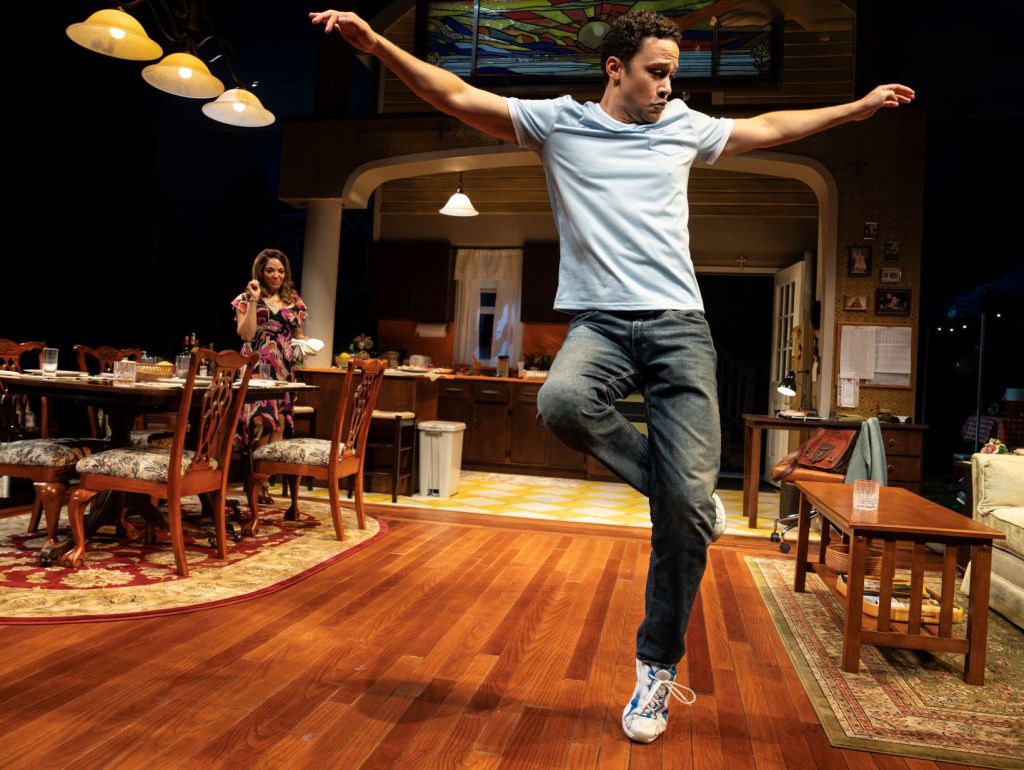
For example, Nelson acts the part of the upwardly mobile success story who always has a deal on the table ready to go. The irony is not lost on us when Nelson hypes a deal with a real estate big wig. Meanwhile, the mogul lives off his reputation for ripping off minorities. Sadly, Nelson admires the mogul’s pluck and con abilities. He ignores how this can potentially harms Latinos.
Mirroring the sick culture and society that values money and material prosperity over people, Leguizamo’s tragic hero tries to wheel and deal to get ahead. Making bad decisions, he overextends himself. Meanwhile, he encourages Nick and Toni to follow his lead. His overweening pride as the patriarch drives him to assume the mantle of a power player. Indeed, the opposite is true. During the process that causes him to fail and lie about it, he compromises his integrity and family’s probity and sanctity. That he willfully blinds himself to the consequences of his beliefs and suppresses his intelligence and good will to fit in, is the final heart breaker.
As in the classic tragic hero, Nelson’s pride also dupes him into a psychotic circularity to believe he has no recourse. Of course he believes the wheels have been set in motion against him by the society’s bigotry and discriminatory values. He should recognize and reject the society that uplifts such values because they support doing whatever necessitates getting ahead. The entire rapacious structure promotes financial terrorism and, whenever possible, it must be rejected. However, Nelson can’t reject it because he can’t help himself from being seduced. Instead, he persists in a prison of his own making, digging his family grave, on a collusion course of self-destruction.
Sadly, he internalizes the society’s inhumanity and makes it his own, a self-hating Latino. Because he adopts this construct because he loathes his immigrant self, he tries to create a new identity apart from his inferior ancestry. Thus, he moves to Forest Hills away from Jackson Heights where he lived “like an immigrant” in a place where cockroaches multiplied.

Finally, as we watch Nelson struggle to assert this new identity in a flawed, indecent, racially institutionalized culture (represented by Forest Hills and what a group of kids did to his son in high school), Leguizamo’s play asserts an important truth for immigrants. Internalizing and adopting the culture’s corrupt, sick, anti-human values is not worthy of immigrants’ sacrifices. This theme is at the heart of Leguizamo’s play. In his plot development and characterizations Leguizamo reveals his tragic hero chases after prosperity and upward mobility. The incalculable loss of what results-losing what it means to be human-isn’t worth it. If one does not weep for Leguizamo’s Nelson at the play’s conclusion, you weren’t paying attention.
To exemplify his themes, Leguizamo uses the scenario of the Castros, an American Latino family. They move from the homey, culturally diverse Jackson Heights to the white, Jewish upscale, racist enclave of Forest Hills. At the outset of the play Nelson, a laundromat owner, awaits his son’s return from a psychiatric facility. Patti has cooked up her son’s favorite dishes. Not only does this reveal her care and concern for her son, her comments to Nelson show her nostalgia for the Latin foods and people of their original Jackson Heights neighborhood in Queens.
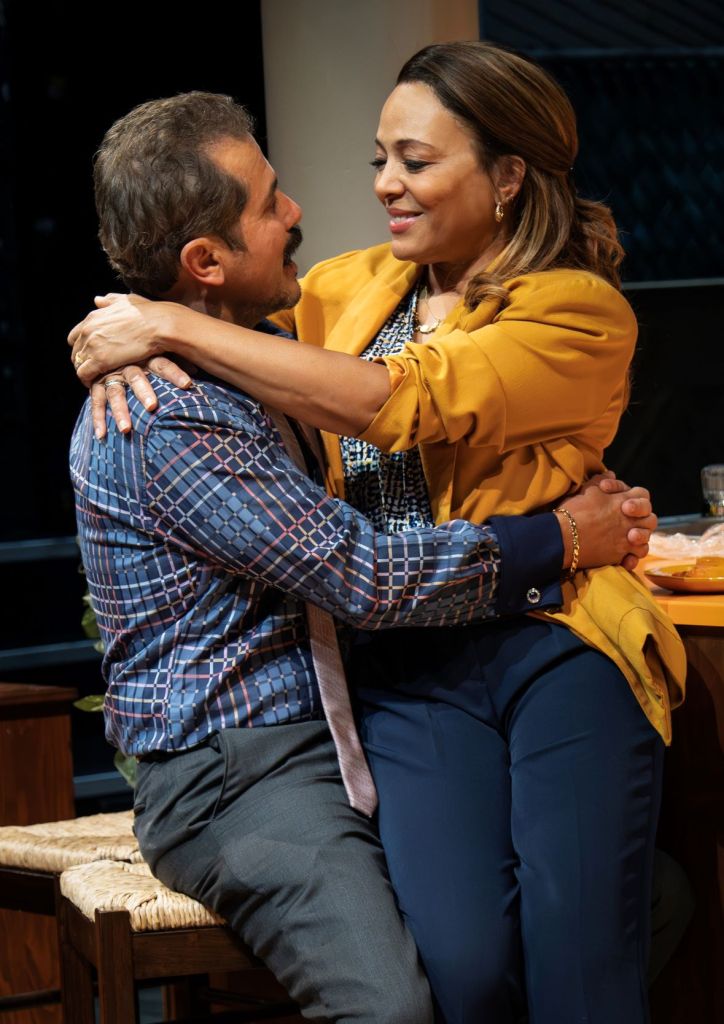
By degrees Leguizamo reveals the mystery why Nick was in a facility. Additionally, the playwright brilliantly explores the conflicts at the heart of this family whose parents put their stake in their children, chiefly son Nick to get ahead financially in the Castro business. To recuperate, the doctors partially helped Nick with medication and therapies.
However, on his return home months later, he still suffers and has episodes. Patti sees the change in his dislike of his old favorite foods (symbolic). Not only does he reject meat, he rejects Catholicism and turns to Buddhism. Because a girl he met at the facility influences him, he moves away from his Latin roots. Later, we learn he loves and admires her and they plan to live together. However, he doesn’t look at the difficulties of this dream: no money, no family support.
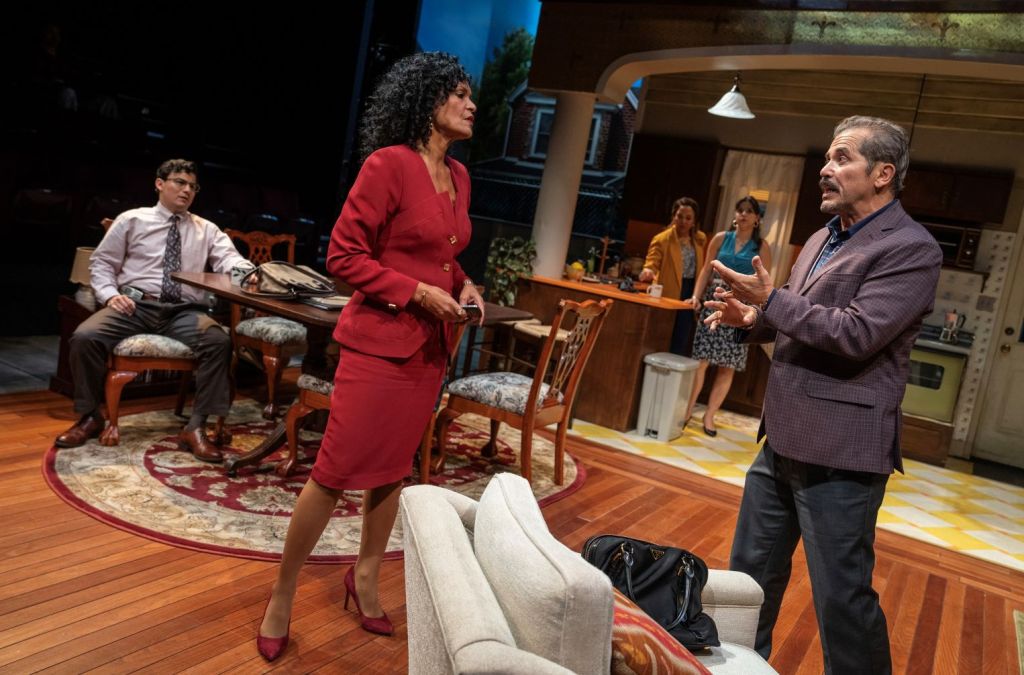
The family conflicts explode when Nick attempts to be truthful with his parents. In his conversation with his mother we learn the horrific details of the beating he received in high school, why it happened, and how it led to episodes in college. Wanting to move beyond this through understanding, Nick learns in therapy that he must talk to his father. Nelson refuses to acknowledge what happened, and becomes a stalemate to Nick’s progress.
Additionally, his doctor supports Nick’s getting out from under the family’s living arrangements. Inspired, Nick yearns to create a life for himself away from their control to be his own person. Ironically, he follows in his father’s footsteps wanting to create a new identify for himself. Yet, he can’t create this identity unless he confronts the truth of what happened to him in high school and talks to his father. Unless he understands the extremely complex issues at the heart of his father’s tragedy, they won’t move forward together. Nelson must understand that he hates his own immigrant being and has embraced sick, twisted corrupt values which he never should have pushed on his family.
Meanwhile, in a fight with Nelson, Nick demonstrates what may really be happening to him. Though he survived the high school beating with a baseball bat, he most probably suffers from what doctors have come to understand as TBI (traumatic brain injury). With TBI the individual suffers debilities both physically and emotionally. When Nelson questions the efficacy of the treatment Nick received from doctors who didn’t really know what was happening to Nick, Nelson is on the right track. But the science had to catch up to Nelson’s observations.
Meanwhile, the problems relating to Nick needing the right help from his parents and his doctors, Nelson’s financial doom and the future of this Latino family under duress are answered in a devastating, powerful conclusion.
There is no spoiler. Leguizamo elegantly and shockingly reveals this family as a microcosm of the ills of our culture and society. Additionally, he sounds the warning for immigrants. If they don’t recognize and refuse the twisted folkways of the “American Dream,” they may lose their self-worth and humanity for a for a lie.
The Other Americans runs 2 hours 15 minutes including an intermission at The Publica Theater until November 23, 2025. https://publictheater.org/theotheramericans
‘Saturday Church’: The Vibrant, Hot Musical Extends Until October 24th
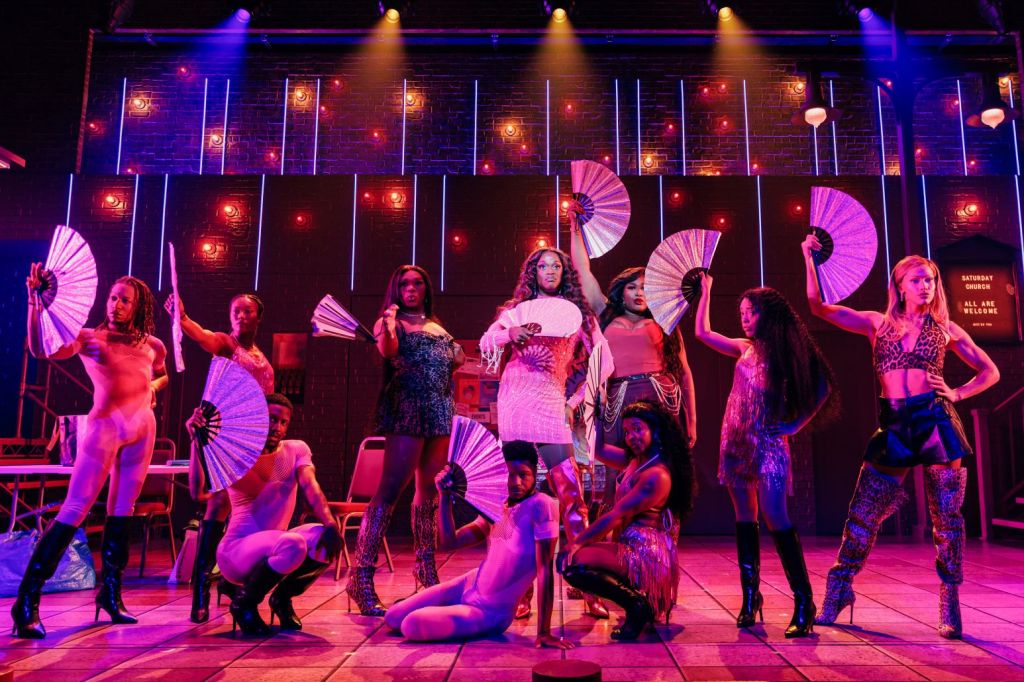
With music and songs by Grammy-nominated pop star Sia and additional music by Grammy-winning DJ and producer, Honey Dijon, Saturday Church soars in its ambitions to be Broadway bound. The excitement and joy are bountiful. The music and songs, a combination of house, pop, gospel spun into electrifying arrangements by Jason Michael Webb and Luke Solomon, also responsible for music supervision, orchestrations and arrangements, become the glory of this musical. Finally, the emotional poignance and heartfelt questions about acceptance, identity and self-love run to every human being, regardless of their orientation and select gender identity (65-68 descriptors that one might choose from).
Currently running at New York Theatre Workshop Saturday Church extends once more until October 24th. If you like rocking with Sia’s music, like Darrell Grand and Moultrie’s choreography and Qween Jean’s vibrant, glittering costumes, you’ll have a blast. The spectacle is ballroom fabulous. As J. Harrison Ghee’s Black Jesus master of ceremonies says at the conclusion, “It’s a Queen thing.”
However, some of the narrative revisits old ground and is tired. Additionally, the music doesn’t spring organically from the characters’ emotions. Sometimes it feels imposed upon their stories. Perhaps a few songs might have been trimmed. The musical, as enjoyable as it is, runs long.
Because of the acute direction by Whitney White (Jaja’s African Hair Braiding), the actors’ performances are captivating and on target. Easily, one becomes caught up in the pageantry, choreography and humor which help to mitigate the predictable story-line and irregularly integrated songs in the narrative.
Conceived for the stage and based on the Spring Pictures movie written and directed by Damon Cardasis, with book and additional lyrics by Damon Cardasis and James Ijames, Saturday Church focuses on Ulysses’ journey toward self-love. Ulysses (the golden Bryson Battle), lost his father recently. This forces his mother to work overtime. Unfortunately, her work schedule as a nurse doesn’t allow Amara (Kristolyn Lloyd) to see her son regularly.
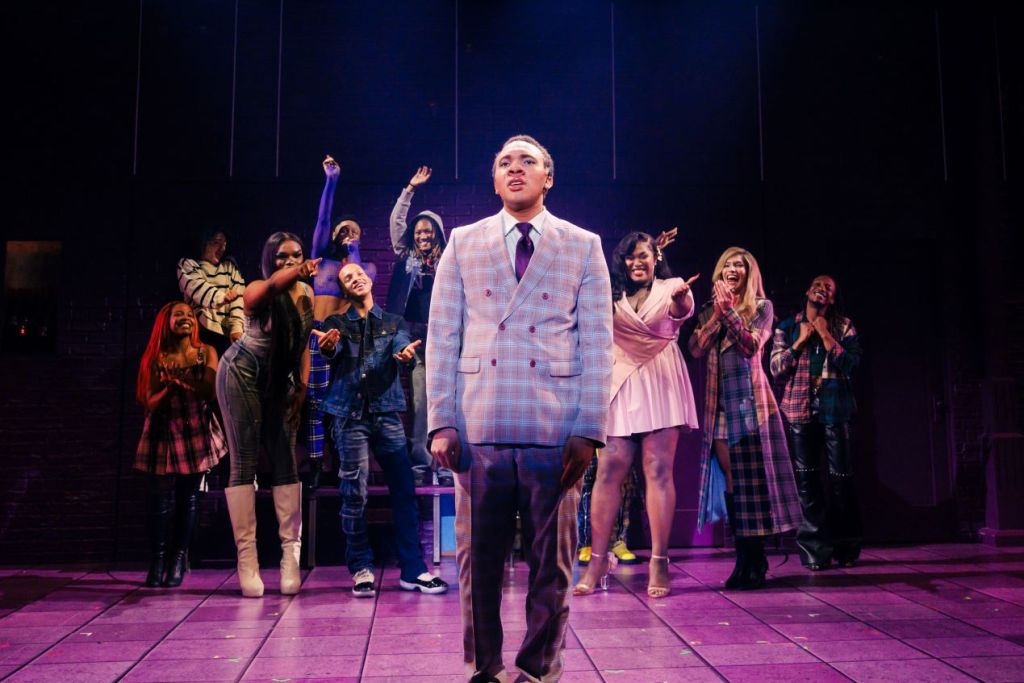
Though the prickly Aunt Rose (the exceptional Joaquina Kalukango), stands in the gap as a parental figure, the grieving teenager can’t confide in her. Even though he lives in New York City, one of the most nonjudgmental cities on the planet, with its myriad types of people from different races, creeds and gender identities, Ulysses’ feels isolated and unconnected.
His problem arises from Aunt Rose and Pastor Lewis (J. Harrison Ghee). Ghee also does double duty as the master of ceremonies, the fantastic Black Jesus. Though Ulysses loves expressing himself in song with his exceptional vocal instrument, Aunt Rose and Pastor Lewis prevent him from joining the choir until he “calms down.” In effect, they negate his person hood.
Negotiating their criticisms, Ulysses tries to develop his faith at St. Matthew’s Church. However, Pastor Lewis and Aunt Rose steal his peace. As pillars of the church both dislike his flamboyance. They find his effeminacy and what it suggests offensive. At this juncture with no guidance, Ulysses doesn’t understand, nor can he admit that he is gay. Besides, why would he? For the pastor, his aunt and mother, the tenets of their religion prohibit L.G.B.T.Q Christianity, leaving him out in the cold.
During a subway ride home, Ulysses meets Raymond (the excellent Jackson Kanawha Perry). Raymond invites Ulysses to Saturday Church and discusses how the sanctuary runs an L.G.B.T.Q. program. With trepidation Ulysses says, “I’m not like that.” Raymond’s humorous reply brings audience laughter, “Oh, you still figuring things out.” Encouraging Ulysses, Raymond suggests that whatever his persuasion is, Saturday Church is a place where different gender identities find acceptance.
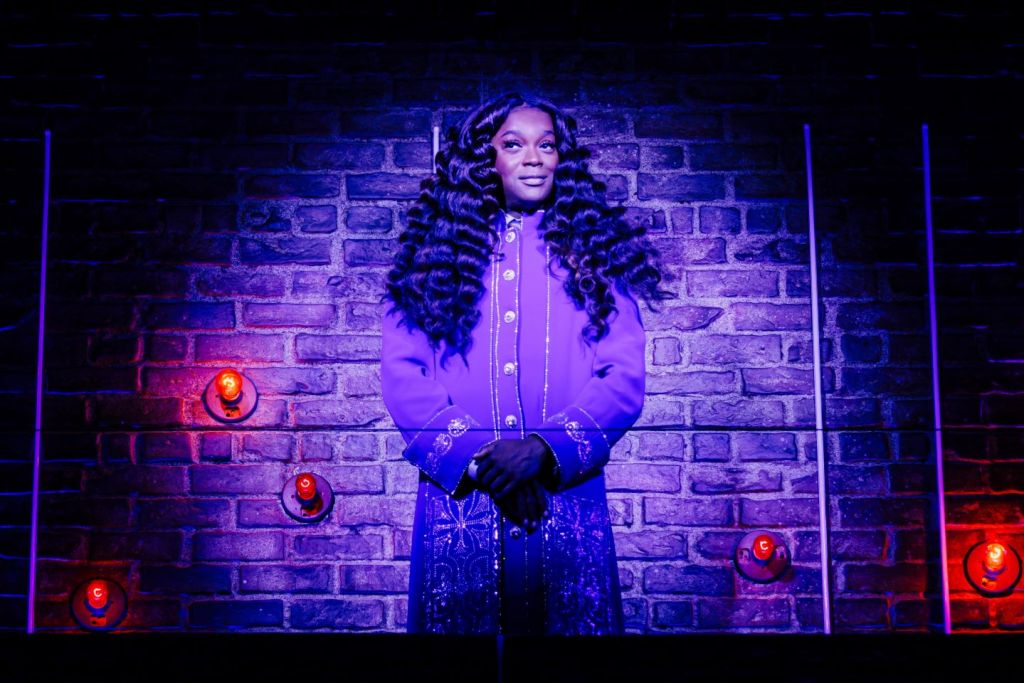
Inspired by the real-life St. Luke in the Fields Church in Manhattan’s West Village, Saturday Church provides a safe environment where Christianity flourishes for all. When Ulysses visits to scout out Raymond, with whom he feels an attachment, the motherly program leader Ebony (B Noel Thomas), and her riotous and talented assistants Dijon (Caleb Quezon) and Heaven (Anania), adopt Ulysses into their family. In a side plot Ebony’s loss of a partner, overwork with running activities for the church with little help, and life stresses bring her to a crisis point which dissolves conveniently by the conclusion.
The book writers attempt to draw parallels between Ulysses’ family and Ebony which remain undeveloped. As a wonderful character unto herself, the subplot might not be necessary.
As Ulysses enjoys his new found persona and develops his relationship with Raymond, his conflicts increase with his mother and aunt. From Raymond he learns the trauma of turning tricks to survive after family rejection. Also, Ulysses personally experiences physical and sexual assault. Finally, he understands that for some, suicide provides a viable choice to end the misery and torment of a queer lifestyle without the safety net of Saturday Church.
But all’s well that ends well. J. Harrison Ghee’s uplifting and humorous Black Jesus redirects Ulysses and effects a miraculous bringing together of the alienated to a more inclusive family of Christ. And as in a cotillion or debutante ball, Ulysses makes his debut. He appears in Qween Jean’s extraordinary white gown for a shining ballroom scene, partnering with Raymond dressed in a white tux. As the two churches come together, and each of the principal’s struts their stuff in beautiful array, Ghee’s Jesus shows love’s answer.
In these treacherous times the message and themes of Saturday Church affirm more than ever the necessity of unity over division, and flexibility in understanding the other person’s viewpoint. With its humor, great good will, musical freedom and prodigious creative talent, Saturday Church presents the message of Christ’s love and truth against a pulsating backdrop of frolic with a point.
Saturday Church runs with one fifteen minute intermission at New York Theatre Workshop until October 24th. https://www.nytw.org/show/saturday-church/?gad_source=1&gad_campaignid=22911892225
‘Ava: The Secret Conversations’ is Enthralling
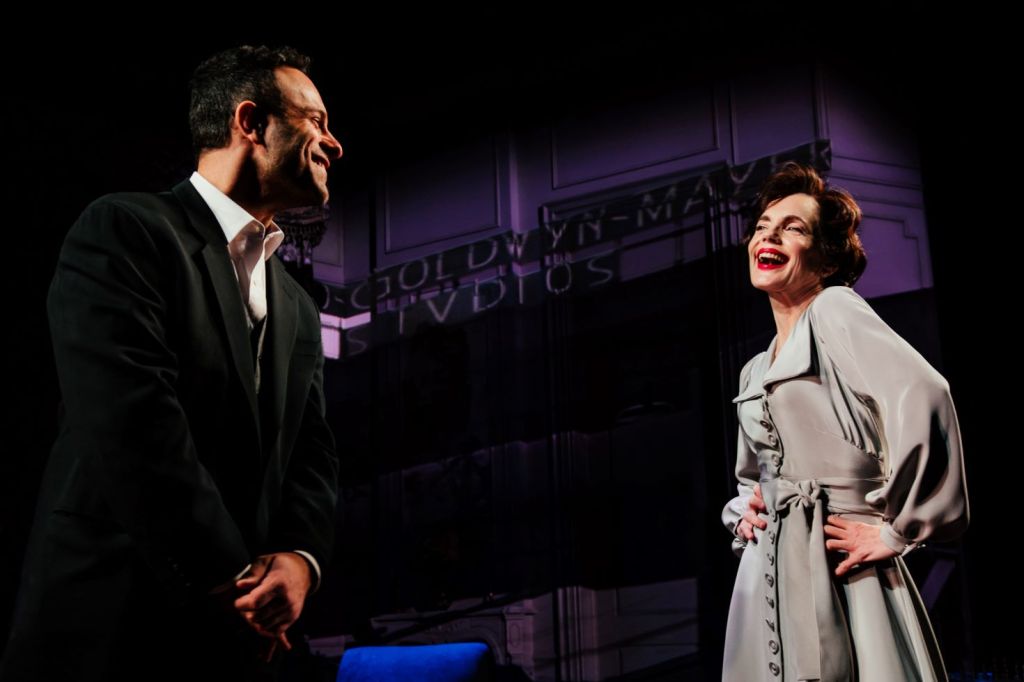
What happens to beautiful women after Hollywood chews them up and spits them out? Ava Gardner, who the studio labeled in a promotion for The Barefoot Contessa (1954) as “The World’s Most Beautiful Animal,” worked in the industry and mostly on TV until her stroke in her 60s. After her illness, she clawed her way back into functioning health to sit for a series of interviews with author Peter Evans who she asked to ghostwrite her autobiography. In Ava: The Secret Conversations, Downtown Abbey star Elizabeth McGovern channels Ava Gardner at New York City Center until September 14th. Her riveting performance mesmerizes with an equivalent assist from Aaron Costa Ganis as Peter Evans and Ava’s husbands.
The play, written by Elizabeth McGovern, reveals known facts about Gardner. However, for those who haven’t read Peter Evans’ titular book on which McGovern bases her writing, the work includes many surprising details.
When Gardner met with Evans at her apartment in London, both had achieved success in their careers. An iconic actress during the Golden Age of Hollywood, Gardner lived her life to the fullest with marriages to Mickey Rooney, band leader Arti Shaw and Frank Sinatra. Additionally, her relationships with many men alluded to in the play indicate she enjoyed her femininity and sexuality. Journalist Evans, who had been recommended to her by a friend wrote biographies of Peter Sellers and Aristotle Onassis to name a few. Together, they brought excitement, experience and expertise to the project which Gardner initiated.
Essentially a two-hander, Ava: The Secret Conversations displays the Gardner/Evans relationship, conflicts about how Ava Gardner wanted to present her legacy, and the split that caused the shuttering of their project. The production features film clips of her husbands integrated throughout, thanks to Alex Basco Koch’s projection design, Cricket S. Meyrs sound design and Amith Chandrashaker’s lighting design.
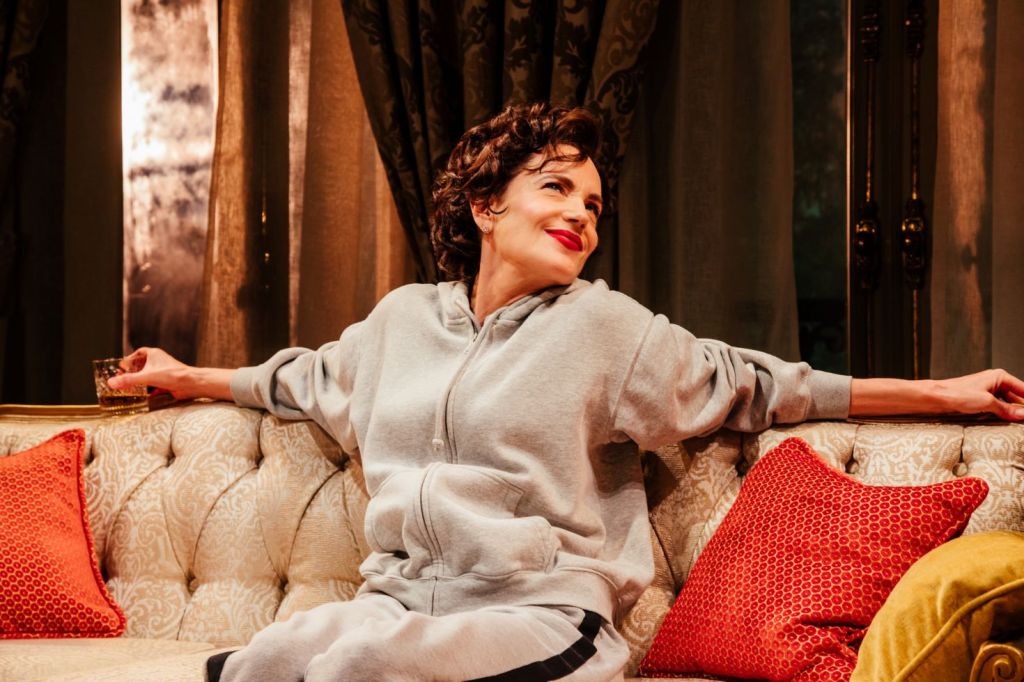
David Meyer’s scenic design and Amith Chandrashaker’s lighting design present Ava’s lush apartment, and minimal sets and spots to reference Peter Evans’ writing study and other scenarios.The technical elements serve Moritz Von Stuelpnagel’s vision of the push and pull of Gardner and Evans who were dependent upon one another for a hoped for profitable outcome which never happened.
Instead, Gardner wrote her own autobiography published shortly after her death in 1990. From the interviews that Evans cobbled together, he wrote Ava: The Secret Conversations published in 2013 after his death. Neither were alive to see their work’s success.

Thematically, as we watch these individuals whose attitudes and values collide, we recognize their interactions happened in a more gracious, decent world than today’s current media circus.
At the top of the play in the prologue, McGovern’s Gardner ominously calls Evans in the middle of the night and tantalizes him like a siren. She mentions she’s thought about assisted suicide, using the organization “Exit.” Then, the scene switches and Ganis’ Evans faces the audience. As he talks to his agent Ed Victor (Chris Thorn’s voice throughout), he questions where to begin the “play?” In a surreal moment we realize the characters discuss “the play” as a framing device. What follows becomes a series of layers which unfold to a core of intimate moments shared between these two individuals remarkable in their own right.
During the uninterrupted span of ninety minutes we watch how Evans engages his subject to be authentic and even raw in her descriptions. For her part McGovern’s Ava tugs at the image of her glittering celebrity and overlays it with her humanity. For example she discusses some graphic details of her rehabilitation after her stroke. The glamor vanishes. Instead, we appreciate Ava’s beauty in mortality.
This key identification reinforces the theme that the human need for community and warmth increases with age and may be hard to come by the greater the celebrity. Gradually, the portrait of Gardner clarifies so we understand the extent to which she experienced heartbreak, loneliness and regret. Additionally, we learn that in exchange for her status, she allowed the studio to dictate her decisions about having a family.
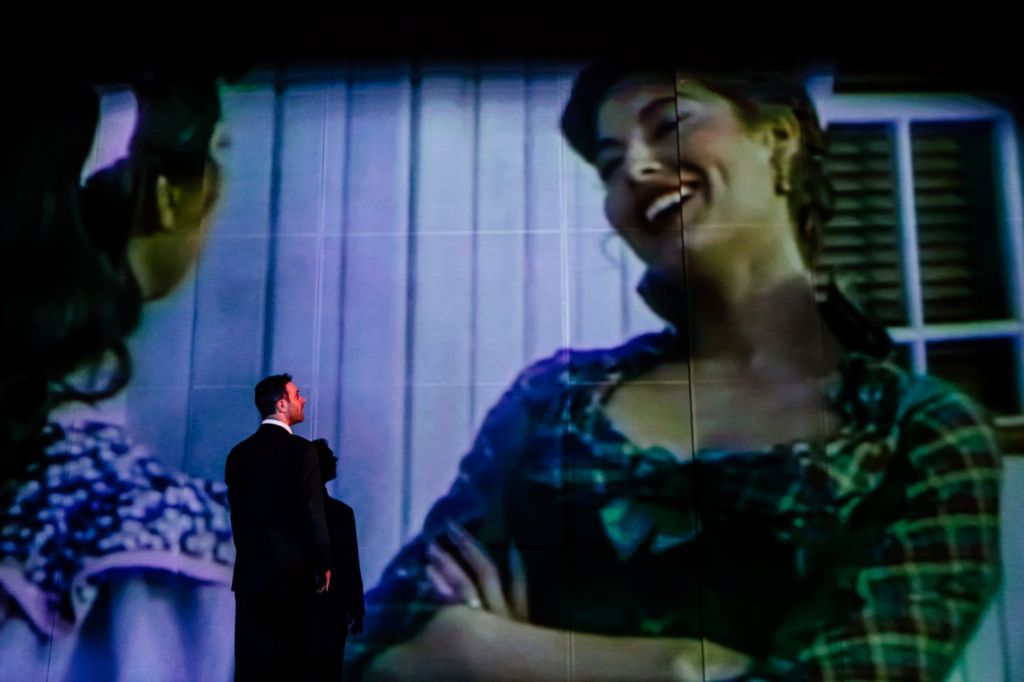
In the interim between discussions, projections and re-imaginings of conversations between Ava and her husbands (Mickey Rooney, Arti Shaw, Frank Sinatra), Ed Victor presses Evans for salacious details. The concept of commercialism everpresent today rears its ugly head. Of course “the dirt” fascinates readers. Obviously, Evans has thoroughly researched Ava’s life, so he attempts to confirm rumored sexual tidbits. Sometimes Ava obliges, enthralled with her own history. Then she realizes she takes the honesty and authenticity too far. Indeed, how will she be viewed if Evans uncovers this earthy, untoward portrait of her brought to life beyond a two-dimensional screen?
On the other side of Evans and Ava’s relationship Victor stands. He intends for the book to achieve best seller status, an easy “slam-dunk.” However, Evans’ scruples and perhaps fears of lawsuits take over. And then Ava makes a decision about the project guided by an important influencer in her life. Abruptly, Evans and Gardner never speak again. However, she does leave him a sign he is in her thoughts, a promise she once made when they first met.
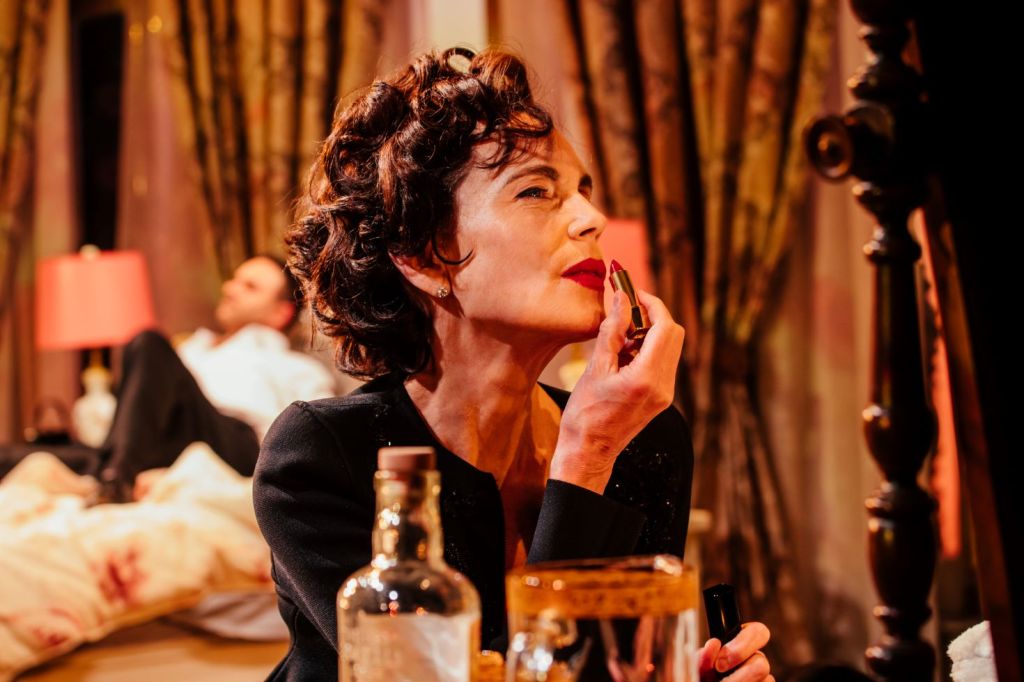
Ava: The Secret Conversations challenges one’s expectations about celebrity without using tired cliche’s. Once the conflicts emerge between Evans and Gardner, the pace picks up. When Evans steps into the characters of Rooney and Sinatra, he does so winningly. With Sinatra he gives McGovern’s Ava emotion to respond to. Toward the last half of the production, the play pops. Toni-Leslie James’ costuming as McGovern dresses for a red carpet appearance, enhances the fading star’s glamor. For most of the play Ava has been sitting around in track suits. Putting on her long sleeve white gloves, McGovern dons Ava’s skin. Regally, she convinces us that Ava is every inch a star, even in her 60s after a stroke.
Ava: The Secret Conversations runs 90 minutes with no intermission at New York City Center, 131 W 55th St (between Sixth and Seventh avenues) until September 14th. https://www.nycitycenter.org/pdps/2025-2026/ava-the-secret-conversations/
‘Duke & Roya’ Review, in Love and War
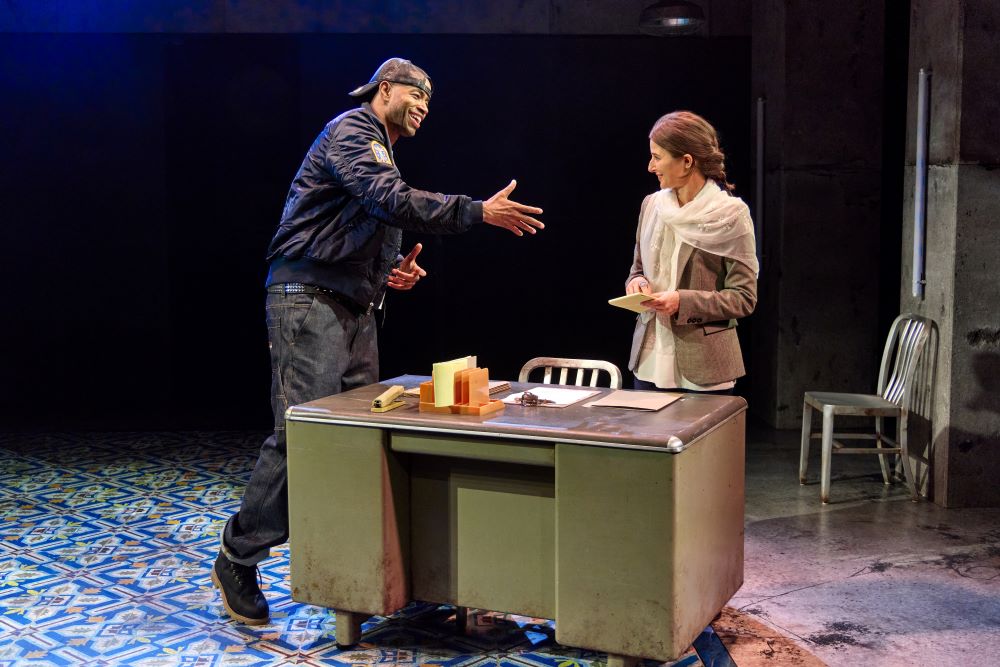
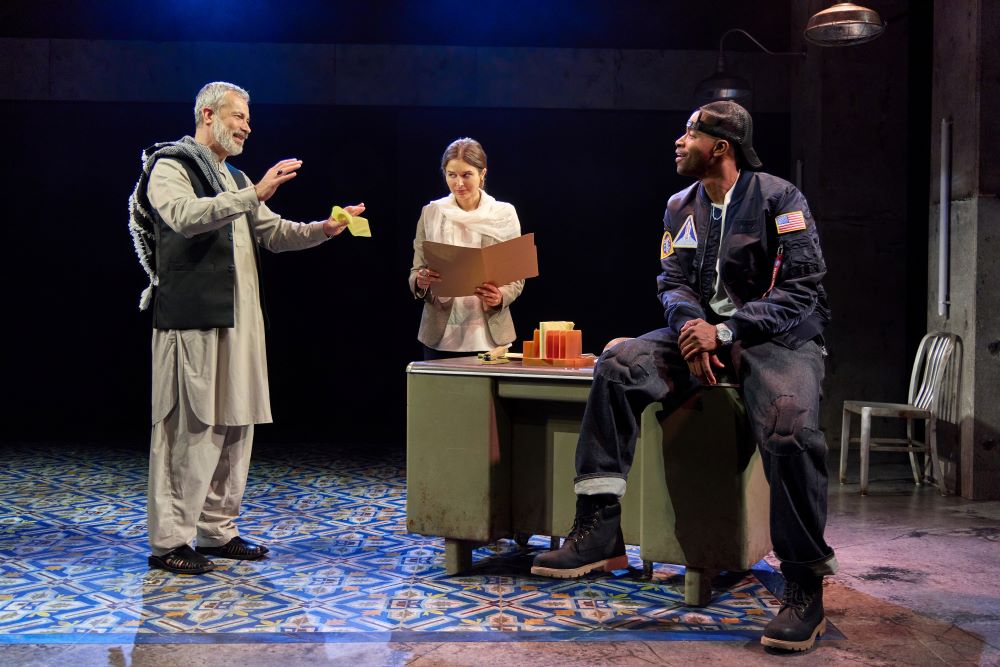
What does Hip Hop music have to do with a Muslim country whose strict religious practices frown on it? Nothing, unless an American base commander brings in a rapper to raise morale and entertain the troops stationed at Bagram Air Force base in Kabul, Afghanistan circa 2017. As unlikely as Hip Hop is to Afghanistan, so is the unlikelihood of the developing relationship between famous rapper Duke (Jay Ellis) and Afghan translator Roya (Stephanie Nur). The evolution of their love and respect for each other develops with humor and insight in Charles Randolph-Wright’s entertaining and meaningful play Duke & Roya. Currently, the hybrid comedy/drama runs at the Lucille Lortel Theatre until August 23rd.
Randolph-Wright unfolds his intriguing play through a series of flashbacks stirred by interviews and interrogations. The purpose of the interviews for the media, obviously is to entertain and titillate. On the other hand the interrogations yield information for investigators. Though we never see the questioners, the four principals, who answer the interrogators,’ questions do the heavy lifting. Through the nimble and talented actors, we form a perspective of the danger and the intrusion into their characters’ personal lives and identities. Randolph-Wright uses the “questioner” device so he can move immediately into the action and adventures between the titular characters in scenes between 2017 and 2025.
Initially, the media questions Duke about his music in the present. Then action transfers from the TV studio to his time in Kabul, Afghanistan. When Duke helicopters onto the base he meets Roya (Stephanie Nur) and her father Sayeed (Dariush Kashani), translators for the American military during the War in Afghanistan. Amiable Sayeed and cool Roya extend their hospitality as employees of the American government. Immediately, Duke shows interest and flirts with Roya, using his confident, “full-of-himself” attitude. Unsurprisingly, his approach, which most likely works on American women, falls flat with Roya.
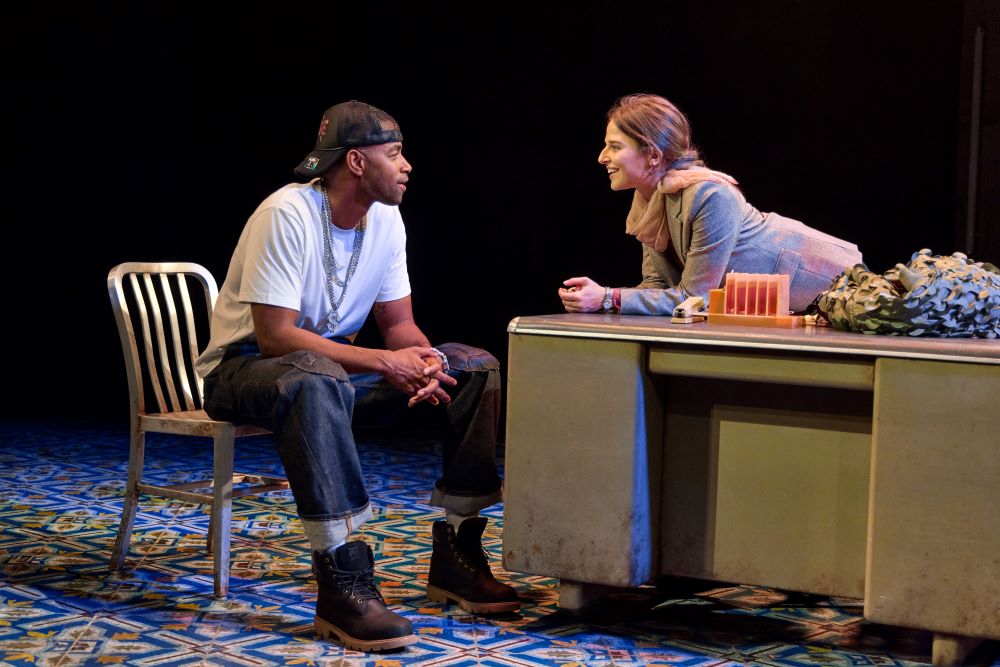
A product of her culture’s strict mores which Duke knows little about, Roya remains aloof. Because he interprets her reaction as “playing hard to get,” their acquaintance happens slowly. Influentially, Roya redirects him toward a new approach with women to encourage his respect. We recognize her brilliant balancing act. Cleverly, she resists his charms, yet lets him know he does appeal to her. So she teases and surprises him with ironic jokes. However, he eventually understands she must be her own woman.
Throughout their experiences together, this push-pull by Ellis’ Duke and Nur’s Roya plays believably. Acutely shepherded by director Warren Adams, the actors and Adams’ staging of them grounds the play in Wilson Chins’ minimal, stylistic set.
Vitally, the contrast between folkways of the west and east reflected in the lightheartedness, emotional drama and revelation of their personalities does capture our interest. For example we learn about the Afghan practice of bacha posh. Because Sayeed has many daughters, he chose the oldest Roya to live as a boy until puberty. Thus, as a boy she had the opportunity of an education. However, sometimes for purposes of safety she dons male clothing and practices bacha posh, which jeopardizes the situation for her later in the play.
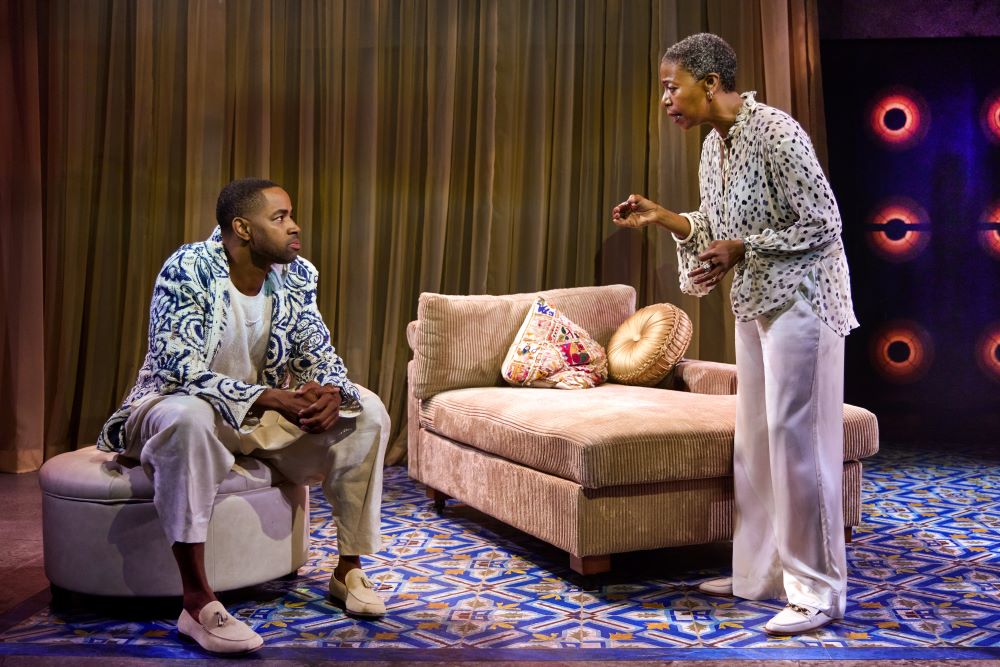
In addition to the standout performances by Ellis and Nur, Noma Dumezweni and Dariush Kashani keep us guessing as Duke’s mom and Roya’s dad. As Desiree, Dumezweni’s strong and forthright sister/mother figure, who chastises Duke when he needs it most, gains our admiration. She’s spot-on mesmerizing. The affable and charming Dariush Kashani authentically conveys the plight of Afghanis caught in an impossible situation. Not aligned with the Taliban that threatens to take over, nor with Americans who will leave the forever war, he, Roya and the family face ever-present danger. Though American visas have been promised for almost a decade, none are on the horizon, a horrific betrayal.
The complex themes sometimes get in the way of each other as the production moves toward the conclusion. Subtly, Randolph-Wright throws into the mix the perspective that Duke exploits the Black experience as a rapper, though his mother is middle upper class. However, Duke’s relationship with Roya changes his perspective and deepens his creativity. Of course the issues of religion, gender and politics come into play. Randolph-Wright intimates the strange parallel of Taliban repression to current oppression of women in the US.
Also, in pointing out facts about the culture clashes and the Afghan war, Randolph-Wright shows the poisonous fallout when the Taliban made a peace deal with the Trump administration without the commitment of Afghan President Ghani. This led to a disastrous withdrawal of American troops and chaos, torture, imprisonment and death for Afghani/US government employees left behind. (Though it is true President Biden extended the evacuation dates, he could not delay the withdrawal indefinitely. Forced to cave to the previous administration’s pressure, he evacuated American personnel and as many of their Afghan counterparts as possible.)
As Duke and Roya mature over the 9 year period, Ellis particularly reveals his maturity during the completion of his interview at the play’s conclusion. Finally, when Duke and Roya meet up again after things become settled, we enjoy watching how their relationship continues to evolve into something profound. Whether or not they end up together is uncertain. However, they have earned their joyful moments together, especially when Ellis’ Duke sings his rhymes for Nur’s Roya with energy and pace. (Ronve O’Daniel’s original music and lyrics are easy and approachable in Ellis’ presentation.)
Amina Alexander’s lighting design, Sanowber Sabrina Spanta’s costume design, Taylor J. Williams sound design and additional music, and Caite Hevner’s projection design provide the background to enhance Chin’s minimal props and set design. These suggest an office at Bagram Air Force Base, an exterior scene in Kabul at night, a swanky hotel room in Dubai, an interrogation room and more.
As one of the more unique, nuanced offerings during this summer Off-Broadway, Duke & Roya shouldn’t be missed.
Duke & Roya runs 2 hours 20 minutes with one 15-minute intermission at the Lucille Lortel Theatre (121 Christopher Street) until August 2nd. https://dukeandroya.com/
‘The Weir’ Review: Drinks and Spirits in a remote Irish Pub
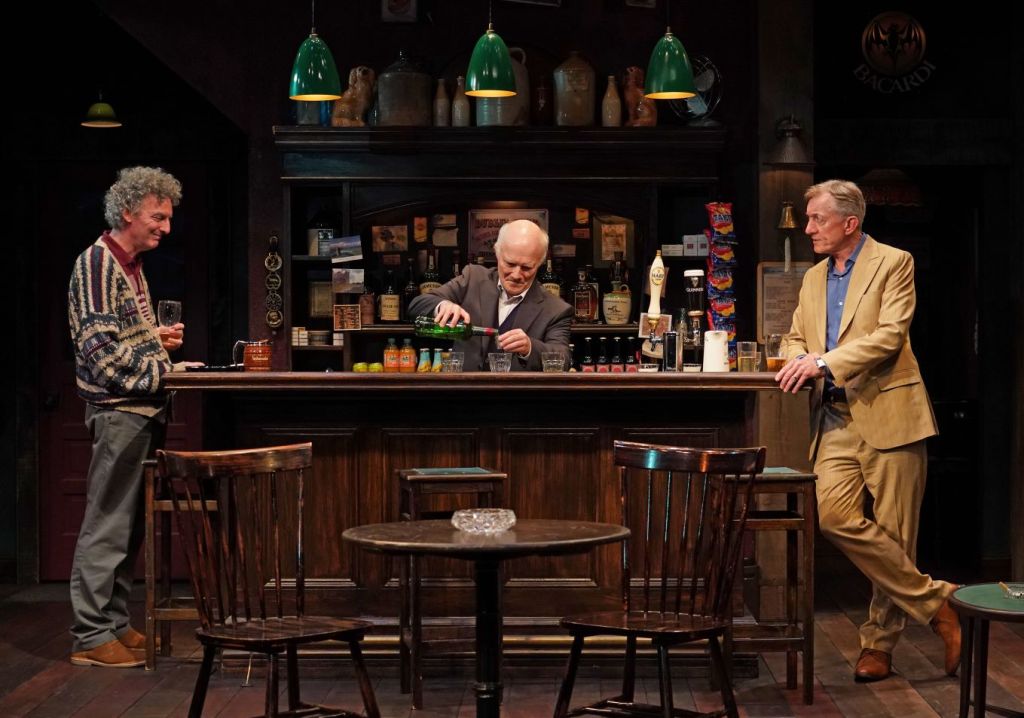
Conor McPherson’s The Weir currently in its fourth revival at Irish Repertory Theatre has evolved its significance for our time. It captures the bygone Irish pub culture and isolated countryside, disappeared by hand-held devices, a global economy and social media. Set in an area of Ireland northwest Leitrim or Sligo, five characters exchange ghostly stories as they drink and chase down their desire for community and camaraderie. Directed with precision and fine pacing by Ciarán O’Reilly, The Weir completes the Irish Rep’s summer season closing August 31st.
Charlie Corcoran’s scenic design of the pub with wooden bar, snacks, bottles, a Guinness tap and heating grate is comfortable for anyone to have a few pints and enjoy themselves at a table or nearby bench. With Michael Gottlieb’s warm, inviting lighting that enhances the actors’ storytelling, all the design elements including the music (Drew Levy-sound design), heighten O’Reilly’s vision of an outpost protective of its denizens and a center of good will. It’s perfect for the audience to immerse itself in the intimacy of conversation held in non-threatening surroundings.
On a dark, windy evening the humorous Jack drops in for drinks as a part of his routine after work at the garage that he owns. A local and familiar patron he helps himself to a bottle since he can’t draw a pint of Guinness because the bar’s tap is not working. Brendan (Johnny Hopkins) owner of the pub, house and farm behind it informs him of this sad fact. But no matter. There are plenty of bottles to be had as Jim (John Keating) joins Jack and Brendan for “a small one.” The entertainment for the evening is the entrance of businessman Finbar (Sean Gormley), who will introduce his client Valerie to the “local color,” since she recently purchased Maura Nealon’s old house.
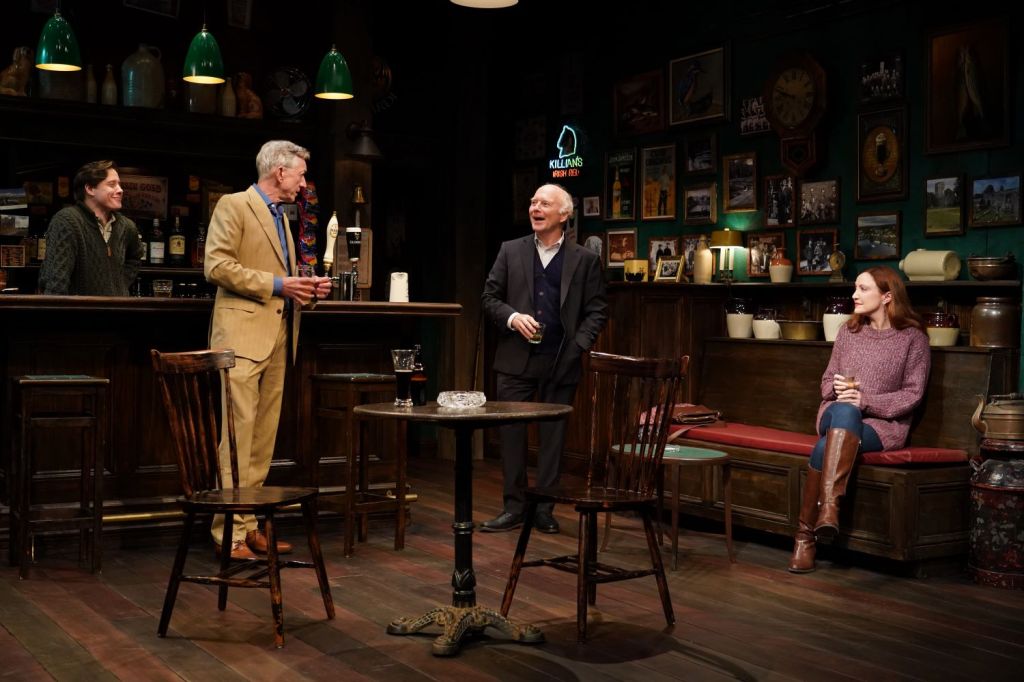
Initially, Jack, Jim and Brendan gossip about the married Finbar’s intentions as he shows up the three bachelors by escorting the young woman to the pub. Jim, caretaker of his mom, and Jack are past their prime in their late 50-60s. Brendan, taken up with his ownership of the pub and farm, is like his friends, lonely and unmarried. None of them are even dating. Thus, the prospect of a young woman coming up from Dublin to their area is worthy of consideration and discussion.
McPherson presents the groundwork, then turns our expectations around and redirects them, after Finbar and Valerie arrive and settle in for drinks. When the conversation turns to folklore, fairy forts and spirits of the area, Valerie’s interest encourages the men to share stories that have spooky underpinnings. Jack begins his monologue about unseen presences knocking on windows and doors, and scaring the residents until the priest blesses the very house that Valerie purchased.
Caught up in his own storytelling which brings a hush over the listeners (and audience), Jack doesn’t realize the import of his story about the Nealon house that Valerie owns. Thankfully, the priest sent the spirits packing. Except there was one last burst of activity when the weir (dam) was being built. Strangely, there were reports of many dead birds on the ground. Then the knocking returned but eventually stopped. Perhaps the fairies showed their displeasure that the weir interfered with their usual bathing place.
Not to be outdone, Finbar shares his ghost story which has the same effect of stirring the emotions of the listeners. Then, it is Jim who tells a shocking, interpretative spiritual sighting. Ironically, Jim’s monologue has a sinister tinge, as he relays what happened when a man appeared and expressed a wish, but couldn’t really have been present because he was dead.
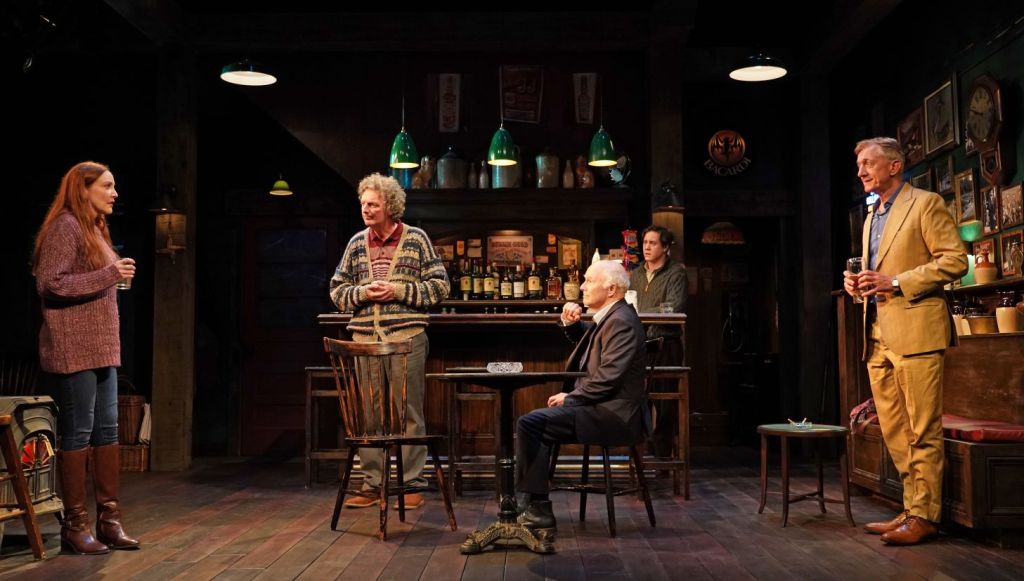
As drinks are purchased after each storyteller’s turn, the belief in the haunting spirits rises, then wanes as doubts take over. After Jim tells his story about the untoward ghost, Valerie goes to the bathroom in Brendan’s house. During her absence Finbar chides all of them. He regrets their stories, especially Jim’s which could have upset Valerie. With Jack’s humorous calling out of Finbar as a hypocrite, they all apologize to each other and drink some more. By this point, the joy of their conversation and good-natured bantering immerses the audience in their community and bond with each other. I could have listened to them talk the rest of the night, thanks to the relaxing, spot-on authenticity of the actors.
Then, once more McPherson shifts the atmosphere and the supernatural becomes more entrenched when Valerie relates her story of an otherworldly presence. Unlike the men’s tales, what she shares is heartfelt, personal, and profound. The others express their sorrow at what happened to her. Importantly, each of the men’s attitudes toward Valerie changes to one of human feeling and concern. Confiding in them to release her grief, they respond with empathy and understanding. Thus, with this human connection, the objectification of the strange young woman accompanied by Finbar at the top of the play vanishes. A new level of feeling has been experienced for the benefit of all present.
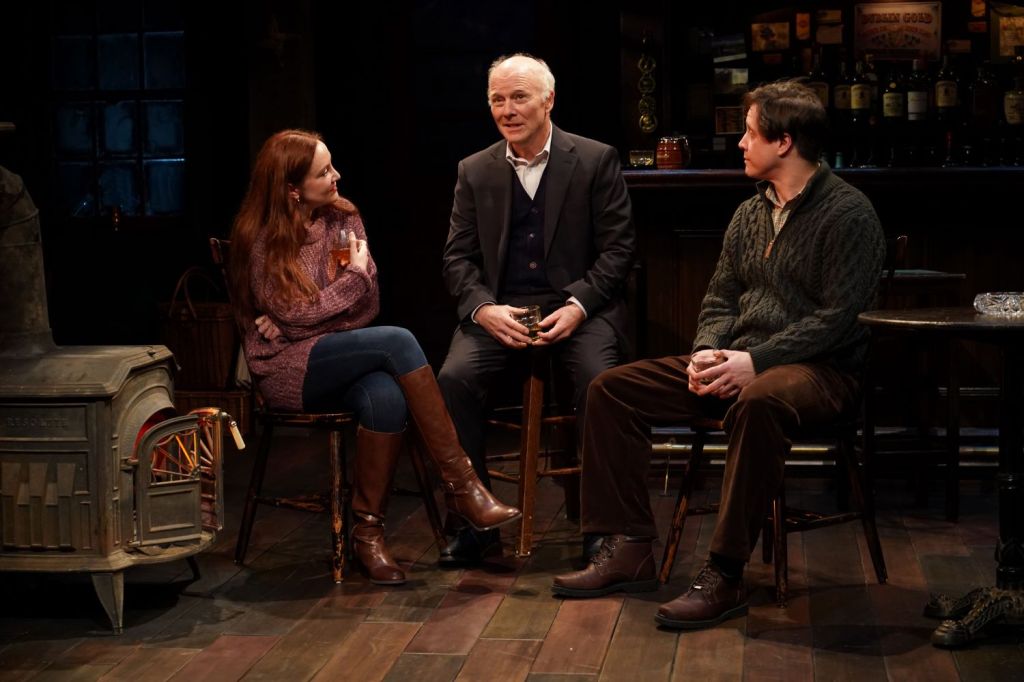
After Finbar leaves with Jim, McPherson presents a surprising coup de grâce. Quietly, Jack shares his poignant, personal story of heartbreak, his own haunting by the living. In an intimate emotional release and expression of regret and vulnerability, Jack tells how he loved a woman he would have married, but he let her slip away for no particularly good reason. Mentoring the younger Brendan not to remain alone like he did, Jack says, “There’s not one morning I don’t wake up with her name in the room.”
McPherson’s theme is a giant one. Back in the day when the world was slower, folks sat and talked to each other in community and conviviality. With such an occasion for closeness, they dispelled feelings of isolation and hurt. As they connected, they helped redeem each other, confessing their problems, or swapping mysteries with no certain answers.
As the world modernized, the ebb and flow of the culture changed and became stopped up, controlled by outside forces. Blocked by fewer opportunities to connect, people retreated into themselves. The opportunities to share dried up, redirected by distractions, much as a dam might redirect the ebb and flow of a river and destroy a place where magical fairies once bathed.
McPherson’s terrific, symbolic play in the hands of O’Reilly, the ensemble and creative team is a nod to the “old ways.” It reminds us of the value of gathering around campfires, fireplaces or heating stoves to tell stories. As companions warm themselves, they unfreeze their souls, learn of each other, and break through the deep silences of human suffering to heal.
The Weir runs 1 hour 40 minutes with no intermission at Irish Repertory Theatre (132 West 22nd St). https://irishrep.org/tickets/
Casey Likes, Lorna Courtney are Terrific in ‘Heathers The Musical’
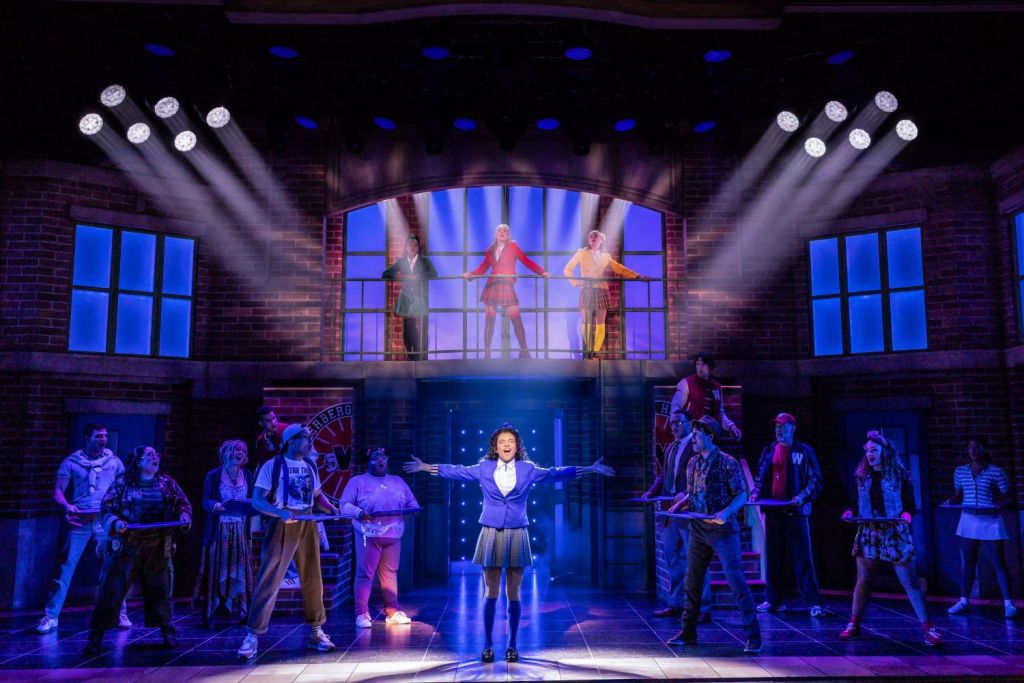
Heathers the Musical
Currently in revival, Heathers The Musial, based on the cult classic film Heathers (1988), written by Daniel Waters, has rocketed onto New World Stages with fans screaming in delight. The production with book, music and lyrics by Kevin Murphy and Laurence O’Keefe first opened at the same Off-Broadway venue in 2014 with Andy Fickman directing. However, O’Keefe and Murphy continually reworked the production honing it to a fine brilliance during the last decade. Most recently in a limited engagement in the West End, it finally transferred to New World Stages. There, it has been extended until January 25, 2026 for good reason.
The 2025 version incorporates changes, including new songs, created in the intervening decade. The concept and subject matter appeals because the sardonic musical comedy satirizes the cruel power dynamics prevalent in high schools across America. Unless one is a part of the ruling elite and finds popularity and favor, the typical high school social machine grinds you up as trash. Admittedly, each high school has its own peculiar “selektion process” of those who “matter,” and those who “don’t.”
How do communities fight this? In a backlash, one character’s notion to purge the toxicity is to “burn everything down.” However, exchanging one form of hatred, nihilism and supremacy for another can create a never-ending cycle of retribution as the musical indicates. Can anything be done?
In its latest version this terrific, complex production asks and answers these questions. Additionally the top notch performances, music (Will Joy), choreography, (Gary Lloyd, Stephanie Klemons), Andy Fickman’s direction and the design elements cohere with near perfect unity to present an overall message. Despite the darkness present in all of us, our humanity has a softer side. We have only to manifest it with courage in the face of bigotry.
The musical opens as narrator/diarist Veronica Sawyer (the amazing Lorna Courtney) considers the negative transformations her classmates have gone through since kindergarten (“Beautiful”). Brainy, misfit Veronica is a senior at Westerberg High in1989, Ohio. Though Veronica believes herself to be a good person (she befriended uncool Martha Dunnstock {Erin Morton}), she must navigate around her classmates who welcome each other with the insults, “FREAK! SLUT! LOSER! SHORT BUS! BULL-DYKE! STUCK-UP! HUNCHBACK!”
Though Veronica blames this toxicity on their growing up and losing their innocence, we wonder if anyone in authority can rein in the students’ brutality toward each other? Therein lies one conflict. Of course the power dynamic is sub rosa. Because students maintain its secrecy, clueless parents and teachers like Ms. Fleming (Kerry Butler), don’t satisfactorily deal with the horrible social culture. Thus, nothing changes.
It is precisely because those in authority can’t influence the students that the three “Heathers” (McKenzie Kurtz, Kiara Lee covered for Oliva Hardy when I saw the show, and Elizabeth Teeter) rule with ferocity (“Candy Store”). In order to lift up their own status, the Heathers make everyone else feel worthless. Ironically, the students electrify the Heathers’ power grid because they fear their wrath and retribution. What would happen if they didn’t bow to Queen Heather Chandler?
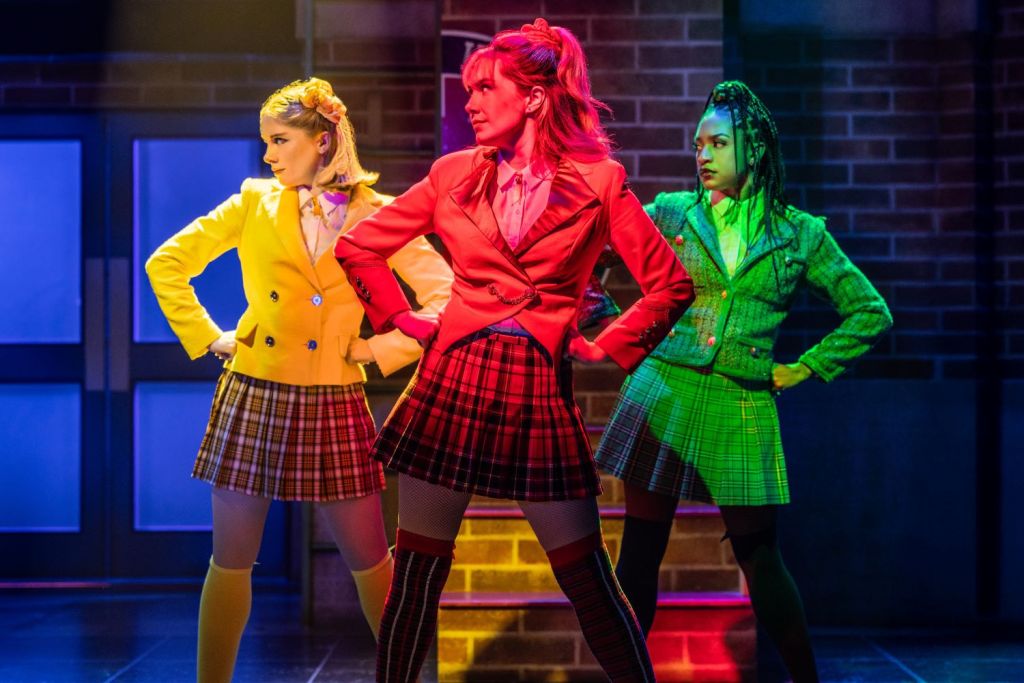
The situation looks up for Veronica when she uses her talent for forgery to save the Heathers from detention. As a result they take her under their wing, give her a make-over and lift her status to “beautiful.” However, she must set up her friend Martha for a grand humiliation at an upcoming party (“Big Fun”) to maintain her popularity.
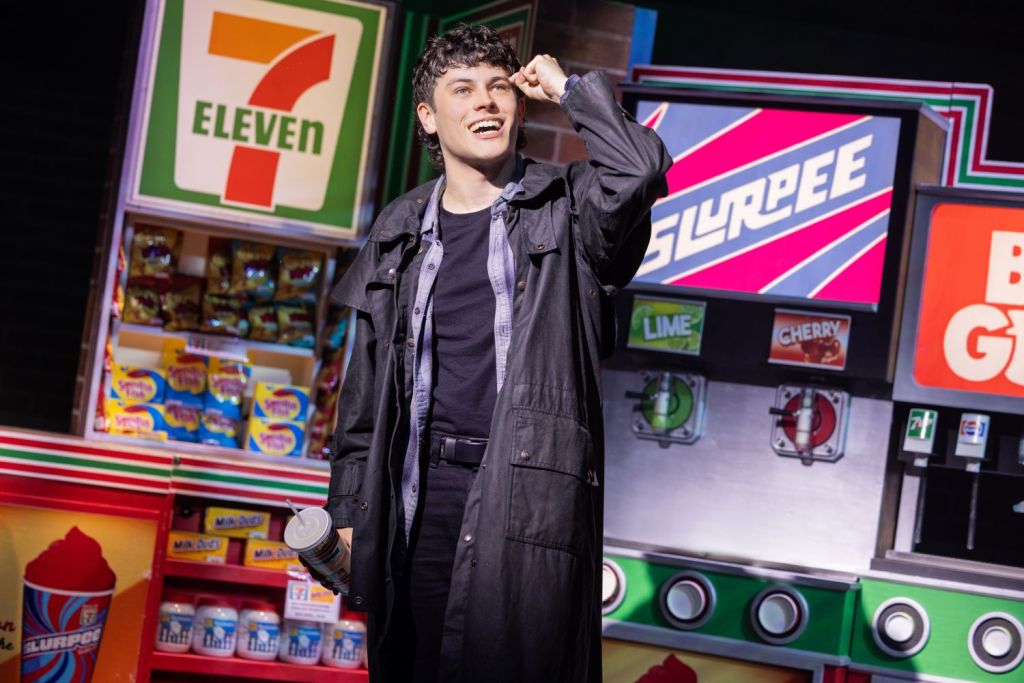
In a counter punch to stop the Heathers’ obnoxious reign of terror, the new student J.D. (the superb Casey Likes) provides another perspective. He criticizes Veronica for selling out Martha to the, “Swatch-dogs and Diet-Cokeheads.” Likes’ JD, dressed in a trench coat and dripping charisma and courage dazzles, a rebel against the stifling social order.
Because JD, stands up to popular jocks, Ram Sweeney (Xavier McKinnon) and Kurt Kelly (Code Ostermeyer), Veronica becomes interested in him (“Fight For Me”). They form an attachment (“Freeze Your Brain”), and J.D. helps Veronica avoid becoming the “laughing stock” of the school (“Dead Girl Walking”). However, Veronica’s innocent plan to apologize to Heather Chandler for throwing up on her outfit backfires. Mistakenly, Veronica gives Heather the wrong cup filled with drain cleaner (JD’s instigation), instead of the cup with her usual prairie oyster hangover cure.
This unexpected twist brings Veronica and JD closer. But their love relationship fueled by a conspiratorial cover-up of Heather’s death leads to more diabolical behavior. With JD’s help Veronica forges a suicide note imitating Heather’s handwriting. The clever, ironic lyrics to dead Heather’s suicide note, in “The Me Inside of Me,” resonate hysterically. (“No one thinks a pretty girl has substance. I am more than just a source of handjobs. No one sees the me inside of me.”) Easily duped, despite Chandler’s horrible nature, the school community believes in her vulnerability and unhappiness.
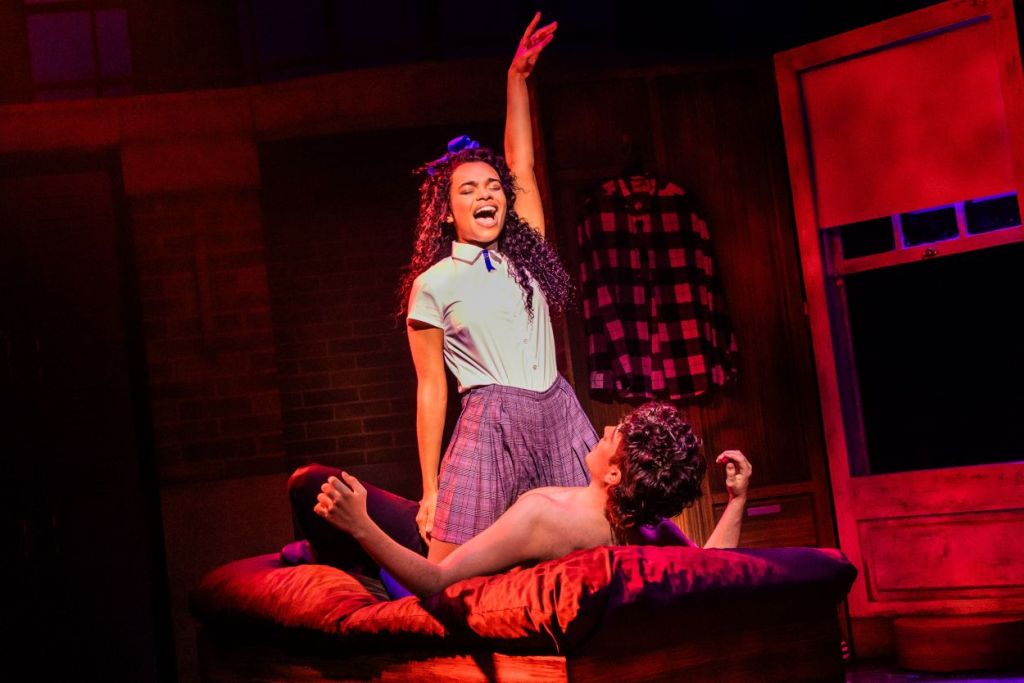
The suicide note elevates Heather to even greater status as a flawed, lonely teenager like everyone else. Meanwhile, the ghost of dead Heather haunts Veronica and cryptically comments while Heather Duke takes Chandler’s place as “Queen.” In a downward spiral Heather Duke’s reign turns out to be worse than Chandler’s. Duke sets up Veronica to be sexually attacked by Ram and Kurt. Though Veronica foils the rape, she and JD plot revenge. Once again the vengeance which begins innocently in Veronica’s misguided mind turns deadly in JD’s hands.
After Veronica and JD tally up two more “accidental” murders, they write believable suicide notes that Ram and Kurt were gay. Neatly, they’ve cleansed the school of three of the most brutal kids in the social hierarchy. In Act I’s closing number (“Our Love is God”), they affirm their love and righteous acts of “justice” with the mind-blowing lyrics: “We can start and finish wars. We’re what killed the dinosaurs. We’re the asteroid that’s overdue.” As JD tells Veronica he’d give his life for her, Veronica cannot resist his love and allure. Energized by her and their new found form of justice, JD’s nihilism continues in Act II. Only Veronica can stop him.
With Andy Fickman’s superior staging and humorous, well-paced timing, the production flies by at two hours and 30 minutes. The ensemble’s exuberance, voices and dancing are cracker-jack, the arrangements super. Memorable throughout, Lorna Courtney sustains her portrayal of Veronica’s transformation from “good person” to JD’s unwitting accomplice to murder, and back again. As JD Casey Likes is Courtney’s match pitting his phenomenal voice against hers with every song. As a couple they shine, reminding us that evil can be seductive.

Finally, McKenzie Kurtz lifts the ironic character of Heather Chandler in death with fine pacing and great humor. She aligns in a perfect contrast with Erin Morton’s kind-hearted, loving Martha Dunnstock, who would be everyone’s friend if they they opened their eyes to her goodness. Standout numbers “My Dead Gay Son,” (Ben Davis, Cameron Loyal are hysterical) and “Shine a Light” (the funny Kerry Butler) are LOL. “Kindergarten Boyfriend” (Erin Morton is spot-on authentic) resonates with pathos.
Thematically, Water’s film and the Heathers musical (2014) were harbingers of today’s cultural divisions. With prescience they exposed the danger of allowing high school communities to be breeding grounds of hate and discrimination, fostered by a school’s particular “master race” clique. If high schools reflect the larger culture, then social media exponentially spreads their poison. Is it any wonder that insults, hate and bigotry are embraced by “seleckt” political groups to gain votes? Spawned in community settings and reinforced by boards of education in their curriculums, hate and discrimination become normalized.
Heathers the Musical reveals the social construct which accepted a “president” who uses insults, bullying tactics and death threats to get what he wants. It also reveals a better answer than JD’s nihilism in the concluding song. It’s up to us to “make it beautiful.”
Heathers The Musical runs 2 hours 30 minutes with one intermission at New World Stages. https://heathersthemusical.com/new-york/about-ny/
In “Angry Alan,” John Krasinski Leaps into the Snakepit of Toxic Masculinity

When cruelty spools out gently and gradually, the witness to it barely notices. However, after a wholesome, middle-aged man morphs from a butterfly of geniality into an ugly, devouring canker worm, the “in-your-face” transformation appalls. John Krasinski reverse engineers Roger’s good-guy persona (think Jim Halpert, “The Office”), into a self-satisfied misogynist in the one-man show Angry Alan. Presented as a limited engagement, Angry Alan, directed by Sam Gold, written by Penelope Skinner (created with Don Mackay), currently runs at the refurbished Studio Seaview through August 3rd.
If you enjoy Krasinski’s work, in Angry Alan he’s humorous and heartfelt, and at the top of his game. Krasinski slyly generates Roger’s emotional breakdown. When we reach the finale, spun out after eighty-five minutes, Roger’s darkening metamorphosis has numbed our emotions.
With insight and ingenuity, the playwright reveals how cultural influences can harm men as they “look for shelter” from their own inner pain and torment. Rather than get professional, local help, they may seek like-minded others on social media for a quick, feel-good fix with disastrous results.
When we meet Roger in his unremarkable, unadorned home in the midwest (courtesy of dots’ apt scenic design), his confessional tone and good-natured aura solicit our interest. Despite his divorce and his firing from an upper level position at AT&T, his smiling face and energy shine with positivity. Krasinski hones his portrayal skillfully with power. Winningly, he mines Roger’s goodwill with his charming audience interactions. He has us. However, where are we going with him?

As we learn his back story, we note his “good guy” persona. For example, ex-wife Suzanne always receives child support payments on time for their son Joe whom he loves. Additionally, he encourages his girlfriend Courtney and her new friends who are feminists and vegans. Furthermore, he supports Courtney’s taking art classes at the local community college, despite the nude male and female models. Not an “extremist,” he walks the political middle of the road.
Thus, Roger’s frenetic enthusiasm about the online guru he recently discovered and hesitates to discuss with Courtney doesn’t alarm. So, we “hear him out.” Clearly, the guy on the internet that Roger finds simpatico has drawn him with his mesmerizing, candid videos. Sure, we know how addictive videos can be. Don’t we immerse ourselves watching them on our phones?
However, the video creator “Angry Alan,” uses a handle that expresses the feelings of hundreds of his followers. As it turns out Alan pushes a stereotypical, one-sided perspective about men’s oppression by “a gynocracy out of control,” a feminist movement over the edge. Roger ignores the causes of feminism as he presents how Angry Alan uplifts men’s rights. Obviously, because women “dominate the world” (like Beyoncé says), men are in crises. Roger cites various statistics (men are more likely to commit suicide, die in combat, be college drop-outs), to reveal how modern men are “in trouble.”
After Roger confides in girlfriend Courtney and they discuss his new interest, he gains her support, though she doesn’t watch any of the videos. Instead, the affable Roger filters Alan through his vulnerable lens and makes him sound reasonable. In fact, this new direction Roger takes prompts him to send a video to Joe. And for the first time, Joe texts him and they agree to Joe’s visit, a first that thrills Courtney. However, Roger doesn’t tell her he uses his child support money for a pricey gold donor ticket to Angry Alan’s men’s conference.
As a turning point in Roger’s downward spiral, the men’s empowerment conference skyrockets his enthusiasm. Meanwhile, the truth revealed in Gold’s staging and the scenic design indicate Roger’s brokenness and susceptibility to brainwashing. As Roger describes the numbers of men and a few women who attend, Gold represents this with two dummies sitting in chairs and a painted backdrop of indistinguishable figures in the distance. No wonder why Roger dismisses those few he talked to and only has eyes for the internet icon and star of the conference, Alan, whom we never see.

The more urgent his need to calm his inner turmoil and isolation, the less Roger focuses on reality. So when he attempts to cheer up a woman he meets at the conference, who leaves depressed, she expresses truths Roger dismisses. There to report on the economic practices of online personalities, Roger quotes her, ” I’m ‘upset’ cos I just sat in a room all day with a bunch of guys like you spewing hate and laughing at rape jokes.” Then she reveals that Alan doesn’t use the donations he receives for charities. Instead, the money goes in Alan’s personal bank account.
Though she has given Roger the inside truth of Angry Alan’s MO, Roger insults her and walks away. Reinforcing his position, he projects onto her his inner emotional state, “What a bitter woman. Talk about fake news.” This stubbornness thrusts him deeper into the abyss. So, when Joe visits and confides in his father looking for comfort, Roger can’t accept Joe’s revelation because it doesn’t line up with Alan’s world view. The affable good guy disappears and a monster of hate and rage manifests. “Angry Alan” has spawned “Angry Roger.” Unable to self-correct or self-evaluate, Roger destroys his relationship with Joe.
Krasinski makes Roger’s descent and self-annihilation believable with the exception of the last moments of the play. Though Roger has a cathartic moment, Skinner drags us back to the internet and Angry Alan’s followers. If she ended the play with Roger feeling the despair of his own pain and sorrow, the play might have had more thematic grist and allowed the audience to identify with Roger’s humanity. Instead, Skinner leaves him online. Though Roger hasn’t had enough, we have. Despite Gold’s finely paced direction, coherent technical vision and Krasinski’s performance, the conclusion leaves us cold.
Angry Alan runs 1 hour 25 minutes without an intermission at Studio Seaview through August 3. studioseaview.com.
Caryl Churchill Strikes Again in a Provocative Suite of Metaphoric One-acts: Glass. Kill. What If If Only. Imp.

Glass. Kill. What If If Only. Imp.
Metaphor rides high in the four one-act offerings thematically threaded by British playwright Caryl Churchill. The suite is currently playing at The Public Theater until May 11th. Directed by James Macdonald, Churchill’s most recent collection integrates poetry, surrealism and “mundane reality” with a twist to represent the precariousness of our psyches in an incomprehensible world that populates the humorous and the horrible simultaneously.
“GLASS” is a fairy-tale-like playlet that opens onto a lighted platform amidst darkness (scenic design by Miriam Buether), which we discover is a mantlepiece that holds objects. The protagonist is a girl of transparent glass (AyanaWorkman). According to the stage directions, “There should be no attempt to make the glass girl look as if she is made of glass. She looks like people look.” We meet her with others who are her jealous rivals, (an antique clock, a plastic red dog, a vase). Though the “glass girl” doesn’t seem to care to compete, the others humorously swipe at each other about who is the most useful, beautiful or valuable.
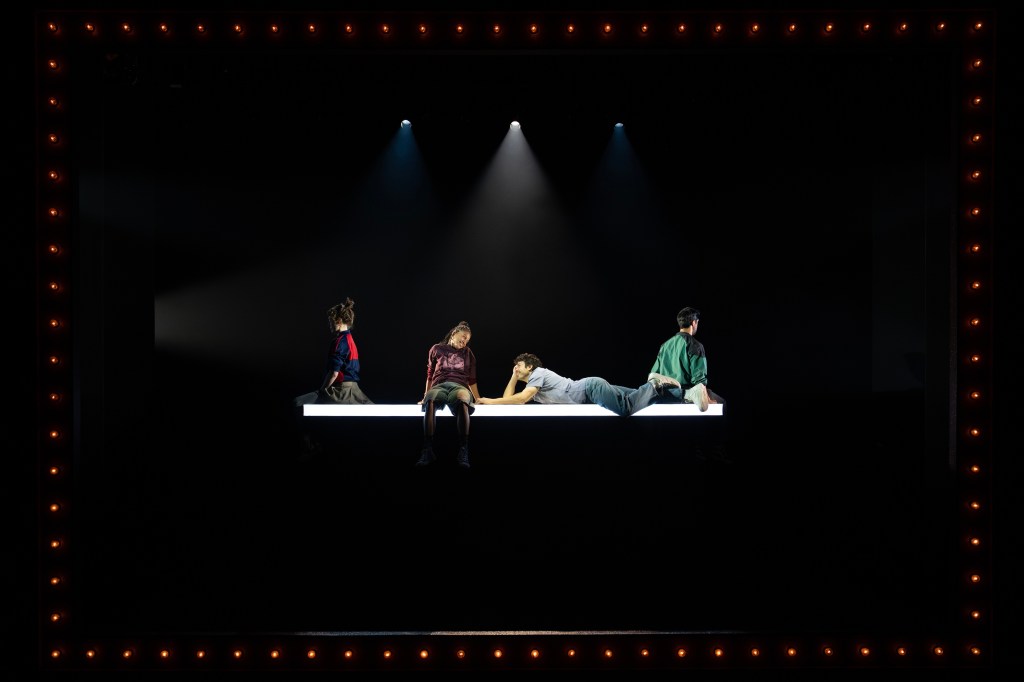
All look like people, suggesting a conceit. One interpretation might be that objectified humans come to believe in their own “grand” objectification. Other humans, aware of themselves, are transparently fragile, which can result in tragedy. Though Churchill’s meaning is opaque, the playwright adds layers. When Ayana Workman’s character is with schoolgirls, who persecute her and make her cry, her pain is visible both inside and out. Her vulnerability attracts a boy (Japhet Balaban), who becomes her friend and confidante. He whispers a story of his life with his father since he was seven. Though his whispers are not audible, we imagine the worst. Yet, we are shocked when the glass girl explains what happens to him which has a devastating impact on her.
The theme of fragility suggested in “GLASS,” is continued as an ironic reversal in “GODS,” after circus performer Junru Wang, presents stunning acrobatic maneuvers on handstand canes. The interlude with lyrical music provides time to reflect about aspects of life which require balance that only comes with training and practice as Junru Wang exhibits.
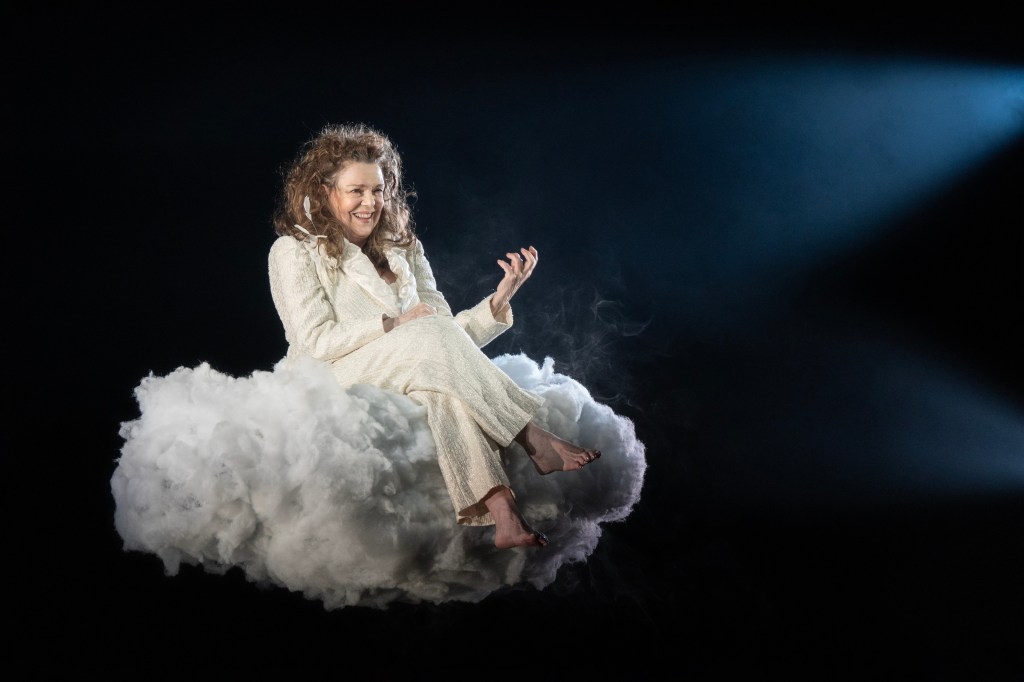
In “GODS,” Churchill casts the Gods of Greek and Roman mythology as the vulnerable ones. They unleashed the Furies to punish brutal humankind to no avail, then recalled them because humans never tire of bloodthirsty murders, wars, rampages. Deirdre O’Connell embodies all of the Gods. She sits suspended mid stage on a fluffy, white cloud surrounded by darkness, haranguing the audience in a stream of consciousness rant about the bloodletting, familial murders, intrigues, wars and cannibalism.
In a summary of bloody acts, O’Connell’s Gods admit they encouraged the brutality with curses and liked watching the results. But now in a humorous and ironic twist, they don’t like it. Furthermore, they wash their hands of the killing, because they don’t even exist. That is to say humans attribute their own monstrous behavior to the Gods instead of accepting responsibility for their own heinous acts. By the conclusion O’Connell’s Gods scream and plead, “He kills his son for the gods to eat and we say no don’t do that it’s enough we don’t like it now don’t do it we say stop please.” The Gods’ point is made. The audience agrees. The maniacal being, a human creation, haplessly protests its creators, knowing the bloodshed and murders will continue. If the gods had ultimate control would humanity be peaceable? Churchill’s irony is devastating.
Circus performer Maddox Morfit-Tighe creates the second interlude as he juggles with clubs and performs acrobatic movements. Macdonald positions both circus performers in the “pit” in front of proscenium using Isabella Byrd’s lighting design for dramatic effect. Churchill’s irony about humankind as performers who juggle and balance themselves in the tragicomical circle of life continues the thematic thread of vulnerability and fragility.

In “WHAT IF IF ONLY” a husband’s (Sathya Sridharan) grief over his wife’s death is so intense that his desire touches the spiritual realm, and the possibility of her return seems imminent when a “being” shows up. However, his suffering has evoked a ghost of “the dead future.” The being brings the horrific understanding that his wife is forever gone, subject to her vulnerable mortality. What is left are the illimitable future possibilities. But when the being suggests that he tries to make a possibility happen, he claims he doesn’t know how. His grief has cut off his ability to even conceive of a future without his wife.
No matter, a child of the future (Ruby Blaut), shows up. Though he ignores the child, she affirms she is going to happen. As we daily ignore our vulnerable, mortal flesh to live, the future will happen, until we die. Churchill frames life as hope with possibility that we must let happen.
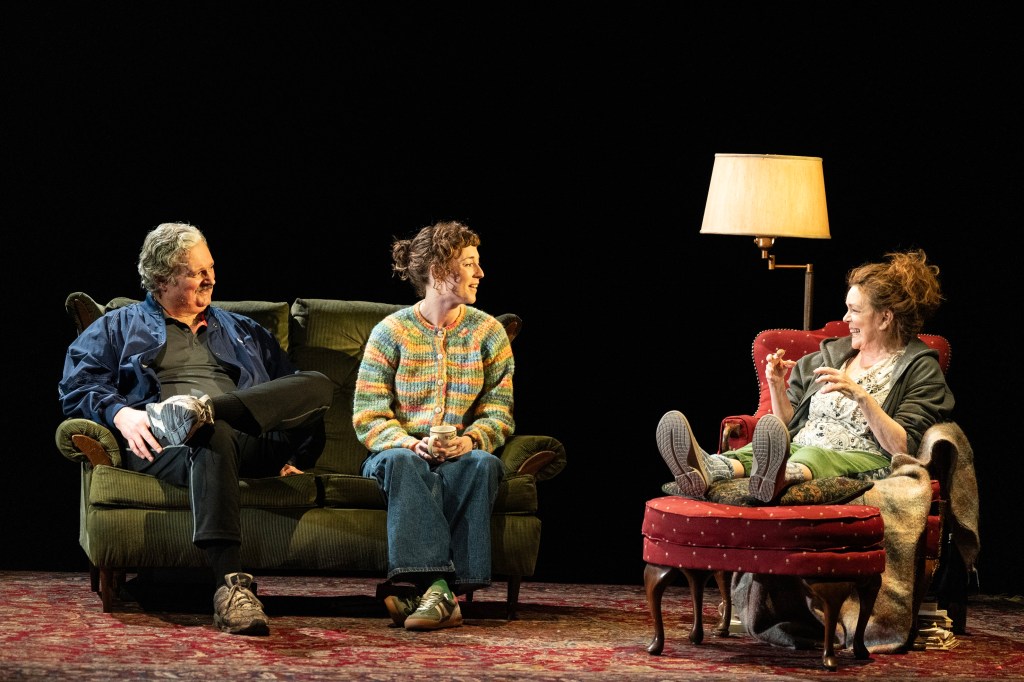
After the intermission Macdonald presents Churchill’s uncharacteristic, humorously domestic one-act “IMP.” The last play continues the thematic threads but buries them in the ordinary and humorous. The significance of the title manifests well into the play development after we learn the back story of two cousins who live together, Dot (O’Connell), and Jimmy (John Ellison Conlee), and their two visitors, niece Niamh (Adelind Horan), from Ireland, and local homeless man Rob (Japhet Balaban). During Rob’s visit with Jimmy, since Rob doesn’t want to discuss any personal details about himself or the possibility of a relationship forming between himself and Niamh, Jimmy decides to share a family secret. Dot believes she captured an imp that is in a wine bottle capped with a cork.
Though Jimmy claims not to believe the imp exists, at Bob’s suggestion, he uncorks the bottle. In the next six scenes we watch to see if anything changes in the lives of these individuals and are especially appalled when Dot wishes evil on Rob via the imp when she discovers that Niamh and Rob split up. We discover the imp’s power by the conclusion. However, the act of Dot’s powerlessness and vulnerability in projecting her own malevolent wishes through a mythic creation to avenge a loved one is pure Churchill. This is especially so because in this homely environment where nothing unusual happens, there is the understanding that people activate myths. Indeed, our beliefs may comfort, but on another level may entrap and even destroy.
Glass. Kill. What If If Only. Imp.
Running time is 2 hours15 minutes with one intermission, through May 11th at the Public Theater publictheater.org.
‘Irishtown,’ a Rip-Roaring Farce Starring Kate Burton

Irishtown
In the hilarious, briskly paced Irishtown, written by Ciara Elizabeth Smyth, and directed for maximum laughs by Nicola Murphy Dubey, the audience is treated to the antics of the successful Dublin-based theatre company, Irishtown Plasyers, as they prepare for their upcoming Broadway opening. According to director Nicola Murphy Dubey, the play “deals with the commodification of culture, consent and the growing pains that come with change.”
Irishhtown is also a send up of theatre-making and how “political correctness” constrains it, as it satirizes the sexual relationships that occur without restraint, in spite of it. This LOL production twits itself and raises some vital questions about theater processes. Presented as a world premiere at Irish Repertory Theatre, Irishtown runs until May 25, 2025. Because it is that good, and a must-see, it should receive an extension.

The luminous Kate Burton heads up the cast
Tony and Emmy-nominated Kate Burton heads up the cast as Constance. Burton is luminous and funny as the understated diva, who has years of experience and knows the inside gossip about the play’s director, Poppy (the excellent Angela Reed). Apparently, Poppy was banned from the Royal Shakespeare Company for untoward sexual behavior with actors. Burton, who is smashing throughout, has some of the funniest lines which she delivers in a spot-on, authentic, full throttle performance. She is particularly riotous when Constance takes umbrage with Poppy, who in one instance, addresses the cast as “lads,” trying to corral her actors to “be quiet” and return to the business of writing a play.
What? Since when do actors write their own play days before their New York City debut? Since they have no choice but to soldier on and just do it.

The Irishtown Players become upended by roiling undercurrents among the cast, the playwright, and director. Sexual liaisons have formed. Political correctness didn’t stop the nervous, stressed-out playwright Aisling (the versatile Brenda Meaney), from sexually partnering up with beautiful lead actress Síofra (the excellent Saoirse-Monica Jackson). We learn about this intrigue when Síofra guiltily defends her relationship with the playwright, bragging to Constance about her acting chops. As the actor with the most experience about how these “things” work in the industry, Constance ironically assures Síofra that she obviously is a good actress and was selected for that reason alone and not for her willingness to have an affair with Aisling.
Eventually, the truth clarifies and the situation worsens
Eventually, the whole truth clarifies. The rehearsals become prickly as the actors discuss whether Aisling’s play needs rewrites, something which Quin (the fine Kevin Oliver Lynch), encourages, especially after Aisling says the play’s setting is Hertfordshire. As the tensions increase between Quinn and Aisling over the incongruities of how an Irish play can take place in England, Constance stumbles upon another sexual intrigue when no one is supposed to be in the rehearsal room. Constance witnesses Síofra’s “acting chops,” as she lustily makes out with Poppy. This unwanted complication of Síofra cheating on Aisling eventually explodes into an imbroglio. To save face from Síofra’s betrayal and remove herself from the cast’s issues with the play’s questionable “Irishness,” Aisling quits.
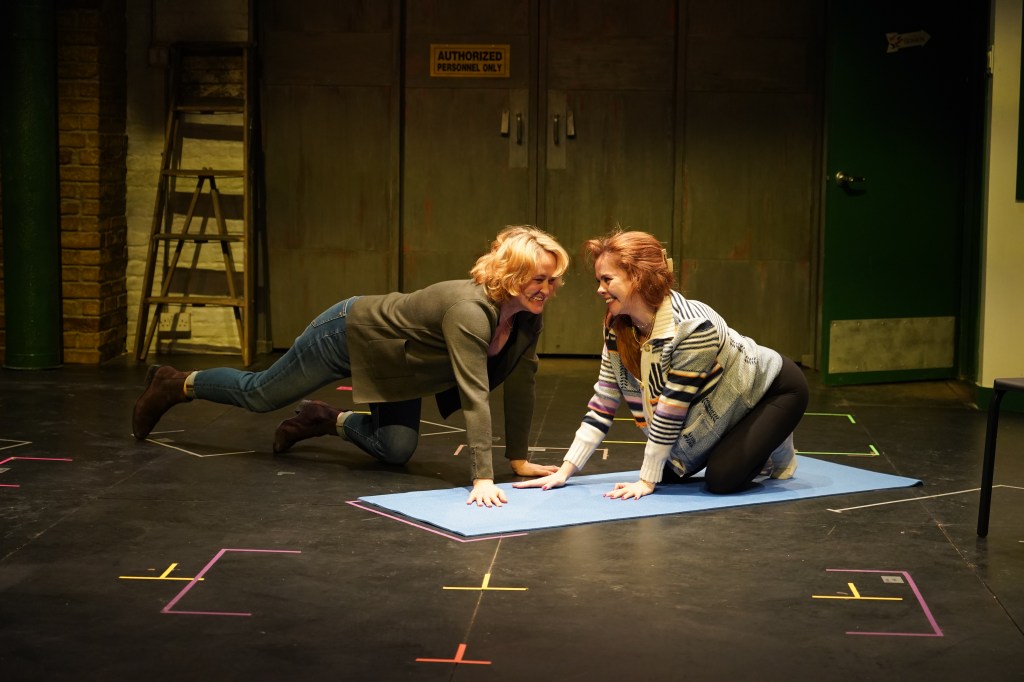
Enraged, the playwright tells Síofra to find other living arrangements. Then, she tells the cast and director she is pulling the play from the performance schedule. This is an acute problem because the producers expect the play to go on in two weeks. The company’s hotel accommodation has been arranged, and they are scheduled to leave on their flight to New York City in one week. They’re screwed. Aisling is not receptive to apologies.
What is in a typical Irish play: dead babies? incest? ghosts?
Ingeniously, the actors try to solve the problem of performing no play by writing their own. Meanwhile, Poppy answers phone calls from American producer McCabe (voice over by Roger Clark). Poppy cheerily strings along McCabe, affirming that Aisling’s play rehearsals are going well. Play? With “stream of consciousness” discussions and a white board to write down their ideas, they attempt to create a play to substitute for Aisling’s, a pure, Irish play, based on all the elements found in Irish plays from time immemorial to the present. As a playwright twitting herself about her own play, Smyth’s concept is riotous.
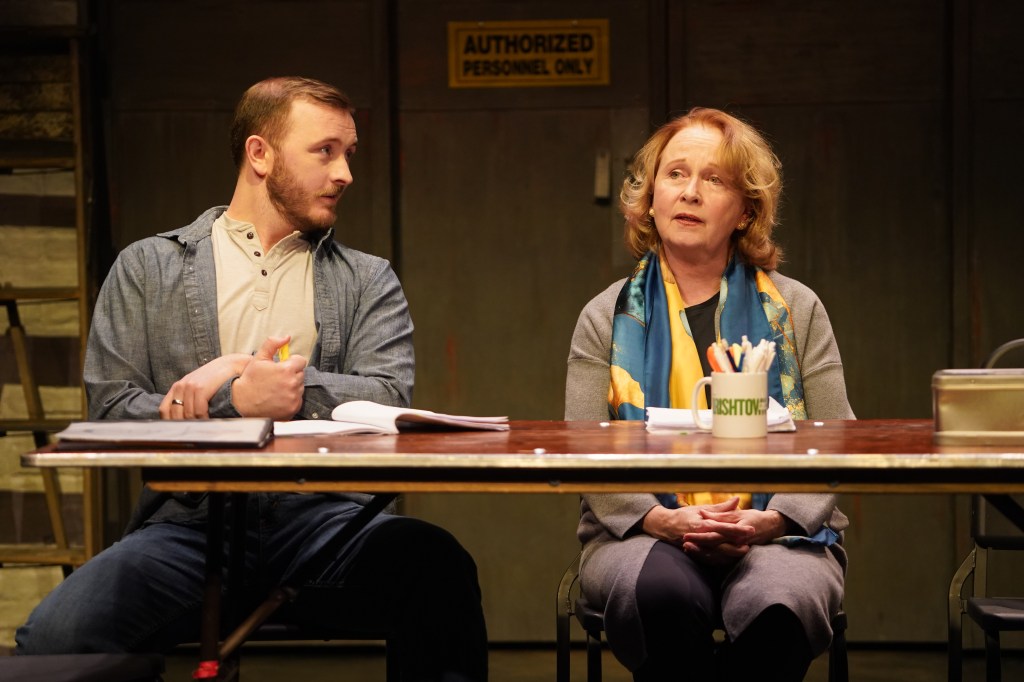
The actors discover writing an Irish play is easier said than done. They are not playwrights. Regardless of how exceptional a playwright may be, it’s impossible to write a winning play in two days. And there’s another conundrum. Typical Irish plays have no happy endings. Unfortunately, the producers like Aisling’s play because it has a happy ending. What to do?
Perfect Irish storylines
In some of the most hilarious dialogue and direction of the play, we enjoy how Constance, Síofra and Quin devise their “perfect Irish storylines,” beginning with initial stock characters and dialogue, adding costumes and props taken from the back room. Their three attempts allude to other plays they’ve done. One hysterical attempt uses the flour scene from Dancing at Lughnasa. Each attempt turns into funny scenes that are near parodies of moments in the plays referenced. However, they fail because in one particular aspect, their plots touch upon the subject of Aisling’s play. This could result in an accusation of plagiarism. But without a play, they will have to renege on the contract they signed, leaving them liable to refund the advance of $250,000.

As their problems augment, the wild-eyed Aisling returns to attempt violence and revenge. During the chaotic upheaval, a mystery becomes exposed that explains the antipathy and rivalry between Quin and Aisling. The revelation is ironic, and surprising with an exceptional twist.
Irishtown is not to be missed
Irishtown is a breath of fresh air with laughs galore. It reveals the other side of theater, and shows how producing original, new work is “darn difficult,” especially when commercial risks must be borne with a grin and a grimace. As director Nicola Murphy Dubey suggests, “Creative processes can be fragile spaces.” With humor the playwright champions this concept throughout her funny, dark, ironic comedy that also is profound.
Kudos to the cracker-jack ensemble work of the actors. Praise goes to the creatives Colm McNally (scenic & lighting design), Orla Long (costume design), Caroline Eng (sound design).
Irishtown runs 90 minutes with no intermission at Irish Repertory Theatre, 132 West 22nd St. It closes May 25, 2025. https://irishrep.org/tickets/
 CAROLE DI TOSTI