Category Archives: Theater News, NYC
Lesley Manville and Mark Strong are Mindblowing in ‘Oedipus’
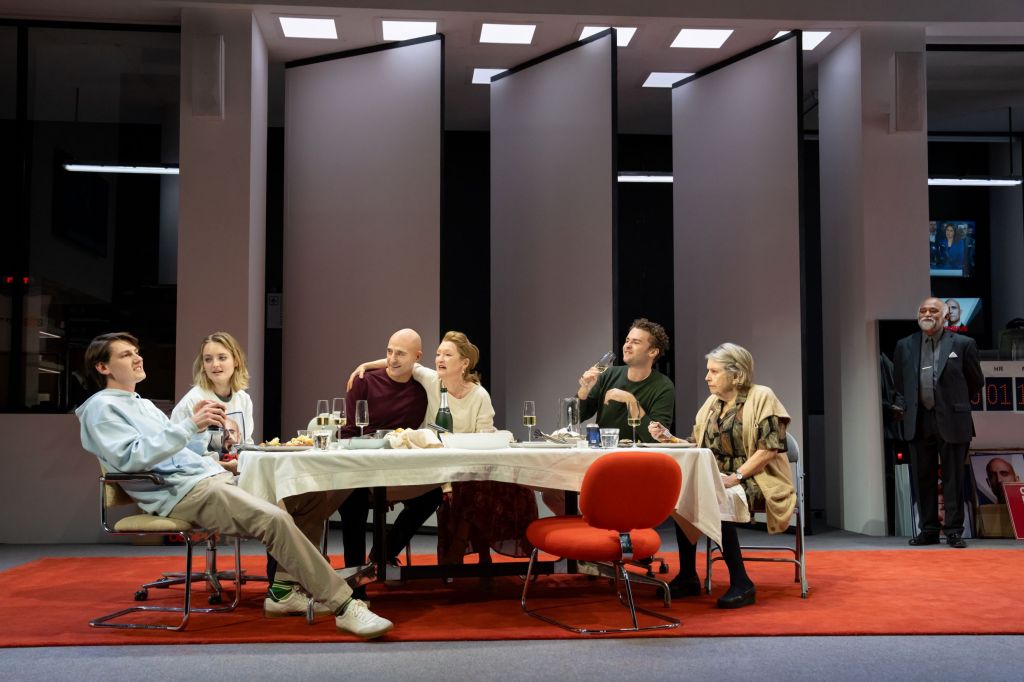
Just imagine in our time, a leader with integrity and probity, who searches out the truth, no matter what the cost to himself and his family. In Robert Icke’s magnificent reworking of Sophocles’ Oedipus, currently at Studio 54 through February 8th, Mark Strong’s powerful, dynamically truthful Oedipus presents as such a man. Likewise, Lesley Manville’s lovely, winning Jocasta presents as his steely, supportive, adoring help-meet. Who wouldn’t embrace such a graceful couple as the finest representatives to govern a nation?
Sophocles’ classic Greek tragedy, that defined the limits of the genre and imprinted on theatrical consciousness the idea that a tragic hero’s hubris causes his destruction, evokes timeless verities. In his updated version, Icke, who also directs, superbly aligns the characters and play’s elements with today’s political constructs. Icke retains the names of the ancient characters. This choice spurs our interest. How will he unravel Sophocles’ amazing Oedipus tragedy, especially the conclusion?
Cleverly, he presents Oedipus as a political campaigner of a fledgling movement that over a two-year period gains critical mass. The director reveals Oedipus’ backstory in a filmed speech to reporters on the eve of the election. The excellent video design is by Tal Yarden.
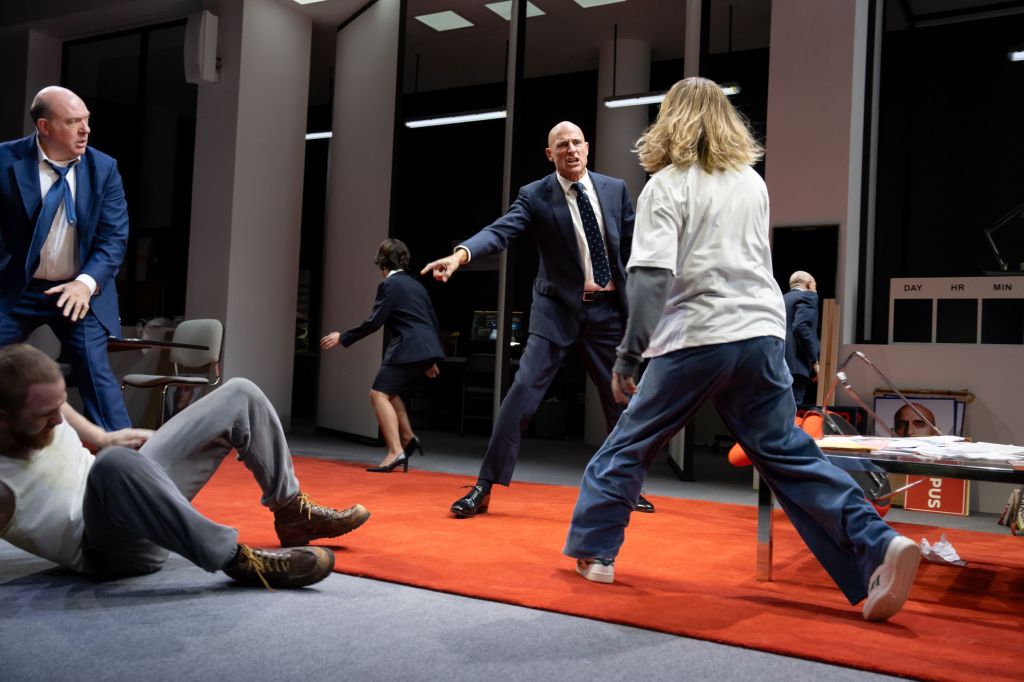
During his speech Oedipus goes off book and makes promises. Though his brother-in-law Creon (the fine John Carroll Lynch) tries to stop him, proudly Oedipus shows himself a man of his word. He galvanizes the crowd when he states he will expose the lies of his opponents. Not only will he reveal his birth certificate (an ironic reference to President Obama), he will investigate the mysterious death of Laius. The former leader from decades ago married Jocasta when she was a teenager. After Laius’ death, Oedipus meets and marries Jocasta despite their age difference. Over the years they raise three children: Antigone (Olivia Reis), Eteocles (Jordan Scowen) and Polyneices (James Wilbraham).
How has Oedipus become the people’s candidate? Without ties to the political system, he speaks a message of reform and justice. Indeed, he will override the corrupt, derelict power structure. Former leaders served their rich donors and let the other classes suffer. Oedipus runs on a mandate of equity and change.
After Oedipus’ speech, the curtain opens to reveal the campaign headquarters that staff gradually dismantles as the campaign phase ends. To signify the next phase the countdown clock, placed conspicuously in scenic designer Hildegard Bechtler’s headquarters, ticks away the seconds down to the announcement of the winner. As the clock ticks toward zero (an ironic symbol), the contents of the campaign war room are removed like the peeling of an onion to its core. As the destined announcement of the winner nears, gradually, the revelation of Oedipus’ true identity happens. Icke has synchronized both concurrently.
Icke’s anointed idea to shape Oedipus as a newbie politician, whose actions and words are singularly unified in honesty, resonates. He represents the iconic head of state we all yearn for and believe in, forgetting leaders are flesh and blood. Of course Icke’s flawed tragic hero, like Sophocles’ ancient one, results in Oedipus’ prideful search for the truth of his origin story and Laius’ cause of death.
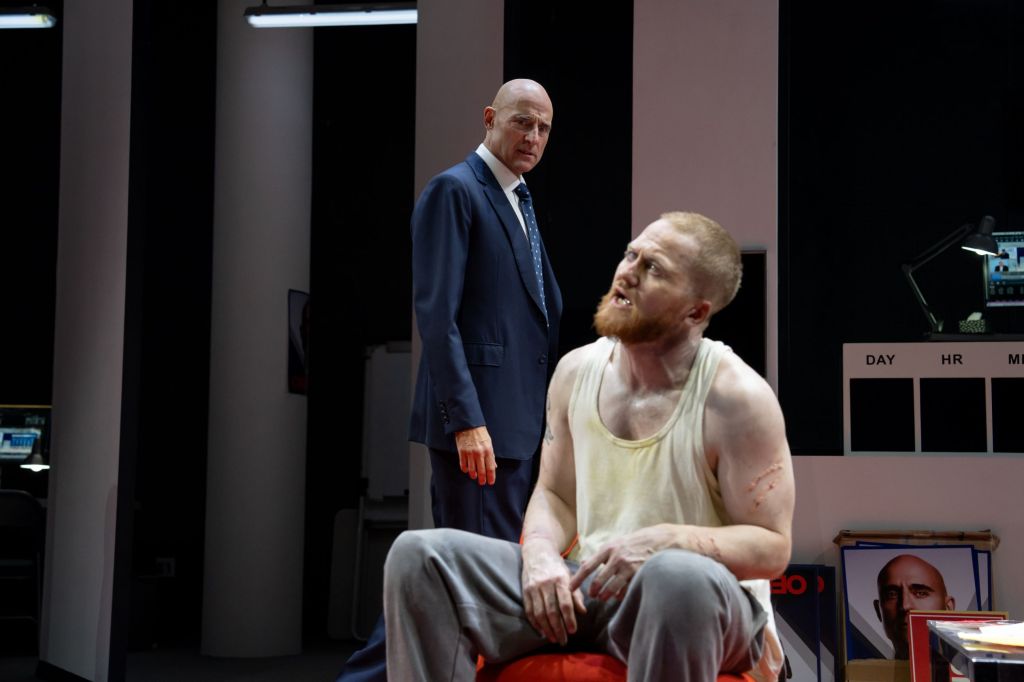
Oedipus’s determination is spurred by the cultist future-teller Teiresias (the superb Samuel Brewer). His authoritative and relentless drive to prove Teiresias wrong, despite warnings from Creon and Jocasta, shows persistence and courage, positive leadership qualities. On the other hand, Oedipus doesn’t realize his search has a dark side and his persistence is stubbornness prompted by a prideful ego. This stubbornness causes his destruction. His pride leaves no way out for him but punishment.
Because the truth is so horrid, Strong’s Oedipus can’t suffer himself to cover it up. In searching to validate his true self, he discovers the flawed human that Teiresias proclaims. Indeed, he is more flawed than most. He is lurid; a man who killed his father, married his mother, and had three children born out of love, lust and incest. He can never be the leader of the nation. He must hold himself accountable after he sees his debased true self. How Mark Strong effects Oedipus’ self-punishment is symbolic genius. Clues to Jocasta’s end are sneakily tucked in earlier.
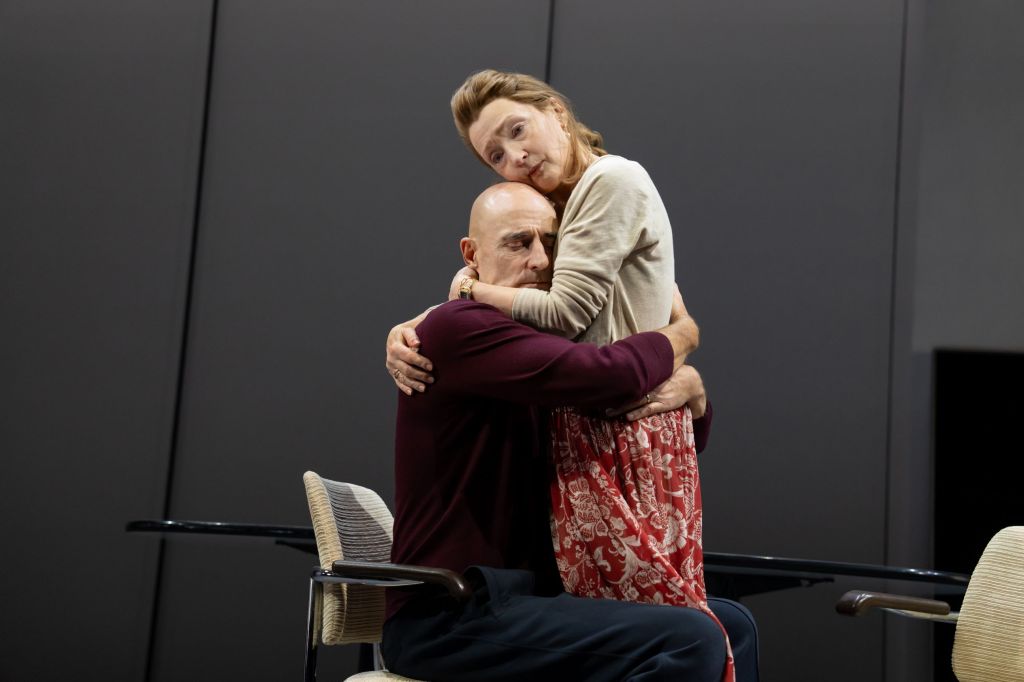
Because of Icke’s acute shepherding of the actors, and the illustrious performances of Manville, Strong and Brewer, with the cast’s assistance, we feel the impact of this tragedy. The love relationship between Jocasta and Oedipus, drawn with two passionate scenes by Manville and Strong, especially the last scene, after they acknowledge who they are with one, long, silent look, devastates and convicts.
Those who know the story feel a confluence of emotions at the irony of mother and son lustily loving and pursuing their desire for each other off stage, while Oedipus delays speaking to his mother Merope (Anne Reid). Manville and Strong are extraordinary. Both actors convey the beauty, the wildness, the uniqueness and enjoyment of their characters’ love, that is unlike any other.
In the last scene when Strong and Manville untangle from their hot grip, clinging to each other then letting go, they acknowledge their characters’ unfathomable and great loss. Manville’s Jocasta crawls away to reconcile the enormity of what she has done. In her physical act of crawling then getting up, we note that fate and their choices have diminished their majestic grace. Their sexual likeness to animals, Oedipus ironically referenced earlier with family at the celebration dinner. Through the physical staging of the final sexual scene, Icke recalls Oedipus’ earlier comparison.
As a meta-theme of his version Icke reminds us of the importance of humility. The more humanity presents its “greatness,” the more it reveals its base nature.
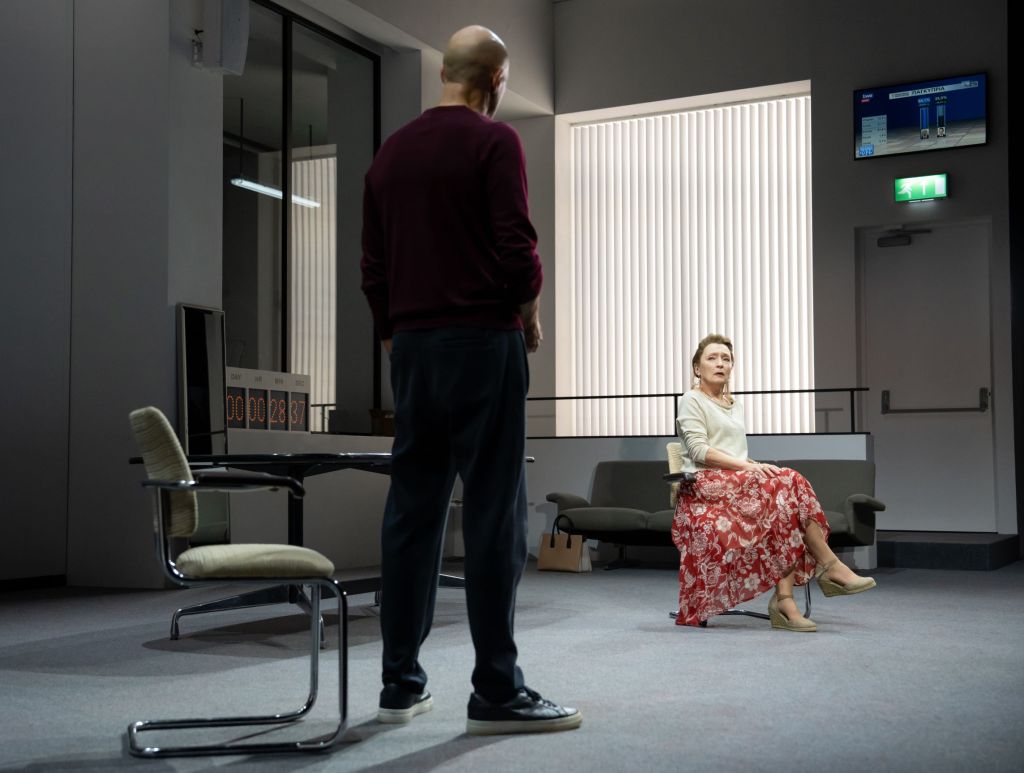
All the more tragedy for Oedipus’ supporters and the unnamed country. Because fate catches up with him and conspires with him to cut off his acceptance of the position he rightfully won, the nation loses. All the more sorrow that the truth and his honest search is what Oedipus prizes, even more than his love for Manville’s Jocasta, the brilliant, equivalent match for Strong’s Oedipus.
Rather than live covertly hiding their actions, both Oedipus and Jocasta hold themselves accountable with a fatalistic strength and nobility. Initially, we learn of her strength as Jocassta tells Oedipus about her experience with the evil Laius (a reference to current political pedophiles and rapists). We see her strength in her self-punishment. Likewise, Oedipus’ strength compels him to face his deeds where cowards would cover up the truth, step into the position and govern autocratically censoring and/or killing their opponents who would “spill the beans.” Oedipus is not such a man. It is an irony that he is a moral leader, but is unfit to lead.
Icke’s masterwork and Manville and Strong’s performances will be remembered in this great production, filled with ironic dialogue about sight, vision, blindness and comments that allude to Oedipus and Jocasta’s incestuous relationship and downfall. Those familiar with the tragedy will get lines like Jocasta’s teasing Oedipus, “You’ll be the death of me,” and her telling people she has four children: “two at 20, one at 23, and one at 52.”
Though I prefer Icke’s ending in darkness with the loud cheers of the supporters, I “get” why Icke ends Oedipus in a flashback. In the very last scene the date is 2023, the beginning of the end. We watch the excited Oedipus and Jocasta choose the rented space (the stripped stage) for their campaign headquarters. The time and place mark their disastrous decision which spools out to their destruction two years later. I groaned with Jocasta’s ironic comment, “It feels like home.”
Her comment resonates like a bomb blast. If Oedipus had not had the vision of himself as the ideal, righteous leader with truth at his core, the place where they are “at home” never would have been selected. Oedipus, a humble mortal, never would have run for high office.
Oedipus runs 2 hours with no intermission at Studio 54 though February 8. oedipustheplay.com.
Susan Stroman Interviewed by Sharon Washington, a LPTW Event

On Friday, November 17, the League of Professional Theatre Women held an interview of an icon in the theater, Susan Stroman. The event was part of The Oral History Project which is held at the New York Public Library for the Performing Arts at Lincoln Center. The venue was the Dorothy and Lewis B. Cullman Center/Bruno Walter Auditorium.
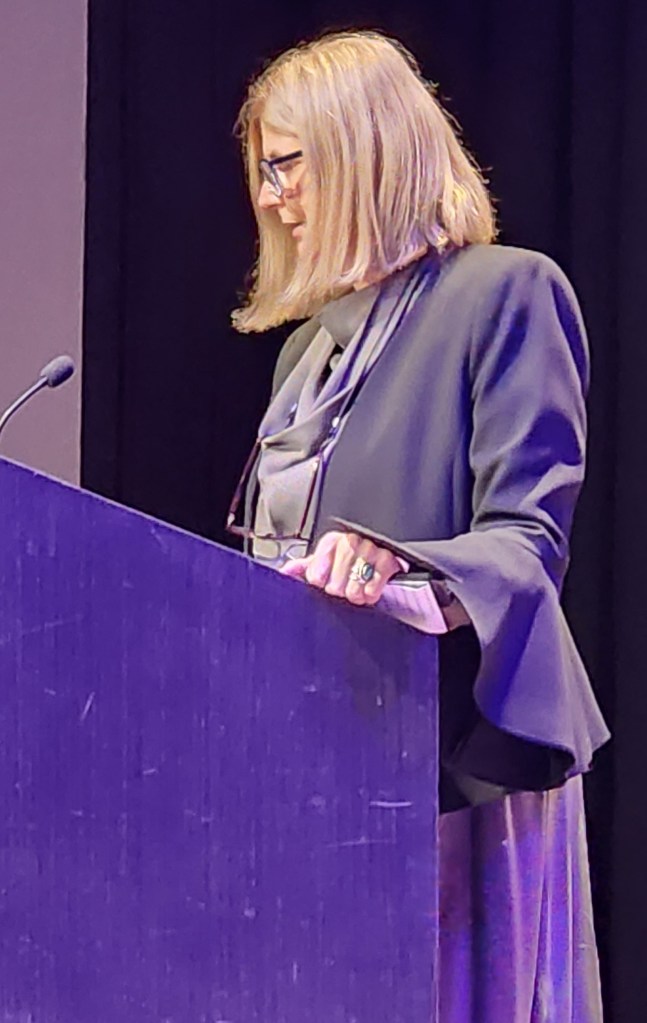
Currently produced for the League by producer and director Ludovica Villar-Hauser, The Oral History Project was founded and produced for 26 years by the late Betty L. Corwin. The interview of Susan Stroman by friend and colleague Sharon Washington was video taped and will be archived in the collections of the New York Public Library for the Performing Arts at Lincoln Center.
How Sharon Washington and Susan Stroman met
After comments by President Ludovica Villar-Hauser, and introductions, Sharon Washington (check out her credits and work on https://iamsharonwashington.com/), began by sharing the story of how she came to first meet Susan Stroman in 2009. At the time, Washington’s agent suggested she audition for a part in a musical, though Washington was a dramatic actress. When Washington posed that she hadn’t been in any musicals, her agent reassured her that in this one, she wouldn’t have to sing, dance or speak. Ironically, Washington questioned why she would even consider such a part. However, her agent countered that it would be directed by Susan Stroman.
Thus, Washington and Stroman collaborated on the 12 times Tony nominated Scottsboro Boys. The musical went on to win the Evening Standard Award for Best Musical in the UK. Though the production didn’t win any Tonys, Washington emphasized that then and now, Stroman’s process is exhilarating.

Specifically, Stroman creates a safe room that is caring. Washington and the other cast members felt so comfortable that they could work freely. Washington pointed out during the interview that Stroman imbues a quality of trust to be a creative collaborator. In her safe space one can try things out and make suggestions. This artistry of bringing out the best in the cast and creative team has brought Stroman accolades and forever friends. Sharon Washington is one of them.
Susan Stroman is a theater Icon

Susan Stroman (Director/Choreographer), is a five-time Tony Award-winning director and choreographer. She has won Olivier, Drama Desk, Outer Critics Circle, Lucille Lortel Awards. Also, for her choreography, she has won a record number (six) of Astaire Awards. Recently, she directed and choreographed the new musical New York, New York, which was nominated for nine Tony Awards and which won Best Scenic Design for a Musical (Beowulf Boritt). The music was by John Kander, lyrics by Fred Ebb and Lin Manuel Miranda, and a book by David Thompson and friend Sharon Washington.
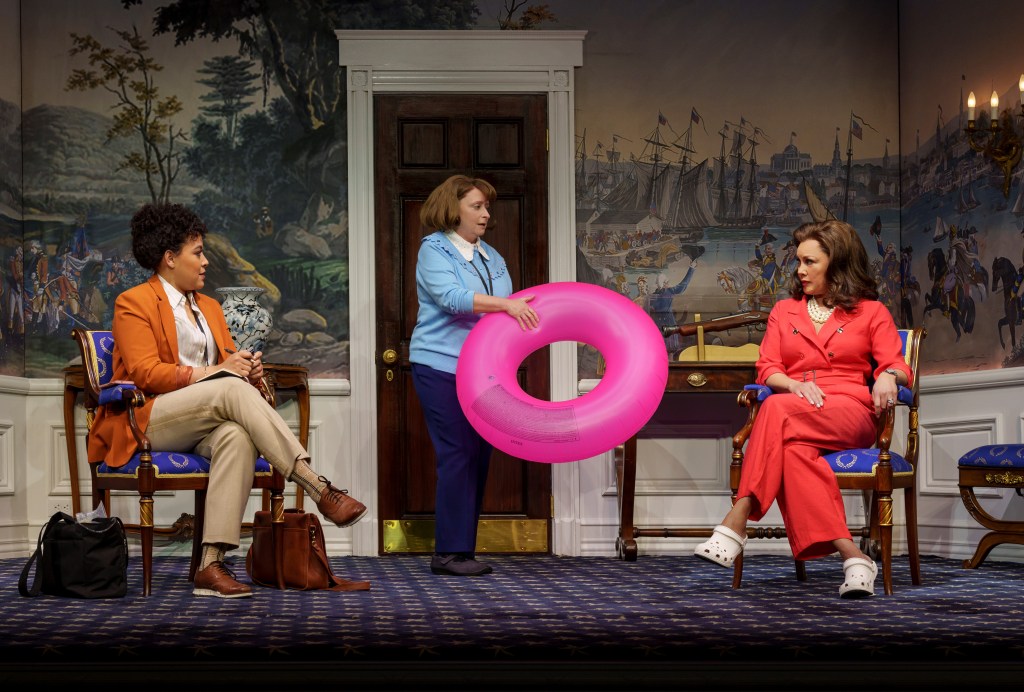
In other recent work, she directed the hysterical, LOL new play POTUS: Or, Behind Every Great Dumbass Are Seven Women Trying to Keep Him Alive. And this season in London’s West End, she directed and choreographed the revival of Crazy for You at the Gillian Lynne Theatre.
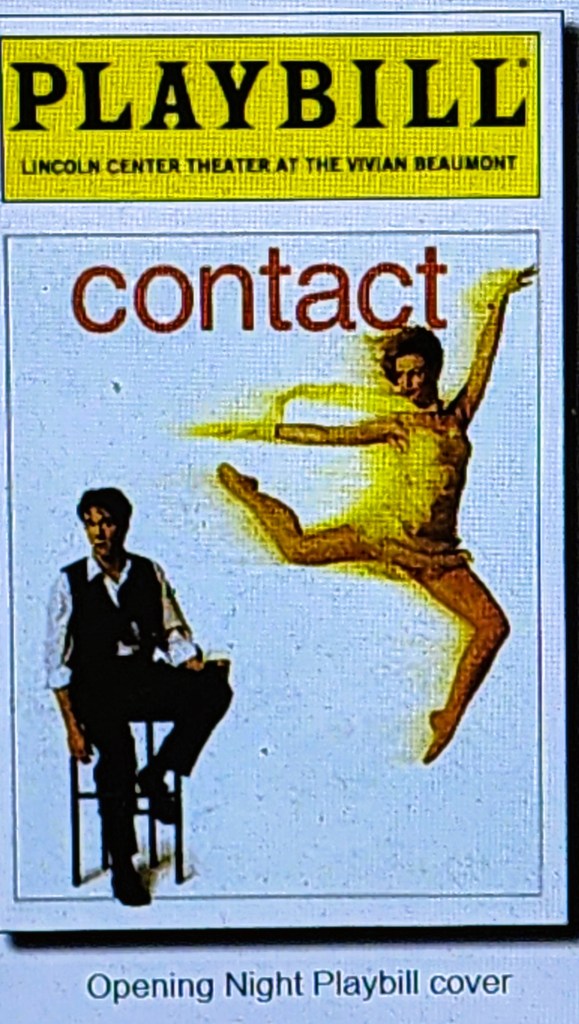
Past exceptional productions include her direction and choreography for The Producers (12 Tony Awards including Best Direction and Best Choreography). She co-created, directed and choreographed the Tony Award-winning musical Contact for Lincoln Center Theater. She received a 2003 Emmy Award for Live from Lincoln Center. Broadway credits include Oklahoma!, Show Boat, Prince of Broadway, Bullets Over Broadway, Big Fish, Young Frankenstein, The Music Man and others. Her Off-Broadway Credits include The Beast in the Jungle, Dot, and Flora the Red Menace to name a few.
Stroman has experience with ballet and opera
She garnered additional theater credits and to these add ballet and opera which include The Merry Widow (Metropolitan Opera); Double Feature, and For the Love of Duke (New York City Ballet). She received four Golden Globe nominations for her direction and choreography for The Producers: The Movie Musical. Additionally, she is the recipient of the George Abbott Award for Lifetime Achievement in the American Theater, and an inductee of the Theater Hall of Fame in New York City. For her complete list of accomplishments, credits and awards, go to www.SusanStroman.com
After Washington and Stroman discussed her beginnings growing up in Delaware in a house of music, where she danced and was in dancing school, she would always create dances when her father played the piano. She grew up appreciating her father’s storytelling and musical talent. She majored in English at the University of Delaware and was attracted to story telling and its different forms which, of course, included music and dance. She mentioned that her family would watch movie musicals together on their sofa, and as she watched, she intuited the synchronicity between the dance and the music and the feeling it created. Storytelling through the dance came easily to her because of her parents and their appreciation of musicals, music, movement and how dancing conveyed the story.
Choreography helps to move the plot forward
For Stroman, today, especially with the virtual media environment, choreography is imperative for moving the plot and story forward in immediacy. The audience wants the story to move forward constantly, which can be accomplished with choreography transitioning the turning points so the events have a forward momentum. In recognizing the importance of the staging and the dance, every corner of the stage must be considered. There is no empty part of the stage that doesn’t have the element of storytelling through dance, music and dialogue.
It is a testament to Stroman’s ability to continually provide fascinating visuals, color and movement so entrancing to audiences, who love her work, if sometimes critics don’t fully understand or appreciate the genius she displays. Indeed, with the stage beginning as a writer begins with a blank page, Stroman thinks profoundly about every dancer, every performer, every musical note, every word of dialogue and of course all the elements in the story (Aristotle’s poetics).

For my mind, her works should be studied in musical theater classes in universities for their immediacy, their vibrance, their emotional grist and their coherence as they synchronize elements of scenic design, costume design, and hair and wig design, lighting, sound, to effect the beauty, sorrow, majesty of the story being told.
The film The Sound of Music was an influence
Stroman emphasized that she and her brother saw The Sound of Music together and it impacted her understanding. She stated, “I was blown away by that movie. I guess I was twelve.” She couldn’t believe the story that was being told and how important the story was, realizing it could be something which is really profound. Stroman followed with the idea that she visualizes music with a story following along. Additionally, she imagines how the dancers would be dancing. Immediately, her “brain begins to spin about what story is being told through the music, the instrumentation and the orchestrations.”
When Stroman puts a show together, she “works very much with the show’s composer and arranger,” of how to open up the music. She manipulates the time signature of the music to help represent the emotion she wants the actors to play and to move forward the momentum of the story. She does a lot of research on every musical. This might include the history of the decade, the geographical area, the setting. She immerses herself in research and thinks extensively about the characters. This helps to inform how she choreographs the music.

Working with performers is about collaborating in a safe space.
Working with actors is about collaborating in a safe space. First, comes the research. Then comes the time and effort put into using what has been learned. Washington attested to Stroman’s being there early before everyone else, and staying late after everyone was gone. Stroman works extensively with her musical partners. Additionally, she is aware of the actor’s process. Each have their own process. Some pick up elements very quickly and others don’t. It is a balancing act to get all on the same page and not make them feel inferior.
In making sure all feel comfortable in the learning process, Stroman stays positive and roots for her actors, wanting them to do their best. Getting the performers to the point of excellence, she has to do her research and be prepared before she ever creates the safe space in the rehearsal room. When they arrive there together, she’s worked through almost the entire show. However, part of creation and allowing the cast to feel comfortable, she doesn’t share all of what she knows. She wants them “to feel free” and be creative and “feel a part of it.” She’s also inspired by the performers who come up with their own creative suggestions. She allows for actors and dancers’ agency, encouraging them to try something different.

Stroman collaborated with Washington during the production, Dot
Stroman shared a moment in Dot where Sharon Washington’s character had extensive monologues and she gave her the stage action of cooking eggs. Stroman had Washington pace the dialogue with cooking eggs so that she finished every time on a particular word. Though Washington was skeptical at first, she become so attuned, that the timing was perfect. With Stroman’s encouragement, she finished when the eggs were done and landed precisely on the designated “word” in the monologue. Both Stroman and Washington discussed the wonder of creating something that didn’t exist before. Considering all the people that collaborated in the creation, the artistry of that collaboration to present something amazing is miraculous.
Stroman discussed how the ideas for various scripts or stories come from various places. The seminal idea for the show Contact came surprisingly with the image of the girl in the yellow dress. Stroman discussed that she was in a bar at one in the morning, and in a bar where all the New Yorkers wore black. And “in walked this girl with a yellow dress which I thought was quite bold for one in the morning.” Stroman described the girl’s action, “She would step forward when she wanted to dance with somebody, and then she would retreat back when she was done with them.” According to Stroman, she was an amazing dancer and she was only there to dance. Stroman watched her dance with various men. Then she disappeared into the night.
The girl with the yellow dress becomes Contact
Around two weeks later at Lincoln Center, Stroman was approached about having ideas. She said, “You know, I think I have an idea.” And from then on, the story of the girl in the yellow dress took flight, bringing in all the elements of music, dance, and storyline. That’s how Contact came into existence, from a visual and organic, raw experience that stirred Susan Stroman’s imagination. Amazing! Contact ran for three years. Humorously, Stroman discussed how pictures of the “girl in the yellow dress” were on busses and billboards and she was thinking the girl would come forward and say something. She never did.
Stroman shared another story about the time she met with Mel Brooks. She was working on A Christmas Carol when she received a call to meet with Mel Brooks. Familiar with his work, she wondered what he wanted to talk to her about. There was a knock at the door. And when she opened it, he started singing, “That face, that face…” and he danced down Stroman’s long hallway, then jumped up on her sofa and said, “Hello! I’m Mel Brooks.” Stroman shared that she didn’t know what would happen. She thought, “But whatever it is, it’s going to be a great adventure.” Indeed, the experience was, “the adventure of a lifetime.”
Regarding working with Mel Brooks, Stroman suggested that she learned from him, collaborating and observing. Of course, it was a new art form for him, so he was flexible and learned from Stroman’s theatrical experiences and process of working. It appears they developed a mutual admiration society.

Facing obstacles as a woman
Washington asked about the obstacles Stroman faced as a women. When Stroman got in the business, she stated, “It really was male dominated.” And she mentioned that it has only been in the last fifteen years that there have been women directors. However, she was not certain about “why that is or was.” When she started, she wanted people to believe, “In the art of what I was doing.” She didn’t dress up. She wore a baseball cap. At that time there was a pressure to “dress down,” and be “strong, but not too strong.” Stroman felt like she “could do it,” when she came to New York. However, she didn’t know if she would “be allowed to do it.”
In sharing a story to encourage young people or anyone in the business, she suggested “always ask questions.” The worst that can happen is that “they” say “no.” One day she and another actor were throwing out ideas and came up with the idea to approach Cabaret’s Kander and Ebb and ask if they could take one of their shows and direct and choreograph it for Off-Broadway. They were shocked when Kander and Ebb agreed and they took Flora the Red Menace, reworked it and brought it to The Vineyard Theatre.
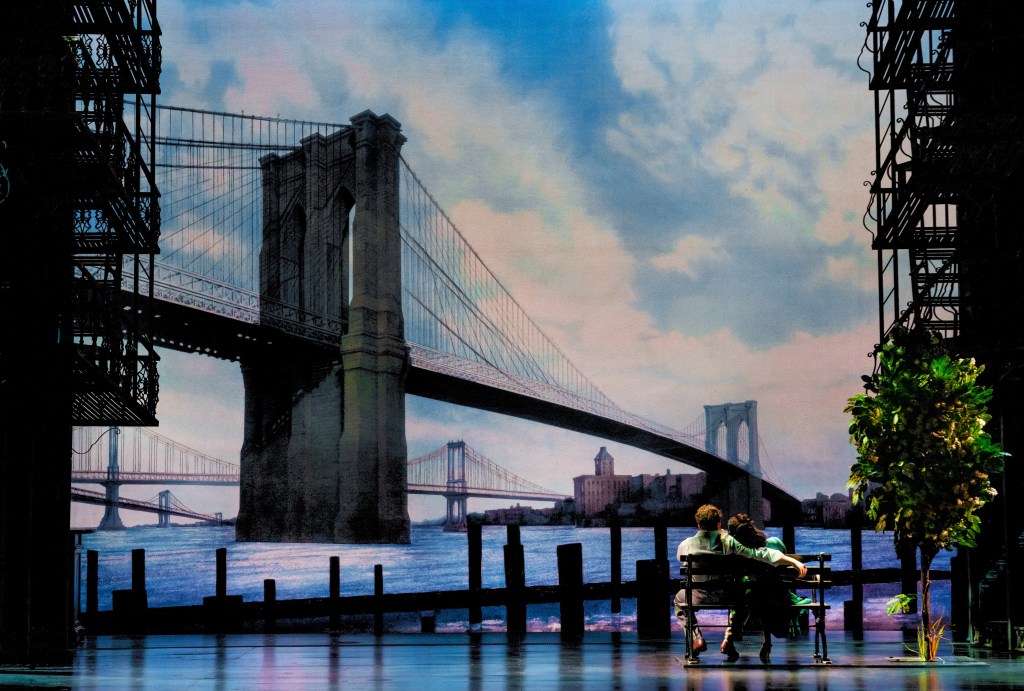
Critics
Stroman discussed critics. She mentioned that “bad reviews are very hurtful.” She also suggested that women’s work is more harshly criticized than men’s and that the same applied in politics. She referenced her great disappointment that New York, New York didn’t have staying power and closed. They were waiting for the tourists, but they never came. Regarding the collaboration, she enjoyed working with the creative team tremendously. Of course, that made the show not lasting more poignant. The show received positive and negative reviews. Regarding any positive reviews received over the years, Stroman quipped, “The good reviews are never good enough.” And when there’s a great review, “You think, well, why didn’t they talk about that?” You just “have to feel good about what you are creating,” she insisted.
In discussing mentorship Sharon Washington suggested Stroman is very gracious and lets everyone participate. With every show she does, she usually has “A young observer who comes on the show and they get to be there for the whole process.” She said, “It’s important to be in the room where it happens.” Young people learn best when they see the process unfolding and join in it, participating whenever it is feasible. They learn, then, that it’s a collaboration. As the team works together, the director coheres with all the designers. It is the director, who has a clear vision of what the production should be. Then, the director shepherds the creatives and negotiates through and around the various egos.
For more on Susan Stroman https://www.susanstroman.com/ or Sharon Washington https://iamsharonwashington.com/ go to their websites. For a video of the interview, visit the New York Library for the Performing Arts archive in person.
The League of Professional Theatre Women is a membership organization for professional theatre women representing a diversity of identities, backgrounds, and disciplines. Through its programs and initiatives, it creates community, cultivates leadership, and seeks to increase opportunities and recognition for women in professional theatre. Its mission is to champion, promote, and celebrate the voices, presence and visibility of women theatre professionals and to advocate for parity and recognition for women in theatre across all disciplines.
‘Orpheus Descending,’ One of Tennessee Williams Most Incisive Works-a Searing Triumph
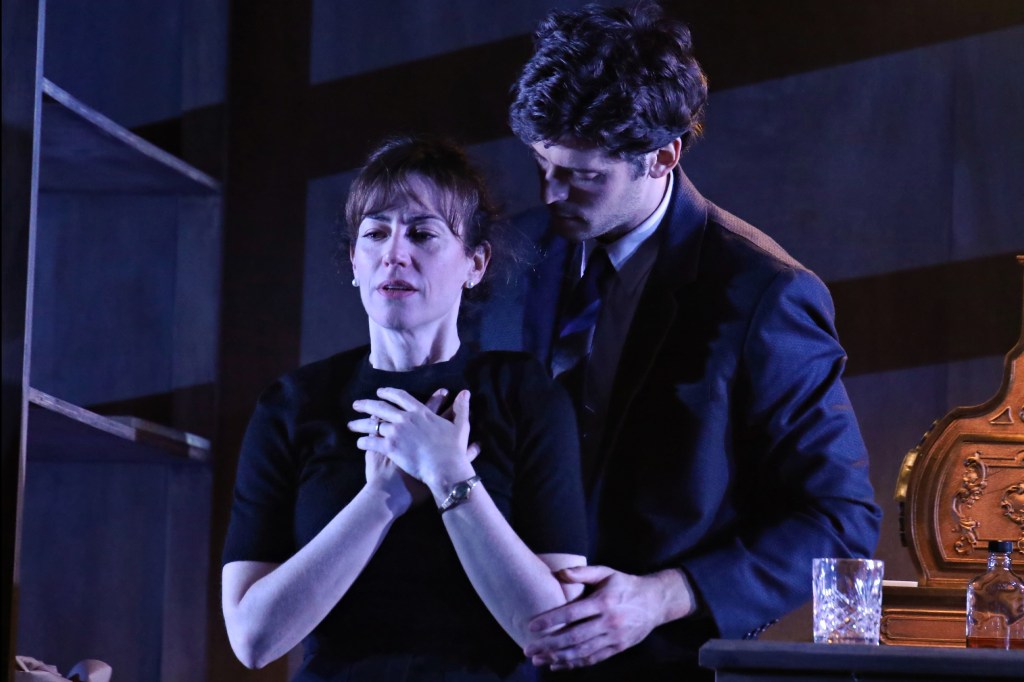
The hell of the South abides in Erica Schmidt’s revival of Orpheus Descending, currently running at Theatre for a New Audience in Brooklyn until August 6th. Tennessee Williams’ poetically brazen work about the underbelly of America that reeks of discrimination, violence, bigotry and cruelty seems particularly regressive in the townspeople of the rural, small, southern, backwater of Two River County, the setting Williams draws for his play.
This production is raw in its ferocity, terrifying in its prescience. It reminds us of the extent to which racists and bigots go feeling self-righteous about their loathsome behaviors when the culture empowers them. The director shepherds the actors to give authentic portrayals that remind us that death lurks in the sadistic wicked who seek to devour those whom they may, especially when their targets have peace and happiness, and step over the line (what the bigots hypocritically think is the line).
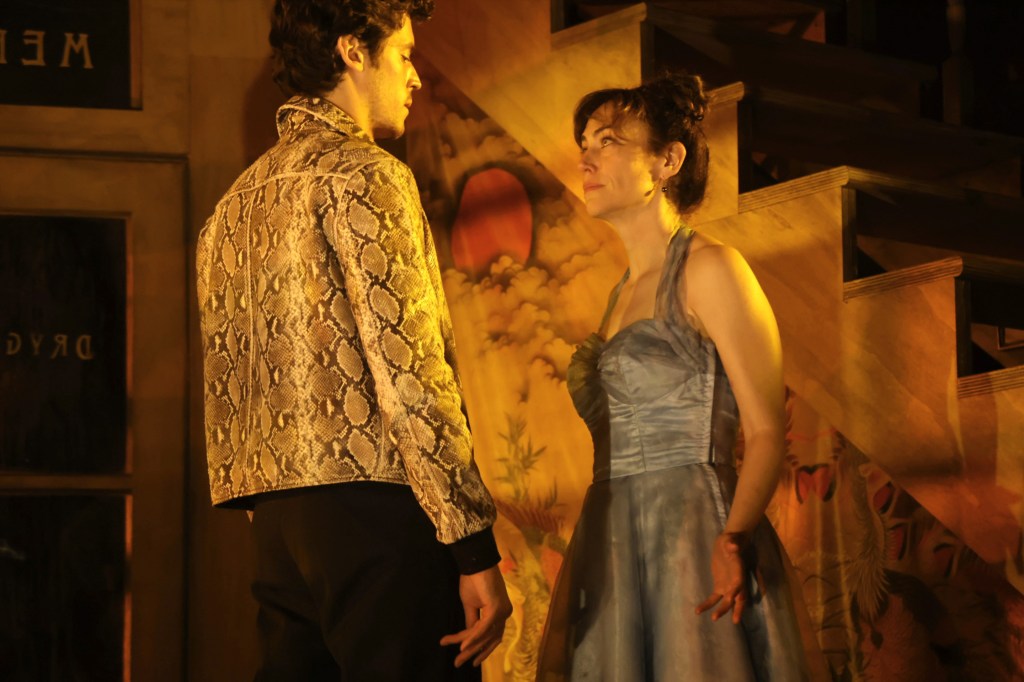
At the top of the play, we immediately note that stupidity and hypocrisy exude from the pours of most of the homely white characters. Sheriff Talbot and the wealthy Cutrere family are the chief representatives and purveyors of white supremacist, conservative law and order, which is as natural and welcome as white on rice.
Williams’ brilliant but lesser known work is based on the Orpheus and Eurydice myth. However, Williams updates the allusion and spins it into metaphoric gold transposing the heroic characters into artists, visionaries and fugitives, who rise wildly above the droll deadness of their environs or are delivered from them, as is Lady (Maggie Siff) who is brought to life during her relationship with Val (Pico Alexander). During the course of Val’s and Lady’s dynamic relationship with each other, they seek to cleanse and overcome their past heartbreaks and regrets and move upward toward redemption, reclamation and new beginnings with each other’s help.

The banal atmosphere conveyed by Amy Rubin’s spare, angular, cage-like design of the Torrence dry goods store is an appropriate setting where most of the conflict and interplay among the characters takes place. Its ugly, hackneyed blandness, lack of vibrancy and straight-edged corners symbolize Lady Torrence’s desolate life with the hypocritical, vapid townspeople and her infirm, brutal, racist, hoary-looking husband Jabe Torrance (the irascible, excellent Michael Cullen).
The other two sections of the set, the confectionery (stage left) and the storage area behind the curtain (stage right), Rubin suggests with minimalism. The confectionery and the storage area symbolize the other aspects of Lady’s character that are not governed by Jabe and the destructive, deadening, Southern folkways. The confectionery eventually outfitted with lanterns symbolizes her hope for renewal and reclamation. The intimate, barely lit, storage area where Val sleeps symbolizes the fulfillment of her desire for love.
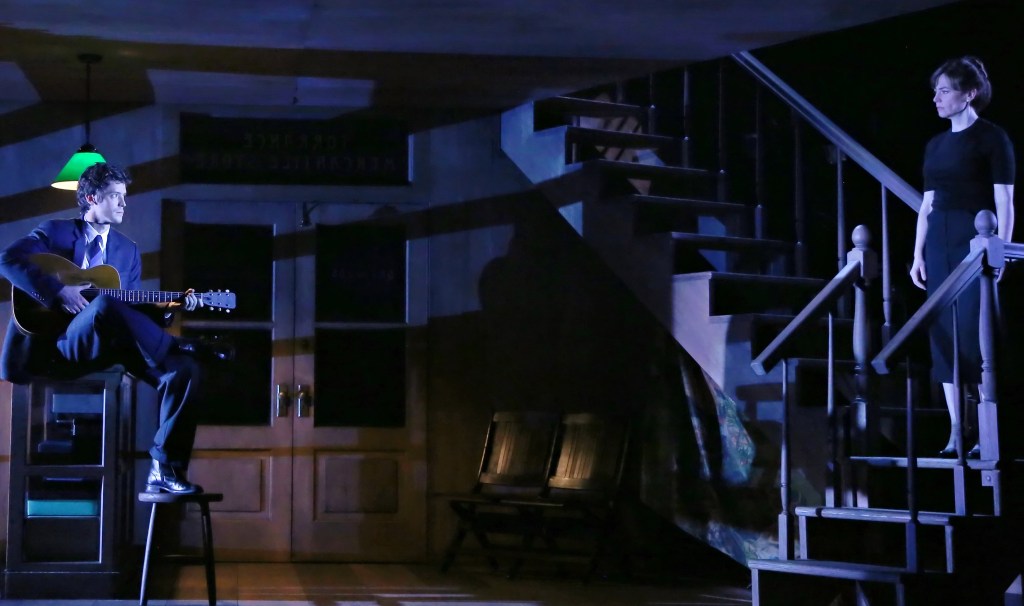
Center stage is the store and above it the Torrence bedroom, both subscribed by walls which pen Lady in. Along with Jabe, the store’s visitors suck her life-blood dry with the exception of Val and Vee (Anna Reeder), a Cassandra-like character. Above the store, Jabe lies in bed dying. Empty of kind words, Jabe communicates his bile and bitterness by pounding his cane on the floor from his sick bed. It is an ominous foreboding alarm that one imagines the master sends to his slave when he commands something from them immediately.
Into Two River county’s washed-out “neon,” “low-life” mediocrity comes the contrasting light and beauty of the guitar artist/entertainer, the stunning and untouchable Val Xavier. Pico Alexander makes the role his own, portraying Val with grace and alluring, angelic innocence befitting “Boy,” the nickname the assertive, feisty Lady gives him. Siff is sterling and likable as she grows vivacious as their bond develops. Siff’s scene where she reveals she is committed to loving Val, despite not wanting to admit needing him is just smashing.
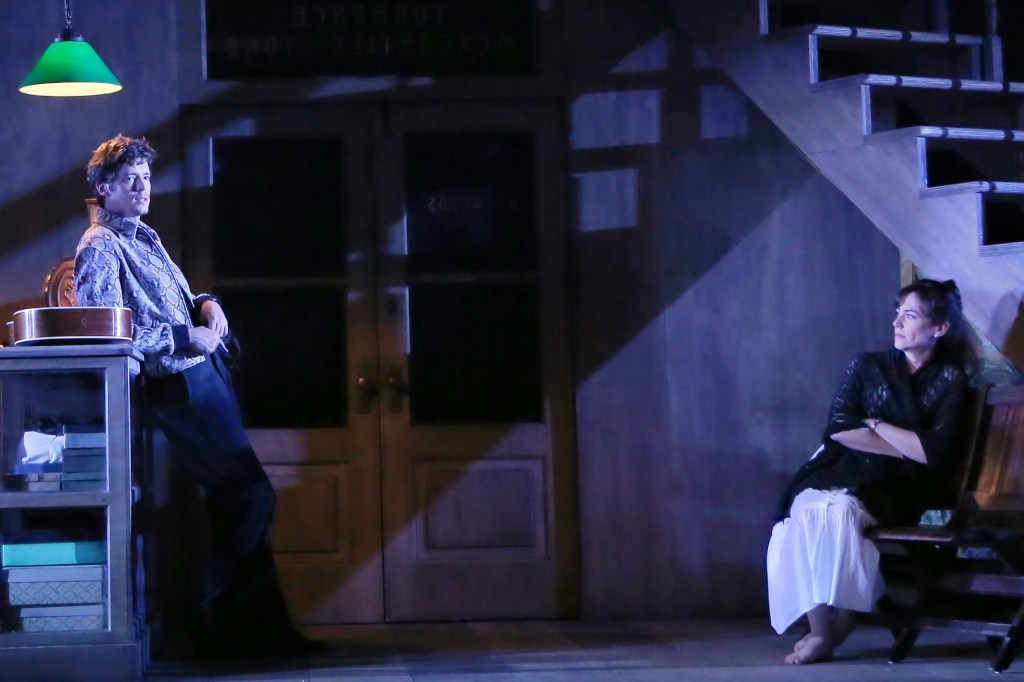
Val illuminates the spaces he enters and shatters the peace of Dolly Hamma (Molly Kate Babos) and Beulah Binnings (Laura Heisler) when he drops by the Torrence store on Vee Talbott’s suggestion that Lady Torrence might give him a job. As he waits patiently for Jabe and Lady to arrive from the hospital after Jabe’s unsuccessful operation, Jabe’s cousins Dolly and Beulah “eye him” while they prepare a celebration for Jabe’s return.
Vee (the fine Ana Reeder), a spiritual visionary born with second sight, accompanies Val and introduces him to the other women hanging around, one of whom is Carol Cutrere (the superb Julia McDermott), a rebellious hellion whose outsized antics and screaming of the Chocktaw cry with Uncle Pleasant, the conjure man (Dathan B. Williams), make the other women apoplectic. Clearly, Carol is an outsider like Val and Lady, only saved by her last name.
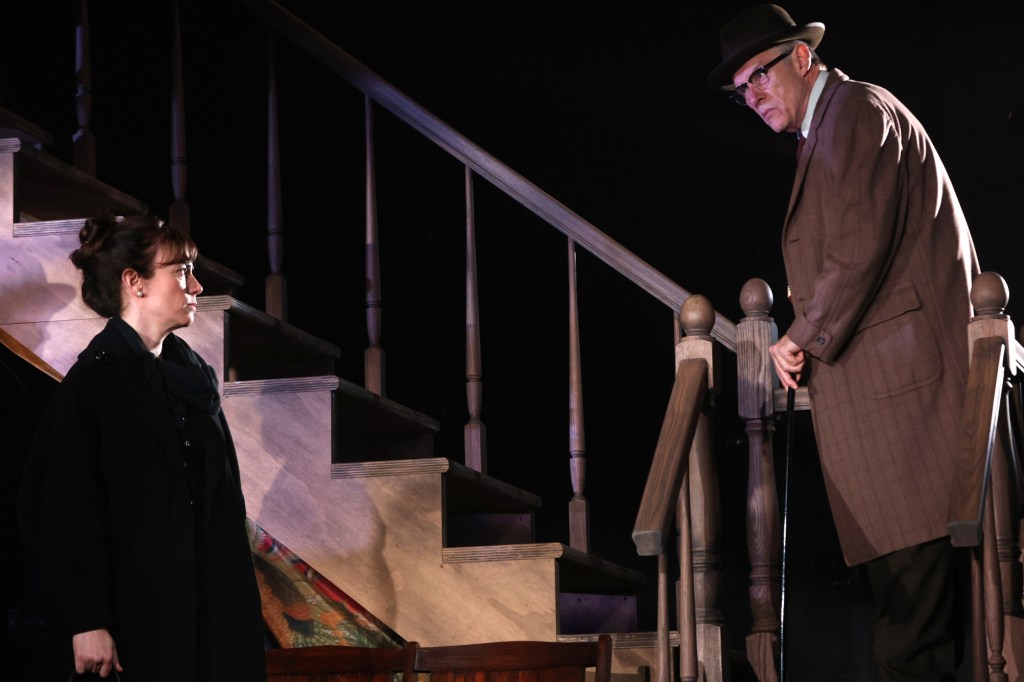
As Vee relates the visions that form the basis of the painting she brings for Jabe to encourage his healing, we note she doesn’t fit in either. If she weren’t married to Sheriff Talbott (Brian Keane) her eccentric ways would banish her from the “polite society” gathered in the store, rounded off by gossip mongers, Sister Temple (Prudence Wright Holmes) and Eva Temple (Kate Skinner), who sneak up the wooden steps to check out Jabe’s bedroom before he and Lady return.
Schmidt stages these opening scenes of William’s claustrophobic setting and characters to maximum effect, clustering the women at the counter and bringing Carol and Uncle Pleasant downstage for their chant and evocation. Downstage is where Carol cavorts, delivers a few soliloquies, and wails her outrage and sorrow as an encomium at the play’s conclusion.
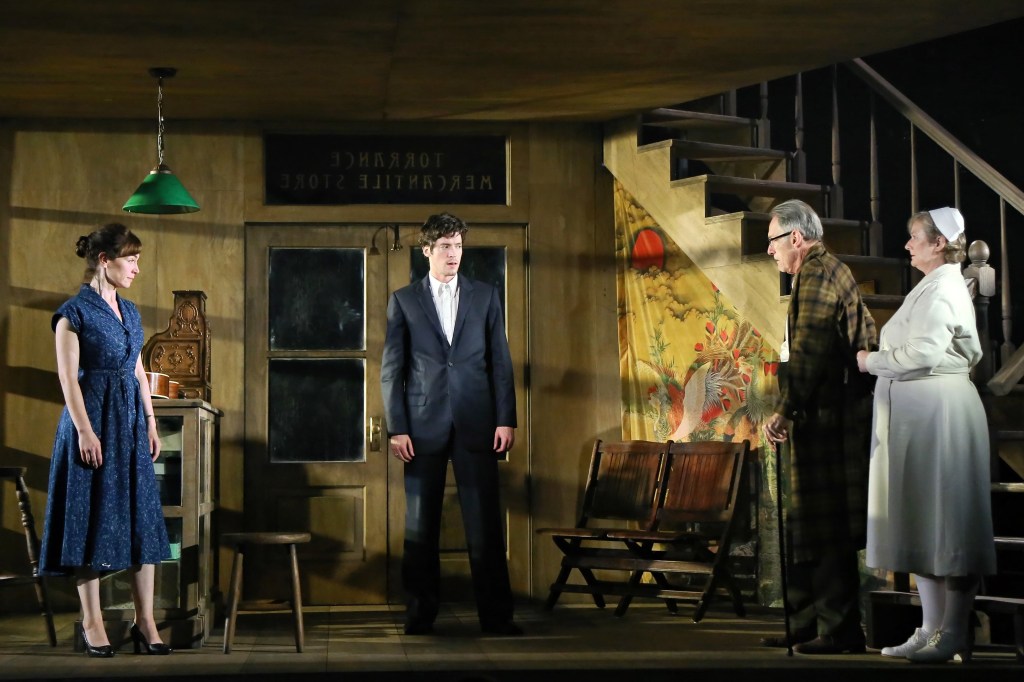
By the time Jabe and Lady arrive and Jabe retires upstairs, we have an understanding of the desolate elements and competing life forces that will drive the conflict forward. Additionally, Williams has the gossips share Lady’s terrible backstory that involves the KKK torching her father’s wine garden, and his gruesome death burning alive in the conflagration because not one firetruck or patron came to his aide.
All this was because he violated the towns’ mores and unwritten law serving wine to “ni$$ers. Implied by Jabe later in the play, the “Wop” had too much life in him and had to be cut down to size and made destitute. Interestingly, Lady’s determined father decided he’d rather burn alive trying to salvage his life’s work than accept poverty and brutality in a death-filled culture. For Lady, the acorn doesn’t fall far from the oak. She decides to take a stand against Jabe and his sadistic brutality than run away with Val.
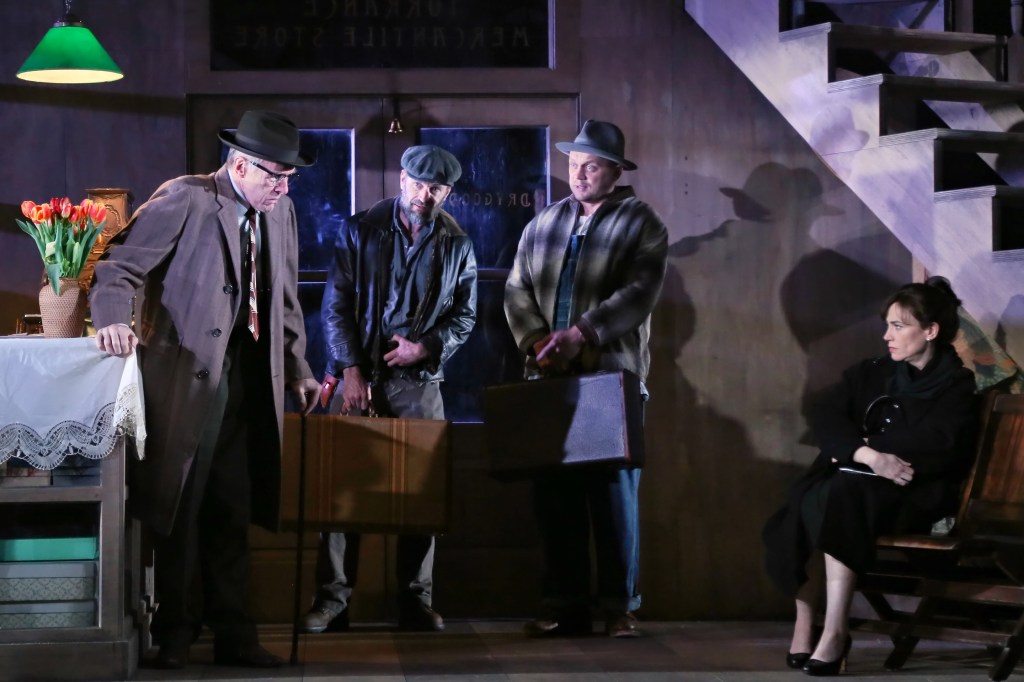
Alexander’s Val and Siff’s Lady establish their relationship gradually with Siff aggressively taunting Val’s appeal to women, one of whom is McDermott’s live-wire Carol. As their comfort level with each other grows, the two bond over Val’s description of a bird that is so free it never corrupts itself by touching the ground and only does so when it dies. Lady expresses her desire for such freedom, and after their discussion is abruptly interrupted by Jabe’s pounding, we note a greater lightheartedness within Lady. Val’s presence is the freedom and wildness that she craves.
Indeed, we note her mood is uplifted every time Lady has a quiet conversation with Val. The actors have the privilege of organically inhabiting these memorable characters with ease to deliver some of the most figuratively elegant and coherently rich dialogue found in all of Williams’ works. One of their most powerful scenes concerns Val’s description of the corrupt world and his own corruption. He counters it by sharing how his “life’s companion,” his guitar and his music, cleanses his impurity and makes him whole again.
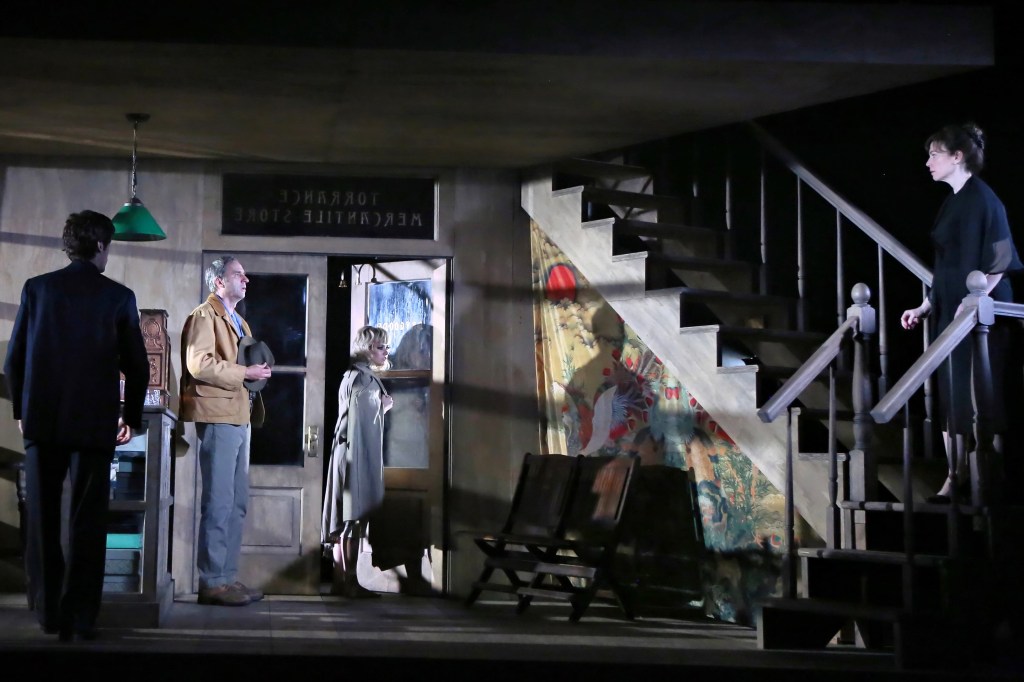
As Val settles in and she begins to rely on him, we realize that her inspiration and actions to reopen the confectionery (Schmidt use of the lanterns descending in the stylized space, stage left) run parallel to Val’s regenerative influence over her. He has ignited her hope and desire to be resurrected from the ashes of the burning, the town’s hatred and racism, and Jabe’s enslavement and ownership of her mental and emotional well being.
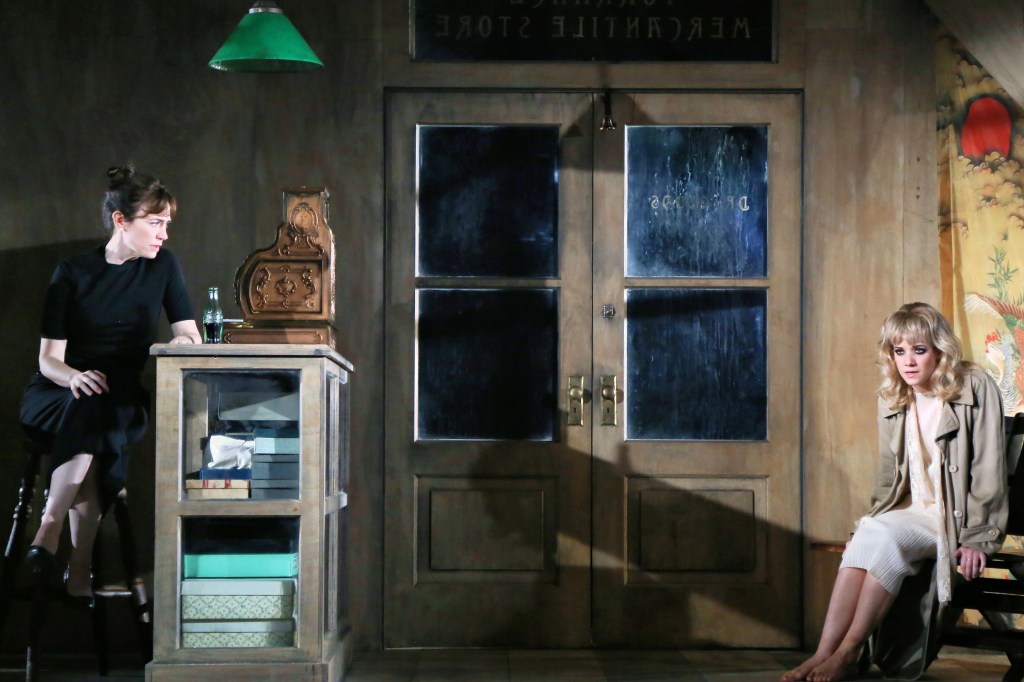
In his characterization of Jabe, Williams reveals the psychosis of the Southern Red Neck confederates turned white supremacists that lost the Civil War but persist in acting as if they won it, especially with regard to their racism and hatred of Blacks and “the other,” (immigrants). In Schmidt’s version, we see that Jabe’s attitudes and the attitudes of the other men presciently foreshadow the current MAGA Republicans’ penchant to be brutal and criminally sadistic because their “power” gives them the right, regardless of the truth of the circumstance or the legality. Certainly, Jabe has the power and white supremacist friends (Sheriff Talbot) to back up his actions with impunity.
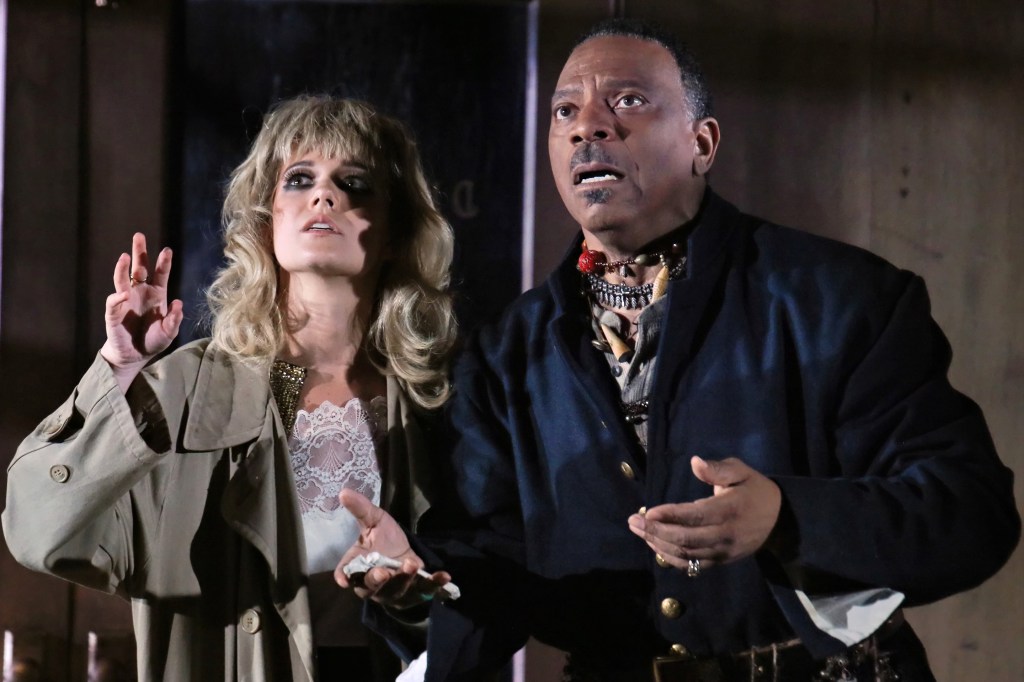
Thus, as Lady has told Val, she “lives” with Jabe, a figure of death who makes sure to stomp down her happiness or agency every chance he gets. In fact each time Val and Lady seek each other’s company for verbal comfort, Jabe almost intuits that she is uplifted away from his presence and claws and pounds (with his cane) his way back into her mind and emotions with his demands. She always goes running to him, for in her soul, she feels she has no other options.
The turning point arrives when Jabe comes downstairs to exert himself over the cancer that is killing him and perpetrate some new malignity against her, which appears to be the only pleasure he has. His emotions are pinged to remembrance when he views the loveliness of the confectionery and the new life that has inspired it (Val). It is then he strikes at Lady provoking her past reason, a white supremacist sadist to the last.
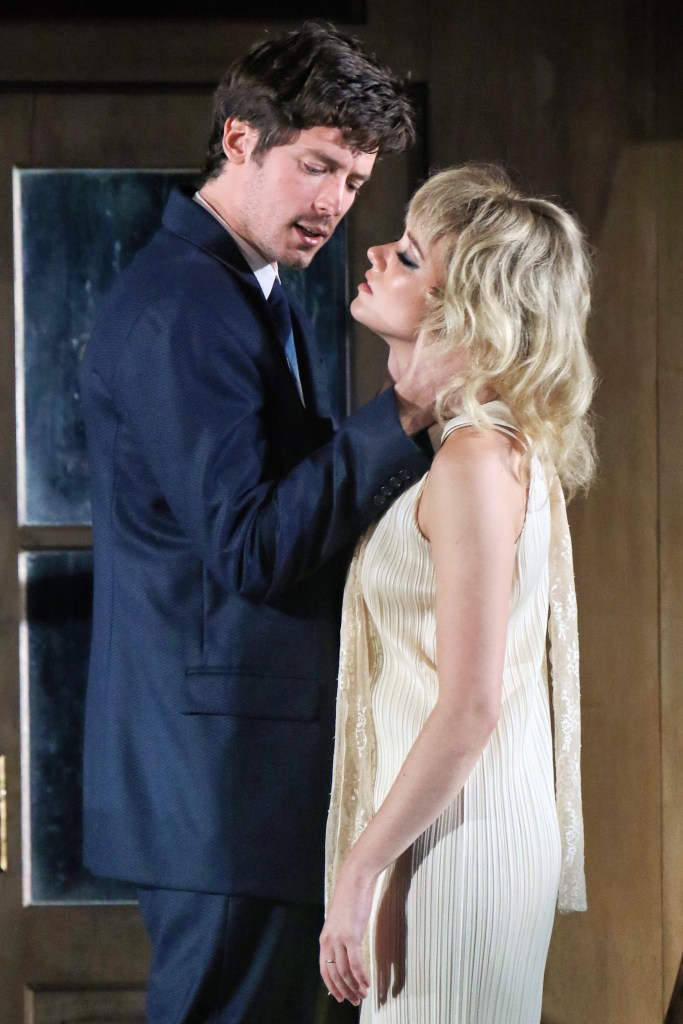
There are no spoilers. What transpires is Williams’ reaffirmation of the modern day tragedy that resulted daily in the Jim Crow South when white supremacists asserted they won the Civil War with every Black person they lynched using law enforcement to cover for them. In the play Williams also infers how this happens in the inhuman, abusive prison system which prompts men to escape and uses the escape as the justification for their killing.
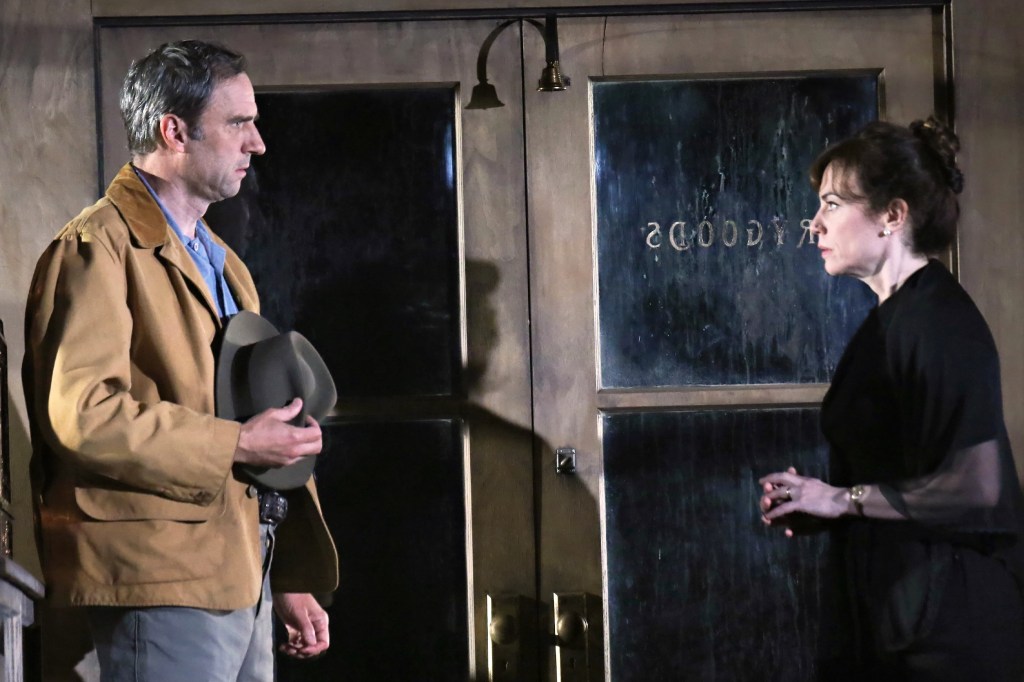
Schmidt and her team have created a production that is bold in revealing Williams’ trenchant themes about death, life, hatred, bigotry, racism and the utter wicked sadism and evil that would keep such a culture going even if the culprits, like Jabe, suffer and are eaten alive by their own hatred. In revealing Williams’ prescient themes that apply for us today, we note that a racist culture cannot be confronted when the power is held by the racists and bigots. Indeed, one must escape the purveyors of death and leave their sphere of influence, if there is no federal oversight or punishment for law breaking. If there isn’t accountability, the individuals, will do as they please, and like despots bend their underlings to their will as death dealers.
Kudos to the creative team which includes Jennifer Moeller’s costume design, David Weiner’s lighting design, Cookie Jordan’s hair and wig design and Justin Ellington’s original music and sound design.
The production concludes August 6th. Don’t miss it for its profound characterizations beautifully acted, acute ideas Schmidt suggests with her fine direction and the technical production values that bring Williams’ stark truths to bear on us today. For tickets and times go to their website https://www.tfana.org/visit/ticket-venue-policies
‘Not About Me’ Coming to Theater for the New City

Theater for the New City,
with the Support of Suite 524,
Presents
the World Premiere of NOT ABOUT ME
Not About Me is written & directed by Eduardo Machado (Havana is Waiting, “Hung,” “Magic City”)
The Limited Off-Broadway Engagement Begins Friday, January 13th
Theater for the New City (Crystal Field, Executive Artistic Director), the Pulitzer Prize winning community cultural center that produces over thirty premieres of new American plays each year, is pleased to announce the world premiere of Not About Me, written and directed by acclaimed playwright Eduardo Machado.
Not About Me will begin previews Friday, January 13th with Opening Night set for Wednesday, January 18th (8pm), at Theater for the New City (155 First Avenue, between 9th and 10th Streets). This limited Off-Broadway engagement will continue through Sunday, February 5th only.
The cast features Mateo d’Amato, Michael Domitrovich, Crystal Field, Ellis Charles Hoffmeister, Charles Manning, Drew Valins, and Heather Velazquez.
The creative team for Not About Me includes Mark Marcante (scenic design), Sean Ryan (production design), Alex Bartenieff (lighting design), Kelsey Charter (costume design), Bird Rogers (projection design), Emily Irvine (puppet designer/maker), and David Margolin Lawson (sound design). Not About Me will feature original music by Michael Domitrovich.
Not About Me is a memory play that takes audiences on a haunting journey through the mind of a playwright during COVID-19 lock downs. Long buried memories of friends lost to a mysterious “gay” disease come crashing into the present, and he is compelled to examine his artistic and political life in the theater. This play is a bittersweet reflection on how tragedy can unearth pain and laughter and bring back to life the treasures buried in the past.
“During the first summer of the lock down one of my best and dearest friends died of COVID. For the next three years all I could think about was all my friends that died of AIDS when I was in my twenties. COVID-19 brought the end of a certain way of life, as did AIDS in the 1980s. What had been a time of freedom and joy, a time when anything could happen, came crashing to a close, as our own sexuality became our illness. Queer people of a certain age know what this is like. Now, in 2022, the whole world has gotten a taste. We must speak out so the world can change to something better once again,” said Machado.
Eduardo Machado was born in Cuba and came to the United States when he was eight and grew up in Los Angeles. He is the author of over fifty plays, including The Floating Island Plays, Once Removed, Stevie Wants To Play The Blues, A Burning Beach, Havana Is Waiting, The Cook, Mariquitas, Worship, and Celia & Fidel. They have been produced at many major regional theaters, as well as in Europe, South America and Off-Broadway including, among others, The Actors Theater of Louisville, Mark Taper Forum, Seattle Rep, Goodman Theatre, Hartford Stage, Theatre for the New City, Long Wharf Theater, Williamstown Theater Festival, Arena Stage in Washington D.C. Cherry Lane Theater, INTAR, Ensemble Studio Theatre, American Place Theater, and Hampstead Theatre in London.
Mr. Machado’s television credits include Executive Story Editor on Season 2 of the drama “Magic City” (Starz) and two seasons on the HBO’s “Hung.” He has written pilots for Starz, Amazon, and AMC. He wrote and directed the film Exiles in New York, which played at the A.F.I Film Festival, South by Southwest, Santa Barbara Film Festival and Latin American International Film Festival in Havana, Cuba. He has directed numerous plays, including his own works and those of emerging writers. As a director his work has appeared in numerous regional theaters including INTAR, Theater for a New City, EST, Mark Taper Forum, Culture Project, Playwrights Collective, The Company Theater, Cherry Lane Alternative, Flea Theater, Group Theater and the Inner City Cultural Center.
Mr. Machado has taught playwriting at Columbia University (Head of Playwriting 1997 to 2007), NYU Tisch (Head of Playwriting 2007 to 2018), and HB studios since 2020. He also taught at the Public Theatre, Mark Taper Forum, Sarah Lawrence College and the Playwrights Center. He has served as an Artistic Associate at The Public, the Flea Theatre/Bat Theatre Company, and The Cherry Lane Alternative. He was playwright-in-residence at The Mark Taper Forum. From 2004 to 2010 he was the Artistic Director of Off-Broadway’s INTAR Theatre.
He is the recipient of the Raúl Juliá HOLA Founders Award and the Berrilla Kerr Grant for contribution to American Theater. Other grants and awards include: AT&T: Onstage Grant; National Endowment for the Arts and Theater Communications Group Playwrights In Residence Fellowship at Theater For the New City; Bernice and Barry Stavis Playwright Award from the National Theatre Conference; two Dramalogue Awards, Best Play; three LA Weekly Awards; Theater Communications Group and Pew Charitable Trusts National Theater Artists Residency Playwright In Residence, Mark Taper Forum, Los Angeles, CA; Viva Los Artistas Award from the city of Los Angeles; Ford Foundation Grant; Rockefeller Foundation Playwriting Award; three National Endowment For the Arts Playwriting Grants; and National Endowment for the Humanities Youth Grant.
He is a member of the Actors Studio, Ensemble Studio Theater, and an alumnus of New Dramatists. He has served on the boards of TCG, New Dramatists and Theater for the New City.
Two collections of Mr. Machado’s work, The Floating Island Plays and Havana is Waiting and Other Plays, are published by the Theatre Communications Group. His plays are also published by Samuel French. Tastes Like Cuba: An Exile’s Hunger for Home, a food memoir by Eduardo Machado and Michael Domitrovich, was released by Gotham Press.
Not About Me will be presented at Theater for the New City (155 First Avenue, between 9th and 10th Streets) from January 13th through February 5th. Performances will be Wednesday through Saturday evenings at 8pm, with matinees Sundays at 3pm. Opening night is set for January 18th. Tickets are $18, student tickets $10 and may be purchased by calling 212-254-1109 or online at https://theaterforthenewcity.net/shows/not-about-me/
‘This Beautiful Future’ Transfers to the Cherry Lane

Sometimes the only hope alive during crises or the trauma of war are romantic dreams which disappear in the light of day. Young love, illusion, rueful regret and irony thread two lines of action, one .in the past in Chartres, France, 1944, the other in an opaque and timeless present. The threads are like parallel tracks that coexist simultaneously without touching until the conclusion of This Beautiful Future where they do briefly coalesce. The production directed by Jack Serio and written by Rita Kalnejais is running at the Cherry Lane Theatre until October 30th.

The playing space downstage front represents an abandoned house once occupied by Jews, rousted out by the Nazis. The setting is Chartres France, 1944 at the end of WWII. Upstage, behind a plastic window partition in the present are observers of the action, two wise, world-savvy seniors (Angelina Fiordellisi) and (Austin Pendleton), playing themselves. These venerables serenade us with ironic songs that provide an exclamation point to the the troubling conversations, cognitive dissonance and contradictions that abide between love-mates, a canny French teenager Elodie (Francesca Carpanini) and Otto (Uly Schlesinger). Otto is a Nazi youth, old enough to shoot Frenchmen for his idol Hitler, but too naive and ignorant to understand the heinousness of his actions.
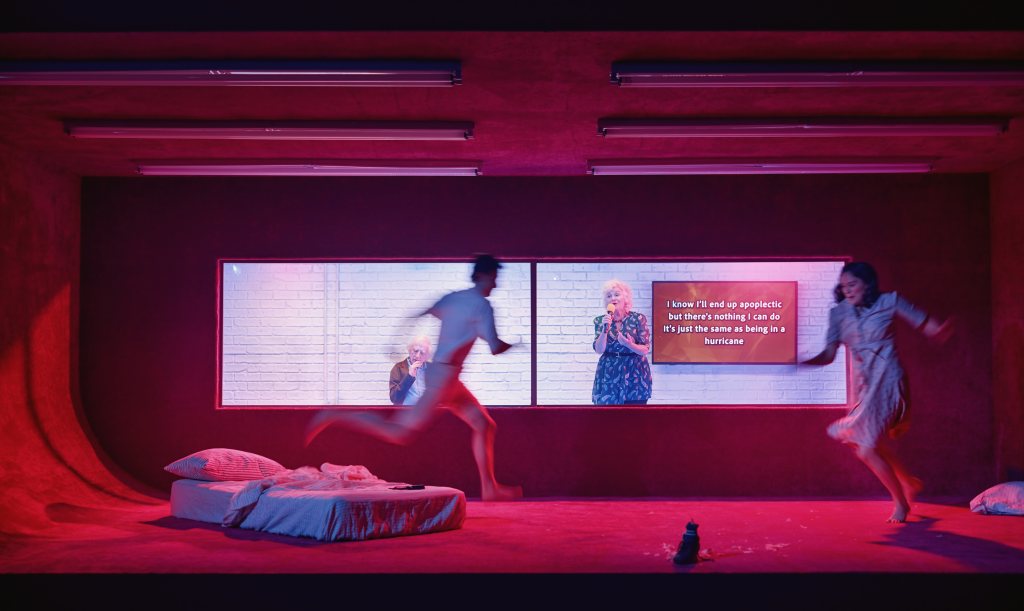
Though the conflict is understated, Elodie has fallen in love with Otto despite his mission to kill, and he is entranced with her, possibly using her to ignore the rude reality that the war is over and he is on the wrong side and facing certain death as American forces are a day, then minutes away.
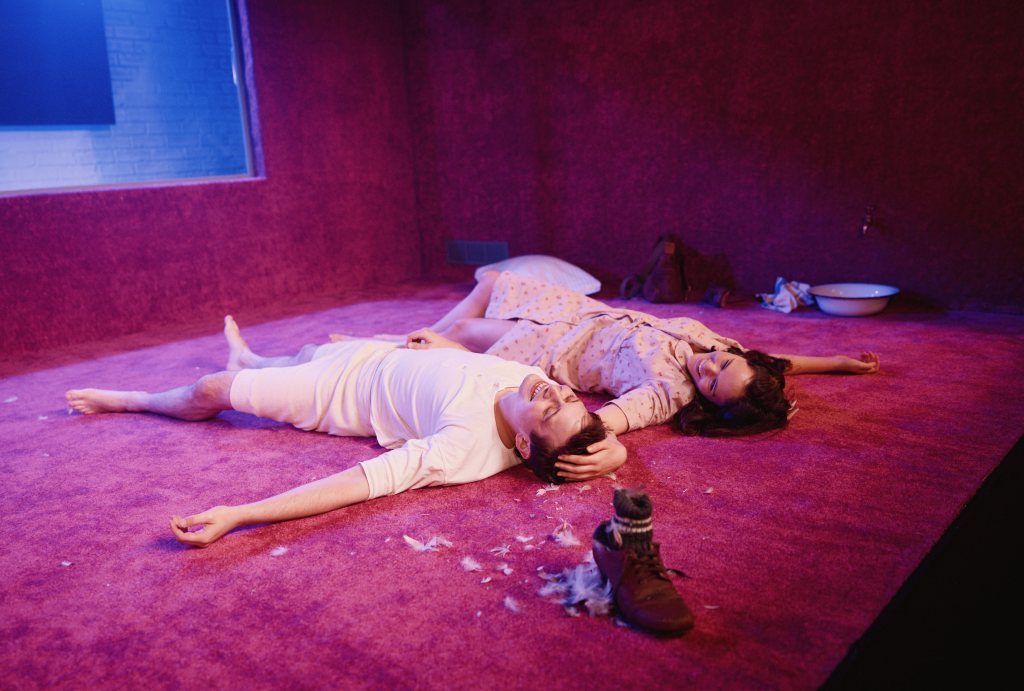
The play combines monologue and interactive dialogue. The time is non linear and moves into flashbacks which alternate from Elodie’s and Otto’s magical and sweet interludes in the bedroom of the abandoned house their last evening together, to the following day when in monologue they unremorsefully describe the consequences of their love’s fool-heartiness. Another flashback skips to the time when they first discovered their interest in each other at the lake. Then the next scene jumps to Otto’s monologue describing his last moments on earth and Elodie’s monologue describing her public shaming and harassment for making love to a Nazi.

Elodie’s and Otto’s separate monologues delivered to the audience are reveries without emotion. As they discuss the consequence of their brief love relationship the following day after their night together in the house, we are surprised by the contrast with the previous scenes when their interactions are joyous, magical, uplifting. During their pillow fight, their throwing water and teasing each other, we forget that this is wartime. As they are compelled to escape to each other, we are relieved to focus on the silliness of their youthful innocence. Yes, even a killer Nazi has elements in his spirit that are silly and sensitive. Importantly, Kalnejais never steps too far away from Otto’s humanity to make him a stereotype.
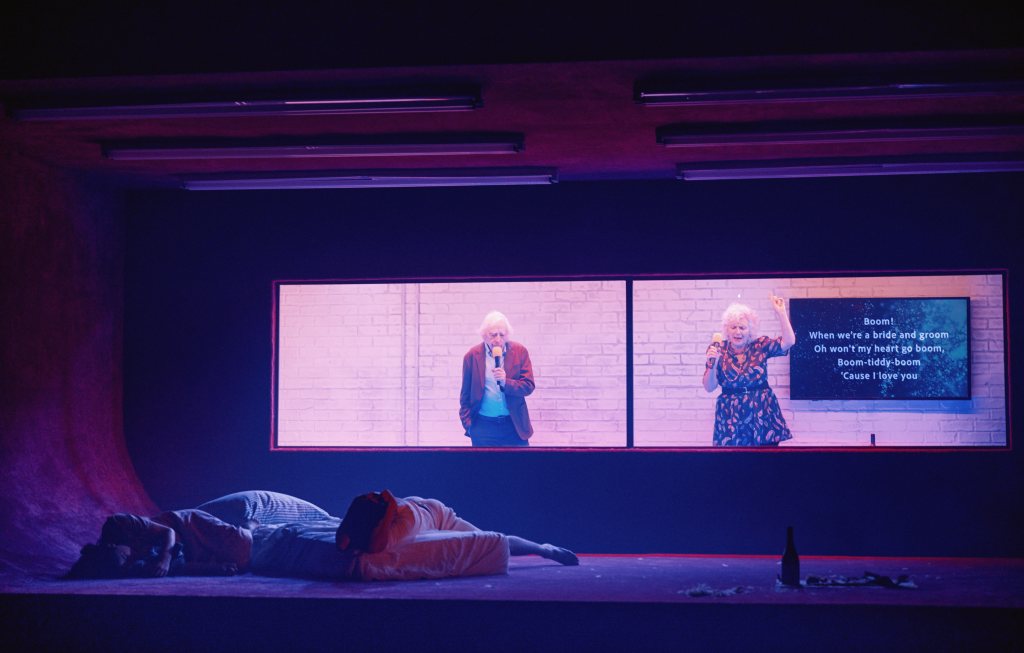
In the final section the morning before they both leave the house, an egg which Elodie has stolen from a nearby chicken coop hatches and the loud chick proclaims it is alive. Of course the irony is that as the two of them leave, the chick will have to fend for itself and most probably die. This irony is heaped on another irony, because in the first scene they discuss their future after the war; they will raise this chick and have more chickens. This is the “beautiful future” of Otto and Elodie, wayward dreamers who at this point in their lives do not regret what they have experienced together. Theirs is a respite in the horrors of death and chaos. Of course they must dream of the beautiful future because it will never come to pass.
Interestingly, toward the end of the play after the wise observers of these events sing songs whose lyrics are loaded with irony, Angelina and Austin come down from their perch “on high” and hug and comfort Otto and Elodie because of what they are going through. One wonders; if the observers could intervene would they encourage Otto to leave Elodie before morning so he doesn’t fall into the hands of the Americans and die? And if Angelina could counsel Elodie, might she have left Otto and the house before her countrywomen catch her and deem her a traitor? Elodie is punished for sleeping with a Nazi, she shares in a monologue. They publicly shame, harass her and shave her head.
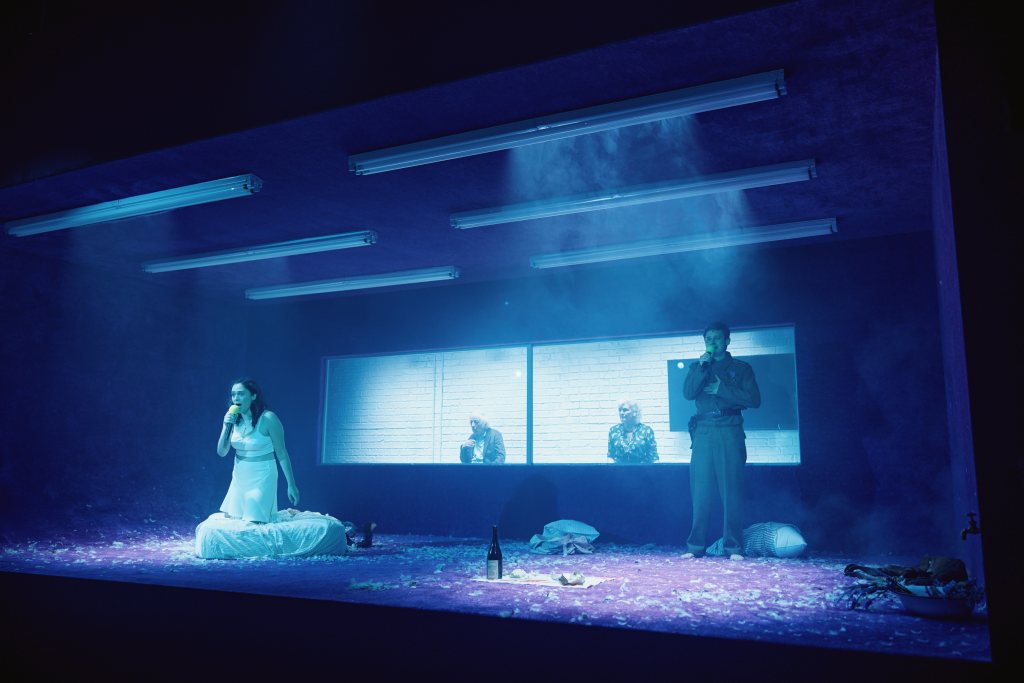
Most probably even if Angelina and Austin attempted to stop Elodie and Otto, they would have rebuked their interference so they could continue to believe in their dreams and “beautiful future.” They prefer being swept up by the annihilation of romantic love’s curse. Evidence of this abides throughout.
Otto is like the QAnon MAGAS in our nation who revel in the fantasies of their own making. Like them he is convinced of his rightness in bringing about Hitler’s “perfect” Master Race and the ideas of the Third Reich. Staunchly oblivious, he refers to news reports of Germany’s loss that Elodie shares with him from the BBC as banned propaganda. He even suggests he could arrest her for listening to enemy radio. Otto cannot be dissuaded from his beliefs that his troop is going to invade England the next day. Most probably his commanders have told them these lies to bolster their flagging moral. It is a wartime trick. One is reminded of Putin’s commanders lying to the Russian youth to get them to fight his losing war against Ukraine.

From war to war throughout the ages up until today, no sane individual wants to kill other human beings. They have to be brainwashed with lies, scapegoating “the enemy other” to do so. Of course, the final lie is that the war is being waged to bring about “the beautiful future.” Things will be better once “the other” is wiped out, cleansed from the face of existence. That Elodie “loves” someone who believes this is an interesting phenomenon. Thus, the songs that Angelina and Austin sing are supremely ironic as they heighten the obliviousness of Elodie and Otto, who we somehow find ourselves engaged with, precisely because they are youthful and off-the-charts irresponsible and blind.
Elodie is like the MAGA wife who supports her husband going to radical, conservative, right-wing Donald Trump rallies, though it is counter to their lives to give money to a grifter, defrauder and proven liar. Elodie ignores the truth that Otto is a killer, a brainwashed Nazi who has most probably killed her brother’s friend and others in her acquaintance. Indeed, the Nazis have killed friends, neighbors and family. Yet, she is able to live with the cognitive dissonance and “love” him.
For his part Otto puffs himself up riding on Hitler’s coattails. He imagines Hitler’s greatness when he started out from nothing to become the near ruler of all of Europe. Otto is tremendously enamored of the adventures he’s had fighting for Hitler and the respect he garners because he wears a uniform. During Elodie’s and Otto’s monologues and interactions, the songs which Angelina and Austin sing are laughably sardonic. That they sing with sweetness punctuates the dark irony all the more.
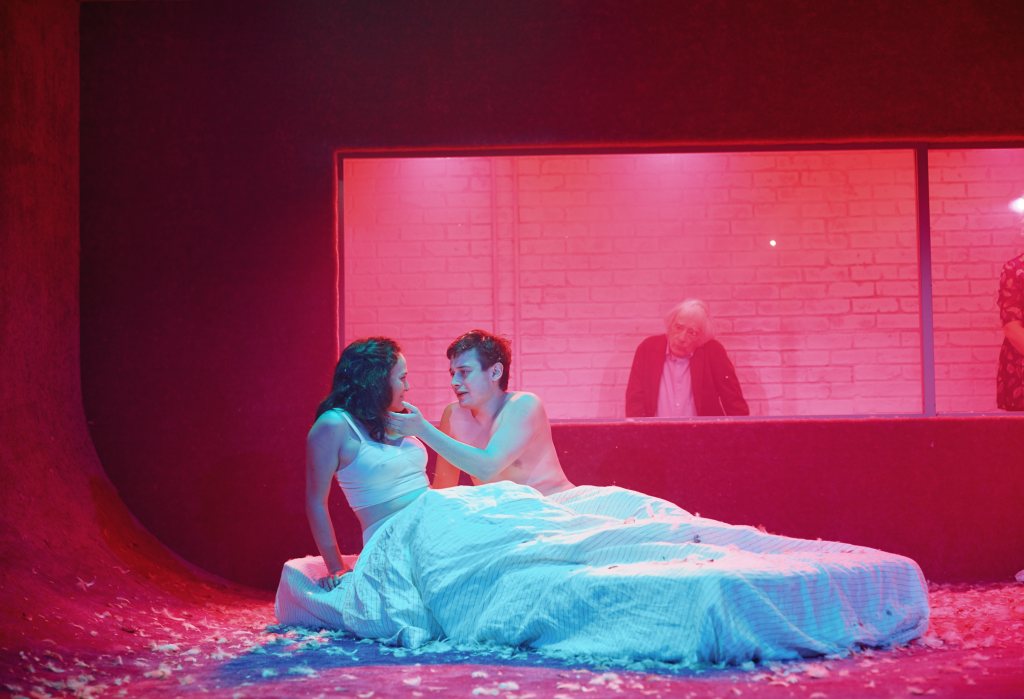
This Beautiful Future is not for everyone. From the rosy, pink set appointments evoking the concept of seeing life through “rose colored glasses” (Frank J. Oliva-scenic design), to the contrast of action and singing in a divided stage (Lacey Ebb-production design), by undefined observers, one may be confounded with a cursory viewing. The play necessitates one goes deeper for it is thought provoking and extremely current. It is well acted and finely directed. The scenes between Carpanini’s Elodie and Uly’s Otto have striking moments of whimsy, beauty and poignancy. However, playwright Rita Kalnejais always makes sure that the romantic fantasy is momentary and that leering reality lurks around the corner ready to pop up and set Elodie’s and Otto’s tranquility spinning into fear.
This Beautiful Future runs 80 minutes with no intermission at the Cherry Lane Theatre. For tickets and times go to their website: https://thisbeautifulfuture.com/
‘Wynn Handman Way’ is THE Way on 56th Between 6th and 7th Avenue in Manhattan

A crowd of friends, Wynn’s daughters Laura, and Liza Handman, close friend, filmmaker, acting teacher Billy Lyons, former Mayor Bill DeBlasio and City Councilman Keith Powers gathered together around 11 AM on the corner of 7th Avenue and 56th Street, September 12, 2022. They were there to celebrate the recognition of Wynn Handman’s prodigious contributions to American theater, American society and New York City with the renaming of 56th St. between 6th and 7th Avenue as “Wynn Handman Way.” This recognition is a long time coming and well deserved, though many may not be familiar with the name Wynn Handman.
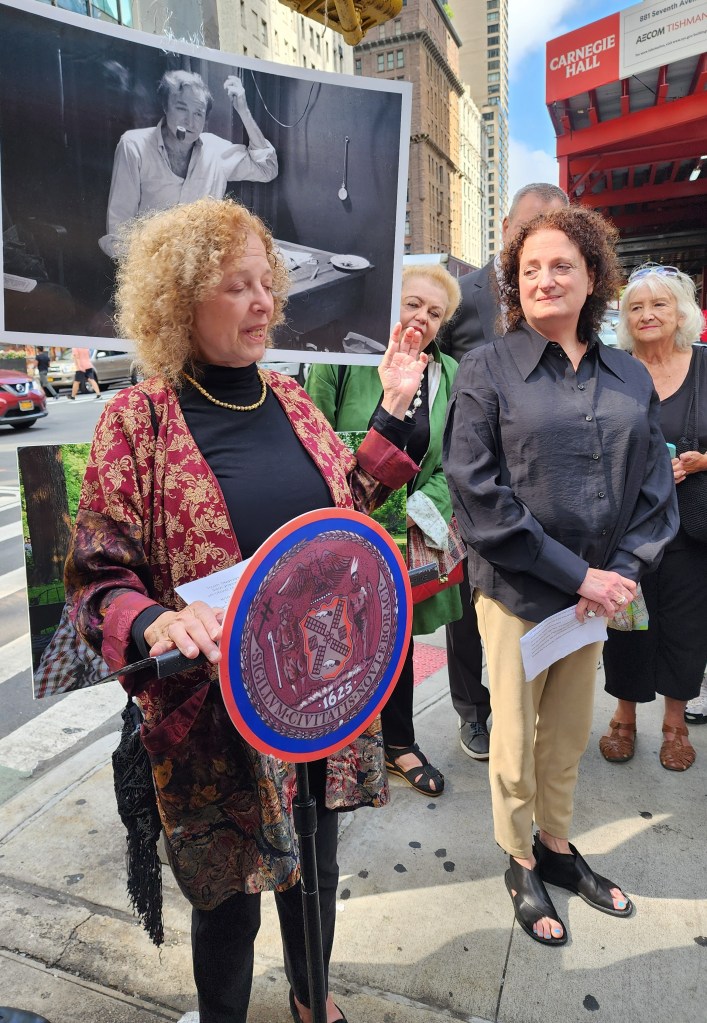
Wynn flew under the radar unlike other acting teachers. Reading about Wynn’s life, seeing him in talkbacks, one in 2018 at Tribeca Film Festival after the showing of Billy Lyon’s film on Wynn, It Takes a Lunatic, (a Tribeca review is at this link https://caroleditosti.com/tag/wynn-handman/), one immediately has the sense that Wynn was all about the work. Perhaps the last thing he was interested in was promoting himself or advertising his acting classes. He never did. Yet, somehow, actors who studied with him and later became giants in film and on stage (i.e. Olympia Dukakis, Denzel Washington, Sam Shepard, Michael Douglas, Richard Gere), found out about Wynn and studied with him, realizing it’s all about the work, the authenticity, the humanity of the characters they portrayed.
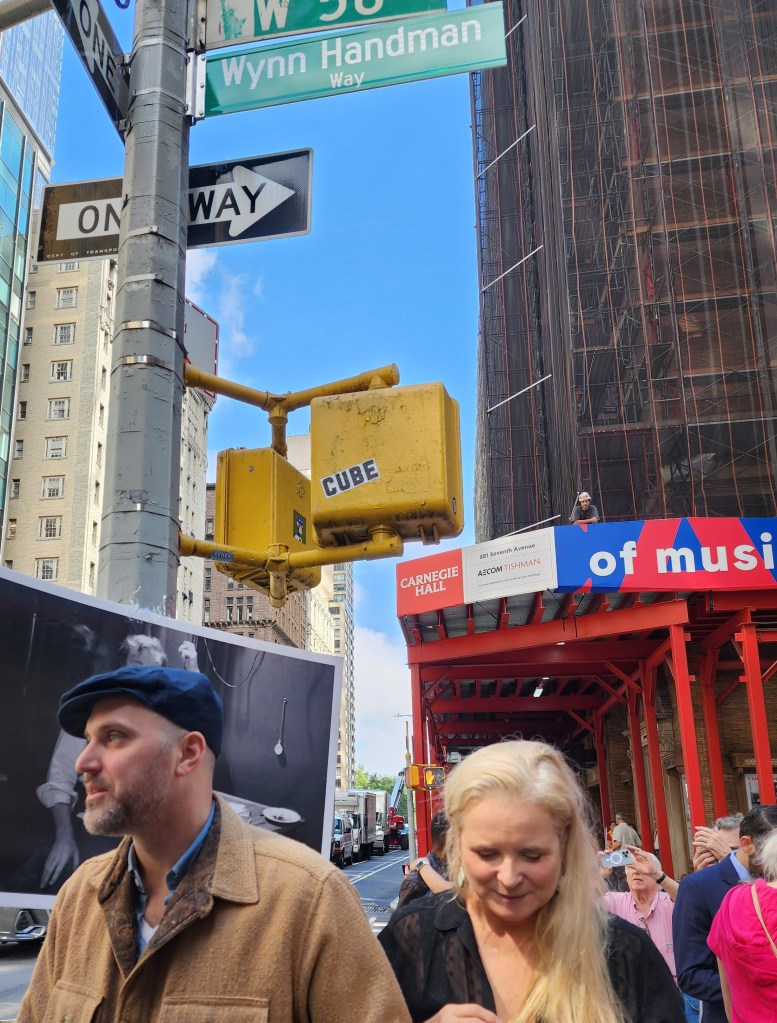
To study acting with Wynn, one picked up information about him by word of mouth. He was down-to-earth, authentic, loving. At the Wynn Handman Street Sign Dedication, those who knew and loved him best, his daughters Liza and Laura and his friend and filmmaker biographer of Wynn, Billy Lyons, spoke fondly about Wynn. What a boon to study acting with him and be in his presence and in the presence of others studying with him. Just to be a fly on the wall would have been enough. However, if you were accepted after you auditioned, you worked, and worked hard.
Wynn Handman was the Artistic Director of The American Place Theatre, which he co-founded with Sidney Lanier and Michael Tolan in 1963. Going against the grain and a maverick for his time, Wynn engaged with Lanier and Tolan because they understood the vitality of theater to change lives and improve cultural understanding and awareness, making us more humane and empathetic. With these goals in mind and many more, Wynn and the others intended to encourage, train, and present new and exciting writing and acting talent and to develop and produce new plays by living American playwrights and writers.
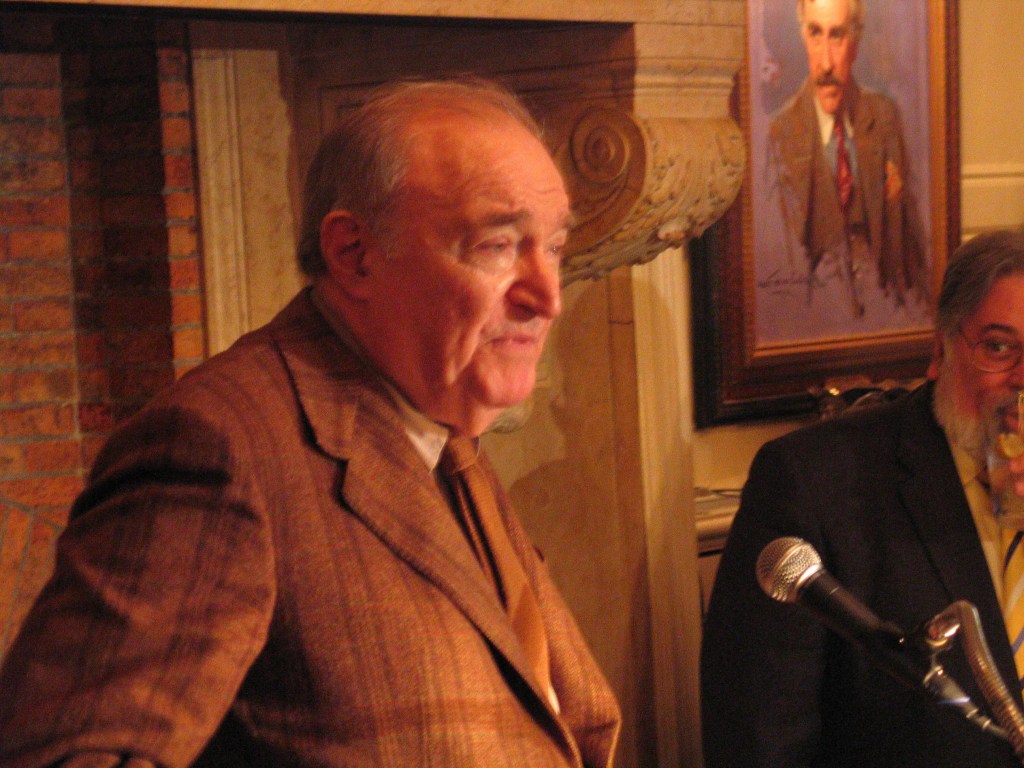
As a change agent, The American Place Theatre was one of the first not-for-profit theaters in NYC. Unlike the current mission of non profits which sometimes appears to serve the CEOs and not the actors, creatives and playwrights, The American Place Theatre was dedicated solely to the development of new American playwrights and writers. Writers whose work was developed and produced there included Robert Lowell, Maria Irene Fornes, William Alfred, Ron Milner, C Frank Chin, Sam Shepard, Ron Tavel, Joyce Carol Oates, Clare Coss, William Hauptman, Jeff Wanshel, and solo performers Bill Irwin, Eric Bogosian, John Leguizamo and Aasif Mandvi, to name a few.
The American Place Theatre moved to a custom-built basement complex in 1970. The complex at 111 West 46th Street, operated until 2002. The organization received several dozen Village Voice Obie Awards and AUDELCO Awards for excellence in Black Theater.
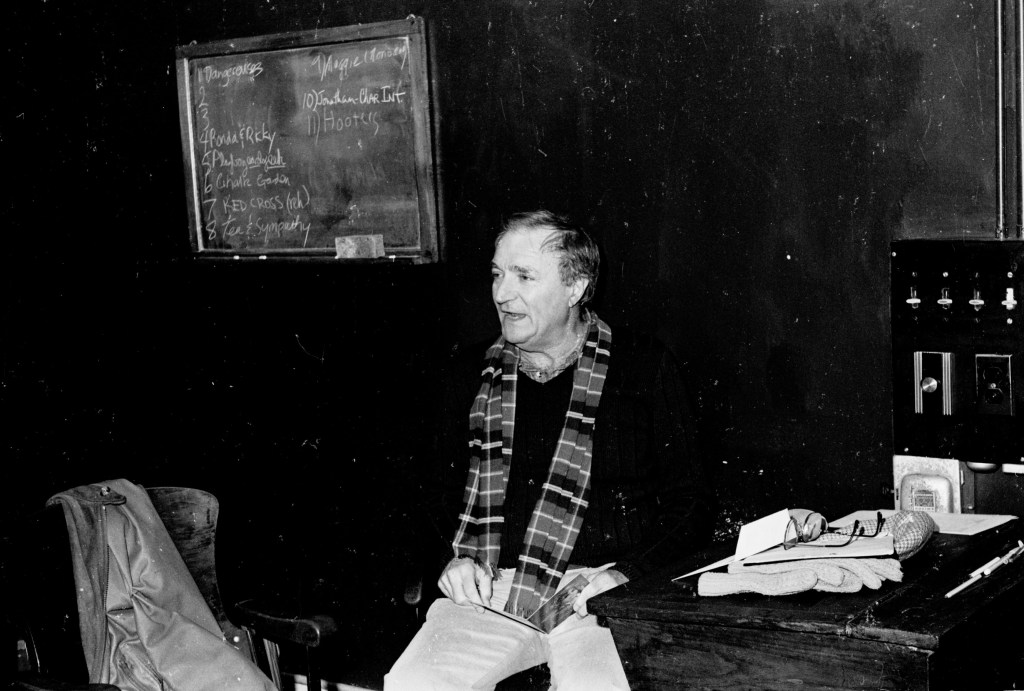
Always at the forefront of innovation with the intent to impact the New York City community, in 1994 friends and members, led by Wynn under the auspices of The American Place Theatre, created a Literature to Life program. The program adapted significant works of American literature to encourage literacy. Performed by solo actors, productions were offered to middle schools and high schools. Wynn Handman directed a number of projects. Also, Elise Thoron directed other projects; currently she heads up the program. To continue with the vital importance of literacy and theater’s place in revitalizing young people’s interest in reading, Project 451, a funding initiative of Literature to Life came into being during the 2008/2009 season. The mission is to ensure that reading, writing, and the arts remain a primary component of the education of young American citizens.
In the videos above City Councilman Keith Powers and former Mayor Bill DeBlasio underscore the great contributions Wynn Handman made to the New York City community and American theater. Funding, which has become problematic with skyrocketing city rents and the focus on purely commercial shows, has modified the impact of innovation, risk-taking and genius in the theater arts, and other processes and attributes that Wynn Handman prized.
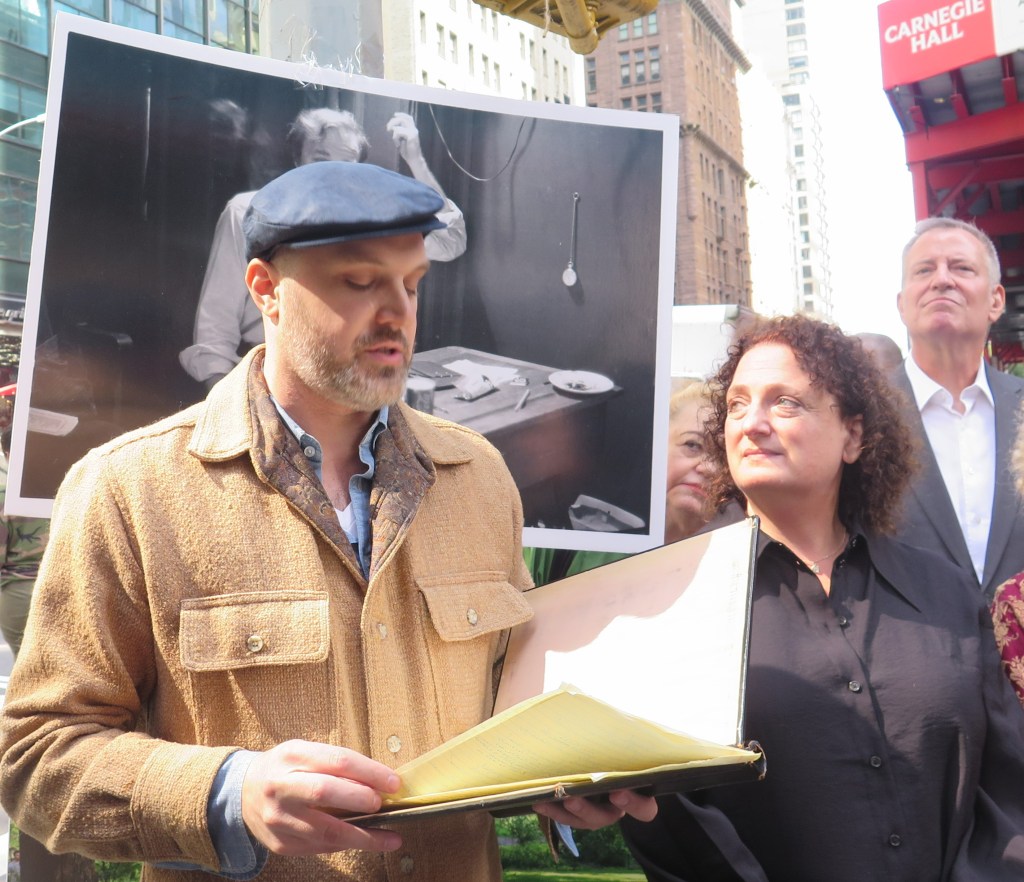
In his remarks Billy Lyons stated that Wynn told him not to fret or worry about American theater and the direction in which it appeared to be going. He said in effect, “Don’t be a “Miniver Cheevy.” Wynn’s reference to the Edwin Arlington Robinson poetic portrait of “Miniver Cheevy,” a man who mourned the glories of the past and drowned himself in drink, is apt. How comfortable it would be for theater to rest on the laurels of past great American playwrights, and quail at producing those who exemplify the unique, original, current and “off the charts” shows. How facile to put away the maverick and the daring for the sake of commercial success. Don’t fail has become the unspoken meme wafting through the psyches of those in the theater arts.
Indeed, the innovations in American theater have been occluded by rapacious Philistines quick to produce a Jukebox Musical, easy to finance a show adapted from a film that has a “sure-fire,” lucrative track record. There is nothing wrong with that. And yet, there is everything wrong with that. Is balance possible beyond Off Broadway and non-profits which overly reward the institution and give short shrift to the creatives?

To be forward thinking, as Wynn would have theater artists and producers be, then failure is something not to be feared. Above all the “critics” must understand the necessity of “Dynamic Theater,” which dares to fail to reemerge with new insights and new genius. Perhaps, in many respects, American theater over the past decades has been failing abysmally, though the box office looks good. There are plenty of anecdotes about shows whose audiences needed to catch up to their brilliance, doing better the second and third time around, when the time was “right and ripe.” Perhaps formulaic success is not an option, except in small doses. Isn’t a modicum of realignment necessary? After the ravages of COVID, it might be as good a time as any to innovate and take risks (i.e. Daryl Roth’s Kinky Boots reboot with reasonable ticket prices).


What to do in this shifting financial climate? We must rely on the generosity of those who have the abundant resources to share (private and government), so that they might bring ticket prices down, bring rentals down and establish more foundations to help subsidize the artists (actors, technicians, creatives), who live and work in New York City and justify its renown as the “#2 theater capital of the world.” If Wynn Handman has been a guiding light toward theater’s evolution, his “lunacy” must continue in theater’s bravest of hearts (producers, directors, actors, creatives), and all those willing to dedicate themselves to forge anew American theater’s next chapters.
‘Potus,’ A High Octaine Farce With Riotous Performances by Rachel Dratch, Vanessa Williams, Lilli Cooper, Lea DeLaria, Suzy Nakamura, Julie White, Julianne Hough

POTUS: or, Behind Every Great Dumbass are Seven Women Trying to Keep Him Alive is a laugh riot, pants wetter that begins from the moment the lights dim in the audience. Writer Selina Fillinger turns every political meme on its silly and dangerous head as award winning director Susan Stroman shepherds her superb cast for maximum rollicking humor that doesn’t quit. Of course, there is a point to this brilliantly “mad” production, currently running at the Sam S. Shubert Theatre. The theme? WWWD?

In other words, “What Would Women Do,” if they ran the country? Well, it turns out in the play, they do! However, because they are not the president, they don’t receive credit for making the big man look good, while taking the flak from what he has managed to botch or not do at all. White men of both political parties pay billions of dollars to make sure that women aren’t presidents. BILLIONS. It makes one think, does it not? What are white men on that they are willing to spend BILLIONS to prevent women taking the highest office in the land? Has there been a time in US History when both political parties had women candidates running against each other for the presidency? POTUS suggests it’s about time.
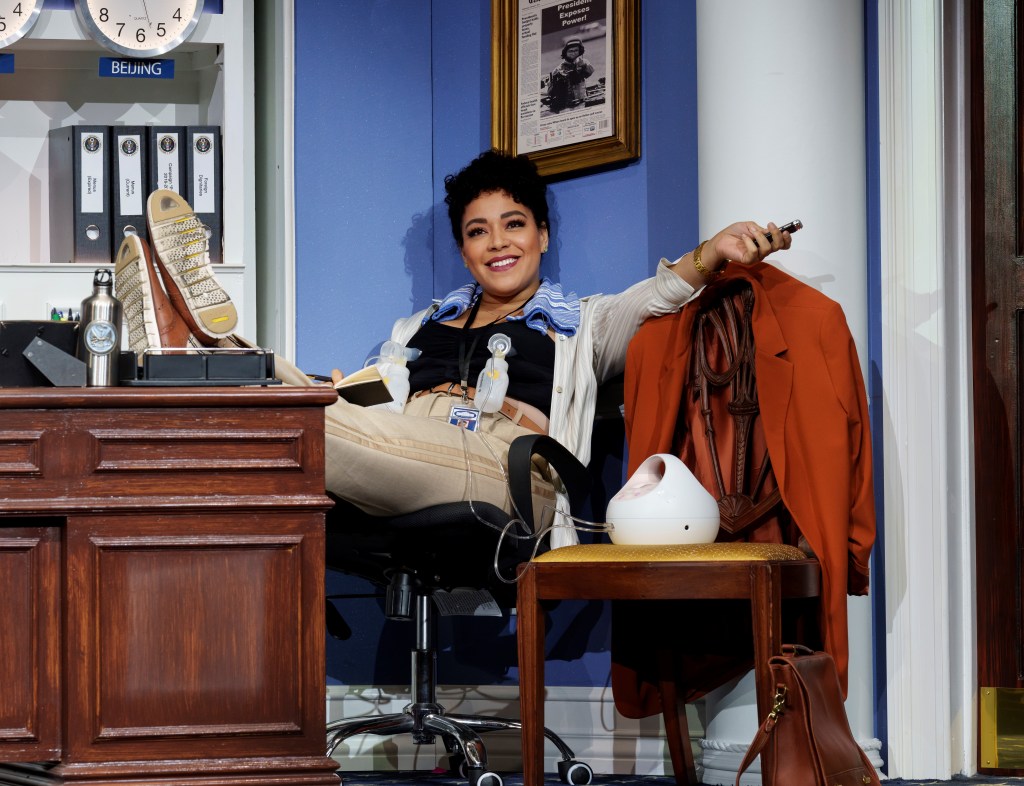
The theme gradually expands and is framed as a question by various female characters in this profoundly funny black comedy. As the events whip by in Fillinger’s ebullient and raucous two act play, they reveal that without his women as his right and left arms, this particularly lame president, who could double for a former president whose last name begins with “T,” would be up sh*t’s creek without a paddle, plunging over a sewage waterfall to his sludgy demise. Do they enable him? It’s one way to look at it. Another is they will never have any chance at all to be in the man’s world without doing what they do. Without a penis, their vaginas bar them for as long as men decide. That is the fleshy point!
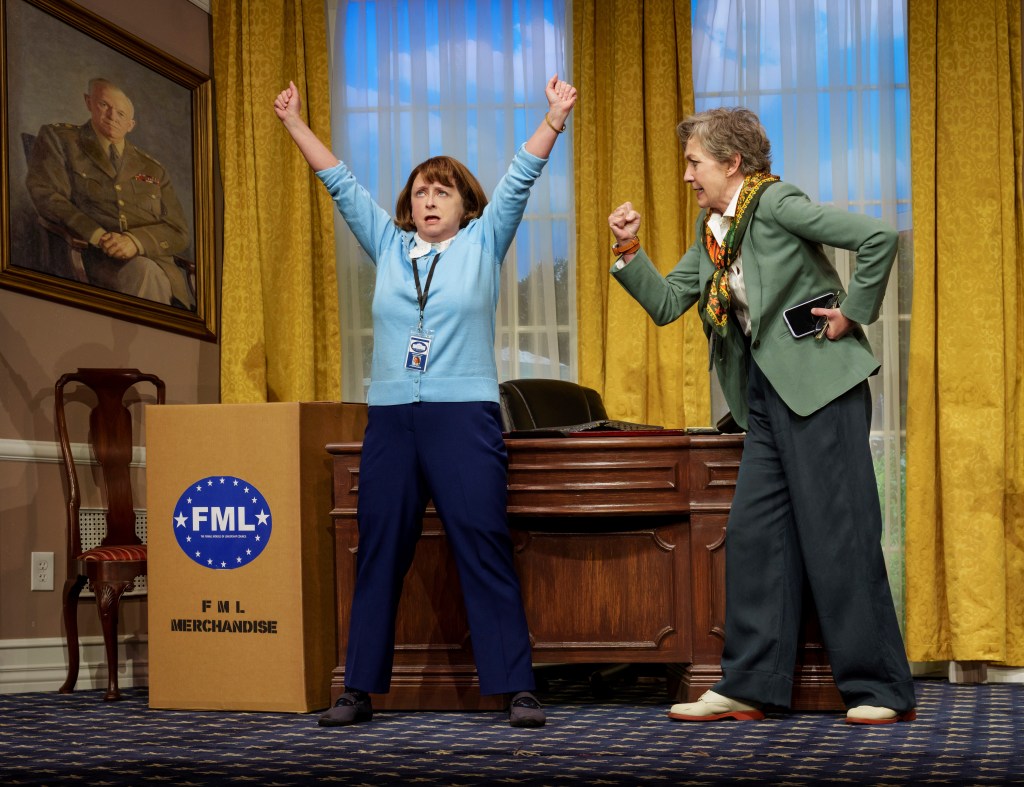
The farce which sends up various former presidents we’ve had (to be fair Republican presidents, because Republicans are never fair), moves at the speed of light for pacing, quips, one-liners and thrust and parries that make absolute sense. So does the gyrating plot which moves from mountain top to mountain top until you are so elevated, you can’t breathe for the belly laughs.
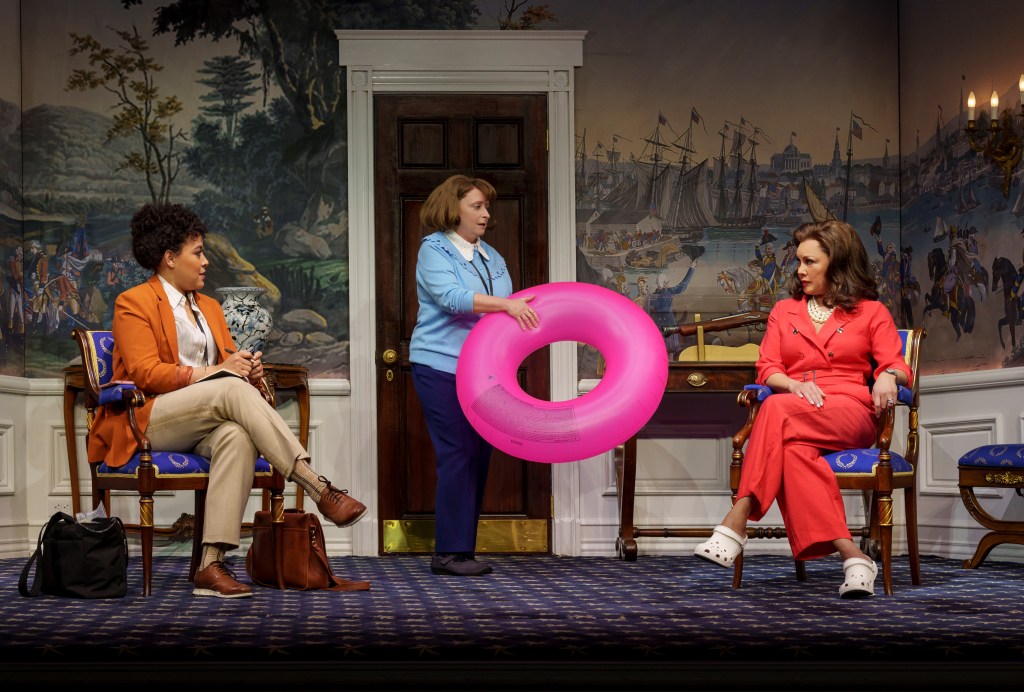
With a cast of seven (all award winners), and an intricate set (Beowulf Boritt), of well appointed rooms spinning on a turn table that reflects areas in the White House, we happily spend time with the females, including a pilot fish reporter. Most of them are highly efficient, talented geniuses who make POTUS pop and generally keep him and the country together. This is a feat considering that “the servant of the people” is a ninny incompetent who is a firestarter, and the women must be at the ready to contain his blazes like advanced technically able forest rangers.
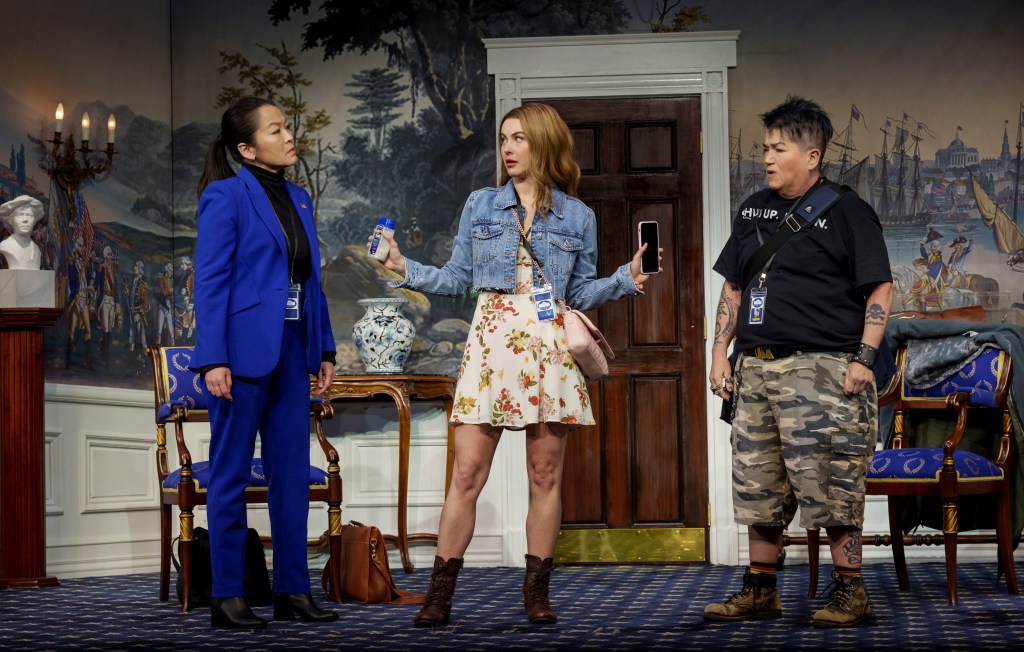
The frolic represents a day in the life of the women of POTUS and a few hangers on like his wife, sister and a “has-been” reporter “in” with the press secretary. These marvelous women include his chief of staff Harriet (Julie White), press secretary Jean, (Suzy Nakamura), secretary Stephanie (Rachel Dratch), his dalliance Dusty (Julianne Hough), his sister Bernadette (Lea DeLaria), slick journalist Chris (Lilli Cooper) and his wife Margaret (Vanessa Williams). All of them are beyond capable and the actresses are a prodigious, laugh a second team.
With frenzy these “wonder women” “keep the balls in the air” for the presidential apotheosis and get him through his day of discussions, briefings, handshakes with physically challenged vets, and a meeting with foreign dignitaries about nuclear non-proliferation treaties. After these events, POTUS is just in time for the FLM (Female Models of Leadership), dinner as icing on his evening cake. Through all these, we witness the machinations these fabulous women spin behind the scenes, but never see the president in action.
In fact, not one male is present on the Schubert stage. How quaint! Considering the few females proportionate to males in the theater world (even female critics), this is quite a lovely step in the right direction.

After an explosive fight in which his wife tells him “to stop acting like his father, grow a pair and get his anal cyst removed without anesthesia,” which we hear about, POTUS publicly states the First Lady is absent from a gathering because she is having a “cunty morning.” “Cunt” is the first word that is spoken by Julie White’s Harriet at the top of the play, as she relates to press secretary Jean POTUS’ public cruelty. It is at the heart of the play’s themes and a remark that sets the media world on fire. Indeed, in POTUS’ world, women don’t count except as utilitarian sex objects; if they are salient, they are “cunts.”
Though we laugh as the correction machine starts to turn and hell breaks loose in the kingdom, the point hits home. Subsequently, one “cunty” event happens after another on this average day at the White House with an invisible POTUS and the women front and center who must suck it up and smile, making the badies go away.
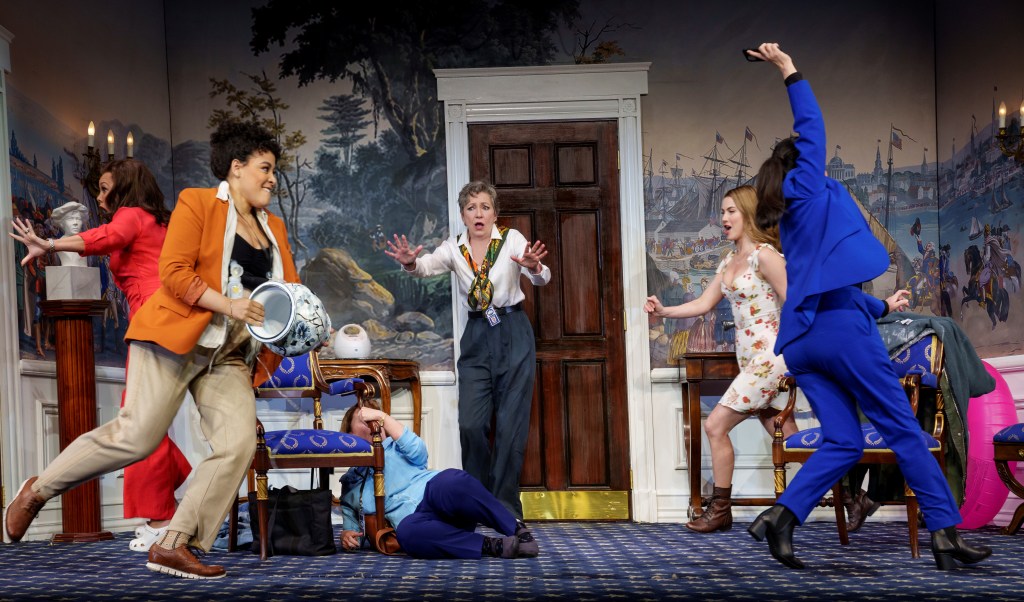
We get to meet Ratchel Dratch’s insecure press secretary Stephanie who is learning physical power confidence and taking her own space, employing full body postures to block Margaret, the First Lady, from going in to give her husband “what for.” Margaret’s edgy, dark insults fly at Stephanie intentionally “behind her back,” while Stephanie is in the room suffering Margaret’s fury and accomplishing her job impeccably. Of course, Margaret believes her role as wife takes precedence over her role as First Lady. However, Harriet and Stephanie prove that is true only up to a point. They prevent the first couple seeing each other (not that they ever do), and block her like linebackers with words and actions.
Potus’ packed schedule doesn’t warrant a discussion with the always fuming Margaret, and he obviously has told Harriet to keep her at bay. However, the First Lady has gravitas and can help smooth the situation which is crassly getting out of hand, inflamed by the media. Allowed to fester like a pustule, his public insult in front of diplomats causes a growing international kerfuffle. Interestingly, “I’m sorry” is not in his vocabulary.
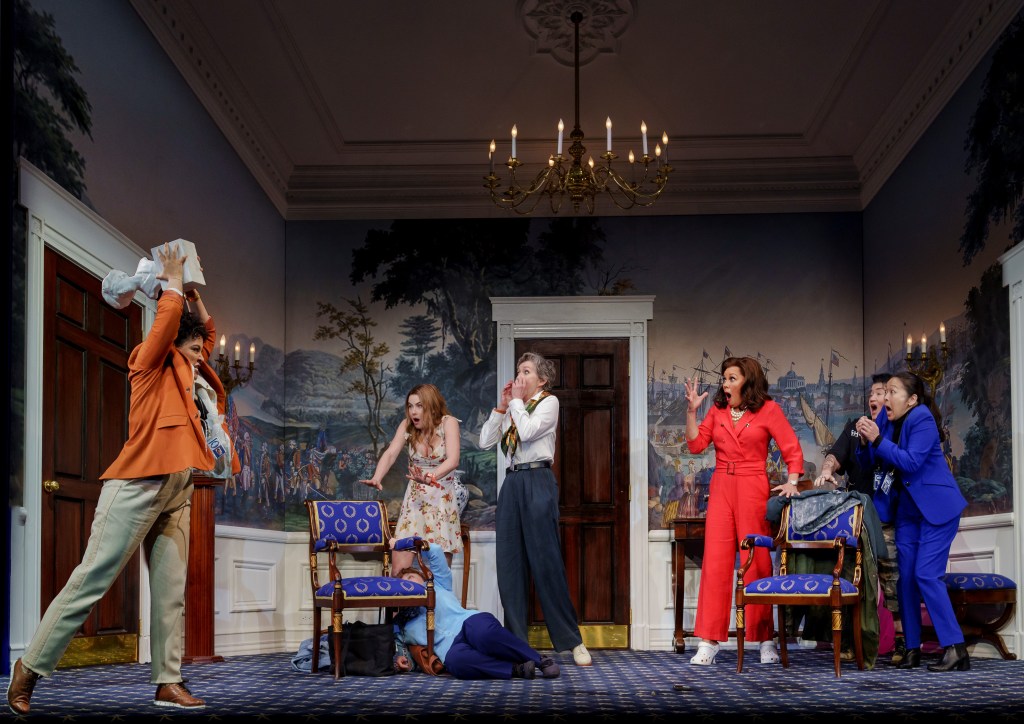
The snoopy reporter Chris (Lilli Cooper), who makes herself comfortable in press secretary Jean’s office, milks the situation for all its worth. It’s a meme; she has twins; a milking machine attached to her breasts gathers breast milk in plastic bags, while she collects the latest juicy gossip about how Margaret handles the president’s “cunty” remark. Interestingly, the comment explodes the offensive meter with countries like Bahrain, who think that the scurrilous reference inferring the First Lady’s female genetalia is nasty and disturbing.
Nevertheless, in the world of power plays and reelections, offense at this remark is a legitimate way to leverage its relationship with POTUS’ administration. Of course Bahrain’s allies and allies of allies all pile on. None of this we see; we only view the frenetic and LOL behavior of the President’s female clean up squad, who must ironically blow by the gender insult to them, as if it is “nothing.”
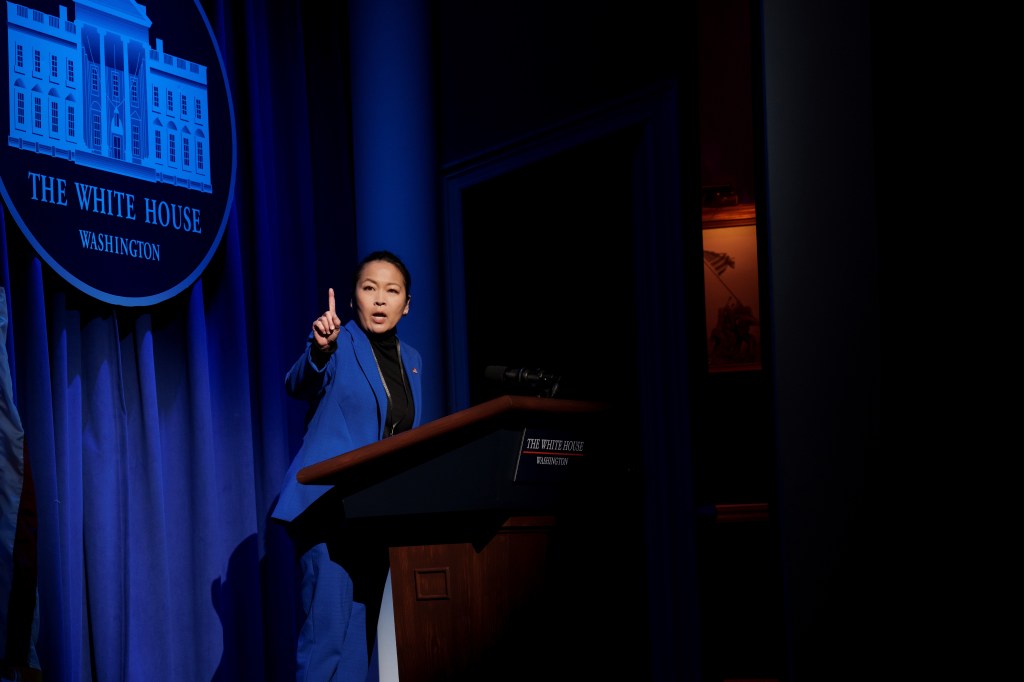
The situation only worsens when Stephanie stumbles upon the very attractive Dusty (Julianne Hough), armed with a security badge, as she floats around the White House looking for the president to discuss their shared secret which makes her vomit. Dratch’s Stephanie freaks. She believes Dusty is her replacement. Throughout Dratch as Stephanie ups the laughs with her spot-on, completely organic reactions to Dusty and the increasingly wild situations. With acumen, press secretary Jean discovers Dusty is a POTUS dalliance that Harriet has scheduled to speak to the president under Harriet’s advisement. Dusty, a wealthy farmer’s daughter, wants a deal with POTUS about seed planting, leveraging something she carries, and making public statements.
The breaking point thrills when POTUS’ sister Bernadette (Lea DeLaria delivers some of the best lines), arrives at the White House to have her brother pardon her convictions for drug crimes. Of course, this will be over Margaret’s dead body, Harriet’s attempts to compromise, and Jean’s attempt to suppress her passion for their former love. The chaos converges and Stroman with the rocket launch of Fillinger’s present, zany, crazy-hysterical script sends us to the heavens and then the depths, when, at the end of Act I, it looks like POTUS is quite dead and requires a body double. Is the former president anywhere to be found?
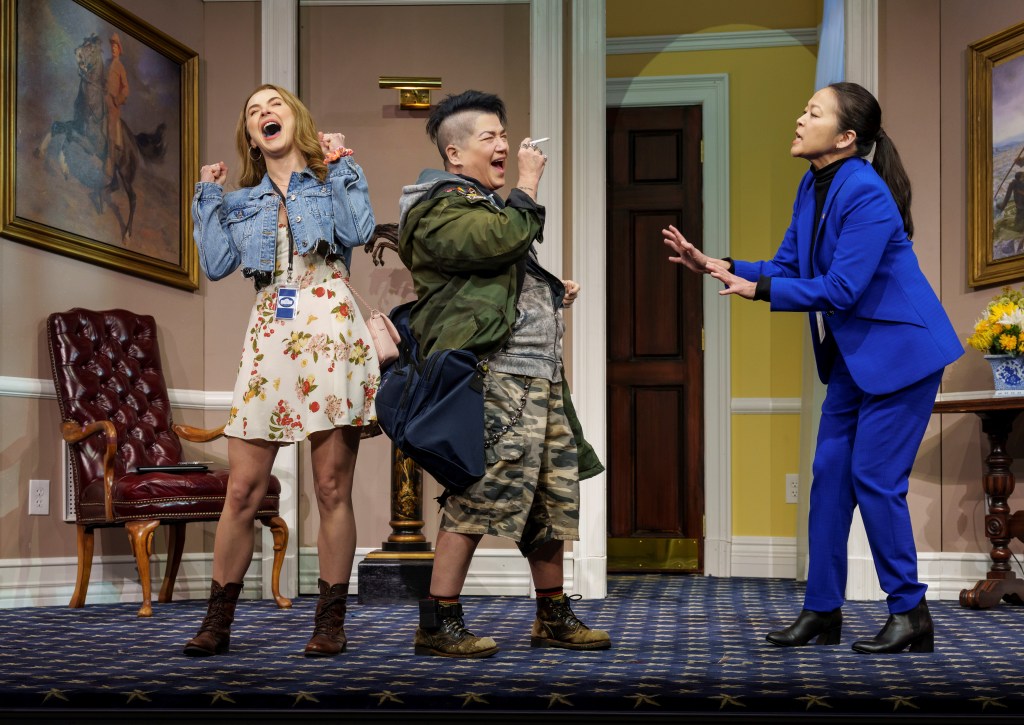
There is no spoiler alert. So much of the wonder of Stroman, the fabulous comedians, the salient crackling script is in each “scene” which must be seen and not read about here. I can’t recommend POTUS enough. This is especially so if you need to laugh feverishly, hysterically, manically, in the face of the ongoing viral plague, freak weather events, Trump Capitol insurrection permissiveness by a Republican (?) DOJ, 2 trillion in Republican tax breaks for billionaires and Putin’s war genociding women and children in Ukraine which Republican apologists like Rand Paul appear to support (???).

Humor and laughter in the midst of darkness helps us get to the next day. The heroic President of Ukraine Volodomyr Zelenskyy reminds the “free world” what courage it takes to be independent of one-man rulers like despot/genocidist Putin who channels Stalin’s extermination of Ukrainians in the Holodomor of 1932-33. That Zelenskyy is a brilliant artist, comedian, producer (Studio Kvartal-95), who rose to become a figurative and literal “Servant of the People,” reveals the importance of laughter and comedy as a foundation to confront trauma and tragedy.
Thus, for non-billionaires and the little people with little, Stroman, these wonderful actors and genius writing by Fillinger are worth their weight in gold. Final kudos go to Sonoyo Nishikawa (lighting design), Jessica Paz (sound design), Linda Cho (costume design), all of which help to make this wondrously absurdist delight the still point in time that you must see, especially if you are a straight white guy who is “macho” enough to handle it. All others in the family of human beings will appreciate it.
POTUS is the “MAX,” especially now in this political season where everything is at the hazard. For tickets and times go to their website: https://potusbway.com/
‘Intimate Apparel’ a New Opera, a Must-See at Lincoln Center Theater

Lynn Nottage’s superb play Intimate Apparel won an Outer Critic’s Circle Award and New York Drama Critic’s Circle Award. It is a play about women circa the turn of the century, the parallels and disparities between race and class, black and white, wealthy and struggling. For the women, gender is the equalizer. This is especially so in Intimate Apparel the opera presented at Lincoln Center’s Mitzi E. Newhouse until the 6th of March. As such this new work is dramatic, taut with undercurrents and themes propelled by Ricky Ian Gordon’s thrilling music and Nottage’s memorable libretto.
Nottage has streamlined her poetic work for Gordon whose music is stylized and hybrid, born out of Nottage’s characterizations to elucidate profound themes that resonate with the audience. Gordon and Nottage are a pairing made in heaven. The production, well thought out by director Bartlett Sher, is all that one might want in raw emotional grace, generated by Gordon’s luscious notes, conveyed by the beautiful, heartfelt voices of the leads and their chorus counterparts.
Sher’s staging features stylized economy and nuance, unencumbered by the extraneous to allow the themes and characterizations to strike with impact. The action takes place on Michael Yeargan’s revolving turntable stage as the world of these characters is circular. The props are efficiently rolled out. Highly specific to the story, they are inconsequential once their purpose has been fulfilled and they dissipate into memory, supplanted by another scene and other props. All reflects an impermanence and hint of symbolic meaning, the tip of the iceberg, like the photographs that appear at the end of each act that Nottage has moved from play to libretto. It is a smashing touch that adheres thematically when we see the floor to ceiling size pictures of the characters “unidentified,” though we have been privileged to have their lives unfold during the opera.
The characters, like us, are subject to their time and place and though they appear to move forward, they remain static, even going backward psychically (George Armstrong, Mayme, Mrs. Van Buran). Forward movement and progress is an illusion, especially for unmarried Negro seamstress, Esther (Kearstin Piper Brown). Nottage effectively draws her arc of development so that Esther is fated to return back to the same setting by the opera’s conclusion. It is in the boarding house of Mrs. Dickson (the superb Adrienne Danrich), when we first meet Brown’s unhappy Esther.
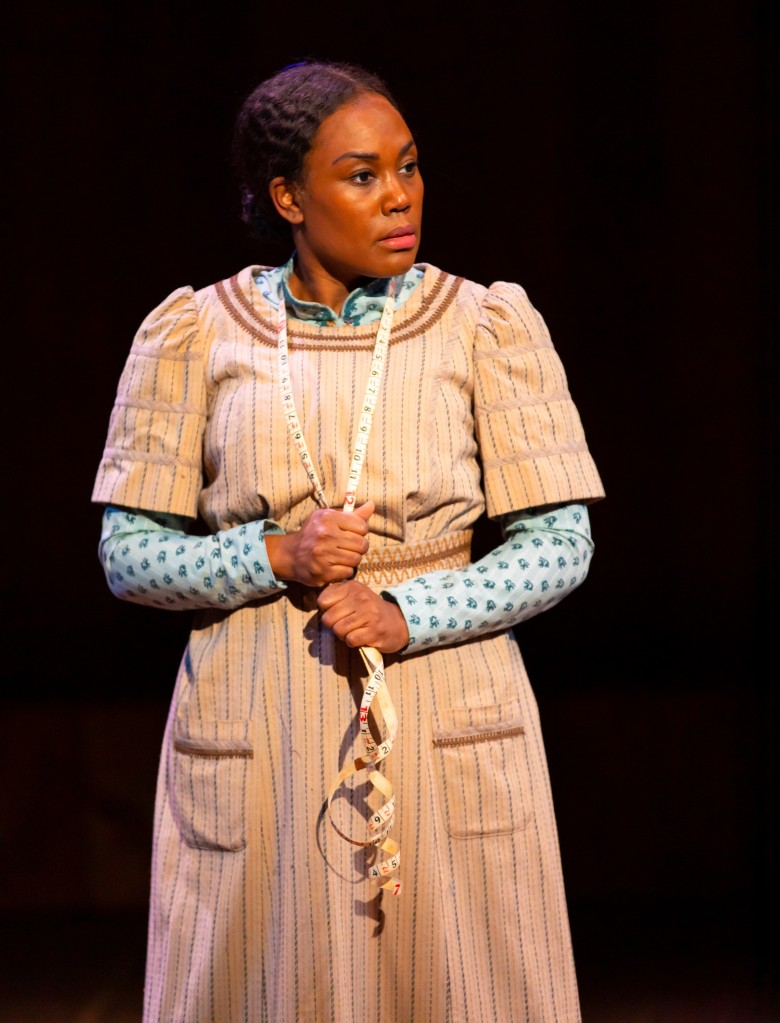
Nottage’s message is clear. Throughout Esther has been through an emotional cataclysm as many black women experienced at the time, marching without notice through history, bearing up against what the society dealt out. Yet, Esther comes through it. And though she ends up in the same place, she is strengthened, stoic, heroic, independent and dignified. Indeed, Esther lands on her feet, perhaps wearily, but she will continue. And it is this delineation of character that Nottage, Sher and Gordon understand in their bones, so that they translate her characterization magnificently into this heartfelt operatic presentation.
From the outset we recognize that Esther is unlike the other women in the boarding house where Corinna Mae’s wedding ceremony is being held. Esther supports herself and is alone, working continually to make her way, not distracted by friends or entertainments which she cannot afford. Thus, she isn’t tempted by the ragtime music that we hear “downstairs.” Throughout, she avoids Mrs. Dickson’s encouragement to meet with one man or another to settle down. Ironically, when she should take Mrs. Dickson’s advice, she doesn’t and pays the price for it.
As the opera opens Esther, annoyed and jealous at Corinna Mae’s marriage, admits to Mrs. Dickson she doesn’t feel she will be loved. Nottage’s libretto melds with Gordon’s party ragtime, as it flows into refrains, “I hate her laughter,” “I hate her happiness.” The libretto throughout is lyrical and grounded in emotional realism as Gordon’s recitative rises to meet the character’s desires and feelings. In this case, Esther yearns to be loved, but feels it is hopeless. But by the end of the scene, she receives a letter given to her from Mrs. Dickson. Perhaps, it will satisfy her longings. Brown’s voice and acting targets our emotions and draws us in to her hopes and concerns. She is wonderful.
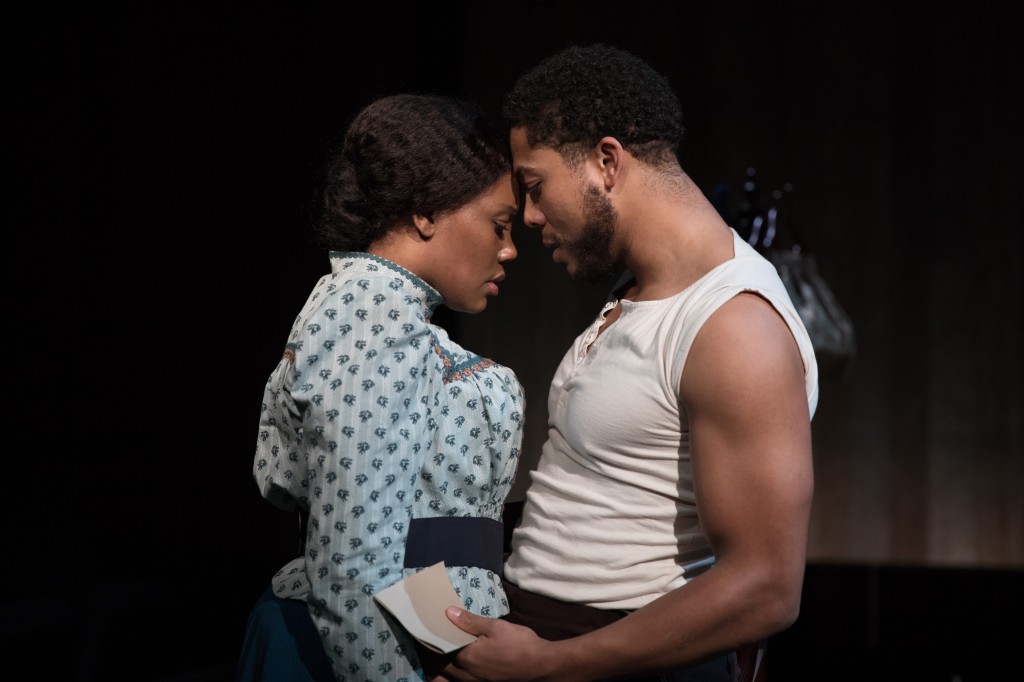
The letter is from laborer George Armstrong (Jorell Williams on Sunday matinee when I saw it). From Barbados, working on the Panama Canal, George Armstrong is an acquaintance friend of someone she knows in her church. The letter becomes the driving force of the action in the opera as it is in Nottage’s titular play. Esther, who can’t read or write, solicits help from two of her clients who are literate. Both women, opposite sides of the same coin, make their living from men, unlike Esther. One is the white elite society woman, the wealthy Mrs. Van Buren (the fine Naomi Louisa O’Connell), whose husband supports her in style but who is disassociated from his life emotionally, psychically and physically. The other is Mayme (Tesia Kwarteng on Sunday matinee when I saw it), who sells her sexual favors and takes beatings from the men who pay her for her services, one of which is to abuse her. She, too, is removed from the men to whom she plies her trade in an incredible irony of intimacy.
As Esther sews the same beautifully made “intimate apparel” (calling forth what true intimacy might mean), so they can attract the males in their lives, both help her write the letters to George. Mrs. Van Buren supplies the technical expertise and Mayme supplies the romantic allurements and sugar. During the process Esther becomes their confidante and she becomes theirs. The relationships are enlightening and Nottage reveals the parallels among the women, who the men dominate and abuse emotionally, psychically and physically. Thus, there is no difference between Mrs. Van Buren or Mayme; though the disparities in economic and financial well-being and respect based on race and class are galaxies apart. The women’s scenes with Brown’s Esther and her clients portrayed by O’Connell and Kwarteng are well drawn and ironic, as they move the action forward.
Both “kept women” ply their sexual trade, and though there is the appearance of a vast difference, certainly prompted by women elitists, the women, who are representative of their classes are oppressed. Esther is less so because of her independence and dominant attitude not to embrace the values that keep women enslaved to men. However, Esther, too falls from that grace, and the opera is an affirmation that she must learn that what she has achieved is indomitable and superior to the other women at this time and place.
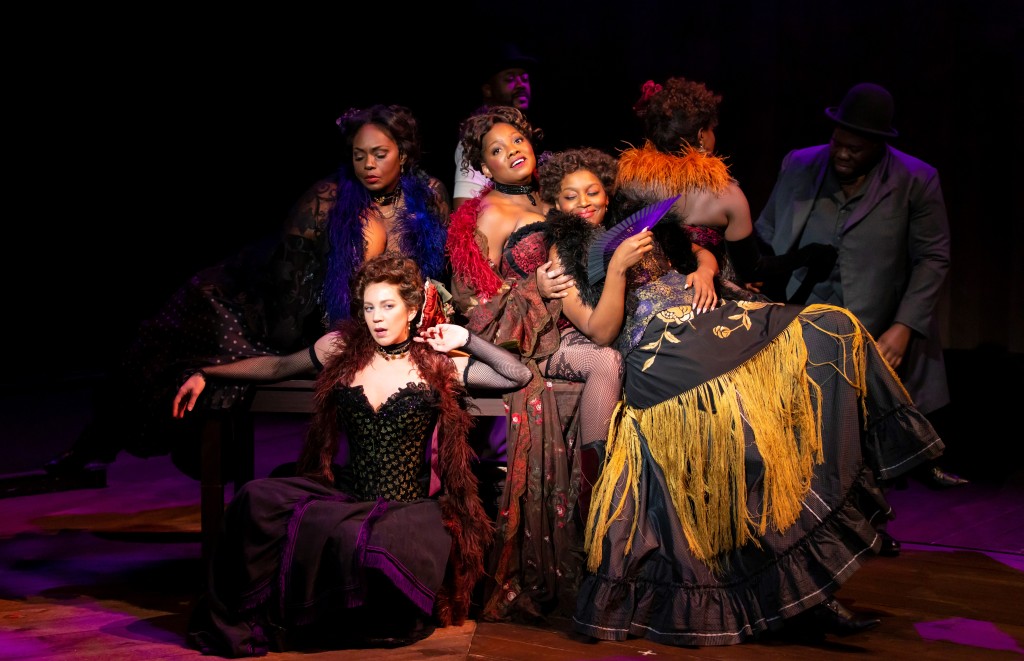
Ironically, Mrs. Van Buren asks Esther if she is a suffragette when she makes a remark that sounds like women’s empowerment. Esther, in spite of herself, encourages Mrs. Van Buren not to “let him do you that way.” For her part Mrs. Van Buren is stuck in the psyche of her “feminine” class stature. She must fit into the stereotypical cut-outs of elite women. She will be the last to realize the vitality of empowering gender identity and women’s rights. She is her husband’s chattel, dependent on him for support, choosing not to work or seek out a skill which is beneath her. Mayme, like Mrs. Van Buren, is oppressed by the men who pay her. Without a skill to support themselves, Mayme and Mrs. Van Buren are sisters born of the same mother of servitude, soul demeaned without independence.
Esther’s scenes with O’Connell’s Mrs. Van Buren and Kwarteng’s Mayme resonate powerfully. During these scenes especially we understand how the women lure Brown’s Esther (though she has asked for it). Stirred by Mrs. Dickson’s values of a woman’s world defined by a man who keeps her, she and Mayme encourage Esther to “fall in love” with George who is a figment of all their imaginations. This is rendered beautifully in the aria when Mayme and Esther sing about the discovered George who has been with both women. It is then Esther tells Mayme not to let him in the door (symbolizing the door of her heart). “Let him go. He’s an unanswered letter, a feather on the wind, you’ll be chasing him forever.” Brown’s emotional highs and lows tear at our hearts; Nottage’s libretto is poetically striking.
To Mrs. Van Buren Esther represents a freedom and openness she craves in her life. However, the three women sing “I fear I love someone,” a melodic song signifying the love is a symbolic, forbidden creation of their hears and minds. For Esther her forbidden love is Mr. Marks (the wonderfully authentic Arnold Livingston Geis). Marks is the orthodox fabric seller on Orchard Street with whom Brown’s Esther forms a spiritual attachment. For Mrs. Van Buren it is the allure of the forbidden (spoiler alert), Esther who makes her feel accepted and loved for herself. For Mayme it is George’s razzle dazzle manly male, who flashes his money (actually Esther’s money), so they can enjoy themselves. His manipulations have convinced Mayme that he is her “Songbird,” though he is married to Esther.
The love Esther, Mrs. Van Buren and Mayme sing of cannot be purchased; it remains outside of their reach. They are confined by folkways and unable to cross those lines in 1905. Love remains that which is a financial and business arrangement pragmatically as Mrs. Dickson suggests happened in her life. Or it is a fantasy that little girls are taught to dream of to anticipate marriage, which in reality is a bondage, they cannot easily escape after marriage.
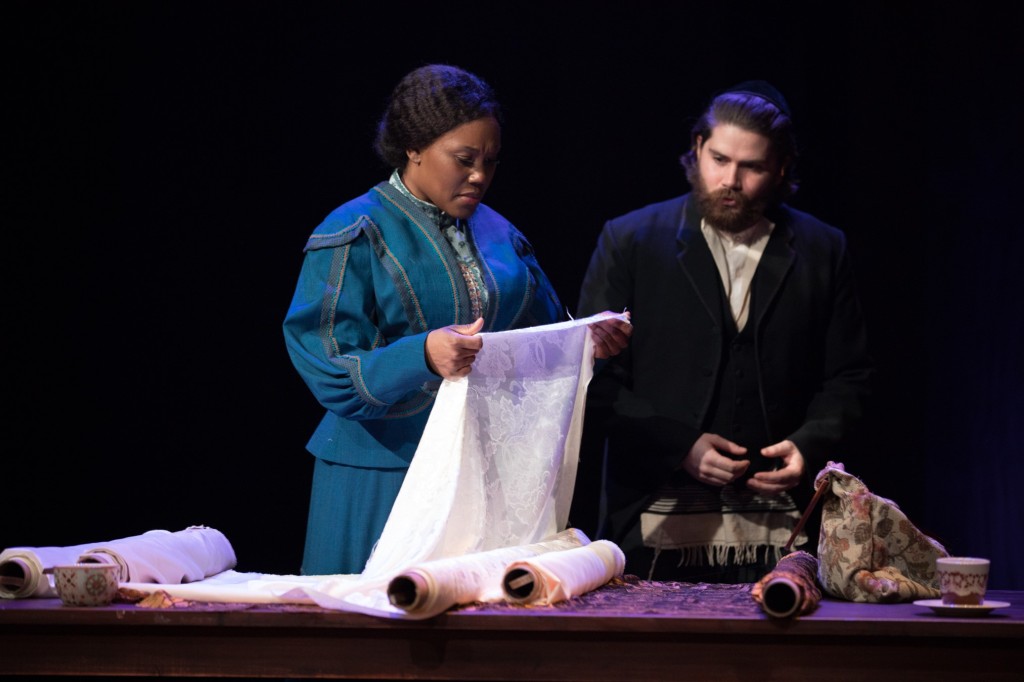
Esther’s relationship with Mr. Marks is vibrantly drawn by Nottage’s libretto and sonorously, poignantly brought to life by Brown and Geis. Sensitively, the actors delineate their mystical union, which is limited by folkways. The fabrics Mr. Marks saves for her carry great meaning and sensuality. Their closeness is beyond professional as their glances and smiles reveal they yearn for each other. Just a casual touch is significant. After Esther is married she tells Mr. Marks she can’t see him anymore and her answer when he asks, “Why not?” carries the weight of the world, “I think you know why.”
However, their last meeting occurs when Brown’s Esther gives Geis’ Mr. Marks the smoking jacket that she gave to George, that George gave to Mayme and that Esther took back from Mayme. It is then that we know the value of “intimate apparel,” and how the symbol has final closure. Intimacy isn’t necessarily in a physical acquaintance, it is soulful and spiritual. Esther, who made the jacket on his recommendation tells him, “It was made for you.” His wearing it will have symbolic meaning for him and for her of a love that was never consummated, but a transcendent love that prospers, regardless of nullifying strictures, prejudices and folkways. What a poignant, memorable satisfying moment, superlatively performed by Brown and Geis. Just smashing!
The finely wrought and beautifully designed costumes by Catherine Zuber are characters unto themselves, measuring out the symbolism, conflicts and themes of class, gender and relationships. From lighting (Jennifer Tipton), to sound (Marc Salzberg), to projections (59 Productions), the technical effects are right on, enhancing this exceptional production. Placing the pianos on platforms above the playing area is enlightened, as the music and musicians are integral to the action, driving it, supporting it. Their visibility is dynamic. Kudos to Steven Osgood’s music direction and Dianne McIntyre’s choreography.
Intimate Apparel closes on March 6th unless it is extended which it should be. Though the audience was packed, more individuals need to see this production which hits it out of the ballpark. For tickets and times go to their website https://www.lct.org/shows/intimate-apparel/
Phylicia Rashad, Brandon J. Dirden in ‘Skeleton Crew,’ Workers vs. Corporates, a Worthy Fight at Manhattan Theatre Club
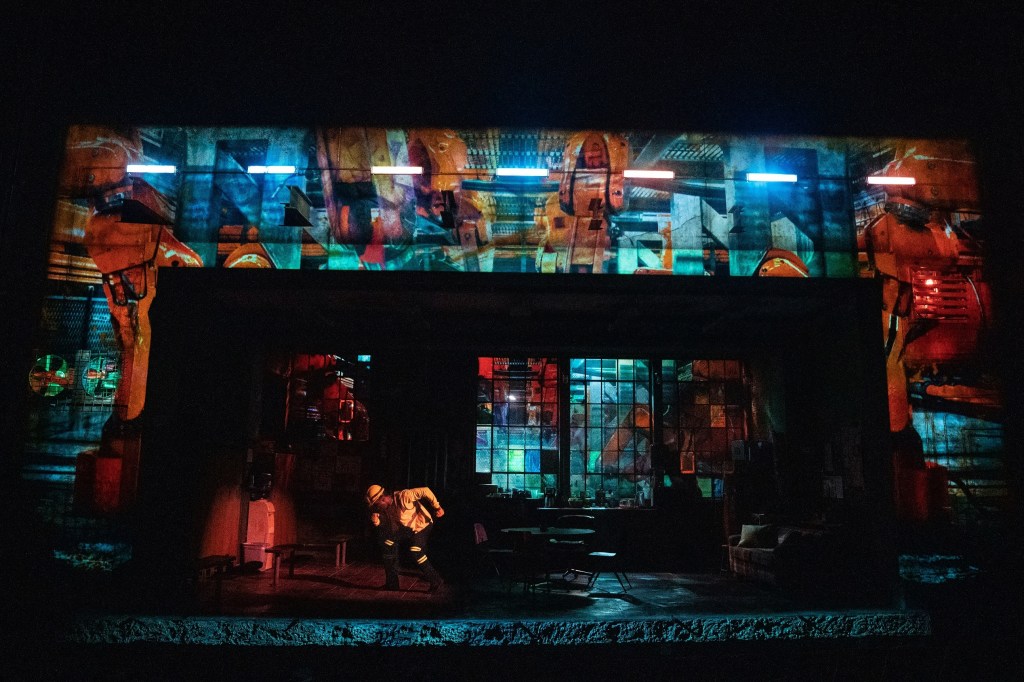
From the symbolic and representative opening salvos of gyrating piston Adesola Osakalumi, whose break dancing suggests the automation which is rendering the human scaling at the auto-stamping factory obsolete, to the well-hewn set by Michael Carnahan (the dusty, run-down, cold, shabby staff room where employees enjoy down-time) we understand that the four person skeleton crew in the Detroit plant will be ghosted as soon as budgetary financial reckonings are made by upper management. This is 2008 Detroit, US during the economic mortgage mess when investment bank Bear Stearns collapses and is bought over by JPMorgan Chase and Lehman’s a 150-year old booming institution goes belly up. People are losing their homes and living in their cars and cheesy motels in Florida. And, it is worse in Detroit whose booming success of the 1960s is a bust by the 1990s and there’s one plant left that is barely churning out product.
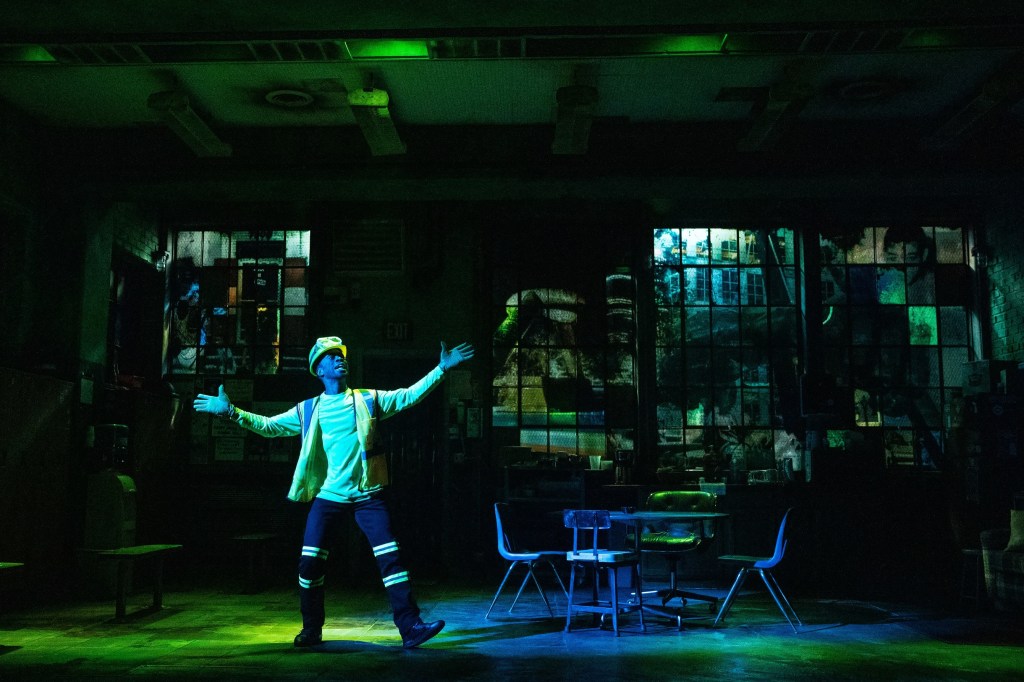
Skeleton Crew directed by the superb Tony Award® winner Ruben Santiago-Hudson, currently in revival at Manhattan Theatre Club after its intimate presentation Off Broadway at the Atlantic six years ago, hints at the tour de force Dominique Morisseau meant the last segment of her Detroit Project to be. The trilogy (The Detroit Project) is about Detroit’s life and times before and after the Reagan outsourcing debacle toppled the city from its glory as the country’s industrial fountain of youth. It includes Detroit-’67, Paradise Blue and Skeleton Crew.
The play has been given a glossy uplift using video projections of the robotic machinery of the assembly line etc. (excellent design by Nicholas Hussong). Coupled with the music (Rob Kaplowitz’s original music & sound design, and Jimmy Keys’ original music & lyrics) at the beginning and between salient scenes, we note the encroaching modernized doom that hammers the employee work force into unrecognizable bits, hyper-downsized from its greatness when Detroit was in its manufacturing heyday. The digital video projections supplant proscenium curtains which would normally frame the stage. As such, the plant’s relentless, driving automation is the outer frame of the stage and encapsulates the action and interactions in the staff room where workers take their breaks from the repetitive and monotonous production line.
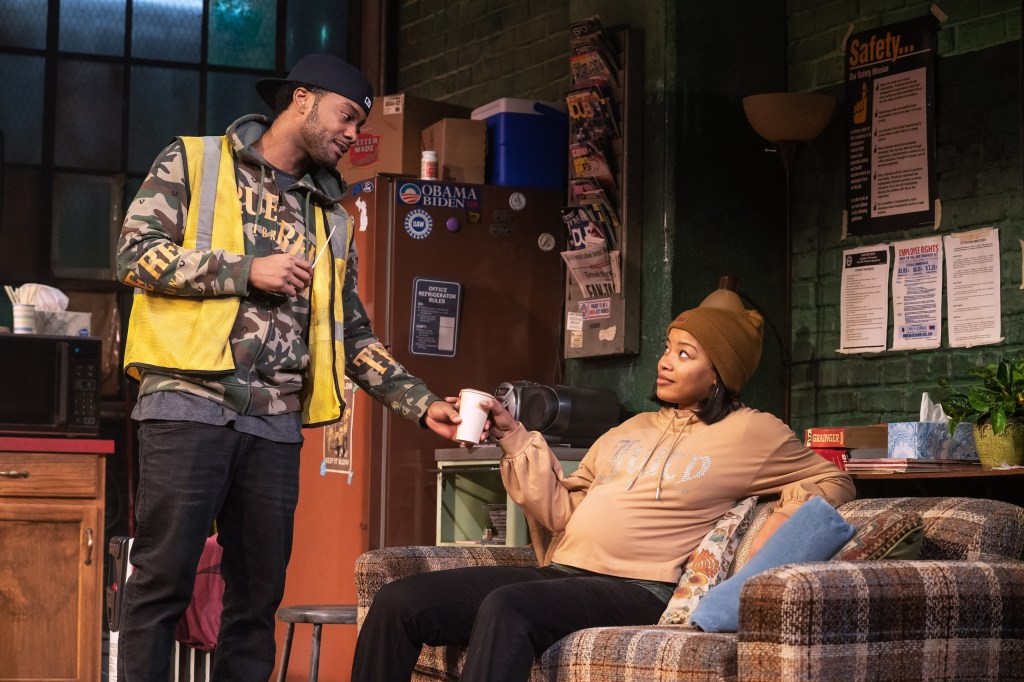
The contrast Morisseau’s dualism creates is trenchantly thematic. The defined “wasted, decrepit humans” are pitted against inevitable “progress” which especially grinds down the people whose loyalty and dedication to the industry have been turned against them. These management diminished unfortunates, like Faye (Tony Award® winner Phylicia Rashad) whose once magnificent efforts are discounted as “unprofitable,” didn’t see the “handwriting on the wall” to prepare for another career after working for the company 29 years in the hope of getting a “great” retirement package. Faye and others trusted the corporates to have their best interests and welfare at heart.
As Morisseau indicates in her characterization of Faye, stand-up employees projected their worthiness, values and integrity on their slimy directors and CEOs, mistakenly assuming they would be rewarded for hard work and effort. Ironically, it is the elite corporates who are the unworthy, lazy, greedy, un-Americans who made America “un-great” through Reagan’s tax laws that allowed them to outsource profits by closing plants and establishing factories anywhere but the United States.

In view of the current debacle with supply chain issues, inflation and absence or overpricing of medical product needed to fight the ongoing health disaster (COVID-2022) which incompetent, do-nothing Republicans have fueled as a political stratagem, Skeleton Crew‘s themes are profound and incredibly current. The problems fourteen years later from the setting (2008, Detroit) are even worse with expanding economic inequality, oppression of the workforce, whether white or blue-collar, by oligarchic elites herding the intellectually infirm white supremacists with misdirection against the democratic institutions that could save them. The seeds of the current destructive forces are evidenced in Morisseau’s setting with the ghosting of Detroit’s last automotive plant where supervisor Reggie (the wonderful Brandon J. Dirden) Union Representative Faye (Phylicia Rashad) the energetic Dez (Joshua Boone) and the pregnant Shanita (the excellent Chanté Adams) work and stress out with each other in unity.
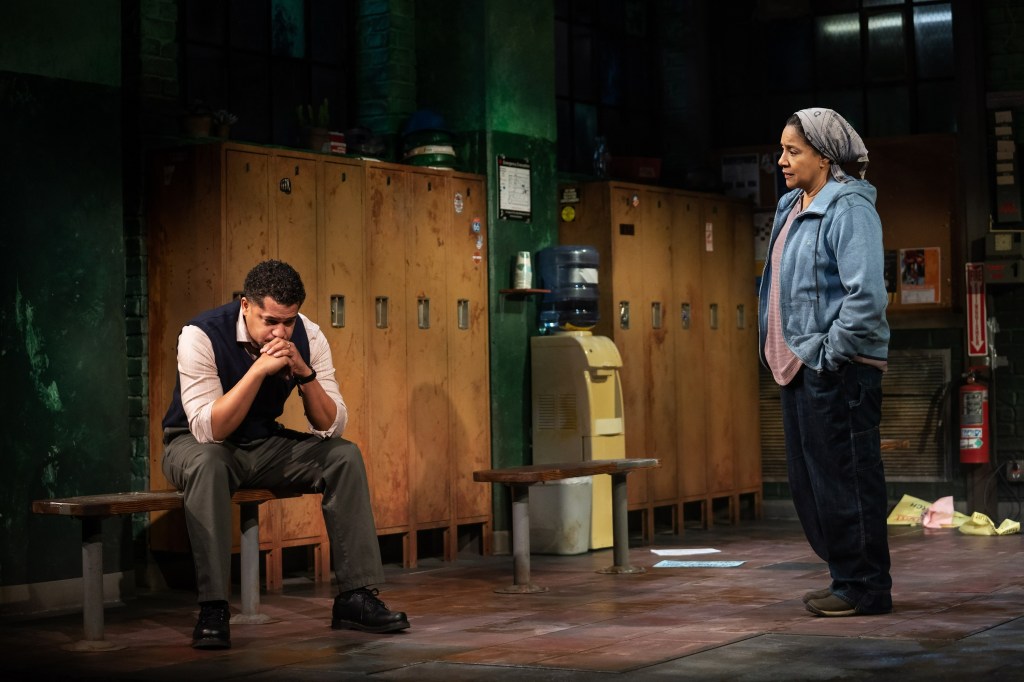
Within this framework we follow the devolution and evolution of these four who signify Morisseau’s special individuals who are the backbone of the nation. It is these who the elites would erase. Their ability to hope and thrive is sorely tested against the annihilating backdrop of demeaning corporate abuse which demands personal strength and communal support to over-leap it. With Morisseau it’s the people vs. “the corporate machine,” and as Morisseau spins the conflicts caused by the plant closure, personal self-destruction or revitalization are the direction for Faye, Dez, Shanita and Reggie, who prove to be likeable working class heroes with huge cracks and flaws that we recognize in ourselves.
Reggie who has been practically raised by Faye as family-she got him the position where he rose to management-is pressured and strained. He’s forced to walk a fine line, knowing what his bosses plan to do. Yet he must not tip their hand which would panic the workforce to strike or leave before the current contracted work is completed. Oppressed to enforce nit-picking rules, Reggie argues with Dez who may or may not be stealing and who sees him as a cold-hearted puppet of corporate.
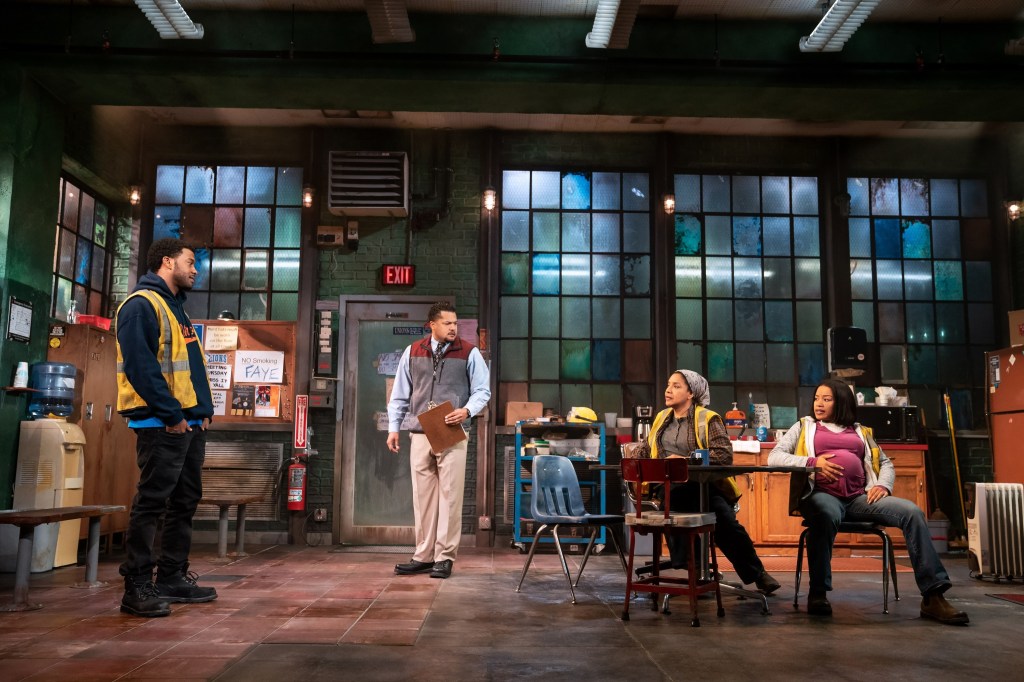
Likewise Reggie emotionally wrestles with Faye who must protect her union workers and herself deciding whether to retire early, which would mean an income loss after retirement. Shanita is pressured emotionally after she is dumped by her baby’s father. She faces being the sole support of her child. She enjoys working at the plant, though she’s a cog in the wheel, but she feels proud for her contribution to making product. Nevertheless, she is strained working and bearing up with her pregnancy, making doctor’s appointments and saving up money before and after she takes time off from the job she loves.
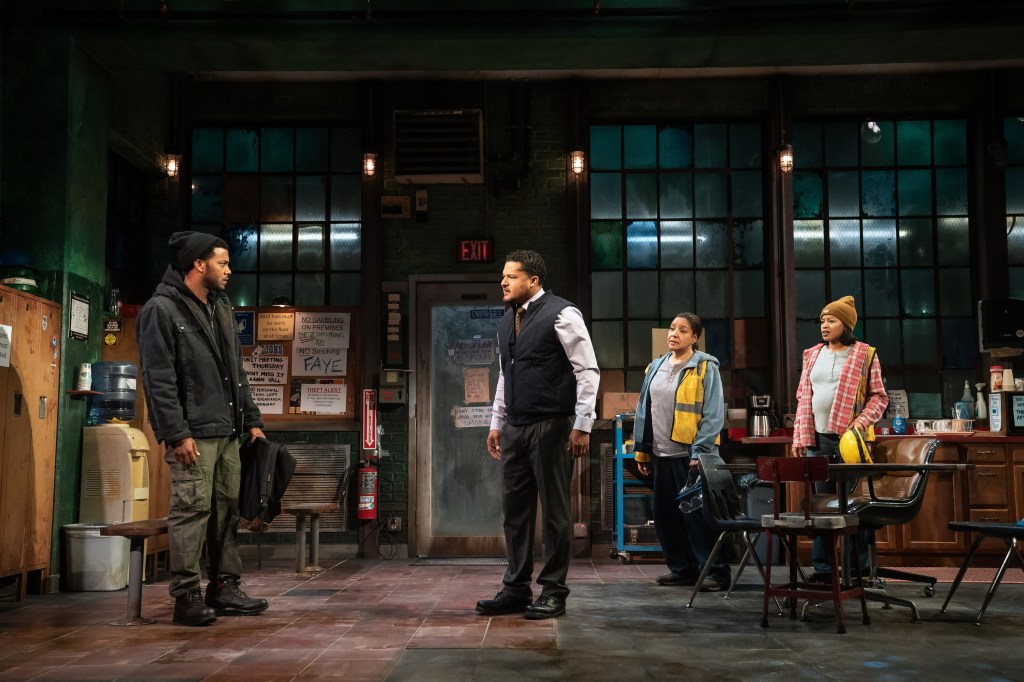
Morisseau excavates each of their struggles with authentic dialogue that is at times humorous, and powerful/poetic as the characters present their positions. Importantly, the playwright extends the reality of what it is to hold a decent job with benefits that is being pulled out from under the worker because the owners’ obscene profits aren’t big enough and government isn’t holding them to account. Thus, as the play progresses and we understand each of the characters’ dreams, we credit Dez for attempting to start his own business with friends, and we hope for Shanita’s child, in light of the nightmares she’s having over the uncertainty of her future. Additionally, we understand Reggie’s position though we expect him to stop his haranguing of the others and stand up to his bosses. We are thrilled when he finally does.

Interestingly, Faye, who appears to be the most solid and reliable is confronting her own devastation in addition to the cancer remission she is going through. Morisseau gradually unfolds each of the characters’ issues and at the end of Act I brings Dez and Reggie’s relationship to a turning point where Dez is about to be fired. When Faye steps in and counsels Reggie to stand up for Dez and the other workers, we question whether Reggie has the guts to or whether he will be a sell-out. The irony is Faye is great at negotiating and encouraging others, but she is lousy at taking care of herself. The revelation of this is poignant, and Morisseau opts to make every audience member put themselves in Faye’s shoes as she, too, “walks the line” between wanting to live or just throw in the towel and give up.

This is a strong ensemble piece and the acting is finely wrought. Unfortunately, some of the humor was lost on me because the actors weren’t always projecting in the cavernous space of the theater. Please actors, project and enunciate! Nevertheless, the passion and presence of Phylicia Rashad along with her counterpoint Brandon J. Dirden was heartfelt. The relationship they create reveals bonds that run deep into love and sacrifice. And the surprising relationship that blossoms between Boone’s Dez and Adams Shanita is beautifully effected by their graded, nuanced performances.
Ruben Santiago-Hudson understands Morisseau’s themes down to his soul’s bone marrow. The play’s visual elements represent the most vital of her themes and the characters are ourselves. We cannot help but be concerned for the conflicts the play presents which seem everpresent and unchanging. The current administration’s hope to “Build Back Better” during this time would appear to rectify the external circumstances of such characters who jump off the stage at us and populate our society. But the same corporate structure that Reggie fights is so entrenched, that soul progress is for the little people, these who are Morisseau’s besties. Perhaps that is the consolation. As for the corporate elites? As Reggie and Dez intimate, they are they’re own soul destruction. And that too is its own tragic consolation.
Kudos to the technical team mentioned above and Emilio Sosa’s costume design, Rui Rita’s lighting design, Adesola Osakalumi’s choreography and Cookie Jordan’s hair and wig design.
Morisseau’s play is dynamite in the hands of Hudson the artistic/technical team and these superb actors. This is a must-see. For tickets and times go to their website: https://www.manhattantheatreclub.com/shows/2021-22-season/skeleton-crew/
‘Meet Kae Fujisawa, Triple Threat: Director, Actor, Playwright’

It is not often that one meets an individual who is ambitious, talented and pursues the arts after mastering a Ph.D. in another language as Kae Fujisawa has done. Indeed, academia didn’t satisfy Kae. She went on to pursue a dramatic arts career in New York City, which many hesitate to do once they discover the difficulties. Kae Fujisawa, who was born in Hokkaido, Japan, is Japanese. She speaks English with an ever-so -slight charming accent which nearly has disappeared since I met her in 2017 at HB Studio. And I can say unequivocally that she is a “Triple Threat.”
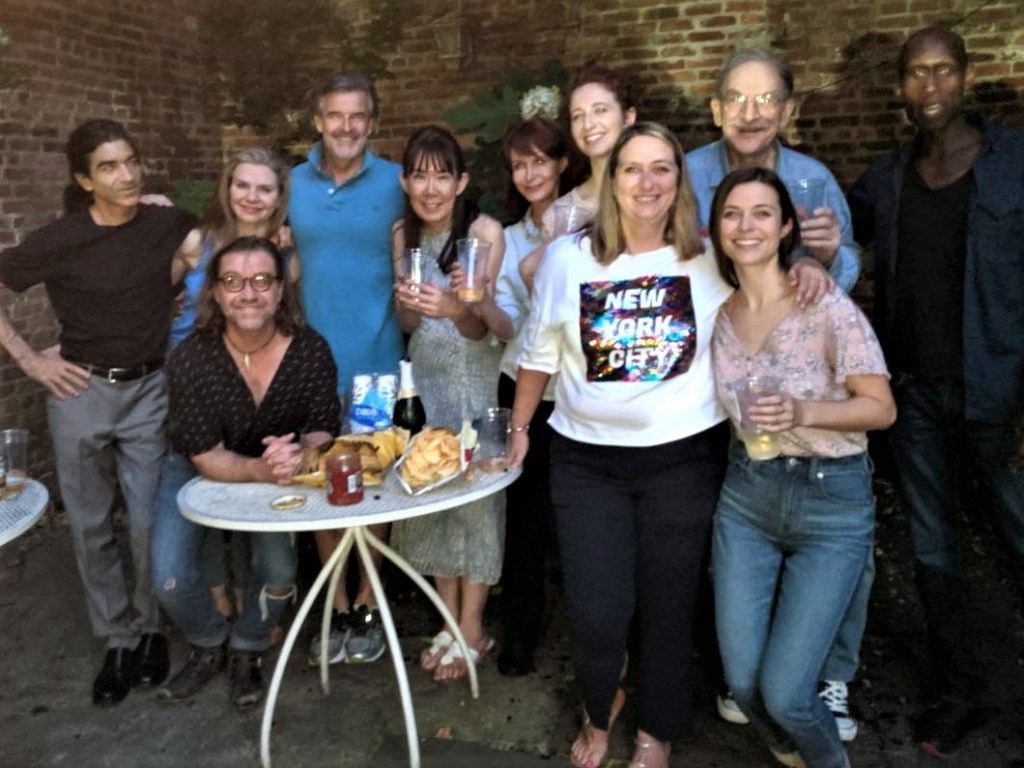
I have seen Kae’s excellent directing work at HB Studio in 2018 and 2019. At HB she took classes and workshops with some of the finest teachers in New York City. The first production I saw her direct was a scene from a full-length play The Rules of Unspoken Words. The scene was included in a collection of scenes from longer plays presented by the HB Studio Playwriting and Directing Division. At the HB Studio’s Playrights Theater, I enjoyed her excellent direction of the full-length comedy 7 Shitty Hombres by Ellen DeLisle. The humorous play, the actors and Kae’s direction received plaudits from the packed house as well as from her peers and teachers.

Kae’s talents directing live theater were made known to me with one of her earliest directing gambits she initiated, which she also produced via her unregistered company Theatre Borderless at the Jefferson Market Library Auditorium in 2018. The short one-act play by Anton Chekov, Swan Song, featured two actors who she shepherded so beautifully through the difficult piece, that I was impressed. I am a Drama Desk reviewer and have been an entertainment journalist for over a decade. Kae’s work struck me because Chekov can be difficult; the language is archaic. But this wasn’t a problem for her or for the actors. As a result of her direction, one of the actors gained the confidence to try out for more classical theater and after her guidance landed Shakespearean roles.

Other live theater she directed I was able to see before COVID-19 shut down New York City for almost two years. These included a Greenhouse Ensemble play that won its entry into the Greenhouse Play Festival. The playwright John Patrick Bray’s Fix was chosen for Kae to direct. With ingenuity, she was able to convey the snowy setting which amazed me. And the actors once again delivered fine performances because of her diligence and efforts.

Kae believes in doing a lot of rehearsals if the actors’ schedules permit this. Importantly, they always are willing to accommodate the rigorous rehearsal schedule because of her easy manner, subtle discipline and high standards. Though she works very hard, she has the personality to gently guide her actors toward excellent results with great good humor and grace. I have seen this with other live productions, Therapy by Susan Jane McDonald and Lullaby by Nicole Gut. Both plays were presented at the New Short Play Festival in the John Cullum Theater. In a span of over one year Kae accomplished a tremendous amount of work and then the pandemic hit.


That did not stop Kae. She has been even more industrious in creating opportunities for herself streaming live films and performing and directing Zoom Theatre and film. I saw her virtual streaming live productions of Falling Awake by Matthew Davis which she self-produced, Prime Real Estate by Joseph Cox for Greenhouse Ensemble and Sketches of Happiness which she wrote, cast, directed and presented for Crossways Theatre. Each of these productions revealed the same level of diligence and perceptive teasing out of the skills of the actors with delightful and profound results.
Because she had directed Lullaby the film, based on the play version, she easily negotiated presenting other productions on Zoom which is a smaller screen, but a screen nevertheless.
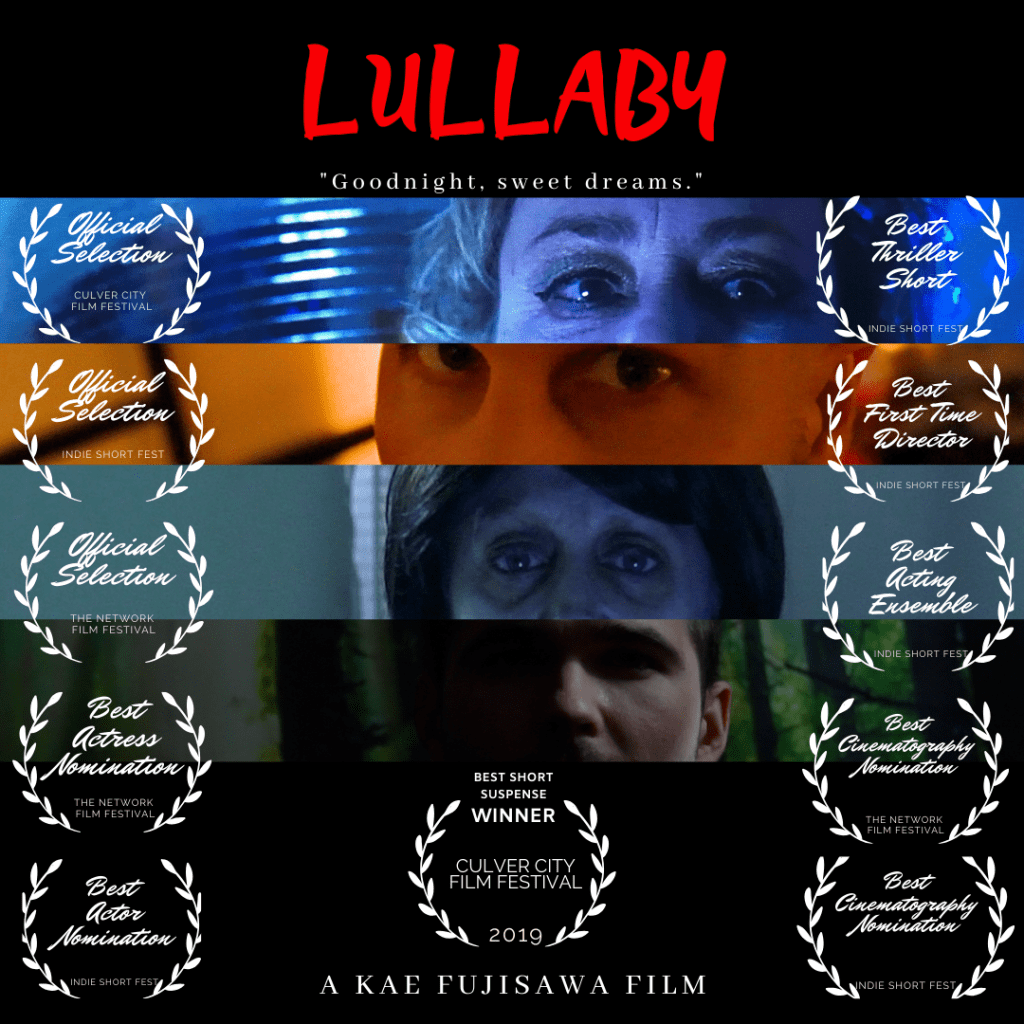
Oftentimes, it is more difficult, because you are not always assured that the actors in their own residences have the same WiFi receptivity. So when there is live streaming, one must give attention to additional technical aspects like sound and connectivity, as well as editing, and shot composition.
Kae’s enthusiasm to work in any medium allowed her to get into directing film. In film she brought the same diligence and prodigious effort that she brings to whatever artistic endeavor she accomplishes. I have never seen her efforts not pay off. The film Lullaby was nominated for a number of awards and won an award for Best Short Suspense Film at Culver City Film Festival. She also won a Best Director award for her Zoom film production of Manifesto for Manhattan Rep’s Short Film Festival.
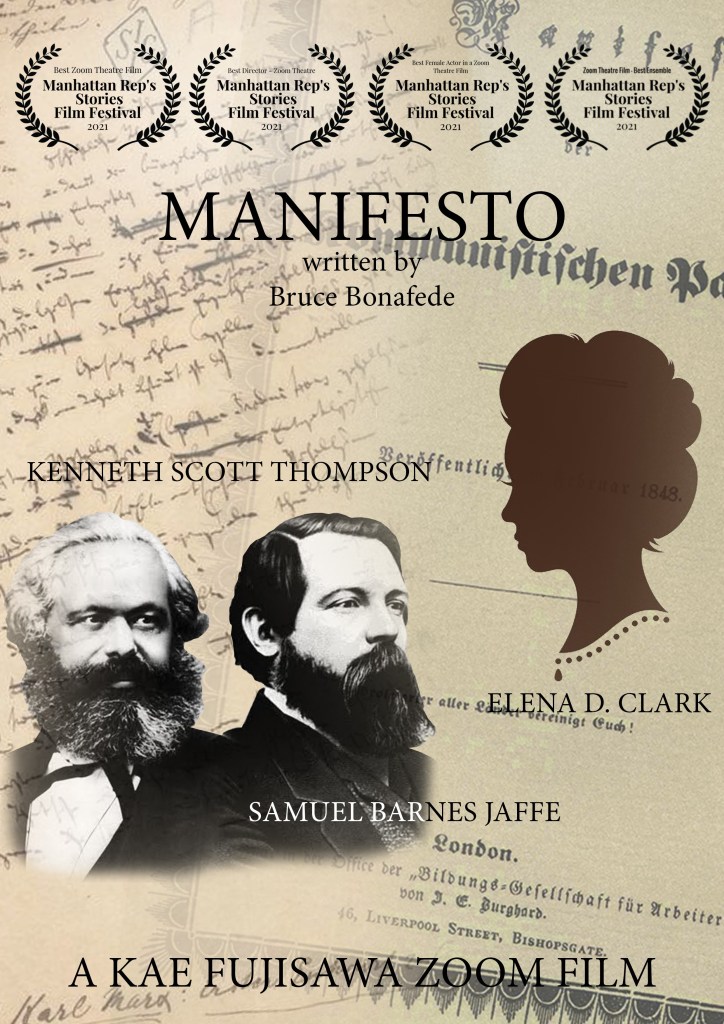
In fact the production won Best Zoom Theatre Film, Best Actress, and Best Ensemble Awards in addition to the Best Director Award. Kae also edited the film, doing a yeoman’s job.

When Kae is not busy directing or writing, she is acting. Most recently she appeared in The Program (Falconworks Theatre), a play, and the movie Mid Autumn (director Rraine Hanson, post production). I have not been able to see her performances except for Sketches of Happiness which she wrote and directed. She was wonderful. Her performance showed nuance, sensitivity and balance.

What continually amazes me about Kae is her energy and her love of all things performance, theater, music, opera, film. The only time she was not herself occurred after she took her Moderna vaccine. In fact it was her acute description of how she felt after the vaccines that largely directed me to take the Pfizer shots for COVID. Otherwise, that is the only time I have seen Kae redirected away from her ebullience and love of the dramatic arts and film.
Currently, Kae is working on a few projects. One of them is to direct scenes from The Berglarian, a full length comedic play which I have written inspired by true events. If things eventually settle down with the pandemic, Kae, I and the exceptional actors will continue to workshop it, do readings and perhaps pitch it to producers.
I am expecting great things from Kae Fujisawa during COVID and after. She is continually originating work and creating opportunities with others in the entertainment arts. A tremendous asset to the theater arts and film community in New York City and beyond, she will continue to be a “triple threat!”
 CAROLE DI TOSTI