‘Manahatta,’ Another View of The Lenape at the Public

In Manahatta, written by Mary Kathryn Nagle and directed by Laurie Woolery, the myth of how Manhattan was purchased from the Lenape, and how the exploitation of Indigenous Peoples continues today, conjoins in a powerful message. Nagle’s play, currently at the Public, is more symbolically realized than factual. The playwright admits that the work, though based on true events, is a work of fiction. Nagle researched and conducted interviews with the Lenape and those of the Delaware Nation. What resulted, after workshopping, and full presentations at Oregon Shakespeare Festival and Yale Rep, is an enlightened work whose themes weave from past to present, reflecting issues of our time.
The play opens with Jane (Elizabeth Frances), being interviewed by Joe (Joe Tapper), who would be her boss at an investment bank in the heart of Wall Street. The investment bank is less than a mile from Pearl Street, named for the huge mound of shells the Lenape left after they had been forcefully expelled from their Northeastern homelands to eventually end up in Oklahoma. Jane, a Lenape, who excelled in financial math and was number one in her class at MIT and Stanford, is hired after she reveals to her boss that interviewing for the job was more important than staying with her family, while her dad received open heart surgery.

Jane tells Joe that she didn’t go to Stanford because her parents, who never graduated from high school told her to, like the other privileged, bored, uninterested students she competed against. She went there because she “knocked down every obstacle they placed in my way.”
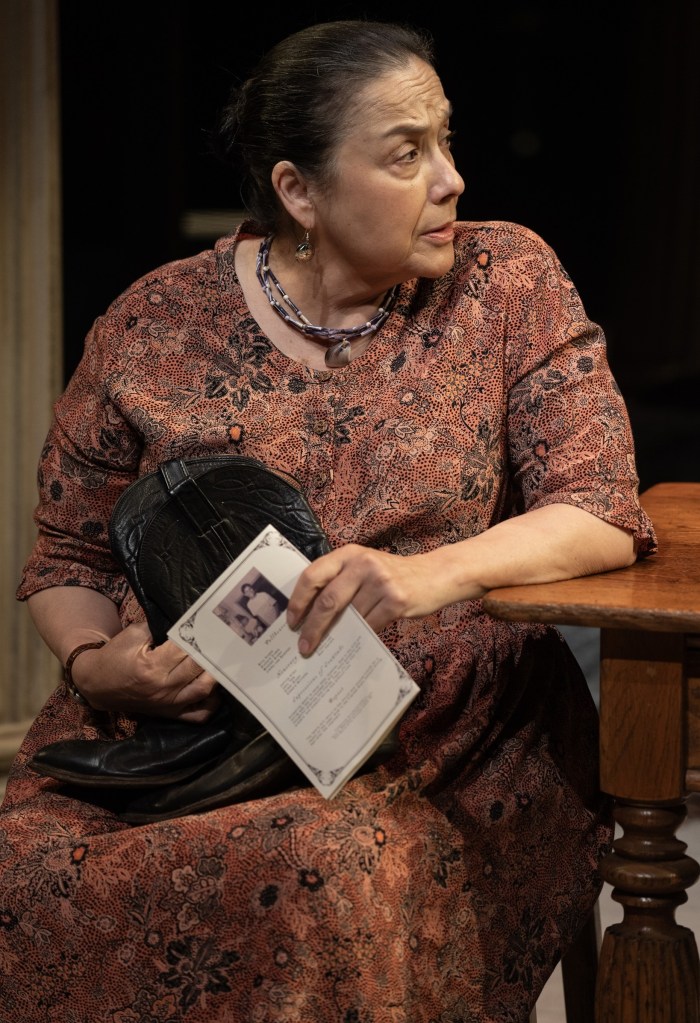
Clearly, Jane is determined, intelligent and the first Indigenous Person hired on Wall Street to return to a place of great symbolism, the home from which her tribe originated. When she returns to Oklahoma, she returns to her father’s funeral, and her sister Debra’s (Rainbow Dickerson) recriminations that she left her family and her tribe for a life in the concrete jungle, “without trees or a sky.” Her mother, Bobbie (Sheila Tousey is terrific as the stoic, ironic matriarch), asks her to find the wampum necklace she will wear at the funeral, a Lenape ritual, which Debra eventually finds because Jane is clueless, not having lived with Bobbie for years.
Significantly, the wampum has been carried down from generations of ancestors and is the most valuable treasure Bobbie owns. Nagle uses the wampum as a symbol of the strength, perseverance and inner fortitude of the Lenape, that abides throughout time, disasters and oppressions by others.
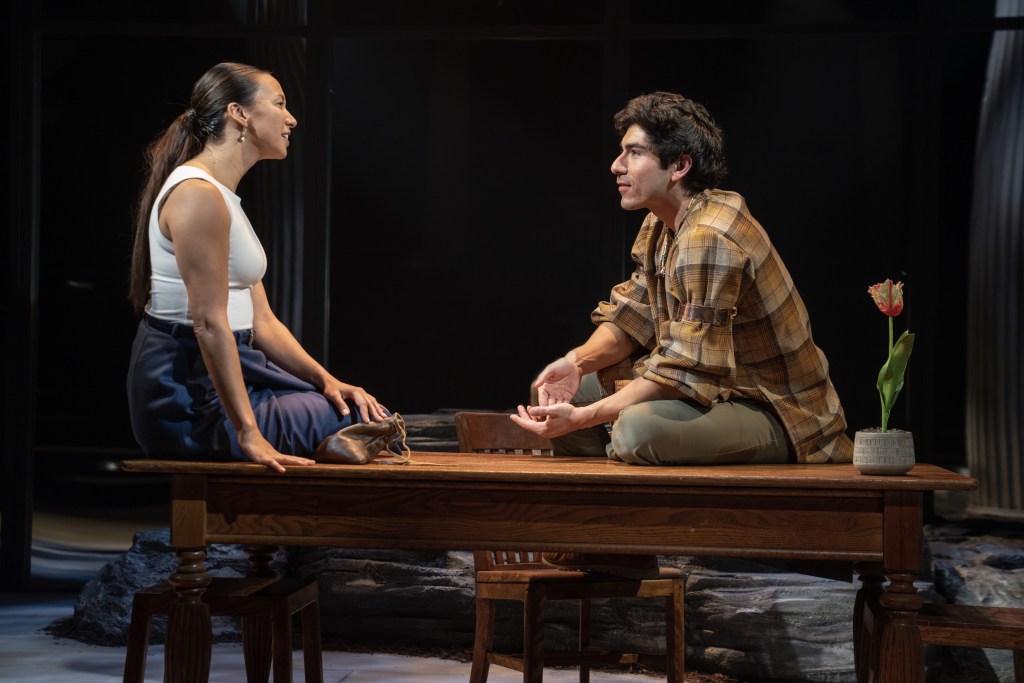
After the funeral, Bobbie engages in a conversation with Michael (Rex Young the evening I saw it), the pastor of the church where Bobbie’s husband sang in the choir. During her conversation with Michael, Bobbie discusses that the Indian Health Service, a government agency responsible for providing health services to Native peoples, refused to pay for the open heart surgery. Bobbie elicits Michael’s help as a loan officer to take out a mortgage on her house to pay for the hospital bills. Not wanting to tell her daughters, she works with Michael and his son Luke (Enrico Nassi), who understands the problem and eventually Michael provides the loan at a high interest rate so she can pay off the hospital bills.
Using seven actors to double on their counterpart roles, Nagle creates a parallel plot point. The setting reverts to 17th-century Manahatta. Se-ket-tu-may-qua (Enrico Nassi), and a Lenape woman, Le-le-wa’-you (Elizabeth Frances), prepare beaver pelts for the Dutch West India Company traders with whom they make trades for wampum. Se-ket-tu-may-qua warns Le-le-wa’-you that she shouldn’t go to the market, even though she wishes to learn the language the Dutch speak. He tells her that he has seen cruel behaviors the men do to Lenape women and suggests they are dangerous. When Peter Minuit (Jeffrey King), realizes the value of the beaver pelts to Amsterdam, he greedily makes deals with Se-ket-tu-may-qua and Le-le-wa’-you for more and more pelts.

Jane’s story unfolds on Wall Street as she begins to realize the mortgage backed securities her team is selling aren’t worth the paper they’re printed on. Though she questions their value, company CEO Dick (Jeffrey King), validates their ratings and justifies the company’s rising stock prices. He also suggests that unless she becomes a real team player, closing many more deals, he will fire her. Jane pulls out a coup, though she must lie to do it. She saves her job, even getting a promotion. Parallel to this action, Bobbie is not making the payments on her mortgage, which ironically is like one of the bad mortgages bundled up into credit default swaps that are worthless, yet are being sold by the Jane’s company and Jane’s team as a great investment.
In the parallel with the past where the notion of money and commercialism was planted like diseased corn in the fields of the Indigenous Peoples to infect their good crops, Peter Minuit (over an alcoholic beverage he shares), strikes a deal with the Lenape and Mother (Sheila Tousey), for the land of Manahatta. Mother, not understanding the concept of ownership of land “in perpetuity,” ends up “selling” Manahatta to Minuit for wampum. This is interpreted as being a gift, making Minuit a part of their family and vice versa. That they are now family members is an incredible irony, for the Dutch with bad will interpret it to mean they have the license to destroy “their Native kin” through assimilation and/or murder if they resist.

With this purchase, Nagle presents the unfortunate fact that the Dutch have insinuated their corrupt and rapacious values into the Lenape culture, eventually overcoming it. Meanwhile, Lenape culture doesn’t have in it such a conceptualization of possession of land, animals, etc. but instead has a view of balance and propriety. Such corrupt transactions symbolically are at the heart of the abuse and recklessness that colonial empires have wielded on Native peoples and the flora and fauna of their lands that they eventually steal outright. The disdainful theft of lands in empire building is a destructive, wicked force that has led to erecting questionable societies that are life defying and earth destroying. Sometimes, little thought is given to the consequences of such tearing down and building.
It is no small irony that the derelict disregard and wastefulness that rapacious possession has perpetrated has as its end game climate change, pollution, and destruction of the very environment possessors and oppressors would call “home.”

After the sale, the Dutch take greater and greater control over the identities and self-determination of the Lenape. They attempt to spread Christianity, demand the Lenape pay a tax to sell the beaver pelts on “Dutch land,” and only pay guilders for the pelts. In this, the playwright foreshadows the downward spiral toward full on oppression and death, as the colonials attempt to wipe out their “sin” by eradicating the cultures of the Native peoples in an explosion of barbarism, greed, corruption and genocide. As Nagle moves the action from Bobbie to the Dutch to Jane we note how the present is mirrored in the past.
In the remaining parallel segments, we see the ill effects of the mortgage debacle visited on Bobbie and others like her, who can’t keep up with the mortgage payments and must default. When Jane offers to pay off her mother’s mortgage, Bobbie refuses the money, standing on her pride and her ancestry. In a heartfelt, beautifully delivered speech Tousey’s Bobbie affirms to her two daughters that material things are worthless, and that she relies on the resilience and strength of her ancestors to withstand any hardships put before them. In keeping the ancestral wampum, she has been sustained and grounded in the true value of life and the sanctity of her culture.

Ironically, this spiritual grounding is something the Dutch and all empire builders do not have and will never understand, appreciate, nor pursue. Ultimately, this blindness works like karma and turns empire builders against themselves so that they ultimately destroy their own empires.
Nagle reflects this truism in the circumstances with Jane. Ironically, Jane who has earned a bonus of $1 million dollars for making an incredible sale, is the only one in the company who actually moves to a better position, while Dick (Dick Fuld of Lehman Brothers), cannot stop the short selling against the firm whose stock price crashes so Lehman goes belly up. Jane, who foresaw what might happen and tried to warn her bosses, learns that the bad faith represented by the credit default swaps of subprime mortgages has created a global financial debacle. However, Dick tells Jane she is in great shape and will be recruited while his career is over, and he will most likely be sued.

At the conclusion Jane affirms her identity as a Lenape, who has returned home to Manahatta, victorious, overcoming the conquerors with the hope that perhaps she can change things. Meanwhile, her mother and sister have joined the homeless populations, and with their few possessions they will carry on and survive, despite the horrific circumstances the blind, derelict empire builders have created.
Nagles’ Manahatta builds toward a satisfying and poignant conclusion because of the efforts of the director and the fine ensemble. As she embodies the past in the present, we recognize the ironic reversal of karmic fortune. Jane triumphs as a woman and Lenape, after besting the colonials at their own game. That she hopes to bring change is questionable. Meanwhile, Bobbie’s values are eternal and overcoming. It is her story that is one of honor and greatness. It suggests immutable truths that affirm the inevitable destruction of empires and those who build them, devoured by their own evil.
The ensemble works seamlessly together and the tension builds so that Nagle’s themes about virtue, honor and the immutability of innocence and goodness are unmistakable against a backdrop of the oppressions of greed that destroy those who allow it to overtake them. Indeed, Nagle affirms the truism that the love of money is the root of all evil.
Kudos to the creative team that help to bring together the director’s vision for this sterling production. Manahatta is at the Public Theater on Lafayette Street downtown. https://publictheater.org/productions/season/2324/manahatta/
‘Hell’s Kitchen,’ Alicia Keys’ Glorious Musical, a New York High

Vibrant, relentlessly electric, Hell’s Kitchen with music and lyrics by Alicia Keys and book by Kristoffer Diaz sends one out into the night elated and energized. In a sold out run at the Public Theater, Hell’s Kitchen is transferring to Broadway for five good reasons. These include award-winning Alicia Keys’ glorious music, Adam Blackstone’s music supervision, Camille A. Brown’s dynamic choreography, Michael Greif’s thoughtful direction and Alicia Keys and Adam Blackstone’s arrangements of key songs from her repertoire, and three new ones.
Integrating Keys’ playlist with an organic storyline rooted to a New York setting during a period of a few months, Greif, Keys and Diaz’s choices stir up the magic that makes this work sizzle beyond the bounds of the typical jukebox musical.

Clearly, the coming of age story about a seventeen-year old living in Manhattan Plaza takes its inspiration from Keys’ life. She lived in Manhattan Plaza with her mother, and then she took off, living independently after about a year, all before seventeen. Diaz’s book moderates Keyes’ exceptionalism, especially that she began to establish her musical prodigy at 7, and by seventeen was arguing with Columbia records about control of her music, image and songs for an album she already created.
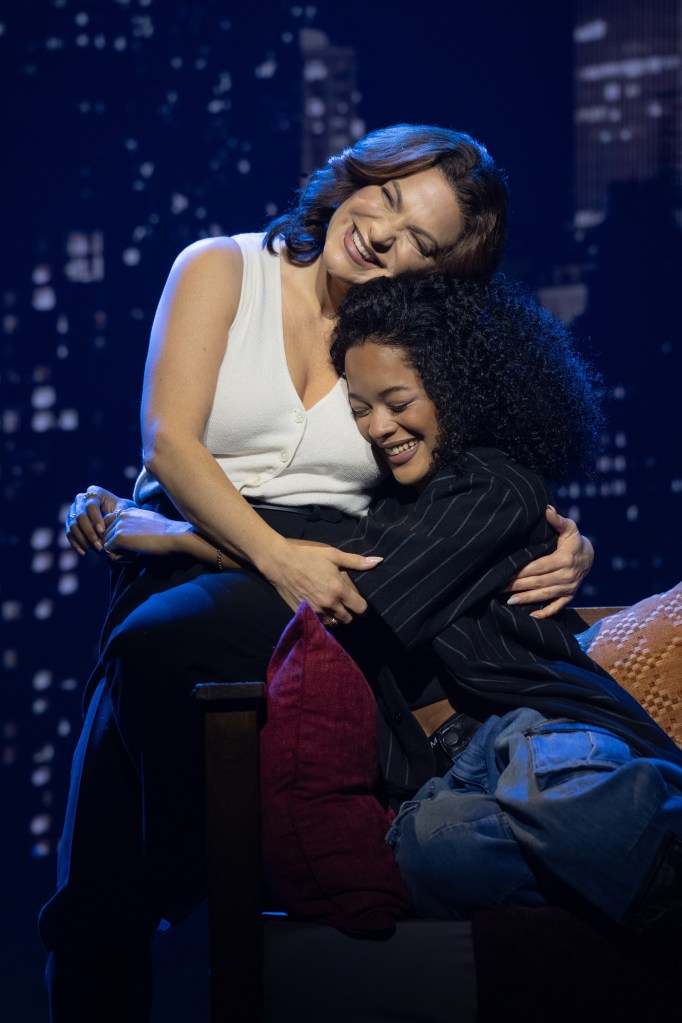
Ali (Gianna Harris the night I saw it), dramatically casts herself as a Rapunzel in cargo pants and Tommy Hilfiger underwear and tops, locked away in the isolated “tower” of Manhattan Plaza by her mother, Jersey (Shoshana Bean). Though mom intends for her to stay safe from the dangers of Hell’s Kitchen, which is gradually being cleaned up of its unsavory druggy characters by then Mayor Rudy Giuliani, Ali questions her mother’s judgment.
Narrating her story in the present, Ali flashes back to key events and key people she meets in her life at the large, subsidized housing arrangement for artists initiated by Estelle Parsons and others. Parsons and other fed up actors, musicians, dancers, etc., encouraged city fathers to create apartments where artists could live while working in the city whose rising costs have continued to this day.
(Joan Marcus)
Artists then and now bring in millions/billions of dollars to the second largest entertainment capitol of the world, yet, subsist on poverty level wages, plying their craft, despite being unable to maintain themselves even on welfare. As a former actress, Jersey is able to meet the requirements at the Plaza for a small living space with Ali, still working part-time as an actress when she can get jobs. However, forced to scramble to support them, Jersey, works the night shift with a steady job, having essentially given up her career to take care of Ali, who doesn’t understand or appreciate the sacrifices her mother has made.Instead, Ali focuses her complaints on her absent father who abandoned the family, and her lack of freedom to hang out with friends and strike out on her own to do what she wants.
The overriding conflict in Hell’s Kitchen is between mother and daughter in their story of reconciliation, which on another level writes a love letter to New York’s loudness, brashness, street people, and atmospheric social artistry in the 1990s.
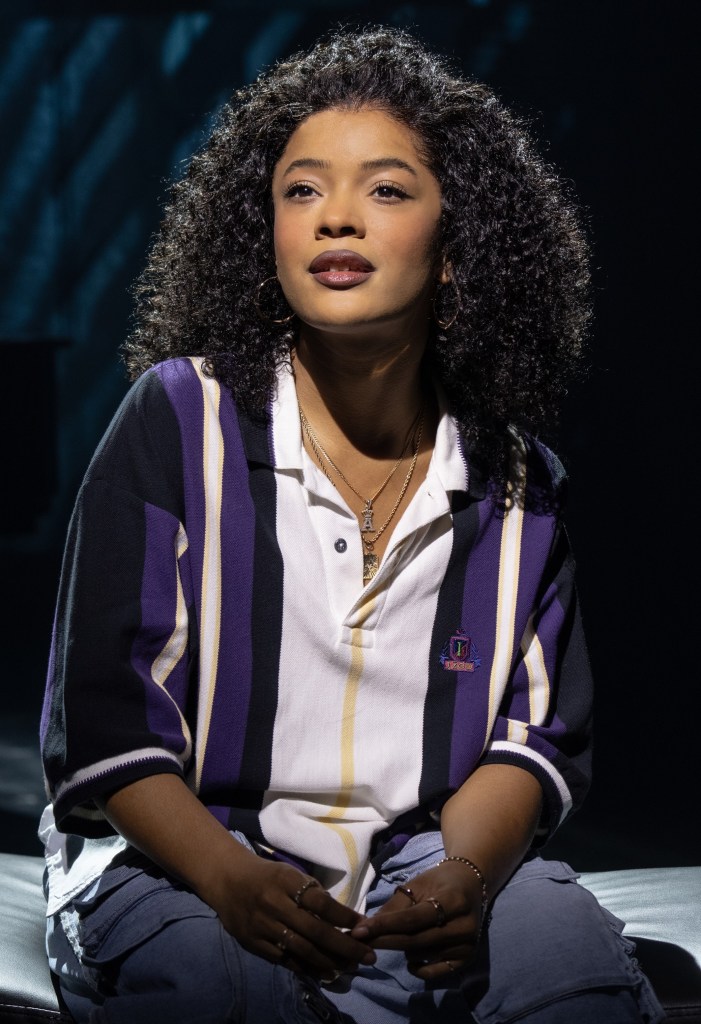
Key to the arc of development is that Jersey doesn’t want Ali to follow in the shadow of her “mistakes” (she got pregnant and had to raise Ali), which she sings about in “Teenage Love Affair” as she affirms why Ali’s soulful father Davis (the smooth-sounding, seductive Brandon Victor Dixon) was not the type of man to settle down. Having heard this story before, the fun and juice of her mother’s passion for her father prod her emotions. She is seduced to walk the alluring tightrope of danger to replicate her mother’s forbidden experiences while trying to find her true purpose which will lift her up from identity disappointments and anger about her father’s neglect. But how can you tie down a crooning club singer who is always on the move and looking for excitement around each corner of life?
This background is presented in Act I (‘The Gospel,” “The River,” “Seventeen,” You Don’t Know My Name,”) as Ali seeks her identity and purpose apart from the family situation she rejects, spurred on by her friends to throw herself at Knuck (the adorable Lamont Walker II when I saw it). The twenty something is one of a three-person bucket drumming crew providing excitement and sexy currents busking in the courtyard of Ali’s residence. Ali’s attraction to him is so palpable, Jersey warns the doorman and her police friends to “watch out” for her daughter’s wiles with the “bucket drummer,” which miffs Ali. When tensions increase with her mother, Ali seeks comfort from Miss Liza Jane’s classical piano playing in the Ellington Room of the Plaza, which so inspires her, she realizes she’s found a part of herself, (“Kaleidoscope”).

Although Keyes’ own storyline is much more complicated, Diaz keeps it simple in order to integrate Keys’ repertoire which includes eleven numbers in Act I and twelve in Act II (according to the program). In Act I, the songs weave Knuck and Ali’s coupling in “Gramercy Park,” and “Un-thinkable (I’m Ready),” and gyrate into an amazing “Girl on Fire” in a heady, rigorous number that involves the entire company and ends in an explosion of emotions.
Unable to contain themselves, Knuck and Ali are intimate in Ali’s apartment. Is it any surprise that Jersey looses it when she finds the older Knuck and her underage daughter on the living room sofa in a rerun of Jersey’s life with Davis? Shocked that the precocious, sexually self-possessed Ali is seventeen (making him a rapist), Knuck is infuriated and races out. He is one step ahead of Jersey but is arrested, and humiliated in public, which Ali tries to prevent but can’t.
Because of her colliding impulses and emotions, Ali has recklessly endangered and effectively punished Knuck for his affections which he tried to resist. In a gender role reversal, she has exploited him as the “innocent,” while “getting off” on using her sexual power. Too late, she backtracks with empty apologies and remonstrances.

The event resolves in the Ellington Room where Ail seeks comfort, while Miss Liza Jane sings the instructive and heartfelt “Perfect Way to Die,” highlighting the culture’s racism, police brutality and discrimination as the daily portion of hatred and violence that communities of color still have to face and fear. Act I concludes powerfully with the song highlighted by Peter Nigrini’s projection design in black and white of victims of future police brutality. Miss Liza Jane and Ali conclude in hope with a focus on Ali’s lesson at the piano. The reveal is that art is the way out of the ghetto, the violence, the discrimination, the institutional racism that so often cuts down Black men and colored populations.
Act II (“Authors of Forever,” Heartburn,” “Love Looks Better,” “Work on It,” to name a few), follows with a lengthy resolution after Ali experiences a loss, ends her brief encounter with Knuck, and Jersey calls in Davis to help her daughter overcome her emotional depression and grief. Together, father and daughter sing a lovely duet with Davis at the piano. Mother and daughter have a new appreciation of one another and the musical ends on a celebratory bow to the city with Keys’ “Empire State of Mind.”

The covers, Gianna Harris, Lamont Walker II, and Crystal Monee Hall are spot-on marvelous, working seamlessly with Shoshana Bean’s powerhouse singing and emotionally riveting portrayal of Jersey. Bean’s Jersey is a tumbling cycle of love, fear, anger and confusion as she tries to negotiate the rebellious Ali. Likewise, Harris perfectly portrays her attempt to kindle a relationship with Davis. The smooth, relaxed portrayal by Brandon Victor Dixon, shines as the counterpart of Jersey. His mellow, and beautifully mellifluous singing is sensational. Dixonl clearly reveals why Bean’s Jersey fell hard for him and was so acutely disappointed and broken when they couldn’t make it as a family.
The musical, pegged as entertainment with the intent of heading for a Broadway audience avoids going as far as it could only inferring Knuck’s arrest might have ended up in a brutal attack against him. Instead, the death that occurs is a loss that is devastating, but not aligned with any cultural indictment. It is most felt by Ali and it triggers her feelings to be more supportive and loving of her mother which ends up in a satisfying and uplifting conclusion.

Nigrini’s colorful projections of New York City lighten up Robert Brill’s grid-scaffolding, dark scenic design and minimalist set pieces. Dede Ayite’s costume design is setting appropriate and dated for that period in time. Lighting design by Natasha Katz, sound design by Gareth Gwen, and hair and wig design by Mia Neal all are in concert with Greif’s vision of a Hell’s Kitchen which is undergoing transformation and hope, despite unresolved institutional racism and discrimination.
I was most drawn by Camille A. Brown’s choreography and the dancers amazing passion and athleticism incorporating a variety of hip hop dances from the period and then evolving into something totally different. Unusually, there is movement during times when least expected, but all correlated with the emotion and feeling of the characters making the dancers moves emotionally expressive and coherent.
Hell’s Kitchen is a winner. Look for it when it opens on Broadway or try your luck with tickets based on availability at the Public Theater on Lafayette Street, downtown. https://publictheater.org/
‘The Gardens of Anuncia’ Lyrical, Unique, Fanciful, Directed by Graciela Daniele

In order to deal with the past, sometimes memories must be altered to beautify the ugliness of their reality. This is one of the themes in Michael John LaChiusa’s musical, The Gardens of Anuncia, directed and choreographed by Graciella Daniele. The Gardens of Anuncia is currently running at Lincoln Center’s Mitzi E. Newhouse.
The musical’s picaresque, lyrical journey memorializes the women who inspire and encourage the artistic soul of Annuncia (Kalyn West), as she grows into a teenager, who then will flourish in her global career as a director, choreographer and dancer. The journey intimated is that of Graciella Daniele, Tony Award nominee (ten times), and recipient of a Lifetime Achievement Award. Though she never won a Tony, Daniele’s directing and choreography of Chita Rivera: The Dancer’s Life, Annie Get Your Gun, Marie Christine, Once on This Island, The Pirates of Penzance, and Ragtime, are among her most memorable achievements.
Wisely, LaChiusa focuses not on the public career of Daniele, but on those who grounded the choreographer and director to prepare her to be an overcomer, ready to face obstacles and not be daunted by them. Through present narration by the older Anuncia (the charming, endearing Priscilla Lopez), on the eve of her acceptance of the Lifetime Achievement Award, in the garden of her country house, Anuncia meditates in flashback about her childhood with the three great women who influenced her, making her who she is today. As she readies herself to bury her aunt’s ashes, a final goodbye, she works through her memories, some hurtful, all poignant, growing up in Buenos Aires, Argentina during the Peronista government and movement in the 1940s and 1950s.

Auncia’s memories are vignettes that encompass vital turning points and revelations in the lives of the Younger Anuncia, Tia (Andrea Burns), Granmama (Mary Testa), and Mami (Eden Espinosa), all of them flowers burgeoning in the beautiful garden of her mind. Bounded by the older Anuncia’s narrative, we are introduced in the “Opening” to the women and their routines in the life they live daily in Granmama’s house in Buenos Aires. Together, the women raise the youngster and support each other after Mami and Anuncia are abandoned by Anuncia’s father, referred to as “That Man.” Lyrically, poetically, La Chiusa moves from present to past as the older Anuncia lands on memories that eventually reveal how each of the women traverse the paternalism of a male world and thrive.
The superb Priscilla Lopez (i.e. The Skin of Our Teeth, Anna in the Tropics), originated the role of Diana Morales in A Chorus Line, winning an Obie Award and Tony nomination. Lopez and Kalyn West portray Older Anuncia and Younger Anuncia, playing off one another seamlessly with grace. Through her reflections, the older Anuncia merges with her younger self to gain strength to finally put to rest the pain of the past, manifested in her finally burying her Tia’s ashes. As Lopez brings humor, poignancy, wisdom and loveliness to the older Anuncia, West embodies the innocence, increasing understanding, anger and astuteness when she asks questions and discovers the truth behind the answers that Tia, Grannmama and Mami give her.
From Tia, Young Anuncia learns to use her imagination to explore her world in, “Listen to the Music.” Additionally, Tia explains why she isn’t married and implies that she is happier without being tied down, having to answer and be obedient to a husband (“Smile for Me, Lucia”).
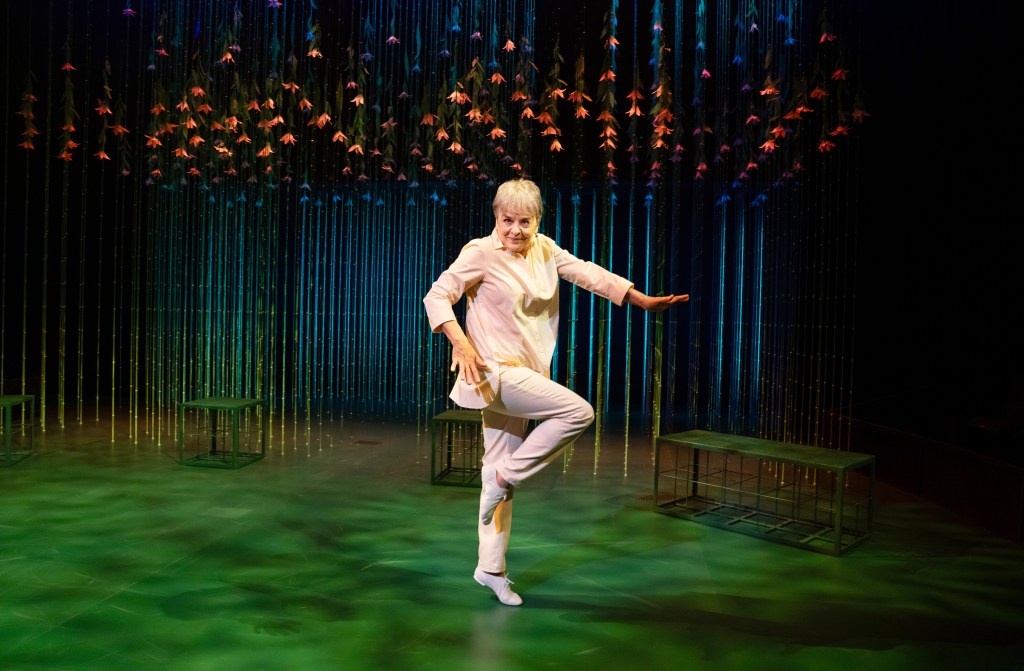
From her mother Mami, she receives the gift of ballet classes to strengthen her flat feet, as well as her interest in the dance. In Espinosa’s interpretation of the sensual “MalaGueña,” Mami dances the tango and sings about the club where she goes to dance with various partners in order to have fun, something that Granmama disapproves of.
Mary Testa’s Granmama adds humor and irony to the relationship the women have with each other. From Granmama, Anuncia learns her love of the dramatic and theatrical, as her Granmama’s reactions are always over the top. Her relationship with her husband, Anuncia’s grandfather, is explosive and extreme. It is forged in scandal and passion, thought it ends up in an eventual tiresome marriage, after which Granmama, eventually kicks him out. In “Waiting/Dreaming,” Anuncia learns they long for each other when he is away in the merchant marine, then can’t wait until he leaves, after a few days of crazy arguments and harangues when he returns.
From each of these incredible women, Anuncia attributes elements of her inner soul. Importantly, she also learns how and why “That Man,” her father, abandoned them and left them destitute, forcing Mami and Anuncia to move in with Tia and Granmama. All of the songs and events take place with the backdrop of danger and “disappearances,” during the Peron regime, a regime which also threatens the family when Mami is arrested.

The events in flashback and flash forward, with Older Anuncia’s narration that bridges them, unspool fluidly in a stylized, minimalist set design by Mark Wendland. The past and present flow into each other in Older Anuncia’s memory, suggested by the ease by which the characters step into the present in the garden of flowers that Older Anuncia talks to, beautifully intimated by Jules Fisher and Peggy Eisenhauer’s lighting design.
The garden is the perfect place of solitude where Old Anuncia revisits conversations and events with these beloved women, who shaped her and sent her with confidence and beauty into the wide world. The colorful, atmospherically lighted beads with attached flowers (Jules Fisher and Peggy Eisenhauer), separate the downstage where the conversations and reminiscences take place, with the past behind the beading where the characters exit.
Lopez, in her direct address to the garden of flowers that includes the audience, animates and enlivens them. Lopez is so specific in her performance, we believe she sees the peonies, the irises, the anemones and forsythias, though nothing is there. However, we note that this is who Anuncia has learned to be, influenced by Tia, to use her imagination.

Thus, in her garden of delights, she is able to converse with the floral pageantry she has planted, as well as the two male deer who come to visit her and nibble on her vegetables. The deer, who are brothers, are hysterically portrayed by Tally Sessions. The first deer gives her the wonderful advice to “Dance While You Can,” as they do a bolero. The second deer, shows up after an interval in time. He shares with the Older Anuncia that he lost his half-brother, who was hit by a car, obeying a “deer crossing” sign. The half-brother is bitter and droll. Lopez’s Anuncia returns the advice she received from the cheerful brother to the nihilistic half-brother, almost cheering him up.
The other male parts are portrayed by Enrique Acevedo who is Granpapa, That Man (Anuncia’s father) and other characters.
Older Anuncia’s garden meditations where she speaks to the plants and the deer are charming, ethereal and magical. They are part of her cultural heritage and legacy from Tia. Like her conversations with Tia, Mami, Grandmama and the others who have passed on, they are a part of her and not “ghosts” or something to be frightened of. The enlivened memories eventually bring the Older Anuncia to closure so that she can finally bury Tia’s ashes. It is time to rest her memories, it is time she lays them in peace in the garden of her mind, manifested in her country house garden.
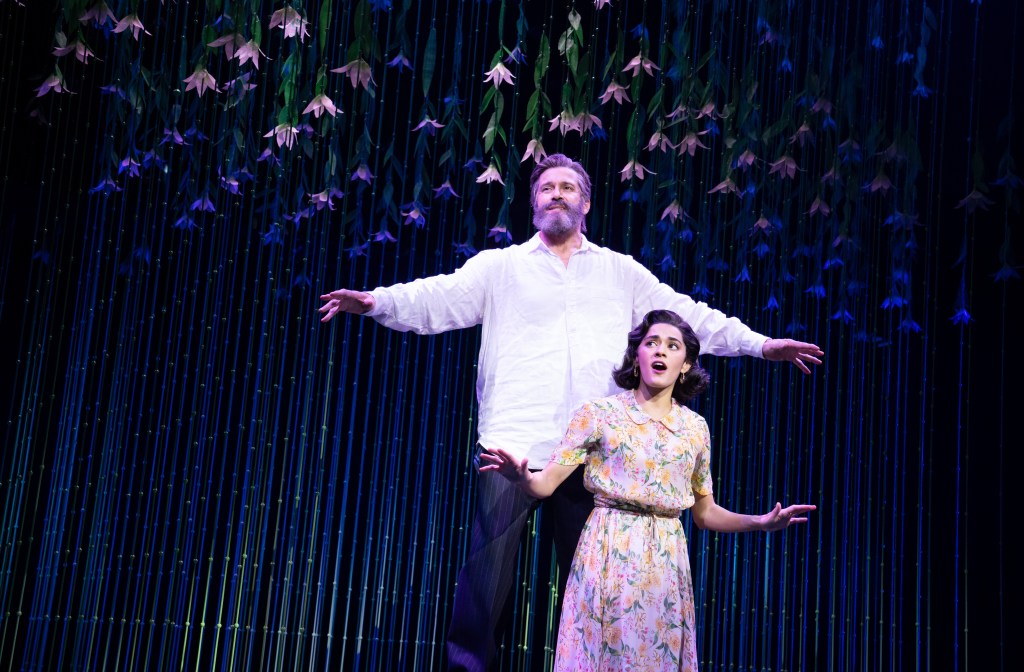
Daniele directs and stages the actors specifically and acutely so that they seem to create their own geometric patterns and rhythms. The choreography remains simple and evocatively cultural, reflecting the time and place to emphasize the Older Anuncia’s memorialization of the women who are so dear to her. Though West does some ballet, it is more representational, as befits the glimpses into the past, as if Anuncia looks into the mirror and can only bear snippets of reminiscences. Indeed, memories are elusive and questionable. Did certain events happen? There is one that the Younger Anuncia affirms happened and wishes she could forget.
From the lyricism, to the suggestiveness and poetic nuances, LaChiusa’s musical is in a category by itself. As elusive as a butterfly’s shimmering, gossamer wings, The Gardens of Anuncia floats into our consciousness with its poignant softness and seduction with stirring themes about the power of imagination, the profound love conveyed by relatives to strengthen progeny, about legacy, and about the wisdom and love it takes to understand the impact of one generation shepherding the next.
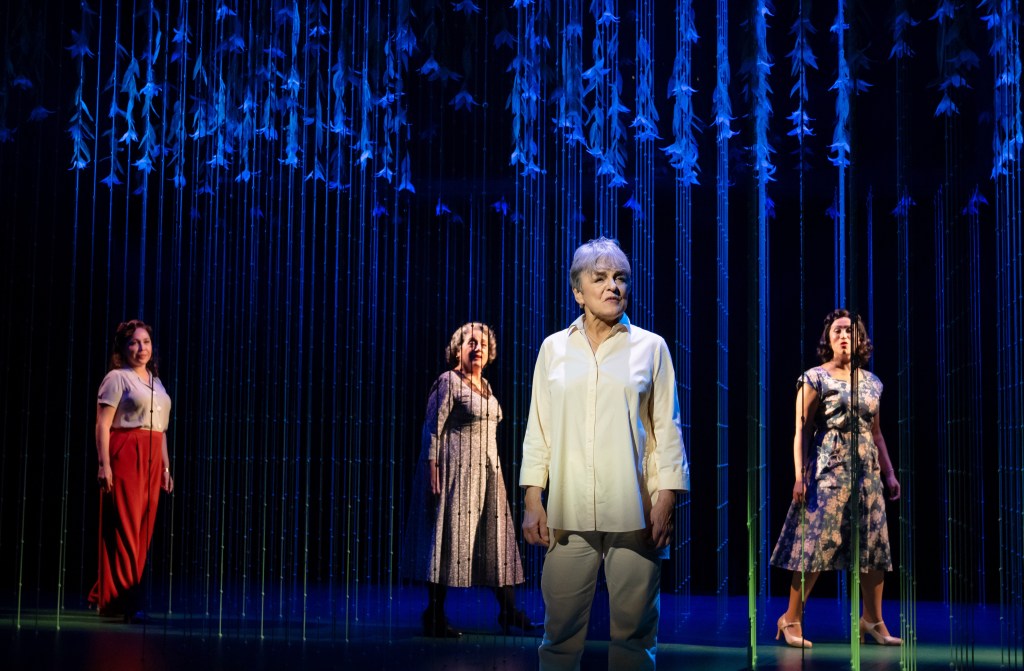
The ensemble are exceptional. They merge, flow, harmonize, dance, spinning into the garden’s loveliness, then retreating back into the corner’s of the Older Anuncia’s mind. Just great!
Kudos go to all the creative team who explored and solidified Daniele’s vision of LaChiusa’s evocative, unique musical. In addition to those mentioned above, these include Toni-Leslie James (costumes), David Lander (lighting design recreation), Drew Levy (sound), Michael Starobin (orchestrations), Deborah Abramson (music director), and Alex Sanchez (co-choreographer).
The Gardens of Anuncia, Lincoln Center Theater at the Mitzi E. Newhouse. Website: https://www.lct.org/shows/gardens-anuncia/
‘New York Botanical Garden Holiday Train Show’




The NYBG Holiday Train Show has begun. And what a magnificent, vibrant show it is.

Now in its 32nd year the show reflects its beginnings.
In 1992, landscape architect and model train enthusiast Paul Busse of Applied Imagination came to the Garden’s Enid A. Haupt Conservatory to express his unique vision for a special exhibition during the winter holidays.

He created The Holiday Garden Railway Exhibit. The following year the “Railway Exhibit” blossomed outdoors in the Garden landscape featuring bridges and a viaduct situated near the LuEsther T. Mertz Library.


This year’s 2023 Holiday Train Show returns to Busse’s outdoor landscape design. However, it is more expansive with a clever theme for it’s outdoor exhibit. The addition is an all-new enchanted woodland train display, replete with forest animals, winter-interest plants and fantastical fungi set on the Haupt Conservatory Lawn.

Don’t underestimate the outdoor display or move too quickly to appreciate that all the elements are plant/botanically based.

The large mushrooms that look like they are out of a Disney cartoon, that kids will appreciate, are recreations, not of ceramics, but they are made of wood, intricately shaped and detailed.

Applied Imagination’s creativity and attention to detail is bar none.

The imagination of the craftspeople at Applied Imagination to recreate their counterparts in nature is astounding. It inspires us in so many directions, conservation, environmental use and protection and appreciation of nature’s wonders. All of these values conjoin with the Garden’s efforts toward the natural world and conservation of plants especially exotic species globally.

Likewise, the woodland animals are botanical creations. For example, the owl which you might miss if you don’t look overhead (it had to be pointed out to me) is predominately made of artichokes.
The lovely flowers that adorn the top arches are made of gourds. And the shelf mushrooms attached to the bridges and fences are themselves.

Look at the vines, coated in plant based resins to give them the glossy finishing touches that look like they are metal or iron. The butterfly creation that looks like it might be featured in any high-end store for home decorations is totally plant based.

That glossy look on the wings is achieved by the same resin that is used on the windows of the miniature of the Enid A. Haupt Conservatory inside, in the rotunda with other structures of the Garden like the LuEsther T. Mertz Library.

The Conservatory miniature is a gloriously detailed structure that took over 1000 people hours to put together. Of course, the visible structure is made of reeds. Interestingly, the cupola rests on “a ring of large pine cone scales.” For the piece de resistance at the very top, artists used seedpods: one mahogany and one lotus. If you didn’t know what these seed pods looked like in their natural habitat, you wouldn’t be able to distinguish their botanical ancestry from plastic. However, the last thing that Applied Imagination would ever employ in its presentations is plastic. Busse and the entire staff support the environment and the wonders of how nature is reflected in design structures.

The outdoor expansion combines with the the New York City and upstate New York miniatures that sprawl indoors throughout the conservatory’s galleries that have been enjoyed in previous years. However, the Garden staff and staff at Applied Imagination make sure that the displays are differently arranged.
Walking through as I have done each year, I try to remember which sections of the city appear in the Palms of the World Gallery or the Centerpiece Rotunda, and I am often at a loss. The show is botanical theater and as such changes from moment to moment, from year to year. Each year, it seems more spectacular than the next. And neither still photographs nor videos do justice to reveal the wonder of exuberant plant life whether in the daytime or the magical and mysterious nighttime of the conservatory.
Like live theater which is akin to an interactive spiritual experience, the NYBG’s botanical theater feels different through the run of the show. To keep the exhibit shining, plants are swapped out. Others are added and the effect is continually one of shifting, lush tropical splendor. This year’s exhibit is a pantheon of color. Wherever you turn there are dazzling orchids, poinsettias, cyclamen and variegated plants, begonias, ferns and the permanent plantings some of which are flowering trees. It is too beautiful to miss.
PROGRAMMING
On 17 Select Nights, Holiday Train Show Visitors of all ages can enjoy NYBG GLOW, the OUTDOOR LIGHT EXPERIENCE. It is returning for its fourth year. NYBG GLOW will take place from 5 to 10 p.m. on the following dates: friday, December 8; Saturday, December 9; Friday, December 15; Saturday, December 16; Sunday, December 17, Friday, December 22, Saturday, December 23; Tuesday December 26; Wednesday, December 27; Thursday, December 28; Friday, December 29; Saturday, December 30, 2023; Saturday, January 6; and Saturday, January 13, 2024.
FAN-FAVORITE BAR CAR NIGHTS, FOR ADULTS AGE 21 AND OVER, WILL ALSO MAKE A COMEBACK THIS SEASON ON THREE SELECT DATES. These are Thursdays, December 7 and December 14, 2023, and Friday, January 5,202 4. Bar Car Nights feature adults-only nighttime viewing of the Holiday Train Show and NYBG GLOW, with light bites and curated beverages available for purchase as visitors journey through the exhibition with friends and loved ones.
For more information, go to the NYBG website. https://www.nybg.org/event/holiday-train-show/
Susan Stroman Interviewed by Sharon Washington, a LPTW Event

On Friday, November 17, the League of Professional Theatre Women held an interview of an icon in the theater, Susan Stroman. The event was part of The Oral History Project which is held at the New York Public Library for the Performing Arts at Lincoln Center. The venue was the Dorothy and Lewis B. Cullman Center/Bruno Walter Auditorium.
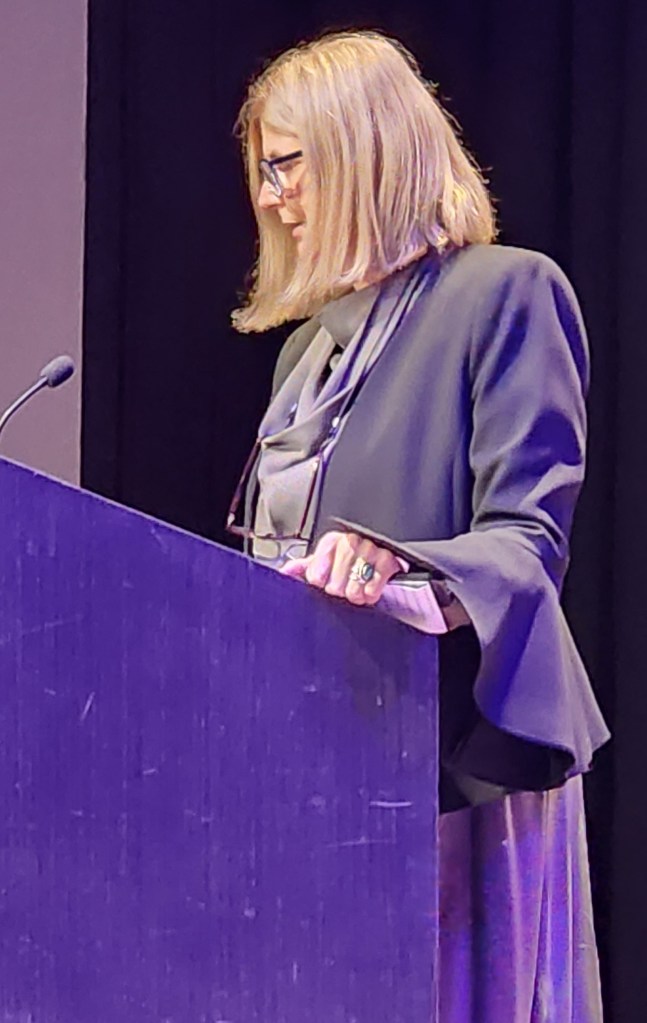
Currently produced for the League by producer and director Ludovica Villar-Hauser, The Oral History Project was founded and produced for 26 years by the late Betty L. Corwin. The interview of Susan Stroman by friend and colleague Sharon Washington was video taped and will be archived in the collections of the New York Public Library for the Performing Arts at Lincoln Center.
How Sharon Washington and Susan Stroman met
After comments by President Ludovica Villar-Hauser, and introductions, Sharon Washington (check out her credits and work on https://iamsharonwashington.com/), began by sharing the story of how she came to first meet Susan Stroman in 2009. At the time, Washington’s agent suggested she audition for a part in a musical, though Washington was a dramatic actress. When Washington posed that she hadn’t been in any musicals, her agent reassured her that in this one, she wouldn’t have to sing, dance or speak. Ironically, Washington questioned why she would even consider such a part. However, her agent countered that it would be directed by Susan Stroman.
Thus, Washington and Stroman collaborated on the 12 times Tony nominated Scottsboro Boys. The musical went on to win the Evening Standard Award for Best Musical in the UK. Though the production didn’t win any Tonys, Washington emphasized that then and now, Stroman’s process is exhilarating.

Specifically, Stroman creates a safe room that is caring. Washington and the other cast members felt so comfortable that they could work freely. Washington pointed out during the interview that Stroman imbues a quality of trust to be a creative collaborator. In her safe space one can try things out and make suggestions. This artistry of bringing out the best in the cast and creative team has brought Stroman accolades and forever friends. Sharon Washington is one of them.
Susan Stroman is a theater Icon

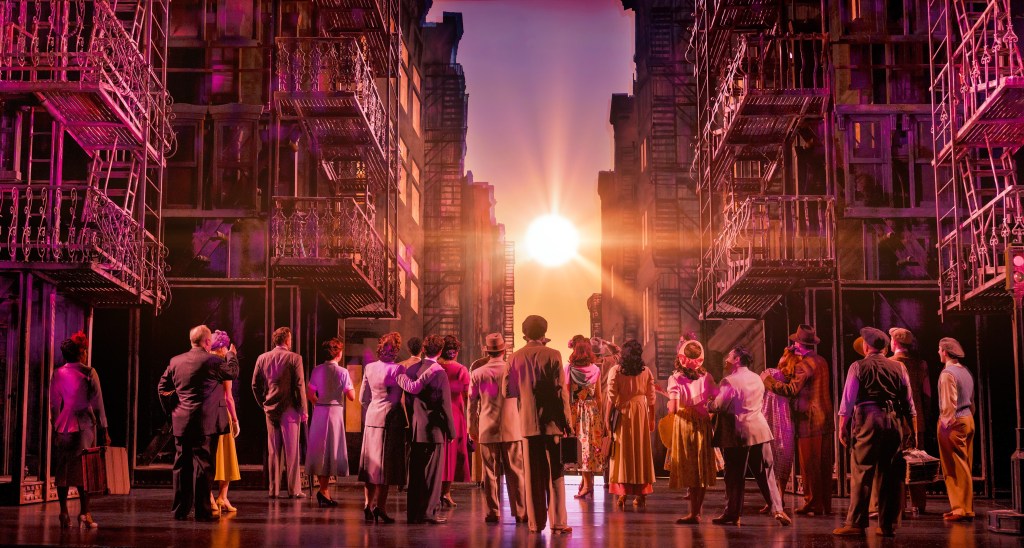
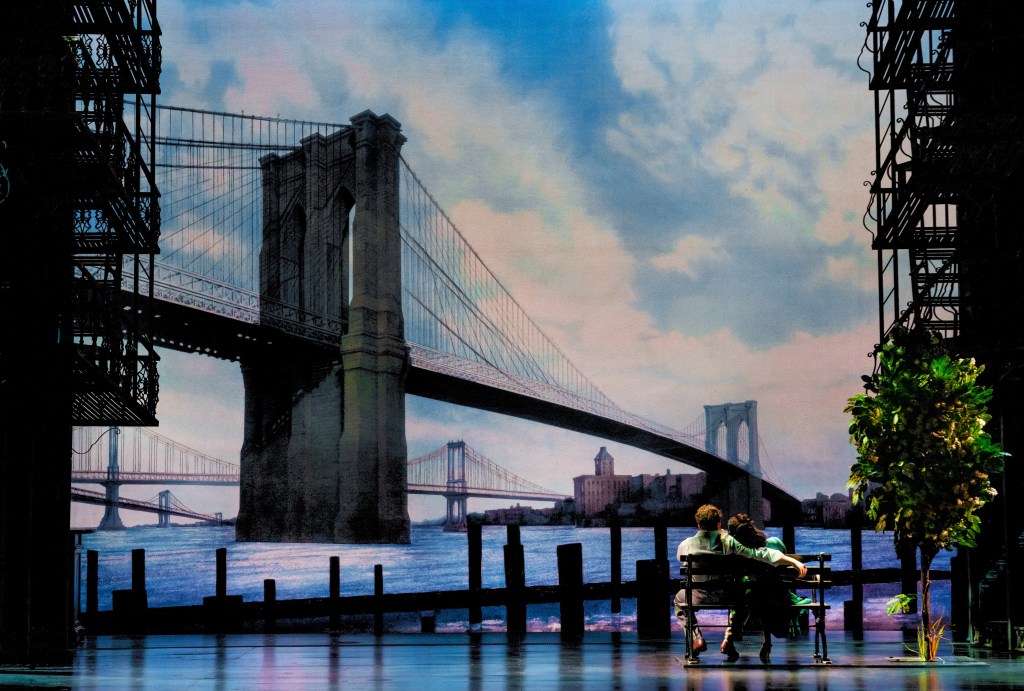
Susan Stroman (Director/Choreographer), is a five-time Tony Award-winning director and choreographer. She has won Olivier, Drama Desk, Outer Critics Circle, Lucille Lortel Awards. Also, for her choreography, she has won a record number (six) of Astaire Awards. Recently, she directed and choreographed the new musical New York, New York, which was nominated for nine Tony Awards and which won Best Scenic Design for a Musical (Beowulf Boritt). The music was by John Kander, lyrics by Fred Ebb and Lin Manuel Miranda, and a book by David Thompson and friend Sharon Washington.
In other recent work, she directed the hysterical, LOL new play POTUS: Or, Behind Every Great Dumbass Are Seven Women Trying to Keep Him Alive. And this season in London’s West End, she directed and choreographed the revival of Crazy for You at the Gillian Lynne Theatre.
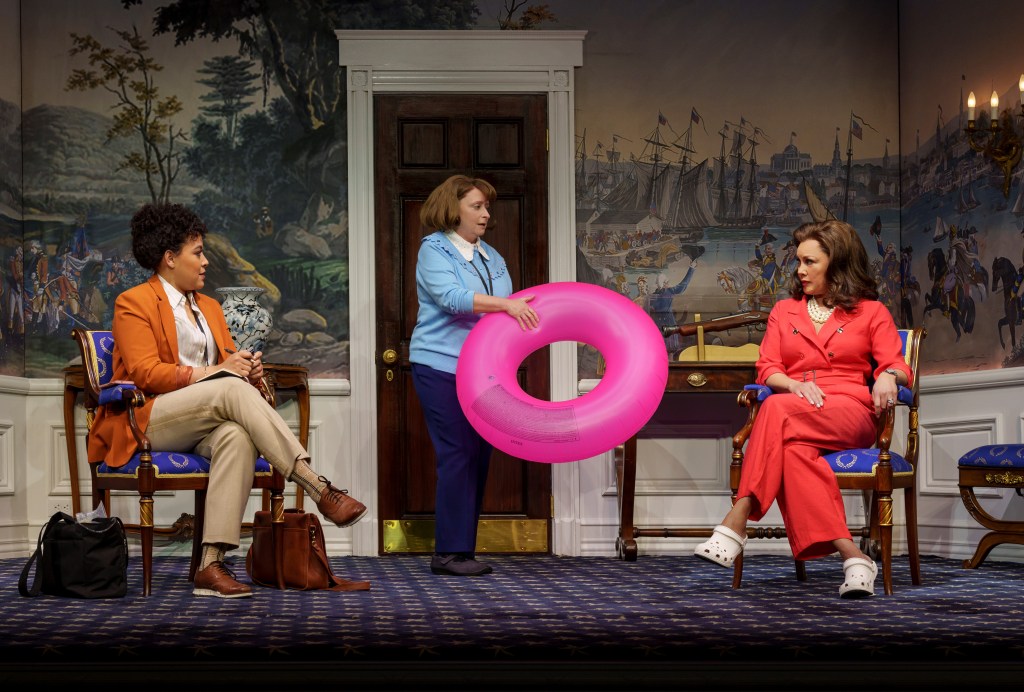
Past exceptional productions include her direction and choreography for The Producers (12 Tony Awards including Best Direction and Best Choreography). She co-created, directed and choreographed the Tony Award-winning musical Contact for Lincoln Center Theater. She received a 2003 Emmy Award for Live from Lincoln Center. Broadway credits include Oklahoma!, Show Boat, Prince of Broadway, Bullets Over Broadway, Big Fish, Young Frankenstein, The Music Man and others. Her Off-Broadway Credits include The Beast in the Jungle, Dot, and Flora the Red Menace to name a few.
Stroman has experience with ballet and opera
She garnered additional theater credits and to these add ballet and opera which include The Merry Widow (Metropolitan Opera); Double Feature, and For the Love of Duke (New York City Ballet). She received four Golden Globe nominations for her direction and choreography for The Producers: The Movie Musical. Additionally, she is the recipient of the George Abbott Award for Lifetime Achievement in the American Theater, and an inductee of the Theater Hall of Fame in New York City. For her complete list of accomplishments, credits and awards, go to www.SusanStroman.com
After Washington and Stroman discussed her beginnings growing up in Delaware in a house of music, where she danced and was in dancing school, she would always create dances when her father played the piano. She grew up appreciating her father’s storytelling and musical talent. She majored in English at the University of Delaware and was attracted to story telling and its different forms which, of course, included music and dance. She mentioned that her family would watch movie musicals together on their sofa, and as she watched, she intuited the synchronicity between the dance and the music and the feeling it created. Storytelling through the dance came easily to her because of her parents and their appreciation of musicals, music, movement and how dancing conveyed the story.
Choreography helps to move the plot forward
For Stroman, today, especially with the virtual media environment, choreography is imperative for moving the plot and story forward in immediacy. The audience wants the story to move forward constantly, which can be accomplished with choreography transitioning the turning points so the events have a forward momentum. In recognizing the importance of the staging and the dance, every corner of the stage must be considered. There is no empty part of the stage that doesn’t have the element of storytelling through dance, music and dialogue.
It is a testament to Stroman’s ability to continually provide fascinating visuals, color and movement so entrancing to audiences, who love her work, if sometimes critics don’t fully understand or appreciate the genius she displays. Indeed, with the stage beginning as a writer begins with a blank page, Stroman thinks profoundly about every dancer, every performer, every musical note, every word of dialogue and of course all the elements in the story (Aristotle’s poetics).

For my mind, her works should be studied in musical theater classes in universities for their immediacy, their vibrance, their emotional grist and their coherence as they synchronize elements of scenic design, costume design, and hair and wig design, lighting, sound, to effect the beauty, sorrow, majesty of the story being told.
The film The Sound of Music was an influence
Stroman emphasized that she and her brother saw The Sound of Music together and it impacted her understanding. She stated, “I was blown away by that movie. I guess I was twelve.” She couldn’t believe the story that was being told and how important the story was, realizing it could be something which is really profound. Stroman followed with the idea that she visualizes music with a story following along. Additionally, she imagines how the dancers would be dancing. Immediately, her “brain begins to spin about what story is being told through the music, the instrumentation and the orchestrations.”
When Stroman puts a show together, she “works very much with the show’s composer and arranger,” of how to open up the music. She manipulates the time signature of the music to help represent the emotion she wants the actors to play and to move forward the momentum of the story. She does a lot of research on every musical. This might include the history of the decade, the geographical area, the setting. She immerses herself in research and thinks extensively about the characters. This helps to inform how she choreographs the music.
Working with performers is about collaborating in a safe space.
Working with actors is about collaborating in a safe space. First, comes the research. Then comes the time and effort put into using what has been learned. Washington attested to Stroman’s being there early before everyone else, and staying late after everyone was gone. Stroman works extensively with her musical partners. Additionally, she is aware of the actor’s process. Each have their own process. Some pick up elements very quickly and others don’t. It is a balancing act to get all on the same page and not make them feel inferior.
In making sure all feel comfortable in the learning process, Stroman stays positive and roots for her actors, wanting them to do their best. Getting the performers to the point of excellence, she has to do her research and be prepared before she ever creates the safe space in the rehearsal room. When they arrive there together, she’s worked through almost the entire show. However, part of creation and allowing the cast to feel comfortable, she doesn’t share all of what she knows. She wants them “to feel free” and be creative and “feel a part of it.” She’s also inspired by the performers who come up with their own creative suggestions. She allows for actors and dancers’ agency, encouraging them to try something different.

Stroman collaborated with Washington during the production, Dot
Stroman shared a moment in Dot where Sharon Washington’s character had extensive monologues and she gave her the stage action of cooking eggs. Stroman had Washington pace the dialogue with cooking eggs so that she finished every time on a particular word. Though Washington was skeptical at first, she become so attuned, that the timing was perfect. With Stroman’s encouragement, she finished when the eggs were done and landed precisely on the designated “word” in the monologue. Both Stroman and Washington discussed the wonder of creating something that didn’t exist before. Considering all the people that collaborated in the creation, the artistry of that collaboration to present something amazing is miraculous.
Stroman discussed how the ideas for various scripts or stories come from various places. The seminal idea for the show Contact came surprisingly with the image of the girl in the yellow dress. Stroman discussed that she was in a bar at one in the morning, and in a bar where all the New Yorkers wore black. And “in walked this girl with a yellow dress which I thought was quite bold for one in the morning.” Stroman described the girl’s action, “She would step forward when she wanted to dance with somebody, and then she would retreat back when she was done with them.” According to Stroman, she was an amazing dancer and she was only there to dance. Stroman watched her dance with various men. Then she disappeared into the night.
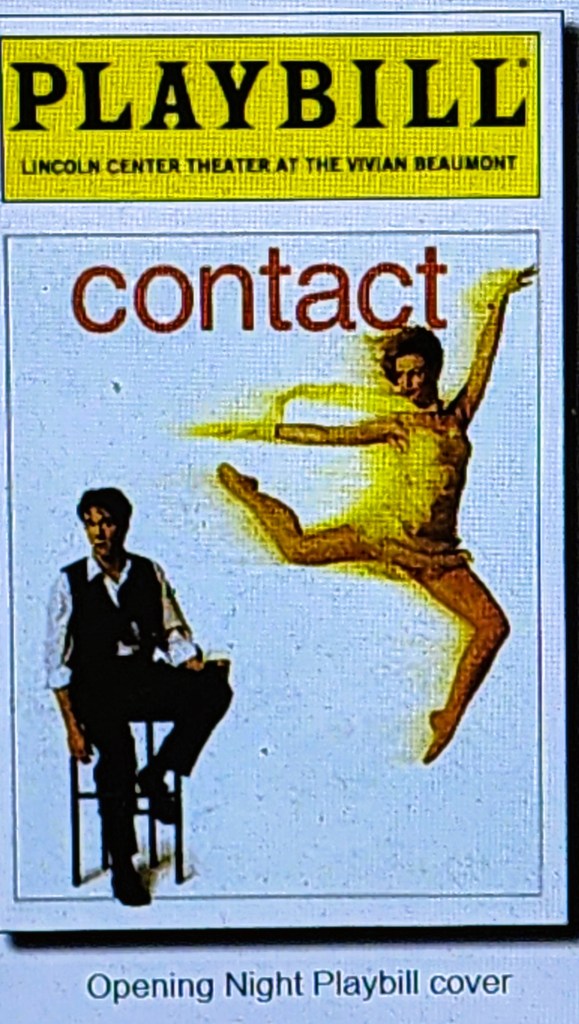
The girl with the yellow dress becomes Contact
Around two weeks later at Lincoln Center, Stroman was approached about having ideas. She said, “You know, I think I have an idea.” And from then on, the story of the girl in the yellow dress took flight, bringing in all the elements of music, dance, and storyline. That’s how Contact came into existence, from a visual and organic, raw experience that stirred Susan Stroman’s imagination. Amazing! Contact ran for three years. Humorously, Stroman discussed how pictures of the “girl in the yellow dress” were on busses and billboards and she was thinking the girl would come forward and say something. She never did.
Stroman shared another story about the time she met with Mel Brooks. She was working on A Christmas Carol when she received a call to meet with Mel Brooks. Familiar with his work, she wondered what he wanted to talk to her about. There was a knock at the door. And when she opened it, he started singing, “That face, that face…” and he danced down Stroman’s long hallway, then jumped up on her sofa and said, “Hello! I’m Mel Brooks.” Stroman shared that she didn’t know what would happen. She thought, “But whatever it is, it’s going to be a great adventure.” Indeed, the experience was, “the adventure of a lifetime.”
Regarding working with Mel Brooks, Stroman suggested that she learned from him, collaborating and observing. Of course, it was a new art form for him, so he was flexible and learned from Stroman’s theatrical experiences and process of working. It appears they developed a mutual admiration society.

Facing obstacles as a woman
Washington asked about the obstacles Stroman faced as a women. When Stroman got in the business, she stated, “It really was male dominated.” And she mentioned that it has only been in the last fifteen years that there have been women directors. However, she was not certain about “why that is or was.” When she started, she wanted people to believe, “In the art of what I was doing.” She didn’t dress up. She wore a baseball cap. At that time there was a pressure to “dress down,” and be “strong, but not too strong.” Stroman felt like she “could do it,” when she came to New York. However, she didn’t know if she would “be allowed to do it.”
In sharing a story to encourage young people or anyone in the business, she suggested “always ask questions.” The worst that can happen is that “they” say “no.” One day she and another actor were throwing out ideas and came up with the idea to approach Cabaret’s Kander and Ebb and ask if they could take one of their shows and direct and choreograph it for Off-Broadway. They were shocked when Kander and Ebb agreed and they took Flora the Red Menace, reworked it and brought it to The Vineyard Theatre.
Critics
Stroman discussed critics. She mentioned that “bad reviews are very hurtful.” She also suggested that women’s work is more harshly criticized than men’s and that the same applied in politics. She referenced her great disappointment that New York, New York didn’t have staying power and closed. They were waiting for the tourists, but they never came. Regarding the collaboration, she enjoyed working with the creative team tremendously. Of course, that made the show not lasting more poignant. The show received positive and negative reviews. Regarding any positive reviews received over the years, Stroman quipped, “The good reviews are never good enough.” And when there’s a great review, “You think, well, why didn’t they talk about that?” You just “have to feel good about what you are creating,” she insisted.
In discussing mentorship Sharon Washington suggested Stroman is very gracious and lets everyone participate. With every show she does, she usually has “A young observer who comes on the show and they get to be there for the whole process.” She said, “It’s important to be in the room where it happens.” Young people learn best when they see the process unfolding and join in it, participating whenever it is feasible. They learn, then, that it’s a collaboration. As the team works together, the director coheres with all the designers. It is the director, who has a clear vision of what the production should be. Then, the director shepherds the creatives and negotiates through and around the various egos.
For more on Susan Stroman https://www.susanstroman.com/ or Sharon Washington https://iamsharonwashington.com/ go to their websites. For a video of the interview, visit the New York Library for the Performing Arts archive in person.
The League of Professional Theatre Women is a membership organization for professional theatre women representing a diversity of identities, backgrounds, and disciplines. Through its programs and initiatives, it creates community, cultivates leadership, and seeks to increase opportunities and recognition for women in professional theatre. Its mission is to champion, promote, and celebrate the voices, presence and visibility of women theatre professionals and to advocate for parity and recognition for women in theatre across all disciplines.
Dianne Wiest in ‘Scene Partners,’ a Wild, Woolly Romp Through The Reality of Imagination

How many women have dreamed of a career in Hollywood only to be dunned by everyone in their lives, except the still small voice encouraging them to try? And after they’ve reached their seventies and it’s too late and they attempt a career in the movies? WTF! Are they out of their minds? In Scene Partners, currently running at the Vineyard Theater, John J. Casewell, Jr. (Wet Brain) presents such a woman in his character Meryl Kowalski, portrayed with exceptional authenticity by Dianne Wiest in a bravura role that challenges expectations.
If Meryl’s relatives believe her packed bags, they would stop her and instead, shore up her living will and have her make final payments on her cemetery plot. Actually, they don’t have to. It’s 1985 and the entertainment industry patriarchy is in full swing, still the perfect place for abuse and rejection. After all, women in their late thirties are considered ancient and unbankable. Men and their puppet females in the industry will send Meryl to an insane asylum or to the grave toute suite, once she discovers how uncooperative they will be. Let her go to Los Angeles and make a fool of herself, a lesson she will never recover from. NOT!
the rub of John J. Casewell, Jr.’s genre-bending play is that Wiest’s enigmatic, nuanced Meryl succeeds beyond our wildest dreams. And she succeeds at a fractious time in the factory town when she should crash and burn immediately. Instead, Meryl and the acolytes she picks up along they way, unspool her anti-matter adventures that involve lift chairs and elevator shafts, and defy sense and sensibility, just for the fun of it.
Indeed! What else has a 75-year-old to do after her mouche (fly projected on a screen), husband dies and frees her from his battering abuse and emotional terrorism? Of course, she must free herself and follow the yellow brick road of her dreams sans money, sobriety and nihilism to become a movie star.
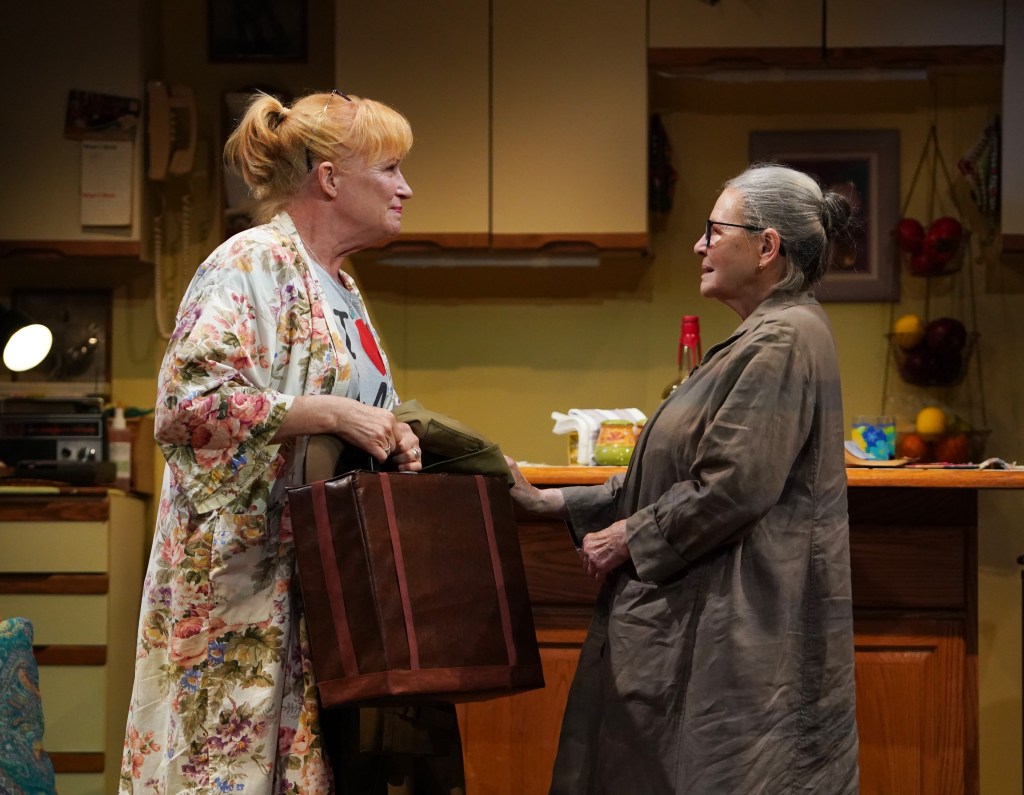
Part of the charm, humor and horror of Casewell Jr.’s Scene Partners, guided by astute director Rachel Chavkin, is that he playfully strings together scenes that appear haphazard but eventually have their own coherence, for a time. He stands familiar tropes (like logic and reality), on their heads, juxtapositioning them so that up is down, left is right. Then he turns them around again. Where is this lack of structural structure taking us, deep into the recesses of Meryl’s imagination? Or is this the stuff that dreams are made of and we all will wake UP back in Meryl’s kitchen, her bags ready to be unpacked?
This out of the box thinking is a good thing, for along the journey, we come to admire this unusual protagonist and find her humorous and adorable. Engaged, we watch as Meryl (turns out she was the first “Meryl” before the other actress), uses her determination and nimble mind, in whatever state it’s in to live in irony, freedom and her fantastic imagination. After all, what is reality anyway but quarks, particles, protons and electrons spinning beyond the speed of light so that what we think is a solid, is actually an illusion of spinning particles. What better place for Meryl to be than the land of illusions to add her own fantasies and realities to theirs! And lo and behold, she gets people out there to believe her! Could this happen as easily in New York City?
In a non-linear, fractured fashion, Meryl eventually spills the beans about her life which is being made into a film with her scene partners from acting class. Born in Los Angeles her father loved her, but her parents divorced and her mother ran away with another man, dragging her along. This stepfather fancied Meryl’s youth and expended himself on her, raping her for his good pleasure, though her mother and stepsister Charlize (the excellent Johanna Day), refused to acknowledge his sinister, sick lechery.

Masochistically continuing the abuse, instead of seeking freedom, we learn, she marries an abuser for life, named Stanley Kowalski. She explains, and we laugh, “I have no idea who’s responsible for feeding the details of my life to Mr. Williams for his little play.” Seeing her father relentlessly beat her mother, daughter Flora (Kristen Sieh), another victim, becomes an addict who depends on Meryl for food, clothing, everything.
Appalled that her mom is leaving her with no food in the house and abandoning her to confront her own addictions (principally self-destruction), Flora criticizes and insults Meryl for following her dreams. Meryl replies, “I have been acting all of my life! It’s about time I get paid for it!”
Indeed, I cannot imagine anyone else in this role, even Meryl Streep. In every breath of dialogue, Dianne Wiest appears to comprehend this victim turned hero, who is a combination of fantasist, Norman Vincent Peale practitioner and chronic traumatic encephalopathy survivor (battered brain syndrome). The power in her will to carve out her own reality out of life goal takes an inner truth and determination that Wiest so capably expresses. She has done similarly in each of the roles she performs, i.e. the sweetly accepting mother in Edward Scissorhands, the hysterical actress Helen Sinclair in Woody Allen’s Bullets Over Broadway (1994). In this ironic, wildly insentient role of Meryl, she achieves a pinnacle, if that is possible. I hope not, for she is imminently watchable and must do more stage productions.

When she points the gun at Josh Hamilton’s Herman, you believe she will shoot as she smiles at him. She’s happily dead serious. Thus, he believes her and he takes her on as his client, interested at her new approach and believability.
Additionally, at times Wiest’s Meryl is out of focus as if in medias res, in a chopped up segue which has no before and a questionable after, confused, wobbly, unsure of herself. This is especially so in the opening scene when she appears on camera (David Bengali’s video & production design), via projection. Styled with make-up and hair for her “close-up, Mr. DeMille,” her wide-eyed, silent response to the voice-over director’s, “Whenever you’re ready, sweetheart,” appears vacantly shocked. Is she amazed that she actually is where she said she would be? Or is something else going on, like a lapse in memory or identity? Wiest keeps her portrayal fresh, surprising, astounding. You can’t take your eyes off her.
Intentionally difficult to describe, Caswell, Jr.’s play hides in the shadows, as if throwing onto the stage anything that is humorous, upended and Wiest is up for. He twits our need to grasp onto something firm, like an arc of development that doesn’t involve Meryl’s strange train ride and sexual intimacies with a Russian conductor. And then there is a hop, skip and jump to “Horray for Hollywood!” and Meryl is threatening Herman Wasserman for auditions and parts with a gun. Speedily after that, she is in acting class with fellow actors.

Scene Partners succeeds because it cracks open another realm of being that is illogical and brashly, humorously defiant. It asks us to accept Meryl for who she is and what she learns about herself in her fragility, lapses, unreal realities and bits and pieces from movies that have clearly impacted her psyche. With help from a fine ensemble, Johanna Day’s grounded stepsister, John Hamilton, edgy and annoying in various roles, Kristen Sieh and others, the vignettes created and cobbled together form a life resurrected into one of purpose, joy and happiness. Does it truthfully matter if we don’t understand all elements about Meryl? Do we ever understand all elements about ourselves?
If we see through a prism the rainbow colors, some emphasized one day, others the next, maybe that’s a good thing. And if we follow dreams, even if only in our imaginations, perhaps that’s all that matters if we don’t harm anyone else. In fact, we may even bring others together pursuing the “unlikely” or the “ridiculous.”
Kudos to the creative team which includes Riccardo Hernandez (scenic design), Brenda Abbandandolo (costume design), Alan C. Edwards (lighting design), Leah Gelpe (sound design), Leah Loukas (hair, wig & makeup design), David Bengali (video & projection design) and others. And special kudos to the director, actors and Wiest, who helped to make Meryl’s world authentic in its wild and crazy configurations.
Scene Partners is a must-see for its zaniness and for Wiest’s dynamic, fascinating performance. For tickets go online https://vineyardtheatre.org/shows/scene-partners/
Susan Stroman Interview by Broadway Playwright Sharon Washington

On Friday, November 17th The League of Professional Theatre Women is sponsoring a free event at the Bruno Walter Auditorium at the New York Public Library for the Performing Arts at Lincoln Center (111 Amsterdam Avenue at 65th Street, New York). The public is invited to this special interview of Tony Award winning Director/Choreographer Susan Stroman about her brilliant career by Broadway Playwright Sharon Washington, at 6 p.m.
The event, which is open to the public, is part of the League of Professional Theatre Women’s (LPTW) Oral History Project in partnership with the Library and is a highlight of LPTW’s 41st season.

Susan Stroman, Director/Choreographer is a five-time Tony Award winning director and choreographer known for the Broadway musicals Crazy for You, Contact, The Scottsboro Boys, and The Producers. She is the winner of a record-making 12 Tony Awards including Best Direction and Best Choreography. Her work has been honored with Olivier, Drama Desk, Outer Critics Circle, Lucille Lortel, and a record six Astaire Awards.

For Broadway, she most recently directed and choreographed the new Kander & Ebb musical New York, New York and directed the new play POTUS: Or, Behind Every Great Dumbass Are Seven Women Trying to Keep Him Alive. This season in London’s West End, she directed and choreographed the revival of Crazy for You at the Gillian Lynne Theatre. Other Broadway credits include: Show Boat, Prince of Broadway, Bullets Over Broadway, Big Fish, Oklahoma!, Young Frankenstein, Thou Shalt Not, The Music Man, Big, The Frogs, and Steel Pier.
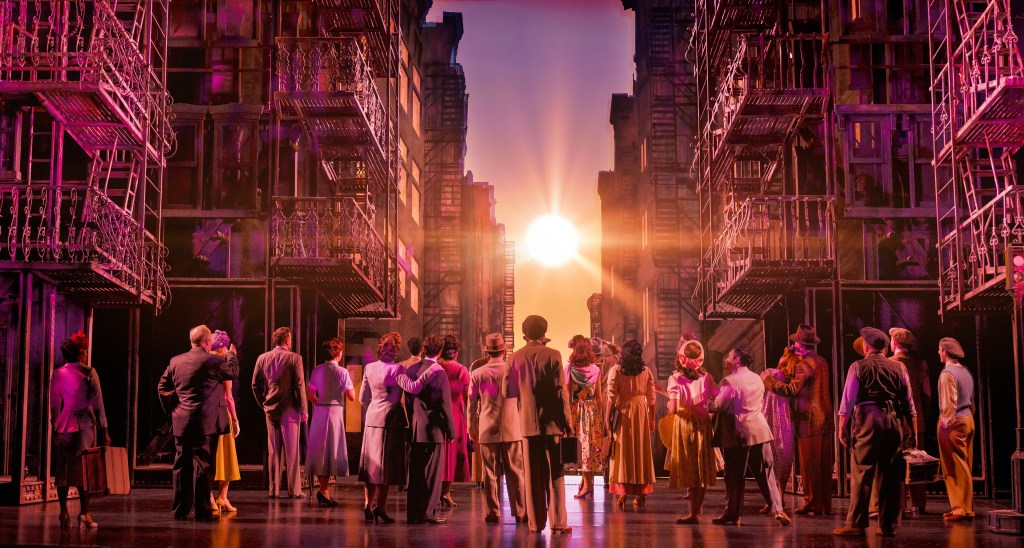
Off-Broadway she directed and choreographed Little Dancer, The Beast in the Jungle, Dot, Flora the Red Menace, And the World Goes ‘Round, Happiness, The Last Two People on Earth: An Apocalyptic Vaudeville, as well as The Merry Widow for The Metropolitan Opera. She has created ballets for New York City Ballet, Pacific Northwest Ballet, and Martha Graham. She received the American Choreography Award for her work in Columbia Pictures feature film Center Stage. She is the recipient of the George Abbott Award for Lifetime Achievement in the American Theater and an inductee of the Theater Hall of Fame in New York City. www.SusanStroman.com

Sharon Washington, Playwright/Actor was nominated for a 2023 Tony Award for Best Book of a Musical as co-writer of New York New York. She made her debut as playwright with her solo play Feeding The Dragon which played Off-Broadway at Primary Stages and was nominated for Outer Critics, Lortel and Audelco Awards. She was the Primary Stages 2017-18 Tow Foundation Playwright-in-Residence. The play was recorded as an Audible Original and selected as an Audible Essentials Top 100 pick.
As an actor, last summer Sharon was seen as Queen Margaret in the Public Theater/Shakespeare in the Park production of Richard III, broadcast on PBS Great Performances. Recent film and television appearances include Power Book III: Raising Kanan, Bull;the short film Birdwatching co-starring Amanda Seyfried, and the Academy-Award winning Joker. You may also recognize her voice as the narrator of several documentary series for Animal Planet, Discovery and NOVA.
On Broadway Sharon appeared in The Scottsboro Boys musical. Off-Broadway credits include Dot (Vineyard Theater); Wild with Happy (Public Theater/NYSF – Lucille Lortel nomination and Audelco Award among many others; and numerous regional theaters around the country.
Sharon holds an MFA from the Yale School of Drama and a BA from Dartmouth College.
To attend this event, please RSVP at this link: https://www.nypl.org/events/programs/2023/11/17/league-professional-theatre-women-susan-stroman
‘The Refuge Plays,’ Nicole Ari Parker and Daniel J. Watts are Smashing

Nathan Alan Davis’ The Refuge Plays, directed by Patricia McGregor, chronicles a family’s survival with a play whose structure employs an interesting twist. The production, a world premiere, begins in the present and flashes backward in generational segments to 70 years prior, spanning four generations. Though the three plays or segments may stand alone, the characters repeat in each and the thread of the main character’s resilience is the principle linchpin around which the events revolve.
In its world premiere presented by the Roundabout Theatre Company in association with New York Theatre Workshop, The Refuge Plays unspools its epic saga during three hours and twenty minutes, and two intermissions. It runs until November 12th at the Laura Pels Theatre.
In Davis’ epic of family bonds happening away from any social construct after World War II, we note how the reigning matriarch and great, grandmother Early wields subtle power and presence despite her advanced years. The superb Nicole Ari Parker is a standout in the role as she evokes the elderly, middle aged and teenage Early.
Contrasted with her great grandson Ha, Ha (JJ Wynder), who expects others to do for him, Early takes it upon herself to chop wood for the stove which also provides heat, despite her granddaughter Joy’s protests that her seventeen-year old son Ha Ha should be doing the chopping, which he says he doesn’t know how to do.

From that action alone the clue is given that Early’s age belies her life force and vibrancy. Living in this cabin in the woods off the grid, which she and husband Crazy Eddie (the superb Daniel J. Watts), built with their own hands decades before, she makes the best of her roughly-hewn life, which she shares with family. Remaining isolated from culture, technological developments and progress, they have managed to find a measure of comfort and peace that society doesn’t offer. The inference is that is perhaps that is why they are still alive. Though not living in the lap of luxury, they want for nothing. What carries them onward are the the authentic community and relationships they forge with each other.
Davis symbolizes Early as the seminal earth mother who sustains her family’s survival, which we understand watching the characters in the present and their movement into the past. From the outset, we note the elderly Early is determined, feisty, funny and authentic no nonsense with family members.
Though she doesn’t get along with her son’s wife Gail (Jessica Frances Dukes), she allows her to stay with them for the sake of their daughter Joy, who once left then came back. Making cryptic comments at times, Early puts up with Gail, though it is obvious she approves of her granddaughter for what they share. Both mourn Walking Man (Jon Michael Hill), who we hear died in a freak accident when a cow crushed him with its weight as he slaughtered it.
In the first segment, “Protect the Beautiful Place,” Davis sets the tone and presents the four generations of family members living in a two room cabin, cramped together, not seeming to mind the lack of personal and private space. This cabin that they call home is a refuge from all that would destroy and divide them, we realize, by the play’s conclusion.
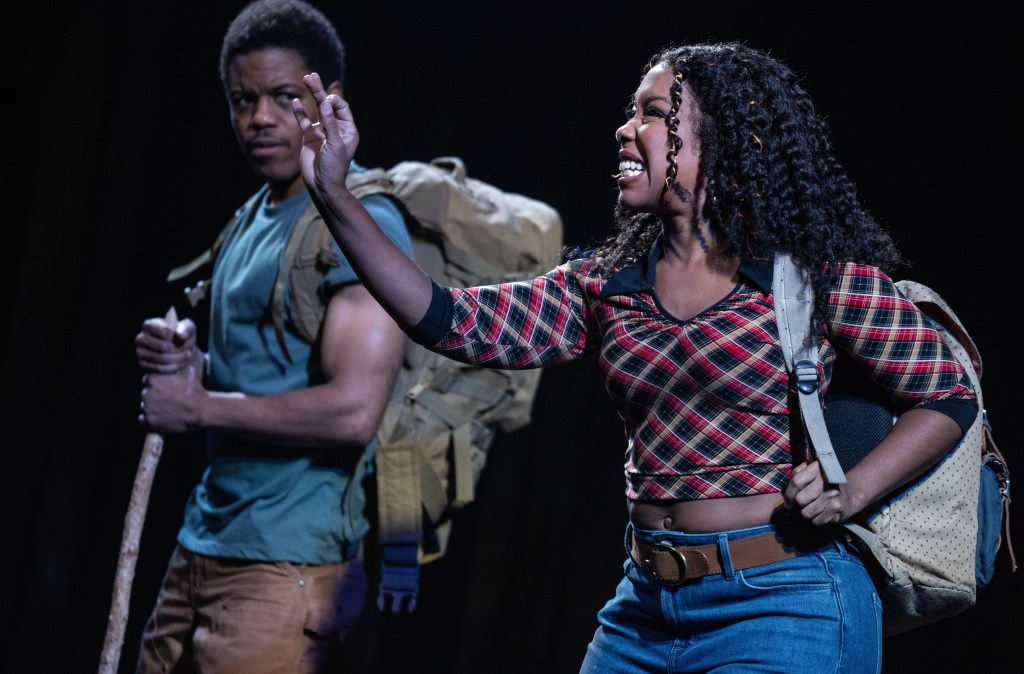
Arnulfo Maldonado’s set design reveals the rawness of their life that indicates economically that they are lower middle class. Only Gail has her own bedroom. Early, Joy and Ha ha sleep together in the living room in a chair, a sofa and the floor. In the same room they cook and eat with spare utilitarian minimalism. The outhouse is around the corner and in the distant past, a younger Early took the water in pails up from the river.
In “Protect the Beautiful Place,” the supernatural eerily wends its way into the family’s routine as they wake up and get ready for their day. The spirit of Gail’s husband Walking Man is a welcome visitor. He moves between the veil of life and the afterlife, and all know of his presence and communicate with him. Recently, he has appeared and announced to Early that Gail will pass on and join him. The family, even Ha ha, accepts this notion, though Gail resists it. During the course of the family interactions, we learn that the women hope that Ha Ha finds a woman to love and have children with to continue the family’s bloodline, though he is only seventeen. We also learn clues about the family history that Davis clarifies in subsequent segments.
When Walking Man visits Gail in a dream, he helps her to make up her mind about joining him. The eventual result occurs through an interesting sequence of events. Thus, we see that the family, encouraged by Early, has created its own myths and folklore which is as natural to them as breathing. Importantly, that one generation has exceeded another is striking and a testament to Early’s resilience and survival instincts. By the conclusion of The Refuge Plays, we understand how Early’s youthful struggles strengthened her, gave her courage and fostered the thriving of this family whose dominance will be taken up by the innocent, clever, book-smart Ha Ha with his new found girlfriend.
The second part, “Walking Man” features Early’s son after he leaves home, wanders to Alaska and other parts of the world, then returns home to his mother and father. Maldonado’s sets include the outdoor space in front of the cabin which is indicated by a front door. During the course of Walking Man’s return home, he talks to his father’s brother, uncle Dax (the humorous Lance Coadie Williams), and two spirits who are his grandparents Clydette (Lizan Mitchell) and Reginald (Jerome Preston Bates). Through them he discovers the truth of his legacy and why he has no birth certificate, why his mother raised him to be self-sufficient and why he is compelled to wander the earth, which he doesn’t understand.

After he learns this truth, Walking Man doesn’t have the heart to confront his mother with the specific details, though he confronts Crazy Eddie who he has accepted as his father. Angry, Walking Man intends to take revenge on the world and kill anyone he finds who exhibits the wickedness of his blood father. Early, stalwart, trusting in God, doesn’t insist with her son, but makes a suggestion and leaves him to his own decisions.
The segment ends with a new influence in Walking Man’s life, his future wife Gail, who the spirits have brought to him. We know this because of the lighter which Gail has been given by Clydette and Reginald and which she uses to light Walking Man’s pipe. The lighter, exhibited by Gail in the first segment which Ha Ha’s girlfriend Symphony (Mallori Taylor Johnson), picks up and uses, reveals the spiritual and ancestral influences that surround this family and guide it to peace and security.
The third segment, “Early’s House” flashes back to Early as a teenager living in the forest with her baby, Walking Man. Through her conversations with Watts’ Crazy Eddie who seeks her out and brings her food, we discover how she has survived through the winter after bearing her child alone. The relationship they develop over the course of the segment is powerfully drawn by Davis and acted with smashing resolve by Parker and Watts. As Crazy Eddie draws her out of herself so she trusts him, similar to how a feral animal is wooed by a well-meaning animal lover, Early reveals herself.
The place by the river she has chosen to be her sanctuary to receive respite and peace. Because she has been forbidden to return home, she determined to turn her back on society and her parents and make it in the woods. Nature has embraced her and with faith in God and the supernatural, she has received sustenance and wisdom to survive with Walking Man.
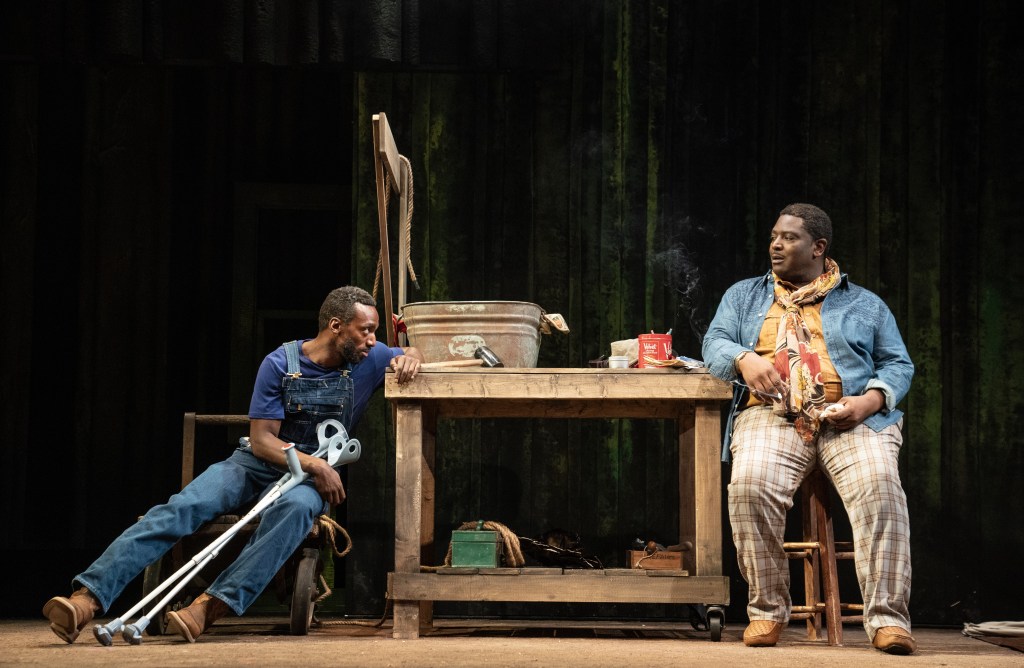
Parker’s amazing portrayal of the young Early reveals the depths of a woman who will fight against all odds to live and care for her child whom she loves. Ironically, there is more peace in nature than there could be found back in her home and former lifestyle which she has renounced to keep Walking Man with her.
The gentle Crazy Eddie is the only one who seeks her out and attempts to help her. Because he, too, has been wounded like Early, hobbled by extensive war injuries, she pities, accepts and trusts him. Both need one another and gradually they receive each other’s help and care. And it is in this place by the river that Eddie and Early sanctify their union and build a rudimentary cabin where they will live and raise Walking Man, whom Eddie unofficially adopts as his son.
“Early’s House” is poignantly written and acted with spot on authenticity. Davis brings together all of the character threads and elements so that we realize how Early compelled herself to forge a family which burgeons and will be sustained past the seventy years that we witness this saga. Excellently directed with fine performances all around, The Refuge Plays is fascinating especially in its structure and poetic, striking dialogue.
A fault at the outset was in the sound design which was corrected in the latter segment. Props go to Emilio Sosa’s costume design, Stacey Derosier’s lighting design, Earon Nealey’s superb hair and wig design and J. Jared Janas make-up design.
For tickets to the unique production, The Refuge Plays, go to their website https://www.roundabouttheatre.org/get-tickets/2023-2024-season/the-refuge-plays/performances
‘Gutenberg! The Musical!’ Featherbrained, Loopy, Josh Gad and Andrew Rannells Shine!

If you are looking for laughs and ridiculous fun, Gutenberg! The Musical! is the show for you. Thanks to the superbly wacky performances in this farce where Josh Gad and Andrew Rannells make a twosome of bat-sh*t silliness, Gutenberg! is a standout. Currently running at the James Earl Jones Theatre with one intermission in a two hour time slot, the zaniness is a treat to take you out of yourself. And who doesn’t need to “forget your troubles and get happy” in these times that try all of our souls?
The premise is well known: amateurs strike out for Broadway, draw in by the allurement of the “great white way.” In this iteration, two guys from New Jersey decide to toss the dice and bankroll a musical they’ve written to pitch it at a backer’s audition they set up at the James Earl Jones Theatre for a one night rental. Because they have to scrounge up the money by using the last dime of their inheritances, they can only afford a bare bones cast. Both play a total of twenty parts. They never change costumes except for hats in bold, black print which state their roles. For accompaniment they’ve hired a three-piece, local band that plays weddings, bar mitzvahs, retirement parties, etc.
Their thought is if they are good enough (ah, there’s the rub), they will get funding from producers to mount their musical on Broadway. Thus, Gutenberg! is theater “vérité,” happening with immediacy. Sitting in the audience, we are told, are various producers who’ve received invites. Thus, the audience bears witness to whether or not these Jersey guys have what it takes to sizzle and shine or fizzle and die on the vine of their dreams.

Scott Brown and Anthony King (book, music and lyrics), launch the show into the stratosphere of inanity. Not only are Bud (Josh Gad) and Doug (Andrew Rannells) below average talents, they have little expertise about what makes a musical or any show for that matter. Furthermore, their lyrics, rhymes and meaning rival the simplicity of Dr. Seuss.
But all is not lost. Interestingly, Dr. Seuss is extremely popular because it capitalizes on being silly. Additionally, the wild duo are winning and lovable. What Bud and Doug lack in talent and expertise, they make up for with enthusiasm, joie de vivre and hilarious, charming schtick.
As a side note, Gad and Rannells, who haven’t been together since Book of Morman, are terrific in curtailing their exceptional talent just enough to be a tad off, making their portrayals as Bud and Doug even funnier. Of course, this adds to the inside joke about who they really are and what they are capable of. Indeed, the audience was tuned to the inside jokes.

Gad and Rannells have fun playing it to the hilt with tongue in cheek direct addresses to the audience and a shattering of the fourth wall, as they move along the plot about a dry subject, the life and times of Johannes Gutenberg, inventor of the printing press. As it turns out Gutenberg is a topic about which little is written and much can be embellished and fictionalized. That is why Bud and Doug have found it to be a glorious subject for a “fantastic” musical.
Ironically, referring to their content as historical fiction, they share little factual information about the man and the time. In falling back on fabrication, which currently is trending in political news and the radical conservative, nihilistic, QAnon wing of the “Republican” Party, Bud and Doug’s fantastic tale is hugely satiric. It indirectly points the finger at the last seven years of Trumpism, when the playing field of misinformation became normalized through the efforts of conservative media. Lies of omission, conspiracy theories and sheer made-up junk swanned as legitimate and newsworthy.

Take for example reports on Italian space lasers causing the 2020 election to be stolen from former president Donald Trump. (Look up recently convicted Trump lawyer Sidney Powell, if my reference to Italian space lasers eludes you.) Such theories are inane fabrications such as those found in this musical.
On the other hand for all its guffaws, belly laughs and puerility, Gutenberg! is as serious as a heart attack. If you peek underneath the abundant blanket of hysteria, it actually makes grave points.
That Scott Brown and Anthony King convert the momentous occasion of the birth of Gutenberg’s printing press, a turning point in history, into a farce that nuances themes about the perils of illiteracy, is profound as well as riotous. In truth illiteracy and “not reading books” is disastrous, when considering the culture wars of the South and their twisted turn into banning books. Making indirect inferences to the QAnon pride of ignorance against the elitism of the educated, Gutenberg! twits us with its ridicule about our present time.

This is especially so with the musical’s humorous, historical reminder of how ignorance leaves an open door for the power hungry. In its Act II arc of development, after the printing press has been invented, the villainous, devilish monk completes his scheme to target Gutenberg and destroy his press. Representing the power of the church which historically exploited the ignorant and illiterate, we understand the benefits of keeping the uneducated, non-reading masses brainwashed, oppressed and afraid.
In portraying the monk with a nefarious purpose, Gad is riotously funny. He pings all the notes of the stereotypical wicked, leaving the audience LOL. Of course, his crafty portrayal stings, if one moves beyond the laughter to the quiet message underneath. Despotism only works well with the uneducated, non-reading, non-thinking masses who are often too distracted to distinguish the truth from fiction and lies.
Throughout the winding action which involves anti-semites, Gutenberg’s fictional German town of Schlimmer, a wine press becoming a printing press, a pretty, violent white cat named Satan, a maid named Helvetica, pencils that kill, Brechtian breaks and commentary about the musical, and so much more, Gad and Rannells create their comedic, whirlwind sketches at Alex Timber’s breakneck pace. Seamlessly stirring the narrative segues, then plunging back into the action as they don the various hats of the characters they portray to trigger spot-on caricatures with their voices and gestures, they send up the “politically warped” stereotypes and spin this delightful musical farce with lightening speed.
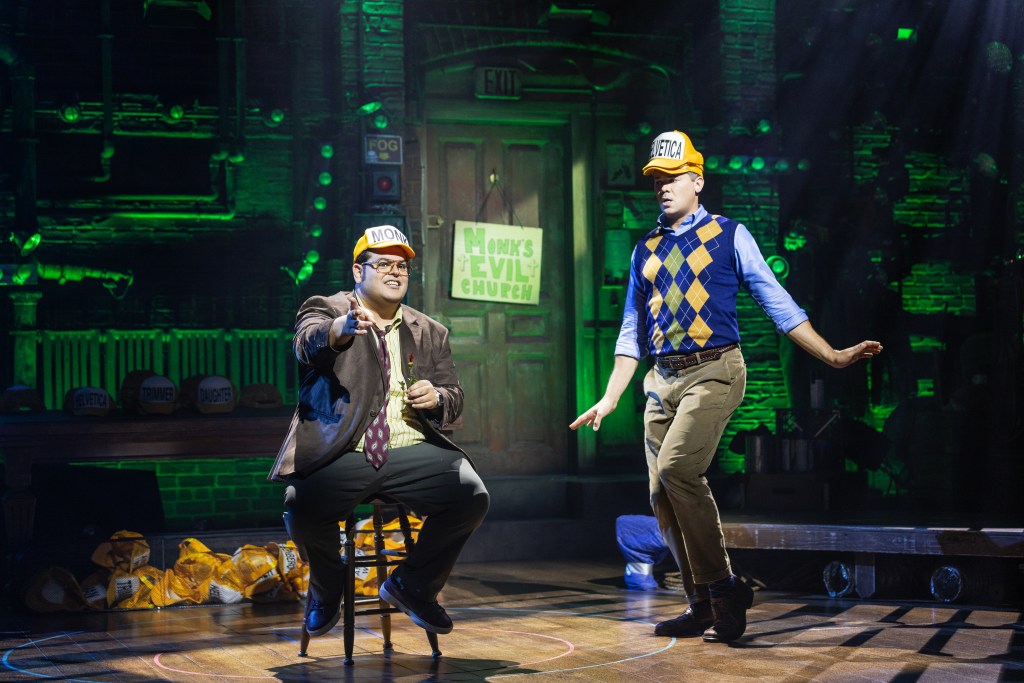
We have been led into the “secret world” of a backer’s audition for a production that is a loser and a winner. Maybe with a little revision, a tweak here and there, a consolidated cast, a reworking of the more incredible elements, a producer will envision its commercial vitality? Maybe not. You have to see it to find out if the producers line up to sign on or hold their noses and back out quietly.
Importantly, during the process, Gad’s Bud and Rannells’ Doug steer the audience from joke to quip to zany song with an aplomb that is exhaustive and exhausting. Assisted by Scott Pask’s scenic design of the stripped down stage, Emily Rebholz’s costume design which is appropriate for Doug and Bud’s dorkish affability, Jeff Croiter’s lighting design and Tommy Kurzman’s hair design, the actors fulfill Timber’s tone and vision for this seemingly facile, but humorously febrile, profound musical. M.L. Dogg and Cody Spencer’s sound design is spot on; I could hear every word.
Kudos goes to the orchestra which includes Marco Paguia (conductor/keyboard 1), Amanda Morton (associate conductor/keyboard 2) and Mike Dobson (percussion). Additional arrangements are made by Scott Brown and Anthony King. T.O. Sterrett is responsible for music supervision, arrangements and orchestrations.
This is one to see for the fun of it. It is also a sardonic criticism of our time, which, thankfully, doesn’t slam one over the head with pretentious probity. For tickets go to the Box Office at 138 West 48th Street or visit their website online https://gutenbergbway.com/ It closes January 28th.
‘Jaja’s African Hair Braiding,’ Hysterical, Fun, Profound
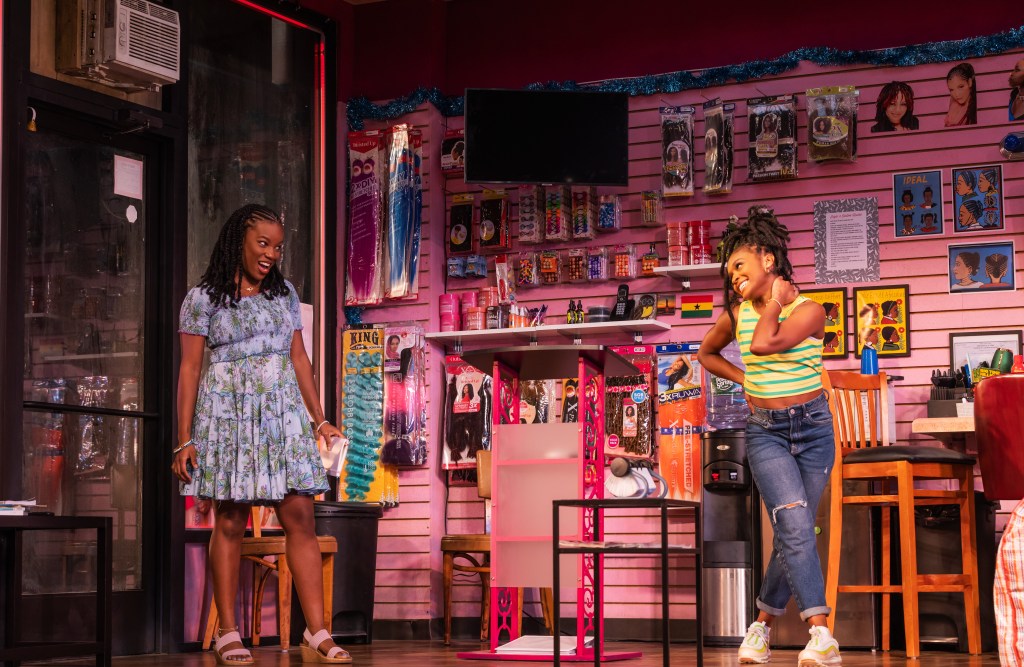
Jaja’s African Hair Braiding by Jocelyn Bioh in its world premiere at the Manhattan Theatre Club (Samuel J. Friedman Theatre), is a rollicking comedy with an underlying twist that, by the conclusion, turns as serious as a heart attack. Bioah’s characters are humorous, quick studies that deliver the laughs effortlessly because of Bioah’s crisp, dialogue and organic, raw themes about relationships, community, female resilience and the symbolism of hair braiding which brings it all together.
The setting is in Harlem, at Jaja’s Hair Salon where African hair braiding and the latest styles are offered. For those white gals and guys who envy the look of long lovely extensions but are too afraid to don them, it is understandable. You have to have a beautiful face to sustain the amazing, freeing look of long braided tresses that you can fling with a gentle or wild toss, evoking any kind of emotion you wish.

During the course of the play, we watch fascinated at the seamless ease with which the actors work their magic, transforming otherwise unremarkable women into jaunty, confident and powerful owners of their own dynamic presentation. While we are distracted by the interplay of jokes and mild insults and gossip, the fabulous shamans weave and work it.
In one instance, Miriam (the fine Brittany Adebumola) takes the entire day to metamorphose her client Jennifer (the exceptional Rachel Christopher). Jennifer comes into the shop appearing staid, conservative and reserved with short cropped hair that does nothing for her. But once in Miriam’s chair, something happens beyond a simple hairdo change.
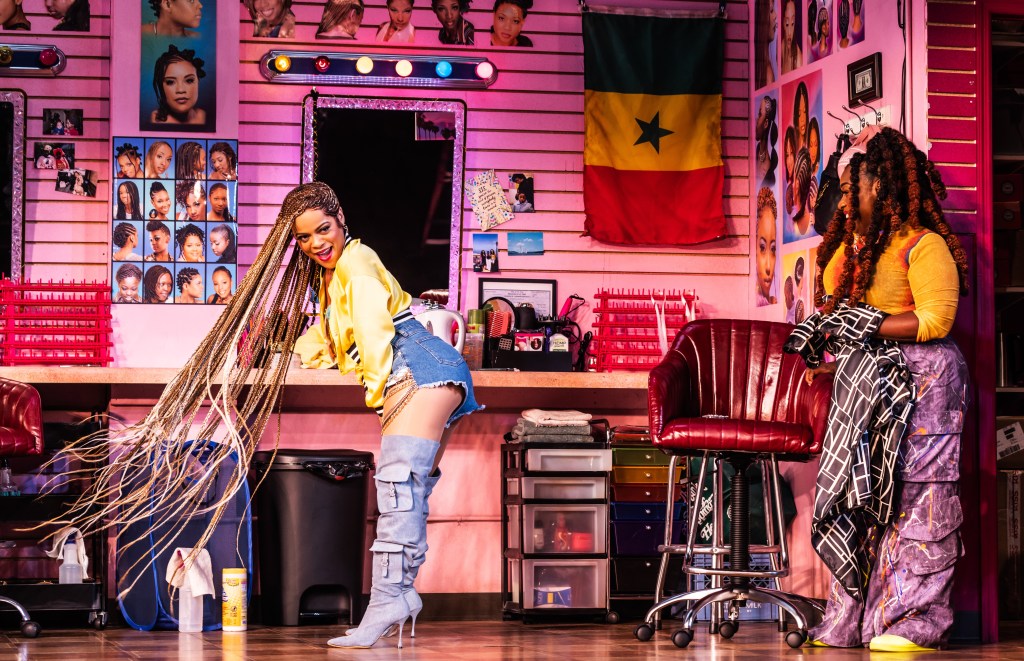
After MIriam is finished discussing her life back in Sierra Leone, which includes the story of her impotent, lazy husband, her surprise pregnancy and birth of her daughter by a gorgeous and potential future husband, and her divorce from the “good-for-nothing”, paternalistic former one, Jennifer is no longer. Miriam has effected the miraculous during her talk. Jennifer has become her unique self with her lovely new look. As she tosses her head back, we note Jennifer’s posture difference, as she steps into the power of how good she looks. Additionally, because of Miriam’s artistry, Jennifer is the proud receptor of a new understanding and encouragement. She has witnessed Miriam’s courage to be open about her life. If Miriam can be courageous, so can she.
Jennifer leaves more confident than before having taken part in the community of caring women who watch each other’s backs and hair, which by now has taken on additional symbolic meaning. Incredibly, Miriam works on Jennifer’s braids the entire play. However, what Jennifer has gained will go with her forever. The dynamic created between the storyteller, Miriam, and the listener, Jennifer, is superb and engages the audience to listen and glean every word they share with each other.
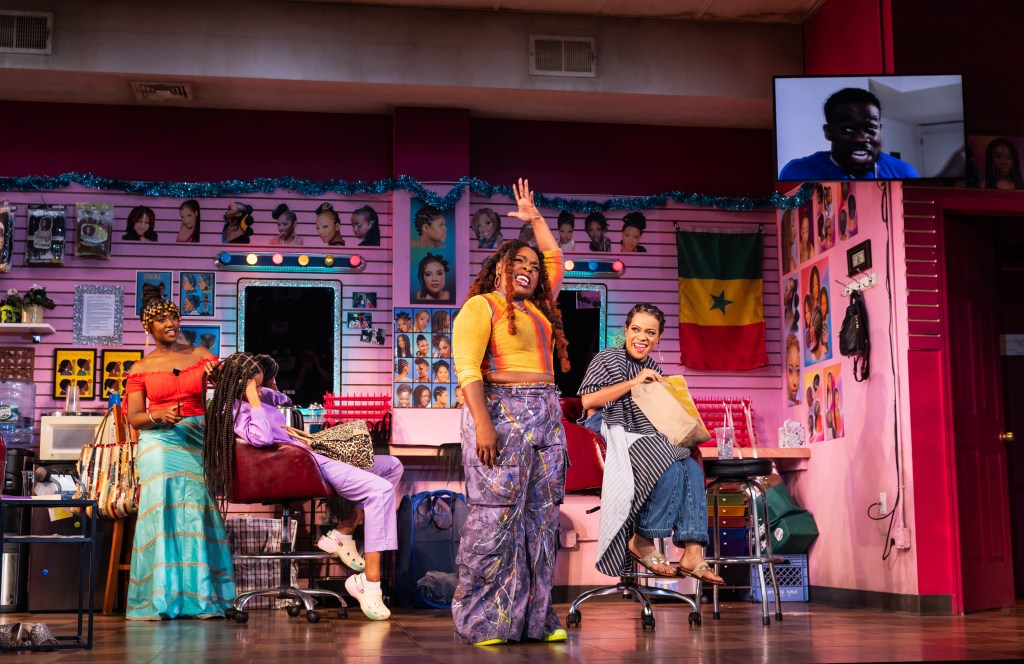
On one level, a good part of the fun and surprise of the production rests with Bioh’s gossipy, earthy, forthright characters, who don’t hold back about various trials they are going through involving men, who exploit them. Nor do they remain reticent if they think one of their braiding colleagues has been surreptitiously stealing their clients, as Bea accuses Ndidi of doing in a hysterical rant
Another aspect of the humor deals with the various clients who come in. Kalyne Coleman and Lakisha May each play three roles as six different clients. They are nearly unrecognizable for their differences in appearances. They change voices, gestures, clothing, mien, carriage and more. For each of these different individuals, they come in with one look and attitude and leave more confident, happier and lovelier than before.
Portraying three vendors and James, Michael Oloyede is hysterically current. Onye Eme-Akwari and Morgan Scott are the actors in the funny Nollywood Film Clip that Ndidi imitates.

For women, hair is key. Bad hair days are not just a bad joke, they are a catastrophe. Bioh capitalizes on this embedded social, cultural more. Presenting its glories, she reveals the symbolism of “extensions,” and “new appearances” as they relate to uplifting the spirit and soul of women who are required to look gorgeous.
Above all, Bioh elevates the artists whose gifted hands enliven, regenerate, encourage and empower their clients. Along with Miriam (Brittany Adebumola), these include Ndidi (Maechi Aharanwa), Aminata (Nana Mensah) and Bea (Zenzi Williams). Sitting in their chairs, under their protection, trusting their skills at beautification, we recognize the splendid results, not only physically in some instances but emotionally and psychically.
The only one who isn’t an African braiding artist is Marie (Dominique Thorne). She is helping out her mother Jaja (Somi Kakoma), who owns the salon and who is getting married that day, so she can get her green card for herself and Marie. Jaja who appears briefly in wedding garb to share her excitement and happiness with the women who are her friends, then goes to the civil judge to be married. However, Marie can’t be happy for her mother. Likewise, neither can old friend Bea, who has told the others the man Jaja is marrying is not to be trusted.

Nevertheless, the point is clear. Within the shop there are artists who are working their way toward citizenship. And Miriam is saving money to bring her daughter to the US. Though Bioh doesn’t belabor the immigration issues, but instead, lets us fall in love with her warm, wonderful characters, it is a huge problem for the brilliant Marie, who has been rejected from attending some of the best colleges. Her immigration status is in limbo as a “Dreamer.”
And like other immigrants, she is living her life on hold in a waiting game that is nullifying as well as demeaning because, as Jaja points out repeatedly to her, she can be a doctor or anything she wants. Her daughter, Marie, is brilliant, ambitious and hard working. Taking over the African hair braiding salon is not good enough. She can do exploits. But without a green card, she can do nothing.
Directed by Whitney White whose vision for the play manifests the sensitivity of a fine tuned violin, the play soars and gives us pause by the conclusion. The technical, artistic elements cohere with the overall themes that show the hair salon is a place of refuge for women to commiserate, dig deep and express their outrage and jealousies, then be forgiven and accepted, after a time. It is a happy, busy, brightly hued and sunny environment to grow and seek comfort in.

David Zinn’s colorful, specific scenic design helps to place this production on the map of the memorable, original and real. This salon is where one enjoys being, even though some of the characters snipe and roll their eyes at each other. Likewise, Dede Ayite’s costume design beautifully manifests the characters and represents their inner workings and outer “brandings.” From her costumes, one picks up cues as to the possibilities of what’s coming next, which isn’t easy as the production’s arc of development is full of surprises.
Importantly, Nikiya Mathis’ hair & wig design is the star of the production. How the braiding is done cleverly with wigs so that it appears that the process takes hours (it does) is perfect. Of course the styles are fabulous.

Kudos to the rest of the creative team which includes Jiyoun Chang (lighting design), Justin Ellington (original music & sound design), Stefania Bulbarella (video design), Dawn-Elin Fraser (dialect & vocal coach).
This is one to see for its acting, direction, themes and its profound conclusion which is unapologetic and searingly current. Bioah has hit Jaja’s African Hair Braiding out of the park. She has given Whitney White, the actors and the creatives a blank slate where they can enjoy manifesting their talents in bringing this wonderful show to life. It is 90 minutes with no intermission and the pacing is perfect. The actors don’t race through the dialogue but allow it to unfold naturally and with precision, humor and grace.
For tickets go to the Box Office on 47th Street between 7th and 8th Avenues or their website https://www.manhattantheatreclub.com/shows/2023-24-season/jajas-african-hair-braiding/?utm_source=google&utm_medium=cpc&gclid=CjwKCAjwvfmoBhAwEiwAG2tqzDaZkpYxm9EVbEs9yQ0hCPDF5gTyx9a8iy4yFCkwZxfd3skrmdD8oxoCAfgQAvD_BwE
 CAROLE DI TOSTI