‘Death of a Salesman,’ Starring Wendell Pierce, Sharon D Clarke in Dynamic, Powerful Performances
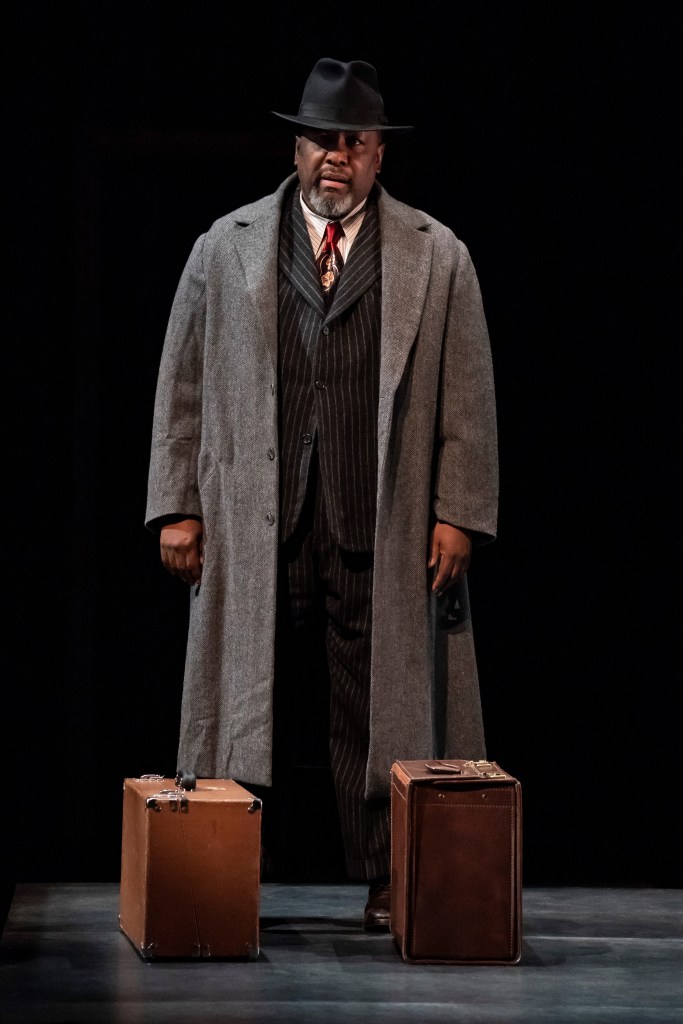
Director Miranda Cromwell has given Arthur Miller’s Death of a Salesman another go round in a revival elucidating the most salient features of Miller’s modern tragedy. Cromwell’s version, currently at the Hudson Theatre, reminds us that as a classic of the 20th century, the play’s themes are timeless, and Loman’s fall is representative of what the powerless man experiences every day of his life.
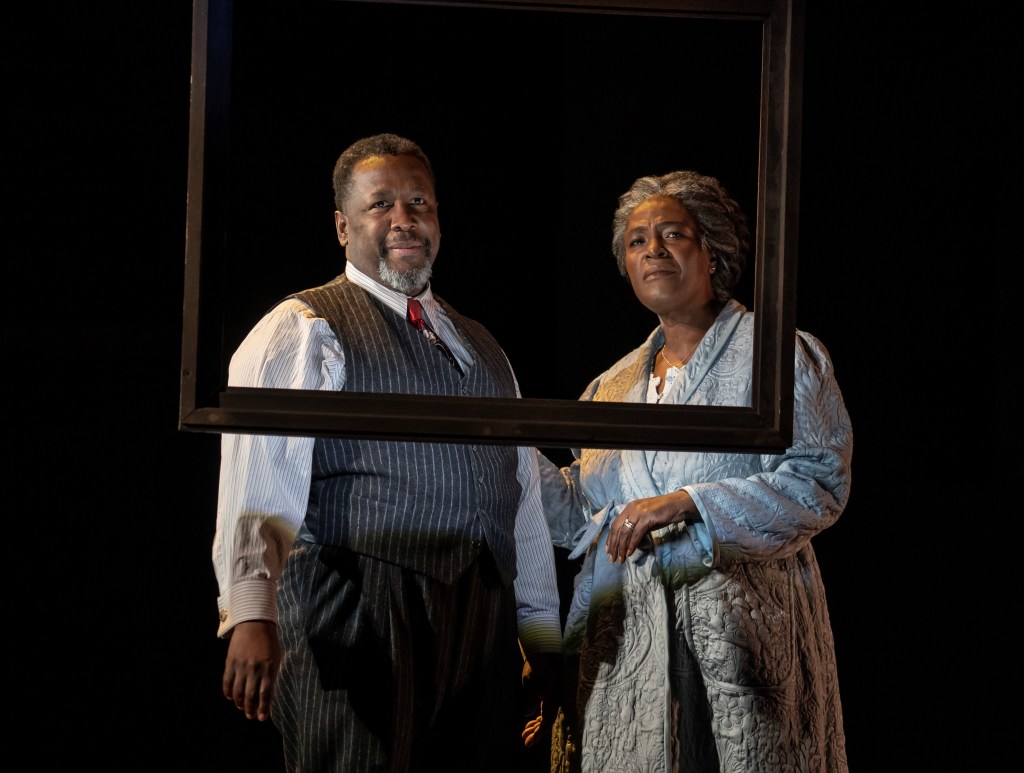
Starring the dynamic, stirring Wendell Pierce as Everyman Willy Loman and Sharon D Clarke as wife Linda, the cast and creatives provide a dramatic and thought provoking view of Miller’s American family. With tremendous currency Cromwell’s version explores the heartfelt tragedy of the diminishing patriarch whose foibles are easily identifiable and relatable to our lives.
From beginning to the conclusion Cromwell shepherds her remarkable cast in a unique reexamination of Willy and Linda Loman, a husband and wife team who cling to falsehoods and illusions for the sake of each other to get to the next day. Fatefully, Willy’s end is irrevocable and Miller’s play expertly imagined by the director reveals the steps which ensure that Willy’s train wreck life moves with increasing devastation to come to the “end of the line,” Willy’s complete breakdown and suicide. Miller’s characterizations are heightened in this revival brought to life from moment-to-moment by the ensemble all of whom are spot-on sensational.
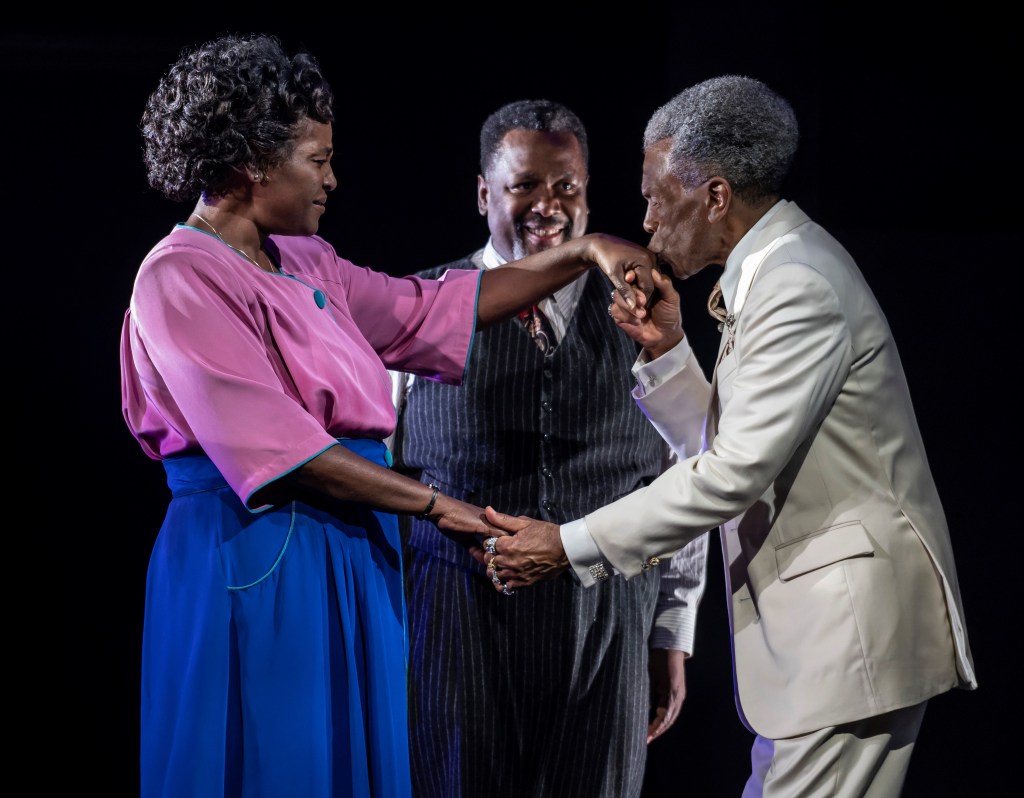
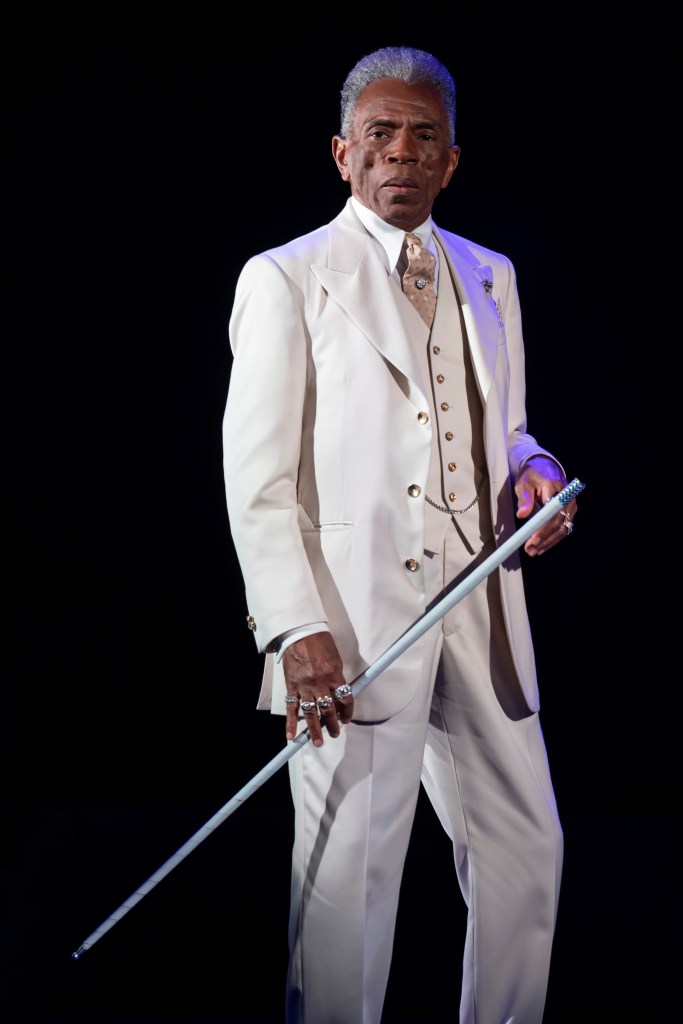
Particularly wonderful, Pierce’s Loman spools out Willy’s loss of power, self-esteem and confidence as he clings to his fantasies and is beaten by memories of his past failures. These become more stark and tormenting until until his ghostly guide, the wonderful, stately André De Shields as Ben, encourages him toward the “proposition” (a life insurance payout) he can’t refuse.
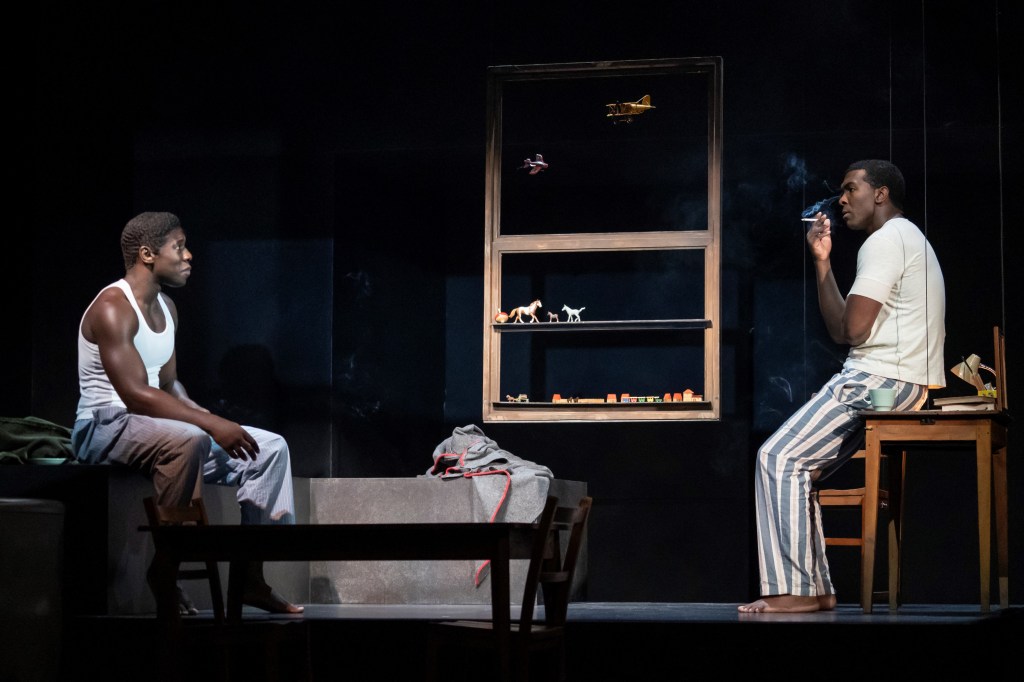
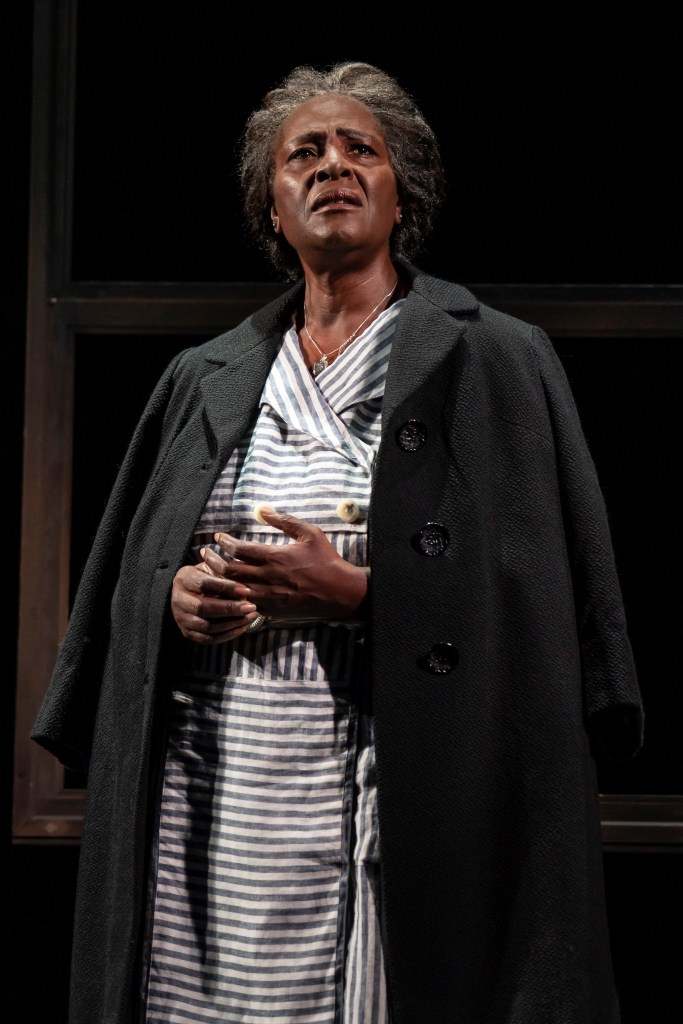
Cromwell’s, staging, Jen Schriever’s lighting design and Mikaal Sulaiman’s sound design relay Willy’s searing flashback visions. Pierce’s Willy makes these physical as if they slash his mind so that he is forced to respond with fury, as he attempts to stop the fears and guilt that drive him toward insanity. Clarke’s Linda kindly couches Willy’s lies and bombast with her own obfuscations and illusions. She is frustrating and infuriating for pandering to Willy’s babble. That Pierce’s Willy ignores and berates her and Clarke’s Linda puts up with him out of love is typical of such relationships of endurance and suffering. However, it becomes obvious that Linda fronts Willy and hides her underlying hopelessness and fear which she confesses to their sons Biff (Khris Davis) and Hap (McKinley Belcher III). Thus, Linda is two people. The loving wife to her husband who puts up with his abuse. And the truthful mother who upbraids her children and seeks their help with her ill husband.

Indeed, Linda knows Willy is desperate and on the brink of suicide. However, she spins her own conundrum. Fatalistically she watches Willie, expecting him to finish himself off in the basement. Yet, at the conclusion she dupes herself into believing Biff exacerbates and is the cause of Willie’s torments. Believing that Biff and Hap’s absence will relieve Willy and he will be “OK,” her delusion contributes to Willy’s suicide as she “lets him go.” Even at the end, she can barely confront what she knew was coming all along. She questions it. Clarke’s Linda can’t process his suicide and is still oblivious to the lies he’s told her to glorify his life. This is so even after Biff in his revelation scene exposes the family as predicate liars. Clarke’s Linda is numbed to realizing the truth of who Willie is. Throughout Clarke’s vital acting reveals a woman at sea going only so far in her realizations, then pulling back just short of making a difference for her entire family. Pierce and Clarke authentically create the type of marriage that reveals how blind love is, especially when it is slathered with lies and illusions.
The morass Willy and Linda have built for each other and their children has so entangled the family, they cannot bear to be around each other for the continuous gaslighting and exaggerations. Willy responds to thirty-four-year-old Biff in extremes ranging from insult to encouragement and mostly argument if Biff doesn’t agree and bow to his “judgment.”
Pierce’s Willy pitted against Davis’ vibrant and soulful Biff works with authentic poignance. Revealing their relationship built on lies, Cromwell with acute minimalism sets up the climactic flashback when Biff, encouraged by Willy to ignore his studies, fails math and runs to Willy in Boston for help. Finding Willy with another woman devastates Biff. It demeans Linda and shows Willy’s life with family is a sham since he can’t uphold his marriage vows. In a dynamic scene between the two actors Pierce’s Willy uses pretense to con his son and overwhelm Davis’ Biff from understanding the facts. But Biff realizes who his father is and can’t forgive him, feeling terrible for Linda. Crying, Biff leaves, forever sealing Willy’s guilt that he has destroyed Biff’s life and proven himself a fraud.

For his part Belcher III’s Hap is a convincing “chip off the old block,” on steroids. He follows in Willy’s footsteps and abides in his own delusions that he’ll make a success of himself, though he can’t admit he is at a low rung in the hierarchy of his company. Belcher III and Davis work hand in glove as the two brothers, one selling himself 24/7, the other seeking his identity and finally discovering it. Biff, the hero of Miller’s play because he faces the truth and confronts the family with their lies, courageously admits he has hit rock bottom. Too resounding for Willy to accept, it is one more torment slashing Willy’s mind. Davis, especially as the truthful Biff in the last scenes is superb.
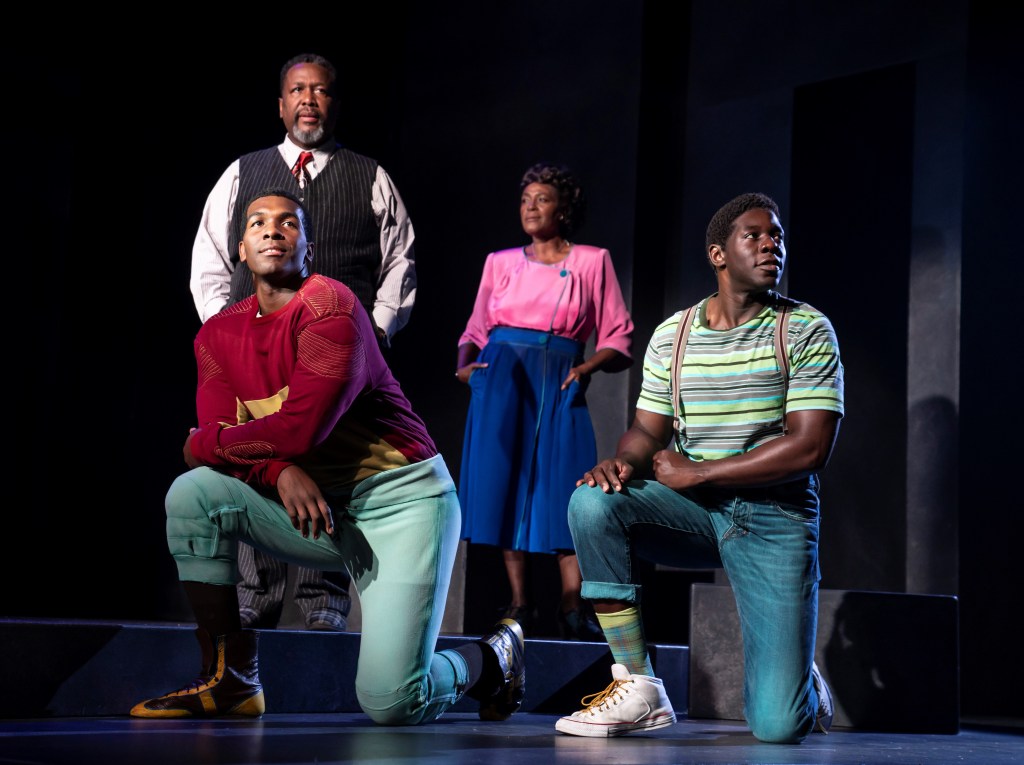
During the flashbacks, Hap, Biff, Linda and Willy enliven the family interactions and dynamics along with neighbor Charley (Delaney Williams in a terrific portrayal), and son Bernard (Stephen Stocking masters the young and the older Bernard with solid acting chops). Charley and Bernard are admirable and kind; their decency in the face of Willy’s insults is smashing. Williams and Stocking are another team to round out this fine ensemble, all of whose work is authentic and beautifully synergistic.

For example Pierce and Davis’s performances along with Lynn Hawley as The Woman perfectly render Biff and Willy’s destruction of their relationship with the awkwardness of a naked expose, as Biff and The Woman catch up Willy blabbering in his lies. Also, as we do during the flashbacks of the family, including the high school days with the excellent Williams and Stocking, we follow, engrossed with the Loman family as we “get” how the fabric of their lives unravels, and we realize why Willy’s suicide comes when it does.
Willy’s breakdown is Pierce’s gradual tour de force with each flashback, each event showing how Willy is brought closer to the brink until he can take no more. Miller reveals that much could have happened to stop him. However, the obfuscations and self-delusions are so great, only Biff could help. But it is too late. Biff can only save himself. Not even the hero can save Willy from his ghostly dreams to die “the death of a salesman” with a fulfilled proposition of $20,000 for his family, a fallen hero after all.
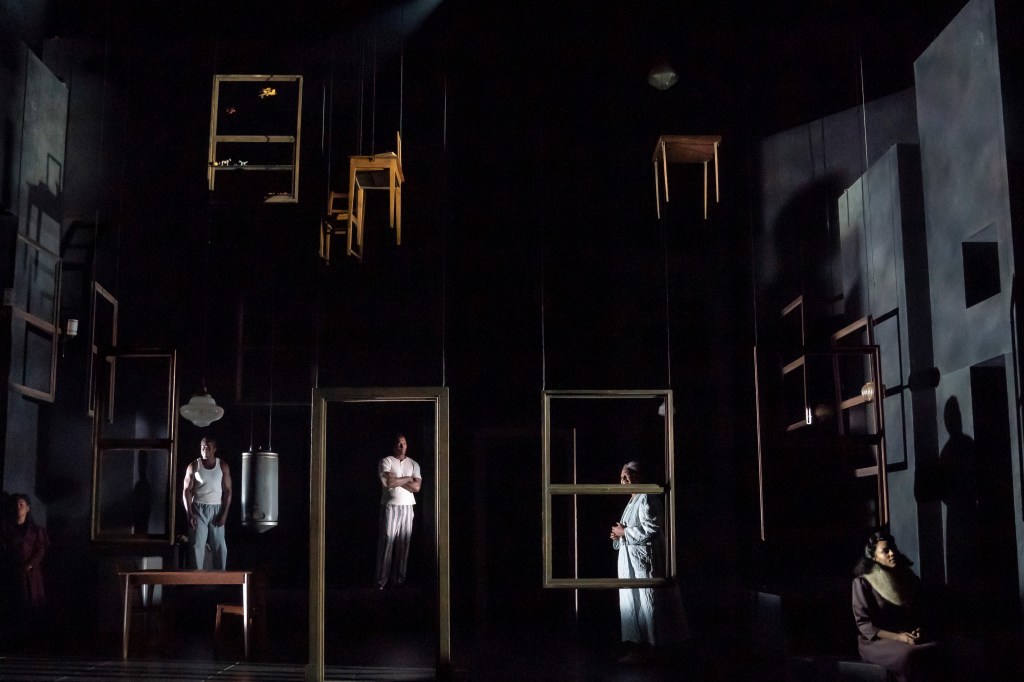
The scenic design by Anna Fleischle is minimalistic and suggestive with wooden frames introducing Willy and Linda. Unadorned furniture suggests Hap and Biff’s bedroom, Howard’s office, the hotel room, etc., revealing the play unfolds mostly in flashback at crucial points in Willy’s past in his memories. The flashback scenes are without framing and the staging is free formed, revealing Willy’s flights of fancy that make him happy. The guilt and fear torments are staged accordingly as Willy attempts to escape himself but can’t. The change in time Cromwell has reflected in the costume changes (co-costume designers Anna Fleischle, Sarita Fellows) of Linda, Biff, Hap, Charlie and Bernard. Only Willy wears the same outfit, always his suit whether jacket on or off, a salesman to the last.
Cromwell uses funeral music in the beginning and at the ending to frame the play about Willy’s life. This structural unity adds grace and embodies the concept of Willy’s death and the life he lives elucidated to reveal why he commits suicide. However, Charlie exonerates Willy and suggests, “nobody dast blame this man. A salesman has got to dream. It comes with the territory.”
This revival is illuminating and fresh, a must-see, especially for its performances and enlightened direction. For tickets and times go to their website: https://www.thehudsonbroadway.com/whatson/death-of-a-salesman/
‘Topdog/Underdog,’ The Cons’ Slow Walk Into Violence

Suzan-Lori Parks’ revival of her Pulitzer Prize winning Topdog/Underdog currently at the Golden Theater measures all the worst elements of America’s love affair with hustlers, grifters, swindlers, confidence men and bamboozlers. Clever con artists encourage the falsehoods of the American Dream, the greatest con ever, that prosperity buys happiness. Brothers Booth (Yahya Abdul-Mateen II), and Lincoln (Corey Hawkins), have bought into the idea that to be “the man” they must do the con, in other words, financially “make a killing” easily and quickly.
Oftentimes, the admirer of the confidence game identifies with the artistry of the hustler, who dupes his mark because he plays upon his vulnerabilities. Of course, the fan never believes that he could be the sucker who falls for the scam. Thus, arrogance and self-deception increase his susceptibility to the con artist’s fraud. Bamboozlers at the top of their game sense the weaknesses of their pigeons (greed, dishonesty, vanity, opportunism, lust, compassion, credulity, desperation and naïveté). They mine them like gold to bring their con home.

Topdog/Underdog reveals Parks’ sardonic genius, as she plays her audience with irony upon irony. Under the apt direction of Kenny Leon and his creative team we are sucked in to the long con as Parks prompts us to laugh at her brilliantly conceived characters Lincoln and Booth, expertly played by Hawkins and Abdul-Mateen II. Parks and Leon draw us into the illusion the characters create, as the hustler (Lincoln or Booth?), slowly lures his mark and exploits his vulnerabilities. The unfolding of the long con happens through a series of short cons where Lincoln and Booth circle each other, get the upper hand, then lose it as they temporarily fall for each others’ lies and posturing. However, one must look closely through the humor and the repartee because what is happening is the draw down to “make a killing.” Who the final winner is depends on how you see it.

Thematically, Parks uses the concept of the confidence game to expose the American culture’s hustle, primarily of Blacks, and of all who are not wealthy. Parks ridicules sub rosa all who believe they escape the oppressive economic structure which cons Lincoln and Booth to commit fraud, lie and steal. Indeed, the “unoppressed” don’t have to engage in such “criminal” behaviors to survive. Instead, they are duped into perpetuating the demeaning economic system and its institutions, only to create a different form of oppression in their lives, one that is harder to detect, and difficult to overcome.
Thus, as the audience watches Lincoln and Booth shred, front, insult and play each other as chumps, they sit smugly back laughing and missing the point. Parks, the con master, tapping their vulnerabilities has them on. This is especially so if the audience believes that not being of color exempts them from oppression. For in her primal message in this amazing work, Parks challenges us to empathize with the characters to fully understand how the profound racial themes, ironies and symbolism of Topdog/Underdog relate and interlock with the oppressive systems that hoodwink us and govern our lives.

The cleverly constructed two-hander, shepherded by Leon and performed with perfection by the actors, fascinates with dynamic, power shifting twists from beginning to conclusion. Lincoln is the older brother and the apparent “top dog.” He has what Booth wants, the talent and artistry to “make a killing” at three-card monte. However, Lincoln doesn’t “touch the cards” since the demise of one of his sidekicks in their scam that used to pull in $1000 a day. Lincoln’s teammate got shot. so Lincoln lays low and stops hustling. We discover this at the top of the play as Booth importunes his brother to teach him his moves and continually pesters him throughout Act I and II to join him and make tons of money at three card monte. Lincoln tells Booth he is done with the grift and involved with something else. However, Lincoln is blind to the import of what he’s chosen to do.
After his life fell apart and he lost his wife and his apartment, Lincoln was dislocated, a shadow of his former “cool” self, without wads of cash at his disposal. Desperate for money, at his wits end, Lincoln demeans himself by taking a job that racially exploits his dignity. Lincoln grovels for his money by sitting in a penny arcade dressed up as Abraham Lincoln, while visitors pay to shoot him. Booth finds the job despicable. He intuits that his brother is being “played” by his bigoted boss and the racists that pay to be the assassins of a black facsimile of President Abraham Lincoln. Part of Lincoln’s costume, along with the beard, hat and long coat of the type President Lincoln wore is the make up which is white face paint.

Parks’ irony in depicting the character of Lincoln is layered and upon examination, both humorous and tragic for many reasons. Lincoln playing Lincoln who “freed the slaves” out of convenience in the power struggle of the Civil War is a deprecating self-effacement and loss of empowerment for the once talented hustler. Lincoln’s white face is a further diminution into enslavement and toadying to “the man.” You can’t get much lower than a Black man putting on white face in an egregious parody which has him assume the role of his oppressor who conned the culture with his signing of the Emancipation Proclamation.

The irony that President Lincoln wanted to send all the Blacks back to Africa doesn’t matter to Lincoln, whose lack of knowledge and desperation damn him to willingly accept the demeaning job which erodes his confidence and self-determination. Additionally, his small salary given to humiliate him by “playing” a president who was the dubious “savior” of Blacks and was hated by Southern bigots, who possibly have come to ridicule him, reveals the extent to which Lincoln is in bondage to the white power structure. That he tells Booth it’s an easy job is Parks’ further thematic irony. Indeed, it is easy to be hoodwinked by “the man,” to internalize oppression and enjoy it because it is safer than to struggle and stand up against it. Lincoln has integrated slavery into his being. He represents one type of Black man in the society who works for a pittance in a job not worth his dignity.
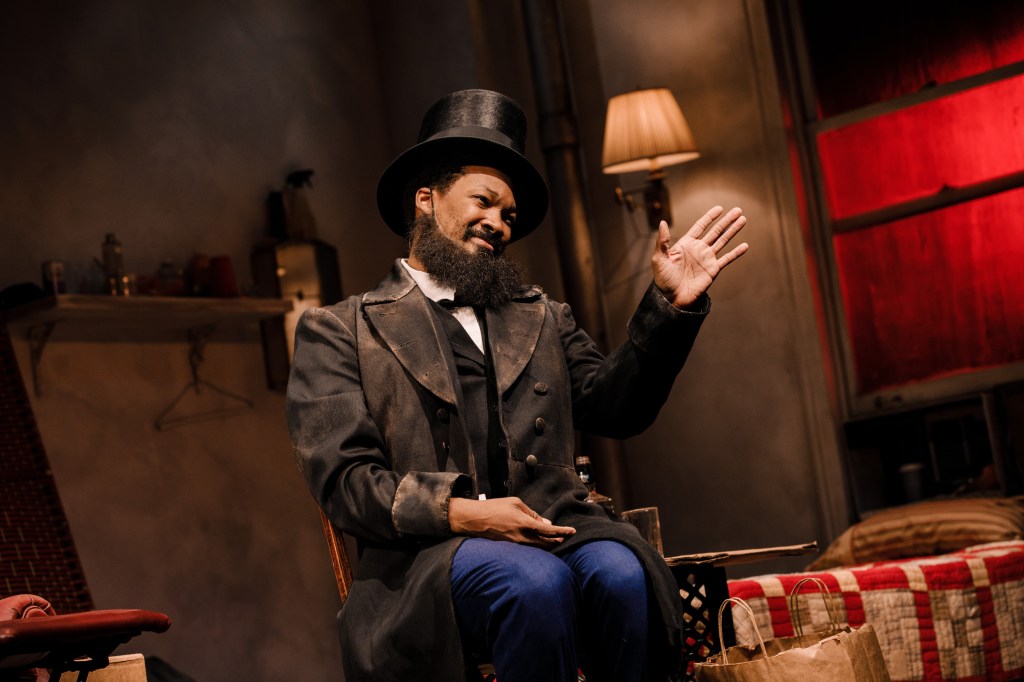
Already, we understand that Parks is having us on, as she has us on about the names of these brothers which their father gave them as a crude and blasphemous joke. It intimates one will murder the other at some point in their miserable lives. As Booth and Lincoln discuss their parents and upbringing, we realize it is a continuation of dis-empowerment, self-effacement and abuse in a continuum, Parks suggests, hearkens back to slavery days. Their parents have passed down to them a diminished life, where they believe dignity and empowerment are only achieved in perfecting “the con.”
Every aspect of their existence reflects their bondage to cultural oppression and impoverishment of opportunity. Lincoln and Booth live together in one raggedy, shabby room in a boarding house without a sink and a toilet. Arnulfo Maldonado’s pointed, superb set design speaks of the realistic poverty and destitution that discloses they are one level above homelessness. The few pieces of furniture and other items most probably are cobbled together from found objects on the street or those stolen, “boosted” by Booth which is his main hustle. It is Booth’s room, so he gets to sleep in the bed that looks like it was pulled from a 1940s psychiatric hospital shown in old black and white films. The recliner where Lincoln sleeps is uncomfortable without a mattress, pillow or blanket.

The beauty of this play is in deciding who the mark is for the long con, as the con artist lures him by degrees and allows him to think he is winning. It is also in understanding the degrees of subtly Parks uses to develop the manipulations of the brothers from their initiation of the first “throw down of the cards” metaphorically, to the last winning hit at the play’s conclusion in Act II. The actors ply their on-point artifice by degrees. Importantly, in Act I they both appear to be genuine and organic as the brothers congenially front each other and appear generous. Booth shares his boost of clothes with Lincoln. Lincoln shares his paycheck to cover the rent, food, etc. However, as the game is on and we get to know each brother, the tension mounts especially as Booth insists upon teaming up with Lincoln in the grand hustle, which Lincoln refuses to do throughout the play. Seemingly without intention, Lincoln’s refusal is a come-on, which makes Booth all the more hungry for Lincoln to engage with him.

In a progression of ironic comments Hawkin’s Lincoln lays bare Abdul-Mateen II’s Booth and his braggadocio about his “girlfriend” Grace. On the other hand, Booth massages Lincoln’s pride in his hustling expertise. He builds him up so he can then compete with him and indicate he, too, is an adept. Then, eventually he will take him down as he hoists Lincoln on his own arrogant petard. Theirs is a constant thrust and parry, dodge and pivot, shuck and jive. By the conclusion they slash and burn with cruelty. As the older brother, Hawkins’ Lincoln appears wiser. However, depending upon our interpretation and Parks’ ambiguity, which allows for a number of possibilities, his wisdom is turned on its head.

Both actors superbly intimate the growing rivalry via the subtext between the brothers. Lincoln’s talent is always in control of the thrust and parry required to lure in the stooge. This riles competitive Booth. Though neither understands their own identity, nor their place as pawns-suckers in the overall scheme of things, Booth has a better understanding of the white oppression that keeps Blacks demeaned. Lincoln has a greater understanding of human nature. Instead of uniting to benefit each other, both are debilitated by their own loss of machismo and pride, their self-confidence stripped by their upbringing and the surrounding culture. In attempting to get it back through “the con,” they only fall in the abyss. They don’t understand the extent to which they are duped by the economic system and its vast inequities. The only thing that Lincoln fully understands is that he is talented enough to rig the game of three card monte and win. It is this he attempts to teach Booth, who fails and answers Lincoln’s grift in the only way he knows how.

Parks indicates that both brothers are blind to their own entrenchment in the falsehoods of the power structure which suggests one can “get ahead” by any means necessary. Of course, ignorance of the game and not knowing one is being played is 90% of “the man’s” success. That the culture’s long con pits the players against each other, sometimes to the death, as in the case of Lincoln’s sidekick is a danger which rightly gave Lincoln pause. But Lincoln’s hands and ego, spurred on by Booth, are “itching” to throw the cards again. That he is “one of the best” is his tragedy.
Both of the brothers con each other until the game is over. Their persistence results in the fated ending which Parks intimates is an inevitability given the cultural context in which Black men, like Lincoln and Booth, attempt to survive. The way to figure out the winning card in the game of three-card monte is to watch the first move of the hustler’s hand at the outset. Lincoln sarcastically tells this to Booth in the last scene of the play, as he demeans his little brother with his perfect moves. Though Lincoln presents his mastery to Booth, both brothers are chumps, duped by the white patriarchy to see each other as “the enemy.”

They don’t understand their place in the culture because they lack the knowledge of the past. Without that knowledge they are conned into scamming money as a way to be in control and get power. However, the cultural long con is so viciously rigged against them and all the classes, even brothers turn against each other to prove themselves. It is a psychotic, racist society that perniciously strips Black men of their beauty and vitality, then entices them to self-destruction by getting them to believe they can win in a game that has been rigged against them from before the time they were born. In Topdog/Underdog Parks indicts the racist culture and condemns its wickedness in establishing, fueling and perpetuating the long con that annihilates.
Parks’ metaphor of cons as it relates to our culture is even more current today than when the play premiered on Broadway in 2001. As Lincoln and Booth try to get over to make it to the next day, they are representative Black men. On a fast track to hell, the brothers can’t win for losing. The economic and social system won’t let them succeed. They are fated to play each other until both are played out. Parks reveals with her trenchant use of the names that since the Emancipation of the Slaves, the con of freedom was just that, a con. For Blacks freedom is a bitter “pie in the sky” lure. The lure persists today more than ever as institutions are set up for the corporations and the uber wealthy to be the winners. Politicos use the long con to dupe their constituents that they will help them be prosperous. Considering that our freedoms are currently under siege from political con artists who lie, cheat and steal, thumbing their nose at the judicial system, Park and Leon’s production is horrifically in the moment.

The play’s symbolic themes are conveyed in Lincoln and Booth’s stylized world, rendered astutely by Maldonado, Dede Ayite’s costumes, Allen Lee Hughes’ lighting, and Justin Ellington’s sound design. Within that world are the deceptions that we think don’t apply to us. Yet, using Lincoln as her mouthpiece, Parks reminds us about what is key. “You win only if ‘the man’ lets you.” The power structure, the patriarchy, the haves will draw you with the short con so you stay to play the long con, where they attempt to take it all, even your illusions of democracy.
Parks brilliant play reminds that all of us are marks subject to the game controllers of the corrupt culture that values money over people. As Lincoln and Booth do, we guide our lives based on the lies of prosperity, of money equaling happiness, as we sacrifice the most important verities in our lives (love, family, friendship), to “get over” and prove we are “somebody.” Following this paradigm to its ridiculous conclusion, the “top dogs” of the culture are the most duped. They have ultimately rigged the game against themselves.

If Parks’ microcosm of the events that occur between the brothers is stretched to the macrocosm, no one wins. In fact the game destroys everyone who plays it. The controllers ultimately lose, because the values that make up the foundation of the game, that prizes money over people, are illusory. The controllers, too, are people, buying into the lie that money is more valuable than their own lives. Thus, the “top dogs” destroy the possibilities for their own goodness and benefit by harming others who are valuable human beings. Indeed, the “top dogs” are more blind, deaf and dumb than Lincoln and Booth. And ironically, with all their power and money, they are worthless. It is the brothers who we care about and with whom we identify and cry with, thanks to Hawkins and and Abdul-Mateen II’s wonderful performances.
Kudos to all the creative team who make this production scintillate with life. Once again these include Arnulfo Maldonado (scenic design), Dede Ayite (costume design), Allen Lee Hughes (lighting design), Justin Ellington (sound design), Don’t miss Hawkins and Abdul-Mateen II’s superb performances in this gripping and matchless play. For tickets and times go to their website: https://topdogunderdog.com/tickets/
‘Raisin in the Sun,’ a Glorious, Triumphant Revival at the Public
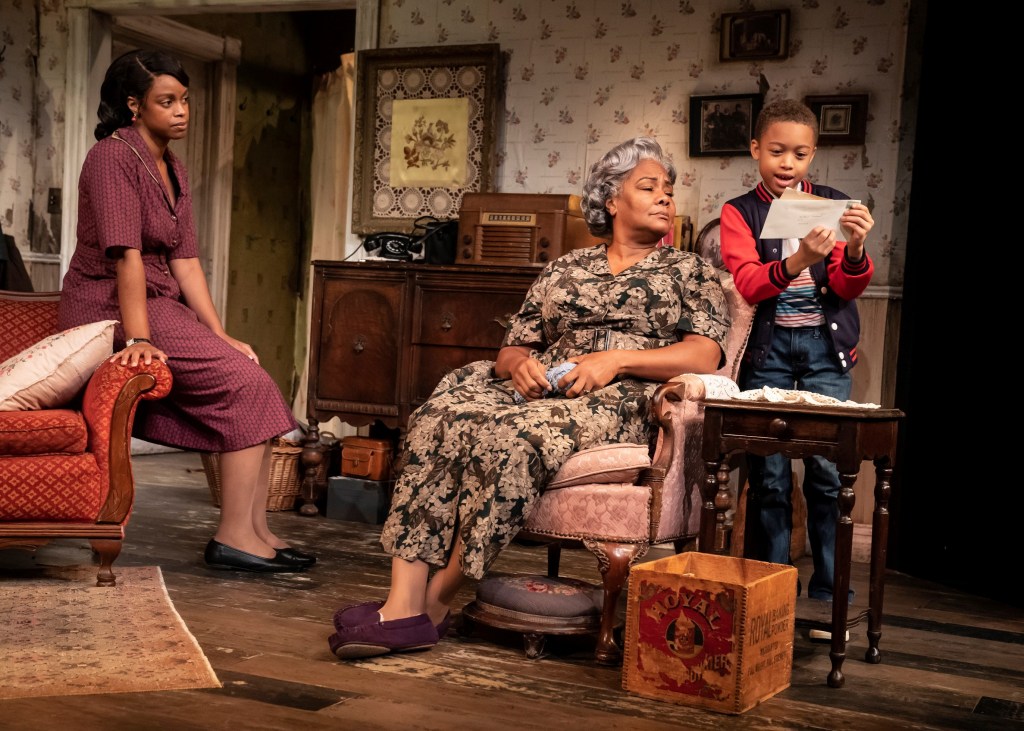
Raisin in the Sun by Lorraine Hansberry, aptly titled referencing the Langston Hughes’ poem, “A Dream Deferred,” is enjoying its fourth major New York City revival. It debuted on Broadway to great acclaim in 1959 and followed with two other Broadway showings in 2004 and in 2014 with Denzel Washington. Now at the Public Theater extended again until November 20th, director Robert O’Hara and the cast, led by Tonya Pinkins, prove that Raisin in the Sun is an immutable masterpiece. Its themes of discrimination, injustice, greed, family unity and love encompass all human experience.
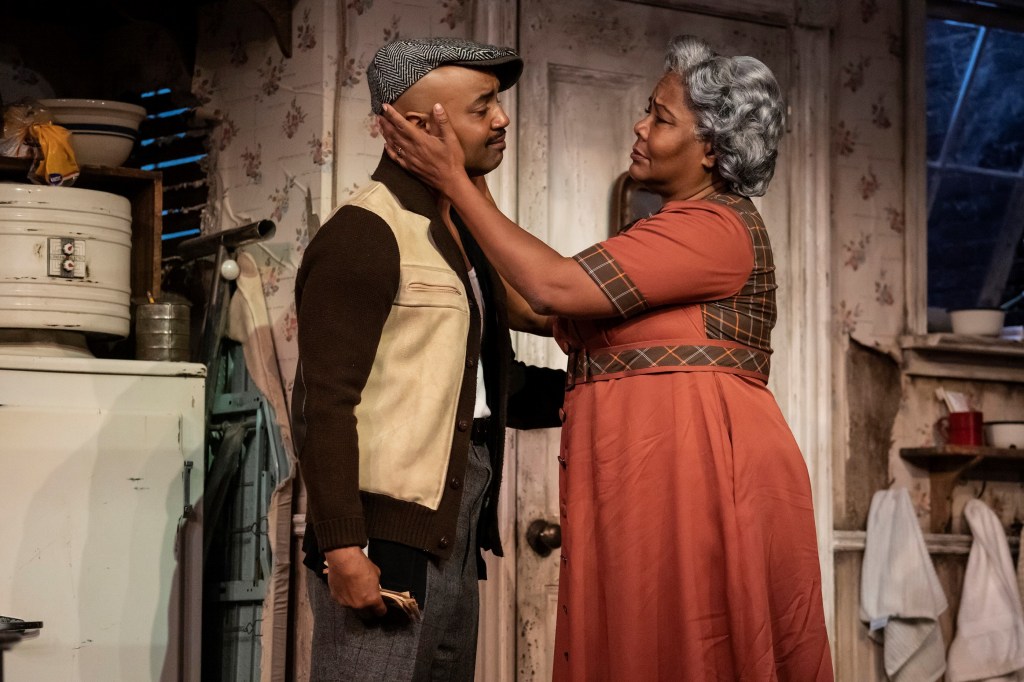
The heartfelt, moving, vibrant and electric production, which lives from moment to moment in joy, humor, sorrow, fury, wisdom and dignity, incisively honors Hansberry’s work in its showcase of Black Americans in this triumphant production. However, more than other revivals of Raisin in the Sun, this cast, creative team and director convert Hansberry’s work to the realm of timelessness. The production is an inspiration, an event of humanity which is incredibly relatable to all races, creeds and colors.
In its particularity the play is about the seminal Black experience in America during a shifting, revolutionary time of great economic and human rights change for African Americans in the 1950s. However, Hansberry’s thematic vision stretches beyond the microcosm. This magnificent play encapsulates the macrocosm with Hansberry’s genius characterizations, conflicts and themes in transcendent writing. For at its heart the play is universal in revealing the human desire to achieve, to evolve, to be empowered, to give voice to one’s soul cries for recognition, for equity, for prosperity.
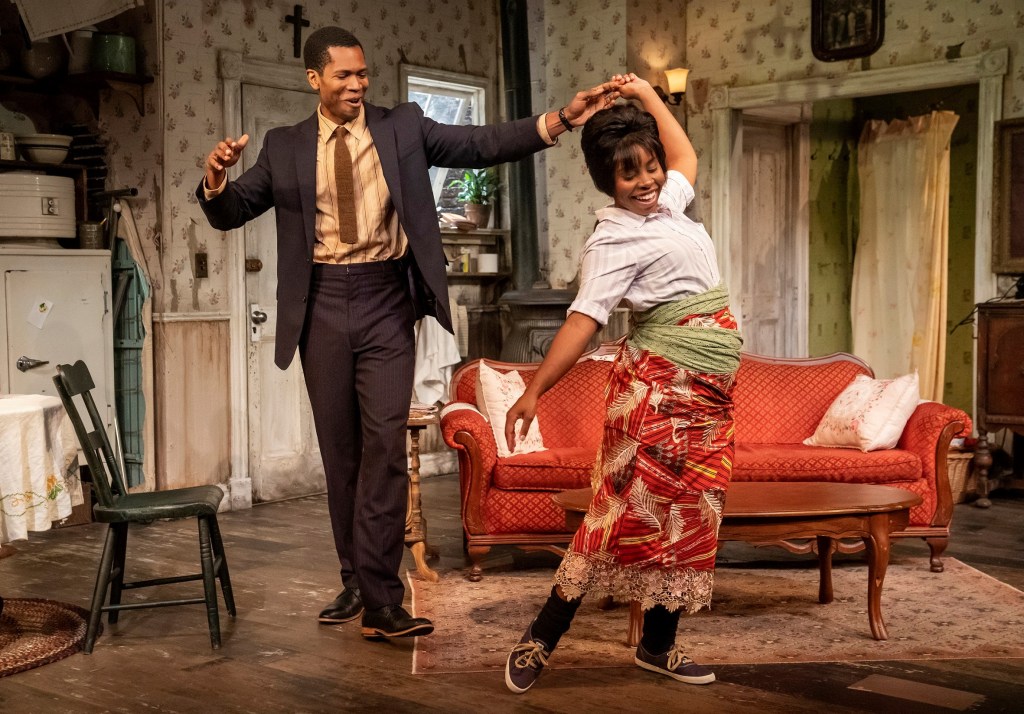
Made into two films, a musical, radio plays, a TV film and inspiring a cycle of three plays (Raisin in the Sun, Clybourne Park and Beneatha’s Place), Hansberry’s work is a classic not to be taken on lightly. However, Robert O’Hara, the cast and the creative team understand the great moment of Hansberry’s work for us today. With their incredible production at the Public, which opened October 25th, they have elucidated the heartbreak, fury, joy and beauty of Black experience as they portray how the Younger family struggles to find their place in a culture of racial oppression, stupidity and cruelty.
O’Hara’s version has additions which enhance the symbolism of Hansberry’s themes. Walter Lee Sr.’s presence materializes as a ghost (Calvin Dutton), who inhabits Lena’s thoughts and remembrances. His unobtrusive presence symbolizes Lena’s heart and love for their family. The insurance check represents the sum total of how the world credits Walter Lee Sr.’s life, an irony because for Lena, no amount of money is an equivalent to the worth of her husband. In fact the insurance check that rattles the household and puts stars in the eyes of Walter Lee Jr. (the amazing Francois Battiste), is blood money to Lena, a blasphemy that she doesn’t want to even touch when the mailman delivers it and she has Travis (Toussant Battiste), read off the number of zeros.

O’Hara’s staging is unique and vital, adding nuance and clarity to Hansberry’s dialogue and characterizations. Mindful of the play’s high-points, he stages the characters priming our focus to receive the full benefit of Hansberry’s message. This is especially so for Walter Lee’s inflammatory and raging monologue about “the takers and the taken,” in previous productions delivered to Lena, Beneatha (Paige Gilbert) and Ruth (Mandi Masden). In O’Hara’s version, Battiste’s Walter Lee stands in a spotlight and delivers the speech to the audience. It is mindblowing, reverential, brilliant, confrontational. More about this staging later.
The performances are authentic and spot-on fabulous. O’Hara’s direction is so pointed and “in-your-face,” the audience is invited to stand in the shoes of the Younger family, watching their trials with empathy. We feel for Masden’s Ruth when Lena confronts her about putting money down for an abortion. Her sobs of desperation at being driven to this because they can’t afford a child recall the past and now Republican states in the present. Considering the impact of the Supreme Court’s Dobbs decision, as a throwback to Ruth Younger’s seeking an illegal abortion, this moment in the play breaks one’s heart. Masden inhabits the character with somber beauty and layered emotion. When she must pull out the stops, sobbing her hopeless despair to Lena, she is spot-on believable.
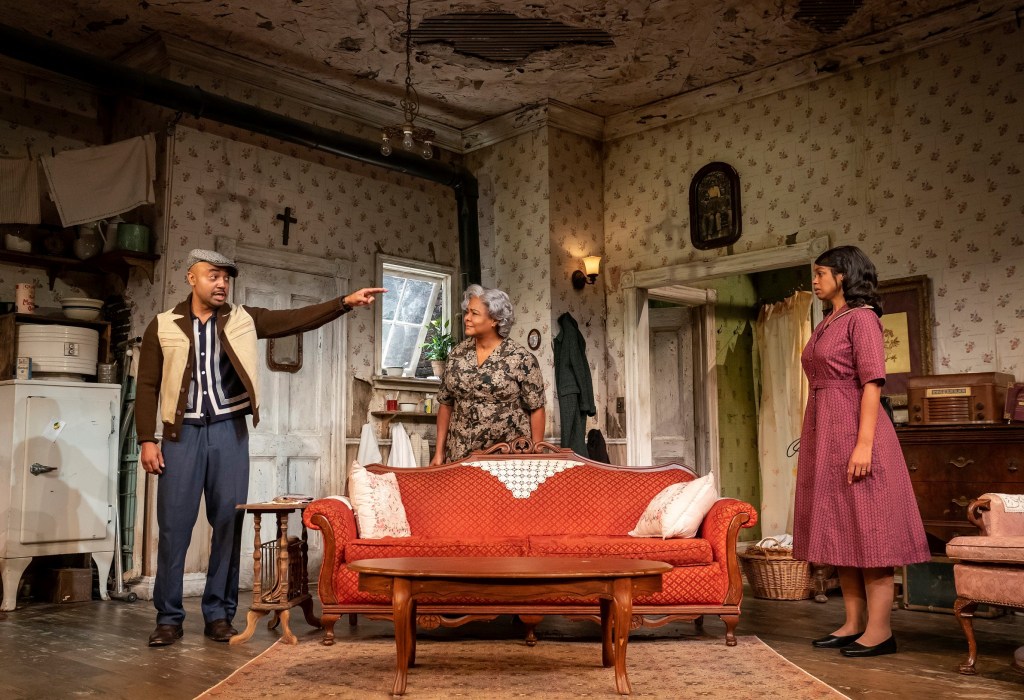
Likewise, as Gilbert’s Beneatha decides between two men and carps and riffs on brother Walter Lee, we understand she is caught between the old and the new. She represents transformation and is on the cusp of the new feminism. Accepting African influences prompted by her relationship with Joseph Asagai (the excellent John Clay III), she vies between being an assimilated Black woman for the sake of George Murchison (Mister Fitzgerald), and moving to embrace her ancestry. As the character of Beneath is the vehicle Hansberry provides with humor, Gilbert fine tunes her performance and is funny organically without pushing for laughs.

The ensemble work is seamless, showing prodigious effort as the actors live onstage. Thus, the audience cannot help but love and cheer on the family against Mr. Lindner (the excellent Jesse Pennington who reminded me of a quiet, quirky Klansman from the South, minus a Southern accent). Lindner’s assault on their dignity and chilling comment after he comes back a second time then says goodbye, in addition to his pejorative patting of Walter Lee on the shoulder as he leaves, combines all the self-satisfaction of one appointed to take a “message,” to the good “colored” folk to warn them away.
Most importantly, we grieve with them over the tragedy of Walter Lee (the incredible Francois Battiste), when his “friend” Willie absconds with the money Lena tells Walter to put in the bank. The tragedy is heightened by Tonya Pinkins’ fabulous performance as she cries out to the Lord to give her strength.

As Lena, Pinkins’ heaving call to the Lord is one for the ages. It is a dignified primal utterance which takes everything out of her, after which her hand shakes til the end of the play, for most probably, she suffered a mini stroke. In her fervency not to smash Walter Lee over the head, which he justly deserves, Lena must turn to God for help. Only He can give her the anointed love and patience to see her way through this family tragedy which threatens to swallow up her hope of moving from the “rattrap” ghetto apartment to Clybourne Park’s white neighborhood. Pinkins is riveting, her authenticity just stunning. I couldn’t take my eyes off her.
Walter Lee’s frantic action losing the insurance money, some of which is supposed to go for Beneatha’s schooling, is a bridge too far for Lena. It is no surprise in the next scene where Walter Lee confronts himself and “lays it out on the line” to explain that the culture has broken apart humanity into the takers and the taken, that a discouraged Lena questions going to Clybourne Park. Disappointed and devastated, she condemns herself for stretching out to want something better for her family. Once again Pinkins’ captures the ethos of Lena’s majesty and sorrow with perfection.
As Walter Lee, Francois Battiste seethes just below the boiling point as he builds to an emotional explosion when he realizes Willie has scammed him and Bobo. His is another stunner of a performance. Walter Lee’s abject desperation to become rich eats him alive and destroys his wisdom and circumspection, something which Lena cannot understand about her children’s generation. She notes they have forgotten how far their parents have come to achieve freedom. Pinkins’ Lena reminds her children to be satisfied with the strides their family has made. However, they ignore her wisdom and must learn through experience, a fact which every generation goes through, as Hansberry subtly suggests.

However, the bitter lesson Willie teaches Walter Lee is too heavy to bear. He has been “taken” by a black “friend,” who understands economic inequity born of white oppression, yet sticks it to another black man, exploiting “the opportunity.” Willie is as desperate as Walter Lee, perhaps more so because it forces him to steal demeaning himself and Walter Lee. They have accepted the corrupt white values, Hansberry suggests, and what they have reaped is near emotional annihilation. Willie’s betrayal symbolizes the culmination of every obstacle the family has been made to endure, including Walter Lee Sr.’s death, all thrown back in their faces by Walter Lee’s desperate act of trusting him. With superbly symbolic staging O’Hara has the family stand in the center of their living room, clinging to Lena at this nadir of their lives, as they look into the abyss, the sacrificial money gone.
It is Lena who must sustain them, but to do so, she drains herself dry of life, following in the footsteps of her husband. And the heaving event is so great, she is lamed after it. Throughout, Lena shows ambivalence about the $10,000 check that Walter Lee puts his faith in to change his life. She recalls that Walter Lee Sr. (Calvin Dutton appears at her remembrance), was drained of life trying to make his way through the work load of a low paying job that barely helped them get by. The money cannot replace the value of her husband and the love she has for him. The loss of most of it is a double slap in her face.

Perhaps the most brilliant of O’Hara’s staging occurs with Walter Lee’s speech after he acknowledges Willie has betrayed him. O’Hara has Walter Lee stand in a spotlight downstage to address the audience with a Raisin in the Sun playbill in hand, as he claims he is going to put on a show. Though he is talking about groveling to Lindner, as he receives the payoff to demean himself and not move in to the white neighborhood, he also is referring to the white audience in the theater and beyond its walls.
“The man” which stands for the patriarchy, the corporates and billionaires who demand $two trillion dollar tax cuts of the politicos and expect the little people (everyone else), to pay for it and take up their slack, surely demands Walter Lee “grin and bear” his oppression. Will he decide to take the dirty money Lindner offers for the house, trading his dignity and identity for a corrupted value system? Or will he stand up to Lindner and move into a white neighborhood, breaking down over a century of discriminatory housing?
The speech, a tour de force by Battiste, is breathtaking. It is Hansberry at her most raw, and trenchant. That O’Hara has intuited that Battiste’s Walter Lee should say this standing as if a wild prophet speaking to the audience at the crossroads of his life is just brilliant. Emotionally hitting all the notes, Battiste’s Walter Lee is priming himself for the momentous decision. Does he have the courage to take a stand? Battiste pulls out all stops genuflecting and grinning in a groveling throwback to the days of slavery from which his ancestors came. He shows the family his toady show he will use on Lindner and provokes Beneatha to refer to him as a “toothless rat.”

O’Hara’s metaphorical staging draws us in. Is there one human being who has not experienced shame, feeling demeaned or belittled and who has not internalized it? As Battiste’s Walter Lee spills his guts to the audience, O’Hara offers the opportunity to be there with Walter Lee, to suffer with him, to “get” his terrible pain and perhaps live the moment with him in this cathartic high-point.
O’Hara’ direction and Pinkins’ performance strengthen our understanding of Walter Lee and Lena’s close relationship with his inclusion of Walter Lee Sr.’s ghost who appears when Lena discusses the travails her husband experienced that physically wore him down and killed him. In his stance and posture Dutton embodies the sweat, toil, tears and exhaustion ebbing out of Walter Lee Sr.’s life, as Lena recalls it.

Interestingly, O’Hara also has the ghost appear at the conclusion of the play when the family leaves for their new home. The ghost and Lena kiss, then she leaves and he sits on the sofa of the old apartment as Travis Younger (the wonderful Toussant Battiste), comes back to retrieve his lunch box. Travis stops and considers as Walter Lee Sr. stares out into the audience and we hear a grinding noise, like that of a huge wall being torn down. The movement in the sound symbolizes the breaking of the color bar, as the old apartment and Walter Lee Sr. retreat upstage into the distant past.
As old makes way for the new, the Younger’s Clybourne Park house emerges beautiful, white and shinning. An astounded Travis turns to look at the symbol of their advancement. However, ugly graffiti appears on the house as lights dim. Indeed, as Mr. Lindner warned, the Youngers will suffer abuse at the hands of their prejudiced white neighbors. It is an intimation of the future that is still unfolding today in the present.

There is so much more in this profound reworking of Hansberry’s play, rightly considered one of the best plays ever written. Kudos to the creative team that brings this work to glorious life. They include Clint Ramos (scenic design), Karen Perry (costume design), Alex Jainchill (lighting design), Elisheba Ittoop (sound design), Brittany Bland (video design), Will Pickens (sound system design), Nikiya Mathis (hair and wig design), Rickey Tripp (movement and musical staging), Teniece Divya Johnson (intimacy & fight director), Claire M. Kavanah (prop manager).
There, I’ve said enough. For tickets and times go to their website: https://publictheater.org/productions/season/2223/a-raisin-in-the-sun/
‘Chester Bailey’ Starring Reed Birney and Ephraim Birney, a Must-See

Joseph Dougherty’s Chester Bailey is a mind-bending drama that tests our understanding of reality, as that which we apprehend with our senses. Taken to its extreme form, those whose senses have been deprived cannot know what reality is and must rely on others to interpret “the reality” of what is around them. However, what happens if they refuse to accept any interpretations and come up with their own? Who gets to interpret what reality is, if the interpretation is repugnant and an encouragement toward self-destruction?
These delicious questions lead to the conundrum that Dr. Philip Cotton (Reed Birney), must resolve as he treats his patient Chester Bailey (Ephraim Birney), who is in a hospital on Long Island in 1945 during the winding down of WW II. Bailey was prevented from going to war by his parents who selfishly wanted to keep their son safe, a notion that Bailey tells us he agreed with so he didn’t rebel against their wishes and enlist.

However, Karma, Fate the Furies spin the family around and have fun with them, proving there is no escape from tragedy. Yet, if we throw caution to the winds and accept what comes, goodness may be around the corner. Perhaps Chester should have enlisted after all. His family and Bailey rue that he didn’t.
Bailey ends up in the psychiatric care of Dr. Philip Cotton after he experiences a traumatic accident at the Brooklyn Navy Yard. A psychotic worker attacks him with a blow torch putting out his eyes, slashing his ear, savaging his face and severing his hands. After defying death, Chester rehabilitates getting through unaccountable pain with the help of huge doses of morphine that foster his dislocation from reality to a place of comfort, and not only physical comfort.

In that haven, he constructs another reality where he believes that he lost his ear and eyesight, but the latter is returning because he sees a bright light that appears to be getting brighter. Furthermore, he “knows” he still has use of his hands and can pick up objects, all despite arguments with the doctors at the general hospital where he’s recovering, who tell him he has no eyes, no hands, one ear and his face is deformed. Indeed, Ephraim Birney’s portrayal of Chester’s believable reconstruction of a world of peace and beauty, where he is becoming whole is sensational. And Birney’s development of Chester’s obstinance and obstruction of anyone who attempts to wrangle his fantasy from him is beyond superb.
Though Chester tells us he receives visits from his father, who tries to encourage him despite his growing alcoholism, his mother refuses to see him. Ephraim Birney’s narration is riveting. Through it we intuit that his mother is overwhelmed by guilt. Smacked by Karma at her selfish attempt to save her son from dying, while other mothers lost their sons, she refuses to visit him and is bedridden with severe depression.
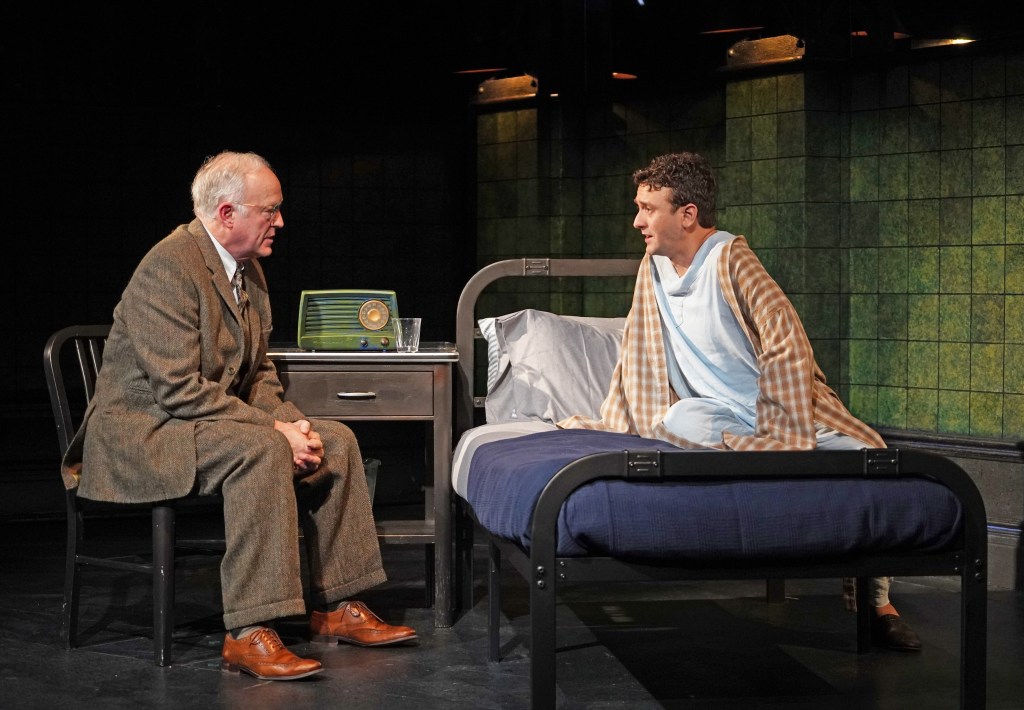
Meanwhile, Birney’s Chester is enthusiastic about seeing shapes and shadows, feeling his fingers and picking up objects. The doctors deem him delusional. Because of Chester’s prognosis, they cannot release him back into society where he will only get worse. Instead, they transfer him to a psychiatric hospital, where he will receive therapy to perhaps encourage him back to the society’s consensus of reality. There he will be forced to accept his condition and receive help to achieve a purposeful life.
Parallel to Chester Bailey’s “delusion” is Dr. Philip Cotton’s response to Bailey. Steeped in partial delusions, we understand that Cotton bends reality toward his own perspective. We discover how both men are two different sides of the same coin from the top of the play, when Dougherty has each man in solo performance introduce themselves when Dr. Philip Cotton meets Chester for the first time in the Long Island psychiatric hospital.
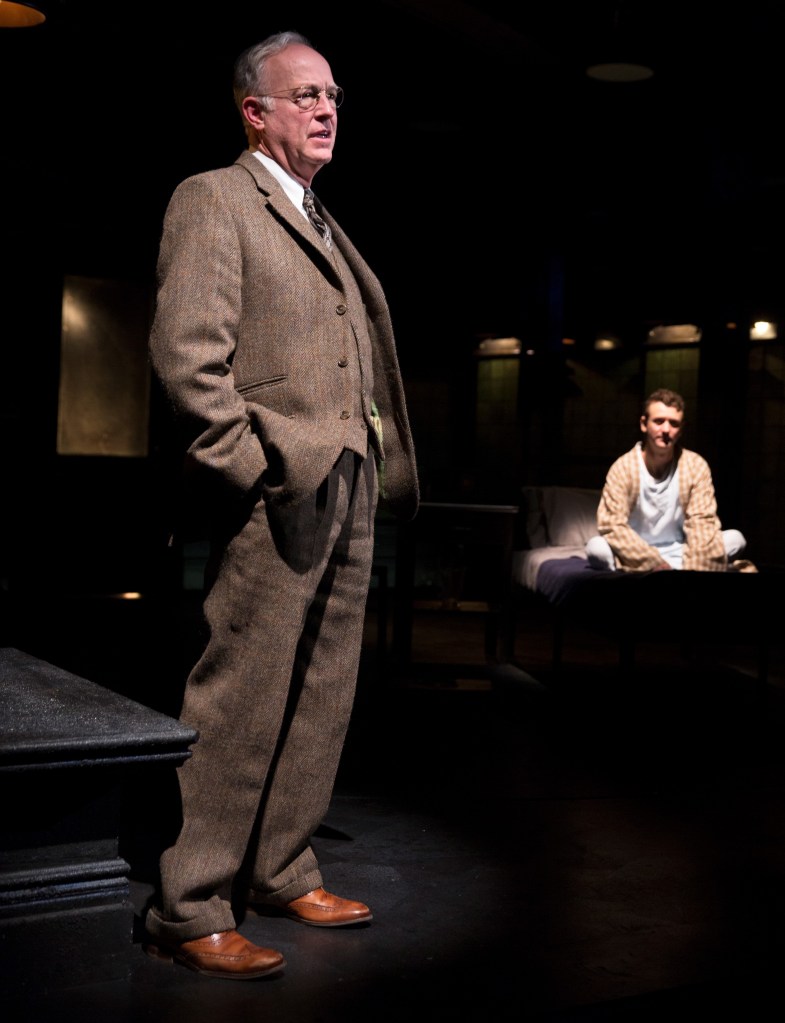
From there time shifts in a flashback to the point before Chester’s accident in the Brooklyn Navy Yard. Through an interlocking web of solo moments addressed to the audience, we discover who these men are and their approach toward their lives, which in actuality isn’t that much different.
Reed Birney is absolutely sensational in his quiet, unspooling of himself as Dr. Cotton who ironically is dislocated from his marriage when he works in Washington, D.C. Birney’s narration of events is engaging and smooth. Alternating with Chester, who discusses his life in parallel themes, Cotton tells us when he was in Washington, D.C. working, his wife had an affair. Its revelation explodes their marriage when he transfers to the Long Island hospital and moves to New York. In fear of discovery, her lover demands that she tell Cotton the truth. Cotton and his wife get a divorce.
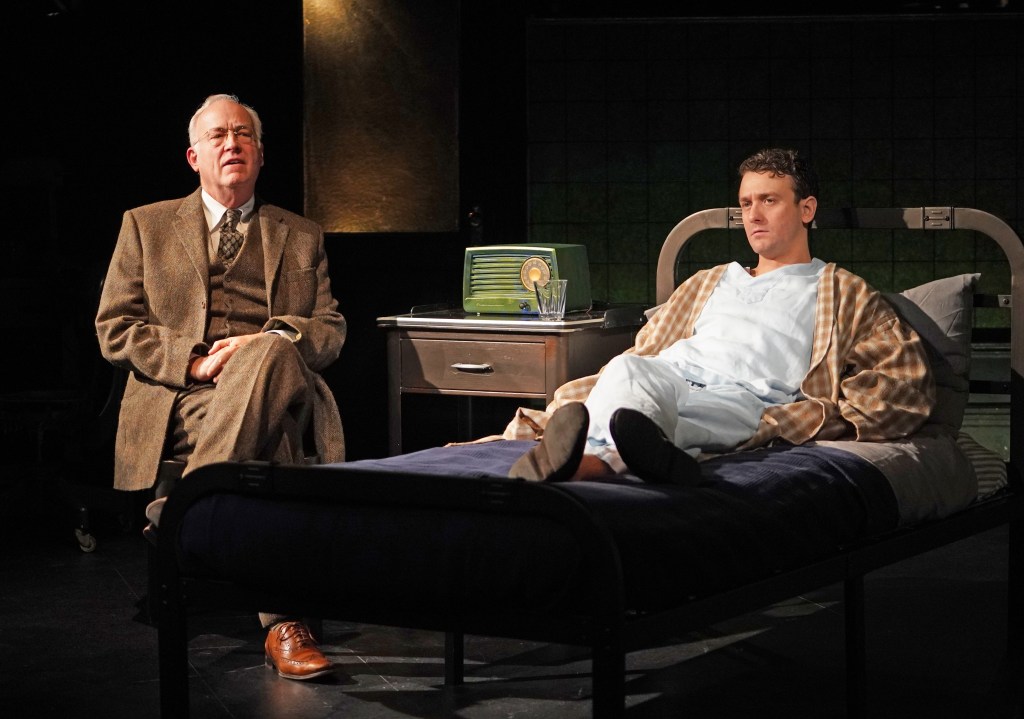
Obtusely moving through his life, Birney’s Cotton doesn’t pick up the signs or even understand why and how his wife could betray him. Instead of learning from this emotional devastation to himself, their daughter and his former wife, he engages in an affair with Cora, his bosses’ wife and wraps himself in her to the point that she becomes his life. Indeed, he lives for the times they covertly meet in various, sleazy, hot pillow motels around the Island.
The beauty of his performance is Birney’s authenticity in portraying Cotton, whose serene and calm self-satisfaction covers up his own delusions about himself and his divorce which he accepts without seeking therapy before or after. His escapism into his affair with Cora conveniently runs him far away from self-analysis or introspection.
Additionally, Birney’s performance is magnificent in its subtly. Cotton manufactures his intent to help Chester Bailey “face” reality so Chester can “better” live his life and adjust to his deformities. In relaying his behavior with Bailey as he interacts with him and reveals his final kindness to him, we are duped by his laid-back good-natured care. Completely taken by his apparent concern for his patient and his romantic interpretations, we ignore why he bestows magnanimity on Chester at the play’s conclusion.

However if one considers the ramifications of what Birney’s Dr. Cotton does when he ignores the truth of what occurs in the hospital, Cotton’s behavior can also be interpreted as permissive and incredibly destructive. Nevertheless, Birney’s Cotton, who is deluded himself and swept up into going beyond his role as a professional, treats Bailey as he, himself, wishes to be treated.
Ironically, Cotton’s interpretation of Chester as an artist of the imagination absolves himself and Bailey of the truth, pushing away the results as if there are no consequences or probabilities of harm. Ignoring his own behavior in accepting Bailey’s behaviors and converting them into harmless obfuscations, he entraps them both in fantasy. Defining Bailey’s actions as self-mercy, Birney’s Cotton removes his own accountability from the situation and demeans Bailey by not challenging him to evolve beyond a “merciful” delusion. The question becomes how merciful is this delusion? And indeed, are delusions merciful?
Engaged and enthralled by the Ephraim and Reed Birney’s portrayals of these intricate and complicated characters, we, too, are swept up in the romance and artistry that Bailey weaves and Cotton accepts and encourages. So what if these flights of imagination have a dark underbelly that perhaps is dangerously dismissed?

We ask, if someone’s life is so physically decimated as Chester’s life is, then what is the harm of his imagining that the woman he saw selling paper and candy in a shop in Penn Station (the beautiful old station intimated with John Lee Beatty’s scenic design and Brian MacDevitt’s lighting design), has become a nurse who visits him? What is the harm if he imagines it is she who has sex with him in his hospital bed late at night and not someone else who has severe problems? He is in love with her, a person he fashions in his imagination. Isn’t that what love is? When we love, don’t we project onto others the beauty and artistry of ourselves? Isn’t that what Dr. Cotton does with Cora? Aren’t we in love with the product of our own imaginations?
Indeed. Of course, there is more to what Doughtery unravels in this rich, dynamically threaded philosophical, psychological work, beautifully shepherded by director Ron Lagomarsino and acted with perfection by father and son duo Reed Birney and Ephraim Birney. Chester Bailey asks so many questions and resolves none of them which makes for a great play that is profoundly rich with thematic gravitas that is resonant for our time.
The production is gobsmacking, helped by Toni-Leslie James’ costume design and Brendan Aanes’ sound design. Performances have been extended because they should be. This outstanding work is its New York Premiere at Irish Repertory Theatre. For tickets and times go to their website. You’ll be happy you saw this amazing, moving play. https://irishrep.org/
‘1776,’ The Revival Revolutionizes our Insights and Revitalizes an Appreciation for our Nation
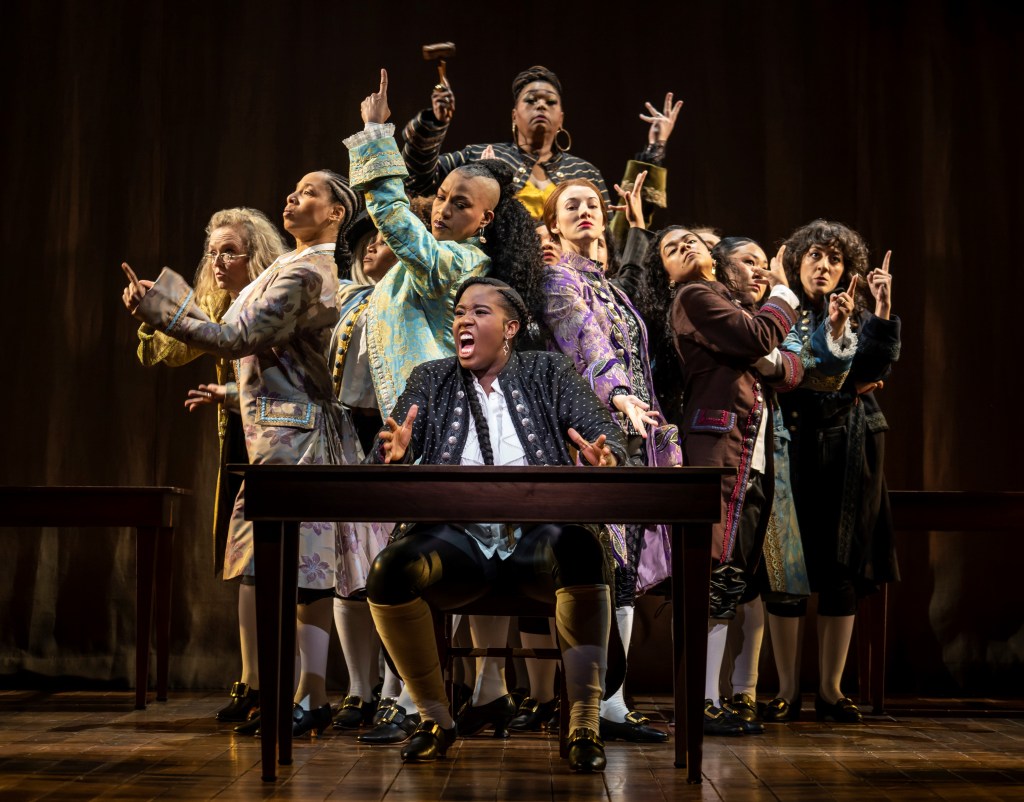
The original Tony award-winning musical ‘1776’ with music and lyrics by Sherman Edwards and book by Peter Stone is for all time an exceptional distillation of events memorializing with artistic license the most salient moments of how the Declaration of Independence was eventually drafted and signed. With the force of a new and treasonous law established by a country that was first formed in the minds of an elite group of white, male land owners, the physical document was a presumptuous act of rebellion. Many disagreed with it. Those without property in the 13 colonies, i.e. women, Native Americans, slaves, white laborers and others, whose lives wouldn’t change much either with rule by propertied colonists or rule by King George III, most probably didn’t care.
In Jeffrey L. Page and Diane Paulus’ revival of the musical 1776 at the American Airlines Theatre, the directors revolutionize the play’s casting with inclusion of those not represented in the forging of the Declaration of Independence. As a remembrance of the excluded and an indication of “how far we’ve come culturally,” the directors cast multi-racial actors who are female, nonbinary and transgender in the roles of the white, male founders normally cast in Edwards and Stone’s 1776.
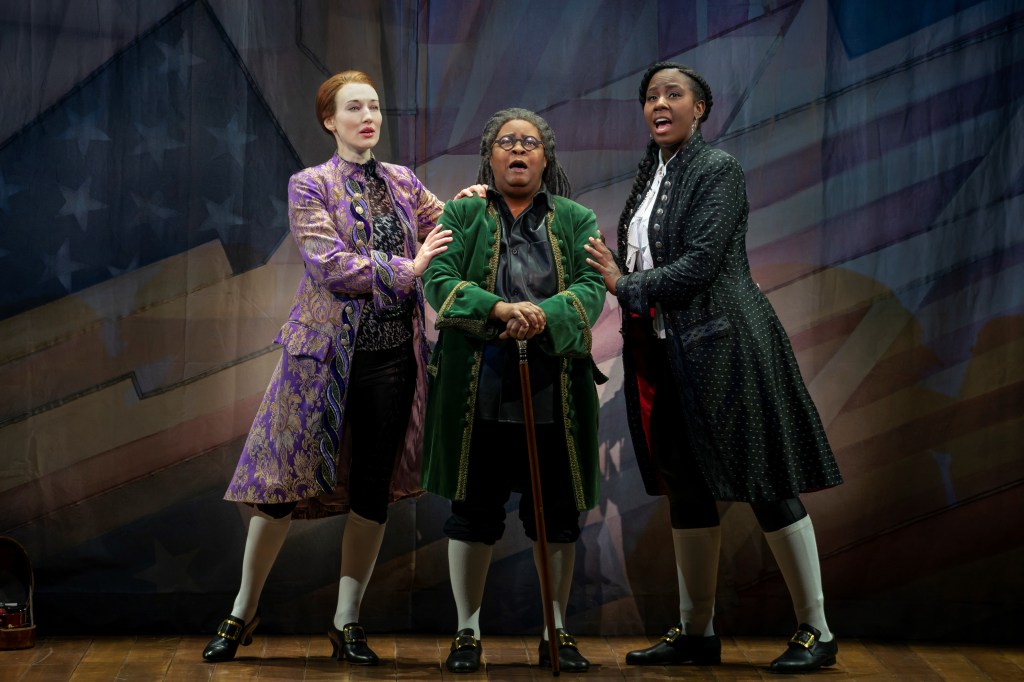
Led by the “obnoxious” John Adams portrayed by the exceptional Crystal Lucas-Perry (“Sit Down John”), 1776 begins as the Second Continental Congress, after months of delay (“Piddle, Twiddle, and Resolve”), finally gets down to confronting whether or not to declare independence from England’s King George III and establish America as a sovereign nation. Massachusetts delegate Adams encouraged by Dr. Benjamin Franklin (the wonderful, wry Patrena Murray) are continually rebuffed by British leaning colonists led by Pennsylvania’s John Dickinson (Carolee Carmello gives a powerful and nuanced performance as the opposition).
When it appears they are moving forward, it is suggested that approval must be unanimous, which John Handcock, President of the Congress (a commanding Liz Mikel) agrees with in order to prevent any of the colonies siding with England, incurring a civil war. Adams and Franklin join together with Virginia’s Thomas Jefferson (Elizabeth A. Davis) the recalcitrant author of a formal Declaration of Independence. The opposition continues with delays, though Franklin, Adams and Jefferson manage to pull in others as the typical manipulations of congress continue.

Washington’s difficulty with raising an army and keeping it equipped and fed is the bad news brought by the Courier (Salome B. Smith), as the Courier sings about soldiers dying on the battlefield while delegates listen with guilt and horror (Smith’s powerfully rendered “Momma, Look Sharp”). South Carolina’s Edward Rutledge (Sara Porkalob) indicts the hypocritical and self-righteous Northern colonies, reinforcing that they, too benefit from the Triangular Slave Trade (the show-stopping “Molasses to Rum”).
Infuriated, Rutledge walks out of the session and won’t return until an anti-slavery clause in the preliminary Declaration of Independence is removed. Unanimity seems far away. Yet, Adams, encouraged by wife Abigail (Allyson Kaye Daniel) throughout (“Yours, Yours, Yours”) and with the help of Franklin and Jefferson and changing results by Washington, make concessions and revisions. Finally, all agree to sign and we see their iconic signatures projected on the curtain at the conclusion.
Page and Paulus’ casting inversion ends when they cast females in the roles of Martha Jefferson (Eryn LeCroy) and Abigail Adams (Allyson Kaye Daniel) with Daniel dressed in a colorful turban and African shift. From a positive perspective, the casting adds new interpretations and vitality, if one isn’t so well acquainted with or enamored of the original musical as to be offended with its “tampering.” Assuredly, 1776, regardless of iteration, stands on its own as a dynamic, ingenious musical.
Importantly, each unique rendering, illuminates additional perspectives. Each version should yield a new appreciation for the Founding Fathers’ humanity and blindness, which still exists today in American attitudes that have carried over for generations from a racist past that cannot be ignored by culture wars of political convenience. However, this latest 1776 outing pegged to our present generation must give pause for its daring. If one viewpoint is modified, the version has done its job. For Page and Paulus’ revival affirms that the essential concepts in the elite, propertied white men’s minds were the immutable verities of spirit that ultimately, if allowed to, transcended demographic differences to help us arrive at the expanding social and cultural contracts we have today in most of the country.
The revolutionary casting provokes humor and thoughtfulness. Interestingly, it often evokes a celebration of the success of the “American experiment.” Specifically, with a pregnant female Thomas Jefferson (Elizabeth A. Davis is expecting and plays the violin exquisitely) the birthing of a nation takes on an ironic and humorous meaning, especially during the song sung by Adams, Franklin and the company entitled “The Egg.” In Act II after Jefferson writes the preliminary document and Adams decides that the eagle will best symbolize the new nation, they suggest that they are like midwives to an egg hatching. During the rousing, cleverly re-imagined song, a video of the new nation’s history to come is projected on a curtain behind the actors. As the multi-cultural nation spools historical events in the future, the pregnant Elizabeth A. Davis’ Jefferson fiercely accompanies with riffs on the electric violin.
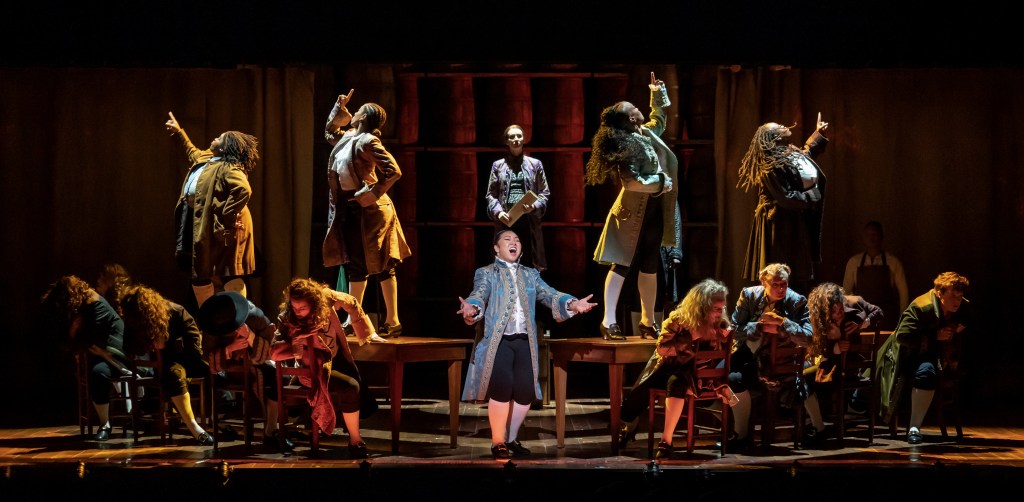
Indeed, we see what has been birthed from past to present. Our nation’s potential is amazing thanks to spiritual concepts which move beyond definition in this revelatory 1776.
The actors reveal their beautiful voices and superb acting talents during other numbers staged imaginatively. Many are standouts, however a few deserve special mention. “Momma, Look Sharp” sung by Salome B. Smith, with Tiffani Barbour and the company is a show stopper as is “Molasses to Rum” sung by Sara Porkalob. The latter song humbles the Northern colonists who participate in the Triangular Slave Trade. In pointing out the blindness of hypocrisy, the should humble everyone today who has a mobile phone, uses a laptop, wears a diamond, eats certain foods, for they have a slave footprint and participate in some for of wage slavery.
Does this new iteration work? What are the directors and actors intending to express with this revolutionary casting approach to a beloved musical? And it is beloved. One only has to read YouTube comments connected with the film version and various songs that users have uploaded, to discover that Americans trot out the filmed version of 1776 (released in 1972) occasionally. Some even claim to watch the film on July 4th to reaffirm their patriotism and appreciation of this nation with its viewing. Thus, fans of the original will perhaps bristle at this version.
However, for younger audiences, the zaniness of the production, its show-stopping numbers and the audacity of this bold cast will appeal. When at times, some of the numbers take on an irreverent, spoofy quality (“He Plays the Violin”) they will find the overall effect amusing. After all, the overarching meaning of Edwards and Stone’s musical cannot be lost, because the script and song lyrics adhere to the original. Also, there is a salient addition with Abigail’s March 1776 letter to her husband, widely quoted as a statement for women’s rights. Abigail reminds him to include women in their endeavors in her adjuration to “remember the ladies.” In spirit and irony, Page and Paulus answer Abigail’s call, devoting the entire production to female, nonbinary and transgender actors.
Thanks to choreography by Jeffrey L. Page and free flowing staging by Page and Paulus, the musical is heavily stylized and stripped of spectacle and intricate set design. One is able to concentrate and align the events and their significance to our history then and now. Costumes by Emilio Sosa intimate the setting and the respective colonists. After the principals enter wearing modern clothing, with Sosa’s magic, they cleverly turn white socks into stockings, black leggings into colonial breeches, then slip into square-toed buckle shoes of the period. Their intricate and lovely frock coats differentiate the colony each represents and reveal the varied styles of our country’s Northern, Mid-Atlantic and Southern colonies.
What Edwards and Stone’s musical did in 1969 was remind Americans of their beginnings, during a time of social upheaval and divisiveness. Then, the musical may have recalled our Founding Fathers’ desire for self-governance as the populace questioned policies that escalated an unpopular war in Viet Nam, which to many seemed hypocritical because it interfered with another nation’s right to choose its own government.
Likewise, this revival seems appropriate at a time of divisiveness and polarization. When our rights are under siege (the right to privacy under Roe vs. Wade, along with the gutting of voting rights), once again we need to be inspired toward true patriotism, taken from our Founding Fathers’ rebellion against despotic and autocratic-acting King George III. Importantly, we need to hearken back to the time when our Founders established the path toward a constitutional democracy, which forces ranging in this nation today appear to want to jettison.
Thus, the musical’s cast solidifies that the “American experiment” of a nation of liberty, accepting of all races, creeds, genders, colors is burgeoning, even though in some places this version might not fall coherently and seamlessly in every moment of the production. The revolutionary cast concept cannot be easily dismissed. Nor can this version be glibly criticized for confusing history or the ideas.
If one reads extensively of the time during the Declaration of Independence and the Founding Fathers, it is clear that great artistic liberty was taken by Edwards and Stone to dramatize the Declaration’s signing in 1776. For example there are inaccuracies in the character of Adams who describes himself as obnoxious as the others concur in the expertly staged and performed opening number that establishes conflict. The description of “obnoxious” is contrary to what David McCullough suggests in his biography of Adams, who was well respected by his compatriots.
The historical inaccuracies are in the service of dramatization. Likewise, the casting of this version is historically inaccurate. However, as a musical for our time and nation, whose democracy appears to be hanging in the balance, it is extremely relevant and in keeping with the immutable spirit of freedom. Whether fans of the original will like it, hopefully, will not deter from their understanding of how the original and this present version are in concert with the nature and substance of a “declaration of independence.”
Kudos to Scott Pask’s fine set design, Jen Shriever’s lighting design, David Bengali’s projection design, John Clancy’s orchestrations Ryan Cantwell’s music direction, AnnMarie’s vocal design, Dean Sharenow-music coordinator and the other creatives who helped to bring this version to life. For tickets and times go to their website: https://www.roundabouttheatre.org/get-tickets/2022-2023-season/1776/
‘Baldwin & Buckley at Cambridge’ at the Public, Review

Baldwin & Buckley at Cambridge, the 1965 debate of James Baldwin and William F. Buckley, Jr. at the Cambridge Union, University of Cambridge, UK is receiving its New York Premiere at The Public Theater. You need to see this production presented by Elevator Repair Service (Gatz, The Sound and the Fury) for many reasons. First, it’s vitally important for us in this present moment to hear and understand Baldwin’s criticism about our nation from the perspective of an articulate novelist, playwright, essayist, poet, identified as one of the greatest Black writers of the Twentieth Century. The production, which captures the debate in its entirety, will also help you understand Baldwin’s realistic acknowledgement of American attitudes and sensibilities, many of these carryovers to our present society and divisive culture, whether we are loathe to admit it or not.
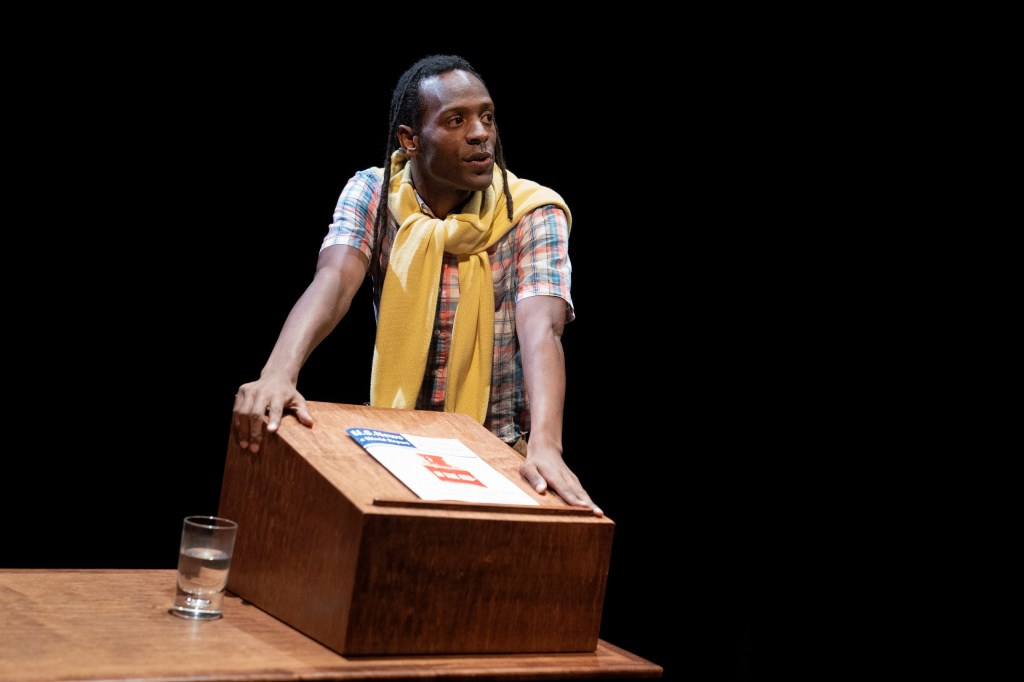
The unadorned, bare bones production highlights the arguments Baldwin and Buckley presented at Cambridge in response to the question, “Has the American Dream been achieved at the expense of the American Negro?” With a minimalist set, two desks, chairs, lamps staged with the audience on three sides at the Anspacher Theater, the evening replicates the words if not the tone, ethos or dynamic drama of Baldwin (Greig Sargeant) and Buckley (Ben Jalosa Williams) in their face-off.
It is a worthy triumph of ERS to re-imagine these two titans, one eloquently speaking for Black America, the other a conservative writer and National Review founder. The latter supported a slow walk of desegregation which Blacks must “be ready for,” and were “not yet ready for.” Baldwin’s and Buckley’s perspectives reflected national attitudes, especially after the legislative gains made for Blacks in 1954, 1964 and 1965 which Baldwin didn’t trust because the power structures of the South and North didn’t adequately enforce the laws. In viewing their comments now, as our nation experiences “in-your-face” racism and discrimination, that would overthrow all gains (revealed in striking down Roe vs. Wade and most of the 1965 Voting Rights Act) the concepts in the debate between Baldwin and Buckley are highly relevant and worthy of review.

The inherent drama of the debate, its electric personages, and the crisis of the time eludes the actors and the director. Indeed, perhaps the task is impossible without sufficient artistry, and imagination to suggest what once was, the frenetic and feverish times of the country that in 1965 saw the Watts riots, which Baldwin alludes to at the end of his speech.
When Baldwin and Buckley debated, America was still fighting segregation in the deep South, the effects of which Cambridge student Mr. Heycock (Gavin Price on Saturdays) discusses to introduce Baldwin’s arguments. He mentions statistics quoted by Martin Luther King, Jr. when they conducted a protest supporting voting rights in Alabama. Heycock states, there were more Negroes in jail for protesting than on the voting rolls. He enumerates other statistics. These identified the extent to which Blacks had been excluded from the White society’s opportunities and their aspirations to achieve the American Dream: jobs with benefits, college educations, economic prosperity, home ownership and more.

As both Heycock and later Sargeant’s Baldwin make clear during their fact-laden presentations, in no way was the Black experience in America “separate but equal” to that of Whites. Their lives, their worlds, their perspectives, opportunities and approach to daily living was anything but equivalent.
Though this was especially so in the South, the quality of life disparities also were prevalent in Northern cities like New York, Detroit, Chicago, Los Angeles. There, Blacks were shoveled into the projects branded as a Utopian “urban renewal.” Actually, there was no renewal, as Blacks were crowded into broken-down buildings and crime-ridden ghettos, where rats flourished and the garbage spilled over into the streets. All of these points, Sargeant’s Baldwin mentions, disputing that Blacks have an equal opportunity in achieving the “American Dream,” which is obtain by Whites at Black’s expense.

The debate is a historic call to remembrance and worthy as such, which is why it bears being watched on YouTube, after seeing the Public’s production, directed by John Collins. The YouTube video reveals the unmistakable ambience of Cambridge and the scholars and students present in their formality and sobriety, laughing at Baldwin’s wit and wisdom and sometimes laughing with ridicule at Buckley’s pompousness and stumbles into bigotry.
Indeed, what is absent from the Public Theater production is this sense of moment. Missing is the ambience of setting and the nature of the audience which played a role in relaying the importance of the Baldwin and Buckley debate. These two giants in their own right honored Cambridge with their presence and concern, conveying American voices and perspectives. The gravitas is lacking in the production and is a possible misstep. Though an announcement is made as to the setting, more should have been done to convey the place and time. With a minimum of dramatization, the production wasn’t as dynamic as it could have been.

Creatively conveying time and place was not the choice of ERS or director Collins. Thus, Baldwin & Budkley at Cambridge is uneven. In structure and format the production follows the original debate. The elements are modernized, costumes in modern dress, not the black bow tie and suit worn for the formal Cambridge debate.
Also, somewhat confusing is that Price’s Heycock acknowledges the Lanape Indigenous Tribe who owned the land the Public Theater rests on. Then immediately he segues into the original debate structure. Perhaps as is done with other productions at the Public, a voice over by Oskar Eustis honoring the Lanape would have been less confusing. The separation of the present America from the debate setting is needed so the audience might reflect on the history of the land. After a pause, the setting of Cambridge, 1965 could then be established.

When Heycock finishes his introduction, Cambridge student Mr. Burford (Christopher-Rashee Stevenson) introduces Buckley’s argument, that it is not true that “the American Dream has been achieved at the expense of the American Negro.” To refute this Mr. Burford points out that 35 Black millionaires have achieved the American Dream. This justification that Blacks have attained the dream and not at the expense of Blacks is an example of the convoluted logic that will follow in Buckley’s confused and misdirected arguments.
Burford’s belittling statement in ignoring the huge unequal and disproportionate number of the few wealthy Blacks to numerous wealthy Whites deserves laughter and ridicule. Interestingly, the audience at the Public didn’t respond, as bigoted as the comment was. Possibly the lack of context of time and place contributed to an absence of audience engagement with Burford’s obnoxious statement and at other times during the performance.
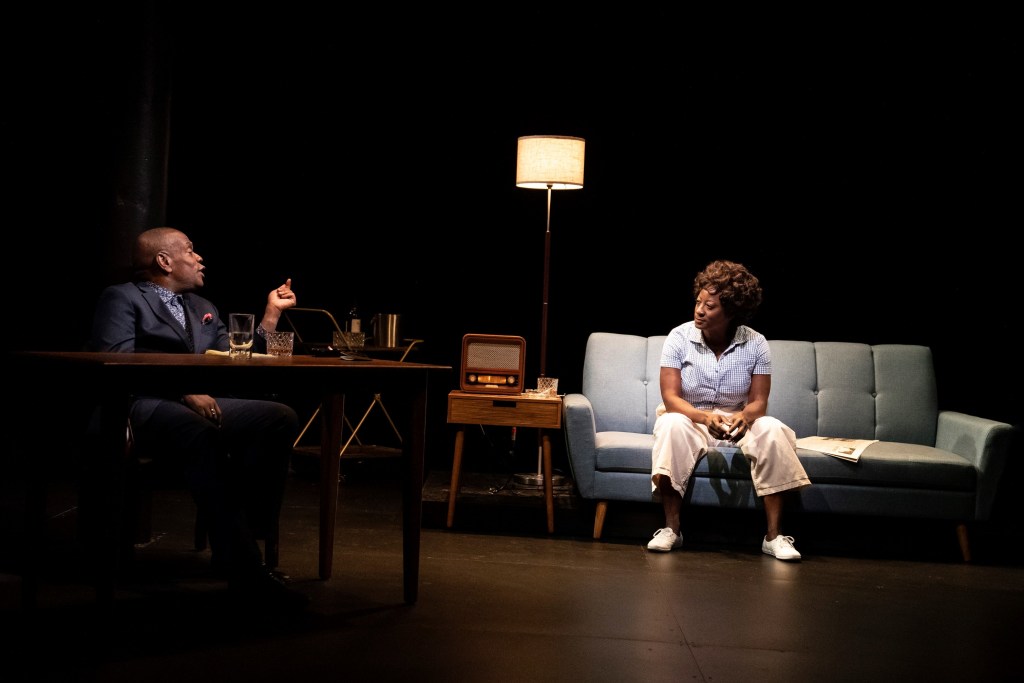
Identifying the number of Black millionaires, while ignoring the large percentage of Blacks who live in poverty, evidences the superficiality of Buckley’s arguments which follow Burford’s introduction. As Williams’ Buckley launches into his presentation, we understand that the reality that Baldwin just portrayed about the Black experience in America, will in no way enter in to Buckley’s discussion. Indeed, he dismisses and ignores Baldwin’s brilliant conceptualizations, something which Baldwin intuits that the White culture does to perpetuate the status quo. Throughout his presentation Buckley doesn’t acknowledge that White culture controls, creates and dictates the Black experience. In no way is Baldwin’s picture of reality confronted by Buckley in his disjointed and at times abstruse speech.
Buckley diverges from Baldwin’s statements so that he does not dispute that the American Dream exists at the expense of Black exploitation. He ignores Baldwin’s dense discussion that the American Dream by its very nature in the White culture’s understanding nullifies its existence if Blacks are to be a part of it. For the American Dream to exist, Baldwin suggests from the White perspective, Blacks must be excluded and given little opportunity to achieve it. Blacks can’t be a part because it necessitates exploitation of themselves. Baldwin’s point is that the dream only exists for Whites. Blacks are a part only in so far that they are at the bottom of the power structure, the foundation upon which Whites step up and rise, taking with them all the spoils, all the opportunities.

Sargeant’s Baldwin is wry and not as nuanced, expressive and dramatic as he might have been. On the other hand, Williams’ Buckley is vital, stirring and engaging. Clearly, in the Public Theater production, Buckley won. I found myself dropping out as Sargeant’s portrayal missed important beats. Williams’ sharp edginess and movements kept my interest. Conversely, Price’s Heycock was portrayed with vitality. Stevenson’s Burford was adequate.
Interestingly, after the debate Sargeant’s Baldwin sits with friend and playwright Lorraine Hansberry (Daphne Gaines). Their interchange reveals their close friendship. Unfortunately, the scene is too brief and should have delved deeper. At the very end, Sargeant takes off the mantle of Baldwin in his most authentic moment. He acknowledges the company’s own politically incorrect historic racism when ERS cast White actors to play Black roles in their early versions of The Sound and the Fury. To identify a past that we are still trying to become free of, even the most well meaning of us, seems counterproductive, guilty and fearful. I look forward to a time when theater moves beyond this stance which in itself is disingenuous and “protests too much.”
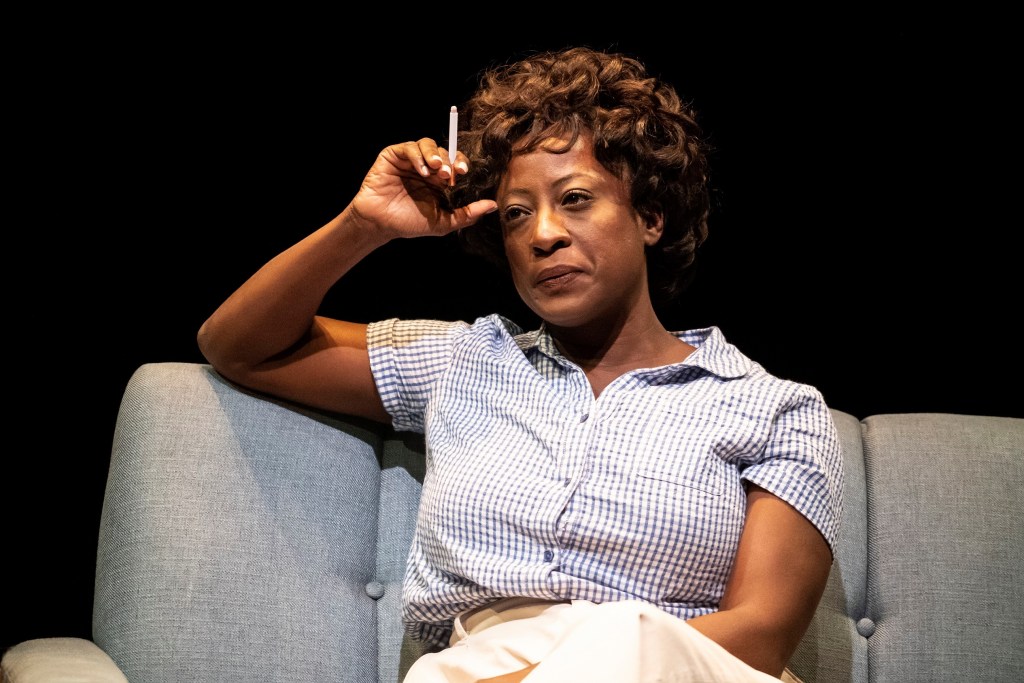
Clearly, at this time it is appropriate that the debate of Baldwin & Budkley at Cambridge be re-imagined. We are at a crossroads. This is not 1965. We are not in Cambridge, however, the ideas from our racist past that were entrenched, have been redeemed as useful and justifiable for us in the present. At no other time in history having attained what we thought was racial progress, have we been so duped by the residual racism that existed culturally into believing it was harmless. Its dangers have always been there and liberals have been blind to it despite warnings by Black and Brown critics.
Baldwin knew, he saw. The Black reality and White world were as clear as day. He understood that the White reality was convinced of its craven rightness to oppress and suppress Blacks to achieve White agendas at Black expense. Today, this horrific White reality is most visible in law enforcement abuse of Blacks, in the broken justice system that incarcerates Blacks disproportionately, in the exclusion of Blacks in corporate empires, in every institution that harbors systemic racism.
And the economic oppression is growing worse to include everyone except the .001%. These truths existed sub rosa for decades as the gap between the wealthy and everyone else widened. However, it took an egregious and criminally-minded opportunist in former president Donald Trump to justify and promote a resurgence of open hatreds branding the necessity of racist oppression, and authoritarianism ruling the underclasses, using media PR of lies and obfuscation.
For that final reason, Baldwin & Budkley at Cambridge is an extremely vital production which must be seen. For tickets go to their website: https://publictheater.org/
‘Cost of Living’ Broadway Review: Are Lives Lived Well or Wasted?

What price do we place on our own inherent value? What is the rock bottom cost we have to pay to live with dignity and be fulfilled emotionally, physically, materially? These subtle questions as well as questions about our need for respect and life-giving emotional and spiritual connection compose the themes of Martyna Majok’s well-acted four-hander, Cost of Living directed by Jo Bonney currently, at the Samuel J. Friedman Theatre.
The 2018 Pulitzer Prize-winning play originally debuted at the Williamstown Theater Festival in 2016, and appeared off Broadway in Manhattan Theatre Club’s production at New York City Center in 2017. Currently, Manhattan Theatre Club presents Majok’s Broadway debut, adapting to the larger stage and stretching out the precisely appropriate scenic design of the various New Jersey apartments of differing economic scale by Wilson Chin. From the ensemble Gregg Mozgala and Katy Sullivan originated their roles of the differently abled John and Ani. Kara Young as Jess and David Zayas as Eddie portray the able bodied caretakers who learn what physical and emotional skills are required to help the differently abled deal with the most intimate and personal body functions when they cannot.
The actors make a terrific ensemble despite a play that has flawed construction and sometimes is unnecessarily confusing during the first hour of the two hour play which speeds by in some parts and slow walks in others. But for the exceptional performances one wouldn’t completely understand the import of the present immediate timeline of the first scene as it connects to the last scene. Both provide the frame that holds together the substance of the rest of the events which take place in flashback four months prior.
Thanks to the superb David Zayas who portrays Eddie, an out of work truck driver and former alcoholic who is clear-eyed and specific in his discussion of his wife who has passed, we eventually unravel the mystery of events which take place between Eddie and wife Ani (Katy Sullivan), Jess (Kara Young) and John (Greg Mozgala) that unspool in the past and spin into the present changing the direction of circumstances for Eddie and Jess.

If Majok didn’t order the play as a frame with flashbacks, the relationships of the couples would have popped even more than they do. However, it is a way to hide the contrivances that promote surprise and twists in Majok’s exploration of the relationships between Jess and John, Ani and Eddie. These twists set up the concluding scene which effects the most beautiful and resonating of Marjok’s themes of connection and communication. The last scene is the uplifting high-point of the play, carefully shepherded by Bonny and wonderfully acted by Zayas and Young.
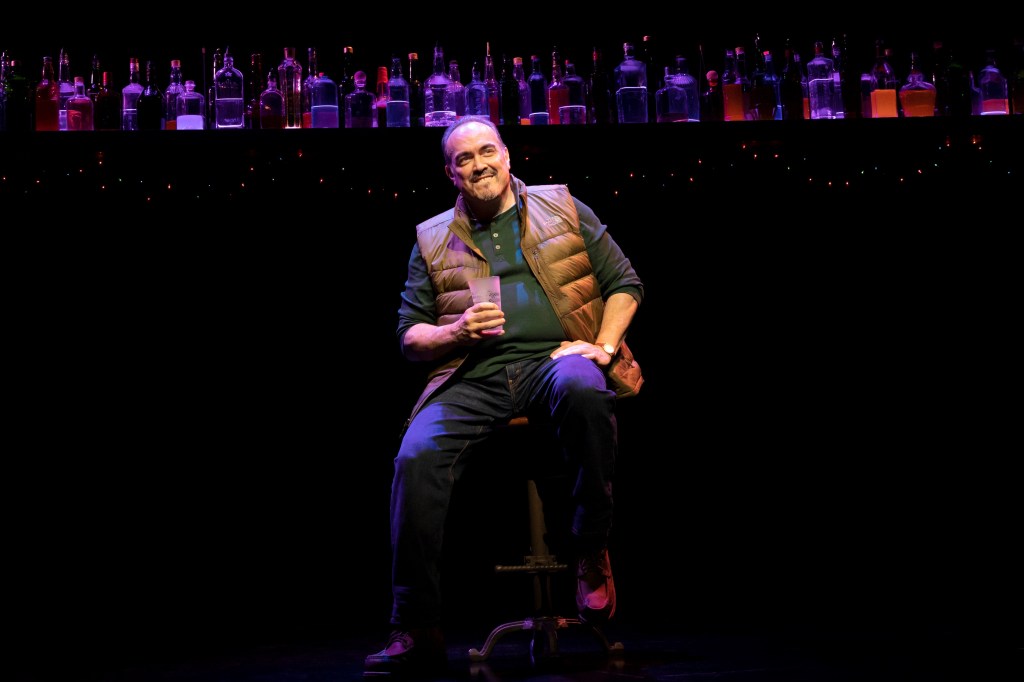
The structural difficulty occurs in the initial scene with Eddie’s solo speech to an unidentified individual (the audience) in the setting of a bar with a lovely row of shining alcohol bottles decoratively strung with Christmas lights. Eddie tells us the hipster bar is in chic Williamsburg, Brooklyn where he has been enticed from Bayonne, New Jersey by cheeky texts. The anonymous individual was given his deceased wife’s phone number which Eddie used to text her to not feel so desolate and alone. After being pestered by the texter into curiosity and a desire to stave off loneliness, Eddie decides to accept the offer to meet at the Williamsburg bar on the snowy night in December.

Zayas’s Eddie, in this sprawling introductory opening scene, where he relays some of his backstory about his alcoholism and split with his wife, remains charming, funny and generous. He easily wins us over by offering us (the anonymous guy in the bar) a drink for listening to him as he promises not to launch into the doom and gloom he feels since his wife died. We go along for the pleasant ride, not realizing when he leaves that this is a prologue, one section of the frame in the immediate present. Thus when the scene switches completely to another setting (thanks to Wilson Chin’s upscale scenic design representing John’s apartment) we don’t realize we are in a flashback four months earlier in another situation. We discover it when the director and the playwright unfold the dialogue introducing two characters unrelated to Eddie.
This might easily have been clarified with a notation in the program of setting change. Prosaic and uncool? Hardly. For the purpose of clarification and the heightening of the vital themes and arc of the relationships which the playwright presents and explores, the details would have launched us into the profound characterizations earlier to appreciate the depth of the play. Thus, we must catch ourselves up in the time switch to a flashback that this is John’s apartment in Princeton at a time in September.

Jess (Kara Young) and John (Greg Mozgala) are complex individuals coming from completely different socioeconomic backgrounds and physical and emotional states, key points for what later unfolds. By degrees we learn that Jess and John went to Princeton where John’s stylish apartment is located. John is a wealthy grad student with cerebral palsy (Mozgala has cerebral palsy). Jess graduated with honors and now works in bars where her tips are large. However, she needs the caretaker job John offers for additional money. As both do the interview dance, we are struck by Jess’ unadorned personality and direct authenticity. John must win us over as he comes off as a presumptuous ironist who is taken with himself.
Whether his personality is a pose to cover for extreme inferiority in a culture and society that prizes the beautiful, athletic, young and whole, or his wealth has allowed him to leverage his superior act, we realize that both Jess and John act in control. Like any relationship, even a work one, trust must be gained and built up. Jess is guarded and wary; John is overly confident and wry.

In the next scene switch from John’s apartment in Princeton, we meet Eddie’s wife Ani who is alive at this point in the flashback which she states takes place in September. She is in her new apartment where she will live with outside help. She is a quadriplegic, having suffered a horrific car accident in the previous months where surgeries saved her life but couldn’t restore her use of her arms and both legs which were amputated at the knee. Obviously, Ani is infuriated with Eddie and curses him out as a matter of course, trying to get him to leave. He is moved by her condition and feels guilty and responsible for being with another woman, a cause of their separation and filing papers for divorce. However, because they are still legally together, she is on his insurance. And he kindly suggests she stay on it even after they are divorced.
The play by degrees establishes the warmth of feeling between Ani and Eddie, Jess and John as the caretakers help the differently abled shower, bathe and finish their personal toilet. The intimacy of the activities are matched by the honesty of their conversations so we are struck by the humanity and concern shared by each individual in the couple who helps the other in an exchange. Anit gives Eddie emotional support as he helps her physically. Jess receives a listening ear in John as she becomes adept at transferring him to the shower seat and helps him cleanse himself.
We learn more about Jess’ immigrant background, her mother’s returning home because of financial difficulty and her struggle to send money home to her, during John’s and Jess’ time together. With the once married couple, the former love between Eddie and Ani is still evident but it has changed and deepened. Eddie could just move away from Ani. However, he emotionally needs to be with her and is happy that he can help her and watch her when the agency and nurse call on him because her regular caretakers sometimes cancel.
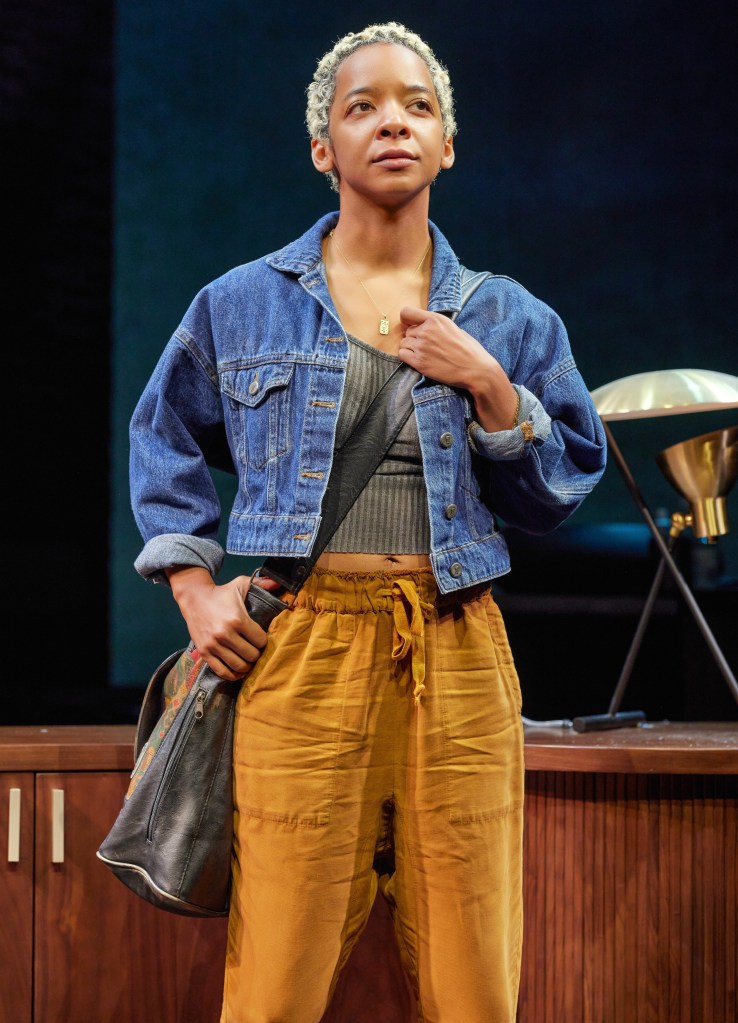
The dynamic relationships created by the superlative actors make this play ring out with hope, even though in the last two flashbacks, the darkness comes and we fear for the characters we have come to like. Also, selfishness is revealed in one of the characters whose clever manipulations are completely unexpected and underestimated. It is a shocking and hurtful reveal and the character never recovers our good will because he has made himself unworthy of it. This twist is seamlessly drawn as Majok plucks at our heart strings and upends our expectations. However, the last scene between Zayas’ Eddie and Young’s Kar is perfection in dialogue, acting, direction. In the actors’ living each moment, we realize why there is nothing like theater.
Cost of Living reminds us of our weaknesses and the consolation that if one feels lonely, all experience the ache even those partnered up. It is a fact of life that neither money nor marriage can salve; it is the cost of being alive, for we are each in ourselves individual and alone. However, only communication, truth and honesty with others can light the way for connection that is sincere and life affirming. It is then that the cost of being alive is worthwhile.
Kudos to Jessica Pabst (costume design) Jeff Croiter (lighting design) Rob Kaplowitz (sound design) Mikaal Sulaiman (original music) and Thomas Schall (movement consultant).
For tickets and times go to their website: https://www.manhattantheatreclub.com/shows/2022-23-season/cost-of-living/
Roma Torre Interviews Tony Award-Winning Producer Pat Addiss

LPTW Invites the Public to the Oral History Interview of Pat Addiss
On 17th of October at 6 p.m. in a joint collaboration of the New York Public Library for the Performing Arts and League of Professional Theatre Women (LPTW), Roma Torre, renowned theatre critic will be interviewing Broadway and Off-Broadway Award Winning Producer Pat Addiss. One award winner questions another award winner, a fitting highlight of LPTW’s celebration of its 40th anniversary, supporting women in the arts through networking, award grants, educational programs and much more.
Torre and Addiss, both women of pluck, drive and industry sport resumes that testify to their love of the theatre and prodigious efforts supporting New York Theatre and thus American Theatre. Addiss, a long-time member of LPTW, has produced more than 20 plays on and off Broadway. Many of these have won or were nominated for a Tony, notably: Little Women; Chita Rivera: The Dancer’s Life; Bridge and Tunnel; Spring Awakening; 39 Steps; Vanya and Sonia and Masha and Spike; and Eclipsed.
Addiss has a keen intellect for understanding what appeals to audiences. When she produces a show, she dedicates herself to making sure the actors (who love her), feel supported and appreciated. I have reviewed a number of her productions after I met Pat out in the Hamptons when I was covering the Hamptons International Film Festival. I have seen her productions (Little Women, Bridge and Tunnel, 39 Steps, Vanya and Sonia and Masha and Spike), and adored them even before I was introduced to her by her close friend Magda Katz, also on assignment at the HIFF, and became friendly with Pat and Magda.
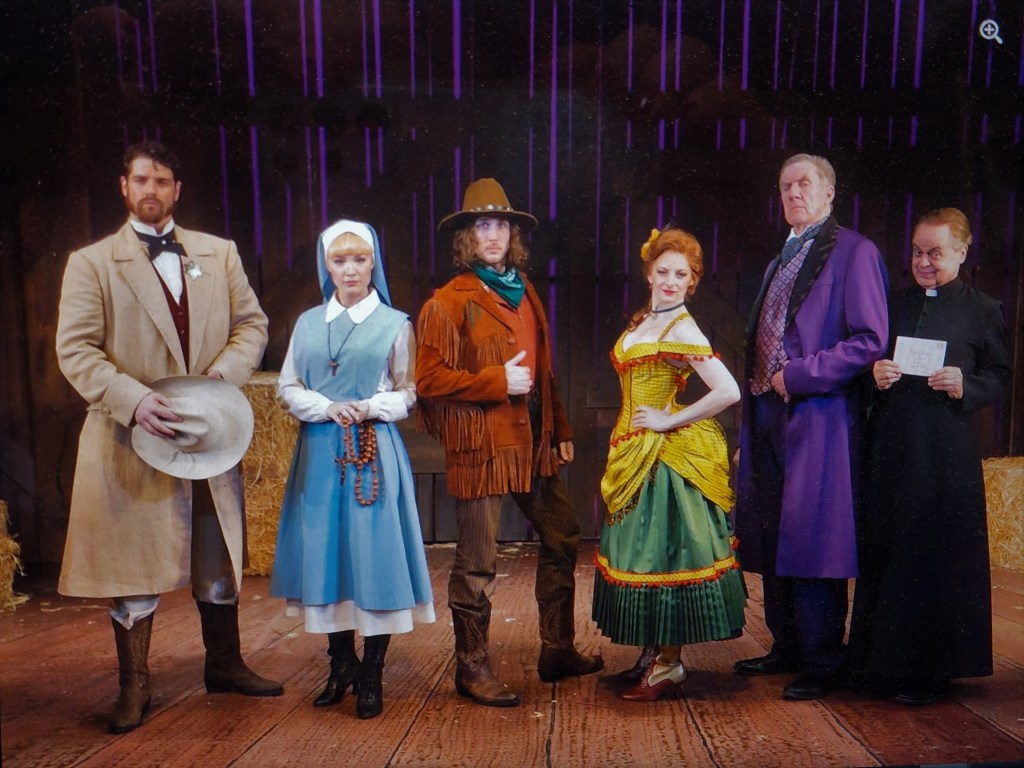
Pat’s Off Broadway productions are equally stellar. Buyer and Cellar is a classic that starred Michael Urie here and in London. To raise funds for Equity Fights Aides during the pandemic, Michael Urie streamed a live, amazing performance of Buyer and Cellar from his apartment. Urie did a phenomenal job with the help of technicians upstate, all of which was perfectly COVID compliant. It was an inspiration and uplift during the dark times of the COVID quarantine.
Pat’s Off Broadway musical, Desperate Measures, won 2 Drama Desk Awards, an Outer Critics Circle Award, and receives raves everywhere it plays in the USA,” Ludovica Villar-Hauser, LPTW Co-President and Producer of this event, noted. A musical satire of Shakespeare’s Measure for Measure with a “wild west” conceptualization, Desperate Measure is another production classic that shines.
Interviewer Roma Torre needs no introduction to faithful viewers of NY1, who happily watched Torre for 28 years as the channel’s midday anchor and chief theatre critic. What viewers might not know is that Torre is a recipient of three Emmys and more than 30 other broadcasting awards. Torre has reviewed more than 3,000 Broadway and Off-Broadway productions and has been inducted into the National Academy of Arts and Sciences Silver Circle, honoring her for lifetime achievement in newscasting.

This event honoring Pat Addiss, part of the 40th anniversary celebration of LPTW, is open to the public. The event is being held at the Lincoln Center Library of the Performing Arts on 40 Lincoln Center Plaza on Amsterdam Avenue in New York City. It is part of a series sponsored by the LPTW Oral History Interview Project in partnership with the Library. To view past Oral History interviews, visit the Library’s Theatre on Film and Tape Archive, or visit LPTW’s archive.
The Pat Addiss interview by Roma Torre is one of the “exciting in-person and online events, where we will honor significant contributions of theatre women across all disciplines, who represent a broad array of ethnic, cultural, and racial backgrounds. Most of our programs this 40th Anniversary Season for LPTW will celebrate our incredible Membership,” said Villar-Hauser.
Women working in the theatre industry are eligible to join LPTW. For more information on upcoming events and to join LPTW, visit: www.theatrewomen.org.
‘This Beautiful Future’ Transfers to the Cherry Lane

Sometimes the only hope alive during crises or the trauma of war are romantic dreams which disappear in the light of day. Young love, illusion, rueful regret and irony thread two lines of action, one .in the past in Chartres, France, 1944, the other in an opaque and timeless present. The threads are like parallel tracks that coexist simultaneously without touching until the conclusion of This Beautiful Future where they do briefly coalesce. The production directed by Jack Serio and written by Rita Kalnejais is running at the Cherry Lane Theatre until October 30th.

The playing space downstage front represents an abandoned house once occupied by Jews, rousted out by the Nazis. The setting is Chartres France, 1944 at the end of WWII. Upstage, behind a plastic window partition in the present are observers of the action, two wise, world-savvy seniors (Angelina Fiordellisi) and (Austin Pendleton), playing themselves. These venerables serenade us with ironic songs that provide an exclamation point to the the troubling conversations, cognitive dissonance and contradictions that abide between love-mates, a canny French teenager Elodie (Francesca Carpanini) and Otto (Uly Schlesinger). Otto is a Nazi youth, old enough to shoot Frenchmen for his idol Hitler, but too naive and ignorant to understand the heinousness of his actions.
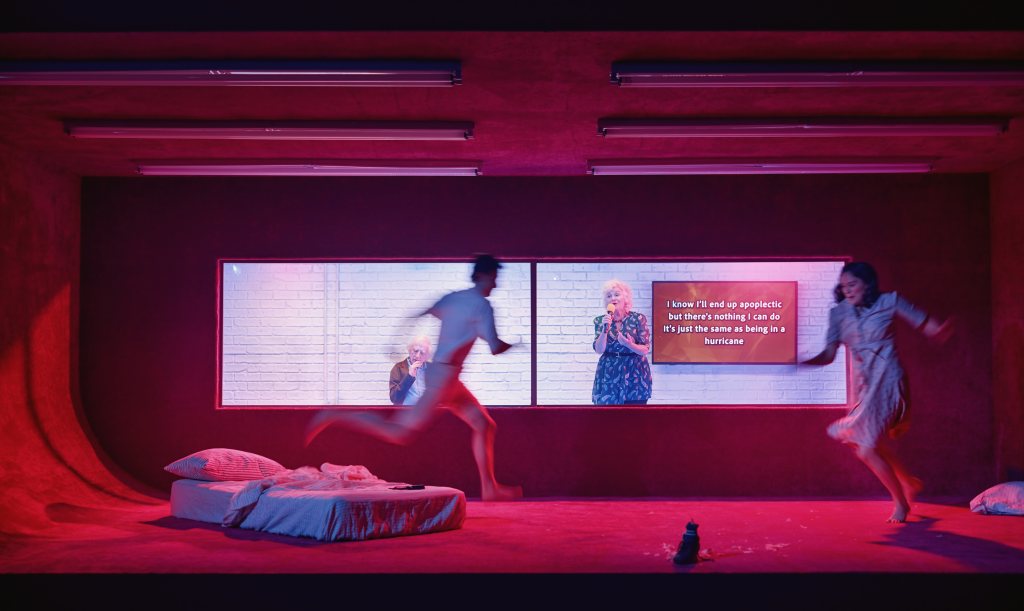
Though the conflict is understated, Elodie has fallen in love with Otto despite his mission to kill, and he is entranced with her, possibly using her to ignore the rude reality that the war is over and he is on the wrong side and facing certain death as American forces are a day, then minutes away.
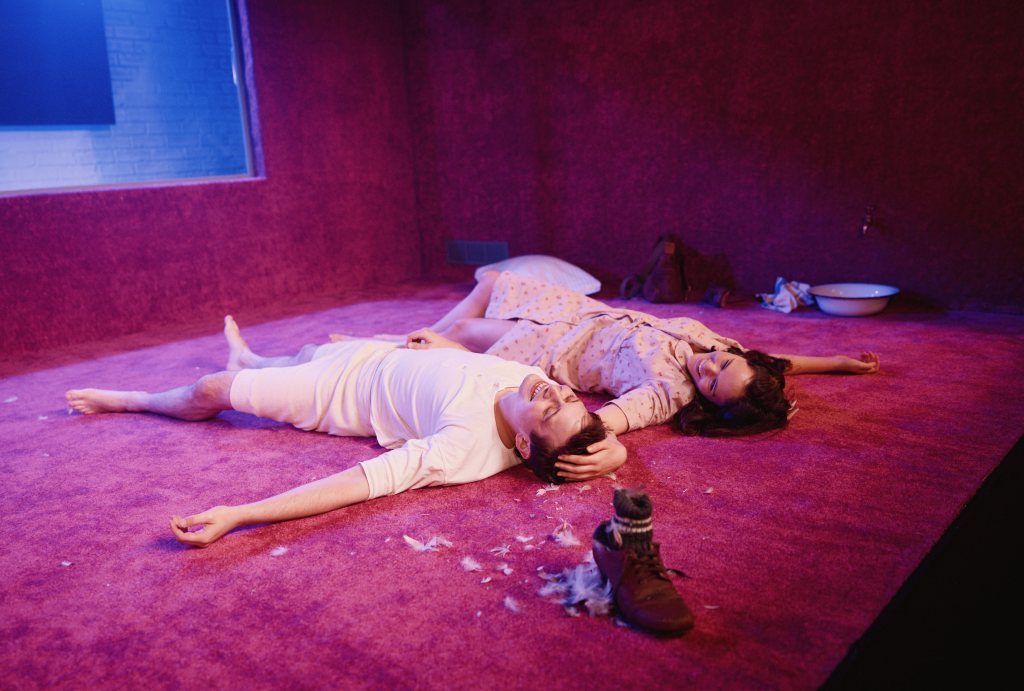
The play combines monologue and interactive dialogue. The time is non linear and moves into flashbacks which alternate from Elodie’s and Otto’s magical and sweet interludes in the bedroom of the abandoned house their last evening together, to the following day when in monologue they unremorsefully describe the consequences of their love’s fool-heartiness. Another flashback skips to the time when they first discovered their interest in each other at the lake. Then the next scene jumps to Otto’s monologue describing his last moments on earth and Elodie’s monologue describing her public shaming and harassment for making love to a Nazi.
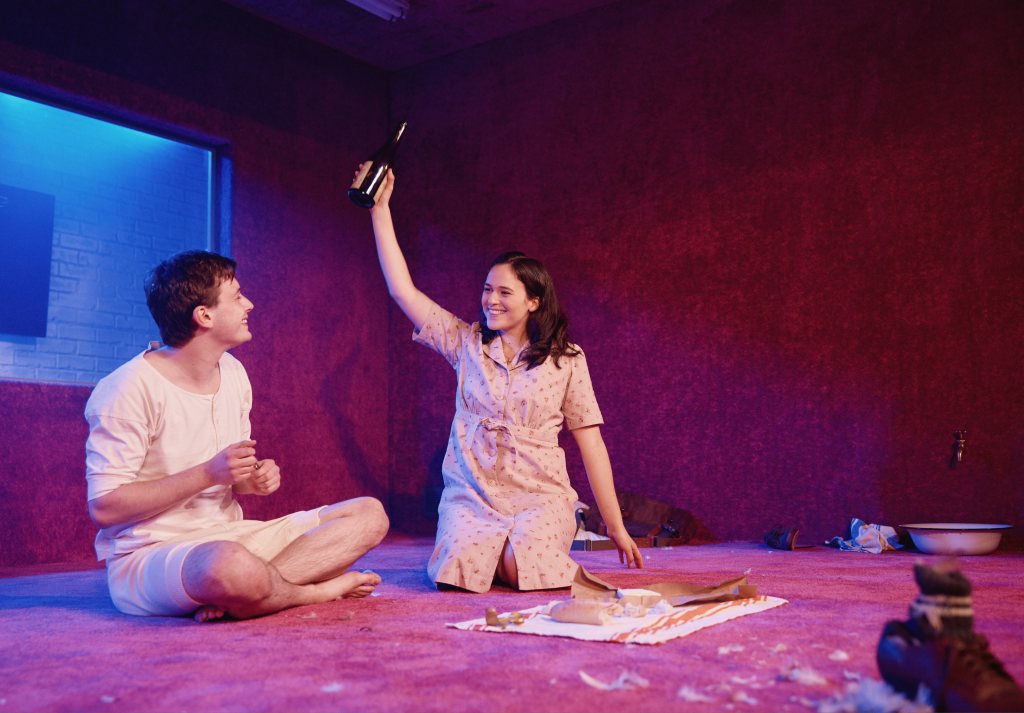
Elodie’s and Otto’s separate monologues delivered to the audience are reveries without emotion. As they discuss the consequence of their brief love relationship the following day after their night together in the house, we are surprised by the contrast with the previous scenes when their interactions are joyous, magical, uplifting. During their pillow fight, their throwing water and teasing each other, we forget that this is wartime. As they are compelled to escape to each other, we are relieved to focus on the silliness of their youthful innocence. Yes, even a killer Nazi has elements in his spirit that are silly and sensitive. Importantly, Kalnejais never steps too far away from Otto’s humanity to make him a stereotype.
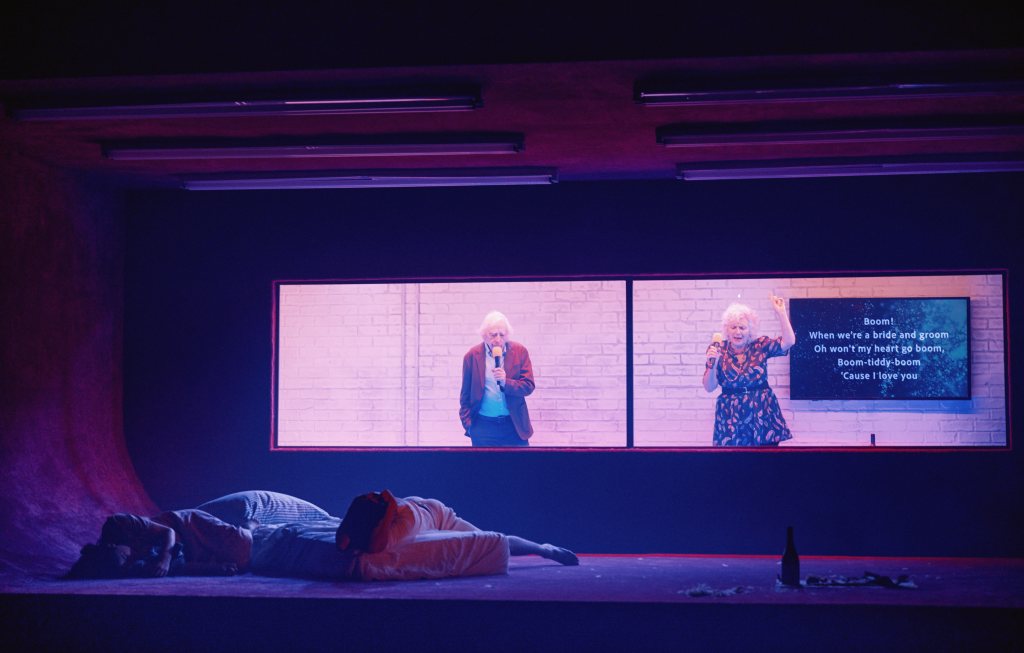
In the final section the morning before they both leave the house, an egg which Elodie has stolen from a nearby chicken coop hatches and the loud chick proclaims it is alive. Of course the irony is that as the two of them leave, the chick will have to fend for itself and most probably die. This irony is heaped on another irony, because in the first scene they discuss their future after the war; they will raise this chick and have more chickens. This is the “beautiful future” of Otto and Elodie, wayward dreamers who at this point in their lives do not regret what they have experienced together. Theirs is a respite in the horrors of death and chaos. Of course they must dream of the beautiful future because it will never come to pass.
Interestingly, toward the end of the play after the wise observers of these events sing songs whose lyrics are loaded with irony, Angelina and Austin come down from their perch “on high” and hug and comfort Otto and Elodie because of what they are going through. One wonders; if the observers could intervene would they encourage Otto to leave Elodie before morning so he doesn’t fall into the hands of the Americans and die? And if Angelina could counsel Elodie, might she have left Otto and the house before her countrywomen catch her and deem her a traitor? Elodie is punished for sleeping with a Nazi, she shares in a monologue. They publicly shame, harass her and shave her head.
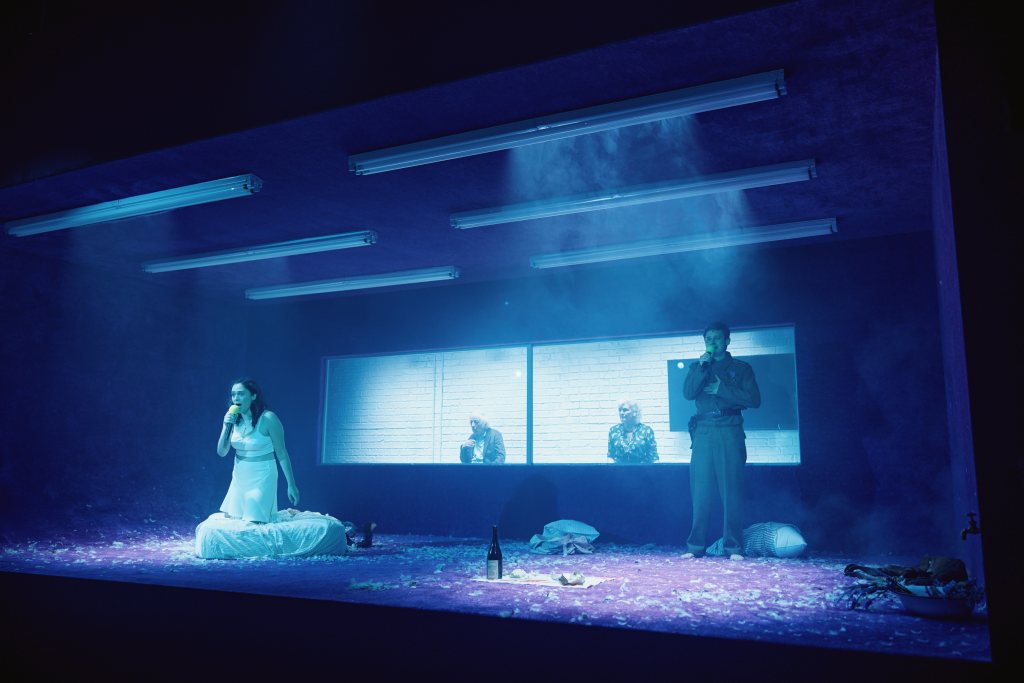
Most probably even if Angelina and Austin attempted to stop Elodie and Otto, they would have rebuked their interference so they could continue to believe in their dreams and “beautiful future.” They prefer being swept up by the annihilation of romantic love’s curse. Evidence of this abides throughout.
Otto is like the QAnon MAGAS in our nation who revel in the fantasies of their own making. Like them he is convinced of his rightness in bringing about Hitler’s “perfect” Master Race and the ideas of the Third Reich. Staunchly oblivious, he refers to news reports of Germany’s loss that Elodie shares with him from the BBC as banned propaganda. He even suggests he could arrest her for listening to enemy radio. Otto cannot be dissuaded from his beliefs that his troop is going to invade England the next day. Most probably his commanders have told them these lies to bolster their flagging moral. It is a wartime trick. One is reminded of Putin’s commanders lying to the Russian youth to get them to fight his losing war against Ukraine.
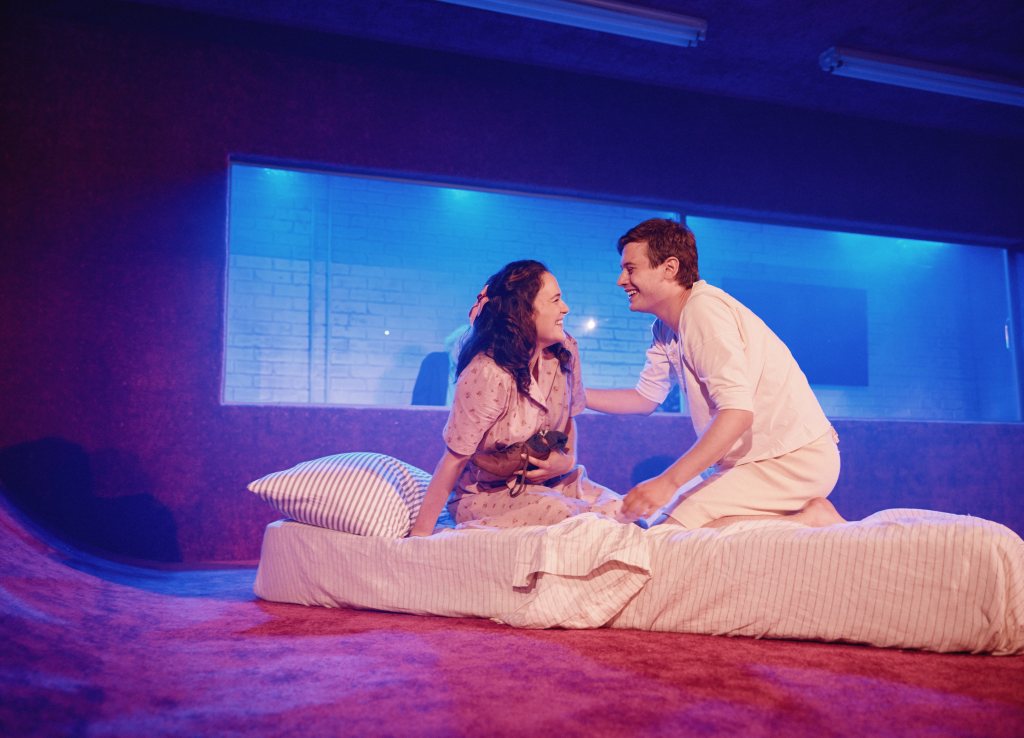
From war to war throughout the ages up until today, no sane individual wants to kill other human beings. They have to be brainwashed with lies, scapegoating “the enemy other” to do so. Of course, the final lie is that the war is being waged to bring about “the beautiful future.” Things will be better once “the other” is wiped out, cleansed from the face of existence. That Elodie “loves” someone who believes this is an interesting phenomenon. Thus, the songs that Angelina and Austin sing are supremely ironic as they heighten the obliviousness of Elodie and Otto, who we somehow find ourselves engaged with, precisely because they are youthful and off-the-charts irresponsible and blind.
Elodie is like the MAGA wife who supports her husband going to radical, conservative, right-wing Donald Trump rallies, though it is counter to their lives to give money to a grifter, defrauder and proven liar. Elodie ignores the truth that Otto is a killer, a brainwashed Nazi who has most probably killed her brother’s friend and others in her acquaintance. Indeed, the Nazis have killed friends, neighbors and family. Yet, she is able to live with the cognitive dissonance and “love” him.
For his part Otto puffs himself up riding on Hitler’s coattails. He imagines Hitler’s greatness when he started out from nothing to become the near ruler of all of Europe. Otto is tremendously enamored of the adventures he’s had fighting for Hitler and the respect he garners because he wears a uniform. During Elodie’s and Otto’s monologues and interactions, the songs which Angelina and Austin sing are laughably sardonic. That they sing with sweetness punctuates the dark irony all the more.
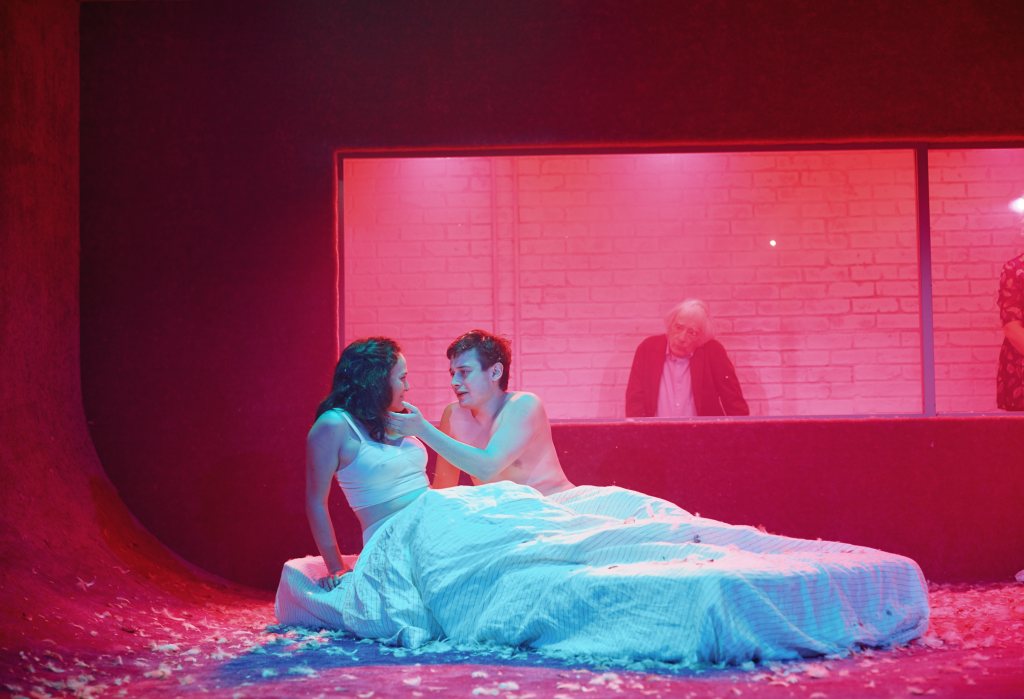
This Beautiful Future is not for everyone. From the rosy, pink set appointments evoking the concept of seeing life through “rose colored glasses” (Frank J. Oliva-scenic design), to the contrast of action and singing in a divided stage (Lacey Ebb-production design), by undefined observers, one may be confounded with a cursory viewing. The play necessitates one goes deeper for it is thought provoking and extremely current. It is well acted and finely directed. The scenes between Carpanini’s Elodie and Uly’s Otto have striking moments of whimsy, beauty and poignancy. However, playwright Rita Kalnejais always makes sure that the romantic fantasy is momentary and that leering reality lurks around the corner ready to pop up and set Elodie’s and Otto’s tranquility spinning into fear.
This Beautiful Future runs 80 minutes with no intermission at the Cherry Lane Theatre. For tickets and times go to their website: https://thisbeautifulfuture.com/
‘Kinky Boots’ is BACK, and It’s Phenomenal!
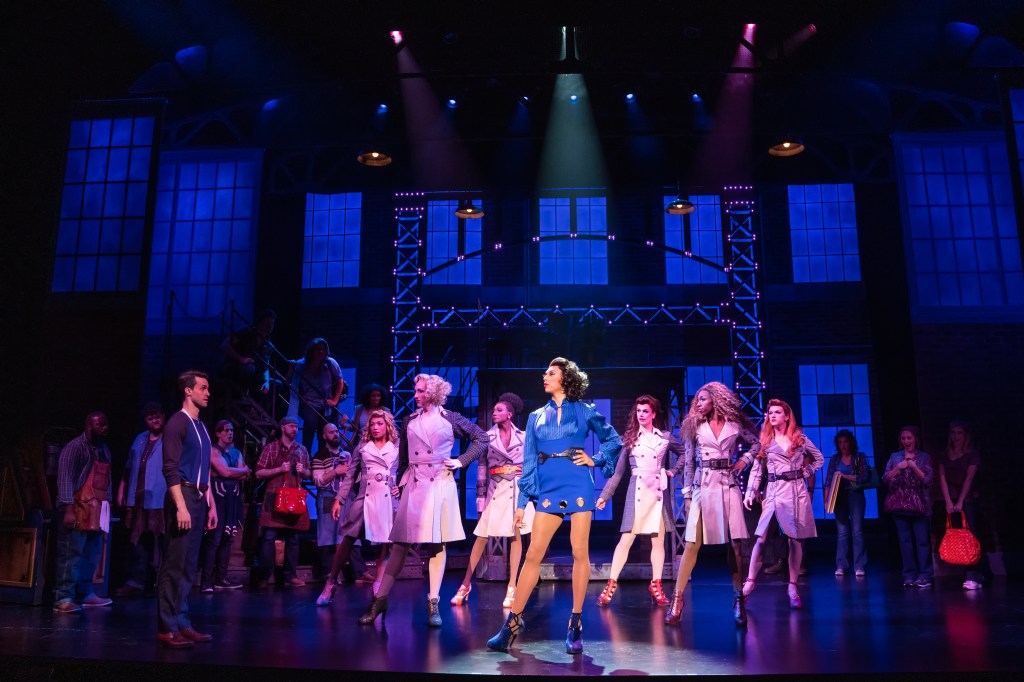
I did not ,see the 2013 production of Kinky Boots, the multi-award winning blockbuster by Harvey Fierstein (book) and Cindi Lauper (music & lyrics), that ran for six years and fortuitously closed April of 2019, one year before the COVID pandemic upended Broadway. The show won six Tony Awards, including Best Musical. These went to Billy Porter as the Best Actor in a Musical, Cindi Lauper for her amazing music and lyrics, Jerry Mitchell for choreography, Stephen Oremus for his orchestrations and John Shivers for sound design.

To share in the bounty for theater goers like me who missed the show and for those fans who are over the moon for Lola and her posse-pop-rocking Angels, producers continue to inspire us presenting this glorious musical at the appropriately intimate, yet large cast accommodations Off Broadway at Stage 42. The creatives are the same with the exception of Gareth Owen, whose sound design keeps the pared- down orchestra as enthralling as ever, and the actors’ vocals spot-on clear. Cleverly keeping the ticket prices at a reasonable level, this “kick-ass” Kinky is a slimmed down version, loyal to what works timelessly with the songs and book with tweaks and a few changes. The cast is extraordinary with gobsmacking, striking voices and performances.

Based on the titular 2005 British film written by Geoff Deane and Tim Firth, partly inspired by true events, the musical highlights Charlie Price (the wonderful Christian Douglas), the inheritor of Price & Sons shoe factory. Planning to launch out on a career with his fiancee Nicola (Brianna Stoute), Charlie’s last wish is to keep the failing company afloat. However, an unusual sequence of events redirects him from his intentions and prompts him to form a partnership with drag queen Lola (Callum Francis), in a wild scheme to produce a line of high-heeled boots for a niche market, which just might save the company. In the process circumstances evolve for the characters, who in their collaboration discover their unique talents, release their inner apprehensions and fears and become more accepting and loving of themselves and others.

The leads are brilliant. Christian Douglas’ Charlie is a reluctant inheritor. Before his death his father attempts to convince him that the company offers a purposeful career (“Price & Son Theme,” “The Most Beautiful Thing”). However, his father went into debt to keep his workers in their jobs and unbeknownst to Charlie plans to sell the company. Charlie vows to leave for London and start another career with Nicola (“Take What You Got”).
Douglas’s voice is sterling and his acting chops are right on. He builds Charlie’s character into one with more confidence to rally his workers after Lola’s designs inspire him to take the “kinky boots” journey. He is Lola’s perfect foil, who turns into a friend, when they both accept the depth of their sense of failure to create an opportunity (“I’m Not My Father’s Son”). As Charlie, Douglas’ pulling away from his relationship with Nicola is subtly gradual, with a grand assist by the superb Danielle Hope, factory worker Lauren, whose swooning gestures as she falls in love with Charlie are organically comedic and delightful (“The History of Wrong Guys”).
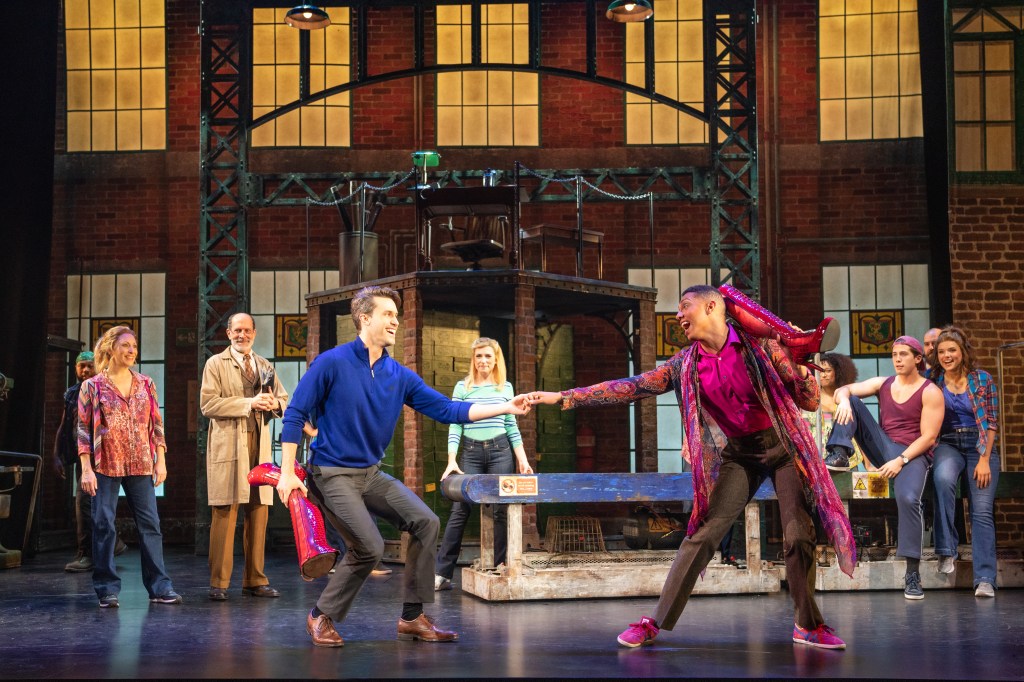
When the pressure is on to produce for the Milan show, we see Charlie’s obsessive, martinet nature arise. Douglas turns on a dime as he becomes fearful of failure and a perfectionist, fighting with Lola and infuriating his workers in a destructive act that threatens to upend their hard work. But for an unlikely savior who provides encouragement and funds in “the nick of time,” the factory’s closure would have been imminent. All they need for their success is Lola’s and the Angels’ participation in the Milan show. But Charlie can’t reach Lola, though he’s profusely apologized.
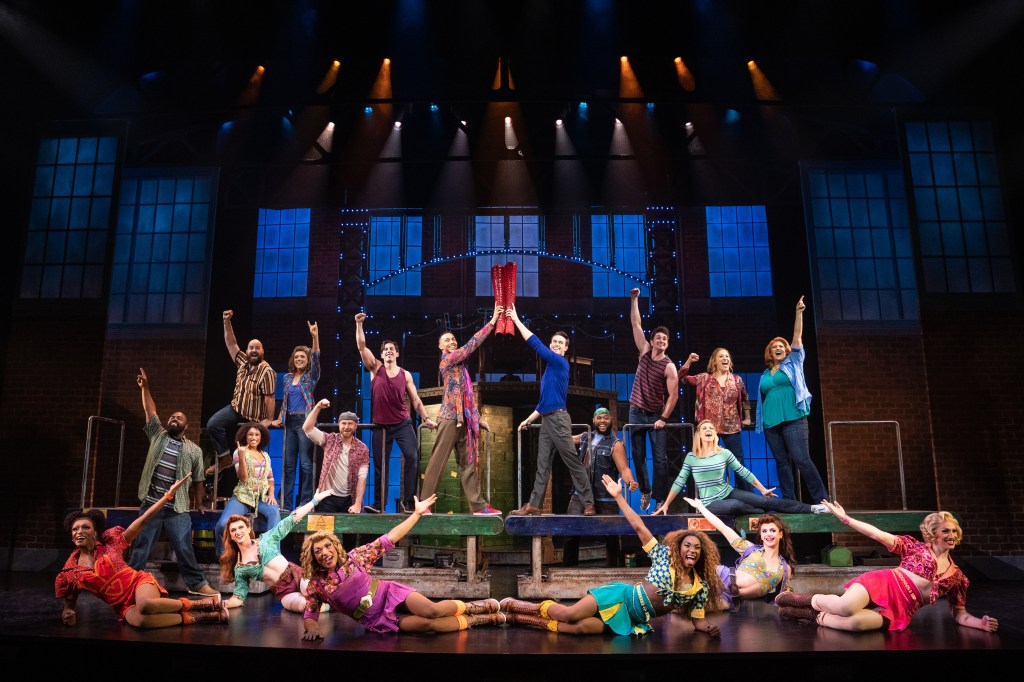
As Charlie, Douglas’ various complicated turns of character are well drawn and profoundly specific. In the powerhouse song where Charlie confronts his self-destructive hubris, “The Soul of a Man,” he brings down the house with applause that lasts some minutes. His performance is superb and heartfelt.

As Charlie’s friend and his initial foil, Lola is a character for the ages. As Lola Callum Francis is galactic star shine. Beautifully graceful and luminous, Francis is true to Lola’s cheeky characterization of himself: “an attention getter,” who mesmerizes. When he is on stage, your eyes invariably shift to him because of his relaxed authenticity and enjoyment in “bringing it.” One has the sense he understands all of the pain and glory that has been Lola’s journey toward self-acceptance and self-love.
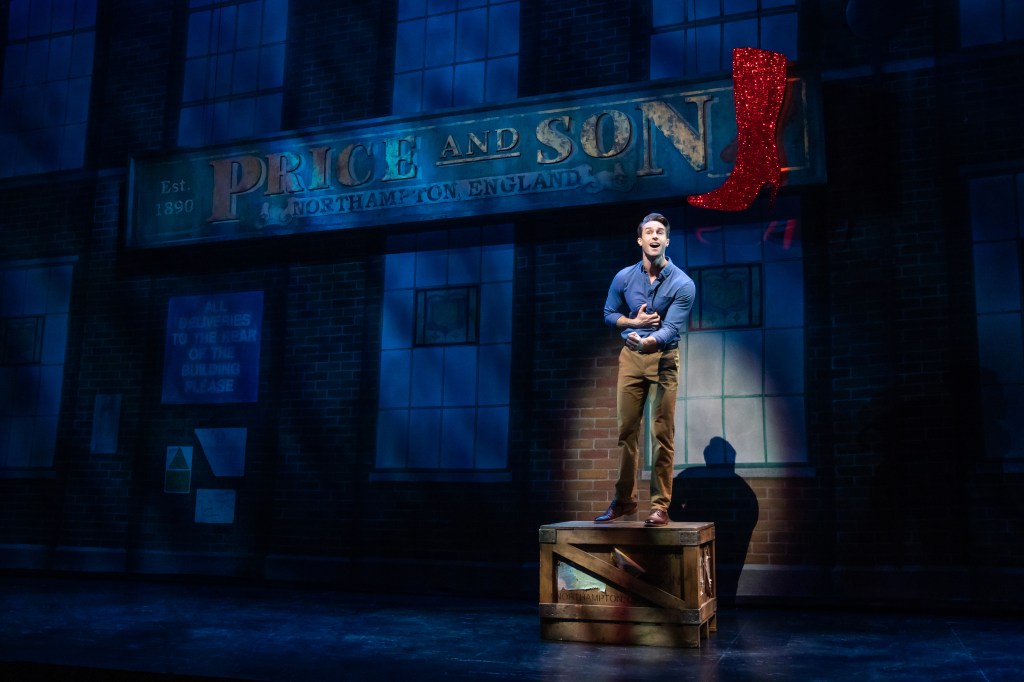
This is especially so when he sings with Charlie (“I’m Not My Father’s Son”). His smashing solo “Hold Me in Your Heart” kills. The latter song he sings to the nursing home residents, one of whom is his father. Francis inhabits Lola in “The Land of Lola,” “Sex Is in the Heel,” the magnificent “Everybody Say Yeah” and the uplifting finale “Raise You Up/Just Be.” Profoundly, Francis exhibits the disparities and complexities of the character; Lola is confident about his feminine gorgeousness, and less accepting about his identity as Simon. However, Charlie, Don and the others at Price & Sons help him grow into a fuller human being over the course of their designing and manufacturing “kinky boots.”

As Lola evolves and gains confidence being Charlie’s glam boot designer, Callum Francis deftly brings the two halves together to magnify what we must acknowledge as the finest strains of our humanity. The actor/character does this with such love and joy, one wants to embrace him for striking the divine and the human as he embodies all the themes of the musical: the importance of acceptance, love, compassion and empathy.
When we first see Simon as his male self, the shock is palpable. Francis is unrecognizable, for we have come to enjoy his Lola self. Thus, the difference, like night and day “says it all,” making Francis’ Lola all the more astounding. His gestures, mien, voice for Simon and Lola are distinct, unique, incredible. It is no wonder that having played the part in Britain, Australia and, briefly, on Broadway, Callum Francis won the Helpmann Award, Australia’s equivalent of the Tony Award.
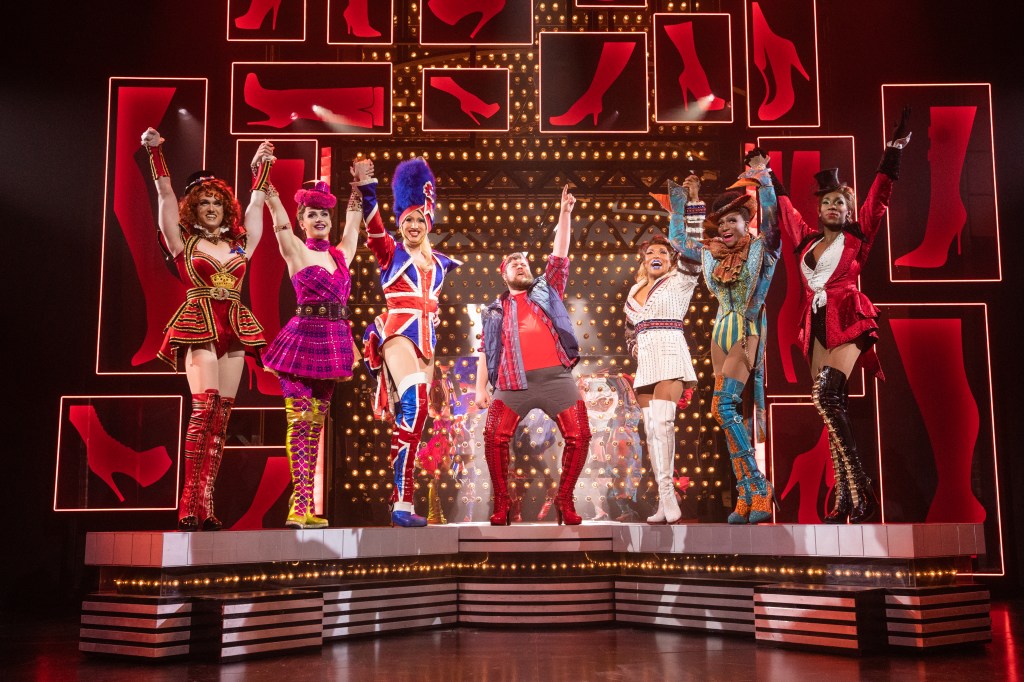
Some have whined that the scene of the young Simon and young Charlie, de-mystifying their backgrounds shouldn’t have been cut. However, there has been a sea change since the show closed and a pandemic has been weaponized by political conservatives who are against the existence of anyone who cannot be stuffed into their frightening cardboard copies of “normal.” Initially, crass, British lout Don (the fabulous, hysterical Sean Steele), reflects why both Simon and Charlie want a life elsewhere and are attracted to London. He represents the bigoted individual Charlie and Simon have had to suffer.

Additionally, the cuts make sense in 2022. The radically repressive, conservative, political tenor of our times moving into a Mid Terms where the far-right MAGA retrenchment against LBGTQ rights, human rights (Fla. Governor Ron Deathsantis’ migrant trafficking), the loss of the right to privacy (the overturning of Roe vs. Wade), has been so outrageous, the cut scenes are not necessary. The idea of anti-democratic cultural paternalism is pervasive. We understand such discriminatory rejection as inhuman. Drag queen Lola, is a firebrand of political controversy, daring to accept herself. The play’s uplifting themes are all the more trenchant, salient and vital for our times where hatred and condemnation lurk around every corner.
Thus, we feel the full thrust of Lola’s hearbreak in the ballad, “Hold Me in Your Heart,” which identifies the paternal rejection. It is not only a cry from Simon’s heart, it is a cry we can identify with, for who has not experienced rejection in one form or another, parental, familial, rejection from friends, strangers, etc.?
This faithful reboot of Kinky Boots directed by Jerry Mitchell is a marvel. The musical is two hours and twenty-five minutes that fly by. For tickets and times go to their website: https://kinkybootsthemusical.com/
 CAROLE DI TOSTI