Blog Archives
Nathan Lane, Laurie Metcalf Bring Out Truths for Our Time in an Ageless ‘Death of a Salesman’ (9 Tony nominations)
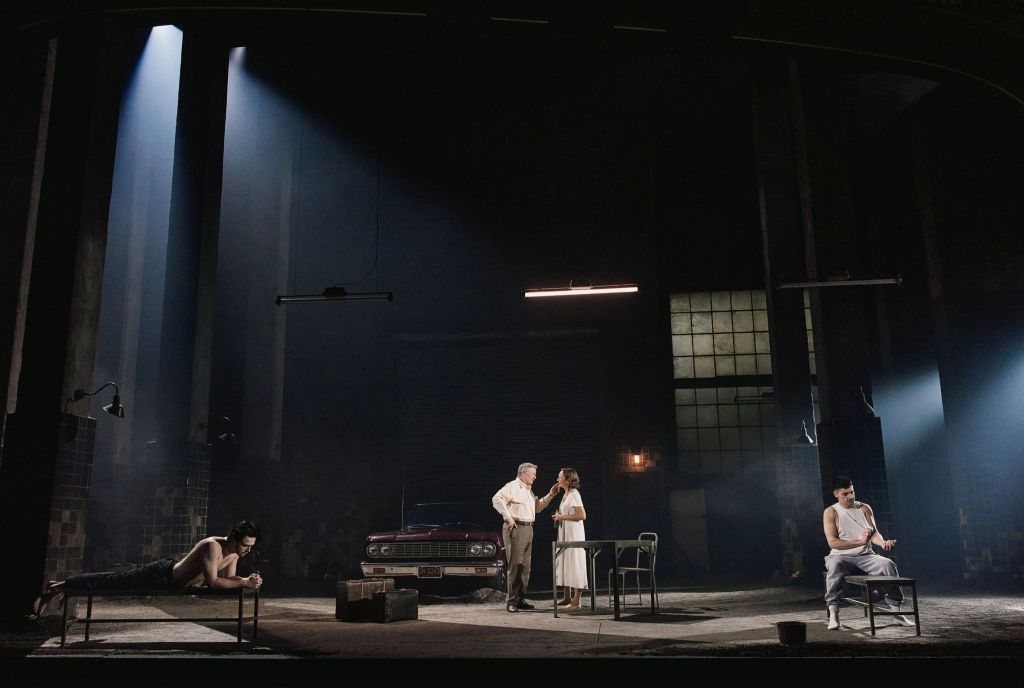
Considered Arthur Miller’s masterpiece of the average guy as a tragic figure, Death of a Salesman has been a hard sell for me as Miller’s greatest play. However, Joe Mantello’s searing direction that teases out incredible performances from Nathan Lane (Willy Loman), Laurie Metcalf (Linda Loman), Chrisopher Abbott (Biff) and Ben Ahlers (Happy), made me a convert. Presented on the cavernous stage of the Winter Garden Theatre in its sixth Broadway revival, the Loman family’s psychological travails between reality and hopeful dreams unfold their flawed humanity with pathos until August 9, 2026.
This magnificent revival in Mantello’s expansive vision conveys the characters as middle class archetypes of American citizens that are manufactured, used up and spit out by a devouring corporate culture, obsessed by success, money and status as definitions of power and greatness (“the American Dream”). Industrialization, production and “progress” are the means used to propagandize and process worker-citizens away from an appreciation of their soul worth and self identification as valuable to themselves and their families.
To underscore this overarching theme of the Lomans snared by this cultural processing with the use of the American Dream to drain their hopes, keep them ensnared and perpetuate the elusive lies of easy prosperity inferred by Willy’s Uncle Ben-Jonathan Cake (you walk into a jungle and bring out diamonds), Mantello uses a stylized set design superbly realized by Chloe Lamford. Additionally, the sound design by Mikaal Sulaiman, haunting music by Pulitzer Prize-winning composer Caroline Shaw, and lighting design by Jack Knowles beautifully carry Mantello’s dark, foreboding insights which the superb ensemble enlivens in a production whose like won’t be seen again.
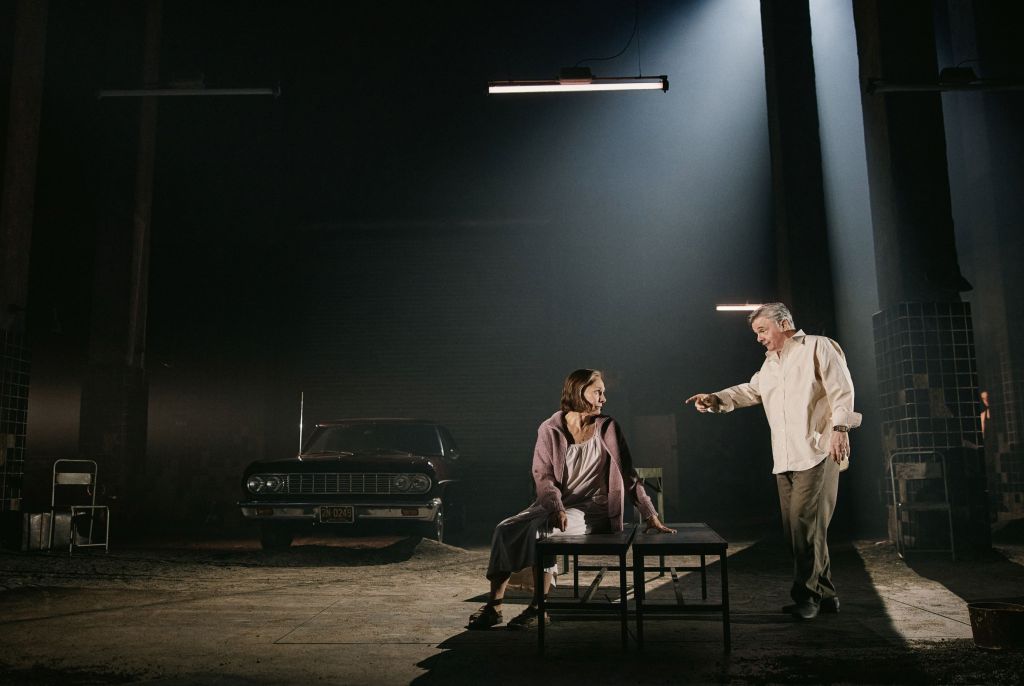
This production of Miller’s Salesman is perfectly synchronized to reflect citizens in our country, currently under siege from the very forces which isolate the Lomans from helping each other. Set adrift in misery, loneliness, distraction and despair, they have little recourse or salvation except delusions, hallucinations and denial. Even a form of success is never enough as suggested by Ahlers’ Happy, who references a prosperous boss who builds an estate but “doesn’t have the peace of mind to live in it.”
The symbol of what made America great, the car (automobile production and its attendant feeder industries, oil, gas, rubber, etc.), becomes that which Willy chooses as his place to die. Mantello features Willy’s car as ever-present and onstage throughout. The car is where Willy spent most of his life alone, traveling through New England with his dreams, and longing of returning home to see his sons, chiefly Biff who he lives his successes through until Biff has a breakdown. At the play’s beginning it also becomes his place of terror, of failure, of disorientation where he can no longer survive for any length of time on a road trip. Finally, he converts it to his way out of a tormenting hellish life he can’t bear, that promises more hope for his family in his death.
The play opens as Lane’s Willy, exhausted and broken down, returns from his aborted sales trip and drives the car onstage into the humongous, grey space that is the Loman’s stylized home. Unlike previous revivals, this place is nothing like an American home the bank would hold in a mortgage. It is similar to an empty factory or warehouse with rectangular, peeling tiled columns and no vibrant colors. It is dimly lit with a grid of dirty window panes on the backstage wall that barely let light in.
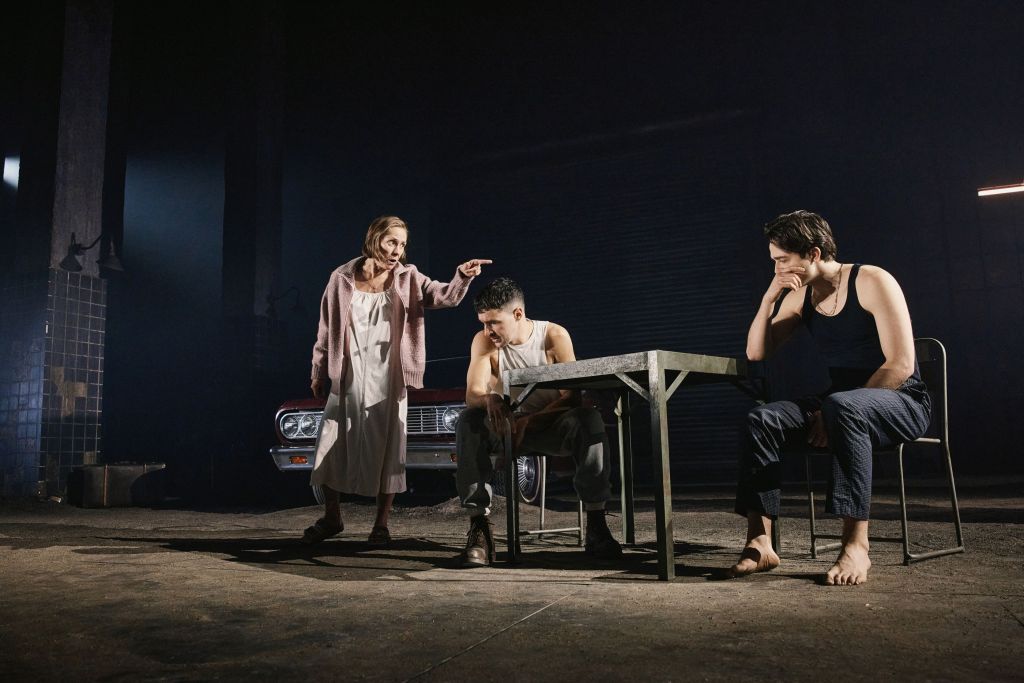
The space is symbolic and interpretive. Far stage left is the basement with Willy’s possible instrument of suicide, the gas water heater, and downstage left is the bit of soil where Lane’s Willy hopefully plants seeds he will never see grow. The characters remain onstage, moving around uncomfortable, factory-type, metal “furniture” to define areas they set up mostly away from each other. They sometimes become inconsequential dim shadows when they don’t speak and other family members do.
Spot lit when there are interactions is Mantello’s approach. But for their interactions darkness and isolation surround them. As spots come up on the initial scene between Willy and Linda when she asks why he came back home, Biff and Happy each lie on a bench on opposite sides of the stage in their ersatz beds and bedrooms, as their parents talk “downstairs.” The spots illuminate the life and interaction of Linda and Willy to a break point, then the darkness encroaches. The symbolism is affecting and effective, revealing the disjointedness of this family, their fears, their isolation, their solitary struggles, their inability to communicate with efficacy to bring about their listener’s understanding toward change.
Willy’s dire emotional and psychic state which impacts the family is also symbolized with the set when the characters move as if in timeless space, like Uncle Ben-Jonahan Cake-who floats onstage and off, as his words float in and out of Willy’s mind. Initially, he uses Ben to inspire him, but also his words and values are a truncheon that Willy uses to bludgeon himself for his failed life. There are also the recriminating memories of guilt that devastate him and push him toward self-annihilation provoked by grown up Bernard (Michael Benjamin Washington) who asks what happened in Boston, the turning point after which Biff and Willy are separated from each other by a gulf of lies and pretenses to protect Linda and damn each other, .
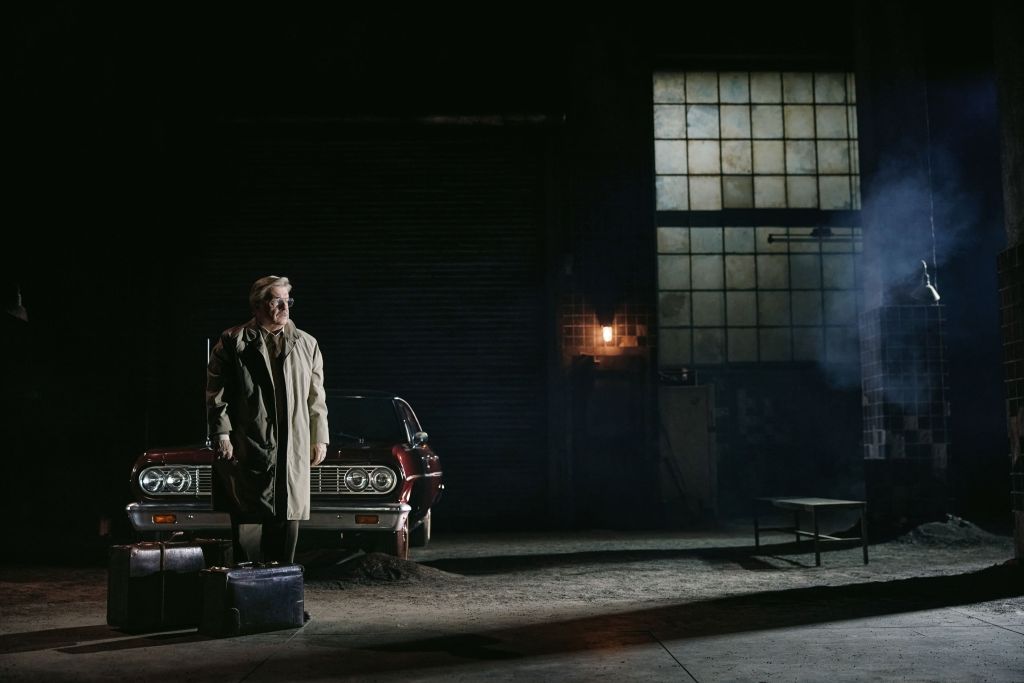
Importantly, Mantello/Lamford and the creative team have created an environment of bleakness and gloom removing any sense of warmth or comfort that a homely kitchen set or living room would suggest. Indeed, Willy and his family move in this towering oppressive, dark space that crushes them but for their connection to each other, which is their real and lasting hope, if they could see it and give each other more kind words and love instead of recriminations. However, even when they argue, insult, indict or chide each other as the glorious Metcalf does in a moment-to-breathtaking-moment take down of Biff, then Happy, her scorching speeches, one about how they left Willy alone babbling in the restaurant, are better than the silent, darkness above, behind and around them.
Mantello/Lamford also use the car to travel through time into the past. For example, one of Willy’s comforting reminiscences is when Young Biff (Joaquin Consuelos) and Young Happy (Jake Termine) follow Willy’s instructions to simonize, shine and buff the car. It is the family’s prize possession that helps provide Willy’s means of support and allows them to go to Ebbets Field on a celebratory day. It represents Willy’s pride in Biff’s scholarship success, as he stands on the roof of the car, the lighting in a golden bronze to family cheers on game day. Happy, happy recollection when Willy is their fine father, Biff has the world at his feet, and Linda looks on her brood “pleased as punch,” a successful mother and wife. Even their giving neighbor Charley (the fine K. Ttodd Freeman) comes out to tease them on this greatest of days for Biff and Willy.
Lane convinces us that Willy is who he claims he is, until he isn’t. Out of the remembrances into the gloom of grey reality he tells his sons, “the woods are burning,” and Linda tells the incredulous Happy and anger-suppressing Biff their dad is dying. With a raw fierceness and edgy emotional plea, Metcalf’s Linda tells Biff and Happy that they can’t just come to visit her, because she loves Willy. “He’s the dearest man in the world to me.” Metcalf’s Linda means it and because of her strength of character and force of will, we take a second look at Willy and see him through her eyes with poignance, and weep for this desolate family.
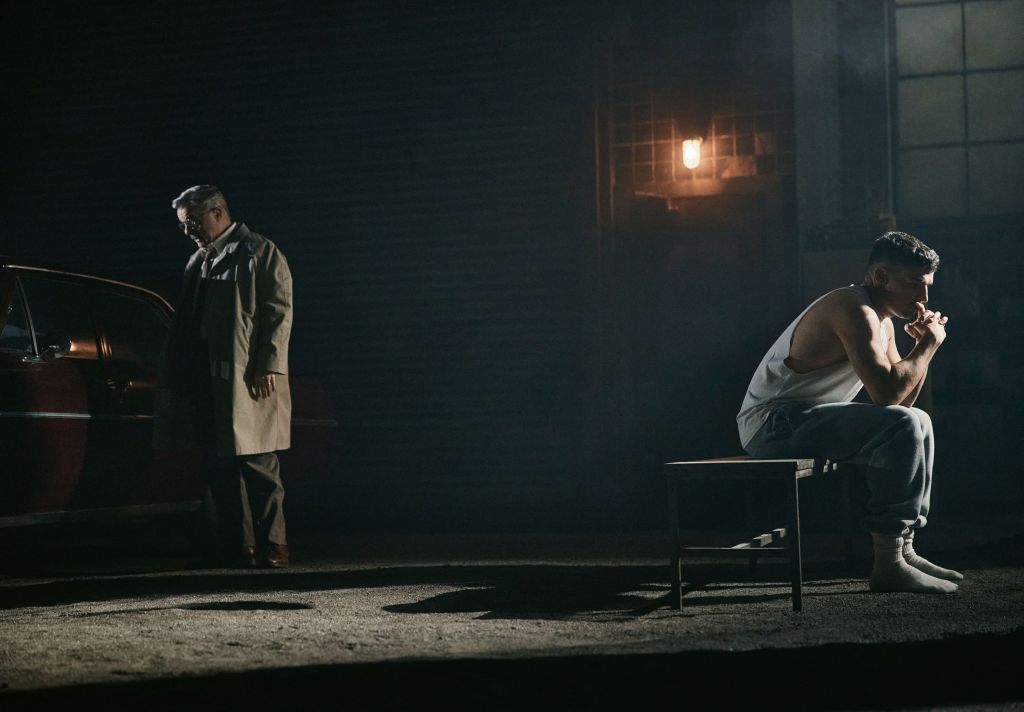
As the play progresses, Miller via Mantello reveals, the reminiscences are in fact hallucinations that Willy uses to torment himself when Biff visits. Willy’s hallucination in the restaurant after his sons desert him is guilt-laden. He relives Biff catching him with a woman and calling him a liar. Willy knows he let his son down, but he can’t admit it and will never forgive himself for it, turning psychically sick. After that incident in Boston Biff and Willy can’t have a heart to heart. Even toward the conclusion when Biff tells his father he will never be the man Willy wants him to be, Willy can’t hear him and misunderstands.
It’s a superb theatrical moment between Lane and Abbott, who passionately steps into the heartfelt, truthful Biff, releases his anger and turns to his father. Willy, still lost, conflating past and present, incapable of recognizing Biff’s truth proclaims,”He cried to me.” In the final most dangerous of Willy’s hallucinations, Cake’s Ben agrees with Willy that Biff will be magnificent with twenty-thousand to back him. Lane’s portrayal of Willy humanizes him and makes him identifiable.
As the second brother given short shrift by the family, Ahlers Happy repeats himself to get attention and uplift Linda. His, “I’m gonna get married, mom,” is as plaintive a cry as any grown manchild’s cry is, yearning for recognition and love but feeling he is incapable of receiving it. Ahlers’ Happy is endearing and charming in a standout portrayal, I haven’t seen before. Still carrying the American Dream to “make it” after seeing what happened to his brother and father, we note his denial like Linda’s, as the inevitable comes and brings her a terrible freedom.
Death of a Salesman runs 2 hours, 50 minutes with one intermission at the Winter Garden Theater through August 9, 2026. salesmanbroadway.com.
‘Death of a Salesman,’ Starring Wendell Pierce, Sharon D Clarke in Dynamic, Powerful Performances
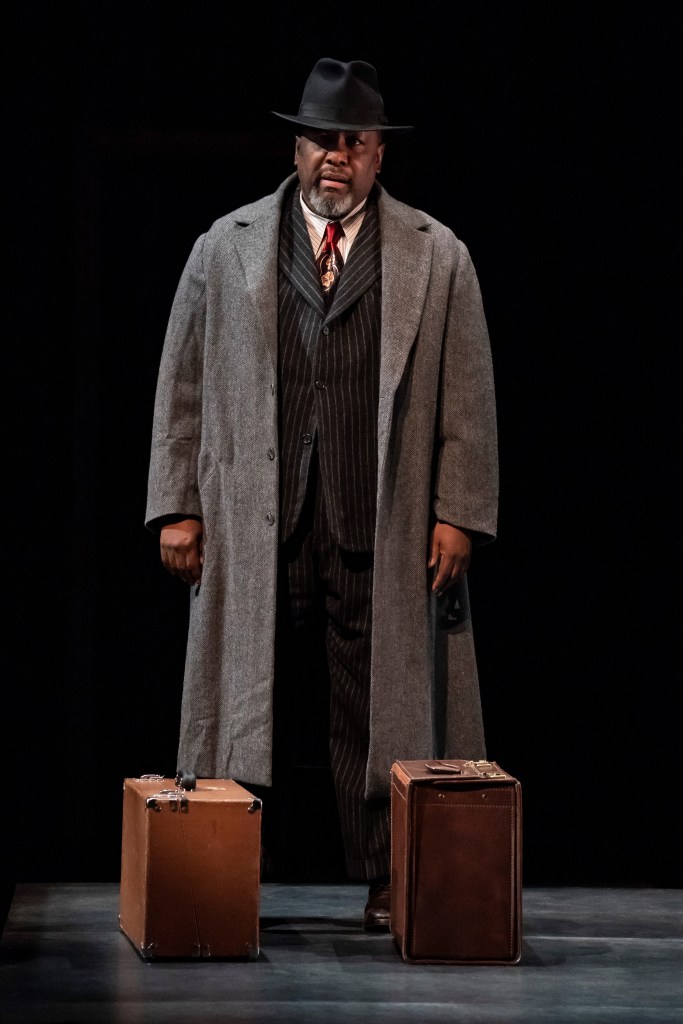
Director Miranda Cromwell has given Arthur Miller’s Death of a Salesman another go round in a revival elucidating the most salient features of Miller’s modern tragedy. Cromwell’s version, currently at the Hudson Theatre, reminds us that as a classic of the 20th century, the play’s themes are timeless, and Loman’s fall is representative of what the powerless man experiences every day of his life.
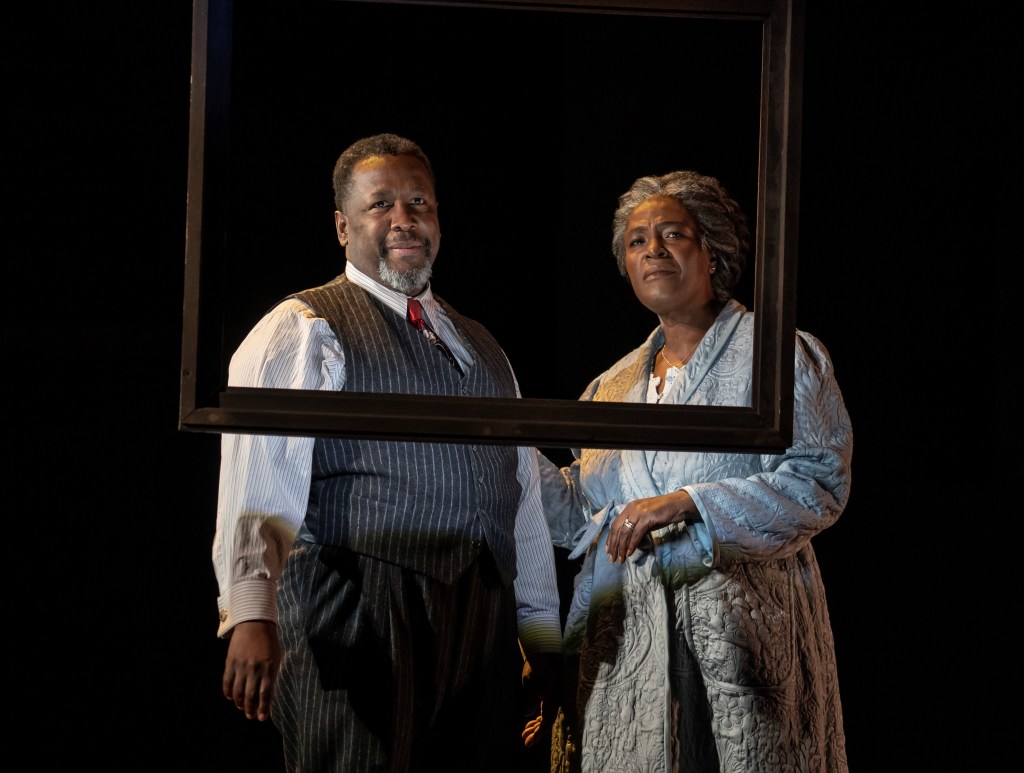
Starring the dynamic, stirring Wendell Pierce as Everyman Willy Loman and Sharon D Clarke as wife Linda, the cast and creatives provide a dramatic and thought provoking view of Miller’s American family. With tremendous currency Cromwell’s version explores the heartfelt tragedy of the diminishing patriarch whose foibles are easily identifiable and relatable to our lives.
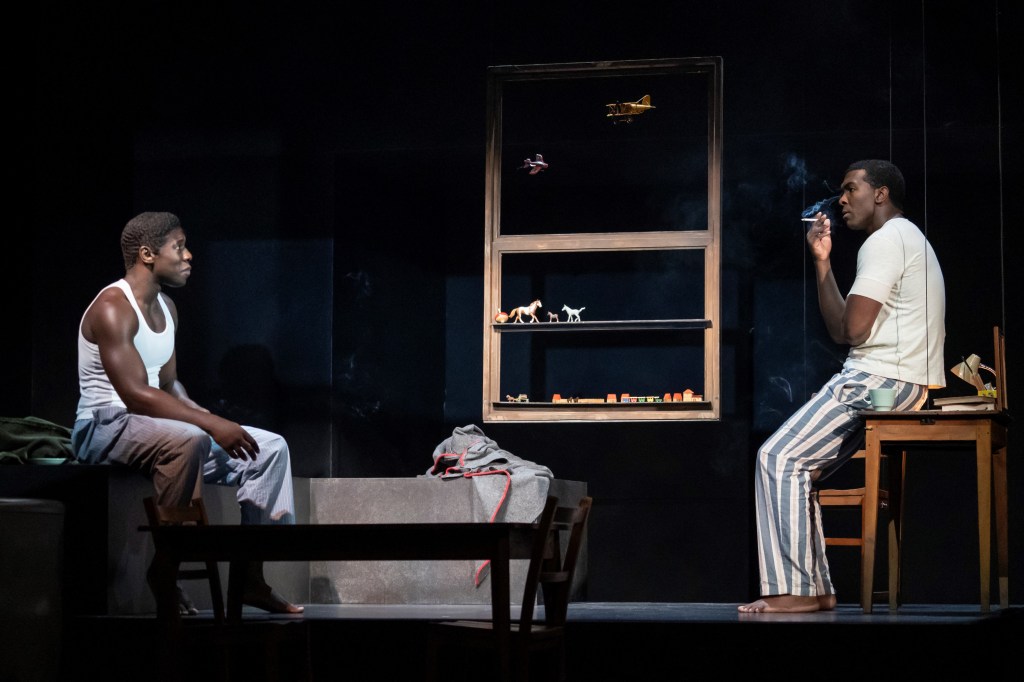
From beginning to the conclusion Cromwell shepherds her remarkable cast in a unique reexamination of Willy and Linda Loman, a husband and wife team who cling to falsehoods and illusions for the sake of each other to get to the next day. Fatefully, Willy’s end is irrevocable and Miller’s play expertly imagined by the director reveals the steps which ensure that Willy’s train wreck life moves with increasing devastation to come to the “end of the line,” Willy’s complete breakdown and suicide. Miller’s characterizations are heightened in this revival brought to life from moment-to-moment by the ensemble all of whom are spot-on sensational.
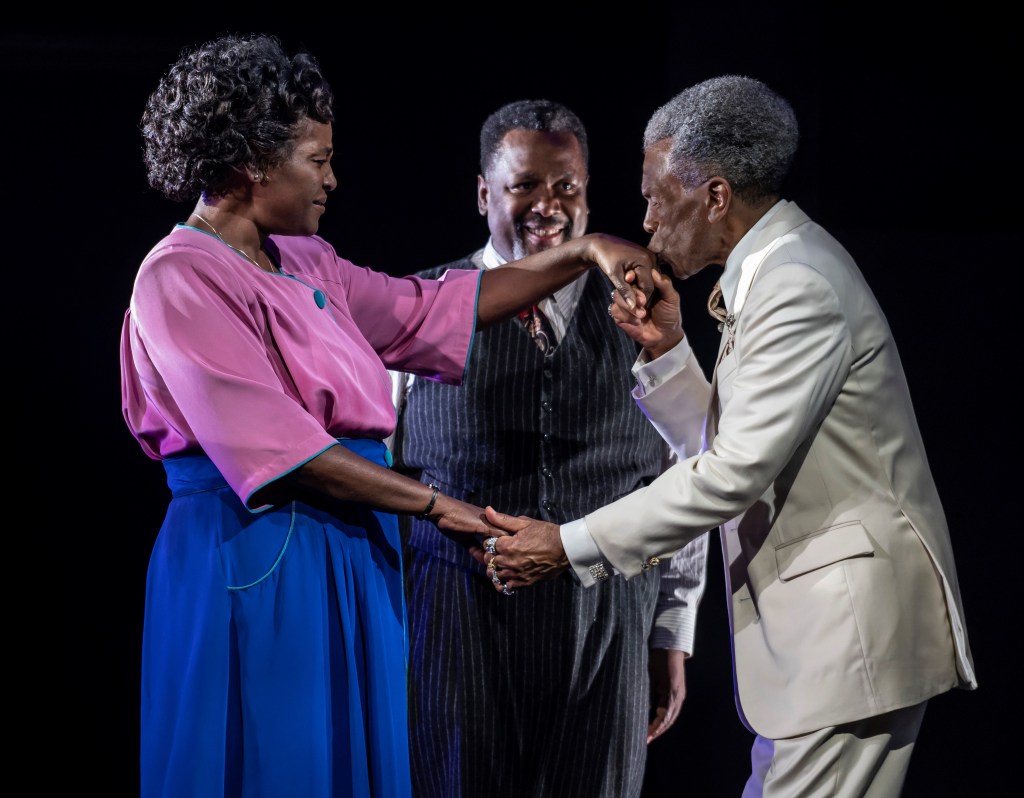
Particularly wonderful, Pierce’s Loman spools out Willy’s loss of power, self-esteem and confidence as he clings to his fantasies and is beaten by memories of his past failures. These become more stark and tormenting until until his ghostly guide, the wonderful, stately André De Shields as Ben, encourages him toward the “proposition” (a life insurance payout) he can’t refuse.
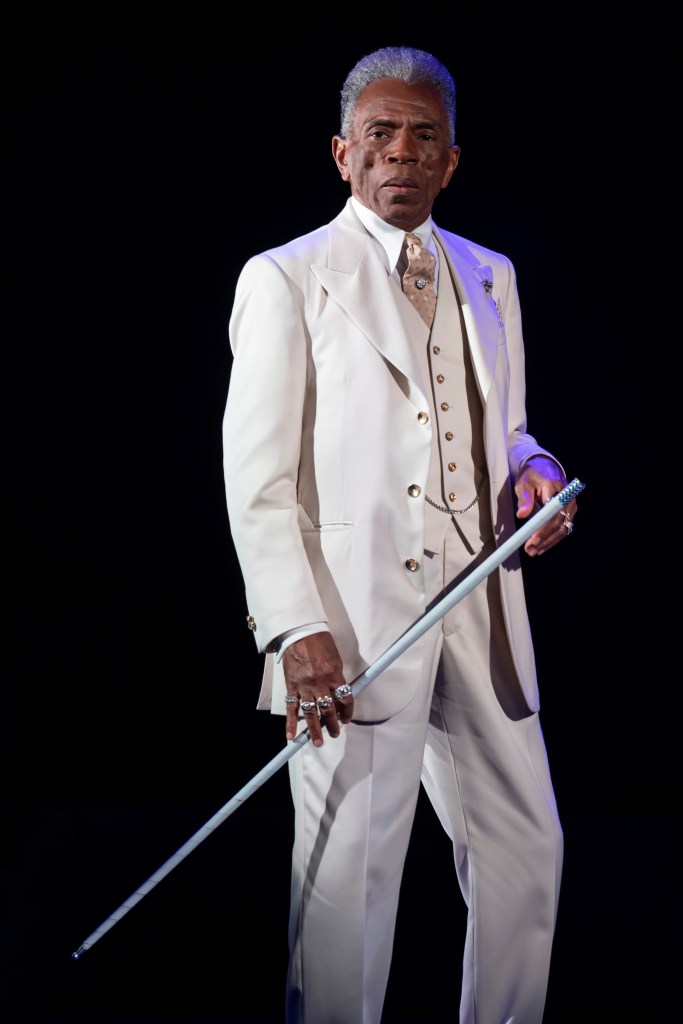
Cromwell’s, staging, Jen Schriever’s lighting design and Mikaal Sulaiman’s sound design relay Willy’s searing flashback visions. Pierce’s Willy makes these physical as if they slash his mind so that he is forced to respond with fury, as he attempts to stop the fears and guilt that drive him toward insanity. Clarke’s Linda kindly couches Willy’s lies and bombast with her own obfuscations and illusions. She is frustrating and infuriating for pandering to Willy’s babble. That Pierce’s Willy ignores and berates her and Clarke’s Linda puts up with him out of love is typical of such relationships of endurance and suffering. However, it becomes obvious that Linda fronts Willy and hides her underlying hopelessness and fear which she confesses to their sons Biff (Khris Davis) and Hap (McKinley Belcher III). Thus, Linda is two people. The loving wife to her husband who puts up with his abuse. And the truthful mother who upbraids her children and seeks their help with her ill husband.

Indeed, Linda knows Willy is desperate and on the brink of suicide. However, she spins her own conundrum. Fatalistically she watches Willie, expecting him to finish himself off in the basement. Yet, at the conclusion she dupes herself into believing Biff exacerbates and is the cause of Willie’s torments. Believing that Biff and Hap’s absence will relieve Willy and he will be “OK,” her delusion contributes to Willy’s suicide as she “lets him go.” Even at the end, she can barely confront what she knew was coming all along. She questions it. Clarke’s Linda can’t process his suicide and is still oblivious to the lies he’s told her to glorify his life. This is so even after Biff in his revelation scene exposes the family as predicate liars. Clarke’s Linda is numbed to realizing the truth of who Willie is. Throughout Clarke’s vital acting reveals a woman at sea going only so far in her realizations, then pulling back just short of making a difference for her entire family. Pierce and Clarke authentically create the type of marriage that reveals how blind love is, especially when it is slathered with lies and illusions.
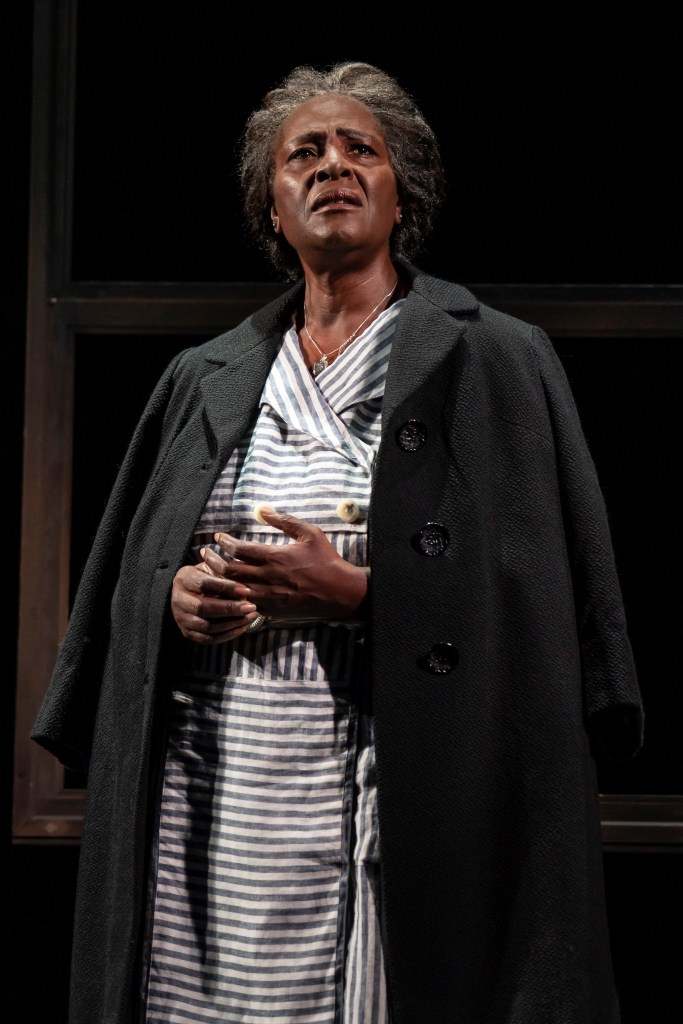
The morass Willy and Linda have built for each other and their children has so entangled the family, they cannot bear to be around each other for the continuous gaslighting and exaggerations. Willy responds to thirty-four-year-old Biff in extremes ranging from insult to encouragement and mostly argument if Biff doesn’t agree and bow to his “judgment.”
Pierce’s Willy pitted against Davis’ vibrant and soulful Biff works with authentic poignance. Revealing their relationship built on lies, Cromwell with acute minimalism sets up the climactic flashback when Biff, encouraged by Willy to ignore his studies, fails math and runs to Willy in Boston for help. Finding Willy with another woman devastates Biff. It demeans Linda and shows Willy’s life with family is a sham since he can’t uphold his marriage vows. In a dynamic scene between the two actors Pierce’s Willy uses pretense to con his son and overwhelm Davis’ Biff from understanding the facts. But Biff realizes who his father is and can’t forgive him, feeling terrible for Linda. Crying, Biff leaves, forever sealing Willy’s guilt that he has destroyed Biff’s life and proven himself a fraud.

For his part Belcher III’s Hap is a convincing “chip off the old block,” on steroids. He follows in Willy’s footsteps and abides in his own delusions that he’ll make a success of himself, though he can’t admit he is at a low rung in the hierarchy of his company. Belcher III and Davis work hand in glove as the two brothers, one selling himself 24/7, the other seeking his identity and finally discovering it. Biff, the hero of Miller’s play because he faces the truth and confronts the family with their lies, courageously admits he has hit rock bottom. Too resounding for Willy to accept, it is one more torment slashing Willy’s mind. Davis, especially as the truthful Biff in the last scenes is superb.
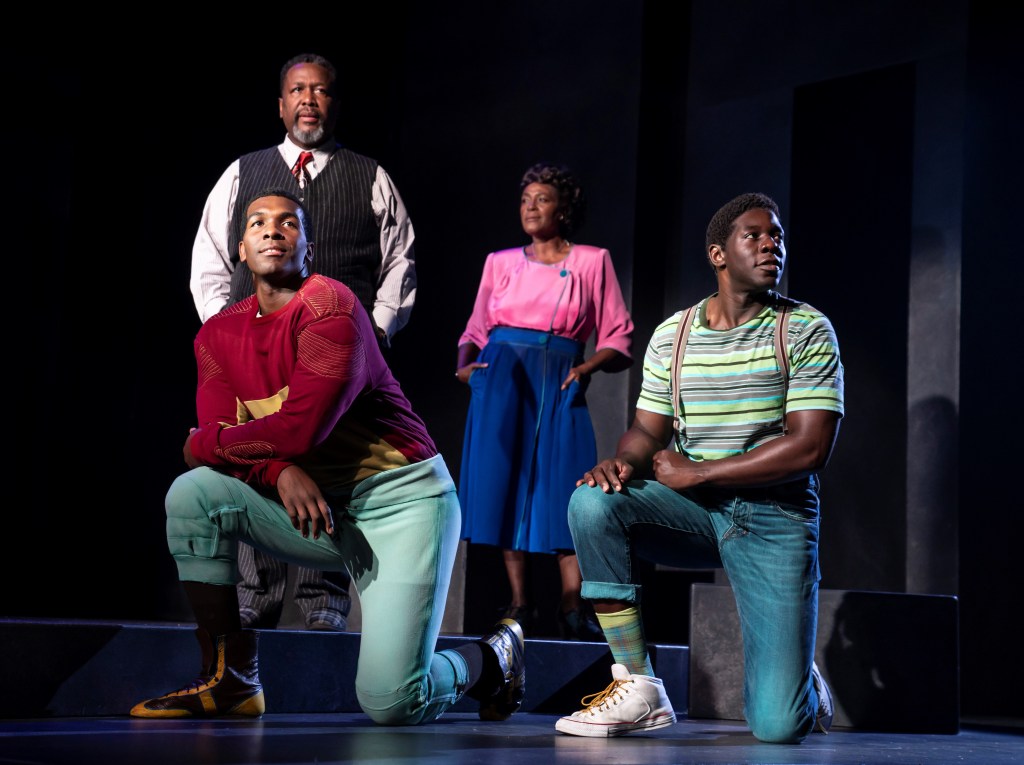
During the flashbacks, Hap, Biff, Linda and Willy enliven the family interactions and dynamics along with neighbor Charley (Delaney Williams in a terrific portrayal), and son Bernard (Stephen Stocking masters the young and the older Bernard with solid acting chops). Charley and Bernard are admirable and kind; their decency in the face of Willy’s insults is smashing. Williams and Stocking are another team to round out this fine ensemble, all of whose work is authentic and beautifully synergistic.

For example Pierce and Davis’s performances along with Lynn Hawley as The Woman perfectly render Biff and Willy’s destruction of their relationship with the awkwardness of a naked expose, as Biff and The Woman catch up Willy blabbering in his lies. Also, as we do during the flashbacks of the family, including the high school days with the excellent Williams and Stocking, we follow, engrossed with the Loman family as we “get” how the fabric of their lives unravels, and we realize why Willy’s suicide comes when it does.
Willy’s breakdown is Pierce’s gradual tour de force with each flashback, each event showing how Willy is brought closer to the brink until he can take no more. Miller reveals that much could have happened to stop him. However, the obfuscations and self-delusions are so great, only Biff could help. But it is too late. Biff can only save himself. Not even the hero can save Willy from his ghostly dreams to die “the death of a salesman” with a fulfilled proposition of $20,000 for his family, a fallen hero after all.
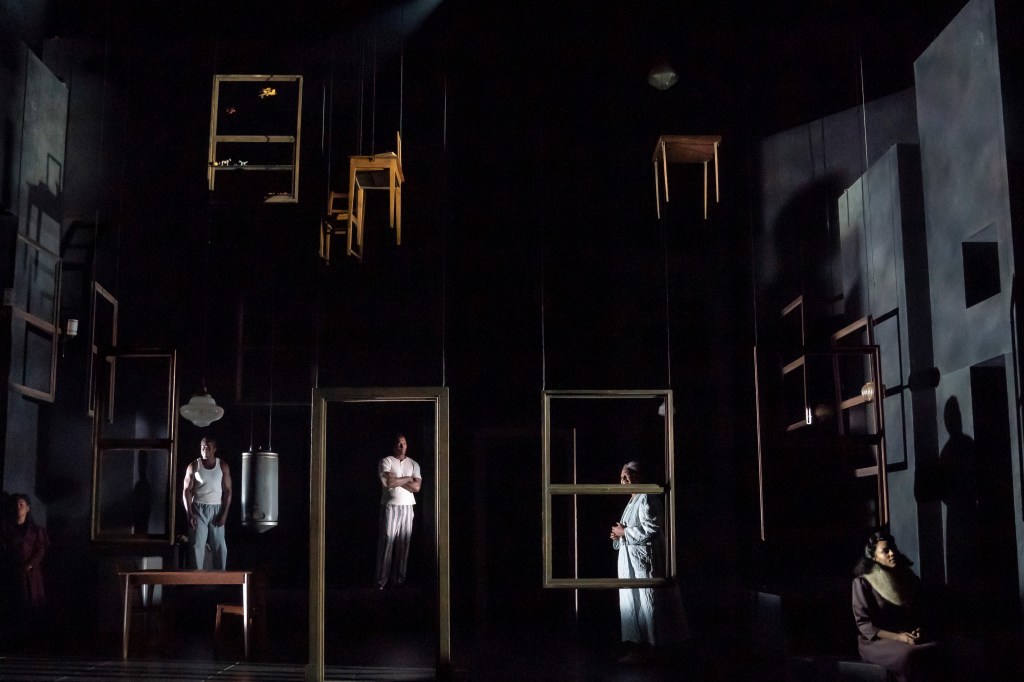
The scenic design by Anna Fleischle is minimalistic and suggestive with wooden frames introducing Willy and Linda. Unadorned furniture suggests Hap and Biff’s bedroom, Howard’s office, the hotel room, etc., revealing the play unfolds mostly in flashback at crucial points in Willy’s past in his memories. The flashback scenes are without framing and the staging is free formed, revealing Willy’s flights of fancy that make him happy. The guilt and fear torments are staged accordingly as Willy attempts to escape himself but can’t. The change in time Cromwell has reflected in the costume changes (co-costume designers Anna Fleischle, Sarita Fellows) of Linda, Biff, Hap, Charlie and Bernard. Only Willy wears the same outfit, always his suit whether jacket on or off, a salesman to the last.
Cromwell uses funeral music in the beginning and at the ending to frame the play about Willy’s life. This structural unity adds grace and embodies the concept of Willy’s death and the life he lives elucidated to reveal why he commits suicide. However, Charlie exonerates Willy and suggests, “nobody dast blame this man. A salesman has got to dream. It comes with the territory.”
This revival is illuminating and fresh, a must-see, especially for its performances and enlightened direction. For tickets and times go to their website: https://www.thehudsonbroadway.com/whatson/death-of-a-salesman/
‘All My Sons,’ Exceptional Performances Infuse Miller’s Play With Grist and Power
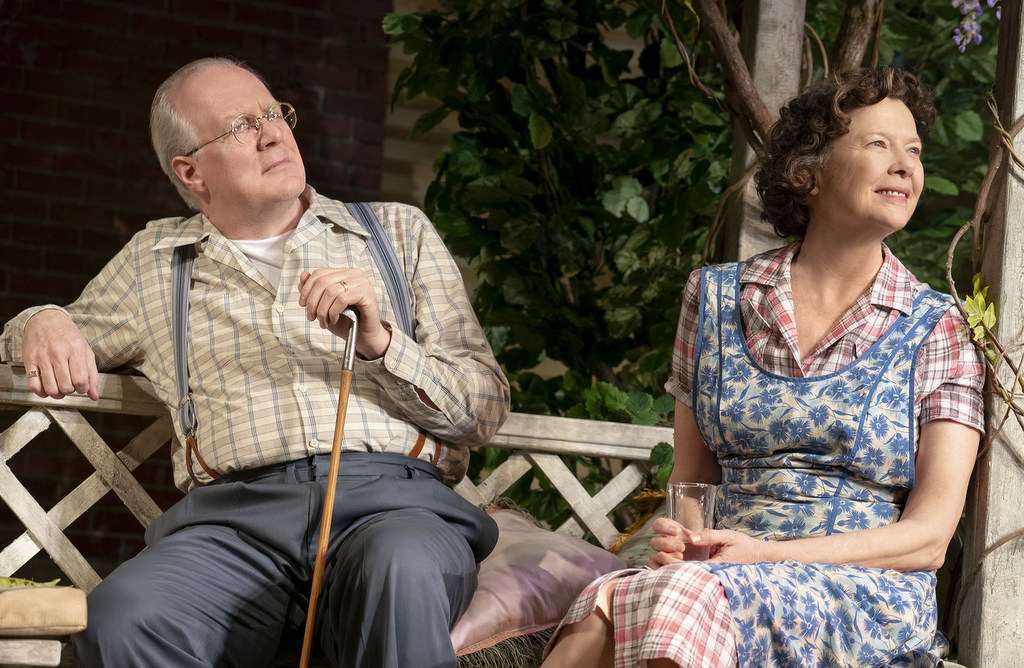
Tracy Letts, Annette Bening in Arthur Miller’s ‘All My Sons,’ directed by Jack O’Brien (Joan Marcus)
Roundabout Theatre Company’s revival of Arthur Miller’s All My Sons speaks with resounding energy about our current time in its themes and characterizations despite its setting 72-years-ago in an America that no longer exists. Directed with acute insight and sensitivity, Jack O’Brien opens the play with the shock of a lightening crash as sounds of thunder dissolve into the droning thrum of a plane. Projected on the curtain we see the visual of a doomed plane speeding toward its demise.
Later, we discover the symbolism. During the fierce storm which destroys a memorial tree in the backyard, Kate Keller (the fabulous Annette Bening) wakes with a nightmare about her son, Larry, a WWII pilot who is MIA. O’Brien adroitly realizes Kate’s nightmare and the storm which destroys Larry’s memorial to foreshadow the coming turmoil in the next day and a half that changes the lives of the Keller family forever.
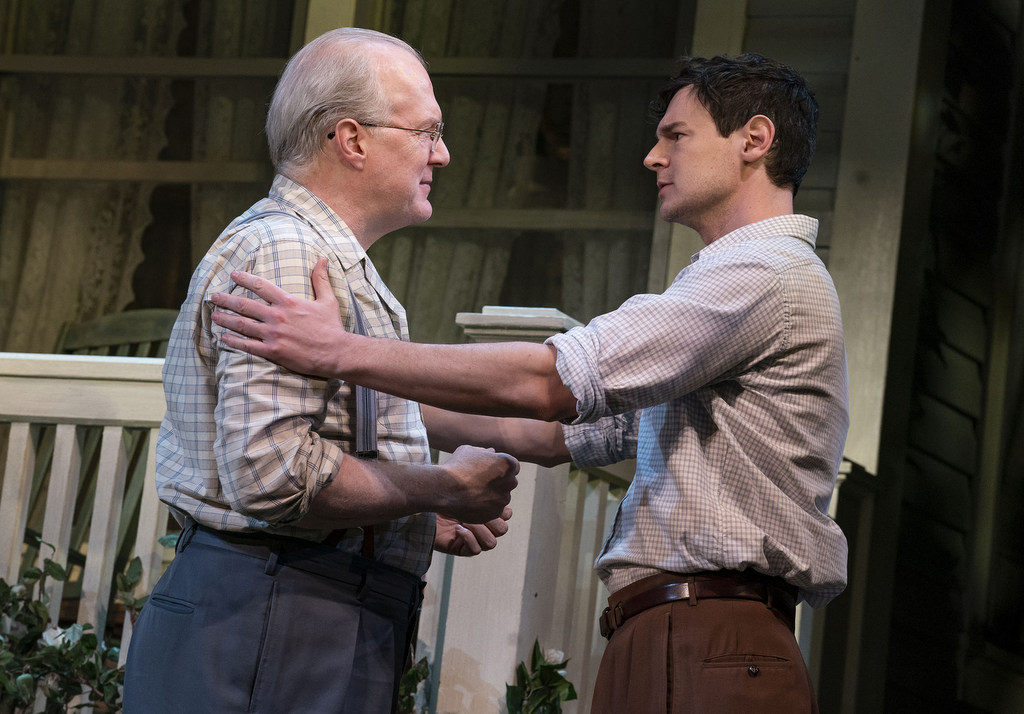
Tracy Letts, Benjamin Walker in Arthur Miller’s ‘All My Sons,’ directed by Jack O’Brien (Joan Marcus)
This auspicious beginning, however, is quelled by the sunny atmosphere of August in the gorgeous, bucolic, serenity of an upper middle class neighborhood where Joe Keller (the superb Tracy Letts), Kate and son Chris (an emotional, authentic portrayal by Benjamin Walker) reside in peace and plenty. The exquisite set by Douglas W. Schmidt invites with its blooming, well-trimmed wisteria vines regaling a square gazebo and homely, comfortable patio with companionable chairs. There, we imagine that pleasant and lively conversations have taken place over the years. Miller never takes us inside to reveal the intimacies of family interactions, a vital clue to this family. They cannot be intimate with each other for fear of cracking the image they present to each other and themselves.
All the play’s action is “out in the open,” “in plain sight,” an irony filled with contradictions. This living “in the public eye” belies the truth that threads throughout the play in one of Miller’s searing themes. In one form of another, the human condition is to live in lies and rationalizations that mask painful truths. The best of us attempt to confront and work through these to get to the core and evolve to “be better” as Chris suggests. Nevertheless, it is easier for us to keep our miserable truths hidden in the shadows while we live in hypocrisy.
It is this hypocrisy that eats away at the soul and mind in a terrible corruption that eventually destroys. An extension of this theme of the individuals is the theme of a society which lives in hypocrisy in a culture founded on lies. The end result is the rot blooms, the lies abide and the culture no longer distinguishes the difference between facts and obfuscations. The cultural dissolution that occur is not even recognizable to the national body politic.
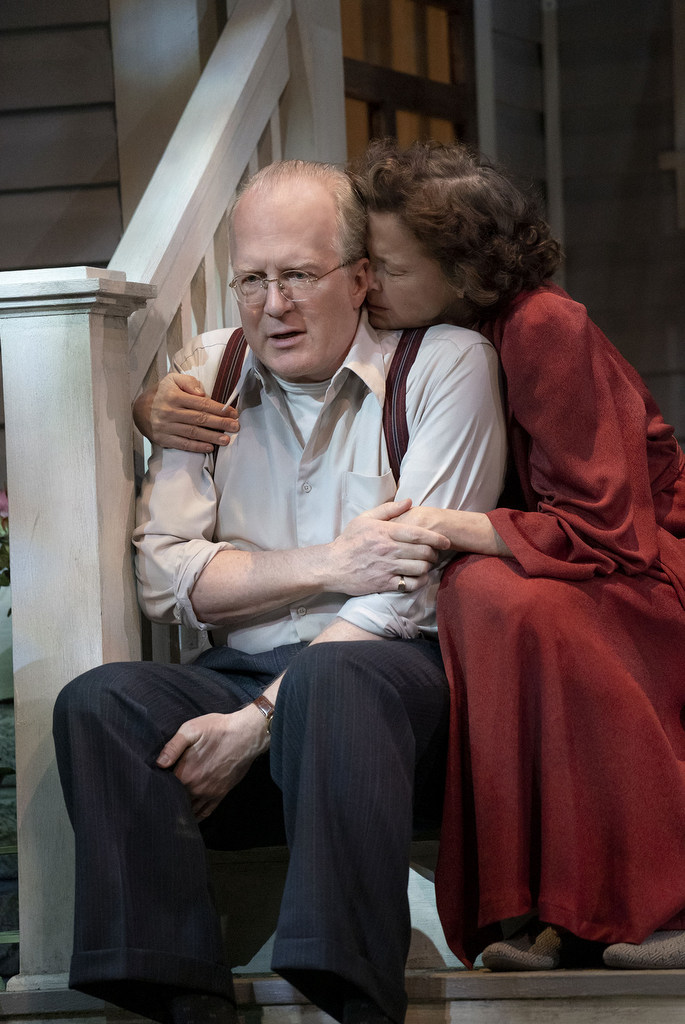
Tracy Letts, Annette Bening in Arthur Miller’s ‘All My Sons,’ directed by Jack O’Brien (Joan Marcus)
Clearly, Miller reveals this is so for his protagonist Joe Keller and the neighborhood and society which enables Joe to maintain his untenable soul condition. In the backstory, Keller was found guilty of negligence in manufacturing defective aircraft parts that ended up bringing 21 pilots to their deaths. Joe and partner/neighbor Steve Deever, end up serving prison time. Joe appeals and is exonerated, foisting off the blame on Steve who is held accountable for the defective engines being sent out. Steve loses everything including his house and the love of his children who move away as he serves out his prison sentence.
When Joe returns home to neighborhood whispers of “murderer,” he holds his head high, fronts with his new business manufacturing household appliances, makes a ton of money and re-engages the friendship of his neighbors. In a few years he re-establishes the honor and integrity he once held through hard work and a well-meaning, generous, jovial public image. He does all of this for the benefit of his family, and especially for his son Chris who made it out of WWII alive and who will inherit the business.
As the details of the past are revealed, in subsequent acts we gradually understand the family dynamic. Stalwart and unshakable are Kate’s and Chris’ support of Joe during the trial and after feeding into the presumptions that he is a vindicated man with a restored public image. We also note the full blown love relationship Chris has with Steve’s daughter, Larry’s girlfriend, Ann Deever (Francesca Carpanini). Ann moved away after the trial, but writes to Chris and they pledge their love.. She comes to visit Chris, Kate and Joe to solidify their marriage plans with Joe and Kate from whom they’ve kept their love secret. Chris and Ann fear Kate will strongly oppose their marriage because “Larry is alive” and Ann must lovingly wait for him.
As the sunlight shines on Joe and his neighbor Dr. Jim Bayliss (Michael Hayden) and they chat about Ann’s visit, we have no sense of any underlying difficulties. O’Brien’s and the actors’ skill abides in the gradual unraveling of the characters’ consciousness, as each attempts to maintain the intricate bulwark of falsehoods that have carried them through three years of Larry’s absence and Joe’s exoneration, both chimaeras.
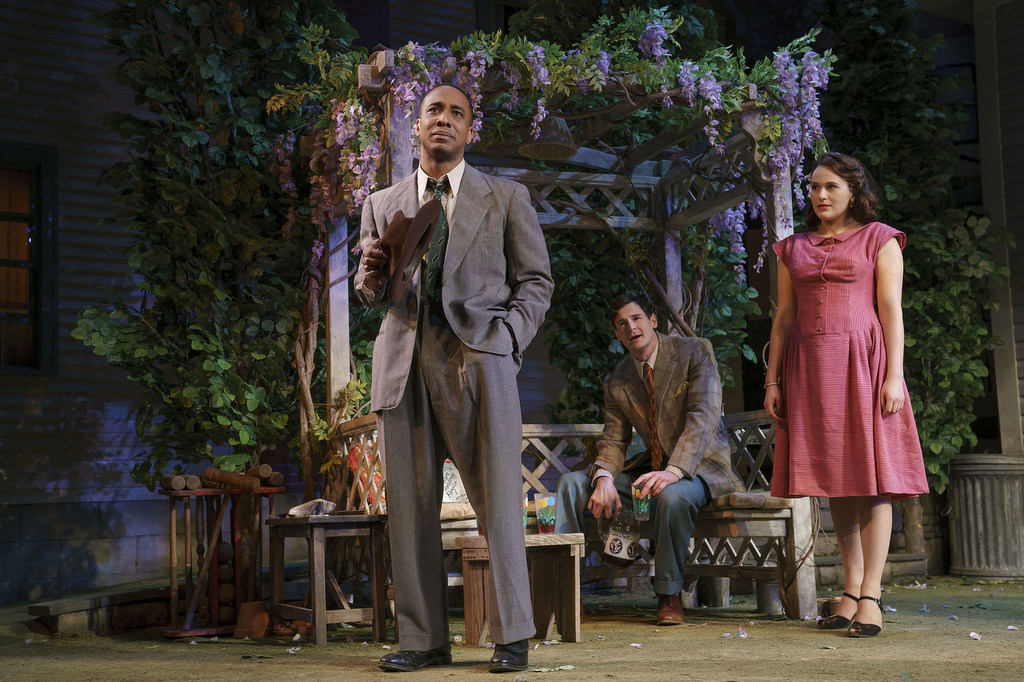
Hampton Fluker (foreground) Benjamin Walker, Francesca Carpanini in Arthur Miller’s ‘All My Sons,’ directed by Jack O’Brien (Joan Marcus
Lies are central to this family’s “wholeness” and “health,” as lies are central to America’s dominant “greatness” after the war. In secret, unbeknownst to us until the conclusion, each suppresses their guilt and fear rather than to confront the painful truth head on and bring it out “in the open” to heal. Kate and Joe are stuck in time, mired in the past. Joe recognizes Kate’s insistence that Larry’s “being alive” is a “fantasy.” But he goes along with it to comfort her and himself and avoid any discussion about the possible alternatives.
Likewise, Chris attempts to forge ahead but is locked in his own fears about his brother. It is no small irony that he chooses his brother’s girlfriend to wive and force the issue of Larry’s MIA by bringing her home to mom. Indeed, it is as if he is keeping Larry’s ghost hovering. Ann is the last person his mother will accept as his bride as long as “Larry is alive.” Chris, like his parents, is conflicted and lives with the guilt of his brother’s ghostly presence.
Each of the family members has created justifications; the more the truth threatens, the more elaborate the excuses. Ultimately, these reside in “I did it for you”-Joe, Kate or blaming others, “you made me”-Ann, Chris. Unable to work through the traumas to heal, they tiptoe around each other, wearing masks of goodness, righteousness and faith. The only one who believes these images is themselves.
The neighborhood encourages the family in their fantasies, as the larger society encourages ideologies about America’s goodness. However, as the play progresses, the Bayliss’s (Michael Hayden, Jenni Barber) candidly reveal everyone in the town believes Joe is guilty and Larry was killed by a defective engine. (the truth that Ann brings in a letter is worse).
Eventually, the truth is revealed when George Deever comes to confront them about Joe’s guilt, and Ann reads a letter revealing where Larry is. As George, Hampton Fluker’s, sorrow and yearning to be in the past with the family’s illusions before the hellish incident of negligence happened is beautifully graded and nuanced with poignance. Fluker’s emotional range from judgmental anger, love for the family to, indictment of their duplicity is beautifully developed.
Francesca Carpanini’s Ann approaches this visit with the Kellers as a developing revelation of her “love” for Chris which is founded in loneliness. Carpanini’s emotional range also solidifies her portrayal of Ann’s self-interest and wish to rid Kate of her illusions forever to extricate Chris from Kate’s hold over him. Her performance as the foil and enemy to the family is well rendered.
When Carpanini’s Ann reads the letter, it is a fascinating mixture of emotions. On the one hand she attempts to “help” by revealing the truth, a devastation that will most probably destroy Kate’s well being, but she does it anyway. When it backfires and Chris, Kate and Joe react counter to what she anticipates, she backpedals in an apologetic excuse blaming the family for “forcing her.” She is desperate to recapture Chris, but it’s too late. It is then she understands the length to which the family has unified against the truth which she selfishly used to move things her way.

(L to R): Benjamin Walker, Tracy Letts, Annette Bening, Hampton Fluker, in ‘All My Sons,’ directed by Jack O’Brien (Joan Marcus)
Up to the point of domino revelations at the conclusion, Annette Bening’s portrayal as Kate Keller is a masterpiece of shifting emotions. She is like a tiger who must keep the family together at all costs and will use her cunning against anyone (like Ann or George) who threatens their circle. Thus, as Kate, Bening makes the reality that Larry is alive amazingly palpable. She is the mortar that holds the bricks Chris and Joe fashion into a wall to close themselves off against the truth. The structure is a protection to keep them from looking within to their self-hatreds, guilt and dishonor. If the bulwark of illusions cracks, they would attack and destroy each other; thus, to keep them safe, she sacrifices herself as “the crazy one” by basing her every thought and action around the spin about Larry and Joe.
The truth that George and Ann (ironic it takes Steve’s kids to do this) brings, she attempts to forestall with distractions luring George with love. But it is she who provides the damning piece of evidence to George who hands the sledgehammer to Ann. It is Ann who crashes down the structure that the family has unconsciously built to safe themselves and their self-righteous image to the public.
Annette Bening converts Kate’s belief into the driving force of will which lives and breathes and resurrects Larry’s presence. Bening is stunning in how she effects this, every moment she lives onstage. Her authenticity as she strikes the notes of Kate’s insistence and determination is so starkly alive, it gives Lett’s Joe and Walker’s Chris the charge and fluidity to carry that reality into their own portrayals making them vibrate with authenticity. Her good will toward George turns him off his intentions to indict Joe and the family with his Joe’s terrible abuse of his father Steve.

Tracy Letts, Benjamin Walker in Arthur Miller’s ‘All My Sons,’ directed by Jack O’Brien (Joan Marcus)
How Walker, Letts and Bening adeptly shepherded by O’Brien establish the nexus of Larry’s being both alive and a ghost who haunts all of them is just brilliant. It is the linchpin of the play and all of the action depends upon their getting this right which they do with spot-on intensity.
The more desperately Joe and Chris attempt to move away from Larry’s ghost, the greater Kate digs in (with her telepathy, her reading signs, her dream, her understanding of the Larry’s astrological chart). Chris’ selection of Ann, Larry’s girlfriend, as his future wife and his asking her to visit to end Kate’s faith about Larry. only exacerbates it. Bening and the others are mesmerizing during this dynamic of thrust and parry of unconscious desires to expurgate their guilt and exorcise Larry from their midst. Kate resists Ann’s presence and the marriage from the outset of her suspicions. Letts’ Joe never argues with Kate to counter her about the marriage. Miller makes it clear, Kate is unstoppable in her resistance to the marriage. The irony is that ultimately, Larry stops it. His voice comes in a letter from beyond the grave. And the revelation, one that Kate has feared all destroys the family unity.

Annette Bening in ‘All My Sons,’ written by Arthur Miller, directed by Jack O’Brien (Joan Marcus)
Until the letter Letts, like Bening, is so invested, we are convinced that Joe is exonerated. Even Walker’s Chris cannot hold him accountable as they confront one another after George’s visit in a terrific scene that uncovers their souls. But it is only after Joe reads the letter himself, that he understands what he must do.
This sterling production especially reveals the verities and timelessness of Miller’s play. Joe Keller redeems himself at the end and leaves a legacy Kate knew in her heart was coming, but the pain was so great she couldn’t confront it until Joe does. It is Chris who is left to assemble the pieces of his shattering into a new ethos.
Miller’s tragic elements are the final apotheosis that uplift us to want to be “better than that,” but leave us knowing that if we were in this family’s shoes, we would probably do the same. In the currency of our time, self-righteousness and blaming the “others” has become a profitable boon. Such hypocrisy Miller suggests in Joe’s pointed aria at the end, which he eventually realizes is the last lie that must fall with himself.
The conclusion mounts to a climax of power and poignance and delivers the blow that Miller desires and O’Brien perfectly crashes down on the audience. This tour de force of sensational ensemble work is perhaps the best iteration I’ve seen of this play to date. At its core, the production has delivered Miller’s thematic wisdom from start to finish. The ensemble’s prodigious talent at hitting the bulls-eye with each and every portrayal makes this production the incredible rendering it is.
Kudos to the creative team: Jane Greenwood (Costume Design) Natasha Katz (Lighting Design) John Gromada (Sound Design) Jeff Sugg (Video and Projection Design) Bob James (Original Music) Douglas W. Schmidt (Set Design)
All My Sons runs with one intermission at The American Airlines Theatre on 42nd Street. It is in a limited run until 23rd June. For tickets and times go to their website by CLICKING HERE.
 CAROLE DI TOSTI