My Bite of the Apple Part I (Redacting Steve Jobs)

Apple, the forbidden fruit
Excited to buy my first iPhone? I guess. but it wasn’t an outer body experience as buying Apple products has been for some. Maybe that’s because I’m a techie fail, a black hole when it comes to understanding mother boards and code and building cloud infrastructure and sequencing networks. I can figure things out if directions are given to me? But that’s it. I am one step above tech illiterate doggie doo with a single digit IQ. So if you are an uptown geek, then you will probably stop reading right about now.
After I got the iPhone, was I ebullient, addicted, umbilical corded? Nah. Actually, since I had a Motorola as well, can you believe my iPhone became my secondary phone to use in case I needed to reference something online? I preferred my old MO, my laptop, my Motorola for calls, the iPhone for referencing. I didn’t like the touch screen so much and since I type at the speed of light, slowing to one finger “tough” could never approach any viable functioning beyond snail pace to input type. That made me pissy. So, I hobbled along in the comfort of the tech semi-dark ages. But I was acutely aware of the awe this gadget produced in others whenever I pulled it out to reference something. Swoons, gasps, exclamations of approval filled the air as if this thing gave me character and substance and not the other way round. Frankly, I thought it amusing at the time and felt somewhat flattered that I was almost “in.” (I had never been “in” in HS. In college as a hippie, yes…but HS has its own sting and that poison was difficult to expurgate.)
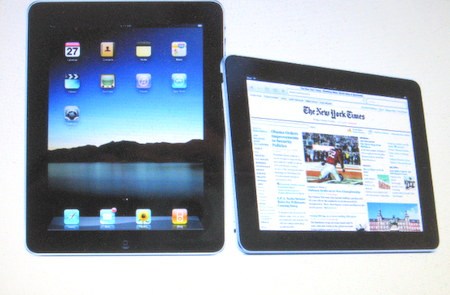
iPads I lusted over but balked at purchasing.
Was it this faux flattery that percolated my appetite to lust for another bite of the forbidden fruit? I thought about buying an iPad. Did I need it? Do I need another piece of jewelry (Most of it is in the safe deposit box.)? I thought, well, I could compose my news articles easily without dragging my laptop around. Granted my laptop was small, and it worked well…everything there that I needed. I admit it. The super hype about the iPads was irresistible and the reveal had my heart and head feening. And at times there were visceral urges that I just had (I mean short of waiting in line for three days. I’m not insane.) to have one of those fabulous, incredible, virtual portals that professionals would be sashaying around with them like progeny. But when I was up close and personal with an iPad my friend (a line waiter) had, I thought, but I love my laptop. Why do I need two cameras? Taking pictures with an iPad is so pretentious, like you want everyone to know it’s an iPad you are taking a picture with. Big deal. (I know, I know. I can hear the geeks moaning about my fecal cephalic lack of appreciation for the iPad’s prodigious design and flawless tech perfection.)
But once you have that first bite, you become hooked. Like a confused obeser who doesn’t know she’s full (I used to be obese; I can say that word.) I had to indulge and buy another Apple product. Maybe I’d even join the holy crowd and worship at the shrine of awesomeness, becoming an owner of Apple, you know, get a few shares? The company’s earnings were spectacular, market share flying high like a dirigible with iPhones and iPads selling so rapidly the company couldn’t keep up production. Global sales…mega, mega. I like, thousands of others, regretted not buying the company when it nearly went belly up and Jobs came back in glory to take it over again after the board kissed his feet and became his willing slaves. I wouldn’t buy a lot of stock, just enough (100 shares) for it to be a symbol that I endorsed everything Steve Jobs stood for as an enlightened, Renaissanced, man of goodness, a shining glory.
So I went to Apple and I looked at the iPad. But I balked at the point of purchase. I had a headache. Over the next few days, I looked at other tablets and smaller laptops. I discussed the iPad with as many geeks as I could. I hesitated. Like a hunger pang that abates, my lust fled. Not sure why. Maybe because I would have to pay for a lot of stuff I needed, buying from the iTunes store, cha ching? I was sick of doing that on the iPhone. The interface with Mozilla that was paramount, I would have to tweak. And I had issues with my iPhone which was slowing. And two cameras? What for two cameras? I had enough cameras I wasn’t using: 35 mm beauties and digitals (top of the line when they first came out).
So instead, I went for another Apple product, their top of the line wireless router that I could stream with from Montauk (I live in NYC). My uncontrollable appetite did rear her fat head, you see? But this bite left me with a bitter taste: it was unappetizing and I got indigestion. The router was really pricey and weird to put together. And I had a hell of a time configuring it to my PC. Annoyed at my tech incompetence and blaming my bad gut, I returned it and bought a well reputed router that a one-year-old could set up. And I left the rising market share of Apple stock for the birds of the air to pluck. But since my phone contract was up, I purchased the next generation iPhone, knowing I would use it minimally, relying on another phone. My appetite for this next bite, though not particularly nourishing or filling was vital to my ego, cultural sensibilities and ethos. I indulged my lust.

Apple Store, Grand Central Station
And then Steve Jobs died. I wrote an article for Technorati and saw the TV programs about his genius, reheard his Stanford speech for the hundredth time and admired the man who was like a mastermining god, the new savior who walked on tech waters. Again and again it was repeated, his ambition, his “drive for perfection” and his “we’ll never see his like again,” and his business acumen and ruthlessness, all wonderful praise for an icon that geeks wept over, no exaggeration. (There were folks unrelated to his family who sobbed over his loss.) It was only a day later after I muted all the static that it came to me. The geeks who owed their changed lives to Jobs? The change was all theirs and had little to do with the man or the gadgets and in fact, they might have become someone greater if not someone else despite him not because of his Apple. But irrevocably, they had tied their own identities with Jobs; they were him and he was them. And they rued the days ahead because how would they be able to function without him to market the wonder and the magic of their addiction and keep their lives meaningful?
And then after Jobs was in the ground a few months, the dam broke and the waters roiled. What had been dredged up in secret and silted and drained away with each reveal of the next generation iPad and iPhone product could be stemmed no longer. Enter Foxconn. And slowly by revelation of a different kind, we began to understand the identity of the king serpent who delivered the Apple to us to eat.
Galileo

We all are enamored of the astronomer/physicist who defied the Catholic church for a season, and though it was heresy taught that the earth was not the center of the solar system/universe, but that our sun was. F. Murray Abraham famed Academy Award winner for Amadeus and acclaimed Shylock in last year’s Classic Stage Company’s Merchant of Venice must have been enamored of Galileo as well because he plays the man with empathy and brilliance.
It is interesting that the director Brian Kulick and the company have chosen the Charles Laughton, Bertol Brecht collaborative translation of Brecht’s play Galileo. The director states that it was chosen in part because in 1947 when the play was premiered in Hollywood and had a brief later run on Broadway, this translation was meaningful in light of the nuclear age ushered in upon the world stage after Fat Man and Little Boy were dropped on Hiroshima and Nagasaki. The inevitable interplay on science’s impact on the culture was something that Brecht wrote as a concern of Galileo, how men would use the truth of science. It is a theme that artists and writers like Ray Bradbury and other science fiction writers and filmmakers have taken up again and again, even in works like Alien and Kubrick’s 2001 A Space Odyssey.
But Brecht’s version playing at the Classic Stage Company which has none of Brecht’s later additions about Galileo and the church resonates for us in its themes about the inflexibility of changing with the nature of truth, and the nature of truth itself being shaped by culture, history and expediency. Galileo’s life is picked up at the point when he is living with his daughter and is tutoring wealthy sons of land owners. Brecht clearly makes the point that one of Galileo’s foibles was his flesh, his enjoying life and eating and wine. And of course, this is the hook later in the play providing the rationale why Galileo was not the martyr that many “heretics” were at the time when he ran afoul of the Inquisition in teaching his truths and proofs about the motion of the spheres, teachings which some of the cardinals, themselves, acknowledged as accurate.
No, Galileo was not a martyr. He caved. And F. Murray Abraham imbues this fleshly hero with an empathy we can all understand. Would we not do the same as he? Who of us would perish for some scribblings that may or may not be used to enhance mankind at some future date. No. Galileo will recant and not burn. He enjoys his wine. His flesh is weak and if the truth burns instead of him? Then, at least he will be able to get to his next meal and glass of wine, enjoying its taste.
But the price he pays brings a skein of bitterness, rejection of his students (interesting that they do not offer to burn with him for receiving the blasphemous teachings) the daily remembrance of his cowardice for his papers have been confiscated, and he must cope with the permanent guest in his house who guards him from writing anything down. So our genius is imprisoned in his home and his mind, unable to further any of his discoveries.
I do not advocate spoilers. So you won’t read what happens here. Get a copy of the play. Brecht is a brilliant playwright, though this might not be his most superlative play. (Mother Courage and Her Children is better.) Don’t count on seeing this version. If you have connections, perhaps you will be able to get a ticket, though it will be difficult unless you know the director or F. Murray Abraham. The performance is completely sold out.
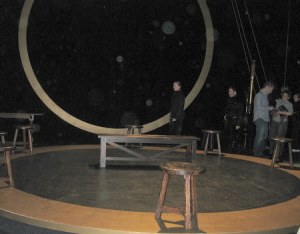
I would have loved to go again, but I’ll just have to remember, rereading this review, how splendid the supporting cast was and how human and alive F. Murray Abraham’s performance was. The circular stage, a sphere, naturally and the globes of the solar system hanging from the ceiling were an effective backdrop to the action of man at the center of the universe. It was only until Galileo’s discourses were noted far and wide that man was no longer front and center and the Age of Enlightenment propelled the sun to the center and knowledge, science and a different kind of truth began spinning outward farther and farther into space and time.
I couldn’t recommend this production enough. I do think that at some point other versions of Brecht’s Galileo will be picked up by other prodigious actors, who like a challenge and enjoy the thought that they can step into the cloak and mien of one of the most illustrious, brilliant and flawed of scientists, making us actually happy that he did not, like so many others fall into the loathsome clutches of the nefarious Inquisition.
By the way, it is interesting to note that Galileo in all his science believes in God and is God’s man. Only the truly brilliant, the ineffably brilliant are able to reconcile science and God, bringing them together in complement, not stretching them from one end of the universe to the other (That is a joke; the universe has no end…and maybe no beginning, since no one was around to observe the Big Bang. It’s a theory.)
To that effect and because I was inspired by the play and F. Murray Abraham’s performance, I did write a sonnet to celebrate.
Viewing the Manhattan skyline

There it is. The Manhattan skyline. I’ve lived here for 30 years and have never rued the day I moved to the city. The arts brought me here to Queens, one train stop away from downtown Manhattan. And the arts and culture keep me here. There is no location like this in the world, despite New York’s crazy occurrences like bed bug rampages and squirrel attacks on car engines and rabid racoons, and alligators and rats in the sewers… big ones. It is a city of dreams. And I belong here, for I am a dreamer.
A teacher I adored in high school told me, I’ll never forget his words, they are in my yearbook, “Dream big. Give it your all, and don’t let you stand in the way of making it.” Of course, he was talking about himself, but I understood what he meant because we were similar in many ways. First, we were immigrants, well, he was. Actually, I was first generation born of immigrants. Secondly, we had that thick ribbon of stubborn rebelliousness and independence. But his was sturdier than mine. I turned out to be rather a bit of a weak-willed wuss, caught by my gender to behave appropriately and give way it was a man’s world. But he was his own person, and traditional institutions rather dislike those who are independent spirited, regardless of how talented and inspiring to students they can be. He never received tenure, though he was perhaps the best teacher most in my class had ever had.
Well, I moved on. And years later, after living upstate, I returned to my land of dreams and eventually moved to New York City. Perhaps one of these days, like the song Summertime says, I’ll” rise up singing.” Spread my wings and cross over the threshold into Manhattan to live and have my being. And if that happens, then I will feel that I truly belong. And when I’m settled in, boxes unpacked, Persian carpets laid out, furniture moved in and my cat taking a nap, I’m going to leap up and anchored like a rock give a shout out, “Girl, it certainly feels good to be home!”*
*Home is the place where you feel the most comfortable in your own skin.
 CAROLE DI TOSTI