‘Home,’ The Journey of a Lifetime in Wisdom and Poetry, Review

With lyricism and poignancy in this Roundabout Theatre Company revival of Home, directed by Kenny Leon, Samm-Art Williams spins a story of life’s rhythms, spanning decades during the Great Migration, the time when thousands of Blacks moved with hope to northern cities, leaving Jim Crow’s economic oppression and lynching violence behind. Williams’ covers distances and cultural spaces, all the while evolving his protagonist’s mental, physical and spiritual well being. Home has been receiving a “warm welcome,” at the Todd Haimes Theater, after a prolonged lapse since its original production in 1980 when it was Drama Desk and Tony-award nominated.
Starring Tory Kittles as Cephus Miles, newcomers Brittany Inge and Stori Ayers, portray a multiplicity of characters (40+) from family members to the men and women positively or negatively rubbing up against Cephus on his journey to self-realization. Williams’ representatives move us from a tobacco farm in Cross Roads, North Carolina to a prison in Raleigh, to a northern city (New York), of subways, a roiling, feverish, chaotic place for Cephus that spills out a never-ending cacophony of noise, colors, struggle and conflict.
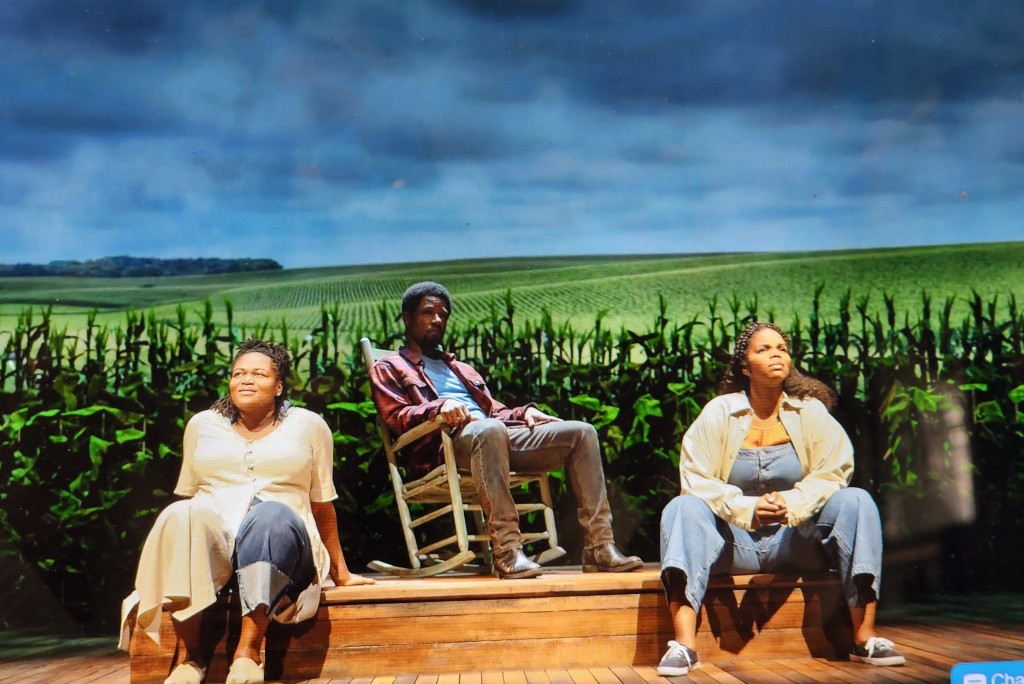
Then finally, a battered, bruised and reformed drug and alcohol-addicted Cephus has had enough. By that point, he has died to his ego to return home to the rich black soil he thought he had lost, and God’s grace, which was apparently late in coming, but actually was with him all along.
It takes wisdom to know that God has been with him, which he has obviously gained as it is subtly expressed by the ersatz Greek chorus (Inge and Ayers), who introduce the theme of God’s grace which we and Cephus learn abides throughout his life. (“If there was ever a woman or man, who has everlasting grace in the eyes of God. It’s the farmer woman… and man.”) As Inge and Ayers repeat these affirmations as Woman Two and Woman One at the top of play and in a brief song and rhythmic summation of the life of the farmer/sharecroppers who labored and sweat under the sun, then left for the cities, they state that one “fool” came back. And Cephus, “the fool” sits in a rocking chair center stage listening to them.
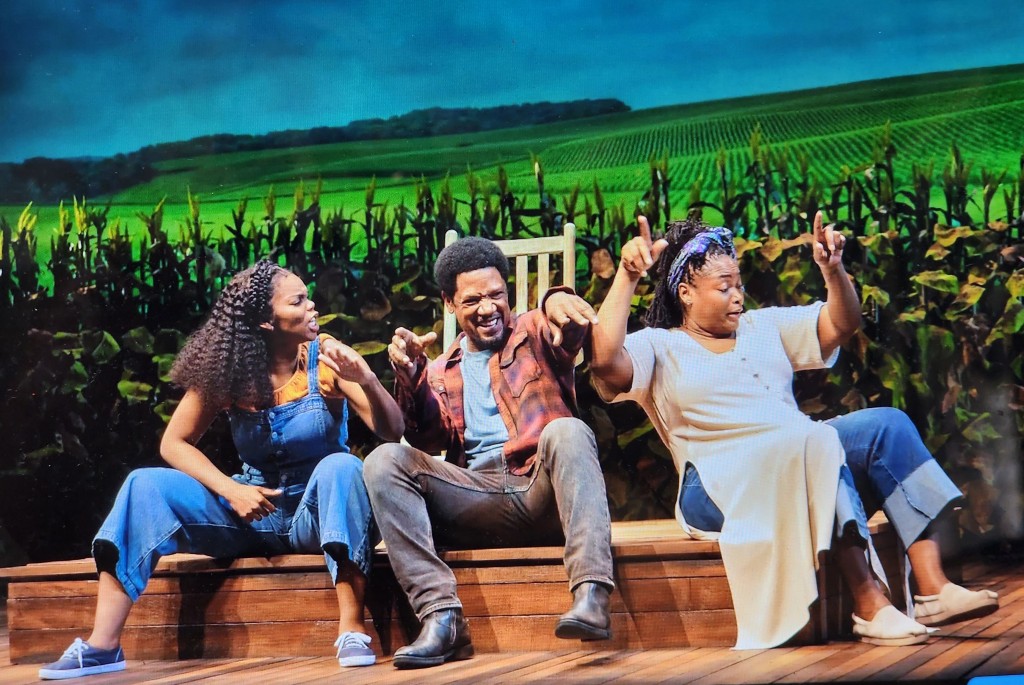
Cephus, is anything but a fool. His travels have converted him to a contented man of wisdom who has learned, through patience, the hard lesson of God’s everlasting grace. Though we don’t realize it at the top of the play, Cephus has returned from his odyssey. The townspeople’s myths swirl around him (via Inge and Ayers), and town children (Ayers and Inge), whisper the rumors, “Old Cephus Miles. Can’t be saved,” that “he’s dead,” that “he’s a ghost,” as they throw rocks at the windows of the “haunted house,” where he has returned to claim “I’m alive,” “I’m flesh, blood and bone.”
The play is Cephus’ lyrical and dramatic life told in flashback, at times in and out of sequence, like an epic tone poem with the chorus (Ayers and Inge), at the ready to activate his narration, an exegesis exploring and explaining the spiritual text of the grace that threads through his life.
Against a backdrop of tobacco plants, corn stalks, golden lighting by Allen Lee Hughes and a projection of distant acres of crops to the horizon line (the projection changes when Cephus moves to the city), Leon employs a symbolic minimalism of set and props (set design-Arnulfo Maldonado). He adjusts scene changes based on the dialogue and simple objects, a box, a chair, a drop-down cross. Dede Ayite’s costumes and Ayers and Inge’s hair (Nikiya Mathis-hair & wig design), essentially remain the same with a few additions and subtractions (hats, scarves, hair let down-a wig). Miraculously, Leon’s simplicity which fits the thematic, lyrically flowing style of this work, is not only fitting, it is revelatory. However, it is also arcane and opaque at times.
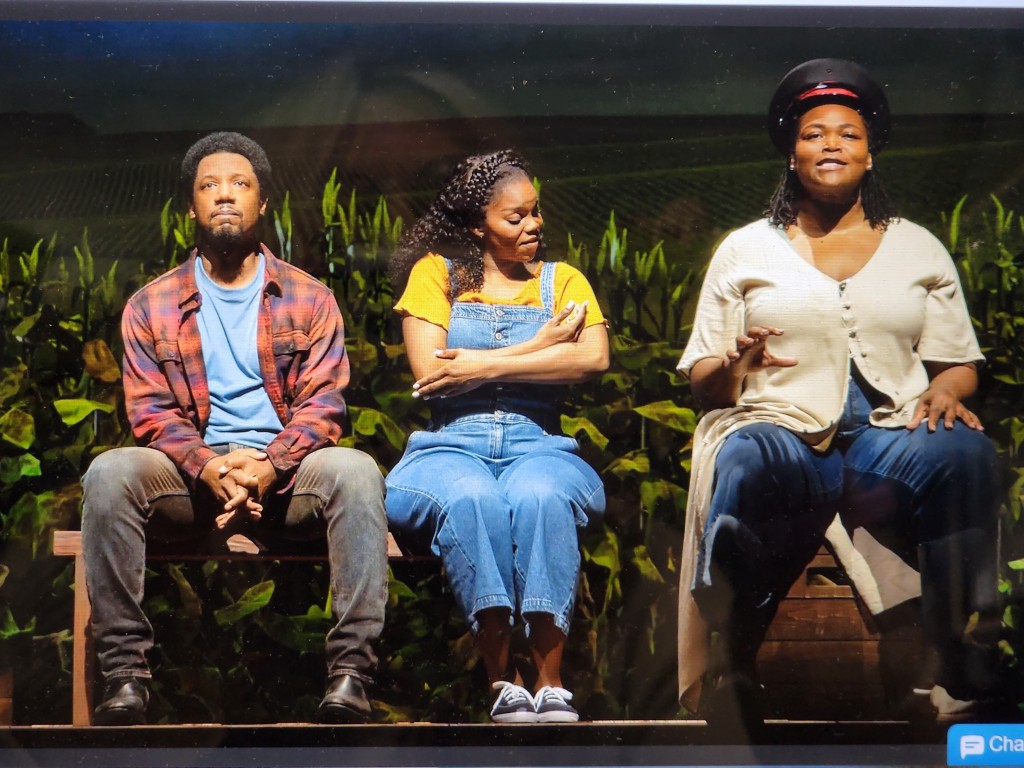
Ultimately, Williams/Leon’s symbolic translation of Cephus’ seemingly “ordinary” existence becomes a spiritual guidepost that focuses on uplifting the souls of those who witness it. Thus, we gradually understand why Cephus quietly dismisses the extraordinarily horrid conditions of racism in the Jim Crow south. Slowly we realize how he withstands injustice related to his poverty and lack of education. That impact is demonstrated when Cephus, unlike those whites who paid to get bone spur deferments or were deferred by college, is drafted during the Viet Nam war. Many Blacks who were unable to get such deferments fought and died in the jungles. He reads the letters of two friends who warn him off going to fight.
But fear didn’t stop Cephus from serving. God’s commandment, “Thou shalt not kill,” stops him. A religious conscientious objector, he spends five years in prison because he refuses to kill in battle. After his imprisonment, Cephus gives up sharecropping and heads north. He has tethered his happiness to Pattie Mae, the love of his life, and thinks he may get an education and “improve” himself like she did. Her mother prompted her to go north, get an education, became a teacher and forget about marrying Cephus because she was “better” than he.
However, at this point in his life, destitute and without friends or shelter, somehow Cephus ends up in the city where life befalls him as he waits for God to “come back from Miami” and help him deal with countless issues. Life takes an unbelievable turn for him and he questions God’s absence. With humor Williams relates Cephus’ travails and shares stories out of the traditions of citified Black folk and stories from his country childhood, i.e. his time in the hayloft with Pattie Mae, gambling in the cemetery with friends, loss of close family members and more. Home presents the important and crucial moments in Cephus’ life under the long arm of God, who he prays to, sometimes.
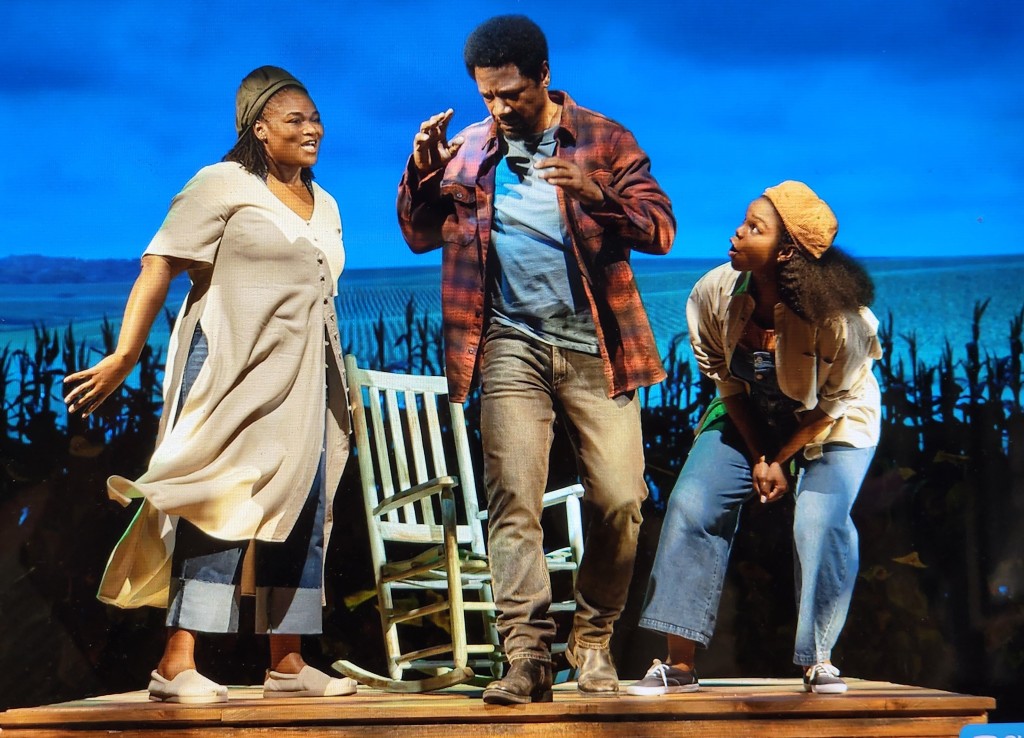
Caught up in the emotionalism of his pain, Cephus, delivered in an incredible performance by Kittles, draws us in and keeps us engaged with humor bytes and memes that reoccur and have their final concluding day. The ending is more than a satisfactory relief and it is the first time we see Cephus grin from ear to ear. Indeed, he has come home in relating and reliving his journey with us with the dogged and wonderful supporting help of Inge and Ayers.
Williams’ style and poetic form is easy listening, as one catches the music inherent in the language and the word beats. At times, however, the pacing and lack of theatricality are uneven and I found myself drifting, despite the tremendous performances of the actors. Overall, the ensemble and their direction by Leon are smashing, as is Williams’ Homeric view which provides a look at war and battle in the human psyche filtered through the American Black experience.
This is one to see. Unless it is extended, the end date is July 21.
Home. Todd Haimes Theatre. 224 West 42nd Street with no intermission. https://www.roundabouttheatre.org/
Theresa Rebeck, Presented by League of Professional Theatre Women at NYPL for the Performing Arts at Lincoln Center
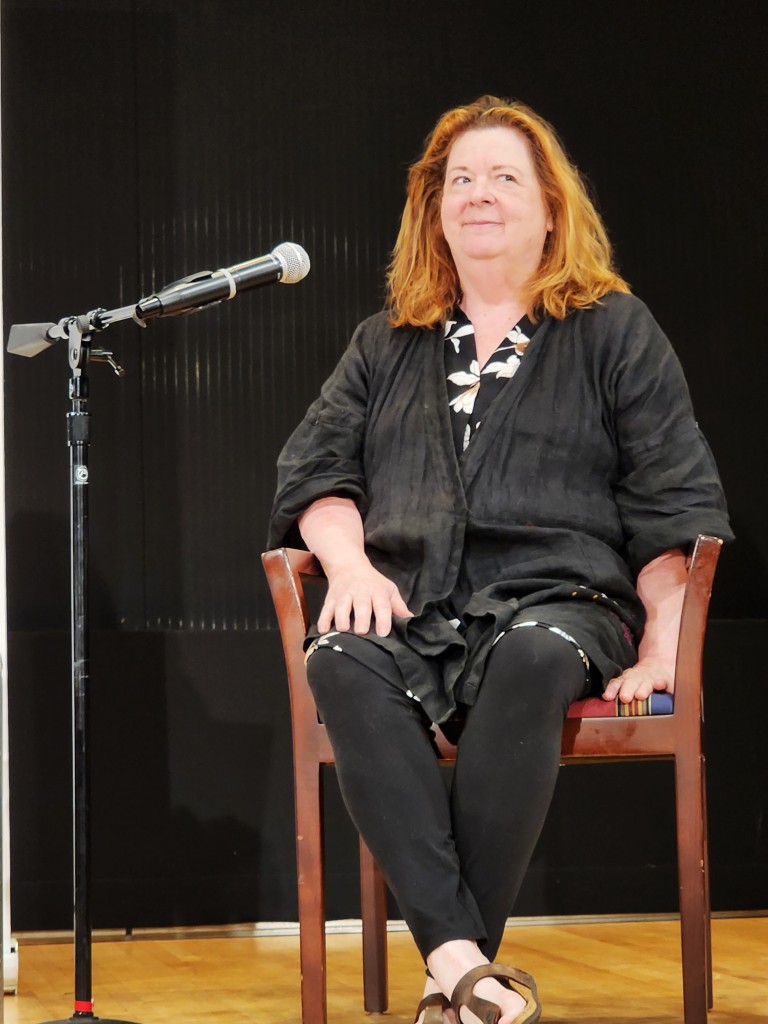
Theresa Rebeck. If the name doesn’t sound immediately familiar, chances are you do know Theresa Rebeck’s work from Broadway, off-Broadway, television, films or literature. A prolific writer, she is the most produced female playwright of her generation. Her work is presented throughout the United States and internationally. Her Broadway credits include I Need That (starring Danny DeVito), Bernhardt/Hamlet (starring Janet McTeer), Dead Accounts (starring Norbert Leo Butz), Seminar (starring Alan Rickman), and Mauritius (starring F. Murray Abraham). Her off-Broadway productions are numerous.
It was a pleasure to hear and see her live in an event sponsored by the League of Professional Theatre Women, Monday, June 3, 2024 at the New York Public Library for the Performing Arts, Lincoln Center’s Bruno Walter Auditorium. Interviewed by her close friend and producer Robyn Goodman (Avenue Q-Tony Award 2004, In the Heights-Tony Award 2008), Robyn founded Aged In Wood Productions in 2000. Their discussion was taped and is part of LPTW’s Oral History Project to preserve visual records of interviews of august women in the theater. The event was produced by director and producer Ludovica Villar-Hauser. A video of the event can be found in the Library’s TOFT Archive.

For the members of LPTW, Theresa Rebeck needed no introduction. Robyn Goodman began by asking general questions about Rebeck’s early life, and her background tie-ins to themes which often arise in her plays. This brief post focuses on a few salient highlights of the interview.
Born in Ohio, Rebeck grew up in an “ultra Republican, ultra Catholic” world. Receiving a Catholic education throughout, she graduated from Ursuline Academy in 1976 and continued with her Catholic education, graduating from the University of Notre Dame in 1980.
With irony and humor, Rebeck confided, “My parents didn’t want me to go to any East Coast School because they were afraid I’d lose my faith.” She shared that as a child, at times she went on a bus to see theater productions. Even at a young age, she venerated playwrights, thinking them gods. To her, Shakespeare, Moliere, Arthur Miller and Tennessee Williams were fantastic. She joked that she was already into theater and drama before she got out of grade school.

After Rebeck began acting in earnest at Ursuline Academy, she told her mother “I think I want to be a playwright.” Rebeck got laughs when she joked about her mother’s response, “She turned grey.”
Interestingly, during her freshman year at Notre Dame, Rebeck was invited to a very religious group who was holding a prayer meeting. It was “really spooky,” and the people were “really religious.” Rebeck sensed something “dark and weird going on.” They were speaking in tongues and talking about women being subservient so that everyone “should know their place.” She quipped, “After ten minutes I wanted to go back to my dorm room.” However, she wasn’t sure how to get back.
This was an introduction to members of “People of Praise,” the religious community Supreme Court Justice Amy Cony Barrett has been a member of since birth. “People of Praise,” is associated with the Catholic charismatic renewal movement, but is not formally affiliated with the Catholic Church. Rebeck’s experience at the prayer meeting and listening to the group’s tenets sent her fleeing in the opposite direction. “People of Praise” appears to be unrepresentative of Rebeck’s Catholic upbringing which has well served her life and work.

As a tie-in, Robyn Goodman read a quote from the award-winning playwright Tina Howe (Coastal Disturbances, Pride’s Crossing), who died last year at 85-years old. Howe said of Rebeck that her “Catholic upbringing has had a profound imprint on her work,” and there’s “a moral heart to Theresa.” According to Howe, “She’s a force of nature who always carries her altar with her.”
When Robyn Goodman asked Theresa, “Do you see this in your work?” She responded, “I do.” Rebeck then grounded the history of theater with the idea of faith as an inherent meld. She claimed she is “one of those people” who thinks that the theater is “holy territory.” And she says of herself, “I’m always a person that points out that theater was a religious ceremony.”
In ancient civilizations the dance and tribal ritual and ceremonial presentation had a deep spiritual and religious basis. With the Greeks who allowed even the slaves to take off from work to participate, theater was a celebration of the god Dionysus, and there were annual play festivals and competitions. Rebeck suggested that in various cultures, there was the shaman or priest, and sitting right next to him was the playwright. For Rebeck, “The gathering of people to share stories and identify with the stories is powerful.”
In responding to Robyn Goodman’s question about her transformation to professional theater, Rebeck mentioned her first production was Spike Heels (1993), that Goodman produced at Second Stage Theater. It starred Kevin Bacon, Tony Goldwyn, Saundra Santiago and the great Julie White. “My husband was in it,” quipped Rebeck. Theresa is married to Jess Lynn, and together they have two children.

Goodman asked if the production and notoriety changed her life, especially the good reviews. Rebeck suggests that with the critics peppering her with questions, “It was like watching all the senators grilling Anita Hill.” One of the questions they asked, was, “Are you going to write a book?” Frank Rich compared Spike Heels to the film Pillow Talk. According to Rich, Kevin Bacon was Gig Young, etc.
Four months later, David Mamet’s Oleanna, which premiered in Cambridge, Massachusetts, appeared off- Broadway at the Orpheum Theater. Frank Rich reviewed it and Rebeck noted Rich’s review. He commented that after the Anita Hill-Clarence Thomas fiasco on Capitol Hill, “finally someone wrote a play about sexual harassment.” Rebeck’s response was tellingly frustrated. She shared her feelings about his comment. “Hey! You saw a play about sexual harassment written by a women and you didn’t notice.”

It was “a different time,” Rebeck said, as she discussed how she reacted to the male/female power issues. “You go along with it, get mad when you go home and try to discuss it, and you’re incoherent.” With Rich’s comment about Oleanna, Rebeck says,”I thought, ‘Come on, this isn’t about sexual harassment. This is a women lying about sexual harassment.'” Rebeck affirmed with Goodman that women were fighting for their place and stature at the time, so it was “very important to produce plays like that.” Rebeck suggested, “I was way ahead of my time,” which received an appropriate laugh.
Goodman pointed out another quote about Rebeck’s writing in that she often writes about “betrayal, treason and poor behavior, a lot of poor behavior.” To that Theresa agreed that many playwrights write about “poor behavior.” Goodman added that Rebeck also writes about class and power shifts.
Rebeck discussed her experiences with productions on Broadway and off-Broadway. In fact, she suggested that she began directing because after the effort and time spent writing a play, she got tired of the release process, after her initial involvement with the production. She went to the table reads, heard design presentations and answered questions people asked. Then came the “thank yous” and she would leave. Rebeck didn’t want to be at the side of “the main event.” She wanted total involvement.

She enjoyed working on Dig, which she also directed and which received wonderful reviews. “I’m so proud of it. It was a good experience.” It is important to Rebeck that the creators have work that they can claim as their own. She enjoys working collaboratively when people are respectful.
Goodman and Rebeck appear to have a shared view of how people negotiate successfully in the “real world.” They negotiate with a sense of morality. Goodman shared the quote which political parties, especially the Trump MAGA Party, eschew as anathema. “If you make the truth your friend, it can’t come and eat you alive.” Rebeck and Goodman agree that a clear, moral point of view in plays, musicals and literature is vital.
Theresa suggested that her alma mater Brandeis University also grounded her toward presenting a clear, moral point of view in her work. She received her three graduate degrees from Brandeis: her MA in English in 1983, a MFA in Playwriting in 1986, and a PhD in Victorian era melodrama in 1989. Fittingly, Rebeck pointed out, that on the seal of Brandeis University are the words, “Truth even unto its innermost parts.” The university president decided to surround the shield on the seal with the quote about truth which is from Psalm 51. Rebeck noted that she recognized the seal on the podium (though it wasn’t clear at that point that it was Brandeis), hearing/seeing a clip of Ken Burns deliver his trenchant Keynote Address to Brandeis University’s 2024 undergraduate class during the 73rd Commencement Exercises. If you haven’t heard any of his speech, you can find it on YouTube. It is definitive and acute.

Rebeck affirms that “writing plays is about people” in the hope to understand “human brilliance and failure.” Of course at times there’s “political content.” However, at the heart it’s about people and human behavior.
In responding to Goodman’s question related to critics, Rebeck agreed that sometimes reviews are devastating and that her husband goes through the process with her. She mentioned that there can be five wonderful or enlightening critiques, and then there is the “crazy” review which is off kilter and seemingly out of nowhere, and people are “foaming at the mouth.” Sometimes, there is that one review while other critics and audiences love the work.
At one point Rebeck thought, “Why do they hate me?” Then, she realized if there’s one outlier, then there isn’t coherence. She mentioned that for a long time people only cared about and quoted the “paper of record.” Of course the irony was that there were many different critics and opinions. The diverse voices and viewpoints are exciting and especially vital for our time. That one opinion held sway and could make or break a play was “damaging to the psyche of the community.” She affirmed, “Now, it’s less dire.”
Rebeck spoke of an incident with a young producer who acted as if there was only one paper that mattered, historically, the “paper of record.” This individual said, based on one review, “Well, the reviews were bad.” Rebeck gave them a reality check. She said that a producer should never act like there is one reviewer who speaks for all critics. To obsess about one review is to bury oneself in negativity and recriminations. She told the producer, “Don’t do that!”

Indeed, Rebeck’s point is well taken. Historically, other critics bought into the prestige factor of “the paper of record,” denigrating their own voices and viewpoints, and bowing to the one review that allegedly spoke for all critics. In this day of book bannings, culture wars and rewriting history, such an approach is tantamount to critics mentally censoring themselves as inferiors. If there is a consensus about a play, that speaks volumes. One “determination” by one critic, regardless of how much he or she is paid, shouldn’t be the “word from on high” that the critics, theater professionals or the public “should” listen to and take to heart.
Rebeck and Goodman are expanding their winning teamwork. They’ve joined together on the musical Working Girl, based on the titular1988 Twentieth Century Fox motion picture written by Kevin Wade. Aimed for Broadway, the musical is presented by special arrangement with Buena Vista Theatrical. Writing the book, Rebeck discussed how she loves working with Tony-winning, composer-lyricist Cyndi Lauper (Kinky Boots), who is writing the score. Tony winner Christopher Ashley (Come From Away) is directing. Producers include Goodman and Josh Fiedler of Aged in Wood Productions, and Kumiko Yoshii.
Rebeck created Smash for NBC and briefly discussed a few highs and lows of working on the showbiz dramatic series. She liked Stephen Spielberg. Since Smash, she has been especially enamored of musical theater. Working Girl is a project that involves collaboration. To have to write a play singularly and then give it to a composer and lyricist is something Rebeck wasn’t interested in doing. She and the team are reimagining and updating the classic. It’s an exciting approach because it also emphasizes women working together and supporting each other on their “climb to the top.” With the political climate as it is, the musical is profoundly important.

One of the themes of the evening was that especially after COVID-19, theater has changed. Theaters around the country are in deep financial trouble. Robyn Goodman suggested that Broadway has gotten out of hand. The business is completely different than what it was two decades ago. Now, to mount a production viably, it costs $25 million dollars. It’s all about the money and finding backers.
As for budding playwrights, Rebeck advised that festivals are a good venue as a place to begin and get noticed. Indeed, 10 minute play festivals allow the creative team to put on “a beautiful event” for little or no money. One can even write a short one-act play and submit it to a one-act play festival. This is a boon for the playwright, who needs to learn how the process works and see the audience’s response to the play. That is an imperative for beginning playwrights.
Rebeck’s plays are published by Smith and Kraus as Theresa Rebeck: Complete Plays, Volumes I, II, III, IV and V. Acting editions are available from Samuel French or Playscripts. For a complete listing of all of her work you can find Theresa Rebeck on her website: https://www.theresarebeck.com/ Robyn Goodman’s website is https://www.agedinwood.com/about
Visit The New York Public Library for the Performing Arts at Lincoln Center, the Library’s TOFT Archive to see the digital recording of the evening. For more information about the TOFT Archives, see this link. https://www.nypl.org/locations/lpa/theatre-film-and-tape-archive To learn more about LPTW, check out their website. https://www.theatrewomen.org/
‘Wonderland: Curious Nature’ at New York Botanical Garden
Victorian “Age of Wonder,” Alice’s Adventures in Wonderland, a Fascinating Exhibit



NYBG opened its latest exhibit this weekend. Inspired by the classic Alice’s Adventures in Wonderland and the sequel, Through the Looking-Glass, And What Alice Found There, by Lewis Carroll, the all-new garden-wide exhibition is whimsical and full of fun and surprising features.


Today, Sunday is the Opening Weekend Garden Party Celebration from 11 a.m. to 5 p.m. on Daffodil Hill. You can dine as a special guest at the Queen’s Tea. And you can encounter The Mad Hatter, Alice, the Red Queen, and other Wonderland characters popping up on the walkways throughout the Garden.
OPENING WEEKEND GARDEN PARTY CELEBRATION TODAY, SUNDAY, MAY 19
Today, May 19, Sunday, there are lawn games like croquette, and other craft activities. Or if you prefer to meditate and reflect as you relieve the stresses of a hard work week, just enjoy a self-guided tour following the digital signs as you appreciate the Garden in its glorious pageantry in the spring. Everywhere you look there is a plant wonderland and themes from Carroll’s works and the Victorian era’s new age of exploration and wonder.



And as you are swept up in the Garden’s heavenly beauty you just may see a Cheshire Cat grinning out at you, for real. Certainly, if you let go, that Cheshire is there smiling at your happiness that you’ve treated yourself and your family to the Garden’s fantastical retreat.
Follow the Signs
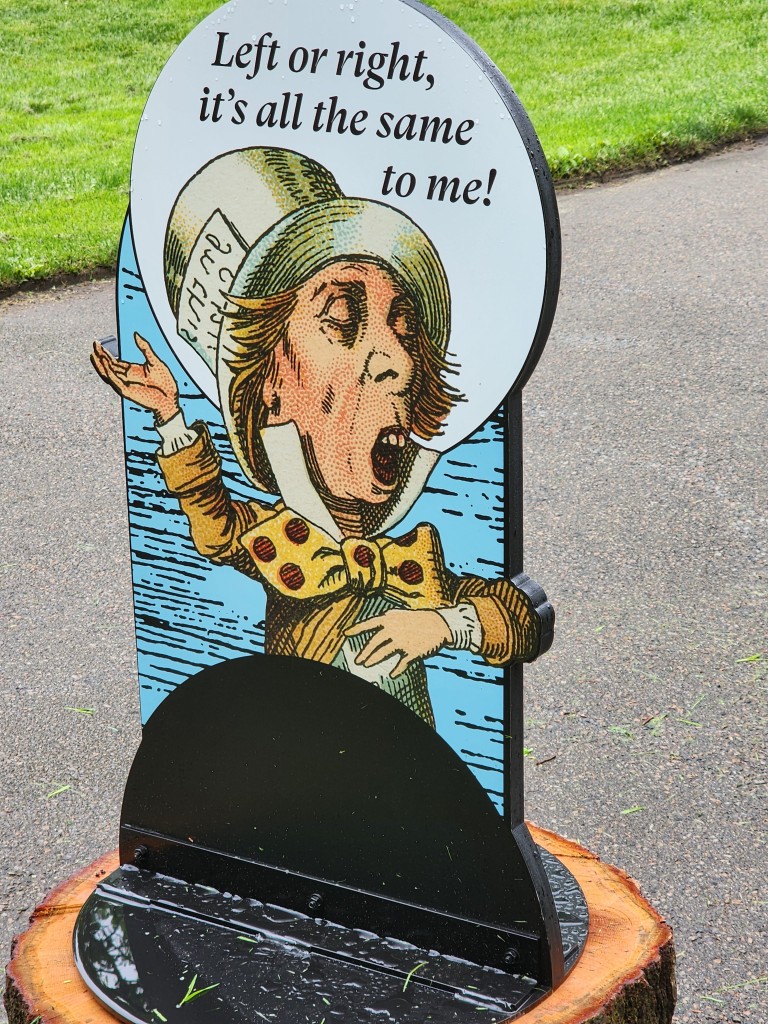


Plants Inspired by Oxford Botanical Gardens, Where Lewis Carroll Walked

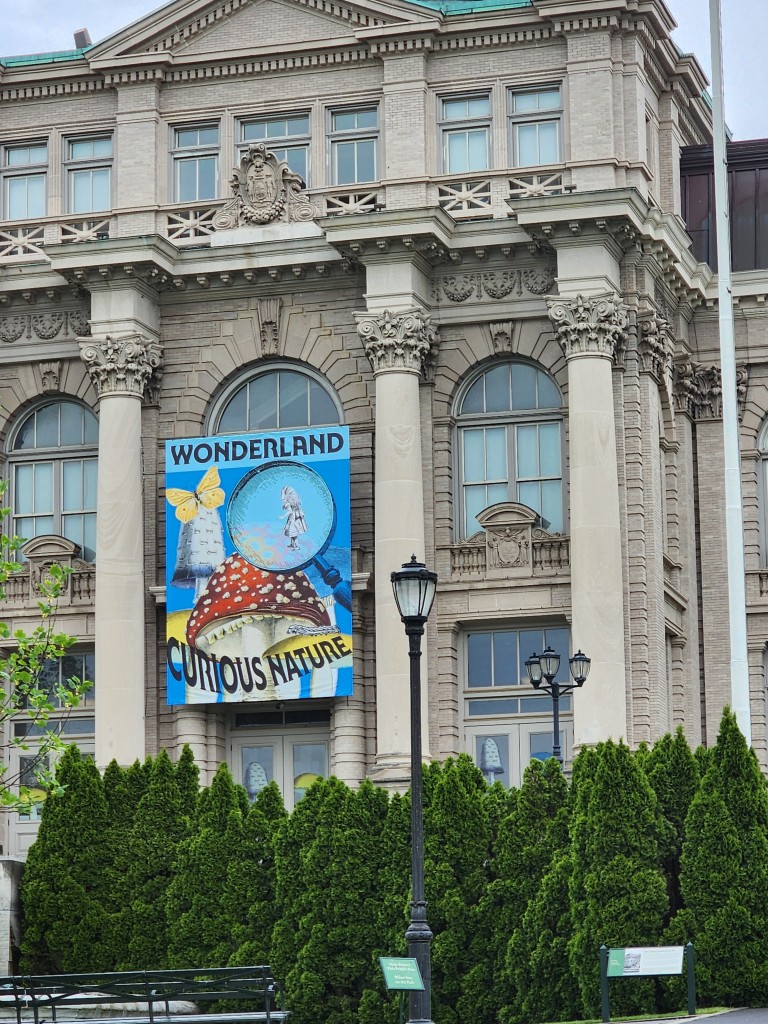
The Wonderland Exhibit continues at LuEsther T. Mertz Library. Visit the galleries to see the contemporary global artists, i.e. Abelardo Morell, Beverly Semmes, Agus Putu Suyadnya and others inspired by Carroll’s books. There are artworks reflect the global appreciation of the wacky characters and settings found in Alice’s Adventures. And in the rotunda of the Library look at the exhibit of dried mind-altering plants, their descriptions, and the songs and books they inspired which reference Carroll’s work. Some of these plants like opium and various mushrooms promoted altered states. The plants influenced Carroll’s idea about perception that he incorporated in Alice’s Adventures in Wonderland and Through the Looking-Glass, And What Alice Found There.
Wonderland: Curious Nature runs until October 27, 2024

The events run from this weekend through October 27th across three seasons, spring, summer and fall. There are programs for the entire family and even the characters from the fantastical books by Lewis Carroll show up to entertain and frolic down the Garden’s pathways always ready for a photo or chat with the more serious patrons wanting to find out more about the characters they portray.



Wondrous people and plants.
Look out for unusual characters and unusual plants that enjoy a marriage with insects like the fern below.

Wonderland: Curious Nature is not only fun, it is ingenious. From the spectacular flower show in the main galleries of the Enid A. Haupt Conservatory to the scheduled tea parties and brunches in the Stone Mill near the Peggy Rockefeller Rose Garden and different menu offerings at the Hudson Garden Grill, there is something for everyone. I will update the exhibit coverage in weeks to come.
For specific programming, go to the New York Botanical Garden site: https://www.nybg.org/event/wonderland-curious-nature/wonderland-curious-nature-programs/wonderland-curious-nature-opening-weekend/
‘Staff Meal,’ Avant Garde, Experimental, a Review

In the notes from playwright Abe Koogler about Staff Meal, directed by Morgan Green, currently at Playwrights Horizons, Koogler hopes that the audience, “will emerge from it the way you might emerge from a transportive meal in an unusual restaurant in a part of town you’ve never been to before. The avant garde work, shrouded with a uncertainty is most interesting when there appears to be a linear forward movement among characters during vignettes of scenes which take place in Gary Robinson’s restaurant, that once was packed, but by the end closes down.
At the top of the play Ben (Greg Keller) and Mina (Susannah Flood), sit near each other in a coffee shop working on their laptops. Eventually, their proximity prompts them to become familiar with each other so after a number of days, saying “Hi,” and other chatty comments, they leave and seek better coffee and/or food elsewhere. The search leads them to Gary Robinson’s restaurant.
The rapport and pacing between Keller and Flood is enjoyable and funny by these talented actors. However, it ends when they get bogged down ordering from a waiter who takes an inordinately long period of time to take their order and bring back an excellent wine. In the interim, they take humorous and sobering flights of fancy about their personal lives which include some of the most imaginative dialogue in the play. However, when the waiter has not brought their food, then the scene shifts with the mood, and the focus becomes their waiter and his experience at the restaurant.

As a flashback of “The Waiter” segment begins, Ben and Mina leave “hanging in the air,” the thread of dialogue along with Ben’s story about his dog, whom his parents mistreated during the time he lived with his family in Spain. Hampton Fluker is the waiter who enters the spotlight. He discusses his time at the restaurant joined by other members of the wait staff (Jess Barbagallo, Carmen M. Herlihy), and chef Christina (Erin Markey), who serves them their delicious “staff meal” before they begin the evening’s service. Fluker’s waiter declines the meal at this point because it is his first day and he is afraid he will throw up out of nervousness.
What is striking about this vignette is that Christina doesn’t come up with ordinary food for the staff, but serves them extraordinary dishes following the philosophy of Gary Robinson, who emphasizes the importance of being of service to others. As one of the servers affirms, “Our power, our glory increases only so much as we give it away, constantly, only so much as we serve.” This is akin to a Biblical verse which implies, if one would be a great leader, one must be great at serving others. This philosophy is the antithesis of that practiced by politicians who serve themselves first, last and always, a virus that has particularly attacked the former Republican Party known as the Trump MAGAS.

However, like fragments of wisdom and truth which filter in and out of our consciousness, this conversation among the staff as they eat Christina’s delicious food and reference two of Gary Robinson’s books, dissolves into the air, though it is a profound concept that is incredibly current. However, one of the reasons why this wisdom and the astute servers’ conversation comes to a screeching halt is that an audience member interrupts with an important question, akin to “What the hell?”
By this point in time, the fourth wall has been broken twice; first by a vagrant (Erin Markey), who attempted to steal Mina’s laptop, though Mina elicited the help of an audience member to watch it for her when she went to the bathroom, because Ben wasn’t there that day. Luckily, Mina interrupts The Vagrant’s theft and sends her away without the laptop as Mina chides the negligent audience member, who was obedient to the playwright and didn’t tell The Vagrant, “Stop thief!”

The second breaking of the fourth wall is by a disruptive “audience member” (the fine Stephanie Berry), who is “annoyed” and questions the direction of the play defining it as meaningless, unrelated to her life, not current-when the world is burning down, and a waste of the gift of the audience’s time. Joining the other actor/servers onstage, she then discusses what she considers meaningful, her life, and the direction it has taken recently.
Of course, this is humorous and gives way to the notion that audience members’ opinions don’t always jive with theater professionals, though they can make or break them via word of mouth recommendations. Then the playwright forestalls audience opinions about his avant garde, surrealistic, weird work, using Berry as a a mouthpiece when the playwright has her say, “Do you ever get this feeling with young writers, or early writers, writers who are developing….do you ever wonder: when will they develop?” Berry’s audience member excoriates the quality of the play, Staff Meal, addressing the characters and absent playwright before sharing what is relatable to her in her life.

On consideration this surreal vignette works because of Berry’s authentic, spot-on performance which is confessional and makes us empathize with her even more so than with the other vignettes. But then she leaves and Koogler picks up where he left off back to the servers discussing the dwindling clientele and whether or not Robinson is going to close the restaurant down.
Then time and space shift once more. At this point, the servers and the couple have disappeared and the vignette with The Vagrant (Erin Markey) occurs. She explains that she takes on three roles, one of which is the chef, but the segment of The Vagrant involves her living in a hole and trying to acquire laptops so that she can get a job. Ah ha! We have the explanation of The Vagrant attempting to steal Mina’s laptop early on in the play. Eventually, she goes for a job interview and is hired and tells us she lived an extraordinary ordinary life and concludes with her affirmation that the rest of the play is about “how it ended.”

Berry’s audience member returns, warning us that she has been found out to be an artifice, and her role in the play is over, but she notices the weather outside is shifting and becoming ominous. The time has shifted once more and events move toward an unsettling conclusion. However, we do find out what happened to Ben’s dog, after they leave the restaurant without their food or wine. The waiter receives a delectable “staff meal,” Ben and Mina are separated walking home, and The Waiter is left questioning if Christina is still in the restaurant.
At this juncture it’s time to reconsider the audience member/playwright twitting himself about what he’s written. However, the play is more naturalistic in its chaotic, unthreaded, seeming randomness with bits of profound meaning stuffed here and there, like life, perhaps. In that we realize that we make meaning from our own lives, as random and strange as events can sometimes be, which have no rhyme or reason. Indeed, a fictional play with a neat beginning, middle and ending is easy to follow, but is perhaps easily dismissed as fiction. Staff Meal, as surreal as it is, is darkly memorable.

To assist with the sets which dissolve away to a bare stage, Jian Jung’s minimalist scenic design creates a cafe, a kitchen, a restaurant dining room and the dark ominous streets. Additional kudos go to Kaye Voyce’s simple (costume design), though I thought the elaborate costume for The Vagrant was interestingly layered with various “stuff.” Masha Tsimring (lighting design), kept segments toward the end foreboding, and Tei Blow (sound design) and Steve Cuiffo (illusion design), executed Morgan Green’s vision for Staff Meal.
Staff Meal will keep you guessing and wondering and perhaps as annoyed as Stephanie Berry’s Audience Member, trying to find the portal to understanding what’s beyond this unusual restaurant that serves its staff better than its customers. It runs with no intermission at Playwrights Horizons, Peter Jay Sharp Theater, 416 West 42nd Street. https://www.playwrightshorizons.org/shows/plays/staff-meal/
‘The Great Gatsby,’ Sumptuously Re-imagined, A Must-See, Unforgettable Broadway Spectacle

The Great Gatsby by F. Scott Fitzgerald is an iconic American novel set during the Jazz Age. It is about class, the privilege of old wealth and the excesses of the nouveau riche, who can never attain the status of the generational moneyed class, regardless of how hard they try. The Great Gatsby a New Musical, based on the titular novel, retains this key theme of America’s class system from the perspective of unreliable narrator Nick Carraway (Noah J. Ricketts). Carraway memorializes Jay Gatsby, the extraordinaire, whose ability to distill hope and materialize his dreams achieves its own artistic perfection. Examined from the perspective of Nick Carraway (Noah J. Ricketts), the tragic flaw in Gatsby’s process is that he attaches his hope to the imperfection of love and a woman who wasn’t worthy of his vision, faith or love.

The Great Gatsby, a New Musical made its premiere at the Broadway Theatre after its fall run at the Paper Mill Playhouse in New Jersey. With book by Kait Kerrigan in her Broadway debut, music by Jason Howland (Paradise Square), and lyrics by Nathan Tysen (Paradise Square), the musical is suprbly choreographed by Dominique Kelley and acutely directed by Marc Bruni (Beautiful: the Carole King Musical). Overall, it’s a gorgeously conceived production with exceptional ensemble work and flamboyant spectacle that sumptuously re-imagines the distinctive settings, individualistic characters and seminal events that make the novel a singular and timeless classic.

The strength of this production is that Kerrigan, Howland and Tysen are loyal to Nick’s perception of the magnificent Jay Gatsby, portrayed exquisitely by Jeremy Jordan. Jordan’s luscious, exceptional voice, Gatsbyesque persona, and passion do justice to Howland and Tysen’s lyrical and dynamic songs, “For Her,” “Past Is Catching Up to Me,” and the duet “Go.” We empathize with Jordan’s Gatsby, whose near divine love of Daisy (the lovely Eva Noblezada), never fails him, though Daisy can’t handle the irrepressible and divine nature of his efforts to transform time.
In “My Green Light,” an extraordinary duet between Noblezada and Jordan at the end of Act I, the couple consummates their love in Gatsby’s lavish bedroom with the projection of the rippling Long Island Sound at night, and the green light at the end of Daisy’s dock twinkling behind them in the background.

Bruni’s phenomenal staging, Paul Tate DePoo III’s projection and set unifies the key elements of the love relationship between Gatsby and Daisy, the artistry of Gatsby’s vision and his infinite hope (symbolized by the green light), driving it. The acting talents of Jordan and Noblezada, their lustrous singing and the setting are dazzling in this memorable, uplifting scene, where Gatsby, indeed, for a moment conquers time.

At that point we believe that Gatsby’s love is enough to hold Daisy and take her away from the craven, brutish, hypocritical Tom, who breaks his mistress Myrtle’s nose (Sara Chase), and manhandles Daisy leaving bruises on her arms during their quarrels. We believe like Nick and Jordan (the adorable Samantha Pauly), that Tom doesn’t deserve Daisy. However, by the conclusion of the musical, Nick realizes that Tom and Daisy do deserve each other. She won’t even attend Gatsby’s funeral, acting like he never existed. We agree with Nick that Gatsby is “worth the whole damn bunch put together.”

As Nick spins it, the tragedy lies in Daisy’s soulish weakness and her inability to live up to Gatsby’s love to “forget the past,” which he asks her to do in front of Tom in the superbly acted scene at the Plaza Hotel. Together the characters sing the sensational ensemble number “Made to Last.” John Zdrojeski’s Tom is particularly cruel as he arrogantly denounces Gatsby, his criminal bootlegging and his low class background. The lyrics are profound and spot-on. The dynamic music reinforces the themes which the characters forcefully embrace and symbolize. Tom sardonically sings, “It’s not about wealth, it’s blood. It’s class. The day you were born, your die had been cast.” And Gatsby insists, “Daisy, tell him you’re through.” And he tells Tom to “face reality,” affirming that Daisy never loved Tom.

During the explosive turning point in the song, Gatsby insists she renounce her marriage to Tom, and in effect her position and class to which Tom “elevated” her. When Tom sees she falters, that she honestly admits that she loved them both, and that Gatsby “wants too much,” Tom feels secure. He knows she is too weak and insecure to leave him and their daughter. Noblezada’s Daisy, Zdrojeski’s Tom and Jordan’s Gatsby strike the mixture of emotions of their characters with authenticity and power. Daisy’s heightened angst and tenuous state of mind force her to leave the suite, with Gatsby running after her. It is not a position of power from which Gatsby might redeem himself with her, though he tries.

Tom’s defamation and insults to Gatsby’s face and the reality of what Daisy would be giving up to leave him dislocates Daisy to distraction and ultimately causes the fatal accident and final tragedy of the underclasses, who make the mistake of becoming involved with the soulless, unimaginative upper class.

Noblezada portrays Daisy’s confusion with grist, making Jeremy Jordan’s desperation to stop Tom’s brainwashing and win her back even more pronounced. When Tom’s words hit their mark, it’s as if a curtain shuts down Daisy’s mind. Jordan’s Gatsby sees the impact of Tom’s cynicism as it disintegrates all the romance of what he has accomplished in order to turn back time to the fullness of Daisy’s love when Tom never existed. The scene is the brilliant high-point. What follows is the aftermath from which there is no recovering, except that Nick must lead the musical encomium to the greatness of his friend Gatsby. He alone fully grasps who the man was, so of course, he is furious that the papers slam Gatsby and further drive Daisy into oblivion and Tom into victory, as they jaunt away to Hawaii.

Kerrigan, Howland and Tysen are faithful to the key events in the novel down to no one going to Gatsby’s funeral except Nick which Bruni simply stages with black curtains, the casket and bier and red roses. Howland and Tysen fill out Wilson’s mania as he assassinates Gatsby, after Tom sets him up (“God Sees Everything”). As Gatsby sings the reprise “For Her” and Nick imagines how it happens, Wilson joins in and asks God’s forgiveness for using his hands to met out justice and take responsibility for the execution. Of course, Wilson’s ask is ridiculous as his justice is misplaced. Duped by Tom to do violence and pay for it with his own life, Wilson is a pathetic figure. Reflecting on these events, and Daisy and Tom’s nonchalance about Gatsby and the Wilsons, Carraway disdains Daisy and Tom as representative of the careless rich who destroy people and things leaving the Nick Carraways of the world to clean up the mess.

Comedic elements are found in this adaptation which sometime diffuse the impact of the story, as does attention to the secondary characters who are given greater focus. It is also problematic that Nick’s perspective doesn’t cohere throughout the musical, but leaves off in a few scenes, one between Jordan and Daisy.

Some of the comedy is refreshing as in the scene Nick and Jordan share at Nick’s cottage while Daisy and Gatsby meet for the first time in five years. Their relationship is expanded beyond the novel when Jordan and Nick’s intimacy gives way to his proposal of marriage which she is on the verge of accepting, though in Act I she is against marriage. Her characterization is more in keeping with today’s women than women of the early 20th century. Nick’s characterization is largely faithful to the novel. Noah J. Ricketts does a fine job of rendering Nick the unreliable narrator who thinks highly of himself, but doesn’t completely stand up to Tom and Daisy. Instead, he turns tail and runs back to the Midwest away from the” “evil” East, an irony. The only way he can reconcile his self-loathing about his behavior is to attempt to expiate his guilt by memorializing Gatsby.
The Jordan/Nick scenes are humorous and flirtatious. Their number “Better Hold Tight” is a diversion more for its own sake. However, we are not surprised that Nick throws over Jordan who doesn’t show up to Gatsby’s funeral either. She is one of the bad drivers, the careless rich who sicken and disgust him, for they dupes the fools who would seek the dream “boats running against the current” (“Finale: Roaring On”), to only to stumble because their dreams are behind them in the past.

Kerrigan, Howland and Tysen take even greater liberties with the secondary characters for the sake of dramatic purposes. Kerrigan, et. al. strengthen and coalesce the ideas symbolizing George Wilson (Paul Whitty), George’s wife Myrtle (Sara Chase), and Meyer Wolfsheim (Eric Anderson), by giving each of them solo numbers which define their personalities, desires and attitudes. These add to the themes, though they refocus the thrust of Nick’s story of how Gatsby is a romantic hero. The mystery surrounding Gatsby’s identity which is slowly revealed in the novel, is lost in this musical with attention going elsewhere.

As a representative of the criminal class that feeds the dreams of the lower class, breaking the law to do so, thug Wolfsheim joins the company singing “New Money,” which old wealth (Tom), regards as garish and meretricious. Anderson’s Wolfsheim (“who made Gatsby”), also sings and joins the company dancing in the excellent number “Shady.” As Wolfsheim sings, Bruni stages vignettes with each of the character couples being corrupted in their adultery or “sinful” affairs (Jordan and Nick, Gatsby and Daisy, Tom and the Wilsons). According to Wolfsheim, “I’m okay with keeping secrets. I’m okay with being naughty. I approve of indiscretions, if you know how to hide a body.”

Eric Anderson and cast of The Great Gatsby (Matthew Murphy and Evan Zimmerman)
Read the rest of this entry
‘Uncle Vanya,’ Steve Carell in a Superb Update of Timeless Chekhov

A favorite of Anton Chekhov fans is Uncle Vanya because it combines organic comedy and tragedy emerging from mundane, static situations, intricate, suppressed characters and their off-balanced, mired-down relationships. Playwright Heidi Schreck (What the Constitution Means to Me), has modernized Vanya enhancing the elements that make Chekhov’s immutable work relevant for us today. Lila Neugebauer’s direction stages Schreck’s Chekhov update with nuance and singularity to make for a stunning premiere of this classic at Lincoln Center’s Vivian Beaumont in a limited run until June 16th.
With a celebrated cast and beautifully shepherded ensemble by the director, we watch as the events unfold and move nowhere, except within the souls of each of the characters who climb mountains of elation, fury, depression and despair by the conclusion of this two act tragicomedy.
Schreck has threaded Chekhov’s genius characterizations with dialogue updates that are streamlined for clarity, yet allow for the ironies and sarcasm to penetrate. At the top of the play Steve Carell’s Vanya is hysterical as he expresses his emotional doldrums at the bottom of a whirlpool of chaos which has arrived in the form of his brother-in-law, Professor Alexander (the pompous, self-important Alfred Molina in a spot-on portrayal), and Alexander’s beautiful, self-absorbed, younger-by-decades wife Elena (Anika Noni Rose). Also present is the vibrant, ironic, self-deprecating, overworked Dr. Astrov (William Jackson Harper), a friend who visits often and owns a neighboring estate.

During the course of the first act, we are witness to the interior feelings and emotions of all the characters who in one way or another are bored, depressed, miserable and disgusted with themselves. Vanya is enraged that he has taken care of Alexander’s lifestyle, even after his sister died in deference to his mother, Maria (Jayne Houdyshell). He is particularly enraged that he believed with is mother that Alexander was a “brilliant” art critic who deserved to be feted, petted and over credited with praise when he lived in the city.
Having clunked past his prime as an old man, Alexander has been fired because no one wants to read his work. He and Elena have run out of money and are forced to stay in the family’s country estate with Vanya and Sonia, Alexander’s daughter (the poignant, heartfelt Alison PIll), away from the limelight which shines on Alexander no more. Seeing Alexander in this new belittlement, though he orders around everyone in the family, who must wait on him hand and foot, Vanya is humiliated with his own self-betrayal. He didn’t realize that Alexander was a blowhard who duped and enslaved him to labor on the farm to supporting his high life, while he pursued his “important” writing. Vanya and Sonia labor diligently to make sure the farm is able to support the family, though it has been a difficult task that recently Vanya has grown to regret. He questions why he wasted his years on a man unworthy of his time and effort, a fraud who knows little about art.

Likewise, Astrov questions his own position as a doctor, admitting to Marina (Mia Katigbak), that he feels responsible for not being able to help a young man killed in an accident. To round out the “les miserables,” Alexander is upset that he is an old man who is growing more decrepit by the minute as he endures believing his young, beautiful wife despises him. Despite his upset, Alexander expects to be waited on by his brother-in-law, mother-in-law and in short, everyone on the estate, which he has come to think is his, by virtue of his wanting it. Though the estate has been bequeathed to his daughter Sonia by Vanya’s sister, his first wife, Alexander and Elena find the quiet life in the country unbearable.
As they take up space and upturn the normal routine of the farm, Elena has been the rarefied creature who has disturbed the molecules of complacency in the lives of Vanya, Sonia and Astrov. Her beauty is shattering. Sonia hates her stepmother, and both Vanya and Astrov fall in love and lust with her. As a result, their former activities bore them; they cannot function with satisfaction, and have fallen distract with want, craving the impossible, Elena’s love. Alexander fears losing her, but realizes if he plays the victim and harps on his own weaknesses of old age, as distasteful as he is, Elena is moral enough to attend to him, though she is bored and loathes him in the process.

The situation is fraught with problems, hatreds, regrets, upsets and soul turmoil, which Schreck has stirred following Chekhov’s dynamic. Thus, Carell’s Vanya and Harper’s Astrov are humorous in their self-loathing as is the arrogant Alexander and vapid Elena who Sonia suggests can end her boredom by helping them on the farm. Of course, work is not something Elena does, which answers why she has married Alexander and both have been the parasites who have sucked the lifeblood of Vanya and Sonia, as they labor for their “betters,” who are actually inferior, ignoble and selfish.
To complicate the situation, Sonia is desperately in love with Astrov, who can only see Elena who is attracted to him. However, Elena is afraid to carry out the possibility of their affair. Instead, she destroys any notion that Sonia has of being with Astrov by ferreting out Astrov’s feelings for Sonia which tumble out as feelings for Elena and a forbidden, hypocritical kiss which Vanya sees and adds to his rage at Elena’s self-righteousness and martyred morality. When Elena tells Sonia that Astrov doesn’t love her, Sonia is heartbroken. It is Pill’s shining moment and everyone who has experienced unrequited love empathizes with her devastation.
When Alexander expresses his plans to sell the estate and take the proceeds to live in the city in a greater comfort and elegance, Carell’s Vanya excoriates Alexander and speaks truth to power. He finally clarifies his disgust for the craven and selfish Alexander, despite Maria’s belief that Alexander is a great man, not the fraud Vanya says he is.

It is a gonzo moment and Carell draws our empathy for Vanya who attempts to expiate his rage, not through understanding how he is responsible for being a dishrag to Alexander, but through manslaughter. The scene is brilliantly staged by Neugebauer and is both humorous and tragic. The denouement happens quickly afterward, as each of the characters turns to their own isolated troubles with no clear resolution of peace or reconciliation with each other.
The ensemble are terrific and the actors are able to tease out the authenticity of their characters so that each is distinct, identifiable and memorable. Naturally, Carell’s Vanya is sympathetic as is Pill’s heartsick Sonia, for they nobly uphold the ethic that work is a kind of redemption in itself, if dreams can never come true. We appreciate Harper’s Astrov in his love of growing forests and his understanding of the extent to which the forests that he plants will bring sustenance to the planet, if even to mitigate only somewhat the society’s encroaching destructiveness. Even Katigbak’s Marina and Sonia’s godfather Waffles (the excellent Jonathan Hadary), are admirable in their ironic stoicism and ability to attempt to lighten the load of the others and not complain.

Finally, as the foils Molina’s Alexander and Noni Rose’s Elena are unredeemable. It is fitting that they leave and perhaps will never return again. The chaos, misery, dislocation and confusion they leave in their wake (including the somewhat adoring fog of Houdyshell’s Maria), are swallowed up by the beautiful countryside and the passion to keep the estate functioning which Sonia and Vanya hope to achieve in peace. Vanya, for now, has thwarted Alexander, by terrorizing Alexander into obeying him in a language (threatening his life), he understands. For this we applaud Vanya.
When Alexander and Elena leave, the disruption has ended and they take their drama and chaos with them. It is as if they were never there. As Vanya and Sonia handle the estate’s paperwork, which they’ve neglected having to answer Alexander’s every need, the verities of truth, honor, nobility and sacrifice are uplifted while they work in silence, and peace is restored to the estate, though they must suffer in not achieving the desires of their lives.
Neugebauer and Schreck have collaborated to create a fine version of Chekhov’s Uncle Vanya that will remain in our hearts because of the simplicity and clarity with which this update has been rendered. Thanks go to the creative team. Mimi Lien’s set design functions expansively to suggest the various rooms of the estate, the garden and hovering forest in the background. A decorative sliding divider which separates the house from the forest and allows us to look out onto the forest and woods beyond (a projection), symbolizes the division between the natural and the artificial worlds which influence and symbolize the characters and what they value.

Vanya and the immediate family take their comforts from the earth and nature as does Astrov. Alexander and Elena have forgotten it, finding no solace in the beautiful surroundings and quiet, rural lifestyle which they find boring because they prefer chaos and the frenetic atmosphere of society. Essentially they are soul damaged and need the distractions they’ve become used to when Alexander was famous and the life of the party before he got tiresome and old and disgusting in the eyes of Elena and those who fired him..
The projection of trees that expands entirely across the stage in the first act is a superb representation of what is immutable and must be preserved as Astrov works to preserve. The forest of trees which is the backdrop of the garden, sometimes sway in the wind. The rustling leaves foreshadow the thunder storm which throws rain into the garden/onstage. The storm symbolizes the storm brewing in Uncle Vanya about Alexander, and emotionally manifests when Alexander suggests they sell the estate to fulfill his personal agenda.
During the intermission every puddle and water droplet is sopped up by the tech crew. Kudos to Lap Chi Chu & Elizabeth Harper for their lighting design and Mikhail Fiksel & Beth Lake for their sound design which bring the symbolism and reality of the storm home.
The modern costumes by Kaye Voyce are character defining. Elena’s extremely tight knit, brightly colored, clingy dresses are eye candy for her admirers as she intends them to be to attract their attention, then pretend she doesn’t want it. Of course she is the leisurely swan while Sonia is the ugly duckling in work clothing, Grandmother Maria dresses like the “hippie radical feminist” that she is, and Marina is in a schmatta as the servant who cooks and cleans. Here, it is easy for Elena to shine; there is no competition.
Vanya looks frumpy and uncaring of himself. This reflects his depression and lack of confidence, while Molina’s Alexander is dressed in the heat like a peacock with a scarf, cane and hat and cream-colored suit when we first see him. Astrov is in his doctor’s uniform, utilitarian, purposeful, then changes to more relaxed clothing. The costumes are one more example of the perfection of Neugebauer’s vision and direction of her team.
Uncle Vanya is an incredible play and this update does Chekhov justice. It is a must-see for Schreck’s script clarity, the actors seamless interactions and the creative teamwork which elevates Chekhov’s view of humanity with hope, sorrow and love in his characterizations, especially of Vanya.
Uncle Vanya runs two hours twenty-five minutes including one intermission, Lincoln Center Theater at the Vivian Beaumont. https://www.lct.org/shows/uncle-vanya/whos-who/
‘Mother Play,’ Stellar Performances by Celia Keenan-Bolger, Jessica Lange, Jim Parsons

One of the keys to understanding Mother Play, A Play in Five Evictions by Paula Vogel is in the narration. Currently running in its premiere at 2NDSTAGE, directed by Tina Landau, Vogel’s play has some elements of her own life, but is not naturalistic. It is stylized, quirky, humorous, imaginative and figurative, like most of her plays. In a nod to Tennessee Williams’ The Glass Menagerie, in the notes, she suggests it is a memory play.
Presumably, the play focuses on a representative mother, Phyllis, portrayed with impeccable sensitivity, raw emotion and nuanced undercurrents of bitterness, humor and irony by the exceptional Jessica Lange. However, the play is actually about a mother-daughter relationship that moves toward reconciliation. As such, the narrator/daughter (the always superb Celia Kennan-Bolger), directs us to her understanding of the last forty years of her life in her relationship with her mother, via the unreliable narrator’s viewpoint.

Should we believe everything the narrator says happened? Or does Martha’s perception of her mother cling to highlights of the events most hurtful and damaging to her? We must ultimately decide or remain uncertain until the play’s conclusion. It’s a delicious conundrum that emphasizes Vogel’s themes of the necessity of developing a deeper understanding of relationships, emotional pain, working through hurt and so much more.
Martha’s genius gains our confidence, empathy and identification with her confessional re-enactment flashbacks as she remembers events. She takes us through the highs and lows of five evictions her family experiences together, after their father dumped them for greener pastures. A key figure in the family dynamic is her two-years older brother Carl, Martha’s brilliant, sweet and kind protector, portrayed with clarity, humor and depth by Jim Parsons.

At the top of the play, which is in the present, Martha is in her early 50s. She tells us that by the time she was 11, their family had moved seven times because their father had a “habit of not paying rent.” Thus, they learned to pack and unpack in a day. She comments with irony that there is a season for packing and a season for unpacking, referencing the Biblical verse (Ecclesiastes 3:1-8), and the Byrd’s song, “Turn, Turn, Turn.”
To destabilize and uproot children from their friends and school mates so many times is a calculation Vogel’s Martha never makes. But it speaks volumes about how the brother and sister rely on each other emotionally, because they are social isolates by necessity because the continued movement which their father, whom we only hear about, didn’t even take into consideration.
As Martha opens a box of the only things her deceased brother had left in their apartment, she takes out a bunny rabbit and a letter Carl had written to her. With the letter, Parson’s Carl materializes and Martha joins him as they step into a series of flashbacks which chronicle events that lead to the five times they were evicted by landlords or they evicted themselves from each other’s lives, only to return, eventually.

Cleverly grounding this family’s living arrangements to present her salient themes about “forever pain,” the impossibility of “mothering,” sacrifice, regret and love, Vogel uses two devices. The first is their furniture which they take with them and rearrange each time they pick up and take off for various reasons. Secondly, there are the roaches, which are magical and symbolic, not only of the poverty and want their father stuck them with, but of the emotional terror and fear of living precariously on the edge of society, sanity and Phyllis’ desire for normalcy.
The roaches, at key moments manifest, swarm, go creepy crawly and loom monstrously in their lives. Since Phyllis signs leases to cheaper basement apartments, promising they will take out the garbage, they are forced to live with these vermin, an indignity of representative squalor from which they never seem to be freed, despite upwardly mobile Phyllis’ attempts to rise to apartments on higher floors.
The first flashback occurs when Martha is twelve, Carl is fourteen, and Phyllis is thirty-seven, in their first apartment away from their father after the divorce. Carl and Martha arrange the furniture and when they are finished, they swivel around Phyllis, reclining in an easy chair in Landau’s deft, humorous introduction of the women the play is allegedly about. Far from “taking it easy,” Lange’s Phyllis demonstrates she is “on edge” and seeks to quell her nerves at this first move without her husband. She immediately importunes her children for the following: her cigarette lighter (a gift from “the only one she loved”), a glass for the gin which she carries in a bottle in her large handbag, and ice, ready made in a tray in a box. After pouring herself a drink and puffing on her cigarette, she begins to relax and says, “Maybe mother will be able to get through this.”

Ironically, the “this” has profound, layered meaning not only for the moment, but for what is ahead for Phyllis, including single parenting, a possible nervous breakdown, poverty, responsibility as a mother, her job and more.
Phyllis pulls out their dinner in a McDonald’s bag from her bottomless black purse, which is empty of money because their father wiped out all the accounts. She speaks of their future-Martha cooking, cleaning and getting dinner, and Carl continuing his excellence of a near perfect score on the PSATs in verbal skills. Phyllis predicts Carl will be the first one in the family to get into college via a scholarship. Martha will take typing and get a job like her mother, so that if a man leaves her like her father discarded her mother, she will be able to support herself.
Though Carl quips flamboyantly about affording rent at the Algonquin, Martha sours at having to share a bedroom with her mother who snores. The favored one, Carl gets his own room. With their new beginning as latch key kids, who have to make their own lunches and deal with their own problems, toward the end of the segment, Carl humorously asks Martha if their childhood has ended.

Being a breadwinner and sole parent is a circumstance Phyllis bitterly resents. Culturally, moms still stayed at home, cooked, cleaned, did the laundry, took care of all the needs of the children, attended to them before and after school, and bowed to their husbands, who had the freedom to do what they pleased, expecting dinner at whatever hour they returned to a wife thrilled to see them. It is this “achievement” that Phyllis wishes for Martha, whom she hopes will marry someone unlike Mr. Herman, in other words a bland man who is unappealing to women and just wants a loyal wife like Martha will be because Phyllis has raised her to be the good woman.
Though Phyllis proudly proclaims this new apartment is a step in the right direction, Phyllis cannot “move on” to annihilate memories of her husband’s past physical and financial abuse, his scurrilous behavior, his machismo insisting all is his way. Filled with regret, Phyllis lapses into negative ruminations about their father who doesn’t provide child support or come to visit. Her cryptic remarks, sarcasm and “treatment” of Martha and Carl, who she openly praises and admires, while being “hard” on Martha, so she won’t marry a fraud, is sometimes humorous, but mostly unjust. In the telling Martha has our sympathy against this cruel, anti-nurturing mother.

Ultimately, we learn that each time they move for a reason that triggers them, each time they pack and unpack and arrange the furniture to settle in, they are still stuck in the same place emotionally because Phyllis can’t forget, forgive or release her anger. And though she adjusts as best she can, she relies emotionally on Carl and Martha, who she eventually evicts when she discovers they live a lifestyle that disgusts her and shatters her dreams for them.
Sprinkled throughout the five evictions and events leading up to them is Vogel’s humor and irony which saves the play from falling into droll repetitiveness because emotionally Phyllis’ needle is stuck in the same groove. Her emotionalism worsens as key revelations spill out about who she is as a woman, who once was adored by the same man who left her for “whores.” Throughout the sometimes humorous, sometimes tragic and upsetting events, Carl and Martha continue to serve and wait on Phyllis until they reach their tipping point. Overcoming these painful events with their mother because they have each other, Carl continues to guide and counsel Martha as a loving brother. This becomes all the more poignant when he leaves the family for various reasons, the last one being the most devastating for Martha and Phyllis.

Landau’s direction and vision for this family whose dysfunction is driven by internal soul damage shared and spread around is acutely realized. The following creatives enhance her vision: David Zinn’s scenic design of movable furniture, Shawn Duan’s projection design of interminable roach swarms, Jen Schriever’s ethereal, atmospheric lighting design (when Carl appears and disappears in Martha’s imagination), and Jill BC Du Boff’s sound design (I heard every word).
Landau’s staging and shepherding of the actors yields tremendous performances. Lange’s is a tour de force, encouraged by Parsons and Keenan-Bloger, whose development through the years pinging the ages from Martha’s 12 years-old and Carl’s 14-years old through to Martha’s fifties is stunning. Parson moderates his maturity and calmness as a contrast to the dire events that occur in the play’s last scenes. The disco scene is amazingly hopeful until Phyllis breaks emotionally and spews fearful, hurtful words.

Always, Keenan-Bolger’s Martha remains ironic, rational, questioning, matter-of-fact. Lange’s fragility and vulnerability underlying her outbursts prompt the stoic response from Parsons and Keenan-Bolger, whose Carl and Martha often take the role of the adults in the room. After a while, Martha has so blinded us to her portrait of Phyllis, we believe her hook, line and sinker that Phyllis is a b*&ch.
Phyllis’ deterioration into heartbreaking loneliness as her children remain estranged from her is attempted by Vogel in a scene that may have been shortened or should have been realized differently, or should have included different tasks by Lange’s Phyllis. Phyllis attempts to moderate her drinking alone in the evening at a time when women get drunk as evening alcoholics. She prepares her drink when she arrives at her set time (looking at her watch), as if using alcohol like a prescription medicine. The playing of cards, getting dinner, trying to make it tastier, spitting it out and trashing it, then having her timed drink, then eventually looking into a crystal ball might have been shortened.

But this is Martha’s imagined view of what her mother does alone. It doesn’t work as fluidly as the other scenes do. Perhaps this is because none of Martha’s interior dialogue is externalized.We only see her outer actions in silence. Martha doesn’t imagine Phyllis’ interior dialogue because that might require an empathy for her mother which she doesn’t have. It is an interesting disjointed scene, perhaps for a very good reason that exposes Martha’s shortcomings about her mother, particularly in understanding and empathizing with her.
However, Keenan-Bolger and Lange bring the play home with the poignant, affirming ending. For the first time, as Martha speaks to an ethereal Carl sitting in a chair reading in a dimly lit section of the stage, she gives herself a break from internalizing her anger. She allows herself to see what was perhaps there all along in her mother’s opinion of her. She does this after she casts all the anger from the past aside. What penetrates is Martha’s new realization of a Phyllis she never understood before. It is a long awaited for moment of feeling that opens a flood of love between them. Vogel leaves the final scene open for audience interpretation as it should be. Either way, the misshapen puzzle pieces fit into redemption and forgiveness.
Mother Play, a Play in Five Evictions is a must-see. It runs with no intermission for one hour and forty-five minutes. The Hayes Theater is on 210 West 44th Street between Broadway and 8th Avenue. https://2st.com/shows/mother-play
‘Hell’s Kitchen’ Blasts Onto Broadway and Electrifies With New York’s Resounding Energy

Hell’s Kitchen, premiering on Broadway in its transfer from the Public Theater is nothing short of gorgeous perfection. Though the creative team rendered a phenomenal production in the fall of 2023 at the Public’s Newman Theater, the 299 seat venue and smaller stage offered a constricted space. The Shubert Theatre Broadway is the proper venue for this update, expanding the bravura performances and allowing for the outsized dance numbers and abundance of talent that is free to explode with musical glory. This production is totally “on fire” and more than “ready” for Broadway in a masterful presentation of Alicia Keys’ music in a coming-of-age story that is inspired by her own life!
With its apparently seamless transfer, Hell’s Kitchen, with book by Kristoffer Diaz, Alicia Keys’ glorious lyrics and music, Adam Blackstone’s music supervision, Camille A. Brown’s dynamic choreography, Michael Greif’s thoughtful direction and Alicia Keys and Adam Blackstone’s arrangements of key songs from her repertoire (and a few new ones), what’s not to adore?
Integrating Keys’ playlist with an organic story rooted to a New York setting during a period of a few months, Greif, Keys and Diaz’s choices stir up the magic that makes this production uncharacteristic and unique, far from the typical obtuse branding of a “jukebox” musical, which it isn’t. The overriding conflict in Hell’s Kitchen is between mother and daughter in their story of reconciliation, which on another level writes a love letter to New York’s loudness, brashness, street people, and atmospheric social artistry in the 1990s.
Even if you are not an Alicia Keys’ fan, you will be enthralled with the performance of the sterling, exceptional voice and presence of Maleah Joi Moon, who is the frustrated Ali, who casts herself as the princess her mother (Shoshana Bean), cages in their apartment. Ali fights for her “freedom” against her narrow vision of her “monster” mom who she believes is a restrictive, paranoid, hypocrite who doesn’t know what life is about. Meanwhile, underneath, she is crying inside, but doesn’t realize how and why.

Using flashbacks from the present with events highlighting all the characters that mattered in her life at the time, Ali tells her story of a special summer, not as we are initially led to believe, because she is with a man. Rather it is a reflection on her past from which she gains wisdom and understanding, through love, sorrow, heartbreak and renewal. The backstory of Ali’s life at Manhattan Plaza, a subsidized residency for artists, is revealed in various songs: “The Gospel,” “The River,” “Seventeen,” and others. Through her storytelling, she reveals her understanding of how pivotal these events are in her relationship with her mother and father, and her relationship with herself as an artist.
Ironically, Jersey (the non pareil Shoshana Bean), knows all too well how one is caught up in the distractions of the opposite sex (“Seventeen”). She coupled with Davis (the soulful Brandon Victor Dixon), when both were not ready to be Ali’s parents. While Davis took off to pursue his career, Jersey gave up hers to raise Ali, work two jobs, live in subsidized housing for artists at Manhattan Plaza, and attempt to corral Davis whenever he was in town to be a father to Ali. Though Ali knows the facts about her parents, she doesn’t understand the profound nature of their relationship as it relates to her. She resents Jersey and Davis and tries to suppress underlying anger about feeling unloved, unwanted and tyrannized. The rage spills out continually against Jersey who must take the brunt of it as a single parent.
Ali seeks her identity and purpose apart from the family situation and her father’s “abandonment” that she rages against. Spurred on by her friends she throws herself herself at Knuck (Chris Lee). The twenty something is one of a three-person bucket drumming crew providing excitement and sexy currents busking in the courtyard of Ali’s residence. Ali’s attraction to him is so palpable, Jersey warns the doorman and her police friends to “watch out” for her daughter’s wiles with the “bucket drummer,” which miffs Ali. When tensions increase with her mother, Ali seeks comfort from Miss Liza Jane’s (the incredible Kecia Lewis), classical piano playing in the Ellington Room of Manhattan Plaza, which so inspires her, she realizes she’s found a part of herself, (“Kaleidoscope”).

There is an underlying irony that Diaz’s book suggests about Ali’s selection of Knuck. Of all the guys at her disposal in New York City, the ultimate attraction falls under her mother and her gossipy doorman’s and neighbors’ noses. Of course her mother is provoked and has a friend cop disperse the drummers. The drummers think they are unwanted because Ali’s mom is white and a racist. Though they are not arrested, the event is frightening. Importantly, it reveals Ali is selfish and willful. Her underlying problems with her family will leech out to impact her relationships unless she checks herself and tries to resolve them, but at this juncture, she doesn’t. Instead, she searches out Knuck who tries to tell her his experiences as a Black man fighting an identity he is branded with, in an attempt to get her to understand that the situation with her white mom’s reaction is dangerous (“Gramercy Park”).
In an attempt to reach out to her daughter, Jersey discusses why she is so “paranoid,” and we get to meet the sexy Davis (“Not Even the King”) when Brandon Victor Dixon smoothly croons his heart out. Bean’s Jersey joins him in “Teenage Love Affair,” and we understand how both allowed the sizzling attraction between them to overthrow rationality, precisely what Jersey fears will happen to Ali. After her discussion with Ali, it seems that mother and daughter have reached an agreement and understanding. However, Ali pushes that understanding aside and willfully seeks out Knuck.
With almost unconscious rebellion, without regard for Knuck (she lies about her age), she pursues an intimate relationship with him (“Un-thinkable [I ‘m Ready]). Indeed, with her provocative behavior, encouraged by her friends in the astounding “Girl on Fire,” she boldly brings Knuck to her apartment, flaunting her faux adulthood on Jersey and disrespecting their home. is it any surprise Jersey finds them in a state of undress? The white mother who has branded Knuck throws him out; and that is when he is told Ali is underage. He runs for his life.
When Ali runs after him, there is confusion and chaos downstairs where his friends have been drumming. Ali tries to apologize to Knuck in front of the crowd when Jersey stops her, tells her to go upstairs and slaps her when she ignores her. Jersey’s action serves as a trigger, the doorman catches Knuck, and cops arrive with flashing red lights to arrest the drummers.

In a typical aftermath, we don’t know if the drummers who have done nothing are OK or not. A hysterical Ali is helped by Miss Liza Jane who finally gets through to Ali (“Perfect Way to Die”), helped by the Peter Nigrini’s projection design which include black and white photos of sons and daughters who have been the victims of police brutality, otherwise known in the South as lynchings. In the interlude Miss Liza Jane tries to encourage Ali, inform her about the racial history of the US and quietly suggest that she can’t afford to be reckless in a racist culture. Miss Liza Jane affirms that Ali must take her anger and pain and use it for an artistic purpose. This is another major theme of Hell’s Kitchen, a theme which Alicia Keys and her friends in the music industry realize every day of their lives.
Interestingly, Hell’s Kitchen doesn’t beat the audience over the head with police brutality; no one is injured, but Miss Liza Jane, who shares her historical, personal experiences sings/speaks to Ali like an adult who can understand. Wisely, Keys and Diaz reveal sub rosa the institutional racism in the culture as it is suggested in “You Don’t Know My Name.” In that song, they emphasize the harm in stereotyping, branding and dismissing the humanity of Knuck as “invisible.” Indeed, Jersey falls into the trap out of fear, though she is not a racist and has a mixed race daughter. Nevertheless, this profound concept is revealed; and as open minded as Jersey is, she is unfair to Knuck. Her daughter is to blame for lying to him.. In how many situations like this have Black men been killed? Knuck and his friends, thus far, have been fortunate.

Moon’s Ali is a combination of innocent and alluring, a convincing “wild child” who wants to attract Knuck, the forbidden prize she can toy with, (repeating the same situation her mother was in), to provoke Jersey for love, or perhaps to drive at a deeper understanding between them. Her obtuseness in endangering Knuck and the others, until the amazing Kecia Lewis’ Miss Liza Jane, and Brandon Victor Dixon’s superb Davis counsel her, is key to her evolution. Importantly, it is a vital mentoring theme for teenagers.
In Act II, when Ali suffers a touching loss that she can’t overcome, but can only move forward through, Moon is just terrific in expressing her hurt and sorrow with grace. Her performance is a smashing powerhouse. Likewise Shoshana Bean as Jersey, in her presence, her fear, anger, panic and emotionalism, rocks the role out of the ballpark.

The two actors create a felt relationship that is authentic and heartfelt. They effect a mother daughter bond that satisfies all the digressions from rebellion, to incriminations to regrets, to sorrows, to reconciliation and a forever, spiritual love which Act II’s songs encompass, especially “If I ain’t Got You,” Hallelujah/Like Water,” “No One.” And of course Hell’s Kitchen wouldn’t be “Hell’s Kitchen” without “Empire State of Mind” in which all the creative team, the swings, Chloe Davis (dance captain), and others pull out the stops and dance and sing passionately as Peter Nigrini’s marvelous projections of New York City’s aerial views at night, form the moving backdrop.
Kecia Lewis as Miss Liza Jane, Chris Lee’s Knuck and the smooth, silky voiced Brandon Victor Dixon are the counterparts of Maleah Joi Moon and Shoshana Bean. The bucket drummers, and Ali’s girls have exceptional voices and presence. There is no spoiler; I’ve intentionally left out a discussion of how the resolution and renewal occurs and when it occurs in Act II.
You really shouldn’t miss Hell’s Kitchen, especially if you are a New Yorker.

Finally, Michael Greif’s vision, his integration of Robert Brill’s fabulous scaffolding scenic design with the rectangular construction grids stylizing the New York City buildings with neon lights, is perfect. Situating the musicians above on the scaffolding so the music rings out the harmonies of Adam Blackstone’s and Alicia Key’s arrangements, in fact all of it, including Natasha Katx’ multi-colored lighting and spots are breathtaking. Importantly, Gareth Owen’s sound design is balanced and painstakingly effected, so I heard each word. On many musicals, the sound design is problematic and slips. Owen’s was right on. Dede Ayite’s costume design and Michael Clifton were period appropriate. The Hilfiger and Gap brands, cargo pants, mid-drift tops, low slung pants with jazzy underwear, and sparkles and shimmering outfits when most needed (especially the last song), were fun and New York identifiable.
All the creative elements aligned with Greif’s vision of a Hell’s Kitchen which is undergoing transformation and hope, despite unresolved institutional racism and discrimination.
As with the Public’s production I was thrilled by Camille A. Brown’s choreography and the dancers’ amazing passion and athleticism incorporating a variety of hip hop dances from the period and then evolving into something totally different. Unusually, there is movement during times when least expected, but all correlated with the emotion and feeling of the characters making the dancers’ moves expressive and coherent.
I’ve said enough. Get your tickets. After the Drama Desks and Tony’s the prices will be higher and you won’t be able to get a more affordable ticket. Now is the time.
Hell’s Kitchen in its Broadway premiere runs two hours thirty-five minutes at the Shubert Theatre, 235 West 44th Street between Broadway and 8th Avenue. https://www.hellskitchen.com/
‘Patriots,’ a Superb Play About the Oligarch Kingmaker Who Made Putin

After the USSR dissolved and Ukraine and various former Soviet republics established their independence, the popular Boris Yeltsin was elected as the President of Russia and remained as President from 1991-1999. Yeltsin, who attempted to transform Russia’s command economy into a capitalist market economy during a period of upheaval, allowed a small number of oligarchs to obtain a majority of national property through wheeling, dealing and manipulation. One of them was the brilliant mathematician Boris Berezovsky, portrayed in the play Patriots with lightening acumen, ferocity and humor by the phenomenal Michael Stuhlbarg.
Written by Peter Morgan (The Crown), directed by Rupert Goold, Patriots in its New York Premiere and transfer from London runs in a limited engagement at the Barrymore Theatre. A loosely inspired examination of recent Russian political history, this exceptional, riveting, new work is not to be missed.
Patriots is a tragicomedy of epic proportions that pits two enemies against one another as they vie for power, redefine what love of country means, remake and brand themselves, examine risk reward ratios, then fall back into default positions: one of fear to maintain control, the other of dismissing fear to live with courage, despite impending doom.

Morgan, inspired by events in Russian politics over the last thirty years, theatrically reconfigures the fascinating situational intrigues and power plays that may have happened during the time of Yeltsin and after his resignation. Uncertainty abounds, for there are no archived records of conversations between the former KGB agent, the nefarious Vladimir Vladimirovich Putin, and the ferociously ambitious and brilliant businessman, Boris Berezovsky. Thus, with humor and chilling currency, the playwright fills in the profiles of these men on antithetical sides of liberalism and conservative soviet autocracy.
With the assistance of Miriam Buether’s interesting multi-level, versatile set design, Jack Knowles symbolically ironic lighting design, Ash J. Woodward’s exceptional video design, Adam Cork’s sound design and music compositions, and co-costume designers Deborah Andrews and Miriam Buether, director Goold teases out Morgan’s fascinating story about how Berezovsky was Putin’s kingmaker and “krysha,” (roof or protector), until Putin turned the tables on him and seized power for himself.
Today, Putin enjoys the longest “reign” of leadership in Russia, even besting Soviet Premiere Joseph Stalin. According to Morgan, Berezovsky engineered Putin’s rise. Then Putin metaphorically stabbed Berezovsky in the eye because he was a better “patriot” than the criminal Berezovsky, who refused to heel to Putin’s power as an autocrat. That is Putin’s story to build up his pride and save face. Indeed, what is the truth? Morgan throws a monkey wrench into Putin’s branding of himself as strong man and creates an indelible portrait of an unknown mealy mouth who bows, flatters and takes orders from the mathematical genius and the most renowned oligarch at the time, Boris Berezovsky.

At the top of the play, Stuhlbarg’s Berezovsky addresses the audience for a brief moment, sharing his “patriotism,” as a man who loves his country and sees its poetic beauty in the simplicity of its natural surroundings. With this interlude, Morgan initiates a sub rosa theme the West finds difficult to believe. For Russians who have sought the West for asylum and safety, it is a much less fulfilling life and an oblivion almost worse than death, for they miss their mother country and would never leave unless forced to.
Shifting to a series of flashbacks Morgan profiles the Russian “patriot” moving into his prime as a successful billionaire. As he juggles his various business interests, interrupted with a phone call from his hysterical daughter which he pawns off to his assistant, he also speaks charmingly to a “Katya.” She is his young women of an inappropriate age, who extorts an expensive necklace from him with a remark that this birthday gift is cheaper than going to a lawyer. It is a coded message that she could financially harm him if she went public and disgraced him with a lawsuit about his taste for teenagers.

Clearly, Berezovsky is an oligarch’s oligarch who is known by everyone in Yeltsin’s Russia for his wealth, his luxuries, his power, his keen business sense, his charm and his affairs with women. He has made good on his prophecy to his math Professor Perelman (Ronald Guttman), that he would use his skills to seek opportunities. However, Boris has no time for his former research in mathematical theories with Perelman. He is too busy making money and creating more opportunities for himself and others who wish to be wealthy.
In the midst of this activity that reveals his vast influence and control, Berezovsky takes a call with the Deputy-Mayor of Saint Petersburg, and we are introduced to a diminutive Putin (the marvelous Will Keen). Putin is the soft-spoken, provincial, invisible, whose rigid, austere, conservatism and upright inflexibility, at this point in time, will not allow him to yield to Berezovsky’s offers of a Mercedes or cash bribe. However, he will exchange favor for favor, perhaps, and in the future may call on Berezovsky if he needs his help.

Using his position, Putin speeds up and smooths over arrangements for a deal Berezovsky makes adding to his rapidly accumulating wealth which allows him to purchase the number one TV station in Russia. And with the TV station in a later scene, after he recovers from a car bomb explosion assassination attempt, Berezovsky and his oligarch friends bankroll the reelection of Yeltsin. This investment allows Berezovsky to take a seat in the government and become closer to Yeltsin (the hysterical Paul Kynman), and his daughter Tatiana (Camila Cano-Flavia).
After a brief scene of Berezovsky with “The Kid,” oligarch Roman Abramovich (Luke Thallon), who needs Berezovsky’s help to expand his oil company Sibneft to one of the largest in the Russian Federation, Berezovsky meets with FSB officer Alexander Litvinenko (Alex Hurt). Litvinenko who investigates the assassination attempt suggests Boris needs protection but refuses Berezovsky’s fabulous offers to be his personal body guard. Litvinenko would rather stay as an impoverished but honorable, “patriotic” FSB officer. Interestingly, the idea of incorruptibility is aligned with the FSB, a fraud which Morgan later reveals is a hypocritical lie.
Interspersed with these scenes are flashbacks of Berezovsky with Professor Perelman. In one, Boris’ mother brings the nine-year old math prodigy to Perelman, who takes him on and asks Boris how he intends to use his mathematical talents. The precocious Berezovsky, who comes from humble means, says he wants to win a Nobel Prize because with it comes $1 million dollars. Winning the prize, he will gloat about it to others. This is another example of Morgan’s truth stretching; there is no Nobel Prize in mathematics. The rough equivalent is The Fields Medal. Nevertheless, Morgan aligns Boris’ youthful desires with his portrait of Berezovsky as an ambitious man with great pride and a taste for what money can buy.

This is further affirmed in a scene that takes place in Moscow in 1989. Stuhlbarg’s Berezovsky thanks his professor and justifies leaving the institute and his work in decision-making theory after the dissolution of the Soviet Union. There is no money in academia and research. While his professor mourns the humiliating break up of their “greatest asset” the Soviet Union, as the country embraces “‘casino capitalism’ in the hope it will make us feel whole,” Berezovsky glories in “liberation.” He embraces the movement toward Western democracy. In the ensuing chaos of economic shifting by Yeltsin, Berezovsky explains to his conservative professor that there are new opportunities that the Russian people hunger for. By employing his mathematical genius for monetary gain in the new found free expression of ideas, he will achieve possibilities that never existed in the former, closed communistic system.
By the end of Act I, Berezovsky hires Litvinenko as his security guard after the FSB officer resigns because his corrupt boss ordered him to assassinate Berezovsky without an investigation or a trial. What was Berezovsky’s crime? The conflation of politics with business; he and his oligarchs bankrolled Yeltsin. Litvinenko announces his resignation publicly decrying the FSB as corrupt. Thus, we understand how the players on both sides justify their actions as “patriotic” to “help” mother Russia for their own benefit, while accusing each other of criminal actions. However, the “austere,” “self-denying” FSB murders; Boris draws the line at using money to buy people.

Meanwhile, Putin, who lost his elected position of Deputy Mayor of Saint Petersburg and was foundering as a tax driver has been rewarded for helping Berezovsky. Boris finagles a position for him with the “Family” (Yeltsin and his daughter), as the new Director of the Federal Security Service (FSB), which displeases Putin who previously asked Boris for a political position. As FSB Director, Putin punished Litvinenko by putting him in the salt mines where he is tortured, while allowing the corrupt FSB boss who wanted Berezovsky assassinated to go free. When Boris questions Putin about this, Putin claims the FSB boss was investigated and denied the charges. Instead, for telling the truth and hinting at the inherent corruption permeating the FSB, Litvinenko is punished.
Ironically, Berezovsky who gave up studying decision-making and mathematical models, makes a terrible decision. He overlooks Putin’s “patriotism” and loyalty to the FSB, which tried to have him killed. As its director, Putin lets the boss who ordered the “hit” on Boris to go free. Clearly, the FSB and by association Putin is treacherous and acts like its own independent “hit” squad. However, Berezovsky overlooks Putin’s lies and determines him to be a soft-spoken, inconsequential, order-taking nebbish. This tragic flaw, whether blindness or pride at believing he can control all players, causes his own destruction when Boris makes another deal with Putin to give him what he wants. In exchange for freeing Litvinenko from prison, he will speak to the “Family” about a political position for Putin in the government.

For helping to reelect Yeltsin, Berezovsky has carte blanche and he asks the “Family” to help find Putin a leadership position. This is another Morgan stretch as he skips all the interim positions Putin held before he became a leader. However, Morgan uses his character Tatiana to counsel Boris. First, she reminds him that he is the third most powerful man in Russia, not the first as Berezovsky boasts he is. Astute about people, Tatiana initially rejects Putin as a possibility for their next leader, suggesting other men for a good reason. Tatiana affirms, “Those KGB guys, they’re not like us.” Agreeing with Boris that Putin is an unremarkable nobody who grew up poor, and as a liberal deputy-mayor was good at taking orders, Tatiana’s final comment is prescient. She says, “He feels little;” and little is “dangerous.” “Little, in my experience, only ever wants to be perceived as big.”
In the next scenes, Yeltsin resigns, most probably pressured to by the oligarchs. Putin meets with Berezovsky and tells him Yeltsin called and “begged him” to take his place. Berezovsky happily believes he will continue to be Putin’s krysha (protector). He assures Putin that his appointment is a tremendous opportunity for Russia and agrees with President Clinton, who told Putin in a phone call, that this is a “historic milestone” for freedom in Russia. Putin tells Boris the second phone call he received was from the Secretary-General of NATO who wanted to open conversations about Russia becoming a member. Boris’ reply, believing Putin will obey him says, “These are our friends.” “Trust them.” As Berezovsky goes for a week’s vacation of fishing, Keen’s Putin does his first official act as President. He calls a meeting of Boris’ oligarch friends, without Boris’ permission.

In Act II as the tragicomic battle for the soul of Russia explodes and Putin’s treachery manifests, events reveal Boris’ mistake ignoring Tatiana’s warnings about Putin. Indeed, Morgan’s enlightened play references the Putin FSB tactics he uses against his enemies that we see Putin use today (poisoning, plane crashes, pushing out of windows). Covering these killings up with lies, he cracks down on freedom of speech, reverses his position on liberal democracy and acts petulant with NATO, infuriated he is not treated with proper deference, bowing and scraping.
Berezovsky opposes Putin’s behavior and stands up to him. In the power shift between the two men, Putin has taken over Berezovsky’s persona, swaggering in admiration. However, he could never be the charming, effusive Boris Berezovsky. Instead, Putin mistakes Berezovsky’s confidence and inner strength of will and is still a little, puffed up nobody, albeit treacherous. He capitalizes on the ruthless evil of the FSB, harnessing them whenever possible to get what he wants. In that, Morgan’s portrait is accurate and essential; a warning to the West who didn’t see coming Putin’s war on Ukraine, starting in 2014, or his Saint Petersburg troll farms which used Social Media to divide the nation and help throw the US Presidential election to Putin’s puppet, the incompetent, derelict Donald Trump. (Read the Mueller Report, not Bill Barr’s “summary”.)
There is no spoiler. You’ll just have to see how Stuhlbarg’s Berezovsky and Keen’s Putin resolve their differences as “patriots,” uplifting Russia and its citizens with every chess move on the board.
This is one to see especially for the beautifully nuanced, humorous, brilliant performances by Keen and Stuhlbarg, Goold’s direction, the fine ensemble, and the powerfully thematic writing by Morgan which will force you to research these individuals to discover more about them.
Patriots, is in a limited engagement until June 23rd. It runs two hours with one 15 minute intermission, 243 West 27th Street between Broadway and 8th Avenue. https://patriotsbroadway.com/
‘Cabaret’ Revival is an Expressionistic, Hypnotic, Smashing Must-See

Rebecca Frecknall’s darkly spirited and remarkable revival of the amazing John Kander and Fred Ebb musical Cabaret, haunts as it moves with frenzy toward increasingly frightening revelations filled with understated, metaphoric violence. With book by Joe Masteroff, Julia Cheng’s choreography, and Tom Scutt’s breathtaking scenic, theater and costume design, this latest iteration of Cabaret, which is based on the 1951 play I Am a Camera by John Van Druten, which in turn was based on the 1939 novel Goodbye to Berlin by Christopher Isherwood, is complex, riveting and unforgettable. With Jennifer Whyte as music supervisor and conductor (sensational music throughout), this revival is one for the ages in greatness, for its performances, its technical grace, its energy, its profound conceptualization and brave stylistic choices.
For Cabaret purists expecting benign, “prettified” variations on past revivals (this is the fifth), director Rebecca Frecknall’s vision will probably jars or disgust. Congratulations. It’s one point of the musical. This is especially so, if one doesn’t want to accept the musical’s messages about how one is seduced into embracing ideologies which promote dictatorships that become killing machines. As in Germany then, today, there are those who would twist the law for their own lucrative agendas. These threaten to establish a leader who is above the law and accountable to no one. Welcome to dictatorship 101, if Trump is voted in.
In light of this salient horror in our increasingly fragile democracy, Frecknall’s brilliant production indicates how such a situation may occur here, as it did in Weimar Germany to bring a genocidal killer to power, while the citizenry watched, then gradually embracing the movement’s martial power, cheered him on.To establish these unlovely, and terrifying themes, Frecknall’s creatives display efforts that are non pareil. Tom Scutt is extraordinarily gifted in his theater design and companion costuming. The August Wilson Theater has been astoundingly transformed into a happening, libertine Berlin jazz joint and cabaret, representative of those found at the twilight of the Weimar Republic in Germany, before the Nazis shuttered them for their filthy, hedonistic decadence.

The entrance to Cabaret at the Kit Kat Club reminds one of a hidden speakeasy as it leads into an eerily lit hallway of abundant, green, shiny fringe that walls off an alley of garbage bins and opens into the heady and enjoyable “Prologue.” You have arrived at the Kit Kat Club, a nesting doll arrangement of outer and inner lounges and bars serving drinks.
If one has arranged to be a part of the immersive seventy-five minute “Prologue,” one is offered a schnapps, the favored drink of Herr Schultz (Steven Skybell in a bravura performance). With schnapps in hand, one follows the crowd up and down a series of stairways into a rosy-pinkish-reddish, maroonish spacious, two-room sectioned lounge. In one section musicians (violin, piano, bass, accordion, clarinet, saxophone), in Kit Kat club costumes and make-up of the era play jazz, and vibrant melodies (Did I hear a polka?), on a raised small stage. Other Prologue dancers gyrate beyond the fringed maroon-toned curtains in the long bar lounge, where one may order drinks.
The Kit Kat Club has a variation of its own “Mayfair cocktail” (in honor of Sally Bowles who hails from Mayfair), and it is delicious. Jordan Fein is responsible for this immersive and delightfully surprising program of drinks and entertainment designed to massage you toward expectation, like a fly enticed forward into the web with promises of wild fun and surgery pleasures.

After one makes one’s way back upstairs into a smaller bar-lounge area, one may order dinner (charcuterie or a vegetable equivalent), and a bottle of champagne or wine, etc., and there is also dessert. After you order, you make your way into the Kit Kat Club theatrical space, the center of the web of intrigue. There, you find your seats at lamp lit tables close to the revolving circular stage, or at rows of seating behind the tables, on either side, where you may also order drinks. This is a surround sound event. The audience seating is on all sides, with the orchestra situated in two mezzanines on opposite sides. Additional seating is arranged in the balcony for another exquisite view of the revolving stage platform with risers that appear and disappear, chiefly transporting and featuring the powerful symbolism of the phenomenal, unparalleled Eddie Redmayne as Emcee.
Tom Scutt’s gobsmacking design is wondrous and memorable, and allows for the attractive waiters, which are NOT actors, to move up the slim paths between tables, bringing menu choices you may order (large Bavarian pretzel and a bag of spicy chips). There’s an accompanying selection of drinks at Manhattan prices, which far outstrip the value of Marks in 1929-1930 Berlin. Risque dancers mingle and mix in the audience and cast glances as they gyrate in stylistic modern dance moves, and flit up to the stage gesturing, voguing and vamping to enliven the audience.
This is not your mama’s cabaret. It reflects a cultural environment of excess and wantonness, borne out of desperation and the desire to please, to get someone to use the phone on the table to arrange a later rendezvous which will add a few more marks to a skinny wallet. Frecknall’s creative team are audience directed, striking the right ambience and mood to encourage satisfaction for a fun, boozy time of oblivion, only to be startled by an “ugly” reality.

There is a somnolent lull as the last orders are fulfilled, then patrons are awakened as the lights dim, cymbals crash and the Emcee (the breathtaking Eddie Redmayne), appears dressed in an unlikely outfit for a Master of Ceremonies: wide, knee-length leather shorts, an unremarkable tank top that looks like underwear, and a green party hat on top of red, red, red hair, which is its own costume. The Emcee crouches, hunching down his height to sing, making macabre hand gestures in long, black, thin gloves. He gains your curious trust as he leads you to the center of the web and keeps you there until the final bow and piercing realization that you’ve witnessed much of the prelude to what is going on in fragile democracies today.
Redmayne’s performance is mesmerizing, not because he is sinister, unemotional, or automatonish like other Emcees, who have gone before him. Nor is his flamboyance pushing it to the edge with star quality gay evocations. Redmayne’s sexuality is overshadowed by his stark determination and intention to be the consummate host and director of the audience’s will, which they should just give over to him obediently, like the Nazis gradually captured the will of the German people who stayed. (the fate of Fraulein Schneider, scene stealer Bebe Neuwirth, in “What Would You do”). With astounding presence, Redmayne personifies a quixotic, soul deformed character. He is internally debilitated and lost as are the Kit Kats and headliner, Sally Bowles (Gayle Rankin). Those who are most lost and broken find political movements and cults appealing and join them.

Indeed, in Frecknall’s production underneath the excess and the raucous dance numbers and “shouting,” it is clear why the soul broken, Kit Kats and Sally Bowles eventually embrace the glamor of Nazi strength and power, despite the terrifying violence behind it. This is reflected in the costume design in Act II, when the entire cast (except those who reject the Nazis), dons light brown suits reflective of fascism’s brown shirts until Hitler gained complete control and went over to the colors black and grey.
Wearing the same light brown suits, unified in belief and purpose, the Kit Kats signify they have put aside their individuality, uniqueness and inferiority, displayed in all its tawdriness and extremities in Act I, as they go around in circles on the stage singing and dancing to earn their keep. The costuming of Act II reveals they are united as part of something bigger than themselves that makes them feel empowered and confident. Sally Bowles craves such empowerment in Act I. She sings to Cliff that she was always “a loser,” and that “maybe this time I’ll win,” after agreeing to hook up with writer Clifford Bradshaw (Ato Blankson Wood). Gayle Rankin sings with soulful heart in a style appropriately different from her frenetic, zany cabaret persona.

Frechnall’s vision of the brown suits shows that the Kit Kats, Sally and the Emcee have embraced Nazi ideology and behavior. It is why the Kit Kats sing aggressively at the conclusion, losers singing for low wages in a seedy jazz joint no more. Triumphant at the “Finale,” the Emcee conducts his brown suit troop band as he sings, “the girls are beautiful.” Their beauty signifies they fit in to the “Master Race ideal. Marching as he directs them, we realize they support the fascists accepting the violent aggression against anyone who would disagree, and call that ideal “ugly” and horrible.
In Act I, all of the players we meet inside and outside the Kit Kat Club are crippled souls who are unaware, purposeless, misdirected and scrounging for their livelihood. The exceptions are Clifford Bradshaw (Ato Blankson-wood), Fraulein Schneider (Bebe Neuwirth provides the phenomenal contrast of one who is fairly whole), and Herr Schultz (the incredible Skybell is her counterpart in spiritual beauty and kindness). Clifford, a bisexual writer who comes to Berlin to finish his novel stays at Fraulein Schneider’s boarding house. Fellow traveler, Ernst Ludwig (Henry Gottfried is a friendly, sweet Nazi), introduces Cliff to racy, wild Berlin, the Kit Kat Club and Sally Bowles (“Don’t Tell Mama”). He also provides Cliff with German pupils (budding Nazis), so he can make money tutoring English.
Clifford lets Sally stay with him when her former boyfriend and club owner dumps her (“Mein Herr,” “Perfectly Marvelous”). It is a time when love is in the air. The magnificent Bebe Neuwirth as Frau Schneider is gently wooed by superb Steven Skybell’s Herr Schultz, with a sensual, delicious pineapple (“It Couldn’t Please me More”). The loving, heartfelt union they effect is a joy and pleasure to behold. These incredible on-point actors’ authenticity is a stark contrast to the twisted, grotesque, clown world of the Kit Kat Club. Likewise, Clifford develops a sexual relationship with Sally which encourages both of them for a time until events shift.

The only ones who don’t establish bonds of love are the Kit Kat performers and the Emcee, however, they are open to establishing a greater bond with a political evil spirit that is whipping through the Weimer Republic and ends up at the door of the Emcee, who uncharacteristically appears and without gestures, contortions and antic party costume, stands straight and tall, clothed in a robe. I was amazed at Redmayne’s height after his crouching, slouching postures.
Standing, no longer in the persona of the Emcee, he sings as himself-the anonymous person who portrays the Emcee-whose name we never learn. He’s obviously a representative of the “everyperson.” What he sings is more frightening than what he sings in his role as Emcee at the Kit Kat Club. But I must take a moment to elucidate Frechnall’s striking “before” and “after” and difference between the songs in Act I and Act II regarding their ambience and the behavior of the Kit Kats, Sally and the Emcee. The changes are significant and give rise to understanding why and how the “everyperson” in the Weimar Republic did nothing to stop the Nazi rise to power.
Initially, when the Kit Kats and Emcee appear for their opening song of “welcome” and “introduction to Berlin,” they perform individualistically and are their own “characters,” with stylized moves, costumes and presentations thanks to Julia Cheng’s choreography and Scutt’s costume design. Whether one describes the cabaret scenes as expressionistic or Brechtian, they are weirdly entrancing, strangely removed and objectified. They are masked with Guy Common’s make-up and Sam Cox’s excellent wigs & hair design, covering up the soul infirmities of these individuals who are scrambling for chump change in this seedy club, that can’t afford a more beautiful, divine “decadence”.
Their costumes are not “polished” or “uniform.” The Emcee is not in a tux and tails and top hat. Altogether, their appearance is one level above rag tag, thrown together with party hats. Sally’s “fur” is hardly that; it’s a dyed light turquoise-mint green, massive fluff piece. To state this club and its owner are scrambling is an understatement. But inside it is warm, and the drinks, dancing and atmosphere says “leave your troubles outside.” All the better to anesthetize you out of your money. The irony and conceit is fabulous. Eventually, the troubles in the form of Nazism will arrive and intensify, as asserted at the “Finale.”

Redmayne’s Emcee is the epitome of the Kit Kats’ leader. His gestures, his hands in black gloves are claw-like, opening and closing, pointing. His body is hunched and at times twisted. The disposition the Emcee displays in “Wilkommen” and “Welcome to Berlin” is not only Brechtian it is vampyric and beckoning. In his delivery of the opening songs and “Two Ladies,” some of the marvelous gestures reminded me of Max Schreck’s vampire Count Orlok in F.W. Murnau’s expressionistic film, Nosferatu (1922).
The crippled interior of the Emcee disappears and transforms to strength and power as he embraces fascism when he sings “Tomorrow Belongs to Me,” alone, without make-up, dressed in an unadorned robe singing of Nazi possibilities. “But gather together to greet the storm, tomorrow belongs to me.” Then in the second stanza, “But somewhere a glory awaits unseen, tomorrow belongs to me.” As he sings the Kit Kats place figures representing the tall, straight, martial Emcee on the circular stage as he finishes the song, foretelling of the Nazi’s rise to power, which has seduced him, “But soon says a whisper, arise, arise, tomorrow belongs to me.”

It’s an incredibly profound number, for we note the philosophical and interior change the Emcee goes through physically. Straight and tall he is empowered; he embraces the “positive future” the Nazis will bring to Germany. The sweetness and lyrical harmonies of the song, and Redmayne’s powerful voice and changed mien are terrifying. In the Emcee’s embrace of Nazism, we understand how the desire to identify with a movement’s promised glory can slowly take over one’s intellect and being, beyond rationality.
It is after the Emcee’s adoption of Nazi pride (“Tomorrow Belongs to Me,”), that Frecknall ties in another reason why fascism became acceptable to many citizens in the Weimar Republic in the superb Kander and Ebb song, “Money.” The Emcee arises from the trap below in a striking black outfit whose see through fabric overlays a skeleton pattern underneath. With the chest and hips embossed with metallic beading and a black fascist-looking helmet, the Emcee sings of the economics of politics between the rich and poor. Because “money answers all things,” the rich are obstacle-overcoming winners. Thus, “Money makes the world go around of that we can be sure. (—-) on being poor.”
The Emcee is an iconic figure symbolizing death, dark power and militarization which brought Germany out of its impoverishing depression as Hitler built munitions factories, employed men and built his war machine. In this scene, the simple words and “jingle” of a tune take on darker meaning. All the characters we meet are strapped in by poverty with the exception of widower and love interest Herr Schultz who owns a fruit market. But poverty breeds misery and jealousy.
At a party to celebrate Schneider’s and Schultz’s wedding, Kost (Natascia Diaz), gossips to Ludwig that Schultz is a Jew with money. Of course, Ludwig warns Frau Schneider not to marry Herr Schultz. The scenes following reveal the growing antisemitism (a brick is thrown through his shop window). Herr Schultz dismisses this as “children,” but Schneider fears Ludwig’s warning. Frechnall configures the scene stylistically with power, referencing and foreshadowing the “Night of the Broken Glass,” when every Jewish business was vandalized and shop windows broken. Herr Schultz holds on to the fantasy that he will be all right; he is a German, after all (an irony). But he moves on the opposite side of the plaza to avoid Frau Schneider.
Neuwirth and Skybell’s performances express the human tragedy of two individuals who love, but for fear’s sake break up and move on. We note that in this event alone, the Nazis have won, and love and truth have lost. This is a society and culture whose tomorrows belong to the Nazis, as Kost, Ludwig and the company sing while Cliff decides to break off his friendship with Ernst Ludwig. The writer and thinker sees the ugliness where the others ignore and dismiss it based on information from the past.

But Act II reveals, “the handwriting is on the wall. It is already too late as the Kit Kats’ “Kick Line” led by the Emcee morphs into a militaristic regimented number as they march off as if at a Nazi Rally. With the discrimination increasing (If You Could See Her”), Cliff confronts Sally about leaving. He refers to the danger of blindness and disinterest in political events, trying to get her to “wake up.” When she says the Nazis have nothing to do with them, Cliff says, “If you’re not against all this-you’re for it. Or you might as well be.” This theme that hits the bullseye for us today, is immutable.
Thus, it is no surprise that Sally has made up her mind to return to the Kit Kat Club and leave Cliff. When the Emcee characterizes her relationship with Cliff, singing the beautiful ballad to Sally with sincerity (“I Don’t Care Much” (“go or stay”), she is moved. It is then she dons the brown suit and with the other Kit Kats and Emcee embraces the Nazi’s “tomorrow.”
Rankin’s parting “Cabaret” is sung as a hellion’s frustration at the choice she’s made (the abortion and leaving Cliff), and the questionable options ahead of her. More than ever because life “isn’t a cabaret,” she will make it one with all the fury in her being and end up like Elsie (who partied hard and left a smiling corpse), perhaps, not with a smile on her face. However, Redmayne’s Emcee has a smile on his face as he directs the militaristic “Finale,” all suggestive, risque Kit Kat behavior disappeared. Dressed in the brown suits, the Kit Kats follow regimented movements. All have embraced the Nazis in a stark horrifying sameness. They’ve sacrificed their gorgeous, crippling individuality for the Nazi nationalism and the greater “good.” They’ve accepted fascism which victimizes, ridicules and scape goats the weak.
Those of the Kit Kat Club follow fascism’s hope. That hope, however, bellicose, is easier to accept than the reality of living which frustrates in a never ending wheel of misfortune going around in circles, going nowhere except into more suffering. For such individuals, embracing destruction and death found in the brutal Nazi ideology brings renewal. Older Germans like Herr Schultz and Frau Schneider accept and make excuses or allow fear to control.
Frecknall’s vision and tone are extremely dark and sardonic, heightening the original book of Cabaret and layering it for us today in a disastrous, repellent warning. Its macabre stylization is perfect as are Redmayne, Neuwirth, Skybell, the heroic Blankson-Wood and Rankin’s devastating Sally Bowles.
Cabaret at the Kit Kat Club. August Wilson Theater, West 52nd Street. Running time: 2 hours 45 minutes. 75 minute optional prologue. https://kitkat.club/cabaret-broadway/
 CAROLE DI TOSTI