‘After the Hunt’ Featuring Julia Roberts, Andrew Garfield @63rd NYFF
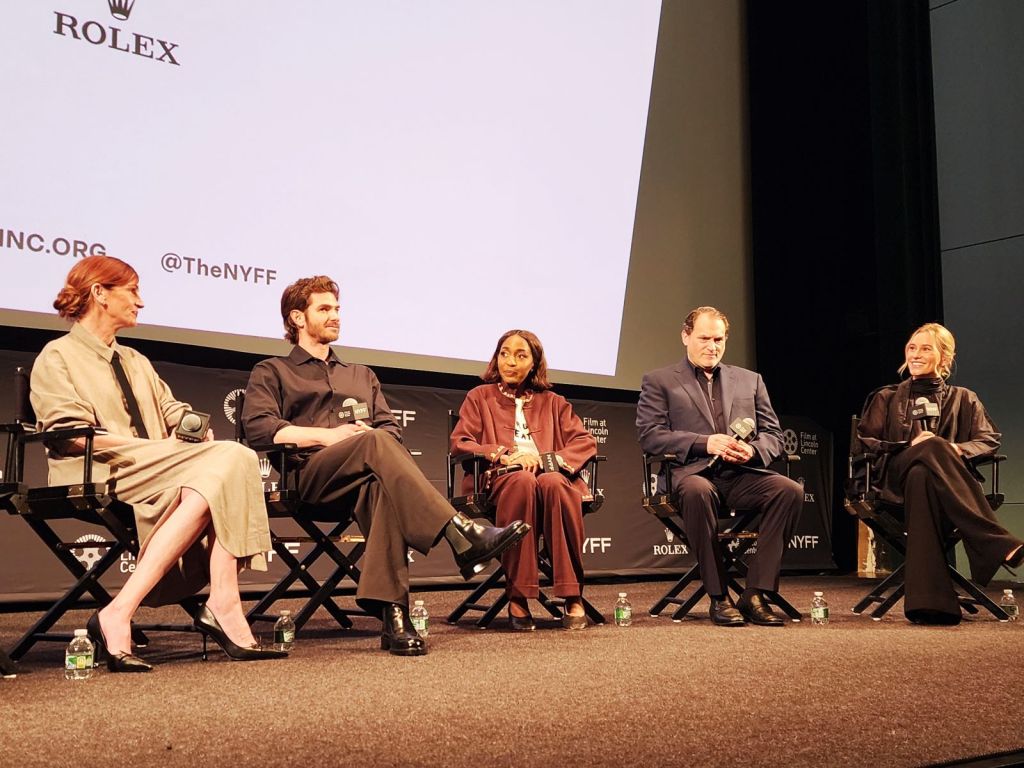
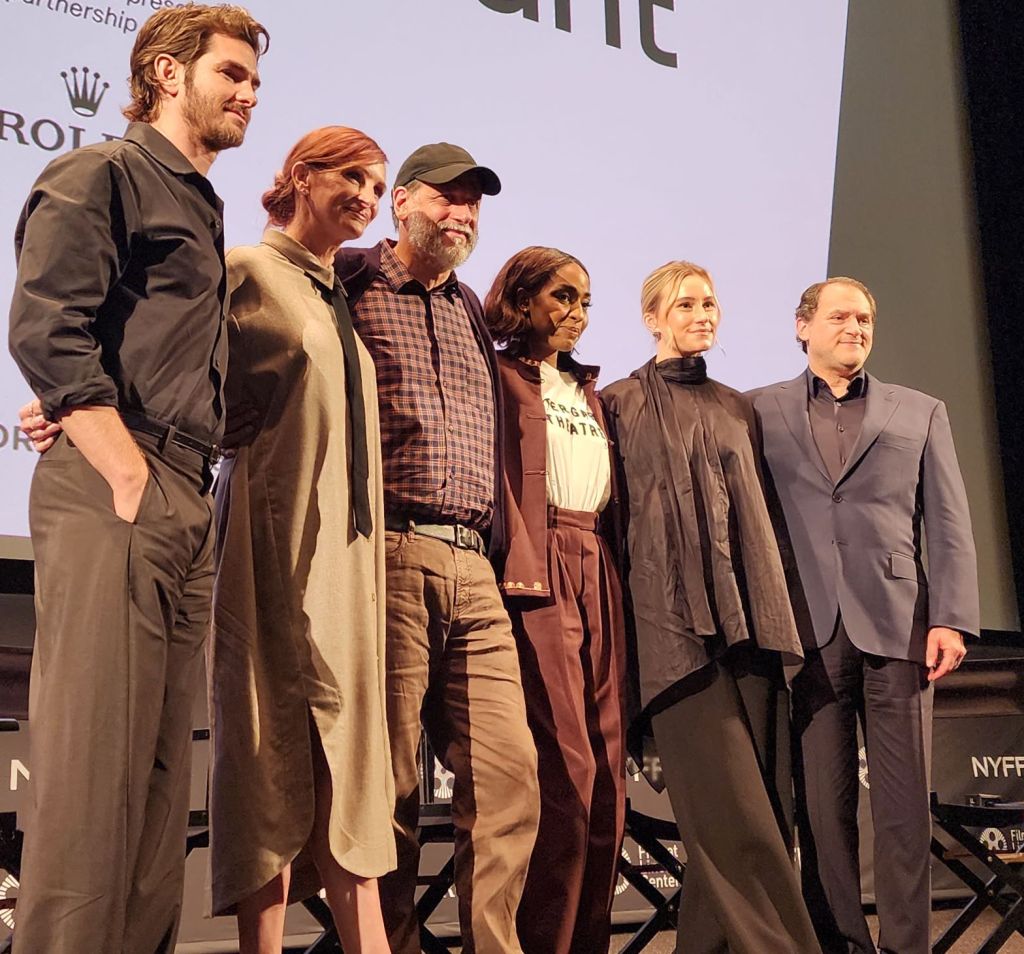
After the Hunt
Directed by Luca Guadagnino and written by Nora Garrett, After the Hunt is a complex, psychological, mystery drama with comedic/ironic flourishes that turn culture wars on their heads. Pointedly, its entangling themes never resolve into a satisfying resolution. Reflective about current social issues involving sexual abuse, gender identity, race, power dynamics, ethics and women’s career ascendance against the backdrop of Yale University in New Haven Connecticut, Guadagnino and Garrett tackle some of the themes credibly. Others they leave swinging in the winds of uncertainty.
Thanks to the incisive performances of principals Julia Roberts, Michael Stuhlbarg, Andrew Garfield and Ayo Edebiri, the film’s central mystery whether sexual abuse did or didn’t occur and why it occurred holds our interest.
However, the subtle nuances and motivations each character reveals become convoluted and incoherent at times. Is this in the service of the notion that human beings are layered, self-destructive, self-betrayers driven by their own nihilistic impulses? In a further irony, the philosophy professors Alma (Roberts) and Hank (Garfield), and their Ph.D. student Maggie (Ayo) are adept at weaponizing philosophy as a defense they use to promote their personal agendas. As a perfect foil, the most well-drawn character of rationality, Alma’s husband psychiatrist Frederick (Stuhlbarg), receives the prize for being the authentic adult in the room. Stuhlbarg’s Frederick is a perfect delight to watch and a welcome relief from the others’ Sturm and Drang.
Main Slate Section of the NYFF
Having its world premiere at the 2025 Venice International Film Festival, After the Hunt in its North American premiere opened the New York Film Festival in the Main Slate section. Interestingly, though the film takes place at Yale University in New Haven, Connecticut, Guadagnino filmed it in England. The superb set design provides the ambience for the 2020 setting and final epilogue in 2025.
In the opening scene, Guadagnino shares his first clue with a title message stating that the event happened at Yale. However, many events occur at the party Alma holds at her home for her students, colleagues and friends. First, we learn about Hank, Alma and Maggie, those closest to Alma, who briefly discuss Maggie’s dissertation on why she selected her topic, “the resurgence of virtue ethics.” Additionally, we learn that Alma and Hank compete for a tenured line professorship. Frederick asks both how they would respond if the other wins it? Do we take them at their word or do they lie?
Finally, Maggie goes to the bathroom. In searching for toilet paper, she finds a “hidden” envelope taped to the interior top of a cabinet. When Maggie opens the envelope she sees it contains an article and pictures. Maggie takes the article which we don’t see in close-up. So much for Maggie’s ethics and respect for her beloved professor’s privacy. Immediately, we note an immoral aspect of her character. We also have an indication of Alma’s character in placing an envelope with secret information where it can be found.
Initial incidents we see, a hidden incident occurs we don’t see
These initial incidents that we see, eyes wide open, take place in Alma and Frederick’s house. However, another incident that happens after the party, we don’t see. We hear about it from the victim, Maggie, who returns the next day to Alma’s. Dripping wet, bedraggled and forlorn, a waif to sorrow over, Maggie tells Alma that Hank sexually attacked her. Maggie admits she shouldn’t have allowed Hank to come over after the party where they had been drinking. Of course, he didn’t stop after she kissed him, though she said, “No.”
Somewhere in the emotional grist of this event that Alma doesn’t initially respond to with care and concern, we consider Maggie’s highly leveraging position at Yale, the antithesis of a conservative, “Red State” university. She is a Black, gay student whose wealthy parents donate heavily to Yale. Close to her professors Hank and Alma, who taught Hank, she goes to Alma for support. Maggie suggests Alma’s background will help her understand what Maggie feels. This comment short circuits Alma. Manipulatively, Maggie brings Alma into the situation and makes it personal to her. In other words, whatever Maggie read in the article she uses as leverage to manipulate Alma to help her. Confused, Alma wonders what Maggie knows about her.
Questioning Maggie’s motives
Thus, we question the wisdom of Maggie’s manipulation and wonder what information the hidden article about Alma held. Also, we question the extent to which the article influenced Maggie to invite Hank to her apartment where she kissed him and then tried to back off his advances. Did this event even occur? What underlying motives does Maggie have if It didn’t? By this point we have forgotten the ironic import of Maggie’s dissertation topic (the resurgence of virtue ethics). If virtue ethics gives weight to practical wisdom and the pursuit of a flourishing life through moral excellence, Maggie appears a hypocrite to even deal with such a topic. Taking the article about Alma doesn’t exemplify moral excellence. Neither does manipulating her with it.
Nevertheless, Maggie’s potentially heart-wrenching emotional experience of sexual assault by a close professor becomes occluded by many factors. Perhaps because of Alma’s cool response, we don’t feel sorry for Maggie or believe her. Her moral ambiguity taking the secret article also makes us question her veracity. Indeed, in the discussion of the “rape” by Alma, Hank and others, then in subsequent compelling scenes more information about the three philosophers unfolds. Against Alma’s suggestions, Maggie presses charges against Hank a surefire way to end his career at Yale.

Spiders spinning webs
As Garrett and Guadagnino spool out clues to interconnecting spider webs spun by three clever spiders with conflicting agendas and motivations, we remember Frederick’s unction about Maggie. He implies that Maggie is a mediocre student. This gives credence to Hank’s assertions that Maggie plagiarized parts of her dissertation. Apparently, her abilities falter, she can’t do the research and resorts to plagiarism. In fact Maggie’s plagiarism will disqualify her Ph.D., and possibly get her evicted from Yale, if either Hank or Alma hold her to account. How should Hank handle Maggie’s plagiarism? Does Alma, an expert in her field qualifying for tenure know Maggie plagiarized? Why don’t Alma and Hank report or correct Maggie?
To what extent do repercussions from Maggie’s wealthy donating family shut Hank and Alma’s mouths about the plagiarism? Shouldn’t they take the moral high ground and have her change her dissertation instead of ignoring it? To what extent does Maggie use the race card to her advantage? Doesn’t she understand that her behaviors play into the stereotypes about wealth, class and race? Does she even care?
Clearly, everyone’s careers are at stake, especially after Maggie accuses Hank of sexual assault. By this point morality, ethics and philosophy don’t help these philosophy professors and would-be philosophy professor. Governed by their own impulses of fight, flight, desire, need beyond intellectual thought, they founder in their own moral morass. Indeed, the irony becomes who is preying on whom? And “after the hunt,” who will be left standing and what will the carcasses look like?
Extreme complications
During the course of the film the complications become extreme when we learn that Alma and Hank had an affair which ends, perhaps prompted by Maggie’s accusation. Additionally, we learn that Maggie emulates Alma obsessively and loves her beyond a teacher student relationship. Also, we learn that Frederick knows about Hank and Alma, and understands the affair’s necessity and impermanence. Finally, we learn that Alma has some disease or pain that requires her to take pain killers or medicine that Frederick leaves on her table stand each morning. However, doctor and colleague Dr. Kim Sayers (Chloë Sevigny) also helps her out with medication.
How many more webs can Garrett and Guadagnino have their spiders spin? Well, Alma’s secrets have yet to be exposed. To what extent should truths be uncovered sooner rather than later to free individuals from wounds that govern their lives? Guadagnino and Garrett do have much to suggest about this through Alma’s revelations and Frederick’s wise love and counseling. Truly, as she says, “she doesn’t deserve him” and is fortunate that he loves her.
As an important point, this film could never take place in a part of the country that is governed by “red state” politics. Ironically, Connecticut, a blue state prides itself on listening to anyone coming forth with accusations. Safe to say that such events occur most probably in universities and colleges around the country. That the screenwriter and director set it in an Ivy League School that takes such issues seriously adds to the gravitas of the film.
In the Q and A after the film, Guadagnino admitted he is a provocateur, but more for entertainment purposes in a positive way. Perhaps, as an iconoclastic clown, he attempts to nudge his audiences to think after unsettling them and providing no easy answers. Indeed, the main tenor of After the Hunt appears to be his wish to provoke discussion more than to present a dialectic and conclusion. Considering his cavalier voice over “cut,” then blackout to end the over two hour film, Guadagnino suggests that the characters he set in motion will continue their duplicity and self-betrayal long after it’s “lights out.”
After the Hunt will open October 10th at select theaters. For screening information for the 63rd NYFF, go to https://www.filmlinc.org/nyff/films/after-the-hunt/
‘Saturday Church’: The Vibrant, Hot Musical Extends Until October 24th
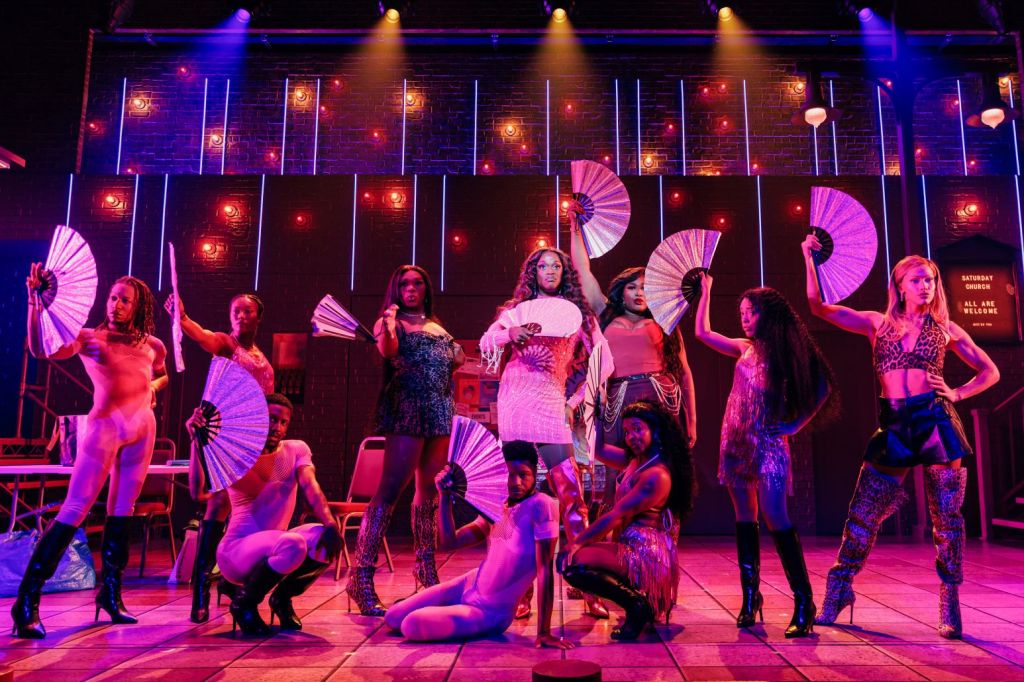
With music and songs by Grammy-nominated pop star Sia and additional music by Grammy-winning DJ and producer, Honey Dijon, Saturday Church soars in its ambitions to be Broadway bound. The excitement and joy are bountiful. The music and songs, a combination of house, pop, gospel spun into electrifying arrangements by Jason Michael Webb and Luke Solomon, also responsible for music supervision, orchestrations and arrangements, become the glory of this musical. Finally, the emotional poignance and heartfelt questions about acceptance, identity and self-love run to every human being, regardless of their orientation and select gender identity (65-68 descriptors that one might choose from).
Currently running at New York Theatre Workshop Saturday Church extends once more until October 24th. If you like rocking with Sia’s music, like Darrell Grand and Moultrie’s choreography and Qween Jean’s vibrant, glittering costumes, you’ll have a blast. The spectacle is ballroom fabulous. As J. Harrison Ghee’s Black Jesus master of ceremonies says at the conclusion, “It’s a Queen thing.”
However, some of the narrative revisits old ground and is tired. Additionally, the music doesn’t spring organically from the characters’ emotions. Sometimes it feels imposed upon their stories. Perhaps a few songs might have been trimmed. The musical, as enjoyable as it is, runs long.
Because of the acute direction by Whitney White (Jaja’s African Hair Braiding), the actors’ performances are captivating and on target. Easily, one becomes caught up in the pageantry, choreography and humor which help to mitigate the predictable story-line and irregularly integrated songs in the narrative.
Conceived for the stage and based on the Spring Pictures movie written and directed by Damon Cardasis, with book and additional lyrics by Damon Cardasis and James Ijames, Saturday Church focuses on Ulysses’ journey toward self-love. Ulysses (the golden Bryson Battle), lost his father recently. This forces his mother to work overtime. Unfortunately, her work schedule as a nurse doesn’t allow Amara (Kristolyn Lloyd) to see her son regularly.
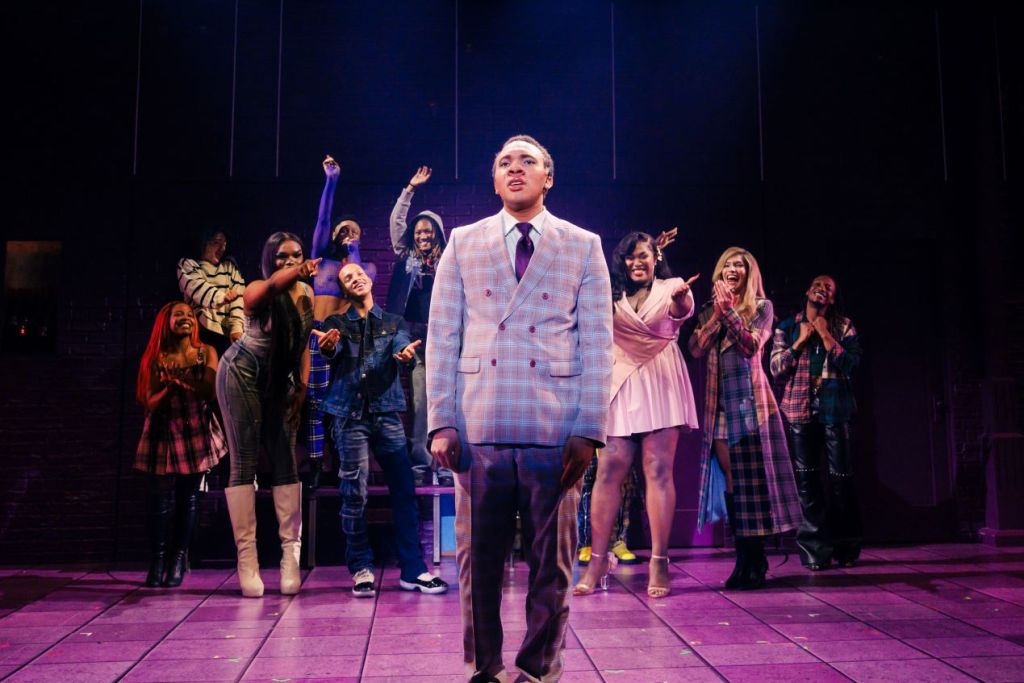
Though the prickly Aunt Rose (the exceptional Joaquina Kalukango), stands in the gap as a parental figure, the grieving teenager can’t confide in her. Even though he lives in New York City, one of the most nonjudgmental cities on the planet, with its myriad types of people from different races, creeds and gender identities, Ulysses’ feels isolated and unconnected.
His problem arises from Aunt Rose and Pastor Lewis (J. Harrison Ghee). Ghee also does double duty as the master of ceremonies, the fantastic Black Jesus. Though Ulysses loves expressing himself in song with his exceptional vocal instrument, Aunt Rose and Pastor Lewis prevent him from joining the choir until he “calms down.” In effect, they negate his person hood.
Negotiating their criticisms, Ulysses tries to develop his faith at St. Matthew’s Church. However, Pastor Lewis and Aunt Rose steal his peace. As pillars of the church both dislike his flamboyance. They find his effeminacy and what it suggests offensive. At this juncture with no guidance, Ulysses doesn’t understand, nor can he admit that he is gay. Besides, why would he? For the pastor, his aunt and mother, the tenets of their religion prohibit L.G.B.T.Q Christianity, leaving him out in the cold.
During a subway ride home, Ulysses meets Raymond (the excellent Jackson Kanawha Perry). Raymond invites Ulysses to Saturday Church and discusses how the sanctuary runs an L.G.B.T.Q. program. With trepidation Ulysses says, “I’m not like that.” Raymond’s humorous reply brings audience laughter, “Oh, you still figuring things out.” Encouraging Ulysses, Raymond suggests that whatever his persuasion is, Saturday Church is a place where different gender identities find acceptance.
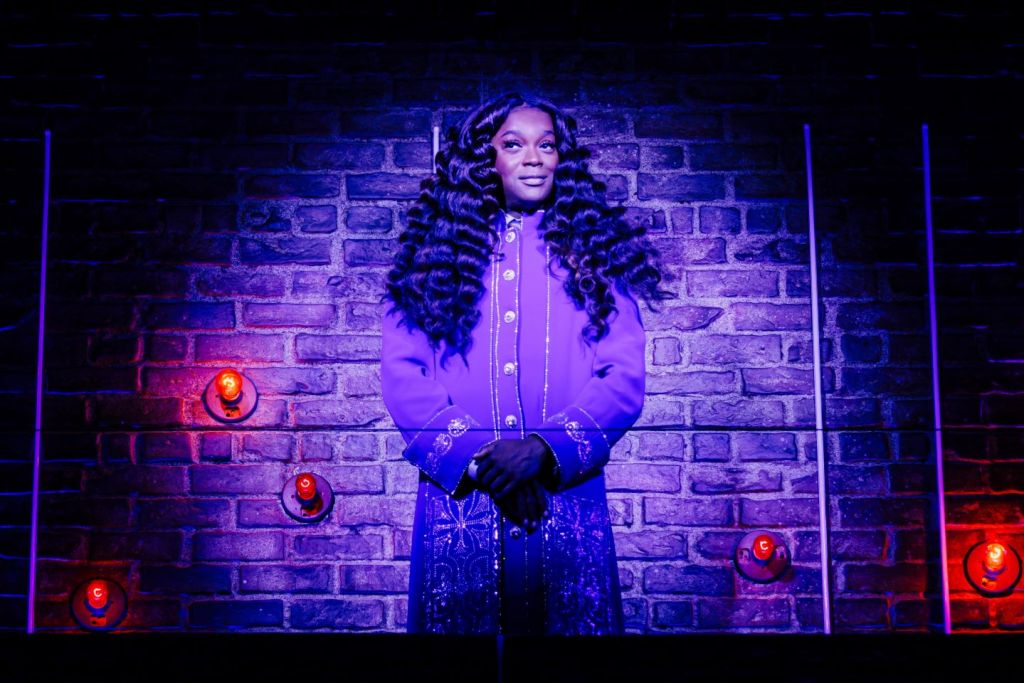
Inspired by the real-life St. Luke in the Fields Church in Manhattan’s West Village, Saturday Church provides a safe environment where Christianity flourishes for all. When Ulysses visits to scout out Raymond, with whom he feels an attachment, the motherly program leader Ebony (B Noel Thomas), and her riotous and talented assistants Dijon (Caleb Quezon) and Heaven (Anania), adopt Ulysses into their family. In a side plot Ebony’s loss of a partner, overwork with running activities for the church with little help, and life stresses bring her to a crisis point which dissolves conveniently by the conclusion.
The book writers attempt to draw parallels between Ulysses’ family and Ebony which remain undeveloped. As a wonderful character unto herself, the subplot might not be necessary.
As Ulysses enjoys his new found persona and develops his relationship with Raymond, his conflicts increase with his mother and aunt. From Raymond he learns the trauma of turning tricks to survive after family rejection. Also, Ulysses personally experiences physical and sexual assault. Finally, he understands that for some, suicide provides a viable choice to end the misery and torment of a queer lifestyle without the safety net of Saturday Church.
But all’s well that ends well. J. Harrison Ghee’s uplifting and humorous Black Jesus redirects Ulysses and effects a miraculous bringing together of the alienated to a more inclusive family of Christ. And as in a cotillion or debutante ball, Ulysses makes his debut. He appears in Qween Jean’s extraordinary white gown for a shining ballroom scene, partnering with Raymond dressed in a white tux. As the two churches come together, and each of the principal’s struts their stuff in beautiful array, Ghee’s Jesus shows love’s answer.
In these treacherous times the message and themes of Saturday Church affirm more than ever the necessity of unity over division, and flexibility in understanding the other person’s viewpoint. With its humor, great good will, musical freedom and prodigious creative talent, Saturday Church presents the message of Christ’s love and truth against a pulsating backdrop of frolic with a point.
Saturday Church runs with one fifteen minute intermission at New York Theatre Workshop until October 24th. https://www.nytw.org/show/saturday-church/?gad_source=1&gad_campaignid=22911892225
‘Late Fame’ Starring Willem Dafoe, 63rd NYFF
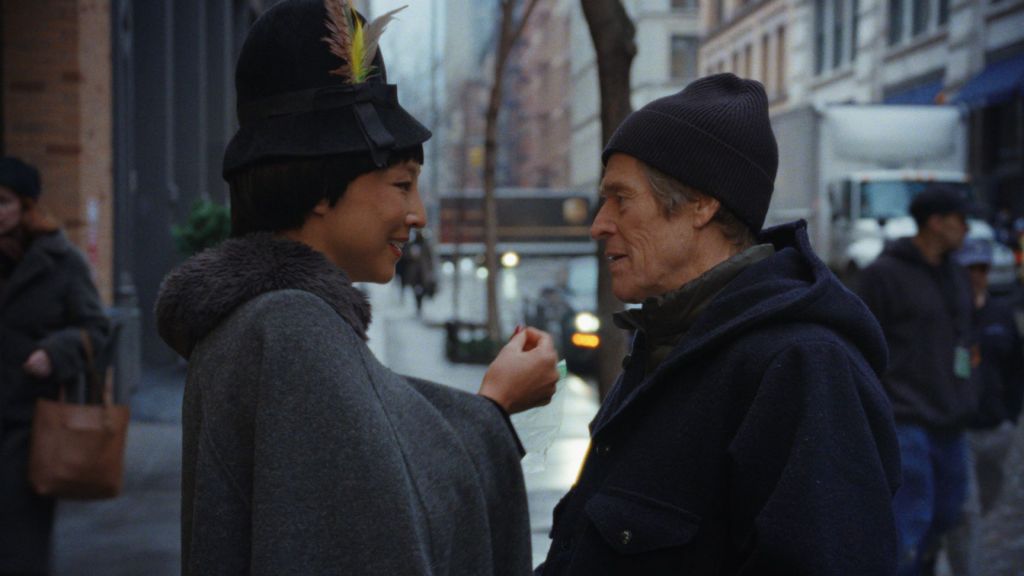
Adapted from the Arthur Schnitzler novella Late Fame, screenwriter Samy Burch (May/December) and director Kent Jones (Diana) shine a light on the West Village and Soho (circa 1970s) and Soho now at the height of its commercialization and development. With the incredible backdrop of factory buildings and West Village apartment buildings turned into fashionista haunts, and cobblestone streets still creating their unique atmosphere, a superb Willem Dafoe portrays the sensitive, once lauded poet Ed Saxburger. The craggy young man who had the world at his feet with the publication of his poetry book Way Past Go eventually gave up his typewriter to earn a modest living with a secure pension as a postal worker.
What happens to the passionate fire required to write poetry that gets published during a time when poetry was the lingua franca of the Village artist milieu, and Soho was the coolest place to be? If old soldiers fade away, does the same happen to promising poets whose work is well regarded but little read, then forgotten?
Late Fame investigates this phenomenon with atmosphere, nuance, irony and heart. It is Jones’ love letter to downtown Manhattan, vastly changed with remnants of its old beauty and undeveloped glory which made a comfortable home to artists of all stripes in the 1970s. Then, Dafoe’s character Ed Saxburger came East, spurred by the thought of fitting in with the artist colonies in Manhattan at that time.
The film which is in the Main Slate section at New York Film Festival is buoyed up by sterling performances from those assisting Dafoe, as he negotiates his empathetic protagonist who is stoic, reserved and charming, and a bit lost as he welcomes yet questions with open eyes his acceptance by a group of well-heeled twenty-somethings, who turn out to be poseur artists. Their mission is to recapture the ethos of Gregory Corso, Allen Ginsberg and others, but they are sorely out of their depth and lack the talent, grist and life wounds to do so.
The film unspools with Saxburger’s rediscovery by this exotic group of young would-be writers and philosophers branding themselves “the Enthusiasm Society.” An effete, wealthy Wilson Meyers (the excellent Edmund Donovan), leads the group of retrograde misogynists and artistes. When Saxburger asks where he found his book, with wide-eyed irony and pride, Meyers tells Saxburger he bought it at “Foyle’s on Charing Cross Road.” Indeed, Meyers uses Saxburger’s book as the equivalent to a museum piece around which Meyer centers his exploitation and cause célèbre.
On further discussion to introduce himself Meyers cavalierly asserts his and the Enthusiasm Society’s purpose to “stand against negativity” and the monetization of everything,” a mission that unravels when Saxburger gets to know him. Key to who they are, is that they distance themselves from lower lights, “the influencer culture, cellphone obsessed and technology maniacs.” These they excoriate, all the while imbibing the same waters because no one is paying attention. However, Saxburger is.
For example Meyers’ stunning, unhip apartment in the village, funded by his parents, is technologically outfitted to the max. The other members are equally flush, supported by their parents, a far cry from the struggling, self-made artists that they emulate. However, their hypocrisy and unawareness of self that Saxburger notes quietly, he puts aside momentarily. He is drawn in by their allurement as they gush over him.
Their earnestness could be worse. At least they aspire to be like legends of the past, so Saxubrger allows himself to be caught up in their artificial world, until the revelations come fast and furious after a poetic recital where various members read at a venue Myers procures. The actors portray these fellows as more of an Oxford-like clique of wannabe creatives who are callow, literary sophisticates. In their aspirations they will never achieve what Saxburger did as he struggled and was celebrated in reviews, even if for a bright moment that he himself extinguished by moving on.
Though these individuals are largely focused on the masculine, they allow the actress and singer Gloria (a fine Greta Lee) to float among them as the girlfriend of one or more of the members. When Ed finally joins the Enthusiasm Society live and they introduce Gloria, her flamboyance and mystery is a treat for Ed. She is more akin to him as an older, wiser, financially strapped actress who, like Ed, knows what it is to struggle for her craft. Unlike Ed, she may hold on longer because she is an opportunist who knows how to play the game. In his authenticity and truth, Saxburger probably said, “It’s enough. I’ve got to eat and support myself.”
Cleverly, Jones features Gloria front and center during a performance of Kurt Weill and Bertolt Brecht’s “Surabaya Johnny.” A chanteuse, Sally Bowles “divine decadence” type, Gloria lures Ed who finds her attractive, opaque and mysterious, unlike the others. During a brief scene they do drugs together and frolic down the streets, a nostalgic nod to the past.
Greta who is supposed to read poetry during the recital appears to be too overwrought to be able to credibly do it. Part of her act, however, she pulls through at the last minute stunning the audience. Finally, Saxburger reads his own work beautifully, though an audience member references his age, albeit tucked into a compliment. The shout out reminds him of where he was and now is with this ersatz glitterati. It’s a desultory in between.
Though Saxburger has a family back home and a brother dying, he stays in New York and doesn’t return to visit. That ground is never covered by Jones or the screenwriter. However, it substantiates that when Saxburger left his family and made a new life for himself in Manhattan.
In the present that life includes a culturally rich apartment with bookcases filled with books that he’s read, a nice touch by the set designer. Also, his group of working class friends that he plays pool with who don’t know his poetic past or his literary interests, have helped distract him from what was. We do see when he can’t write a new poem for the recital that his artistry has been put on indefinite hold. But it’s OK. Beyond these elements, this is a film about brief moments in time where the light shines and then dims only to shine once more before it goes out.
Jones’ work is noteworthy for the stellar performances. Dafoe who inhabits the role perfectly is sensational, and Lee and the others provide the foundation from which Dafoe easily and seamlessly establishes this intriguing and heartfelt character.
Tickets are still available at https://www.filmlinc.org/nyff2025/films/late-fame/
‘Ava: The Secret Conversations’ is Enthralling
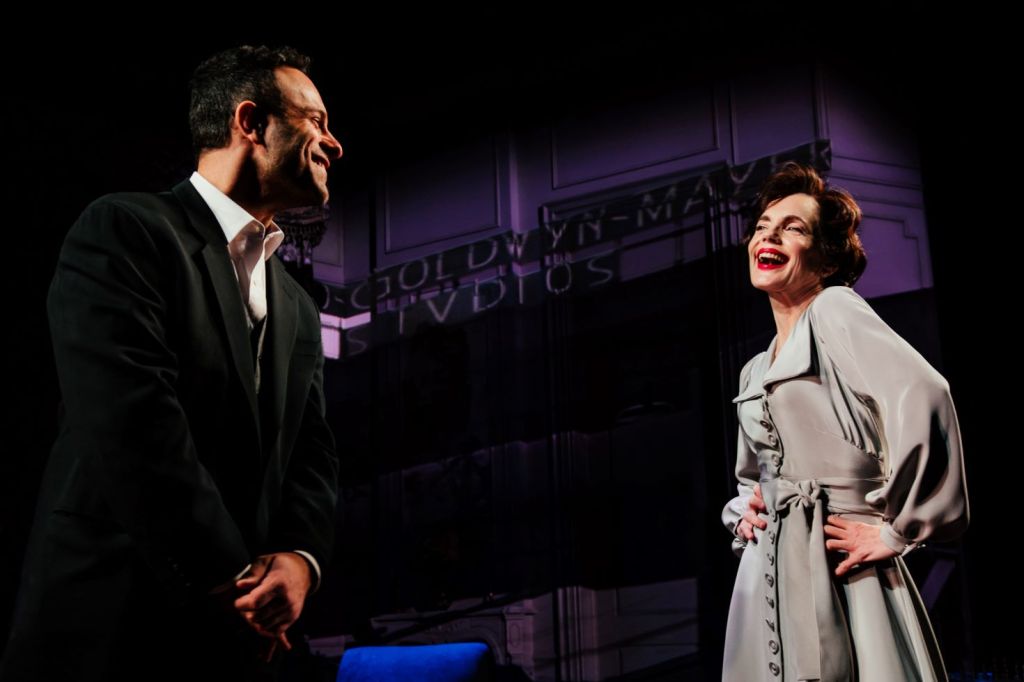
What happens to beautiful women after Hollywood chews them up and spits them out? Ava Gardner, who the studio labeled in a promotion for The Barefoot Contessa (1954) as “The World’s Most Beautiful Animal,” worked in the industry and mostly on TV until her stroke in her 60s. After her illness, she clawed her way back into functioning health to sit for a series of interviews with author Peter Evans who she asked to ghostwrite her autobiography. In Ava: The Secret Conversations, Downtown Abbey star Elizabeth McGovern channels Ava Gardner at New York City Center until September 14th. Her riveting performance mesmerizes with an equivalent assist from Aaron Costa Ganis as Peter Evans and Ava’s husbands.
The play, written by Elizabeth McGovern, reveals known facts about Gardner. However, for those who haven’t read Peter Evans’ titular book on which McGovern bases her writing, the work includes many surprising details.
When Gardner met with Evans at her apartment in London, both had achieved success in their careers. An iconic actress during the Golden Age of Hollywood, Gardner lived her life to the fullest with marriages to Mickey Rooney, band leader Arti Shaw and Frank Sinatra. Additionally, her relationships with many men alluded to in the play indicate she enjoyed her femininity and sexuality. Journalist Evans, who had been recommended to her by a friend wrote biographies of Peter Sellers and Aristotle Onassis to name a few. Together, they brought excitement, experience and expertise to the project which Gardner initiated.
Essentially a two-hander, Ava: The Secret Conversations displays the Gardner/Evans relationship, conflicts about how Ava Gardner wanted to present her legacy, and the split that caused the shuttering of their project. The production features film clips of her husbands integrated throughout, thanks to Alex Basco Koch’s projection design, Cricket S. Meyrs sound design and Amith Chandrashaker’s lighting design.
David Meyer’s scenic design and Amith Chandrashaker’s lighting design present Ava’s lush apartment, and minimal sets and spots to reference Peter Evans’ writing study and other scenarios.The technical elements serve Moritz Von Stuelpnagel’s vision of the push and pull of Gardner and Evans who were dependent upon one another for a hoped for profitable outcome which never happened.
Instead, Gardner wrote her own autobiography published shortly after her death in 1990. From the interviews that Evans cobbled together, he wrote Ava: The Secret Conversations published in 2013 after his death. Neither were alive to see their work’s success.

Thematically, as we watch these individuals whose attitudes and values collide, we recognize their interactions happened in a more gracious, decent world than today’s current media circus.
At the top of the play in the prologue, McGovern’s Gardner ominously calls Evans in the middle of the night and tantalizes him like a siren. She mentions she’s thought about assisted suicide, using the organization “Exit.” Then, the scene switches and Ganis’ Evans faces the audience. As he talks to his agent Ed Victor (Chris Thorn’s voice throughout), he questions where to begin the “play?” In a surreal moment we realize the characters discuss “the play” as a framing device. What follows becomes a series of layers which unfold to a core of intimate moments shared between these two individuals remarkable in their own right.
During the uninterrupted span of ninety minutes we watch how Evans engages his subject to be authentic and even raw in her descriptions. For her part McGovern’s Ava tugs at the image of her glittering celebrity and overlays it with her humanity. For example she discusses some graphic details of her rehabilitation after her stroke. The glamor vanishes. Instead, we appreciate Ava’s beauty in mortality.
This key identification reinforces the theme that the human need for community and warmth increases with age and may be hard to come by the greater the celebrity. Gradually, the portrait of Gardner clarifies so we understand the extent to which she experienced heartbreak, loneliness and regret. Additionally, we learn that in exchange for her status, she allowed the studio to dictate her decisions about having a family.
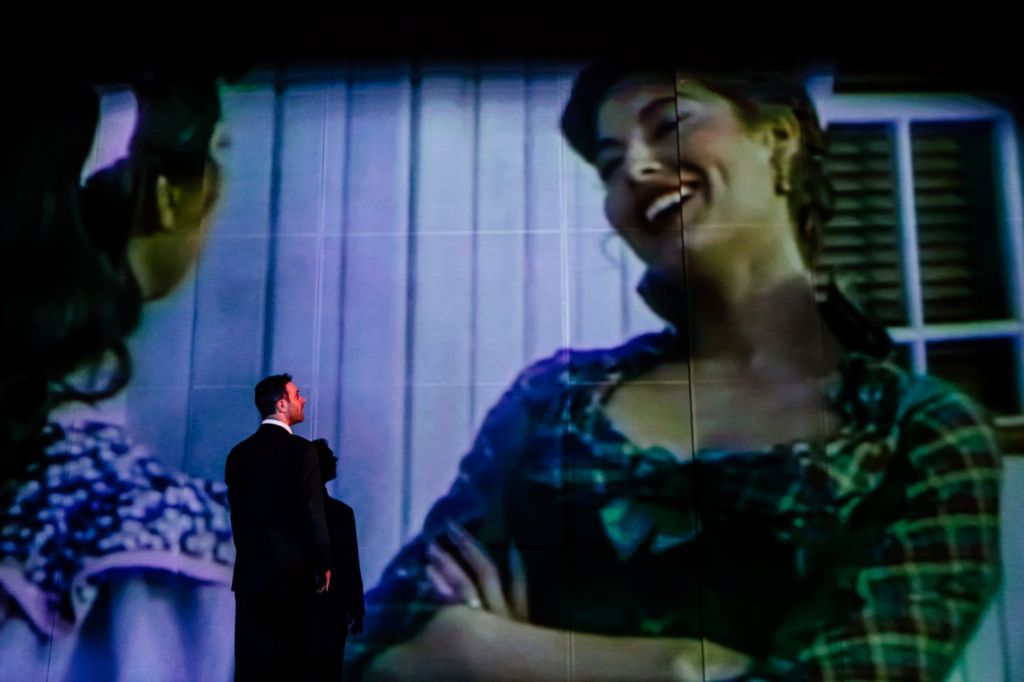
In the interim between discussions, projections and re-imaginings of conversations between Ava and her husbands (Mickey Rooney, Arti Shaw, Frank Sinatra), Ed Victor presses Evans for salacious details. The concept of commercialism everpresent today rears its ugly head. Of course “the dirt” fascinates readers. Obviously, Evans has thoroughly researched Ava’s life, so he attempts to confirm rumored sexual tidbits. Sometimes Ava obliges, enthralled with her own history. Then she realizes she takes the honesty and authenticity too far. Indeed, how will she be viewed if Evans uncovers this earthy, untoward portrait of her brought to life beyond a two-dimensional screen?
On the other side of Evans and Ava’s relationship Victor stands. He intends for the book to achieve best seller status, an easy “slam-dunk.” However, Evans’ scruples and perhaps fears of lawsuits take over. And then Ava makes a decision about the project guided by an important influencer in her life. Abruptly, Evans and Gardner never speak again. However, she does leave him a sign he is in her thoughts, a promise she once made when they first met.
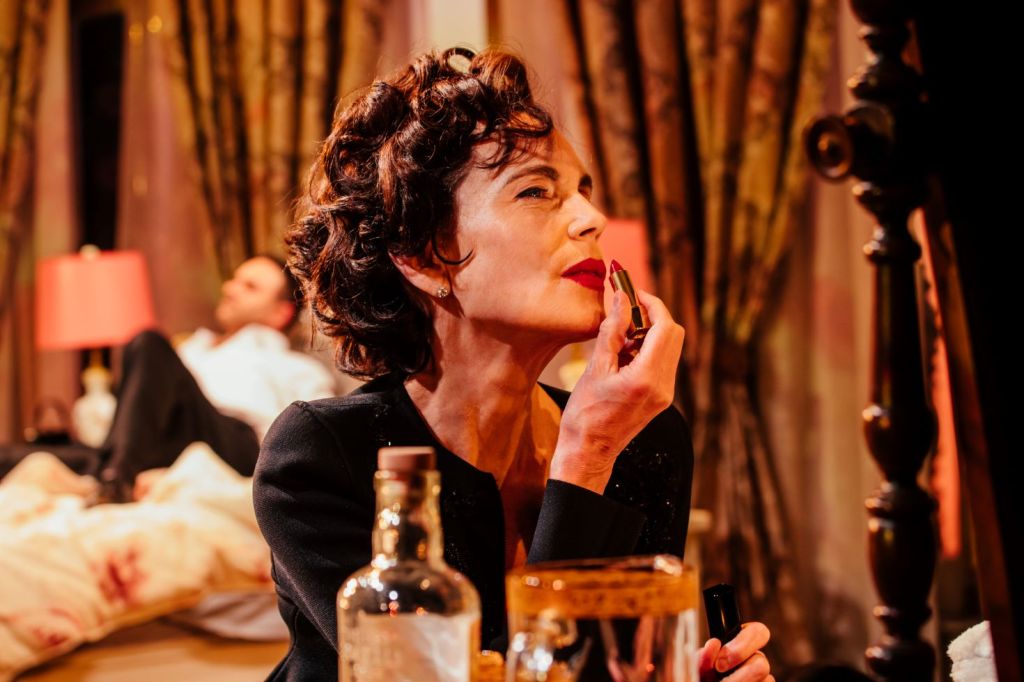
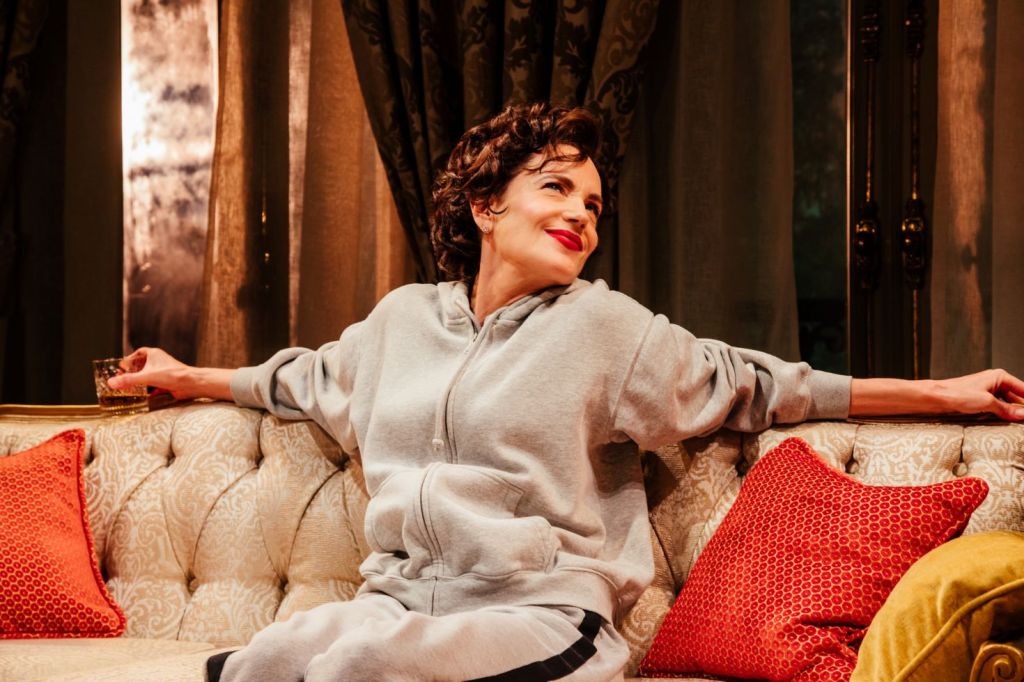
Ava: The Secret Conversations challenges one’s expectations about celebrity without using tired cliche’s. Once the conflicts emerge between Evans and Gardner, the pace picks up. When Evans steps into the characters of Rooney and Sinatra, he does so winningly. With Sinatra he gives McGovern’s Ava emotion to respond to. Toward the last half of the production, the play pops. Toni-Leslie James’ costuming as McGovern dresses for a red carpet appearance, enhances the fading star’s glamor. For most of the play Ava has been sitting around in track suits. Putting on her long sleeve white gloves, McGovern dons Ava’s skin. Regally, she convinces us that Ava is every inch a star, even in her 60s after a stroke.
Ava: The Secret Conversations runs 90 minutes with no intermission at New York City Center, 131 W 55th St (between Sixth and Seventh avenues) until September 14th. https://www.nycitycenter.org/pdps/2025-2026/ava-the-secret-conversations/
‘Duke & Roya’ Review, in Love and War
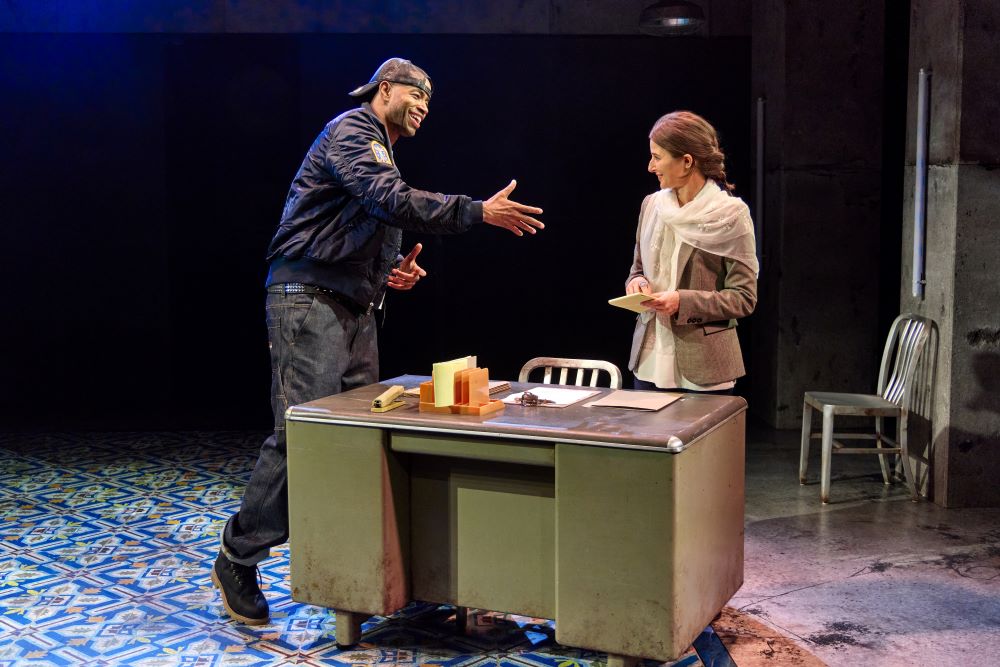
What does Hip Hop music have to do with a Muslim country whose strict religious practices frown on it? Nothing, unless an American base commander brings in a rapper to raise morale and entertain the troops stationed at Bagram Air Force base in Kabul, Afghanistan circa 2017. As unlikely as Hip Hop is to Afghanistan, so is the unlikelihood of the developing relationship between famous rapper Duke (Jay Ellis) and Afghan translator Roya (Stephanie Nur). The evolution of their love and respect for each other develops with humor and insight in Charles Randolph-Wright’s entertaining and meaningful play Duke & Roya. Currently, the hybrid comedy/drama runs at the Lucille Lortel Theatre until August 23rd.
Randolph-Wright unfolds his intriguing play through a series of flashbacks stirred by interviews and interrogations. The purpose of the interviews for the media, obviously is to entertain and titillate. On the other hand the interrogations yield information for investigators. Though we never see the questioners, the four principals, who answer the interrogators,’ questions do the heavy lifting. Through the nimble and talented actors, we form a perspective of the danger and the intrusion into their characters’ personal lives and identities. Randolph-Wright uses the “questioner” device so he can move immediately into the action and adventures between the titular characters in scenes between 2017 and 2025.
Initially, the media questions Duke about his music in the present. Then action transfers from the TV studio to his time in Kabul, Afghanistan. When Duke helicopters onto the base he meets Roya (Stephanie Nur) and her father Sayeed (Dariush Kashani), translators for the American military during the War in Afghanistan. Amiable Sayeed and cool Roya extend their hospitality as employees of the American government. Immediately, Duke shows interest and flirts with Roya, using his confident, “full-of-himself” attitude. Unsurprisingly, his approach, which most likely works on American women, falls flat with Roya.
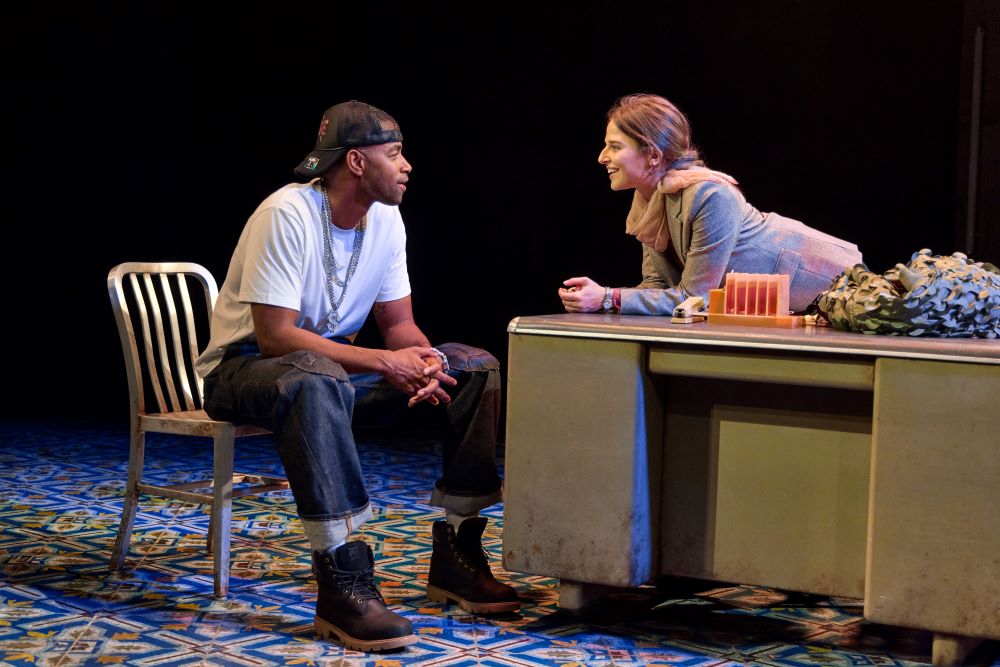
A product of her culture’s strict mores which Duke knows little about, Roya remains aloof. Because he interprets her reaction as “playing hard to get,” their acquaintance happens slowly. Influentially, Roya redirects him toward a new approach with women to encourage his respect. We recognize her brilliant balancing act. Cleverly, she resists his charms, yet lets him know he does appeal to her. So she teases and surprises him with ironic jokes. However, he eventually understands she must be her own woman.
Throughout their experiences together, this push-pull by Ellis’ Duke and Nur’s Roya plays believably. Acutely shepherded by director Warren Adams, the actors and Adams’ staging of them grounds the play in Wilson Chins’ minimal, stylistic set.
Vitally, the contrast between folkways of the west and east reflected in the lightheartedness, emotional drama and revelation of their personalities does capture our interest. For example we learn about the Afghan practice of bacha posh. Because Sayeed has many daughters, he chose the oldest Roya to live as a boy until puberty. Thus, as a boy she had the opportunity of an education. However, sometimes for purposes of safety she dons male clothing and practices bacha posh, which jeopardizes the situation for her later in the play.
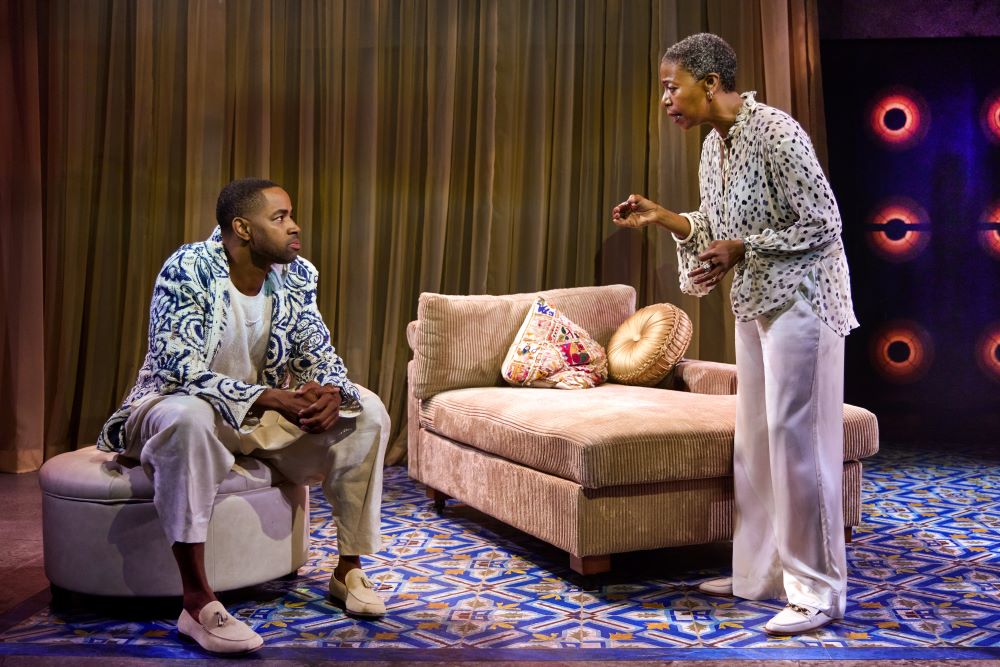
In addition to the standout performances by Ellis and Nur, Noma Dumezweni and Dariush Kashani keep us guessing as Duke’s mom and Roya’s dad. As Desiree, Dumezweni’s strong and forthright sister/mother figure, who chastises Duke when he needs it most, gains our admiration. She’s spot-on mesmerizing. The affable and charming Dariush Kashani authentically conveys the plight of Afghanis caught in an impossible situation. Not aligned with the Taliban that threatens to take over, nor with Americans who will leave the forever war, he, Roya and the family face ever-present danger. Though American visas have been promised for almost a decade, none are on the horizon, a horrific betrayal.
The complex themes sometimes get in the way of each other as the production moves toward the conclusion. Subtly, Randolph-Wright throws into the mix the perspective that Duke exploits the Black experience as a rapper, though his mother is middle upper class. However, Duke’s relationship with Roya changes his perspective and deepens his creativity. Of course the issues of religion, gender and politics come into play. Randolph-Wright intimates the strange parallel of Taliban repression to current oppression of women in the US.
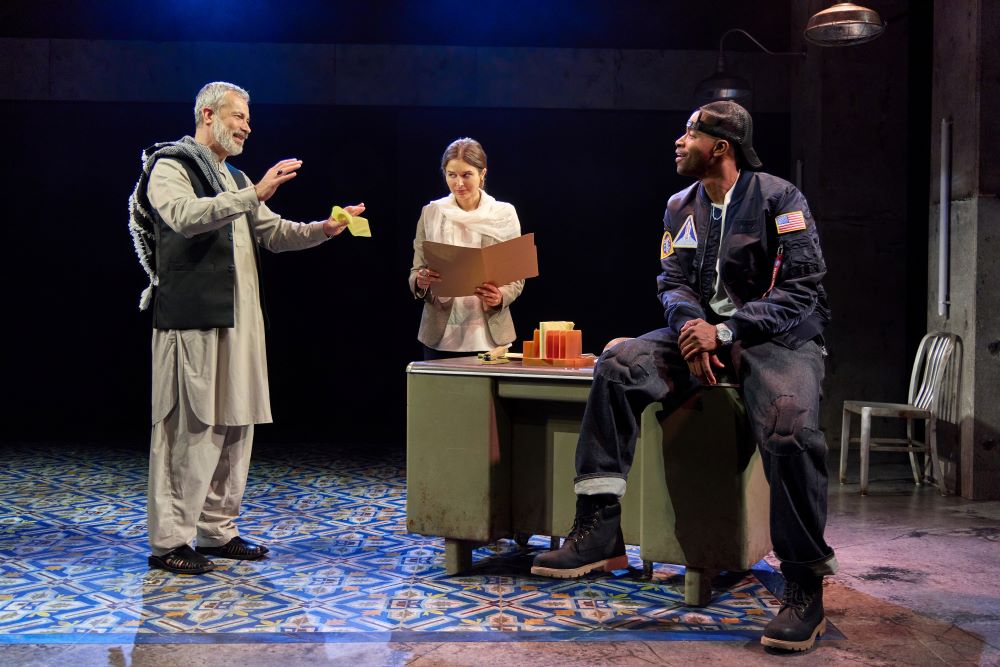
Also, in pointing out facts about the culture clashes and the Afghan war, Randolph-Wright shows the poisonous fallout when the Taliban made a peace deal with the Trump administration without the commitment of Afghan President Ghani. This led to a disastrous withdrawal of American troops and chaos, torture, imprisonment and death for Afghani/US government employees left behind. (Though it is true President Biden extended the evacuation dates, he could not delay the withdrawal indefinitely. Forced to cave to the previous administration’s pressure, he evacuated American personnel and as many of their Afghan counterparts as possible.)
As Duke and Roya mature over the 9 year period, Ellis particularly reveals his maturity during the completion of his interview at the play’s conclusion. Finally, when Duke and Roya meet up again after things become settled, we enjoy watching how their relationship continues to evolve into something profound. Whether or not they end up together is uncertain. However, they have earned their joyful moments together, especially when Ellis’ Duke sings his rhymes for Nur’s Roya with energy and pace. (Ronve O’Daniel’s original music and lyrics are easy and approachable in Ellis’ presentation.)
Amina Alexander’s lighting design, Sanowber Sabrina Spanta’s costume design, Taylor J. Williams sound design and additional music, and Caite Hevner’s projection design provide the background to enhance Chin’s minimal props and set design. These suggest an office at Bagram Air Force Base, an exterior scene in Kabul at night, a swanky hotel room in Dubai, an interrogation room and more.
As one of the more unique, nuanced offerings during this summer Off-Broadway, Duke & Roya shouldn’t be missed.
Duke & Roya runs 2 hours 20 minutes with one 15-minute intermission at the Lucille Lortel Theatre (121 Christopher Street) until August 2nd. https://dukeandroya.com/
‘The Weir’ Review: Drinks and Spirits in a remote Irish Pub
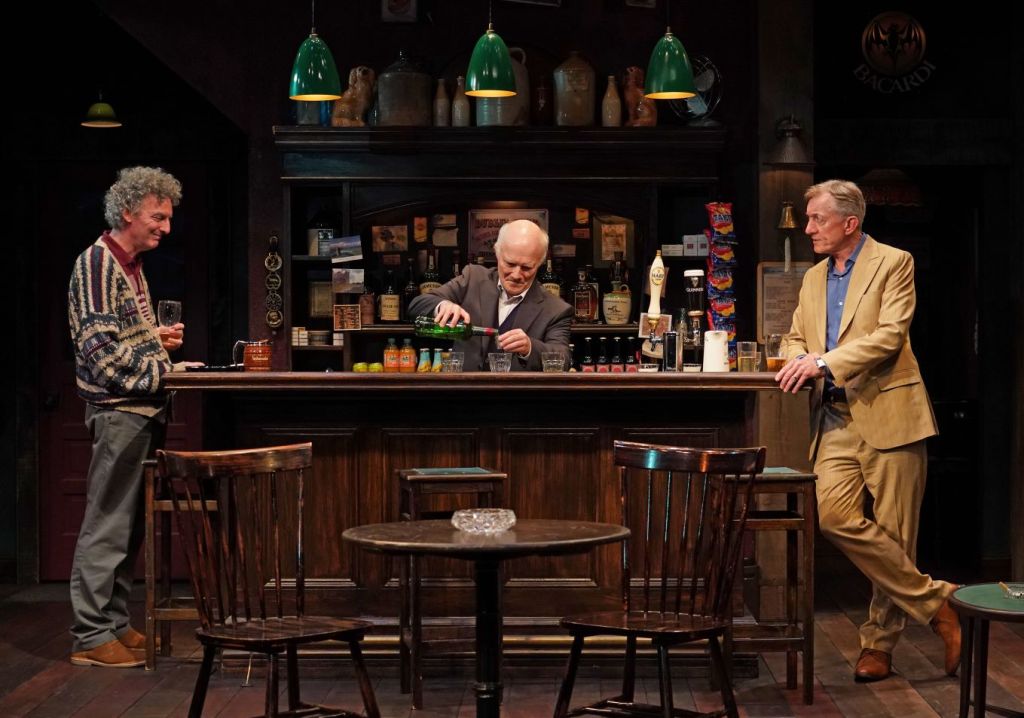
Conor McPherson’s The Weir currently in its fourth revival at Irish Repertory Theatre has evolved its significance for our time. It captures the bygone Irish pub culture and isolated countryside, disappeared by hand-held devices, a global economy and social media. Set in an area of Ireland northwest Leitrim or Sligo, five characters exchange ghostly stories as they drink and chase down their desire for community and camaraderie. Directed with precision and fine pacing by Ciarán O’Reilly, The Weir completes the Irish Rep’s summer season closing August 31st.
Charlie Corcoran’s scenic design of the pub with wooden bar, snacks, bottles, a Guinness tap and heating grate is comfortable for anyone to have a few pints and enjoy themselves at a table or nearby bench. With Michael Gottlieb’s warm, inviting lighting that enhances the actors’ storytelling, all the design elements including the music (Drew Levy-sound design), heighten O’Reilly’s vision of an outpost protective of its denizens and a center of good will. It’s perfect for the audience to immerse itself in the intimacy of conversation held in non-threatening surroundings.
On a dark, windy evening the humorous Jack drops in for drinks as a part of his routine after work at the garage that he owns. A local and familiar patron he helps himself to a bottle since he can’t draw a pint of Guinness because the bar’s tap is not working. Brendan (Johnny Hopkins) owner of the pub, house and farm behind it informs him of this sad fact. But no matter. There are plenty of bottles to be had as Jim (John Keating) joins Jack and Brendan for “a small one.” The entertainment for the evening is the entrance of businessman Finbar (Sean Gormley), who will introduce his client Valerie to the “local color,” since she recently purchased Maura Nealon’s old house.
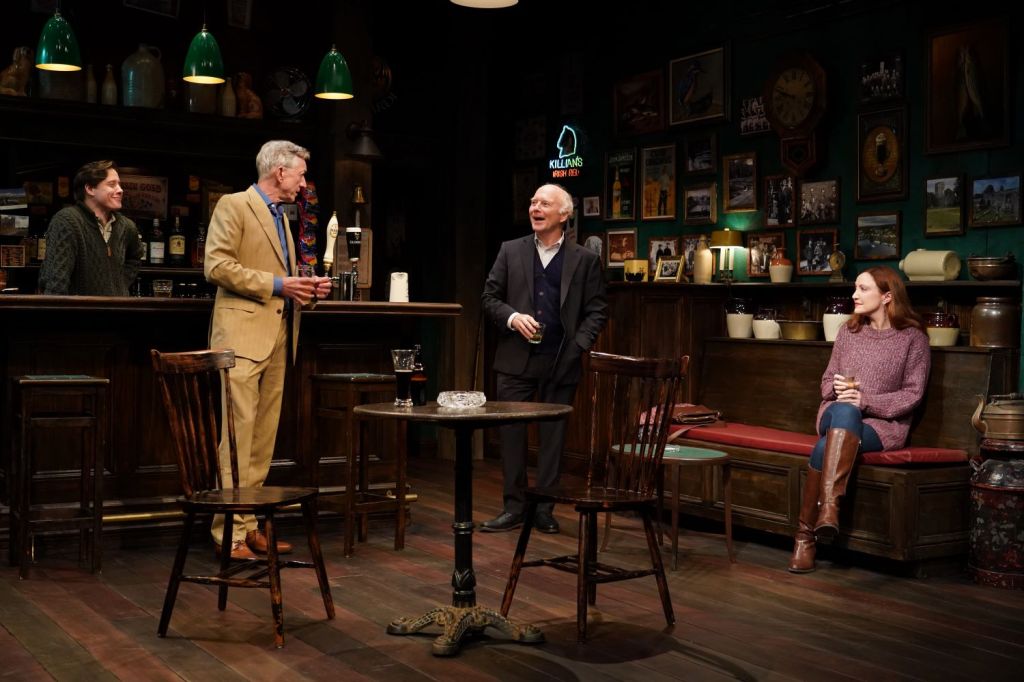
Initially, Jack, Jim and Brendan gossip about the married Finbar’s intentions as he shows up the three bachelors by escorting the young woman to the pub. Jim, caretaker of his mom, and Jack are past their prime in their late 50-60s. Brendan, taken up with his ownership of the pub and farm, is like his friends, lonely and unmarried. None of them are even dating. Thus, the prospect of a young woman coming up from Dublin to their area is worthy of consideration and discussion.
McPherson presents the groundwork, then turns our expectations around and redirects them, after Finbar and Valerie arrive and settle in for drinks. When the conversation turns to folklore, fairy forts and spirits of the area, Valerie’s interest encourages the men to share stories that have spooky underpinnings. Jack begins his monologue about unseen presences knocking on windows and doors, and scaring the residents until the priest blesses the very house that Valerie purchased.
Caught up in his own storytelling which brings a hush over the listeners (and audience), Jack doesn’t realize the import of his story about the Nealon house that Valerie owns. Thankfully, the priest sent the spirits packing. Except there was one last burst of activity when the weir (dam) was being built. Strangely, there were reports of many dead birds on the ground. Then the knocking returned but eventually stopped. Perhaps the fairies showed their displeasure that the weir interfered with their usual bathing place.
Not to be outdone, Finbar shares his ghost story which has the same effect of stirring the emotions of the listeners. Then, it is Jim who tells a shocking, interpretative spiritual sighting. Ironically, Jim’s monologue has a sinister tinge, as he relays what happened when a man appeared and expressed a wish, but couldn’t really have been present because he was dead.
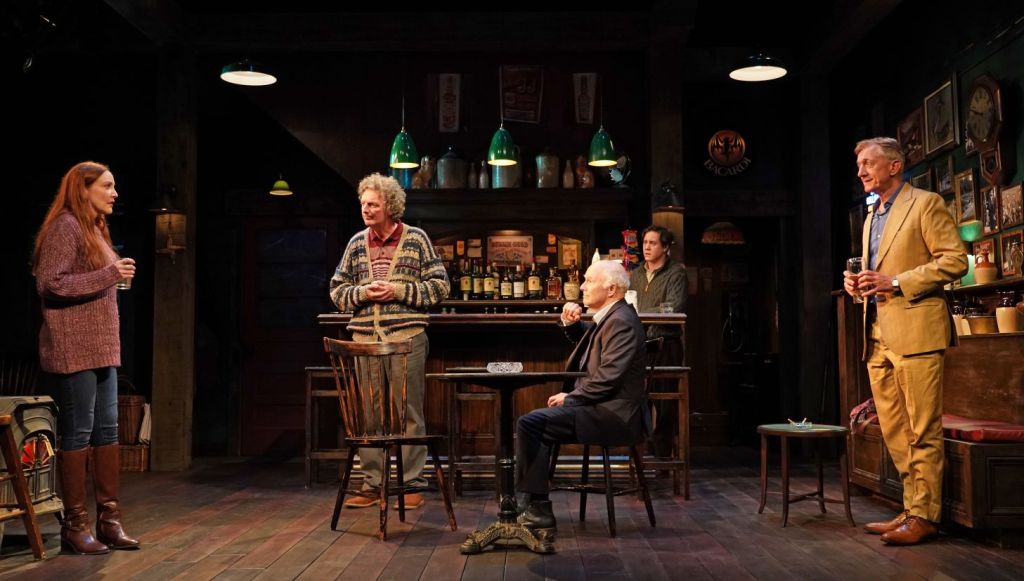
As drinks are purchased after each storyteller’s turn, the belief in the haunting spirits rises, then wanes as doubts take over. After Jim tells his story about the untoward ghost, Valerie goes to the bathroom in Brendan’s house. During her absence Finbar chides all of them. He regrets their stories, especially Jim’s which could have upset Valerie. With Jack’s humorous calling out of Finbar as a hypocrite, they all apologize to each other and drink some more. By this point, the joy of their conversation and good-natured bantering immerses the audience in their community and bond with each other. I could have listened to them talk the rest of the night, thanks to the relaxing, spot-on authenticity of the actors.
Then, once more McPherson shifts the atmosphere and the supernatural becomes more entrenched when Valerie relates her story of an otherworldly presence. Unlike the men’s tales, what she shares is heartfelt, personal, and profound. The others express their sorrow at what happened to her. Importantly, each of the men’s attitudes toward Valerie changes to one of human feeling and concern. Confiding in them to release her grief, they respond with empathy and understanding. Thus, with this human connection, the objectification of the strange young woman accompanied by Finbar at the top of the play vanishes. A new level of feeling has been experienced for the benefit of all present.
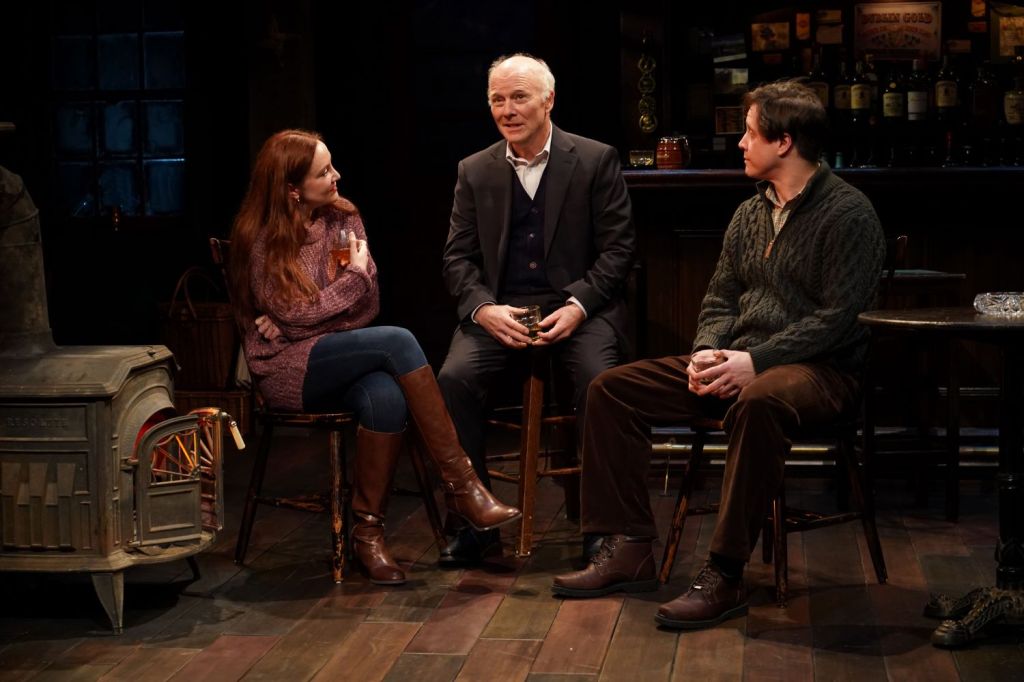
After Finbar leaves with Jim, McPherson presents a surprising coup de grâce. Quietly, Jack shares his poignant, personal story of heartbreak, his own haunting by the living. In an intimate emotional release and expression of regret and vulnerability, Jack tells how he loved a woman he would have married, but he let her slip away for no particularly good reason. Mentoring the younger Brendan not to remain alone like he did, Jack says, “There’s not one morning I don’t wake up with her name in the room.”
McPherson’s theme is a giant one. Back in the day when the world was slower, folks sat and talked to each other in community and conviviality. With such an occasion for closeness, they dispelled feelings of isolation and hurt. As they connected, they helped redeem each other, confessing their problems, or swapping mysteries with no certain answers.
As the world modernized, the ebb and flow of the culture changed and became stopped up, controlled by outside forces. Blocked by fewer opportunities to connect, people retreated into themselves. The opportunities to share dried up, redirected by distractions, much as a dam might redirect the ebb and flow of a river and destroy a place where magical fairies once bathed.
McPherson’s terrific, symbolic play in the hands of O’Reilly, the ensemble and creative team is a nod to the “old ways.” It reminds us of the value of gathering around campfires, fireplaces or heating stoves to tell stories. As companions warm themselves, they unfreeze their souls, learn of each other, and break through the deep silences of human suffering to heal.
The Weir runs 1 hour 40 minutes with no intermission at Irish Repertory Theatre (132 West 22nd St). https://irishrep.org/tickets/
Casey Likes, Lorna Courtney are Terrific in ‘Heathers The Musical’
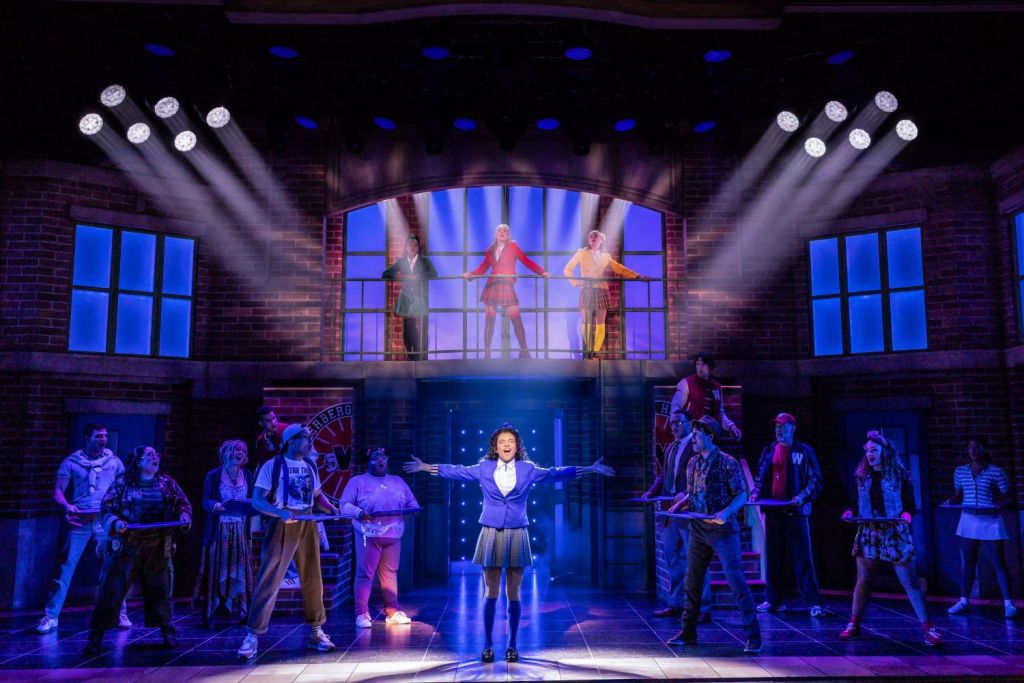
Heathers the Musical
Currently in revival, Heathers The Musial, based on the cult classic film Heathers (1988), written by Daniel Waters, has rocketed onto New World Stages with fans screaming in delight. The production with book, music and lyrics by Kevin Murphy and Laurence O’Keefe first opened at the same Off-Broadway venue in 2014 with Andy Fickman directing. However, O’Keefe and Murphy continually reworked the production honing it to a fine brilliance during the last decade. Most recently in a limited engagement in the West End, it finally transferred to New World Stages. There, it has been extended until January 25, 2026 for good reason.
The 2025 version incorporates changes, including new songs, created in the intervening decade. The concept and subject matter appeals because the sardonic musical comedy satirizes the cruel power dynamics prevalent in high schools across America. Unless one is a part of the ruling elite and finds popularity and favor, the typical high school social machine grinds you up as trash. Admittedly, each high school has its own peculiar “selektion process” of those who “matter,” and those who “don’t.”
How do communities fight this? In a backlash, one character’s notion to purge the toxicity is to “burn everything down.” However, exchanging one form of hatred, nihilism and supremacy for another can create a never-ending cycle of retribution as the musical indicates. Can anything be done?
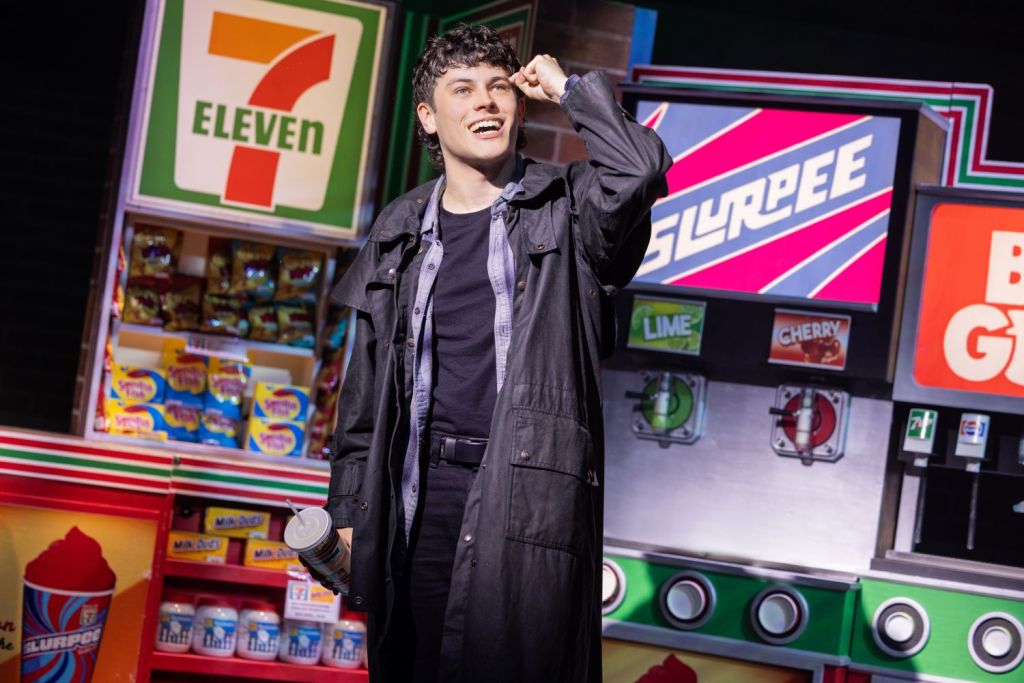
In its latest version this terrific, complex production asks and answers these questions. Additionally the top notch performances, music (Will Joy), choreography, (Gary Lloyd, Stephanie Klemons), Andy Fickman’s direction and the design elements cohere with near perfect unity to present an overall message. Despite the darkness present in all of us, our humanity has a softer side. We have only to manifest it with courage in the face of bigotry.
The musical opens as narrator/diarist Veronica Sawyer (the amazing Lorna Courtney) considers the negative transformations her classmates have gone through since kindergarten (“Beautiful”). Brainy, misfit Veronica is a senior at Westerberg High in1989, Ohio. Though Veronica believes herself to be a good person (she befriended uncool Martha Dunnstock {Erin Morton}), she must navigate around her classmates who welcome each other with the insults, “FREAK! SLUT! LOSER! SHORT BUS! BULL-DYKE! STUCK-UP! HUNCHBACK!”
Though Veronica blames this toxicity on their growing up and losing their innocence, we wonder if anyone in authority can rein in the students’ brutality toward each other? Therein lies one conflict. Of course the power dynamic is sub rosa. Because students maintain its secrecy, clueless parents and teachers like Ms. Fleming (Kerry Butler), don’t satisfactorily deal with the horrible social culture. Thus, nothing changes.
It is precisely because those in authority can’t influence the students that the three “Heathers” (McKenzie Kurtz, Kiara Lee covered for Oliva Hardy when I saw the show, and Elizabeth Teeter) rule with ferocity (“Candy Store”). In order to lift up their own status, the Heathers make everyone else feel worthless. Ironically, the students electrify the Heathers’ power grid because they fear their wrath and retribution. What would happen if they didn’t bow to Queen Heather Chandler?
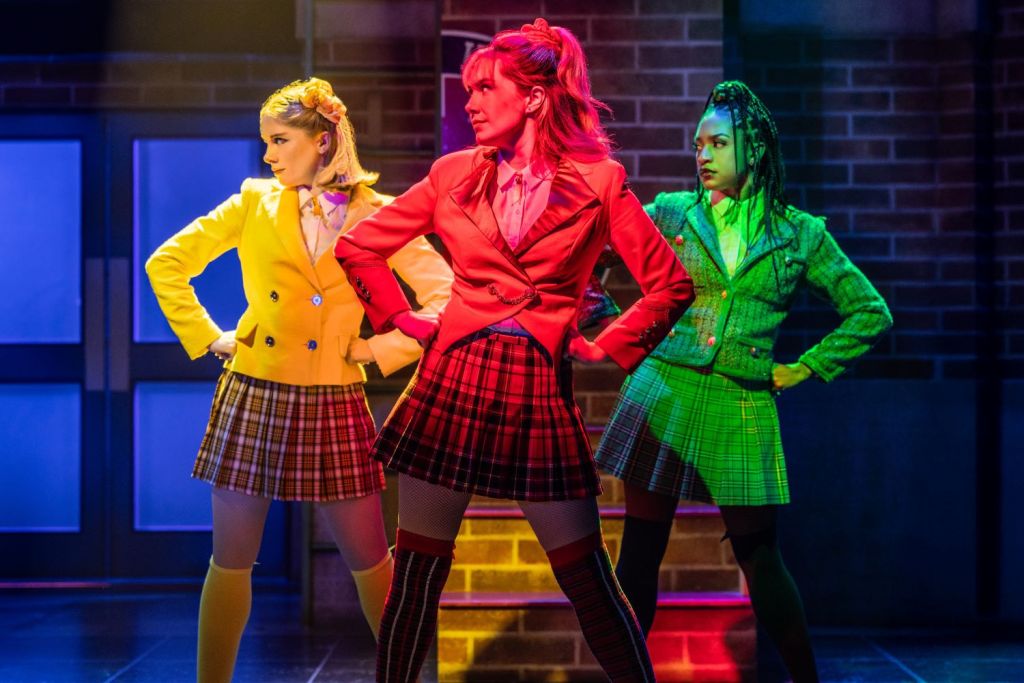
The situation looks up for Veronica when she uses her talent for forgery to save the Heathers from detention. As a result they take her under their wing, give her a make-over and lift her status to “beautiful.” However, she must set up her friend Martha for a grand humiliation at an upcoming party (“Big Fun”) to maintain her popularity.
In a counter punch to stop the Heathers’ obnoxious reign of terror, the new student J.D. (the superb Casey Likes) provides another perspective. He criticizes Veronica for selling out Martha to the, “Swatch-dogs and Diet-Cokeheads.” Likes’ JD, dressed in a trench coat and dripping charisma and courage dazzles, a rebel against the stifling social order.
Because JD, stands up to popular jocks, Ram Sweeney (Xavier McKinnon) and Kurt Kelly (Code Ostermeyer), Veronica becomes interested in him (“Fight For Me”). They form an attachment (“Freeze Your Brain”), and J.D. helps Veronica avoid becoming the “laughing stock” of the school (“Dead Girl Walking”). However, Veronica’s innocent plan to apologize to Heather Chandler for throwing up on her outfit backfires. Mistakenly, Veronica gives Heather the wrong cup filled with drain cleaner (JD’s instigation), instead of the cup with her usual prairie oyster hangover cure.
This unexpected twist brings Veronica and JD closer. But their love relationship fueled by a conspiratorial cover-up of Heather’s death leads to more diabolical behavior. With JD’s help Veronica forges a suicide note imitating Heather’s handwriting. The clever, ironic lyrics to dead Heather’s suicide note, in “The Me Inside of Me,” resonate hysterically. (“No one thinks a pretty girl has substance. I am more than just a source of handjobs. No one sees the me inside of me.”) Easily duped, despite Chandler’s horrible nature, the school community believes in her vulnerability and unhappiness.
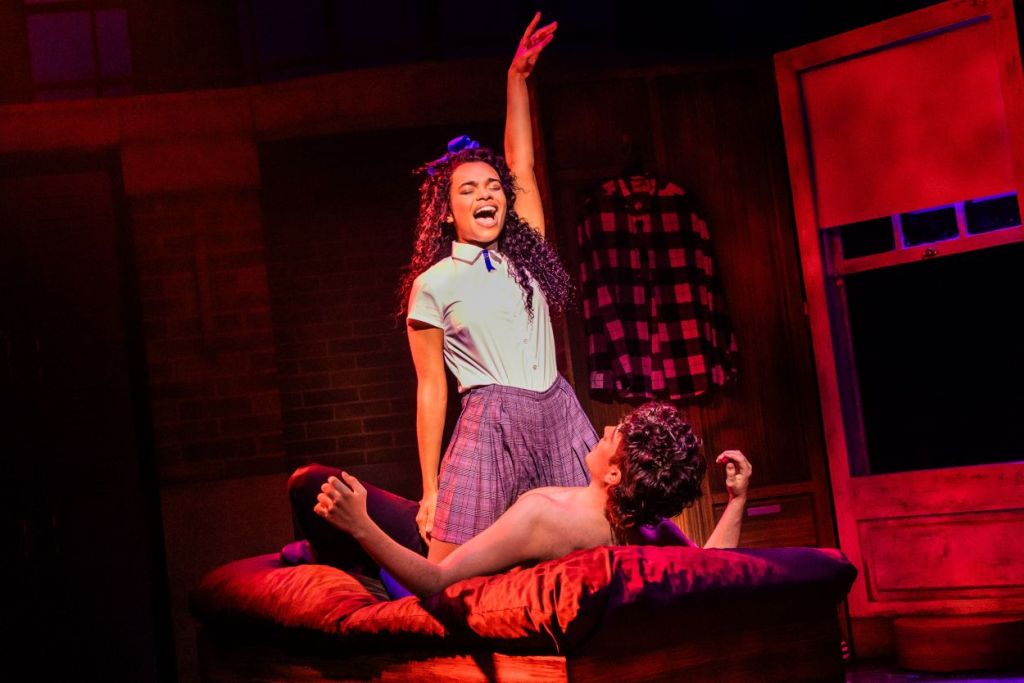
The suicide note elevates Heather to even greater status as a flawed, lonely teenager like everyone else. Meanwhile, the ghost of dead Heather haunts Veronica and cryptically comments while Heather Duke takes Chandler’s place as “Queen.” In a downward spiral Heather Duke’s reign turns out to be worse than Chandler’s. Duke sets up Veronica to be sexually attacked by Ram and Kurt. Though Veronica foils the rape, she and JD plot revenge. Once again the vengeance which begins innocently in Veronica’s misguided mind turns deadly in JD’s hands.
After Veronica and JD tally up two more “accidental” murders, they write believable suicide notes that Ram and Kurt were gay. Neatly, they’ve cleansed the school of three of the most brutal kids in the social hierarchy. In Act I’s closing number (“Our Love is God”), they affirm their love and righteous acts of “justice” with the mind-blowing lyrics: “We can start and finish wars. We’re what killed the dinosaurs. We’re the asteroid that’s overdue.” As JD tells Veronica he’d give his life for her, Veronica cannot resist his love and allure. Energized by her and their new found form of justice, JD’s nihilism continues in Act II. Only Veronica can stop him.
With Andy Fickman’s superior staging and humorous, well-paced timing, the production flies by at two hours and 30 minutes. The ensemble’s exuberance, voices and dancing are cracker-jack, the arrangements super. Memorable throughout, Lorna Courtney sustains her portrayal of Veronica’s transformation from “good person” to JD’s unwitting accomplice to murder, and back again. As JD Casey Likes is Courtney’s match pitting his phenomenal voice against hers with every song. As a couple they shine, reminding us that evil can be seductive.

Finally, McKenzie Kurtz lifts the ironic character of Heather Chandler in death with fine pacing and great humor. She aligns in a perfect contrast with Erin Morton’s kind-hearted, loving Martha Dunnstock, who would be everyone’s friend if they they opened their eyes to her goodness. Standout numbers “My Dead Gay Son,” (Ben Davis, Cameron Loyal are hysterical) and “Shine a Light” (the funny Kerry Butler) are LOL. “Kindergarten Boyfriend” (Erin Morton is spot-on authentic) resonates with pathos.
Thematically, Water’s film and the Heathers musical (2014) were harbingers of today’s cultural divisions. With prescience they exposed the danger of allowing high school communities to be breeding grounds of hate and discrimination, fostered by a school’s particular “master race” clique. If high schools reflect the larger culture, then social media exponentially spreads their poison. Is it any wonder that insults, hate and bigotry are embraced by “seleckt” political groups to gain votes? Spawned in community settings and reinforced by boards of education in their curriculums, hate and discrimination become normalized.
Heathers the Musical reveals the social construct which accepted a “president” who uses insults, bullying tactics and death threats to get what he wants. It also reveals a better answer than JD’s nihilism in the concluding song. It’s up to us to “make it beautiful.”
Heathers The Musical runs 2 hours 30 minutes with one intermission at New World Stages. https://heathersthemusical.com/new-york/about-ny/
In “Angry Alan,” John Krasinski Leaps into the Snakepit of Toxic Masculinity

When cruelty spools out gently and gradually, the witness to it barely notices. However, after a wholesome, middle-aged man morphs from a butterfly of geniality into an ugly, devouring canker worm, the “in-your-face” transformation appalls. John Krasinski reverse engineers Roger’s good-guy persona (think Jim Halpert, “The Office”), into a self-satisfied misogynist in the one-man show Angry Alan. Presented as a limited engagement, Angry Alan, directed by Sam Gold, written by Penelope Skinner (created with Don Mackay), currently runs at the refurbished Studio Seaview through August 3rd.
If you enjoy Krasinski’s work, in Angry Alan he’s humorous and heartfelt, and at the top of his game. Krasinski slyly generates Roger’s emotional breakdown. When we reach the finale, spun out after eighty-five minutes, Roger’s darkening metamorphosis has numbed our emotions.
With insight and ingenuity, the playwright reveals how cultural influences can harm men as they “look for shelter” from their own inner pain and torment. Rather than get professional, local help, they may seek like-minded others on social media for a quick, feel-good fix with disastrous results.
When we meet Roger in his unremarkable, unadorned home in the midwest (courtesy of dots’ apt scenic design), his confessional tone and good-natured aura solicit our interest. Despite his divorce and his firing from an upper level position at AT&T, his smiling face and energy shine with positivity. Krasinski hones his portrayal skillfully with power. Winningly, he mines Roger’s goodwill with his charming audience interactions. He has us. However, where are we going with him?

As we learn his back story, we note his “good guy” persona. For example, ex-wife Suzanne always receives child support payments on time for their son Joe whom he loves. Additionally, he encourages his girlfriend Courtney and her new friends who are feminists and vegans. Furthermore, he supports Courtney’s taking art classes at the local community college, despite the nude male and female models. Not an “extremist,” he walks the political middle of the road.
Thus, Roger’s frenetic enthusiasm about the online guru he recently discovered and hesitates to discuss with Courtney doesn’t alarm. So, we “hear him out.” Clearly, the guy on the internet that Roger finds simpatico has drawn him with his mesmerizing, candid videos. Sure, we know how addictive videos can be. Don’t we immerse ourselves watching them on our phones?
However, the video creator “Angry Alan,” uses a handle that expresses the feelings of hundreds of his followers. As it turns out Alan pushes a stereotypical, one-sided perspective about men’s oppression by “a gynocracy out of control,” a feminist movement over the edge. Roger ignores the causes of feminism as he presents how Angry Alan uplifts men’s rights. Obviously, because women “dominate the world” (like Beyoncé says), men are in crises. Roger cites various statistics (men are more likely to commit suicide, die in combat, be college drop-outs), to reveal how modern men are “in trouble.”
After Roger confides in girlfriend Courtney and they discuss his new interest, he gains her support, though she doesn’t watch any of the videos. Instead, the affable Roger filters Alan through his vulnerable lens and makes him sound reasonable. In fact, this new direction Roger takes prompts him to send a video to Joe. And for the first time, Joe texts him and they agree to Joe’s visit, a first that thrills Courtney. However, Roger doesn’t tell her he uses his child support money for a pricey gold donor ticket to Angry Alan’s men’s conference.
As a turning point in Roger’s downward spiral, the men’s empowerment conference skyrockets his enthusiasm. Meanwhile, the truth revealed in Gold’s staging and the scenic design indicate Roger’s brokenness and susceptibility to brainwashing. As Roger describes the numbers of men and a few women who attend, Gold represents this with two dummies sitting in chairs and a painted backdrop of indistinguishable figures in the distance. No wonder why Roger dismisses those few he talked to and only has eyes for the internet icon and star of the conference, Alan, whom we never see.

The more urgent his need to calm his inner turmoil and isolation, the less Roger focuses on reality. So when he attempts to cheer up a woman he meets at the conference, who leaves depressed, she expresses truths Roger dismisses. There to report on the economic practices of online personalities, Roger quotes her, ” I’m ‘upset’ cos I just sat in a room all day with a bunch of guys like you spewing hate and laughing at rape jokes.” Then she reveals that Alan doesn’t use the donations he receives for charities. Instead, the money goes in Alan’s personal bank account.
Though she has given Roger the inside truth of Angry Alan’s MO, Roger insults her and walks away. Reinforcing his position, he projects onto her his inner emotional state, “What a bitter woman. Talk about fake news.” This stubbornness thrusts him deeper into the abyss. So, when Joe visits and confides in his father looking for comfort, Roger can’t accept Joe’s revelation because it doesn’t line up with Alan’s world view. The affable good guy disappears and a monster of hate and rage manifests. “Angry Alan” has spawned “Angry Roger.” Unable to self-correct or self-evaluate, Roger destroys his relationship with Joe.
Krasinski makes Roger’s descent and self-annihilation believable with the exception of the last moments of the play. Though Roger has a cathartic moment, Skinner drags us back to the internet and Angry Alan’s followers. If she ended the play with Roger feeling the despair of his own pain and sorrow, the play might have had more thematic grist and allowed the audience to identify with Roger’s humanity. Instead, Skinner leaves him online. Though Roger hasn’t had enough, we have. Despite Gold’s finely paced direction, coherent technical vision and Krasinski’s performance, the conclusion leaves us cold.
Angry Alan runs 1 hour 25 minutes without an intermission at Studio Seaview through August 3. studioseaview.com.
‘Call Me Izzy’ Jean Smart Triumphs in her Broadway Return
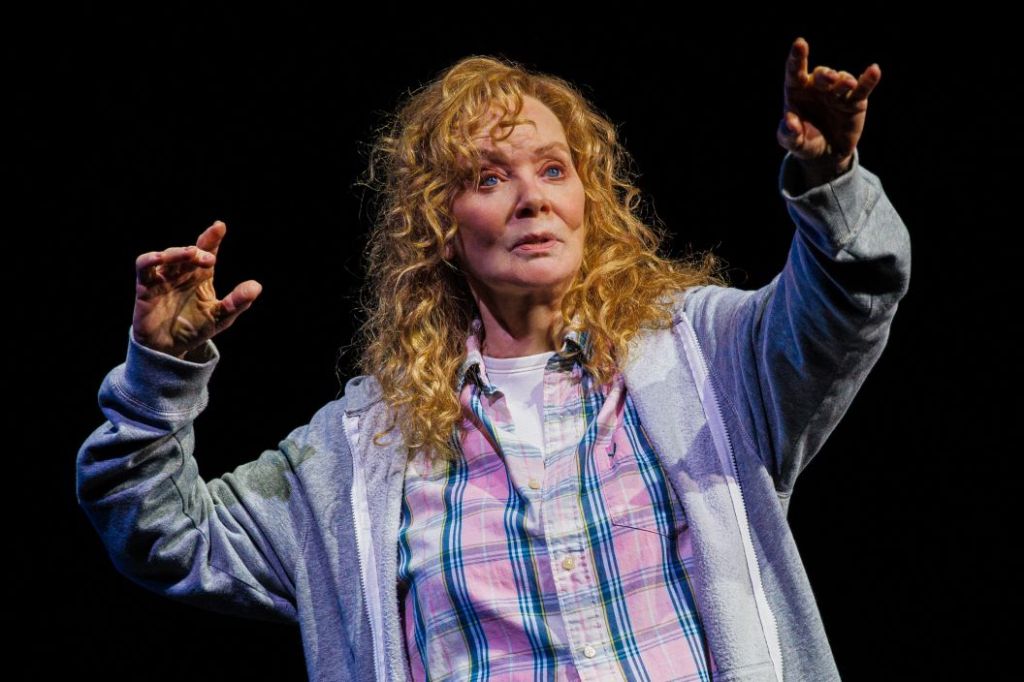
It was a wise casting choice to engage Jean Smart for Call Me Izzy, written by Jamie Wax. Call Me Izzy currently runs at Studio 54 until August 17th. The beloved “Hacks” star, a Six-time Emmy Award winner and Tony nominee is drawing fans who are delighted to see her after a two-decade absence from Broadway.
The 90-minute play is aptly shepherded with fine pacing and staging by Sarna Lapine. This is especially so once Izzy moves from the bathroom where she is forced to write in secrecy. The director’s collaboration with Smart and the technical team reveal a woman’s life under siege in a horrific marriage.
With supporting lighting effects by Donald Holder, compressed interior scenic design and haunting, exterior forest projection by Mikiko Suzuki MacADAMS, the production is nuanced and profound. Though the play does feel contrived in its development, overall, the production is memorable for Smart’s performance and the technical elements that highlight the play’s themes. Even Smart’s costumes (long flannel shirts and jeans by Tom Broecker) and the original music composition by T Bone Burnett and David Mansfield cohere with the characterization and suggest the South.
Smart portrays Izzy in a moment-to-moment solo performance. She takes on the voices of various characters as she relates Izzy’s story. Throughout, Smart shimmers as a powerhouse of feeling, evoking empathy and emotion. Though at times the accent she uses wasn’t clear, (Beth Lake’s sound design), enough of the humor broke through. Smart’s illuminating portrayal of the Louisiana poet who lives in a trailer park with a mean, abusive husband, did override any artificiality that distracted me.
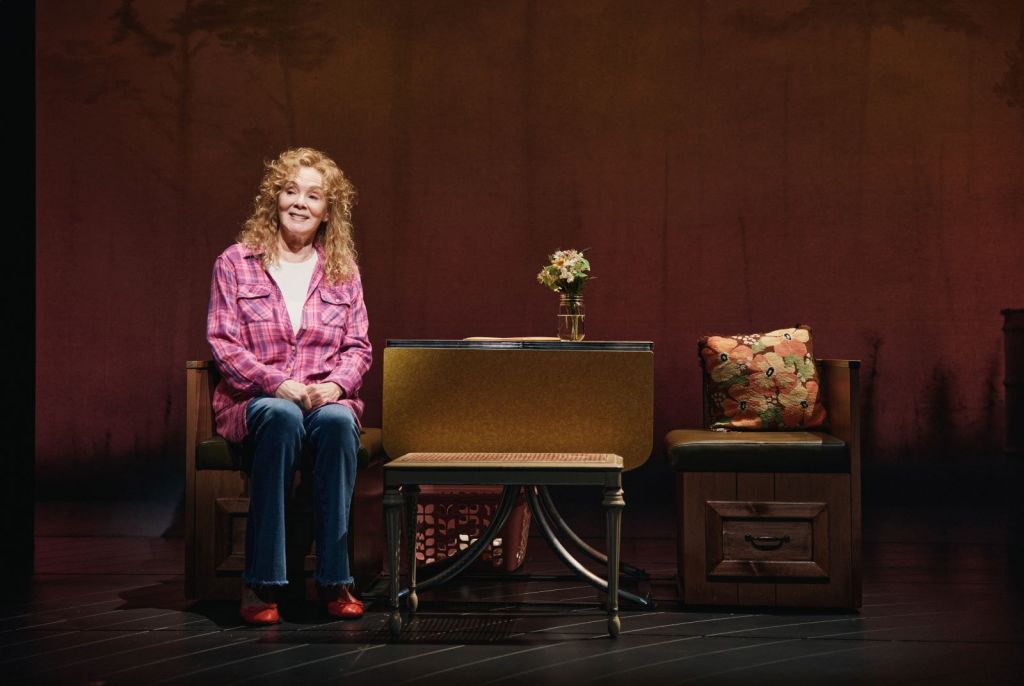
Nevertheless, because of the setting and background details, one can easily figure out the direction of events after the first fifteen minutes. Additionally, the play’s predictability and Izzy’s self-victimization, provoked when she stays with the violent Ferd for years, strain one’s patience. Thank goodness for the talented Jean Smart whose affability and humility lead one to hope for Izzy, despite knowing what the inevitable, dire conclusion will be.
As a housewife in rural Louisiana in 1989, Izzy adores writing, even though it must be in secret away from Ferd’s prying eyes. With exuberance she explains her first inspiration to write, her high school teacher who encouraged her, and a neighbor who takes her to a nearby library where Izzy reads Shakespeare and writes a sonnet. Over the years she fills her journals which she hides away in a back closet because Ferd despises such “uppity ways.” Clearly, as his possession she must remain on his intellectual level. Thus, he prevents her attending college though it might improve their lives. And a monetary award she wins to pursue a writing residency is her curse to be punished, not their blessing.
Izzy writes to express her feelings. Married to Ferd since her 17th birthday, initially they enjoyed each other, prospered and moved to a more upscale trailer park abutting a forest. As Izzy discusses their relationship we note that he gradually meets her attempt to establish her identity through poetry with violence. Tip-toeing around Ferd, Izzy learns to live an inner life apart from him. Whenever she or others inadvertently reveal her talents, Ferd takes offense. He interprets her work as treason and beats her. At a particularly crucial turning point, he takes all of her journals and burns them. He forces her to watch her words, which symbolize her lifeblood, “go up in smoke.” Izzy says with his act he has killed her.
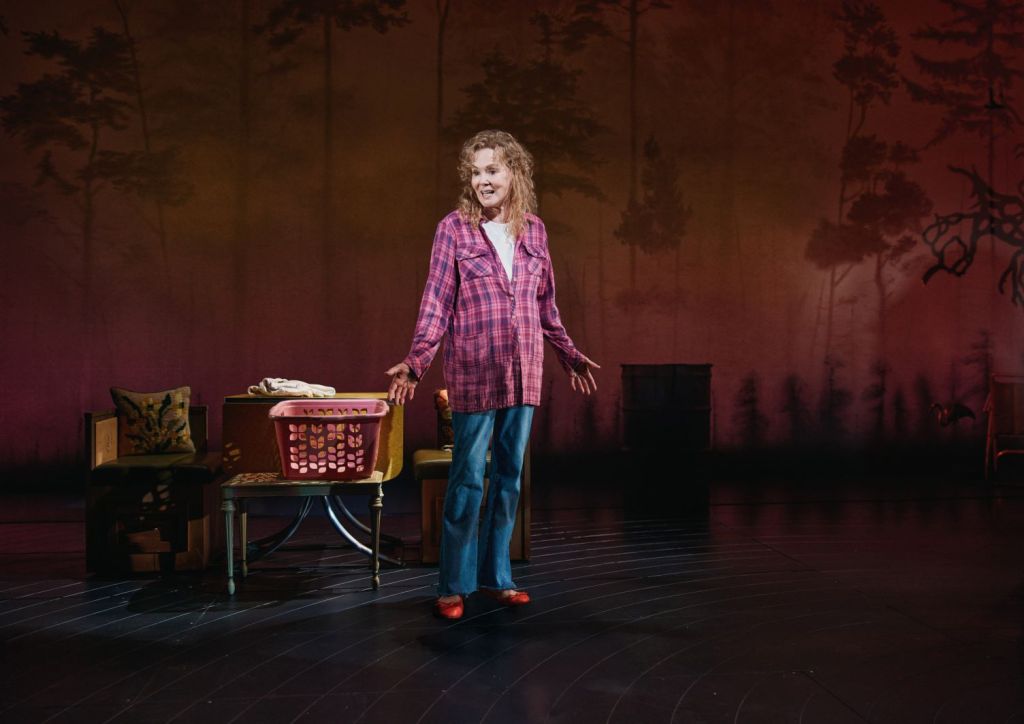
Ferd controls. Izzy lets him believe he is the lord and master, and she bows to his every whim. What sustains her? The inner resilience she receives by writing poetry.
Izzy persists after he burns her journals. Covertly, she evolves herself, her reading and writing. It is why she is in the bathroom discussing the blue tablets she puts in the toilet tank at the top of the play. She shows us how she writes in the bathroom of the cramped trailer. In fact a good deal of the play takes place in the bathroom where she can be alone in quiet to write, think and speak to us.
Mikiko Suzuki MacAdams’ scenic design aptly walls off a bathroom and squeezes in an oversized toilet with a lid that serves as a “table” where Izzy writes on toilet paper. The sonnet and other poems are wadded up and hidden in a Tampax box in a cabinet. The toxically masculine Ferd would never look there. The irony of the bathroom setting is a wonderful touch. In its small space Izzy finds the solace of her wide imagination.
Unfortunately, her writing is not enough. Izzy is a product of the folkways of her culture and her upbringing. Unable to escape them they influence her final actions at the play’s conclusion.
The subject matter of Call Me Izzy is important now more than ever. However, Izzy’s passivity is difficult to experience. It is why, when Smart’s Izzy expresses an interest in leaving Ferd, the audience cheers her on. Too little, too late; we must be tortured by Izzy’s last choice which leaves an uncertain ending.
Call Me Izzy runs 1 hour 30 minutes through August 17th at Studio 54. callmeizzyplay.com.
I
‘Van Gogh’s Flowers’ at New York Botanical Garden is Magnificent




Van Gogh’s Flowers (May 24 through October 26, 2025)
Vincent van Gogh needs no introduction to art lovers. Happily, for them and even for those not acquainted with the iconic painter, the New York Botanical Garden’s spring exhibit Van Gogh’s Flowers is stunning. The memorable exhibit celebrates the work of the Dutch painter who decided to become an artist at 27-years-old.



His was a decision that changed his life and the art world forever, according to the Vincent Van Gogh Museum in its discussion of Van Gogh’s life and journey toward the elusive greatness he never was able to realize while he was alive. Van Gogh’s Flowers runs from May 24 through October 26, 2025. The exhibit is not to be missed, principally because it highlights the way Van Gogh captured still lifes of flowers through his unique expression of color, light and form.

Reading through the stories of Van Gogh listed with various paintings on the Van Gogh Museum’s website, one is able to discover interesting facts about the junction of Van Gogh’s life and work. On the subject of flowers, the museum contains some of his floral still lifes. It’s fun to compare them with the specific paintings that inspired artists Amie J. Jacobsen, Graphic Rewilding’s Catherine Borowski and Lee Baker, and immersive artist, Cyril Lancelin.


All three contemporary artists contribute to the NYBG exhibit Van Gogh’s Flowers using their own mediums of expression.

Visiting NYBG Van Gogh’s Flowers, one will want to read all of the signage with the quotes Van Gogh spoke during his lifetime to learn more about the mythic painter. The signage also pinpoints the designs of the featured artists found in the Enid A Haupt Conservatory walkways, in the indoor and outdoor reflecting pools and in the great plaza lawn. Van Gogh’s influence on them and on artists globally is a study in genius and the immutable verities that touch humanity and ground it in the pleasure of beauty and nature to move our souls out of ourselves into another way of being and consciousness.

Apparently, along his journey, Van Gogh painted flowers as a commercial venture, as he heard that such paintings were popular and lucrative. In Paris Van Gogh painted over 35 still life paintings of flowers, hoping that they would sell.


However, he had little luck selling them even though paintings of flowers were trending. His brother Theo wrote to their mother telling her that to help him, acquaintances would bring flowers for Van Gogh to paint every week.

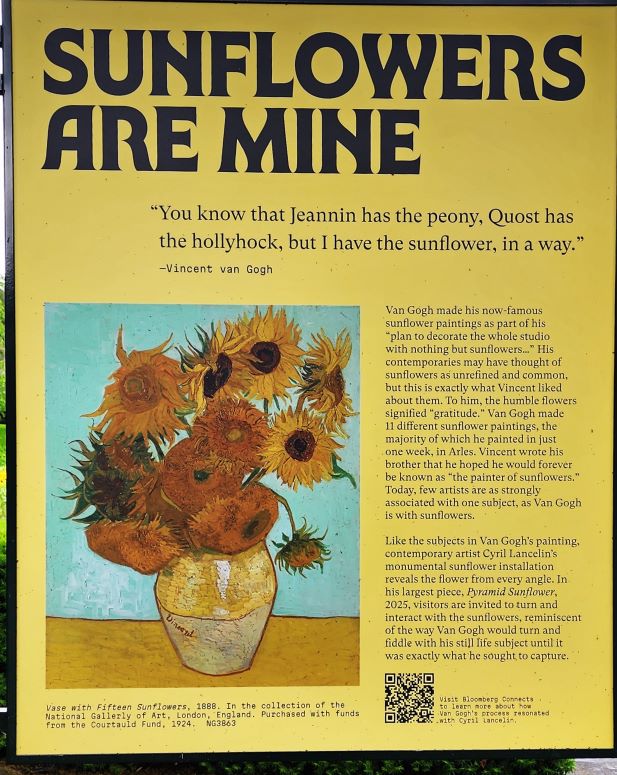
After he ventured to the South of France, Van Gogh, whose intellect and mentality were always fragile, had a breakdown. It took him about a year to recover in a sanatorium at Saint-Rémy-de-Provence where he painted scenes he saw from his room. Interestingly, he didn’t paint the bars on the windows, perhaps signifying that in his creative spirit he was free as he was in his paintings as his mode of expression. Before and after recovering from his extended illness Van Gogh painted sunflowers (in Arles nearby), which to him symbolized gratitude. He used the color yellow extensively delighting in it. These and other details are found on the signage of the NYBG exhibit.

The NYBG exhibit features a placard of Van Gogh’s painting of the courtyard of the hospital at Saint-Rémy-de-Provence where Van Gogh found rest and recuperated as best he could. The showcase rotunda of the Enid A. Haupt conservatory features a reflection of Van Gogh’s courtyard painting with a similar structure suggested and the amazing plantings which are in a circular arrangement segmented florally like the spokes of a wheel. Just breathtaking.

At the Garden, the paintings that inspired the artists Amie J. Jacobsen, Catherine Borowski and Lee Baker, and Cyril Lancelin are brought to life situated in gorgeous botanical displays along with the contemporary artists’ work.

Thanks to Cyril Lancelin, visitors can walk along a pathway that meanders through plantings of real and sculptured sunflowers (by Lancelin), a symbolic reflection of what Van Gogh found healing and restorative. For him sunflowers meant “gratitude.”



Vincent left the mental hospital in May 1890, he headed north to Auvers-sur-Oise. He met several artists there and continued painting fields, always using his beloved yellow. Then, one day in agitation, the story goes, he shot himself in a wheat field and died of his wounds some days later.

Van Gogh’s incredible legacy was a large body of art works: over 850 paintings and almost 1,300 works on paper. Visitors to NYBG’s Van Gogh’s Flowers will come to a new appreciation of how the natural world inspired Van Gogh. Most museums boast at least two or three of Van Gogh’s paintings which at auction command millions of dollars. In 1987 one version of Sunflowers sold for $37. 85 million. Today, those in the art world suggest the sunflower series of paintings would be in the hundreds of millions.


This amazing NYBG exhibit is a complete celebration of Van Gogh reflected in all of its programming. Complementary daytime programming on select dates during Van Gogh’s Flowers will offer engaging, interactive experiences, such as “Plein Air Drop-In and Paint,” engaging NYBG visitors’ creativity.
On select dates, Starry Nights will offer exhibition viewing in the glow of evening, with music and performers, drinks and food available for purchase. Conditions-permitting, after-dark Van Gogh-themed drone shows will take place on May 30, 31st and June 6th. These shows are New York City’s first at a cultural institution—bringing Starry Night to life before your eyes.
Finally, visitors can immerse themselves in the LEGO Botanical Garden pop-up. They can enjoy the hands-on make-and-take experience including a mini-Van Gogh sunflower creation.
For more information about this wonderful show and programming during the exhibit, go to the website, https://www.nybg.org/event/van-goghs-flowers/?gad_source=1&gad_campaignid=22428050313
 CAROLE DI TOSTI